

Article

Fixed Point Results in Extended ℱ-Metric Spaces with Applications to Caputo Fractional Differential Equations

Department of Mathematics and Statistics, Faculty of Science, University of Jeddah, P.O. Box 80327, Jeddah 21589, Saudi Arabia
Fractal Fract. 2026, 10(4), 261; https://doi.org/10.3390/fractalfract10040261
Submission received: 25 February 2026 / Revised: 31 March 2026 / Accepted: 2 April 2026 / Published: 15 April 2026
(This article belongs to the Section Numerical and Computational Methods)

Abstract

The purpose of this research work is to propose and develop the notion of α , ψ -contractions in the setting of extended F -metric spaces and to establish corresponding fixed point results. Using these results, we derive fixed point results for graphic contractions in extended F -metric spaces as well as for mappings in partially ordered extended F -metric spaces. To demonstrate the validity and novelty of the proposed results, a non-trivial example is provided. Moreover, the constructed framework serves as a tool to investigate the existence of solutions for Caputo fractional differential equations, thereby highlighting both its effectiveness and practical significance.

1. Introduction

Metric spaces (MSs) [1] provide an essential framework in the theory of fixed points (FPs), offering a rigorous way to measure distances and study convergence properties of sequences. The concept of a MS forms a foundational building block in mathematics and is continually being generalized to capture more complex structures and behaviors. Over the years, several extensions of MSs have been introduced to relax or modify the classical triangle inequality, allowing for a wider class of mappings to be analyzed. These generalizations have proved particularly useful in establishing the existence and uniqueness of FPs under various contractive conditions, accommodating both classical and non-classical operators. Among these generalizations, Bakhtin [2] introduced a notable extension, later formalized by Czerwik [3] in 1993 as the b-MS, where the classical triangle inequality is relaxed by incorporating a constant factor s 1 . This development led to novel analytical approaches and practical applications. Fagin et al. [4] subsequently defined the concept of an s-relaxedp MS as a generalization of a b-MS and MS. Khamsi et al. [5] further explored this idea under the framework of metric-type spaces, establishing several FP results within that context. Branciari [6] contributed an additional generalization by introducing the rectangular MS, in which the triangle inequality is replaced by a broader rectangular inequality involving four points. Building on these developments, Jleli et al. [7] proposed the F -MS, a unified framework that encompasses metric, b-metric, and rectangular spaces. More recently, Panda et al. [8] introduced the extended F -MS ( EF -MS), which expands the conventional F -metric by offering enhanced flexibility in defining the distance function, thereby enabling the study of a broader class of mappings and operators.
Motivated by the progressive generalizations of MSs, a central objective has been to extend fundamental results of FP theory to more general and adaptable settings. In this context, the Banach contraction principle (BCP) [9] remains one of the earliest and most significant results, ensuring the unique FP of self-mappings that satisfy a contraction condition. In 2004, Ran et al. [10] introduced an FP theorem for mappings on partially ordered MSs, extending the classical BCP. They observed that many real-world problems, such as matrix equations, naturally involve both a metric and an order structure. Their main idea was to combine these two frameworks by considering monotone and contractive mappings in ordered spaces. The authors proved that such mappings admit FPs and demonstrated the usefulness of this result through applications to matrix equations. In 2008, Jachymski [11] proposed the concept of graphic contractions in MSs equipped with a directed graph. This idea was motivated by the fact that many mappings encountered in applied sciences inherently respect certain relational structures that cannot be fully described within the standard metric setting. By incorporating a graph representation on the given set, Jachymski [11] was able to unify and generalize several existing FP results, notably extending the BCP to settings where the contraction condition is imposed only to connected vertices in the graph, not to all elements of the space. In their 2012 paper, Samet et al. [12] introduced the concept of ( α - ψ ) -contractive-type mappings to generalize the Banach contraction principle. They combined a control function ψ and an admissibility function α to define a broader class of contractions. Their results established new FP theorems in complete MSs, extending and unifying many existing FP results in the literature. Samreen et al. [13] extended the concept of ( α - ψ ) -contraction to graphs and established a corresponding FP theorem. Wu et al. [14] generalized this notion by defining a new class of mappings in the context of b-MSs. They then established FP theorems for such mappings in complete b-MSs, under suitable admissibility and iterative-sequence conditions. Later on, Hussain et al. [15] defined the notion of ( α - ψ ) -contraction in the framework of F -MSs and proved some generalized FP theorems. Al-Mezel et al. [16] extended this notion to ( α β - ψ ) -contraction in F -MSs and solved the nonlinear neutral differential equations with their main result. Additional results and related discussions on this topic are available in [17,18].
This investigation is concerned with the study of the EF -MSs and establishing a collection of novel FP results for α , ψ -contraction mappings. Extending from these insights, we establish FP theorems for graphic contractions in EF -MSs and for mappings defined on partially ordered EF -MSs. To illustrate the originality and applicability of the results, a non-trivial example is included. Additionally, the theoretical framework is employed to examine the existence of solutions to Caputo fractional differential equations, emphasizing its practical relevance and effectiveness.
The remainder of this paper is structured as follows. Section 2 outlines the necessary preliminaries, including the fundamental concepts of MSs, b-MS, s-relaxedp MSs, F -MSs, and EF -MSs. Section 3 is devoted to the core theoretical contributions, where the idea of α , ψ -contractions in EF -MSs is introduced and the corresponding FP theorems are established, extending and unifying several existing findings. In Section 4, we present FP theorems for graphic contractions in EF -MSs, as well as for mappings defined on partially ordered EF -MSs. Section 5 demonstrates the applicability of the developed results by addressing Caputo fractional differential equations, thereby emphasizing the practical relevance of the proposed framework.

2. Preliminaries

We start this section by introducing the core definitions, preliminary lemmas, and essential ideas that support the core findings that follow.
Fréchet [1] originally introduced the notion of a MS in this fashion.
Definition 1
([1]). Let . A function d : × [ 0 , ) is said to be a metric on ℧ if it satisfies the following properties:
( m s 1 ) d ( σ , ν ) 0 and d ( σ , ν ) = 0 σ = ν ;
( m s 2 ) d ( σ , ν ) = d ( ν , σ ) ,
( m s 3 ) d ( σ , z ) d ( σ , ν ) + d ( ν , z ) , σ , ν , z .
The structure ( , d ) is then called an MS.
Stefan Banach [9] constructed the celebrated BCP, which serves as a primary result in FP theory. This principle is significant because it offers a straightforward but robust condition ensuring the existence and uniqueness of FPs. It has also paved the way for a wide range of applications in analysis, as well as in differential and integral equations. For the results that follow, we assume that ( , d ) is a complete MS, forming the bedrock for extensions to more general and extended metric frameworks.
Theorem 1
([9]). Let ( , d ) be a complete MS, and let B : . If there exists a constant λ [ 0 , 1 ) , such that
d ( B σ , B ν ) λ d ( σ , ν ) ,
for all σ , ν , then B admits a unique FP.
To broaden the classical BCP to include order-theoretic structures, Ran et al. [10] introduced the notion of a partially ordered MS, in which both the metric and the partial order are jointly used to investigate the existence of FPs.
Let ( , ) be a partially ordered set (poset), where the binary relation ⪯ satisfies
  • Reflexivity: σ σ for all σ .
  • Antisymmetry: if σ ν and ν σ , then σ = ν .
  • Transitivity: if σ ν and ν z , then σ z .
Definition 2.
A B : is said to be non-decreasing if
σ ν B σ B ν
for all σ , ν .
Ran et al. [10] established the following result.
Theorem 2
([10]). Let ( , d ) be a complete MS endowed with a partial order. Let B : be a continuous and non-decreasing mapping with respect to. Suppose that there exists some constant λ [ 0 , 1 ) , such that
d ( B σ , B ν ) λ d ( σ , ν ) ,
for all σ , ν , with σ ν . If there exists some σ 0 , such that σ 0 B σ 0 , then B admits an FP.
Jachymski [11] introduced the concept of a graphic contraction, which incorporates the edge-preserving property of a directed graph.
By a directed graph, we mean a pair G = V , E with V (vertices) and E V × V (directed edges). A path from a vertex σ to a vertex ν of length N N is a sequence { σ i } i = 0 N of N + 1 vertices, such that σ 0 = σ , σ N = ν and ( σ i 1 ,   σ i ) E ( G ) , i = 1 , , N . A directed graph G is said to be weakly connected; when the direction of all edges is ignored, the resulting undirected graph is connected. In other words, for any two vertices σ and ν in G, there exists a path (ignoring edge directions) that links σ to ν .
Jachymski [11] proved the following result.
Theorem 3
([11]). Let ( , d ) be a complete MS along with the directed graph G = , E ( G ) and B : . Assume that
(a) B is edge-preserving; that is, for all σ , ν with ( σ , ν ) E ( G ) , we have ( B σ , B ν ) E ( G ) ;
(b) There is a λ ( 0 , 1 ) , such that, σ , ν with ( σ , ν ) E ( G ) , we have
d ( B σ , B ν ) λ d ( σ , ν ) .
Suppose further that the graph G is weakly connected and there exists at least one point σ 0 , such that ( σ 0 , B σ 0 ) E ( G ) . Then B admits a unique FP.
Samet et al. [12] introduced the concepts of α -admissible and α - ψ -contractive mappings, establishing several FP theorems for such mappings in complete MSs in 2012.
Let Ψ denote the family of all non-decreasing functions ψ : [ 0 , + ) [ 0 , + ) satisfying
n = 1 ψ n ( ι ) < + , ι > 0 ,
where ψ n denotes the n-th iterate of ψ .
The following lemma plays an essential role in the developments that follow.
Lemma 1.
If ψ Ψ , then these are satisfied:
(i) ( ψ n ( ι ) ) n N converges to 0 as n , ι ( 0 , + ) ;
(ii) ψ ( ι ) < ι for all ι > 0 ;
(iii) ψ ( ι ) = 0 if, and only if, ι = 0 .
Samet et al. [12] introduced the notion of α -admissible mappings in this way:
Definition 3.
Let B : and α : × [ 0 , + ) . A self-mapping B is called α-admissible if it satisfies the condition
α ( σ , ν ) 1 α ( B σ , B ν ) 1 .
for all σ , ν .
Definition 4.
Let ( , d ) be an MS. A self-mapping B : is said to be an α-ψ-contractive mapping if there exists a function α : × [ 0 , + ) and a function ψ Ψ , such that
α ( σ , ν ) d ( B σ , B ν ) ψ d ( σ , ν ) ,
for all σ , ν .
According to Czerwik [3], a b-MS is defined in the following way:
Definition 5
([3]). Let and s 1 . A function d : × [ 0 , ) is considered as a b-metric if it satisfies the axioms ( m s 1 ) - ( m s 2 ) and
d ( σ , z ) s [ d ( σ , ν ) + d ( ν , z ) ] ,
σ , ν , z . The couple ( , d ) is called a b-MS.
It is evident that any MS becomes a b-MS when the parameter s = 1 , since the b-metric inequality then coincides with the standard triangle inequality. Hence, a b-MS extends the classical concept of an MS by permitting a controlled weakening of the triangle inequality through a constant s 1 .
Fagin et al. [4] proposed the following definition of an s-relaxedp-MS.
Definition 6
([4]). Let , and let d : × [ 0 , + ) satisfy the assertions ( m s 1 ) - ( m s 2 ) and suppose there exists a constant s 1 , such that, for any pair ( σ , ν ) × , for every natural number N N , N 2 , and ( σ i ) i = 1 N , with ( σ 1 , σ N ) = ( σ , ν ) , the following holds:
d ( σ , ν ) > 0 d ( σ , ν ) s i = 1 N 1 d ( σ i , σ i + 1 ) .
Consequently, ( , d ) is called an s-relaxedp-MS.
It is straightforward to see that every b-MS is an s-relaxedp-MS; however, the converse does not necessarily apply. In fact, for N = 2 , the defining inequality of s-relaxedp-MS reduces to the standard b-metric inequality, demonstrating that s-relaxedp-MSs provide a broader generalization of both metric and b-MSs. This relaxation allows the distance between two points to be bounded by the sum of distances along any finite sequence connecting them, offering a more flexible setting for analyzing FP results and convergence behavior in generalized MSs.
An influential extension of an MS, termed an F -MS, was given by Jleli et al. [7].
Let F be the family of continuous functions ς : ( 0 , + ) R that satisfy the following properties:
( F 1 )
For any 0 < s < ι , we have ς ( s ) ς ( ι ) ;
( F 2 )
For every sequence { ι n } ( 0 , + ) , lim n ι n = 0 lim n ς ( ι n ) = .
Definition 7
([7]). Let , and let d : × [ 0 , + ) . Let there be a pair ( ς , ω ) F × [ 0 , + ) , such that d satisfies the axioms ( m s 1 ) and ( m s 2 ) and in addition, the inequality below is satisfied by it.
For any pair ( σ , ν ) × and for every N N , with N 2 , let ( σ i ) i = 1 N satisfy ( σ 1 , σ N ) = ( σ , ν ) . Then
d ( σ , ν ) > 0 ς ( d ( σ , ν ) ) ς ( i = 1 N 1 d ( σ i , σ i + 1 ) ) + ω .
Considering these axioms, ( , d ) is called an F -MS.
It is important to note that the notion of an F -MS unifies and generalizes several previously studied distance structures. For instance, by taking ς ( ι ) = ln ι and ω = ln s , the above defining inequality reduces to that of an s-relaxedp-MS. Consequently, every s-relaxedp-MS is an F -MS; however, the reverse is not guaranteed. This illustrates that the F -metric framework offers a broader and more flexible generalization, providing a functional approach to distance control that includes both b-metric and s-relaxedp-MSs as special cases.
Panda et al. [8] defined the notion of an extended F -MS ( EF -MS) in this way.
Definition 8
([8]). Let , and d : × [ 0 , + ) . Suppose there exists ( ς , ω ) F × [ 0 , + ) , such that d fulfills the axioms ( m s 1 ) and ( m s 2 ) and in addition, there exists a function ρ : × [ 1 , + ) , so that, for any pair ( σ , ν ) × and any natural number N N , N 2 , if ( σ i ) i = 1 N is a sequence with ( σ 1 , σ N ) = ( σ , ν ) , the following inequality holds:
d ( σ , ν ) > 0 ς ( d ( σ , ν ) ) ς i = 1 N 1 d ( σ i , σ i + 1 ) j = 1 i ρ ( σ j , ν ) + ω .
This condition is commonly referred to as the ( m s E F 3 ) and ( , d ) is called an EF -MS.
This approach broadens the F -metric structure via the use of the control function ρ ( · , · ) . In particular, if ρ ( σ , ν ) = 1 for all σ , ν , then the EF -MS simplifies to an F -MS.
The EF -MS concept provides greater flexibility in modeling distances in generalized metric settings. Unlike the fixed control in F -metrics, the variable function ρ allows the space to accommodate non-uniform contributions from intermediate points along a chain connecting two elements. This makes EF -metrics capable of encompassing a wide range of previously studied structures, including classical MSs, b-MSs, s-relaxedp-MSs, and F -MSs.
By offering this extended and adaptable structure, an EF -MS serves as a robust framework for analyzing convergence, continuity, and FP results in more general and complex settings, thereby opening avenues for new theoretical developments and applications in nonlinear analysis and applied mathematics.
We now present an example originally provided by Panda et al. [8].
Example 1
([8]). Let = [ 0 , + ) . Define d : × [ 0 , + ) by
d ( σ , ν ) = | σ ν |
with ς ( ι ) = ln ( ι ) and ω = 0 , then ( , d ) is an EF -MS.
Further, we provide several other examples illustrating the concept of EF -MSs.
Example 2.
Let = { a , b , c , d } . Define d : × [ 0 , + ) by
d ( σ , ν ) =           0 , i f σ = ν ; 1 ,   i f ( σ , ν ) a , b , b , a , b , c , c , b , a , d , d , a       2 ,   i f ( σ , ν ) a , c , c , a , b , d , d , b ;         3 ,   i f ( σ , ν ) a , d , d , a .
Let ρ : × [ 1 , + ) be the constant ρ ( σ , ν ) = 1 ,   ( σ , ν ) × . Select ς F by
ς ( ι ) = ln ι , f o r ι > 0
so ς meets ( F 1 ) and ( F 2 ) and ω = 0 . Accordingly, ( , d ) forms an EF -MS.
Remark 1.
Clearly, every F -MS is also an EF -MS, though the reverse is not always true. In particular, if we set
ρ ( σ , ν ) = 1 , σ , ν ,
then the EF -metric condition ( D E 3 ) reduces to the EF -metric condition ( D F 3 ) . Therefore, the EF -MS concept serves as a proper generalization of the F -MS.
Definition 9
([8]). Let ( , d ) be an EF -MS and { σ n } be a sequence in . Then
(i) { σ n } is said to converge in the EF -sense to σ if the sequence { σ n } approaches σ with respect to the EF -metric d.
(ii) { σ n } is called an E -Cauchy when
lim n , m d ( σ n , σ m ) = 0 .
(iii) ( , d ) is said to be an E -complete if every E -Cauchy sequence in ℧ converges in the EF -sense to some point in ℧.

3. Main Results

In this section, we present the main results of the paper. We start by defining the notion of ( α , ψ ) -contractions in the background of EF -MSs and proceed to prove some FP results for these self-maps.
Definition 10.
Let , and ρ : × [ 1 , + ) be a control function. A function ψ : [ 0 , + ) [ 0 , + ) is called an extended comparison function if ψ satisfies the following conditions:
(i) ψ is decreasing;
(ii) i = n ψ i ( ι ) j = 1 i ρ ( σ j , σ m ) < + , ι > 0 , and for any sequence { σ n } defined by σ n + 1 = B σ n , n N , m N and ψ i denotes the i-iterate of ψ .
The set of all extended comparison functions is denoted by Ψ .
Definition 11.
Let ( , d ) be an EF -MS. A self-mapping B : is said to be an ( α , ψ ) -contraction if there exists a function α : × [ 0 , + ) and a function ψ Ψ , such that
α ( σ , ν ) d ( B σ , B ν ) ψ d ( σ , ν ) ,
for all σ , ν .
We now present a key property that plays a crucial role in our main result.
( P α ) -property: If { σ n } is a sequence such that σ n σ as n with α ( σ n , σ n + 1 ) 1 , it follows that α ( σ n , σ ) 1 , ∀ n N .
With these ideas in mind, we first formalize the concept of an ( α , ψ ) -contraction in EF -MSs, followed by the ( P α ) -property for sequences, and finally present the main FP theorem.
Theorem 4.
Let ( , d ) be an E -complete EF -MS, and let B : be an ( α , ψ ) -contraction which is also an α-admissible mapping. Assume the following conditions hold:
(i) There exists σ 0 , such that α ( σ 0 , B σ 0 ) 1 .
(ii) For σ 0 , the sequence { σ n } defined by σ n + 1 = B σ n , n N satisfies
sup m 1 lim n ψ n + 1 ( ι ) ψ n ( ι ) ρ ( σ n , σ m ) < 1 ,
for ι > 0 and ψ n denotes the n-iterate of comparison function ψ .
(iii) Either B is continuous, or the ( P α ) -property holds.
Then B admits an FP.
(iv) Moreover, if for every σ , ν with α ( σ , ν ) 1 , there exists z , such that α ( σ , z ) 1 and α ( ν , z ) 1 , then the FP of B is unique.
Proof. 
Let σ 0 with α ( σ 0 , B σ 0 ) 1 . Define
σ n + 1 = B σ n
n N . If for some n 0 N ,   σ n 0 + 1 = σ n 0 , then σ n 0 is an FP of mapping B . Otherwise, assume σ n + 1 σ n , for all n N . Now α ( σ 0 , B σ 0 ) 1 implies that α ( σ 0 , σ 1 ) 1 . Since B is an α -admissible mapping, we get
α ( B σ 0 , B σ 1 ) 1 ,
that is, α ( σ 1 , σ 2 ) 1 . By induction, we get
α ( σ n , σ n + 1 ) 1
for all n N . By inequality (2), we have
d ( σ n , σ n + 1 ) = d ( B σ n 1 , B σ n ) α ( σ n 1 , σ n ) d ( B σ n 1 , B σ n ) ψ d ( σ n 1 , σ n ) ,
and by repeated application,
d ( σ n , σ n + 1 ) ψ n d ( σ 0 , σ 1 ) ,
for all n N . By ( m s E F 3 ) , we have
ς d ( σ n , σ m ) ς i = n m 1 d ( σ i , σ i + 1 ) j = 1 i ρ ( σ j , σ m ) + ω ,
for m > n . Since
i = n m 1 d ( σ i , σ i + 1 ) j = 1 i ρ ( σ j , σ m ) = ρ ( σ 1 , σ m ) ρ ( σ 2 , σ m ) ρ ( σ n , σ m ) d ( σ n , σ n + 1 ) + ρ ( σ 1 , σ m ) ρ ( σ 2 , σ m ) ρ ( σ n + 1 , σ m ) d ( σ n + 1 , σ n + 2 ) + ρ ( σ 1 , σ m ) ρ ( σ 2 , σ m ) ρ ( σ m 1 , σ m ) d ( σ m 1 , σ m ) .
With the help of the inequality (4), we derive
i = n m 1 d ( σ i , σ i + 1 ) j = 1 i ρ ( σ j , σ m ) ρ ( σ 1 , σ m ) ρ ( σ 2 , σ m ) ρ ( σ n , σ m ) ψ n d ( σ 0 , σ 1 ) + ρ ( σ 1 , σ m ) ρ ( σ 2 , σ m ) ρ ( σ n + 1 , σ m ) ψ n + 1 d ( σ 0 , σ 1 ) + ρ ( σ 1 , σ m ) ρ ( σ 2 , σ m ) ρ ( σ m 1 , σ m ) ψ m 1 d ( σ 0 , σ 1 ) = i = n m 1 ψ i d ( σ 0 , σ 1 ) j = 1 i ρ ( σ j , σ m ) i = n ψ i d ( σ 0 , σ 1 ) j = 1 i ρ ( σ j , σ m )
By inserting (6) into (5) and using ( F 1 ), we obtain
ς d ( σ n , σ m ) ς i = n m 1 d ( σ i , σ i + 1 ) j = 1 i ρ ( σ j , σ m ) + ω ς i = n ψ i d ( σ 0 , σ 1 ) j = 1 i ρ ( σ j , σ m ) + ω
Let A i , m = ψ i d ( σ 0 , σ 1 ) j = 1 i ρ ( σ j , σ m ) . Then
A i + 1 , m A i , m = ψ i + 1 d ( σ 0 , σ 1 ) ψ i d ( σ 0 , σ 1 ) ρ ( σ i + 1 , σ m ) .
In view of the assumed condition (ii), we have
sup m 1 lim n ψ n + 1 ( d ( σ 0 , σ 1 ) ) ψ n ( d ( σ 0 , σ 1 ) ) ρ ( σ n + 1 , σ m ) < 1 .
Thus, there exists N N , such that for all i N and for all m 1 ,
A i + 1 , m A i , m < η
for some η ( 0 , 1 ) . Therefore, by the ratio test, the series
i = n ψ i d ( σ 0 , σ 1 ) j = 1 i ρ ( σ j , σ m )
is convergent. Consequently, there exists N N , such that
0 < i = n ψ i d ( σ 0 , σ 1 ) j = 1 i ρ ( σ j , σ m ) < δ ,
for m > n N . Now, let ( ς , ω ) F × [ 0 , + ) , such that ( m s E F 3 ) is satisfied. Let ϵ > 0 be fixed. By ( F 2 ), there exists δ > 0 , such that
0 < ι < δ ς ( ι ) < ς ( ϵ ) ω .
Now by (8) and (9), we have
ς i = n m 1 d ( σ i , σ i + 1 ) j = 1 i ρ ( σ j , σ m ) ς i = n ψ i d ( σ 0 , σ 1 ) j = 1 i ρ ( σ j , σ m ) < ς ( ϵ ) ω ,
for m > n N . Hence, by (7) and (10), we have
d ( σ n , σ m ) > 0 ς d ( σ n , σ m ) ς i = n m 1 d ( σ i , σ i + 1 ) j = 1 i ρ ( σ j , σ m ) + ω < ς ( ϵ ) .
This demonstrates, using condition ( F 1 ), that
d ( σ n , σ m ) < ϵ ,
for all m > n N , showing that { σ n } is E -Cauchy. Given that ( , d ) is E -complete, there is a point σ * such that the sequence { σ n } E -converges to σ * in the sense of an EF -metric; that is,
lim n d ( σ n , σ * ) = 0 .
Assume that B is continuous. Taking the limit as n in (3) and using (11), we get
σ * = lim n σ n + 1 = lim n B σ n = B lim n σ n ,
that is, σ * is an FP of B . In addition, if the sequence { σ n } is such that σ n σ * as n and α ( σ n , σ n + 1 ) 1 , then by the ( P α ) -property, we obtain α ( σ n , σ * ) 1 , ∀ n N . By (2), we have
d ( B σ n , B σ * ) α ( σ n , σ * ) d ( B σ n , B σ * ) ψ ( d σ n , σ * ) .
By the triangle inequality ( m s E F 3 ) , we have
ς ( d ( σ * , B σ * ) ) ς d ( σ * , σ n + 1 ) ρ ( σ * , B σ * ) + d ( σ n + 1 , B σ * ) ρ ( σ * , B σ * ) ρ ( σ * , σ n + 1 ) + ω = ς d ( σ * , σ n + 1 ) ρ ( σ * , B σ * ) + d ( B σ n , B σ * ) ρ ( σ * , B σ * ) ρ ( σ * , σ n + 1 ) + ω ς d ( σ * , σ n + 1 ) ρ ( σ * , B σ * ) + ψ ( d σ n , σ * ) ρ ( σ * , B σ * ) ρ ( σ * , σ n + 1 ) + ω .
By Lemma 1 (ii), we know that
ψ ( d σ n , σ * ) < d σ n , σ * .
Therefore, inequality (12) yields
ς ( d ( σ * , B σ * ) ) ς d ( σ * , σ n + 1 ) ρ ( σ * , B σ * ) + d σ n , σ * ρ ( σ * , B σ * ) ρ ( σ * , σ n + 1 ) + ω .
By the continuity of the function ς and the fact that σ n σ * as n , we obtain
lim n ς d ( σ * , σ n + 1 ) ρ ( σ * , B σ * ) + d σ n , σ * ρ ( σ * , B σ * ) ρ ( σ * , σ n + 1 ) + ω = .
So, by (13) and ( F 2 ), we have d ( σ * , B σ * ) = 0 , i.e., σ * = B σ * . Thus, σ * is an FP of B . Suppose that σ * and σ / are two FPs of mapping B , then by the assumption (iv), there exists z , such that
α ( σ * , z ) 1 and α ( σ / , z ) 1 .
Since B is an α -admissible mapping,
α ( σ * , B z ) = α ( B σ * , B z ) 1 and α ( σ / , B z ) = α ( B σ / , B z ) 1 .
By induction, we get
α ( σ * , B n z ) 1 and α ( σ / , B n z ) 1 ,
for all n N . By (2) and (14), we have
d ( σ * , B n z ) = d ( B σ * , B B n 1 z ) α ( σ * , B n 1 z ) d ( B σ * , B B n 1 z ) ψ d ( σ * , B n 1 z ) ,
that is,
d ( σ * , B n z ) ψ d ( σ * , B n 1 z ) ,
for all n N . Similarly,
d ( σ * , B n 1 z ) = d ( B σ * , B B n 2 z ) α ( σ * , B n 2 z ) d ( B σ * , B B n 2 z ) ψ d ( σ * , B n 2 z ) ,
that is,
d ( σ * , B n 1 z ) ψ d ( σ * , B n 2 z ) ,
for all n N . It follows that by (15) and (16), we have
d ( σ * , B n z ) ψ 2 d ( σ * , B n 2 z ) ,
for all n N . By induction, we have
d ( σ * , B n z ) ψ n d ( σ * , z ) ,
for all n N . Taking the limit as n + in inequality (17), we have
B n z σ * .
Similarly, using (2) and (14), we can prove that
B n z σ / .
Using (18) and (19), the uniqueness of the limit gives us σ * = σ / . Thus, the FP is unique. □
Example 3.
Let = R . Define the EF -metric d : × R + by
d ( σ , ν ) = σ ν ,
σ , ν and the function ρ : × [ 1 , + ) by ρ ( σ , ν ) = 1 + σ + ν . Then ( , d ) is an EF -MS with ς ( ι ) = ln ι for ι > 0 and ω = 0 . Then ( , d ) is an EF -MS. Moreover, since the real numbers R are complete under the metric defined above, ( , d ) is E -complete. Define the mapping B : by
B σ = 3 σ 8 3 , i f σ > 1 σ 3 , i f 0 σ 1 0 , i f σ < 0 .
At first, we observe that the BCP cannot be applied in this case since we have
d ( B 1 , B 2 ) = 3 > 1 = d ( 1 , 2 ) .
Now, we define the mapping α : × [ 0 , + ) by
α ( σ , ν ) = 1 , i f σ , ν 0 , 1 , 0 , otherwise
and ψ ( ι ) = 1 3 ι , for ι > 0 . If α ( σ , ν ) = 0 , the left side is 0 and the inequality (2) holds trivially. If α ( σ , ν ) = 1 , then σ , ν 0 , 1 . On 0 , 1 , we have B σ = 1 3 . Hence,
α ( σ , ν ) d ( B σ , B ν ) = σ 3 ν 3 = 1 3 σ ν = ψ d ( σ , ν ) .
Thus, B is an ( α , ψ ) -contraction. To verify that B is α-admissible, consider any σ , ν for which α ( σ , ν ) 1 . This condition ensures that σ , ν 0 , 1 . Then, according to the definitions of B and α , we obtain the following:
B σ = σ 3 0 , 1 and B ν = ν 3 0 , 1 ,
then α ( B σ , B ν ) = 1 . Therefore, B is α-admissible. Take σ 0 = 1 . Then B σ 0 = 1 3 and
α ( σ 0 , B σ 0 ) = α ( 1 , 1 3 ) = 1 .
So hypothesis (i) is satisfied. Since ψ ( ι ) = 1 3 ι for ι > 0 , ψ n ( ι ) = 1 3 n ι . Then
ψ n + 1 ( ι ) ψ n ( ι ) = 1 3 < 1 .
Let { σ n } be the sequence given by
σ n + 1 = B σ n .
Starting from σ 0 = 1 ,
σ n = 1 3 n .
The graphical illustration of the convergence behavior of the iterative sequence { σ n } for different initial values σ 0 = 0.1 , 0.5 and 1 is illustrated in Figure 1. The numerical values of sequence for these initial values are presented in Table 1, confirming the rapid convergence of the sequence to the fixed point.
Hence,
ρ σ n , σ m = 1 + σ n + σ m = 1 + 1 3 n + 1 3 m .
Therefore,
lim n ψ n + 1 ( ι ) ψ n ( ι ) ρ ( σ n , σ m ) = 1 3 1 + 1 3 m .
Taking the supremum over m 1 ,
sup m 1 lim n ψ n + 1 ( ι ) ψ n ( ι ) ρ ( σ n , σ m ) = sup m 1 1 3 1 + 1 3 m = 1 3 1 + 1 3 = 4 9 < 1 .
So condition (ii) is also satisfied. The mapping B defined in (20) is continuous on each interval and continuous at the boundary points 0 and 1. Hence, B is continuous. Therefore, condition (iii) holds. For any σ , ν 0 , 1 , choose z = 1 . Then
α ( σ , z ) = 1 , α ( ν , z ) = 1 .
Hence, condition (iv) is satisfied. Thus, all hypotheses of Theorem 4 are satisfied and B has an FP. Direct computation of the FP equation shows the unique FP is 0.
Corollary 1.
Let ( , d ) be an E -complete EF -MS, and let B : . Assume that there exists a function ψ Ψ , such that
d ( B σ , B ν ) ψ d ( σ , ν ) ,
for all σ , ν . For initial point σ 0 , the sequence { σ n } defined by σ n + 1 = B σ n , n N satisfies
sup m 1 lim n ψ n + 1 ( ι ) ψ n ( ι ) ρ ( σ n , σ m ) < 1 ,
for ι > 0 . Then B has a unique FP.
Proof. 
This is a direct consequence of Theorem 4 by defining α ( σ , ν ) = 1 , for all σ , ν . □
In this manner, the principal theorem of Panda et al. [8] can be obtained as a direct consequence of the above corollary.
Corollary 2
([8]). Let ( , d ) be an E -complete EF -MS, and let B : . Assume that there exists a constant λ ( 0 , 1 ) , such that
d ( B σ , B ν ) λ d ( σ , ν ) ,
for all σ , ν . For initial point σ 0 , the sequence { σ n } defined by σ n + 1 = B σ n , n N satisfies
sup m 1 lim n ρ ( σ n , σ m ) < 1 λ ,
for ι > 0 . Then B has a unique FP.
Proof. 
Take ψ ι = λ ι for ι > 0 and λ ( 0 , 1 ) in Corollary 1. □
Remark 2.
(i) If the control function ρ : × [ 1 , + ) is taken as ρ ( σ , ν ) = 1 in Definition 8, then the EF -MS reduces to a usual F -MS. Under this choice, Corollary 2 reproduces the principal result established by Jleli et al. [7].
(ii) By selecting ς ( ι ) = ln ι for ι > 0 and ω = ln s for s > 1 , and again taking ρ ( σ , ν ) = 1 in Definition 8, then the EF -metric structure specializes to a b-MS. Consequently, Theorem 4 reduces to the key FP theorem of Samreen et al. [13], which itself extends the classical result of Czerwik [3].
(iii) If ρ ( σ , ν ) = 1 and ς ( ι ) = ln ι for ι > 0 along with ω = 0 in Definition 8, the framework of the EF -MS collapses to an ordinary MS. In this setting, Theorem 4 yields the FP result of Samet et al. [12], from which the BCP [9] follows as a direct consequence.

4. Consequences

4.1. Fixed Point Result for Graphic Contractions

This subsection is devoted to deriving FP results for graphic contractions, based on the main theorem concerning ( α , ψ )-contraction in EF -MSs.
Definition 12.
A mapping B : is called G-continuous if, given σ and sequence { σ n } ,
σ n σ a s n a n d ( σ n , σ n + 1 ) E ( G ) for all n N implying B σ n B σ .
We now present a key property that plays a crucial role in this result.
( P G ) -property: if { σ n } is a sequence in ℧ such that ( σ n , σ n + 1 ) E ( G ) for all n N and σ n σ as n + , then ( σ n , σ ) E ( G ) for all n N .
Corollary 3.
Let ( , d ) be an E -complete EF -MS along with a directed graph G , and let B : be a self-mapping. Assume the following conditions hold:
(i) σ , ν , ( σ , ν ) E ( G ) ( B σ , B ν ) E ( G ) ;
(ii) There exists σ 0 , such that ( σ 0 , B σ 0 ) E ( G ) ;
(iii) There exists a function ψ Ψ , such that
d ( B σ , B ν ) ψ d ( σ , ν )
for all ( σ , ν ) E ( G ) ,
(iv) The comparison function ψ satisfies
sup m 1 lim n ψ n + 1 ( ι ) ψ n ( ι ) ρ ( σ n , σ m ) < 1 ,
and the orbit { σ n } defined by
σ n + 1 = B σ n , n N ,
(v) B is G-continuous or the ( P G ) -property holds.
Then B admits an FP.
(vi) Moreover, if for every σ , ν with ( σ , ν ) E ( G ) , there exists z , such that α ( σ , z ) E ( G ) and α ( ν , z ) E ( G ) , then the FP of B is unique.
Proof. 
Define, α : × [ 0 , + ) by
α ( σ , ν ) = 1 , if ( σ , ν ) E ( G ) 0 , otherwise . .
Suppose α ( σ , ν ) 1 . Then ( σ , ν ) E ( G ) . By hypothesis (i), we have ( B σ , B ν ) E ( G ) ; hence, α ( B σ , B ν ) 1 . Thus,
α ( σ , ν ) 1 α ( B σ , B ν ) 1 ,
so B is an α -admissible mapping. If ( σ , ν ) E ( G ) , then α ( σ , ν ) = 1 . Thus, from assumption (iii), we have
α ( σ , ν ) d ( B σ , B ν ) = d ( B σ , B ν ) ψ ( d ( σ , ν ) ) .
Therefore, B is an α , ψ -contraction. Hypothesis (ii) of this theorem shows that there exists σ 0 , such that ( σ 0 , B σ 0 ) E ( G ) ; that is, α ( σ 0 , B σ 0 ) 1 . Hence, hypothesis (i) of Theorem 4 is satisfied. Conditions (iv)–(vi) correspond to conditions (ii)–(iv) of Theorem 4 directly. Hence, all conditions of Theorem 4 are satisfied and B has a unique FP. □

4.2. Fixed Point Result in Partially Ordered EF -MSs

In this work, we consider partially ordered EF -MSs, that is, spaces of the form ( , d , ) , where ( , d ) is an EF -MS and ⪯ is a partial order on .
We now introduce an essential property that is pivotal to this result.
( P O ) -property: If { σ n } is a sequence in ℧, such that σ n σ n + 1 for all n N and σ n σ as n + , then σ n σ for all n N .
Corollary 4.
Let ( , d , ) be an E -complete partially ordered EF -MS, and let B : be a self-mapping. Assume the following conditions hold:
(i) B is non-decreasing, that is, σ ν B σ B ν .
(ii) There exists σ 0 , such that σ 0 B σ 0 .
(iii) There exists a function ψ Ψ , such that
d ( B σ , B ν ) ψ d ( σ , ν ) ,
for all σ ν .
(iv) The comparison function ψ satisfies
sup m 1 lim n ψ n + 1 ( ι ) ψ n ( ι ) ρ ( σ n , σ m ) < 1 ,
and the Picard orbit { σ n } defined by
σ n + 1 = B σ n .
(v) Either B is continuous or the ( P O ) -property holds.
Then B admits an FP.
(vi) Moreover, if for every σ , ν with σ ν , there exists z , such that σ z and ν z , then the FP of B is unique.
Proof. 
Define, α : × [ 0 , + ) by
α ( σ , ν ) = 1 , if σ ν , 0 , otherwise . .
Suppose α ( σ , ν ) 1 . Then σ ν . By hypothesis (i), we have B σ B ν ; hence, α ( B σ , B ν ) 1 . Thus,
α ( σ , ν ) 1 α ( B σ , B ν ) 1 ,
so B is an α -admissible mapping. If σ ν , then α ( σ , ν ) = 1 . Thus, from (iii), we have
α ( σ , ν ) d ( B σ , B ν ) = d ( B σ , B ν ) ψ ( d ( σ , ν ) ) .
Therefore, B is an α , ψ -contraction. Hypothesis (ii) of this theorem shows that there exists σ 0 , such that σ 0 B σ 0 , that is, α ( σ 0 , B σ 0 ) 1 . Hence, hypothesis (i) of Theorem 4 is satisfied. Conditions (iv)–(vi) correspond to conditions (ii)–(iv) of Theorem 4 directly. Hence, all conditions of Theorem 4 are satisfied and B has a unique FP. □

5. Applications

The FP theory has become a fundamental analytical framework for examining the solutions to a wide range of functional, integral, and differential equations. Over the past few years, the integration of fractional derivatives within mathematical modeling has gained notable attention, primarily because of their capacity to capture memory and hereditary effects in applied sciences. Fractional differential equations (FDEs) offer an intrinsic and flexible tool for describing such occurrences; however, obtaining precise analytical solutions to these equations remains a challenging task.
In this section, we employ the FP results developed earlier to establish the solutions for specific types of FDEs. By defining a well-suited operator that corresponds to the specified fractional problem and formulating a pertinent EF -metric structure, we show that the operator satisfies the necessary contractive conditions. As a result, the solution of the FDE is identified as the FP of this operator.
Consider the Caputo fractional differential equation of order β ( 0 , 1 )
D β C ( σ ( ι ) ) = g ( ι , σ ( ι ) ) , ι [ 0 , T ] , σ ( 0 ) = σ 0 ,
where
  • D β C ( σ ( ι ) ) denotes the Caputo fractional derivative;
  • g : [ 0 , T ] × R R is continuous;
  • σ ( ι ) is the function to be solved for.
For β ( 0 , 1 ) , the Caputo derivative of a function σ ( ι ) is defined by
D β C σ ( ι ) = 1 Γ ( 1 β ) 0 ι σ / ( s ) ι s β d s ,
where σ / L 1 [ 0 , T ] and Γ ( · ) is the Gamma function. Alternatively, it satisfies the inverse relationship with the Riemann–Liouville integral
I β D β C σ ( ι ) = σ ( ι ) σ ( 0 ) , ι [ 0 , T ] ,
where the Riemann–Liouville fractional integral of order β > 0 is
I β f ( ι ) = 1 Γ ( β ) 0 ι ι s β 1 f ( s ) d s .
Applying I β to both sides of the FDE (22), we get
I β D β C σ ( ι ) = I β g ( ι , σ ( ι ) ) .
By the inverse property of the Caputo derivative (23), we have
σ ( ι ) σ ( 0 ) = I β g ( ι , σ ( ι ) ) .
Using the initial condition σ ( 0 ) = σ 0 and the definition of I β , we obtain
σ ( ι ) = σ 0 + 1 Γ ( β ) 0 ι ι s β 1 g ( s , σ ( s ) ) d s .
Consequently, the problem of solving the Caputo fractional differential Equation (22) reduces to solving the equivalent integral Equation (24).
Let = C ( [ 0 , T ] ) be the space of continuous functions on [ 0 , T ] with the sup norm
σ = sup ι [ 0 , T ] σ ι ,
and define EF -metric d : × R + by
d ( σ , ν ) = σ ν = sup ι [ 0 , T ] σ ( ι ) ν ( ι ) ,
for all σ , ν and consider the control function ρ : × [ 1 , + ) given by
ρ ( σ , ν ) = 1 + σ + ν .
Moreover, let ς ( ι ) = ln ι and ω = 2 . Under these settings, ( , d ) forms an E -complete EF -MS.
Theorem 5.
Let ( , d ) be the E -complete EF -MS defined above. Assume that these conditions hold:
(i) g : [ 0 , T ] × R R is continuous and there exists a constant L 0 , such that
g ι , x g ι , y L x y ,
for all x , y R and ι [ 0 , T ] .
(ii) Define
λ = L T β Γ ( β + 1 ) < 1 ,
and the comparison function ψ ( ι ) = λ ι , for ι > 0 .
(iii) Let α : × [ 0 , + ) be given by α ( σ , ν ) = 1 , for all σ , ν .
(iv) Assume the Picard iterative sequence { σ n } , defined by
σ n + 1 = B σ n , for n N ,
is bounded, i.e., there exists M > 0 , such that
σ n M
for all n N .
(v) Suppose further that
λ ( 1 + 2 M ) < 1 .
Consequently, integral Equation (24) admits a unique solution. Furthermore, this solution coincides with the unique FP of the operator
B σ ( ι ) = σ 0 + 1 Γ ( β ) 0 ι ι s β 1 g ( s , σ ( s ) ) d s ,
and the Picard sequence defined by σ ( n + 1 ) = B σ ( n ) converges exponentially to this solution for any initial function σ ( 0 ) C [ 0 , T ] .
Proof. 
For σ 1 , σ 2 C [ 0 , T ] , we have
d ( B σ 1 , B σ 2 ) = sup ι [ 0 , T ] 1 Γ ( β ) 0 ι ι s β 1 g ( s , σ 1 ( s ) ) g ( s , σ 2 ( s ) ) d s 1 Γ ( β ) sup ι [ 0 , T ] 0 ι ι s β 1 g ( s , σ 1 ( s ) ) g ( s , σ 2 ( s ) ) d s .
By using the assmuption (i), we have
d ( B σ 1 , B σ 2 ) 1 Γ ( β ) sup ι [ 0 , T ] 0 ι ι s β 1 g ( s , σ 1 ( s ) ) g ( s , σ 2 ( s ) ) d s L Γ ( β ) sup ι [ 0 , T ] 0 ι ι s β 1 σ 1 ( s ) σ 2 ( s ) d s L Γ ( β ) sup ι [ 0 , T ] 0 ι ι s β 1 d ( σ 1 , σ 2 ) d s = L Γ ( β ) d ( σ 1 , σ 2 ) sup ι [ 0 , T ] 0 ι ι s β 1 d s = L Γ ( β ) · ι β β d ( σ 1 , σ 2 ) = L T β Γ ( β + 1 ) d ( σ 1 , σ 2 ) = λ d ( σ 1 , σ 2 ) = ψ d ( σ 1 , σ 2 ) .
Since β ( σ 1 , σ 2 ) = 1 , we have
α ( σ 1 , σ 2 ) d ( B σ 1 , B σ 2 ) ψ d ( σ 1 , σ 2 ) ,
so B is indeed an ( α , ψ )-contraction. Now α ( σ , ν ) = 1 trivially satisfies α -admissibility. Take σ ( 0 ) as arbitrary. Then
α σ ( 0 ) , B σ ( 0 ) = 1 1 .
Since ψ ( ι ) = λ ι is linear,
ψ 1 ( ι ) = λ ι , ψ 2 ( ι ) = λ 2 ι , , ψ n ( ι ) = λ n ι .
So the ratio
ψ n + 1 ( ι ) ψ n ( ι ) = λ n + 1 ι λ n ι = λ .
Moreover, by condition (iv), we have
ρ ( σ n , σ m ) = 1 + σ n + σ m 1 + 2 M .
Thus, by condition (v), we get
sup m 1 lim n ψ n + 1 ( ι ) ψ n ( ι ) ρ ( σ n , σ m ) λ ( 1 + 2 M ) < 1 .
Since g is continuous, it is obvious that B is also continuous. Hence, all the hypotheses of Theorem 4 are fulfilled, and the operator possesses a unique FP σ * C [ 0 , T ] , which provides the solution to integral Equation (24). □

6. Conclusions

In this work, we presented the concept of α , ψ -contractions in the EF -MS framework and developed some FP theorems. Using these results, we derived FP theorems for graphic contractions in EF -MSs as well as for mappings in partially ordered EF -MSs. To demonstrate the validity and novelty of the proposed results, a non-trivial example was provided. Moreover, the constructed theoretical framework was implemented to investigate the solutions for Caputo fractional differential equations, thereby highlighting both its effectiveness and practical significance.
Future research can explore several directions to extend and deepen the results obtained in this study. One promising direction is the investigation of stability and perturbation analysis of FPs in EF -MSs, which would provide insights into the robustness of solutions under small changes in the mapping or the underlying space. Another direction is the study of dynamical systems modeled in EF -MS, including discrete and continuous systems, to analyze the existence and stability of equilibrium points and their long-term behavior. Applications to nonlinear integral and fractional differential equations, optimization problems, and real-world models in engineering, physics, and complex networks can further demonstrate the practical relevance of EF -MS theory. These avenues are expected to not only enrich the theoretical foundations of EF -MS but also provide new tools for applied mathematics and related disciplines.

Funding

This research received no external funding.

Data Availability Statement

The original contributions of this study are included in the article; further inquiries can be directed to the corresponding author.

Conflicts of Interest

The author declares no conflicts of interest.

References

  1. Frechet, M. Sur quelques points du calcul fonctionnel. Rend. Circ. Mat. Palermo 1906, 22, 1–72. [Google Scholar] [CrossRef]
  2. Bakhtin, I.A. The contraction mapping principle in almost metric spaces. Funct. Anal. 1989, 30, 26–37. [Google Scholar]
  3. Czerwik, S. Contraction mappings in b-metric spaces. Acta Math. Inform. Univ. Ostra. 1993, 1, 5–11. [Google Scholar]
  4. Fagin, R.; Kumar, R.; Sivakumar, D. Comparing top k lists. SIAM J. Discret. Math. 2003, 17, 134–160. [Google Scholar] [CrossRef]
  5. Khamsi, M.A.; Hussain, N. KKM mappings in metric type spaces. Nonlinear Anal. 2010, 7, 3123–3129. [Google Scholar] [CrossRef]
  6. Branciari, A. A fixed point theorem of Banach-Caccioppoli type on a class of generalized metric spaces. Publ. Math. Debr. 2000, 57, 31–37. [Google Scholar] [CrossRef]
  7. Jleli, M.; Samet, B. On a new generalization of metric spaces. J. Fixed Point Theory Appl. 2018, 2018, 128. [Google Scholar] [CrossRef]
  8. Panda, S.K.; Abdeljawad, T.; Ravichandran, C. Novel fixed point approach to Atangana-Baleanu fractional and Lp-Fredholm integral equations. Alex. Eng. J. 2020, 59, 1959–1970. [Google Scholar] [CrossRef]
  9. Banach, S. Sur les operations dans les ensembles abstraits et leur applications aux equations integrales. Fundam. Math. 1922, 3, 133–181. [Google Scholar] [CrossRef]
  10. Ran, A.C.M.; Reurings, M.C.B. A fixed point theorem in partially ordered sets and some applications to matrix equations. Proc. Amer. Math. Soc. 2004, 132, 1435–1443. [Google Scholar] [CrossRef]
  11. Jachymski, J. The contraction principle for mappings on a metric space with a graph. Proc. Am. Math. Soc. 2008, 136, 1359–1373. [Google Scholar] [CrossRef]
  12. Samet, B.; Vetro, C.; Vetro, P. Fixed point theorem for α-ψ contractive type mappings. Nonlinear Anal. 2012, 75, 2154–2165. [Google Scholar] [CrossRef]
  13. Samreen, M.; Kamran, T.; Shahzad, N. Some fixed point theorems in b-metric space endowed with graph. Abstr. Appl. Anal. 2013, 2013, 967132. [Google Scholar] [CrossRef]
  14. Wu, X.; Zhao, L. Fixed point theorems for generalized α-ψ type contractive mappings in b-metric spaces and applications. J. Math. Comput. Sci. 2018, 18, 49–62. [Google Scholar] [CrossRef]
  15. Hussain, A.; Kanwal, T. Existence and uniqueness for a neutral differential problem with unbounded delay via fixed point results. Trans. A Razmadze Math. Inst. 2018, 172, 481–490. [Google Scholar] [CrossRef]
  16. Al-Mezel, S.A.; Ahmad, J.; Marino, G. Fixed point theorems for generalized (αβ-ψ)-contractions in F-metric spaces with applications. Mathematics 2020, 8, 584. [Google Scholar] [CrossRef]
  17. Al-Mazrooei, A.E.; Ahmad, J. Fixed point theorems for rational contractions in F-metric spaces. J. Mat. Anal. 2019, 10, 79–86. [Google Scholar]
  18. Alnaser, L.A.; Ahmad, J.; Lateef, D.; Fouad, H.A. New fixed point theorems with applications to non-linear neutral differential equations. Symmetry 2019, 11, 602. [Google Scholar] [CrossRef]
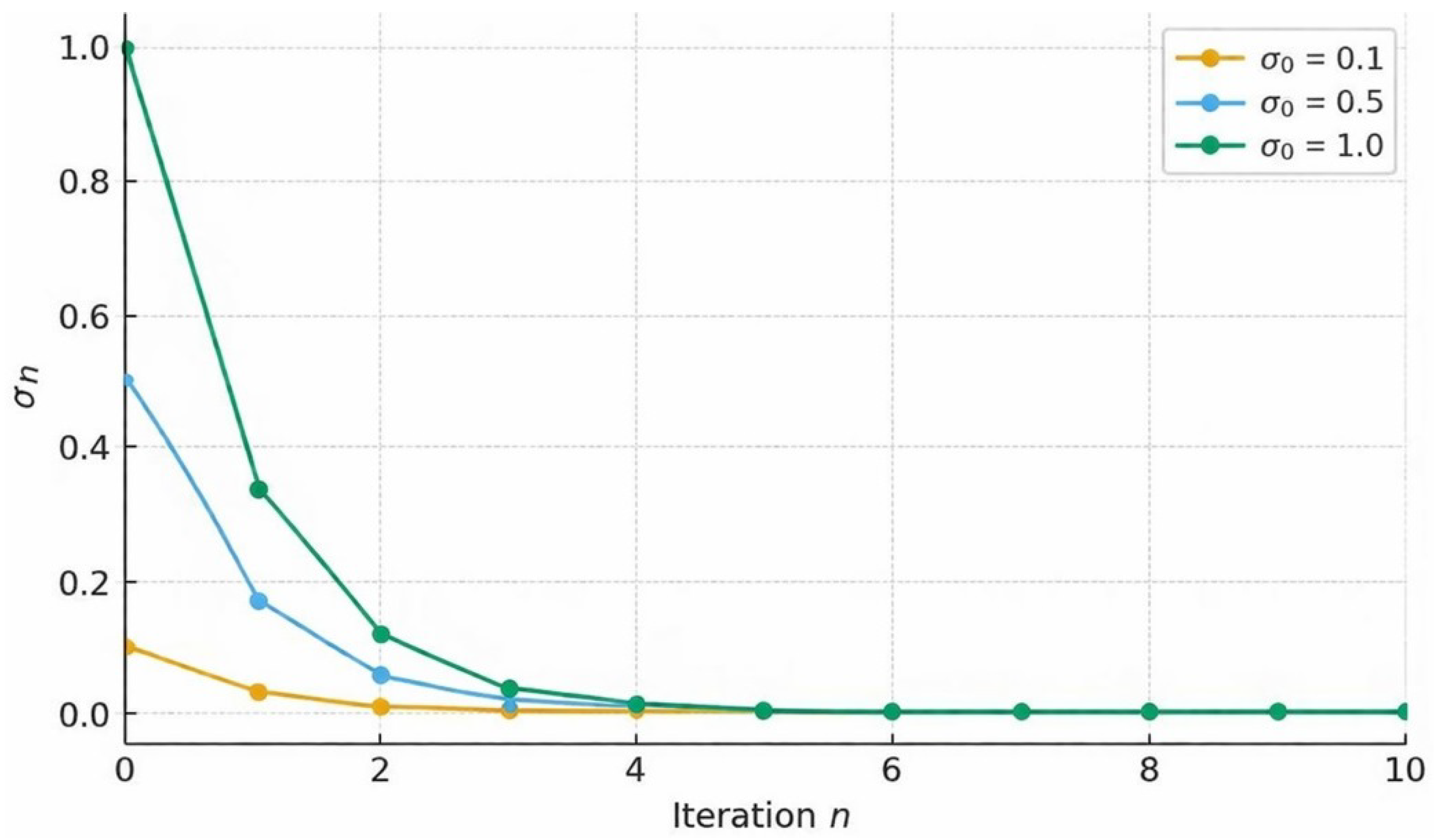
Figure 1. Convergence behavior for the example.
Fractalfract 10 00261 g001
Table 1. Values of σ n for different initial σ 0 .
n σ n ( σ 0 = 0.1 ) σ n ( σ 0 = 0.5 ) σ n ( σ 0 = 1 )
00.10000.50001.0000
10.03330.16670.3333
20.01110.05560.1111
30.00370.01850.0370
40.00120.00620.0123
50.00040.00210.0041
60.00010.00070.0014
70.00000.00020.0005
80.00000.00010.0002
90.00000.00000.0001
100.00000.00000.0000
110.00000.00000.0001
120.00000.00000.0000
Disclaimer/Publisher’s Note: The statements, opinions and data contained in all publications are solely those of the individual author(s) and contributor(s) and not of MDPI and/or the editor(s). MDPI and/or the editor(s) disclaim responsibility for any injury to people or property resulting from any ideas, methods, instructions or products referred to in the content.


