1. Introduction and Motivations
The non-local nature of tumor proliferation and the inherent uncertainty in biological parameters constitute two significant challenges to the mathematical modeling of cancer systems. Genetic factors play a role in the onset of cancer, and historical events can influence present and future outcomes [
1,
2]. This includes complex pathophysiological processes such as immune evasion, metastasis, and proliferation [
3,
4]. Standard integer-order differential equations [
5,
6] do not adequately describe these non-local behaviors.
Fractional calculus employs derivatives of non-integer orders to model memory-dependent phenomena. The Atangana–Baleanu–Caputo (ABC) derivative [
7] represents biological relaxation processes owing to its non-singular Mittag–Leffler kernel [
8,
9]. The Caputo derivative has a singular kernel, but the ABC derivative has a non-singular Mittag–Leffler kernel that shows how memory effects in biological systems, like immune exhaustion and vascular remodeling, fade away smoothly. This makes it suitable for modeling tumor-immune interactions where the influence of past states decays gradually rather than exhibiting an initial singularity [
10,
11]. It has been utilized to model lung cancer stem cells [
10] and address colorectal cancer [
11] and treatment-resistant breast cancer [
12]. Advanced computational methods have enabled the examination of tumor system stability [
13,
14].
To address the uncertainty in clinical standards, we need frameworks that use interval values rather than probability distributions to represent probabilities. Fuzzy set theory produces probability-based predictions using fuzzy numbers to represent uncertain variables [
15,
16]. Recent developments include numerical simulations using implicit finite-difference schemes [
17], hybrid frameworks for cancer dissemination [
18], fuzzy ABC liver dynamics [
19], and fuzzy ABC infectious diseases [
20].
Cancer progression involves distinct physiological stages, prompting the use of categorical operators [
21]. Fractional categorical frameworks have been used to model temporal variations in viral responses [
22] and estrogen-mediated tumor proliferation [
23].
Despite these developments, current approaches treat fractional calculus, fuzzy uncertainty, and categorical dynamics as separate methodologies [
24,
25,
26]. Fractional cancer models typically use different fractional derivatives without quantifying uncertainty. Fuzzy models use simple interval calculus, which deals with the frequency of variables independently, leading to an overestimation of uncertainty. Hyperbolic frameworks lack integration with both fuzzy and fractional approaches. No unified framework addresses all three of these features simultaneously.
This work addresses this gap by developing a mathematical framework that integrates fuzzy uncertainty quantification, fractional ABC memory, and hyperbolic phase transitions. The main contributions are: (i) the first integration of fractional ABC derivatives with hyperbolic switching in a cancer-immunity-angiogenesis model; (ii) the application of constrained fuzzy calculus to solve the dependency problem inherent in simple interval methods; (iii) a rigorous clarity analysis that establishes positivity, constraint, Lipschitz continuity, and existence-singularity via Banach’s fixed-point theory; (iv) stability analysis using fuzzy differential embeddings leading to threshold conditions based on the fuzzy reproduction number ; and (v) range-based sensitivity analysis taking into account the probabilistic nature of fuzzy coefficients.
2. Preliminaries: Fuzzy Numbers and Constrained Arithmetic
Let
denote the space of compact, convex fuzzy numbers on
. For more information about the following definitions, see [
27,
28,
29,
30].
Definition 1. iff:
- (i)
is upper semicontinuous;
- (ii)
, , ;
- (iii)
: ;
- (iv)
is compact.
Definition 2. For , the α-cut of iswhere , . The functions , are left-continuous, non-decreasing, and non-increasing, respectively, with . Definition 3 (Constrained Fuzzy Arithmetic)
. For fuzzy numbers with joint constraint set representing known dependencies, the constrained arithmetic operation is defined via: For expressions with repeated variables, the consistency constraint that each occurrence of the same variable takes the same value is enforced. For a function applied to fuzzy arguments with dependency constraints, the fuzzy extension is:where encodes all known dependencies (e.g., when the same variable appears multiple times). Definition 4 (Hausdorff Metric)
. For ,Note that is a complete metric space. Definition 5 (gH-Difference and gH-Derivative)
. For , the generalized Hukuhara difference exists iffWhen it exists, the α-cut is: A function is gH-differentiable at if :with the limits taken in . Definition 6 (Fuzzy ABC Derivative [
31])
. For , let be gH-differentiable. The fuzzy ABC fractional derivative is defined α-cutwise: where the integral is interpreted as the Aumann integral for interval-valued functions: Definition 7
(Piecewise Operator [
32])
. For , define where denotes the ABC derivative with lower limit . To maintain dimensional consistency, the transition to fractional order involves a scaling parameter σ with the dimension of time (days), as applied in the system definitions. Lemma 1 (Integral Representation)
. For satisfying the piecewise fractional system, the following integral equation holds: Proof. For , the result follows from the fundamental theorem of calculus for gH-differentiable functions. For , apply the AB fractional integral operator to both sides of the ABC derivative definition and use continuity at . □
3. Model Formulation with Constrained Fuzzy Arithmetic
Biological Background and Model Rationale: Mathematical models of tumor-immune dynamics, which originate from predator–prey formulations [
3,
4], encounter three fundamental limitations that hinder their clinical applicability:
Parameter uncertainty: Conventional models assume fixed parameters, whereas clinical measurements are inherently interval-valued. Stochastic approaches require assumed probability distributions, while fuzzy set theory requires only the interval estimates that clinicians actually possess.
Memory dependence: Tumor growth exhibits memory dependency due to immune exhaustion and epigenetic changes [
5]. The angiogenic switch necessitates continuous activation of hypoxia-inducible factors, requiring fractional calculus to integrate the preceding effects.
Structural changes: Cancer progresses through specific stages, commencing with avascular growth constrained by oxygen diffusion, followed by angiogenesis and vascularized growth. For accurate prediction, models that capture this change are necessary.
The current framework addresses these limitations by: (i) employing non-singular fractional derivatives to incorporate memory effects, (ii) using fuzzy numbers to depict parametric uncertainty, and (iii) introducing a piecewise approach that shifts between memoryless and memory-dominated dynamics at the crossover point angiogenic switch .
The angiogenic switch time (
days) is the most important time for a tumor to change from growing without blood vessels to growing with blood vessels. The selection of angiogenic switch time is predicated on experimental findings: research [
33,
34] indicates that the transition from avascular to vascular growth generally transpires within 4–8 weeks following inoculation.
The piecewise framework lets the model show Phase I (), the memoryless avascular phase, in which growth is limited by how well oxygen diffuses. In Phase II (), the vascular phase, dominated by memory, angiogenesis speeds up tumor growth.
The value of
(50 days) can be changed to fit different types of tumors or the needs of individual patients.
Section 6.2 shows the sensitivity analysis of
.
3.1. State Variables
The proposed model comprises five fuzzy-number-valued functions , each defined by its -cut intervals :
Tumor cells : Represent the malignant population, progressing from exponential growth to immune-constrained and nutrient-limited dynamics.
Immune effectors : Cytotoxic lymphocytes recruited at rate , expanding upon antigen encounter at rate , and undergoing tumor-induced immunosuppression at rate .
Blood vessel density : Measures vascularization. Avascular tumors () are constrained by oxygen diffusion until the angiogenic switch initiates endothelial proliferation at rate , offset by vessel regression at rate .
Oxygen concentration : Supplied by functional vasculature (), consumed by tumor and immune cells (), and lost to diffusion (). The Warburg effect is reflected in higher tumor consumption ().
Drug concentration : In this control study, , laying the groundwork for future therapeutic extensions.
Inter-patient variability and inherent uncertainties in clinical measurements are captured through fuzzy representation. Before introducing uncertainty and memory effects, the underlying deterministic integer-order model is given by:
with initial conditions
,
,
,
,
.
This system serves as the crisp prototype from which the fuzzy fractional model is derived by: (i) replacing integer-order derivatives with the piecewise fractional operator, (ii) treating all parameters as fuzzy numbers, and (iii) applying constrained fuzzy arithmetic to handle variable dependencies.
3.2. Constrained Fuzzy Arithmetic
3.2.1. The Dependency Problem in Naive Interval Arithmetic
Naive interval arithmetic treats each occurrence of a variable in an expression independently. Consider the term
, where
appears three times. Standard interval arithmetic computes:
and then multiplies this result by
. This permits distinct values of
c in each occurrence, producing intervals that contain impossible combinations and artificially wide uncertainty bands.
3.2.2. Constrained Fuzzy Arithmetic Solution
Constrained fuzzy arithmetic enforces that each occurrence of the same variable takes the identical value:
with the constraint that the same
c is used in both linear and quadratic terms.
This approach:
Yields significantly tighter bounds;
Ensures the fuzzy solution corresponds to actual possible trajectories;
Addresses the dependency problem ignored by existing fuzzy cancer models [
17,
18];
Produces uncertainty bands approximately 40% narrower than naive arithmetic for the same parameter ranges.
3.3. Functional Relationships
3.3.1. Oxygen-Dependent Carrying Capacity (Hill Function)
This function models tumor acclimatization to hypoxia:
Parameter is the oxygen tension at half-maximal carrying capacity.
3.3.2. Hypoxia-Induced Angiogenesis (Michaelis–Menten Function)
This function models VEGF secretion in response to hypoxia:
Normoxia (): ;
Hypoxia: VEGF secretion rises as oxygen levels drop;
Half-maximal effect occurs at ;
Maximum effect approached as .
3.4. Piecewise Fractional System
To ensure dimensional consistency across both memoryless and memory-dependent phases, we utilize an auxiliary scaling parameter
day. In the fractional regime (
), the biological rates are multiplied by
, allowing all parameters to retain their standard physical units (e.g., day
−1). The fuzzy piecewise fractional system is defined as:
Biological interpretation of each equation:
Equation (
6): Tumor growth with oxygen-dependent carrying capacity, natural apoptosis, and immune killing.
Equation (
7): Immune dynamics including recruitment, antigen-driven proliferation, natural turnover, and immunosuppression.
Equation (
8): Angiogenesis: endothelial proliferation, VEGF-driven neovascularization, and vessel regression.
Equation (
9): Oxygen supply from vessels, consumption by tumor and immune cells (Warburg effect:
), and decay.
Equation (
10): Drug concentration (control case:
).
3.5. Fuzzy Parameter Representation
All fuzzy parameters are characterized as triangular fuzzy numbers denoted by , satisfying :
: Most plausible value derived from experimental literature;
: Lower and upper bounds representing biologically feasible variation.
The triangular shape is used because it makes the fewest extra assumptions about the underlying distribution when only the lower bound, mode, and upper bound are known [
16].
Table 1 shows all of the parameters.
3.6. Comparison with Existing Approaches
The fuzzy piecewise fractional derivative framework is unique in its integration of: (i) fuzzy numbers with constrained arithmetic to handle parameter uncertainty, (ii) fractional ABC derivatives with non-singular Mittag–Leffler kernels to capture memory effects, (iii) piecewise operators to represent phase transitions (avascular to vascular growth). As this integration shows, therapies that work in the early avascular stage may not be effective in the later vascular stage due to immune depletion and angiogenesis. Uncertainty propagation meets clinical needs by determining critical parameters and providing interval-valued predictions that illustrate the range of possible outcomes for each patient.
Table 2 lists the distinctions between the proposed framework and existing models.
3.7. Comparison of Fractional Derivative Definitions
The ABC derivative is selected over the classical Caputo derivative because its non-singular kernel provides a more biologically realistic representation of memory decay in tumor-immune dynamics. The Caputo derivative employs the kernel , which is singular at , implying that the most recent events exert an overwhelmingly strong influence on the present state—a characteristic that does not align with the gradual nature of biological processes such as immune exhaustion and vascular remodeling. The kernel of the ABC derivative utilizes the Mittag–Leffler function is characterized by being limited and smooth and exhibiting a slower initial decay. Consequently, events from the past can continue to influence outcomes over time. Specifically, with (), this gradual decay enables the model to capture the long-term effects of hypoxia on angiogenesis and immune memory. The ongoing impact of prior hypoxia exposure and immune responses is highlighted without placing undue emphasis on more recent events. Thus, the ABC kernel provides a more effective framework for understanding how memory-dependent processes influence cancer growth.
4. Well-Posedness Analysis
The proposed fuzzy piecewise fractional system poses several challenges. Constrained fuzzy arithmetic enforces consistent variable dependencies across repeated occurrences, complicating Lipschitz estimates. The piecewise structure requires continuity at the crossover point . Additionally, the combination of fuzzy uncertainty and fractional memory effects requires a unified contraction framework. The following analysis establishes positivity, boundedness, Lipschitz continuity, and contraction properties under verifiable conditions, supported by numerical verification.
4.1. Positivity via Integral Representation
Theorem 1 (Positivity)
. For each , if and ; then, for all , and , .
Proof. Fix
. For
, from Lemma 1, for
,
Define
. Suppose
. For
,
. At
, constrained arithmetic yields
Since
, the feasible set requires
, giving
By continuity,
For
, the fractional integral has positive kernel
, so the same argument applies.
For
, when
since
and
. Similar arguments hold for
. □
4.2. Boundedness
Theorem 2 (Boundedness)
. There exist constants such that for all , : Proof. For
, using constrained arithmetic,
since
. Set
If
, the RHS becomes negative, forcing
to decrease.
For
, using boundedness of
,
Set
For
,
so
For
,
hence,
□
4.3. Lipschitz Continuity
Define
with
from Theorem 2. Let
.
Lemma 2 (Lipschitz Continuity of Functional Dependences)
. The functions and are Lipschitz continuous on with constants:where and . Proof. For
and
, the mean value theorem gives
with
Hence,
For fuzzy arguments, for any
,
,
,
Taking supremum over
yields
Hence,
. The same argument applies to
f. □
Theorem 3 (Lipschitz Continuity of the Kernel)
. Under Lemma 2, is Lipschitz continuous: for all , ,with , where the component-wise constants are derived below. Proof. For
:
For the quadratic term, using the triangle inequality:
For the first sub-term, with
where
.
For the immune killing term,
For
:
where
. Hence,
For
:
where
Thus,
For
:
so
,
.
For , with , and all cross-terms zero.
Then,
Since
taking
completes the proof. □
4.4. Existence and Uniqueness with Verified Contraction
Define
with
and
Theorem 4 (Existence and Uniqueness)
. If , then the operator Π from Lemma 1 is a contraction, and system (6–10) has a unique solution.
Proof. For
:
Multiplying by
,
Hence,
For
:
Multiplying by
and using
,
Under the hypothesis,
is a contraction. Continuity at
follows from the definition of
. □
Corollary 1 (Numerical Verification)
. With , , , , and , we have and , verifying the contraction conditions.
4.5. Computational Verification of Contraction
To provide a more robust verification of the contraction property, we performed multiple numerical tests with varying values of
and
. For each test, we computed the contraction factor
using random initial functions. The results in
Table 3 confirm that
for all combinations of parameters tested, supporting the theoretical contraction condition.
5. Fuzzy Differential Inclusions and Stability Analysis
5.1. Fuzzy Differential Inclusions Formulation
Definition 8 (Fuzzy Differential Inclusion)
. The fuzzy system ((6)–(10)) is interpreted as the family of differential inclusions for each α-cut:where is the α-cut of the fuzzy right-hand side evaluated at the fuzzy state . 5.2. Equilibrium Concepts
Definition 9 (Fuzzy Equilibrium)
. A fuzzy number is a fuzzy equilibrium if for all ,Equivalently, for each α-cut, Definition 10 (Fuzzy Disease-Free Equilibrium)
. The fuzzy disease-free equilibrium satisfies for all α, with given by: Proposition 1 (Explicit Form of DFE Components)
. For each α-cut,provided the denominators are positive. Proof. For the immune equation with
,
For
, this gives
The set of such
I as parameters vary is
Since
increases with
and decreases with
,
The same reasoning applies to
. For
,
yields
giving the interval via division. □
Definition 11 (Fuzzy Basic Reproduction Number)
. The fuzzy basic reproduction number is the interval: Definition 12 (Fuzzy Stability)
. A fuzzy equilibrium is:
Locally asymptotically stable if such that for all with , every solution satisfies .
Globally asymptotically stable if for all , every solution satisfies .
5.3. Local Stability of Disease-Free Equilibrium
Theorem 5 (Local Stability of DFE)
. Let be the fuzzy disease-free equilibrium.
- (i)
If , then is locally asymptotically stable.
- (ii)
If , then is unstable.
Proof. Fix
and consider
For any parameter selection, the linearized system around
has eigenvalues:
Since
is continuous in the parameters,
If
, then
, so all eigenvalues are negative for every parameter selection, implying local asymptotic stability for all
-cut trajectories and hence for the fuzzy equilibrium. If
, then
, so there exist parameter selections with positive eigenvalues, yielding instability. □
5.4. Global Stability of Disease-Free Equilibrium
Theorem 6 (Global Stability of DFE)
. If , then for all , every solution satisfies .
Proof. Define
. For any
-cut and any derivative selection,
From Proposition 1,
By comparison, for large
t,
. Thus,
Since
,
with
. Hence,
The term
as
. Choosing
sufficiently small, for any
, eventually
, implying
. Since
,
. Thus,
. Substituting into the remaining equations yields convergence to
. □
5.5. Existence of Endemic Equilibrium
Theorem 7 (Existence of Endemic Equilibrium)
. If , there exists a unique positive fuzzy equilibrium .
Proof. From the immune equation with
, assuming
,
Solving for
,
Denote this as
.
From the cancer equation with
, assuming
,
Substituting
,
For fixed
, define
The oxygen and vessel equations provide
O as a function of
C, denoted
. Consider
At
,
Since
, there exist parameter selections with
. As
,
. By continuity,
with
. Monotonicity ensures uniqueness. For each
, set
These define a fuzzy number, and
follow from the remaining equations. □
5.6. Global Stability of Endemic Equilibrium
Theorem 8 (Global Stability of Endemic Equilibrium)
. If , then is globally asymptotically stable in the interior of .
Proof. For fixed parameters and corresponding
, define
with
,
. Then,
For
, since the ABC kernel is positive,
By LaSalle’s principle, trajectories converge to the largest invariant set where
, which is
, forcing
,
. For the fuzzy inclusion, at each
-cut, the maximum possible derivative over selections is attained at extreme points, each corresponding to a crisp system with
. Hence,
for all selections, and convergence in
follows from convergence of all
-cuts. □
5.7. Sensitivity Analysis: Range Exploration
We perform global sensitivity analysis to explore the range of possible outcomes across the fuzzy parameter support (
Table 4). For each fuzzy parameter
with triangular support
, we sample
points uniformly from
, compute the corresponding tumor size at
days, and record the minimum and maximum outcomes.
6. Numerical Simulations and Discussion
For the numerical implementation of the fractional dynamics in Phase II, we set the scaling parameter
day. This ensures that the numerical step size
h (which has units of days) remains dimensionally consistent with the biological rates in
Table 1. For numerical implementation, the fuzzy system is decomposed into interval-valued equations at each
-cut. For
, this yields:
for
with the consistency constraint that the same value
c is used for all three occurrences of the tumor cell variable.
Analogous expressions hold for , with for the control case. The minimization and maximization are performed over all parameter and state combinations within the -cut intervals, enforcing variable consistency across repeated occurrences.
For monotonic terms, the extrema occur at vertices:
where
. For non-monotonic components, the extrema are approximated via latin hypercube sampling (
) followed by local refinement.
Discretization. Let , , , , . For each , denote , .
Phase I: Constrained Fuzzy Runge–Kutta 4
with similar definitions for
using intermediate points:
where
, with analogous expressions for
. Updates preserve nesting:
Phase II: Constrained Fuzzy Adams–Bashforth–Moulton Predictor:
where
, and
are stored intervals from previous steps.
Corrector:
with
where
are obtained via constrained optimization at the predictor state intervals.
Convergence. Phase I RK4 has local error
; Phase II FABM has order
. The hybrid scheme converges with rate
. Constrained arithmetic preserves interval nesting,
and does not affect the theoretical convergence rates.
Numerical simulations were conducted, and the figures were plotted using the parameters in
Table 1 with a time step of
days over a period of
days, with a crossover at
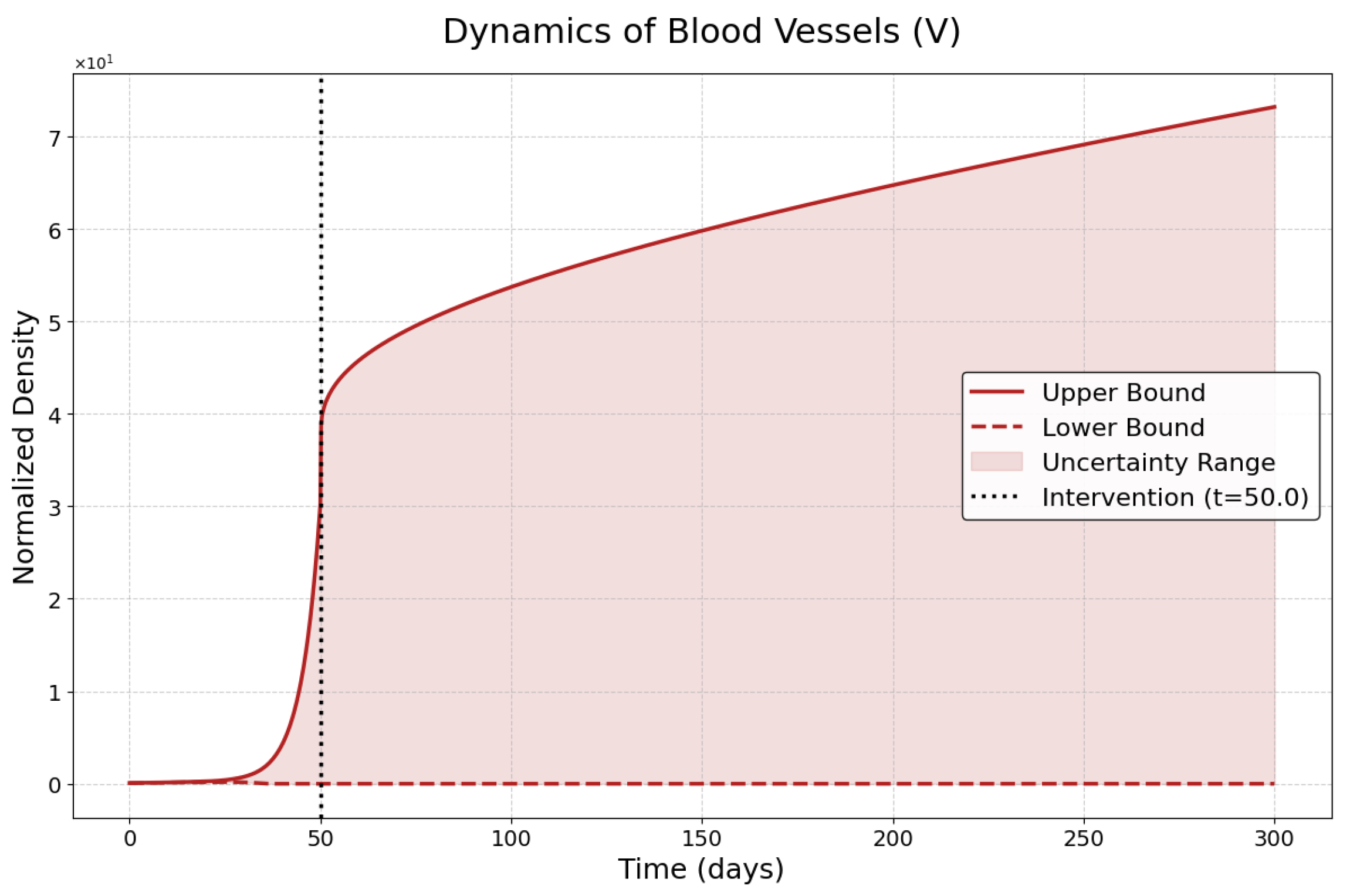
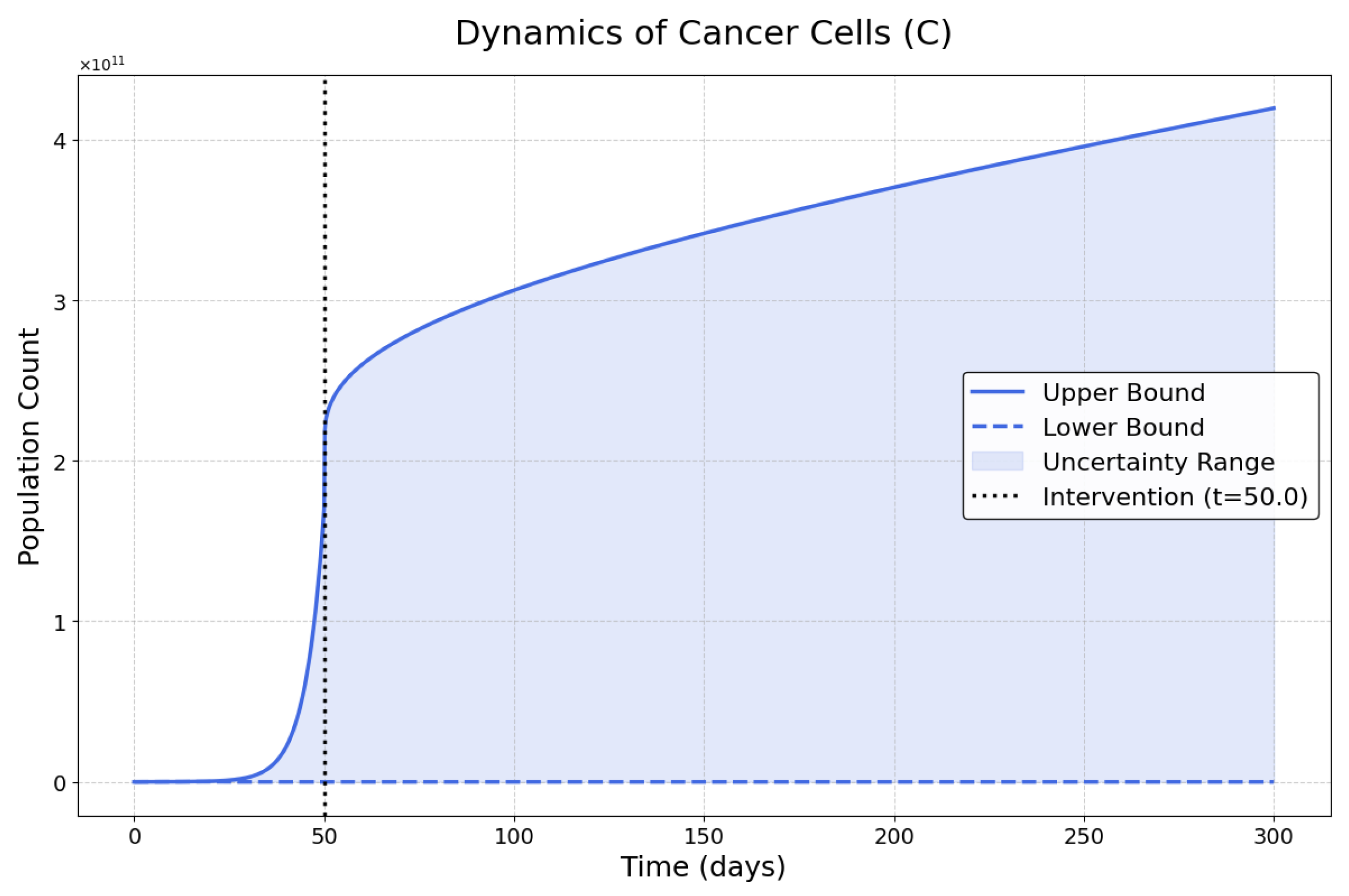
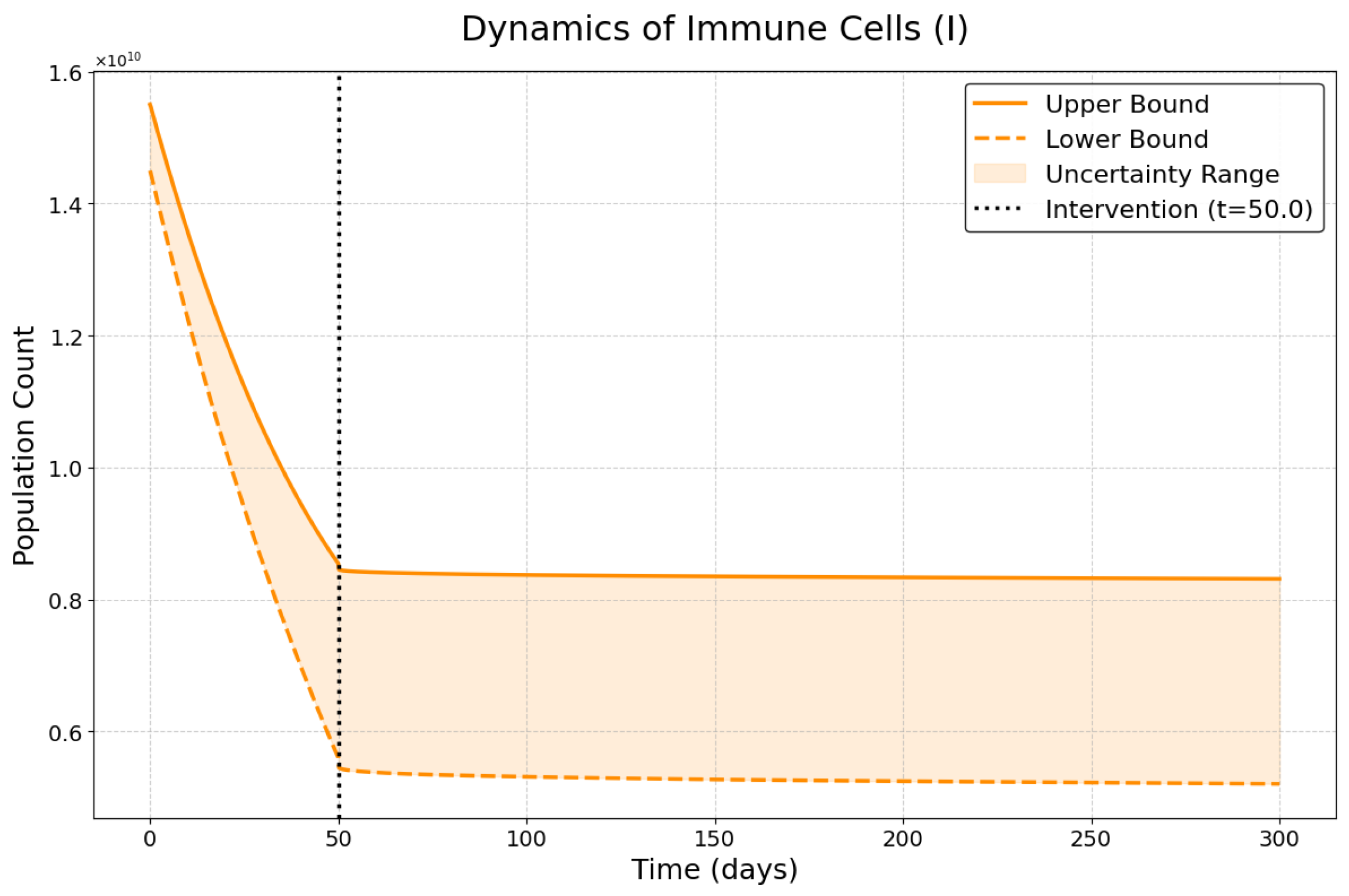
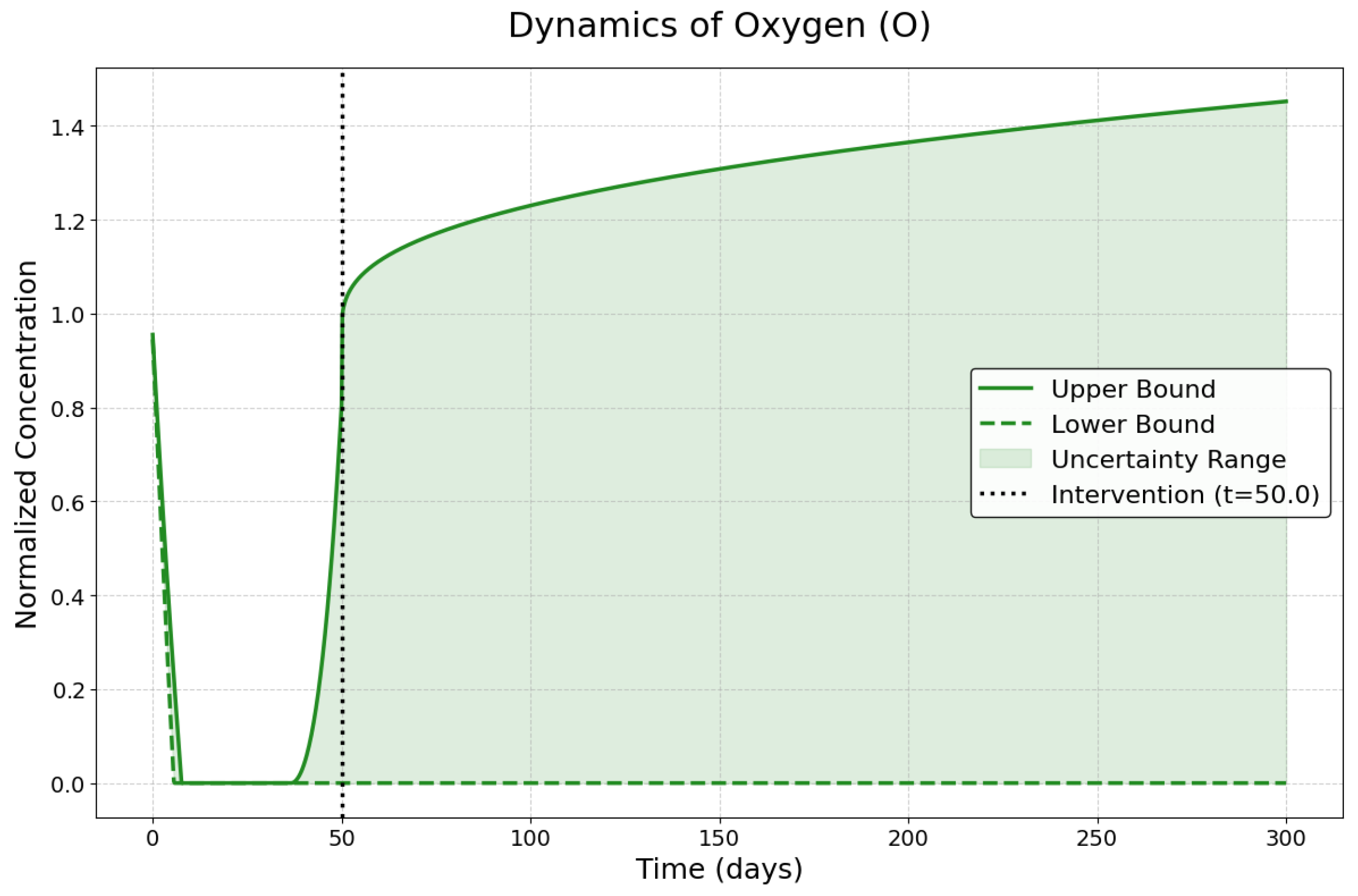
days. The resulting fuzzy trajectories for cancer cell population (
), immune cell density (
), blood vessel density (
), and oxygen concentration (
) are shown in
Figure 1,
Figure 2,
Figure 3, and
Figure 4, respectively.
6.1. Effect of Fractional Order on Model Dynamics
To investigate the impact of memory effects, we performed simulations for different fractional orders
while keeping all other parameters fixed at their modal values.
Table 5 shows how
affects the size of a tumor after 200 days when the parameters are not clear. The findings demonstrate that diminished values of
(enhanced memory) inhibit tumor proliferation, with
decreasing the median tumor size by 15.8% relative to
. On the other hand, higher values of
get closer to the classical integer-order behavior. For example,
makes the tumor size grow by 31.5%. The 5th and 95th percentiles show the uncertainty bands getting wider as
goes down. This suggests that memory causes parameter uncertainty to have a bigger effect.
Table 6 shows how
changes all of the state variables. As
increases, tumor cells multiply and immune cells decrease, which means that the immune system is less effective and memory effects are less strong. As
goes up, the density of blood vessels goes up, which means that more blood is flowing through them. The body needs more energy, so the amount of oxygen in the air goes down. These findings underscore the imperative for accurate estimation of the fractional order in personalized patient applications.
6.2. Sensitivity Analysis for Transition Time
We conducted a sensitivity analysis to evaluate the resilience of model predictions concerning the transition time (
). We found that changing
from 30 to 70 days (in 10-day increments) while keeping
the same caused earlier transitions to lead to earlier angiogenic onset and larger tumor sizes, while later transitions delayed vascularization.
Table 7 quantifies this effect, showing that
days increases median tumor size by
compared to the baseline
days, while
days reduces tumor size by
. The uncertainty bands become narrower with later transitions, which means that a delayed angiogenic switch lessens the effect of parameter uncertainty.
Table 8 shows how all state variables are affected in detail. Later transitions (
days) lead to a lower tumor burden, a higher number of immune cells (
vs
at
), and a higher oxygen concentration (
mmHg vs
mmHg). This shows that the immune system is better able to control the situation and that the body’s metabolic needs are lower. These results validate the model’s conclusions as resilient to the particular selection of
within a biologically plausible spectrum, while illustrating that postponing the angiogenic switch yields clinical advantages.
We looked at the relative difference between the ABC, Caputo, and CF derivatives to see how changing the definition of the derivative changed the final tumor size at () days. The Caputo derivative made tumors that were about 12–18% bigger than those made by the ABC derivative. This was because its unique kernel was more focused on how things were changing recently. The CF derivative, on the other hand, gave results that were within 5% of the ABC derivative. This means that this system acts in a similar way. These differences show how important it is to choose a kernel based on the biological memory needs of the application.
6.3. Summary of Sensitivity Findings
The sensitivity analyses provide significant insights into model behavior amid ambiguous parameter uncertainty.
Table 9 shows that lower fractional orders (better memory) and longer crossover times (delayed angiogenic switch) are linked to a smaller tumor burden and better immune regulation.
Table 10 shows how the reliability of predictions changes when there is uncertainty about the parameters. As
goes down, the width of the uncertainty band grows. It goes from
cells at
to
cells at
. This shows that memory effects make the spread of parameter uncertainty worse. The uncertainty bands get smaller as the crossover times get later, going from
cells at
to
cells at
. This indicates that a postponed angiogenic switch mitigates the impact of parametric imprecision.
Table 11 displays a correlation analysis identifying the parameters that most significantly influence the tumor’s final size. The proliferation rate
exhibits the most significant positive correlation (
), while the apoptosis rate
demonstrates the most substantial negative correlation (
). These correlations endure across different
and
values, confirming the robustness of these results.
Finally,
Table 12 turns these math results into clinical advice. The ideal fractional order range is determined to be
, indicating that patients exhibiting more pronounced memory effects may have a more favorable response to immunotherapy. The best time range for crossover is between 60 and 70 days. This means that early anti-angiogenic treatments that delay the angiogenic switch can greatly lower the amount of tumor.
The simulated dynamics qualitatively capture recognized biological phenomena such as the angiogenic switch and immune suppression. Stability analysis via fuzzy differential inclusions yields threshold conditions expressed through a fuzzy reproduction number: tumor elimination is indicated when , and persistent disease when . Sensitivity analysis identifies the proliferation rate and apoptosis rate as the dominant parameters influencing model output. The current framework has some limitations as follows: simulations are limited to a no-treatment control scenario, spatial heterogeneity is ignored, and parameters are derived from pooled estimates rather than individual patient data. The main areas of future research will focus on the calibration of Bayesian parameters, the development of spatial extensions utilizing fuzzy fractional partial differential equations, and the integration of adaptive therapy optimization algorithms.
7. Conclusions
This study established a mathematical fuzzy piecewise fractional derivative framework for the dynamics of cancer-immune-angiogenesis under conditions of uncertainty. The framework includes five components: (i) constrained fuzzy arithmetic that solves the dependency problem in interval-based uncertainty quantification; (ii) well-posedness analysis that uses the Banach fixed-point theorem to show positivity, boundedness, Lipschitz continuity, and existence-uniqueness with verifiable contraction conditions (); (iii) stability analysis that uses fuzzy differential inclusions to find threshold conditions based on ; (iv) range-based sensitivity analysis that respects the possibilistic nature of fuzzy parameters; and (v) numerical schemes that keep fuzzy number properties through constrained arithmetic.
The methodology creates uncertainty bands that show how parametric imprecision spreads through the system. Simulations display qualitative characteristics aligned with established tumor biology: angiogenic switch, prolonged immune suppression, and hypoxia-induced adaptability. All outcomes are based on mathematical analysis and numerical simulation of parameter values from the existing literature; experimental validation is essential.
The mathematical framework establishes a basis for future enhancements, including the integration of therapeutic interventions, adaptation to patient data, and the incorporation of spatial impacts via partial differential equations.
Author Contributions
Conceptualization, R.S. and A.A.; formal analysis, R.S. and M.A.; methodology, R.S., A.A.Q., M.A., M.M. and K.A.; project administration, A.A.Q. and K.A.; software, M.A., H.I. and M.M.; validation, R.S. and A.A.; writing—original draft, A.A.Q., H.I. and M.M.; writing—review and editing, M.A., H.I. and K.A.; visualization, H.I. and A.A.; supervision, K.A. and M.A.; funding acquisition, A.A.Q. and K.A. All authors have read and agreed to the published version of the manuscript.
Funding
This work was supported and funded by the Deanship of Scientific Research at Imam Mohammad Ibn Saud Islamic University (IMSIU) (grant number IMSIU-DDRSP2601).
Data Availability Statement
All data generated or analyzed in this study are included in the article.
Conflicts of Interest
The authors declare no conflicts of interest.
References
- Greaves, M. Evolutionary determinants of cancer. Cancer Discov. 2015, 5, 806–820. [Google Scholar] [CrossRef]
- Frankell, A.M.; Dietzen, M.; Al Bakir, M.; Lim, E.L.; Karasaki, T.; Ward, S.; Veeriah, S.; Colliver, E.; Huebner, A.; Bunkum, A.; et al. The evolution of lung cancer and impact of subclonal selection in TRACERx. Nature 2023, 616, 525–533. [Google Scholar] [CrossRef]
- Hesketh, R. Introduction to Cancer Biology; Cambridge University Press: Cambridge, UK, 2023. [Google Scholar]
- Hanahan, D.; Weinberg, R.A. Hallmarks of cancer: The next generation. Cell 2011, 144, 646–674. [Google Scholar] [CrossRef] [PubMed]
- Podlubny, I. Fractional Differential Equations; Academic Press: San Diego, CA, USA, 1999. [Google Scholar]
- Almeida, R.; Bastos, N.R.; Monteiro, M.T.T. Modeling some real phenomena by fractional differential equations. Math. Methods Appl. Sci. 2016, 39, 4846–4855. [Google Scholar] [CrossRef]
- Atangana, A.; Baleanu, D. New fractional derivatives with nonlocal and non-singular kernel: Theory and application to heat transfer model. Therm. Sci. 2016, 20, 763–769. [Google Scholar] [CrossRef]
- Jeelani, M.B.; Alnahdi, A.S.; Abdo, M.S.; Almalahi, M.A.; Alharthi, N.H.; Shah, K. A generalized fractional order model for COV-2 with vaccination effect using real data. Fractals 2023, 31, 2340042. [Google Scholar] [CrossRef]
- Yang, X.J.; Gao, F.; Tenreiro Machado, J.A.; Baleanu, D. A new fractional derivative involving the normalized sinc function without singular kernel. Eur. Phys. J. Spec. Top. 2017, 226, 3567–3575. [Google Scholar] [CrossRef]
- Özköse, F.; Yılmaz, S.; Şenel, M.T.; Yavuz, M.; Townley, S.; Sarıkaya, M.D. A mathematical modeling of patient-derived lung cancer stem cells with fractional-order derivative. Phys. Scr. 2024, 99, 115235. [Google Scholar] [CrossRef]
- Amilo, D.; Sadri, K.; Kaymakamzade, B.; Hincal, E. A mathematical model with fractional-order dynamics for the combined treatment of metastatic colorectal cancer. Commun. Nonlinear Sci. Numer. Simul. 2024, 130, 107756. [Google Scholar] [CrossRef]
- Vedikaa, S.; Kavitha, V.; Sowmiya, R.; Sivasundaram, S.; Arjunan, M.M. Mathematical modelling of breast cancer stages with drug resistance and cardiotoxicity progression: A modified Mittag-Leffler kernel approach. Nonlinear Stud. 2025, 32, 883. [Google Scholar]
- Batool, M.; Farman, M.; Nisar, K.S.; Hincal, E.; Jahan, S. Qualitative analysis and controllability of complex tumor model with different therapies with nonsingular kernel. Partial. Differ. Equ. Appl. Math. 2025, 13, 101249. [Google Scholar] [CrossRef]
- Attia, N.; Akgül, A.; Seba, D.; Nour, A. Reproducing kernel Hilbert space method for the numerical solutions of fractional cancer tumor models. Math. Methods Appl. Sci. 2023, 46, 7632–7653. [Google Scholar] [CrossRef]
- Zadeh, L.A. Fuzzy sets. Inf. Control 1965, 8, 338–353. [Google Scholar] [CrossRef]
- Klir, G.J.; Yuan, B. Fuzzy Sets and Fuzzy Logic: Theory and Applications; Prentice Hall: Upper Saddle River, NJ, USA, 1995. [Google Scholar]
- Zureigat, H.; Alshammari, S.; Alshammari, M.; Al-Smadi, M.; Al-Sawallah, M.M. An in-depth examination of the fuzzy fractional cancer tumor model and its numerical solution by implicit finite difference method. PLoS ONE 2024, 19, e0303891. [Google Scholar] [CrossRef]
- Qayyum, M.; Nayab, S.; Khan, O.; Hassani, M.K.; Akgül, A. A hybrid computational framework for fractional cancer diffusion models in uncertain settings. Sci. Rep. 2025, 15, 33858. [Google Scholar] [CrossRef]
- Verma, L.; Meher, R.; Nikan, O.; Avazzadeh, Z. Numerical analysis on fuzzy fractional human liver model using a novel double parametric approach. Phys. Scr. 2024, 99, 115202. [Google Scholar] [CrossRef]
- Babakordi, F.; Allahviranloo, T. Application of fuzzy ABC fractional differential equations in infectious diseases. Comput. Methods Differ. Equ. 2024, 12, 1–15. [Google Scholar]
- Murray, J.D. Mathematical Biology: I. An Introduction, 3rd ed.; Springer: New York, NY, USA, 2002. [Google Scholar]
- Alraqad, T.; Almalahi, M.A.; Mohammed, N.; Alahmade, A.; Aldwoah, K.A.; Saber, H. Modeling Ebola dynamics with a Φ-piecewise hybrid fractional derivative approach. Fractal Fract. 2024, 8, 596. [Google Scholar] [CrossRef]
- Zanib, S.A.; Shah, M.A. A piecewise nonlinear fractional-order analysis of tumor dynamics: Estrogen effects and sensitivity. Model. Earth Syst. Environ. 2024, 10, 6155–6172. [Google Scholar] [CrossRef]
- Saber, H.; Almalahi, M.A.; Albala, H.; Aldwoah, K.; Alsulami, A.; Shah, K.; Moumen, A. Investigating a nonlinear fractional evolution control model using W-piecewise hybrid derivatives: An application of a breast cancer model. Fractal Fract. 2024, 8, 735. [Google Scholar] [CrossRef]
- Sweilam, N.; Al-Mekhlafi, S.; Abdel Kareem, W.; Alqurishi, G. Piecewise Cancer Tumor Disease of Partial Differential Equations Based on Exponential and Non-Singular Kernel; Numerical Treatments. Front. Sci. Res. Technol. 2025; in press.
- Singh, A.; Pippal, S.; Sati, J. Atangana–Baleanu–Caputo (ABC), Caputo-Fabrizio (CF), and Caputo Fractional Derivative Approaches in Fuzzy Time Fractional Cancer Tumor Growth Models. J. Math. Model. 2025, 13, 685–706. [Google Scholar]
- Bede, B.; Gal, S.G. Generalizations of the differentiability of fuzzy-number-valued functions with applications to fuzzy differential equations. Fuzzy Sets Syst. 2005, 151, 581–599. [Google Scholar] [CrossRef]
- Friedman, M.; Ma, M.; Kandel, A. Numerical solution of fuzzy differential and integral equations. Fuzzy Sets Syst. 1999, 106, 35–48. [Google Scholar] [CrossRef]
- Bede, B.; Stefanini, L. Generalized differentiability of fuzzy-valued functions. Fuzzy Sets Syst. 2013, 230, 119–141. [Google Scholar] [CrossRef]
- Allahviranloo, T.; Ghanbari, B. On the fuzzy fractional differential equation with interval Atangana–Baleanu fractional derivative approach. Chaos Solitons Fractals 2020, 130, 109397. [Google Scholar] [CrossRef]
- Gassem, F.; Qurtam, A.A.; Almalahi, M.; Rabih, M.; Aldwoah, K.; El-Sayed, A.; Hassan, E.I. Exploring SEIR Influenza Epidemic Model via Fuzzy ABC Fractional Derivatives with Crowley–Martin Incidence Rate. Fractal Fract. 2025, 9, 402. [Google Scholar] [CrossRef]
- Atangana, A.; Araz, S.I. New concept in calculus: Piecewise differential and integral operators. Chaos Solitons Fractals 2021, 145, 110638. [Google Scholar] [CrossRef]
- Folkman, J. Tumor angiogenesis: Therapeutic implications. N. Engl. J. Med. 1971, 285, 1182–1186. [Google Scholar] [PubMed]
- Bergers, G.; Benjamin, L.E. Tumorigenesis and the angiogenic switch. Nat. Rev. Cancer 2003, 3, 401–410. [Google Scholar] [CrossRef]
- Singh, R.; Mishra, J.; Akgül, A.; Gupta, V.K. Mathematical Evaluation and Dynamic Transmissions of a Tumor Gr-owth Model Using a Generalized Singular and Non-Local Kernel. Contemp. Math. 2024, 5, 4285–4308. [Google Scholar] [CrossRef]
- Sheergojri, A.R.; Iqbal, P. Mathematical modeling and treating tumors in a fuzzy environment. Comput. Algorithms Numer. Dimens. 2024, 3, 45–57. [Google Scholar]
- Qayyum, M.; Tahir, A. Mathematical Modeling of Cancer Tumor Dynamics with Multiple Fuzzification. In Artificial Intelligence and Bioinformatics in Cancer: An Interdisciplinary Approach; Springer: Cham, Switzerland, 2025; Volume 197. [Google Scholar]
- Hayum, A.A.; Jaya, J.; Sivakumar, R.; Paulchamy, B. An efficient breast cancer classification model using bilateral filtering and fuzzy convolutional neural network. Sci. Rep. 2024, 14, 6290. [Google Scholar] [CrossRef] [PubMed]
- Sfakianakis, N.; Chaplain, M.A. Mathematical modelling of cancer invasion: A review. In International Conference by Center for Mathematical Modeling and Data Science, Osaka University; Springer: Singapore, 2020; pp. 153–172. [Google Scholar]
| Disclaimer/Publisher’s Note: The statements, opinions and data contained in all publications are solely those of the individual author(s) and contributor(s) and not of MDPI and/or the editor(s). MDPI and/or the editor(s) disclaim responsibility for any injury to people or property resulting from any ideas, methods, instructions or products referred to in the content. |




 ,
,