Article

Hybrid Numerical–Machine Learning Framework for Time-Fractal Carreau–Yasuda Flow: Stability, Convergence, and Sensitivity Analysis


1
Department of Mathematics, Faculty of Engineering and Computing, National University of Modern Languages (NUML), Islamabad 44000, Pakistan
2
Department of Mathematics and Statistics, College of Science, Imam Mohammad Ibn Saud Islamic University (IMSIU), Riyadh 11432, Saudi Arabia
3
Department of Mathematics, University of Wah, Wah Cantt 47040, Pakistan
*
Author to whom correspondence should be addressed.
Fractal Fract. 2026, 10(4), 221; https://doi.org/10.3390/fractalfract10040221
Submission received: 6 February 2026 / Revised: 19 March 2026 / Accepted: 20 March 2026 / Published: 26 March 2026
(This article belongs to the Section General Mathematics, Analysis)

Abstract

This study introduces a modified computational scheme for handling linear and nonlinear fractal time-dependent partial differential equations. The method is constructed using three different stages that provide third-order accuracy in the fractal time variable. The stability of the approach is examined using scalar fractal models and Fourier analysis, while convergence is established for coupled convection–diffusion systems. The numerical algorithm is applied to analyze the mixed convective flow of a Carreau–Yasuda non-Newtonian fluid over stationary and oscillating plates under the influence of viscous dissipation and magnetic field effects. For spatial discretization, the incompressible continuity equation is handled by a first-order difference scheme, whereas higher-order compact schemes are implemented for the momentum, thermal, and concentration equations. The numerical findings show that increasing the Weissenberg number and magnetic field inclination reduces the velocity distribution. An accuracy assessment against existing numerical techniques demonstrates that the present method yields smaller computational errors, particularly when central difference schemes are used in space. In addition, a surrogate machine learning model is developed to predict the skin friction coefficient and local Nusselt number using Reynolds, Weissenberg, Prandtl, and Eckert numbers as input features. The predictive capability of the model is validated through Parity plots, bar charts for sensitivity analysis, scatter visualization, and Taylor Diagrams, confirming strong agreement with the numerical results.

1. Introduction

Numerical schemes play a vital role in solving problems in science and engineering. There exist two types of schemes for solving time-dependent partial differential equations. One is time discretization schemes, which can be classified as explicit and implicit. Most implicit schemes are unconditionally stable, and most explicit schemes are conditionally stable. However, implicit schemes require other iterative schemes for solving difference equations that arise when applied to given partial differential equations. On the other hand, explicit schemes do not require any other iterative schemes to solve difference equations, but most have restrictions on step size. The appropriate step size should be chosen so the scheme remains stable. An existing procedure to check the stability condition(s) of difference schemes is the von Neumann stability criterion, which uses Fourier series analysis to determine the conditions of time and space sizes, and any parameter(s) involved, in the given partial differential equation(s). In this study, a third-order scheme is proposed for solving time-fractal partial differential equations. The scheme is constructed using fractal Taylor series expansion. For space discretization, a compact scheme is chosen that provides sixth-order accuracy on most of the internal grid points. The scheme is applied to a non-Newtonian fluid flow over a surface and compared with existing schemes; it is concluded that the proposed scheme demonstrates reduced error compared the two other schemes studied using second-order central discretization.
Carreau–Yasuda fluid flow is a mathematical model used to explain the behavior of non-Newtonian fluids, which deviate from Newtonian fluids’ linear relationship between shear stress and shear rate, such as air or water. When predicting the flow characteristics of non-Newtonian fluids, like those with shear-thinning or shear-thickening behavior, this model is especially helpful in the fields of engineering and fluid dynamics. The Carreau–Yasuda model offers a more thorough explanation of complex fluid dynamics in a variety of industrial applications, from oil extraction to food processing, by taking into account the fluid’s viscosity as a function of shear rate. In fluid mechanics, viscous dissipation is a phenomenon that occurs when a viscous fluid flows and creates internal frictional forces inside the fluid that convert mechanical energy into heat. This process increases the fluid’s temperature because kinetic energy is transformed into thermal energy. In many engineering applications, viscous dissipation can have a large impact on heat transfer, fluid dynamics, and overall system performance.
High-order time integration techniques, such as modified Runge–Kutta (RK) schemes, play a central role in the numerical solution of nonlinear partial differential equations arising in fluid dynamics. Recent developments have focused on enhancing stability properties while preserving high accuracy for stiff- and convection-dominated systems. For example, Gu, Quan and Xin (2025) developed and analyzed implicit–explicit Runge–Kutta methods for nonlinear reaction–diffusion systems, proving strong stability and convergence under appropriate time-step restrictions [1]. Similarly, Qin, Jiang, and Yan (2024) proposed strong stability-preserving two-derivative Runge–Kutta schemes and demonstrated improved stability regions compared to classical RK methods [2]. These advancements provide a solid theoretical framework for extending modified RK schemes to complex non-Newtonian flow problems.
In mixed convection heat and mass transfer problems, coupling between momentum, thermal, and concentration fields significantly increases nonlinearity. The rheology becomes more complex when non-Newtonian models such as the Carreau–Yasuda model are employed. Akbar et al. (2024) investigated Carreau–Yasuda nanofluid flow with variable thermal conductivity and nonlinear convection, demonstrating that boundary layer thickness is very sensitive to rheological parameters [3]. Areshi (2025) further explored radiative heat transport in Carreau–Yasuda flows, emphasizing the influence of shear-thinning index on thermal enhancement [4]. Ullah et al. (2024) analyzed buoyancy and viscous dissipation effects in Carreau fluids and confirmed that viscous heating significantly increases temperature profiles in mixed convection regimes [5].
Electromagnetically actuated surfaces such as the Riga plate generate Lorentz forces that modify the boundary layer structure. Yahaya et al. (2023) explored dual solutions in mixed-convection hybrid nanofluid flow over a vertical Riga plate, and research has been conducted on stability differences between solution branches [6]. Nasir et al. (2023) investigated unsteady stagnation-point nanofluid flow over a moving Riga plate, and heat transfer increased because of electromagnetic forcing [7]. These findings confirm the practical relevance of Riga plate configurations in modern thermal engineering systems.
Theoretical stability and convergence analyses play an important role when modified Runge–Kutta methods are applied to such coupled systems. Singh, V. P., & Singh, S. (2025) studied the stability and convergence of Runge–Kutta methods to solve ODE systems [8]. Arif, Abodayeh, and Nawaz (2024) introduced a fractal Runge–Kutta approach, and convergence analysis was performed for nonlinear transport equations [9]. Kunstmann et al. (2018) explored high-order Runge–Kutta discretizations for parabolic PDEs, and it was proven that schemes were unconditionally stable by imposing some constraints [10].
Recent studies have applied advanced computational schemes for models of fluid flow over plates. Ayub et al. (2022) explored mixed convective Carreau–Yasuda nanofluid flow under effects of thermal radiation and found that the Nusselt number significantly increased [11]. Daniel Makinde (2013) studied non-Newtonian boundary layers under the effect of viscous dissipation and quantified entropy generation rates [12]. Pantokratoras & Magyari (2009) analyzed electromagnetic boundary layers over Riga surfaces and validated Lorentz-force-induced stabilization [13]. Further contributions have strengthened the mathematical foundation of RK-type solvers. Ranocha & Ketcheson (2020) proposed energy-stable Runge–Kutta discretizations for nonlinear diffusion systems [14], while D’Afiero (2025) developed adaptive RK schemes with improved error control [15]. Non-Newtonian nanofluid flow over the plate was studied in [16]. Governing equations are transformed to systems of ODEs and solved by applying the spectral collection scheme along Legendre Wavelets (SCSLW) combined with the shooting technique.
The flow of fluid can be discussed between two parallel plates. Jeffrey fluid between parallel static plates is studied in [17]. Magnetohydrodynamic (MHD) flow in a Brinkman-type dusty fluid confined between fluctuating parallel vertical plates under arbitrary wall shear stress conditions has been investigated in [18]. Flow model is considered using Caputo–Fabrizio time-fractional derivative, and flow is generated by free convection and buoyant force. Heat and mass transfer of MHD Brinkman-type dusty fluid between parallel non-conducting plates is addressed in [19]. The systematic solution was investigated under the application of the Poincaré–Lighthill fluctuation method. Effects of different dimensionless parameters, such as the Grashof number, magnetic parameter, and dusty fluid variable, on the velocity of base fluid has been investigated and discussed. Some authors have also studied the effect of nanoparticles in different types of non-Newtonian fluids. Among these works, tetra hybrid nanofluids have been considered within flow in [19], and focus was placed on heat and mass transport properties. These nanofluids are used in solar applications and are well suited for solar power production and other thermal applications. A numerical solution for the mathematical model of MHD boundary layer nanofluid flow has been found and is presented in the form of velocity and temperature profiles in [20]. Four combinations of nanoparticles, including copper, alumina, silicon dioxide, and graphene, were considered as nanofluids. Existing studies on the motion of fluid over solid surfaces also consider the application of artificial neural networks to predict heat and mass transports or other quantities. Nanofluid flow over a porous plate was discussed in [21]. Effects of radiation and cross diffusion have also been studied. Governing equations have been expressed in the form of partial differential equations and then converted into ordinary differential equations and solved by using Matlab (2013a and 2018a) inbuilt solver bvp4c. Heat and mass transfer predictions have been provided by applying an artificial neural network approach that gave a regression coefficient R = 1 and a mean square error M S E < 10 9 using the Levenberg–Marquardt algorithm for training purposes. Nawaz et al. (2026) demonstrated that ANN models can accurately predict thermal performance parameters in non-Newtonian nanofluid convection problems, achieving high regression coefficients (R2 > 0.99) between numerical and predicted heat transfer rates [22]. Their study confirmed that multilayer feedforward neural networks trained with backpropagation algorithms effectively approximate nonlinear mappings between governing dimensionless parameters and the Nusselt number. Similarly, Kavitha et al. (2026) applied Runge–Kutta-generated numerical datasets to train ANN models for coupled heat and mass transfer systems and reported that surrogate ANN models reduced computational cost by more than 90% while maintaining excellent prediction accuracy [23]. Their results showed that when CFD data are generated through stable and convergent numerical schemes, ANN surrogates can generalize well across unseen parameter combinations.
Various authors have studied machine learning predictions and mathematical modeling of Carreau–Yasuda models. Aksoy et al. [24] studied the boundary layer equations for a Carreau–Yasuda fluid and transformed governing equations into dimensionless ODEs using similarity transformations and applied numerical techniques, emphasizing the effect of rheological parameters on velocity behavior within the boundary layer. In another study, Altalbawy et al. [25] applied machine learning methods to predict temperature profile in nanofluid flow and demonstrated that machine learning models can accurately reproduce numerical results. Furthermore, Chowdhury et al. [26] employed artificial-neural-network-based modeling to study heat transfer characteristics in magnetohydrodynamic Carreau boundary layer fluid flow and concluded that artificial-neural-network based machine learning techniques can effectively approximate complex nonlinear solutions of considered flow problems.
Based on these developments, the present study modified an existing Runge–Kutta scheme for discretizing fractal time-dependent partial differential equations. The scheme is constructed in three explicit stages. Instead of a fixed time step size, a variable step size can be adopted depending on the fractal parameter. Later, stability and convergence analysis of a modified fractal Runge–Kutta scheme on convection diffusion is provided, after which the scheme is applied to heat and mass transfer of a Carreau–Yasuda fluid over a Riga plate with viscous dissipation. Section 5 presents the variation in dimensionless parameters based on velocity, temperature, and concentration profiles that are displayed in different graphs.

2. Fractal Computational Scheme

A fractal scheme will be constructed that can be used to solve dimensionless equations in flow phenomena. The scheme is a three-stage scheme that utilizes only the information of the n t h time level to find a solution at the next time level, i.e., n + 1 t h . The order of accuracy is achieved after applying all three stages, and the third-order accurate solution will be provided in fractal time. To propose or construct a computational scheme, consider the following general form of the fractal time-dependent partial differential equation:
p t α = G p , p x , p y , p y y
and the initial and boundary conditions are provided as
p 0 , x ,   y = β 1 ,   p t , x ,   0 = β 2 ,   p t , x ,   L = β 3 , p t , 0 ,   y = β 4
where 0 < α < 1 and β j , j = 1 , 2 , 3 , 4 are constants.
The first stage of the scheme is a forward Euler method for the fractal differential equation, which can only be used to perform fractal time discretization of Equation (1), and it is expressed as
p ¯ i ,   j n + 1 = p i ,   j n + a o Δ t 1 t α p i ,   j n
where Δ t 1 = 1 3 t n + 1 α t n α .
The second stage of the scheme provides the solution at an arbitrary time level, which can be expressed as
p ¯ ¯ i ,   j n + 1 = 1 5 p i , j n + 4 p ¯ i ,   j n + 1 + Δ t 2 t α p ¯ i ,   j n + 1
where Δ t 2 = 2 3 t n + 1 α t n α .
The third stage, the corrector stage, is used to find the solution at the next time level and is presented as
p i ,   j n + 1 = a p i ,   j n + b p ¯ i ,   j n + 1 + c p ¯ ¯ i ,   j n + 1 + d Δ t t α p ¯ ¯ i ,   j n + 1
where the values/expressions of unknowns, namely “ a ”, “ b ”, “ c ”, and “ d ”, will be found later.
Now, by applying fractal Taylor series for the expansion of p i ,   j n + 1 ,
p i ,   j n + 1 = p i ,   j n + Δ t t α p i ,   j n + Δ t 2 2 !   t α 2 p i ,   j n + Δ t 3 3 !   t α 3 p i ,   j n +
where Δ t = t n + 1 α t n α .
Putting Equation (3) into Equation (4) yields
p ¯ ¯ i ,   j n + 1 = p i ,   j n + 4 5 a o Δ t 1 t α p i ,   j n + Δ t 2 t α p i ,   j n + a o Δ t 1 Δ t 2 t α 2 p i ,   j n
Inserting Equations (3) and (7) into Equation (5) results in
p i ,   j n + 1 = a p i ,   j n + b p i ,   j n + c p i ,   j n + 4 5 a o c Δ t 1 t α p i ,   j n + c Δ t 2 t α p i ,   j n + a o c Δ t 1 Δ t 2 t α 2 p i ,   j n + b a o Δ t 1 t α p i ,   j n + d Δ t t α p i ,   j n + 4 5 a o Δ t 1 t α 2 p i ,   j n + Δ t 2 t α 2 p i ,   j n + a o Δ t 1 Δ t 2 t α 2 p i ,   j n
Now, substituting expansion p i ,   j n + 1 from Equation (6) into Equation (8) yields
p i ,   j n + Δ t t α p i ,   j n + Δ t 2 2 !   t α 2 p i ,   j n + Δ t 3 3 !   t α 3 p i ,   j n + O t 4 = a p i ,   j n + b p i ,   j n + c p i ,   j n + 4 5 a o c Δ t 1 t α p i ,   j n + c Δ t 2 t α p i ,   j n + a o c Δ t 1 Δ t 2 t α 2 p i ,   j n + b a o Δ t 1 t α p i ,   j n + d Δ t t α p i ,   j n + 4 5 a o Δ t 1 t α 2 p i ,   j n + Δ t 2 t α 2 p i ,   j n + a o Δ t 1 Δ t 2 t α 3 p i ,   j n
Now, equating the coefficients of p i ,   j n , t α p i ,   j n , t α 2 p i ,   j n , and t α 3 p i ,   j n in Equation (9) yields
a + b + c = 1 ,         4 5 a o c Δ t 1 + b a o Δ t 1 + c t 2 + d t = t a o c Δ t 1 Δ t 2 + 4 5 a o d Δ t Δ t 1 + d t t 2 = t 2 2 ,     d a o t 1 t 2 = t 2 6    
The values of the unknowns, “ a ”, “ b ”, “ c ”, and “ d ”, are found by solving Equation (10):
d = t 2 / 6 a o t 1 t 2 , c = 4 a o t 3 t 1 + 5 t 3 t 2 15 a o t 1 t 2 t 2 / 30 a o 2 t 1 2 t 2 2 , b = 150 a o 2 t t 1 2 t 2 2 15 a o t 3 t 1 t 2 + 60 a o 2 t 2 t 1 2 t 2 25 t 3 t 2 2 16 a o 2 t 3 t 1 2 + 75 a o t 2 t 1 t 2 2 / 150 a o 3 t 1 3 t 2 2 , a = 4 a o 2 t 3 t 1 2 + 15 a o 2 t 2 t 1 2 t 2 10 a o t 3 t 1 t 2 + 25 t 3 t 2 2 + 150 a o 2 t t 1 2 t 2 2 75 a o t 2 t 1 t 2 2 150 a o 3 t 1 3 t 2 2 / 150 a o 3 t 1 3 t 2 2
The semi-discrete scheme for Equation (1) is expressed as
p ¯ i ,   j n + 1 = p i ,   j n + Δ t 1 G i , j n
where G i , j n = G p i ,   j n , p x i ,   j n ,   p y i ,   j n ,   p y y   i ,   j n .
p ¯ ¯ i ,   j n + 1 = 1 5 p i ,   j n + 4 p ¯ i ,   j n + 1 + Δ t 2 G ¯ i , j n + 1
where G ¯ i , j n + 1 = G p ¯ i ,   j n + 1 , p ¯ x i ,   j n + 1 ,   p ¯ y i ,   j n + 1 ,   p ¯ y y   i ,   j n + 1 .
p i ,   j n + 1 = a p i ,   j n + b p ¯ i ,   j n + 1 + c p ¯ ¯ i ,   j n + 1 + d Δ t G ¯ ¯ i , j n + 1
where G ¯ ¯ i , j n + 1 = G p ¯ ¯ i ,   j n + 1 , p ¯ ¯ x i ,   j n + 1 ,   p ¯ ¯ y i ,   j n + 1 ,   p ¯ ¯ y y i ,   j n + 1 .
Let G = β 1 p x + β 2 p y + β 3 p y y , and if second-order central discretization for the space variable is conducted, then the fully discrete scheme is represented as
p ¯ i ,   j n + 1 = p i ,   j n + Δ t 1 β 1 Γ x + β 2 Γ y + β 3 Γ y 2   p i ,   j n
p ¯ ¯ i ,   j n + 1 = 1 5 p i ,   j n + 4 p ¯ i ,   j n + 1 + Δ t 2 β 1 Γ x + β 2 Γ y + β 3 Γ y 2 p ¯ i ,   j n + 1  
p i ,   j n + 1 = a p i ,   j n + b p ¯ i ,   j n + 1 + c p ¯ ¯ i ,   j n + 1 + d Δ t β 1 Γ x + β 2 Γ y + β 3 Γ y 2 p ¯ ¯ i ,   j n + 1
where Γ x = A 1 1 B 1 ,   Γ y = A 2 1 B 2 ,   Γ y 2 = A 3 1 B 3 , and compact discretizations of p x i , j n ,   p y i , j n   &   p y y i , j n , respectively, are given as
α 1 p x i 1 ,   j n + p x i ,   j n + α 1 p x i + 1 ,   j n = c 0 δ 1 , x p i , j n + c 1 δ 2 , x p i , j n δ 1 , x p i , j n = p i + 1 , j n p i 1 , j n 2 Δ x , δ 2 , x p i , j n = p i + 2 , j n p i 2 , j n 4 Δ x
α 1 p y i ,   j 1 n + p y | i ,   j n + α 1 p y i ,   j + 1 n = c 0 δ 1 , y p i , j n + c 1 δ 2 , y p i , j n δ 1 , y p i , j n = p i , j + 1 n p i , j 1 n 2 Δ y , δ 2 , y p i , j n = p i , j + 2 n p i , j 2 n 4 Δ y
α 2 2 p y 2 i ,   j 1 n + 2 p y 2 i ,   j n + α 2 2 p y 2 i ,   j + 1 n = c 2 δ 1 , y 2 p i , j n + c δ 2 , y 2 p i , j n δ 1 , y 2 p i , j n = p i , j + 1 n 2 p i , j n + p i , j 1 n Δ y 2 , δ 2 , y 2 p i , j n = p i , j + 2 n 2 p i , j n + p i , j 2 n 4 Δ y 2
where c 0 = 2 3 α 1 + 2 ,   c 1 = 1 3 4 α 1 1 & c 2 = 4 3 1 α 2 ,   c 3 = 1 3 10 α 2 1 .

3. Stability Analysis

Stability analysis of the scheme is performed using Fourier series expansion. These transformations can be used to check the stability condition of linear finite difference schemes. In this study, this analysis is used to find the stability condition(s) of the linear time–fractal finite difference scheme. These criteria can be used for nonlinear differential equations, but the equations have to be linearized, and the criteria will only estimate the actual stability condition(s) for the actual differential equation. The stability analysis begins with the following transformations:
A 1 e i I ψ 1 e j I ψ 2 = α 1 e i + 1 I ψ 1 + e i I ψ 1 + α 1 e i 1 I ψ 1 e j I ψ 2 B 1 e i I ψ 1 e j I ψ 2 = c 0 δ e , ψ 1 e i ψ 1 + j ψ 1 I + c 1 δ e 2 , ψ 1 e i ψ 1 + j ψ 1 I δ e 1 , ψ 1 e i ψ 1 + j ψ 1 I = e i + 1 I ψ 1 e i 1 I ψ 1 e j I ψ 2 2 Δ x ,   δ e 2 , ψ 1 e i ψ 1 + j ψ 1 I = e i + 2 I ψ 1 e i 2 I ψ 1 e j I ψ 2 4 Δ x
Substituting corresponding transformations from (21) into Equation (15) yields
p ¯ i ,   j n + 1 = p i ,   j n + t 1 β 1 c 0 I s i n ψ 1 x 2 α 1 c o s ψ 1 + 1 + c 1 I s i n 2 ψ 1 2 Δ x 2 α 1 c o s ψ 1 + 1 + β 2 c 0 I s i n ψ 2 x 2 α 1 c o s ψ 2 + 1 + c 1 I s i n 2 ψ 2 2 Δ x 2 α 1 c o s ψ 2 + 1 + β 3 2 c 0 c o s ψ 2 1 x 2 α 2 c o s ψ 2 + 1 + 2 c 1 c o s 2 ψ 2 1 2 Δ x 2 α 2 c o s ψ 2 + 1 p i ,   j n
Equation (22) is rewritten as
p ¯ i ,   j n + 1 = p i ,   j n + I γ 1 + γ 2 p i ,   j n  
where γ 1 = t 1 β 1 c 0 s i n ψ 1 x 2 α 1 c o s ψ 1 + 1 + c 1 s i n 2 ψ 1 2 Δ x 2 α 1 c o s ψ 1 + 1 + β 2 c 0 s i n ψ 2 x 2 α 1 c o s ψ 2 + 1 + c 1 s i n 2 ψ 2 2 Δ x 2 α 1 c o s ψ 2 + 1 and γ 2 = t 1 β 3 2 c 0 c o s ψ 2 1 x 2 α 2 c o s ψ 2 + 1 + 2 c 1 c o s 2 ψ 2 1 2 Δ x 2 α 2 c o s ψ 2 + 1 .
Similarly, the second stage of scheme (16) leads to
p ¯ ¯ i ,   j n + 1 = 1 5 p i ,   j n + I γ 3 + γ 4 + 4 5 1 + I γ 1 + γ 2 p i ,   j n  
where γ 3 = t 2 β 1 c 0 s i n ψ 1 x 2 α 1 c o s ψ 1 + 1 + c 1 s i n 2 ψ 1 2 Δ x 2 α 1 c o s ψ 1 + 1 + β 2 c 0 s i n ψ 2 x 2 α 1 c o s ψ 2 + 1 + c 1 s i n 2 ψ 2 2 Δ x 2 α 1 c o s ψ 2 + 1 and γ 4 = t 2 β 3 2 c 0 c o s ψ 2 1 x 2 α 2 c o s ψ 2 + 1 + 2 c 1 c o s 2 ψ 2 1 2 Δ x 2 α 2 c o s ψ 2 + 1 .
The third stage of scheme (17) can be written as
p i ,   j n + 1 = a p i ,   j n + b 1 + I γ 1 + γ 2 p i ,   j n + c 1 5 + I γ 3 + γ 4 + 4 5 1 + I γ 1 + γ 2 p i ,   j n + d I γ 5 + γ 6 1 5 + I γ 3 + γ 4 + 4 5 1 + I γ 1 + γ 2 p i ,   j n
where γ 5 = t β 1 c 0 s i n ψ 1 x 2 α 1 c o s ψ 1 + 1 + c 1 s i n 2 ψ 1 2 Δ x 2 α 1 c o s ψ 1 + 1 + β 2 c 0 s i n ψ 2 x 2 α 1 c o s ψ 2 + 1 + c 1 s i n 2 ψ 2 2 Δ x 2 α 1 c o s ψ 2 + 1 and γ 6 = t β 3 2 c 0 c o s ψ 2 1 x 2 α 2 c o s ψ 2 + 1 + 2 c 1 c o s 2 ψ 2 1 2 Δ x 2 α 2 c o s ψ 2 + 1 .
Equation (25) is rewritten as
p i ,   j n + 1 = I γ 7 + γ 8 p i ,   j n
The stability condition in this case would be
p i ,   j n + 1 p i ,   j n 2 = γ 7 2 + γ 8 2 1
If the scheme satisfies condition (27), which depends on the step sizes and parameters in the differential equation, then it will remain stable.
Stability analysis was provided for scalar differential equations. Next, convergence analysis will be provided for the system of the fractal time-dependent partial differential equation. For this reason, consider the following partial differential equation:
p t α = C 1 p x + C 2 p y + C 3 2 p y 2 + C 4 p
where p is a vector and A 1 ,   A 2 ,   A 3 , and A 4 are matrices.
By discretizing Equation (28) using the proposed scheme, the following equations are obtained:
p ¯ i ,   j n + 1 = p i ,   j n + Δ t 1 C 1 Γ x + C 2 Γ y + C 3 Γ y 2 + C 4 p i ,   j n  
p ¯ ¯ i ,   j n + 1 = 1 5 p i ,   j n + 4 p ¯ i ,   j n + 1 + Δ t 2 C 1 Γ x + C 2 Γ y + C 3 Γ y 2 + C 4 p ¯ i ,   j n + 1
p i ,   j n + 1 = a p i ,   j n + b p ¯ i ,   j n + 1 + c p ¯ ¯ i ,   j n + 1 + d Δ t C 1 Γ x + C 2 Γ y + C 3 Γ y 2 + C 4 p ¯ i ,   j n + 1
Theorem 1.
The proposed computational fractal schemes (29)–(31) with compact spatial discretization for the vector-matrix Equation (28) converges conditionally.
Proof of Theorem 1.
The proof of this theorem begins with the assumption of the exact scheme, given as
P ¯ i ,   j n + 1 = P i ,   j n + Δ t 1 C 1 Γ x P i ,   j n + C 2 Γ y P i ,   j n + C 3 Γ y 2 P i ,   j n + C 4 P i ,   j n  
Now, by subtracting the first stages of the proposed and exact schemes and considering P ¯ i ,   j n + 1 p ¯ i ,   j n = e ¯ i ,   j n + 1 ,   P i ,   j n + 1 p i ,   j n = e i ,   j n , etc., the equation of the form is obtained:
e ¯ i ,   j n + 1 = e i ,   j n + t 1 C 1 Γ x e i ,   j n + C 2 Γ y e i ,   j n + C 3 Γ y 2 e i ,   j n + C 4 e i ,   j n
Applying norm to Equation (33) yields
e ¯ n + 1 e n + t 1 C 1 Γ x + C 2 Γ y + 4 C 3 Γ y 2 + C 4 e n = 1 + ς 1 + ς 2 + ς 3 + ς 4 e n
where ς 1 = t 1 C 1 Γ x , ς 2 = t 1 C 2 Γ y , ς 3 = 4 t 1 C 3 Γ y 2 , and ς 4 = t 1 C 4 .
Similarly, subtracting the second stages of the proposed and exact schemes results in the equation of the form:
e ¯ ¯ n + 1 1 5 e n + 4 e ¯ n + 1 + t 2 C 1 Γ x + C 2 Γ y + 4 C 3 Γ y 2 + C 4 e ¯ n + 1   = 1 + ς ¯ 1 + ς ¯ 2 + ς ¯ 3 + ς ¯ 4 e ¯ n + 1
where ς ¯ 1 = t 2 C 1 Γ x , ς ¯ 2 = t 2 C 2 Γ y , ς ¯ 3 = 4 t 2 C 3 Γ y 2 , and ς ¯ 4 = t 2 C 4 .
Similarly, using the third stages of the proposed and exact schemes yield the equation of the form:
e n + 1 a e n + b e ¯ n + 1 + c e ¯ ¯ n + 1 + t d C 1 Γ x + C 2 Γ y + 4 C 3 Γ y 2 + C 4 e ¯ ¯ n + 1
where ς ^ 1 = t C 1 Γ x , ς ^ 2 = t C 2 Γ y , ς ^ 3 = 4 t C 3 Γ y 2 , and ς ^ 4 = t C 4 .
Now, inequality (36) can be expressed in the form
e n + 1 a e n + b 1 + ς 1 + ς 2 + ς 3 + ς 4 e n   + c + d ς ^ 1 + ς ^ 2 + ς ^ 3 + ς ^ 4 1 + ς ¯ 1 + ς ¯ 2 + ς ¯ 3 + ς ¯ 4 1 + ς 1 + ς 2 + ς 3 + ς 4 e n   + Q O t 3 , x 6 ,   y 6
Inequality (37) can be rewritten as
e n + 1 a + b 1 + ς 1 + ς 2 + ς 3 + ς 4     + c + d ς ^ 1 + ς ^ 2 + ς ^ 3 + ς ^ 4 1 + ς ¯ 1 + ς ¯ 2 + ς ¯ 3 + ς ¯ 4 1 + ς 1 + ς 2 + ς 3 + ς 4 e n       + Q O t 3 , x 6 ,   y 6
Inequality (38) can be written as
e n + 1 ς e n + Q O t 3 , x 6 ,   y 6
where ς = a + b 1 + ς 1 + ς 2 + ς 3 + ς 4 + c + d ς ^ 1 + ς ^ 2 + ς ^ 3 + ς ^ 4 1 + ς ¯ 1 + ς ¯ 2 + ς ¯ 3 + ς ¯ 4 1 + ς 1 + ς 2 + ς 3 + ς 4 .
Substituting n = 0 into inequality (39) yields
e 1 ς e 0 + Q O t 3 , x 6 ,   y 6
Since e 0 = 0 , inequality (40) is written as
e 1 Q O t 3 , x 6 ,   y 6
Substituting n = 1 into inequality (39) gives
e 2 ς e 1 + Q O t 3 , x 6 ,   y 6 ς + 1 Q O t 3 , x 6 ,   y 6
If this is continued until a finite “ n ”, then
e 2 ς n 1 + ς n 2 + + 1 Q O t 3 , x 6 ,   y 6 = 1 ς n 1 ς Q O t 3 , x 6 ,   y 6
Now, applying the limit as n , the infinite geometric series + ς n 1 + ς n 2 + + ς + 1 will converge if it satisfies ς < 1 . □

4. Problem Formulation

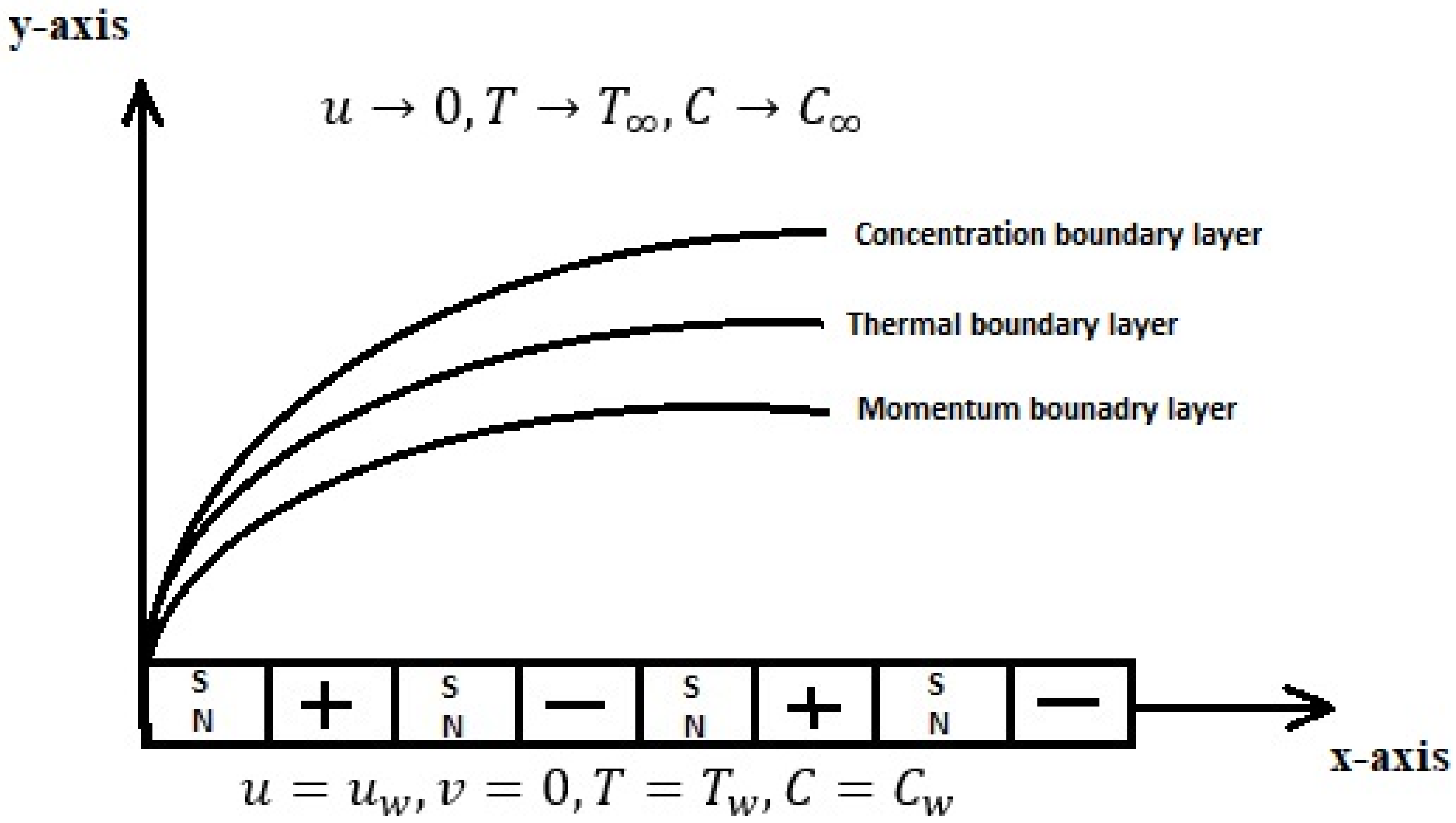
Think about the two-dimensional, laminar, unstable, incompressible Carreau–Yasuda fluid flow over the slope sheet. The abrupt displacement of the plate is what causes the fluid to flow. Place the y -axis perpendicular to the plate and the x -axis parallel to it. Presume that the ambient temperature and concentration—which are those measured distant from the plate—are lower than the fluid’s temperature and concentration at the plate. Assume that the magnetic field strength that forms an angle with the sheet is B 0 . Furthermore, the effects of temperature- and space-dependent heat sources and chemical processes are considered. Figure 1 shows the geometry of the problem.
Viscosity of the Carreau–Yasuda model can be expressed as
μ γ ˙ = μ + μ 0 μ 1 + Γ γ ˙ d 1 m 1 d 1
For two-dimensional boundary layer flow, v = u x , y , v x , y , 0 , the extra stress is
τ x y = μ γ ˙ u y + v x
For boundary layer approximation,
τ x y μ γ ˙ u y
and shear rate reduces to
γ ˙ = u y
So, the viscosity of Carreau–Yasuda fluid is expressed as
μ = μ + μ 0 μ 1 + Γ u y d 1 m 1 d 1
The flow’s governing equations in this instance can be shown as
u x + v y = 0
u t + u u x + v u y = ν u y y + Γ d 1 ν m 1 d 1 d 1 + 1 u y y u y d 1 σ B o 2 ρ s i n 2 ϑ u + g β T T T c o s ϑ + π j o M o 8 ρ e π a 1 y
T t + u T x + v T y = k ρ c p T y y + μ ρ c p u y 2 + μ ρ c p Γ d 1 m 1 d 1 u y 2 u y d 1 1 ρ c p q r y + 1 ρ c p q
C t + u C x + v C y = D C y y k r C C
where q = k u w x ν ρ C p A u T w T + B T T is space- and temperature-dependent heat source during internal heat generation, and q r = 4 3 σ T 3 k T y .
The initial and boundary conditions are expressed as
u 0 , x , y = 0 ,   v 0 , x , y = 0 ,   T 0 , x , y = 0 ,   C 0 , x , y = 0 u t , x , 0 = u w ,   v t , x , 0 = 0 ,   T t , x , 0 = T w ,   C t , x , 0 = C w u t , x , y 0 ,   T t , x , y 0 ,   C t , x , y 0   when   y u t , 0 , y = 0 ,   v t , 0 , y = 0 ,   T t , 0 , y = 0 ,   C t , 0 , y = 0
Consider the following transformations:
u = u u w ,   v = v u w ,   t = u w t L ,   x = x L ,   y = y L ,     θ = T T T w T ,   ϕ = C C C w C  
Substituting transformations shown in (49) for partial derivatives in Equations (44)–(48) results in a dimensionless form of partial differential equations:
u t = u w 2 L u t ,   u x = u w L u x ,   u y = u w L u y ,   2 u y 2 = u w L 2 2 u y 2 ,   T x = T w T L θ x ,   T y = T w T L θ y ,   2 T y 2 = T w T L 2 2 θ y 2 ,   C x = C w C L ϕ x ,   C y = C w C L ϕ y ,   2 C y 2 = C w C L 2 2 ϕ y 2
Using conversions shown in (50) and transformations in (49) in Equations (44)–(48) leads to a dimensionless form of partial differential equations, expressed as
u x + v y = 0
u t + u u x + v u y = 1 R e u y y + m 1 d 1 R e d 1 + 1 W e d 1 u y y u y d 1 H o 2 R e s i n 2 ϑ u + Q e A y + G γ T R e 2 c o s ϑ θ  
θ t + u θ x + v θ y = 1 R e 1 P r θ y y + 4 3 R d R e 1 P r θ y y + E c R e u y 2 + W e d 1 E c R e m 1 d 1 u y 2 u y d 1 + ε x 1 P r ( A u + B θ )
ϕ t + u ϕ x + v ϕ y = 1 S c 1 R e ϕ y y γ ϕ
Subject to the initial and boundary conditions
u 0 , x , y = 0 ,   v 0 , x , y = 0 ,   θ 0 , x , y = 0 ,   ϕ 0 , x , y = 0 u t , x , 0 = 1 ,   v t , x , 0 = 0 ,   θ t , x , 0 = 1 ,   ϕ t , x , 0 = 1 u t , x , y 0 ,   θ t , x , y 0 ,   ϕ t , x , y 0   when   y   u t , 0 , y = 0 ,   θ t , 0 , y = 0 ,   ϕ t , 0 , y = 0
where G γ T , H 0 , R e , W e , A , Q , P r , R d   , E c , S c , and γ are dimensionless chemical reactions defined as
G r T = L 3 g β T T w T ν 2 , H o = B L σ ρ ν ,   R e = L u w ν ,   W e = Γ u w L ,   A = π L a 1 ,   Q = π j o M o L 8 ρ u w 2 ,   P r = ρ c p ν k ,   R d = 4 σ T 3 3 k k ,   S c = ν D ,   γ = k r L u w  
The skin friction coefficient and local Nusselt and Sherwood numbers are defined as
C f = τ w ρ u w 2
N u L = L q w k T w T
S h L = L j w D C w C
where τ w = μ + m 1 d 1 Γ d 1 u y d 1 u y y = 0 , q w = k T y y = 0 and j w = D C y y = 0 .
By using corresponding transformations from the set of transformations shown in (54) for Equations (61)–(63), the dimensionless skin friction coefficient and local Nusselt and Sherwood numbers are expressed as
R e C f = 1 + m 1 d 1 W e d 1 u y d 1   u y y = 0
N u L = θ y y = 0
S h L = ϕ y y = 0
Time-fractal is more general than the integer-order time derivative. The proposed scheme can be used for classical integer-order time derivative and time-fractal partial differential equations. Also, it may capture long-range time dependence, better model viscoelastic response, and describe delayed diffusion. By using time-fractal derivatives, Equation (56) stays the same, while the rest are expressed as
u t α + u u x + v u y = 1 R e u y y + m 1 d 1 R e d 1 + 1 W e d 1 u y y u y d 1 H o 2 R e s i n 2 ϑ u + Q e A y + G γ T R e 2 c o s ( ϑ ) θ  
θ t α + u θ x + v θ y = 1 R e 1 P r θ y y + 4 3 R d R e 1 P r θ y y + E c R e u y 2 + W e d 1 E c R e m 1 d 1 u y 2 u y d 1 + ε x 1 P r ( A u + B θ )
ϕ t α + u ϕ x + v ϕ y = 1 S c 1 R e ϕ y y γ ϕ
subjected to the same initial and boundary conditions (60).
The discretization of Equation (67) using the proposed scheme is given as
u ¯ i , j n + 1 = u i , j n + t 1 u i , j n Γ x u i , j n Γ y u i , j n + 1 R e + m 1 d 1 R e d 1 + 1 W e d 1 Γ y u i , j n Γ y 2 u i , j n H o 2 R e s i n 2 ϑ u i , j n + Q e A y + G γ T R e 2 c o s ϑ θ i , j n
u ¯ ¯ i , j n + 1 = 1 5 u i , j n + 4 u ¯ i , j n + 1 + t 2 u i , j n Γ x u ¯ i , j n + 1 Γ y u ¯ i , j n + 1 + 1 R e + m 1 d 1 R e d 1 + 1 W e d 1 Γ y u ¯ i , j n + 1 Γ y 2 u ¯ i , j n + 1 H o 2 R e s i n 2 δ 1 u ¯ i , j n + 1 + Q e A y + G γ T R e 2 c o s δ 1 θ ¯ i , j n + 1
u i , j n + 1 = a u i , j n + b u ¯ i , j n + 1 + c u ¯ ¯ i , j n + 1 + d t u i , j n Γ x u ¯ ¯ i , j n + 1 Γ y u ¯ ¯ i , j n + 1 + 1 R e + m 1 d 1 R e d 1 + 1 W e d 1 Γ y u ¯ ¯ i , j n + 1 Γ y 2 u ¯ ¯ i , j n + 1 H o 2 R e s i n 2 δ 1 u ¯ ¯ i , j n + 1 + Q e A y + G γ T R e 2 c o s δ 1 θ ¯ ¯ i , j n + 1

5. Results and Discussion

A numerical scheme is constructed in three different stages. One advantage of the scheme is its faster convergence compared to other explicit three-stage schemes. Because it requires a minimum number of terms to find the solution, the scheme can be used for both classical and fractal partial differential equations. It was constructed by using fractal Taylor series expansion and provides third-order accuracy in fractal time. For spatial discretization, a compact scheme is chosen that provides sixth-order accuracy on the internal nodes for the momentum, energy, and concentration equations. For the continuity equation of incompressible fluid, the first-order scheme for spatial discretization is employed.
In the beginning of this study, a numerical scheme is modified for time-fractal partial differential equations. Its construction and stability and convergence analysis are provided. After this, a mathematical model of flow over the Riga plate is constructed, and its dimensionless form is solved by the proposed scheme. The range of parameters used in the considered model depends on the stability condition of the proposed scheme. So, if the scheme remains stable for a certain parameter value, then that value can be chosen. The results obtained by these equations are used as targets for predicting the skin friction coefficient and local Nusselt number using artificial intelligence.
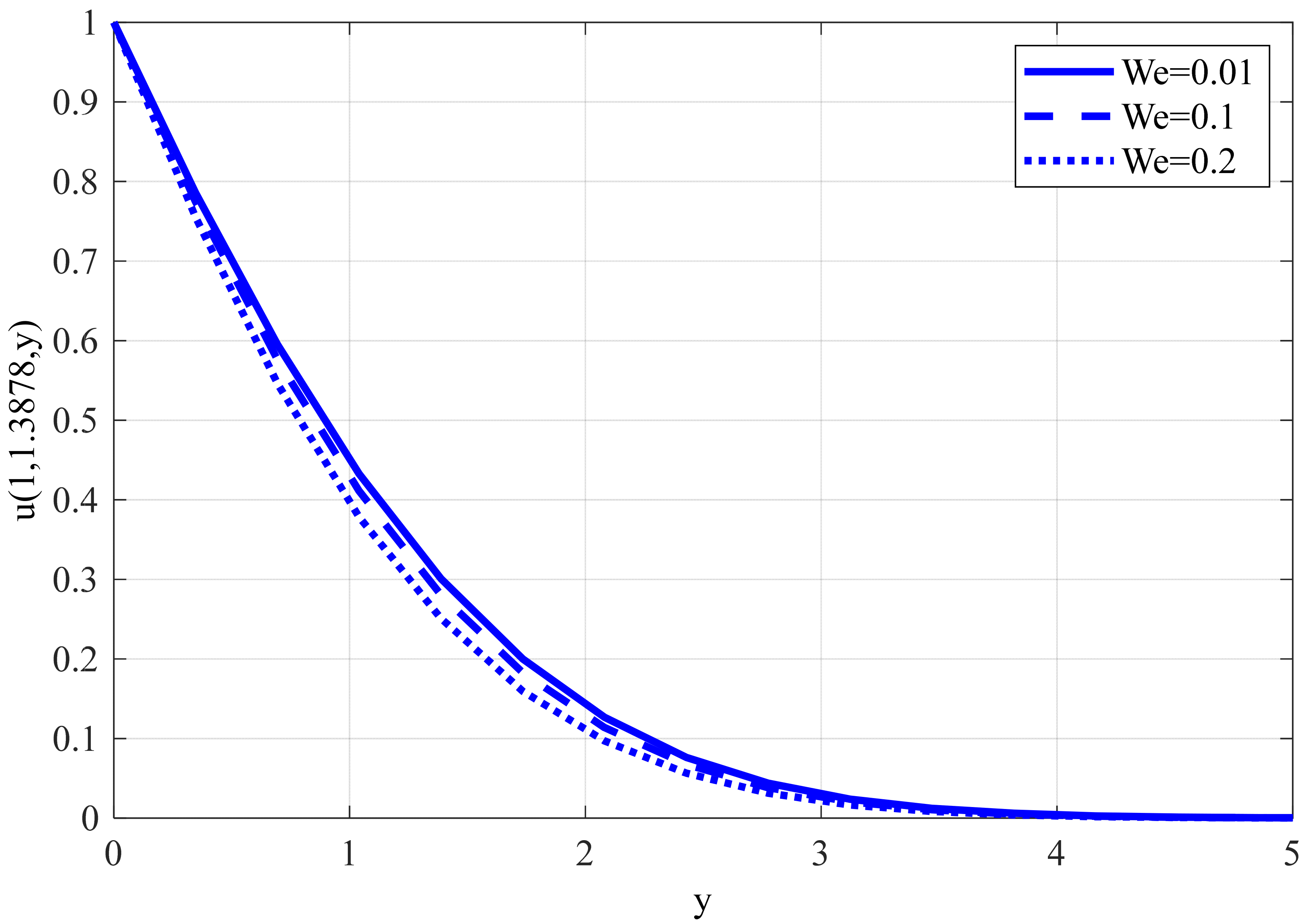
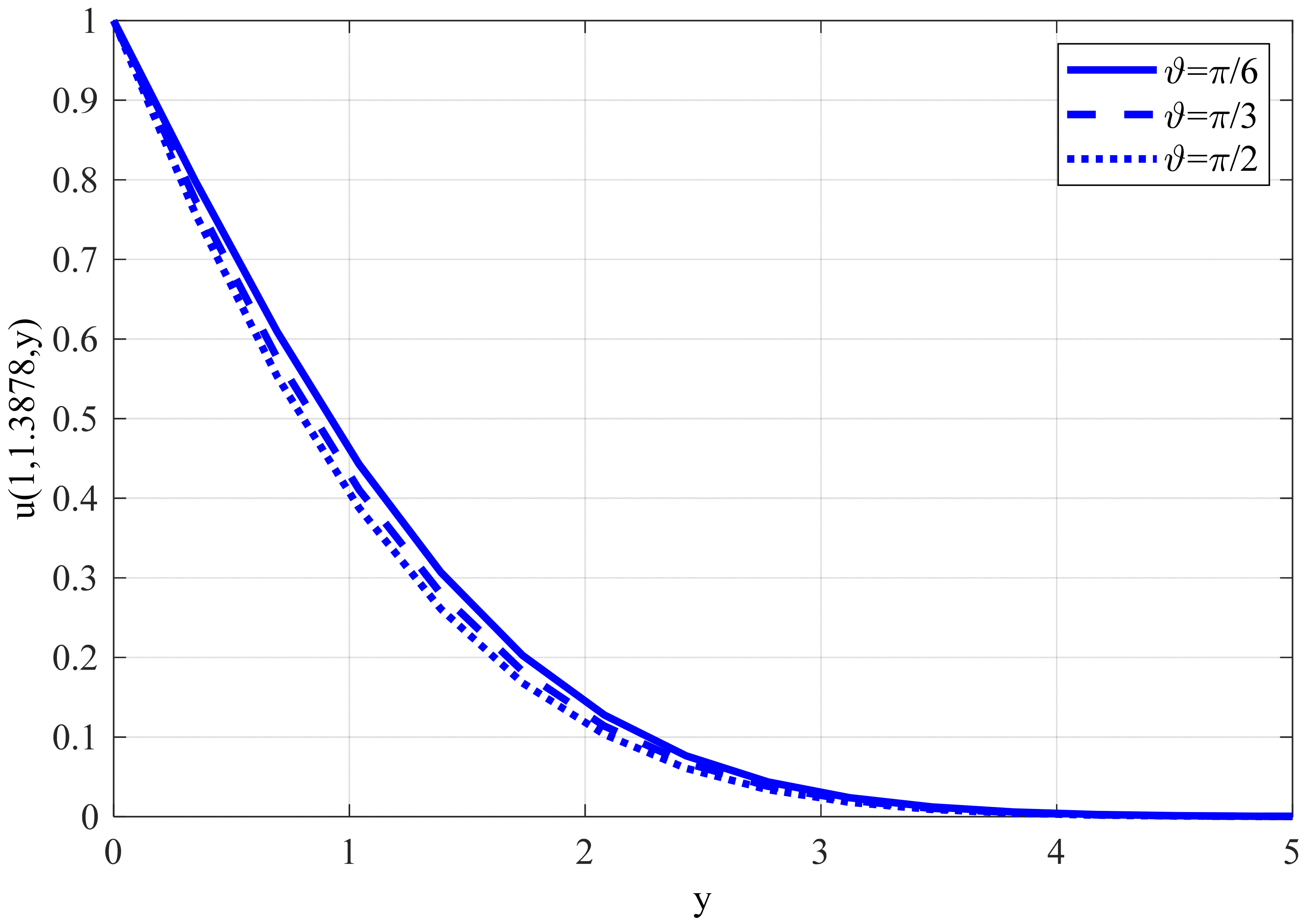
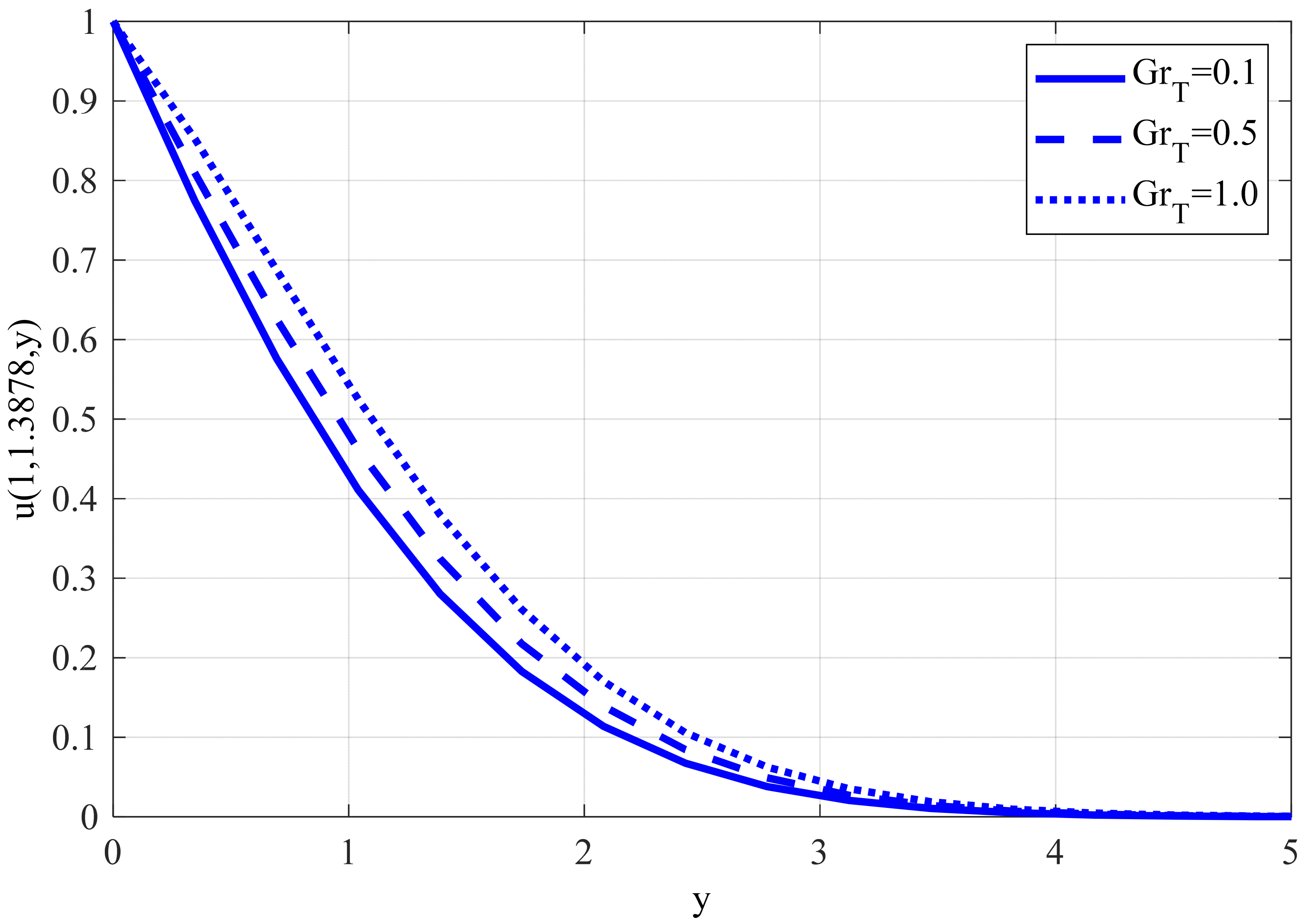
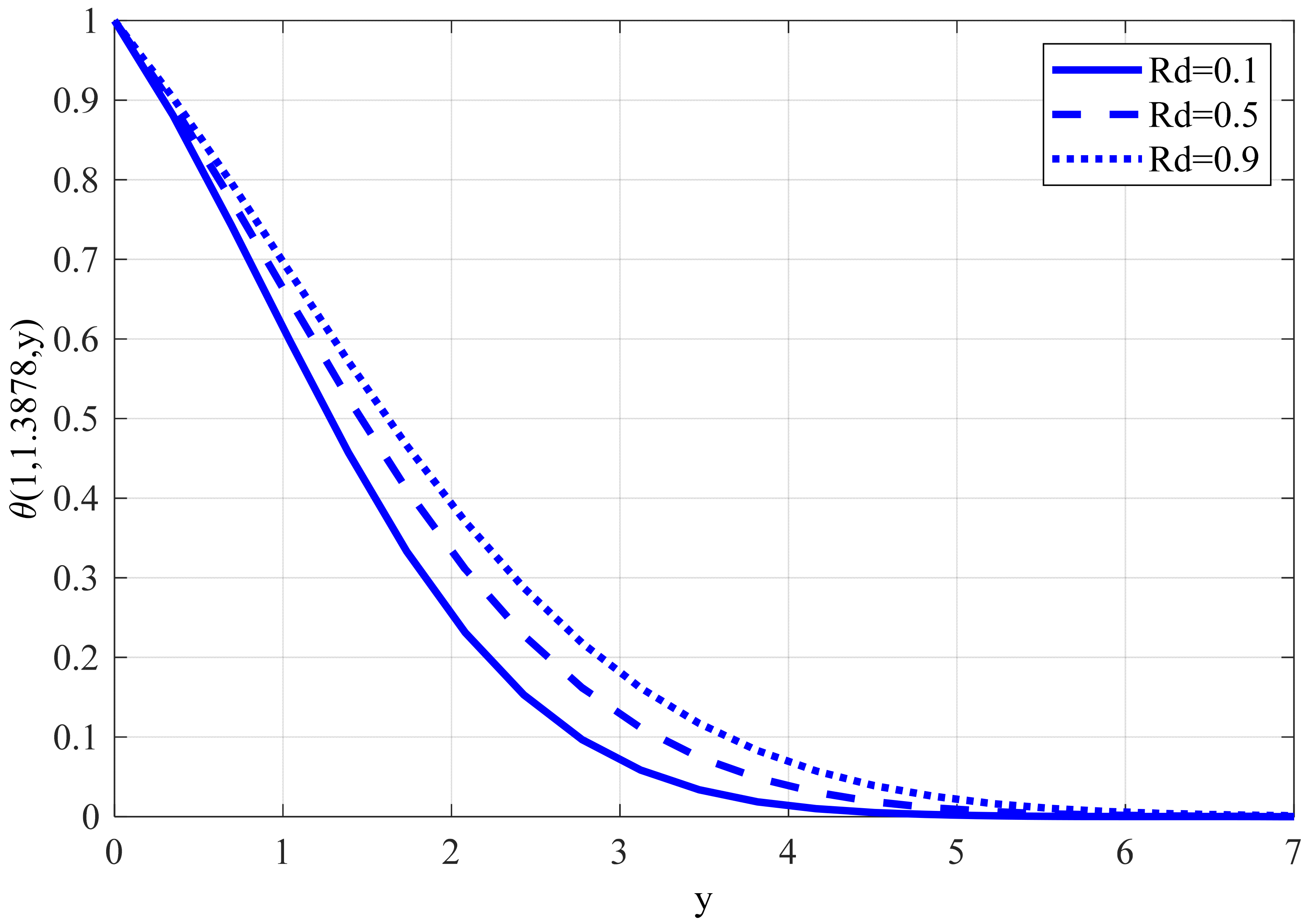
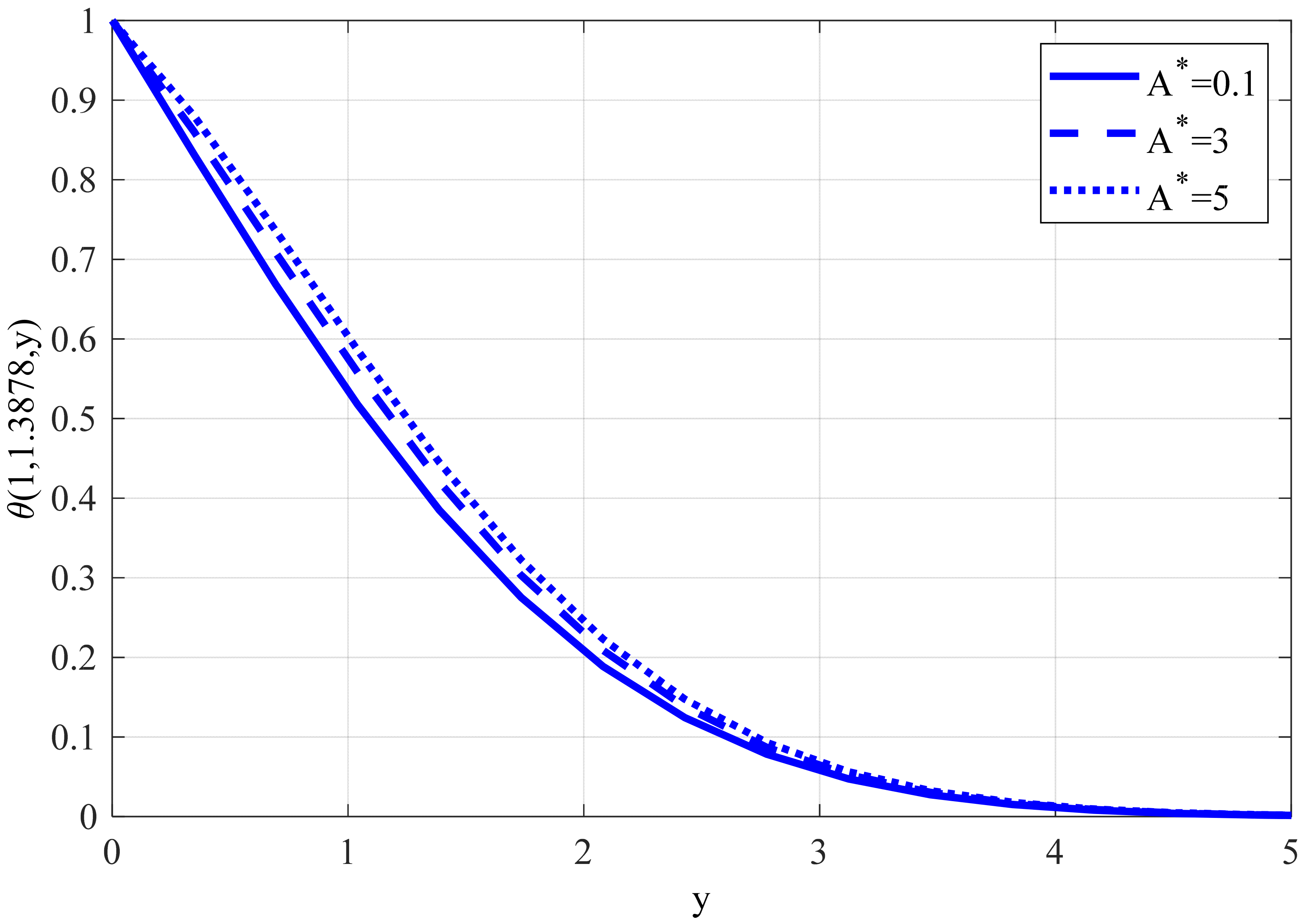
Figure 2 illustrates the influence of the Weissenberg number on the velocity distribution. An increase in the Weissenberg number leads to a reduction in velocity. This behavior is attributed to the enhanced relaxation effects associated with the higher elastic properties of the fluid, which resist flow motion. Figure 3 presents the impact of the magnetic field inclination angle on the velocity field. As the inclination angle increases, the velocity decreases due to the strengthening of the Lorentz force, which opposes the fluid motion and suppresses momentum development. The variation in velocity with the Grashof number is shown in Figure 4. Growth in the Grashof number escalates the velocity profile because stronger buoyancy forces promote fluid motion in mixed convection regimes. In Figure 5, the radiation parameter is observed to elevate the temperature distribution. Higher radiation contributes additional thermal energy to the fluid, resulting in thicker thermal boundary layers.
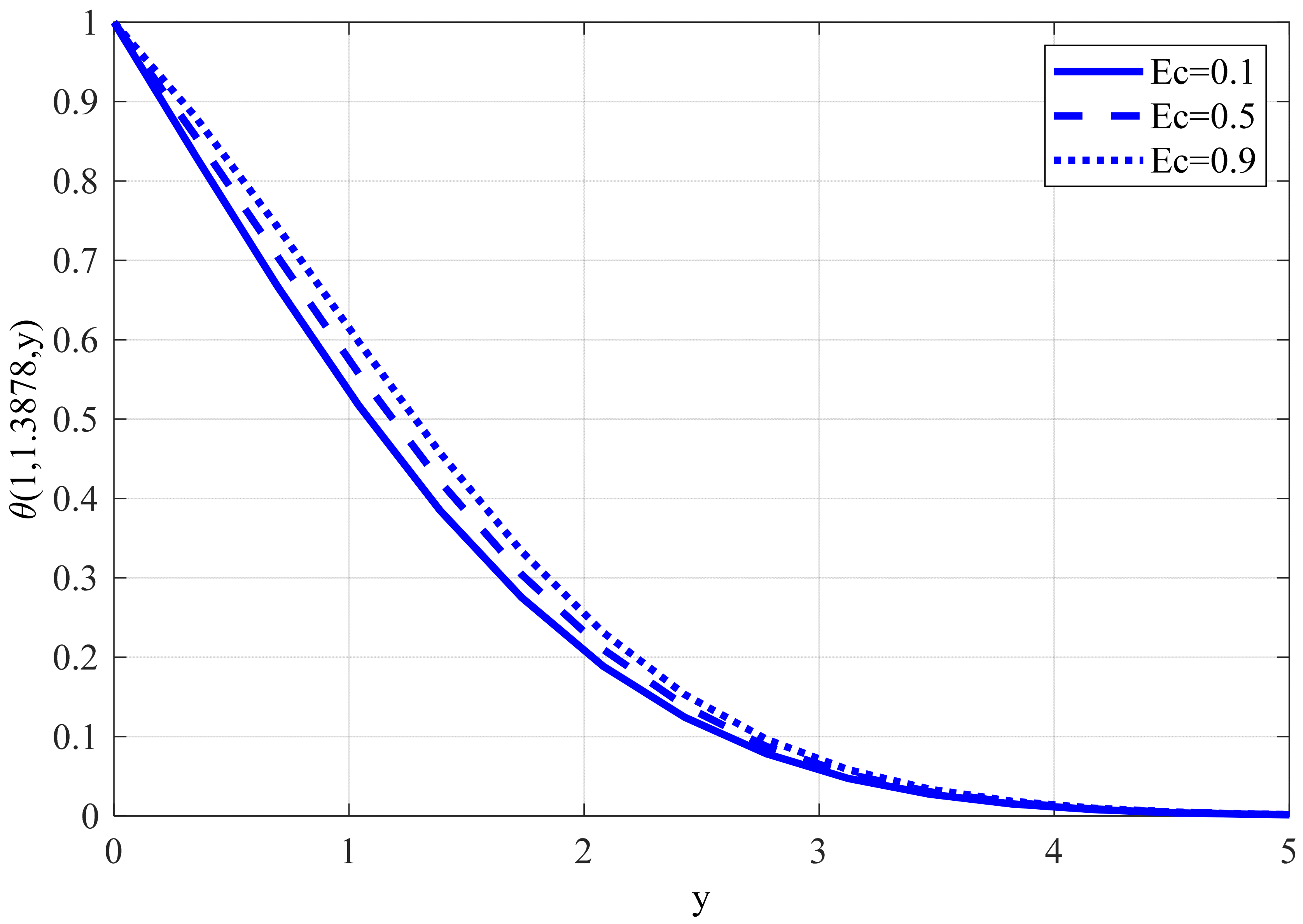
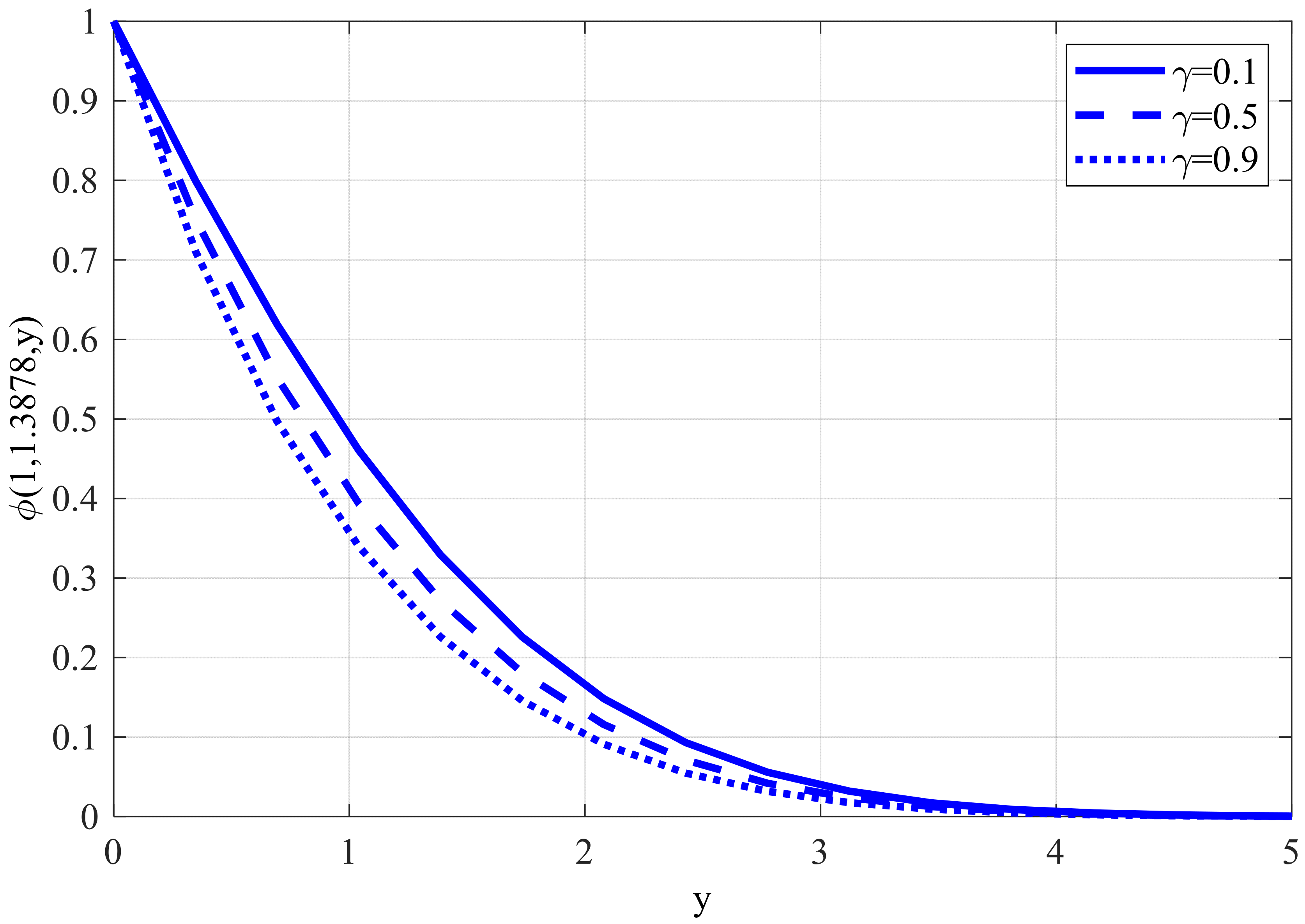
Figure 6 shows the temperature profile affected by the Eckert number. Growing values of the Eckert number raises viscous dissipation, converting more kinetic energy into internal energy and consequently increasing the fluid’s temperature. The effect of space-dependent heat source coefficient on temperature distribution is shown in Figure 7. When this coefficient increases, internal heat generation escalates, which raises the temperature distribution. Finally, Figure 8 shows the concentration distribution affected by the chemical reaction parameter. Growth in this reaction parameter declines the concentration profile because stronger reactions enhance the consumption of species, which decreases concentrations within the boundary layer.
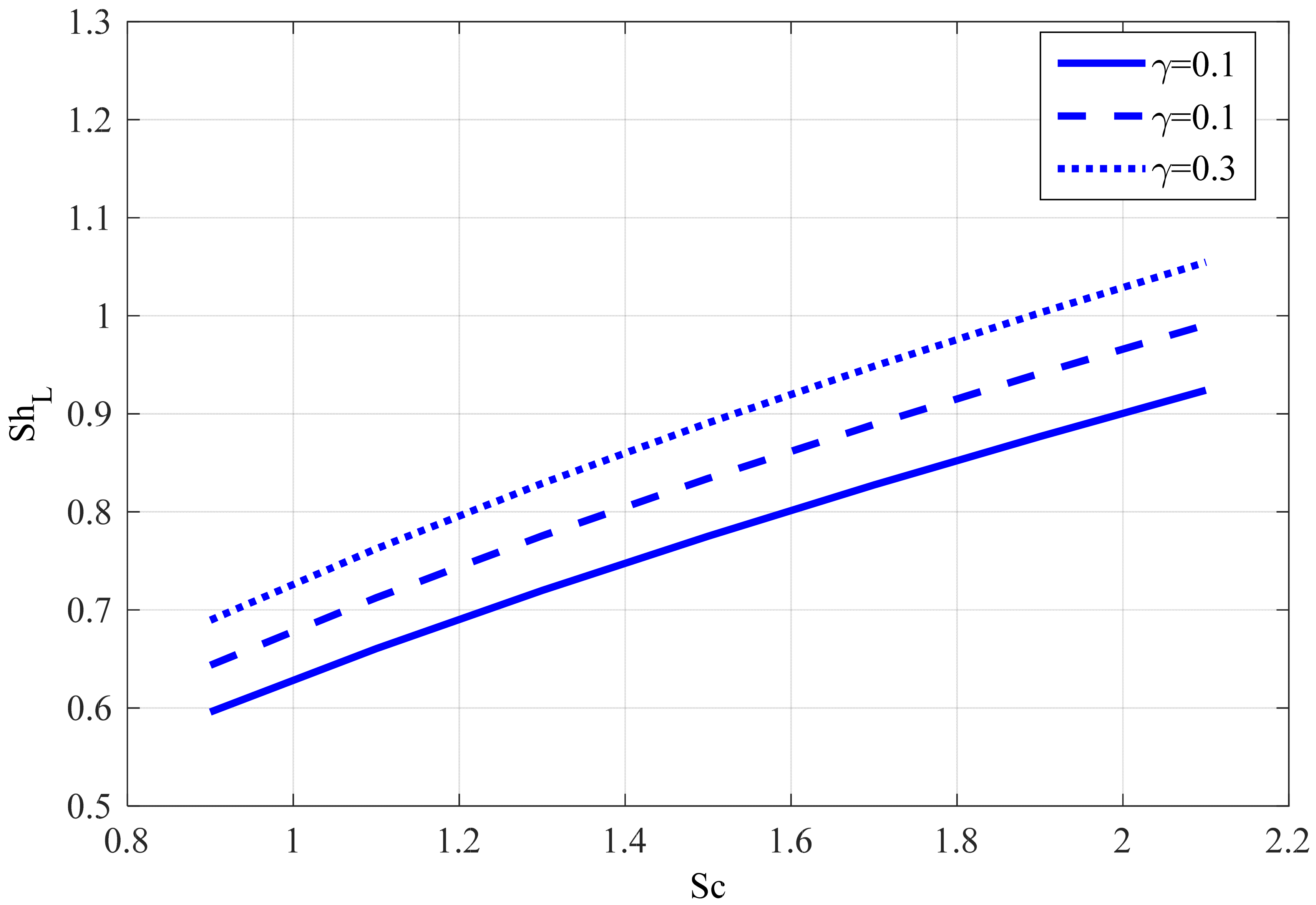
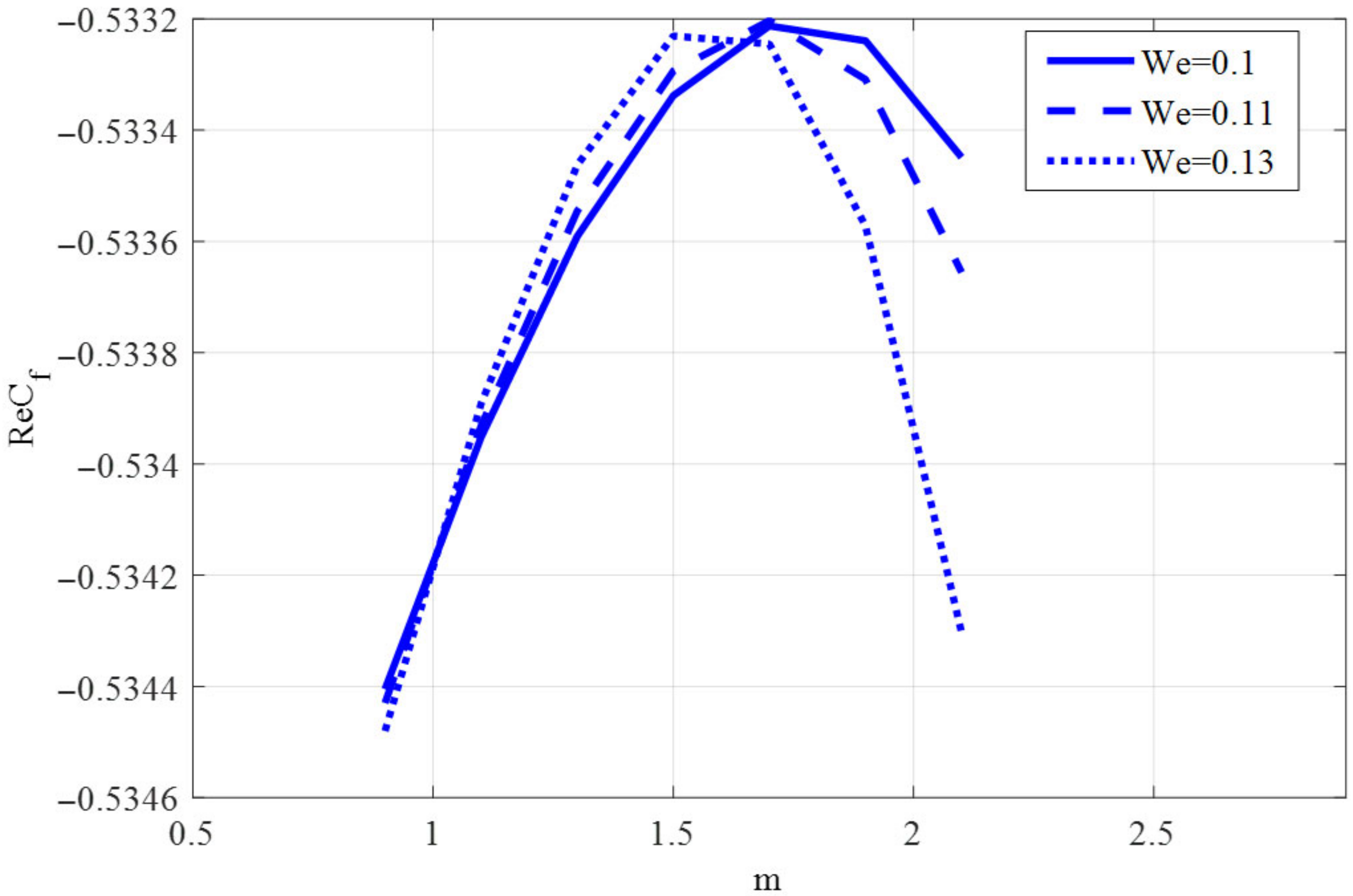
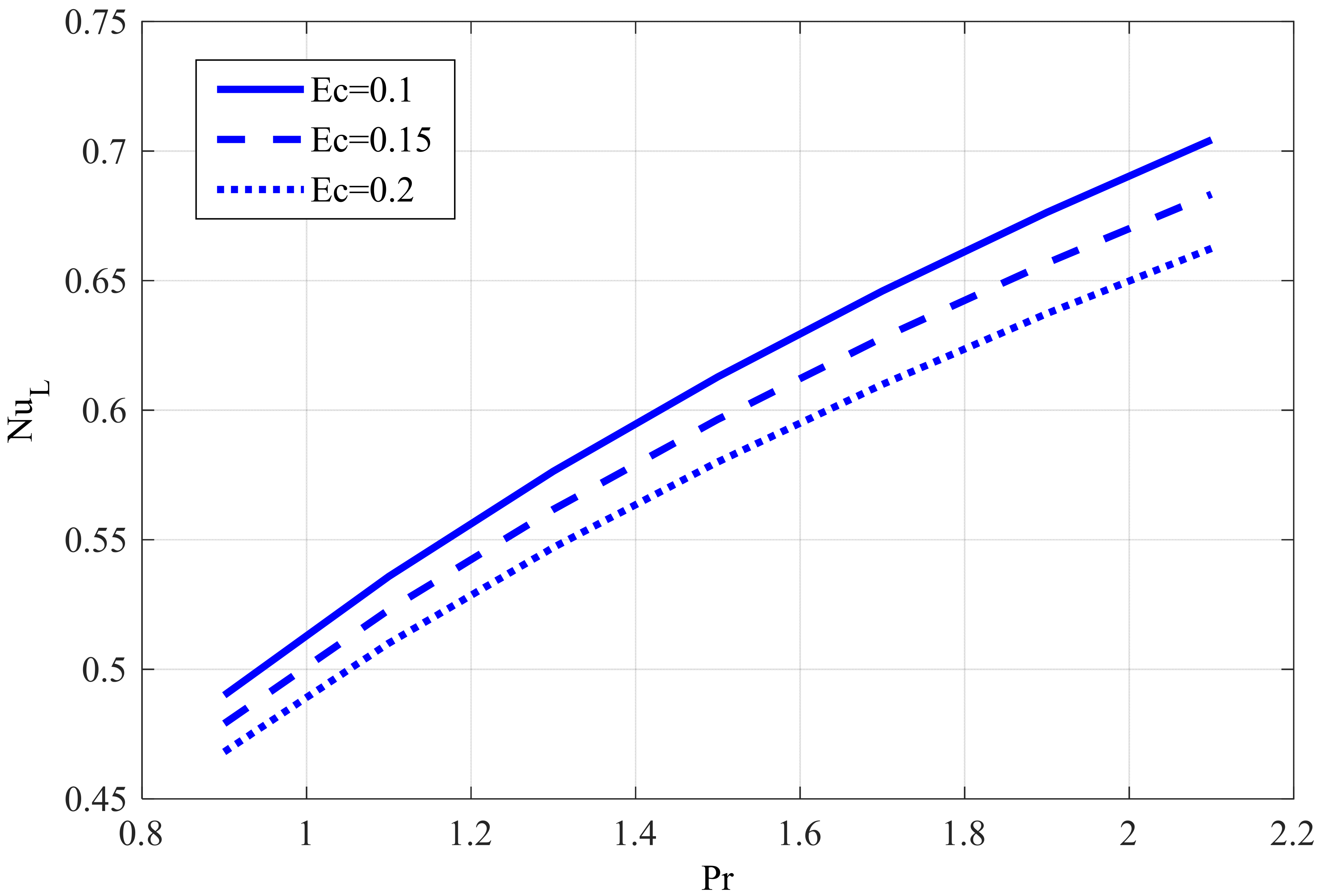
Figure 9 shows the effect of variation in the power-law index and the Weissenberg number on the skin friction coefficient. Wall shear stress is significantly modified by +changes in these parameters due to alterations in the elastic characteristics and the fluid’s effective viscosity. The effect of the Prandtl and Eckert numbers on the local Nusselt number is displayed in Figure 10. Increasing the Prandtl number raises the heat transfer rate because higher Prandtl values leads to lower thermal diffusivity, which steepens the temperature gradient at the surface. In contrast, larger Eckert numbers decline the local Nusselt number as viscous dissipation enhances the fluid temperature and reduces the thermal gradient at the wall. Figure 11 displays the effects of variations in the Schmidt number and chemical reaction parameter on the local Sherwood number. An increase in the Schmidt number intensifies mass transfer at the surface due to weakened species diffusivity, which increases the concentration gradient. Similarly, higher reaction rates escalate species consumption within the boundary layer, modifying the mass transfer characteristics and affecting the Sherwood number accordingly.
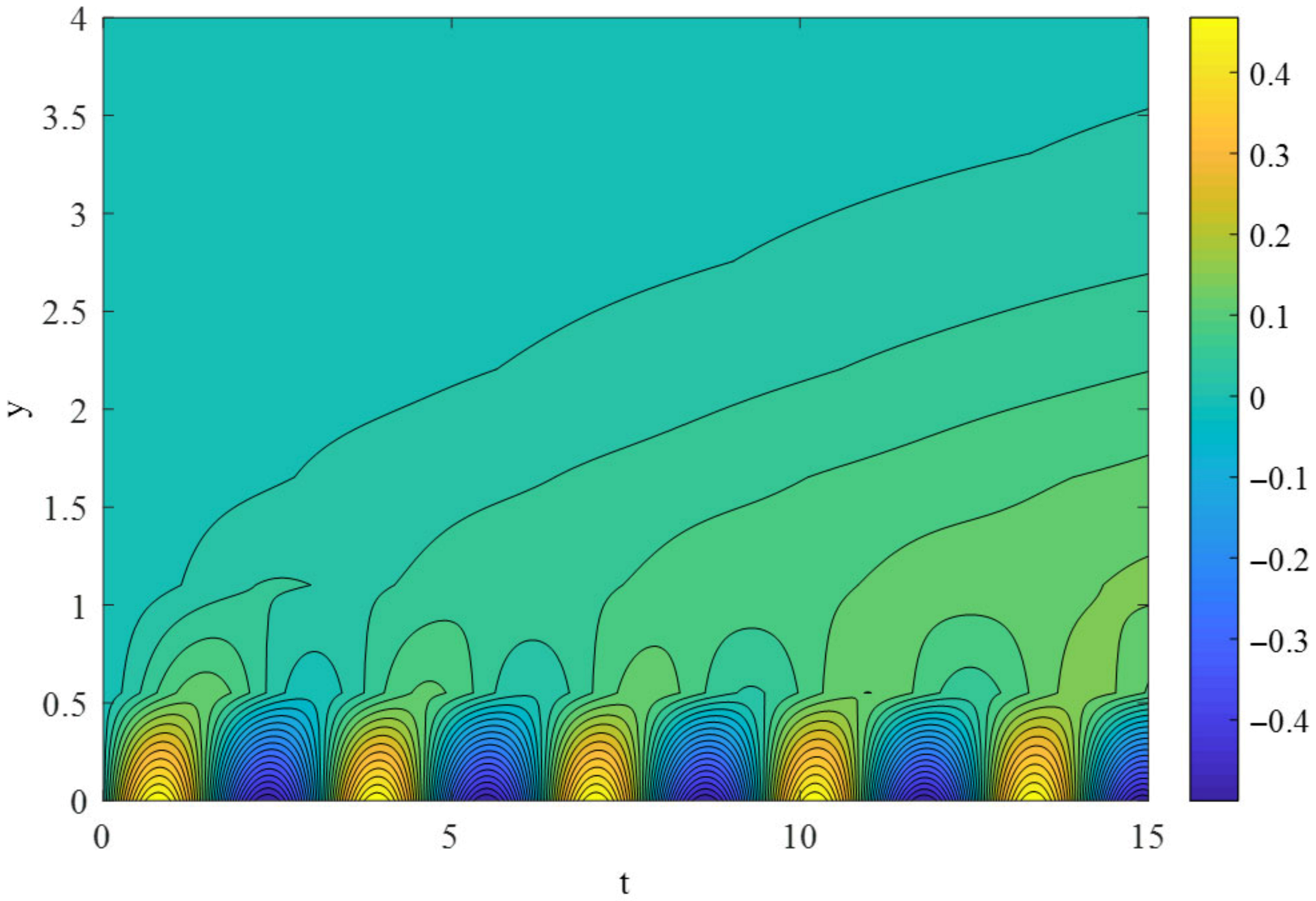
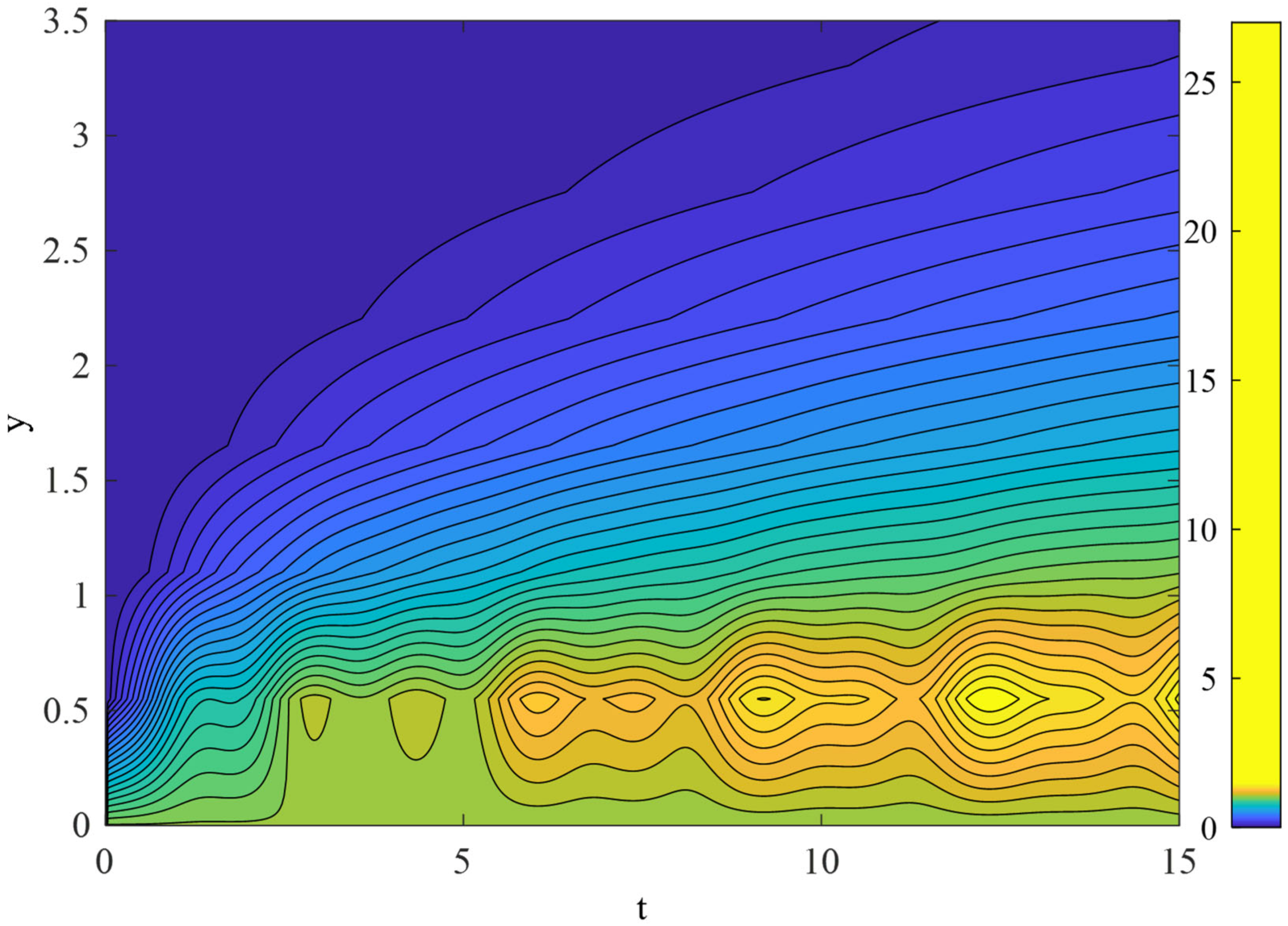
Figure 12 and Figure 13 display contour representations of velocity and temperature distributions. Figure 12 displays the contours of horizontal velocity profiles over time and space for the case of the oscillatory plate. The oscillatory motion of the boundary introduces wave structures in the flow field that can be seen along the temporal direction. Temperature contours provided in Figure 13 reveal similar time-dependent behavior affected by the oscillatory boundary condition.
Table 1 shows the comparison of the three schemes for finding the norm of the absolute error between the exact and numerical solutions when the schemes are applied to the first example in [20]. The first order in the time scheme is forward Euler and the second order in the Runge–Kutta scheme is time. Two different spatial discretizations are used. The second order is consisted on classical central discretization, and the sixth order is consisted on compact discretization. The proposed scheme is third-order accurate in time and gives smaller errors than the other two schemes when using second-order central discretization in space. But the error is reduced when time becomes smaller for the compact scheme, and in this second order, Runge–Kutta performs better than the other two schemes.
Table 2 shows the comparison of numerical solutions and exact solutions for solving the stokes first problem, which is a parabolic partial differential equation. The solution can be improved if more grid points are used. Only fourteen points in space are used, and the solution is found on these fourteen points. So, validation of the solution obtained by the proposed scheme is ensured by comparison of solutions shown in Table 2.
This study also utilizes a surrogate machine learning model for predicting the skin friction coefficient and local Nusselt number for the considered Carreau–Yasuda non-Newtonian fluid flow over a Riga plate. The use of the Riga plate imposes an exponentially decaying Lorentz force which significantly modifies the near-wall momentum transport. This surrogate machine learning model learns from the combined influence of viscoelastic rheology and electromagnetic actuation, which is difficult for regression or reduced-order analytical models. The model uses the four vectors as input and skin friction coefficient and local Nusselt number as output, and physical quantities are also computed by solving dimensionless governing equations. It predicts values of the skin friction coefficient and local Nusselt number without actually solving governing equations; instead, they are solved to collect target values for each value of input vectors.
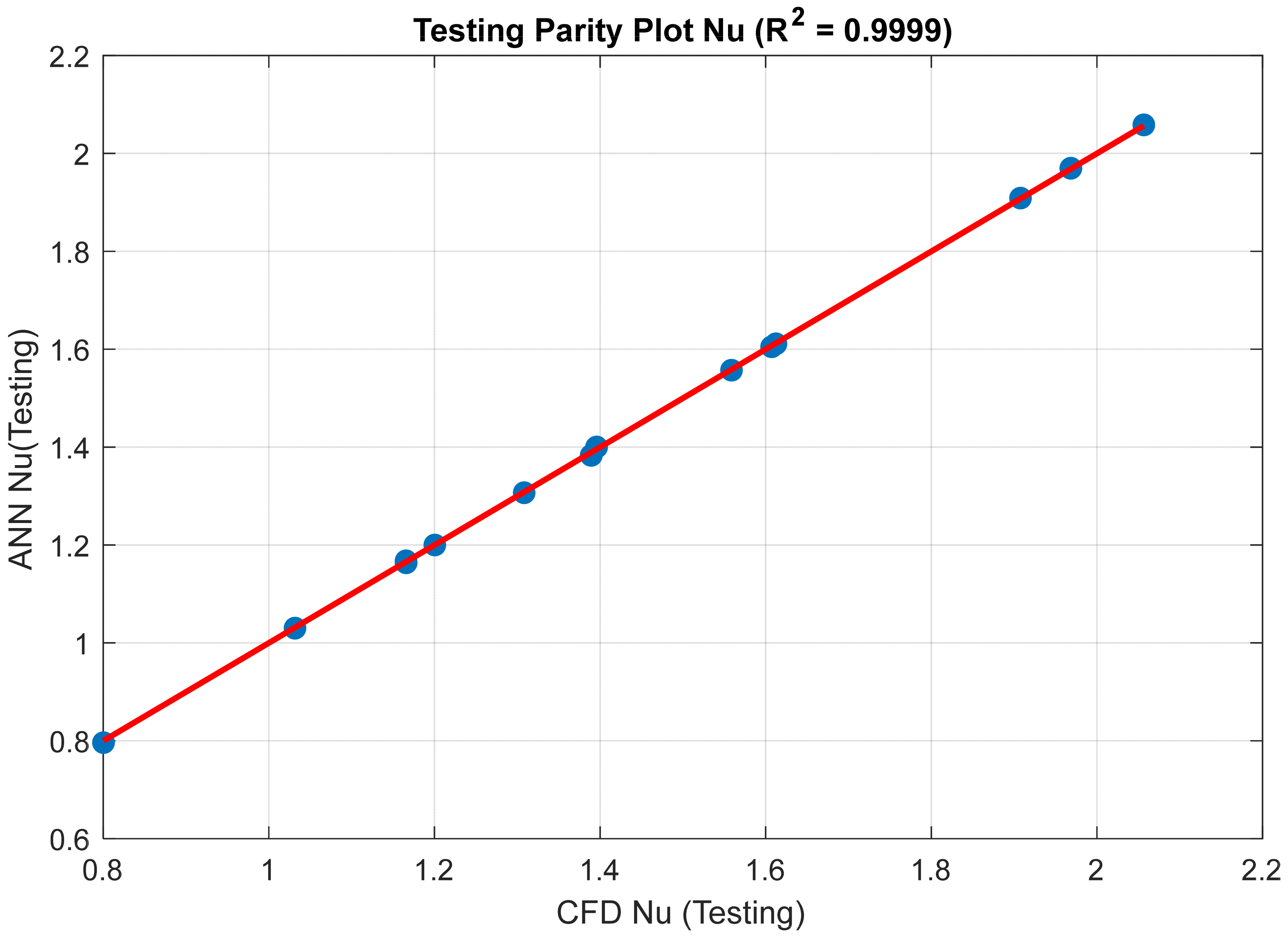
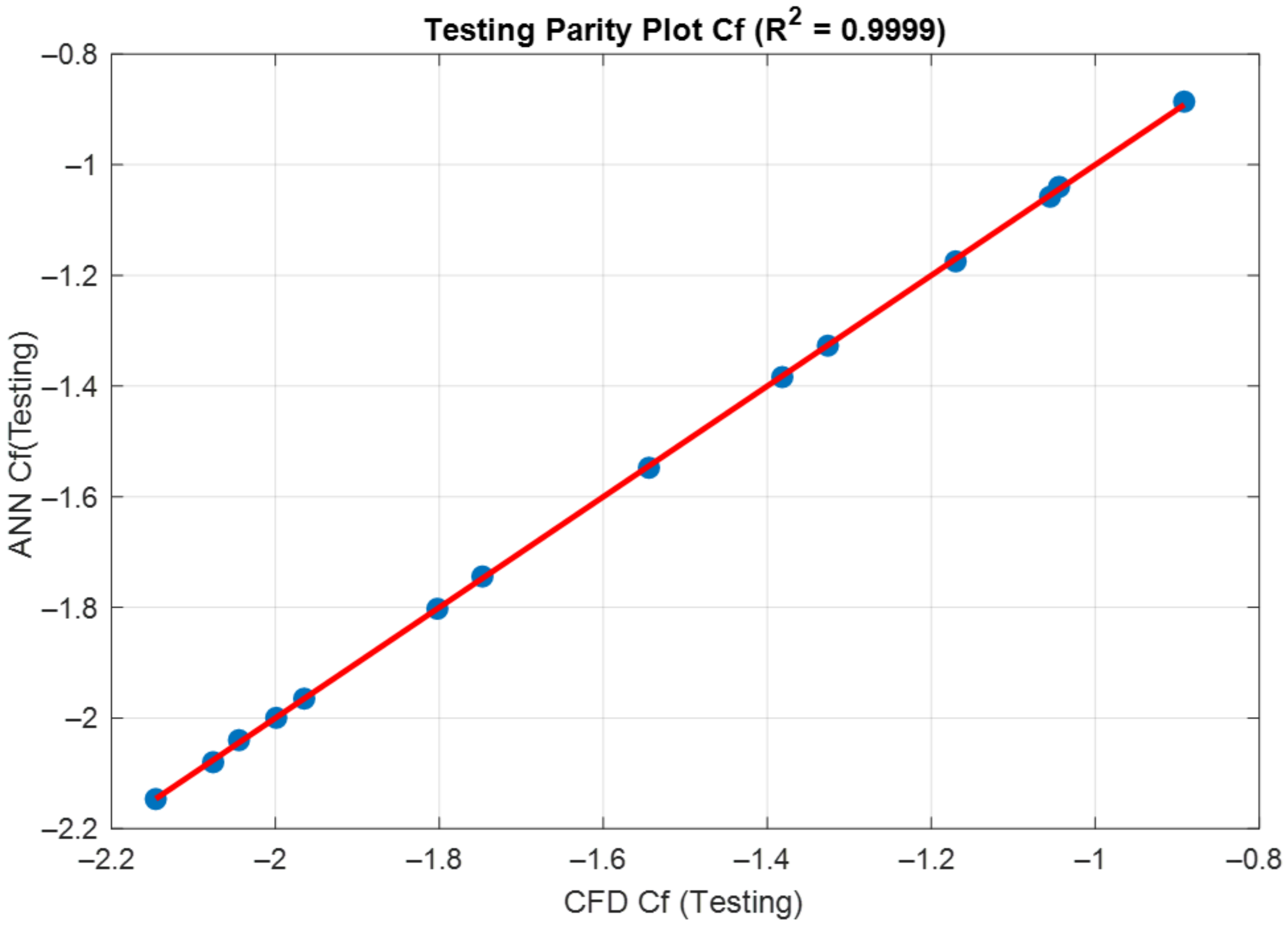
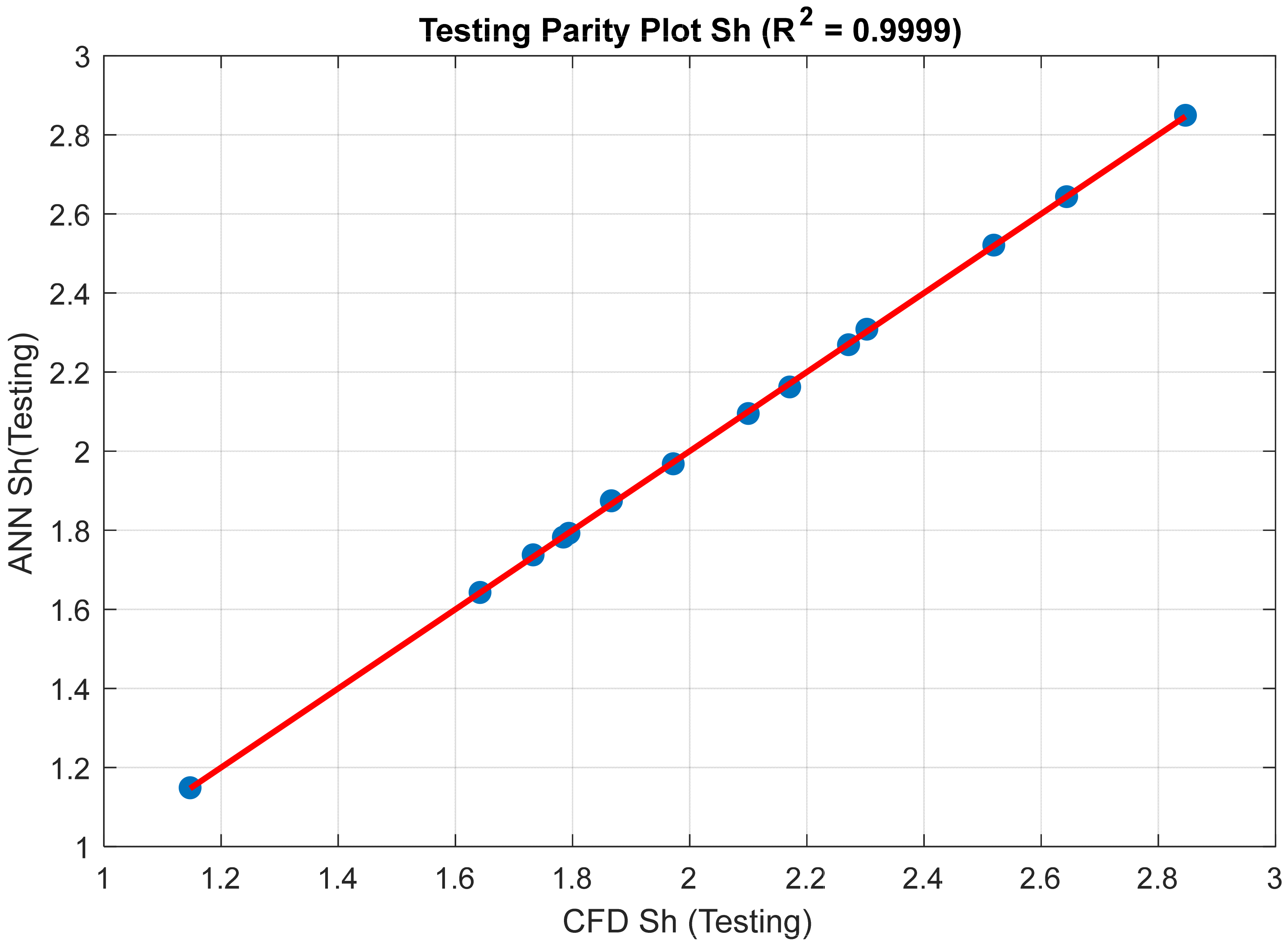
The parity plots shown in Figure 14, Figure 15 and Figure 16 for the skin friction coefficient, local Nusselt number, and local Sherwood number, respectively, assist as a visual and assessable measure of the predictive ability of the trained artificial neural network for this problem of flow over plate. In each case shown in Figure 14, Figure 15 and Figure 16, the ANN predictions for the testing dataset are plotted against the corresponding CFD-derived values obtained by applying the classical finite difference scheme for the considered problem of flow over plate. Approximately all points lie on the 45° diagonal line, indicating perfect agreement between the artificial neural network model and the reference data obtained from the numerical solver shown before. Figure 14, Figure 15 and Figure 16 show that most points cluster closely around this line, which demonstrates that the network has successfully captured the complex nonlinear relationships between the input parameters R e , G r T ,   P r , E c , S c as vectors of numerical values and the outputs. The high degree of alignment of the predicted and actual set of data, along with the computed coefficients of determination R 2 that approach unity, as shown in Figure 14, Figure 15 and Figure 16, shows that the ANN can reliably reproduce the results of the skin friction coefficient and local Nusselt and Sherwood numbers that are obtained by solving a dimensionless set of governing PDEs across a range of input conditions. This proves both its generalization capability and accuracy.
The parity plots shown in Figure 14, Figure 15 and Figure 16 for the skin friction coefficient, local Nusselt number, and local Sherwood number exhibit the tightest clustering around the diagonal line, which suggests that the momentum, heat transfer and nanoparticle concentration-related dynamics governed by the PDE are well captured by the network. These parity plots show that the artificial neural network can serve as an efficient surrogate for the full PDE solver and thus reduces computational cost without compromising accuracy. This type of modeling using artificial neural networks is particularly important for applications that necessitate quick estimation over a wide range of parameters, such as optimization, parametric studies, or real-time control.
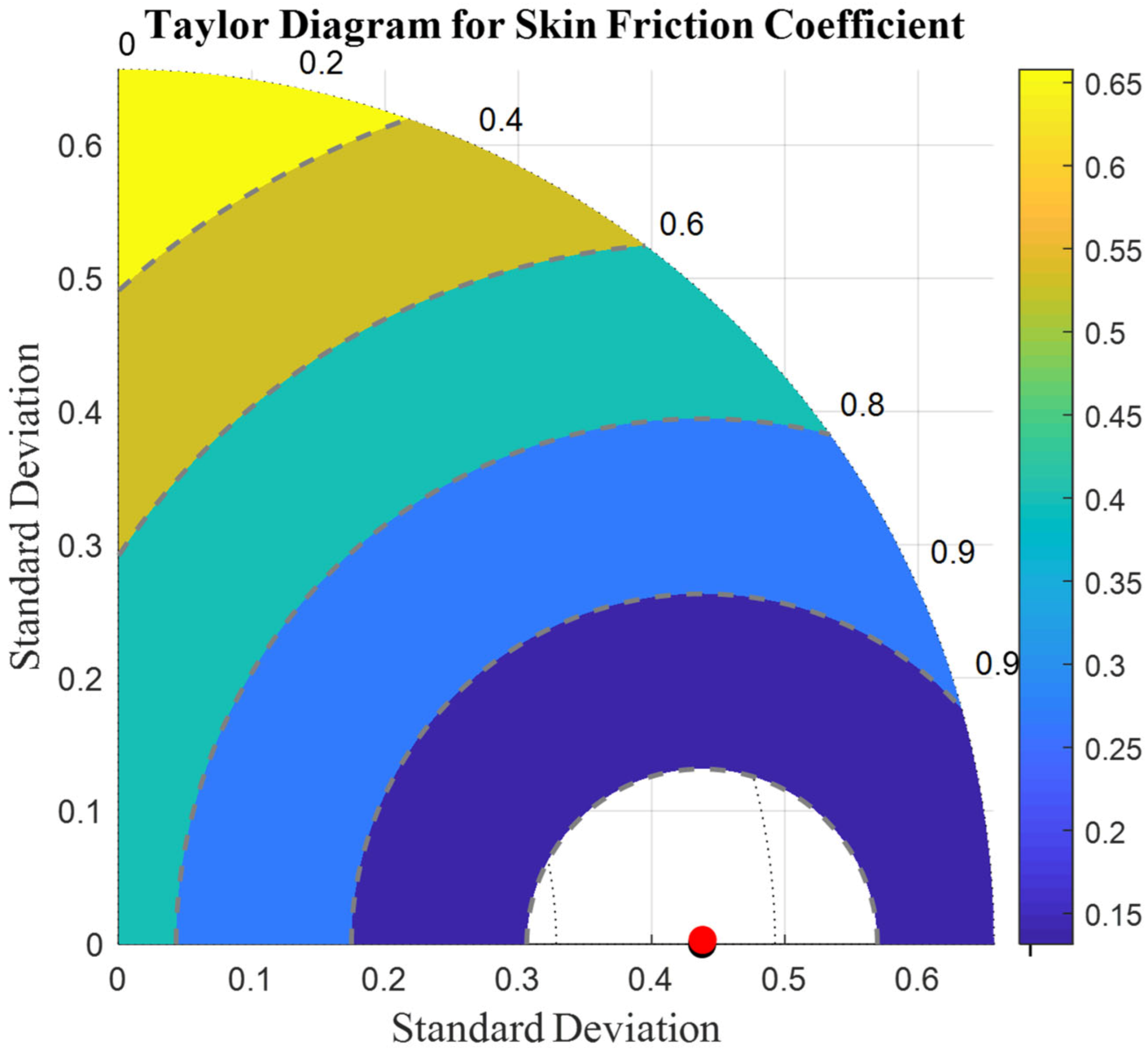
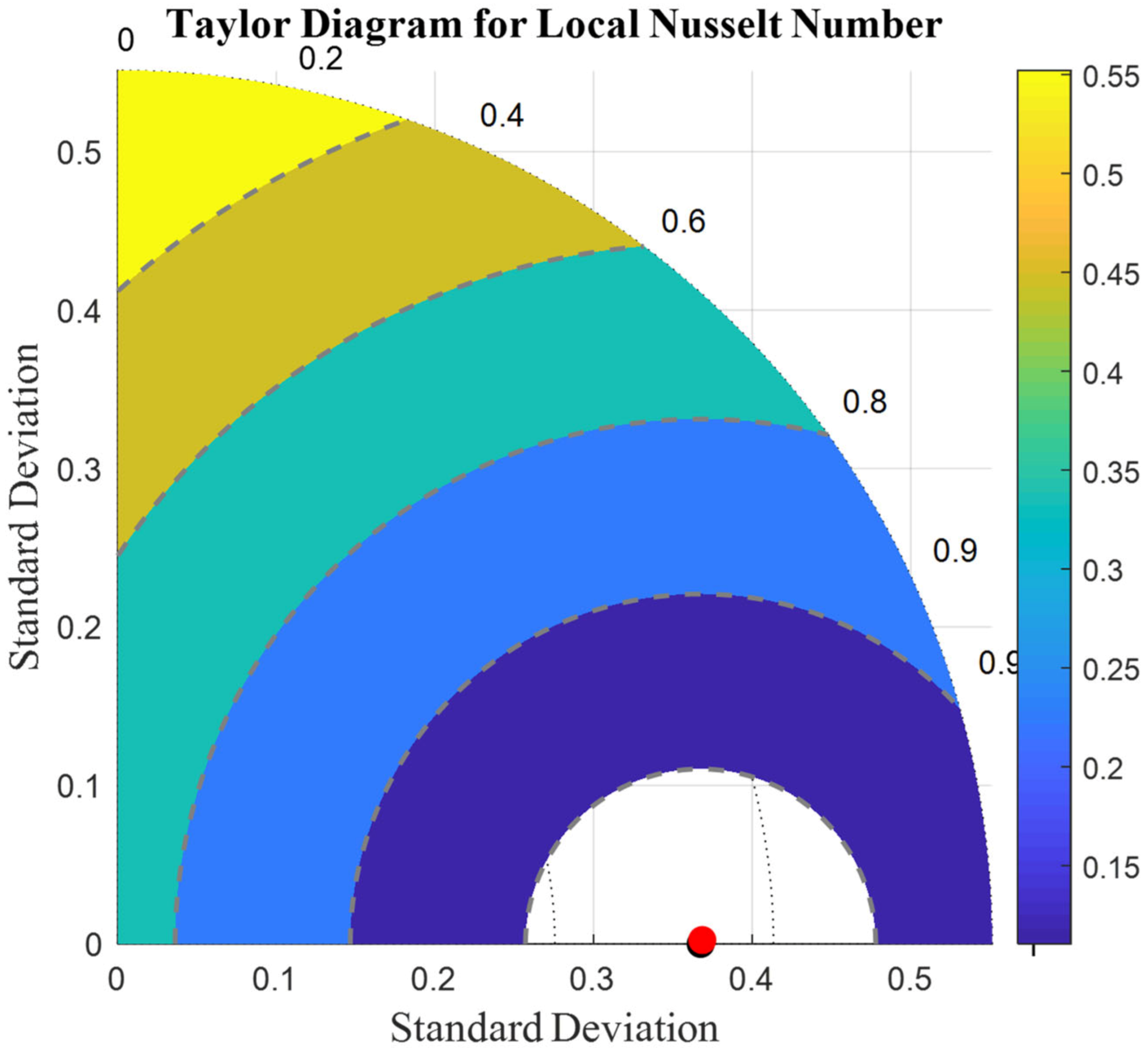
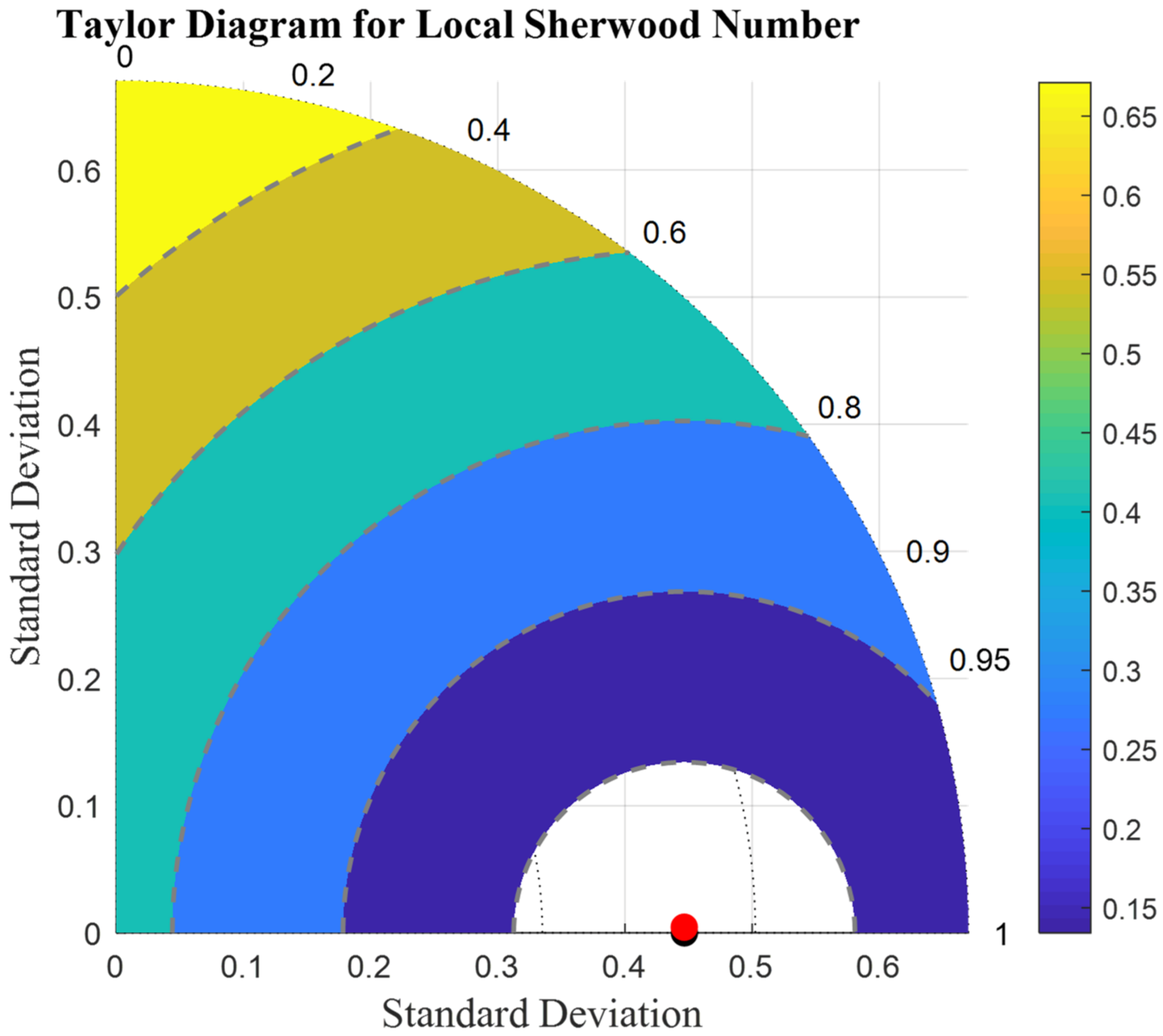
A comprehensive statistical comparison between the CFD-generated data obtained from the predictions produced by the artificial neural network and PDE solver is provided in Taylor diagrams shown in Figure 17, Figure 18 and Figure 19 for the skin friction coefficient, local Nusselt number, and local Sherwood number, respectively. Unlike simple parity plots, three important statistical measures, namely the correlation coefficient, the standard deviation, and the root mean square error (RMSE), are simultaneously illustrated by the Taylor diagrams. The angular coordinate corresponds to the correlation coefficient between the predicted and actual data from the PDEs while the radial distance from the origin represents the standard deviation of the predicted dataset. The reference or actual CFD solution obtained by solving governing PDEs using the classical finite difference scheme is plotted along the horizontal axis, and the position of the artificial neural network prediction point relative to this reference delivers an instant visual valuation of the model performance. Figure 17, Figure 18 and Figure 19 conclude that the predicted points lie close to the reference or actual points, showing that the artificial neural network accurately reproduces the statistical characteristics of the CFD results.
The Taylor diagram in Figure 17 shows that the neural network prediction for the skin friction coefficient lies very close to the reference or actual/numerical point, which indicates that there is strong agreement between the artificial neural network and the CFD data from the PDEs =. The correlation coefficient approaches unity because both points are close to each other, which shows that the predicted data and reference or numerical data obtained from PDEs follow almost identical trends across the testing samples. Additionally, both predicted and numerical standard deviations closely match, revealing that the neural network captures the variability and distribution of the physical quantity effectively. The small RMSE contours surrounding the predicted point further confirm that there is a small difference between the ANN predictions and the PDEs, which demonstrates the reliability of the trained neural network for approximation of the momentum transport characteristics represented by the dimensionless PDE model.
Similarly, the Taylor diagrams in Figure 18 and Figure 19 for the local Nusselt and Sherwood numbers show that is the neural network has strong predictive performance in modeling heat and mass transfer rates. Although some deviation of predicted points from numerical points is observed due to the increased nonlinearity of the energy and nanoparticle concentration equations, the points for the local Nusselt and Sherwood numbers still maintain high correlation value and low RMSE. This indicates that the ANN successfully captures both the variability and magnitude of the CFD-generated results. Overall, the Taylor diagrams prove the high accuracy of the predicted local Nusselt and Sherwood numbers, confirming the reproduction of the statistical structure of the PDE solution. This shows that the ANN model is a reliable surrogate for predicting the key transport quantities over the range of parameters considered in the study.
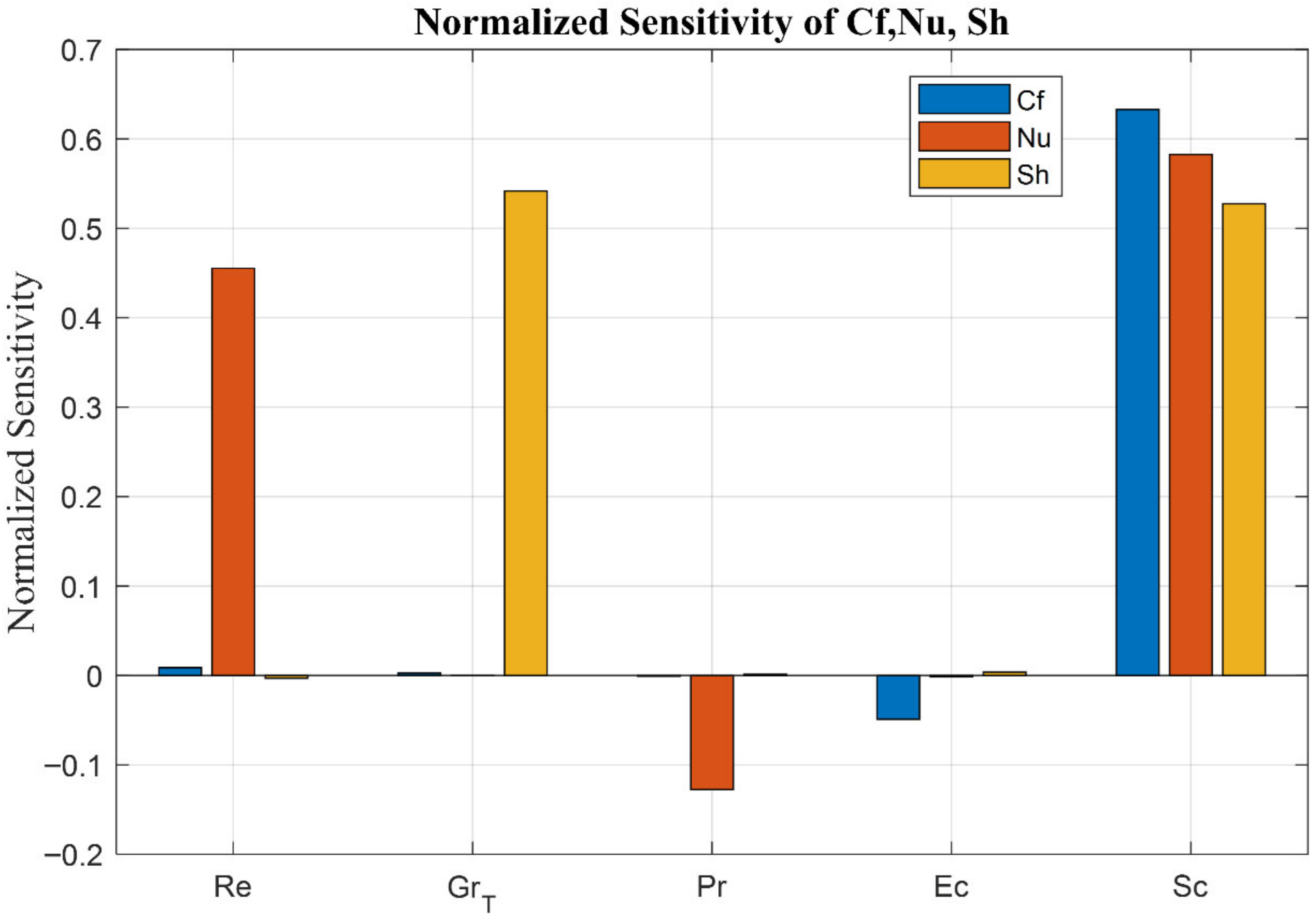
The effect of the dimensionless parameters in the considered governing PDEs on the physical responses, namely the skin friction coefficient, local Nusselt number, and local Sherwood number, are calculated using normalized stability analysis. The relative contribution of each input parameter, namely the Reynolds number R e , thermal Grashof number G r T , Prandtl number P r , Eckert number E c , and Schmidt number S c , for the prediction of outputs obtained through the trained neural network model is illustrated by the bar chart. The normalized sensitivity analysis in Figure 20 confirms that the sensitivities are comparable across different physical variables and dimensionless.
Figure 20 shows that the input parameters affect the three engineering quantities with varying degrees of influence. The Schmidt number exhibits a relatively stronger impact on all three transport quantities due to their direct involvement in the nanoparticle concentration equation, so it can affect the local Nusselt number because energy and nanoparticle concentration equations are coupled.
The application of artificial neural networks in machine learning delivers an influential alternative framework for analyzing complex computational fluid dynamics (CFD) problems that consist of coupled momentum, heat, and mass transfer processes. Governing equations for the flow over plate are reduced to dimensionless forms and then solved by the finite difference scheme, and numerical values of the skin friction coefficient, local Nusselt number, and local Sherwood number are obtained for various combinations of controlling parameters, including the Reynolds number, thermal Grashof number, Prandtl number, Eckert number, and Schmidt number. This direct way of solving these dimensionless partial differential equations gives accurate results, but it is computationally expensive because for every value of influential parameter, a set of equations need to be solved. Therefore, an artificial neural network is designed and trained for data obtained from the CFD solver, and this surrogate model can approximate the nonlinear relationship between input and output transport quantities and maintains high accuracy.
One of the major advantages of using machine learning, particularly an artificial neural network, in this context is the significant reduction in computational cost that can be useful in optimization tasks and parametric studies. As soon as the artificial neural network is trained, any value of skin friction coefficient, local Nusselt number, and local Sherwood number can be predicted instantaneously without any repetition in solving the dimensionless system of governing partial differential equations. When a large number of evaluations are required in real-time prediction scenarios, this type of prediction is useful; it also has advantages in uncertainty quantification and sensitivity analysis. This model trained on an artificial neural network can predict reliable approximations across the parameter space, and thus, hundreds or thousands of expensive CFD simulations can be avoided. So, exploration of complex flow behaviors can be significantly accelerated by using trained a artificial neural network model.
Additionally, highly nonlinear relationships between input variables and response variables arising in CFD problems can be captured by using machine learning models. The considered model comprises buoyancy force, viscous dissipation, and heat and mass transfer of nanofluid flow. Therefore, an analytical solution becomes intractable because of these nonlinear interactions, and the difficulty of classical numerical analysis is increased because of nonlinear terms. An artificial neural network is an efficient tool that learns these nonlinear mappings directly from the CFD-generated dataset. So, both numerical CFD and the machine learning framework become computational-efficient approaches for analyzing the effect of various dimensionless parameters on momentum, heat, and mass transfer characteristics.

6. Conclusions

A third-order, three-stage finite difference scheme based on fractal Taylor expansion was developed for time-fractal partial differential equations. The method was conditionally stable, required only two time levels, and produced lower numerical errors compared to existing schemes when central spatial discretization was applied. Its effectiveness was demonstrated for mixed convective Carreau–Yasuda fluid flow over flat and oscillatory plates with viscous dissipation.
In addition, an artificial neural network (ANN) model was developed to predict the engineering quantities, namely, the skin friction coefficient and local Nusselt number, using the Reynolds number, Prandtl number, and Eckert number as inputs. The graphical results show that ANN predictions had strong agreement with the numerical results obtained by applying a numerical scheme to the flow problem, demonstrating that the hybrid numerical–ANN framework provided an efficient tool for rapid thermal performance estimation in non-Newtonian flow systems. Its applicability extends to thermal processing, polymer extrusion, electromagnetic flow control, and other engineering systems involving complex rheology and coupled heat–mass transfer.
Since the proposed scheme was conditionally stable, it allowed only specific values of parameters. But this scheme can be applied to both integer-order or time-fractal partial differential equations. Also, the surrogate model has been implemented for predicting the skin friction coefficient and local Nusselt number. Thus, this kind of machine learning or deep leaning modeling can be used in the future to predict and/or optimize the skin friction coefficient and local Nusselt and Sherwood numbers.

Author Contributions

Writing—original draft preparation, Y.N.; conceptualization, Y.N.; methodology, Y.N.; software, Y.N.; formal analysis, Y.N.; funding acquisition, R.M.H.; writing—review and editing, R.M.H. and M.M. All authors have read and agreed to the published version of the manuscript.

Funding

This work was supported and funded by the Deanship of Scientific Research at Imam Mohammad Ibn Saud Islamic University (IMSIU) (grant number IMSIU-DDRSP2603).

Data Availability Statement

The original contributions presented in this study are included in the article. Further inquiries can be directed to the corresponding author.

Conflicts of Interest

There are no conflicts of research interest regarding the research presented in this manuscript.

Nomenclature

u horizontal component of velocity
a 1 width of the magnetic field between electrodes
j o current density applied to electrodes
g gravity
k r chemical reaction
C concentration
σ electrical conductivity
H 0 Hartmann number
R e Reynold number
A dimensionless parameter
P r Prandtl number
E c Eckert number
γ dimensionless chemical reaction
μ infinite-shear viscosity
d 1 Yasuda parameter
v vertical component of velocity
M o magnetization of the permanent magnets mounted on the surface of the Riga plate
β T coefficients of thermal expansions
ρ density of fluid
α thermal diffusivity
D mass diffusivity
G r T thermal Grashof number
ε dimensionless parameters
W e Weisenberg number
Q modified Hartmann number
R d   radiation parameter
S c Schmidt number
μ 0 zero-shear viscosity
Γ relaxation time constant
γ ˙ shear rate

References

  1. Gu, X.M.; Quan, C.; Xin, Q. Stability and convergence of implicit–explicit Runge–Kutta methods for the reaction–diffusion equation with random diffusion coefficient. Commun. Nonlinear Sci. Numer. Simul. 2025, 155, 109602. [Google Scholar] [CrossRef]
  2. Qin, X.; Jiang, Z.; Yan, C. Strong stability preserving two-derivative two-step Runge–Kutta methods. Mathematics 2024, 12, 2465. [Google Scholar] [CrossRef]
  3. Akbar, A.A.; Raza, M.; Khan, U.; Waqas, H. Heat transfer analysis of Carreau–Yasuda nanofluid flow with variable thermal conductivity and quadratic convection. J. Comput. Des. Eng. 2024, 11, 99–113. [Google Scholar] [CrossRef]
  4. Areshi, M. Advancing heat transport in radiated Carreau-Yasuda non-Newtonian fluids under nonlinear stretching conditions and variable heat flux: A similarity solution approach. Case Stud. Therm. Eng. 2025, 74, 106849. [Google Scholar] [CrossRef]
  5. Ullah, H.; Khan, M.; Ahmad, S. Computational analysis of Carreau fluid flow with buoyancy and viscous dissipation. J. Mech. 2024, 40, 145–158. [Google Scholar] [CrossRef]
  6. Yahaya, R.I.; Arifin, N.M.; Nazar, R.; Pop, I. Dual solutions of unsteady mixed convection hybrid nanofluid flow past a vertical Riga plate. Mathematics 2023, 11, 215. [Google Scholar] [CrossRef]
  7. Nasir, S.; Khan, U.; Baleanu, D. Unsteady mixed convection stagnation-point flow of nanofluid over a movable Riga plate. Sci. Rep. 2023, 13, 12567. [Google Scholar] [CrossRef]
  8. Singh, V.P.; Singh, S. Stability Analysis of a Sixth-Stage Fifth-Order Runge-Kutta Method for Solving Initial Value Problems. Int. J. Sci. Technol. 2025, 16. [Google Scholar] [CrossRef]
  9. Arif, M.S.; Abodayeh, K.; Nawaz, Y. Advancements in numerical solutions: A fractal Runge–Kutta approach. Comput. Model. Eng. Sci. 2024, 141, 1135–1158. [Google Scholar]
  10. Kunstmann, P.C.; Li, B.; Lubich, C. Runge–Kutta time discretization of nonlinear parabolic equations studied via discrete maximal parabolic regularity. Found. Comput. Math. 2018, 18, 1109–1130. [Google Scholar] [CrossRef]
  11. Ayub, S.; Zahir, H.; Tanveer, A. Mixed convection and non-linear thermal radiative analysis for Carreau-Yasuda nanofluid in an endoscope. Int. Commun. Heat Mass Transf. 2022, 138, 106371. [Google Scholar] [CrossRef]
  12. Daniel Makinde, O. Effects of viscous dissipation and Newtonian heating on boundary-layer flow of nanofluids over a flat plate. Int. J. Numer. Methods Heat Fluid Flow 2013, 23, 1291–1303. [Google Scholar] [CrossRef]
  13. Pantokratoras, A.; Magyari, E. EMHD free-convection boundary-layer flow from a Riga-plate. J. Eng. Math. 2009, 64, 303–315. [Google Scholar] [CrossRef]
  14. Ranocha, H.; Ketcheson, D.I. Energy stability of explicit Runge--Kutta methods for nonautonomous or nonlinear problems. SIAM J. Numer. Anal. 2020, 58, 3382–3405. [Google Scholar] [CrossRef]
  15. D’Afiero, F.M. Embedded Strong Stability Preserving Runge–Kutta methods with adaptive time stepping for shock-dominated Flows. Comput. Fluids 2025, 305, 106916. [Google Scholar] [CrossRef]
  16. Abbas, T.; Muhammad, T.; El Kadhi, N.; Majeed, A. Analysis of Ag-MgO/water Williamson hybrid nanofluid flow with viscous dissipation over a radially stretching surface under magnetic field and heat source effects. Alex. Eng. J. 2026, 135, 318–326. [Google Scholar] [CrossRef]
  17. Khan, D.; Asogwa, K.K.; Alqahtani, T.; Algarni, S.; Alqahtani, S.; Akbar, M.A. A generalized two-phase free convection flow of dusty Jeffrey fluid between infinite vertical parallel plates with heat transfer. J. Math. 2022, 2022, 8470139. [Google Scholar] [CrossRef]
  18. Ali, G.; Kumam, P. An exploration of heat and mass transfer for MHD flow of Brinkman type dusty fluid between fluctuating parallel vertical plates with arbitrary wall shear stress. Int. J. Thermofluids 2024, 21, 100529. [Google Scholar]
  19. Mahariq, I.; Ghazwani, H.A.; Shah, M.A. Enhancing heat and mass transfer in MHD tetra hybrid nanofluid on solar collector plate through fractal operator analysis. Results Eng. 2024, 24, 103163. [Google Scholar] [CrossRef]
  20. Raza, Q.; Ali, B.; Ghazwani, H.A.; Younis, J. ANN-based modeling of porous MHD mixed convection in tri-hybrid nanofluids with thermal radiation. J. Radiat. Res. Appl. Sci. 2025, 18, 101852. [Google Scholar]
  21. Azmi, H.M.; Arifin, N.M.; Rosali, H.; Isa, S.S.M. The Hamilton-crosser thermal conductivity model in the quaternary nanofluid flow with second-order slip condition. J. Radiat. Res. Appl. Sci. 2026, 19, 102142. [Google Scholar] [CrossRef]
  22. Nawaz, Y.; Kerdid, N.; Arif, M.S.; Bibi, M. AI-Assisted Hybrid Solver for Skin Friction and Sherwood Number Prediction in Eyring–Prandtl Nanofluid Flow over a Riga Plate. Comput. Model. Eng. Sci. 2026, 146, 20. [Google Scholar] [CrossRef]
  23. Kavitha, R.; Jacob, K.; Shafee, A.; Deivanayagampillai, N. Hybrid numerical–artificial neural network modeling of bioconvection in MHD nanofluids with gyrotactic microorganisms. Multiscale Multidiscip. Model. Exp. Des. 2026, 9, 1–20. [Google Scholar] [CrossRef]
  24. Aksoy, Y.; Sümer, H.; Samra, K. A similarity approach to boundary layer equations of a non-Newtonian fluid: Carreau-Yasuda model. Niğde Ömer Halisdemir Univ. J. Eng. Sci. 2021, 10, 791–799. [Google Scholar] [CrossRef]
  25. Altalbawy, F.M.A.; Alkhayyat, A.; Jhala, R.; Yadav, A.; Ramachandran, T.; Shankhyan, A.; Karthikeyan, A.; Thatoi, D.N.; Sinitsin, V.V. Computational fluid dynamic and machine learning modeling of nanofluid flow for determination of temperature distribution and models comparison. Sci. Rep. 2025, 15, 19073. [Google Scholar] [CrossRef] [PubMed]
  26. Chowdhury, R.S.; Bhaumik, B.; Sarkar, G.M.; Sahoo, B. Modeling and prediction of Carreau fluid flow with generalized thermal conductivity using hybrid artificial neural network and symbolic regression. Eng. Appl. Artif. Intell. 2026, 167, 113781. [Google Scholar] [CrossRef]
Figure 1. Geometry of the problem.
Fractalfract 10 00221 g001
Figure 2. Effect of variation in Weisenberg number on velocity profile using R e = 1 ,   d 1 = 1 ,   m = 2 ,   G r T = 0.1 ,   H o = 0.5 ,   ϑ = π 3 ,   P r = 0.9 ,   E c = 0.9 ,   R d = 0.1 ,   A = 0.1 ,   B = 0.1 ,   S c = 0.9 ,   γ = 0.1 ,   ε = 0.1 ,   α = 0.75 .
Fractalfract 10 00221 g002
Figure 3. Effect of variation in inclined angle of magnetic field on velocity profile using R e = 1 ,   d 1 = 1 ,   m = 2 ,   G r T = 0.1 ,   H o = 0.5 ,   W e = 0.1 ,   P r = 0.9 ,   E c = 0.9 ,   R d = 0.1 ,     A = 0.1 ,   B = 0.1 ,   S c = 0.9 ,   γ = 0.1 ,   ε = 0.1 ,   α = 0.75 .
Fractalfract 10 00221 g003
Figure 4. Effect of variation in Grashof number on velocity profile using R e = 1 ,   d 1 = 1 ,   m = 2 , W e = 0.1 ,   H o = 0.5 ,   ϑ = π 3 ,   P r = 0.9 ,   E c = 0.9 ,   R d = 0.1 ,   A = 0.1 ,   B = 0.1 ,   S c = 0.9 ,   γ = 0.1 ,   ε = 0.1 ,   α = 0.75 .
Fractalfract 10 00221 g004
Figure 5. Effect of variation in radiation parameter on temperature profile using R e = 1 ,   d 1 = 1 ,   m = 2 , W e = 0.1 ,   H o = 0.5 ,   ϑ = π 3 ,   P r = 0.9 ,   E c = 0.9 ,   G r T = 0.5 ,   A = 0.1 ,   B = 0.1 ,   S c = 0.9 ,   γ = 0.1 ,   ε = 0.1 ,   α = 0.75 .
Fractalfract 10 00221 g005
Figure 6. Effect of variation in Eckert number on temperature profile using R e = 1 ,   d 1 = 1 ,   m = 2 , W e = 0.1 ,   H o = 0.5 ,   ϑ = π 3 ,   P r = 0.9 ,   R d = 0.1 ,   G r T = 0.5 ,   A = 0.1 ,   B = 0.1 ,   S c = 0.9 ,   γ = 0.1 ,   ε = 0.1 ,   α = 0.75 .
Fractalfract 10 00221 g006
Figure 7. Effect of variation in coefficient of space dependent term in heat source on temperature profile using R e = 1 ,   d 1 = 1 ,   m = 2 , W e = 0.1 ,   H o = 0.5 ,   ϑ = π 3 ,   P r = 0.9 ,   R d = 0.1 ,   G r T = 0.5 ,   E c = 0.1 ,   B = 0.1 ,   S c = 0.9 ,   γ = 0.1 ,   ε = 0.1 ,   α = 0.75 .
Fractalfract 10 00221 g007
Figure 8. Effect of variation in reaction rate parameter on concentration profile using R e = 1 ,   d 1 = 1 ,   m = 2 , W e = 0.1 ,   H o = 0.5 ,   ϑ = π 3 ,   P r = 0.9 ,   R d = 0.1 ,   G r T = 0.5 ,   E c = 0.1 ,   B = 0.1 ,   S c = 0.9 ,   A = 0.1 ,   ε = 0.1 ,   α = 0.75 .
Fractalfract 10 00221 g008
Figure 9. Effect of variation in power-law exponent and Weisenberg number on skin friction coefficient using R e = 1 ,   d 1 = 1 ,   γ = 0.9 ,   H o = 0.5 ,   ϑ = π 3 ,   P r = 0.9 ,   R d = 0.1 ,   G r T = 0.5 ,   E c = 0.1 ,   B = 0.1 ,   S c = 0.9 ,   A = 0.1 ,   ε = 0.1 ,   α = 0.75 .
Fractalfract 10 00221 g009
Figure 10. Effect of variation in Prandtl number and Eckert number on local Nusselt number using R e = 1 ,   d 1 = 1 ,   γ = 0.9 ,   H o = 0.5 ,   ϑ = π 3 ,   m = 2 ,   R d = 0.1 ,   G r T = 0.5 ,   W e = 0.13 ,   B = 0.1 ,   S c = 0.9 ,   A = 0.1 ,   ε = 0.1 ,   α = 0.75 .
Fractalfract 10 00221 g010
Figure 11. Effect of variation in Schmidt number and reaction rate parameter on local Sherwood number using R e = 1 ,   d 1 = 1 ,   E c = 0.2 ,   H o = 0.5 ,   ϑ = π 3 ,   m = 2 ,   R d = 0.1 ,   G r T = 0.5 ,   W e = 0.13 ,   B = 0.1 ,   P r = 0.9 ,   A = 0.1 ,   ε = 0.1 ,   α = 0.75 .
Fractalfract 10 00221 g011
Figure 12. Contour plot for horizontal component of velocity profile along temporal and spatial coordinates using R e = 7 ,   d 1 = 1 ,   E c = 35 ,   H o = 0.5 ,   ϑ = π 3 ,   m = 2 ,   Q = 0.1 ,   R d = 0.1 ,   G r T = 5 ,   W e = 0.13 ,   B = 0.1 ,   P r = 0.9 ,   A = 0.1 ,   ε = 0.1 ,   S c = 0.9 ,   γ = 0.3 ,   α = 0.75 ,   u w = c o s ( t ) s i n ( t ) ,   y L ( l e n g t h   o f   b o u n d a r y ) = 27 ,   x L ( l e n g t h   o f   b o u n d a r y ) = 27 .
Fractalfract 10 00221 g012
Figure 13. Contour plot for temperature profile along temporal and spatial coordinates using R e = 7 ,   d 1 = 1 ,   E c = 35 ,   H o = 0.5 ,   ϑ = π 3 ,   m = 2 ,   Q = 0.1 ,   R d = 0.1 ,   G r T = 5 ,   W e = 0.13 ,   B = 0.1 ,   P r = 0.9 ,   A = 0.1 ,   ε = 0.1 ,   S c = 0.9 ,   γ = 0.3 ,   α = 0.75 ,   u w = c o s t s i n t ,   y L ( l e n g t h   o f   b o u n d a r y ) = 27 ,   x L ( l e n g t h   o f   b o u n d a r y ) = 27 .
Fractalfract 10 00221 g013
Figure 14. Parity plot showing predicted and numerically computed skin friction coefficient and local Nusselt number using R e = 1 + 3 r a n d ,   d 1 = 1 ,   E c = 0.1 + 0.5 r a n d ,   H o = 0.5 ,   ϑ = π 3 ,   m = 1 ,   Q = 0.1 ,   R d = 0.1 ,   G r T = 0.5 + 3 r a n d ,   W e = 0.3 ,   B = 0.1 ,   P r = 0.7 + r a n d ,   A = 0.1 ,   ε = 0.1 ,   S c = 0.7 + r a n d ,   γ = 0.3 .
Fractalfract 10 00221 g014
Figure 15. Parity plot for predicted and numerically computed local Nusselt number using R e = 1 + 3 r a n d ,   d 1 = 1 ,   E c = 0.1 + 0.5 r a n d ,   H o = 0.5 ,   ϑ = π 3 ,   m = 1 ,   Q = 0.1 ,   R d = 0.1 ,   G r T = 0.5 + 3 r a n d ,   W e = 0.3 ,   B = 0.1 ,   P r = 0.7 + r a n d ,   A = 0.1 ,   ε = 0.1 ,   S c = 0.7 + r a n d ,   γ = 0.3 .
Fractalfract 10 00221 g015
Figure 16. Parity plot for predicted and numerically computed local Sherwood number using R e = 1 + 3 r a n d ,   d 1 = 1 ,   E c = 0.1 + 0.5 r a n d ,   H o = 0.5 ,   ϑ = π 3 ,   m = 1 ,   Q = 0.1 ,   R d = 0.1 ,   G r T = 0.5 + 3 r a n d ,   W e = 0.3 ,   B = 0.1 ,   P r = 0.7 + r a n d ,   A = 0.1 ,   ε = 0.1 ,   S c = 0.7 + r a n d ,   γ = 0.3 .
Fractalfract 10 00221 g016
Figure 17. Taylor diagram for predicted and numerically computed skin friction coefficient using R e = 1 + 3 r a n d ,   d 1 = 1 ,   E c = 0.1 + 0.5 r a n d ,   H o = 0.5 ,   ϑ = π 3 ,   m = 1 ,   Q = 0.1 ,   R d = 0.1 ,   G r T = 0.5 + 3 r a n d ,   W e = 0.3 ,   B = 0.1 ,   P r = 0.7 + r a n d ,   A = 0.1 ,   ε = 0.1 ,   S c = 0.7 + r a n d ,   γ = 0.3 .
Fractalfract 10 00221 g017
Figure 18. Taylor diagram for predicted and numerically computed local Nusselt number using R e = 1 + 3 r a n d ,   d 1 = 1 ,   E c = 0.1 + 0.5 r a n d ,   H o = 0.5 ,   ϑ = π 3 ,   m = 1 ,   Q = 0.1 ,   R d = 0.1 ,   G r T = 0.5 + 3 r a n d ,   W e = 0.3 ,   B = 0.1 ,   P r = 0.7 + r a n d ,   A = 0.1 ,   ε = 0.1 ,   S c = 0.7 + r a n d ,   γ = 0.3 .
Fractalfract 10 00221 g018
Figure 19. Taylor diagram for predicted and numerically computed local Sherwood number using R e = 1 + 3 r a n d ,   d 1 = 1 ,   E c = 0.1 + 0.5 r a n d ,   H o = 0.5 ,   ϑ = π 3 ,   m = 1 ,   Q = 0.1 ,   R d = 0.1 ,   G r T = 0.5 + 3 r a n d ,   W e = 0.3 ,   B = 0.1 ,   P r = 0.7 + r a n d ,   A = 0.1 ,   ε = 0.1 ,   S c = 0.7 + r a n d ,   γ = 0.3 .
Fractalfract 10 00221 g019
Figure 20. Sensitivity analysis of input parameters on skin friction coefficient, local Nusselt number, and local Sherwood number using R e = 1 + 3 r a n d ,   d 1 = 1 ,   E c = 0.1 + 0.5 r a n d ,   H o = 0.5 ,   ϑ = π 3 ,   m = 1 ,   Q = 0.1 ,   R d = 0.1 ,   G r T = 0.5 + 3 r a n d ,   W e = 0.3 ,   B = 0.1 ,   P r = 0.7 + r a n d ,   A = 0.1 ,   ε = 0.1 ,   S c = 0.7 + r a n d ,   γ = 0.3 .
Fractalfract 10 00221 g020
Table 1. Comparison of three schemes using N x = 50 = N y (No. of grid points in space) and t f = 0.07 (final time).
t L 2 Error
Proposed SchemeFirst-Order SchemeSecond-Order Scheme
CentralCompactCentralCompactCentralCompact
0.07 1500 2.77 × 10−41.29 × 10−44.73 × 10−41.59 × 10−44.11 × 10−49.73 × 10−5
0.07 1750 2.80 × 10−41.10 × 10−44.51 × 10−41.37 × 10−43.98 × 10−48.38 × 10−5
0.07 2000 2.82 × 10−49.59 × 10−54.34 × 10−41.20 × 10−43.88 × 10−47.36 × 10−5
0.07 2250 2.85 × 10−48.48 × 10−54.21 × 10−41.07 × 10−43.80 × 10−46.57 × 10−5
Table 2. Validation of proposed scheme for solving stokes first problem using t f ( f i n a l   t i m e ) = 1 ,   N t ( p o i n t s   i n   t i m e ) = 50 .
y Exact SolutionNumerical Solution y Exact SolutionNumerical Solution
0 1 1 3.7692 0.0077 0.0098
0.5385 0.7034 0.7019 4.3077 0.0023 0.0035
1.0769 0.4464 0.4453 4.8462 0.0006 0.0011
1.6154 0.2534 0.2544 5.3846 0.0001 0.0003
2.1538 0.1278 0.1309 5.9231 0.0000 0.0001
2.6923 0.0569 0.0609 6.4615 0.0000 0.0000
3.2308 0.0223 0.0256 7 0.0000 0
Disclaimer/Publisher’s Note: The statements, opinions and data contained in all publications are solely those of the individual author(s) and contributor(s) and not of MDPI and/or the editor(s). MDPI and/or the editor(s) disclaim responsibility for any injury to people or property resulting from any ideas, methods, instructions or products referred to in the content.