Article

Pathways Toward Carbon Peaking and Their Impacts on Industrial Structure in Hebei Province

1
Faculty of Humanities and Social Sciences, Macao Polytechnic University, R. de Luís Gonzaga Gomes, Macau, China
2
Key Laboratory of Regional Sustainable Development Modeling, Institute of Geographic Sciences and Natural Resources Research, CAS, Beijing 100101, China
3
School of Geographical Sciences, Hebei Normal University, Shijiazhuang 050025, China
*
Author to whom correspondence should be addressed.
Urban Sci. 2025, 9(12), 516; https://doi.org/10.3390/urbansci9120516
Submission received: 10 October 2025 / Revised: 16 November 2025 / Accepted: 19 November 2025 / Published: 5 December 2025

Abstract

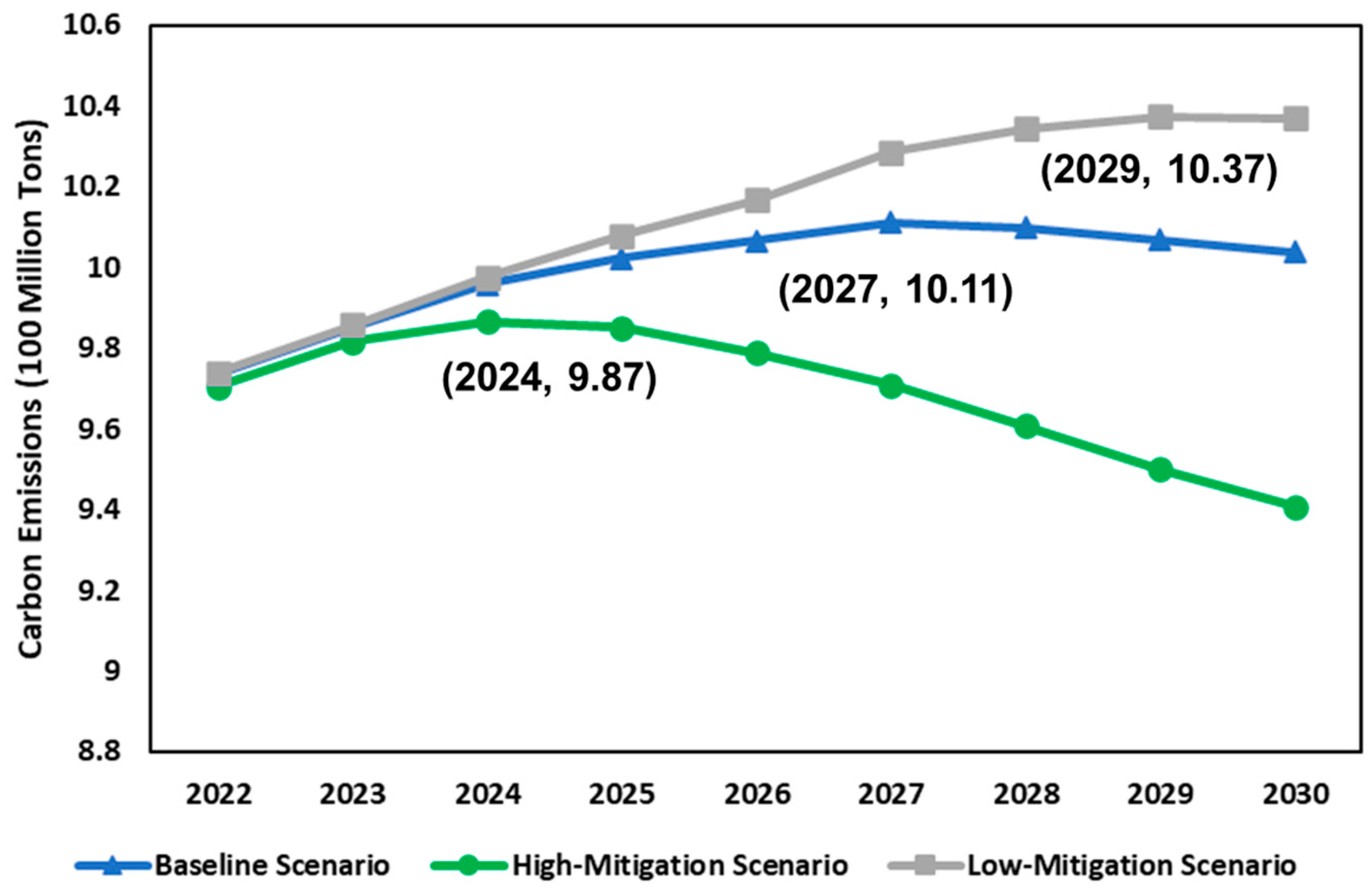
Since 2017, China’s carbon emissions have exceeded 10 billion tons. Hebei Province is one of the country’s major heavy-industrial regions, accounting for over 9 percent of the national total carbon emissions. Achieving carbon peaking and neutrality in Hebei is therefore vital to realizing China’s overall dual carbon goals. This study examines the spatiotemporal evolution of Hebei’s carbon emissions from four perspectives: general characteristics, energy structure, industrial structure, and urban emission patterns. Six key socioeconomic factors—population, GDP per capita, urbanization rate, share of secondary industry, installed capacity of thermal power generation, and energy intensity—were selected to project emission trends under baseline scenario, high-mitigation scenario, and low-mitigation scenario. The results show that Hebei’s carbon emissions are expected to peak in 2027 at 1.011 billion tons under the baseline scenario, in 2024 at 0.987 billion tons under the high-mitigation scenario, and in 2029 at 1.037 billion tons under the low-mitigation scenario, followed by a slight decline. Considering the province’s industrial composition and development trends, the baseline and low-mitigation pathways are more feasible. Controlling the expansion of energy-intensive industries, particularly ferrous-metal smelting and electricity and heat production, will be critical for achieving Hebei’s carbon-peaking target.

1. Introduction

Since 1950, the world has undergone an extensive process of urbanization, during which population growth and economic expansion have driven a rapid increase in fossil energy consumption and a sharp rise in carbon dioxide emissions from 6 billion tons to 37.8 billion tons in 2023 [1]. Carbon dioxide is the primary contributor to global warming, and climate change has significantly intensified the frequency of extreme heat events, heavy precipitation, and related natural disasters, resulting in severe losses of life and property and posing a profound threat to the sustainability of human systems [2,3,4]. According to relevant United Nations reports, more than half of the world’s population now resides in urban areas, where dense concentrations of people and economic activities have resulted in cities accounting for over 70% of global carbon emissions [5]. Projections from recent studies suggest that by 2030, more than 1.2 million square kilometers of land will be converted into new urban areas, with nearly half of this expansion expected to occur in Asia. Among these regions, the Beijing–Tianjin–Hebei and Yangtze River Delta urban agglomerations exhibit particularly high probabilities of spatial expansion [6,7].
Since the initiation of the reform and opening-up policy, China has experienced rapid industrialization and urbanization. The national urbanization rate increased from 17.92% in 1978 to 60.6% in 2019, with the total urban population reaching 848.43 million in 2019. This rapid economic development has led to a significant rise in carbon dioxide emissions [8]. According to carbon emission statistics from the International Energy Agency (IEA), China’s total carbon emissions grew from 2.09 billion tons in 1990 to 10.613 billion tons in 2022, with more than 70% of these emissions derived from coal consumption [9]. Previous studies have examined the spatiotemporal characteristics of China’s carbon emissions at multiple scales, revealing substantial interprovincial differences. High-emission provinces are primarily located in the eastern coastal and northeastern regions, while provinces in the central and western regions exhibit lower emission levels but faster growth rates. From the perspectives of urban agglomerations, provinces, and industrial sectors, China’s carbon emissions exhibit pronounced spatial clustering and structural differentiation. The three major urban agglomerations—Beijing–Tianjin–Hebei (BTH), the Yangtze River Delta (YRD), and the Pearl River Delta (PRD)—constitute the country’s most significant high-emission clusters. Recent studies indicate that annual emissions of the BTH region have reached approximately 800–900 Mt CO2, compared with 600–700 Mt CO2 in the YRD and 300–400 Mt CO2 in the PRD, reflecting a locked-in high-carbon structure and notable cross-regional spillover effects [10,11,12]. At the provincial scale, heavy industrial provinces such as Shandong, Hebei, and Jiangsu jointly contribute around 2400–2700 Mt CO2 in recent years, while several northwestern provinces exhibit significantly higher emission intensities than the national average due to their coal-based energy mix and resource-dependent industrial base [13,14]. At the sectoral level, the power and heat sector, together with the iron-and-steel industry, typically account for 50–70% of energy-related emissions in high-emission regions, where technological bottlenecks in power decarbonization and process emissions in steelmaking remain key constraints [15,16]. Empirical findings further demonstrate that industrial structure, energy consumption structure, urbanization, and interregional emission transfers are the dominant drivers shaping regional disparities in both emission scale and emission intensity [17,18,19]. Although China’s total carbon dioxide emissions continue to rise, its carbon intensity has declined significantly, largely driven by structural transformation and evolving investment patterns [20,21]. Per capita carbon emissions exhibit a marked “high in the north and low in the south” spatial distribution, and empirical results suggest that population density and fiscal expenditure exert inhibitory effects on the growth of per capita emissions [22,23].
China pledged at the United Nations General Assembly in 2020 to achieve peak carbon emissions before 2030 and carbon neutrality before 2060, a commitment that has received broad recognition from the scientific community. Studies have shown that fulfilling this pledge would significantly mitigate global warming but would also require integrated policy responses, technological innovation, and institutional mechanisms to ensure its realization [24,25]. Recent scenario analyses suggest that under accelerated mitigation and structural transition pathways, China’s total carbon emissions may peak around 2025 [26]. Research examining the relationship between per capita carbon emissions and GDP per capita further indicates that China is likely to reach its emission peak between 2021 and 2025, thus achieving the 2030 carbon peaking target of the Paris Agreement five to ten years ahead of schedule [27]. Moreover, existing studies have explored the main pathways toward the “dual carbon” goals from the perspectives of the transportation sector, energy transition, and industrial restructuring. These studies emphasize that under varying rates of economic growth, the scale and structural composition of the secondary and tertiary industries must be appropriately adjusted to achieve the carbon peaking target [28,29,30].
Building on the existing body of research, four major categories of modeling approaches have been developed for forecasting carbon peaking trajectories. Scenario-based extensions of the STIRPAT or Kaya identity integrate key socioeconomic and energy indicators, such as population size, GDP per capita, urbanization rate, industrial structure, energy intensity, and the share of coal or thermal power within the P–A–T framework to simulate baseline and mitigation pathways and to identify peak timelines [20,30]. Existing studies used decomposition-based approaches to assess the historical contributions of scale, structural, and intensity effects and link these drivers to policy-oriented scenarios for industrial restructuring and energy-system transformation [31,32]. The machine learning and hybrid models, including LSTM, BiLSTM, and ensemble-learning frameworks, were used to enhance the ability to capture nonlinear dynamics and lag effects, while interpretability tools such as SHAP were used to identify dominant emission drivers [33,34]. Regression-based models, such as OLS, partial least squares, and ridge regression, directly quantify emission–driver relationships and extrapolate future outcomes under different socioeconomic assumptions. Ridge regression has been increasingly applied in carbon-emission forecasting as a robust approach for handling multicollinearity among socioeconomic and energy-related drivers in policy evaluation contexts. Recent empirical studies indicate that ridge-based prediction models can generate stable peak-oriented results while clarifying the relative influence of key demographic, economic, and energy variables. For instance, scenario-based ridge frameworks integrating population size, economic affluence, energy intensity, carbon intensity, and residential-sector indicators have been employed to estimate peak magnitude and peak timing in the building sector [35,36]. In addition, ridge regression has been coupled with dynamic scenario simulations to construct phased peak pathways over medium- and long-term horizons, thereby supporting the assessment of emission-reduction trajectories under differentiated policy constraints and developmental stages [37]. Overall, ridge regression has proven to be a resilient and policy-responsive tool for forecasting carbon-emission pathways in complex multi-variable systems, providing decision-makers with a more dependable analytical basis for peak-path planning, policy calibration, and emission-control scheduling at provincial and urban scales.
The Beijing–Tianjin–Hebei (BTH) urban agglomeration represents the most concentrated region of high-emission cities in China and faces substantial pressure to reduce carbon emissions [10]. Within the framework of coordinated regional development, differentiated functional positioning has significantly influenced the selection of emission reduction pathways. Under the policy of relieving Beijing’s non-capital functions, the city has increasingly emphasized its role as a high-end service hub, with the value added by the financial and business service sectors accounting for 61% and 40%, respectively, of the total within the BTH region. In contrast, Tianjin and Hebei possess comparative advantages in the industrial and transportation sectors. From the perspective of manufacturing industries, energy-intensive production is largely concentrated in Hebei Province, particularly in Tangshan and Handan, whose combined crude steel output constitutes approximately 60% of the BTH total. Meanwhile, Beijing and Tianjin have shifted toward high-tech and equipment manufacturing industries [38,39,40]. As the regional center for advanced services and manufacturing, Beijing has largely achieved a decoupling between economic growth and carbon emissions. In contrast, Hebei has absorbed a number of relocated high-carbon enterprises from Beijing, making improvements in energy efficiency and technological innovation key challenges for emission reduction [40,41,42]. Under the carbon peaking target, how to effectively coordinate industrial development and low-carbon transition in Hebei Province remains an urgent issue requiring further investigation.
Hebei Province is widely recognized as one of China’s most carbon-intensive regions, with total emissions remaining among the highest nationwide and showing a long-term upward trend despite recent signs of slowdown [43,44]. The province’s carbon intensity has also remained at a comparatively high level over an extended period, reflecting the constraints of a coal-dominated energy structure [45]. The regional energy profile is closely aligned with the development of heavy industry, especially coal-fired power, iron and steel production, and cement manufacturing which resulting in a strongly coupled energy–industry system [45,46]. At the sectoral level, the ferrous-metal smelting and rolling industry, together with electricity and heat production, constitutes the core sources of emissions, characterized by high carbon density and limited short-term abatement potential [43,46]. Existing studies further indicate that Hebei’s future emission trajectory will be largely shaped by industrial restructuring, energy-mix adjustment, and the pace of technological upgrading [44,47]. Overall, as a major industrial base and high-emission region, Hebei faces substantial structural transformation pressure, and its effective mitigation progress will be critical to the achievement of China’s national carbon-peaking and carbon-neutrality goals. In this context, the present study examines the spatiotemporal evolution of carbon emissions in Hebei Province from four dimensions: basic characteristics, energy structure, industrial structure, and urban emission patterns. Drawing on the approach of predicting carbon emission trends based on key socioeconomic factors, six indicators—population, GDP per capita, urbanization rate, share of the secondary industry, installed capacity of thermal power generation, and energy intensity—were employed to construct a carbon emission forecasting model for Hebei Province. The model projects Hebei’s carbon emission trends under three scenarios through 2030: baseline, high-mitigation, and low-mitigation. Building on an analysis of socioeconomic factor changes under different scenarios, the study further explores, from the perspective of industrial structure, the implications of carbon peaking for Hebei’s industrial restructuring, thereby providing a policy reference for the formulation of Hebei’s carbon peaking pathway.

2. Materials and Methods

2.1. Study Area

Hebei Province consists of eleven prefecture-level cities: Shijiazhuang, Tangshan, Baoding, Handan, Cangzhou, Hengshui, Xingtai, Langfang, Qinhuangdao, Zhangjiakou, and Chengde. It plays a crucial role in the coordinated development of the Beijing–Tianjin–Hebei region (Figure 1a). From 2005 to 2022, the province experienced rapid urbanization, with the urbanization rate increasing from 38% to 62%. Over the same period, the total population grew from 68.51 million to 74.64 million by 2020, although a gradual decline has been observed since 2020 (Figure 1b). Meanwhile, Hebei has long served as a key base for heavy industry in China. In 2022, the province ranked first nationwide in the production of pig iron, crude steel, and finished steel, accounting for 23%, 20%, and 24% of national output, respectively.
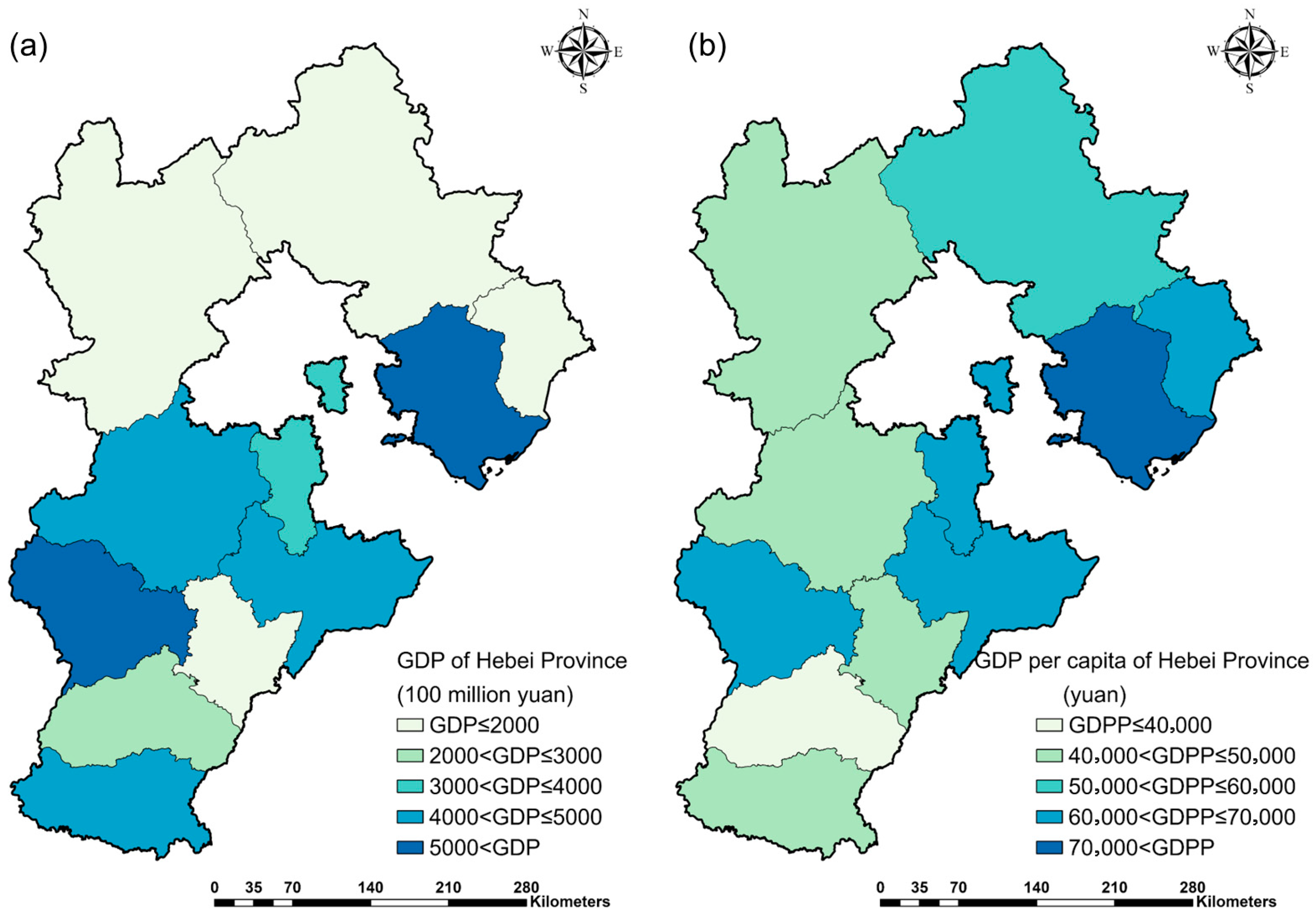
At the city level, significant disparities exist in economic development across the province. Both Shijiazhuang and Tangshan reported a regional GDP exceeding 700 billion CNY, while Handan, Baoding, Cangzhou, and Langfang each exceeded 350 billion CNY, representing an intermediate level of regional development. The remaining cities all reported GDPs below 300 billion CNY. In 2022, the tertiary sector accounted for the largest share of GDP in most cities; however, Tangshan’s secondary industry contributed more than 55%, and in other medium- and high-level cities, the share of the secondary industry generally exceeded 30%. Industrial production, therefore, remains a fundamental driver of urban economic growth in Hebei Province (Figure 1c). The city-level GDP and GDP per capita in 2022 can be referred to in Figure A1.

2.2. Carbon Emission Accounting in Hebei Province

At the provincial scale, China maintains relatively comprehensive energy consumption data, and most existing studies have adopted the carbon accounting methodology recommended by the Intergovernmental Panel on Climate Change (IPCC). Based on this approach, regional carbon emissions are estimated by combining total energy consumption with the emission coefficients and oxidation factors associated with different energy types.
E B T p = i = 1 E B T i × N C V n × C E C n × C O F n × 44 12
Here, N C V n denotes the net calorific value of energy type n, C E C n represents the carbon emission coefficient of energy type n, and C O F n refers to the oxidation factor of energy type n.
The China Emission Accounts and Datasets (CEADs) provide a comprehensive inventory of provincial-level carbon emissions from 1997 to 2021, covering multiple industrial sectors. In this study, provincial-level carbon emission data from the CEADs database were used as the foundation for analyzing carbon emissions in Hebei Province. Since the CEADs database currently discloses city-level carbon emission data only up to 2019 and contains missing records for certain cities, the city-level emissions for Hebei Province were derived from the authors’ own calculations. The specific accounting procedures follow methodologies documented in previously published studies [48].

2.3. Carbon Emission Forecasting Model

Hebei Province is one of the most populous provinces in China. Residential energy use constitutes one of the major sources of carbon emissions. Therefore, population size was selected as a key predictor of carbon emissions (P). In 2020, the secondary industry accounted for 93.51% of Hebei’s total carbon emissions. Although the share of the secondary industry in total output has been declining, it remains the dominant source of emissions. Accordingly, the proportion of the secondary industry was included as one of the indicators for carbon emission prediction (S). Carbon emissions from coal consumption in Hebei in 2020 primarily originated from the production and supply of electricity, steam, and hot water, indicating that thermal power generation contributed a substantial share of total emissions. Meanwhile, the investment in clean energy has been increasing significantly, accompanied by a gradual decline in the proportion of installed capacity for thermal power generation. This trend plays a crucial role in achieving the carbon peaking target, and the share of installed thermal power capacity was selected as another predictive indicator (T). Existing research has demonstrated that economic development and population size are the principal driving forces behind the growth of energy consumption and carbon emissions, with economic development exerting a particularly strong positive influence on emission increases [49,50]. Accordingly, this study employed GDP per capita (G) as a representative indicator of economic development to project carbon emissions in Hebei province. Urban areas, which concentrate a large share of the population and economic activities, constitute the main sources of carbon emissions. Therefore, the urbanization rate (U) was adopted as an indicator reflecting the stage of urban development in existing studies, which generally contributed to the rise in carbon emissions [51,52]. Additionally, improvements in production technology can effectively reduce energy consumption per unit of economic output to mitigate carbon emission growth. Existing studies have confirmed that a reduction in energy intensity can effectively curb the growth of carbon emissions [49,53], and the establishment of targets for lowering carbon emission intensity also exerted a restraining effect on emission levels [54]. Therefore, energy intensity (I) was chosen as a technology-related indicator for emission prediction. In addition, existing studies have demonstrated that the above factors are the primary determinants of carbon emissions [55]. In related research on carbon emission forecasting, variables such as population, GDP per capita, urbanization rate, industrial structure, and energy intensity have been used as indicators representing regional social, economic, and technological development levels, taken as key predictors for assessing regional carbon emission trends [56].
Descriptive statistics for the variables from 2005 to 2020 are presented in Table 1. The results of the multiple linear regression indicate that most coefficients are statistically insignificant, and certain variables, such as the share of the secondary industry and the proportion of thermal power, exhibit signs contrary to theoretical expectations. In addition, all variables show variance inflation factors (VIFs) well above 10, suggesting severe multicollinearity within the model. Multicollinearity inflates coefficient variances, destabilizes coefficient directions, and invalidates significance tests, thereby preventing the linear regression model from accurately capturing the true effects of the explanatory variables (Table A1).
To overcome the instability of the linear regression model while retaining all driving factors, this study introduces a ridge regression model. Ridge regression incorporates a penalty term into the ordinary least squares estimation, which applies moderate shrinkage to the coefficients, effectively reducing estimation bias caused by multicollinearity and yielding more stable and interpretable parameter estimates [57]. The ridge regression–based model thus provides a more reliable framework for identifying the key drivers of carbon emissions in Hebei Province and establishes a robust foundation for subsequent scenario-based emission forecasting. The analytical procedures were conducted using the SPSS Statistics 26.0 software platform.
C = β 0 + β 1 P + β 2 G + β 3 U + β 4 S + β 5 T + β 6 I
In this model, P denotes population size, G represents GDP per capita, U indicates the urbanization rate, S refers to the share of the secondary industry, T denotes the installed capacity of thermal power generation, and I represents energy intensity.
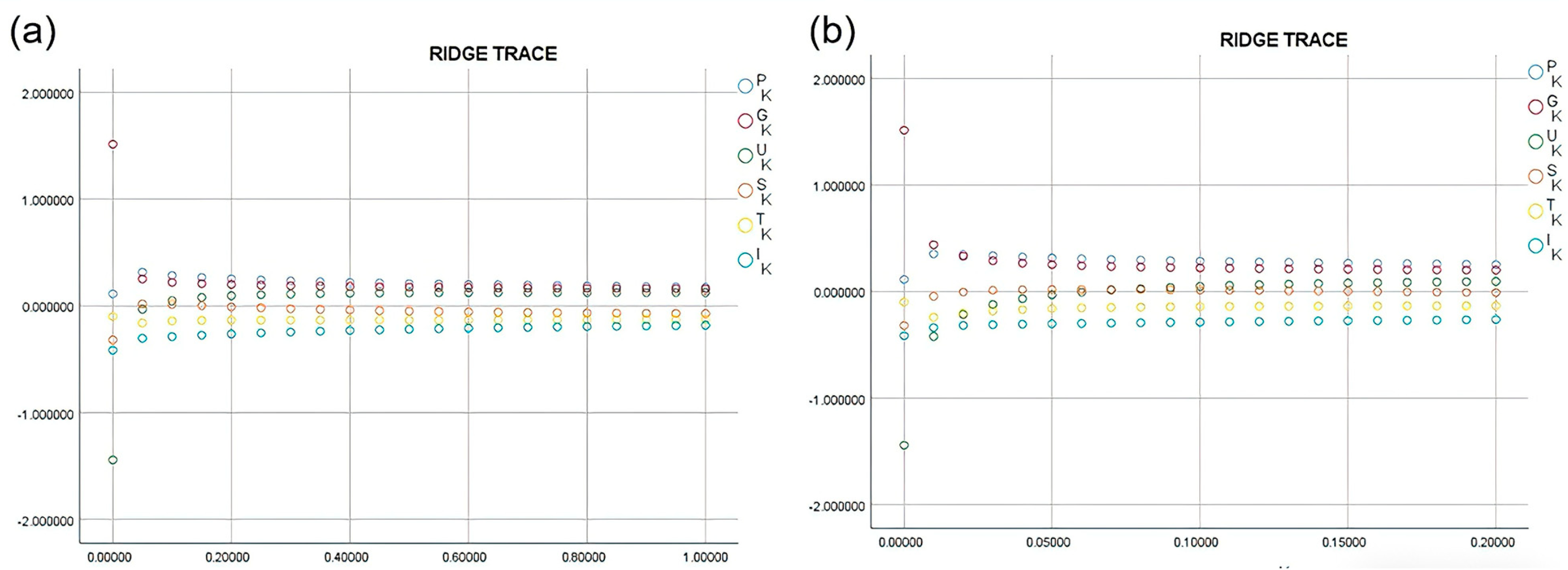
To determine the optimal penalty coefficient (k) for the ridge regression model, a two-step parameter selection procedure was employed (Figure A2). First, the value range of k was set between 0 and 1, and ridge regression estimations were computed sequentially with small increments to construct the Ridge Trace. The Ridge Trace depicts the trajectories of standardized regression coefficients as the penalty parameter k varies, serving as a diagnostic tool for assessing coefficient stability. The results show that as k increases from 0 to approximately 0.2, the initially large fluctuations in coefficient values gradually converge, indicating that the inclusion of the penalty term effectively mitigates coefficient instability caused by multicollinearity (Figure A2a). Building on this result, the parameter range was further narrowed to 0–0.2, and the ridge trace curves were recalculated. The findings reveal that when k = 0.05, the standardized coefficients of all explanatory variables become essentially stable with minimal variation, and the ridge trace flattens noticeably, suggesting that the model achieves a satisfactory balance at this parameter value. At this point, the model effectively alleviates variance inflation due to multicollinearity while avoiding excessive penalization that could amplify estimation bias, thereby achieving high robustness and interpretability (Figure A2b). Consequently, k = 0.05 was selected as the optimal penalty coefficient for the ridge regression model, based on which the fitted and predicted carbon emission results for Hebei Province from 2005 to 2020 were calculated.

2.4. Scenario Setting for Carbon Peaking Forecast

This study determines the 2025 values of key indicators based on the targets specified in Hebei Province’s 14th Five-Year Plan (2021–2025) concerning economic growth, urbanization rate, and energy intensity. The targets for industrial structure and power-related indicators were aligned with those set forth in the national 14th Five-Year Plan and the national energy development plan. In recent years, Hebei’s population has shown a declining trend, and population changes were projected according to the trend observed from 2020 to 2023. According to the official planning documents, Hebei’s regional GDP is expected to grow at an average annual rate of 6% during the 14th Five-Year Plan period. Considering population changes, the average annual growth rate of GDP per capita was set at 7%. The target urbanization rate for 2025 is 65%, and the proportion of the secondary industry is set at 35.5%. The share of installed thermal power generation capacity is projected to change at an average annual rate of 8%. The province’s energy intensity is targeted to decline by a cumulative 15% over the period, corresponding to an average annual reduction of 5% (Table A2). Overall, since the targets of the 15th Five-Year Plan have not yet been released, the average annual rates of change for most variables during 2026–2030 were set at levels relatively lower than those observed for 2021–2025.
X a a g = X t X 0 n 1
Here, Xagg refers to the average annual growth rate of variables. X0 and Xt refer to variables at time t and 0, which are the end and the beginning of the period. n refers to the years between time t and 0 minus one.
Under the baseline scenario, the changes in each variable were determined according to these official plans, with annual change rates set to follow a decreasing trend in magnitude over the planning period (Table 2). Since Hebei’s 15th Five-Year Plan (2026–2030) has not yet been released, the annual change rates of variables for 2026–2030 were projected based on the average annual variation patterns observed during 2021–2025, and most variables followed a trend of gradual decline in change magnitude (Table 2). Drawing on previous studies, and based on the baseline scenario, the HMS (high-mitigation scenario) and LMS (low-mitigation scenario) were developed by adjusting the rates of change for each variable to varying extents, taking into account both the effects of these variables on carbon emissions and their recent empirical trends [56,58]. Considering that industrial production and daily activities in Hebei Province were affected by the COVID-19 pandemic, the emissions recorded during those years may not accurately represent typical conditions. Therefore, the regression model was validated using actual and projected carbon emissions for the period 2005–2020, and the province’s carbon emissions for 2023–2030 were subsequently projected under the baseline, high-mitigation, and low-mitigation scenarios.
The selection of different development pathways requires corresponding constraints on key socioeconomic indicators (Table 2). Since Hebei Province’s total population decreased by 0.37% in 2022, the baseline scenario (BLS) follows the recent downward demographic trend, with an annual rate of change ranging from −0.2% to −0.4%. The proportions of the secondary industry, installed thermal power capacity, and energy intensity are also assumed to continue their downward trajectories, with respective annual rates of change between −1% and −5%, −3% and −5%, and −2% and −5%. In contrast, GDP per capita and the urbanization rate are projected to increase, though at a gradually declining pace, with growth rates of 1–5% and 1.5–2%, respectively.
The high-mitigation scenario (HMS) assumes slower socioeconomic growth. Under this scenario, the annual rates of change for population size, the share of the secondary industry, the share of installed thermal power capacity, and energy intensity range between −0.5% and −0.8%, −1.3% and −5.8%, −4% and −8%, and −2.5% and −6.5%, respectively. The annual growth rates of GDP per capita and urbanization are expected to remain in the ranges of 1–4.1% and 1–1.2%, respectively.
The low-mitigation scenario (LMS), by contrast, assumes accelerated socioeconomic growth. In this case, the annual rates of change for population size, the share of the secondary industry, the share of installed thermal power capacity, and energy intensity fall within −0.1–−0.2%, −0.5–−3%, −1–−3%, and −1–−3%, respectively, while GDP per capita and the urbanization rate increase more rapidly, with growth rates of 1.5–6% and 2.5–3.5%, respectively.

2.5. Data Sources

The carbon emission data for Hebei Province were obtained from the China Emission Accounts and Datasets (CEADs), which provide a provincial-level carbon emission inventory covering the period from 1997 to 2020. This dataset also includes sectoral information on energy consumption and corresponding carbon emissions. Socioeconomic data were primarily derived from the China Statistical Yearbook, the Hebei Statistical Yearbook, and the China Energy Statistical Yearbook.

3. Results

3.1. Characteristics of Carbon Emissions in Hebei Province

3.1.1. Basic Characteristics of Carbon Emissions

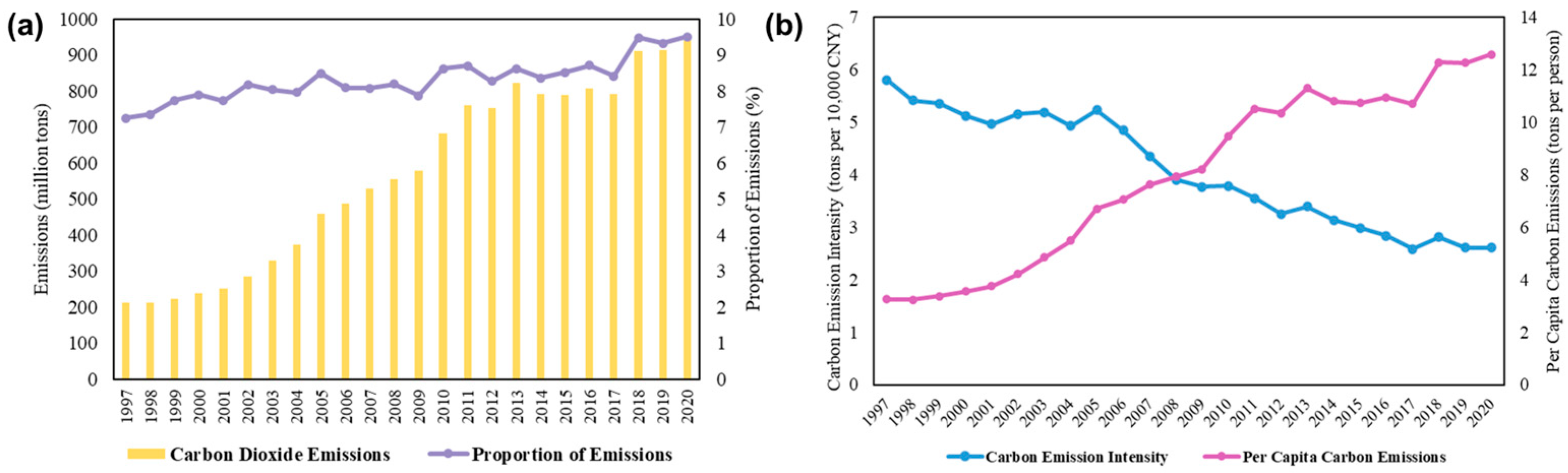
Hebei Province is characterized by high total carbon emissions, rapid growth, and high emission intensity (Figure 2). From 1997 to 2020, the province’s carbon emissions increased from 212 million tons to 939 million tons, with an average annual growth rate of 6.68%, exceeding the national rate of 5.44%. Meanwhile, Hebei’s share of China’s total carbon emissions rose steadily from 7.2% in 1997 to 9.5% in 2020, maintaining a relatively high proportion overall. Although the growth rate of carbon emissions has slowed since 2014, the overall emission scale continues to expand, making Hebei one of the provinces with the highest emission levels in China.
Carbon emission intensity and per capita emissions display opposite trends. The carbon emission intensity declined markedly, from 5.8 tons per 10,000 CNY in 1997 to 2.6 tons per 10,000 CNY in 2020, while per capita carbon emissions increased from 3.25 tons per person to 12.59 tons per person—both significantly higher than the 2020 national averages of 0.98 tons per 10,000 CNY and 7 tons per person, respectively. This pattern indicates that the growth in carbon emissions has outpaced population growth. Overall, Hebei Province faces substantial pressure to reduce emissions, but it also possesses considerable potential for mitigation.

3.1.2. Energy Structure Characteristics of Carbon Emissions

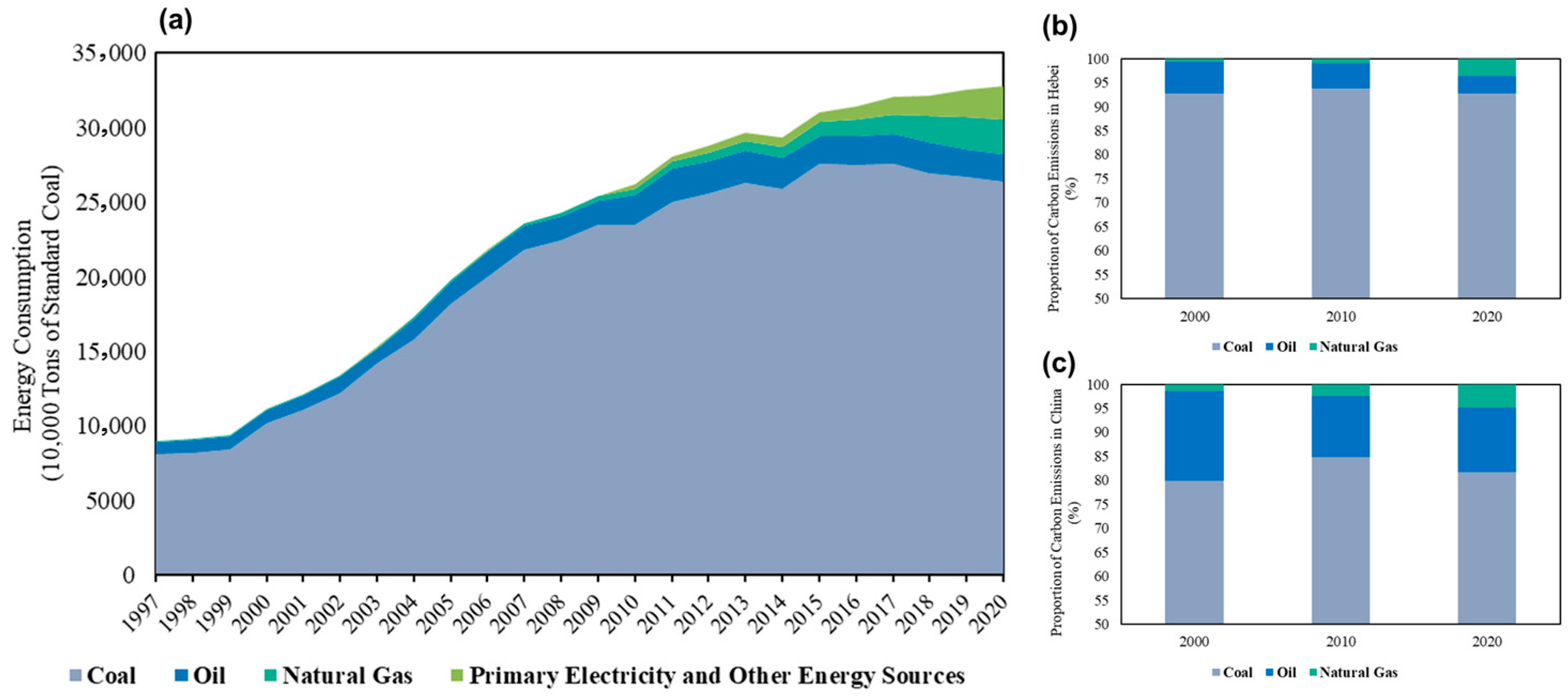
With sustained economic growth and rapid urbanization, Hebei Province’s total energy consumption increased from 90.33 million tons of standard coal to 327.82 million tons of standard coal (Figure 3a). Owing to the predominance of traditional industries, Hebei’s energy consumption structure remains heavily coal-oriented. In 2020, coal, oil, natural gas, and other energy sources accounted for 80.51%, 5.67%, 7.00%, and 6.82% of total energy consumption, respectively. Nevertheless, the province has shown a clear trend toward energy structure optimization. Since 2010, the shares of coal and oil in total consumption have declined steadily, while those of natural gas and other clean energy sources—such as primary electricity—have increased significantly. In particular, the proportion of primary electricity and other energy sources has risen by nearly 1% annually since 2015, reflecting the growing adoption of clean energy technologies.
From the perspective of the energy structure of carbon emissions, coal and oil consumption together accounted for more than 95% of total carbon emissions in Hebei Province, though this share has exhibited a downward trend since 2010 (Figure 3b). In comparison with the national energy-related carbon emission structure (Figure 3c), Hebei’s carbon emissions from coal consumption are higher than the national average of 81%, whereas emissions from oil and natural gas consumption are lower than the national averages of 13.47% and 4.85%, respectively.

3.1.3. Industrial Structure Characteristics of Carbon Emissions

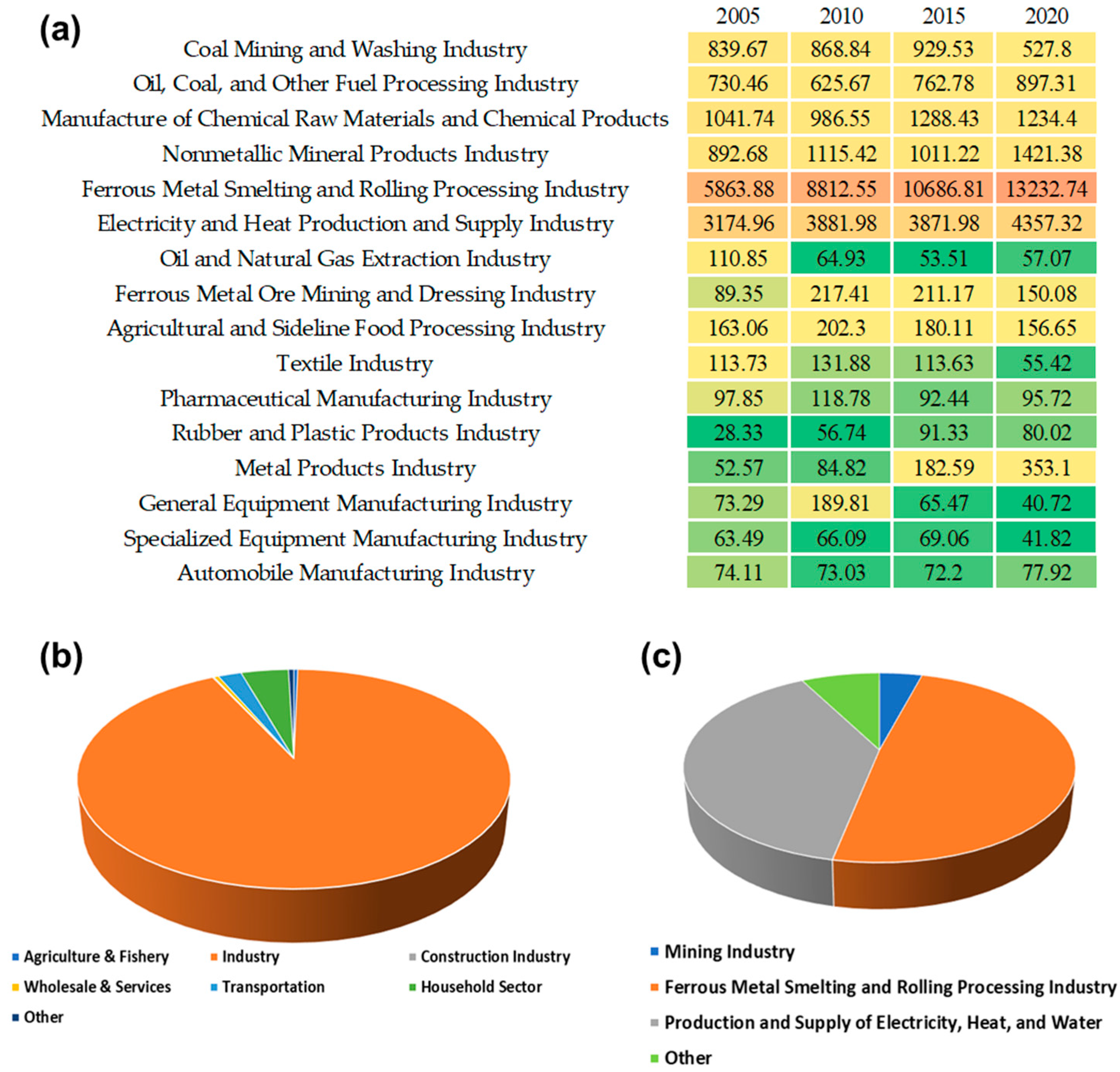
High energy-intensive industries account for more than 80% of Hebei Province’s total carbon emissions (Figure 4). These industries include coal mining and washing, petroleum and coal processing and other fuel industries, the manufacture of chemical raw materials and chemical products, the nonmetallic mineral products industry, ferrous metal smelting and rolling, and electricity and heat production and supply. Together, these sectors consume more than 90% of the province’s total energy. The energy consumption of large-scale enterprises in these highly energy-intensive industries exceeds 5 million tons of standard coal, far higher than that of other manufacturing sectors. Among them, ferrous metal smelting and rolling, and electricity and heat production and supply are particularly dominant, accounting for 56.56% and 18.63%, respectively, of the total energy consumption of large industrial enterprises in 2020. Notably, energy consumption in ferrous metal smelting and rolling increased from 58.63 million tons of standard coal in 2005 to 132.32 million tons in 2020.
These industries are also the principal sources of carbon emissions in Hebei Province, with the industrial sector as a whole contributing 92% of total provincial emissions. Within the industrial sector, ferrous metal smelting and rolling and electricity and heat production and supply account for 49% and 39% of industrial carbon emissions, respectively, representing 45% and 36% of the province’s total emissions. This indicates a highly concentrated distribution of carbon emissions among a few energy-intensive industries.
However, the profits generated by the ferrous metal smelting and rolling sector represented only 28% of the total profits of large-scale enterprises in the province. Although this sector consumed more than half of the total energy of Hebei Province, its contribution to the provincial economy remains relatively low. Moreover, this sector exhibited a pronounced spatial concentration, large-scale enterprises in Tangshan, Handan, and Shijiazhuang account for 45% of the province’s total energy consumption. This indicated that the ferrous metal smelting and rolling sector should be a key focus for future industrial transformation, and targeted efforts are needed to promote technological upgrading and production optimization in major cities.

3.1.4. City-Level Characteristics of Carbon Emissions

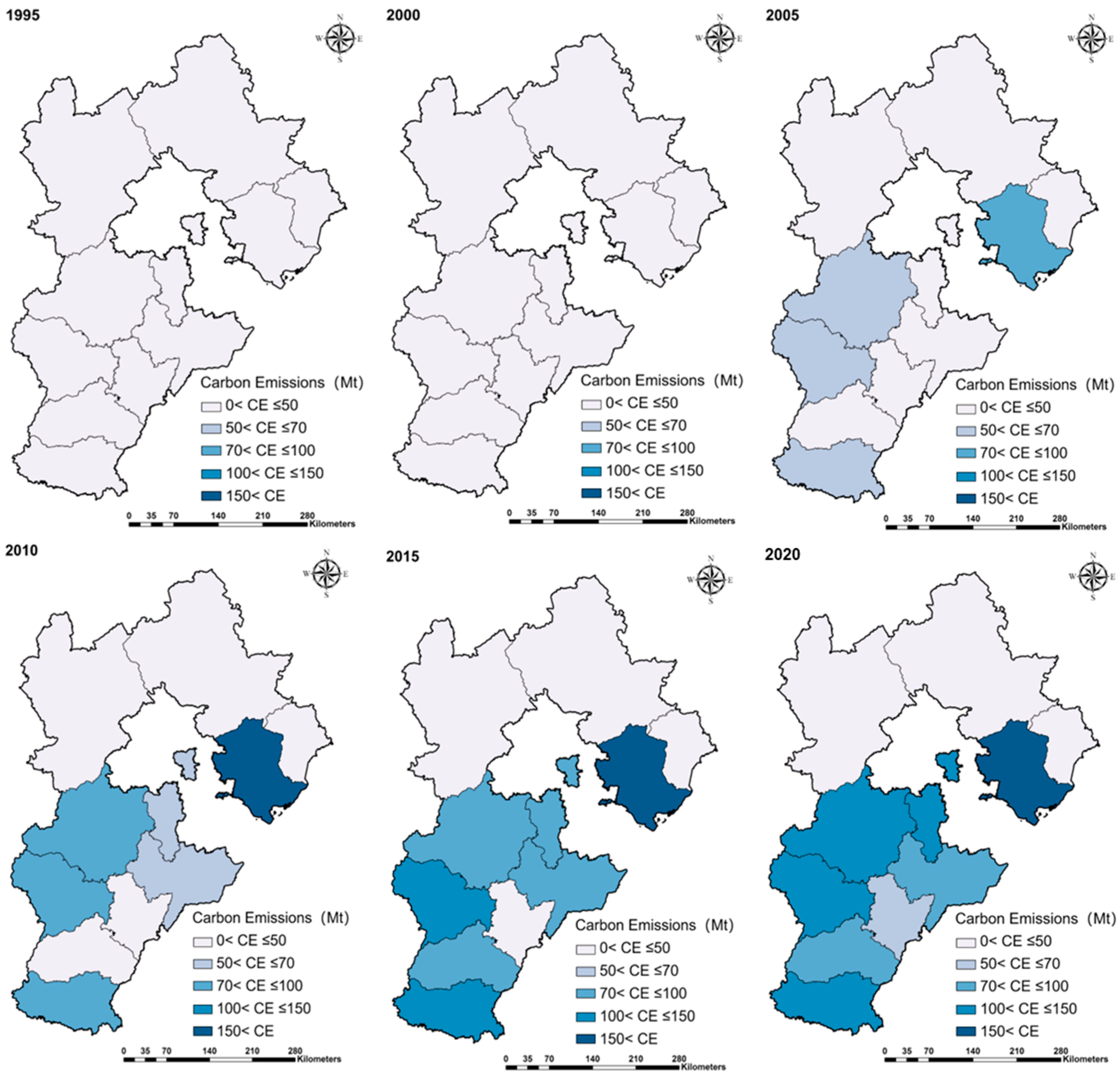
Significant differences exist in carbon emission scales among cities within Hebei Province (Figure 5). From 1995 to 2020, all cities in the province experienced varying degrees of carbon emission growth, with the most pronounced increases occurring after 2005. Cities such as Tangshan, Shijiazhuang, Baoding, and Handan exhibited particularly rapid growth, together accounting for nearly 60% of the province’s total emissions. Based on emission scales, the cities can be classified into three groups.
The first group comprises high-emission cities. Tangshan ranks first in Hebei in the production of industrial products such as coke, steel, and chemical fibers, with its carbon emissions remaining above 150 million tons since 2010. Shijiazhuang, Handan, Baoding, and Langfang are also major producers of steel and chemical products. Their carbon emissions all exceeded 100 million tons in 2020, and these cities are characterized by relatively dense economic activity and population concentration, resulting in substantial emission reduction pressure. The second group includes medium-emission cities such as Cangzhou, Xingtai, and Hengshui, whose emissions ranged between 50 and 100 million tons in 2020. The third group consists of Zhangjiakou, Chengde, and Qinhuangdao, which serve important ecological conservation functions. Their carbon emission scales have consistently remained below 50 million tons.
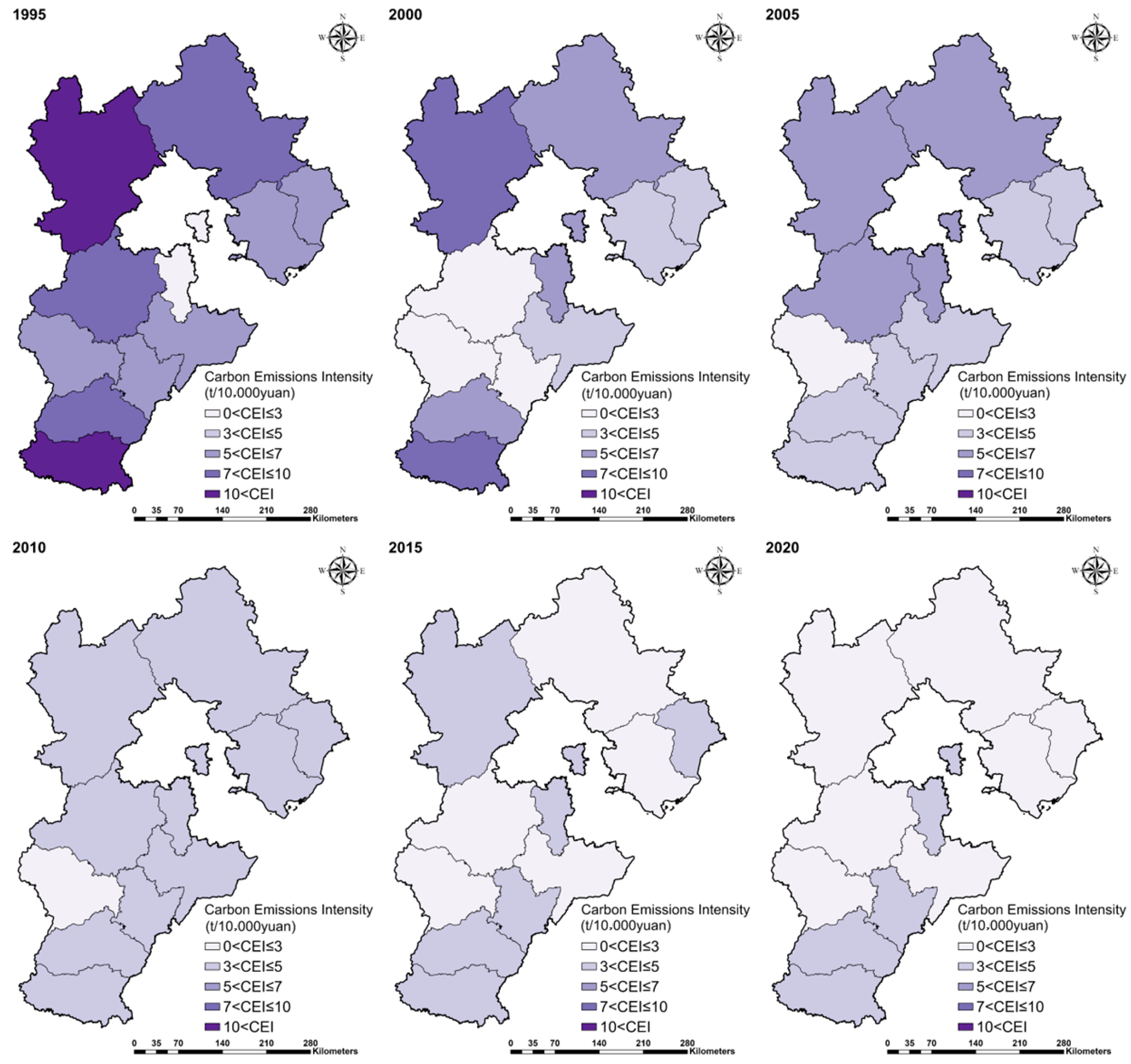
As shown in Figure 6, the carbon emission intensity (CEI) of the Beijing–Tianjin–Hebei region exhibited a continuous downward trend from 1995 to 2020, while significant spatial disparities persisted throughout the period. Between 1995 and 2000, the northwestern and southern parts of Hebei Province generally showed high levels of CEI, particularly in cities such as Zhangjiakou, Handan, and Tangshan, where heavy industry and energy extraction dominated, with CEI exceeding 7 tons per 10,000 yuan of GDP. Driven by industrial restructuring and improvements in energy efficiency, the overall CEI gradually declined, with northern Hebei cities experiencing particularly notable reductions. By 2020, except for a few heavy-industrial bases, most cities had reduced their CEI to below 3 tons per 10,000 yuan of GDP, indicating that most cities in the region had achieved phased progress in balancing economic development and emission reduction. However, cities in central and southern Hebei still displayed relatively high CEI, suggesting the need for further optimization of energy structure and technological efficiency to narrow the gap with the province’s overall carbon reduction level.

3.2. Scenario Projections for Hebei Province’s Carbon Peaking

3.2.1. Carbon Emission Forecasting Model for Hebei Province

According to the regression results, when k = 0.05, the explanatory power of the variables for carbon emissions reached 0.96 (R2 = 0.96). The coefficients of each variable are as follows:
C =   854.201 + 0.245 P + 0.004 G 1.225 U + 1.086 S 1.768 T 109.173
The regression results indicate that the coefficients of population (P), GDP per capita (G), and the share of the secondary industry (S) are positive, suggesting a positive effect on carbon emissions. Among them, the coefficient of the secondary industry share (1.086) has the strongest impact on carbon emissions. In contrast, the coefficients of urbanization rate, the share of installed thermal power capacity, and energy intensity are negative, indicating that these factors exert a mitigating effect on carbon emissions.
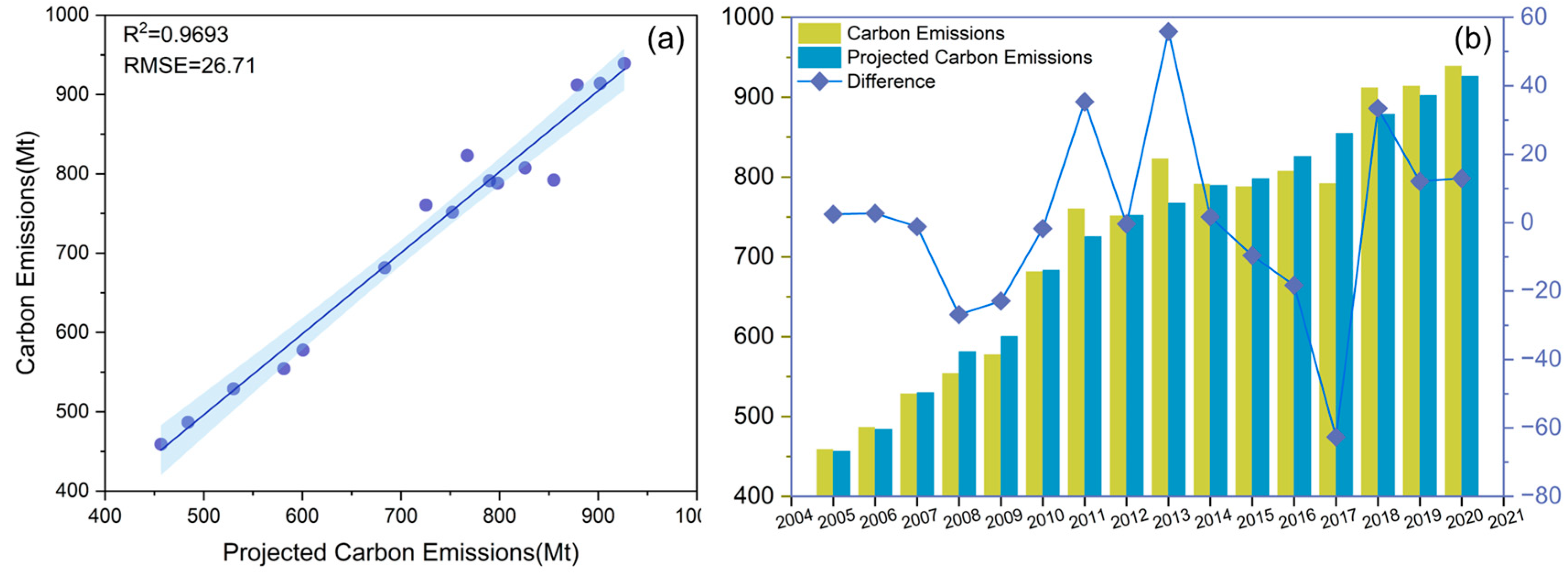
Figure 7 illustrates the fitted and predicted carbon emission results of the ridge regression model for the period 2005–2020. As shown in panel (a), the predicted values exhibit a high degree of consistency with the observed values (R2 = 0.9693, RMSE = 26.71 Mt), indicating that the model accurately reproduces the temporal evolution of Hebei Province’s carbon emissions. Compared with the ordinary least squares (OLS) regression, the ridge regression model effectively mitigates multicollinearity by shrinking coefficient estimates, thereby stabilizing the inter-variable relationships and yielding a more reliable overall fit. Panel (b) further presents the year-by-year comparison between the observed and predicted carbon emissions, along with their differences. The two series show a high level of concordance in most years, demonstrating the model’s strong stability in capturing long-term trends. Minor deviations observed in certain years are primarily attributable to fluctuations in energy consumption and variations in industrial capacity during those periods. Nevertheless, the overall margin of error remains small, and the model successfully captures the renewed upward trend in emissions after 2017.
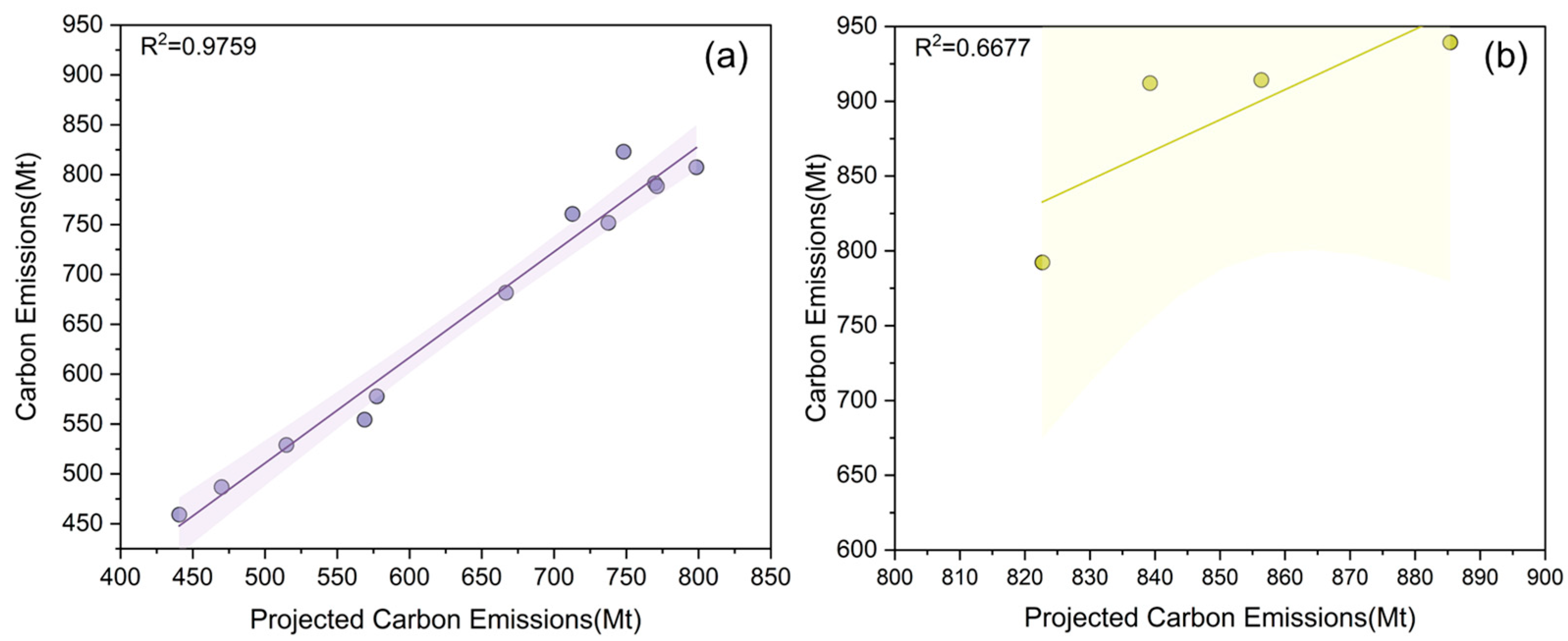
Meanwhile, using k = 0.05 as the baseline parameter, the generalization ability of the ridge regression prediction model was tested by dividing the data into a training set (2005–2016) and a testing set (2017–2020). The results show that the model achieves a high level of accuracy and robustness, with an R2 = 0.9759 for the testing set, demonstrating strong explanatory power for variations in Hebei’s carbon emissions during 2005–2016 (Figure A3a). In 2018, carbon emissions increased rapidly, primarily due to a nearly 80 Mt rise in emissions from the smelting and pressing of ferrous metals sector compared with 2017, which led to a relatively larger deviation between the predicted and observed results (Figure A3b). This indicates that the model exhibits a certain degree of dependence on temporal sequence patterns, suggesting that more precise capture of variable information is required to achieve accurate carbon emission predictions. Overall, the model’s performance for the 2005–2020 period reasonably captures the combined effects of structural adjustments and energy efficiency improvements on carbon emissions, confirming the validity and reliability of the ridge regression model for regional carbon emission forecasting and trend analysis.

3.2.2. Results of Carbon Peaking Projections in Hebei Province

From 2023 to 2030, carbon emissions in Hebei Province are projected to follow a pattern of rising first, then peaking, and subsequently declining under all three scenarios—baseline, high-mitigation, and low-mitigation (Figure 8). Under the baseline scenario, Hebei is expected to reach its carbon peak in 2027, with a peak emission level of 1.011 billion tons, followed by a gradual decline. Under the high-mitigation scenario, the peak is projected to occur earlier, in 2024, at 0.987 billion tons, after which emissions will continue to decrease significantly. In contrast, under the low-mitigation scenario, the province is expected to peak later, in 2029, at 1.037 billion tons, with emissions in 2030 slightly declining to 1.036 billion tons.
As shown in Table 3, the projected values of the key indicators vary across the three scenarios. Reducing the share of the secondary industry, the proportion of installed thermal power capacity, and energy intensity plays a crucial role in all simulated carbon-peaking pathways. The high-mitigation scenario features the most favorable indicator configuration for achieving carbon peaking; however, it also entails significant socioeconomic trade-offs. Between 2023 and 2030, the population would decline by 4.18 million, the share of the secondary industry would fall below 30%, and GDP per capita in 2030 would remain below 70,000 CNY. Such a slowdown in economic growth would be particularly detrimental for Hebei Province, where the industrial sector remains a key driver of development. A substantial contraction of the secondary industry would constrain economic performance and negatively affect employment and household welfare.
By contrast, the low-mitigation and baseline pathways appear more feasible for achieving carbon peaking before 2030. Under the baseline scenario, Hebei’s carbon emissions are projected to peak in 2027 and then decline steadily between 2028 and 2030. During this period, the population is expected to decrease by 1.4 million compared with 2023, GDP per capita would exceed 70,000 CNY by 2030, and the share of the secondary industry would remain above 30%, alongside continuous optimization of the energy structure. Under the low-mitigation scenario, Hebei’s emissions are projected to peak in 2029 and slightly decline thereafter. This scenario offers the most flexible conditions for economic growth, allowing for relatively higher proportions of secondary industry and thermal power generation, as well as a smaller decline in population. Although economic expansion would be most pronounced under the low-mitigation scenario, whether the downward trend in carbon emissions after 2030 can be sustained requires further analysis. Therefore, a carbon-peaking pathway that combines the low-mitigation scenario as a basis and the baseline scenario as a target appears to be the most realistic and practical approach for Hebei Province.

3.3. Industrial Structure Analysis Under Carbon Peaking Scenarios

Since 2015, the share of the secondary industry in Hebei Province has declined from 43.7% to 40.2%, the proportion of thermal power generation has dropped from 75% to 43%, and energy intensity has decreased from 1.17 tons of standard coal per 10,000 CNY to 0.82 tons per 10,000 CNY. These changes indicate that the annual average rate of decline in the share of the secondary industry should remain between −0.5% and −3%, the share of installed thermal power capacity between −1% and −3%, and energy intensity between −1% and −3% to stay on track toward the carbon peaking target. In recent years, with strong progress in new energy development, the declines in both thermal power capacity share and energy intensity have been particularly pronounced, aligning with the province’s transition toward carbon peaking. By contrast, the reduction in the secondary industry’s share has proceeded at a moderate pace, roughly consistent with the low-mitigation scenario. To ensure steady progress toward carbon peaking, Hebei Province must further accelerate industrial restructuring during the 14th Five-Year Plan period, reducing the dominance of energy-intensive sectors within the secondary industry.
(1)
Under the low-mitigation scenario, the share of the secondary industry is projected to fall to 34.71% by 2030. Based on the projected population and GDP per capita values (Table 2), the estimated gross output value of the secondary industry in 2030 will be approximately 2.035 trillion CNY, requiring the average annual growth rate to be limited to around 2.46%. Between 2017 and 2022, the secondary industry grew at an average annual rate of 6.55%, meaning its expansion must slow substantially. Since industrial sectors have consistently accounted for over 80% of the secondary industry’s output since 2005—with an average annual growth rate of 6.64% over the past five years—they remain the dominant drivers of industrial change. Consequently, controlling the growth of the secondary industry depends primarily on reducing the industrial sector’s expansion rate to approximately 2.4% per year, consistent with the required pace of deceleration.
(2)
The ferrous metal smelting and rolling industry has experienced substantial profit growth over the past five years, rising from 32 billion CNY to 84.2 billion CNY. Its share of total profits among large-scale industrial enterprises increased from 11.37% in 2016 to 34.30% in 2021, making it one of the main contributors to Hebei’s high carbon emissions. Since 2019, its value added has maintained an annual growth rate of about 6%, consistent with the overall industrial trend but far above the rate required for carbon peaking. As a key emission-intensive sector, its growth rate must be gradually reduced to below 2.4% annually under the low-mitigation scenario.
(3)
The electricity and heat production and supply sector is likewise a key target for emission reduction. On one hand, it involves lowering the share of thermal power generation; on the other, it requires controlling the overall pace of industry expansion. In recent years, the proportion of thermal power in Hebei Province has continued to decline, with an average annual reduction of more than 10%, consistent with the requirements of the low-mitigation scenario. However, in terms of total output, the sector’s value added has grown at an average annual rate of 4.53%. Production in energy-intensive industries within the province continues to depend on maintaining power generation capacity, and thermal power remains dominant. From 2015 to 2019, the installed capacity of thermal power generation increased from 435 GW to 502.1 GW, representing an average annual growth rate of 3.86%. Therefore, achieving the carbon-peaking target requires limiting the growth rate of the electricity and heat production sector to within 2.4% per year and gradually reducing thermal power capacity, transitioning from growth to stabilization and eventual decline before 2030.
(4)
Controlling the growth of the secondary industry and key subsectors will inevitably affect employment and enterprises. Since 2005, employment in the secondary industry first increased and then declined, with a sharp downward trend over the past five years. Under the low-mitigation pathway, the continued reduction in the secondary industry’s share is expected to result in a further decline in employment—by approximately 900,000 workers between 2023 and 2030. The number of employees and enterprises in the ferrous metal smelting and rolling industry has already decreased faster than projected under the low-mitigation scenario, aligning with carbon peaking requirements. In contrast, the electricity and heat production and supply industry has seen annual growth rates of 2.96% in employment and 21.71% in enterprise numbers over the past five years—both exceeding the limits set by the carbon peaking pathway. Under these constraints, the industry is projected to reduce employment by 3000 to 15,000 workers and the number of large-scale enterprises by 20 to 290 between 2023 and 2030.

4. Discussion

4.1. Policy Implications

According to the ridge regression results, the coefficients of population (P), GDP per capita (G), and the proportion of the secondary industry (S) are positive, indicating that population, economic growth, and industrial structure remain the main drivers of increasing carbon emissions in Hebei Province. Based on the baseline scenario, we adjusted P, G, and S to HMS and LMS scenarios, respectively, and compared the corresponding changes in the timing of the carbon emission peak (Table 4 and Table 5). The results show that in the HMS scenario, a smaller population scale leads to an earlier carbon peak, while in the LMS scenario, continued population growth drives persistent increases in emissions. The effects of GDP per capita and the secondary industry share on the timing of the carbon peak are relatively smaller in the HMS scenario. However, under the LMS scenario, the share of the secondary industry exerts a stronger influence than GDP per capita in promoting the carbon peak in Hebei province.
Provincial-level carbon emission forecasting in China mainly employs methodological frameworks such as scenario simulation, structural decomposition, machine learning, and regression inference. Typically, indicators including population, economic growth, industrial structure, energy intensity, and energy structure are incorporated into the analytical system to construct baseline and mitigation scenarios, thereby predicting the temporal pathways toward provincial carbon peaking [59]. Existing studies have examined carbon peaking in other high-emission provinces and proposed corresponding policy recommendations. The findings indicate that both the timing and magnitude of the carbon peak are jointly influenced by multiple interacting factors. For instance, in Guangdong Province, achieving carbon peaking around 2030 depends critically on continuous improvements in energy efficiency and the transition of energy-intensive manufacturing industries toward low-carbon sectors. Among these factors, improvements in manufacturing energy efficiency and an increased share of the service sector have the most significant influence on the peak emission level [60]. In typical high-emission regions such as Jiangsu Province, the emission peak is expected to occur between 2025 and 2030. The formation of the peak is mainly driven by four categories of factors, including the improvements in energy efficiency, optimization of industrial structure, increased electrification of end-use energy, and the decarbonization of the power generation mix. The energy efficiency enhancement and industrial restructuring play the most decisive roles [61]. Moreover, comparative studies across multiple provinces have found that environmental protection investment alone does not necessarily lead to emission reductions; its effectiveness depends on policy coordination with energy structure transformation and industrial upgrading [62]. Compared with other regions, these provinces share certain commonalities in their driving mechanisms and transition pathways. The timing and level of carbon peaking are jointly shaped by the synergistic effects of energy efficiency, industrial structure, and energy mix. However, unlike coastal provinces, Hebei Province faces greater challenges due to its concentration of traditional manufacturing industries, stronger dependence on fossil energy, and slower pace of industrial transformation. Thus, in achieving carbon peaking, the development of clean energy and the improvement of industrial energy efficiency are necessary, while maintaining overall economic stability.
Based on the above analysis and comparison, the following recommendations are proposed from a regional policy perspective: First, policy efforts should focus on consolidating and expanding the achievements of energy structure optimization by shifting the orientation from a “national energy supply base” toward a “clean energy base”. Developing emerging industries such as clean energy equipment manufacturing and operation, and maintenance services can transform energy restructuring into a new driver of economic growth. At the same time, demonstration zones should be utilized to absorb labor transferred from traditional industries, provide green electricity and carbon-negative products for the coordinated development of the Beijing–Tianjin–Hebei region, and integrate ecological conservation areas, green transformation zones, and national energy supply bases under the unified goal of clean energy development.
Second, policy measures should promote the technological upgrading of energy-intensive industries to ensure an orderly and stable decarbonization process while avoiding uniform peak-control measures. Energy-saving retrofits, ultra-low-emission upgrades, and demonstrations of advanced low-carbon technologies such as electric furnace steelmaking, hydrogen metallurgy, and CCUS should be systematically advanced in key sectors, including steel, power generation, and cement. Policies should also make full use of the existing industrial base in wind power, photovoltaics, and low-carbon technology manufacturing. In addition, through the collaborative innovation platforms of the Beijing–Tianjin–Hebei region, scientific and financial resources should be directed toward low-carbon transformation and recycling projects in traditional industries, supporting the establishment of a national hub for emission-reduction technology development and diffusion.
Third, policy design should establish differentiated carbon peaking timetables and industrial transformation roadmaps based on functional zoning and intercity emission disparities. Areas such as Zhangjiakou and Chengde, which possess abundant clean energy resources, should be encouraged to reach their emission peaks ahead of schedule. For cities with concentrated heavy industries and dense populations, including Tangshan, Shijiazhuang, Handan, and Baoding, phased peak targets and sector-specific emission goals should be formulated to guide the strategic layout of emerging industries. Cities such as Langfang, Cangzhou, and Xingtai, which have a certain industrial foundation but relatively weak momentum for transformation, can promote the development of new energy vehicles, wind power, photovoltaics, and related logistics and commercial services by undertaking spillover industries from Beijing and Tianjin’s advanced manufacturing and modern service sectors. Through unified provincial-level planning and the implementation of region and category-specific “timetables” and “roadmaps”, policies can ensure that the province as a whole achieves carbon peaking around 2030, while preserving the necessary development space and gradient for individual cities.
Finally, Hebei must coordinate overall and regional carbon peaking by developing a scientific timetable and roadmap. While the province’s overall carbon peaking target before 2030 is achievable, significant disparities exist among cities in emission scales and economic structures. Tangshan, Shijiazhuang, Handan, and Baoding—key producers of steel, cement, metals, and pharmaceuticals—face high emission pressures and urgent industrial restructuring needs due to dense populations and heavy industry concentrations. In contrast, Zhangjiakou and Chengde, endowed with abundant clean energy resources and smaller populations, enjoy clear advantages in achieving early carbon peaking. Cities such as Langfang, Cangzhou, and Xingtai also have considerable industrial bases but lag in transformation momentum compared with economically advanced cities. Each locality should develop tailored carbon peaking roadmaps based on its specific conditions: cities with structural advantages should peak earlier, while those under greater emission pressure—such as Shijiazhuang and Tangshan—should adopt phased targets with flexible adjustments, ensuring space for continued economic development beyond the carbon peak.

4.2. Limitations

Although ridge regression can substantially enhance model robustness under conditions of multicollinearity and effectively capture the overall trend of carbon emissions in Hebei Province, it still has certain limitations when applied to regional carbon emission forecasting. First, ridge regression is essentially a linear model, assuming stable linear relationships between carbon emissions and variables such as population, economic activity, industrial structure, and energy intensity. This assumption makes it difficult to fully capture nonlinear or abrupt effects arising from the rapid transformation of energy structure, industrial policy adjustments, or production fluctuations in heavily polluting sectors. Then, since the model is fitted using historical data from 2005 to 2020, its predictive results mainly reflect the continuation of past statistical relationships. Consequently, it has limited sensitivity to short-term policy interventions or exogenous shocks such as sharp fluctuations in energy prices, which may lead to underestimation of anomalous changes in specific years, such as the emission rebound observed in 2018. Third, although the ridge parameter was determined through ridge trace analysis to achieve coefficient convergence and stability, the process still relies on empirical judgment. Moreover, the regularization nature of ridge regression compresses coefficients as a whole, which may weaken the interpretability of the actual contribution of certain variables. Overall, ridge regression demonstrates high reliability in simulating macro-level trends and conducting long-term forecasts, but remains limited in explaining detailed mechanisms of emission changes or abrupt fluctuations. Therefore, the ridge regression remains an appropriate and effective analytical approach at the provincial level, where the general trend of variation is relatively stable.
In addition, the predictions in this study are primarily based on historical data from 2005 to 2020. While these data effectively reflect the overall emission trend in Hebei Province, the relatively short time series constrains the model’s ability to capture long-term policy effects and economic cycle fluctuations. Future projections beyond 2030 should account for potential impacts of rapid energy transitions or major technological breakthroughs. Furthermore, spatial heterogeneity has not yet been fully represented, as the estimation is conducted at the provincial level without differentiating among cities that vary in industrial structure, energy profiles, and emission-reduction potential. Future research could integrate longer time series, higher spatial resolution, and nonlinear modeling approaches to deepen the understanding of carbon emission drivers and region-specific peaking pathways.

5. Conclusions

This study provides a comprehensive multi-dimensional analysis of the spatiotemporal characteristics of carbon emissions in Hebei Province and constructs a ridge regression model based on socioeconomic factors closely related to carbon emissions. Using this model, carbon emission trends in Hebei Province were projected under three scenarios—baseline, high-mitigation, and low-mitigation—through 2030.
From 1997 to 2020, Hebei Province’s carbon emissions maintained a continuous upward trend, though the growth rate has slowed in recent years. Carbon emission intensity declined markedly, while per capita carbon emissions exhibited a fluctuating upward trend, and both remain higher than the national average, indicating substantial potential for emission reduction. Coal continues to dominate the province’s carbon emissions, but the shares of natural gas and primary electricity and other clean energy sources have increased rapidly, reflecting a clear trend toward energy structure optimization. More than 80% of Hebei’s total carbon emissions are concentrated in energy-intensive industries, with ferrous metal smelting and rolling, and electricity and heat production and supply contributing 45% and 36% of total emissions, respectively. Under the influence of these dominant industries, industrial cities such as Shijiazhuang, Tangshan, and Handan face particularly high emission reduction pressures.
Scenario-based forecasts derived from the ridge regression model show that under the baseline scenario, Hebei is expected to reach its carbon peak in 2027, with a peak emission of 1.011 billion tons, followed by a gradual decline. Under the high-mitigation scenario, the province peaks earlier in 2024 at 0.987 billion tons, then continues to decline significantly. Under the low-mitigation scenario, the peak occurs later in 2029 at 1.037 billion tons, with emissions slightly decreasing to 1.036 billion tons by 2030. Considering Hebei’s economic structure and the trends of key socioeconomic indicators, the baseline and low-mitigation scenarios are assessed as more feasible pathways toward carbon peaking.
Under the low-mitigation scenario, the share of the secondary industry is projected to decline to approximately 34.71% by 2030. The industrial sector remains the principal driver of change within the secondary industry; therefore, controlling industrial expansion is central to achieving carbon peaking. The annual growth rate of industrial output should be limited to around 2.4%, consistent with the overall growth constraint for the secondary industry. Specifically, ferrous metal smelting and rolling, and electricity and heat production and supply are key sectors requiring stricter control, with their annual growth rates also capped below 2.4%. However, constraining industrial growth will inevitably lead to some employment contraction—particularly in the electricity and heat production and supply industry, where the number of employed workers is expected to decline by 3000 to 15,000 by 2030.

Author Contributions

Conceptualization, Y.Z. (You Zhao) and S.L.; methodology, Y.Z. (Yuan Zhou); software, Y.Z. (Yuan Zhou); validation, Y.Z. (You Zhao) and S.L.; formal analysis, Y.Z. (You Zhao); investigation, Y.Z. (You Zhao) and Y.Z. (Yuan Zhou); resources, S.L.; data curation, Y.Z. (You Zhao); writing—original draft preparation, Y.Z. (You Zhao) and Y.Z. (Yuan Zhou); writing—review and editing, Y.Z. (You Zhao) and S.L.; visualization, Y.Z. (You Zhao) and Y.Z. (Yuan Zhou); supervision, S.L.; project administration, S.L.; funding acquisition, S.L. All authors have read and agreed to the published version of the manuscript.

Funding

This research was funded by the Humanities and Social Sciences of Macao Polytechnic University and the Science & Technology Program of Hebei Normal University, grant number L2024B25. The APC was funded by the Faculty of Humanities and Social Sciences, Macao Polytechnic University.

Data Availability Statement

Requests may be directed to the corresponding author, who will provide the datasets for academic and non-commercial use in accordance with confidentiality and ethical requirements.

Conflicts of Interest

The authors declare no conflicts of interest.

Appendix A

Table A1. The results of multiple linear regression.
VariablesβFVIF
P 0.085 0.758 71.46
G 0.021 0.079 331.28
U −31.14 0.017 139.00
S −13.817 0.282 44.01
T −1.117 0.825 107.66
I −150.18 0.384 116.88
β 0 1889.80 0.465 /
Table A2. Basis for Variable Changes.
Policy BasisPGUSTI
The 14th Five-Year Plan/
Hebei Province’s 14th Five-Year Plan/The 14th Five-Year Plan for the Modern Energy System/
The 14th Five-Year Plan for the Development of Renewable Energy
/ 7% * 65% 35.5% 8% * [−15%]
2021–2025 annual average change rate −0.3% * 7% * 2% * −2.5% * −8% * −5.7% *
2026–2030 annual average change rate −0.4% * 3% * 2% * −2.5% * −5% * −3% *
* Annual average change rate. [] Cumulative change rate.
Figure A1. Economic development at the city level in Hebei Province in 2022. (a) GDP of Hebei Province; (b) GDP per capital of Hebei Province.
Urbansci 09 00516 g0a1
Figure A2. Ridge trace in this study. (a) The range of k is 0–1; (b) The range of k is 0–0.2.
Urbansci 09 00516 g0a2
Figure A3. The training set and test set results of the ridge regression model. (a) Projected Carbon Emissions (Mt); (b) Projected Carbon Emissions (Mt).
Urbansci 09 00516 g0a3

References

  1. Ritchie, H.; Roser, M. CO2 Emissions. Our World in Data 2020. Available online: https://ourworldindata.org/co2-emissions (accessed on 1 February 2025).
  2. Grant, L.; Vanderkelen, I.; Gudmundsson, L.; Fischer, E.; Seneviratne, S.I.; Thiery, W. Global Emergence of Unprecedented Lifetime Exposure to Climate Extremes. Nature 2025, 637, 89–97. [Google Scholar] [CrossRef]
  3. Carlson, C.J.; Mitchell, D.; Gibb, R.; Stuart-Smith, R.F.; Carleton, T.; Lavelle, T.E.; Lippi, C.A.; Lukas-Sithole, M.; North, M.A.; Ryan, S.J.; et al. Health Losses Attributed to Anthropogenic Climate Change. Nat. Clim. Chang. 2025, 15, 1052–1055. [Google Scholar] [CrossRef]
  4. Otto, F.E.L. Attribution of Extreme Events to Climate Change. Annu. Rev. Environ. Resour. 2023, 48, 813–828. [Google Scholar] [CrossRef]
  5. United Nations, Department of Economic and Social Affairs, Population Division. World Urbanization Prospects: The 2018 Revision (ST/ESA/SER.A/420); United Nations: New York, NY, USA, 2019. [Google Scholar]
  6. Seto, K.C.; Güneralp, B.; Hutyra, L.R. Global Forecasts of Urban Expansion to 2030 and Direct Impacts on Biodiversity and Carbon Pools. Proc. Natl. Acad. Sci. USA 2012, 109, 16083–16088. [Google Scholar] [CrossRef]
  7. Li, X.; Zhou, Y.; Hejazi, M.I.; Wise, M.A.; Vernon, C.R.; Iyer, G.C.; Chen, W. Global Urban Growth between 1870 and 2100 from Integrated High-Resolution Mapped Data and Urban Dynamic Modeling. Commun. Earth Environ. 2021, 2, 201. [Google Scholar] [CrossRef]
  8. Lin, B. Impact of China’s New-Type Urbanization on Energy Intensity: A City-Level Analysis. Energy Econ. 2021, 99, 105292. [Google Scholar] [CrossRef]
  9. International Energy Agency (IEA). Greenhouse Gas Emissions from Energy; IEA: Paris, France. Available online: https://www.iea.org/data-and-statistics/data-product/greenhouse-gas-emissions-from-energy (accessed on 15 February 2025).
  10. Bai, Y.; Zheng, H.; Shan, Y.; Meng, J.; Li, Y. The Consumption-Based Carbon Emissions in the Jing-Jin-Ji Urban Agglomeration over China’s Economic Transition. Earth’s Future 2021, 9, e2021EF002132. [Google Scholar] [CrossRef]
  11. Yang, J.; Gong, Y.; Zhang, C.; Sun, J.; Wong, G.; Shi, W.; Liu, W.; Gao, G.F.; Bi, Y. City-Level Emission Peak and Drivers in China. Innovation 2022, 3, 100306. [Google Scholar] [CrossRef] [PubMed]
  12. Xia, C.; Wang, C.; Fan, Y.; An, K.; Wang, Y.; Song, J.; Zhang, H.; Du, P.; Meng, J.; Shan, Y.; et al. Heterogeneity in Carbon Footprint Trends and Trade-Induced Effects across China’s City Clusters. Commun. Earth Environ. 2025, 6, 26. [Google Scholar] [CrossRef]
  13. Xu, J.; Guan, Y.; Oldfield, J.; Guan, D.; Shan, Y. China Carbon Emission Accounts 2020–2021. Appl. Energy 2024, 360, 122837. [Google Scholar] [CrossRef]
  14. Carbon Brief. Explainer: Why China’s Provinces Are So Important for Action on Climate Change. Carbon Brief 2022. Available online: https://www.carbonbrief.org (accessed on 20 October 2025).
  15. Zhao, L.; Wang, K.; Yi, H.; Cheng, Y.; Zhen, J.; Hu, H. Carbon Emission Drivers of China’s Power Sector and Its Transformation for Global Decarbonization Contribution. Appl. Energy 2024, 376, 124258. [Google Scholar] [CrossRef]
  16. Wang, Y.; Wen, Z.; Xu, M.; Doh Dinga, C. Long-term transformation in China’s steel sector for carbon capture and storage technology deployment. Nat. Commun. 2025, 16, 4251. [Google Scholar] [CrossRef] [PubMed]
  17. Wei, Y.; Zhao, T.; Zhang, X.; Tian, Q.; Zhang, F. Exploring the Role of Energy Transition in Shaping the CO2 Emissions Pattern in China’s Power Sector. Sci. Rep. 2025, 15, 18794. [Google Scholar] [CrossRef]
  18. Yu, Y.; You, K.; Cai, W.; Feng, W.; Li, R.; Liu, Q.; Chen, L.; Liu, Y. City-level building operation and end-use carbon emissions dataset from China for 2015–2020. Sci. Data 2024, 11, 138. [Google Scholar] [CrossRef]
  19. Zhong, J.; Wang, D.; Guo, L.; Miao, C.; Zhang, D.; Yu, F.; Pan, W.; Li, F.; Peng, B.; Li, L.; et al. Downscaling Top-Down CO2 Emissions and Sinks in China empowered by hybrid training. NPJ Clim. Atmos. Sci. 2025, 8, 195. [Google Scholar] [CrossRef]
  20. Zheng, X.; Lu, Y.; Yuan, J.; Baninla, Y.; Zhang, S.; Stenseth, N.C.; Hessen, D.O.; Tian, H.; Obersteiner, M.; Chen, D. Drivers of Change in China’s Energy-Related CO2 Emissions. Proc. Natl. Acad. Sci. USA 2020, 117, 29–36. [Google Scholar] [CrossRef] [PubMed]
  21. Guan, D.; Meng, J.; Reiner, D.M.; Zhang, N.; Shan, Y.; Mi, Z.; Shao, S.; Liu, Z.; Zhang, Q.; Davis, S.J. Structural Decline in China’s CO2 Emissions through Transitions in Industry and Energy Systems. Nat. Geosci. 2018, 11, 611–617. [Google Scholar] [CrossRef]
  22. Li, J.; Wang, S.; Liu, X. Urban–Rural Carbon Emission Differences in China: Spatial Patterns and Driving Mechanisms. Environ. Pollut. 2024, 345, 124567. [Google Scholar] [CrossRef]
  23. Guo, C.; Yu, J. Determinants and Their Spatial Heterogeneity of Carbon Emissions in Resource-Based Cities, China. Sci. Rep. 2024, 14, 5894. [Google Scholar] [CrossRef]
  24. Li, L.; Yang, H.; Chen, Y.; Mi, Z.; Guan, D.; Zeng, N. Mitigation of China’s Carbon Neutrality to Global Warming. Nat. Commun. 2022, 13, 7201. [Google Scholar] [CrossRef]
  25. Wang, Y.; Guo, C.; Chen, X.; Jia, L.; Guo, X.; Chen, R.; Zhang, M.; Chen, Z.; Wang, H. Carbon peak and carbon neutrality in China: Goals, implementation path and prospects. China Geology. 2021, 4, 720–746. [Google Scholar] [CrossRef]
  26. Madaleno, M.; Dogan, E.; Taskin, D. A step forward on sustainability: The nexus of environmental responsibility, green technology, clean energy and green finance. Energy Econ. 2022, 109, 105945. [Google Scholar] [CrossRef]
  27. Wang, H.; Lu, X.; Deng, Y.; Sun, Y.; Nielsen, C.P.; Liu, Y.; Zhu, G.; Bu, M.; Bi, J.; McElroy, M.B. China’s CO2 Peak before 2030 Implied from Characteristics and Growth of Cities. Nat. Sustain. 2019, 2, 748–754. [Google Scholar] [CrossRef]
  28. Zheng, X.; Wang, J.; Chen, Y.; Tian, C.; Li, X. Potential Pathways to Reach Energy-Related CO2 Emission Peak in China. Environ. Sci. Pollut. Res. 2023, 30, 66328–66345. [Google Scholar] [CrossRef]
  29. Liu, H.; Zhu, F.; Li, X.; Wang, J. Investigating the Driving Factors of Carbon Emissions in China: Promoting Transportation Industry as Carbon Peak Target. Sustain. Cities Soc. 2024, 105, 105245. [Google Scholar] [CrossRef]
  30. Thompson, H.; Toledo, H. Renewable versus nonrenewable energy for Canada in a free trade agreement with China. Energy Econ. 2022, 105, 105716. [Google Scholar] [CrossRef]
  31. Fang, L.; Wang, L.; Chen, W.; Sun, J.; Cao, Q.; Wang, S.; Wang, L. Identifying the impacts of natural and human factors on ecosystem service in the Yangtze and Yellow River Basins. J. Clean. Prod. 2021, 314, 127995. [Google Scholar] [CrossRef]
  32. Xu, G.; Jiang, Z.; Li, X. Provincial Carbon Emission Scenarios in China Based on GDIM and Structural Adjustment Pathways. Appl. Energy 2023, 348, 121450. [Google Scholar] [CrossRef]
  33. Li, Y.; Sun, Y. Modeling and Predicting City-Level CO2 Emissions Using Open Access Data and Machine Learning. Pollut. Res. 2021, 28, 19260–19271. [Google Scholar] [CrossRef]
  34. Fang, X.; Ding, L.; Gao, M. Carbon Emissions and Innovation Cities: A SHAP-Model-Based Study on Decoupling Trends and Policy Implications in Coastal China. Sustainability 2025, 17, 3344. [Google Scholar] [CrossRef]
  35. Tan, J.; Peng, S.; Liu, E. Spatio-Temporal Distribution and Peak Prediction of Energy Consumption and Carbon Emissions of Residential Buildings in China. Appl. Energy 2024, 376, 124330. [Google Scholar] [CrossRef]
  36. Xin, L.; Li, S.; Rene, E.R.; Lun, X.; Zhang, P.; Ma, W. Prediction of Carbon Emissions Peak and Carbon Neutrality Based on Life Cycle CO2 Emissions in Megacity Building Sector: Dynamic Scenario Simulations of Beijing. Environ. Res. 2023, 238, 117160. [Google Scholar] [CrossRef]
  37. Shi, Q.; Liang, Q.; Wang, J.; Huo, T.; Gao, J.; You, K.; Cai, W. Dynamic Scenario Simulations of Phased Carbon Peaking in China’s Building Sector through 2030–2050. Sustain. Prod. Consum. 2023, 35, 724–734. [Google Scholar] [CrossRef]
  38. Wen, W.; Deng, Z.; Ma, X.; Xing, Y.; Pan, C.; Liu, Y.; Zhang, H.; Tharaka, W.A.N.D.; Hua, T.; Shen, L. Analysis of the Synergistic Benefits of Typical Technologies for Pollution Reduction and Carbon Reduction in the Iron and Steel Industry in the Beijing–Tianjin–Hebei Region. Sci. Rep. 2024, 14, 12413. [Google Scholar] [CrossRef]
  39. Yang, Y.; Qu, S.; Cai, B.; Liang, S.; Wang, Z.; Wang, J.; Xu, M. Mapping Global Carbon Footprint in China. Nat. Commun. 2020, 11, 2237. [Google Scholar] [CrossRef]
  40. Gu, R.; Zhao, Y.; Wang, Q.; Peng, D.; Li, T.; Liang, J.; Li, Y. The Impact of Rationalization and Upgrading of Industrial Structure on Carbon Emissions: Evidence from the Beijing–Tianjin–Hebei Urban Agglomeration. Int. J. Environ. Res. Public Health 2022, 19, 7997. [Google Scholar] [CrossRef]
  41. Zhang, Y.; Li, X.; Wang, J. Driving Factors and Decoupling Effect of Energy-Related Carbon Emissions in Beijing. Sustainability 2024, 17, 3940. [Google Scholar] [CrossRef]
  42. Zhou, D.; Sun, C.; Li, Y. Does Industrial Transfer Change the Spatial Structure of CO2 Emissions? Evidence from the Beijing–Tianjin–Hebei Region in China. Energy Policy 2022, 165, 112930. [Google Scholar] [CrossRef]
  43. Liao, W.; Zhang, L.; Wei, Z. Multi-objective green meal delivery routing problem based on a two-stage solution strategy. J. Clean. Prod. 2020, 258, 120627. [Google Scholar] [CrossRef]
  44. Ruiz Diaz, D.F.; Wang, Y. Component-level modeling of solid oxide water electrolysis cell for clean hydrogen production. J. Clean. Prod. 2024, 443, 140940. [Google Scholar] [CrossRef]
  45. Zhang, B.; Wang, Q.; Wang, S.; Tong, R. Coal power demand and paths to peak carbon emissions in China: A provincial scenario analysis oriented by CO2-related health co-benefits. Energy 2023, 282, 128830. [Google Scholar] [CrossRef]
  46. Zhu, T.; Wang, X.; Yu, Y.; Li, C.; Yao, Q.; Li, Y. Multi-process and multi-pollutant control technology for ultra-low emissions in the iron and steel industry. J. Environ. Sci. 2023, 123, 83–95. [Google Scholar] [CrossRef]
  47. Xu, F.; Cui, F.; Xiang, N. Roadmap of Green Transformation for a Steel-Manufacturing intensive city in China driven by air pollution control. J. Clean. Prod. 2021, 283, 124643. [Google Scholar] [CrossRef]
  48. Zhou, Y.; Chen, M.; Tang, Z.; Zhao, Y. City-level carbon emissions accounting and differentiation integrated nighttime light and city attributes. Resour. Conserv. Recycl. 2022, 182, 106337. [Google Scholar] [CrossRef]
  49. Ye, B.; Jiang, J.; Li, C.; Miao, L.; Tang, J. Quantification and driving force analysis of provincial-level carbon emissions in China. Appl. Energy 2017, 198, 223–238. [Google Scholar] [CrossRef]
  50. Song, C.; Yang, J.; Wu, F.; Xiao, X.; Xia, J.; Li, X. Response characteristics and influencing factors of carbon emissions and land surface temperature in Guangdong Province, China. Urban Clim. 2022, 46, 101330. [Google Scholar] [CrossRef]
  51. Ding, Y.; Li, F. Examining the effects of urbanization and industrialization on carbon dioxide emission: Evidence from China’s provincial regions. Energy 2017, 125, 533–542. [Google Scholar] [CrossRef]
  52. Wang, Q.; Wu, S.; Zeng, Y.; Wu, B. Exploring the relationship between urbanization, energy consumption, and CO2 emissions in different provinces of China. Renew. Sustain. Energy Rev. 2016, 54, 1563–1579. [Google Scholar] [CrossRef]
  53. Wang, Z.; Zhang, B.; Liu, T. Empirical analysis on the factors influencing national and regional carbon intensity in China. Renew. Sustain. Energy Rev. 2016, 55, 34–42. [Google Scholar] [CrossRef]
  54. Zhang, P.; Wang, H. Do provincial energy policies and energy intensity targets help reduce CO2 emissions? Evidence from China. Energy 2022, 245, 123275. [Google Scholar] [CrossRef]
  55. Xu, S.; He, Z.; Long, R. Factors that influence carbon emissions due to energy consumption in China: Decomposition analysis using LMDI. Appl. Energy 2014, 127, 182–193. [Google Scholar] [CrossRef]
  56. Liu, R.; Fang, Y.; Peng, S.; Benani, N.; Wu, X.; Chen, Y.; Wang, T.; Chai, Q.; Yang, P. Study on factors influencing carbon dioxide emissions and carbon peak heterogenous pathways in Chinese provinces. J. Environ. Manag. 2024, 365, 121667. [Google Scholar] [CrossRef] [PubMed]
  57. Lassalle, G.; Fabre, S. Distinguishing carotene and xanthophyll contents in the leaves of riparian forest species by applying machine learning algorithms to field reflectance data. Adv. Remote Sens. For. Monit. 2022, 43–77. [Google Scholar] [CrossRef]
  58. Guo, Y.; Hou, Z.; Fang, Y.; Wang, Q.; Huang, L.; Luo, J.; Shi, T.; Sun, W. Forecasting and Scenario Analysis of Carbon Emissions in Key Industries: A Case Study in Henan Province, China. Energies 2023, 16, 7103. [Google Scholar] [CrossRef]
  59. Guo, X.; Pang, J. Analysis of Provincial CO2 Emission Peaking in China: Insights from Production and Consumption. Appl. Energy 2023, 331, 120446. [Google Scholar] [CrossRef]
  60. Ren, F.; Long, D. Carbon Emission Forecasting and Scenario Analysis in Guangdong Province Based on Optimized Fast Learning Network. J. Clean. Prod. 2021, 317, 128408. [Google Scholar] [CrossRef]
  61. Miao, A.K.; Yuan, Y.; Wu, H.; Ma, X.; Shao, C.Y.; Xiang, S. Pathway for China’s Provincial Carbon Emission Peak: A Case Study of the Jiangsu Province. Energy 2024, 298, 131417. [Google Scholar] [CrossRef]
  62. Zhao, K.; Yu, S.; Wu, L.; Wu, X.; Wang, L. Carbon Emissions Prediction Considering Environment Protection Investment of 30 Provinces in China. Environ. Res. 2024, 244, 117914. [Google Scholar] [CrossRef]
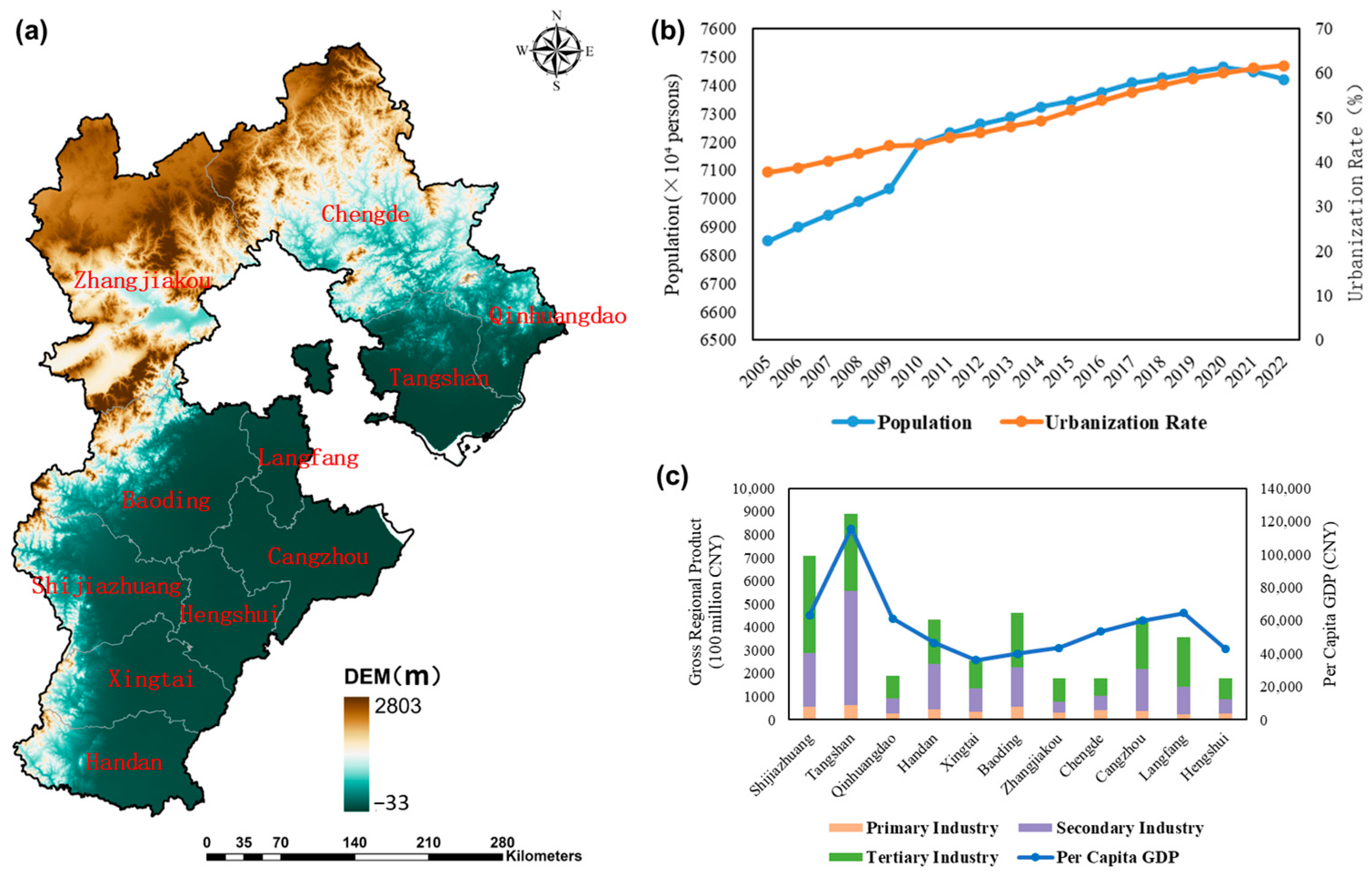
Figure 1. Overview of the study area. (a) BTH cities and DEM; (b) Population Characteristics of the BTH Region; (c) Industrial Characteristics of the BTH Region.
Urbansci 09 00516 g001
Figure 2. Basic characteristics of carbon emissions. (a) Carbon Emission Trends in Hebei Province; (b) Emission Intensity and Per Capita Emissions in Hebei.
Urbansci 09 00516 g002
Figure 3. Energy structure characteristics of carbon emissions. (a) Energy Consumption Structure in Hebei; (b) Carbon Emission Share of Energy Consumption in Hebei; (c) China’s Energy Consumption–Related Carbon Emission Share.
Urbansci 09 00516 g003
Figure 4. Industrial structure characteristics of carbon emissions. (a) Carbon Emissions of Specific Industrial Sectors; (b) Sectoral Carbon Emissions; (c) Carbon Emissions of Major Industries in the Industrial Sector.
Urbansci 09 00516 g004
Figure 5. Spatiotemporal patterns of city-level carbon emissions in Hebei Province.
Urbansci 09 00516 g005
Figure 6. City-level carbon emissions intensity in Hebei Province.
Urbansci 09 00516 g006
Figure 7. Comparison of projected and actual carbon emissions. (a) Correlation Between Predicted and Statistical Carbon Emissions; (b) Differences Between Predicted and Statistical Carbon Emissions.
Urbansci 09 00516 g007
Figure 8. The projection of carbon emissions in different scenarios.
Urbansci 09 00516 g008
Table 1. Descriptive statistics of variables.
VariablesMinimum ValueMaximum ValueAverage ValueStandard Error
P 6851.00 7463.84 7217.44 52.08
G 12,845.00 48,564.00 31,089.00 2851.31
U 37.69 60.07 48.33 1.81
S 38.20 49.20 44.84 0.90
T 52.79 96.41 79.77 3.47
I 0.91 2.26 1.39 0.11
Table 2. Changes in indicator variables under three scenarios (%).
ScenarioVariable20232024202520262027202820292030
Baseline ScenarioP−0.20−0.20−0.20−0.30−0.30−0.30−0.40−0.40
G5.005.003.003.003.001.001.001.00
U2.002.002.001.51.51.51.51.5
S−5.00−5.00−5.00−3.00−3.00−3.00−1.00−1.00
T−5.00−5.00−5.00−4.00−4.00−4.00−3.00−3.00
I−5.00−4.00−4.00−3.00−3.00−2.00−2.00−2.00
High-Mitigation ScenarioP−0.50−0.60−0.70−0.90−1.00−0.90−0.90−0.80
G4.104.102.102.302.301.001.001.00
U1.201.201.201.001.001.001.201.20
S−5.80−5.80−5.80−3.50−3.50−3.50−1.30−1.30
T−8.00−8.00−8.00−6.00−6.00−6.00−4.00−4.00
I−6.50−5.50−5.50−4.00−4.00−3.00−2.50−2.50
Low-Mitigation ScenarioP−0.10−0.10−0.10−0.15−0.15−0.10−0.10−0.20
G6.006.005.005.006.003.002.001.50
U3.003.003.003.503.502.502.502.50
S−3.00−3.00−3.00−1.50−1.50−1.50−0.50−0.50
T−3.00−3.00−3.00−2.00−2.00−2.00−1.00−1.00
I−3.00−2.00−2.00−1.50−1.50−1.00−1.00−1.00
Table 3. Indicator parameters and projected carbon emissions under the three scenarios.
YearP (10,000 Persons)G (CNY/Person)U (%)S (%)T (%)I (Tons of Standard Coal per 10,000 CNY)Carbon Emissions (100 Million Tons)
Baseline Scenario2023742056,99561.6540.2043.230.829.73
2024740559,84562.8838.1941.060.789.85
2025739062,83764.1436.2839.010.749.96
2026737564,72265.4234.4737.060.7110.02
2027735366,66466.4033.4335.580.6910.07
2028733168,66467.4032.4334.150.6710.11
2029730969,35068.4131.4632.790.6610.10
2030728070,04469.4431.1431.800.6510.07
High-Mitigation Scenario2023738359,33262.3937.8739.770.769.82
2024733961,76463.1435.6736.590.729.87
2025728763,06163.9033.6033.660.689.85
2026722264,51264.5332.4331.640.659.79
2027714965,99665.1831.2929.740.639.71
2028708566,65565.8330.2027.960.619.61
2029702167,32266.6229.8026.840.599.50
2030696567,99567.4229.4225.760.589.41
Low-Mitigation Scenario2023741260,414.763.5038.99441.930.799.86
2024740564,03965.4037.8240.670.789.98
2025739867,24167.3736.6939.450.7610.08
2026738770,60469.7236.1438.660.7510.17
2027737574,84072.1635.6037.890.7410.29
2028736877,08573.9735.0637.130.7310.34
2029736178,62775.8234.8936.760.7210.37
2030734679,80677.7134.7136.390.7210.36
Table 4. Projected carbon emissions with P, G, and S under the HMS scenario.
YearCEs with HMS PCEs with HMS GCEs with HMS S
2023979.608983.162984.705
2024983.211991.915995.209
2025980.757996.2431001.429
2026974.511998.8181005.660
2027966.6991001.3721009.974
2028955.0801000.0151008.583
2029943.620996.9011005.484
2030933.946993.7441002.344
Table 5. Projected carbon emissions with P, G, and S under the LMS scenario.
YearCEs with LMS PCEs with LMS GCEs with LMS S
2023986.869987.155985.927
2024999.4951000.304997.546
20251007.7961011.6571004.781
20261014.8801021.2801009.692
20271022.0231033.9831014.649
20281024.3411038.4711013.868
20291026.6761038.5841011.005
20301027.1421037.2941008.097
Disclaimer/Publisher’s Note: The statements, opinions and data contained in all publications are solely those of the individual author(s) and contributor(s) and not of MDPI and/or the editor(s). MDPI and/or the editor(s) disclaim responsibility for any injury to people or property resulting from any ideas, methods, instructions or products referred to in the content.