
Article

The Digital City Dividend: Modeling Residents’ Expected Financial Gains from Tech-Enabled Service Delivery


by
Zubair Ali Raja
1,
Muhammad Mashhood Arif
2,* and
Nida Batool Sheikh
3
1
Department of Accounting & Finance, School of Business and Economics, Thompson Rivers University, Kamloops, BC V2C 0C8, Canada
2
Department of Planning, Geography and Environmental Studies, University of the Fraser Valley, 33844 King Rd, Abbotsford, BC V2S 7M7, Canada
3
Department of Architecture and Urban Planning, Faculty of Engineering and Architecture, Ghent University, 9000 Ghent, Belgium
*
Author to whom correspondence should be addressed.
Urban Sci. 2026, 10(5), 292; https://doi.org/10.3390/urbansci10050292
Submission received: 5 March 2026 / Revised: 16 April 2026 / Accepted: 14 May 2026 / Published: 21 May 2026

Abstract

This study examines how tech-enabled municipal service delivery can generate a digital city dividend, measured as residents’ expected financial gains in urban context. The purpose is to identify the beliefs and enabling conditions that most strongly shape these expectations. We collected resident survey data and analysed the proposed model using PLS-SEM in SmartPLS. The reflective measurement model was evaluated for reliability and convergent validity (composite reliability; AVE) and for discriminant validity using both the Fornell–Larcker criterion and HTMT. We then tested the structural model through bootstrapping to assess the hypothesized paths. The results show that expected financial gains are driven primarily by behavioral intention, and are also supported directly by perceived value and trust. Behavioral intention rises mainly with trust and performance expectancy, while the effects of other adoption drivers are comparatively weaker. Service delivery quality contributes indirectly by strengthening perceived usefulness and trust, which subsequently improves intention and the expected dividend. The findings indicate that perceived financial benefits depend on a clear value pathway, credible institutional trust, and consistent service performance. The study therefore highlights practical priorities for cities: improve reliability and responsiveness, strengthen confidence through transparency and resolution mechanisms, and make the value-for-money case more legible to residents.

1. Introduction

Smart city agendas are increasingly judged through the everyday front door of government: whether residents can complete routine municipal transactions quickly and reliably through digital channels. In this practical sense, a smart city is not only an urban technology stack, but a service system that uses information and communication technologies to improve the effectiveness and accessibility of core public services. This idea is consistent with influential definitions that frame smart cities as an interaction of ICT with human, social, and institutional capacity, and as a set of initiatives intended to improve urban performance and service outcomes rather than technology adoption for its own sake [1,2]. Governance-focused work likewise emphasizes that “smart” outcomes depend on how public organizations coordinate, design, and manage these digital capabilities in day-to-day service delivery [3]. Critical scholarship cautions, however, that “smart city” labelling can become rhetorical unless it is anchored in measurable improvements residents actually experience in their service encounters and in how benefits are distributed across citizens [4].
Despite rapid growth in civic platforms and e-government portals, the evidence base still under-specifies resident-level value in ways that are financially meaningful at the household scale. Many smart city assessments map domains and application areas, yet often stop short of identifying which features of the resident service encounter translate into tangible reductions in time, cost, and uncertainty for users [5]. Related critiques of data-driven and platform-led urbanism warn that capability and analytics can be privileged over citizen-centred outcomes, producing “smart” systems whose benefits are not legible to everyday users in practical terms [6]. This gap matters because, from a resident standpoint, the adoption and continued use of digital city services is frequently an economic judgment: does the platform save me time, money, and risk relative to in-person transactions. Research on public values and public value in ICT-enabled reforms reinforces this point by arguing that digital government should be evaluated not only by internal efficiency but by the value it creates for the public and the trade-offs it introduces [7,8].
This study responds by advancing the digital city dividend, defined as residents’ expected financial gains from tech-enabled service delivery. Expected financial gains capture the economic benefits residents anticipate when they use, or consider using, digital channels for city services, including fewer trips, shorter waiting time, reduced follow-ups, and lower uncertainty about status and compliance. The focus on expectations is deliberate: perceptions of system and service performance shape satisfaction, usefulness, and downstream behavioral outcomes, even before residents accumulate long experience with a platform [9]. In civic transactions, expectations are also conditioned by institutional credibility and risk perceptions, because residents evaluate not only usability but whether the service can be trusted to produce accurate records and reliable outcomes [10].
Empirically, the paper is situated in Lahore, a large metropolitan context where mobility costs and administrative friction can be substantial, making perceived savings especially salient. The central research question is embedded in this service value problem: Which features of tech-enabled city service delivery most strongly shape residents’ expectations of financial gains in Lahore? The study is significant because it offers a citizen-facing value metric that complements system-centric efficiency claims, helps municipalities prioritize design and operational improvements that make savings legible to users, and supports more inclusive digital service strategies by keeping skill-based inequalities visible in adoption and benefit formation [11]. In this way, the paper reframes “smartness” as a resident-level value pathway, linking service delivery quality, intention to use, and trust to the formation of financially meaningful expectations.

2. Literature Review

2.1. Smart Cities as a Resident-Facing Service Proposition

Smart city research has moved from technology-led narratives toward a more grounded question: what does “smartness” deliver in the daily life of residents. Foundational critiques warned that smart city claims can become rhetorical, vendor-driven, or unevenly distributed unless they are anchored in outcomes that citizens can observe and experience [4,12]. Subsequent definitional and review work has tried to discipline the concept by emphasizing integrated urban systems that combine ICT, institutions, and human capital to improve service performance and urban quality rather than simply expanding digital infrastructure [13,14]. Empirical mapping of smart city initiatives shows that cities often concentrate investments in mobility, governance platforms, and environment-related applications, yet the translation from initiative portfolios to citizen-side benefits is not automatic and depends heavily on design, implementation quality, and local context [15]. Evolutionary perspectives similarly argue that smart cities develop through stages, and citizen experience often becomes a key differentiator once basic digitization is in place [16].
This shift matters for research that aims to measure value at the resident level, because the unit of analysis becomes the service encounter and the resident’s assessment of what improved and what it cost them. A service-centric framing also aligns with the public administration literature that treats digital transformation as a redesign of processes and interfaces through which residents interact with the state, rather than an IT procurement exercise [17]. As a result, a resident-facing evaluation lens should focus on how digital channels reduce friction, improve clarity and responsiveness, and deliver benefits that residents interpret as tangible and worthwhile.

2.2. Governance, Public Values, and the Problem of Value Visibility

A consistent message across smart city governance reviews is that governance is not an add-on but a determinant of outcomes. Systematic syntheses emphasize that smart city outcomes depend on coordination across agencies, the management of public–private arrangements, and accountability for service performance and data practices [18]. This governance emphasis becomes especially important when researchers examine citizen-side benefits, because trust and legitimacy are shaped by how services are governed and how reliably they function under real constraints.
Digital government research has therefore developed a public values and public value agenda that pushes evaluation beyond efficiency. Bannister and Connolly argue that ICT-enabled reforms should be assessed through the lens of public values such as equity, transparency, and professionalism, since digitization can strengthen some values while weakening others [7]. Cordella and Bonina similarly propose a public value perspective for ICT reforms, emphasizing that value emerges from institutional arrangements and service redesign, not from digitization alone [8]. Building on this, literature reviews conceptualize e-government public value as multidimensional, spanning service, administrative, ethical, and social outcomes, and calling for measurement approaches that capture benefits as experienced by citizens rather than only as recorded within agencies [19,20].

2.3. Service Quality as the Mechanism Linking Digital Services to Perceived Benefits

The information systems literature provides a widely used foundation for understanding why digital services succeed or fail from the user’s perspective. The updated DeLone and McLean IS success model identifies system quality, information quality, and service quality as key antecedents of user satisfaction and downstream impacts [9]. In citizen-facing municipal services, this logic implies that residents’ benefit expectations will be shaped by whether the platform works reliably, whether information is clear and accurate, and whether service support resolves problems quickly. Service quality theory similarly emphasizes reliability and responsiveness as central to users’ judgments, and these dimensions remain relevant when the provider is government rather than a private firm, because residents still evaluate whether the service performs as promised [21].
E-government-specific measurement work reinforces that public digital services carry distinctive quality expectations, including clarity of procedures, perceived fairness, and the ability to complete tasks without repeated steps or visits [22,23]. This matters for the digital city dividend because expected financial gains are not only about nominal cost savings. They also reflect reductions in uncertainty, fewer repeated transactions, and reduced time burdens that accumulate across multiple interactions.

2.4. Trust, Risk, and Confidence in Civic Transactions

Municipal digital services frequently involve identity, enforceable outcomes, and payments, which elevates the role of trust and perceived risk. Citizen adoption studies show that trust-related beliefs and perceived risk shape willingness to use e-government services, alongside usability and innovation factors [24,25,26]. Trust is also empirically associated with e-government success measures, suggesting that well-designed systems can underperform when residents doubt the institution or the channel [27]. Recent work extends this by framing trustworthiness as a property of digital government services shaped by design, accountability mechanisms, and institutional capacity [28].
For expected financial gains, trust is pivotal because residents will discount expected savings if they believe the digital channel is unreliable, produces errors, or exposes them to risk. In practice, a service that saves time but is perceived as unsafe or inaccurate may not be interpreted as a dividend. This creates a value formation logic in which service quality and trust jointly determine whether residents view digital services as economically beneficial.

2.5. Perceived Value and the Move Toward Expected Household-Level Gains

Perceived value theory frames value as a trade-off between what the user receives and what they sacrifice, including time, effort, and uncertainty costs [29]. Operationalizations in services research show that value is multidimensional and can be decomposed into functional and affective components, which is useful when translating abstract benefit claims into measurable constructs [30]. In digital services contexts, expectation–confirmation theory further suggests that continued engagement depends on whether initial expectations are met through actual performance and satisfaction [31].
However, much of the smart city and e-government outcome literature still relies on broad end-states such as satisfaction, continuance, or quality of life rather than explicitly capturing the resident’s expectation that digital services generate financially interpretable gains at the household level. Research on ICT-based smart city services indicates that successful services can shape citizen-perceived outcomes and quality-of-life evaluations, particularly when privacy and reliability are addressed [32]. Building on this, the digital city dividend perspective sharpens the outcome into a micro-level, economically legible expectation that can inform design and policy prioritization.

2.6. Digital Skills and Unequal Conversion of Access into Benefits

Finally, digital benefit formation is not uniform. Digital divide research emphasizes that internet skills constitute an independent layer of inequality, meaning residents with lower skills may face higher effort costs and lower returns from the same digital service [11,33]. Systematic reviews of digital skills show that capability is shaped by education, occupational exposure, and learning opportunities, implying systematic differences in who can capitalize on digital service delivery [34]. This is directly relevant for expected financial gains, because the same platform can generate meaningful time savings for one user and create frustration and repeated failed attempts for another. A benefits-focused smart city evaluation must therefore acknowledge that perceived gains depend on residents’ ability to navigate systems and complete tasks correctly.

3. Model Framework and Hypotheses

3.1. UTAUT2 as the Core Behavioral Framework

This study positions the Unified Theory of Acceptance and Use of Technology 2 as the core behavioral framework because it explains residents’ intention to use a digital channel through a set of well-established drivers: effort expectancy, performance expectancy, social influence, hedonic motivation, and habit [35]. The original UTAUT provides the foundational logic for intention formation and technology uptake and remains widely applied across public and private digital services [36]. In municipal settings, these mechanisms map cleanly onto repeated civic interactions, such as paying bills, submitting requests, tracking applications, and accessing information, where both perceived usefulness and perceived effort shape residents’ adoption decisions.
To reflect the public-service context, the model treats perceived service experience as an upstream belief-forming condition. Specifically, smart service delivery quality is introduced as the antecedent that shapes residents’ effort and performance beliefs and also strengthens trust in the digital channel. This positioning is consistent with IS success and service-quality research that argues quality perceptions are formed early and subsequently influence downstream beliefs and behavioral outcomes [37]. The framework then extends the UTAUT2 intention pathway to the paper’s focal outcome, expected financial gains, which operationalises the digital city dividend as residents’ anticipated economic advantage from using tech-enabled city services.

3.2. Constructs, Model Positioning, and Integrated Hypotheses

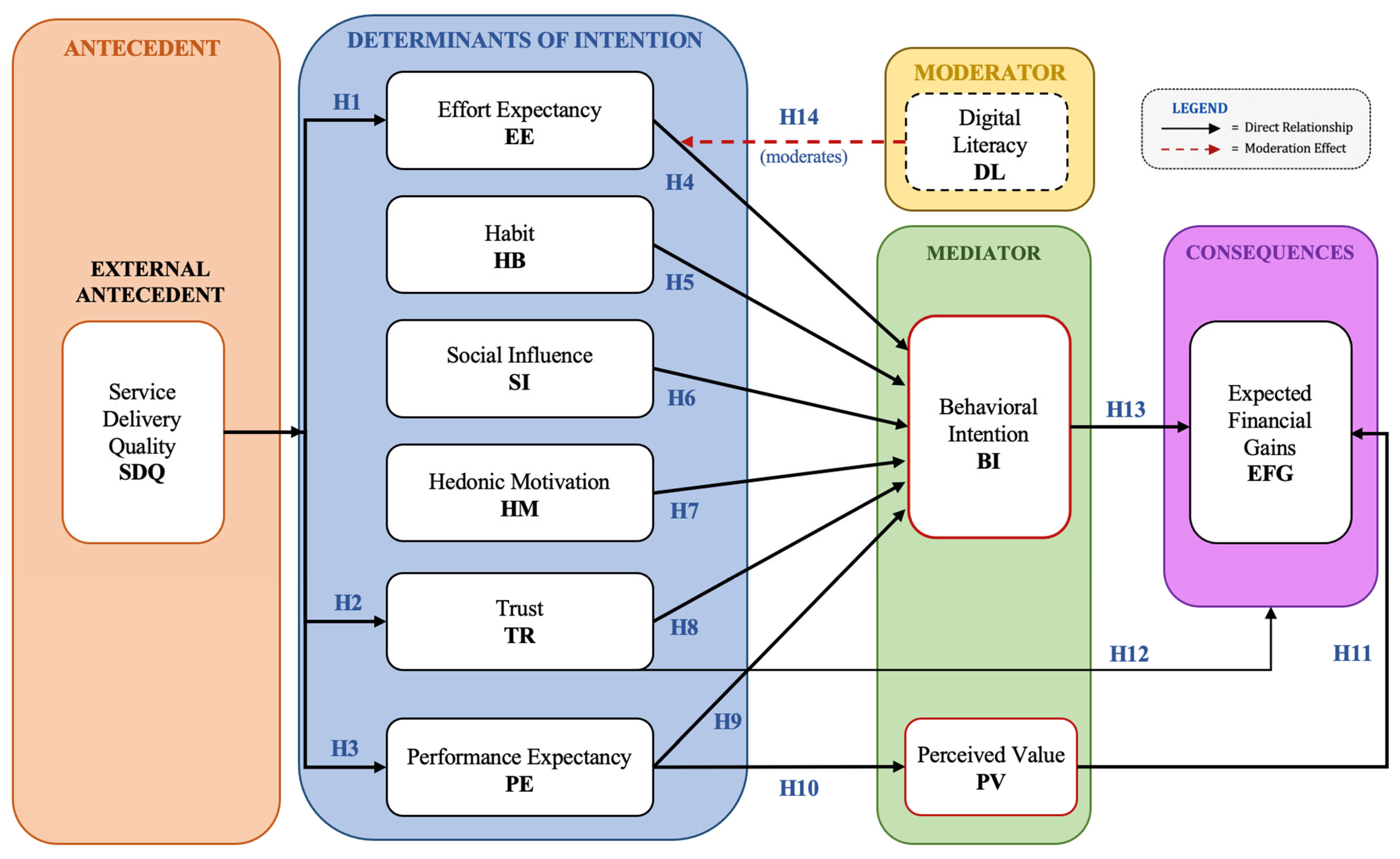
Smart service delivery quality (SDQ) captures residents’ perceptions that tech enabled city services are easy to navigate, provide clear steps, and operate reliably. In the model, SDQ is positioned as the upstream construct because early interactions with a digital channel shape core beliefs about ease, usefulness, and institutional dependability, which later influence intention formation in adoption frameworks [9,38]. Conceptually, SDQ is operationalized through residents’ assessments of interface clarity, process transparency, and reliability, since these features signal whether the service environment reduces friction or creates additional burden. On this basis, SDQ is expected to increase effort expectancy (EE), performance expectancy (PE), and trust (TR), because a coherent and stable service environment should reduce the cognitive work required to complete tasks, increase confidence that the service will help residents accomplish civic goals efficiently, and reassure users that transactions will be processed correctly. Accordingly, the model specifies positive effects from SDQ to EE (H1), PE (H2), and TR (H3).
Effort expectancy (EE) reflects the perceived procedural and cognitive ease of learning and using city digital services. It is operationalized through perceptions of how straightforward it is to understand the service steps, how quickly a resident can become comfortable using the system, and how much mental effort is required to complete a transaction. In UTAUT based research, perceived ease reduces non-monetary adoption costs such as time spent learning, confusion, and task anxiety, and therefore strengthens behavioral intention (BI) [36,39,40]. The model therefore proposes that EE positively predicts BI (H4). Because capability conditions shape whether perceived ease translates into confident action, digital literacy (DL) is incorporated as a moderator. DL is operationalized as residents’ perceived competence in using digital tools, navigating online processes, and resolving common issues during online interactions. The model proposes that DL strengthens the EE to BI relationship (H14), meaning that when residents have stronger digital capability, improvements in perceived ease are more likely to convert into intention, while lower capability can weaken this conversion even when services are designed to be user friendly.
Performance expectancy (PE) represents the perceived instrumental benefits of using city digital services, including faster completion, improved efficiency, and better task outcomes. It is operationalized through residents’ beliefs that the digital channel helps them accomplish civic tasks more effectively than traditional channels, saves time, and improves overall convenience. PE is consistently among the strongest predictors of intention in technology acceptance research, particularly in utilitarian settings where convenience and successful task completion matter most [41,42]. The model therefore specifies that PE increases BI (H5). PE is also positioned as a proximal antecedent of perceived value (PV), because residents’ value judgements depend heavily on the expected magnitude of benefits relative to perceived costs, including time, effort, uncertainty, and perceived risk [43]. PV is operationalized as an overall “worth it” evaluation that integrates perceived benefits with monetary and non-monetary costs. Accordingly, the model specifies a positive effect from PE to PV (H10).
Trust (TR) reflects residents’ confidence that the city’s tech enabled services are dependable and secure, and that transactions will be completed correctly. It is operationalized through beliefs about transactional reliability, data protection, and institutional competence, because these beliefs directly shape perceived risk in public service contexts. Trust is particularly salient for civic transactions where residents may perceive consequences of errors, missed deadlines, or misuse of personal information, which can suppress adoption even when usability is high [44,45]. Hence, TR is expected to increase BI by reducing perceived risk costs (H6). The model also posits a direct link from TR to expected financial gains (EFG), because trust reduces anticipated hidden losses associated with transaction risk, rework, and delays, which strengthens expectations of net gain from using the digital channel (H13).
The model incorporates additional UTAUT2 drivers that plausibly matter for city service use. Social influence (SI) captures whether important others encourage, endorse, or model the use of city digital services, and can operate as a legitimacy cue during diffusion [46,47]. It is operationalized through perceived expectations from family, peers, and community networks, and through perceptions that using digital services is socially supported or increasingly normative. On this basis, SI is expected to increase BI (H7). Hedonic motivation (HM) reflects positive affect and enjoyment associated with smooth and responsive interfaces. It is operationalized through the extent to which using the service feels pleasant, engaging, or less stressful, since even utilitarian civic tasks can become more acceptable when interaction quality is high. Therefore, HM is expected to increase BI (H8) [48,49,50]. Habit (HB) captures routinization, meaning that repeated engagement makes digital service use more automatic and less dependent on active deliberation. It is operationalized through residents’ self-reported tendency to use digital channels by default for civic tasks, which should strengthen BI independent of ongoing evaluation. Accordingly, HB is expected to increase BI (H9).
To translate adoption intention into the digital city dividend, the framework introduces PV and EFG as outcome oriented constructs. Perceived value (PV), as noted above, represents residents’ holistic trade off evaluation of whether the benefits of using city digital services are worth the costs they bear [51]. A stronger PV judgement is expected to translate into a stronger expectation of economic advantage, since the resident perceives the channel as delivering net benefits (H12) [52,53]. Expected financial gains (EFG) is the focal dependent variable and captures anticipated savings and avoided losses from using tech enabled services, including reductions in search and transaction costs, fewer repeat interactions, and lower delay related losses. This positioning aligns with digital government scholarship that frames citizen value in terms of efficiency gains and reduced transaction burdens [54,55] and with transaction cost logic where digital channels can lower the costs of completing exchanges with public agencies [56,57,58]. Because the model captures expectations rather than realised outcomes, BI is posited to increase EFG, since residents who intend to use the digital channel more are more likely to anticipate and plan around its time and cost advantages (H11). These relationships specify a coherent pathway in which upstream service quality shapes ease, usefulness, and trust, these beliefs shape intention, and intention, value, and trust translate into expected financial gains, with digital literacy conditioning how strongly ease converts into intention.
The measurement items used to operationalize all constructs are presented in Appendix A. Taken together, the proposed model presents a coherent pathway through which service conditions are translated into expected resident benefits (Figure 1). Smart service delivery quality (SDQ) is positioned as the upstream antecedent and is expected to strengthen effort expectancy, trust, and performance expectancy. These constructs then shape behavioral intention, together with habit, social influence, and hedonic motivation, which are included as additional determinants of intention. Digital literacy is incorporated as a moderator, such that stronger digital capability is expected to reinforce the positive effect of effort expectancy on behavioral intention. Beyond intention, performance expectancy is also hypothesized to improve perceived value by increasing residents’ sense that the digital service is worthwhile. Finally, behavioral intention, perceived value, and trust are each expected to contribute directly to expected financial gains, which form the central outcome of the study.

4. Methods and Materials

4.1. Study Area

The empirical setting is Lahore, the capital of Punjab, Pakistan, and one of South Asia’s largest metropolitan economies. Lahore’s rapid urban expansion, dense mixed land-use structure, and mobility-intensive daily routines generate frequent resident interactions with municipal and provincial service agencies, particularly through housing, land-use, and transport-related transactions and compliance processes [59,60]. Recent official reporting indicates Lahore’s population increased from 11.12 million (2017) to about 13.0 million (2023), reflecting continued urban expansion and service-delivery pressures as the city absorbs inward migration and peri-urban growth [61]. These dynamics create a policy-relevant environment for studying tech-enabled city services, because digital channels are increasingly positioned as scalability tools to reduce queuing, travel, and repeat visits that residents often face in conventional public-service workflows.
Lahore’s context is also appropriate for examining heterogeneous “digital dividend” expectations because residents’ ability to convert digital services into tangible gains is likely to vary with socioeconomic and capability differences across neighborhoods. In such settings, the expected value of digital channels may be shaped not only by perceived system performance and ease, but also by trust in institutional follow-through and data handling, which is repeatedly identified as central in e-government adoption. Hence, Lahore offers a realistic municipal environment in which residents can plausibly evaluate whether using digital channels will translate into time savings, reduced transaction costs, and avoided delays that carry economic meaning at the household level.

4.2. Data Collection

This study employed a cross-sectional questionnaire survey to capture residents’ perceptions and expectations about tech-enabled city service delivery in Lahore. The target population comprised adult residents (18+) living in Lahore, including both current users and potential users of digital public services, because the focal outcome is expected financial gains from prospective engagement with digital service channels rather than realized benefits from a single platform. To standardize interpretation, the questionnaire opened with a concise definition of “tech-enabled city services” as government-provided digital channels (mobile apps and web portals) used to complete common transactions and requests. Anchoring examples included online payments for public dues/fees, traffic-related digital interactions (e-challan), complaint submission and service-request reporting, and digital status tracking/notifications. These examples were presented as illustrative rather than exhaustive, encouraging respondents to evaluate constructs as an integrated bundle of digital governance experiences rather than a single-application lens.
The instrument comprised three blocks. First, a latent-variable block measured constructs used in the structural model: smart service delivery quality (SDQ), effort expectancy (EE), performance expectancy (PE), social influence (SI), hedonic motivation (HM), trust (TR), behavioral intention (BI), perceived value (PV), expected financial gains (EFG), and digital literacy (DL). Items were adapted to the Lahore public-service context while preserving construct meaning and were measured on Likert-type scales to support SEM estimation. Second, an exposure block captured whether respondents had used any tech-enabled public service in the prior 12 months and their primary access channel (app vs. website). Third, a socioeconomic profile block captured demographics (age, gender, education, income band, employment status).
A hybrid recruitment strategy improved coverage across Lahore’s heterogeneous neighborhoods and socioeconomic groups. Online dissemination shared the survey link through community networks, neighborhood groups, university/professional associations, and social media. To reduce over-representation of digitally advantaged residents, field-assisted recruitment complemented online outreach using QR codes and brief intercept prompts in public settings.
The questionnaire was prepared in English and Urdu using a translation approach emphasizing conceptual equivalence. Common method bias was mitigated through anonymity assurances, “no right/wrong answers” instructions, neutral transitions between blocks, and context-specific wording to reduce ambiguity. After eligibility screening and quality checks (patterned responding and missingness), 340 usable responses were retained for SEM estimation.

4.3. Sample Adequacy and Preliminary Data Diagnostics

Preliminary diagnostic statistics reported in Table 1 indicate that the dataset was suitable for latent-variable modelling and free from major data quality concerns prior to SEM estimation. First, sampling adequacy was confirmed using the Kaiser–Meyer–Olkin (KMO) measure, which yielded a value of 0.805, exceeding the recommended threshold of 0.70 and indicating that the correlation matrix was appropriate for factor-based analysis. This result was reinforced by Bartlett’s test of sphericity, which was highly significant (χ2 = 4530.298, df = 820, p < 0.001), confirming that the correlation structure was sufficiently non-random for factor extraction.
Further evidence of data adequacy came from the communalities, which ranged from 0.383 to 0.730, with most values above 0.60. Although SDQ2 and HB1 showed relatively lower communalities, they were assessed contextually rather than removed automatically, given the broader pattern of acceptable item performance. Using the eigenvalue-greater-than-one rule, 11 components were retained in the unrotated solution, jointly explaining 62.59% of the total variance, which is satisfactory in social science research.
To examine possible common method bias associated with single-source self-report data, Harman’s single-factor test was conducted. The first factor accounted for only 15.34% of the variance, well below the conservative 50% threshold, suggesting no serious common method bias. Finally, item-level normality diagnostics showed skewness values between −0.522 and +0.025 and kurtosis values between −0.972 and −0.199, all within acceptable ranges. Overall, these preliminary checks support the stability, adequacy, and suitability of the dataset for subsequent SEM analysis.

4.4. Application of SmartPLS for Modeling

SmartPLS was used to estimate the proposed model via PLS-SEM because the study is explicitly explanatory–predictive: it seeks to explain variance in residents’ expected financial gains (EFG) while also identifying which antecedents exert the strongest influence within an integrated latent-variable framework. This choice aligns with contemporary PLS-SEM guidance that emphasizes prediction-oriented explanation, suitability for complex models with multiple latent constructs, and practical flexibility for incorporating interaction effects. All constructs were specified with reflective measurement models, consistent with the theoretical framing of the indicators as manifestations of underlying latent traits.
Model evaluation followed the standard two-stage procedure in PLS-SEM. In the first stage, the measurement model was assessed to confirm that constructs demonstrated adequate reliability and validity, ensuring that subsequent structural inferences were not driven by weak or unstable measurement. In the second stage, the structural model was evaluated to test the hypothesized relationships, assess the magnitude and significance of path effects, quantify explained variance in key endogenous constructs (especially EFG), and examine predictive relevance where appropriate. This sequential approach ensures that structural results are interpretable as substantive relationships rather than artifacts of measurement error.

4.4.1. Reliability and Validity Analysis

Following the evaluation sequence used in the sample paper, the measurement model was assessed before interpreting the structural relationships. Because all latent variables were specified as reflective, indicator reliability was examined through standardized outer loadings (λ). Loadings around or above 0.70 were treated as satisfactory, implying that indicators share substantial variance with the intended construct. For indicator ( i ) of construct (η), indicator reliability is:
Indicator reliability i = λ i 2
Internal consistency reliability was evaluated using composite reliability (CR), which is commonly preferred to Cronbach’s alpha in PLS-SEM because it does not assume equal indicator reliability [62]. Cronbach’s alpha was inspected as a descriptive check, but inference relied primarily on CR. Cronbach’s alpha and CR were calculated as follows:
α = k k 1 1 i = 1 k σ i 2 σ T 2
C R = i = 1 k λ i 2 i = 1 k λ i 2 + i = 1 k θ i
Convergent validity was assessed via AVE:
A V E = i = 1 k λ i 2 k
Discriminant validity was evaluated primarily using HTMT [63], with values below 0.85/0.90 indicating adequate distinctiveness. Collinearity among predictors was checked using VIF:
V I F j = 1 1 R j 2
Because the framework includes moderation, measurement quality was checked in the main-effects model and re-verified after adding the interaction term. This two-step verification was important to ensure that the inclusion of the interaction term did not distort the reliability, validity, or distinctiveness of the reflective constructs.

4.4.2. Partial Least Squares Structural Equation Modelling

Structural relationships were estimated using partial least squares structural equation modelling (PLS-SEM) in SmartPLS. PLS-SEM was selected because the study is explanatory–predictive: it aims to explain variance in residents’ expected financial gains (the “digital city dividend”) while identifying the strongest antecedents in an integrated latent-variable framework [62]. Path significance was assessed via nonparametric bootstrapping (large resample count), and inference relied on path coefficients (β), t-values, p-values, and bias-corrected confidence intervals.
Model explanatory power was evaluated using the coefficient of determination ( R 2 ) for each endogenous construct ( y ):
R 2 = 1 n y n y n ^ 2 n y n y ¯ 2
Practical importance was assessed using effect sizes ( f 2 ), capturing the change in ( R 2 ) when a predictor is omitted:
f 2 = R included 2 R excluded 2 1 R included 2
Predictive relevance was examined using blindfolding-based ( Q 2 ) (Stone–Geisser):
Q 2 = 1 S S E S S O
Consistent with the “dividend” framing, out-of-sample predictive assessment (PLS-based prediction and benchmark comparisons) was incorporated following predictive PLS guidance [64]. Moderation was modelled as an interaction between Digital Literacy ( D L ) and Effort Expectancy ( E E ) predicting Behavioral Intention ( B I ):
B I = β 0 + β 1 E E + β 2 D L + β 3 E E × D L + ε
The interaction term’s sign and significance were evaluated via bootstrapping [65], and full measurement/structural results are reported in Section 5 for replication and review.

5. Results

5.1. Socio-Economic Demographics (SEDs)

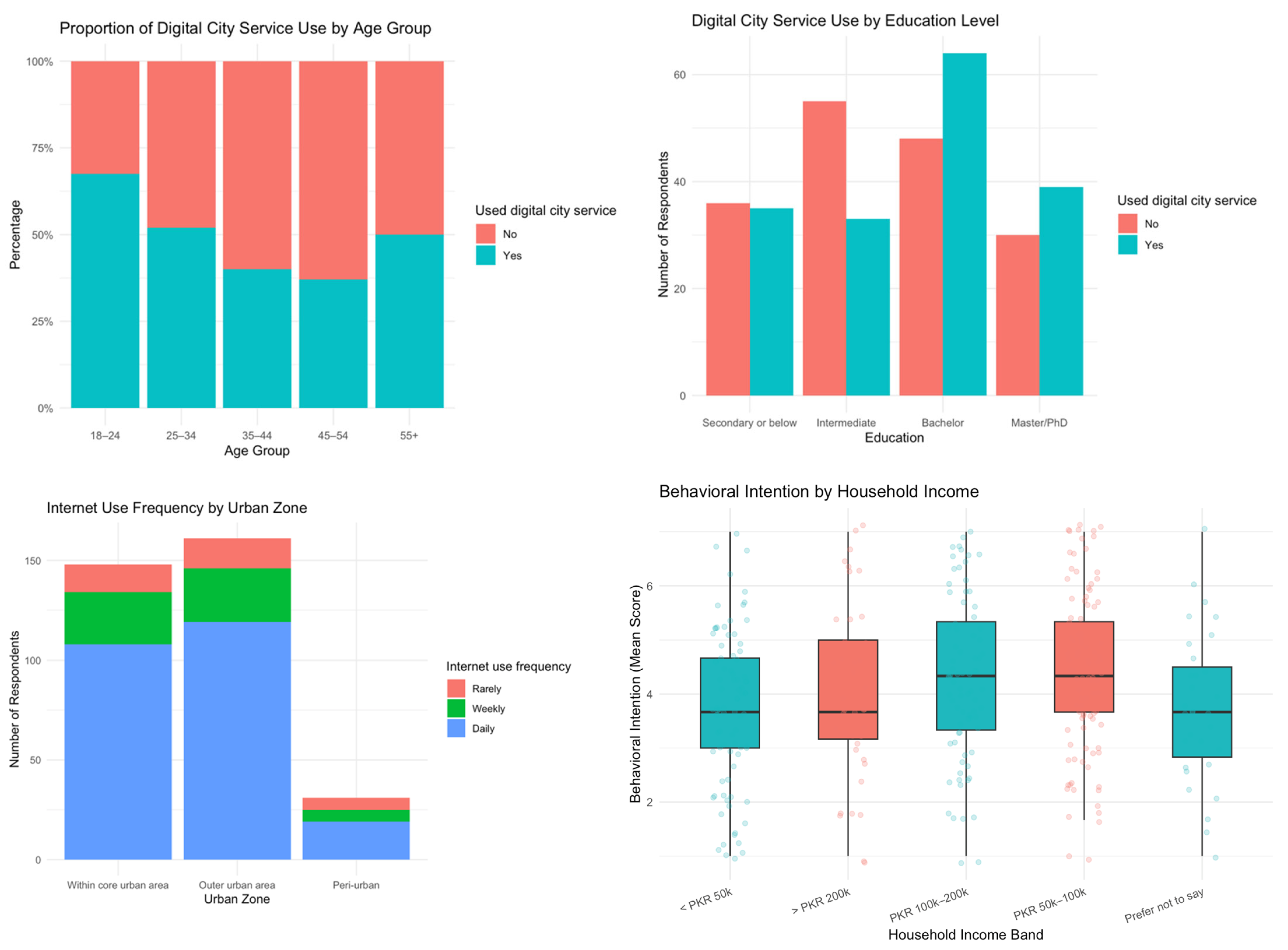
The socio-economic profile of the sample presents a reasonably diverse respondent base and offers a useful context for interpreting digital city service behavior. As illustrated in Figure 2, the sample is broadly concentrated in the economically active population, with particularly strong representation from the 25–34 and 35–44 age groups, while smaller shares are drawn from 18–24, 45–54, and especially 55+ respondents. This pattern suggests that the data are driven mainly by working-age adults, who are more likely to interact with formal service systems, digital platforms, and urban service infrastructures. Educationally, the sample is distributed across secondary or below, intermediate, bachelor, and Master/PhD levels, with bachelor-level respondents forming the largest segment and postgraduate respondents also meaningfully represented. Household income is similarly spread across multiple bands, including lower-income, middle-income, upper-income, and non-disclosed categories, which strengthens the descriptive breadth of the sample.
In terms of digital readiness, internet use is consistently high across all urban zones, with daily use dominating in the core urban area as well as outer urban locations, while peri-urban respondents appear fewer in number but still maintain notable weekly and daily connectivity. Recent use of digital city services is also substantial, although unevenly distributed across socio-economic groups. The age-based cross-tabulation shows that younger respondents, especially those aged 18–24, report comparatively higher proportions of digital city service use, whereas usage declines in older categories. This association is statistically significant, with the Pearson chi-square test confirming a meaningful relationship between age group and digital city service use (χ2 = 15.539, df = 4, p = 0.0037).
The socio-economic profile also aligns with behavioral patterns. Respondents who used digital city services in the last 12 months reported a notably higher mean behavioral intention score (4.76) than non-users (3.42), and this difference is highly significant (Welch’s t = −9.12, p < 2.2 × 10⁻¹⁶). Together, these findings indicate that socio-economic positioning, digital exposure, and actual service experience jointly shape the context for subsequent structural analysis.

5.2. Measurement Model Evaluation

Data analysis was carried out in SmartPLS to estimate the conceptual model and evaluate the strength and statistical significance of the latent constructs. The analysis followed a two-stage approach: first, the measurement model was assessed to confirm construct reliability and validity; second, the structural model was evaluated to estimate path coefficients and test the proposed hypotheses.
Model adequacy was examined using R2 values to determine the explanatory power for the endogenous construct(s). To establish the robustness of the latent measures, the model was evaluated in SmartPLS using the following criteria:
  • Convergent validity and item reliability
  • Discriminant validity
  • Heterotrait–Monotrait (HTMT) ratio of correlations
  • Structural model assessment
  • Overall model fit

5.2.1. Convergent Validity and Individual Item Reliability

Consistent with established PLS-SEM procedures, the evaluation of the reflective measurement model preceded any interpretation of structural path coefficients in order to ensure that the latent constructs were measured with sufficient reliability and validity. This sequencing is critical because structural relationships can only be meaningfully interpreted when the underlying constructs demonstrate acceptable psychometric properties. As reported in Table 2, the assessment covered indicator reliability, internal consistency reliability, and convergent validity, following the widely recommended two-step logic for reflective models.
First, indicator reliability was examined through standardized outer loadings. All retained indicators exceeded the commonly accepted threshold of 0.70, indicating that each item shared substantial variance with its underlying construct. The observed range of loadings (0.723–0.905) reflects consistently strong item performance. The lowest loading (TR1 = 0.723) remains comfortably above the minimum acceptable level, suggesting that even the comparatively weaker indicators contribute meaningfully to construct measurement. At the upper end, SI1 = 0.905 demonstrates particularly strong alignment with its latent variable, reinforcing the robustness of the Social Influence construct. Importantly, the absence of low-loading indicators eliminates concerns regarding measurement attenuation or the need for item deletion, thereby preserving conceptual coverage across constructs.
Second, internal consistency reliability was assessed using composite reliability (CR), which is preferred in PLS-SEM over Cronbach’s alpha because it does not assume tau-equivalence and accounts for actual outer loadings. All constructs exceeded the recommended threshold of 0.70, confirming satisfactory internal consistency. CR values ranged from 0.788 (DL) to 0.911 (EFG), demonstrating that the indicators within each construct are coherently measuring the same conceptual domain. The relatively high CR for EFG (0.911) suggests a well-defined and internally consistent outcome construct, while the remaining constructs (BI = 0.892; EE = 0.875; HB = 0.803; HM = 0.811; PE = 0.868; PV = 0.882; SDQ = 0.859; SI = 0.852; TR = 0.847) similarly indicate stable and reliable measurement. Notably, none of the CR values exceed 0.95, which would otherwise signal potential redundancy or excessive item similarity. Thus, the measurement model achieves a desirable balance between reliability and parsimony.
Third, convergent validity was evaluated through the average variance extracted (AVE). All AVE values surpassed the 0.50 benchmark, indicating that each construct explains more than half of the variance in its indicators. The AVE values ranged from 0.581 (TR) to 0.743 (SI), with most constructs comfortably positioned above 0.60. These magnitudes confirm that the latent variables capture substantial common variance relative to measurement error. In practical terms, this means that the constructs are measured with sufficient precision to support reliable inference in the structural model. The particularly strong AVE for SI (0.743) and BI (0.734) further underscores the clarity with which these constructs are operationalized.

5.2.2. Discriminant Validity: Fornell–Larcker Criterion and Cross-Loadings

Discriminant validity was evaluated to ensure that each latent construct represents a distinct conceptual domain and is not empirically indistinguishable from other constructs in the measurement model. The Fornell–Larcker criterion was assessed by comparing the square root of the average variance extracted (diagonal elements) with the correlations between constructs (off-diagonal elements). As shown in the matrix in Table 3, discriminant validity is supported because, for every construct, the square root of AVE exceeds its strongest correlation with any other construct. For instance, Behavioral Intention (√AVE = 0.856) remains well above its highest correlation, which occurs with Expected Financial Gains (√AVE = 0.460). Expected Financial Gains (√AVE = 0.819) likewise exceeds its strongest association (√AVE = 0.460 with Behavioral Intention). Performance Expectancy (√AVE = 0.788) and Perceived Value (√AVE = 0.807) are also clearly distinguishable, despite their comparatively stronger correlation (√AVE = 0.395). Similarly, Service Delivery Quality (√AVE = 0.818) remains empirically distinct even where it correlates most strongly with Trust (√AVE = 0.315). Across the remaining constructs, inter-construct correlations are generally modest (often near zero and occasionally negative), further reinforcing that the latent variables capture non-redundant dimensions of residents’ digital service perceptions and behavioral responses.
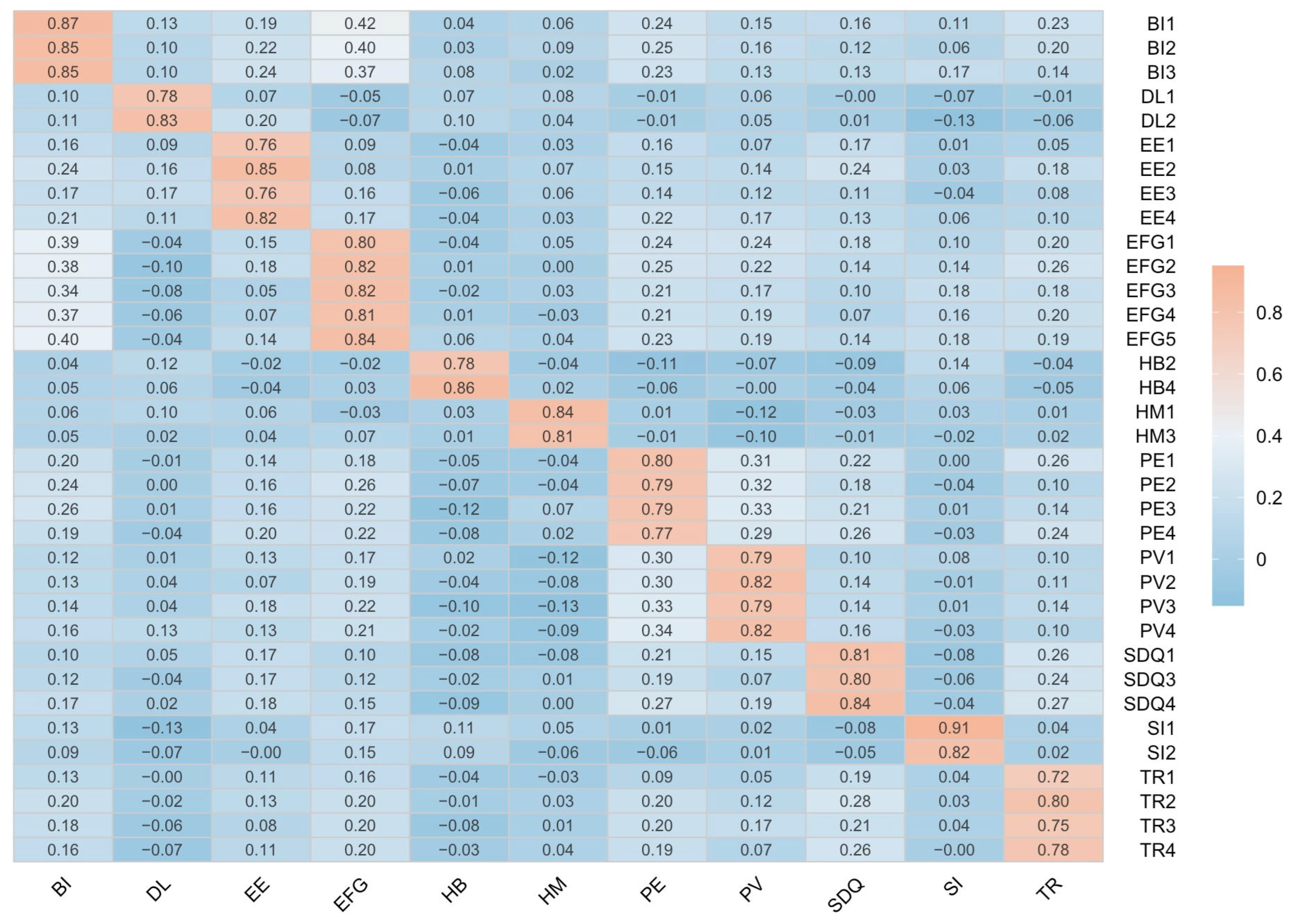
As an additional diagnostic, cross-loadings were inspected in SmartPLS to confirm that each indicator loads most strongly on its intended construct relative to all alternatives (Figure 3). The results support this condition across the measurement model. For example, the Behavioral Intention items load most strongly on BI (0.85–0.87), the Social Influence items load highest on SI (0.82–0.91), and the Service Delivery Quality items load highest on SDQ (0.80–0.84). A similar pattern is evident for Expected Financial Gains, where EFG1–EFG5 load most strongly on EFG (0.80–0.84), despite showing moderate secondary associations with BI. Importantly, no indicator loads higher on another construct than on its own assigned construct, indicating that item-level overlap is limited and theoretically acceptable.
More specifically, the strongest non-target cross-loadings appear in theoretically adjacent constructs rather than unrelated domains, which is substantively reasonable. At the same time, these secondary loadings remain clearly below the primary loadings on the intended constructs, preserving construct distinctiveness. Taken together, the cross-loadings pattern complements the Fornell–Larcker results and provides further evidence of adequate discriminant validity, supporting interpretation of the structural model with confidence.

5.2.3. Heterotrait–Monotrait Ratio of Correlations

Discriminant validity was further assessed using the heterotrait–monotrait ratio of correlations (HTMT), a stringent correlation-based criterion for evaluating whether theoretically distinct latent constructs are also empirically distinguishable, as shown in Table 4. HTMT compares cross-construct indicator correlations with within-construct correlations; values that are too high indicate a lack of separability between two constructs. Using established guidelines, discriminant validity is considered satisfactory when HTMT values remain below conservative (0.85) (or, alternatively, the liberal 0.90) thresholds.
As shown in the HTMT matrix, all inter-construct HTMT values are well below 0.85, providing strong evidence of discriminant validity across the measurement model. The largest HTMT value is 0.541 between Behavioral Intention (BI) and Expected Financial Gains (EFG), indicating a meaningful association that remains comfortably within acceptable limits. Other relatively higher, but still clearly permissible, ratios include Performance Expectancy (PE) with Perceived Value (PV) (0.486), Trust (TR) with Service Delivery Quality (SDQ) (0.407), and PE with SDQ (0.350). These patterns align with the model’s logic: stronger service delivery perceptions may reinforce trust, and usefulness beliefs may translate into value perceptions, without the constructs collapsing into a single dimension. At the same time, many HTMT values are small (e.g., PE–DL = 0.046, TR–SI = 0.053), indicating minimal empirical overlap for several construct pairs.

5.2.4. Structural Model Assessment

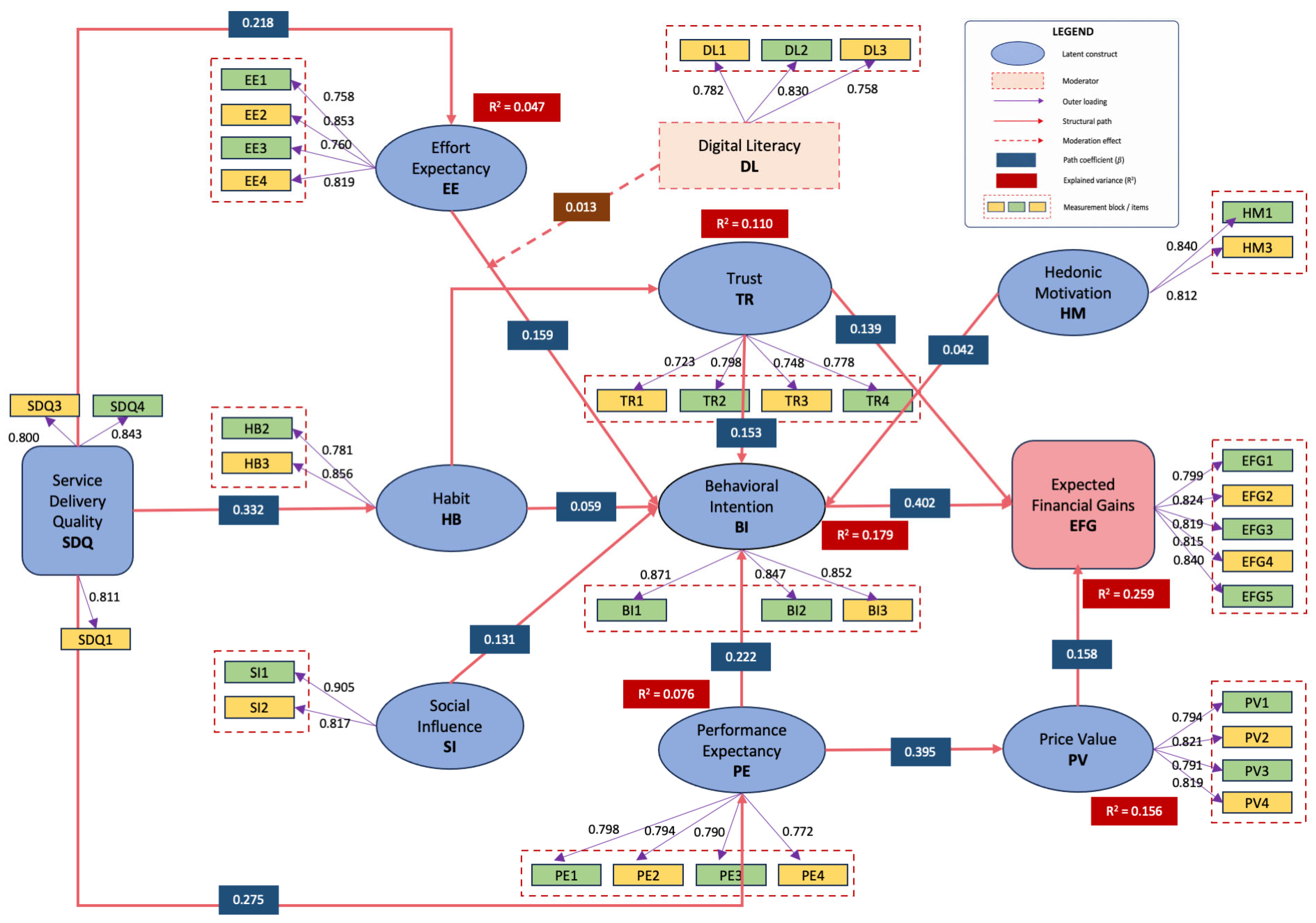
The structural model and the standardized path coefficients for the hypothesized relationships among the latent constructs are illustrated in Figure 4. In assessing the structural model, the bootstrapped path estimates indicate that the model explains residents’ expected financial gains primarily through behavioral intention and value-related beliefs. Behavioral intention had a strong and statistically significant effect on expected financial gains (β = 0.402, t = 8.693, p < 0.001), highlighting intention as the most direct driver of the perceived “digital city dividend.” In addition, Perceived value contributed positively to expected financial gains (β = 0.158, t = 3.171, p = 0.002), and trust also showed a significant positive association with expected financial gains (β = 0.139, t = 3.028, p = 0.002). These results suggest that residents’ financial expectations are strengthened when digital services are perceived as worthwhile and when confidence in the system is higher, while intention serves as the key proximal mechanism translating those beliefs into expected gains.
Behavioral intention itself was shaped by multiple significant predictors. Performance expectancy exerted a positive and statistically significant effect on behavioral intention (β = 0.223, t = 4.063, p < 0.001), indicating that perceived usefulness motivates residents to engage with digital city services. Effort expectancy also positively influenced behavioral intention (β = 0.162, t = 3.166, p = 0.002), implying that ease of use remains an important adoption condition. Social influence was likewise significant (β = 0.130, t = 2.452, p = 0.014), showing that normative pressures and peer signals still matter in shaping intentions. Digital literacy had a smaller but statistically significant positive effect on behavioral intention (β = 0.116, t = 2.393, p = 0.017), suggesting that capability and confidence in using digital tools modestly increase residents’ willingness to adopt.
Upstream service-performance perceptions also played a meaningful enabling role through key mediators. Service delivery quality significantly improved effort expectancy (β = 0.215, t = 4.012, p < 0.001), performance expectancy (β = 0.274, t = 5.065, p < 0.001), and trust (β = 0.315, t = 5.960, p < 0.001). This pattern indicates that when digital city services are experienced as reliable and well delivered, residents are more likely to perceive them as easier to use, more useful, and more trustworthy, channels that ultimately feed into intention and financial expectations. Consistent with this chain, performance expectancy also significantly strengthened perceived value perceptions (β = 0.395, t = 8.651, p < 0.001), meaning that perceived usefulness translates strongly into perceived value-for-money.
Finally, several hypothesized relationships were not supported in the structural model. The interaction term between digital literacy and effort expectancy was not significant (β = 0.019, t = 0.399, p = 0.690), providing no evidence of moderation. Habit (β = 0.064, t = 1.067, p = 0.286) and hedonic motivation (β = 0.044, t = 0.792, p = 0.429) were also non-significant predictors of behavioral intention in this sample, suggesting that functional considerations and credibility-based beliefs dominate over routine or enjoyment-based motives in this context.
Indicators with loadings below 0.40 were automatically removed due to inadequate reliability. Items with loadings between 0.40 and 0.59 were also omitted, as they explain less than 35% of the construct variance. Indicators loading between 0.60 and 0.69 were evaluated against composite reliability (CR) and average variance extracted (AVE); where their retention resulted in AVE below 0.50 or CR below 0.70, they were removed to ensure convergent validity and internal consistency. This stepwise screening was applied iteratively to balance statistical adequacy with content coverage, ensuring each construct retained sufficient conceptual breadth. In cases where multiple marginal items were present, the indicator with the weakest loading or clearest redundancy was removed first to preserve the most informative measures. This refinement procedure follows recommended thresholds in the PLS-SEM literature [62,66,67]. All retained indicators satisfied acceptable reliability standards. The detailed structural model results are reported in Table 5, including the standardized coefficients, bootstrap statistics, and hypothesis-testing outcomes.

5.2.5. Overall Model Fitness Analysis (Goodness-of-Fit)

To assess the global validity and explanatory adequacy of the proposed PLS-SEM model, overall model fitness was evaluated using the Goodness-of-Fit (GoF) index. The GoF provides a single, parsimonious summary of model performance by integrating measurement quality (captured through the average communality/AVE) and structural explanatory power (captured through the average (R2) of endogenous constructs). Consistent with the approach proposed in prior PLS-SEM applications, the GoF is computed as the geometric mean of the model’s average AVE and average (R2), thereby reflecting how well the model performs jointly at the indicator level and at the construct-relationship level.
G o F = A V E ¯ × R 2 ¯
A V E ¯ = 1 K k = 1 K A V E k
R 2 ¯ = 1 J j = 1 J R j 2
In this study, the endogenous constructs’ (R2) values (as reported in the model figure) were 0.047, 0.076, 0.110, 0.179, 0.156, and 0.259, yielding an average explanatory power of:
R 2 ¯ = 0.047 + 0.076 + 0.110 + 0.179 + 0.156 + 0.259 6 = 0.138
The average AVE across the constructs was ( A V E ¯ = 0.665). Substituting these values into the GoF formula gives:
G o F = 0.665 × 0.138 = 0.09177 = 0.303
Using commonly cited reference points for interpretation GoFsmall = 0.10, GoFmedium = 0.255, GoFlarge = 0.361, the obtained GoF = 0.303 exceeds the medium benchmark and approaches the large benchmark. This indicates that the model demonstrates strong overall adequacy, combining satisfactory construct measurement quality with meaningful explanatory power across the endogenous variables. In substantive terms, the result supports the model’s ability to capture coherent resident perceptions (measurement model) and translate them into statistically meaningful explanatory relationships (structural model), thereby strengthening confidence in the study’s inferences about the drivers of the dependent construct.

6. Discussion

This study set out to explain how residents form expected financial gains (EFG), the “digital city dividend”, from using tech-enabled city services, and which perceptions most strongly translate into that expectation. The results suggest a clear, layered mechanism: service delivery quality (SDQ) operates upstream by shaping key belief structures (effort expectancy, performance expectancy, and trust), those beliefs shape behavioral intention (BI), and BI in turn becomes the main route through which residents convert perceptions into anticipated monetary/time savings. This configuration aligns with the public value framing in digital government research, where citizens do not evaluate digital services only as “technology,” but as a package of reliability, responsiveness, and institutional credibility that must justify the time, effort, and risk of switching channels [7,8].
A central finding is the role of SDQ as the system-level precursor. SDQ significantly increases effort expectancy (β = 0.215, t = 4.012, p < 0.001) and performance expectancy (β = 0.274, t = 5.065, p < 0.001), and it also strengthens trust (β = 0.315, t = 5.960, p < 0.001). Substantively, this means residents read “service performance” (speed, accuracy, reliability, and completion of tasks) as evidence that the digital channel is easy enough to use, useful enough to matter, and credible enough to rely on. This reinforces the idea that the adoption problem in city platforms is not merely interface design; it is the citizen’s experience of whether the digital channel reliably reduces transaction frictions relative to offline alternatives, an argument long emphasized in e-government evaluation and public value scholarship [19,20,48].
Turning to BI, the evidence supports a largely utilitarian decision logic. Performance expectancy is a significant predictor of BI (β = 0.223, t = 4.063, p < 0.001) and so is effort expectancy (β = 0.162, t = 3.166, p = 0.002). In practical terms, residents are more willing to use digital city services when they believe the channel will actually work (deliver outcomes) and will not impose excessive learning and procedural costs. This is consistent with the UTAUT-family proposition that perceived usefulness and ease remain foundational drivers, particularly when the digital service is instrumental (paying, applying, registering, reporting) rather than purely experiential [31].
Two additional determinants of BI deserve emphasis because they speak to the social and capability context of urban digitalization. Social influence is significant (β = 0.130, t = 2.452, p = 0.014), implying that peer endorsement and normative signals still matter for civic technologies, especially when residents are uncertain about the value and legitimacy of a digital channel. At the same time, digital literacy also has a direct effect on BI (β = 0.116, t = 2.393, p = 0.017), confirming that capability constraints remain binding even when smartphones and internet access are widespread. These results support a more nuanced “digital divide” interpretation: inequalities may shift from access to effective use such as skills, confidence, and procedural know-how, rather than disappearing entirely.
Trust further emerges as consequential for adoption: trust significantly predicts BI (β = 0.153, t = 2.839, p = 0.005). This finding is important in a municipal service setting because residents face asymmetric information: they cannot fully observe whether submissions are processed fairly, whether fees are correctly applied, or whether data will be protected. Where institutional trust is fragile, perceived risk becomes a hidden “cost” that can offset the perceived convenience of digital channels. The present evidence indicates that, beyond SDQ, trust functions as an independent motivational asset that encourages residents to engage with the platform. This pattern closely mirrors classic e-government adoption work that positions trust as a cornerstone of citizen uptake, particularly where compliance, data-sharing, and payment are involved [24].
By contrast, hedonic motivation and habit are not significant predictors of BI (HM: β = 0.044, t = 0.792, p = 0.429; HB: β = 0.064, t = 1.067, p = 0.286). This “null” result is theoretically informative rather than disappointing. It suggests that city service platforms are not being adopted because they are enjoyable or because use is routinized; instead, adoption is primarily driven by performance, effort reduction, social endorsement, skills, and trust. In other words, residents approach the city’s digital channel as a high-stakes, task-oriented instrument, closer to a transactional system than a lifestyle technology. This helps explain why increasing “engagement” features alone may not shift behavior unless the platform also delivers consistent service completion and visible reliability gains [31,48].
The most policy-relevant story appears in the determinants of EFG, the focal outcome construct. Behavioral intention is the dominant predictor of expected financial gains (β = 0.402, t = 8.693, p < 0.001), indicating that residents who plan to use the digital channel more strongly are also the ones who anticipate tangible savings and avoided losses. This result clarifies the “why” behind the digital city dividend: expectations of savings are not floating perceptions; they are tied to intended behavioral substitution, using digital options rather than time- and cost-intensive in-person processes. Importantly, EFG is also shaped by perceived value (β = 0.158, t = 3.171, p = 0.002) and trust (β = 0.139, t = 3.028, p = 0.002). These paths imply that residents’ dividend calculus depends on both an economic appraisal (“Is it worth it?”) and an institutional appraisal (“Is it safe/reliable enough to count as real savings?”). This is consistent with the public value lens: perceived value and credible governance conditions are essential for citizens to believe digital reforms will deliver real, not merely promised, benefits [19,48].
The pathway from performance expectancy to perceived value is also strong (β = 0.395, t = 8.651, p < 0.001), reinforcing that perceived usefulness translates into value-for-money judgments. Conceptually, this means residents interpret “usefulness” through an economic lens: if the service helps complete tasks faster and with fewer frictions, it becomes “worth it,” which then strengthens expected gains. This chain is a useful refinement of UTAUT-style models in a municipal context because it connects the technology acceptance core (usefulness) to a more explicitly economic evaluation (value), and then to a financially framed outcome (EFG) [31].
Two non-findings further sharpen interpretation. First, the moderation term (digital literacy × effort expectancy) is not supported (β = 0.019, t = 0.399, p = 0.690). A plausible explanation is that effort expectancy already captures perceived ease at the level that matters; once people decide a system is easy enough, additional literacy does not meaningfully change how “ease” becomes intention. Alternatively, the literacy distribution in the sample may not be extreme enough to create a differential slope, even though literacy still matters directly for BI. Second, while the model explains meaningful variance in EFG (R2 = 0.259), BI (R2 = 0.179), and PV (R2 = 0.156), the explanatory power remains moderate overall, implying that additional determinants, such as prior service experiences, perceived responsiveness after submission, outage/latency episodes, complaint resolution, or household constraints, may also shape expected gains but were not captured in the present specification [68]. These are realistic additions for future work, especially because “expected gains” are partly formed through narratives and lived experiences that can shift quickly with service disruption.
Finally, the findings contribute to smart urban governance debates by showing that the citizen-facing “smart city” proposition becomes credible only when the institutional and service layer performs. This aligns with scholarship emphasizing that smart cities are governance projects as much as technology projects: legitimacy, accountability, and service reliability structure whether citizens accept digital channels as beneficial [69]. It also echoes the broader “digital dividends” argument: benefits are not automatic outcomes of digitization; they materialize only when institutions and capabilities allow citizens to convert digital access into real welfare gains [70,71]. In short, the study suggests a restrained but actionable conclusion: the digital city dividend is achievable, but it is conditional, built on service delivery quality, trust, resident capability, and a clear value proposition rather than on novelty, enjoyment, or habit formation alone.

6.1. Practical Implications for Lahore and Pakistan’s Digital Public Service Delivery

The results point to a clear policy message for Lahore and, more broadly, Pakistan’s digital public service ecosystem: perceived benefits and credibility must be made visible and repeatable at the point of use. In the model, service delivery quality is not merely a “nice-to-have” feature; it functions as an upstream lever that strengthens effort expectancy, performance expectancy, and trust, three mechanisms that ultimately raise behavioral intention and, through it, residents’ expected financial gains. Practically, this implies that city and provincial agencies should prioritize reliability (uptime, error-free submissions, predictable processing timelines), responsiveness (clear ticketing, escalation routes, and turnaround standards), and transparency (status tracking and notifications). These improvements convert “digital services” from an uncertain alternative into a low-friction default, directly addressing why residents may hesitate even when services exist.
Trust emerges as consequential for both adoption intent and expected financial gains, which means credibility-building should be treated as an operational requirement rather than a communication add-on. Lahore’s agencies can strengthen trust through concrete safeguards: consistent authentication standards across portals, clear data-minimization statements written in plain language, visible cybersecurity practices (e.g., audit badges, breach-response protocols), and predictable grievance redressal. Importantly, trust is earned through performance consistency, when users repeatedly experience successful transactions, timely confirmations, and reduced need for in-person follow-up, the “digital city dividend” becomes believable.
Digital literacy also matters for intention, indicating that adoption constraints are partly capability-based rather than preference-based. Targeted micro-interventions such as short, task-based tutorials embedded inside portals, assisted digital kiosks at service centers, and community-based training partnerships, can reduce cognitive load for first-time users. Finally, because social influence contributes to intention, public agencies should leverage credible messengers (neighborhood-level campaigns, employer partnerships, university channels) and showcase usage norms (“most residents now renew/submit online”) while ensuring that offline access remains available to avoid excluding residents with limited connectivity or device constraints.

6.2. Comparative Perspective and Research Extensions

Viewed through global evidence on technology adoption and digital government, the Lahore results align with a broader pattern: citizens adopt digital public services when perceived usefulness/value and social–institutional confidence outweigh perceived effort and risk. The centrality of performance expectancy and behavioral intention is consistent with core acceptance theory, where perceived usefulness and facilitating conditions repeatedly predict uptake across contexts and service types [72,73]. Similarly, the role of trust, directly and through perceptions of service performance, mirrors established e-government findings that institutional trust and perceived risk shape willingness to transact online with the state, especially when services involve payments, identity verification, or sensitive records [24,74].
At the same time, the Lahore model points to a particularly important global comparison: the “digital dividend” is often uneven because digital literacy and capability constraints remain stronger in many low-and middle-income contexts than in high-income ones. This is consistent with digital divide research emphasizing that access alone is insufficient; skills, confidence, and the ability to convert digital access into tangible benefits determine who actually gains from digitalization [75]. Related comparative urban research has similarly shown that socio-spatial conditions and neighborhood context can produce uneven patterns of access, mobility, and practical benefit across urban systems, reinforcing the need for context-sensitive and spatially differentiated interpretation of digital service outcomes [76]. From a policy lens, this suggests that Pakistan’s digital service reforms should be assessed not only by adoption averages, but also by distributional outcomes that is who is getting benefits, who is excluded, and which service categories create the largest time-and-cost savings.
For research extensions, three directions follow from global digital government scholarship. First, future work can test whether the same value-creation pathways hold across different “maturity levels” of digital government (informational portals vs. transactional vs. integrated life-event services), which is emphasized in international digital government frameworks [77,78]. Second, longitudinal designs can verify whether expected financial gains become realized gains (and whether positive experiences build habit over time). Third, additional moderators, such as service type risk (low-stakes vs. high-stakes), platform reliability, or perceived data protection, can refine why certain relationships strengthen or weaken as systems scale. Fourth, future research could extend the present model by mapping neighborhood-level dimension scores derived from the PLS-SEM results and by examining whether their aggregation into a composite spatial indicator can provide added value for understanding intra-urban heterogeneity and supporting urban planning decisions. These extensions position the Lahore evidence as globally relevant: it demonstrates that citizens adopt digital government when they can clearly convert trust, usability, and service quality into practical household benefits, not merely when technology is available.

7. Conclusions

This study set out to explain why residents expect a “digital city dividend”, that is, concrete household-level financial gains from using tech-enabled public services, and which factors most strongly translate digital service delivery into perceived value. Using PLS-SEM, the analysis offers a coherent picture of how service performance, citizen capabilities, and motivational mechanisms combine to shape both technology adoption and the expectation of economic benefit. The results support the idea that digital government becomes meaningful for citizens when it reduces real-world friction: time spent in queues, repeated visits, transaction uncertainty, and associated travel and opportunity costs.
The central contribution of the findings is the clear role of expected financial gains as a high-impact driver of adoption. Behavioral intention to use digital city services is most strongly influenced by residents’ expectation that these services will save money or avoid losses, indicating that citizens assess digital channels through a practical cost–benefit lens rather than purely technological enthusiasm. This validates the study’s framing: the promise of “smart” service delivery is not an abstract modernization narrative, but a value proposition that must be experienced as economically relevant at the household level. In parallel, perceived effort and performance beliefs also matter. Higher effort expectancy and performance expectancy both contribute positively to behavioral intention, suggesting that citizens are more willing to adopt digital services when the systems are easy to use and clearly useful for completing tasks efficiently.
The results also reveal that social influence and trust remain important, but not uniformly decisive across all pathways. Social influence contributes positively to behavioral intention, implying that social cues such as peer use, family recommendations, and perceived norms, still shape technology uptake in Lahore. Trust shows a meaningful positive contribution to adoption and also influences expected financial gains, reinforcing a critical governance point: citizens are unlikely to rely on digital channels for consequential services unless they believe the system is reliable, fair, and safe. At the same time, some hypothesized links were not supported, including hedonic motivation and the perceived value pathway to adoption. These non-significant effects are theoretically informative: digital public services are not adopted primarily for enjoyment, and adoption is not simply a function of “value-for-money” perceptions in the consumer sense. Rather, the evidence indicates that adoption is anchored in functional performance, ease of use, social reinforcement, and confidence that the system will deliver tangible benefits.
A further implication is that service delivery quality operates as an upstream enabler. Its effects appear through key mediators that matter to citizens, improving ease-of-use perceptions, strengthening trust, and reinforcing performance beliefs. This underlines that digital transformation in cities is not a technology deployment problem alone; it is a service management problem. Without dependable, consistent, and responsive service experiences, the perceived dividend weakens and citizen adoption becomes fragile.
The study advances an explanatory-predictive account of digital service uptake in Lahore by explicitly linking adoption to expected economic payoffs. The findings suggest that policy emphasis should shift from platform availability to value realization: designing digital services that reduce user effort, improve completion certainty, build trust through transparency and grievance redress, and deliver time-and-cost savings that residents can recognize. In doing so, the research strengthens the conceptual basis for treating digital government not merely as administrative modernization, but as a measurable household welfare mechanism in rapidly growing cities.

Author Contributions

Conceptualization, M.M.A., Z.A.R. and N.B.S.; methodology, M.M.A. and Z.A.R.; software, M.M.A.; validation, M.M.A., Z.A.R. and N.B.S.; formal analysis, M.M.A. and Z.A.R.; investigation, M.M.A., Z.A.R. and N.B.S.; resources, M.M.A. and Z.A.R.; data curation, M.M.A. and N.B.S.; writing—original draft preparation, M.M.A. and Z.A.R.; writing—review and editing, M.M.A., Z.A.R. and N.B.S.; visualization, M.M.A. and Z.A.R.; supervision, M.M.A. and Z.A.R.; project administration, M.M.A. and Z.A.R.; funding acquisition, M.M.A. and Z.A.R. All authors have read and agreed to the published version of the manuscript.

Funding

This research received no external funding.

Data Availability Statement

The data supporting the findings of this study are available from the corresponding author upon reasonable request.

Acknowledgments

During the preparation of this work, the authors used ChatGPT (GPT-5.5 Thinking) to rephrase parts of the manuscript for improved clarity and language refinement. After using this tool, the authors reviewed and edited the content as needed and take full responsibility for the content of the published article.

Conflicts of Interest

The authors declare no conflicts of interest.

Appendix A

Table A1. Measurement items used for the reflective constructs.
ConstructCodeIndicator Statement (Reflective)
Smart service delivery quality
(SDQ)
SDQ1The city’s tech-enabled services are easy to navigate.
SDQ2The city’s tech-enabled services provide clear and understandable steps.
SDQ3The city’s tech-enabled services work reliably without errors.
Effort
expectancy
(EE)
EE1Learning to use the city’s tech-enabled services is easy for me.
EE2Using the city’s tech-enabled services is clear and understandable.
EE3It is easy for me to become skilful at using the city’s tech-enabled services.
EE4The steps to complete tasks through the city’s tech-enabled services are clear.
Performance
expectancy
(PE)
PE1Using the city’s tech-enabled services helps me complete civic tasks more quickly.
PE2Using the city’s tech-enabled services improves my efficiency in dealing with the city.
PE3Using the city’s tech-enabled services makes it easier to accomplish my need from the city.
PE4Overall, the city’s tech-enabled services are useful for managing my civic needs.
Trust
(TR)
TR1I believe the city’s tech-enabled services are dependable.
TR2I believe my information is handled securely when using the city’s tech-enabled services.
TR3I believe transactions through the city’s tech-enabled services will be completed correctly.
TR4Overall, I trust the city’s tech-enabled services.
Social
influence
(SI)
SI1People who are important to me think I should use the city’s tech-enabled services.
SI2People whose opinions I value encourage me to use the city’s tech-enabled services.
SI3People around me generally support the use of the city’s tech-enabled services.
Hedonic
motivation
(HM)
HM1Using the city’s tech-enabled services is enjoyable.
HM2Using the city’s tech-enabled services is fun.
HM3Using the city’s tech-enabled services feels convenient and stress-free.
Habit
(HB)
HB1Using the city’s tech-enabled services has become a habit for me.
HB2Using the city’s tech-enabled services is something I do automatically.
HB3I prefer using digital methods over visiting city offices in person.
HB4Using the city’s tech-enabled services is part of how I normally handle civic tasks.
Behavioral
intention
(BI)
BI1I intend to use the city’s tech-enabled services in the future.
BI2I will try to use the city’s tech-enabled services whenever possible.
BI3I plan to increase my use of the city’s tech-enabled services.
Perceived value
(PV)
PV1Overall, the benefits of using the city’s tech-enabled services are worth the costs.
PV2Using the city’s tech-enabled services provides good value for me.
PV3Considering what I give up, using the city’s tech-enabled services is worthwhile.
PV4Compared to visiting city offices, using the city’s tech-enabled services reduces my cost and hassle.
Expected
financial gains
(EFG)
EFG1Using the city’s tech-enabled services will reduce my transaction costs (e.g., travel/fees).
EFG2Using these services will save me time that I can reallocate to productive activities.
EFG3Using these services will reduce delay-related losses (e.g., missed deadlines).
EFG4Using the city’s tech-enabled services will help me avoid extra costs such as penalties.
EFG5Overall, I expect to experience financial benefits from using the city’s tech-enabled services.
Digital
literacy (DL)
DL1I am confident using digital tools (apps/web) to complete official tasks.
DL2I can find and use online information needed to complete city services.
DL3I can troubleshoot basic issues (e.g., login, verification) when using digital city services.

References

  1. Caragliu, A.; Del Bo, C.F.; Nijkamp, P. “Smart cities in Europe” revisited: A meta-analysis of smart city economic impacts. J. Urban Technol. 2023, 30, 51–69. [Google Scholar] [CrossRef]
  2. Albino, V.; Berardi, U.; Dangelico, R.M. Smart cities: Definitions, dimensions, performance, and initiatives. J. Urban Technol. 2015, 22, 3–21. [Google Scholar] [CrossRef]
  3. Mills, A.J.; Durepos, G.; Wiebe, E. Encyclopedia of Case Study Research; Sage Publications: Thousand Oaks, CA, USA, 2009. [Google Scholar]
  4. Hollands, R.G. Will the real smart city please stand up?: Intelligent, progressive or entrepreneurial? In The Routledge Companion to Smart Cities; Routledge: Oxfordshire, UK, 2020; pp. 179–199. [Google Scholar]
  5. Neirotti, P.; De Marco, A.; Cagliano, A.C.; Mangano, G.; Scorrano, F. Current trends in Smart City initiatives: Some stylised facts. Cities 2014, 38, 25–36. [Google Scholar] [CrossRef]
  6. Kitchin, R. The real-time city? Big data and smart urbanism. GeoJournal 2014, 79, 1–14. [Google Scholar] [CrossRef]
  7. Bannister, F.; Connolly, R. ICT, public values and transformative government: A framework and programme for research. Gov. Inf. Q. 2014, 31, 119–128. [Google Scholar] [CrossRef]
  8. Cordella, A.; Bonina, C.M. A public value perspective for ICT enabled public sector reforms: A theoretical reflection. Gov. Inf. Q. 2012, 29, 512–520. [Google Scholar] [CrossRef]
  9. DeLone, W.H.; McLean, E.R. The DeLone and McLean model of information systems success: A ten-year update. J. Manag. Inf. Syst. 2003, 19, 9–30. [Google Scholar]
  10. Carter, L.; Bélanger, F. The utilization of e-government services: Citizen trust, innovation and acceptance factors. Inf. Syst. J. 2005, 15, 5–25. [Google Scholar] [CrossRef]
  11. Van Deursen, A.; Van Dijk, J. Internet skills and the digital divide. New Media Soc. 2011, 13, 893–911. [Google Scholar] [CrossRef]
  12. Silva, B.N.; Khan, M.; Han, K. Towards sustainable smart cities: A review of trends, architectures, components, and open challenges in smart cities. Sustain. Cities Soc. 2018, 38, 697–713. [Google Scholar] [CrossRef]
  13. Toli, A.M.; Murtagh, N. The concept of sustainability in smart city definitions. Front. Built Environ. 2020, 6, 77. [Google Scholar] [CrossRef]
  14. Dameri, R.P. Searching for smart city definition: A comprehensive proposal. Int. J. Comput. Technol. 2013, 11, 2544–2551. [Google Scholar] [CrossRef]
  15. Radu, L.-D. Disruptive technologies in smart cities: A survey on current trends and challenges. Smart Cities 2020, 3, 1022–1038. [Google Scholar] [CrossRef]
  16. Kummitha, R.K.R.; Crutzen, N. How do we understand smart cities? An evolutionary perspective. Cities 2017, 67, 43–52. [Google Scholar] [CrossRef]
  17. Dunleavy, P.; Margetts, H.; Bastow, S.; Tinkler, J. New public management is dead—Long live digital-era governance. J. Public Adm. Res. Theory 2006, 16, 467–494. [Google Scholar] [CrossRef]
  18. Ruhlandt, R.W.S. The governance of smart cities: A systematic literature review. Cities 2018, 81, 1–23. [Google Scholar] [CrossRef]
  19. Twizeyimana, J.D.; Andersson, A. The public value of E-Government—A literature review. Gov. Inf. Q. 2019, 36, 167–178. [Google Scholar] [CrossRef]
  20. Deng, H.; Karunasena, K.; Xu, W. Evaluating the performance of e-government in developing countries: A public value perspective. Internet Res. 2018, 28, 169–190. [Google Scholar] [CrossRef]
  21. Parasuraman, A.; Zeithaml, V.A.; Berry, L.L. A conceptual model of service quality and its implications for future research. J. Mark. 1985, 49, 41–50. [Google Scholar] [CrossRef]
  22. Li, Y.; Shang, H. Service quality, perceived value, and citizens’ continuous-use intention regarding e-government: Empirical evidence from China. Inf. Manag. 2020, 57, 103197. [Google Scholar] [CrossRef]
  23. Dhingra, S.; Gupta, S.; Bhatt, R. A study of relationship among service quality of E-commerce websites, customer satisfaction, and purchase intention. Int. J. E-Bus. Res. (IJEBR) 2020, 16, 42–59. [Google Scholar] [CrossRef]
  24. Alzahrani, L.; Al-Karaghouli, W.; Weerakkody, V. Analysing the critical factors influencing trust in e-government adoption from citizens’ perspective: A systematic review and a conceptual framework. Int. Bus. Rev. 2017, 26, 164–175. [Google Scholar] [CrossRef]
  25. Hooda, A.; Gupta, P.; Jeyaraj, A.; Giannakis, M.; Dwivedi, Y.K. The effects of trust on behavioral intention and use behavior within e-government contexts. Int. J. Inf. Manag. 2022, 67, 102553. [Google Scholar] [CrossRef]
  26. Chen, L.; Aklikokou, A.K. Determinants of E-government adoption: Testing the mediating effects of perceived usefulness and perceived ease of use. Int. J. Public Adm. 2020, 43, 850–865. [Google Scholar] [CrossRef]
  27. Teo, T.S.; Srivastava, S.C.; Jiang, L. Trust and electronic government success: An empirical study. J. Manag. Inf. Syst. 2008, 25, 99–132. [Google Scholar] [CrossRef]
  28. Janssen, M.; Rana, N.P.; Slade, E.L.; Dwivedi, Y.K. Trustworthiness of digital government services: Deriving a comprehensive theory through interpretive structural modelling. Digit. Gov. Public Manag. 2021, 20, 647–671. [Google Scholar]
  29. Kearns, R.; Hair, N. Consumer perceptions of business-to-consumer relationships in electronic retail environments: A means–end chain approach. J. Relatsh. Mark. 2008, 7, 5–27. [Google Scholar] [CrossRef]
  30. Sweeney, J.C.; Soutar, G.N. Consumer perceived value: The development of a multiple item scale. J. Retail. 2001, 77, 203–220. [Google Scholar] [CrossRef]
  31. Bhattacherjee, A. Understanding information systems continuance: An expectation-confirmation model. MIS Q. 2001, 25, 351–370. [Google Scholar] [CrossRef]
  32. Ji, T.; Chen, J.-H.; Wei, H.-H.; Su, Y.-C. Towards people-centric smart city development: Investigating the citizens’ preferences and perceptions about smart-city services in Taiwan. Sustain. Cities Soc. 2021, 67, 102691. [Google Scholar] [CrossRef]
  33. Lybeck, R.; Koiranen, I.; Koivula, A. From digital divide to digital capital: The role of education and digital skills in social media participation. Univers. Access Inf. Soc. 2024, 23, 1657–1669. [Google Scholar] [CrossRef]
  34. Van Laar, E.; Van Deursen, A.J.; Van Dijk, J.A.; De Haan, J. Determinants of 21st-century skills and 21st-century digital skills for workers: A systematic literature review. Sage Open 2020, 10, 2158244019900176. [Google Scholar] [CrossRef]
  35. Venkatesh, V.; Thong, J.Y.; Xu, X. Consumer acceptance and use of information technology: Extending the unified theory of acceptance and use of technology. MIS Q. 2012, 36, 157–178. [Google Scholar] [CrossRef]
  36. Venkatesh, V.; Morris, M.G.; Davis, G.B.; Davis, F.D. User acceptance of information technology: Toward a unified view. MIS Q. 2003, 27, 425–478. [Google Scholar] [CrossRef]
  37. Rai, A.; Lang, S.S.; Welker, R.B. Assessing the validity of IS success models: An empirical test and theoretical analysis. Inf. Syst. Res. 2002, 13, 50–69. [Google Scholar] [CrossRef]
  38. Hakeem, M.; Sulphey, M. Investigating the adoption of smart local government services: The impact of service quality, trust, and social influence. Transform. Gov. People Process Policy 2024, 18, 785–802. [Google Scholar] [CrossRef]
  39. Turner, M.; Kitchenham, B.; Brereton, P.; Charters, S.; Budgen, D. Does the technology acceptance model predict actual use? A systematic literature review. Inf. Softw. Technol. 2010, 52, 463–479. [Google Scholar] [CrossRef]
  40. Venkatesh, V. Determinants of perceived ease of use: Integrating control, intrinsic motivation, and emotion into the technology acceptance model. Inf. Syst. Res. 2000, 11, 342–365. [Google Scholar] [CrossRef]
  41. Al-Mamary, Y.H.; Alshallaqi, M.; Abubakar, A.A.; Alhakimi, W.; Alhaidan, H. A comprehensive conceptual model of digital transformation in public services: Exploring key factors and their impact on government success. Future Bus. J. 2025, 11, 193. [Google Scholar] [CrossRef]
  42. Jadil, Y.; Rana, N.P.; Dwivedi, Y.K. A meta-analysis of the UTAUT model in the mobile banking literature: The moderating role of sample size and culture. J. Bus. Res. 2021, 132, 354–372. [Google Scholar] [CrossRef]
  43. Markiewicz, Ł.; Muda, R.; Kubińska, E.; Augustynowicz, P. An explanatory analysis of perceived risk decision weights (perceived-risk attitudes) and perceived benefit decision weights (perceived-benefit attitudes) in risk-value models. J. Risk Res. 2020, 23, 739–761. [Google Scholar] [CrossRef]
  44. McKnight, D.H.; Choudhury, V.; Kacmar, C. Developing and validating trust measures for e-commerce: An integrative typology. Inf. Syst. Res. 2002, 13, 334–359. [Google Scholar] [CrossRef]
  45. Gupta, P.; Hooda, A.; Jeyaraj, A.; Seddon, J.J.; Dwivedi, Y.K. Trust, risk, privacy and security in e-Government use: Insights from a MASEM analysis. Inf. Syst. Front. 2025, 27, 1089–1105. [Google Scholar] [CrossRef]
  46. Wang, H.-J. Factors that influence adoption intentions toward smart city services among users. Inf. Technol. Manag. 2025, 26, 609–623. [Google Scholar] [CrossRef]
  47. Alshare, K.A.; Lane, P.L. Predicting student-perceived learning outcomes and satisfaction in ERP courses: An empirical investigation. Commun. Assoc. Inf. Syst. 2011, 28, 34. [Google Scholar] [CrossRef]
  48. Althunibat, A.; Binsawad, M.; Almaiah, M.A.; Almomani, O.; Alsaaidah, A.; Al-Rahmi, W.; Seliaman, M.E. Sustainable applications of smart-government services: A model to understand smart-government adoption. Sustainability 2021, 13, 3028. [Google Scholar] [CrossRef]
  49. Ma, J.Y.; Xie, J.F.; Chen, C.-C. Exploring the structural relationships of microinteractions in perception and behavior by the hedonic motivation system adoption model. Int. J. Hum. Comput. Interact. 2025, 41, 592–607. [Google Scholar] [CrossRef]
  50. Hornbæk, K.; Hertzum, M. Technology acceptance and user experience: A review of the experiential component in HCI. ACM Trans. Comput.-Hum. Interact. (TOCHI) 2017, 24, 1–30. [Google Scholar] [CrossRef]
  51. Wang, C.; Teo, T.S.; Liu, L. Perceived value and continuance intention in mobile government service in China. Telemat. Inform. 2020, 48, 101348. [Google Scholar] [CrossRef]
  52. Hariguna, T.; Rahardja, U.; Ruangkanjanases, A. The impact of citizen perceived value on their intention to use e-government services: An empirical study. Electron. Gov. Int. J. 2020, 16, 426–440. [Google Scholar] [CrossRef]
  53. Mensah, I.K.; Mwakapesa, D.S. Investigating the Behavioral Adoption Intention of Mobile Government Services From the Value-Based Adoption Model Perspective. IEEE Access 2025, 13, 75305–75322. [Google Scholar] [CrossRef]
  54. Zhang, L.; Zhang, X. Impact of digital government construction on the intelligent transformation of enterprises: Evidence from China. Technol. Forecast. Soc. Change 2025, 210, 123787. [Google Scholar] [CrossRef]
  55. Lindgren, I.; Madsen, C.Ø. Digital First? Understanding Citizens’ Communication Needs in Digital Public Encounters. Soc. Policy Adm. 2025, 60, 269–285. [Google Scholar] [CrossRef]
  56. Princz-Jakovics, T.; Szemenyei, M. Development of an e-governance system to support cooperative environmental policy actions. Environ. Syst. Decis. 2024, 44, 763–778. [Google Scholar] [CrossRef]
  57. Guo, Y.; Xu, X. How Digital Government Empowers Public Service Delivery in China: Mechanisms from Public Value and Technological Empowerment Perspectives. Systems 2026, 14, 30. [Google Scholar] [CrossRef]
  58. Zeng, S.; Chen, J. Digital Empowerment of Smart Governance for Local Governments in China: Lessons from Shenzhen. J. Knowl. Econ. 2025, 1–19. [Google Scholar] [CrossRef]
  59. Asim, M.; Arif, M.; Aziz, A.; Adeel, A. Relaxing the Planning Standards of Housing Scheme: An Approach to Enhance Affordabirfty of Poor. Univ. Eng. Technol. Taxila Tech. J. 2016, 21, 2. [Google Scholar]
  60. Sheikh, N.B.; Arif, M.M.; Laverge, J.; Delghust, M. Integrating Land Use and Transport for Energy Efficiency: Enabling Urban Transformation and Combating Environmental Pollution. In Proceedings of the CIB Conferences, Lafayette, IN, USA, 19–23 May 2025; p. 9. [Google Scholar]
  61. Pakistan Bureau of Statistics. 7th Population and Housing Census 2023: Punjab Provincial Census Report; Government of Pakistan: Islamabad, Pakistan, 2024. Available online: https://www.pbs.gov.pk/wp-content/uploads/2020/07/Provincial-Census-Report-2023-Punjab.pdf (accessed on 12 January 2026).
  62. Hair, J.F.; Ringle, C.M.; Sarstedt, M. Partial least squares structural equation modeling: Rigorous applications, better results and higher acceptance. Long Range Plan. 2013, 46, 1–12. [Google Scholar] [CrossRef]
  63. Henseler, J.; Ringle, C.M.; Sarstedt, M. A new criterion for assessing discriminant validity in variance-based structural equation modeling. J. Acad. Mark. Sci. 2015, 43, 115–135. [Google Scholar] [CrossRef]
  64. Shmueli, G.; Sarstedt, M.; Hair, J.F.; Cheah, J.-H.; Ting, H.; Vaithilingam, S.; Ringle, C.M. Predictive model assessment in PLS-SEM: Guidelines for using PLSpredict. Eur. J. Mark. 2019, 53, 2322–2347. [Google Scholar] [CrossRef]
  65. Henseler, J.; Fassott, G. Testing moderating effects in PLS path models: An illustration of available procedures. In Handbook of Partial Least Squares: Concepts, Methods and Applications; Springer: Berlin/Heidelberg, Germany, 2009; pp. 713–735. [Google Scholar]
  66. Hair, J.F.; Risher, J.J.; Sarstedt, M.; Ringle, C.M. When to use and how to report the results of PLS-SEM. Eur. Bus. Rev. 2019, 31, 2–24. [Google Scholar] [CrossRef]
  67. Hair, J.F.; Black, W.C.; Babin, B.J.; Anderson, R.E. Multivariate Data Analysis; Cengage Learning: Boston, MA, USA, 2019. [Google Scholar]
  68. Yigitcanlar, T.; Kamruzzaman, M.; Foth, M.; Sabatini-Marques, J.; Da Costa, E.; Ioppolo, G. Can cities become smart without being sustainable? A systematic review of the literature. Sustain. Cities Soc. 2019, 45, 348–365. [Google Scholar] [CrossRef]
  69. Meijer, A.; Bolívar, M.P.R. Governing the smart city: A review of the literature on smart urban governance. Int. Rev. Adm. Sci. 2016, 82, 392–408. [Google Scholar] [CrossRef]
  70. Helsper, E. The Digital Disconnect: The Social Causes and Consequences of Digital Inequalities; SAGE Publications Ltd.: Thousand Oaks, CA, USA, 2021. [Google Scholar]
  71. World Bank Group. World Development Report 2016: Digital Dividends; World Bank Publications: Washington, DC, USA, 2016. [Google Scholar]
  72. Al-Hujran, O.; Al-Debei, M.M.; Chatfield, A.; Migdadi, M. The imperative of influencing citizen attitude toward e-government adoption and use. Comput. Hum. Behav. 2015, 53, 189–203. [Google Scholar] [CrossRef]
  73. Dwivedi, Y.K.; Rana, N.P.; Jeyaraj, A.; Clement, M.; Williams, M.D. Re-examining the unified theory of acceptance and use of technology (UTAUT): Towards a revised theoretical model. Inf. Syst. Front. 2019, 21, 719–734. [Google Scholar] [CrossRef]
  74. Bélanger, F.; Carter, L. Trust and risk in e-government adoption. J. Strateg. Inf. Syst. 2008, 17, 165–176. [Google Scholar] [CrossRef]
  75. Scheerder, A.; Van Deursen, A.; Van Dijk, J. Determinants of Internet skills, uses and outcomes. A systematic review of the second-and third-level digital divide. Telemat. Inform. 2017, 34, 1607–1624. [Google Scholar] [CrossRef]
  76. Arif, M.M.; Adeel, A.; Sheikh, N.B. Mode choice patterns and socio-spatial equity in contrasting transitional urban mobility systems. TeMA-J. Land Use Mobil. Environ. 2025, 18, 271–292. [Google Scholar]
  77. Hujran, O.; Alarabiat, A.; AlSuwaidi, M. Analysing e-government maturity models. Electron. Gov. Int. J. 2023, 19, 1–21. [Google Scholar] [CrossRef]
  78. Janowski, T. Digital government evolution: From transformation to contextualization. Gov. Inf. Q. 2015, 32, 221–236. [Google Scholar] [CrossRef]
Figure 1. Proposed UTAUT2-based model linking smart service delivery quality to residents’ expected financial gains.
Urbansci 10 00292 g001
Figure 2. Socio-economic profiling of survey respondents.
Urbansci 10 00292 g002
Figure 3. Cross-loadings matrix heatmap for the reflective measurement model.
Urbansci 10 00292 g003
Figure 4. Structural model relationships illustrating standardized path coefficients and corresponding t-statistics (in parentheses) for the hypothesized links between latent constructs.
Urbansci 10 00292 g004
Table 1. Diagnostic Tests: Factor Analysis & Normality.
Test/MetricResultAcceptable ThresholdInterpretation
1. Sampling Adequacy (KMO)0.805>0.70Meritorious—suitable for factor analysis
2. Sphericity
(Bartlett’s)
χ2 = 4530.298, df = 820, p < 0.001p < 0.05Significant—correlations are favorable
3. Communalities
(Extraction)
0.383–0.730
(majority > 0.60, except SDQ2 0.383, HB1 0.465)
>0.40Adequate—most variance well explained
4. Factor Extraction
(Eigenvalue > 1)
11 components with eigenvalue > 1Eigenvalue > 111 factors retained (unrotated)
5. Total Variance Explained62.59% (first 11 components)>60%
(social sciences)
Good explanatory power
6. Harman’s Single-Factor (CMB)15.34% variance by first factor<50%No common method bias detected
7. Normality (Skewness)−0.522 to +0.025−2 to +2Within range—data approximates normal
8. Normality (Kurtosis)−0.972 to −0.199−2 to +2Within range—data approximates normal
Table 2. Measurement model results: factor loadings, AVE, and CR (n = 340).
ConstructItemLoadingAVECR
Behavioral
Intention
(BI)
BI10.8710.7340.892
BI20.847
BI30.852
Digital
Literacy
(DL)
DL10.7820.6500.788
DL20.830
DL30.758
Effort
Expectancy
(EE)
EE10.7580.6370.875
EE20.853
EE30.760
EE40.819
Expected
Financial Gains (EFG)
EFG10.7990.6710.911
EFG20.824
EFG30.819
EFG40.815
EFG50.840
Habit
(HB)
HB20.7810.6720.803
HB30.856
Hedonic
Motivation (HM)
HM10.8400.6820.811
HM30.812
Performance Expectancy (PE)PE10.7980.6220.868
PE20.794
PE30.790
PE40.772
Perceived Value(PV)PV10.7940.6510.882
PV20.821
PV30.791
PV40.819
Service
Delivery Quality (SDQ)
SDQ10.8110.6700.859
SDQ30.800
SDQ40.843
Social
Influence (SI)
SI10.9050.7430.852
SI20.817
Trust
(TR)
TR10.7230.5810.847
TR20.798
TR30.748
TR40.778
Table 3. Fornell–Larcker discriminant validity matrix (square root of AVE on the diagonal).
BIDLEEEFGHBHMPEPVSDQSITR
BI 0.856
DL 0.1270.806
EE 0.2500.1700.798
EFG 0.460−0.0750.1480.819
HB 0.0560.107−0.0370.0060.820
HM 0.0650.0750.0620.021−0.0110.826
PE 0.281−0.0110.2090.280−0.1010.0020.788
PV 0.1700.0680.1570.246−0.043−0.1290.3950.807
SDQ 0.1600.0100.2150.153−0.079−0.0280.2740.1700.818
SI 0.130−0.1230.0250.1870.1160.006−0.0180.015−0.0740.862
TR 0.224−0.0480.1390.252−0.0530.0220.2270.1400.3150.0340.762
Table 4. Heterotrait–Monotrait (HTMT) ratios for discriminant validity.
BI DL EE EFG HB HM PE PV SDQ SI TR
BI
DL 0.205
EE 0.300 0.267
EFG 0.541 0.124 0.182
HB 0.087 0.224 0.076 0.080
HM 0.098 0.190 0.090 0.106 0.088
PE 0.346 0.046 0.261 0.333 0.162 0.081
PV 0.206 0.142 0.188 0.287 0.111 0.193 0.486
SDQ 0.199 0.085 0.260 0.184 0.128 0.066 0.350 0.209
SI 0.174 0.210 0.067 0.245 0.206 0.103 0.073 0.065 0.103
TR 0.278 0.100 0.164 0.303 0.086 0.061 0.286 0.176 0.407 0.053
Table 5. Structural model results and hypothesis testing (bootstrap; standardized coefficients).
PathβMean (M)STDEVt-Valuep-ValueDecision
BI → EFG0.4020.4040.0468.693<0.001Accepted
DL → BI0.1160.1230.0482.3930.017Accepted
DL × EE → BI0.0190.0200.0490.3990.690Not supported
EE → BI0.1620.1650.0513.1660.002Accepted
HB → BI0.0640.0700.0601.0670.286Not supported
HM → BI0.0440.0530.0560.7920.429Not supported
PE → BI0.2230.2210.0554.063<0.001Accepted
PE → PV0.3950.3980.0468.651<0.001Accepted
PV → EFG0.1580.1600.0503.1710.002Accepted
SDQ → EE0.2150.2200.0544.012<0.001Accepted
SDQ → PE0.2740.2770.0545.065<0.001Accepted
SDQ → TR0.3150.3200.0535.960<0.001Accepted
SI → BI0.1300.1330.0532.4520.014Accepted
TR → BI0.1530.1550.0542.8390.005Accepted
TR → EFG0.1390.1400.0463.0280.002Accepted
Decision rule used: Accepted if p < 0.05, otherwise Not supported. Note: “→” indicates the direction of the hypothesized relationship.
Disclaimer/Publisher’s Note: The statements, opinions and data contained in all publications are solely those of the individual author(s) and contributor(s) and not of MDPI and/or the editor(s). MDPI and/or the editor(s) disclaim responsibility for any injury to people or property resulting from any ideas, methods, instructions or products referred to in the content.