Article

Formation of a Sustainable Urban Structure Aimed at Reducing the Impact of Climate Change Threats to Lithuanian Cities


by
Evaldas Ramanauskas
1,*,
Arūnas Bukantis
2,
Liucijus Dringelis
1,
Giedrius Kaveckis
1 and
Gintė Jonkutė-Vilkė
1
1
Institute of Architecture and Construction, Kaunas University of Technology, Tunelio Str. 60, LT-44405 Kaunas, Lithuania
2
Department of Hydrology and Climatology, Institute of Geosciences, Vilnius University, M.K. Ciurlionio Str. 21-315, LT-03101 Vilnius, Lithuania
*
Author to whom correspondence should be addressed.
Urban Sci. 2026, 10(5), 248; https://doi.org/10.3390/urbansci10050248
Submission received: 21 February 2026 / Revised: 28 April 2026 / Accepted: 29 April 2026 / Published: 4 May 2026

Abstract

At the global level, as well as in Lithuania, the risks associated with climate change and other emerging threats—such as war, radiation, and pandemics—are increasing, and adequate preparedness is necessary to avoid their negative consequences. Despite international and other strategic efforts to assess emerging threats, preparedness to adapt to them and to mitigate their impacts remains insufficient. Considering the insufficient level of preparedness of the country’s cities to cope with these threats, this article introduces a new, sustainable element of urban structure—a comprehensive territorial structural unit capable of functioning under adverse and hazardous conditions. The formation of this new urban complex is based on three core sustainability principles—social, ecological, and economic—alongside international and national urban planning experience. The newly proposed sustainable urban structural complex consists of a group of blocks with diverse building types bounded perimetrically by urban public transport streets connecting the complex with other urban areas. For the functionality of the complex, a structural element—a green core—is envisaged in its central part, intended to serve residents through recreation, social interaction, civil security, and other functions. Due to its functional characteristics, structure, autonomy, capacity to integrate with other urban structures, and other properties, this urban complex closely resembles a biological cell; thus, for semantic clarity, it is termed an urbocell (urban cell). This urbocell is integrated into the urban fabric of residential districts and the entire city, forming a sustainable spatial and urban structure suitable for safe living, working, and recreation. The article models potential structural elements of the urbocell—namely, selected urban block morphotypes—using the computational tool Autodesk Forma, the results of which may support more informed urban planning decisions for developing a more sustainable and climate-resilient urban environment.

1. Introduction

Ongoing climate change processes, which generate threats such as heatwaves, floods, and storms, are increasingly affecting cities, the residential environment, and inhabitants. Recent years have recorded progressively higher summer temperatures, emerging flash floods, and hurricanes [1,2]. These phenomena damage urban infrastructure and residents’ property and impact public health [3,4]. Additionally, in the current era, persistent threats of war, radiation, and pandemics remain highly relevant, with potentially severe negative consequences. The aspiration to prevent these threats to humanity is one of the primary global objectives. However, as ongoing global processes demonstrate, equally important is adequate preparedness for the consequences of such threats.
Ambitious environmental requirements are being introduced at the international level, aiming to reduce and stabilise adverse climate change processes, including reducing greenhouse gas emissions and conserving natural environmental resources [5,6,7,8,9]. There is also promotion of sustainable systems based on sustainable development principles, which may create prerequisites for adapting to the negative consequences of impending hazards [10,11,12]. All these actions and principles are especially significant for shaping the residential environment and the overall formation of urban structure [12,13].
International organisations provide recommendations for developing urban green infrastructure that emphasise optimising transportation systems and sustainable mobility, multifunctional land use, and other aspects [11]. However, the implementation of these principles does not yet have sufficient legal and theoretical grounding in all countries. Moreover, the practical application of these recommendations still receives insufficient attention from national governmental institutions responsible for decision-making [14,15]. Therefore, to facilitate broader examination of these matters, this article presents certain conceptual principles for more effective urban adaptation to the adverse consequences arising from climate change and other potential threats.
The objective of this article is to propose measures for forming a sustainable urban environment and structure aimed at reducing the negative impact of climate change and other potential threats on Lithuanian cities. It seeks to formulate a specific urban structural model and define its implementation principles within urban planning and territorial development practice.

1.1. Literature Review

The relevance of sustainable urban structure formation is demonstrated by research conducted across various fields. Primarily, this includes studies examining climate change processes and their consequences on the residential environment, assessments of potential risks related to war, radiation, and pandemics, and the corresponding infrastructure requirements for preparedness. Additionally, there are studies focused on the formation of urban structures themselves, exploring diverse methods and approaches for creating resilient and sustainable cities.
Climate Change. Intensive climatological research is currently being conducted to analyse the urban structure of cities and the reciprocal influence between urban form and climate [13,16,17,18]. One of the principal works related to the study of sustainable urban structures is the study by Stewart and Oke (2012) which developed the Local Climate Zone classification system [19]. This system enables the identification of distinct urban structures with specific physical properties that determine their correlative relationships with microclimatic parameters. This provided the foundation for extensive research on urban structure using both in situ and remote methods for assessing urban air temperature [20,21,22]. However, such climatological research remains underdeveloped in Lithuania. In the country, evaluations tend to focus on individual aspects, such as air pollution and the impact of vegetation on microclimate [23,24]. Studies related to the investigation of urban heat island intensity are also conducted [25,26]. Nevertheless, broader examination of urban structural issues remains limited. Therefore, research seeking sustainable urban structures remains relevant within the Lithuanian urban planning context.
War, radiation, and pandemic risks. When planning cities, it is equally important to assess the potential dangers posed by war, pandemics, and other threats. Recent studies have analysed the relationship between urban planning, spatial structure, and war-related threats [27], reviewed historical experiences from past conflicts and their impact on urban structures [28], and examined transformations of historical fortifications alongside their parallels with characteristics of contemporary military operations [29]. Research on challenges arising during the 2019 COVID-19 pandemic has also received considerable attention in recent years. From this perspective, the suitability of urban structures is evaluated, deficiencies are identified, and solutions are sought regarding how cities should evolve to improve their functionality when confronted with analogous situations [30,31]. Nevertheless, these studies require further development to enable comprehensive assessment of emerging threats.
Urban sustainability. A fairly broad spectrum of research is currently underway on the formation of sustainable urban structures. Significant attention is devoted to evaluating interrelationships among individual elements of urban structure—examining urban morphological properties, building parameters, development types, green spaces, and street systems in relation to sustainability principles and urban vitality [32,33,34,35,36]. Advanced spatial syntax analysis methods are applied to assess the balance among territorial functions, residents, and transportation systems and developmental sustainability [37,38], and the influence of urban transportation systems on urban structure is also investigated [39]. These and other studies are grounded in or closely related to the New Urbanism movement (1980s), the ‘15-min city’ concept [40], and the pursuit of sustainable development goals [41]. They address theoretical methods of urban structure analysis and provide a substantial foundation and prerequisites for sustainable urban spatial structure across multiple dimensions. However, although most urban structure research broadly addresses individual functional aspects (such as transportation, vitality, functional distribution, energy supply), comparatively less attention is devoted to the comprehensive search for urban territorial units in the context of contemporary climate and other threats.
For sustainable urban structure, the complex interrelationship between urban structural elements such as blocks, public spaces, and green areas is particularly important, as well as the substantiation of the spatial arrangement of these elements and the assessment of their necessity, which has not been widely discussed in the recent literature. Therefore, considering the increasingly evident need to accelerate urban adaptation to emerging threats, this article aims to draw attention to the purposeful formation of urban structure to strengthen urban sustainability and resilience against escalating threats.

1.2. Methodology

The issues examined in this article are presented in separate sections organised according to specific themes, applying methods characteristic of each subject area under investigation. The topics are addressed in the following distinct parts of the article: justifying the necessity of addressing urban adaptation to emerging threats (Section 2.1), defining the principal functional and spatial structure of the urban model (Section 2.2), and evaluating its resilience modelling potential regarding the adverse consequences of climate change (Section 2.3).
Material analysed within the article sections is presented using specialised analytical methods from climatology, geoinformation technologies, and urban planning.
The risks posed by climate change were assessed according to the Climate Risk Index (CRI), which ranks 174 countries worldwide based on the assessment of climate impacts on the economy and human populations averaged annually over the period 1993–2022 [42]. Climate change and the dynamics of its extreme manifestations were reviewed by analysing studies conducted by international organisations and scientific research groups, as well as the climate change scenarios they present. For climatic threats, time series analysis and trend analysis were conducted, and descriptive statistics are provided. Assessment of urban preparedness for potential threats was conducted via analysis of legal acts and spatial planning documents.
In the search for urban structure, the historical development of urban districts was reviewed and sustainable development principles were evaluated. Formation of the territorial unit of urban structure incorporated aspects integrating spatial and functional elements—transportation, green spaces, social facilities, and safety infrastructure—within the residential environment.
Resilience of the established urban structure model to climate change phenomena is evaluated through microclimatic analysis employing the computational modelling software Autodesk Forma. Computer-based microclimatic analysis was applied to the modelling of individual development morphotypes forming the urban complex. The modelling study was conducted as a pilot analysis assessing the perceived temperature and wind microclimatic comfort of the selected morphotypes as calculated by the computational tool. The basic survey of morphotype models was conducted within a limited area with a radius of 200 m for temperature modelling and approximately 400 m for wind effect modelling. The results of the research are summarised by comparing them with the results of previously conducted empirical studies.

2. Results and Findings

2.1. Principal Factors Determining the Formation of a New Sustainable Urban Structure in Cities

2.1.1. Climate Change and Other Potential Threats, Along with Their Adverse Impacts on Cities and Their Environments

Scale of Climate Change Threats Globally and in the Baltic Region
Due to direct impacts of extreme weather events from 1993 to 2022, more than 765,000 people died worldwide, with direct economic losses, adjusted for inflation, reaching nearly 4.2 trillion USD [42]. The years 2023–2024 represent another phase of climate crisis, wherein extreme phenomena became the new normal: historical records for atmospheric and sea surface maximum temperatures and minimal ice cover extents were repeatedly broken; Earth recorded its hottest day in history on 22 July 2024 (global average daily air temperature of 17.16 °C); and 2024 became the hottest year on record, the first year when the average air temperature exceeded pre-industrial levels by 1.5 °C [43,44]. To reduce the magnitude of adverse climate change impacts, effective climate adaptation and disaster risk management strategies are urgently required in the near future—strategies capable of successfully mitigating risk, enhancing resilience, and reducing economic burden [45]. Considering escalating climate impacts, the gradual phase-out of fossil fuels, limitation of deforestation, and expansion of green areas in cities remain priority measures [42].
In Lithuania, weather- and climate-related extreme events during 1980–2024 caused total economic losses amounting to 2.968 billion EUR—equivalent to 45.467 million EUR per km2 and 899 EUR per capita [46]. According to the CRI, which ranks 174 countries worldwide based on absolute and relative climate impacts on economy and human populations averaged annually over 1993–2022, Lithuania occupies a relatively high position (41st) [42]. This places Lithuania in the same 21–50 category as, for example, France, Germany, Bulgaria, and Romania. Baltic region countries fall into lower CRI categories (51–100); consequently, climate-related risk factors are most pertinent to Lithuania within this region. Primary risk factors for the economy according to the CRI methodology include floods, storms, heatwaves (a heatwave is defined as three or more consecutive days when the daily maximum air temperature reaches 30 °C or higher), and droughts. The frequency, intensity, and duration of these extreme weather phenomena, the economic damage caused, and their impact on people (number of fatalities, injuries, affected individuals and homeless persons) are evaluated. The index is based on data from the international disaster database EM-DAT, the World Bank, and the International Monetary Fund.
For urbanised territories, heatwaves constitute one of the most severe and rapidly escalating hazards. Urban morphology—dense development, extensive impervious surfaces, and limited greenery—generates the urban heat island effect, elevating temperatures and thereby amplifying health risks. For instance, studies have determined that, in Lithuania’s largest cities—Vilnius, Kaunas, and Klaipėda—the most intense heat islands, depending on development type, may reach 2.0–2.5 °C. Urban areas exhibit 4–7% lower air humidity compared to rural localities, characteristic significant changes in wind speed and direction, longer and more intense heatwaves, and more frequent tropical nights [15]. Heatwaves in cities result in substantial energy losses due to the demand for building cooling, cause damage to building structures, and pose threats to public health. Heatwave-related risk is becoming increasingly relevant in Northern Europe and the Baltic Sea region, as buildings typical of traditionally cooler climates are not adapted to hot summer weather, thereby increasing overheating risks during summer months. Particularly vulnerable groups include elderly persons, residents with the lowest incomes, and those living in poorly insulated, older, energy-inefficient dwellings—factors that may exacerbate existing social disparities. Future heat risks will intensify significantly: long-term projections (to 2080–2100) indicate that, with 3 °C warming relative to pre-industrial levels, the number of thermally comfortable hours in European cities could decline by up to 74% [12]. This constitutes a critically important domain for urban planning, public health policy, and social protection challenges.
Urbanised territories exhibit high sensitivity to hydrometeorological hazards intensified by climate change, such as rainfall-induced (pluvial) flash floods, riverine flooding, storms, and soil destabilisation. Due to dense infrastructure, soil sealing with impervious materials, and ageing stormwater drainage systems, cities become especially vulnerable during periods of intense precipitation. Flood and landslide risks in urban areas increase with more frequent cloudbursts and an inadequate stormwater infrastructure that often fails to accommodate the volume and intensity of extreme rainfall. Cities frequently exhibit compounding risk factors—dense development, insufficient stormwater system capacity, and built-up riverbanks. Pluvial flooding is projected to increase substantially by 2030 in Northern Europe (a region encompassing the Baltic states) and in certain Western and Central European cities [12].
Coastal urban areas face sea level rises, wave action, and storm-induced shoreline erosion, leading to vulnerability of residential and public buildings, transport hubs, and critical infrastructure. Negative impacts are further amplified by saltwater intrusion into groundwater, wind-driven storm surges, and land subsidence in densely built coastal zones.
Critical infrastructure—energy grids, communication systems, water supply, wastewater networks, and transportation—forms an interconnected functional web in cities, where any single disruption may trigger cascading consequences. Rising temperatures affect energy systems: heatwaves reduce electricity generation efficiency, while droughts disrupt cooling processes. Currently, floods and storms account for a substantial share of the damage to energy distribution lines; in the future, drought- and heatwave-induced damage will intensify further [12,47]. The impact of a single extreme hydrometeorological event may propagate across multiple systems and sectors, simultaneously affecting several economic domains. Such interlinkages can generate risk cascades, wherein risk emerging in one system transfers to others. For example, extreme heat combined with prolonged drought in Europe during 2022 exerted major direct impacts on ecosystems, forestry, agriculture, water supply, and human health. Indirect effects compromised energy security, transport services, and tourism while generating fiscal challenges at regional and national levels [12,46]. Looking ahead, effective urban climate adaptation must be comprehensive, grounded in systemic planning, social equity, and cross-sectoral collaboration. Without consistent and anticipatory planning, risks may reach critical levels by the end of the twenty-first century [12,42].
Climate Change and Dynamics of Extreme Events in Lithuania
To develop climate-resilient urban structures, a comprehensive assessment of climate change-induced extreme events in Lithuania is essential, evaluating their frequency, intensity, seasonality, and interaction with the urban environment. According to prior research and statistical data from the Lithuanian Hydrometeorological Service (LHMT) [48] for 1961–2023, the nature of extreme events in the country is demonstrably changing, with cities becoming particularly sensitive to these shifts.
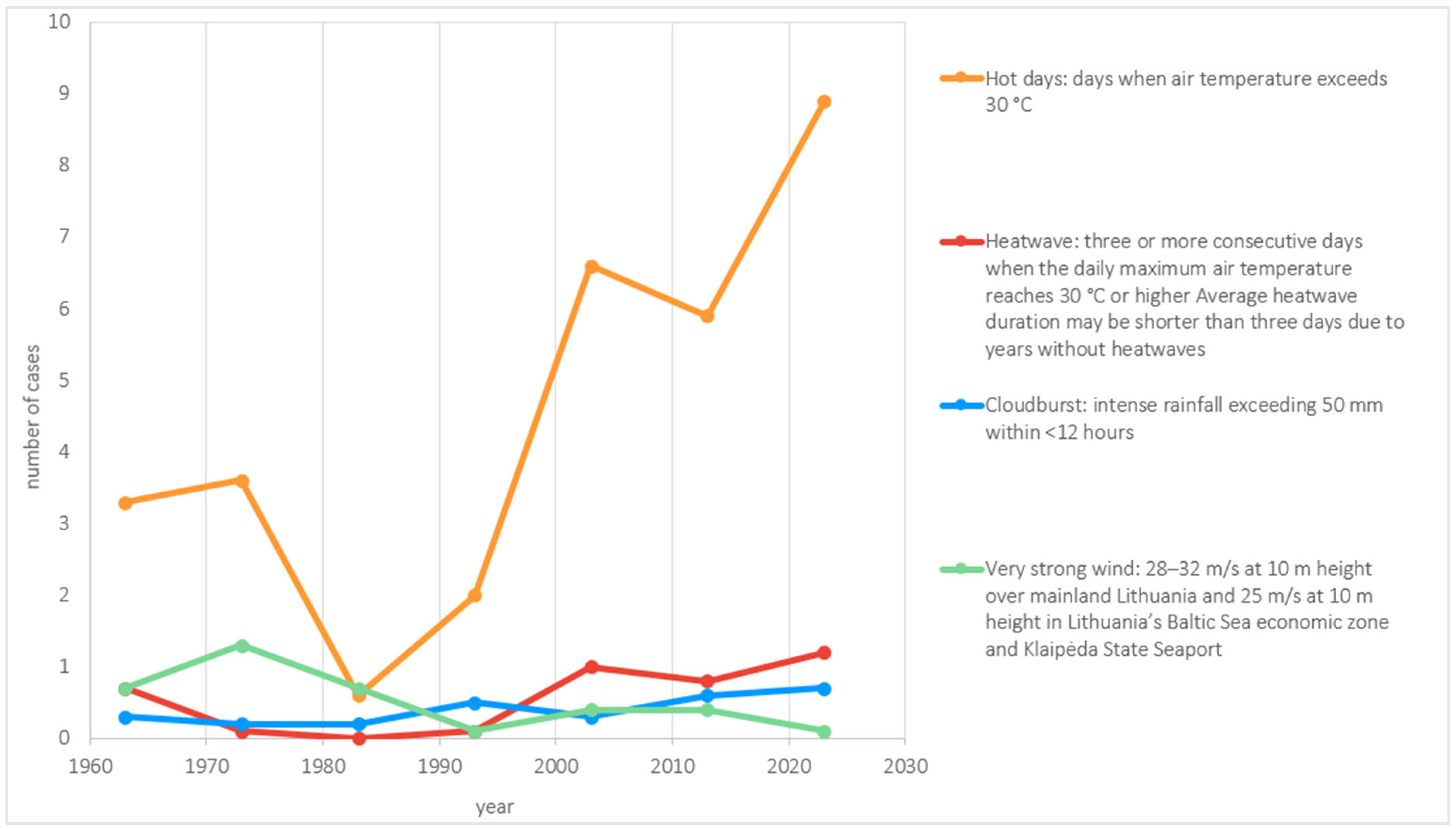
The past three decades experienced a pronounced increase in hot days (when air temperature exceeded 30 °C) in Lithuania’s largest cities—Vilnius and Kaunas (Figure 1). During 1964–1990, the annual average number of such days was approximately 2.1 (1964–1973—3.6 days, 1974–1983—0.6 days, 1984–1993—2 days); between 1994 and 2023, this indicator rose more than threefold to an average of 7.1 hot days per year (1994–2003—6.6 days; 2004–2013—5.9 days; 2014–2023—8.9 days per year) [15]. This increase correlates not only with general climatic warming but also with the urban heat island effect, which elevates air temperatures in densely built areas, particularly at night.
Future projections also indicate unfavourable trends. In a moderate-greenhouse-gas-emissions scenario (RCP 4.5), the number of hot days in Lithuania by the end of the twenty-first century could increase 1.6–1.7 times, and, in a pessimistic scenario (RCP 8.5), by more than threefold compared to the current climate norm [15,49,50]. This implies escalating risks to public health, greater energy demand for building cooling, and increased thermal stress on urban ecosystems.
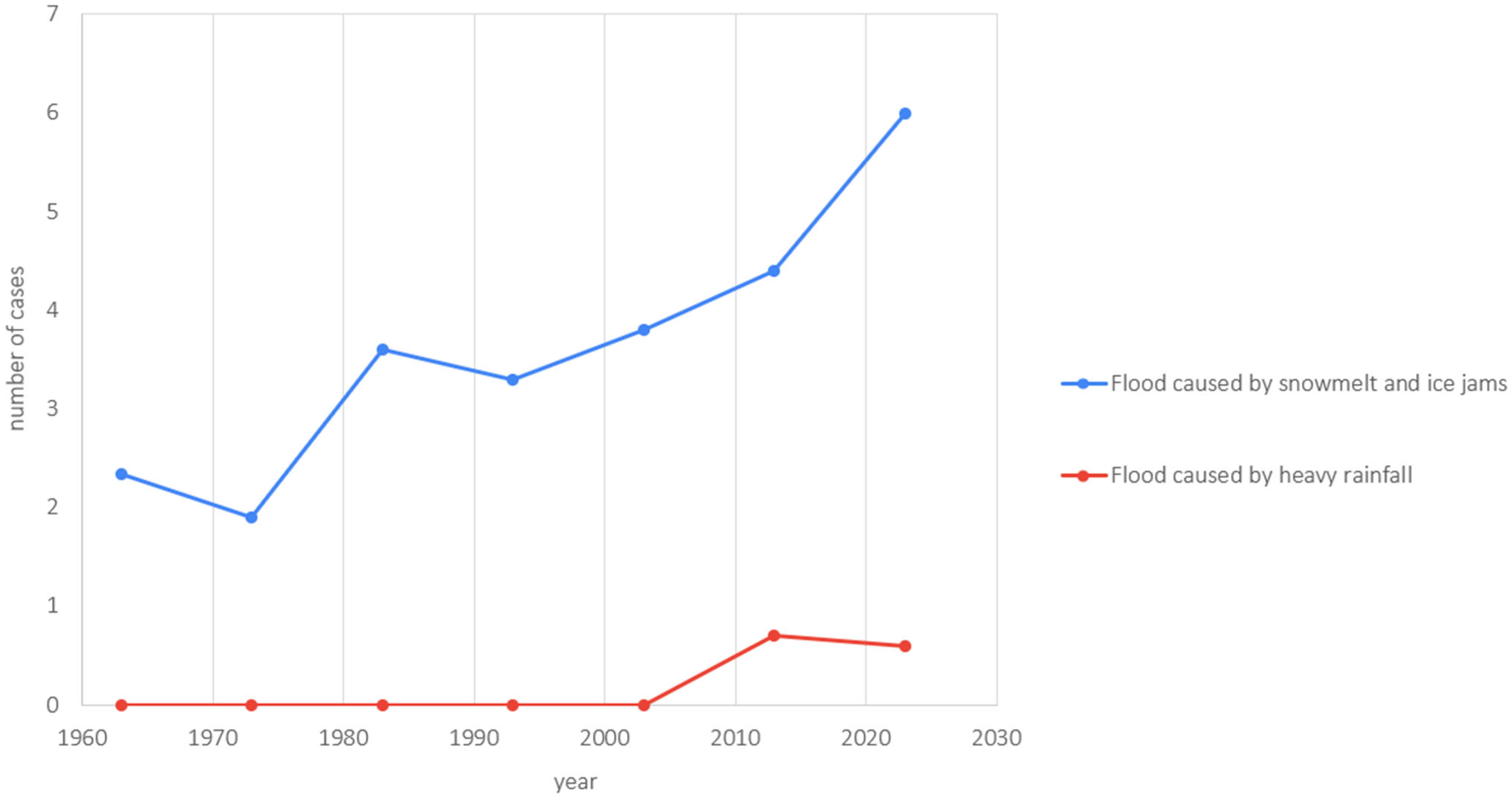
Regarding precipitation and flood regime changes, historically, approximately 90% of extreme floods in Lithuania were associated with spring snowmelt and ice jams in rivers (Figure 2). However, recent decades have shown a clear trend towards more frequent localised floods caused by intense cloudbursts, especially in urbanised areas where extensive impervious surfaces limit natural water infiltration into soil. Such floods are often of short duration but cause substantial damage to urban infrastructure, transport systems, and residents’ property [15].
According to LHMT statistical data [48], in each decade during 1961–1993, the three largest Lithuanian cities recorded an average of approximately four extreme precipitation events per decade—0.4 days per year with ≥50 mm rainfall within 12 h. Between 1994 and 2023, i.e., over the past three decades, this indicator increased (Figure 1). Notably, during 1994–2003, the number of such events per year reached 0.3, whereas, during 2004–2023, it more than doubled to an average of 0.6 (in 2004–2013) and then to 0.7 events (in 2014–2023) per year [15]. Future climate scenarios project that the frequency of extreme or even catastrophic rainfall events (with >80 mm precipitation within 12 h) may increase further, by approximately one-third under the RCP 4.5 scenario and up to three-quarters under RCP 8.5, relative to current conditions [15,49,50].
Regarding strong winds and storms, the overall number of large-scale storm events in Lithuania remains stable or shows a declining trend; however, with increasing temperature gradients and atmospheric instability, a rise in localised, short-duration but highly intense phenomena such as squalls or tornadoes is anticipated [15]. Such events pose significant risks to urban infrastructure due to their unpredictability and highly localised impacts.
In summary, the dynamics of extreme meteorological events in Lithuania clearly indicate a warming climate, an increasing frequency of heatwaves and intense precipitation, and a growing risk of compound events where, for instance, heatwaves are followed by sudden cloudbursts. These trends fundamentally align with observed changes across Europe [51,52,53]; therefore, a prompt response is necessary to mitigate the influence and impacts of these extreme events on populations, with particular emphasis on high-density residential areas likely to experience the greatest effects.

2.1.2. Preparedness of the Urban Structure and Environment of Lithuanian Cities to Function Under Climate Change and Other Potential Threat Conditions

Undoubtedly the most significant global threat, inevitably affecting Lithuania as well, is climate change on a global scale and its associated catastrophic phenomena—floods, heatwaves, storms, hurricanes, and wildfires [1,2,3,4]. In addition to these climate change-induced natural hazards, considerable danger is posed by anthropogenic threats—war and radiation hazards—which pollute air and water, destroy ecosystems, harm people and cities, and trigger migration waves [27,28]. Pandemic and epidemic threats are also particularly risky, arising from the combined impact of critical natural and anthropogenic factors [30,31].
These threats are particularly relevant to urban areas, where the proper development of necessary infrastructure can significantly reduce the potential adverse impacts of various emergency situations.
The preparation of the urban environment should be stipulated by legal documents regulating spatial planning and urbanism, as well as by the principal spatial planning documents of the country being prepared, in general and detailed plans. However, an assessment of the country’s principal Law on Spatial Planning [54], which governs urban development, reveals that, although the law’s provisions aim to take into account the negative consequences of climate change, they inadequately address land-use strategy and conservation and do not ensure the planning of infrastructure that enhances urban resilience. Furthermore, due to deficiencies in this law, provisions of other laws promoting increased ecosystem sustainability, restoration of natural resources [55], and urban planning based on sustainable development principles are essentially ineffective [56].
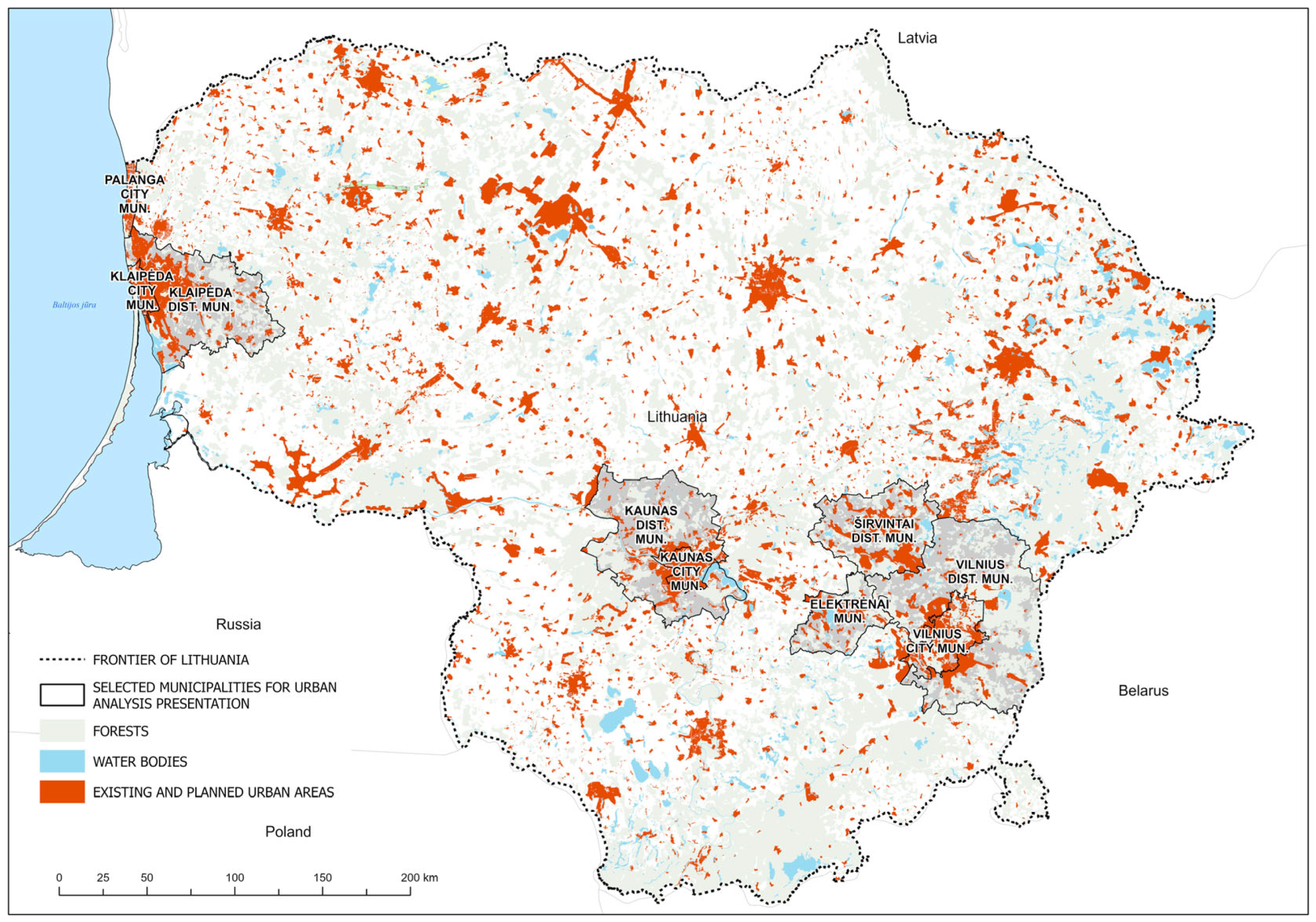
An analysis of spatial planning documents prepared in the country [57,58] indicates that their solutions also fail to adequately assess the negative consequences of emerging threats. Over recent decades, municipal general plans have designated areas for new urban development that, on average, are two to three times larger than the currently built-up areas. It has been established that municipal general plans together designate 4335 km2 of new development areas [57,58], whereas the existing built-up area in 2023 amounted to only 2434 km2 [59].
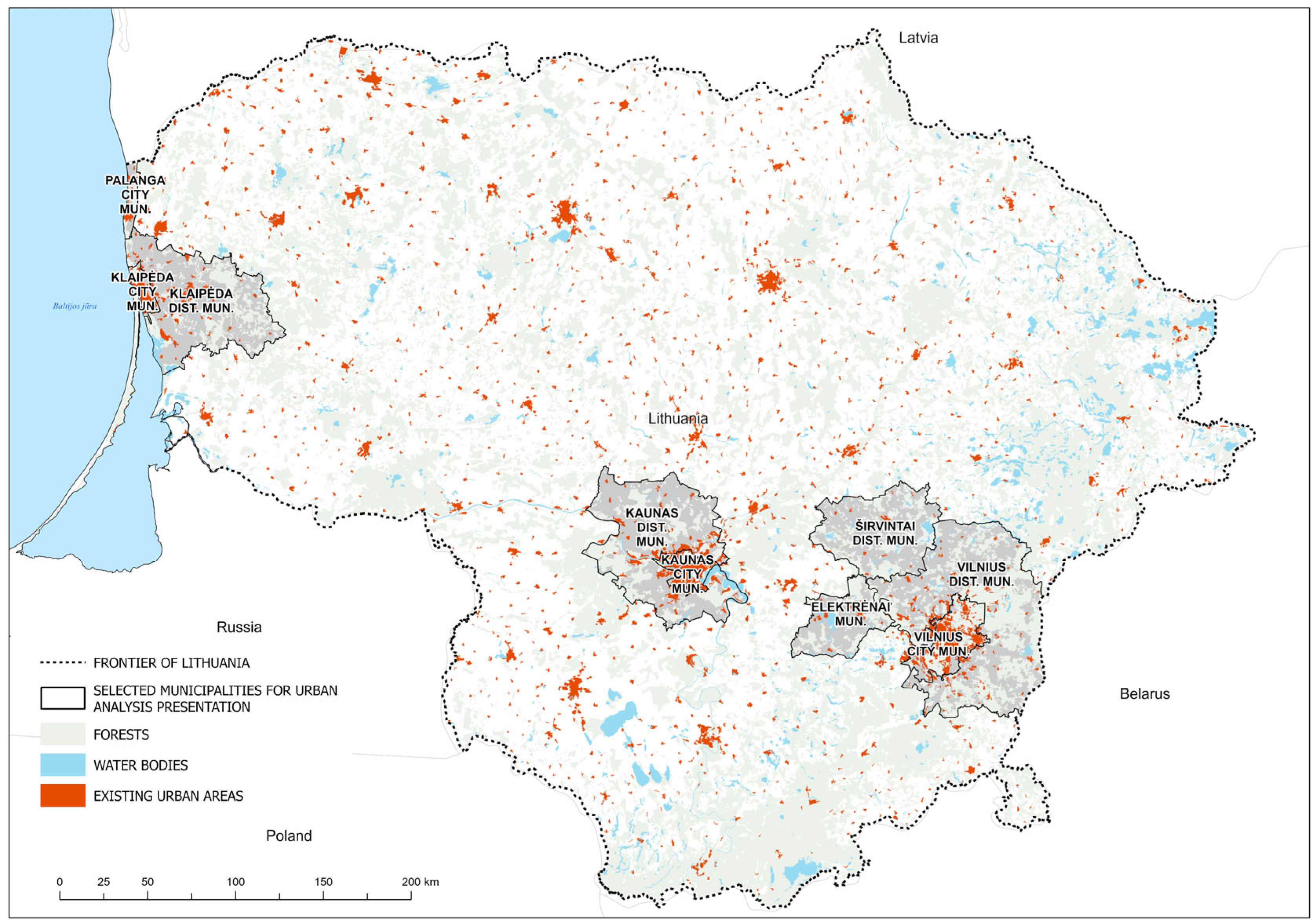
Such development is most often driven by uncontrolled municipal activity that, representing the interests of narrow groups, seeks to maximise opportunities for parcelling land for construction. It should also be noted that, to satisfy demand for construction plots, the Law on Green Spaces is being amended, thereby reducing and distancing green zones from the residential environment [60,61]. In this situation, irrational formation of new detached residential quarters occurs, with an unjustified layout of various haphazard facilities, both residential and industrial. Flood-prone areas are being developed, the natural framework is being destroyed, and the hydrographic network is being altered (of 1565 km2 of flood-risk territories, 115 km2 are urbanised or undergoing urbanisation). Particularly pronounced parcelling of plots is observed in the unrestrained urbanisation of the country’s major cities and the coastal zone (Figure 3 and Figure 4, Table 1).
Such unrestrained urban expansion can be illustrated by comparing land use with several European Union Member States. For instance, according to Eurostat data for 2022, in Lithuania, the area of urbanised territories per capita amounted to 1189.2 m2, whereas, in Germany, it was 573.3 m2 per capita, in Belgium, 578.1 m2, in the Czech Republic, 718.7 m2, and, in Poland, 692 m2 [62]. It should be noted that newly built-up area per capita in Lithuania is twice as high as in other countries. Negative land-take trends are also evident in recent urbanisation processes, whereby built-up areas increased from 1879 km2 in 2002 to 2485 km2 in 2025 [63,64], representing an increase of 60,600 ha or 32%. Meanwhile, the population during the same period changed from 3.443 million to 2.890 million, a decrease of 553,000 inhabitants [65]. This indicates that such urban development trends are unfounded and therefore unacceptable.
Uncontrolled urban development does not create opportunities for comprehensive creation of safety infrastructure facilities that, alongside climate change threats, could also be utilised in the event of war, radiation, or pandemic threats. The primary protective infrastructure for these threats should consist of shelters, protective structures, and other civil protection facilities for extreme situations. However, an assessment of the current state of preparedness leads only to the conclusion that the most important and best-protecting facilities—deep shelters—are entirely absent. According to statistics, protective shelters serve only a portion of the population in major cities—approximately 18% in Klaipėda, 33% in Kaunas, and 49% in Vilnius [66]—whereas the target norm is at least 60% [67]. Moreover, the legal framework for the deployment of such infrastructure, regrettably, is still not being prepared.
In summary, it can be argued that the emerging threats of climate change, war, and other risks are not being adequately assessed at the national level. This is evidenced by an insufficiently developed legal framework, uncontrolled urban development, unsustainable use of territorial resources, and inadequate protection of natural elements, as well as the lack of essential civil safety infrastructure. These factors—primarily rooted in shortcomings in spatial planning—form the basis for the proposals presented in this study for shaping a more sustainable urban structure.

2.2. Formation of a New, Sustainable Urban Structure of Cities Taking into Account the Threatening Impact of Climate Change and Other Negative Factors on Cities, the Environment, and People

2.2.1. Evolution of the Urban Structure of Cities and the Current State of Spatial Planning in Lithuania

In Lithuania, the principal traditional element of urban structure that has historically developed is the residential block [68]. It consists of a group of buildings arranged perimetrically, bounded on all sides by service streets intended for vehicle access and pedestrian approach to the buildings.
With the rapid growth of the global population, existing cities have expanded intensively and new cities have emerged. Alongside urban growth, industry, transport, resident service sectors, and other new urban functions have developed rapidly [68,69,70,71,72,73,74]. In addressing the spatial organisation of rapidly expanding industrial and residential areas, new urban planning concepts have been proposed—integrating functional zones and incorporating the natural environment (William Morris’s decentralised city), fragmenting the city into distinct parts (Ebenezer Howard’s Garden City), or responding to emerging transportation infrastructure conditions (Arturo Soria y Mata’s Linear City), among others [75,76].
In addition to the development of new urban planning models, the improvement of the structure of residential areas is of no less importance. Given that residential blocks planned in the 19th century are relatively small (approximately 0.5–1.5 ha in area), they lack the capacity to accommodate other necessary functions, such as services, recreation, and childcare or educational facilities. For this reason, at the beginning of the 20th century, residential blocks began to be enlarged (to approximately 5–6 ha in area); however, this mechanical increase in size proved ineffective, highlighting the need for new urban planning solutions.
In response to this situation, new directions and ideas in urban planning began to emerge globally, alongside the development of convenient structural elements for urban form. Accordingly, during the first half of the twentieth century, proposals arose to create urban territorial units capable of integrating daily service facilities such as schools, shops, and sports grounds [77,78]. Such a structural urban complex was formed by encircling its perimeter with arterial roads while retaining only service roads internally, thereby establishing a safe residential environment.
These proposals for creating structural urban units first appeared in the United States [29] and later spread to Europe [79,80]. In Europe, they evolved into the planning of large-scale urban complexes with expansive open spaces [81,82], which were introduced into Lithuania under the designation ‘microdistricts’ [68,69,83]. The planning and construction of such microdistricts in Lithuania occurred during the period 1962–1990.
However, from 1990–1991 onwards, shifts in the country’s political, economic, and demographic landscape—accompanied by intensive emigration, urban depopulation, and regional decline—altered construction scales, leading to the cessation of microdistrict development. Urban development and construction shifted from the domain of state-led policy to private developers, for whom economic profitability became paramount. Consequently, construction predominantly involved individual buildings on isolated plots lacking green spaces, engineering infrastructure, and social amenities, with little regard for shaping a high-quality residential environment or fulfilling societal and human needs.
To improve the urban situation nationwide, enhance residential environments, establish new urban green spaces, and expand recreational zones for residents, the Government of the Republic of Lithuania commissioned the preparation of the Republic of Lithuania Law on Landscaping in 2007 [84], which is mandatory for all urban planning projects (one of the authors of this text—L. Dringelis—also participated in drafting this law). This law provides a classification of urban green spaces, establishes normative standards, defines their integration within urban structure, specifies accessibility distances, and introduces other regulatory provisions. Although successfully applied in preparing urban plans of various scales, the law proved difficult to implement effectively due to construction occurring only on fragmented individual plots or small blocks.
In light of this situation and pressure from developers, the Law on Landscaping was subsequently amended; norms were reduced and accessibility distances extended [60,61]. Regrettably, these changes did not improve the formation of socially cohesive, ecologically resilient, or recreationally functional urban environments.
Deficiencies in territorial urban planning, residential environment quality, and public space formation across Lithuanian cities have become especially pronounced in the current era, amid emerging threats such as climate change, war, radiation hazards, pandemics, and other potential crises [85,86,87,88].
Considering these challenges, it has become necessary to formulate a new element of urban structure—a structural territorial unit or urban complex—capable of establishing a sustainable, safe, and ecologically sound living environment conducive to residence, work, and recreation.

2.2.2. Core Principles of Sustainability in Forming a New, Sustainable Urban Structure

It can be asserted that the primary and most significant factors shaping the development of a new urban structure are climate change, global warming, and their associated phenomena, including heatwaves, storms, hurricanes, floods, droughts, wildfires, and other extreme events. Although these destructive phenomena are of natural origin, they are widely regarded as being triggered or exacerbated by humanity’s self-interested and detrimental activities worldwide [89,90].
To mitigate the progression of climate change and safeguard against its catastrophic consequences, relevant documents have been adopted at both international [5,6,7,8,9,10,11] and national levels [55,56]. These documents primarily emphasise reducing greenhouse gas emissions, limiting fossil fuel consumption, and improving ecological conditions; however, they scarcely address the formation of new urban structures and residential environments in light of climate change projections.
Beyond global climate change, recent decades have also seen the emergence of localised anthropogenic factors including military threats (bombardments, shelling, destruction, and devastation of populations and environments) [91,92]; radiation hazards (large-scale radioactive contamination) [93,94]; pandemic risks (such as widespread infectious outbreaks among the population) [95,96]; and other potential factors whose destructive impacts are no less severe than those of climate change. Accounting for all these elements, it is essential to consider the known and other potential adverse factors when designing a new, sustainable urban structure.
To achieve sustainability in the envisioned urban structure, it is first necessary to acknowledge the principles of sustainability defined in the 1987 report of the United Nations World Commission on Environment and Development, ‘Our Common Future’ [97]. This conceptualisation of sustainability emphasises the necessity of achieving balanced interaction and harmony among its three core components—social, ecological, and economic—which are closely interrelated, mutually reinforcing, and capable of establishing appropriate and secure conditions for living, working, and recreation.
When formulating the proposed new sustainable element of urban structure, it is imperative to account for the objectives set forth by these sustainability components—social, ecological, and economic [40,97].
  • Objectives for implementing the social sustainability component:
    a.
    Ensuring residents’ safety, health, and residential comfort;
    b.
    Creating opportunities for recreation, leisure, and social interaction;
    c.
    Enabling social engagement across all age groups;
    d.
    Providing conditions for children’s education, diverse activities, sports, and recreation;
    e.
    Ensuring convenient and safe accessibility to public transport links and green recreational zones.
  • Objectives for implementing the ecological sustainability component:
    a.
    Establishing a healthy, safe, and ecologically sound residential environment;
    b.
    Removing through-traffic from residential areas by locating private vehicle parking along internal service roads;
    c.
    Developing an integrated green space system within the residential environment and in publicly accessible open areas.
  • Objectives for implementing the economic sustainability component:
    a.
    Urban structure, street network configuration, building typology, and other planning decisions must be justified, rational, compact, and cost-effective;
    b.
    The planned urban structure must incorporate reliable management, communication, security systems, and engineering infrastructure;
    c.
    The planned urban territory must be compact, resource-efficient, well-founded, and economically viable.
The integrated implementation of these core sustainability components—social, ecological, and economic—in shaping urban structure will enable the creation of a comprehensive, high-quality, sustainable, and secure residential environment.

2.2.3. Formation of a New Sustainable Territorial Urban Unit Within the Urban Structure of Cities and Its Conceptual Designation

Based on the sustainability principles and objectives outlined above, this study aims to formulate a new sustainable element of urban structure—a territorial urban unit or complex—to be employed in developing a novel city planning framework capable of mitigating the impacts of climate change.
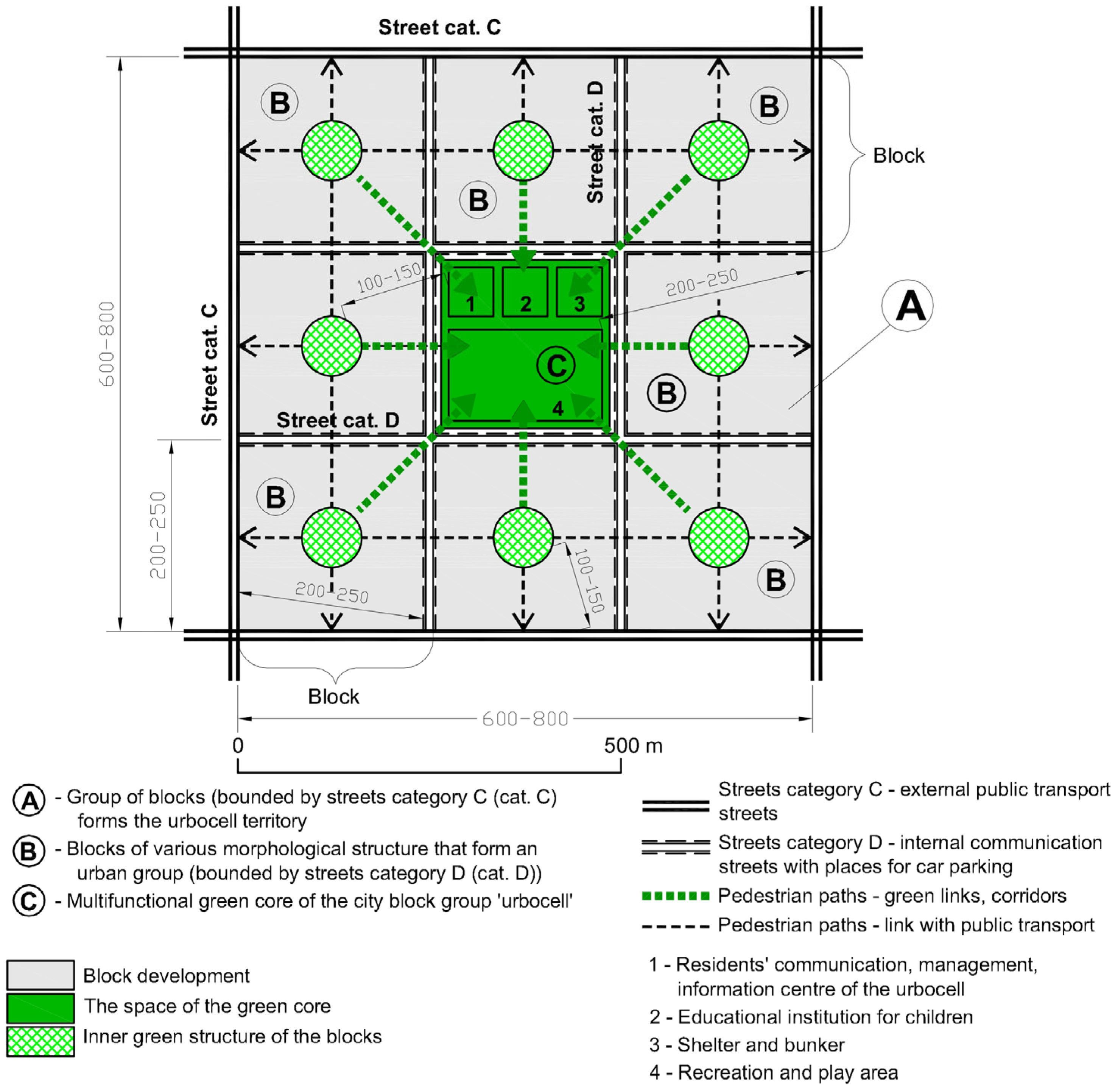
This urban structural complex should comprise a portion of urban territory bounded on all sides along its perimeter by the city’s public transport streets (categories B and C), thereby establishing a distinct, autonomously functioning entity while ensuring connectivity with the broader urban fabric. These public transport streets, in accordance with urban traffic organisation requirements [69,98,99,100], are laid out at intervals of 600–800 m, delineating a planned urban complex area of 40–60 hectares.
The internal structure of this urban complex consists of a grouping of residential blocks, each 3–4 hectares in size, exhibiting diverse building typologies and heights, bounded by internal auxiliary streets (category D), alongside which resident vehicle parking facilities are to be provided. Within each block, an internal green space is planned, with all vehicular traffic eliminated from its interior.
At the centre of the forming urban complex, encircled by residential blocks, a primary, mandatory structural element is envisaged—a multifunctional green area, or core—whose principal purpose is to ensure resident safety and protection against diverse threats (such as climate change, military hazards, radiation, pandemics) while creating conditions for recreation and leisure and enabling communication and social engagement. The foundation of the complex’s green core consists of landscaped green space incorporating recreation and play zones, early childhood education facilities, and structures dedicated to community social activities and interaction. However, the most critical facilities within this core comprise shelters and underground bunkers (repurposed during peacetime for cultural, educational, and other community functions), as well as a command, communications, and engineering services centre (Figure 5).
The transportation and connectivity system of the forming urban complex within the city’s urban structure comprises external public transport routes (categories B and C) linking the complex to the broader urban fabric; internal circulation streets (category D) delineating blocks and providing access to buildings; bicycle and micromobility pathways; and landscaped pedestrian routes—green connections—safely interlinking the complex’s blocks with each other, with external public transport streets, and with the internal centre—the green core.
Distances between block centres and external transport nodes and the internal green core average approximately 100–150 m, corresponding to the 5–10 min pedestrian accessibility standards advocated by contemporary urban planning paradigms [101].
The population of the forming urban complex, depending on its total area (40–60 ha), building typology, height, and other factors, could be between 7000 and 8000 residents or up to 12,000–15,000 or more residents. However, the precise population figure can only be determined upon completion of a detailed design for the complex.
To achieve a meaningful, semantically precise designation for this newly formulated sustainable territorial unit of urban structure—a structural complex—we draw upon bionics, the scientific discipline investigating the application of organismal structural and physiological principles to technological systems [102]. It has been established that this proposed new urban structural complex, in terms of its properties, such as functional mode, form, structure, and composition, corresponds entirely to the characteristics of a natural biological cell.
According to the definition of a biological cell [103], it constitutes an elementary living system capable of autonomous existence, growth, and reproduction. It forms the foundation of organismal structure, development, and vital functions. A cell comprises living cellular content—protoplasm—and a nucleus that regulates metabolic processes and biosynthesis and performs other essential functions. The cell is separated from its environment by a biological membrane that regulates internal composition and facilitates stable intercellular connections.
The proposed new sustainable structural urban complex, as previously noted, is autonomous, self-sustaining in its functioning, and capable of interconnection with other analogous urban complexes. The composition of this complex comprises residential blocks with internal infrastructure and a primary, central, vitally important element—the green core—housing facilities for resident recreation, social interaction, civil defence, communications systems, command functions, and engineering infrastructure. This urban complex is bounded along its entire perimeter by principal public transportation arteries that shield the complex from external noise and pollution while enabling integration with the city’s broader urban fabric.
Beyond the similarities in fundamental structural, functional, and sustainability properties, these two structures—the urban physical–technical configuration and the natural biological cellular organisation—are identical even in their detailed composition. For instance, the streets bounding the urban complex can be equated with a biological membrane that preserves cellular autonomy while simultaneously enabling connection with other cells. The residential blocks of this complex can be likened to cellular protoplasm, which fills the cell and constitutes its substantive content. The complex’s green core, vitally essential to its functioning, can be compared to the cell’s nucleus, which regulates cellular processes and sustains its vitality.
Taking all the foregoing into consideration, and seeking a meaningful designation with semantic clarity for this newly created territorial unit of urban structure—a structural urban complex—we propose naming this urban complex an urban cell, or urbocell. It is anticipated that this new, sustainable urbocell, when implemented, will provide the foundation for developing novel, sustainable, compact urban structures that are rationally grounded in social, ecological, and economic dimensions.
As previously noted, the territorial extent of the discussed urban structural complex or urbocell is determined by the city’s public passenger transport streets (categories B and C) that bound the complex, thereby delineating an urbocell territory of approximately 40–60 hectares. To establish approximate parameters for the urbocell’s residential block area, population size, green core dimensions, and other characteristics, we adopt a mean urbocell territorial size of 50 hectares. We further assume that the residential block area within this urbocell (excluding internal service streets and the green core) may preliminarily constitute approximately 40 hectares. Consequently, the urbocell’s population is determined by the building typology, height, and other characteristics of its blocks, which, in turn, dictate the size, functional purpose, and operational programme of the green core.
To systematise the urban planning process when selecting and modifying building typology and height, this study employs standardised construction types or morphotypes, wherein an indicative population density per hectare is established according to their inherent properties. The size of the green core is determined based on the local green space area of approximately 10–11 m2 per resident of the block group, as adopted in previous studies and normative documents. This value may be refined according to the core’s intended usage and operational programme.
As noted, the foundation of the urbocell’s green core may consist of a public park area (morphotype 9) supplemented by mandatory green core infrastructure elements—essential facilities for civil defence, social interaction, education, recreation, communications, command functions, and other functions.
As preliminary calculations demonstrate (Table 2), such a residential block grouping—the urbocell—may accommodate between 7000 and 8000 residents (e.g., morphotypes 3, 6) and up to 12,000–15,000 residents (morphotypes 4, 5) or more, depending on its development typology (morphotype). The green core size likewise depends on population numbers and its intended functional programme, potentially reaching 5–6 ha (3, 6 morph.) or 7–8 ha (4–5 morph.). Distances from block centres to the green core centre measure approximately 100–150 m and, to public transport streets, 150–200 m, constituting—as noted—a 10–15 min pedestrian journey.
In determining green core area, it is accepted that the minimum green core size must be no less than 2–3 ha when forming low-rise development structures and no greater than 7–8 ha when forming mid- and high-rise development structures. Intermediate green core area values are interpolated using exponential function calculations. Exponential variation reflects the regularities of most natural processes; therefore, this study adopts such variation as potentially justifying the required size of the forming urbocell’s core.
The presented table, having evaluated all possible development morphotype characteristics, selects for further modelling, according to urban planning parameters building height, landscaping, and other properties, those morphotypes applicable to cities of varying sizes.
In summary, it can be asserted that the territorial unit of urban structure—the urbocell—constitutes a comprehensively liveable, safe, ecologically sound, and economically efficient structural element of the city. The concept for creating this urbocell was previously outlined in an earlier issue of Urban Science (2025, p. 9, [104]), which presented the fundamental properties of this urban structural unit regarding its creation, functioning, and other characteristics, and is discussed in greater detail in the present article.

2.2.4. Integration of the Proposed New Structural Territorial Urban Unit ‘Urbocell’ into the Urban Fabric

The proposed new sustainable urban structural complex—the urbocell—as noted, represents a comprehensive, autonomously functioning component of urban structure, a territorial unit comprising a grouping of residential blocks with a mandatory green core essential for cellular functioning, which concentrates all necessary service elements for urbocell residents—recreation, social interaction, civil defence, information, communications, command functions, and others. This urbocell constitutes the smallest component of urban structure integrated into residential districts, which, in turn, form part of the city’s overall urban fabric.
A city’s residential district represents a portion of urban territory predominantly designated for residential use. Residential districts are typically formed by the city’s high-speed traffic streets (category A) and principal streets (category B). These are laid out at intervals of 1000–1500 m and subdivide urban territory into districts averaging 150–200 ha in area. Depending on development typology, such a district may accommodate on average 15,000–20,000 and 25,000–30,000 or more residents, for whom the district centre with park area should constitute approximately 20–30 ha.
The service radius of such a district centre with park would measure approximately 500–700 m, corresponding to up to a 15 min pedestrian journey, assuming a walking speed of 1 km per 15 min. Within this district centre, adjacent to the park, all facilities serving district residents should be located—public, commercial, medical, and other centres, civil defence installations, sports, recreation, and social interaction zones, necessary infrastructure, and other facilities.
Depending on the size of a city’s residential district, its composition may consist of several urbocells which are interconnected with the district centre and with each other via safe, landscaped pedestrian pathways within a 15–20 min walking distance, thereby forming a safe, sustainable, district-level urban system and structure.
The presented sustainable residential district of the city, together with other analogous city districts, is integrated into the overall urban fabric of the city.
As noted, the city’s urban structure comprises the previously discussed residential districts, which, in turn, consist of groups of residential blocks or urbocells with a vitally important, mandatory green core. The primary, most significant element of the city’s urban structure is the city’s public, cultural, and administrative centre with the city park, in the vicinity of which all the most important facilities for recreation, social activity, and communication, civil defence shelters, protective structures, and other necessary objects are located.
To create a sustainable, safe green system for the city, all urban green spaces with civil defence facilities—from the urbocell’s green core, through the district centre park, to the city’s central park—are linked into a unified whole via green connections or green corridors, enabling people to move safely through the city under prevailing circumstances.
In principle, an urbocell may be developed not only in new territories but also within existing urban structures by defining a green core area while ensuring connectivity requirements, as well as other relevant criteria. In a specific location, the formation of an urbocell requires that block layout, size, and form, as well as the overall spatial structure, be adapted to the local topography, hydrographic network, green spaces, and existing urban fabric.
This article presents the integration of the urbocell into the city’s urban structure only schematically, as a more detailed description is provided in a previously published journal article (p. 9, [104]).

2.3. Modelling and Evaluation of the New Urban Structural Unit of Cities—The Urbocell—Modifying Its Building Typology (Morphotypes)

2.3.1. Urbocell Building Variants and Their Selection for Modelling

Based on the research conducted in this work and the proposals presented, modelling of the building structure of the blocks constituting the urbocell is provided. Modelling of block building structures is performed to determine the possibilities of increasing the resilience of the urban cell to emerging climate change impacts.
Modelling of the urban cell’s block development structure is presented through the evaluation of the selection of development morphotypes. In this study, the development of urbocell blocks is examined through nine distinct morphotypes, the main characteristics of which are presented in Table 2.
The selection of building morphotypes for the urbocell structure may be influenced by various factors. Primarily, morphotypes for an urban complex are chosen based on the specific characteristics of a given city, including its development pattern, size, status, natural conditions, and historically established traditions of urban development. They are also chosen with regard to the intended functions of the area, among other considerations.
An urban cell may consist of a single morphotype or a combination of different morphotypes, the selection and modelling of which are influenced by the aforementioned and other relevant factors. Different morphotype combinations can be modelled to produce a range of technical, spatial, economic, and other characteristics, which can subsequently be evaluated to identify more resilient spatial structures in response to increasing extreme climatic events. Accordingly, to evaluate the potential of morphotype-based modelling for adapting urban cell structures to adverse climate impacts, this study examines morphotypes in greater detail with respect to the microclimatic conditions they generate.
For more detailed assessment and modelling, those morphotypes characteristic of Lithuanian cities and distinguished by their physical parameters—i.e., exhibiting greater contrast—are selected. These include the homestead development morphotype (morphotype 1), characteristic of small towns and the suburbs of larger cities; the perimeter block development (morphotype 3), characteristic of the central parts of almost all cities; and the high-rise freestanding development (morphotype 5), characteristic of the main residential zones of medium-sized and large cities.
These morphotypes differ in terms of their built form, height, building density, and other parameters, which, as indicated by previous field studies [105], may lead to greater microclimatic differences.

2.3.2. Modelling and Evaluation of the Selected Building Variants

To assess the potential differing microclimatic characteristics of the urbocell’s blocks, conceptual spatial models of the selected morphotypes were developed. They were created considering the most characteristic spatial structure parameters of each morphotype. The model of the homestead development morphotype consists of lower-volume, freestanding buildings, with their surroundings shaped by a closed arrangement of private territories. For the perimeter block development, a regular arrangement of larger-volume buildings was selected, with a clearly distinguished structure of public spaces and enclosed or semi-enclosed internal block spaces. For the high-rise development, there are groups of freestanding large high-rise buildings surrounded by considerably larger, merging open spaces.
To enable a more comprehensive analysis of the selected morphotypes, two modification variants were developed for each morphotype. These modifications were created by altering the building layout, greenery, and other spatial structure elements and parameters while preserving the fundamental structure of the morphotype in all cases.
Selection of a computer microclimatic modelling programme for determining and comparing the specific microclimatic conditions of morphotypes led to Autodesk Forma [106]. This computer programme enables microclimatic modelling to evaluate the perceived temperature arising in the environment of an urban structure using the Universal Thermal Climate Index (UTCI) calculation method [107]. Perceived temperature is a microclimatic comfort indicator that integrates the effects of air temperature, humidity, solar radiation, and wind, expressed in degrees Celsius. Using this method, the programme evaluates the changes in air temperature, wind speed, humidity, and solar radiation determined by the spatial model submitted for analysis and provides a derived perceived temperature index for the structure under investigation.
In addition to the aforementioned microclimatic indicator of perceived temperature, wind comfort conditions are also assessed in greater detail. These are evaluated across all seasons, based on long-term observations of wind speed and direction. This wind comfort level enables a broader assessment of the microclimatic comfort conditions of the analysed urban structure, which may occur under different seasonal conditions. Consequently, it allows for evaluation of the microclimatic suitability of the urban structure within a wider range of potential climatic scenarios.
For morphotype modelling, the city of Kaunas was selected as the geographic area, specifically, its urban outskirts, where new urban development is planned and where an urban cell could be implemented. From a climatic perspective, extreme summer heat conditions—becoming increasingly characteristic of the country—were chosen. For modelling, an air temperature of 30 °C and a south-westerly wind (SW) of 4 m/s (at 10 m height) were adopted. Based on the Copernicus ERA5 atmospheric data used by the Autodesk Forma programme, the modelling employed a relative humidity of 57%, cloud cover of 76%, and global solar radiation of 406 W/m2. The indicators for evaluating the microclimatic characteristics of morphotypes are presented in Table 3.
Following the microclimatic modelling analysis of the selected morphotype modifications, average perceived air temperature indicators were determined for interior spaces. In the homestead development morphotype, the modelled average perceived temperature reaches 33.3–33.9 °C, which is 3.3–3.9 °C higher than the initial air temperature entered for calculations. In the case of the perimeter block development morphotype, the perceived temperature rises less, to 32.7–32.8 °C, which is 2.7–2.8 °C higher than the initial temperature. A similar perceived temperature was determined for the high-rise development morphotype model, reaching only 31.9–32.3 °C, which is only 1.9–2.3 °C higher than the initial air temperature.
The differences in perceived temperature are influenced by the varying wind exposure and solar exposure conditions that develop across the morphotypes. According to wind exposure analysis results, a significant reduction in wind speed was observed in all morphotype models compared to the initial wind speed entered for calculations. Wind speed decreases most markedly in the homestead and perimeter block development morphotypes (to approximately ~1 m/s). However, higher wind speeds persist in the vicinity of the high-rise development (approximately 1.5–2 m/s). In terms of solar exposure, a larger surface area of shade is generated in the higher-rise morphotypes 3 and 5. As the analysis shows, higher wind speeds and greater shaded area lead to lower temperature indicators; this is best illustrated by the lowest perceived temperature recorded for the high-rise development morphotype.
Based on the modelling results, it can be asserted that, during hot days, more favourable microclimatic comfort conditions may arise in the more spacious perimeter block and high-rise morphotype structures than in the finer-grained homestead development structures. Accordingly, heat islands are likely to form more intensively in areas of detached residential morphotypes.
Analysis of perceived temperature during hot days indicates the most suitable spatial structure for creating cooler conditions and avoiding overheating of the residential environment. However, when selecting morphotypes for sustainable urban structures, it is necessary to evaluate the overall comfort provided by morphotypes across different seasons. From this perspective, the derived indicator of wind comfort level generated by the Autodesk Forma software for urban structures can be evaluated for all seasons. Following computational calculations, it was determined that more favourable comfort conditions according to wind comfort level arise in the homestead and perimeter block development morphotypes, where scores of 2.0 and 1.9, respectively, were recorded. Less favourable comfort conditions occur in the high-rise development structure, where the comfort level reaches 2.4 points.
The results of the microclimatic analysis—namely, the instantaneous perceived temperature and annual wind comfort level—indicate that, under extreme heat conditions, increased wind exposure in certain morphotypes, although contributing to greater discomfort, can reduce perceived air temperature in internal spaces and thereby lower the risk of overheating. However, under typical prevailing climatic conditions, higher wind exposure generally leads to increased discomfort and is unlikely to be acceptable for a significant portion of the year. Therefore, in selecting morphotypes for a more livable environment, it is essential to achieve a balanced relationship between microclimatic factors, ensuring their optimal performance under both extreme and typical climatic conditions.
Microclimatic analysis of morphotypes reveals the potential to model urban structures that are more resilient to heat island formation and simultaneously more comfortable under diverse climatic conditions. Thus, by selecting and analysing individual morphotypes, the optimal composition of urban cells can accordingly be determined.
Although microclimatic comfort conditions constitute one of the essential factors of residential environment quality, when shaping the optimal composition of an urban cell, other factors determining a sustainable urban structure must also be considered, such as territorial efficiency, vitality of the urban structure, and compactness of the territory, which are related to the corresponding residential density, building layout typology, and others.

3. Discussion

Climate change and other emerging threats, along with their increasing intensity, compel nations to seek measures and approaches to mitigate the potential negative consequences of various induced phenomena. One of the solutions proposed in this article is to pursue coordinated urban planning by creating comprehensive urban structural units—urbocells.
In forming the territorial unit of urban structure—the urbocell—the fundamental principles of sustainability theory are applied—social, ecological, and economic—which ensure the most important aspects of residential environment quality. Furthermore, the structure of the urbocell is based on efficient, rational use of urban territory, creating within a relatively modest area (40–60 ha) a compact, sustainable, liveable urban structural complex capable of autonomous functioning equipped with recreational green spaces, social facilities, and civil defence installations, fully aligning with the recommendations of international documents [9,11,41]. Although, in its properties, this model resembles a natural cell, it is not an urban model based on urban metabolism; rather, it is primarily grounded in functional urban aspects.
The urbocell model presented in this article is not the only such urban structure model proposed in the literature. In the field of urban studies, other functional and urban models that promote sustainable urban development have also been proposed by various authors. Notable studies include the humanisation of block groups (superblocks) [108], sponge cities [109], eco-smart cities [110], urban energy supply sustainability [111], implementation of advanced information technologies (smart cities, high-frequency cities, AI cities) [112,113,114], and urban biomimetic structures [115], among other developments. When comparing these models with the urbocell, it can be observed that, in most of the cases, more emphasis is placed on addressing individual aspects of urban functioning and on improving specific spatial elements, without encompassing the comprehensive formation of the urban structural foundation. In contrast, the urbocell model represents one of the attempts to comprehensively shape the basis of an urban territorial unit that would enable systematic planning of individual city parts. It could be implemented in both the normative and methodological literature, as well as in the fields of territorial planning and urban practice, ensuring the development of a sustainable urban structure and enhancing the sustainability of existing city parts through their modernisation or conversion.
Application of the urbocell model not only can ensure the formation of key structural elements —the green core and the transportation connectivity system—but can also create conditions for the deliberate selection of block development morphotypes, which may lead to greater or lesser resilience to the adverse effects of climate change. The research conducted in this work—computer modelling—demonstrated that the homestead development morphotype most significantly amplifies the heat effect—i.e., the perceived temperature—whereas the perimeter block and high-rise development types result in smaller microclimatic variations.
When the results of the computer modelling are compared with earlier field studies [105], it can be observed that the majority of the results correlate with each other. Both computer modelling and field studies indicate that smaller temperature differences occur in the case of high-rise developments, with computer modelling indicating a deviation of approximately 1.8 °C and field studies recording 0–1.5 °C. However, different results were obtained when evaluating low-rise development structures. Computer-based analysis of the detached housing morphotype revealed relatively significant temperature variations.
Different results were obtained when evaluating low-rise building structures. Computer-based analysis of the homestead development morphotype revealed relatively pronounced temperature deviations of approximately 3.5 °C, whereas field studies recorded some of the smallest deviations of 0–1 °C. Nevertheless, in field studies evaluating denser low-rise block development structures, similarly substantial deviations of 1.5–2 °C were also recorded. Such a distribution of results may be associated with the specific contextual conditions of the studied objects, including differences in landscaping and spatial configuration.
The temperature deviation identified for the homestead development morphotype in the computer-based analysis may be unexpected. However, in this case, it is important to consider that the low-rise homestead development was analysed as a denser, small-scale low-rise structure characterised by more enclosed spaces and smaller building shadow areas compared to structures with taller buildings and more open spaces. In addition, the analysis was conducted within a limited simulation domain of the computational model, which is more representative of enclosed inner urban areas than open suburban environments. These factors—both related to spatial configuration and methodological aspects of the modelling—are likely to have significantly influenced the temperature deviation results for this low-rise morphotype, indicating a higher potential for overheating within the area. Therefore, the results of the computer-based analysis should not be interpreted independently of the specific characteristics of the study case and the applied methodology and cannot be regarded as definitive in all cases.
Summarising the outcomes of sustainable urban structure research, one recommended direction is the application of higher-rise morphotypes when forming more spacious urban structures. This is corroborated by both field studies and computer modelling results. Similar conclusions are also formulated in the works of other researchers [116]. Beyond these microclimatic characteristics, it should be noted that the sustainability of the examined urban structure, exemplified by the proposed morphotype, is simultaneously determined by greater territorial compactness, higher population capacity, and more favourable overall conditions for establishing a vital urban structure. Consequently, incorporating the morphotype selected on this basis into the urbocell structure could enhance the resilience of urban residential environments to emerging threats.
Research on urban structure and morphotype sustainability can be expanded through more detailed analytical and modelling methods, as demonstrated by other authors’ evaluations of local urban climatic zone characteristics [117], detailed microclimatic analysis of specific urban structures, and investigations into the relationships among urban form, microclimate, and building energy consumption [118,119].
It is anticipated that the integration of the urban cell concept into territorial planning theory and practice will align with the interests of various nations and serve as a crucial foundation for better adapting urban structures to increase their resilience against potential negative consequences of emerging threats.

4. Conclusions

  • Ongoing climate change processes are generating escalating hazards—heatwaves, floods, storms, hurricanes—that devastate urban and natural environments, cause human casualties, trigger ecological and public health crises, and incur substantial material losses. Among emerging threats, heatwaves represent one of the most rapidly intensifying risks to urbanised territories. In Northern Europe and the cool-climate Baltic Sea region, they have become particularly acute due to urban environments not adapted to hot summer conditions. Projections indicate that, in the long term (by 2080–2100), with 3 °C warming relative to the pre-industrial period, the number of thermally comfortable hours in European cities could decline by up to 74%.
  • During the recent 1990–2020 decades, compared with the 1960–1990 period, Lithuania experienced extreme events with greater frequency; the number of hot days increased 3.25 fold, while days with heavy precipitation rose by approximately 0.6 fold. Such changes indicate intensifying trends in the recurrence of these extreme phenomena. Therefore, to mitigate the adverse impacts of impending heatwaves and floods, measures must be implemented to enhance urban resilience: developing urban structures that diminish heatwave effects, refraining from construction in flood-prone zones, expanding green spaces and water bodies, and preserving and restoring natural framework elements.
  • Current analysis of national urban preparedness for extreme events and hazards reveals that cities remain fundamentally unprepared, and necessary preparedness measures are inadequately implemented. Principal documents that could ensure adequate preparedness for climate change and other threats—municipal comprehensive plans—are often prepared irresponsibly, lacking clear coordination and professional oversight from higher-level institutions. The country is witnessing indiscriminate development of agricultural land with various structures, construction within natural framework zones, infilling of flood-risk areas for building projects, and other problematic practices. Insufficient attention is also devoted to civil defence infrastructure development; the country lacks adequate shelters, and their provision follows no coherent systematic approach.
  • Having assessed global threats posed by climate change, warfare, pandemics, and other potential hazards to populations, cities, and natural environments—and having established that the nation is unprepared and scarcely preparing to confront or mitigate the destructive consequences of these threats—this work presents proposals for forming a new, sustainable, and secure urban structure.
  • The formation of this new urban structure is grounded in the key principles of sustainability—social, ecological, and economic—whose harmonious interaction can enable the creation of an appropriate urban environment. The newly proposed sustainable territorial unit of urban structure—a structural complex—comprises a grouping of blocks with diverse development typologies bounded on all sides along its perimeter by the city’s public transport streets (categories B and C), thereby integrating the complex into the city’s overall spatial fabric. For functional operation of the complex, a mandatory structural element is envisaged at its centre—the green area, or core—designed to serve residents through protection against diverse threats, facilitation of communication and social activities, provision for children’s engagement, and support for recreation and leisure.
  • The territorial unit of the new urban structure, by virtue of its functional purpose, structural composition, capacity to maintain internal operational autonomy, and ability to integrate into the city’s broader urban fabric, corresponds in significant respects to the properties of a natural biological cell. Therefore, seeking meaningful semantic clarity, this territorial urban complex is defined as an urban cell or urbocell.
  • The presented new sustainable element of urban structure—the urbocell—parallels a natural biological cell, which, while preserving the autonomy of its internal composition and function, naturally integrates with other analogous cells into a unified living biological tissue. Similarly, the proposed technical urban cell, while maintaining its sustainable structural and functional autonomy, possesses the capacity to interconnect with other similar technical cells into a unified sustainable urban fabric, thereby forming new cities and districts.
  • The microclimatic characteristics of an urbocell are primarily determined by the building morphotypes of its constituent urban blocks, which may vary in terms of development pattern, density, height, and other parameters. A microclimatic analysis of selected morphotypes conducted using Autodesk Forma indicates that, during periods of elevated temperatures, high-rise and tall-building morphotypes exhibit the lowest heat accumulation and the greatest resistance to thermal stress. However, microclimatic performance is influenced not only by perceived temperature but also by factors such as wind exposure, humidity, and related variables. When these factors are taken into account, more favourable microclimatic comfort conditions are observed in more enclosed, smaller-scale morphotypes, such as detached housing and perimeter block developments. Given that an urbocell may comprise a range of development types, its overall microclimate is determined by the combined effect of its constituent morphotypes.

Author Contributions

Conceptualisation, E.R. and L.D.; methodology, E.R., L.D., A.B. and G.K.; software, E.R., A.B. and G.K.; validation, G.J.-V. and A.B.; formal analysis, E.R., A.B., L.D. and G.K.; investigation, E.R., A.B. and G.K.; resources, E.R., A.B. and G.K.; data curation, E.R. and G.J.-V.; writing—original draft preparation, E.R., A.B. and L.D.; writing—review and editing, E.R., A.B., L.D., G.K. and G.J.-V.; visualisation, E.R., A.B. and G.K.; supervision, E.R. and L.D.; project administration, E.R.; funding acquisition, E.R., A.B., L.D., G.K. and G.J.-V. All authors have read and agreed to the published version of the manuscript.

Funding

This research was funded by the Science Council of Lithuania (Lietuvos mokslo taryba LMT), grant number S-MIP-23-62.

Institutional Review Board Statement

Not applicable.

Informed Consent Statement

Not applicable.

Data Availability Statement

When conducting this research study, no data were created.

Conflicts of Interest

The authors declare no conflicts of interest.

References

  1. World Meteorological Organization. State of the Global Climate 2024; WMO: Geneva, Switzerland, 2025; No. 1368; Available online: https://library.wmo.int/idurl/4/69455 (accessed on 26 March 2026).
  2. World Meteorological Organization. Greenhouse Gas Bulletin: The State of Greenhouse Gases in the Atmosphere Based on Global Observations Through 2023; WMO: Geneva, Switzerland, 2024. [Google Scholar]
  3. United Nations Development Programme (UNDP). The World’s Largest Survey on Climate Change Is Out—Here’s What the Results Show. 2024. Available online: https://climatepromise.undp.org/news-and-stories/worlds-largest-survey-climate-change-out-heres-what-results-show (accessed on 2 May 2025).
  4. Kancs, D. Enhancing the Preparedness and Readiness; EERI Research Paper Series No. 08/2024; Economics and Econometrics Research Institute (EERI): Brussels, Belgium, 2024; Available online: https://hdl.handle.net/10419/311596 (accessed on 2 May 2025).
  5. United Nations. Kyoto Protocol to the United Nations Framework Convention on Climate Change; United Nations: San Francisco, CA, USA, 1998. [Google Scholar]
  6. United Nations. Paris Agreement; United Nations: San Francisco, CA, USA, 2015. [Google Scholar]
  7. European Commission. Communication from the Commission to the European Parliament, the Council, the European Economic and Social Committee and the Committee of the Regions; Roadmap to a Resource Efficient Europe; Office for Official Publications of the European Communities: Brussels, Belgium, 2011. [Google Scholar]
  8. Decision No. 1386/2013/EU of the European Parliament and of the Council of 20 November 2013 on a General Union Environment Action Programme to 2020 ‘Living Well, Within the Limits of Our Planet’. Available online: https://eur-lex.europa.eu/legal-content/EN/TXT/?uri=CELEX:32013D1386 (accessed on 27 January 2024).
  9. Communication from the Commission. The European Green Deal; COM (2019) 640 Final; European Commission: Brussels, Belgium, 2019; Available online: https://eur-lex.europa.eu/legal-content/EN/TXT/?uri=CELEX%3A52019DC0640 (accessed on 21 August 2024).
  10. World Health Organisation (WHO). Preparedness and Resilience for Emerging Threats (PRET). PRER Initiative in WHO’s South East Asia Region. Available online: https://www.who.int/southeastasia/outbreaks-and-emergencies/infectious-hazard-management/pret (accessed on 3 May 2025).
  11. United Nations. The New Urban Agenda; United Nations: New York, NY, USA, 2017; ISBN 978-92-1-132757-1. Available online: https://habitat3.org/the-new-urban-agenda/ (accessed on 30 December 2025).
  12. EUCRA. European Climate Risk Assessment. European Environment Agency Report. 2024. Available online: https://www.eea.europa.eu/en/analysis/publications/european-climate-risk-assessment (accessed on 26 March 2026).
  13. Feng, J.; Gao, K.; Khan, H.; Ulpiani, G.; Vasilakopoulou, K.; Young Yun, G.; Santamouris, M. Overheating of Cities: Magnitude, Characteristics, Impact, Mitigation and Adaptation, and Future Challenges. Annu. Rev. Environ. Resours. 2023, 48, 651–679. [Google Scholar] [CrossRef]
  14. Lenaerts, K.; Tagliapietra, S.; Wolff, G.B. How Can the European Union Adapt to Climate Change? Intereconomics 2022, 5, 314–321. [Google Scholar] [CrossRef]
  15. Ramanauskas, E.; Bukantis, A.; Dringelis, L.; Kaveckis, G.; Jonkutė-Vilkė, G. Climate Change and Cities of Lithuania: Threats, Problems and Prerequisites for Solution. Urban Sci. 2024, 8, 186. [Google Scholar] [CrossRef]
  16. Broto, V.C.; Bulkeley, H.A. Survey of Urban Climate Change Experiments in 100 cities. Glob. Environ. Change 2013, 23, 92–102. [Google Scholar] [CrossRef]
  17. Short, J.R.; Farmer, A. Cities and Climate Change. Earth 2021, 2, 1038–1045. [Google Scholar] [CrossRef]
  18. Filho, W.L.; Tuladhar, L.; Li, C.; Balogun, A.-L.; Kovaleva, M.; Abubakar, I.R.; Azadi, H.; Donkor, F. Climate Change and Extremes: Implications on City Livability and Associated Health Risks Across the Globe. Int. J. Clim. Change Strateg. Manag. 2022, 15, 1–19. [Google Scholar] [CrossRef]
  19. Stewart, I.D.; Oke, T.R. Local Climate Zones for Urban Temperature Studies. Bull. Am. Meteorol. Soc. 2012, 93, 1879–1900. [Google Scholar] [CrossRef]
  20. Demuzere, M.; Bechtel, B.; Middel, A.; Mills, G. Mapping Europe into Local Climate Zones. PLoS ONE 2019, 14, e0214474. [Google Scholar] [CrossRef] [PubMed]
  21. Erhorn-Kluttig, H.; Jank, R.; Schrempf, L.; Dütz, A.; Rumpel, F.; Schrade, J.; Erhorn, H.; Beier, C.; Sager, C.; Schmidt, D. Energetische Quartiersplanung; Fraunhofer IRB Verlag: Stuttgart, Germany, 2011. [Google Scholar]
  22. Kaveckis, G. Modeling Future Population’s Vulnerability to Heat Waves in Greater Hamburg. Ph.D. Thesis, Staats-und Universitätsbibliothek Hamburg Carl von Ossietzky, Hamburg, Germany, 2017. [Google Scholar]
  23. Mažeikis, A. Urbanization Influence on Meteorological Parameters of Air Pollution: Vilnius Case Study. Baltica 2013, 26, 51–56. [Google Scholar] [CrossRef]
  24. Misiune, I.; Kazys, J. Accessibility to and Fragmentation of Urban Green Infrastructure: Importance for Adaptation to Climate Change. In Human-Nature Interactions; Misiune, I., Depellegrin, D., Vigil, L.E., Eds.; Springer Nature: Cham, Switzerland, 2022; pp. 235–246. Available online: https://www.researchgate.net/publication/361662695_Accessibility_to_and_Fragmentation_of_Urban_Green_Infrastructure_Importance_for_Adaptation_to_Climate_Change (accessed on 3 May 2025).
  25. Urbanavičiūtė, L.; Bukantis, A. The Formation of a Heat Island in Vilnius city. Vilnius Univ. Proc. 2020, 10, 29. [Google Scholar] [CrossRef]
  26. Bukantis, A.; Klimavičius, L. Urban Effects on Heat Wave Intensity and Duration: A Case Study of the Vilnius City. In Proceedings of the EMS Annual Meeting 2024, Barcelona, Spain, 2–6 September 2024. [Google Scholar] [CrossRef]
  27. Shishovski, J.; Blazhevski, S.; Mileva, I. The Redesign of Cities for Urban Warfare Resilience and Deterrence After the Russo-Ukrainian War of 2022. In Proceedings of the Annual International Conference on Emerging Ideas, Skopje, North Macedonia, 22 September 2022; pp. 75–87. [Google Scholar] [CrossRef]
  28. Laakkonen, S. Urban Resilience and Warfare: How did the Second World War Affect the Urban Environment? City Environ. Interact. 2020, 5, 100035. [Google Scholar] [CrossRef]
  29. Denman, D.S. On Fortification: Military Architecture, Geometric Power, and Defensive Design. Secur. Dialogue 2019, 51, 231–247. [Google Scholar] [CrossRef]
  30. Banai, R. Pandemic and the Planning of Resilient Cities and Regions. Cities 2020, 106, 102929. [Google Scholar] [CrossRef]
  31. Sun, Y.; Weightman, R.; Dogan, T.; Samaranayake, S.A. Review of Urban Resilience Frameworks: Transferring Knowledge to Enhance Pandemic Resilience. arXiv 2025. [Google Scholar] [CrossRef]
  32. Mobaraki, A.; Nikoofam, M.; Mobaraki, B. The Nexus of Morphology and Sustainable Urban Form Parameters as a Common Basis for Evaluating Sustainability in Urban Forms. Sustainability 2025, 17, 3967. [Google Scholar] [CrossRef]
  33. Jiang, Y.; Huang, Z.; Zhou, X.; Chen, X. Evaluating the Impact of Urban Morphology on Urban Vitality: An Exploratory Study Using Big Geo-Data. Int. J. Digit. Earth 2024, 17, 2327571. [Google Scholar] [CrossRef]
  34. Avtar, R.; Ahmad, S.; Rahman, M.M.; Saleh Alsulamy, S.; Gowhar Meraj, G.; Mahendra Sethi, M.; Chander, K.; Singh, C.K.; Kharrazi, A. Impact of Urban Density on Human Well-being and Sustainable Development in Delhi, India. Sci. Rep. 2025, 15, 33717. [Google Scholar] [CrossRef] [PubMed]
  35. He, W.; Weng, Q. Disparities of Urban Morphology Effects on Compound Natural Risks: A Multiscale Study Across the USA. npj Urban Sustain. 2025, 5, 39. [Google Scholar] [CrossRef]
  36. El-Derawy, S.; El-Zafarany, A.; Abd El-Aziz, N.A. Using Urban Spaces to Enhance City Resilience: A Framework for Planning and Design. Civ. Eng. Archit. 2025, 13, 2134–2152. [Google Scholar] [CrossRef]
  37. Zhang, Y.; Wang, X.; Wang, L.; Li, G.; Zhang, Y.; Ye, Y.; Jiang, H.; Zhong, S.; Song, J. Measurement and Optimization of Sustainable Urban Form Elements in New Urban Districts Using Multi-source Data. Front. Environ. Sci. 2024, 12, 1451903. [Google Scholar] [CrossRef]
  38. Zaleckis, K.; Mlinkauskiene, A.; Grazuleviciute-Vileniske, I.; Ivaskevicius, M. Visibility and Reachability of Interwar Modernism (Kaunas Case). Urban Sci. 2025, 9, 533. [Google Scholar] [CrossRef]
  39. Li, Y.; Gu, K. Urban Morphology and Transit-Oriented Development (TOD): Planning and Managing Urban Change in New Zealand. Cities 2025, 167, 106407. [Google Scholar] [CrossRef]
  40. Moreno, C.; Allam, Z.; Chabaud, D.; Gall, C.; Pratlong, F. Introducing the ‘15-Minute City’: Sustainability, Resilience and Place Identity in Future Post-pandemic Cities. Smart Cities 2021, 4, 93–111. [Google Scholar] [CrossRef]
  41. United Nations. Transforming Our World: The 2030 Agenda for Sustainable Development; United Nations: San Francisco, CA, USA, 2015. [Google Scholar]
  42. Adil, L.; Eckstein, D.; Kuenzel, V.; Schaefer, L. Climate Risk Index 2025–Who Suffers Most from Extreme Weather Events? Germanwatch. Available online: https://www.germanwatch.org/en/node/93013 (accessed on 26 March 2026).
  43. New Records Daily Global Average Temperature Reached in July 2024. Copernicus–European Union’s Earth Observation Programme. 2024. Available online: https://climate.copernicus.eu/new-record-daily-global-average-temperature-reached-july-2024 (accessed on 16 November 2025).
  44. Copernicus–European Union’s Earth Observation Programme. 2024–A Second Record-Breaking Year, Following the Exceptional 2023. 2025. Available online: https://climate.copernicus.eu/sites/default/files/custom-uploads/GCH-2024/GCH2024.pdf (accessed on 16 November 2025).
  45. Alogoskoufis, S.; Dunz, N.; Emambakhsh, T.; Hennig, T.; Kaijser, M.; Kouratzoglou, C.; Muñoz, M.A.; Parisi, L.; Salleo, C. ECB Economy-Wide Climate Stress Test: Methodology and Results; European Central Bank: Frankfurt, Germany, 2021; Available online: https://www.ecb.europa.eu/pub/pdf/scpops/ecb.op281~05a7735b1c.en.pdf (accessed on 30 December 2025).
  46. EEA–European Environment Agency. Economic Losses and Fatalities from Weather-and Climate-Related Extremes. 2025. Available online: https://www.eea.europa.eu/en/analysis/publications/economic-losses-from-climate-extremes (accessed on 15 November 2025).
  47. Armstrong, D.I.; Staal, A.; Abrams, J.F.; Winkelmann, R.; Sakschewski, B.; Loriani, S.; Fezer, I.; Cornell, S.; Rockstrom, J.; Lenton, T.M. Exceeding 1.5 °C Global Warming Could Trigger Multiple Climate Tipping Points. Science 2022, 377, eabn7950. [Google Scholar] [CrossRef]
  48. Data of the Lithuanian Hydrometeorological Service (LHMS): Statistical Data of Hot Days, Extreme Heatwaves, Heavy Rainfall, Intense Wind, River Floods. Available online: https://www.meteo.lt/paslaugos/prasymai-hidrometeorologinems-paslaugoms-gauti/ (accessed on 22 March 2024).
  49. Ministry of Environment of the Republic of Lithuania. Developing Projections of Climate Change to 2100. Inception Report for Phase I of the Project ‘Preparation of Climate Change Projections, a National Study on the Sensitivity and Vulnerability of Lithuanian Municipalities to Climate Change, and a Climate Change Adaptation Plan for the Most Vulnerable Municipality’. 2022. Available online: https://am.lrv.lt/lt/ (accessed on 27 January 2024).
  50. Stocker, T.F.; Qin, D.; Plattner, G.-K.; Tignor, M.; Allen, S.K.; Boschung, J.; Nauels, A.; Xia, Y.; Bex, V.; Midgley, P.M. (Eds.) IPCC, 2013: Climate Change 2013: The Physical Science Basis; Contribution of Working Group I to the Fifth Assessment Report of the Intergovernmental Panel on Climate Change; Cambridge University Press: Cambridge, UK; New York, NY, USA, 2013; p. 1535. [Google Scholar]
  51. Fang, B.; Rakovec, O.; Bevacqua, E.; Kumar, R.; Zscheischler, J. Diverging Trends in Large Floods Across Europe in a Warming Climate. Commun. Earth Env. 2025, 6, 717. [Google Scholar] [CrossRef]
  52. Copernicus–European Union’s Earth Observation Programme. European State of the Climate: Striking East-West Contrast and Widespread Flooding in Europe’s Warmest Year. 2025. Available online: https://climate.copernicus.eu/european-state-climate-striking-east-west-contrast-and-widespread-flooding-europes-warmest-year (accessed on 30 December 2025).
  53. Boboc, L.; Dima, M.; Vaideanu, P.; Ionita, M. Trends and Variability of Heat Waves in Europe and the Association with Large-scale Circulation Patterns. Weather Clim. Extrem. 2025, 49, 100794. [Google Scholar] [CrossRef]
  54. Republic of Lithuania Law on Territorial Planning. No. I-1120, New Redaction from 2014-01-01. 12 December 1995. Available online: https://e-seimas.lrs.lt/portal/legalAct/lt/TAD/TAIS.23069/asr (accessed on 30 December 2025).
  55. National Climate Change Management Policy Strategy, Adopted by Seimas of Republic of Lithuania on 6 November 2012, Amendment No. XI-2375. Available online: https://e-seimas.lrs.lt/portal/legalAct/lt/TAD/TAIS.437284 (accessed on 30 December 2025).
  56. National Climate Change Management Agenda. Approved by Resolution No. XIV-490 of the Seimas of the Republic of Lithuania. 30 June 2021. Available online: https://e-seimas.lrs.lt/portal/legalAct/lt/TAD/219a2632a6b311ecaf79c2120caf5094?jfwid=-56ckr0gcc (accessed on 30 December 2025).
  57. Register of Territorial Planning Documents of the Republic of Lithuania. 2023. Available online: https://tpdr.planuojustatau.lt/map/main.html (accessed on 15 January 2025).
  58. Geo-Object Data. Lithuanian Spatial Data Web, VšĮ Statybos Sektoriaus Vystymo Agentūra (Public Institution Construction Sector Development Agency). Available online: https://www.geoportal.lt/geoportal/ (accessed on 21 August 2024).
  59. National Land Agency of Ministry of Environment. Land Bank of the Republic of Lithuania, 1 January 2023; National Land Agency of Ministry of Environment: Vilnius, Lithuania, 2023. [Google Scholar]
  60. Norms for Separate Green Areas for Recreational Purposes, Adopted by Minister of Environment of the Republic of Lithuania 21 December 2007; Order No. D1-694. Available online: https://e-seimas.lrs.lt/portal/legalAct/lt/TAD/TAIS.311858?jfwid=v7tysp5gz (accessed on 21 August 2024).
  61. Norms for Public Separate Green Areas, Adopted by Minister of Environment of the Republic of Lithuania 27 May 2022; Order No. D1-151, Implemented in New Redaction Adopted by Minister of Environment of the Republic of Lithuania 1 May 2023; Order No. D1-146. Available online: https://www.e-tar.lt/portal/legalAct.html?documentId=a4450c00ddcf11ec8d9390588bf2de65 (accessed on 21 August 2024).
  62. Eurostat–official website of the European Union. Settlement Area. 2025. Available online: https://ec.europa.eu/eurostat/databrowser/view/lan_settl/default/table (accessed on 30 December 2025).
  63. National Land Agency of Ministry of Environment. Land Bank of the Republic of Lithuania, 1 January 2002; National Land Agency of Ministry of Environment: Vilnius, Lithuania, 2002. [Google Scholar]
  64. National Land Agency of Ministry of Environment. Land Bank of the Republic of Lithuania, 1 January 2025; National Land Agency of Ministry of Environment: Vilnius, Lithuania, 2025. [Google Scholar]
  65. State Data Agency. Statistical Data of Population of Lithuania. Available online: https://osp.stat.gov.lt/statistiniu-rodikliu-analize#/ (accessed on 30 December 2025).
  66. Data of the Fire and Rescue Department (FRD) Under the Ministry of the Interior: Statistical Data of Shelters and Refuges in Lithuania for 2024. Available online: https://lt72.lt/kolektyvines-apsaugos-statiniai-priedangos-ir-rusiai/ (accessed on 22 March 2024).
  67. Civil Security Strengthening and Development Programme, Approved by Seimas of the Republic of Lithuania. Resolution No. XIV-2946. 18 July 2024. Available online: https://e-seimas.lrs.lt/portal/legalAct/lt/TAD/62090bc1458d11efb121d2fe3a0eff27?jfwid=sypti4z69 (accessed on 2 May 2025).
  68. Šešelgis, K. Miestų Raida: Sąlygos ir Rezultatai; Technika: Vilnius, Lithuania, 1996; ISBN 9986-05-268-8. [Google Scholar]
  69. Vanagas, J. Miesto Teorija; Vilniaus Dailės Akademijos Leidykla: Vilnius, Lithuania, 2003; ISBN 9986-571-85-5. [Google Scholar]
  70. Zaleckis, K. Erdvės Sintaksė Urbanistinei Analizei: Koncepcijos, Apskaičiavimai ir Pavyzdžiai; Vilniaus Dailės Akademijos Leidykla: Vilnius, Lithuania, 2018; ISBN 9789955964292. [Google Scholar]
  71. Hohenberg, P.M. The Historical Geography of European Cities: An Interpretive Essay. In Handbook of Regional and Urban Economics; Vernon Henderson, J., Thisse, J.-F., Eds.; Elsevier: Amsterdam, The Netherlands, 2004; Volume 4, pp. 3021–3052. [Google Scholar] [CrossRef]
  72. Gauthiez, B. The History of Urban Morphology. Urban Morphol. 2004, 8, 71–89. [Google Scholar] [CrossRef]
  73. Grabowski, M. The 18th and 19th Century Industrialization Process as the Main Aspect of City Creation and its Impact on Contemporary City Structures: The Case of Lodz. IOP Conf. Ser. Mater. Sci. Eng. 2019, 471, 082046. [Google Scholar] [CrossRef]
  74. Jeremy, A.; Robert, A.M.; Paul, W.R. Industrialization and Urbanization in Nineteenth Century America. Reg. Sci. Urban Econ. 2022, 94, 103678. [Google Scholar] [CrossRef]
  75. Howard, E. Garden Cities of To-Morrow; Osborn, F.J., Ed.; Routledge: London, UK, 2007. [Google Scholar] [CrossRef]
  76. Clark, B. Ebenezer Howard and The Marriage of Town and Country: An Introduction to Howard’s Garden Cities of Tomorrow (Selections). Organ. Environ. 2003, 16, 87–97. [Google Scholar] [CrossRef]
  77. Perry, C.A. The Neighbourhood Unit; Routledge: London, UK, 1998; pp. 25–44. [Google Scholar]
  78. Peterson, J.A. The Birth of City Planning in the United States, 1840–1917; The Johns Hopkins University Press: Baltimore, MD, USA, 2003. [Google Scholar]
  79. Platt, H. American Urban Planning Since 1850. In The Oxford Encyclopedia of American History; Gilfoyle, T.J., Ed.; Oxford University Press: Oxford, UK, 2018. [Google Scholar] [CrossRef]
  80. Guerra, M.W.; Abarkan, A.; Castrillo Romon, M.A.; Pekar, M. (Eds.) European Planning History in the 20th Century–A Continent of Urban Planning; Routledge: New York, NY, USA, 2022. [Google Scholar] [CrossRef]
  81. Corbusier, L. The City of To-Morrow and Its Planning (1929); Dover Publications: New York, NY, USA, 1987; ISBN 13-978-0486253329. [Google Scholar]
  82. Lora, J.A.R.; Carrillo, D.N.; Cano, M.T.P. Le Corbusier’s Urbanism: An Urban Characterisation of his Proposals for Inner Cities. Front. Archit. Res. 2021, 10, 701–714. [Google Scholar] [CrossRef]
  83. Miškinis, A. Lietuvos Urbanistika: Istorija, Dabartis, Ateitis; Mintis: Vilnius, Lithuania, 1991; ISBN 5417001244. [Google Scholar]
  84. Republic of Lithuania Law on Green Areas. No. X-1241, New Redaction from 2021-11-01. 28 June 2007. Available online: https://e-seimas.lrs.lt/portal/legalActEditions/lt/TAD/TAIS.301807 (accessed on 21 August 2024).
  85. McBean, G.; Ajibade, I. Climate Change, Related Hazards and Human Settlements. Curr. Opin. Environ. Sustain. 2009, 1, 179–186. [Google Scholar] [CrossRef]
  86. Laino, E.; Iglesias, G. Extreme Climate Change Hazards and Impacts on European Coastal Cities: A Review. Renew. Sustain. Energy Rev. 2003, 184, 113587. [Google Scholar] [CrossRef]
  87. Chirico, F. Spirituality to Cope with COVID-19 Pandemic, Climate Change and Future Global Challenges. J. Health Soc. Sci. 2021, 6, 151–158. Available online: https://journalhss.com/wp-content/uploads/jhhs_62_151-158.pdf (accessed on 28 April 2026).
  88. Gameiro, F.; Ferreira, P.; Faria, M. Association Between Social and Emotional Competencies and Quality of Life in the Context of War, Pandemic and Climate Change. Behav. Sci. 2023, 13, 249. [Google Scholar] [CrossRef] [PubMed]
  89. Kumar, V.; Ranjan, D.; Verma, K. Global Climate Change: The Loop Between Cause and Impact. In Global Climate Change; Singh, S., Singh, P., Rangabhashiyam, S., Srivastava, K.K., Eds.; Elsevier: Amsterdam, The Netherlands, 2021; pp. 187–211. [Google Scholar] [CrossRef]
  90. Gabric, A.J. The Climate Change Crisis: A Review of Its Causes and Possible Responses. Atmosphere 2023, 14, 1081. [Google Scholar] [CrossRef]
  91. McCarthy, J. How War Impacts Climate Change and the Environment; Global Citizen: New York, NY, USA, 2022; Available online: https://bit.ly/3CWQ5VI (accessed on 20 January 2025).
  92. Ciot, M.G. The Impact of the Russian–Ukrainian Conflict on Green Deal Implementation in Central–Southeastern Member States of the European Union. Reg. Sci. Policy Pract. 2023, 15, 122–144. [Google Scholar] [CrossRef]
  93. International Atomic Energy Agency. Environmental Consequences of the Chernobyl Accident and Their Remediation: Twenty Years of Experience/Report of the Chernobyl Forum Expert Group ‘Environment’; International Atomic Energy Agency: Vienna, Austria, 2006; Available online: https://www-pub.iaea.org/MTCD/Publications/PDF/Pub1239_web.pdf (accessed on 21 January 2025).
  94. Engler, J.O. Global and Regional Probabilities of Major Nuclear Reactor Accidents. J. Environ. Manag. 2020, 269, 110780. [Google Scholar] [CrossRef] [PubMed]
  95. Aiswarya Raj, S.; Angella, E.J.; Pooja, C. Impact of COVID-19 in Shaping New Resilient Urban Planning Approach. IOP Conf. Ser. Mater. Sci. Eng. 2021, 1114, 012040. [Google Scholar] [CrossRef]
  96. Zhu, X.; Xu, J. After the Pandemic is Before the Pandemic: Rethinking Urban Priorities, Assumptions and Planning Approaches. Heliyon 2023, 9, e20763. [Google Scholar] [CrossRef]
  97. Brundtland, G. Report of the World Commission on Environment and Development: Our Common Future; United Nations General Assembly Document A/42/427; NGO Committee on Education: Geneva, Switzerland, 1987; Available online: https://digitallibrary.un.org/record/139811?v=pdf (accessed on 20 January 2025).
  98. Urbanizuotų Teritorijų Susisiekimo Sistemų Planavimo Normos, Adopted by Minister of Enironment by Order 2015 m. Vasario 12 d. Nr. D1-110. Available online: https://e-seimas.lrs.lt/portal/legalAct/lt/TAD/03d583b0b2a511e486d695b7d843f736?jfwid=bkaxm7a0 (accessed on 20 January 2025).
  99. Statybos Techninis Reglamentas STR 2.06.04:2014 “Gatvės ir Vietinės Reikšmės Keliai. Bendrieji Reikalavimai”, Adopted by Minister of Enironment by Order 2014 m. birželio 17 d. įsakymu Nr. D1-533. Available online: https://e-seimas.lrs.lt/portal/legalAct/lt/TAD/TAIS.413395/asr (accessed on 20 January 2025).
  100. Vanagas, J. Urbanistikos Pagrindai; Technika: Vilnius, Lithuania, 2008; ISBN 978-9955-28-237-2. [Google Scholar]
  101. Moore, S.; Trudeau, D. New Urbanism: From Exception to Norm—The Evolution of a Global Movement. Urban Plan. 2020, 5, 384–387. [Google Scholar] [CrossRef]
  102. Online Etymiology Dictionary. Origin and History of Bionics. Available online: https://www.etymonline.com/word/bionics (accessed on 21 January 2025).
  103. Encyclopaedia Britannica. Cell. Available online: https://www.britannica.com/science/cell-biology (accessed on 21 January 2025).
  104. Dringelis, L.; Ramanauskas, E. New Territorial Unit of the Urban Structure of Cities—The Urbocell. Urban Sci. 2025, 9, 227. [Google Scholar] [CrossRef]
  105. Ramanauskas, E.; Bukantis, A.; Dringelis, L.; Kaveckis, G.; Jonkutė-Vilkė, G. Urban Environment and Structure of Lithuanian Cities: Their Assessment in the Context of Climate Change and Other Potential Threats. Land 2025, 14, 1759. [Google Scholar] [CrossRef]
  106. Autodesk. Forma Site Design. Available online: https://www.autodesk.com/products/forma/overview (accessed on 12 September 2025).
  107. Staahl, J. Forma’s Microclimate Analysis: Intuitive Insights into Perceived Temperature; Autodesk: San Francisco, CA, USA, 2023; Available online: https://blogs.autodesk.com/forma/2023/05/08/updated-microclimate-analysis-allows-intuitive-insights-perceived-temperature/ (accessed on 9 December 2025).
  108. Brenner, A.K.; Haas, W.; Rudloff, C.; Lorenz, F.; Wieser, G.; Haberl, H.; Wiedenhofer, D.; Pichler, M. How Experiments with Superblocks in Vienna Shape Climate and Health Outcomes and Interact with the Urban Planning Regime. J. Transp. Geogr. 2024, 116, 103862. [Google Scholar] [CrossRef]
  109. Nguyen, T.T.; Ngo, H.H.; Guo, W.; Wang, X.C.; Ren, N.; Li, G.; Ding, J.; Liang, H. Implementation of a Specific Urban Water Management–Sponge City. Sci. Total Environ. 2019, 652, 147–162. [Google Scholar] [CrossRef]
  110. Bibri, S.E. Eco-districts and Data-driven Smart Eco-cities: Emerging Approaches to Strategic Planning by Design and Spatial Scaling and Evaluation by Technology. Land Use Policy 2022, 113, 105830. [Google Scholar] [CrossRef]
  111. Salter, J.; Lu, Y.; Kim, J.C.; Kellett, R.; Girling, C.; Inomata, F.; Krahn, A. Iterative ‘What-if’ Neighborhood Simulation: Energy and Emissions Impacts. Build. Cities 2020, 1, 293–307. [Google Scholar] [CrossRef]
  112. Yang, R.; Zhen, F. Smart City Development Models: A Cross-cultural Regional Analysis from Theory to Practice. Res. Glob. 2024, 8, 100221. [Google Scholar] [CrossRef]
  113. Senousi, A.M.; Zhang, J.; Shi, W.; Liu, X. A Proposed Framework for Identification of Indicators to Model High-Frequency Cities. ISPRS Int. J. Geo-Inf. 2021, 10, 317. [Google Scholar] [CrossRef]
  114. Xia, H.; Liu, R.; Li, L.; Zhang, Y. The Fundamental Issues and Development Trends of AI-Driven Transformations in Urban Transit and Urban Space. Sustain. Cities Soc. 2025, 126, 106422. [Google Scholar] [CrossRef]
  115. Zaleckis, K.; Grazuleviciute-Vileniske, I.; Viliūnas, G. Invisible Inheritable Urban Biomimicry: How to Re-discover and Evaluate It. Archit. Urban Plan. 2025, 21, 99–120. [Google Scholar] [CrossRef]
  116. Wang, Y.; Zhou, D.; Wang, Y.; Fang, Y.; Yuan, Y.; Lv, L. Comparative Study of Urban Residential Design and Microclimate Characteristics Based on ENVI-met Simulation. Indoor Built Environ. 2019, 28, 1200–1216. [Google Scholar] [CrossRef]
  117. Liu, Z.; Xu, Q.; Jin, H. The Influence of Urban Residential Block Morphology on Seasonal Outdoor Thermal Comfort in Severely Cold Regions: A Case Study of Harbin, China. Front. Archit. Res. 2025, Epub ahead of printing. [Google Scholar] [CrossRef]
  118. Sánchez de la Flor, F.; Domínguez, S.A. Modelling Microclimate in Urban Environments and Assessing its Influence on the Performance of Surrounding Buildings. Energy Build. 2004, 36, 403–413. [Google Scholar] [CrossRef]
  119. Manapragada, N.V.S.K.; Natanian, J. Urban Microclimate and Energy Modeling: A Review of Integration Approaches. Sustainability 2025, 17, 3025. [Google Scholar] [CrossRef]
Figure 1. Changes in hot days, heatwaves, cloudbursts, and strong winds during 1961–2023 and their trends in selected towns—Vilnius, Kaunas, Klaipėda (cases by year) (the figure was prepared by the authors based on data from the Lithuanian Hydrometeorological Service (LHMT) [48]).
Urbansci 10 00248 g001
Figure 2. Changes in flood event frequency and trends during 1961–2023 in Lithuania (the figure was prepared by the authors based on data from the Lithuanian Hydrometeorological Service (LHMT) [48]).
Urbansci 10 00248 g002
Figure 3. Urbanised territories of the country in 2023 according to land-use data (analysis of urban area expansion in selected municipalities is presented in Table 1; map prepared by the authors based on GDR_250LT geospatial land-use data; data source: www.geoportal.lt (2023)).
Urbansci 10 00248 g003
Figure 4. Urbanised and urbanising territories of the country, as defined in general-plan solutions prepared in 2005–2023 (analysis of urban area expansion in selected municipalities is presented in Table 1; map prepared by the authors based on municipal master plans; source of master plans: https://tpdr.planuojustatau.lt/map/main.html (2023) (accessed on 26 March 2026)).
Urbansci 10 00248 g004
Figure 5. Functional structural model of the sustainable urban complex urbocell (urban cell) within the urban structure of cities.
Urbansci 10 00248 g005
Table 1. Expansion of the country’s major cities and resort zones (selected municipalities marked in grey in Figure 3 and Figure 4).
MunicipalityExisting Built-Up Land,
2023, km2
Area Designated for Urbanisation in General Plans, km2Part of New Designated Urban Area, %
Kaunas City Municipality76.2445.6860
Kaunas District Municipality101.0191.7091
Klaipėda City Municipality33.3124.6774
Klaipėda District Municipality80.98356.28440
Palanga City Municipality13.3624.80186
Elektrėnai Municipality26.0091.79353
Širvintos District Municipality30.64254.03829
Vilnius City Municipality127.6773.1257
Vilnius District Municipality130.2242.1232
Data sources: existing built-up areas based on the Land Fund of the Republic of Lithuania (1 January 2023) (https://nzt.lrv.lt/lt/statistine-informacija/lietuvos-respublikos-zemes-fondas/ (accessed on 26 March 2026)) [59]; areas designated for urbanisation based on municipal master plans (https://tpdr.planuojustatau.lt/map/main.html (accessed on 15 January 2025)).
Table 2. Determination of urbocell population size and green core dimensions depending on the applied building typology (morphotype) *.
No.Building Development Morphotype and Its Description, SchematicPopulation 1 haPopulation per BlockTotal Urbocell PopulationApproximate Urbocell Green Core Size, ha
1Homestead (extensive) development. Extensive development of residential territories with 1–3-storey buildings, plot coverage ratio 15–30%.Urbansci 10 00248 i0015025020002.5–3.0
2Row housing/mixed (homestead intensive) development. Residential development with three or more attached single-family dwellings of 1–3 storeys, plot coverage ratio 20–40%.Urbansci 10 00248 i0027537530003.0–3.5
3Perimeter block development. Fully or partially enclosed regular-plan urban structure along the block’s outer perimeter
with 3–5-storey buildings, plot coverage ratio 30–45%.
Urbansci 10 00248 i00317587570005.0–6.0
4Free-layout development typology. Buildings (or building groups) arranged according to freely selected composition with 4–6-storey buildings, plot coverage ratio 15–25%.Urbansci 10 00248 i004250125087506.0–7.0
5High-rise development. Development formed by tall tower buildings (building height exceeding 30 m) with 9–16-storey buildings, plot coverage ratio 20–25%.Urbansci 10 00248 i005375187515,0007.0–8.0
6Mixed development. A single block incorporating multiple development typologies with 2–9-storey buildings, plot coverage ratio 20–25%.Urbansci 10 00248 i006200100080006.0–7.0
7Industrial and engineering infrastructure territory development **Urbansci 10 00248 i007The industrial morphotype is considered a non-residential morphotype. In this morphotype’s urban cell, the green core is formed optionally. Its size may be determined by adopting lower values.
8Open space detached buildings (separately (freely) standing buildings) **
Urbansci 10 00248 i008Development with freestanding buildings applicable to non-residential territories potentially incorporated into the green core composition.
9Greenery (parks and squares. public spaces) ***Urbansci 10 00248 i009Green spaces constitute the foundation of the green core.
Remarks: * The following aggregate data are used in calculating urbocell indicators: urbocell size: 50 ha; developable area: 35–40 ha; green core area per resident calculated at 5–15 m2 and interpolated according to population size using an exponential function. ** The industrial morphotype and detached building morphotype may form an urbocell without residents; it may include a core or exist without one. The area of urban core is not calculated. *** The green space morphotype constitutes the primary element forming the urbocell—the green core. The area of the urban core is not calculated.
Table 3. Spatial structure indicators of morphotypes and results of microclimatic analysis under the climatic conditions set for modelling: air temperature—30 °C, wind—SW 4 m/s, relative humidity—57%, cloud cover—76%, global solar radiation—406 W/m2; month and time of day: July, 14:00.
Morphotype No.Morphotype Modification No.Morphotype PlanSpatial Structure IndicatorsMorphotype
Mean Perceived Temperature T *, °C
(According to Autodesk Forma)
Annual Wind Comfort Level ** (0–5 Point Scale)
Number of StoreysPlot Coverage Ratio, %Green Space Share, %Impervious Surface Share, %
11aUrbansci 10 00248 i0101–22525–5015–2533.92.0
1bUrbansci 10 00248 i0111–22525–5015–2533.32.4
33aUrbansci 10 00248 i0124–64020–3050–6532.71.9
3bUrbansci 10 00248 i0134–64020–3050–6532.81.9
55aUrbansci 10 00248 i0147–122525–3530–4032.32.3
5bUrbansci 10 00248 i01510–203515–2540–6031.92.3
* Perceived temperature: this is a microclimatic comfort indicator summarising the impact of air temperature, humidity, solar exposure, and wind, expressed in degrees Celsius. ** The annual wind comfort level represents the indoor environmental comfort determined by wind speed, evaluated in relation to the convenience of human activities—sitting, standing, or moving—and is calculated using the Larson scale. The closer the score is to zero, the more favourable the comfort conditions.
Disclaimer/Publisher’s Note: The statements, opinions and data contained in all publications are solely those of the individual author(s) and contributor(s) and not of MDPI and/or the editor(s). MDPI and/or the editor(s) disclaim responsibility for any injury to people or property resulting from any ideas, methods, instructions or products referred to in the content.