
Evolution and Stability of Post-Fermentative Copigmentation in Listán Negro Red Wine Using Caffeic Acid and Glucose

 ,
,
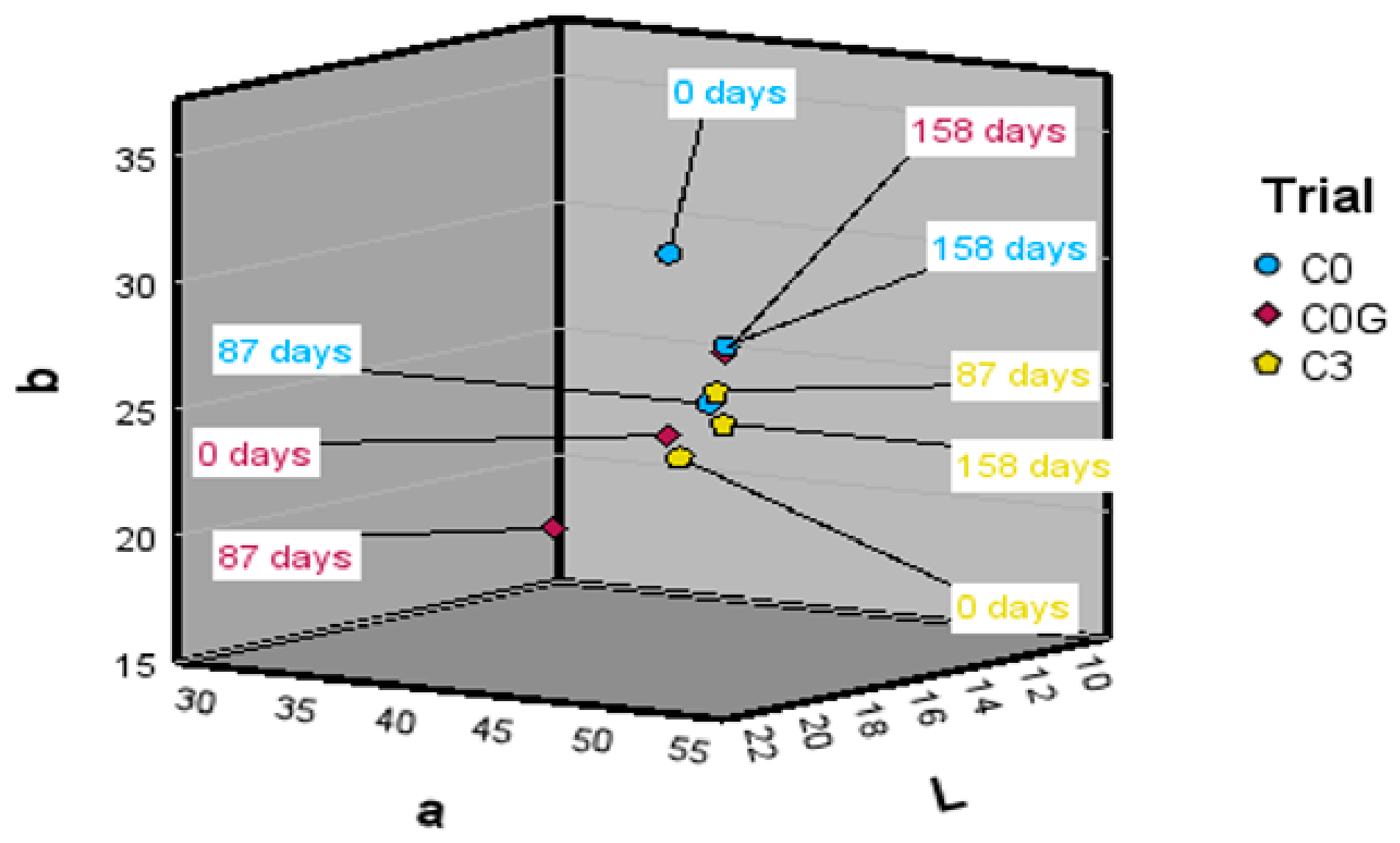
Abstract
1. Introduction
2. Materials and Methods
2.1. Preparation of Red Wine Samples
- Control group: Original red wine without additions (n = 9).
- Glucose control: Wine supplemented with 10 g/L of glucose (n = 9).
- Caffeic acid series: Wine with four increasing concentrations of caffeic acid (120, 240, 480, and 960 mg/L; n = 9 each, total n = 36).
- Caffeic acid plus glucose series: wine containing each of the four caffeic acid concentrations combined with 10 g/L glucose (n = 9 each, total n = 36).
2.2. Physico-Chemical Characterization
2.3. Spectrophotometric Measurements and Chromatic Parameters
- Color Intensity (CI) [28]:
- Total Color Intensity (TCI) [29]:
- Tonality (Hue):
- Lightness (L*): from black (0) to white (100).
- a* and b*: representing the red-green and yellow-blue axes, respectively.
- Chroma (C*): indicating color saturation calculated as follows:
- Hue angle (H*): representing the color tone obtained as follows:
2.4. Total Color Difference (∆E*ab) and Visual Perception Analysis
- Contribution of Lightness (%Cont.∆L*):
- Contribution of Redness (%Cont.∆a*):
- Contribution of Yellowness (%Cont.∆b*):
2.5. Statistical Analysis
3. Results
3.1. Initial Physico-Chemical Characterization of the Base Wine
3.2. Spectrophotometric Data and Color Intensity
3.3. Evidence of Copigmentation
- Hyperchromic Effect: The increase in maximum absorbance (AbsMax) relative to the control ranged from 3.18% (120 mg/L, C1) to 12.79% (960 mg/L, C4).
- Bathochromic Shift: All treated samples showed a shift in the maximum absorption wavelength (λmax) toward longer wavelengths (red-to-blue shift). This displacement reached up to 3 nm and was observed across the concentration range.
- Effect of Glucose: The addition of 10 g/L of glucose increased the initial response, with maximum color increases reaching 15.9% in the C4G treatment.
- 87 days: All treatments maintained higher color values than the control, although the magnitude of the increase was reduced. For example, the C4 treatment decreased from 12.8% to 7.2%. At this stage, an increase in color intensity was also observed in the control (Table 2).
- 158 days: Low concentrations (120 and 240 mg/L) showed values similar to or slightly below the control (−0.77% and −0.21%, respectively).
- High concentrations: Treatments with 480 and 960 mg/L maintained higher color values than the control, with increases of 5.20% and 6.10%, respectively.
- Glucose Effect: The initial effect of glucose was not maintained at later stages, with differences becoming negligible at the end of the experiment.
3.4. Evolution of Visual Perception and Total Color Difference (∆E*ab)
4. Discussion
4.1. Mechanism of Initial Color Enhancement
4.2. Visual Impact and CIELAB Interpretation
4.3. Glucose Effect and Matrix Influence
4.4. Concentration Threshold and Negative Low-Dose Effect
4.5. Evolution Toward More Stable Pigments
4.6. Post- vs. Pre-Fermentative Efficiency
4.7. Comparison with Recent Post-Fermentative Approaches
5. Conclusions
Author Contributions
Funding
Informed Consent Statement
Data Availability Statement
Acknowledgments
Conflicts of Interest
Abbreviations
| Abbreviation | Meaning |
| a* | Redness-greenness CIELAB coordinate |
| AbsMax | Maximum absorbance |
| ADI | Acceptable Daily Intake |
| b* | Yellowness-Blueish CIELAB coordinate |
| C* | Chroma (color saturation) |
| CI | Color Intensity (Glories or OIV method) |
| CIELAB | International Commission on Illumination color space (L*, a*, b*) |
| CU | Cielab Units |
| H* | Hue angle (CIELAB tone) |
| Hue | Tonality (A420/A520) |
| L* | Lightness CIELAB coordinate |
| OIV | International Organisation of Vine and Wine |
| SO2 Free | Free Sulfur Dioxide |
| SO2 Total | Total Sulfur Dioxide |
| TCI | OIV Color Intensity |
| TPI | Total Polyphenol Index |
| UA | Units of Absorbance |
| VA | Volatile Acidity |
| ΔEab* | Total Color Difference |
| ∆λ | Bathochromic shift (wavelength shift) |
| λmax | Maximum absorbance wavelength |
| %Color | Relative Color Increase |
References
- Zhang, X.; Jeffery, D.W.; Li, D.; Lan, Y.; Zhao, X.; Duan, C. Red wine coloration: A review of pigmented molecules, reactions, and applications. Compr. Rev. Food Sci. Food Saf. 2022, 21, 3834–3866. [Google Scholar] [CrossRef] [PubMed]
- de Freitas, V.A.P.; Fernandes, A.; Oliveira, J.; Teixeira, N.; Mateus, N. A review of the current knowledge of red wine colour. Oeno One 2017, 51, 1–15. [Google Scholar]
- Cheng, S.; Wu, T.; Gao, J.; Han, X.; Huang, W.; You, Y.; Zhan, J. Color myth: Anthocyanins reactions and enological approaches achieving their stabilization in the aging process of red wine. Food Innov. Adv. 2023, 2, 255–271. [Google Scholar] [CrossRef]
- He, F.; Liang, N.; Mu, L.; Pan, Q.; Wang, J.; Reeves, M.J.; Duan, C. Anthocyanins and their variation in red wines I. Monomeric anthocyanins and their color expression. Molecules 2012, 17, 1571–1601. [Google Scholar] [CrossRef]
- Dangles, O.; Fenger, J. The chemical reactivity of anthocyanins and its consequences in food science and nutrition. Molecules 2018, 23, 1970. [Google Scholar] [CrossRef]
- Monagas, M.; Bartolomé, B. Anthocyanins and anthocyanin-derived compounds. In Wine Chemistry and Biochemistry; Springer: Berlin/Heidelberg, Germany, 2009; pp. 439–462. [Google Scholar]
- Boulton, R. The copigmentation of anthocyanins and its role in the color of red wine: A critical review. Am. J. Enol. Vitic. 2001, 52, 67–87. [Google Scholar] [CrossRef]
- Xue, Z.; Zhang, Q.; Wang, T. Co-pigmentation of caffeic acid and catechin on wine color and the effect of ultrasound in model wine solutions. J. AOAC Int. 2021, 104, 1703–1709. [Google Scholar] [CrossRef]
- Ricci, A.; Galaz-Torres, C.; Parpinello, G.P.; Demola, M.; Spiga, M.; Versari, A. The Role of Copigmentation in Colour Attributes and Their Evolution in Model Wine: A Thermodynamic and Colorimetric Study. Foods 2025, 14, 2467. [Google Scholar] [CrossRef]
- Lyu, J.; Li, J.; Jiang, W.; Liu, T.; Xu, Y.; Tang, K. Copigmentation effects of different phenolics on color stability of three basic anthocyanins in wines: Chromaticity, thermodynamics and molecular dynamics simulation. Food Chem. 2025, 476, 143499. [Google Scholar] [CrossRef] [PubMed]
- Zhang, B.; Wang, X.; Yang, B.; Li, N.; Niu, J.; Shi, X.; Han, S. Copigmentation evidence of phenolic compound: The effect of caffeic and rosmarinic acids addition on the chromatic quality and phenolic composition of Cabernet Sauvignon red wine from the Hexi Corridor region (China). J. Food Compos. Anal. 2021, 102, 104037. [Google Scholar] [CrossRef]
- Qin, Q.; Tatsuzawa, F.; Nakane, T.; Kaidzuka, T.; Iwashina, T.; Mizuno, T. Anthocyanins and flavonols from the flowers of Ranunculus cultivars (Ranunculaceae) and their color expression. Hortic. J. 2024, 93, 114–125. [Google Scholar] [CrossRef]
- Ertan, K.; Türkyılmaz, M.; Özkan, M. Color and stability of anthocyanins in strawberry nectars containing various co-pigment sources and sweeteners. Food Chem. 2020, 310, 125856. [Google Scholar] [CrossRef]
- Heras-Roger, J.; Díaz-Romero, C.; Darias-Martín, J. A comprehensive study of red wine properties according to variety. Food Chem. 2016, 196, 1224–1231. [Google Scholar] [CrossRef] [PubMed]
- Pérez-Trujillo, J.P.; Hernández, Z.; López-Bellido, F.J.; Hermosín-Gutiérrez, I. Characteristic phenolic composition of single-cultivar red wines of the Canary Islands (Spain). J. Agric. Food Chem. 2011, 59, 6150–6164. [Google Scholar] [CrossRef]
- Heras-Roger, J.; Alonso-Alonso, O.; Gallo-Montesdeoca, A.; Díaz-Romero, C.; Darias-Martín, J. Influence of copigmentation and phenolic composition on wine color. J. Food Sci. Technol. 2016, 53, 2540–2547. [Google Scholar] [CrossRef] [PubMed]
- Mattivi, F.; Guzzon, R.; Vrhovsek, U.; Stefanini, M.; Velasco, R. Metabolite profiling of grape: Flavonols and anthocyanins. J. Agric. Food Chem. 2006, 54, 7692–7702. [Google Scholar] [CrossRef]
- Escribano-Bailón, M.T.; Rivas-Gonzalo, J.C.; García-Estévez, I. Wine color evolution and stability. In Red Wine Technology; Elsevier: Amsterdam, The Netherlands, 2019; pp. 195–205. [Google Scholar]
- Mueller, S.; Szolnoki, G. The relative influence of packaging, labelling, branding and sensory attributes on liking and purchase intent: Consumers differ in their responsiveness. Food Qual. Prefer. 2010, 21, 774–783. [Google Scholar] [CrossRef]
- Alcalde-Eon, C.; Pérez-Mestre, C.; Ferreras-Charro, R.; Rivero, F.J.; Heredia, F.J.; Escribano-Bailón, M.T. Addition of mannoproteins and/or seeds during winemaking and their effects on pigment composition and color stability. J. Agric. Food Chem. 2019, 67, 4031–4042. [Google Scholar] [CrossRef] [PubMed]
- Rivero, F.J.; Gordillo, B.; Jara-Palacios, M.J.; González-Miret, M.L.; Heredia, F.J. Effect of addition of overripe seeds from white grape by-products during red wine fermentation on wine colour and phenolic composition. LWT 2017, 84, 544–550. [Google Scholar] [CrossRef]
- Álvarez, I.; Aleixandre, J.L.; García, M.J.; Lizama, V.; Aleixandre-Tudó, J.L. Effect of the prefermentative addition of copigments on the polyphenolic composition of Tempranillo wines after malolactic fermentation. Eur. Food Res. Technol. 2009, 228, 501–510. [Google Scholar] [CrossRef]
- Cejudo-Bastante, M.J.; Rodríguez-Morgado, B.; Jara-Palacios, M.J.; Rivas-Gonzalo, J.C.; Parrado, J.; Heredia, F.J. Pre-fermentative addition of an enzymatic grape seed hydrolysate in warm climate winemaking. Effect on the differential colorimetry, copigmentation and polyphenolic profiles. Food Chem. 2016, 209, 348–357. [Google Scholar] [CrossRef]
- González-Manzano, S.; Dueñas, M.; Rivas-Gonzalo, J.C.; Escribano-Bailón, M.T.; Santos-Buelga, C. Studies on the copigmentation between anthocyanins and flavan-3-ols and their influence in the colour expression of red wine. Food Chem. 2009, 114, 649–656. [Google Scholar] [CrossRef]
- Wang, Y.; Yin, M.; Zhao, J.; Li, X.; Cui, Y.; Wang, Y. Investigation of the effect of ethanol on the stability of black rice anthocyanin/cyclodextrin inclusion complexes in aqueous systems. J. Sci. Food Agric. 2025, 105, 8038–8047. [Google Scholar] [CrossRef] [PubMed]
- Ribéreau-Gayon, P. Vol. 2: The Chemistry of Wine: Stabilization and Treatments; Wiley: Chichester, UK, 2006. [Google Scholar]
- Vallverdú-Queralt, A.; Verbaere, A.; Meudec, E.; Cheynier, V.; Sommerer, N. Straightforward method to quantify GSH, GSSG, GRP, and hydroxycinnamic acids in wines by UPLC-MRM-MS. J. Agric. Food Chem. 2015, 63, 142–149. [Google Scholar] [CrossRef] [PubMed]
- Cheynier, V. Phenolic compounds: From plants to foods. Phytochem. Rev. 2012, 11, 153–177. [Google Scholar] [CrossRef]
- Master, O.; Patronage, O. Compendium of International Methods of Wine and Must Analysis. The International Organisation of Vine and Wine. 2024. Available online: https://www.oiv.int/standards/compendium-of-international-methods-of-wine-and-must-analysis (accessed on 19 March 2026).
- Glories, Y. La couleur des vins rouges. Conn. Vigne Vin. 1984, 18, 253–271. [Google Scholar] [CrossRef]
- Ayala, F.; Echávarri, J.F.; Negueruela, A.I. A new simplified method for measuring the color of wines. I. Red and rose wines. Am. J. Enol. Vitic. 1997, 48, 357–363. [Google Scholar] [CrossRef]
- Martínez, J.A.; Melgosa, M.; Pérez, M.M.; Hita, E.; Negueruela, A.I. Note. Visual and instrumental color evaluation in red wines. Food Sci. Technol. Int. 2001, 7, 439–444. [Google Scholar]
- Ju, Y.; Yang, L.; Yue, X.; Li, Y.; He, R.; Deng, S.; Yang, X.; Fang, Y. Anthocyanin profiles and color properties of red wines made from Vitis davidii and Vitis vinifera grapes. Food Sci. Hum. Wellness 2021, 10, 335–344. [Google Scholar] [CrossRef]
- Chen, H.; Wang, M.; Zhang, L.; Ren, F.; Li, Y.; Chen, Y.; Liu, Y.; Zhang, Z.; Zeng, Q. Anthocyanin profiles and color parameters of fourteen grapes and wines from the eastern foot of Helan Mountain in Ningxia. Food Chem. X 2024, 24, 102034. [Google Scholar] [CrossRef]
- Niculescu, V.; Paun, N.; Ionete, R. The evolution of polyphenols from grapes to wines. Grapes Wines-Adv. Prod. Process. Anal. Valorization 2018, 7, 119–140. [Google Scholar]
- Olthof, M.R.; Katan, M.B.; Hollman, P.C. Chlorogenic acid and caffeic acid are absorbed in humans. J. Nutr. 2001, 131, 66–71. [Google Scholar] [CrossRef]
- He, F.; Liang, N.; Mu, L.; Pan, Q.; Wang, J.; Reeves, M.J.; Duan, C. Anthocyanins and their variation in red wines II. Anthocyanin derived pigments and their color evolution. Molecules 2012, 17, 1483–1519. [Google Scholar] [CrossRef]
- Gordillo, B.; Rodríguez-Pulido, F.J.; Escudero-Gilete, M.L.; González-Miret, M.L.; Heredia, F.J. Comprehensive colorimetric study of anthocyanic copigmentation in model solutions. Effects of pH and molar ratio. J. Agric. Food Chem. 2012, 60, 2896–2905. [Google Scholar] [CrossRef]
- Gómez-Míguez, M.; González-Manzano, S.; Escribano-Bailón, M.T.; Heredia, F.J.; Santos-Buelga, C. Influence of different phenolic copigments on the color of malvidin 3-glucoside. J. Agric. Food Chem. 2006, 54, 5422–5429. [Google Scholar] [CrossRef] [PubMed]
- Molaeafard, S.; Jamei, R.; Marjani, A.P. Co-pigmentation of anthocyanins extracted from sour cherry (Prunus cerasus L.) with some organic acids: Color intensity, thermal stability, and thermodynamic parameters. Food Chem. 2021, 339, 128070. [Google Scholar] [CrossRef]
- Li, X.; Li, J.; Wang, M.; Jiang, H. Copigmentation effects and thermal degradation kinetics of purple sweet potato anthocyanins with metal ions and sugars. Appl. Biol. Chem. 2016, 59, 15–24. [Google Scholar] [CrossRef]
- Zhao, X.; Zhang, N.; Wu, G.; He, F.; Lan, Y.; Duan, C. Intermolecular copigmentation between anthocyanidin-3, 5-O-diglucosides and three phenolic compounds: Insights from experimental and theoretical studies. Food Chem. Adv. 2022, 1, 100111. [Google Scholar] [CrossRef]
- Li, Y.; Prejanò, M.; Toscano, M.; Russo, N. Oenin/syringic acid copigmentation: Insights from a theoretical study. Front. Chem. 2019, 7, 579. [Google Scholar] [CrossRef]
- Azman, E.M.; Yusof, N.; Chatzifragkou, A.; Charalampopoulos, D. Stability enhancement of anthocyanins from blackcurrant (Ribes nigrum L.) pomace through intermolecular copigmentation. Molecules 2022, 27, 5489. [Google Scholar] [CrossRef]
- Enaru, B.; Drețcanu, G.; Pop, T.D.; Stǎnilǎ, A.; Diaconeasa, Z. Anthocyanins: Factors affecting their stability and degradation. Antioxidants 2021, 10, 1967. [Google Scholar] [CrossRef]
- Idir, S.; Achat, S.; Cruz, L.; Dangles, O. Anthocyanin-rich extracts: Susceptibility to color loss by hydration and thermal degradation, influence of metal ions and endogenous copigments. Food Chem. 2025, 481, 144004. [Google Scholar] [CrossRef]
- Marquez, A.; Serratosa, M.P.; Merida, J. Pyranoanthocyanin derived pigments in wine: Structure and formation during winemaking. J. Chem. 2013, 2013, 713028. [Google Scholar] [CrossRef]
- de Freitas, V.; Mateus, N. Formation of pyranoanthocyanins in red wines: A new and diverse class of anthocyanin derivatives. Anal. Bioanal. Chem. 2011, 401, 1463–1473. [Google Scholar] [CrossRef]
- Zhang, X.; Lan, Y.; Huang, Y.; Zhao, X.; Duan, C. Targeted metabolomics of anthocyanin derivatives during prolonged wine aging: Evolution, color contribution and aging prediction. Food Chem. 2021, 339, 127795. [Google Scholar] [CrossRef]
- Voss, D.M.; Miyagusuku-Cruzado, G.; Giusti, M.M. Comparing the thermal stability of 10-carboxy-, 10-methyl-, and 10-catechyl-pyranocyanidin-3-glucosides and their precursor, cyanidin-3-glucoside. npj Sci. Food 2022, 6, 16. [Google Scholar] [CrossRef] [PubMed]
- Rentzsch, M.; Schwarz, M.; Winterhalter, P. Pyranoanthocyanins–an overview on structures, occurrence, and pathways of formation. Trends Food Sci. Technol. 2007, 18, 526–534. [Google Scholar] [CrossRef]
- Li, X.; Yuan, K.; Zhang, Y.; Liu, C.; Cai, D.; Sun, J.; Lai, C.; Bai, W. The promising stability of carboxylpyranocyanidin-3-O-glucoside during food processing and simulated digestion and its bioavailability research. J. Sci. Food Agric. 2024, 104, 2372–2382. [Google Scholar] [CrossRef] [PubMed]
- Lin, Y.; Li, C.; Shi, L.; Wang, L. Anthocyanins: Modified new technologies and challenges. Foods 2023, 12, 1368. [Google Scholar] [CrossRef] [PubMed]
- Amorati, R.; Pedulli, G.F.; Cabrini, L.; Zambonin, L.; Landi, L. Solvent and pH effects on the antioxidant activity of caffeic and other phenolic acids. J. Agric. Food Chem. 2006, 54, 2932–2937. [Google Scholar] [CrossRef]
- Bimpilas, A.; Panagopoulou, M.; Tsimogiannis, D.; Oreopoulou, V. Anthocyanin copigmentation and color of wine: The effect of naturally obtained hydroxycinnamic acids as cofactors. Food Chem. 2016, 197, 39–46. [Google Scholar] [CrossRef]
- Beaver, J.W.; Miller, K.V.; Medina-Plaza, C.; Dokoozlian, N.; Ponangi, R.; Blair, T.; Block, D.; Oberholster, A. The effects of temperature and ethanol on proanthocyanidin adsorption to grape cell wall material in the presence of anthocyanins. Molecules 2020, 25, 4139. [Google Scholar] [CrossRef] [PubMed]
- Hensen, J.; Hoening, F.; Bogdanovic, T.; Schieber, A.; Weber, F. Pectin forms polymeric pigments by complexing anthocyanins during red winemaking and ageing. Food Res. Int. 2024, 188, 114442. [Google Scholar] [CrossRef] [PubMed]
- Rivero, F.J.; Jara-Palacios, M.J.; Gordillo, B.; Heredia, F.J.; González-Miret, M.L. Impact of a post-fermentative maceration with overripe seeds on the color stability of red wines. Food Chem. 2019, 272, 329–336. [Google Scholar] [CrossRef] [PubMed]
- Gordillo, B.; Rivero, F.J.; Jara-Palacios, M.J.; González-Miret, M.L.; Heredia, F.J. Impact of a double post-fermentative maceration with ripe and overripe seeds on the phenolic composition and color stability of Syrah red wines from warm climate. Food Chem. 2021, 346, 128919. [Google Scholar] [CrossRef]



| Analytical Parameter | Mean Value (±SD) | Reference Method |
|---|---|---|
| Physicochemical Parameters | ||
| Density (g/cm3) | 0.9930 ± 0.0002 | [29] OIV-MA-AS2-01A |
| Specific Gravity (20°/20°) | 0.9948 ± 0.0003 | [29] OIV-MA-AS2-01A |
| Alcoholic strength (% vol) | 13.41 ± 0.12 | [29] OIV-MA-AS312-01 |
| Total Dry Extract (g/L) | 31.6 ± 0.5 | [29] OIV-MA-AS2-03A |
| pH (pH units) | 3.54 ± 0.02 | [29] OIV-MA-AS313-15 |
| Sulfur Dioxide | ||
| Total SO2 (mg/L) | 42 ± 10 | [29] OIV-MA-AS323-04A2 |
| Free SO2 (mg/L) | 13 ± 5 | [29] OIV-MA-AS323-04A |
| Acidity profile | ||
| Total Acidity (g. tartaric acid/L) | 5.20 ± 0.15 | [29] OIV-MA-AS313-01 |
| Volatile Acidity, VA (g. acetic acid/L) | 0.50 ± 0.05 | [29] OIV-MA-AS313-02 |
| Fixed Acidity (g. tartaric acid/L) | 4.60 ± 0.17 | [29] OIV-MA-AS313-03 |
| Malic Acid (g/L) | 0.15 ± 0.04 | [29] OIV-MA-AS313-11 |
| Phenolic composition | ||
| TPI (280 nm Absorbance Units) | 47.0 ± 1.2 | [26] |
| Tannins (g/L) | 3.10 ± 0.25 | [26] |
| Anthocyanins (mg/L) | 319 ± 15 | [26] |
| Assay | Trial | A620 | A520 | A420 | IC | TCI | Hue | L* | a* | b* | C* | H* |
|---|---|---|---|---|---|---|---|---|---|---|---|---|
| Initial color parameters (t0 = 0 days) | C0 | 0.69 c (0.19) | 3.469 d (0.20) | 2.28 d (0.26) | 5.75 e (0.46) | 6.44 e (0.65) | 0.66 ab (0.03) | 23.16 a (1.55) | 53.19 a (1.73) | 33.22 a (0.64) | 62.72 a (1.81) | 31.99 a (0.36) |
| C1 | 1.04 ab (0.12) | 3.87 bc (0.06) | 2.60 bc (0.06) | 6.46 d (0.12) | 7.50 cd (0.25) | 0.67 a (0.01) | 13.83 b (3.12) | 40.35 bc (4.75) | 20.64 bc (5.51) | 45.32 b (6.84) | 27.09 b (2.86) | |
| C2 | 1.06 ab (0.11) | 4.04 ab (0.01) | 2.76 ab (0.13) | 6.79 bc (0.14) | 7.86 abc (0.25) | 0.68 a (0.03) | 13.28 b (2.89) | 40.19 bc (4.13) | 20.35 bc (4.75) | 45.05 bc (5.90) | 26.86 bc (2.55) | |
| C3 | 1.19 a (0.22) | 4.19 a (0.14) | 2.82 a (0.22) | 7.00 ab (0.37) | 8.19 a (0.59) | 0.67 a (0.03) | 10.52 c (5.29) | 36.44 d (7.33) | 16.24 d (8.20) | 39.89 d (10.30) | 24.02 d (4.74) | |
| C4 | 1.07 ab (0.12) | 4.06 ab (0.03) | 2.62 bc (0.01) | 6.68 bcd (0.04) | 7.76 bc (0.08) | 0.65 bc (0.01) | 12.82 bc (3.05) | 39.57 bc (4.48) | 19.44 bc (5.30) | 44.09 bc (6.46) | 26.17 bc (2.99) | |
| C0G | 1.06 ab (0.11) | 3.82 c (0.04) | 2.63 bc (0.03) | 6.46 d (0.07) | 7.52 cd (0.18) | 0.69 a (0.01) | 13.34 b (2.59) | 39.42 bc (3.99) | 19.97 bc (4.60) | 44.19 bc (5.71) | 26.86 bc (3.25) | |
| C1G | 1.06 ab (0.15) | 3.97 bc (0.06) | 2.62 bc (0.03) | 6.59 cd (0.02) | 7.65 bc (0.17) | 0.66 ab (0.02) | 13.37 b (3.81) | 40.08 bc (5.36) | 20.18 bc (6.22) | 44.87 bc (7.71) | 26.72 bc (3.25) | |
| C2G | 1.06 ab (0.16) | 3.98 bc (0.05) | 2.72 abc (0.07) | 6.70 bcd (0.13) | 7.76 bc (0.28) | 0.68 a (0.01) | 13.37 b (3.99) | 40.18 bc (5.65) | 20.23 bc (6.43) | 44.99 bc (8.06) | 26.72 bc (3.26) | |
| C3G | 1.02 b (0.11) | 4.06 ab (0.02) | 2.57 c (0.02) | 6.63 bcd (0.01) | 7.65 bc (0.12) | 0.63 c (0.01) | 14.15 b (2.96) | 41.50 bc (4.33) | 21.42 bc (5.06) | 46.70 bc (6.25) | 27.30 b (2.60) | |
| C4G | 1.10 b (0.13) | 4.18 a (0.02) | 2.74 ab (0.01) | 6.93 a (0.01) | 8.02 ab (0.12) | 0.66 bc (0.01) | 12.37 bc (3.16) | 39.24 c (4.63) | 19.01 c (5.32) | 43.61 bc (6.59) | 25.80 bc (3.05) | |
| Intermediate color parameters (t1 = 87 days) | C0 | 1.02 ab (0.07) | 4.63 bc (0.20) | 3.09 ab (0.06) | 7.73 cd (0.26) | 8.75 cd (0.32) | 0.67 a (0.02) | 14.83 a (1.44) | 43.87 ab (1.85) | 24.53 ab (2.48) | 50.33 ab (2.87) | 29.20 a (1.39) |
| C1 | 1.04 ab (0.02) | 4.79 ab (0.15) | 3.13 ab (0.03) | 7.92 bc (0.17) | 8.96 abc (0.19) | 0.65 ab (0.02) | 14.37 ab (0.45) | 43.57 ab (0.46) | 23.93 bc (0.65) | 49.73 ab (0.68) | 26.07 b (5.08) | |
| C2 | 1.02 ab (0.07) | 4.79 ab (0.13) | 3.09 ab (0.09) | 7.88 bc (0.21) | 8.90 bc (0.28) | 0.65 ab (0.01) | 14.70 a (1.66) | 44.03 ab (2.25) | 24.43 ab (2.71) | 50.37 ab (3.39) | 28.93 a (1.55) | |
| C3 | 1.00 b (0.10) | 4.80 ab (0.28) | 3.09 ab (0.16) | 7.89 bc (0.44) | 8.89 bc (0.54) | 0.64 bc (0.01) | 15.17 a (1.39) | 44.70 a (1.95) | 25.13 a (2.76) | 51.30 a (3.32) | 29.27 a (1.15) | |
| C4 | 1.08 a (0.07) | 4.97 a (0.16) | 3.16 a (0.03) | 8.13 a (0.19) | 9.21 a (0.26) | 0.63 bc (0.02) | 16.15 a (0.12) | 41.65 bc (0.56) | 27.17 a (0.68) | 46.80 bc (1.02) | 27.00 ab (1.06) | |
| C0G | 1.00 b (0.07) | 4.59 c (0.23) | 3.01 b (0.06) | 7.60 d (0.30) | 8.60 d (0.37) | 0.65 bc (0.02) | 10.67 c (1.35) | 30.20 d (1.70) | 17.53 d (1.25) | 34.90 d (1.55) | 20.07 c (1.30) | |
| C1G | 0.99 b (0.01) | 4.63 bc (0.09) | 3.03 b (0.14) | 7.66 cd (0.02) | 7.65 bc (0.17) | 0.65 ab (0.02) | 15.37 a (0.42) | 44.73 a (0.55) | 25.43 a (0.91) | 51.43 a (1.05) | 29.60 a (0.45) | |
| C2G | 1.00 b (0.08) | 4.64 bc (0.30) | 3.01 b (0.09) | 7.66 cd (0.38) | 7.76 bc (0.28) | 0.65 ab (0.03) | 15.20 a (1.91) | 44.37 a (2.43) | 25.17 a (3.10) | 51.00 a (3.93) | 29.47 a (1.45) | |
| C3G | 1.06 ab (0.07) | 4.92 a (0.10) | 3.16 a (0.03) | 8.07 a (0.15) | 7.65 bc (0.12) | 0.64 bc (0.01) | 13.90 b (1.70) | 43.07 ab (2.35) | 23.20 bc (2.85) | 48.93 b (3.65) | 28.23 b (1.55) | |
| C4G | 1.02 ab (0.05) | 4.96 a (0.10) | 3.16 a (0.05) | 8.12 a (0.15) | 8.02 ab (0.12) | 0.64 bc (0.01) | 14.80 a (1.39) | 44.40 a (1.74) | 24.77 ab (2.30) | 50.83 a (2.62) | 29.10 a (1.25) | |
| Final color parameters (t2 = 158 days) | C0 | 0.97 ab (0.03) | 4.67 bc (0.06) | 3.14 a (0.05) | 7.81 bc (0.11) | 8.78 bc (0.13) | 0.67 a (0.00) | 16.33 b (0.73) | 46.83 b (1.04) | 27.38 ab (1.13) | 54.23 b (1.50) | 30.33 a (0.52) |
| C1 | 0.96 b (0.06) | 4.63 c (0.11) | 3.01 b (0.12) | 7.64 c (0.22) | 8.59 c (0.28) | 0.65 bc (0.01) | 16.50 b (1.31) | 46.83 b (1.74) | 27.43 ab (2.06) | 54.30 b (2.65) | 30.55 a (0.90) | |
| C2 | 0.94 b (0.08) | 4.59 c (0.21) | 2.96 b (0.11) | 7.54 c (0.31) | 8.49 c (0.39) | 0.64 c (0.01) | 16.83 b (2.05) | 47.10 ab (2.63) | 27.80 a (2.98) | 54.70 b (3.96) | 30.48 a (1.34) | |
| C3 | 1.06 a (0.09) | 4.89 ab (0.06) | 3.10 (0.09) | 7.99 ab (0.14) | 9.05 ab (0.23) | 0.63 c (0.02) | 14.08 c (1.88) | 43.50 c (3.12) | 23.50 c (3.52) | 49.48 c (4.67) | 28.28 b (1.93) | |
| C4 | 1.02 ab (0.03) | 4.94 a (0.04) | 3.09 a (0.01) | 8.03 a (0.03) | 9.05 a (0.06) | 0.63 c (0.00) | 15.25 bc (1.03) | 45.70 bc (1.49) | 25.60 bc (1.63) | 52.35 bc (2.19) | 29.25 ab (0.81) | |
| C0G | 0.97 ab (0.06) | 4.63 bc (0.13) | 3.09 a (0.08) | 7.72 bc (0.19) | 8.69 bc (0.25) | 0.67 a (0.01) | 16.25 b (1.37) | 46.65 b (1.75) | 27.08 ab (2.15) | 53.85 b (2.75) | 30.10 a (1.05) | |
| C1G | 0.92 b (0.04) | 4.54 c (0.13) | 2.93 b (0.05) | 7.47 c (0.15) | 8.39 c (0.20) | 0.65 bc (0.01) | 17.48 a (0.79) | 48.20 a (1.40) | 28.93 a (1.69) | 56.23 a (2.15) | 30.93 a (0.59) | |
| C2G | 0.91 b (0.07) | 4.66 bc (0.07) | 2.96 b (0.11) | 7.63 c (0.14) | 8.54 c (0.21) | 0.64 c (0.02) | 17.60 a (2.06) | 48.48 a (2.54) | 29.25 a (3.32) | 56.68 a (4.15) | 31.05 a (1.46) | |
| C3G | 0.91 b (0.10) | 4.74 abc (0.17) | 2.95 b (0.12) | 7.69 bc (0.28) | 8.60 bc (0.38) | 0.62 c (0.01) | 17.55 a (2.69) | 48.38 a (3.50) | 29.13 a (4.24) | 56.50 a (5.49) | 30.90 a (1.73) | |
| C4G | 0.97 ab (0.10) | 4.98 a (0.13) | 3.12 a (0.07) | 8.10 a (0.17) | 9.07 a (0.25) | 0.63 c (0.01) | 16.15 b (2.45) | 46.55 b (3.16) | 27.18 ab (3.39) | 53.93 b (4.63) | 30.15 a (1.78) |
| Trial | Copigmentation (t0 = 0 Days) | Copigmentation (t1 = 87 Days) | Copigmentation (t2 = 158 Days) | |||||||||
|---|---|---|---|---|---|---|---|---|---|---|---|---|
| λmax | ∆λ | AbsMax. | %Color | λmax | ∆λ | AbsMax. | %Color | λmax | ∆λ | AbsMax. | %Color | |
| C0 | 527.0 | 0.0 | 3.707 | 0.0% | 527.3 | 0.0 | 4.689 | 0.0% | 525.6 | 0.0 | 4.689 | 0.0% |
| C1 | 529.0 | 2.0 | 3.825 | 3.2% | 528.0 | 0.7 | 4.84 | 3.2% | 526.0 | 0.4 | 4.653 | −0.8% |
| C2 | 529.0 | 2.0 | 3.977 | 7.3% | 527.3 | 0.0 | 4.793 | 2.2% | 526.5 | 0.9 | 4.679 | −0.2% |
| C3 | 530.0 | 3.0 | 4.063 | 9.6% | 528.0 | 0.7 | 4.856 | 3.6% | 526.8 | 1.2 | 4.933 | 5.2% |
| C4 | 528.0 | 1.0 | 4.181 | 12.8% | 528.0 | 0.7 | 5.026 | 7.2% | 526.0 | 0.4 | 4.975 | 6.1% |
| C0G | 529.0 | 2.0 | 3.770 | 1.7% | 526.7 | −0.6 | 4.648 | −0.9% | 526.0 | 0.4 | 4.665 | −0.5% |
| C1G | 529.5 | 2.5 | 3.946 | 6.5% | 527.5 | 0.2 | 4.71 | 0.4% | 526.0 | 0.4 | 4.57 | −2.5% |
| C2G | 530.0 | 3.0 | 4.036 | 8.9% | 527.3 | 0.0 | 4.695 | 0.1% | 526.0 | 0.4 | 4.689 | 0.0% |
| C3G | 530.0 | 3.0 | 4.256 | 14.8% | 528.0 | 0.7 | 4.968 | 5.9% | 526.8 | 1.2 | 4.769 | 1.7% |
| C4G | 530.0 | 3.0 | 4.296 | 15.9% | 528.5 | 1.2 | 4.988 | 6.4% | 526.5 | 0.9 | 5.004 | 6.7% |
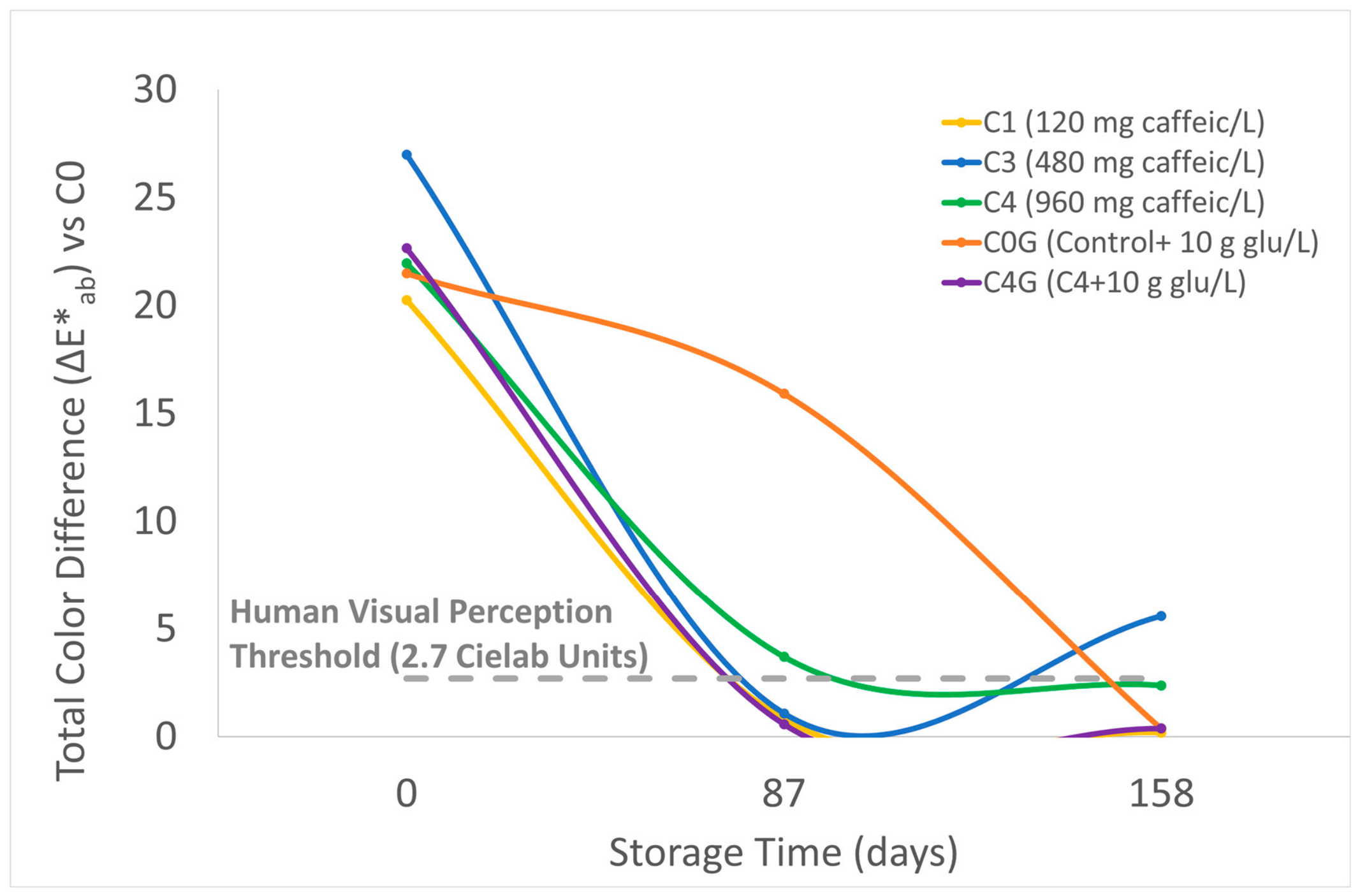
| Trial | Comparison | Initial ΔE*ab (t = 0) | Intermediate ΔE*ab (t = 87 d) | Final ΔE*ab (t = 158 d) |
|---|---|---|---|---|
| C1 | vs. C0 | 20.25 ± 10.00 a | 0.81 ± 0.15 c | 0.18 ± 0.05 d |
| C2 | vs. C0 | 20.79 ± 9.50 a | 0.23 ± 0.10 c | 0.71 ± 0.20 cd |
| C3 | vs. C0 | 26.99 ± 12.10 a | 1.08 ± 0.45 c | 5.59 ± 1.12 a |
| C4 | vs. C0 | 21.96 ± 8.80 a | 3.70 ± 0.95 b | 2.37 ± 0.65 bc |
| C0G | vs. C0 | 21.48 ± 7.20 a | 15.91 ± 3.40 a | 0.36 ± 0.10 d |
| C1G | vs. C0 | 20.92 ± 9.00 a | 0.58 ± 0.20 c | 2.37 ± 0.55 bc |
| vs. C0G | 0.69 ± 0.12 b | 17.19 ± 4.10 a | 2.71 ± 0.85 b | |
| C2G | vs. C0 | 20.83 ± 8.50 a | 1.22 ± 0.35 c | 3.01 ± 0.70 b |
| vs. C0G | 0.65 ± 0.10 b | 16.66 ± 3.80 a | 3.18 ± 0.90 b | |
| C3G | vs. C0 | 18.90 ± 6.40 a | 1.32 ± 0.40 c | 3.08 ± 0.75 b |
| vs. C0G | 2.66 ± 0.55 b | 14.28 ± 3.20 a | 3.17 ± 0.80 b | |
| C4G | vs. C0 | 22.65 ± 7.90 a | 0.58 ± 0.15 c | 0.39 ± 0.12 d |
| vs. C0G | 1.38 ± 0.25 b | 16.47 ± 4.00 a | 0.17 ± 0.05 d |
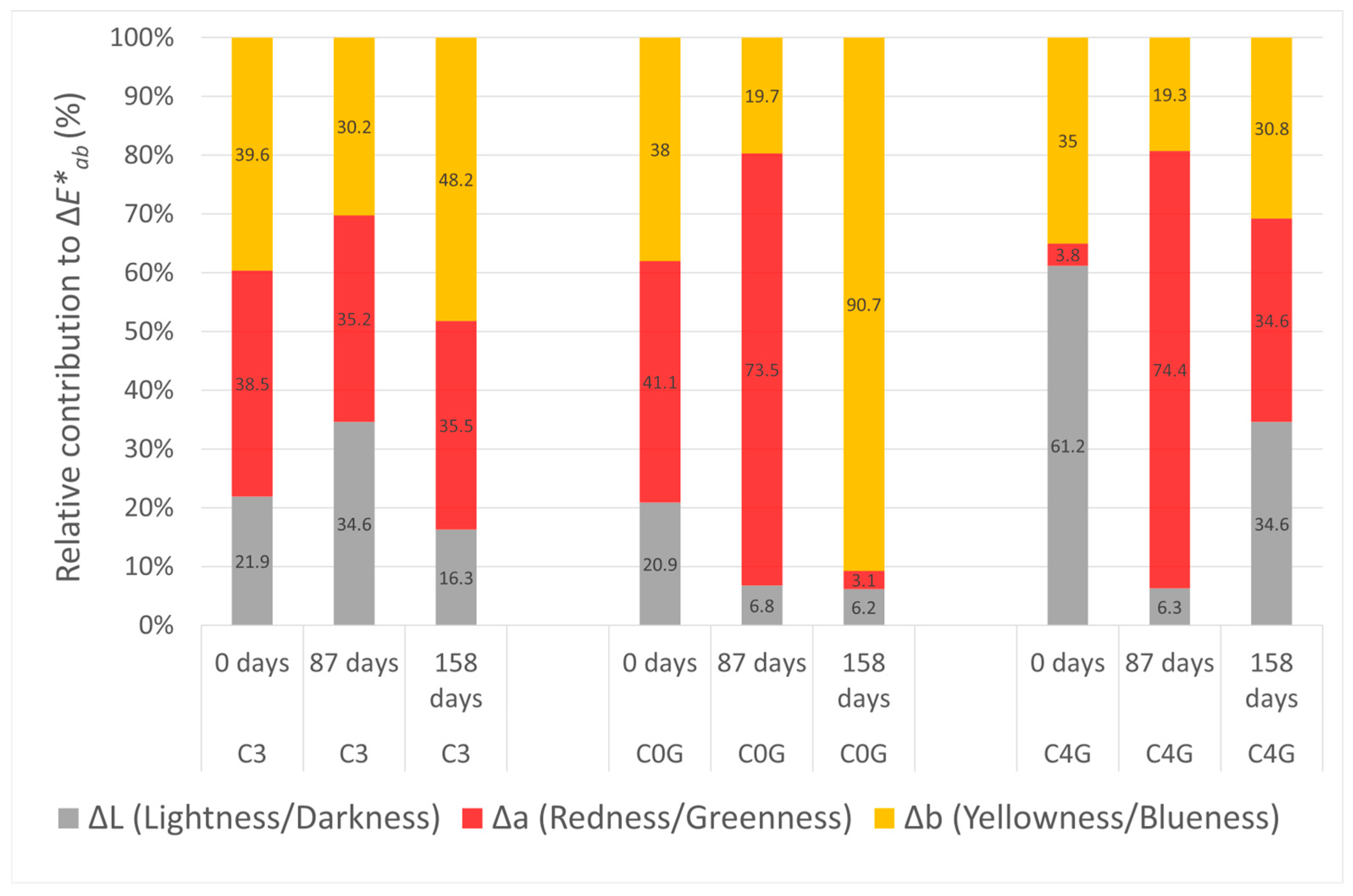
| Period | Trial | Comparison Ref. | ΔEab* | %ContΔL* | %ContΔa* | %ContΔb* |
|---|---|---|---|---|---|---|
| Initial (t = 0) | C1 | vs. C0 | 20.3 ± 10.0 a | 21.2 ± 2.4 b | 40.2 ± 3.8 a | 38.6 ± 3.5 a |
| C2 | vs. C0 | 20.8 ± 9.5 a | 22.6 ± 2.1 b | 39.1 ± 3.2 a | 38.3 ± 3.1 a | |
| C3 | vs. C0 | 27.0 ± 12.1 a | 21.9 ± 1.9 b | 38.5 ± 2.8 a | 39.6 ± 3.4 a | |
| C4 | vs. C0 | 22.0 ± 8.8 a | 22.1 ± 2.0 b | 38.5 ± 3.0 a | 39.4 ± 3.2 a | |
| C0G | vs. C0 | 21.5 ± 7.2 a | 20.9 ± 1.8 b | 41.1 ± 2.5 a | 38.0 ± 2.9 a | |
| C1G | vs. C0G | 0.7 ± 0.1 b | 2.1 ± 0.5 b | 1.1 ± 0.3 b | 96.8 ± 4.2 a | |
| C2G | vs. C0G | 0.6 ± 0.1 b | 5.3 ± 1.2 b | 2.5 ± 0.6 b | 92.2 ± 5.0 a | |
| C3G | vs. C0G | 2.7 ± 0.6 b | 13.9 ± 3.5 c | 31.5 ± 4.1 b | 54.6 ± 5.8 a | |
| C4G | vs. C0G | 1.4 ± 0.2 b | 61.2 ± 7.4 a | 3.8 ± 0.9 c | 35.0 ± 4.6 b | |
| Intermediate (t = 87 d) | C1 | vs. C0 | 0.8 ± 0.1 c | 32.2 ± 4.5 b | 13.7 ± 5.1 c | 54.1 ± 6.2 a |
| C2 | vs. C0 | 0.2 ± 0.1 c | 32.1 ± 3.8 b | 12.2 ± 4.3 c | 55.7 ± 5.9 a | |
| C3 | vs. C0 | 1.1 ± 0.4 c | 34.6 ± 5.2 a | 35.2 ± 4.8 a | 30.2 ± 3.9 b | |
| C4 | vs. C0 | 3.7 ± 0.9 b | 12.7 ± 2.8 c | 35.9 ± 4.1 b | 51.4 ± 5.5 a | |
| C0G | vs. C0 | 15.9 ± 3.4 a | 6.8 ± 1.2 d | 73.5 ± 4.8 a | 19.7 ± 2.3 c | |
| C1G | vs. C0G | 17.2 ± 4.1 a | 7.5 ± 1.4 d | 74.3 ± 5.2 a | 18.2 ± 2.1 c | |
| C2G | vs. C0G | 16.7 ± 3.8 a | 7.7 ± 1.6 d | 74.0 ± 4.9 a | 18.3 ± 2.2 c | |
| C3G | vs. C0G | 14.3 ± 3.2 a | 6.3 ± 1.1 d | 74.4 ± 4.5 a | 19.3 ± 2.4 c | |
| C4G | vs. C0G | 16.5 ± 4.0 a | 6.3 ± 1.3 d | 74.4 ± 5.0 a | 19.3 ± 2.5 c | |
| Final (t = 158 d) | C1 | vs. C0 | 0.2 ± 0.1 d | 70.0 ± 8.2 a | 0.0 ± 0.0 c | 30.0 ± 4.5 b |
| C2 | vs. C0 | 0.7 ± 0.2 cd | 22.3 ± 3.5 b | 27.6 ± 4.1 b | 50.1 ± 6.4 a | |
| C3 | vs. C0 | 5.6 ± 1.1 a | 16.3 ± 3.4 c | 35.5 ± 4.2 b | 48.2 ± 5.5 a | |
| C4 | vs. C0 | 2.4 ± 0.6 bc | 20.7 ± 4.1 b | 22.7 ± 3.9 b | 56.6 ± 6.9 a | |
| C0G | vs. C0 | 0.4 ± 0.1 d | 6.2 ± 1.1 b | 3.1 ± 0.8 b | 90.7 ± 4.8 a | |
| C1G | vs. C0G | 2.7 ± 0.5 b | 20.6 ± 3.2 b | 35.5 ± 4.5 a | 43.9 ± 5.1 a | |
| C2G | vs. C0G | 3.2 ± 0.9 b | 17.0 ± 2.8 c | 31.8 ± 3.9 b | 51.2 ± 6.2 a | |
| C3G | vs. C0G | 3.2 ± 0.8 b | 15.6 ± 2.5 b | 27.8 ± 3.6 b | 56.6 ± 7.1 a | |
| C4G | vs. C0G | 0.2 ± 0.1 d | 34.6 ± 5.5 a | 34.6 ± 5.1 a | 30.8 ± 4.3 a |
Disclaimer/Publisher’s Note: The statements, opinions and data contained in all publications are solely those of the individual author(s) and contributor(s) and not of MDPI and/or the editor(s). MDPI and/or the editor(s) disclaim responsibility for any injury to people or property resulting from any ideas, methods, instructions or products referred to in the content. |
© 2026 by the authors. Licensee MDPI, Basel, Switzerland. This article is an open access article distributed under the terms and conditions of the Creative Commons Attribution (CC BY) license.
Share and Cite
Heras-Roger, J.; Díaz-Romero, C.; Darias-Rosales, J.; Darias-Martín, J. Evolution and Stability of Post-Fermentative Copigmentation in Listán Negro Red Wine Using Caffeic Acid and Glucose. Sci 2026, 8, 118. https://doi.org/10.3390/sci8050118
Heras-Roger J, Díaz-Romero C, Darias-Rosales J, Darias-Martín J. Evolution and Stability of Post-Fermentative Copigmentation in Listán Negro Red Wine Using Caffeic Acid and Glucose. Sci. 2026; 8(5):118. https://doi.org/10.3390/sci8050118
Chicago/Turabian StyleHeras-Roger, Jesús, Carlos Díaz-Romero, Javier Darias-Rosales, and Jacinto Darias-Martín. 2026. "Evolution and Stability of Post-Fermentative Copigmentation in Listán Negro Red Wine Using Caffeic Acid and Glucose" Sci 8, no. 5: 118. https://doi.org/10.3390/sci8050118
APA StyleHeras-Roger, J., Díaz-Romero, C., Darias-Rosales, J., & Darias-Martín, J. (2026). Evolution and Stability of Post-Fermentative Copigmentation in Listán Negro Red Wine Using Caffeic Acid and Glucose. Sci, 8(5), 118. https://doi.org/10.3390/sci8050118