1. Introduction
Computational models can explain how local neural interactions produce large-scale brain-like dynamics, but only if the implementation is demonstrably correct and the results are reproducible. In this work we present LANA, an agent-based spiking neural network model where neurons and propagating signals are represented as interacting agents connected by delayed synapses and coupled to an environmental field that decays and spreads in space. We introduce a structured verification-and-validation workflow that first checks the core update rules against analytical expectations and then evaluates network behavior across multiple scales under controlled parameter sweeps. Across 13 predefined tests and ~2000 simulation runs, the model meets explicit pass/fail criteria, supporting internal consistency and transparent reproducibility. This framework provides a practical blueprint for credibility in nonlinear network simulations and facilitates reuse of both the model and the full test suite by other researchers.
Complex neural processes, including synchronization, oscillations, metastable states, and abrupt regime shifts, arise from nonlinear interactions between heterogeneous units embedded in structured environments. Recent progress in deep SNN training, neuromorphic hardware, and application-oriented deployments has expanded the relevance of spiking models beyond their classical role in theoretical neuroscience [
1,
2,
3,
4,
5]. Contemporary reviews emphasize improvements in performance, energy efficiency, software tooling, and task breadth, while current neuromorphic roadmaps show that scalable hardware, benchmarking, and deployment ecosystems are maturing rapidly [
1,
2,
3,
4,
5]. This broader context strengthens the need for transparent, reproducible, and well-validated spiking models, particularly when they are intended to support mechanism-level interpretation rather than benchmark accuracy alone. A key methodological challenge in computational neuroscience is how to link micro-level mechanisms to macro-level signatures without eclipsing the causal chain that produces them. At the micro level, these mechanisms can be spiking, refractoriness, transmission delays, and inhibition; at the macro level they are reflected by changes in variability, oscillatory episodes, and critical-like transitions. Agent-based modeling (ABM) is well suited to this task because it represents neurons as locally acting entities whose aggregate dynamics emerge from spatially defined rules in discrete time. This lens is most appropriate for the study of collective-state phenomena of interest in neural systems such as avalanche-like activity and criticality signatures [
6,
7,
8]. Although beneficial, more broadly, ABMs and simulation models require systematic verification and validation (V&V) to gain credibility and avoid over-interpreting emergent patterns that may be induced by implementation errors, uncontrolled numerical artifacts, or confounded experimental design. In the absence of these protections, emergent regimes may be evidence of implementation artifacts rather than the mechanisms that are intended to be employed. Verification concerns whether the computational implementation correctly realizes the intended mechanisms, whereas validation concerns whether the resulting behavior is consistent with theoretical expectations and/or empirical knowledge relevant to the intended use. Established V&V practice relies on carefully designed test hierarchies, explicit pass/fail criteria, and reproducible protocols [
9,
10]. For ABMs, model-description standardization (e.g., ODD) adds to transparency and independent replication [
11]. Global sensitivity analysis over factorial designs provides a principled way to identify dominant parameters across the explored design space, strengthen robustness assessment, and guide subsequent calibration [
12,
13]. In this work, we describe and validate LANA (Local Adaptive Neural Agents), a spiking neural network (spatially embedded agent-based) architecture proposed for NetLogo [
6,
14,
15]. What is unique about LANA is that it separates neurons and propagating signals into two explicitly modeled agent types: neuron agents integrate local inputs and emit spikes, while mobile signal agents transport activity across space and interact with neighboring neurons based on distance-dependent coupling. Correspondingly, the neurons are linked with directed synapses with defined transmission delays, and the system is coupled to a diffusive environmental field E which builds dynamically, decays, and feeds back onto neuronal effectiveness via a divisive normalization process. Neuronal dynamics follow a discrete-time leaky integrate-and-fire formulation with an absolute refractory period, a standard reduced description in spiking-network modeling [
16,
17,
18,
19]. Although LANA is conceptually motivated, its credibility depends on a multi-level V&V baseline showing that emergent regimes, including oscillatory and critical-like behavior, arise from the intended design rather than from implementation artefacts. This is particularly critical for spatial ABMs with many coupled operators in place (signal transport, delayed synaptic transmission, environmental diffusion/decay, feedback on neuronal gain), since small errors in implementation could create qualitative changes in dynamics. The manuscript makes three contributions. First, it introduces LANA, a spatially explicit agent-based spiking neural network in which neurons, propagating signals, directed synapses, and an environmental field are represented as distinct interacting components. Second, it establishes a five-level verification-and-validation workflow with explicit pass/fail criteria spanning operator-level checks, neuron-level mechanisms, propagation tests, network-level behavior, and sensitivity/robustness analyses. Third, it uses the validated model to isolate the mechanistic roles of signal transport, environmental feedback, and focal efficacy loss through matched-seed baseline, regime, and lesion experiments. We use a spiking neural network as the demonstration case because it is a demanding multi-scale testbed: operator correctness, single-neuron dynamics, propagation behavior, and emergent network regimes must remain consistent within the same model. For that reason, the SNN case is not incidental but methodologically appropriate: it provides a stringent setting in which the proposed V&V workflow must simultaneously address local rules, delayed transmission, spatial coupling, and collective dynamics. Recent work on spiking-neural-network software ecosystems shows that contemporary research relies on a heterogeneous toolbox of simulators and modeling frameworks rather than on a single canonical environment [
20,
21,
22,
23]. In this context, the aim of the present work is not to compete with high-performance general-purpose SNN simulators. Instead, LANA is proposed as a spatially explicit agent-based testbed in which neurons, propagating signals, and environmental feedback are represented as distinct interacting entities under a transparent tick-level schedule. NetLogo was therefore selected for methodological fit: it supports explicit agent–environment interactions, controlled isolation of mechanisms, and a verification-and-validation workflow that remains readable at the level of model logic. This choice was therefore driven by the intended methodological use of the model rather than by a claim that NetLogo should replace established high-performance neuroscience simulators. After establishing the core five-level V&V baseline, we perform an additional set of matched-seed mechanism-dissection experiments. These experiments are designed to quantify the contribution of the signal-agent/environment module, separate three operational regimes (resting, hyperexcitable, and focal-lesion), and assess local robustness around the validated nominal operating point. These extensions do not replace the core V&V suite; rather, they leverage validated implementation to clarify how explicit signal transport, environmental feedback, and focal efficacy loss shape network-level dynamics. The balance of the manuscript is presented as follows.
Section 2 offers a full model description of LANA, including agent types, update scheduling, and the governing equations.
Section 3 provides the five-level V&V model, experimental design, and pass criteria. Results of all tests (robustness analyses) are reported in
Section 4. In
Section 5, implications, limitations, and priorities for data-driven extensions are analyzed, and
Section 6 wraps up.
2. Model Description
LANA (Local Adaptive Neural Agents) is a spatially explicit agent-based spiking neural network. Neuronal activity follows a discrete-time leaky integrate-and-fire formulation and propagates through two concurrent pathways: delayed synaptic transmission over directed links and short-range signal-mediated coupling in physical space. These pathways co-evolve with a diffusive, decaying environmental field
that modulates effective neuronal efficacy through divisive feedback. In the default configuration, neurons are distributed over a spatial grid, assigned excitatory or inhibitory identity according to a prescribed inhibitory fraction, and connected by distance-dependent synapses whose transmission delays increase with spatial separation. Implementation-specific names used in the code are reported in
Appendix A rather than in the main narrative.
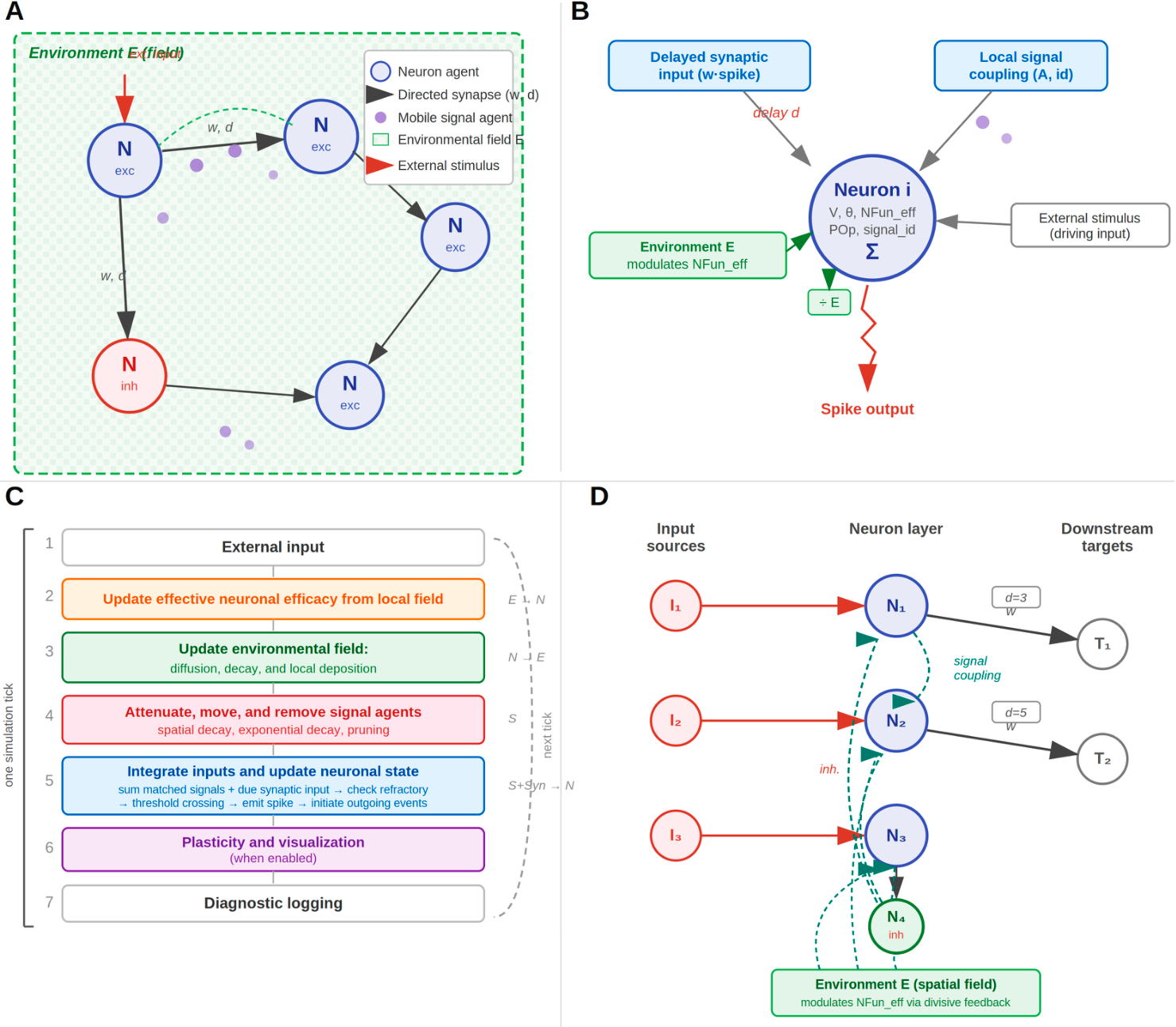
Figure 1 provides a conceptual overview of the model before the detailed formulation. It distinguishes the three interacting component classes—neurons, signal agents, and directed synapses—and shows how their dynamics are coupled to the environmental field
within a fixed tick-level schedule.
Entities, links, and state variables
LANA comprises three interacting entity classes and one spatial field. Neurons represent spiking units characterized by membrane potential, refractory state, threshold, intrinsic and effective efficacy, and spike-history variables. Signal agents are mobile activity packets characterized by amplitude, channel label, interaction radius, velocity, and a per-tick decay factor. Synapses are direct links characterized by weight, integer delay, and an eligibility countdown. The environmental field is a patch-local scalar field updated through diffusion, decay, and local deposition from signals. Neurons represent spiking units with the following internal state variables:
membrane potential (V);
absolute refractory counter (R);
spike threshold (thr, synchronized to THRESHOLD);
intrinsic efficacy (NFun) and effective efficacy (NFun-eff);
refractory period (p_op, synchronized to POp);
spike bookkeeping for rate/ISI statistics (spike-count, min-isi, last-spike-tick);
neuron type (neuron-type) set probabilistically by INHIB-FRAC;
channel label controlling which signal agents can influence the neuron.
Signal agents are mobile activity packets emitted by spiking neurons and characterized by the following: amplitude (A), which can be positive (excitatory) or negative (inhibitory);
channel identifier (signal_id);
interaction radius (radius, typically RADIUS-SIGNAL);
velocity components (vdx, vdy), producing ballistic motion at each tick;
exponential amplitude decay factor (BETA), applied per tick.
Synapses represent directed delayed interactions and are characterized by the following: synaptic weight (w);
integer delay (delay);
an eligibility countdown (elig) that realizes the delay operator (countdown to 0 triggers delivery).
The environmental field is a patch-local scalar field updated at each tick through diffusion, decay, and local deposition from signals. Initialization and network topology
At initialization, a user-defined random seed is set for reproducibility, the environmental field is reset to zero, and neurons are created with heterogeneous intrinsic efficacy and target out-degree. Intrinsic efficacy is drawn from a truncated normal distribution and bounded to [0, 1]. Each neuron is assigned excitatory or inhibitory identity according to the prescribed inhibitory fraction. Directed synapses are then formed preferentially among spatially proximal neurons. Transmission delays are determined by spatial distance and converted to integer values through a ceiling operation, ensuring a minimum delay of one tick. Unless otherwise specified in validation modes, initial synaptic weights are set to 1.0.
Tick-level process overview. At each tick, the model is updated in a fixed sequence that is essential for interpretability and verification: External input/stimulation, defined by the active mode (periodic stimulus, logic-gate trial input, EEG-driven input, or dedicated validation stimuli).
Environment-to-neuron efficacy update: calculate NFun_eff from the current local E.
Environment update: diffuse and decay the field , then add local signal deposition through a synchronous buffer update to avoid ordering artefacts.
Signal update: apply exponential amplitude decay and update positions by velocity.
Neuron update: handle refractoriness, integrate inputs, and apply the threshold rule to generate spikes.
Synapse visualization and plasticity update (plasticity is executed only in standard mode; it is disabled in verification modes).
Logging and diagnostics: update reporters, time-series histories, plots, and optional CSV logging.
This schedule clearly defines the operator composition of the model and allows for controlled isolation of mechanisms in the V&V suite.
For reader convenience, the signal–neuron interaction rule is summarized below in execution order.
The ordered computational procedure for updating signal agents and computing their local contribution to neuronal input is summarized in Algorithm 1.
| Algorithm 1. Signal–neuron interaction rule at one simulation tick. |
1. Update each signal agent by applying amplitude decay and position update.
2. Remove any signal whose absolute amplitude falls below the disappearance threshold.
3. For each neuron, identify only those signal agents whose channel label matches that neuron.
4. Among matching signals, retain only those within the interaction radius.
5. Compute the signal-mediated contribution of each retained signal using distance attenuation.
6. Sum these contributions to obtain the local signal-mediated input to the neuron.
7. Combine this input with delayed synaptic input before applying the neuron update. |
Table 1 summarizes the principal state variables, parameters, and operators used in the mathematical formulation.
Governing mechanisms and mathematical formulation. The equations below are presented in conceptual mathematical notation rather than implementation-level syntax. For clarity, the formulation is organized in the same mechanistic order in which the model operates: neuronal state dynamics, signal-mediated coupling, delayed synaptic transmission, environmental-field dynamics, environment-to-neuron feedback, and synaptic plasticity.
Neuron membrane dynamics and spiking. Classical conductance-based models provide the historical basis for formal neuronal membrane dynamics [
24], while the present implementation uses a reduced discrete-time leaky integrator in neuron i:
where
is the leak rate and
is the simulation time step (default: one tick). A spike occurs when:
where
denotes the spike threshold. Upon spiking,
is reset to
, and the neuron enters an absolute refractory state of duration
ticks. While
, spiking is suppressed, and the membrane potential remains clamped at the reset level. Inputs: signal-mediated coupling and delayed synaptic transmission
The total drive to neuron
is decomposed into two components: a local signal-mediated term and a delayed synaptic term.
Signal coupling. Neuron
responds only to signals whose channel label matches its own. For matching signals within an interaction radius, contributions are distance-attenuated:
where
denotes the set of signal agents whose channel matches neuron
,
is the amplitude of signal
at time
,
is the distance between neuron
and signal
, and
is the spatial attenuation coefficient.
Delayed synaptic input. Directed synapses receive input only when their eligibility counter equals zero. Let
denote the set of presynaptic neurons connected to neuron
. A synapse
contributes input only when its eligibility counter reaches zero, so delayed synaptic input is given by Equation (4).
where
denotes the set of presynaptic neurons connected to neuron
,
is the weight of synapse
,
is its delay countdown, and
encodes whether the presynaptic neuron is excitatory or inhibitory.
Synaptic delay operator (eligibility countdown). When neuron i spikes at tick t, each outgoing synapse sets its eligibility counter to the built-in delay period d_{i→k}. Each subsequent tick decrements elig until it reaches 0, at which time the synaptic input in Equation (4) is delivered; after delivery, the countdown goes to −1 and cannot be repeated since there can be a new presynaptic spike. This implementation yields an integer-valued delay operator that can be tested directly in controlled chain experiments (Phase 1, V1).
Signal dynamics. Each signal agent updates as:
where
is the per-tick signal decay factor. Signals are removed once
falls below a small threshold (1 × 10
−4 in the current implementation), ensuring computational stability and bounded memory. Signal velocities are initialized on emission using a random direction at a speed proportional to OUT-RANGE.
Environment field E: diffusion, decay, and deposition
The environmental field E is stored per patch and updated synchronously using an auxiliary buffer to avoid ordering artifacts. Each tick applies a 4-neighbor discrete Laplacian diffusion operator, linear decay, and local deposition from signals on that patch:
where
is the diffusion coefficient,
is the environmental decay rate, and the deposition term aggregates the amplitudes of signal agents present on the corresponding patch at the current tick.
Environment-to-neuron feedback (divisive normalization). Environmental feedback modulates neuronal efficacy via a divisive form:
where
denotes the mean environmental field in the radius-1 neighborhood of neuron
, and
controls the strength of divisive environmental feedback on neuronal efficacy.
Synaptic plasticity. In standard mode, synaptic weights evolve according to a simple decay-plus-coincidence rule inspired by classical Hebbian and synaptic-plasticity principles [
25,
26]:
with clipping to [0, 5]. Here
and
are fixed constants in the current implementation. For verification modes (chain/decay/single neuron), plasticity is disabled so that weights remain constant and deterministic operator testing is not confounded by drift.
Implementation notes. For transparency and reproducibility, a small number of implementation-specific aspects of the NetLogo model should be noted. Neurons, propagating signals, synapses, and the environmental field are represented as distinct interacting components, and the field is updated synchronously to prevent ordering artefacts. During initialization, connectivity is assigned using bounded degree targets and spatial proximity, while transmission delays are discretized into integer tick delays with a minimum of one tick. In addition, the executable model includes simple numerical safeguards to maintain stable field dynamics under extreme conditions.
Inputs, experimental modes, and readouts. LANA includes multiple stimulus and experimental modes used across the V&V suite: (i) a periodic stimulus injected at a fixed source patch; (ii) a logic-gate protocol injecting two inputs (A and B) according to a trial schedule and reading spiking in an output region; (iii) an EEG-driven mode that reads amplitude pairs from a CSV file and injects them as signals at source locations; and (iv) lesioning that reduces intrinsic efficacy within a spatially defined radius. The present study focuses on the modes required to isolate and test the operators and emergent signatures targeted by the five-level V&V framework.
4. Results
All verification and validation experiments satisfied their predefined pass criteria (
Table 2). Unless otherwise stated, values are reported as means across independent random seeds for each condition. At a high level, the Results show four main findings. First, the core numerical operators satisfy their predefined verification criteria, including exact delay propagation and analytically consistent field decay and diffusion. Second, neuron-level mechanisms behave as expected, with a sharp activation threshold and strict refractory enforcement. Third, the validated local rules scale into interpretable propagation and network-level signatures, including inhibition-driven suppression and coupling-driven regime change. Fourth, supplementary matched-seed and robustness analyses clarify the mechanistic roles of signal transport, environmental feedback, lesioning, and parameter sensitivity. Where the tested subsystem is fully deterministic under the imposed isolation constraints (e.g., no diffusion, no stochastic sources), results are identical across seeds.
Phase 1: Algorithmic verification. Phase 1 isolates and verifies four central numerical/algorithmic operators: (V1) synaptic transmission delay implementation, (V2) environmental field decay update, (V3) distance-attenuated signal coupling, and (V4) environmental field diffusion. Both of these experiments take place in standalone validation modes that disable plasticity and suppress confounding coupling pathways.
V1: Chain delay verification. A feedforward chain of 11 neurons is set up, with fixed synaptic weight and fixed transmission delay between consecutive neurons. By assigning a unique to each neuron to ensure that propagation is conducted solely through synapses (and not via spatial signal coupling), the mobile signals cannot directly go on trigger downstream neurons. Environmental coupling is turned off ( = 0), diffusion is disabled (D = 0), and decay is set to eliminate E-field accumulation ( = 1). A solitary suprathreshold stimulus activates neuron 0, while first-spike times are documented for all neurons.
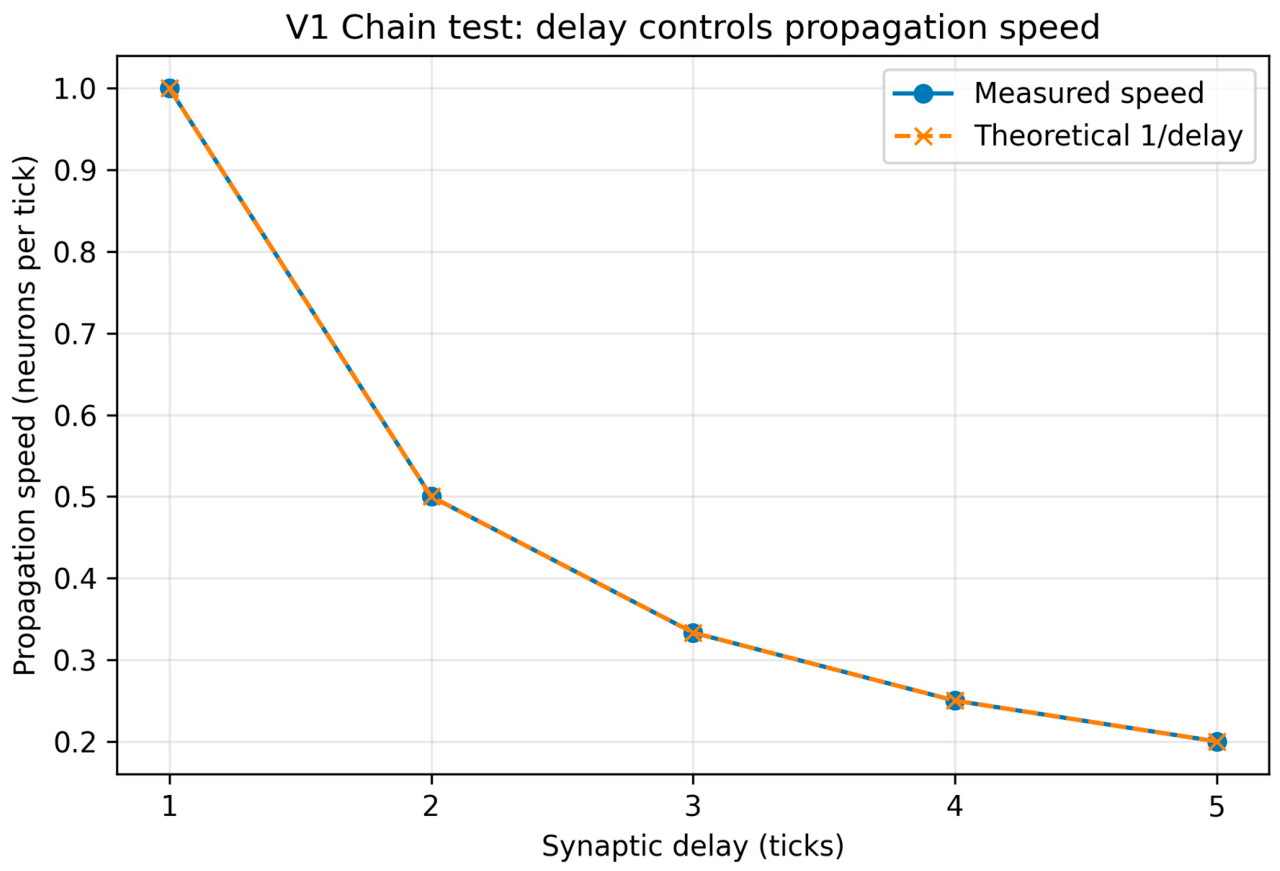
Across fixed-delay values from one to five ticks, the measured mean inter-neuron first-spike lag matched the prescribed delay exactly (
Table 3), with
in all conditions. Propagation speed followed the expected inverse relationship
, with
across conditions (
Figure 2). This analytical agreement is summarized in
Table 4. These results provide a strict algorithmic confirmation that the delay counter/eligibility mechanism is implemented without off-by-one or scheduling artefacts. The strict criterion MAE = 0 is appropriate for this deliberately deterministic benchmark because the chain uses integer-valued delays, fixed update ordering, and no stochastic perturbations in the propagation measurement. In stochastic settings, or in implementations involving floating-point delay interpolation, agreement within numerical tolerance rather than exact zero error would be the appropriate benchmark.
To explicitly demonstrate agreement with analytical reference solutions,
Table 4 summarizes quantitative comparison between simulation results and the corresponding theoretical expressions for the delay–speed law (V1), the exponential decay operator (V2), the signal attenuation reference (V3), and the diffusion operator (V4).
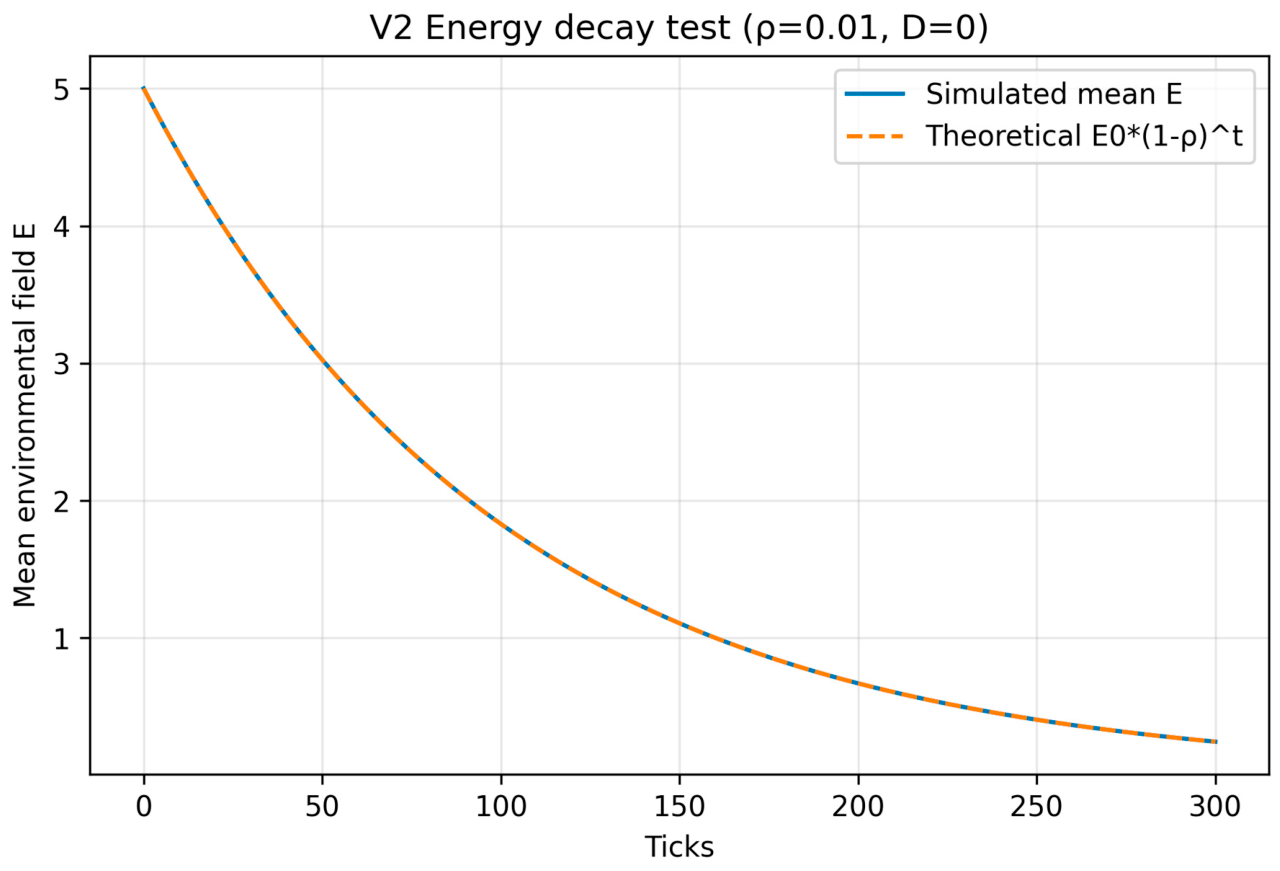
V2: Energy decay test. In order to check the decay term of the environmental update operator, the field is uniformly initialized with the value E0 = 5.0 on all the patches. Diffusion is disabled: D = 0; neuron–environment coupling is disabled: = 0; signals are not present. Given these conditions the mean-field trajectory should be discrete-time exponential decay
Given
over 300 ticks (10 seeds), the simulated mean field confirms that the model fits the theoretical curve to numerical precision (R
2 = 1.000; MAE ≈ 2.19 × 10
−14), therefore indicating that the decay component is correctly computed and remains numerically stable under the controlled circumstances (
Figure 3).
V3: Signal distance-attenuation test. To verify the correctness of the distance-attenuated signal channel (γ) together with per-tick signal amplitude decay (β), we swept γ across eight levels in the range 0.001–2.0 and β across {0.5, 0.8, 0.95} in a standard network (N = 100), with environmental coupling disabled (
=0) and diffusion disabled (D = 0) to isolate signal-mediated reach. Across 20 independent seeds per condition (480 runs; 500 ticks), the mean firing rate decreases monotonically with increasing γ for the active β levels, consistent with an attenuation envelope of the form
The Spearman association between γ and mean firing rate is strongly negative
for β = 0.95), satisfying the predefined pass criterion (
Table 2) and confirming that spatial attenuation is implemented correctly.
V4: E-field diffusion operator test. To verify the diffusion term of the E-field update operator (), we used the decay-test isolation setup and initialized a localized hot spot in the field (E = 100 at the origin). We swept D across seven levels from 0 to 0.2 over 10 seeds (70 runs; 500 ticks) and evaluated the final mean E, final maximum E, and the max/mean ratio. As expected for a conservative diffusion operator, the global mean E is invariant to D (CV(mean-E across D) ≈ 0), while increasing D produces stronger spatial smoothing reflected by a perfect negative association between D and the final max/mean ratio (Spearman = −1.000). These results confirm that diffusion redistributes E without loss and scales correctly with D.
Phase 2: Micro-scale validation. In this phase, basic neuron-level mechanisms are tested: (M1) a sharp threshold for activation (bifurcation from silent to firing) and (M2) strict imposition of the absolute refractory period.
M1: Threshold bifurcation. A single neuron was simulated on its own (
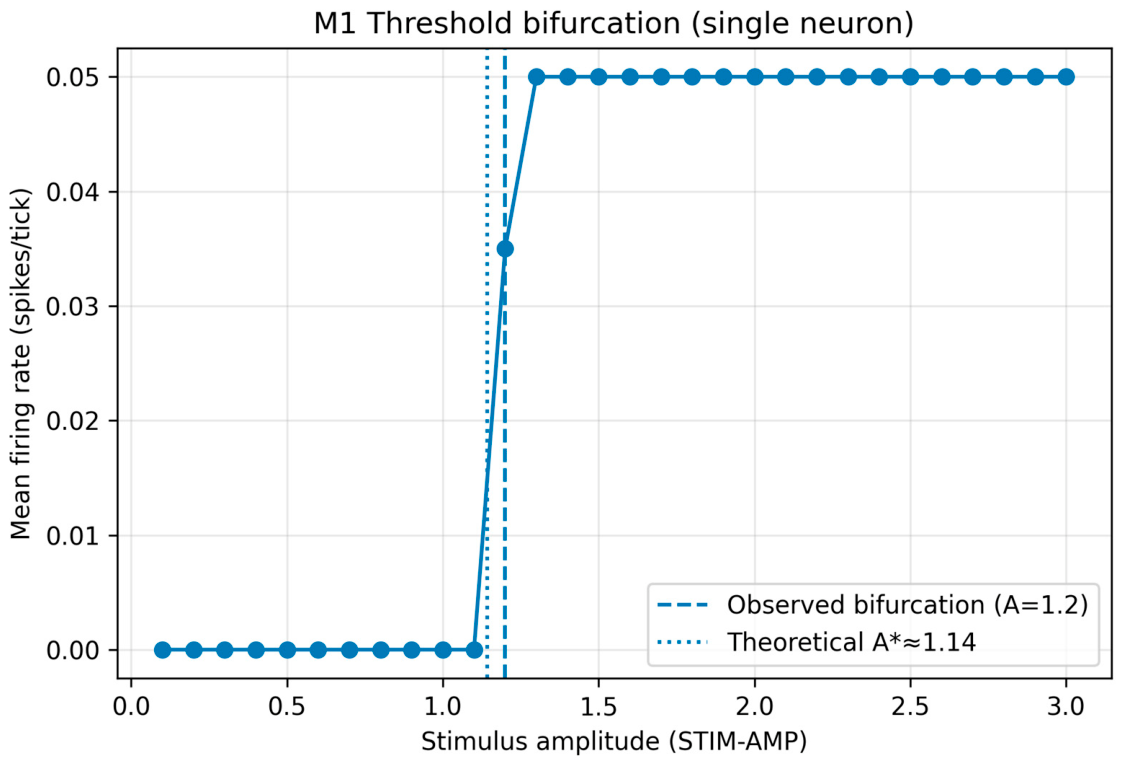
= 0, D = 0, no synapses). To examine threshold activation without spatial attenuation or channel-matching effects, a periodic direct stimulus was applied to the membrane potential every 10 ticks. The stimulus amplitude was swept from 0.1 to 3.0 over 10 seeds, and mean firing rate was recorded. Analytically, the critical amplitude for threshold crossing in the discrete leaky integrator is
for
,
, and stimulus period
ticks. Consistent with this prediction, firing remained zero up to amplitude 1.1, whereas sustained spiking emerged at amplitude 1.2 and saturated near 0.05 spikes/tick for larger amplitudes (
Figure 4). The saturation plateau reflects the combined effect of the stimulus schedule and refractory enforcement, which limit the neuron to one spike per stimulus cycle in the high-amplitude regime.
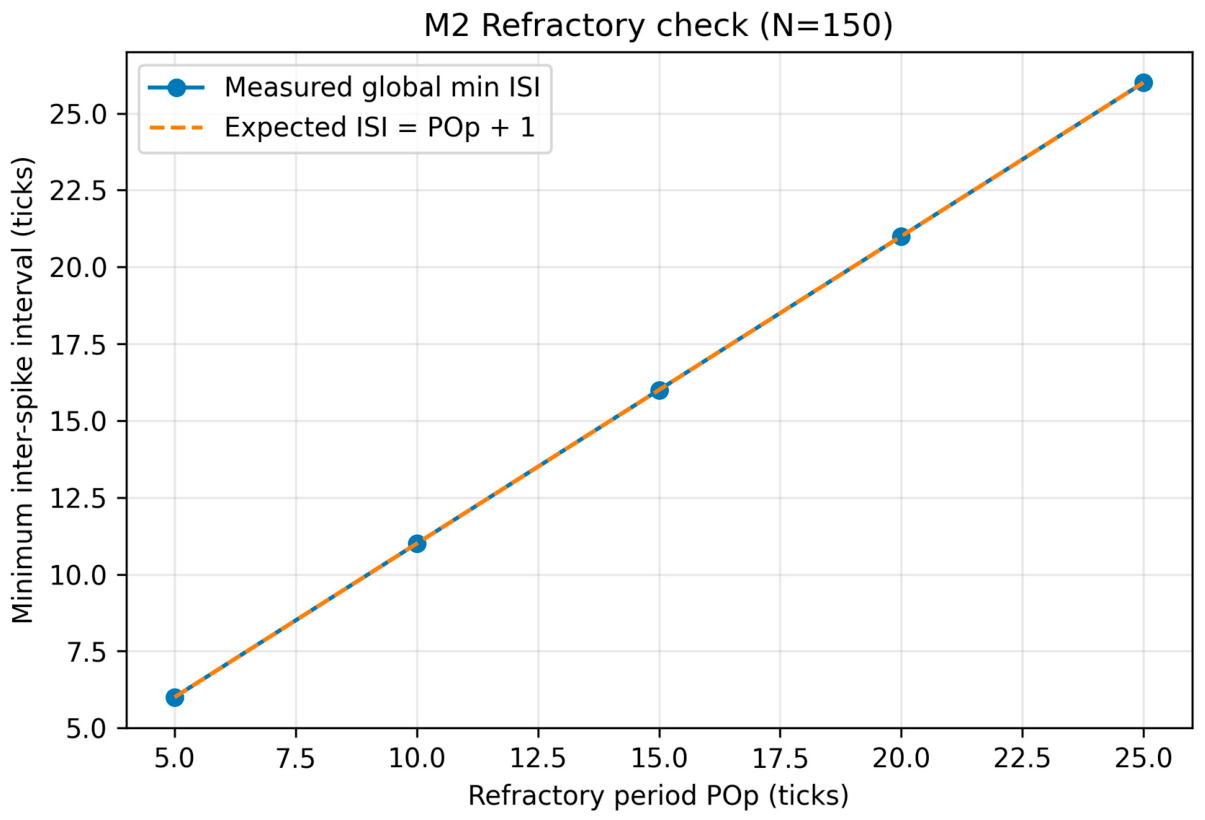
M2: Refractory check. To test refractory enforcement, we simulated the standard network (
) while sweeping the refractory period
over
ticks (10 seeds per level; 500 ticks per run). For each run, we recorded the global minimum inter-spike interval (ISI) among neurons that fired at least twice. Across all tested refractory settings and all seeds, the minimum measured ISI was exactly
(
Table 5;
Figure 5), with no violations. This confirms strict enforcement of the absolute refractory constraint in discrete time.
Phase 3: Verification of meso-scale propagation. Phase 3 tests if validated micro-mechanisms scale harmoniously to the propagation in small, structured networks. Two complementary tests are used: (E1) synaptic weight as a propagation gate, and (E2) synaptic delay as the propagation speed controller.
E1: Synaptic weight gating versus propagation rate. Using the same 11-neuron chain structure as V1 with delay fixed to one tick, FIXED-W is swept from 0.5 to 2.5 (step 0.5) over 20 seeds. Propagation is successful if the chain completes (all neurons produce a first spike). Propagation fails deterministically at FIXED-W = 0.5 (0/20 complete), suggesting that the synaptic input is subthreshold. For FIXED-W ≥ 1.0, propagation success occurs in 20/20 runs and the speed has been maintained as exactly one neuron/tick (
Table 6). Therefore, in this controlled chain regime, synaptic weight governs whether propagation happens, and delay governs how fast propagation is possible after suprathreshold transmission is achieved.
E2: Delay controls propagation speed. E2 reiterates, at the meso scale, the V1 finding that propagation speed is governed solely by transmission delay (speed ≈ 1/delay;
Figure 2), provided that weight is suprathreshold.
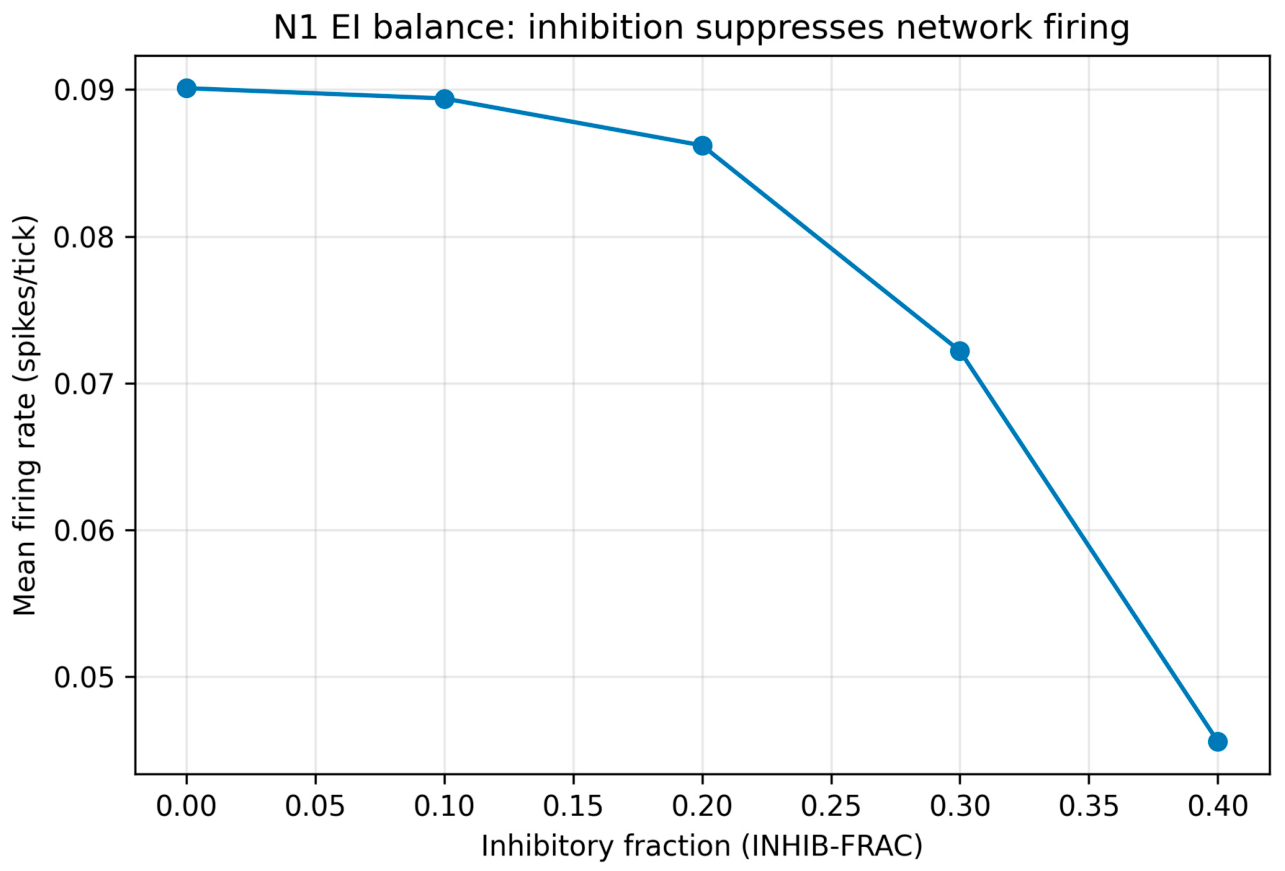
Phase 4: Macro-scale network validation. Phase 4 validates emergent network-level signatures expected of spiking excitation–inhibition (EI) systems and closed-loop coupling: (N1) inhibition suppresses firing and regularizes variability, and (N2) increasing environment coupling induces a qualitative regime shift in activity statistics and oscillatory prevalence.
N1: Excitation–inhibition balance. INHIB-FRAC is swept from 0.0 to 0.4 (step 0.1), with N = 150 and 30 seeds per condition. We report mean firing rate (FR), synchrony index, and Fano factor. Mean firing rate decreases monotonically with inhibition strength, from 0.0901 spikes/tick at INHIB-FRAC = 0.0 to 0.0456 spikes/tick at INHIB-FRAC = 0.4 (a 49.4% reduction;
Table 7;
Figure 6), satisfying the pass criterion. The Fano factor decreases from 3.12 to 1.57, consistent with reduced burstiness/overdispersion under stronger inhibitory control.
Seed-to-seed variability remains low up to INHIB-FRAC ≤ 0.2 but increases markedly for strong inhibition (0.3–0.4), indicating that some realizations approach near-silent regimes under high inhibitory fractions.
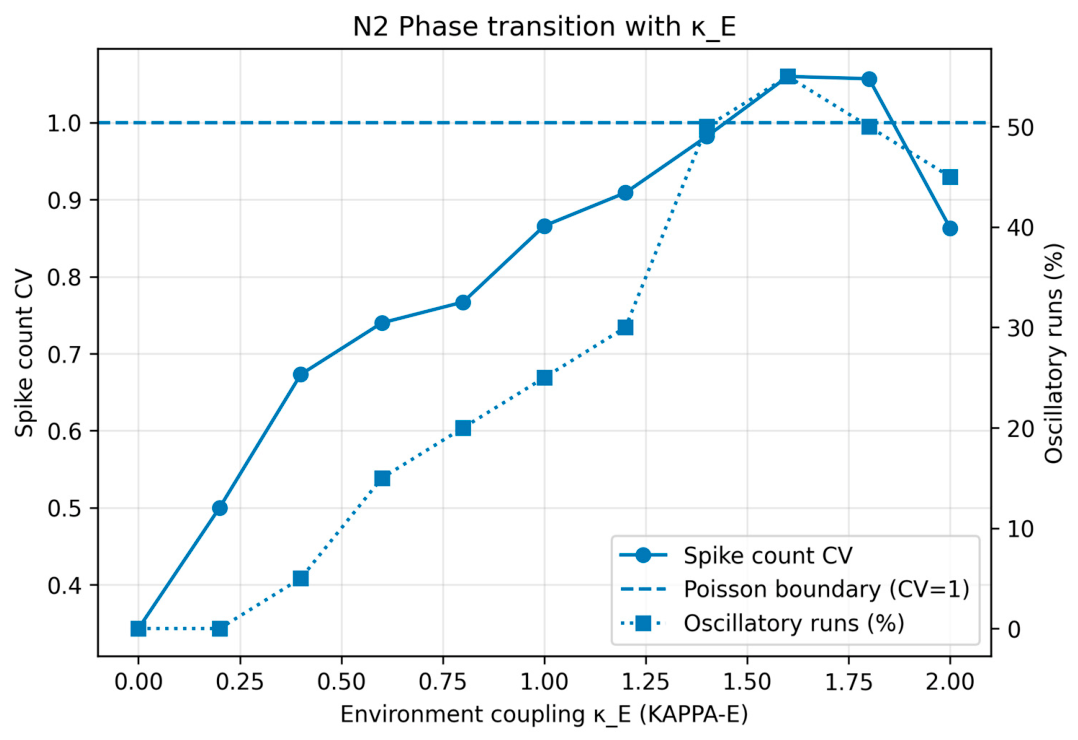
N2: Phase transition under environment coupling .
The environment-coupling strength
was swept from 0 to 2.0 in steps of 0.2, with
and 20 seeds per condition. We evaluated mean firing rate, spike-count variability (CV), and the fraction of runs classified as oscillatory-like. Increasing
progressively suppressed firing while increasing variability of the population spike count. Mean firing rate decreased from 0.0859 ± 0.0028 spikes/tick at
to 0.0117 ± 0.0015 at
(−86.4%). Spike-count variability (CV computed over the last 100 ticks) increased with
and approached or exceeded 1 around
–1.6, indicating a shift from relatively regular activity to a high-variability regime. Using the operational detector defined in Section Reproducibility and Execution Protocol (CV over the last 50 ticks > 1 and mean spike count > 0), the fraction of oscillatory-like runs peaked at 55% at
and remained elevated at higher coupling (
Table 8;
Figure 7). Together, these signatures support
as a control parameter governing the transition between relatively regular/asynchronous regimes and more irregular/oscillatory regimes.
Phase 5: Global sensitivity analysis. In order to estimate parameters impact over the entire design world, a full-factorial global sensitivity screening over
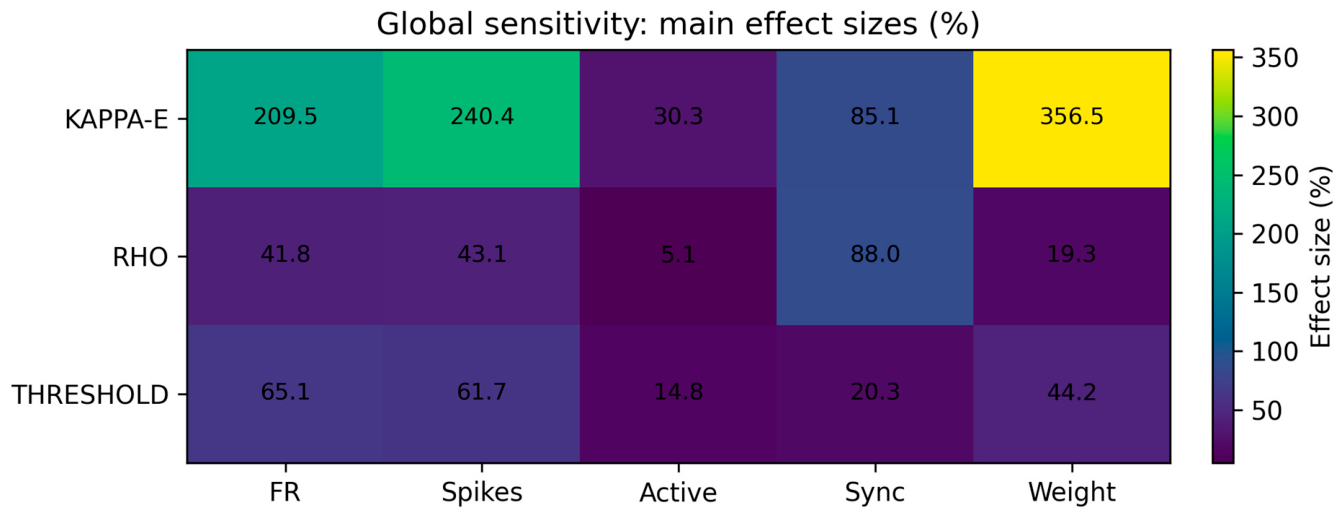
∈ {0, 0.5, 1.0, 1.5, 2.0}, ρ ∈ {0.001, 0.01, 0.019}, and θ ∈ {0.5, 1.0, 1.5} was carried out across 10 seed configurations (450 runs; 500 ticks). Results include mean firing rate, total spikes, active-neuron fraction, synchrony index, and synaptic weight statistics. We show that
dominates firing rate, total spikes and synaptic weight statistics by range-based main effect sizes of 209.5% (FR), 240.4% (spikes), and 356.5% (mean weight) (see
Table 9;
Figure 8). Range-based main effects were used here as a screening metric because the purpose of this phase was to rank dominant control parameters transparently over a modest factorial design rather than obtain a full variance decomposition. This choice provides directly interpretable effect magnitudes for an initial V&V-oriented sensitivity screen and is computationally well matched to the present design. Variance-based methods such as Sobol analysis remain important future extensions, but they require a broader sampling strategy and are therefore reserved for subsequent uncertainty-quantification work. On the other hand, in synchrony, ρ exerts its largest impact (88.0%), again supporting that a long-term association with performance is due to environmental persistence in the regulation of the temporal coordination system, but θ is responsible for only a slight change of excitability and activity participation from θ, the latter being the expected impact.
4.1. Additional Robustness Tests
Beyond the five main stages, we also provide two robustness checks: network size sensitivity (R1) and long-horizon plasticity convergence (R2).
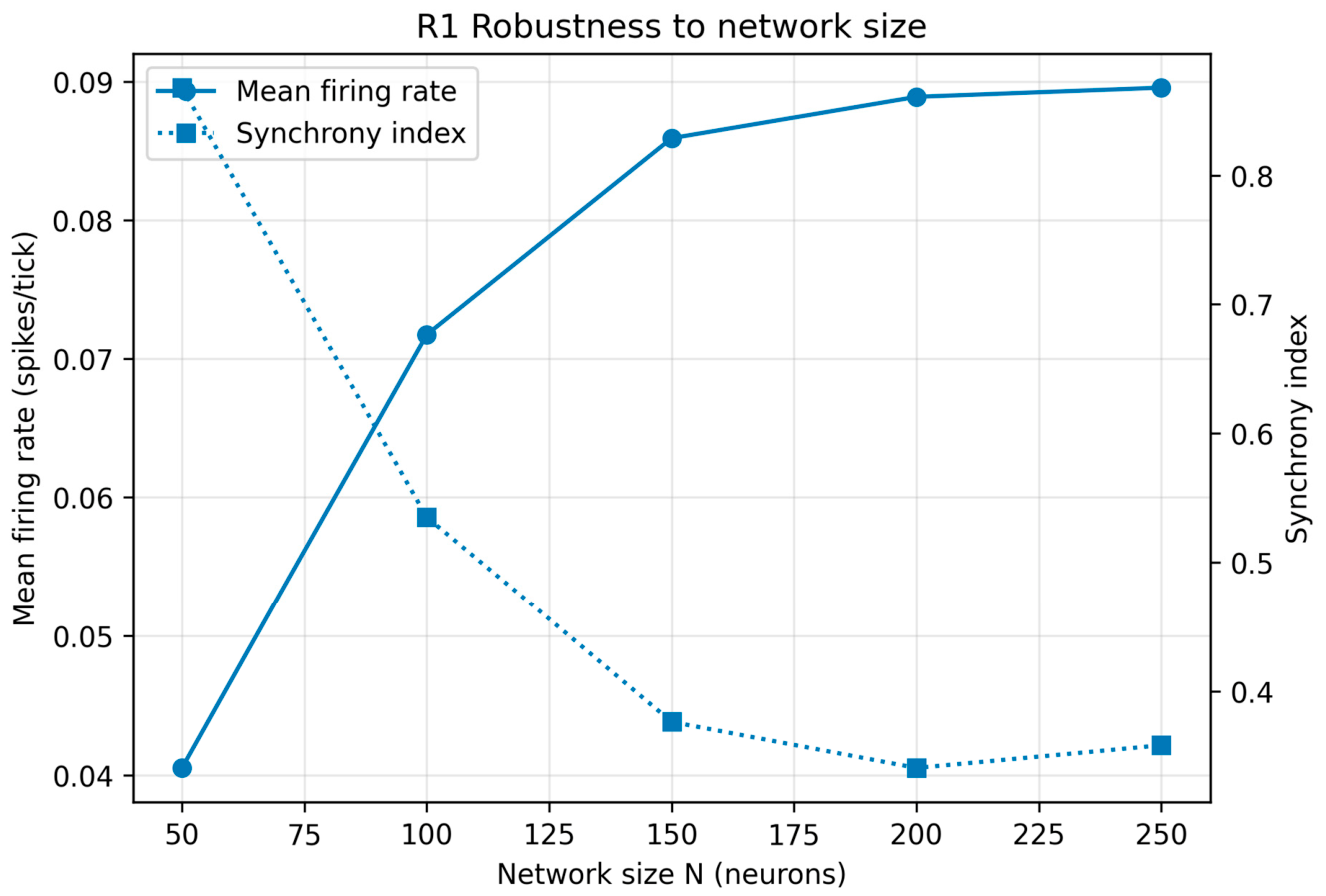
R1: Resilience to network size. N-NODES is swept from 50 to 250 in steps of 50 (20 seeds; 500 ticks). We monitor firing rate, synchrony, the Fano factor, and the fraction of active neurons. The network-level statistics stabilise to N ≈ 150 (
Table 10;
Figure 9). For N = 50, the firing rate is highly seed dependent (CV ≈ 62%), and on average ~68% of neurons are firing. For N ≥ 150, the mean FR converges near ~0.089 spikes/tick with low cross-seed variability (CV ≈ 1–3%) and nearly complete activation.
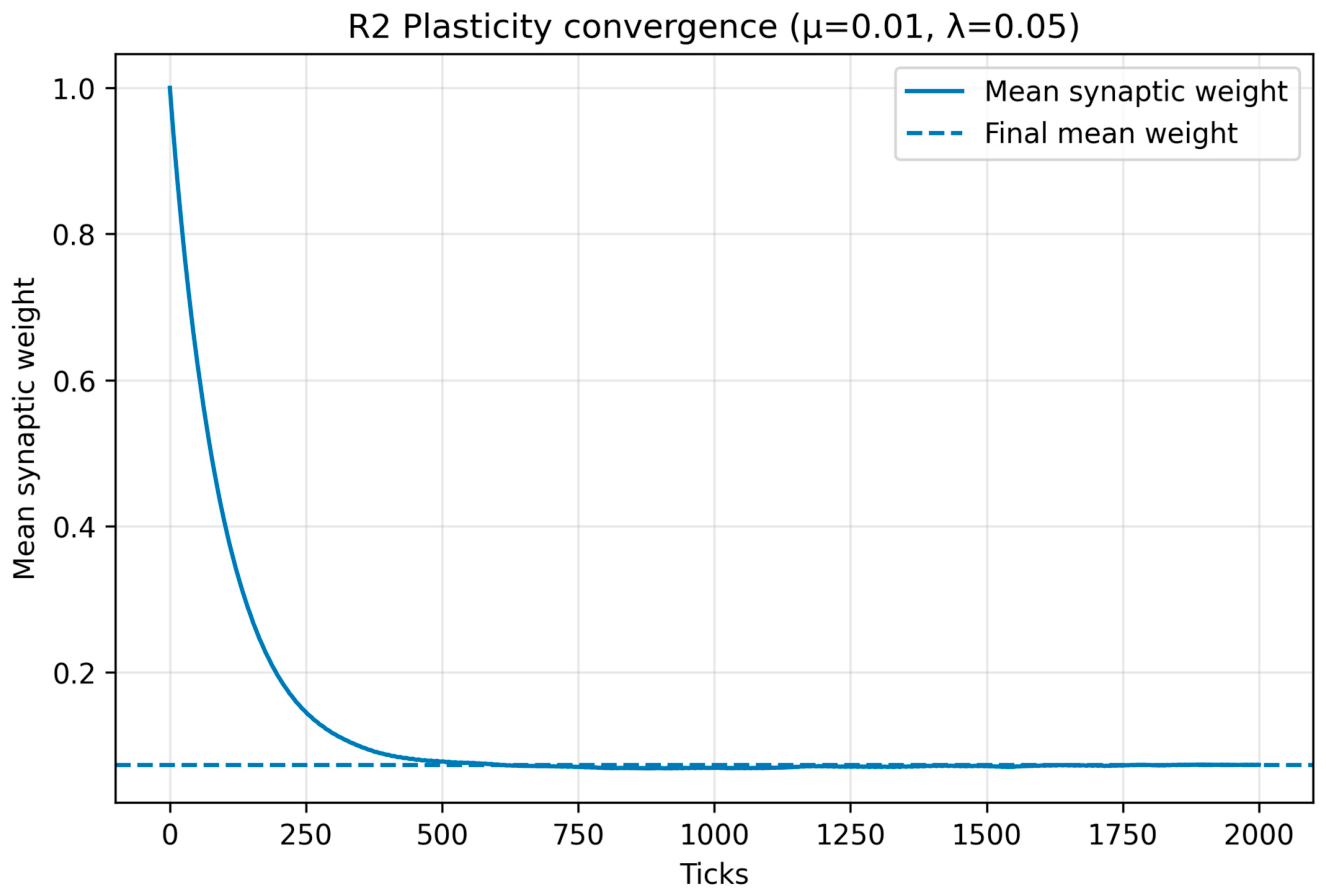
R2: Plasticity convergence. Assuming plasticity is functional
in normal network (N = 150), we perform 20 seeds for 2000 ticks and observe synaptic weight statistics over time. Mean synaptic weight decays from the initial value and reaches a stable equilibrium by 2000 ticks: mean(w) = 0.0738 ± 0.0128 across seeds. Interestingly, mean firing rate remains steady at ≈ 0.088 spikes/tick despite substantial weight reorganization, which demonstrates convergence towards a functional steady regime with bounded synaptic statistics (
Figure 10).
4.2. Supplementary Mechanism-Dissection Results
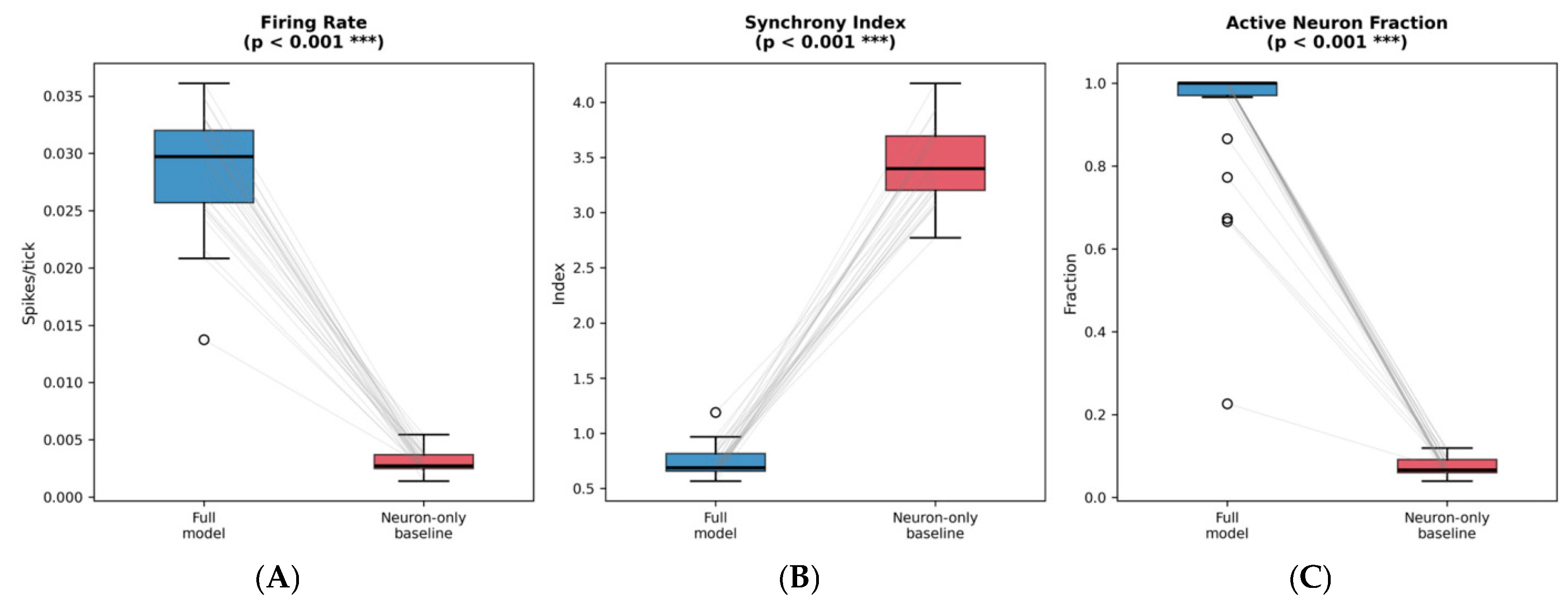
Full model versus neuron-only baseline. To quantify the contribution of the signal-agent and environment-coupling modules, we compared the full LANA model against the neuron-only baseline under a matched-seed paired design (N = 150, 30 seeds, 500 ticks per run). In the baseline, mobile signal agents are absent, the environmental field remains at zero, and divisive normalization is bypassed; neuronal dynamics and synaptic transmission operate identically to the full model. Stimulus delivery is maintained by direct membrane-potential injection with the same spatial profile. The full model produced a median firing rate of 0.0297 spikes/tick (IQR: 0.0257–0.0320) compared to 0.0027 (IQR: 0.0025–0.0037) in the baseline (Wilcoxon signed-rank test,
p= 1.86 × 10
−9, rank-biserial r = 1.00;
Figure 11;
Table 11). The approximately 11-fold increase in firing rate demonstrates that the signal-agent layer and environment-mediated feedback substantially amplify network activity beyond what synaptic transmission alone can sustain. The synchrony index was significantly higher in the baseline (median 3.40 vs. 0.69,
p= 1.86 × 10
−9, d = −7.41), indicating that without environment-mediated coupling, the few active neurons fire in tight synchrony rather than exhibiting the distributed activity patterns characteristic of the full model. Spike-count variability (CV) was correspondingly elevated in the baseline (3.64 vs. 0.59,
p= 1.86 × 10
−9, d = −9.03), reflecting irregular, burst-like dynamics in the absence of the E-field’s gain-control mechanism.
The active neuron fraction dropped from near-complete recruitment in the full model (median 1.00) to only 6.7% in the baseline (p= 1.69 × 10⁻⁶, d = 4.89), confirming that signal agents are essential for spatial propagation of activity across the network. As a control, the chain benchmark was run under both conditions across three delay values (one, two, and three ticks) with 20 seeds each. Propagation speed and delay accuracy were identical between the full model and baseline in all 120 runs (, MAE = 0.000000 in both conditions), confirming that the synaptic delay mechanism operates correctly independent of the signal-agent module and that the baseline switch does not inadvertently alter the core propagation pathway.
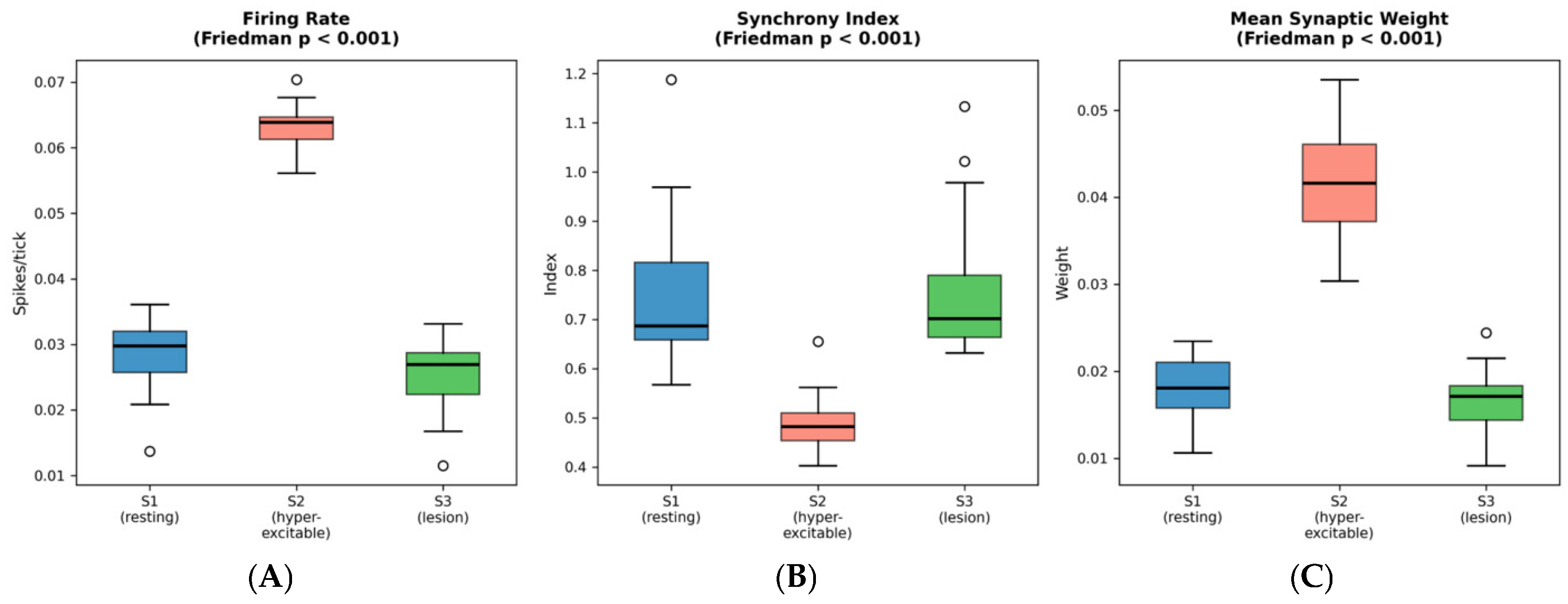
Regime comparison (S1/S2/S3). Across 30 matched seeds, the three regimes produced distinct activity profiles (Friedman χ
2 = 60.0,
p< 10
−13 for firing rate;
Figure 12;
Table 12). The hyperexcitable regime (S2) exhibited a median firing rate of 0.0639 spikes/tick, approximately 2.15 times higher than S1 (0.0297; Bonferroni-corrected p < 0.0001), consistent with the combined effect of reduced threshold, weakened environmental feedback, and lower inhibition. The lesion regime (S3) showed reduced firing rate relative to S1 (0.0269; Bonferroni-corrected p < 0.0001), reflecting the loss of neuronal efficacy within the lesion zone. Synchrony was significantly lower in S2 (median 0.48) compared to both S1 (0.69) and S3 (0.70; both Bonferroni-corrected p < 0.0001), indicating that the hyperexcitable network distributes activity more evenly across the population rather than concentrating it in synchronized bursts. S1 and S3 did not differ significantly in synchrony (
p= 0.59), consistent with their identical network parameters outside the lesion zone. Mean synaptic weight was substantially higher in S2 (0.0416 vs. 0.0181 in S1; Bonferroni-corrected p < 0.0001), reflecting enhanced plasticity driven by the elevated firing rate. S3 showed a modest but significant reduction in mean weight relative to S1 (0.0171;
p= 0.0009), attributable to reduced activity in the lesion zone suppressing local plasticity.
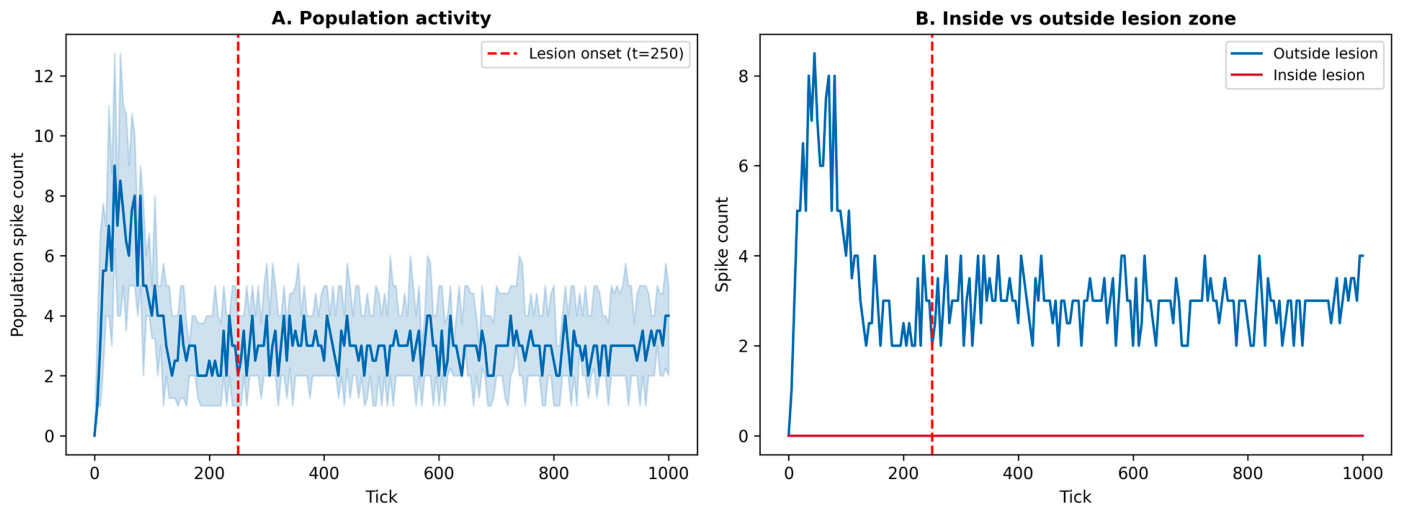
Lesion dynamics (S3). In S3, the pre-lesion baseline (ticks 50–200) established a stable firing plateau of 4.49 spikes/tick (IQR: 4.20–4.65). Following lesion onset at tick 250, an immediate drop was observed to 3.33 spikes/tick (IQR: 2.75–3.64), representing a 22.5% reduction relative to pre-lesion levels (drop ratio median = 0.78, IQR: 0.72–0.84; Wilcoxon p = 1.73 × 10
−6, Standardized effect (d) = 1.54). Neurons inside the lesion zone were effectively silenced (median post-lesion spike count = 0), while neurons outside the lesion zone continued firing at reduced but sustained levels (median 3.43). The recovery phase (ticks 300–500) showed partial stabilization at 3.44 spikes/tick (recovery ratio = 0.79), indicating that the network does not fully compensate for the lost efficacy. The final plateau (last 200 ticks) remained at 3.40 spikes/tick, confirming persistent but stable post-lesion dynamics. These post-lesion dynamics are summarized in
Figure 13 and
Table 13.
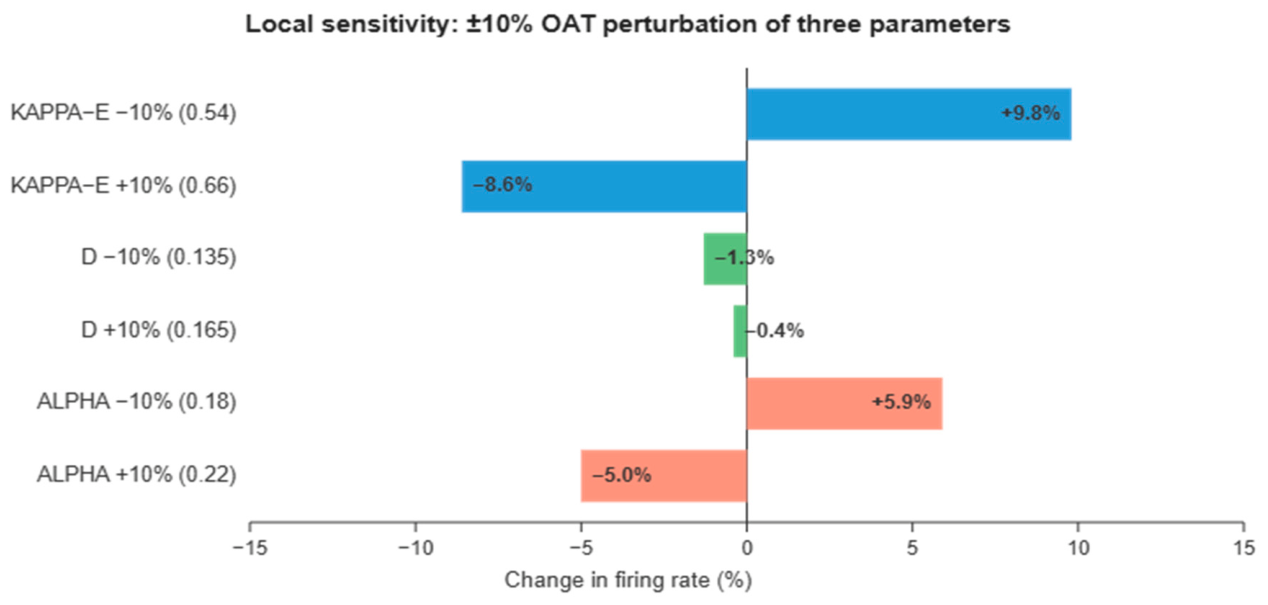
Local sensitivity analysis. To assess robustness to parameter uncertainty, we performed a one-at-a-time (OAT) perturbation analysis on three key parameters: environment coupling strength (κ_E), diffusion coefficient (D), and leak rate (α). Each parameter was varied by ±10% around its nominal value, while all others remained fixed, with 10 seeds per level. The environment coupling parameter κ_E showed the strongest sensitivity: reducing κ_E by 10% (to 0.54) increased the mean firing rate by +9.8%, while increasing it by 10% (to 0.66) decreased firing rate by −8.6%. The leak rate α showed moderate sensitivity (+5.9% at α = 0.18; −5.0% at α = 0.22), reflecting its direct role in membrane dynamics. The diffusion coefficient D was largely insensitive to ±10% perturbation (−1.3% and −0.4%), indicating that local diffusion rate is not a critical control parameter at this scale. All responses were monotonic and proportionate, confirming that model behavior is smooth and predictable in the neighborhood of the nominal operating point. The qualitative regime separation reported above is robust to moderate parameter uncertainty. The ±10% interval was selected as a local robustness window around the validated nominal operating point. It was not intended to map the full transition structure of the model; those broader behavioral changes were examined separately through the wider sweeps used in Phases M1, N1, N2, and GSA. Within this local window, the objective was to test whether small perturbations produce smooth or abrupt deviations from the validated baseline. The local sensitivity profile is shown in
Figure 14.
5. Discussion
In this study, a full, reproducible verification and validation (V&V) workflow is created for a spatial, agent-based spiking neural network with explicit local coupling and a co-evolving environmental field. The manuscript is intended as an interdisciplinary methodological contribution at the intersection of agent-based modeling, computational neuroscience, and simulation credibility. Its central claim is therefore not biological completeness and not replacement of mainstream SNN simulators, but a transparent framework for representing, isolating, and validating spatially explicit spiking-network mechanisms across scales. This positioning is important because the scientific value of the study lies in methodological clarity, mechanistic traceability, and reproducible verification rather than in maximizing simulator performance alone [
28,
29]. We accomplish this by intentionally isolating mechanisms in dedicated validation modes until we establish the correctness of the core operators of the model and then validate emergent behaviors at increasing scales, in line with established simulation credibility [
9,
10]. This hierarchy is particularly relevant for agent-based neural models since small, nuanced implementation errors relating to operator ordering, off-by-one delay handling, or unstable field updates can yield qualitatively misbehaved emergent dynamics. At the operator level, Phase 1 validates that synaptic transmission delays follow the mandated propagation time without error as previously stated (MAE = 0; speed = 1/delay; R
2 = 1.000), and that the environmental decay update follows the theoretical discrete exponential law at floating-point accuracy. With the addition of the diffusion test (V4), all terms of the E-field update equation are now independently verified (decay + diffusion), and the signal-attenuation channel (V3) is confirmed as a separate, analytically consistent coupling pathway. The findings provide assurance that such network-scale effects are not artifacts of numerical drift or scheduling variance. At an operational level, the neuron implementation exhibits the expected primitives of a reduced spiking model: a sharp threshold bifurcation under periodic forcing and strict enforcement of an absolute refractory constraint (min (ISI) = POp + 1, zero violations). Such properties are essential for interpretability, because small deviations in refractoriness or thresholding are likely to influence how population activity statistics shift and which collective state transitions change most quickly [
16,
17,
18,
19].
At the meso- and macro-scale, the results clarify how validated local mechanisms translate into structured propagation and network-level control. In the controlled chain experiments, synaptic delay acts as a pure speed controller, whereas synaptic weight functions as a propagation gate: once the delivered input is suprathreshold, the timing of propagation is determined by delay rather than by weight magnitude. This separation follows directly from the discrete-time leaky integrate-and-fire formulation used here and should be made explicit when interpreting transmission speed and latency in this model class. At the network level, the macro-validation stage recovers qualitative signatures expected in excitatory–inhibitory spiking systems: increasing inhibition monotonically suppresses activity and reduces spike-count overdispersion, consistent with inhibition-driven regularization [
18]. In addition, stronger environmental coupling
induces a coupling-driven regime shift characterized by reduced firing, increased spike-count variability, and a higher prevalence of oscillatory-like episodes. Sensitivity screening further identifies
as the dominant control parameter for firing and synaptic-weight statistics, while
primarily shapes temporal coordination and
sets the overall excitability level. Mechanistically,
closes a feedback loop in which spikes deposit activity into the environmental field and the field, in turn, divisively modulates subsequent neuronal efficacy, consistent with gain-control principles in neural computation [
30].
Mechanistic dissection via baseline comparison. The neuron-only baseline provides a principled decomposition of LANA’s emergent dynamics. By disabling the signal-agent layer and environment coupling while preserving synaptic transmission, we isolate the contribution of two novel architectural features: mobile signal-mediated coupling and activity-dependent divisive normalization via the environmental field. The approximately 11-fold difference in firing rate and the shift from 6.7% to near-complete neuronal recruitment demonstrate that these mechanisms are not auxiliary but constitute the primary drivers of network-level activity. The chain benchmark serves as an internal consistency check, confirming across 120 paired runs that synaptic delay propagation is unaffected by the baseline switch, thereby validating the experimental isolation. The regime comparison further demonstrates that the model produces three qualitatively distinct dynamical states from biologically interpretable parameter variations, with all differences surviving paired statistical testing with large effect sizes.
5.1. Sensitivity Structure and Practical Guidance for Model Use
The global sensitivity analysis complements the validation phases by quantifying parameter influence over a factorial design. The results identify
as the dominant driver of firing activity and synaptic-weight statistics, consistent with its role as the primary coupling parameter controlling the strength of the activity–environment feedback. The decay rate
exerts the strongest effect on synchrony, suggesting that environmental persistence extends temporal correlations, whereas the threshold
acts as a global excitability control [
12,
13]. Practically, these rankings provide a principled starting point for future calibration:
should be prioritized when fitting regime statistics such as variability and oscillatory prevalence,
when fitting temporal coordination measures, and
when fitting overall firing levels.
5.2. Limitations and Future Work
Current V&V is purposely mechanism-based (internal, structural, and face validity) rather than a literal quantitative match to biological recordings. Though LANA features an EEG-driven stimulus mode, we have not yet calibrated parameters to empirical data, nor have we validated the outputs against specific experimental measurements, e.g., spectral power, avalanche statistics, or spike-train interval distributions. Nevertheless, the validated structure of LANA admits several concrete data-oriented extensions. In an EEG-informed application, preprocessed time-varying source amplitudes could be used to drive the model, with comparison targets including activity envelopes, synchrony, spike-count variability, oscillatory prevalence, and derived spectral summaries. In a lesion-oriented application, focal efficacy reduction could be compared with empirical measures of acute activity drop, recovery slope, spatial contrast between affected and unaffected regions, and post-lesion plateau behavior. More generally, future calibration could target spectral power, avalanche-like statistics, inter-spike-interval distributions, active-fraction dynamics, and regime-transition boundaries, depending on the measurement modality and experimental context. Additionally, the neuron-only baseline was evaluated in the resting configuration and as a chain-control experiment rather than exhaustively across all operational regimes. The S1–S3 labels should therefore be interpreted as operational dynamical regimes, not patient-specific biological phenotypes. Finally, the local robustness analysis was restricted to ±10% one-at-a-time perturbations around the nominal operating point. This range was chosen for local stability assessment rather than for mapping the full transition structure of the model; broader variance-based uncertainty quantification remains future work. Thus, future work must focus on the following: (1) systematic data-driven calibration (e.g., likelihood-free or approximate Bayesian approaches), (2) uncertainty quantification of seeds and parameter distributions, (3) broad-based sensitivity analyses based on variation (e.g., Sobol methods) rather than range-based effect sizes. Furthermore, oscillation classification and “regime” labelling in this work is derived from summary statistics and heuristic detectors and additional spectral and state-space analyses could enhance biological interpretability. Thus, these observations, taken together, lend credence to a strong claim of credibility: LANA is algorithmically sound under isolated testing, simulates anticipated “neuron-level” primitives, and shows controlled, interpretable regime variation at network scale based on explicit coupling parameters, which is sufficient for future empirical validation.




 ,
,