
Performance and Microstructural Characteristics of Ultra-Early High-Strength Cement-Based Grouting Materials Modified with Accelerating and Retarding Agents
 ,
, 
Abstract
1. Introduction
2. Experimental Program
2.1. Material
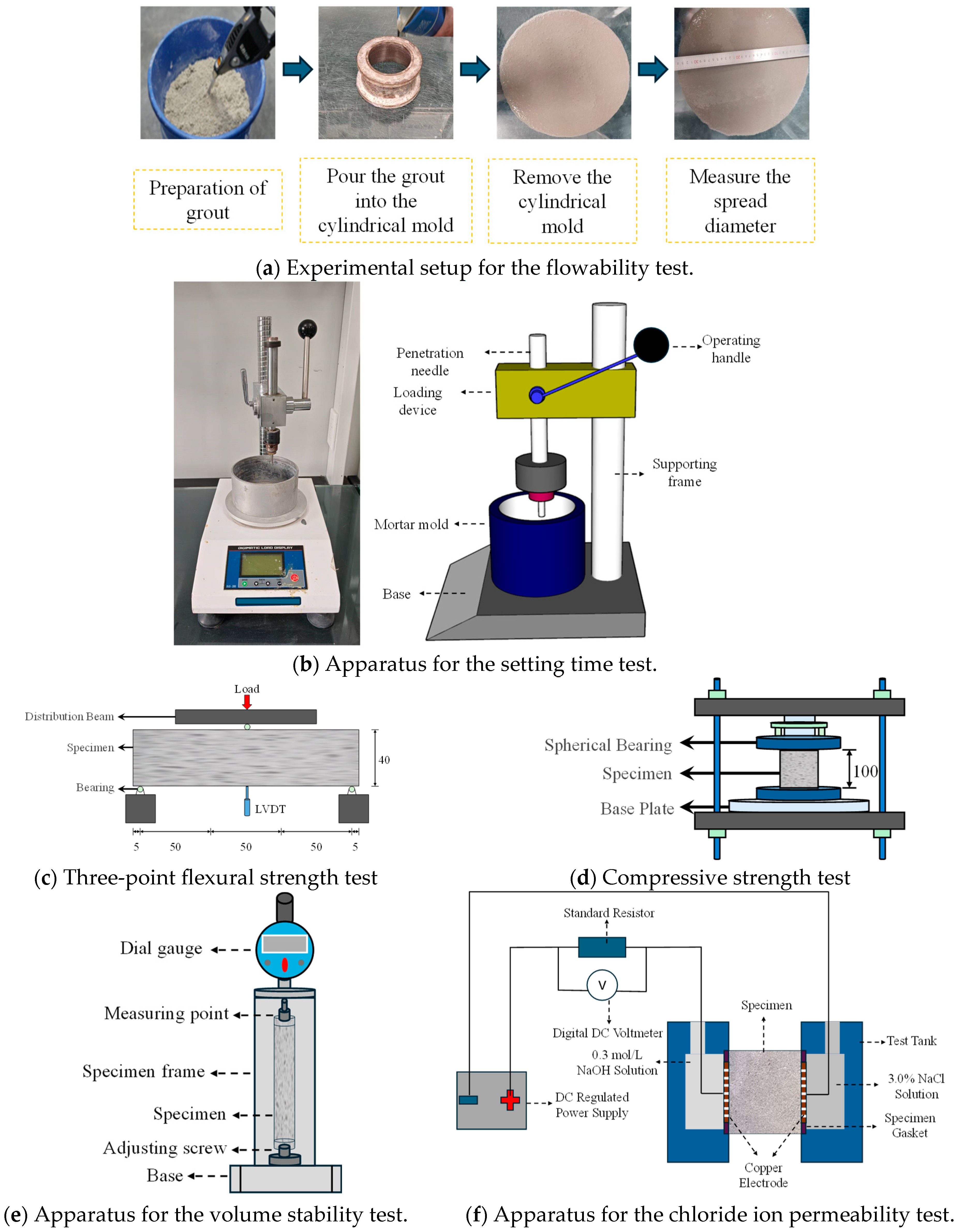
2.2. Experimental Design and Methods
- (1)
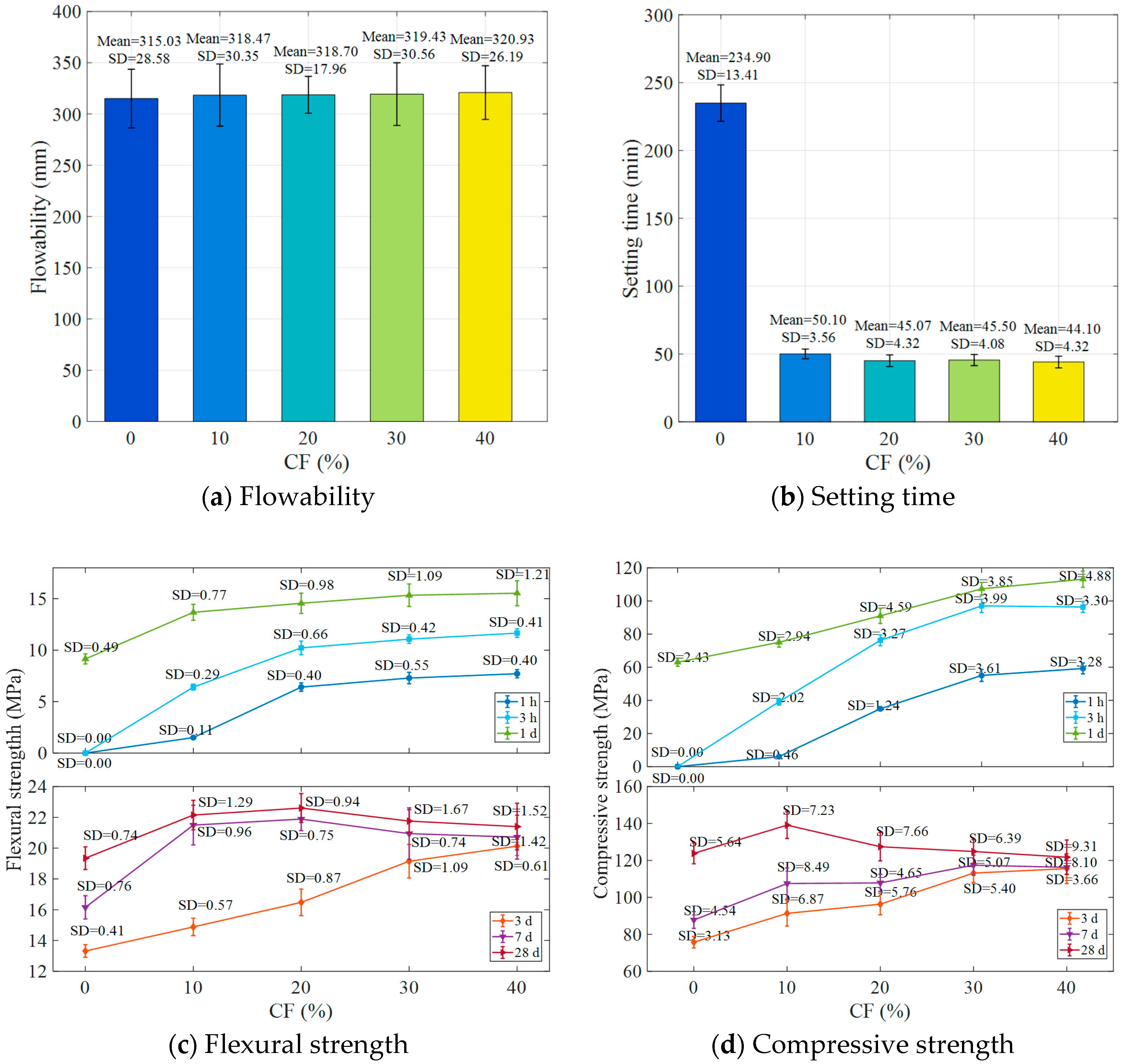
- Effect of CF replacement ratio: Under identical testing conditions, the CF replacement ratio was set at 0%, 10%, 20%, 30%, and 40% to evaluate its effects on the setting behavior, flowability, and mechanical properties of the grouting material.
- (2)
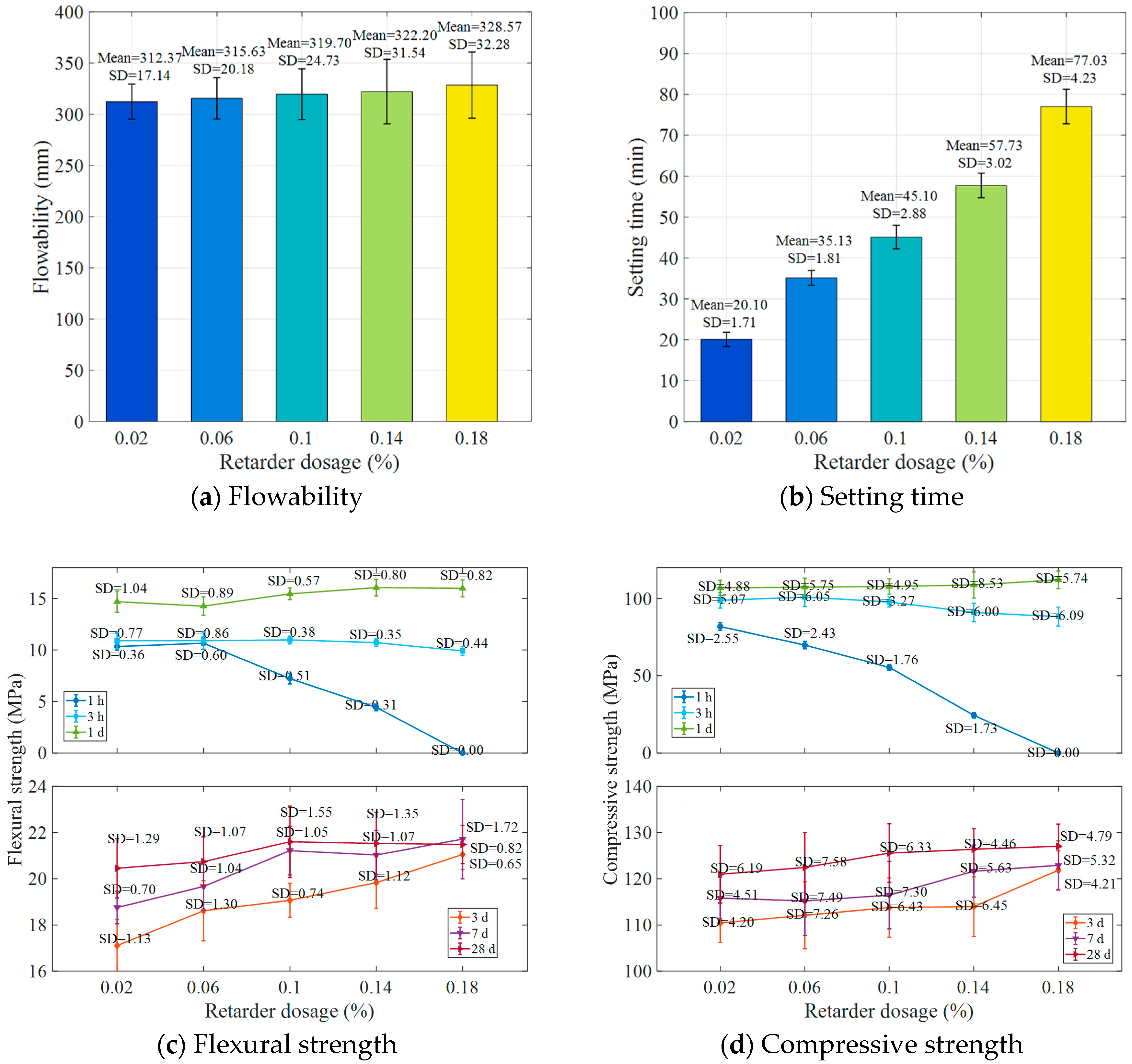
- Effect of retarder dosage: In the preliminary experiments, the mixture without retarder exhibited excessively rapid setting behavior and insufficient workable time after CF incorporation. Therefore, the retarder dosage investigation focused on mixtures containing 0.02%, 0.06%, 0.10%, 0.14%, and 0.18% retarder to ensure practical operational time for engineering applications. Based on the optimal CF dosage determined in Scheme (1), the influence of retarder dosage on the setting behavior and strength development of the grout was systematically investigated.
- (3)
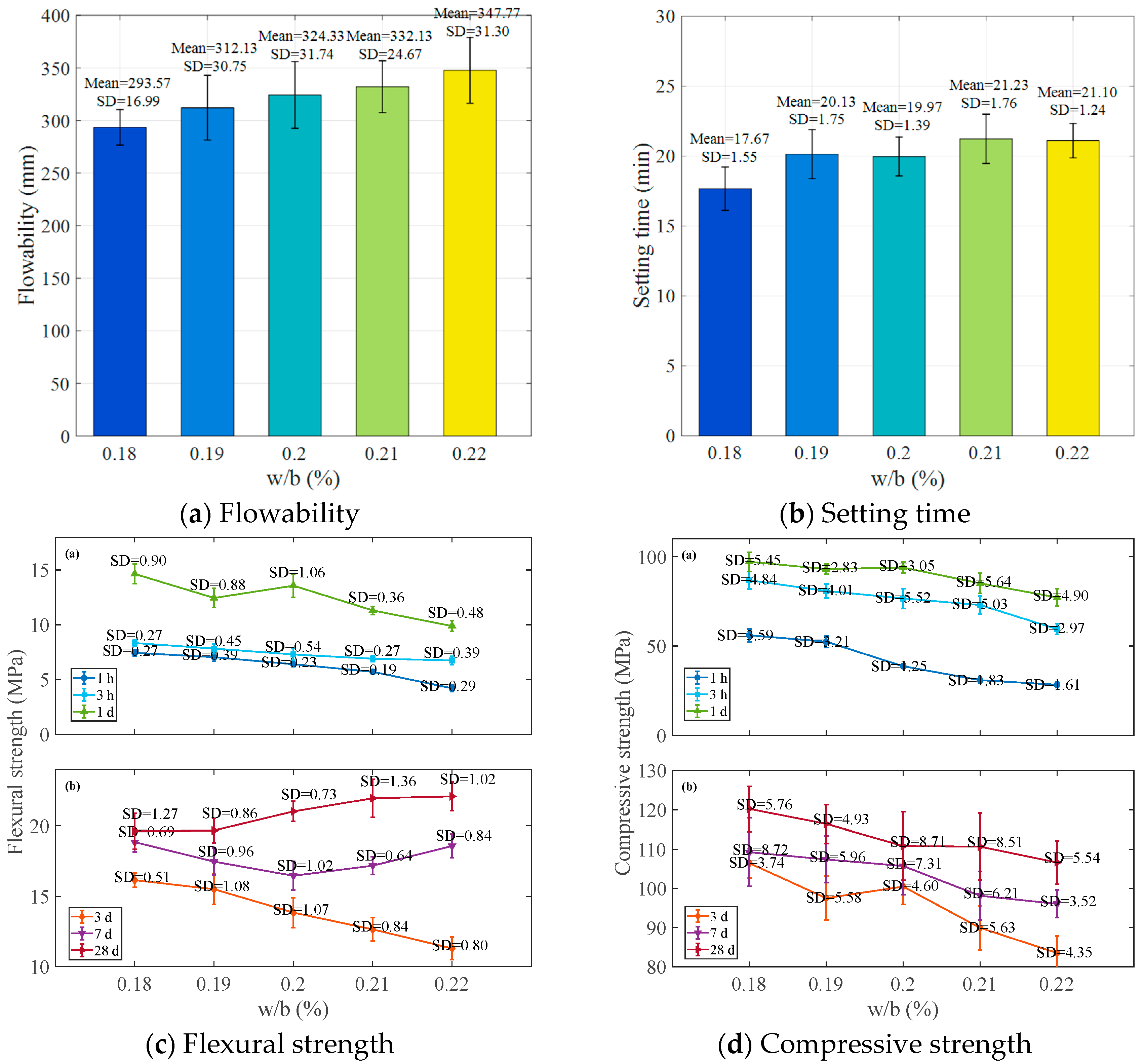
- Effect of water-to-binder ratio (w/b): After determining the optimal CF replacement ratio and retarder dosage, the w/b ratio was adjusted from 0.18 to 0.22 to evaluate its influence on flowability, mechanical properties, and toughness.
3. Experimental Results Analysis
3.1. Effect of Cf Dosage on Workability and Mechanical Properties
3.2. Effect of Retarder Dosage on Workability and Mechanical Properties
3.3. Effect of w/b on Workability and Mechanical Properties
3.4. Volume Stability and Durability
3.5. Microstructural Analysis
4. Conclusions
- (1)
- CF had a limited influence on grout flowability but significantly shortened the setting time and enhanced early-age strength development. Increasing the CF replacement ratio markedly improved the 1 h and 3 h compressive strengths. However, excessive CF incorporation adversely affected later-age strength. A CF replacement ratio of 30% provided a balanced performance between ultra-early strength and later-age mechanical properties.
- (2)
- The retarder significantly prolonged the setting time and improved grout workability. However, increasing the retarder dosage reduced early-age strength development. In contrast, appropriate retarder incorporation contributed to the improvement in later-age mechanical performance and toughness.
- (3)
- Increasing the w/b ratio significantly improved flowability but gradually reduced compressive strength at all curing ages. Meanwhile, the 28 d flexural strength showed a slight increase, indicating improved toughness. Considering the balance among flowability, strength, and workability, a w/b ratio of 0.19 was selected as the optimal value.
- (4)
- The optimal mixture proportion consisted of a CF replacement ratio of 30%, a retarder dosage of 0.02%, and a w/b ratio of 0.19. Under this condition, the grout exhibited a flowability of 312 mm, a compressive strength of 81.4 MPa at 1 h, and a compressive strength of 121.3 MPa at 28 d, demonstrating favorable overall performance.
- (5)
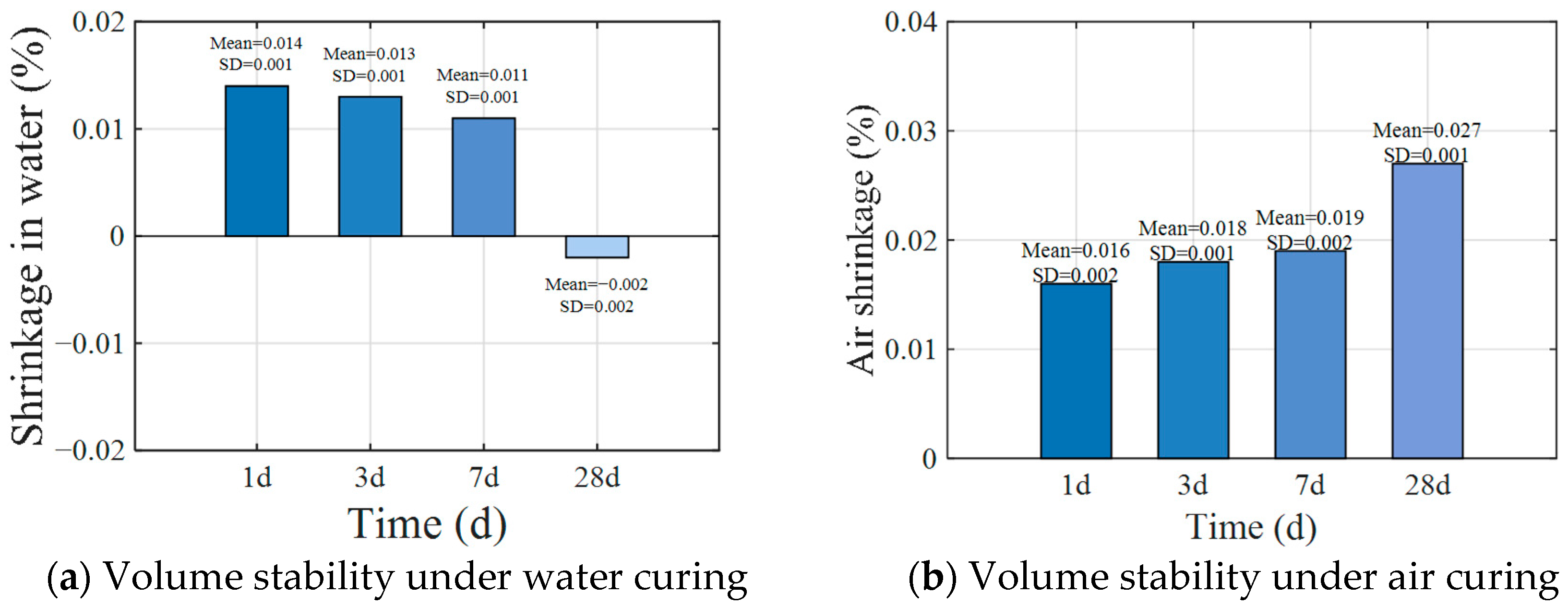
- The prepared grout exhibited good volumetric stability and durability. Under air-curing conditions, the 28 d shrinkage rate was 0.027%, while the electric flux at 28 d was only 12 C, indicating low ionic permeability and good resistance to chloride ion penetration.
- (6)
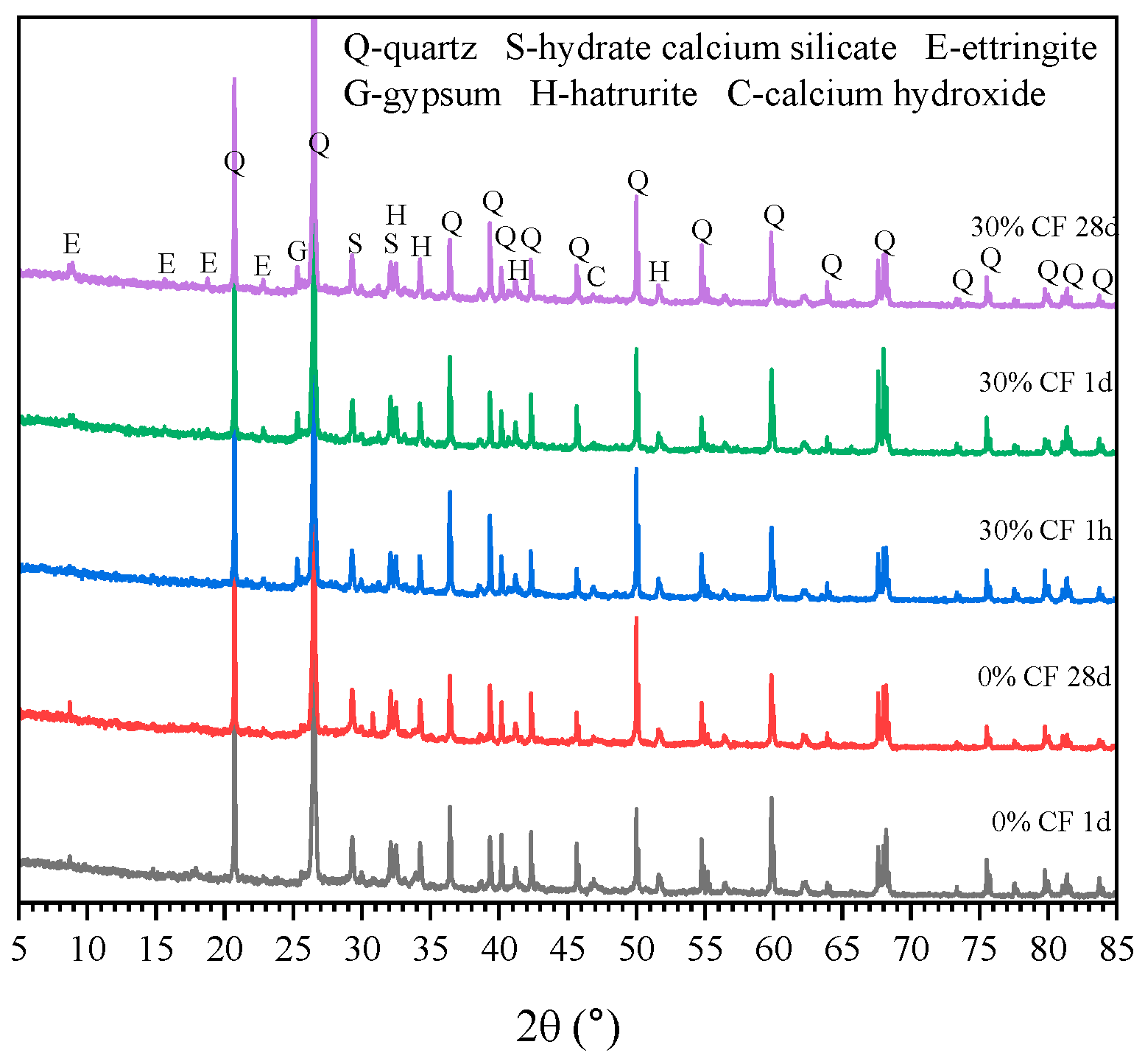
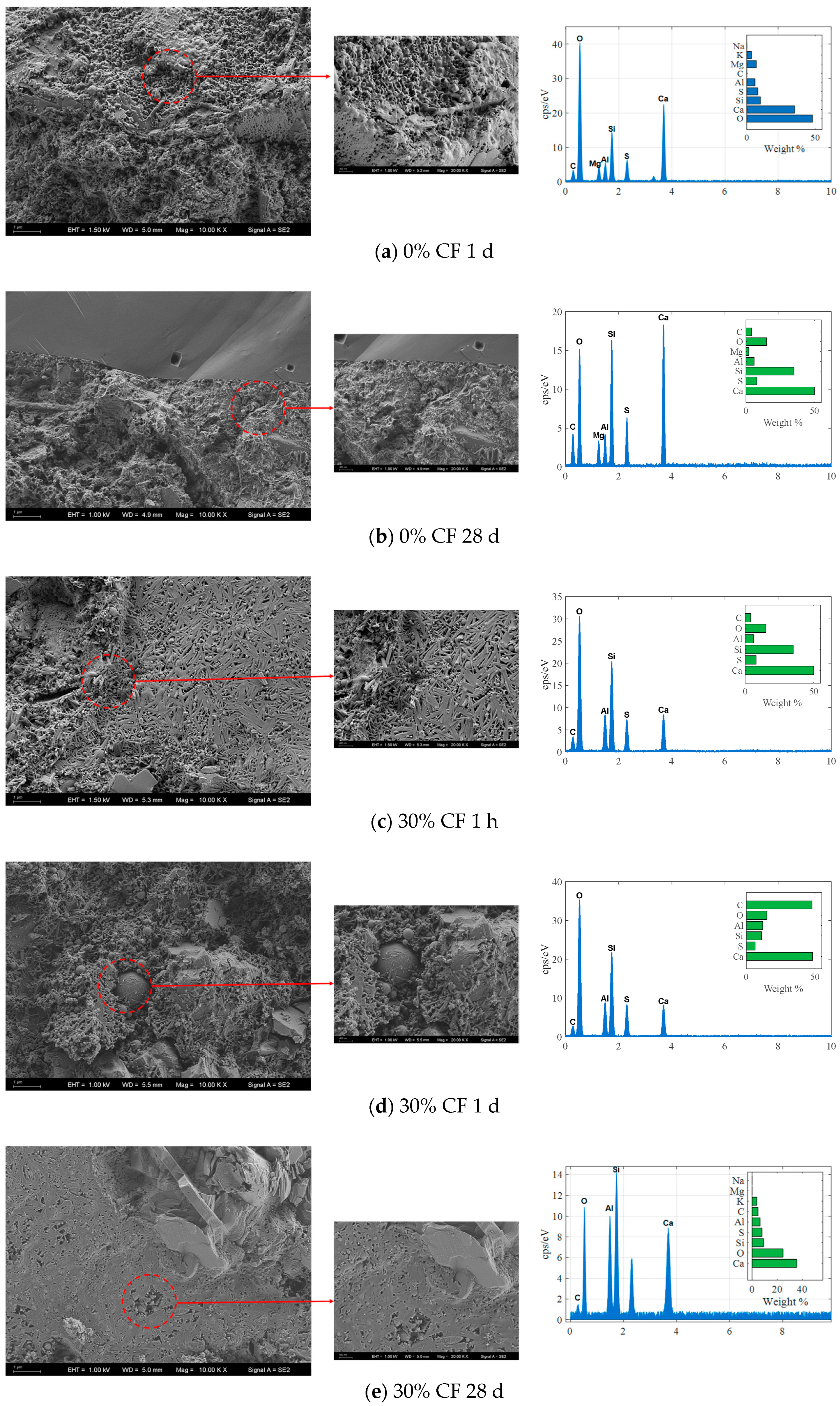
- XRD and SEM/EDS analyses showed that CF promoted the rapid formation of AFt during the early hydration stage. The interaction between AFt and C–S–H gel contributed to the development of a denser microstructure, which may be associated with the improved early-age strength and durability performance of the grout.
Author Contributions
Funding
Data Availability Statement
Conflicts of Interest
References
- Moffatt, E.G.; Thomas, M.D.A. Performance of rapid-repair concrete in an aggressive marine environment. Constr. Mater. Constr. Build. Mater. 2017, 132, 478–486. [Google Scholar] [CrossRef]
- Hou, X.; Li, J.; Xu, J.; Xiao, X.; Wang, J.; Liu, Y.; Ossman, M.; Lin, F.; Wang, X.; Li, Y.; et al. Experimental study of sulfoaluminate cement-based rapid repair mortar undergoing hot/wet harsh conditions: Mechanical strengths, hydration products, and ettringite evolution mechanism. ACS Sustain. Chem. Eng. 2024, 12, 10089–10101. [Google Scholar] [CrossRef]
- Li, F.; Ran, X.; Li, Y.; Ou, W.; Li, P. Rapid hardening and high-fluidity ultra-high performance cement-based grout with calcium formate. Mater. Lett. 2025, 388, 138326. [Google Scholar] [CrossRef]
- Yoo, D.Y.; Oh, T.; Chun, B. Highly ductile ultra-rapid-hardening mortar containing oxidized polyethylene fibers. Constr. Build. Mater. 2021, 277, 122317. [Google Scholar] [CrossRef]
- Sakai, E.; Nikaido, Y.; Itoh, T.; Daimon, M. Ettringite formation and microstructure of rapid hardening cement. Cem. Concr. Res. 2004, 34, 1669–1673. [Google Scholar] [CrossRef]
- Zhang, L.; Glasser, F.P. Hydration of calcium sulfoaluminate cement at less than 24 h. Adv. Cem. Res. 2002, 14, 141–155. [Google Scholar] [CrossRef]
- Winnefeld, F.; Lothenbach, B. Hydration of calcium sulfoaluminate cements—Experimental findings and thermodynamic modelling. Cem. Concr. Res. 2010, 40, 1239–1247. [Google Scholar] [CrossRef]
- Gartner, E. Industrially interesting approaches to “low-CO2” cements. Cem. Concr. Res. 2004, 34, 1489–1498. [Google Scholar] [CrossRef]
- Juenger, M.C.G.; Winnefeld, F.; Provis, J.L.; Ideker, J. Advances in alternative cementitious binders. Cem. Concr. Res. 2011, 41, 1232–1243. [Google Scholar] [CrossRef]
- Mehta, P.K. Mechanism of sulfate attack on portland cement concrete—Another look. Cem. Concr. Res. 1983, 13, 401–406. [Google Scholar] [CrossRef]
- Scrivener, K.L.; Nonat, A. Hydration of cementitious materials, present and future. Cem. Concr. Res. 2011, 41, 651–665. [Google Scholar] [CrossRef]
- Taylor, H.F.W. Cement Chemistry, 2nd ed.; Thomas Telford: London, UK, 1997. [Google Scholar]
- Ramachandran, V.S. Concrete Admixtures Handbook, 2nd ed.; Noyes Publications: Park Ridge, NJ, USA, 1996. [Google Scholar]
- Collepardi, M. Admixtures used to enhance placing characteristics of concrete. Cem. Concr. Compos. 1998, 20, 103–112. [Google Scholar] [CrossRef]
- Paulini, P. Reaction mechanisms of concrete admixtures. Cem. Concr. Res. 1990, 20, 910–918. [Google Scholar] [CrossRef]
- Odler, I. Special Inorganic Cements; CRC Press: London, UK, 2000. [Google Scholar]
- Plank, J.; Winter, C. Competitive adsorption between superplasticizer and retarder molecules on mineral binder surface. Cem. Concr. Res. 2008, 38, 599–605. [Google Scholar] [CrossRef]
- Neville, A.M. Properties of Concrete, 5th ed.; Pearson Education: London, UK, 2011. [Google Scholar]
- Powers, T.C. Structure and physical properties of hardened Portland cement paste. J. Am. Ceram. Soc. 1958, 41, 1–6. [Google Scholar] [CrossRef]
- Bentz, D.P.; Garboczi, E.J. Modelling the leaching of calcium hydroxide from cement paste: Effects on pore space percolation and diffusivity. Mater. Struct. 1992, 25, 523–533. [Google Scholar] [CrossRef]
- Mindess, S.; Young, J.F.; Darwin, D. Concrete, 2nd ed.; Prentice Hall: Englewood Cliffs, NJ, USA, 2003. [Google Scholar]
- Thomas, M.D.A.; Bentz, E.C. Life-365 Service Life Prediction Model; Concrete International: Farmington Hills, MI, USA, 2002. [Google Scholar]
- Moffatt, E.G.; Thomas, M.D.A. Durability of rapid-strength concrete produced with ettringite-based binders. ACI Mater. J. 2018, 115, 105–115. [Google Scholar]
- Richardson, I.G. The calcium silicate hydrates. Cem. Concr. Res. 2008, 38, 137–158. [Google Scholar] [CrossRef]
- Scrivener, K.L. Backscattered electron imaging of cementitious microstructures: Understanding and quantification. Cem. Concr. Compos. 2004, 26, 935–945. [Google Scholar] [CrossRef]
- Diamond, S. Mercury porosimetry: An inappropriate method for the measurement of pore size distributions in cement-based materials. Cem. Concr. Res. 2000, 30, 1517–1525. [Google Scholar] [CrossRef]
- Lim, T.; Kim, S.; Jo, K.; Jo, I.; Lee, E.; Lee, H. Early hydration and mechanical strength of calcite–ettringite seeds added cement mixture for 3D printing. Adv. Cem. Res. 2021, 33, 523–534. [Google Scholar] [CrossRef]
- Qian, J.; Shi, C.; Wang, Z. Activation of blended cements containing fly ash. Cem. Concr. Res. 2001, 31, 1121–1127. [Google Scholar] [CrossRef]
- Shi, C.; Krivenko, P.V.; Roy, D. Alkali-Activated Cements and Concretes; Taylor & Francis: London, UK, 2006. [Google Scholar]
- Wang, K.; Jansen, D.C.; Shah, S.P.; Karr, A.F. Permeability study of cracked concrete. Cem. Concr. Res. 1997, 27, 381–393. [Google Scholar] [CrossRef]
- GB/T 1596-2017; Fly Ash Used for Cement and Concrete. Standards Press of China: Beijing, China, 2017.
- GB/T 50448-2015; Technical Code for Application of Cementitious Grout Materials. China Architecture & Building Press: Beijing, China, 2015.
- Zhu, G.; Cheng, Y.; Wang, P.; Chai, F.; Chen, M.; Bai, W.; Yu, Z.; Dai, K.; Yu, X. Multi-objective collaborative optimization of mechanical and shrinkage properties for engineered geopolymer composites based on orthogonal experimental design. Case Stud. Constr. Mater. 2025, 23, e05556. [Google Scholar] [CrossRef]
- JGJ/T 70-2009; Standard for Test Method of Basic Properties of Construction Mortar. China Architecture & Building Press: Beijing, China, 2009.
- GB/T 17671-2021; Method of Testing Cements—Determination of Strength (ISO Method). State Administration for Market Regulation: Beijing, China, 2021.
- Zhang, W.; Wang, T.; Cao, F.; Wang, C.; Mei, X.; Shao, J.; Su, T. Improvement effect assessment of waste fibre on the comprehensive performance of mixed recycled aggregate concrete. Constr. Build. Mater. 2025, 491, 142633. [Google Scholar] [CrossRef]
- GB/T 50082-2009; Standard for Test Methods of Long-Term Performance and Durability of Ordinary Concrete. China Architecture & Building Press: Beijing, China, 2009.
- Xu, S.; Li, W.; Wang, X.; Zhang, H.; Liu, J.; Jiang, H.; Wang, X.; Ma, H.; Shi, J.; Yu, Z.; et al. The mechanical properties and durability of the pe-bfrp hybrid-fiber-engineered cementitious composite (ECC). Buildings 2025, 15, 1860. [Google Scholar] [CrossRef]



| PO | CF | SF | FA | Quartz Sand (20–40 Mesh) | Quartz Sand (40–70 Mesh) | Superplasticizer | Retarder | Water |
|---|---|---|---|---|---|---|---|---|
| 450 | 0 | 30 | 20 | 280 | 220 | 5 | 0.5 | 95 |
| 400 | 50 | 30 | 20 | 280 | 220 | 5 | 0.5 | 95 |
| 350 | 100 | 30 | 20 | 280 | 220 | 5 | 0.5 | 95 |
| 300 | 150 | 30 | 20 | 280 | 220 | 5 | 0.5 | 95 |
Disclaimer/Publisher’s Note: The statements, opinions and data contained in all publications are solely those of the individual author(s) and contributor(s) and not of MDPI and/or the editor(s). MDPI and/or the editor(s) disclaim responsibility for any injury to people or property resulting from any ideas, methods, instructions or products referred to in the content. |
© 2026 by the authors. Licensee MDPI, Basel, Switzerland. This article is an open access article distributed under the terms and conditions of the Creative Commons Attribution (CC BY) license.
Share and Cite
Duan, X.-Z.; Liu, Z.-J.; Wang, S.-Q.; Xia, R.-J.; Li, W.; Liu, J.; Song, G.-H.; Shi, Z.-X.; Shi, J.; Yang, A.; et al. Performance and Microstructural Characteristics of Ultra-Early High-Strength Cement-Based Grouting Materials Modified with Accelerating and Retarding Agents. Infrastructures 2026, 11, 185. https://doi.org/10.3390/infrastructures11060185
Duan X-Z, Liu Z-J, Wang S-Q, Xia R-J, Li W, Liu J, Song G-H, Shi Z-X, Shi J, Yang A, et al. Performance and Microstructural Characteristics of Ultra-Early High-Strength Cement-Based Grouting Materials Modified with Accelerating and Retarding Agents. Infrastructures. 2026; 11(6):185. https://doi.org/10.3390/infrastructures11060185
Chicago/Turabian StyleDuan, Xing-Ze, Zhao-Jun Liu, Shuai-Qi Wang, Rui-Jie Xia, Wei Li, Ju Liu, Guo-Hua Song, Zhi-Xiao Shi, Jun Shi, Ao Yang, and et al. 2026. "Performance and Microstructural Characteristics of Ultra-Early High-Strength Cement-Based Grouting Materials Modified with Accelerating and Retarding Agents" Infrastructures 11, no. 6: 185. https://doi.org/10.3390/infrastructures11060185
APA StyleDuan, X.-Z., Liu, Z.-J., Wang, S.-Q., Xia, R.-J., Li, W., Liu, J., Song, G.-H., Shi, Z.-X., Shi, J., Yang, A., & Dai, K.-Y. (2026). Performance and Microstructural Characteristics of Ultra-Early High-Strength Cement-Based Grouting Materials Modified with Accelerating and Retarding Agents. Infrastructures, 11(6), 185. https://doi.org/10.3390/infrastructures11060185