You are currently viewing a new version of our website. To view the old version click .
Instruments
  • Communication
  • Open Access

26 November 2025

Conceptual Study on the Implementation of NRTA for Industrial Applications

,
,
,
,
,
,
and
1
LP2i UMR5797, Université de Bordeaux, CNRS, 33170 Gradignan, France
2
Orano Recyclage, 125 Avenue de Paris, 92320 Châtillon, France
3
Orano Recyclage, Établissement de la Hague, 50444 La Hague, France
*
Authors to whom correspondence should be addressed.
This article belongs to the Special Issue Instrumentation and Measurement Methods for Industry 4.0 and IoT

Abstract

Neutron Resonance Transmission Analysis (NRTA) is a non-destructive technique allowing the elemental and isotopic characterization of materials and objects. This study represents a first step toward understanding the NRTA technique and developing a novel compact system adapted for industrial applications. The industrial feasibility of the NRTA was assessed by simulating a compact system using the Monte Carlo code MCNP 6.1. Neutron transmission spectra were generated for various metallic samples, ranging from 0.1 mm to 1 cm in thickness, and analyzed using a home-developed quantification method that incorporates nuclear cross sections from the ENDF/B-VIII.0 library and accounts for instrumental resolution. For this first study, an idealized configuration was considered, with a 0 µs pulsed neutron source and a Gaussian resolution function, to validate the methodology under a simple controlled condition. The results demonstrate that the areal densities of isotopes of Uranium and Plutonium can be determined with relative deviations below 10%, even under compact measurement conditions. This study validates the characterization method and represents a first step toward the continued development of an industrial NRTA prototype for rapid, non-destructive isotopic control of nuclear materials.

1. Introduction

Since the mid-1970s, France has strategically chosen to reprocess and recycle spent nuclear fuel. This policy aimed to optimize the use of uranium resources by reusing separated uranium and plutonium, while reducing the volume and radiotoxicity of the final waste [1]. The high-level waste generated by these operations is vitrified and stored at the La Hague Orano facility [2], which today serves as the international industrial reference center for such processes. In 2024, the French government reaffirmed the continuation of this policy beyond 2040, planning the extension of existing facilities and the study of the construction of new infrastructures [3]. In this context, precise isotopic analyses remain a major need to ensure the quality, safety, and traceability of reprocessing operations.
Within the nuclear fuel cycle, a precise knowledge of the isotopic composition of fissile and fertile materials, in particular uranium, plutonium, and minor actinides in different steps of the recycling process, is essential to optimize reprocessing procedures and ensure the safety of the facilities. To date, inductively coupled plasma mass spectrometry (ICP-MS) [4] remains the reference technique due to its high isotopic precision. However, this method is destructive, complex to implement, and requires several days of chemical preparation and analysis. Non-destructive reference nuclear measurement techniques, such as neutron or gamma spectroscopy (in active and passive modes), have also been employed for decades [5] with high quality. Nevertheless, these nuclear measurement techniques lack the capacity to characterize all present isotopes (e.g., 242Pu) and depend on reactor calculation codes for data interpretation.
The development of a novel, rapid, non-destructive method capable of providing reliable isotopic compositions while being less dependent on experimental conditions would therefore represent a major advance for some specific nuclear characterization applications. In this context, Neutron Resonance Transmission Analysis (NRTA) appears as a promising alternative. Due to its isotopic selectivity and its ability to cover a wide range of nuclei (medium- and high-Z isotopes) [6], this technique offers a unique potential to improve the characterization of nuclear materials under industrial conditions.
Historically, NRTA has been implemented since the 1970s in research centers to determine the isotopic composition of fresh and irradiated fuels [7], and especially for total neutron reaction cross-section measurements [8]. Nevertheless, its use has remained limited to fundamental research centers (for studying thin and homogeneous samples) due to experimental constraints. Indeed, this technique requires long flight paths (from tens up to few hundred meters, as in GELINA—JRC-Geel [9]) and high-performance accelerators capable of producing intense (≈1013 n/s [9]), high-resolution neutron beams (lower than µs [9]), necessary, as well as the use of sophisticated data analysis tools such as REFIT [10], SAMMY [11], or CONRAD [12].
The current challenge is to design a more compact system, suitable for analyzing thick and non-homogeneous samples, capable of delivering results within minutes or hours, with an expected accuracy on the order of a few percent. Several international studies are exploring this approach. In the United States, for instance, prototypes using DT neutron generators and compact detectors have demonstrated the feasibility of isotopic identification of uranium and plutonium [13,14]. In Japan, the Japan Atomic Energy Agency is developing a compact NRTA system for existing facilities [15,16], including simulation studies and pulsed neutron generation [17,18]. In France, the Orano—CNRS Bordeaux (LP2i) partnership is part of this effort, aiming to develop an industrial NRTA prototype dedicated to spent nuclear fuel reprocessing needs.
This study investigates the industrial feasibility of NRTA, focusing on its adaptation to compact systems under realistic industrial constraints: very short flight paths, neutron sources with limited flux and time resolution, and complex thick sample configurations. The objective of this work is to present the first results of the developed NRTA characterization method. The method was designed and developed using MCNP [19] simulations rather than experimental data. This preliminary stage aims to test and validate the methodology under idealized conditions prior to its future experimental application. Results from Monte Carlo simulations are presented, along with a quantification method developed for analyzing neutron resonance transmission, paving the way for the practical application of this technique in an industrial context.

2. Neutron Resonance Transmission Analysis (NRTA)

2.1. Principle and Experimental Conditions

NRTA is a non-destructive analytical technique that enables the identification and quantification of the elemental and isotopic composition of materials based on their characteristic total cross-section resonances in the epithermal energy range.
This active neutron interrogation method relies on the interaction of a pulsed neutron beam, moderated to thermal and epithermal energies, with a sample. These energy ranges correspond to the regions where resonances appear in the neutron-induced reaction cross sections.
As the neutrons pass through the sample, some are absorbed or scattered, while the remaining fraction is measured by a detector placed downstream, using the time-of-flight (TOF) technique. The fraction of neutrons that pass through the sample without interaction constitutes the main quantity measured in NRTA.
In the ideal case of a parallel beam perpendicular to a homogeneous plate, this fraction, called transmission T, is expressed as:
T Theo ( E ) = exp   [ k n k σ tot , k ( E ) ]
where σtot, k (E) represents the Doppler broadened total cross section of isotope k, and nk its areal density.
Experimentally, the transmission is derived from the ratio of flux measured with and without the sample:
T exp t = φ in B in φ out B out
where
φ in is the flux measured with the sample in the beam,
φ out is the flux measured without the sample,
Bin and Bout are the corresponding background counts for the in and out configurations.

2.2. Resolution Function

In NRTA experiments, measurements provide only the transmission spectra as a function of time using the TOF technique. To obtain the energy dependence, the measured time-of-flight must be converted into the neutron kinetic energy using the non-relativistic relation.
However, experimental data are never perfectly resolved. As neutrons travel through various materials (moderator, target, detector, etc.), their flight times are affected by multiple effects such as moderation time, burst width of the accelerator, and detector response. Consequently, neutrons with the same kinetic energy do not necessarily arrive at the detector simultaneously.
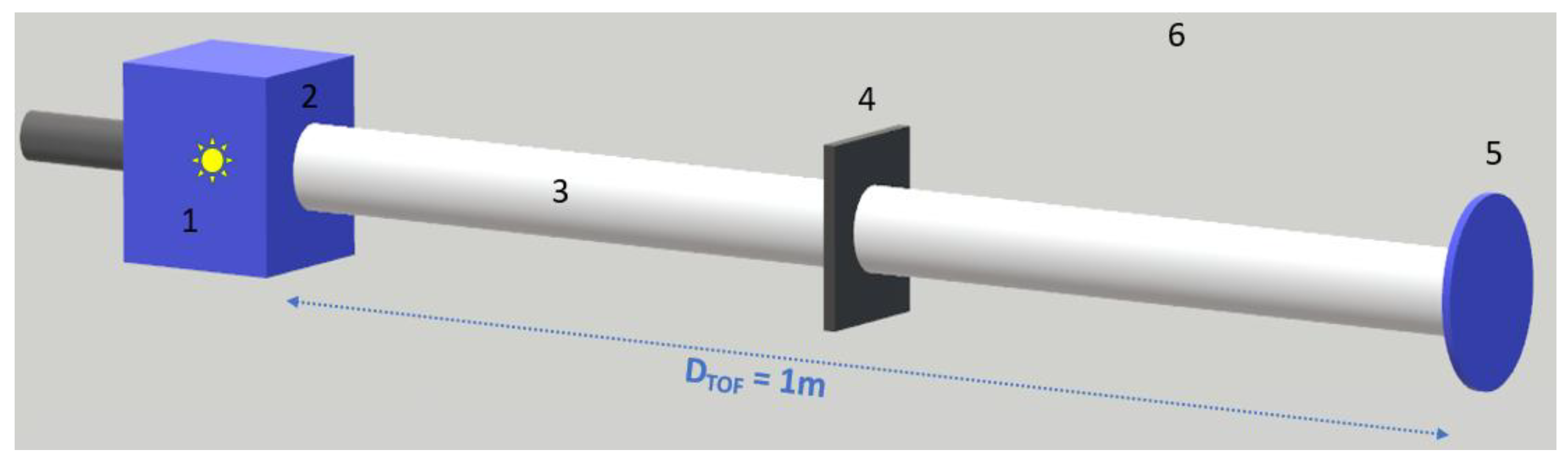
To better understand this phenomenon, a simulation was performed using the geometry illustrated in Figure 1. The setup includes:
Figure 1. Compact NRTA system geometry used in MCNP simulations, illustrating (1) the neutron source, (2) polythene moderator, (3) collimation tube, (4) sample, (5) detector, and (6) air.
  • Pulsed source: 14 MeV neutrons produced by a pulsed neutron generator (D–T), with a 0 µs duration, positioned at the center of the moderator.
  • Moderator block: slowing down neutrons to reach the resonance energies of the target isotopes (<100 eV, epithermal range). The moderator is modeled as a 20 × 20 × 20 cm3 polyethylene block.
  • Collimation tube: serving as a perfect neutron guide by removing all off-axis neutrons.
  • Sample: where thermalized neutrons interact with the sample nuclei, producing absorption signatures characteristic of each isotope. The sample is modeled as a metallic disc of 14 cm in diameter and variable thickness, ranging from 0.1 mm to 1 cm depending on the studied case.
  • Detector: where neutron energy is detected using the time-of-flight method ( E n = 1 2   m n d TOF t TOF 2 ). In the simulations, the detector is modeled as an ideal circular disk with the same diameter as the sample, ensuring perfect collection of all transmitted neutrons without any efficiency loss.
  • Air (shown in grey on Figure 1): the surrounding area where no neutrons are simulated.
For this simulation, and for all subsequent results presented in this work, a total of NPS = 1011 particles were used, leading to a computation time of approximately 8 h, with variance reduction techniques applied to optimize the calculation. All simulations were performed under idealized conditions: the neutron source had zero pulse width, the detector response was ideal, and the collimation tube acted as a perfect neutron guide (removing all off-axis neutrons).
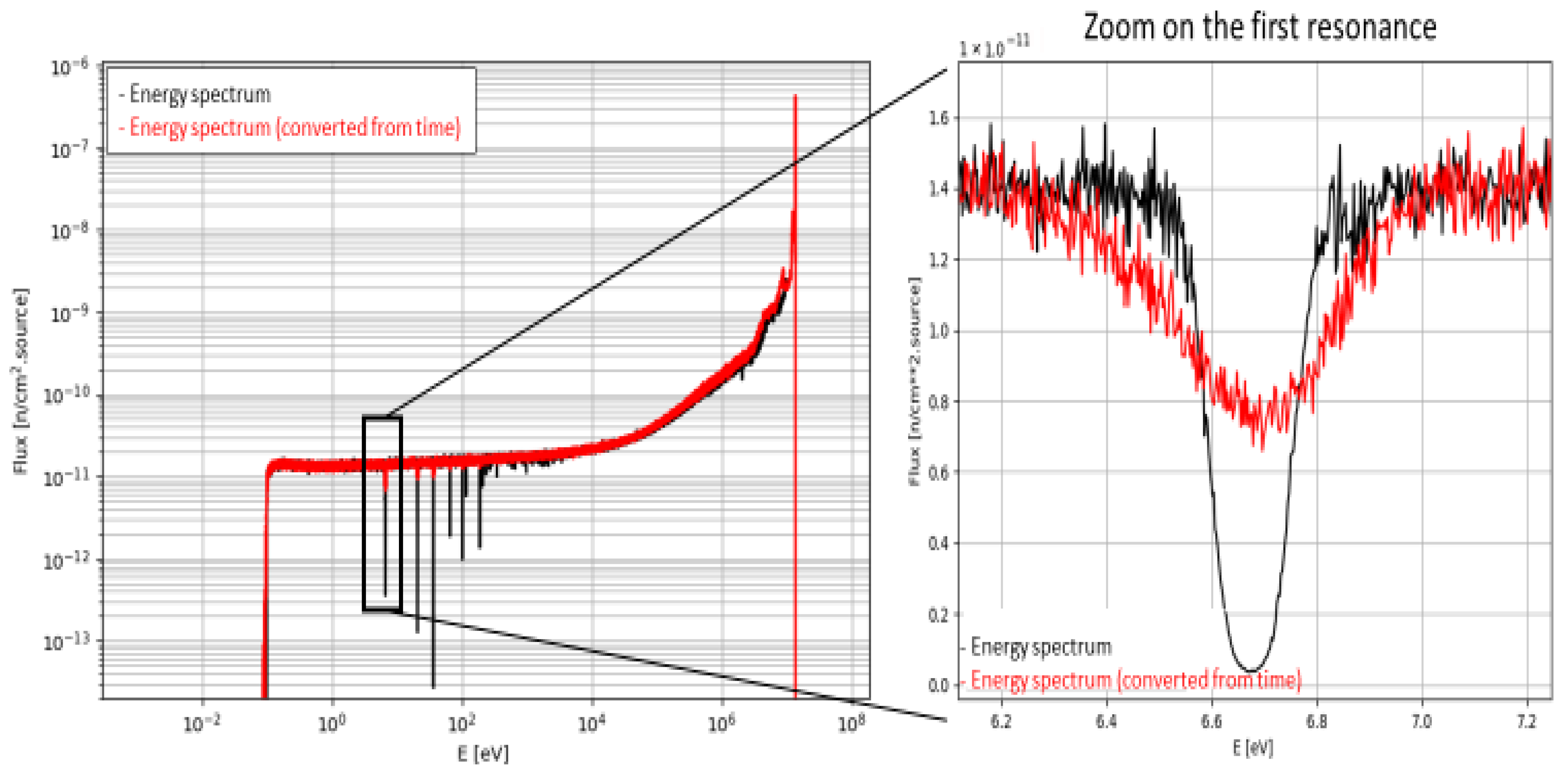
The results were collected at a 1 m flight path using F1 tallies (current over the surface): one tally recorded the neutron time-of-flight, while another tally collected the corresponding neutron energies. Figure 2 clearly illustrates the degradation of energy information caused by the system’s time resolution by comparing the simulated energy spectrum (black) with the corresponding time-converted spectrum (red). Unlike experimental measurements, Monte Carlo simulations provide direct access to the true energy spectrum, allowing a clear visualization of how time-resolution effects broaden and distort the resonances under experimental conditions.
Figure 2. Left: Simulated energy spectrum (black) vs. time-converted spectrum (red). Right: Zoom on the first resonance (238U sample).
As a result, direct isotopic characterization from the areas of resonance dips cannot be performed:
  • Resonances appear broadened and shallower, making auto-absorption corrections impossible;
  • Resonances from other isotopes may overlap significantly.
Consequently, an accurate characterization of the samples requires accounting for these different system contributions in order to correct the theoretical spectra. This correction is achieved through the so-called resolution function, which describes the overall time- and energy-broadening effects of the system. In a realistic NRTA system, the system’s resolution function mainly results from two contributions:
  • The source pulse width, which introduces temporal spreading (not simulated here);
  • The moderating process, which scatters the neutron arrival times for a given energy.
By accounting for the system’s resolution function in the calculation of the theoretical transmission, it becomes possible to retrieve the quantities of isotopes present in the sample. Indeed, the corrected theoretical transmission can be directly related to the experimental transmission Texp provided that the basic assumptions of transmission experiments are fulfilled [20]:
  • The sample is perpendicular to a parallel incoming neutron beam.
  • All detected neutrons have passed through the sample.
  • Neutrons scattered by the sample are not registered by the neutron detector.

3. Methodology

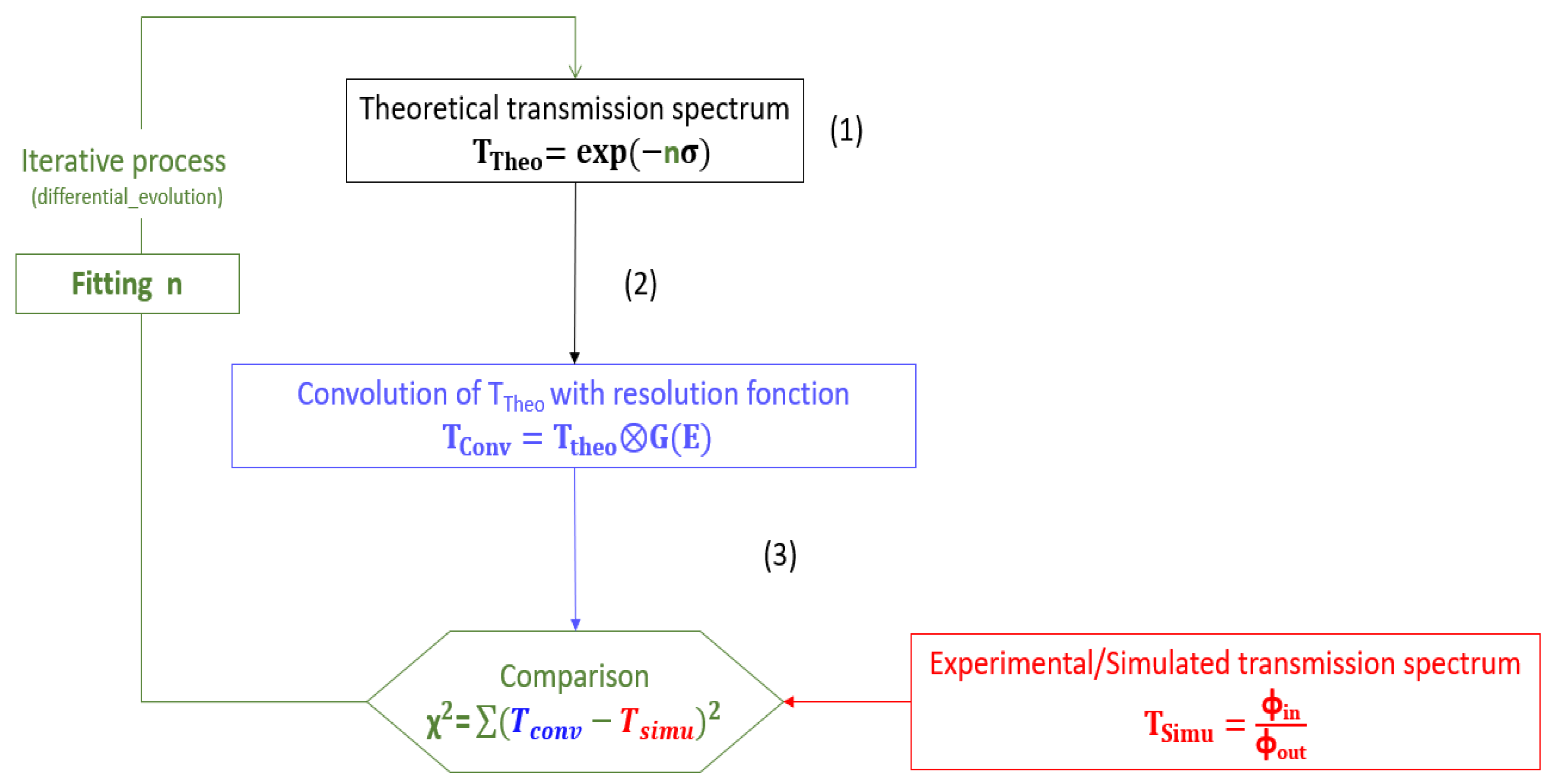
As discussed previously, the system’s resolution limits the ability to directly characterize the isotopic composition from resonance dips. To overcome these limitations and fully exploit the information contained in the transmission spectra, a specific analysis method has been developed. This method is based on the use of a Python 3 script and is designed not only to process theoretical spectra together with simulated or experimental results, but also to provide a user-friendly code adapted for industrial applications, unlike existing, more complex and sophisticated analysis tools such as REFIT [10], SAMMY [11], or CONRAD [12]. The adopted approach is structured around three main steps, which are also summarized in Figure 3:
Figure 3. Schematic of the NRTA quantification method. The main steps include (1) generation of theoretical transmission spectra from known nuclear cross sections, (2) transmission degradation using the resolution function representing the compact system, and (3) comparison between theoretical and simulated/experimental spectra to adjust the isotopic areal densities via a least-squares fit.
  • Generation of theoretical transmission spectra: The theoretical transmission spectra were calculated using microscopic neutron total cross sections from the ENDF/B-VIII.0 library at 293.6 K, according to the Beer–Lambert law (Equation (1)), based on the assumed isotopic composition and areal densities of the sample. For the calculation, initial bounds are set for each material quantity (n), which are then iteratively refined using the differential evolution algorithm (implemented in SciPy library [21]) to fit the theoretical spectrum to the simulated (or experimental data).
  • Spectral degradation using a resolution function: the theoretical transmission spectrum is convoluted with a resolution function representing the characteristics of the NRTA system. This function accounts in particular for the moderation process and the flight path length. The goal is to obtain a theoretical spectrum comparable to the simulated or experimental spectrum.
  • Comparison of theory vs. data (from Monte Carlo simulation or experiment): the data spectrum is compared in each energy bin to the theoretical spectrum. A global minimum is determined using the differential evolution algorithm, which iteratively adjusts the material quantities (n) to achieve the best agreement between theory and simulation, as illustrated in Figure 3.

4. Results

To assess the validity of the characterization method, simulations were performed on metallic disc samples with thicknesses ranging from 0.1 mm to 1 cm. The simulated setup corresponds to the compact configuration presented in Figure 1, featuring a simplified transmission geometry with an ideal neutron source, an ideal detector, and the condition that all detected neutrons have passed through the sample.
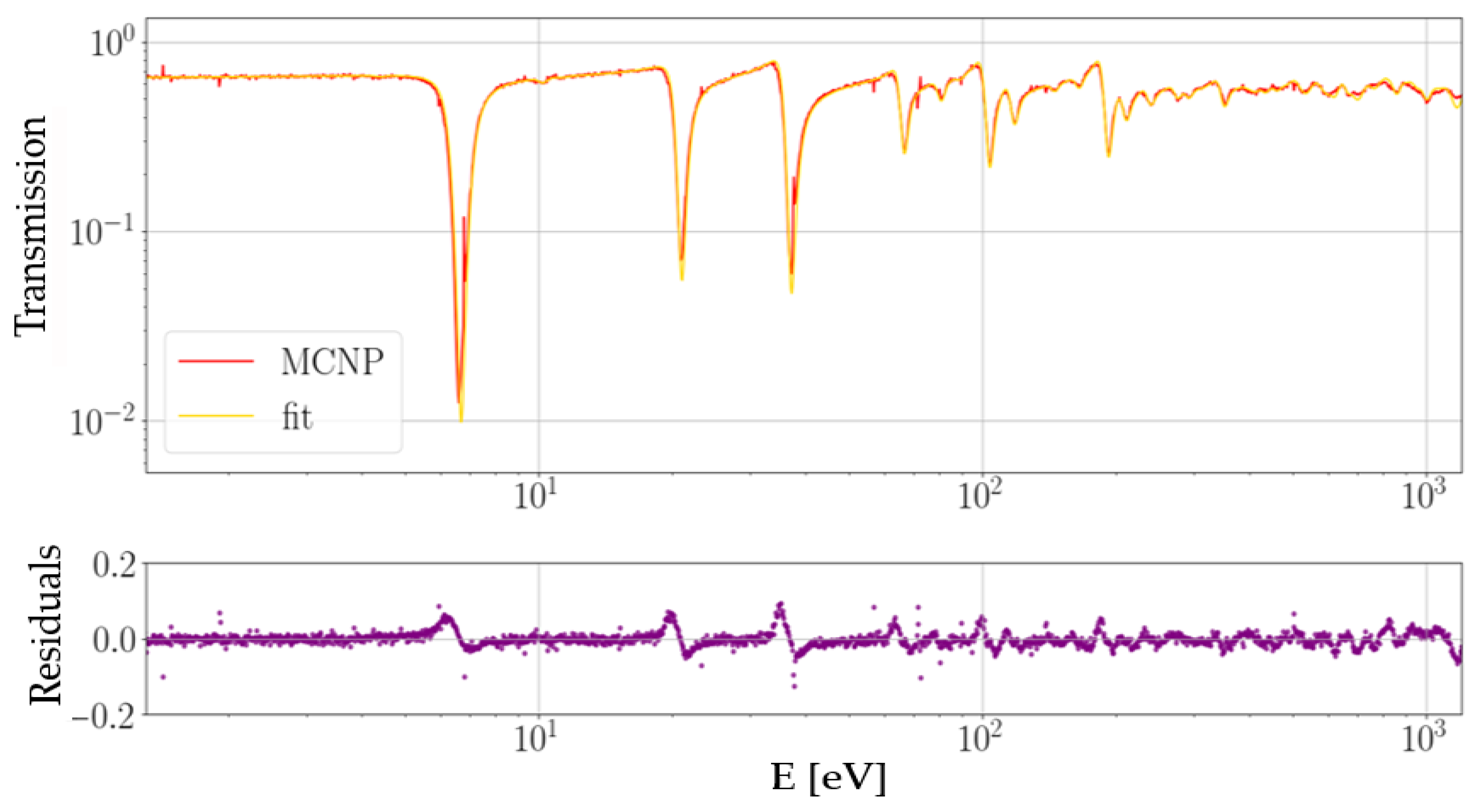
Figure 4 illustrates an example of a simulated neutron transmission spectrum obtained for a 1 cm thick metallic 238U sample. The resonance structures characteristic of uranium are clearly visible, confirming that the configuration allows the observation of individual resonances even under compact conditions.
Figure 4. Transmission through a 1 cm-thick 238U sample, as detailed in Table 1. The simulated transmission is shown in red, the fitted result in yellow, and the difference between the two is displayed as a residual plot in purple at the bottom of the figure.
The simulated transmission spectra were then analyzed using the developed characterization method (Figure 3), which relies on nuclear cross-sections from the ENDF/B-VIII.0 data library. For this first study, and to obtain preliminary results, a Gaussian resolution function was chosen as a simplified approach to represent the instrumental response of the compact system. Since the Gaussian approximation closely represents the resolution function of a system with a negligible pulse width, an ideal neutron source with zero pulse width was considered to validate the method before extending it to more realistic configurations. The standard deviation of this Gaussian varies with energy to account for the time-of-flight dependence of the system resolution.
A quantitative comparison between the simulated areal densities and those obtained using the NRTA quantification method is reported in Table 1. For thin mono-isotopic samples, the relative deviations between simulated and retrieved values remain below 5%. In the case of mixed or thicker samples, the deviations remain below 10%.
Table 1. Results of the NRTA. The simulations were performed for a 1 m flight path and an ideal source with a pulse width of 0 µs.
Overall, the developed NRTA method predicts isotopic areal densities with a relative accuracy generally between 5% and 10% and the observed discrepancies mainly arise from the simplified choice of a Gaussian resolution function. In practice, the actual instrumental response, extracted from Monte Carlo simulations, exhibits an asymmetric shape. Incorporating this more realistic profile into the analysis is expected to further reduce deviations and improve the predictive accuracy of the method. It should be noted that, to date, no sensitivity or uncertainty study has been conducted on the present simulation results; performing such analyses in the future would allow a more thorough assessment of the deviations between simulated areal densities and those obtained using the NRTA quantification method.

5. Conclusions

This study constitutes a first step toward both understanding the NRTA technique and familiarizing ourselves with its practical implementation through simulations. The initial approach focused on idealized conditions, using a 0 µs pulsed source and a Gaussian resolution function, to validate a characterization methodology specifically developed for industrial applications. Under these ideal conditions, the method appears capable of estimating the isotopic compositions of metallic samples, reproducing areal densities with relative deviations generally below 10%, even in compact system configurations.
This conceptual study establishes a reference framework for the industrial feasibility of the Neutron Resonance Transmission Analysis (NRTA) technique and demonstrates the robustness of the proposed approach. Future developments will include refining the characterization method by incorporating a more realistic, asymmetric resolution function derived from simulations and accounting for the intrinsic time resolution of the neutron source. The methodology will also be extended to handle more complex isotopic mixtures, and a dedicated uncertainty and sensitivity study will be performed. These improvements will allow us to approach a more realistic NRTA system and provide a solid basis to evaluate and compare our results with those obtained by other research groups.
In parallel, experimental validation campaigns are planned at GELINA and MONNET facilities, in collaboration with JRC-Geel. These measurements will play a key role in confirming the applicability of the proposed approach and represent a significant step toward the industrial deployment of NRTA for rapid and non-destructive isotopic control of nuclear materials.

Author Contributions

Conceptualization, M.A. (Melissa Azzoune) and L.M.; methodology, M.A. (Melissa Azzoune) and L.M.; software, M.A. (Melissa Azzoune); validation, L.M. and N.D.T.; formal analysis, M.A. (Melissa Azzoune); writing—original draft preparation, M.A. (Melissa Azzoune); writing—review and editing, M.A. (Melissa Azzoune), L.M. and N.D.T.; supervision, L.M., N.D.T., M.A. (Mourad Aïche), F.P., L.V., L.T. and S.P.; project administration, L.V.; funding acquisition, L.V. All authors have read and agreed to the published version of the manuscript.

Funding

The authors declare that this study received funding from Orano company.

Data Availability Statement

The original contributions presented in this study are included in the article. Further inquiries can be directed to the corresponding author(s).

Conflicts of Interest

Authors L.M., M.A. (Mourad Aïche) and F.P. collaborate with the Orano company on other projects. Authors N.D.T., L.V., L.T. and S.P. are employed by the Orano company. Author M.A. (Melissa Azzoune) is funded by the Orano company.

References

  1. OCDE; Agence Pour L’Énergie Nucléaire. Cycles du Combustible Nucléaire Avancés et Gestion des Déchets Radioactifs; Développement de L’Énergie Nucléaire; OECD: Paris, France, 2006; ISBN 978-92-64-02487-8. [Google Scholar]
  2. Orano Recyclage. Rapport d’Information du Site Orano la Hague; Orano Recyclage: Paris, France, 2023. [Google Scholar]
  3. Benjamin, M. Focus: France seeks strategy as nuclear waste site risks saturation point. Reuters. 3 February 2023. Available online: https://www.reuters.com/business/environment/france-seeks-strategy-nuclear-waste-site-risks-saturation-point-2023-02-03 (accessed on 30 October 2025).
  4. Krachler, M.; Alvarez-Sarandes, R.; Van Winckel, S. Challenges in the quality assurance of elemental and isotopic analyses in the nuclear domain benefitting from high resolution ICP-OES and sector field ICP-MS. J. Radioanal. Nucl. Chem. 2015, 304, 1201–1209. [Google Scholar] [CrossRef] [PubMed][Green Version]
  5. Benefits and Drawbacks of Non-Destructive Assay (NDA) for Nuclear Safeguards—An Overview—European Commission. Available online: https://esarda.jrc.ec.europa.eu/publications/benefits-and-drawbacks-non-destructive-assay-nda-nuclear-safeguards-overview_en (accessed on 30 October 2025).[Green Version]
  6. Paradela, C.; Alaerts, G.; Becker, B.; Heyse, J.; Kopecky, S.; Moens, A.; Mondelaers, W.; Schillebeeckx, P.; Wynants, R.; Harada, H.; et al. Characterization of nuclear material by Neutron Resonance Transmission Analysis. Nuovo C. C Geophys. Space Phys. C 2016, 38, 176. [Google Scholar] [CrossRef]
  7. Behrens, J.W.; Johnson, R.G.; Schrack, R.A. Neutron Resonance Transmission Analysis of Reactor Fuel Samples. Nucl. Technol. 1984, 67, 162–168. [Google Scholar] [CrossRef]
  8. Schillebeeckx, P.; Becker, B.; Danon, Y.; Guber, K.; Harada, H.; Heyse, J.; Junghans, A.R.; Kopecky, S.; Massimi, C.; Moxon, M.C.; et al. Determination of Resonance Parameters and their Covariances from Neutron Induced Reaction Cross Section Data. Nucl. Data Sheets 2012, 113, 3054–3100. [Google Scholar] [CrossRef]
  9. Schillebeeckx, P.; Borella, A.; Emiliani, F.; Gorini, G.; Kockelmann, W.; Kopecky, S.; Lampoudis, C.; Moxon, M.; Cippo, E.P.; Postma, H.; et al. Neutron resonance spectroscopy for the characterization of materials and objects. J. Instrum. 2012, 7, C03009. [Google Scholar] [CrossRef]
  10. Moxon, M.C.; Ware, T.C.; Dean, C.J. REFIT-2009: Multilevel Resonance Parameter Least Squares Fit of N Transmission, Capture, Fission & Self Indication Data; NEA-0914; OECD Nuclear Energy Agency: Paris, France, 2009. [Google Scholar]
  11. Larson, N.M. Updated User’s Guide for Sammy: Multilevel R-Matrix Fits to Neutron Data Using Bayes’ Equations; Oak Ridge National Laboratory (ORNL): Oak Ridge, TN, USA, 2008. [Google Scholar]
  12. Archier, P.; Jean, C.D.S.; Kopecky, S.; Litaize, O.; Noguère, G.; Schillebeeckx, P.; Volev, K. Recent Developments in the CONRAD Code regarding Experimental Corrections. EPJ Web Conf. 2013, 42, 02004. [Google Scholar] [CrossRef]
  13. Klein, E.A. Neutron Resonance Transmission Analysis of Nuclear Material Using a Portable D-T Neutron Generator. Ph.D. Thesis, Massachusetts Institute of Technology, Cambridge, MA, USA, 2023. [Google Scholar]
  14. McDonald, B.S.; Danagoulian, A.; Gilbert, A.J.; Klein, E.A.; Kulisek, J.A.; Moore, M.E.; Rahon, J.M.; Zalavadia, M.A. Neutron resonance transmission analysis prototype system for thorium fuel cycle safeguards. Nucl. Instrum. Methods Phys. Res. Sect. Accel. Spectrometers Detect. Assoc. Equip. 2024, 1062, 169148. [Google Scholar] [CrossRef]
  15. Tsuchiya, H.; Kitatani, F.; Maeda, M.; Toh, Y.; Kureta, M. Development of Neutron Resonance Transmission Analysis as a Non-Destructive Assay Technique for Nuclear Nonproliferation. Plasma Fusion Res. 2018, 13, 2406004. Available online: https://www.jstage.jst.go.jp/article/pfr/13/0/13_2406004/_article/-char/en (accessed on 30 October 2025). [CrossRef]
  16. Guembou Shouop, C.J.; Tshuchiya, H. Monte Carlo and experimental assessment of the optimal geometry of the source and collimator for a table-top NRTA system for small nuclear material measurement. Nucl. Instrum. Methods Phys. Res. Sect. Accel. Spectrometers Detect. Assoc. Equip. 2025, 1072, 170189. [Google Scholar] [CrossRef]
  17. E-Journal of Advanced Maintenance (EJAM). Available online: https://www.jsm.or.jp/ejam/Vol.11No.1/AA/AA156/AA156.html (accessed on 30 October 2025).
  18. Toh, Y.; Ohzu, A.; Tsuchiya, H.; Furutaka, K.; Kitatani, F.; Komeda, M.; Maeda, M.; Koizumi, M. Development of active neutron nondestructive assay system. EPJ Web Conf. 2025, 329, 06001. [Google Scholar] [CrossRef]
  19. Pelowitz, D.B.; Goorley, J.T.; James, M.R. MCNP6 User’s Manual; Technical Report LA-CP-13-00634; Los Alamos National Laboratory: Los Alamos, NM, USA, 2013. [Google Scholar]
  20. Paradela, C.; Wynants, R.; Kopecky, S.; Salamon, L.; Kureta, M.; Alaerts, G.; Harada, H.; Tsuchiya, H.; Koizumi, M. Neutron Resonance Analysis: System Requirements; Publications Office of the European Union: Luxembourg, 2016; ISBN 978-92-79-63918-0. [Google Scholar]
  21. Storn, R.; Price, K. Differential Evolution—A Simple and Efficient Heuristic for global Optimization over Continuous Spaces. J. Glob. Optim. 1997, 11, 341–359. [Google Scholar] [CrossRef]
Disclaimer/Publisher’s Note: The statements, opinions and data contained in all publications are solely those of the individual author(s) and contributor(s) and not of MDPI and/or the editor(s). MDPI and/or the editor(s) disclaim responsibility for any injury to people or property resulting from any ideas, methods, instructions or products referred to in the content.

Article Metrics

Citations

Article Access Statistics

Multiple requests from the same IP address are counted as one view.