Article

Impurity-Scattering Assisted Umklapp Scattering as the Origin of Low-Temperature Resistivity in the Normal State of Cuprate Superconductors


1
Institute of Physics, Chinese Academy of Sciences, Beijing 100190, China
2
College of Physics, Chongqing University, Chongqing 401331, China
3
School of Physics, Beihang University, Beijing 100191, China
4
School of Physics and Astronomy, Beijing Normal University, Beijing 100875, China
5
Department of Physics, Beijing Normal University, Zhuhai 519087, China
*
Authors to whom correspondence should be addressed.
Condens. Matter 2026, 11(2), 17; https://doi.org/10.3390/condmat11020017
Submission received: 19 March 2026 / Revised: 29 April 2026 / Accepted: 2 May 2026 / Published: 8 May 2026
(This article belongs to the Special Issue Superstripes Physics, 4th Edition)

Abstract

The transport experiments reveal that the low-temperature resistivity in the normal state of cuprate superconductors is quadratic in temperature (T-quadratic) in the underdoped pseudogap phase, while it is linear in temperature (T-linear) in the overdoped strange-metal phase; however, the full understanding of these different behaviors is still a challenging issue. Here starting from the microscopic electronic structure of cuprate superconductors, the low-temperature resistivity in the normal state is investigated from the underdoped pseudogap phase to the overdoped strange-metal phase. It is shown that the mechanism requires both the impurity scattering and the umklapp scattering: the impurity scattering is needed to restrict the modification of the distribution function to at and around the antinodal region, while the impurity-scattering assisted umklapp scattering from a spin excitation is at the heart of the behavior in the low-temperature resistivity, where the doping dependence of the temperature scale exists, and presents a similar behavior of the antinodal spin pseudogap crossover temperature. In the low-temperature region above the temperature scale in the overdoped strange-metal phase, the resistivity is T-linear; however, in the low-temperature region below the temperature scale in the underdoped pseudogap phase, the opening of the spin pseudogap lowers the spin excitation density of states at and around the antinodal region, which reduces the strength of the electron umklapp scattering from a spin excitation associated with the antinode, and thus leads to a T-quadratic behavior of the resistivity.

1. Introduction

The parent compound of cuprate superconductors is a Mott insulator [1,2] with an antiferromagnetic (AF) long-range order (AFLRO); however, after this AFLRO is destroyed rapidly by the charge-carrier doping, superconductivity emerges [3]. In addition to their unique superconducting (SC) properties [4,5,6], the cuprate superconductors have a rich temperature–doping phase diagram [4,5,6,7], where three distinct regions need to be distinguished: (a) The optimally doped regime, where the highest SC transition temperature T c occurs [7]. (b) The underdoped regime, where an energy gap [8,9,10,11] called the normal-state pseudogap exists above T c but below the pseudogap crossover temperature T * . This is why in the underdoped regime, the phase above T c but below T * has been referred to as the pseudogap phase. In particular, this normal-state pseudogap is present in both the spin and charge channels [8,9,10,11,12,13,14,15,16,17], and then the physical response in the underdoped regime can be well interpreted in terms of the opening of the normal-state pseudogap. (c) The overdoped regime, where the normal state in low temperatures exhibits a number of the anomalous properties [18,19,20] in the sense that they do not fit in with the conventional Fermi-liquid theory [21,22,23], which has led to the normal state in the overdoped regime being referred to as the strange-metal phase.
The understanding of the nature of the normal state in cuprate superconductors represents a formidable challenge for theory [18,19,20], since superconductivity itself is a corollary to the normal-state properties. One essential ingredient in the quest for the nature of the normal state is the resistivity [18,19,20]. In this paper, we shall not address the case at high temperature, but instead focus on the low-temperature resistivity, since whose origin is intertwined with the mechanism of superconductivity [18,19,20]. Experimentally, by virtue of systematic studies using the transport measurement technique, the low-temperature resistivity from the underdoped pseudogap phase to the overdoped strange-metal phase is well-established by now, where some agreements have emerged that (a) the variation of the low-temperature resistivity is quadratic in temperature (T-quadratic) for a wide doping range in the underdoped pseudogap phase [24,25,26,27,28,29,30,31]; (b) the low-temperature resistivity increases linearly with temperature in the overdoped strange-metal phase extending up to the edge of the SC dome [32,33,34,35]; and (c) the strengths of both the T-quadratic resistivity and the linear in temperature (T-linear) resistivity decrease with the increase in doping. These transport experimental observations therefore indicate an exceptional crossover from the low-temperature T-quadratic resistivity in the underdoped pseudogap phase to the low-temperature T-linear resistivity in the overdoped strange-metal phase; however, a complete understanding of this exotic crossover is still unclear. On the other hand, the low-temperature T-linear resistivity and the related strange-metal behaviors have been observed recently in artificial cuprate super-lattices and quantum-engineered hetero-structures [36,37], where the interplay between the Fermi-liquid behavior, strange-metal behavior, and superconductivity can be tuned via geometric and band-structure control. These experimental results [36,37] therefore offer a complementary perspective for a controlled crossover between the Fermi-liquid and strange-metal behaviors in a doped Mott insulator.
Theoretically, several mechanisms have been suggested for the interpretation of the origins of the low-temperature T-quadratic resistivity in the underdoped pseudogap phase and the low-temperature T-linear resistivity in the overdoped strange-metal phase, where the T-linear resistivity in the overdoped strange-metal phase was explained as a consequence of the scale-invariant physics near to the quantum critical point [38,39] or from the Planckian dissipation [40,41,42,43]. In particular, the T-linear resistivity in the underdoped regime above T * has been attributed to the electron umklapp scattering [44]; however, when the temperatures fall below T * , the opening of the pseudogap restricts the available umklapp scattering channels, which generates T-quadratic resistivity in the underdoped pseudogap phase at the temperature below T * . The charge-carrier doping process nearly always introduces some measure of disorder [45,46,47], leading to the principle that all cuprate superconductors have naturally occurring impurities, and that the impurity-scattering effect may play an important role both in the normal-state and the SC-state properties. In this case, it was shown that the low-temperature T-linear resistivity in the overdoped strange-metal phase is induced by the impurity-scattering assisted umklapp scattering from a critical boson mode [48]. Moreover, in the case of near the clean limit, we [49,50] have also recently studied the nature of the low-temperature resistivity from the underdoped pseudogap phase to the overdoped strange-metal phase, where the low-temperature T-linear resistivity in the overdoped strange-metal phase originates mainly from the impurity-scattering assisted antinodal umklapp scattering between electrons by the exchange of the effective spin propagator; however, when this impurity-scattering assisted electron antinodal umklapp scattering flows to the underdoped pseudogap phase, the opening of the antinodal spin pseudogap decreases the spin excitation density of states at and around the antinodal region, which reduces the strength of the impurity-scattering assisted electron antinodal umklapp scattering, and therefore leads to the low-temperature T-quadratic resistivity. In these previous studies [49,50], our main goal is to emphasize that the impurity-scattering assisted electron umklapp scattering from a spin excitation is at the heart of the behavior in the low-temperature resistivity, and therefore the crucial role played by the impurity scattering itself is not discussed in detail. In this paper, as a complement of these previous works [49,50], we restudy the nature of the low-temperature resistivity from the underdoped pseudogap phase to the overdoped strange-metal phase, and show that the impurity scattering is required to restrict the modification of the distribution function to at and around the antinodal region, and then the impurity-scattering assisted electron umklapp scattering associated with the antinode is responsible for the low-temperature resistivity in the normal state of cuprate superconductors.
This paper is organized as follows. In Section 2, we briefly review the microscopic theory of the pseudogap in both the spin and charge channels. In particular, the normal-state pseudogap suppresses partially the spectral weight on the electron Fermi surface (EFS) at and around the antinodal region, and then the important electron umklapp scattering process is concentrated at and around the antinodal region. Starting from the microscopic electronic structure, the resistivity in the normal state due to the impurity-scattering assisted electron umklapp scattering from a spin excitation is derived in terms of the Boltzmann transport equation. The quantitative characteristics of the low-temperature resistivity are presented in Section 3, where we show that the doping dependence of the temperature scale is proportional to the square of the minimal electron umklapp scattering vector and presents a similar behavior to the antinodal spin pseudogap crossover temperature. In the low-temperature region above the temperature scale in the overdoped strange-metal phase, the resistivity exhibits a T-linear behavior, while in the low-temperature region below the temperature scale in the underdoped pseudogap phase, the antinodal spin pseudogap partially suppresses the spin excitation density of states at and around the antinodal region, which decreases the strength of the impurity-scattering assisted electron antinodal umklapp scattering, and thus generates a T-quadratic behavior of the resistivity. Finally, we give a summary in Section 4. In the Appendix A, we present the detailed form for the numerical solution of the Boltzmann equation, and show that the low-temperature resistivity in the clean limit shrinks to zero.

2. Theoretical Framework

The basic element in the layered crystal structure of cuprate superconductors is the square-lattice copper-oxide layer [3], and it is widely believed that the nonconventional features of cuprate superconductors are mainly governed by these copper-oxide layers. In this case, it has been proposed that the fundamental physics of the doped copper-oxide layer is contained in the low-energy effective t-J model on a square lattice [51],
H = t l η ^ σ C l σ C l + η ^ σ + t l τ ^ σ C l σ C l + τ ^ σ + μ l σ C l σ C l σ + J l η ^ S l · S l + η ^ ,
supplemented by the on-site local constraint σ C l σ C l σ 1 to remove double occupancy of any a site, where the operator C l σ and operator C l σ creates and annihilates an electron with spin σ at site l, S l is the spin operator with its components S l x , S l y , and S l z , and μ is the chemical potential. The summation is taken over all sites l, and each site l is restricted to its nearest-neighbor (NN) sites η ^ or next NN sites τ ^ . Throughout this paper, the magnetic coupling J and the lattice constant of the square lattice are set as the energy and length units, respectively, while the parameters [49,50] in the low-energy effective t-J model (1) are chosen as t / J = 2.5 and t / t = 0.3 , which are the typical values of cuprate superconductors [4,5,6,52]. Moreover, when necessary to compare with the experimental data, we set J = 100 meV. However, it should be noted that in cuprate superconductors, the values of t, t , and J are believed to vary somewhat from compound to compound, and then some differences among the different families have been observed experimentally [4,5,6,52]. In particular, it has been shown experimentally [4,5,6,52] and theoretically [53,54,55,56,57] that these differences for different families of cuprate superconductors are mainly correlated with t . In this case, we [58,59,60,61] have made a series of calculations for the low-energy electronic structure and the related T c with different values of t , and the obtained results are qualitatively consistent with the corresponding experimental data [4,5,6,52].
The on-site local constraint of no double electron occupancy is a direct reflection of the strong electron correlation [51,62,63,64,65] in the low-energy effective t-J model (1), and can be treated properly in terms of the fermion-spin transformation [66,67,68],
C l = h l S l , C l = h l S l + ,
where S l + and S l are the U ( 1 ) gauge invariant spin-raising and spin-lowering operators, respectively, which carry spin index of the constrained electron, and thus the collective mode from this spin degree of freedom of the constrained electron is interpreted as the spin excitation responsible for the spin dynamics of the system, and h l σ = e i Φ l σ h l and h l σ = e i Φ l σ h l are the U ( 1 ) gauge invariant charge carrier creation and annihilation operators, respectively, which describe the charge degree of freedom of the constrained electron together with some effects of spin configuration rearrangements due to the presence of the doped charge carrier itself, while the constrained electron as a result of the charge–spin recombination of a charge carrier and a localized spin is responsible for the electronic properties.

2.1. Normal-State Pseudogap

In cuprate superconductors, the pseudogap state is particularly obvious in the underdoped regime [8,9,10,11], leading to all the exotic features of the normal state in the underdoped regime being correlated directly to the opening of the pseudogap. Starting from the fermion-spin theory (2) description of the low-energy effective t-J model (1), the microscopic theory of the pseudogap in both the charge and spin channels has been developed [69,70,71,72,73], where the normal-state pseudogap originates directly from the constrained electrons in the two-dimensional Fermi sea scattered by the spin excitations (then the collective mode from the spin degree of freedom of the constrained electron itself), while the spin pseudogap is generated directly by the coupling of the spin excitations with the charge carriers (then the charge degree of freedom of the constrained electron itself). The work in this paper builds on this microscopic pseudogap theory, and here we sketch the main formalism and results. In these previous discussions [70,71,72], the full electron propagator of the fermion-spin theory (2) description of the low-energy effective t-J model (1) has been obtained in terms of the full charge–spin recombination as
G ( k , ω ) = 1 ω ε k Σ ph ( k , ω ) ,
where ε k = 4 t γ k + 4 t γ k + μ is the electron energy dispersion in the tight-binding approximation, with γ k = ( cos k x + cos k y ) / 2 and γ k = cos k x cos k y , while the electron self-energy originates from the interaction between electrons by the exchange of the effective spin propagator, and can be expressed as
Σ ph ( k , i ω n ) = 1 N p 1 β i p m G ( p + k , i p m + i ω n ) P ( 0 ) ( k , p , i p m ) ,
with the number of lattice sites N, the fermion and boson Matsubara frequencies ω n and p m , respectively, and the mean-field (MF) effective spin propagator,
P ( 0 ) ( k , p , ω ) = 1 N q Λ p + q + k 2 Π ( p , q , ω ) ,
where Λ k = 4 t γ k 4 t γ k is the vertex function and Π ( p , q , ω ) is the MF spin bubble, which is a convolution of two MF spin propagators, and can be expressed explicitly as
Π ( p , q , i p m ) = 1 β i q m D ( 0 ) ( q , i q m ) D ( 0 ) ( q + p , i q m + i p m ) ,
with the boson Matsubara frequency q m , and the MF spin propagator,
D ( 0 ) ( k , ω ) = B k ω 2 ω k 2 = B k 2 ω k 1 ω ω k 1 ω + ω k ,
where the MF spin excitation energy dispersion ω k and the corresponding spectral weight B k have been given in Ref. [73].
The key observation in the theory [69,70,71,72] is that the normal-state pseudogap is closely associated with the electron self-energy as Σ ph ( k , ω ) [ 2 Δ ¯ PG ( k ) ] 2 / [ ω ε 0 k ] , where Δ ¯ PG ( k ) is identified as being a region of the electron self-energy in which Δ ¯ PG ( k ) partially suppresses the electronic density of states on EFS, and, in this sense, Δ ¯ PG ( k ) has been referred to as the normal-state pseudogap, with the normal-state pseudogap parameter Δ ¯ PG 2 = ( 1 / N ) k Δ ¯ PG 2 ( k ) . This normal-state pseudogap Δ ¯ PG ( k ) together with the related energy dispersion ε 0 k are obtained straightforwardly from the electron self-energy Σ ph ( k , ω ) . In previous studies [69,70], the evolution of Δ ¯ PG with doping has been discussed, where the obtained result of the normal-state pseudogap magnitude at an any given doping is well-consistent with the experimentally measured corresponding normal-state pseudogap energy scale [8,9,10,11], while the correlation of the normal-state pseudogap magnitude to doping (then the phase diagram) is also in agreement with the experimental observations [8,9,10,11], i.e., Δ ¯ PG is relatively large at the slight underdoping, and then it decreases with the increase of doping in the underdoped regime, eventually terminating at the strongly overdoped region. On the other hand, at a given doping concentration, Δ ¯ PG is defined as a crossover with a pseudogap crossover temperature T * , where, in corresponding to the doping dependence of Δ ¯ PG , T * decreases with the increase in doping, and goes approximately to zero in the strongly overdoped region [8,9,10,11].
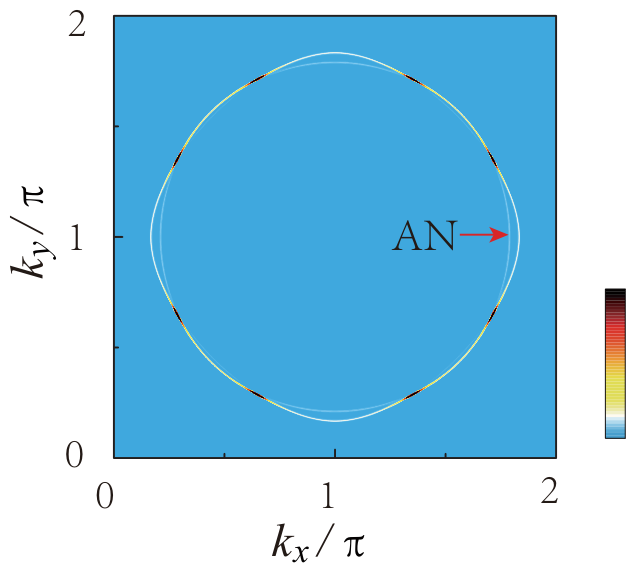
T * is actually a crossover temperature below which a novel electronic state emerges, where the distinguished features are characterized by the presence of the ordering phenomena [74,75,76,77,78,79], the dramatic change in the line-shape of the energy distribution curve [79,80,81,82,83,84,85,86,87], and the kink in the quasiparticle dispersion [88,89,90,91,92,93], etc. In particular, the normal-state pseudogap leads to an EFS reconstruction [94,95,96,97,98,99,100,101,102]. The location of the underlying EFS contour is obtained straightforwardly by the poles of the full electron propagator (3) at zero energy, i.e., ε k + Re Σ ph ( k , 0 ) = ε ¯ k = 0 , and then the spectral weight at the EFS contour is governed mainly by the imaginary part of the electron self-energy Im Σ ph ( k , ω ) , where ε ¯ k = Z F ε k is the renormalized electron energy dispersion and Z F 1 = 1 Re Σ pho ( k , 0 ) k = [ π , 0 ] is the single-particle coherent weight, with Re Σ pho ( k , ω ) being the real part of the antisymmetric part of the electron self-energy. In previous works [70,71,72], the EFS reconstruction has been discussed in the detail. Since the shape of EFS plays a crucial role in the understanding of the low-temperature resistivity in the normal state of cuprate superconductors, we replot the intensity map of the electron spectral function A ( k , ω ) = Im G ( k , ω ) / π in the first Brillouin zone for the binding energy ω = 0 at δ = 0.09 with T = 0.002 J in Figure 1, where the Brillouin zone center has been shifted by [ π , π ], while AN labeled the antinode. It thus shows that the normal-state pseudogap generates an EFS reconstruction, i.e., the spectral weight at and around the antinodal region of EFS becomes partially gapped, leading to the fact that EFS consists, not of a closed contour, but only of four disconnected Fermi arcs centered at and around the nodal region, in qualitative agreement with the experimental observations [94,95,96,97,98,99,100,101,102].

2.2. Spin Pseudogap and Full Effective Spin Propagator

In this subsection, we study the detailed features of the full effective spin propagator and the related spin pseudogap in the fermion-spin theory (2) description of the low-energy effective t-J model (1) for a convenience in the following discussion of the low-temperature resistivity due to the impurity-scattering assisted electron umklapp scattering mediated by the exchange of the full effective spin propagator. The full effective spin propagator can be expressed as [50]
P ( k , p , k , ω ) = 1 N q Λ p + q + k Λ q + k Π ¯ ( p , q , ω ) ,
with the full spin bubble
Π ¯ ( p , q , i p m ) = 1 β i q m D ( q , i q m ) D ( q + p , i q m + i p m ) ,
where the full spin propagator D ( k , ω ) can be expressed as [73,103,104]
D ( k , ω ) = 1 D ( 0 ) 1 ( k , ω ) Σ ph ( s ) ( k , ω ) ,
with the spin self-energy Σ ph ( s ) ( k , ω ) , which is derived in terms of the collective charge-carrier mode, and has been given in Ref. [73]. Starting from this full spin propagator (10), the dynamical spin response of cuprate superconductors has been investigated [73,103,104], and the obtained results are qualitatively consistent with the experimental observations [105,106,107,108,109,110,111,112,113].
As in the case of the normal-state pseudogap discussed in Section 2.1, the spin pseudogap Δ ¯ pg ( s ) ( k ) in the fermion-spin theory (2) description of the t-J model (1) is closely related to the spin self-energy Σ ph ( s ) ( k , ω ) as [50]
Σ ph ( s ) ( k , ω ) B k [ Δ ¯ pg ( s ) ( k ) ] 2 ω 2 ω 0 k 2 ,
where Δ ¯ pg ( s ) ( k ) anisotropically suppresses the spin excitation density of states, which, together with the related spin excitation energy dispersion ω 0 k , can be obtained directly from the spin self-energy Σ ph ( s ) ( k , ω ) , and have been given in Ref. [50]. Substituting the above spin self-energy (11) into Equation (10), the full spin propagator (10) can be obtained as
D ( k , ω ) = B ¯ 1 k ω 2 ω ¯ 1 k 2 + B ¯ 2 k ω 2 ω ¯ 2 k 2 = α = 1 , 2 B ¯ α k ω 2 ω ¯ α k 2 ,
with the renormalized spin excitation energy dispersions
ω ¯ 1 k 2 = 1 2 ω k 2 + ω 0 k 2 + ( ω k 2 ω 0 k 2 ) 2 + 4 B k 2 [ Δ ¯ pg ( s ) ( k ) ] 2 ,
ω ¯ 2 k 2 = 1 2 ω k 2 + ω 0 k 2 ( ω k 2 ω 0 k 2 ) 2 + 4 B k 2 [ Δ ¯ pg ( s ) ( k ) ] 2 ,
and the corresponding spectral weights B ¯ 1 k and B ¯ 2 k , respectively, which have been derived in Ref. [50].
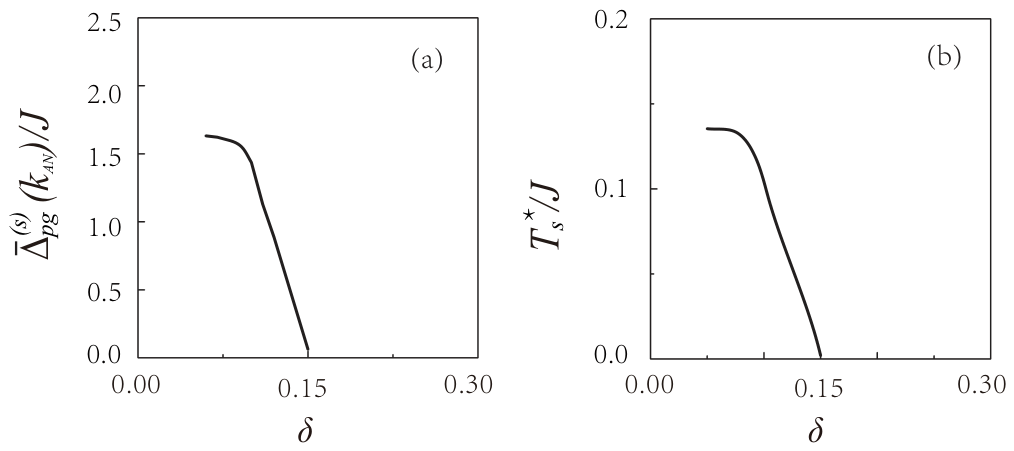
The crucial scattering process responsible for the low-temperature resistivity in the overdoped strange-metal phase is concentrated at and around the antinodal region; however, the antinodal spin pseudogap opens at low temperatures in the underdoped pseudogap phase, which partially suppresses the spin excitation density of states at and around the antinodal region [24,25,26,27], and thus would naturally account for a deviation from the low-temperature behavior of the resistivity in the overdoped strange-metal phase. In Figure 2a, we replot the antinodal spin pseudogap Δ ¯ pg ( s ) ( k AN ) as a function of doping with temperature T = 0.002 J , where k AN is the wave vector at the antinode of EFS. The obtained result [50] in Figure 2a therefore shows that Δ ¯ pg ( s ) ( k AN ) is not sensitive to doping in the slightly underdoped region, and then it decreases rapidly as doping is increased in the heavily underdoped region. More specially, Δ ¯ pg ( s ) ( k AN ) vanishes abruptly at and around the optimal doping, indicating that the main properties of the antinodal spin excitation in the overdoped regime can be well described by the MF spin propagator (7). This Δ ¯ pg ( s ) ( k AN ) in the underdoped regime depresses the spin excitation density of states at and around the antinodal region. Moreover, for a given doping, Δ ¯ pg ( s ) ( k AN ) vanishes when the temperature reaches the antinodal spin pseudogap crossover temperature T s * . In Figure 2b, we replot  T s * as a function of doping, where T s * presents a similar behavior of Δ ¯ pg ( s ) ( k AN ) , i.e., T s * is relatively high in the slightly underdoped region, but it diminishes quickly with the increase in doping in the heavily underdoped region, and terminates eventually at and around the optimal doping.
From the above full spin propagator (12), the full spin bubble (9) can be evaluated as
Π ¯ ( p , q , ω ) = α = 1 , 2 α = 1 , 2 W ¯ α α p q ( 1 ) ω 2 [ ω ¯ α α p q ( 1 ) ] 2 + W ¯ α α p q ( 2 ) ω 2 [ ω ¯ α α p q ( 2 ) ] 2 ,
with the full effective spin excitation energy dispersions
ω ¯ α α p q ( 1 ) = ω ¯ α q + p + ω ¯ α q ,
ω ¯ α α p q ( 2 ) = ω ¯ α q + p ω ¯ α q ,
and the corresponding weight functions W ¯ α α p q ( 1 ) and W ¯ α α p q ( 2 ) , respectively, which have been derived in Ref. [50]. Substituting the above full spin bubble (14) into Equation (8), the full effective spin propagator (8) can be obtained as
P ( k , p , k , ω ) = 1 N α α q ϖ α α ( 1 ) ( k , p , k , q ) ω 2 [ ω ¯ α α p q ( 1 ) ] 2 ϖ α α ( 2 ) ( k , p , k , q ) ω 2 [ ω ¯ α α p q ( 2 ) ] 2 ,
where the corresponding spectral weights ϖ α α ( 1 ) ( k , p , k , q ) = Λ k + p + q Λ q + k W ¯ α α p q ( 1 ) and ϖ α α ( 2 ) ( k , p , k , q ) = Λ k + p + q Λ q + k W ¯ α α p q ( 2 ) , respectively.
We now turn to explore the exotic properties of the full spin propagator (16). The full spin excitation spectral function A spin ( k , ω ) = Im D ( k , ω ) / π can be obtained straightforwardly from the full spin propagator (12) as
A spin ( k , ω ) = A spin ( 1 ) ( k , ω ) + A spin ( 2 ) ( k , ω ) ,
with the corresponding components
A spin ( 1 ) ( k , ω ) = B ¯ 1 k ω ¯ 1 k [ δ ( ω ω ¯ 1 k ) δ ( ω + ω ¯ 1 k ) ] ,
A spin ( 2 ) ( k , ω ) = B ¯ 2 k ω ¯ 2 k [ δ ( ω ω ¯ 2 k ) δ ( ω + ω ¯ 2 k ) ] .
However, after a careful calculation and analysis [50], it has been found that the spectral weight of the full spin excitation spectrum in the component A spin ( 1 ) ( k , ω ) is several orders of magnitude larger than the corresponding spectral weight in the component A spin ( 2 ) ( k , ω ) , which shows that the constrained electrons in the two-dimensional Fermi sea are mainly scattered by the spin excitations from the component A spin ( 1 ) ( k , ω ) . On the other hand, it has been also found that the highest density of states of the spin excitations with the renormalized spin excitation energy dispersion ω ¯ 1 k is located at and around the AF wave vector k A = [ ± π , ± π ] . With the help of these special properties of the spin excitations, the full effective spin propagator P ( k , p , k , ω ) in Equation (16) can now be reduced approximately as
P ( k , p , k , ω ) 1 N q ϖ 11 ( 1 ) ( k , p , k , q ) ω 2 [ ω 11 p q ( 1 ) ] 2 ϖ 11 ( 2 ) ( k , p , k , q ) ω 2 [ ω 11 p q ( 2 ) ] 2 .
Following the previous discussion [49,50], the full effective spin excitation energy dispersions ω ¯ 11 p q ( 1 ) and ω ¯ 11 p q ( 2 ) in Equation (15) can be expressed approximately in terms of the Taylor expansion as
ω ¯ 11 p q ( 1 ) = ω ¯ 1 q + p + ω ¯ 1 q b q p 2 + 2 ω ¯ 1 q ,
ω ¯ 11 p q ( 2 ) = ω ¯ 1 q + p ω ¯ 1 q b q p 2 ,
with b q = d 2 ω ¯ 1 q / ( d 2 q ) . It thus shows that the full effective spin excitation energy in Equation (19) scales with p 2 .

2.3. Boltzmann Transport Equation

For the discussion of the nature of the low-temperature resistivity of cuprate superconductors in the normal state, we need to determine the momentum distribution relaxation. A popular method for the calculation of the momentum distribution relaxation is to solve the Boltzmann transport equation with the input of the scattering processes [22,23], since the Boltzmann transport equation is effective in the presence of well-defined quasiparticles or in dealing with electron interactions mediated by different boson modes in the Eliashberg approach. This is based on the groundbreaking work of Prange and Kadanoff [114], who demonstrated that in the electron–phonon system, a set of transport equations can be derived under the Migdal approximation, where the phonon-mediated electron interaction leads to the electron self-energy and vertex correction. Especially, even in the absence of clearly defined quasiparticles, this set of coupled transport equations for electron and phonon distribution functions is correct, where one of the forms of the transport equation [114]
e E · k f ( k ) = I e e I i e ,
with the input of the scattering process, is identical to the electrical Boltzmann transport equation proposed very early by Landau for the case in which the quasiparticle is well-defined [22,23], where e is the charge of an electron, E is an external electric field E , f ( k , t ) is the electron distribution function in a homogeneous system, I e e is the electron–electron collision term, and I i e is the electron–impurity collision term. More importantly, it has been shown clearly that the Boltzmann transport equation derived by Prange and Kadanoff [114] is not specific to an electron interaction mediated by phonons in the electron–phonon system, and that it is also effective for the system with the electron interaction mediated by other boson modes [48].
In this paper, we start from the microscopic electronic structure of cuprate superconductors discussed in Section 2.1 to study the low-temperature resistivity in the normal state by solving the Boltzmann transport equation, Equation (21). To solve this Boltzmann transport equation, Equation (21), the linear perturbation from the equilibrium in terms of the fermion distribution function n F ( ω ) and the local shift of the chemical potential Φ ˜ ( k ) has been introduced [48,114] as f ( k ) = n F ( ε ¯ k ) [ d n F ( ε ¯ k ) / d ε ¯ k ] Φ ˜ ( k ) , where Φ ˜ ( k ) satisfies the antisymmetric relation Φ ˜ ( k ) = Φ ˜ ( k ) . With the help of the above treatment, the Boltzmann transport equation, Equation (21), can be linearized as
e v k · E d n F ( ε ¯ k ) d ε ¯ k = I e e I i e ,
where the momentum dependence of the electron velocity v k = k ε ¯ k .
The electron–impurity collision term I i e in the Boltzmann transport equation, Equation (22), is proportional to the local shift of the chemical potential Φ ˜ ( k ) , and it is straightforward to find the electron–impurity collision term I i e via [48]
I i e = γ 0 Φ ˜ ( k ) d n F ( ε ¯ k ) d ε ¯ k ,
with the impurity-scattering rate γ 0 . This impurity scattering is required to restrict the modification of the distribution function to at and around the antinodal region [see Appendix A]. On the other hand, the electron–electron collision term I e e in the Boltzmann transport equation, Equation (22), is closely related to the mechanism of the momentum relaxation [22,23]. In this paper, we adopt the impurity-scattering assisted electron umklapp scattering as the mechanism of the momentum relaxation [44,48,115,116,117]. The reasons can be summarized as follows: (i) As shown in Figure 1, the spectral weight on EFS at and around the antinodal region is partially suppressed by the normal-state pseudogap to form the Fermi arcs, which therefore shows that the interaction (then the scattering) between electrons at and around the antinodal region is particularly strong, and then that the important impurity-scattering assisted electron umklapp scattering is concentrated at and around the antinodal region. (ii) The minimal electron umklapp vector Δ p connecting neighboring EFSs is small at and around the antinodal region [48]. In particular, in the present impurity-scattering assisted electron umklapp scattering from a spin excitation, the temperature scale proportional to Δ p 2 presents a similar behavior to the antinodal spin pseudogap crossover temperature in the underdoped pseudogap phase [50]; however, it can be very low in the overdoped strange-metal phase. We will turn to further discuss this issue in Section 3.
In our previous discussions [49,50], the electron–electron collision I e e in the Boltzmann transport equation, Equation (22), due to the impurity-scattering assisted electron umklapp scattering from a spin excitation has been derived, and can be expressed explicitly as
I e e = 1 N 2 k , p 2 T | P ¯ ( k , p , k , ε ¯ k ε ¯ k + p + G ) | 2 { Φ ˜ ( k ) + Φ ˜ ( k ) Φ ˜ ( k + p + G ) Φ ˜ ( k p ) }   × n F ( ε ¯ k ) n F ( ε ¯ k ) [ 1 n F ( ε ¯ k + p + G ) ] [ 1 n F ( ε ¯ k p ) ] δ ( ε ¯ k + ε ¯ k ε ¯ k + p + G ε ¯ k p ) ,
where G represents a set of reciprocal lattice vectors, and, following the common practice [49], the scattering probability for two electrons has been normalized as P ¯ ( k , p , k , ε ¯ k ε ¯ k + p + G ) = P ( k , p , k , ε ¯ k ε ¯ k + p + G ) / W sp with the normalization factor W sp 2 = ( 1 / N 2 ) k , p | Im P ( k , p k , ω ) | 2 d ω . It is worth noting that (i) the above electron umklapp scattering (24) is described as a scattering between electrons by the exchange of the full effective spin propagator P ( k , p , k , ω ) in Equation (8), rather than the scattering between electrons via the emission and absorption of the spin excitation [48]; (ii) the above electron umklapp scattering process (24) is a rather special scattering process, since small momentum scattering is focused on only, in this case, this mechanism of the momentum relaxation that requires both the electron umklapp scattering and impurity scattering [48] [see Appendix A], although the low-temperature resistivity slope is independent of the impurity scattering.
In an interacting electron system, all the low-temperature transport processes involve only the electronic states near EFS [22,23]. In this case, a given patch at EFS can be described by the Fermi angle θ with θ [ 0 , 2 π ] . In the present case of the impurity-scattering assisted umklapp scattering between electrons by the exchange of the full effective spin propagator, an electron on EFS parameterized by the Fermi angle θ is scattered to a point parameterized by the Fermi angle θ on the umklapp EFS via the spin excitation carrying momentum [49,50], and then the momentum integration in the electron–electron collision (24) along the perpendicular direction can be replaced by the integration over ε ¯ k [48,114]. With the help of the above treatment, the electron–electron collision I e e in Equation (24) has been obtained [49], and then the Boltzmann transport Equation (22) can be further expressed as
e v F ( θ ) · E = [ γ ( θ ) + γ 0 ] Φ ( θ ) + 2 d θ 2 π ζ ( θ ) F ( θ , θ ) Φ ( θ ) ,
with Φ ( θ ) = Φ ˜ [ k ( θ ) ] , where the antisymmetric relation Φ ˜ ( k ) = Φ ˜ ( k ) for Φ ˜ ( k ) has been replaced as Φ ( θ ) = Φ ( θ + π ) for Φ ( θ ) , the Fermi velocity v F ( θ ) at the Fermi angle θ , the density of states factor ζ ( θ ) = k F 2 / [ 4 π 2 v F 3 ] at angle θ , the Fermi wave vector k F , the Fermi velocity v F , and the angular (momentum) dependence of the electron umklapp scattering rate,
γ ( θ ) = 2 d θ 2 π ζ ( θ ) F ( θ , θ ) ,
where the impurity-scattering assisted kernel function F ( θ , θ ) connecting the point θ on the circular EFS with the point θ on the umklapp EFS via the amplitude of the momentum transfer p ( θ , θ ) can be expressed as
F ( θ , θ ) = 1 T d ω 2 π ω 2 p ( θ , θ ) | P ¯ [ k ( θ ) , p ( θ , θ ) , ω ] | 2 n B ( ω ) [ 1 + n B ( ω ) ] ,
where n B ( ω ) is the boson distribution function, while the full effective spin propagator P ¯ ( k , p , k , ω ) in Equation (24) can be further expressed in terms of the Fermi angles θ and θ as [50]
P ¯ [ k ( θ ) , p ( θ , θ ) , ω ] = 1 W sp 1 N α α q ϖ α α ( 1 ) ( θ , θ , q ) ω 2 [ ω ¯ α α θ , θ ( 1 ) ( q ) ] 2 ϖ α α ( 2 ) ( θ , θ , q ) ω 2 [ ω ¯ α α θ , θ ( 2 ) ( q ) ] 2 ,
with ϖ α α ( 1 ) ( θ , θ , q ) = ϖ α α ( 1 ) [ k ( θ ) , p ( θ , θ ) , k F , q ] , ϖ α α ( 2 ) ( θ , θ , q ) = ϖ α α ( 2 ) [ k ( θ ) , p ( θ , θ ) , k F , q ] , ω ¯ α α θ , θ ( 1 ) ( q ) = ω ¯ α α p ( θ , θ ) q ( 1 ) , and ω ¯ α α θ , θ ( 2 ) ( q ) = ω ¯ α α p ( θ , θ ) q ( 2 ) .

3. Low-Temperature Resistivity

From the Boltzmann transport Equation (25), the electron current density can be obtained in terms of the local shift of the chemical potential as [49,50]
J = e n 0 1 N k v k d n F ( ε ¯ k ) d ε ¯ k Φ ˜ ( k ) = e n 0 k F v F d θ ( 2 π ) 2 v F ( θ ) Φ ( θ ) ,
with the momentum relaxation that is generated by the action of the electric field on the mobile electrons at EFS with the density n 0 .
The local shift of the chemical potential Φ ( θ ) in the Boltzmann transport equation, Equation (25), can be derived numerically [see Appendix A] or evaluated directly in the relaxation-time approximation. In particular, starting from the impurity-scattering assisted electron umklapp scattering mediated by a critical boson mode, the accurate solution and the approximated result for the local shift of the chemical potential are obtained from numerically solving the corresponding inverse matrix and in the relaxation-time approximation [48], respectively. Comparing the results of the resistivity obtained in the relaxation-time approximation with the corresponding results obtained from the accurate solution for the local shift of the chemical potential, it is thus shown that the relaxation-time approximation works very well at low temperatures. In this case, as a qualitative discussion in this paper, we discuss the low-temperature resistivity due to the impurity-scattering assisted electron umklapp scattering from a spin excitation in the relaxation-time approximation only, while the formalism for the numerical solution of the local shift of the chemical potential is presented in Appendix A for the emphasis of the mechanism of the momentum relaxation from any a boson mode requires both the impurity scattering and the electron umklapp scattering.
In the relaxation-time approximation, the local shift of the chemical potential Φ ( θ ) in the electron current density Equation (29) can be evaluated straightforwardly as
Φ ( θ ) = e v F cos ( θ ) 2 γ ( θ ) + γ 0 E x ^ ,
where the electric field E has been chosen along the x ^ -axis, and then the dc conductivity now can be obtained as [48,49]
σ dc ( T ) = e 2 n 0 k F v F d θ ( 2 π ) 2 cos 2 ( θ ) 1 2 γ ( θ ) + γ 0 .
The above obtained dc conductivity allows us to determine the resistivity in a straightforward way as
ρ ( T ) = 1 σ dc ( T ) .
In particular, as we have shown in previous works [49,50], when the temperature T 0 and the angular (momentum) dependence of the electron umklapp scattering rate γ ( θ , T ) 0 , then the impurity-scattering generated resistivity ρ 0 can be derived directly as ρ 0 = γ 0 / C , with the temperature independence of the constant
C = e 2 n 0 k F v F d θ ( 2 π ) 2 cos 2 ( θ ) = e 2 n 0 k F v F 4 π .
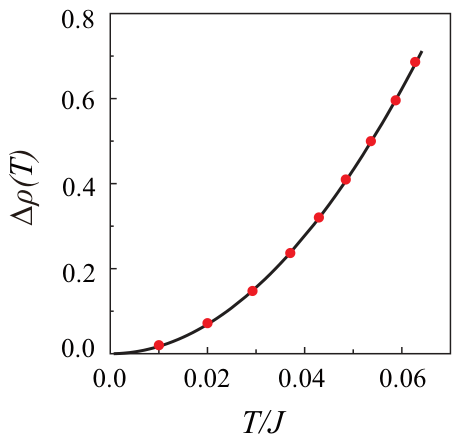
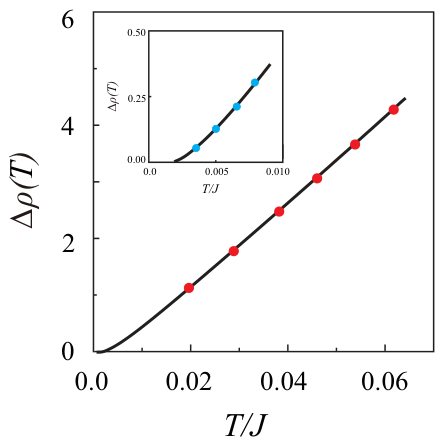
We are now ready to discuss the low-temperature resistivity of cuprate superconductors in the normal state. In Figure 3, we plot the low-temperature resistivity Δ ρ ( T ) = [ ρ ( T ) ρ 0 ] / ρ 0 as a function of temperature with the impurity-scattering rate γ 0 = 0.00001 at the underdoping δ = 0.09 , where the red dots are numerically fitted results with the fit form Δ ρ ( T ) = A 2 T 2 and A 2 = 173.08 . Apparently, in the low-temperature region of the underdoped pseudogap phase, the low-temperature resistivity is predominantly T-quadratic, indicating that the characteristic feature of the T-quadratic behavior of the low-temperature resistivity is the same in the theory and experiments [24,25,26,27,28,29,30,31]. Moreover, we [50] have also shown that the magnitude of the low-temperature T-quadratic resistivity ρ ( T ) at a given doping and a given temperature is qualitatively consistent with the corresponding experimental results in the underdoped pseudogap phase. On the other hand, the obtained result of the low-temperature resistivity Δ ρ ( T ) = [ ρ ( T ) ρ 0 ] / ρ 0 as a function of temperature with the impurity-scattering rate γ 0 = 0.00001 at the overdoping δ = 0.23 is plotted in Figure 4, where the red dots are numerically fitted results with the fit form Δ ρ ( T ) = A 1 T and A 1 = 78.04 , while the inset shows the detail of the temperature dependence of the resistivity in the far-lower-temperature region, where the blue dots are the numerically fitted results with the fit form Δ ρ ( T ) = A 2 T 2 and A 2 = 5198.62 . In Figure 4, there are two distinguished regions: (i) in the low-temperature region of the overdoped strange-metal phase, the low-temperature resistivity presents a T-linear behavior down to the low temperature of T 0.01 J ; (ii) in the far-lower-temperature region T < 0.01 J of the overdoped strange-metal phase, the far-lower-temperature resistivity decreases quadratically with the decrease in temperature. Moreover, we [49,50] have also performed the calculation for the resistivity ρ ( T ) at different doping concentrations, and the obtained results show that the low-temperature T-quadratic resistivity in the underdoped pseudogap phase persists all the way up to the strongly underdoped region, while the low-temperature T-linear resistivity in the overdoped strange-metal phase extends up to the edge of the SC dome, where both the strengths of the low-temperature T-quadratic resistivity and T-linear resistivity (then the T-quadratic resistivity and T-linear resistivity coefficients) decrease as doping is increased. All these obtained results are well-consistent with the corresponding experimental observations [24,25,26,27,28,29,30,31,32,33,34,35]. On the other hand, both the slopes of the low-temperature T-quadratic resistivity and T-linear resistivity themselves are independent of the impurity-scattering rate γ 0 for γ 0 1 , and are therefore intrinsic [48]. To confirm this point more clearly, we have made a series of calculations for Δ ρ ( T ) at different γ 0 , and found that for the case of γ 0 < 0.001 , the obtained results of Δ ρ ( T ) at different γ 0 are qualitatively consistent with each other.
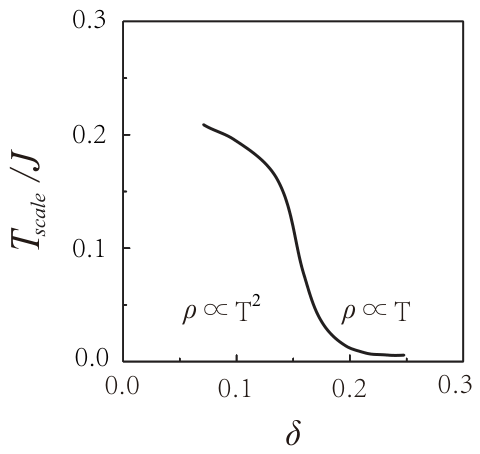
The above mechanism of the momentum relaxation requires both the impurity scattering and the electron umklapp scattering, where the impurity scattering is needed to restrict the modification of the distribution function to the antinodal region [see Appendix A], while the impurity-scattering assisted electron umklapp scattering from a spin excitation associated with the antinodes leads to the low-temperature T-linear resistivity in the overdoped strange-metal phase; however, when this impurity-scattering assisted electron umklapp scattering moves to the underdoped pseudogap phase, the opening of the antinodal spin pseudogap partially suppresses the strength of the antinodal electron umklapp scattering, leading to the low-temperature T-quadratic resistivity. This picture of the unusual crossover from the low-temperature T-linear resistivity in the overdoped strange-metal phase to the low-temperature T-quadratic resistivity in the underdoped pseudogap phase can also be understood from the special properties of the impurity-scattering assisted kernel function F ( θ , θ ) in Equation (27) [then the impurity-scattering assisted electron umklapp scattering rate in Equation (26)]. This impurity-scattering assisted kernel function F ( θ , θ ) is proportional to the full effective spin propagator P ( k , p , k , ω ) ; however, as we have mentioned in Equation (20), the full effective spin excitation energy scales with p 2 , and then when the impurity-scattering assisted electron umklapp scattering kicks in, the energy scale is proportional to Δ p 2 due to the presence of this p 2 scaling in the full effective spin excitation energy. This leads to the fact that T scale = b ¯ Δ p 2 can be referred to as the temperature scale, where the average value b ¯ = ( 1 / N ) q { k A } b ( q ) is a constant at a given doping, and the summation q { k A } is restricted to the extremely small area { k A } around the k A point of the Brillouin zone. In the recent discussions [50], we have shown that this T scale is intrinsically correlated with the antinodal spin pseudogap, and therefore is strongly doping-dependent. For convenience in the following discussions, T scale as a function of doping is replotted in Figure 5, where T scale clearly presents a similar behavior to T s * shown in Figure 2b in the underdoped pseudogap phase, and is very low in the overdoped strange-metal phase due to the absence of the antinodal spin pseudogap shown in Figure 2a. With the help of the above scaling of the full effective spin excitation energy in Equation (20) and the doping dependence of T scale in Figure 5, our previous analysis [49,50] has demonstrated clearly that the impurity-scattering assisted umklapp-scattering effect is not exponentially small at low temperatures as in the case of the electron–phonon coupling, but is a power law down to zero temperature, where three primary regions of the impurity-scattering assisted kernel function need to be distinguished:
(i)
In the low-temperature region ( T < T scale ) in the underdoped pseudogap phase shown in Figure 5, the impurity-scattering assisted kernel function F ( θ , θ ) is reduced as F ( θ , θ ) T 2 , this leads to a low-temperature T-quadratic resistivity ρ ( T ) T 2 shown in Figure 3 in the underdoped pseudogap phase.
(ii)
However, in the low-temperature region ( T > T scale ) in the overdoped strange-metal phase shown in Figure 5, the impurity-scattering assisted kernel function F ( θ , θ ) is reduced as F ( θ , θ ) T , which generates a T-linear resistivity ρ ( T ) T shown in Figure 4 in the overdoped strange-metal phase. Concomitantly, the low-temperature resistivity exhibits an exceptional crossover from the T-linear behavior in the overdoped strange-metal phase to the T-quadratic behavior in the underdoped pseudogap phase.
(iii)
On the other hand, in the far-lower-temperature region T < T scale 0.01 J in the overdoped strange-metal phase, the impurity-scattering assisted kernel function F ( θ , θ ) is reduced as F ( θ , θ ) T 2 , this behavior therefore produces a T-quadratic resistivity in the far-lower-temperature region.

4. Summary and Discussion

Starting from the microscopic electronic structure of cuprate superconductors, we have studied the low-temperature resistivity in the normal state from the underdoped pseudogap phase to the overdoped strange-metal phase, and show that the mechanism of the momentum relaxation requires both the impurity scattering and the electron umklapp scattering. The impurity scattering is required to restrict the modification of the distribution function to at and around the antinodal region of EFS, while the impurity-scattering assisted electron umklapp scattering mediated by the exchange of the full effective spin propagator dominates the temperature-dependent behavior of the low-temperature resistivity, where the doping dependence of the temperature scale T scale exists, which is proportional to the square of the minimal electron umklapp scattering vector, and presents a similar behavior of the antinodal spin pseudogap crossover temperature. In the overdoped strange-metal phase, where the antinodal spin pseudogap vanishes, the impurity-scattering assisted electron umklapp scattering from a spin excitation associated with the antinodal region produces a low-temperature T-linear resistivity in the temperature region above the temperature scale ( T > T scale ); however, in the underdoped pseudogap phase, where the antinodal spin pseudogap opens, the antinodal spin pseudogap in the temperature region below the temperature scale ( T < T scale ) partially suppresses the spin excitation density of states at and around the antinodal region, which weakens the strength of the impurity-scattering assisted electron umklapp scattering at and around the antinodal region, and thus leads to a low-temperature T-quadratic resistivity. As a natural consequence, the low-temperature resistivity exhibits an unusual crossover from the low-temperature T-linear behavior in the overdoped strange-metal phase to the low-temperature T-quadratic behavior in the underdoped pseudogap phase.

Author Contributions

X.M. contributed numerical calculations of the low-temperature resistivity. Writing—original draft, S.F., X.M., M.Z. and H.G. All authors participated in the conceptualization, theoretical research, data analysis and interpretation, discussions, and approval of this manuscript. All authors have read and agreed to the published version of the manuscript.

Funding

This work is supported by the National Key Research and Development Program of China under Grant Nos. 2021YFA1401803 and 2023YFA1406500, the National Natural Science Foundation of China under Grant Nos. 12504172, 12574249, and 12274036, and the Special Funding for Postdoctoral Research Projects in Chongqing under Grant No. 2024CQBSHTB3156.

Data Availability Statement

The original contributions presented in this study are included in the article. Further inquiries can be directed to the corresponding author.

Acknowledgments

The authors would like to thank X. T. Zhang for the helpful discussions.

Conflicts of Interest

The authors declare no conflicts of interest.

Appendix A. Numerical Solution of Boltzmann Transport Equation

In this appendix, we numerically solve the Boltzmann transport equation by discretizing the θ variable in Equation (25) of the main text, where the integral–differential equation, Equation (25), is converted to a matrix equation as
e v ^ F · E = 2 F ^ · Φ ^ ,
where v ^ F and Φ ^ can be expressed explicitly as
v ^ F = v F ( θ 1 ) v F ( θ 2 ) v F ( θ 3 ) · · · v F ( θ N ) , Φ ^ = Φ ( θ 1 ) Φ ( θ 2 ) Φ ( θ 3 ) · · · Φ ( θ N ) ,
respectively, while the matrix F ^ can be derived straightforwardly as
F ^ = 1 N θ θ l θ 1 ζ ( θ l ) F ( θ 1 , θ l ) + γ 0 , ζ ( θ 2 ) F ( θ 1 , θ 2 ) , , ζ ( θ N ) F ( θ 1 , θ N ) ζ ( θ 1 ) F ( θ 2 , θ 1 ) , θ l θ 2 ζ ( θ l ) F ( θ 2 , θ l ) + γ 0 , , ζ ( θ N ) F ( θ 2 , θ N ) ζ ( θ 1 ) F ( θ N , θ 1 ) , ζ ( θ 2 ) F ( θ N , θ 2 ) , , θ l θ N ζ ( θ l ) F ( θ N , θ l ) + γ 0 .
It should be emphasized that the impurity-scattering rate γ 0 of the diagonal elements emerges in the above kernel function matrix F ^ , and, in this sense, this kernel function (then the electron umklapp scattering) is referred to as the impurity-scattering assisted kernel function (then the impurity-scattering assisted electron umklapp scattering). In principle, the clean limit can be approached by continuing to decrease the impurity-scattering rate γ 0 . However, the important electron umklapp scattering process is concentrated at and around the antinodal region [48,49,50], where only small momentum scattering dominates the electron umklapp scattering as we have mentioned in the main text. In this case, the impurity scattering is required to restrict the modification of the distribution function to the antinodal region [48]. This follows from a basic fact that in the clean limit with the impurity-scattering rate γ 0 = 0 , the determinant of the above matrix F ^ is equal to zero, i.e., | F ^ | = 0 , which leads to the fact that the region of the temperature-dependent resistivity due to the electron umklapp scattering from any a boson mode without the impurity-scattering assistance shrinks to zero [48]. This is why the mechanism of the momentum relaxation from any boson mode requires both the impurity scattering and the electron umklapp scattering.
By numerically solving the inverse matrix F ^ 1 , we can directly obtain the accurate solution for Φ ^ from the above matrix equation, Equation (A1), as
Φ ^ = e 2 F ^ 1 v ^ F · E .
Substituting the above result of Φ ^ into Equation (29) of the main text, the dc conductivity (then the resistivity) can be accurately evaluated.

References

  1. Kastner, M.A.; Birgeneau, R.J.; Shirane, G.; Endoh, Y. Magnetic, transport, and optical properties of monolayer copper oxides. Rev. Mod. Phys. 1998, 70, 897–928. [Google Scholar] [CrossRef]
  2. Fujita, M.; Hiraka, H.; Matsuda, M.; Matsuura, M.; Tranquada, J.M.; Wakimoto, S.; Xu, G.; Yamada, K. Progress in neutron scattering studies of spin excitations in high-Tc cuprates. J. Phys. Soc. Jpn. 2012, 81, 011007. [Google Scholar] [CrossRef]
  3. Bednorz, J.G.; Müller, K.A. Possible high Tc superconductivity in the Ba-La-Cu-O system. Z. Phys. B 1986, 64, 189–193. [Google Scholar] [CrossRef]
  4. Damascelli, A.; Hussain, Z.; Shen, Z.-X. Angle-resolved photoemission studies of the cuprate superconductors. Rev. Mod. Phys. 2003, 75, 473–541. [Google Scholar] [CrossRef]
  5. Campuzano, J.C.; Norman, M.R.; Randeira, M. Photoemission in the high-Tc superconductors. In Physics of Superconductors; Bennemann, K.H., Ketterson, J.B., Eds.; Springer: Berlin/Heidelberg, Germany, 2004; Volume II, p. 167. [Google Scholar]
  6. Fink, J.; Borisenko, S.; Kordyuk, A.; Koitzsch, A.; Geck, J.; Zabalotnyy, V.; Knupfer, M.; Büechner, B.; Berger, H. Dressing of the charge carriers in high-Tc superconductors. In Lecture Notes in Physics; Hüfner, S., Ed.; Springer: Berlin/Heidelberg, Germany, 2007; Volume 715, p. 295. [Google Scholar]
  7. Drozdov, I.K.; Pletikosić, I.; Kim, C.-K.; Fujita, K.; Gu, G.D.; Davis, J.C.S.; Johnson, P.D.; Zović, I.B.; Valla, T. Phase diagram of Bi2Sr2CaCu2O8+δ revisited. Nat. Commun. 2018, 9, 5210. [Google Scholar] [CrossRef]
  8. Timusk, T.; Statt, B. The pseudogap in high-temperature superconductors: An experimental survey. Rep. Prog. Phys. 1999, 62, 61–122. [Google Scholar] [CrossRef]
  9. Hüfner, S.; Hossain, M.A.; Damascelli, A.; Sawatzky, A.G.A. Two gaps make a high-temperature supercon-ductor? Rep. Prog. Phys. 2008, 71, 062501. [Google Scholar] [CrossRef]
  10. Hussey, N.E. What drives pseudogap physics in high-Tc cuprates? A view from the (resistance) bridge. J. Phys. Chem. Solids 2011, 72, 529–532. [Google Scholar] [CrossRef]
  11. Vishik, I.M. Photoemission perspective on pseudogap, superconducting fluctuations, and charge order in cuprates: A review of recent progress. Rep. Prog. Phys. 2018, 81, 062501. [Google Scholar] [CrossRef] [PubMed]
  12. Loeser, A.G.; Shen, Z.-X.; Dessau, D.S.; Marshall, D.S.; Park, C.H.; Fournier, P.; Kapitulnik, A. Excitation gap in the normal state of underdoped Bi2Sr2CaCu2O8+δ. Science 1996, 273, 325–329. [Google Scholar] [CrossRef]
  13. Norman, M.R.; Ding, H.; Randeria, M.; Campuzano, J.C.; Yokoya, T.; Takeuchi, T.; Takahashi, T.; Mochiku, T.; Kadowaki, K.; Guptasarma, P.; et al. Destruction of the Fermi surface in underdoped high-Tc superconductors. Nature 1998, 392, 157–160. [Google Scholar] [CrossRef]
  14. Renner, C.; Revaz, B.; Genoud, J.-Y.; Kadowaki, K.; Fischer, Ø. Pseudogap precursor of the superconducting gap in under- and overdoped Bi2Sr2CaCu2O8+δ. Phys. Rev. Lett. 1998, 80, 149–152. [Google Scholar] [CrossRef]
  15. Warren, W.W., Jr.; Walstedt, R.E.; Brennert, G.F.; Cava, R.J.; Tycko, R.; Bell, R.F.; Dabbagh, G. Cu spin dynamics and superconducting precursor effects in planes above Tc in YBa2Cu3O6.7. Phys. Rev. Lett. 1989, 62, 1193–1196. [Google Scholar] [CrossRef]
  16. Alloul, H.; Ohno, T.; Mendels, P. 89Y NMR evidence for a Fermi-liquid behavior in YBa2Cu3O6+x. Phys. Rev. Lett. 1989, 63, 1700–1703. [Google Scholar] [CrossRef]
  17. Walstedt, R.E.; Warren, W.W., Jr.; Bell, R.F.; Cava, R.J.; Espinosa, G.P.; Schneemeyer, L.F.; Waszczak, J.V. 63Cu NMR shift and linewidth anomalies in the Tc = 60 K phase of Y-Ba-Cu-O. Phys. Rev. B 1990, 41, 9574–9577. [Google Scholar] [CrossRef] [PubMed]
  18. Keimer, B.; Kivelson, S.A.; Norman, M.R.; Uchida, S.; Zaanen, J. From quantum matter to high-temperature superconductivity in copper oxides. Nature 2015, 518, 179–186. [Google Scholar] [CrossRef]
  19. Varma, C.M. Colloquium: Linear in temperature resistivity and associated mysteries including high temperature superconductivity. Rev. Mod. Phys. 2020, 92, 031001. [Google Scholar] [CrossRef]
  20. Hussey, N.E. High-temperature superconductivity and strange metallicity: Simple observations with (possibly) profound implications. Phys. C 2023, 614, 1354362. [Google Scholar] [CrossRef]
  21. Schrieffer, J.R. Theory of Superconductivity; Benjamin: New York, NY, USA, 1964. [Google Scholar]
  22. Abrikosov, A.A. Fundamentals of the Theory of Metals; Elsevier Science Publishers B.V.: Amsterdam, The Netherlands, 1988. [Google Scholar]
  23. Mahan, G.D. Many-Particle Physics; Plenum Press: New York, NY, USA, 1981. [Google Scholar]
  24. Bucher, B.; Steiner, P.; Karpinski, J.; Kaldis, E.; Wachter, P. Influence of the spin gap on the normal state transport in YBa2Cu4O8. Phys. Rev. Lett. 1993, 70, 2012–2015. [Google Scholar] [CrossRef] [PubMed]
  25. Ito, T.; Takenaka, K.; Uchida, S. Systematic deviation from T-linear behavior in the in-plane resistivity of YBa2Cu3O7−y: Evidence for dominant spin scattering. Phys. Rev. Lett. 1993, 70, 3995–3998. [Google Scholar] [CrossRef]
  26. Nakano, T.; Oda, M.; Manabe, C.; Momono, N.; Miura, Y.; Ido, M. Magnetic properties and electronic conduction of superconducting La2−xSrxCuO4. Phys. Rev. B 1994, 49, 16000–16008. [Google Scholar] [CrossRef] [PubMed]
  27. Ando, Y.; Lavrov, A.N.; Komiya, S.; Segawa, K.; Sun, X.F. Mobility of the doped holes and the antiferromagnetic correlations in underdoped high-Tc cuprates. Phys. Rev. Lett. 2001, 87, 017001. [Google Scholar] [CrossRef] [PubMed]
  28. Cooper, R.A.; Wang, Y.; Vignolle, B.; Lipscombe, O.J.; Hayden, S.M.; Tanabe, Y.; Adachi, T.; Koike, Y.; Nohara, M.; Takagi, H.; et al. Anomalous criticality in the electrical resistivity of La2−xSrxCuO4. Science 2009, 323, 603. [Google Scholar] [CrossRef] [PubMed]
  29. Mirzaei, S.I.; Stricker, D.; Hancock, J.N.; Berthod, C.; Georges, A.; Heumen, E.; Chan, M.K.; Zhao, X.; Li, Y.; Greven, M.; et al. Spectroscopic evidence for Fermi liquid-like energy and temperature dependence of the relaxation rate in the pseudogap phase of the cuprates. Proc. Natl. Acad. Sci. USA 2013, 110, 5774. [Google Scholar] [CrossRef]
  30. Barišić, N.; Chan, M.K.; Li, Y.; Yu, G.; Zhao, X.; Dressel, M.; Smontara, A.; Greven, M. Universal sheet re-sistance and revised phase diagram of the cuprate high-temperature superconductors. Proc. Natl. Acad. Sci. USA 2013, 110, 12235. [Google Scholar] [CrossRef]
  31. Pelc, D.; Veit, M.J.; Dorow, C.J.; Ge, Y.; Barišić, N.; Greven, M. Resistivity phase diagram of cuprates revisited. Phys. Rev. B 2020, 102, 075114. [Google Scholar] [CrossRef]
  32. Legros, A.; Benhabib, S.; Tabis, W.; Laliberté, F.; Dion, M.; Lizaire, M.; Vignolle, B.; Vignolles, D.; Raffy, H.; Li, Z.Z.; et al. Universal T-linear resistivity and Planckian dissipation in overdoped cuprates. Nat. Phys. 2019, 15, 142–147. [Google Scholar] [CrossRef]
  33. Ayres, J.; Berben, M.; Čulo, M.; Hsu, Y.-T.; van Heumen, E.; Huang, Y.; Zaanen, J.; Kondo, T.; Takeuchi, T.; Cooper, J.R.; et al. Incoherent transport across the strange-metal regime of overdoped cuprates. Nature 2021, 595, 661. [Google Scholar] [CrossRef]
  34. Grissonnanche, G.; Fang, Y.; Legros, A.; Verret, S.; Laliberté, F.; Collignon, C.; Zhou, J.; Graf, D.; Goddard, P.A.; Taillefer, L.; et al. Linear-in temperature resistivity from an isotropic Planckian scattering rate. Nature 2021, 595, 667–672. [Google Scholar] [CrossRef]
  35. Gurvitch, M.; Fiory, A.T. Resistivity of La1.825Sr0.175CuO4 and YBa2Cu3O7 to 1100 K: Absence of saturation and its implications. Phys. Rev. Lett. 1987, 59, 1337–1340. [Google Scholar] [CrossRef]
  36. Campi, G.; Logvenov, G.; Caprara, S.; Valletta, A.; Bianconi, A. Kondo Versus Fano in Superconducting Artificial High-Tc Heterostructures. Condens. Matter 2024, 9, 43. [Google Scholar] [CrossRef]
  37. Campi, G.; Alimenti, A.; Logvenov, G.; Smith, G.A.; Balakirev, F.; Lee, S.-E.; Balicas, L.; Silva, E.; Ummarino, G.A.; Midei, G.; et al. Upper critical magnetic field and multiband superconductivity in artificial high-Tc superlattices of nano quantum wells. Phys. Rev. Mater. 2025, 9, 074204. [Google Scholar] [CrossRef]
  38. Damle, K.; Sachdev, S. Nonzero-temperature transport near quantum critical points. Phys. Rev. B 1997, 56, 8714–8733. [Google Scholar] [CrossRef]
  39. Sachdev, S. Quantum Phase Transitions; Cambridge University Press: Cambridge, UK, 1999. [Google Scholar]
  40. Zaanen, J. Why the temperature is high. Nature 2004, 430, 512. [Google Scholar] [CrossRef]
  41. Dell’Anna, L.; Metzner, W. Electrical resistivity near Pomeranchuk instability in two dimensions. Phys. Rev. Lett. 2007, 98, 136402. [Google Scholar] [CrossRef]
  42. Zaanen, J. Planckian dissipation, minimal viscosity and the transport in cuprate strange metals. SciPost Phys. 2019, 6, 061. [Google Scholar] [CrossRef]
  43. Hartnoll, S.A.; Mackenzie, A.P. Colloquium: Planckian dissipation in metals. Rev. Mod. Phys. 2022, 94, 041002. [Google Scholar] [CrossRef]
  44. Rice, T.M.; Robinson, N.J.; Tsvelik, A.M. Umklapp scattering as the origin of T-linear resistivity in the normal state of high-Tc cuprate superconductors. Phys. Rev. B 2017, 96, 220502. [Google Scholar] [CrossRef]
  45. Hussey, N.E. Low-energy quasiparticles in high-Tc cuprates. Adv. Phys. 2002, 51, 1685–1771. [Google Scholar] [CrossRef]
  46. Balatsky, A.V.; Vekhter, I.; Zhu, J.-X. Impurity-induced states in conventional and unconventional superconductors. Rev. Mod. Phys. 2006, 78, 373–433. [Google Scholar] [CrossRef]
  47. Alloul, H.; Bobroff, J.; Gabay, M.; Hirschfeld, P.J. Defects in correlated metals and superconductors. Rev. Mod. Phys. 2009, 81, 45–108. [Google Scholar] [CrossRef]
  48. Lee, P.A. Low-temperature T-linear resistivity due to umklapp scattering from a critical mode. Phys. Rev. B 2021, 104, 035140. [Google Scholar] [CrossRef]
  49. Ma, X.; Zeng, M.; Cao, Z.; Feng, S. Low-temperature T-linear resistivity in the strange metal phase of overdoped cuprate superconductors due to umklapp scattering from a spin excitation. Phys. Rev. B 2023, 108, 134502. [Google Scholar] [CrossRef]
  50. Ma, X.; Zeng, M.; Guo, H.; Feng, S. Low-temperature T2 resistivity in the underdoped pseudogap phase versus T-linear resistivity in the overdoped strange-metal phase of cuprate superconductors. Phys. Rev. B 2024, 110, 094520. [Google Scholar] [CrossRef]
  51. Anderson, P.W. The resonating valence bond state in La2CuO4 and superconductivity. Science 1987, 235, 1196–1198. [Google Scholar] [CrossRef]
  52. Kim, C.; White, P.J.; Shen, Z.-X.; Tohyama, T.; Shibata, Y.; Maekawa, S.; Wells, B.O.; Kim, Y.J.; Birgeneau, R.J.; Kastner, M.A. Systematics of the Photoemission Spectral Function of Cuprates: Insulators and Hole- and Electron-Doped Superconductors. Phys. Rev. Lett. 1998, 80, 4245–4248. [Google Scholar] [CrossRef]
  53. Hybertsen, M.S.; Stechel, E.B.; Schluter, M.; Jennison, D.R. Renormalization from density-functional theory to strong-coupling models for electronic states in Cu-O materials. Phys. Rev. B 1990, 41, 11068–11072. [Google Scholar] [CrossRef]
  54. Gooding, R.J.; Vos, K.J.E.; Leung, P.W. Theory of electron-hole asymmetry in doped CuO2 planes. Phys. Rev. B 1994, 50, 12866–12875. [Google Scholar] [CrossRef] [PubMed]
  55. Tanaka, K.; Yoshida, T.; Fujimori, A.; Lu, D.H.; Shen, Z.-X.; Zhou, X.-J.; Eisaki, H.; Hussain, Z.; Uchida, S.; Aiura, Y.; et al. Effects of next-nearest-neighbor hopping t on the electronic structure of cuprate superconductors. Phys. Rev. B 2004, 70, 092503. [Google Scholar] [CrossRef]
  56. Shih, C.T.; Lee, T.K.; Eder, R.; Mou, C.-Y.; Chen, Y.C. Enhancement of Pairing Correlation by t in the Two-Dimensional Extended t-J Model. Phys. Rev. Lett. 2004, 92, 227002. [Google Scholar] [CrossRef] [PubMed]
  57. Pavarini, E.; Dasgupta, I.; Saha-Dasgupta, T.; Jepsen, O.; Andersen, O.K. Band-Structure Trend in Hole-Doped Cuprates and Correlation with Tcmax. Phys. Rev. Lett. 2001, 87, 047003. [Google Scholar] [CrossRef] [PubMed]
  58. Liu, Y.; Lan, Y.; Feng, S. Peak-structure in the self-energy of cuprate superconductors. Phys. Rev. B 2021, 103, 024525. [Google Scholar] [CrossRef]
  59. Tan, S.; Liu, Y.; Mou, Y.; Feng, S. Anisotropic dressing of electrons in electron-doped cuprate superconductors. Phys. Rev. B 2021, 103, 014503. [Google Scholar] [CrossRef]
  60. Gao, D.; Mou, Y.; Feng, S. Anomalous electron spectrum and its relation to peak structure of electron scattering rate in cuprate superconductors. J. Low Temp. Phys. 2018, 192, 19–32. [Google Scholar] [CrossRef]
  61. Feng, S.; Ma, T. Enhancement of superconducting transition temperature by the additional second neighbor hopping t in the t-J model. Phys. Lett. A 2006, 350, 138–146. [Google Scholar] [CrossRef][Green Version]
  62. Yu, L. Many-body problems in high temperature superconductivity. In Recent Progress in Many-Body Theories; Ainsworth, T.L., Campbell, C.E., Clements, B.E., Krotscheck, E., Eds.; Plenum: New York, NY, USA, 1992; Volume 3, p. 157. [Google Scholar]
  63. Feng, S.; Wu, J.B.; Su, Z.B.; Yu, L. Slave-particle studies of the electron-momentum distribution in the low-dimensional t-J model. Phys. Rev. B 1993, 47, 15192. [Google Scholar] [CrossRef]
  64. Zhang, L.; Jain, J.K.; Emery, V.J. Importance of the local constraint in slave-boson theories. Phys. Rev. B 1993, 47, 3368–3373. [Google Scholar] [CrossRef] [PubMed]
  65. Lee, P.A.; Nagaosa, N.; Wen, X.-G. Doping a Mott insulator: Physics of high-temperature superconductivity. Rev. Mod. Phys. 2006, 78, 17–85. [Google Scholar] [CrossRef]
  66. Feng, S.; Qin, J.; Ma, T. A gauge invariant dressed holon and spinon description of the normal state of underdoped cuprates. J. Phys. Condens. Matter 2004, 16, 343. [Google Scholar] [CrossRef][Green Version]
  67. Feng, S.; Su, Z.B.; Yu, L. Fermion-spin transformation to implement the charge-spin separation. Phys. Rev. B 1994, 49, 2368. [Google Scholar] [CrossRef]
  68. Feng, S.; Lan, Y.; Zhao, H.; Kuang, L.; Qin, L.; Ma, A.X. Kinetic-energy-driven superconductivity in cuprate su-perconductors. Int. J. Mod. Phys. B 2015, 29, 1530009. [Google Scholar] [CrossRef]
  69. Feng, S.; Zhao, H.; Huang, Z. Two gaps with one energy scale in cuprate superconductors. Phys. Rev. B 2012, 85, 054509, Erratum in Phys. Rev. B 2012, 85, 099902. [Google Scholar] [CrossRef]
  70. Li, X.; Zeng, M.; Guo, H.; Feng, S. Unusual electronic structure in underdoped cuprate superconductors. Phys. C 2025, 636, 1354767. [Google Scholar] [CrossRef]
  71. Feng, S.; Kuang, L.; Zhao, H. Electronic structure of cuprate superconductors in a full charge-spin recombination scheme. Phys. C 2015, 517, 5–15. [Google Scholar] [CrossRef]
  72. Feng, S.; Gao, D.; Zhao, H. Charge order driven by Fermi-arc instability and its connection with pseudogap in cuprate superconductors. Philos. Mag. 2016, 96, 1245–1262. [Google Scholar] [CrossRef]
  73. Kuang, L.; Lan, Y.; Feng, S. Dynamical spin response in cuprate superconductors from low-energy to high-energy. J. Magn. Magn. Mater. 2015, 374, 624–633. [Google Scholar] [CrossRef]
  74. Comin, R.; Damascelli, A. Resonant X-Ray scattering studies of charge order in cuprates. Annu. Rev. Condens. Matter Phys. 2016, 7, 369–405. [Google Scholar] [CrossRef]
  75. Comin, R.; Frano, A.; Yee, M.M.; Yoshida, Y.; Eisaki, H.; Schierle, E.; Weschke, E.; Sutarto, R.; He, F.; Soumyanarayanan, A.; et al. Charge order driven by Fermi-arc instability in Bi2Sr2−xLaxCuO6+δ. Science 2014, 343, 390. [Google Scholar] [CrossRef]
  76. Ghiringhelli, G.; Tacon, M.L.; Minola, M.; Blanco-Canosa, S.; Mazzoli, C.; Brookes, N.B.; Luca, G.M.D.; Frano, A.; Hawthorn, D.G.; He, F.; et al. Long-range incommensurate charge fluctuations in (Y,Nd)Ba2Cu3O6+x. Science 2012, 337, 821–825. [Google Scholar] [CrossRef]
  77. Neto, E.H.D.; Aynajian, P.; Frano, A.; Comin, R.; Schierle, E.; Weschke, E.; Gyenis, A.; Wen, J.; Schneeloch, J.; Xu, Z.; et al. Ubiquitous interplay between charge ordering and high-temperature superconductivity in cuprates. Science 2014, 343, 393–396. [Google Scholar] [CrossRef] [PubMed]
  78. Campi, G.; Bianconi, A.; Poccia, N.; Bianconi, G.; Barba, L.; Arrighetti, G.; Innocenti, D.; Karpinski, J.; Zhigadlo, N.D.; Kazakov, S.M.; et al. Inhomogeneity of charge-density-wave order and quenched disorder in a high-Tc superconductor. Nature 2015, 525, 359–362. [Google Scholar] [CrossRef] [PubMed]
  79. Hashimoto, M.; Nowadnick, E.A.; He, R.-H.; Vishik, I.M.; Moritz, B.; He, Y.; Tanaka, K.; Moore, R.G.; Lu, D.; Yo-shida, Y.; et al. Direct spectroscopic evidence for phase competition between the pseudogap and superconductivity in Bi2Sr2CaCu2O8+δ. Nat. Mater. 2015, 14, 37–42. [Google Scholar] [CrossRef]
  80. Dessau, D.S.; Wells, B.O.; Shen, Z.-X.; Spicer, W.E.; Arko, A.J.; List, R.S.; Mitzi, D.B.; Kapitulnik, A. Anomalous spectral weight transfer at the superconducting transition of Bi2Sr2CaCu2O8+δ. Phys. Rev. Lett. 1991, 66, 2160–2163. [Google Scholar] [CrossRef]
  81. Campuzano, J.C.; Ding, H.; Norman, M.R.; Fretwell, H.M.; Randeria, M.; Kaminski, A.; Mesot, J.; Takeuchi, T.; Sato, T.; Yokoya, T.; et al. Electronic spectra and their relation to the (π, π) collective mode in high-Tc superconductors. Phys. Rev. Lett. 1999, 83, 3709–3712. [Google Scholar] [CrossRef]
  82. Lu, D.H.; Feng, D.L.; Armitage, N.P.; Shen, K.M.; Damascelli, A.; Kim, C.; Ronning, F.; Shen, Z.-X.; Bonn, D.A.; Liang, R.; et al. Superconducting gap and strong in-plane anisotropy in untwinned YBa2Cu3O7−δ. Phys. Rev. Lett. 2001, 86, 4370–4373. [Google Scholar] [CrossRef]
  83. Sato, T.; Matsui, H.; Nishina, S.; Takahashi, T.; Fujii, T.; Watanabe, T.; Matsuda, A.A. Low energy excitation and scaling in Bi2Sr2Can−1CunO2n+4 (n = 1 − 3): Angle-resolved photoemission spectroscopy. Phys. Rev. Lett. 2002, 89, 067005. [Google Scholar] [CrossRef]
  84. Borisenko, S.V.; Kordyuk, A.A.; Kim, T.K.; Koitzsch, A.; Knupfer, M.; Golden, M.S.; Fink, J.; Eschrig, M.; Berger, H.; Follath, R. Anomalous enhancement of the coupling to the magnetic resonance mode in underdoped Pb-Bi2212. Phys. Rev. Lett. 2003, 90, 207001. [Google Scholar] [CrossRef]
  85. Wei, J.; Zhang, Y.; Ou, H.W.; Xie, B.P.; Shen, D.W.; Zhao, J.F.; Yang, L.X.; Arita, M.; Shimada, K.; Namatame, H.; et al. Superconducting coherence peak in the electronic excitations of a single-layer Bi2Sr1.6La0.4CuO6+δ cuprate superconductor. Phys. Rev. Lett. 2008, 101, 097005. [Google Scholar] [CrossRef]
  86. Loret, B.; Sakai, S.; Benhabib, S.; Gallais, Y.; Cazayous, M.; Méasson, M.A.; Zhong, R.D.; Schneeloch, J.; Gu, G.D.; Forget, A.; et al. Vertical temperature boundary of the pseudogap under the superconducting dome in the phase diagram of Bi2Sr2CaCu2O8+δ. Phys. Rev. B 2017, 96, 094525. [Google Scholar] [CrossRef]
  87. Mou, D.; Kaminski, A.; Gu, G. Direct observation of self-energy signatures of the resonant collective mode in Bi2Sr2CaCu2O8+δ. Phys. Rev. B 2017, 95, 174501. [Google Scholar] [CrossRef]
  88. Bogdanov, P.V.; Lanzara, A.; Kellar, S.A.; Zhou, X.J.; Lu, E.D.; Zheng, W.J.; Gu, G.; Shimoyama, J.-I.; Kishio, K.; Ikeda, H.; et al. Evidence for an energy scale for quasiparticle dispersion in Bi2Sr2CaCu2O8. Phys. Rev. Lett. 2000, 85, 2581–2584. [Google Scholar] [CrossRef] [PubMed]
  89. Kaminski, A.; Randeria, M.; Campuzano, J.C.; Norman, M.R.; Fretwell, H.; Mesot, J.; Sato, T.; Takahashi, T.; Kadowaki, K. Renormalization of spectral line shape and dispersion below Tc in Bi2Sr2CaCu2O8+δ. Phys. Rev. Lett. 2001, 86, 1070–1073. [Google Scholar] [CrossRef]
  90. Johnson, P.D.; Valla, T.; Fedorov, A.V.; Yusof, Z.; Wells, B.O.; Li, Q.; Moodenbaugh, A.R.; Gu, G.D.; Koshizuka, N.; Kendziora, C.; et al. Doping and temperature dependence of the mass enhancement observed in the cuprate Bi2Sr2CaCu2O8+δ. Phys. Rev. Lett. 2001, 87, 177007. [Google Scholar] [CrossRef] [PubMed]
  91. Sato, T.; Matsui, H.; Takahashi, T.; Ding, H.; Yang, H.-B.; Wang, S.-C.; Fujii, T.; Watanabe, T.; Matsuda, A.; Terashima, T.; et al. Observation of band renormalization effects in hole-doped high-Tc superconductors. Phys. Rev. Lett. 2003, 91, 157003. [Google Scholar] [CrossRef]
  92. Lee, W.S.; Tanaka, K.; Vishik, I.M.; Lu, D.H.; Moore, R.G.; Eisaki, H.; Iyo, A.; Devereaux, T.P.; Shen, Z.X. De-pendence of band-renormalization effects on the number of copper oxide layers in Tl-based copper oxide superconductors revealed by angle-resolved photoemission spectroscopy. Phys. Rev. Lett. 2009, 103, 067003. [Google Scholar] [CrossRef]
  93. He, J.; Zhang, W.; Bok, J.M.; Mou, D.; Zhao, L.; Peng, Y.; He, S.; Liu, G.; Dong, X.; Zhang, J.; et al. Coexistence of two sharp-mode couplings and their unusual momentum dependence in the superconducting state of Bi2Sr2CaCu2O8+δ revealed by laser-based angle-resolved photoemission. Phys. Rev. Lett. 2013, 111, 107005. [Google Scholar] [CrossRef]
  94. Shi, M.; Chang, J.; Pailhés, S.; Norman, M.R.; Campuzano, J.C.; Mánsson, M.; Claesson, T.; Tjernberg, O.; Bendounan, A.; Patthey, L.; et al. Coherent d-wave superconducting gap in underdo-ped La2−xSrxCuO4 by angle-resolved photoemission spectroscopy. Phys. Rev. Lett. 2008, 101, 047002. [Google Scholar] [CrossRef]
  95. Sassa, Y.; Radović, M.; Mánsson, M.; Razzoli, E.; Cui, X.Y.; Pailhés, S.; Guerrero, S.; Shi, M.; Willmott, P.R.; Granozio, F.M.; et al. Ortho-II band folding in YBa2Cu3O7−δ films revealed by angle-resolved photoemission. Phys. Rev. B 2011, 83, 140511. [Google Scholar] [CrossRef]
  96. Horio, M.; Adachi, T.; Mori, Y.; Takahashi, A.; Yoshida, T.; Suzuki, H.; Ambolode, L.C.C., II; Okazaki, K.; Ono, K.; Kumigashira, H.; et al. Suppression of the antiferromagnetic pseudogap in the electron-doped high-temperature superconductor by protect annealing. Nat. Commun. 2016, 7, 10567. [Google Scholar] [CrossRef]
  97. Loret, B.; Gallais, Y.; Cazayous, M.; Zhong, R.D.; Schneeloch, J.; Gu, G.; Fedorov, A.; Kim, T.K.; Borisenko, S.V.; Sacuto, A. Raman and ARPES combined study on the connection between the existence of the pseudogap and the topology of the Fermi surface in Bi2Sr2CaCu2O8+δ. Phys. Rev. B 2018, 97, 174521. [Google Scholar] [CrossRef]
  98. Chatterjee, U.; Shi, M.; Kaminski, A.; Kanigel, A.; Fretwell, H.M.; Terashima, K.; Takahashi, T.; Rosenkranz, S.; Li, Z.Z.; Raffy, H.; et al. Nondispersive Fermi arcs and the absence of charge ordering in the pseudogap phase of Bi2Sr2CaCu2O8+δ. Phys. Rev. Lett. 2006, 96, 107006. [Google Scholar] [CrossRef]
  99. McElroy, K.; Gweon, G.-H.; Zhou, S.Y.; Graf, J.; Uchida, S.; Eisaki, H.; Takagi, H.; Sasagawa, T.; Lee, D.-H.; Lanzara, A. Elastic scattering susceptibility of the high temperature superconductor Bi2Sr2CaCu2O8+δ: A comparison between real and momentum space photoemission spectroscopies. Phys. Rev. Lett. 2006, 96, 067005. [Google Scholar] [CrossRef] [PubMed]
  100. Chatterjee, U.; Shi, M.; Kaminski, A.; Kanigel, A.; Fretwell, H.M.; Terashima, K.; Takahashi, T.; Rosenkranz, S.; Li, Z.Z.; Raffy, H.; et al. Anomalous dispersion in the autocorrelation of angle-resolved photoemission spectra of high-temperature Bi2Sr2CaCu2O8+δ superconductors. Phys. Rev. B 2007, 76, 012504. [Google Scholar] [CrossRef]
  101. He, Y.; Yin, Y.; Zech, M.; Soumyanarayanan, A.; Yee, M.M.; Williams, T.; Boyer, M.C.; Chatterjee, K.; Wise, W.D.; Zeljkovic, I.; et al. Fermi surface and pseudogap evolution in a cuprate superconductor. Science 2014, 344, 608–611. [Google Scholar] [CrossRef]
  102. Restrepo, F.; Zhao, J.; Campuzano, J.C.; Chatterjee, U. Temperature and carrier concentration dependence of Fermi arcs in moderately underdoped Bi2Sr2CaCu2O8+δ cuprate high-temperature superconductors: A joint density of states perspective. Phys. Rev. B 2023, 107, 174519. [Google Scholar] [CrossRef]
  103. Yuan, F.; Feng, S.; Su, Z.B.; Yu, L. Doping and temperature dependence of incommensurate antiferromagnetism in underdoped lanthanum cuprates. Phys. Rev. B 2001, 64, 224505. [Google Scholar] [CrossRef]
  104. Feng, S.; Huang, Z. Universal spin response in copper oxide materials. Phys. Rev. B 1998, 57, 10328–10331. [Google Scholar] [CrossRef][Green Version]
  105. Birgeneau, R.J.; Endoh, Y.; Kakurai, K.; Hidaka, Y.; Murakami, T.; Kastner, M.A.; Thurston, T.R.; Shirane, G.; Yamada, K. Static and dynamic spin fluctuations in superconducting La2−xSrxCuOx. Phys. Rev. B 1989, 39, 2868–2871. [Google Scholar] [CrossRef]
  106. Fong, H.F.; Keimer, B.; Anderson, P.W.; Reznik, D.; Dogˇan, F.; Aksay, I.A. Phonon and mag-netic neutron scattering at 41 meV in YBa2Cu3O7. Phys. Rev. Lett. 1995, 75, 316. [Google Scholar] [CrossRef] [PubMed]
  107. Yamada, K.; Lee, C.H.; Kurahashi, K.; Wada, J.; Wakimoto, S.; Ueki, S.; Kimura, H.; Endoh, Y.; Hosoya, S.; Shirane, G.; et al. Doping dependence of the spatially modulated dynamical spin correlations and the superconducting-transition temperature in La2−xSrxCuO4. Phys. Rev. B 1998, 57, 6165–6172. [Google Scholar] [CrossRef]
  108. Arai, M.; Nishijima, T.; Endoh, Y.; Egami, T.; Tajima, S.; Tomimoto, K.; Shiohara, Y.; Takahashi, M.; Garret, A.; Bennington, S.M. Incommensurate spin dynamics of underdoped superconductor YBa2Cu3O6.7. Phys. Rev. Lett. 1999, 83, 608–611. [Google Scholar] [CrossRef]
  109. Bourges, P.; Sidis, Y.; Fong, H.F.; Regnault, L.P.; Bossy, J.; Ivanov, A.; Keimer, B. The spin excitation spectrum in superconducting YBa2Cu3O6.85. Science 2000, 288, 1234–1237. [Google Scholar] [CrossRef]
  110. He, H.; Sidis, Y.; Bourges, P.; Gu, G.D.; Ivanov, A.; Koshizuka, N.; Liang, B.; Lin, C.T.; Regnault, L.P.; Schoenherr, E.; et al. Resonant spin excitation in an overdoped high temperature superconductor. Phys. Rev. Lett. 2001, 86, 1610. [Google Scholar] [CrossRef]
  111. Hayden, S.M.; Mook, H.A.; Dai, P.; Perring, T.G.; Dogˇan, F. The structure of the high-energy spin excitations in a high-transition-temperature superconductor. Nature 2004, 429, 531–534. [Google Scholar] [CrossRef]
  112. Tranquada, J.M.; Woo, H.; Perring, T.G.; Goka, H.; Gu, G.D.; Xu, G.; Fujita, M.; Yamada, K. Quantum magnetic excitations from stripes in copper oxide superconductors. Nature 2004, 429, 534–538. [Google Scholar] [CrossRef]
  113. Bourges, P.; Keimer, B.; Pailhès, S.; Regnault, L.P.; Sidis, Y.; Ulrich, a.C. The resonant magnetic mode: A common feature of high-Tc superconductors. Phys. C 2005, 424, 45–49. [Google Scholar] [CrossRef]
  114. Prange, R.E.; Kadanoff, L.P. Transport theory for electron-phonon interactions in metals. Phys. Rev. B 1964, 134, A566–A580. [Google Scholar] [CrossRef]
  115. Honerkamp, C.; Salmhofer, M.; Furukawa, N.; Rice, T.M. Breakdown of the Landau-Fermi liquid in two dimensions due to umklapp scattering. Phys. Rev. B 2001, 63, 035109. [Google Scholar] [CrossRef]
  116. Hartnoll, S.A.; Hofman, D.M. Locally critical resistivities from umklapp scattering. Phys. Rev. Lett. 2012, 108, 241601. [Google Scholar] [CrossRef]
  117. Hussey, N.E. The normal state scattering rate in high-cuprates. Eur. Phys. J. B 2003, 31, 495–507. [Google Scholar] [CrossRef]
Figure 1. (Color online.) The intensity map of the electron spectral function in the first Brillouin zone for the binding energy ω = 0 at δ = 0.09 with T = 0.002 J , where the Brillouin zone center has been shifted by [ π , π ], while AN is labeled the antinode.
Condensedmatter 11 00017 g001
Figure 2. (a) The antinodal spin pseudogap Δ ¯ pg ( s ) ( k AN ) in temperature T = 0.002 J and (b) the corresponding antinodal spin pseudogap crossover temperature T s * as a function of doping, where k AN is the wave vector at the antinode.
Condensedmatter 11 00017 g002
Figure 3. (Color online.) Low-temperature resistivity as a function of temperature with the impurity-scattering rate γ 0 = 0.00001 at the underdoping δ = 0.09 , where the red dots are the numerically fitted results with the fit form Δ ρ ( T ) = A 2 T 2 and A 2 = 173.08 .
Condensedmatter 11 00017 g003
Figure 4. (Color online.) Low-temperature resistivity as a function of temperature with the impurity-scattering rate γ 0 = 0.00001 at the overdoping δ = 0.23 , where the red dots are the numerically fitted results with the fit form Δ ρ ( T ) = A 1 T and A 1 = 78.04 . The inset shows the detail of the temperature dependence of the resistivity in the far-lower-temperature region, where the blue dots are the numerically fitted results with the fit form Δ ρ ( T ) = A 2 T 2 and A 2 = 5198.62 .
Condensedmatter 11 00017 g004
Figure 5. Temperature scale, T scale , as a function of doping.
Condensedmatter 11 00017 g005
Disclaimer/Publisher’s Note: The statements, opinions and data contained in all publications are solely those of the individual author(s) and contributor(s) and not of MDPI and/or the editor(s). MDPI and/or the editor(s) disclaim responsibility for any injury to people or property resulting from any ideas, methods, instructions or products referred to in the content.