Article

Josephson Interferometry of Helical Phases in Superconducting Heterostructures

by
Paulo J. F. Cavalcanti
1,
Jérôme Cayssol
1 and
Alexander I. Buzdin
1,2,*
1
University Bordeaux, Centre National de la Recherche Scientifique, Laboratoire Ondes et Matière d’Aquitaine, Unité Mixte de Recherche 5798, F-33400 Talence, France
2
Institute for Computer Science and Mathematical Modeling, Sechenov First Moscow State Medical University, Moscow 19991, Russia
*
Author to whom correspondence should be addressed.
Condens. Matter 2026, 11(2), 16; https://doi.org/10.3390/condmat11020016
Submission received: 10 March 2026 / Revised: 15 April 2026 / Accepted: 25 April 2026 / Published: 29 April 2026

Abstract

We suggest Josephson interferometry as a quantitative probe of spin–orbit-driven phenomena in superconducting heterostructures. Two distinct mechanisms are analyzed: (i) intrinsic helical superconductivity, producing asymmetric Fraunhofer patterns with lobe deformations and field-reversal asymmetry, and (ii) emergent interfacial magnetism in ferromagnet–superconductor hybrids, where Rashba spin–orbit coupling generates spontaneous fields that rigidly shift the interference fringes. The predicted signatures—flux-shifted interference minima, anisotropic critical current suppression, and angle-dependent pattern distortions—provide direct experimental access to finite-momentum pairing and interface-localized fields via standard Josephson current measurements.

1. Introduction

Superconducting pairing in the presence of spin–orbit coupling (SOC) generates triplet superconducting correlations due to the fact that SOC lifts the spin degeneracy. This results in many interesting properties of such superconductors (see, for example, Refs. [1,2,3,4]). Recently, a lot of attention has been paid to the effects of SOC in superconducting hybrid structures [5,6,7,8,9,10]. In the case of Rashba spin–orbit coupling (RSOC), the presence of a Zeeman magnetic field leads to the appearance of the so-called helical phase with modulated superconducting order parameter ψ ( r ) = ψ 0 e i q · r [11,12,13].
The helical phase in superconducting hybrid structures leads to the formation of Josephson φ 0 junctions with spontaneous phase difference in the ground state [14,15] and the so-called phase batteries [16]. All these predictions have been confirmed in recent experiments [17,18,19]. Another interesting property of the helical phase is the intrinsic diode effect predicted in [20,21,22] and then observed in experiments [23,24]. In spite of the clear manifestations of the existence of the helical phase, it lacks a method for the direct determination of its main characteristic, namely the wavevector q of the helical modulation.
In the present work, we suggest using the Fraunhofer diffraction pattern of the Josephson current between helical and normal superconductors to reveal both the direction and magnitude of the wavevector q of the modulated order parameter. We consider two types of realization of the helical superconducting states. The first one corresponds to a very thin superconducting film (with thickness comparable to the superconducting coherence length ξ ) on the surface of a ferromagnetic insulator. The exchange field and Rashba interaction are averaged over the film thickness and lead to the formation of the helical state [25]. We consider junctions between helical superconductors and conventional superconductors, incorporating Clem’s exact solution [26] for thin-film electrodynamics to account for geometric confinement effects. The second type corresponds to a superconducting film with a relatively large thickness, where RSOC produces a spontaneous current in the atomic-scale region near the interface. This current is counterbalanced by the superconducting screening current flowing in the region of the width of the London penetration depth λ L near the interface [27]. Using the Ginzburg–Landau theory for non-centrosymmetric structures [3,6], we compute the dependence of the Josephson current with respect to the applied external magnetic field. In both situations, it is explained how the wave vector q can be extracted from standard Josephson current–magnetic field Fraunhofer patterns.
It is interesting to note that a magnetic helical phase has been predicted to occur in superconducting magnetic materials as a compromise between ferromagnetism and superconductivity [28,29]. If the period of the magnetic modulation is larger than the interatomic distance and much smaller than the superconducting coherence length, then such a structure appears as a ferromagnet to the magnetic subsystem and as an antiferromagnet to the superconducting one. The peculiar characteristics of Josephson junctions with magnetic helical superconductors were studied in [30,31,32].
The outline of the paper is as follows. In Section 2 (Model I), we analyze tunnel Josephson junctions between a helical, non-centrosymmetric superconductor and a conventional s-wave superconductor. We employ Clem’s exact solution for thin-film electrodynamics [26] to account for nonlocal electrodynamics and geometric confinement. The finite-momentum order parameter, ψ e i q · r , inherent to the helical state, produces asymmetric, angle-dependent Fraunhofer patterns; from these distortions, one can directly extract both the magnitude and the direction of the helical wavevector q . In Section 3 (Model II), we turn to ferromagnet–superconductor (F/S) heterostructures, where interfacial Rashba spin–orbit coupling generates spontaneous interface currents and a magnetic field discontinuity as described by Mironov and Buzdin [27]. These interfacial fields manifest in Josephson interferometry as a rigid translation of the Fraunhofer pattern in flux space, providing a distinct, vector-resolved signature of emergent interfacial magnetism.

2. Model I: Thin-Film Josephson Junctions Between a Helical and a Conventional Superconductor

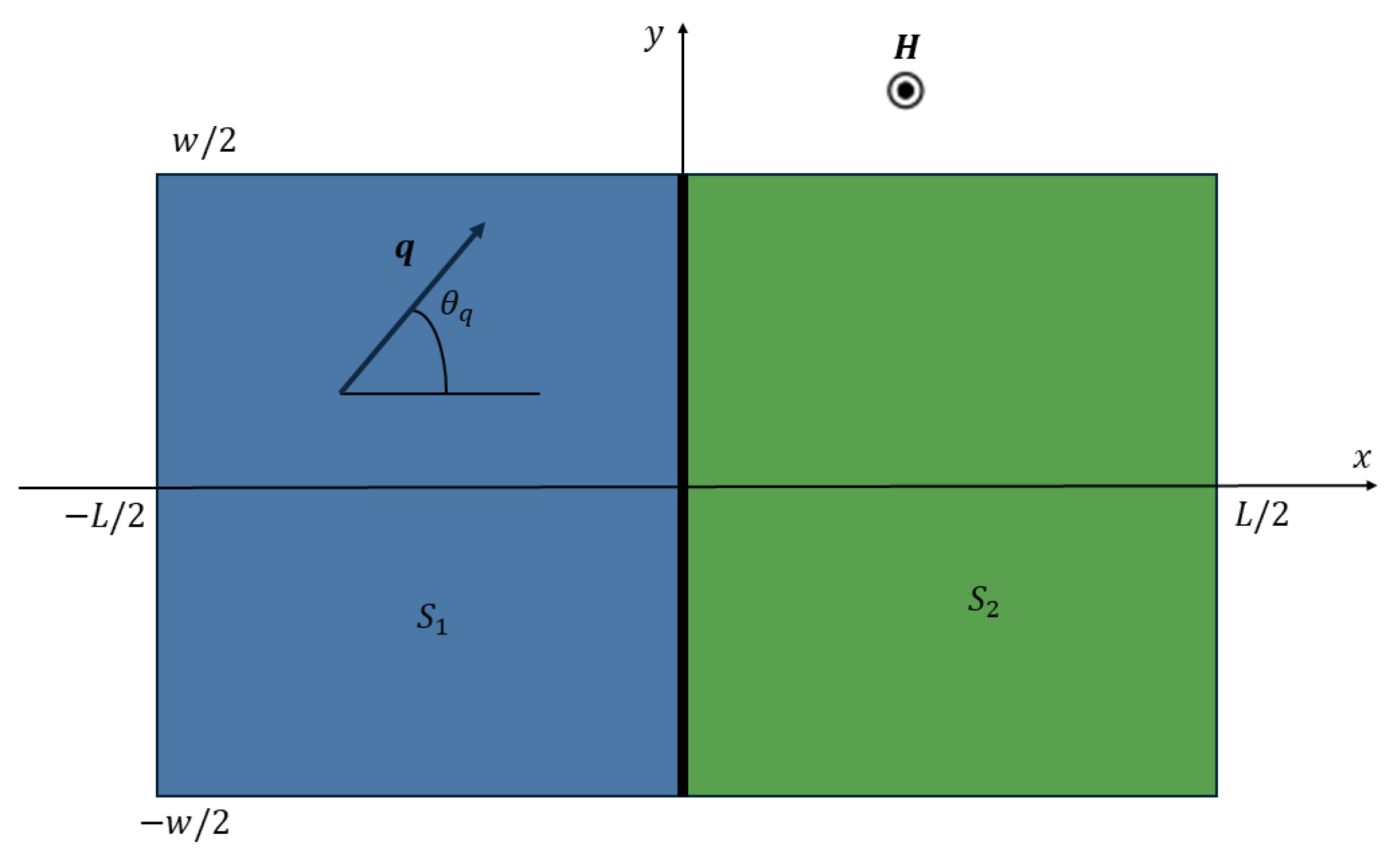
We consider a tunnel Josephson junction between a non-centrosymmetric helical superconductor, characterized by its modulation vector q , and a conventional s-wave spin singlet superconductor with uniform order parameter. Both superconductors are thin films in the x y plane, and the whole junction has a finite rectangular shape L × w (Figure 1). We investigate the dependence of the critical current I c ( H ) versus a perpendicular magnetic field H = H e z . In order to describe the helical phase, we use a Ginzburg–Landau (GL) functional which incorporates Lifshitz invariants (Section 2.1).

2.1. Non-Centrosymmetric Helical Superconductor with Spin–Orbit Coupling

We introduce here the formalism for non-centrosymmetric superconductors to fix the notation and remind us how a helical ground state with non-uniform order parameter can appear. In the presence of spin–orbit coupling and a magnetic field, the superconducting transition is described by the following Ginzburg–Landau free energy density:
f ( r ) = a | ψ | 2 + K | D ψ | 2 + b 2 | ψ | 4 + ( × A ) 2 2 μ 0 + ε ( n × h ) · [ ψ * D ψ + H . c . ] ,
where ψ is the superconducting order parameter. One notes a = α ( T c 0 T ) , where α , b , and K are the standard positive Ginzburg–Landau coefficients. The coefficient K relates to an effective mass m * through K = 2 / ( 2 m * ) . In the bulk, | ψ | 2 = | a | / b and the superconducting coherence length is defined as ξ = K / | a | . The magnetic field enters through the covariant derivative D = i + ( 2 e / ) A , with e > 0 denoting the elementary charge. The unit vector n indicates the direction of broken inversion symmetry. The last term in Equation (1) represents the interplay between Rashba spin–orbit coupling ε ( r ) and the exchange field h . In the thin-film limit ( t ξ ), we treat ε ( r ) as a constant averaged over the film thickness, t [27]. The SOC term
f so = ε n ^ × h · ψ * D ψ + H . c .
constitutes a Lifshitz invariant that induces helical phase modulation of the superconducting order parameter, ψ e i q · r , characteristic of systems with broken inversion symmetry and SOC [33]. Indeed, the ground state that minimizes the free energy is the helical phase ψ ( r ) = ψ 0 e i q · r . For a state with uniform amplitude in the absence of magnetic fields ( A = 0 ), the free energy density becomes
f ( q ) = a | ψ 0 | 2 + K | q | 2 | ψ 0 | 2 + b 2 | ψ 0 | 4 + 2 ε ( n × h ) · q | ψ 0 | 2 .
Minimization with respect to q yields the following equilibrium wavevector:
q = ε K ( n × h ) .
Substituting back into the free energy and inspecting the | ψ 0 | 2 terms yields the renormalized coefficient a:
a ˜ = a ε 2 K ( n × h ) 2 ,
which enhances the critical temperature, as follows:
T c = T c 0 + ε 2 α K ( n × h ) 2 .
This result shows that the ground state is a helix, with Cooper pairs acquiring a finite center-of-mass momentum q . This state minimizes the free energy by balancing the kinetic energy cost ( K q 2 ) against the energy gain from the spin–orbit coupling ( 2 ε ( n × h ) · q ).
In the presence of a magnetic field × A 0 , we perform a gauge transformation that absorbs the spatial phase modulation inherent to the order parameter of the helical superconductor only. The transformation ψ ( r ) = e i q · r ψ ˜ ( r ) for the helical electrode, where q is the equilibrium helical wavevector given by Equation (4), allows us to rewrite the free energy density.
Under this selective gauge transformation, the Lifshitz invariant f so for the helical electrode generates terms that exactly cancel the additional kinetic energy from the phase gradient, yielding the standard GL form for the transformed order parameter:
f ( r ) = a ˜ | ψ ˜ | 2 + K | D ψ ˜ | 2 + b 2 | ψ ˜ | 4 + ( × A ) 2 2 μ 0 .
The crucial physical consequence is that the helical modulation now appears explicitly in the boundary conditions at the junction interface. This occurs because the gauge transformation ψ ( r ) = e i q · r ψ ˜ ( r ) incorporates the bulk SOC effects into the redefined order parameter ψ ˜ , yielding the standard GL form where the supercurrent follows the conventional London relation without explicit SOC terms. The helical character q thus manifests primarily through boundary conditions rather than bulk current modifications.
We also introduce the London approximation to express the gauge-invariant current as a function of the superconducting phase gradient γ and the electromagnetic field A , essential for analyzing Josephson interference phenomena. To this aim, we first express the superconducting order parameter as ψ ˜ = m ψ 0 e i γ , where ψ 0 is the equilibrium magnitude, m = | ψ ˜ | / ψ 0 is the reduced amplitude, and γ is the phase of the superconducting order parameter. Then the current density is obtained by varying the free-energy density Equation (7) with respect to A . In the London limit, the supercurrent reads
J = m 2 μ 0 λ L 2 A + Φ 0 2 π γ ,
where Φ 0 = h / 2 e is the flux quantum and λ L is the London penetration depth. The latter is defined in the uniform equilibrium state (when | ψ ˜ | = ψ 0 , i.e., m 1 ) by λ L 2 = 8 ( e / ) 2 μ 0 K | ψ 0 | 2 .

2.2. Josephson Junction

We consider a Josephson junction formed by a thin rectangular superconducting strip of length L (along x), width w (along y), divided in two halves by a narrow tunnel barrier (Figure 1). In the helical superconductor S 1 (region L / 2 < x < 0 ), the order parameter reads
ψ 1 = m 1 ψ 0 e i q · r e i ( γ 1 + ϕ 0 ) ,
and ψ 2 = m 2 ψ 0 e i γ 2 in the conventional superconductor S 2 (region ( 0 < x < L / 2 ), where ϕ 0 is a constant phase offset. The junction thickness t is assumed to be much smaller than the London penetration depth λ L . Hence, the current density J is uniform across the thickness and the electrodynamics is governed by the Pearl length Λ = 2 λ L 2 / t . We focus on the case where Λ greatly exceeds both L and w, allowing us to neglect self-field effects from screening currents [34]. The total gauge-invariant phase difference between S 1 and S 2 combines four contributions:
Δ φ ( y ) = γ 1 ( 0 , y ) γ 2 ( 0 , y ) + q y y + ϕ 0 ,
with q y = q sin θ q being the transverse component of the helical wavevector. After the gauge transformation, γ 1 and γ 2 denote the transformed, slowly varying phases of the two electrodes. Crucially, the finite center-of-mass momentum of Cooper pairs (the helical modulation) re-enters the gauge-invariant phase difference as an additive, spatially dependent term q y y that cannot be eliminated by a single-valued gauge choice across the full junction.
In the absence of helical modulation, Clem’s calculation [26] provides an exact treatment of the nonlocal electrodynamic response, capturing how magnetic flux penetrates thin-film electrodes through edge effects. The phase difference contribution Δ γ ( y ) = γ 1 ( 0 , y ) γ 2 ( 0 , y ) is given by the following Fourier decomposition:
Δ γ ( y ) = n = 0 A n sin ( k n y ) ,
with quantized transverse wavevectors k n = ( 2 n + 1 ) π / w and coefficients
A n = 16 π H Φ 0 w ( 1 ) n k n 3 tanh k n L 4 .
The critical Josephson current I c is found by maximizing the total current I = w / 2 w / 2 J ( y ) d y with respect to constant phase offset ϕ 0 . For sinusoidal current phase relation J ( y ) = J c sin Δ φ ( y ) (valid in tunnel/low-transparency limit), this maximum occurs when ϕ 0 = ± π / 2 , giving
I c I c 0 = 2 w 0 w / 2 cos q y y + Δ γ ( y ) d y .
To evaluate the summation over Δ γ ( y ) in the integral, we employ Jacobi–Anger expansion for each Fourier mode:
e i A n sin ( k n y ) = m n = J m n ( A n ) e i m n k n y ,
where J m ( · ) is the m-th order Bessel function of the first kind. The complete phase factor becomes
e i Δ γ ( y ) = n e i A n sin ( k n y ) = n m n J m n ( A n ) e i m n k n y .
Interchanging product and summation, we obtain
e i Δ γ ( y ) = { m n } n J m n ( A n ) exp i y n m n k n ,
where { m n } = ( m 0 , m 1 , m 2 , ) is a sequence of integer indices. Substituting into the current integral, we obtain
0 w / 2 cos q y y + Δ γ ( y ) d y = Re { m n } n J m n ( A n ) × 0 w / 2 e i ( q y + n m n k n ) y d y .
Evaluating the Fourier integral yields the final result:
I c I c 0 = { m n } n = 0 J m n ( A n ) × sin 1 2 q y w + n = 0 m n ( 2 n + 1 ) π 1 2 q y w + n = 0 m n ( 2 n + 1 ) π
In numerical evaluations we truncate the Fourier series and multi-index sums. Specifically we use N max = 4 Fourier modes in Δ γ ( y ) and include Bessel expansion orders up to M max = 7 (restricting significant m n values accordingly), which is sufficient to ensure accurate convergence for the parameter ranges used below.

2.3. Fraunhofer Patterns

To investigate the effect of the helical wavevector q , one considers the following gauge-invariant phase difference:
Δ φ ( y ) = Δ γ ( y ) + q y y + ϕ 0 ,
which incorporates the magnetic flux penetration contribution Δ γ ( y ) described by Clem’s nonlocal solution for thin-film electrodes [26] and the transverse component q y = | q | sin θ q of the equilibrium helical wavevector (Equation (4)), with ϕ 0 being a constant phase offset. Asymmetry emerges from distinct transformation properties of these phase components under magnetic field reversal. The magnetic phase term Δ γ ( y ) = n A n sin ( k n y ) , with coefficients A n H from Equation (11), transforms as Δ γ ( y ; H ) Δ γ ( y ; H ) under field inversion H H , reflecting its orbital origin [26]. In contrast, the helical phase gradient q y y remains invariant under field reversal, assuming the in-plane exchange field h determining q is unaffected by perpendicular probe field H .
This symmetry breaking manifests directly in measurable asymmetry I c ( H ) I c ( H ) . While conventional junctions exhibit symmetric current profiles under field reversal ( J ( y , H ) J ( y , H ) ), the helical phase gradient q y y breaks this symmetry, leading to asymmetric current profile distortion and consequently different critical currents at positive and negative fields. This mechanism underlies all the subsequent geometrical and interference phenomena discussed below.
Junction geometry plays a crucial role in determining interference pattern morphology through its influence on magnetic phase profile Δ γ ( y ) . We identify two distinct geometrical regimes with fundamentally different characteristics governing how helical signatures manifest in experimental measurements.
In the short-junction limit ( L w ), phase difference simplifies to linear profile due to asymptotic behavior tanh ( k n L / 4 ) k n L / 4 , leading to
Δ γ ( y ) = π Φ Φ 0 L w 2 y ,
where Φ = H w 2 represents total magnetic flux threading the junction. This linearization emerges from mathematical identity, as follows:
n = 0 ( 1 ) n ( 2 n + 1 ) 2 sin ( 2 n + 1 ) π w y = π 4 π w y ,
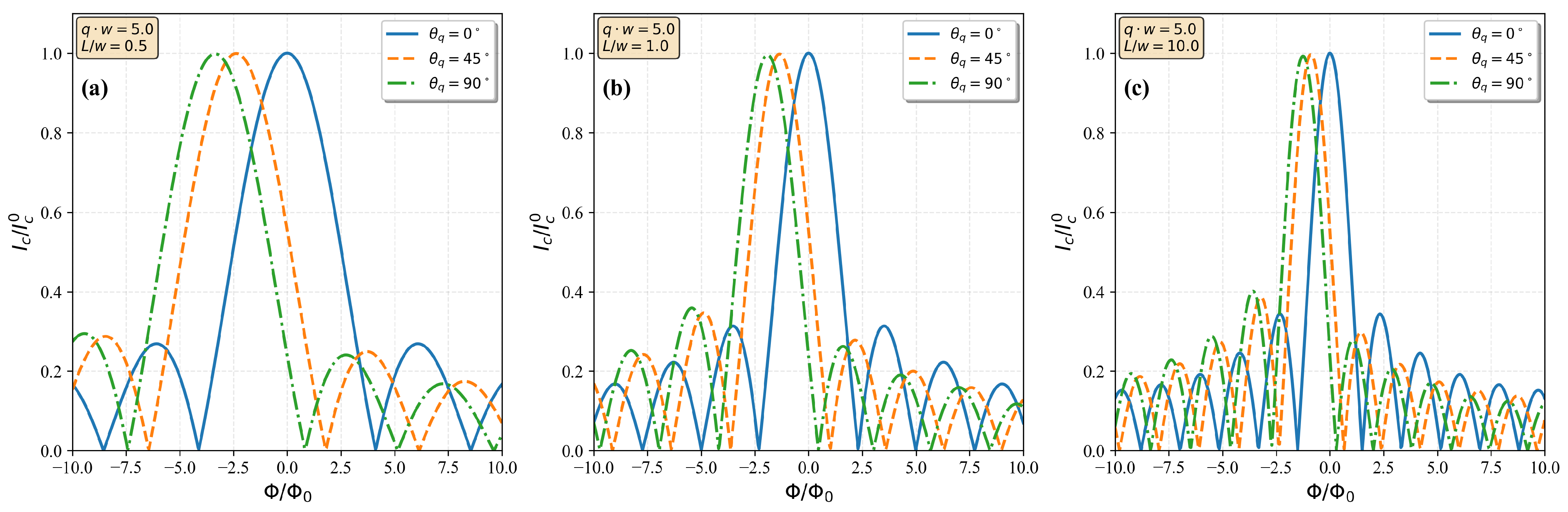
valid for 0 y w / 2 . In this limit, helical phase q y y contributes linearly with magnetic phase contribution, resulting primarily in horizontal Fraunhofer pattern displacements without significant lobe deformation, as is clearly observed in Figure 2a for L / w = 0.5 .
In the long-junction limit ( L w ), tanh ( k n L / 4 ) 1 , and the phase profile reduces to
Δ γ ( y ) = 16 Φ π 2 Φ 0 n = 0 ( 1 ) n ( 2 n + 1 ) 3 sin ( 2 n + 1 ) π w y .
This odd-harmonic Fourier series can be compactly rewritten in terms of the Lerch transcendent function, Θ ( r , s , η ) = k = 0 r k ( k + η ) s , as
σ ( χ ) = n = 0 ( 1 ) n ( 2 n + 1 ) 3 sin ( 2 n + 1 ) χ = i 16 e i χ Θ ( e 2 i χ , 3 , 1 2 ) Θ ( e 2 i χ , 3 , 1 2 ) .
This reformulation does not alter the underlying physics; it simply provides a compact closed-form representation of the long-junction harmonic content, which is convenient for both analytical treatment and numerical evaluation. The higher-order spatial harmonics encoded in Δ γ ( y ) then induce a nonlinear helical phase modulation, leading not only to a horizontal displacement of the interference pattern but also to a deformation of its lobes. These effects are particularly pronounced in the L / w = 10 case shown in Figure 2c.

2.4. Discussion of the Fraunhofer Patterns

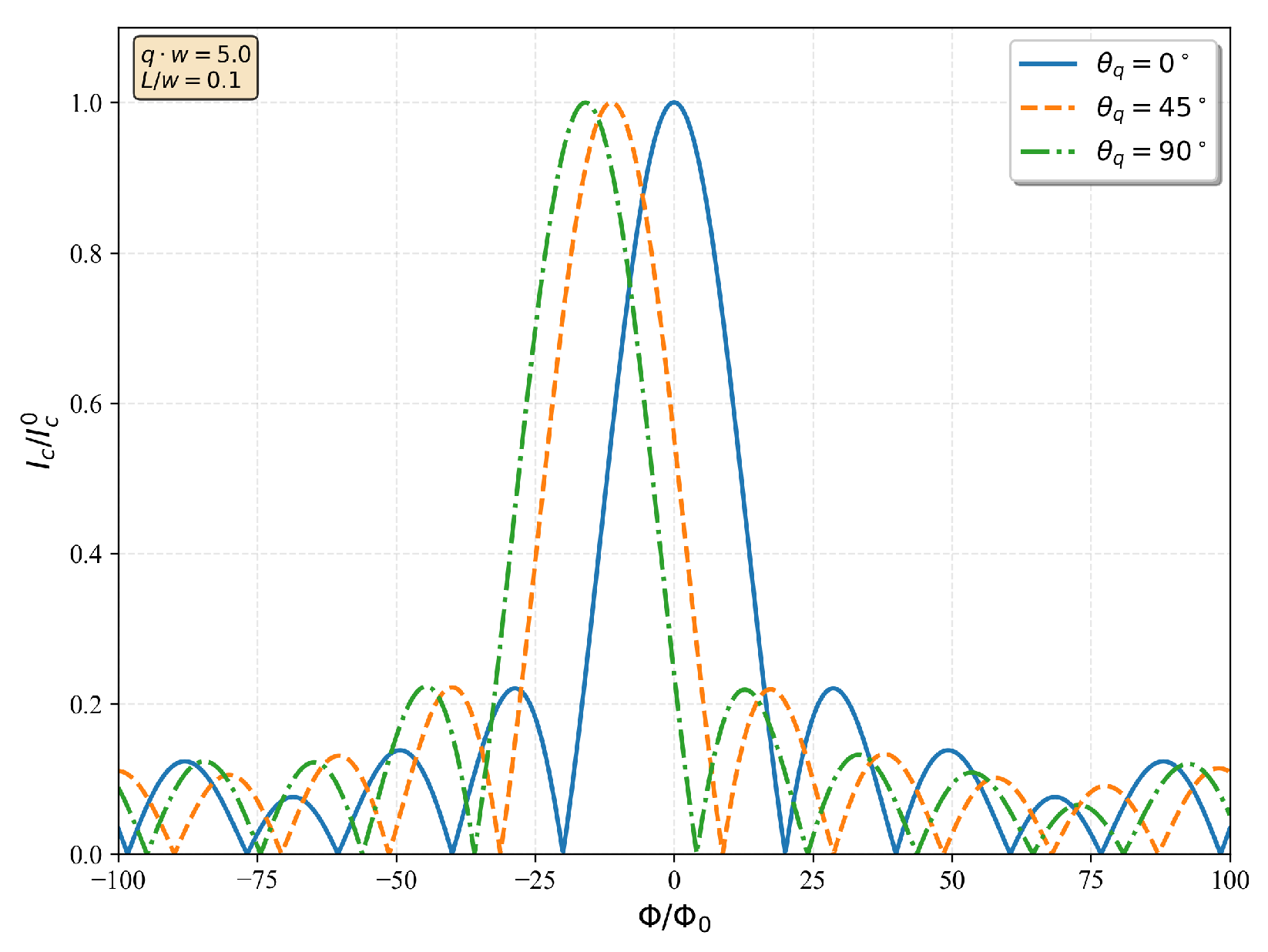
Our theoretical analysis reveals that Josephson junctions incorporating helical superconductors exhibit fundamentally distinct interference patterns characterized by pronounced asymmetry in critical current I c as a function of normalized magnetic flux Φ / Φ 0 = H w 2 / Φ 0 and aspect ratio L / w . The signatures clearly demonstrated in Figure 2, Figure 3 and Figure 4 provide direct evidence of finite-momentum Cooper pairing in helical superconducting electrodes and establish Josephson interferometry as a powerful probe for characterizing helical order parameters.
The short-junction limit ( L w ), where the magnetic phase profile Δ γ ( y ) becomes linear in y, provides crucial physical insight through emergence of effective flux bias. In this linear phase regime, the simplified phase gradient Δ γ ( y ) ( 2 π / Φ 0 ) ( Φ / w ) y allows for direct comparison with the helical term, revealing that q y y acts as effective flux offset:
δ Φ = Φ 0 2 π q y w ,
or, equivalently, in dimensionless form,
δ Φ Φ 0 = q y w 2 π .
The crucial physical insight emerges from recognizing that helical phase modulation produces constant phase gradient across the junction, mathematically equivalent to fixed magnetic flux bias. This provides a direct quantitative relationship between measurable horizontal Fraunhofer pattern displacement and the underlying helical wavevector component q y .
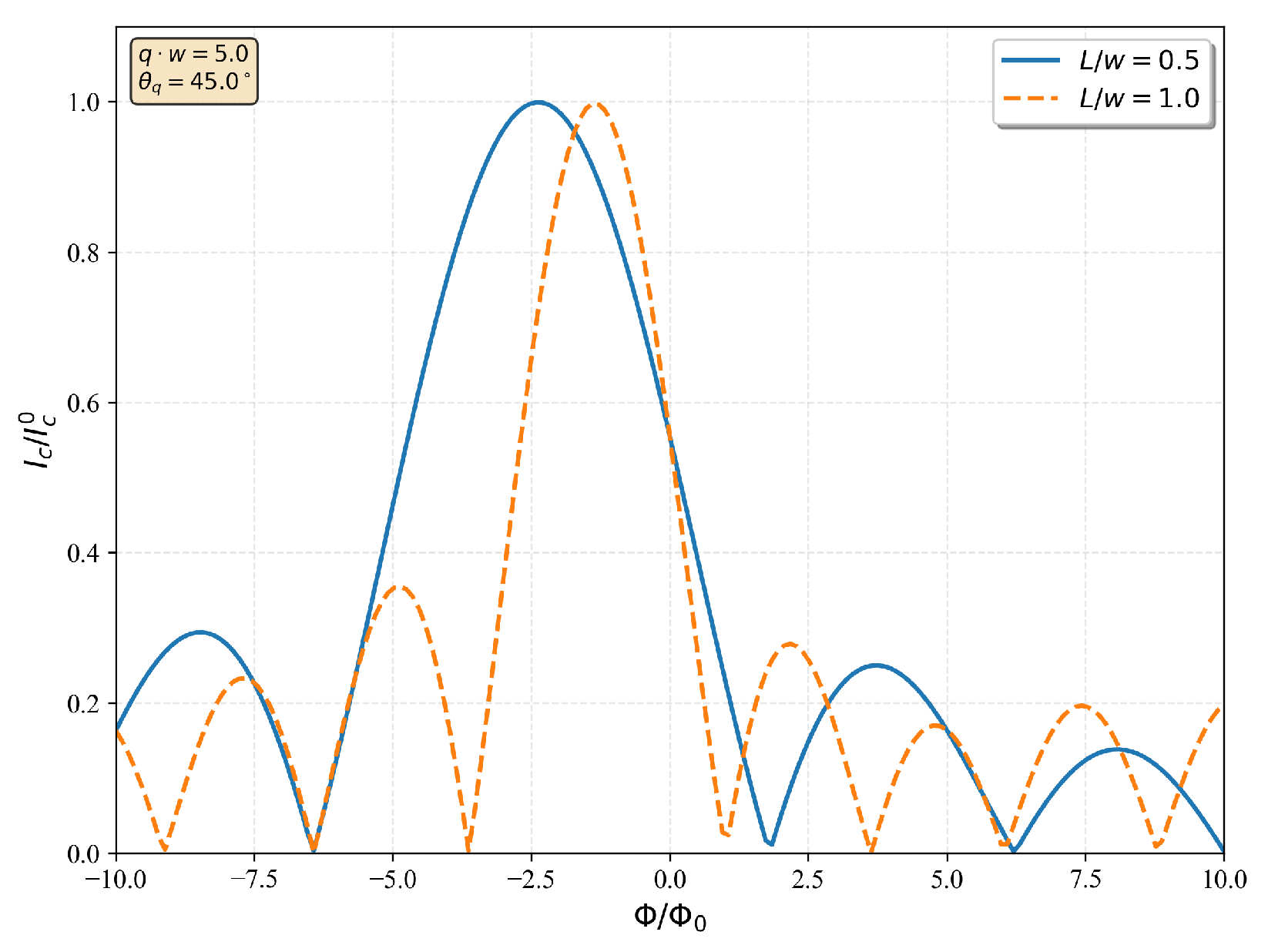
This horizontal displacement of the interference patterns observed in Figure 2, Figure 3 and Figure 4. and provides a direct experimental measure of helical wavevector component q y . The detection mechanism in Model I relies on helical wavevector q directly modifying the gauge-invariant phase difference Δ φ ( y ) = Δ γ ( y ) + q y y (Equation (19)). This produces asymmetric interference patterns through the interplay between magnetic flux penetration ( Δ γ ( y ) ) and intrinsic helical modulation ( q y y ), providing a direct probe of finite-momentum pairing in superconducting electrode.

2.5. Peak Broadening in Geometrical Confinement

A distinctive feature in our calculated interference patterns is systematic Fraunhofer peak broadening with decreasing aspect ratio L / w . This geometrical effect, clearly evident in progression from Figure 2a ( L / w = 0.5 ) to Figure 2c ( L / w = 10 ), arises from fundamental modifications in the magnetic flux penetration profile and provides crucial insights for experimental implementation.
The physical origin of peak broadening can be understood through the scaling behavior of phase response to magnetic flux. In the short-junction limit ( L w ), linearized phase profile Δ γ ( y ) = ( π Φ / Φ 0 ) ( L / w 2 ) y (Equation (20)) exhibits reduced sensitivity to magnetic flux, governed by prefactor π L / ( Φ 0 w 2 ) . This diminished phase response means larger magnetic flux increments Φ are required to achieve π -phase shifts necessary for destructive interference, consequently broadening peaks in I c versus Φ / Φ 0 dependence.
Characteristic flux period Δ Φ period emerges from scaling of Fourier coefficients in Clem’s solution (Equation (11)). Coefficients A n = ( 16 π H ) / ( Φ 0 w ) · [ ( 1 ) n / k n 3 ] tanh ( k n L / 4 ) determine magnetic field dependence of phase profile. For L w , tanh ( k n L / 4 ) k n L / 4 , yielding A n Φ L / w 2 since Φ = H w 2 . The destructive interference condition requires cumulative phase variation across the junction reaching π , occurring when product Φ L / w 2 changes by approximately unity. This leads directly to scaling relation:
Δ Φ period w 2 L .
This scaling quantitatively explains observed broadening: for fixed junction width w, decreasing L increases the flux period between interference minima, manifesting as wider peaks in critical current pattern. The full width at half the maximum of the central peak follows the same scaling, providing a quantitative measure of geometrical influence on interference sharpness.
The underlying mechanism involves the suppression of higher-order spatial harmonics in confined geometries. For L w , hyperbolic tangent terms tanh ( k n L / 4 ) k n L / 4 strongly suppress higher Fourier modes ( n 1 ), resulting in a smoother phase profile dominated by fundamental harmonic. This spectral simplification reduces the sharpness of the phase transitions between constructive and destructive interference conditions, thereby broadening the peaks in flux dependence.
Peak broadening enhances experimental detection by amplifying relative helical signature δ Φ / Δ Φ period and increasing the robustness against junction inhomogeneities and field fluctuations. Crucially, fundamental relationships characterizing the helical state remain unaffected: even with maximum broadening, linear dependence δ ( Φ / Φ 0 ) = q y w / ( 2 π ) (Equation (25)) remains valid, and angular variation δ ( Φ / Φ 0 ) sin θ q persists across all geometries. These consistent relationships provide reliable signatures to distinguish the true helical effects from spurious asymmetries caused by sample imperfections.

2.6. Complete Interference Behavior and Experimental Signatures

Complete interference behavior requires analysis beyond linear phase profile approximation for Δ γ ( y ) to account for complex spatial harmonics in magnetic flux penetration. Our complete theoretical treatment via Jacobi–Anger expansion (Equations (14)–(18)) reveals interference extrema governed by combined wavevectors q y + n m n k n appearing in the sinc function denominator of Equation (18). Destructive interference and lobe suppression occur under specific cancellation conditions:
q y + n m n k n = 2 π N w , N Z ,
where { m n } are integer indices from Fourier–Bessel expansion. This intricate coupling between helical wavevector and magnetic flux penetration modes produces not only horizontal shifts but also characteristic lobe deformations, providing additional helical order signatures beyond simple pattern displacement.
The vector character of the helical state manifests in the strong angular dependence of interference patterns. Since q y = q sin θ q , horizontal shift follows δ ( Φ / Φ 0 ) sin θ q , vanishing when the helical wavevector aligns with current direction ( θ q = 0 ) and maximizing when perpendicular ( θ q = 90 ). This angular anisotropy, demonstrated in Figure 3, provides a crucial experimental fingerprint for distinguishing the helical order from other asymmetry sources like geometrical imperfections or inhomogeneous current distributions.
For optimal experimental implementation, we recommend employing junctions with L / w 1 for initial helical order detection to leverage peak broadening for enhanced shift resolution, while utilizing junctions in the short-junction limit where linear phase profile approximation Δ γ ( y ) ( π Φ / Φ 0 ) ( L / w 2 ) y applies for quantitative helical wavevector component determination via δ Φ = ( Φ 0 / 2 π ) q y w . Predicted asymmetric Fraunhofer patterns establish a powerful experimental methodology for identifying finite-momentum pairing in non-centrosymmetric superconductors, complementing more complex spectroscopic techniques. Quantitative helical wavevector component extraction can be achieved by measuring the horizontal shift δ ( Φ / Φ 0 ) and fitting to the complete model, using Equation (25) as the initial estimate. The angular dependence of this shift, coupled with characteristic lobe deformations from higher-order flux penetration modes, provides multiple consistency checks for unambiguous finite-momentum pairing identification in non-centrosymmetric superconducting heterostructures [3,33].

3. Model II: Emergent Helical Superconductivity from Interfacial SOC in F/S Hybrids

While Model I addresses the intrinsic helical order, we now examine interfacial phenomena in F/S hybrids where helical characteristics emerge indirectly. Building on Mironov and Buzdin’s prediction of spontaneous magnetic fields at S/F interfaces [27], we consider conventional superconducting films where interfacial SOC induced by a ferromagnet generates spontaneous atomic-scale currents, counterbalanced by screening currents over London penetration depths.
Such a situation provides a complementary pathway to study finite-momentum pairing in systems where the helical order may not be present in the bulk but emerges through interfacial phenomena in confined geometries.
Recently, superconductor/normal metal/ferromagnetic thin-film structures with spin–orbit interaction in the normal metal layer have been theoretically investigated in [9,10]. We believe that, in the case of a very thin normal layer, such structures may permit the realization of the situation described in Model II.

3.1. Model and Theoretical Framework

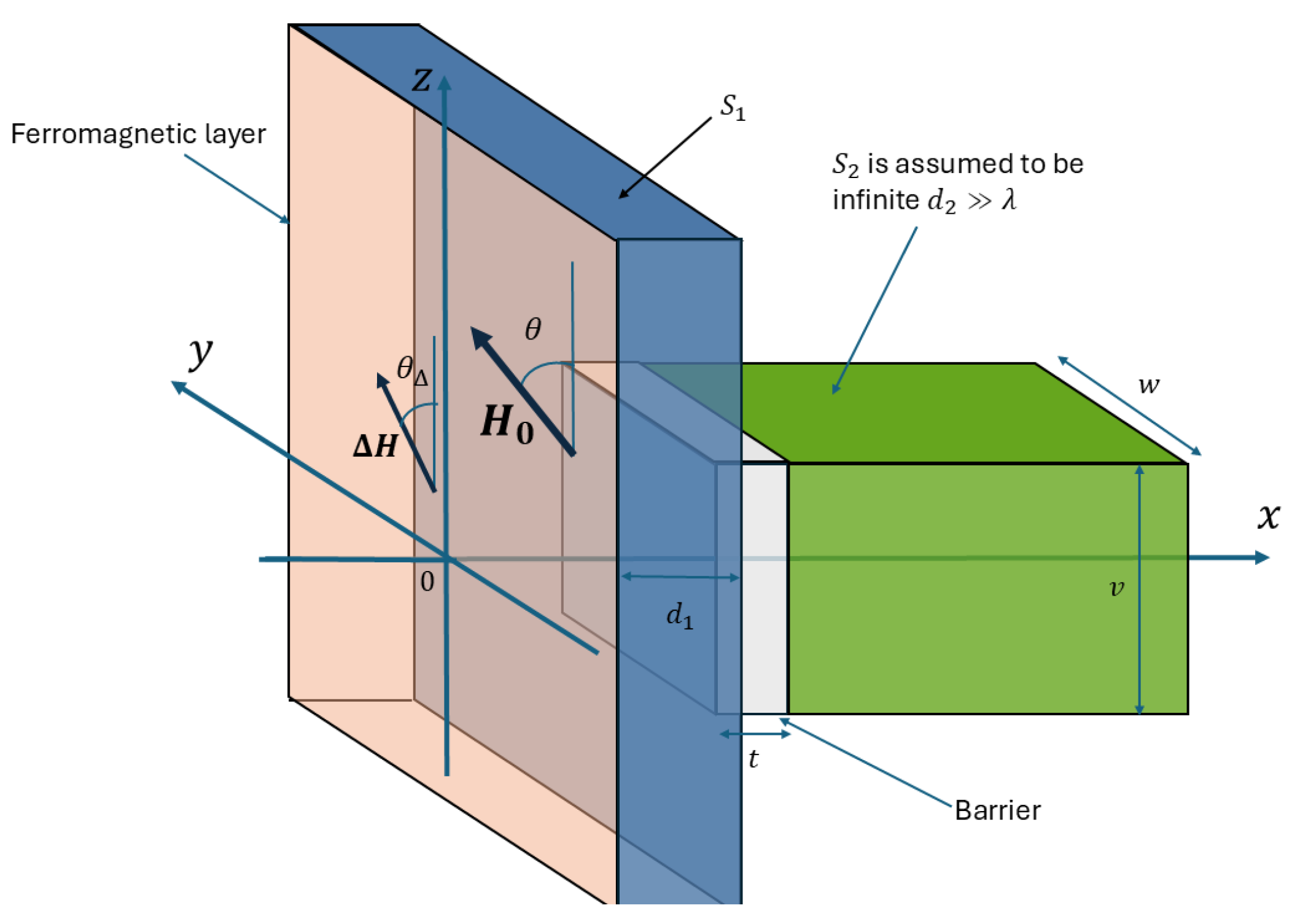
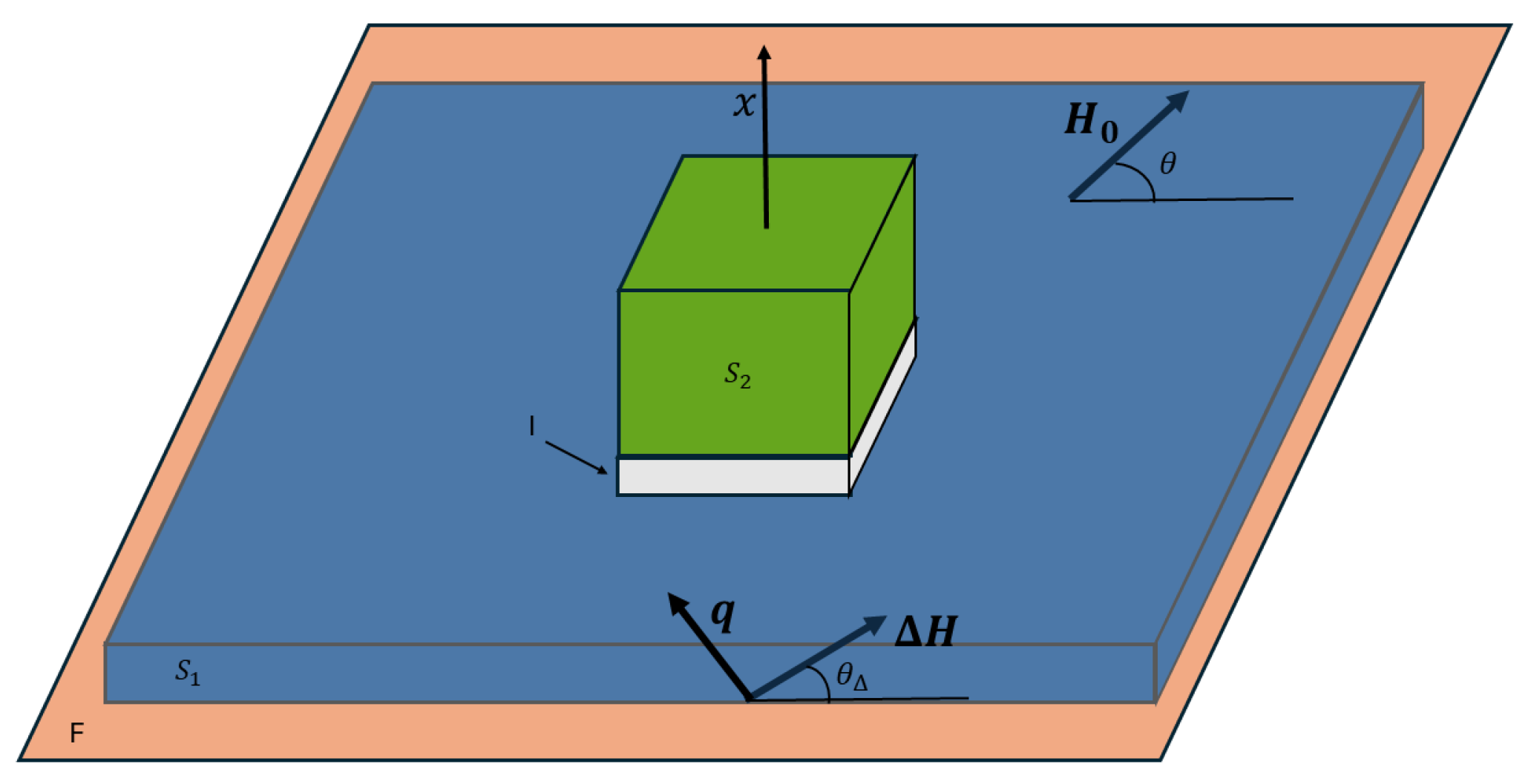
We consider a Josephson junction between a ferromagnet–superconductor ( F / S 1 ) bilayer and a conventional superconductor S 2 , as depicted in Figure 5. The key distinction from Model I lies in the origin of the helical modulation: here, the F / S 1 bilayer consists of a ferromagnetic layer (F) coating a conventional superconducting slab of thickness d 1 of the order of London penetration depth ( 0 < x < d 1 ), featuring a thin interfacial layer with Rashba-type spin–orbit coupling. Note that this setup is similar to the one suggested in [35] to reveal a long-ranged electromagnetic proximity effect in S / F systems.
The interplay between Rashba SOC and the exchange field produces spontaneous currents [27], manifested as a magnetic field discontinuity Δ H = H F H S across x = 0 . An insulating layer (I) separates the F / S 1 bilayer from the second superconducting electrode S 2 , forming the Josephson junction.
The theoretical description follows the same Ginzburg–Landau formalism developed in Section 2, with the free energy density given by Equation (1). The crucial difference lies in the spatial localization of the SOC term: ε ( r ) is now non-zero only in a thin layer of thickness l so ξ near the F / S 1 interface at x = 0 , with n ^ = x ^ denoting the interface normal. This interfacial SOC term, represented by the Lifshitz invariant in Equation (2), induces helical phase modulation.
Integrating the SOC contribution Equation (2) over the thin interfacial layer yields the surface free energy:
F so = 2 | ψ | 2 l so S ε n ^ × h · ϕ + 2 e A | x = 0 ,
where S is the interface area. Variation with respect to the vector potential results in the surface current density:
J s u r f = α so μ 0 λ L 2 n ^ × h
with the SOC constant α so = ε l so / 2 e K and London penetration depth λ L . The boundary condition at the F / S 1 interface follows from Ampère’s law for the tangential magnetic field components:
n ^ × H S H F = μ 0 J s u r f .
Defining the interfacial field discontinuity as Δ H H F H S , we obtain the following relation:
Δ H = α so λ L 2 h .
This spontaneous field discontinuity emerges without external magnetic fields, driven solely by the exchange field and Rashba SOC—a distinctive signature of interfacial SOC in S/F hybrids [27].
The ferromagnet layer ( x = 0 ) induces a spontaneous magnetic field Δ H = ( 0 , Δ H y , Δ H z ) at the F / S 1 interface, which significantly modifies the magnetic profile throughout S 1 . This interfacial field discontinuity alters the screening currents and, consequently, the Josephson coupling. To probe these interfacial effects experimentally, we apply an external field H 0 = ( 0 , H 0 y , H 0 z ) as shown in Figure 6. The magnetic field distribution in superconductor S 1 ( 0 < x < d 1 ) is governed by the London equation 2 H = H / λ L 2 , with the following solution:
H ( x ) = H 0 cosh 2 x d 1 2 λ L cosh d 1 2 λ L Δ H sinh x d 1 λ L sinh d 1 λ L ,
where the field discontinuity at the F / S 1 interface causes a change in the magnetic field profile. In the thin barrier region ( d 1 < x < d 1 + t ), the field remains uniform: H ( x ) = H 0 .
Screening currents in S 1 are obtained from the magnetic field curl:
J ( x ) = 1 μ 0 λ L x ^ × H 0 sinh 2 x d 1 2 λ L cosh d 1 2 λ L Δ H cosh x d 1 λ L sinh d 1 λ L .
In the bulk superconductor S 2 ( x > d 1 + t ), which we assume to have a thickness much larger than λ L , the magnetic field and current distributions follow the conventional Meissner response. The field penetrates S 2 according to H S 2 ( x ) = H 0 e ( x d 1 t ) / λ L , generating screening currents J S 2 ( x ) = ( x ^ / μ 0 λ L ) × H 0 e ( x d 1 t ) / λ L that flow parallel to the interface and decay exponentially into the bulk. This conventional behavior in S 2 contrasts with the complex current patterns induced in S 1 by the interfacial SOC, highlighting the localized nature of the emergent helical phenomena at the F / S 1 interface. The modified field profiles directly impact the Josephson interference patterns, which we analyze next through the Fraunhofer response.

3.2. Josephson Phase Difference and Fraunhofer Pattern

Using the expressions for the currents on both sides of the Josephson junction contacts, we may write the phase-difference gradient as [36]
ϕ y = 2 π Φ 0 H 0 z λ L 1 + δ + t λ L Δ H z sinh ( d 1 / λ L ) k y ,
ϕ z = 2 π Φ 0 H 0 y λ L 1 + δ + t λ L Δ H y sinh ( d 1 / λ L ) k z ,
where δ = tanh ( d 1 / 2 λ L ) accounts for thin-film corrections. The total phase difference is
ϕ ( y , z ) = k y y + k z z + ϕ 0 .
Although the spontaneous interfacial field Δ H is typically small in magnitude, for thin films where d 1 λ L , the sinh ( d 1 / λ L ) term approaches d 1 / λ L linearly, resulting in an amplification factor of λ L / d 1 that can reach substantial values. This amplification enables the interfacial term λ L Δ H / sinh ( d 1 / λ L ) to become comparable to or even dominate over the contribution from the external applied field H 0 , particularly in the regime where d 1 λ L . Consequently, in heterostructures with small thicknesses, near-complete cancellation of the external magnetic flux becomes experimentally accessible, enabling the observation of regimes where the Josephson response is primarily governed by emergent interfacial fields rather than externally applied fields.
The total Josephson current I x is obtained by integrating the local current density J x = J c sin ϕ ( y , z ) over the junction area. For a rectangular junction of width w (along y) and height v (along z), this yields:
I x = J c w / 2 w / 2 v / 2 v / 2 sin k y y + k z z + ϕ 0 d y d z = 4 J c k y k z sin k y w 2 sin k z v 2 sin ϕ 0 .
Maximizing I x with respect to ϕ 0 results in the normalized critical current:
I x I c 0 = sin π Φ y eff / Φ 0 π Φ y eff / Φ 0 sin π Φ z eff / Φ 0 π Φ z eff / Φ 0 ,
where I c 0 = J c w v is the zero-field critical current, Φ 0 = h / ( 2 e ) is the flux quantum, and Φ j eff = Φ j Δ Φ j ( j = y , z ) are the effective fluxes. The resulting dependence on the effective fluxes Φ y eff and Φ z eff is analogous to the characteristic Fraunhofer pattern for rectangular Josephson junctions under arbitrarily oriented magnetic fields [37].
Φ y = H 0 y t eff v , Δ Φ y = Δ H y λ L v sinh ( d 1 / λ L ) , Φ z = H 0 z t eff w , Δ Φ z = Δ H z λ L w sinh ( d 1 / λ L ) .
where t eff = λ L ( 1 + δ ) + t is the effective magnetic thickness and δ = tanh ( d 1 / 2 λ L ) accounts for possible asymmetry. Here, Φ y and Φ z represent fluxes from the external field H 0 , while Δ Φ y and Δ Φ z originate from the interfacial field Δ H .
The applied and interfacial fields both lie in the y z -plane and can be written as H 0 = H 0 ( sin θ y ^ + cos θ z ^ ) , Δ H = Δ H ( sin θ Δ y ^ + cos θ Δ z ^ ) , with θ and θ Δ measured from the z-axis. In the absence of interfacial effects, the critical current follows the conventional Fraunhofer pattern for arbitrary field orientation [37]:
I x I c 0 sin π Φ z / Φ 0 π Φ z / Φ 0 × sin π Φ y / Φ 0 π Φ y / Φ 0 .
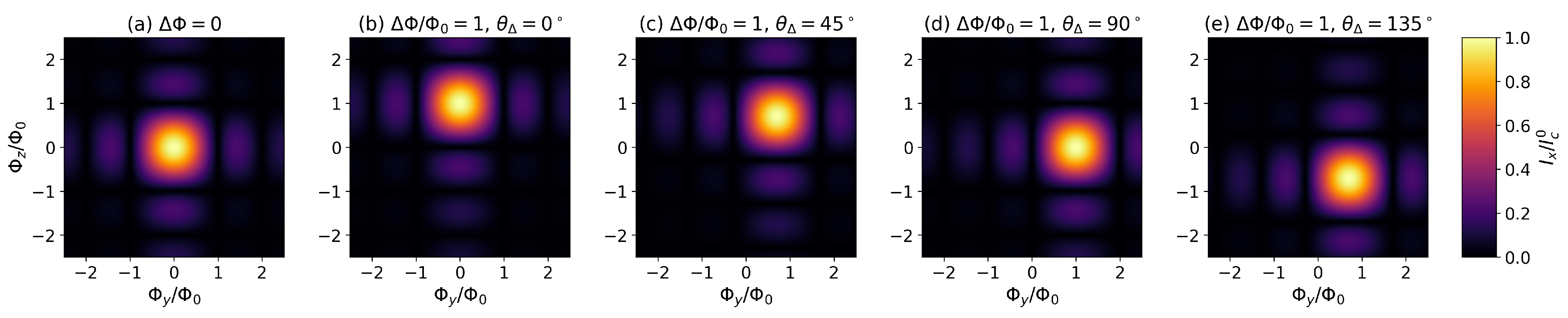
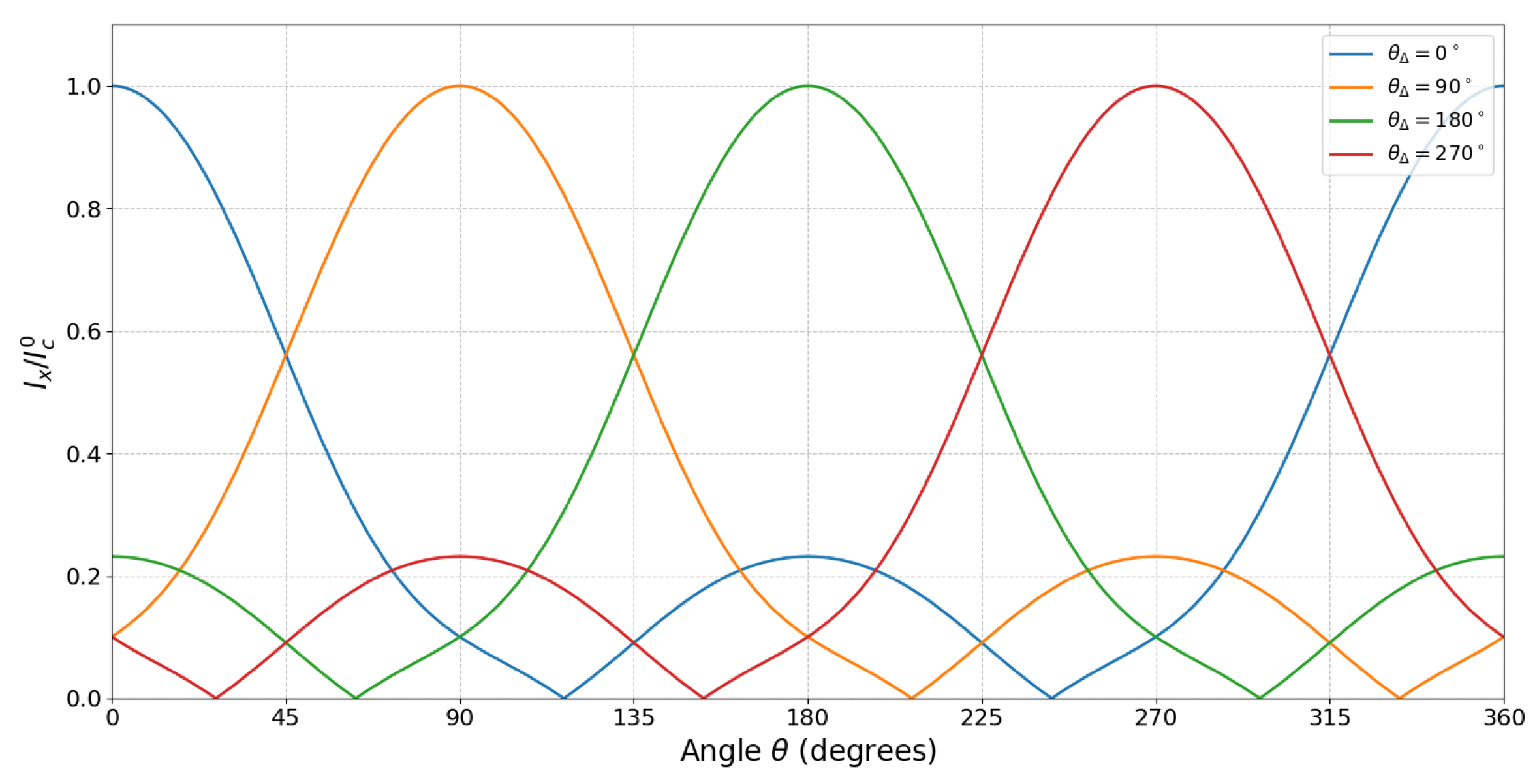
Interfacial Rashba SOC introduces additional shifts Δ Φ y and Δ Φ z in the flux arguments, which lead to three main consequences: (i) the lateral translation of the interference fringes, (ii) breaking of the symmetry between positive and negative lobes, and (iii) a distinct vectorial dependence on θ Δ . As θ Δ is varied through 0 , 90 , and 180 , these effects manifest as predictable shifts in the critical current maxima (Figure 7), anisotropic suppression patterns (Figure 8), and even complete current suppression at specific flux values.
The interference patterns, when expressed in terms of the effective fluxes Φ j eff , all conform to the characteristic Fraunhofer dependence for rectangular junctions under arbitrarily oriented magnetic fields given by Equation (38). This universal scaling demonstrates that the interfacial field induces a rigid translation in flux space without distorting the underlying interference pattern. The resulting fringe displacements provide direct access to the vector components of the interfacial field, enabling quantitative magnetometry of interfacial phenomena.

3.3. Extracting θ Δ Angle from Josephson Interference Patterns

The spontaneous magnetic field Δ H generated at the F/S interface, characterized by its magnitude Δ H and the orientation angle in the plane θ Δ , manifests itself as measurable changes in the Josephson interference pattern. Its vector nature can be quantified unambiguously through angular-dependent measurements of the critical current.
The effective magnetic fluxes determine the Fraunhofer pattern, and the minima of I x occur when Φ i eff = n Φ 0 ( n Z ). Experimentally, Δ Φ y and Δ Φ z can be determined by measuring the field values H 0 y min and H 0 z min at which the first minimum ( n = 1 ) of I c occurs for fields aligned along the principal axes. The interfacial field angle is then obtained via θ Δ = arctan w v · Δ Φ y Δ Φ z . The magnitude Δ H is later determined from either of the shift components Δ H = sinh ( d 1 / λ L ) λ L w Δ Φ z sec θ Δ = sinh ( d 1 / λ L ) λ L v Δ Φ y csc θ Δ . This analysis enables a complete vector characterization of the interfacial field through standard Josephson interferometry measurements.
The spontaneous magnetic field Δ H produces the effective flux offsets that rigidly shift the interference pattern without altering its characteristic functional form.
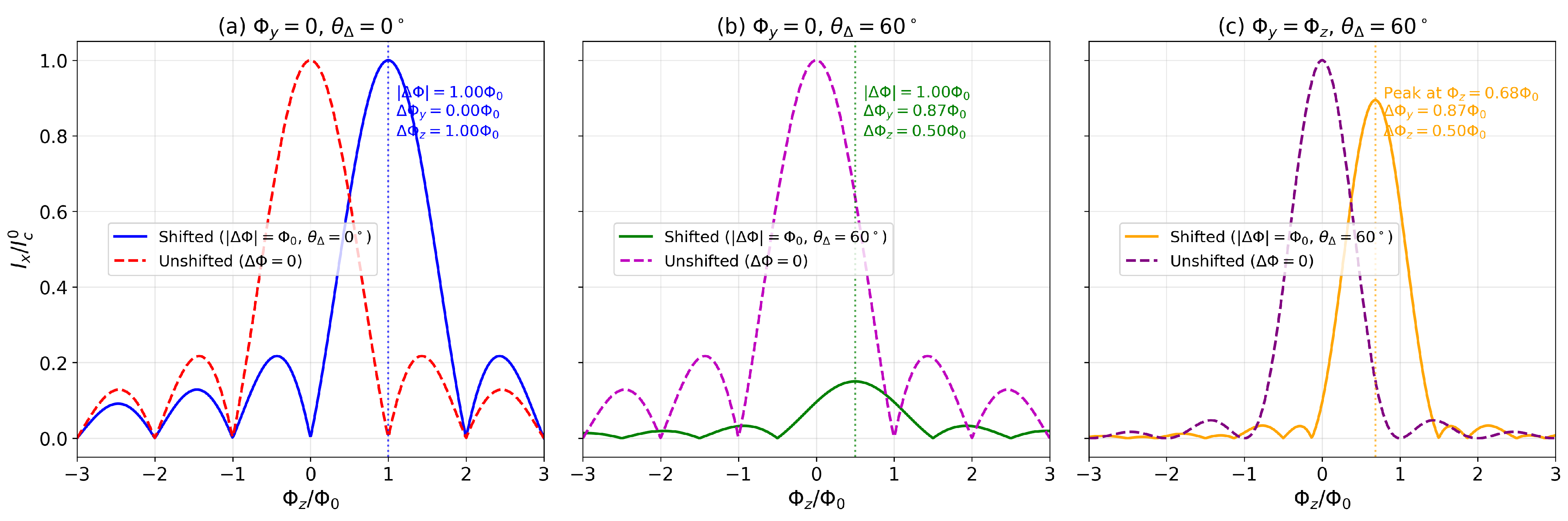
A key feature for experimental detection is the amplification of the interfacial contribution in the thin-film regime ( d 1 λ L ), where otherwise small interfacial fields may produce observable fringe displacements. The two-dimensional ( Φ y , Φ z ) interference maps encode the vector character of Δ H through the displacement vector ( Δ Φ y , Δ Φ z ) (see Equation (39) and Figure 7 and Figure 9); as θ Δ varies, the patterns shift predictably while preserving the lobe structure of a uniform rectangular junction.

4. Conclusions

This work establishes Josephson interferometry as a quantitative and vector-sensitive probe of spin–orbit-driven symmetry breaking in superconducting heterostructures.
We show that the junctions between helical and conventional superconductors produce intrinsically asymmetric Fraunhofer patterns exhibiting both horizontal flux shifts and characteristic lobe deformations. The resulting interference patterns show systematic field-reversal asymmetry and angular-dependent distortions—both unambiguous signatures of finite-momentum pairing. The relation δ ( Φ / Φ 0 ) = q y w / ( 2 π ) enables direct experimental access to helical wavevector components, while the full Fourier–Bessel expansion captures higher-order lobe modulations beyond simple flux offsets.
For the ferromagnet–superconductor hybrids, the interfacial spin–orbit coupling generates spontaneous interfacial fields Δ H that rigidly shift interference patterns in flux space. The relations Δ Φ y = λ L Δ H y v / sinh ( d 1 / λ L ) and Δ Φ z = λ L Δ H z w / sinh ( d 1 / λ L ) link measurable flux displacements to both the magnitude and vector orientation of these emergent fields. In thin films ( d 1 λ L ), geometric amplification enhances detection sensitivity, while the preserved Fraunhofer envelope distinguishes this mechanism from the asymmetric distortions for planar junctions. Comprehensive characterization through two-dimensional critical current maps I c ( Φ y , Φ z ) , combined with angular field sweeps and systematic thickness variation, enables the simultaneous extraction of q and Δ H . Magnetization reversal and reference samples provide crucial validation against extrinsic asymmetries.
In practice, this interferometric scheme offers direct access to the key parameters of the helical phase—the helical wavevector q and the interfacial field Δ H . Recently, a setup similar to the one discussed in Model II was used to experimentally study nanoscale spin ordering and spin screening effects in ferromagnetic Josephson tunnel junctions [38]. The observed shift of the Fraunhofer pattern was related to the magnetization of the ferromagnet and to the spin polarization of the Cooper pairs [39]. This spin polarization appears at a distance of the order of the superconducting coherence length ξ near the ferromagnet interface. To minimize the contribution of spin polarization, it is advantageous to choose a film thickness d 1 much larger than ξ .
To observe the discussed effects effectively, careful consideration of the sample geometry is required to suppress parasitic stray fields. Furthermore, it is essential to ensure high-quality interfaces and minimize imperfections on a scale comparable to the London penetration depth ( λ L ).
In summary, Josephson interferometry emerges as a unified vector-resolved probe capable of mapping both emergent interfacial magnetism and finite-momentum pairing states.

Author Contributions

Conceptualization, A.I.B.; methodology, A.I.B. and J.C.; software, P.J.F.C.; validation, A.I.B., J.C. and P.J.F.C.; formal analysis, P.J.F.C., J.C. and A.I.B.; investigation, P.J.F.C., J.C., A.I.B. and P.J.F.C.; writing—original draft preparation, review and editing, P.J.F.C., J.C. and A.I.B.; visualization, P.J.F.C.; and supervision, A.I.B. All authors have read and agreed to the published version of the manuscript.

Funding

This research was funded by ANR-22-CE30-00020-01 “SUPERFAST” and “the LIGHT S&T Graduate Program” (PIA3 Investment for the Future Program, No. ANR-17-EURE-0027) and GPR LIGHT.

Data Availability Statement

The data that support the findings of this study are available from the corresponding author upon reasonable request. All data that support the findings of this study are included within the article.

Conflicts of Interest

The authors declare no conflicts of interest.

Abbreviations

The following abbreviations are used in this manuscript:
SOCSpin–orbit coupling
RSOCRashba spin–orbit coupling
F/SFerromagnet
SSuperconductor
IInsulating barrier
GLGinzburg–Landau

References

  1. Edel’shtein, V. Characteristics of the Cooper pairing in two-dimensional noncentrosymmetric electron systems. Sov. Phys. JETP 1989, 68, 1244–1249. [Google Scholar]
  2. Gor’kov, L.P.; Rashba, E.I. Superconducting 2D System with Lifted Spin Degeneracy: Mixed Singlet-Triplet State. Phys. Rev. Lett. 2001, 87, 037004. [Google Scholar] [CrossRef]
  3. Agterberg, D.F. Magnetoelectric Effects, Helical Phases, and FFLO Phases. In Non-Centrosymmetric Superconductors: Introduction and Overview; Bauer, E., Sigrist, M., Eds.; Springer: Berlin/Heidelberg, Germany, 2012; pp. 155–170. [Google Scholar] [CrossRef]
  4. Mineev, V.P.; Sigrist, M. Basic Theory of Superconductivity in Metals Without Inversion Center. In Lecture Notes in Physics; Bauer, E., Sigrist, M., Eds.; Springer: Berlin/Heidelberg, Germany, 2012; Volume 847, pp. 129–154. [Google Scholar] [CrossRef]
  5. Mel’nikov, A.S.; Mironov, S.V.; Samokhvalov, A.V.; Buzdin, A.I. Superconducting spintronics: State of the art and prospects. Phys. Usp. 2022, 65, 1248–1289. [Google Scholar] [CrossRef]
  6. Amundsen, M.; Linder, J.; Robinson, J.W.A.; Žutić, I.; Banerjee, N. Colloquium: Spin-orbit effects in superconducting hybrid structures. Rev. Mod. Phys. 2024, 96, 021003. [Google Scholar] [CrossRef]
  7. Plastovets, V.; Buzdin, A. Magnetoelectric effect in the helical state of a superconductor/ferromagnet bilayer. Phys. Rev. B 2024, 110, 144521. [Google Scholar] [CrossRef]
  8. Hasan, J.; Shaffer, D.; Khodas, M.; Levchenko, A. Supercurrent diode effect in helical superconductors. Phys. Rev. B 2024, 110, 024508. [Google Scholar] [CrossRef]
  9. Neilo, A.; Bakurskiy, S.; Klenov, N.; Soloviev, I.; Kupriyanov, M. Superconducting Valve Exploiting Interplay between Spin-Orbit and Exchange Interactions. Nanomaterials 2022, 12, 4426. [Google Scholar] [CrossRef]
  10. Neilo, A.; Bakurskiy, S.; Klenov, N.; Soloviev, I.; Kupriyanov, M. Tunnel Josephson Junction with Spin–Orbit/Ferromagnetic Valve. Nanomaterials 2023, 13, 1970. [Google Scholar] [CrossRef]
  11. Bauer, E.; Sigrist, M. Non-Centrosymmetric Superconductors: Introduction and Overview; Springer: Berlin/Heidelberg, Germany, 2012; Volume 847. [Google Scholar] [CrossRef]
  12. Smidman, M.; Salamon, M.B.; Yuan, H.Q.; Agterberg, D.F. Superconductivity and spin–orbit coupling in non-centrosymmetric materials: A review. Rep. Prog. Phys. 2017, 80, 036501. [Google Scholar] [CrossRef] [PubMed]
  13. Mineev, V.P.; Samokhin, K.V. Nonuniform states in noncentrosymmetric superconductors: Derivation of Lifshitz invariants from microscopic theory. Phys. Rev. B 2008, 78, 144503. [Google Scholar] [CrossRef]
  14. Buzdin, A. Direct Coupling Between Magnetism and Superconducting Current in the Josephson φ0 Junction. Phys. Rev. Lett. 2008, 101, 107005. [Google Scholar] [CrossRef]
  15. Reynoso, A.A.; Usaj, G.; Balseiro, C.A.; Feinberg, D.; Avignon, M. Anomalous Josephson Current in Junctions with Spin Polarizing Quantum Point Contacts. Phys. Rev. Lett. 2008, 101, 107001. [Google Scholar] [CrossRef] [PubMed]
  16. Robinson, J.W.A.; Samokhvalov, A.V.; Buzdin, A.I. Chirality-controlled spontaneous currents in spin–orbit coupled superconducting rings. Phys. Rev. B 2019, 99, 180501. [Google Scholar] [CrossRef]
  17. Szombati, D.B.; Nadj-Perge, S.; Car, D.; Plissard, S.R.; Bakkers, E.P.A.M.; Kouwenhoven, L.P. Josephson ϕ0-junction in nanowire quantum dots. Nat. Phys. 2016, 12, 568–572. [Google Scholar] [CrossRef]
  18. Strambini, E.; Iorio, A.; Durante, O.; Citro, R.; Sanz-Fernández, C.; Guarcello, C.; Tokatly, I.V.; Braggio, A.; Rocci, M.; Ligato, N.; et al. A Josephson phase battery. Nat. Nanotechnol. 2020, 15, 656–660. [Google Scholar] [CrossRef]
  19. Assouline, A.; Feuillet-Palma, C.; Bergeal, N.; Zhang, T.; Mottaghizadeh, A.; Zimmers, A.; Lhuillier, E.; Eddrie, M.; Atkinson, P.; Aprili, M.; et al. Spin-Orbit induced phase-shift in Bi2Se3 Josephson junctions. Nat. Commun. 2019, 10, 126. [Google Scholar] [CrossRef]
  20. Daido, A.; Ikeda, Y.; Yanase, Y. Intrinsic Superconducting Diode Effect. Phys. Rev. Lett. 2022, 128, 037001. [Google Scholar] [CrossRef] [PubMed]
  21. Nadeem, M.; Fuhrer, M.S.; Wang, X. The superconducting diode effect. Nat. Rev. Phys. 2023, 5, 558–577. [Google Scholar] [CrossRef]
  22. Shaffer, D.; Levchenko, A. Theories of Superconducting Diode Effects. arXiv 2025, arXiv:2510.25864. [Google Scholar] [CrossRef]
  23. Ando, F.; Miyasaka, Y.; Li, T.; Ishizuka, J.; Arakawa, T.; Shiota, Y.; Moriyama, T.; Yanase, Y.; Ono, T. Observation of superconducting diode effect. Nature 2020, 584, 373–376. [Google Scholar] [CrossRef]
  24. Pal, B.; Chakraborty, A.; Sivakumar, P.K.; Davydova, M.; Gopi, A.K.; Pandeya, A.K.; Krieger, J.A.; Zhang, Y.; Date, M.; Ju, S.; et al. Josephson diode effect from Cooper pair momentum in a topological semimetal. Nat. Phys. 2022, 18, 1228–1233. [Google Scholar] [CrossRef]
  25. Agterberg, D.F.; Kaur, R.P. Magnetic-field-induced helical and stripe phases in Rashba superconductors. Phys. Rev. B 2007, 75, 064511. [Google Scholar] [CrossRef]
  26. Clem, J.R. Josephson junctions in thin and narrow rectangular superconducting strips. Phys. Rev. B 2010, 81, 144515. [Google Scholar] [CrossRef]
  27. Mironov, S.; Buzdin, A. Spontaneous Currents in Superconducting Systems with Strong Spin-Orbit Coupling. Phys. Rev. Lett. 2017, 118, 077001. [Google Scholar] [CrossRef]
  28. Kulić, M.L. Conventional magnetic superconductors: Coexistence of singlet superconductivity and magnetic order. Comptes Rendus Phys. 2006, 7, 4–21. [Google Scholar] [CrossRef]
  29. Kulić, M.L.; Buzdin, A.I. Coexistence of Singlet Superconductivity and Magnetic Order in Bulk Magnetic Superconductors and SF Heterostructures. In Superconductivity: Conventional and Unconventional Superconductors; Bennemann, K.H., Ketterson, J.B., Eds.; Springer: Berlin/Heidelberg, Germany, 2008; pp. 163–200. [Google Scholar] [CrossRef]
  30. Kulić, M.L.; Kulić, I.M. Possibility of a π Josephson junction and switch in superconductors with spiral magnetic order. Phys. Rev. B 2001, 63, 104503. [Google Scholar] [CrossRef]
  31. Volkov, A.F. Surface effects in magnetic superconductors with a spiral magnetic structure. Phys. Rev. B 2008, 77, 064521. [Google Scholar] [CrossRef][Green Version]
  32. Champel, T.; Löfwander, T.; Eschrig, M. 0-π Transitions in a Superconductor/Chiral Ferromagnet/Superconductor Junction Induced by a Homogeneous Cycloidal Spiral. Phys. Rev. Lett. 2008, 100, 077003. [Google Scholar] [CrossRef]
  33. Kaur, R.P.; Agterberg, D.F.; Sigrist, M. Helical Vortex Phase in the Noncentrosymmetric CePt3Si. Phys. Rev. Lett. 2005, 94, 137002. [Google Scholar] [CrossRef]
  34. de Gennes, P.G. Superconductivity of Metals and Alloys, 2nd ed.; CRC Press: Boca Raton, FL, USA, 1999; See Chapter 6 for thin film electrodynamics with tλ. [Google Scholar]
  35. Mironov, S.; Mel’nikov, A.S.; Buzdin, A. Electromagnetic proximity effect in planar superconductor-ferromagnet structures. Appl. Phys. Lett. 2018, 113, 022601. [Google Scholar] [CrossRef]
  36. Mironov, S.; Goldobin, E.; Koelle, D.; Kleiner, R.; Tamarat, P.; Lounis, B.; Buzdin, A. Anomalous Josephson effect controlled by an Abrikosov vortex. Phys. Rev. B 2017, 96, 214515. [Google Scholar] [CrossRef]
  37. Barone, A.; Paternò, G. “Small” Junctions in a Magnetic Field. In Physics and Applications of the Josephson Effect; John Wiley & Sons, Ltd.: Hoboken, NJ, USA, 1982; Chapter 4; pp. 69–95. [Google Scholar] [CrossRef]
  38. Satariano, R.; Volkov, A.F.; Ahmad, H.G.; Di Palma, L.; Ferraiuolo, R.; Vettoliere, A.; Granata, C.; Montemurro, D.; Parlato, L.; Pepe, G.P.; et al. Nanoscale spin ordering and spin screening effects in tunnel ferromagnetic Josephson junctions. Commun. Mater. 2024, 5, 67. [Google Scholar] [CrossRef]
  39. Dahir, S.M.; Volkov, A.F.; Eremin, I.M. Phase-dependent spin polarization of Cooper pairs in magnetic Josephson junctions. Phys. Rev. B 2019, 100, 134513. [Google Scholar] [CrossRef]
Figure 1. A thin-film Josephson junction between a helical superconductor ( S 1 ) and a conventional s-wave superconductor ( S 2 ) separated by a thin tunnel barrier represented by the thick line in the figure, at x = 0 . The helical state in the left electrode is characterized by wavevector q which is induced by an in-plane exchange field h . An external magnetic field H = H e z is applied perpendicular to the plane (along z). The angle between q and the junction axis x is denoted θ q . The coordinate origin is at the junction center.
Condensedmatter 11 00016 g001
Figure 2. Geometric control of helical signatures in Josephson interferometry. Normalized critical current I c / I c 0 versus normalized magnetic flux Φ / Φ 0 for Josephson junctions between helical and conventional superconductors with fixed helical modulation q · w = 5.0 . Here, θ q denotes the angle between the helical wavevector q and the junction axis x. Three geometric regimes reveal distinct interference characteristics. (a) Short-junction limit ( L / w = 0.5 ) exhibits broadened Fraunhofer peaks with pronounced horizontal shifts δ Φ q sin θ q , where geometric confinement enhances flux period Δ Φ period w 2 / L . (b) Square junction ( L / w = 1.0 ) shows intermediate interference with developing lobe structure and maintained angular asymmetry. (c) Long-junction limit ( L / w = 10.0 ) displays sharp Fraunhofer minima with complex lobe deformations arising from higher-order spatial harmonics in Clem’s nonlocal solution. The systematic evolution from simple pattern translation to intricate lobe distortion with increasing aspect ratio demonstrates geometric tunability of helical signatures, providing multiple experimental handles for quantitative determination of helical wavevector components q y = q sin θ q through standard transport measurements.
Condensedmatter 11 00016 g002
Figure 3. Angular dependence of normalized critical current I c / I c 0 versus dimensionless magnetic flux Φ / Φ 0 = H w 2 / Φ 0 for Josephson junction with aspect ratio L / w = 0.1 and helical order parameter q w = 5.0 . Calculations use Clem’s thin-film model with Fourier–Bessel series expansion ( N max = 4 , M max = 7 ). Curves show characteristic Fraunhofer interference patterns for different helical wavevector orientations θ q , demonstrating progressive asymmetries and current minimum shifts with angular variation. These asymmetric patterns provide distinctive helical phase ordering signatures in superconducting heterostructures, with horizontal displacement δ Φ q sin θ q enabling direct helical wavevector component measurement.
Condensedmatter 11 00016 g003
Figure 4. Comparison of Fraunhofer interference patterns in Josephson junctions between helical and conventional superconductors for different geometric aspect ratios. Normalized critical current I c / I c 0 versus normalized magnetic flux Φ / Φ 0 . Both curves correspond to fixed helical angle θ q = 45 and helical wavevector magnitude q · w = 5.0 . Solid blue curve ( L / w = 0.5 ): junction with strong geometric confinement exhibiting broadened Fraunhofer peaks characteristic of the short-junction regime. Dashed orange curve ( L / w = 1.0 ): square junction showing intermediate interference pattern with narrower peaks and deeper minima. The horizontal asymmetry observed in both patterns is a distinctive signature of the helical superconducting state, resulting from spin–orbit coupling that induces finite-momentum Cooper pairing.
Condensedmatter 11 00016 g004
Figure 5. Schematic of the F/S/I/S Josephson junction (Model II). A ferromagnetic layer (F) induces spin–orbit coupling at the F / S 1 interface, generating a spontaneous magnetic field Δ H via spin-momentum locking. The Josephson junction comprises superconducting electrodes S 1 and S 2 separated by an insulating barrier (I). This heterostructure enables helical modulation through interfacial effects rather than bulk properties.
Condensedmatter 11 00016 g005
Figure 6. Detailed F / S 1 / I / S 2 junction geometry (Model II). The ferromagnetic layer (F) at x = 0 induces interfacial SOC. The superconducting electrode S 1 occupies 0 < x < d 1 , separated from bulk superconductor S 2 ( x > d 1 + t ) by an insulating barrier ( d 1 < x < d 1 + t ). An external field H 0 is applied at angle θ to the z-axis. The interfacial SOC field Δ H is oriented at angle θ Δ to the z-axis.
Condensedmatter 11 00016 g006
Figure 7. Two-dimensional Fraunhofer interference patterns in F/S-I-S Josephson junctions with spontaneous interfacial fields with an aspect ratio v / w = 1.0 . The maps display the normalized critical current I x / I c 0 as a function of normalized magnetic flux components Φ y / Φ 0 (horizontal axis) and Φ z / Φ 0 (vertical axis). (a) Conventional interference pattern without interfacial flux ( Δ Φ = 0 ), showing characteristic symmetric lobes centered at the origin. (be) Interference patterns with fixed interfacial flux magnitude Δ Φ = Φ 0 oriented at different angles θ Δ , where Δ Φ y = Δ Φ sin θ Δ and Δ Φ z = Δ Φ cos θ Δ . The progressive shifting demonstrates the vector nature of the interfacial SOC field: (b) θ Δ = 0 (pure Φ z shift), (c) θ Δ = 45 (diagonal shift), (d) θ Δ = 90 (pure Φ y shift), and (e) θ Δ = 135 (shift to second quadrant). The interfacial SOC field produces a rigid translation of the interference pattern in flux space, enabling direct vector magnetometry of emergent interfacial phenomena [27].
Condensedmatter 11 00016 g007
Figure 8. Normalized Josephson critical current I x / I c 0 versus external-field orientation θ for several orientations θ Δ of the interfacial field Δ H . The key features include the followong: (i) angular shift of interference minima that varies with θ Δ , (ii) asymmetric lobe suppression for θ θ Δ , (iii) complete current suppression at particular angular configurations. The angular displacement Δ θ = θ Δ θ min (with θ min the angle of the first, n = 1 , interference minimum) provides a direct measure of the interfacial field direction. Plotted curves use Φ / Φ 0 = 0.8 and Δ Φ / Φ 0 = 0.55 .
Condensedmatter 11 00016 g008
Figure 9. Josephson interferometry patterns demonstrating vector characterization of interfacial magnetic fields in superconducting heterostructures with an aspect ratio v / w = 1.0 . (a) Fraunhofer pattern with interfacial field oriented at θ Δ = 0 ( Φ y = 0 ), showing a rigid shift of Δ Φ z = Φ 0 along the measurement axis without pattern distortion. (b) Pattern with θ Δ = 60 ( Φ y = 0 ), exhibiting reduced apparent shift ( Δ Φ z = 0.50 Φ 0 ) due to field misalignment, with the maximum current suppression indicating the vector nature of the interfacial field. (c) Measurement along the diagonal direction Φ y = Φ z with θ Δ = 60 , revealing a projected shift of 0.68 Φ 0 along the measurement axis. The reduced maximum current and intermediate shift position demonstrate how the apparent displacement depends on the relative orientation between the measurement direction and the interfacial field vector. These patterns enable the complete determination of both the magnitude ( | Δ Φ | = Φ 0 ) and direction ( θ Δ ) of interfacial fields through standard Josephson interferometry.
Condensedmatter 11 00016 g009
Disclaimer/Publisher’s Note: The statements, opinions and data contained in all publications are solely those of the individual author(s) and contributor(s) and not of MDPI and/or the editor(s). MDPI and/or the editor(s) disclaim responsibility for any injury to people or property resulting from any ideas, methods, instructions or products referred to in the content.