1. Introduction
Environmental degradation driven by diverse anthropogenic activities has emerged as one of the most pressing global challenges of the 21st century. The rapid expansion of the global population, coupled with intensified industrial and domestic waste discharge, has left indelible and permanent marks on marine ecosystems worldwide. In the context of the Black Sea, a semi-enclosed basin with unique hydrological characteristics [
1], these pressures are particularly acute. Recent data from the Turkish Statistical Institute (TurkStat) indicate a noticeable decline in seafood productivity, which serves as a primary nutritional resource for the region [
2]. This decline is not merely a result of overfishing but is increasingly linked to systemic chemical pollution that disrupts the biological integrity of the marine environment [
3].
Among various pollutants, trace elements (often referred to as heavy metals) represent a significant threat due to their unique chemical properties. Unlike organic pollutants that may degrade over time, elements such as lead (Pb), cadmium (Cd), mercury (Hg), and arsenic (As) are persistent and non-biodegradable [
4,
5,
6]. These contaminants enter the marine environment through riverine runoff, atmospheric deposition, and direct industrial discharges, subsequently integrating into the sediment and water column. Once present in the ecosystem, they undergo bioaccumulation in aquatic organisms and biomagnification across trophic levels [
7]. Because fish occupy high positions in the marine food web, they serve as critical indicators of environmental health and act as a primary vector for human exposure to toxic elements [
8].
The management and restoration of marine health are governed by international frameworks such as the European Union’s Marine Strategy Framework Directive (MSFD) (2008/56/EC). MSFD adopts an ecosystem-based approach to achieve Good Environmental Status (GES), a holistic concept assessing the cleanliness, health, and productivity of seas [
9]. Descriptor 9 of this directive specifically addresses contaminants in fish and other seafood, mandating that their levels must not exceed established safety thresholds to ensure public health protection [
9]. Progress toward GES depends on maintaining pollutant concentrations within tolerable limits, where they pose no significant risk to the marine environment or the consumers who depend on it [
9]. As a result, monitoring metal pollution in marine ecosystems, determining accumulation levels in fish and comparing these data with national and international standards are indispensable for both protecting the marine environment and ensuring human health. Such scientific studies provide valuable information to decision makers to develop sustainable fisheries and environmental management policies [
10].
Fish can sequester trace elements through multiple pathways, including the gills, skin, and digestive tract via contaminated water or prey [
11,
12,
13]. The rate of accumulation is influenced by various factors, including the chemical form of the element, the species’ lifestyle, and its dietary characteristics. For instance, demersal species in close contact with sediments may exhibit different accumulation profiles compared to pelagic species. Vulnerable populations, particularly children and pregnant women, are at heightened risk from the toxic effects of elements like Hg and Cd, which can lead to neurological and systemic disorders [
14,
15]. Therefore, rigorous monitoring of these contaminants is indispensable for food safety.
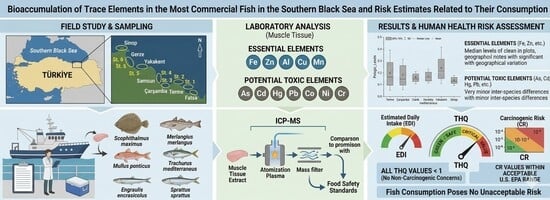
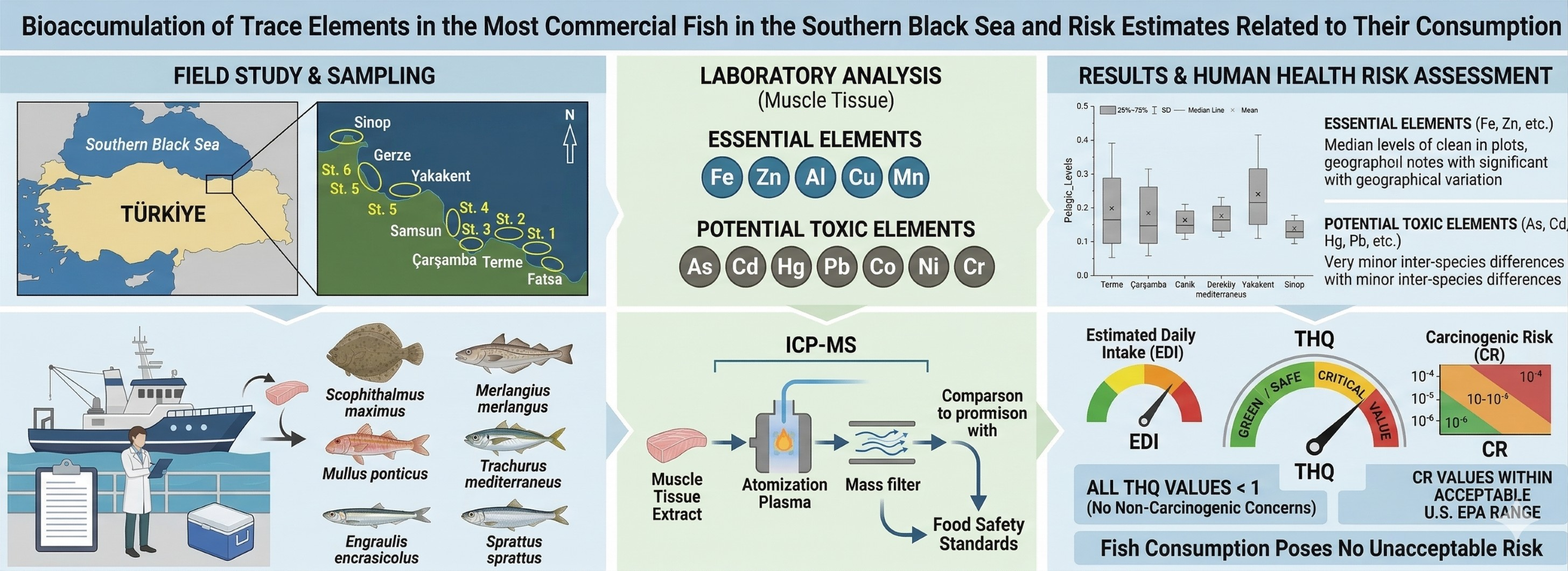
This study provides a comprehensive evaluation of thirteen elements (Al, Cr, Mn, Fe, Co, Ni, Cu, Zn, As, Cd, Hg, and Pb) in six commercially significant fish species from the southern Black Sea. The selection includes pelagic species, such as European anchovy (Engraulis encrasicolus), Mediterranean horse mackerel (Trachurus mediterraneus), and European sprat (Sprattus sprattus), and demersal species, including Whiting (Merlangius merlangus), Blunt-snouted mullet (Mullus ponticus), and Turbot (Scophthalmus maximus). Sampling was conducted at six strategic stations along the Sinop and Samsun coasts, regions that constitute the backbone of Turkish Black Sea fisheries. Samsun, situated at the confluence of the Kızılırmak and Yeşilırmak rivers, faces a complex pollution landscape driven by its role as a major industrial, agricultural, and urban hub. The ecological health of the southern Black Sea is heavily influenced by the discharge from these two major river basins. The Kızılırmak and Yeşilırmak deltas are among Türkiye’s most fertile regions, but intensive farming leads to substantial non-point source pollution. While trace element accumulation is a global concern, the Southern Black Sea presents a unique case due to its intense industrial, agricultural, and aquaculture activities. Therefore, it is crucial to evaluate the concentrations of these elements in commercially important fish species to ensure food safety and assess the potential health risks for consumers in the region.
The primary objective is to quantify bioaccumulation levels, compare them with national and international standards, and execute a detailed human health risk assessment using indices such as the EDI, THQ, and CR. By bridging environmental data with public health metrics, this research aims to support sustainable fisheries management and provide a scientific basis for environmental protection policies in the Black Sea.
2. Materials and Methods
2.1. Study Area and Sample Collection
The research was conducted along the southern coast of the Black Sea, specifically targeting six strategic sampling stations located within the Sinop and Samsun provinces. These regions are characterized by distinct demographic and industrial profiles; Samsun represents a densely populated urban center (1,382,376 inhabitants) with relatively higher industrial activity, whereas Sinop maintains a smaller urban structure (226,957 inhabitants) [
16]. The sampling area is significantly influenced by the discharge of two major river systems: the Kızılırmak (Türkiye’s longest river) and the Yeşilırmak. These rivers act as primary conduits for terrestrial, agricultural, and urban runoff into the Black Sea ecosystem.
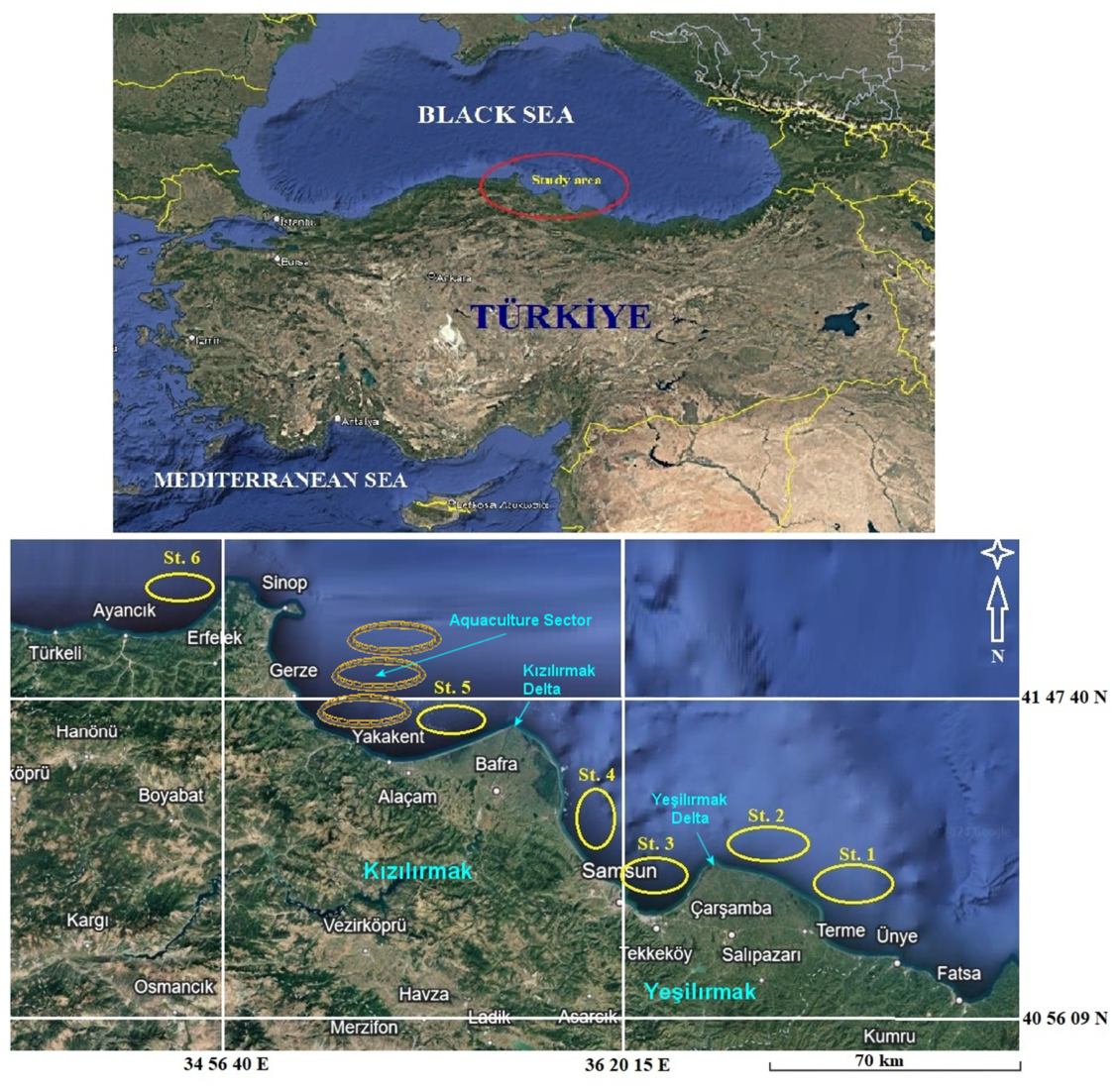
Sampling was conducted at six strategically selected stations along the Southern Black Sea coast (
Figure 1). The study area covers a significant coastline between Sinop and Samsun, characterized by different environmental influences. Specifically, St. 4 and St. 3 are located near the Kızılırmak and Yeşilırmak deltas, respectively, which are critical areas for terrestrial runoff. Furthermore, the presence of intensive aquaculture activities near St. 5 (Yakakent/Gerze region) was considered to evaluate potential localized impacts on trace element concentrations in the muscle tissues of the target fish species.
Fish samples were collected during the consecutive fishing seasons of 2023, 2024, and 2025. Industrial pelagic and benthic species were obtained using commercial bottom otter trawl, midwater pair trawl and purse seine vessels between 1 September and 15 April. Demersal samples, particularly turbot, were harvested using small-scale coastal turbot gillnets outside the legal closure period (15 April–15 June).
The sampling stations were located along the southern Black Sea coast of Türkiye, and their coordinates were expressed in degrees, minutes and seconds (DMS). Accordingly, St. 1 was positioned at 41°17′51.9″ N, 37°08′14.2″ E; St. 2 at 41°24′17.6″ N, 36°50′26.6″ E; St. 3 at 41°19′14.1″ N, 36°26′28.6″ E; St. 4 at 41°28′21.8″ N, 36°14′21.7″ E; St. 5 at 41°44′23.3″ N, 35°44′12.7″ E; and St. 6 at 42°05′47.5″ N, 34°47′32.6″ E.
For the entire fishing season, the minimum, maximum and mean sea-water temperatures calculated for each station were evaluated separately to characterize the thermal conditions of the sampling area (
Supplementary Table S1).
At St. 1, the minimum sea-water temperature was recorded as 8.6 °C in March 2025, whereas the maximum temperature reached 26.8 °C in August 2025. The mean sea-water temperature calculated for this station over the annual assessment period was 16.47 ± 1.98 °C. This station therefore exhibited the highest mean temperature among the investigated stations, although the difference between stations remained relatively limited. St. 2, St. 3 and St. 4 showed very similar thermal characteristics throughout the study period. At these three stations, the minimum sea-water temperature was 8.4 °C, recorded in March 2025, while the maximum temperature was 26.8 °C, recorded in August 2025.
The mean temperature calculated for each of these stations was 16.39 ± 1.98 °C. This similarity indicates that the central part of the study area, covering the Samsun coastal zone and the offshore waters influenced by the Yeşilırmak Delta, was characterized by a relatively homogeneous seasonal temperature regime. St. 5 and St. 6 represented the western part of the study area. At these stations, the minimum sea-water temperature was determined as 8.2 °C in March 2025, while the maximum temperature was 26.8 °C in August 2025.
The mean sea-water temperature for both St. 5 and St. 6 was calculated as 16.30 ± 1.99 °C. These values suggest that the western sector of the study area exhibited slightly lower mean temperatures compared with the eastern and central sectors. However, the magnitude of this difference was small, indicating that all stations were generally exposed to a similar seasonal thermal pattern.
Overall, the station-based temperature assessment revealed a clear seasonal pattern across the study area. The lowest sea-water temperatures were consistently observed in March 2025, while the highest values were recorded in August 2025 at all stations. Mean temperatures varied only slightly among stations, ranging from 16.30 to 16.47 °C. This limited spatial variation suggests that the study area was generally characterized by a comparable thermal regime during the investigated fishing season, although minor differences may reflect local hydrographic conditions, coastal morphology, freshwater inputs from delta systems and the spatial distribution of fishing operations.
During the study, fish specimens were collected from commercial fishing vessels operating with different fishing gears along various depth contours. Bottom trawl nets were operated at depths ranging from 45 to 120 m, subject to the legal coastal distance restriction requiring a minimum distance of 3 nautical miles from the shoreline. Midwater trawl nets, for which no legal coastal distance limit was specified in the present context, were used at depths of 24–40 m. Purse seine nets were operated at depths between 18 and 45 m, whereas turbot set nets were deployed at depths ranging from 45 to 90 m. These differences in fishing depth and gear type indicate that the sampled fish originated from a broad range of coastal and sublittoral habitats within the southern Black Sea.
2.2. Biota Selection and Processing
Considering the factors mentioned in the research area, the region is the most important passage and waiting points of pelagic fish species such as European anchovy
Engraulis encrasicolus (Linnaeus, 1758), Mediterranean horse mackerel
Trachurus mediterraneus (Steindachner, 1868) and European sprat
Sprattus sprattus (Linnaeus, 1758), which form shoals and can periodically host dense shoals [
17]. In addition, fishing can be carried out with fishing gears used in industrial fisheries and fishing gears used in small-scale fisheries on the coasts of Samsun and Sinop, where the most economically valuable demersal fish species of the Black Sea, Turbot
Scophthalmus maximus (Linnaeus, 1758), Blunt-snouted mullet
Mullus ponticus Essipov, 1927 and Whiting
Merlangius merlangus (Linnaeus, 1758) are intensively fished [
18,
19].
To ensure spatial and temporal representativeness, all six fish species were consistently harvested from each of the sampling stations along the Sinop and Samsun coasts. Sampling campaigns were carried out systematically during all fishing seasons to account for inter-annual variations. By utilizing the same set of species across all locations, the study provides a robust comparative framework for assessing trace element bioaccumulation across the southern Black Sea.
Following the fishing operations, representative sub-samples of each species were randomly selected from the total commercial catch to obtain a statistically unbiased dataset for subsequent analysis. This rigorous approach ensured that the collected data accurately reflected the average population characteristics and the habitat-specific trace element partitioning within the study area.
Six economically significant fish species were selected for analysis, categorized by their ecological niches:
Pelagic species: In the world, pelagic fish are divided into two main groups as large pelagic and small pelagic species [
20]. Pelagic species fished in the Black Sea are small pelagic species consisting of European anchovy, Mediterranean horse mackerel, bonito, bluefish, shad and European sprat [
21,
22]. European anchovy is the fish species with the highest consumption as human food in our country. In the Black Sea, mainly European anchovy and Mediterranean horse mackerel are directly offered for human consumption for nutritional purposes, while European sprat can be a part of human consumption indirectly (fish oil, pharmaceutical industry, feed production for other marine and terrestrial animals that can be cultivated) by passing through the processing stages in the fish flour-oil industry [
17,
23]. The pelagic fish species that are economically fished in industrial fisheries are anchovy, horse mackerel and sprat [
24].
Demersal species: Although demersal fish species are not fished as much as pelagic fish species in the world, they are preferred more than pelagic species due to their taste and economic value. For this reason, they attract attention especially in commercial fisheries and other stakeholder sectors related to aquaculture. The most important economic demersal species of the Black Sea are Turbot, Blunt-snouted mullet and Whiting [
25,
26,
27,
28]. In our country, Whiting, Blunt-snouted mullet and Turbot are among the demersal species that rank first in fisheries production, have high economic value for fishermen and are in high demand in terms of human nutrition and consumption [
24,
29].
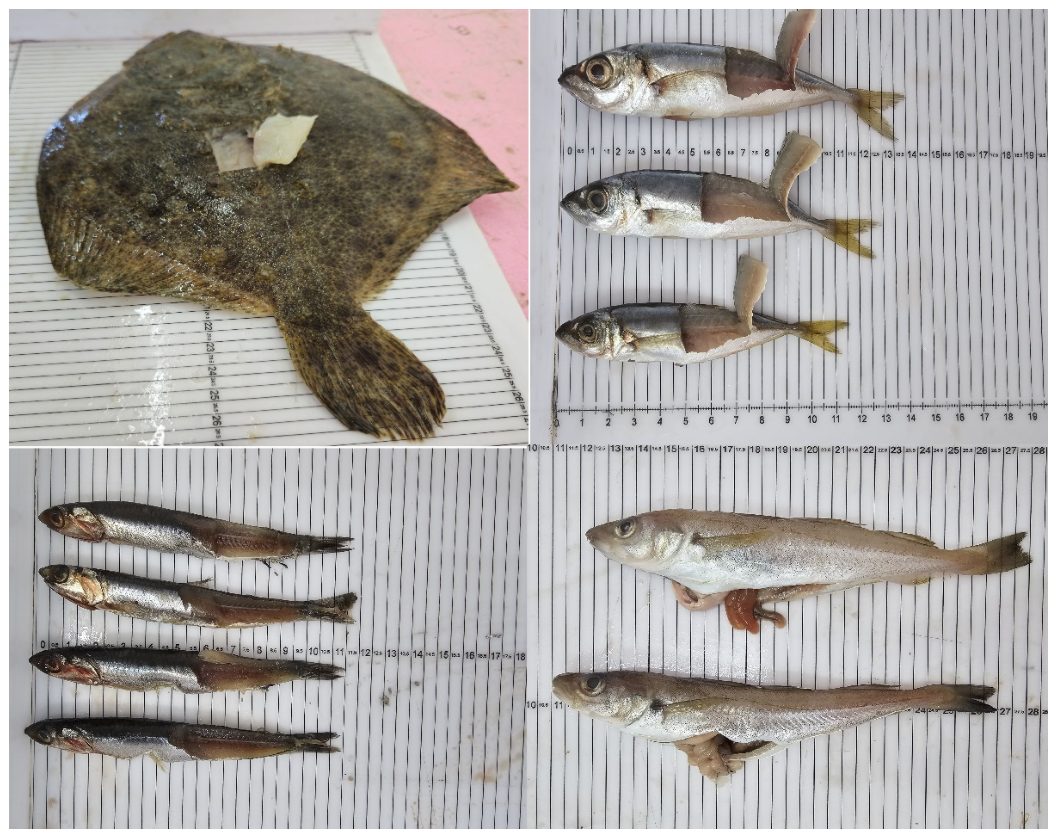
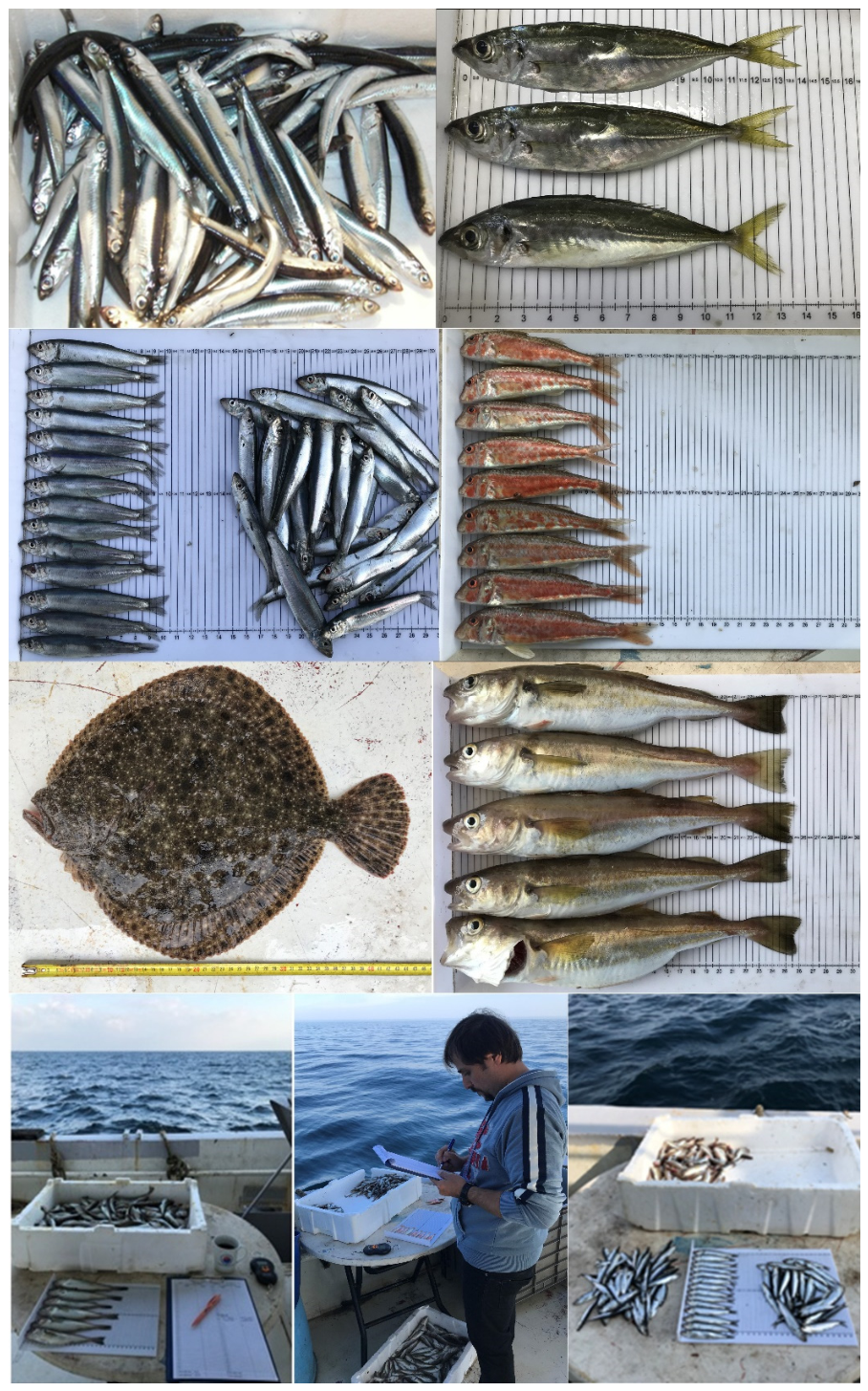
Upon collection, total length (L) and weight (W) were recorded on board (
Figure 2).
Specimens were then transported to the laboratory in insulated containers at 4 °C. Approximately 1.5 g of dorsal muscle tissue was dissected from each specimen (
Figure 3), homogenized, and stored in Teflon vessels for subsequent digestion [
30]. To ensure the accuracy of the trace element analysis, all skin, scales, fascia, and visible fat deposits were meticulously removed using plastic tools and stainless-steel scalpels prior to homogenization. Only the pure ‘fillet’ portion of the white muscle was utilized, as these non-muscular tissues can exhibit different affinity levels for certain trace elements, potentially biasing the results. The collected tissues were then rinsed with deionized water to remove any external contaminants or blood residues before being prepared for the digestion process.
In this context, the amounts of elements (Al, Cr, Mn, Fe, Co, Co, Ni, Ni, Cu, Zn, As, Cd, Hg and Pb) in fish tissues were measured by Inductively Coupled Plasma (ICP-MS) after microwave dissolution at Sinop University Scientific and Technological Research Application and Research Center (SÜBİTAM) as follows.
2.3. Elemental Analysis and Quality Control
Trace element concentrations (Al, Cr, Mn, Fe, Co, Ni, Cu, Zn, As, Cd, Hg, and Pb) were determined following the EPA Method 200.3 protocol. Samples underwent microwave-assisted acid digestion (Milestone SK10, Milestone Srl, Sorisole (BG), Italy) using a concentrated mixture of HNO
3 (65% suprapur) and H
2O
2 (30% suprapur) (7:1) ratio. The thermal profile was maintained at 200 °C for 30 min [
31,
32,
33,
34]. The ICP-MS was operated under robust plasma mode at 1550 W RF power, with a sampling depth of 8 mm, a spray chamber temperature of 2 °C, and a helium cell gas flow of 4 mL/min for kinetic energy discrimination (4 V) to minimize polyatomic interferences.
Quantification was performed using Inductively Coupled Plasma Mass Spectrometry (ICP-MS, Agilent 7700X, Agilent Technologies, Santa Clara, CA, USA). Analytical accuracy was ensured through the use of multi-element standard solutions (27 element mix: 8500-6940 2A and 8500-6940 Hg) and internal standards [
31,
32,
33,
34]. All concentrations are reported in mg/kg wet weight (wet wt.).
To ensure rigorous quality assurance and control, analyses were conducted in triplicate using a certified reference material (Lobster TORT-2, National Research Council Canada (NRC-CNRC), Ottawa, ON, Canada). The analytical precision remained within ±10%, while the recovery (accuracy) for the CRM elements ranged from 97% to 105%. Additionally, a 1 ppm internal standard (Agilent 5188-6525, Agilent Technologies, Santa Clara, CA, USA) was monitored continuously throughout the sample analysis.
2.4. Pollution and Health Assessment
2.4.1. Metal Pollution Index (MPI)
To assess the comprehensive pollution in fish, the total metal pollution index (MPI) was performed. The THQ was calculated as follows [
35,
36]:
where Cn is the content of metal n in fish samples (mg/kg, wet wt.).
2.4.2. Calculation of Daily and Weekly Metal Intakes
To assess exposure levels from fish consumption, daily and weekly metal intakes were calculated based on metal concentrations in edible tissues. The following equation was used to calculate the estimated daily metal intake (mg/kg/day) for consumers [
37,
38]:
where C metal is the metal concentration in fish samples (mg/kg, wet wt.); W fish is the average daily fish consumption in Türkiye (g/day); and BW is the body weight of the consumer (kg). In this study, the average daily per capita fish consumption was taken as 19.72 g. [
39]. In this study, the risk assessment was conducted specifically for the adult population in Türkiye. To ensure a representative calculation for this category, the average BW of the consumer was assumed to be 70 kg, consistent with international risk assessment standards and regional demographic data.
Estimated weekly intakes were obtained by multiplying the EDI values by 7.
2.4.3. Risk Assessment
The Target Hazard Quotient was used to measure health risks associated with fish consumption by the residents of Sinop. The following equation describes the method for assessing risk using THQ, as defined in the US Environmental Protection Agency Region III risk-based concentration table [
40]:
where Rf. D. is the oral reference dose of the metal (mg/kg-day), calculated in this study using the most up-to-date data from the United States Environmental Protection Agency and the Risk Assessment Information System, respectively [
40,
41].
The Risk Index was calculated using the following formula:
An RI <10−6 is considered insignificant, 10−6 < RI < 10−4 is considered acceptable, and an RI > 10−4 is considered significant.
The Hazard Index is the sum of the THQs. If HI is less than 1.0, there are no adverse health effects, whereas an HI greater than 1.0 indicates a possibility of adverse outcomes [
40,
41].
2.5. Statistical Analysis
Prior to analysis, data were analyzed for normality and non-parametric statistical methods were preferred. All statistical analyses were performed to evaluate differences in element concentrations among fish species, sampling locations, and habitats (demersal and pelagic). The reported average values and standard deviations are derived from triplicate measurements performed for each sample, ensuring the robustness and statistical significance of toxicological data.
Descriptive statistics were expressed as mean ± standard deviation. Statistical significance was accepted at p < 0.05. Differences in element concentrations among fish species and sampling regions were assessed using the Kruskal–Wallis test, and the Mann–Whitney U test was used to compare element concentrations between demersal and pelagic species. Multivariate analysis was conducted using Principal Component Analysis (PCA) to identify patterns in metal accumulation. Prior to PCA, element concentration data were log-transformed. The PCA biplot was used to interpret clustering patterns and to distinguish between demersal and pelagic species based on their element levels.
3. Results
3.1. Elemental Concentrations in Fish Species
The biometric characteristics of the fish species analyzed are summarized in
Table 1. The mean, minimum, and maximum concentrations of each element across all species and sampling locations are presented in
Table 2. The data reveal a wide variation in elemental concentrations:
The average element concentrations for S. maximus,
M. merlangus,
M. ponticus,
T. mediterraneus,
E. encrasicolus, and
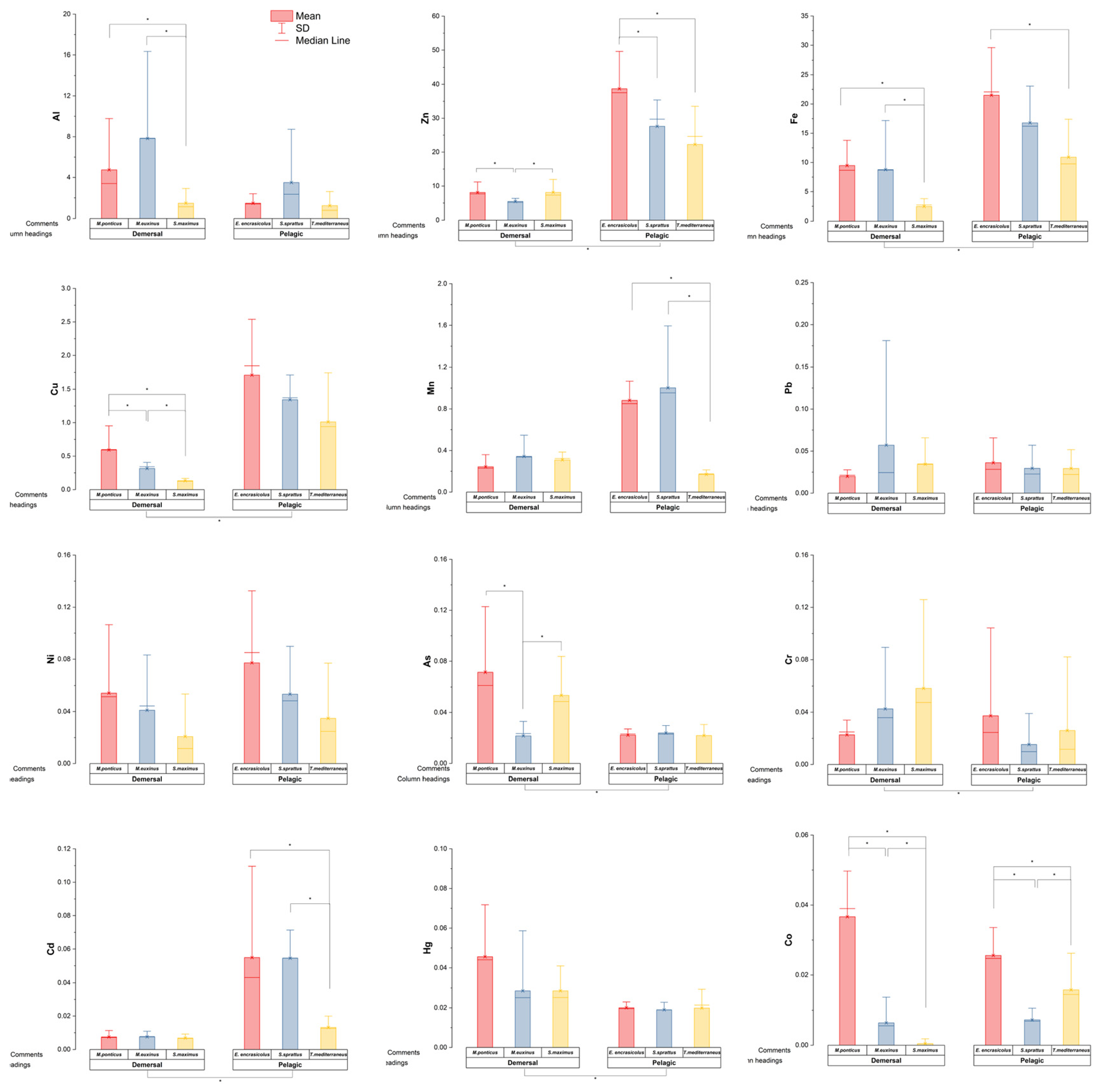
S. sprattus are illustrated in
Figure 4. While concentrations were relatively similar among species, specific variations were noted:
S. maximus exhibited slightly lower levels of Cd and Pb;
T. mediterraneus showed lower Hg levels, while
M. merlangus had lower As; In contrast,
M. ponticus displayed higher levels of Hg and As, while
E. encrasicolus showed higher Cd accumulation.
The statistical analysis revealed significant inter-specific variations in trace element accumulation across the studied fish species (
Figure 4). According to the results of the one-way ANOVA followed by Tukey’s post hoc test, essential elements such as Zn, Fe, and Cu showed highly significant differences (
p < 0.05), particularly between pelagic species like
E. encrasicolus and demersal species like
S. maximus. For instance, as indicated by the significance markers in
Figure 4, Al and Zn levels in
M. merlangus and
E. encrasicolus were significantly higher than those observed in
S. maximus (
p < 0.05). Similarly, Cd and Co concentrations exhibited distinct accumulation patterns between the two ecological groups, with significant
p-values (
p < 0.05) denoted by the asterisk markers over the corresponding brackets. These results provide robust evidence that species-specific physiological traits and habitat preferences significantly influence the metal burden in Black Sea fish biota.
3.2. Habitat and Multivariate Analysis
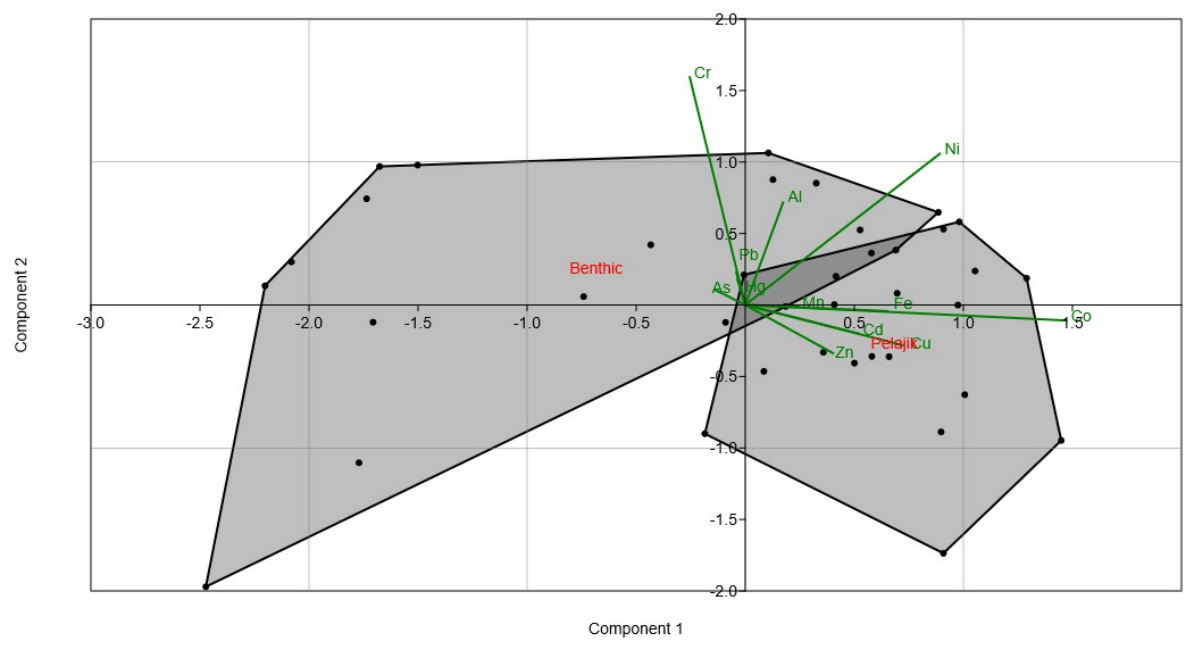
The statistical analysis revealed significant variations in metal accumulation patterns across different ecological niches, specifically distinguishing between demersal and pelagic habitats. The Principal Component Analysis (PCA) biplot (
Figure 5) successfully segregated the fish species based on their characteristic habitats and feeding strategies. The first five principal components captured a substantial 93% of the total variance, with PC1 and PC2 being the primary drivers, accounting for 46.8% and 19.9%, respectively.
According to the loading matrix (
Supplementary Table S2), PC1 (Pelagic-driven axis) showed a strong association with the pelagic habitat, characterized by significant positive loadings (loading values > 0.65) of Co, Ni, Cu, and Fe. This grouping suggests a common uptake pathway or similar bioaccumulation kinetics among species occupying the upper water column.
PC2 (Demersal-driven axis) effectively defined the demersal niche, showing high positive loadings for Cr and Ni. The distinct positioning of these elements in the PCA space highlights the influence of sediment-water interface interactions on the metal profiles of bottom-dwelling species. The separation observed in the score plot confirms that habitat-specific physiological constraints are more influential than phylogenetic proximity in trace element sequestration.
3.3. Human Health Risk Assessment
The elemental concentrations in muscle tissues were compared with national and international permissible limits (
Table 3).
Toxic Metal Limits: Mean values for Cd, Hg, Pb, Cu, and Zn were all below the tolerance thresholds set by the European Union and the Turkish Food Codex. Although maximum Cd levels in E. encrasicolus (0.055 mg/kg) and S. sprattus (0.054 mg/kg) reached the limit, their averages remained safe.
Intake Estimates: Estimated Daily Intakes (EDIs) and Estimated Weekly Intakes (EWIs) are presented in
Table 4 and
Table 5.
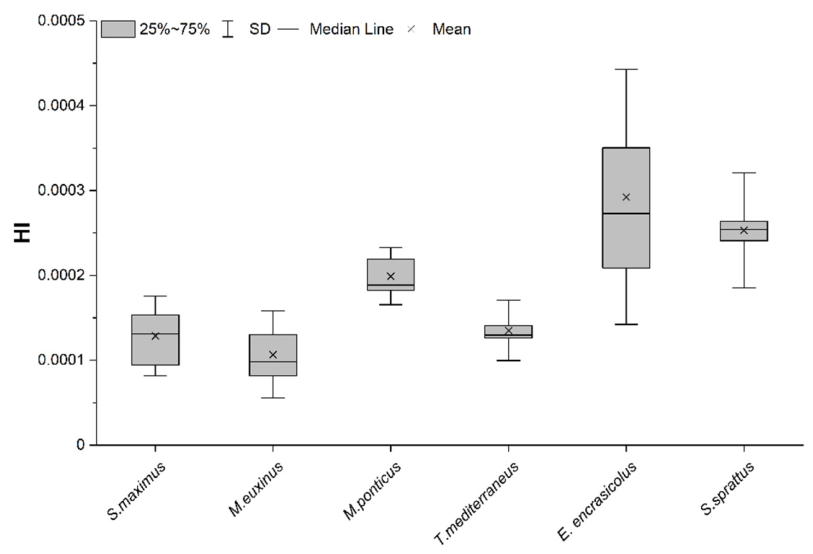
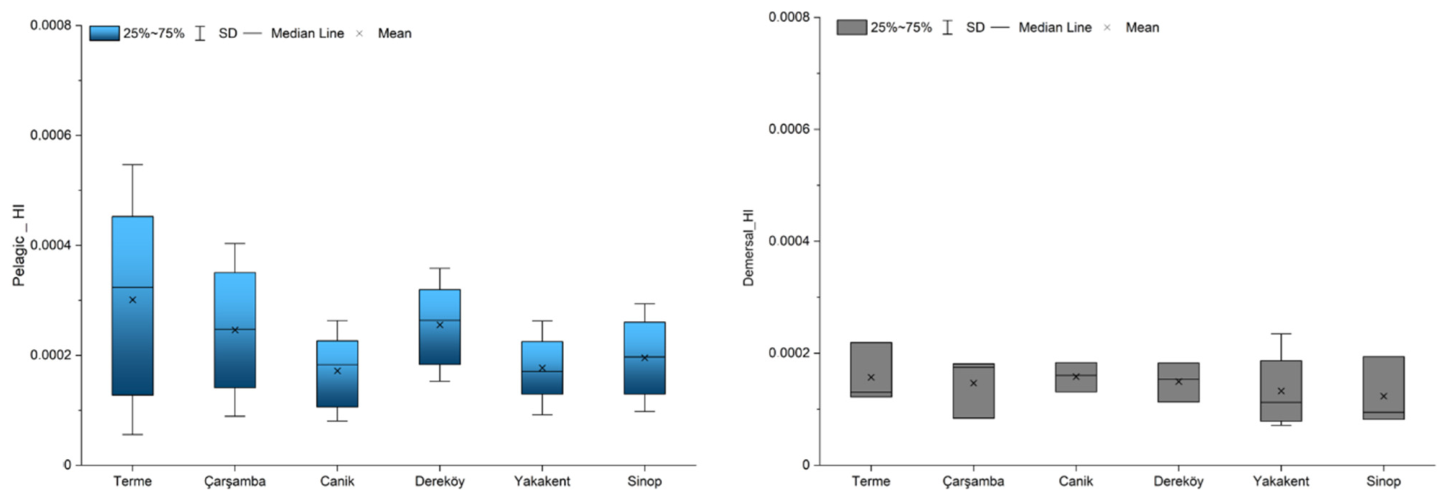
Risk Indices: Target Hazard Quotients (THQ) and Hazard Index (HI) values were calculated (
Table 6). The HI value (1.8 × 10
−3) was significantly lower than 1 (
Figure 6 and
Figure 7).
Carcinogenic Risk (CR): The RI values for Cr, As, and Pb (
Table 7) fell within the acceptable range of 10
−6 to 10
−4 as defined by the EPA.
4. Discussion
The elemental composition of the fish species analyzed in this study reflects a complex interaction between habitat, feeding strategies, and long-term environmental trends in the Southern Black Sea. Our results indicate that while essential elements such as Fe and Zn fluctuate naturally, toxic metals (Cd, Pb, Hg, and As) are generally found at concentrations well below historical levels and international safety thresholds. The high concentrations of Fe and Zn observed are consistent with their roles as essential elements and their natural abundance in marine biota.
The PCA results indicate that pelagic and demersal fish follow distinct accumulation pathways. The PCA biplot (
Figure 5) clearly distinguishes between pelagic and demersal species, reflecting a mechanism driven by habitat-specific exposure pathways. Pelagic species, positioned along the PC1 axis, show a strong correlation with Co, Ni, and Cu. This can be attributed to their high metabolic rates and constant movement in the upper water column, where they primarily accumulate these elements through the ingestion of planktonic organisms and direct uptake from dissolved phases in the surface waters. Conversely, the segregation of demersal species along PC2, associated with Cr and Ni, reflects the influence of the sediment-water interface. Demersal fish, such as S. maximus, are in constant contact with benthic sediments, which act as a major sink for trace elements in the Black Sea. The higher accumulation of Cr in these species likely results from the ingestion of benthic invertebrates and the resuspended sediment particles, which are typically enriched in lithogenic elements compared to the open water column. These findings suggest that the ecological niche dictates the primary route of metal exposure, bridging the gap between statistical clustering and biological reality. The dominance of Cr and Ni in demersal-associated components suggests a stronger influence of sedimentary interfaces on these species. Furthermore, the geographical variation, specifically the higher concentrations observed in the Samsun region (
Figure 7), points toward localized environmental pressures. This elevation likely reflects the impact of intensive industrial activities, urbanization, and agricultural runoff characteristic of the Samsun coastline [
3], whereas regions like Yakakent and Dereköy appear less exposed to anthropogenic pollution.
While the present study focuses on the muscle tissues of fish, it is well-established that water quality parameters significantly influence the bioavailability and subsequent accumulation of metals in marine biota. Factors such as pH, water temperature, and salinity can alter the chemical speciation of metals in the water column, thereby affecting their uptake through the gills and skin. Although direct water analysis was not within the scope of this research, previous studies in the Southern Black Sea suggest that seasonal variations in vertical mixing and riverine discharge significantly modulate the dissolved metal concentrations. The lower accumulation levels observed in our study might be partially attributed to the dynamic nature of the Black Sea’s surface waters, where rapid dilution and sedimentation processes can limit the duration of exposure to pelagic and demersal species.
Water temperature is a primary driver of metal uptake kinetics. During the warmer spring and summer months, the metabolic rates of fish typically increase, leading to higher ingestion rates and increased gill ventilation. Enhanced metabolism often results in a higher turnover of elements. In the Black Sea, rising temperatures can increase the bioavailability of certain metals in the water column, potentially leading to higher concentrations in tissues during the late summer season compared to the winter. Our results suggest that the observed trace element levels are a snapshot influenced by the sampling season; therefore, future longitudinal studies covering the full migratory and reproductive cycles of these species are essential to fully characterize the long-term risk profiles in the southern Black Sea.
4.1. Comparison with Historical Data and Regional Trends
A primary finding of this study is the significant reduction in toxic metal burdens compared to historical data from the 1990s and early 2000s.
Pb and Cd for
E. encrasicolus, our mean Pb results (0.036 mg/kg wet wt.) show a dramatic decline compared to the levels reported by many studies [
47,
48,
49,
50,
51]. Similarly, mean Cd levels in
S. maximus were found to be 0.007 mg/kg wet wt., which is nearly 77 times lower than the Kayseri market samples (0.54 mg/kg wet wt.) reported by [
52], where the origin of the fish and post-harvest factors might differ from our direct Black Sea samplings. These trends suggest that environmental regulations and the phasing out of leaded fuels have positively impacted the Black Sea biota.
The findings of this study reveal lower trace element concentrations compared to several previous reports, which can be attributed to specific environmental and temporal factors associated with the cited literature. For instance, Hg levels in
M. merlangus (0.029 mg/kg wet wt.) were notably lower than those reported by [
53,
54,
55]. While [
53] represents historical data from over a decade ago, the higher values in recent studies [
54,
55] are explicitly linked to extreme environmental events; for example, [
54] reports elevated metal levels specifically following climate-change-induced floods, which increase terrestrial runoff and sediment mobilization.
Similarly, the As levels in
T. mediterraneus (0.022 mg/kg wet wt.) in our study are lower than values found by [
56,
57,
58,
59]. These differences likely arise from the diverse sampling localities, ranging from the Bulgarian coast [
57,
58] to various Turkish regions [
59], which are subject to different anthropogenic pressures and geological backgrounds.
These comparisons suggest that while the Black Sea biota shows signs of recovery, localized environmental disturbances and sampling contexts remain the primary drivers of variability in metal accumulation.
4.2. Habitat-Linked Accumulation and Trophic Transfer
The differentiation between demersal and pelagic species was further supported by our comparative analysis. Demersal species (
M. barbatus,
M. barbatus and
S. maximus) showed different profiles due to their interaction with the sediment. However, the Fe concentrations in demersal fish samples were found to be much lower than historical Aegean Sea data [
60], suggesting that the Samsun-Sinop shelf does not currently suffer from acute demersal Fe-loading.
The stability of metal levels in demersal species
M. merlangus and pelagic species
E. encrasicolus, across the central-southern shelf, when compared to higher values in the Eastern Black Sea (Rize) [
61], highlights that geographical location and local industrial inputs (e.g., Samsun Port) [
3] are more influential than species-specific biological differences alone.
4.3. Regional Hotspots
Geographical analysis consistently identified the Samsun region as a localized “hotspot” for several elements (
Figure 7). This is consistent with earlier observations by [
62,
63,
64], who highlighted the vulnerability of the Middle Black Sea to anthropogenic pressures. The elevated concentrations of Cu and Fe in Samsun coasts are likely a result of industrial effluents, port activities, and agricultural runoff from the Kızılırmak and Yeşilırmak rivers, as also suggested by [
3].
To ensure the long-term sustainability of fisheries and safeguard public health in the southern Black Sea, policymakers should adopt a proactive “source-to-sea” management strategy that addresses land-based pollution at its origin [
65,
66,
67]. This includes enforcing stricter discharge regulations and real-time monitoring in industrial hotspots like Samsun, alongside the establishment of riparian buffer zones along the Kızılırmak and Yeşilırmak rivers to filter agricultural runoff. Furthermore, fisheries management should prioritize habitat-focused protections, such as curbing illegal bottom trawling to prevent the resuspension of contaminated sediments and implementing digital traceability systems to enhance consumer transparency. By integrating industrial oversight with sustainable fishing practices and regional cooperation, authorities can transform current monitoring data into a robust early-warning system for the entire ecosystem.
While the current study focuses on the biological monitoring of fish tissues rather than direct abiotic matrices, the elevated trace element levels observed in the Samsun area align with its geographical and anthropogenic characteristics. The Samsun coast is subject to significant terrestrial inputs from the Yeşilırmak and Kızılırmak rivers, which are known to carry agricultural runoff and industrial effluents from the inner regions of Anatolia [
3]. Furthermore, the presence of heavy industrial activities, including fertilizer and copper processing plants, suggests a high potential for trace element enrichment in the local marine environment. Although direct water and sediment analyses were not conducted in this study, the bioaccumulation patterns observed in the sampled fish act as integrative biomarkers of long-term environmental exposure, supporting the hypothesis that this region remains a critical area for environmental monitoring in the Southern Black Sea.
4.4. Human Health Risk Assessment and Food Safety
From a global food safety perspective, our results are highly encouraging. All analyzed muscle tissues remained within the permissible limits set by EC and the Turkish Food Codex (see
Table 3).
All calculated THQ and HI values were well below the critical threshold of 1, indicating no non-carcinogenic risk from consumption. Although the USEPA [
40] has updated its stance on Pb reference values since 2024, our calculations using previous SFO values confirm that the carcinogenic risk remains within the negligible-to-acceptable range (10
−6 to 10
−5).
Interestingly, while some species showed slight variations in accumulation (e.g.,
M. ponticus accumulating more Hg and As), the average daily intake for consumers remains similar regardless of the species chosen. This suggests that at current consumption rates, these Black Sea fish species do not pose a significant health threat. In the carcinogenic risk assessment, it is crucial to distinguish between total As and its toxic inorganic form (iAs). Since only total arsenic concentrations were analytically determined in this study, the carcinogenic risk was calculated based on the conservative assumption that 10% of the total As is present in the inorganic form, as recommended by previous studies [
68,
69,
70]. This conversion factor ensures a more realistic estimation of the carcinogenic risk, preventing the overestimation that occurs when using total As values for toxicity calculations.
However, the proximity of maximum Cd levels to regulatory limits in certain small pelagic fish (E. encrasicolus and S. sprattus) highlights the necessity for continuous monitoring of the Black Sea ecosystem to track long-term bioaccumulation trends. The comparative assessment of our findings with historical data from the past three decades suggests a downward trend in certain trace element concentrations in the Southern Black Sea. Although a continuous, systematic monitoring dataset for the entire 30-year period is unavailable, a meta-analysis of previous studies conducted in the region indicates that current metal levels in species are generally lower than those reported in the 1990s and early 2000s. This apparent decrease may be attributed to stricter international regulations, the implementation of the Bucharest Convention, and the modernization of industrial discharge treatments in riparian countries. However, this trend should be interpreted with caution, as localized enrichment still occurs near major river mouths and industrial zones, necessitating long-term, harmonized monitoring programs to confirm these temporal shifts. The localized elevations in industrial zones like Samsun underscore the necessity for continued environmental monitoring to ensure the sustainability of these marine resources.
The bioaccumulation patterns observed in this study reflect the distinct physiological handling of essential versus toxic trace elements. Essential elements (e.g., Cu, Zn, Fe) are subject to active homeostatic regulation; fish possess sophisticated metabolic pathways to maintain these metals within specific physiological ranges required for enzymatic activities and cellular functions. Consequently, their accumulation often plateaus once metabolic requirements are met, unless environmental concentrations exceed the regulatory capacity of the organism [
7].
In contrast, toxic elements (e.g., Pb, Cd, Hg) have no known biological function and tend to follow a non-regulatory accumulation pattern. Unlike essential metals, toxic elements are not easily excreted and instead bind to metallothioneins, leading to progressive bioaccumulation over time, even at low environmental exposures. This fundamental difference explains why toxic metal concentrations in the examined species, although below legal limits, show a more direct correlation with long-term environmental exposure compared to the strictly regulated essential elements [
7].
The adherence of trace element levels to the strict thresholds set by the European Commission and the Turkish Food Codex reflects a robust margin of safety for the local population, as these limits are intentionally designed with significant safety factors to mitigate long-term health risks [
43,
44,
45,
46].
The findings of this study provide critical data for the implementation of the EU MSFD 2008/56/EC within the Black Sea basin [
9]. Specifically, our results contribute to Descriptor 9, which states that ‘contaminants in fish and other seafood for human consumption do not exceed levels established by Community legislation or other relevant standards’ [
9]. By systematically monitoring trace elements in six commercially key species, this research assists in assessing whether the Southern Black Sea is moving toward Good Environmental Status (GES) [
9]. Furthermore, the integration of the latest Commission Regulation (EU) 2022/617 regarding Hg limits [
46] ensures that our risk assessments align with the most stringent contemporary European standards, bridging the gap between localized monitoring and broad-scale environmental policy.
The present health risk assessment was primarily focused on the adult population in Türkiye, utilizing representative consumption rates and body weight parameters for this demographic. However, it is important to acknowledge that pregnant women and children constitute highly sensitive populations due to their distinct physiological requirements and lower body weights, which may result in higher relative exposure levels to trace elements. While the current results provide a robust baseline for public health, future research should incorporate age-specific consumption data and lower body weight thresholds to specifically characterize the risks for these vulnerable groups. This study serves as a critical first step in identifying general exposure patterns, paving the way for more targeted toxicological assessments in the Black Sea region.
5. Conclusions
This study provides a comprehensive and up-to-date assessment of elemental concentrations and associated human health risks in major commercial fish species of the Southern Black Sea. The following key conclusions can be drawn:
Elemental Safety and Trends: Toxic metal concentrations (Cd, Pb, Hg, and As) in all analyzed species were significantly lower than the maximum permissible limits set by the European Union and the Turkish Food Codex. Comparison with the last 30 years of literature reveals a substantial downward trend in Pb and Cd accumulation, suggesting a regional recovery from historical pollution pressures.
Habitat and Regional Hotspots: PCA successfully differentiated metal accumulation patterns between demersal and pelagic species. The Samsun region was identified as a localized hotspot for certain elements, likely driven by industrial discharges and agricultural runoff from the nearby deltas, emphasizing the need for targeted environmental management in these areas.
The observed partitioning of trace elements suggests a clear trophic divergence. Demersal species exhibit a ‘sediment-oriented’ accumulation signature [
71,
72], likely exacerbated by their proximity to the benthic boundary layer where metals like Cr and Ni are sequestered. In contrast, pelagic species reflect a ‘plankton-oriented’ pathway, where metal uptake is closely tied to the primary production cycles of the upper water column. These findings underscore the importance of considering ecological traits when assessing the environmental risk of trace element contamination.
Human Health Risk: The HI and THQ were consistently below the critical threshold of 1. Furthermore, the CR values for Cr, As, and Pb fell within the negligible-to-acceptable range (10−6 to 10−4), confirming that current consumption rates of the Black Sea fish pose no significant health risk to the human population.
Given that Cd levels in small pelagic species were found to be approaching regulatory limits, a proactive management strategy is recommended for the Southern Black Sea. First, a high-resolution spatial monitoring program should be established, focusing on seasonal variations in Cd bioaccumulation within the food web. Second, considering the significant terrestrial inputs from major rivers, it is essential to implement stricter controls on industrial and agricultural effluents at their source to mitigate the flux of heavy metals into the marine environment. Finally, it is suggested that regional fisheries management should incorporate periodic trace element screening as part of routine quality control, ensuring that small pelagic fish, a primary protein source in the region, remain safely below the maximum permissible levels for human consumption.
Future Perspectives and Recommendations: For a more granular understanding of bioaccumulation, future studies should examine the relationship between elemental concentrations and the age, size, and trophic levels of fish. Furthermore, separate analysis of inorganic and organic forms, particularly for As, is essential, as the inorganic form presents a higher toxicological risk. Long-term, systematic monitoring programs and high-resolution mapping of pollution sources (industrial, agricultural, and urban) are recommended to ensure the sustainability of marine resources and the continued safety of seafood in the Black Sea region.
In conclusion, while the current concentrations of trace elements in commercially important fish species from the southern Black Sea remain within safe limits for human consumption, the distinct bioaccumulation patterns observed between pelagic and demersal habitats underscore the complexity of this marine ecosystem. The findings highlight that current safety margins are maintained, yet the persistent pressure from industrial, urban, and agricultural discharges via the Kızılırmak and Yeşilırmak rivers necessitates a transition from reactive testing to a proactive, “source-to-sea” management framework. By integrating continuous environmental monitoring with habitat-specific protections and stricter regulatory oversight into pollution hotspots, authorities can safeguard the long-term ecological integrity of the Black Sea and ensure the continued safety and sustainability of its vital fisheries resources for future generations.
Supplementary Materials
The following supporting information can be downloaded at:
https://www.mdpi.com/article/10.3390/fishes11050295/s1, Table S1: Minimum, maximum and mean sea-water temperatures with standard error calculated for each sampling station during all fishing seasons and coordinates of stations; Table S2: Principal component loading matrix for trace elements in fish muscle tissues.
Author Contributions
Conceptualization, L.B.; methodology, S.Ö., Z.B.Ö. and A.Ö.; software, A.Ö.; validation, L.B. and S.Ö.; formal analysis, L.B. and A.Ö.; investigation, S.Ö., Z.B.Ö. and A.Ö.; resources, S.Ö. and L.B.; data curation, A.Ö., Z.B.Ö., S.Ö. and L.B.; writing—original draft preparation, L.B.; writing—review and editing, L.B.; visualization, A.Ö.; supervision, L.B.; project administration, L.B.; funding acquisition, L.B. All authors have read and agreed to the published version of the manuscript.
Funding
This research was funded by Sinop University within the scope of Scientific Research Project, grant number SÜF-1901-24-004.
Institutional Review Board Statement
This article does not contain any studies involving human or animal subjects. The fish were sampled after being caught by a commercial fishing vessel.
Informed Consent Statement
Informed consent was obtained from all individual participants included in the study.
Data Availability Statement
The original contributions presented in this study are included in the
Supplementary Materials. Further inquiries can be directed to the corresponding author.
Acknowledgments
We extend our sincere gratitude to the Department of Hydrobiology and the Department of Fishing Technology and Processing at the Faculty of Fisheries for providing the facilities essential to this study. We are also grateful to Sinop University’s Scientific and Technological Research Application and Research Centre (SUBİTAM) for their support during the elemental analyses. Furthermore, we would like to express our deepest appreciation to Selahattin ERDOĞAN for his technical guidance, meticulous work, and the invaluable clarifications he provided, all of which were vital to the success of this research. During the preparation of this manuscript, the authors used Gemini 3 Flash for the purposes of improving the English language and refining the manuscript’s development. The authors have reviewed and edited the output and take full responsibility for the content of this publication.
Conflicts of Interest
The authors declare no conflicts of interest.
Abbreviations
The following abbreviations are used in this manuscript:
| EDI | Estimated Daily Intake |
| EWI | Estimated Weekly Intake |
| THQ | Target Hazard Quotient |
| HI | Hazard Index |
| RI | Risk Index |
| CR | Carcinogenic Risk |
| USEPA | United States Environmental Protection Agency |
| RAIS | Risk Assessment Information System |
| MSFD | Marine Strategy Framework Directive |
| GES | Good Environmental Status |
| PCA | Principal Component Analysis |
| ICP-MS | Inductively Coupled Plasma Mass Spectrometry |
References
- Zaitsev, Y. An Introduction to the Black Sea Ecology. 2001. Available online: https://www.researchgate.net/publication/277054240_An_introduction_to_the_Black_Sea_ecology (accessed on 20 February 2024).[Green Version]
- Turkish Statistical Institute. Address Based Population Registration System (ABPRS) Results. 31 December 2023. Available online: https://veriportali.tuik.gov.tr/en/press/49684 (accessed on 20 February 2024).
- Bat, L.; Öztekin, A.; Şahin, F.; Arıcı, E.; Özsandıkçı, U. An overview of the Black Sea pollution in Turkey. Mediterr. Fish. Aquac. Res. 2018, 1, 67–86. [Google Scholar]
- Balali-Mood, M.; Naseri, K.; Tahergorabi, Z.; Khazdair, M.R.; Sadeghi, M. Toxic mechanisms of five heavy metals: Mercury, lead, chromium, cadmium, and arsenic. Front. Pharmacol. 2021, 12, 643972. [Google Scholar] [CrossRef]
- Oliveira, V.H.; Coelho, J.P.; Borgogni, R.; Pereira, M.E.; Figueira, E. Metal (oid) s accumulation (Hg and As) and their biochemical effects in Halimione portulacoides (Ria de Aveiro, Portugal). Mar. Pollut. Bull. 2022, 180, 113804. [Google Scholar] [CrossRef]
- Bat, L.; Öztekin, A.; Arıcı, E.; Şahin, F.; Bhuyan, M.S. Trace element risk assessment for the consumption of Sarda sarda (Bloch, 1793) from the mid-south Black Sea coastline. Water Air Soil Pollut. 2022, 233, 441. [Google Scholar] [CrossRef]
- Bat, L. The contamination status of heavy metals in fish from the Black Sea, Turkey and potential risks to human health. In Black Sea Marine Environment: The Turkish Shelf; Sezgin, M., Bat, L., Ürkmez, D., Arıcı, E., Öztürk, B., Eds.; Turkish Marine Research Foundation (TUDAV): Istanbul, Turkey, 2017; pp. 322–418. [Google Scholar]
- Bat, L.; Arıcı, E. Heavy metal levels in fish, molluscs, and crustacea from Turkish seas and potential risk of human health. In Handbook of Food Bioengineering Volume 13, Food Quality: Balancing Health and Disease; Holban, A.M., Grumezescu, A.M., Eds.; Academic Press: Cambridge, MA, USA, 2018; pp. 159–196. [Google Scholar] [CrossRef]
- European Union. Directive 2008/56/EC of the European Parliament and of the Council of 17 June 2008 establishing a framework for community action in the field of marine environmental policy, Marine Strategy Framework Directive. Off. J. Eur. Union 2008, 164, 19–40. [Google Scholar]
- European Union. Directive 2000/60/EC of the European Parliament and of the Council of 23 October 2000 establishing a framework for Community action in the field of water policy. Off. J. Eur. Communities 2000, 327, 1–72. [Google Scholar]
- Ahmed, Q.; Bat, L. Comparison of Pb and Cd concentration in tissues of fish Alepes djedaba (Forsskål, 1775) collected from Karachi fish harbour. Int. J. Fauna Biol. Stud. 2015, 2, 93–96. [Google Scholar]
- Ahmed, Q.; Bat, L.; Yousuf, F.; Ali, Q.M.; Nazim, K. Accumulation of heavy metals (Fe, Mn, Cu, Zn, Ni, Pb, Cd and Cr) in tissues of Narrow-barred Spanish mackerel (Family-Scombridae) fish marketed by Karachi fish harbor. Open Biol. Sci. J. 2015, 1, 20–28. [Google Scholar] [CrossRef]
- Bat, L.; Arıcı, E. Heavy metal levels in tissues of Merlangius merlangus (Linnaeus, 1758) from the Black Sea coast of Turkey and potential risks to human health. Int. J. Mar. Sci. 2016, 6, 1–8. [Google Scholar]
- EFSA. Cadmium dietary exposure in the European population. EFSA J. 2012, 10, 2551. [Google Scholar] [CrossRef]
- EFSA Panel on Contaminants in the Food Chain (CONTAM). Scientific opinion on the risk for public health related to the presence of mercury and methylmercury in food. EFSA J. 2012, 10, 2985. [Google Scholar] [CrossRef]
- Turkish Statistical Institute. Address Based Population Registration System (ABPRS) Results, 1 January–31 December 2025. Available online: https://veriportali.tuik.gov.tr/en/press/53899 (accessed on 20 February 2024).
- Özdemir, S.; Duyar, H.A.; Özsandıkçı, U. Seasonal changes in length–weight relationships and nutritional composition of anchovy (Engraulis encrasicolus) caught from the Black Sea coast. Menba J. Fac. Fish. Kastamonu Univ. 2020, 6, 53–62. [Google Scholar]
- Özdemir, S.; Erdem, E. Comparison of catch amount and length composition of whiting (Merlangius merlangus euxinus) and red mullet (Mullus barbatus ponticus) caught by demersal trawl in different fishing grounds of the Black Sea. J. FisheriesSciences.com 2011, 5, 196–204. [Google Scholar]
- Özdemir, S.; Özsandıkçı, U.; Duyar, H.A. Some population parameters of picked dogfish (Squalus acanthias L., 1758) incidentally captured in commercial fisheries in the southern Black Sea shores and a first record of angular roughshark (Oxynotus centrina L., 1758) for the Black Sea. Mar. Sci. Technol. Bull. 2023, 12, 483–494. [Google Scholar] [CrossRef]
- FAO. The State of World Fisheries and Aquaculture 2024: Blue Transformation in Action; Food and Agriculture Organization: Rome, Italy, 2024. [Google Scholar] [CrossRef]
- Özdemir, S.; Erdem, E.; Aksu, H.; Birinci Özdemir, Z. Catch composition and length–weight relationships of some pelagic species caught by midwater trawl. J. FisheriesSciences.com 2010, 4, 427–436. [Google Scholar]
- Özdemir, S.; Erdem, E. Monitoring of weekly catch per unit effort (CPUE) and some biological features of bluefish (Pomatomus saltatrix Linnaeus, 1766) captured from southern Black Sea coasts of Turkey. Mar. Sci. Technol. Bull. 2018, 7, 68–73. [Google Scholar] [CrossRef][Green Version]
- Bayraklı, B.; Özdemir, S.; Duyar, H.A. A study on fishing of anchovy (Engraulis encrasicolus) and sprat (Sprattus sprattus) in the Black Sea and on fishmeal–fish oil processing technology. Menba J. Fac. Fish. Kastamonu Univ. 2019, 5, 9–16. [Google Scholar]
- Turkish Statistical Institute. Address Based Population Registration System (ABPRS) Results. 31 December 2024. Available online: https://veriportali.tuik.gov.tr/en/press/53783 (accessed on 20 February 2024).
- Özdemir, S.; Duyar, H.A. Length–weight relationships for ten fish species collected by trawl surveys from the Black Sea coast, Turkey. Int. J. Chem. Environ. Biol. Sci. 2013, 1, 405–407. [Google Scholar]
- Samsun, S. Population parameters of red mullet (Mullus barbatus ponticus Essipov, 1927) in the south-eastern Black Sea, Turkey. Indian J. Fish. 2022, 69, 1–6. [Google Scholar] [CrossRef]
- Erdoğan-Sağlam, N. Seasonal changes in population parameters and mortality rates of the red mullet (Mullus barbatus L., 1758) in the south-eastern part of the Black Sea coast of Turkey. Russ. J. Mar. Biol. 2023, 49, 307–320. [Google Scholar] [CrossRef]
- Duyar, H.A.; Özdemir, S. Proximate composition and colour values of muscle tissue of male and female blunt-snouted mullet (Mullus ponticus Essipov, 1927) from the Black Sea. Mar. Life Sci. 2024, 6, 78–89. [Google Scholar] [CrossRef]
- Özdemir, S.; Erdem, Y. Codend selectivity of demersal trawl with square mesh panel (SMP) for blunt-snouted mullet (Mullus ponticus Essipov, 1927) in the southern Black Sea shores of Türkiye. Turk. J. Marit. Mar. Sci. 2024, 10, 232–244. [Google Scholar] [CrossRef]
- Bernhard, M. Manual of Methods in the Aquatic Environment Research; FAO Fisheries Technical Paper No. 158; Food and Agriculture Organization: Rome, Italy, 1976. [Google Scholar]
- Bat, L.; Arıcı, E.; Öztekin, A. Heavy metal biomonitoring in cultured rainbow trout of the Black Sea and risk estimations on its consumption. Biol. Trace Elem. Res. 2025, 203, 2811–2819. [Google Scholar] [CrossRef]
- Bat, L.; Öztekin, A. Risk assessment for exposure to potential toxic metals via dietary intake of black scorpionfish from the Black Sea. Talanta Open 2025, 11, 100461. [Google Scholar] [CrossRef]
- Bat, L.; Yardım, Ö.; Öztekin, A.; Arıcı, E. Assessing health risks from metal contamination in Engraulis encrasicolus (Linnaeus, 1758) along the Black Sea. J. Food Compos. Anal. 2024, 132, 106309. [Google Scholar] [CrossRef]
- Bat, L.; Özdemir, S.; Öztekin, A.; Özdemir, Z.B. Sex-specific bioaccumulation and health risk assessment of trace elements in Alosa immaculata Bennett, 1835 from the Southern Black. Int. J. Environ. Geoinform. 2025, 12, 471–482. [Google Scholar] [CrossRef]
- Usero, J.; Gonzalez-Regalado, E.; Gracia, I. Trace metals in the bivalve molluscs Ruditapes decussatus and Ruditapes philippinarum from the Atlantic Coast of Southern Spain. Environ. Int. 1997, 23, 291–298. [Google Scholar] [CrossRef]
- Usero, J.; Morillo, J.; Gracia, I. Heavy metal concentrations in molluscs from the Atlantic coast of southern Spain. Chemosphere 2005, 59, 1175–1181. [Google Scholar] [CrossRef] [PubMed]
- USEPA. Risk-Based Concentration Table; United States Environmental Protection Agency: Washington, DC, USA, 2000.
- USEPA. Risk Assessment Guidance for Superfund: Volume III—Part A, Process for Conducting Probabilistic Risk Assessment; EPA 540-R-02-002; United States Environmental Protection Agency: Washington, DC, USA, 2001.
- Çöteli, F.T. Su Ürünleri Ürün Raporu 2024 (Yayın No: 403). Tarım ve Orman Bakanlığı, Tarımsal Ekonomi ve Politika Geliştirme Enstitüsü (TEPGE). 2024. Available online: https://www.scribd.com/document/813897384/Su-Urunleri-Urun-Raporu-2024-403-TEPGE (accessed on 5 February 2025).
- USEPA Regional Screening Levels (RSLs)—User’s Guide November 2024. Available online: https://www.epa.gov/risk/regional-screening-levels-rsls-generic-tables (accessed on 25 May 2025).
- RAIS. Risk Assessment Information System. 2024. Available online: https://rais.ornl.gov/tutorials/toxvals.html (accessed on 25 May 2025).
- Republic of Turkey. Turkish food codex—Maximum levels of certain contaminants in foodstuffs. Off. Gaz. Repub. Türk. 1995, 22223. [Google Scholar]
- Republic of Turkey. Turkish food codex regulation. Off. Gaz. Repub. Türk. 2002, 24885. [Google Scholar]
- Republic of Turkey. Turkish food codex regulation on maximum levels for certain contaminants in foodstuffs. Off. Gaz. Repub. Türk. 2011, 28157. [Google Scholar]
- European Union. Commission Regulation (EC) No 1881/2006 of 19 December 2006 setting maximum levels for certain contaminants in foodstuffs. Off. J. Eur. Union 2006, 364, 5–24. [Google Scholar]
- European Union. Commission Regulation (EU) 2022/617 of 12 April 2022 amending Regulation (EC) No 1881/2006 as regards maximum levels of mercury in fish and salt. Off. J. Eur. Union 2022, 115, 60–63. [Google Scholar]
- Nisbet, C.; Terzi, G.; Pilgir, O.; Sarac, N. Determination of heavy metal levels in fish samples collected from the middle Black Sea. Kafkas Univ. Vet. Fak. Derg. 2010, 16, 119–125. [Google Scholar] [CrossRef]
- Topçuoğlu, S.; Kut, D.; Erentürk, N.; Esen, N.; Saygı, N. Some element levels in anchovy, bluefish, Atlantic mackerel and dolphin. Turk. J. Eng. Environ. Sci. 1995, 19, 307–310. [Google Scholar]
- Türkmen, A.; Tepe, Y.; Türkmen, M. Metal levels in tissues of the European anchovy, Engraulis encrasicolus L., 1758, and picarel, Spicara smaris L., 1758, from Black, Marmara and Aegean seas. Bull. Environ. Contam. Toxicol. 2008, 80, 521–525. [Google Scholar] [CrossRef] [PubMed]
- Türkmen, M.; Dura, N. Assessment of heavy metal concentrations in fish from south western Black Sea. Indian J. Geo-Mar. Sci. 2016, 45, 1552–2559. [Google Scholar]
- Türkmen, M.; Akaydin, A. Metal levels in tissues of commercially important fish species from Southeastern Black Sea Coasts. Indian J. Geo-Mar. Sci. 2017, 46, 2357–2360. [Google Scholar]
- Duran, A.; Tuzen, M.; Soylak, M. Assessment of trace metal concentrations in muscle tissue of certain commercially available fish species from Kayseri, Turkey. Environ. Monit. Assess. 2014, 186, 4619–4628. [Google Scholar] [CrossRef] [PubMed]
- Tüzen, M. Toxic and essential trace elemental contents in fish species from the Black Sea, Turkey. Food Chem. Toxicol. 2009, 47, 1785–1790. [Google Scholar] [CrossRef]
- Duyar, H.A.; Bayraklı, B.; Altuntas, M. Effects of floods resulting from climate change on metal concentrations in whiting (Merlangius merlangus euxinus) and red mullet (Mullus barbatus) and health risk assessment. Environ. Monit. Assess. 2023, 195, 979. [Google Scholar] [CrossRef]
- Yildiz, H.; Bayrakli, B.; Altuntas, M.; Çelik, I. Metal concentrations, selenium-mercury balance, and potential health risk assessment for consumer of whiting (Merlangius merlangus euxinus L., 1758) from different regions of the southern Black Sea. Environ. Sci. Pollut. Res. 2023, 30, 65059–65073. [Google Scholar] [CrossRef]
- Mutlu, T. Distribution of toxic and trace metals in fish from the Black Sea: Implications for human health risks. Emerg. Contam. 2024, 10, 100295. [Google Scholar] [CrossRef]
- Peycheva, K.; Stancheva, M.; Georgieva, S.; Makedosnki, L. Heavy metals in water, sediments and marine fishes from Bulgarian Black Sea. In Proceedings of International Conference “Managing Risks to Coastal Regions and Communities in a Changing World” (EMECS’11-SeaCoasts XXVI); Academus Publishing: Redwood City, CA, USA, 2017. [Google Scholar]
- Stancheva, M.; Makedonski, L.; Peycheva, K. Determination of heavy metal concentrations of most consumed fish species from Bulgarian Black Sea coast. Bulg. Chem. Commun. 2014, 46, 195–203. [Google Scholar]
- Görür, F.K.; Keser, R.; Akçay, N.; Dizman, S. Radioactivity and heavy metal concentrations of some commercial fish species consumed in the Black Sea Region of Turkey. Chemosphere 2012, 87, 356–361. [Google Scholar] [CrossRef] [PubMed]
- Uysal, H.; Tuncer, S. Levels of heavy metals in some commercial food species in the Bay of Izmir. In Proceedings of the VI Journees Etude Pollutions Cannes, Cannes, France, 2–4 December 1982; Volume 323. [Google Scholar]
- Baltas, H.; Kiris, E.; Sirin, M. Determination of radioactivity levels and heavy metal concentrations in seawater, sediment and anchovy (Engraulis encrasicolus) from the Black Sea in Rize, Turkey. Mar. Pollut. Bull. 2017, 116, 528–533. [Google Scholar] [CrossRef]
- Bakan, G.; Büyükgüngör, H. The Black Sea. Mar. Pollut. Bull. 2000, 41, 24–43. [Google Scholar] [CrossRef]
- Bakan, G.; Özkoç, H.B. An ecological risk assessment of the impact of heavy metals in surface sediments on biota from the mid-Black Sea coast of Turkey. Int. J. Environ. Stud. 2007, 64, 45–57. [Google Scholar] [CrossRef]
- Altaş, L.; Büyükgüngör, H. Heavy metal pollution in the Black Sea shore and offshore of Turkey. Environ. Geol. 2007, 52, 469–476. [Google Scholar] [CrossRef]
- Oros, A. Bioaccumulation and trophic transfer of heavy metals in marine fish: Ecological and ecosystem-level impacts. J. Xenobiot. 2025, 15, 59. [Google Scholar] [CrossRef]
- Bisinicu, E.; Abaza, V.; Boicenco, L.; Adrian, F.; Harcota, G.-E.; Marin, O.; Oros, A.; Pantea, E.; Spinu, A.; Timofte, F.; et al. Spatial cumulative assessment of impact risk-implementing ecosystem-based management for enhanced sustainability and biodiversity in the Black Sea. Sustainability 2024, 16, 4449. [Google Scholar] [CrossRef]
- Lazar, L.; Spanu, A.; Boicenco, L.; Oros, A.; Damir, N.; Bisinicu, E.; Abaza, V.; Filimon, A.; Harcota, G.; Marin, O.; et al. Methodology for prioritizing marine environmental pressures under various management scenarios in the Black Sea. Front. Mar. Sci. 2024, 11, 1388877. [Google Scholar] [CrossRef]
- da Silva, C.J.M.; Viana, L.N.; Saint’Pierre, T.D.; Canela, M.C.; de Almeida, C.M.S. Toxic and essential elements determination in edible tissues of different elasmobranch species from Southeastern Brazil and potential human health risks. Mar. Pollut. Bull. 2025, 214, 117749. [Google Scholar] [CrossRef]
- Marengo, M.; Durieux, E.D.; Ternengo, S.; Lejeune, P.; Degrange, E.; Pasqualini, V.; Gobert, S. Comparison of elemental composition in two wild and cultured marine fish and potential risks to human health. Ecotoxicol. Environ. Saf. 2018, 158, 204–212. [Google Scholar] [CrossRef] [PubMed]
- Souza-Araujo, J.; Souza-Junior, O.G.; Guimarães-Costa, A.; Hussey, N.E.; Lima, M.O.; Giarrizzo, T. The consumption of shark meat in the Amazon region and its implications for human health and the marine ecosystem. Chemosphere 2021, 265, 129132. [Google Scholar] [CrossRef]
- Ristea, E.; Pârvulescu, O.C.; Lavric, V.; Oros, A. Assessment of heavy metal contamination of seawater and sediments along the Romanian Black Sea coast: Spatial distribution and environmental implications. Sustainability 2025, 17, 2586. [Google Scholar] [CrossRef]
- Bat, L.; Şahin, F.; Öztekin, A.; Özsandıkçı, U.; Özkan, E.Y. Comprehensive risk assessment of metals in surface sediments of the Southern Black Sea coastal and transition waters. Reg. Stud. Mar. Sci. 2024, 75, 103561. [Google Scholar] [CrossRef]
| Disclaimer/Publisher’s Note: The statements, opinions and data contained in all publications are solely those of the individual author(s) and contributor(s) and not of MDPI and/or the editor(s). MDPI and/or the editor(s) disclaim responsibility for any injury to people or property resulting from any ideas, methods, instructions or products referred to in the content. |