1. Introduction
Wilson’s [
1] ‘biophilia hypothesis’ proposes that evolutionary processes may shape a tendency to attend to and prefer natural stimuli. Most of the evidence supporting this hypothesis comes from the psychological literature in humans, which shows a systematic preference for natural landscapes over human-made ones [
1,
2,
3,
4,
5,
6,
7,
8]. It must be acknowledged that the observed preference in humans may, rather than representing an evolutionary adaptation [
9,
10,
11,
12], be a cultural by-product of modern living conditions, in which individuals spend a substantial proportion of their time indoors within artificial environments. However, it makes it at least possible that other species may exhibit comparable tendencies in their environmental preferences [
13]. Investigating these preferences in non-human species is therefore highly interesting from an evolutionary perspective, besides providing potentially important information for the welfare of animals raised in captivity.
Behavioural research across vertebrate taxa provides partial support for this broader idea of sensitivity and attraction to natural stimuli in non-human animals. For example, sensitivity to biological motion, the ability to detect and interpret movement patterns characteristic of living organisms, is well documented not only in humans [
14], but also in a wide range of mammals [
15], birds [
16], and fish [
17,
18]. In addition, evidence for preferences toward naturalistic conditions has emerged in fields such as animal welfare science. For instance, cows and common marmosets have been shown to prefer outdoor over indoor housing conditions [
19,
20], while tench have been reported to favour mud substrates compared to concrete alternatives [
21]. However, in many of these cases, natural and artificial environments differ along multiple dimensions simultaneously, such as structural complexity, texture, or resource availability. These differences may themselves drive the observed preferences, making it difficult to isolate whether animals are specifically attracted to the “naturalness” of a stimulus. Consequently, there remains a lack of studies directly investigating preferences for natural stimuli in contexts where natural and artificial alternatives are carefully matched for relevant features.
The present study aims to address this gap by investigating whether guppies (
Poecilia reticulata) exhibit a preference for natural environments using aquatic plants as stimuli. Teleost fish represent an especially interesting group for investigating the evolution of complex behaviour [
22,
23]. One of the main reasons for this lies in their phylogenetic position within the vertebrate tree, which makes them particularly suitable for comparison with the other major lineage leading to tetrapods. This comparative perspective provides a valuable framework for exploring the evolutionary origins and diversification of behavioural traits across vertebrates. In addition, teleost fish display a wide range of complex behaviours that are also observed in tetrapods. In some cases, it is even possible to identify potentially homologous brain structures and underlying neural mechanisms that may support these behaviours across fish and other vertebrates [
24,
25]. Moreover, the study species, being ovoviviparous, produces newborns that are immediately capable of performing a wide range of behaviours, making it a particularly suitable model for investigating innate and early-life preferences [
26,
27,
28].
In our study, we assess whether guppies show a preference for an environment enriched with live aquatic plants compared to one containing structurally similar artificial elements using a dichotomous choice paradigm [
29]. This paradigm, while not the only one that could potentially address our experimental question, has the advantage of allowing us to directly measure how fish spontaneously choose between the two environments without introducing forced choices or requiring repeated trials that could lead to learning. Previous studies have shown that fish often respond positively to artificial plants, likely because such structures provide functional benefits such as shelter [
30]. However, to the best of our knowledge, a direct comparison between natural and artificial plants that are closely matched in structure is still lacking in our species. Based on the hypothesis of a widespread preference for natural environments [
1], we predict that guppies will display a measurable preference for natural plants over artificial ones.
2. Materials and Methods
2.1. Subjects and Maintenance Conditions
This study was conducted on 51 juvenile wild-type guppies (P. reticulata). These individuals originated from a population initially collected in 2002 from the lower Tacarigua River in Trinidad. Following their collection in the river, this population (but not the experimental subjects of this study) has been continuously maintained in an artificial outdoor pond located in Padova (Italy), within a tropical greenhouse facility. This pond was selected to approximate as closely as possible the natural conditions experienced by guppies in Trinidad, thereby minimizing the effects of domestication and other forms of selection in captivity. The pond was a semi-natural habitat, characterised by the presence of abundant aquatic vegetation, natural substrates, and limited human intervention. In this setting, fish were not provided with supplemental feeding, but instead obtained food naturally from the pond environment, including available microorganisms and organic matter. The population was allowed to reproduce freely over multiple generations, without the implementation of any controlled breeding protocols or artificial selection procedures.
Individuals of this long-established population were collected from the greenhouse pond in 2023 to form a laboratory population. Collection was carried out using hand nets. Immediately after capture, the fish were transferred to the laboratory in aerated containers to ensure adequate oxygenation. Upon arrival, individuals were gradually acclimated to laboratory conditions. Subsequently, these guppies were maintained under standardised housing conditions in mixed-sex groups in 400 L plastic tanks. Water temperature was maintained at 27 ± 1 °C, and conductivity was kept at 606.7 ± 60.18 µS/cm throughout the maintenance period. Each tank included a filtration system with mechanical, biological, and chemical components. A 12:12 h light–dark cycle was implemented using 30 W fluorescent lamps (GRO-LUX, Sylvania, Trezzano sul Naviglio, Milan, Itay) to approximate natural photoperiod conditions and to support normal physiological and behavioural rhythms. Feeding was carried out on a regular basis using a combination of commercial flakes (Vipan Nature Tropical Flakes, Sera, Heinsberg, Germany) and freshly hatched Artemia salina nauplii.
As the subjects, we used newborn guppies obtained from the laboratory population and selected randomly following the procedures outlined in Varracchio et al. [
29]. Selection of newborns was conducted in the maintenance aquaria described above, where adult guppies could breed freely. These aquaria were inspected each morning, and newborn guppies were promptly collected. The use of newborn individuals, rather than adult fish raised in the aquaria or in the outdoor pond, was a critical aspect of the experimental design, as it ensured that subjects had minimal prior exposure to external environmental stimuli. This approach allowed us to reduce the potential influence of learning and experience, thereby enabling a more reliable assessment of early-life preferences and the possible contribution of innate behavioural mechanisms. Each subject was tested only once. At the end of the testing, the subjects were transferred to maintenance tanks under the same conditions described above and retained in the laboratory as breeders for future experiments.
2.2. General Description of the Paradigm
The experiment was a dicrotous choice test designed to assess spontaneous preference, defined as a behavioural tendency exhibited by an animal in the absence of any prior conditioning, reinforcement, or training procedures (e.g., [
31]). This approach allows for the evaluation of unlearned or early-emerging behavioural responses, minimising the potential influence of experience or associative learning. The overall experimental design, apparatus configuration, and testing procedures closely followed those described in Varracchio et al. [
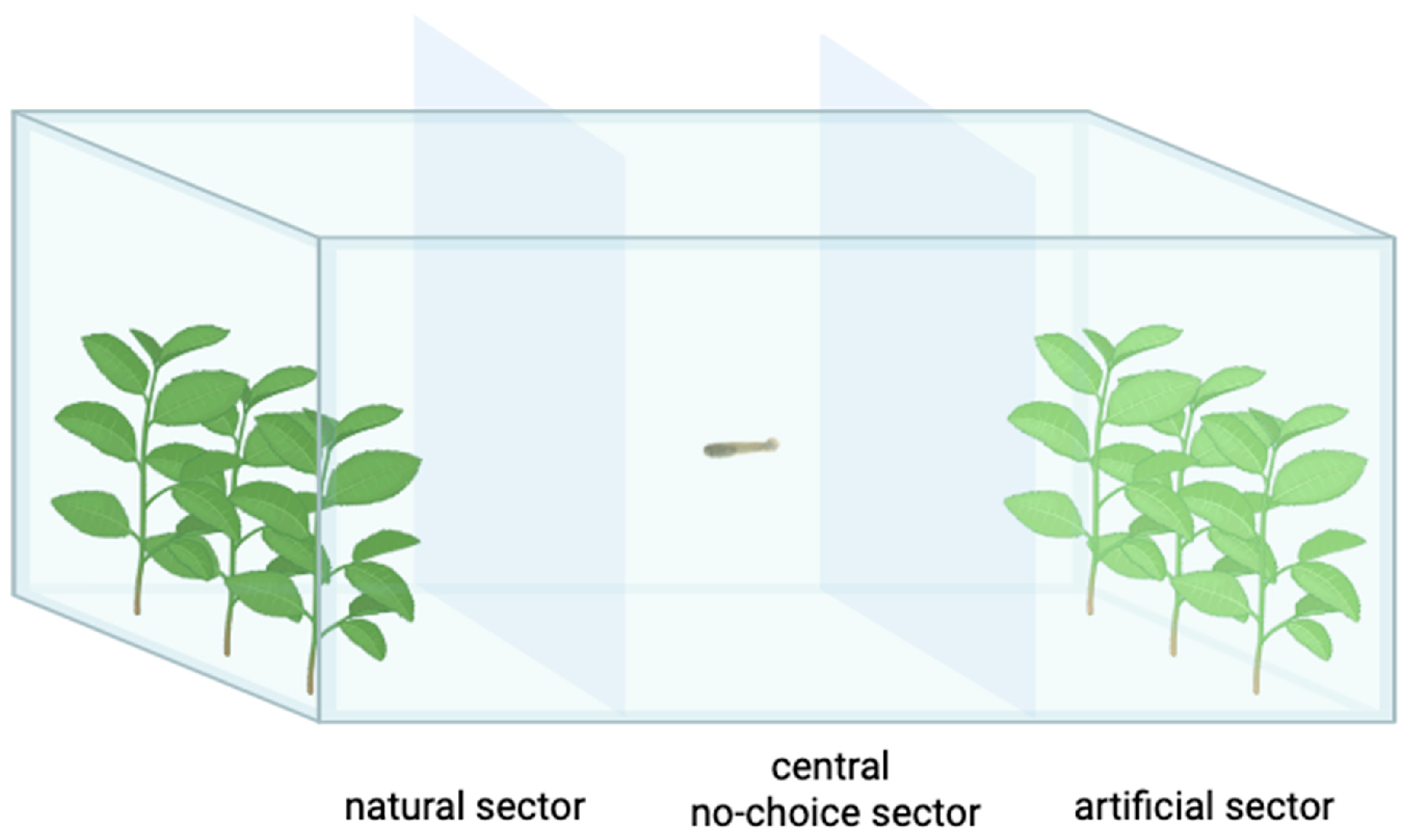
29], with only minor modifications introduced to accommodate the specific aims of the present study. Briefly, fish were observed in rectangular tanks divided into three virtual sectors. The two lateral sectors contained the experimental stimuli (natural versus artificial plants), while the central sector served as a neutral area. By quantifying the time spent by each fish in the different sectors, we aimed to assess their preference for natural compared to artificial plants.
2.3. Experimental Apparatus and Plant Stimuli
The experimental apparatus consisted of a rectangular tank (42 cm × 16 cm × 15 cm). The tank was made of white plastic, and it was filled with water to a depth of 10 cm (
Figure 1). We used of multiple identical copies of the apparatus (N = 12) to ensure that multiple trials could be conducted simultaneously. Illumination was provided by a 20 W LED strip (6500 K; TMR), positioned as a single strip above the centre of each apparatus to deliver uniform and diffuse lighting.
The preference test was based on the presentation of real and artificial aquatic plants belonging to the three species (Egeria densa, Bacopa caroliniana, and Hygrophila polysperma). Plant species selection was guided by practical considerations, as they are commonly used in tropical freshwater aquaria, are easy to maintain under laboratory conditions, and possess comparable structural traits. Furthermore, for each of these natural plant species, a corresponding artificial counterpart with similar features was available. To ensure comparability between conditions and to isolate the variable of interest (i.e., natural versus artificial origin), particular care was taken to standardise the physical characteristics of the plants. Real plants were trimmed to individual stems measuring 6 cm in length, and artificial plants were cut and adjusted to match this size as closely as possible. Each stem, whether natural or artificial, was attached to a small weight (ceramic biofilter ring) to prevent floating and to maintain a stable and consistent position within the tank throughout the trial.
Three stems of real plants were placed at one end of the tank, while three stems of artificial plants were positioned at the opposite end, thereby creating two distinct but structurally comparable choice environments. A preliminary analysis indicated that plant species did not significantly affect subjects’ preferences (F2,48 = 0.063, p = 0.939), allowing the data to be pooled across plant species without introducing systematic bias. To further control for potential side preferences or spatial biases, the position of real and artificial plants was alternated systematically across subjects. Throughout the experimental period, an air stone connected to an aerator was positioned in the central sector of the apparatus to ensure water circulation and oxygenation.
2.4. Testing Procedure
Testing began by randomly selecting a subject and gently placing it in the central area of the apparatus, equidistant from both stimulus zones. The stimuli were already in place in the apparatus before the subject was introduced. Immediately following placement, A. salina nauplii were delivered using a Pasteur pipette. The transport and the feeding were performed by the same experimenter, maintaining consistency across individual subjects. The subjects were then left undisturbed within the testing apparatus for a period of five days prior to the main behavioural observation. Throughout the experimental period, fish remained in the apparatus and were fed regularly (in the centre of the apparatus) following the maintenance schedule with commercial flakes and A. salina nauplii.
The use of an extended habituation period was based on previous findings demonstrating that prolonged exposure to a novel environment reduces stress responses and facilitates a more reliable assessment of spontaneous environmental preferences [
32,
33]. When first introduced into an unfamiliar setting, small laboratory fish typically exhibit antipredator responses, including increased thigmotaxis and a tendency to seek shelter or remain in protected areas. Such behaviours can mask underlying preference patterns, particularly when both available options provide refuge. Moreover, in novel environments, fish often exhibit a freezing response, which may prevent them from evaluating both stimuli and lead to a random choice. Because the aim of the present study was to assess habitat preference independently of immediate shelter-seeking behaviour, and given that both experimental conditions offered structurally similar protection that may be difficult to discriminate, we focused on measuring preference after an acclimation interval. The selection of a 5-day habituation period was based on empirical evidence from Varracchio et al. [
29] showing that preference for a given environment emerges and can be more reliably measured in this species after five days of habituation to the apparatus. As a control condition, we also observed subjects’ behaviour immediately following their initial introduction into the apparatus. As expected, no significant preference was observed during this early phase, supporting the interpretation that initial responses were primarily driven by general shelter-seeking behaviour rather than by a specific attraction to natural or artificial stimuli.
Each behavioural observation session consisted of a 20 min recording period conducted at a fixed time of day (starting at 9:30 a.m.) in order to minimise potential effects of circadian variation on behavioural activity. The behaviour of the subjects was recorded using a digital video camera (IMX179; Sony, Tokyo, Japan) mounted above the apparatus, providing a top-down view of the experimental arena. This recording setup allowed for accurate and unbiased quantification of spatial behaviour and enabled subsequent offline scoring and analysis of the data.
2.5. Behavioural Data Collection
The behavioural recordings were analysed offline through video playback on a computer monitor. During playback, the experimental apparatus was virtually divided into three distinct but equally sized sectors by means of a transparent overlay applied to the screen. Following the procedure described in Varracchio et al. [
29], the first sector corresponded to the area containing natural stimuli, the second represented the central no-choice sector, and the third corresponded to the area containing artificial stimuli. This approach allowed us to quantify a simple, yet effective, measure of choice based on the time spent in each sector, as commonly done in studies on fish preferences (reviewed in [
34,
35]). It is expected that the more a sector is preferred, the more time the subject will spend in it. Given the relatively small size of the sectors, it is unlikely that a subject would enter a sector randomly without perceiving the associated stimuli, as entry would place it in close proximity to the plants.
Due to the difficulty of implementing reliable automated tracking in environments where plants partially obstruct the subjects’ position, the recordings were scored by an experimenter using custom software (‘Ciclic Timer’). This software provides a set of independent timers that can be activated by the experimenter using different keys on a computer keyboard. Each timer was associated with a specific sector of the test apparatus, allowing for precise and continuous quantification of the time spent by each subject in the respective sectors.
Time spent in each sector was used to compute preference indices [
36]. Preference for natural plants was calculated as the proportion of time spent in the sector containing natural plants relative to the total time spent in the two lateral sectors (i.e., excluding the central no-choice sector from this calculation). In contrast, preference for the central sector was calculated as the proportion of time spent in the central area relative to the total observation time.
To account for potential temporal dynamics in behaviour, the 20 min observation period was divided into ten consecutive 2 min time blocks (e.g., [
37]). This allowed us to examine how preferences evolved over the course of the testing session and to identify any time-dependent patterns in choice behaviour.
2.6. Statistical Analysis
All statistical analyses were conducted using RStudio (version 2022.02.3). Descriptive statistics are reported as mean ± standard deviation (SD), and the threshold for statistical significance was set at p = 0.05.
The proportion of time spent in the central sector was analysed using a linear mixed-effects model, with ‘minute block’ included as a fixed effect and subject identity included as a random effect to account for repeated measures across time.
To analyse preference for the sector containing natural plants, we first verified that the data met the assumptions of normality using the Shapiro–Wilk test, ensuring that no data transformation was required [
38]. Preference values (calculated excluding the central sector, as described above) were then compared against chance level (50%, reflecting equal use of the two lateral sectors) using one-sample
t-tests. On this preference variable, we additionally run an analysis based on a linear mixed-effects model, with ‘minute block’ included as a fixed effect and subject identity as a random effect.
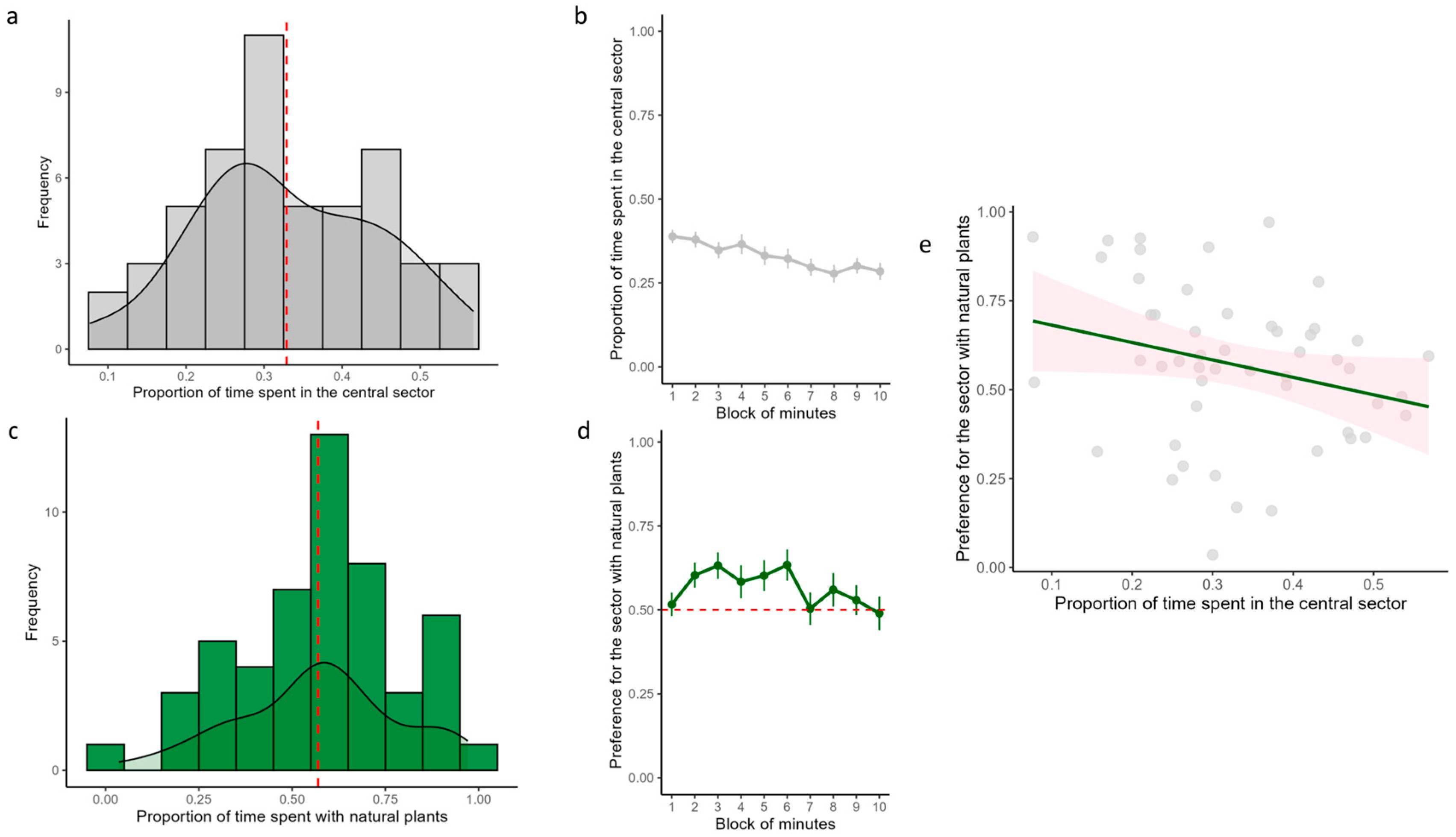
Finally, Pearson’s correlation analysis was used to assess the relationship between the proportion of time spent in the central sector and the strength of preference for natural plants.
4. Discussion
Our results suggest that a fish species, the guppy (
P. reticulata), shows a measurable preference for natural plants over structurally similar artificial ones. This preference for natural plants observed in guppies is consistent with previous research emphasising the ecological importance of vegetation for this species, as well as with research on another fish, the betta (
Betta splendens; [
39]). Aquatic plants are known to function as critical refuges from predators and to provide essential microhabitats that support foraging activities as well as social interactions [
40,
41]. However, it is important to note that some of these functional benefits, particularly those related to protection and shelter, could also be provided by artificial plants. The fact that a preference for natural plants still emerged in spite of the benefit of the artificial plants suggests the presence of a recognition mechanism for natural stimuli in guppies. In other words, guppies did not simply respond to the availability of refuge, which could be provided by both natural and artificial plants, but instead discriminated between the two types of stimuli. One possible interpretation is that guppies are able to distinguish natural from artificial plants through visual and/or chemical cues and consequently prefer to occupy the sector containing natural vegetation. At the same time, the mechanism underlying the discrimination and the preference observed in guppies may be indirect. For instance, although both natural and artificial plants were expected to develop biofilm under aquarium conditions, it is plausible that the microbial communities associated with live plants are more complex and diverse [
42]. It is also possible that, despite the small size of the apparatus, oxygenation levels during the test were higher in the water surrounding the natural plants. Such differences could contribute indirectly to the observed preference. In our study, we did not analyse these potential secondary factors. Consequently, while our findings are consistent with an attraction to natural stimuli, further work is needed to disentangle the specific features driving this behaviour.
It is also noteworthy that, although statistically significant, the preference measured was relatively modest in magnitude. During the fluctuations observed across the testing period, it often approached chance levels. On the one hand, this may be due to the fact that preference measures based on time spent in a given sector may not be highly discriminating for this type of experimental question. Part of this effect may be due to interference from other behaviours expressed in our experimental setting, as suggested by the near-significant effect of time spent in the centre of the apparatus in predicting preference. Additional approaches, such as forced-choice tests (e.g., T-mazes) or other behavioural variables (e.g., number of interactions or approaches), may therefore be useful to confirm these findings. On the other hand, it is also possible that the preference for natural plants is inherently modest, irrespective of the paradigm adopted. This would suggest that artificial plants may still have provided some degree of attraction, possibly functioning as an alternative form of refuge. Accordingly, observations conducted immediately after introducing subjects into the testing apparatus indicated that both artificial and natural plants elicited similar levels of attraction, likely because both options offered comparable shelter in a novel and potentially threatening environment. Only after a five-day habituation period, once the subjects had acclimated to the apparatus and had the opportunity to explore it more thoroughly, did a clear preference for natural plants become apparent. This temporal pattern is consistent with previous findings in guppies, which indicate that an initial phase of habituation is necessary when the aim is to assess environmental preferences rather than immediate antipredator responses [
29]. In the absence of such habituation, behaviour is likely dominated by shelter-seeking tendencies and freezing, which may obscure more subtle preference patterns for specific environmental features.
The relatively modest strength of the preference observed in the present study also raises interesting methodological and applied implications. First, it suggests that artificial stimuli may, under certain conditions, be effectively used to investigate environmental and habitat preferences in fish. While such an approach would inevitably reduce ecological realism, it would allow for greater experimental control over stimulus properties and may be particularly valuable in studies focusing on aquatic environments that are already heavily influenced by artificial structures and materials [
43,
44,
45,
46]. Second, our results provide insights into the common practice of using environmental enrichment to improve the welfare of animals kept in captive conditions (e.g., [
39,
47,
48,
49]). We suggest that a balanced interpretation of our findings is that natural plants represent the most suitable enrichment option, as they are preferred by the fish but that given that the observed preference was relatively modest, artificial plants may still represent a viable alternative in situations where the use of natural vegetation is impractical or not feasible. Therefore, while the provision of natural plants should be prioritised as an enrichment strategy for fish in captivity, artificial structures may also be considered under certain conditions. Importantly, this conclusion is context-dependent and should be carefully evaluated in relation to the specific environmental, logistical, and husbandry constraints of each setting.
Despite the need for habituation, the preference for natural plants was observed early in development, at a stage when guppies had no prior experience with external environments. Because no explicit reward was associated with choosing the sector containing natural plants, the most parsimonious interpretation, although not the only possible one, is that the observed behaviour may be driven by innate mechanisms rather than learned associations. While this interpretation requires further empirical validation, the presence of such an innate bias would be consistent with the idea that preferences for natural environments have been shaped by natural selection in order to enhance survival and fitness [
1]. It would be valuable to systematically investigate preferences for natural environments in other species to further test this hypothesis. Moreover, an aspect that needs to be more directly addressed is the role of experience in shaping environmental preferences. Although we attempted to minimize this factor by using newborn subjects, it cannot be excluded that at least part of the preference for certain environments is influenced by prenatal exposure to environmental cues and epigenetic factors. In this sense, the prior experience of the parents with plants and natural habitats before producing the offspring used in these experiments should also be controlled.





 ,
,