

Monoterpenes as Natural Anesthetics to Mitigate Stress in Fish: Advances Using the Zebrafish Larvae Model

 , ,
, ,  and
and 
Abstract
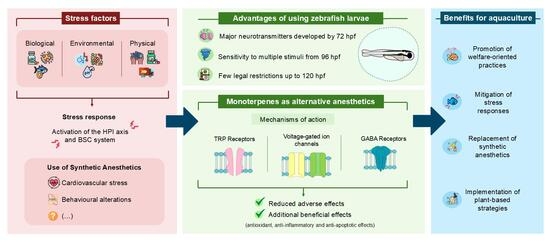
1. Introduction
2. Stress Physiology in Fish
2.1. Functioning and Description of the Hypothalamus–Pituitary–Interrenal (HPI) Axis
2.2. Physiological Responses to Stress
2.3. Stress-Inducing Factors in Aquaculture
3. Zebrafish as a Model for Stress and Anesthesia Research
3.1. Advantages of the Zebrafish Model for Aquaculture Research
3.2. Zebrafish Larvae as a Model for Stress Research
3.3. Zebrafish Larvae as a Model for Anesthesia Research
4. Synthetic vs. Natural Anesthetics for Fish
4.1. Anesthesia as a Strategy to Reduce Stress
4.2. Aversive Properties of Conventional Anesthetics
4.3. Monoterpenes as Alternative Stress-Reducing and Anesthetic Agents
4.4. Physiological Effects and Applications of Monoterpenes
5. Limitations and Future Directions
6. Conclusions
Author Contributions
Funding
Institutional Review Board Statement
Informed Consent Statement
Data Availability Statement
Conflicts of Interest
Abbreviations
| MS-222 | Tricaine methanesulfonate |
| HPI | Hypothalamus–pituitary–interrenal |
| HPA | Hypothalamus–pituitary–adrenal |
| CNS | Central nervous system |
| CRH | Corticotropin-releasing hormone |
| ACTH | Adrenocorticotropic hormone |
| BSC | Brain–sympathetic–chromaffin |
| ANIT | European Parliament’s Committee of Inquiry on the Protection of Animals during Transport |
| WOAH | World Organization for Animal Health |
| hpf | Hours post-fertilization |
| GC | Glucocorticoid |
| MR | Mineralocorticoid receptor |
| GST | Glutathione s-transferase |
| dpf | Days post-fertilization |
| GABA | Gamma-aminobutyric acid |
| NMDA | N-methyl-D-aspartate |
| TRPV-1 | Transient receptor potential vanilloid-1 |
References
- Bonga, S.E.W. The stress response in fish. Physiol. Rev. 1997, 77, 591–625. [Google Scholar] [CrossRef]
- Barton, B.A. Stress in fishes: A diversity of responses with particular reference to changes in circulating corticosteroids. Integr. Comp. Biol. 2002, 42, 517–525. [Google Scholar] [CrossRef]
- Gorissen, M.; Flik, G. The Endocrinology of the Stress Response in Fish, in Biology of Stress in Fish. In Fish Physiology; Schreck, C.B., Tort, L., Farrell, A.P., Brauner, C.J., Eds.; Academic Press: Amsterdam, The Netherlands, 2016; pp. 75–111. [Google Scholar]
- Flik, G.; Klaren, P.H.M.; van den Burg, E.H.; Metz, J.R.; Huising, M.O. CRF and stress in fish. Gen. Comp. Endocrinol. 2006, 146, 36–44. [Google Scholar] [CrossRef] [PubMed]
- Huising, M.O.; Flik, G. The remarkable conservation of corticotropin-releasing hormone-binding protein in the stress axis of vertebrates. Gen. Comp. Endocrinol. 2005, 144, 104–113. [Google Scholar]
- Alsop, D.; Vijayan, M.M. Development of the corticosteroid stress axis and receptor expression in zebrafish. Am. J. Physiol. Regul. Integr. Comp. Physiol. 2008, 294, R711–R719. [Google Scholar] [CrossRef] [PubMed]
- Mommsen, T.P.; Vijayan, M.M.; Moon, T.W. Cortisol in teleosts: Dynamics, mechanisms of action, and metabolic regulation. Rev. Fish Biol. Fish. 1999, 9, 211–268. [Google Scholar] [CrossRef]
- Reid, S.G.; Bernier, N.J.; Perry, S.F. The adrenergic stress response in fish: Control of catecholamine storage and release. Comp. Biochem. Physiol. Part C 1998, 120, 1–27. [Google Scholar] [CrossRef]
- Sopinka, N.M.; Donaldson, M.R.; O’Connor, C.M.; Suski, C.D.; Cooke, S.J. Stress Indicators in Fish. In Biology of Stress in Fish: Fish Physiology; Schreck, C.B., Tort, L., Farrel, A.P., Brauner, C.J., Eds.; Elsevier: Amsterdam, The Netherlands, 2016; pp. 405–462. [Google Scholar] [CrossRef]
- Martínez-Porchas, M.; Martínez-Córdova, L.R.; Ramos-Enriquez, R. Cortisol and Glucose: Reliable indicators of fish stress? Pan-Am. J. Aquat. Sci. 2009, 4, 158–178. [Google Scholar]
- Mandelman, J.W.; Skomal, G.B. The physiological stress response in elasmobranch fishes: Selected papers from a symposium at the 26th annual meeting of the American Elasmobranch Society. Comp. Biochem. Physiol. Part A Mol. Integr. Physiol. 2012, 162, 71–72. [Google Scholar] [CrossRef]
- Rehman, S.; Gora, A.H.; Ahmad, I.; Rasool, S.I. Stress in Aquaculture Hatcheries: Source Impact and Mitigation. Int. J. Curr. Microbiol. Appl. Sci. 2017, 6, 3030–3045. [Google Scholar] [CrossRef]
- Ciji, A.; Akhtar, M.S. Stress management in aquaculture: A review of dietary interventions. Rev. Aquacult. 2021, 13, 2190–2247. [Google Scholar] [CrossRef]
- Varghese, T.; Ebeneeza, S.; Ahmad Dar, S.; Kumar Pal, A. Mitigation of stress in fish through nutraceuticals. World J. Aquac. Res. Dev. 2021, 3, 1014. [Google Scholar]
- Brandão, M.L.; Dorigao-Guimaraes, F.; Bolognesi, M.C.; Gauy, A.C.S.; Pereira, A.V.S.; Vian, L.; Carvalho, T.B.; Goncalves-de-Freitas, E. Understanding behaviour to improve the welfare of an ornamental fish. J. Fish Biol. 2021, 99, 726–739. [Google Scholar] [CrossRef]
- Valcarce, D.G.; Sellés-Egea, A.; Riesco, M.F.; De Garnica, M.G.; Martínez-Fernández, B.; Herráez, M.P.; Robles, V. Early stress exposure on zebrafish development: Effects on survival, malformations and molecular alterations. Fish Physiol. Biochem. 2024, 50, 1545–1562. [Google Scholar] [CrossRef]
- Best, C.; Kurrasch, D.M.; Vijayan, M.M. Maternal cortisol stimulates neurogenesis and affects larval behaviour in zebrafish. Sci. Rep. 2017, 7, 40905. [Google Scholar] [CrossRef]
- Higuchi, M. Maternal stress suppresses cell proliferation in the forebrain of zebrafish larvae. Genes Cells 2020, 25, 350–357. [Google Scholar] [CrossRef] [PubMed]
- Chin, J.S.R.; Phan, T.N.; Albert, L.T.; Keene, A.C.; Duboué, E.R. Long lasting anxiety following early life stress is dependent on glucocorticoid signaling in zebrafish. Sci. Rep. 2022, 12, 12826. [Google Scholar] [CrossRef] [PubMed]
- Fan, X.; Hou, T.; Sun, T.; Zhu, L.; Zhang, S.; Tang, K.; Wang, Z. Starvation stress affects the maternal development and larval fitness in zebrafish (Danio rerio). Sci. Tot. Environ. 2019, 695, 133897. [Google Scholar] [CrossRef]
- Ashley, P.J. Fish welfare: Current issues in aquaculture. Appl. Anim. Behav. Sci. 2007, 104, 199–235. [Google Scholar] [CrossRef]
- Gabriel, U.U.; Akinrotimi, O.A. Management of stress in fish for sustainable aquaculture development. Researcher 2011, 3, 28–38. [Google Scholar]
- Becker, A.G.; Cunha, M.A.; Garcia, L.O.; Zeppenfeld, C.C.; Parodi, T.V.; Maldaner, G.; Morel, A.F.; Baldisserotto, B. Efficacy of eugenol and the methanolic extract of Condalia buxifolia during the transport of the silver catfish Rhamdia quelen. Neotrop. Ichthyol. 2013, 11, 675–681. [Google Scholar] [CrossRef]
- Parodi, T.V.; Cunha, M.A.; Becker, A.G.; Zeppenfeld, C.C.; Martins, D.I.; Koakoski, G.; Barcellos, L.G.; Heinzmann, B.M.; Baldisserotto, B. Anesthetic activity of the essential oil of Aloysia triphylla and effectiveness in reducing stress during transport of albino and gray strains of silver catfish, Rhamdia quelen. Fish. Physiol. Biochem. 2014, 40, 323–334. [Google Scholar] [CrossRef]
- Teixeira, R.R.; Souza, R.; Sena, A.C.; Baldisserotto, B.; Heinzmann, B.M.; Copatti, C.E. Essential oil of Aloysia triphylla is effective in Nile tilapia transport. Bol. Inst. Pesca 2018, 44, 17–24. [Google Scholar] [CrossRef]
- Lim, L.C.; Dhert, P.; Sorgeloos, P. Recent developments and improvements in ornamental fish packaging systems for air transport. Aquacult. Res. 2003, 34, 923–935. [Google Scholar] [CrossRef]
- Luz, R.K.; Favero, G.C. Use of Salt, Anesthetics, and Stocking Density in Transport of Live Fish: A Review. Fishes 2024, 9, 286. [Google Scholar] [CrossRef]
- Sherif, A.H.; Eldessouki, E.A.; Sabry, N.M.; Ali, N.G. The protective role of iodine and MS-222 against stress response and bacterial infections during Nile tilapia (Oreochromis niloticus) transportation. Aquacult. Int. 2023, 31, 401–416. [Google Scholar] [CrossRef]
- Zhang, H.; Wang, Q.; Dong, Y.; Mei, J.; Xie, J. Effects of tricaine methanesulphonate (MS-222) on physiological stress and fresh quality of sea bass (Lateolabrax maculatus) under simulated high-density and long-distance transport stress. Biology 2023, 12, 223. [Google Scholar] [CrossRef] [PubMed]
- Bortoletti, M.; Fonsatti, E.; Leva, F.; Maccatrozzo, L.; Ballarin, C.; Radaelli, G.; Caberlotto, S.; Bertotto, D. Influence of Transportation on Stress Response and Cellular Oxidative Stress Markers in Juvenile Meagre (Argyrosomus regius). Animals 2023, 13, 3288. [Google Scholar] [CrossRef] [PubMed]
- Brandão, F.R.; Duncan, W.P.; Farias, C.F.S.; de Melo Souza, D.C.; de Oliveira, M.I.B.; Rocha, M.J.S.; Monteiro, P.C.; Majolo, C.; Chaves, F.C.M.; de Almeida O’Sullivan, F.L. Essential oils of Lippia sidoides and Mentha piperita as reducers of stress during the transport of Colossoma macropomum. Aquaculture 2022, 560, 738515. [Google Scholar] [CrossRef]
- Becker, A.G.; Parodi, T.V.; Heldwein, C.G.; Zeppenfeld, C.C.; Heinzmann, B.M.; Baldisserotto, B. Transportation of silver catfish, Rhamdia quelen, in water with eugenol and the essential oil of Lippia alba. Fish Physiol. Biochem. 2012, 38, 789–796. [Google Scholar] [CrossRef]
- Harmon, T.S. Methods for reducing stressors and maintaining water quality associated with live fish transport in tanks: A review of the basics. Rev. Aquacult. 2009, 1, 58–66. [Google Scholar] [CrossRef]
- Zeppenfeld, C.C.; Toni, C.; Becker, A.G.; Miron, D.D.; Parodi, T.V.; Heinzmann, B.M.; Barcellos, L.J.G.; Koakoski, G.; da Rosa, J.G.S.; Loro, V.L.; et al. Physiological and biochemical responses of silver catfish, Rhamdia quelen, after transport in water with essential oil of Aloysia triphylla (L’Herit) Britton. Aquaculture 2014, 418, 101–107. [Google Scholar] [CrossRef]
- Lemos, L.S.; Angarica, L.M.; Hauser-Davis, R.A.; Quinete, N. Cortisol as a Stress Indicator in Fish: Sampling Methods Analytical Techniques Organic Pollutant Exposure Assessments. Int. J. Environ. Res. Public Health 2023, 20, 6237. [Google Scholar] [CrossRef]
- Gomes, L.C.; Chagas, E.C.; Brinn, R.P.; Roubach, R.; Coppati, C.E.; Baldisserotto, B. Use of salt during transportation of air breathing pirarucu juveniles (Arapaima gigas) in plastic bags. Aquaculture 2006, 256, 521–528. [Google Scholar] [CrossRef]
- Souza, C.F.; Baldissera, M.D.; Baldisserotto, B.; Heinzmann, B.M.; Martos-Sitcha, J.A.; Mancera, J.M. Essential Oils as Stress-Reducing Agents for Fish Aquaculture: A Review. Front. Physiol. 2019, 10, 785. [Google Scholar] [CrossRef] [PubMed]
- Mu, X.; Pang, S.; Sun, X.; Gao, J.; Chen, J.; Chen, X.; Li, X.; Wang, C. Evaluation of acute and developmental effects of difenoconazole via multiple stage zebrafish assays. Environ. Pollut. 2013, 175, 147–157. [Google Scholar] [CrossRef] [PubMed]
- Evers, H.-G.; Pinnegar, J.K.; Taylor, M.I. Where are they all from?—Sources sustainability in the ornamental freshwater fish trade. J. Fish. Biol. 2019, 94, 909–916. [Google Scholar] [CrossRef] [PubMed]
- Browning, H. Improving welfare assessment in aquaculture. Front. Vet. Sci. 2023, 10, 1060720. [Google Scholar] [CrossRef]
- Mancuso, M. Fish welfare in aquaculture. J. Aquacult. Res. Dev. 2013, 4, e107. [Google Scholar] [CrossRef]
- Toni, M.; Manciocco, A.; Angiulli, E.; Alleva, E.; Cioni, C.; Malavasi, S. Review: Assessing fish welfare in research and aquaculture, with a focus on European directives. Animal 2019, 13, 161–170. [Google Scholar] [CrossRef]
- Martos-Sitcha, J.A.; Mancera, J.M.; Prunet, P.; Magnoni, L.J. Editorial: Welfare and Stressors in Fish: Challenges Facing Aquaculture. Front. Physiol. 2020, 11, 162. [Google Scholar] [CrossRef]
- Ciliberti, R.; Alfano, L.; Petralia, P. Ethics in aquaculture: Animal welfare environmental sustainability. J. Prev. Med. Hyg. 2023, 64, e443–e447. [Google Scholar] [CrossRef]
- Stevens, C.H.; Croft, D.P.; Paull, G.C.; Tyler, C.R. Stress welfare in ornamental fishes: What can be learned from aquaculture? J. Fish Biol. 2017, 91, 409–428. [Google Scholar] [CrossRef]
- Minaz, M.; Félix, L. Trends and advancements in fish anaesthesia over the last decade. Aquaculture 2026, 612, 743147. [Google Scholar] [CrossRef]
- Eachus, H.; Choi, M.K.; Ryu, S. The Effects of Early Life Stress on the Brain and Behaviour: Insights From Zebrafish Models. Front. Cell Dev. Biol. 2021, 9, 657591. [Google Scholar] [CrossRef]
- Felix, L.; Coimbra, A.M.; Valentim, A.M.; Antunes, L. Review on the use of zebrafish embryos to study the effects of anesthetics during early development. Crit. Rev. Toxicol. 2019, 49, 357–370. [Google Scholar] [CrossRef]
- Jørgensen, L.V.G. Zebrafish as a Model for Fish Diseases in Aquaculture. Pathogens 2020, 9, 609. [Google Scholar] [CrossRef] [PubMed]
- Ulloa, P.E.; Medrano, J.F.; Feijoo, C.G. Zebrafish as animal model for aquaculture nutrition research. Front. Genet. 2014, 5, 313. [Google Scholar] [CrossRef] [PubMed]
- Strahle, U.; Scholz, S.; Geisler, R.; Greiner, P.; Hollert, H.; Rastegar, S.; Schumacher, A.; Selderslaghs, I.; Weiss, C.; Witters, H.; et al. Zebrafish embryos as an alternative to animal experiments-a commentary on the definition of the onset of protected life stages in animal welfare regulations. Reprod. Toxicol. 2012, 33, 128–132. [Google Scholar] [CrossRef]
- Rico, E.P.; Rosemberg, D.B.; Seibt, K.J.; Capiotti, K.M.; Da Silva, R.S.; Bonan, C.D. Zebrafish neurotransmitter systems as potential pharmacological and toxicological targets. Neurotoxicol. Teratol. 2011, 33, 608–617. [Google Scholar] [CrossRef]
- Ribas, L.; Piferrer, F. The zebrafish (Danio rerio) as a model organism, with emphasis on applications for finfish aquaculture research. Rev. Aquacult. 2014, 6, 209–240. [Google Scholar] [CrossRef]
- Zon, L.I.; Peterson, R.T. In vivo drug discovery in the zebrafish. Nat. Rev. Drug Discov. 2005, 4, 35–44. [Google Scholar] [CrossRef]
- McGrath, P.; Li, C.Q. Zebrafish: A predictive model for assessing drug-induced toxicity. Drug Discov. Today 2008, 13, 394–401. [Google Scholar] [CrossRef]
- Vieira, R.; Venâncio, C.A.S.; Félix, L.M. Toxic effects of a mancozeb-containing commercial formulation at environmental relevant concentrations on zebrafish embryonic development. Environ. Sci. Pollut. Res. Int. 2020, 27, 21174–21187. [Google Scholar] [CrossRef] [PubMed]
- Lee-Estevez, M.; Figueroa, E.; Cosson, J.; Short, S.E.; Valdebenito, I.; Ulloa-Rodríguez, P.; Farías, J.G. Zebrafish as a useful model for immunological research with potential applications in aquaculture. Rev. Aquacult. 2018, 10, 213–223. [Google Scholar] [CrossRef]
- Dahm, R.; Geisler, R. Learning from small fry: The zebrafish as a genetic model organism for aquaculture fish species. Mar. Biotechnol. 2006, 8, 329–345. [Google Scholar] [CrossRef] [PubMed]
- Schroeder, P.G. The welfare of zebrafish. In Laboratory Fish in Biomedical Research; D’Angelo, L., de Girolamo, P., Eds.; Academic Press: Amsterdam, The Netherlands, 2022; pp. 101–117. [Google Scholar] [CrossRef]
- Steenbergen, P.J.; Richardson, M.K.; Champagne, D.L. The use of the zebrafish model in stress research. Prog. Neuro-psychopharmacol. Biol. Psychiatry 2011, 35, 1432–1451. [Google Scholar] [CrossRef]
- Piferrer, F.; Ribas, L. The use of the zebrafish as a model in fish aquaculture research. In Fish Physiology; Benfey, T.J., Farrell, A.P., Brauner, C.J., Eds.; Academic Press: Amsterdam, The Netherlands, 2020; pp. 273–313. [Google Scholar] [CrossRef]
- Spagnoli, S.; Lawrence, C.; Kent, M.L. Stress in Fish as Model Organisms. In Fish Physiology; Schreck, C.B., Tort, L., Farrell, A.P., Brauner, C.J., Eds.; Academic Press: Amsterdam, The Netherlands, 2016; pp. 541–564. [Google Scholar] [CrossRef]
- Rosa, J.G.S.; Lima, C.; Lopes-Ferreira, M. Zebrafish Larvae Behavior Models as a Tool for Drug Screenings Pre-Clinical Trials: A Review. Int. J. Molec. Sci. 2022, 23, 6647. [Google Scholar] [CrossRef]
- Basnet, R.M.; Zizioli, D.; Taweedet, S.; Finazzi, D.; Memo, M. Zebrafish Larvae as a Behavioral Model in Neuropharmacology. Biomedicines 2019, 7, 23. [Google Scholar] [CrossRef]
- de Marco, R.J. The Potential of Zebrafish Larvae and Water Vortex Protocols in Stress Biology. Endocrines 2025, 6, 11. [Google Scholar] [CrossRef]
- Faught, E.; Vijayan, M.M. The mineralocorticoid receptor is essential for stress axis regulation in zebrafish larvae. Sci. Rep. 2018, 8, 18081. [Google Scholar] [CrossRef]
- Rudneva, I. Biomarkers for Stress in Fish Embryos and Larvae, 1st ed.; CRC Press: Boca Raton, FL. USA, 2014; pp. 1–15. [Google Scholar] [CrossRef]
- Pietsch, C.; Konrad, J.; Pawlak, P. Acute Stress Effects over Time on Gene Expression Patterns in the Male Zebrafish (Danio rerio) Brain. Animals 2025, 15, 2431. [Google Scholar] [CrossRef]
- Li, X.; Fu, C.; Tan, X.; Fu, S. Responses of zebrafish to chronic environmental stressors: Anxiety-like behavior and its persistence. Front. Mar. Sci. 2025, 12, 1551595. [Google Scholar] [CrossRef]
- Alsop, D.; Vijayan, M.M. Molecular programming of the corticosteroid stress axis during zebrafish development. Comp. Biochem. Physiol. Part A Molec. Integr. Physiol. 2009, 153, 49–54. [Google Scholar] [CrossRef] [PubMed]
- Faught, E.; Vijayan, M.M. Coordinated Action of Corticotropin-Releasing Hormone and Cortisol Shapes the Acute Stress-Induced Behavioural Response in Zebrafish. Neuroendocrinol 2022, 112, 74–87. [Google Scholar] [CrossRef]
- Castillo-Ramírez, L.A.; Ryu, S.; de Marco, R.J. Active behaviour during early development shapes glucocorticoid reactivity. Sci. Rep. 2019, 9, 12796. [Google Scholar] [CrossRef] [PubMed]
- Castillo-Ramirez, L.A.; Ryu, S.; de Marco, R.J. Cortisol dynamics and GR-dependent feedback regulation in zebrafish larvae exposed to repeated stress. Biol. Open 2024, 13, bio061683. [Google Scholar] [CrossRef] [PubMed]
- Vieira, R.S.F.; Venâncio, C.A.S.; Félix, L.M. Behavioral, metabolic, and biochemical alterations caused by an acute stress event in a zebrafish larvae model. Fish. Physiol. Biochem. 2025, 51, 25. [Google Scholar] [CrossRef]
- Eissa, N.; Wang, H.-P. Transcriptional stress responses to environmental and husbandry stressors in aquaculture species. Rev. Aquacult. 2016, 8, 61–88. [Google Scholar] [CrossRef]
- Ehrlich, O.; Karamalakis, A.; Krylov, A.J.; Dudczig, S.; Hassell, K.L.; Jusuf, P.R. Clove Oil and AQUI-S Efficacy for Zebrafish Embryo, Larva, and Adult Anesthesia. Zebrafish 2019, 16, 451–459. [Google Scholar] [CrossRef]
- Félix, L.; Campos, S.; Guedes de Pinho, P.; Antunes, L.; Valentim, A.M. Early developmental effects of propofol exposure in different stages of zebrafish embryos. Toxicol. Lett. 2025, 403, 84–93. [Google Scholar] [CrossRef]
- Eto, K.; Mazilu-Brown, J.K.; Henderson-MacLennan, N.; Dipple, K.M.; McCabe, E.R.B. Development of catecholamine and cortisol stress responses in zebrafish. Molec. Genet. Metabol. Rep. 2014, 1, 373–377. [Google Scholar] [CrossRef]
- de Abreu, M.S.; Demin, K.A.; Giacomini, A.; Amstislavskaya, T.G.; Strekalova, T.; Maslov, G.O.; Kositsin, Y.; Petersen, E.V.; Kalueff, A.V. Understanding how stress responses and stress-related behaviors have evolved in zebrafish and mammals. Neurobiol. Stress 2021, 15, 100405. [Google Scholar] [CrossRef] [PubMed]
- Rombough, P. The energetics of embryonic growth. Respir. Physiol. Neurobiol. 2011, 178, 22–29. [Google Scholar] [CrossRef] [PubMed]
- Rombough, P.J. Ontogenetic changes in the toxicity and efficacy of the anaesthetic MS222 (tricaine methanesulfonate) in zebrafish (Danio rerio) larvae. Comp. Biochem. Physiol. Part. A Mol. Integr. Physiol. 2007, 148, 463–469. [Google Scholar] [CrossRef]
- Bedell, V.; Buglo, E.; Marcato, D.; Pylatiuk, C.; Mikut, R.; Stegmaier, J.; Scudder, W.; Wray, M.; Züchner, S.; Strähle, U. Zebrafish: A pharmacogenetic model for anesthesia. Methods Enzymol. 2018, 602, 189–209. [Google Scholar] [CrossRef] [PubMed]
- Felix, L.M.; Luzio, A.; Themudo, M.; Antunes, L.; Matos, M.; Coimbra, A.M.; Valentim, A.M. MS-222 short exposure induces developmental and behavioural alterations in zebrafish embryos. Reprod. Toxicol. 2018, 81, 122–131. [Google Scholar] [CrossRef]
- Rocha, C.A.; Félix, L.M.; Monteiro, S.M.; Venâncio, C.A. Antinociceptive Analysis of Natural Monoterpenes Eugenol, Menthol, Carvacrol and Thymol in a Zebrafish Larval Model. Pharmaceuticals 2024, 17, 457. [Google Scholar] [CrossRef]
- Tao, Y.; Du, C.; Duan, B.; Wang, W.; Guo, H.; Feng, J.; Xu, H.; Li, Y. Eugenol exposure inhibits embryonic development and swim bladder formation in zebrafish. Comp. Biochem. Physiol. Part C Toxicol. Pharmacol. 2023, 268, 109602. [Google Scholar] [CrossRef]
- Rocha, C.A.; Félix, L.M.; Monteiro, S.M.; Venâncio, C.A. Advancing Zebrafish (Danio rerio) Welfare Using Immersion Analgesics. Vet. Sci. 2025, 12, 571. [Google Scholar] [CrossRef]
- Köhler, A.; Valentim, A.M. Analgesia, anesthesia, and euthanasia in zebrafish. In Laboratory Fish in Biomedical Research; D’Angelo, L., de Girolamo, P., Eds.; Academic Press: Amsterdam, The Netherlands, 2022; pp. 119–137. [Google Scholar] [CrossRef]
- Matthews, M.; Varga, Z.M. Anesthesia and euthanasia in zebrafish. ILAR J. 2012, 53, 192–204. [Google Scholar] [CrossRef] [PubMed]
- Schnick, R.R. Zero withdrawal anesthetic for all finfish and shellfish: Need and candidates. Fisheries 2006, 31, 122–126. [Google Scholar] [CrossRef]
- Félix, L.; Vieira, R.; Monteiro, S.M.; Venâncio, C. A meta-analytic review of monoterpene for fish anaesthesia. Fish Fish. 2023, 24, 367–380. [Google Scholar] [CrossRef]
- Schroeder, P.; Lloyd, R.; McKimm, R.; Metselaar, M.; Navarro, J.; O’Farrell, M.; Readman, G.D.; Speilberg, L.; Mocho, J.P. Anaesthesia of laboratory, aquaculture and ornamental fish: Proceedings of the first LASA-FVS Symposium. Lab. Anim. 2021, 55, 317–328. [Google Scholar] [CrossRef]
- Ross, L.G.; Ross, B.R. The Nature of Anaesthesia, Sedation and Analgesia. In Anaesthetic and Sedative Techniques for Aquatic Animals; Ross, L.G., Ross, B.R., Eds.; Wiley-Blackwell: Hoboken, NJ, USA, 2008; pp. 41–51. [Google Scholar] [CrossRef]
- Zahl, I.H.; Samuelsen, O.; Kiessling, A. Anaesthesia of farmed fish: Implications for welfare. Fish. Physiol. Biochem. 2012, 38, 201–218. [Google Scholar] [CrossRef] [PubMed]
- Ross, L.G.; Ross, B.R. The Features of Anaesthetic Agents. In Anaesthetic and Sedative Techniques for Aquatic Animals; Ross, L.G., Ross, B.R., Eds.; Wiley-Blackwell: Hoboken, NJ, USA, 2008; pp. 53–56. [Google Scholar] [CrossRef]
- Marking, L.L.; Meyer, F.P. Are Better Anesthetics Needed in Fisheries? Fisheries 1985, 10, 2–5. [Google Scholar] [CrossRef]
- Wedemeyer, G. Effects of Fish Cultural Procedures. In Physiology of fish in intensive culture systems, 1st ed.; Springer: Berlin, Germany, 1996; pp. 111–165. [Google Scholar] [CrossRef]
- Flecknell, P. Basic Principles of Anaesthesia. In Laboratory Animal Anaesthesia; Academic Press: Amsterdam, The Netherlands, 2015; pp. 1–75. [Google Scholar] [CrossRef]
- Coyle, S.D.; Durborow, R.M.; Tidwell, J.H. Anesthetics in Aquaculture: Publication No. 3900; Southern Regional Aquaculture Center: Stoneville, MS, USA, 2004. [Google Scholar]
- Purbosari, N.; Warsiki, E.; Syamsu, K.; Santoso, J. Natural versus synthetic anesthetic for transport of live fish: A review. Aquacult. Fish. 2019, 4, 129–133. [Google Scholar] [CrossRef]
- Neiffer, D.L.; Stamper, M.A. Fish sedation, anesthesia, analgesia, and euthanasia: Considerations, methods, and types of drugs. ILAR J. 2009, 50, 343–360. [Google Scholar] [CrossRef]
- Priborsky, J.; Velisek, J. A Review of Three Commonly Used Fish Anesthetics. Rev. Fish. Sci. Aquacult. 2018, 26, 417–442. [Google Scholar] [CrossRef]
- Sneddon, L.U. Clinical Anesthesia Analgesia in Fish. J. Exot. Pet. Med. 2012, 21, 32–43. [Google Scholar] [CrossRef]
- Dimitriadou, S.; Miller, M.; Pilehvar, A.; Sneddon, L.U.; Bamsey, J.L.; Hogan-Bassey, D.; Trznadel, M.; Ball, J.S.; Takesono, A.; Hillman, C.; et al. Evaluating anaesthetics for improving science and welfare using larval zebrafish. bioRxiv 2025, preprint. [Google Scholar] [CrossRef]
- Leyden, C.; Brüggemann, T.; Debinski, F.; Simacek, C.A.; Dehmelt, F.A.; Arrenberg, A.B. Efficacy of Tricaine (MS-222) and Hypothermia as Anesthetic Agents for Blocking Sensorimotor Responses in Larval Zebrafish. Front. Vet. Sci. 2022, 9, 864573. [Google Scholar] [CrossRef] [PubMed]
- Ge, Y.; Yuan, W.; Jia, W.; Guan, Z.; Huang, T.; Zhang, Y.; Song, C.; Xiao, Y.; Gao, J. Apoptotic mechanism of propofol-induced developmental toxicity in zebrafish embryos. PLoS ONE 2023, 18, e0286391. [Google Scholar] [CrossRef] [PubMed]
- Neiffer, D.L. Anesthesia and analgesia. In Clinical Guide to Fish Medicine; Hadfield, C.A., Clayton, L.A., Eds.; Wiley-Blackwell: Hoboken, NJ, USA, 2021; pp. 198–212. [Google Scholar] [CrossRef]
- Chen, K.; Wang, C.Q.; Fan, Y.Q.; Xie, Y.S.; Yin, Z.F.; Xu, Z.J.; Zhang, H.L.; Cao, J.T.; Han, Z.H.; Wang, Y.; et al. The evaluation of rapid cooling as an anesthetic method for the zebrafish. Zebrafish 2014, 11, 71–75. [Google Scholar] [CrossRef]
- Massee, K.C.; Rust, M.B.; Hardy, R.W.; Stickney, R.R. The effectiveness of tricaine, quinaldine sulfate and metomidate as anesthetics for larval fish. Aquaculture 1995, 134, 351–359. [Google Scholar] [CrossRef]
- Felix, L.M.; Luzio, A.; Antunes, L.; Coimbra, A.M.; Valentim, A.M. Malformations and mortality in zebrafish early stages associated with elevated caspase activity after 24 h exposure to MS-222. Toxicol. Appl. Pharmacol. 2021, 412, 115385. [Google Scholar] [CrossRef]
- Felix, L.M.; Luzio, A.; Santos, A.; Antunes, L.M.; Coimbra, A.M.; Valentim, A.M. MS-222 induces biochemical and transcriptional changes related to oxidative stress, cell proliferation and apoptosis in zebrafish embryos. Comp. Biochem. Physiol. Part C Toxicol. Pharmacol. 2020, 237, 108834. [Google Scholar] [CrossRef]
- Guo, P.; Huang, Z.; Tao, T.; Chen, X.; Zhang, W.; Zhang, Y.; Lin, C. Zebrafish as a model for studying the developmental neurotoxicity of propofol. J. Appl. Toxicol. 2015, 35, 1511–1519. [Google Scholar] [CrossRef]
- Qian, S.; Liu, H.; Wei, H.; Liu, J.; Li, X.; Luo, X. Toxic effects of prolonged propofol exposure on cardiac development in zebrafish larvae. BMC Anesthesiol. 2025, 25, 81. [Google Scholar] [CrossRef]
- Luo, X.; Chen, L.; Zhang, Y.; Liu, J.; Xie, H. Developmental and cardiac toxicities of propofol in zebrafish larvae. Comp. Biochem. Physiol. Part C Toxicol. Pharmacol. 2020, 237, 108838. [Google Scholar] [CrossRef]
- Mocho, J.P.; Lang, F.; Valentin, G.; Bedu, S.; McKimm, R.; Ramos, J.; Saavedra Torres, Y.; Wheatley, S.E.; Higgins, J.; Millington, M.E.; et al. A Multi-Site Assessment of Anesthetic Overdose, Hypothermic Shock, and Electrical Stunning as Methods of Euthanasia for Zebrafish (Danio rerio) Embryos and Larvae. Biology 2022, 11, 546. [Google Scholar] [CrossRef]
- Emeka, U.; Iloegbunam, N.G.; Gbekele-Oluwa, A.R. Natural Products and Aquaculture Development. IOSR J. Pharm. Biol. Sci. 2014, 9, 70–82. [Google Scholar] [CrossRef]
- Junior, E.F.d.M.; Uehara, S.A.; Rodrigues, E.C.; Palheta, G.D.A.; Melo NFACd Freire, L.d.S.; Takata, R. Menthol and eugenol as natural anesthetics for early juveniles of curimba. Rev. Bras. Zootec. 2018, 47, e20170266. [Google Scholar] [CrossRef]
- Abbaszadeh, S.; Sharifzadeh, A.; Shokri, H.; Khosravi, A.R.; Abbaszadeh, A. Antifungal efficacy of thymol carvacrol eugenol menthol as alternative agents to control the growth of food-relevant fungi. J. Mycol. Med. 2014, 24, e51–e56. [Google Scholar] [CrossRef]
- Khalil, A.A.; ur Rahman, U.; Khan, M.R.; Sahar, A.; Mehmood, T.; Khan, M. Essential oil eugenol: Sources, extraction techniques and nutraceutical perspectives. RSC Adv. 2017, 7, 32669–32681. [Google Scholar] [CrossRef]
- Kheawfu, K.; Pikulkaew, S.; Hamamoto, H.; Sekimizu, K.; Okonogi, S. Influence of clove oil and eugenol on muscle contraction of silkworm (Bombyx mori). Drug Discov. Ther. 2017, 11, 64–69. [Google Scholar] [CrossRef] [PubMed]
- Barbas, L.A.L.; Torres, M.F.; Da Costa, B.M.P.; Feitosa, M.J.M.; Maltez, L.C.; Amado, L.L.; Toda, Y.P.S.; Batista, P.D.S.; Cabral, D.A.C.; Hamoy, M. Eugenol induces body immobilization yet evoking an increased neuronal excitability in fish during short-term baths. Aquat. Toxicol. 2021, 231, 105734. [Google Scholar] [CrossRef]
- Pramod, K.; Ansari, S.H.; Ali, J. Eugenol: A natural compound with versatile pharmacological actions. Nat. Prod. Commun. 2010, 5, 1999–2006. [Google Scholar] [CrossRef]
- Vieira, R.S.F.; Sousa, D.; Félix, L.M.; Venâncio, C.A.S. Anaesthetic profile of thymol and menthol in zebrafish larvae model. Aquacult. Fish. 2025, 10, 401–410. [Google Scholar] [CrossRef]
- Capparucci, F.; De Benedetto, G.; Natale, S.; Pecoraro, R.; Iaria, C.; Marino, F. Evaluation of Anaesthetic Effect of Commercial Basil Ocimum basilicum on Zebrafish (Danio rerio) Embryos. Fishes 2022, 7, 318. [Google Scholar] [CrossRef]
- Vieira, R.S.F.; Venancio, C.A.S.; Felix, L.M. Thymol and menthol as anaesthetics for short transportation of zebrafish larva. Fish Physiol. Biochem. 2025, 51, 129. [Google Scholar] [CrossRef]
- Bianchini, A.E.; Garlet, Q.I.; da Cunha, J.A.; Bandeira, G.J.; Brusque, I.C.M.; Salbego, J.; Heinzmann, B.M.; Baldisserotto, B. Monoterpenoids (thymol carvacrol S-(+)-linalool) with anesthetic activity in silver catfish (Rhamdia quelen): Evaluation of acetylcholinesterase GABAergic activity Braz. J. Med. Biol. Res. 2017, 50, e6346. [Google Scholar] [CrossRef]
- Ghelardini, C.; Galeotti, N.; Mazzanti, G. Local Anaesthetic Activity of Monoterpenes and Phenylpropanes of Essential Oils. Planta Med. 2001, 67, 564–566. [Google Scholar] [CrossRef]
- Koziol, A.; Stryjewska, A.; Librowski, T.; Salat, K.; Gawel, M.; Moniczewski, A.; Lochynski, S. An overview of the pharmacological properties and potential applications of natural monoterpenes. Mini Rev. Med. Chem. 2014, 14, 1156–1168. [Google Scholar] [CrossRef]
- Loza-Tavera, H. Monoterpenes in Essential Oils. In Chemicals via Higher Plant Bioengineering; Shahidi, F., Kolodziejczyk, P., Whitaker, J.R., Munguia, A.L., Fuller, G., Eds.; Springer: Berlin, Germany, 1999; pp. 49–62. [Google Scholar] [CrossRef]
- Zielińska-Błajet, M.; Feder-Kubis, J. Monoterpenes Their Derivatives—Recent Development in Biological Medical Applications. Int. J. Molec. Sci. 2020, 21, 7078. [Google Scholar] [CrossRef] [PubMed]
- Umaru, I.J. Introduction to natural product. In Extraction of Natural Products from Agro-Industrial Wastes; Bhawani, S.A., Khan, A., Ahmad, F.B., Eds.; Elsevier: Amsterdam, The Netherlands, 2023; pp. 19–34. [Google Scholar] [CrossRef]
- Menzikov, S.A.; Zaichenko, D.M.; Moskovtsev, A.A.; Morozov, S.G.; Kubatiev, A.A. Phenols and GABAA receptors: From structure and molecular mechanisms action to neuropsychiatric sequelae. Front. Pharmacol. 2024, 15, 1272534. [Google Scholar] [CrossRef] [PubMed]
- Guenette, S.; Beaudry, F.; Marier, J.; Vachon, P. Pharmacokinetics anesthetic activity of eugenol in male Sprague–Dawley rats. J. Vet. Pharmacol. Ther. 2006, 29, 265–270. [Google Scholar] [CrossRef] [PubMed]
- Nisar, M.F.; Khadim, M.; Rafiq, M.; Chen, J.; Yang, Y.; Wan, C.C. Pharmacological Properties and Health Benefits of Eugenol: A Comprehensive Review. Oxid. Med. Cell. Longev. 2021, 2021, 2497354. [Google Scholar] [CrossRef]
- Chung, G.; Oh, S.B. Eugenol as Local Anesthetic. In Natural Products: Phytochemistry, Botany and Metabolism of Alkaloids, Phenolics and Terpenes; Ramawat, K.G., Mérillon, J.M., Eds.; Springer: Berlin, Germany, 2013; pp. 4001–4015. [Google Scholar] [CrossRef]
- Tsuchiya, H. Anesthetic Agents of Plant Origin: A Review of Phytochemicals with Anesthetic Activity. Molecules 2017, 22, 1369. [Google Scholar] [CrossRef]
- Felix, L.; Monteiro, S.M.; Venêncio, C. Evaluation of thymol application for anaesthesia of adult zebrafish. Fish Physiol. Biochem. 2025, 51, 155. [Google Scholar] [CrossRef]
- Grasshoff, C.; Drexler, B.; Rudolph, U.; Antkowiak, B. Anaesthetic drugs: Linking molecular actions to clinical effects. Curr. Pharma. Des. 2006, 12, 3665–3679. [Google Scholar] [CrossRef]
- Lee, S.H.; Moon, J.Y.; Jung, S.J.; Kang, J.G.; Choi, S.P.; Jang, J.H. Eugenol inhibits the GABAA current in trigeminal ganglion neurons. PLoS ONE 2015, 10, e0117316. [Google Scholar] [CrossRef] [PubMed]
- Soares, G.; Bhattacharya, T.; Chakrabarti, T.; Tagde, P.; Cavalu, S. Exploring Pharmacological Mechanisms of Essential Oils on the Central Nervous System. Plants 2021, 11, 21. [Google Scholar] [CrossRef]
- Bakkali, F.; Averbeck, S.; Averbeck, D.; Idaomar, M. Biological effects of essential oils—A review. Food Chem. Toxicol. 2008, 46, 446–475. [Google Scholar] [CrossRef] [PubMed]
- Moreira, M.R.C.; Salvadori, M.G.d.S.S.; de Almeida, A.A.C.; de Sousa, D.P.; Jordán, J.; Satyal, P.; de Freitas, R.M.; de Almeida, R.N. Anxiolytic-like effects and mechanism of (−)-myrtenol: A monoterpene alcohol. Neurosci. Lett. 2014, 579, 119–124. [Google Scholar] [CrossRef] [PubMed]
- Heldwein, C.G.; de LSilva, L.; Gai, E.Z.; Roman, C.; Parodi, T.V.; Bürger, M.E.; Baldisserotto, B.; de MFlores, É.M.; Heinzmann, B.M. S-(+)-Linalool from Lippia alba: Sedative and anesthetic for silver catfish (Rhamdia quelen). Vet. Anaesth. Analg. 2014, 41, 621–629. [Google Scholar] [CrossRef]
- Chioca, L.R.; Ferro, M.M.; Baretta, I.P.; Oliveira, S.M.; Silva, C.R.; Ferreira, J.; Losso, E.M.; Andreatini, R. Anxiolytic-like effect of lavender essential oil inhalation in mice: Participation of serotonergic but not GABAA/benzodiazepine neurotransmission. J. Ethnopharmacol. 2013, 147, 412–418. [Google Scholar] [CrossRef]
- Raut, J.S.; Karuppayil, S.M. A status review on the medicinal properties of essential oils. Ind. Crops Prod. 2014, 62, 250–264. [Google Scholar] [CrossRef]
- Yang, B.; Piao, Z.; Kim, Y.B.; Lee, C.H.; Lee, J.; Park, K.; Kim, J.; Oh, S. Activation of vanilloid receptor 1 (VR1) by eugenol. J. Dent. Res. 2003, 82, 781–785. [Google Scholar] [CrossRef]
- Savio-Galimberti, E.; Gollob, M.H.; Darbar, D. Voltage-gated sodium channels: Biophysics, pharmacology, and related channelopathies. Front. Pharmacol. 2012, 3, 124. [Google Scholar] [CrossRef]
- Seo, H.; Li, H.Y.; Perez-Reyes, E.; Lee, J.H. Effects of eugenol on T-type Ca2+ channel isoforms. J. Pharmacol. Exp. Ther. 2013, 347, 310–317. [Google Scholar] [CrossRef]
- Park, I.S.; Park, S.J.; Gil, H.W.; Nam, Y.K.; Kim, D.S. Anesthetic effects of clove oil and lidocaine-HCl on marine medaka (Oryzias dancena). Lab. Anim. 2011, 40, 45–51. [Google Scholar] [CrossRef] [PubMed]
- Félix, L.; Monteiro, S.M.; Venâncio, C. Menthol as a sustainable alternative anaesthetic for adult zebrafish (Danio rerio). Vet. Res. Commun. 2025, 49, 288. [Google Scholar] [CrossRef]
- Conti, F.; Zarantoniello, M.; Antonucci, M.; Cattaneo, N.; Rattin, M.; de Russi, G.; Secci, G.; Lucon-Xiccato, T.; Lira de Medeiros, A.C.; Olivotto, I. The Application of Synthetic Flavors in Zebrafish (Danio rerio) Rearing with Emphasis on Attractive Ones: Effects on Fish Development, Welfare, and Appetite. Animals 2023, 13, 3368. [Google Scholar] [CrossRef]
- Polednik, K.M.; Koch, A.C.; Felzien, L.K. Effects of Essential Oil from Thymus vulgaris on Viability and Inflammation in Zebrafish Embryos. Zebrafish 2018, 15, 361–371. [Google Scholar] [CrossRef] [PubMed]
- Borges, R.S.; Keita, H.; Ortiz, B.L.S.; dos Santos Sampaio, T.I.; Ferreira, I.M.; Lima, E.S.; Silva, M.J.A.; Fernandes, C.P.; Oliveira, A.E.M.F.M.; da Conceição, E.C.; et al. Anti-inflammatory activity of nanoemulsions of essential oil from Rosmarinus officinalis L.: In vitro and in zebrafish studies. Inflammopharmacology 2018, 26, 1057–1080. [Google Scholar] [CrossRef]
- Lanzarin, G.A.B.; Félix, L.M.; Monteiro, S.M.; Ferreira, J.M.; Oliveira, P.A.; Venâncio, C. Anti-Inflammatory, Anti-Oxidative and Anti-Apoptotic Effects of Thymol and 24-Epibrassinolide in Zebrafish Larvae. Antioxidants 2023, 12, 1297. [Google Scholar] [CrossRef]
- Akermi, S.; Smaoui, S.; Elhadef, K.; Fourati, M.; Louhichi, N.; Chaari, M.; Chakchouk Mtibaa, A.; Baanannou, A.; Masmoudi, S.; Mellouli, L. Cupressus sempervirens Essential Oil: Exploring the Antibacterial Multitarget Mechanisms, Chemcomputational Toxicity Prediction, and Safety Assessment in Zebrafish Embryos. Molecules 2022, 27, 2630. [Google Scholar] [CrossRef]
- Vieira, R.; Venancio, C.; Felix, L. Teratogenic, Oxidative Stress and Behavioural Outcomes of Three Fungicides of Natural Origin (Equisetum arvense, Mimosa tenuiflora, Thymol) on Zebrafish (Danio rerio). Toxics 2021, 9, 8. [Google Scholar] [CrossRef]
- Krishnan, M.; Kim, D.K.; Gie Kim, S.; Kang, S.C. Thymol exposure mediates pro-oxidant shift by regulating Nrf2 and apoptotic events in zebrafish (Danio rerio) embryos. Environ. Toxicol. Pharmacol. 2019, 65, 1–8. [Google Scholar] [CrossRef] [PubMed]
- da Silva, I.I.; da Silva, N.P.C.; Marrs, J.A.; Cadena, P.G. Essential Oils Produce Developmental Toxicity in Zebrafish Embryos and Cause Behavior Changes in Zebrafish Larvae. Biomedicines 2023, 11, 2821. [Google Scholar] [CrossRef] [PubMed]
- Dawood, M.A.; El Basuini, M.F.; Yilmaz, S.; Abdel-Latif, H.M.; Alagawany, M.; Kari, Z.A.; Abdul Razab, M.K.A.; Hamid, N.K.A.; Moonmanee, T.; Van Doan, H. Exploring the roles of dietary herbal essential oils in aquaculture: A review. Animals 2022, 12, 823. [Google Scholar] [CrossRef]
- Manayi, A.; Nabavi, S.M.; Daglia, M.; Jafari, S. Natural terpenoids as a promising source for modulation of GABAergic system and treatment of neurological diseases. Pharmacol. Rep. 2016, 68, 671–679. [Google Scholar] [CrossRef]
- Kaspute, G.; Ivaskiene, T.; Ramanavicius, A.; Ramanavicius, S.; Prentice, U. Terpenes and Essential Oils in Pharmaceutics: Applications as Therapeutic Agents and Penetration Enhancers with Advanced Delivery Systems for Improved Stability and Bioavailability. Pharmaceutics 2025, 17, 793. [Google Scholar] [CrossRef]



| Stage | Stimulus | Objective | Observed Effect | Findings | Reference |
|---|---|---|---|---|---|
| 25–97 hpf | Different stressors (unspecified) | Development of corticosteroid axis | Cortisol synthesis and HPI activation from ~72 hpf No acute response until 97 hpf | HPI axis becomes functional before 97 hpf | [6] |
| 0–97 hpf | Acute stress (unspecified) | Onset of functional HPI response | Basal cortisol levels present at hatch Stress-induced response from 97 hpf | Confirms timing of HPI activation in larvae | [70] |
| 2, 24, 48 and 96 hpf | Acute swirling stressor and light stimulus | Role of GR and MR in stress behavior | Loss of GR/MR abolished hyperactivity after light stress Cortisol increases at 96 hpf | GCR and MR both mediate stress-related behavior | [66] |
| 96 hpf | Acute swirling stressor | Mechanisms involving stress response | CRH/CRHR1 system induces hyperactivity GR/MR sustain response Cortisol increases | Establishes link between CRH and cortisol signaling | [71] |
| 120 hpf | Vortex flow (medium strength) | Prolonged forced swimming and HPI activation | Whole-body cortisol increases from the moment of exposure up until 4 h later; return to baseline at 6 h Positive rheotaxis | Early life stress reconfigures cortisol secretion | [72] |
| Compound | Concentration (mg L−1) | Stage | Mechanism of Action | Main Observations | Side Effects | Reference |
|---|---|---|---|---|---|---|
| MS-222 | 78.4–2612.9 | 4–4.5 dpf | Na+ channel blockade | Limited CNS depression at higher concentrations ↓ Brain activity after light stimulation ↓ Atrial and ventricular rates * ↓ Stroke volume * ↓ Cardiac output * ↑ Thigmotaxis in light phase at higher concentrations ↓ Locomotion at lower concentrations | Cardiovascular stress Anxiogenesis | [103] |
| 500–1000 | 3–5 dpf | ↑ Sensitivity with age due to maturation of ionoregulatory function | Stage-dependent sensitivity | |||
| 168 | 5–7 dpf | Rapid loss of tactile response and righting reflex * Rapid recovery of tactile response * Interference with optokinetic behavior Stable heart rate | Behavioral alterations | [104] | ||
| Propofol | 1–5 | 6 hpf–3 dpf | GABA modulation Conductance of Cl− channels | ↓ Heart rate ↓ Body length ↓ Hatchability ↑ Expression of casp3a, casp3b, casp9 and baxb Edema, spinal deformities, fin dysplasia, light pigmentation, hemorrhage | Cardiovascular stress Developmental toxicity Malformations Apoptosis | [105] |
| Quinaldine sulfate | 193–1351.1 | 4–4.5 dpf | Unclear | Limited CNS depression at higher concentrations Aversion to the administration site ↓ Brain activity after light stimulation ↓ Atrial and ventricular rates * ↓ Cardiac output * ↑ Thigmotaxis response | Avoidance behavior Cardiovascular stress Anxiogenesis | [103] |
| Etomidate | 29.3–537.4 | 4–4.5 dpf | GABA modulation | Limited reduction in brain activity ↓ Atrial and ventricular rates * ↑ Thigmotaxis response at intermediate concentrations | Minimal cardiovascular stress Anxiogenesis | [103] |
| Benzocaine | ≥49.6 | 4–4.5 dpf | Na+ channel blockade | Widespread CNS depression at higher concentrations ↓ Atrial and ventricular rates * ↓ Cardiac output* ↑ Thigmotaxis in dark phase at higher concentrations | Cardiovascular stress Anxiogenesis | [103] |
| Substance | Concentration (mg L−1) | Stage | Mechanism of Action | Main Observations | Side Effects | Reference |
|---|---|---|---|---|---|---|
| Clove oil | 40, 60, 90, 120, and 150 | 24 hpf | GABA modulation; Na+/Ca2+ channel blockade | Rapid anesthesia * Prolonged recovery * ↑ Mortality with concentration | - | [76] |
| 90, 120, and 150 | 5 dpf | Rapid anesthesia * Prolonged recovery * ↑ Mortality at 90 and 150 mg/L | ||||
| Isoeugenol | 32.8–394.1 | 4–4.5 dpf | CNS depression at higher concentrations ↓ Atrial and ventricular rates * ↓ Stroke volume * ↓ Cardiac output * ↑ Thigmotaxis response at intermediate concentrations | Cardiovascular stress Anxiogenesis | [103] | |
| AQUI-S | 40, 100, 150 and 200 | 24 hpf | Rapid anesthesia * Prolonged recovery * ↑ Mortality with concentration; Lethal at 200 mg/L Heart edema at higher concentrations | Teratogenesis | [76] | |
| 100 and 200 | 5 dpf | ↑ Mortality with concentration Lethal at 200 mg/L | - | |||
| Basil essential oil (Ocimum basilicum) | 50, 100 and 200 | 24 hpf–4 dpf | Unclear | ↑ Mortality at both higher concentrations ↓ Hatch rate * ↓ Heart rate at both higher concentrations Pericardial edema, blood congestion and un-looped heart at both higher concentrations | Bradycardia at higher concentrations Teratogenesis | [123] |
| Thymol | 15 | 3 dpf | GABA modulation; Na+/Ca2+ channel blockade | ↓ Heart rate ↓ ATPase activity ↓ Stress | - | [124] |
| 100, 200 and 300 | 3 dpf | ↓ ATPase activity Differential activities of antioxidant enzymes ↑ Swimming | Bradycardia on anesthesia induction | [122] | ||
| Menthol | 50 | 3 dpf | TRPV1 agonist; Na+/Ca2+ channel blockade | ↓ Heart rate ↓ ATPase activity Stress Modulates Nrf2 expression | - | [124] |
| 200, 400 and 500 | 3 dpf | Differential activities of antioxidant enzymes ↑ Speed at 500 mg/L | Bradycardia on anesthesia induction | [122] |
Disclaimer/Publisher’s Note: The statements, opinions and data contained in all publications are solely those of the individual author(s) and contributor(s) and not of MDPI and/or the editor(s). MDPI and/or the editor(s) disclaim responsibility for any injury to people or property resulting from any ideas, methods, instructions or products referred to in the content. |
© 2026 by the authors. Licensee MDPI, Basel, Switzerland. This article is an open access article distributed under the terms and conditions of the Creative Commons Attribution (CC BY) license.
Share and Cite
Vieira, R.S.F.; Rocha, C.A.; Venâncio, C.A.S.; Félix, L.M. Monoterpenes as Natural Anesthetics to Mitigate Stress in Fish: Advances Using the Zebrafish Larvae Model. Fishes 2026, 11, 289. https://doi.org/10.3390/fishes11050289
Vieira RSF, Rocha CA, Venâncio CAS, Félix LM. Monoterpenes as Natural Anesthetics to Mitigate Stress in Fish: Advances Using the Zebrafish Larvae Model. Fishes. 2026; 11(5):289. https://doi.org/10.3390/fishes11050289
Chicago/Turabian StyleVieira, Raquel S. F., Cláudia A. Rocha, Carlos A. S. Venâncio, and Luís M. Félix. 2026. "Monoterpenes as Natural Anesthetics to Mitigate Stress in Fish: Advances Using the Zebrafish Larvae Model" Fishes 11, no. 5: 289. https://doi.org/10.3390/fishes11050289
APA StyleVieira, R. S. F., Rocha, C. A., Venâncio, C. A. S., & Félix, L. M. (2026). Monoterpenes as Natural Anesthetics to Mitigate Stress in Fish: Advances Using the Zebrafish Larvae Model. Fishes, 11(5), 289. https://doi.org/10.3390/fishes11050289