Article

Impact of Solubilized Mannan Oligosaccharide Supplementation on Growth Performance, Digestive Health, Stress Resistance, and Economic Efficiency in Pacific White Shrimp (Penaeus vannamei) Raised in an Intensive Synbiotic System

by
Danielle Alves da Silva
1,*,
Flávia Abreu Everton
2,
Gisely Karla de Almeida Costa
2,
Suzianny Maria Bezerra Cabral da Silva
2,
Fernando Leandro dos Santos
3,
Rodrigo Antônio Ponce de Leon Ferreira de Carvalho
4,
Giovanni Sampaio Gonçalves
5,
João Fernando Albers Koch
6 and
Luis Otavio Brito
1
1
Laboratório de Carcinicultura, Universidade Federal Rural de Pernambuco, Rua Dom Manoel de Medeiros, s/n, Dois Irmãos, Recife 52171-900, Pernambuco, Brazil
2
Laboratório de Sanidade de Animais Aquáticos, Universidade Federal Rural de Pernambuco, Rua Dom Manoel de Medeiros, s/n, Dois Irmãos, Recife 52171-900, Pernambuco, Brazil
3
Laboratório de Histopatologia Maria Ignez Calvalcante, Universidade Federal Rural de Pernambuco, Rua Dom Manoel de Medeiros, s/n, Dois Irmãos 52171-900, Pernambuco, Brazil
4
Laboratório de Nutrição de Organismos Aquáticos, Universidade Federal do Rio Grande do Norte, Campus Universitário Lagoa Nova, Natal 59078-900, Rio Grande do Norte, Brazil
5
Laboratório de Nutrição em Aquicultura do Instituto de Pesca, Av. Abelardo Menezes, S/N acesso Rod. Washington Luís km 444, São José do Rio Preto 15025-620, São Paulo, Brazil
6
Gerente Técnico Global—Aquicultura, Biorigin, Rua XV de Novembro, 865, Lençóis Paulista 18680-900, São Paulo, Brazil
*
Author to whom correspondence should be addressed.
Fishes 2026, 11(5), 279; https://doi.org/10.3390/fishes11050279
Submission received: 31 March 2026 / Revised: 3 May 2026 / Accepted: 7 May 2026 / Published: 9 May 2026
(This article belongs to the Special Issue Sustainable Aquaculture of Crustaceans)

Abstract

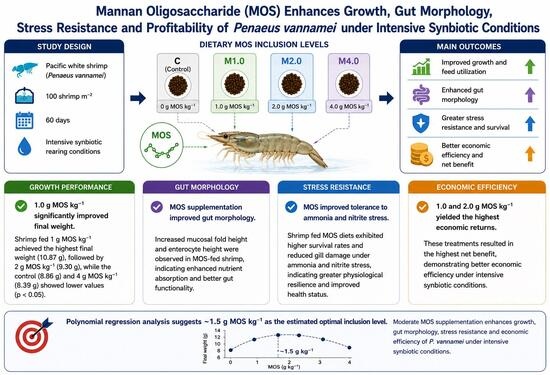
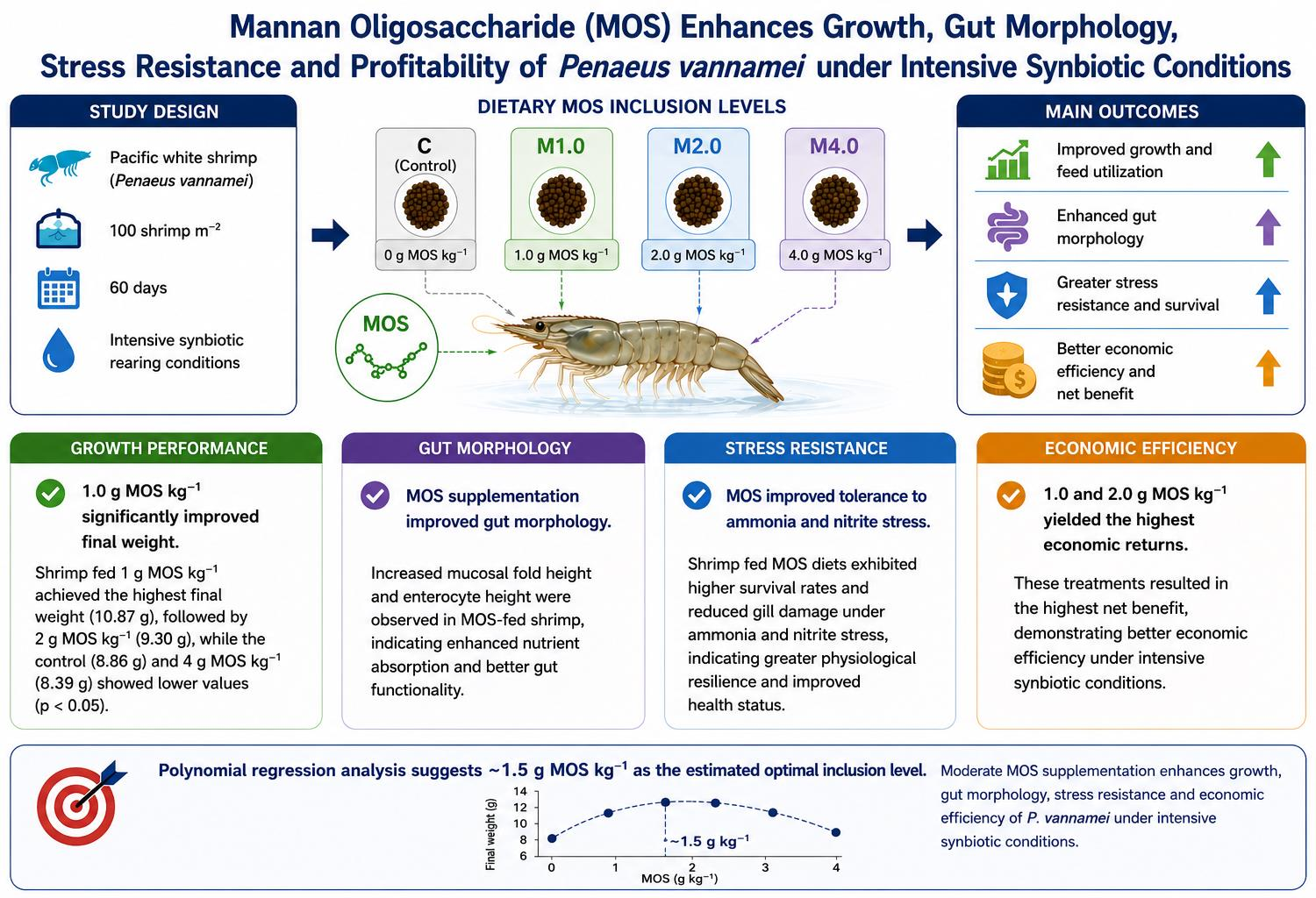
The present study investigated how dietary inclusion of solubilized mannan oligosaccharide (MOS) influences growth performance, digestive health, stress resilience, and production profitability in Pacific white shrimp (Penaeus vannamei) reared under intensive synbiotic conditions. Juveniles averaging 3.00 ± 0.04 g were stocked at 100 shrimp m−2 and fed experimental diets containing 0 (control), 1.0, 2.0, or 4.0 g kg−1 MOS for 60 days. Shrimp receiving 1.0 g kg−1 MOS showed higher growth rate, improved feed conversion, and greater final body weight than the control (p < 0.05), indicating enhanced feed utilization efficiency and better overall performance. Gut morphology improved in MOS-fed treatments, with increased mucosal fold height and enterocyte height, suggesting increased nutrient absorption and improved gut functionality. Gut presumptive total count remained relatively stable among treatments, although Bacillus counts tended to increase with solubilized MOS supplementation. Under ammonia and nitrite stress, supplemented groups showed higher survival and reduced gill damage, indicating improved physiological tolerance and health status. Economic analysis demonstrated that 1.0 and 2.0 g kg−1 MOS achieved the best cost–benefit ratios under intensive conditions. Overall, moderate MOS supplementation enhanced growth, gut morphology, stress resistance, and economic efficiency. Polynomial regression analysis, based on the four dietary inclusion levels evaluated, suggested that approximately 1.5 g kg−1 MOS may represent an estimated optimal inclusion level.
Key Contribution: Solubilized MOS enhances growth performance, gut morphology, and stress resistance of Penaeus vannamei under intensive synbiotic conditions, and improves production efficiency and economic returns, supporting its application as a functional additive in intensive shrimp farming systems.

Graphical Abstract

1. Introduction

The rapid expansion of shrimp farming worldwide has been accompanied by intensified production practices that have increased physiological stress and disease susceptibility in cultured shrimp. Historically, antibiotics were widely used to control bacterial outbreaks, but this practice has contributed to antibiotic-resistant pathogens and environmental contamination [1,2,3]. As a result, increasing attention has been directed toward sustainable strategies capable of improving shrimp health and productive performance while reducing dependence on chemotherapeutic agents [4].
Among these alternatives, prebiotics have gained prominence as functional feed additives capable of modulating gut microbial communities, improving nutrient assimilation, and enhancing immune function. These non-digestible compounds selectively stimulate beneficial microorganisms in the gut, promoting improved resilience, growth performance, and feed efficiency [5,6,7].
The most studied prebiotics in aquaculture are mannan oligosaccharides (MOS) and β-glucans, primarily derived from yeast cell walls [8,9,10]. Yeast-based ingredients are valued for their nutritional and bioactive properties, which improve gut health and immune defense [11]. MOS, obtained through controlled lysis of Saccharomyces cerevisiae, has been shown to enhance gut morphology by increasing mucosal folds and enterocyte development, improving nutrient absorption and growth performance [12,13,14]. In addition, MOS supplementation stimulates immune responses and increases tolerance to environmental stress and pathogens [15,16,17,18,19].
The functional mechanism of MOS involves binding and agglutinating pathogenic bacteria, preventing their adhesion to the gut epithelium and facilitating their elimination [20]. Research involving Penaeus vannamei has demonstrated that dietary MOS supplementation may promote beneficial microbial populations and suppress opportunistic bacteria, including Vibrio and Aeromonas species, contributing to improved survival and immune homeostasis [12,21,22].
Most studies evaluating MOS supplementation in penaeid shrimp have been conducted under conventional or clear-water culture conditions [12,16,23,24]. In contrast, intensive synbiotic systems are characterized by high stocking densities and the coexistence of beneficial microbial communities maintained through probiotic and organic substrate inputs, creating a dynamic microbial environment with elevated organic loads and environmental stress [25]. These conditions may directly influence the biological responses to dietary prebiotics. Despite the recognized benefits of MOS in shrimp nutrition, limited information is available regarding the effects of solubilized MOS supplementation under intensive synbiotic conditions, particularly concerning the combined impacts on growth performance, intestinal morphology, stress resistance, and production profitability in P. vannamei culture.
Recent technological advances have led to the development of solubilized MOS, in which the mannan layer of the yeast cell wall is solubilized to improve bioavailability and partially expose the β-glucan matrix. This enhances synergistic bioactivity between MOS and β-glucans, which are known for their immunomodulatory, antioxidant, and anti-inflammatory properties [26,27,28,29].
Despite the demonstrated benefits of MOS and β-glucans, limited research has explored the potential of solubilized MOS in intensive P. vannamei culture systems. Accordingly, the present study investigated the effects of different dietary inclusion levels of solubilized MOS on growth performance, gut health, resistance to environmental stress, and production profitability in Pacific white shrimp reared under intensive synbiotic conditions.

2. Materials and Methods

2.1. Ingredients and Experimental Diets

The control diet (C) was formulated using conventional ingredients commonly included in commercial shrimp feeds in order to satisfy the nutritional requirements of juvenile P. vannamei [30]. The diet was formulated to be isoproteic (360 g crude protein kg−1) and isoenergetic (4400 kcal kg−1). A commercially available solubilized mannan oligosaccharide (MOS) additive (Hypergen®, Biorigin, SP, Brazil), containing 27.2% solubilized mannans, 17% protein, 3.4% ash, and 8% moisture, was evaluated in the present study.
The additive is obtained from the cellular biomass of Saccharomyces cerevisiae. Following yeast cultivation, the biomass is subjected to autolysis and subsequent centrifugation to separate the yeast cell wall fraction. This material subsequently undergoes an enzymatic treatment designed to partially solubilize the MOS fraction while maintaining the structural integrity of β-glucans (1.3/1.6), after which the product is dried. Glucan and mannan contents were quantified through high-temperature acid hydrolysis, which promoted cleavage of glycosidic bonds and release of glucose and mannose molecules. The released monosaccharides were quantified by enzymatic assays followed by spectrophotometric determination, and the obtained values were subsequently applied to estimate glucan and mannan concentrations. Analytical determinations followed the methodology described by [31], with slight modifications.
Three experimental diets were formulated by partially substituting wheat flour with MOS at inclusion levels of 1.0, 2.0, and 4.0 g kg−1 (equivalent to 0.27, 0.54, and 1.08 g mannans), designated M1.0, M2.0, and M4.0 (Table 1). All diets were produced at the Centro Avançado do Pescado Continental (Instituto de Pesca, São José do Rio Preto, SP, Brazil) following standard feed production steps: milling (<600 μm), homogenization (15 min), extrusion (2 mm, 80–90 °C), and drying (90–100 °C, ~12% moisture). After processing, the pellets were sealed and maintained under frozen storage until use.

2.2. Shrimp Nursery

The nursery phase was conducted at the Laboratório de Carcinicultura (LACAR), Department of Fisheries and Aquaculture, UFRPE, Brazil. P. vannamei post larvae (PL10; 0.003 g) from a commercial hatchery (Aquasul, Rio Grande do Norte, Brazil) were reared in a synbiotic system until reaching 3.0 ± 0.04 g. Shrimp were fed a 45% crude protein diet (Wean, ADM Animal Nutrition, São Paulo, Brazil) four times daily, starting at 35% and gradually reduced to 8% of biomass. Stocking density was 675 PL m−3, and feeding was adjusted based on consumption and survival following [32].

2.3. Experimental System Setup and Design

Following the nursery phase, shrimp were counted, individually weighed, and randomly stocked into experimental tanks at a density of 100 shrimp m−2 (125 shrimp m−3), corresponding to 100 shrimp per tank, for a 60-day experimental period. The study followed a completely randomized design composed of four dietary treatments, each with three replicates in the tanks: control diet (C, no MOS) and diets containing 1.0 g kg−1 (M1.0), 2.0 g kg−1 (M2.0), or 4.0 g kg−1 (M4.0) of solubilized MOS. The experimental trial was carried out in 800 L fiberglass tanks (1.0 m2 bottom area) with continuous aeration provided by a 1.7 HP radial blower (Asten, SP, Brazil) connected to perforated air distribution lines. To avoid shrimp escape, tanks were covered with a 70% UV-protective mesh. Each experimental unit received 400 L of seawater (25 g L−1 salinity), previously filtered through a 250 μm mesh, disinfected with 30 ppm sodium hypochlorite, and aerated for 48 h, in addition to 400 L of water obtained from the synbiotic nursery system (TAN 0.05 mg L−1, NO2–N 0.2 mg L−1, NO3–N 83.3 mg L−1, alkalinity 140 mg CaCO3 L−1, pH 7.5, settleable solids 5 mL L−1, and salinity 22.5 g L−1).

2.4. System Maintenance

During the experimental period, tanks routinely received applications of a synbiotic preparation composed of a probiotic blend containing Bacillus subtilis (2.1 × 10⁷ CFU g−1), B. licheniformis (3.7 × 10⁷ CFU g−1), and Bacillus sp. (2.8 × 10⁷ CFU g−1), resulting in a total viable bacterial concentration of 8.6 × 10⁷ CFU g−1 (Kayros Agrícola e Ambiental, SP, Brazil). The probiotic was activated for 2 h using 0.3 g m−3 sugar in 0.2 L of seawater (25 g L−1 salinity). Subsequently, rice bran (<200 μm) was added at 3 g m−3 and the mixture was maintained under anaerobic conditions for 24 h, followed by an additional 24 h under aerobic conditions. The synbiotic preparation was applied every three days, except in tanks where settleable solids exceeded 10 mL L−1. Alkalinity (>150 mg CaCO3 L−1) and pH (>7.5) were maintained by adding calcium and magnesium hydroxides (25 g m−3 every five days). Water replacement was limited to compensating for evaporative losses.

2.5. Water Quality

Water quality parameters were monitored throughout the experimental period to ensure suitable culture conditions. Dissolved oxygen (DO) and water temperature were recorded twice per day (08:00 and 16:00) using a multiparameter device (AT-160, AlfaKit, Brazil). Salinity, pH, and settleable solids were evaluated three times weekly with a salinometer (AZ86031), pH meter (Asko AK90), and Imhoff cone, according to the procedures described in [33]. At 10-day intervals, total ammonia nitrogen (TAN), nitrite (NO2–N), and total alkalinity (TA) were determined according to the methodologies described in [34,35]. Nitrate (NO3–N) and orthophosphate (PO43−) concentrations were evaluated every 20 days according to [32]. Prior to analysis, samples were filtered through 45 μm filter paper.

2.6. Shrimp Feeding Trial

Throughout the 60-day experimental period, shrimp were fed three times per day (08:00, 13:00, and 17:00), beginning at 8% of total biomass per day and gradually decreasing to 3% by the end of the trial. Feed allowances were adjusted based on feed consumption and mortality rates, following [32]. Every 10 days, 20 shrimp from each tank were weighed to monitor growth performance and adjust feeding rates. On day 60 and at the conclusion of the experiment, all shrimp were counted and weighed for performance evaluation. Growth performance indicators were calculated using the following equations:
Final weight (g) = final biomass (g)/number of shrimp;
Feed conversion ratio (FCR) = feed supplied/(final biomass − initial biomass);
Growth rate (g week−1) = [(final weight − initial weight)/culture days] × 7;
Survival (%) = (final number of shrimp/initial number of shrimp) × 100;
Yield (kg m−3) = final biomass/culture volume;
Yield (kg ha−1) = final biomass × 10,000.

2.7. Proximate Composition

Proximate analyses of feed and shrimp samples were performed following [36] at the Laboratório de Nutrição Animal, Department de Zootecnia, UFRPE, Brazil, in triplicate. For each treatment, nine shrimp (three shrimp per tank) were sampled at the beginning and at the conclusion of the experimental period. Shrimp collected from each tank were pooled to obtain a composite sample, from which subsamples were taken for proximate composition analysis. All analyses were conducted in triplicate. The mean value per tank was considered the experimental unit for statistical analysis. Similarly, 20 g of each experimental diet per treatment were collected, and three subsamples were used for laboratory analyses. Moisture content was determined by drying samples at 105 °C until constant weight was achieved and dried samples were subsequently ground before analysis [36]. Crude protein (N × 6.25) content was quantified using the Kjeldahl procedure [36], total lipids by Soxhlet extraction with hexane [36], ash by incineration at 550 °C [36] and crude fiber according to [37].

2.8. Presumptive Total Count

Presumptive microbiological counts of gut microbiota were performed at LASAq (DEPAq, UFRPE, Brazil) to quantify colony-forming units (CFU g−1) of Vibrio spp., Bacillus spp., and fungi. Sampling was conducted at three stages of the experiment (beginning, middle, and end of the trial). Gut samples from nine shrimp per treatment (three shrimp per tank) were collected, pooled according to tank (≈50 mg per pool) [38], and processed immediately after dissection. No sample storage was performed prior to microbiological analysis. Shrimp were euthanized through ventral nerve cord transection. The external surface was disinfected with 70% ethanol for 15 s, followed by immersion in 1.5% sodium hypochlorite supplemented with 0.1% Tween-80 for 15 min, and subsequently rinsed three times with sterile distilled water. Gut samples were transferred to sterile containers containing 600 μL of sterile alkaline peptone water and homogenized by manual maceration using sterile pestles.
Samples were serially diluted from 10−1 to 10−5, and 100 μL aliquots of each dilution were spread-plated in triplicate under aerobic conditions onto thiosulfate citrate bile sucrose agar (TCBS agar; 30 °C for 24 h) for presumptive Vibrio spp., mannitol egg yolk polymyxin agar (MYP agar; 30 °C for 24 h) for presumptive Bacillus spp., and Sabouraud dextrose agar (36 °C for 72 h) for fungi. Presumptive Vibrio colonies were differentiated according to sucrose fermentation on TCBS agar, while Bacillus spp. and fungal colonies were identified based on colony morphology and culture medium characteristics described by [39]. No molecular or biochemical confirmation tests were performed. Colony enumeration using standard plate count methods was carried out next, and results were expressed as colony-forming units per milliliter (CFU g−1).

2.9. Ammonia and Nitrite Nitrogen Stress Tests

Following the feeding trial, 30 shrimp per treatment (10 per replicate) were exposed to acute ammonia (NH3–N) stress conditions. Subsequently, the same individuals (n = 8 per replicate) were used for the nitrite (NO2–N) stress test to simulate sequential exposure to different nitrogenous stressors commonly encountered under farming conditions. Both assays were conducted in 15 L containers (salinity 22 ± 0.9 g L−1; 27 ± 0.3 °C; pH 8.0 ± 0.1) at a density of 1 shrimp L−1, using ammonium chloride (10 g L−1) and sodium nitrite (49.25 g L−1) stock solutions (Table 2). Each test lasted 96 h, with survival recorded every 24 h [16].
Hemolymph (≈200 μL) was drawn from ten shrimp per treatment before and after exposure [40] using syringes preloaded with Alsever’s anticoagulant (336 mmol L−1 NaCl, 115 mmol L−1 glucose, 27 mmol L−1 sodium citrate, 9 mmol L−1 EDTA; pH 7.2; 1:2 v:v). An aliquot was fixed in modified Alsever’s solution with 4% formaldehyde (1:3 v:v). Total hemocyte counts (THC) were measured in a Neubauer chamber, and differential hemocyte counts (hyaline, semi-granular, and granular cells) were determined after methanol fixation (6 min), Giemsa staining (1:10, 10 min), dehydration (70% ethanol, 1 min), and xylene clearing (6 min) [41].

2.10. Histological Analysis

At the conclusion of the 60-day culture period, gut samples (three shrimp per tank) were collected for histological analysis. After the nitrogen stress test, gill samples (three shrimp per tank) were also collected. Samples were fixed in Davidson’s AFA solution for 70 h, transferred to 70% ethanol, dehydrated through an ascending ethanol series (70–100%), cleared with xylene, and subsequently embedded in paraffin. Histological sections (2 µm) were obtained using a rotary microtome (RM2255, Leica Microsystems, Wetzlar, Germany), mounted on slides, followed by hematoxylin and eosin (H&E) staining, following [42]. Histological evaluations were conducted under an optical microscope (BX41, Olympus, Tokyo, Japan) equipped with a Leica K5 camera. Morphometric analysis of the anterior and midgut was performed using ImageJ (v1.46r, National Institute of Health, Bethesda, MD, USA). All mucosal folds visible in each histological section were measured. Analyses were performed using three shrimp per tank and three replicates per treatment. The following parameters were measured: number of mucosal folds (NF), total mucosal fold height (MFTH), mucosal fold width (MFW), epithelial height of the fold (EHF), and enterocyte height (EH). Total mucosal fold height corresponded to the distance between the basal membrane and the apex of the mucosal fold whereas epithelial height of the fold was defined as the thickness of the epithelial layer covering the fold. Enterocyte height was measured as the distance from the basal membrane to the apical surface of epithelial cells [42]. All measurements were obtained under 400× magnification. Gill lesions were semi-quantitatively assessed using the Histological Alteration Index (HAI; [43]) (Table 3, Figure 1), with lesions classified as stage I (mild), II (severe), or III (irreversible) per [44]. HAI was calculated as:
HAI = [1 × Σ(I)] + [10 × Σ(II)] + [100 × Σ(III)],
HAI values were interpreted as follows: 0–10 (normal), 11–20 (mild to moderate), 21–50 (moderate to severe), 51–100 (severe), and >100 (irreversible).

2.11. Economic Benefits

The economic analysis was conducted considering a standardized production area of one hectare and one cycle, using shrimp performance data obtained in the present experiment (final weight, FCR, and survival rate). The analysis included partial operational costs for feed, the MOS additive, while fixed expenses (juvenile shrimp, labor, electricity, fertilizers, and alkalinity control) were excluded since they were identical across treatments. The following unit prices were applied: commercial feed, USD 0.92 kg−1; MOS additive (Hypergen®, Biorigin, Brazil), USD 9.00 kg−1; and Shrimp market price (Brazil), USD 3.50 kg−1. Exchange rate: 1 USD = BRL 5.22 (Brazil, 4 March 2026). The impact of MOS price fluctuations on net profitability was evaluated using three price scenarios for the MOS additive: USD 9.00, USD 10.00, and USD 11.00 kg−1, to determine how additive price variation could influence overall profitability.
Harvested shrimp (number) = Stocking density (shrimp ha−1) × Production area (ha) × Survival rate (%)
Harvested biomass (kg ha−1) = Harvested shrimp (number) × Final weight (kg)
Revenues (USD ha−1) = Harvested biomass (kg ha−1) × USD 3.50 kg−1
Feed supplied = Harvested biomass (kg ha−1) × FCR
Feed cost (USD ha−1) =Feed supplied (kg ha−1) × Feed price (USD kg−1)
Additive cost (USD ha−1) = (Feed supplied (kg ha−1) × Inclusion level(g/kg) × MOS price (USD kg−1)/1000
Expenses (USD ha−1) = (Feed cost (USD ha−1) + Additive cost (USD ha−1))
Net income (USD ha−1) = Revenues (USD ha−1) − Expenses (USD ha−1)

2.12. Data Analysis

Statistical analyses were performed using BioEstat v.5.3 (Instituto Mamirauá, Tefé, AM, Brazil). Data normality and homogeneity were tested with Lilliefors and Cochran’s tests (p < 0.05). Variables meeting these assumptions (performance, proximate composition, HAI) were analyzed by one-way ANOVA followed by Tukey’s test (p < 0.05). Temporal variations in water quality (temperature, salinity, pH) were evaluated by repeated-measures ANOVA. Non-parametric data (TAN, N–NO2, N–NO3, settleable solids, dissolved oxygen) were assessed using Friedman’s test followed by Conover post hoc analysis with Holm–Bonferroni correction. Microbial counts, gut morphology, stress tolerance, and differential hemocyte data were analyzed using the Kruskal–Wallis test followed by Dunn’s post hoc test (Holm–Bonferroni correction). The optimal dietary MOS level was estimated by second-order polynomial regression of growth performance. For gut morphology, all mucosal folds present in each section were measured. Outliers were identified according to the interquartile range (IQR) method and subsequently excluded from the analyses. Remaining values were averaged per tank, which was considered the experimental unit.

3. Results

3.1. Water Quality

Throughout the 60-day experimental period, water quality variables remained stable, with no significant differences observed among treatments (p > 0.05) (Table 4). Temperature, dissolved oxygen, salinity, pH, total alkalinity, total ammonia nitrogen (TAN), nitrite (NO2-N), nitrate (NO3-N), orthophosphate, and settleable solids (SS) all stayed within optimal ranges for P. vannamei culture throughout the experiment.

3.2. Shrimp Performance

After 60 days, significant differences among treatments were detected (p < 0.05) (Table 5). Shrimp fed solubilized MOS diets, especially M1.0 and M2.0, exhibited improved performance relative to the control group. The M1.0 group achieved the highest final weight (10.87 ± 0.26 g) compared with the control (8.86 ± 0.13 g) (p < 0.05). This treatment also presented the highest weekly growth rate (0.91 ± 0.03 g week−1), feed conversion ratio (1.20 ± 0.14), and productivity (1.25 ± 0.09 kg m−3; 9967 ± 719 kg ha−1). Survival was higher in M1.0 (91.7%) and M2.0 (93.0%) whereas the lowest survival was observed in M4.0 (73.0%). Second-order polynomial regression based on growth and yield data from the four evaluated dietary inclusion levels suggested that approximately 1.5 g kg−1 feed may represent a potential optimal inclusion level for solubilized MOS.

3.3. Proximal Composition

After 60 days of feeding with diets containing different inclusion levels of solubilized MOS and the control diet (Table 6), the proximate composition of P. vannamei juveniles showed significant changes in crude protein, lipid, fiber, and ash compared with the initial values. However, among treatments, only ash content differed significantly (p < 0.05), indicating variability among groups fed solubilized MOS diets.

3.4. Presumptive Total Count

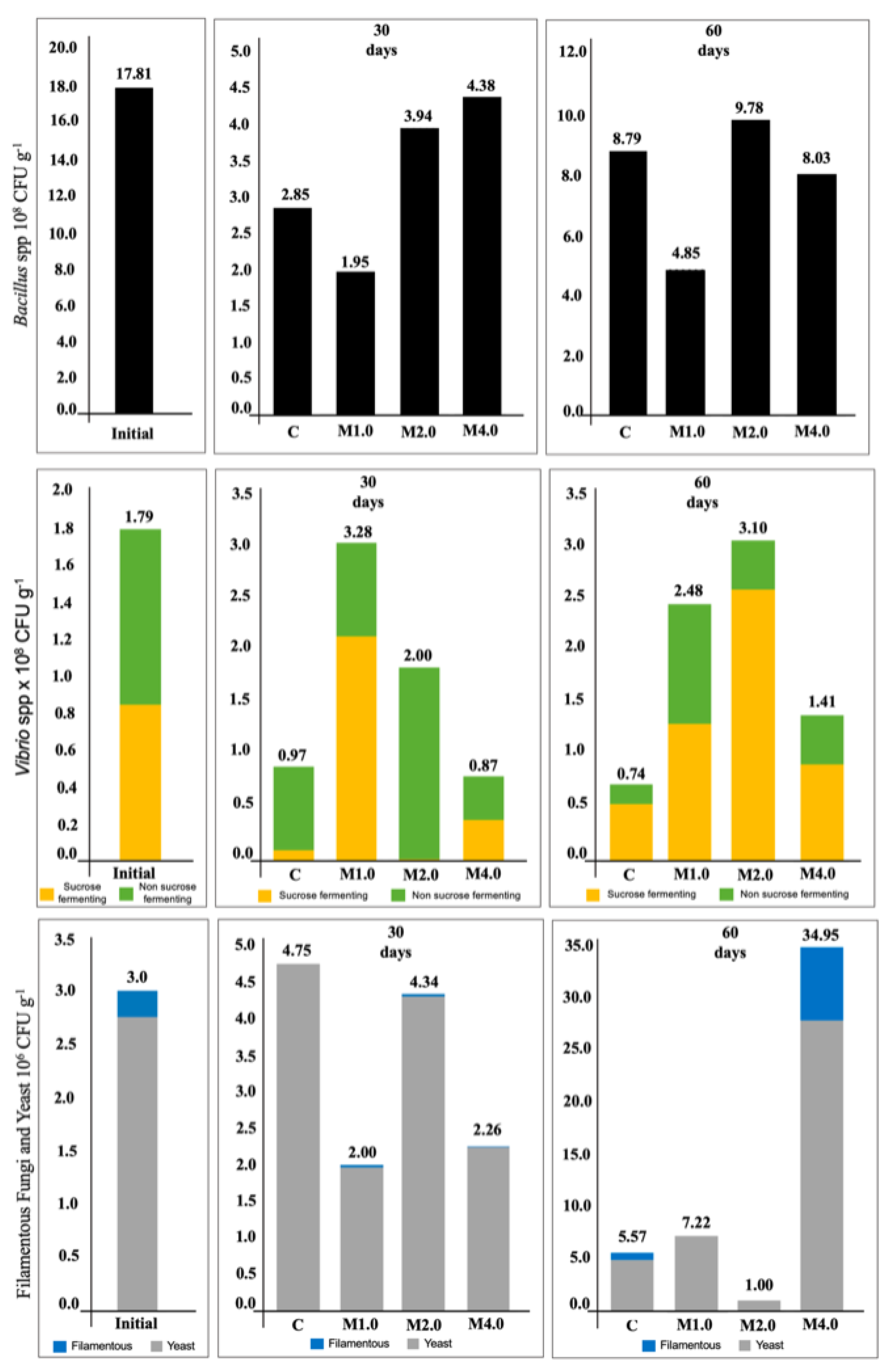
Presumptive counts of Vibrio spp. (TCBS), Bacillus spp. (MYP), and fungi (Sabouraud Dextrose agar) in shrimp guts are shown in Figure 2. No significant differences (p > 0.05) were found among treatments. At the start, Bacillus spp. counts were higher (17.81 × 10⁸ CFU g−1), about tenfold greater than Vibrio spp. (1.79 × 10⁸ CFU g−1). Over 60 days, Bacillus spp. declined across treatments, most notably in M1.0 (−73%), while Vibrio spp. increased in M1.0 and M2.0, reaching 2.48 × 10⁸ and 3.10 × 10⁸ CFU g−1, respectively. In contrast, Vibrio counts decreased in the control and M4.0 groups. Sucrose-positive colonies increased in all treatments by day 60. Fungal counts rose in all groups, with the highest value in M4.0 (34.95 × 10⁶ CFU g−1), where filamentous fungi were also detected, similarly to the control treatment.

3.5. Ammonia and Nitrite Nitrogen Stress Tests

Significant differences (p < 0.05) in shrimp survival were observed among treatments during the ammonia stress test (Table 7). After 96 h, survival was highest in M1.0 (80.6% ± 3.9) and M2.0 (69.4% ± 7.9), both exceeding the control (47.2% ± 7.9). In contrast, the nitrite stress test showed no significant differences (p > 0.05) among treatments after 96 h (Table 8).
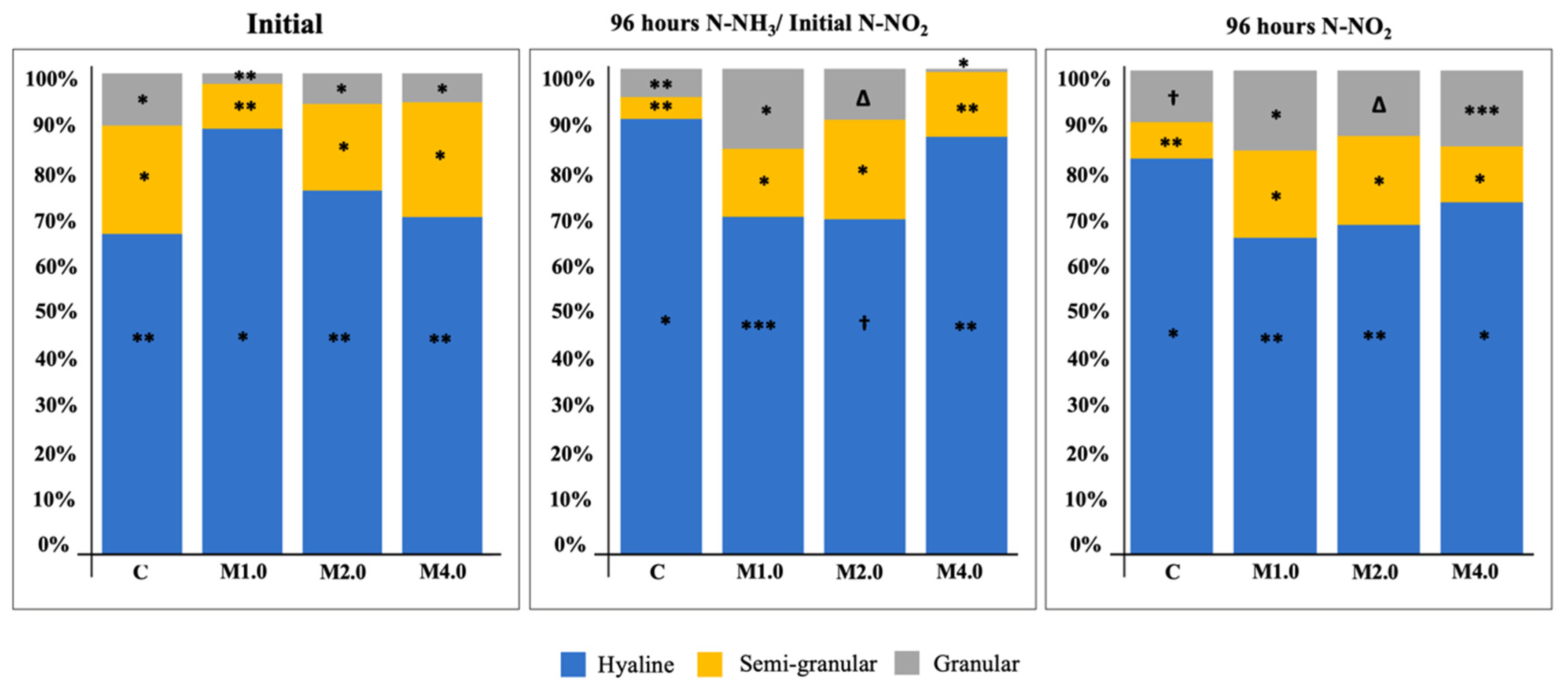
Total hemocyte counts (THC) did not differ significantly among treatments (Table 9). Following ammonia exposure, THC values decreased in the control, M1.0, and M2.0 groups. In contrast, after nitrite exposure, THC increased in all treatments relative to the initial values. Differential hemocyte profiles (Figure 3) showed that initial hyaline cell proportions ranged from 66.58 ± 13.74% in the control group to 88.44 ± 3.98% in M1.0. Semi-granular cell percentages ranged from 9.31 ± 2.91% in M1.0 to 23.74 ± 8.15% in M4.0, whereas granular cells ranged from 6.04 ± 2.85% in M2.0 to 10.82 ± 6.03% in the control group. After ammonia exposure, hyaline cell percentages decreased in M1.0 and M2.0 but increased in the control and M4.0 groups, while semi-granular and granular cells exhibited the opposite pattern. Following nitrite exposure, hyaline cell proportions decreased in all treatments, semi-granular cells increased in all groups except M4.0, and granular cells increased across treatments.

3.6. Morphology Analysis

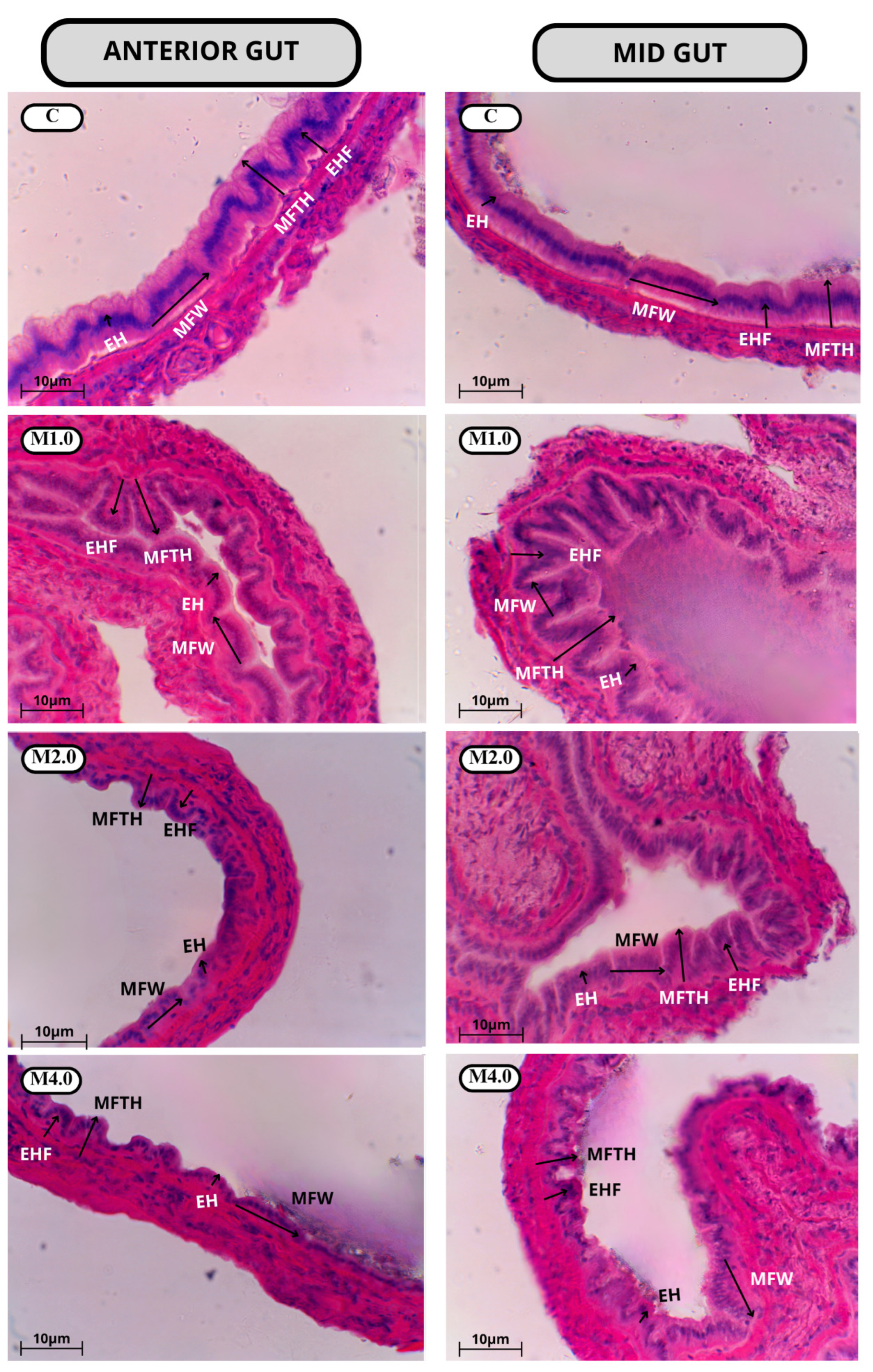
Gut morphology results for the midgut and anterior gut are presented in Table 10 and Figure 4. Significant differences among treatments were detected (p < 0.05). In the midgut region, shrimp fed the M4.0 diet showed the highest number of mucosal folds (NF) and greatest mucosal fold width (MFW), whereas total mucosal fold height (MFTH) was highest in M1.0. Enterocyte height (EH) increased in shrimp from the M1.0 and M2.0 treatments. In the anterior gut, higher values for mucosal fold number (NF) and mucosal fold width (MFW) were observed in M2.0 and M4.0, while M1.0 exhibited the highest total mucosal fold height (MFTH).
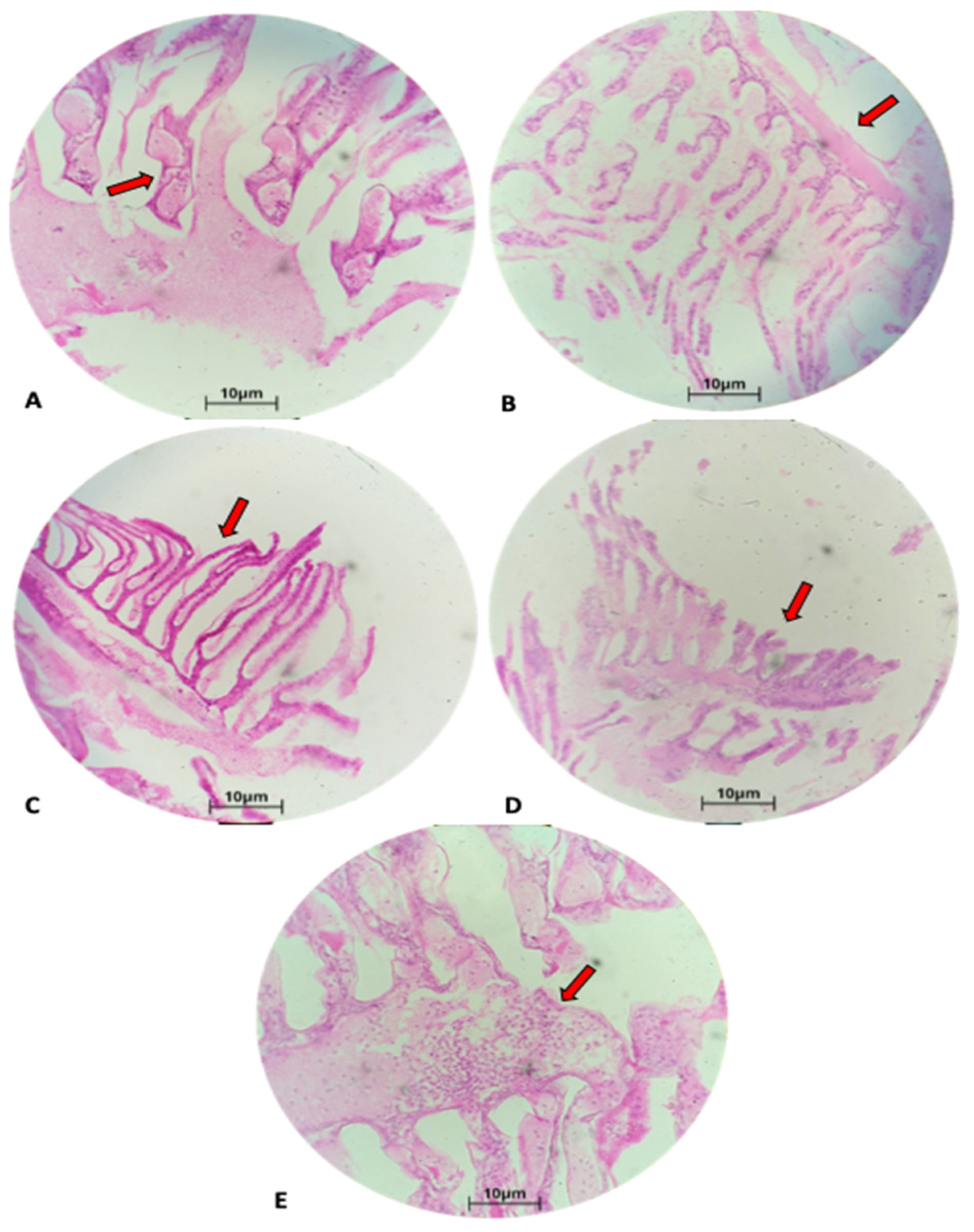
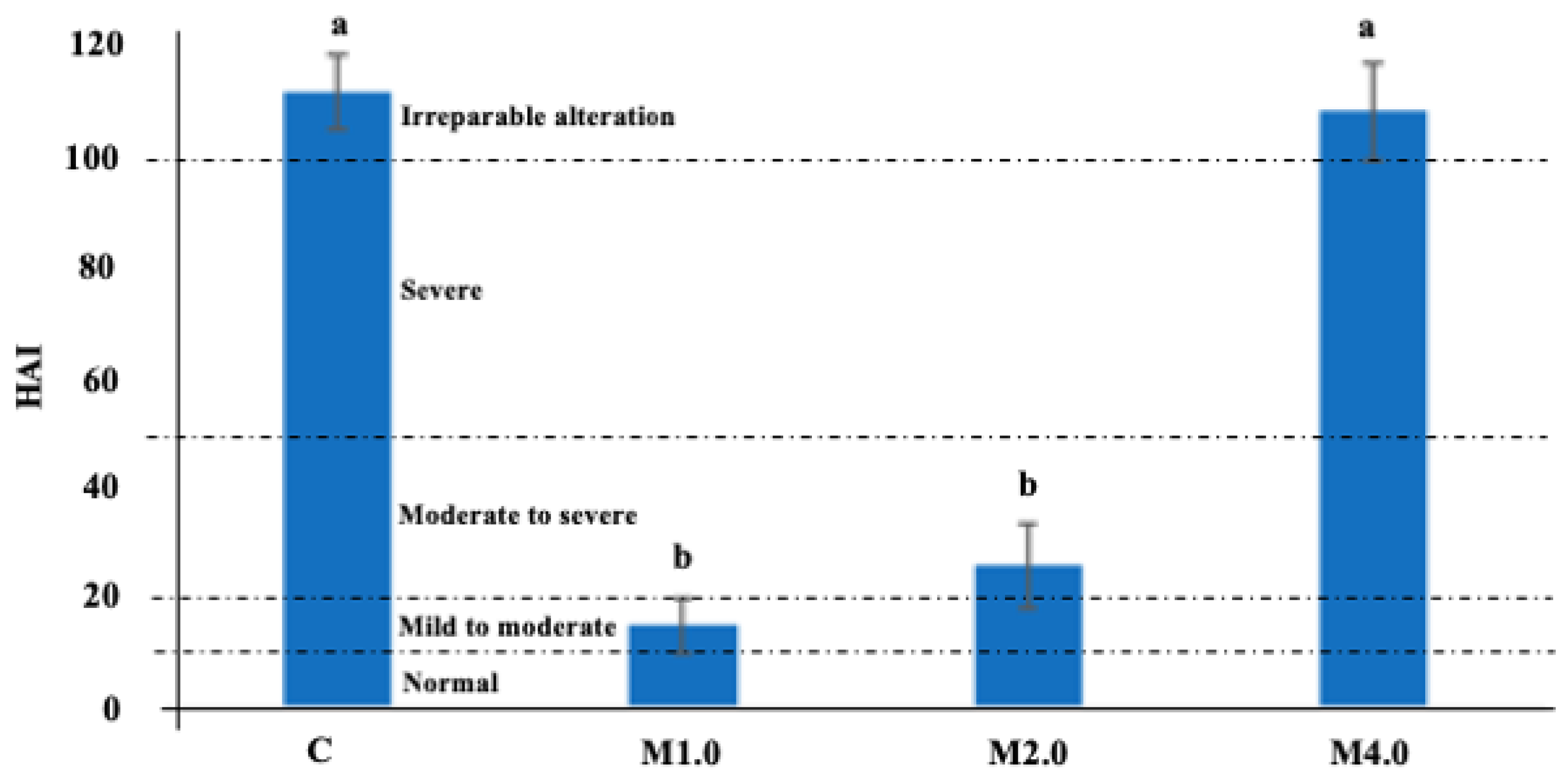
Gill morphology following ammonia and nitrite stress exposure (Table 11; Figure 5) revealed more pronounced histological alterations in the control and M4.0 groups, whereas M1.0 exhibited the lowest histological alteration index (HAI) and the highest proportion of normal gill structures.

3.7. Economic Benefits

The economic assessment (Table 12) indicated that shrimp fed diets supplemented with solubilized MOS generated higher revenues than the control treatment. The M1.0 and M2.0 groups produced gross revenues of USD 34,876 ha−1 and USD 30,272 ha−1, respectively, whereas the control treatment generated USD 28,064 ha−1. Net income, considering feed and additive costs, was also higher in M1.0 (USD 23,767 ha−1) and M2.0 (USD 18,102 ha−1), indicating improved economic performance at dietary inclusion levels of 1.0 and 2.0 g kg−1 MOS. Increasing additive cost from USD 9.00 kg−1 to USD 10.00 and USD 11.00 kg−1 resulted in only slight reductions in net income across treatments. Overall, fluctuations in MOS price had limited influence on profitability, suggesting that the economic advantages of MOS supplementation remained stable across the evaluated pricing scenarios.

4. Discussion

In intensive aquaculture systems, microbial activity can lower alkalinity and pH, requiring buffering to sustain nitrification. Maintaining alkalinity above 100 mg CaCO3 L−1 is critical to support microbial balance [45]. In this study, periodic addition of calcium and magnesium hydroxide (25 g m−3 every five days) effectively stabilized pH (≈7.7) and alkalinity (>100 mg CaCO3 L−1), ensuring equilibrium between heterotrophic and nitrifying bacteria. Consistently low concentrations of total ammonia nitrogen (TAN) and nitrite (NO2–N), together with higher nitrate (NO3–N) levels, indicate effective nitrogen conversion within the system [46,47]. Overall, all parameters remained within optimal ranges for P. vannamei culture, indicating that dietary solubilized mannan oligosaccharides (MOS) did not compromise system stability [48].
Dietary mannan oligosaccharides (MOS) are known to enhance digestive enzyme activity, nutrient digestibility, and gut absorption, thereby improving growth in aquaculture species [23,24]. In this study, supplementation with 1.0 g kg−1 of solubilized MOS significantly improved P. vannamei performance under intensive conditions, whereas higher inclusion levels resulted in reduced performance responses, possibly due to digestive overload or metabolic imbalance. Previous studies using non-solubilized MOS obtained through enzymatic hydrolysis have reported similar responses. P. monodon showed optimal performance at 1 g kg−1 of MOS [49], while P. vannamei achieved the best growth at 5 g kg−1 [50] and up to 4 g kg−1 [16], with no further benefits at higher levels. These findings suggest that excessive MOS inclusion may impair performance, highlighting the importance of defining optimal supplementation levels for different culture systems.
The variability among studies likely reflects differences in processing methods, molecular structure, and environmental factors such as stocking density and water quality. In addition to dosage effects, differences between conventional and solubilized MOS may also contribute to the distinct biological responses observed among studies. Solubilized MOS undergo enzymatic processing that partially modifies the mannan fraction and increases the exposure of β-glucans within the yeast cell wall matrix [51,52]. These structural modifications may influence the interaction of bioactive compounds with intestinal and immune-related cells, potentially affecting immunomodulatory activity under stressful culture conditions [53,54]. Consequently, differences in processing methods and structural composition among commercial MOS products may partially explain variations in shrimp growth and physiological responses reported in the literature.
Notably, most previous trials were conducted in clear-water systems, which lack the microbial interactions characteristic of biofloc or synbiotic systems. In the present work, MOS at 1.0–2.0 g kg−1 improved shrimp performance, with second-order polynomial regression suggesting that approximately 1.5 g kg−1 may represent a potential optimal inclusion level based on the four evaluated dietary inclusion levels. Above this inclusion level, additional improvements in growth performance were not detected, underscoring the importance of optimizing MOS dosage for intensive crustacean culture [13].
Unlike [55], who found increased protein and ash in P. vannamei fed 2% S. cerevisiae yeast, the present study showed no changes in lipid or protein content with solubilized MOS (1.0–4.0 g kg−1). Only ash content increased in M2.0 and M4.0, suggesting that dietary prebiotic concentration may differently influence shrimp body composition.
Presumptive culture-based counts of selected microbial groups revealed increased Bacillus spp. counts across all treatments after 60 days, likely due to continuous synbiotic supplementation and rice bran fermentation, which may have favored the proliferation of culturable Bacillus spp. Even in the control treatment, the predominance of Bacillus spp. over Vibrio spp. among the culturable groups evaluated may indicate microbial conditions favorable to Bacillus spp. under the experimental conditions, since these bacteria are known to suppress pathogens through competitive exclusion and antimicrobial production [56,57,58]. However, the presence of filamentous fungi in the Control and M4.0 treatments may have impaired gut health, partially counteracting these effects [59]. These results should be interpreted cautiously, since culture-based presumptive counts represent only a limited fraction of the gut microbial community and are strongly influenced by selective media and incubation conditions. These findings highlight the need for future microbiome-based studies to better understand the interactions between prebiotics, probiotics, and gut microbial communities in shrimp culture systems.
Gut mucosal morphology plays a central role in nutrient uptake efficiency, since taller folds and well-developed epithelial layers increase the absorptive surface available for digestion [15,60,61,62]. In this study, supplementation with solubilized MOS above 1.0 g kg−1 reduced total mucosal fold height (MFTH) and enterocyte height (EH) in both the midgut and anterior gut, indicating a possible threshold beyond which excessive inclusion may impair gut structure and function. These findings align with reports showing that moderate MOS supplementation improves growth performance and gut integrity in P. vannamei and E. sinensis, whereas higher inclusion levels may exert detrimental effects [16,63]. Similar improvements in gut morphology have been described in D. labrax [64], P. monodon [49], C. auratus gibelio [65], H. huso [66], and Epinephelus fuscoguttatus ♀ × Epinephelus lanceolatus ♂ [67]. Recent studies also indicate that MOS enhances epithelial structure and gut barrier function in P. vannamei [58].
In aquaculture, ammonia and nitrite accumulation can reach toxic levels, increasing mortality and disease susceptibility in cultured species [68,69,70]. In this study, shrimp fed diets supplemented with solubilized MOS (M1.0 and M2.0) exhibited higher survival under ammonia stress, indicating a synergistic effect that enhanced environmental stress resistance [16,62]. Conversely, survival decreased in the M4.0 group, possibly due to immune overstimulation from excessive β-glucan exposure [71,72]. No significant differences were observed in the nitrite stress test, suggesting that MOS may enhance tolerance to ammonia exposure but does not necessarily confer resistance to subsequent stressors, possibly because prior immune activation reduced physiological reserves. It should also be considered that the sequential exposure to ammonia followed by nitrite may have produced carryover physiological effects, since this experimental approach was designed to simulate stress conditions that may occur sequentially in intensive aquaculture systems.
According to [73], increased hemocyte counts in shrimp reflect a defensive response to environmental or biological stress. In this study, total hemocyte counts declined by about 50% in the Control treatments after ammonia exposure but remained more stable in the M1.0 and M2.0 treatments. Following nitrite stress, hemocyte counts rose across all treatments except M4.0, where excessive MOS likely suppressed immune activity. Similar findings were reported by [74], who noted that while prebiotic supplementation enhances shrimp immunity, high inclusion levels (≥5 g kg−1) can reduce total hemocyte counts. Differential hemocyte profiles revealed a reduction in hyaline cells together with increased proportions of semi-granular and granular cells, suggesting immune activation and cellular specialization [75]. However, granular and semi-granular cell levels in the Control and M4.0 groups fell below optimal ranges for P. vannamei [76].
Gills are among the most sensitive organs for detecting environmental and pathogenic stress in aquatic organisms, as they are directly exposed to surrounding water [77]. Exposure to toxic compounds such as ammonia and nitrite can severely damage gill epithelium, as previously demonstrated in Macrobrachium amazonicum juveniles [78]. In the present study, varying degrees of gill alteration were observed across treatments; however, shrimp fed moderate levels of solubilized MOS (M1.0 and M2.0) exhibited lower histological alteration indices. These findings suggest that supplementation with solubilized MOS helps maintain gill structural integrity and enhances shrimp tolerance to environmental stress.
In intensive aquaculture systems, feed represents the primary production cost, making dietary optimization crucial for profitability. Although functional additives increase formulation costs, their inclusion can generate significant economic returns by improving growth, feed efficiency, and disease resistance [79]. In this study, shrimp fed solubilized MOS at 1.0 and 2.0 g kg−1 achieved higher gross revenues (USD 34,876 ha−1 and USD 30,272 ha−1, respectively) compared with the control (USD 28,064 ha−1). The increased income was primarily due to improved final weight and survival, which offset the additive cost. The M1.0 treatment exhibited the highest net income, confirming that moderate inclusion of solubilized MOS provided the most favorable cost-to-benefit relationship under intensive culture conditions.


5. Conclusions

Overall, the results demonstrate that dietary supplementation with 1.0–2.0 g kg−1 of solubilized MOS enhances growth performance, gut morphology and economic efficiency in P. vannamei. These findings support the use of solubilized MOS as a sustainable functional feed additive in intensive aquaculture systems. Future research should further investigate its long-term effects on microbial ecology, antioxidant responses, and stress resilience under different rearing conditions.

Author Contributions

Conceptualization, D.A.d.S., S.M.B.C.d.S., R.A.P.d.L.F.d.C., J.F.A.K. and L.O.B.; methodology, D.A.d.S., S.M.B.C.d.S., G.S.G. and L.O.B.; investigation, D.A.d.S.; data curation, D.A.d.S., F.A.E., G.K.d.A.C. and F.L.d.S.; formal analysis, D.A.d.S.; writing—original draft preparation, D.A.d.S.; writing—review and editing, S.M.B.C.d.S., F.L.d.S., R.A.P.d.L.F.d.C., G.S.G., J.F.A.K. and L.O.B.; resources, S.M.B.C.d.S., J.F.A.K. and L.O.B.; supervision, L.O.B.; project administration, S.M.B.C.d.S. and L.O.B.; funding acquisition, S.M.B.C.d.S., J.F.A.K. and L.O.B. All authors have read and agreed to the published version of the manuscript.

Funding

The authors acknowledge the financial support provided by Biorigin (Açucareira Quatá S.A.). The National Council for Scientific and Technological Development (CNPq) granted a scholarship to Luis Otavio Brito (PQ 305445/2024-3) and funded the CNPq Universal research project 403830/2021-4. The Coordination for the Improvement of Higher Education Personnel (CAPES) also provided financial support through scholarships (in the processes: 88887.601775/2021-00; 88887.712710/2022-00; 88887.912924/2023-00), Financing Code 001.

Institutional Review Board Statement

The research conducted adheres to the current animal welfare regulations in Brazil. The use of Penaeus vannamei in this experimental study does not require approval from the Brazilian Ethics Committee for Animal Use. All authors consented to participate in this research.

Data Availability Statement

The original contributions presented in this study are included in the article. Further inquiries can be directed to the corresponding author.

Acknowledgments

During the preparation of this study, the authors used ChatGPT by OpenAI for the purpose of assisting in the creation of the graphical abstract. The authors have reviewed and edited the output and take full responsibility for the content of this publication.

Conflicts of Interest

Author João Fernando Albers Koch was employed by the company Biorigin Brasil. The remaining authors declare that the research was conducted in the absence of any commercial or financial relationships that could be construed as a potential conflict of interest. The authors declare that this study received funding from Biorigin Brasil. The founder was not involved in the study design, collection, analysis, interpretation of data, the writing of this article or the decision to submit it for publication.

References

  1. Song, S.K.; Beck, B.R.; Kim, D.; Park, J.; Kim, J.; Kim, H.D.; Ringø, E. Prebiotics as immunostimulants in aquaculture: A review. Fish Shellfish Immunol. 2014, 40, 40–48. [Google Scholar] [CrossRef]
  2. Kari, Z.A.; Kabir, M.A.; Munir, M.B.; Wei, L.S. Using of fermented soy pulp as an edible coating material on fish feed pellet in African catfish (Clarias gariepinus) production. Aquac. Aquar. Conserv. Legis. 2020, 13, 296–308. [Google Scholar]
  3. Kari, Z.A.; Kabir, M.A.; Mat, K.; Rusli, N.D.; Razab, M.K.A.A.; Ariff, N.S.N.A.; Edinur, H.A.; Rahim, M.Z.A.; Pati, S.; Dawood, M.A.O.; et al. The possibility of replacing fish meal with fermented soy pulp on the growth performance, blood biochemistry, liver, and intestinal morphology of African catfish (Clarias gariepinus). Aquac. Rep. 2021, 21, 100815. [Google Scholar] [CrossRef]
  4. Amenyogbe, E.; Chen, G.; Wang, Z.; Huang, J.S. The exploitation of probiotics, prebiotics and synbiotics in aquaculture: Present study, limitations and future directions: A review. Aquac. Int. 2020, 28, 1017–1041. [Google Scholar] [CrossRef]
  5. Davani-Davari, D.; Negahdaripour, M.; Karimzadeh, I.; Seifan, M.; Mohkam, M.; Masoumi, S.J.; Berenjian, A.; Ghasemi, Y. Prebiotics: Definition, types, sources, mechanisms, and clinical applications. Foods 2019, 8, 92. [Google Scholar] [CrossRef]
  6. Rohani, M.F.; Islam, S.M.; Hossain, M.K.; Ferdous, Z.; Siddik, M.A.B.; Nuruzzaman, M.; Padeniya, U.; Brown, C.; Shahjahan, M. Probiotics, prebiotics and synbiotics improved the functionality of aquafeed: Upgrading growth, reproduction, immunity and disease. Fish Shellfish Immunol. 2022, 120, 569–589. [Google Scholar] [CrossRef] [PubMed]
  7. Mountzouris, K.C. Prebiotics: Types. In Encyclopedia of Dairy Sciences, 3rd ed.; Academic Press: Cambridge, MA, USA, 2022; pp. 352–358. [Google Scholar]
  8. Dawood, M.A.O.; Koshio, S.; Fadl, S.E.; Ahmed, H.A.; El Asely, A.; Abdel-Daim, M.M.; Alkahtani, S. The modulatory effect of mannanoligosaccharide on oxidative status, selected immune parameters and tolerance against low salinity stress in red sea bream (Pagrus major). Aquac. Rep. 2020, 16, 100278. [Google Scholar] [CrossRef]
  9. Yilmaz, S.; Yilmaz, E.; Dawood, M.A.O.; Ringø, E.; Ahmadifar, E.; Abdel-Latif, H.M.R. Probiotics, prebiotics, and synbiotics used to control vibriosis in fish: A review. Aquaculture 2022, 547, 737514. [Google Scholar] [CrossRef]
  10. Ramasubburayan, R.; Prakash, S.; Immanuel, G.; Mubarakali, D.; Rajakumar, G.; Thirumurugan, D.; Palavesam, A. The transformative role of prebiotics, probiotics, and microbiomes in biofloc systems for sustainable aquaculture: A comprehensive review. Rev. Aquac. 2024, 17, e13000. [Google Scholar] [CrossRef]
  11. Goh, C.J.H.; Cui, L.; Wong, J.H.; Lewis, J.; Goh, M.; Kong, K.W.; Yang, L.K.; Alfatah, M.; Kanagasundaram, Y.; Hoon, S.; et al. Diethyl phthalate (DEP) perturbs nitrogen metabolism in Saccharomyces cerevisiae. Sci. Rep. 2022, 12, 10237. [Google Scholar] [CrossRef]
  12. Gainza, O.; Romero, J. Effect of mannan oligosaccharides on the microbiota and productivity parameters of Litopenaeus vannamei shrimp under intensive cultivation in Ecuador. Sci. Rep. 2020, 10, 2719. [Google Scholar] [CrossRef]
  13. Faustino, M.; Durão, J.; Pereira, C.F.; Pintado, M.E.; Carvalho, A.P. Mannans and mannan oligosaccharides (MOS) from Saccharomyces cerevisiae—A sustainable source of functional ingredients. Carbohydr. Polym. 2021, 272, 118467. [Google Scholar] [CrossRef] [PubMed]
  14. Akter, M.N.; Zahan, K.; Zafar, M.A.; Khatun, N.; Rana, M.S.; Mursalin, M.I. Effects of dietary mannan oligosaccharide on growth performance, feed utilization, body composition and haematological parameters in Asian catfish (Clarias batrachus) juveniles. Turk. J. Fish. Aquat. Sci. 2021, 21, 559–567. [Google Scholar] [CrossRef]
  15. Sang, H.M.; Fotedar, R. Effects of mannan oligosaccharide dietary supplementation on performances of the tropical spiny lobsters juvenile (Panulirus ornatus, Fabricius 1798). Fish Shellfish Immunol. 2010, 29, 483–489. [Google Scholar] [CrossRef]
  16. Zhang, J.; Liu, Y.; Tian, L.; Yang, H.; Liang, G.; Xu, D. Effects of dietary mannan oligosaccharide on growth performance, gut morphology and stress tolerance of juvenile Pacific white shrimp, Litopenaeus vannamei. Fish Shellfish Immunol. 2012, 33, 1027–1032. [Google Scholar] [CrossRef]
  17. Ren, S.; Wang, Y.; Cai, Y.; Wu, L.; Tian, S.; Wang, L.; Jiang, W.; Guo, Y.; Sun, Y.; Zhou, Y. Effects of dietary mannan oligosaccharide supplementation on growth performance, antioxidant capacity, non-specific immunity and immune-related gene expression of juvenile hybrid grouper (Epinephelus lanceolatus ♂ × Epinephelus fuscoguttatus ♀). Aquaculture 2020, 523, 735195. [Google Scholar] [CrossRef]
  18. Harikrishnan, R.; Devi, G.; Balamurugan, P.; Abdel-Warith, A.A.; Younis, E.M.; Doan, H.V.; Balasundaram, C.; Davies, S.J.; El-Haroun, E. Immunostimulatory effect of mannan-oligosaccharides supplementation diet in milkfish (Chanos chanos). Fish Shellfish Immunol. 2023, 133, 108568. [Google Scholar] [CrossRef] [PubMed]
  19. Eissa, E.S.H.; Dowidar, H.A.; Al-Hoshani, N.; Baazaoui, N.; Alshammari, N.M.; Bahshwan, S.M.A.; Kari, Z.A.; Ibrahim, S.; Munir, M.B.; AL-Farga, A.; et al. Dietary supplementation with fermented prebiotics and probiotics can increase growth, immunity, and histological alterations in Pacific whiteleg shrimp (Litopenaeus vannamei) challenged with Vibrio parahaemolyticus. Aquac. Int. 2025, 33, 62. [Google Scholar] [CrossRef]
  20. Torrecillas, S.; Montero, D.; Izquierdo, M. Improved health and growth of fish fed mannan oligosaccharides: Potential mode of action. Fish Shellfish Immunol. 2014, 36, 525–544. [Google Scholar] [CrossRef]
  21. Wang, T.; Wu, H.X.; Li, W.J.; Xu, R.; Qiao, F.; Du, Z.Y.; Zhang, M.L. Effects of dietary mannan oligosaccharides (MOS) supplementation on metabolism, inflammatory response and gut microbiota of juvenile Nile tilapia (Oreochromis niloticus) fed with high carbohydrate diet. Fish Shellfish Immunol. 2022, 130, 550–559. [Google Scholar] [CrossRef]
  22. Lu, Z.Y.; Feng, L.; Jiang, W.D.; Wu, P.; Liu, Y.; Jiang, J.; Kuang, S.Y.; Tang, L.; Li, S.W.; Zhong, C.B.; et al. Dietary mannan oligosaccharides strengthens intestinal immune barrier function via multipath cooperation during Aeromonas hydrophila infection in grass carp (Ctenopharyngodon idella). Front. Immunol. 2022, 13, 1010221. [Google Scholar] [CrossRef]
  23. Al-Ghamdi, O.A.; Saïdi, S.A.; Farhat-Khemakhem, A.; Ghorbel, S.; Chouayekh, H.; Cerruti, P.; Azaza, M.S. Exogenous β-propeller phytase and prebiotic mannan oligosaccharide (MOS) supplementation of formulated diets applied to juvenile Nile tilapia, Oreochromis niloticus: Impact on growth performance and nutrient digestibility. Fishes 2023, 8, 574. [Google Scholar] [CrossRef]
  24. Widanarni, W.; Taufik, A.; Yuhana, M.; Ekasari, J. Dietary Mannan Oligosaccharides Positively Affect the Growth, Digestive Enzyme Activity, Immunity and Resistance against Vibrio harveyi of Pacific White Shrimp (Litopenaeus vannamei) Larvae. Turk. J. Fish. Aquat. Sci. 2019, 19, 271–278. [Google Scholar] [CrossRef]
  25. Pimentel, O.A.L.F.; Schwarz, M.H.; van Senten, J.; Wasielesky, W.; Urick, S.; Carvalho, A.; McAlhaney, E.; Clarington, J.; Krummenauer, D. The super-intensive culture of Penaeus vannamei in low salinity water: A comparative study among recirculating aquaculture system, biofloc, and synbiotic systems. Aquaculture 2025, 596, 741774. [Google Scholar] [CrossRef]
  26. Zhao, H.X.; Cao, J.M.; Wang, A.L.; Du, Z.-Y.; Ye, C.-X.; Huang, Y.-H.; Lan, H.-B.; Zhou, T.-T. Effect of long-term administration of dietary β-1,3-glucan on growth, physiological, and immune responses in Litopenaeus vannamei (Boone, 1931). Aquac. Int. 2012, 20, 145–158. [Google Scholar] [CrossRef]
  27. Yamamoto, F.Y.; Castillo, S.; de Cruz, C.R.; Chen, K.; Hume, M.E.; Gatlin, D.M. Synergistic effects of the β-1,3 glucan paramylon and vitamin C on immunological responses of hybrid striped bass (Morone chrysops × M. saxatilis) were pronounced in vitro but more moderate in vivo. Aquaculture 2020, 526, 735394. [Google Scholar] [CrossRef]
  28. Xu, B.; Zhang, G.; Wang, L.; Sagada, G.; Zhang, J.; Shao, Q. The influence of dietary β-1,3-glucan on growth performance, feed utilization, antioxidative and immune status of Pacific white shrimp, Litopenaeus vannamei. Aquac. Nutr. 2021, 27, 1590–1601. [Google Scholar] [CrossRef]
  29. Dou, X.; Huang, H.; Li, Y.; Deng, J.; Tan, B. Effects of dietary β-glucan on growth rate, antioxidant status, immune response, and resistance against Aeromonas hydrophila in genetic improvement of farmed tilapia (GIFT, Oreochromis niloticus). Aquac. Rep. 2023, 29, 101480. [Google Scholar] [CrossRef]
  30. National Research Council (NRC). Nutrient Requirements of Fish and Shrimp; The National Academies Press: Washington, DC, USA, 2011; 376p. [Google Scholar]
  31. Freimund, S.; Janett, S.; Arrigoni, E.; Amadò, R. Optimised quantification method for yeast-derived 1,3-β-d-glucan and α-d-mannan. Eur. Food Res. Technol. 2005, 220, 101–105. [Google Scholar] [CrossRef]
  32. Van Wyk, P. Nutrition and feeding of Litopenaeus vannamei in intensive culture systems. In Farming Marine Shrimp in Recirculating Freshwater Systems; Van Wyk, P., Davis-Hodgkins, M., Laramore, R., Main, K.L., Mountain, J., Scarpa, J., Eds.; Department of Agriculture and Consumer Services Harbor Branch Oceanic Institute: Tallahassee, FL, USA, 1999; pp. 125–140. [Google Scholar]
  33. Avnimelech, Y. Biofloc Technology—A Practical Guide Book, 2nd ed.; The World Aquaculture Society: Baton Rouge, LA, USA, 2012. [Google Scholar]
  34. APHA. Standard Methods for the Examination of Water and Wastewater, 22nd ed.; American Public Health Association: Washington, DC, USA, 2012. [Google Scholar]
  35. Fries, J. Análisis de Trazas. Métodos Fotométricos Comprobados; Merck: Darmstadt, Germany, 1971; p. 130. [Google Scholar]
  36. AOAC. Official Methods of Analysis, 20th ed.; Association of Official Analytical Chemistry: Washington, DC, USA, 2016; p. 3172. [Google Scholar]
  37. Detmann, E.; Souza, M.A.; Valadares Filho, S.C.; Queiroz, A.C.; Berchielli, T.T.; Saliba, O.S.; Cabral, L.S.; Pina, D.S.; Ladeira, M.M.; Azevedo, J.A.G. Métodos para Análise de Alimentos; Suprema: Visconde do Rio Branco, Brazil, 2012; p. 214. [Google Scholar]
  38. Vandenberghe, J.; Verdonck, L.; Robles-Arozarena, R.; Rivera, G.; Bolland, A.; Balladares, M.; Gomez-Gil, B.; Calderon, J.; Sorgeloos, P.; Swings, J. Vibrios associated with Litopenaeus vannamei larvae, postlarvae, broodstock, and hatchery probionts. Appl. Environ. Microbiol. 1999, 65, 2591–2597. [Google Scholar] [CrossRef]
  39. Trabulsi, L.R.; Alterthum, F. Microbiologia, 6th ed.; Atheneu: São Paulo, Brazil, 2015. [Google Scholar]
  40. Guertler, C.; Rieg, T.; Mejía-Ruíz, C.H.; Lehmann, M.; Barracco, M.A.; Perazzolo, L.M. Hemograma e sobrevivência de camarões marinhos após silenciamento do WSSV por RNA de interferência. Pesqui. Agropecu. Bras. 2013, 48, 983–990. [Google Scholar] [CrossRef]
  41. Celi, M.; Filiciotto, F.; Parrinello, D.; Buscaino, G.; Damiano, M.A.; Cuttitta, A.; D’Angelo, S.; Mazzola, S.; Vazzana, M. Physiological and agonistic behavioural response of Procambarus clarkii to an acoustic stimulus. J. Exp. Biol. 2013, 216, 709–718. [Google Scholar] [CrossRef]
  42. Lightner, D.V. A Handbook of Shrimp Pathology and Diagnostic Procedures for Diseases of Cultured Penaeid Shrimp; World Aquaculture Society: Sorrento, LA, USA, 1996; p. 256. [Google Scholar]
  43. Poleksic, V.; Mitrovic-Tutundzic, V. Fish gills as a monitor of sublethal and chronic effects of pollution. In Sublethal and Chronic Effects of Pollutants on Freshwater Fish; Muller, R., Lloyd, R., Eds.; Fishing News Books Ltd.: Farnham, UK, 1994; pp. 339–352. [Google Scholar]
  44. Fregoso-Lopez, M.G.; Morales-Covarrubia, M.S.; Franco-Nava, M.A.; Ramírez-Rochín, J.; Fierro-Sanudo, J.F.; Ponce-Palafox, J.T.; Páez-Osuna, F. Histological alterations in gills of shrimp Litopenaeus vannamei in low-salinity waters under different stocking densities: Potential relationship with nitrogen compounds. Aquac. Res. 2017, 24, 1–10. [Google Scholar] [CrossRef]
  45. Khanjani, M.H.; Mohammadi, A.; Emerenciano, M.G.C. Water quality in biofloc technology (BFT): An applied review for an evolving aquaculture. Aquac. Int. 2024, 32, 9321–9374. [Google Scholar] [CrossRef]
  46. Kasan, N.A.; Manan, H.; Ismail, T.I.T.; Salam, A.I.A.; Rahim, A.I.A.; Kamarruzan, A.S.; Ishak, A.N.; Deraman, S.; Nasrin, Z.; Chik, C.E.N.C.; et al. Effect of biofloc product-Rapid BFT™ vs. clear water system in improving the water quality and growth performances of Pacific whiteleg shrimp (Penaeus vannamei) cultured in indoor aquaculture system. Aquac. Res. 2021, 52, 6504–6513. [Google Scholar] [CrossRef]
  47. Uawisetwathana, U.; Situmorang, M.L.; Arayamethakorn, S.; Haniswita, S.G.; Panya, A.; Karoonuthaisiri, N.; Rungrassamee, W. Supplementation of ex-situ biofloc to improve growth performance and enhance nutritional values of the Pacific white shrimp rearing at low salinity conditions. Appl. Sci. 2021, 11, 4598. [Google Scholar] [CrossRef]
  48. Amjad, K.; Dahms, H.-U.; Triawan, A.; Lin, F.-Y.; Wu, Y.-C.; Lai, H.-T. Impact of alkalinity treatments on biofloc dynamics and growth performance in Penaeus vannamei shrimp culture. Aquac. Rep. 2025, 42, 102797. [Google Scholar] [CrossRef]
  49. Sang, H.M.; Kien, N.T.; Thanh Thuy, N.T. Effects of dietary mannan oligosaccharide on growth, survival, physiological, immunological and gut morphological conditions of black tiger prawn (Penaeus monodon, Fabricius 1798). Aquac. Nutr. 2014, 20, 341–348. [Google Scholar] [CrossRef]
  50. Li, Y.C.; Liu, H.; Dai, X.; Li, J.; Ding, F. Effects of dietary inulin and mannan oligosaccharide on immune related genes expression and disease resistance of Pacific white shrimp, Litopenaeus vannamei. Fish Shellfish Immunol. 2018, 76, 78–92. [Google Scholar] [CrossRef]
  51. Baek, K.R.; Ramakrishnan, S.R.; Kim, S.J.; Seo, S.O. Yeast cell wall mannan structural features, biological activities, and production strategies. Heliyon 2024, 10, e27896. [Google Scholar] [CrossRef] [PubMed]
  52. Liu, Y.; Wu, Q.; Wu, X.; Algharib, S.A.; Gong, F.; Hu, J.; Luo, W.; Zhou, M.; Pan, Y.; Yan, Y.; et al. Structure, preparation, modification, and bioactivities of β-glucan and mannan from yeast cell wall: A review. Int. J. Biol. Macromol. 2021, 173, 445–456. [Google Scholar] [CrossRef]
  53. Machuca, C.; Méndez-Martínez, Y.; Reyes-Becerril, M.; Angulo, C. Yeast β-Glucans as Fish Immunomodulators: A Review. Animals 2022, 12, 2154. [Google Scholar] [CrossRef]
  54. Hadiuzzaman, M.; Moniruzzaman, M.; Shahjahan, M.; Bai, S.C.; Min, T.; Hossain, Z. β-Glucan: Mode of Action and Its Uses in Fish Immunomodulation. Front. Mar. Sci. 2022, 9, 905986. [Google Scholar] [CrossRef]
  55. Ayiku, S.; Shen, J.; Tan, B.; Dong, X.; Liu, H. Effects of dietary yeast culture on shrimp growth, immune response, intestinal health and disease resistance against Vibrio harveyi. Fish Shellfish Immunol. 2020, 102, 286–295. [Google Scholar] [CrossRef] [PubMed]
  56. Noor, G.; Larsen, M.; Christensen, H. Identification and antimicrobial resistance of bacteria isolated from probiotic products used in shrimp culture. PLoS ONE 2015, 10, e0132338. [Google Scholar] [CrossRef]
  57. Martínez Cruz, P.; Ibañez, A.L.O.; Monroy-Hermosillo, O.A.; Ramirez Saad, H.C. Use of probiotics in aquaculture. ISRN Microbiol. 2021, 13. [Google Scholar] [CrossRef] [PubMed]
  58. Pardede, M.A.; Widanarni, W.; Sukenda, S.; Yuhana, M. Evaluation of dietary microencapsulated synbiotics Pseudoalteromonas piscicida 1UB, Bacillus NP5, and mannan-oligosaccharides to prevent Vibrio parahaemolyticus infection in Pacific white shrimp (Penaeus vannamei). Aquac. Int. 2024, 32, 2077–2091. [Google Scholar] [CrossRef]
  59. Govindasamy, T.; Bhassu, S.; Raju, C.S.; Velayuthan, R.D. Exploring fungal diversity in shrimp aquaculture: One health approach for addressing food safety and human health concerns. J. Taibah Univ. Sci. 2025, 19, 2579337. [Google Scholar] [CrossRef]
  60. Daniels, D.L.; Merrifield, D.P.; Boothroyd, S.J.; Davies, S.J.; Factor, J.R.; Arnold, K.E. Effect of dietary Bacillus spp. and mannan oligosaccharides (MOS) on European lobster (Homarus gammarus L.) larvae growth performance, gut morphology and gut microbiota. Aquaculture 2010, 304, 49–57. [Google Scholar] [CrossRef]
  61. Sun, Z.; Tan, X.; Ye, H.; Zou, C.; Ye, C.; Wang, A. Effects of dietary Panax notoginseng extract on growth performance, fish composition, immune responses, intestinal histology and immune related genes expression of hybrid grouper (Epinephelus lanceolatus ♂ × Epinephelus fuscoguttatus ♀) fed high lipid diets. Fish Shellfish Immunol. 2018, 73, 234–244. [Google Scholar] [CrossRef]
  62. Chen, M.; Chen, X.Q.; Tian, L.X.; Liu, Y.J.; Niu, J. Beneficial impacts on growth, intestinal health, immune responses and ammonia resistance of Pacific white shrimp (Litopenaeus vannamei) fed dietary synbiotic (mannan oligosaccharide and Bacillus licheniformis). Aquac. Rep. 2020, 17, 100408. [Google Scholar] [CrossRef]
  63. Lu, J.; Qi, C.; Limbu, S.M.; Han, F.; Yang, L.; Wang, X.; Qin, J.G.; Chen, L. Dietary mannan oligosaccharide (MOS) improves growth performance, antioxidant capacity, non-specific immunity and intestinal histology of juvenile Chinese mitten crabs (Eriocheir sinensis). Aquaculture 2019, 510, 337–346. [Google Scholar] [CrossRef]
  64. Torrecillas, S.; Makol, A.; Betancor, M.B.; Montero, D.; Caballero, M.J.; Sweetman, J.; Izquierdo, M. Enhanced intestinal epithelial barrier health status on European sea bass (Dicentrarchus labrax) fed mannan oligosaccharides. Fish Shellfish Immunol. 2013, 34, 1485–1495. [Google Scholar] [CrossRef] [PubMed]
  65. Akrami, R.; Chitsaz, H.; Hezarjaribi, A.; Ziaei, R. Effect of dietary mannan oligosaccharide (MOS) on growth performance and immune response of Gibel carp juveniles (Carassius auratus gibelio). J. Vet. Adv. 2012, 2, 507–513. [Google Scholar]
  66. Razeghi Mansour, M.; Akrami, R.; Ghobadi, S.H.; Amani Denji, K.; Ezatrahimi, N.; Gharaei, A. Effect of dietary mannan oligosaccharide (MOS) on growth performance, survival, body composition, and some hematological parameters in giant sturgeon juvenile (Huso huso Linnaeus, 1754). Fish Physiol. Biochem. 2012, 38, 829–835. [Google Scholar] [CrossRef]
  67. Zhu, L.; Wang, S.; Cai, Y.; Shi, H.; Zhou, Y.; Zhang, D.; Guo, W.; Wang, S. Effects of five prebiotics on growth, antioxidant capacity, non-specific immunity, stress resistance, and disease resistance of juvenile hybrid grouper (Epinephelus fuscoguttatus ♀ × Epinephelus lanceolatus ♂). Animals 2023, 13, 754. [Google Scholar] [CrossRef] [PubMed]
  68. Guo, H.; Xian, J.A.; Li, B.; Ye, C.X.; Wang, A.L.; Miao, Y.T.; Liao, S.A. Gene expression of apoptosis-related genes, stress protein and antioxidant enzymes in hemocytes of white shrimp Litopenaeus vannamei under nitrite stress. Comp. Biochem. Physiol. C Toxicol. Pharmacol. 2013, 157, 366–371. [Google Scholar] [CrossRef]
  69. Duan, Y.; Zhang, J.; Wang, Y.; Liu, Q.S.; Xiong, D.L. Nitrite stress disrupts the structural integrity and induces oxidative stress response in the intestines of Pacific white shrimp Litopenaeus vannamei. J. Exp. Zool. A Ecol. Integr. Physiol. 2018, 329, 43–50. [Google Scholar] [CrossRef]
  70. Tong, D.; Zhu, Z.; Wu, J.; Li, F.; Shen, J.; Cao, J.; Tang, Y.; Liu, G.; Hu, L.; Shi, W. Impacts of ammonia stress on different Pacific whiteleg shrimp Litopenaeus vannamei families and the underlying adaptive mechanisms. Aquat. Toxicol. 2023, 259, 106549. [Google Scholar] [CrossRef]
  71. Mameloco, E.J.G.; Traifalgar, R.F.M. Supplementation of combined mannan oligosaccharide and β-glucan immunostimulants improves immunological responses and enhances resistance of Pacific whiteleg shrimp, Penaeus vannamei, against Vibrio parahaemolyticus infection. Int. Aquat. Res. 2020, 12, 291–299. [Google Scholar] [CrossRef]
  72. Meena, D.K.; Das, P.; Kumar, S.; Mandal, S.C.; Prusty, A.K.; Singh, S.K.; Akhtar, M.S.; Behera, B.K.; Kumar, K.; Pal, A.K.; et al. β-glucan: An ideal immunostimulant in aquaculture (a review). Fish Physiol. Biochem. 2013, 39, 431–457. [Google Scholar] [CrossRef]
  73. Chen, Y.; Luo, K.; Zhang, B.; Lu, Z.; Wang, F. Shrimp MANF maintains hemocyte viability via interaction with a tyrosine kinase Abl. Dev. Comp. Immunol. 2023, 143, 104675. [Google Scholar] [CrossRef]
  74. Andrino, K.G.S.; Apines-Amar, M.J.S.; Janeo, R.L.; Corre, V.L., Jr. Effects of dietary mannan oligosaccharide (MOS) and β-glucan on growth, immune response and survival against white spot syndrome virus (WSSV) infection of juvenile tiger shrimp Penaeus monodon. AACL Bioflux 2014, 7, 321–332. [Google Scholar]
  75. Su, Y.; Yang, F.; Li, F. Comparison analysis of circulating hemocytes in decapod crustaceans. Fish Shellfish Immunol. 2024, 154, 109947. [Google Scholar] [CrossRef] [PubMed]
  76. Darwantin, K.; Sidik, R. Efisiensi penggunaan imunostimulan dalam pakan terhadap laju pertumbuhan, respon imun dan kelulushidupan udang vaname (Litopenaeus vannamei). J. Biosains Pascasarj. 2016, 18, 123–139. [Google Scholar] [CrossRef]
  77. Nan, Y.; Xiao, M.; Duan, Y.; Yang, Y. Toxicity of ammonia stress on the physiological homeostasis in the gills of Litopenaeus vannamei under seawater and low-salinity conditions. Biology 2024, 13, 281. [Google Scholar] [CrossRef]
  78. Dutra, F.M.; Rönnau, M.; Sponchiado, D.; Forneck, S.C.; Freire, C.A.; Ballester, E.L. Histological alterations in gills of Macrobrachium amazonicum juveniles exposed to ammonia and nitrite. Aquat. Toxicol. 2017, 187, 115–123. [Google Scholar] [CrossRef]
  79. Segarra, S.; Chau, T.; Hoang, P.; Tran, L. Immunoregulation and resistance to aquatic pathogens with dietary nucleotides in Pacific white shrimp, Litopenaeus vannamei. Fishes 2023, 8, 308. [Google Scholar] [CrossRef]
Figure 1. Gill morphology alterations in Penaeus vannamei juveniles fed diets containing commercial solubilized MOS for 60 days and subsequently exposed to ammonia and nitrite stress tests (400×). (A) Dilation of efferent and afferent vessels. (B) Intense melanization. (C) Branchial atrophy. (D) Deformation. (E) Severe hemolymph infiltration. Tissues stained with hematoxylin and eosin (H&E). Scale bar = 10 µm.
Fishes 11 00279 g001
Figure 2. Presumptive microbial counts of Bacillus spp. cultivated on MYP agar (×108 CFU g−1), filamentous fungi and yeasts cultivated on Sabouraud agar (×108 CFU g−1), and Vibrio spp. cultivated on TCBS agar (×108 CFU g−1) in the gut tract of P. vannamei. Experimental treatments included a control diet without MOS supplementation (C) and diets supplemented with 1.0 g kg−1 (M1.0), 2.0 g kg−1 (M2.0), and 4.0 g kg−1 (M4.0) of solubilized mannan oligosaccharides. Data are presented as mean ± standard deviation (n = 3). Data were analyzed using the Kruskal–Wallis test followed by Dunn’s post hoc test (p < 0.05).
Fishes 11 00279 g002
Figure 3. Relative proportions of hyaline, semi-granular, and granular hemocytes in Penaeus vannamei following ammonia and nitrite stress exposure. Data are expressed as mean ± standard deviation. Different letters indicate significant differences (Kruskal–Wallis, p < 0.05; Dunn post hoc, p < 0.05). Symbols: * = a; ** = b; *** = c; ∆ = ab; † = bc. Treatments: control diet without solubilized MOS (C) and diets containing 1.0 (M1.0), 2.0 (M2.0), and 4.0 g kg−1 (M4.0) of solubilized MOS.
Fishes 11 00279 g003
Figure 4. Histological observations of gut of Penaeus vannamei juveniles after 60 days of feeding with control diet or solubilized MOS-supplemented diets. Treatments correspond to control diet without MOS supplementation (C) and diets supplemented with 1.0 (M1.0), 2.0 (M2.0), and 4.0 g kg−1 (M4.0) of solubilized MOS. Images are arranged from left to right as C, M1.0, M2.0, and M4.0. Histological measurements were obtained from three shrimp per tank and three replicate tanks per treatment. Abbreviations: EH, enterocyte height; EHF, epithelial height of the fold, MFTH, total mucosal fold height; MFW, mucosal fold width; NF, number of mucosal folds. Scale bar = 10 μm. Original magnification × 400.
Fishes 11 00279 g004
Figure 5. Histological alteration index (HAI ± SD) in gills of Penaeus vannamei following ammonia and nitrite stress exposure. Experimental treatments included a control diet without MOS supplementation (C) and diets supplemented with 1.0 (M1.0), 2.0 (M2.0), and 4.0 g kg−1 (M4.0) of solubilized MOS. Data are presented as mean ± standard deviation (n = 3). Different letters indicate significant differences among treatments determined using one-way ANOVA followed by Tukey’s post hoc test (p < 0.05).
Fishes 11 00279 g005
Table 1. Formulation and proximate composition of control and diets supplemented with commercial MOS for P. vannamei juveniles reared in a synbiotic system.
Ingredients (g kg−1)Diet
ControlM1.0M2.0M4.0
Wheat flour a180179178176
Soybean meal b150150150150
Soy Protein Concentrate c120120120120
Poultry by-product d120120120120
Broken rice e80808080
Fish meal f60606060
Hemoglobin g50505050
Wheat meal e50505050
Sorghum h45454545
Dicalcium phosphate i23.523.523.523.5
Krill meal j20202020
Soy lecithin k22222222
Potassium chloride l10101010
Fish oil f10101010
Soybean oil b10101010
Salt10101010
MOS m01.02.04.0
Kaolin n5.65.65.65.6
Magnesium oxide o5555
Vitamin and Mineral Supplement p5555
DL-Methionine q5555
L-Threonine r5555
L-Lysine s5555
Nutribinder t5555
Fylax (Antifungal) u3333
Vitamin C (35%) v0.90.90.90.9
Proximate composition (g kg−1)
Crude protein385380385380
Crude fat69667069
Crude fiber48434844
Ash148143147149
Gross Energy (kcal kg−1)4446444144584451
a Cidade Bella Moinho (Ponta Grossa, PR, Brazil); b Comigo Coop. (Rio Verde, GO, Brazil); c CJ Selecta (Araguari, MG, Brazil); d Frango Rico (Votuporanga, SP, Brazil); e Dallas (Nova Alvorada do Sul, MS, Brazil); f BFP Bioprod. Pescado (Itajaí, SC, Brazil); g Hemoprot (Lins, SP, Brazil); h Raguife (Santa Fé do Sul, SP, Brazil); i Ecophos (Formiga, MG, Brazil); j Aker Biomarine (Lysaker, Norway); k Adicel Ind. e Com. (Belo Horizonte, MG, Brazil); l Brasil Química (Batatais, SP, Brazil); m Hypergen/Biorigin (Lençóis Paulista, SP, Brazil); n CaO do Brasil (Iguatama, MG, Brazil); o Magnesium do Brasil (Fortaleza, CE, Brazil); p De Heus (Rio Claro, SP, Brazil); q Rhodimet® NP99 (Adisseo); r Ajinomoto do Brasil (L-Threonine 98%); s Ajinomoto do Brasil (L-Lysine 78%); t Nutri-Bind Aqua (Adisseo); u Selko Feed Additives; v Heilongjiang NHU Biotech (Suihua, China).
Table 2. Nitrogen concentrations during ammonia and nitrite stress tests in P. vannamei juveniles fed diets with solubilized MOS.
TAN (mg L−1)NH3-N (mg L−1)NO2-N (mg L−1)
Initial14.700.7620.13
24 h13.170.6821.20
48 h15.400.8019.20
72 h16.200.8422.77
96 h14.670.7625.43
Data corresponds to the mean (n = 3). TAN—total ammonia nitrogen.
Table 3. Classification of the histological alterations observed in gills of Penaeus vannamei after ammonia and nitrite nitrogen stress exposure.
Stage 1Stage 2Stage 3
MelanizationDeformation or AtrophyNecrosis
Mild to moderate dilation of hemolymph vesselsSevere dilation of hemolymph vesselsSevere tissue deformation and atrophy
Hemolymph infiltration
This stage corresponds to the early response to stress, characterized by mild lesions that do not substantially compromise gill functionality, although they indicate physiological disturbance.In this stage, tissue alterations become more pronounced, impairing respiratory gas exchange and negatively affecting the organism’s physiological condition and performance.This condition is characterized by extensive and irreversible gill damage, resulting in severe functional impairment and a marked reduction in blood oxygenation capacity, potentially compromising survival.
Table 4. Water quality variables measured in culture units containing juvenile Penaeus vannamei fed control or MOS-supplemented diets under synbiotic conditions during a 60-day experimental period.
VariablesTreatments
CM1.0M2.0M4.0
Temperature (°C)27.82 ± 0.3827.78 ± 0.3127.81 ± 0.3027.80 ± 0.32
DO (mg L−1)6.32 ± 0.186.40 ± 0.136.42 ± 0.196.34 ± 0.15
Salinity (gL−1)25.25 ± 2.5725.51 ± 2.8525.75 ± 2.6425.62 ± 2.73
pH 7.70 ± 0.207.71 ± 0.177.67 ± 0.197.71 ± 0.17
TA (mg CaCO3 L−1)112.62 ± 19.17118.09 ± 15.68110.71 ± 15.66106.90 ± 17.86
TAN (mg L−1)0.26 ± 0.190.23 ± 0.190.28 ± 0.190.22 ± 0.18
Nitrite-N (mg L−1)0.18 ± 0.050.18 ± 0.090.21 ± 0.090.19 ± 0.08
Nitrate-N (mg L−1)190.95± 159.60197.65± 176.30182.93± 138.58204.09± 175.61
Orthophosphate (mg L−1)29.56 ± 9.8625.72 ± 7.4729.04 ± 10.0027.86 ± 9.00
SS (mL L−1)5.24 ± 1.155.50 ± 2.525.10 ± 2.194.60 ± 1.66
Data are presented as mean ± standard deviation. Parametric variables were evaluated using repeated-measures ANOVA (p ≤ 0.05), whereas non-parametric variables were analyzed using Friedman’s test (p ≤ 0.05). Experimental treatments included a control diet without MOS supplementation (C) and diets supplemented with 1.0 (M1.0), 2.0 (M2.0), and 4.0 g kg−1 feed (M4.0) of solubilized MOS. Abbreviations: DO, dissolved oxygen; TAN, total ammonia nitrogen; TA, total alkalinity; SS, settleable solids.
Table 5. Performance of Penaeus vannamei juveniles fed control and MOS-supplemented diets under a synbiotic system for 60 days.
VariablesTreatments
CM1.0M2.0M4.0R2Regression Equation
Final weight (g)8.86 ± 0.13 c10.87 ± 0.26 a9.30 ± 0.13 b8.39 ± 0.17 d0.53y = −0.30x2 + 0.99x + 9.22
Survival (%)90.50 ± 1.50 a91.67 ± 5.51 a93.00 ± 3.00 a73.00 ± 2.00 b0.88y = −2.52x2 + 5.89x + 90.02
Growth week g−10.68 ± 0.01 b0.91 ± 0.03 a0.73 ± 0.02 b0.63 ± 0.02 c0.53y = −0.04x2 + 0.11x + 0.72
kg m−31.0 ± 0.01 c1.25 ± 0.09 ª1.08 ± 0.02 b0.77 ± 0.02 d0.85y = −0.06x2 + 0.19x + 1.03
kg ha−18014 ± 131 c9967 ± 719 a8644 ± 161 b6182 ± 51 d0.83y = −0.05x2 + 0.14x + 0.83
FCR1.70 ± 0.01 b1.20 ± 0.14 d1.50 ± 0.02 c2.10 ± 0.10 a0.86y = 0.13x2 − 0.37x + 1.60
Data are presented as mean ± standard deviation. Variables were analyzed using one-way ANOVA followed by Tukey’s post hoc test (p ≤ 0.05). Mean values within the same row followed by different superscript letters indicate significant differences among treatments. Experimental treatments included a control diet without MOS supplementation (C) and diets supplemented with 1.0 (M1.0), 2.0 (M2.0), and 4.0 g kg−1 feed (M4.0) of solubilized MOS.
Table 6. Proximate composition on a dry weight basis of juvenile Penaeus vannamei fed control or MOS-supplemented diets under synbiotic conditions during a 60-day experimental period.
% Dry MatterTreatments
InitialCM1.0M2.0M4.0
Moisture76.81± 1.41 a76.44 ± 0.55 a75.91 ± 1.58 a77.73 ± 1.56 a77.05 ± 1.11 a
Crude Protein61.89 ± 1.80 b70.17 ± 1.36 a71.30 ± 1.42 a70.69 ± 0.98 a70.32 ± 0.78 a
Lipids3.25 ±0.95 b3.99 ± 0.63 a3.78 ± 0.64 ab4.31 ± 0.14 ab4.95 ± 0.63 a
Fiber8.14 ±0.84 a5.62 ± 0.35 b6.01 ± 0.82 b7.06 ± 0.72 ab7.25 ± 0.42 ab
Ash11.85 ±0.79 c12.43 ± 0.49 bc12.83 ± 0.32 b14.35 ± 0.48 a14.09 ± 0.95 ab
Data are presented as mean ± standard deviation. Variables were analyzed using one-way ANOVA followed by Tukey’s post hoc test (p ≤ 0.05). Mean values within the same row followed by different superscript letters indicate significant differences among treatments. Experimental treatments included a control diet without MOS supplementation (C) and diets supplemented with 1.0 g kg−1 (M1.0), 2.0 g kg−1 (M2.0), and 4.0 g kg−1 (M4.0) of solubilized MOS.
Table 7. Survival of Penaeus vannamei juveniles exposed to ammonia nitrogen stress after feeding with control or MOS-supplemented diets.
Exposure TimeTreatments
CM1.0M2.0M4.0
24 h100 ± 0.0 a94.4 ± 3.9 a97.2 ± 3.9 a91.7 ± 6.8 a
48 h80.6 ± 10.4 a91.7 ± 6.8 a88.9 ± 3.9 a83.3 ± 6.8 a
72 h61.1 ± 7.9 b83.3 ± 0.0 a83.3 ± 0.0 a75.0 ± 6.8 ab
96 h47.2 ± 7.9 b80.6 ± 3.9 a69.4 ± 7.9 a55.5 ± 3.9 b
Data are presented as mean ± standard deviation (n = 3 per exposure time). Data were analyzed using the Kruskal–Wallis test (p < 0.05). Experimental treatments included a control diet without MOS supplementation (C) and diets supplemented with 1.0 (M1.0), 2.0 (M2.0), and 4.0 g kg−1 (M4.0) of solubilized MOS. Different superscript letters within the same row indicate significant differences among treatments (p < 0.05).
Table 8. Survival (%) of Penaeus vannamei juveniles exposed to nitrite nitrogen stress after feeding with control or MOS-supplemented diets.
Exposure TimeTreatments
CM1.0M2.0M4.0
24 h100 ± 0.094.4 ± 9.694.4 ± 9.688.9 ± 19.2
48 h77.8 ± 9.683.3 ± 16.788.9 ± 9.688.9 ± 19.2
72 h77.8 ± 9.683.3 ± 16.788.9 ± 9.677.8 ± 9.6
96 h77.8 ± 9.677.8 ± 19.277.8 ± 25.472.2 ± 9.6
Data are presented as mean ± standard deviation (n = 3 per exposure time). Data were analyzed using the Kruskal–Wallis test (p < 0.05). Experimental treatments included a control diet without MOS supplementation (C) and diets supplemented with 1.0 (M1.0), 2.0 (M2.0), and 4.0 g kg−1 (M4.0) of solubilized MOS.
Table 9. Total hemocyte counts of Penaeus vannamei after ammonia and nitrite nitrogen stress exposure (106 cells mL−1).
TimeTreatments
CM1.0M2.0M4.0
Initial N-NH34.1 ± 3.3 a3.8 ± 2.0 a3.8 ± 4.8 a4.5 ± 3.5 a
96 h N-NH3/
Initial N-NO−2
2.1 ± 2.1 a3.3 ± 2.2 a3.1 ± 2.8 a4.6 ± 3.0 a
96 h N-NO−27.2 ± 4.6 a5.6 ± 4.0 a3.7 ± 2.5 a2.2 ± 8.10 a
Data are presented as mean ± standard deviation (n = 3 per exposure time). Data were analyzed using the Kruskal–Wallis test (p < 0.05). Experimental treatments included a control diet without MOS supplementation (C) and diets supplemented with 1.0 (M1.0), 2.0 (M2.0), and 4.0 g kg−1 (M4.0) of solubilized MOS. Different superscript letters within the same row indicate significant differences among treatments (p < 0.05).
Table 10. The gut morphology of Penaeus vannamei fed control or solubilized MOS-supplemented diets for 60 days.
HistologicalTreatments
Midgut
CM1.0M2.0M4.0
Number of mucosal folds (NF)12.0 ± 4.52 b23.00 ± 6.60 a20.20 ± 4.73 a21.40 ± 4.43 a
Epithelial height of the fold (EHF, μm)4.28 ± 1.64 c8.04 ± 1.18 a8.22 ± 1.19 b6.23 ± 1.21 c
Mucosal fold width (MFW, μm)17.22 ± 2.94 a9.15 ± 2.98 c10.05 ± 3.23 c13.06 ± 2.26 b
Total mucosal fold height (MFTH, μm)7.36 ± 2.32 d22.85 ± 3.17 a17.37 ± 3.23 b12.99 ± 1.83 c
Enterocyte height (EH, μm)1.81 ± 0.11 c3.20 ± 0.15 a2.79 ± 0.17 b2.01 ± 0.18 c
Anterior Gut
CM1.0M2.0M4.0
Number of mucosal folds (NF)14.6 ± 2.99 b24.20 ± 5.39 a22.00 ± 5.27 a22.60 ± 4.22 a
Epithelial height of the fold (EHF, μm)5.51 ± 1.15 c7.84 ± 0.99 a6.99 ± 1.13 b5.01 ± 1.23 c
Mucosal fold width (MFW, μm)14.16 ± 1.94 a9.42 ± 2.07 b10.11 ± 2.00 b14.05 ± 2.11 a
Total mucosal fold height (MFTH, μm)9.40 ± 2.19 c17.57 ± 1.99 a13.50 ± 2.03 b9.92 ± 1.97 c
Enterocyte height (EH, μm)1.90 ± 0.11 c3.00 ± 0.14 a2.50 ± 0.11 b1.90 ± 0.12 c
Data are presented as mean ± standard deviation. Different superscript letters within the same row indicate significant differences among treatments (one-way ANOVA followed by Tukey’s test, p < 0.05). Experimental treatments included a control diet without MOS supplementation (C) and diets supplemented with 1.0 (M1.0), 2.0 (M2.0), and 4.0 g kg−1 (M4.0) of solubilized MOS.
Table 11. Histological alteration index (HAI) of gills from Penaeus vannamei subjected to ammonia and nitrite stress exposure.
Stage Treatments
CM1.0M2.0M4.0
Stage INormal tissue function30.8%48.3%32.4%31.4%
Stage IIMild to moderate alteration7.7%6.9%8.1%5.7%
Moderate to severe alteration46.2%44.8%56.8%42.9%
Stage IIISevere alteration15.38%0.0%2.7%20.0%
Irreparable alteration0.0%0.0%0.0%0.0%
HAI111.3 ± 6.7 a14.7 ± 5.1 b25.5 ± 7.6 b107.8 ± 8.7 a
Data are presented as percentages or mean ± standard deviation. Different superscript letters indicate significant differences among treatments determined using one-way ANOVA followed by Tukey’s post hoc test (p < 0.05). Experimental treatments included a control diet without MOS supplementation (C) and diets supplemented with 1.0 (M1.0), 2.0 (M2.0), and 4.0 g kg−1 (M4.0) of solubilized MOS.
Table 12. Economic benefits of Penaeus vannamei juveniles fed control or solubilized MOS-supplemented diets under intensive synbiotic culture conditions.
Treatments
CM1.0M2.0M4.0
REVENUESStockingshrimp ha−11,000,0001,000,0001,000,0001,000,000
Survival%90.5091.6793.0073.00
Harvested shrimpshrimp ha−1905,000916,700930,000730,000
Final shrimp weightg8.8610.879.308.39
Harvested biomasskg ha−18018996486496129
RevenuesUSD ha−128,06434,87630,27221,436
EXPENSESFCR 1.701.201.502.10
Feed suppliedkg ha−113,63111,95712,97412,862
Feed cost USD ha−112,54111,00111,93611,833
Additive cost (USD 9.00 kg−1)USD ha−10.00107234463
ExpensesUSD ha−112,54111,10812,17012,296
Net income (additive cost: USD 9.00 kg−1)USD ha−115,52323,76718,1029141
Net income (additive cost: USD 10.00 kg−1)USD ha−115,52323,75518,0769089
Net income (additive cost: USD 11.00 kg−1)USD ha−115,52323,74318,0509038
Experimental treatments included a control diet without MOS supplementation (C) and diets supplemented with 1.0 (M1.0), 2.0 (M2.0), and 4.0 g kg−1 (M4.0) of solubilized MOS.
Disclaimer/Publisher’s Note: The statements, opinions and data contained in all publications are solely those of the individual author(s) and contributor(s) and not of MDPI and/or the editor(s). MDPI and/or the editor(s) disclaim responsibility for any injury to people or property resulting from any ideas, methods, instructions or products referred to in the content.