

Application of Magnetic Resonance Tools for Qualification and Traceability of Mullets
 ,
,  , , and
Abstract
1. Introduction
2. Materials and Methods
2.1. Study Area
2.2. Samples
2.3. Metabolomics Analysis 1H NMR
2.4. Metabolite Identification and Quantification
2.5. Statistical Analysis
2.6. IA Uses
3. Results
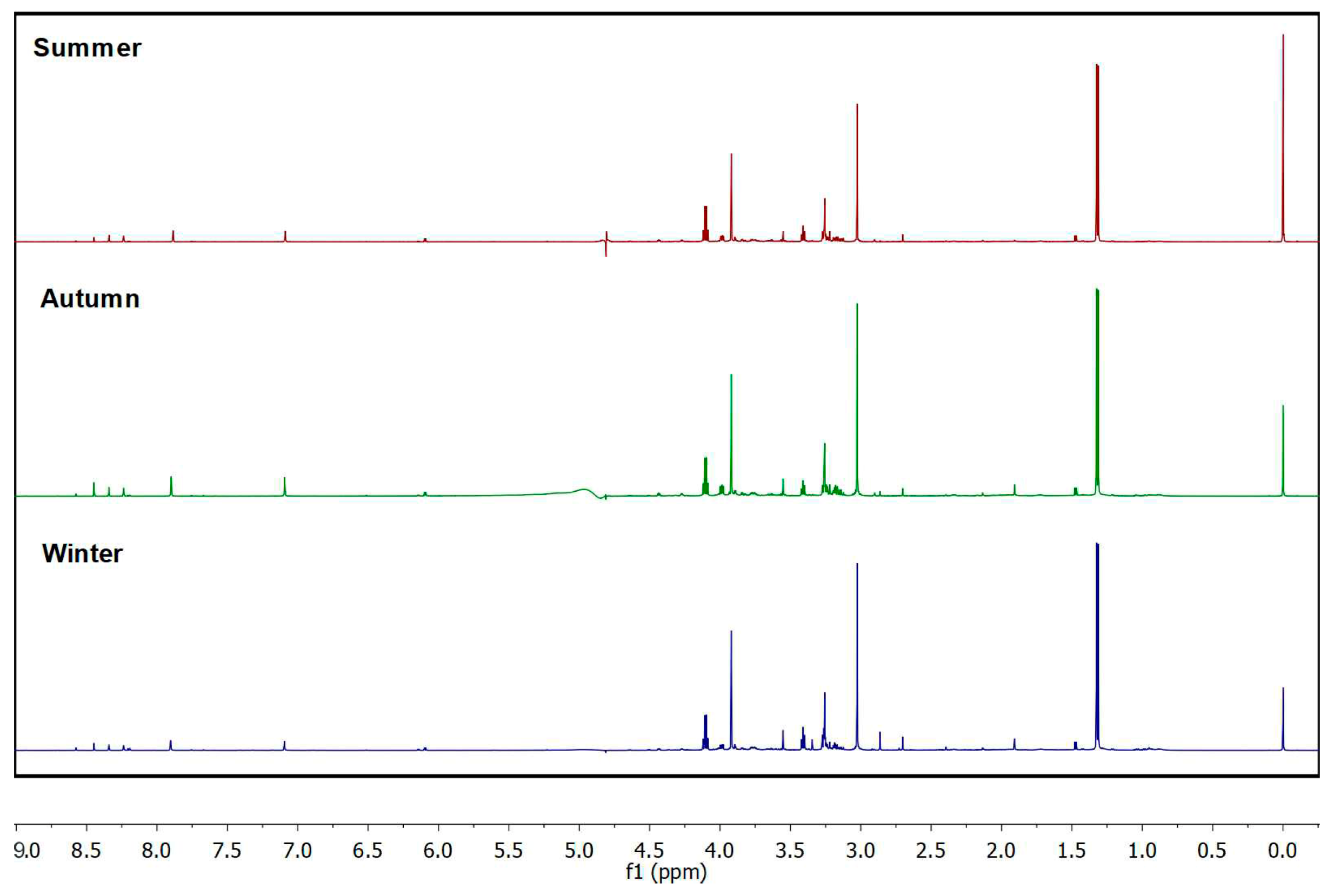
3.1. Identification of Mullet Muscle Metabolite Profiles
3.2. Effect of Season on Mullet Muscle Metabolite Profiles
3.3. Effect of Size Category on Mullet Muscle Metabolite Profiles
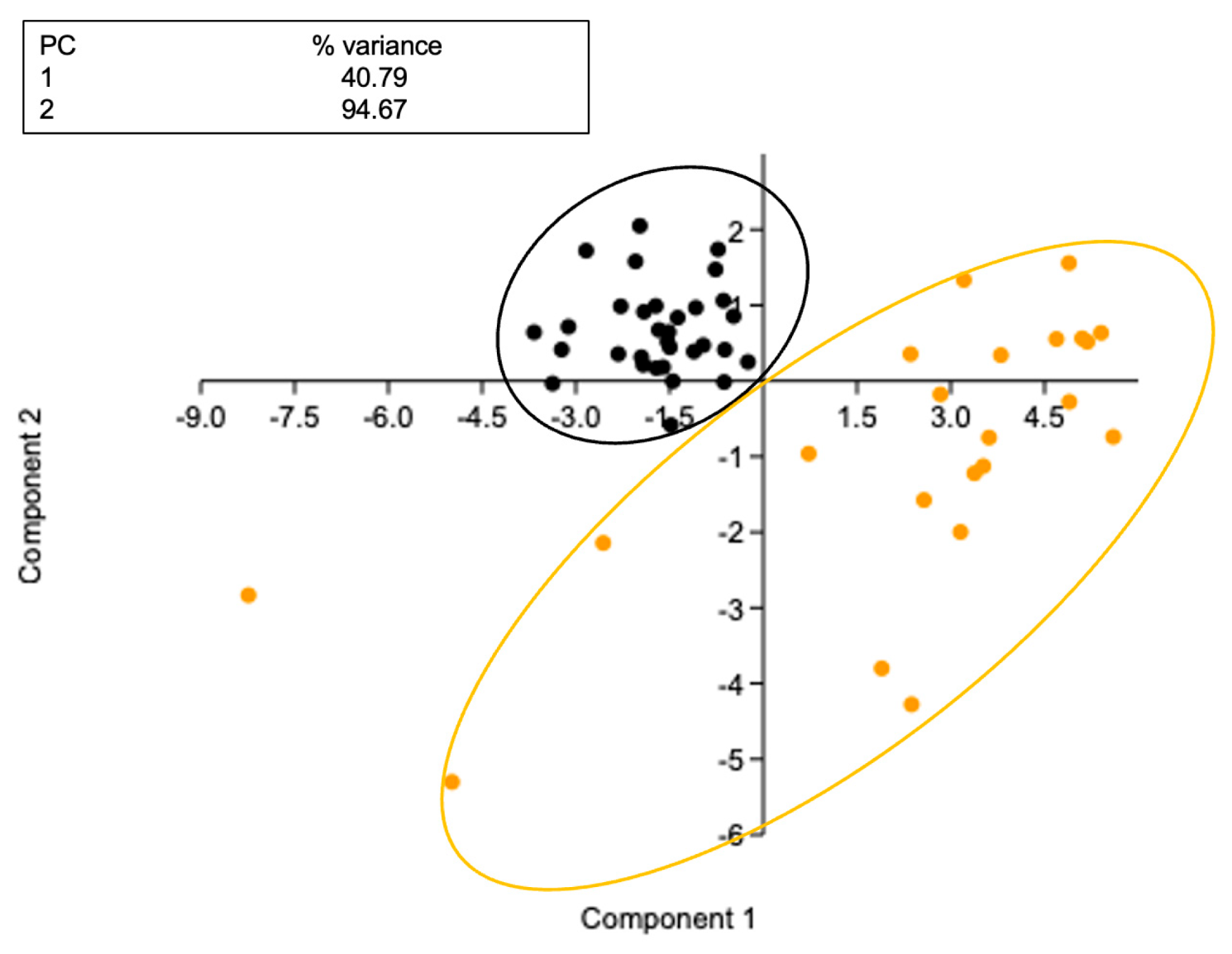
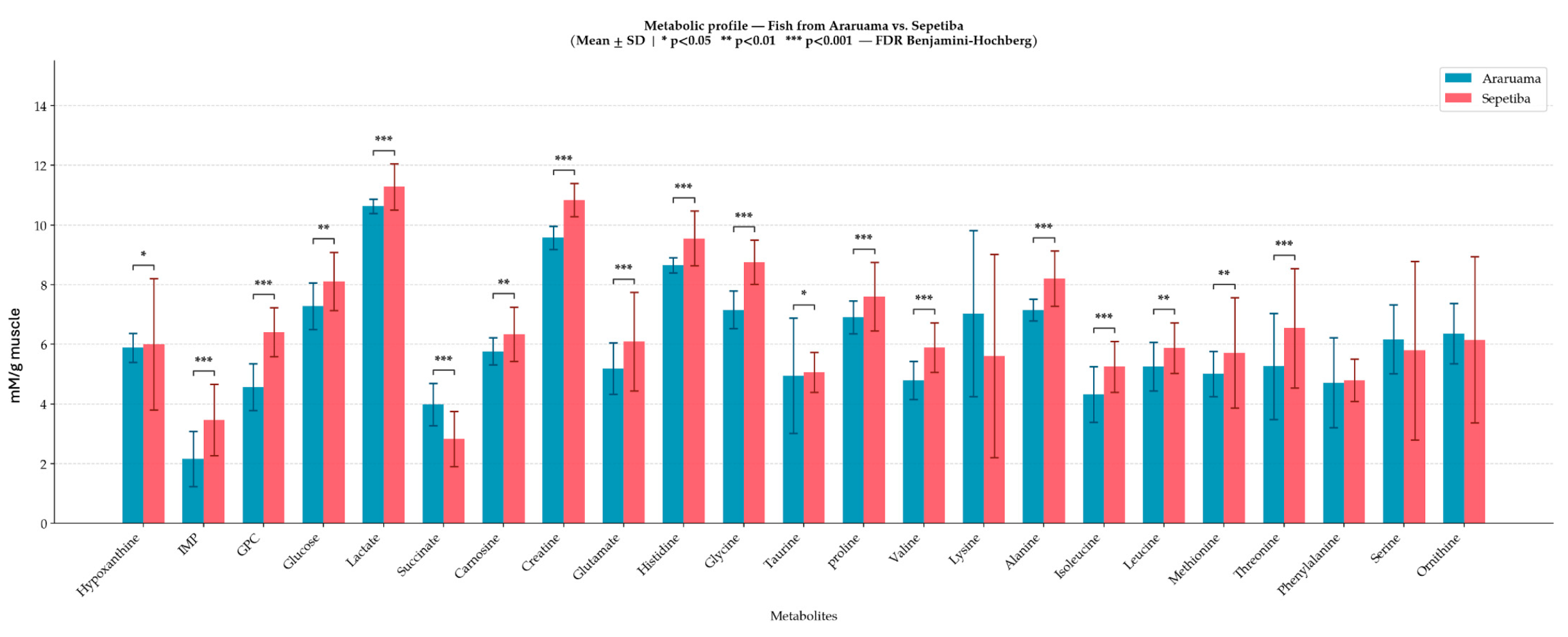
3.4. Effect of Geographical Origin on Mullet Muscle Metabolite Profiles
4. Discussion
5. Conclusions
6. Patents
Author Contributions
Funding
Institutional Review Board Statement
Data Availability Statement
Acknowledgments
Conflicts of Interest
Abbreviations
| 1H NMR | 1H Nuclear Magnetic Resonance |
| ATP | Adenosine Triphosphate |
| DSS-d6 | 2,2-dimethyl-2-silapentane-5-sulfonate-d6 |
| GPC | Glycerophosphorylcholine |
| IMP | Inosine-5-monophosphate |
| LOOCV | Leave-One-Out-Cross-Validation |
| NMR | Nuclear Magnetic Resonance |
| PCA | Principal Component Analysis |
| TCA | Tricarboxylic acid |
References
- Yang, H.; He, S.; Feng, Q.; Xia, S.; Zhou, Q.; Wu, Z.; Zhang, Y. Navigating the depths of seafood authentication: Technologies, regulations, and future prospects. Meas. Food 2024, 14, 100165. [Google Scholar] [CrossRef]
- Edwards, K.; Manley, M.; Hoffman, L.C.; Williams, P.J. Non-Destructive Spectroscopic and Imaging Techniques for the Detection of Processed Meat Fraud. Foods 2021, 10, 448. [Google Scholar] [CrossRef] [PubMed]
- Wishart, D.S.; Cheng, L.L.; Copié, V.; Edison, A.S.; Eghbalnia, H.R.; Hoch, J.C.; Gouveia, G.J.; Pathmasiri, W.; Powers, R.; Schock, T.B. NMR and Metabolomics—A Roadmap for the Future. Metabolites 2022, 12, 678. [Google Scholar] [CrossRef]
- Picone, G. The 1H HR-NMR Methods for the Evaluation of the Stability, Quality, Authenticity, and Shelf Life of Foods. Encyclopedia 2024, 4, 1617–1628. [Google Scholar] [CrossRef]
- Saglam, M.; Paasch, N.; Horns, A.L.; Weidner, M.; Bachmann, R. 1H NMR metabolic profiling for the differentiation of fish species. Food Chem. Adv. 2023, 4, 100602. [Google Scholar] [CrossRef]
- Silva, S.O.; Pedro, G.; Junior, L.; Machado, M.B.; Jesus, R.S.; Antônio, S.; Farias, M.; Bezerra, J.A.; Diego, C.; Santos, A. 1H NMR spectroscopy as a tool to probe potential biomarkers of the drying-salting process: A proof-of-concept study with the Amazon fish pirarucu. Food Chem. 2024, 448, 139047. [Google Scholar] [CrossRef]
- Bodin, N.; Amiel, A.; Fouché, E.; Sardenne, F.; Chassot, E.; Debrauwer, L.; Guillou, H.; Trembley-Franco, M.; Canlet, C. NMR-based metabolic profiling and discrimination of wild tropical tunas by species, size category, geographic origin, and on-board storage condition. Food Chem. 2022, 371, 131094. [Google Scholar] [CrossRef]
- Vidal, N.P.; Picone, G.; Goicoechea, E.; Laghi, L.; Manzanos, M.J.; Danesi, F.; Bordoni, A.; Capozzi, F.; Guillén, M.D. Metabolite release and protein hydrolysis during the in vitro digestion of cooked sea bass fillets. A study by 1H NMR. Food Res. Int. 2016, 88, 293–301. [Google Scholar] [CrossRef]
- Silva, R.A.G.; Rosmam, P.C.C. Hydro-Sedimentary viability of a projected tidal inlet on the western side of Araruama Lagoon–RJ. Rev. Bras. Rec. Hidr. 2016, 21, 25–35. [Google Scholar] [CrossRef]
- Vilar, A.; Belart, P.; Mendonça, J.O.; Carelli, T.; Laut, L. Interannual variations in the araruama hypersaline system: Implications for the sedimentological and hydrological characteristics of brejo do espinho lagoon (Rio de Janeiro, Brazil). J. S. Am. Earth Sci. 2026, 172, 105939. [Google Scholar] [CrossRef]
- Cônsolo, N.R.B.; Rosa, A.F.; Barbosa, L.C.G.S.; Maclean, P.H.; Higuera-Padilla, A.; Colnago, L.A.; Titto, E.V. Preliminary study on the characterization of Longissimus lumborum dark cutting meat in Angus × Nellore crossbreed cattle using NMR-based metabolomics. Meat Sci. 2021, 172, 108350. [Google Scholar] [CrossRef]
- Rout, M.; Lipfert, M.; Lee, B.L.; Berjanskii, M.; Assempour, N.; Fresno, R.V.; Cayuela, A.S.; Dong, Y.; Johnson, M.; Shahin, H.; et al. MagMet: A fully automated web server for targeted nuclear magnetic resonance metabolomics of plasma and serum. Magn. Reson. Chem. 2023, 61, 681–704. [Google Scholar] [CrossRef]
- Hammer, Ø.; Harper, D.A.T.; Ryan, P.D. PAST: Paleontological Statistics Software Package for Education and Data Analysis. Palaeontol. Electron. 2001, 4, 9. [Google Scholar]
- Bi, S.; Li, N.; Gong, G.; Gao, P.; Zhu, J.; Abulikemu, B. Elucidating volatile flavor profiles and metabolic pathways in Northern Pike (Esox lucius) during superchilled storage: A combined UPLC-Q-TOF/MS and GC-MS approach. Foods 2025, 14, 2556. [Google Scholar] [CrossRef] [PubMed]
- Badaoui, W.; Toledo-Guedes, K.; Valero-Rodriguez, J.M.; Villar-Montalt, A.; Marhuenda-Egea, F.C. Decoding Fish Origins: How Metals and Metabolites Differentiate Wild, Cultured, and Escaped Specimens. Metabolites 2025, 15, 490. [Google Scholar] [CrossRef]
- Watabe, S.; Kamal, M.; Hashimoto, K. Postmortem Changes in ATP, Creatine Phosphate, and Lactate in Sardine Muscle. J. Food Sci. 1991, 56, 151–153. [Google Scholar] [CrossRef]
- Weber, J.M.; Choi, K.; Gonzalez, A.; Omlin, T. Metabolic fuel kinetics in fish: Swimming, hypoxia and muscle membranes. J. Exp. Biol. 2016, 219, 250–258. [Google Scholar] [CrossRef] [PubMed]
- Ditty, J.G.; Shaw, R.F. Spatial and temporal distribution of larval striped mullet (Mugil cephalus) and white mullet (Mugil curema, family: Mugilidae) in the northern Gulf of Mexico, with notes on mountain mullet, Agonostomus monticola. Bull. Mar. Sci. 1996, 59, 271–288. [Google Scholar]
- Blaber, S.J.M. Tropical Estuarine Fishes: Ecology, Exploitation and Conservation, 1st ed.; Blackwell Science: Oxford, UK; London, UK, 2000; 372p. [Google Scholar]
- Dumith, M.T.; Santos, A.F.G.N. Reproductive Functionality of Fish in Hypersaline Lagoons: Araruama Lagoon, Brazil. Estuaries Coasts 2024, 47, 805–820. [Google Scholar] [CrossRef]
- Albieri, R.J.; Araújo, F.G. Reproductive biology of the mullet Mugil liza (Teleostei: Mugilidae) in a tropical Brazilian bay. Zoologia 2010, 27, 331–340. [Google Scholar] [CrossRef]
- Sampath, W.W.H.A.; Rathnayake, R.M.D.S.; Yang, M.; Zhang, W.; Mai, K. Roles of dietary taurine in fish nutrition. Mar. Life Sci. Technol. 2020, 2, 360–375. [Google Scholar] [CrossRef]
- Shen, G.; Wang, S.; Dong, J.; Feng, J.; Xu, J.; Xia, F.; Wang, X.; Ye, J. Metabolic effect of dietary taurine supplementation on grouper (Epinephelus coioides): A H-1-NMR-based metabolomics study. Molecules 2019, 24, 2253. [Google Scholar] [CrossRef]
- Salze, G.P.; Davis, D.A. Taurine: A critical nutrient for future fish feeds. Aquaculture 2015, 437, 215–229. [Google Scholar] [CrossRef]
- Schrama, D.; Cerqueira, M.; Raposo, C.S.; Rosa da Costa, A.M.; Wulff, T.; Gonçalves, A.; Camacho, C.; Colen, R.; Fonseca, F.; Rodrigues, P.M. Dietary creatine supplementation in gilthead seabream (Sparus aurata): Comparative proteomics analysis on fish allergens, muscle quality, and liver. Front. Physiol. 2018, 9, 1844. [Google Scholar] [CrossRef]
- Zhang, S.; Wang, C.; Liu, S.; Wang, Y.; Lu, S.; Han, S.; Jiang, H.; Liu, H.; Yang, Y. Impact of dietary lysine on growth, nutrient utilization, and intestinal health in triploid rainbow trout (Oncorhynchus mykiss) fed low fish meal diets. Aquac. Rep. 2024, 39, 102402. [Google Scholar] [CrossRef]
- Shen, G.P.; Ding, Z.N.; Dai, T.; Feng, J.H.; Dong, J.Y.; Xia, F.; Xu, J.J.; Ye, J.D. Effect of dietary taurine supplementation on metabolome variation in plasma of Nile tilapia. Animal 2021, 15, 100167. [Google Scholar] [CrossRef] [PubMed]
- Li, D.; Zhuang, S.; Peng, Y.; Tan, Y.; Hong, H.; Luo, Y. Mechanism of inosine monophosphate degradation by specific spoilage organism from grass carp in fish juice system. Foods 2022, 11, 2672. [Google Scholar] [CrossRef] [PubMed]
- Mehta, N.K.; Sharma, S.; Triphati, H.H.; Satvik, K.; Aruna, K.; Choudhary, B.K.; Meena, D.K. Conversion of fish processing waste to value-added commodities: A waste to wealth strategies for greening of the environment. In Organic Farming, 2nd ed.; Sarathchandran, U.M.R., Thomas, S., Meena, D.K., Eds.; Woodhead Publishing: Cambridge, UK; London, UK, 2023; pp. 421–466. [Google Scholar] [CrossRef]
- Chen, H.; Jin, C.; Xie, L.; Wu, J. Succinate as a signaling molecule in the mediation of liver diseases. Biochim. Biophys. Acta 2024, 1870, 166935. [Google Scholar] [CrossRef]
- Fauconneau, B. Partial substitution of protein by a single amino-acid or an organic-acid in rainbow-trout diets. Aquaculture 1988, 70, 97–106. [Google Scholar] [CrossRef]
- Ding, Q.; Lu, C.; Hao, Q.; Zhang, Q.; Yang, Y.; Olsen, R.E.; Ringo, E.; Ran, C.; Zhang, Z.; Zhou, Z. Dietary Succinate Impacts the Nutritional Metabolism, Protein Succinylation and Gut Microbiota of Zebrafish. Front. Nutr. 2022, 9, 894278. [Google Scholar] [CrossRef]
- Zhang, C.; Liu, Y.; Shi, Z.; Yao, C.; Zhang, J.; Wang, Y.; Liu, J.; Mai, K.; Ai, Q. Effects of dietary succinic acid supplementation on growth performance, digestive ability, intestinal development and immunity of large yellow croaker (Larimichthys crocea) larvae. Fish Shellfish Immunol. 2024, 155, 109972. [Google Scholar] [CrossRef] [PubMed]
- Aursand, M.; Standal, I.B.; Prae, A.; Mcevoy, L.; Irvine, J.; Axelson, D.E. 13C NMR Pattern Recognition Techniques for the Classification of Atlantic Salmon (Salmo salar L.) According to Their Wild, Farmed, and Geographical Origin. J. Agric. Food Chem. 2009, 57, 3444–3451. [Google Scholar] [CrossRef] [PubMed]
- Martinez, I.; Standal, I.B.; Axelson, D.E.; Finstad, B.; Aursand, M. Identification of the farm origin of salmon by fatty acid and HR 13C NMR profiling. Food Chem. 2009, 116, 766–773. [Google Scholar] [CrossRef]
- Kuhn, S.; Reitel, K.; Homapour, E.; Kork, K.; Vaino, V.; Arula, T.; Bernotas, P.; Reile, I. Discriminating the origin of fish from closely related water bodies by combining NMR spectroscopy with statistical analysis and machine learning. Ecol. Inform. 2024, 83, 102753. [Google Scholar] [CrossRef]
- Jędrejko, M.; Kała, K.; Muszyńska, B. Anserine, Balenine, and Ergothioneine: Impact of Histidine-Containing Compounds on Exercise Performance—A Narrative Review. Nutrients 2025, 17, 828. [Google Scholar] [CrossRef]
- Lancha Junior, A.H.; Painelli, V.d.S.; Saunders, B.; Artioli, G.G. Nutritional Strategies to Modulate Intracellular and Extracellular Buffering Capacity During High-Intensity Exercise. Sports Med. 2015, 1, S71–S81. [Google Scholar] [CrossRef]
- Svendsen, J.C.; Tirsgaard, B.; Cordero, G.A.; Steffensen, J.F. lntraspecific variation in aerobic and anaerobic locomotion: Gilthead sea bream (Sparus aurata) and Trinidadian guppy (Poecilia reticulata) do not exhibit a trade-off between maximum sustained swimming speed and minimum cost of transport. In Physiological Adaptations to Swimming in Fish, 1st ed.; Planas, J.V., Palstra, A.P., Magnoni, L.J., Eds.; Frontiers Media: Lausanne, Switzerland, 2017; pp. 13–24. [Google Scholar] [CrossRef]
- Sales, N.; Baeta, A.S.B.V.; de Lima, L.G.; Pessanha, A.L.M. Do the shallow-water habitats of a hypersaline tropical estuary act as nursery grounds for fishes? Mar. Ecol. 2018, 39, e12473. [Google Scholar] [CrossRef]
- Duarte, R.C.d.S.; de Barros, G.; Milesi, S.V.; Dias, T.L.P. Influence of macroalgal morphology on the functional structure of molluscan community from hypersaline estuary. Hydrobiologia 2020, 847, 1107–1119. [Google Scholar] [CrossRef]
- Badú, M.L.A.S.; Silva Lima, C.S.; Pessanha, A.L.M. Environmental influences on the ichthyoplankton in hypersaline estuaries located in a Semiarid Northeastern Brazilian coast. Neotrop. Ichthyol. 2022, 20, e210081. [Google Scholar] [CrossRef]
- Farhat, M.; Khan, A. Growth, feed conversion and body composition of fingerling stinging catfish Heteropneustes fossilis (Bloch) fed varying levels of dietary L-threonine. Aquac. Res. 2017, 48, 2355–2368. [Google Scholar] [CrossRef]
- Dong, Y.W.; Feng, L.; Jiang, W.D.; Liu, Y.; Wu, P.; Jiang, J.; Kuang, S.Y.; Tang, L.; Tang, W.N.; Zhang, Y.A.; et al. Dietary threonine deficiency depressed the disease resistance, immune and physical barriers in the gills of juvenile grass carp (Ctenopharyngodon idella) under infection of Flavobacterium columnare. Fish Shellfish Immunol. 2018, 72, 161–173. [Google Scholar] [CrossRef] [PubMed]
- Sharf, Y.; Mukhtar, A.; Khan, A. Dietary threonine requirement of fingerling Channa punctatus (Bloch) based on growth, feed conversion, protein retention efficiency, hematological parameters, and biochemical composition. Aquaculture 2022, 560, 738504. [Google Scholar] [CrossRef]
- Sivashanmugam, M.; Jaidev, J.; Umashankar, V.; Sulochana, K.N. Ornithine and its role in metabolic diseases: An appraisal. Biomed. Pharmacother. 2017, 86, 185–194. [Google Scholar] [CrossRef]
- Deng, M.; Wang, H.; Du, X.; Yuang, L.; Li, Y.; Niu, D. Osmotic regulation of free amino acid for adaptation to high salt in razor clam. Res. Sq. 2023. [Google Scholar] [CrossRef]
- Chen, X.; Tang, Y.; Du, X.; Giffard-Mena, I.; Cao, Q. Metabolomic insights into fish osmoregulation: Unveiling adaptive mechanisms to salinity change. Comp. Biochem. Physiol. Part. D Genom. Proteom. 2026, 58, 101742. [Google Scholar] [CrossRef] [PubMed]
- Vargas-Chacoff, L.; Moneva, F.; Oyarzún, R.; Martínez, D.; Muñoz, J.L.P.; Bertrán, C.; Mancera, J.M. Environmental salinity-modified osmoregulatory response in the sub-Antarctic notothenioid fish Eleginops maclovinus. Polar Biol. 2014, 37, 1235–1245. [Google Scholar] [CrossRef]
- Yancey, P.H. Organic osmolytes as compatible, metabolic and counteracting cytoprotectants in high osmolarity and other stresses. J. Exp. Biol. 2005, 208, 2819–2830. [Google Scholar] [CrossRef]
- Velselvi, R.; Dasgupta, S.; Varghese, T.; Sahu, N.P.; Tripathi, G.; Panmei, H.; Singha, K.P.; Krishna, G. Taurine and/or inorganic potassium as dietary osmolyte counter the stress and enhance the growth of GIFT reared in ion imbalanced low saline water. Food Chem. 2021, 29, 100058. [Google Scholar] [CrossRef]
- Su, H.; Ma, D.; Fan, J.; Zhong, Z.; Li, Y.; Zhu, H. Metabolism response mechanism in the gill of Oreochromis mossambicus under salinity, alkalinity and saline-alkalinity stresses. Ecotoxicol. Environ. Saf. 2023, 251, 114523. [Google Scholar] [CrossRef]




| Season | Total Length (cm) | Standard Length (cm) | Total Mass (g) | Height (cm) | Males/Females (%) |
|---|---|---|---|---|---|
| Summer 1 | 44.48 ± 10.66 | 35.63 ± 4.94 | 834.92 ± 362.33 | 11.62 ± 1.93 | 37.50/62.50 |
| Autumn 2 | 54.27 ± 3.85 | 44.81 ± 3.56 | 1539.45 ± 367.06 | 12.06 ± 0.37 | 43.75/56.25 |
| Winter 3 | 47.40 ± 11.89 | 40.78 ± 9.59 | 977.94 ± 704.19 | 10.62 ± 2.30 | 68.42/31.58 |
| Season | Dissolved Oxygen (mg/L) | pH | Temperature (°C) | Conductivity (mS) | Salinity (‰) |
|---|---|---|---|---|---|
| Summer 1 | 6.73 ± 0.12 | 7.99 ± 0.10 | 29.78 ± 0.67 | 73.08 ± 4.30 | 50.50 ± 1.00 |
| Autumn 2 | 8.78 ± 2.76 | 7.93 ± 0.11 | 28.48 ± 0.31 | 81.20 ± 5.86 | 54.43 ± 2.19 |
| Winter 3 | 7.43 ± 1.32 | 7.84 ± 0.21 | 26.23 ± 0.54 | 78.78 ± 3.35 | 53.31 ± 2.25 |
| Metabolite | Concentration Range * | Group | Type |
|---|---|---|---|
| Hypoxantine | 543.2–6.5 | I | Purine |
| Inosine-5-monophosphate | 97.8–0.2 | I | Enzyme |
| Glycerophosphorylcholine | 171.1–4.9 | II | Essential nutrient |
| Glucose | 4563.3–215.8 | II | Monosaccharide |
| Lactate | 24,418.9–522.7 | III | Organic acid |
| Succinate | 155.3–12.6 | III | Organic acid |
| Carnosine | 372.0–14.1 | III | Dipeptide |
| Creatine | 10,918.0–381.1 | III | Nitrogen organic acid |
| Glutamate | 512.1–29.8 | IV | Amino acid |
| Histidine | 4422.5–338.8 | IV | Amino acid |
| Glycine | 2188.3–43.1 | IV | Amino acid |
| Taurine | 5303.4–14.4 | IV | Amino acid |
| Proline | 1476.4–216.7 | IV | Amino acid |
| Valine | 483.7–21.2 | IV | Amino acid |
| Lysine | 6522.5 -3.8 | IV | Amino acid |
| Alanine | 518.3–11.0 | IV | Amino acid |
| Isoleucine | 707.8–23.0 | IV | Amino acid |
| Leucine | 1505.4–35.8 | IV | Amino acid |
| Methionine | 834.3–28.2 | IV | Amino acid |
| Threonine | 470.2–3.1 | IV | Amino acid |
| Phenylalanine | 849.1–12.9 | IV | Amino acid |
| Serine | 868.6–16.3 | IV | Amino acid |
| Ornithine | 862.5–17.7 | IV | Non-proteinogenic amino acid |
| Metabolite * | Summer | Autumn | Winter |
|---|---|---|---|
| Hypoxantine | 298.81 ± 120.0 a | 319.49 ± 153.65 a | 248.10 ± 73.35 a |
| Inosine-5-monophosphate | 7.93 ± 7.13 a | 4.50 ± 4.91 a | 11.93 ± 6.62 a |
| Glycerophosphorylcholine | 96.92 ± 26.49 a | 108.40 ± 35.52 a | 96.41 ± 41.15 a |
| Glucose | 908.75 ± 396.77 a | 888.74 ± 432.70 a | 677.16 ± 160.31 a |
| Lactate | 15,539.75 ± 3631.36 a | 17,739.46 ± 5781.62 a | 15,760.72 ± 1918.71 a |
| Succinate | 60.66 ± 41.18 a | 65.16 ± 33.13 a | 34.76 ± 21.13 b |
| Carnosine | 210.37 ± 78.33 a | 230.50 ± 84.53 a | 248.14 ± 83.21 a |
| Creatine | 7310.01 + 1405.24 a | 7423.95 + 3357.65 a | 6172.06 + 1567.88 a |
| Glutamate | 206.20 ± 133.84 a | 150.80 ± 131.80 a | 146.81 ± 50.29 a |
| Histidine | 3080.28 ± 643.25 a | 2755.87 ± 943.66 a | 3368.12 ± 637.02 a |
| Glycine | 1058.33 + 409.53 a | 1209.52 + 721.59 a | 740.02 + 413.83 a |
| Taurine | 39.16 ± 17.21 a | 40.40 ± 19.87 a | 34.69 ± 16.83 a |
| Proline | 657.98 ± 216.23 a | 650.01 ± 331.77 a | 786.22 ± 385.54 a |
| Valine | 97.43 + 37.62 a | 105.37 + 59.55 a | 80.51 + 34.79 a |
| Lysine | 300.62 ± 160.11 a | 442.71 ± 349.81 a | 290.69 ± 160.17 a |
| Alanine | 772.48 ± 258.15 a | 869.11 ± 344.94 a | 767.01 ± 282.91 a |
| Isoleucine | 53.85 ± 24.50 a | 54.32 ± 32.53 a | 102.94 ± 110.44 a |
| Leucine | 133.17 ± 63.83 a | 131.96 ± 57.65 a | 239.73 ± 216.45 a |
| Methionine | 131.63 ± 111.34 a | 146.47 ± 90.11 a | 92.35 ± 40.99 a |
| Threonine | 243.19 ± 124.22 a | 285.18 ± 111.34 a | 322.95 ± 66.23 a |
| Phenylalanine | 111.54 ± 112.74 a | 38.04 ± 25.04 a | 361.37 ± 358.70 a |
| Serine | 398.12 ± 225.72 a | 315.46 ± 193.02 a | 356.23 ± 262.78 a |
| Ornithine | 607.13 ± 226.42 a | 583.96 ± 263.07 a | 458.03 ± 381.40 a |
| Metabolite * | Ara | SC | p Value |
|---|---|---|---|
| Hypoxantine | 248.10 ± 73.35 a | 345.73 ± 254.75 a | 0.8864 |
| Inosine-5-monophosphate | 11.93 ± 6.62 a | 9.52 ± 6.75 a | 0.4791 |
| Glycerophosphorylcholine | 96.41 ± 41.15 a | 73.60 ± 54.69 a | 0.1931 |
| Glucose | 677.16 ± 160.31 a | 474.63 ± 248.18 a | 0.1003 |
| Lactate | 15,760.72 ± 1918.71 a | 7420.12 ± 5183.60 b | 0.0066 |
| Succinate | 34.76 ± 21.13 a | 33.52 ± 21.86 a | 0.8137 |
| Carnosine | 248.14 ± 83.21 a | 191.85 ± 127.67 a | 0.1931 |
| Creatine | 6172.06 ± 1567.88 a | 3969.27 ± 2451.98 a | 0.0593 |
| Glutamate | 146.81 ± 50.29 a | 188.75 ± 166.96 a | 0.5677 |
| Histidine | 3368.12 ± 637.02 a | 2037.26 ± 1281.17 b | 0.0187 |
| Glycine | 740.02 ± 413.83 a | 487.03 ± 347.10 a | 0.1289 |
| Taurine | 34.69 ± 16.83 a | 33.26 ± 27.95 a | 0.6631 |
| Proline | 786.22 ± 385.54 a | 315.98 ± 227.24 a | 0.0424 |
| Valine | 80.51 ± 34.79 a | 98.45 ± 71.88 a | 0.6704 |
| Lysine | 150.93 ± 100.13 a | 123.70 ± 106.38 a | 0.7540 |
| Alanine | 767.01 ± 282.91 a | 577.45 ± 400.51 a | 0.1585 |
| Isoleucine | 102.94 ± 110.44 a | 59.07 ± 44.02 a | 0.5186 |
| Leucine | 239.73 ± 216.45 a | 113.18 ± 82.92 a | 0.0707 |
| Methionine | 92.35 ± 40.99 a | 76.20 ± 44.00 a | 0.5582 |
| Threonine | 322.95 ± 66.23 a | 158.82 ± 81.34 b | 0.0283 |
| Phenylalanine | 361.37 ± 358.70 a | 39.38 ± 29.38 b | 0.0019 |
| Serine | 356.23 ± 262.78 a | 279.70 ± 219.49 a | 0.4822 |
| Ornithine | 458.03 ± 381.40 a | 162.33 ± 111.72 b | 0.0152 |
Disclaimer/Publisher’s Note: The statements, opinions and data contained in all publications are solely those of the individual author(s) and contributor(s) and not of MDPI and/or the editor(s). MDPI and/or the editor(s) disclaim responsibility for any injury to people or property resulting from any ideas, methods, instructions or products referred to in the content. |
© 2026 by the authors. Licensee MDPI, Basel, Switzerland. This article is an open access article distributed under the terms and conditions of the Creative Commons Attribution (CC BY) license.
Share and Cite
Fogaça, F.H.d.S.; Cônsolo, N.R.B.; dos Santos, E.S.P.; de Oliveira, B.S.; Almeida, L.S.; Ramos, L.R.V.; Colnago, L.A. Application of Magnetic Resonance Tools for Qualification and Traceability of Mullets. Fishes 2026, 11, 263. https://doi.org/10.3390/fishes11050263
Fogaça FHdS, Cônsolo NRB, dos Santos ESP, de Oliveira BS, Almeida LS, Ramos LRV, Colnago LA. Application of Magnetic Resonance Tools for Qualification and Traceability of Mullets. Fishes. 2026; 11(5):263. https://doi.org/10.3390/fishes11050263
Chicago/Turabian StyleFogaça, Fabíola Helena dos Santos, Nara Regina Brandão Cônsolo, Eduardo S. Pina dos Santos, Brenda S. de Oliveira, Luísa Souza Almeida, Leonardo Rocha V. Ramos, and Luiz Alberto Colnago. 2026. "Application of Magnetic Resonance Tools for Qualification and Traceability of Mullets" Fishes 11, no. 5: 263. https://doi.org/10.3390/fishes11050263
APA StyleFogaça, F. H. d. S., Cônsolo, N. R. B., dos Santos, E. S. P., de Oliveira, B. S., Almeida, L. S., Ramos, L. R. V., & Colnago, L. A. (2026). Application of Magnetic Resonance Tools for Qualification and Traceability of Mullets. Fishes, 11(5), 263. https://doi.org/10.3390/fishes11050263