
Modeling the In Vitro Hydrolysis of Nano-Emulsified Rapeseed Oil Digested with Intestinal Lipases of the Rainbow Trout Oncorhynchus mykiss Through Response Surface Methodology: Effect of the Emulsifier


Abstract
1. Introduction
2. Materials and Methods
2.1. Chemicals
2.2. Oil
2.3. Emulsifiers
2.4. Preparation of the Emulsions
2.5. Preparation of Intestinal Crude Extracts
- (i)
- The biological material, obtained from three batches of five individuals each (n = 15), was cut into small pieces with scissors.
- (ii)
- The chopped tissue was mixed with the extraction solution at a ratio 1:3 (w/v) at 0 °C.
- (iii)
- The mixture was homogenized using an Ultra-Turrax homogenizer (IKA T18, IKA-Werke GmbH & Co., Staufen, Germany) at 7500 rpm for 3–5 min. To prevent foam formation, the process was conducted in a beaker submerged in an ice-water bath.
- (iv)
- The homogenate pH was adjusted to 8.0 and maintained in the ice/water bath for 30 min.
- (v)
- The mixture was centrifuged at 3220× g for 15 m at 4 °C.
- (vi)
- The upper fat layer in the tubes was discarded after centrifugation, and the aqueous phase was collected and maintained in an ice/water bath. Afterward, the aqueous phase was aliquoted in 2 mL vials and centrifuged at 20,817× g rpm for 10 min at 4 °C. Subsequently, the supernatants were mixed in a beaker under stirring and maintained in an ice/water bath.
- (vii)
- At last, the ICE was aliquoted in 2 mL vials and stored at −80 °C.
2.6. Protocol to Measure the Lipase Activity of Intestinal Crude Extract
2.7. Measurement Protocols for Response Variables
2.7.1. Mean Droplet Diameter (MDD) and Polydispersity Index (PdI)
2.7.2. Determination of the Degree of Hydrolysis (DH) of in Vitro Digested Emulsions Through the pH-Stat Method
2.8. Experimental Design and Statistical Analysis
2.8.1. Unifactorial Experiments
2.8.2. Response Surface Methodology
2.8.3. Multi-Response Optimization of RSM Models
2.8.4. Validation of the RSM Model Optimization
2.8.5. Statistics
3. Results
3.1. Unifactorial Experiments
3.1.1. Effect of Number of Cycles
3.1.2. Effect of the Pressure
3.2. CCD Experiments and Response Surface Models
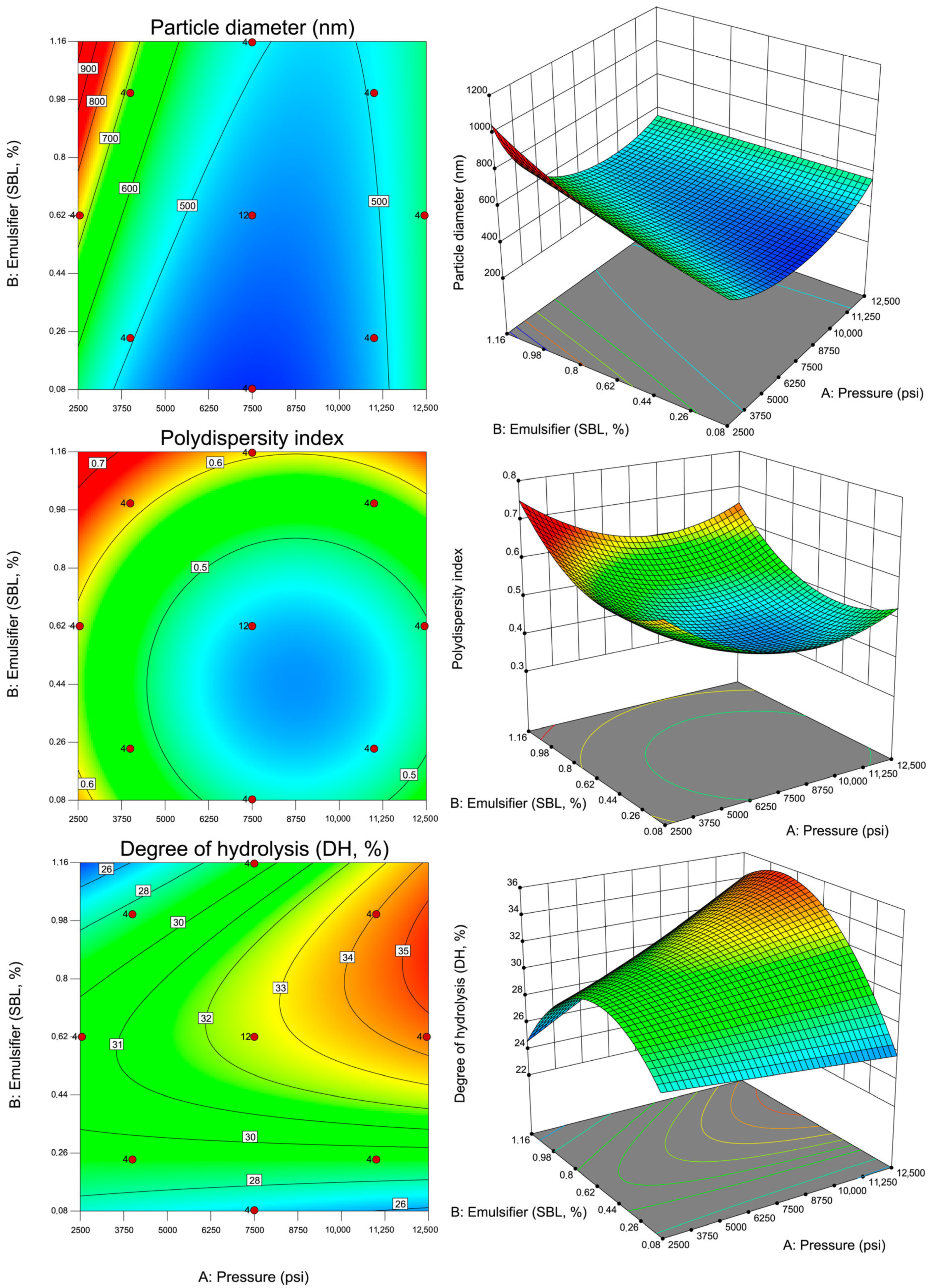
3.2.1. Response Surface Models for MDD, PdI, and DH When SBL Was Used as an Emulsifier
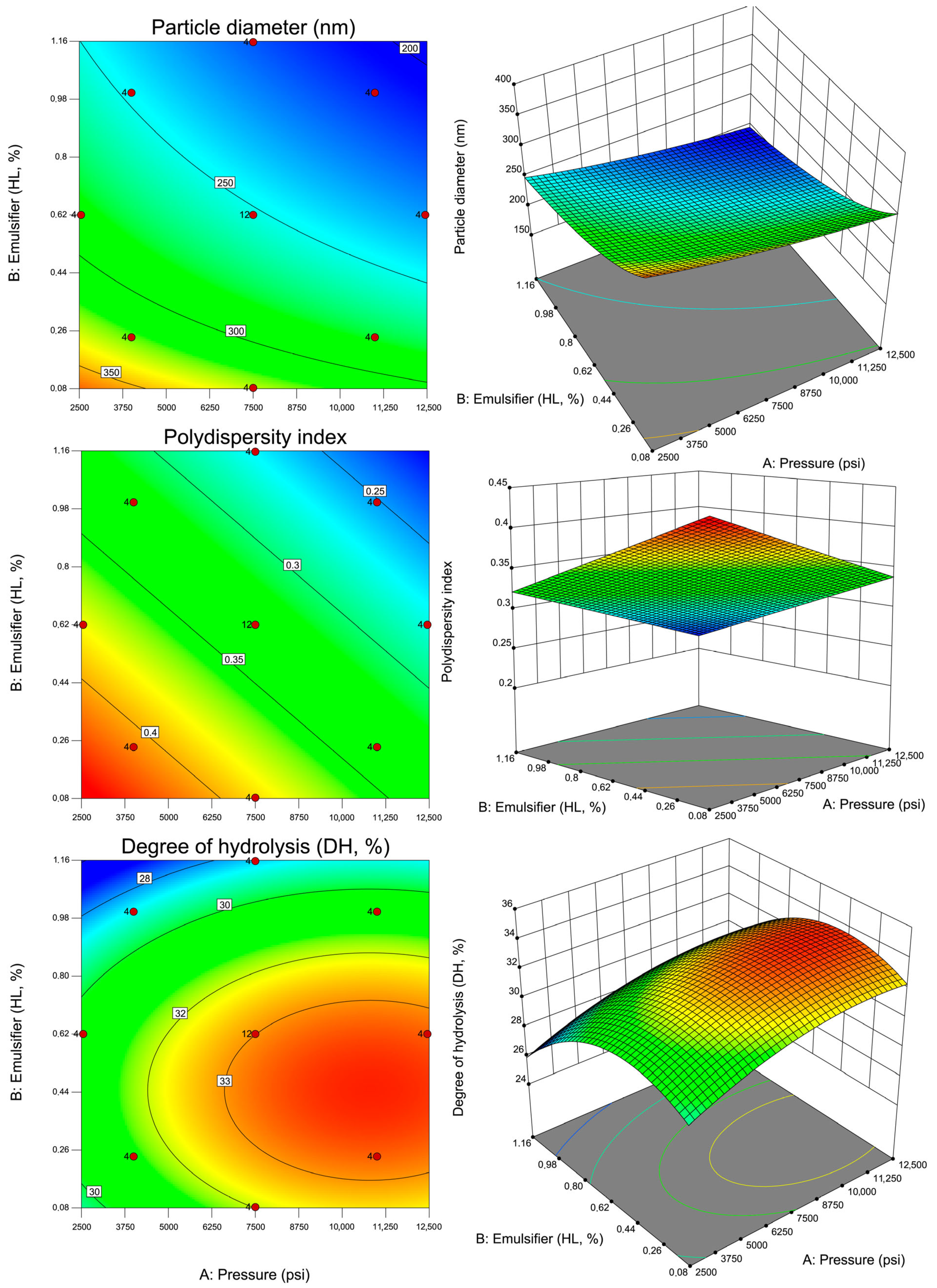
3.2.2. Response Surface Models for MDD, PdI, and DH When HL Was Used as an Emulsifier
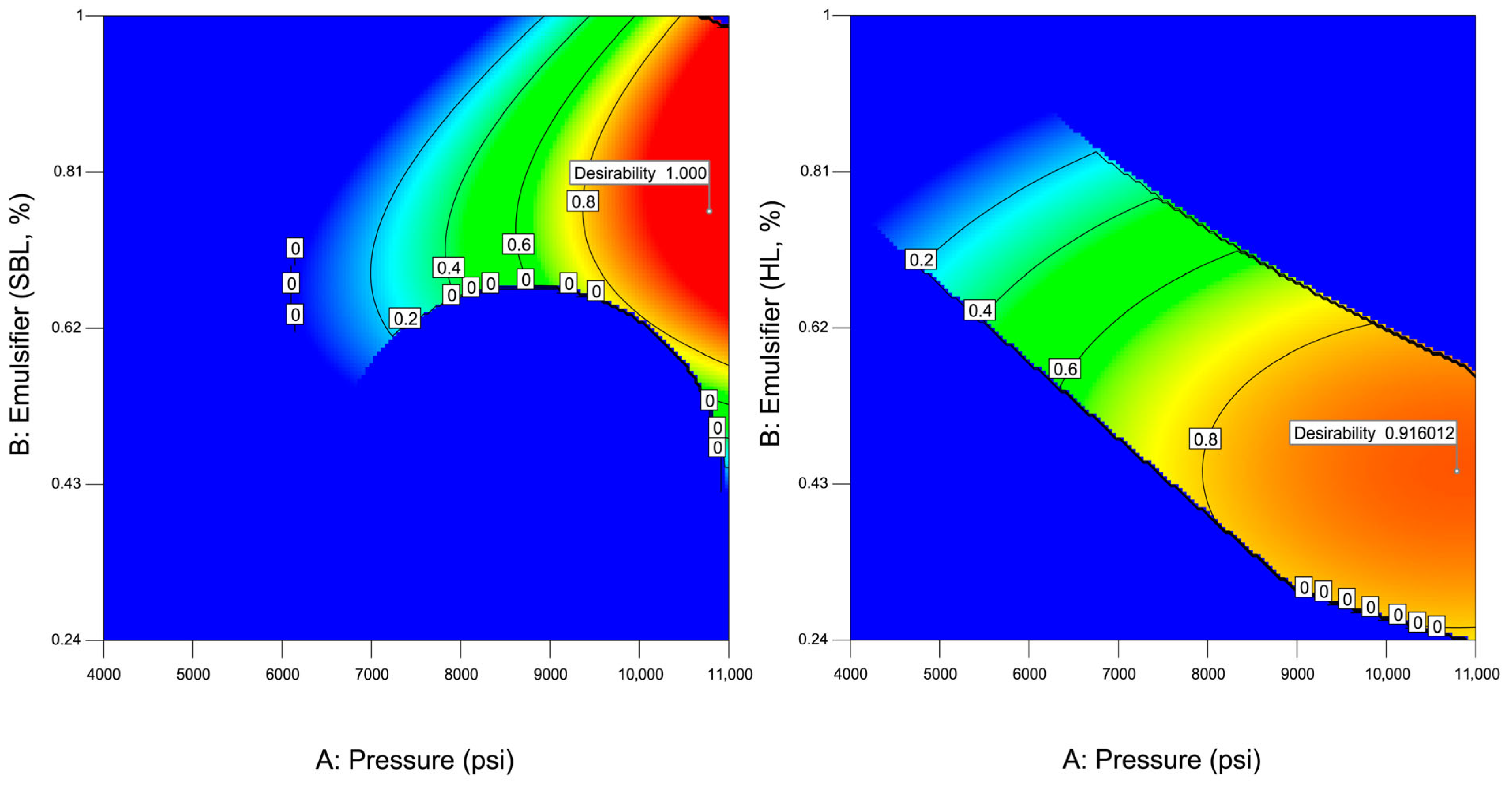
3.3. Model Optimization
3.4. Validation Assays
4. Discussion
4.1. CCD Experiments and Response Surface Models
4.2. Effects of Emulsifier Type, Emulsifier Dose, and Homogenization Pressure on the Characteristics of Emulsion Droplet
4.3. Effects of Emulsifier Type, Emulsifier Dose, and Homogenization Pressure on the Degree of Hydrolysis of Rapeseed Oil Digested with Intestinal Extracts of Rainbow Trout
5. Conclusions
Supplementary Materials
Author Contributions
Funding
Institutional Review Board Statement
Informed Consent Statement
Data Availability Statement
Acknowledgments
Conflicts of Interest
Abbreviations
| CCD | Composite central design |
| DH | Degree of hydrolysis (%) |
| HL | Hydrolyzed lecithin |
| EBMR | Emulsifier to bile salts molar ratio |
| ICE | Intestinal crude extract |
| IFC | Interfacial composition |
| LPL | Lysophospholipids |
| MDD | Mean droplet diameter (nm) |
| PdI | Polydispersity index of emulsion droplets (dimensionless) |
| PL | Phospholipids |
| RSM | Response surface methodology |
| RSO | Rapeseed oil |
| SBL | Soybean lecithin |
References
- FAO. The State of World Fisheries and Aquaculture 2024—Blue Transformation in Action; Food and Agriculture Organization of the United Nations: Rome, Italy, 2024; 232p. [Google Scholar] [CrossRef]
- Aas, T.S.; Åsgård, T.; Ytrestøyl, T. Utilization of feed resources in the production of Atlantic salmon (Salmo salar) in Norway: An update for 2020. Aquac. Rep. 2022, 26, 101316. [Google Scholar] [CrossRef]
- Aas, T.S.; Åsgård, T.; Ytrestøyl, T. Utilization of feed resources in the production of rainbow trout (Oncorhynchus mykiss) in Norway in 2020. Aquac. Rep. 2022, 26, 101317. [Google Scholar] [CrossRef]
- Naylor, R.L.; Hardy, R.W.; Buschmann, A.H.; Bush, S.R.; Cao, L.; Klinger, D.H.; Little, D.C.; Lubchenco, J.; Shumway, S.E.; Troell, M. A 20-year retrospective review of global aquaculture. Nature 2021, 591, 551–563. [Google Scholar] [CrossRef]
- Qian, Y.-F.; Wang, J.-X.; Qiao, F.; Luo, Y.; Chen, L.-Q.; Zhang, M.-L.; Du, Z.-Y. Modelling the impact of replacing fish oil with plant oils: A meta-analysis to match the optimal plant oil for major cultured fish. Rev. Aquac. 2024, 16, 1395–1422. [Google Scholar] [CrossRef]
- Turchini, G.M.; Francis, D.S.; Du, Z.-Y.; Olsen, R.E.; Ringø, E.; Tocher, D.R. Chapter 5—The lipids. In Fish Nutrition, 4th ed.; Hardy, R.W., Kaushik, S.J., Eds.; Academic Press: London, UK, 2022; pp. 303–467. [Google Scholar] [CrossRef]
- McClements, D.J. Lipid-based emulsions and emulsifiers. In Food Lipids: Chemistry, Nutrition, and Biotechnology, 4th ed.; Akoh, C.C., Ed.; CRC Press: Boca Raton, FL, USA; Taylor & Francis Group: Boca Raton, FL, USA, 2017; pp. 73–108. [Google Scholar] [CrossRef]
- Olsson, C.; Holmgren, S. Autonomic control of gut motility: A comparative view. Auton. Neurosci. Basic Clin. 2011, 165, 80–101. [Google Scholar] [CrossRef]
- Small, B.C. Chapter 8—Nutritional physiology. In Fish Nutrition, 4th ed.; Hardy, R.W., Kaushik, S.J., Eds.; Academic Press: London, UK, 2022; pp. 593–641. [Google Scholar] [CrossRef]
- Grosell, M.; O’Donnell, M.J.; Wood, C.M. Hepatic versus gallbladder bile composition: In vivo transport physiology of the gallbladder in rainbow trout. Am. J. Physiol.-Regul. Integr. Comp. Physiol. 2000, 278, R1674–R1684. [Google Scholar] [CrossRef] [PubMed]
- Kurtovic, I.; Marshall, S.; Zhao, X.; Simpson, B. Lipases from Mammals and Fishes. Rev. Fish. Sci. 2009, 17, 18–40. [Google Scholar] [CrossRef]
- Kaiser, F.; Schlachter, M.; van der Sande, A.D.; Schulz, C. A taste for growth: Rapeseed lecithin improves the feed intake of post-juvenile rainbow trout (Oncorhynchus mykiss). J. World Aquac. Soc. 2024, 55, e13097. [Google Scholar] [CrossRef]
- Batista, R.O.; Richter, B.L.; Banze, J.F.; Schleder, D.D.; Salhi, M.; Nobrega, R.O.; Silva, M.F.; Mattioni, B.; Pettigrew, J.E.; Fracalossi, D.M. Soy Lecithin Supplementation Promotes Growth and Increases Lipid Digestibility in GIFT Nile Tilapia Raised at Suboptimal Temperature. Fishes 2023, 8, 404. [Google Scholar] [CrossRef]
- Geurden, I.; Kaushik, S.; Corraze, G. Dietary phosphatidylcholine affects postprandial plasma levels and digestibility of lipid in common carp (Cyprinus carpio). Br. J. Nutr. 2008, 100, 512–517. [Google Scholar] [CrossRef]
- Bao, M.-Y.; Wang, Z.; Nuez-Ortín, W.G.; Zhao, G.; Dehasque, M.; Du, Z.-Y.; Zhang, M.-L. Comparison of Lysophospholipids and Bile Acids on the Growth Performance, Lipid Deposition, and Intestinal Health of Largemouth Bass (Micropterus salmoides). Aquac. Nutr. 2024, 2024, 1518809. [Google Scholar] [CrossRef] [PubMed]
- Zhang, Y.; Horstmann, P.; Maas, R.; Prakash, S.; Staessen, T.W.O.; Kokou, F.; Schrama, J.W. Effect of emulsifier supplementation on nutrient digestibility, bile acid balance, faecal waste production and faecal characteristics of yellowtail kingfish (Seriola lalandi). Aquac. Rep. 2024, 35, 101964. [Google Scholar] [CrossRef]
- Lu, Z.; Yao, C.; Tan, B.; Dong, X.; Yang, Q.; Liu, H.; Zhang, S.; Chi, S. Effects of Lysophospholipid Supplementation in Feed with Low Protein or Lipid on Growth Performance, Lipid Metabolism, and Intestinal Flora of Largemouth Bass (Micropterus salmoides). Aquac. Nutr. 2022, 2022, 4347466. [Google Scholar] [CrossRef]
- Adhami, B.; Amirkolaei, A.K.; Oraji, H.; Kazemifard, M.; Mahjoub, S. Effects of lysophospholipid on rainbow trout (Oncorhynchus mykiss) growth, biochemical indices, nutrient digestibility and liver histomorphometry when fed fat powder diet. Aquac. Nutr. 2021, 27, 1779–1788. [Google Scholar] [CrossRef]
- Krogdahl, Å.; Hansen, A.K.G.; Kortner, T.M.; Bjӧrkhem, I.; Krasnov, A.; Berge, G.M.; Denstadli, V. Choline and phosphatidylcholine, but not methionine, cysteine, taurine and taurocholate, eliminate excessive gut mucosal lipid accumulation in Atlantic salmon (Salmo salar L.). Aquaculture 2020, 528, 735552. [Google Scholar] [CrossRef]
- Li, B.; Li, Z.; Sun, Y.; Wang, S.; Huang, B.; Wang, J. Effects of dietary lysolecithin (LPC) on growth, apparent digestibility of nutrient and lipid metabolism in juvenile turbot Scophthalmus maximus L. Aquac. Fish. 2019, 4, 61–66. [Google Scholar] [CrossRef]
- Cabezas, D.M.; Diehl, B.W.K.; Tomas, M.C. Emulsifying properties of hydrolysed and low HLB sunflower lecithin mixtures. Eur. J. Lipid Sci. Technol. 2016, 118, 975–983. [Google Scholar] [CrossRef]
- Li, Y.; McClements, D.J. New mathematical model for interpreting pH-stat digestion profiles: Impact of lipid droplet characteristics on in vitro digestibility. J. Agric. Food Chem. 2010, 58, 8085–8092. [Google Scholar] [CrossRef]
- Zhou, H.; Tan, Y.; McClements, D.J. Applications of the INFOGEST In Vitro Digestion Model to Foods: A Review. Annu. Rev. Food Sci. Technol. 2023, 14, 135–156. [Google Scholar] [CrossRef]
- McClements, D.J.; Li, Y. Review of in vitro digestion models for rapid screening of emulsion-based systems. Food Funct. 2010, 1, 32–59. [Google Scholar] [CrossRef] [PubMed]
- Wang, R.; Mohammadi, M.; Mahboubi, A.; Taherzadeh, M.J. In-vitro digestion models: A critical review for human and fish and a protocol for in-vitro digestion in fish. Bioengineered 2021, 12, 3040–3064. [Google Scholar] [CrossRef]
- Myers, R.H.; Montgomery, D.C.; Anderson-Cook, C.M. Response Surface Methodology: Process and Product Optimization Using Designed Experiments, 4th ed.; John Wiley & Sons, Inc.: Hoboken, NJ, USA, 2016; p. 825. [Google Scholar]
- Hollebeeck, S.; Borlon, F.; Schneider, Y.-J.; Larondelle, Y.; Rogez, H. Development of a standardised human in vitro digestion protocol based on macronutrient digestion using response surface methodology. Food Chem. 2013, 138, 1936–1944. [Google Scholar] [CrossRef]
- Martínez, Ó.; Márquez, L.; Moyano, F.J.; Díaz, M. Modeling the Hydrolysis of Soybean Flour Proteins Digested with Gastric Proteases of the Marine Fish Sparus aurata and Commercial Non-Starch Polysaccharidases. Fishes 2025, 10, e320. [Google Scholar] [CrossRef]
- Gutiérrez-Méndez, N.; Chavez-Garay, D.R.; Leal-Ramos, M.Y. Lecithins: A comprehensive review of their properties and their use in formulating microemulsions. J. Food Biochem. 2022, 46, e14157. [Google Scholar] [CrossRef]
- Cabezas, D.M.; Madoery, R.; Diehl, B.W.K.; Tomás, M.C. Emulsifying properties of different modified sunflower lecithins. J. Am. Oil Chem. Soc. 2012, 89, 355–361. [Google Scholar] [CrossRef]
- Serrano, X.; Hernández, A.J.; Morales, G.; Larson, M.; Ruiz, J.; Orellana, P.; Díaz, M.; Moyano, F.J.; Márquez, L. Effects of dietary melanoidins on digestive physiology, nutrient digestibility and plasmatic antioxidant capacity of the rainbow trout Oncorhynchus mykiss. Aquaculture 2018, 485, 153–160. [Google Scholar] [CrossRef]
- Bucking, C.; Wood, C.M. The effect of postprandial changes in pH along the gastrointestinal tract on the distribution of ions between the solid and fluid phases of chyme in rainbow trout. Aquac. Nutr. 2009, 15, 282–296. [Google Scholar] [CrossRef]
- Romarheim, O.H.; Skrede, A.; Penn, M.; Mydland, L.T.; Krogdahl, Å.; Storebakken, T. Lipid digestibility, bile drainage and development of morphological intestinal changes in rainbow trout (Oncorhynchus mykiss) fed diets containing defatted soybean meal. Aquaculture 2008, 274, 329–338. [Google Scholar] [CrossRef]
- Mun, S.; Decker, E.A.; McClements, D.J. Influence of emulsifier type on in vitro digestibility of lipid droplets by pancreatic lipase. Food Res. Int. 2007, 40, 770–781. [Google Scholar] [CrossRef]
- Senanayake, N.S.P.J.; Shahidi, F. Lipase-catalyzed incorporation of docosahexaenoic acid (DHA) into borage oil: Optimization using response surface methodology. Food Chem. 2002, 77, 115–123. [Google Scholar] [CrossRef]
- Derringer, G.; Suich, R. Simultaneous Optimization of Several Response Variables. J. Qual. Technol. 1980, 12, 214–219. [Google Scholar] [CrossRef]
- Pulido, H.G.; De la Vara Salazar, R. Análisis y Diseño de Experimentos, 2nd ed.; McGraw-Hill Interamericana: Mexico City, Mexico, 2004; 545p. [Google Scholar]
- Montgomery, D.C. Design and Analysis of Experiments, 8th ed.; John Wiley & Sons, Inc.: Hoboken, NJ, USA, 2013; p. 752. [Google Scholar]
- Bot, F.; Cossuta, D.; O’Mahony, J.A. Inter-relationships between composition, physicochemical properties and functionality of lecithin ingredients. Trends Food Sci. Technol. 2021, 111, 261–270. [Google Scholar] [CrossRef]
- Wang, M.; Yan, W.; Zhou, Y.; Fan, L.; Liu, Y.; Li, J. Progress in the application of lecithins in water-in-oil emulsions. Trends Food Sci. Technol. 2021, 118, 388–398. [Google Scholar] [CrossRef]
- Quezada, C.; Urra, M.; Mella, C.; Zúñiga, R.N.; Troncoso, E. Plant-Based Oil-in-Water Food Emulsions: Exploring the Influence of Different Formulations on Their Physicochemical Properties. Foods 2024, 13, 513. [Google Scholar] [CrossRef]
- Walia, N.; Chen, L. Pea protein based vitamin D nanoemulsions: Fabrication, stability and in vitro study using Caco-2 cells. Food Chem. 2020, 305, 125475. [Google Scholar] [CrossRef] [PubMed]
- Komaiko, J.; Sastrosubroto, A.; McClements, D.J. Encapsulation of ω-3 fatty acids in nanoemulsion-based delivery systems fabricated from natural emulsifiers: Sunflower phospholipids. Food Chem. 2016, 203, 331–339. [Google Scholar] [CrossRef]
- Hu, M.; Li, Y.; Decker, E.A.; McClements, D.J. Role of calcium and calcium-binding agents on the lipase digestibility of emulsified lipids using an in vitro digestion model. Food Hydrocoll. 2010, 24, 719–725. [Google Scholar] [CrossRef]
- Kampa, J.; Koidis, A.; Ghawi, S.K.; Frazier, R.A.; Rodriguez-Garcia, J. Optimisation of the physicochemical stability of extra virgin olive oil-in-water nanoemulsion: Processing parameters and stabiliser type. Eur. Food Res. Technol. 2022, 248, 2765–2777. [Google Scholar] [CrossRef]
- Chung, C.; Sher, A.; Rousset, P.; McClements, D.J. Impact of Electrostatic Interactions on Lecithin-Stabilized Model O/W Emulsions. Food Biophys. 2018, 13, 292–303. [Google Scholar] [CrossRef]
- Sarkar, A.; Ye, A.; Singh, H. On the role of bile salts in the digestion of emulsified lipids. Food Hydrocoll. 2016, 60, 77–84. [Google Scholar] [CrossRef]
- Amara, S.; Gerlei, M.; Jeandel, C.; Sahaka, M.; Carrière, F.; Linder, M. In vitro gastrointestinal digestion of marine oil emulsions and liposomal solutions: Fate of LC-PUFAs upon lipolysis. Food Funct. 2024, 15, 11291–11304. [Google Scholar] [CrossRef]
- Pizones Ruiz-Henestrosa, V.M.; Ribourg, L.; Kermarrec, A.; Anton, M.; Pilosof, A.; Viau, M.; Meynier, A. Emulsifiers modulate the extent of gastric lipolysis during the dynamic in vitro digestion of submicron chia oil/water emulsions with limited impact on the final extent of intestinal lipolysis. Food Hydrocoll. 2022, 124, 107336. [Google Scholar] [CrossRef]
- Troncoso, E.; Aguilera, J.M.; McClements, D.J. Influence of particle size on the in vitro digestibility of protein-coated lipid nanoparticles. J. Colloid Interface Sci. 2012, 382, 110–116. [Google Scholar] [CrossRef]
- Lie, Ø.; Lambertsen, G. Digestive lipolytic enzymes in cod (Gadus morrhua): Fatty acid specificity. Comp. Biochem. Physiol. Part B 1985, 80, 447–450. [Google Scholar] [CrossRef]
- Tocher, D.R.; Sargent, J.R. Studies on triacylglycerol, wax ester and sterol ester hydrolases in intestinal caeca of rainbow trout (Salmo gairdneri) fed diets rich in triacylglycerols and wax esters. Comp. Biochem. Physiol. Part B 1984, 77, 561–571. [Google Scholar] [CrossRef]
- Reis, P.; Holmberg, K.; Watzke, H.; Leser, M.E.; Miller, R. Lipases at interfaces: A review. Adv. Colloid Interface Sci. 2009, 147–148, 237–250. [Google Scholar] [CrossRef] [PubMed]
- Vinarov, Z.; Tcholakova, S.; Damyanova, B.; Atanasov, Y.; Denkov, N.D.; Stoyanov, S.D.; Pelan, E.; Lips, A. Effects of emulsifier charge and concentration on pancreatic lipolysis: 2. Interplay of emulsifiers and biles. Langmuir 2012, 28, 12140–12150. [Google Scholar] [CrossRef]
- Tsuzuki, W.; Ue, A.; Nagao, A.; Endo, M.; Abe, M. Inhibitory effect of lysophosphatidylcholine on pancreatic lipase-mediated hydrolysis in lipid emulsion. Biochim. Biophys. Acta Mol. Cell Biol. Lipids 2004, 1684, 1–7. [Google Scholar] [CrossRef] [PubMed]
- Vinarov, Z.; Petkova, Y.; Tcholakova, S.; Denkov, N.; Stoyanov, S.; Pelan, E.; Lips, A. Effects of emulsifier charge and concentration on pancreatic lipolysis. 1. In the absence of bile salts. Langmuir 2012, 28, 8127–8139. [Google Scholar] [CrossRef] [PubMed]



| Codified Levels | ||||||
|---|---|---|---|---|---|---|
| Design Points | Axial (2) | Factorial (2) | Center (6) | Factorial (2) | Axial (2) | |
| Independent Variables (Numeric Factors) | Symbol | −alfa | −1 | 0 | +1 | +alfa |
| Homogenization pressure (psi) | A | 2550 | 4000 | 7500 | 11,000 | 12,450 |
| Emulsifier concentration (% w/w) | B | 0.08 | 0.24 | 0.62 | 1.00 | 1.16 |
| Response Variables | Soybean Lecithin (SBL) | Hydrolyzed Lecithin (HL) | ||
|---|---|---|---|---|
| Objective | Limits | Objective | Limits | |
| GH (%) | Maximize | 32–34 | Maximize | 31–34 |
| MDD (nm) | Within the limits | 450–550 | Within the limits | 240–280 |
| PdI (dimensionless) | Within the limits | 0.45–0.55 | Within the limits | 0.30–0.35 |
| Emulsifier | Conditions | Estimation | MDD | PdI | DH |
|---|---|---|---|---|---|
| SBL | 10,781 psi, and 0.76% SBL | Prediction | 492 ± 8.8 | 0.482 ± 0.05 | 34.4 ± 1.79 |
| Validation | 544 ± 30 | 0.520 ± 0.02 | 33.1 ± 0.97 | ||
| HL | 10,790 psi, and 0.45% HL | Prediction | 253 ± 2.4 | 0.315 ± 0.04 | 33.8 ± 1.29 |
| Validation | 243 ± 8.2 | 0.294 ± 0.03 | 34.8 ± 0.68 |
Disclaimer/Publisher’s Note: The statements, opinions and data contained in all publications are solely those of the individual author(s) and contributor(s) and not of MDPI and/or the editor(s). MDPI and/or the editor(s) disclaim responsibility for any injury to people or property resulting from any ideas, methods, instructions or products referred to in the content. |
© 2026 by the authors. Licensee MDPI, Basel, Switzerland. This article is an open access article distributed under the terms and conditions of the Creative Commons Attribution (CC BY) license.
Share and Cite
Picher, P.E.; Márquez, L.; Martínez, Ó.; Díaz, M. Modeling the In Vitro Hydrolysis of Nano-Emulsified Rapeseed Oil Digested with Intestinal Lipases of the Rainbow Trout Oncorhynchus mykiss Through Response Surface Methodology: Effect of the Emulsifier. Fishes 2026, 11, 256. https://doi.org/10.3390/fishes11050256
Picher PE, Márquez L, Martínez Ó, Díaz M. Modeling the In Vitro Hydrolysis of Nano-Emulsified Rapeseed Oil Digested with Intestinal Lipases of the Rainbow Trout Oncorhynchus mykiss Through Response Surface Methodology: Effect of the Emulsifier. Fishes. 2026; 11(5):256. https://doi.org/10.3390/fishes11050256
Chicago/Turabian StylePicher, Pablo E., Lorenzo Márquez, Óscar Martínez, and Manuel Díaz. 2026. "Modeling the In Vitro Hydrolysis of Nano-Emulsified Rapeseed Oil Digested with Intestinal Lipases of the Rainbow Trout Oncorhynchus mykiss Through Response Surface Methodology: Effect of the Emulsifier" Fishes 11, no. 5: 256. https://doi.org/10.3390/fishes11050256
APA StylePicher, P. E., Márquez, L., Martínez, Ó., & Díaz, M. (2026). Modeling the In Vitro Hydrolysis of Nano-Emulsified Rapeseed Oil Digested with Intestinal Lipases of the Rainbow Trout Oncorhynchus mykiss Through Response Surface Methodology: Effect of the Emulsifier. Fishes, 11(5), 256. https://doi.org/10.3390/fishes11050256