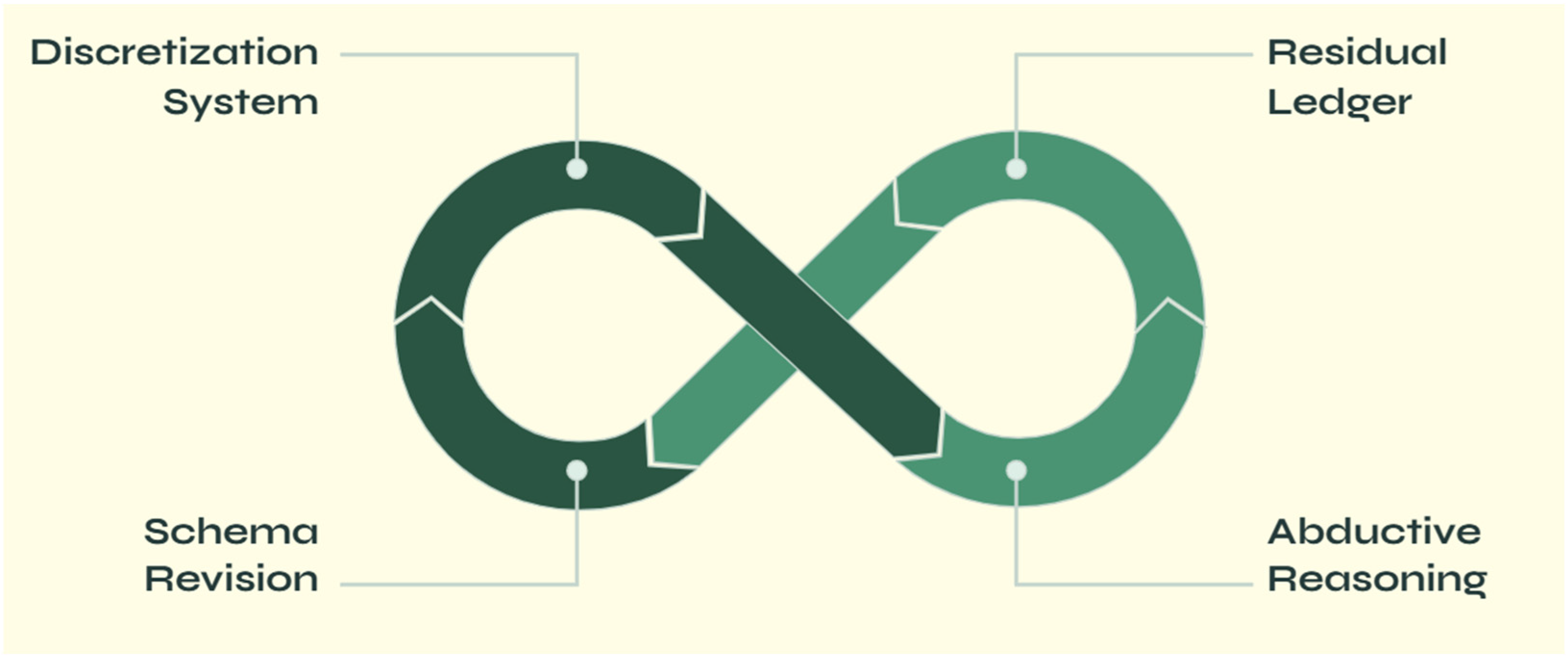

Abductive Discretization and Residual Politics: From Kantian Schematism to “Open Schema” AI Governance

Abstract
1. Introduction
- (1)
- Outliers and drift are primarily statistical diagnoses relative to a dataset or model behavior.
- (2)
- OOD flags epistemic distance from training support.
- (3)
- Residuals are governance failures: the schema cannot stably recognize a case as a case, cannot justify the boundary that excludes it, or cannot translate the harm into admissible evidence without erasing its meaning.
- Category mismatch: the taxonomy lacks a distinction that the situation demands.
- Threshold ambiguity: small contextual shifts flip the outcome, relocating responsibility.
- Multi-label conflict: legitimate aspects of the case map to incompatible labels or procedures.
- Cultural/context mismatch: the schema presupposes a “standard” form of life that does not hold.
- Rights/harms not captured: the harm is real but cannot be expressed in the approved fields.
2. Residuals and Checklist-Centered Governance: The Politics of Classification and Verification
2.1. Residuals Are Not Accidents: The Constitutive Remainder of Discretization
2.2. Checklist-Centered Governance: When Verification Replaces Responsiveness
2.3. The Residual Ledger: Making the Remainder Governable Without Erasing It
2.4. Thresholds, Accountability, and Abductive Revision
2.5. Illustrative Case: The Dutch Childcare Benefits Scandal
3. German Idealism and Abduction: Schema, Resistance, and Conceptual Development
3.1. Kantian Schematism and the Structural Underdetermination of Categories
3.2. Fichte’s Anstoß: Residuals as the “Check” That Forces Reconfiguration
3.3. Schelling: The Dynamic Remainder as a Motor of Formation
3.4. Dilthey: The Epistemological Rift Between Explanation and Understanding
4. From Audit to Abduction: Why Explanation and Interpretability Do Not Eliminate Residuals
4.1. Why “More Explanation” Does Not Eliminate Residuals
4.2. Internal Auditing and Governance Artifacts: When Documentation Becomes the End
4.3. Interpretability vs. Explanation: Two Governance Promises, One Residual Limit
4.4. Abductive Governance as a Protocol: From Residual Evidence to Category Change
5. Open Schema Governance: Institutional Design for Residual Visibility and Revision
5.1. The Residual Ledger as a Governance Primitive
5.2. Dual-Layer Evidence: Preserving Narrative Without Sacrificing Standardization
5.3. Threshold Justification as Public Reason: Parameters as Normative Commitments
5.4. Category Revision Protocol: Versioned Taxonomies and Explicit Triggers
5.4.1. Governance Body and Due Process
5.4.2. Safeguards Against Gaming and Over-Revision
5.5. Minimal Implementation: How to Adopt Open Schema Governance
5.6. Worked Example: From Residual Ledger to Schema Revision (Illustrative)
- (1)
- Add new category: “Eligibility—Nonstandard Household/Income Evidence” (with admissible evidence rules and escalation guidance).
- (2)
- Split “Documentation—Missing Forms” into (a) “Missing Forms—Standard Case” and (b) “Evidence Not Expressible in Standard Forms” (residual-sensitive pathway).
- (3)
- Update threshold rule: if the system detects irregular-income indicators and mixed household references, it must not default to “Missing Forms”; it must route to the new category and present an evidence menu (acceptable substitutes and a human-assistance option).
6. Conclusions: Toward a Revisable Governance Pathway
Funding
Institutional Review Board Statement
Informed Consent Statement
Data Availability Statement
Acknowledgments
Conflicts of Interest
References
- Jobin, A.; Ienca, M.; Vayena, E. The global landscape of AI ethics guidelines. Nat. Mach. Intell. 2019, 1, 389–399. [Google Scholar] [CrossRef]
- Mittelstadt, B. Principles alone cannot guarantee ethical AI. Nat. Mach. Intell. 2019, 1, 501–507. [Google Scholar] [CrossRef]
- Mitchell, M.; Wu, S.; Zaldivar, A.; Barnes, P.; Vasserman, L.; Hutchinson, B.; Spitzer, E.; Raji, I.D.; Gebru, T. Model Cards for Model Reporting. In Proceedings of the FAT* 19: Proceedings of the Conference on Fairness, Accountability, and Transparen; ACM: New York, NY, USA, 2019; pp. 220–229. [Google Scholar]
- Raji, I.D.; Smart, A.; White, R.N.; Mitchell, M.; Gebru, T.; Hutchinson, B.; Smith-Loud, J.; Theron, D.; Barnes, P. Closing the AI Accountability Gap. In Proceedings of the 2020 Conference on Fairness, Accountability, and Transparency; ACM: New York, NY, USA, 2020; pp. 33–44. [Google Scholar]
- Power, M. The Audit Society: Rituals of Verification; Oxford University Press: Oxford, UK, 1997. [Google Scholar]
- Strathern, M. (Ed.) Audit Cultures; Routledge: London, UK, 2000. [Google Scholar]
- Bowker, G.C.; Star, S.L. Sorting Things Out: Classification and Its Consequences; MIT Press: Cambridge, MA, USA, 1999; ISBN 978-0262522953. [Google Scholar]
- Luhmann, N. Social Systems; Stanford University Press: Stanford, CA, USA, 1995; ISBN 978-0804726252. [Google Scholar]
- Kant, I. Critique of Pure Reason; Guyer, P.; Wood, A., Translators; Cambridge University Press: Cambridge, UK, 1998. [Google Scholar]
- Fichte, J.G. Foundations of the Entire Science of Knowledge; Heath, P.; Lachs, J., Translators; Cambridge University Press: Cambridge, UK, 1982. [Google Scholar]
- Schelling, F.W.J. System of Transcendental Idealism; Heath, P., Translator; University of Virginia Press: Charlottesville, VA, USA, 1978. [Google Scholar]
- Dilthey, W. Einleitung in die Geisteswissenschaften; Duncker & Humblot: Leipzig, Germany, 1883. [Google Scholar]
- Husserl, E. The Crisis of European Sciences and Transcendental Phenomenology; Carr, D., Translator; Northwestern University Press: Evanston, IL, USA, 1970. [Google Scholar]
- Luhmann, N. Risk: A Sociological Theory; De Gruyter: Berlin, Germany, 1993. [Google Scholar]
- Peirce, C.S. Collected Papers of Charles Sanders Peirce; Hartshorne, C., Weiss, P., Burks, A.W., Eds.; Harvard University Press: Cambridge, MA, USA, 1931–1958. [Google Scholar]
- Son, S.H. Epistemological Origins of Abductive Discretization and AI Governance. J. Korean Philos. Soc. 2026, 177, 143–172. [Google Scholar] [CrossRef]
- Selbst, A.D.; Boyd, D.; Friedler, S.A.; Venkatasubramanian, S.; Vertesi, J. Fairness and abstraction in sociotechnical systems. In Proceedings of the Conference on Fairness, Accountability, and Transparency; ACM: New York, NY, USA, 2019; pp. 59–68. [Google Scholar]
- Thom, R. Structural Stability and Morphogenesis; W. A. Benjamin: Reading, MA, USA, 1975. [Google Scholar]
- European Commission. Ethics Guidelines for Trustworthy AI; European Commission: Brussels, Belgium, 2019. [Google Scholar]
- NIST. AI Risk Management Framework (AI RMF 1.0); NIST: Gaithersburg, MD, USA, 2023.
- ISO/IEC 23894:2023; Information Technology—Artificial Intelligence—Guidance on Risk Management. ISO: Geneva, Switzerland, 2023.
- Fenger, M.; Simonse, R. The implosion of the Dutch surveillance welfare state. Soc. Policy Adm. 2024, 58, 264–276. [Google Scholar] [CrossRef]
- Wittgenstein, L. Philosophical Investigations; Anscombe, G.E.M., Translator; Basil Blackwell: Oxford, UK, 1953. [Google Scholar]
- Esposito, E. Artificial Communication; MIT Press: Cambridge, MA, USA, 2022. [Google Scholar]
- Gadamer, H.-G. Truth and Method; Weinsheimer, J.; Marshall, D.G., Translators; Continuum: London, UK, 2004. [Google Scholar]
- Merleau-Ponty, M. L’Œil et l’Esprit; Gallimard: Paris, France, 1964. [Google Scholar]
- Magnani, L. Human abductive cognition vindicated. Philosophies 2022, 7, 15. [Google Scholar] [CrossRef]
- Rudin, C. Stop explaining black box machine learning models. Nat. Mach. Intell. 2019, 1, 206–215. [Google Scholar] [CrossRef] [PubMed]
- Miller, T. Explanation in artificial intelligence. Artif. Intell. 2019, 267, 1–38. [Google Scholar] [CrossRef]
- Wachter, S.; Mittelstadt, B.; Russell, C. Counterfactual explanations without opening the black box. Harv. J. Law Technol. 2018, 31, 841–887. [Google Scholar]
- Floridi, L. Establishing the rules for building trustworthy AI. Nat. Mach. Intell. 2019, 1, 261–262. [Google Scholar] [CrossRef]
- Mittelstadt, B.D.; Allo, P.; Taddeo, M.; Wachter, S.; Floridi, L. The ethics of algorithms. Big Data Soc. 2016, 3, 1–21. [Google Scholar] [CrossRef]
- Gebru, T.; Morgenstern, J.; Vecchione, B.; Vaughan, J.W.; Wallach, H.; Ill, H.D.; Crawford, K. Datasheets for datasets. Commun. ACM 2021, 64, 86–92. [Google Scholar] [CrossRef]
- Gunning, D.; Aha, D.W. DARPA’s explainable artificial intelligence (XAI) program. AI Mag. 2019, 40, 44–58. [Google Scholar]
- Doshi-Velez, F.; Kim, B. Towards a rigorous science of interpretable machine learning. arXiv 2017, arXiv:1702.08608. [Google Scholar] [CrossRef]
- Ribeiro, M.T.; Singh, S.; Guestrin, C. “Why should I trust you?”: Explaining the Predictions of Any Classifier. In Proceedings of the 22nd ACM SIGKDD International Conference on Knowledge Discovery and Data Mining; ACM: New York, NY, USA, 2016; pp. 1135–1144. [Google Scholar]
- Lundberg, S.M.; Lee, S.-I. A unified approach to interpreting model predictions. In Proceedings of the 31st International Conference on Neural Information Processing Systems; ACM: New York, NY, USA, 2017; pp. 4768–4777. [Google Scholar]
- Kroll, J.A.; Huey, J.; Barocas, S.; Felten, E.W.; Reidenberg, J.R.; Robinson, D.G.; Yu, H. Accountable algorithms. Univ. Pa. Law Rev. 2017, 165, 633–705. [Google Scholar]
- Eubanks, V. Automating Inequality; St. Martin’s Press: New York, NY, USA, 2018. [Google Scholar]
- Noble, S.U. Algorithms of Oppression; NYU Press: New York, NY, USA, 2018. [Google Scholar]
- Barocas, S.; Hardt, M.; Narayanan, A. Fairness and Machine Learning: Limitations and Opportunities; MIT Press: Cambridge, MA, USA, 2023. [Google Scholar]
- Dwork, C.; Hardt, M.; Pitassi, T.; Reingold, O.; Zemel, R. Fairness through awareness. In Proceedings of the 3rd Innovations in Theoretical Computer Science Conference; ACM: New York, NY, USA, 2012; pp. 214–226. [Google Scholar]
- Hardt, M.; Price, E.; Srebro, N. Equality of opportunity in supervised learning. In 30th Conference on Neural Information Processing Systems; ACM: New York, NY, USA, 2016; pp. 3323–3331. [Google Scholar]
- Binns, R. Fairness in machine learning. In Proceedings of the FAccT ‘23: 2023 ACM Conference on Fairness, Accountability, and Transparency; ACM: New York, NY, USA, 2018; pp. 149–159. [Google Scholar]
- Passi, S.; Barocas, S. Problem formulation and fairness. In Proceedings of the FAT* ’19: Conference on Fairness, Accountability, and Transparency; ACM: New York, NY, USA, 2019; pp. 39–48. [Google Scholar]
- European Union. Regulation (EU) 2024/1689 of the European Parliament and of the Council of 13 June 2024 Laying Down Harmonised Rules on Artificial Intelligence (Artificial Intelligence Act). Off. J. Eur. Union 2024. L 1689. [Google Scholar]



| Dimension | Checklist-Centered Governance | Open Schema Governance |
|---|---|---|
| Primary aim | Verifiability of procedure; compliance demonstration | Responsiveness under inevitable discretization; revision capacity |
| Unit of governance | Fixed categories + predefined checklist items | Versioned taxonomy + explicit revision triggers |
| What counts as evidence | Standardized, document-layer fields; audit artifacts | Dual-layer evidence (narrative + document) linked but not collapsed |
| Default treatment of edge cases | Exception-handling; “miscellaneous/other”; discretionary overrides | Residual logging as first-order input; patterns become revision-relevant |
| Failure signal | Non-compliance (a missed item) | Residual concentration/scale + appeal overturn + threshold instability |
| Accountability style | Accountability by proof (show the checklist was followed) | Accountability-by-revisability (show how/when schema changes) |
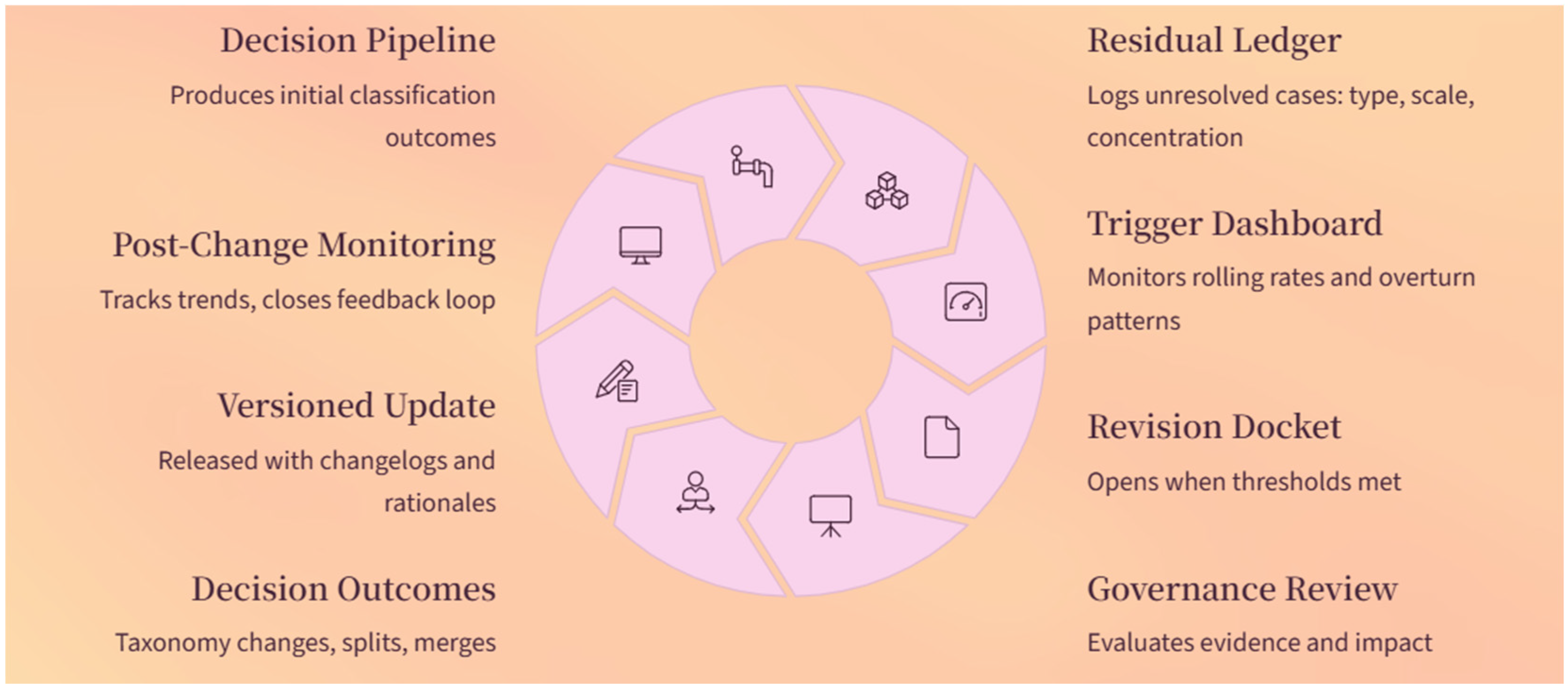
| Change mechanism | Rare, informal, reactive Updates | Formal protocol: docket → review → decision → changelog → monitoring |
| Typical blind spot | Harms that do not fit approved fields; minority lifeworld contexts | Strategic flooding/over-revision (addressed by safeguards) |
| Outputs | Model cards, checklists, post hoc explanations | Residual ledger, trigger dashboard, revision decisions, versioned standards |
Disclaimer/Publisher’s Note: The statements, opinions and data contained in all publications are solely those of the individual author(s) and contributor(s) and not of MDPI and/or the editor(s). MDPI and/or the editor(s) disclaim responsibility for any injury to people or property resulting from any ideas, methods, instructions or products referred to in the content. |
© 2026 by the author. Licensee MDPI, Basel, Switzerland. This article is an open access article distributed under the terms and conditions of the Creative Commons Attribution (CC BY) license.
Share and Cite
Son, S.H. Abductive Discretization and Residual Politics: From Kantian Schematism to “Open Schema” AI Governance. Philosophies 2026, 11, 51. https://doi.org/10.3390/philosophies11020051
Son SH. Abductive Discretization and Residual Politics: From Kantian Schematism to “Open Schema” AI Governance. Philosophies. 2026; 11(2):51. https://doi.org/10.3390/philosophies11020051
Chicago/Turabian StyleSon, Se Hoon. 2026. "Abductive Discretization and Residual Politics: From Kantian Schematism to “Open Schema” AI Governance" Philosophies 11, no. 2: 51. https://doi.org/10.3390/philosophies11020051
APA StyleSon, S. H. (2026). Abductive Discretization and Residual Politics: From Kantian Schematism to “Open Schema” AI Governance. Philosophies, 11(2), 51. https://doi.org/10.3390/philosophies11020051