
Conventional Versus Underwater Endoscopic Mucosal Resection for Superficial Non-Ampullary Duodenal Epithelial Tumors ≤ 20 mm: Study Protocol for a Multicenter Randomized Controlled Trial (D-CURE Trial)

 , , ,
, , ,  , and
, and 
Abstract
1. Background
2. Methods and Analysis
2.1. Study Settings
2.2. Approvals
2.3. Patient Selection


2.3.1. Inclusion Criteria
- Endoscopically diagnosed adenoma, adenocarcinoma, or histologically confirmed adenoma or adenocarcinoma through preoperative biopsy.
- The lesion has a longitudinal diameter of 20 mm or less.
- The estimated tumor depth is limited to the mucosa.
- The lesion is located in the duodenal bulb, descending part, or horizontal part, without invasion into the major or minor papilla.
- The lesion is non-pedunculated.
- Scheduled for endoscopic treatment for a single lesion.
- No history of gastrectomy or duodenectomy.
- Age at the time of registration ranges from 18 years to 85 years.
- Eastern Cooperative Oncology Group Performance Status is 0, 1, or 2.
- Has received adequate explanation regarding trial participation and has provided written consent.
2.3.2. Exclusion Criteria
- Diagnosed with familial adenomatous polyposis (FAP).
- Presents with systemic infections requiring systemic treatment.
- Pregnant or breastfeeding women.
- Psychiatric disorders, psychiatric symptoms, or dementia that would hinder participation in the trial.
- Complicated by unstable angina (occurrence within the last three weeks or exacerbation of angina) or a history of myocardial infarction within the past six months.
- Complicated with respiratory diseases requiring continuous oxygen therapy.
- Patients with a prognosis of less than 1 year.
- Other patients deemed inappropriate by the attending trial physician.
2.4. Informed Consent Procedure
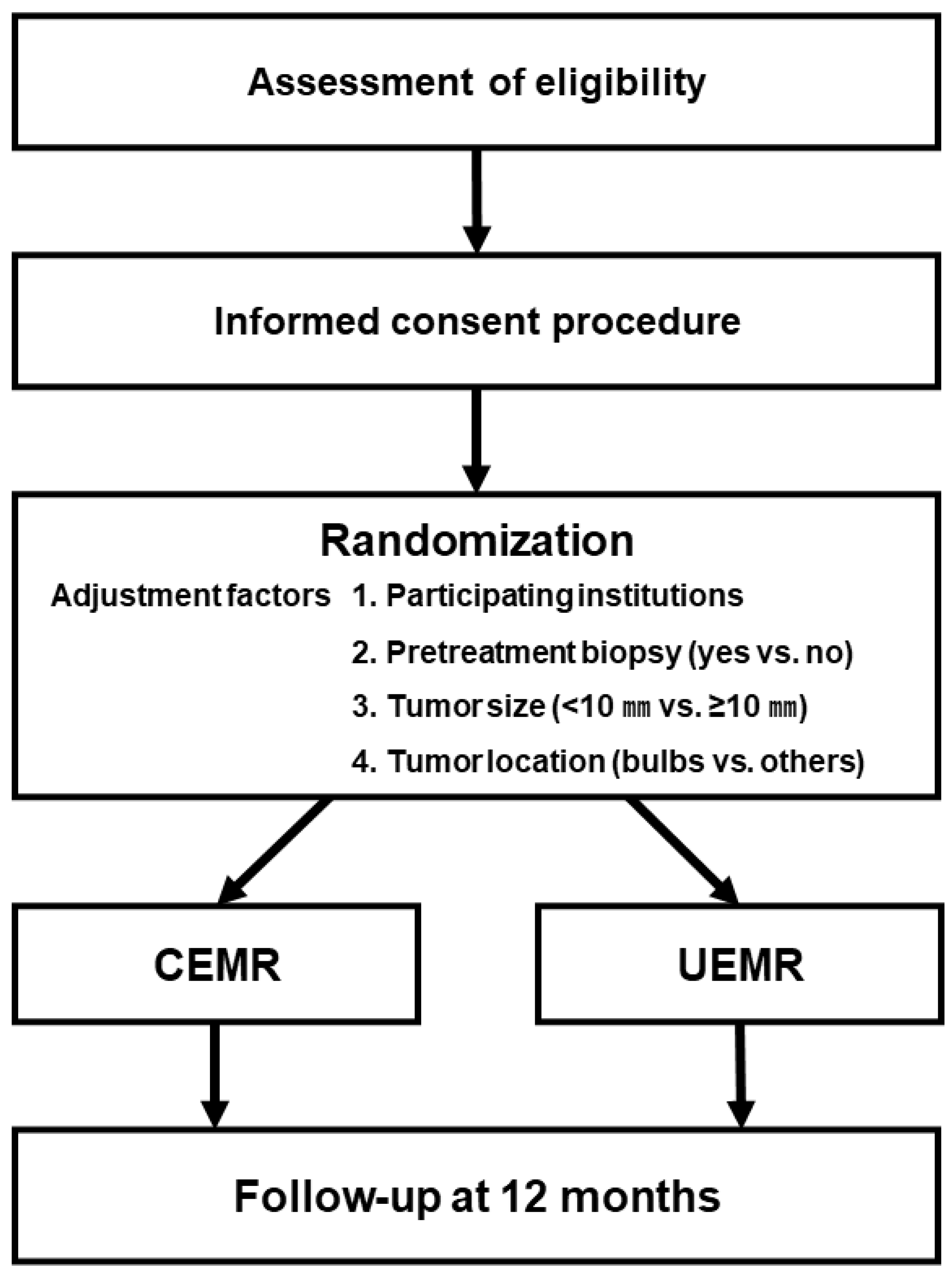
2.5. Randomization
Randomization Adjustment Factors and Their Selected Reasons for This Selection
- Institution
- 2.
- Pretreatment biopsy (presence vs. absence)
- 3.
- Tumor size (<10 mm vs. ≥10 mm)
- 4.
- Tumor location (bulb vs. other portions)
2.6. Blinding
2.7. Interventions
2.7.1. Standard Treatment Group (CEMR Group)
- Submucosal injections must be administered with a solution commonly used at each institution. The injection time will be considered as the start time of the CEMR procedure.
- The lesion, including the surrounding non-tumor mucosa, should be strangled with a commercially available snare of any type or size, chosen at the discretion of each endoscopist. Bipolar snares can be used. However, EMR with the cap technique is not permitted. Although the following settings are recommended for high-frequency devices, adjustments may be made at each facility: Endo-Cut Q mode, effect 2, duration 1, interval 6 for the VIO 300D ERBE; Endo-cut Q, effect 2 for the VIO3. Specimen retrieval should be performed using a retrieval net, grasping forceps, or a snare at the discretion of the endoscopist. Intentional fragmentation is not allowed.
2.7.2. Trial Treatment Group (UEMR Group)
- After deflating the stomach and duodenum, the duodenal lumen must be filled with saline solution. The start time of saline immersion will be considered the start time of the UEMR procedure. Gel immersion is not permitted in this case.
- The lesion, including the surrounding non-tumor mucosa, should be snared under saline immersion using a commercially available snare of any type or size, chosen at the discretion of each endoscopist. Bipolar snares can be used. Although the following settings are recommended for high-frequency devices, adjustments may be made at each facility: Endo-Cut Q mode, effect 3, duration 2, interval 4 for VIO 300D ERBE, and Endo-Cut Q, effect 3 for VIO3. Specimen retrieval was performed in the same manner as in CEMR.
2.7.3. Confirmation of Residual Lesions After EMR and Hemostasis
2.7.4. Mucosal Closure of EMR Ulcer Bed
2.7.5. Rescue Treatment in Case of Incompletion of Allocated Endoscopic Resection Method
2.8. Surveillance
2.9. Outcomes
2.9.1. Primary Endpoint (For Non-Inferiority)
2.9.2. Secondary Endpoints
- En bloc resection rate
- 2.
- Histological complete resection rate
- 3.
- Adverse events
- a.
- Intraoperative perforation
- b.
- Intraoperative bleeding
- c.
- Delayed bleeding
- d.
- Delayed perforation
- 4.
- Technical success rate
- 5.
- Total procedure time
- 6.
- Resection time
- 7.
- Mucosal closure time
- 8.
- Complete mucosal closure rate
- 9.
- Complete mucosal closure rate with standard clips
- 10.
- One-year duodenum preservation survival rate
- 11.
- Device cost
2.10. Sample Size Calculation
2.11. Significance of the D-CURE Trial
2.12. Data Collection and Management
2.13. Planned Statistical Analyses
2.13.1. Analysis of Efficacy
- Analysis of primary endpoint
- 2.
- Analysis of Secondary Endpoints
- a.
- En bloc resection rate, histological complete resection rate, technical success rate, complete mucosal closure rate, and complete mucosal closure rate with standard clips: The rates for the CEMR and UEMR groups, the point estimate of the intergroup differences, and the 95% CI will be calculated.
- b.
- Total procedural, resection, and mucosal closure times: Summary statistics will be computed for both groups. The Wilcoxon rank-sum test will be used.
- c.
- One-year duodenum preservation survival rate: The rates for the CEMR and UEMR groups, the point estimate of the intergroup difference, and the 95% CI will be calculated.
- d.
- Device cost: Summary statistics will be computed for each group, and the Wilcoxon rank-sum test will be used for comparison.
2.13.2. Safety Analysis
2.13.3. Exploratory Analysis
2.13.4. Patient and Public Involvement
2.14. Ethics and Dissemination
3. Discussion
Trial Status
Supplementary Materials
Author Contributions
Funding
Institutional Review Board Statement
Informed Consent Statement
Data Availability Statement
Acknowledgments
Conflicts of Interest
Abbreviations
References
- Nakagawa, K.; Sho, M.; Okada, K.I.; Akahori, T.; Aoyama, T.; Eguchi, H.; Fujii, T.; Higuchi, R.; Kanaji, S.; Kanetaka, K.; et al. Surgical results of non-ampullary duodenal cancer: A nationwide survey in Japan. J. Gastroenterol. 2022, 57, 70–81. [Google Scholar] [CrossRef]
- Nonaka, S.; Oda, I.; Tada, K.; Mori, G.; Sato, Y.; Abe, S.; Suzuki, H.; Yoshinaga, S.; Nakajima, T.; Matsuda, T.; et al. Clinical outcome of endoscopic resection for nonampullary duodenal tumors. Endoscopy 2015, 47, 129–135. [Google Scholar] [CrossRef] [PubMed]
- Lv, X.H.; Yang, J.L. The Application of Underwater Endoscopic Mucosal Resection for Nonampullary Duodenal Adenomas. Clin. Gastroenterol. Hepatol. 2022, 20, 1884. [Google Scholar] [CrossRef] [PubMed]
- ASGE Standards of Practice Committee; Chathadi, K.V.; Khashab, M.A.; Acosta, R.D.; Chandrasekhara, V.; Eloubeidi, M.A.; Faulx, A.L.; Fonkalsrud, L.; Lightdale, J.R.; Saltzman, J.R.; et al. The role of endoscopy in ampullary and duodenal adenomas. Gastrointest. Endosc. 2015, 82, 773–781. [Google Scholar] [CrossRef] [PubMed]
- Vanbiervliet, G.; Moss, A.; Arvanitakis, M.; Arnelo, U.; Beyna, T.; Busch, O.; Deprez, P.H.; Kunovsky, L.; Larghi, A.; Manes, G.; et al. Endoscopic management of superficial nonampullary duodenal tumors: European Society of Gastrointestinal Endoscopy (ESGE) Guideline. Endoscopy 2021, 53, 522–534. [Google Scholar] [CrossRef]
- Nakayama, A.; Kato, M.; Takatori, Y.; Shimoda, M.; Mizutani, M.; Tsutsumi, K.; Kiguchi, Y.; Akimoto, T.; Sasaki, M.; Mutaguchi, M.; et al. How I do it: Endoscopic diagnosis for superficial non-ampullary duodenal epithelial tumors. Dig. Endosc. 2020, 32, 417–424. [Google Scholar] [CrossRef]
- Bourke, M.J.; Lo, S.K.; Buerlein, R.C.D.; Das, K.K. AGA Clinical Practice Update on Nonampullary Duodenal Lesions: Expert Review. Gastroenterology 2025, 168, 169–175. [Google Scholar] [CrossRef]
- Apel, D.; Jakobs, R.; Spiethoff, A.; Riemann, J.F. Follow-up after endoscopic snare resection of duodenal adenomas. Endoscopy 2005, 37, 444–448. [Google Scholar] [CrossRef]
- Alexander, S.; Bourke, M.J.; Williams, S.J.; Bailey, A.; Co, J. EMR of large, sessile, sporadic nonampullary duodenal adenomas: Technical aspects and long-term outcome (with videos). Gastrointest. Endosc. 2009, 69, 66–73. [Google Scholar] [CrossRef]
- Abbass, R.; Rigaux, J.; Al-Kawas, F.H. Nonampullary duodenal polyps: Characteristics and endoscopic management. Gastrointest. Endosc. 2010, 71, 754–759. [Google Scholar] [CrossRef]
- Binmoeller, K.F.; Shah, J.N.; Bhat, Y.M.; Kane, S.D. “Underwater” EMR of sporadic laterally spreading nonampullary duodenal adenomas (with video). Gastrointest. Endosc. 2013, 78, 496–502. [Google Scholar] [CrossRef]
- Yamasaki, Y.; Uedo, N.; Akamatsu, T.; Kagawa, T.; Higashi, R.; Dohi, O.; Furukawa, M.; Takahashi, Y.; Inoue, T.; Tanaka, S.; et al. Nonrecurrence Rate of Underwater EMR for ≤20-mm Nonampullary Duodenal Adenomas: A Multicenter Prospective Study (D-UEMR Study). Clin. Gastroenterol. Hepatol. 2022, 20, 1010–1018.e3. [Google Scholar] [CrossRef] [PubMed]
- Maruoka, D.; Arai, M.; Kishimoto, T.; Matsumura, T.; Inoue, M.; Nakagawa, T.; Watanabe, Y.; Katsuno, T.; Tsuyuguchi, T.; Imazeki, F.; et al. Clinical outcomes of endoscopic resection for nonampullary duodenal high-grade dysplasia and intramucosal carcinoma. Endoscopy 2013, 45, 138–141. [Google Scholar] [CrossRef] [PubMed]
- Kato, M.; Takeuchi, Y.; Hoteya, S.; Oyama, T.; Nonaka, S.; Yoshimizu, S.; Kakushima, N.; Ohata, K.; Yamamoto, H.; Hara, Y.; et al. Outcomes of endoscopic resection for superficial duodenal tumors: 10 years’ experience in 18 Japanese high volume centers. Endoscopy 2022, 54, 663–670. [Google Scholar] [CrossRef] [PubMed]
- Lv, X.H.; Luo, R.; Lu, Q.; Deng, K.; Yang, J.L. Underwater versus conventional endoscopic mucosal resection for superficial non-ampullary duodenal epithelial tumors ≤ 20 mm: A systematic review and meta-analysis. Dig. Liver Dis. 2023, 55, 714–720. [Google Scholar] [CrossRef]
- Chan, A.W.; Tetzlaff, J.M.; Gøtzsche, P.C.; Altman, D.G.; Mann, H.; Berlin, J.A.; Dickersin, K.; Hróbjartsson, A.; Schulz, K.F.; Parulekar, W.R.; et al. SPIRIT 2013 explanation and elaboration: Guidance for protocols of clinical trials. BMJ 2013, 346, e7586. [Google Scholar] [CrossRef]
- Fujimoto, K.; Fujishiro, M.; Kato, M.; Higuchi, K.; Iwakiri, R.; Sakamoto, C.; Uchiyama, S.; Kashiwagi, A.; Ogawa, H.; Murakami, K.; et al. Guidelines for gastroenterological endoscopy in patients undergoing antithrombotic treatment. Dig. Endosc. 2014, 26, 1–14. [Google Scholar] [CrossRef]
- Kato, M.; Uedo, N.; Hokimoto, S.; Ieko, M.; Higuchi, K.; Murakami, K.; Fujimoto, K. Guidelines for Gastroenterological Endoscopy in Patients Undergoing Antithrombotic Treatment: 2017 Appendix on Anticoagulants Including Direct Oral Anticoagulants. Dig. Endosc. 2018, 30, 433–440. [Google Scholar] [CrossRef]
- Ushiku, T.; Arnason, T.; Fukayama, M.; Lauwers, G. Extra-ampullary duodenal adenocarcinoma. Am. J. Surg. Pathol. 2014, 38, 1484–1493. [Google Scholar] [CrossRef]
- Hida, R.; Yamamoto, H.; Hirahashi, M.; Kumagai, R.; Nishiyama, K.; Gi, T.; Esaki, M.; Kitazono, T.; Oda, Y. Duodenal Neoplasms of Gastric Phenotype: An Immunohistochemical and Genetic Study with a Practical Approach to the Classification. Am. J. Surg. Pathol. 2017, 41, 343–353. [Google Scholar] [CrossRef]
- Hijikata, K.; Nemoto, T.; Igarashi, Y.; Shibuya, K. Extra-ampullary duodenal adenoma: A clinicopathological study. Histopathology 2017, 71, 200–207. [Google Scholar] [CrossRef] [PubMed]
- Gotoda, T.; Akamatsu, T.; Abe, S.; Shimatani, M.; Nakai, Y.; Hatta, W.; Hosoe, N.; Miura, Y.; Miyahara, R.; Yamaguchi, D.; et al. Guidelines for sedation in gastroenterological endoscopy (second edition). Dig. Endosc. 2021, 33, 21–53. [Google Scholar] [CrossRef] [PubMed]
- Yamamoto, Y.; Yoshizawa, N.; Tomida, H.; Fujisaki, J.; Igarashi, M. Therapeutic outcomes of endoscopic resection for superficial non-ampullary duodenal tumor. Dig. Endosc. 2014, 26, 50–56. [Google Scholar] [CrossRef] [PubMed]
- ICH Harmonised Tripartite Guideline. Statistical principles for clinical trials. International Conference on Harmonisation E9 Expert Working Group. Stat. Med. 1999, 18, 1905–1942. [Google Scholar]
- Inoue, H.; Endo, M. Endoscopic esophageal mucosal resection using a transparent tube. Surg. Endosc. 1990, 4, 198–201. [Google Scholar] [CrossRef]
- Inoue, H.; Takeshita, K.; Hori, H.; Muraoka, Y.; Yoneshima, H.; Endo, M. Endoscopic mucosal resection with a cap-fitted panendoscope for esophagus, stomach, and colon mucosal lesions. Gastrointest. Endosc. 1993, 39, 58–62. [Google Scholar] [CrossRef]
- Ono, H.; Kondo, H.; Gotoda, T.; Shirao, K.; Yamaguchi, H.; Saito, D.; Hosokawa, K.; Shimoda, T.; Yoshida, S. Endoscopic mucosal resection for treatment of early gastric cancer. Gut 2001, 48, 225–229. [Google Scholar] [CrossRef]
- Imai, K.; Hotta, K.; Ito, S.; Yamaguchi, Y.; Kishida, Y.; Yabuuchi, Y.; Yoshida, M.; Kawata, N.; Tanaka, M.; Kakushima, N.; et al. Tip-in Endoscopic Mucosal Resection for 15- to 25-mm Colorectal Adenomas: A Single-Center, Randomized Controlled Trial (STAR Trial). Am. J. Gastroenterol. 2021, 116, 1398–1405. [Google Scholar] [CrossRef]
- Ichijima, R.; Ikehara, H.; Sumida, Y.; Inada, T.; Nemoto, D.; Nakajima, Y.; Minagawa, T.; Sumiyoshi, T.; Inoki, K.; Yoshida, N.; et al. Randomized controlled trial comparing conventional and traction endoscopic submucosal dissection for early colon tumor (CONNECT-C trial). Dig. Endosc. 2023, 35, 86–93. [Google Scholar] [CrossRef]
- Yamashina, T.; Uedo, N.; Akasaka, T.; Iwatsubo, T.; Nakatani, Y.; Akamatsu, T.; Kawamura, T.; Takeuchi, Y.; Fujii, S.; Kusaka, T.; et al. Comparison of Underwater vs Conventional Endoscopic Mucosal Resection of Intermediate-Size Colorectal Polyps. Gastroenterology 2019, 157, 451–461.e452. [Google Scholar] [CrossRef]
- Sánchez, J.R.; Alvarez-Gonzalez, M.A.; Pellisé, M.; Coto-Ugarte, D.; Uchima, H.; Aranda-Hernández, J.; García, J.S.; Marín-Gabriel, J.C.; Pons, F.R.; Nogales, O.; et al. Underwater versus conventional EMR of large nonpedunculated colorectal lesions: A multicenter randomized controlled trial. Gastrointest. Endosc. 2023, 97, 941–951.e2. [Google Scholar] [CrossRef]
- Nagl, S.; Ebigbo, A.; Goelder, S.K.; Roemmele, C.; Neuhaus, L.; Weber, T.; Braun, G.; Probst, A.; Schnoy, E.; Kafel, A.J.; et al. Underwater vs Conventional Endoscopic Mucosal Resection of Large Sessile or Flat Colorectal Polyps: A Prospective Randomized Controlled Trial. Gastroenterology 2021, 161, 1460–1474.e1. [Google Scholar] [CrossRef]
- Almario, J.A.; Zhang, L.Y.; Cohen, J.; Haber, G.B.; Ramberan, H.; Storm, A.C.; Gordon, S.; Adler, J.M.; Pohl, H.; Schlachterman, A.; et al. Through-the-scope suture closure of nonampullary duodenal endoscopic mucosal resection defects: A retrospective multicenter cohort study. Endoscopy 2023, 55, 865–870. [Google Scholar] [CrossRef]
- Kubosawa, Y.; Kato, M.; Sasaki, M.; Iwata, K.; Miyazaki, K.; Masunaga, T.; Hayashi, Y.; Mizutani, M.; Kiguchi, Y.; Takatori, Y.; et al. Closure of large mucosal defects for prevention of strictures after duodenal endoscopic submucosal dissection (with video). Gastrointest. Endosc. 2023, 97, 484–492. [Google Scholar] [CrossRef]
- Yamashina, T.; Shimatani, M.; Takahashi, Y.; Takeo, M.; Saito, N.; Matsumoto, H.; Kasai, T.; Kano, M.; Sumimoto, K.; Mitsuyama, T.; et al. Gel Immersion Endoscopic Mucosal Resection (EMR) for Superficial Nonampullary Duodenal Epithelial Tumors May Reduce Procedure Time Compared with Underwater EMR (with Video). Gastroenterol. Res. Pract. 2022, 2022, 2040792. [Google Scholar] [CrossRef]
- Schmidt, A.; Meier, B.; Cahyadi, O.; Karel, C. Duodenal endoscopic full-thickness resection (with video). Gastrointest. Endosc. 2015, 82, 728–733. [Google Scholar] [CrossRef]
Disclaimer/Publisher’s Note: The statements, opinions and data contained in all publications are solely those of the individual author(s) and contributor(s) and not of MDPI and/or the editor(s). MDPI and/or the editor(s) disclaim responsibility for any injury to people or property resulting from any ideas, methods, instructions or products referred to in the content. |
© 2026 by the authors. Licensee MDPI, Basel, Switzerland. This article is an open access article distributed under the terms and conditions of the Creative Commons Attribution (CC BY) license.
Share and Cite
Yoshida, M.; Hatta, W.; Nakamura, T.; Nakaya, N.; Shichijo, S.; Tanaka, Y.; Kanzaki, H.; Hirasawa, K.; Oda, I.; Hirose, T.; et al. Conventional Versus Underwater Endoscopic Mucosal Resection for Superficial Non-Ampullary Duodenal Epithelial Tumors ≤ 20 mm: Study Protocol for a Multicenter Randomized Controlled Trial (D-CURE Trial). Methods Protoc. 2026, 9, 30. https://doi.org/10.3390/mps9010030
Yoshida M, Hatta W, Nakamura T, Nakaya N, Shichijo S, Tanaka Y, Kanzaki H, Hirasawa K, Oda I, Hirose T, et al. Conventional Versus Underwater Endoscopic Mucosal Resection for Superficial Non-Ampullary Duodenal Epithelial Tumors ≤ 20 mm: Study Protocol for a Multicenter Randomized Controlled Trial (D-CURE Trial). Methods and Protocols. 2026; 9(1):30. https://doi.org/10.3390/mps9010030
Chicago/Turabian StyleYoshida, Masao, Waku Hatta, Tomohiro Nakamura, Naoki Nakaya, Satoki Shichijo, Yasuyuki Tanaka, Hiromitsu Kanzaki, Kingo Hirasawa, Ichiro Oda, Takashi Hirose, and et al. 2026. "Conventional Versus Underwater Endoscopic Mucosal Resection for Superficial Non-Ampullary Duodenal Epithelial Tumors ≤ 20 mm: Study Protocol for a Multicenter Randomized Controlled Trial (D-CURE Trial)" Methods and Protocols 9, no. 1: 30. https://doi.org/10.3390/mps9010030
APA StyleYoshida, M., Hatta, W., Nakamura, T., Nakaya, N., Shichijo, S., Tanaka, Y., Kanzaki, H., Hirasawa, K., Oda, I., Hirose, T., Kato, M., Takizawa, K., Toya, Y., Hikichi, T., Sawai, H., Yoshida, N., Dohi, O., Masamune, A., Abe, S., & Yano, T., on behalf of the D-CURE Trial Group. (2026). Conventional Versus Underwater Endoscopic Mucosal Resection for Superficial Non-Ampullary Duodenal Epithelial Tumors ≤ 20 mm: Study Protocol for a Multicenter Randomized Controlled Trial (D-CURE Trial). Methods and Protocols, 9(1), 30. https://doi.org/10.3390/mps9010030