1. Introduction
The construction industry is among the most hazardous occupational sectors globally, with workers facing substantially high risks of injury and fatality compared to other industries [
1]. In the United States alone, the Occupational Safety and Health Administration [
2] reported 1075 construction-related fatalities in 2023, representing approximately three deaths per day. This persistent safety challenge has significant implications for workforce welfare, project productivity, and economic costs associated with occupational incidents.
A substantial body of research has identified inadequate adherence to safety protocols as a primary contributor to construction accidents [
3]. While technological and regulatory interventions have improved workplace safety, the human behavioral dimension, particularly workers’ intrinsic drive to engage in safe practices, remains less explored. Safety motivation, defined as the internal and external factors that influence individuals to perform work safely [
4], could be a critical determinant of safety outcomes. Griffin and Curcuruto [
5] demonstrated that safety motivation contributes to positive safety climates by encouraging workers to assume responsibility for their own safety and that of their co-workers. However, current pressures including skilled labor shortages and production demands, may compromise safety prioritization among workers [
3].
The relationship between safety motivation and safety climate represents an important yet unexplored area of construction safety research. Safety climate, encompassing workers’ shared perceptions of organizational safety priorities and practices, has been extensively studied as a predictor of safety outcomes. Investigators have examined safety motivation among construction workers [
6], yet only a few studies have explored its relationship with safety climate, without establishing definitive conclusions. The prevailing understanding suggests a unidirectional relationship wherein safety climate influences safety motivation [
7]. However, evidence from existing literature indicates that both constructs may contribute to injury reduction, suggesting potential bidirectionality in their relationship [
8].
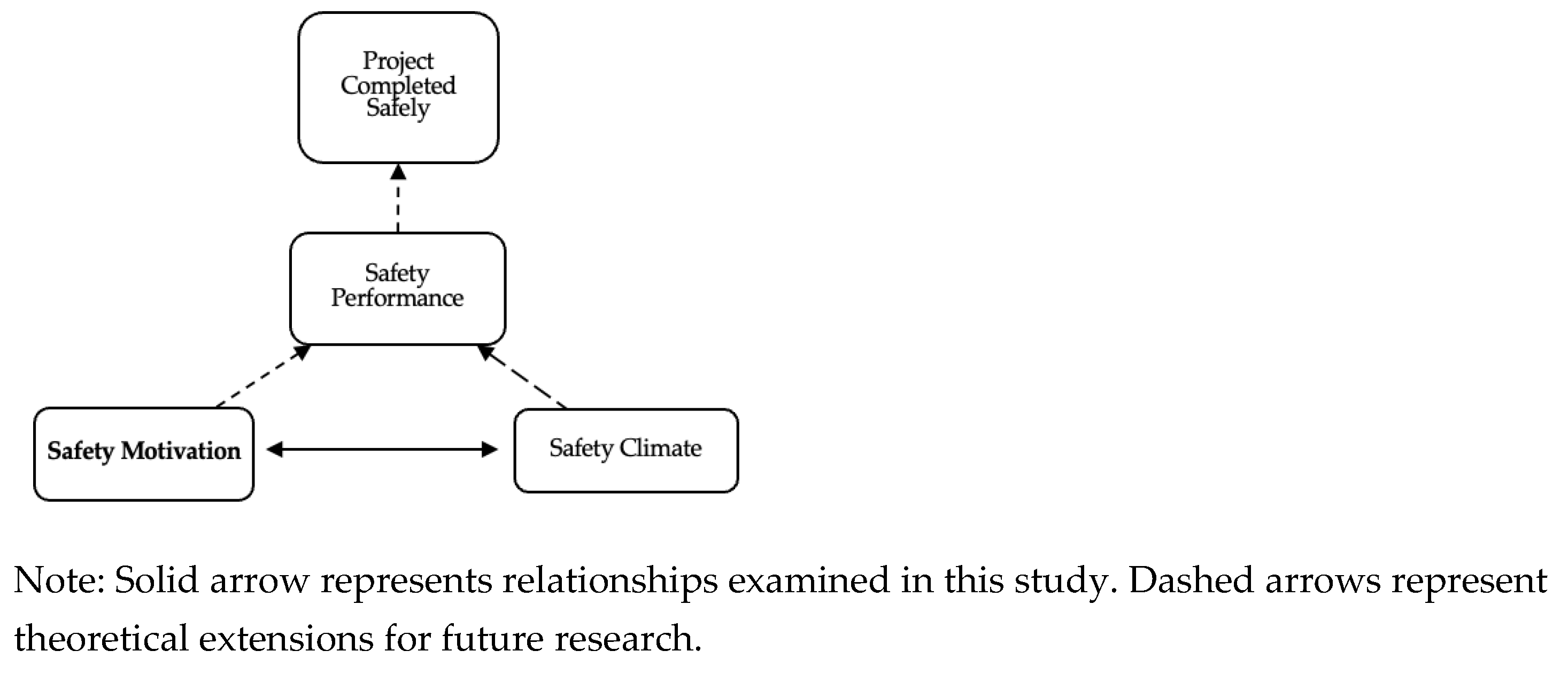
This study examined the hypothesis that safety motivation and safety climate maintain a reciprocal relationship in construction settings (
Figure 1). Specifically, this study investigated whether safety motivation not only results from positive safety climate but may also actively contribute to its development and maintenance. Furthermore, the conceptual model proposes that both constructs influence safety performance, which ultimately affects project safety outcomes (
Figure 1), though the current study focuses specifically on examining the association between safety motivation and safety climate. Understanding these relationships has important implications for developing more effective safety interventions that target both safety climate factors and individual motivational processes. The research question addressed was:
What is the nature of the association between safety motivation and safety climate among construction workers? A quantitative survey approach was employed to examine these constructs and their interrelationship, with findings suggesting significant bidirectional associations between worker safety motivation and perceived safety climate.
2. Literature Review
Building upon the established significance of safety motivation and safety climate in construction safety, this review examines the theoretical foundations of these constructs and synthesizes current empirical evidence regarding their interrelationship. Despite ongoing technological and regulatory advances, the construction sector continues to experience high accident rates, with behavioral factors, particularly safety motivation, identified as critical determinants of safety outcomes [
2,
3].
2.1. Theoretical Foundation of Safety Motivation
Safety motivation represents a multidimensional construct encompassing the internal and external factors that drive workers to perform their duties safely. Drawing from general motivation theory, three distinct forms of safety motivation have been identified in occupational contexts. Intrinsic safety motivation arises from internal factors and personal satisfaction, wherein workers engage in safe behaviors for inherent fulfillment rather than external rewards. Extrinsic safety motivation derives from external factors controlled by others, such as incentives, recognition, or supervisory expectations. Negative motivation operates through fear of undesirable consequences, including potential injuries or disciplinary actions [
4]. For this study, safety motivation is defined as the group of factors that influence workers to complete their tasks safely, integrating both approach-oriented and avoidance-oriented motivational processes.
2.2. Safety Motivation and Safety Performance
Empirical evidence shows that safety motivation serves as a critical mediator between organizational safety initiatives and actual safety performance. Griffin and Neal [
9] found that motivated workers demonstrate greater adherence to safety protocols, more actively engage in safe practices, and positively influence collective safety culture. Conversely, motivational deficits correlate with increased unsafe behaviors, non-compliance with safety regulations, and diminished engagement with safety practices [
3]. These findings suggest that safety motivation operates not merely as an individual characteristic but as a product of complex interactions between personal values, perceived relevance of safety measures, and organizational support systems.
Organizational and environmental factors substantially influence safety motivation and subsequent performance. Poor communication, inadequate supervision, deficient site management, and insufficient production planning have been identified as demotivating factors that increase safety risks [
6,
7]. These factors often create self-reinforcing cycles wherein organizational dysfunction diminishes worker motivation, which subsequently exacerbates safety challenges. Addressing these issues requires comprehensive interventions that recognize workers’ safety contributions, foster ownership of safety outcomes, and establish supportive organizational infrastructures.
2.3. Safety Climate as Motivational Antecedent
Safety climate, defined as employees’ shared perceptions of safety prioritization within their work environment, is an antecedent to safety motivation. Organizations characterized by robust safety climates, including strong management commitment, effective safety equipment provision, comprehensive training programs, and clear communication channels, demonstrate significantly enhanced employee safety motivation [
10]. When workers perceive genuine organizational commitment to safety, both intrinsic and extrinsic safety motivations increase, leading to improved adherence to safety practices and reduced accident rates [
11].
Management leadership plays a pivotal role in establishing and maintaining positive safety climates. Effective safety leadership, encompassing clear communication, consistent reinforcement of safety practices, and demonstrated commitment to safety standards, significantly influences workers’ safety attitudes and behaviors [
12]. Sankar et al. [
13] demonstrated that safety leadership acts as a catalyst for positive safety climate on construction sites, with strong supervisory commitment directly elevating workers’ collective safety perceptions. Transparent communication regarding safety expectations reinforces the importance of safety and encourages protocol adherence, while ambiguous directives or inconsistent messaging undermine motivation and weaken safety climate. Supervisory practices that leverage risk perception and reframe safety challenges as opportunities rather than hindrances can enhance both motivation and climate [
12]. Research on safety-specific transformational leadership further suggests that leaders who share safety knowledge and foster psychological safety among workers produce stronger safety behavior outcomes [
14]. Similarly, perceived leadership support has been found to promote safety citizenship behaviors and improve safety performance through safety learning mechanisms [
15], while supportive leadership is particularly influential in shaping the safety behaviors of newer construction workers [
16].
2.4. Bidirectional Relationship Between Safety Climate and Safety Motivation
While traditional models have conceptualized safety climate as a determinant of safety motivation, emerging evidence suggests a more complex, potentially bidirectional relationship. Theoretically, safety motivation can influence safety climate through several mechanisms, such as motivated workers model safe behaviors that peers observe and emulate (according to social learning theory [
13]). Workers with high safety motivation actively engage in peer communication about hazards and safety practices, shaping collective norms, and motivated workers provide upward feedback to management, influencing organizational policies and resource allocation. These individual-level motivations aggregate to create the shared perceptions and collective practices that constitute organizational safety climate. Al-Bayati [
7] noted that safety climate variables often mirror safety behavior variables, suggesting reciprocal influence between climate perceptions and individual motivations. This interdependence indicates that organizations cannot effectively cultivate positive safety climates without simultaneously attending to worker safety motivation [
6]. Coworker influence and peer-driven safety norms, products of individual motivations, contribute to collective climate perceptions, suggesting that motivated individuals actively shape organizational safety climate. Guo et al. [
17] further demonstrated that psychological symptoms interact with safety climate to shape safety behaviors among construction workers, highlighting that the association between climate and behavior is moderated by individual psychological states and reinforcing the need for models that account for both organizational and personal factors simultaneously.
Despite substantial research examining safety climate and safety motivation independently, critical gaps remain in understanding their interrelationship. First, while studies have demonstrated correlations between these constructs, the specific mechanisms through which they influence one another remain inadequately characterized. Second, the potential bidirectionality of this relationship has received limited empirical attention, with most research assuming unidirectional causality from climate to motivation. Third, insufficient research has examined how different motivation types (intrinsic, extrinsic, and negative) interact within safety climate contexts, or how these interactions vary across cultural and organizational settings. Finally, comprehensive models integrating these constructs with downstream outcomes such as safety performance and project safety completion are lacking.
This study addresses these gaps by empirically examining the bidirectional relationship between safety motivation and safety climate among construction workers, testing whether these constructs mutually reinforce one another and jointly influence safety outcomes. Understanding this relationship is essential for developing more effective, theoretically grounded interventions that target both individual motivational processes and organizational climate factors simultaneously.
3. Materials and Methods
A cross-sectional quantitative research design was employed to examine the association between construction workers’ safety motivation and their perceived safety climate. This approach enabled numerical measurement and statistical analysis of the relationship between these constructs. The study protocol, including survey instruments and data collection procedures, received approval from the Institutional Review Board prior to data collection, ensuring compliance with ethical standards for human subjects research.
3.1. Instrument Development
The survey instrument was developed following a systematic review of recent literature published within five years preceding the study. A comprehensive search was conducted using the keywords “safety motivation,” “safety climate,” and “construction safety motivation” in academic databases, yielding 98 relevant articles. These publications informed the selection and adaptation of validated measurement scales for both safety motivation and safety climate constructs.
The final survey instrument comprised three sections.
Section 1 contained items measuring safety motivation across its three dimensions: intrinsic motivation (internal factors and personal satisfaction from safe work), extrinsic motivation (external rewards and recognition for safe behaviors), and negative motivation (fear of adverse consequences).
Section 2 assessed perceived safety climate using items that captured workers’ perceptions of organizational safety priorities, management commitment, safety communication, and workplace safety practices.
Section 3 collected demographic information, including age, work experience, job role, education level, and project characteristics. All measurement items utilized Likert-type response scales to facilitate quantitative analysis.
Safety climate was measured using scales adapted from Zohar [
18], encompassing multiple dimensions including leadership and communication, safety procedures and training, peer support and team dynamics, recognition and reinforcement, safety equipment, safety involvement, and safety rewards. Safety motivation was measured using scales adapted from Fleming [
15], capturing intrinsic, extrinsic, and negative motivation. All items used 5-point Likert scales ranging from 1 (strongly disagree) to 5 (strongly agree). Reliability analysis demonstrated acceptable internal consistency for all scales [safety motivation (α = 0.84), overall safety climate (α = 0.89)].
The survey was translated into Spanish by certified translators to ensure linguistic equivalence. Both English and Spanish versions were pilot tested with small groups of construction workers (n = 5 per language) to assess comprehension, clarity, and face validity. Minor revisions were made based on feedback from the pilot test before finalizing the instruments.
3.2. Sampling and Recruitment
The target population consisted of construction workers actively employed on commercial construction projects within a single U.S. state, where construction safety is regulated by federal OSHA standards without state-specific plan modifications. The state’s construction industry is characterized by lower unionization rates (approximately 5% compared to the U.S. national average of 13%), a workforce with substantial Hispanic representation, and a predominance of small to mid-sized firms in commercial construction.
A purposive sampling strategy was employed to select construction projects that represented the diversity of commercial construction activity in the region. This non-probability sampling approach was selected as the most appropriate method given the practical constraints of accessing construction sites and the need to capture diverse worker experiences across varied organizational and geographic contexts. Projects were identified through multiple channels: direct communication with construction company management, coordination with industry associations, and referrals from participating organizations.
A total of 20 distinct geographic locations were included in the sampling strategy to capture regional variability within the state’s construction industry. These locations encompassed urban, suburban, and rural areas, representing diverse market conditions and organizational contexts. Access to the workers on these projects was negotiated individually with project managers and superintendents, who provided permission for on-site data collection and facilitated worker recruitment. To ensure adequate representation across trades and experience levels, the research team employed maximum variation sampling within each project site. Workers from different trades (e.g., masonry, plumbing, carpentry, equipment operation) and varying levels of experience were invited to participate. Project managers provided estimated worker counts for each site, with eligible populations ranging from 15 to 120 workers per project (total eligible population approximately 922 workers across all sites). All workers present during site visits and safety meetings were invited to participate, with no exclusion criteria applied beyond current employment on a participating commercial construction project.
The survey was distributed to 922 construction workers across the selected projects, yielding 383 valid responses for an overall response rate of 41.5%.
3.3. Data Collection Procedures
Data collection occurred over six months in 2024. Multiple distribution methods were employed to maximize participation: on-site paper surveys administered during safety meetings or breaks, and electronic surveys distributed via email or text message links provided by participating organizations. All potential participants received verbal and written information about the study’s purpose, the voluntary nature of participation, data confidentiality procedures, and their right to withdraw at any time without consequences.
The authors visited construction sites during scheduled safety meetings when possible, explained the study, and provided opportunities for workers to complete surveys on-site or take them for later completion. For electronic distribution, superintendents shared survey links with workers, and up to two follow-up reminders were sent at two-week intervals. No incentives were offered for participation to avoid undue influence.
All participants provided informed consent either through signed consent forms (paper surveys) or electronic consent acknowledgment (online surveys) prior to completing the questionnaire. Survey responses were anonymous, with no identifying information collected that could link responses to individual participants.
3.4. Data Analysis
Completed surveys were screened for completeness and response validity. Surveys with more than 20% missing data on key variables were excluded from analysis. The final analytical sample comprised 383 complete responses. Data from paper surveys were manually entered into electronic format and verified to ensure accuracy.
Statistical analyses were conducted using SPSS Version 28.0. Descriptive statistics were calculated for all variables, including frequencies and percentages for categorical variables, and means, standard deviations, and ranges for continuous variables. Reliability of measurement scales was assessed using Cronbach’s alpha coefficients. Bivariate relationships between safety motivation and safety climate were examined using Pearson correlation coefficients. Correlation analysis was selected as the primary analytical approach because it directly addresses the research question regarding the nature of associations between safety motivation and safety climate dimensions. This approach allows examination of relationship strength across multiple climate dimensions without imposing directional assumptions inconsistent with the proposed bidirectional conceptual model. Given the cross-sectional design, correlation analysis provides appropriate evidence of association while avoiding claims of causality or directional prediction that the study design cannot support.
4. Results
The survey was distributed to 922 construction workers across multiple commercial projects throughout the state, yielding 383 valid responses for a response rate of 41.5%.
Table 1 presents the demographic characteristics of the sample. The participant pool was predominantly male (96.34%,
n = 369), reflecting the gender composition typical of the construction workforce in the U.S. Ethnic diversity was evident, with Hispanic workers comprising the largest proportion (62.66%,
n = 240), followed by Caucasian (20.37%,
n = 78) and African American (9.66%,
n = 37) workers.
The age distribution revealed a workforce concentrated in early-to-mid career stages, with the largest proportion of participants in the 25–34 years age range (37.34%, n = 143), followed by those aged 35–44 years (28.98%, n = 111) and 18–24 years (22.98%, n = 88). Fewer participants were aged 45–54 years (8.36%, n = 32) or 55 years and above (2.35%, n = 9). Work experience among participants was substantial, with the modal category being 11–15 years of construction experience (31.33%, n = 120), followed by 6–10 years (26.63%, n = 102). Approximately one-fifth of participants (20.37%, n = 78) reported 1–5 years of experience, while 15.67% (n = 60) had less than one year and 6.01% (n = 23) had more than 15 years of experience in the industry. Educational attainment varied across the sample. High school diploma or equivalent was the most common educational level (33.68%, n = 129), followed by some high school education without completion (22.98%, n = 88) and some college education (19.32%, n = 74). Smaller proportions held college degrees (15.67%, n = 60) or graduate degrees (8.36%, n = 32).
Trade specializations represented in the sample included masons (34.94%, n = 134), equipment operators (13.25%, n = 51), plumbers (12.05%, n = 46), carpenters (10.84%, n = 42), and ironworkers (10.84%, n = 42). Other trades, including insulators and various specializations, collectively accounted for the remaining 18.02% (n = 69) of participants.
Regarding recent safety outcomes, 18.08% (
n = 69) of participants reported having sustained or been involved in a workplace injury within the 12 months preceding the survey, while 81.98% (
n = 314) reported no injury involvement during this period. Additional demographic information about the participants is provided in
Table 1.
4.1. Safety Motivation and Safety Climate Scores
Table 2 presents the descriptive statistics for the primary study constructs. Both safety motivation (M = 4.34, SD = 0.72) and safety climate (M = 3.91, SD = 1.16) demonstrated mean scores above the scale midpoint of 3.0 on the 5-point Likert scale, indicating generally positive perceptions among participants. The relatively lower standard deviation for safety motivation compared to safety climate suggests greater consensus among workers regarding their personal safety motivation than their perceptions of organizational safety climate.
4.2. Typology of Safety Motivation
Participants identified their primary reasons for adhering to safety practices, revealing a heterogeneous motivational landscape (
Table 3). Negative motivation, driven by fear of adverse outcomes, was the predominant type, with 37% (
n = 142) of participants reporting that accident prevention motivated their safety compliance. Intrinsic motivations collectively accounted for 27% of responses, including moral obligation (21%,
n = 80), gaining peer respect (4%,
n = 15), and management rewards (2%,
n = 8). Extrinsic motivations represented 33% of responses, encompassing management encouragement (13%,
n = 50), viewing safety as inherent to work (9%,
n = 34), meeting expectations (7%,
n = 27), peer influence (4%,
n = 13), and avoiding negative feedback (4%,
n = 11).
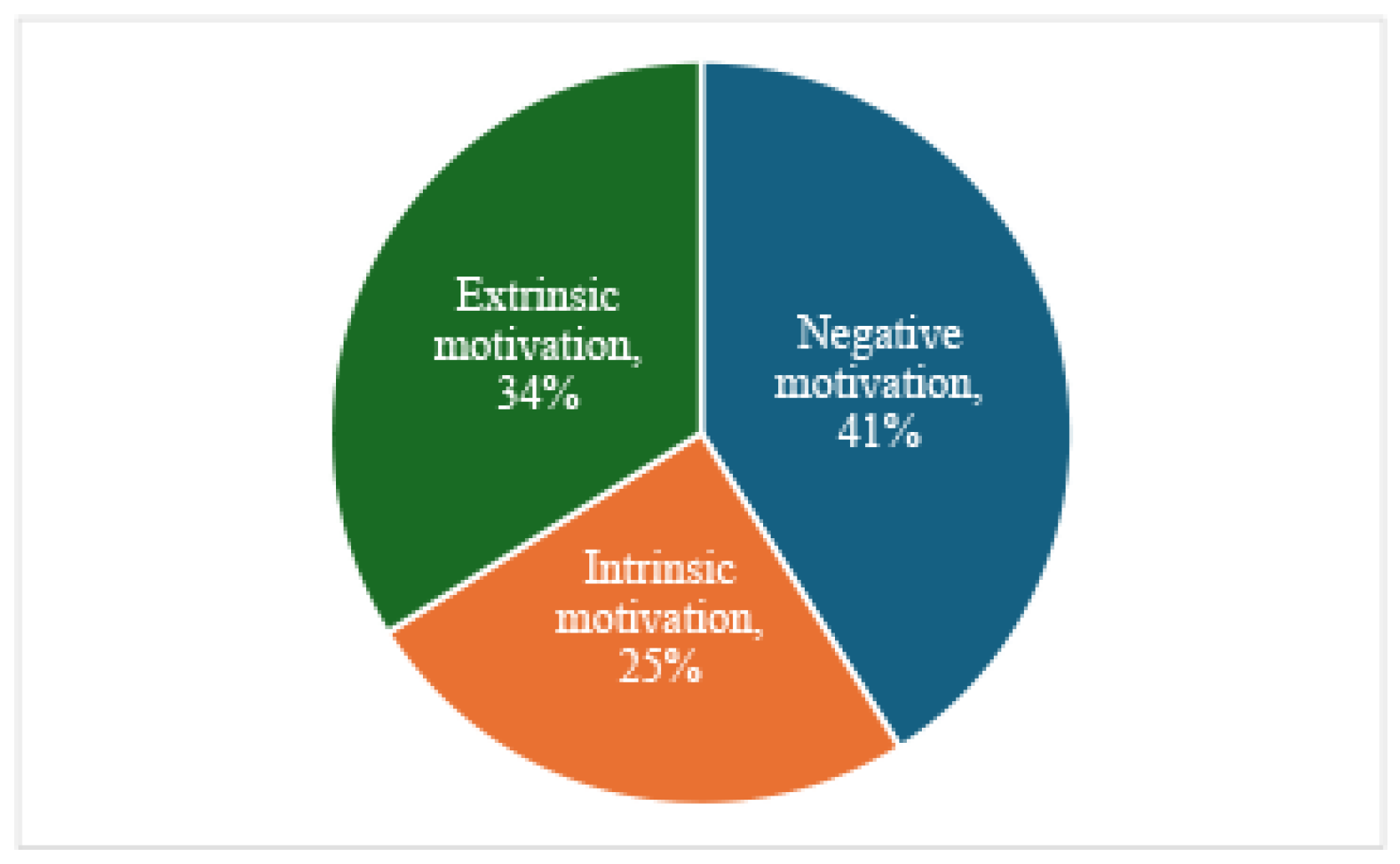
When aggregated by motivational category (
Figure 2), negative motivation predominated (40.0%,
n = 153), followed by extrinsic motivation (32.4%,
n = 124) and intrinsic motivation (26.9%,
n = 103). These findings underscore the complexity of safety motivation within construction workforces and suggest that comprehensive safety interventions must address multiple motivational pathways simultaneously.
4.3. Correlation Analysis: Safety Motivation and Safety Climate
Pearson correlation analyses examined relationships between safety motivation and overall safety climate, as well as specific safety climate dimensions (
Table 4). Safety motivation demonstrated a moderate positive correlation with overall safety climate (r = 0.467,
p < 0.01), supporting the hypothesized association between these constructs.
Among specific safety climate dimensions, Leadership and Communication exhibited the strongest correlation with safety motivation (r = 0.514, p < 0.01), followed by Safety Equipment availability (r = 0.488, p < 0.01) and Safety Procedures and Training (r = 0.485, p < 0.01). Moderate positive correlations were observed between safety motivation and Peer Support and Team Dynamics (r = 0.377, p < 0.01) and Recognition and Reinforcement (r = 0.367, p < 0.01). Weaker, non-significant correlations emerged between safety motivation and Safety Involvement (r = 0.158, p > 0.05) and Safety Rewards (r = 0.109, p > 0.05).
Substantial intercorrelations among safety climate dimensions were evident. Leadership and Communication correlated significantly with Safety Procedures and Training (r = 0.324, p < 0.01), Peer Support and Team Dynamics (r = 0.503, p < 0.01), Recognition and Reinforcement (r = 0.294, p < 0.01), and Safety Equipment (r = 0.460, p < 0.01). The strongest intercorrelation observed was between Peer Support and Team Dynamics and Safety Equipment (r = 0.647, p < 0.01), suggesting these dimensions may represent closely related aspects of workers’ safety climate perceptions. Safety Procedures and Training also demonstrated strong associations with Safety Equipment (r = 0.573, p < 0.01) and Peer Support and Team Dynamics (r = 0.507, p < 0.01).
These correlational findings provide empirical support for the proposed bidirectional relationship between safety motivation and safety climate, demonstrating that multiple dimensions of safety climate are significantly associated with workers’ safety motivation. The pattern of intercorrelations among safety climate dimensions suggests a multidimensional yet integrated construct underlying workers’ perceptions of organizational safety priorities.
5. Discussion
This study examined the association between safety motivation and safety climate among construction workers, addressing a critical gap in understanding the bidirectional relationship between these constructs. The findings provide empirical support for the proposed conceptual model (
Figure 1) and contribute to the growing body of literature emphasizing the interdependence of individual motivational factors and organizational safety climate in construction settings.
5.1. Bidirectional Relationship Between Safety Motivation and Safety Climate
The moderate positive correlation between safety motivation and overall safety climate (r = 0.467,
p < 0.01) supports the central hypothesis that these constructs are significantly associated. This finding extends previous research by Wen et al. [
3], which suggested unidirectional influence from safety climate to safety motivation, by demonstrating that the relationship may be reciprocal. Workers with higher safety motivation likely contribute to positive safety climate perceptions through their engagement in safety behaviors, peer influence, and reinforcement of safety norms. Conversely, organizations fostering strong safety climates provide the environmental conditions that nurture and sustain worker safety motivation. This bidirectional dynamic aligns with the Institute for Work & Health’s (
https://www.iwh.on.ca) observation that both constructs contribute to injury reduction, suggesting they are mutually reinforcing rather than hierarchically ordered.
5.2. Influence of Safety Climate on Safety Motivation
Among the specific safety climate dimensions examined, Leadership and Communication emerged as the strongest correlate of safety motivation (r = 0.514,
p < 0.01). This finding underscores the critical role of management in establishing safety expectations, demonstrating commitment to safety values, and maintaining transparent communication channels, factors previously identified as foundational to safety culture [
10,
12]. When workers perceive that leadership genuinely prioritizes safety through consistent messaging and supportive actions, their intrinsic and extrinsic motivations to engage in safe practices are enhanced.
The significant associations between safety motivation and both Safety Procedures and Training (r = 0.485,
p < 0.01) and Safety Equipment availability (r = 0.488,
p < 0.01) highlight the importance of providing workers with the knowledge, skills, and resources necessary for safe work performance. These findings align with Al-Bayati’s [
7] emphasis on comprehensive safety training and suggest that workers are more motivated to follow safety protocols when they understand the rationale behind procedures and have access to appropriate protective equipment. The provision of adequate safety equipment may signal organizational commitment to worker wellbeing, thereby enhancing both extrinsic motivation (meeting organizational expectations) and intrinsic motivation (personal protection and moral obligation).
Peer Support and Team Dynamics demonstrated a moderate positive correlation with safety motivation (r = 0.377,
p < 0.01), consistent with Guo et al.’s [
17] findings that collaborative work environments foster safety engagement. This relationship suggests that safety motivation operates not only at the individual level but is embedded within social contexts where coworker behaviors, expectations, and support influence individual motivation. Similarly, Recognition and Reinforcement showed a significant positive correlation (r = 0.367,
p < 0.01), supporting Griffin and Neal’s [
8] assertion that acknowledging safe behaviors reinforces motivation and contributes to positive safety climates.
The weaker, non-significant correlations between safety motivation and Safety Involvement (r = 0.158) and Safety Rewards (r = 0.109) warrant further investigation. These findings suggest that formal participation programs and reward systems may be less influential in motivating safety behaviors than interpersonal factors such as leadership, communication, and peer support. Alternatively, these dimensions may be less consistently implemented across the construction sites sampled, resulting in greater variability and weaker associations.
5.3. Heterogeneity of Safety Motivation
The typology of safety motivations revealed in this study provides nuanced insights into the drivers of safety compliance. The predominance of negative motivation (41.0%), characterized by fear of accidents and adverse outcomes, suggests that avoidance-oriented motivations remain prevalent in construction contexts. While negative motivation can effectively promote compliance, overreliance on fear-based appeals may have limitations, as suggested by motivational theory. Workers motivated primarily by fear may engage in minimum compliance rather than proactive safety behaviors and may experience reduced job satisfaction and increased stress.
The substantial representation of extrinsic motivations (34.0%), including management encouragement, meeting expectations, and peer influence, indicates that organizational and social factors significantly shape safety behaviors. These findings support the development of interventions that leverage positive reinforcement, clear expectations, and supportive supervision. The presence of intrinsic motivations (25.0%), including moral obligation and gaining peer respect, demonstrates that many workers possess internalized safety values. Fostering intrinsic motivation through strategies that enhance workers’ sense of ownership, competence, and autonomy in safety matters may yield more sustainable safety engagement than purely extrinsic or negative approaches [
5].
The predominance of negative motivation raises sustainability concerns. Fear-based approaches create stress, foster minimal compliance rather than proactive behavior, and diminish in effectiveness over time. The lower prevalence of intrinsic motivation suggests substantial opportunity for interventions that cultivate internal safety values through worker involvement, competence-building, and connection to personal values.
5.4. Interconnectedness of Safety Climate Dimensions
The substantial intercorrelations among safety climate dimensions observed in this study (
Table 4) suggest that these constructs, while conceptually distinct, function as an integrated system. The particularly strong correlation between Peer Support and Team Dynamics and Safety Equipment (r = 0.647,
p < 0.01) may indicate that supportive team environments facilitate appropriate equipment use and maintenance, or that adequate equipment provision enables collaborative safety efforts. Leadership and Communication demonstrated significant correlations with all other climate dimensions, reinforcing their foundational role in shaping comprehensive safety climates. These findings support Abeje and Luo’s [
6] argument that safety motivation and safety climate are complementary concepts requiring simultaneous attention in organizational interventions.
5.5. Implications for Practice
The results suggest several practical implications for construction safety management. The predominance of negative motivation (40%) indicates a need for intervention. Organizations should progressively involve workers in safety decision-making, connect safety to personal values (family, professional pride), and emphasize respect-based recognition over tangible rewards. Small-scale projects can implement peer-led committees and flexible procedures, while large-scale projects require formalized worker representation and systematic communication channels.
Leadership and Communication showed the strongest association with safety motivation (r = 0.514). Managers should prioritize consistent, transparent safety communication and visible commitment. Small operations benefit from informal daily interactions and behavioral modeling, while large projects require structured toolbox talks, multilingual briefings, and designated safety representatives.
Strong correlations with Safety Equipment (r = 0.488) and Training (r = 0.485) indicate resource provision drives motivation beyond compliance. Small firms can leverage industry associations and peer mentoring; large firms should implement centralized equipment management and comprehensive onboarding programs.
6. Conclusions
This study addressed a critical gap in construction safety research by empirically examining the association between workers’ safety motivation and their perceived safety climate. The research question: whether safety motivation is associated with safety climate among construction workers, was answered affirmatively, with findings demonstrating significant positive correlations between these constructs and supporting the proposed bidirectional conceptual model.
The results reveal that construction workers’ safety motivation operates through diverse pathways, with negative motivation (fear of accidents) currently predominating, followed by extrinsic factors (organizational and social influences) and intrinsic drivers (personal values and moral obligation). This motivational heterogeneity has important implications for intervention design. Rather than relying solely on compliance-based approaches that leverage fear, construction organizations should implement integrated strategies that cultivate intrinsic safety values while maintaining supportive organizational structures and clear behavioral expectations.
The study’s principal contribution lies in demonstrating that safety motivation and safety climate function as mutually reinforcing elements within construction safety systems. Workers who are highly motivated contribute to positive organizational safety climates through their behaviors and peer influence, while strong safety climates provide the environmental conditions—including leadership support, resource availability, and social norms—that sustain and enhance individual motivation. This reciprocal relationship suggests that interventions targeting only organizational factors or only individual attitudes will be less effective than comprehensive approaches addressing both simultaneously.
For construction safety professionals, project managers, and organizational leaders, these findings emphasize the need to move beyond viewing safety as primarily a matter of rule enforcement or equipment provision. Effective safety management requires creating work environments where leadership consistently communicates safety priorities, workers receive adequate training and resources, peer relationships support safe practices, and safe behaviors are recognized and valued. By addressing the full spectrum of organizational factors that shape safety climate while simultaneously understanding and responding to diverse worker motivations, construction organizations can cultivate safety cultures that reduce injuries and protect worker wellbeing.
Limitations and Future Research
There are a few limitations of this study that warrant consideration. The cross-sectional design precludes causal inference regarding the directionality of relationships between safety motivation and safety climate. Longitudinal research employing panel designs or experimental interventions is needed to establish temporal precedence and test the proposed bidirectional causality. The study was conducted within a single state with specific regulatory and cultural characteristics that may limit generalizability. These contextual factors may influence safety climate perceptions and motivational drivers, potentially limiting generalizability to states with different regulatory frameworks (e.g., state OSHA plans), higher unionization rates, or different workforce demographics. The 41.5% response rate, while reasonable for field-based surveys in construction settings, raises potential non-response bias concerns. Future research should examine whether non-participants differ systematically from participants in safety attitudes or experiences.
Additionally, this study relied on self-reported measures, which may be subject to social desirability bias, particularly regarding safety behaviors and motivations. Future research incorporating behavioral observations, objective safety performance metrics, or supervisor ratings would strengthen findings. The predominance of male participants (96.34%) reflects construction industry demographics but limits understanding of potential gender differences in safety motivation and climate perceptions. Finally, the relatively weak associations between certain safety climate dimensions (Safety Involvement, Safety Rewards) and safety motivation suggest these constructs may require refinement or that implementation variability across sites obscured relationships. Future research should examine organizational characteristics that moderate the strength of these associations.
The conceptual model (
Figure 1) proposes relationships extending to safety performance and project completion. However, this study examined only the association between safety motivation and safety climate. Future research should test the complete model using longitudinal designs with objective safety performance metrics and project-level outcome data to establish the causal pathways from motivation and climate to actual safety outcomes.