2. Theoretical Foundation of AMM Risk Assessment
2.1. Definition and Principles of Risk Assessment
According to ISO 31000:2018, risk is defined as the effect of uncertainty on objectives and is typically expressed as a function of the probability of occurrence of a hazardous event and the severity of its consequences [
20]. In the context of ground gas hazards, risk assessment aims to determine the likelihood that a subsurface gas source will generate hazardous concentrations in occupied spaces and to quantify the associated impact [
5,
21].
The fundamental mathematical representation of risk is [
22,
23]
where
represents the probability of occurrence of the hazardous condition,
represents the severity of consequences.
The multiplicative formulation preserves monotonicity and ensures that risk increases proportionally with either probability or consequence. Although simplified, this representation is widely adopted in environmental and industrial safety frameworks due to its transparency and decision-support applicability.
To ensure theoretical rigor and compatibility with reliability-based approaches, the hazardous condition is formally defined using a limit state function:
where
is the measured methane concentration (% vol.) and
is the adopted critical threshold.
The system is considered safe when
and in a failure (hazard) state when
This formulation enables future integration with structural reliability methods (e.g., FORM), even though the present study adopts a semi-quantitative operational framework.
Failure is defined operationally as the exceedance of the alert threshold vol. CH4 in borehole screening, used for decision prioritization; LEL exceedance is treated as an extreme consequence condition.
2.2. Methodological Approaches in Risk Assessment
Depending on the nature, availability, and statistical robustness of data, risk assessment can be performed using three complementary methodological approaches [
24,
25]: quantitative, semi-quantitative, and qualitative. Each approach has distinct theoretical foundations, strengths, and limitations.
Quantitative Risk Assessment (QRA) employs numerical data and probabilistic models to compute objective probabilities and estimate consequences in measurable terms. It typically requires statistically characterized input parameters and sufficiently large datasets to derive reliable probability distributions. Representative methods include Monte Carlo simulation, the First-Order Reliability Method (FORM), and the Second-Order Reliability Method (SORM). These approaches allow explicit modeling of uncertainty propagation and failure probability estimation but are computationally intensive and data-demanding.
Semi-quantitative Risk Assessment utilizes ordinal scoring systems to classify probability and consequence into discrete categories (e.g., 1–5). The probability–consequence risk matrix is the most widely applied instrument within this category. Semi-quantitative approaches are particularly useful in emergency or data-limited contexts, where rapid operational decisions are required. However, they introduce discretization effects and may involve subjective threshold selection.
Qualitative Risk Assessment describes risk in non-numerical terms (e.g., low, medium, high), relying predominantly on expert judgment without explicit numerical modeling. While useful for preliminary screening, qualitative approaches lack reproducibility and statistical transparency.
In the present study, a hybrid framework is adopted, combining quantitative exceedance probability estimation based on measured methane concentrations with a semi-quantitative 5 × 5 probability–consequence matrix for operational risk classification,
Table 1.
Additional theoretical clarification:
The selection of a semi-quantitative matrix-based framework for the operational phase is justified by
The limited availability of statistically characterized subsurface transport parameters.
The need for rapid classification during emergency conditions.
The requirement for transparency and reproducibility in urban risk governance.
However, by formally defining the hazardous state (see
Section 2.1), the proposed framework remains compatible with reliability-based extensions, ensuring methodological scalability.
2.3. Factors Influencing Abandoned Mine Methane (AMM) Emissions
Methane emissions from abandoned coal mines represent a multi-factorial process controlled by geological structure, residual gas storage conditions, hydrogeological dynamics, atmospheric forcing, and anthropogenic disturbance. Unlike active mining systems, where ventilation and degassing are engineered and monitored, abandoned systems evolve under uncontrolled post-closure conditions.
The literature indicates that AMM migration toward the surface is governed by a combination of
Gas generation and desorption mechanisms;
Permeability pathways and structural discontinuities;
Hydrostatic displacement processes;
Barometric pressure variations;
Urban infrastructure interaction [
3,
4,
5,
6,
11].
In order to ensure a systematic risk assessment, influencing factors were identified through
Review of international case studies and scientific literature;
Analysis of historical mining documentation;
Field observations during monitoring campaigns;
Expert consultation within the project team.
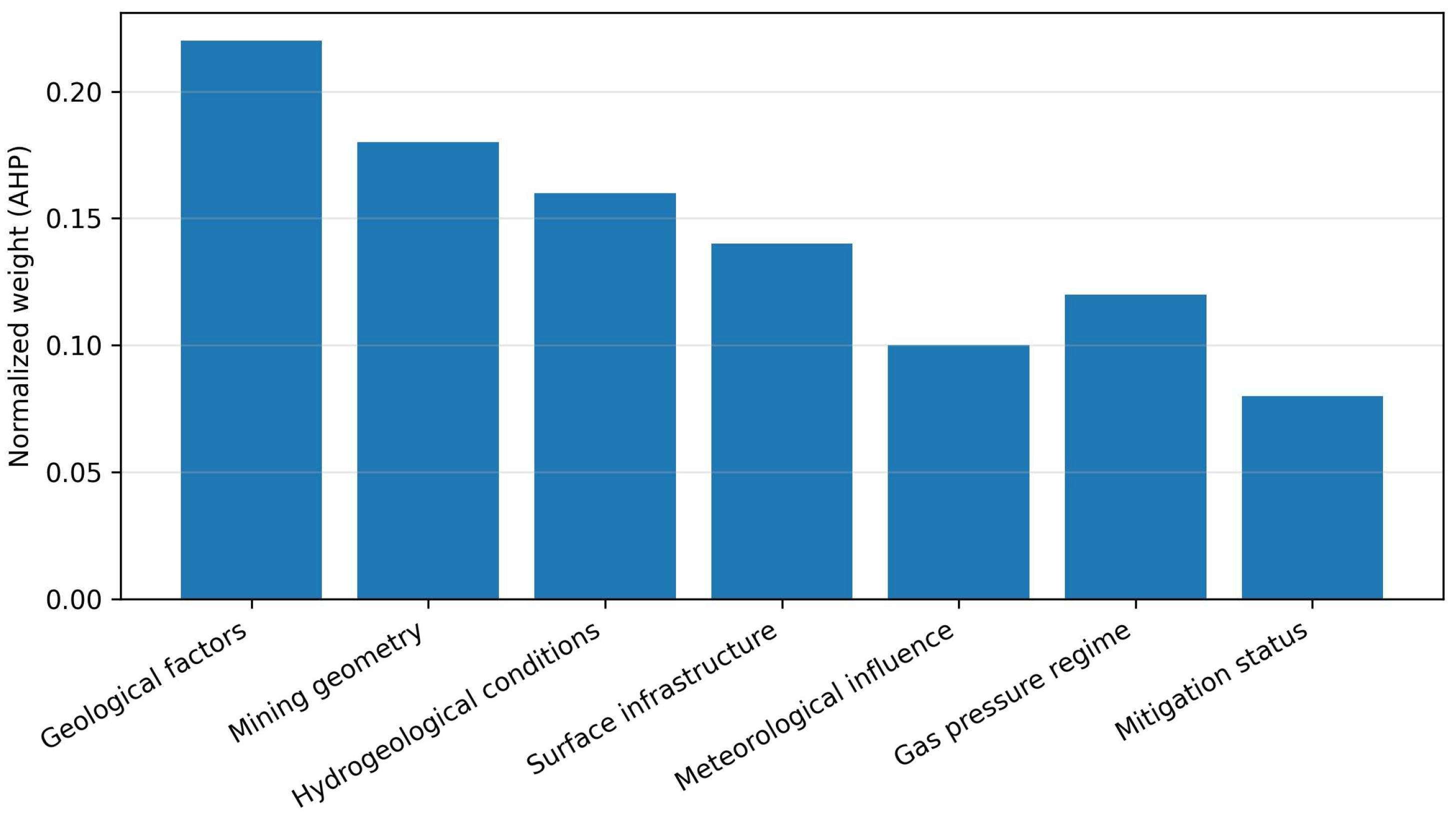
A total of 42 influencing factors were identified and grouped into seven categories, reflecting both static (structural) and dynamic (time-dependent) controls. The distinction between static and dynamic factors is relevant for risk assessment, as static factors define baseline vulnerability, whereas dynamic factors modulate short-term hazard activation (
Table 2,
Figure 1).
2.3.1. Static vs. Dynamic Controls
Static factors (geological and mining-related) define the intrinsic methane storage potential and structural connectivity of abandoned workings. These parameters evolve slowly and represent the baseline susceptibility of the site.
Dynamic factors (hydrogeological, meteorological, anthropogenic, biological) act as triggering mechanisms. For example,
Rising groundwater levels may displace accumulated gas upward (“hydraulic piston effect”).
Rapid barometric pressure drops may enhance methane exsolution and migration.
Construction works may create preferential migration pathways.
This distinction is critical in operational risk assessment, as static vulnerability does not automatically imply immediate hazard unless dynamic activation conditions occur.
2.3.2. Integration into Risk Assessment
The identification of influencing factors serves three purposes:
Contextualization of measured methane concentrations within a mechanistic framework.
Support for consequence evaluation (e.g., infrastructure vulnerability).
Foundation for potential future probabilistic modeling (e.g., reliability-based extensions).
While not all 42 factors are explicitly parameterized in the present semi-quantitative model, their structured classification ensures transparency and scalability of the framework.
2.4. Risk Matrix and Risk Classification
2.4.1. Definition of Probability and Consequence Scales
For semi-quantitative risk evaluation, standardized ordinal scales are defined and adapted to the specific context of methane emissions from abandoned coal mines [
21,
24,
26]. The correspondence between the quantitative exceedance probability
and the ordinal 1–5 probability scale is presented in
Table 3.
The consequence scale (C) is presented in
Table 4.
The consequence scale integrates human exposure and material damage indicators relevant to urban methane-related hazards (
Table 4).
2.4.2. Determination of Consequence Weights Using AHP
To determine the relative contribution of each consequence component, the Analytic Hierarchy Process (AHP) was applied [
27] using a panel of five experts (two mining engineers, one geologist, one public safety specialist, and one urban planner) who performed pairwise comparisons among the three primary consequence dimensions—explosive potential
, human exposure
, and infrastructure vulnerability
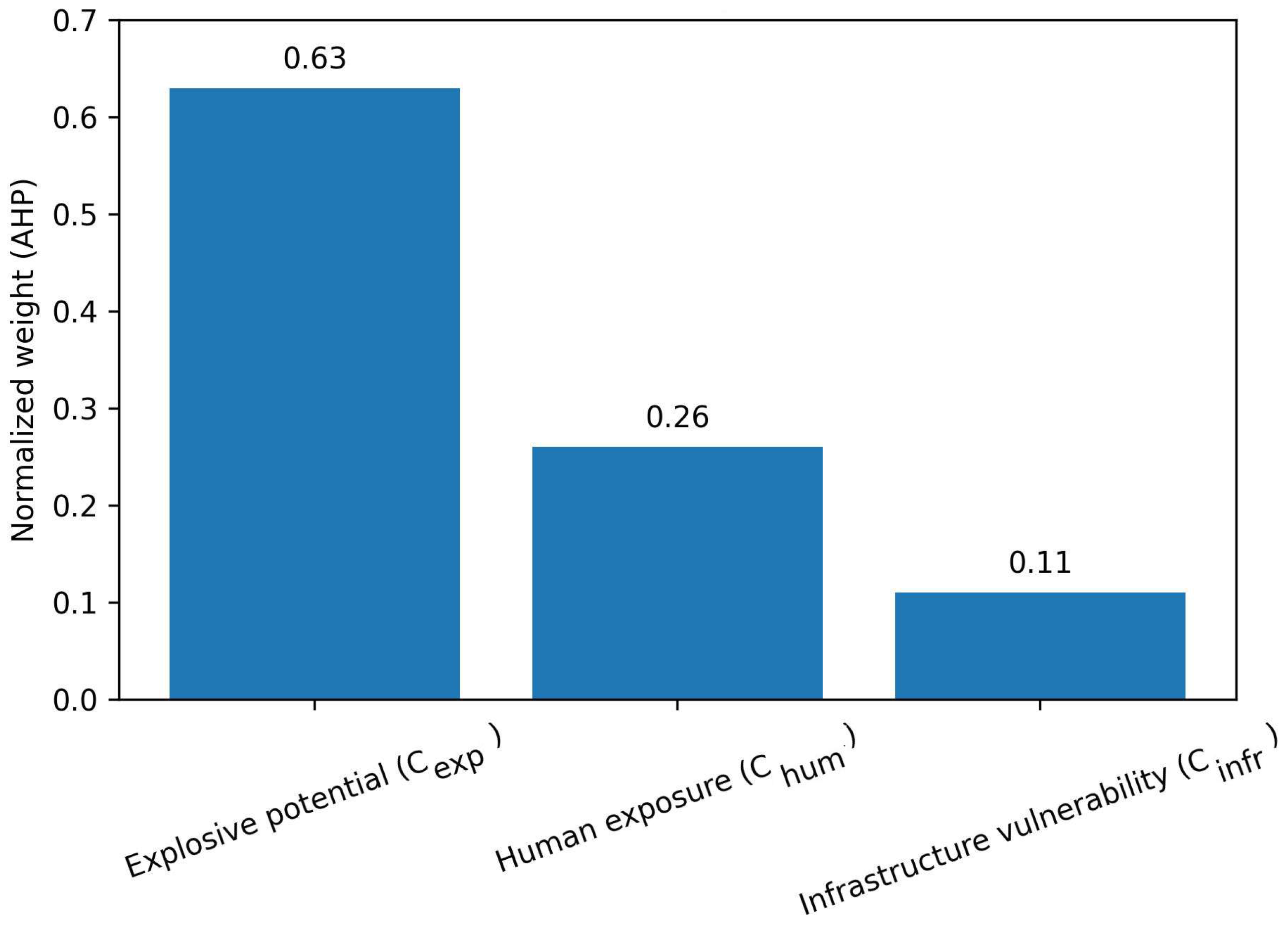
; the median pairwise comparison matrix (reported above) was adopted as the group judgment to reduce sensitivity to individual outliers. The normalized principal eigenvector of this matrix yields the weight vector
with
, indicating that explosive potential carries the largest contribution to the aggregated consequence score, followed by human exposure and infrastructure vulnerability. Hereafter,
denotes the AHP-weighted aggregated consequence score, while
,
, and
denote the corresponding component ratings assigned on the 1–5 ordinal severity scale defined in the consequence scheme; the overall consequence score is computed as
Consistency of expert judgments was verified using the Saaty consistency ratio:
confirming acceptable logical coherence of the pairwise comparisons and supporting the reliability of the derived weights (
Figure 2). Pairwise judgments were aggregated using the median to reduce sensitivity to outliers in expert scoring.
Because consequence severity in urban methane incidents cannot be measured directly from a single physical variable, AHP was used to formalize expert judgment in a transparent and reproducible way. Although some subjectivity is unavoidable, the use of a multidisciplinary five-expert panel, median aggregation of pairwise judgments, and a low consistency ratio (CR = 0.043) substantially reduces arbitrariness and supports the reliability of the derived weights.
2.4.3. Risk Level and Recommended Actions
The overall risk score is computed as
, where
P is the probability score assigned from the exceedance-based probability scale, and
C is the AHP-weighted aggregated consequence score; the resulting
R values are then mapped to the five risk classes defined by the matrix to support consistent hotspot ranking and prioritization of monitoring and mitigation actions (
Table 5).
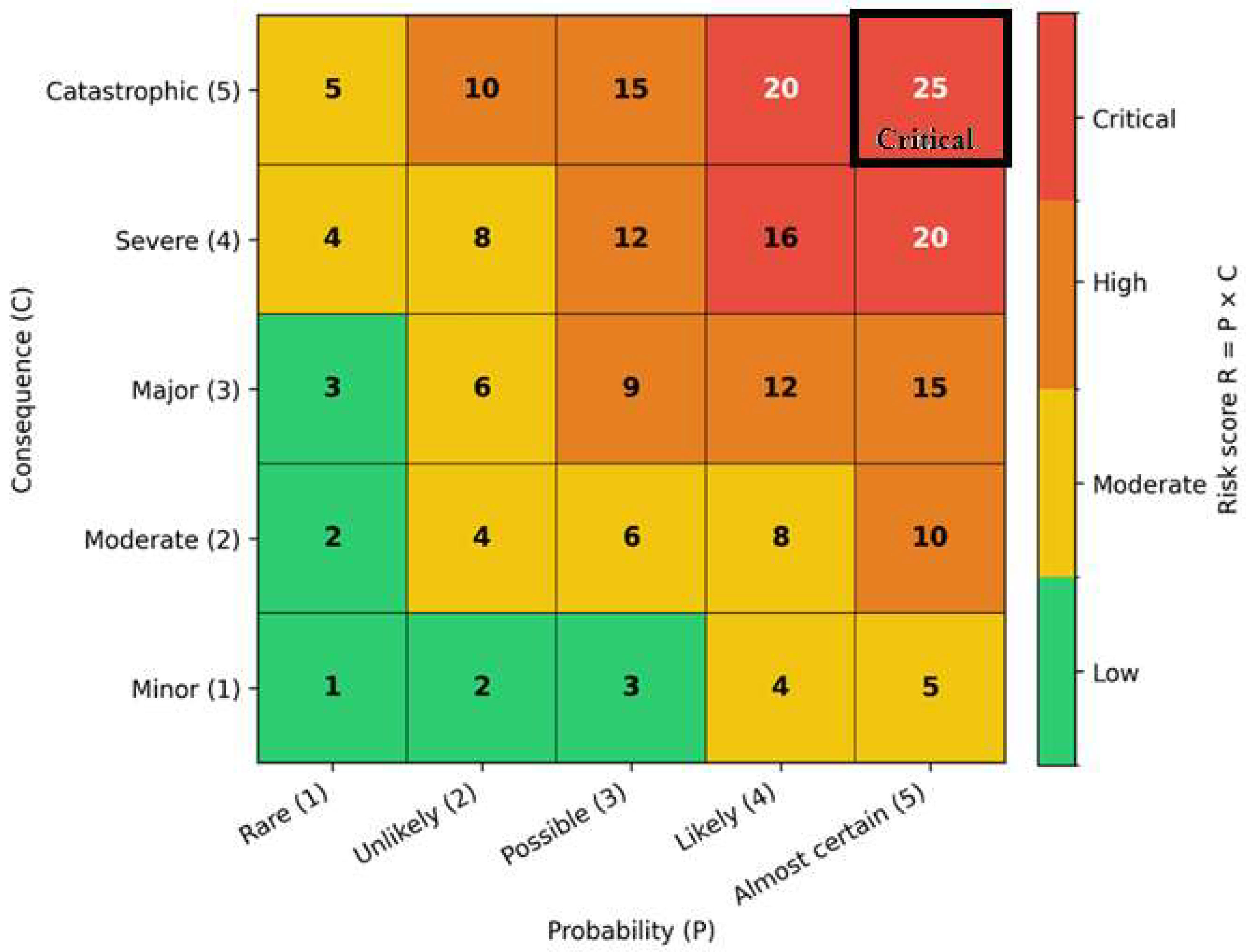
Figure 3 presents the 5 × 5 probability–consequence matrix used for semi-quantitative risk evaluation. Risk categories are classified as Low (L), Moderate (M), High (H), and Critical (C). The highlighted cell, symbolized by the black square, illustrates the application of the framework to the Lupeni case study (P = 5, C = 5), corresponding to R = 25, classified as Critical.
For matrix-based classification, the aggregated consequence score C is mapped to the nearest ordinal level (1–5) to ensure consistency with the discrete probability–consequence matrix.
2.5. Quantitative Indicators for Risk Assessment
2.5.1. Exceedance Probability of Critical Thresholds
To quantify the probability of exceeding critical methane concentration thresholds, the following frequentist estimator is used [
23]:
where:
represents the number of measurements exceeding the critical threshold,
represents the total number of observations.
Validity condition: and .
These conditions indicate that both the expected number of exceedances and non-exceedances must be sufficiently large for normal-approximation-based interval formulas to be reliable.
In the present study, this criterion is used only as a general validity check; the reported confidence intervals are based on Wilson and exact binomial methods.
For the global assessment, observations are treated as operational replicates:
Although measurements are repeated at the same monitoring points, the global exceedance probability is interpreted as an operational frequency indicator. Temporal dependence between repeated measurements at identical locations is evaluated separately using repeated-measures statistical tests (repeated-measures ANOVA and/or the Friedman test), thereby preventing inflation of the independence assumption.
This approach allows separation between frequency-based exceedance estimation (for risk matrix classification) and statistical inference on temporal variability.
The global exceedance estimate is interpreted as an operational frequency across monitoring operations; dependence at repeated locations is assessed separately via repeated-measures tests.
2.5.2. Confidence Interval for Probability Estimation
To quantify estimation uncertainty, 95% confidence intervals were calculated using methods appropriate to sample size and proportion extremes.
For global exceedance probabilities based on the full monitoring dataset ( operational observations), confidence intervals were computed using the Wilson score interval, which provides more reliable coverage than the Wald approximation, especially for moderate sample sizes and proportions not centered near 0.5.
For localized point-level assessments with very small sample sizes (e.g., three campaigns at a single monitoring point) and/or extreme proportions ( or ), the exact Clopper–Pearson binomial interval was used.
Accordingly, the confidence intervals reported in
Section 4.1 for global exceedance frequencies are based on the Wilson score method, whereas hotspot-specific extreme cases, such as point P2 with 3/3 exceedances above the 3% vol. threshold, are reported using the exact Clopper–Pearson method.
This dual approach ensures statistically robust uncertainty quantification for both area-scale exceedance frequencies and localized hotspot persistence.
2.5.3. Explosive Hazard Index
To quantify proximity to explosive conditions, an index relative to the Lower Explosive Limit (LEL) is defined [
4] as
where
is the measured methane concentration (% vol.) and
vol. (
v/
v) for methane in air. An operational alert threshold of
3% vol. CH4 is adopted in this study; this corresponds to approximately
68% of the LEL (3/4.4 = 0.682) and is used as a conservative early-warning level to trigger intensified monitoring and mitigation assessment before explosive conditions are reached. The 3% vol. threshold is adopted as an early-warning operational trigger (~68% of LEL), enabling intervention before flammable conditions are reached. The interpretation of
and the associated explosive consequence component
are summarized in
Table 6 below. Values exceeding 100% indicate methane concentrations equal to or above the LEL under confined conditions. The explosive component
derived from
is subsequently integrated into the aggregated consequence score using the AHP-derived weights (
Section 2.4.2).
The categorical mapping is used for consequence scoring and does not replace regulatory safety assessments of explosive atmospheres.
2.6. Limitations of Risk Matrices
Risk matrices, although widely applied in industrial and environmental risk assessment, exhibit several well-documented methodological limitations [
25], including (i)
boundary effects, where small differences in quantitative input values may shift classification across ordinal categories without meaningful changes in hazard magnitude; (ii)
loss of quantitative information, as continuous variables are mapped to discrete ordinal levels, reducing numerical resolution; (iii)
scaling subjectivity, since the definition of thresholds separating ordinal levels may involve expert judgment; and (iv)
aggregation simplification, because the multiplicative combination
assumes proportional interaction between probability and consequence and may mask nonlinear or systemic interactions. Despite these limitations, risk matrices remain widely used due to their transparency, operational simplicity, and decision-support utility, particularly in emergency contexts where rapid prioritization is required.
Beyond these general limitations, it is essential to distinguish between
aleatory and
epistemic uncertainty in AMM risk assessment [
18,
19].
Aleatory uncertainty (irreducible variability) arises from natural randomness in the system, such as fluctuations in barometric pressure affecting gas migration, spatial heterogeneity of permeability and fracture networks, and temporal variability in residual methane desorption rates; it cannot be reduced through additional measurements and must be represented probabilistically.
Epistemic uncertainty (reducible uncertainty) stems from incomplete knowledge, including limited documentation of historical mine workings, restricted temporal coverage of methane measurements (three campaigns), unknown efficiency of historical seals, and simplifying assumptions in the conceptual migration model; it can be reduced through additional data collection, improved site investigation, and refined modeling. Practically, aleatory uncertainty should be incorporated into probability estimates (e.g., through confidence intervals), while epistemic uncertainty motivates adaptive monitoring and conservative decision thresholds; in the Lupeni case, the confidence intervals reported in
Section 4.1 support this interpretation, and the residual epistemic component justifies continued post-intervention monitoring within the URBAN-MINE-RISK algorithm.
To mitigate methodological limitations in the present study and position the framework appropriately, the following measures are adopted: (
a) explicit quantitative-to-ordinal correspondence by mapping exceedance probabilities to ordinal probability levels using defined thresholds (
Table 3); (
b) uncertainty quantification through confidence intervals for probability estimates (
Section 2.5.2), providing an uncertainty envelope rather than relying solely on point estimates; (
c) structured consequence weighting via AHP with formal consistency verification (CR < 0.10), reducing subjective bias; (
d) comparison against a quantitative reliability-oriented approach (FORM) in
Section 4.7 for methodological cross-validation; and (
e) a formal limit-state definition (
Section 2.1) to ensure theoretical compatibility with reliability-based methods. Accordingly, the proposed framework does not aim to replace fully quantitative probabilistic modeling, but to provide a transparent and operationally robust decision-support tool for post-mining urban environments where complete probabilistic characterization is not available, decision timelines are constrained, and public safety requires clear prioritization.
4. Results and Discussion
4.1. Quantitative Probability Assessment
Repeated-measures analyses treat the 41 monitoring points as paired subjects measured across the three campaigns (within-subject factor: campaign date).
Table 10 summarizes the frequency of exceedance of critical methane thresholds and the associated 95% confidence intervals based on
observations. Exceedance of the 1% vol. threshold is used exclusively as a screening (pre-alert) indicator, whereas risk classification through the
matrix is performed using the operational alert threshold of 3% vol. CH
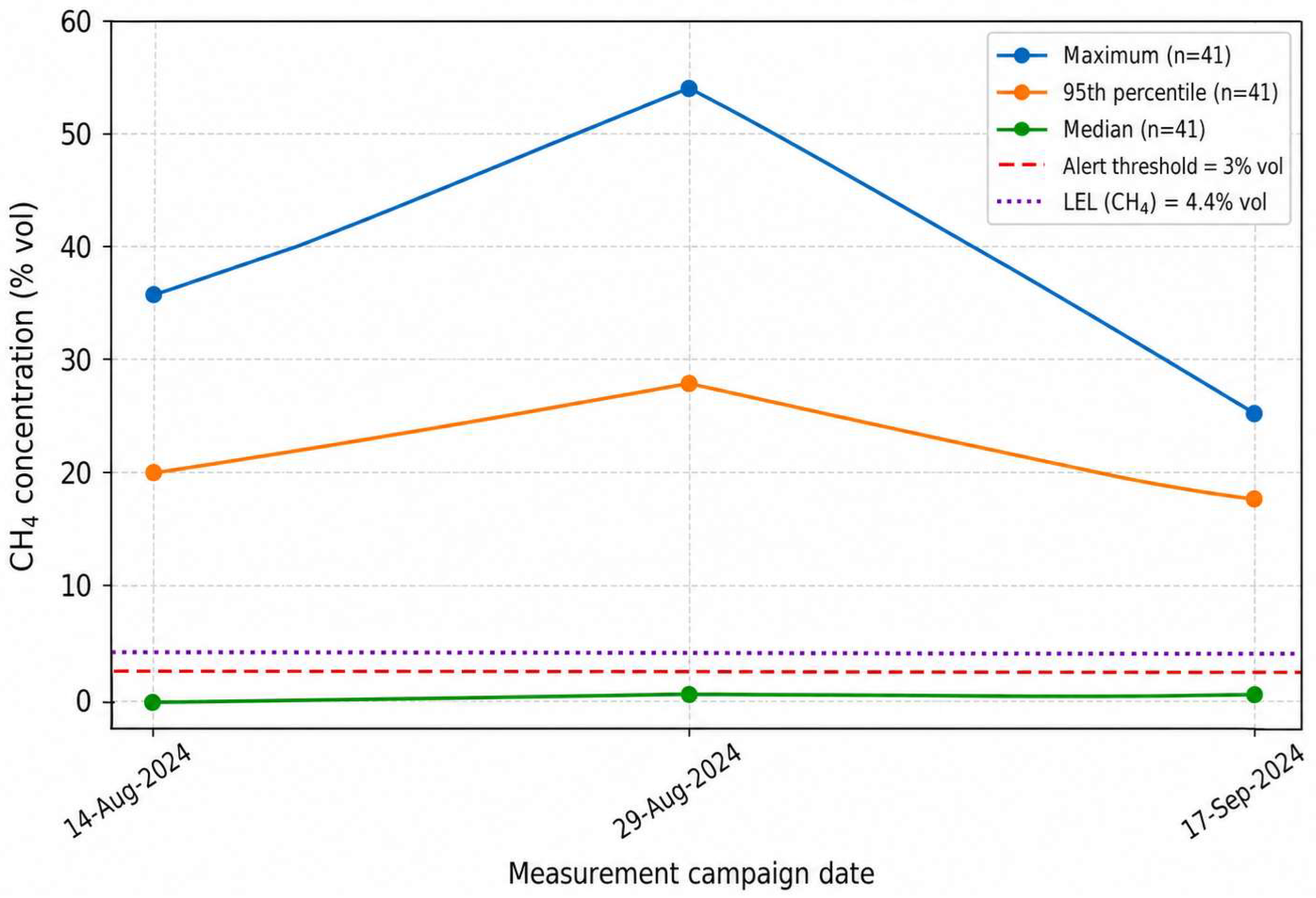
4. For the critical hotspot P2, exceedance above 3% was observed in all three campaigns:
The corresponding 95% confidence interval was computed using the exact Clopper–Pearson binomial method, appropriate for extreme proportions, yielding
confirming persistence of threshold exceedance at the hotspot (
Figure 6).
Temporal Variability Analysis
Because the same 41 monitoring points were measured during all campaigns, repeated-measures statistical tests were applied. Normality was evaluated using the Shapiro–Wilk test and homogeneity of variances using Levene’s test; Shapiro–Wilk indicated non-normal distributions (), while Levene’s test did not indicate significant variance heterogeneity (). Although repeated-measures ANOVA yielded , , (not statistically significant), Inference relied primarily on the non-parametric Friedman test due to non-normality. The Friedman test indicated a statistically significant global temporal effect, , ; however, the associated effect size was small (Kendall’s ). Post hoc pairwise comparisons (Wilcoxon signed-rank with Holm correction) showed that the significant contrast was primarily between 29 August 2024 and 17 September 2024 (). Importantly, despite this small temporal effect, the magnitude of variation remains minor relative to the extreme values recorded at hotspot P2 (maximum 54% vol.), and the spatial hierarchy of high-concentration points remained stable across campaigns. Therefore, the global exceedance probability for the operational alert threshold is taken as for risk classification purposes. Compared with previous studies that addressed AMM mainly through concentration mapping, case reporting, or emission characterization, the present study contributes an integrated operational framework that combines repeated field monitoring, exceedance-based probability estimation, AHP-weighted consequence evaluation, and a decision algorithm for intervention prioritization. This integration represents the main methodological novelty of the study. Accordingly, P(C > threshold) should be interpreted as an operational exceedance frequency across monitoring observations, not as the probability of independent realizations in the strict statistical sense.
4.2. Consequence Assessment
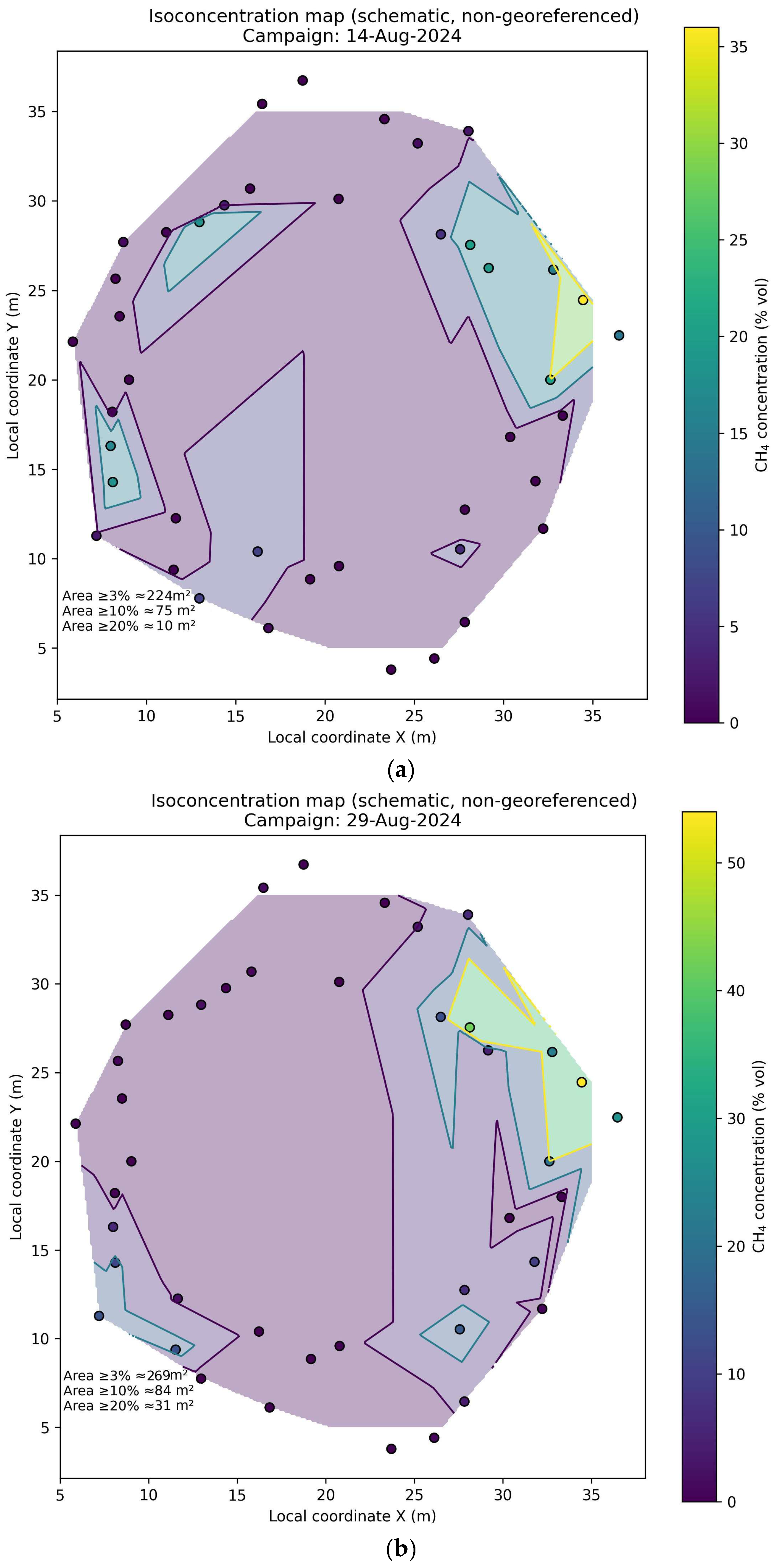
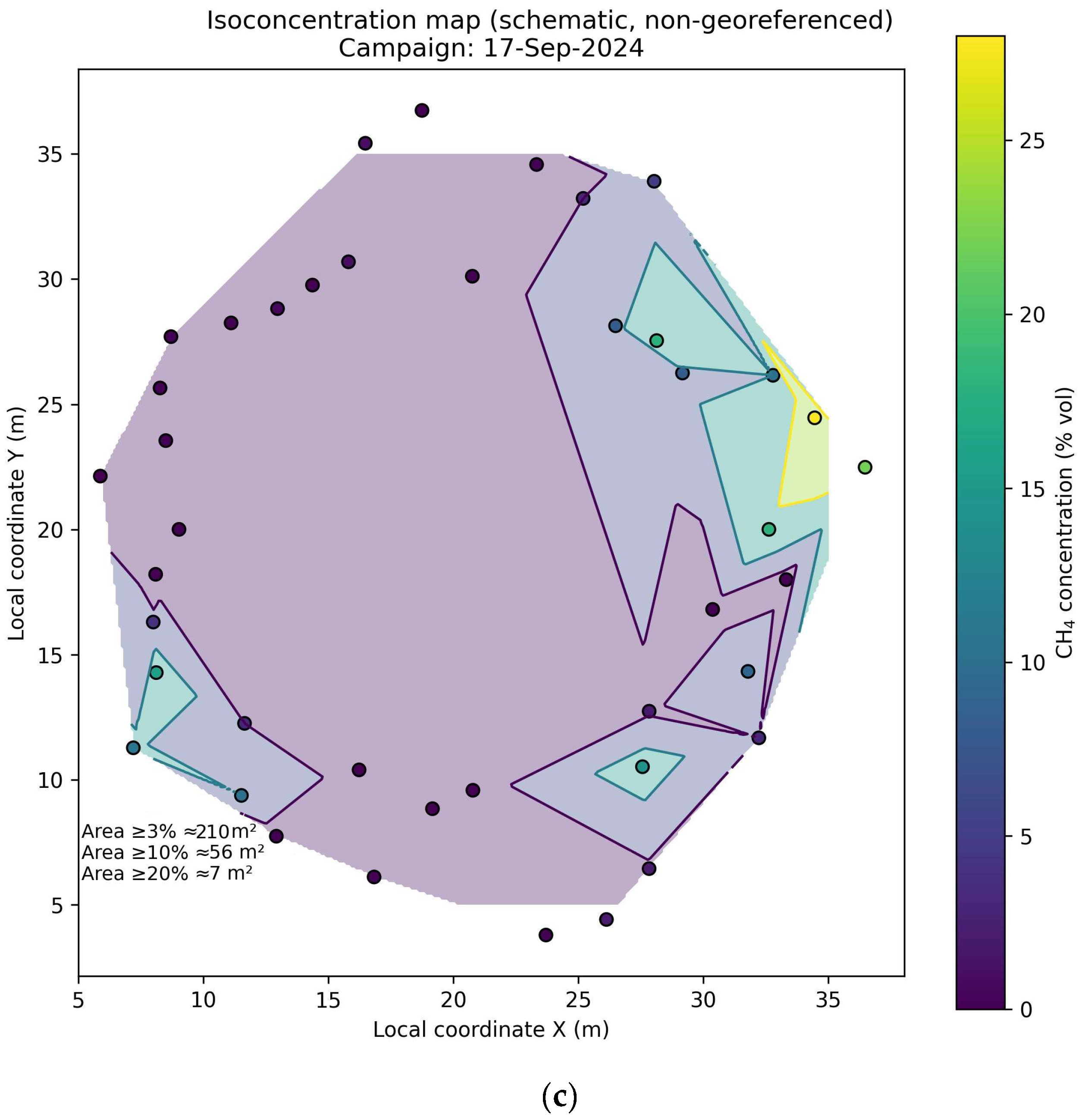
As shown in
Figure 7a–c, the CH
4 isoconcentration maps derived from the three monitoring campaigns consistently identify hotspot P2 as the area with the highest methane concentrations and repeated exceedances of the 3%, 10%, and 20% vol. thresholds. These spatial patterns support the consequence assessment by confirming the persistence of a localized high-risk zone under repeated monitoring conditions.
For hotspot P2, the maximum recorded methane concentration was
. The explosive proximity index is therefore
which greatly exceeds the lower explosive limit and corresponds to the maximum explosive hazard category,
. The maximum measured concentration at P2 (54% vol.) is approximately 12.3 times the lower explosive limit (LEL = 4.4% vol.), indicating an extreme explosive hazard under confined conditions.
The affected area is located within a densely populated urban sector of Lupeni (~23,000 inhabitants; density > 2000 inhabitants/km2); according to the predefined consequence scale, this yields the maximum human exposure score, . The hotspot is also in immediate proximity to critical infrastructure, including a newly installed natural gas pipeline as well as sewer and potable water networks, which increases the likelihood of confined gas accumulation and potential cascading effects; accordingly, the infrastructure vulnerability score is set to .
Scores
and
follow
Table 4 criteria for dense urban exposure and immediate proximity to confined utility infrastructure with cascading potential.
Using the AHP-derived weights, the aggregated consequence is computed as
Substituting the component scores gives
confirming that the aggregated consequence reaches the maximum value (
) and indicating catastrophic potential consequences under plausible worst-case conditions.
4.3. Spatial Stability Analysis
To evaluate the persistence of the spatial methane pattern, Spearman’s rank correlation was computed between campaigns using the 41 monitoring points as paired observations. The analysis indicates moderate but significant agreement between 14 August and 29 August (, ) and between 14 August and 17 September (, ), and a very high agreement between 29 August and 17 September (, ), demonstrating near-identical spatial ordering of concentration levels in the latter two campaigns. Overall, these results show that the spatial hierarchy of monitoring points remained stable over time, the hotspot persisted in the same sector, and the methane distribution is primarily controlled by subsurface structural factors rather than short-term environmental variability.
The near-unity correlation between 29 August and 17 September indicates that hotspot ranking is highly persistent, supporting structural control rather than transient forcing.
4.4. Assessment of Meteorological Influence
Meteorological conditions remained relatively stable across campaigns, with no precipitation, wind speeds below 7 km/h, and only marginal atmospheric pressure variation (ΔP ≈ 2.9 hPa). Methane was measured in boreholes (subsurface screening points), where direct wind-driven dilution is negligible; although barometric pumping can influence soil-gas migration, the absence of abrupt pressure drops during the measurement periods reduces the likelihood of pressure-driven transient degassing dominating the observations. Importantly, despite minor temporal differences detected by statistical tests (
Section 4.1), the strong inter-campaign spatial rank stability (Spearman
ρ, up to 0.97) indicates that meteorological variability was not the primary driver of the observed concentration patterns. Overall, the combined statistical and physical evidence supports dominant structural control of methane migration through mining-related pathways (faults/voids and utility corridors), with meteorology acting only as a minor short-term modulator.
Meteorological stability documented in
Table 7 supports interpreting temporal differences as secondary modulation rather than primary control
4.5. Risk Evaluation Using the P × C Matrix
Risk was quantified by integrating the probability of exceeding the operational alert threshold (3% vol. CH
4) with the severity of consequences estimated according to the methodology described in
Section 2.4. The risk score is defined as
, where
represents the probability level (ordinal scale 1–5,
Table 3) and
represents the consequence level (ordinal scale 1–5,
Table 4). For the full dataset comprising 41 monitoring points across three campaigns (
observations), the global exceedance probability of the 3% vol. threshold is
. Because
, the global exceedance maps to
(‘Possible’) per
Table 3, yielding
for area-scale prioritization. According to the probability scale defined in
Table 3, this value falls within the interval 0.25–0.50, corresponding to
(“Possible”), meaning the event may occur under certain circumstances within the monitored urban perimeter. The consequence level is conservatively evaluated at the maximum plausible level,
(“Catastrophic”), because confined gas accumulation and ignition could produce severe outcomes, given the extreme explosive potential quantified in
Section 4.2, the high population density, and the vulnerability of subsurface infrastructure, importantly, this classification does not imply that catastrophic damage has occurred, but that the theoretical impact potential is severe if an ignition scenario were to develop. The resulting risk score for the general monitored area is therefore
, which falls in the
high-risk band defined in
Table 5 (10–16), supporting intensified monitoring and mitigation planning at the area scale.
In contrast, the operational hotspot P2 represents a localized critical condition. At monitoring point P2, the 3% vol. threshold was exceeded in all three campaigns (
), corresponding to
(“Frequent”). For localized critical points, probability is interpreted at the point scale as a recurrence score across campaigns because the objective is hotspot identification rather than long-term regional frequency estimation. The consequence level remains
(“Catastrophic”), and the risk score for P2 is
, corresponding to
critical risk and requiring immediate technical mitigation according to
Table 5. This classification is also consistent with the 5 × 5 probability–consequence matrix (
Figure 3), where the general-area position (P = 3, C = 5) lies in the high-risk domain, while the hotspot position (P = 5, C = 5) occupies the extreme critical cell. The contrast between the general area and the localized hotspot highlights pronounced spatial heterogeneity of risk and justifies targeted intervention and continued post-intervention monitoring.
4.6. Risk Scenarios and Operational Interpretation
To strengthen the risk evaluation, three operational scenarios were defined to reflect realistic urban gas migration pathways and to translate the
results into actionable field conditions.
S1—Accumulation in confined utility structures: methane concentrations exceeding 3% vol. in boreholes adjacent to utility corridors indicate potential accumulation in poorly ventilated underground structures (manholes, cable ducts, sewer chambers); for hotspot P2,
,
, therefore
(“Critical”), representing the highest-priority operational scenario.
S2—Migration toward residential basements: gas migration through preferential pathways (faults, utility trenches, backfilled excavations) may lead to accumulation beneath or within residential buildings; at the general area scale, the global exceedance probability
maps to
(“Possible”) and, with
, yields
(“High”), supporting intensified monitoring and preventive ventilation planning where warranted.
S3—Interaction with subsurface infrastructure: gas accumulation near pipelines, sewer networks, and foundations may increase indirect hazard exposure; in this scenario, risk is evaluated as a function of proximity to infrastructure, density of underground utilities, and confinement potential, and in sectors adjacent to P2, this condition approaches the high–critical boundary, justifying conservative operational controls (
Table 11).
Overall, the obtained scores indicate a localized critical risk at P2 and a high risk classification for the broader monitored area, and this spatial differentiation is essential for proportional resource allocation and targeted intervention.
4.7. Sensitivity Analysis of the Risk Matrix
To evaluate classification robustness, a one-level variation of
and
was tested for hotspot P2 (
Table 12). The results show that reducing either probability or consequence by one level (
or
) lowers the risk score to
, but the classification remains
critical, whereas a simultaneous reduction in both (
,
) yields
and downgrades the category to
high. To further evaluate robustness with respect to the subjective component of the AHP weighting, a sensitivity analysis was performed on the consequence weights derived from the expert panel (
Table 13). The nominal weights
were varied by ±20% while maintaining
; for each case, the aggregated consequence score
was recalculated for hotspot P2 and mapped to the nearest ordinal level. Across all tested weight variations, the aggregated consequence score remained at the maximum level (
), which is expected because the component ratings for P2 are consistently maximal (
), making the aggregated score insensitive to moderate weight changes. Overall, these results demonstrate that the classification of hotspot P2 as a
critical risk (
) is robust with respect to one-level perturbations in probability and consequence (
Table 12) and to reasonable uncertainty in expert-derived AHP weights (
Table 13). Only a simultaneous reduction in both probability and consequence levels would downgrade the classification from critical to high; given the repeated exceedance of 3% vol., the extreme explosive proximity index (
), and the dense urban exposure, such a simultaneous downgrade is not supported by the current measurements. Therefore, the critical risk classification for hotspot P2 is methodologically stable and decision-relevant.
4.8. Intervention and Validation of Results
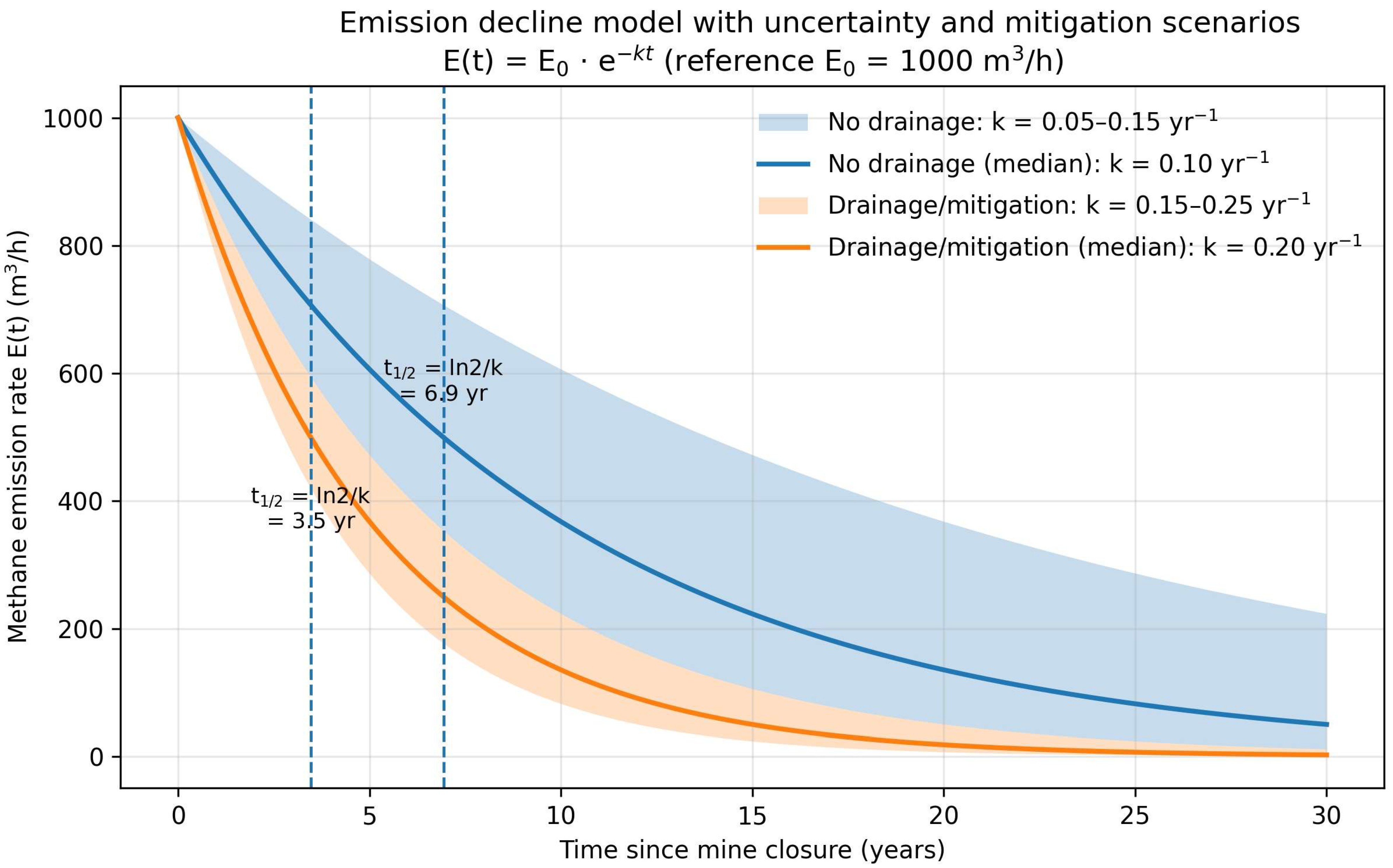
Methane emissions after mine closure are conceptualized using an exponential decay model,
where
represents the initial emission level,
is the decay coefficient, and
is the time since intervention or closure. The exponential decline hypothesis reflects first-order degassing behavior commonly used to describe post-mining methane emission reduction. In
Figure 8, shaded bands represent uncertainty ranges of the decay coefficient
, while vertical dashed lines indicate the half-life,
Two mitigation trajectories are illustrated: a no-drainage scenario (natural attenuation) and a controlled drainage/mitigation scenario implemented following the risk assessment.
Following the classification of hotspot P2 as a critical risk, a controlled drainage system was connected to the former mine degassing infrastructure. Post-intervention monitoring demonstrated a rapid and progressive decline in methane concentrations (
Table 14). By February 2025, methane concentrations became instrumentally undetectable at the representative points, confirming the effectiveness of the mitigation system. Instrumental non-detect corresponds to
LOD; reported zeros therefore indicate concentrations below detection rather than absolute absence. The monotonic decline observed across all monitored points supports controlled depressurization and source capture rather than random fluctuation. Importantly, the spatial hotspot hierarchy disappeared after intervention, further validating that the emission source was structurally connected to mine gas pathways.
The vertical dashed lines indicate the emission half-life, , i.e., the time required for the methane emission rate to decrease to 50% of its initial value. The earlier dashed line corresponds to the controlled drainage/mitigation scenario, where the higher decay coefficient leads to a shorter half-life of approximately 3.5 years. The later dashed line corresponds to the no-drainage scenario, where the lower decay coefficient results in a longer half-life of approximately 6.9 years.
4.9. Uncertainty Analysis
Table 15 summarizes the main sources of uncertainty affecting the risk assessment, their type, expected impact, and the management approach adopted in this study. Measurement uncertainty was controlled through standardized sampling protocols and routine instrument calibration. The relatively dense monitoring network (41 points) reduced potential spatial under-sampling bias and improved representativeness of the observed concentration field. Although AHP weighting introduces expert subjectivity, the low consistency ratio (CR = 0.043) confirms logical coherence of judgments and supports the reliability of the derived weights. Uncertainty related to probability scaling was minimized through an explicit quantitative-to-ordinal correspondence between exceedance frequency and probability levels (
Section 2.4). Overall, uncertainty sources were explicitly identified, classified, and methodologically managed, supporting the robustness of the final risk classification and the decision relevance of the proposed framework.
Uncertainty sources include both aleatory variability (environmental/system fluctuations) and epistemic uncertainty (limited historical and parameter information), managed here through CI, sensitivity testing, and conservative thresholds.
4.10. Remarks on Reliability-Based Quantitative Methods (Future Directions)
Advanced structural reliability methods, such as the First-Order Reliability Method (FORM), provide a rigorous probabilistic framework for evaluating the exceedance of a defined limit-state function
. In the context of AMM risk assessment, a representative limit state can be formulated as
, where
is the critical methane concentration threshold (e.g., 3% vol.) and
is the methane concentration predicted by a physical model as a function of random inputs
. Typical inputs include overburden permeability
(often modeled as lognormal), residual gas pressure
in abandoned workings (normal), barometric pressure trend
(extreme value), groundwater level
(seasonal), and excavation volume
(triangular). The failure probability is then
. FORM approximates
by transforming variables into standard normal space and linearizing the limit-state function at the most probable point of failure [
23]. In the present case study—an operational emergency context with only three monitoring campaigns over six weeks—building a fully parameterized FORM model would require extensive additional assumptions about distributions of subsurface transport parameters, potentially introducing substantial modeling uncertainty in the absence of long-term time series and detailed geotechnical characterization. Nevertheless, the framework developed here (
Section 2.1) explicitly defines the limit state
, ensuring conceptual compatibility with reliability-based methods and establishing a clear pathway for future FORM implementation once extended datasets become available through permanent monitoring. The relationship between the semi-quantitative matrix approach and FORM can be viewed as an operational simplification: the matrix probability levels
–5 correspond to the discretized intervals of the continuous failure probability
, while consequence levels
–5 represent conditional impact given exceedance; thus,
approximates, in ordinal terms, a risk ranking proportional to
times expected conditional consequence. For post-mining urban areas where immediate safety decisions are required but comprehensive probabilistic data are unavailable, the semi-quantitative framework provides a transparent and defensible alternative to fully probabilistic methods, while progressive transition to FORM-based reliability analysis remains a logical future direction as monitoring networks expand and calibrated physical parameters become available (
Table 16).
A comparative methodological perspective, highlighting the advantages and limitations of the main approaches, is provided in
Table 17. Key practical trade-offs among the risk matrix, direct measurements, and FORM are summarized in
Table 17.
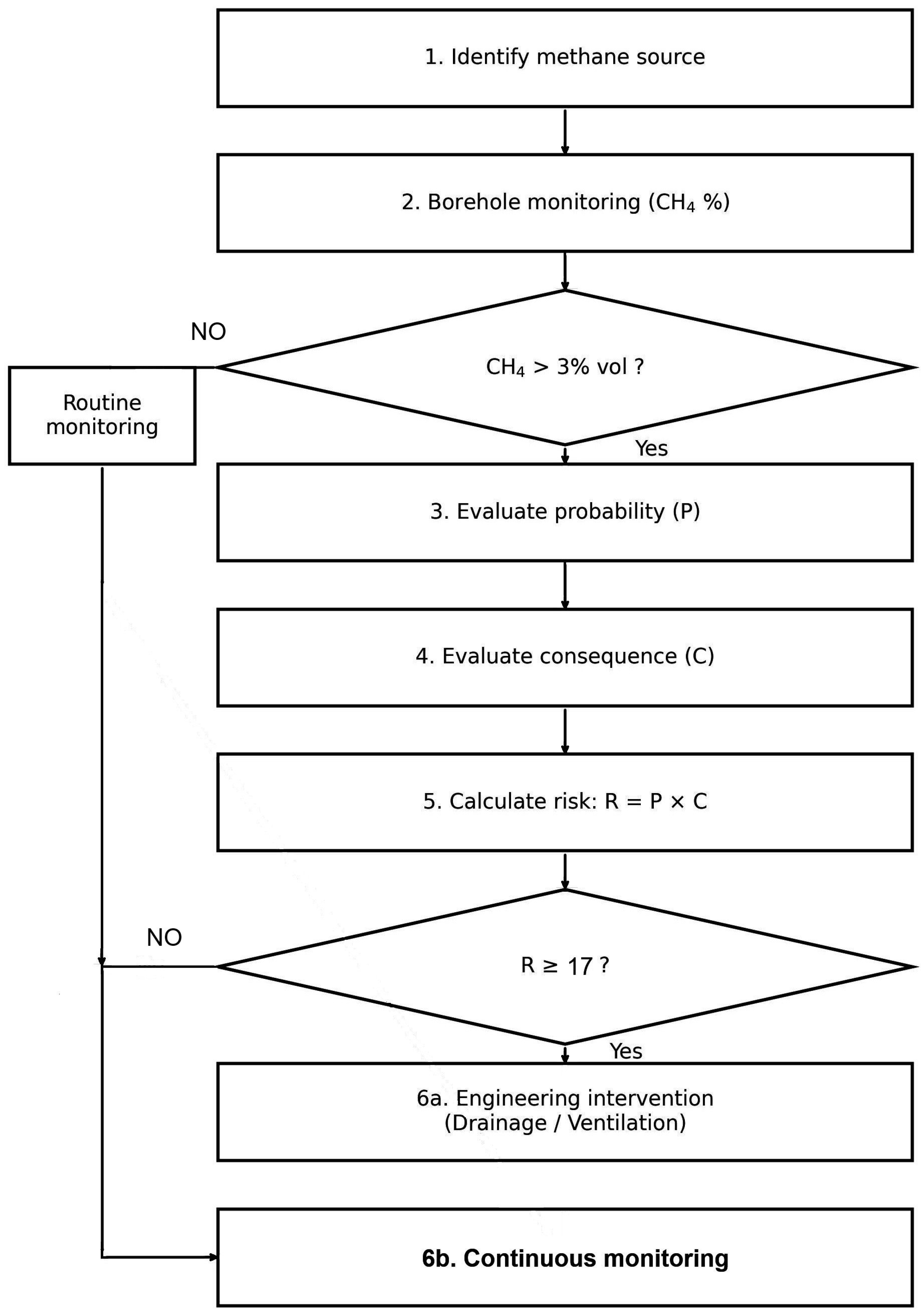
5. URBAN-MINE-RISK Decision Algorithm
Based on the integrated methodological framework developed in this study and its application to the Lupeni case, a structured decision-support workflow entitled URBAN-MINE-RISK is proposed for managing abandoned mine methane (AMM) risks in urban environments.
The algorithm operationalizes the transition from preliminary screening to quantitative assessment, risk classification, and engineering intervention, while preserving methodological transparency and statistical rigor
Figure 9.
Phase 1—Pre-Assessment.
Collection of historical mining and geological documentation.
Urban infrastructure mapping (utilities, basements, confined spaces).
Preliminary risk estimate:
Decision rule:
If → annual monitoring; STOP.
Otherwise → proceed to Phase 2.
Phase 2—Quantitative Monitoring.
Deployment of an adaptive monitoring network (minimum 20 points; expanded as needed).
At least three monitoring campaigns.
Measurement parameters: CH4, CO2, CO, pressure, and meteorological conditions.
Radial expansion of the network until concentrations fall below 0.5% vol.
Phase 3—Statistical Analysis.
Calculation of mean, median, and standard deviation.
Estimation of exceedance probabilities:
with 95% confidence intervals.
Rank correlation (Spearman) between campaigns to evaluate spatial stability.
Testing temporal differences (Repeated Measures ANOVA and/or Friedman test, depending on assumptions).
Identification of critical points (e.g., or ).
Phase 4—Source Identification (Chromatographic Analysis).
Sampling from critical boreholes and the public gas network.
Detection of diagnostic markers (CO, C2H2).
Attribution of emission source: mining origin vs. network leakage vs. unknown.
Phase 5—Risk Evaluation.
Determination of consequence weights via AHP.
Assignment of probability level (P) using quantitative–ordinal correspondence.
Assignment of consequence components:
Explosive potential (via ).
Human exposure.
Infrastructure vulnerability.
Calculation of aggregated consequence score .
Classification in a 5 × 5 matrix.
Sensitivity analysis of classification robustness.
Phase 7—Post-Intervention Validation.
Monthly monitoring (Year 1).
Quarterly monitoring (Years 2–3).
Annual monitoring (after Year 3).
Risk reassessment every 12 months.
The URBAN-MINE-RISK framework ensures traceability between measured data, statistical inference, risk scoring, and engineering decision-making. Its modular structure allows adaptation to different geological and urban contexts.