
Worker Well-Being in Italian Manufacturing: A Cluster Analysis of Work Engagement, Exhaustion, and Work Ability


Abstract
1. Introduction
1.1. Work Engagement and Burnout
1.2. Work Ability in Manufacturing Sector
2. Objective
- RQ1: What distinct well-being profiles can be identified among Italian manufacturing workers based on their levels of work engagement, emotional exhaustion, and work ability?
- RQ2: How do these well-being profiles differ in terms of psychosocial work characteristics (job demands, decision latitude, rewards)?
- RQ3: What are the demographic and occupational characteristics associated with membership in each profile?
3. Material and Methods
Data Collection Participant
4. Measures
4.1. Background Variables
4.2. Work Ability
4.3. Work Engagement
4.4. Emotional Exhaustion
4.5. Psychosocial Work-Related Characteristics
4.5.1. Job Demands
4.5.2. Decision Latitude: Discretionary Skills and Decision Authority
4.5.3. Reward
4.5.4. Presence of Pathologies
Participants
4.6. Statistical Analysis
5. Results
Identification of Clusters
6. Discussion
7. Conclusions
Author Contributions
Funding
Institutional Review Board Statement
Informed Consent Statement
Data Availability Statement
Conflicts of Interest
References
- ISTAT. Censimento Permanente Delle Imprese 2023: Primi Risultati. 2023. Available online: https://www.istat.it/comunicato-stampa/censimento-permanente-delle-imprese-2023-primi-risultati/ (accessed on 18 January 2026).
- European Commission. Annual Report on European SMEs 2022/2023; Publications Office of the European Union: Luxembourg, 2023.
- Schaufeli, W.B. The future of occupational health psychology. Appl. Psychol. 2004, 53, 502–517. [Google Scholar] [CrossRef]
- Wang, Y.; Ramos, A.; Wu, H.; Liu, L.; Yang, X.; Wang, J.; Wang, L. Relationship between occupational stress and burnout among Chinese teachers: A cross-sectional survey in Liaoning, China. Int. Arch. Occup. Environ. Health 2015, 88, 589–597. [Google Scholar] [CrossRef]
- Landsbergis, P.A.; Diez-Roux, A.V.; Fujishiro, K.; Baron, S.; Kaufman, J.D.; Meyer, J.D.; Koutsouras, G.; Shimbo, D.; Shrager, S.M.; Stukovsky, K.H.; et al. Job strain, occupational category, systolic blood pressure, and hypertension prevalence. J. Occup. Environ. Med. 2015, 57, 1178–1184. [Google Scholar] [CrossRef]
- Gosselin, E.; Bourgault, P.; Lavoie, S. Association between job strain, mental health and empathy among intensive care nurses. Nurs. Crit. Care 2016, 21, 137–145. [Google Scholar] [CrossRef]
- Rasmussen, V.; Turnell, A.; Butow, P.; Juraskova, I.; Kirsten, L.; Wiener, L.; Patetnaude, A.; Hoekstra-Weebers, J.; Grassi, L.; on behalf of the IPOS Research Committee. Burnout among psychosocial oncologists: An application and extension of the effort–reward imbalance model. Psychooncology 2016, 25, 194–202. [Google Scholar] [CrossRef]
- Marano, D.E.; Boice, J.D., Jr.; Fryzek, J.P.; Morrison, J.A.; Sadler, C.J.; McLaughlin, J.K. Exposure assessment for a large epidemiological study of aircraft manufacturing workers. Appl. Occup. Environ. Hyg. 2000, 15, 644–656. [Google Scholar] [CrossRef] [PubMed]
- Nielsen, K.; Nielsen, M.B.; Ogbonnaya, C.; Känsälä, M.; Saari, E.; Isaksson, K. Workplace resources to improve both employee well-being and performance: A systematic review and meta-analysis. Work Stress 2017, 31, 101–120. [Google Scholar] [CrossRef]
- Peiró, J.M.; Montesa, D.; Soriano, A.; Kozusznik, M.W.; Villajos, E.; Magdaleno, J.; Djourova, N.P.; Ayala, Y. Revisiting the Happy-Productive Worker Thesis from a Eudaimonic Perspective: A Systematic Review. Sustainability 2021, 13, 3174. [Google Scholar] [CrossRef]
- Govaerts, R.; Tassignon, B.; Ghillebert, J.; Serrien, B.; De Bock, S.; Ampe, T.; Makrini, I.E.; Vanderborght, B.; Meeusen, R.; Pauw, K.D. Prevalence and incidence of work-related musculoskeletal disorders in secondary industries of 21st century Europe: A systematic review and meta-analysis. BMC Musculoskelet. Disord. 2021, 22, 751. [Google Scholar] [CrossRef] [PubMed]
- Bakker, A.B.; Demerouti, E. Job demands–resources theory: Taking stock and looking forward. J. Occup. Health Psychol. 2017, 22, 273–285. [Google Scholar] [CrossRef]
- Hakanen, J.J.; Schaufeli, W.B.; Ahola, K. The Job Demands-Resources model: A three-year cross-lagged study of burnout, depression, commitment, and work engagement. Work Stress 2008, 22, 224–241. [Google Scholar] [CrossRef]
- Schaufeli, W.B.; Taris, T.W.; van Rhenen, W. Workaholism, burnout, and work engagement: Three of a kind or three different kinds of employee well-being? Appl. Psychol. 2009, 57, 173–203. [Google Scholar] [CrossRef]
- Mucci, N.; Giorgi, G.; Cupelli, V.; Gioffrè, P.A.; Rosati, M.V.; Tomei, F.; Tomei, G.; Breso-Esteve, E.; Arcangeli, G. Work-related stress assessment in a population of Italian workers: The Stress Questionnaire. Sci. Total Environ. 2015, 502, 673–679. [Google Scholar] [CrossRef]
- Schaufeli, W.B.; Taris, T.W. A critical review of the Job Demands-Resources Model: Implications for improving work and health. In Bridging Occupational, Organizational and Public Health; Bauer, G.F., Hämmig, O., Eds.; Springer: Dordrecht, The Netherlands, 2014; pp. 43–68. [Google Scholar]
- Cadiz, D.M.; Brady, G.; Rineer, J.R.; Truxillo, D.M. A review and synthesis of the work ability literature. Work. Aging Retire. 2019, 5, 114–138. [Google Scholar] [CrossRef]
- Schaufeli, W.B.; Bakker, A.B. Job demands, job resources and their relationship with burnout and engagement: A multi-sample study. J. Organ. Behav. 2004, 25, 293–315. [Google Scholar] [CrossRef]
- Schaufeli, W.B.; Enzmann, D. The Burnout Companion to Study and Practice: A Critical Analysis; Taylor & Francis: Philadelphia, PA, USA, 1998. [Google Scholar]
- Schaufeli, W.B.; Salanova, M.; González-Romá, V.; Bakker, A.B. The measurement of engagement and burnout: A confirmatory factor analysis approach. J. Happiness Stud. 2002, 3, 71–92. [Google Scholar] [CrossRef]
- Schaufeli, W.B.; Bakker, A.B. Werk en welbevinden: Naar een positieve benadering in de Arbeids-en Gezondheidspsychologie. Gedrag Organ. 2001, 14, 229–253. [Google Scholar]
- González-Romá, V.; Schaufeli, W.B.; Bakker, A.B.; Lloret, S. Burnout and work engagement: Independent factors or opposite poles? J. Vocat. Behav. 2006, 68, 165–174. [Google Scholar] [CrossRef]
- Montgomery, A.J.; Peeters, M.C.W.; Schaufeli, W.B.; Den Ouden, M. Work-home interference among newspaper managers: Its relationship with burnout and engagement. Anxiety Stress Coping 2003, 16, 195–211. [Google Scholar]
- Maslach, C.; Jackson, S.E. Maslach Burnout Inventory Manual, 2nd ed.; Consulting Psychologists Press: Palo Alto, CA, USA, 1986. [Google Scholar]
- Schaufeli, W.B.; Martinez, I.M.; Pinto, A.M.; Salanova, M.; Bakker, A.B. Burnout and engagement in university students: A cross-national study. J. Cross Cult. Psychol. 2002, 33, 464–481. [Google Scholar] [CrossRef]
- Ilmarinen, J.; Tuomi, K.; Klockars, M. Changes in the work ability of active employees over an 11-year period. Scand. J. Work Environ. Health 1997, 23, 49–57. [Google Scholar]
- Tuomi, K.; Huuhtanen, P.; Nykyri, E.; Ilmarinen, J. Promotion of work ability, the quality of work and retirement. Occup. Med. 2001, 51, 318–324. [Google Scholar] [CrossRef]
- Fischer, F.M.; Borges, F.N.d.S.; Rotenberg, L.; Latorre, M.D.R.D.d.O.; Soares, N.S.; Rosa, P.L.F.S.; Teixeira, L.R.; Nagai, R.; Steluti, J.; Landsbergis, P. Work ability of health care shift workers: What matters? Chronobiol. Int. 2006, 23, 1165–1179. [Google Scholar] [CrossRef]
- Pohjonen, T. Perceived work ability of home care workers in relation to individual and work-related factors in different age groups. Occup. Med. 2001, 51, 209–217. [Google Scholar] [CrossRef]
- Tuomi, K.; Eskelinen, L.; Toikkanen, J.; Järvinen, E.; Ilmarinen, J.; Klockars, M. Work load and individual factors affecting work ability among aging municipal employees. Scand. J. Work Environ. Health 1991, 17, 128–134. [Google Scholar] [PubMed]
- Tuomi, K.; Toikkanen, J.; Eskelinen, L.; Backman, A.L.; Ilmarinen, J.; Järvinen, E.; Klockars, M. Mortality, disability and changes in occupation among aging municipal employees. Scand. J. Work Environ. Health 1991, 17, 58–66. [Google Scholar] [PubMed]
- Bacci, G.; Viotti, S.; Guidetti, G.; Sottimano, I.; Simondi, G.; Caligaris, M.; Converso, D. Work ability and ageing among blue-collar workers: The role of work and individual characteristics. J. Occup. Environ. Med. 2023, 65, 10–1097. [Google Scholar]
- Das, D.; Kumar, A.; Sharma, M. A systematic review of work-related musculoskeletal disorders among handicraft workers engaged in hand-intensive tasks. Int. J. Occup. Saf. Ergon. 2020, 26, 55–66. [Google Scholar] [CrossRef]
- Joseph, L.; Vasanthan, L.; Standen, M.; Kuisma, R.; Paungmali, A.; Pirunsan, U.; Sitilertpisan, P. Musculoskeletal disorders and psychosocial risk factors among professional drivers: A systematic review. Hum. Factors 2023, 65, 62–85. [Google Scholar] [CrossRef]
- van der Meer, S.M.; Smit, D.J.; Hutting, N.; van Lankveld, W.; Engels, J.; Reneman, M.; Pelgrim, T.; Staal, J.B. Facilitators and barriers for implementing interventions to prevent work-related musculoskeletal disorders: A systematic review. J. Occup. Rehabil. 2024, 34, 555–567. [Google Scholar] [CrossRef] [PubMed]
- Karran, E.L.; Grant, A.R.; Moseley, G.L. Low back pain and the social determinants of health: A systematic review and narrative synthesis. Pain 2020, 161, 2476–2493. [Google Scholar] [CrossRef]
- Kozak, A.; Wirth, T.; Verhamme, M.; Nienhaus, A. Musculoskeletal health, work-related risk factors and preventive measures in hairdressing: A scoping review. J. Occup. Med. Toxicol. 2019, 14, 1–14. [Google Scholar] [CrossRef] [PubMed]
- Dieker, A.C.; IJzelenberg, W.; Proper, K.I.; Burdorf, A.; Ket, J.C.; van der Beek, A.J.; Hulsegge, G. The contribution of work and lifestyle factors to socioeconomic inequalities in self-rated health: A systematic review. Scand. J. Work Environ. Health 2019, 45, 114–125. [Google Scholar] [CrossRef]
- van Vilsteren, M.; van Oostrom, S.H.; de Vet, H.C.W.; Franche, R.L.; Boot, C.R.L.; Anema, J.R. Workplace interventions to prevent work disability in workers on sick leave. Cochrane Database Syst. Rev. 2015, CD006955. [Google Scholar] [CrossRef]
- van der Gulden, J. Handboek arbeid & gezondheid: Een rijke bron van informatie. TBV Tijdschr. Bedr. Verzekeringsgeneeskd. 2019, 27, 31. [Google Scholar]
- Formann, A.K. Die Latent-Class-Analyse: Einführung in Theorie und Anwendung; Beltz: Weinheim, Germany, 1984. [Google Scholar]
- Clatworthy, J.; Buick, D.; Hankins, M.; Weinman, J.; Horne, R. The use and reporting of cluster analysis in health psychology: A review. Br. J. Health Psychol. 2005, 10, 329–358. [Google Scholar] [CrossRef]
- Morin, A.J.S.; Bujacz, A.; Gagné, M. Person-centered methodologies in the organizational sciences: Introduction to the feature topic. Organ. Res. Methods 2018, 21, 803–813. [Google Scholar] [CrossRef]
- Meyer, J.P.; Morin, A.J.S. A person-centered approach to commitment research: Theory, research, and methodology. J. Organ. Behav. 2016, 37, 584–612. [Google Scholar] [CrossRef]
- Wang, M.; Hanges, P.J. Latent class procedures: Applications to organizational research. Organ. Res. Methods 2011, 14, 24–51. [Google Scholar] [CrossRef]
- Castrica, R.; Marsella, L. Legge 5 febbraio 1992 n. 104: Legge quadro per l’assistenza, l’integrazione sociale e i diritti delle persone handicappate. In Medicina Legale; Minerva Medica: Torino, Italy, 2005; pp. 765–769. [Google Scholar]
- Tuomi, K.; Ilmarinen, J.; Jahkola, A.; Katajarinne, L.; Tulkki, A. Work Ability Index, 19th ed.; Finnish Institute of Occupational Health: Helsinki, Finland, 1998. [Google Scholar]
- Schaufeli, W.B.; Bakker, A.B.; Salanova, M. The measurement of work engagement with a short questionnaire: A cross-national study. Educ. Psychol. Meas. 2006, 66, 701–716. [Google Scholar] [CrossRef]
- Balducci, C.; Fraccaroli, F.; Schaufeli, W.B. Psychometric properties of the Italian version of the Utrecht Work Engagement Scale (UWES-9): A cross-cultural analysis. Eur. J. Psychol. Assess. 2010, 26, 143–149. [Google Scholar] [CrossRef]
- Maslach, C.; Jackson, S.E.; Leiter, M.P. Maslach Burnout Inventory Manual, 3rd ed.; Consulting Psychologists Press: Palo Alto, CA, USA, 1996. [Google Scholar]
- Karasek, R.; Brisson, C.; Kawakami, N.; Houtman, I.; Bongers, P.; Amick, B. The Job Content Questionnaire (JCQ): An instrument for internationally comparative assessments of psychosocial job characteristics. J. Occup. Health Psychol. 1998, 3, 322–355. [Google Scholar] [CrossRef] [PubMed]
- Siegrist, J.; Starke, D.; Chandola, T.; Godin, I.; Marmot, M.; Niedhammer, I.; Peter, R. The measurement of effort--reward imbalance at work: European comparisons. Soc. Sci. Med. 2004, 58, 1483–1499. [Google Scholar] [CrossRef]
- Kaufman, L.; Rousseeuw, P.J. Finding Groups in Data: An Introduction to Cluster Analysis; Wiley: Hoboken, NJ, USA, 2005. [Google Scholar]
- Ward, J.H. Hierarchical grouping to optimize an objective function. J. Am. Stat. Assoc. 1963, 58, 236–244. [Google Scholar] [CrossRef]
- Mooi, E.; Sarstedt, M. A Concise Guide to Market Research: The Process, Data, and Methods Using IBM SPSS Statistics; Springer: Berlin, Germany, 2011. [Google Scholar]
- Maslach, C.; Schaufeli, W.B.; Leiter, M.P. Job burnout. Annu. Rev. Psychol. 2001, 52, 397–422. [Google Scholar] [CrossRef] [PubMed]
- Karasek, R.; Theorell, T. Healthy Work: Stress, Productivity, and the Reconstruction of Working Life; Basic Books: New York, NY, USA, 1990. [Google Scholar]
- Theorell, T.; Hammarström, A.; Aronsson, G.; Träskman Bendz, L.; Grape, T.; Hogstedt, C.; Marteinsdottir, I.; Skoog, I.; Hall, C. A systematic review including meta-analysis of work environment and depressive symptoms. BMC Public Health 2015, 15, 738. [Google Scholar] [CrossRef]
- Moeller, J.; Ivcevic, Z.; White, A.E.; Menges, J.I.; Brackett, M.A. Highly engaged but burned out: Intra-individual profiles in the US workforce. Career Dev. Int. 2018, 23, 86–105. [Google Scholar] [CrossRef]
- Mäkikangas, A.; Feldt, T.; Kinnunen, U.; Mauno, S. The longitudinal development of employee well-being: A systematic review. Work Stress 2013, 27, 46–75. [Google Scholar] [CrossRef]
- Martínez, M.; Fernández-Cano, M.; Feijoo-Cid, M.; Serrano, C.; Navarro, A. Psychosocial health outcomes among healthcare workers during the COVID-19 pandemic: A cross-sectional study. Saf. Sci. 2022, 145, 105499. [Google Scholar] [CrossRef]


| N | % | |
|---|---|---|
| Gender | ||
| Female | 128 | 37.6 |
| Male | 211 | 62.1 |
| Prefers not to answer | 1 | 0.3 |
| Age | ||
| 19–30 | 70 | 21.1 |
| 31–40 | 78 | 23.5 |
| 41–50 | 139 | 41.9 |
| 51–65 | 45 | 13.6 |
| Job Seniority | ||
| 0–10 | 93 | 27.9 |
| 11–20 | 102 | 30.6 |
| 21–30 | 108 | 32.4 |
| 31–40 | 30 | 9.0 |
| Children (under 16) | ||
| Yes | 81 | 41.8 |
| No | 78 | 58.3 |
| Dependent family members | ||
| Yes | 48 | 14.2 |
| No | 290 | 85.8 |
| Employment contract | ||
| Indeterminate time | 330 | 96.8 |
| Fixed-term contract | 10 | 3.2 |
| Facilitations L. ex104/92 | ||
| Yes | 29 | 8.7 |
| No | 304 | 91.3 |
| Marital status | ||
| Single | 86 | 25.4 |
| Married/cohabiting | 207 | 61.1 |
| Separated/divorced | 44 | 13.0 |
| Widowed | 2 | 0.6 |
| Working time | ||
| Part-time | 9 | 2.7 |
| Full-time | 329 | 97.3 |
| Shift (including night shift) | ||
| Yes | 271 | 79.7 |
| No | 69 | 20.3 |
| 1 | 2 | 3 | |
|---|---|---|---|
| 1. Work engagement | -- | ||
| 2. Emotional exhaustion | −0.498 ** | -- | |
| 3. Work ability | 0.52 ** | −0.561 ** | -- |
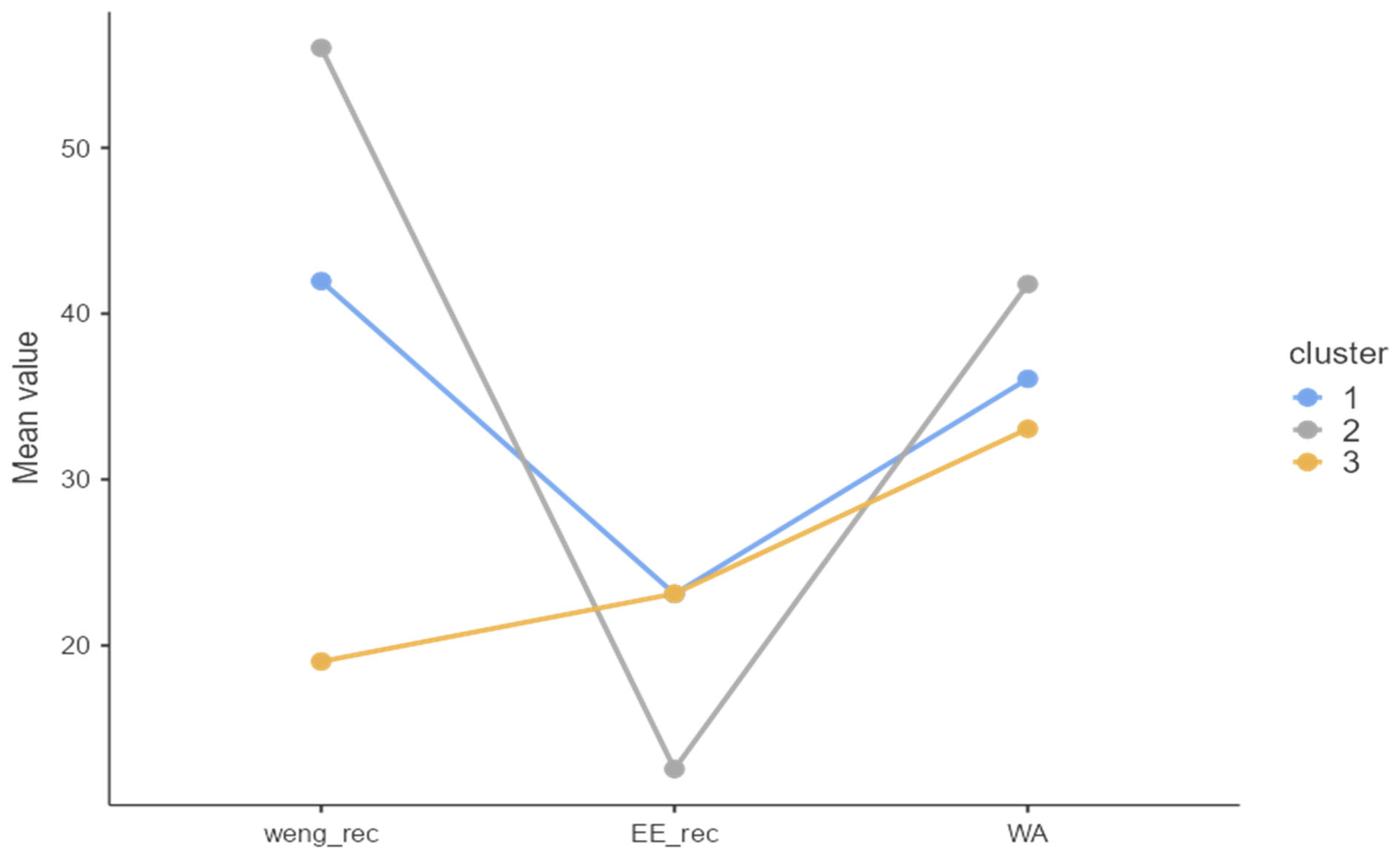
| Disillusioned | Motivated & Healthy | Motivated & Stressed | |
|---|---|---|---|
| Work engagement | 19.04 | 55.95 | 41.92 |
| Emotional exhaustion | 23.12 | 12.60 | 23.19 |
| Work Ability Index | 33 | 42 | 36 |
| Variables | F |
|---|---|
| Physical demands | 51.41 * |
| Cognitive demands | 30.58 |
| Decision Latitude | 4.46 * |
| Discretionary Skills | 42.95 * |
| Decision Authority | 38.82 * |
| Reward | 44.43 * |
Disclaimer/Publisher’s Note: The statements, opinions and data contained in all publications are solely those of the individual author(s) and contributor(s) and not of MDPI and/or the editor(s). MDPI and/or the editor(s) disclaim responsibility for any injury to people or property resulting from any ideas, methods, instructions or products referred to in the content. |
© 2026 by the authors. Licensee MDPI, Basel, Switzerland. This article is an open access article distributed under the terms and conditions of the Creative Commons Attribution (CC BY) license.
Share and Cite
Bacci, G.; Converso, D.; Guidetti, G.; Sottimano, I.; Viotti, S. Worker Well-Being in Italian Manufacturing: A Cluster Analysis of Work Engagement, Exhaustion, and Work Ability. Safety 2026, 12, 21. https://doi.org/10.3390/safety12010021
Bacci G, Converso D, Guidetti G, Sottimano I, Viotti S. Worker Well-Being in Italian Manufacturing: A Cluster Analysis of Work Engagement, Exhaustion, and Work Ability. Safety. 2026; 12(1):21. https://doi.org/10.3390/safety12010021
Chicago/Turabian StyleBacci, Giulia, Daniela Converso, Gloria Guidetti, Ilaria Sottimano, and Sara Viotti. 2026. "Worker Well-Being in Italian Manufacturing: A Cluster Analysis of Work Engagement, Exhaustion, and Work Ability" Safety 12, no. 1: 21. https://doi.org/10.3390/safety12010021
APA StyleBacci, G., Converso, D., Guidetti, G., Sottimano, I., & Viotti, S. (2026). Worker Well-Being in Italian Manufacturing: A Cluster Analysis of Work Engagement, Exhaustion, and Work Ability. Safety, 12(1), 21. https://doi.org/10.3390/safety12010021