
Article

Sustainable Production of Macrocybe indica Mushrooms: Enhancing Cultivation Performance, and Nutritional and Bioactive Properties Through Substrate Evaluation

by
Georgios Koutrotsios
1,*,
Dimitra Tagkouli
2,
Georgios Bekiaris
3,
Konstantinos Tsiantas
4,
Georgios Sotiroudis
5,
Panagiotis Zoumpoulakis
4,5,
Nick Kalogeropoulos
2 and
Georgios I. Zervakis
1,*
1
Laboratory of General and Agricultural Microbiology, Department of Crop Science, Agricultural University of Athens, Iera Odos 75, 11855 Athens, Greece
2
Laboratory of Chemistry, Biochemistry and Physical Chemistry of Foods, Department of Nutrition and Dietetics, Harokopio University, El. Venizelou 70, 17671 Kallithea, Greece
3
Laboratory of Food Microbiology and Biotechnology, Department of Food Science and Human Nutrition, Agricultural University of Athens, Iera Odos 75, 11855 Athens, Greece
4
Department of Food Science and Technology, University of West Attica, Ag. Spyridonos, 12243 Egaleo, Greece
5
Institute of Chemical Biology, National Hellenic Research Foundation, Vas. Constantinou Ave., 11635 Athens, Greece
*
Authors to whom correspondence should be addressed.
Recycling 2026, 11(10), 179; https://doi.org/10.3390/recycling11100179
Submission received: 27 July 2026 / Revised: 10 September 2026 / Accepted: 26 September 2026 / Published: 3 October 2026
(This article belongs to the Special Issue Advancing Recovery of Agricultural Waste)

Abstract

Mushroom cultivation offers a sustainable route to convert agro-industrial residues into nutritious food while reducing environmental waste. Macrocybe indica (basionym Calocybe indica) is a particularly attractive basidiomycete for mushroom production in warm climates. This study evaluated four substrates—wheat straw (WHS), beech sawdust (BSD), and their combinations with grape marc (GMW and GMB, respectively)—with and without a casing layer, by assessing M. indica cultivation performance and the bioactive compound content of the mushrooms produced. Wheat straw with casing exhibited the highest yield and biological efficiency (153%), indicating that straw-based substrates are preferable for commercial production. Grape marc incorporation reduced yield but significantly enhanced protein content, total phenolics, antioxidant activity, ergosterol, and several individual phenolic acids and triterpenic compounds, with strong substrate–mushroom correlations observed for protocatechuic acid, caffeic acid, and ursolic acid. Beech sawdust-based substrates favoured β-glucan and ergothioneine content. ATR-FTIR spectroscopy combined with Principal Component Analysis showed clear differentiation in the composition of mushrooms grown on substrates with or without grape marc. These findings reveal a functional trade-off between agronomic efficiency and nutraceutical enhancement, demonstrating that strategic substrate selection can direct M. indica cultivation toward either maximum yield and/or enhanced functional food value, supporting circular bioeconomy approaches to mushroom cultivation.

1. Introduction

To ensure a healthy future for both people and the planet, the growing population must be fed in a manner that is healthy, equitable, and sustainable. Mushroom cultivation can substantially contribute to these goals, since it represents a biotechnological process that converts agro-industrial by-products into highly nutritious food by simultaneously reducing pertinent waste streams [1]. However, mushroom cultivation often involves energy-intensive practices, such as the regulation of environmental parameters including temperature, humidity, and aeration. Temperature control, in particular, constitutes a major operational cost, since most commercially cultivated mushroom species thrive in relatively cool environments (temperatures from 10 °C to 20 °C). Among edible fungi, Macrocybe indica (Purkay. & A. Chandra) Khalid, F. Razzaq & Haqnawaz [2], commonly known as the “milky mushroom” (and until recently appearing as Calocybe indica in scientific literature), has attracted significant interest within the mushroom sector due to its distinct ability to produce high-quality mushrooms in warm climates and in temperatures of 30–38 °C [3]. Such physiological adaptability represents a clear advantage over most other cultivated species, especially in tropical and subtropical regions or during the summer season in temperate climates. In addition, cultivation of this species is advantageous due to low investment requirements, shorter growth period and extended mushroom shelf-life, making it a cost-effective and practical choice for industrial production under warm conditions.
M. indica is known for its high nutritional value, being a rich source of protein, essential amino acids, fiber, vitamins, and minerals [4,5]. Additionally, it contains bioactive compounds such as polysaccharides, phenolic compounds, and antioxidants, which contribute to its reported medicinal value, including immunomodulatory, anti-inflammatory, antimicrobial, anticoagulant, and antitumor properties [6,7]. These characteristics make M. indica not only a valuable food source but also a promising functional food with potential health benefits.
Moreover, this species demonstrates adaptability to a variety of substrates, allowing the use of various agro-residues as alternative cultivation media [8,9,10]. The type of substrate is recognized as a key determinant of mushroom productivity, nutritional composition and bioactive properties across many cultivated mushroom species, including M. indica, Pleurotus spp., Cyclocybe cylindracea, and Hericium erinaceus [9,11,12,13]. Therefore, substrate selection provides an effective strategy to improve not only cultivation performance but also the functional and health-promoting properties of edible mushrooms.
This study focuses on investigating the influence of various substrates and production techniques, including the use of a casing layer, on selected cultivation parameters, nutritional composition, and bioactive properties of M. indica. By analyzing the mushroom’s response to various agro-industrial by-products and cultivation practices, the study aims to identify suitable substrate combinations and management strategies, for improving fruitbody production and enhancing the mushroom’s bioactive potential, contributing to both sustainable agriculture and human nutrition.

2. Results and Discussion

2.1. Evaluation of Cultivation Performance of Macrocybe indica on Various Substrates

Cultivation parameters for M. indica on various substrates with or without the application of a casing layer are presented in Table 1. Incubation lasted 21 days across all treatments, while the time to primordia formation (earliness) ranged between 29 and 34 days, being 1 to 4 days shorter on substrates where casing layer was applied and/or to which grape marc was added. The overall cropping period varied only slightly (61–69 days), indicating that substrate composition had little influence on the time progression of the crop cycle. In contrast, significant differences were observed in yield, biological efficiency (BE), productivity, and average mushroom weight, which were strongly affected by both substrate type and the application of a casing layer.
The highest yield was obtained on wheat straw (WHS) with the application of a casing layer, where the total yield reached 457 g with a BE of 152.7% and a productivity of 2.3. Average fruitbody weight in this treatment was also relatively high (82.7 g), underscoring the suitability of wheat straw as a substrate for M. indica. In contrast, the poorest performance was recorded on grape marc mixed with beech sawdust (GMB) without casing, which resulted in total yield of only 191 g, a BE of 36.4%, and a productivity of 0.6. Application of a casing layer consistently improved yields across all substrates, although the extent of improvement varied. For example, the casing layer almost doubled BEs in WHS and GMW as compared with the non-cased treatments, while in BSD and GMB the increase was less pronounced. These findings confirm the importance of casing in enhancing both yield and earliness since it accelerates primordia formation and maintains surface moisture conducive to sporophore development. Average mushroom weight did not differ significantly among treatments, indicating that yield differences were mainly attributed to variations in fruitbody number rather than size.
The results of the present study confirm that straw-based substrates constitute the most efficient cultivation media for M. indica, in agreement with most previous studies. Both rice straw and wheat straw have been repeatedly reported to provide the highest biological efficiency (BE) and overall productivity compared with other agro-residues [8,14,15,16]. Rice straw is most frequently identified as the optimal substrate, with reported BE values ranging from 80% to nearly 200%, depending on cultivation conditions and supplementation [8,14,16]. However, several studies indicate that wheat straw can perform equally well or even outperform rice straw under specific conditions, particularly in terms of yield stability and protein content [17,18]. Overall, the outcome of previous studies consistently supports the superiority of straw-based substrates over materials such as sawdust, cotton waste, bamboo leaves, or sugarcane residues.
The performance of the substrates examined in the present study can be partly explained by their chemical composition (Table 2). Wheat straw (WHS) exhibited a high hemicellulose content (26.3% dry weight) combined with relatively low lignin levels (11.9% dry weight), a combination that is considered favorable for rapid enzymatic degradation and efficient carbon utilization by lignocellulolytic fungi. In contrast, beech sawdust (BSD) showed the highest lignin (15.9% dry weight) and cellulose (48.1% dry weight) contents, factors that limit substrate biodegradability and, consequently, mushroom productivity. Similar relationships between lignin content and reduced yield have been reported for Pleurotus spp. cultivated on various substrates [11], supporting such conclusions.
The incorporation of grape marc into both straw- and sawdust-based substrates resulted in pronounced compositional shifts that explain the reduced biological efficiency observed, particularly in the GMB treatment. In both substrates, grape marc supplementation substantially decreased hemicellulose content (WHS: 26.3% vs. GMW: 15.6%; BSD: 21.8% vs. GMB: 16.6% dry weight) and modified cellulose levels (Table 2), thereby limiting the availability of readily accessible structural carbohydrates required for efficient fungal growth. At the same time, grape marc addition led to a marked increase in total phenolic content (TPC) (GMW: 3638 and GMB: 3486 mg GAE/100 g dry weight), compared to the non-supplemented substrates (WHS: 621 and BSD: 715 mg GAE/100 g dry weight). Although this enrichment enhances the antioxidant and bioactive potential of the substrates, grape marc also contains recalcitrant polyphenols and lipophilic fractions that may partially interfere with lignocellulolytic enzymatic activity and overall substrate biodegradability, as previously reported for Pleurotus species cultivated on phenolic-rich olive mill residues [13].
In addition to the substrate itself, the application of a casing layer proved to be a critical factor for successful cultivation of M. indica. Consistent with earlier studies, casing effectively stimulated primordia initiation and increased yield by improving moisture retention, gas exchange, and microbial signaling at the substrate surface [9,18,19]. Peat-based casing materials, applied at a thickness of approximately 2–3 cm, are widely regarded as optimal, although alternative materials such as spent mushroom compost, vermicompost, or manure-based mixtures have also been reported to substantially enhance yield [10,14,16,20].

2.2. Effect of Substrate Composition and Casing Layer on the Nutritional Profile of Macrocybe indica Mushrooms

2.2.1. Crude Composition

The nutritional composition of M. indica fruitbodies was strongly influenced by substrate type and, to a lesser extent, by the application of a casing layer (Table 3). Mushrooms cultivated on grape marc-amended substrates (GMW and GMB) exhibited the highest protein content, reaching up to 22.9% dry weight, whereas non-amended straw (WHS) and beech sawdust (BSD) substrates produced mushrooms with lower protein (16–17%). This trend is related to the nitrogen content of the substrates (Table 2), since grape marc incorporation increased total nitrogen and, indirectly, crude protein in the fruitbodies. This response may be associated with increased nitrogen availability and its potential effects on amino acid and protein biosynthesis, as previously suggested in the literature [21]; however, these mechanisms were not directly investigated in the present study. Such a relationship between substrate nitrogen and mushroom protein content has been repeatedly reported for M. indica and other cultivated mushrooms: nitrogen-rich substrate supplementation has been shown to increase protein levels from approximately 14% to over 23% [9], while similar trends have been observed in other species such as Pleurotus ostreatus and Cyclocybe cylindracea, where mushroom protein content was positively correlated with substrate nitrogen availability [11,22].
An inverse relationship between protein and total carbohydrates was also evident. Treatments exhibiting higher protein levels (GMW and GMB) contained less carbohydrates, whereas the highest carbohydrate values were recorded in mushrooms grown on BSD with casing. This trade-off may reflect changes in fungal carbon partitioning, whereby increased nitrogen availability favors the allocation of carbon skeletons towards amino acid and protein biosynthesis, rather than carbohydrate accumulation [21]. Similar protein–carbohydrate trade-offs have been reported for M. indica [9], while carbohydrate content was positively correlated with substrate lignocellulosic fractions such as cellulose and hemicellulose in the case of P. ostreatus [11]. The present results support this trend, as substrates characterized by higher structural polysaccharide content (e.g., BSD; Table 2) produced mushrooms with increased carbohydrate levels.
Crude fat content was generally low across all treatments, with the highest values in WHS and BSD without casing (4.4–4.7%) versus significantly lower fat values in grape marc-amended substrates (2–2.8%). One possible explanation is that substrate nitrogen availability alters fungal carbon allocation and lipid metabolism. Increased nitrogen availability may favor biomass production and amino acid biosynthesis at the expense of lipid accumulation, whereas nutrient limitation has been shown to trigger extensive lipid metabolic remodeling in fungi [21,23]; this is also consistent with literature reports indicating that nitrogen or phenolic-rich substrate supplements can reduce lipid accumulation in fruitbodies [9,24]. Similar substrate-dependent variations have been reported for P. ostreatus and C. cylindracea, where mushroom lipid content was positively correlated with substrate C/N ratio and cellulose content [11]. Such relationships may partly explain the higher fat levels observed in the lignocellulose-rich substrates examined in the present study.
Crude fibre followed a similar substrate-dependent trend, with sawdust-based treatments showing slightly higher fibre content, likely reflecting the elevated amount of lignocellulosics in BSD (Table 2). Ash content showed moderate variation among substrates, with slightly higher values recorded in grape marc-amended treatments. This observation is consistent with the relatively elevated mineral content of grape marc-containing substrates (Table 2), suggesting efficient transfer of mineral elements from substrate to fruitbodies. Similar substrate-driven differences in mineral composition have been documented in various mushroom species, where ash and metal content were strongly influenced by the nature of the substrate [25,26]. Gross energy values varied within a narrow range across all treatments, indicating that substrate-induced compositional changes did not substantially affect the overall caloric density of mushrooms.
Overall, these results are consistent with previously reported ranges for M. indica, where crude protein can vary from 10 to 40% depending on the type of substrate and supplementation used [9,18,24,27], total carbohydrates range between 26 and 82%, and crude fat generally remains below 5% [3,5,9,27]. Variations in the values reported across studies may reflect differences in mushroom strain, substrate composition, cultivation conditions, and analytical procedures.
The casing layer exerted moderate effects on composition, slightly reducing protein and fat while increasing carbohydrate content in most treatments. These changes may reflect altered nutrient partitioning during fructification, as casing promotes yield through enhanced moisture retention and primordia formation, without substantially modifying the overall nutritional profile [9,18].

2.2.2. Antioxidant Activity

Edible mushrooms are widely recognized as an important source of natural antioxidants due to their content in phenolic compounds and other bioactive metabolites. In particular, M. indica has been reported to exhibit considerable antioxidant potential, largely attributed to phenolic constituents and related secondary metabolites [6,7].
In the present study, radical scavenging activity (DPPH) varied significantly among substrates, with the highest value recorded in mushrooms cultivated on the GMB substrate without casing (100.9 mmol TE/100 g dry weight), followed by those produced on uncased WHS (76.7 mmol TE/100 g dry weight). Notably, the application of a casing layer consistently resulted in lower DPPH radical-scavenging activity across all substrates (Table 4). Total phenolic content (TPC) also varied considerably among treatments, ranging from TPC 98.3 to 590.5 mg GAE/100 g dry weight, with the highest concentrations detected in mushrooms produced on grape marc-amended substrates (Table 4). This response may reflect both the increased availability of phenolic precursors in grape marc and the ability of lignocellulolytic fungi to enzymatically release, biotransform, or synthesize phenolic compounds during substrate colonization. The variation in DPPH activity did not fully correspond with that of TPC across treatments, indicating that radical-scavenging capacity cannot be attributed solely to the total amount of phenolic compounds. Differences in the phenolic profile, as well as the contribution of other antioxidant constituents present in mushroom extracts, may also influence the observed antioxidant response. Such metabolic responses are commonly associated with fungal oxidative metabolism and may contribute to the enhanced antioxidant capacity of the resulting fruitbodies [28]. In addition, antioxidant activity was assessed using the DPPH assay alone; therefore, future studies incorporating complementary assays, such as ABTS or FRAP, could provide a more comprehensive characterization of the antioxidant properties of M. indica fruitbodies.
The significant impact of substrate composition on phenolic content and antioxidant activity is well-documented for M. indica [9,29]. In particular, substrates enriched with phytochemical-rich materials have been shown to significantly increase mushroom TPC and enhance radical scavenging activity [9]. Similar trends have also been reported for other cultivated species, such as Hypsizygus ulmarius, Pleurotus citrinopileatus, P. eryngii and P. ostreatus, where the use of phenolic-rich residues (e.g., grape marc or nut shells) resulted in increased phenolic content in the produced fruitbodies [13,30,31].
Furthermore, the elevated TPC levels recorded in mushrooms grown on GMW and GMB substrates were positively associated with the phenolic content of the corresponding substrates (Table 2), as supported by a correlation between substrate and mushroom phenolic concentrations (r = 0.72, p < 0.05). This relationship may be compatible with mechanisms previously proposed in the literature, including the selective uptake of low-molecular-weight phenolics and/or the enzymatic biotransformation of substrate-derived polyphenols into fungal metabolites [28,32]. Alternatively, exposure to phenolic-rich substrates may stimulate fungal secondary metabolism through oxidative stress signaling, potentially enhancing the de novo biosynthesis of antioxidant metabolites [33].

2.2.3. Ergosterol

Ergosterol is the principal sterol of fungal cell membranes and a key bioactive compound of nutritional importance since it serves as the natural precursor of vitamin D2 following exposure to UV radiation. It may inhibit intestinal cholesterol absorption [34], while it also possesses antimicrobial, antioxidant, anticancer, antidiabetic and anti-neurodegenerative properties [35]. In the present study, ergosterol content in M. indica mushrooms varied significantly among substrates and cultivation treatments, ranging from 5.3 to 12.1 mg/g dry weight, with the highest values recorded in mushrooms produced on grape marc-amended substrates (GMW and GMB), particularly in the absence of casing.
The observed differences suggest a strong influence of substrate composition on ergosterol biosynthesis. Notably, grape marc-containing substrates (Table 2) are known to be rich in bioactive lipophilic compounds, including squalene, which constitutes a key precursor in the sterol biosynthetic pathway [36]. Furthermore, in most cases, the application of a casing layer negatively affected ergosterol content, showing a reduction of up to 37% in GMW substrate. It should also be noted that ergosterol levels may be influenced by additional factors such as developmental stage, genetic background and post-harvest conditions, as well as by exposure to UV radiation, which can convert ergosterol to vitamin D2 [27,37].

2.2.4. Ergothioneine

Ergothioneine (ET) is a naturally occurring sulfur-containing amino acid with strong antioxidant activity, widely recognized for its cytoprotective, anti-inflammatory and neuroprotective properties [38]. It cannot be synthesized in the human body, and edible mushrooms represent one of its richest natural sources [39]. In M. indica, ergothioneine has been identified as a major bioactive compound contributing significantly to the antioxidant activity of the species [3].
In the present study, ergothioneine content varied considerably among treatments, ranging from 55.9 to 189.6 μg/g dry weight, with the highest values recorded in mushrooms cultivated on BSD and GMB substrates with casing. In contrast to phenolic compounds and ergosterol, the application of a casing layer generally resulted in increased ET content, particularly in sawdust-based substrates. The observed variations may be attributed to differences in substrate chemical composition and nutrient availability. Substrates based on beech sawdust (BSD and GMB), which are characterized by higher lignocellulosic content and a distinct nutrient profile (Table 2), may promote metabolic pathways associated with ergothioneine biosynthesis. This may be due to differences in substrate nutrient composition which influence metabolic flux through the ergothioneine biosynthetic pathway, depending on the availability of histidine and sulfur-containing metabolites [40]. Moreover, the degradation of more recalcitrant lignocellulosic substrates may impose greater oxidative and metabolic demands on the mycelium, thereby stimulating ergothioneine biosynthesis as part of the intracellular antioxidant defense system of the fungus [41].
Similar substrate-dependent variations have also been reported in Pleurotus spp., where the use of various agro-residues resulted in significant differences in ergothioneine content of the fruitbodies [30,42]. Furthermore, its content has been shown to vary during mushroom development, typically increasing towards intermediate maturity stages and declining at full maturity, highlighting the importance of harvest timing [43]. It should be noted that the ergothioneine values recorded in the present study are lower than those reported for several Pleurotus species, where values may exceed 1000 μg/g dry weight, but remain within the range reported for other cultivated mushrooms, highlighting species-specific differences in ergothioneine biosynthesis [1].

2.2.5. Glucans

Glucans constitute major structural polysaccharides of fungal cell walls, with β-glucans playing a key role in maintaining cell wall integrity, while also representing some of the most important bioactive compounds due to their well-documented immunomodulatory, antioxidant, anticoagulant and prebiotic properties [6,44].
In the present study, β-glucans were the dominant fraction, ranging from 24.0% to 38.6% dry weight, whereas α-glucans were found to be consistently lower (6.0–13.0% dry weight). The highest β-glucan contents were recorded in mushrooms cultivated on wood-based substrates (BSD and GMB, up to 38.6% dry weight), while lower values were observed in WHS- and GMW-derived samples. In contrast, α-glucans were higher in WHS treatments (13.0% dry weight), and were significantly reduced in GMW samples (as low as 6.0% dry weight). The application of a casing layer had no consistent effect on β-glucan content, which remained relatively stable across substrates. In contrast, α-glucans exhibited a substrate-dependent response, increasing in WHS, decreasing substantially in GMW, and showing little or no change in BSD and GMB. Such patterns can be partly explained by the chemical composition of the substrates (Table 2). Substrates with higher cellulose and lignin contents, e.g., BSD and GMB, were associated with increased β-glucan content, suggesting a positive relationship between recalcitrant lignocellulosic fractions and the synthesis of structural polysaccharides in mushrooms. Fungal growth on more recalcitrant lignocellulosic substrates requires continuous hyphal extension and cell wall remodeling, thereby increasing the demand for β-glucans, the major structural polysaccharides of the fungal cell wall. Moreover, lignocellulose degradation is often accompanied by the release of phenolic compounds and the generation of reactive oxygen species (ROS), which have been proposed to stimulate β-glucan biosynthesis through the activation of β-glucan synthase (GLS) and related cell wall biosynthetic pathways, representing an adaptive response to oxidative stress [45]. This observation is consistent with previous findings indicating that substrates rich in structural carbohydrates favor the synthesis of cell wall components such as glucans and chitin. Conversely, substrates supplemented with grape marc (GMW and GMB), despite their high phenolic content, exhibited reduced hemicellulose, cellulose and lignin content, which may partly explain the differentiation between α- and β-glucan fractions, reflecting shifts in carbon allocation and metabolic regulation.
The observed trends are in agreement with literature data for M. indica, where β-glucan content typically ranges between 20 and 25% dry weight but may increase depending on the substrate used and cultivation conditions [9]. Substrates rich in lignocellulosic residues, such as straw and sugarcane waste, have been reported to promote higher β-glucan content, whereas less complex substrates result in lower content [46,47]. Similar substrate-dependent effects have also been reported in other mushroom species, including Pleurotus spp., Ganoderma lucidum and Hericium erinaceus, although in some cases glucan content appears less sensitive to substrate variation, indicating species-specific metabolic responses [12,30,48].

2.2.6. Individual Phenolic Compounds and Triterpenic Acids

Phenolic compounds represent one of the most important groups of bioactive secondary metabolites in edible mushrooms, contributing substantially to their antioxidant, anti-inflammatory, antimicrobial, and functional food properties [32]. In M. indica, previous studies have reported a broad spectrum of phenolic acids, flavonoids, and related compounds, including gallic, protocatechuic, caffeic, ferulic, vanillic, syringic, and p-coumaric acids, as well as catechin, epicatechin, quercetin, and resveratrol, which collectively contribute to its recognized nutraceutical potential [3,6]. However, significant variation among strains, developmental stages, and substrate types indicates that cultivation conditions strongly influence the phenolic profile of this species.
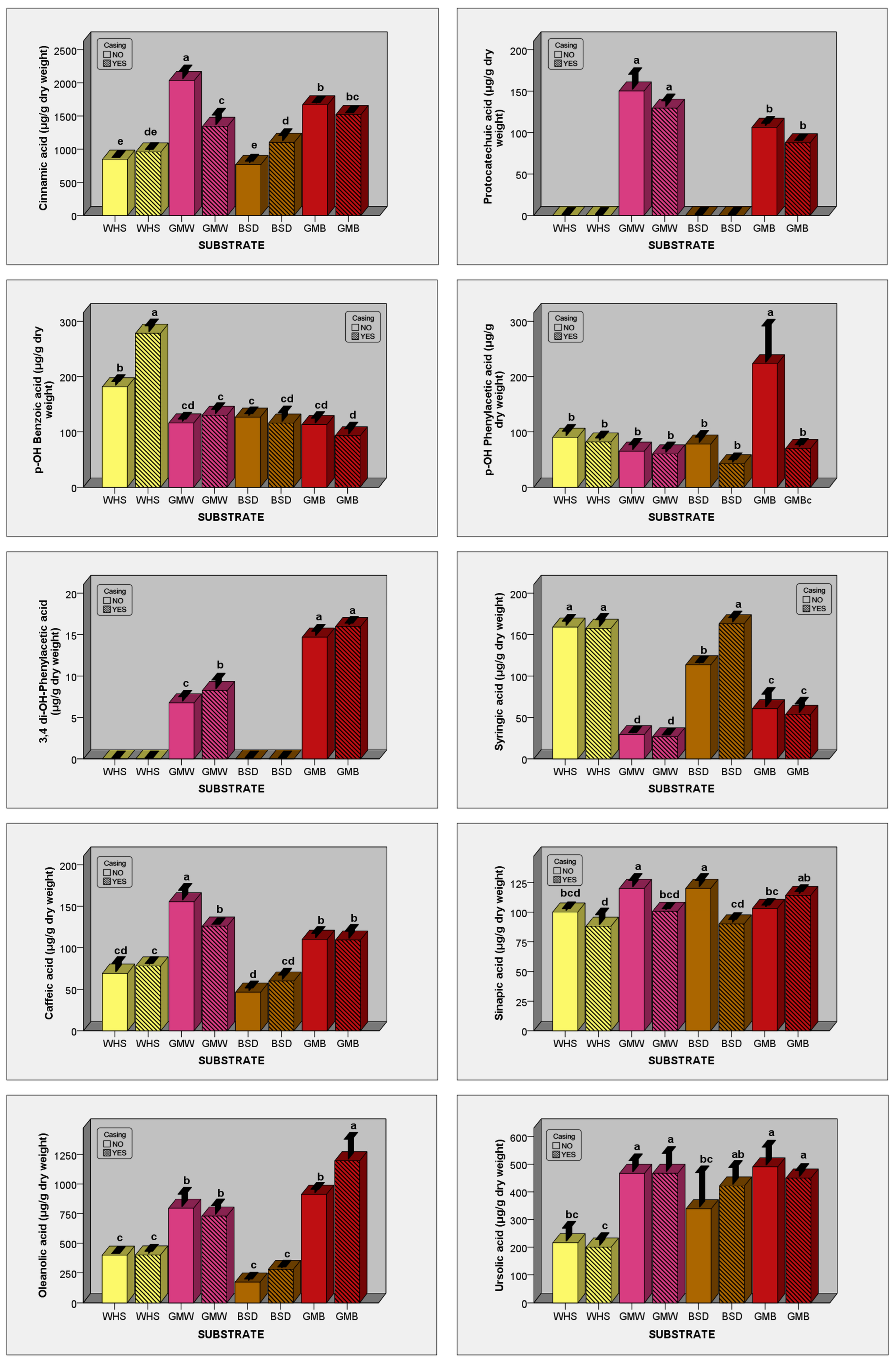
In the present study, eight individual phenolic compounds and two triterpenic acids were identified in M. indica fruitbodies, with the nature of substrate exerting a pronounced effect on their content (Figure 1). Among the identified compounds, cinnamic acid was the predominant phenolic across all mushroom samples, ranging from 768.8 to 2035.3 μg/g dry weight, despite being below detection limits in all cultivation substrates prior to inoculation (Table 2). This finding indicates that cinnamic acid is predominantly produced through endogenous fungal biosynthesis rather than a result of direct uptake from the cultivation substrate. Nevertheless, substrate composition may indirectly influence its content by modulating aromatic metabolism and the activity of secondary metabolic pathways. Since cinnamic acid represents a central intermediate in fungal aromatic metabolism, its elevated concentrations—particularly in mushrooms cultivated on grape marc-amended substrates such as GMW and GMB—suggest that phenolic-rich residues may stimulate de novo phenolic biosynthesis through enhanced precursor availability, metabolic induction, or oxidative stress-mediated regulation of secondary metabolism.
Particularly notable was the strong substrate-fruitbody relationship observed for several compounds. Protocatechuic acid and 3,4-dihydroxyphenylacetic acid were exclusively or predominantly detected in mushrooms grown on grape marc-containing substrates, with strong positive correlations between substrate and mushroom concentrations (r = 0.94 and r = 0.91, respectively; p < 0.05). Similarly, caffeic acid exhibited an exceptionally strong correlation (r = 0.99, p < 0.05), consistent with a direct substrate influence on mushroom chemical composition. These findings indicate that substrate-derived phenolics can contribute to mushroom composition through selective uptake, enzymatic biotransformation and subsequent accumulation. However, the extent to which individual compounds accumulate most likely depends on the balance between substrate-derived precursors and endogenous fungal biosynthesis. Thus, the phenolic profile of M. indica appears to result from two complementary processes: (i) de novo synthesis of fungal metabolites, particularly for compounds such as cinnamic acid, and (ii) selective uptake and/or biotransformation of substrate-derived phenolics, especially for compounds showing strong substrate–fruitbody correlations. Such mechanisms have been previously proposed for Pleurotus mushrooms cultivated on polyphenol-rich agro-industrial residues [13] or from a wide range of other fungi grown on grape pomace [49]. Biotransformation of plant-derived phenolics by ligninolytic enzymes, including laccases and peroxidases, may further contribute to the conversion of substrate phenolics into lower-molecular-weight metabolites that subsequently accumulate in fungal tissues [28].
Sinapic acid displayed moderate substrate-dependent variation and a positive but non-significant correlation with substrate concentrations (r = 0.60), indicating partial substrate influence combined with substantial endogenous metabolic regulation. Moreover, p-hydroxybenzoic acid and syringic acid followed inverse patterns, with WHS-derived mushrooms generally containing higher concentrations than those originating from grape marc-based substrates, suggesting selective metabolic redirection rather than uniform enhancement of all phenolic fractions.
Regarding triterpenic acids, both oleanolic and ursolic acids were significantly affected by substrate type. Oleanolic acid content ranged from 171.2 to 1196.2 μg/g dry weight, with the highest levels being recorded in mushrooms cultivated on GMB substrate, while ursolic acid values were generally elevated in grape marc-amended treatments. Ursolic acid exhibited a strong and statistically significant positive correlation between substrate and mushroom concentrations (r = 0.82, p < 0.05), indicating that substrate composition strongly influences ursolic acid accumulation, although the relative contribution of substrate-derived compounds vs. de novo biosynthesis cannot be distinguished from the data available. Oleanolic acid also showed a positive correlation (r = 0.65), although not statistically significant, suggesting that both substrate composition and fungal metabolism contribute to its final content.
The application of casing generally exerted moderate and compound-specific effects, occasionally increasing cinnamic acid concentrations, while it exhibited a variable impact on phenolic acids and triterpenes. These effects likely reflect altered developmental physiology and nutrient partitioning during fructification rather than direct substrate chemical modification.

2.3. Spectroscopic and Principal Component Analysis

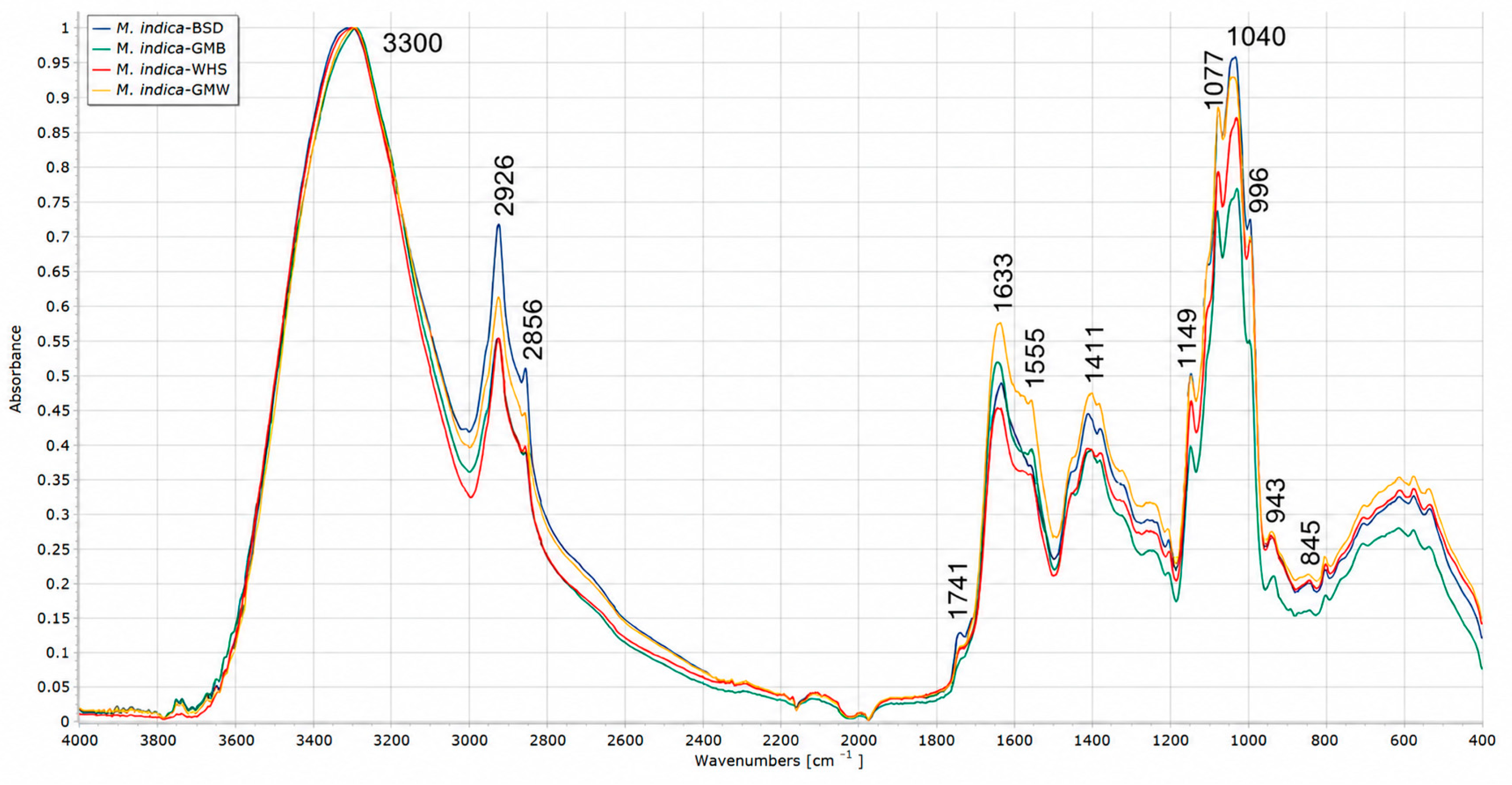
The recorded ATR-FTIR spectra of the produced M. indica mushrooms cultivated on the various substrates (Figure 2) showed differences mainly in absorption intensities, reflecting variations in their overall chemical composition. Due to the complex nature of mushroom matrices, several absorption bands may represent overlapping contributions from different classes of biomolecules and should therefore not be regarded as specific markers of individual compounds. The broad band around 3300 cm−1 may include contributions from N–H stretching vibrations of proteins (Amide A), as well as O–H stretching vibrations of phenolic compounds, certain triterpenoids, and water [50,51,52]. The bands at 2926 and 2856 cm−1 are mainly associated with symmetric and asymmetric CH2 stretching vibrations, whereas the band around 1741 cm−1 is commonly attributed to C=O stretching of lipid-related compounds. The region around 1633 cm−1 may contain overlapping contributions from C=O stretching of proteins (Amide I) and aromatic C=C stretching of phenolic compounds [50,53], as well as N–H bending vibrations of flavonoids [48,54]. The band around 1555 cm−1 is primarily associated with N–H bending of secondary amides (Amide II) and C–N stretching vibrations [50]. The band near 1411 cm−1 may originate from symmetric COO− stretching vibrations of fatty and amino acids and bending vibrations of methyl groups in proteins [55]. Finally, the region between 1200 and 900 cm−1 is dominated by C–O–C, C–O, and C–C stretching vibrations mainly associated with polysaccharides [56,57,58]. Overall, these assignments should be interpreted as indicative of the major classes of biomolecules contributing to each spectral region rather than as compound-specific identification.
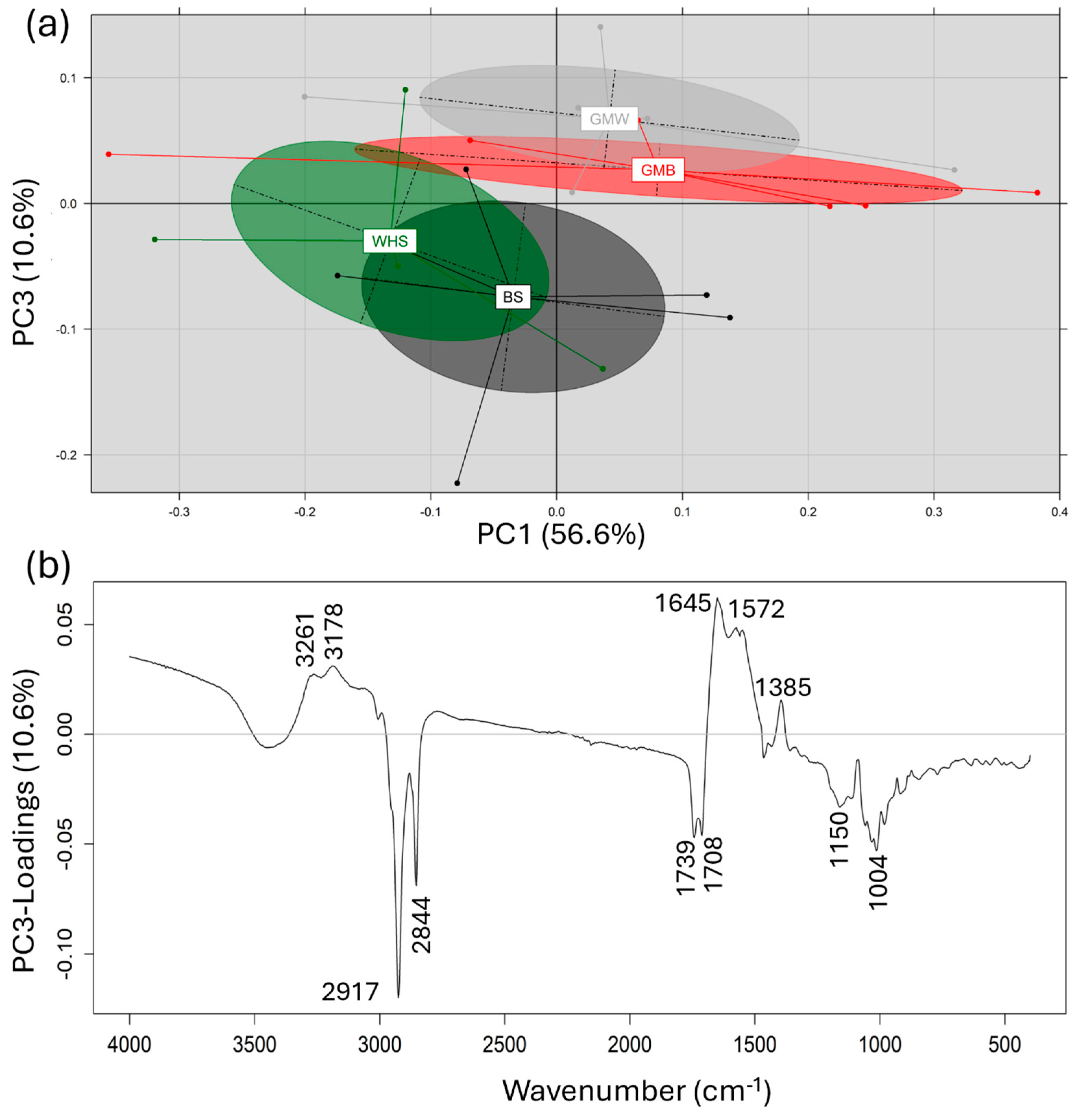
The recorded ATR-FTIR spectra were further analyzed using Principal Component Analysis (PCA) to investigate possible clustering patterns according to the cultivation substrate. The score plot obtained by comparing the first and third principal components of the spectra, previously pre-treated by Multiplicative Scatter Correction (MSC) and mean-centering, revealed a clear separation mainly between mushrooms cultivated on substrates containing grape marc and those cultivated on substrates without grape marc (Figure 3a). These two principal components explained a relatively high proportion of the total spectral variance (67%; Supplementary Figure S1). Examination of the corresponding loading profiles, particularly the PC3 loadings, indicated that the observed separation was associated with spectral regions around 3200, 1645, 1572, and 1385 cm−1 (Figure 3b). These regions comprise overlapping vibrational bands that may originate from several classes of biomolecules, including proteins and phenolic compounds, and therefore cannot be considered specific markers of individual compound classes in such a complex biological matrix. Nevertheless, the spectral differentiation observed by PCA is consistent with the compositional differences independently determined by the chemical analyses (Table 3 and Table 4).

3. Materials and Methods

3.1. Chemicals and Reagents

The chemicals used in this study, including ergosterol, p-hydroxybenzoic acid, gallic acid, p-coumaric acid, p-hydroxyphenylacetic acid, ursolic acid, 2,4,6-tris(2-pyridyl)-s-triazine (TPTZ), and ergothioneine, were sourced from Sigma (Steinheim, Germany). Folin–Ciocalteu reagent, bis(trimethylsilyl)-trifluoroacetamide (BSTFA), 1,1-diphenyl-2-picrylhydrazyl (DPPH), 6-hydroxy-2,5,7,8-tetramethylchroman-2-carboxylic acid (Trolox), oleanolic acid, and 3-(4-hydroxyphenyl)-1-propanol were obtained from Aldrich (Steinheim, Germany). Cholesterol and vanillic acid were purchased from Serva (Heidelberg, Germany). Methimidazole (internal standard) was supplied by Thermo Fischer (Erlenbachweg, Germany).

3.2. Fungal Strain and Mushroom Cultivation Process

For this study, a commercial strain of Macrocybe indica (Basidiomycota, Agaricales) was used. The strain is routinely maintained on potato dextrose agar and stored in the culture collection of the Laboratory of General and Agricultural Microbiology at the Agricultural University of Athens, under the accession code ‘LGAM 201’. Grape marc obtained from a local winery, beech sawdust sourced from a wood processing facility located in Athens, and wheat straw kindly provided by Dirfis Mushrooms SA (Evoia, Greece), were used to prepare the substrates for mushroom cultivation. These raw materials were combined to generate the following four substrates: (a) GMW: a 1:1 mixture of grape marc and wheat straw (w/w); (b) GMB: a 1:1 mixture of grape marc and beech sawdust (w/w); (c) WHS: wheat straw; and (d) BSD: beech sawdust. In all substrates, soybean flour was incorporated at 10% (w/w, on a dry weight basis) as a nitrogen-rich supplement. The 1:1 (w/w) grape marc incorporation ratio was selected based on previous experiments by our research group, in which 50% (w/w) grape marc supplementation provided a suitable balance between cultivation performance and enhancement of bioactive compounds compared with lower incorporation levels [11,13], while higher proportions may adversely affect substrate structure and aeration.
The substrates were sterilized twice at 121 °C for 1 h under 1.1 atm in 1 kg polypropylene autoclavable bags. Cereal grain spawn of M. indica was prepared according to the method previously described [11] and inoculated into the sterilized substrates at a rate of 3% (w/w). Incubation was carried out at 27 °C in the dark. Once the substrates were fully colonized, the bags were opened, and a 2 cm casing layer consisting of peat moss and CaCO3 (2:1 w/w) was applied to four of the eight replicates for each substrate, the remaining four being maintained without casing. The environmental conditions were controlled as follows: relative humidity at 95 ± 2%, temperature at 30–32 °C, and light intensity at 700 lumen/m2 for 16 h/day using fluorescent lamps. After the formation of mushroom primordia, CO2 levels were kept below 1200 ppm, relative humidity at 80 ± 2%, and light intensity at 1000 lumen/m2 for 12 h/day until the end of the cultivation cycle.
To evaluate the effects of each substrate on mushroom production and cultivation efficiency, the following parameters were assessed [11]: (a) the duration of each stage of the mushroom crop cycle (incubation, primordia formation, and total cultivation period, including harvest of three flushes); (b) earliness (the time from inoculation to the appearance of primordia); (c) mushroom yield (the fresh weight of the mushrooms produced); (d) average mushroom weight (calculated as the total yield divided by the total number of fruitbodies harvested); (e) biological efficiency (BE), expressed as the percentage of fresh mushroom weight relative to the dry weight of the substrate; and (f) productivity, determined as the ratio of BE to the cultivation period length (in days).

3.3. Preparation of Substrate and Mushroom Samples for Analysis

Four distinct samples were taken from each substrate (collected immediately after preparation and before inoculation with the fungus) for the analysis of selected compounds. Additionally, four mushroom samples (all collected from the first flush) were analyzed for each substrate. The samples were freeze-dried using a Telstar Cryodos apparatus (Telstar Industrial, S.L., Terrassa, Spain). The resulting dried material was finely ground into a powder, placed in sealed plastic bags, and stored in the dark at −20 °C prior to analysis.

3.4. Crude Composition of Mushrooms and Substrates

Ash, crude fiber, crude protein, and crude fat contents of mushrooms were determined following the methods described by AOAC [59]. Crude protein content of mushroom samples was calculated based on the total nitrogen content using a conversion factor of 4.38, which is commonly applied to mushrooms to account for their relatively high proportion of non-protein nitrogen [60]. Nitrogen-free extracts (total carbohydrates) were calculated using the formula 100 − (protein + fat + ash contents). Gross energy (kcal per 100 g dry weight) was estimated using the equation energy = 4 × (g protein + g carbohydrate) + 9 × (g fat) [61].
For the determination of the crude composition of the substrates, samples were analyzed for their content of ash, crude fiber, crude protein, and crude fat, as previously described. Crude protein content of substrate samples was calculated from the total nitrogen content using a conversion factor of 6.25 [62]. Neutral detergent fiber (NDF), acid detergent fiber (ADF), and acid detergent lignin (ADL) were quantified following the method of Goering and Van Soest [63]. Lignin content was estimated as ADL, while hemicellulose and cellulose contents were calculated as NDF − ADF and ADF − ADL, respectively.

3.5. Determination of Glucans

The total and α-glucan contents were determined using the Mushroom and Yeast Beta-Glucan assay kit (Megazyme Int., Bray, Ireland) following the manufacturer’s instructions. The β-glucan content was calculated by subtracting the α-glucan content from the total glucan content.

3.6. Phenolics Extraction

Phenolic compounds were extracted following a previously established method with slight modifications [64]. Briefly, 0.5 g of freeze-dried mushroom sample was extracted with 10 mL of methanol at room temperature by shaking for 48 h in the dark. The extracts were separated by centrifugation at 2500 rpm for 10 min, and the residues were re-extracted with 2.5 mL of methanol for 2 h. The two extract portions were combined, and the methanol volume was reduced to 2 mL using a rotary evaporator (Rotavapor-R, Büchi Labortechnic AG, Flawil, Switzerland). The resulting extracts were then sealed in GC vials and stored at −20 °C.

3.7. Assessment of Antioxidant Activity and Total Phenolic Content

The antioxidant activity of the methanolic extracts was evaluated by assessing their radical scavenging capacity using the DPPH antiradical-activity (AAR) assay, as described by Arnous et al. [65]. Trolox was employed as the calibration standard, and the results were expressed as millimoles of Trolox equivalents (TEs) per 100 g of dry mushroom weight.
The total phenolic content (TPC) in the methanolic extracts of mushrooms was determined using the Folin–Ciocalteu assay, modified for micro-scale by Arnous et al. [65]. Absorbance was measured at 750 nm using a U-2001 spectrophotometer (Hitachi Instruments Inc., Tokyo, Japan). Gallic acid was employed for the calibration curve, and the results were expressed as milligrams of gallic acid equivalents (mg GAE) per 100 g of dried mushrooms.

3.8. Determination of Individual Phenolic Compounds and Triterpenic Acids

A selective ion monitoring gas-chromatography mass-spectrometry (SIM-GC–MS) technique was used to detect target phenolic compounds and triterpenic acids, following the procedure described by Kalogeropoulos et al. [64]. This method relies on the comparison of retention times and the ratios of two to three fragment ions of each compound with those of commercially available pure standards [66]. In brief, 2 g of freeze-dried samples were extracted with 40 mL of methanol for 48 h in the dark at room temperature. After centrifugation, the residues were re-extracted with 10 mL of methanol for 2 h. Once the solvent was removed, the extract was re-dissolved in 1 mL of methanol, and the phenolic compounds and triterpenic acids were derivatized to their trimethylsilyl (TMS) ethers. Quantification was performed using target and qualifier ions of commercial standards at predetermined ratios, with 3-(4-hydroxyphenyl)-1-propanol used as the internal standard.

3.9. Determination of Ergosterol

Ergosterol was isolated and quantified following the procedure outlined by Sapozhnikova et al. [67], with minor modifications. In brief, 100–200 mg of freeze-dried samples were spiked with a cholesterol standard solution as the internal standard and subjected to hot saponification with 3 M KOH in methanol for 60 min at 60 °C. The unsaponifiable fraction was extracted with hexane, and sterols were derivatized into trimethylsilyl ethers (TMS) after treatment with BSTFA at 70 °C for 20 min. To minimize light exposure, all manipulations were carried out under reduced lighting conditions. The TMS derivatives were analyzed using GC–MS on an Agilent HP 6890N gas chromatograph (Waldbronn, Germany) coupled with an HP 5973 mass selective detector, operating under electron impact ionization (70 eV) on an HP-5MS capillary column, as described by Koutrotsios et al. [20]. Ergosterol concentration was determined by constructing a seven-point calibration curve in the range of 0–600 µg, using cholesterol as the internal standard.

3.10. Determination of Ergothioneine

For the recovery of ergothioneine from M. indica samples, a procedure similar to that described by Sapozhnikova et al. [67], with modified centrifugation conditions, was applied, as outlined by Tsiantas et al. [68]. The identification and quantification of ergothioneine in mushrooms were performed using a previously developed liquid chromatography–mass spectrometry (LC-MS/MS) method [30]. For extraction, 100 mg of mushroom powder was mixed with 10 mL of an extraction solvent (water:methanol 1:4, v/v). The mixture was vortexed vigorously (Falc Instruments, Bergamo, Italy) for 20 min and then centrifuged (Centrifuge Z32 HK; Hermle, Wehingen, Germany) for an additional 20 min at 3650 rcf. Subsequently, 8 mL of the supernatant was freeze-dried, and the dry residue was collected for further analysis. Methimidazole was used as the internal standard for LC-MS/MS analysis.
The chromatographic separation of ergothioneine and methimidazole was performed using a Kromasil C18 column (100 mm × 2.1 mm i.d., 3.5 μm particle size; Nouryon, Amsterdam, The Netherlands). Analytes were separated by gradient elution with solvent A (water containing 0.1% formic acid) and solvent B (acetonitrile). The gradient started at 30% solvent A, increased to 50% over 10 min, and then returned to 30% at 15 min. The flow rate was set to 0.2 mL/min, and the samples were diluted to acetonitrile:water (70:30, v/v). The injection volume was 10 μL, and the column temperature was set at 25 °C.
The mass spectrometer used was a 3D quadrupole ion trap LCQ FLEET (Thermo Fisher Scientific, Waltham, MA, USA), equipped with electrospray ionization (ESI) in positive mode. Ergothioneine was quantified by the mass transition from m/z 230.1 to 186.1 using single reaction monitoring (SRM), while methimidazole was detected using the parent ion at m/z 114.9. Ergothioneine content was determined using a calibration curve with the peak area ratio (a.u.) = 0.030C + 0.011 (R2 = 0.998) in the concentration range of 2.5–35 μg/mL. All measurements were conducted in triplicate, and the LC-MS/MS data were processed using Xcalibur software (version 4.2, Thermo Fisher Scientific, Waltham, MA, USA).

3.11. Attenuated Total Reflection FOURIER Transform Infrared (ATR-FTIR) Spectroscopic Analysis

The FTIR spectra of the substrates (prior to inoculation with fungi) and the produced mushrooms were recorded using a Spectrum Two FTIR spectrometer (Perkin Elmer Inc., Waltham, MA, USA) equipped with a Diamond ATR sampling technique, utilizing the Spectrum 10 spectroscopy software. For each sample, 32 scans were performed in the infrared range between 4000 and 400 cm−1 at a resolution of 4 cm−1. Measurements were conducted in triplicate and averaged. The recorded spectra were ATR-corrected using a diamond refractive index of 1.5, followed by smoothing with the Savitzky–Golay algorithm (total smoothing window of 9 points, and a second-order polynomial). Further, the spectra were linearly baseline-corrected and normalized by the mean using SpectraGryph 1.2.7 software (https://www.effemm2.de/spectragryph/, accessed on 1 May 2026).

3.12. Statistical Analysis

All chemical analyses and tests were carried out in quadruplicate. The results are presented as mean ± standard deviation (SD). To assess differences between means, one-way analysis of variance (ANOVA) followed by Duncan’s multiple range test at a 5% significance level was applied (IBM SPSS Statistics 21). Prior to ANOVA, the assumptions of normality and homogeneity of variances were assessed using the Shapiro–Wilk and Levene’s tests, respectively. Pearson’s correlation coefficient was utilized to evaluate relationships between variables, with significance levels set at 0.05 and 0.01. To further explore the underlying information, Principal Component Analysis (PCA) was conducted on the recorded ATR-FTIR spectra of the produced mushrooms cultivated on various substrates, after Multiplicative Scatter Correction and mean centering. Both the PCA and the spectral transformations were carried out using RStudio (Build 526), loaded with the “ade4” and “adegraphics” packages.

4. Conclusions

The present study demonstrates that Macrocybe indica can be effectively cultivated on the four evaluated agro-industrial residues, while the type of substrate and the application of a casing layer significantly affect not only the cultivation parameters but also the nutritional and functional profile of the mushrooms produced. Among the substrates evaluated, wheat straw with casing exhibited the highest cultivation performance, with a biological efficiency of 152.7%. Although grape marc incorporation reduced cultivation performance, it substantially enhanced selected bioactive compounds; notably, in uncased mushrooms, the GMB substrate increased total phenolic content by approximately 93% (from 306.0 to 590.5 mg GAE/100 g dry weight) and ergosterol content by approximately 49% (from 8.1 to 12.1 mg/g dry weight) compared with the corresponding BSD substrate.
Grape marc-based substrates significantly improved mushroom protein content, total phenolics, antioxidant activity, ergosterol, and several individual phenolic acids and triterpenic compounds, highlighting a functional trade-off between cultivation efficiency and nutraceutical enhancement. Particularly, strong positive associations between substrate and mushroom concentrations for protocatechuic, 3,4-dihydroxyphenylacetic, caffeic, and ursolic acids indicate that substrate composition directly shapes fungal secondary metabolite profiles through selective uptake, biotransformation, and/or metabolic induction. Conversely, the consistently high content of cinnamic acid, despite its absence in substrates, indicates active endogenous fungal biosynthesis potentially stimulated by substrate-induced physiological responses. Beech sawdust-based substrates favored the increase in β-glucan and ergothioneine contents, further emphasizing that substrate selection can selectively trigger distinct metabolic pathways toward targeted functional traits. The casing layer proved essential for maximizing yield and earliness, although it generally reduced antioxidant-related metabolites and sometimes enhanced ergothioneine content. Furthermore, the FTIR-PCA provided a rapid, non-destructive confirmation of substrate-driven compositional differentiation, which has potential as a quality monitoring tool.
The present study was conducted using a single M. indica strain and a fixed grape marc incorporation level (50%) under specific cultivation conditions. Further studies evaluating various grape marc incorporation rates, fungal strains, and cultivation conditions would help determine the broader applicability of the observed responses.
Overall, this work highlights that substrate selection can direct mushroom production towards maximum agronomic efficiency and/or enhanced mushroom quality. The utilization of agro-industrial residues such as grape marc represents a promising circular bioeconomy approach, transforming low-value by-products into high-value added functional foods. The findings support the importance of substrate selection in M. indica cultivation systems, and hence its broader commercial exploitation as a climate-adapted mushroom species with significant nutraceutical potential.

Supplementary Materials

The following supporting information can be downloaded at https://www.mdpi.com/article/10.3390/recycling11100179/s1, Figure S1: PCA explained variance (first six PCs) of the recorded ATR-FTIR spectra from M. indica mushrooms after Multiplicative Scatter Correction (MSC) and mean centering.

Author Contributions

Conceptualization, G.K. and G.I.Z.; methodology, G.K., and G.S.; validation, G.K., D.T. and G.S.; formal analysis, G.K., D.T. and K.T.; investigation, G.K. and D.T.; resources, P.Z., N.K. and G.I.Z.; writing—original draft preparation, G.K.; writing—review and editing, G.K., G.B., P.Z. and G.I.Z.; visualization, G.K. and G.B.; supervision, G.I.Z.; project administration, G.I.Z.; funding acquisition, G.I.Z. All authors have read and agreed to the published version of the manuscript.

Funding

This research has been partly co-financed by the European Union and Greek national funds (European Social Fund-ESF) through the Operation Program Competitiveness, Entrepreneurship, and Innovation, under the call RESEARCH-CREATE-INNOVATE (project code: T1EDK-02560).

Data Availability Statement

The original contributions presented in this study are included in the article and Supplementary Material. Further inquiries can be directed to the corresponding authors.

Conflicts of Interest

The authors declare no conflicts of interest.

References

  1. Zervakis, G.I.; Koutrotsios, G. Solid-state fermentation of plant residues and agro-industrial wastes for the production of medicinal mushrooms. In Medicinal Plants and Fungi: Recent Advances in Research and Development; Agrawal, D., Tsay, H.S., Shyur, L.F., Wu, Y.C., Wang, S.Y., Eds.; Springer: Singapore, 2017; pp. 365–396. [Google Scholar] [CrossRef] [Scilit]
  2. Razzaq, F.; Haqnawaz, M.; Shahid, R.; Ashraf, U.; Afshan, N.; Khalid, A.N.; Niazi, A.R. Phylogenetic reidentification of Calocybe indica to Macrocybe indica and new records of Calocybe erminea in Pakistan. Microsc. Res. Tech. 2026, 89, 100–108. [Google Scholar] [CrossRef] [Scilit] [PubMed]
  3. Shashikant, M.; Bains, A.; Chawla, P.; Fogarasi, M.; Fogarasi, S. The current status, bioactivity, food, and pharmaceutical approaches of Calocybe indica: A review. Antioxidants 2022, 11, 1145. [Google Scholar] [CrossRef] [Scilit] [PubMed]
  4. Ghosh, S.; Acharya, K. Milky mushroom: A healthy nutritious diet. Food Res. Int. 2022, 156, 111113. [Google Scholar] [CrossRef] [Scilit] [PubMed]
  5. Subbiah, K.A.; Balan, V. A comprehensive review of tropical milky white mushroom (Calocybe indica P&C). Mycobiology 2015, 43, 184–194. [Google Scholar] [CrossRef] [Scilit] [PubMed]
  6. Nataraj, A.; Govindan, S.; Ramani, P.; Subbaiah, K.A.; Sathianarayanan, S.; Venkidasamy, B.; Thiruvengadam, M.; Rebezov, M.; Shariati, M.A.; Lorenzo, J.M.; et al. Antioxidant, anti-tumour, and anticoagulant activities of polysaccharide from Calocybe indica (APK2). Antioxidants 2022, 11, 1694. [Google Scholar] [CrossRef] [Scilit] [PubMed]
  7. Shashikant, M.; Bains, A.; Chawla, P.; Sharma, M.; Kaushik, R.; Kandi, S.; Kuhad, R.C. In vitro antimicrobial and anti-inflammatory activity of modified solvent-evaporated ethanolic extract of Calocybe indica: GC-MS and HPLC characterization. Int. J. Food Microbiol. 2022, 376, 109741. [Google Scholar] [CrossRef] [Scilit] [PubMed]
  8. Patel, P.; Trivedi, R. Yield performance of Calocybe indica on different agricultural substrate. Int. Res. J. Eng. IT Sci. Res. 2016, 2, 66–71. [Google Scholar] [CrossRef] [Scilit][Green Version]
  9. Rathore, H.; Sharma, A.; Prasad, S.; Kumar, A.; Sharma, S.; Singh, A. Yield, nutritional composition and antioxidant properties of Calocybe indica cultivated on wheat straw basal substrate supplemented with nitrogenous tree leaves. Waste Biomass Valorization 2020, 11, 807–815. [Google Scholar] [CrossRef] [Scilit]
  10. Zhao, J.L.; Shao, Y.Y.; Liu, B. Microbiome dynamics in four different casing materials used for milky mushroom (Calocybe indica) cultivation. Horticulturae 2025, 11, 667. [Google Scholar] [CrossRef] [Scilit]
  11. Koutrotsios, G.; Mountzouris, K.C.; Chatzipavlidis, I.; Zervakis, G.I. Bioconversion of lignocellulosic residues by Agrocybe cylindracea and Pleurotus ostreatus mushroom fungi—Assessment of their effect on the final product and spent substrate properties. Food Chem. 2014, 161, 127–135. [Google Scholar] [CrossRef] [Scilit] [PubMed]
  12. Koutrotsios, G.; Larou, E.; Mountzouris, K.C.; Zervakis, G.I. Detoxification of olive mill wastewater and bioconversion of olive crop residues into high-value-added biomass by the choice edible mushroom Hericium erinaceus. Appl. Biochem. Biotechnol. 2016, 180, 195–209. [Google Scholar] [CrossRef] [Scilit] [PubMed]
  13. Koutrotsios, G.; Kalogeropoulos, N.; Kaliora, A.C.; Zervakis, G.I. Toward an increased functionality in oyster (Pleurotus) mushrooms produced on grape marc or olive mill wastes serving as sources of bioactive compounds. J. Agric. Food Chem. 2018, 66, 5971–5983. [Google Scholar] [CrossRef] [Scilit] [PubMed]
  14. Amin, R.; Khair, A.; Alam, N.; Lee, T.S. Effect of different substrates and casing materials on the growth and yield of Calocybe indica. Mycobiology 2010, 38, 97–101. [Google Scholar] [CrossRef] [Scilit] [PubMed]
  15. Navathe, S.; Borkar, P.G.; Kadam, J.J. Cultivation of Calocybe indica (P & C) in Konkan Region of Maharashtra, India. World J. Agric. Res. 2014, 2, 187–191. [Google Scholar] [CrossRef] [Scilit][Green Version]
  16. Chakraborty, B.; Chakraborty, U.; Barman, S.; Roy, S. Effect of different substrates and casing materials on growth and yield of Calocybe indica (P&C) in North Bengal, India. J. Appl. Nat. Sci. 2016, 8, 683–690. [Google Scholar] [CrossRef] [Scilit]
  17. Vijaykumar, G.; John, P.; Ganesh, K. Selection of different substrates for the cultivation of milky mushroom (Calocybe indica P & C). Indian J. Tradit. Knowl. 2014, 13, 434–436. [Google Scholar]
  18. Sardar, H.; Anjum, M.A.; Nawaz, A.; Naz, S.; Ejaz, S.; Ali, S.; Haider, S.T. Effect of different agro-wastes, casing materials and supplements on the growth, yield and nutrition of milky mushroom (Calocybe indica). Folia Hortic. 2020, 32, 115–124. [Google Scholar] [CrossRef] [Scilit]
  19. McGee, C.F. Microbial ecology of the Agaricus bisporus mushroom cropping process. Appl. Microbiol. Biotechnol. 2018, 102, 1075–1083. [Google Scholar] [CrossRef] [Scilit] [PubMed]
  20. Bashir, R.; Mahi, M.H.; Ferdous, T.; Gani, M.A.; Elias, S.M.; Yesmin, S.; Khandakar, J. Using spent mushroom substrate (SMS) as a casing boosted bacterial activity and enhanced the mineral profile of Calocybe indica. Sci. Rep. 2025, 15, 26945. [Google Scholar] [CrossRef] [Scilit] [PubMed]
  21. Nuralykyzy, B.; Nie, J.; Mei, H.; Zhang, Y.; Rogers, K.M.; Li, C.; Yuan, Y. Synergies between carbon sequestration, nitrogen utilization, and mushroom quality: A comprehensive review of substrate, fungi, and soil interactions. J. Agric. Food Chem. 2025, 73, 14144–14157. [Google Scholar] [CrossRef] [Scilit] [PubMed]
  22. Isikhuemhen, O.S.; Mikiashvilli, N.A. Lignocellulolytic enzyme activity, substrate utilization, and mushroom yield by Pleurotus ostreatus cultivated on substrate containing anaerobic digester solids. J. Ind. Microbiol. Biotechnol. 2009, 36, 1353–1362. [Google Scholar] [CrossRef] [Scilit] [PubMed]
  23. Ray, P.; Abraham, P.E.; Guo, Y.; Giannone, R.J.; Engle, N.L.; Yang, Z.K.; Craven, K.D. Scavenging organic nitrogen and remodelling lipid metabolism are key survival strategies adopted by the endophytic fungi Serendipita vermifera and Serendipita bescii to alleviate nitrogen and phosphorous starvation in vitro. Environ. Microbiol. Rep. 2019, 11, 548–557. [Google Scholar] [CrossRef] [Scilit] [PubMed]
  24. Chelladurai, G.; Yadav, T.K.; Pathak, R.K. Chemical composition and nutritional value of paddy straw milky mushroom (Calocybe indica). Nat. Environ. Pollut. Technol. 2021, 20, 1157–1164. [Google Scholar] [CrossRef] [Scilit]
  25. Siwulski, M.; Rzymski, P.; Budka, A.; Kalač, P.; Budzyńska, S.; Dawidowicz, L.; Niedzielski, P. The effect of different substrates on the growth of six cultivated mushroom species and composition of macro- and trace elements in their fruiting bodies. Eur. Food Res. Technol. 2019, 245, 419–431. [Google Scholar] [CrossRef] [Scilit]
  26. Koutrotsios, G.; Danezis, G.; Georgiou, C.; Zervakis, G.I. Elemental content in Pleurotus ostreatus and Cyclocybe cylindracea mushrooms: Correlations with concentrations in cultivation substrates and effects on the production process. Molecules 2020, 25, 2179. [Google Scholar] [CrossRef] [Scilit] [PubMed]
  27. Dhakad, P.K.; Chandra, R.; Yadav, M.K.; Patar, U.R. Comparative study on nutraceuticals of five strains of milky mushroom (Calocybe indica). Int. J. Curr. Microbiol. Appl. Sci. 2017, 6, 645–648. [Google Scholar] [CrossRef] [Scilit]
  28. Janusz, G.; Pawlik, A.; Sulej, J.; Świderska-Burek, U.; Jarosz-Wilkołazka, A.; Paszczyński, A. Lignin degradation: Microorganisms, enzymes involved, genomes analysis and evolution. FEMS Microbiol. Rev. 2017, 41, 941–962. [Google Scholar] [CrossRef] [Scilit] [PubMed]
  29. Datta, S.; Dubey, J.; Gupta, S.; Paul, A.; Gupta, P.; Mitra, A.K. Tropical milky white mushroom, Calocybe indica (Agaricomycetes): An effective antimicrobial agent working in synergism with standard antibiotics. Int. J. Med. Mushrooms 2020, 22, 347–357. [Google Scholar] [CrossRef] [Scilit] [PubMed]
  30. Koutrotsios, G.; Tagkouli, D.; Bekiaris, G.; Kaliora, A.; Tsiaka, T.; Tsiantas, K.; Zervakis, G.I. Enhancing the nutritional and functional properties of Pleurotus citrinopileatus mushrooms through the exploitation of winery and olive mill wastes. Food Chem. 2022, 370, 131022. [Google Scholar] [CrossRef] [Scilit] [PubMed]
  31. Atíla, F. Using phenol-rich agro-wastes as substrates for the cultivation of Hypsizygus ulmarius mushroom with enhanced functional and nutritional potential. Braz. Arch. Biol. Technol. 2022, 65, e22210669. [Google Scholar] [CrossRef] [Scilit]
  32. Heleno, S.A.; Martins, A.; Queiroz, M.J.R.; Ferreira, I.C.F.R. Bioactivity of phenolic acids: Metabolites versus parent compounds—A review. Food Chem. 2015, 173, 501–513. [Google Scholar] [CrossRef] [Scilit] [PubMed]
  33. Calvo, A.M.; Wilson, R.A.; Bok, J.W.; Keller, N.P. Relationship between secondary metabolism and fungal development. Microbiol. Mol. Biol. Rev. 2002, 66, 447–459. [Google Scholar] [CrossRef] [Scilit] [PubMed]
  34. He, W.S.; Cui, D.; Li, L.; Tong, L.T.; Rui, J.; Li, H.E.; Liu, X. Cholesterol-reducing effect of ergosterol is modulated via inhibition of cholesterol absorption and promotion of cholesterol excretion. J. Funct. Foods 2019, 57, 488–496. [Google Scholar] [CrossRef] [Scilit]
  35. Rangsinth, P.; Sharika, R.; Pattarachotanant, N.; Duangjan, C.; Wongwan, C.; Sillapachaiyaporn, C.; Chuchawankul, S. Potential beneficial effects and pharmacological properties of ergosterol, a common bioactive compound in edible mushrooms. Foods 2023, 12, 2529. [Google Scholar] [CrossRef] [Scilit] [PubMed]
  36. Chai, L.; Che, J.; Qi, Q.; Hou, J. Metabolic engineering for squalene production: Advances and perspectives. J. Agric. Food Chem. 2024, 72, 27715–27725. [Google Scholar] [CrossRef] [Scilit] [PubMed]
  37. Shao, S.; Hernandez, M.; Kramer, J.K.G.; Rinker, D.L.; Tsao, R. Ergosterol profiles, fatty acid composition, and antioxidant activities of button mushrooms as affected by tissue part and developmental stage. J. Agric. Food Chem. 2010, 58, 11616–11625. [Google Scholar] [CrossRef] [Scilit] [PubMed]
  38. Kalaras, M.D.; Richie, J.P.; Calcagnotto, A.; Beelman, R.B. Mushrooms: A rich source of the antioxidants ergothioneine and glutathione. Food Chem. 2017, 233, 429–433. [Google Scholar] [CrossRef] [Scilit] [PubMed]
  39. Halliwell, B.; Cheah, I.K.; Tang, R.M.Y. Ergothioneine—A diet-derived antioxidant with therapeutic potential. FEBS Lett. 2018, 592, 3357–3366. [Google Scholar] [CrossRef] [Scilit] [PubMed]
  40. Sato, S.; Saika, A.; Koshiyama, T.; Higashiyama, Y.; Fukuoka, T.; Morita, T. Biosynthesis of ergothioneine: Current state, achievements, and perspectives. Appl. Microbiol. Biotechnol. 2025, 109, 93. [Google Scholar] [CrossRef] [Scilit] [PubMed]
  41. Borodina, I.; Kenny, L.C.; McCarthy, C.M.; Paramasivan, K.; Pretorius, E.; Roberts, T.J.; Kell, D.B. The biology of ergothioneine, an antioxidant nutraceutical. Nutr. Res. Rev. 2020, 33, 190–217. [Google Scholar] [CrossRef] [Scilit] [PubMed]
  42. Chilanti, G.; da Rosa, L.O.; Poleto, L.; Branco, C.S.; Camassola, M.; Fontana, R.C.; Dillon, A.J.P. Effect of different substrates on Pleurotus spp. cultivation in Brazil: Ergothioneine and lovastatin. J. Food Compos. Anal. 2022, 107, 104367. [Google Scholar] [CrossRef] [Scilit]
  43. Kumla, J.; Lumyong, S.; Suwannarach, N. Centesimal composition, bioactive compounds, antioxidant and α-glucosidase inhibitory activities of commercial edible oyster mushrooms at different maturity stages in Northern Thailand. Foods 2025, 14, 3511. [Google Scholar] [CrossRef] [Scilit] [PubMed]
  44. Ghosh, S.; Khatua, S.; Dasgupta, A.; Acharya, K. Crude polysaccharide from the milky mushroom, Calocybe indica, modulates innate immunity of macrophage cells by triggering MyD88-dependent TLR4/NF-κB pathway. J. Pharm. Pharmacol. 2021, 73, 70–81. [Google Scholar] [CrossRef] [Scilit] [PubMed]
  45. Papaspyridi, L.M.; Zerva, A.; Topakas, E. Biocatalytic synthesis of fungal β-glucans. Catalysts 2018, 8, 274. [Google Scholar] [CrossRef] [Scilit]
  46. Cortina-Escribano, M.; Pihlava, J.M.; Miina, J.; Veteli, P.; Linnakoski, R.; Vanhanen, H. Effect of strain, wood substrate and cold treatment on the yield and β-glucan content of Ganoderma lucidum fruiting bodies. Molecules 2020, 25, 4732. [Google Scholar] [CrossRef] [Scilit] [PubMed]
  47. Xu, X.; Hu, Y.; Quan, L. Production of bioactive polysaccharides by Inonotus obliquus under submerged fermentation supplemented with lignocellulosic biomass and their antioxidant activity. Bioprocess Biosyst. Eng. 2014, 37, 2483–2492. [Google Scholar] [CrossRef] [Scilit] [PubMed]
  48. Oliveira, R.N.; Mancini, M.C.; Oliveira, F.C.S.D.; Passos, T.M.; Quilty, B.; Thiré, R.M.D.S.M.; McGuinness, G.B. FTIR analysis and quantification of phenols and flavonoids of five commercially available plant extracts used in wound healing. Matéria (Rio J.) 2016, 21, 767–779. [Google Scholar] [CrossRef] [Scilit]
  49. Šelo, G.; Planinić, M.; Tišma, M.; Grgić, J.; Perković, G.; Koceva Komlenić, D.; Bucić-Kojić, A. A comparative study of the influence of various fungal-based pretreatments of grape pomace on phenolic compounds recovery. Foods 2022, 11, 1665. [Google Scholar] [CrossRef] [Scilit] [PubMed]
  50. Socrates, G. Infrared and Raman Characteristic Group Frequencies: Tables and Charts, 3rd ed.; John Wiley & Sons Ltd.: Chichester, UK, 2001. [Google Scholar]
  51. Ricci, A.; Olejar, K.J.; Parpinello, G.P.; Kilmartin, P.A.; Versari, A. Application of Fourier transform infrared (FTIR) spectroscopy in the characterization of tannins. Appl. Spectrosc. Rev. 2015, 50, 407–442. [Google Scholar] [CrossRef] [Scilit]
  52. Su, H.G.; Peng, X.R.; Shi, Q.Q.; Huang, Y.J.; Zhou, L.; Qiu, M.H. Lanostane triterpenoids with anti-inflammatory activities from Ganoderma lucidum. Phytochemistry 2020, 173, 112256. [Google Scholar] [CrossRef] [Scilit] [PubMed]
  53. Forfang, K.; Zimmermann, B.; Kosa, G.; Kohler, A.; Shapaval, V. FTIR spectroscopy for evaluation and monitoring of lipid extraction efficiency for oleaginous fungi. PLoS ONE 2017, 12, e0170611. [Google Scholar] [CrossRef] [Scilit] [PubMed]
  54. Mot, A.C.; Silaghi-Dumitrescu, R.; Sârbu, C. Rapid and effective evaluation of the antioxidant capacity of propolis extracts using DPPH bleaching kinetic profiles, FT-IR and UV–Vis spectroscopic data. J. Food Compos. Anal. 2011, 24, 516–522. [Google Scholar] [CrossRef] [Scilit]
  55. Movasaghi, Z.; Rehman, S.; ur Rehman, D.I. Fourier transform infrared (FTIR) spectroscopy of biological tissues. Appl. Spectrosc. Rev. 2008, 43, 134–179. [Google Scholar] [CrossRef] [Scilit]
  56. Synytsya, A.; Míčková, K.; Synytsya, A.; Jablonský, I.; Spěváček, J.; Erban, V.; Kováříková, E.; Čopíková, J. Glucans from fruit bodies of cultivated mushrooms Pleurotus ostreatus and Pleurotus eryngii: Structure and potential prebiotic activity. Carbohydr. Polym. 2009, 76, 548–556. [Google Scholar] [CrossRef] [Scilit]
  57. Baeva, E.; Bleha, R.; Sedliaková, M.; Sushytskyi, L.; Švec, I.; Čopíková, J.; Jablonský, I.; Klouček, P.; Synytsya, A. Evaluation of the cultivated mushroom Pleurotus ostreatus basidiocarps using vibration spectroscopy and chemometrics. Appl. Sci. 2020, 10, 8156. [Google Scholar] [CrossRef] [Scilit]
  58. Bleha, R.; Třešnáková, L.; Sushytskyi, L.; Čapek, P.; Čopíková, J.; Klouček, P.; Jablonský, I.; Synytsya, A. Polysaccharides from basidiocarps of the polypore fungus Ganoderma resinaceum: Isolation and structure. Polymers 2022, 14, 255. [Google Scholar] [CrossRef] [Scilit] [PubMed]
  59. AOAC. Official Methods of Analysis, 16th ed.; Association of Official Analytical Chemists: Arlington, VA, USA, 1995. [Google Scholar]
  60. Braaksma, A.; Schaap, D.J. Protein analysis of the common mushroom Agaricus bisporus. Postharvest Biol. Technol. 1996, 7, 119–127. [Google Scholar] [CrossRef] [Scilit]
  61. Manzi, P.; Marconi, S.; Aguzzi, A.; Pizzoferrato, L. Commercial mushrooms: Nutritional quality and effect of cooking. Food Chem. 2004, 84, 201–206. [Google Scholar] [CrossRef] [Scilit]
  62. Mariotti, F.; Tomé, D.; Mirand, P.P. Converting nitrogen into protein—Beyond 6.25 and Jones’ factors. Crit. Rev. Food Sci. Nutr. 2008, 48, 177–184. [Google Scholar] [CrossRef] [Scilit] [PubMed]
  63. Goering, H.K.; Van Soest, P.J. Forage Fiber Analyses (Apparatus, Reagents, Procedures, and Some Applications); Agriculture Handbook No. 379; Agricultural Research Service, United States Department of Agriculture: Washington, DC, USA, 1970.
  64. Kalogeropoulos, N.; Yanni, A.E.; Koutrotsios, G.; Aloupi, M. Bioactive microconstituents and antioxidant properties of wild edible mushrooms from the island of Lesvos, Greece. Food Chem. Toxicol. 2013, 55, 378–385. [Google Scholar] [CrossRef] [Scilit] [PubMed]
  65. Arnous, A.; Makris, D.P.; Kefalas, P. Correlation of pigment and flavanol content with antioxidant properties in selected aged regional wines from Greece. J. Food Compos. Anal. 2002, 15, 655–665. [Google Scholar] [CrossRef] [Scilit]
  66. Koutrotsios, G.; Kalogeropoulos, N.; Stathopoulos, P.; Kaliora, A.C.; Zervakis, G.I. Bioactive compounds and antioxidant activity exhibit high intraspecific variability in Pleurotus ostreatus mushrooms and correlate well with cultivation performance parameters. World J. Microbiol. Biotechnol. 2017, 33, 98. [Google Scholar] [CrossRef] [Scilit] [PubMed]
  67. Sapozhnikova, Y.; Byrdwell, W.C.; Lobato, A.; Romig, B. Effects of UV-B radiation levels on concentrations of phytosterols, ergothioneine, and polyphenolic compounds in mushroom powders used as dietary supplements. J. Agric. Food Chem. 2014, 62, 3034–3042. [Google Scholar] [CrossRef] [Scilit] [PubMed]
  68. Tsiantas, K.; Tsiaka, T.; Koutrotsios, G.; Siapi, E.; Zervakis, G.I.; Kalogeropoulos, N.; Zoumpoulakis, P. On the identification and quantification of ergothioneine and lovastatin in various mushroom species: Assets and challenges of different analytical approaches. Molecules 2021, 26, 1832. [Google Scholar] [CrossRef] [Scilit] [PubMed]
Figure 1. Individual phenolic compounds and triterpenic compounds in Macrocybe indica mushrooms cultivated on four substrates, i.e., WHS: wheat straw, GMW: grape marc plus wheat straw (1:1 w/w), BSD: Beech sawdust and GMB: grape marc plus beech sawdust (1:1 w/w) with or without a casing layer as indicated in the figure legend. Values (μg/g dry weight) on vertical axes are expressed as means ± standard errors (n = 4). Different letters (a–e) indicate statistically significant differences (Gabriel’s t-test, p < 0.05) for comparisons of treatment means between different substrates.
Recycling 11 00179 g001
Figure 2. Recorded ATR-FTIR spectra of Macrocybe indica mushrooms, cultivated on various substrates, with marked the regions of interest.
Recycling 11 00179 g002
Figure 3. (a) Score plot and grouping of the performed Principal Component Analysis on the recorded ATR-FTIR spectra of the Macrocybe indica mushrooms; and (b) loading plot of the third principal component (PC3), with the spectral regions of interest marked.
Recycling 11 00179 g003
Table 1. Cultivation parameters for Macrocybe indica mushrooms produced on four substrates, i.e., WHS: wheat straw, GMW: grape marc plus wheat straw (1:1 w/w), BSD: beech sawdust, GMB: beech sawdust plus grape marc (1:1 w/w) with or without a casing layer. Values are expressed as means ± standard deviation (n = 4). Different superscript letters (a–f) indicate statistically significant differences (Duncan’s t-test. p < 0.05) for comparison of treatment means between different substrates.
CasingSubstrate
LayerWHSGMWBSDGMB
Incubation
(days)
No21.0 ± 0.0 a21.0 ± 0.0 a21.0 ± 0.0 a21.0 ± 0.0 a
Yes21.0 ± 0.0 a21.0 ± 0.0 a21.0 ± 0.0 a21.0 ± 0.0 a
Earliness
(days)
No34.0 ± 3.0 a33.0 ± 4.4 a,b32.3 ± 1.5 a,b31.0 ± 1.0 a,b
Yes33.0 ± 3.0 a,b29.0 ± 1.0 b30.3 ± 1.5 a,b29.0 ± 1.0 b
Cropping period (days)No62.0 ± 8.0 a62.7 ± 6.7 a63.3 ± 9.1 a61.7 ± 11.7 a
Yes69.0 ± 5.0 a61.7 ± 2.1 a63.0 ± 10.2 a61.7 ± 2.1 a
Yield 1st flush
(g)
No206.0 ± 24.0 b231.3 ± 57.5 b139.7 ± 45.4 c144.7 ± 8.3 c
Yes325.5 ± 25.5 a242.7 ± 14.7 b187.7 ± 35.0 b,c194.7 ± 14.6 b,c
Yield 2nd flush
(g)
No40.9 ± 16.9 a,b52.5 ± 9.8 a,b59.3 ± 24.4 a,b32.3 ± 7.6 b
Yes76.5 ± 23.5 a,b105.3 ± 60.4 a83.3 ± 58.5 a,b70.0 ± 10.6 a,b
Total yield
(g)
No247.6 ± 6.4 c,d,e350.9 ± 108.3 a,b,c210.1 ± 35.5 d,e191.2 ± 19.8 e
Yes457.1 ± 82.6 a400.2 ± 83.5 a,b288.6 ± 26.8 c,d,e312.1 ± 15.4 b,c,d
Biological efficiency (%)No82.7 ± 2.2 b,c,d90.0 ± 27.8 b,c48.9 ± 8.3 e,f36.4 ± 3.8 f
Yes152.7 ± 27.6 a102.7 ± 21.4 b67.2 ± 6.2 c,d,e59.3 ± 2.9 d,e,f
ProductivityNo1.4 ± 0.1 b,c1.4 ± 0.3 b,c0.8 ± 0.3 d0.6 ± 0.1 d
Yes2.3 ± 0.6 a1.7 ± 0.3 b1.1 ± 0.3 c,d1.0 ± 0.1 c,d
Mushroom weight (g)No67.6 ± 41.7 a55.0 ± 32.6 a61.5 ± 24.4 a27.4 ± 3.6 a
Yes82.7 ± 58.5 a49.8 ± 10.6 a50.0 ± 21.0 a50.8 ± 29.9 a
Table 2. Crude composition, Total Phenolic Content (TPC), and Content in Individual Phenolic Compounds, and Triterpenic Compounds as Determined in four Macrocybe indica mushroom cultivation substrates, i.e., WHS: wheat straw, GMW: grape marc plus wheat straw (1:1 w/w), BSD: beech sawdust, GMB: beech sawdust plus grape marc (1:1 w/w). Values (%dry weight) are expressed as means ± standard deviation (n = 4). Different superscript letters (a–d) indicate statistically significant differences (Duncan’s t-test. p < 0.05) for comparison of treatment means between different substrates.
Substrates
WHSGMWBSDGMB
Moisture70.0 ± 0.3 a61.0 ± 0.2 b57.0 ± 0.3 c47.4 ± 0.1 d
Crude protein12.0 ± 1.3 a11.57 ± 1.1 a14.5 ± 2.3 a15.1 ± 1.7 a
Crude fat1.3 ± 0.4 c5.0 ± 0.1 a0.3 ± 0.1 d3.6 ± 0.3 b
Total carbohydrates81.1 ± 2.4 a78.6 ± 1.6 a83.8 ± 1.5 a78.5 ± 1.4 a
Ash5.62 ± 0.24.91 ± 0.11.41 ± 0.02.81 ± 0.2
Hemicellulose26.3 ± 0.9 a15.6 ± 0.4 c21.8 ± 0.0 b16.6 ± 0.7 c
Cellulose31.8 ± 2.9 b26.7 ± 1.5 b48.1 ± 3.6 a32.8 ± 3.0 b
Lignin11.9 ± 0.1 c10.0 ± 0.1 d15.9 ± 0.2 a13.7 ± 0.2 b
TPC (mg GAE/100 g d.w)621 ± 83 c3638 ± 23 a715 ± 19 c3486 ± 40 b
Individual phenolics
p-OH-benzoic acid570.3 ± 6.5 c1072.0 ± 13.1 a513.3 ± 28.5 c922.0 ± 145.0 b
p-OH-phenylacetic acid299.3 ± 79.5 b437.3 ± 59.5 a58.0 ± 12.1 c260.7 ± 40.5 b
Protocatechuic acid146.0 ± 49.7 c1304.7 ± 116.5 a378.3 ± 9.5 b1401 ± 201.2 a
Syringic acid1692.3 ± 91.5 b1032.3 ± 102.5 b4944.3 ± 106.5 a4422.3 ± 711.5 a
Hydroxycinnamic acids
Caffeic acid893.3 ± 237.5 c2699.3 ± 198.5 a213.7 ± 27.4 d2070.7 ± 25.6 b
Sinapic acid378.7 ± 81.5 c659.0 ± 54.8 b310.3 ± 43.3 c1008.0 ± 62.3 a
Vanilin250.0 ± 51.6 b307.9 ± 21.8 b377.5 ± 41.9 a275.2 ± 14.8 b
Tyrosol22.4 ± 5.2 c461.4 ± 4.1 a27.5 ± 2.4 c198.4 ± 5.2 b
3-4-OH-PhenylaceticN.D.274.0 ± 28.9 aN.D.286.3 ± 95.5 a
Vanillic acid1280.1 ± 71.8 b1131.7 ± 98.9 b1270.1 ± 64.2 b2022.0 ± 169.6 a
Gallic acid64.2 ± 16.7 b108,547.3 ± 11,223.3 a603.7 ± 21.6 b134,948.0 ± 45,522.0 a
Chrysin18,750.1 ± 295.8 c36,566.5 ± 1175.2 a7176.3 ± 839.5 d24,483.6 ± 6288.4 b
EpicathechinN.D.13,433.1 ± 1012.2 a1054.0 ± 72.0 b16,938.4 ± 4479.2 a
CatechinN.D.13,518.9 ± 1196.2 a6990.3 ± 541.6 b20,124.2 ± 7242.6 a
Kampherol1071.7 ± 247.6 c64,097.4 ± 2714.0 a1500.6 ± 196.4 c34,115.4 ± 8672.2 b
Quercetin1414.1 ± 84.9 c38,666.3 ± 243.8 a3768.9 ± 373.9 c27,285.8 ± 2367.0 b
Triterpenic acids
Oleanolic acid4363.0 ± 2101.0 c5,374,934.3 ± 142,281.5 a3666.3 ± 287.5 c2,324,025.7 ± 882,178.5 b
Ursolic acidN.D.551.2 ± 39.8 aN.D.524.9 ± 24.8 a
Table 3. Crude composition of Macrocybe indica mushrooms produced on four substrates, i.e., WHS: wheat straw, GMW: grape marc plus wheat straw (1:1 w/w), BSD: beech sawdust, GMB: beech sawdust plus grape marc (1:1 w/w) with or without a casing layer. Values (%dry weight, except of gross energy: kcal 100 g−1 dry weight) are expressed as means ± standard deviation (n = 4). Different superscript letters (a–e) indicate statistically significant differences (Duncan’s t-test. p < 0.05) for comparison of treatment means between different substrates.
CasingSubstrate
WHSGMWBSDGMB
Crude proteinNo16.87 ± 1.51 c21.09 ± 2.76 a,b16.69 ± 1.38 c22.87 ± 0.83 a
Yes16.14 ± 0.72 c19.12 ± 1.75 b,c16.18 ± 0.91 c22.86 ± 1.72 a
Crude fatNo4.73 ± 0.42 a2.27 ± 0.53 c4.40 ± 2.66 a,b2.83 ± 0.29 a,b,c
Yes3.41 ± 1.08 a,b,c1.95 ± 0.02 c1.85 ± 0.33 c2.43 ± 0.15 c
Crude fibreNo10.34 ± 1.00 a,b,c9.17 ± 0.61 a,b,c11.61 ± 3.03 a10.98 ± 1.95 a,b
Yes9.26 ± 0.60 a,b,c8.56 ± 1.14 b,c7.90 ± 1.20 c8.95 ± 0.36 a,b,c
Total carbohydratesNo70.86 ± 2.35 b,c,d69.78 ± 2.91 c,d73.29 ± 2.66 a,b,c67.26 ± 1.04 c
Yes74.35 ± 0.90 a,b72.92 ± 1.89 b,c76.91 ± 0.79 a68.20 ± 2.34 c
AshNo7.55 ± 0.41 a6.86 ± 0.09 a,b5.62 ± 0.17 d,e7.04 ± 0.39 a,b
Yes6.11 ± 0.55 c,d6.01 ± 0.19 c,d5.06 ± 0.22 e6.50 ± 0.72 b,c
Gross energyNo393.44 ± 0.48 a,b383.91 ± 2.30 b399.49 ± 13.62 a385.97 ± 2.86 b
Yes392.61 ± 3.17 a,b385.71 ± 0.68 b389.03 ± 2.49 b386.16 ± 3.48 b
Table 4. Antioxidant activity (DPPH), total phenolic (TPC), ergosterol, ergothioneine and glucan contents in Macrocybe indica mushrooms cultivated on four substrates, i.e., WHS: wheat straw, GMW: grape marc plus wheat straw (1:1 w/w), BSD: Beech sawdust and GMB: grape marc plus beech sawdust (1:1 w/w) with or without a casing layer. Values are expressed as means ± standard deviation (n = 4). Different superscript letters (a–e) indicate statistically significant differences (Duncan’s t-test. p < 0.05) for comparison of treatment means between different substrates.
CasingSubstrate
WHSGMWBSDGMB
DPPH (mmol TE/100 g d.w.)No76.7 ± 4.3 b36.9 ± 7.7 c35.4 ± 5.4 c100.9 ± 11.1 a
Yes35.3 ± 6.3 c29.5 ± 7.1 c23.9 ± 7.6 c67.8 ± 5.4 b
TPC (mg GAE/100 g d.w.)No210.7 ± 21.3 d342.9 ± 40.4 b,c306.0 ± 17.2 c590.5 ± 6.9 a
Yes155.7 ± 20.1 d,e161.5 ± 27.2 d,e98.3 ± 19.1 e359.5 ± 4.5 b
Ergosterol (mg/g d.w.)No5.8 ± 2.6 e11.5 ± 1.3 a8.1 ± 2.0 c,d12.1 ± 3.0 a
Yes9.2 ± 1.4 b,c7.2 ± 0.5 d,e5.3 ± 1.4 e10.6 ± 1.5 a,b
Ergothioneine (μg/g d.w.)No55.9 ± 1.3 d124.8 ± 18.7 b73.4 ± 3.6 d153.1 ± 14.8 a,b
Yes108.1 ± 15.1 c132.2 ± 8.1 b184.8 ± 25.9 a189.6 ± 12.9 a
α-glucans (% d.w.)No11.9 ± 0.3 a,b10.9 ± 1.2 b7.5 ± 0.5 c,d7.7 ± 0.3 c,d
Yes13.0 ± 0.0 a6.0 ± 2.0 d8.0 ± 1.0 c7.7 ± 0.6 c,d
β-glucans (% d.w.)No28.1 ± 4.8 b24.0 ± 1.4 b38.6 ± 5.1 a34.8 ± 0.8 a
Yes25.0 ± 5.0 b27.3 ± 4.2 b36.3 ± 1.5 a36.0 ± 1.0 a
Disclaimer/Publisher’s Note: The statements, opinions and data contained in all publications are solely those of the individual author(s) and contributor(s) and not of MDPI and/or the editor(s). MDPI and/or the editor(s) disclaim responsibility for any injury to people or property resulting from any ideas, methods, instructions or products referred to in the content.