Article

Effect of Annealing Atmosphere on the Microstructure and High-Frequency Magnetic Properties of FeSiCr Soft Magnetic Composites


1
College of Materials Science and Engineering, Zhejiang University of Technology, Hangzhou 310014, China
2
Research Center of Magnetic and Electronic Materials, Zhejiang University of Technology, Hangzhou 310014, China
3
Zhejiang Engineering Research Center of Functional Composite Materials and Electronic Packaging, Hangzhou 310014, China
4
Qingtian County Science and Technology Information Center, Lishui 323900, China
5
International Institute of Green Materials, Josai International University, Togane 283-8555, Japan
*
Authors to whom correspondence should be addressed.
Magnetochemistry 2026, 12(5), 57; https://doi.org/10.3390/magnetochemistry12050057
Submission received: 19 April 2026 / Revised: 8 May 2026 / Accepted: 9 May 2026 / Published: 12 May 2026
(This article belongs to the Special Issue Magnetic Materials: From Fundamentals to Cutting-Edge Applications)

Abstract

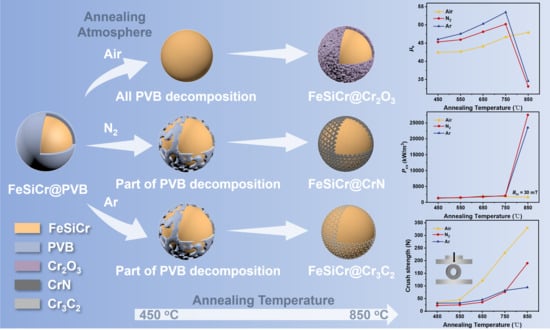
Annealing is a critical step in the fabrication of soft magnetic composites (SMCs), and precise coordination of annealing atmosphere and temperature is essential for optimizing their performance. In this study, FeSiCr SMCs were annealed under three different atmospheres (air, nitrogen, and argon) across a range of temperatures, and the effects of the annealing atmosphere on their microstructure and soft magnetic properties were systematically investigated. The results demonstrate that annealing in an inert atmosphere, particularly argon, within the temperature range of 450–750 °C, yields superior magnetic properties compared with air annealing. After annealing under argon at 550 °C, the effective magnetic permeability (μe) reached 47.5, and the power loss (Pcv) was 1457.3 kW/m3 at 1000 kHz and 30 mT. These improvements are primarily attributed to effective stress relaxation and the substantial retention of the polyvinyl butyral (PVB) insulating layer. With further increases in annealing temperature, the magnetic properties deteriorate rapidly due to the complete decomposition of PVB and the formation of conductive chromium carbides. Under such conditions, air annealing exhibits distinct advantages. Selective oxidation of FeSiCr occurs, leading to the formation of a dense chromium oxide insulating layer that enhances magnetic performance (after annealing at 850 °C, μe = 47.9, Pcv = 1632.0 kW/m3). Moreover, the mechanical properties were significantly improved, with the radial crush strength increasing from 22.36 N in the unannealed state to 330 N after annealing. These results indicate that the comprehensive performance of SMCs can be effectively tailored through the appropriate selection of annealing atmosphere and temperature, providing valuable guidance for the design and optimization of high-performance SMCs.

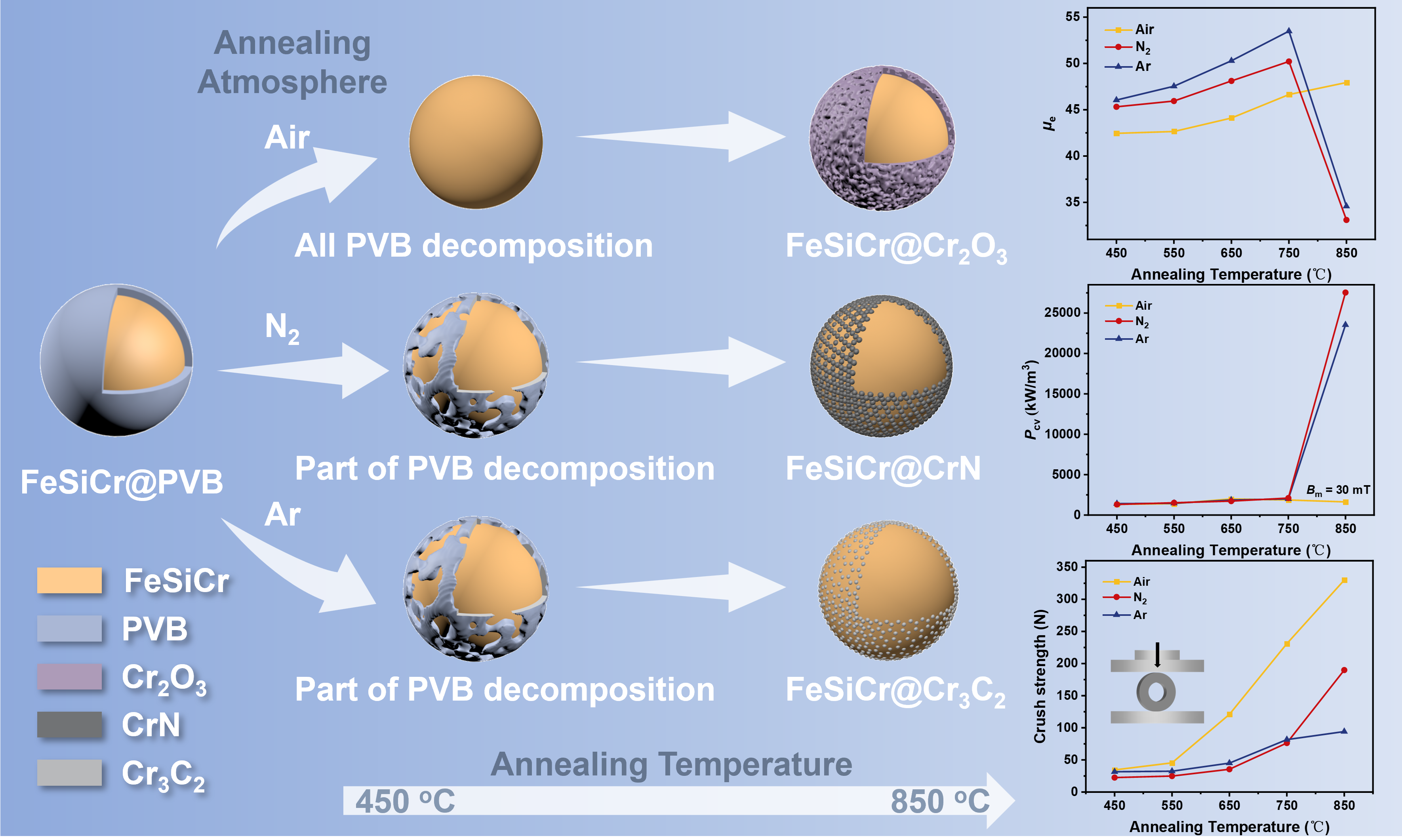
Graphical Abstract

1. Introduction

With the rapid development of 5G communication, new energy vehicles, and power electronic devices towards high frequency and integration, soft magnetic materials, which serve as key functional materials for energy conversion and signal processing, are facing unprecedented performance challenges [1,2,3]. Traditional silicon steel sheets are limited by the sharp increase in high-frequency eddy current loss (Pec) [4,5,6], ferrite materials are constrained by their low saturation magnetic induction [7], and amorphous/nanocrystalline alloys have processing brittleness issues [8,9,10]. Consequently, these materials exhibit insufficient adaptability for emerging applications, such as third-generation semiconductor devices and MHz-range high-frequency inductors. Against this background, soft magnetic composites (SMCs), which exhibit three-dimensional magnetic flux conduction and tunable high-frequency loss characteristics [11,12,13], have become a major research focus in the development of advanced soft magnetic materials.
The fabrication of SMCs generally involves three main steps: insulation coating, pressure compaction, and annealing [14]. Among these, density is a critical parameter influencing magnetic permeability. Increasing the density enhances the volume fraction of the magnetic phase per unit volume, thereby promoting higher magnetic permeability. However, during processing, excessive compaction pressure applied to increase density inevitably introduces substantial internal stresses. These stresses induce domain-wall pinning, impede their motion, and increase resistance to domain rotation, which significantly degrades the soft magnetic properties of the material, resulting in reduced magnetic permeability and increased hysteresis loss (Physt) [15]. The subsequent annealing process relieves the internal stresses introduced during compaction through recovery and recrystallization mechanisms, thereby restoring and optimizing the magnetic properties of the material [16]. Existing studies have predominantly focused on regulating annealing temperature. For instance, Song et al. [17] used polytetrafluoroethylene (PTFE) as the insulation coating layer for Fe, and the thermal stability of PTFE itself severely limited the regulation of annealing temperature. When the temperature exceeded 150 °C, the insulation layer deteriorated due to PTFE decomposition. Similarly, Li et al. [18] passivated FeSiAl/carbonyl iron powder mixtures using phosphoric acid and demonstrated that annealing at 640 °C significantly improved magnetic properties, whereas further increases in annealing temperature still led to degradation of the insulating layer. These results indicate that although higher annealing temperatures are beneficial for relieving internal stress and enhancing magnetic permeability, the incorporation of organic or inorganic insulating layers in SMCs fundamentally restricts the allowable annealing temperature. In an inert atmosphere, the decomposition temperature of the insulating layer is higher compared to that in an air atmosphere [19,20,21,22]. These findings indicate that both annealing atmosphere and temperature jointly influence the stability of the insulating layer. Recent trends in FeSiCr insulation coating research, such as the exploration of various metal oxides [23], the utilization of salt compound thermal decomposition to form composite layers [24], and the design of double-layer insulating structures [25], further highlight the importance of coating integrity and thermal stability during annealing.
Idczak et al. [26] found that at high temperatures, atomic diffusion occurs within FeSiCr particles, with chromium atoms preferentially diffusing toward the particle surface to form an ultrathin chromium-rich phase. When annealed in an air atmosphere, these chromium atoms, which have migrated to the surface at high temperatures, readily react with oxygen to form an in situ Cr2O3 insulating layer. In contrast, under high-temperature inert atmospheres, the chromium-rich surface phases of FeSiCr may participate in alternative reactions, leading to the formation of new phases. Consequently, the annealing atmosphere and temperature jointly govern the reaction pathways and final phase constitution of FeSiCr during annealing. Currently, there is still a lack of systematic research and a clear explanation of the evolution mechanism of the microstructure and its relationship with the soft magnetic properties in the preparation process of soft magnetic composite materials under different annealing atmospheres and temperatures.
In this study, FeSiCr SMCs were annealed at various temperatures under three different atmospheres: air, nitrogen, and argon. The influence of annealing atmosphere and temperature on the microstructure and soft magnetic properties of FeSiCr SMCs was systematically investigated, and corresponding models were developed to elucidate the underlying correlations. This study provides both theoretical insights and practical guidance for the further exploration of the comprehensive soft magnetic properties of FeSiCr.

2. Materials and Methods

The water-atomized spherical FeSiCr soft magnetic powder (D50 = 10 μm) was provided by Qinhuangdao YaHao New Materials Technology Co., Ltd. (Qinhuangdao, China). Polyvinyl butyral (PVB, with 70–75% dihydroxy groups) as the binder and n-propyl acetate (≥99%, AR grade) as the solvent were both purchased from Shanghai Aladdin Biochemical Technology Co., Ltd. (Shanghai, China).
First, an appropriate amount of PVB particles was dissolved in n-propyl acetate to prepare a 20 wt% PVB-propyl acetate solution. Then, 20 g of FeSiCr powder was mixed with 1.5 g of the PVB-propyl acetate solution and mixed thoroughly using a glass rod. The mixture was dried at room temperature. The 1.5 g of the dried powder was compacted under a pressure of 1000 MPa at 80 °C for 3 min to form a toroidal sample with an outer diameter of 12.67 mm, an inner diameter of 7.56 mm and a height of approximately 3 mm. Finally, all the toroidal samples were annealed for 1 h under different atmospheres and at different temperatures. The heating and cooling rates were both 1 °C/min, and the gas flow rate was 300 mL/min. The atmospheres included air, argon (≥99.99%), and nitrogen (≥99.99%), and the temperatures were 450 °C, 550 °C, 650 °C, 750 °C, and 850 °C. An additional group was treated in air at 950 °C. For each experimental condition, four parallel samples were prepared and tested, and the average values were used for data analysis and plotting.
The phase composition and crystal structure of the materials were analyzed by X-ray diffraction (XRD, Cu Kα, PANalytical XPert Pro, Almelo, The Netherlands). The morphology of the sample surface and internal cross-section was observed by field emission scanning electron microscopy (FE-SEM, HITACHI Regulus 8100, Tokyo, Japan), and the elemental distribution was analyzed by the energy dispersive X-ray spectrometer (EDS, Oxford Ultim Max 65, Oxford, UK) equipped with it. The sample composition was analyzed by X-ray photoelectron spectroscopy (XPS, Al Kα, Thermo Scientific K-Alpha, Waltham, MA, USA). For transmission electron microscopy (TEM, 300 kV, FEI Tecnai G2 F30 S-Twin, Hillsboro, OR, USA) observation, the composite samples were prepared by resin embedding and ultrathin sectioning. The microstructure and elemental distribution of the surface coating of the annealed samples were further characterized by TEM. The resistance of the samples was measured by a digital multimeter (CHNT, Wenzhou, China), and the resistivity was calculated (Note S1). The ring-shaped sample was wound with 24 turns. Under the conditions of 25 °C, 100–1000 kHz and 500 mV, the inductance value was measured using an LCR tester (Agilent E4991, Santa Clara, CA, USA), and based on this measurement, the effective permeability was calculated. The magnetic loss of the toroidal samples at different frequencies and magnetic induction intensities was measured by a B-H AC magnetic property analyzer (SY-8218, IWATSU, Tokyo, Japan) at 25 °C room temperature. The thermal gravimetric analysis of the FeSiCr powder coated with PVB was carried out by a thermalgravimetric analyzer (TGA, TA Q5000IR, New Castle, DE, USA) in nitrogen and air atmospheres, respectively, with a heating rate of 10 °C/min from room temperature to 900 °C. The radial crush strength of the toroidal samples was measured by a high and low temperature double column testing machine (Instron 5966, Norwood, MA, USA). Vibrating Sample Magnetometer (VSM, LAKE SHORE 7407, Columbus, OH, USA) with an external magnetic field in the range from 20,000 Oe to 20,000 Oe measured the hysteresis loop and related magnetic properties.

3. Results and Discussion

3.1. Microstructural Characteristics

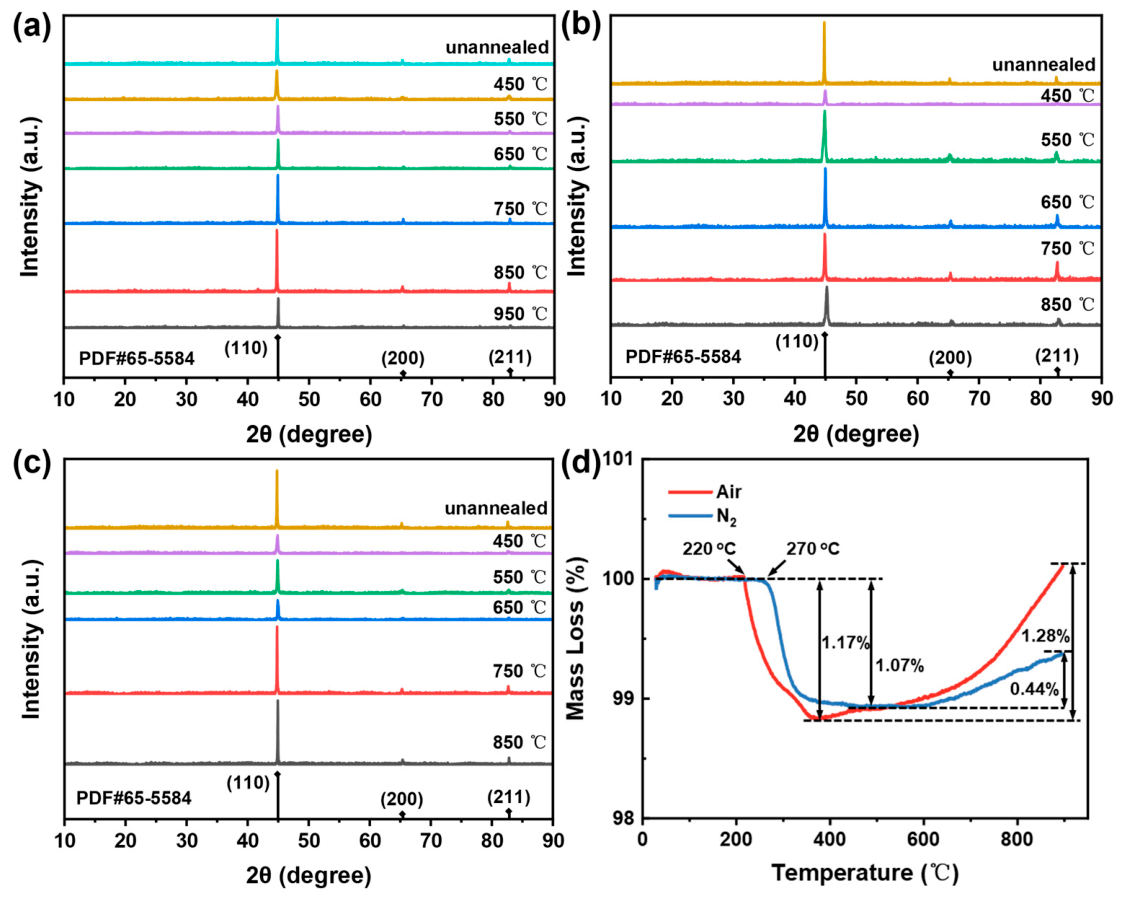
Figure 1a–c presents the XRD patterns of FeSiCr SMCs in the unannealed state and after annealing at various temperatures under different atmospheres (air, nitrogen, and argon). The results indicate that no discernible phase transformations occurred in samples annealed under any of the investigated atmospheres when compared with the unannealed sample. The three diffraction peaks located at 44.9°, 65.3°, and 82.8° in the patterns correspond to the (110), (200), and (211) crystal planes of the body-centered cubic (bcc) α-Fe (Si, Cr) solid solution, respectively, which are consistent with the standard diffraction card data. Additionally, no characteristic diffraction signals of other phases, such as chromium oxide, were found within the XRD detection range, which might be due to the low formation amount of such phases. Meanwhile, the lattice constant of samples annealed under three different atmospheres was calculated. As shown in Figure S1, the lattice constant decreases with increasing annealing temperature for all atmospheres. Thermogravimetric analysis was performed on FeSiCr@PVB powders under both air and nitrogen atmospheres, and the results are presented in Figure 1d. The initial decomposition temperature of PVB in air is approximately 220 °C, while it increases to about 270 °C in a nitrogen atmosphere, indicating that PVB decomposes more readily in air. It should be noted that the samples used for thermogravimetric analysis in this study were in powder form, while the actual annealed specimens were toroidal magnetic cores with more complex internal structures. Consequently, mass and heat transfer conditions in the bulk samples differ from those in powder samples, and the decomposition temperature of PVB during the actual annealing process may be further elevated. Moreover, the thermogravimetric curves obtained in both air and nitrogen reveal a gradual increase in sample mass at high temperatures, with a more pronounced increase observed in air and a weaker effect in nitrogen. This behavior is likely associated with the formation of new phases resulting from reactions between FeSiCr particles and the surrounding atmosphere at elevated temperatures.
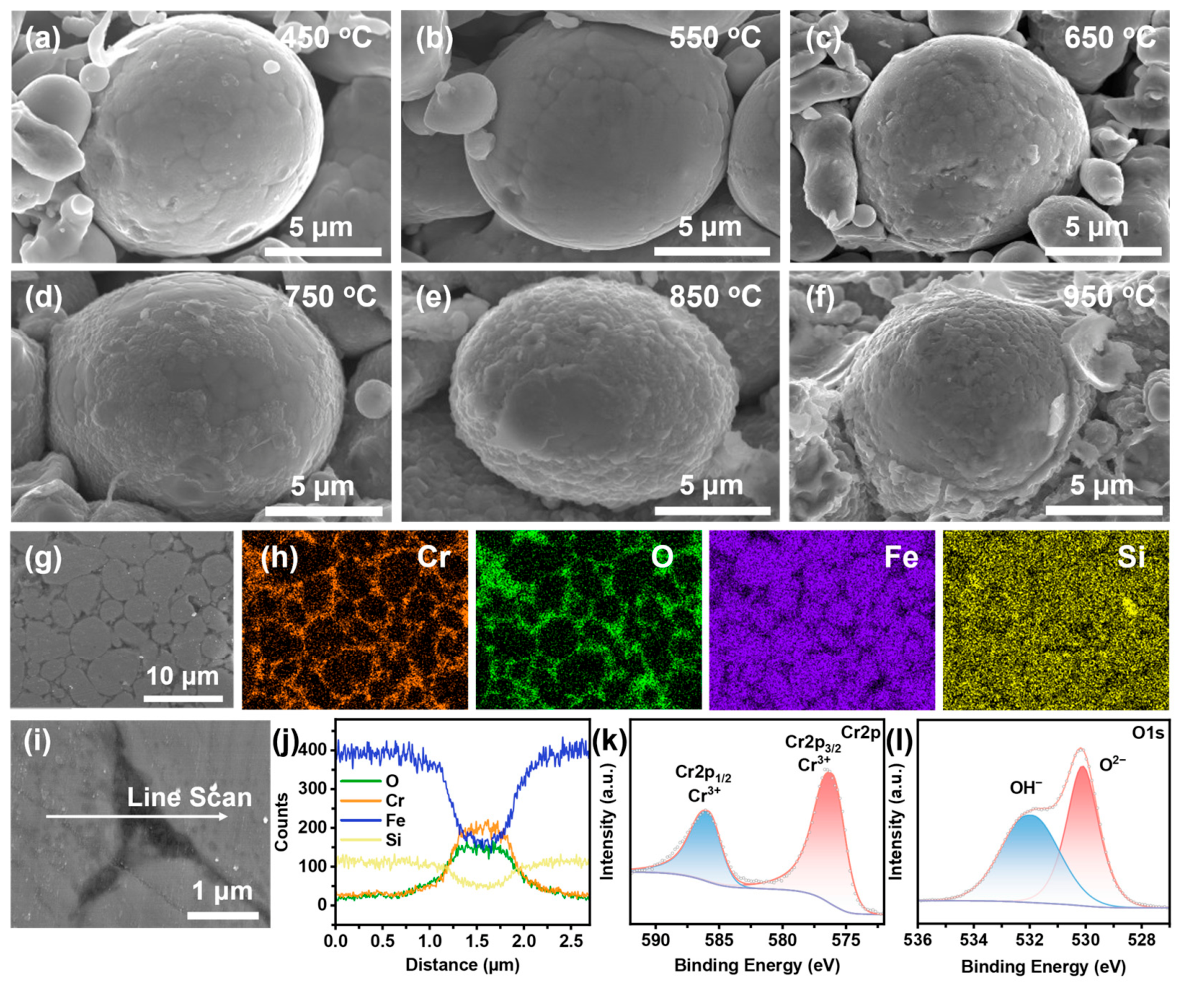
Figure 2a–f illustrates the evolution of the surface morphology of FeSiCr particles annealed in air as the temperature increases from 450 °C to 950 °C. As the temperature rises, the PVB on the particle surface gradually decomposes. At temperatures above 650 °C, numerous fine particles emerge on the FeSiCr surface. These particles progressively increase in number and coarsen with further temperature elevation, eventually forming a continuous coating layer covering the particle surface. When the temperature reaches 850 °C, the coating layer significantly thickens, and the surface roughness increases significantly. At 950 °C, excessive growth of the coating layer occurs, resulting in an overly thick layer. Local delamination of the coating layer is observed in Figure 2f, which can be attributed to the deterioration of mechanical integrity and reduced adhesion between the excessively thick insulating layer and the FeSiCr substrate. To investigate the chemical composition of the surface coating layer, EDS analysis was conducted on the cross-section of the sample annealed at 850 °C. As shown in Figure 2g,h, Cr and O are significantly enriched at the particle surface, forming a continuous insulating layer, while Fe and Si are uniformly distributed within the particle interior. Further elemental line-scan analyses across the cross-section (Figure 2i,j) reveal a strong spatial overlap between Cr and O signals in the surface region, confirming the formation of chromium oxide. To further identify the chemical states of the elements in the insulating layer, XPS was conducted on samples annealed in air at 850 °C. The spectra were fitted using standard binding energy references for Cr2p and O1s. As shown in Figure 2k, the Cr2p spectrum indicates that chromium is predominantly present in the Cr3+ oxidation state [27], while the O1s spectrum in Figure 2l can be deconvoluted into two components corresponding to O2− and OH species. Collectively, these results confirm that during annealing, chromium atoms diffuse from the particle interior to the surface and undergo in situ oxidation with oxygen, ultimately forming an insulating layer primarily composed of Cr2O3.
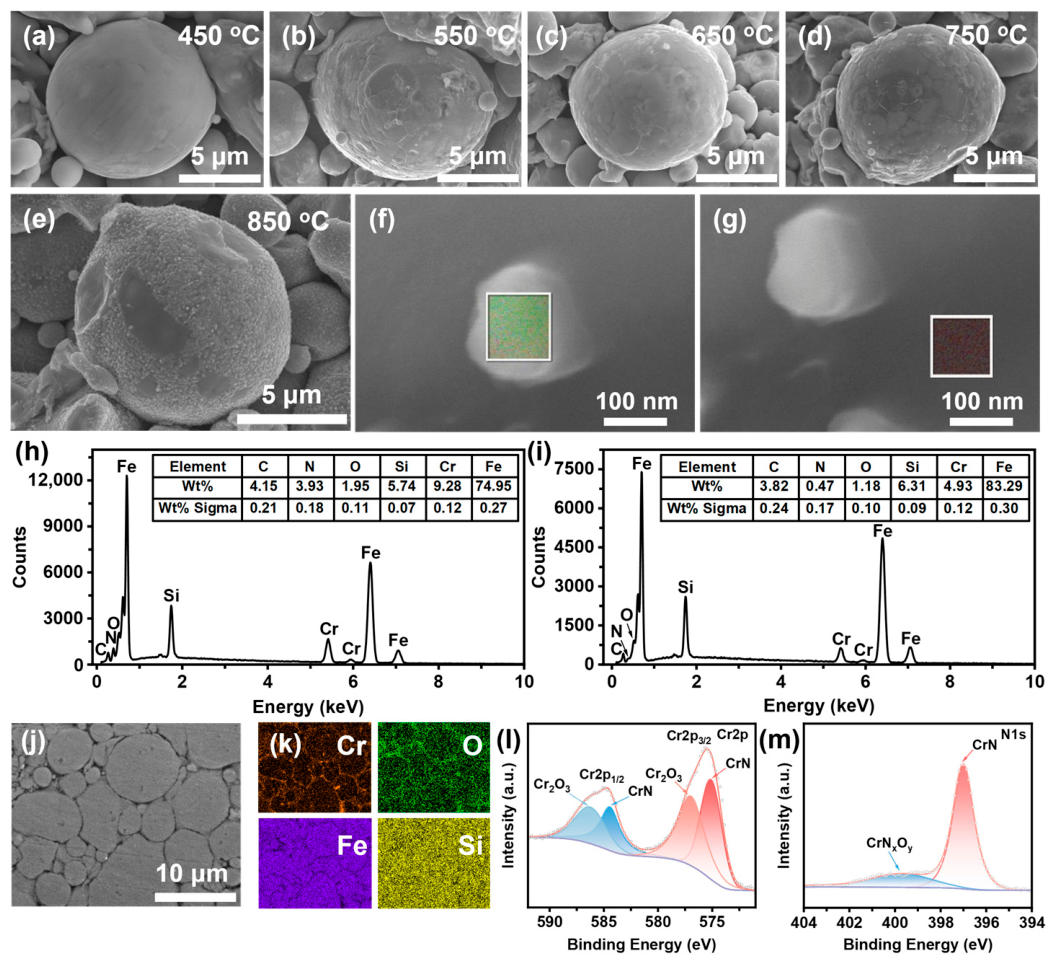
Figure 3 presents the SEM and EDS images of FeSiCr particles after annealing at different temperatures in a nitrogen atmosphere. As shown in Figure 3a–e, the PVB layer gradually decomposes with increasing annealing temperature. When the temperature reaches 750 °C, a small number of fine particles begin to appear on the FeSiCr particle surface. Upon further increasing the temperature to 850 °C, a large number of uniformly distributed surface particles are observed, accompanied by a noticeable increase in their size. To clarify the chemical composition of these surface particles, EDS elemental comparison analyses were conducted on selected surface regions (Figure 3f,g). As shown in Figure 3h,i, the surface particle regions exhibit significantly higher Cr and N contents than the exposed substrate areas, preliminarily indicating the formation of chromium nitride. This observation suggests that during annealing in a nitrogen atmosphere, Cr in FeSiCr reacts with nitrogen at elevated temperatures to form chromium nitride. Further EDS characterization of cross-sectional FeSiCr SMCs annealed at 850 °C in nitrogen is shown in Figure 3j,k. Trace amounts of chromium oxide were detected in the interparticle regions. By comparison with the EDS spectra of the original powder cross-section (Figure S2) and the oxygen content data (Table S1), it can be concluded that this oxide does not originate from the native oxide layer on the FeSiCr particles. Instead, it is attributed to oxygen-containing species released from PVB decomposition and the reaction between residual oxygen in nitrogen and Cr at high temperatures. XPS was further employed to analyze the surface chemical states of the sample annealed at 850 °C. As shown in Figure 3l, the Cr2p3/2 peaks at binding energies of 575.1 eV and 576.9 eV are assigned to CrN and Cr2O3 [27], respectively. The N1s spectrum in Figure 3m can be deconvoluted into two components, with peaks at 396.4 eV corresponding to CrN and at 399.1 eV corresponding to CrNxOy [28]. These valence state analyses confirm the coexistence of CrN and Cr2O3 on the surface of FeSiCr particles annealed at 850 °C in a nitrogen atmosphere.
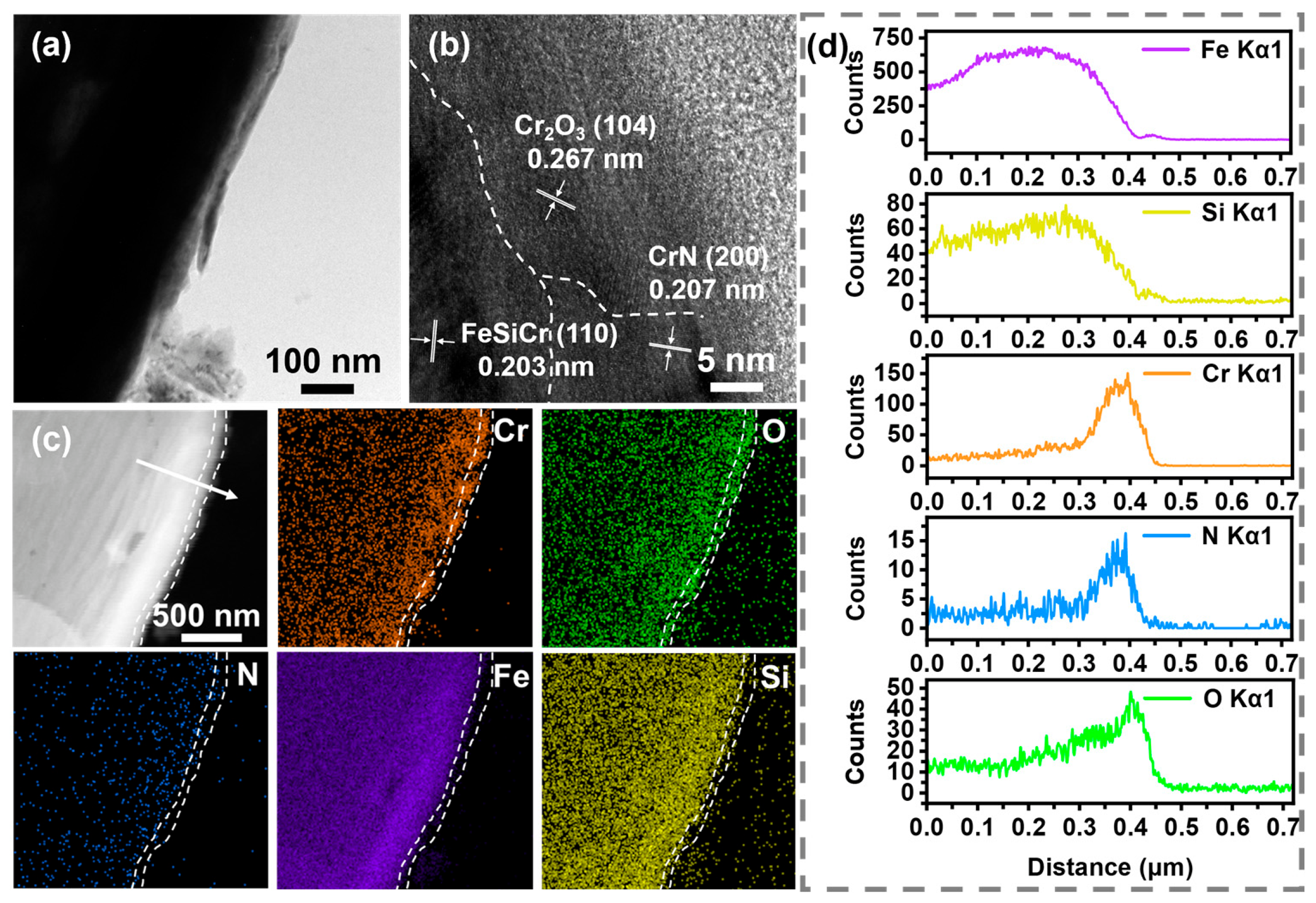
To further confirm the formation of CrN and Cr2O3 on the surface of FeSiCr powder after annealing at 850 °C in nitrogen, TEM analysis was conducted on the FeSiCr powder annealed at 850 °C in nitrogen, as shown in Figure 4. By combining the HAADF image in Figure 4c with the corresponding elemental line-scan profiles in Figure 4d, a pronounced enrichment of Cr, O, and N is observed within an approximately 100 nm thick surface region, accompanied by a corresponding depletion of Fe and Si. The HRTEM image in Figure 4b reveals distinct lattice fringes with interplanar spacings of 0.203 nm, 0.207 nm, and 0.267 nm. These spacings can be indexed to the (110) plane of FeSiCr [29], the (200) plane of CrN [30], and the (104) plane of Cr2O3 [31], respectively. These results provide direct microstructural evidence for the coexistence of CrN and Cr2O3 on the surface of FeSiCr particles after annealing at 850 °C in nitrogen.
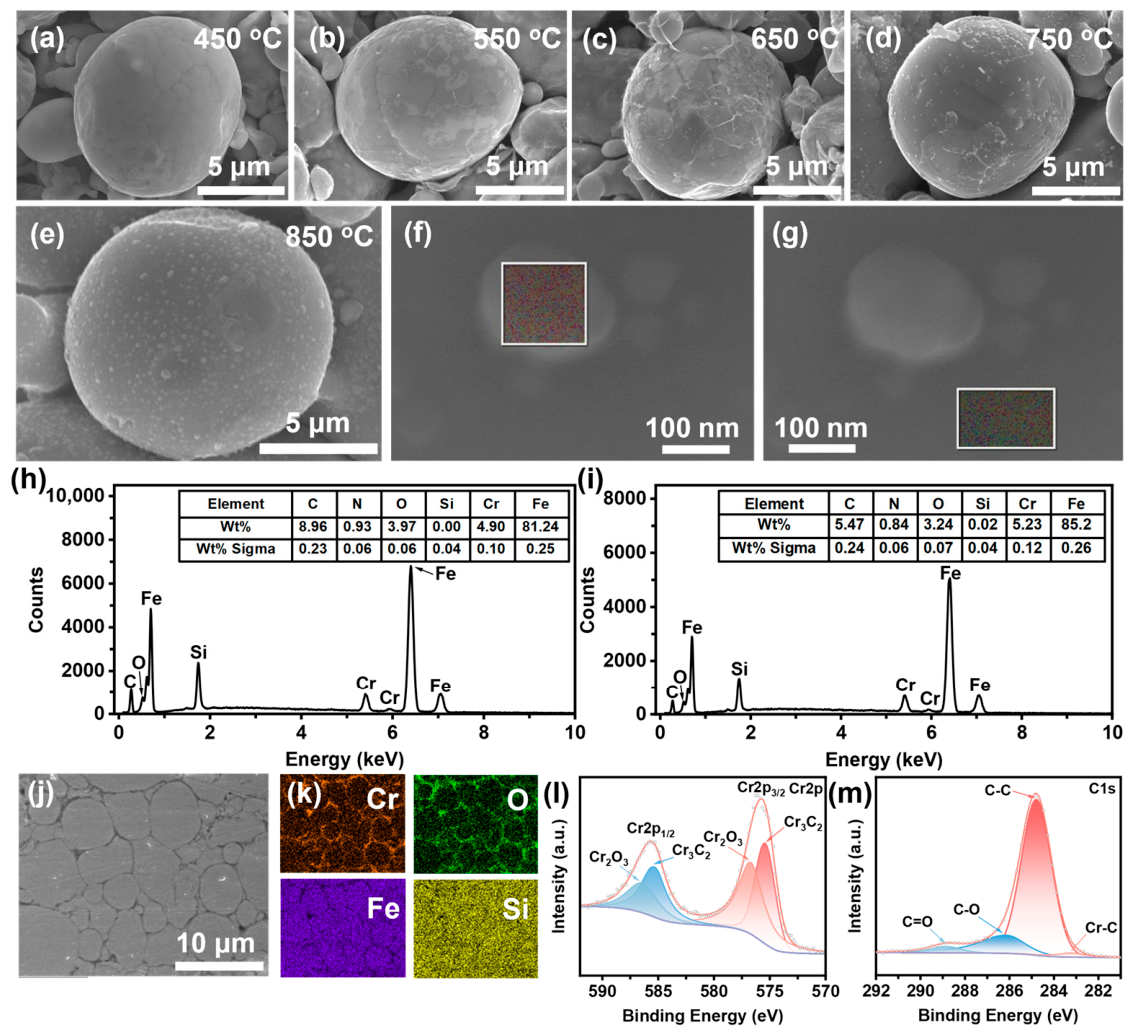
Figure 5 shows the SEM and EDS images of FeSiCr particles after annealing at different temperatures in an argon atmosphere. As shown in Figure 5a–e, the surface morphology evolution of samples annealed in argon is generally similar to that observed in nitrogen, characterized by the progressive formation and growth of surface particles with increasing temperature. Under annealing at 850 °C, the surface particles formed in argon are noticeably smaller and less uniformly distributed than those formed in nitrogen. To investigate the chemical nature of the surface products formed in argon (Figure 5f,g), EDS elemental comparison analyses were performed. As indicated by the EDS results in Figure 5h,i, the carbon content in the surface particle regions is significantly higher than that in the exposed FeSiCr substrate regions. This observation suggests that these surface particles are either carbonaceous residues remaining after the thermal decomposition of PVB or chromium carbides formed through reactions between Cr and carbon. Further EDS analysis of cross-sectional samples (Figure 5j,k) reveals trace amounts of chromium oxide in the interparticle regions. By comparison with the cross-sectional EDS spectra (Figure S2) and oxygen content data (Table S1) of the original powder, it can be inferred that the formation mechanism of chromium oxide in argon is similar to that in nitrogen. In both cases, chromium oxide originates from reactions between Cr and oxygen-containing species generated during PVB decomposition, as well as residual oxygen present in the protective gas at elevated temperatures. To identify the chemical states of the surface products, XPS was performed on samples annealed at 850 °C in argon, as shown in Figure 5l,m). The Cr2p3/2 spectrum can be deconvoluted into two components corresponding to Cr3C2 (575.4 eV) and Cr2O3 (576.7 eV) [27,32]. The C1s spectrum consists of four peaks assigned to Cr-C (283.2 eV), C-C (284.8 eV), C-O (286.1 eV), and C=O (288.8 eV) [33]. These valence state analyses confirm the formation of Cr3C2 and Cr2O3 on the surface of FeSiCr particles annealed at 850 °C in an argon atmosphere.

3.2. Magnetic Properties

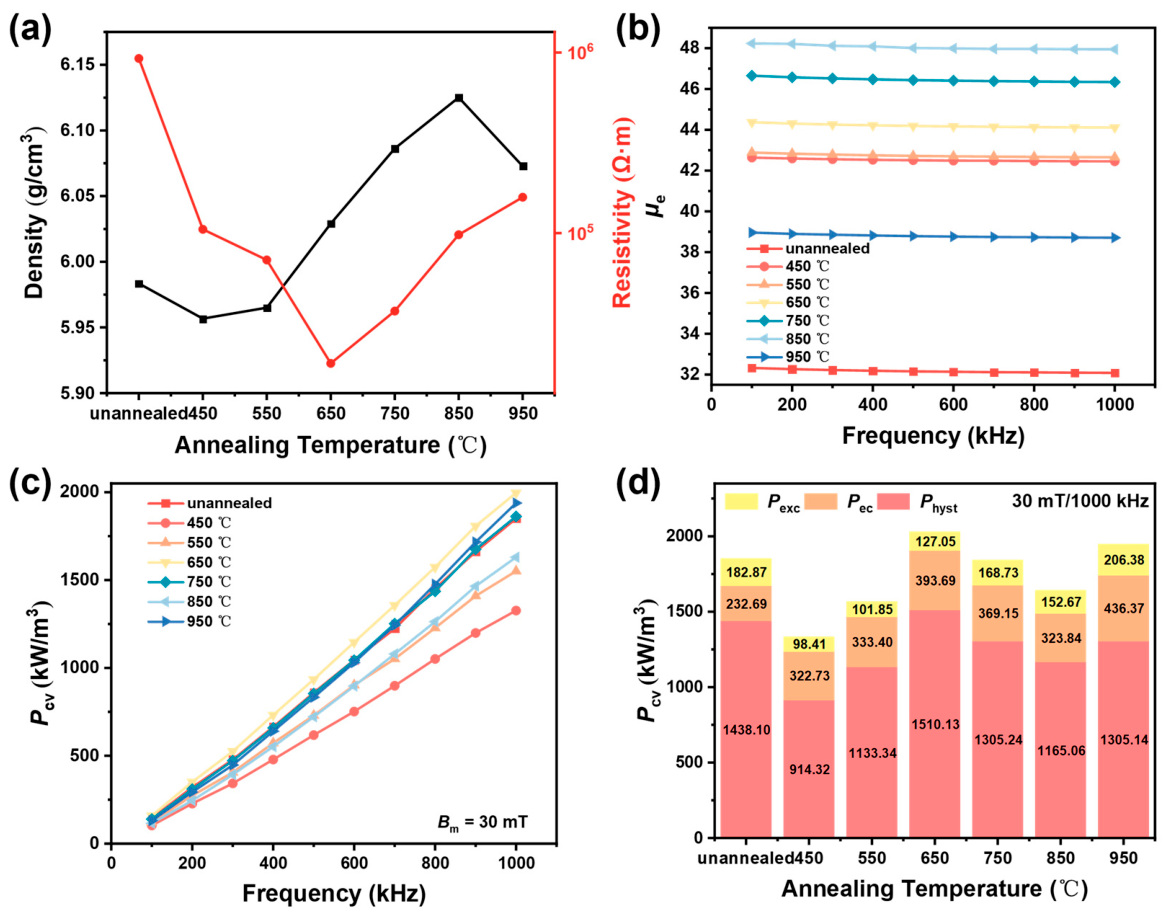
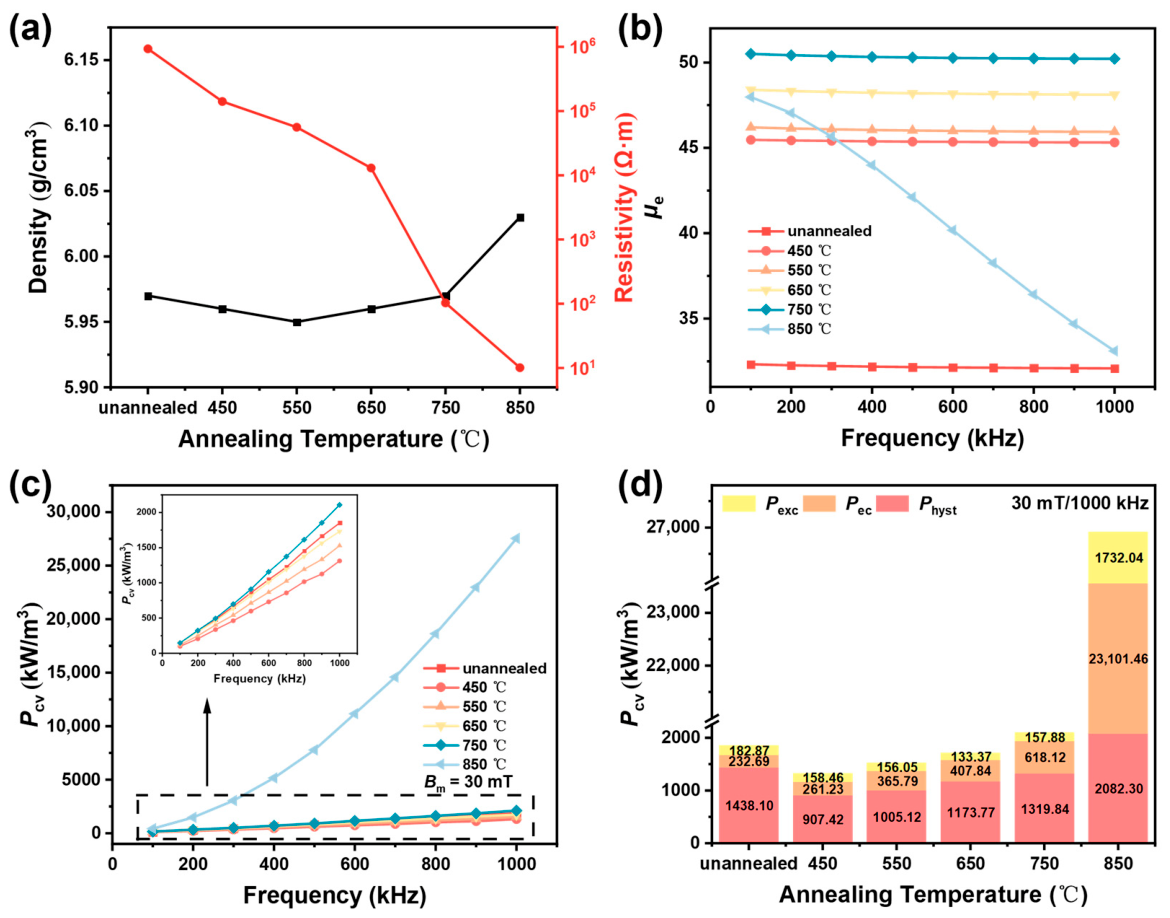
Figure 6a presents the density and resistivity variations in FeSiCr SMCs after annealing at different temperatures in an air atmosphere. With increasing annealing temperature, the density initially exhibits a slight increase, followed by a subsequent decrease. Compared with the unannealed sample, annealing at 450 °C results in a density reduction, which can be attributed to partial thermal decomposition of the PVB. As the annealing temperature increases further, the combined effects of progressive Cr2O3 formation and densification driven by internal stress relaxation lead to a gradual increase in density, reaching a maximum at 850 °C. When the annealing temperature exceeds this value, excessive growth of Cr2O3 deteriorates the structural integrity of the composite, inducing microcrack formation and increased porosity, which ultimately causes a decline in density. Figure 6b shows the μe of FeSiCr SMCs annealed at different temperatures in air. All samples exhibit good frequency stability within the range of 100–1000 kHz. As shown in Figure S3 [34,35,36,37,38,39,40], the lattice strain, calculated using the Williamson-Hall method [41,42] based on the XRD data, gradually decreases with increasing annealing temperature, indicating the progressive release of internal stress. Although a small amount of Cr2O3 begins to form at 650 °C, slightly consuming the magnetic phase, the overall effect is a continuous increase in μe, which reaches a maximum value of 47.9 at 850 °C. However, when the annealing temperature further increases to 950 °C, severe surface oxidation occurs, generating a large amount of Cr2O3. This substantially reduces the effective magnetic phase content, leading to a pronounced decrease in μe to 38.7.
Figure 6c shows the Pcv of FeSiCr SMCs annealed at different temperatures in an air atmosphere at 30 mT and 100–1000 kHz. As shown in the figure, the Pcv of the samples exhibits a non-monotonic variation trend with the increase in annealing temperature, specifically, it first increases, then decreases, and finally rises again. At an annealing temperature of 450 °C, the Pcv reaches its minimum value of 1326.7 kW/m3. When the annealing temperature rises to 650 °C, the Pcv significantly increases to 1996.9 kW/m3, corresponding to a maximum. With a further increase in temperature to 850 °C, Pcv decreases to 1632.0 kW/m3, forming a secondary minimum. To further elucidate the relationship between annealing temperature, Cr2O3 formation induced by high-temperature annealing, and Pcv, a loss separation analysis was performed. According to classical loss separation theory, Pcv can be decomposed into Physt, Pec, and Pexc, as expressed by the following equation:
P c v = P h y s t + P e c + P e x c = C h y s t B m α f + C e c i n t e r + C e c i n t r a B m 2 f 2 + C e x c B m x f y
where C h y s t represents the hysteresis coefficient, B m is the maximum magnetic induction intensity, α is the Steinmetz coefficient, and f is the frequency. C e c i n t e r is the inter-particle eddy current coefficient, and C e c i n t r a is the intra-particle eddy current coefficient. C e x c corresponds to the Pexc coefficient, and x and y are the coefficients of the maximum magnetic induction intensity and frequency of the Pexc, respectively.
In Figure 6d, the loss separation of samples annealed at different temperatures is presented. Under each temperature condition, Physt accounts for a relatively high proportion of Pcv. It is worth noting that the Physt increases within the temperature range of 450–650 °C. This phenomenon can be attributed to the gradual decomposition of PVB, with its residual products accumulating on the particle surface along with the newly formed Cr2O3, thereby forming a non-magnetic phase. These phases act as additional domain wall pinning sites. As shown in Figures S4 and S5a, the increased density of pinning sites enhances the coercivity (Hc), thereby leading to higher Physt. In this temperature range, the detrimental effect of enhanced domain wall pinning outweighs the beneficial effect of stress relaxation on Hc [43]. Meanwhile, the continuous increase in Pec over the same temperature interval is governed by two distinct mechanisms that dominate in different subranges. Within the temperature range of 450–550 °C, PVB gradually undergoes complete decomposition, accompanied by the initial formation of a small amount of Cr2O3. In this stage, the decomposition of PVB serves as the predominant factor, leading to a continuous decrease in electrical resistivity and a consequent increase in Pec. As the temperature further rises to 650 °C, although limited formation of Cr2O3 persists, localized sintering between particles becomes pronounced. This sintering effect strengthens the inter-particle conductive pathways, which further reduces resistivity and markedly intensifies the Pec. In the second stage, in the high-temperature range of 650–950 °C, the surface of FeSiCr particles begins to oxidize, leading to the formation of Cr2O3. As the amount and size of Cr2O3 increase, a continuous and relatively uniform insulating layer gradually develops on the particle surface, which effectively suppresses the Pec. However, when the annealing temperature is further increased (such as 950 °C), excessive thickening of the Cr2O3 layer may induce an inhomogeneous resistivity distribution, thereby increasing Pec. The evolution of the insulating layer can be indirectly verified by the resistivity variation. As shown in Figure 6a, the resistivity initially decreases due to PVB decomposition, and subsequently recovers during the Cr2O3 formation stage. This resistivity evolution exhibits a clear correlation with the fluctuation behavior of Pec, collectively demonstrating the critical role of the insulating layer state in determining the loss characteristics.
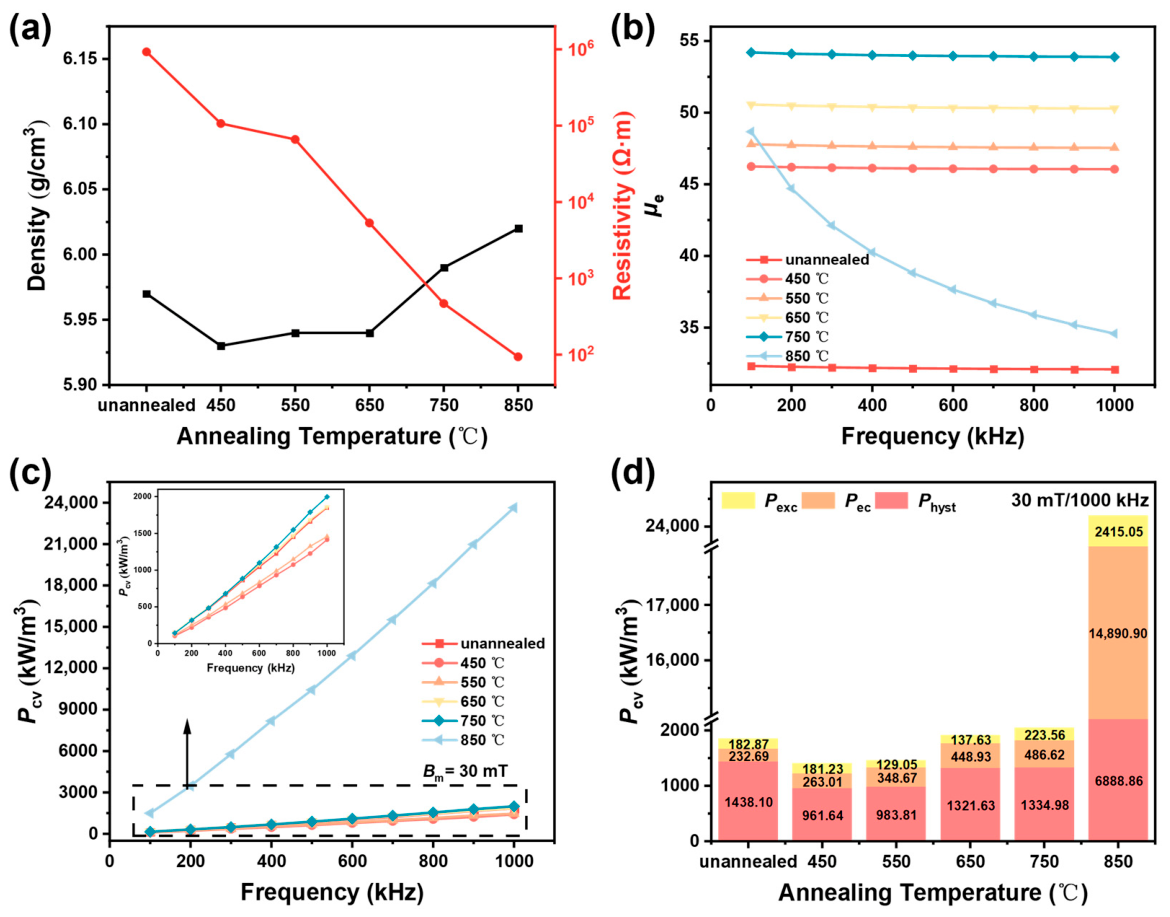
High-temperature annealing in an air atmosphere leads to surface oxidation of FeSiCr particles, resulting in the formation of Cr2O3. To eliminate the influence of this oxidation, annealing experiments at various temperatures were therefore carried out under an inert gas atmosphere. Nitrogen was first selected as the inert atmosphere for high-temperature annealing. Figure 7a shows the density and resistivity of FeSiCr SMCs annealed at different temperatures in nitrogen. As the annealing temperature increases, the density evolution can be divided into several distinct stages. In the initial stage, partial thermal decomposition of the PVB results in a slight decrease in density. With further temperature increase, the formation of CrN and Cr2O3, together with internal stress-induced densification, leads to a gradual increase in density. This trend persists up to 850 °C, at which point the substantial formation of CrN causes a pronounced increase in density. The electrical resistivity decreases rapidly with increasing annealing temperature. In the low-temperature range, this decrease is primarily attributed to the thermal decomposition of the PVB, while in the high-temperature range, the formation of electrically conductive CrN further contributes to the reduction in resistivity. Figure 7b shows the μe of FeSiCr SMCs annealed at different temperatures in nitrogen. As shown in Figure S6, the lattice strain decreases with increasing temperature, indicating that internal stress in the samples is progressively relieved. Consequently, μe gradually increases and reaches a maximum value of 50.2 at 750 °C. Meanwhile, samples annealed at temperatures between 450 and 750 °C exhibit good frequency stability over the range of 100–1000 kHz. However, when the annealing temperature was further increased to 850 °C, μe dropped to 33.1. Moreover, it decreased significantly with the increase in frequency, from 48.0 at 100 kHz to 33.1 at 1000 kHz, with a decrease of approximately 31.0%. This behavior can be attributed to the formation of CrN on the surface of FeSiCr particles at elevated temperatures without the development of a complete and continuous insulating coating. Such an incomplete coating state promotes local metallic bonding between adjacent particles, introducing additional magnetic domain pinning sites. These pinning sites significantly impede the reversible motion of domain walls, leading to a reduction in μₑ and a deterioration of frequency stability.
Figure 7c shows the Pcv of FeSiCr SMCs annealed at different temperatures in nitrogen at 30 mT from 100 to 1000 kHz. As shown in the figure, the Pcv of the samples gradually increases with the increase in annealing temperature. At 450 °C annealing conditions, the Pcv reaches the minimum value of 1312.4 kW/m3; as the temperature rises to 750 °C, the Pcv increases to 2108.1 kW/m3; and when the temperature further rises to 850 °C, the Pcv sharply increases to 27,577.5 kW/m3.
To further elucidate the loss mechanism, the Pcv is separated into losses in Figure 7d. Physt increases with increasing annealing temperature. The evolution of Physt can be interpreted in two stages. In the temperature range of 450–650 °C, PVB progressively decomposes as the annealing temperature increases. The resulting carbonaceous residues [44,45] adhere to the particle surfaces, forming non-magnetic phases. These phases act as additional domain wall pinning sites. The increased density of pinning sites enhances the Hc (Figure S5b), thereby contributing to a rise in Physt. At 750 °C, a small amount of CrN [46] begins to form, whereas at 850 °C, a substantial amount of discontinuous CrN precipitates. These secondary phases further hinder domain wall motion and rotation, resulting in an additional increase in Physt. Within this temperature interval, the detrimental effect of enhanced domain wall pinning on Hc outweighs the beneficial effect of stress relaxation, ultimately leading to an overall increase in Physt.
Meanwhile, the evolution of Pec is closely associated with changes in electrical resistivity and interparticle connectivity. Between 450 and 550 °C, the PVB decomposes, which degrades the inter-particle insulation and leads to an initial increase in Pec. As the temperature rises to 650 °C, local sintering occurs between the particles, which further strengthens the conductive pathways, thereby further reducing the resistivity and correspondingly increasing the Pec. At 750 °C, the particles remain locally sintered, and a small amount of conductive CrN begins to form on their surfaces. The presence of CrN promotes a more pronounced increase in Pec. This effect becomes significantly more pronounced at 850 °C, where abundant CrN forms. Due to its higher electrical conductivity compared to the FeSiCr matrix, CrN establishes low-resistance conductive networks along grain boundaries. This leads to a local concentration of eddy currents, ultimately causing a sharp surge in Pec.
Based on the observation that CrN forms in FeSiCr SMCs annealed at 850 °C in a nitrogen atmosphere, a comparative analysis was further carried out on samples annealed at different temperatures under an argon atmosphere. As shown in Figure 8a–c, the variation trends of density, electrical resistivity, μe, and Pcv for samples annealed in argon are generally consistent with those observed for samples annealed in nitrogen. At the initial stage, the density slightly decreases due to the thermal decomposition of PVB. With further increase in annealing temperature, the formation of Cr3C2 and Cr2O3, together with densification driven by internal stress relief, leads to a moderate increase in density up to 850 °C. At this temperature, the substantial formation of Cr3C2 results in a pronounced increase in density.
As the annealing temperature increases, lattice strain is progressively relieved (Figure S7). The μe reaches a maximum value of 53.5 at 750 °C. However, with a further increase in temperature, it decreases to 34.6 at 850 °C. In addition, μe decreases significantly with increasing frequency, from 48.7 at 100 kHz to 34.6 at 1000 kHz, with a decrease of approximately 29.0%. This phenomenon may be due to the complete carbonization of the PVB coating at high temperatures, resulting in direct contact between particles. In addition, residual carbon reacts with Cr to form Cr3C2. This phase acts as a strong domain-wall pinning site and disrupts grain boundary continuity, thereby severely hindering domain-wall motion and leading to a substantial reduction in μe. The Loss separation analysis of Pcv (Figure 8d) reveals the temperature-dependent evolution of Physt and Pec. Physt increases with annealing temperature. From 450 to 650 °C, PVB decomposition forms carbonaceous, non-magnetic surface phases that act as domain wall pinning sites, increasing Hc (Figure S5c) and thus Physt. At 750–850 °C, the precipitation of Cr3C2 [39] further impedes domain wall motion, leading to a continued rise in Physt. Overall, enhanced pinning outweighs stress relaxation. In contrast, Pec is governed by resistivity and interparticle connectivity. Between 450 and 550 °C, degradation of interparticle insulation increases Pec. At 650 °C, local sintering strengthens conductive pathways, further increasing Pec. At 750–850 °C, the formation of conductive Cr3C2 establishes low-resistance networks, promoting localized eddy currents and causing a sharp increase in Pec.
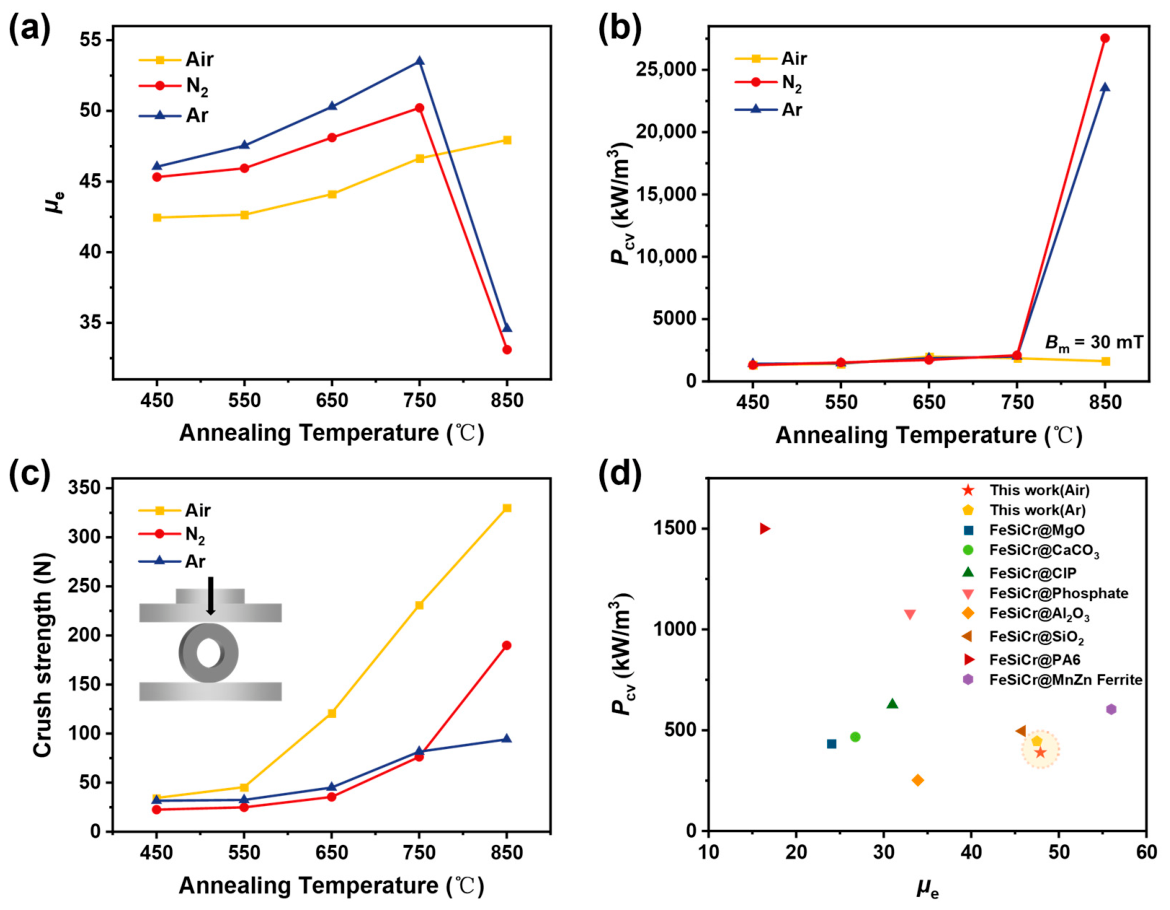
The comparative magnetic properties of samples annealed under different atmospheres are presented in Figure 9a,b. Within the annealing temperature range of 450–750 °C, the μe of samples annealed in an argon atmosphere was generally higher than that of samples annealed in nitrogen and air, reaching a maximum value of 53.5 at 750 °C. However, when the temperature increased to 850 °C, the permeability of air-annealed samples exceeded that of samples annealed in argon and nitrogen and exhibited superior frequency stability. From the perspective of loss behavior, within the temperature range of 450–650 °C, the Pcv of samples annealed in all three atmospheres increased with increasing annealing temperature, with the lowest value observed at 450 °C. Among them, samples annealed in nitrogen exhibited the lowest Pcv, at 1312.4 kW/m3. In contrast, when the annealing temperature increased to 850 °C, the Pcv of samples annealed in nitrogen and argon increased sharply, whereas that of the air-annealed sample decreased to 1632.0 kW/m3.
To further compare the mechanical performance of samples annealed at different temperatures under the three atmospheres, the radial crush strength of all samples was measured. The unannealed samples exhibited a radial crush strength of 22.36 N. As shown in Figure 9c, annealing led to varying degrees of improvement in radial crush strength. For samples annealed in all three atmospheres, the radial crush strength increased with increasing annealing temperature. Notably, samples annealed in air generally exhibited higher radial crush strength than those annealed in nitrogen and argon, reaching 330 N at 850 °C, which represents a substantial enhancement compared with the unannealed state.
By systematically matching the annealing atmosphere and temperature, it was determined that within the temperature range of 450–750 °C, samples annealed in an argon atmosphere exhibited superior soft magnetic properties. Among these conditions, annealing at 550 °C was identified as the optimal process, yielding a μe of 47.5 and a Pcv of 1457.3 kW/m3 at 1000 kHz and 30 mT. When the annealing temperature was increased to 850 °C, samples annealed in air demonstrated the best overall performance, with a μe of 47.9 and a Pcv of 1632.0 kW/m3 under the same testing conditions (1000 kHz, 30 mT). Simultaneously, their radial crush strength increased to 330 N, indicating a significant enhancement in mechanical robustness. For comparison with similar materials reported in the literature, the magnetic properties of two representative samples were further evaluated at 50 mT and 100 kHz, yielding Pcv values of 445.1 kW/m3 and 388.9 kW/m3, respectively. Figure 9d shows the comparison of the soft magnetic properties of the FeSiCr SMCs prepared in this study with those of the samples reported in the previous literature [15,40,41,42,43,44,45,46]. Compared with the research results in the previous literature, the FeSiCr SMCs in this study exhibited better magnetic properties.

3.3. Mechanism

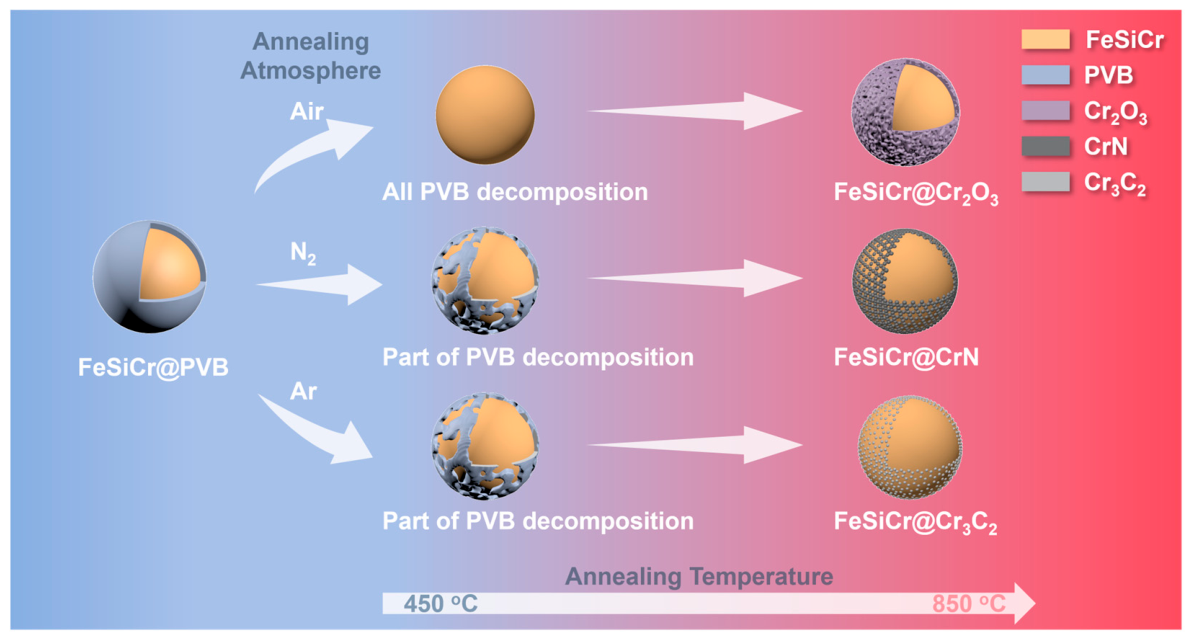
Based on the above experimental results, the matching relationship between annealing atmosphere and annealing temperature was systematically investigated. To clearly illustrate this correlation, a corresponding mechanistic model was established, as shown in Figure 10. Within the annealing temperature range of 450–650 °C, the decomposition temperature of PVB in air is lower than that in nitrogen and argon. Consequently, under identical temperature conditions, a higher amount of residual PVB is retained in nitrogen and argon atmospheres than in air. This residual PVB acts as an insulating coating, thereby suppressing Pec. Meanwhile, with increasing annealing temperature, samples annealed in nitrogen and argon primarily undergo internal stress relaxation and the healing of structural defects introduced during the molding process. In contrast, for samples annealed in air, surface oxidation of FeSiCr particles occurs in addition to stress relief and defect recovery, leading to the introduction of additional stress and defects. As a result, although the μe increases monotonically in all three atmospheres, samples annealed in nitrogen and argon exhibit significantly higher permeability than those annealed in air. Within this temperature range, annealing in argon at 550 °C was identified as the optimal matching condition. Under this condition, internal stresses were effectively relieved while a moderate PVB coating was preserved, thereby achieving a comprehensive optimization of the magnetic properties.
When the annealing temperature is further increased to 750–850 °C, the PVB coating on the surface of FeSiCr particles is completely decomposed. Under an air atmosphere, in situ oxidation occurs on the particle surface, leading to the formation of a dense Cr2O3 insulating layer, which effectively suppresses Pec and increases electrical resistivity. Simultaneously, internal stresses are fully released, and residual defects are further eliminated, resulting in a continued increase in μₑ and a reduction in Physt. In addition, the in situ-formed Cr2O3 layer is tightly bonded to the substrate, which contributes to an enhancement in the mechanical strength of the FeSiCr soft magnetic composite. In contrast, under nitrogen and argon atmospheres, the presence of chromium-rich phases on the FeSiCr particle surface promotes the formation of low-resistivity compounds, such as chromium nitride or chromium carbide. These phases generate localized conductive pathways, leading to eddy current concentration and a sharp increase in Pec. Meanwhile, these compounds act as strong magnetic domain-wall pinning sites, significantly hindering reversible domain-wall motion and thereby causing a decrease in effective permeability and a deterioration of frequency stability. Based on the high-temperature performance, air annealing at 850 °C is confirmed as the optimal process condition within this temperature range.

4. Conclusions

This study systematically investigated the synergistic effects of annealing atmosphere and temperature on the properties of FeSiCr SMCs. Through comprehensive characterization of the microstructure and composition of samples subjected to different annealing conditions, the mechanisms by which annealing temperature and atmosphere influence magnetic performance were elucidated. In the low-temperature range, annealing at 550 °C in an argon atmosphere was identified as the optimal condition. This treatment effectively relieved internal stresses while partially preserving the PVB coating, thereby increasing the μe to 47.5 and reducing the Pcv to 1457.3 kW/m3 at 1000 kHz and 30 mT, with a corresponding electrical resistivity of ρv = 6.6 × 10⁴ Ω·m. In the high-temperature range, annealing at 850 °C in an air atmosphere exhibited the most favorable performance. Under these conditions, Cr diffused from the particle interior to the surface and reacted with oxygen to form a uniform and dense Cr2O3 insulating layer, resulting in a FeSiCr@Cr2O3 composite structure with excellent soft magnetic properties. Specifically, a Pcv of 1632.0 kW/m3 (1000 kHz, 30 mT), a μe of 47.9, and a resistivity of ρv = 9.8 × 10⁴ Ω·m were achieved. Meanwhile, the radial crush strength increased markedly from 22.36 N for the unannealed sample to 330 N. Overall, this work clarifies the optimal atmosphere selection for FeSiCr SMCs across different annealing temperature ranges and reveals two distinct optimization mechanisms: internal stress relaxation at low temperatures and insulating layer construction at high temperatures. These findings provide both a theoretical foundation and practical process guidance for the fabrication of high-performance soft magnetic materials.

Supplementary Materials

The following supporting information can be downloaded at: https://www.mdpi.com/article/10.3390/magnetochemistry12050057/s1. Note S1. Experimental detail; Figure S1: (a) Lattice constant of FeSiCr SMCs annealed in air at temperatures from 450 to 950 °C. (b) Lattice constant of FeSiCr SMCs annealed in nitrogen at temperatures from 450 to 850 °C. (c) Lattice constant of FeSiCr SMCs annealed in argon at temperatures from 450 to 850 °C. Figure S2: SEM and EDS images of the cross-section of unannealed FeSiCr SMCs particles. Figure S3: (a–f) Williamson-Hall plots of FeSiCr SMCs annealed in air at temperatures from 450 to 950 °C. (g) Strain of FeSiCr SMCs as a function of annealing temperature. Figure S4: (a) Hysteresis loops of FeSiCr SMCs annealed in air at temperatures from 450 to 950 °C. (b) Hysteresis loops of FeSiCr SMCs annealed in nitrogen at temperatures from 450 to 850 °C. (c) Hysteresis loops of FeSiCr SMCs annealed in argon at temperatures from 450 to 850 °C. Figure S5: (a) Coercivity (Hc) of FeSiCr SMCs annealed in air at temperatures from 450 °C to 950 °C (b) Hc of FeSiCr SMCs annealed in nitrogen at temperatures from 450 to 850 °C. (c) Hc of FeSiCr SMCs annealed in argon at temperatures from 450 to 850 °C. Figure S6: (a–e) Williamson–Hall plots of FeSiCr SMCs annealed in nitrogen at temperatures from 450 to 850 °C. (f) Strain of FeSiCr SMCs as a function of annealing temperature. Figure S7: (a–e) Williamson–Hall plots of FeSiCr SMCs annealed in argon at temperatures from 450 to 850 °C. (f) Strain of FeSiCr SMCs as a function of annealing temperature. Table S1: Comparison of oxygen content in FeSiCr powder and FeSiCr SMCs annealed at 850 °C in different atmospheres. Table S2: The densities of FeSiCr SMCs under different annealing conditions. Table S3: The μe of FeSiCr SMCs under different annealing conditions. Table S4: The Pcv of FeSiCr SMCs annealed under different conditions at 30 mT and 1000 kHz.

Author Contributions

C.F.: Conceptualization, Data curation, Formal analysis, Writing—original draft. J.Z. (Jie Zhang): Data curation, Formal analysis, Writing—review & editing. J.Z. (Jianwei Zheng): Writing—review & editing. D.S.: Writing—review & editing. W.W.: Writing—review & editing. J.Z. (Jingwu Zheng): Writing—review & editing, Supervision, Funding acquisition, Conceptualization. L.Q.: Writing—review & editing. W.C.: Writing—review & editing. Y.Y.: Writing—review & editing. J.L.: Writing—review & editing. J.Y.: Writing—review & editing. A.I.: Writing—review & editing. S.C.: Funding acquisition, Writing—review & editing. All authors have read and agreed to the published version of the manuscript.

Funding

This work was financially sponsored by the Key R&D Project of Zhejiang Provincial Department of Science and Technology (2024C01146), and Advanced Materials-National Science and Technology Major Project (2024ZD0606800), and Intergovernmental International Science, Technology and Innovation Cooperation Key Project of the National Key R&D Programme (No. 2022YFE0109800).

Data Availability Statement

The original contributions presented in this study are included in the article. Further inquiries can be directed to the corresponding author.

Conflicts of Interest

The authors declare that they have no known competing financial interests or personal relationships that could influence the work reported in this article.

References

  1. Gutfleisch, O.; Willard, M.A.; Brück, E.; Chen, C.H.; Sankar, S.G.; Liu, J.P. Magnetic Materials and Devices for the 21st Century: Stronger, Lighter, and More Energy Efficient. Adv. Mater. 2011, 23, 821–842. [Google Scholar] [CrossRef] [PubMed]
  2. Silveyra, J.M.; Ferrara, E.; Huber, D.L.; Monson, T.C. Soft magnetic materials for a sustainable and electrified world. Science 2018, 362, eaao0195. [Google Scholar] [CrossRef]
  3. Talaat, A.; Suraj, M.V.; Byerly, K.; Wang, A.; Wang, Y.; Lee, J.K.; Ohodnicki, P.R. Review on soft magnetic metal and inorganic oxide nanocomposites for power applications. J. Alloys Compd. 2021, 870, 159500. [Google Scholar] [CrossRef]
  4. Wang, S.P.; Wang, Y.H.; Liu, C.C.; Lei, G.; Guo, Y.G.; Zhu, J.G. Performance Comparison of Tubular Flux-Switching Permanent Magnet Machines Using Soft Magnetic Composite Material and Hybrid Material Magnetic Cores. IEEE Trans. Energy Convers. 2023, 38, 1118–1129. [Google Scholar] [CrossRef]
  5. Krings, A.; Boglietti, A.; Cavagnino, A.; Sprague, S. Soft Magnetic Material Status and Trends in Electric Machines. IEEE Trans. Ind. Electron. 2017, 64, 2405–2414. [Google Scholar] [CrossRef]
  6. Ouyang, G.Y.; Chen, X.; Liang, Y.F.; Macziewski, C.; Cui, J. Review of Fe-6.5 wt%Si high silicon steel-A promising soft magnetic material for sub-kHz application. J. Magn. Magn. Mater. 2019, 481, 234–250. [Google Scholar] [CrossRef]
  7. Li, W.C.; Cai, H.W.; Kang, Y.; Ying, Y.; Yu, J.; Zheng, J.W.; Qiao, L.; Jiang, Y.; Che, S.L. High permeability and low loss bioinspired soft magnetic composites with nacre-like structure for high frequency applications. Acta Mater. 2019, 167, 267–274. [Google Scholar] [CrossRef]
  8. Sai, T.; Wang, P.F.; Gu, X.Y.; Xu, X.P.; Sun, J.J.; Ye, J. Low magnetic noise, easy-to-process polystyrene-grafted amorphous alloy composites for extremely-weak magnetic measurement at ultra-low frequency. Mater. Today Adv. 2024, 22, 100487. [Google Scholar] [CrossRef]
  9. Hou, L.; Shang, Q.Z.; Wang, B.J.; Zhang, P.Y.; Liu, L.; Li, Z.; Li, W.H. Effects of oxygen on amorphous formation, magnetic properties and bending ductility in FeBCCu amorphous alloy. Appl. Phys. A Mater. Sci. Process. 2023, 129, 636. [Google Scholar] [CrossRef]
  10. Liu, J.H.; Kong, F.Y.; Cheng, C.H.; Yue, S.Q.; Song, W.L.; Wang, H.P.; Wang, A.D. Attractive magnetic properties in as-cast bulk metallic glasses. J. Non-Cryst. Solids 2025, 653, 123437. [Google Scholar] [CrossRef]
  11. Foster, L.; Altaf, N.; Gray, J.; Waryoba, D.; Rajagopalan, R. Fabrication of cold sintered soft magnetic composites using oxalate coated iron powders. Mater. Chem. Phys. 2024, 321, 129500. [Google Scholar] [CrossRef]
  12. Jang, M.S.; Park, J.M.; Kim, J.; Sun, C.H.Y.; Koo, B.; Kim, H.R.; Kwon, Y.T.; Yang, S.S.; Lee, J.W.; Kim, Y.; et al. Unprecedented heat resistance of Fe-based soft magnetic composites realized with tunable double insulation layer: Synergy of MgO diffusion barrier and void-filling SiO2 layer. J. Magn. Magn. Mater. 2023, 580, 170893. [Google Scholar] [CrossRef]
  13. Liu, C.K.; Yu, X.Q.; Li, R.; Zhang, T.; Zhang, T. Synthesis of small-sized spherical Fe-based amorphous powders with insulating nanolayer from ribbon electrodes. J. Mater. Process. Technol. 2024, 333, 118610. [Google Scholar] [CrossRef]
  14. He, J.Y.; Yuan, H.; Nie, M.; Guo, H.; Yu, H.; Liu, Z.; Sun, R. Soft magnetic materials for power inductors: State of art and future development. Mater. Today Electron. 2023, 6, 100066. [Google Scholar] [CrossRef]
  15. Huang, H.H.; Zhang, R.; Sun, H.B.; Zhang, J.C.; Wang, J.H. High density Fe-based soft magnetic composites with nice magnetic properties prepared by warm compaction. J. Alloys Compd. 2023, 947, 169460. [Google Scholar] [CrossRef]
  16. Morrish, A.H. The Physical Principles of Magnetism, 1st ed.; The Institute of Electrical and Electronics Engineers, Inc.: New York, NY, USA, 2001. [Google Scholar]
  17. Song, M.; Luo, F.; Shang, Y.J.; Duan, Z.X. Influence of Polytetrafluoroethylene Content, Compaction Pressure, and Annealing Treatment on the Magnetic Properties of Iron-Based Soft Magnetic Composites. Molecules 2024, 29, 4019. [Google Scholar] [CrossRef]
  18. Li, J.; Ni, J.L.; Zhu, S.J.; Feng, S.J. Evolution of magnetic loss with annealing temperature in FeSiAl/carbonyl iron soft magnetic composite. Mater. Technol. 2022, 37, 2313–2317. [Google Scholar] [CrossRef]
  19. Shokrollahi, H.; Janghorban, K. Different annealing treatments for improvement of magnetic and electrical properties of soft magnetic composites. J. Magn. Magn. Mater. 2007, 317, 61–67. [Google Scholar] [CrossRef]
  20. Wu, S.; Sun, A.Z.; Zhai, F.Q.; Wang, J.; Zhang, Q.; Xu, W.H.; Logan, P.; Volinsky, A.A. Annealing effects on magnetic properties of silicone-coated iron-based soft magnetic composites. J. Magn. Magn. Mater. 2012, 324, 818–822. [Google Scholar] [CrossRef]
  21. Zhang, Z.Y.; Peng, X.L.; Li, J.; Tao, S.; Zhang, N.; Zeng, Y.X.; Xu, J.C.; Hong, B.; Wang, X.Q. Enhancing properties of Fe-based soft magnetic composites via Al-Si alloy interfacial diffusion annealing. J. Mater. Res. Technol. JMRT 2025, 38, 6148–6159. [Google Scholar] [CrossRef]
  22. Huang, M.Q.; Wu, C.; Jiang, Y.Z.; Yan, M. Evolution of phosphate coatings during high-temperature annealing and its influence on the Fe and FeSiAl soft magnetic composites. J. Alloys Compd. 2015, 644, 124–130. [Google Scholar] [CrossRef]
  23. Huang, Z.Y.; Huang, H.Q.; He, H.; Wu, Z.Y.; Wang, X.S.; Wang, R. Effect of Various Metal Oxide Insulating Layers on the Magnetic Properties of Fe-Si-Cr Systems. Coatings 2023, 13, 804. [Google Scholar] [CrossRef]
  24. Huang, H.Q.; Wang, R.; Li, K.X.; Dai, B.; Wu, Z.Y.; Lyu, P. Fabrication of high-performance FeSiCr-based soft magnetic composites using thermal decomposition of salt compounds. J. Mater. Res. Technol. JMRT 2024, 29, 3291–3302. [Google Scholar] [CrossRef]
  25. Huang, Z.Y.; Huang, H.Q.; He, H.; Li, K.X.; Wu, Z.Y.; Wang, R. Fabrication and Soft Magnetic Properties of Fe-Si-Cr Composites with Double-Insulating Layers Suitable for High-Frequency Power Applications. Magnetochemistry 2023, 9, 145. [Google Scholar] [CrossRef]
  26. Idczak, K.; Idczak, R. Investigation of Surface Segregation in Fe-Cr-Si Alloys by XPS. Metall. Mater. Trans. A Phys. Metall. Mater. Sci. 2020, 51, 3076–3089. [Google Scholar] [CrossRef]
  27. Sleigh, C.; Pijpers, A.P.; Jaspers, A.; Coussens, B.; Meier, R.J. On the determination of atomic charge via ESCA including application to organometallics. J. Electron Spectrosc. Nd Relat. Phenomen 1996, 77, 41–57. [Google Scholar] [CrossRef]
  28. Lippitz, A.; Hübert, T. XPS investigations of chromium nitride thin films. Surf. Coat. Technol. 2005, 200, 250–253. [Google Scholar] [CrossRef]
  29. Yang, R.Y.; Ma, Z.R.; Wu, Z.Z.; Wang, M.Y.; Zhong, L.; Tang, J.L.; Song, T.X.; Zhou, T.D. Enhancing broadband and intense microwave absorption properties of flaky FeSiCr powder by coating SiO2. Ceram. Int. 2023, 49, 23975–23984. [Google Scholar] [CrossRef]
  30. Novaković, M.; Popović, M.; Zhang, K.; Mitrić, M.; Bibić, N. Irradiation induced formation of VN in CrN thin films. Nucl. Instrum. Methods Phys. Res. Sect. B Beam Interact. Mater. At. 2015, 358, 206–209. [Google Scholar] [CrossRef]
  31. Tobia, D.; Winkler, E.L.; Zysler, R.D.; Granada, M.; Troiani, H.E. Superparamagnetism in AFM Cr2O3 nanoparticles. J. Alloys Compd. 2010, 495, 520–523. [Google Scholar] [CrossRef]
  32. Liu, X.G.; Zhang, S.W.; Li, Y. Green preparation of in situ Cr3C2 nano-coatings on graphite surface and their water-wettability and rheological properties. Ceram. Int. 2018, 44, 9526–9533. [Google Scholar] [CrossRef]
  33. Gayathri, S.; Kumar, N.; Krishnan, R.; Ravindran, T.R.; Dash, S.; Tyagi, A.K.; Sridharan, M. Influence of Cr content on the micro-structural and tribological properties of PLD grown nanocomposite DLC-Cr thin films. Mater. Chem. Phys. 2015, 167, 194–200. [Google Scholar] [CrossRef]
  34. Nath, D.; Singh, F.; Das, R. X-ray diffraction analysis by Williamson-Hall, Halder-Wagner and size-strain plot methods of CdSe nanoparticles- a comparative study. Mater. Chem. Phys. 2020, 239, 122021. [Google Scholar] [CrossRef]
  35. Hassanzadeh-Tabrizi, S.A. Precise calculation of crystallite size of nanomaterials: A review. J. Alloys Compd. 2023, 968, 171914. [Google Scholar] [CrossRef]
  36. Yi, X.W.; Peng, Y.D.; Yao, Z.X.; Xia, C.; Zhu, S.Z. Microstructure and magnetic properties of FeSiAl soft magnetic composites prepared by chemical in-situ coprecipitation with NaOH. Mater. Chem. Phys. 2021, 267, 124626. [Google Scholar] [CrossRef]
  37. Li, Y.J.; Lin, Z.W.; Liu, H.X.; Wang, Y.; Guo, Y.G.; Zhu, J.G.; Yang, Q.X. Three-dimensional magnetic properties of soft magnetic composite material at different frequencies. J. Appl. Phys. 2011, 109, 07B503. [Google Scholar] [CrossRef]
  38. Li, Z.; Zhao, J.H.; Wang, C.H.; Li, Y.; Tang, S.; Zhou, X.Y.; Li, H.X.; Zhang, E.R.; Liu, X.G.; Zhang, X.F. Enhanced soft magnetic properties of FeSiAl soft magnetic composites with magnetic oxide Fe3O4 as coating precursor. Ceram. Int. 2025, 51, 51423–51435. [Google Scholar] [CrossRef]
  39. Dorner, D.; Zaefferer, S.; Lahn, L.; Raabe, D. Overview of microstructure and microtexture development in grain-oriented silicon steel. J. Magn. Magn. Mater. 2006, 304, 183–186. [Google Scholar] [CrossRef]
  40. Liang, R.Y.; Sun, C.Q.; Li, Q.C. Evolution of Microstructure and Texture in Grain-Oriented 6.5% Si Steel Processed by Rolling with Intrinsic Inhibitors and Additional Inhibitors. Materials 2023, 16, 6731. [Google Scholar] [CrossRef]
  41. Dutta, S.; Chattopadhyay, S.; Sarkar, A.; Chakrabarti, M.; Sanyal, D.; Jana, D. Role of defects in tailoring structural, electrical and optical properties of ZnO. Prog. Mater. Sci. 2009, 54, 89–136. [Google Scholar] [CrossRef]
  42. Chandel, S.; Thakur, P.; Tomar, M.; Gupta, V.; Thakur, A. Investigation of structural, optical, dielectric and magnetic studies of Mn substituted BiFeO3 multiferroics. Ceram. Int. 2017, 43, 13750–13758. [Google Scholar] [CrossRef]
  43. Herzer, G. Grain size dependence of coercivity and permeability in nanocrystalline ferromagnets. IEEE Trans. Magn. 1990, 26, 1397–1402. [Google Scholar] [CrossRef]
  44. Liu, H.; Feng, Y.; Wang, Z.H.; Wang, K.; Me, J.Y. A PVB-based rheological phase approach to nano-LiFePO4/C composite cathodes. Powder Technol. 2008, 184, 313–317. [Google Scholar] [CrossRef]
  45. Lewis, J.A. BINDER REMOVAL FROM CERAMICS. Annu. Rev. Mater. Res. 1997, 27, 147–173. [Google Scholar] [CrossRef]
  46. Wang, S.C.; Lin, H.T.; Nayak, P.K.; Chang, S.Y.; Huang, J.L. Carbothermal reduction process for synthesis of nanosized chromium carbide via metal-organic vapor deposition. Thin Solid Film. 2010, 518, 7360–7365. [Google Scholar] [CrossRef]
  47. Choi, S.J.; Lee, S.W.; Bon, C.Y.; Lee, K.; Choi, S.J.; Yoo, S.-I. Novel Fabrication Method for a High-Performance Soft-Magnetic Composite Composed of Alumina-Coated Fe-Based Metal Powder. J. Electron. Mater. 2020, 50, 664–674. [Google Scholar] [CrossRef]
  48. Gong, M.J.; Dong, Y.Q.; Huang, J.J.; Chang, L.; Pan, Y.; Wang, F.; He, A.; Li, J.; Liu, X.; Wang, X. The enhanced magnetic properties of FeSiCr powder cores composited with carbonyl iron powder. J. Mater. Sci. Mater. Electron. 2021, 32, 8829–8836. [Google Scholar] [CrossRef]
  49. Nie, W.; Yu, T.; Wang, Z.G.; Wei, X.W. High-performance core-shell-type FeSiCr@MnZn soft magnetic composites for high-frequency applications. J. Alloys Compd. 2021, 864, 158215. [Google Scholar] [CrossRef]
  50. Wang, F.L.; Dong, Y.Q.; Chang, L.; Pan, Y.; Chi, Q.; Gong, M.; Li, J.; He, A.; Wang, X. High performance of Fe-based soft magnetic composites coated with novel nano-CaCO3/epoxy nanocomposites insulating layer. J. Solid State Chem. 2021, 304, 122634. [Google Scholar] [CrossRef]
  51. Wang, L.L.; Qiao, L.; Zheng, J.W.; Cai, W.; Ying, Y.; Li, W.C.; Che, S.; Yu, J. Microstructure and properties of FeSiCr/PA6 composites by injection molding using FeSiCr powders by phosphating and coupling treatment. J. Magn. Magn. Mater. 2018, 452, 210–218. [Google Scholar] [CrossRef]
  52. Wu, S.D.; Dong, Y.Q.; Li, X.B.; Gong, M.; Zhao, R.; Gao, W.; Wu, H.; He, A.; Li, J.; Wang, X.; et al. Microstructure and magnetic properties of FeSiCr soft magnetic powder cores with a MgO insulating layer prepared by the sol-gel method. Ceram. Int. 2022, 48, 22237–22245. [Google Scholar] [CrossRef]
  53. Yu, H.C.; Zhou, S.X.; Zhang, G.Q.; Dong, B.; Meng, L.; Li, Z.; Dong, Y.; Cao, X. The phosphating effect on the properties of FeSiCr alloy powder. J. Magn. Magn. Mater. 2022, 552, 168741. [Google Scholar] [CrossRef]
Figure 1. XRD curves of FeSiCr SMCs annealed at different temperatures in (a) air, (b) nitrogen, and (c) argon. (d) TG curve of FeSiCr@PVB in air and nitrogen. The figure indicates the initial decomposition temperature of PVB and the mass loss of FeSiCr@PVB powders.
Magnetochemistry 12 00057 g001
Figure 2. (af) SEM images of FeSiCr particles annealed in air at 450–950 °C. (g) SEM image of the cross-section of FeSiCr SMCs annealed in air at 850 °C. (h) EDS images of the cross-section of FeSiCr SMCs annealed in air at 850 °C. (i) SEM image of the local cross-section of FeSiCr SMCs annealed in air at 850 °C. (j) Line distribution of elements in the direction of the white arrow in (i). (k,l) XPS spectra of Cr and O elements in FeSiCr SMCs annealed in air at 850 °C.
Magnetochemistry 12 00057 g002
Figure 3. (ae) SEM images of FeSiCr particles annealed in nitrogen at 450–850 °C. (f,g) SEM images of the surface particles and substrate of FeSiCr SMCs annealed in nitrogen at 850 °C. (h,i) EDS spectra of the regions within the white boxes in (e,f). (j) SEM image of the cross-section of FeSiCr SMCs annealed in nitrogen at 850 °C. (k) EDS spectrum of the region in (i). (l,m) XPS spectra of Cr and N elements in FeSiCr SMCs annealed in nitrogen at 850 °C.
Magnetochemistry 12 00057 g003
Figure 4. (a) TEM image of FeSiCr powder annealed at 850 °C in nitrogen. (b) Transmission electron microscopy (HRTEM) image of the surface of FeSiCr powder. (c) High-angle annular dark-field (HAADF) mapping of FeSiCr powder annealed at 850 °C in nitrogen. (d) Elemental line distribution along the white arrow direction in (c).
Magnetochemistry 12 00057 g004
Figure 5. (ae) SEM images of FeSiCr particles annealed in argon at 450–850 °C. (f,g) SEM images of the surface particles and substrate of FeSiCr SMCs annealed in argon at 850 °C. (h,i) EDS spectra of the regions within the white boxes in (e,f). (j) SEM image of the cross-section of FeSiCr SMCs annealed in argon at 850 °C. (k) EDS spectrum of the region in (i). (l,m) XPS spectra of Cr and C elements in FeSiCr SMCs annealed in argon at 850 °C.
Magnetochemistry 12 00057 g005
Figure 6. (a) Density and resistivity of FeSiCr SMCs annealed at different temperatures in air. (b) Effective permeability (μe) of FeSiCr SMCs annealed to varying temperatures in air within the range of 100–1000 kHz. (c) Power loss (Pcv) of FeSiCr SMCs annealed to varying temperatures in air within the range of 30 mT and 100–1000 kHz. (d) Physt, Pec, and excess loss (Pexc) of FeSiCr SMCs annealed in air at 30 mT and 1000 kHz after loss separation.
Magnetochemistry 12 00057 g006
Figure 7. (a) Density and resistivity of FeSiCr SMCs annealed at different temperatures in nitrogen. (b) The μe of FeSiCr SMCs annealed to varying temperatures in nitrogen within the range of 100–1000 kHz. (c) Pcv of FeSiCr SMCs annealed to varying temperatures in nitrogen within the range of 30 mT and 100–1000 kHz. The inset shows the Pcv of the unannealed and annealed samples (450–750 °C) measured at 30 mT and 100–1000 kHz. (d) Physt, Pec, and Pexc of FeSiCr SMCs annealed in nitrogen at 30 mT and 1000 kHz after loss separation.
Magnetochemistry 12 00057 g007
Figure 8. (a) Density and resistivity of FeSiCr SMCs annealed at different temperatures in argon. (b) The μe of FeSiCr SMCs annealed at different temperatures in argon within the range of 100–1000 kHz. (c) Pcv of FeSiCr SMCs annealed at different temperatures in argon within the range of 100–1000 kHz at 30 mT. The inset shows the Pcv of the unannealed and annealed samples (450–750 °C) measured at 30 mT and 100–1000 kHz. (d) Physt, Pec, and Pexc of FeSiCr SMCs annealed in argon at 30 mT and 1000 kHz after loss separation.
Magnetochemistry 12 00057 g008
Figure 9. (a) The μe of FeSiCr SMCs in air, nitrogen, and argon at different temperatures after annealing at 1000 kHz. (b) Pcv of FeSiCr SMCs in air, nitrogen, and argon at 30 mT and 1000 kHz after annealing at different temperatures. (c) The crush strength of FeSiCr SMCs in air, nitrogen, and argon after annealing at different temperatures. The inset shows the application of a compressive force to the toroidal sample. (d) Comparison of soft magnetic properties with other FeSiCr SMCs at 50 mT and 100 kHz [15,47,48,49,50,51,52,53].
Magnetochemistry 12 00057 g009
Figure 10. Microstructure mechanism diagram of FeSiCr SMCs after annealing under different atmospheres and at different temperatures.
Magnetochemistry 12 00057 g010
Disclaimer/Publisher’s Note: The statements, opinions and data contained in all publications are solely those of the individual author(s) and contributor(s) and not of MDPI and/or the editor(s). MDPI and/or the editor(s) disclaim responsibility for any injury to people or property resulting from any ideas, methods, instructions or products referred to in the content.