Abstract
Auxin is a vital phytohormone, but its synthesis pathway is poorly understood. This study used bioinformatic analysis to identify and analyze the gene family members that encode tomato auxin biosynthesis. The FZY gene family members encoding flavin-containing monooxygenases were retrieved from the tomato genome database. DNAMAN analysis revealed nine genes within the landmark domain WL(I/V)VATGENAE, between the FAD and NADPH domains. Phylogenetic analysis showed that the FZY gene family in tomato is closely related to the YUC gene family in Arabidopsis thaliana. A qRT-PCR showed that SlFZY2, SlFZY3, SlFZY4-1, and SlFZY5 were highly expressed in tomato flower organs. The analysis of promoter cis-acting elements revealed light-responsive elements in the promoters of all nine members in tomato, indicating their sensitivity to light signals. Furthermore, the promoters of SlFZY4-2, SlFZY5, and SlFZY7 contain low-temperature-responsive elements. This study demonstrated that SlTAA5 expression was 2.22 times that of SlTAA3 in the roots, and SlTAA3 expression in the pistils was 83.58 times that in the stamens during the tomato flowering stage. Therefore, various members of the tomato FZY gene family are involved in regulating the development of tomato floral organs and are responsive to abiotic stresses, such as low temperature and weak light.
1. Introduction
Auxin participates in nearly every developmental process of plants, and its concentration gradient plays a key role in plant growth and development [1,2]. The site of auxin maxima around the apical meristem indicates the initiation site of leaf primordia [3]. Although the auxin response maxima are closely related to organ initiation and growth, the auxin minima play a crucial role in the formation of both axillary bud meristems and the separation layers of the Arabidopsis thaliana valve margin [4]. Auxin is synthesized locally and helps to optimize plant growth [5]. For example, after the auxin biosynthetic gene in the aboveground parts of rice was knocked out, the auxin in rice was significantly reduced, which resulted in increased rice tillers and a decreased seed setting rate [6,7,8]. The A. thaliana yuc2yuc6 double mutant cannot develop functionally mature pollen, but its other developmental processes are the same as those in the wild-type plants [9]. The endoplasmic reticulum (ER) membrane localization for tryptophan aminotransferase, present in Arabidopsis thaliana (TAA)/YUC proteins involved in auxin biosynthesis, has appeared in the early evolution of bryophytes. ER membrane-anchored YUC proteins previously existed mainly in roots [10]. The SCFTIR1/AFBs-mediated signaling pathway participated in the feedback regulation of the YUC-mediated auxin biosynthesis pathway in Arabidopsis thaliana [11]. It is obvious that YUC genes are necessary for developmental processes, from embryogenesis to seedling development to flower development. Overexpression of some YUC genes leads to similar phenotypes, suggesting that YUC may have overlapping functions; for example, the YUC3, YUC5, YUC7, YUC8, and YUC9 genes were expressed in roots, and the inactivation of these five YUC genes (yucQ) led to the development of short and geotropic roots [12]. In addition to this, the auxin reporter DR5-GUS expression of YUC1, YUC2, YUC4, and YUC6 were expressed in leaf primordia [13]; however, YUC1 and YUC4 show distinct and overlapping expression patterns, and even yuc1 yuc4 double mutants do not exhibit any obvious defects in embryogenesis or the formation of leaves [8]. In Arabidopsis thaliana, the clavata1 (CLV1) receptor and histone acetyltransferase general control non-repressible 5 (GCN5) inhibited the expression YUC4 by acetylating histone H3 [14]. SUPERMAN (SUP) interacted with polycomb repressive complex 2 (PRC2) and fine-tuned local auxin signaling by negatively regulating the expression of the auxin biosynthesis gene YUC1/4 [15]. YUC-mediated auxin biosynthesis was also necessary for endosperm development in maize [16]. Microspore development in the Arabidopsis thaliana yuc2yuc6 double mutant stalled before the first asymmetric mitotic division (PMI) of the pollen; therefore, the yuc2yuc6 mutant could not produce viable pollen [17].
Plant endogenous auxins can be synthesized through the tryptophan (Trp)-dependent and Trp-independent pathways. However, studies on the Trp-independent pathway are limited, and this pathway is still poorly understood. Thus far, only one complete Trp-dependent pathway, the TAA/YUC pathway, has been established in plants [18,19,20], and it is highly conserved throughout the plant kingdom. The indole-3-acetic acid (IAA) balance in plants is coordinated through many processes. Firstly, the reactions catalyzed by TAA are reversible. Considering the high level of indole-3-pyruvate (IPA) [21], the aminotransferase VAS1 catalyzes IPA to Trp. During this process, methionine (Met) is catalyzed to α-keto-γ-methylbutyric acid, which participates in ethylene biosynthesis. Secondly, when the IPA level is considerably elevated, another transaminase VAS1 converts IPA back to Trp to coordinate the biosynthesis of auxin and ethylene. Finally, IAA can be irreversibly oxidized and inactivated by dioxygenase for auxin oxidation. The biosynthesis and degradation of local auxin together maintain a steady state of endogenous auxin in plants to ensure their optimal growth [22]. Light and temperature are key factors for plant development. The DR5::GUS staining of apple seedlings after low-temperature treatment exhibited significantly decreased auxin in the roots [23]. Nevertheless, there are also reports of upregulating auxin with low temperature. For example, the IAA content in the flower spikes was significantly increased after wheat was treated at 4 °C for 21 days [16]. The effects of low temperature on auxin biosynthesis might be different for different species and organs [8,24]. The basic helix-loop-helix transcription factor, PHYTOCHROME-INTERACTING FACTOR 4 (PIF4) is a key regulator of plant thermomorphogenesis [25]. PIFs interact with phytochrome. The low ratio of red to far red light (R:FR) led to increased auxin levels in cotyledons [26].
Tomato (Solanum lycopersicum) is one of the most widely cultivated heat-loving vegetables. Fruit formation and development require a series of strict mechanisms, which is a complex and orderly process of biochemical and molecular changes. Auxin, as a plant hormone, plays an important role in regulating fruit growth and development. As a key gene family in the auxin biosynthesis pathway, the YUCCA(YUC) family has been widely studied in A. thaliana; however, reports on related studies in tomato are few. Therefore, this study applied bioinformatics to analyze and identify the key gene family YUC/FZY in the auxin biosynthetic pathway in tomato, and subcellular localization and cis-acting element prediction analysis were performed. Moreover, real-time quantitative PCR (qRT-PCR) was used to analyze the expression of FZY genes in various parts of tomato, and to clarify the members of the tomato FZY gene family that are involved in regulating the development of tomato floral organs and the response to abiotic stresses, such as low temperature and weak light stress.
2. Materials and Methods
2.1. Experimental Materials
The tomato variety tested in this experiment was ‘Alisa Craig’ (AC). The seeds were sown in the plug tray of an energy-saving solar greenhouse at the Facility Vegetable Research Station of Shenyang Agricultural University. The nighttime temperature was set to 15 °C, while the daytime temperature was 25 °C, with a photoperiod of 12/12 h. The humidity was 65%, and the illuminance was 400 μmol·m−2·s−1.
2.2. Experimental Methods
2.2.1. Identification and Naming of Tomato YUC and TAA Family Members
The amino acid sequences of the YUCCA and TAA family members were queried in the A. thaliana genome database (http://www.arabidopsis.org/, accessed on 25 April 2023); additionally, BLAST was conducted in the tomato genome database (https://solgenomics.net/, accessed on 25 April 2023) to obtain all tomato proteins with similar sequences to A. thaliana YUCCA and TAA family members. DNAMAN was used to compare the retrieved amino acid sequences, and the proteins containing the three functional domains of the YUCCA family were taken as the target family members for further verification. The phylogenetic relationship between the flavin-containing monooxygenase (FMO) and TAA families of tomato and the two families of A. thaliana was analyzed using the Maximum Likelihood method to construct a tree with MEGA5, and the resulting members were named according to their relationship distance.
2.2.2. Sequence Analysis of Tomato YUC and TAA Genes
The Gene Structure Display Server (GSDS, http://gsds.cbi.pku.edu.cn/, accessed on 25 April 2023) was adopted to analyze the YUC and TAA gene structures in tomato and A. thaliana. The MEME Suite (http://meme-suite.org/, accessed on 25 April 2023) was used to analyze the conservative motifs of these two families, and the TB tools toolkit was used to analyze the sequence conservation of the three functional domains of the YUC family. CELLO v.2.5: subCELlular LOcalization predictor (http://cello.life.nctu.edu.tw/, accessed on 25 April 2023) was adopted to predict the subcellular localization of tomato YUC family members. Ensembl Plants (http://plants.ensembl.org/index.html, accessed on 25 April 2023) was used to find the promoter sequences of the tomato YUC family, and the promoter database PlantCARE (http://bioinformatics.psb.ugent.be/webtools/plantcare/html/, accessed on 25 April 2023) was searched to analyze the promoter-binding elements for genes encoding the FMO family in tomato.
2.2.3. Extraction and Purification of Total RNA from Various Tissues of Tomato
The roots, stems, leaves, flower buds, fully open flowers, stamens, pistils, and young fruits of AC tomato were sampled under normal growth conditions from 60-day-old seedlings, and the pedicel abscission zones from newly opened flowers were cut into small segments (about 3 mm) using a sharp blade at anthesis. Three biological replicates for each sample were used. An RNA extraction kit from CWbiotech (Beijing, China) was used to extract total RNA from each sample, in preparation for later analysis of tomato FZY gene expression in various tissues. The total RNA concentrations were determined using a microplate reader, and their integrities were checked by agarose gel electrophoresis.
2.2.4. Preparation of cDNA from Various Tissues of Tomato
A reverse transcription kit from TAKARA (Kusatsu, Japan) was used to reverse transcribe the extracted total RNA. The reaction system included 4 µL of RT master mix (5×) and 16 µL of RNA + ddH2O. After the reverse transcription program was completed, the cDNA templates were stored in a −20 °C freezer.
2.2.5. Analysis of Gene Expression in Various Tissues of Tomato
A real-time fluorescence qPCR kit from TAKARA was used to analyze gene expression. The reaction system included 10 µL of TB green advantage premix (2×); 2 µL of forward primer, 2 µL of reverse primer, 2 µL of cDNA, and 4 µL of ddH2O. The relative gene expression was calculated from 2−ΔΔCt values. A constitutively expressed actin gene (NCBI: NM_001330119.1) was used as a reference gene to normalize the cDNA. Each experiment was performed independently, two times, with at least three biological samples, and recorded with CFX96 real-time system (Bio-Rad, Hercules, CA, USA).
3. Results
3.1. Searching for and Naming of YUC/FZY Genes in Tomato
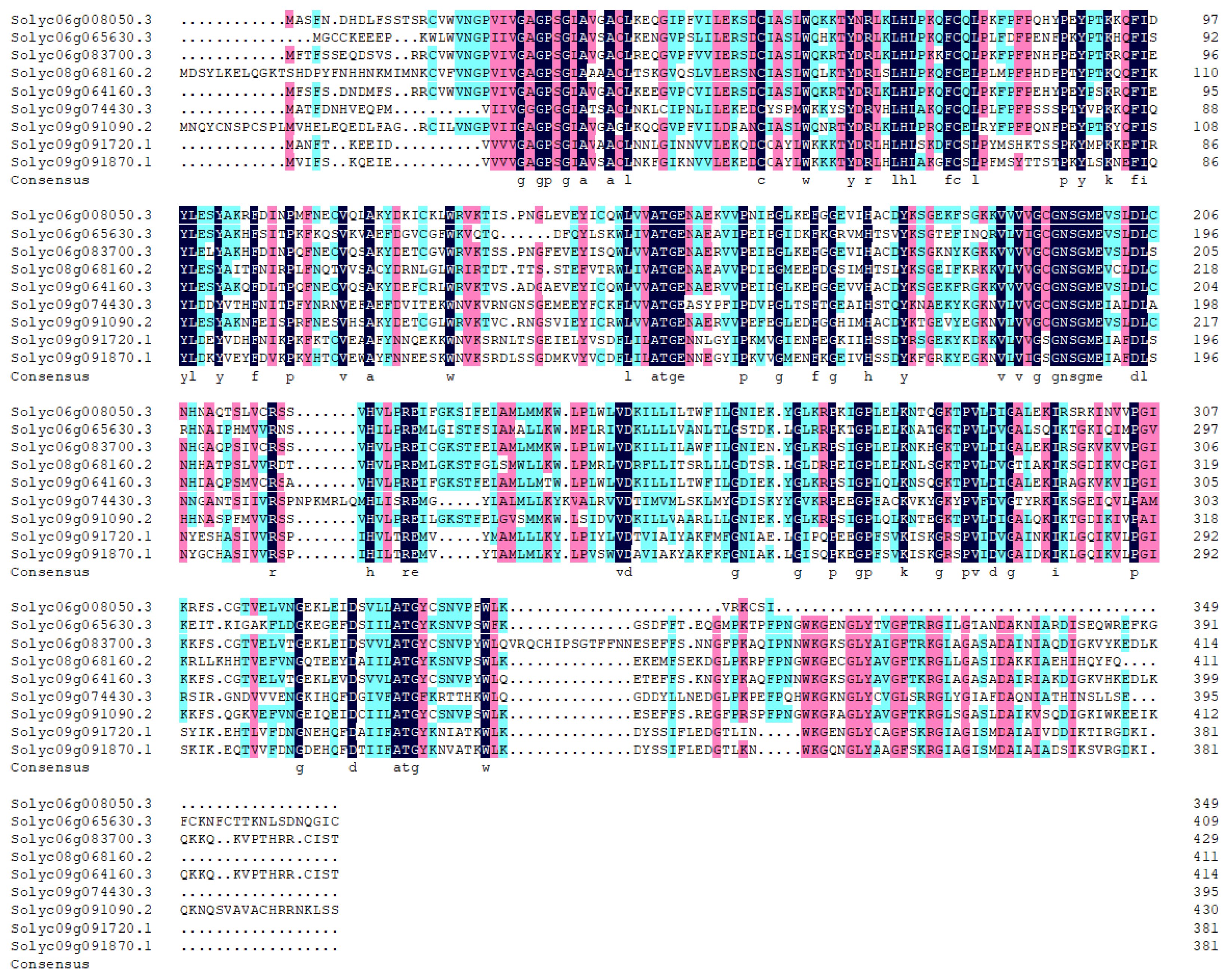
A total of 22 genes possibly homologous to the FMO-encoding YUC gene family in A. thaliana were found by BLAST in the tomato genome database. Further amino acid sequence alignment of these 22 genes with DNAMAN revealed nine genes containing the three functional domains: FAD (GAGPSGLA), NADPH (GCGNSGM), and WL(I/V)VATGENAE. Considering that the latter is the landmark domain of the FMO family (Figure 1), these nine proteins in tomato may belong to the FMO family. It follows that we identified FZY gene family members in tomato.
Figure 1.
Amino acid sequence alignment of the nine target FZY proteins in tomato. Colors represent the homology of the sequences, and the darker the color, the higher the similarity.
3.2. Characteristic Analysis of YUC/FZY Genes in Tomato
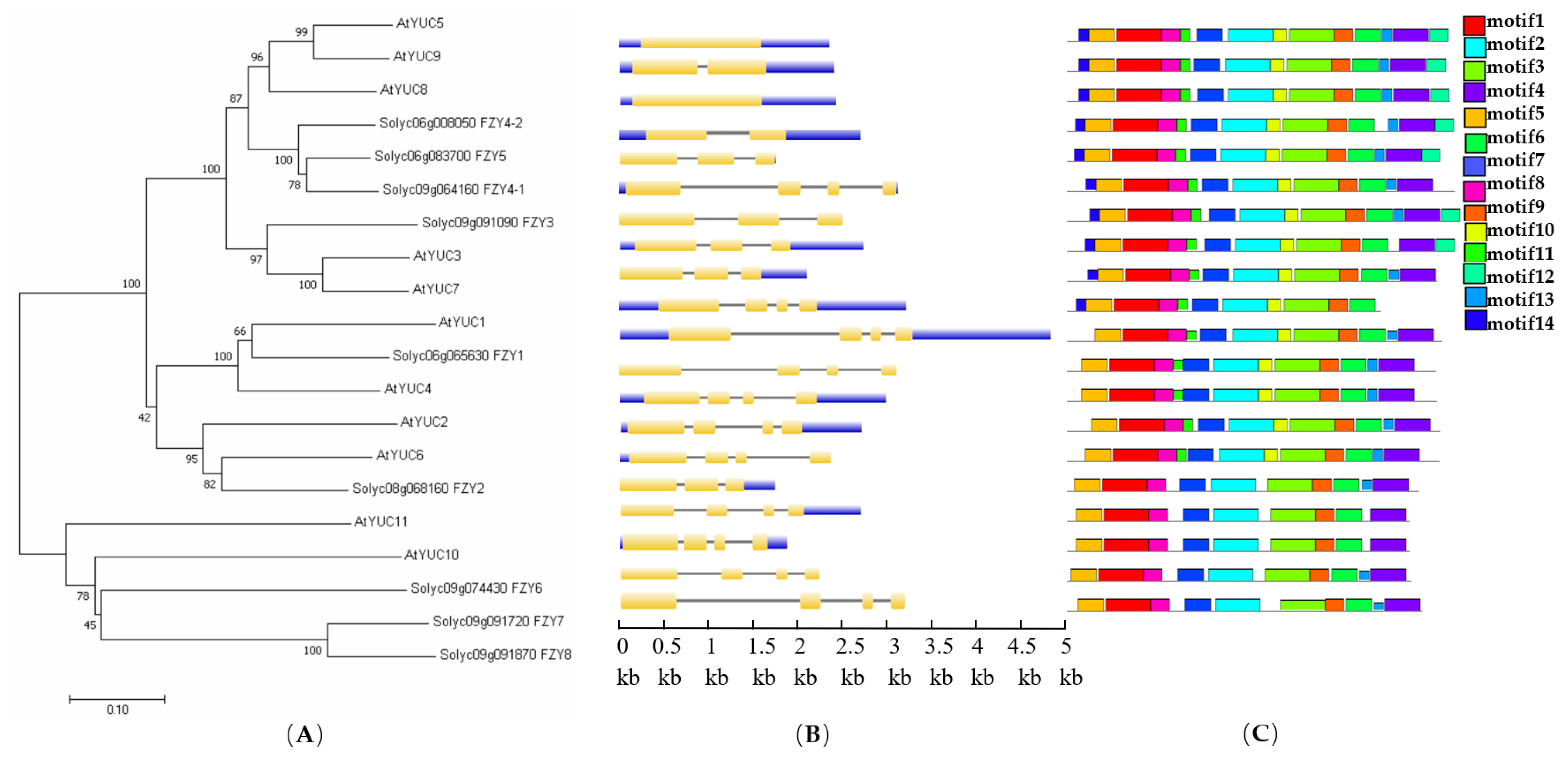
The phylogenetic analysis of the proteins encoded by these nine genes in tomato and by the YUC family in A. thaliana showed a close phylogenetic relationship between the FZY family of tomato and the YUC family of A. thaliana (Figure 2A). The tomato FZY family was named according to the phylogenetic results and previous research reports. The FZY family in tomato is closely related to the YUC1 family present in A. thaliana. Solyc08g068160, which is closely related to AtYUC2, was named SlFZY2. Solyc09g091090, which is closely related to AtYUC3 and AtYUC7, was named SlFZY3. Solyc09g064160 was named SlFZY4-1, Solyc06g008050 was named SlFZY4-2, and Solyc06g083700 was named SlFZY5, and these genes are evolutionarily close to AtYUC5, AtYUC8, and AtYUC9. Solyc09g074430 was named SlFZY6, Solyc09g091720 was named SlFZY7, and Solyc09g091870Y was named SlFZY8; these genes are evolutionarily close to AtYUC10 and AtYUC11. SlFZY4-2, SlFZY7, and SlFZY8, reported in this study, were newly discovered genes that have not been reported previously. We could also see that the nine YUC proteins in tomato could be grouped into four different groups (Figure 2A). SlFZY3, SlFZY4-1, SlFZY4-2, and SlFZY5 comprised the first group. The three other groups are SlFZY1, SlFZY2, and SlFZY6–SlFZY8.
Figure 2.
(A) Phylogenetic tree, (B) gene structure analysis, and (C) motifs of the tomato FZY gene family.
The online GSDS 2.0 was used to analyze the FMO gene family structure of tomato and A. thaliana (Figure 2B). The results showed that SlFZY1, SlFZY2, SlFZY4-1, SlFZY6, SlFZY7, SlFZY8, AtYUC1, AtYUC2, AtYUC4, AtYUC6, and AtYUC10 each had four exons and three introns that do not encode proteins; SlFZY3, SlFZY5, AtYUC3, AtYUC7, and AtYUC11 each had three exons and two introns; and SlFZY4-2 and AtYUC9 each had two exons and one intron, while AtYUC5 had only one exon. As such, the auxin biosynthesis gene family members, which demonstrate a close homogeneous relationship between tomato and A. thaliana, have similar gene structures.
A MEME analysis of the protein structure of the YUC family demonstrated that motif19 is a shared motif (Figure 2C). SlFZY6, SlFZY7, SlFZY8, AtYUC10, and AtYUC11 do not contain motif10 or motif11, a few genes do not contain motif12, and more than half do not contain motif13 or motif14.
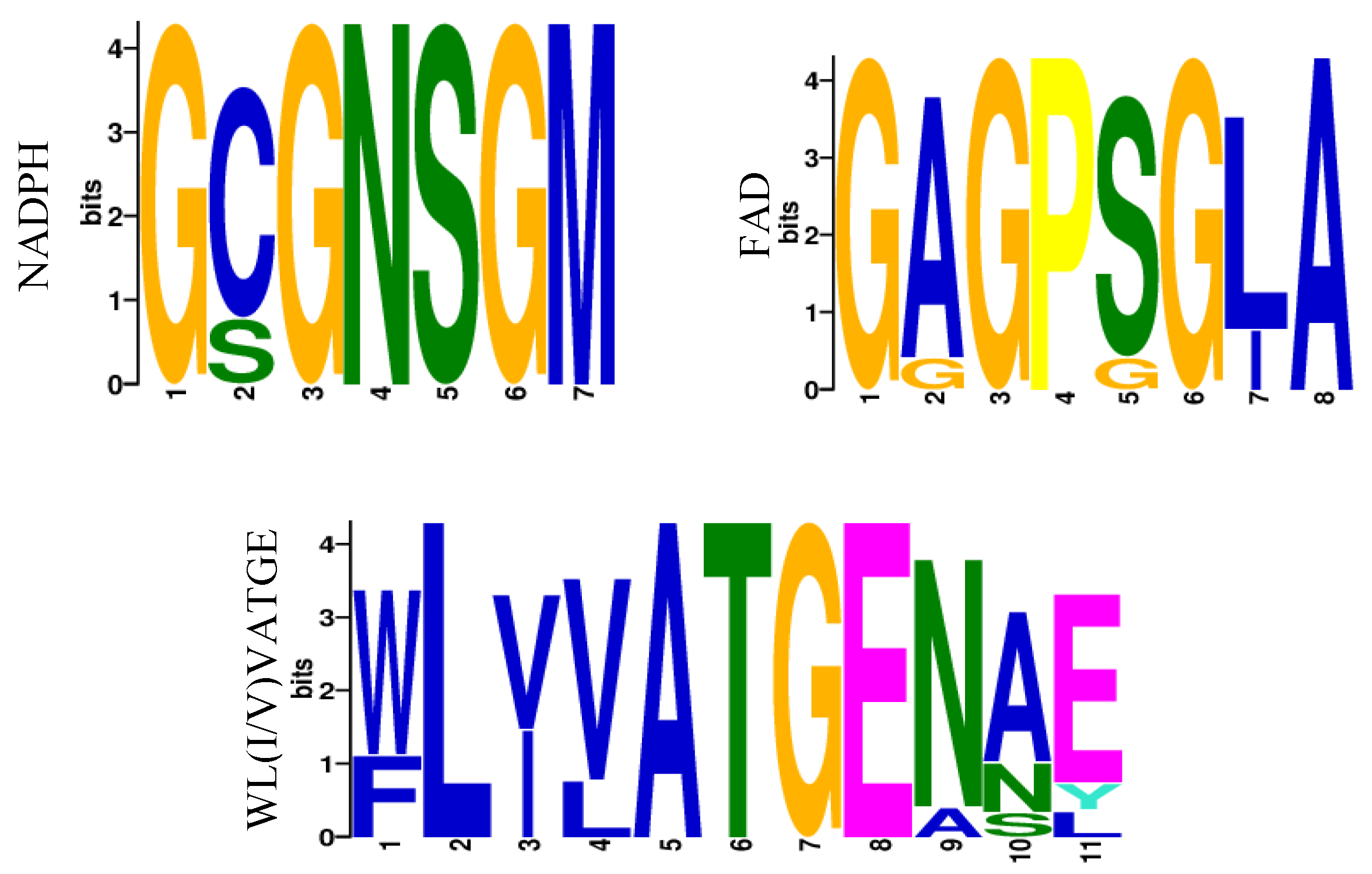
The sequence logo (Figure 3) shows that the three functional domains of FAD, NADPH, and WL(I/V)VATGENAE are located in motif5, motif7, and motif2, respectively. FAD and NADPH are highly conservative, and WL(I/V) VATGENAE is conservative.
Figure 3.
Amino acid sequence logo of the three functional domains.
The subcellular localization prediction of the tomato FZY gene family suggested that only SlFZY2 might be present in the chloroplast, SlFZY5 might be present in the cytoplasm or chloroplast, SlFZY7 might be present in the cytoplasm or plasma membrane, and the six other proteins might be present in the cytoplasm (Table 1). Previous studies have shown that the TAA/YUC pathway completes the biosynthesis of auxin in the cytoplasm, which is consistent with our results.
Table 1.
Subcellular localization prediction of tomato SlFZY gene family members.
Analysis of promoter cis-acting elements showed that only the two genes SlFZY2 and SlFZY8 do not contain CAAT-box. In addition (Table 2), SlFZY8 does not contain TATA-box, indicating that it may lack transcriptional activity. The seven other genes contain these two cis-acting elements. As the core promoter element, the TATA-box is one of the binding sites of RNA polymerase. RNA polymerase binds to this site and initiates transcription. CAAT-box regulates the frequency of transcription initiation. This gene family may be susceptible to the environment because the promoters of all members contain light-responsive elements, indicating their sensitivity to light signals. Both SlFZY1 and SlFZY3 contain cis-acting elements of TC-rich repeats (Table 2) that function in defense and stress response. SlFZY2 might be regulated by the MYB family of transcription factors to respond to drought stress because of the MBS-binding elements on its promoter (Table 2). The promoters of SlFZY4-2 and SlFZY6 contain the MYB recognition element that binds to MYB and participates in light response (Table 2). The promoters of SlFZY4-2, SlFZY5, and SlFZY7 contain low-temperature-responsive (LTR) elements, suggesting that low temperature may directly or indirectly regulate FZYs (Table 2). Synergistic or antagonistic interactions exist between hormones during the regulation of plant growth and development. SlFZY2, SlFZY4-2, SlFZY5, SlFZY7, and SlFZY8 contain abscisic acid-responsive elements. All except SlFZY1 contain the salicylic acid-responsive element TCA-element. SlFZY3, SlFZY4-2, and SlFZY5 contain the auxin-responsive element AuxRR-core. SlFZY2, SlFZY3, SlFZY4-2, SlFZY5, SlFZY7, and SlFZY8 contain the methyl jasmonate-responsive element CGTCA-motif.
Table 2.
Prediction of cis-acting elements of the SlFZY promoter.
It follows that the FZY family of tomato is closely related to the YUC family of Arabidopsis. Subcellular localization prediction of the tomato FZY family revealed that eight of its members may be in the cytoplasm and one in the chloroplast. Through the analysis of promoter cis-acting elements, it was found that promoters of all members of this gene family in tomato contain photoresponsive elements, indicating that they are sensitive to light signals. Only SlFZY4-2, SlFZY5, and SlFZY7 have low-temperature response elements on their promoters.
3.3. Analysis of Expression Patterns of YUC/FZY Genes in Various Tissues of Tomato
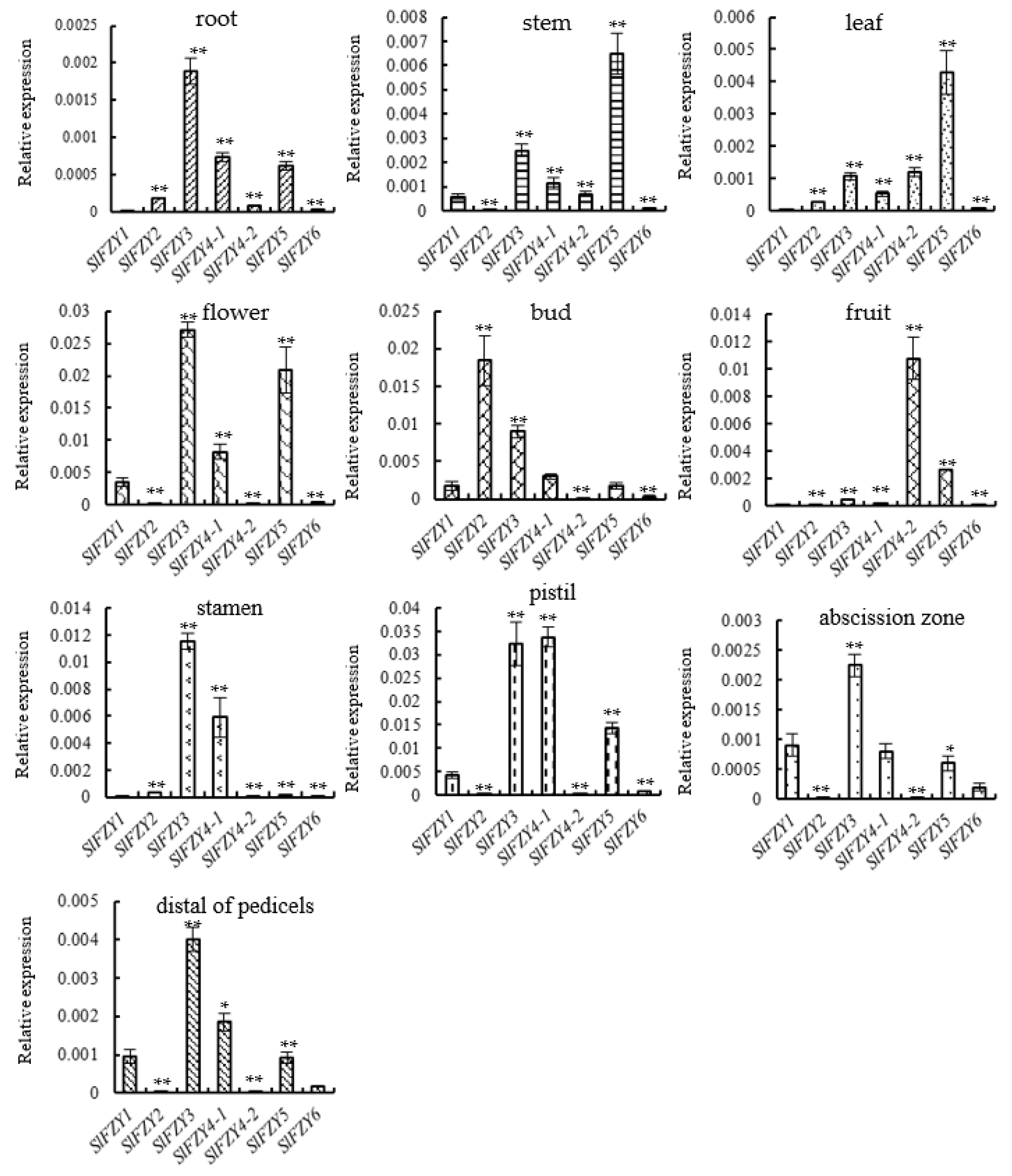
Local biosynthesis of auxin regulates the growth and development of plants; the YUC/FZY gene is a key rate-limiting enzyme in auxin synthesis. Therefore, to clarify the role of the YUC/FZY gene in tomato growth and development, total RNA from various tissues of tomato was extracted and reverse transcribed. The expression of SlFZY genes in various tomato parts was analyzed by qRT-PCR (Figure 4). The results showed a spatiality in the expression pattern of the SlFZY gene family. SlFZY3 was the most highly expressed in the underground parts of tomato. SlFZY5 was the most highly expressed in the stems and in the leaves. In the fully open flowers, SlFZY3 was the most highly expressed, followed by SLFZY5. In the flower buds, SLFZY2 expression was the highest. SLFZY3 and SLFZY4-1 were highly expressed in stamens and pistils. SlFZYs were lowly expressed in the flower stalks. In fruits, SLFZY4-2 was highly expressed, with high tissue specificity. In conclusion, the YUC/FZY gene is involved in the whole process of tomato growth and development.
Figure 4.
qRT-PCR analysis of SlFZYs relative expression levels normalized to actin in various tissues of tomato. Significant difference was determined by one-way ANOVA with Dunnett’s test; * indicates significant difference (p < 0.05); ** indicates extremely significant difference (p < 0.01).
3.4. Identification and Structure Analysis of the Genes Encoding TAA Transaminase in Tomato
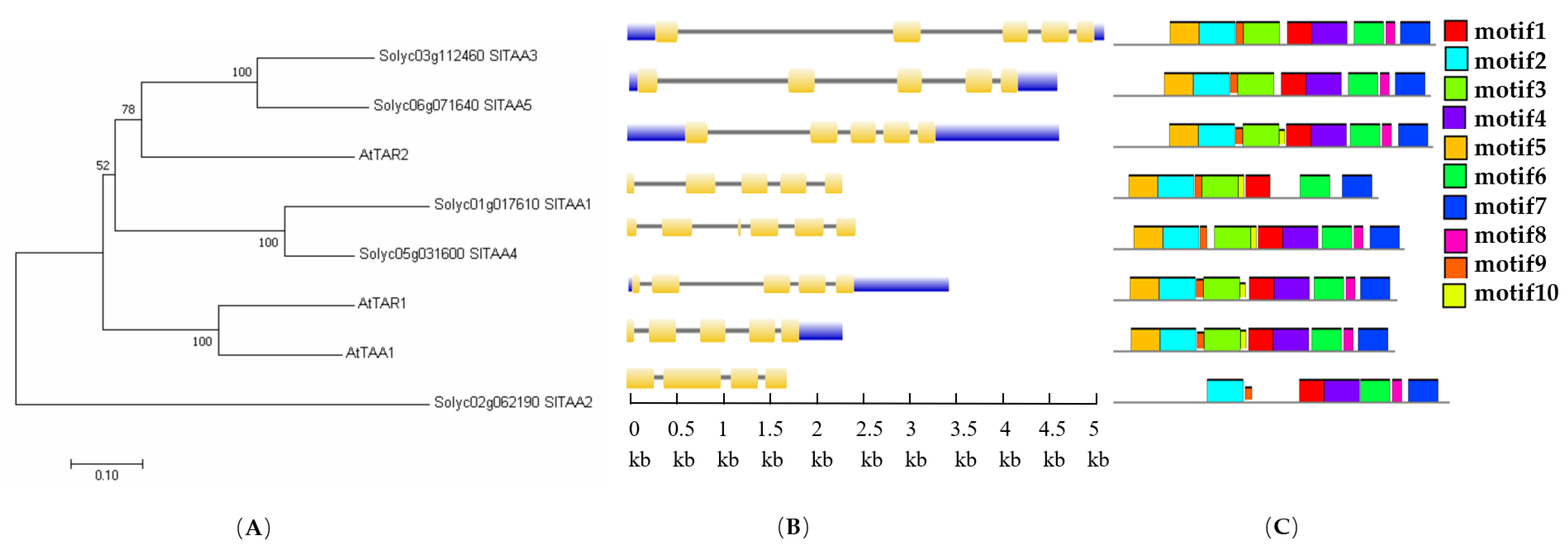
The role of the TAA aminotransferase family in plants is crucial in auxin biosynthesis; however, this family has not been reported in tomato (Figure 5). In the present study, a total of five possible members of this family was retrieved in the tomato genome database. Phylogenetic analysis showed that these five genes in tomato are closely related to the TAA/TAR genes in A. thaliana. Phylogenetic nomenclature was performed, and Solyc01g017610 was named SlTAA1, Solyc02g062190 was named SlTAA2, Solyc03g112460 was named SlTAA3, Solyc05g031600 was named SlTAA4, and Solyc06g071640 was named SlTAA5. Gene structure analysis revealed that only SlTAA2 contains four exons, and all other genes have five exons. The motif analysis results were similar to the gene structure analysis results. The structure of the SlTAA2 protein is remarkably different from those of other proteins, containing only seven motifs. It follows that we identified TAA gene family members in tomato.
Figure 5.
(A) Phylogenetic tree based on alignment of protein amino acid sequences; (B) Structural analysis of the five target genes in tomato and three TAA/TAR genes in Arabidopsis thaliana; and (C) Motif analysis of the five target genes in tomato and three TAA/TAR genes in Arabidopsis thaliana.
3.5. Expression Analysis of TAA Genes in Various Tissues of Tomato
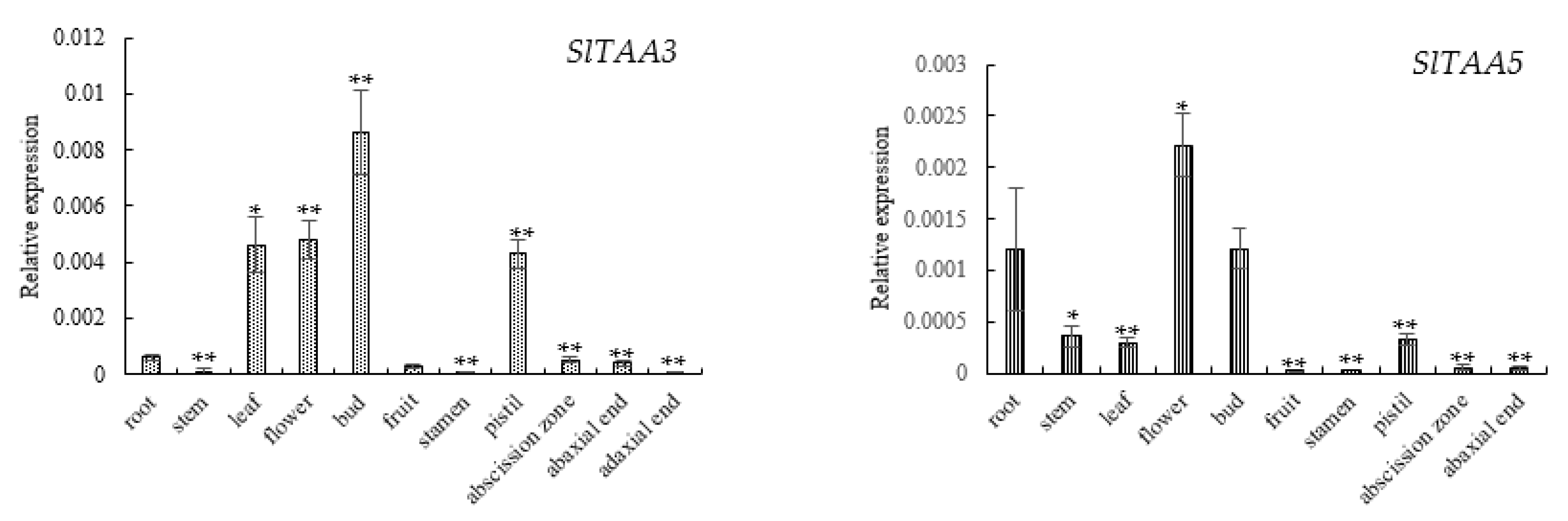
The catalysis of tryptophan to indole pyruvate by TAA transaminase in plants is the first step of the TAA/YUC pathway. NCBI was used to design primers for the TAA family. Only the primers of SlTAA3 and SlTAA5 were specific, while the three other genes were far from the A. thaliana TAA transaminase family phylogenetically. Hence, in this study, the expressions of SlTAA3 and SlTAA5 from various tissues of tomato were quantitatively analyzed by qRT-PCR (Figure 6). The results showed that the expression of SlTAA3 was lower than that of SlTAA5 in the roots, as that of SlTAA5 was 2.22 times that of SlTAA3. In other tomato tissues, the expression of SlTAA3 was higher than that of SlTAA5 and reached its peak in the flower buds. During the tomato flowering stage, the expression of SlTAA3 in the pistils was 83.58 times that in the stamens. In conclusion, the TAA gene, especially SlTAA3, is involved in the whole process of tomato growth and development.
Figure 6.
qRT-PCR analysis of SlTAA3 and SlTAA5 relative expression levels normalized to actin in various tissues of tomato. Significant difference was determined by one-way ANOVA with Dunnett’s test; * indicates significant difference (p < 0.05); ** indicates extremely significant difference (p < 0.01).
4. Discussion
Auxin and its locality are accompanied by the whole process of plant growth and development; the transportation and signal transduction of auxin in tomato have been studied, but its biosynthesis has not been studied. In this study, a bioinformatics analysis was conducted to find key genes encoding rate-limiting enzymes in the auxin synthesis pathway in tomato. Bioinformatic analysis was used to successfully identify nine YUCCAs (FZYs) in the tomato genome, all of which contain the WL(I/V)VATGENAE domain, located between FAD and NADPH domains. Considering that this domain is the landmark domain of the FMO family, the nine genes possibly encode FMOs and participate in the auxin biosynthesis pathway in tomato. The resulting phylogenetic tree showed that the FZY gene family in tomato is closely related to the YUC gene family, with 11 members in in A. thaliana. It is additionally similar that tomato FZY proteins can be also grouped into four groups, as YUC ones can in A. thaliana [10]. YUC is the rate-limiting enzyme in the auxin biosynthesis pathway in plants. Thus, finding the genes encoding this enzyme in tomato is crucial for every aspect of tomato research. The subcellular localization prediction of the tomato FZY gene family revealed that eight of its members might be present in the cytoplasm and one in the chloroplast. Auxin biosynthesis occurs in the cytoplasm [27], suggesting that these nine genes are involved in the biosynthesis of tomato auxin. Promoter cis-acting element analysis exhibited light-responsive elements in the promoters of all members of this gene family in tomato, suggesting their sensitivity to light signals. Previous studies have shown that, in A. thaliana, PIF4 could regulate YUC4 expression in response to light signals [28]. Our results are consistent with this conclusion. The promoters of SlFZY4-2, SlFZY5, and SlFZY7 contain LTR elements. It is speculated that low temperature might regulate tomato development by affecting the expression of these three genes. LTR elements were not found on the promoters of the other genes, but they may regulate SlFZY through other transcription factors in tomato. Through bioinformatic analysis, this research further identified five TAA/TRA aminotransferase family genes in the tomato genome. The qRT-PCR results showed that SlTAA3 was highly expressed in tomato, suggesting its crucial role in the growth and development of tomato. Phylogenetically, SlTAA3 is closely related to AtTAR in A. thaliana, and their gene structure and motif modules share high similarities. The TAA family produces IPA and the YUC family functions in the conversion of IPA to IAA in A. thaliana through a quantification process of IPA [27]. Two gene families encoding key enzymes in the TAA/YUC auxin biosynthesis pathway were found in tomato, and they provided a new direction for further exploring the regulatory mechanism of auxin in tomato development. Plant auxins are synthesized locally [29]. Analyzing the expression pattern of SlFZYs in various tissues of tomato is an important part of their functional study. It is well known that over-expression of YUC genes increases auxin production in A. thaliana, while the loss of function of a single YUC gene does not affect plant growth [30]. Through qRT-PCR analysis, it was found that SlFZY2, SlFZY3, SlFZY4-1, and SlFZY5 are highly expressed in tomato flower organs, similar to YUC1 and YUC4 in A. thaliana. These four genes are speculated to regulate the development of tomato floral organs. The highest expression of SlFZY3 was in the underground parts of tomato, that of SlFZY5 was highest in the stems and leaves, and that of SlFZY4-2 was highest in young fruits. It is well known that the root tip is an important component for the synthesis of auxin, and the concentration of auxin can affect the change in the root tip structure. It has been confirmed that the mutation of YUC3, YUC 5, YUC 7, YUC 8 and YUC 9, which are highly expressed in the root system of Arabidopsis thaliana, will interfere with root growth. Therefore, it can be inferred that the SlFZY3 in the tomato root system may be involved in the formation of root structure [10,31]. However, unlike in the study of Arabidopsis, the function of the FZY gene in tomato remains unclear. However, bioinformatic analysis could not fully prove that the FZY gene family in tomato is responsible for encoding FMOs, and further confirmation via the iaam gene complementation test is needed. The YUC gene family shows serious functional redundancy in A. thaliana. Thus, it is to be determined by the virus-induced gene silencing tool whether members of the tomato FZY gene family show distinct and overlapping expression patterns. Further experiments are needed to verify the gene function.
5. Conclusions
Auxin is involved in nearly all processes of plant growth and development, and its locality is essential. In this study, the FZY gene family members for tomato auxin biosynthesis were identified using bioinformatic methods. The expressions of such genes in various tissues of tomato were analyzed. The spatiality of their expression pattern was demonstrated, and their expression was the highest in the flower organs of tomato. The analysis of promoter cis-acting elements revealed light-responsive elements in the promoters of all found gene family members in tomato, indicating their sensitivity to light signals. The promoters of SlFZY4-2, SlFZY5, and SlFZY7 contain LTR elements. In addition, the expression of SlTAA5 was 2.22 times that of SlTAA3 in the roots. The expression of SlTAA3 in the pistils was 83.58 times that in the stamens during the tomato flowering stage. Therefore, our study demonstrated that various members of the tomato FZY gene family are involved in regulating the development of tomato floral organs and the response to abiotic stresses, such as low temperature and weak light.
Author Contributions
Data curation, S.M. and H.X.; investigation, X.Y., Y.Y. and Y.M.; methodology, T.X., Y.L. and F.W.; project administration, M.Q. and T.L.; Validation, X.Y. and L.H.; writing—original draft, S.M. and H.X.; writing—review and editing, S.M., H.X., X.Y., M.Q. and T.L. All authors have read and agreed to the published version of the manuscript.
Funding
This research was funded by the National Natural Science Foundation of China, grant numbers 32102460, 31972397, and 32172554; as well as the 2021 Scientific Research Funding Project of Liaoning Provincial Department of Education, grant number LJKZ0639.
Data Availability Statement
The authors will supply the relevant data in response to reasonable requests.
Acknowledgments
The authors are grateful to the National & Local Joint Engineering Research Center of Northern Horticultural Facilities Design & Application Technology (Liaoning), the Modern Protected Horticulture Engineering & Technology Center (Shenyang Agricultural University), and the Key Laboratory of Protected Horticulture (Shenyang Agricultural University) Institute for supporting this project.
Conflicts of Interest
The authors declare no conflict of interest.
References
- Lincoln, C.; Britton, J.H.; Estelle, M. Growth and Development of the axr1 Mutants of Arabidopsis. Plant Cell 1990, 2, 1071–1080. [Google Scholar] [CrossRef] [PubMed]
- Collett, C.E.; Harberd, N.P.; Leyser, O. Hormonal Interactions in the Control of Arabidopsis Hypocotyl Elongation. Plant Physiol. 2000, 124, 553–562. [Google Scholar] [CrossRef] [PubMed]
- Smith, R.S.; Guyomarc’H, S.; Mandel, T.; Reinhardt, D.; Kuhlemeier, C.; Prusinkiewicz, P. A plausible model of phyllotaxis. Proc. Natl. Acad. Sci. USA 2006, 103, 1301–1306. [Google Scholar] [CrossRef]
- Qi, J.; Wang, Y.; Yu, T.; Cunha, A.; Wu, B.; Vernoux, T.; Meyerowitz, E.; Jiao, Y. Auxin depletion from leaf primordia contributes to organ patterning. Proc. Natl. Acad. Sci. USA 2014, 111, 18769–18774. [Google Scholar] [CrossRef]
- Stepanova, A.N.; Robertson-Hoyt, J.; Yun, J.; Benavente, L.M.; Xie, D.-Y.; Doležal, K.; Schlereth, A.; Jürgens, G.; Alonso, J.M. TAA1-Mediated Auxin Biosynthesis Is Essential for Hormone Crosstalk and Plant Development. Cell 2008, 133, 177–191. [Google Scholar] [CrossRef] [PubMed]
- Guo, T.; Chen, K.; Dong, N.; Ye, W.; Shan, J.; Lin, H. Tillering and small grain 1 dominates the tryptophan aminotransferase family required for local auxin biosynthesis in rice. J. Integr. Plant Biol. 2019, 62, 581–600. [Google Scholar] [CrossRef] [PubMed]
- Taylor, J.E.; Whitelaw, C.A. Signals in abscission. New Phytol. 2001, 151, 323–340. [Google Scholar] [CrossRef]
- Cheng, Y.; Dai, X.; Zhao, Y. Auxin biosynthesis by the YUCCA flavin monooxygenases controls the formation of floral organs and vascular tissues in Arabidopsis. Genes Dev. 2006, 20, 1790–1799. [Google Scholar] [CrossRef]
- Cecchetti, V.; Celebrin, D.; Napoli, N.; Ghelli, R.; Brunetti, P.; Costantino, P.; Cardarelli, M. An auxin maximum in the middle layer controls stamen development and pollen maturation in Arabidopsis. New Phytol. 2016, 213, 1194–1207. [Google Scholar] [CrossRef]
- Poulet, A.; Kriechbaumer, V. Bioinformatics Analysis of Phylogeny and Transcription of TAA/YUC Auxin Biosynthetic Genes. Int. J. Mol. Sci. 2017, 18, 1791. [Google Scholar] [CrossRef]
- Qin, H.; Zhang, Z.; Wang, J.; Chen, X.; Wei, P.; Huang, R. The activation of OsEIL1 on YUC8 transcription and auxin biosynthesis is required for ethylene-inhibited root elongation in rice early seedling development. PLoS Genet. 2017, 13, e1006955. [Google Scholar] [CrossRef] [PubMed]
- Chen, Q.; Dai, X.; De-Paoli, H.; Cheng, Y.; Takebayashi, Y.; Kasahara, H.; Kamiya, Y.; Zhao, Y. Auxin Overproduction in Shoots Cannot Rescue Auxin Deficiencies in Arabidopsis Roots. Plant Cell Physiol. 2014, 55, 1072–1079. [Google Scholar] [CrossRef] [PubMed]
- Zhao, Y. The role of local biosynthesis of auxin and cytokinin in plant development. Curr. Opin. Plant Biol. 2008, 11, 16–22. [Google Scholar] [CrossRef] [PubMed]
- Poulios, S.; Vlachonasios, K.E. Synergistic action of GCN5 and CLAVATA1 in the regulation of gynoecium development in Arabidopsis thaliana. New Phytol. 2018, 220, 593–608. [Google Scholar] [CrossRef]
- Xu, Y.; Prunet, N.; Gan, E.-S.; Wang, Y.; Stewart, D.; Wellmer, F.; Huang, J.; Yamaguchi, N.; Tatsumi, Y.; Kojima, M.; et al. SUPERMAN regulates floral whorl boundaries through control of auxin biosynthesis. EMBO J. 2018, 37, e97499. [Google Scholar] [CrossRef]
- Yuan, H.; Zhao, K.; Lei, H.; Shen, X.; Liu, Y.; Liao, X.; Li, T. Genome-wide analysis of the GH3 family in apple (Malus × domestica). BMC Genom. 2013, 14, 297. [Google Scholar] [CrossRef]
- Stepanova, A.N.; Yun, J.; Robles, L.M.; Novak, O.; He, W.; Guo, H.; Ljung, K.; Alonso, J.M. The Arabidopsis YUCCA1 flavin monooxygenase functions in the indole-3-pyruvic acid branch of auxin biosynthesis. Plant Cell 2011, 23, 3961–3973. [Google Scholar] [CrossRef]
- Dai, X.; Mashiguchi, K.; Chen, Q.; Kasahara, H.; Kamiya, Y.; Ojha, S.; DuBois, J.; Ballou, D.; Zhao, Y. The biochemical mechanism of auxin biosynthesis by an arabidopsis YUCCA flavin-containing monooxygenase. J. Biol. Chem. 2013, 288, 1448–1457. [Google Scholar] [CrossRef]
- Zhao, C.; Wang, P.; Si, T.; Hsu, C.-C.; Wang, L.; Zayed, O.; Yu, Z.; Zhu, Y.; Dong, J.; Tao, W.A.; et al. MAP Kinase Cascades Regulate the Cold Response by Modulating ICE1 Protein Stability. Dev. Cell 2017, 43, 618–629. [Google Scholar] [CrossRef]
- Mashiguchi, K.; Tanaka, K.; Sakai, T.; Sugawara, S.; Kawaide, H.; Natsume, M.; Hanada, A.; Yaeno, T.; Shirasu, K.; Yao, H.; et al. The main auxin biosynthesis pathway in Arabidopsis. Proc. Natl. Acad. Sci. USA 2011, 108, 18512–18517. [Google Scholar] [CrossRef]
- Gao, Y.; Dai, X.; Zheng, Z.; Kasahara, H.; Kamiya, Y. Over expression of the bacterial tryptophan oxidase RebO affects auxin biosynthesis and Arabidopsis development. Sci. Bull. 2016, 61, 859–867. [Google Scholar] [CrossRef]
- Zhang, J.; Lin, J.E.; Harris, C.; Pereira, F.C.M.; Wu, F.; Blakeslee, J.J.; Peer, W.A. DAO1 catalyzes temporal and tissue-specific oxidative inactivation of auxin in Arabidopsis thaliana. Proc. Natl. Acad. Sci. USA 2016, 113, 11010–11015. [Google Scholar] [CrossRef]
- Ma, Q.; Dai, X.; Xu, Y.; Guo, J.; Liu, Y.; Chen, N.; Xiao, J.; Zhang, D.; Xu, Z.; Zhang, X.; et al. Enhanced tolerance to chilling stress in OsMYB3R-2 transgenic rice is mediated by alteration in cell cycle and ectopic expression of stress genes. Plant Physiol. 2009, 150, 244–256. [Google Scholar] [CrossRef] [PubMed]
- Cheng, Y.; Dai, X.; Zhao, Y. Auxin Synthesized by the YUCCA Flavin Monooxygenases Is Essential for Embryogenesis and Leaf Formation in Arabidopsis. Plant Cell 2007, 19, 2430–2439. [Google Scholar] [CrossRef]
- Du, H.; Liu, H.; Xiong, L. Endogenous auxin and jasmonic acid levels are differentially modulated by abiotic stresses in rice. Front. Plant Sci. 2013, 4, 397. [Google Scholar] [CrossRef]
- Koini, M.A.; Alvey, L.; Allen, T.; Tilley, C.A.; Harberd, N.P.; Whitelam, G.C.; Franklin, K.A. High Temperature-Mediated Adaptations in Plant Architecture Require the bHLH Transcription Factor PIF4. Curr. Biol. 2009, 19, 408–413. [Google Scholar] [CrossRef]
- Chen, L.; Tong, J.; Xiao, L.; Ruan, Y.; Liu, J.; Zeng, M.; Huang, H.; Wang, J.-W.; Xu, L. YUCCA-mediated auxin biogenesis is required for cell fate transition occurring during de novo root organogenesis in Arabidopsis. J. Exp. Bot. 2016, 67, 4273–4284. [Google Scholar] [CrossRef]
- Pucciariello, O.; Legris, M.; Rojas, C.C.; Iglesias, M.J.; Hernando, C.E.; Dezar, C.; Vazquez, M.; Yanovsky, M.J.; Finlayson, S.A.; Prat, S.; et al. Rewiring of auxin signaling under persistent shade. Proc. Natl. Acad. Sci. USA 2018, 115, 5612–5617. [Google Scholar] [CrossRef]
- Zhao, Y. Essential Roles of Local Auxin Biosynthesis in Plant Development and in Adaptation to Environmental Changes. Annu. Rev. Plant Biol. 2018, 69, 417–435. [Google Scholar] [CrossRef]
- Zhao, Y.; Christensen, S.K.; Fankhauser, C.; Cashman, J.R.; Cohen, J.D.; Weigel, D.; Chory, J. A role for flavin monooxygenase-like enzymes in auxin biosynthesis. Science 2001, 291, 306–309. [Google Scholar] [CrossRef] [PubMed]
- Cao, X.; Yang, H.; Shang, C.; Ma, S.; Liu, L.; Cheng, J. The Roles of Auxin Biosynthesis YUCCA Gene Family in Plants. Int. J. Mol. Sci. 2019, 20, 6343. [Google Scholar] [CrossRef] [PubMed]
Disclaimer/Publisher’s Note: The statements, opinions and data contained in all publications are solely those of the individual author(s) and contributor(s) and not of MDPI and/or the editor(s). MDPI and/or the editor(s) disclaim responsibility for any injury to people or property resulting from any ideas, methods, instructions or products referred to in the content. |
© 2023 by the authors. Licensee MDPI, Basel, Switzerland. This article is an open access article distributed under the terms and conditions of the Creative Commons Attribution (CC BY) license (https://creativecommons.org/licenses/by/4.0/).