Article

A Novel Loss-of-Function CmERECTA Allele, Cmer-2, Controls Dwarf Architecture in Melon (Cucumis melo var. cantalupensis)


1
College of Horticulture, Henan Agricultural University, Zhengzhou 450046, China
2
Research Center of Cucurbit Germplasm Enhancement and Utilization of Henan Province, Zhengzhou 450046, China
3
International Joint Laboratory of Henan Horticultural Crop Biology, Zhengzhou 450046, China
4
Luoyang Nongfa Agricultural Technology Limited Company, Luoyang 471123, China
5
Luoyang Seed Industry Development Center, Luoyang 471000, China
*
Authors to whom correspondence should be addressed.
These authors contributed equally to this work.
Horticulturae 2026, 12(6), 652; https://doi.org/10.3390/horticulturae12060652
Submission received: 6 April 2026 / Revised: 17 May 2026 / Accepted: 21 May 2026 / Published: 23 May 2026
(This article belongs to the Special Issue Germplasm Resources and Genetics Improvement of Watermelon and Melon)

Abstract

As a high-value horticultural crop, melon cultivation requires substantial labor input for plant architecture management. Dwarf architecture is a desirable trait for melon breeding, as it simplifies plant management and enables higher planting density. In this study, we identified a spontaneous dwarf mutant, HMN-d, derived from a cantalupensis melon HMN. Compared to HMN, HMN-d exhibited a 70% reduction in plant height with unchanged node number. BSA-seq mapped the mutation to a single 1.86 Mb interval on chromosome 7 containing CmER, a known regulator of melon height. A novel loss-of-function allele, Cmer-2, introducing a premature stop codon, was identified in this region of HMN-d. Linkage analysis using 1455 F2 individuals via KASP marker developed from the Cmer-2 variant revealed complete co-segregation with the dwarf phenotype. Allelism analysis further demonstrated that Cmer-2 is allelic to Cmer-1, a previously identified loss-of-function allele of CmER. CmER knockout lines generated by gene editing recapitulated the dwarf phenotype, directly confirming that loss of CmER function is sufficient to cause dwarfism. Collectively, these findings establish Cmer-2 as the causal variant underlying the dwarf phenotype and provide valuable genetic resources for melon plant architecture improvement and for dissecting the mechanisms of height regulation.

1. Introduction

Melon (Cucumis melo L.) is a horticultural crop of significant economic importance and plays a prominent role in modern agricultural production. Its fruits are prized for their aromatic flavor and balanced content of sugars, organic acids, vitamins, and minerals, making them highly popular among consumers. Although melon originated in Africa, it is now cultivated commercially worldwide. According to the Food and Agriculture Organization of the United Nations, approximately 1.04 million hectares were dedicated to melon cultivation in 2024, yielding 28.24 million tons of fruit “https://www.fao.org/faostat/zh/#data/QCL (accessed on 12 December 2025)”. However, melon production is labor-intensive, as architectural management practices such as vine training and lateral branch removal require substantial manual input [1]. With an aging population and rising labor costs, there is an urgent need for elite melon varieties with more manageable architectures. Unlike the model plant Arabidopsis, which undergoes distinct vegetative and reproductive phases, cucurbit crops such as melon exhibit alternating vegetative and reproductive growth following an initial period of pure vegetative development [2]. The node serves as the fundamental growth unit of the melon, bearing leaves, flowers, tendrils, and lateral branches. Plant height is determined by both node number and internode length. A dwarf phenotype characterized by shortened internodes and a largely unchanged node number holds considerable value for melon cultivation, particularly in protected cultivation (greenhouses) and vertical training systems where vine management is labor-intensive. This compact architecture simplifies canopy management and enables increased planting density. Nevertheless, the agronomic utility of a dwarfing gene depends on its not negatively impacting fruit yield, flowering time, or quality; therefore, any novel allele requires careful evaluation.
Among factors influencing plant height, plant hormones have received the most research attention and exert the most pronounced effects. Numerous phytohormones have been implicated in regulating internode elongation, including gibberellin (GA), brassinosteroid (BR), and auxin. Modulating GA signaling has a conserved effect on height development across plant species. Inhibition of GA biosynthesis or signal transduction formed the genetic basis of the Green Revolution in wheat and rice [3,4]. In cucurbit crops, dwarf phenotypes resulting from mutations in GA-related genes have been extensively documented. Loss-of-function mutations in GA3ox reduced GA biosynthesis and shortened internode length in watermelon [5,6,7], sponge gourd [8], pumpkin [9], and cucumber [10]. Similarly, disruption of GA20ox in watermelon [11] or KAO in cucumber [12] reduced GA content and conferred recessive dwarf phenotypes. A gain-of-function mutation in squash GA2ox, which encodes a key enzyme in GA catabolism, resulted in dominant dwarfism [13]. Additionally, a mutation in the watermelon GA receptor gene GID1L2 produced a GA-insensitive dwarf phenotype [14]. Beyond GA, BR-mediated architectural regulation has also been widely reported in cucurbits. Mutations in genes encoding key BR biosynthesis enzymes, including CsCYP85A1 [15], CsDET2 [16], CsDWF5 [17], and CsDWF7 [18], all result in reduced BR content, decreased internode length, and compact architecture in cucumber. Watermelon ClDUF21 promotes BR synthesis and internode elongation by interacting with ClDWF1 [19]. Disruption of the BR pathway not only affects architecture but also leads to wrinkled, dark-green leaves and impaired reproductive development [19]. In the case of auxin, mutations in the auxin transporter ABCB19 result in shortened internodes and semi-dwarf architecture in watermelon and cucumber [20,21].
In addition to hormonal pathways, factors controlling cell morphogenesis or the cell cycle also play important roles in plant height determination [22]. Mutation of the watermelon cellulose synthase gene ClCSLH1 affects cell wall development and leads to dwarf architecture [23]. In cucumber, loss of function of the cyclin-dependent kinase inhibitor CsSMR1 results in reduced internode length and node number [24]. Mutation of the melon β-tubulin gene CmTUB8 disrupts cytoskeleton formation and generates an incompletely dominant dwarf phenotype [25].
Moreover, several transcriptional regulators and protein modifiers have been implicated in modulating height in cucurbits. The watermelon transcription factor ClNAC100 promotes internode elongation by activating ClGA3ox expression [26]. The role of the transcription factor YABBY1 in suppressing height has been validated in squash, cucumber, and watermelon [27]. Similarly, cucumber MYB transcription factor CsRAX5 [28] and melon transcription factor CmOVATE [29] negatively regulate height development, although their target genes remain unidentified. In addition, the LRR receptor kinase ERECTA promotes internode elongation in cucumber, melon, and squash [30,31], yet its phosphorylation substrates remain unknown. Disruption of the cucumber F-box protein CsVFB, a component of the SCF E3 ubiquitin ligase complex, results in dwarf architecture, although its ubiquitination substrates have yet to be identified [32].
In previous studies, several dwarf melon germplasm resources have been reported [33]. However, only three genes regulating melon height have been functionally validated by gene editing or overexpression [25,29,31]. Yang et al. cloned the first height-related gene, CmER, from the natural dwarf mutant M406 [31]. Han et al. obtained an incompletely dominant dwarf melon through EMS mutagenesis and cloned the causal gene CmTUB8 [25]. Using transgenic overexpression, Yuan et al. validated the role of CmOVATE in suppressing melon height [29]. Collectively, the genetic resources for melon dwarfing remain limited, and the molecular mechanisms governing height regulation are still largely unclear.
Previously, we isolated a novel melon dwarf mutant, HMN-d, from the inbred line HMN. The objectives of this study were to (1) characterize the phenotypic traits of dwarf mutant HMN-d; (2) identify the causal gene underlying the dwarf phenotype through forward genetics and develop molecular markers; (3) validate the role of CmER by allelic analysis and gene editing; (4) investigate CmER through protein structure prediction, gene expression analysis and phylogenetic analysis.

2. Materials and Methods

2.1. Plant Materials and Phenotypic Evaluation

Cantalupensis melon inbred line HMN was obtained from the Zhengzhou Fruit Research Institute, Chinese Academy of Agricultural Sciences. HMN-d was identified as a single dwarf individual in an HMN field plot in spring 2021. It has subsequently undergone over six generations of self-pollination, with the dwarf phenotype remaining consistently stable and uniform. This stability confirms the homozygosity of the line and excludes the possibility of seed mixture or genetic contamination. Melon inbred lines XZM, TopMark, and Cmer-1NIL were provided by the Melon Genomics and Modern Biotechnology Breeding Laboratory, Henan Agricultural University. The dwarf line Cmer-1NIL was developed by introgressing the Cmer-1 mutation from M406 into TopMark [31]. HMN-d was crossed with XZM and HMN to construct genetic populations for inheritance analysis and gene mapping. HMN-d was also crossed with Cmer-1NIL for allelism testing. Populations for inheritance and mapping studies were grown in plastic greenhouses at the Science and Education Park of Henan Agricultural University in spring 2024. The planting density was 30 cm between plants and 50 cm between rows. Greenhouse conditions maintained an average temperature of 30 °C and a relative humidity of 60–70%, with irrigation provided once every two weeks. Plants used for allelism tests were cultivated in growth chambers in plastic pots (25 cm diameter, 30 cm height) filled with a substrate mixture of peat, vermiculite, and perlite (3:1:1, v/v). Growth chamber conditions were maintained at 28 °C/22 °C (day/night) under a 12/12 h light/dark photoperiod, with a light intensity of approximately 400 µmol/m2/s and a relative humidity of 75%. Plants were irrigated weekly.
Phenotypic data were collected at 40 days after transplanting for greenhouse-grown plants and at 30 days after transplanting for growth chamber-grown plants. For plant height and node number, 5 plants from each genotype were randomly selected from the same condition. The 4th to 8th internodes of these 5 plants were used to measure internode lengths. Normality was assessed using the Shapiro–Wilk test, and homogeneity of variances was verified using Levene’s test. Multiple comparisons were analyzed using one-way ANOVA (α = 0.05), followed by Tukey’s HSD post hoc test. Two-tailed unpaired Student’s t-tests were used for pairwise comparisons. Standard deviation (SD) is presented as error bars in the figures, with each plant serving as an experimental unit.

2.2. Histological Analysis

Stem segments of the 3rd internode at the five-true-leaf stage were collected from HMN-d and HMN, cut into small pieces, and fixed in a solution containing 50% ethanol, acetic acid, and 40% formaldehyde (18:1:1). Samples were softened in 8% (w/v) ethylenediamine for 7 days at room temperature, then dehydrated through a graded ethanol series (50%, 70%, 90%, and 100%) and embedded in paraffin. Longitudinal sections (8 μm thick) were cut using a rotary microtome, dewaxed in xylene, rehydrated through absolute and 75% ethanol, and stained with 0.05% (w/v) toluidine blue for 60 s. Sections were observed under a light microscope and captured with a digital camera. Cell longitudinal length was measured using the software Image J v1.51. For cell measurements, 3 plants per genotype and 2 longitudinal sections per internode were used, and 15 cells per section were measured in a randomized manner. The number of cell layers per internode was estimated by dividing internode length by the mean cell length.

2.3. Genetic Analysis

To determine the inheritance pattern of the dwarf trait, segregation ratios of normal to dwarf plants in F2 and BC1F1 populations were analyzed. In all segregating populations, individuals with a plant height of less than 60 cm were classified as dwarf plants. Chi-square (χ2) goodness-of-fit tests were performed using the formula χ2 = Σ[(O − E)2/E], where O and E represent observed and expected values, respectively.

2.4. Bulk Segregant Analysis and Candidate Gene Sequencing

To perform bulked segregant analysis (BSA), we selected 30 normal and 30 dwarf plants from the F2 population derived from the cross between XZM and HMN-d. Genomic DNA was extracted from each plant using the CTAB method. Equal amounts of DNA from individuals were pooled to construct normal and dwarf DNA pools. Libraries were constructed using DNA from these two pools and the parental lines (XZM, HMN-d, and HMN), followed by sequencing on an Illumina platform to generate paired-end reads. Sequencing HMN served as the original parental control to verify the origin of mutations. By comparing HMN, XZM, and HMN-d, we were able to filter out spontaneous mutations that arose during the derivation of HMN-d but are unrelated to the dwarf phenotype.
Illumina sequencing yielded the following raw reads per sample: Normal pool, 85,920,598; Dwarf pool, 78,935,182; HMN-d, 83,946,011; XZM, 84,692,168. After quality filtering, the clean reads were: Normal pool, 84,912,596; Dwarf pool, 78,236,196; HMN-d, 82,937,030; XZM, 83,593,288. These reads were aligned to the melon reference genome (Melon DHL92 v4) using BWA-mem2, with alignment rates of 98.38%, 98.43%, 98.53%, and 98.18%, respectively. The mean sequencing depths were: Normal pool, 29×; Dwarf pool, 26×; HMN-d, 28×; XZM, 28×. Corresponding genome coverages were 97.83%, 97.82%, 97.04%, and 97.25%. SNP calling was performed using GATK HaplotypeCaller, (Broad Institute, Cambridge, MA, USA) followed by stringent filtering: (1) retained only biallelic SNPs; (2) required a minimum read support of 4 per bulk; (3) removed SNPs with identical homozygous genotypes between bulks; (4) removed SNPs with identical homozygous genotypes between parents; (5) removed SNPs where the genotype in the recessive bulk did not match the recessive parent, or the genotype in the dominant bulk did not match the dominant parent. Additional thresholds included a minimum depth of 10×, a maximum depth of 100×, and a minimum genotype quality of 20. After quality filtering, we finally obtained 634,822 reliable high-quality SNPs for further analysis.
The SNP-index was calculated separately for the two bulks. For a given SNP: In the recessive bulk (aa), SNP-index(aa) = Maa/(Paa + Maa), where Maa is the read depth supporting the allele from the recessive parent, and Paa is the depth supporting the allele from the dominant parent. In the dominant bulk (ab), SNP-index(ab) = Mab/(Pab + Mab), where Mab is the read depth supporting the recessive parent allele, and Pab is the depth supporting the dominant parent allele. The ΔSNP-index was then derived as ΔSNP-index = SNP-index(aa) − SNP-index(ab). A sliding window approach (2000 bp window with 10 bp step) and mean smoothing were applied to the SNP-index. Candidate genomic regions were identified using a ΔSNP-index threshold of 0.667, which was determined as the mean ΔSNP-index plus three times the standard deviation (mean + 3 × SD). Genes within these candidate intervals that contained non-synonymous or frameshift mutations were annotated using SnpEff v5.0 and considered as initial candidate genes.
The sequence of the CmER gene was amplified from HMN, HMN-d, XZM, and Cmer-1NIL by PCR, and the products were subjected to Sanger sequencing. Sequences of different melon lines were aligned to identify variations. Detailed sequences of PCR and sequencing primers are provided in the Supplementary Materials Table S1.

2.5. KASP Marker Development and Genotyping

A Kompetitive Allele-Specific PCR (KASP) marker was designed based on the SNP in Cmer-2, which contained primers K1145461-F, K1145461C-R, and K1145461G-R. DNA was extracted from the parents and 1501 individual F2 plants (XZM × HMN-d). KASP reactions (10 µL total volume) contained 5 µL KASP mix, 0.05 µL each of these three primers, 1 µL DNA template, and 3.85 µL ddH2O. PCR conditions were: 95 °C for 10 min; 10 cycles of 95 °C for 20 s and 61–55 °C for 40 s (touchdown of 0.6 °C per cycle); followed by 30 cycles of 94 °C for 20 s and 55 °C for 40 s. Fluorescence signals were detected using software Bio-Rad CFX Manager (Bio-Rad Laboratories, Inc., Hercules, CA, USA), and genotypes were assigned based on FAM/HEX fluorescence: homozygous C/C (FAM only), homozygous G/G (HEX only), or heterozygous C/G (both). KASP analysis successfully genotyped 1455 F2 individuals, with 46 excluded due to missing or ambiguous data.

2.6. Genetic Transformation and Gene Editing of Melon

Target site TTCTGTGCTACCGTTGGTG from the first exon of CmER was assembled into gene editing vector pZHW512G by the Golden Gate method [34]. The usability of this target site has been verified in previous work [35]. The resulting working plasmids were transformed into Agrobacterium competent cell strains GV3101. To prepare explants, melon seeds of inbred line XZM were immersed in water at 55 °C for 30 min, and the seed coat was removed using tweezers. After sterilization with 75% alcohol for 1 min and 3% NaClO for 15 min, seeds were soaked in sterile water at 4 °C for 24 h for sufficient imbibition. Then, radicle tissue segments were cut away from the proximal end perpendicularly, and two separated cotyledons were used as explants. Before inoculating with explants, the Agrobacterium harboring gene editing vectors was cultured in 2*YT liquid medium until the value of the optical density parameter (OD600) reached 0.7–0.9. The Agrobacterium cells were then centrifuged at 5000 rpm for 10 min and resuspended in the infection solution at OD600 values of 0.08–0.15. All relevant media were prepared as follows: 2*YT liquid medium: 16 g/L tryptone, 10 g/L yeast extract, 5 g/L sodium chloride, pH = 7.0; Infection solution: 4.43 g/L MS, 30 g/L sucrose, 100 μM acetosyringone, 1.25 mM MES, 0.02% Silwet L-77, and pH = 5.8.
To carry out infiltration, the Agrobacterium cells that were previously resuspended with infection solution were mixed with the explants inside a 20 mL sterile syringe. The distal end was sealed with a rubber stopper after expelling the air, and the plunger was then pulled manually from 10 mL to 20 mL for 2 min. Following this, the mixture was maintained under normal pressure for an additional 3 min. This procedure was repeated twice. After inoculation, explants were blotted dry and transferred to the co-culture medium, with a sterile filter paper placed below. The Petri dishes were then sealed with medical tape and kept in the dark for 7 days at 27 °C. The co-culture medium was prepared fresh and contained 4.43 g/L MS salts, 1 mg/L 6-BA, 1 mg/L ABA, 2 mg/L AgNO3, 1.25 mM MES, 100 μM acetosyringone, 8 g/L agar, and pH = 5.8. After co-culture, cotyledons were placed on shoot induction medium to induce the formation of adventitious buds at 26 °C with light for 16 h and 22 °C in the dark for 8 h. The shoot induction medium was prepared as follows: 4.43 g/L MS salts, 30 g/L sucrose, 1 mg/L 6-BA, 1 mg/L ABA, 2 mg/L AgNO3, 200 mg/L timentin, 200 mg/L cefazolin, 100 μM acetosyringone, 8 g/L agar, and pH = 5.8. After shoot induction for 3–4 weeks, the positive transgenic shoots were identified by GFP fluorescence. When the prospective positive transgenic shoots reached 2–3 cm in length, they were transplanted into a rooting medium for about 2 weeks. The rooting medium was prepared by mixing 50 mL vermiculite with 40 mL 4.43 g/L MS solution.
The presumptive CmER-edited plants were genotyped by PCR amplicon sequencing. Potential edited sequences within the target gene CmER were amplified with primers ER-I-F and ER-I-R using DNA as an amplification template. The resulting PCR amplicons were analyzed via Sanger sequencing. All confirmed T0 plants with CmER edited were self-crossed to harvest seeds of T1 plants. Homozygous Cmer mutants were segregated from T1 plants and were used to investigate height phenotypes.

2.7. Protein Structure Prediction

Protein domains, motifs, and repeats were predicted using InterPro https://www.ebi.ac.uk/interpro/ (accessed on 5 December 2025). The three-dimensional structure of CmER protein (Accession number: A0A1S3BVV6) was obtained from the AlphaFold Protein Structure Database (https://alphafold.ebi.ac.uk/).

2.8. Expression Pattern Analysis of CmER

The expression pattern of CmER was analyzed in both HMN and HMN-d using reverse transcription quantitative PCR (RT-qPCR). Total RNA was extracted from root, stem, apical bud, leaf, tendril, sepal, stigma, ovary, stamen, and petal by Trizol, and cDNA was obtained by reverse transcription. RT-qPCR was performed with a CFX96 Touch machine (Bio-Rad, Hercules, CA, USA) with SYBR Green as fluorochrome. The expression level of CmER was calculated by the 2−ΔΔCt method with the CmActin1 gene as an internal reference. All the expression levels were the average of three biological replicates. The sequences of primers are listed in Table S1.

2.9. Phylogenetic Analysis

Using the protein sequence of CmER as a query, BLAST (Basic Local Alignment Search Tool) v2.15.0+ searches were performed in Phytozome (https://phytozome-next.jgi.doe.gov/) to acquire the putative ER homologs in another 14 representative rosid plants (Arabidopsis lyrata, Arabidopsis halleri, Arabidopsis thaliana, Capsella rubella, Eutrema salsugineum, Citrus sinensis, Populus trichocarpa, Carica papaya, Malus domestica, Prunus persica, Gossypium raimondii, Vitis vinifera, Eucalyptus grandis, Medicago truncatula) and the outgroup Selaginella moellendorffii. The full-length protein sequences were aligned by the MUSCLE algorithm in MEGA 11. And a neighbor-joining tree was constructed to analyze the evolutionary relationships of ER family genes with 500 bootstrap replicates.

3. Results

3.1. Phenotypic Characterization of the Dwarf Mutant HMN-d

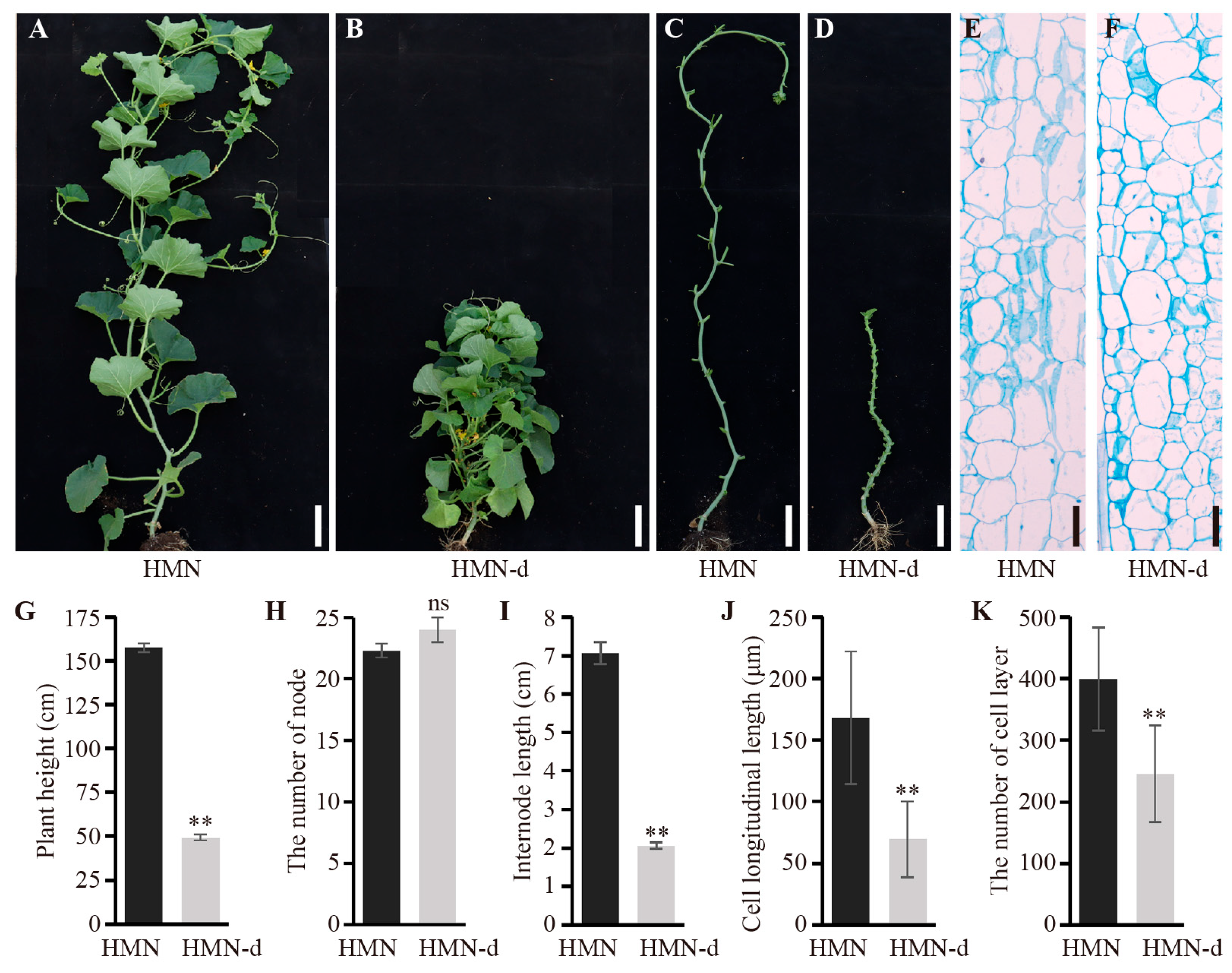
HMN-d is a spontaneous dwarf mutant derived from the melon inbred line HMN (Cucumis melo var. cantalupensis). Compared with HMN, HMN-d exhibited pronounced dwarfism starting from the seedling stage. At 40 days after transplanting of three-week-old seedlings, the height of HMN reached 157.67 ± 2.52 cm (Figure 1A,G), whereas HMN-d was only 49.33 ± 1.53 cm tall (Figure 1B,G), approximately 31.3% of HMN. Node number did not differ significantly between HMN (22.33 ± 0.58) and HMN-d (23.33 ± 1.15) (Figure 1C,D,H). However, the average internode length of HMN-d was significantly reduced to 2.06 ± 0.09 cm, compared with 7.07 ± 0.29 cm in HMN (Figure 1I), indicating that the dwarf phenotype of HMN-d resulted from suppressed internode elongation. Histological analysis of longitudinal stem sections (Figure 1E,F) revealed that the mean longitudinal cell length in HMN-d internodes (69.55 ± 30.95 μm) was significantly shorter than that in HMN (168.23 ± 53.76 μm) (Figure 1J). The estimated number of cell layers per internode, calculated by dividing internode length by mean cell diameter, was also reduced in HMN-d (245.87 ± 78.30) compared with HMN (399.45 ± 83.73) (Figure 1K). This suggests that the shortened internodes in HMN-d may result from a combination of reduced cell elongation and potentially reduced cell number.

3.2. Inheritance Pattern of the Dwarf Trait in HMN-d

To determine the inheritance pattern of the dwarf trait, HMN-d was crossed with normal-height lines HMN and XZM, and F2 and BC1 populations were generated. As shown in Table 1, all F1 plants from both crosses exhibited normal height, indicating that the dwarf trait is recessive. In the two F2 populations, the segregation ratios of normal to dwarf plants approximated 3:1. In two BC1 populations derived from backcrossing F1 with HMN-d, the ratios approximated 1:1. The segregation ratios observed in the F2 and BC1 populations are consistent with Mendelian inheritance of a single recessive nuclear gene underlying the HMN-d dwarf phenotype, thereby excluding cytoplasmic inheritance.

3.3. BSA-Seq and Candidate Gene Analysis

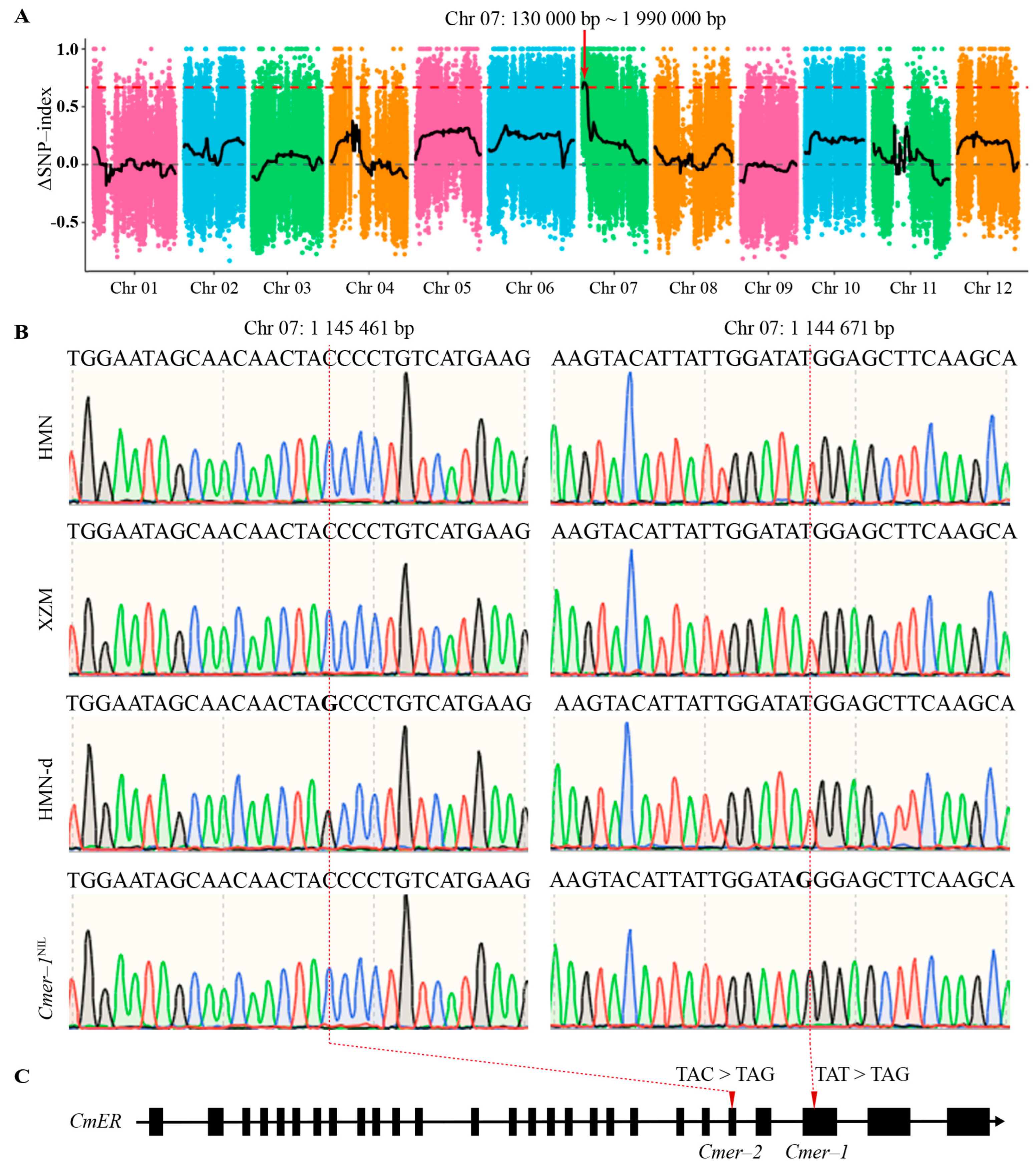
To identify the genetic locus underlying the dwarf phenotype, BSA-seq was performed using the F2 population derived from XZM × HMN-d. Thirty normal and 30 dwarf plants were selected for constructing DNA pools. High-throughput DNA sequencing of the normal and dwarf pools, along with parental lines (XZM, HMN-d, and HMN), was conducted. SNP calling and ΔSNP-index calculations across the genome revealed a single candidate interval exceeding the threshold on chromosome 7, spanning 1.86 Mb (from 130,000 bp to 1,990,000 bp) (Figure 2A). This interval contained 259 predicted genes. Sequence alignment identified 58 genes with non-synonymous or frameshift mutations in HMN-d (Table S2). Notably, CmER, a gene possessing a significant role in controlling internode elongation of melon [31] (Yang et al., 2020), was among these candidates.
As CmER is the only gene within the candidate interval with a validated role in regulating melon plant height, and the remaining 57 genes lack functional annotations associated with plant height or cell proliferation (Table S2), CmER was prioritized for subsequent analysis. Sanger sequencing confirmed the presence of a novel SNP in HMN-d within the 23rd exon of CmER (Chr7: 1,145,461), resulting in a C-to-G substitution that changes a tyrosine codon (TAC) to a stop codon (TAG) (Figure 2B,C). This mutation, designated as Cmer-2, is distinct from the previously reported Cmer-1 allele in Cmer-1NIL (a T-to-G SNP at Chr7: 1,144,671 in the 25th exon, also introducing a premature stop codon) (Figure 2B,C). Given the premature termination caused by Cmer-2 and the known role of CmER in melon height regulation, we hypothesized that Cmer-2 is the causal mutation for dwarfism in HMN-d.

3.4. Co-Segregation of Cmer-2 with the Dwarf Phenotype

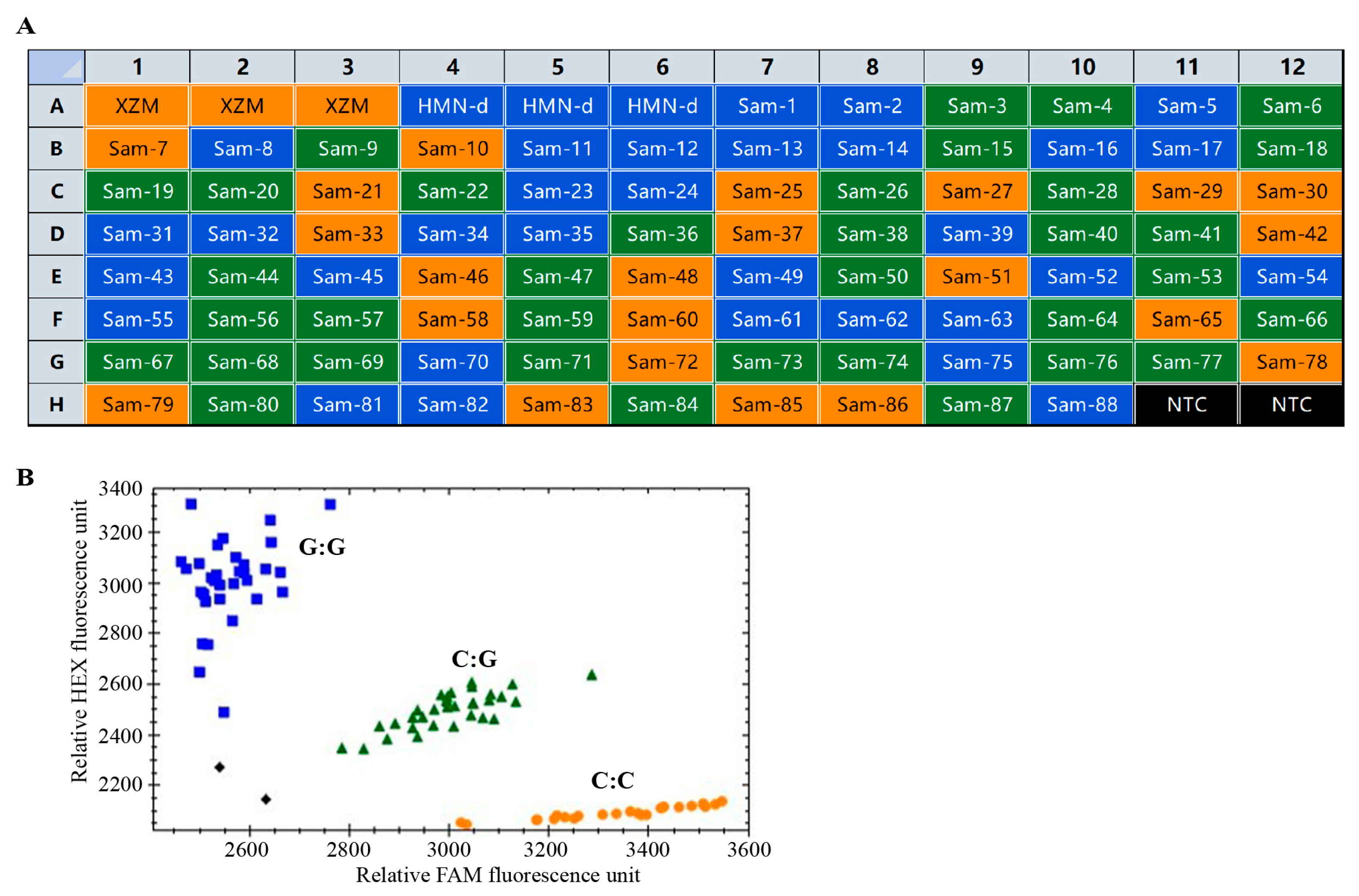
To validate the association between Cmer-2 and the dwarf trait, a KASP marker was developed based on the Cmer-2 SNP and used to genotype 1501 individuals from the F2 (XZM × HMN-d) population. In total, 1455 individuals were successfully genotyped by KASP analysis, while 46 were excluded due to missing or ambiguous data. The genotypes of these individuals were classified as homozygous C/C, homozygous G/G, or heterozygous C/G (Figure 3A,B). Phenotypic analysis revealed that all 380 G/G homozygous plants exhibited a dwarf stature resembling HMN-d, whereas all 371 C/C homozygous and 704 C/G heterozygous plants displayed normal height comparable to XZM (Table 2). These results demonstrate a complete co-segregation of the Cmer-2 mutation with the dwarf phenotype, supporting a causal relationship.

3.5. Allelism Test Between Cmer-2 and Cmer-1

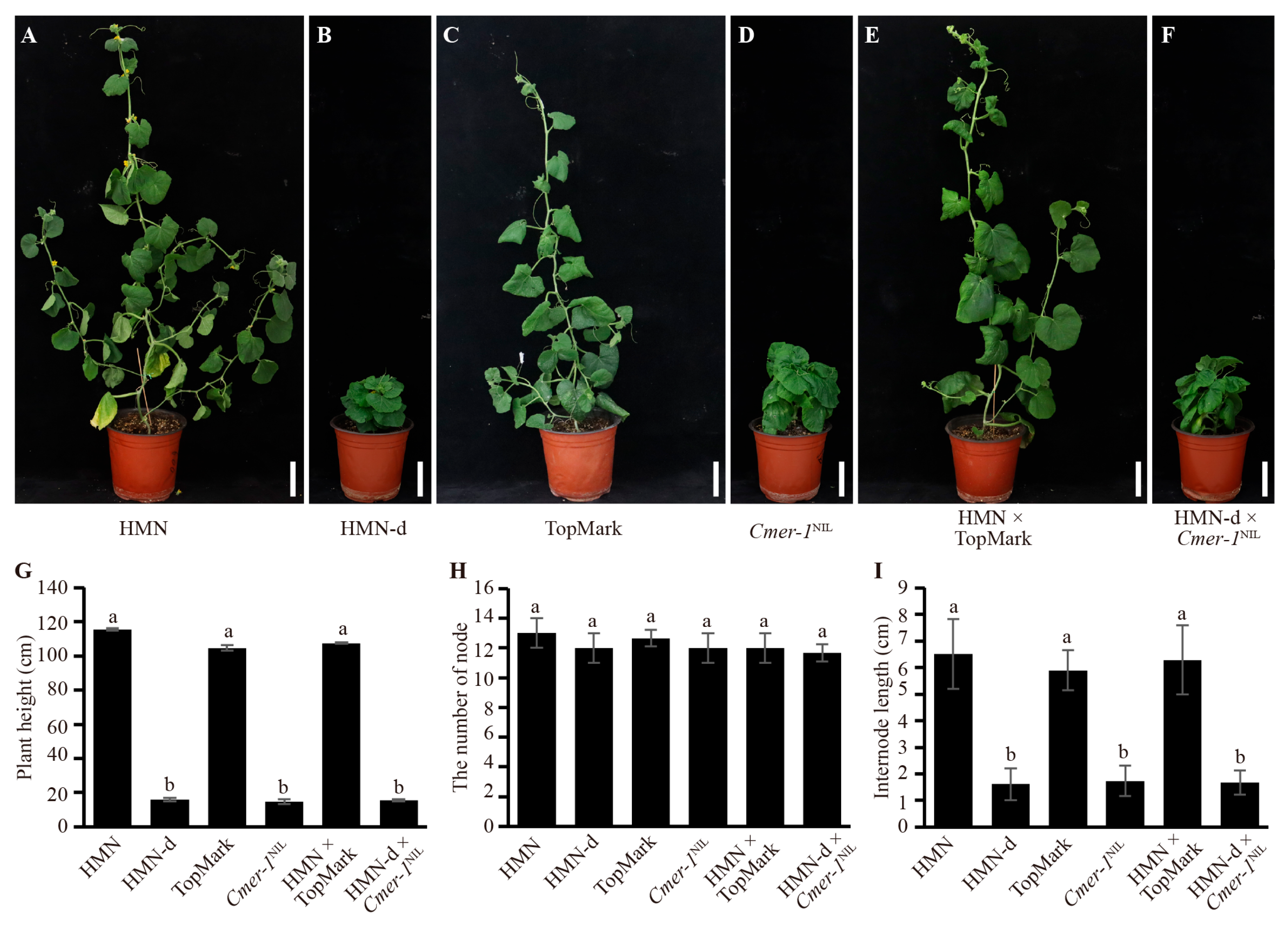
To further confirm that Cmer-2 is responsible for the dwarf phenotype, HMN-d was crossed with dwarf line Cmer-1NIL. Cmer-1NIL was developed by introgressing the Cmer-1 mutation from M406 into TopMark. The resulting F1 hybrids (HMN-d × Cmer-1NIL) exhibited a dwarf phenotype (16.03 ± 0.86 cm), comparable to both parents (HMN-d: 16.23 ± 1.72 cm; Cmer-1NIL: 15.13 ± 1.88 cm) and significantly shorter than the normal-height F1 (HMN × TopMark) (106.80 ± 2.43 cm) (Figure 4). Node number did not differ significantly among different genotypes, while internode length was markedly reduced in F1 (HMN-d × Cmer-1NIL) (1.67 ± 0.45 cm) compared with F1 (HMN × TopMark) (6.28 ± 1.30 cm). These results indicated that Cmer-2 is allelic to Cmer-1 with respect to internode elongation and suggested that Cmer-2 is the causal mutation for dwarfism in HMN-d.

3.6. Knockout of CmER by Gene Editing Technology

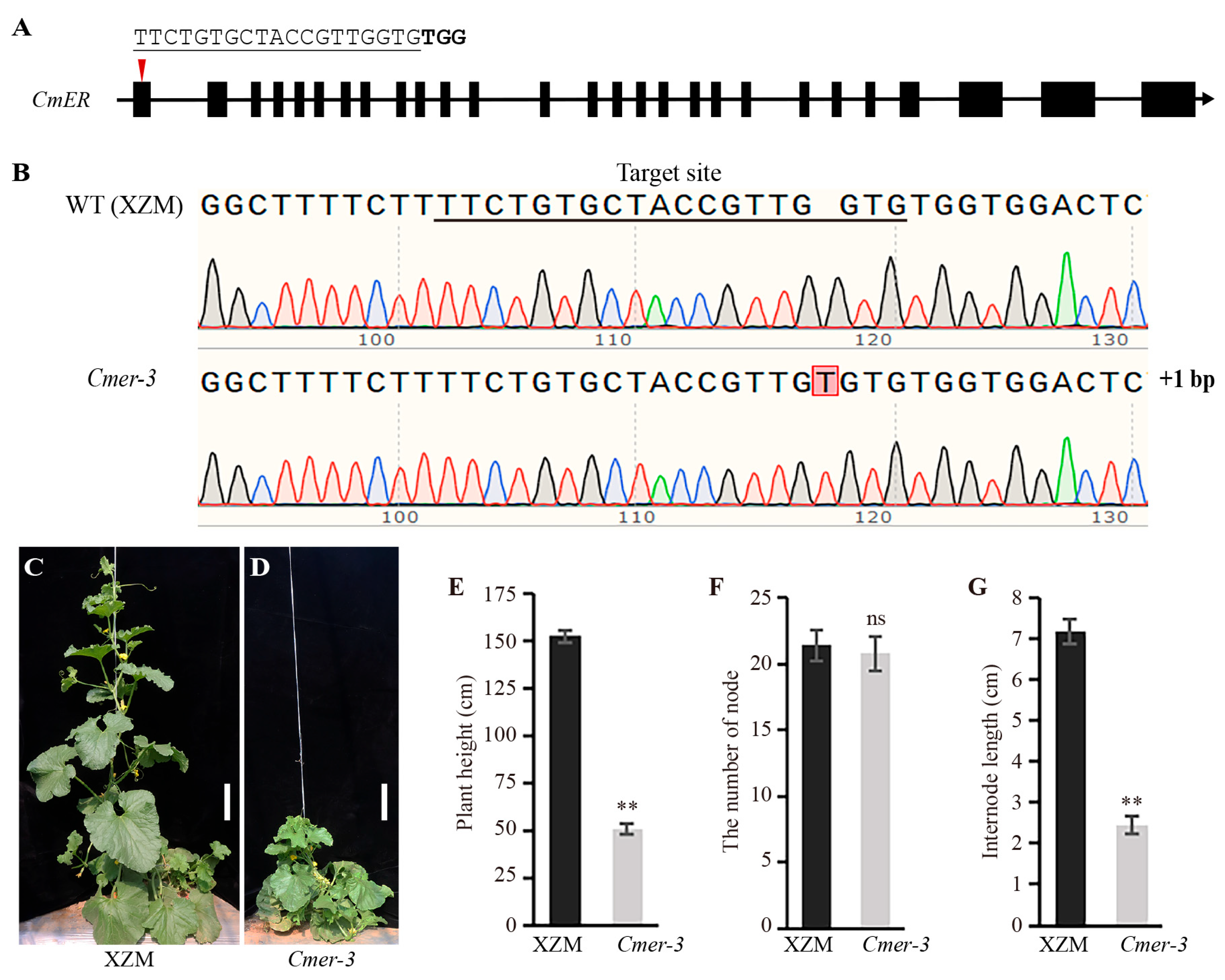
As a powerful tool for targeted gene editing, CRISPR/Cas9 has been successfully applied in melon [1]. To verify the function of CmER in regulating plant height by CRISPR/Cas9-based gene editing, the target site TTCTGTGCTACCGTTGGTG was designed (Figure 5A). The usability of this target site has been verified in previous work [34]. After genetic transformation in the melon inbred line XZM and mutation identification, a homozygous Cmer mutant carrying a 1 bp insertion at the target site was obtained in the T1 generation plant (hereinafter designated as Cmer-3). Similar to HMN-d, Cmer-3 displayed pronounced dwarfism (Figure 5C,D). At 40 days after transplanting in the field, the height of Cmer-3 was only 50.80 ± 2.77 cm, whereas XZM reached 152.80 ± 3.35 cm tall (Figure 5E). Cmer-3 had a comparable number of nodes to XZM (XZM, 21.40 ± 1.14; Cmer-3, 20.80 ± 1.30, Figure 5F). However, the internode length was markedly reduced from 7.15 ± 0.31 cm in XZM to 2.45 ± 0.21 cm in Cmer-3 (Figure 5G). These results strongly supported the notion that loss of CmER function results in dwarfism through the suppression of internode elongation.

3.7. Analysis of CmER Protein Structure and Expression Pattern

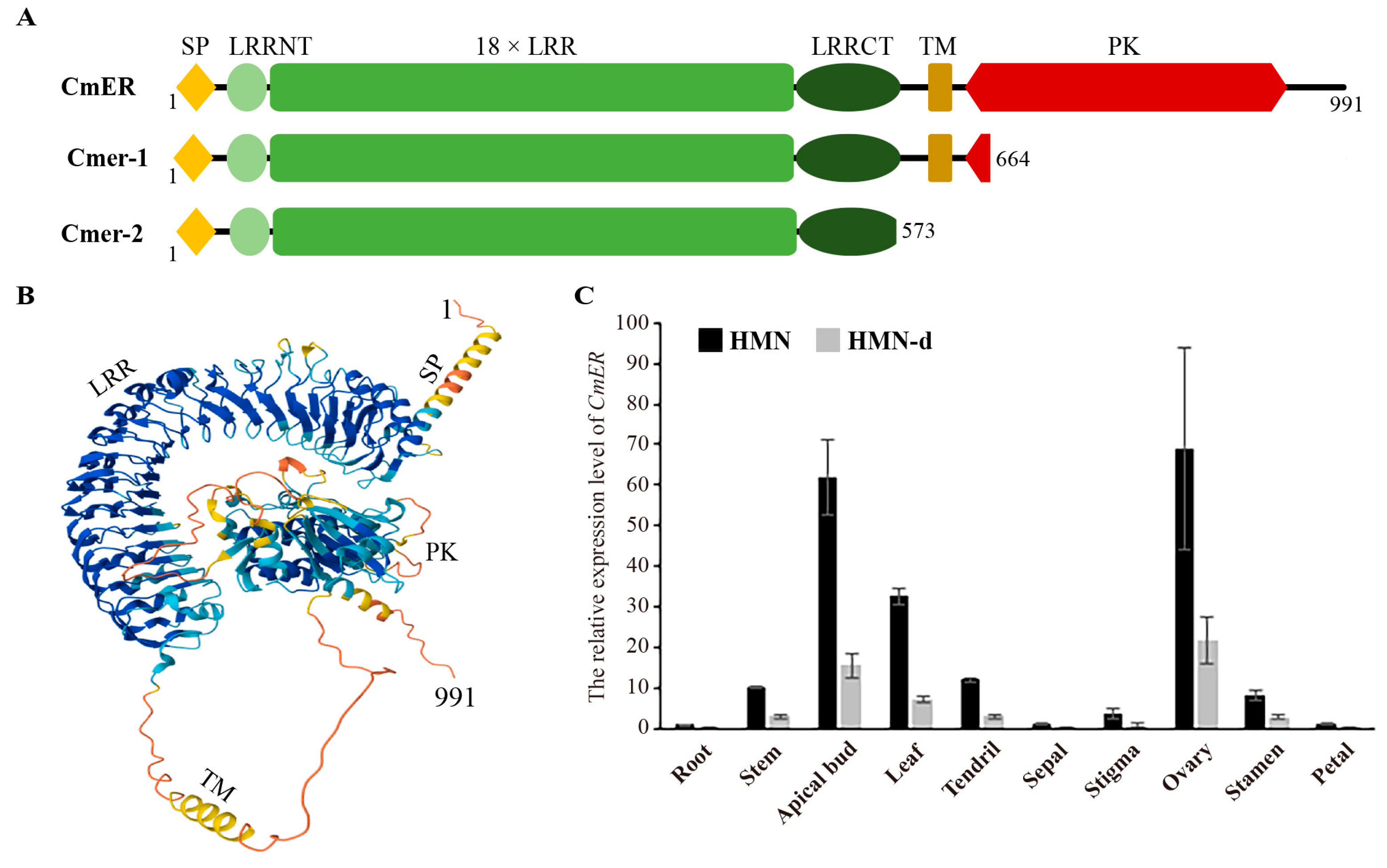
CmER is an LRR receptor-like protein kinase (RLK) comprising 991 amino acids, with an N-terminal extracellular signal peptide and LRR domain, a middle transmembrane domain, and a C-terminal intracellular kinase domain (Figure 6A,B). Cmer-1 is predicted to encode a truncated protein of 664 amino acids (designated as Cmer-1), lacking most of the kinase domain. The Cmer-2 mutation is predicted to result in an even shorter protein of 573 amino acids (designated as Cmer-2), completely lacking both the transmembrane and kinase domains (Figure 6A).
To investigate the expression pattern of CmER in melon, we sampled root, stem, apical bud, leaf, tendril, sepal, stigma, ovary, stamen, and petal from both HMN and HMN-d at the flowering stage, and performed RT-qPCR analyses. The results showed that the highest expression of CmER was detected in the apical bud and ovary, and CmER is hardly expressed in the root, sepal, and petal (Figure 6C). Across all tested organs, the expression level of CmER was lower in HMN-d than in HMN. The aberrant mRNAs with premature termination codons might be degraded by the nonsense mRNA decay (NMD) pathway [36], which likely accounts for the reduced expression of CmER in HMN-d.

3.8. Phylogenetic Analysis of the ER Family Gene in Rosid Plants

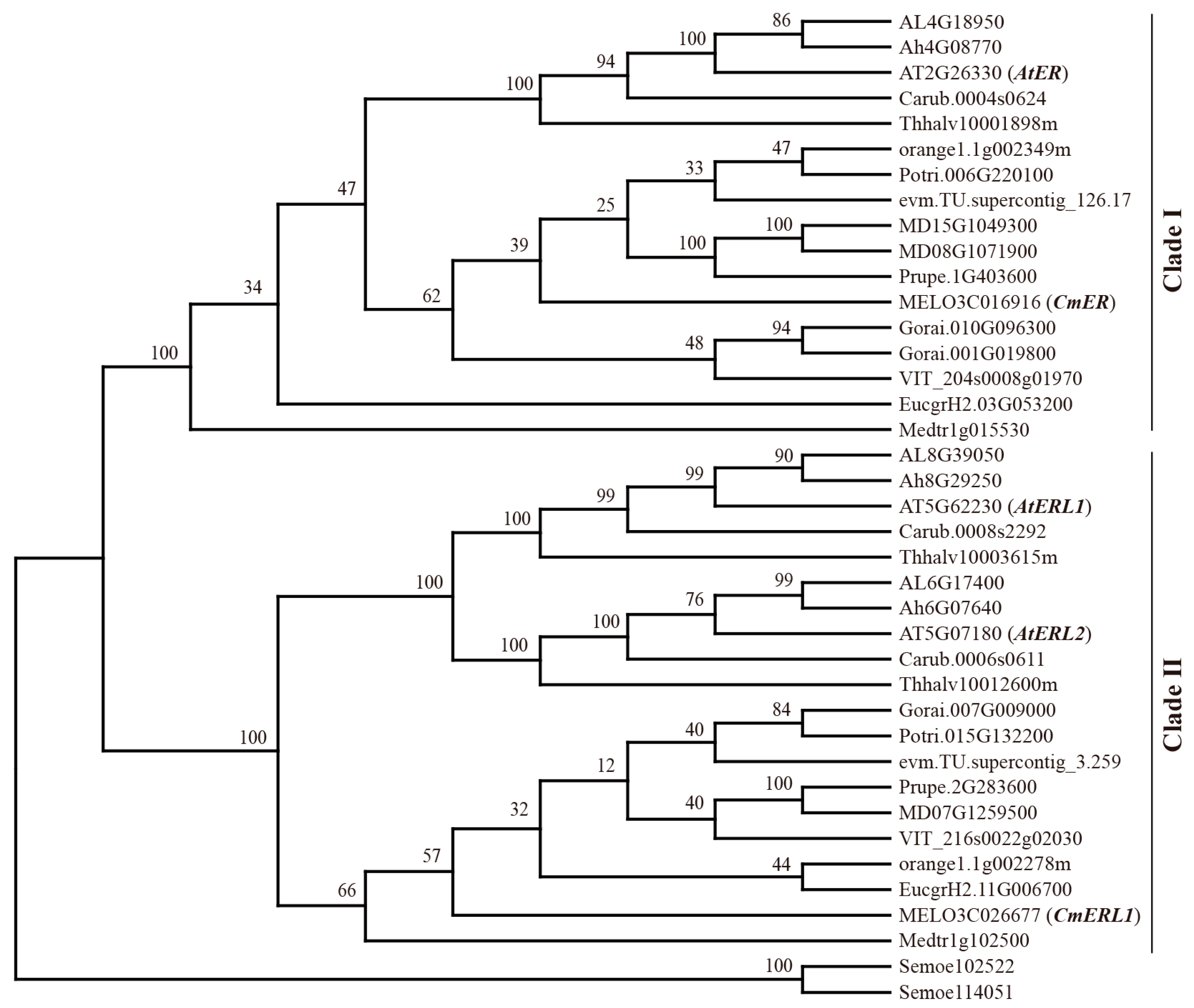
In most plants, the ER gene has one or more paralogous genes known as ERECTA-like (ERL), and together they constitute the ER gene family. To investigate the evolutionary relationships of the ER gene family within rosids, protein sequences of ER homologs were retrieved from representative species, and a neighbor-joining (NJ) phylogenetic tree was constructed using lycophyte Selaginella moellendorffii as the outgroup. The resulting phylogenetic tree revealed two major clades, corresponding to the orthologs of ER and ERL, respectively (Figure 7). In Clade I, most rosids possess a single ER ortholog, with the exception of Gossypium raimondii and Malus domestica. Within Clade II, all Brassicaceae species examined—including Arabidopsis lyrata, Arabidopsis halleri, Arabidopsis thaliana, Capsella rubella, and Eutrema salsugineum—possess two ERL copies, whereas only one ERL ortholog was identified in other rosids. Most notably, the Brassicaceae have two ERLs, ERL1 and ERL2, clustered into two distinct subclades, suggesting that they likely originated from a Brassicaceae-specific duplication event. These results provide preliminary insights into the copy number variation in ER family genes across rosids.

4. Discussion

Melon is a globally cultivated cash crop. The short-internode trait represents an important target for genetic improvement, as it simplifies plant architecture management and enables higher planting density in protected cultivation. In this study, we identified an independent spontaneous loss-of-function allele of CmER in cantalupensis germplasm and developed a KASP marker for marker-assisted selection. The dwarf mutation Cmer-2 is allelic to Cmer-1, which was previously identified in the casaba melon accession M406 [31]. This indicated that distinct mutations in the same gene can produce similar dwarf phenotypes in different melon varieties. Such genetic convergence has also been observed in other traits. For example, the five-carpel trait in ssp. melo and ssp. agrestis results from different variations in the same gene, CmCLV3 [37,38].
In this study, several lines of evidence were provided to establish that the Cmer-2 mutation is responsible for the dwarf phenotype of HMN-d. (1) CmER is the only gene within the candidate interval that has a validated role in controlling melon plant height. The C-to-G substitution of Cmer-2 introduces a premature stop codon, predicted to produce a shorter truncated protein than that of Cmer-1; (2) Segregation analysis of 1455 individuals from an F2 segregating population showed that the Cmer-2 variant co-segregated entirely with the dwarf phenotype; (3) Heterozygotes combining Cmer-1 and Cmer-2 exhibited a dwarf phenotype comparable to that of homozygous Cmer-1 mutants, demonstrating that Cmer-2 is a dwarfing allele functionally analogous to Cmer-1. (4) The CmER-knockout lines displayed a dwarf phenotype similar to that of HMN-d, directly confirming that loss of CmER function is sufficient to cause dwarfism.
The ER protein is a receptor-like kinase (RLK). The extracellular leucine-rich repeat (LRR) domain is responsible for recognizing peptide ligands. The transmembrane (TM) domain is essential for anchoring ER to the plasma membrane, enabling proper spatial orientation for ligand perception and signal transduction. The intracellular protein kinase (PK) domain transduces extracellular signals into intracellular phosphorylation cascades. The Cmer-2 mutation is predicted to produce a truncated protein that completely lacks both the TM and PK domains. Without the TM domain, the truncated protein would fail to localize to the plasma membrane and would likely be secreted into the apoplast or degraded. The absence of the PK domain renders the protein incapable of kinase activity, thereby abolishing downstream signaling. Collectively, the loss of both domains is expected to result in a complete loss of function for CmER.
ER orthologs are conserved across plants, and their role in height regulation has been documented in multiple species, including Arabidopsis [39], rice [40], maize [41], rapeseed [42], tomato [43], cucumber [44], and melon [31]. However, the downstream signaling pathways through which ER regulates plant architecture remain largely unknown. In Arabidopsis, ER modulates inflorescence length via a mitogen-activated protein kinase (MAPK) cascade [45,46,47], though downstream MAPK targets are still unclear. In tomato, SlER promotes height by regulating GA synthesis [43], and Sun et al. proposed that cucumber CsER acts similarly [48]. In contrast, Xu et al. suggested that CsER regulates cucumber height through auxin signaling [49]. Yang et al. reported that melon CmER promotes internode elongation via auxin and physically interacts with the auxin transporter CmPIN2 [31]. Meanwhile, Chen et al. found that cucumber Cser mutants are insensitive to multiple hormones but show enhanced sensitivity to high-concentration BR [44], suggesting a disruption of BR signaling in Cser. Several studies in Arabidopsis have also revealed crosstalk between the ER and BR pathways. BR co-receptors SERKs interact with ER to regulate integument and stomatal development [50,51], and ER indirectly activates the expression of BR transcription factor BZR1 [52]. Additionally, Arabidopsis BRI1 inhibitor BKI1 interacts with the ER to suppress its kinase activity and modulate architecture [53].
While this study establishes that loss-of-function of CmER is sufficient to cause dwarfism in melon, the downstream molecular mechanisms remain to be elucidated. Studies in Arabidopsis and other species have provided valuable insights and an important reference for dissecting how CmER regulates plant height in melon. To clarify the regulatory relationship between CmER and different hormones in melon, future studies should investigate direct hormone quantification, expression profiling of hormone-related genes, physiological response assays, and biochemical validation of protein–protein interactions between CmER and hormone signaling components. From a breeding perspective, comprehensive agronomic evaluation of the Cmer-2 allele across diverse genetic backgrounds is essential to assess its effects on major agronomic traits and to fully exploit its potential for melon plant architecture improvement.

5. Conclusions

In conclusion, we isolated a dwarf melon mutant, HMN-d, identified Cmer-2 as the causal mutation through segregation analysis, allelic testing, and gene editing, and developed a KASP marker based on this allele. This newly characterized loss-of-function allele of CmER provides a valuable genetic resource for breeding dwarf melon and dissecting the mechanisms of height regulation.

Supplementary Materials

The following supporting information can be downloaded at: https://www.mdpi.com/article/10.3390/horticulturae12060652/s1, Table S1: List of primers used in this study; Table S2: Candidate genes containing non-synonymous or frame-shift mutations.

Author Contributions

Conceptualization, P.W., L.Y., J.H. (Jianbin Hu), and X.L.; methodology, R.Z., J.W., J.H. (Juan Hou), Q.L., W.M., L.L. and C.L.; validation, C.C., Y.L. and D.L.; formal analysis, R.Z.; investigation, R.Z., J.W., Y.W., Y.Z., C.C., Y.L. and D.L.; resources, L.Y., J.H. (Jianbin Hu), and X.L.; data curation, R.Z., P.W. and X.L.; writing—original draft preparation, R.Z. and X.L.; writing—review and editing, J.H. (Jianbin Hu) and X.L.; visualization, R.Z. and X.L.; supervision, J.H. (Jianbin Hu) and X.L.; project administration, J.H. (Jianbin Hu) and X.L.; funding acquisition, P.W., J.H. (Jianbin Hu), and X.L. All authors have read and agreed to the published version of the manuscript.

Funding

This research was funded by the National Natural Science Foundation of China (Grant No.32573009), the Key Research and Promotion Projects from Henan Province (Grant No.242102111136), and the Scientific and Technological Innovation Team in Colleges and Universities in Henan (Grant No.26IRTSTHN014).

Data Availability Statement

The original contributions presented in this study are included in the article/Supplementary Material. Further inquiries can be directed to the corresponding author.

Conflicts of Interest

Authors Chenchen Cao and Di Liang were employed by the company Luoyang Nongfa Agricultural Technology Limited Company, Luoyang 471123, China. The remaining authors declare that the research was conducted in the absence of any commercial or financial relationships that could be construed as a potential conflict of interest.

Abbreviations

The following abbreviations are used in this manuscript:
ERERECTA
GAGibberellin
BRBrassinosteroid
ERLERECTA like
SDStandard deviation
MAPKMitogen-activated protein kinase
NJNeighbor-joining
KASPKompetitive Allele-Specific PCR
RLKLRR receptor-like protein kinase
LRRLeucine-rich repeats
TMTransmembrane
SPSignal peptide
PKProtein kinase
BLASTBasic Local Alignment Search Tool
BSABulked segregant analysis

References

  1. Li, X.; Cao, C.; Liu, Y.; Bolaños-Villegas, P.; Wang, J.; Zhou, R.; Hou, J.; Li, Q.; Mao, W.; Wang, P.; et al. Enhancing genetic transformation efficiency of melon (Cucumis melo L.) through an extended sucrose-removal co-culture. Plant Cell Rep. 2025, 44, 123. [Google Scholar] [CrossRef]
  2. Liu, X.; Chen, J.; Zhang, X. Genetic regulation of shoot architecture in cucumber. Hortic. Res. 2021, 8, 143. [Google Scholar] [CrossRef]
  3. Bai, R.; Yang, B.; Peng, K.; Xiang, A.; Wan, Z.; Li, M.; Zheng, X.; Zhao, J.; Zhao, Y.; Zheng, J.; et al. Identification of a novel dwarfing gene, Rht_m097, on chromosome 4BS in common wheat. Mol. Breed. 2025, 45, 38. [Google Scholar] [CrossRef] [PubMed]
  4. Shaheen, A.; Li, Z.; Yang, Y.; Xie, J.; Zhu, L.; Li, C.; Nie, F.; Wang, M.; Wang, Y.; Rasheed, A.; et al. Genetic regulation of wheat plant architecture and future prospects for its improvement. New Crops 2025, 2, 100048. [Google Scholar] [CrossRef]
  5. Wei, C.; Zhu, C.; Yang, L.; Zhao, W.; Ma, R.; Li, H.; Zhang, Y.; Ma, J.; Yang, J.; Zhang, X. A point mutation resulting in a 13 bp deletion in the coding sequence of Cldf leads to a GA-deficient dwarf phenotype in watermelon. Hortic. Res. 2019, 6, 132. [Google Scholar] [CrossRef]
  6. Sun, Y.; Zhang, H.; Fan, M.; He, Y.; Guo, P. A mutation in the intron splice acceptor site of a GA3ox gene confers dwarf architecture in watermelon (Citrullus lanatus L.). Sci. Rep. 2020, 10, 14915. [Google Scholar] [CrossRef] [PubMed]
  7. Zhang, T.; Liu, J.; Amanullah, S.; Ding, Z.; Cui, H.; Luan, F.; Gao, P. Fine Mapping of Cla015407 Controlling Plant Height in Watermelon. J. Am. Soc. Hortic. Sci. 2021, 146, 196–205. [Google Scholar] [CrossRef]
  8. Zhao, G.; Luo, C.; Luo, J.; Li, J.; Gong, H.; Zheng, X.; Liu, X.; Guo, J.; Zhou, L.; Wu, H. A mutation in LacDWARF1 results in a GA-deficient dwarf phenotype in sponge gourd (Luffa acutangula). Theor. Appl. Genet. 2021, 134, 3443–3457. [Google Scholar] [CrossRef]
  9. Min, Z.; Hu, X.; Han, X.; Li, Y.; Li, J.; Wang, D.; Sun, L.; Sun, X. Genetic Mapping and Identification of the Gibberellin 3-Oxidase Gene GA3ox Leading to a GA-Deficient Dwarf Phenotype in Pumpkin (Cucurbita moschata D.). Agronomy 2022, 12, 1779. [Google Scholar] [CrossRef]
  10. Anarjan, M.B.; Begum, S.; Bae, I.; Lee, S. Mutation in the GA3ox gene governs short-internode characteristic in a korean cucumber inbred line. Hortic. Environ. Biotechnol. 2023, 64, 485–495. [Google Scholar] [CrossRef]
  11. Dong, W.; Wu, D.; Wang, C.; Liu, Y.; Wu, D. Characterization of the molecular mechanism underlying the dwarfism of dsh mutant watermelon plants. Plant Sci. 2021, 313, 111074. [Google Scholar] [CrossRef]
  12. Zhang, M.; Song, M.; Cheng, F.; Han, X.; Cheng, C.; Yu, X.; Chen, J.; Lou, Q. The mutation of ent-kaurenoic acid oxidase, a key enzyme involved in gibberellin biosynthesis, confers a dwarf phenotype to cucumber. Theor. Appl. Genet. 2024, 138, 12. [Google Scholar] [CrossRef]
  13. Ding, W.; Wang, Y.; Qi, C.; Luo, Y.; Wang, C.; Xu, W.; Qu, S. Fine mapping identified the gibberellin 2-oxidase gene CpDw leading to a dwarf phenotype in squash (Cucurbita pepo L.). Plant Sci. 2021, 306, 110857. [Google Scholar] [CrossRef]
  14. Liu, J.; Gao, P.; Wang, X.; Liu, H.; Ma, S.; Wang, J.; Luan, F. Genetic analysis and mapping of a short-internode gene (cladw) in watermelon (Citrullus lanatus L.). Euphytica 2022, 218, 119. [Google Scholar] [CrossRef]
  15. Wang, H.; Li, W.; Qin, Y.; Pan, Y.; Wang, X.; Weng, Y.; Chen, P.; Li, Y. The Cytochrome P450 Gene CsCYP85A1 Is a Putative Candidate for Super Compact-1 (Scp-1) Plant Architecture Mutation in Cucumber (Cucumis sativus L.). Front. Plant Sci. 2017, 8, 266. [Google Scholar] [CrossRef] [PubMed]
  16. Hou, S.; Niu, H.; Tao, Q.; Wang, S.; Gong, Z.; Li, S.; Weng, Y.; Li, Z. A mutant in the CsDET2 gene leads to a systemic brassinosteriod deficiency and super compact phenotype in cucumber (Cucumis sativus L.). Theor. Appl. Genet. 2017, 130, 1693–1703. [Google Scholar] [CrossRef] [PubMed]
  17. Zhang, M.; Song, M.; Cheng, F.; Yang, Z.; Davoudi, M.; Chen, J.; Lou, Q. Identification of a putative candidate gene encoding 7-dehydrocholesterol reductase involved in brassinosteroids biosynthesis for compact plant architecture in Cucumber (Cucumis sativus L.). Theor. Appl. Genet. 2021, 134, 2023–2034. [Google Scholar] [CrossRef]
  18. Zhang, H.; Liu, Z.; Wang, Y.; Mu, S.; Yue, H.; Luo, Y.; Zhang, Z.; Li, Y.; Chen, P. A mutation in CsDWF7 gene encoding a delta7 sterol C-5(6) desaturase leads to the phenotype of super compact in cucumber (Cucumis sativus L.). Theor. Appl. Genet. 2024, 137, 20. [Google Scholar] [CrossRef]
  19. Sun, P.; Zhao, H.; Cao, L.; Zhang, T.; Zhang, H.; Yang, T.; Zhao, B.; Jiang, Y.; Dong, J.; Chen, T.; et al. A DUF21 domain-containing protein regulates plant dwarfing in watermelon. Plant Physiol. 2024, 196, 3091–3104. [Google Scholar] [CrossRef]
  20. Zhu, H.; Zhang, M.; Sun, S.; Yang, S.; Li, J.; Li, H.; Yang, H.; Zhang, K.; Hu, J.; Liu, D.; et al. A Single Nucleotide Deletion in an ABC Transporter Gene Leads to a Dwarf Phenotype in Watermelon. Front. Plant Sci. 2019, 10, 1399. [Google Scholar] [CrossRef] [PubMed]
  21. Cheng, F.; Song, M.; Zhang, M.; Zha, G.; Yin, J.; Cheng, C.; Chen, J.; Lou, Q. A mutation in CsABCB19 encoding an ATP-binding cassette auxin transporter leads to erect and compact leaf architecture in cucumber (Cucumis sativus L.). Plant Sci. 2023, 329, 111625. [Google Scholar] [CrossRef]
  22. Zhou, Q.; Fu, Z.; Li, M.; Shen, Q.; Sun, C.; Feng, Y.; Liu, Y.; Jiang, J.; Qin, T.; Mao, T.; et al. Maize tubulin folding cofactor B is required for cell division and cell growth through modulating microtubule homeostasis. New Phytol. 2023, 239, 1707–1722. [Google Scholar] [CrossRef] [PubMed]
  23. Bao, J.; Shi, J.; Qin, Y.; Hua, S.; Wu, Y.; Yang, C.; Gu, Y.; Dong, W. The knockout of ClaCSLH1 induced dwarfing in watermelon. Theor. Appl. Genet. 2025, 138, 120. [Google Scholar] [CrossRef]
  24. Li, S.; Zhang, Q.; Zhang, H.; Wang, J.; Sun, J.; Yang, X.; Huang, S.; Zhang, Z. Deletion of a cyclin-dependent protein kinase inhibitor, CsSMR1, leads to dwarf and determinate growth in cucumber (Cucumis sativus L.). Theor. Appl. Genet. 2022, 135, 915–927. [Google Scholar] [CrossRef]
  25. Han, Z.; Zheng, W.; Li, Y.; Ou, Q.; Zhao, H.; Zhao, H.; Xu, J.; Chai, S.; Yang, X.; Zhang, Z.; et al. Genetic and histological characterization of a dwarf mutant in melon (Cucumis melo L.) reveals potential for breeding semi-dwarf cultivars. Theor. Appl. Genet. 2025, 138, 250. [Google Scholar] [CrossRef] [PubMed]
  26. Wang, J.; Zhu, Y.; Li, M.; Zhang, H.; Zhang, X.; Tian, S.; Ren, Y.; Yu, Y.; Liao, S.; Gong, G.; et al. The NAC transcription factor ClNAC100 positively regulates plant height and fruit size in watermelon. Plant J. 2025, 123, e70292. [Google Scholar] [CrossRef]
  27. Wang, S.; Wang, K.; Li, Z.; Li, Y.; He, J.; Li, H.; Wang, B.; Xin, T.; Tian, H.; Tian, J.; et al. Architecture design of cucurbit crops for enhanced productivity by a natural allele. Nat. Plants 2022, 8, 1394–1407. [Google Scholar] [CrossRef]
  28. Zhao, W.; Wang, J.; Yang, H.; Hou, X.; Zhang, Z.; Chen, J.; Wang, H.; Yan, C. Large-scale analysis of MYB genes in Cucurbitaceae identifies a novel gene regulating plant height. Hortic. Res. 2025, 12, uhaf210. [Google Scholar] [CrossRef]
  29. Yuan, G.; Li, C.; Han, W.; Zhang, H.; Qiu, Y.; Zhang, H.; Cui, H.; Ma, J. Overexpression of the CmOVATE gene modifies the plant architecture of melon. Plant Cell Rep. 2025, 44, 252. [Google Scholar] [CrossRef]
  30. Xin, T.; Tian, H.; Ma, Y.; Wang, S.; Yang, L.; Li, X.; Zhang, M.; Chen, C.; Wang, H.; Li, H.; et al. Targeted creating new mutants with compact plant architecture using CRISPR/Cas9 genome editing by an optimized genetic transformation procedure in cucurbit plants. Hortic. Res. 2022, 9, uhab086. [Google Scholar] [CrossRef] [PubMed]
  31. Yang, S.; Zhang, K.; Zhu, H.; Zhang, X.; Yan, W.; Xu, N.; Liu, D.; Hu, J.; Wu, Y.; Weng, Y.; et al. Melon short internode (CmSi) encodes an ERECTA-like receptor kinase regulating stem elongation through auxin signaling. Hortic. Res. 2020, 7, 202. [Google Scholar] [CrossRef]
  32. Lin, T.; Wang, S.; Zhong, Y.; Gao, D.; Cui, Q.; Chen, H.; Zhang, Z.; Shen, H.; Weng, Y.; Huang, S. A Truncated F-Box Protein Confers the Dwarfism in Cucumber. J. Genet. Genom. 2016, 43, 223–226. [Google Scholar] [CrossRef] [PubMed]
  33. Knavel, D.E. Inheritance of a Short-internode Mutant of `Mainstream’ Muskmelon. HortScience 1990, 25, 1274–1275. [Google Scholar] [CrossRef]
  34. Pan, W.; Cheng, Z.; Han, Z.; Yang, H.; Zhang, W.; Zhang, H. Efficient genetic transformation and CRISPR/Cas9-mediated genome editing of watermelon assisted by genes encoding developmental regulators. J. Zhejiang Univ.-Sci. B 2022, 23, 339–344. [Google Scholar] [CrossRef] [PubMed]
  35. Li, X.; Cao, C.; Bolaños-Villegas, P.; Liu, Y.; Wang, J.; Li, Q.; Mao, W.; Wang, P.; Hou, J.; Li, L.; et al. Validation of CRISPR construct activity and gene function in melon via a hairy root transformation system. Physiol. Mol. Biol. Plants 2025, 31, 753–766. [Google Scholar] [CrossRef]
  36. Conti, E.; Izaurralde, E. Nonsense-mediated mRNA decay: Molecular insights and mechanistic variations across species. Curr. Opin. Cell Biol. 2005, 17, 316–325. [Google Scholar] [CrossRef]
  37. Wang, L.; Wang, Y.; Luan, F.; Zhang, X.; Zhao, J.; Yang, Z.; Liu, S. Biparental genetic mapping reveals that CmCLAVATA3 (CmCLV3) is responsible for the variation in carpel number in melon (Cucumis melo L.). Theor. Appl. Genet. 2022, 135, 1909–1921. [Google Scholar] [CrossRef]
  38. Wu, H.; Jia, Y.; Chen, X.; Jiang, N.; Zhang, Z.; Chai, S. Novel Allelic Gene Variations in CmCLAVATA3 (CmCLV3) Were Identified in a Genetic Population of Melon (Cucumis melo L.). Int. J. Mol. Sci. 2024, 25, 6011. [Google Scholar] [CrossRef]
  39. Torii, K.U.; Mitsukawa, N.; Oosumi, T.; Matsuura, Y.; Yokoyama, R.; Whittier, R.F.; Komeda, Y. The Arabidopsis ERECTA gene encodes a putative receptor protein kinase with extracellular leucine-rich repeats. Plant Cell 1996, 8, 735–746. [Google Scholar]
  40. Zhang, Y.; Li, S.; Xue, S.; Yang, S.; Huang, J.; Wang, L. Phylogenetic and CRISPR/Cas9 Studies in Deciphering the Evolutionary Trajectory and Phenotypic Impacts of Rice ERECTA Genes. Front. Plant Sci. 2018, 9, 473. [Google Scholar] [CrossRef]
  41. Duan, H.; Li, J.; Xue, Z.; Yang, L.; Sun, Y.; Ju, X.; Zhang, J.; Xu, G.; Xiong, X.; Sun, L.; et al. Genetic dissection of internode length confers improvement for ideal plant architecture in maize. Plant J. 2025, 121, e17245. [Google Scholar] [CrossRef]
  42. Zhang, H.; Wang, T.; Gu, J.; Hong, D. Mutation of ERECTA homologous genes confers ideal plant architecture in Brassica napus. Abiotech 2025, 6, 249–262. [Google Scholar] [CrossRef] [PubMed]
  43. Zhao, X.; Zhang, K.; Zhang, H.; Bi, M.; He, Y.; Cui, Y.; Tan, C.; Ma, J.; Qi, M. Tomato short internodes and pedicels encode an LRR receptor-like serine/threonine-protein kinase ERECTA regulating stem elongation through modulating gibberellin metabolism. Front. Plant Sci. 2023, 14, 1283489. [Google Scholar] [CrossRef] [PubMed]
  44. Chen, F.; Yong, J.; Zhang, G.; Liu, M.; Wang, Q.; Zhong, H.; Pan, Y.; Chen, P.; Weng, Y.; Li, Y. An LTR retrotransposon insertion inside CsERECTA for an LRR receptor-like serine/threonine-protein kinase results in compact (cp) plant architecture in cucumber. Theor. Appl. Genet. 2023, 136, 31. [Google Scholar] [CrossRef]
  45. Meng, X.; Wang, H.; He, Y.; Liu, Y.; Walker, J.C.; Torii, K.U.; Zhang, S. A MAPK cascade downstream of ERECTA receptor-like protein kinase regulates Arabidopsis inflorescence architecture by promoting localized cell proliferation. Plant Cell 2012, 24, 4948–4960. [Google Scholar] [CrossRef]
  46. Lin, J.; Zhao, J.; Du, L.; Wang, P.; Sun, B.; Zhang, C.; Shi, Y.; Li, H.; Sun, H. Activation of MAPK-mediated immunity by phosphatidic acid in response to positive-strand RNA viruses. Plant Commun. 2024, 5, 100659. [Google Scholar] [CrossRef]
  47. Li, W.; Li, Y.; Shi, H.; Wang, H.; Ji, K.; Zhang, L.; Wang, Y.; Dong, Y.; Li, Y. ZmMPK6, a mitogen-activated protein kinase, regulates maize kernel weight. J. Exp. Bot. 2024, 75, 3287–3299. [Google Scholar] [CrossRef]
  48. Sun, Y.; Zhou, K.; Wang, X.; Li, X.; Zhang, X.; Han, N.; Zhang, J.; Chen, S. Identification and characterization of CsERECTA, a major gene controlling stem elongation through regulating GA biosynthesis in cucumber. Theor. Appl. Genet. 2024, 137, 151. [Google Scholar] [CrossRef]
  49. Xu, X.; Hu, Q.; Wang, J.; Wang, X.; Lou, L.; Xu, J.; Yang, X.; Chen, X. A 2-bp deletion in the protein kinase domain region of the ERECTA-like receptor kinase gene in cucumber results in short internode phenotype. Plant Sci. 2023, 327, 111536. [Google Scholar] [CrossRef] [PubMed]
  50. Meng, X.; Chen, X.; Mang, H.; Liu, C.; Yu, X.; Gao, X.; Torii, K.U.; He, P.; Shan, L. Differential Function of Arabidopsis SERK Family Receptor-like Kinases in Stomatal Patterning. Curr. Biol. 2015, 25, 2361–2372. [Google Scholar] [CrossRef]
  51. Li, M.; Lv, M.; Wang, X.; Cai, Z.; Yao, H.; Zhang, D.; Li, H.; Zhu, M.; Du, W.; Wang, R.; et al. The EPFL-ERf-SERK signaling controls integument development in Arabidopsis. New Phytol. 2023, 238, 186–201. [Google Scholar] [CrossRef]
  52. Cai, H.; Huang, Y.; Liu, L.; Zhang, M.; Chai, M.; Xi, X.; Aslam, M.; Wang, L.; Ma, S.; Su, H.; et al. Signaling by the EPFL-ERECTA family coordinates female germline specification through the BZR1 family in Arabidopsis. Plant Cell 2023, 35, 1455–1473. [Google Scholar] [CrossRef]
  53. Wang, D.; Yang, C.; Wang, H.; Wu, Z.; Jiang, J.; Liu, J.; He, Z.; Chang, F.; Ma, H.; Wang, X. BKI1 Regulates Plant Architecture through Coordinated Inhibition of the Brassinosteroid and ERECTA Signaling Pathways in Arabidopsis. Mol. Plant 2017, 10, 297–308. [Google Scholar] [CrossRef]
Figure 1. Plant height and cell morphology analysis in HMN and HMN-d. (A,B) Morphology of HMN and HMN-d grown in a greenhouse for 40 days. (C,D) Main vine morphology. (E,F) Longitudinal internode sections of the 3rd internode at the five-true-leaf stage. (G) Plant height comparison, n = 5 for both HMN and HMN-d. (H) Node number comparison, n = 5 for both HMN and HMN-d. (I) Internode length comparison, n = 25 for both HMN and HMN-d. (J) Longitudinal cell length comparison, n = 90 for both HMN and HMN-d. (K) Estimated cell layer number per internode, n = 25 for both HMN and HMN-d. Error bars presented the SD. ns: not significant; **: p < 0.01, two-tailed unpaired Student’s t-tests. Scale bars = 10 cm (AD), 200 μm (E,F).
Horticulturae 12 00652 g001
Figure 2. Candidate interval mapping and CmER sequence analysis. (A) ΔSNP-index plot from BSA-seq of the F2 population (HMN-d × XZM). Each dot represents an SNP; the black line is the fitted curve, the red dashed line indicates the threshold, and the arrow marks the candidate interval. The threshold was calculated as the mean ΔSNP-index plus 3-time SD. (B) Sanger sequencing chromatograms of Cmer-1 and Cmer-2 sites in HMN, XZM, HMN-d, and Cmer-1NIL. (C) Schematic representation of the Cmer-1 and Cmer-2 mutations.
Horticulturae 12 00652 g002
Figure 3. KASP genotyping of the F2 population. (A) Genotyping results in a 96-well plate. NTC: negative control. (B) Scatter plot of FAM vs. HEX fluorescence. Blue: homozygous G/G; green: heterozygous C/G; orange: homozygous C/C; black: negative controls.
Horticulturae 12 00652 g003
Figure 4. Allelism test between Cmer-2 and Cmer-1. (AF) Representative plant height phenotypes of parental lines (HMN, HMN-d, TopMark, and Cmer-1NIL) and F1 hybrids (HMN × TopMark and HMN-d × Cmer-1NIL) at 30 days after planting in a growth chamber. (GI) Quantification of plant height (n = 3 for all genotypes), node number (n = 3 for all genotypes), and internode length (n = 15 for all genotypes). Error bars presented the SD. Significant differences (p < 0.05, one-way ANOVA with Tukey’s HSD test) are indicated by different letters. Scale bar = 10 cm.
Horticulturae 12 00652 g004
Figure 5. Validating CmER function by CRISPR/Cas-based gene editing. (A) Gene structure of CmER and design of the target site for gene editing. (B) Amplicon sequencing of DNA fragments across the target site of CmER in XZM and Cmer-3. (C,D) Morphology of XZM and Cmer-3 at 40 days after transplanting in a greenhouse. (E) Plant height comparison, n = 5 for both XZM and Cmer-3. (F) Node number comparison, n = 5 for both XZM and Cmer-3. (G) Internode length comparison, n = 25 for both XZM and Cmer-3. Error bars presented the SD. ns: not significant; **: p < 0.01, two-tailed unpaired Student’s t-tests. Scale bars = 10 cm.
Horticulturae 12 00652 g005
Figure 6. Structural and expression analysis of CmER. (A) Domain analyses of proteins CmER, Cmer-1, and Cmer-2. SP: signal peptide; LRRNT: LRR N-terminal cap; LRR: leucine-rich repeats; LRRCT: LRR C-terminal cap; TM: transmembrane domain; PK: protein kinase domain. (B) Predicted 3D structure of CmER protein by AlphaFold Protein Structure Database. (C) RT-qPCR analysis of CmER expression in root, stem, apical bud, leaf, tendril, sepal, stigma, ovary, stamen, and petal of HMN and HMN-d. Error bars indicate SD, n = 3.
Horticulturae 12 00652 g006
Figure 7. Phylogenetic analysis of the ER gene family across rosid species. A neighbor-joining tree was constructed using protein sequences of ER homologs from 15 representative rosid species with lycophyte Selaginella moellendorffii as the outgroup. Bootstrap support values (%) are shown at the nodes. The positions of AtER, CmER, AtERL1, AtERL2, and CmERL1 are highlighted in bold. The scientific names of the species and their corresponding gene identifiers are listed below: Arabidopsis lyrata, AL4G18950, AL8G39050, AL6G17400; Arabidopsis halleri, Ah4G08770, Ah8G29250, Ah6G07640; Arabidopsis thaliana, AT2G26330, AT5G62230, AT5G07180; Capsella rubella, Carub.0004s0624, Carub.0008s2292, Carub.0006s0611; Eutrema salsugineum, Thhalv10001898m, Thhalv10003615m, Thhalv10012600m; Citrus sinensis, orange1.1g002349m, orange1.1g002278m; Populus trichocarpa, Potri.006G220100, Potri.015G132200; Carica papaya, evm.TU.supercontig_126.17, evm.TU.supercontig_3.259; Malus domestica, MD15G1049300, MD08G1071900, MD07G1259500; Prunus persica, Prupe.1G403600, Prupe.2G283600; Cucumis melo, MELO3C016916, MELO3C026677; Gossypium raimondii, Gorai.010G096300, Gorai.001G019800, Gorai.007G009000; Vitis vinifera, VIT_204s0008g01970, VIT_216s0022g02030; Eucalyptus grandis, EucgrH2.03G053200, EucgrH2.11G006700; Medicago truncatula, Medtr1g015530, Medtr1g102500; Selaginella moellendorffii, Semoe102522, Semoe114051.
Horticulturae 12 00652 g007
Table 1. Genetic analysis of the dwarf trait in HMN-d.
Name of Parental Lines and PopulationsNumber of IndividualsNumber of Normal PlantsNumber of Dwarf PlantsExpected Segregation Ratioχ2 Valuep Value
HMN15150-
HMN-d15015-
F1 (HMN × HMN-d)15150-
F2 (HMN × HMN-d)209150593:11.160.28
BC1 (F1 × HMN)505001:0
BC1 (F1 × HMN-d)5024261:10.080.78
XZM15150-
F1 (XZM × HMN-d)15150-
F2 (XZM × HMN-d)210161493:10.310.58
BC1 (F1 × XZM)505001:0
BC1 (F1 × HMN-d)5027231:10.320.57
Note: Degrees of freedom (df) = 1 for all χ2 tests; Yates’ correction was not applied.
Table 2. Phenotypic statistics of plants with different KASP genotypes.
KASP GenotypesNumber of Normal PlantsNumber of Dwarf Plants
G:G0380
C:G7040
C:C3710
Disclaimer/Publisher’s Note: The statements, opinions and data contained in all publications are solely those of the individual author(s) and contributor(s) and not of MDPI and/or the editor(s). MDPI and/or the editor(s) disclaim responsibility for any injury to people or property resulting from any ideas, methods, instructions or products referred to in the content.