Article

Characterization of the Potato KHD Gene Family: Evolutionary Conservation, Hormone-Responsive Expression, and Core Members Mediating Abiotic Stress Tolerance

College of Life Science, Shanxi Normal University, Taiyuan 030031, China
*
Authors to whom correspondence should be addressed.
Horticulturae 2026, 12(5), 642; https://doi.org/10.3390/horticulturae12050642
Submission received: 3 May 2026 / Accepted: 16 May 2026 / Published: 21 May 2026
(This article belongs to the Section Genetics, Genomics, Breeding, and Biotechnology (G2B2))

Abstract

RNA-binding proteins (RBPs), specifically those containing K Homology (KH) domains, are critical for post-transcriptional regulation and abiotic stress responsiveness in plants. However, systematic characterization of the KHD gene family in potato (Solanum tuberosum L.) remains unreported. Here, we identified 83 StKHD genes unevenly distributed across 12 potato chromosomes, which clustered into five subgroups with conserved gene structures and motif compositions. Most StKHD proteins were predicted to localize to the nucleus, confirmed experimentally for StKHD-41 via transient expression in Nicotiana benthamiana. Collinearity analysis revealed 23, 22, 19, and 4 orthologous pairs with Arabidopsis, tomato, pepper, and tobacco, respectively. Promoter analysis showed distribution of hormone- and stress-responsive cis-elements, while interaction network analysis predicted 39 StKHDs interacting with 137 proteins. Tissue-specific profiling revealed broad expression of several StKHDs, and specific members displayed consistent expression changes under abiotic stresses, correlating with TC-rich repeat enrichment. RT-qPCR validated that StKHD-41 responded rapidly to JA, moderately to SA/GA, and slowly to ABA, with significant upregulation under drought and salt stress by day 2. This study provides a foundation for understanding StKHD functions and identifies targets for enhancing potato stress resistance.

1. Introduction

RNA-binding proteins (RBPs) represent a crucial category of regulatory molecules that play a central role in the regulation of nearly all aspects of RNA metabolism, including transcription, splicing, transport, translation, and degradation. These proteins thereby orchestrate essential biological processes such as cell proliferation, differentiation, and stress adaptation [1,2]. Among the various modular domains that confer RNA-binding specificity to RBPs, the K-homology (KH) domain is particularly noteworthy for its evolutionary conservation and functional versatility [3,4]. Initially identified in the human heterogeneous nuclear ribonucleoprotein K (hnRNPK), the KH domain typically consists of approximately 70 amino acids organized into a characteristic βααβ core structure. This domain is further classified into two primary subtypes, Type I and Type II, which are distinguished by differences in the arrangement of their secondary structural elements and their taxonomic distribution [5].
The conserved GxxG motif within the KH domain is pivotal for mediating interactions with single-stranded nucleic acids. Variations in the surrounding regions, domain duplication events, and substitutions of conserved residues contribute to the functional diversity and structural stability of KH domain-containing proteins (KHDs) across both prokaryotic and eukaryotic organisms [6]. For example, a single point mutation (G266E) within the KH1 domain of the Fragile X messenger ribonucleoprotein (FMRP) compromises the stability of the α-helix and proper protein folding, resulting in the loss of RNA-binding activity and the onset of Fragile X syndrome (FXS) [7]. This underscores the structural constraints necessary for the biological function of KH domains [8]. Recent evidence suggests that KH domain proteins often interact with microRNAs or form heterodimeric complexes, such as KhpA/KhpB, to regulate RNA stability and gene expression. This expands their functional repertoire within developmental and stress-responsive networks [9,10,11].
In plants, KHD genes have been identified as pivotal regulators of developmental processes and stress response networks. Genome-wide characterization studies have identified 30 KHD genes in Arabidopsis thaliana [12], 31 in Oryza sativa [13], 45 in Solanum lycopersicum [14], and 62 in Zea mays [14], highlighting the evolutionary conservation and functional divergence of this gene family across angiosperms [14,15]. Functional analyses have implicated plant KHD genes in various biological processes: FLOWERING LOCUS KH DOMAIN (FLK) and PEPPER (PEP) are involved in the regulation of flowering time through the modulation of FLOWERING LOCUS C (FLC) expression [16], while REGULATOR OF CBF GENE EXPRESSION 3 (RCF3) plays a role in heat stress responses by regulating miRNA biogenesis [17]. Recent studies have uncovered synergistic interactions between FLK and HIGH OSMOTIC STRESS GENE EXPRESSION 5 (HOS5) in coordinating flowering timing with abiotic stress and pathogen defense in Arabidopsis. Additionally, AtKH9/29 are involved in mediating ABA and SA signaling by regulating marker genes such as ABF2, ABF4, and PR1b [15].
In crop species, OsKH12 has been identified as a negative regulator of rice salt tolerance by downregulating salt-responsive genes [13]. In contrast, MdKRBP4 in apple enhances immune responses against Valsa mali [18], while StKRBP1 in potato functions as a susceptibility factor exploited by Phytophthora infestans RXLR effectors to facilitate late blight [19]. Importantly, KHDs in plants are frequently localized in both the nucleus and cytoplasm, allowing for multi-level regulation of RNA metabolism during stress adaptation [20]. Furthermore, their involvement in membrane-associated complexes extends their roles in signal transduction and protein translocation [21].
Potato (Solanum tuberosum L.) ranks as the fourth most significant food crop worldwide, contributing substantially to food security and poverty alleviation [22]. Nevertheless, potato production is persistently threatened by various biotic stresses, such as late blight and bacterial wilt, and abiotic stresses, including drought, salinity, and extreme temperatures. These challenges are further intensified by climate change, which exacerbates yield losses and poses significant obstacles to sustainable production [23].
Recent research has elucidated significant mechanisms underlying potato stress responses, including the WRKY41–Flavonoid 3′-hydroxylase pathway associated with cold tolerance [24] and the deletion of the parakletos gene for enhanced multi-stress resistance [23]. However, the regulatory functions of KHD genes in the adaptation of potatoes to abiotic stress remain insufficiently investigated. Physiological and transcriptomic analyses have demonstrated that potatoes respond to drought and cold stress through mechanisms such as reactive oxygen species (ROS) scavenging, osmotic adjustment, and hormone signaling pathways [6,25]. These processes are precisely those modulated by KHD genes in other plant species [14]. Notably, pathogen effectors from Valsa mali and Phytophthora infestans specifically target plant KHDs to suppress defense responses [18,19]. Furthermore, homologous KHDs in Solanaceae species, such as tomato, are transcriptionally induced under combined cold and drought stress [26], underscoring the critical need to elucidate KHD-mediated resistance mechanisms in potatoes [19]. A comprehensive genome-wide analysis of the entire StKHD gene family has not yet been conducted. This gap in knowledge impedes the effective use of StKHD genes for enhancing the stress resilience of potatoes through genetic improvement.
In this study, we hypothesized that the StKHD gene family plays critical roles in hormone signaling and abiotic stress adaptation in potato, with members potentially regulating these processes through conserved gene structures, cis-acting regulatory elements, and protein-protein interactions. To test this hypothesis, we aimed to: conduct a comprehensive genome-wide characterization of the StKHD gene family, including identification of gene number, chromosomal distribution, phylogenetic classification, gene structure, and motif composition; analyze subcellular localization and collinearity with orthologs in related species (Arabidopsis, tomato, pepper, tobacco); identify hormone- and stress-responsive cis-acting elements in promoters and construct protein–protein interaction networks; investigate spatiotemporal expression patterns and responsiveness to GA, ABA, SA, JA, drought, and salt stress, with a focus on the functional role of StKHD-41. These objectives were designed to elucidate the evolutionary conservation, functional diversification, and regulatory mechanisms of StKHD genes in potato.

2. Materials and Methods

2.1. Retrieval and Identification of KHDs from Five Species

The protein sequences of StKHDs were obtained from the Ensembl Plants database by BLAST and HMMER 3.3.2 searches against the SolTub_3.0 genome assembly, and the same method was used to search for KHD sequences in Arabidopsis (Arabidopsis thaliana), tomato (Solanum lycopersicum), pepper (Capsicum annuum), and tobacco (Nicotiana tabacum). The hidden Markov model (HMM) profile for the K-homology domain (KHD, PF03169) was sourced from the Pfam database. Initial screening for candidate proteins containing the KHD was conducted using the hmmsearch program within HMMER (version 3.3.2), applying an E-value threshold of 1 × 10⁻⁵ [27]. Subsequent validation of these candidates was performed using the SMART online tool and the NCBI Conserved Domain Database (CDD) to ensure the presence of the complete PF03169 domain, followed by the removal of redundant sequences [28]. All sequence processing was performed using TBtools v2.096 and HMMER 3.3.2.

2.2. Analysis of Physicochemical Properties and Chromosomal Distribution of StKHDs

To facilitate a comprehensive characterization of the identified KH domain (KHD) proteins, their physicochemical properties were analyzed. Parameters such as amino acid count, molecular weight (MW), theoretical isoelectric point (pI), instability index, aliphatic index, and grand average of hydropathicity (GRAVY) were calculated using the ProtParam tool available on the ExPASy server (http://web.expasy.org/protparam/, accessed on 6 June 2023). Subcellular localization was predicted with CELLO v2.5 (http://cello.life.nctu.edu.tw, accessed on 6 June 2023), while potential three-dimensional (3D) structure models were modeled via the UniProt database (https://www.uniprot.org/, accessed on 6 June 2023). Three-dimensional (3D) structure were constructed based on sequence similarity searches against the UniProt Protein Data Bank (PDB), followed by homology modeling using DS Visualizer. To visualize genomic distribution, the physical positions of all KHD genes were extracted from the potato genome annotation file and mapped onto the 12 potato chromosomes using the online tool MG2C_v2.1 (http://mg2c.iask.in/mg2c_v2.1/, accessed on 9 August 2024).

2.3. Analysis of Phylogeny and Collinearity of StKHDs

To investigate the evolutionary relationships of KHDs, full-length amino acid sequences from Arabidopsis, tomato, pepper, and tobacco were retrieved from the JGI Phytozome database (https://phytozome.jgi.doe.gov/pz/portal.html, accessed on 29 January 2026). Multiple sequence alignment was performed using MUSCLE (v3.8.31) with default parameters. A phylogenetic tree was constructed employing the maximum likelihood method in MEGA X (version 10.2) [29]. The resulting tree was visualized and annotated using the iTOL online platform (https://itol.embl.de/, accessed on 29 January 2026). For the synteny analysis, collinear gene pairs between potato and four other species were identified and visualized utilizing the “One Step MCScanX” module in TBtools (v2.096) [30].

2.4. Analysis of Conserved Motifs, Protein Domains and Gene Structures of StKHDs

The analysis of conserved motifs within the StKHD proteins was conducted using the Multiple Em for Motif Elicitation (MEME) suite (version 5.5.7) with parameters set to a maximum of 10 motifs and a site distribution allowing zero or one occurrence per sequence [31]. Concurrently, conserved protein domains were identified by querying the amino acid sequences against the NCBI Conserved Domain Database (CDD) [28]. For comprehensive visualization, the phylogenetic tree (in NWK format), gene structure annotations, motif locations (MAST output from MEME), and conserved domain information were integrated and graphically represented using TBtools software (v2.096) [32].

2.5. Analysis of Cis-Acting Elements in StKHDs Promoters

To further explore the potential transcriptional regulation of StKHDs, we conducted a cis-regulatory element analysis within the 2000 bp promoter regions upstream of the translation start sites. The promoter sequences were extracted from the genome annotation file and analyzed using the PlantCARE database (http://bioinformatics.psb.ugent.be/webtools/plantcare/html/, accessed on 24 May 2024). This analysis identified putative cis-elements associated with stress responses, hormone signaling, and developmental processes. The distribution and composition of these elements across the StKHD promoters were visualized using the heatmap module in TBtools [32].

2.6. Expression Patterns Analysis of StKHDs

To examine the expression patterns of StKHDs in various potato tissues, RNA-seq data were retrieved from the publicly available NCBI Sequence Read Archive (SRA) database (accession numbers: SRA030516, SRP005965), encompassing tissues such as root, stem, leaf, and tuber. To avoid technical mapping biases and biological homeolog expression biases inherent to tetraploid genotypes, the transcriptome data used for the expression heatmap were derived exclusively from the diploid reference genotype DM1-3 516 R44. Gene expression levels were quantified as fragments per kilobase of exon per million mapped reads (FPKM). As this analysis aimed to profile tissue-specific expression patterns rather than identify statistically differentially expressed genes (which requires raw count-based tools such as DESeq2), FPKM was utilized to normalize for clustering. To optimize data distribution and enhance visualization, the FPKM values were log10-transformed for downstream analysis. A heatmap was generated using TBtools software, and hierarchical clustering was applied to categorize gene expression profiles [33].

2.7. Gene Ontology and Predicted Protein Interactions of StKHD Proteins

Functional annotation of differentially expressed genes was conducted using the Plant RegMap platform (http://plantregmap.gao-lab.org/go.php, accessed on 16 December 2025). The resulting GO classifications were subsequently visualized as a Gene Ontology graph, as presented on the Microbial Information website. The PPI network of 83 StKHDs was constructed using the STRING database (http://string-db.org/, accessed on 17 January 2026), followed by further refinement and visualization with Cytoscape software (version 2.8.3). During network construction, isolated proteins without any interaction were filtered out and excluded from the final network.

2.8. Plant Material and Treatments

The plant material utilized in the study was a diploid cultivated potato variety (DM1-3 516 R44), sourced from the Institute of Vegetables and Flowers at the Chinese Academy of Agricultural Sciences (CAAS). The potato seedlings were grown in pots containing a sterilized mix of peat moss and vermiculite (2:1 ratio) within a growth chamber, where conditions were maintained at a day/night temperature of 26 °C/18 °C, a 16 h light/8 h dark cycle, and a relative humidity of 60–70% [34].
Once the seedlings had 7–8 fully expanded true leaves, different treatments were applied. To induce abiotic stress, the seedlings’ root zones were watered with 200 mM NaCl for salt stress and 300 mM mannitol for drought stress. Hormone treatments involved foliar spraying with 1 mM salicylic acid (SA), 50 µM abscisic acid (ABA), 50 µM gibberellin (GA), and 25 µM jasmonic acid (JA) [35]. During the spraying process, meticulous attention was devoted to ensuring the uniform wetting of both adaxial and abaxial leaf surfaces until the formation of fine condensed water droplets without any dripping. Immediately following the spraying, the treated plants were enclosed in black plastic bags to preserve hormone efficacy. This foliar treatment was administered only once. Leaf samples were collected at 1, 2, 3, 4, and 5 days post-treatment, with day 0 designated as the untreated control group. All harvested samples were rapidly frozen in liquid nitrogen to preserve RNA integrity, followed by the extraction of total RNA using the TransZol Up Plus RNA Kit (TransGen Biotech, Beijing, China). The extracted RNA was subsequently reverse-transcribed into complementary DNA (cDNA) using the EasyScript® One-Step gDNA Removal and cDNA Synthesis SuperMix (TransGen Biotech, Beijing, China) in accordance with the manufacturer’s protocol for subsequent RT-qPCR analysis. To ensure the reproducibility and reliability of the experimental results, each treatment, including the control group, was independently replicated three times with three seedlings per replicate.

2.9. RNA Isolation and RT-qPCR Analysis of StKHD-41

Leaf samples were finely pulverized in liquid nitrogen, and total RNA was subsequently extracted utilizing the EasyPure Universal Plant Total RNA Kit (TransGen Biotech, Beijing, China), adhering strictly to the manufacturer’s protocol. The isolated RNA served as the template for the synthesis of first-strand cDNA, employing the TransScript® One-Step gDNA Removal and cDNA Synthesis SuperMix (TransGen Biotech, Beijing, China). Reverse transcription quantitative polymerase chain reaction (RT-qPCR) was conducted using the QuantStudio 3 Real-Time PCR System (Thermo Fisher Scientific, Shanghai, China). The reaction mixture comprised 20 µL, including 1 µL of cDNA template, 0.4 µL each of StKHD-41-F and StKHD-41-R primers, 10 µL of SuperMix, 0.4 µL of Passive Reference Dye II, and 7.8 µL of nuclease-free water. The amplification protocol was as follows: an initial denaturation at 94 °C for 30 s, followed by 40 cycles of denaturation at 94 °C for 5 s and annealing/extension at 60 °C for 30 s. Each experiment was performed in triplicate for biological replicates. Relative gene expression levels were determined using the 2−∆∆CT method, with primer sequences detailed in Table S1. All statistical analyses were conducted using GraphPad Prism 10 software. The Shapiro–Wilk test was used to evaluate the normality of all datasets. All data satisfied the normality assumption (p > 0.05); thus, one-way ANOVA combined with Tukey’s multiple comparison test was adopted to compare gene expression levels among different time points. Significant differences are indicated by different lowercase letters (a, b, c) at adjusted p < 0.05.

2.10. Subcellular Localization Analysis of StKHD-41

To characterize the subcellular localization and expression profile of StKHD-41 in potato, the full-length coding sequence (CDS) of StKHD-41 without the stop codon was cloned into the pCAMBIAsuper1300 vector. Briefly, the complete 2058 bp CDS of StKHD-41 was amplified from potato cDNA by PCR using homologous arm-containing primers (Table S1). The PCR product was then ligated into the pCAMBIAsuper1300 vector pre-linearized with restriction enzymes Sal I and Kpn I. Then, the resulting KHD-41-GFP fusion plasmid was subsequently introduced into competent Escherichia coli DH5α cells; positive clones were identified through colony PCR and Sanger sequencing (Sangon Biotech, Shanghai, China). Furthermore, the authenticated recombinant plasmid was further introduced into Agrobacterium tumefaciens strain GV3101, with single colonies subjected to PCR-based positive validation. Finally, the recombinant Agrobacterium carrying the KHD-41-GFP construct was infiltrated into tobacco leaves for transient expression analysis, following the protocol described previously [36]. GFP fluorescence signals were visualized and evaluated using a laser scanning confocal microscope (LSM 880, Carl Zeiss, Jena, Germany).

3. Results

3.1. Identification and Physicochemical Characterization of StKHDs

A total of 83 putative StKHDs were identified and designated StKHD-1 to StKHD-83 according to their ascending genomic coordinates (Table S2). The amino acid lengths varied substantially, ranging from 80 aa (StKHD-78) to 1622 aa (StKHD-34), corresponding to molecular weights of 8.30–182.20 kDa. Theoretical isoelectric points (pI) ranged from 4.41 (StKHD-28/29) to 9.57 (StKHD-24), with 47 StKHDs considered acidic (pI < 7) and 36 basic (pI > 7). Based on instability index values (5.85–68.10), 62 StKHD proteins were classified as unstable (>40), whereas aliphatic indices (41.53–101.28) suggested diversity in thermal stability. Grand average of hydropathicity (GRAVY) scores (−1.006–0.126) indicated that 80 StKHDs were predominantly hydrophilic. Subcellular localization predictions indicated that the majority of StKHDs were localized to the nucleus, consistent with potential roles in transcriptional regulation. The remaining StKHDs were predicted to localize to mitochondria, chloroplasts, plasma membrane, or peroxisomes. Notably, StKHD-30 and StKHD-61 were assigned to the plasma membrane. Three-dimensional (3D) structure models were constructed based on sequence similarity searches against the UniProt Protein Data Bank (PDB), followed by homology modeling using DS Visualizer. The resulting models revealed high conservation in 3D structure among several StKHDs pairs and clusters (Figure S1). Collectively, these structural and physicochemical characteristics imply functional diversification among StKHDs, which may contribute to potato adaptation to environmental stimuli and regulation of developmental processes.

3.2. Chromosome Distribution and Synteny Analysis of StKHD Genes

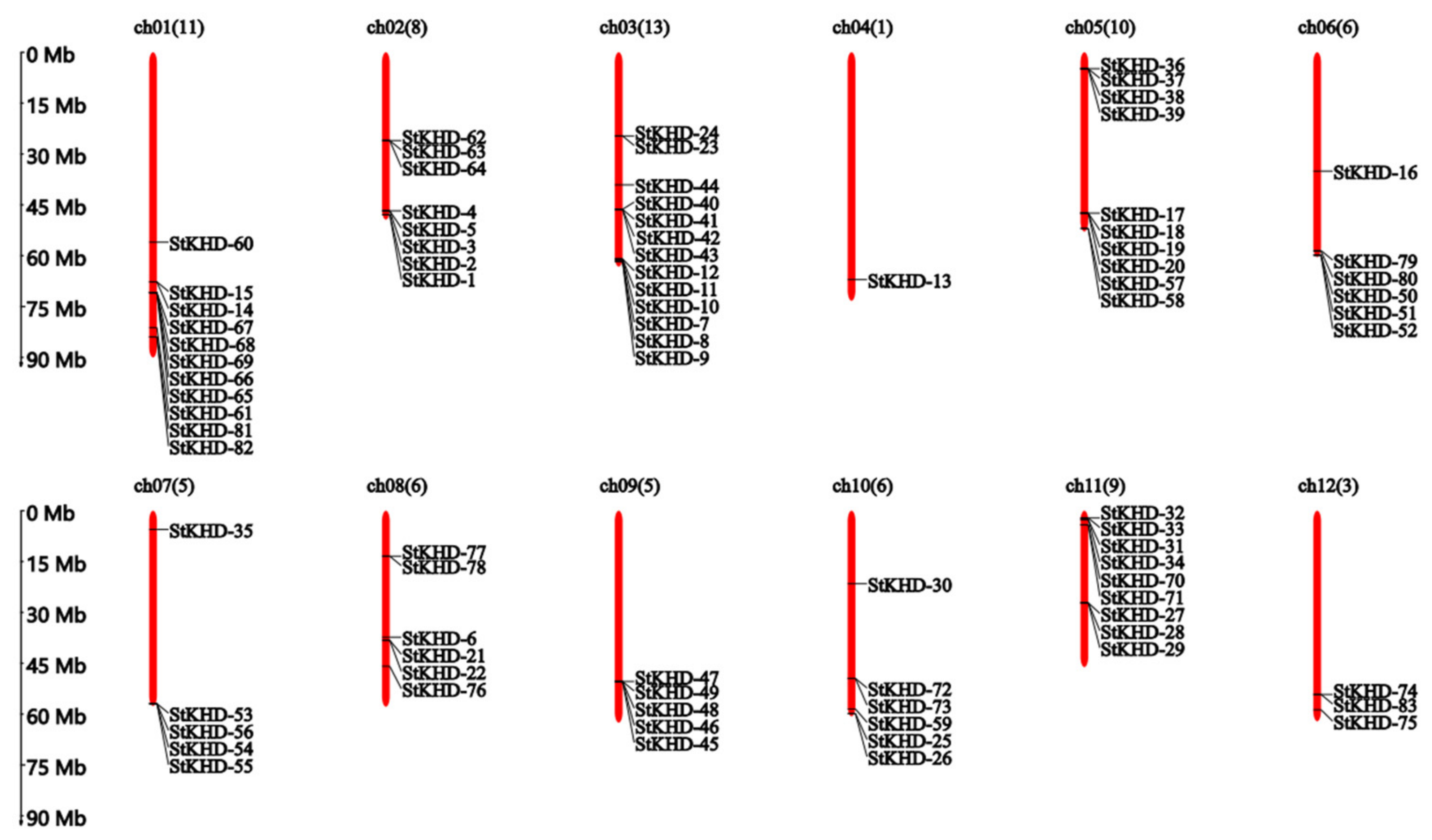
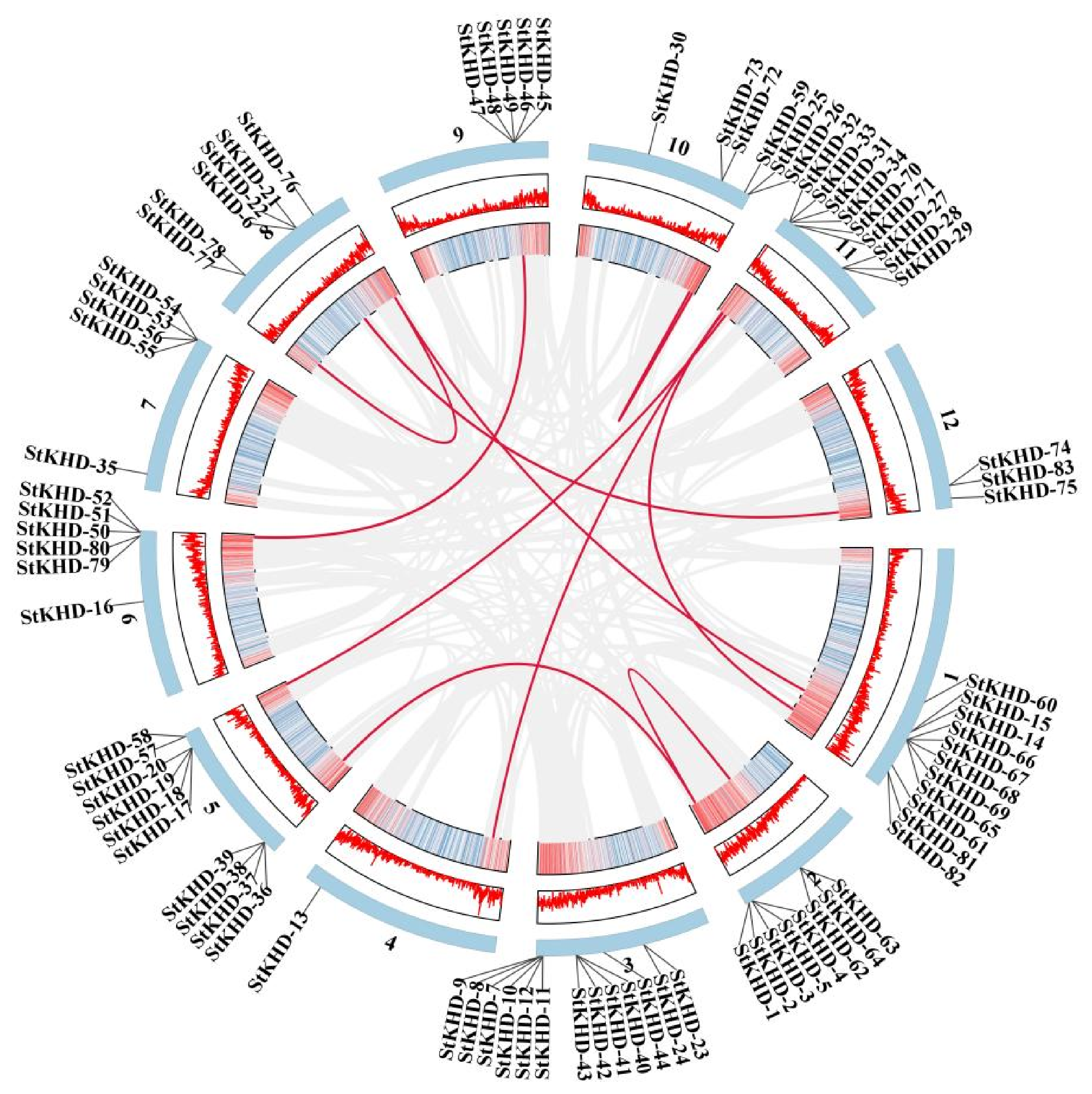
The chromosomal distribution of the 83 StKHD genes was mapped to the potato genome (Figure 1). These StKHDs were unevenly distributed across all 12 potato chromosomes (ch01–ch12). Chromosome 3 harbored the highest number of StKHDs (13), followed by ch01 (11), ch05 (10), ch11 (9), and ch02 (8). In contrast, only StKHD13 was located on ch04, while three were found on ch12. Chromosomes 7 and 9 each contained five StKHDs, whereas ch06, ch08, and ch10 each harbored 6 StKHDs. To elucidate the expansion mechanisms of the StKHD gene family, we analyzed gene duplication events (Figure 2). The results revealed 54 tandemly duplicated gene pairs distributed across all chromosomes except ch04, with genes in each pair located in close genomic proximity. Chromosomes 1, 2, 3, 5, and 11 exhibited the highest density of tandem duplication pairs. Additionally, 10 segmentally duplicated gene pairs were identified.

3.3. Phylogenetic Analysis and Classification of StKHDs

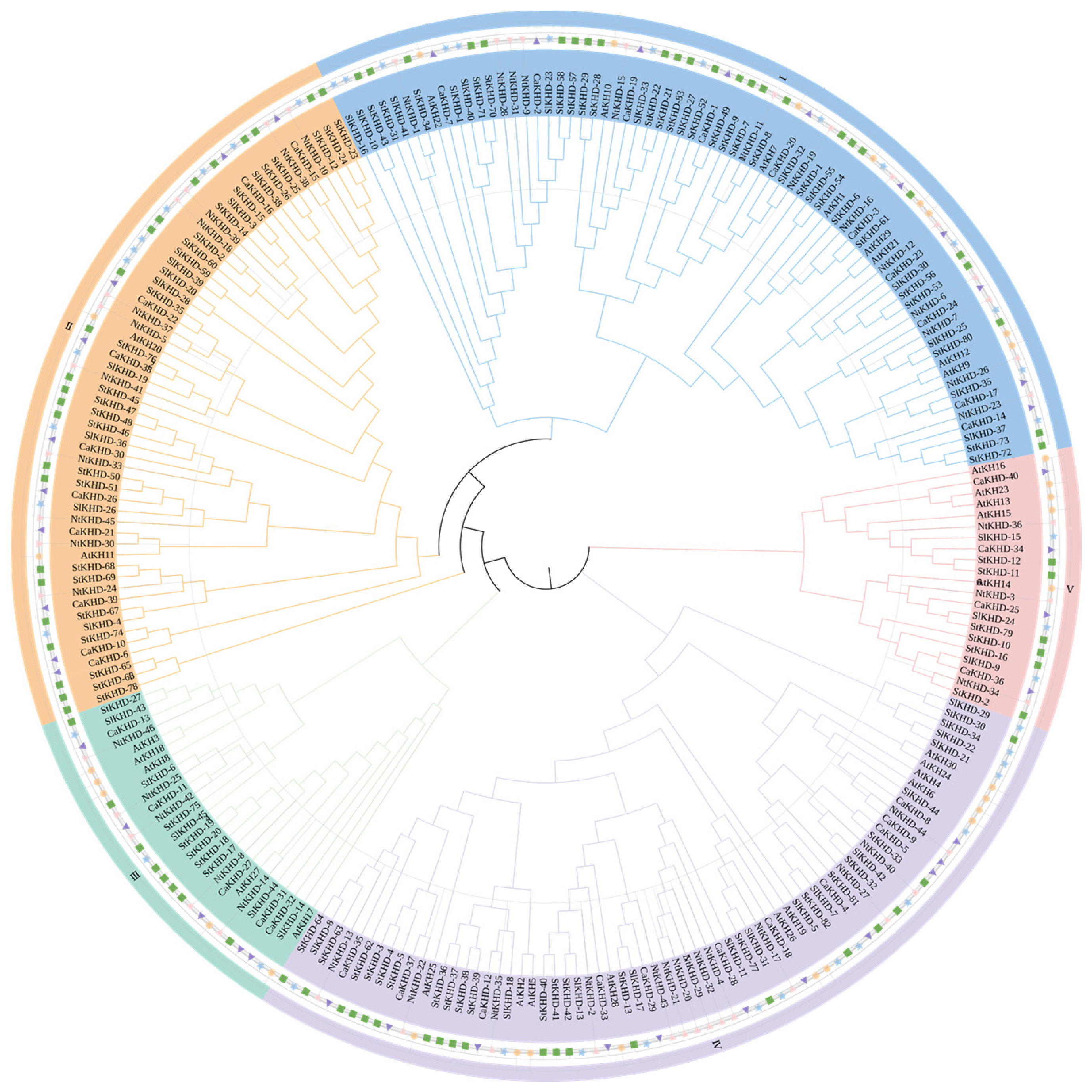
To investigate the evolutionary relationships among KHD family members, a phylogenetic tree was constructed using a total of 244 KHD protein sequences from five species: potato (83), Arabidopsis (30), tomato (45), pepper (40), and tobacco (46) (Figure 3, Table S3). Based on their branching positions, the KHDs were classified into five distinct subgroups, designated I through V, with each subgroup highlighted in a unique color. Subgroup I contained 71 members, Subgroup II comprised 57, Subgroup III included 25, Subgroup IV contained 69 and Subgroup V encompassed 21 members. A key observation was that KHD homologs from all five analyzed species were present in each of the five subgroups.

3.4. Collinearity Analysis of KHD Genes Between Potato and Four Species

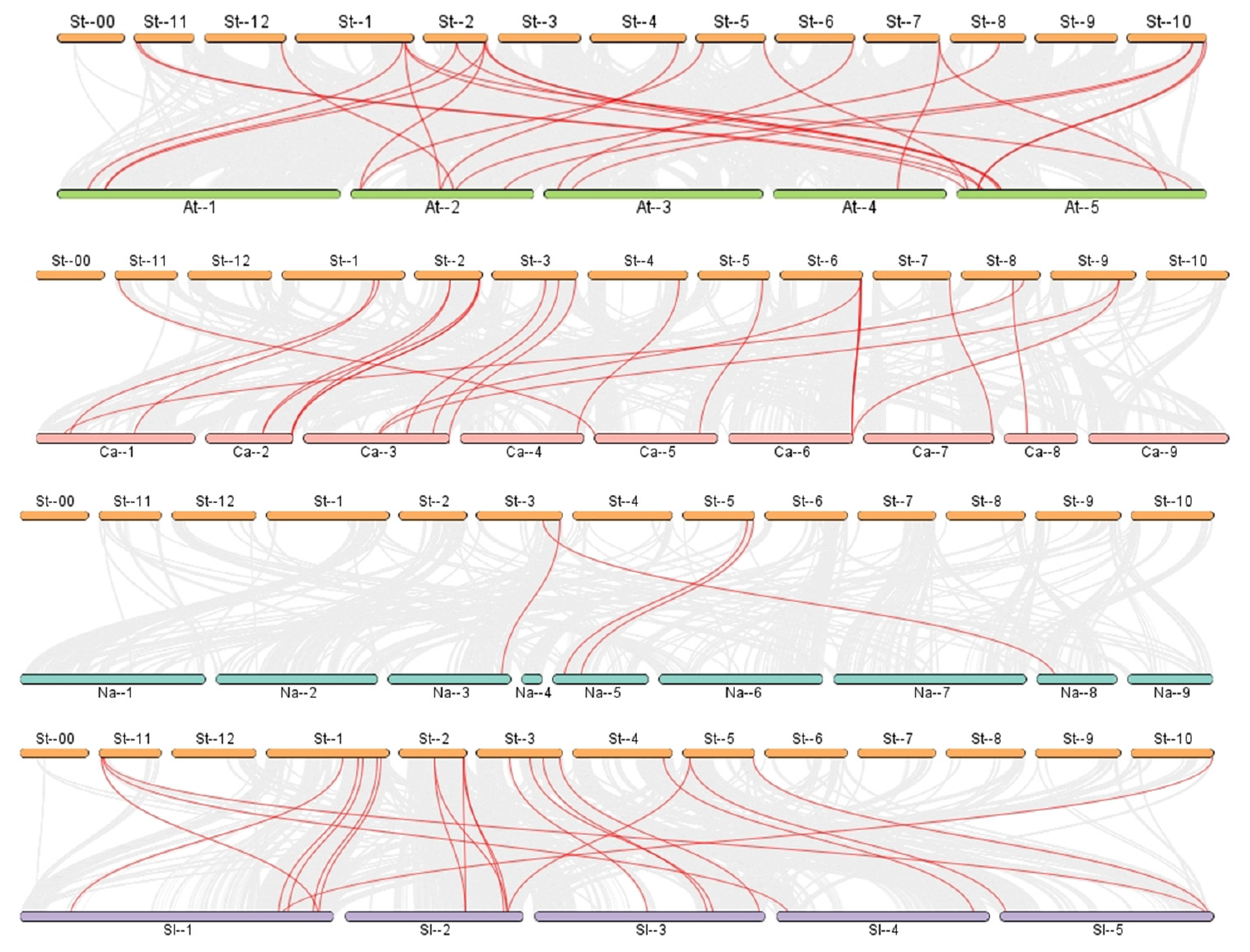
To systematically analyze the evolutionary conservation, divergence, and expansion of the StKHD gene family, we performed an interspecific collinearity analysis between StKHDs and AtKHDs, CaKHDs, NtKHDs, and SlKHDs (Figure 4). The results showed a total of 68 interspecific collinear gene pairs across the four combinations: 23 between potato and Arabidopsis, 19 between potato and pepper, 22 between potato and tomato, and 4 between potato and tobacco. Several core StKHDs demonstrated extensive collinearity across multiple species, for example, StKHD-1, StKHD-2, StKHD-3, StKHD-5, and StKHD-11 each established collinear pairs with homologous genes derived from at least three different species. Specifically, StKHD-1 showed collinearity with AtKHD-1/2/5, CaKHD-1 and SlKHD-1; StKHD-2 with AtKHD-1/2/5, CaKHD-2 and SlKHD-2; StKHD-3 with CaKHD-3, NtKHD-3/8 and SlKHD-3; StKHD-5 with AtKHD-2/5, CaKHD-5, NtKHD-5 and SlKHD-2/4/5; StKHD-11 with AtKHD-5, CaKHD-5 and SlKHD-1/4/5.

3.5. Conserved Motifs and Domains, and Gene Structures Analyses of StKHDs

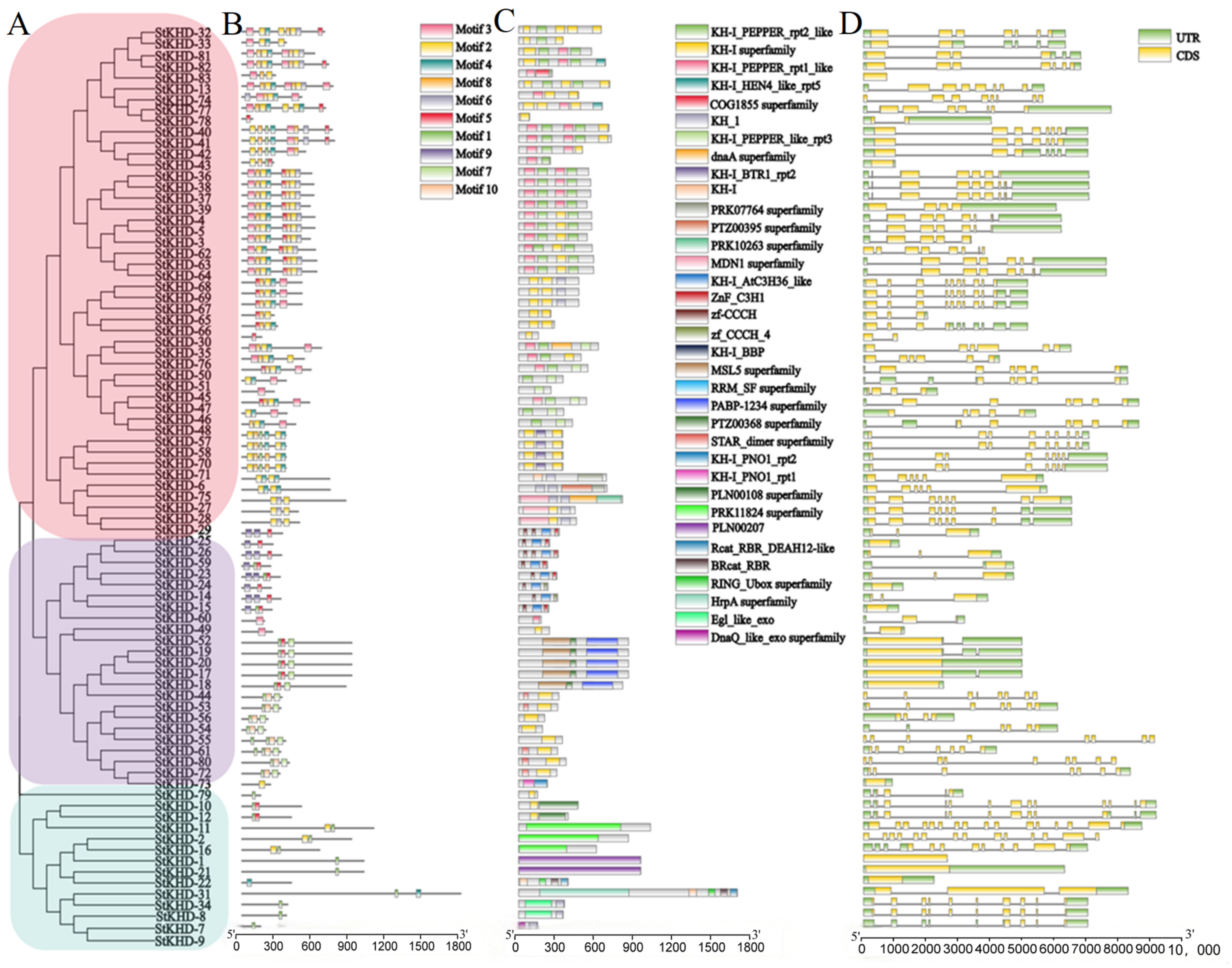
To systematically examine the structural characteristics and potential functional correlations within the StKHD gene family, we conducted a comprehensive analysis of motif compositions, conserved protein domains, and exon–intron organization integrating these findings with phylogenetic clustering (Figure 5). The construction of a maximum likelihood phylogenetic tree revealed that StKHDs are grouped into distinct subgroups with high bootstrap support. Additionally, MEME analysis identified 10 conserved motifs (Motif 1–10) exhibiting clear subgroups-specific distribution patterns (Figure 5A,B).
Conserved domains analysis confirmed that all StKHDs contain the characteristic KH domain (PF03169) or its variants (KH-I, KH-J_PEPPER-like), a crucial motif for RNA/DNA binding (Figure 5C). Remarkably, StKHD-34 exhibits a unique diversity of domains, encoding additional HrpA (associated with bacterial pathogenesis), RING_Ubox (E3 ubiquitin ligase), BRcat-RBR, and Rcat-RBR-DEAH12-like (RNA helicase) domains. A minor subgroup, including StKHD11 and StKHD28, also possesses zf-CCCHStKHD34 exhibits domains, which are implicated in RNA binding and post-transcriptional regulation, thereby enhancing the functional versatility of the family. Exon–intron structures reveals that approximately 80% of StKHDs contain 2 to 11 exons, highlighting the structural complexity of this gene family (Figure 5D).

3.6. Cis-Acting Elements in the Promoters of StKHDs

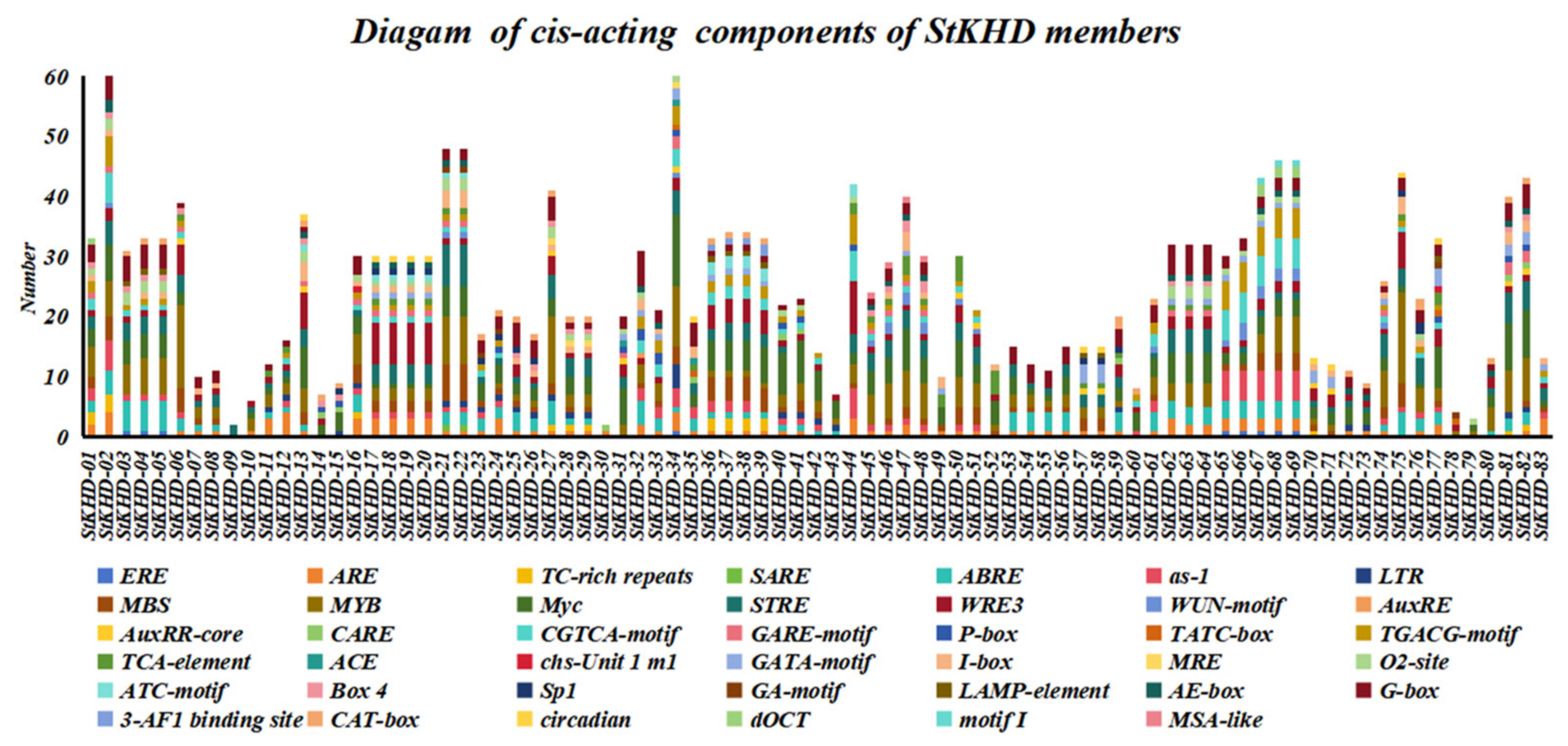
To systematically explore the regulatory mechanisms of StKHDs, we extracted 2000 bp upstream promoter sequences from 83 StKHDs and performed cis-acting element analysis. As shown in Figure 6 and Figure S2, the identified cis-elements in StKHDs were sorted by their quantity in each category, in the order of light-responsive, hormone-responsive, stress-responsive, and growth and development-related elements. Light-responsive G-boxes were the most abundant, accounting for 37.43% (125 elements) of the relevant elements. Among hormone-responsive cis-elements, MeJA-responsive motifs (CGTCA-motif, TGACG-motif), GA3-responsive elements (P-box, TATC-box), ABA-responsive elements (ABRE, ARE), SA-responsive element (TCA-element), and auxin-responsive elements (TGACG-motif, ERE, AuxRE) were identified; notably, CGTCA-motif and TGACG-motif were the most prevalent among them, representing 31.47% (73 elements) of all hormone-related elements. Stress-responsive cis-elements included ERE, ARE, TC-rich repeats, SARE, ABRE, O2-site, as-1, LTR, MBS, MYB, Myc, STRE, WRE3, and WUN-motif, with the drought-inducible MYB element accounting for 20.99% of this category. The growth and development-related category contained the fewest elements, with only five types identified (CAT-box, Circadian, dOCT, motif I, and MSA-like). Furthermore, the differential distribution and abundance of these cis-elements among StKHDs suggest potential functional divergence of family members, which may be closely associated with their specific responses to various external cues and internal developmental signals.

3.7. GO Enrichment Analysis of StKHD Proteins

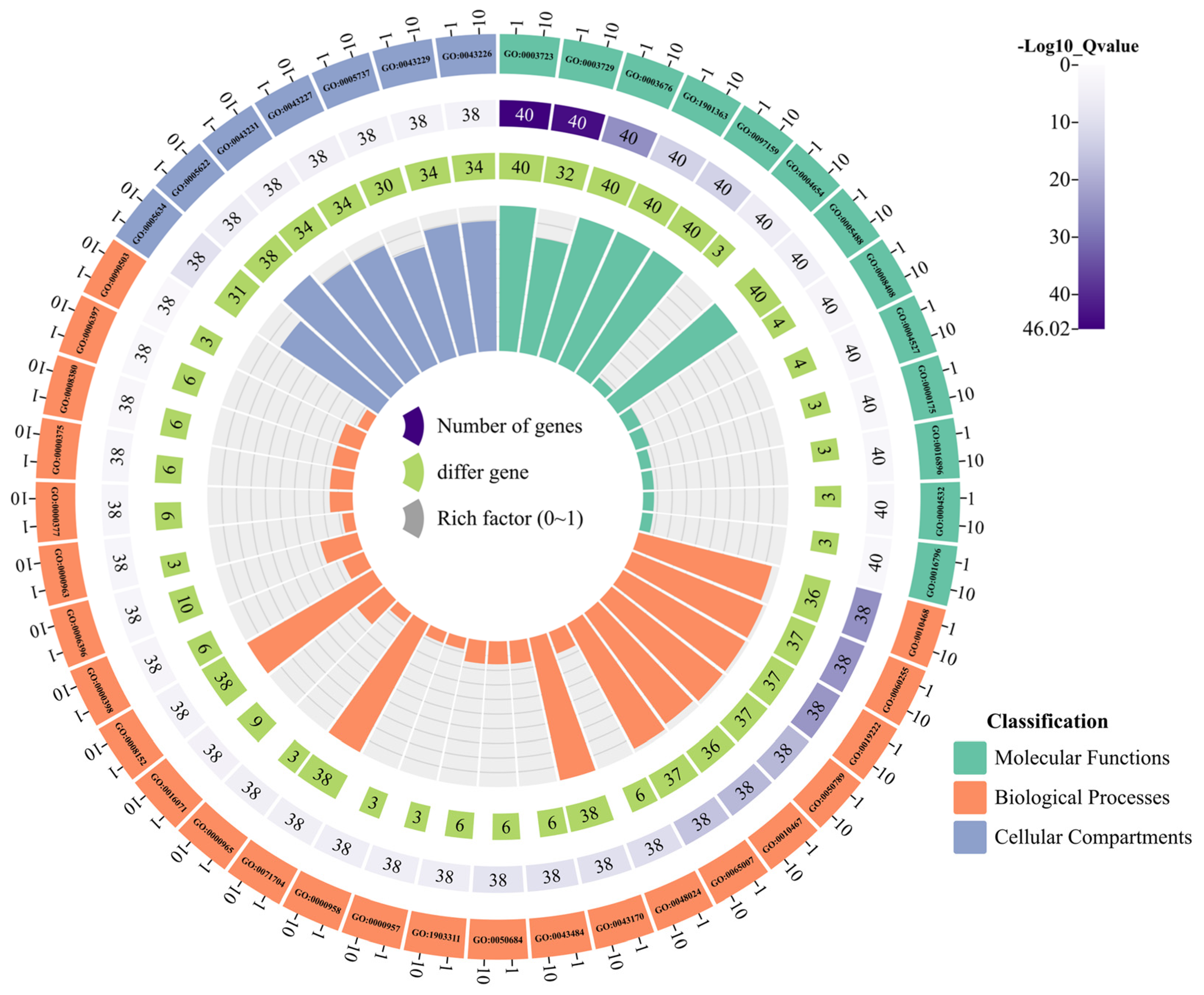
To systematically investigate the functional characteristics of StKHDs, GO enrichment analysis was conducted (Figure 7). The results showed that StKHDs had three primary functional categories: Molecular Function (MF), Biological Process (BP), and Cellular Component (CC).
In the MF category, the StKHDs were predominantly enriched in nucleic acid binding (GO:0003676), general binding (GO:0005488), and various catalytic activities (GO:0004532, GO:0016896, GO:0016796, GO:0004527, GO:0008408, GO:0004654). These associations highlight their diverse roles in nucleic acid interaction, RNA processing, polysaccharide hydrolysis, and carbohydrate metabolism. The nucleic acid binding function suggests their potential role as transcription factors, while the catalytic activities imply involvement in post-transcriptional regulation and metabolic coordination.
The BP category was the most prominently enriched among all GO classifications, implying that StKHDs play extensive roles in modulating various plant physiological and biochemical processes. Within the BP category, StKHDs were significantly enriched in key functional terms including organic substance metabolic process (GO:0071704), biosynthetic process (GO:0050789), and metabolic process (GO:0008152), highlighting their pivotal roles in mediating plant material metabolism and biosynthesis.
In the CC category, the enriched terms were predominantly related to the nucleus (GO:0005634), aligning with the understanding that eukaryotic transcription factors typically localize to the nucleus to bind DNA and regulate target gene expression.

3.8. Co-Expression Network and PPI Analysis of StKHDs

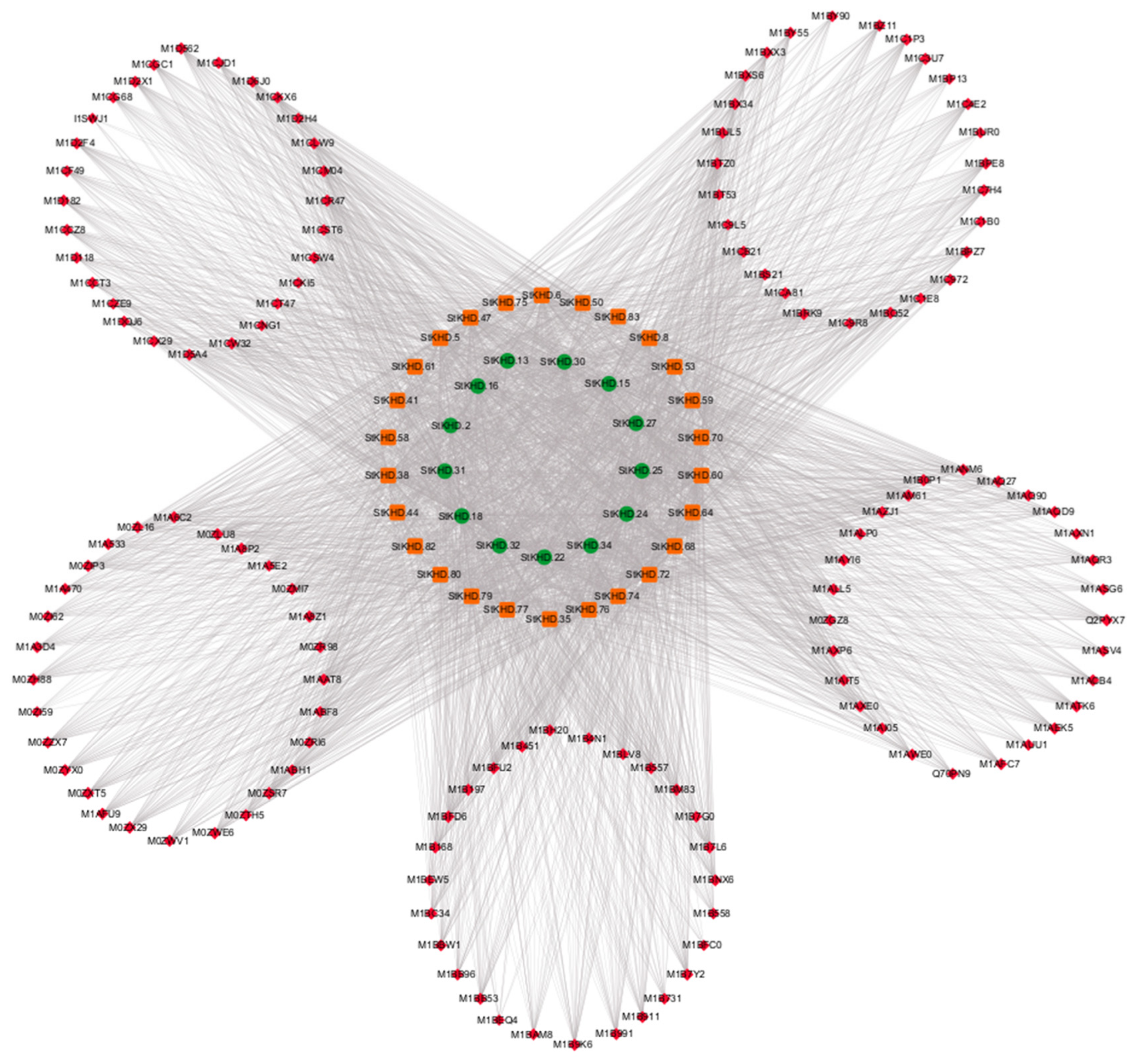
To further elucidate the functional coordination and regulatory mechanisms of StKHDs, the protein–protein interaction (PPI) network of 83 StKHDs and other proteins was constructed (Figure 8). There are 3686 interaction pairs involving 176 unique proteins. Of these, 436 interactions occurred among members of the StKHD family, representing 11.8% of the total interactions, which indicates functional synergy and potential redundancy within the family. The remaining 3250 interaction pairs (88.2% of the total) were observed between StKHDs and other interacting partners, suggesting that the StKHDs primarily exerts its biological functions through cross-functional interactions with proteins from other functional families. Among the 83 StKHD members, 39 StKHDs formed reliable interaction pairs, whereas 44 StKHDs did not establish detectable interactions, implying that the latter may possess functional independence or specific regulatory roles.
Topological analysis of the PPI network identified StKHD2, StKHD18, StKHD72 and StKHD76 as the most highly connected hub nodes, each associated with 146 interaction partners. StKHD27 and StKHD53, each with 145 interaction partners, underscored their essential roles in maintaining network integrity and facilitating signal transduction across pathways. Through quantitative analysis of correlation coefficients (r values), we further identified the strongest interaction relationships within the network, including: StKHD38-M1CB21 (r = −1.0), StKHD15-M1C7H4 (r = 1.0), StKHD31-M1AZJ1 (r = 1.0), StKHD30-M1AXP6 (r = 1.0), StKHD76-M1CW32 (r = 1.0), StKHD22-M1CM04 (r = 0.999999), StKHD74-M1D2F4 (r = −1), StKHD2-M1BFD6 (r = 0.999999), StKHD47-M1BQ52 (r = 0.999999), and StKHD34-M1BUL5 (r = 0.999998). Furthermore, StKHD6 demonstrated extensive negative correlations, suggesting its potential role as a regulatory hub. StKHD53 exhibited significant negative correlations with multiple proteins, indicating its likely function as a negative regulator (Figure 8, Table S4).

3.9. Expression Characterization of StKHDs

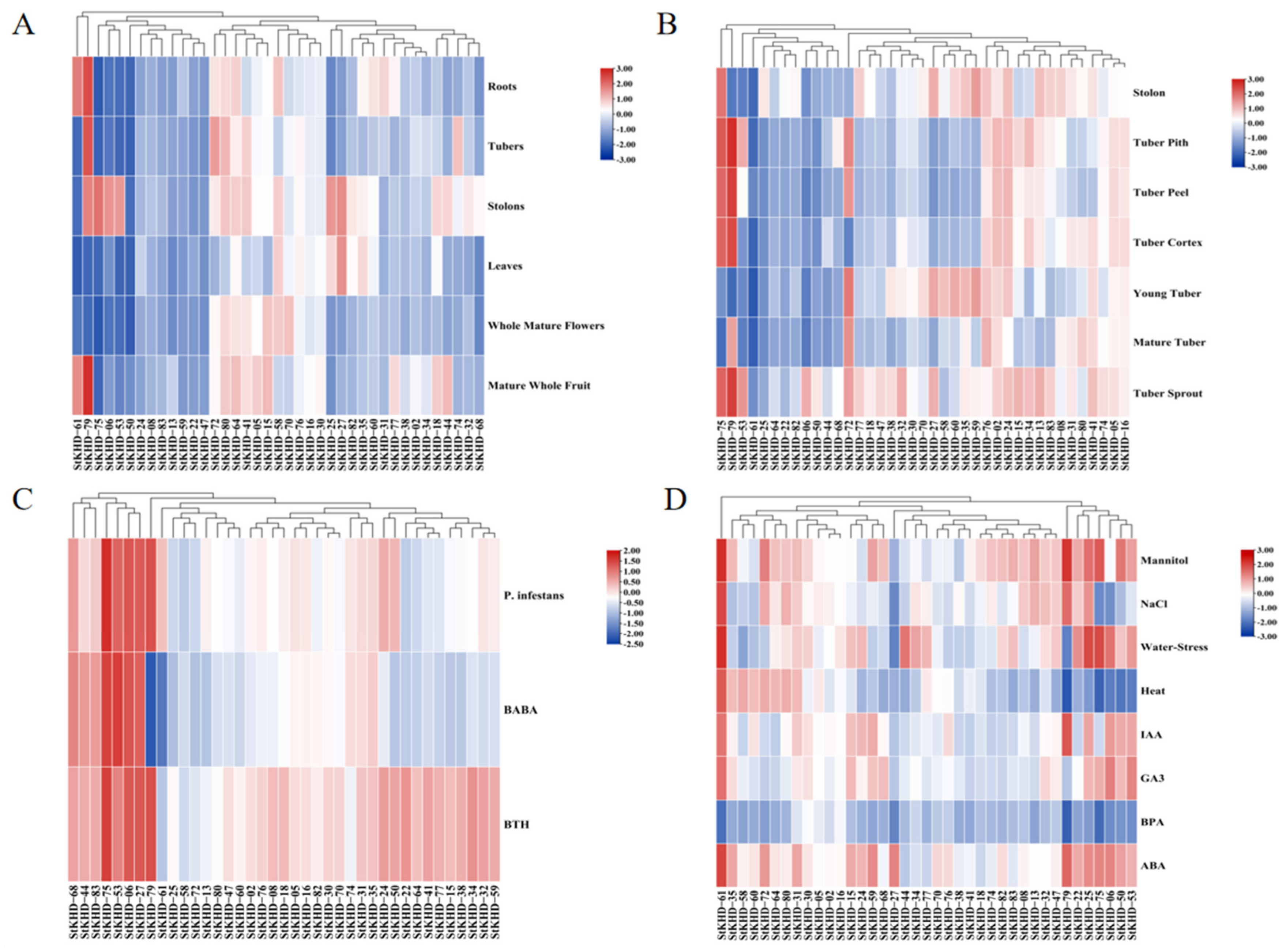
To systematically elucidate the potential functions of StKHDs in potato growth, development, and stress adaptation, a comprehensive analysis of their expression profiles was performed using transcriptome data (Table S5), with visualization via heatmaps. Overall, the expression profiles of StKHDs were consistent with the predicted results of cis-acting elements. Most StKHDs exhibited downregulated expression at different growth and development stages, while a small subgroup showed significantly spatiotemporally specific upregulation: for instance, StKHD-6, StKHD-53, and StKHD-75 were specifically upregulated in stolons, whereas StKHD-31 and StKHD-60 were exclusively upregulated in roots (Figure 9A). In contrast, StKHD-2 maintained consistently high transcript abundance across all developmental stages of tubers (Figure 9B). StKHD-79 was significantly upregulated in roots, tubers, stolons, and mature fruits, suggesting its potential role in regulating the formation and development of underground storage organs in potatoes; conversely, it was downregulated in photosynthetic organs (flowers and leaves), which may prevent disruption of mRNA homeostasis in the photosynthetic system and is consistent with the principle of organ functional differentiation.
With respect to stress responses, most StKHDs were generally upregulated under various stresses, except for benzylaminopurine (BAP) treatment and heat stress, and their responses to different stresses showed overall consistency (Figure 9C,D). Notably, StKHD-68, StKHD-44, StKHD-83, StKHD-75, StKHD-53, StKHD-6, StKHD-27, and StKHD-75 exhibited consistent upregulation in response to Phytophthora infection, β-aminobutyric acid (BABA) treatment, and benzothiadiazole (BTH) treatment, highlighting their potential roles as core regulators in the broad-spectrum defense pathway (Figure 9C). Intriguingly, StKHD-13 and StKHD-61 were specifically induced by Phytophthora infection, indicating their involvement in pathogen-specific recognition or downstream signaling transduction pathways. Under abiotic stress and exogenous phytohormone treatments, all StKHD genes showed downregulated transcript levels under BAP treatment, with StKHD-31 and StKHD-61 being exclusively downregulated by BAP. This suggests that BAP can mediate targeted transcriptional repression of the StKHD gene family, leading to almost complete inhibition of their transcriptional activity (Figure 9D). Notably, StKHD-41 and StKHD-18 were markedly and exclusively upregulated in response to mannitol treatment, indicating their pivotal roles as regulatory factors in the osmotic stress response pathway. This upregulation likely enhances cellular osmotic adjustment capacity, facilitating adaptation to dehydration stress by stabilizing mRNAs of genes related to osmolyte biosynthesis or promoting their translation. Conversely, the transcriptional levels of StKHD-41 and StKHD-18 were significantly downregulated under other abiotic stresses and exogenous phytohormone treatments, a pattern presumably representing an adaptive regulatory strategy in potato plants to conserve energy by avoiding unnecessary overexpression of these two genes under non-osmotic stress conditions.

3.10. RT-qPCR Analysis of StKHD-41 Under Drought, Salt and Phytohormone Treatment

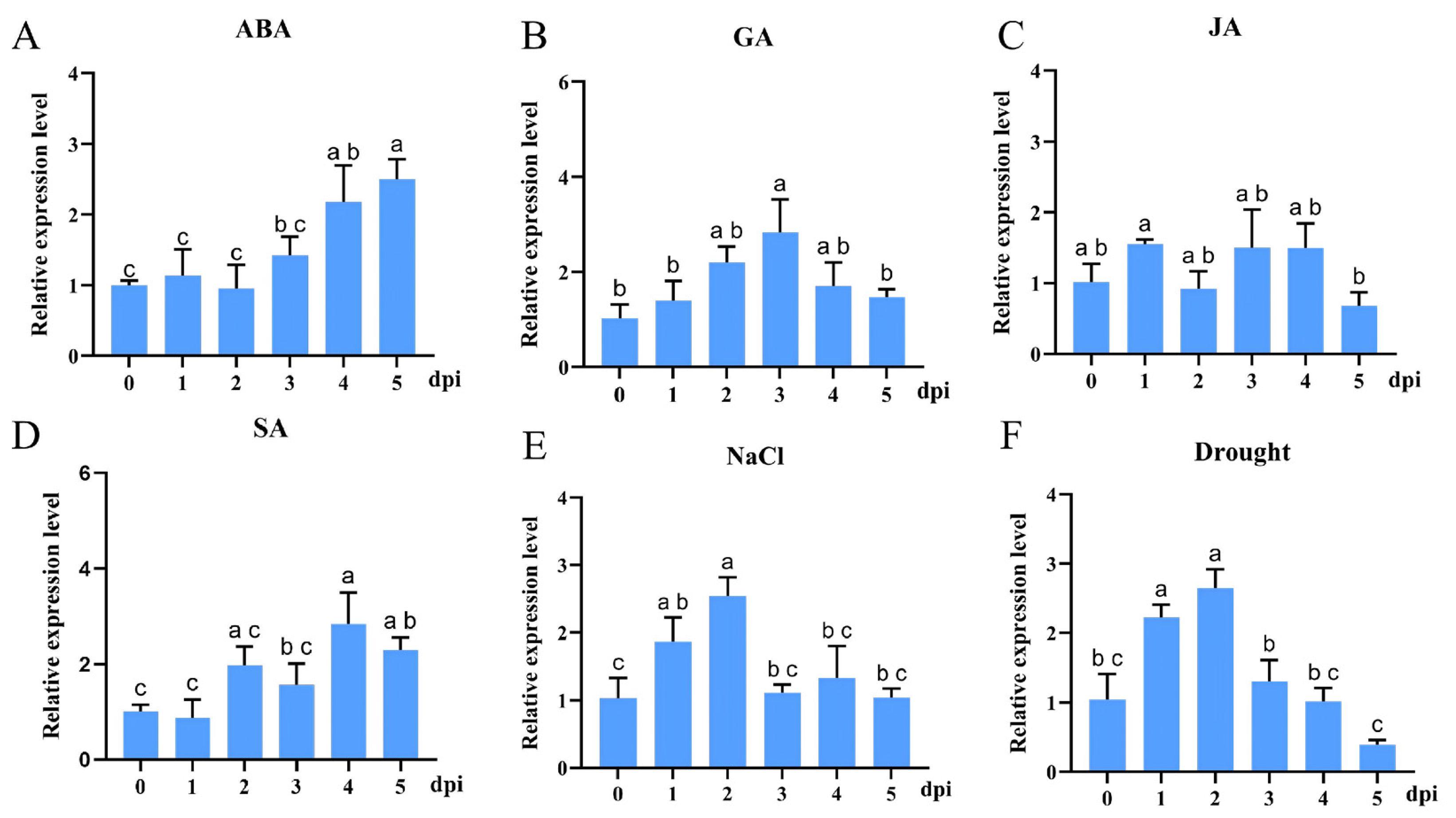
Based on the transcriptomic analysis detailed above, which identified StKHD-41 and StKHD-18 as the only genes upregulated in response to mannitol treatment, StKHD-41 was selected as the representative gene for subsequent RT-qPCR analysis. This analysis specifically assessed the expression levels of StKHD-41 in the leaves of potato seedlings over a period of 1 to 5 days following treatment with four phytohormones (ABA, GA, SA, and JA), as well as under conditions of salt and drought stress (Figure 10, Table S6). The 0-day treatment served as the control. The RT-qPCR results indicated that, under ABA treatment, the expression level of StKHD-41 increased significantly on the 4th day and continued to rise on the 5th day, reaching a peak approximately two times higher than that of the control (Figure 10A). Under SA treatment, StKHD-41 expression was elevated on the 2nd, 4th, and 5th days, with the highest expression level observed on the 4th day (Figure 10D). In response to GA and JA treatments, StKHD-41 expression was upregulated on the 3rd and 1st day, respectively (Figure 10B,C). In the context of salt and drought stress, the expression levels of StKHD-41 peaked on the 2nd day (Figure 10E,F), exhibiting a significant increase compared to the 0-day treatment control, respectively. Collectively, these findings indicate that StKHD-41 is involved in the signaling pathways mediated by four phytohormones (ABA, GA, SA, and JA) as well as the responses to salt and drought stresses.

3.11. The StKHD-41 Localizes in the Nucleus

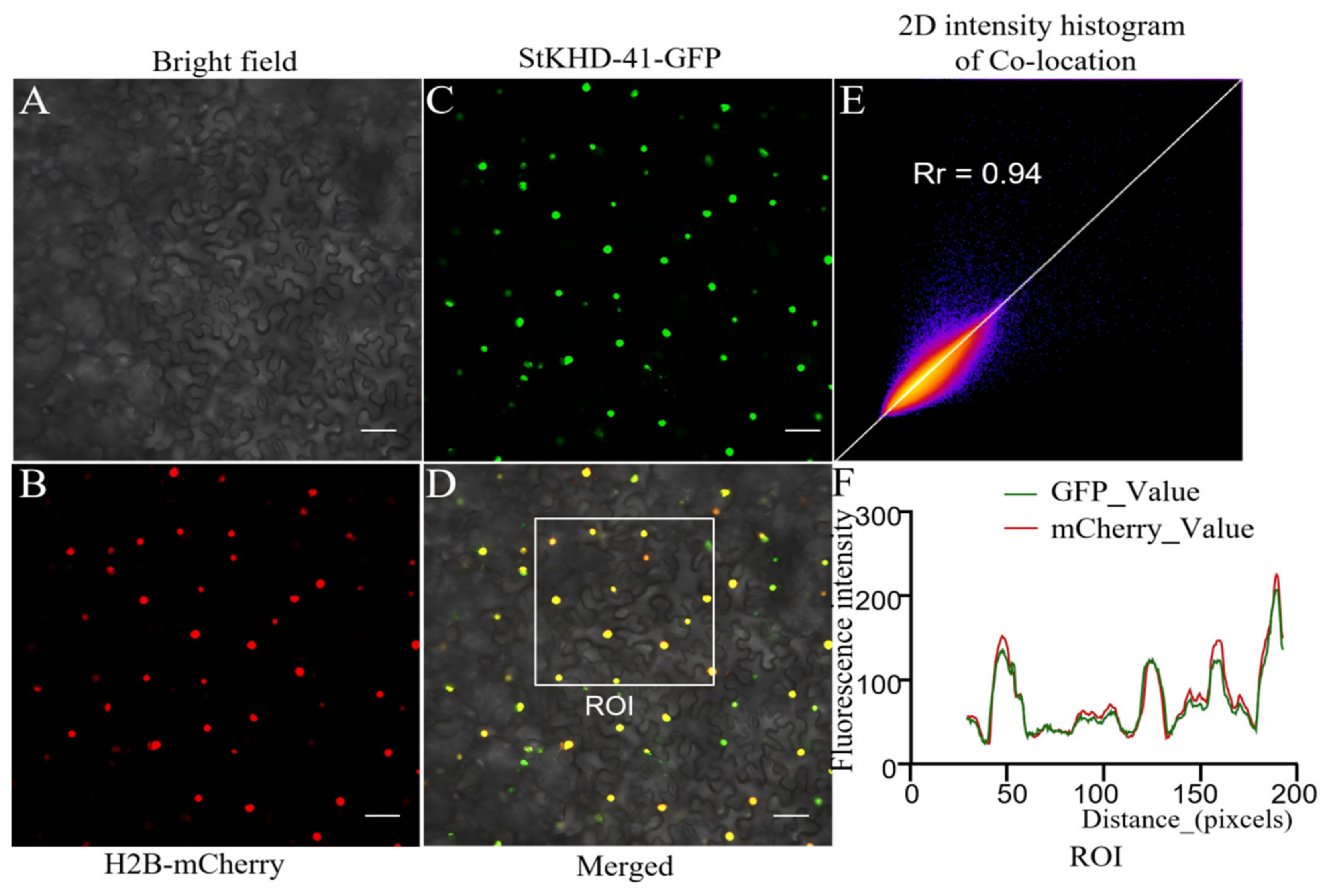
To determine the subcellular localization of StKHD-41, we generated a KHD-41-GFP fusion expression vector (Figure S3). A pCAMBIAsuper1300-H2B-mCherry construct (serving as a nuclear marker, emitting red fluorescence) was co-utilized to contextualize the GFP signal. Confocal imaging revealed that the StKHD-41-GFP fluorescence colocalized with the nuclear marker (Figure 11), demonstrating that StKHD-41 is a nuclear-localized protein. This observation aligns with prior bioinformatic predictions and functional analyses.

4. Discussion

The KHDs constitute a conserved family of RNA-binding proteins (RBPs) that play pivotal roles after transcriptional regulation, including RNA splicing, stability maintenance, and translation control, across prokaryotes and eukaryotes [37]. In various plants, including Arabidopsis [14], rice [13], tomato [14], corn [14], KHDs have been identified and increasingly recognized as key regulators of growth and stress adaptation, but systematic characterization of the StKHDs has remained elusive. In the current study, a total of eighty-three StKHDs were identified and systematically analyzed, their potential biological functions were predicted, and the responsive patterns of StKHD-41 to four phytohormones, salt and drought stresses were also experimentally validated.

4.1. Diversification, Conservation, and Evolution of the StKHD Gene Family

A total of 83 StKHDs are asymmetrically distributed across all 12 chromosomes of the potato genome (Figure 1); this pattern aligns with characteristics reported for other plant transcription factor families, such as the R2R3-MYB family in tobacco [38] and the MADS-box family in pineapple [39], reflecting non-random gene family expansion during genome evolution. A large number of duplicated gene pairs were distributed on all chromosomes except chromosome 4, consistent with the classical definition of tandem duplication [40], with the highest density on chromosomes 1, 2, 3, 5 and 11, making local tandem duplication a key contributor to StKHD family expansion. Additionally, 10 segmentally duplicated gene pairs suggested (Figure 2) that whole-genome duplication also played an important role in StKHD family formation [41], and together, tandem and segmental duplication were the major drivers of StKHD family diversification [42,43].
StKHDs display structural conservation and evolutionary dynamism (Figure 3), consistent with KHD characteristics in other plants [14]. Phylogenetic analysis clustered StKHDs into distinct subgroups, where members share similar gene structures and conserved motif compositions (Figure 3 and Figure 5), implying intra-subgroup functional redundancy and inter-subgroup functional specialization, a pattern also reported for OsKHDs [13] and AtKHDs [14]. Notably, KHD homologs from all five analyzed species were distributed across the five subgroups, indicating that the divergence of these major clades predated the speciation of the studied angiosperm lineages, in line with the evolutionary pattern of conserved transcription factor families [44]. Additionally, StKHDs showed a close evolutionary relationship with SlKHDs, with frequent co-clustering of their homologs in subgroup with high bootstrap support, an affinity attributed to their Solanaceae membership and recent common ancestry [45], suggesting potential functional conservation between potato and tomato KHDs. This comparative phylogenetic framework provides a valuable basis for subsequent StKHD functional characterization.
There are 22 collinear gene pairs between potato and tomato (Figure 4), reflecting their close relationship within the Solanaceae family and their relatively recent common ancestry [45], while slightly more with Arabidopsis (23), the aligns with the general pattern where distantly related model species preserve conserved core gene pairs, whereas closely related species exhibit lineage-specific adaptive syntenic blocks [41]. There is a counterintuitive presence that potato shares fewer collinear KHD gene pairs with tobacco (4 pairs) than with the phylogenetically more distant Arabidopsis (23 pairs); it is important to consider the unique genomic architecture of Nicotiana tabacum. Unlike diploid Solanaceae species such as tomato, which exhibits high collinearity with potato (22 pairs), tobacco is a recent allotetraploid that has undergone extensive diploidization, massive transposable element expansions, and subsequent gene loss [46,47]. These turbulent genomic rearrangements have severely disrupted ancestral syntenic blocks, thereby obscuring the homologous relationships of the StKHD family specifically within the Nicotiana lineage. Such collinearity implies conserved functions of orthologous KHDs in Solanaceae plants, providing a basis for functional inference from tomato to potato. Additionally, several core StKHDs (StKHD-1, StKHD-2, StKHD-3, StKHD-5, and StKHD-11) demonstrated extensive collinearity across multiple species, underscoring their evolutionary conservation and potential functional significance, suggesting that this gene may represent an ancient conserved member of the KHD gene family that predates the divergence of Solanaceae species and has retained essential biological functions [42]. Cross-species conserved collinear genes are commonly linked to essential biological processes, as observed in various transcription factor families [38,48].

4.2. StKHDs May Mediate Plant Growth Processes, Together with Cellular Responses to Abiotic Stresses and Phytohormone Cues

The conserved motifs and domains, along with structure of genes, serves as fundamental determinants of both functional conservation and evolutionary divergence within transcription factor families. When combined with phylogenetic analysis, these elements facilitate robust functional inference for gene family members [38,49]. StKHD-34 exhibits auxiliary domains (Figure 5C) and suggests its potential involvement in the assembly of multi-protein complexes and the interplay between nucleic acid metabolism and ubiquitination pathways [48,50]. In contrast, most StKHDs predominantly contain the KH domain or its variants (KH-I, KH-J_PEPPER-like) (Figure 5C), indicating a conservation of core domain functionality with subtle differentiation through structural variations [34]. In conclusion, StKHDs demonstrate distinct subgroup-specific structural characteristics, with conserved core motifs and domains ensuring functional consistency, while structural variations contribute to functional diversification. These results provide a robust structural foundation for predicting the biological functions of StKHD genes.
Gene expression is precisely regulated by cis-acting elements located in upstream promoter regions, which function as critical molecular switches mediating responses to a variety of internal and external stimuli [34]. The promoter regions of StKHDs (Figure 6) are enriched with diverse cis-acting elements, including hormone-responsive elements (ABRE for ABA, GARE for GA, TGA-binding sites for SA) and stress-responsive elements (TC-rich repeats, MBS for drought) [51]. GO analysis (Figure 7) and protein–protein interaction analysis (Figure 8) directly correlate with the expression patterns of KHDs under corresponding treatments (Figure 9), highlighting that cis-acting elements are key determinants of KHDs responsiveness to hormones and abiotic stresses. For instance, StKHD-6, StKHD-50, StKHD-53, and StKHD-75, whose promoters contains multiple ABRE elements, showed the most significant upregulation under ABA treatment, consistent with the role of ABRE elements in mediating ABA-induced gene expression [52]. In contrast, the lack of DRE elements in their promoters explain its general downregulation as a whole under salt stress, as DRE elements are essential for salt-responsive gene activation [53].
Subcellular localization predictions (Table S2) indicated that the majority of StKHDs are localized to the nucleus, which is highly consistent with their potential functions in transcriptional regulation. Combined with the functional prediction and stress response analysis of the StKHDs, the nuclear localization feature further supports that StKHDs can regulate the transcription of downstream hormone signaling- and stress response-related genes by interacting with cis-acting elements in the promoter regions of target genes within the nucleus. This is also a typical mode of action for StKHDs in plants to participate in growth and development as well as stress adaptation. The remaining StKHD members were predicted to localize to mitochondria, chloroplasts, plasma membrane, or peroxisomes, suggesting that StKHDs may achieve functional diversity through multi-organelle distribution, such as participating in metabolic regulation or stress responses within organelles. Notably, StKHD-30 and StKHD-61 were assigned to the plasma membrane. According to existing studies [54], this indicates that these two members may be involved in the perception of external environmental signals or transmembrane transport processes. They provide upstream signal recognition and transmission functions for the stress response pathway mediated by the StKHDs, complementing the downstream transcriptional regulation mechanism of nuclear-localized members.

4.3. StKHD-41 Can Mediate the Response to Hormone, Salt and Drought Stresses

StKHD-41 exhibits distinct response patterns to four key hormones (ABA, GA, JA, SA), reflecting its involvement in diverse hormone-mediated signaling networks (Figure 10A–D). These hormone-specific response dynamics are consistent with the well-characterized conserved mechanisms of plant hormone signaling, providing further support for the functional relevance of StKHD-41 in these pathways. JA treatment induced the fastest response of StKHD-41, with peak expression at 1 day post-treatment; this rapid induction is attributed to the GA-GID1 complex-mediated degradation of DELLA repressors [55]. Specifically, StKHD-41 is directly activated by transcription factors (e.g., MYC2 homologs) released from DELLA-dependent inhibition, a regulatory mechanism conserved in Arabidopsis that underlies the classic crosstalk between JA and GA signaling [55]. In contrast, GA treatment led to peak expression of StKHD-41 at 3 days post-treatment, consistent with the sequential molecular events of GA signaling cascades. SA treatment resulted in dual peak expression of StKHD-41 at 2 and 4 days post-treatment, which aligns with the requirement for additional molecular processes in SA signaling, including NPR1 nuclear translocation and transcription complex assembly [56], a characteristic feature of SA-mediated gene regulation reported in multiple plant species. The slowest response was observed under ABA treatment (peak at 3 days post-treatment), indicating that StKHD-41 functions as a late-response gene in the ABA pathway, which requires cascaded regulation by intermediate transcription factors [57]. This is consistent with the well-characterized ABA signaling pathway, which involves the PYR/PYL-SnRK2-ABF cascade and chromatin remodeling [52], and further confirms that StKHD-41 follows the conserved regulatory logic of ABA-responsive late genes. These hormone response patterns align with the known functions of plant KHDs. For example, AtESR1, a KH-domain RBP, modulates jasmonate signaling to uncouple stress resistance from growth restraint [57], while soybean GmKHDs are regulated by photoperiod and involved in flowering via hormone crosstalk [27]. The broad responsiveness of StKHD-41 to multiple hormones suggests that it may serve as a hub in hormone crosstalk, coordinating the integration of diverse signaling pathways to regulate potato growth and stress adaptation, a role increasingly recognized for RBPs in plants [58].
Abiotic stresses such as salt and drought severely constrain potato production, and identifying stress-responsive genes is crucial for breeding stress-tolerant cultivars. The present study showed that StKHD-41 exhibits a conserved upregulated expression pattern under both salt and drought stresses, with significant induction observed at 2 days after treatment, indicating its positive involvement in the adaptation to multiple abiotic stresses. Under drought stress, the significant upregulation of StKHD-41 at 2 days post-treatment (Figure 10E) is likely mediated by drought-induced endogenous ABA accumulation [59]. This mechanism is further supported by the enrichment of drought-responsive MBS (MYB-binding site) elements in the StKHD-41 promoter and the GO annotation of StKHDs in hormone-mediated stress responses, linking the drought-induced upregulation of StKHD-41 to the ABA-dependent stress signaling pathway characterized earlier, consistent with StKHD-41 functioning as a late-response gene in the ABA pathway. Similarly, StKHD-41 was also significantly upregulated at 2 days post-treatment under salt stress (Figure 10F), a response pattern associated with the presence of stress-responsive cis-elements (e.g., MBS and/or ABRE elements) in its promoter that are commonly shared by both drought and salt stress signaling pathways [51]. The conserved upregulation of StKHD-41 under both stresses suggests that it may act as a common positive regulator in the convergence of drought and salt stress response pathways. Similar to an Arabidopsis KH-domain protein that enhances thermotolerance via regulating stress-responsive gene expression [60], StKHD-41 may contribute to both drought and salt resistance by modulating the stability or translation of downstream stress-responsive mRNAs that are shared by these two stress pathways. This conserved stress-responsive pattern is consistent with the role of some KH-domain proteins in mediating multiple abiotic stress responses, such as AtSIEK (an Arabidopsis KH-domain protein involved in salt stress tolerance) [61], highlighting the functional conservation of KH-domain proteins in abiotic stress adaptation. Additionally, the co-expression of some StKHDs with known stress-responsive genes (e.g., PR genes and osmolyte synthesis genes) suggests their coordinated involvement in downstream stress-response cascades, analogous to the role of HAK family genes in mediating K+ transport and salt tolerance in Medicago and cucumber [62].
In addition, the discrepancies between the RT-qPCR results (Figure 10) and relative expression profiles (Figure 9) may be attributed to the strong RNA secondary structure of this gene or differences in sample preparation [63]. Confocal imaging revealed that the fluorescence of the StKHD-41-GFP fusion protein colocalized with the nuclear marker (Figure 11), demonstrating that StKHD-41 is a nuclear-localized protein. This result is consistent with previous bioinformatic predictions and functional analyses, further confirming that StKHD-41 exerts regulatory effects in the nucleus. Combined with its differential expression characteristics under hormone treatments and salt/drought stresses, it is speculated that StKHD-41 participates in the adaptive regulation of plants to abiotic stresses by interacting with cis-acting elements in target gene promoters within the nucleus. This provides direct localization evidence for deciphering the molecular mechanism of the StKHD family in potato stress tolerance.

4.4. Limitations, Translational Value, and Future Perspectives for Polyploid Breeding

Despite the comprehensive characterization of the StKHD family, certain limitations must be acknowledged. Primarily, the functional roles attributed to StKHDs rely exclusively on in silico predictions and expression profiling; subsequent research employing genetic techniques, such as CRISPR/Cas9-based knockout or overexpression, is necessary to confirm their precise physiological functions. Furthermore, the mechanistic details of StKHD-mediated stress responses, including specific RNA targets and protein interactors, remain elusive. Approaches like RNA immunoprecipitation sequencing (RIP-seq) and yeast two-hybrid (Y2H) screening will be crucial for elucidating these downstream ligands and binding partners, as well as for mapping the interplay between StKHD-related pathways and established stress-signaling networks.
Beyond molecular mechanisms, it is critical to evaluate the translational value of these findings in a breeding context. Our bioinformatic and expression analyses were restricted to diploid genotypes, whereas practical potato breeding predominantly operates within autotetraploid germplasm. This diploid-centric approach presents a distinct trade-off. On the positive side, the diploid genome provides a clean genetic background devoid of homeologous interference and dosage effects, enabling the high-resolution identification of core conserved domains and precise cis-acting element architectures (e.g., TC-rich repeats in hub genes like StKHD-2, StKHD-18, StKHD-41, and StKHD-76). Conversely, the primary disadvantage is that autotetraploid potatoes exhibit complex allelic dosage effects and intra-locus interactions [47]; thus, expression magnitudes observed in diploids may not directly translate to tetraploid phenotypes.
Consequently, physiological profiling on a single inbred diploid line cannot directly generate hybrid breeding outcomes. Instead, the current data should be viewed as an essential target discovery phase, yielding a precise molecular blueprint. The diagnostic sequence features identified herein serve as direct targets for future allelic mining, such as screening for presence/absence variations (PAVs) or SNPs within key cis-elements across broad tetraploid germplasm panels and wild relatives [64]. Ultimately, this will facilitate the development of functional molecular markers for marker-assisted selection (MAS) [65], thereby bridging the gap between the static molecular characterization performed in diploids and the dynamic genetic variability required for successful tetraploid potato hybrid breeding.

5. Conclusions

In this study, we present the first comprehensive genome-wide characterization of the potato KHD gene family, identifying 83 StKHD genes across all 12 chromosomes. Phylogenetic and structural analyses revealed a highly conserved evolutionary history divided into five subgroups, with most members predicted to be localized in the nucleus. Expression profiling demonstrated that StKHDs exhibit complex spatiotemporal expression patterns and are broadly involved in phytohormone signaling (ABA, GA, SA, and JA) and abiotic stress responses. Notably, hub genes (StKHD-2, StKHD-18, StKHD-72, and StKHD-76) and the experimentally validated StKHD-41 exhibited rapid and distinct responsiveness to hormonal cues and salt/drought stresses. Furthermore, a positive correlation between stress-responsive expression and the presence of TC-rich repeats in their promoters underscores the functional conservation of these regulatory elements. Overall, this study establishes a solid theoretical foundation for the StKHD family in potato stress adaptation. The core hub genes, particularly StKHD-41, provide valuable genetic targets for future functional validation and molecular breeding aimed at improving stress tolerance in potato cultivars.

Supplementary Materials

The following supporting information can be downloaded at: https://www.mdpi.com/article/10.3390/horticulturae12050642/s1, Figure S1: Three-dimensional structure of StKHDs proteins; Figure S2: Number of cis-acting elements on promoters of KHD genes; Figure S3: Construction and identification of the pCAMBIA1300-StKHD-41-GFP expression vector; Supplementary File S1: XG04551F ABX28476-1; Table S1: The primers of StKHD-41 and Stactin; Table S2: The physicochemical properties and amino acid sequence of StKHDs; Table S3: The KHD gene family of five plant species; Table S4: The PPI interaction information of StKHDs; Table S5: The transcriptome data corresponding to the StKHD heatmap analysis; Table S6: The RT-qPCR results of StKHD-41.

Author Contributions

Conceptualization, L.L. (Liqin Liang); Methodology, L.W.; software, Y.Z.; validation, L.L. (Liqin Liang), L.W. and G.G.; formal analysis, L.W.; investigation, L.W.; resources, G.G.; data curation, L.W.; writing—original draft preparation, L.W.; writing—review and editing, all authors; visualization, J.Z., Q.Z. and J.L.; supervision, G.G. and W.L.; project administration, G.G.; funding acquisition, G.G., L.L. (Liqin Liang) and Y.Z. All authors have read and agreed to the published version of the manuscript.

Funding

This research was funded by National Natural Science Foundation of China (Grant No. 32472200), Natural Science Foundation of Shanxi Province (Grant No. 202203021211259), Postgraduate Innovation Project of Shanxi Province (Grant No. 2024XSY51), Postgraduate Education Reform Project of Shanxi Province (Grant No. 2023JG096).

Data Availability Statement

All data analyzed about this study are included in the published article or Supplementary Materials.

Acknowledgments

ChatGPT-4 and Zhipu Qingyan (GLM-5.1) (OpenAI) were used to assist with language editing and translation during manuscript preparation. The authors have reviewed and edited the output and take full responsibility for the content of this publication.

Conflicts of Interest

The authors declare that the research was conducted in the absence of any commercial or financial relationships that could be construed as a potential conflict of interest.

References

  1. Hentze, M.W.; Castello, A.; Schwarzl, T.; Preiss, T. A Brave New World of RNA-Binding Proteins. Nat. Rev. Mol. Cell Biol. 2018, 19, 327–341. [Google Scholar] [CrossRef]
  2. Gerstberger, S.; Hafner, M.; Tuschl, T. A Census of Human RNA-binding Proteins. Nat. Rev. Genet. 2014, 15, 829–845. [Google Scholar] [CrossRef] [PubMed]
  3. Valverde, R.; Edwards, L.; Regan, L. Structure and Function of KH Domains. FEBS J. 2008, 275, 2712–2726. [Google Scholar] [CrossRef] [PubMed]
  4. Nicastro, G.; Taylor, I.A.; Ramos, A. KH-RNA Interactions: Back in the Groove. Curr. Opin. Struct. Biol. 2015, 30, 63–70. [Google Scholar] [CrossRef]
  5. Grishin, N.V. KH Domain: One Motif, Two Folds. Nucleic Acids Res. 2001, 29, 638–643. [Google Scholar] [CrossRef]
  6. Olejniczak, M.; Jiang, X.; Basczok, M.M.; Storz, G. KH Domain Proteins: Another Family of Bacterial RNA Matchmakers? Mol. Microbiol. 2022, 117, 10–19. [Google Scholar] [CrossRef]
  7. Siomi, H.; Matunis, M.J.; Michael, W.M.; Dreyfuss, G. The Pre-mRNA Binding K Protein Contains a Novel Evolutionarily Conserved Motif. Nucleic Acids Res. 1993, 21, 1193–1198. [Google Scholar] [CrossRef]
  8. Myrick, L.K.; Nakamoto-Kinoshita, M.; Lindor, N.M.; Kirmani, S.; Cheng, X.; Warren, S.T. Fragile X Syndrome Due to a Missense Mutation. Eur. J. Hum. Genet. 2014, 22, 1185–1189. [Google Scholar] [CrossRef]
  9. Haskell, D.; Zinovyeva, A. KH Domain Containing RNA-binding Proteins Coordinate with MicroRNAs to Regulate Caenorhabditis Elegans Development. G3 Genes|Genomes|Genet. 2021, 11, jkab013. [Google Scholar] [CrossRef] [PubMed]
  10. Lamm-Schmidt, V.; Fuchs, M.; Sulzer, J.; Gerovac, M.; Hör, J.; Dersch, P.; Vogel, J.; Faber, F. Grad-seq Identifies KhpB as a Global RNA-binding Protein in Clostridioides difficile that Regulates Toxin Production. microLife 2021, 2, uqab004. [Google Scholar] [CrossRef]
  11. Zhu, Y.; Ponath, F.; Cosi, V.; Vogel, J. A Global Survey of Small RNA Interactors Identifies KhpA and KhpB as Major RNA-binding Proteins in Fusobacterium nucleatum. Nucleic Acids Res. 2024, 52, 3950–3970. [Google Scholar] [CrossRef]
  12. Zhang, Y.; Zhang, L.; Xiao, Q.; Wu, C.; Zhang, J.; Xu, Q.; Yu, Z.; Bao, S.; Wang, J.; Li, Y.; et al. Two Independent Allohexaploidizations and Genomic Fractionation in Solanales. Front. Plant Sci. 2022, 13, 1001402. [Google Scholar] [CrossRef] [PubMed]
  13. Xie, Q.; Zhang, Y.; Wu, M.; Chen, Y.; Wang, Y.; Zeng, Q.; Han, Y.; Zhang, S.; Zhang, J.; Chen, T.; et al. Identification and Functional Analysis of KH Family Genes Associated with Salt Stress in Rice. Int. J. Mol. Sci. 2024, 25, 5950. [Google Scholar] [CrossRef]
  14. Zhang, Y.; Ma, Y.; Liu, R.; Li, G. Genome-Wide Characterization and Expression Analysis of KH Family Genes Response to ABA and SA in Arabidopsis thaliana. Int. J. Mol. Sci. 2022, 23, 511. [Google Scholar] [CrossRef] [PubMed]
  15. Rodríguez-Cazorla, E.; Ripoll, J.J.; Candela, H.; Aranda-Martínez, A.; Zavala-González, E.; García-Mina, J.M.; Zamarreño, Á.-M.; Martínez-Laborda, A.; Vera, A. The KH-domain Genes FLK and HOS5 Integrate Flowering and Stress Responses in Arabidopsis thaliana. J. Exp. Bot. 2025, 76, 5382–5400. [Google Scholar] [CrossRef]
  16. Ripoll, J.J.; Rodríguez-Cazorla, E.; González-Reig, S.; Andújar, A.; Alonso-Cantabrana, H.; Perez-Amador, M.A.; Carbonell, J.; Martínez-Laborda, A.; Vera, A. Antagonistic Interactions Between Arabidopsis K-homology Domain Genes Uncover PEPPER as a Positive Regulator of the Central Floral Repressor FLOWERING LOCUS C. Dev. Biol. 2009, 333, 251–262. [Google Scholar] [CrossRef] [PubMed]
  17. Karlsson, P.; Christie, M.D.; Seymour, D.K.; Wang, H.; Wang, X.; Hagmann, J.; Kulcheski, F.; Manavella, P.A. KH Domain Protein RCF3 Is a Tissue-Biased Regulator of the Plant MiRNA Biogenesis Cofactor HYL1. Proc. Natl. Acad. Sci. USA 2015, 112, 14096–14101. [Google Scholar] [CrossRef] [PubMed]
  18. Wang, W.; Wang, S.; Gong, W.; Lv, L.; Xu, L.; Nie, J.; Huang, L. Valsa mali Secretes An Effector Protein VmEP1 to Target a K Homology Domain-Containing Protein for Virulence in Apple. Mol. Plant Pathol. 2022, 23, 1577–1591. [Google Scholar] [CrossRef]
  19. Wang, X.; Boevink, P.; McLellan, H.; Armstrong, M.; Bukharova, T.; Qin, Z.; Birch, P.R. A Host KH RNA-Binding Protein Is a Susceptibility Factor Targeted by an RXLR Effector to Promote Late Blight Disease. Mol. Plant 2015, 8, 1385–1395. [Google Scholar] [CrossRef]
  20. Dai, G.Y.; Chen, D.K.; Sun, Y.P.; Liang, W.Y.; Liu, Y.; Huang, L.Q.; Li, Y.K.; He, J.F.; Yao, N. The Arabidopsis KH-domain protein FLOWERING LOCUS Y Delays Flowering by Upregulating FLOWERING LOCUS C Family Members. Plant Cell Rep. 2020, 39, 1705–1717. [Google Scholar] [CrossRef]
  21. Sankaranarayanan, S.; Haag, C.; Petzsch, P.; Köhrer, K.; Matuszyńska, A.; Zarnack, K.; Feldbrügge, M. The mRNA Stability Factor Khd4 Defines a Specific mRNA Regulon For Membrane Trafficking in the Pathogen Ustilago maydis. Proc. Natl. Acad. Sci. USA 2023, 120, e2301731120. [Google Scholar] [CrossRef]
  22. Sapakhova, Z.; Abilda, Z.; Toishimanov, M.; Daurov, D.; Daurova, A.; Raissova, N.; Sidorik, A.; Kanat, R.; Zhambakin, K.; Shamekova, M. Early Generation Selection of Potato Breeding Lines. Horticulturae 2024, 10, 1121. [Google Scholar] [CrossRef]
  23. Zahid, M.A.; Kieu, N.P.; Carlsen, F.M.; Lenman, M.; Konakalla, N.C.; Yang, H.; Jyakhwa, S.; Mravec, J.; Vetukuri, R.; Petersen, B.L.; et al. Enhanced Stress Resilience in Potato by Deletion of Parakletos. Nat. Commun. 2024, 15, 5224. [Google Scholar] [CrossRef] [PubMed]
  24. Bao, H.; Yuan, L.; Luo, Y.; Zhang, J.; Liu, X.; Wu, Q.; Wang, X.; Liu, J.; Zhu, G. The Transcription Factor WRKY41-FLAVONOID 3′-HYDROXYLASE Module Fine-Tunes Flavonoid Metabolism and Cold Tolerance in Potato. Plant Physiol. 2025, 197, kiaf070. [Google Scholar] [CrossRef]
  25. Li, X.; Zheng, Z.; Zhou, Y.; Yang, S.; Su, W.; Guo, H.; Ye, G.; Wang, J. Metabolome and Transcriptome Analyses Reveal Molecular Responses of Two Potato (Solanum tuberosum L.) Cultivars to Cold Stress. Front. Plant Sci. 2025, 16, 1543380. [Google Scholar] [CrossRef]
  26. Zhou, R.; Yu, X.; Zhao, T.; Ottosen, C.O.; Rosenqvist, E.; Wu, Z. Physiological Analysis and Transcriptome Sequencing Reveal the Effects of Combined Cold and Drought on Tomato Leaf. BMC Plant Biol. 2019, 19, 377. [Google Scholar] [CrossRef] [PubMed]
  27. Potter, S.C.; Luciani, A.; Eddy, S.R.; Park, Y.; Lopez, R.; Finn, R.D. HMMER Web Server: 2018 Update. Nucleic Acids Res. 2018, 46, W200–W204. [Google Scholar] [CrossRef]
  28. Wang, J.; Chitsaz, F.; Derbyshire, M.K.; Gonzales, N.R.; Gwadz, M.; Lu, S.; Marchler, G.H.; Song, J.S.; Thanki, N.; Yamashita, R.A.; et al. The Conserved Domain Database in 2023. Nucleic Acids Res. 2023, 51, D384–D388. [Google Scholar] [CrossRef]
  29. Kumar, S.; Stecher, G.; Li, M.; Knyaz, C.; Tamura, K. MEGA X: Molecular Evolutionary Genetics Analysis across Computing Platforms. Mol. Biol. Evol. 2018, 35, 1547–1549. [Google Scholar] [CrossRef]
  30. Su, W.; Zhang, C.; Feng, J.; Feng, A.; You, C.; Ren, Y.; Wang, D.; Sun, T.; Su, Y.; Xu, L.; et al. Genome-Wide Identification, Characterization and Expression Analysis of the Carotenoid Cleavage Oxygenase (CCO) Gene Family in Saccharum. Plant Physiol. Biochem. 2021, 162, 196–210. [Google Scholar] [CrossRef] [PubMed]
  31. Bailey, T.L.; Johnson, J.; Grant, C.E.; Noble, W.S. The MEME Suite. Nucleic Acids Res. 2015, 43, W39–W49. [Google Scholar] [CrossRef]
  32. Chen, C.; Chen, H.; Zhang, Y.; Thomas, H.R.; Frank, M.H.; He, Y.; Xia, R. TBtools: An Integrative Toolkit Developed for Interactive Analyses of Big Biological Data. Mol. Plant 2020, 13, 1194–1202. [Google Scholar] [CrossRef] [PubMed]
  33. Rehman, A.; Wang, N.; Peng, Z.; He, S.; Zhao, Z.; Gao, Q.; Wang, Z.; Li, H.; Du, X. Identification of C2H2 Subfamily ZAT genes in Gossypium Species Reveals GhZAT34 and GhZAT79 Enhanced Salt Tolerance in Arabidopsis and cotton. Int. J. Biol. Macromol. 2021, 184, 967–980. [Google Scholar] [CrossRef] [PubMed]
  34. Ali, A.; Alexandersson, E.; Sandin, M.; Resjö, S.; Lenman, M.; Hedley, P.; Levander, F.; Andreasson, E. Quantitative Proteomics and Transcriptomics of Potato in Response to Phytophthora infestans in Compatible and Incompatible Interactions. BMC Genom. 2014, 15, 497. [Google Scholar] [CrossRef] [PubMed]
  35. Tian, T.; Yu, R.; Suo, Y.; Cheng, L.; Li, G.; Yao, D.; Song, Y.; Wang, H.; Li, X.; Gao, G. A Genome-Wide Analysis of StTGA Genes Reveals the Critical Role in Enhanced Bacterial Wilt Tolerance in Potato During Ralstonia solanacearum Infection. Front. Genet. 2022, 13, 894844. [Google Scholar] [CrossRef]
  36. Luo, B.; Guang, M.; Yun, W.; Ding, S.; Ren, S.; Gao, H. Camellia sinensis Chloroplast Fluoride Efflux Gene CsABCB9 Is Involved in the Fluoride Tolerance Mechanism. Int. J. Mol. Sci. 2022, 23, 7756. [Google Scholar] [CrossRef]
  37. Ramos, A.; Hollingworth, D.; Major, S.A.; Adinolfi, S.; Kelly, G.; Muskett, F.W.; Pastore, A. Role of Dimerization in KH/RNA Complexes: The Example of Nova KH3. Biochemistry 2002, 41, 4193–4201. [Google Scholar] [CrossRef]
  38. Yang, J.; Zhang, B.; Gu, G.; Yuan, J.; Shen, S.; Jin, L.; Lin, Z.; Lin, J.; Xie, X. Genome-Wide Identification and Expression Analysis of the R2R3-MYB Gene Family in Tobacco (Nicotiana tabacum L.). BMC Genom. 2022, 23, 432. [Google Scholar] [CrossRef]
  39. Pan, X.; Ouyang, Y.; Wei, Y.; Zhang, B.; Wang, J.; Zhang, H. Genome-Wide Analysis of MADS-box Families and their Expressions in Flower Organs Development of Pineapple (Ananas comosus (L.) Merr.). Front. Plant Sci. 2022, 13, 948587. [Google Scholar] [CrossRef]
  40. Leister, D. Tandem and Segmental Gene Duplication and Recombination in the Evolution of Plant Disease Resistance Gene. Trends Genet. 2004, 20, 116–122. [Google Scholar] [CrossRef]
  41. Wang, J.; Wang, Z.; Wang, P.; Wu, J.; Kong, L.; Ma, L.; Jiang, S.; Ren, W.; Liu, W.; Guo, Y.; et al. Genome-Wide Identification of YABBY Gene Family and Its Expression Pattern Analysis in Astragalus mongholicus. Plant Signal. Behav. 2024, 19, 2355740. [Google Scholar] [CrossRef]
  42. Cannon, S.B.; Mitra, A.; Baumgarten, A.; Young, N.D.; May, G. The Roles of Segmental and Tandem Gene Duplication in the Evolution of Large Gene Families in Arabidopsis thaliana. BMC Plant Biol. 2004, 4, 10. [Google Scholar] [CrossRef]
  43. Lu, H.; Xu, J.; Li, G.; Zhong, T.; Chen, D.; Lv, J. Genome-Wide Identification And Expression Analysis of GRAS Gene Family in Eucalyptus grandis. BMC Plant Biol. 2024, 24, 573. [Google Scholar] [CrossRef]
  44. Du, H.; Feng, B.R.; Yang, S.S.; Huang, Y.B.; Tang, Y.X. The R2R3-MYB transcription Factor Gene Family in maize. PLoS ONE 2012, 7, e37463. [Google Scholar] [CrossRef] [PubMed]
  45. Sierro, N.; Battey, J.N.; Ouadi, S.; Bakaher, N.; Bovet, L.; Willig, A.; Goepfert, S.; Peitsch, M.C.; Ivanov, N.V. The Tobacco Genome Sequence and Its Comparison with those of Tomato and Potato. Nat. Commun. 2014, 5, 3833. [Google Scholar] [CrossRef] [PubMed]
  46. Sierro, N.; Battey, J.N.; Ouadi, S.; Bovet, L.; Goepfert, S.; Bakaher, N.; Peitsch, M.C.; Ivanov, N.V. Reference Genomes and Transcriptomes of Nicotiana sylvestris and Nicotiana tomentosiformis. Genome Biol. 2013, 14, R60. [Google Scholar] [CrossRef]
  47. Van de Peer, Y.; Mizrachi, E.; Marchal, K. The Evolutionary Significance of Polyploidy. Nat. Rev. Genet. 2017, 18, 411–424. [Google Scholar] [CrossRef] [PubMed]
  48. Zhao, M.; Liu, Z.; Gan, J.; Yang, C.; Lu, A.; Han, Q.; Yang, H.; Xu, Y.; Sun, G.; Wu, D. Identification and Expression Analysis of XIP Gene Family Members in Rice. Genetica 2024, 152, 83–100. [Google Scholar] [CrossRef]
  49. Yu, J.; Yuan, Y.; Dong, L.; Cui, G. Genome-Wide Investigation of Nlp Gene Family Members in Alfalfa (Medicago sativa L.): Evolution and Expression Profiles During Development and Stress. BMC Genom. 2023, 24, 320. [Google Scholar] [CrossRef]
  50. Liang, L.; Guo, L.; Zhai, Y.; Hou, Z.; Wu, W.; Zhang, X.; Wu, Y.; Liu, X.; Guo, S.; Gao, G.; et al. Genome-Wide Characterization of SOS1 Gene Family in Potato (Solanum tuberosum) and Expression Analyses Under Salt and Hormone Stress. Front. Plant Sci. 2023, 14, 1201730. [Google Scholar] [CrossRef]
  51. Yamaguchi-Shinozaki, K.; Shinozaki, K. Organization of Cis-Acting Regulatory Elements in Osmotic- and Cold-Stress-Responsive Promoters. Trends Plant Sci. 2005, 10, 88–94. [Google Scholar] [CrossRef] [PubMed]
  52. Ma, Y.; Szostkiewicz, I.; Korte, A.; Moes, D.; Yang, Y.; Christmann, A.; Grill, E. Regulators of PP2C Phosphatase Activity Function as Abscisic Acid Sensors. Science 2009, 324, 1064–1068. [Google Scholar] [CrossRef]
  53. Seki, M.; Narusaka, M.; Abe, H.; Kasuga, M.; Yamaguchi-Shinozaki, K.; Carninci, P.; Hayashizaki, Y.; Shinozaki, K. Monitoring the Expression Pattern of 1300 Arabidopsis genes Under Drought and Cold Stresses by Using a Full-Length CDNA Microarray. Plant Cell 2001, 13, 61–72. [Google Scholar] [CrossRef]
  54. Fu, Z.; Liu, G.; Du, L.; Wang, L.; Yan, H.; Yin, B.; Ou, Q. Soil-applied Selenite Increases Selenium and Reduces Cadmium in Roots of Moringa oleifera. Sci. Rep. 2020, 10, 20411. [Google Scholar] [CrossRef]
  55. Hernández-García, J.; Sun, R.; Serrano-Mislata, A.; Inoue, K.; Vargas-Chávez, C.; Esteve-Bruna, D.; Arbona, V.; Yamaoka, S.; Nishihama, R.; Kohchi, T.; et al. Coordination between Growth and Stress Responses by DELLA in the Liverwort Marchantia polymorpha. Curr. Biol. 2021, 31, 3678–3686.e11. [Google Scholar] [CrossRef]
  56. Fu, Z.Q.; Yan, S.; Saleh, A.; Wang, W.; Ruble, J.; Oka, N.; Mohan, R.; Spoel, S.H.; Tada, Y.; Zheng, N.; et al. NPR3 and NPR4 are Receptors for the Immune Signal Salicylic Acid in Plants. Nature 2012, 486, 228–232. [Google Scholar] [CrossRef]
  57. Wasternack, C.; Hause, B. Jasmonates: Biosynthesis, Perception, Signal Transduction and Action in Plant Stress Response, Growth and Development. An Update to the 2007 Review in Annals of Botany. Ann. Bot. 2013, 111, 1021–1058. [Google Scholar] [CrossRef] [PubMed]
  58. Wang, T.; Meng, K.; Zhu, Z.; Pan, L.; Okita, T.W.; Zhang, L.; Tian, L. The Regulatory Roles of RNA-Binding Proteins in Plant Salt Stress Response. Plants 2025, 14, 1402. [Google Scholar] [CrossRef] [PubMed]
  59. Schroeder, J.I.; Kwak, J.M.; Allen, G.J. Guard Cell Abscisic Acid Signalling And Engineering Drought Hardiness in Plants. Nature 2001, 410, 327–330. [Google Scholar] [CrossRef]
  60. Guan, Q.; Wen, C.; Zeng, H.; Zhu, J. A KH Domain-Containing Putative Rna-Binding Protein is Critical for Heat Stress-Responsive Gene Regulation and Thermotolerance in Arabidopsis. Mol. Plant 2013, 6, 386–395. [Google Scholar] [CrossRef]
  61. Zhang, X.; Xie, Q.; Xiang, L.; Lei, Z.; Huang, Q.; Zhang, J.; Cai, M.; Chen, T. AtSIEK, an EXD1-like Protein with KH Domain, Involves in Salt Stress Response by Interacting with FRY2/CPL1. Int. J. Biol. Macromol. 2023, 233, 123369. [Google Scholar] [CrossRef] [PubMed]
  62. Yuan, G.; Sun, D.; An, G.; Li, W.; Si, W.; Liu, J.; Zhu, Y. Transcriptomic and Metabolomic Analysis of the Effects of Exogenous Trehalose on Salt Tolerance in Watermelon (Citrullus lanatus). Cells 2022, 11, 2338. [Google Scholar] [CrossRef] [PubMed]
  63. Rachinger, N.; Fischer, S.; Böhme, I.; Linck-Paulus, L.; Kuphal, S.; Kappelmann-Fenzl, M.; Bosserhoff, A.K. Loss of Gene Information: Discrepancies between RNA Sequencing, cDNA Microarray, and qRT-PCR. Int. J. Mol. Sci. 2021, 22, 9349. [Google Scholar] [CrossRef] [PubMed]
  64. Zhang, C.; Yang, Z.; Tang, D.; Zhu, Y.; Wang, P.; Li, D.; Zhu, G.; Xiong, X.; Shang, Y.; Li, C.; et al. Genome Design of Hybrid Potato. Cell 2021, 184, 3873–3883.e12. [Google Scholar] [CrossRef]
  65. Collard, B.C.; Mackill, D.J. Marker-assisted selection: An Approach for Precision Plant Breeding in the Twenty-first Century. Philos. Trans. R. Soc. Lond. B Biol. Sci. 2008, 363, 557–572. [Google Scholar] [CrossRef]
Figure 1. Chromosomal distribution of StKHD genes. The chromosome number is labeled above each bar. The scale on the left indicates chromosome length (Mb).
Horticulturae 12 00642 g001
Figure 2. Chromosomal localization and duplication events of StKHD genes. Red lines connect tandemly duplicated gene pairs. The two outer rings represent whole genome gene density, with red and blue indicating high and low density regions, respectively.
Horticulturae 12 00642 g002
Figure 3. The phylogenetic tree of the KHD family across five species. This maximum likelihood phylogenetic tree was constructed utilizing the full-length protein sequences of known KHDs from each species. The KHDs are categorized into five distinct groups (I–V), each denoted by different colors. Specifically, purple triangles indicate pepper KHDs (CaKHDs), pink triangles denote tobacco KHDs (NtKHDs), blue star represent tomato KHDs (SlKHDs), yellow circles signify Arabidopsis KHDs (AtKHDs), and green boxes correspond to potato KHDs (StKHDs).
Horticulturae 12 00642 g003
Figure 4. The analysis of collinearity relationships among KHD genes in potato (Solanum tuberosum) and four other species: Arabidopsis (Arabidopsis thaliana), pepper (Capsicum annuum), tobacco (Nicotiana tabacum), and tomato (Solanum lycopersicum). Gray lines represent collinear segments between the potato genome and the genomes of four other species, while red lines denote homologous gene pairs.
Horticulturae 12 00642 g004
Figure 5. Phylogenetic relationship, motifs, domains, and gene structures of StKHDs. (A) The phylogenetic tree of StKHDs. The phylogenetic tree was constructed based on the full-length protein sequences of StKHD family using MEGA X software. Details of subgroups are shown in different colors. (B) The motifs of StKHDs. The motifs, numbers 1–10, are displayed in different colored boxes. (C) The domains of StKHDs. Schematic representation of the domains of StKHD family. Different domains are represented by different colors. (D) The gene structures of StKHDs. Exons and untranslated regions (UTRs) were indicated by yellow and green boxes, respectively, and black lines indicated introns. The phylogenetic tree, conserved motifs, domains, and gene structures were predicted using TBtools. The scale provided at the bottom can be employed to estimate the length of DNA genomic or protein sequences.
Horticulturae 12 00642 g005
Figure 6. Analysis of cis-acting elements. Graphical representation of 83 StKHDs having varying roles in hormonal responses, light responsiveness, plant growth and development, and stress responsiveness.
Horticulturae 12 00642 g006
Figure 7. The GO annotation of the StKHDs. The GO annotation was categorized into Molecular Function (green), Biological Process (orange), and Cellular Component (blue) categories, respectively. The three elements within the circle represent: the number of genes indicate the total number of genes enriched in each GO term. The differ gene indicate the number of differentially expressed genes within each GO term. The Rich factor indicate the proportion of differentially expressed genes in the total genes of the corresponding GO term, with a range of 0~1, reflecting the degree of enrichment. The color gradient bar on the right indicates the significance of enrichment, represented as -Log10_Qvalue, with darker purple corresponding to higher significance.
Horticulturae 12 00642 g007
Figure 8. The PPI interaction network analysis of StKHDs. Orange squares and green circles represent the StKHDs and the red rhombuses indicate proteins interacting with StKHDs. The grey lines represent the interactions between StKHDs and other proteins.
Horticulturae 12 00642 g008
Figure 9. Relative expression profiles of StKHD genes. The expression profiles are based on the diploid potato genotype (DM1-3 516 R44). (A) The distribution of StKHD expression levels across diverse tissues during various developmental stages. (B) The relative expression profile of StKHDs in selected tissues during potato tuber development. (C) The alteration in expression levels of StKHD transcripts in response to biotic stress. (BABA, β-aminobutyric acid; BTH, benzothiadiazole). (D) The variation in expression patterns of StKHD transcripts in reaction to abiotic stress and phytohormone exposure (IAA, indole-3-acetic acid; GA3, gibberellin 3; BAP, 6-benzylaminopurine; ABA, abscisic acid).
Horticulturae 12 00642 g009
Figure 10. RT-qPCR analysis of StKHD-41 gene expression under salt stress and four phytohormone treatments: (A) ABA (abscisic acid); (B) GA (gibberellin); (C) JA (jasmonic acid); (D) SA (salicylic acid); (E) NaCl stress; (F) Drought stress. dpi indicates days post-treatment. Using Stactin as the internal reference gene, the expression levels of the target gene were normalized. Different lowercase letters above bars indicate significant differences (adjusted p < 0.05) among different time points, while the same letter indicates no significant difference (adjusted p > 0.05). All data were analyzed by one-way ANOVA followed by Tukey’s multiple comparison test.
Horticulturae 12 00642 g010
Figure 11. Subcellular location of StKHD-41 in Nicotiana benthamiana. (A) Bright field image; (B) Control group: pSuper1300-H2B-mCherry. (C) Experimental group: pSuper1300-StKHD-41-GFP fluorescent bright field image. (D) Merged: the control group and the experimental group were combined with bright field images, the white box denotes the selected region of interest (ROI). (E) Fluorescence signal distribution within the ROI, with a co-localization correlation coefficient Rr = 0.94. (F) Variation trend of fluorescence intensity with pixel distance for StKHD-41-GFP (green curve) and H2B-mCherry (red curve) within the ROI. Scale bar, 50 µm.
Horticulturae 12 00642 g011
Disclaimer/Publisher’s Note: The statements, opinions and data contained in all publications are solely those of the individual author(s) and contributor(s) and not of MDPI and/or the editor(s). MDPI and/or the editor(s) disclaim responsibility for any injury to people or property resulting from any ideas, methods, instructions or products referred to in the content.