Article

Postharvest Treatments of Potential 2,4-D Surrogates Improve Storage Performance and Flavor Quality in ‘Eureka’ Lemon Fruits


1
Citrus Research Institute, Southwest University, Chongqing 400712, China
2
College of Horticulture and Landscape Architecture, Southwest University, Chongqing 400715, China
3
Xuewang Agriculture (Chongqing) Co., Ltd., Chongqing 402660, China
*
Author to whom correspondence should be addressed.
These authors contributed equally to this work.
Horticulturae 2026, 12(5), 598; https://doi.org/10.3390/horticulturae12050598
Submission received: 2 April 2026 / Revised: 30 April 2026 / Accepted: 7 May 2026 / Published: 12 May 2026
(This article belongs to the Section Postharvest Biology, Quality, Safety, and Technology)

Abstract

An issue of common concern in lemon production is finding a safe and efficient alternative to 2,4-dichlorophenoxyacetic acid (2,4-D). In this study, ‘Eureka’ lemon fruits were treated with three concentrations (1, 2 and 3) of fluroxypyr-meptyl (FME), a combination of fluroxypyr-meptyl and fluroxypyr (FLFM), 2,4-dichlorophenoxypropionic acid (2,4-DP), and 2-methyl-4-chlorophenoxyacetic acid (MCPA). Water and 2,4-D served as controls. We measured the storage performance indicators of fruit, such as weight loss rate and decay rate, and shelf-life quality parameters, such as juice yield, flavor compounds and pesticide residues. During storage, weight loss was significantly higher in water than under all other treatments. Weight loss rates under FME2 and 2,4-DP3 were significantly lower than under 2,4-D. Decay rates in FLFM1, 2,4-DP2, and the FME series were significantly lower than in 2,4-D and water, whereas those in 2,4-DP1 and the MCPA series were significantly higher than in 2,4-D at 200 days after treatment. Regarding shelf-life performance, juice yield in water (65.14%) and 2,4-D (68.26%) was significantly lower than under most other treatments. The highest juice yield was observed in FME2 (77.84%). Treatments 2,4-DP1, 2,4-DP2, and FME2 were superior to 2,4-D and water in maintaining total soluble solids, titratable acid, and vitamin C contents, while other treatments showed no negative effects on internal quality. Fruits under MCPA2, 2,4-DP3, 2,4-DP2, and FME2 maintained better flavor compound profiles than those in water. Notably, MCPA2 resulted in significantly higher levels of terpenes (e.g., D-limonene) and aldehydes (e.g., citral); FME2 effectively maintained linalool, geraniol, and α-terpineol; and 2,4-DP3 performed well in maintaining D-limonene, sesquiterpenes, and alcohols compared with other treatments. All treated fruits complied with Chinese National Food Safety Standard Maximum Residue Limits for Pesticides in Food GB 2763-2026 and meet the EU standard limits for citrus. Overall, FME2 treatment resulted in the best storage performance and quality, followed by 2,4-DP3, indicating that these treatments may serve as effective postharvest alternatives for lemon preservation.

1. Introduction

During storage, lemon fruits face issues such as water loss, calyx abscission, decay, quality deterioration, loss of flavor compounds, and the development of off-odors, which severely impact their marketability and consumer acceptance [1,2,3]. ‘Eureka’ lemons account for more than 95% of the total production in China [4]. Therefore, postharvest treatments for ‘Eureka’ lemon fruits, primarily employing chemical agents, have become a key step for reducing postharvest losses and preserving fruit quality.
Many chemical treatments, such as plant growth regulators, are applied to lemon fruit after harvest. Following these treatments, the fruits are bagged and stored in a controlled environment with appropriate temperature and humidity to maintain freshness. Among these, 2,4-dichlorophenoxyacetic acid (2,4-D) is an auxin analog widely used in commercial postharvest treatments for citrus fruits. It effectively inhibits the formation of the calyx abscission layer, maintains the green color of the calyx, and reduces fruit water loss and disease susceptibility [5,6]. 2,4-D exerts its preservative effects through a cascade of regulatory processes. It alters endogenous hormone balance in the peel (promoting ABA and SA, while inhibiting ethylene), activates defense-related gene expression, and ultimately reduces respiration and water loss while enhancing peel mechanical strength [7]. However, the use of 2,4-D poses significant concerns. It has low water solubility, making its absorption difficult under natural conditions, and a long degradation half-life, making its degradation challenging in the environment [8]. Furthermore, improper dosing and indiscriminate application of 2,4-D often result in excessive residue levels, posing food safety risks [9,10]. Due to these concerns, this compound has been strictly restricted in the citrus industry within the European Union (EU). Therefore, identifying safe and effective preservatives has become an urgent need for the sustainable development of the lemon industry.
Some plant growth regulators, such as fluroxypyr (FL) and FME, have been reported to significantly delay calyx senescence and reduce water loss in on-tree Lane Late navel oranges, Newhall navel oranges, Wogan mandarins, and Ponkan mandarins during postharvest storage, with no adverse effects on the internal and external quality of fruits [8,11]. Previous studies have shown that FL alone and FME have similar preservation effects on citrus fruits, and FME treatment is even superior to FL treatment in reducing calyx senescence of Lane Late navel oranges. However, the effects of their combination on citrus storage performance and quality have not been reported. In addition, 2,4-DP, an analog of 2,4-D, is widely used to prevent preharvest fruit drop of citrus and improve the quality of on-tree fruits in terms of titratable acid (TA) [12,13]. 2-Methyl-4-chlorophenoxyacetic acid (MCPA) has also been reported to reduce calyx browning and fruit decay [14,15,16,17]. 2,4-DP and MCPA do not directly produce dioxins during normal use, storage, or degradation, indicating higher food safety and environmental friendliness. However, reports on their functions in postharvest storage and preservation of citrus fruits are scarce. While maintaining the flavor compounds of citrus fruits during storage, some treatments can delay the loss of characteristic flavor compounds such as D-limonene and citral, whereas others may lead to the accumulation of off-flavor compounds such as ethanol [3,18,19].
Therefore, in this study, ‘Eureka’ lemon fruits were treated with 2,4-D, FME, FLFM, 2,4-DP, and MCPA under commercial postharvest practices. The storage performance and shelf-life quality parameters, including juice yield, flavor compounds, and residue levels, were compared among treatments. The objective was to identify preservative treatments that are more efficient and safer than 2,4-D, thereby providing a reference for postharvest storage of lemons.

2. Materials and Methods

2.1. Experimental Materials

The materials were ‘Eureka’ lemon fruits, harvested in mid-December 2024 from the production orchard (Anyue, China). The trees were grafted on Citrus junos rootstock, with a tree age of 7 years. Healthy fruits were harvested at approximately 210 days after anthesis at commercial mature stage, with uniformly bright yellow peel color, no mechanical damage, no diseases and insect pests, and regular fruit shape.

2.2. Experimental Design

For each treatment group, 420 fruits were selected and divided into three biological replicates, with an average of 140 fruits per replicate. Lemon fruits were completely immersed in the treatment solutions listed in Table 1 for 1 min, air-dried, and then individually packed with PE preservative film bags (one fruit per bag). Test preservatives, including FME [8], FLFM, 2,4-DP [13], and MCPA [20], with three concentrations at each, with water and 2,4-D [13,21] serving as controls, forming a total of 13 treatments. The packed fruits were stored in the storage warehouse at a temperature of 10 °C and a relative humidity of 80–85%.
During storage, each treatment was set up with 3 biological replicates. For each biological replicate, 60 fruits were selected to measure calyx browning and rot rate, and 15 fruits were selected to measure the weight loss rate. Measurements were taken every 7 days from 0 to 90 days after treatment (DAT), and every 30 days from 90 to 270 days after treatment. After 270 DAT, the fruits were transported under simulated commercial shipping conditions. They were packed into cardboard boxes and transported for 2 days at 20 ± 2 °C to the Citrus Research Institute of Southwest University in Beibei, Chongqing. After simulated commercial transportation, 9 fruits per biological replicate were used for fruit quality determination, including juice yield, total soluble solids, titratable acid, vitamin C, fruit firmness and color. Volatile flavor compounds were also analyzed. Preservative and pesticide residues were determined. All tests were conducted at the end of shelf life.

2.3. Analysis of Fruit Storage Performance

Weight loss rate = ((initial weight−weight at each time point) ÷ initial weight) × 100%. Stem browning rate = (number of browned fruits ÷ total number of fruits) × 100%. The number of decayed fruits in each treatment was recorded at fixed time points. Decay rate = (number of decayed fruits ÷ total number of fruits) × 100%.

2.4. Analysis of Fruit Color

Fruit color was measured using a CR-400 colorimeter (Konica Minolta, Inc., Tokyo, Japan). Lightness (L), redness–greenness (a), and yellowness–blueness (b) were recorded. The citrus color index (CCI) was calculated as CCI = 1000 × a/(L × b) to better characterize peel and pulp color development during storage. The hue angle (h°) was calculated as h° = arctan (b/a) to describe the color hue of the peel and pulp.

2.5. Analysis of Fruit Size and Firmness

The longitudinal diameter and transverse diameter of fruits were measured using a vernier caliper, and the single fruit weight was weighed using an electronic balance. The fruit shape index was calculated as the ratio of longitudinal diameter to transverse diameter. Fruit firmness was determined using a fruit firmness tester (Aidebao GY-4, Yueqing Aidebao Instrument Co., Ltd., Wenzhou, China, probe diameter 3.5 mm).

2.6. Determination of Fruit Juice Yield and Internal Quality

In the internal quality analysis, 9 fruits were randomly selected from each of the three biological replicates for each treatment group, resulting in a total of 27 fruits per treatment group. Juice was extracted using a manual pressing method and used for the relevant assays. Total soluble solids were determined using a handheld refractometer (PAL-1, ATAGO, Tokyo, Japan). Titratable acidity was determined using standard titration. Vitamin C content was analyzed using a conventional colorimetric method.

2.7. Determination of Volatile Components

Volatile compounds were collected from lemon samples using solid-phase microextraction and analyzed by gas chromatography–mass spectrometry (GC-MS). Instrument operating parameters and analytical procedures followed standard and widely accepted conditions for the spectral analysis of citrus volatiles, as described by Zhang et al. (2024) [22] and Duan et al. (2026) [23]. All volatile compounds were identified and quantified through comparison with standard spectra and relative quantification calculations.

2.8. Determination of Pesticide and Plant Growth Regulator Residues

The residues of the target compounds, including the insecticide imidacloprid and the plant growth regulators (2,4-D, 2,4-DP, FLFM, FME, and GA3), were determined using high-performance liquid chromatography (HPLC). Sample preparation and instrumental conditions were based on the method described by Anastassiades et al. (2003) [24]. All residues were quantified using the external standard method, with three biological replicates performed for each sample to ensure accuracy. The gradient elution conditions and MRM mass spectral conditions are shown in Table 2 and Table 3, respectively. The maximum residue limits (MRLs) for compliance assessment were based on the Standard GB 2763-2026 [25]. The lowest fruit MRLs were applied for fluroxypyr, fluroxypyr-meptyl, and 2,4-DP, which lack citrus-specific limits.

2.9. Data Analysis

All the data are presented as mean ± SD. Statistical analyses were conducted using R software (version 4.2.1, R Core Team, 2022). For percentage data (e.g., browning rate and decay rate), normality (Shapiro–Wilk test) and homogeneity of variances (Levene’s test, car package) were examined. Data meeting the assumptions were analyzed by one-way ANOVA (aov function); otherwise, arcsine square root transformation was applied before ANOVA. When significant differences were detected (p < 0.05), Duncan’s new multiple range test (agricolae package) was used for multiple comparisons.

3. Results

3.1. Effects of Postharvest Treatments on the Weight Loss Rate of Lemon Fruits

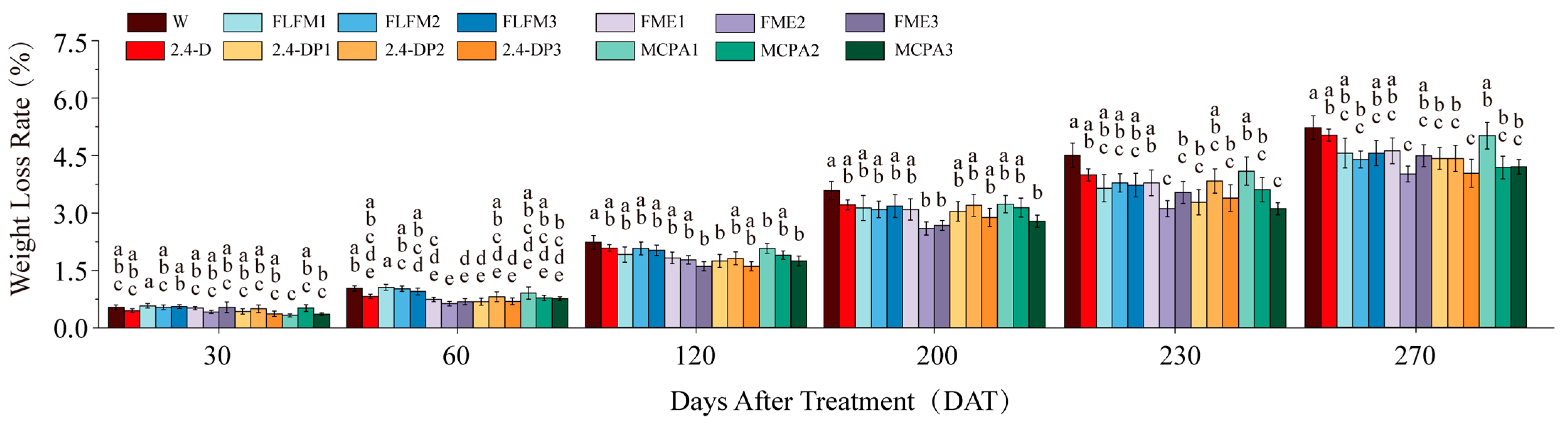
The weight loss rate is a key indicator of storage performance in lemon fruits. Upon extending the storage period from 30 to 270 days after treatment (DAT), the weight loss rate of water increased from 0.54% to 5.25%, which was significantly higher than under other treatments (Figure 1 and Figure S1). At 90 DAT, the weight loss rate under FME2, 2,4-DP1, 2,4-DP3, and MCPA3 treatments was 1.08%, 1.17%, 1.14%, and 1.20%, respectively, with the weight loss rate under FME2 treatment being significantly lower than under 2,4-D treatment (1.40%). This trend was consistent with that observed at 120 and 160 DAT. At 230 DAT, the weight loss rate under FME2 and MCPA3 treatments was 3.12% and 3.13%, respectively, both significantly lower than under 2,4-D (4.02%). Meanwhile, the weight loss rate under FME3, 2,4-DP1, 2,4-DP3, and MCPA2 was 3.56%, 3.30%, 3.41%, and 3.63%, respectively, all lower than that under 2,4-D treatment. At 270 DAT, the weight loss rate was 5.05% under 2,4-D treatment and 4.03% and 4.05%, respectively, under FME2 and 2,4-DP3 treatments, both significantly lower than under 2,4-D treatment. In contrast, the weight loss rate under MCPA3 treatment increased to 4.22%, which was significantly higher than in the water control but did not differ significantly from that under 2,4-D treatment. In summary, the weight loss rates under FME2 and 2,4-DP3 treatments was superior to that of 2,4-D.

3.2. Effects of Postharvest Treatments on the Calyx Browning Rate of Lemon Fruits

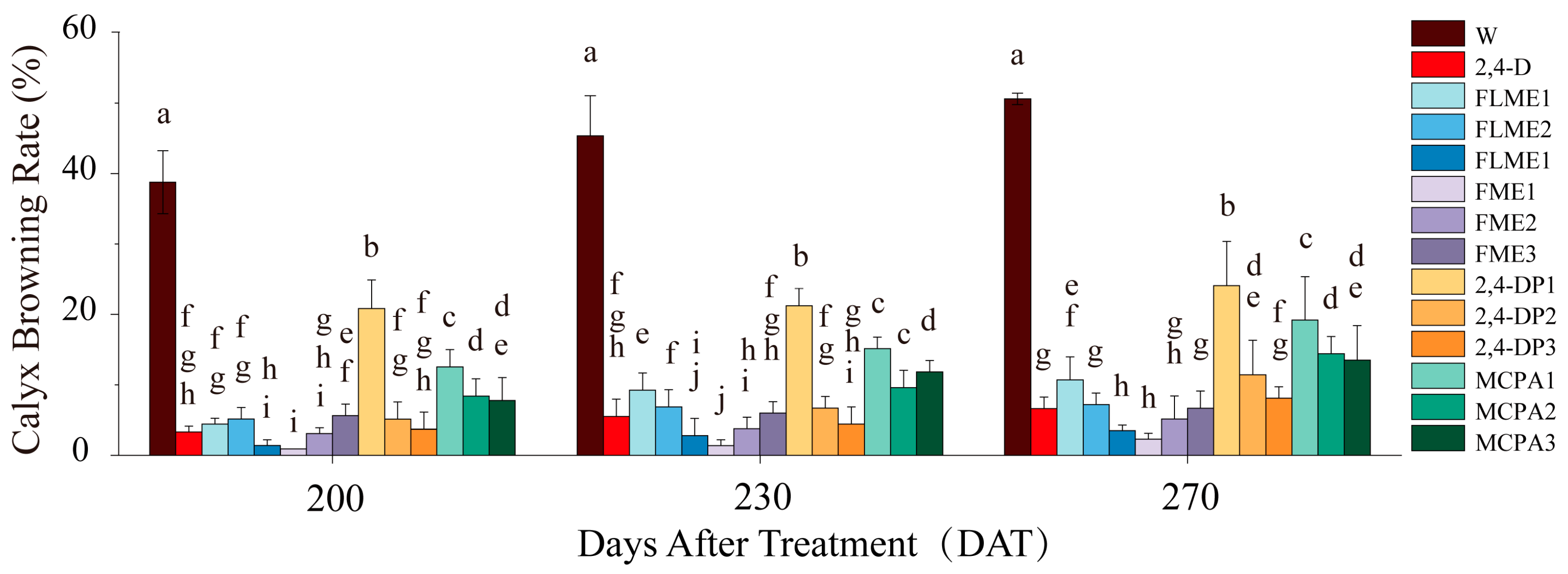
Calyx browning is a physiological disorder impacting postharvest fruit quality. The browning incidence increased with the progression of the storage period under all treatments. The browning rate in water was 38.85%, 45.45%, and 50.72%, respectively, at 200, 230, and 270 DAT of storage. In contrast, the browning rates under the other treatments were considerably lower at the corresponding time points (Figure 2). Specifically, the rate under FLFM3 and FME1 treatments was 1.38% and 2.00%, respectively, at 200 DAT, both lower than under 2,4-D treatment (3.31%). The rate under 2,4-DP2 and 2,4-DP3 treatments was 5.12% and 3.68%, respectively, and did not differ significantly from that under 2,4-D treatment. These results were consistent with the trend observed at 230 DAT. FLFM3 treatment led to the lowest browning rate among all treatments at 270 DAT (only 5.00%), followed by FME2 (5.14%) and FME1 (5.26%); all were significantly lower than that under 2,4-D treatment (6.62%). The browning rate under 2,4-DP3 treatment was 8.09%, which remained significantly lower than in water. In summary, significantly lower browning rates were consistently maintained under FLFM3, FME1, and FME2 treatments during the late storage period than under water and 2,4-D treatments.

3.3. Effects of Postharvest Treatments on the Decay Rate of Lemon Fruits

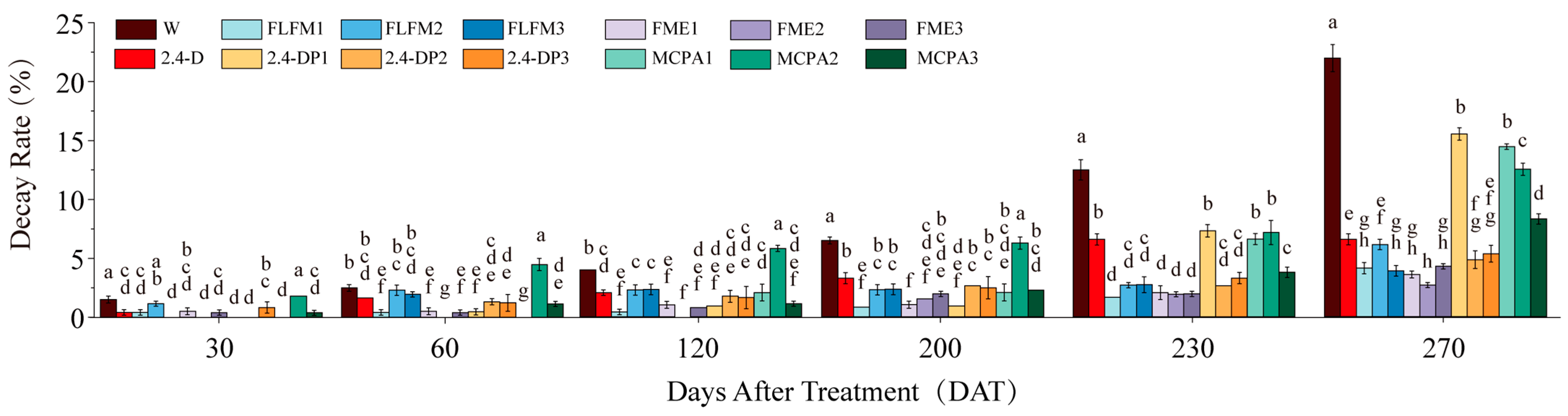
Decay incidence is a key parameter for evaluating lemon storage performance. On extending the storage period from 30 to 270 DAT, the decay incidence increased from 0.37% to 19.64% in the water control, and from 1.60% to 11.20% under MCPA2 treatment, whereas the increases under other treatments were relatively gradual (Figure 3 and Figure S2). At 90 DAT, the decay incidence was significantly lower under FME2 (0.00%), FLFM1 (0.37%), and FME1 (0.46%) treatments than under 2,4-D (1.84%) and water (1.84%). At 200 DAT, decay incidence exceeded 5% in water and was 2.94% in 2,4-D, both significantly higher than under FLFM1, FME, 2,4-DP1, and 2,4-DP2 treatments. At 230 DAT, the decay incidence under 2,4-DP1 and MCPA1 treatments increased rapidly to 13.88% and 12.92%, respectively, showing no significant difference from that under 2,4-D. At 270 DAT, the decay incidence under FME2, FLFM1, FLFM3, FME1, FME3, and 2,4-DP2 treatments was 2.40%, 3.69%, 3.48%, 3.21%, 3.83%, and 4.33%, respectively, which was significantly lower than under 2,4-D (5.88%); however, the decay incidence under the MCPA series treatments was significantly higher. These results indicated that the decay incidence under FME2, FME1, and FLFM1 treatments remained significantly lower than under 2,4-D and water during storage.

3.4. Effects of Postharvest Treatments on the Color of Lemon Fruit

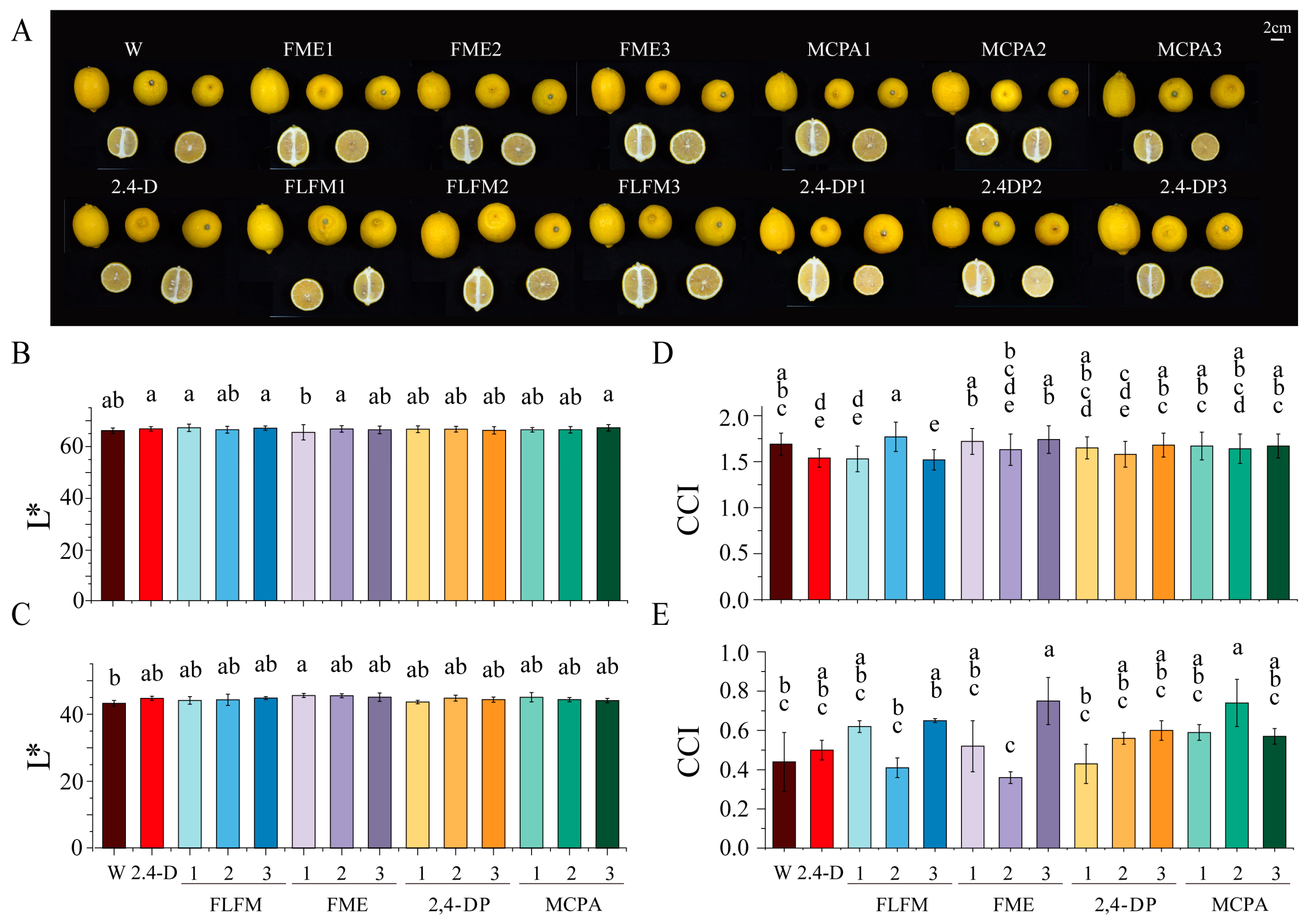
Fruit color is a key determinant of lemon shelf-life quality. Compared with the external coloration under 2,4-D and water treatments, most treatments did not cause noticeable color changes based on visual assessment (Figure 4A). For peel brightness, the water treatment showed an L value of 65.58, with no significant differences observed among treatments (Figure 4B). Regarding pulp brightness, the FME1 treatment (45.59) exhibited the highest L value, which was significantly higher than that of the water treatment, whereas no significant differences were observed between the other treatments and 2,4-D (Figure 4C).
Peel CCI values ranged from 0 to 2. Except for the 2,4-D, FLFM1, and FLFM3 treatments, no significant differences were observed between the other treatments and the water treatment (Figure 4D). Pulp CCI values ranged from 0 to 1 and showed trends similar to those of peel CCI (Figure 4E). In addition, no significant differences were observed in h° values of peel and pulp among treatments, with values around 83–84° for peel and approximately 88° for pulp (Figure S3A,B). In summary, none of the postharvest treatments adversely affected fruit coloration.

3.5. Effects of Postharvest Treatments on Juice Yield and Firmness of Lemon Fruits

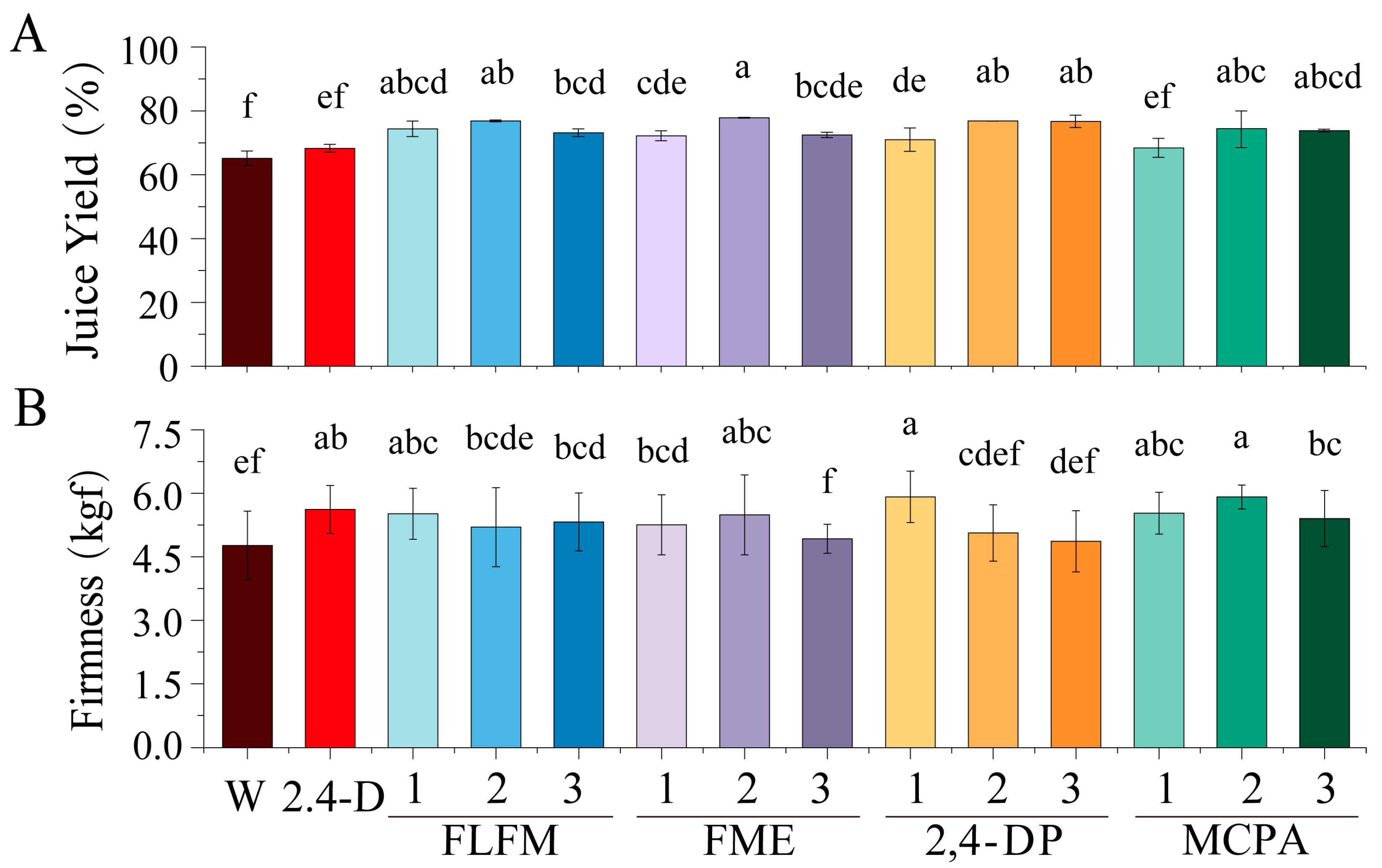
All other treatments, except MCPA1 and 2,4-D, led to higher fruit juice yields than water (65.14%) (Figure 5A). Among these, FME2 (77.84%), FLFM2 (76.86%), 2,4-DP2 (76.82%), 2,4-DP3 (76.71%), and MCPA2 ranked in the top five. Fruit firmness under most treatments was significantly higher than that of the water control, indicating that they effectively delayed the decline in firmness during storage (Figure 5B). The values were significantly higher under 2,4-DP1 (5.58 kg·cm−2), MCPA2 (5.57 kg·cm−2), FME2 (5.18 kg·cm−2), and MCPA1 (5.21 kg·cm−2) treatments than in water (4.50 kg·cm−2) while showing no significant difference from that under 2,4-D (5.30 kg·cm−2). The fruit shape index under most treatments ranged from 1.21 to 1.23 compared with that in water and 2,4-D (Figure S4), indicating no significant effect of treatment on fruit shape.

3.6. Effects of Postharvest Treatments on TSS, TA, and Vc Contents of Lemon Fruits

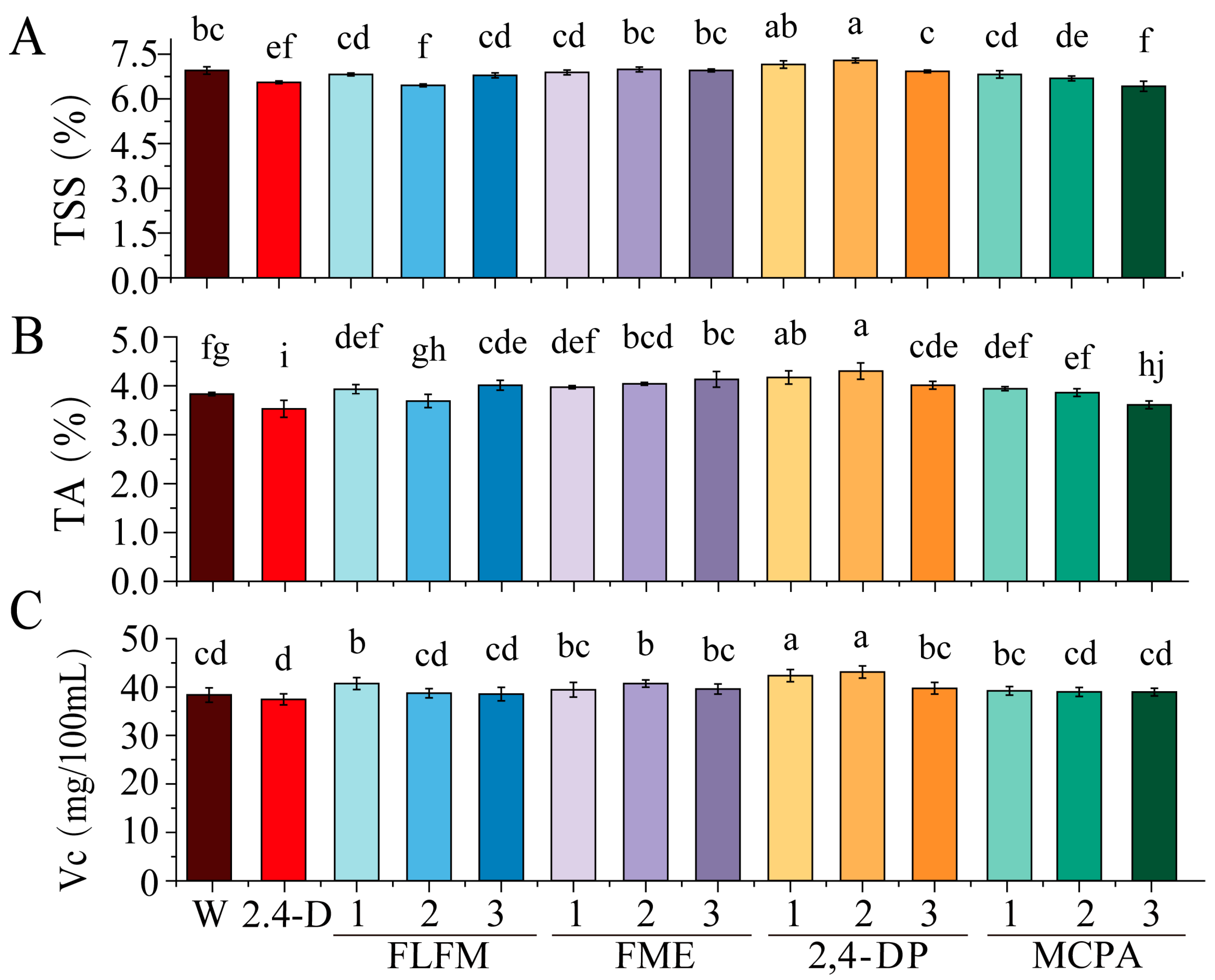
TSS, TA, and Vc contents serve as key indicators of the nutritional quality of lemons. TSS content was significantly higher under 2,4-DP2 (7.30), 2,4-DP1 (7.17), and FME2 (7.00) treatments than under 2,4-D (6.57) (Figure 6A). Furthermore, most treatments maintained higher TA content than water (3.82%) and 2,4-D (3.52%). Among these, 2,4-DP2 treatment led to the highest TA content (4.29%), whereas high values of 4.16%, 4.02%, 4.03%, and 4.00%, respectively, were recorded under 2,4-DP1, FME3, FME2, and FLFM3 treatments (Figure 6B). A similar trend was observed for Vc content. The Vc content under 2,4-DP2, 2,4-DP1, FLFM1, and FME2 treatments was 42.59, 41.85, 40.22, and 40.22 mg·100 g−1, respectively, all significantly higher than in water (37.93 mg·100g−1) and 2,4-D (37.04 mg·100g−1) (Figure 6C). In summary, 2,4-DP2, 2,4-DP1, and FME2 treatments demonstrated outstanding effects in maintaining TSS, TA, and Vc contents, whereas the other treatments had no adverse impact on these internal quality parameters.

3.7. Effects of Postharvest Treatments on the Volatile Component Content of Lemons

Volatile compounds are key indicators of the flavoring quality of lemons. Total flavor compounds were significantly higher under MCPA2 treatment than under 2,4-D and water. Significantly higher total flavoring levels were observed under 2,4-DP3, FLFM1, FLFM2, FME3, 2,4-DP2, and MCPA3 treatments than in water, but they did not differ significantly from those under 2,4-D (Table 4 and Table S1).
Monoterpenes dominated the flavoring profile. Seven monoterpene compounds were identified, collectively accounting for more than 67.43% of total volatiles, with D-limonene being the most abundant. The D-limonene content was highest under FME3 treatment. No significant difference was observed between FLFM2 and FLFM1 treatments; however, both had significantly higher D-limonene content than 2,4-D and water. The D-limonene content under FME2, 2,4-DP2, and 2,4-DP3 treatments did not differ significantly from that under 2,4-D, whereas the contents under the remaining treatments were significantly lower. Except for ocimene and myrcene, other monoterpenes, such as β-pinene and terpinolene, exhibited trends similar to that for D-limonene, with higher levels generally observed under MCPA2 or 2,4-DP3 treatments. The contents of ocimene and myrcene were significantly lower under 2,4-D and water than under other treatments, except for the FLFM3, FME1, 2,4-DP1, and MCPA series. Similarly, the contents of sesquiterpenes, such as β-caryophyllene, trans-α-bergamotene, and valencene, were higher under 2,4-DP3 and 2,4-DP2 treatments, whereas the cis-α-bisabolene content was higher under MCPA2 treatment than under other treatments.
Alcohols formed the second major class, accounting for more than 10.92% of total volatiles, with α-terpineol being the most abundant component. The α-terpineol content was the highest under MCPA2 treatment, followed by 2,4-DP3, 2,4-DP2, and FME2 treatments; these values were significantly higher than that under 2,4-D. Except for ethanol, the other alcohol components showed trends similar to those of α-terpineol. The ethanol content was significantly lower under FLFM1, FLFM2, and FME2 treatments than under 2,4-D, whereas the content under 2,4-DP2, 2,4-DP3, MCPA2, and MCPA3 treatments did not significantly differ compared with that under 2,4-D. Aldehydes were primarily composed of citral, nonanal, and lauraldehyde. The citral levels were significantly higher under MCPA2, FME2, FLFM1, and FLFM2 treatments than under 2,4-D and water, whereas the citral level was significantly lower under FME1 treatment than under 2,4-D and water. Nonanal and lauraldehyde showed trends similar to those for citral. 4”-Methylacetophenone was the only identified ketone component, with its content under 2,4-D and water being significantly higher than under all other treatments. Geranyl acetate was the predominant ester. The geranyl acetate content was significantly higher under MCPA2 treatment than under 2,4-D or water. Except for FME1, 2,4-DP2, and MCPA1, all other treatments showed higher ester contents than water. In summary, MCPA3 treatment resulted in the highest total flavor content among all treatments. This treatment showed higher levels of monoterpenes (e.g., camphene), alcohols (e.g., α-terpineol), and various esters. Meanwhile, 2,4-DP3 treatment maintained higher sesquiterpene content (e.g., β-caryophyllene and trans-α-bergamotene), and FME2 treatment maintained higher alcohol content (e.g., linalool and α-terpineol).

3.8. Analysis of Pesticide Residues in Lemons Following Postharvest Preservative Treatments

In this study, MCPA treatments were associated with relatively high rates of calyx browning and decay during storage. Also, their physiological parameters (e.g., TA and Vc) were either comparable to or significantly lower than in water. Accordingly, the residue analysis focused on six selected chemicals from the 2,4-D, FLFM, FME, and 2,4-DP treatment groups. As shown in Table 5, imazalil levels in fruits under these treatments ranged from 0.07 to 0.23 mg·kg−1. Specifically, detectable levels of both imazalil (0.15 mg·kg−1) and 2,4-D (0.03 mg·kg−1) were observed under 2,4-D treatment. Similarly, trace amounts (<0.01 mg·kg−1) were detected under the 2,4-DP treatments. FL, FME, and gibberellic acid were not detected in any of the samples. These results demonstrated that all detected residue levels were within the MRLs established by the Standard GB 2763-2026.

4. Discussion

The potential food safety and environmental risks of 2,4-D have drawn widespread attention, and the European Union has explicitly restricted its use in fruit preservation. Therefore, identifying safe and efficient postharvest preservative alternatives is crucial to ensuring the competitiveness of the lemon industry and maintaining food safety. Here, we systematically evaluated the effects of various preservatives, including FLFM, FME, 2,4-DP, and MCPA, on storage performance and quality of lemon fruits, thereby providing a technical basis for optimizing commercial preservation formulations for lemon fruits.
In the study, FME effectively maintained the lower weight loss and decay rates, improved the nutritional quality, such as higher juice yield and firmness, and enriched flavoring components, such as α-terpineol, of ‘Eureka’ lemons, with FME2 showing the best overall efficacy. The fruit decay and calyx browning rates of Newhall navel oranges and Ponkan mandarins under FL and FME treatments after 90 days were significantly lower than those under water treatment and did not differ from those under 2,4-D treatment [8]. In on-tree preservation, the calyx senescence rates of Lane Late navel oranges under FME and FL treatments (3.85% and 2.67%, respectively) were significantly lower than those under 2,4-D treatment (18.13%), demonstrating their superiority in delaying calyx senescence. Alhassan [14] also reported that 1 mM FME was significantly more effective than 2,4-D in inhibiting calyx browning and fruit decay in Valencia oranges, consistent with the present findings. Conversely, FME treatment had no significant effect on the weight loss rate of ‘Esbal’ clementine fruits [14], and Qin [11] demonstrated that FME reduced ethanol accumulation and effectively maintained fruit TSS, solid–acid ratio, and juice yield. Furthermore, 2,4-DP outperformed 2,4-D in delaying water loss and maintaining juice yield, TA, and vitamin C. High-concentration treatments provided better storage performance and quality maintenance, whereas low-concentration treatments were associated with higher calyx browning and decay rates. MCPA performed comparably to 2,4-D in maintaining the weight loss rate, color difference, and solid–acid ratio of ‘Eureka’ lemons [15].
In addition, no studies have addressed the effects of these treatments on citrus fruit aroma components. In recent years, metabolomic approaches based on GC-MS and LC-MS have been widely applied to investigate the dynamic changes in aroma compounds of citrus fruits and Kadsua coccinea leaf extracts [26,27,28]. In this study, 28 volatile compounds were identified using GC-MS, encompassing major aroma categories including terpenes, alcohols, aldehydes, esters, and ketones. From the perspective of postharvest biochemical pathways, terpenes are primarily synthesized via the MVA and MEP pathways, whereas alcohols and esters originate from the LOX pathway and AAT-catalyzed reactions, respectively. The significant accumulation of terpenes and esters in the 2,4-DP and MCPA treatment groups may be associated with upregulated TPS and AAT activities [29], whereas FME reduces off-flavor compounds such as ethanol by inhibiting ADH and PDC activities [11]. Previous studies on the cascade regulation of 2,4-D have shown that exogenous auxin analogs can indirectly modulate these enzyme activities by altering endogenous hormone balance [7,28]. Therefore, both 2,4-DP and MCPA treatments promoted the dynamic accumulation of characteristic aroma compounds including alcohols, such as α-terpineol, and monoterpenes, such as α-pinene, which is consistent with the results of Xiong et al. [18] and Hong et al. [30] under heat and salicylic acid, and oxalic acid treatments. Among these, α-pinene and α-terpineol exert their antimicrobial activity primarily by disrupting microbial cell membranes. Consequently, they effectively inhibit microbial growth on fruits such as strawberries [31] and grapes [32], reduce fruit decay and weight loss, and thereby extend shelf life. FME2 maintained high levels of D-limonene, linalool, and α-terpineol at 270 DAT, whereas ethanol and 4′-methylacetophenone levels were lower than those under 2,4-D treatment. Although Liang et al. [33] identified 4′-methylacetophenone as a potential off-flavor compound in citrus, its levels in this study were far below food regulatory thresholds and did not compromise fruit flavor quality or commercial value.
In international trade, exceeding residue limits is a major constraint on Chinese fruit exports. According to China’s GB 2763 standard, the MRL for 2,4-D in lemons is 1 mg·kg−1, whereas the EU sets a stricter limit of 0.05 mg·kg−1. All residue values detected in this study were below both Chinese and EU limits. Currently, MRLs for FL and FME are established only for cereals (e.g., 0.5 mg·kg−1 in corn), with no specific limits for fruits. Temporary MRLs for 2,4-DP in crops such as soybeans and fresh corn range from 0.05 to 0.1 mg·kg−1. Mostert [15] reported that the acute oral toxicity (LD50) of both FME and MCPA was lower than that of 2,4-D, suggesting a more favorable safety profile. In the present study, pesticide residue analysis confirmed that the residues of all tested preservatives complied with the Standard GB 2763-2026, supporting the feasibility of these alternatives from a food safety perspective.

5. Conclusions

In this study, fruits under FME2 treatment exhibited lower weight loss, browning, and decay rates than those under 2,4-D, as well as improved fruit quality, indicated by higher juice yield, TA and Vc contents during shelf life, with no significant difference in flavoring compound levels. In addition, 2,4-DP3 exerted significant effects on fruit nutritional quality (TSS, TA, and vitamin C) and levels of flavor compounds, including sesquiterpenes, whereas its inhibitory effect on weight loss and decay was comparable to that of 2,4-D. Therefore, this study suggests that FME2 and 2,4-DP3 will further be verified in postharvest storage of lemons, thereby providing a technical basis for optimizing postharvest preservation strategies.

Supplementary Materials

The following supporting information can be downloaded at: https://www.mdpi.com/article/10.3390/horticulturae12050598/s1, Figure S1. Weight loss rate of lemons during storage under post-harvest preservative treatments; Figure S2. Decay rate of lemons during storage u-nder postharvest preservative treatments; Figure S3. Effects of postharvest preservative treatments on peel and pulp h° of lemon fruits after 270 days of storage; Figure S4. Effects of postharvest preservative treatments on shape index after 270 days of storage; Table S1. Effects of postharvest preservative treatments on volatile compounds.

Author Contributions

The authors have made the following declarations about their contributions: M.H. and C.C. conceived the study. X.R. designed the methodology. L.R., X.R., T.W., H.W., G.H., Y.W., W.X. and K.Z. performed the investigation. F.W., G.H., Y.W. and L.P. provided resources. L.R., T.W., H.W. and Y.W. curated the data. L.R. wrote the original draft. L.R., X.R., T.W. and Y.H. reviewed and edited the manuscript. L.R. visualized the results. Y.H. and L.P. supervised the project. L.P., W.X. and K.Z. administered the project. F.W., G.H. and Y.H. acquired funding. All authors have read and agreed to the published version of the manuscript.

Funding

This research was supported by the National Natural Science Foundation of China (grant no. 32372676 and 32172510), Development of Yield and Quality Improvement and Storage Technology for Lemons in Xuewang Agriculture (F2025110), and the China Agriculture Research System of MOF and MARA (CARS-26).

Data Availability Statement

The data presented in this study are available in this article.

Acknowledgments

We would like to thank Jingjing Guo, Yi Qin, and Shuang Hang (College of Horticulture and Landscape Architecture, Southwest University) for their assistance with the experiments. All authors have read and agreed to the published version of the manuscript.

Conflicts of Interest

Authors Feixiang Wu, Genan Han, and Yangsheng Wu were employed by Xuewang Agriculture (Chongqing) Co., Ltd. The remaining authors declare that the research was conducted in the absence of any commercial or financial relationships that could be construed as a potential conflict of interest.

References

  1. Ladaniya, M. Citrus Fruit: Biology, Technology and Evaluation, 2nd ed.; Academic Press: London, UK, 2022; An imprint of Elsevier: San Diego, CA, USA, 2023; ISBN 978-0-323-99306-7. [Google Scholar]
  2. Wang, J.H.; Guo, W.Q.; Zheng, F.; Zhang, Y.; Wang, X.H.; Liu, D.Y.; Tang, J. Research Progress on Storage and Processing of Citrus Fruits. J. Agric. 2024, 14, 49–55. [Google Scholar]
  3. Liu, S.; Cai, Y.; Lou, Y.; Zhao, Y.; Cao, M.; Li, P.; Gu, Q. Understanding Citrus Aroma: Changes Induced by Postharvest Treatments of Fresh Fruit. Postharvest Biol. Technol. 2025, 224, 113491. [Google Scholar] [CrossRef]
  4. Jiang, H.Y. The Road to High-Quality Development of Lemon Industry in Anyue County. China Seed Ind. 2025, 8, 204–205. [Google Scholar]
  5. Duan, Z.K.; Tang, J.; Shen, L.M.; Li, Y.C. Effects of Paclobutrazol and Several Other Agents on Citrus Preservation. South China Fruits 2013, 42, 49–51, 53. [Google Scholar]
  6. Zhou, L.; Han, A.H.; Wang, R.K. Disease Control Effects of Several Preservatives in Citrus Storage. J. Southwest China Norm. Univ. (Nat. Sci. Ed.) 2007, 43–45. [Google Scholar]
  7. Ma, Q.; Ding, Y.; Chang, J.; Sun, X.; Zhang, L.; Wei, Q.; Cheng, Y.; Chen, L.; Xu, J.; Deng, X. Comprehensive Insights on How 2,4-Dichlorophenoxyacetic Acid Retards Senescence in Post-Harvest Citrus Fruits Using Transcriptomic and Proteomic Approaches. J. Exp. Bot. 2014, 65, 61–74. [Google Scholar] [CrossRef] [PubMed]
  8. Cheng, Y.J.; Yang, C.H.; Bao, Z.; Zhu, F.; Xu, R.W.; Xu, C.X.; Zou, Y.Q. Application of a Preservative in On-Tree and Postharvest Storage of Citrus. CN116172055A, 30 May 2023. [Google Scholar]
  9. Chen, W.; Jiao, B.; Su, X.; Zhao, Q.; Sun, D. Dissipation and Residue of 2,4-D in Citrus under Field Condition. Environ. Monit. Assess. 2015, 187, 302. [Google Scholar] [CrossRef] [PubMed]
  10. Meng, H.Y.; Zhu, F.W.; Liao, L.H.; Liu, S.; Wang, G.; Wan, K.; Tang, X.M. Study on the Use and Residue Regulation of Citrus Preservatives. Qual. Saf. Agric. Prod. 2022, 1, 73–78. [Google Scholar]
  11. Qin, J.X.; Ou, L.S.; Xu, C.X.; Zou, Y.Q.; Lu, C.Q.; Zhu, F.; Xu, R.W.; Chen, X.L.; Qin, K.F.; Li, G.G.; et al. Effect of Fluroxypyr-Meptyl on the On-Tree Storage Quality of Orah Mandarin. Sci. Agric. Sin. 2025, 58, 3970–3984. [Google Scholar]
  12. Iekiyo, K.; Koio, H.; Niu, J.X.; Jiang, D.J. Effect of 2,4-DP and MCPB on Preventing Preharvest Fruit Drop in Apple. North. Fruits 1992, 4, 55–57. [Google Scholar]
  13. Yildirim, B.; Yesiloglu, T.; Incesu, M.; Kamiloglu, M.U.; Cimen, B.; Tamer, S. Effects of 2,4-DP (2,4-Dichlorophenoxypropionic Acid) Plant Growth Regulator on Fruit Size and Yield of Valencia Oranges (Citrus sinensis Osb.). N. Z. J. Crop Hortic. Sci. 2011, 40, 55–64. [Google Scholar] [CrossRef]
  14. Alhassan, N.; Wills, R.B.H.; Bowyer, M.C.; Pristijono, P.; Golding, J.B. Comparative Study of the Auxins 2,4-D, Fluroxypyr, Dicamba, MCPA and Hydrogen Sulphide to Inhibit Postharvest Calyx Senescence and Maintain Internal Quality of Valencia Oranges. N. Z. J. Crop Hortic. Sci. 2022, 50, 131–142. [Google Scholar] [CrossRef]
  15. Mostert, S.; Alférez, F.M.; Du Plooy, W.; Cronjé, P.J.R. Effect of Plant Growth Regulators on Postharvest Calyx Retention of Citrus Fruit. Postharvest Biol. Technol. 2024, 207, 112629. [Google Scholar] [CrossRef]
  16. Chen, X.; Ma, Y.; Huang, M.; Li, W.; Zeng, D.; Li, J.; Wang, Y. Multiple Herbicide Resistance in a Cyperus difformis Population in Rice Field from China. Pestic. Biochem. Physiol. 2023, 195, 105576. [Google Scholar] [CrossRef]
  17. Chen, Y.L.; Jiang, Y.; Li, Y.X.; Liu, L.; Sun, C.J. Simultaneous Determination of Six Plant Growth Regulators in Fruits by High Performance Liquid Chromatography. Mod. Prev. Med. 2016, 43, 891–895. [Google Scholar]
  18. Xiong, B.; Zheng, W.; Wang, J.; Yao, J.; Li, Y.; Chen, S.; Liao, L.; Wang, X.; Zhang, M.; He, S.; et al. Effect of Postharvest Treatments on Aroma Volatiles in Sweet Orange ‘Newhall’ Peel Using HS-SPME-GC/MS. Plant Physiol. Biochem. 2025, 229, 110643. [Google Scholar] [CrossRef]
  19. Porat, R.; Weiss, B.; Cohen, L.; Daus, A.; Goren, R.; Droby, S. Effects of Ethylene and 1-Methylcyclopropene on the Postharvest Qualities of ‘Shamouti’ Oranges. Postharvest Biol. Technol. 1999, 15, 155–163. [Google Scholar] [CrossRef]
  20. Alhassan, N.; Isah, U.A.; Abdulai, A.; Mohammed, T. Postharvest Treatment of Navel Oranges with Fluroxypyr, 2-Methyl-4-Chlorophenoxyacetic Acids, and 2,4-Dichlorophenoxyacetic Maintains Physiological Quality during Ambient Storage. J. Arid. Agric. 2024, 10, 142–149. [Google Scholar] [CrossRef]
  21. Ou, Z.T.; Li, G.G.; Chen, X.L.; Chen, D.K.; Liu, Y.X.; Zhao, H.T.; Luo, Q.J. Effect of Chemical Treatments on Quality Changes of Murcott Mandarin during Low Temperature Storage. Jiangsu Agric. Sci. 2021, 49, 174–176. [Google Scholar]
  22. Zhang, M.; Wang, Y.; Li, Q.; Luo, Y.; Tao, L.; Lai, D.; Zhang, Y.; Chu, L.; Shen, Q.; Liu, D.; et al. Ultrasound-Assisted Extraction of Polysaccharides from Ginkgo biloba: Process Optimization, Composition and Anti-Inflammatory Activity. Heliyon 2024, 10, e37811. [Google Scholar] [CrossRef]
  23. Duan, Y.; Li, X.; Zhu, Y.; Chen, J.; Xue, J.; Wang, H.; Chen, S. Dual-Frequency Ultrasonic-Assisted Extraction of Pumpkin Polysaccharides: Process Optimization, Structural Characterization, and Antioxidant Activity. LWT 2026, 244, 119220. [Google Scholar] [CrossRef]
  24. Anastassiades, M.; Lehotay, S.J.; Štajnbaher, D.; Schenck, F.J. Fast and Easy Multiresidue Method Employing Acetonitrile Extraction/Partitioning and “Dispersive Solid-Phase Extraction” for the Determination of Pesticide Residues in Produce. J. AOAC Int. 2003, 86, 412–431. [Google Scholar] [CrossRef]
  25. GB 2763-2026; National Food Safety Standard—Maximum Residue Limits for Pesticides in Food. National Health Commission of the People’s Republic of China, Ministry of Agriculture and Rural Affairs of the People’s Republic of China, State Administration for Market Regulation, Standards Press of China: Beijing, China, 2026. (In Chinese)
  26. Shi, S.; Li, K.; Peng, J.; Li, J.; Luo, L.; Liu, M.; Chen, Y.; Xiang, Z.; Xiong, P.; Liu, L.; et al. Chemical Characterization of Extracts of Leaves of Kadsua coccinea (Lem.) A.C. Sm. by UHPLC-Q-Exactive Orbitrap Mass Spectrometry and Assessment of Their Antioxidant and Anti-Inflammatory Activities. Biomed. Pharmacother. 2022, 149, 112828. [Google Scholar] [CrossRef]
  27. Yang, X.; Lin, X.; Wei, Q.; Chen, M.; Chen, J.; Ma, Q. Understanding the Influence of 2,4-Dichlorophenoxyacetic Acid and Melatonin Treatments on the Sweet and Acidic Flavors and Citric Acid Metabolism of ‘Olinda’ Orange (Citrus sinensis (L.) Osbeck). Sci. Hortic. 2022, 304, 111287. [Google Scholar] [CrossRef]
  28. Li, C.; Li, X.; Liang, G.; Xiang, S.; Han, G. Analysis of Phenols and Volatile Metabolites during Lemon Fruit Ripening after Bagging Treatment. HortScience 2025, 60, 1302–1307. [Google Scholar] [CrossRef]
  29. Huang, D.; Li, J.; Wei, Y.; Luo, X.; Xie, X.; Chen, J.; Yao, S.; Li, L.; Fu, J.; Xu, J.; et al. Integration of Metabolomics and Transcriptomics Unravels the Molecular Mechanisms Underlying Variations in Flavor-Related Volatiles in Citrus reticulata ‘Chachi’ Grafted onto Different Rootstocks. Food Res. Int. 2025, 217, 116780. [Google Scholar] [CrossRef] [PubMed]
  30. Hong, M.; Wang, J.; Wang, R.K.; Feng, Y.; Zhou, L.; Deng, T.J.; Yao, S.X.; Xiao, Y.H.; He, M.Y. Effects of Oxalic Acid Treatment on Flavor Quality and Ethanol Metabolism of Postharvest Jin Orange. Food Ferment. Ind. 2023, 49, 71–77. [Google Scholar]
  31. Chaux-Gutiérrez, A.M.; Pérez-Monterroza, E.J.; Cattelan, M.G.; Janzantti, N.S.; Nicoletti, V.R.; Aouada, F.A.; de Moura, M.R. Active Packaging Incorporating Cryogels Loaded with Pink Pepper Essential Oil (Schinus terebinthifolius Raddi) for Strawberry Preservation. Processes 2025, 13, 1179. [Google Scholar] [CrossRef]
  32. Jing, Z.Y. Analysis and Application of Volatile Flavor Compounds in Pepper Essential Oil. Master’s Thesis, Hebei University of Engineering, Handan, China, 2023. [Google Scholar]
  33. Liang, C.-P.; Wang, M.; Simon, J.E.; Ho, C.-T. Antioxidant Activity of Plant Extracts on the Inhibition of Citral Off-Odor Formation. Mol. Nutr. Food Res. 2004, 48, 308–317. [Google Scholar] [CrossRef]
Figure 1. Weight loss rate of lemons during storage under postharvest preservative treatments. Vertical bars represent means ± standard error (n = 3). Different lowercase letters indicate significant differences among treatments according to Duncan’s multiple range test (p ≤ 0.05).
Horticulturae 12 00598 g001
Figure 2. Calyx browning rate of lemons during storage following postharvest preservative treatments. Vertical bars represent means ± standard error (n = 3). Different lowercase letters indicate significant differences among treatments according to Duncan’s multiple range test (p ≤ 0.05).
Horticulturae 12 00598 g002
Figure 3. Decay rate of lemons during storage under postharvest preservative treatments. Vertical bars represent means ± standard error (n = 3). Different lowercase letters indicate significant differences among treatments according to Duncan’s multiple range test (p ≤ 0.05).
Horticulturae 12 00598 g003
Figure 4. Effects of postharvest preservative treatments on peel and pulp color of lemon fruits after 270 days of storage. (A) Lemon fruits after storage; the bar indicates 2 cm. (B) Peel lightness (L*). (C) Pulp lightness (L*). (D) Peel citrus color index (CCI). (E) Pulp citrus color index (CCI). Vertical bars represent means ± standard error (n = 3). Different lowercase letters indicate significant differences among treatments according to Duncan’s multiple range test (p ≤ 0.05).
Horticulturae 12 00598 g004
Figure 5. Effects of postharvest preservative treatments on juice yield and firmness after 270 days of storage. (A) Juice Yield; (B) Firmness. Vertical bars represent means ± standard error (n = 3). Different lowercase letters indicate significant differences among treatments according to Duncan’s multiple range test (p ≤ 0.05).
Horticulturae 12 00598 g005
Figure 6. Effects of postharvest preservative treatments on internal quality attributes of lemon fruits after 270 days of storage. (A) TSS content. (B) TA content. (C) Vc content. Vertical bars represent means ± standard error (n = 3). Different lowercase letters indicate significant differences among treatments according to Duncan’s multiple range test (p ≤ 0.05).
Horticulturae 12 00598 g006
Table 1. Experimental concentrations of the agents (calculated as active ingredient).
AbbreviationAgentConcentration
WClear water
2,4-D2,4-D (85% active ingredient, Sichuan Guoguang Agrochemical Co., Ltd., Chengdu, China)200 mg/L
FLFM1Fluroxypyr-meptyl (28.8%) and fluroxypyr (20%) (ratio of active ingredients by weight: 1:0.69, Weifang Xinlü Chemical Co., Ltd., Weifang, China) 50 mg/L
2100 mg/L
3200 mg/L
FME1Fluroxypyr-meptyl (95% active ingredient, Heze Maotairuinong Biotechnology Co., Ltd., Heze, China)75 mg/L
2150 mg/L
3225 mg/L
2,4-DP12,4-DP (50% active ingredient, Shandong Zhongshi Pharmaceutical Co., Ltd., Liaocheng, China)30 mg/L
260 mg/L
390 mg/L
MCPA1MCPA (99% active ingredient, Shanghai Titan Technology Co., Ltd., Shanghai, China)20 mg/L
240 mg/L
380 mg/L
Except for clear water, all treatments were added with 20% imazalil at 1000-fold dilution (200 mg/L) and 20% gibberellic acid at 2000-fold dilution (100 mg/L).
Table 2. Gradient elution conditions of mobile phase.
Time (min)Mobile Phase A (%)Mobile Phase B (%)
-9010
0.29010
21090
61090
6.19010
89010
Table 3. MRM monitoring parameters.
Pesticide NameRetention Time (min)Ion Source ModeParent Ion (m/z)Daughter Ion (m/z)Collision Energy (eV)Dwell Time (ms)
Gibberellic acid2.4Negative ion344.9239.285
344.9143.1255
2,4-D3.2Negative ion219161155
221163155
2,4-DP3.3Negative ion219161105
219125305
Imazalil2.9Positive ion297.1159155
297.1201205
Fluroxypyr2.8Negative ion255209155
255181255
Fluroxypyr-meptyl4.1Positive ion367.6209.2255
367.6255.1105
Table 4. Effects of postharvest preservative treatments on volatile compounds.
NameContent (μg/g)
W2,4-DFLFM1FLFM2FLFM3FME1FME2FME32.4-DP12.4-DP22.4-DP3MCPA1MCPA2MCPA3
Monoterpenes615.54 ± 1.29 f938.92 ± 121.67 cd1050.43 ± 100.96 bc1032.80 ± 71.25 bc587.41 ± 100.84 fg430.16 ± 7.40 h808.47 ± 64.63 de1076.34 ± 205.70 ab570.71 ± 19.82 fg904.19 ± 44.41 d1079.64 ± 133.47 ab482.25 ± 82.45 gh1177.14 ± 17.38 a994.58 ± 92.77 bcd
D-Limonene493.04 ± 1.56 fg644.41 ± 86.92 de792.77 ± 46.91 abc809.53 ± 58.34 ab482.47 ± 71.49 g365.60 ± 7.17 h599.45 ± 91.39 ef844.37 ± 146.00 a482.07 ± 12.63 g575.59 ± 20.05 ef663.27 ± 47.27 d415.44 ± 62.91 gh715.17 ± 41.55 cd730.25 ± 13.92 bcd
Beta-Pinene55.49 ± 2.33 ef157.56 ± 14.98 b116.68 ± 39.76 c74.12 ± 3.61 de31.82 ± 15.57 fg16.63 ± 1.16 g77.79 ± 9.05 de77.80 ± 34.06 de24.05 ± 4.43 fg174.55 ± 52.34 b168.76 ± 36.31 b16.67 ± 8.68 g237.70 ± 1.75 a97.75 ± 59.84 cd
Myrcene34.78 ± 0.31 efg37.89 ± 8.21 def50.30 ± 6.60 cd61.06 ± 2.21 bc31.85 ± 7.30 fg20.62 ± 0.33 g57.62 ± 1.46 bc65.86 ± 7.84 b30.32 ± 1.69 fg47.67 ± 15.41 cde84.93 ± 37.76 a23.09 ± 5.05 fg66.31 ± 19.77 b70.70 ± 23.53 b
Terpinolene20.54 ± 5.26 d77.33 ± 14.20 b62.94 ± 15.60 b63.87 ± 2.19 b28.83 ± 4.43 d19.24 ± 0.82 d47.79 ± 20.98 c61.75 ± 14.57 b24.77 ± 0.76 d75.93 ± 18.70 b124.85 ± 8.42 a22.43 ± 4.90 d137.80 ± 7.79 a69.52 ± 17.04 b
Ocimene7.07 ± 2.36 e6.51 ± 0.92 e17.40 ± 3.68 bc13.56 ± 4.53 d7.91 ± 1.38 e4.96 ± 0.17 e16.11 ± 1.19 bcd17.24 ± 1.75 bc5.75 ± 0.28 e18.78 ± 5.48 b22.76 ± 2.34 a1.32 ± 0.20 f7.62 ± 0.34 e15.06 ± 3.69 cd
Sesquiterpenes33.04 ± 0.79 fg144.12 ± 9.26 bc106.63 ± 47.71 cd55.72 ± 4.63 efg28.74 ± 11.25 fg19.37 ± 1.33 g57.80 ± 1.86 efg71.16 ± 28.04 def24.82 ± 0.19 g159.87 ± 88.15 ab186.69 ± 40.51 a24.75 ± 8.30 g103.61 ± 2.51 cd98.35 ± 59.24 de
Trans-.α-Bergamotene14.06 ± 0.42 de57.53 ± 8.39 b40.13 ± 22.14 c20.53 ± 2.08 de11.48 ± 5.80 de4.98 ± 0.40 e21.05 ± 0.12 de27.73 ± 12.63 cd10.31 ± 0.12 de61.45 ± 34.22 ab76.68 ± 15.74 a5.90 ± 3.32 e3.85 ± 0.00 e39.02 ± 25.48 c
Beta-Caryophyllene8.10 ± 0.13 fgh31.01 ± 0.12 bc26.23 ± 13.76 bcd13.18 ± 0.99 efgh5.89 ± 2.30 gh3.28 ± 0.14 h14.56 ± 0.40 efg16.65 ± 6.70 def4.91 ± 0.06 gh34.83 ± 18.84 ab41.87 ± 8.29 a4.39 ± 1.96 gh32.88 ± 0.35 ab21.72 ± 13.94 cde
Valencene6.58 ± 0.17 g34.61 ± 2.12 bc28.50 ± 6.26 cd14.31 ± 0.84 efg7.43 ± 1.98 fg4.37 ± 0.12 g14.82 ± 0.68 efg17.39 ± 5.91 ef6.21 ± 0.29 g42.02 ± 22.06 ab51.17 ± 11.43 a5.57 ± 1.35 g40.11 ± 0.35 b23.41 ± 13.14 de
Cis-.α.-Bisabolene1.86 ± 0.02 g11.35 ± 1.34 b4.56 ± 2.14 ef2.96 ± 0.28 fg1.77 ± 0.38 g5.75 ± 0.41 de2.51 ± 0.76 g3.59 ± 1.05 fg1.64 ± 0.02 g7.82 ± 4.47 c2.26 ± 0.55 g7.14 ± 1.90 cd53.00 ± 0.44 a5.74 ± 1.36 de
Alcohols88.64 ± 3.22 ef174.90 ± 40.42 d184.52 ± 18.83 cd196.44 ± 3.69 cd105.10 ± 9.42 e75.53 ± 1.38 f203.63 ± 14.01 bc174.25 ± 20.30 d75.61 ± 0.68 f195.42 ± 33.28 cd225.01 ± 14.95 b73.23 ± 8.37 f311.19 ± 2.44 a194.11 ± 26.72 cd
Alpha-Terpineol66.50 ± 2.62 e135.62 ± 34.06 d148.91 ± 14.94 cd156.20 ± 5.90 cd76.46 ± 8.02 e55.18 ± 0.86 e164.25 ± 10.83 c140.64 ± 18.30 d60.88 ± 1.73 e166.74 ± 31.91 c194.28 ± 13.48 b57.29 ± 9.26 e223.79 ± 5.07 a164.72 ± 26.14 c
Ethanol5.70 ± 0.28 bcd5.59 ± 0.66 bcde1.43 ± 0.54 g2.99 ± 0.82 f5.37 ± 0.10 cde4.37 ± 0.33 e2.68 ± 0.86 f4.80 ± 0.82 de5.04 ± 1.03 cde6.23 ± 0.59 bc6.63 ± 0.17 b7.80 ± 0.37 a4.93 ± 2.16 de4.47 ± 1.83 de
Aldehydes21.52 ± 4.01 e10.88 ± 0.74 g41.53 ± 5.51 b34.64 ± 5.33 c5.65 ± 0.52 h6.47 ± 0.90 h27.76 ± 0.48 d14.20 ± 0.32 f1.35 ± 0.01 j6.61 ± 1.25 h5.11 ± 1.04 hi1.88 ± 0.48 ij46.34 ± 3.09 a10.14 ± 4.08 g
Citral20.41 ± 3.96 d8.87 ± 0.92 f39.44 ± 5.81 a32.32 ± 5.45 b4.85 ± 0.49 gh5.69 ± 0.80 fgh25.22 ± 0.68 c12.37 ± 0.46 e0.89 ± 0.18 i4.48 ± 1.19 ghi3.03 ± 0.77 hi1.03 ± 0.44 i42.48 ± 4.84 a6.95 ± 3.44 fg
Nonanal0.63 ± 0.03 e0.60 ± 0.04 ef0.63 ± 0.13 e0.71 ± 0.02 d0.42 ± 0.01 h0.42 ± 0.02 h0.77 ± 0.01 cd0.55 ± 0.05 fg0.33 ± 0.02 i0.74 ± 0.05 cd0.80 ± 0.09 c0.49 ± 0.03 g1.57 ± 0.08 a1.39 ± 0.02 b
Lauric aldehyde0.48 ± 0.02 c1.32 ± 0.14 b1.45 ± 0.17 b1.61 ± 0.10 b0.38 ± 0.05 c0.36 ± 0.07 c1.78 ± 0.19 ab1.29 ± 0.09 b0.27 ± 0.00 c1.38 ± 0.01 b1.28 ± 0.18 b0.36 ± 0.01 c2.28 ± 1.67 a1.80 ± 0.62 ab
Ketones7.83 ± 0.31 a1.78 ± 0.02 h3.34 ± 0.11 e4.46 ± 0.03 b0.70 ± 0.02 ij0.66 ± 0.02 ij3.58 ± 0.33 d2.53 ± 0.05 g0.50 ± 0.03 j2.82 ± 0.02 f3.20 ± 0.28 e0.78 ± 0.13 i4.19 ± 0.17 c3.33 ± 0.17 e
4′-Methylacetophenone7.83 ± 0.31 a1.78 ± 0.02 h3.34 ± 0.11 e4.46 ± 0.03 b0.70 ± 0.02 ij0.66 ± 0.02 ij3.58 ± 0.33 d2.53 ± 0.05 g0.50 ± 0.03 j2.82 ± 0.02 f3.20 ± 0.28 e0.78 ± 0.13 i4.19 ± 0.17 c3.33 ± 0.17 e
Esters37.09 ± 1.86 d118.75 ± 10.15 b85.20 ± 8.36 c6.77 ± 4.47 e38.59 ± 2.74 d26.55 ± 0.39 d115.72 ± 12.33 b78.40 ± 6.36 c19.53 ± 1.39 de71.27 ± 9.39 c82.00 ± 6.48 c24.53 ± 1.26 de179.04 ± 6.22 a39.14 ± 50.32 d
Geranyl acetate35.62 ± 1.79 f106.80 ± 10.04 b81.79 ± 7.90 c99.41 ± 3.24 bc37.21 ± 2.61 f25.49 ± 0.38 g111.81 ± 11.96 b75.27 ± 6.09 cde18.70 ± 0.84 g68.09 ± 8.82 e78.25 ± 6.25 cd23.87 ± 0.99 g173.53 ± 6.45 a71.95 ± 0.00 de
Total content803.66 ± 4.41 d1389.35 ± 81.43 bc1471.66 ± 170.24 bc1426.29 ± 87.08 bc766.19 ± 124.79 d558.74 ± 6.1 d1216.97 ± 90.49 c1416.88 ± 260.13 bc692.52 ± 22.12 d1340.17 ± 176.46 bc1581.63 ± 196.73 ab607.43 ± 99.76 d1821.51 ± 8.18 a1339.65 ± 132.32 bc
Vertical bars represent means ± standard error (n = 3). Different lowercase letters indicate significant differences among treatments according to Duncan’s multiple range test (p ≤ 0.05).
Table 5. Pesticide residues of different postharvest preservatives in lemons.
FluroxypyrFluroxypyr-MeptylImazalilGibberellic Acid2,4-DP2,4-D
W//////
2,4-D//0.15 ± 0.01//0.03 ± 0.00
FLFM1//0.09 ± 0.00///
FLFM2//0.09 ± 0.00///
FLFM3//0.13 ± 0.00///
FME1//0.09 ± 0.00///
FME2//0.11 ± 0.01///
FME3//0.07 ± 0.00///
2,4-DP1//0.22 ± 0.02///
2,4-DP2//0.23 ± 0.02/0.01 ± 0.00/
2,4-DP3//0.21 ± 0.01/0.01 ± 0.00/
LOD
(mg/kg)
0.0050.0050.0050.0050.0050.005
MRL
(mg/kg)
0.500.505.00/0.101.00
“/” indicates not detected or below the detection limit.
Disclaimer/Publisher’s Note: The statements, opinions and data contained in all publications are solely those of the individual author(s) and contributor(s) and not of MDPI and/or the editor(s). MDPI and/or the editor(s) disclaim responsibility for any injury to people or property resulting from any ideas, methods, instructions or products referred to in the content.