

You are currently viewing a new version of our website. To view the old version click .

Horticulturae, Volume 10, Issue 7

July 2024 - 112 articles

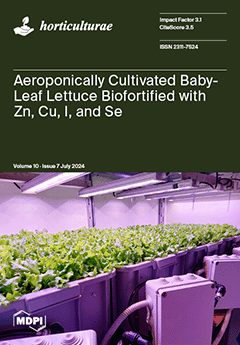
Cover Story: In indoor cultivation, the production of value-added vegetables is particularly important due to high production costs. This study assessed the biofortification of indoor-grown baby-leaf lettuce using aeroponics. Four experiments were conducted by adding different concentrations of Zn (from 10 to 450 µM) or Cu (from 3 to 250 µM) into nutrient solution. A fifth experiment was conducted by simultaneously adding the optimal concentration of I (5 µM), Se (13 µM), Zn (250 µM) and Cu (150 µM). Higher concentrations of Cu, Zn, I, or Se in the nutrient solution led to an increase in their concentrations in lettuce leaves. Simultaneously biofortifying baby-leaf lettuce with these four minerals is a practical and convenient way to integrate these micronutrients into the diet without reducing the yield or quality of lettuce. View this paper
  • Issues are regarded as officially published after their release is announced to the table of contents alert mailing list .
  • You may sign up for email alerts to receive table of contents of newly released issues.
  • PDF is the official format for papers published in both, html and pdf forms. To view the papers in pdf format, click on the "PDF Full-text" link, and use the free Adobe Reader to open them.

Articles (112)

  • Article
  • Open Access
2 Citations
1,779 Views
18 Pages

Soluble sugars, as an indispensable source of energy, play crucial roles in plant growth and development. However, to date, scant information about the sucrose metabolism-related gene families is available in kiwifruit (Actinidia rufa Planch). Here,...

  • Article
  • Open Access
5 Citations
2,578 Views
13 Pages

Because of their tolerance to root rot and many abiotic stresses, rootstocks are generally required for commercial avocado production. However, cutting and air-layering, which are popular methods of vegetative propagation for producing large numbers...

  • Article
  • Open Access
2 Citations
2,001 Views
17 Pages

Strawberry red core root rot disease affects the growth and yield of strawberry (Fragaria ananassa Duch), which leads to economic losses in China. The study employed a tissue separation method to isolate and identify the causal agent responsible for...

  • Feature Paper
  • Article
  • Open Access
6 Citations
2,243 Views
15 Pages

Mulching with Municipal Solid Waste (MSW) Compost Has Beneficial Side Effects on Vineyard Soil Compared to Mulching with Synthetic Films

  • Ileana Blanco,
  • Massimiliano Cardinale,
  • Corrado Domanda,
  • Gianluca Pappaccogli,
  • Piergiorgio Romano,
  • Gianni Zorzi and
  • Laura Rustioni

Municipal solid waste (MSW) compost represents a sustainable alternative to plastic film for mulching in viticulture. This study investigated the effects of MSW compost on vineyard soil properties, specifically focusing on side effects such as soil t...

  • Review
  • Open Access
1 Citations
2,374 Views
33 Pages

Brazil is home to some of the world’s greatest biodiversity, providing an immeasurable number of new opportunities and unexplored sources of native plants for the development of products, extracts, foods, and compounds of social and economic in...

  • Article
  • Open Access
2 Citations
2,942 Views
18 Pages

Early season monitoring of nutrient stress is important in red maple (Acer rubrum L.) and flowering dogwood (Cornus florida L.) to optimize management practices and ensure healthy crop production in containers. Two different irrigation systems (drip...

  • Article
  • Open Access
1 Citations
2,705 Views
22 Pages

Association of Microbiome Diversity with Disease Symptoms in Brassica oleracea Leaves

  • Héctor Martín-Cardoso,
  • Víctor M. González-Miguel,
  • Luis Soler-López,
  • Sonia Campo and
  • Blanca San Segundo

Cabbage (Brassica oleracea), a crop of major economic importance worldwide, is affected by numerous diseases, which are caused by a wide range of microorganisms, including fungi, oomycetes, bacteria, and viruses, which lead to important losses in yie...

  • Article
  • Open Access
14 Citations
6,344 Views
17 Pages

Evaluation of Integrated Pest and Disease Management Combinations against Major Insect Pests and Diseases of Tomato in Tamil Nadu, India

  • Sankaran Pagalahalli Shanmugam,
  • Marimuthu Murugan,
  • Mookiah Shanthi,
  • Thiyagarajan Elaiyabharathi,
  • Kathithachalam Angappan,
  • Gandhi Karthikeyan,
  • Gopal Arulkumar,
  • Palanisamy Manjari,
  • Manickam Ravishankar and
  • Paola Sotelo-Cardona
  • + 2 authors

Tomatoes are one of the predominant vegetable crops grown throughout the year in Tamil Nadu, India. Their perishable nature and resource-intensive cultivation make them susceptible to biotic stress. The damage caused by invasive insect pests, bacteri...

  • Article
  • Open Access
2 Citations
1,822 Views
10 Pages

Glehnia littoralis F. (GLF), a perennial herb indigenous to the coastal areas of northern Pacific countries is widely utilized in medicine for various diseases and symptoms. The current study aimed to determine the relationship between phytochemicals...

  • Article
  • Open Access
1,615 Views
10 Pages

A Species-Specific PCR Differentiates Two Causal Agents of Hazel Powdery Mildew and Reveals the Occurrence of Erysiphe corylacearum

  • Klementina Kalmár,
  • Katalin Borostyán,
  • Orsolya Molnár,
  • János Ágoston,
  • Éva Preininger and
  • Márk Z. Németh

The demand for common hazel (Corylus avellana) fruit increases constantly. Powdery mildew (PM) on hazels in Hungary and throughout Europe was previously caused mainly by Phyllactinia guttata. However, less than a decade ago, another fungus of Asian o...

of 12

Get Alerted

Add your email address to receive forthcoming issues of this journal.

XFacebookLinkedIn
Horticulturae - ISSN 2311-7524