Article

Effects of Extraction Methods on Inulin, Fructooligosaccharides and Microbial Inulinase Production from Stevia rebaudiana


1
Department of Food Engineering, Akdeniz University, Antalya 07058, Antalya, Türkiye
2
Manavgat Vocational School, Akdeniz University, Manavgat 07600, Antalya, Türkiye
3
Department of Bioprocess Engineering, University of Hohenheim, 70599 Stuttgart, Germany
4
Göynük Culinary Arts Vocational School, Akdeniz University, Kemer 07994, Antalya, Türkiye
5
Technical Sciences Vocational School, Akdeniz University, Antalya 07058, Antalya, Türkiye
6
Food Safety and Agricultural Research Center, Akdeniz University, Antalya 07059, Antalya, Türkiye
*
Author to whom correspondence should be addressed.
Fermentation 2026, 12(8), 377; https://doi.org/10.3390/fermentation12080377
Submission received: 30 June 2026 / Revised: 6 August 2026 / Accepted: 8 August 2026 / Published: 10 August 2026
(This article belongs to the Special Issue Process Intensification in Microbial Biotechnology for Fermentation)

Abstract

In this study, Stevia fractions (root, leaf, stem and their mixture) were used for inulin extraction using aqueous extraction, enzyme-assisted extraction and enzyme-assisted decanter extraction. The extracts were used as carbon sources in submerged (SmF) fermentation, whereas the remaining solid residues were used as substrates in solid-state (SSF) fermentation for inulinase and FOS production by Aspergillus niger. The highest inulin concentration was obtained from the root extract produced by aqueous extraction at a 1:5 (w/v) ratio (197.55 g/L). The highest fructooligosaccharides (FOS) concentration (12.64 g/L) was achieved by root enzyme-assisted extraction. In SmF, the highest total FOS concentration (13.99 g/L) was obtained from leaf enzyme-assisted extracts (LEE), whereas in SSF, the maximum total FOS concentration (20.80 g/L) was achieved using leaf enzyme-assisted decanter extracts. Inulinase from the aqueous root extracts was 609.72 U/mL during SmF and the leaf enzyme-assisted decanter extracts was 450.86 U/mL during SSF. Inulin extraction from fractions of Stevia, high inulinase production in Smf, and enhanced FOS production from residual biomass in SSF enable the generation of multiple value-added products and support circular economy and biorefinery principles.

1. Introduction

Stevia rebaudiana is widely recognized as a natural-source and low-calorie sweetener [1]. However, the utilization potential of Stevia is not limited to its sweetening components. Inulin and FOS, which are inulin-type fructans with different chain lengths, are also present in the plant [2]. Inulin and FOS are of considerable importance because of their prebiotic properties [3]. Inulin can be converted into FOS through an enzymatic process using inulinase produced by microorganisms during fermentation [4]. Therefore Stevia rebaudiana represents a promising plant resource for the production of value-added products.
Stevia rebaudiana is a perennial herbaceous plant belonging to the family Asteraceae. On a global scale, the cultivation area of stevia covers 32,000 ha, with nearly 75% of this production concentrated in China [5]. In Türkiye, the first agricultural trials for stevia cultivation were initiated in the province of Antalya and the first harvest was obtained in 2012. Developed through adaptation and selection-based breeding efforts under Turkish agroecological conditions, Levent 93 is a clonally propagated stevia cultivar that demonstrates suitability for commercial cultivation and stands out with its high leaf production potential [6]. Although Stevia rebaudiana Bertoni possesses a sweetness intensity nearly 300 times greater than that of sucrose, it contains no calories. These properties make stevia a promising natural and healthy alternative to artificial sweeteners [7,8,9]. Consequently, the Stevia plant is considered not only a low-calorie sweetener but also a sustainable biomass feedstock, as its different fractions may be utilized to obtain value-added compounds. The separate evaluation of the root, stem, and leaf fractions enables the distribution of inulin and fructooligosaccharides within the plant to be assessed and facilitates the selection of suitable extraction conditions.
Inulin, a polysaccharide of considerable industrial and nutritional value, plays a key role in both the food and pharmaceutical industries. Because of its dietary fiber and prebiotic qualities, inulin is known as a functional food ingredient. Regular ingestion of inulin has been linked to positive impacts on human gut health [10]. Many methods have been developed to improve the yield of inulin extraction. These include ultrasound-assisted extraction, microwave-assisted extraction, pulsed electric field-assisted extraction, supercritical fluid extraction, ethanol:water precipitation and hot water extraction techniques [11,12,13,14,15]. Accordingly, while inulin natively exhibits valuable prebiotic properties, enzyme-assisted extraction and hydrolysis can effectively convert the polysaccharide into short-chain FOS with higher solubility and superior functional prebiotic benefits [16].
FOS are water-soluble oligosaccharides characterized by β-(2, 1) fructosyl fructose glycosidic linkages and they exhibit a relative sweetness ranging from 0.3 to 0.6 times that of sucrose [17]. Their sweetness intensity varies depending on their structural composition, including 1-β-fructofuranosyl nystose (FFN), nystose and 1-kestose [18]. FOS can be obtained through plant extraction or enzymatic hydrolysis, both of which yield fructooligosaccharides along with monosaccharide and disaccharide by-products. The presence of these residual sugars can negatively influence the prebiotic activity and caloric profile of the final product. Therefore, ongoing research focuses on developing and optimizing production and purification methods to achieve FOS products with higher purity and improved functional quality.
Inulinases are the most utilized group of enzymes to produce fructooligosaccharides (FOS) from inulin or sucrose. Particularly, endo-inulinases catalyze the random hydrolysis of β-(2, 1) glycosidic linkages in the inulin polymer chain, resulting in the formation of short-chain fructooligosaccharides. Inulinase production can be achieved through both solid-state fermentation (SSF) and submerged fermentation (SmF) systems. SSF is considered a bioeconomical and cost-effective technique due to its ability to employ low-cost agro-industrial residues such as wheat bran, rice husk, banana peel, onion skin and chicory leaves or roots as substrates. This method offers significant advantages including high product yield, reduced process duration, low energy and water consumption and minimal downstream processing requirements [19]. In industrial applications, pure cultures are generally preferred, whereas mixed cultures are often used for bioconversion processes involving agricultural residues, such as composting or ensiling [20]. On the other hand, SmF is a well-established technique widely adopted for microbial enzyme production. Its main advantages include ease of sterilization, precise control of process parameters, efficient heat and mass transfer and maintenance of homogeneity within the medium [21]. Moreover, this system provides a favorable environment for microorganisms requiring high moisture levels for growth and metabolism [16]. During fermentation, a wide range of microorganisms, including molds, yeasts and bacteria, can produce inulinases. Among these, Aspergillus sp., Penicillium sp, Bacillus sp. and Kluyveromyces sp. have been extensively studied for inulinase production under both SSF and SmF conditions [22]. In particular, Aspergillus niger is one of the most widely employed species in industrial enzyme manufacturing due to its high productivity and secretion efficiency. Inulinases derived from A. niger utilize inulin or inulin-rich natural substrates as carbon sources, which simultaneously act as inducers of enzyme synthesis. The enzymatic hydrolysis of inulin leads to the formation of oligofructose, with the resulting product mixture containing approximately 30% sucrose [23]. Accordingly, the functional link among inulin extraction, FOS production and inulinase activity establishes the core framework for an integrated extraction–fermentation bioprocess.
The aim of this study was to evaluate the effectiveness of aqueous, enzyme-assisted, and centrifuge decanter (CD) extraction methods for the extraction of inulin and FOS from different fractions of Stevia rebaudiana (var. Levent 93), including the leaves, stems, roots and their mixtures. Enzymatic maceration was incorporated into the extraction process to enhance the release of inulin and FOS and improve extraction efficiency. The resulting inulin-rich extracts were subsequently used as carbon sources in SmF, whereas the remaining solid residues were utilized as substrates in SSF with A. niger A42 for microbial inulinase and FOS production. Through microbial inulinase activity, inulin was hydrolyzed into FOS, including 1-kestose, nystose and FFN. The novelty of this study lies in the integrated evaluation of different Stevia rebaudiana fractions, extraction and techniques, and fermentation processes for inulin and FOS extraction and bioconversion. Furthermore, the utilization of both the extracts and the remaining solid residues provides an effective strategy for maximizing the valorization of Stevia rebaudiana biomass. This integrated approach enhances the overall utilization efficiency of Stevia rebaudiana, minimizes the generation of unused residues, and supports the production of value-added products in accordance with circular economy and biorefinery principles.

2. Material and Methods

2.1. Material

The leaf, stem and root fractions of Stevia rebaudiana Bertoni (var. Levent 93) plant, used as the carbon source in this study, were obtained from Güney-Agripark Co. (Antalya, Türkiye). The harvested Stevia plants (leaves, stems and roots) were dried in an incubator at 60 °C. All the analytical-grade reagents were purchased from Sigma-Aldrich (St. Louis, MO, USA). FOS standards were obtained from Wako Pure Chemical Co. (Osaka, Japan).

2.2. Microorganism, Stock Culture and Pre-Culture Preparation

The fungal strain Aspergillus niger A42 (ATCC 204447), known for its endoinulinase-producing capability, was utilized as the biocatalyst for inulinase and FOS synthesis. The strain was obtained from the American Type Culture Collection (ATCC, Peoria, IL, USA).
The strain was cultivated on malt extract agar (MEA; 48 g/L, Merck, Darmstadt, Germany). After sterilization (121 °C, 15 min), the medium was inoculated with a spore suspension prepared using sterile 0.001% (v/v) Tween-80 and incubated at 30 °C for 4 days. The fungal spore concentration was determined using a Thoma counting chamber and adjusted to approximately 3 × 10⁷ spores per milliliter for use as inoculum in the fermentation experiments [24,25].

2.3. Preparation of Aqueous, Enzyme-Assisted and Decanter-Processed Extraction

Preparation of Aqueous Extraction: Before extraction, the root, stem, leaf and mixed samples of Stevia were ground to obtain a homogeneous material. Preliminary trials were conducted in all the aqueous extraction procedures using deionized water at solid-to-liquid ratios of 1:5, 1:10 and 1:15 (w/v). The mixtures were maintained at room temperature for 30 min to facilitate solubilization and subsequently filtered through filter paper. The supernatant obtained after filtration was collected for inulin and FOS analyses as well as for submerged fermentation experiments, while the retentates were preserved for solid-state fermentation studies.
Preparation of Enzyme-Assisted Extraction: The effect of Pectinex-assisted extraction on inulin recovery from ground Stevia tissues (leaf, stem, root and mixture) was evaluated using an enzyme-assisted extraction approach. For each fraction, 10 g of ground material was prepared at a predefined solid-to-liquid ratio of 1:5. Pectinex was applied to the aqueous extract at a final concentration of 0.3 mL/kg. The hydrolysis process was performed at 50 °C for 90 min under the optimal conditions specified by Novozymes [26].
Decanter Extraction: Following enzyme-assisted extraction, the aqueous and enzyme-assisted extracts were subjected to decanter centrifugation at 2000× g and 20 °C for 15 min (Thermo Scientific Evolution 201, Waltham, MA, USA) to ensure effective liquid-solid separation. After centrifugation, the supernatant was separated by passing through filter paper, while the retentate was removed. Both phases were collected and reserved for subsequent analyses.

2.4. Submerged Fermentation

The supernatant fractions of different Stevia extracts were used as the carbon source for submerged fermentation. The medium (100 mL of working volume) was supplemented with 1% (w/v) yeast extract and the initial pH was adjusted to 5.0 prior to sterilization. After sterilization, aseptic inoculation was performed at a rate of 3% (v/v) using a spore suspension containing 3 × 10⁷ spores/mL, corresponding to a final inoculum level of 9 × 10⁵ spores/mL of culture medium. The submerged fermentations were conducted in a shaking incubator (Sartorius CERTOMAT® IS, Gottingen, Germany) at 30 °C and 250 rpm. The incubation was continued for 14 days with sampling performed aseptically every 24 h. The collected samples were analyzed daily for inulinase activity, FOS and monosaccharides [25].

2.5. Solid-State Fermentation

The solid parts remaining from the extraction process of Stevia leaves, stems, roots and mixed samples were dried in an incubator at 60 °C. The dried residues were subsequently utilized as a substrate to produce inulinase and FOS through SSF using Aspergillius niger. Five grams of residue were mixed with liquid medium at a solid-to-liquid ratio of 1:3 (w/v) and the pH was adjusted to 5.0 before sterilization. The flasks were sterilized at 121 °C for 15 min and inoculated with 7% (v/v) spore suspension and a final inoculum level of 6.3 × 10⁶ spores/g of dry substrate. Fermentation was carried out at 30 °C for 14 days in duplicate.
After fermentation, enzyme extraction was performed by adding 20 mL of 0.1 M sodium acetate buffer (pH 4.8) and incubating at 30 °C, 250 rpm for 1 h. The mixtures were filtered through filter paper and centrifuged at 1500× g for 10 min at 4 °C. The enzyme extracts were analyzed for inulinase activity and FOS content [27,28].

2.6. Analysis

2.6.1. Inulin and FOS Analysis

Inulin analysis was performed using a Thermo Scientific Dionex Ultimate 3000 HPLC system (Thermo Fisher Scientific, Dreieich, Germany) equipped with a RefractoMax 520 refractive index detector and an auto sampler. Prior to analysis, the samples were passed through 0.45 µm membrane filters, diluted tenfold and transferred into vials. Chromatographic separation was performed on a Shodex OHpak SB-806M HQ column (Tokyo, Japan) (40 °C) using 0.01 N NaNO3 as the mobile phase with a flow rate of 1.0 mL/min and an injection volume of 50 µL [29].
FOS was determined using the same HPLC system under the same conditions. The analyses were performed with a 20 µL injection volume at 60 °C on serially coupled Shodex KS-801 and KS-802 columns (Tokyo, Japan) using ultrapure water as the mobile phase. The flow rate was programmed at 0, 5 mL/min (0–20 min), 0.3 mL/min (20–45 min) and 0.5 mL/min (45–70 min) [22].

2.6.2. Inulinase and Invertase Activity Analysis

Inulinase activities in the fermentation samples were determined using the DNSA method [30]. The fermented broth was centrifuged at 16 000 rcf for 5 min at 25 °C and the supernatant was collected as the crude enzyme extract. Inulin and sucrose (2%) prepared in Na acetate buffer (100 mM, pH 4.8) were used as the substrate for inulinase and invertase analyses. The enzyme extracts were diluted 10–100-fold with the same buffer. For each analysis, 100 µL of diluted enzyme extract was mixed with 900 µL of substrate solution and incubated at 60 °C for 10 min. The reaction was terminated by adding 1.5 mL of DNSA reagent, followed by heating at 100 °C for 10 min. Spectrophotometric measurements were performed at 540 nm (Thermo Scientific Evolution 201, USA) [31,32]. Reducing sugar concentrations were determined from a D-fructose standard curve, and the resulting enzyme activities were reported in U/mL [25,33]. One unit of inulinase or invertase activity was defined as the amount of enzyme required to release reducing sugars equivalent to 1 µmol of D-fructose per minute from 2% (w/v) inulin or sucrose, respectively at pH 4.8 and 60 °C. Invertase activity was additionally measured in the samples exhibiting the highest inulinase activity, and the inulinase-to-invertase activity ratio (I/S) was calculated by dividing inulinase activity by invertase activity. Since the inulinase enzyme produced by Aspergillius niger also exhibits invertase-type activity, invertase assays were conducted on samples exhibiting maximum inulinase activity at the end of fermentation.

2.6.3. Statistical Analysis

Experimental design and data analysis were performed using software from Minitab (Version 13.3, State College, PA, USA) and SAS (Version 9.00, Cary, NC, USA). Duncan’s multiple range test was applied at a 95% confidence level (p < 0.05). All the experiments were carried out in duplicate under parallel conditions.

3. Results and Discussion

The results are discussed in terms of the effects of extraction and fermentation on inulin and FOS contents, and the inulinase and invertase activities observed during fermentations.

3.1. Inulin and FOS Contents of Extractions

To determine the best solid-to-liquid ratio, inulin results of the extracts were obtained from leaves, roots, stems and mixtures of Stevia rebaudiana at solid-to-liquid ratios of 1: 5, 1: 10 and 1: 15, the inulin contents of aqueous leaf extracts were 57.40 g/L, 34.20 g/L and 29.77 g/L respectively; for stem extracts were 14.01 g/L, 2.74 g/L and 2.48 g/L; while for root extracts yielded inulin contents of 197.55 g/L, 92.71 g/L and 68.86 g/L. The mixed extracts contained inulin contents of 37.55 g/L, 16.34 g/L and 9.55 g/L. These results indicate that a solid-to-liquid ratio of 1:5 is the most suitable aqueous extraction condition for inulin concentration (Table 1). The maximum inulin concentration was obtained from root aqueous extract (197.55 g/L), which was significantly higher than other extraction samples (p < 0.05). Among the tested solid-to-liquid ratios, the 1:5 ratio provided the highest inulin concentration while requiring the lowest water volume per unit of substrate. Therefore, the 1:5 ratio was selected as the most favorable condition in terms of extract concentration and water requirement during the extraction step. However, this assessment does not reflect the total content of inulin recovered per unit of initial dry biomass or the corresponding recovery percentage. Inulin and FOS concentrations from the fractions of Stevia with different extraction methods were shown in Table 1. The inulin contents of aqueous leaf extract (ALE), leaf enzyme-assisted extract (LEE), leaf (LEHD) decanter extract was determined and the highest inulin content was found to be 57.40 g/L in the ALE method, whereas a substantial reduction in levels of inulin was observed following LEE and LEHD extractions.
In addition, the FOS contents of ALE, LEE and LEHD extracts were measured and the highest FOS content was found to be 12.40 g/L in the LEHD extract. Enzyme-assisted decanter extraction reduced the inulin content in the leaf fraction while enhancing FOS content. The inulin contents of aqueous stem extract (ASE), stem enzyme-assisted extract (SEE) and stem enzyme-assisted decanter (SEHD) extract were determined and the maximum inulin concentration in stem extract was obtained at 25.25 g/L. While ASE resulted in the lowest inulin content, SEE and SEHD extractions led to increased levels of inulin. In parallel, the FOS contents of ASE, SEE and SEHD extracts were measured and the highest FOS content was observed in the SEHD extract. These results indicate that, particularly in the stem fraction, enzyme-assisted decanter extraction provides higher inulin and FOS contents compared to aqueous extraction. The inulin contents of aqueous root extract (ARE), root enzyme-assisted extract (REE), and root enzyme-assisted decanter (REHD) were determined as 197.55 g/L, 19.82 g/L and 25.12 g/L, respectively (p < 0.05). These results indicate that ARE provided a significantly higher inulin extraction concentration from the root fraction, whereas the application of REE and REHD methods resulted in a notable reduction in total inulin content. This finding suggested that inulin-type fructans are not uniformly distributed among the different fractions of the Stevia plant. Previous studies have identified inulin-type fructans as major carbohydrate components of Stevia root extracts and have also reported their presence at considerable levels in the leaf fraction [2]. In contrast, the FOS content suggests a considerable effect of the Pectinex enzyme, indicating its important role in promoting inulin hydrolysis in the root fraction. The inulin content of extracts obtained from the mixture fraction was determined for aqueous mix extract (AME), mix enzyme-assisted extract (MEE), and mix enzyme-assisted decanter (MEHD), respectively. These findings demonstrate that AME provided the highest inulin content in the mixed fraction, whereas MEE and MEHD methods resulted in reduced inulin concentration. The FOS contents of AME, MEE and MEHD extracts were measured as 8.12 g/L, 6.68 g/L and 7.60 g/L, respectively. Statistical analysis revealed significant differences in the inulin results among the mixture samples (p < 0.05). The lower FOS content observed after enzyme-assisted and enzyme-assisted decanter methods compared to AME can be associated with the primary function of the decanter process, which is to enhance solid–liquid phase separation. However, under certain conditions, interactions between the pectin-cellulose matrix and particle surfaces can result in the co-removal of soluble components with the solid fraction [34]. Therefore, this mechanism is considered to be one of the possible reasons for the decrease in FOS contents observed during mixture enzyme-assisted decanter extraction.
These findings confirm that the root fraction is the most suitable raw material for inulin and FOS production and that Pectinex application effectively enhances fructan formation. In a previous study, an autoclave-based extraction method was proposed as an alternative to conventional techniques for the isolation of inulin from Stevia roots [35]. In the conventional extraction process, 5 g of stevia roots were extracted with 300 mL of deionized water at 80 °C for 4 h. The resulting extract was treated with ethanol at a 1:3 (v/v) ratio, kept at 4 °C overnight and subsequently centrifuged to recover the precipitated fraction. The findings revealed that the use of autoclave conditions markedly shortened the extraction time, indicating that autoclave extraction represents a rapid and efficient approach for inulin isolation from Stevia roots. In another study, Cichorium intybus L. was subjected to three different extraction approaches, pectinase-assisted, pressure-assisted and a combination of both, with the aim of enhancing inulin concentration. Among these, the pressure-assisted extraction method resulted in the highest inulin concentration, reaching 19.77 mg/mL in the obtained extracts [36]. Similarly, the enzyme-assisted extraction of pectin and inulin from artichoke bracts and stems was investigated in a study [37]. In their study, alcohol insoluble residues were first removed through microwave-assisted heating, followed by enzymatic hydrolysis using protease and hemicellulase. As a result, the extracts yielded 31.8–45.0 g/100 g of inulin, demonstrating the efficiency of the combined microwave-assisted extraction (MAE) enzyme-assisted extraction (EAE) approach. A review of the existing literature indicates that with the growing emphasis on sustainability and continuous advances in green extraction technologies. Pectinex Ultra SP-L, used in the present study, has been reported to exhibit side activities such as fructosidase and fructosyltransferanse in addition to its pectinolytic activity. Montilla et al. (2011) demonstrated that this enzyme preparation could promote both stachyose hydrolysis and the formation of new oligosaccharides [38]. Therefore, the increase in FOS observed following Pectinex treatment may be interpreted as a possible consequence of enzyme-mediated carbohydrate transformation. This increase may have resulted from the release of FOS entrapped within the plant matrix through enzymatic disruption of cell wall components or the partial conversion of longer-chain fructans into lower molecular weight products. Overall, aqueous extraction offers higher inulin concentrations and operational simplicity, whereas enzyme-assisted extraction may promote FOS formation and improve the accessibility of carbohydrates in the residual biomass. Therefore, it should be considered a complementary step in an integrated biorefinery process for producing multiple value-added products from Stevia. Stevia, particularly its root part, has been identified as a rich source of inulin. Moreover, enzyme-assisted extraction approaches have shown great potential for enhancing FOS recovery from this plant. In addition, the applied extraction methods enabled a rapid and practical increase in inulin content within the aqueous phase.

3.2. Inulinase and Invertase Activities of Fermentations

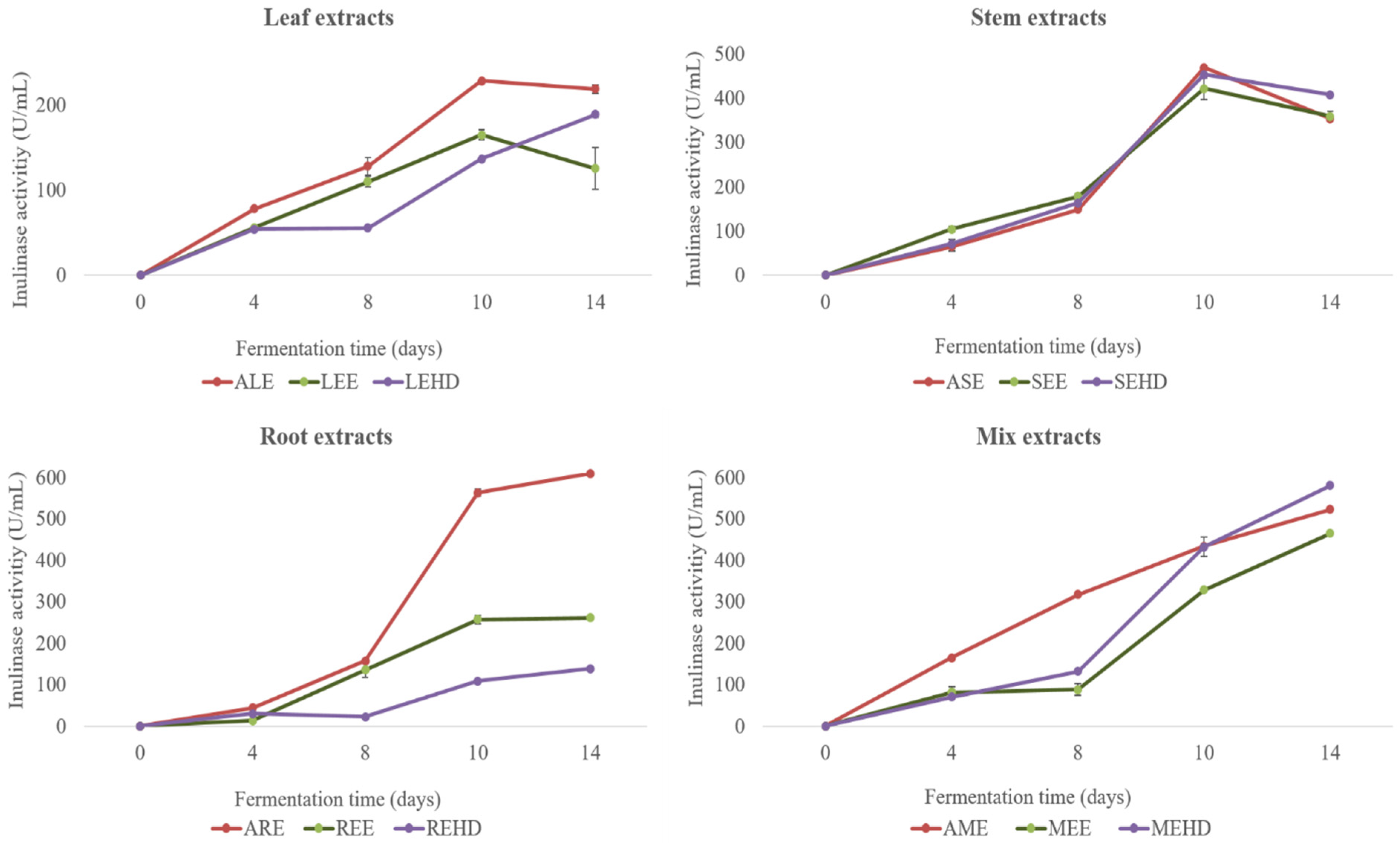
The maximum inulinase and invertase activities obtained from submerged and solid-state fermentations were shown in Table 2. The highest inulinase activity (609.72 U/mL) was observed on the 14th day of submerged fermentation performed with ARE, which was significantly higher than other samples (p < 0.05). This finding indicates that A. niger was able to utilize the inulin structures present in the root extract more efficiently, suggesting that the microorganism preferentially employs the root fraction as a carbon source for inulinase synthesis. The maximum invertase activity was detected in the submerged fermentation of AME, reaching an enzyme activity of 349.26 U/mL. When the I/S ratios in Table 2 were evaluated across all the fermentations, it was observed that all the enzyme samples predominantly exhibited inulinase activity (I/S > 10−2).
Time-dependent changes in inulinase activity during submerged fermentation (0–14 days) are shown for leaf, stem, root and mixed extracts obtained using aqueous, enzyme-assisted and enzyme-assisted decanter extraction methods (Figure 1). In leaf extracts, inulinase activity increased in all the extraction methods up to day 10. On day 10th, the highest inulinase activity was observed in ALE, reaching 228.15 U/mL, while LEE exhibited an activity of 164.61 U/mL on the same day. In contrast, LEHD showed a gradual increase, reaching its maximum value of 188.94 U/mL on day 14. In stem extracts, inulinase activity increased throughout the fermentation period and reached its maximum on day 10. The inulinase activities at this time were measured as ASE, SEE and SEHD, respectively. A decrease in inulinase activity was observed by day 14. Among all the fractions, root extracts exhibited the most notable differences among extraction methods. In ARE, a sharp increase in inulinase activity was observed from day 8 onward, reaching 609.72 U/mL. Finally, in mixed extracts, inulinase activity increased steadily throughout the fermentation period, reaching 522.49 U/mL, 464.26 U/mL and 580.72 U/mL for AME, MEE and MEHD, respectively.
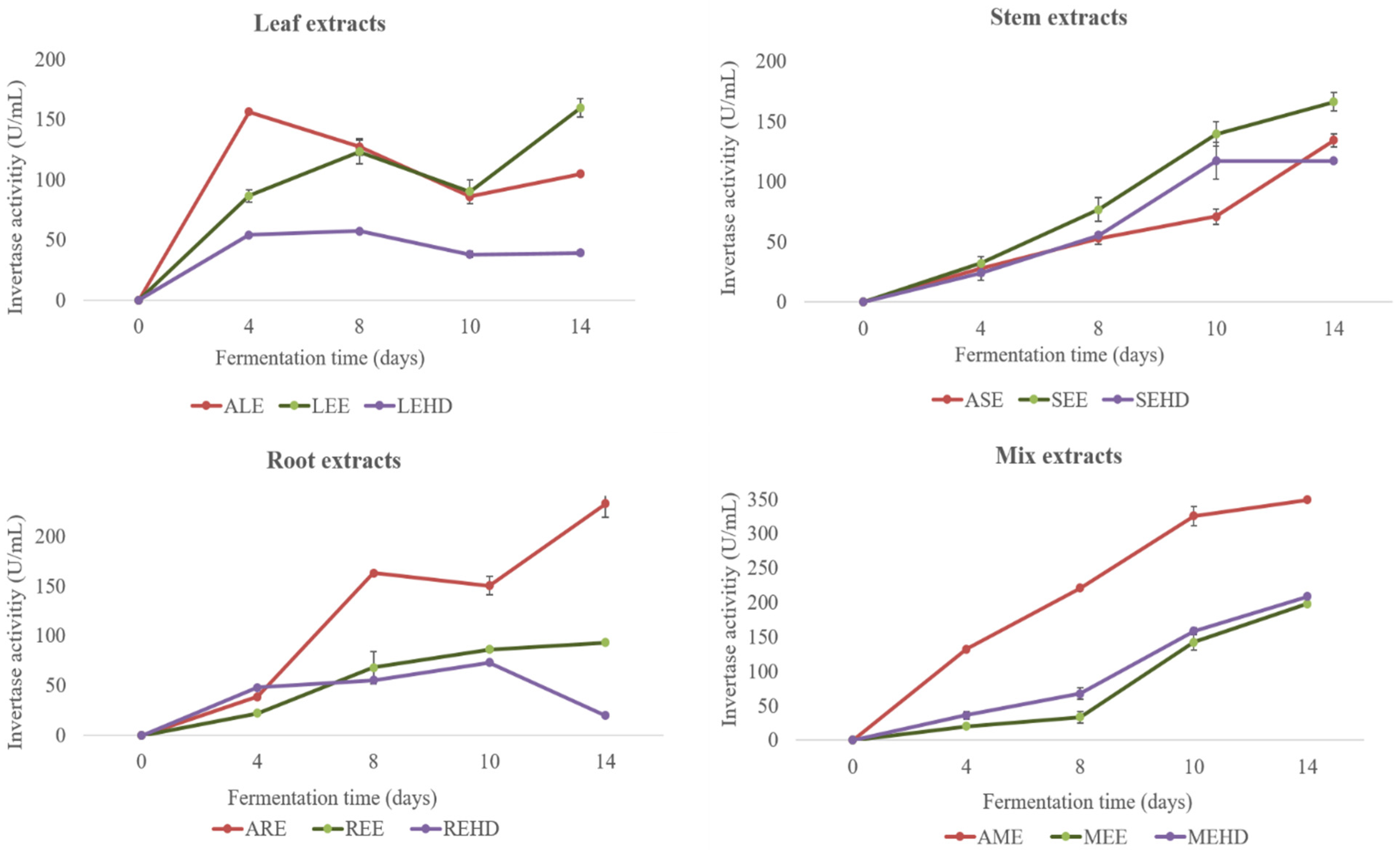
Figure 2 shows the changes in invertase activity during submerged fermentation (0–14 days) in Stevia fraction extracts obtained using different extraction methods. In leaf extracts, invertase activity in ALE reached 156.47 U/mL on day 4, followed by a decrease until day 10th and a slight increase by day 14th. LEE exhibited a continuous increase, reaching the highest invertase activity of 159.46 U/mL on day 14th. In contrast, LEHD showed consistently low invertase activity through the fermentation period. In stem extracts, invertase activity increased under all the extraction methods, with the highest activities observed on day 14th. The invertase activities at this time were measured as ASE, SEE and SEHD, respectively. In root extracts, ARE reached 232 U/mL by day 14th, while REE showed a gradual increase throughout fermentation, reaching 93 U/mL by day 14th. In contrast, REHD exhibited a decrease in invertase activity after day 10th. In mixed extracts, invertase activity increased throughout the fermentation period under all the extraction methods, reaching 349.26 U/mL, 198.33 U/mL and 208.56 U/mL for AME, MEE and MEHD, respectively, on day 14th. The higher inulinase activity observed under SmF conditions may be associated with the greater accessibility of inulin and other soluble carbon sources in the supernatant to A. niger. The more homogeneous distribution of medium components and the easier control of process parameters, including temperature, agitation and pH, may also have contributed to enzyme production [39]. Furthermore, the direct recovery of the extracellular enzyme from fermentation supernatant represents an important operational advantage of SmF [40].
In previous research, various carbon sources including inulin, glucose, maltose, sucrose, lactose, onion peel, stevia root and wheat bran were utilized for inulinase production by Rhizopus oryzae (p < 0.05) [37]. The optimal fermentation was achieved after 5 days of incubation at 35 °C and pH 5.0 using 2% (w/v) wheat bran as the carbon source. Under those conditions, the maximum inulinase activity and specific activity were 348. 36 U/mL and 3621. 78 U/mg, respectively. Similarly, another study demonstrated that barley husk, wheat bran and oat husk were pretreated with deep eutectic solvents (ChCl: Gly (1: 2)) and subsequently used as substrates in submerged fermentation by Aspergillus niger A42 to produce inulinase [41]. The fermentation results revealed that deep eutectic solvent-pretreated wheat bran was the most effective substrate, yielding 416 U/mL of inulinase activity and 486 U/mL of invertase activity [41]. In another study, the inulinase enzyme was produced by several fungal and yeast strains including Aspergillus, Trichoderma, Pencillium, Saccharomyces and Candida through submerged fermentation [42]. Among these, Aspergillus niger exhibited the highest enzyme activity, reaching 55.93 U/mL with an I/S ratio of 0.59. A comparison with previous studies in the literature demonstrated that the results obtained in this work were in accordance with those reported by other researchers. Collective evaluation of the results supports the suitability of SmF for enhanced inulinase production by A. niger using carbohydrate-rich Stevia extracts.
On day 14 of solid-state fermentation, inulinase activity in root extracts was measured as 392.63 U/mL for Aqueous leaf extract residue (ALER) and 358.89 U/mL for leaf enzyme-assisted extract residue (LEER), while the highest activity was observed in leaf enzyme-assisted decanter residue (LEHDER), reaching 450.86 U/mL. In stem extracts, inulinase activity was determined and the maximum value was found to be in stem enzyme-assisted decanter extract residue (SEHDR) at 200.18 U/mL. In root-residue samples, the highest inulinase activity of 253.78 U/mL was detected in REHDR. For mixed extracts, the highest inulinase activity reached 310.28 U/mL in mixture enzyme-assisted extract residue (MEER). Throughout the enzyme-assisted decanter solid-state fermentation process, inulinase activity was generally higher in all the extracts except for the mixed fractions (Table 2). The highest invertase activity was obtained from leaf extract residues processed using enzyme-assisted decanter extraction (467.06 U/mL). In a prior study, solid state fermentation using carob fruits as a substrate yielded a maximum inulinase activity of 249.98 U/mL [22]. Similarly, Da Silva et al. (2023) performed solid state fermentation with A. niger URM5741 using a mixture of wheat, soybean and oat bran (5 g) supplemented with 2.5% inulin and reported invertase and inulinase activities of 27.80 U/mL and 16.68 U/mL, respectively [43]. Using Aspergillus niger AUMC 9375, inulinase enzyme production through solid-state fermentation on a mixed substrate composed of sunflower and lettuce residues yielded enzyme activities of 300 U/mL and 290 U/mL, respectively [44]. According to the literature, inulinase activity has been reported to be high in both submerged and solid-state fermentation systems [22,28,37,45]. The main contribution of SSF lies in the valorization of solid Stevia residues generated after extraction as substrates for the production of value-added products, including inulinase and FOS, rather than their disposal as unused waste streams. Canatar et al. (2023) demonstrated the production of both inulinase and FOS from a carob-based solid substrate, supporting the potential of SSF for the multiproduct valorization of plant-derived residues [22].

3.3. FOS Production in Submerged and Solid-State Fermentations

According to the FOS analysis of the submerged fermentation samples, the FFN, nystose, 1-kestose and total FOS contents of the initial and 14th day samples, as well as the final FOS values of the solid-state fermentation, are presented in Table 3 and Table 4 respectively. Evaluation of the initial and 14th day findings revealed that FFN content increased, with the highest FFN content found to be in LEHD (7.57 g/L). In addition, nystose levels increased in ASE (2.50 g/L), AME (9.47 g/L), SEE (3.15 g/L), LEHD (1.85 g/L) and SEHD (1.80 g/L), while 1-kestose content increased in AME (7.28 g/L), LEE (9.30 g/L), LEHD (5.28 g/L) and MEHD 9.58 g/L). In terms of total FOS, an overall increase was observed in LEE (13.99 g/L), MEE (10.48 g/L), LEHD (7.88 g/L) and MEHD (12.48 g/L) samples compared to the initial values. The highest total FOS content was obtained from LEE at the end of fermentation (13.99 g/L) (Table 3).
In a previous study, the ability of three fungal strains, Aspergillus niger PSH, Aspergillus oryzae DIA-MF, and Aspergillus niger GH1, to produce FOS through submerged fermentation using Agave salmina aguamiel as substrate was investigated [46]. Additionally, Czapek Dox medium supplemented with sucrose was used as the control substrate for FOS production. In both media, Aspergillus oryzae DIA-MF was identified as the fungal strain capable of producing FOS. After 24 h incubation, Aspergillus oryzae DIA-MF achieved the highest FOS concentration, reaching 20.30 g/L when aguamiel was employed as the carbon source [46].
Following the solid-state fermentations, FFN (4, 79 g/L) and kestose (9.53 g/L) reached their highest values among leaf residue fermentations (Table 4). In stem extracts, ASER fermentation produced nystose and 1-kestose at levels of 6.80 g/L and 2.36 g/L, respectively. In SEHDR, FFN (3.31 g/L), nystose (3.22 g/L) and 1-kestose (1.40 g/L) were detected. For root extracts, ARER fermentation yielded nystose and 1-kestose contents of 3.54 g/L and 1.02 g/L, respectively. Notably, FFN content was not detected in solid-state fermentation from root extracts. In mixed extracts, MEHDR produced FFN (4.51 g/L), nystose (6.40 g/L) and 1-kestose (3.80 g/L). Notably, the solid-state fermentation using LEHDR resulted in the highest total FOS yield (20.80 g/L). The high FOS level observed in the LEHDR under SSF conditions may be associated with the further enzymatic degradation of FOS precursors, such as inulin, remaining in the solid residue. In addition, fungal growth and cell wall-degrading enzymes may have contributed to the release of FOS previously retained within the solid matrix [4]. Therefore, the observed increase in FOS may reflect the combined effects of enzymatic conversion of residual fructans and the release of matrix-associated FOS [47]. Among all the samples, the lowest total FOS concentration (4.56 g/L) was obtained from the fermentation using ARER (Table 3). In previous research, solid-state fermentation using coffee waste, coffee extract and ground coffee as substrates employing Aspergillus niger A42 for FOS production was studied [28]. In that study, the highest FFN concentration reached 38.34 ppm. In another study, FOS production was carried out by Aspergillus oryzae DIA-MF through solid-state fermentation using various agro-industrial residues enriched with aguamiel. The statistically optimized process identified sugarcane bagasse as the most effective substrate, yielding a maximum FOS concentration of 7.64 g/L [48]. Another study used carob fruits as a substrate for solid-state fermentation with A. niger A42, obtaining total FOS concentrations ranging from 179.35 to 516.66 ppm [22]. In that study, after enzyme purification, the maximum total FOS yield increased substantially, reaching 28,712.70 ppm. According to the reported studies, the total FOS yield was found to be relatively high. Furthermore, in future studies, FOS production using purified enzymes could be pursued to further enhance the overall FOS concentration.
Different carbon sources exhibited varying effects on inulinase production. In one study Kluyveromyces marxianus DSM 70106 cultivated under submerged fermentation and when inulin was used as the main carbon source, a markedly higher inulinase yield was obtained compared to glucose, fructose, sucrose, lactose, maltose and starch [49]. In another study, inulinase production was carried out under solid-state fermentation using Staphylococcus sp. RRL-1 and Kluyveromyces marxianus ATCC 5266 with wheat bran, rice bran, coconut oil cake, corn flour and their combinations serving as carbon sources. The results indicated that media containing wheat bran were the most effective for inulinase production by both strains [50]. In previous studies, various carbon sources such as glucose, fructose, inulin, whey powder, carob extract and sugar beet molasses were used to enhance inulinase production by Aspergillus niger. Among these, sugar beet molasses was identified as the most effective carbon source for inulinase synthesis [51]. In previous research, microbial inulinase production by Aspergillus niger ICCF 92 using three different carbon sources, namely molasses, inulin and carob pod decoction, was reported [52]. Their findings demonstrated that carob pod decoction was the most effective carbon source, yielding the highest inulinase activity under static fermentation conditions. Therefore, the high cost of pure carbon sources highlights the importance of using plant-based materials as alternative substrates. Consequently, the potential of Stevia (var. Levent 93) as a substrate for inulinase production by Aspergillus niger A42 is likely attributed to its relatively high contents of sucrose and inulin.
The utilization of the supernatant and retentate obtained after extraction in SmF and SSF, respectively, enabled a more comprehensive valorization of Stevia biomass. The supernatant supported high inulinase production under SmF, whereas the enzyme-assisted solid (leaf) residues were further used in SSF, contributing to FOS production. Thus, the two fermentation systems performed complementary functions and enabled the generation of multiple value-added products from the same plant material. While offering advantages, SSF may also involve limitations related to moisture distribution, aeration, heat transfer, and recovery [27,53]. Therefore, although the proposed strategy shows promise for the integrated valorization of Stevia biomass, further mass balance analysis, resource use assessment, downstream recovery studies and pilot-scale validation are required before industrial implementation [27,53]. This sequential approach may reduce the formation of unused solid residues, improve overall biomass utilization, and support the application of circular economy and biorefinery principles to Stevia processing.

4. Conclusions

In this study, Stevia rebaudiana Bertoni (var. Levent 93) was subjected to aqueous extraction coupled with enzyme-assisted decanter processing to enhance the recovery of inulin and fructooligosaccharides (FOS). The aqueous root extraction yielded the highest inulin concentration (197.55 g/L). Treatment with Pectinex enzyme markedly increased FOS accumulation, resulting in a total FOS content of 12.64 g/L in the enzyme-assisted root extract. Following extraction, Smf and SSF were performed in flasks. The maximum inulinase activities were obtained from the aqueous root extracts (609.72 U/mL) and the leaf enzyme-assisted decanter extracts (450.86 U/mL), respectively. In submerged fermentation, the leaf enzyme-assisted treatment achieved a total FOS concentration of 13.99 g/L, while solid-state fermentation using the leaf enzyme-assisted decanter extraction residue as a carbon source produced the highest overall FOS yield (20.80 g/L).
Comparative analysis of different Stevia fractions revealed that the often-overlooked root part exhibited high potential for inulin recovery and served as an effective carbon source for fermentation processes. The addition of pectinex enzymes promoted the breakdown of cell wall structures, thereby enhancing the release and solubilization of fructans within the aqueous extraction medium. Throughout this process, microbial inulinase and FOS production was achieved using A. niger through both Smf and SSF employing the leaf, stem, root and mixed fractions of Stevia. Moreover, the development of novel aqueous enzyme-assisted decanter extraction strategies presented in this study is expected to contribute to future research by improving FOS production efficiency, reducing overall process costs and supporting sustainability in integrated biotechnological systems.
The main contribution of this study is not only in the recovery of inulin and FOS from different fractions of Stevia, but also in integrating different extraction methods with the subsequent valorization of the remaining biomass within the same process. SmF supported high inulinase production from the supernatants, whereas SSF enabled the retentates to be further converted into FOS and inulinase. The findings demonstrate that extraction performance, enzyme production, and residual biomass utilization should be evaluated as interconnected components of a multiproduct bioprocess rather than as independent operations. This approach represents a transition from a linear, single-product extraction process toward an integrated biorefinery strategy that promotes the generation of unused solid residues.

Author Contributions

Conceptualization, I.T.; methodology, I.T.; formal analysis, G.K., M.C., S.B., S.B.E.Ü., H.N.G.T., A.O. and M.K.; investigation, G.K., M.C., S.B., S.B.E.Ü., H.N.G.T., A.O., M.K., E.Y. and İ.Y.; resources, İ.Y.; data curation, G.K., M.C., S.B., S.B.E.Ü., H.N.G.T., A.O. and I.T.; writing—original draft preparation, G.K.; writing—review and editing, M.C., H.N.G.T. and I.T.; visualization, I.T.; supervision, I.T.; project administration, I.T.; funding acquisition, I.T. All authors have read and agreed to the published version of the manuscript.

Funding

This research was financially supported by The Scientific and Technological Research Council of Türkiye (TÜBİTAK) under Grant No. 120M507.

Institutional Review Board Statement

Not applicable.

Informed Consent Statement

Not applicable.

Data Availability Statement

Data can be made available upon request.

Conflicts of Interest

The authors declare no conflicts of interest.

Abbreviations

ALEAqueous Leaf Extract
ALERAqueous Leaf Extract Residue
AMEAqueous Mixture Extract
AMERAqueous Mixture Extract Residue
AREAqueous Root Extract
ARERAqueous Root Extract Residue
ASEAqueous Stem Extract
ASERAqueous Stem Extract Residue
CDCentrifuge Decanter
DNSA3,5-Dinitrosalicylic Acid
EAEEnzyme-Assisted Extraction
FFN1-β-fructofuranosyl Nystose
FOSFructooligosaccharides
I/SInulinase-to-Substrate Ratio
LEELeaf Enzyme-Assisted Extract
LEERLeaf Enzyme-Assisted Extract Residue
LEHDLeaf Enzyme-Assisted Decanter Extract
LEHDRLeaf Enzyme-Assisted Decanter Residue
MAEMicrowave-Assisted Extraction
MEAMalt Extract Agar
MEEMixture Enzyme-Assisted Extract
MEERMixture Enzyme-Assisted Extract Residue
MEHDMixture Enzyme-Assisted Decanter Extract
MEHDRMixture Enzyme-Assisted Decanter Residue
ND.Not Detected
REERoot Enzyme-Assisted Extract
REERRoot Enzyme-Assisted Extract Residue
REHDRoot Enzyme-Assisted -Decanter Extract
REHDRRoot Enzyme-Assisted -Decanter Extract Residue
SEEStem Enzyme-Assisted Extract
SEERStem Enzyme-Assisted Extract Residue
SEHDStem Enzyme-Assisted Decanter Extract
SEHDRStem Enzyme-Assisted Decanter Extract Residue
SmFSubmerged Fermentation
SSFSolid-State Fermentation

References

  1. Lemus-Mondaca, R.; Vega-Gálvez, A.; Zura-Bravo, L.; Ah-Hen, K. Stevia rebaudiana Bertoni, Source of a High-Potency Natural Sweetener: A Comprehensive Review on the Biochemical, Nutritional and Functional Aspects. Food Chem. 2012, 132, 1121–1132. [Google Scholar] [CrossRef] [Scilit] [PubMed]
  2. De Oliveira, A.J.B.; Gonçalves, R.A.C.; Chierrito, T.P.C.; Dos Santos, M.M.; De Souza, L.M.; Gorin, P.A.J.; Sassaki, G.L.; Iacomini, M. Structure and Degree of Polymerisation of Fructooligosaccharides Present in Roots and Leaves of Stevia rebaudiana (Bert.) Bertoni. Food Chem. 2011, 129, 305–311. [Google Scholar] [CrossRef] [Scilit] [PubMed]
  3. Sanches Lopes, S.M.; Francisco, M.G.; Higashi, B.; de Almeida, R.T.R.; Krausová, G.; Pilau, E.J.; Gonçalves, J.E.; Correia Gonçalves, R.A.; Braz de Oliveira, A.J. Chemical Characterization and Prebiotic Activity of Fructo-Oligosaccharides from Stevia rebaudiana (Bertoni) Roots and in Vitro Adventitious Root Cultures. Carbohydr. Polym. 2016, 152, 718–725. [Google Scholar] [CrossRef] [Scilit] [PubMed]
  4. Xu, Y.; Zheng, Z.; Xu, Q.; Yong, Q.; Ouyang, J. Efficient Conversion of Inulin to Inulooligosaccharides through Endoinulinase from Aspergillus niger. J. Agric. Food Chem. 2016, 64, 2612–2618. [Google Scholar] [CrossRef] [Scilit] [PubMed]
  5. Hossain, M.F.; Islam, M.T.; Islam, M.A.; Akhtar, S. Cultivation and Uses of Stevia (Stevia rebaudiana Bertoni): A Review. Afr. J. Food Agric. Nutr. Dev. 2017, 17, 12745–12757. [Google Scholar] [CrossRef] [Scilit]
  6. Tohumluk Tescil ve Sertifikasyon Merkez Müdürlüğü. Registration Report of Stevia (Levent 93) Variety; Tohumluk Tescil ve Sertifikasyon Merkez Müdürlüğü: Ankara, Turkey, 2020. [Google Scholar]
  7. Koyama, E.; Sakai, N.; Ohori, Y.; Kitazawa, K.; Izawa, O.; Kakegawa, K.; Fujino, A.; Ui, M. Absorption and Metabolism of Glycosidic Sweeteners of Stevia Mixture and Their Aglycone, Steviol, in Rats and Humans. Food Chem. Toxicol. 2003, 41, 875–883. [Google Scholar] [CrossRef] [Scilit] [PubMed]
  8. Maki, K.C.; Curry, L.L.; Reeves, M.S.; Toth, P.D.; McKenney, J.M.; Farmer, M.V.; Schwartz, S.L.; Lubin, B.C.; Boileau, A.C.; Dicklin, M.R.; et al. Chronic Consumption of Rebaudioside A, a Steviol Glycoside, in Men and Women with Type 2 Diabetes Mellitus. Food Chem. Toxicol. 2008, 46, S47–S53. [Google Scholar] [CrossRef] [Scilit] [PubMed]
  9. Wheeler, A.; Boileau, A.C.; Winkler, P.C.; Compton, J.C.; Prakash, I.; Jiang, X.; Mandarino, D.A. Pharmacokinetics of Rebaudioside A and Stevioside after Single Oral Doses in Healthy Men. Food Chem. Toxicol. 2008, 46, S54–S60. [Google Scholar] [CrossRef] [Scilit] [PubMed]
  10. Vandeputte, D.; Falony, G.; Vieira-Silva, S.; Wang, J.; Sailer, M.; Theis, S.; Verbeke, K.; Raes, J. Prebiotic Inulin-Type Fructans Induce Specific Changes in the Human Gut Microbiota. Food Chem. 2017, 66, 1968–1974. [Google Scholar] [CrossRef] [Scilit] [PubMed]
  11. Wei, L.; Wang, J.; Zheng, X.; Teng, D.; Yang, Y.; Cai, C.; Feng, T.; Zhang, F. Studies on the Extracting Technical Conditions of Inulin from Jerusalem Artichoke Tubers. J. Food Eng. 2007, 79, 1087–1093. [Google Scholar] [CrossRef] [Scilit]
  12. Zhu, Z.; He, J.; Liu, G.; Barba, F.J.; Koubaa, M.; Ding, L.; Bals, O.; Grimi, N.; Vorobiev, E. Recent Insights for the Green Recovery of Inulin from Plant Food Materials Using Non-Conventional Extraction Technologies: A Review. Innov. Food Sci. Emerg. Technol. 2016, 33, 1–9. [Google Scholar] [CrossRef] [Scilit]
  13. Rivera, A.; Pozo, M.; Sánchez-Moreno, V.E.; Vera, E.; Jaramillo, L.I. Pulsed Electric Field-Assisted Extraction of Inulin from Ecuadorian Cabuya (Agave americana). Molecules 2024, 29, 3428. [Google Scholar] [CrossRef] [Scilit] [PubMed]
  14. Canazza, E.; Grauso, M.; Mihaylova, D.; Lante, A. Techno-Functional Properties and Applications of Inulin in Food Systems. Gels 2025, 11, 829. [Google Scholar] [CrossRef] [Scilit] [PubMed]
  15. Mudannayake, D.C.; Meegahawaththa, W.K.; Illippangama, A.U.; Pitawala, H.M.J.C.; Wimalasiri, K.M.S.; Silva, K.F.S.T. Extraction, Purification and Structural Characterization of Inulin-Type Fructans from Different Selected Asparagus Species. Bioact. Carbohydr. Diet. Fibre 2025, 34, 100486. [Google Scholar] [CrossRef] [Scilit]
  16. Singh, R.S.; Singh, R.P.; Kennedy, J.F. Recent Insights in Enzymatic Synthesis of Fructooligosaccharides from Inulin. Int. J. Biol. Macromol. 2016, 85, 565–572. [Google Scholar] [CrossRef] [Scilit] [PubMed]
  17. Flores-Maltos, D.A.; Mussatto, S.I.; Contreras-Esquivel, J.C.; Rodríguez-Herrera, R.; Teixeira, J.A.; Aguilar, C.N. Biotechnological Production and Application of Fructooligosaccharides. Crit. Rev. Biotechnol. 2016, 36, 259–267. [Google Scholar] [CrossRef] [Scilit] [PubMed]
  18. Ibrahim, O.O. Technological Aspects of Fructo-Oligosaccharides (FOS), Production Processes, Physiological Properties, Applications and Health Benefits. J. Food Chem. Nanotechnol. 2021, 7, 41–46. [Google Scholar] [CrossRef] [Scilit]
  19. Pandey, A. Solid-State Fermentation. Biochem. Eng. J. 2003, 13, 81–84. [Google Scholar] [CrossRef] [Scilit]
  20. Krishna, C. Solid-State Fermentation Systems—An Overview. Crit. Rev. Biotechnol. 2005, 25, 1–30. [Google Scholar] [CrossRef] [Scilit] [PubMed]
  21. Mazutti, M.A.; Zabot, G.; Boni, G.; Skovronski, A.; Oliveira, D.d.; Luccio, M.D.; Rodrigues, M.I.; Treichel, H.; Maugeri, F. Kinetics of Inulinase Production by Solid-State Fermentation in a Packed-Bed Bioreactor. Food Chem. 2010, 120, 163–173. [Google Scholar] [CrossRef] [Scilit]
  22. Canatar, M.; Tufan, H.N.G.; Ünsal, S.B.E.; Koc, C.Y.; Ozcan, A.; Kucuk, G.; Basmak, S.; Yatmaz, E.; Germec, M.; Yavuz, I.; et al. Inulinase and Fructooligosaccharide Production from Carob Using Aspergillus niger A42 (ATCC 204447) under Solid-State Fermentation Conditions. Int. J. Biol. Macromol. 2023, 245, 125520. [Google Scholar] [CrossRef] [Scilit] [PubMed]
  23. Pandey, A.; Soccol, C.R.; Selvakumar, P.; Soccol, V.T.; Krieger, N.; Fontana, J.D. Recent Developments in Microbial Inulinases. Appl. Biochem. Biotechnol. 1999, 81, 35–52. [Google Scholar] [CrossRef] [Scilit] [PubMed]
  24. Öngen-Baysal, G.; Sukan, Ş.S.; Vassilev, N. Production and Properties of Inulinase from Aspergillus niger. Biotechnol. Lett. 1994, 16, 275–280. [Google Scholar] [CrossRef] [Scilit]
  25. Gürler, H.N.; Germec, M.; Turhan, I. The Inhibition Effect of Phenol on the Production of Aspergillus niger Inulinase and Its Modeling. J. Food Process. Preserv. 2021, 45, e14522. [Google Scholar] [CrossRef] [Scilit]
  26. Dabkowska, K.; Mech, M.; Kopeć, K.; Pilarek, M. Enzymatic Activity of Some Industrially-Applied Cellulolytic Enzyme Preparations. Ecol. Chem. Eng. S 2017, 24, 9–18. [Google Scholar] [CrossRef] [Scilit]
  27. Chen, H.Q.; Chen, X.M.; Chen, T.X.; Xu, X.M.; Jin, Z.Y. Extraction Optimization of Inulinase Obtained by Solid State Fermentation of Aspergillus Ficuum JNSP5-06. Carbohydr. Polym. 2011, 85, 446–451. [Google Scholar] [CrossRef] [Scilit]
  28. Basmak, S.; Turhan, I. Production of β-Mannanase, Inulinase, and Oligosaccharides from Coffee Wastes and Extracts. Int. J. Biol. Macromol. 2024, 261, 129798. [Google Scholar] [CrossRef] [Scilit] [PubMed]
  29. Ozcan, A.; Germec, M.; Turhan, I. Optimization and Kinetic Modeling of Media Composition for Hyaluronic Acid Production from Carob Extract with Streptococcus Zooepidemicus. Bioprocess Biosyst. Eng. 2022, 45, 2019–2029. [Google Scholar] [CrossRef] [Scilit] [PubMed]
  30. Miller, G.L. Use of Dinitrosalicylic Acid Reagent for Determination of Reducing Sugar. Anal. Chem. 1959, 31, 426–428. [Google Scholar] [CrossRef] [Scilit]
  31. Dinarvand, M.; Ariff, A.B.; Moeini, H.; Masomian, M.; Mousavi, S.S.; Nahavandi, R.; Mustafa, S. Effect of Extrinsic and Intrinsic Parameters on Inulinase Production by Aspergillus niger ATCC 20611. Electron. J. Biotechnol. 2012, 15, 5. [Google Scholar] [CrossRef] [Scilit]
  32. Germec, M.; Turhan, I. Application of Aspergillus niger Inulinase Production in Sugar Beet Molasses-Based Medium Optimized by Central Composite Design to Mathematical Models. Biomass Convers. Biorefin. 2021, 13, 10985–11003. [Google Scholar] [CrossRef] [Scilit]
  33. Pessoni, R.A.B.; Figueiredo-Ribeiro, R.C.L.; Braga, M.R. Extracellular Inulinases from Penicillium Janczewskii, a Fungus Isolated from the Rhizosphere of Vernonia Herbacea (Asteraceae). J. Appl. Microbiol. 1999, 87, 141–147. [Google Scholar] [CrossRef] [Scilit] [PubMed]
  34. Huang, X.; Ai, C.; Yao, H.; Zhao, C.; Xiang, C.; Hong, T.; Xiao, J. Guideline for the Extraction, Isolation, Purification, and Structural Characterization of Polysaccharides from Natural Resources. eFood 2022, 3, e37. [Google Scholar] [CrossRef] [Scilit]
  35. Mariano, T.B.; Silva Lima, H.R.d.; Cotrim Ribeiro, S.T.; Santos Filho, J.R.d.; Serrato, R.V.; Reis, A.V.; Gonçalves, R.A.C.; Oliveira, A.J.B. de Inulin Extraction from Stevia rebaudiana Roots in an Autoclave. Carbohydr. Res. 2023, 530, 108850. [Google Scholar] [CrossRef] [Scilit] [PubMed]
  36. Duda, Ł.; Budryn, G.; Olszewska, M.A.; Rutkowska, M.; Kruczkowska, W.; Grabowska, K.; Kołat, D.; Jaśkiewicz, A.; Pasieka, Z.W.; Kłosiński, K.K. Evaluation of Inulin and Polyphenol Content and the Cytotoxicity of Cichorium Intybus L. Var. Foliosum Root Extracts Obtained by Pectinase- and Pressure-Assisted Extraction. Nutrients 2025, 17, 1040. [Google Scholar] [CrossRef] [Scilit] [PubMed]
  37. Yazici, S.O.; Sahin, S.; Biyik, H.H.; Geroglu, Y.; Ozmen, I. Optimization of Fermentation Parameters for High-Activity Inulinase Production and Purification from Rhizopus oryzae by Plackett–Burman and Box–Behnken. J. Food Sci. Technol. 2020, 58, 739–751. [Google Scholar] [CrossRef] [Scilit] [PubMed]
  38. Montilla, A.; Olano, A.; Martínez-Villaluenga, C.; Corzo, N. Study of Influential Factors on Oligosaccharide Formation by Fructosyltransferase Activity during Stachyose Hydrolysis by Pectinex Ultra SP-L. J. Agric. Food Chem. 2011, 59, 10705–10711. [Google Scholar] [CrossRef] [Scilit] [PubMed]
  39. Kowalska, A.; Antecka, A.; Owczarz, P.; Bizukojć, M. Inulinolytic Activity of Broths of Aspergillus niger ATCC 204447 Cultivated in Shake Flasks and Stirred Tank Bioreactor. Eng. Life Sci. 2017, 17, 1006–1020. [Google Scholar] [CrossRef] [Scilit] [PubMed]
  40. Germec, M.; Turhan, I. Partial Purification and Characterization of Aspergillus niger Inulinase Produced from Sugar-Beet Molasses in the Shaking Incubator and Stirred-Tank Bioreactors. Int. J. Biol. Macromol. 2020, 164, 3789–3799. [Google Scholar] [CrossRef] [Scilit] [PubMed]
  41. Hosta Yavuz, H.G.; Yavuz, I.; Turhan, I. Valorization of Oat Husk for the Production of Fermentable Sugars, Xylooligosaccharides, and Inulinase via Deep Eutectic Solvent and Microwave-Assisted Pretreatment. Fermentation 2025, 11, 561. [Google Scholar] [CrossRef] [Scilit]
  42. Abou-Taleb, K.A.; Amin, S.A.; Ahmed, A.I. Production of Exo-Inulinase from Aspergillus niger and Candida oleophila for Degradation of Chicory Root Inulin and Ethanol Production. Middle East J. Agric. Res. 2019, 08, 855–867. [Google Scholar]
  43. da Silva, W.B.; Porto, T.S.; da Silva, S.P.; de Oliveira, R.L. Optimization Strategy for Inulinase Production by Aspergillus niger URM5741 and Its Biochemical Characterization, Kinetic/Thermodynamic Study, and Application on Inulin and Sucrose Hydrolysis. 3 Biotech 2023, 13, 376. [Google Scholar] [CrossRef] [Scilit] [PubMed]
  44. Housseiny, M.M. Production of an Endoinulinase from Aspergillus niger AUMC 9375, by Solid State Fermentation of Agricultural Wastes, with Purification and Characterization of the Free and Immobilized Enzyme. J. Microbiol. 2014, 52, 389–398. [Google Scholar] [CrossRef] [Scilit] [PubMed]
  45. Kalra, K.; Kumari, R. Isolation and Production of Inulinase From Banana Peel by Using Aspergillus niger Under Submerged Fermentation. Int. J. Sci. Res. Publ. 2017, 7, 454. [Google Scholar]
  46. Muñiz-Márquez, D.B.; Teixeira, J.A.; Mussatto, S.I.; Contreras-Esquivel, J.C.; Rodríguez-Herrera, R.; Aguilar, C.N. Fructo-Oligosaccharides (FOS) Production by Fungal Submerged Culture Using Aguamiel as a Low-Cost by-Product. LWT 2019, 102, 75–79. [Google Scholar] [CrossRef] [Scilit]
  47. Santo Domingo, C.; Otalora Gonzalez, C.; Navarro, D.; Stortz, C.; Rojas, A.M.; Gerschenson, L.N.; Fissore, E.N. Enzyme Assisted Extraction of Pectin and Inulin Enriched Fractions Isolated from Microwave Treated Cynara Cardunculus Tissues. Int. J. Food Sci. Technol. 2021, 56, 242–249. [Google Scholar] [CrossRef] [Scilit]
  48. de la Rosa, O.; Múñiz-Marquez, D.B.; Contreras-Esquivel, J.C.; Wong-Paz, J.E.; Rodríguez-Herrera, R.; Aguilar, C.N. Improving the Fructooligosaccharides Production by Solid-State Fermentation. Biocatal. Agric. Biotechnol. 2020, 27, 101704. [Google Scholar] [CrossRef] [Scilit]
  49. Pessoa, A.; Vitolo, M. Inulinase from Kluyveromyces Marxianus: Culture Medium Composition and Enzyme Extraction. Braz. J. Chem. Eng. 1999, 16, 237–245. [Google Scholar] [CrossRef] [Scilit]
  50. Selvakumar, P.; Pandey, A. Solid State Fermentation for the Synthesis of Inulinase from Staphylococcus sp. and Kluyveromyces marxianus. Process Biochem. 1999, 34, 851–855. [Google Scholar] [CrossRef] [Scilit]
  51. Germec, M.; Turhan, I. Evaluation of Carbon Sources for the Production of Inulinase by Aspergillus niger A42 and Its Characterization. Bioprocess Biosyst. Eng. 2019, 42, 1993–2005. [Google Scholar] [CrossRef] [Scilit] [PubMed]
  52. Vladu, M.G.; Eremia, M.C.; Miu, D.M.; Savoiu, G.V.; Petrescu, M.M. Preliminary Studies on the Biosynthesis of Microbial Inulinase by Aspergillus niger ICCF 92. Chem. Proc. 2025, 18, 48. [Google Scholar] [CrossRef] [Scilit]
  53. Gowthaman, M.K.; Rao, K.R.; Ghildyal, N.P.; Karanth, N.G. Gas Concentration and Temperature Gradients in a Packed Bed Solid-State Fermentor. Biotechnol. Adv. 1993, 11, 611–620. [Google Scholar] [CrossRef] [Scilit] [PubMed]
Figure 1. Changes in inulinase activities during submerged fermentation.
Fermentation 12 00377 g001
Figure 2. Changes in invertase activities during submerged fermentation.
Fermentation 12 00377 g002
Table 1. The FOS and inulin contents of extracts.
SampleInulin
(g/L)
FFN
(g/L)
Nystose
(g/L)
1-Kestose
(g/L)
Total FOS
(g/L)
ALE57.40 b ± 0.32ND.4.38 a ± 0.045.99 bc ± 0.0110.37
ASE14.01 g ± 0.28ND.1.55 c ± 0.013.29 gf ± 0.024.84
ARE197.55 a ± 0.96ND.3.51 a ± 0.015.19 dc ± 0.028.70
AME37.55 c ± 0.71ND.3.34 ba ± 0.044.78 de ± 0.008.12
LEE24.13 d ± 0.01ND.3.82 a ± 0.006.47 b ± 0.0210.29
SEE23.81 d ± 0.77ND.1.69 c ± 0.003.95 ef ± 0.015.64
REE19.86 e ± 0.242.54 a ± 0.083.71 a ± 0.056.40 b ± 0.0112.64
MEE13.12 g ± 2.97ND.2.26 bc ± 0.064.42 def ± 0.046.68
LEHD24.78 d ± 0.73ND.4.53 d ± 0.007.93 a ± 0.0012.40
SEHD25.25 d ± 1.06ND.1.79 c ± 0.004.25 dce ± 0.026.04
REHD25.12 d ± 0.37ND.4.02 a ± 0.006.82 a ± 0.0010.85
MEHD16.40 f ± 0143.28 a ± 0.071.79 c ± 0.032.53 f ± 0.017.60
Data are presented as mean ± standard error (n: 2). Means within the same column marked with different lowercase letters indicate significant differences at p < 0.05; ND.: not detected.
Table 2. The maximum inulinase and invertase activities from the submerged and solid-state fermentation of extracts.
Submerged Fermentation Solid State Fermentation
SampleInulinase
(U/mL)
Invertase (U/mL)I/SSampleInulinase (U/mL)Invertase (U/mL)I/S
ALE228.15 edc ± 11.6086.15 b ± 2.342.65.ALER392.63 bac ± 0.00407.62 ba ± 0.000.96
ASE468.87 bac ± 5.1670.95 b ± 6.206.61ASER177.66 fe ± 3.7278.50 fg ± 2.652.26
ARE609.72 a ± 0.00232.68 ba ± 13.262.62ARER187.46 fe ± 1.07170.40 e ± 0.001.10
AME522.49 ba ± 0.00349.26 a ± 0.001.50AMER289.67 bedc ± 0.00318.69 de ± 0.000.91
LEE164.61 ed ± 24.3290.05 b ± 10.061.83LEER358.89 bac ± 0.00326.60 dc ± 0.001.10
SEE421.21 bac ± 27.57139.46 ba ± 14.823.02SEER172.79 fe ± 2.9665.44 g ± 1.212.64
REE260.33 fdec ± 0.0093.07 bcd ± 0.002.80REER167.33 f ± 0.00134.59 fe ± 3.171.24
MEE464.26 bac ± 0.00198.33 b ± 0.002.34MEER310.28 bdc ± 0.00372.34 bc ± 0.000.83
LEHD188.94 fe ± 7.3239.35 cd ± 1.644.80LEHDR450.86 a ± 0.00467.06 a ± 6.030.97
SEHD452.98 bac ± 0.21117.24 ba ± 0.103.86SEHDR200.18 fed ± 4.5478.31 fg ± 3.132.56
REHD138.39 fe ± 0.0019.98 d ± 0.016.93REHDR253.78 fedc ± 0.00162.12 e ± 0.001.57
MEHD580.72 a ± 0.00208.56 b ± 0.002.78MEHDR215.23 fed ± 3.27290.42 d ± 7.780.74
Data are presented as mean ± standard error (n: 2); Means within the same column marked with different lowercase letters indicate significant differences at p < 0.05. R: residue.
Table 3. FOS contents of submerged fermentations.
SampleFFN
(g/L)
Nystose
(g/L)
1-Kestose
(g/L)
Total FOS
(g/L)
İnitialDay 14InitialDay 14InitialDay 14InitialDay 14
ALEND.1.11 ba ± 0.393.92 ba ± 1.382.28 a ± 0.017.44 a ± 1.196.03 dc ± 2.1311.369.42
ASEND.1.44 a ± 0.031.55 ba ± 0.132.50 a ± 0.712.68 e ± 0.69ND.4.233.93
AREND.1.62 a ± 0.153.51 a ± 0.112.52 a ± 0.025.18 bdac ± 0.31ND.8.704.14
AME3.71 a ± 1.311.21 ba ± 0.422.82 ba ± 0.999.47 ba ± 0.234.78 bdec ± 0.047.28 bdc ± 2.5011.319.44
LEEND a ± 0.001.59 a ± 0.073.82 a ± 0.0303.18 a ± 0.066.47 bac ± 0.279.30 ba ± 0.1810.3013.99
SEEND a ± 0.001.25 a ± 2.701.69 ba ± 0.033.15 a ± 0.193.95 de ± 0.17ND.5.644.40
REE3.18 a ± 1.12ND.3.71 a ± 0.41ND.5.80 bdac ± 0.58ND.12.75ND.
MEEND.1.13 a ± 0.092.26 ba ± 0.511.49 ba ± 0.054.42 dec ± 0.617.86 bac ± 0.046.6810.48
LEHDND.7.57 ba ± 0.25ND.1.85 ba ± 1.30ND.5.28 bdac ± 2.65ND.7.88
SEHDND.1.06 ba ± 2.291.79 ba ± 0.021.80 ba ± 0.504.24 dec ± 0.22ND.6.042.85
REHDND.ND.4.02 a ± 0.00ND.6.82 bac ± 0.00ND.10.84ND.
MEHD3.87 a ± 1.351.23 a ± 0.022.79 ba ± 0.981.67 ba ± 0.033.74 de ± 0.349.58 a ± 0.3310.3512.48
Data are presented as mean ± standard error (n: 2); Means within the same column marked with different lowercase letters indicate significant differences at p < 0.05; ND.: not detected.
Table 4. FOS contents of solid-state fermentations.
SampleFFN
(g/L)
Nystose
(g/L)
1-Kestose
(g/L)
Total FOS (g/L)
ALER *2.27 d ± 0.721.62 b ± 0.313.44 cd ± 0.157.33
ASERND.6.80 ba ± 0.172.36 cd ± 0.309.16
ARERND.3.54 ba ± 2.501.02 d ± 0.714.56
AMER3.32 c ± 0.143.68 ba ± 1.731.83 d ± 0.048.82
LEER4.52 ba ± 0.007.47 a ± 0.886.66 b ± 1.5018.65
SEERND.5.56 ba ± 0.011.97 d ± 0.007.53
REERND.7.56 a ± 0.171.33 d ± 0.018.88
MEER3.70 bc ± 0.015.75 ba ± 0.311.80 d ± 0.1211.25
LEHDR4.79 a ± 0.086.48 ba ± 0.359.53 a ± 0.0320.80
SEHDR3.31 e ± 0.003.22 ba ± 2.281.40 d ± 0.524.96
REHDRND7.19 ba ± 0.065.08 cb ± 0.1212.26
MEHDR4.51 ba ± 0.066.40 ba ± 0.013.80 cd ± 0.1214.71
Data are presented as mean ± standard error (n: 2); Means within the same column marked with different lowercase letters indicate significant differences at p < 0.05; ND.: not detected; * R: residue.
Disclaimer/Publisher’s Note: The statements, opinions and data contained in all publications are solely those of the individual author(s) and contributor(s) and not of MDPI and/or the editor(s). MDPI and/or the editor(s) disclaim responsibility for any injury to people or property resulting from any ideas, methods, instructions or products referred to in the content.