1. Introduction
Metallothionein (MT), chemically designated as metallothionine histidine trimethyl inner salt, is a ubiquitous class of low-molecular-weight metal-binding proteins characterized by a high cysteine content (≈30% of total amino acids) and unique metal-coordinating properties [
1]. Since its first isolation from equine kidney as a cadmium (Cd
2+)-binding protein by Margoshes and Vallee in 1957 [
2], and subsequent naming by Kagi et al. in 1961 (based on its ability to bind multiple metal ions and high sulfur content) [
3], MT has garnered extensive attention due to its diverse biological functions. These functions include heavy metal detoxification, free radical scavenging, radiation resistance, regulation of trace element metabolism, anti-inflammatory and anticancer activities, as well as potential therapeutic applications in neurodegenerative diseases such as Alzheimer’s and Parkinson’s disease [
4,
5,
6,
7,
8,
9]. Owing to these versatile properties, MT holds broad application prospects in the medicine, healthcare, and food industries, making it a key research focus in the field of biological resource development.
With the rapid advancement of biotechnology and the pharmaceutical industry, the global demand for MT has increased annually. As a highly inducible endogenous protein, MT synthesis can be triggered by various stimuli, including heavy metal ions (e.g., Zn
2+, Cu
2+, Cd
2+) [
10,
11,
12,
13], cytokines, hormones, organic chemicals, and environmental stress signals [
14]. However, traditional MT production methods—such as extracting soluble MT from animal tissues (e.g., rabbit liver, porcine liver) or inducing MT synthesis via heavy metal treatment in native organisms—exhibit inherent limitations: strict raw material availability, complex production processes, extremely low yields (often <0.05 mg/mL), and cumbersome purification steps [
15]. These drawbacks not only hinder large-scale MT production and result in high production costs but also severely restrict the advancement of MT-related research and applications. Thus, insufficient raw material supply and low production efficiency have become core bottlenecks in the MT industry.
Microbial genetic engineering and fermentation technology have emerged as promising solutions for large-scale production of high-purity marine-derived MT. Among microbial expression systems, probiotic-based platforms are particularly favored in industrial settings due to their simplicity, safety, and high reliability—gaining recognition from both academia and industry. Recent studies have focused on constructing MT-probiotic expression systems to achieve heterologous MT expression: Yi et al. developed a recombinant MT expression vector using green fluorescent protein (GFP) as a reporter gene, successfully generating a MT-producing
Pichia pastoris strain [
16]; Liao optimized MT fusion strategies and sources to construct a
P. pastoris surface-display strain for Cd
2+ removal [
17]; Xu et al. and Cui et al. independently confirmed the correct secretion and functional expression of human MT genes in
P. pastoris [
18,
19]; Peng et al. and Su et al. achieved fusion expression of human MT in lactic acid bacteria, expanding the application of MT in food-grade systems [
20]. In our preliminary work, we constructed a recombinant MT-producing
Bacillus subtilis (a prokaryotic probiotic) and optimized its fermentation conditions to realize extracellular MT secretion, resulting in a 1.84-fold increase in MT expression compared to the initial yield [
21,
22]. Nevertheless, the final MT yield (≈0.134 mg/mL) remained far below the threshold required for economical large-scale industrial production.
Artificial Neural Networks (ANNs) are artificial intelligence tools that simulate the neural structure and information processing mechanisms of the human brain. They exhibit significant advantages in modeling and predicting complex nonlinear systems—especially in cases where traditional linear models (e.g., response surface methodology) fail to capture intricate parameter interactions [
23]. As a core subtype of ANNs, the Back Propagation Neural Network (BPNN) excels at fitting complex nonlinear relationships with no strict constraints on the number of input/output variables. It has been widely applied in key aspects of the fermentation industry, such as medium optimization, process parameter tuning, and product yield prediction. For example: Yang et al. combined ANN with genetic algorithms to optimize the medium composition for two-step vitamin C fermentation, significantly improving the yield of the mixed bacterial consortium [
24]; Ding et al. developed a BPNN model to reliably predict total acid content in pear vinegar fermentation, with a prediction error < 5% [
25]; Wei et al. optimized the fermentation process of glucose isomerase production by Streptomyces using BPNN coupled with genetic algorithms, achieving a model prediction error of only 1.76% and a 41.1% increase in enzyme yield [
26]; Ma et al. constructed a BPNN-based soft-sensing model for real-time monitoring of ethanol concentration in fermentation systems, addressing the lag issue of traditional offline detection methods [
27]; Wang et al. and Tong et al. applied BPNN to optimize fermentation media for lycopene and neomycin production, respectively, leading to a 23% increase in neomycin potency and a 19% increase in lycopene yield [
28,
29].
To address the aforementioned challenges in optimizing the fermentation process for recombinant marine-derived metallothionein-producing
Pichia pastoris, an appropriate modeling and optimization strategy was selected based on the characteristics of the experimental data. The dataset used in this study consists of 124 samples with five continuous fermentation variables, representing a small-sample tabular regression problem. For this type of data, convolutional neural networks (CNN) are not suitable, as they are designed to capture spatial correlations in structured inputs such as images [
30]. In contrast, the present task involves modeling nonlinear relationships among independent process variables. Considering the limited sample size, a relatively compact BPNN provides sufficient nonlinear modeling capability while avoiding unnecessary complexity and overfitting. In addition, model stability was ensured through normalization, batch normalization, adaptive optimization, and early stopping. The trained BPNN can also be directly used as a surrogate model and readily coupled with particle swarm optimization. Therefore, BPNN was considered a suitable and practical modeling choice for this study.
To further achieve the optimization goal of maximizing MT production, particle swarm optimization (PSO) is employed in conjunction with the BPNN model. As a population-based global optimization algorithm, PSO is capable of identifying the optimal combination of fermentation parameters that maximizes the predicted MT concentration [
31]. Specifically, the trained neural network functions as a surrogate model that maps input variables to MT output, while PSO operates in the input space by iteratively updating candidate solutions represented as particles. During the optimization process, each particle adjusts its position according to both its own historical best solution and the globally best solution identified within the swarm, which allows the algorithm to balance exploration and exploitation. The iterative process continues until convergence is reached, at which point the global best solution represents the optimal fermentation conditions within the defined search space. This integrated BPNN-PSO framework enables efficient exploration of complex nonlinear response surfaces that are difficult to analyze using conventional methods, thereby providing reliable technical support for the optimization of the target fermentation process.
To overcome the raw material and yield bottlenecks in industrial MT production, this study first cloned the MT gene from marine mollusks (Ostrea plicatula), constructed a marine-derived MT-P. pastoris expression vector, and transformed it into a food-grade P. pastoris host. P. pastoris was selected as the expression system for several key reasons: (1) it is a eukaryotic system capable of post-translational modifications (e.g., correct protein folding), ensuring the biological activity of heterologously expressed MT; (2) it exhibits high cell density fermentation potential, enabling high protein yields; (3) it is endotoxin-free, meeting safety requirements for food and pharmaceutical applications; and (4) its fermentation process is mature and stable, suitable for large-scale industrial scaling. Among P. pastoris strains, the SMD1168 strain carries a mutation in the Pep4 gene, which encodes proteinase A—this mutation eliminates proteinase A activity, preventing the degradation of heterologous proteins (e.g., MT) and significantly enhancing the expression level and stability of the target protein.
Building on our previous construction of the protease-deficient recombinant strain SMD1168-MT, the present study focuses on optimizing the key conditions governing MT-induced fermentation and expression. Innovatively, we integrate fermentation process parameters with a BP neural network model to establish a precise MT expression prediction system and identify the optimal technical pathway for efficient MT synthesis. The specific objectives of this study are: (1) to optimize the growth conditions of SMD1168-MT (e.g., initial pH, shaking speed, inoculum size); (2) to screen key induced fermentation parameters (e.g., methanol concentration, induction OD600, induction time, metal ion type/concentration); (3) to construct a BP neural network model for MT yield prediction and optimize parameters using the Particle Swarm Optimization (PSO) algorithm; (4) to validate the optimized process and evaluate the antioxidant activity of the produced MT. This research aims to break the raw material limitations of traditional MT production, unlock the potential of industrial marine-derived MT production, and provide technical support for its large-scale application.
2. Materials and Methods
2.1. Experimental Strains, Culture Media, and Reagents
The cDNA of MT from
Ostrea plicatula (GenBank accession number: KP875559) was cloned from the hepatopancreas of
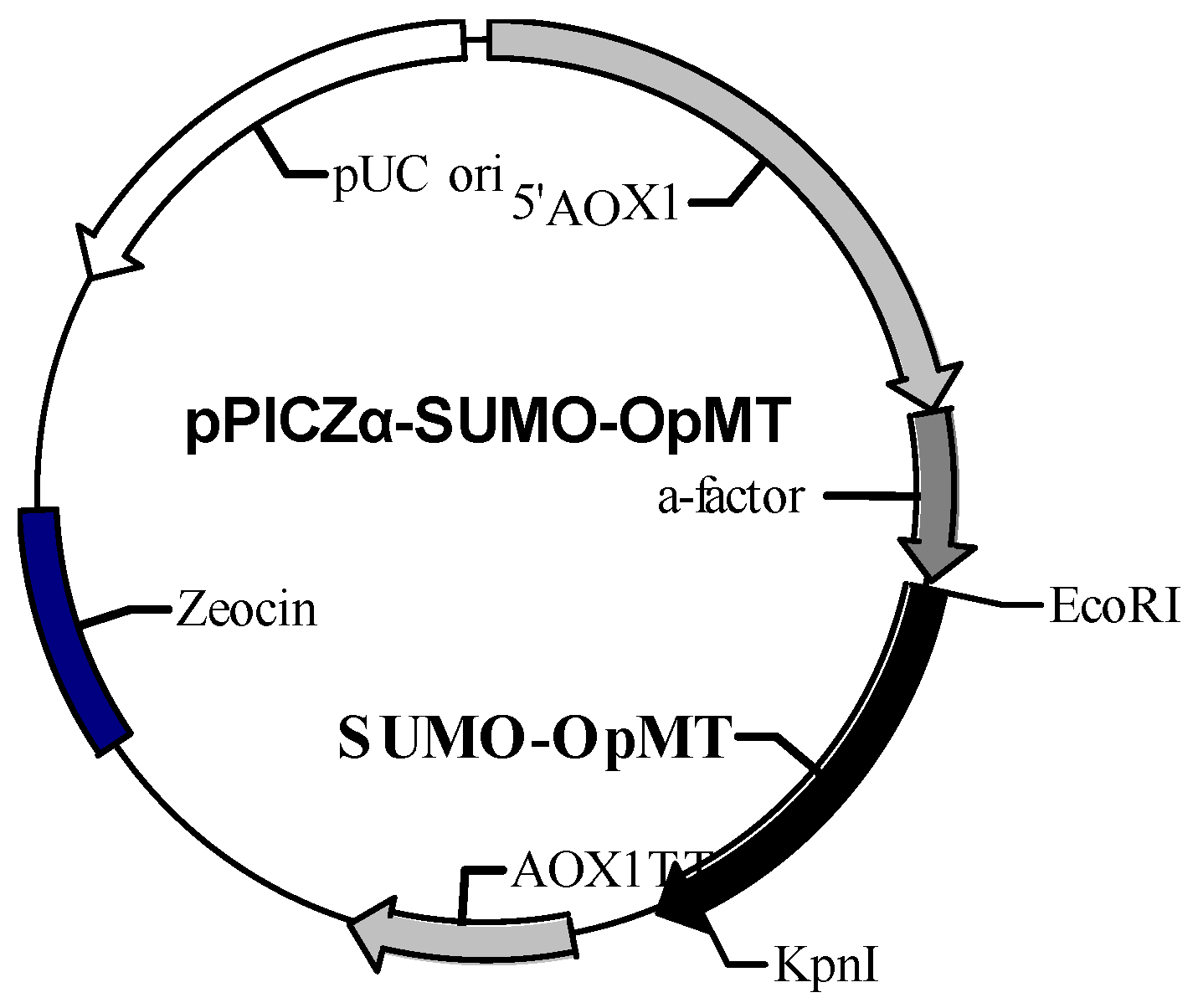
Ostrea plicatula collected from the Xiamen coastal waters (Fujian, China). The recombinant plasmid pPICZα-SUMO-OpMT (
Figure 1) and recombinant
Pichia pastoris SMD1168-MT (harboring a marine-derived MT gene) were both provided by the Engineering Technology Research Center for Comprehensive Utilization of Marine Biological Resources, Third Institute of Oceanography, Ministry of Natural Resources (Xiamen, China). Both the recombinant plasmid and strain were stored at −80 °C in YPD medium (see below) supplemented with 20% (
v/
v) glycerol.
Culture Media: YPD, BMGY, and BMMY media were purchased from Xiamen Lüyin Co., Ltd. (Xiamen, China).
Chemicals and Kits: Inorganic salts: Sodium chloride (NaCl), zinc chloride (ZnCl2), cadmium chloride (CdCl2), and copper chloride (CuCl2) were obtained from Xilong Chemical Co., Ltd. (Guangzhou, China). Organic reagents: Methanol (HPLC grade), glycerol (analytical grade), and technical agar powder were purchased from Xilong Chemical Co., Ltd. Antibiotics: Kanamycin, ampicillin, and Zeocin were sourced from Beijing Solarbio Technology Co., Ltd. (Beijing, China). Standard and derivatization reagents: Rabbit liver metallothionein standard (purity ≥ 90%), Tris-(2-carboxylethyl)-phosphine (TCEP), and 7-Fluoro-2,1,3-benzoxadiazole-4-sulfonate (SBD-F) were procured from Sigma-Aldrich Shanghai Trading Co., Ltd. (Shanghai, China). Glycerol Content Detection Kit (suitable for Glycerol-Periodate Acid Oxidation-Acetylacetone Colorimetric Method) was obtained from Beijing Boxbio Science Technology Co., Ltd. (Beijing, China). Nitrogen/Ammonium Sulfate Detection Kit (suitable for Indophenol Blue Colorimetric Method) was purchased from Xiamen Yimai Environmental Protection Technology Co., Ltd. (Xiamen, China).
2.2. Experimental Instruments
All instruments used in this study are listed in
Table 1, including their models and manufacturers.
2.3. Strain Cultivation and Condition Optimization
The recombinant P. pastoris SMD1168-MT stored at −80 °C was streaked onto solid YPD agar plates (supplemented with 100 μg/mL kanamycin, 100 μg/mL ampicillin, and 50 μg/mL Zeocin) using a sterile inoculating loop. The plates were incubated at 30 °C for 24 h to activate the strain. A single well-isolated colony from the activated plate was inoculated into 50 mL liquid YPD medium (with the same antibiotic concentrations as above) at a 1% (v/v) inoculum ratio, followed by incubation at 30 °C with shaking at 200 r/min for 20 h to prepare the seed culture.
The initial MT titer (the basal expression level) of the unoptimized recombinant Pichia pastoris SMD1168-MT strain was 0.073 mg/mL under standard laboratory fermentation conditions (BMGY/BMMY medium, 30 °C, initial pH 8.0, 200 r/min shaking speed, 1% inoculum size, 48 h induction time, no exogenous methanol and metal ion addition).
To determine the optimal growth conditions for SMD1168-MT, single-factor experiments were conducted to evaluate the effects of initial pH, shaking speed, and inoculum size on cell growth (monitored via OD600). Each experiment included three biological replicates, and samples were collected every 2 h to measure OD600 using a UV-visible spectrophotometer (Shimadzu UV-1780, Shimadzu Corporation, Suzhou, China). The factors and their levels were set as follows: Initial pH: 5.0, 6.0, 7.0, 8.0, 9.0 (adjusted using 1 mol/L HCl or 1 mol/L NaOH before autoclaving). Shaking speed: 180, 200, 220, 240 r/min. Inoculum size: 1%, 2%, 4%, 8% (v/v; calculated based on the volume of seed culture added to fresh BMGY medium).
2.4. Induced Fermentation and Condition Optimization
Preliminary Cultivation: Based on the optimized growth conditions (initial pH 8.0, shaking speed 220 r/min, inoculum size 4%), the seed culture was inoculated into 100 mL BMGY medium and incubated at 30 °C with shaking at 220 r/min until the strain reached the stationary growth phase (OD600 ≈ 8.0) and glycerol in the medium was nearly depleted.
Induction Initiation: When the seed culture reached the stationary phase, the cells were harvested by centrifugation at 5000 r/min for 10 min at 4 °C. The cell pellet was resuspended in 100 mL fresh BMMY medium (pre-adjusted to pH 8.0) to the desired initial OD600. Methanol (as the inducer for the AOX1 promoter) was added to the specified volume fraction, and filter-sterilized (0.22 μm aqueous membrane) metal ions (ZnSO4, CuCl2, or CdCl2) were added to induce the expression of MT, respectively. The induced fermentation was conducted at 30 °C with shaking at the specified speed.
Optimization of Induction Conditions: Five key factors affecting MT expression were optimized with three biological replicates per treatment level:
Initial OD600: 2.0, 4.0, 6.0, 8.8, 10.0.
Methanol Volume Fraction: 0%, 2.5%, 5%, 7.5%, 10% (v/v).
Shaking Speed: 180, 200, 220, 240, 260 r/min.
Induction Time: 6, 12, 24, 48, 72 h.
Inducing Metal Concentration: 0, 50, 100, 200, 500, 700 μmol/L (for Zn2+, Cd2+, Cu2+).
2.5. BP Neural Network Model Design
2.5.1. Data Collection and Preprocessing
To characterize the nonlinear response of metallothionein (MT) expression to key process parameters during the induced fermentation of recombinant yeast strains, Python 3.8 was used for model construction. Five process factors—methanol dose (%, *v/v*), initial bacterial density of fermentation broth (OD600), shaking speed (rpm), induction time (h), and Zn2+ addition amount (μmol/L)—were set as input variables, and the corresponding measured final MT concentration (mg/mL) was set as the output variable. A total of 124 valid experimental datasets were included. The dataset was randomly split into training and validation sets at a 4:1 ratio (train/test split = 0.8/0.2). All variables were standardized using the mean and standard deviation of the training set to eliminate dimensional interference on model training.
2.5.2. Construction and Training of the Neural Network Model
A four-layer feedforward neural network with a topology of 5-16-12-6-1 was established. The input layer contained 5 neurons corresponding to the five process parameters; the three hidden layers had 16, 12, and 6 neurons, respectively; and the output layer had one neuron for predicting MT concentration. The Rectified Linear Unit (ReLU) activation function was applied to hidden layers for nonlinear expression, while a linear activation function was used for the output layer. The Adam optimizer was adopted for parameter updating, with an initial learning rate of 0.001 and hyperparameters β1 = 0.9, β2 = 0.999.
A dynamic learning rate decay strategy was implemented: the learning rate was multiplied by 0.7 if the validation loss did not improve for 200 consecutive epochs, with a minimum of 1 × 10⁻⁵. A weighted loss function was designed to enhance predictive performance in the high MT concentration region, assigning a weight coefficient of 120 to samples with MT concentration > 0.165 mg/mL. Mini-batch gradient descent was used with a batch size of 8 and a maximum of 4000 epochs. An early stopping mechanism prevented overfitting by terminating training early if validation loss stagnated for 1200 consecutive epochs.
2.5.3. Optimization of Fermentation Conditions by Particle Swarm Optimization Algorithm
Based on the well-trained neural network, the Particle Swarm Optimization (PSO) algorithm was employed to optimize fermentation parameters. The PSO was configured with 40 particles and a maximum of 120 iterations. The inertia weight linearly decreased from 0.9 to 0.4, and both individual and social learning factors were set to 2.0. PSO searches were performed within the experimental parameter range to maximize the neural network-predicted MT concentration.
2.5.4. Model Evaluation and Parameter Analysis
Model performance was evaluated using the coefficient of determination (R2), root mean square error (RMSE), and mean absolute error (MAE). To quantify the influence of each process parameter on MT yield, local perturbation analysis was conducted at the PSO-optimized point. Each parameter was perturbed by ±15% within its range, and the relative change rate of MT concentration was calculated. The relative importance percentage of each parameter was derived after normalization.
2.6. Determination of MT
2.6.1. Pre-Column Derivatization Reaction
An aliquot of 20 μL MT supernatant was mixed sequentially with 3 μL of 20% (
w/
v) TCEP solution, 10 μL of 5 mg/mL SBD-F solution, and 75 μL of reaction buffer (1 mol/L boric acid, 30 mmol/L EDTA, 0.8 mol/L KOH, pH 10.5). The mixture was vortexed thoroughly and incubated in a water bath at 50 °C for 30 min. The reaction was terminated by adding 10 μL of 4 mol/L HCl, and the resulting solution was made up to a final volume of 1 mL with 20 mmol/L dilution buffer (pH 7.5), followed by thorough vortex mixing. After filtration through a 0.22 μm aqueous membrane, the content of -SH groups was determined by high-performance liquid chromatography (HPLC) for the indirect quantification of MT [
32].
2.6.2. Chromatographic Equipment and Conditions
A Waters e2695 HPLC system equipped with a Waters 2475 fluorescence detector was used for the analysis. The mobile phase consisted of acetonitrile: 25 mmol/L phosphate buffer (pH 7.5): methanol at a volume ratio of 18:80:2. Separation was performed on a Sinochrom ODS-BP C18 column (4.6 mm × 250 mm, 5 μm). The injection volume was 40 μL with a total elution time of 20 min. The flow rate and column temperature were set at 0.5 mL/min and 25 °C, respectively. Fluorescence detection was carried out at an excitation wavelength of 380 nm and an emission wavelength of 510 nm. The retention time of the rabbit liver MT standard under chromatographic conditions is 7.7 min.
2.6.3. Standard Curve Establishment
Rabbit liver metallothionein (MT) was used as the standard, and standard solutions with concentrations of 0.05, 0.1, 0.15, 0.2, and 0.25 mg/mL were prepared. The HPLC method described in
Section 2.6.2 was employed to determine the peak areas of the standard solutions, and a standard curve was constructed with the MT concentration as the abscissa and the corresponding peak area as the ordinate. The standard curve of rabbit liver MT showed a good linear relationship in the range of 0.05–0.25 mg/mL, with the regression equation y = 0.89716x − 1276.6 (R
2 = 0.9990).
2.6.4. Determination of Recombinant MT
The collected fermentation broth was centrifuged at 7000 r/min for 10 min, and the supernatant was collected and incubated in a water bath at 80 °C for 5 min. The treated supernatant was further centrifuged at 12,000 rpm for 10 min, and the resulting supernatant was collected for the subsequent determination of MT content. To prevent the attenuation of the fluorescent signal from the derivatization reaction caused by prolonged storage, all sample detections must be completed within 24 h after sample preparation. The retention time of the recombinant MT in the fermentation supernatant is around 7.7 min, which is basically consistent with the retention time of the MT standard peak (7.7 min). The recombinant MT titer in the samples was calculated by substituting the measured peak areas of the samples into the pre-established standard curve.
2.7. Data and Image Processing
Data Analysis: All experimental data were first tested for normality using the Kolmogorov–Smirnov test and for homogeneity of variance using Levene’s test. For normally distributed and homogeneous variance data, one-way analysis of variance (ANOVA) was used for multiple comparisons, and Tukey’s HSD test for post hoc analysis. For non-normal data, the Kruskal–Wallis H test (non-parametric ANOVA) was used. Significance level: p < 0.05 was considered statistically significant, and p < 0.01 was highly significant. All experiments included 3 biological replicates (independent culture and fermentation) and 2 technical replicates (duplicate detection for each biological sample), and all data are expressed as mean ± standard deviation (SD). Multiple-comparison correction: The Bonferroni correction was applied for multiple comparisons to avoid type I errors, and this correction method has been specified in the statistical analysis section.
SigmaPlot 15.0 software was used for data processing and graphing. Model Construction: MATLAB 2019b software was utilized to construct the BP neural network model and PSO.
3. Results and Discussion
3.1. Optimization of Strain Cultivation Conditions
The growth status of recombinant P. pastoris SMD1168-MT directly determines the efficiency of cell biomass accumulation, which is the core basis for subsequent efficient induced expression of MT.
3.1.1. Initial pH
The initial pH of the medium influences cell growth by regulating cell membrane charge, enzyme activity, and the bioavailability of nutrients (e.g., metal ions) [
33,
34,
35]. Previous studies have reported that the optimal initial pH for most
P. pastoris strains ranges from 5.0 to 7.0—acidic conditions (pH < 5.0) damage membrane integrity and inhibit nutrient absorption, while alkaline conditions (pH > 7.0) alter the chemical form of metal ions and reduce their availability [
33,
34]. However, due to the Pep4 gene mutation in SMD1168-MT, its pH adaptability differed from that of wild-type strains.
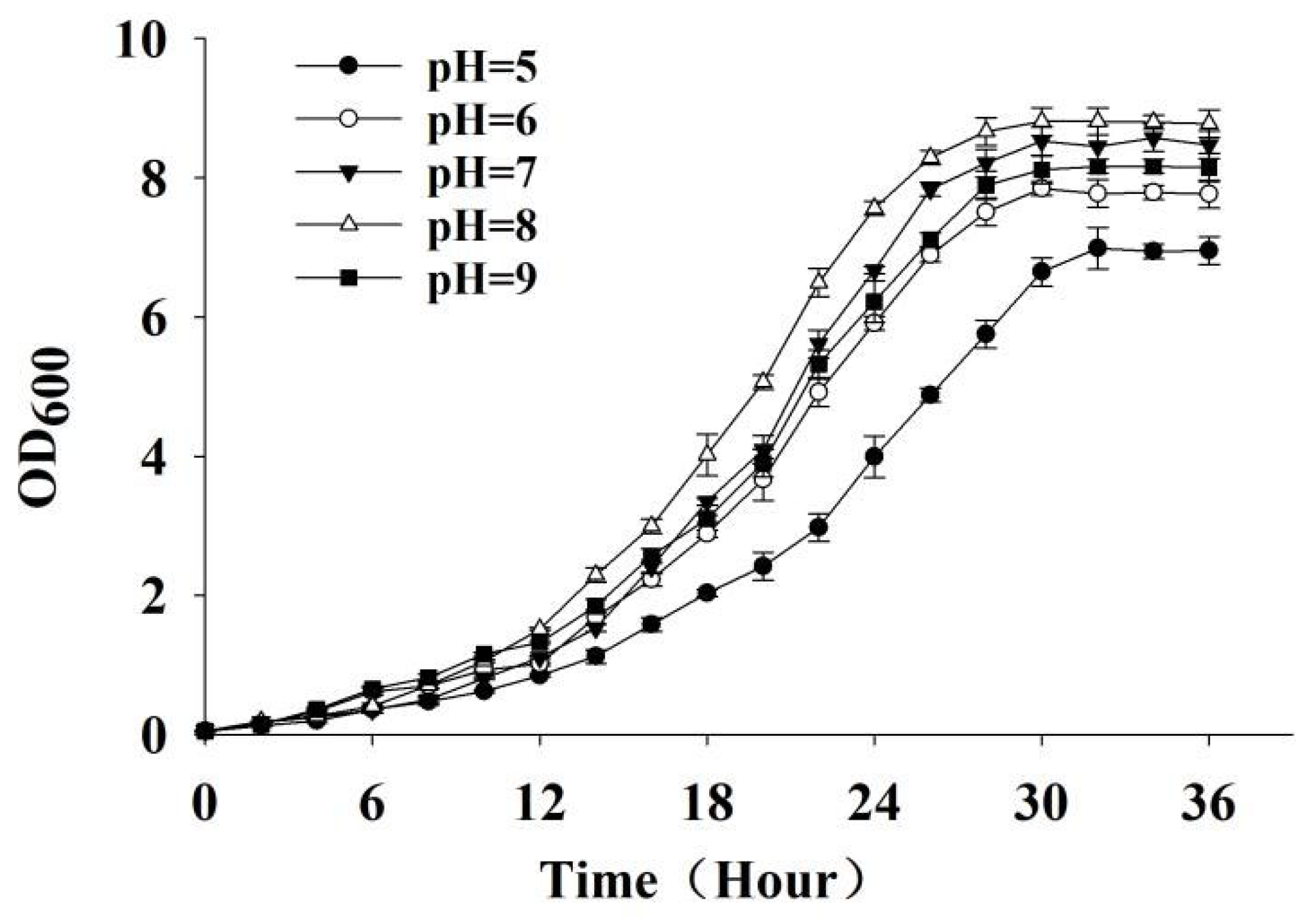
As shown in
Figure 2, SMD1168-MT grew well at initial pH values of 6.0–9.0, with the stationary growth phase occurring between 28 and 34 h and maintaining high cell density during this phase. At 30 h of cultivation, the OD
600 value in the initial pH 8.0 group reached a peak of 8.81, significantly higher than that in other groups; after 30 h, the OD
600 value of this group decreased rapidly, presumably due to the depletion of carbon sources such as glycerol in the medium. Additionally, considering that strain metabolism (e.g., secretion of organic acids/alkaline substances) causes dynamic pH changes during cultivation, a buffer system (e.g., phosphate buffer) should be added to the medium in subsequent experiments to maintain the pH within the optimal range of 7.5–8.5, ensuring sustained and stable cell growth.
3.1.2. Shaking Speed
Pichia pastoris is a typical aerobic microorganism, and dissolved oxygen is a key limiting factor for its growth and metabolism. In a shake flask culture system with a fixed liquid volume, shaking speed directly determines dissolved oxygen levels and nutrient mass transfer efficiency by influencing liquid shear force and gas–liquid exchange efficiency. Excessive low shaking speeds lead to insufficient dissolved oxygen, triggering anaerobic metabolism and the production of inhibitory substances such as acetic acid; excessively high speeds cause membrane damage due to strong shear force, resulting in leakage of intracellular substances [
36,
37,
38].
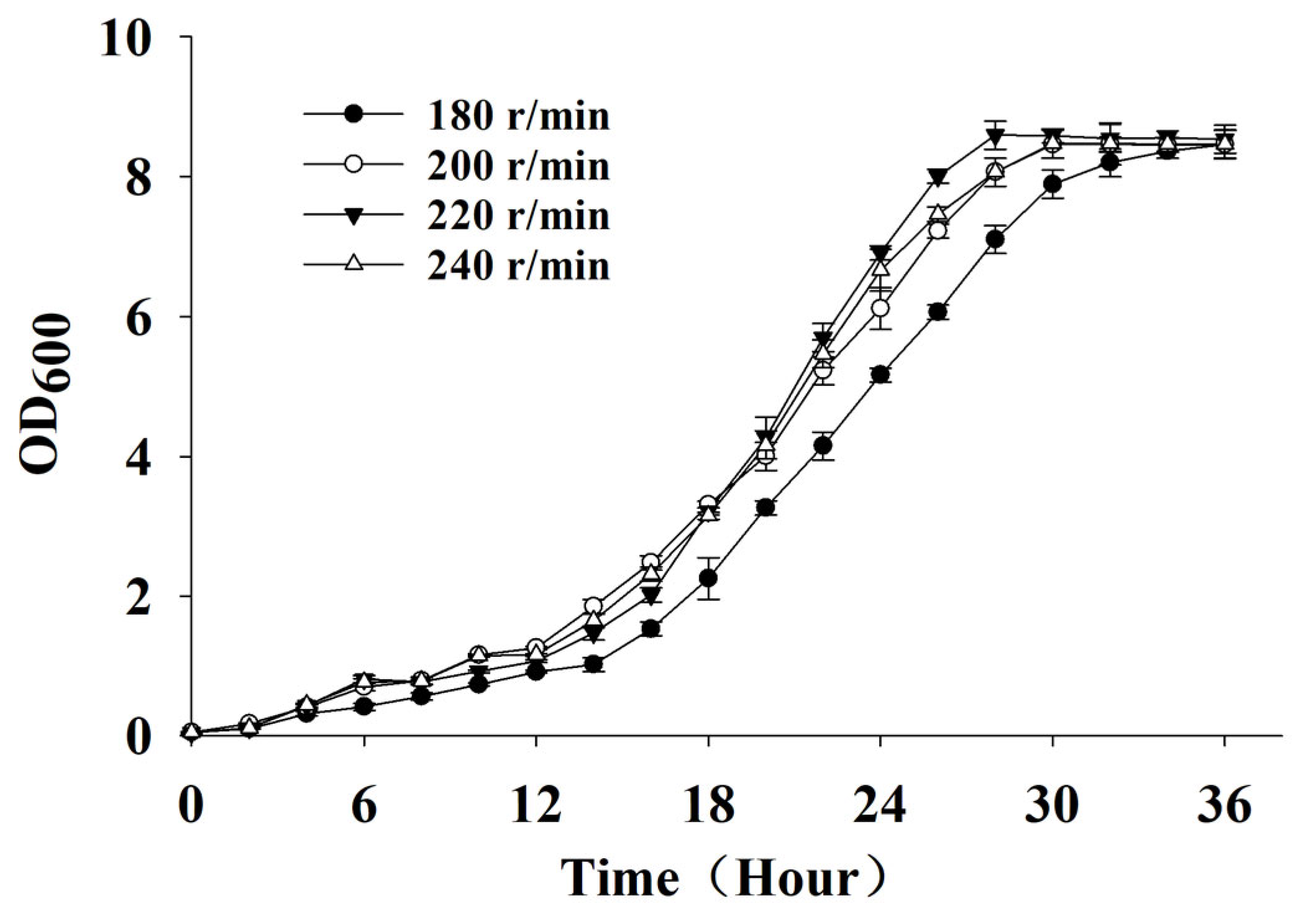
As shown in
Figure 3, the growth rate of SMD1168-MT increased with increasing shaking speed, and the stationary growth phase advanced. At 180 r/min, the strain entered the stationary phase 4–6 h later than the 220 r/min group, with a peak OD
600 of only 7.23; at 220 r/min, the strain reached the stationary phase at 28 h, with an OD
600 of 8.62—at this speed, dissolved oxygen levels met the requirements for high-density cell growth while avoiding cell lysis caused by high speeds. When the speed was further increased to 240 r/min, the OD
600 value did not increase significantly, presumably due to reaching dissolved oxygen saturation. Considering energy consumption and cell growth efficiency, 220 r/min was determined as the optimal shaking speed.
3.1.3. Inoculum Size
Inoculum size regulates the cell growth cycle, nutrient competition intensity, and risk of contamination by altering the initial cell density: excessively small inoculum sizes prolong the lag phase and increase cultivation time; excessively large sizes cause rapid early nutrient depletion, leading to insufficient dissolved oxygen and a shortened stationary phase [
39]. For the
P. pastoris expression system, most studies suggest that an inoculum size of 3–5% balances rapid biomass accumulation and nutrient equilibrium [
39], which was verified and optimized in this study.
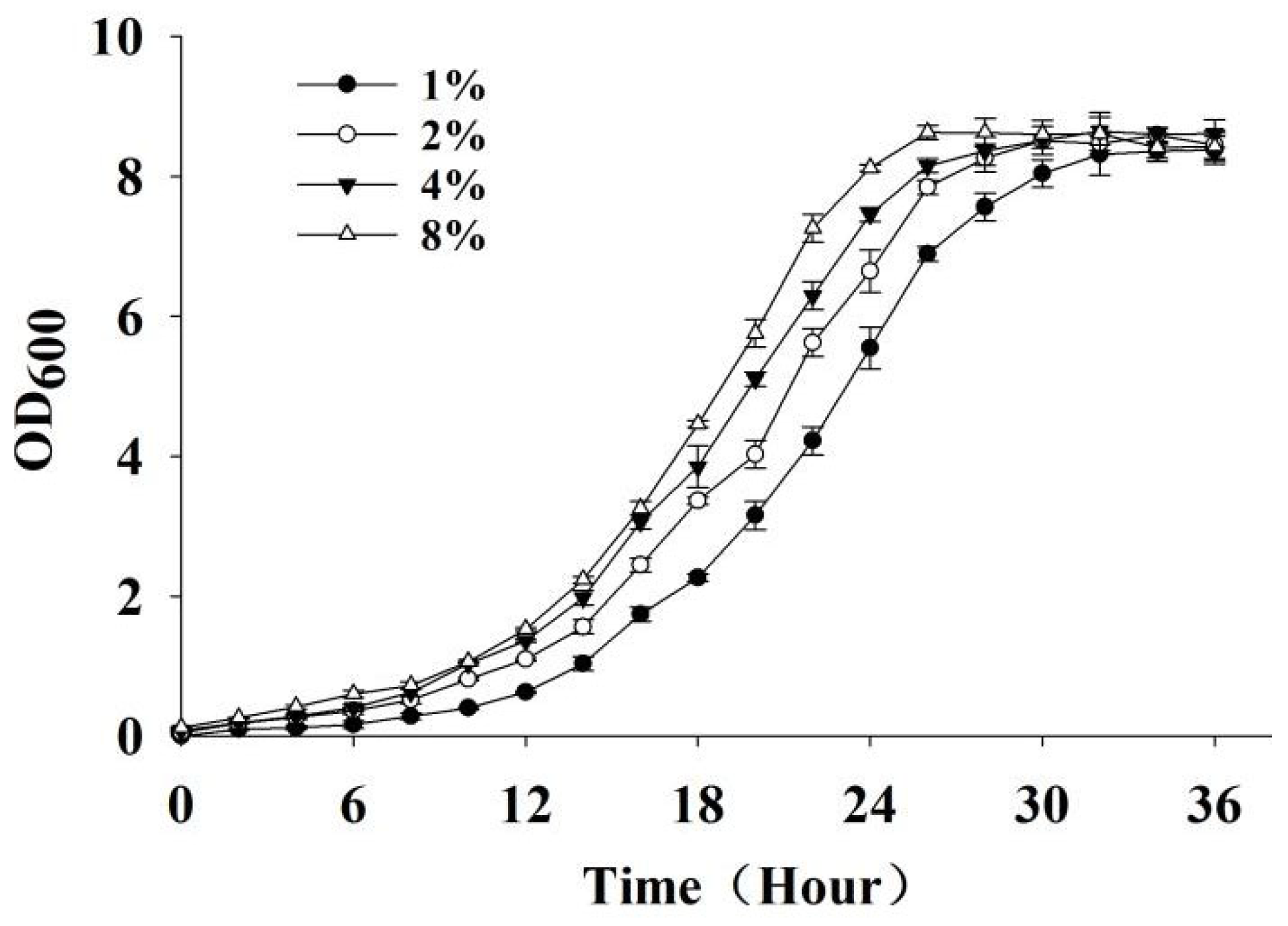
As shown in
Figure 4, within 26 h of cultivation, the OD
600 value of SMD1168-MT increased with increasing inoculum size: the 1% and 2% inoculum groups reached growth peaks after 32–34 h, with OD
600 values of 8.3 and 8.5, respectively. The 4% inoculum group reached a peak (OD
600 = 8.65) at 30 h, with a stationary phase lasting 4–6 h and maintaining good cell activity. The 8% inoculum group reached a peak (OD
600 = 8.71) early at 26 h, but the stationary phase only lasted 2–4 h before entering the decline phase, presumably due to rapid depletion of carbon and nitrogen sources caused by excessively high initial cell density. To verify this inference, supplementary quantitative detection of residual glycerol (carbon source) and ammonium sulfate (nitrogen source) in the medium was conducted using the Glycerol-Periodic Acid Oxidation-Acetylacetone Colorimetric Method and the indophenol colorimetric method, respectively. The supplementary data confirmed that at 28 h of cultivation, both residual glycerol and ammonium sulfate in the 8% inoculum group were below 0.1 g/L (near complete depletion), which directly verified our previous inference. Considering production costs, growth cycle, biomass, and fermentation stability, 4% (with a maximum OD
600 of 8.64) was selected as the optimal inoculum size.
3.2. Optimization of Induction Fermentation Conditions
Induced fermentation is the core step for SMD1168-MT to synthesize marine-derived MT, and its process parameters directly determine MT expression efficiency and activity.
3.2.1. Inducer Dosage, Induction OD600, Induction Time, and Shaking Speed
MT expression in SMD1168-MT is regulated by the AOX1 promoter, and methanol—as a specific inducer of the AOX1 promoter—requires a balance between “promoter activation efficiency” and “cell toxicity tolerance” [
40,
41,
42,
43,
44]. Low methanol concentrations can activate the AOX1 promoter but fail to meet the energy requirements for cell metabolism and protein synthesis, resulting in low MT expression; high concentrations inhibit alcohol oxidase activity and induce intracellular reactive oxygen species accumulation, causing cell damage and lysis [
44].
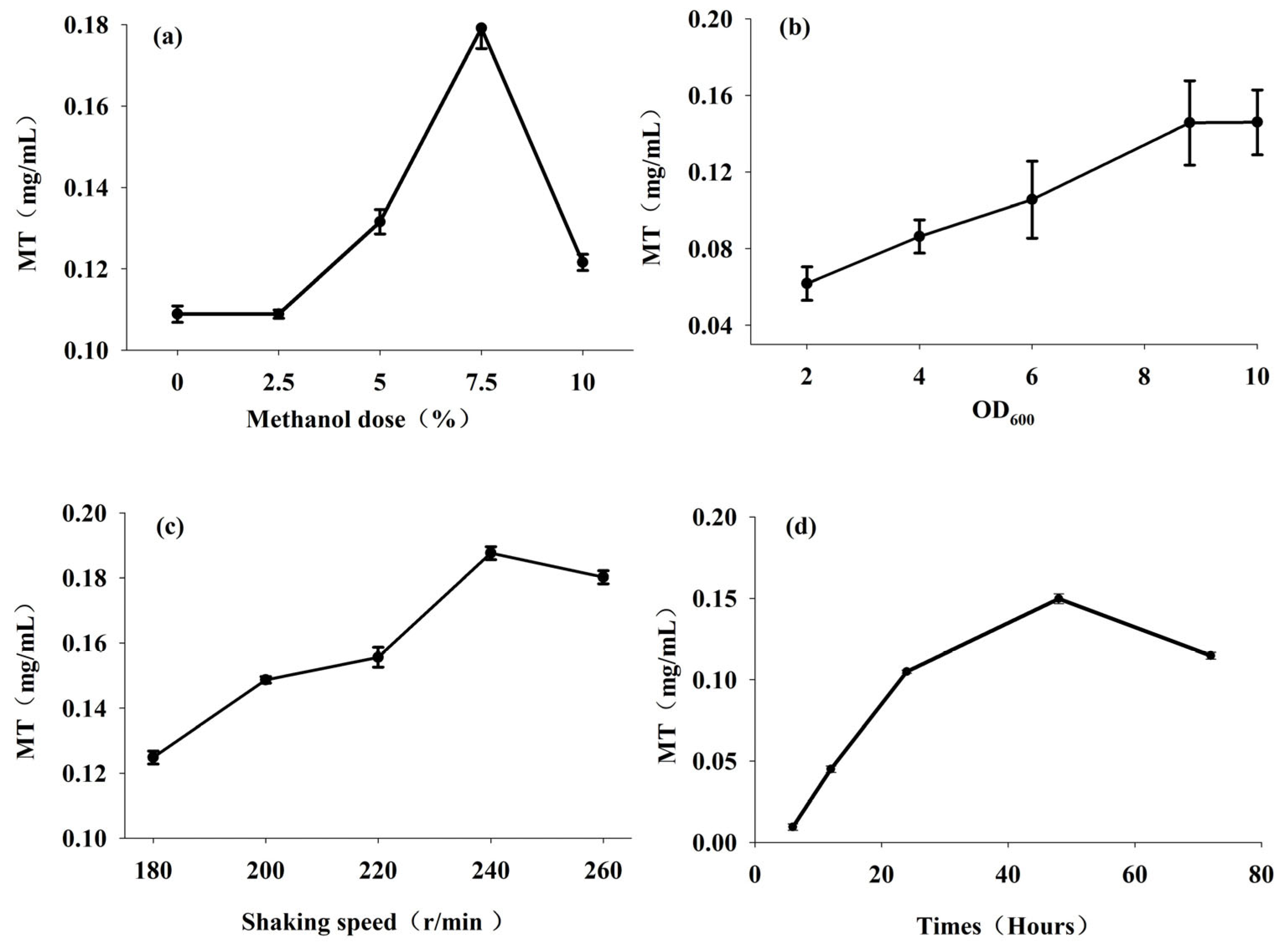
As shown in
Figure 5a, MT expression increased first and then decreased with increasing methanol volume fraction: at 0–7.5% methanol, MT expression gradually increased to a peak of 0.179 mg/mL—at this stage, increased methanol concentration effectively activated the AOX1 promoter while providing sufficient carbon sources and energy for cells; when methanol volume fraction exceeded 7.5%, MT expression decreased significantly, presumably because the toxic effect of high methanol concentrations exceeded its promoter activation effect. It is important to note that methanol is volatile in shake flask cultures and cannot be dynamically supplemented, differing from the pulsed feeding or dissolved oxygen feedback control modes in fermenters [
40,
41,
42]. In subsequent large-scale experiments, a “low initial concentration + dissolved oxygen-coupled feeding” strategy is recommended to maintain methanol concentration within a safe and efficient range of 0.5–1.5%, ensuring sustained MT expression while reducing toxicity risks and carbon source waste.
The initial induction OD
600 directly reflects the physiological state of cells, and its selection must match “cell metabolic activity” and “nutrient reserve capacity”: excessively low cell density (OD
600 < 6.0) means cells are in the early logarithmic growth phase, where enzyme systems related to protein synthesis are not fully activated, resulting in low MT expression efficiency; excessively high cell density (OD
600 > 9.0) means glycerol and other carbon sources in the medium are nearly depleted, causing cells to enter the decline phase due to nutrient deficiency, and high cell density intensifies dissolved oxygen competition, inhibiting MT synthesis [
40,
44]. As shown in
Figure 5b, MT expression was significantly positively correlated with the initial induction OD
600: when OD
600 increased to 8.8, MT expression increased from 0.0618 mg/mL to 0.146 mg/mL, a 235.8% increase; when OD
600 further increased to 10.0, MT expression remained almost unchanged, and the yeast suspension showed slight turbidity (OD
600 measurement fluctuated by ±0.3), indicating partial cell lysis. In summary, when OD
600 = 8.8, cells are in the late logarithmic growth phase, with both high metabolic activity and sufficient nutrient reserves, representing the optimal physiological state for inducing MT expression—under this condition, cell tolerance to methanol and protein synthesis efficiency are at their peaks.
Shaking speed indirectly affects dissolved oxygen levels and nutrient mass transfer efficiency by regulating gas–liquid exchange efficiency and liquid shear force in shake flasks. During MT synthesis by
P. pastoris, activation of the AOX1 promoter, metal ion transport, and protein folding all consume large amounts of oxygen [
35,
36,
37,
38,
44]. Excessive low speeds lead to insufficient dissolved oxygen, triggering anaerobic metabolism and the production of inhibitory substances such as acetic acid; excessively high speeds cause membrane damage due to strong shear force, resulting in leakage of intracellular MT and decreased cell activity. As shown in
Figure 5c, the relationship between shaking speed and MT expression can be divided into two phases: 180–240 r/min is the “dissolved oxygen limitation phase,” where MT expression increased rapidly from 0.125 mg/mL to 0.188 mg/mL with increasing speed; 240–260 r/min is the “shear damage phase,” where MT expression decreased, possibly due to cell lysis caused by high speeds. Therefore, 240 r/min was determined as the optimal speed, balancing dissolved oxygen supply and cell activity to fully meet the oxygen demand for MT synthesis.
The selection of induction time must balance “MT accumulation” and “product stability”: in the early induction stage (0–48 h), cells are in the active MT synthesis phase, and MT expression increased linearly from 0.028 mg/mL to 0.185 mg/mL; in the late induction stage (>48 h), medium nutrients are depleted, cell protease secretion increases—resulting in degradation of synthesized MT—and secondary metabolites produced by cell metabolism inhibit MT expression (
Figure 5d). Considering economy and efficiency, 48 h was determined as the optimal induction time, where both MT accumulation and stability are at optimal levels.
3.2.2. Inductive Metals and Dosages
The core function of MT is metal ion binding and detoxification, and its expression depends on induction by specific metal ions—these ions not only activate the MT gene promoter but also act as cofactors to promote correct MT folding, forming bioactive metal-thiol complexes [
10,
11,
12,
13,
45,
46]. Significant differences (
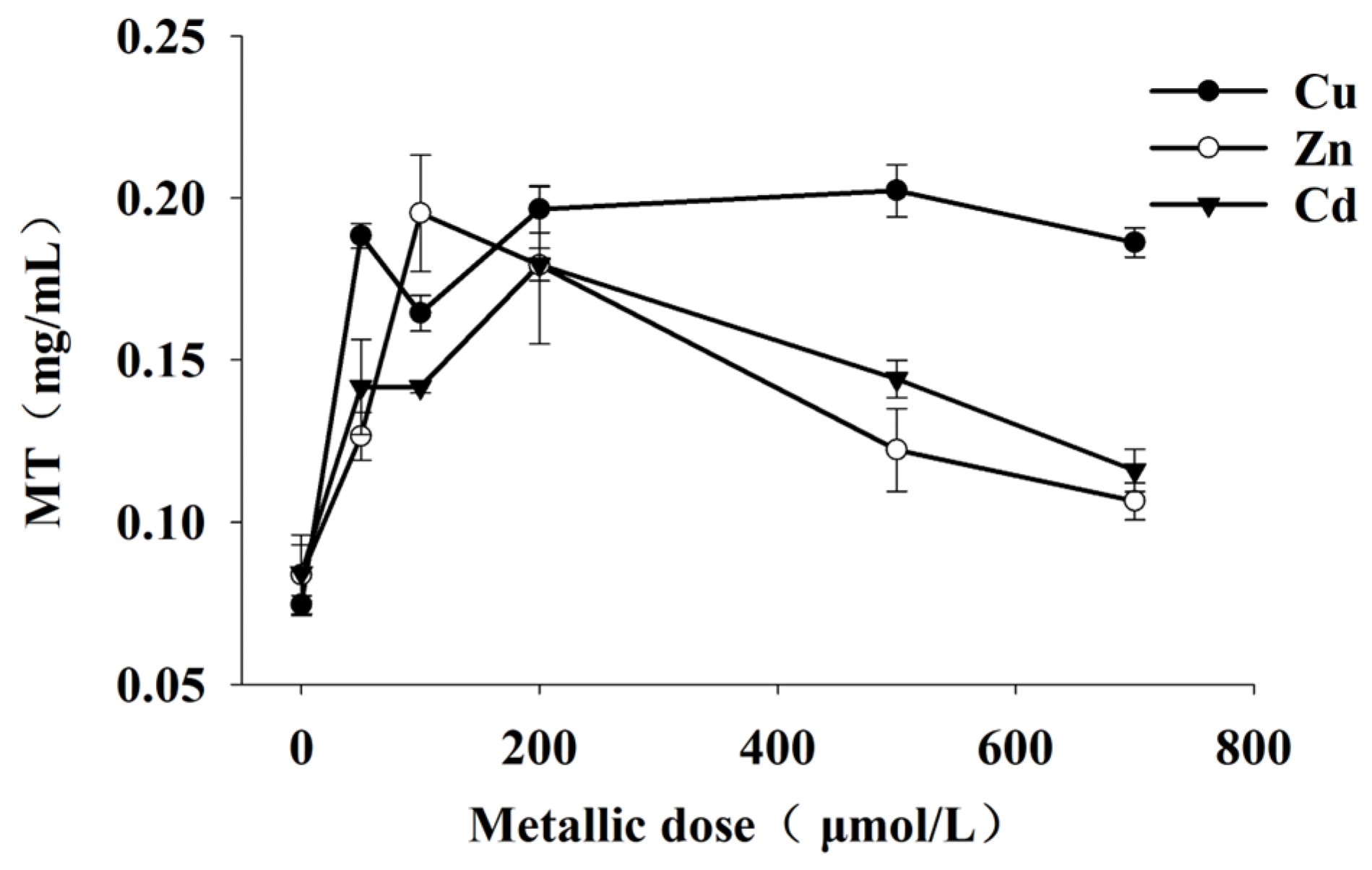
p < 0.05) exist in the induction efficiency and binding affinity of different metal ions for MT, and a balance between “induction activity” and “biological safety” must be considered. Among the tested metals, Cd
2+ showed the weakest induction effect on SMD1168-MT; Cu
2+ induction efficiency was less affected by concentration, reaching a peak of 0.202 mg/mL at 500 μmol/L; Zn
2+ induced an MT expression level of 0.195 mg/mL at 100 μmol/L, which was comparable to that induced by Cu
2+ (
Figure 6). The Zn
2+ dosage must match the MT binding capacity (MT contains 20 cysteine residues, forming 7 Zn
2+ binding sites [
47]); additionally, as an essential trace element for humans, Zn
2+ exhibits high induction activity and good biological safety, and its induced product requires no additional demetalization treatment, enabling direct application in product development [
45,
48]. Therefore, Zn
2+ was selected as the optimal inducing metal for SMD1168-MT, with an optimal concentration of 100 μmol/L.
The titer of 0.195 mg/mL was the maximum MT yield achieved via single-factor optimization (OFAT) of key induction parameters (methanol concentration, induction OD
600, shaking speed, induction time, and Zn
2+ concentration), as shown in
Figure 5 and
Figure 6 of the manuscript. This result reflected the improvement of MT expression by optimizing individual fermentation parameters, but OFAT experiments have an inherent limitation: they cannot account for the complex nonlinear interactions between multiple fermentation parameters. In industrial fermentation processes, microbial growth and heterologous protein expression are regulated by the synergistic effects of multiple environmental and process factors, and single-factor optimization often fails to capture these interactive effects, leading to a suboptimal yield ceiling.
3.3. BP Neural Network Model Construction and Performance Evaluation
3.3.1. Model Training and Convergence
A BP neural network model with a topology of 5-16-12-6-1 was constructed to predict MT expression based on the five key induction parameters (methanol volume fraction, initial OD
600, shaking speed, induction time, Zn
2+ concentration). In this fermentation-related modeling study, an “epoch” represents one complete pass through the entire training dataset of fermentation samples, while the “loss” corresponds to the weighted mean squared error between the predicted and experimental MT concentrations in the fermentation broth.
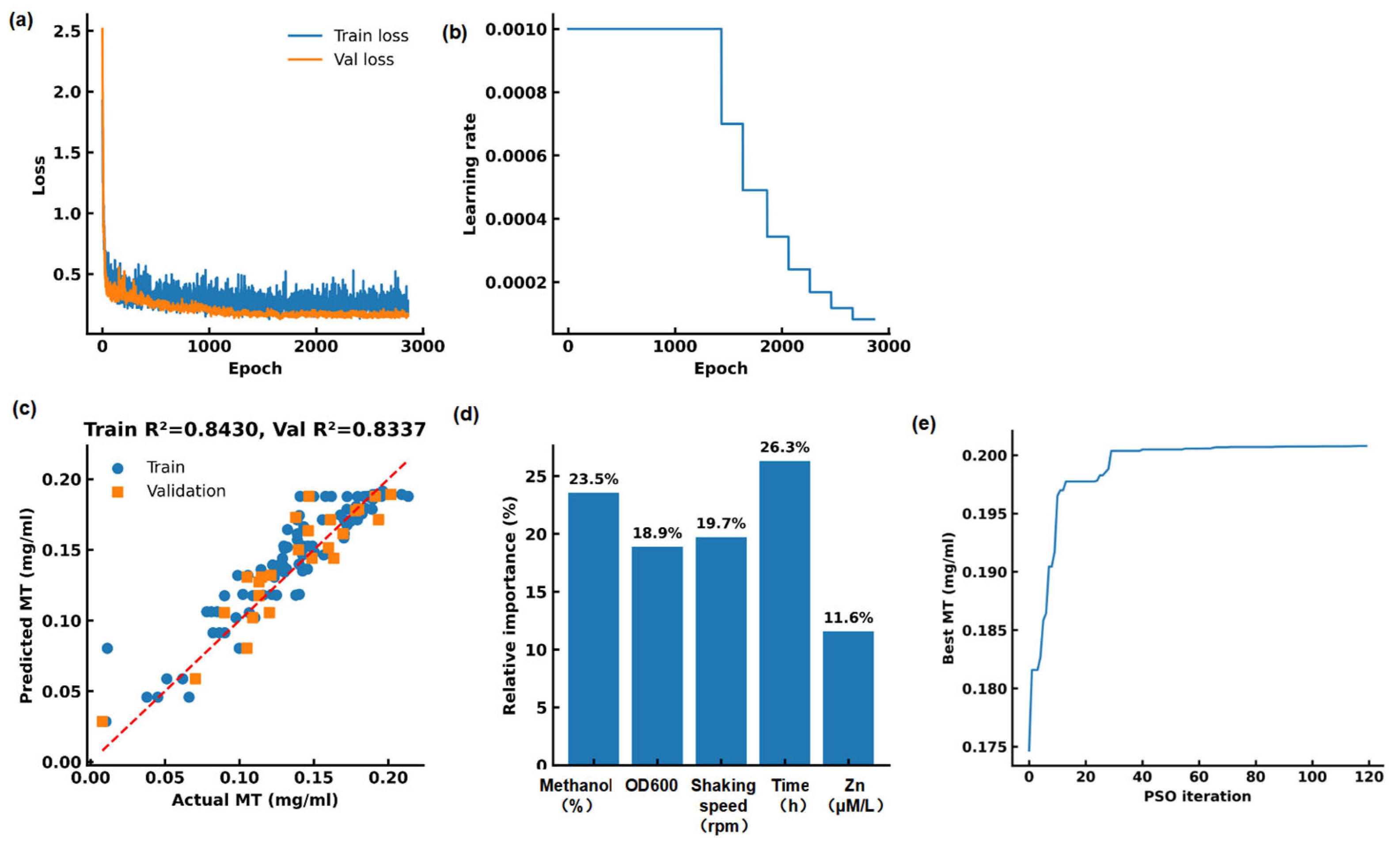
Figure 7a illustrates the evolution of both training and validation loss as a function of training epochs and serves to demonstrate the convergence behavior and generalization performance of the model. The gradual decrease in training loss indicates that the model is effectively learning the underlying data patterns, while the stabilization of validation loss suggests that the model achieves a suitable balance between fitting accuracy and generalization capability. The application of early stopping further ensures that overfitting is minimized by selecting the optimal model parameters corresponding to the lowest validation loss, which is essential for reliable fermentation process prediction.
Consistent with the above analysis, the BP neural network model exhibited good convergence during training (
Figure 7a): both training loss and validation loss decreased steadily with increasing epochs, and the validation loss reached a minimum of 0.1277 after 2862 epochs—at this point, the early stopping mechanism was triggered to terminate the training process and prevent overfitting, thus ensuring the model’s applicability to actual fermentation process prediction. The value of 0.1277 corresponds to the minimum validation loss achieved during the training process. This value is determined dynamically based on the model’s performance on the validation dataset of fermentation samples and is used as a key criterion for selecting the optimal set of model parameters. Therefore, this value directly reflects the best generalization performance of the model in predicting MT expression during the fermentation process. In addition, the dynamic learning rate adjustment strategy effectively responded to the plateau phase of validation loss (
Figure 7b). The learning rate decreased from the initial 0.001 to 0.000058 after six decays, ensuring that the model continued to optimize parameters even when loss stagnated.
3.3.2. Model Performance Metrics
The performance metrics of the BP neural network model for the training and validation sets are summarized in
Table 2. The model exhibited high prediction accuracy (
Table 2).
The small difference between the training and validation metrics indicates good model generalization ability and no significant overfitting. As shown in
Figure 7c, the predicted MT concentrations were highly consistent with the actual values for both sets—further confirming the reliability of the model.
3.3.3. Relative Importance of Input Parameters
The parameter importance was evaluated using a local perturbation-based sensitivity analysis in which each input variable was independently varied within a defined range around the optimal point while keeping other variables constant. The resulting change in predicted MT concentration was used as a quantitative measure of the influence of each parameter. Parameters that induce larger changes in model output are considered more influential. To facilitate comparison, the raw sensitivity values were normalized by the sum of all parameter effects, yielding relative importance percentages. This approach provides an intuitive and model-consistent interpretation of the contribution of each variable to the predicted response. Therefore, local perturbation analysis was conducted to quantify the influence of each input parameter on MT yield (
Figure 7d).
The relative importance of the parameters was ranked as follows: induction time (26.3%) and methanol volume fraction (23.5%) were the most critical factors affecting MT yield; shaking speed (19.7%) and OD600 (18.9%) influenced mass transfer efficiency and cell density, respectively; Zn2+ concentration (11.6%), as a trace element, had a relatively smaller impact on secondary metabolite synthesis.
This ranking provides a theoretical basis for prioritizing resource allocation in industrial process optimization—for example, stricter control of induction time and methanol concentration can yield greater improvements in MT yield.
3.4. Optimization of Fermentation Conditions by PSO and Validation
During the PSO process, particles are randomly distributed across the search space, resulting in relatively low predicted MT values. As the optimization progresses, particles iteratively adjust their positions by incorporating information from both individual and global best solutions, which drives the population toward regions associated with higher MT production. This process leads to a gradual improvement in the global best solution until convergence is achieved, at which point further iterations yield negligible changes. The increasing trend in MT values observed during PSO iterations reflects the inherent optimization mechanism of the algorithm (
Figure 7e).
Based on the well-trained BP neural network model, the PSO algorithm was used to optimize the five input parameters to maximize MT yield. During 120 iterations (
Figure 7e), the predicted optimal MT concentration gradually increased from the initial 0.1917 mg/mL to 0.2008 mg/mL and stabilized after approximately 50 iterations—indicating convergence of the PSO algorithm.
The optimized parameters obtained from the model were: methanol volume fraction 7.68%, OD
600 8.15, shaking speed 238.50 r/min, induction time 49.79 h, and Zn
2+ concentration 124.89 μmol/L—under these conditions, the predicted MT concentration was 0.2089 mg/mL. Considering practical application, the optimal fermentation parameters were adjusted to: methanol volume fraction 7.7%, OD
600 8.2, shaking speed 240 r/min, induction time 50 h, and Zn
2+ concentration 125 μmol/L. Fermentation validation experiments under these conditions showed that the MT expression level reached 0.2141 mg/mL (
Figure 7e), 2.93-fold higher than the initial yield.
The actual MT concentration was close to the model-predicted value (0.2089 mg/mL), with a relative error of only 2.49% (<3%)—confirming that the BP neural network model can accurately predict MT expression in recombinant P. pastoris under different fermentation conditions.
The MT titer of 0.2141 mg/mL achieved by the BP neural network (BPNN) combined with particle swarm optimization (PSO) was the result of optimizing the synergistic combination of all five key induction parameters, rather than a simple adjustment of a single factor. Although the absolute yield improvement from 0.195 mg/mL (OFAT) to 0.2141 mg/mL (BP-PSO) is moderate (a 12.7% increase), this improvement carries critical scientific and practical significance for fermentation process development, as summarized below.
First, the BPNN-PSO framework effectively captures nonlinear interactions among fermentation parameters. The BPNN model was trained to fit the complex nonlinear relationships between the five fermentation parameters and MT yield, and PSO was used to search for the optimal parameter combination in the multidimensional parameter space. This combined strategy overcomes the limitation of OFAT experiments that ignore parameter interactions, and the 12.7% yield increase directly validates the synergistic effect of optimized parameter coupling on MT expression.
Second, this study establishes a predictive and scalable process model for MT fermentation. Beyond the moderate yield enhancement, the core contribution lies in the construction of a data-driven BPNN prediction model with strong predictive performance (R2 = 0.8430 for the training set, R2 = 0.8337 for the validation set). In contrast to OFAT results, which are typically constrained to specific experimental conditions, the BPNN model exhibits favorable generalization ability and can be readily extended to guide fermentation scale-up from shake flasks to bioreactors—a critical requirement for industrial bioprocess development.
Third, the optimized parameter set provides a stable and reproducible baseline process for marine-derived MT production. The BP-PSO optimized parameter combination (7.7% methanol, OD600 8.2, 240 r/min, 50 h induction, 125 μmol/L Zn2+) is a stable and reproducible baseline process for MT production. This baseline can be further combined with other fermentation optimization strategies (e.g., medium component optimization, fed-batch fermentation, metabolic engineering of the host strain) to achieve a higher MT yield. For heterologous protein expression in Pichia pastoris, establishing a stable, optimized baseline process is a prerequisite for subsequent high-yield modification, and this study provides such a critical foundation for marine-derived MT production.