Article

Oxygen-Deficient TiO2 Aerogel for Enhanced Photocatalytic Performance

Key Laboratory of Bio-Based Material Science and Technology (Ministry of Education), Northeast Forestry University, Harbin 150040, China
*
Authors to whom correspondence should be addressed.
These authors contributed equally to this work.
Gels 2026, 12(5), 370; https://doi.org/10.3390/gels12050370
Submission received: 26 March 2026 / Revised: 16 April 2026 / Accepted: 24 April 2026 / Published: 28 April 2026
(This article belongs to the Special Issue Gels for Removal and Adsorption (4th Edition))

Abstract

Low charge-separation efficiency is a major factor limiting the photoelectric conversion performance of TiO2. In this work, oxygen-vacancy-rich porous TiO2 gel photocatalyst was successfully fabricated. The as-prepared material exhibits a three-dimensional interconnected hierarchical porous architecture with a specific surface area of 62.9 m2 g−1. EPR and XPS analyses confirmed the presence of Ti3+ defects and oxygen vacancies, which effectively increase the electron density and facilitate the separation and migration of photogenerated charge carriers. The results demonstrated excellent photocatalytic activity, with over 85% of RhB degraded within 50 min under light irradiation. In addition, its photocatalytic performance was further investigated by photocatalytic hydrogen evolution, and the hydrogen production rate reached 850.6 μmol·g−1 h−1. The enhanced photocatalytic performance can be mainly attributed to the synergistic effect of the hierarchical porous structure and oxygen vacancies. Specifically, the hierarchical porous structure improves mass transfer and provides abundant active sites, while oxygen vacancies modulate the electronic structure and promote charge separation, thereby significantly enhancing the catalytic activity. This work provides an effective strategy for improving the photoelectric conversion performance of TiO2 and offers theoretical guidance as well as experimental support for the defect engineering and structural design of TiO2-based photocatalytic materials.

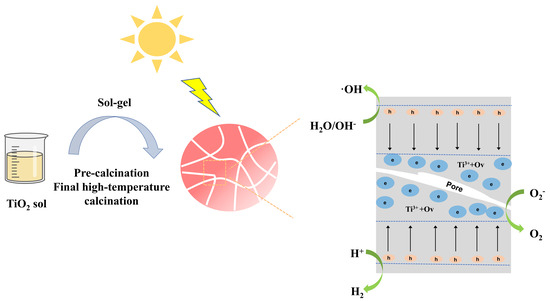
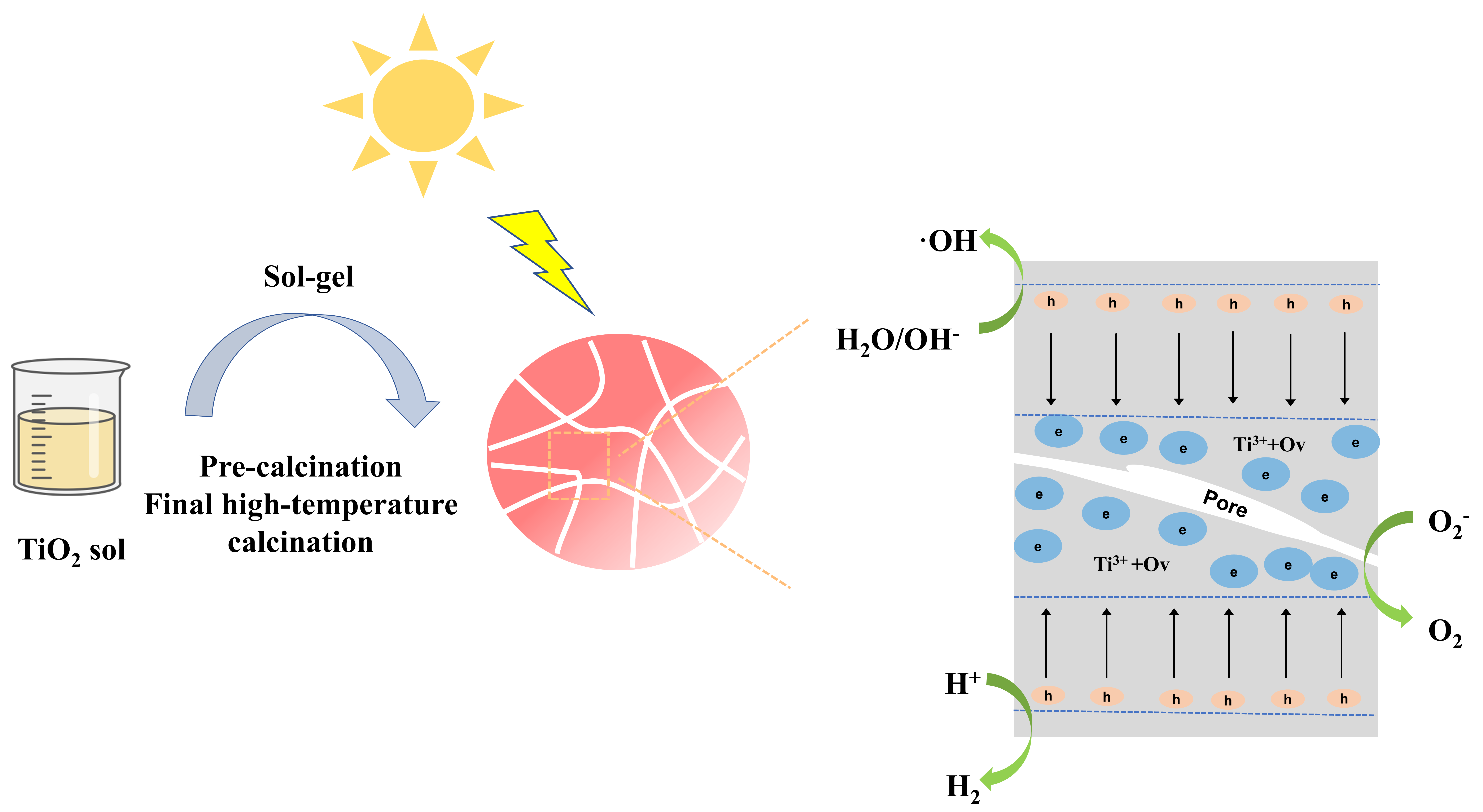
Graphical Abstract

1. Introduction

Hydrogen, owing to its high energy density, clean combustion products, and sustainable recyclability, is widely regarded as an important secondary energy source for replacing fossil fuels and alleviating the energy crisis and environmental pollution [1,2,3]. Solar-driven photocatalytic water splitting over semiconductors is considered an ideal approach for achieving green hydrogen production and solar energy conversion [4,5,6,7]. Among various semiconductor photocatalysts, TiO2 has become one of the most extensively studied and representative materials in the field of photocatalytic hydrogen production because of its high chemical stability, low cost, non-toxicity, and excellent resistance to photocorrosion [8,9]. However, the practical application of TiO2 is still restricted by several factors [10,11,12]. First, TiO2 possesses a wide band gap and can only respond to ultraviolet light, which accounts for only a very small fraction of the solar spectrum, resulting in low solar energy utilization efficiency [10]. Second, the photogenerated electron–hole pairs in TiO2 tend to recombine rapidly, which severely limits the separation and transport efficiency of charge carriers [12].
To improve the photoelectric conversion efficiency of TiO2, researchers initially introduced various cation dopants [13,14,15] (such as Nd, Sb, and Ag) or anion dopants [16,17,18] (such as S, C, and N) to enhance light absorption. However, the high cost of metal cations, the complexity of the doping process, and the limited catalytic performance achieved by anion doping have restricted the practical application of doping technology in TiO2 photocatalysis. In recent years, defect engineering has been widely regarded as an effective strategy for tuning the physicochemical properties and surface actives sites of semiconductor photocatalysts. In particular, oxygen-vacancy-rich TiO2 (Ti3+) materials have been widely used in photocatalysis because of their excellent catalytic performance [19,20,21,22,23,24]. Oxygen vacancies are generally regarded as crucial defect sites for regulating the electronic structure and surface properties of semiconductor photocatalysts, increasing the carrier density, facilitating the separation and migration of photogenerated charge carriers, thereby improve interfacial charge-transfer efficiency [20,21,22]. In addition, oxygen vacancies can act as active centers for the adsorption and activation of reactant molecules, which is highly beneficial for enhancing the overall photocatalytic performance [23]. However, due to the limited specific surface area of conventional TiO2, most oxygen vacancies are confined to exposed surface active sites, resulting in unsatisfactory catalytic performance. Moreover, a low specific surface area often leads to a high recombination rate of photogenerated electrons and holes.
Therefore, the construction of porous architectures is of great significance for improving the catalytic performance of defect-engineered TiO2 systems. Various porous TiO2 materials have been prepared using soft and hard templates, which can effectively enhance light absorption and photocatalytic efficiency. More importantly, porous structures are also beneficial for defect engineering, as they facilitate the formation and exposure of defect sites and can increase the concentration of oxygen vacancies [25,26,27,28]. In particular, porous TiO2 derived from a TiO2 gel precursor provides a promising platform for integrating structural regulation with defect modulation.
To improve the photocatalytic hydrogen evolution performance of TiO2, porous oxygen-vacancy-rich TiO2 microspheres gel were constructed through a gel-assisted strategy. TiO2 gel precursor was first synthesized and then converted into porous TiO2 microspheres gel enriched with oxygen vacancies. The enhanced photocatalytic activity of the gel-derived porous TiO2 originates from the synergistic effects of defect engineering and porous structural regulation. Oxygen vacancies introduce defect states into the band gap of TiO2 and modulate its electronic structure, thereby extending the light-response range and improving visible-light absorption. In addition, these defects serve as electron-trapping centers, which inhibit the recombination of photogenerated electron–hole pairs and facilitate charge separation. The coexistence of Ti3+ species further increases electron density and electrical conductivity, lowers charge-transfer resistance, and accelerates electron migration from the bulk to the surface. Meanwhile, the kinetics of hydrogen evolution are significantly improved, Benefiting from the synergistic optimization of light harvesting, charge separation, charge transport, and surface reaction processes.

2. Results and Discussion

2.1. Morphology and Composition Analysis

Tetrabutyl titanate (TBT) was selected as the titanium precursor. Compared with TiCl3 and TiCl4, TBT is easier to control during the reaction process and is less likely to undergo rapid hydrolysis or generate large amounts of acidic by-products. Therefore, the reaction process involving TBT is relatively mild and safe [29,30,31]. IRA-900 was employed as a soft template and fully impregnated with TBT pre-hydrolyzed in hydrochloric acid solution. The resulting TBT/IRA-900 composite was then aged at 60 °C, leading to the formation of an acidic TiO2 sol via flocculation. After drying, a gray porous TiO2 gel was obtained and subsequently subjected to calcination. The hydrolysis and polycondensation reactions of TBT in hydrochloric acid solution are shown in Equations (1)–(3) [32,33].
Ti(OC4H9)4 + nH2O → Ti(OC4H9)4−n(OH)n + nC4H9OH
Ti(OC4H9)4−n(OH)n + Ti(OC4H9)4−n(OH)n → (C4H9O)4−nTi-O-Ti(OC4H9)4−n + nH2O
Ti(OC4H9)4−n(OH)n + Ti(OC4H9)4 → (C4H9O)4−n × Ti-O-Ti(OC4H9)4−n + nC4H9OH
The morphology and elemental distribution of porous TiO2-X-550 were characterized by SEM and EDX mapping. As shown in Figure 1a, porous TiO2-X-550 exhibits an approximately spherical morphology with a wrinkled surface, which is beneficial for enhanced light absorption [34]. As shown in Figure 1d,e, the fractured surface of porous TiO2-X-550 exhibits a distinct internal porous structure, which is beneficial for light absorption, mass transfer, and the transport of reactive species. The EDS mapping images in Figure 1b,c confirm that the sample consists solely of Ti and O elements, indicating the successful formation of TiO2. In addition, the corresponding EDAX spectrum is presented in Figure S1 (Supplementary Materials), further verifying the elemental composition of porous TiO2-X-550. TEM analysis further reveals that porous TiO2-X-550 possesses a hierarchical pore structure with pore sizes of approximately 5–30 nm, and the pores are continuous and interconnected (Figure 1f). In addition, the HRTEM image in Figure 1g shows lattice fringes with d-spacings of 0.352 nm, which can be assigned to the (101) planes of anatase TiO2, respectively [35,36].
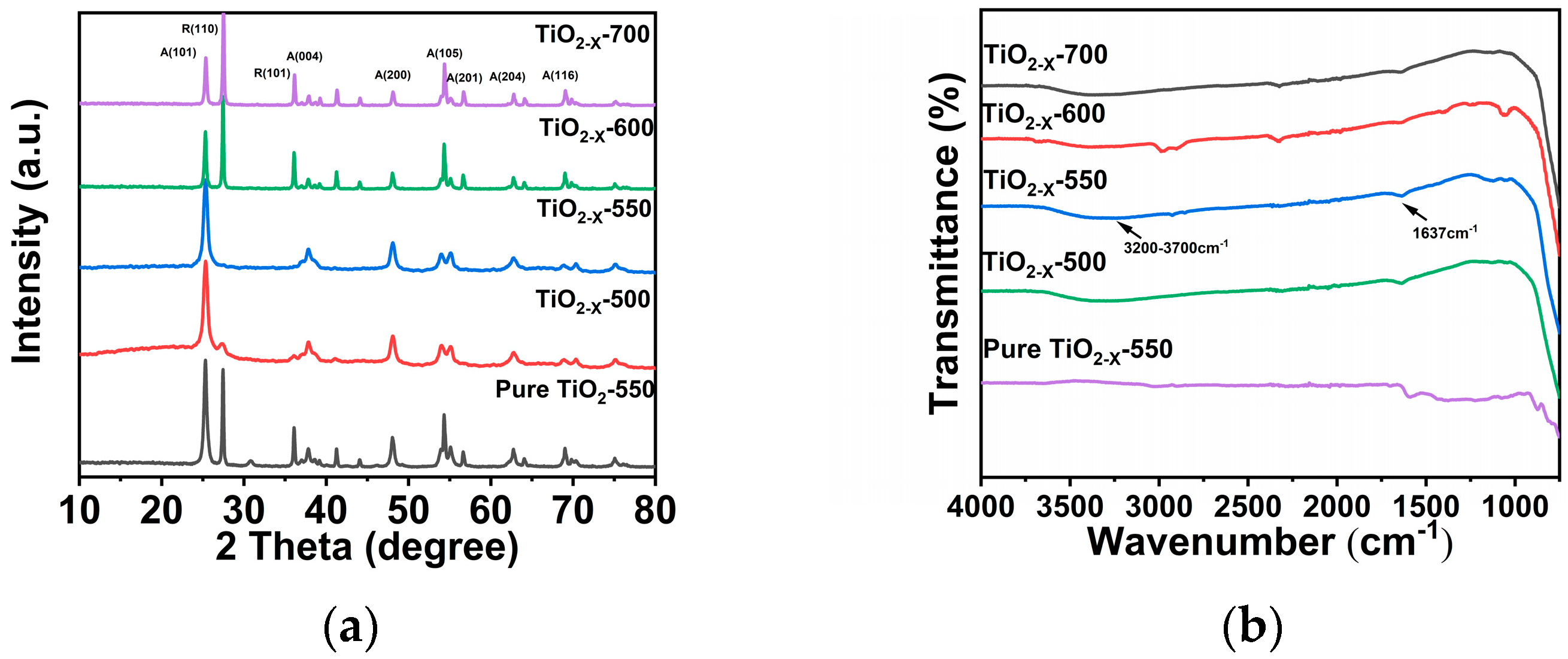
The crystal structures of the TiO2-X samples prepared at different calcination temperatures were examined by XRD (Figure 2a). The diffraction peaks of TiO2-X-550 at 25.3°, 37.8°, 48.0°, 53.9°, 54.9°, 62.9°, and 68.8° are assigned to the (101), (004), (200), (105), (201), (204), and (116) planes of anatase TiO2, respectively, indicating that the sample predominantly consists of the anatase phase [36,37]. The XRD patterns clearly reveal the presence of the anatase TiO2 phase in all samples. Compared with TiO2-X-500 and TiO2-X-550, the samples prepared under the other calcination conditions show, in addition to the characteristic anatase diffraction peaks, two extra peaks located at 27.41° and 36.09°, corresponding to the (110) and (101) planes of rutile TiO2, respectively. This indicates that partial phase transformation from anatase to rutile occurred under these calcination conditions [38]. These results indicate that a portion of anatase TiO2 was transformed into rutile TiO2, which can be attributed to the anatase-to-rutile phase transition of TiO2 occurring within the temperature range of 550–800 °C. Therefore, the samples calcined below 550 °C are expected to retain more lattice defects, which can serve as charge-trapping sites and facilitate the separation of photogenerated electron–hole pairs, thereby contributing to enhanced photocatalytic performance. According to the Scherrer equation: D = K⋅λ/β⋅cosθ: where D is the average crystallite size (nm), K is the Scherrer constant (typically 0.89–0.94, usually taken as 0.9), λ is the X-ray wavelength, β is the full width at half maximum (FWHM) of the diffraction peak in radians, and θ is the Bragg angle, the crystallite sizes of TiO2-X-550 were calculated to be 7.7–16.7 nm (Table S1 in Supplementary Materials). Interestingly, the crystallite size corresponding to the (101) plane first increased and then decreased as the calcination temperature increased. Among all the samples, TiO2-X-550 exhibited the largest crystallite size along the (101) plane. In addition, its diffraction peak remained relatively broad, suggesting a high degree of lattice disorder and/or microstrain, which is favorable for defect formation in the material. To further investigate the molecular structure and surface chemical composition of TiO2-X prepared under different calcination conditions, Fourier transform infrared (FTIR) spectroscopy was carried out (Figure 2b). The absorption band at 1637 cm−1 is assigned to the bending vibration of adsorbed water molecules, while the broad band observed at 3200–3700 cm−1 corresponds to the stretching vibration of surface hydroxyl groups. These results indicate the presence of abundant hydroxyl species and adsorbed water on the TiO2 surface [39].
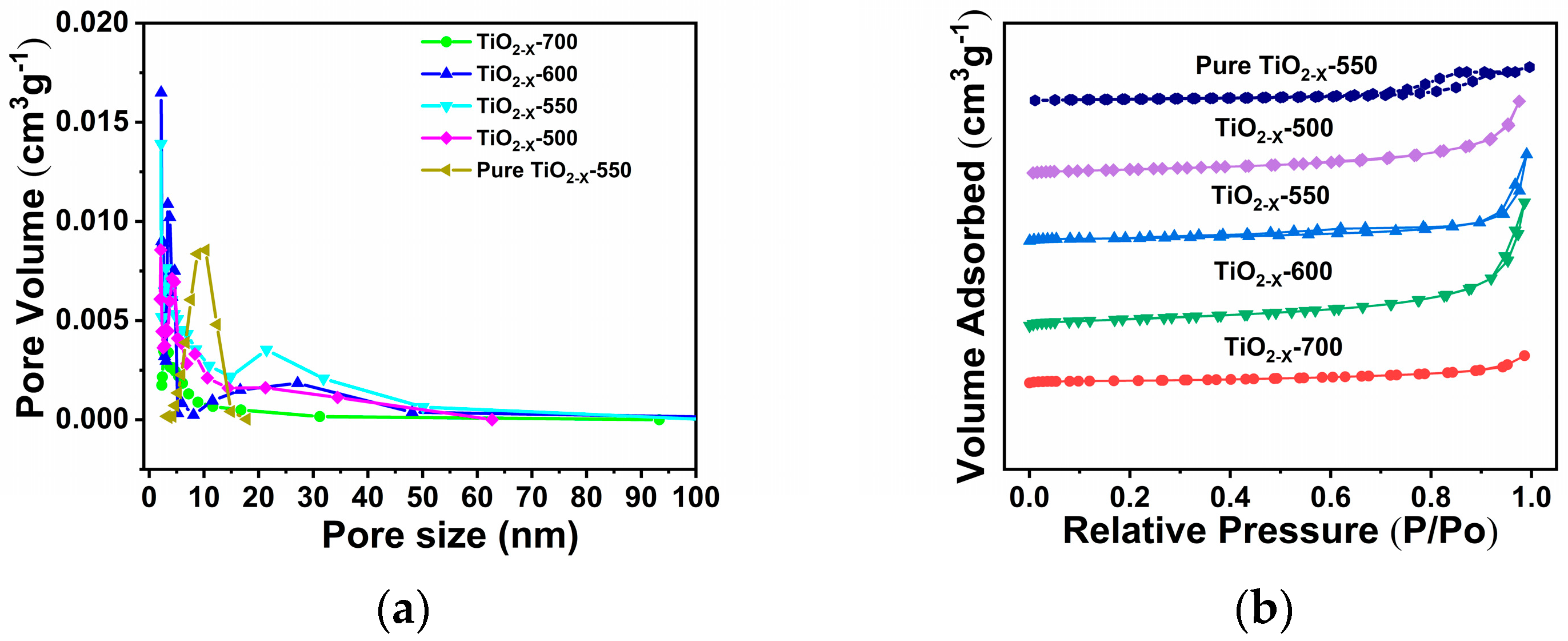
The specific surface areas and pore structures of all samples were investigated by nitrogen adsorption–desorption measurements. As shown in Figure 3a, TiO2-X-500, TiO2-X-550, and TiO2-X-600 exhibited pronounced H3-type hysteresis loops in the relatively high-pressure region (P/P0), indicating the presence of abundant mesopores and hierarchical pore channels within the materials [40,41,42,43]. In contrast, the other samples did not exhibit obvious H3 hysteresis loops in the adsorption–desorption isotherms. The pore-size distribution curves in Figure 3b further show that TiO2-X-500, TiO2-X-550, and TiO2-X-600 possess pores distributed in the range of 2–60 nm, confirming the successful formation of hierarchical porous structures, summarized in Table S2, TiO2-X-550 exhibits the largest specific surface area, reaching 62.9 m2 g−1, In general, the specific surface area tends to decrease with increasing calcination temperature, which can be attributed to particle growth and partial pore collapse during calcination. To further clarify the three-dimensional pore structure of TiO2-X-550, Micro-CT analysis was performed. The results indicate that TiO2-X-550 possesses a highly porous framework with predominantly interconnected open pores, which is in good agreement with the BET results, summarized in Figure S2 and Table S3. Such a pore architecture is favorable for reactant diffusion and active-site accessibility.
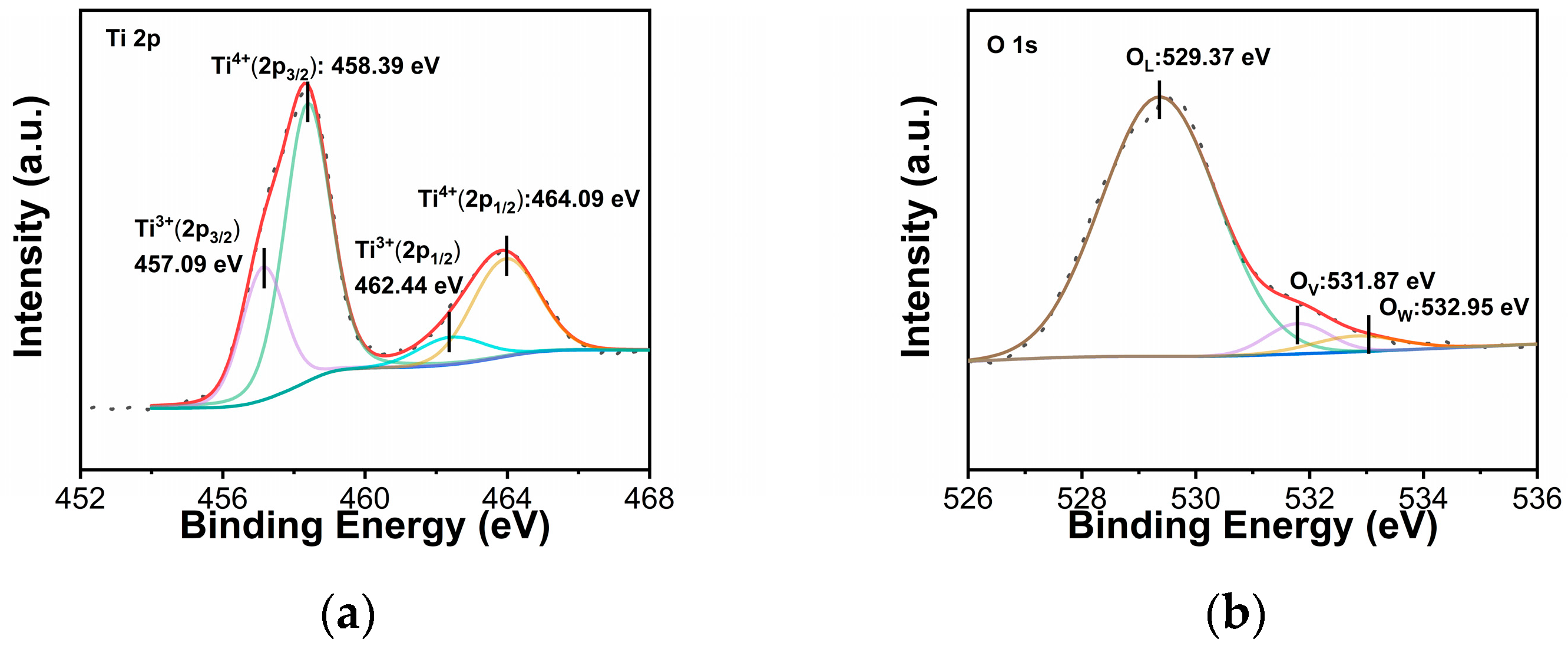
The chemical valence state and surface composition of porous TiO2-X-550 were analyzed by XPS. The corresponding XPS survey spectrum is presented in Figure S3, confirming the presence of Ti and O elements in the sample. Figure 4a shows that the peaks at 457.09 eV and 462.44 eV were assigned to Ti 2p3/2 and Ti 2p1/2 of porous TiO2-X-550, which be attributed to Ti3+ in the sample, while the peaks at 458.39 eV and 464.09 eV were assigned to Ti4+ in the sample [44]. In Figure 4b, the O1s spectrum indicates that the peaks at 529.37 eV, 531.87 eV and 532.95 eV have obvious peaks, which correspond to lattice oxygen (OL), oxygen atoms near the oxygen vacancy (OV) and chemically adsorbed water molecules (OW) formed by the adsorbed water molecules [42]. In Figure S4, the EPR spectra show that all samples exhibit a distinct resonance signal around 3428–3432 G, indicating the presence of a certain concentration of paramagnetic defects in the samples [45]. Compared with Pure TiO2-X-550, the resonance signals of the defect-regulated TiO2-X samples are significantly enhanced, suggesting a higher defect concentration.

2.2. Analysis of the Photovoltaic Properties

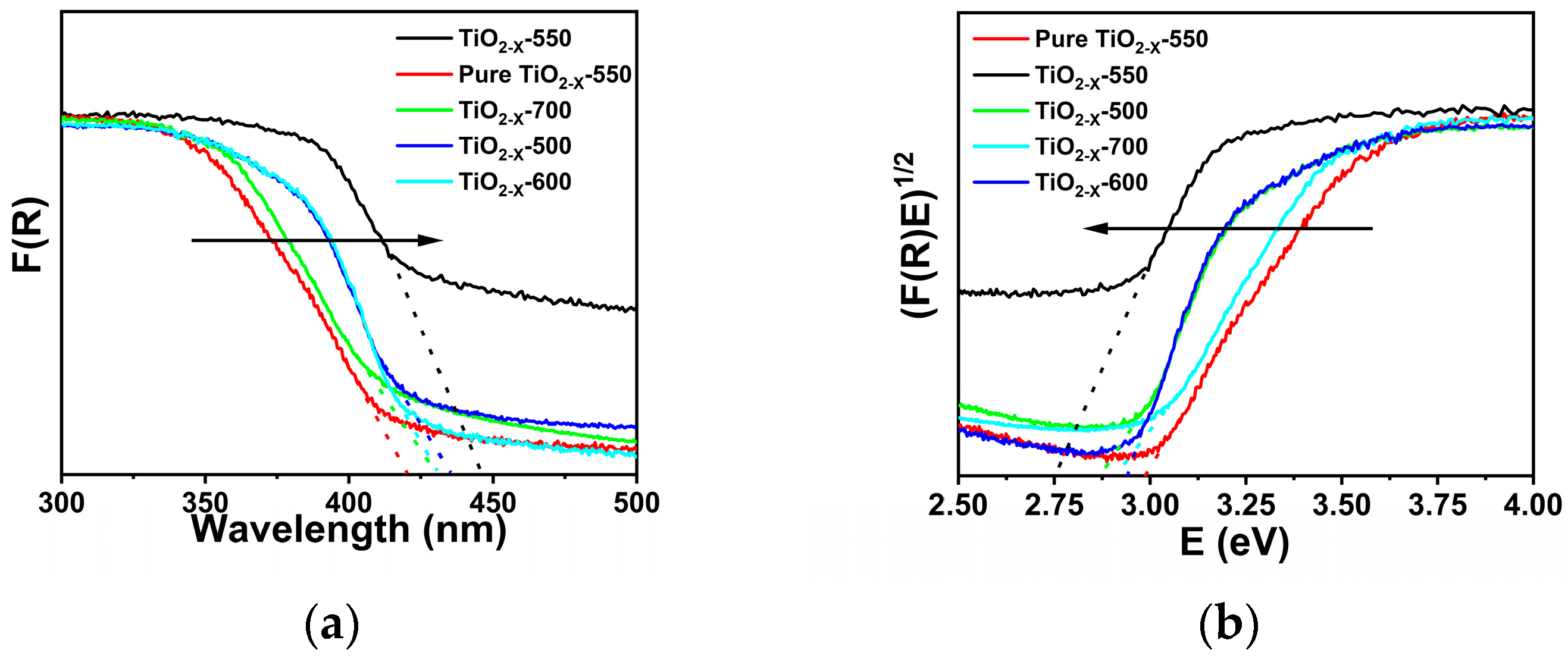
The optical absorption properties of TiO2-X-550 were characterized by UV-vis diffuse reflectance spectroscopy (UV-vis DRS) [45]. As presented in Figure 5b, the band gap energy of TiO2-X-550 was calculated to be 2.75 eV, which is significantly smaller than that of pristine TiO2 (3.2 eV, corresponding to an absorption edge of 387 nm). In addition, extrapolation of the absorption edge in Figure 5a yielded an absorption wavelength of approximately 446 nm, indicating an obvious red shift in the absorption edge. This red shift demonstrates that TiO2-X-550 possesses an extended light-response range and enhanced visible-light absorption capability. Similar red-shift behavior was also observed for the samples calcined at other temperatures [45,46,47]. Moreover, the reduced band gap energy and increased specific surface area, especially for TiO2-X-550 with a specific surface area of 62.9 m2 g−1, are beneficial for broadening the spectral response range, enhancing photon utilization, and facilitating mass transfer as well as the migration of reactive species, thus contributing to the improved photocatalytic activity.
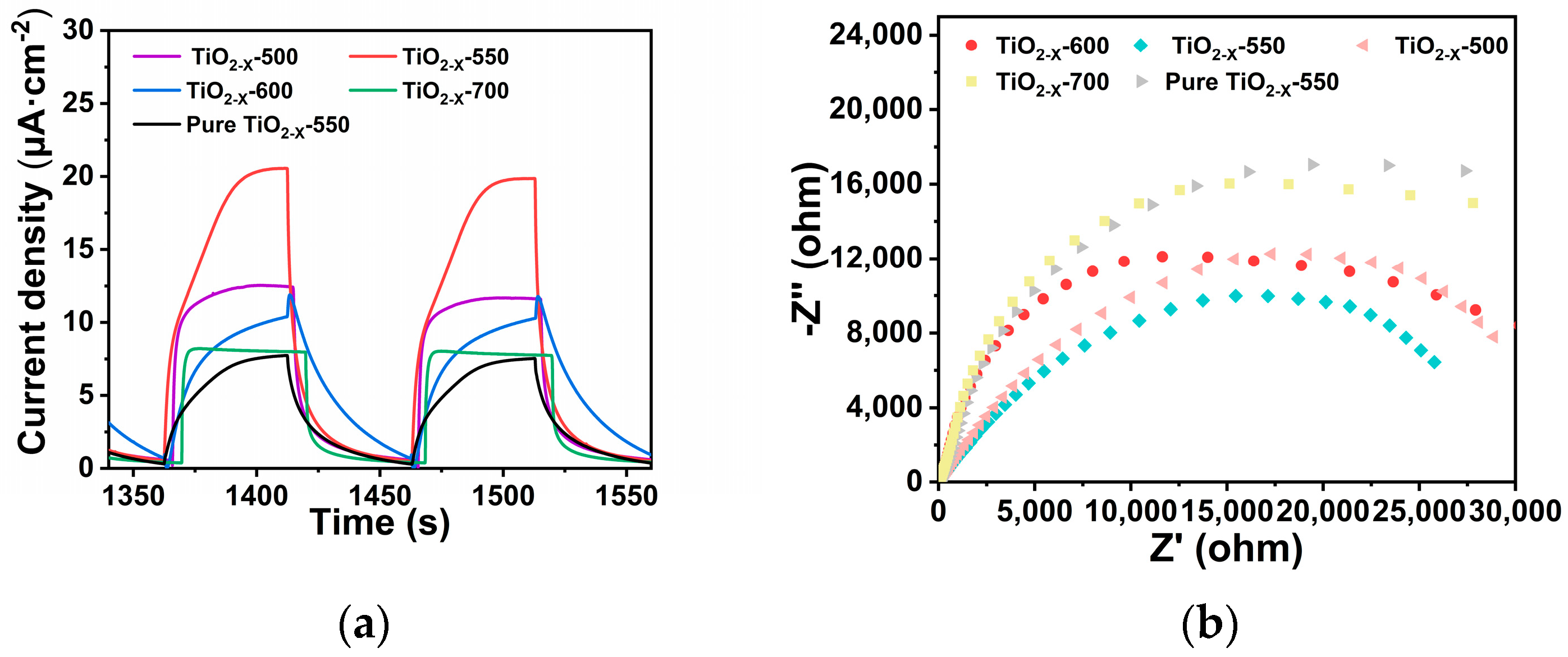
From Figure 6a, as shown in the transient photocurrent curves, all samples exhibited obvious and reproducible photocurrent responses under periodic light on–off irradiation, demonstrating that each catalyst could effectively respond to light excitation. Notably, TiO2-X-550 showed the highest photocurrent density among all the samples, indicating its superior ability to promote the separation of photogenerated electron–hole pairs and accelerate charge-carrier transport. With the calcination temperature increasing from 500 to 550 °C, the photocurrent response increased markedly. In contrast, further increasing the calcination temperature to 600 and 700 °C led to a gradual decline in photocurrent intensity, suggesting that excessively high calcination temperatures are detrimental to the separation and migration of photogenerated carriers [45,46,48]. According to the EIS Nyquist plots shown in Figure 6b, TiO2-X-550 displays the smallest semicircular arc radius, indicating the lowest interfacial charge-transfer resistance and the fastest electron-transfer kinetics among all the samples. By comparison, the samples calcined at higher temperatures exhibit relatively larger impedance arcs, suggesting less efficient interfacial charge transport. This result demonstrates that the introduction of the porous structure in TiO2-X-550 can effectively reduce the charge-transfer resistance of photogenerated electrons and thereby promote the photocatalytic reaction [46]. As shown in the Figure S5, all samples exhibit positive slopes in the Mott–Schottky plots, indicating that they are typical n-type semiconductors. Notably, TiO2-X-550 shows the smallest slope, suggesting that it has the highest carrier concentration. According to the Mott–Schottky relationship, the slope is inversely proportional to the donor density; therefore, a smaller slope indicates a higher electron donor concentration, which is beneficial for charge transfer and separation, thereby enhancing the photoelectrochemical or photocatalytic performance. In contrast, the other samples exhibit relatively larger slopes, indicating lower carrier concentrations. In addition, the differences in the x-axis intercepts among the samples indicate variations in their flat-band potentials, suggesting that the calcination temperature or defect engineering can influence the band structure of the materials. Overall, TiO2-X-550, with the smallest slope and the highest carrier concentration, exhibits superior electron transport capability and thus is expected to show better catalytic activity.
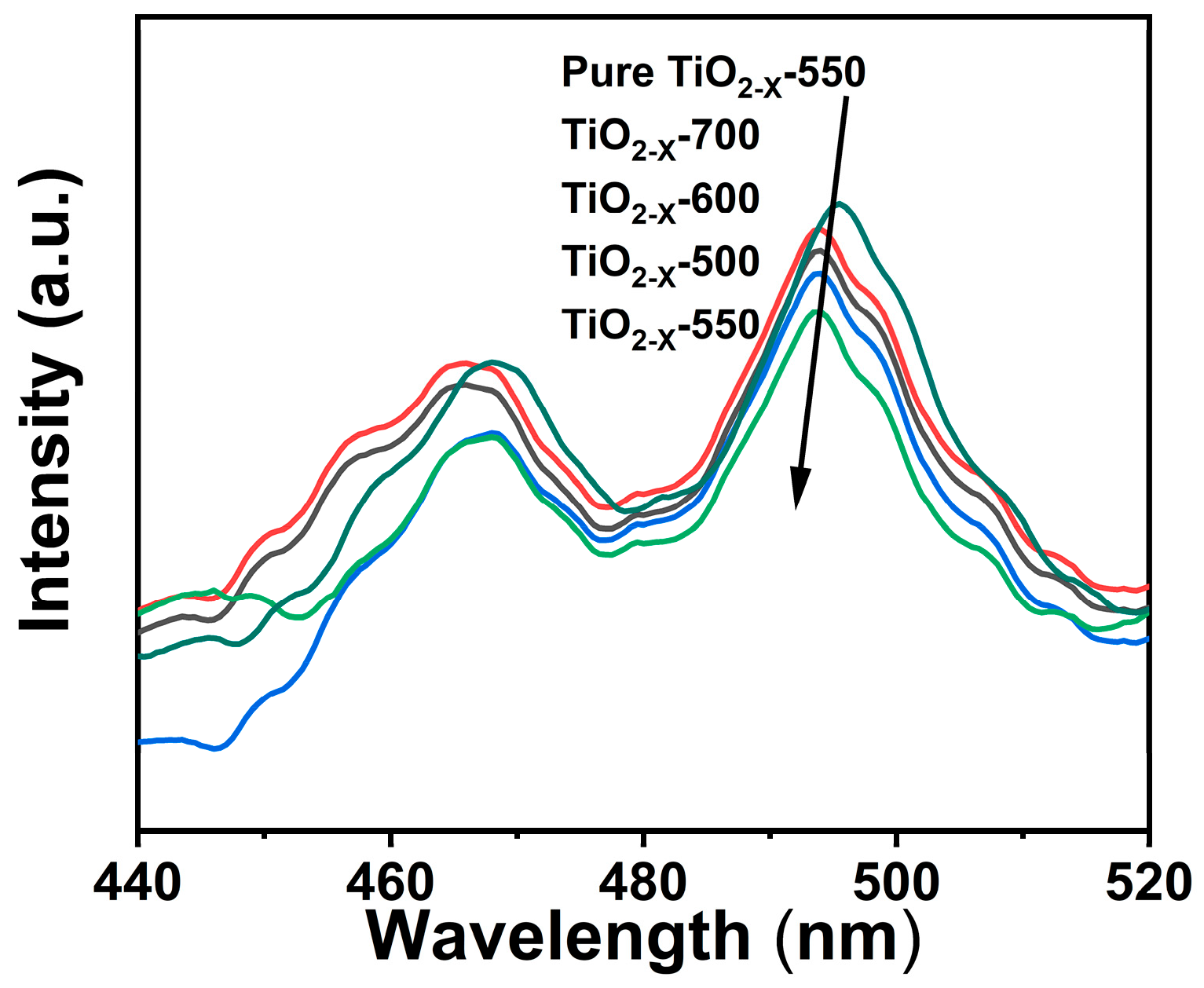
To further evaluate the separation and recombination behaviors of photogenerated charge carriers, photoluminescence (PL) spectra of the as-prepared samples were recorded. All samples displayed obvious emission signals in the range of 450–510 nm, among which the emission peak at around 495 nm was the most intense. As presented in Figure 7, TiO2-X-700 exhibits the highest PL intensity, indicating the most pronounced recombination of photogenerated electron–hole pairs. This finding suggests that the calcination temperature plays a critical role in regulating the electronic structure and surface defect states of TiO2. By comparison, TiO2-X-550 shows the lowest PL intensity, demonstrating its strongest ability to inhibit charge-carrier recombination and promote the separation of photogenerated electrons and holes, in good agreement with its highest photocatalytic activity [49]. Generally, a lower PL intensity indicates a lower recombination probability of photogenerated carriers and hence a more efficient charge-separation process.

2.3. Photocatalytic Performance

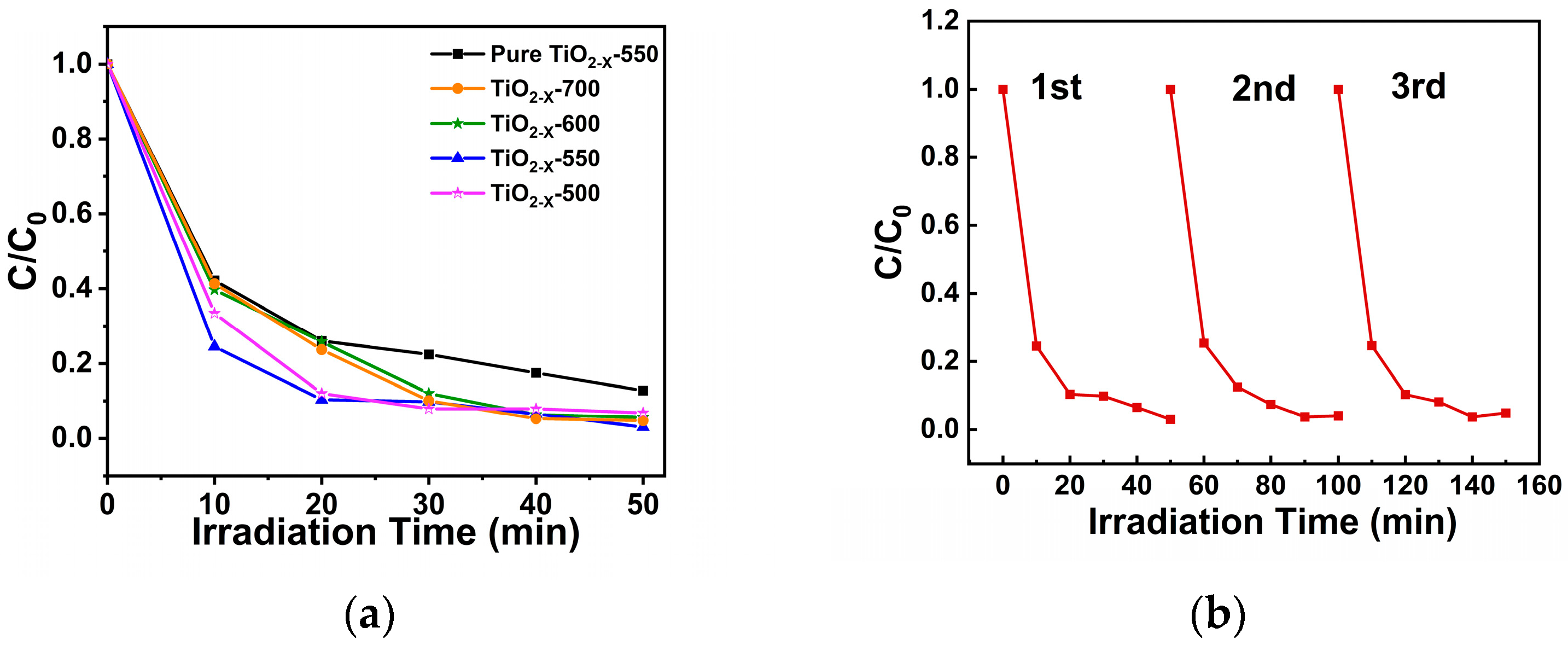
The photocatalytic performance of the samples was evaluated by degrading RhB (Rhodamine B) solution under simulated sunlight in Figure 8a. Among all the samples, the degradation performance of RhB by the catalysts first increased and then decreased with the increase in calcination temperature. And TiO2-X-550 showed the best degradation of RhB, indicating that TiO2-X-550 with oxygen vacancies has extremely strong photocatalytic ability. To evaluate the photocatalytic stability of the samples, the prepared samples were used to degrade RhB solution under simulated fluorescent lamps for three cycles. Figure 8b shows that after three cycles, the degradation of RhB by TiO2-X-550 remained almost unchanged, and its photocatalytic activity was stable, indicating that the catalytic performance of TiO2 with oxygen vacancies has high stability. For further benchmarking, the photocatalytic degradation performance of commercial P25 TiO2 was also investigated, and the corresponding results are provided in Figure S6, further demonstrating the superior photocatalytic activity of TiO2-X-550. As shown in Figure S7, all samples exhibit good linear relationships between ln(C0/C) and irradiation time, indicating that the photocatalytic degradation process obeys pseudo-first-order kinetics. The gradual increase in ln(C0/C) with irradiation time further confirms the continuous degradation of the pollutant. Among all samples, TiO2-X-550 shows the largest slope, with an apparent rate constant (k) of 0.063 in Figure S7, demonstrating the highest photocatalytic degradation activity.
Superoxide radicals (·O2−) and hydroxyl radicals (·OH) are important reactive species in photocatalytic reactions. To further elucidate the reaction mechanism of this system, the roles of these two radicals were investigated. In general, photogenerated electrons can reduce surface-adsorbed oxygen molecules to produce ·O2−, whereas photogenerated holes can oxidize water molecules or surface hydroxyl groups to generate ·OH. Their formation processes can be described by the following reaction equations.
TiO2−X + hν → e + h+
OH + h+ → ·OH
O2 + e → ·O2
·O2 + e + 2H+ → H2O2
H2O2 + e → ·OH + OH
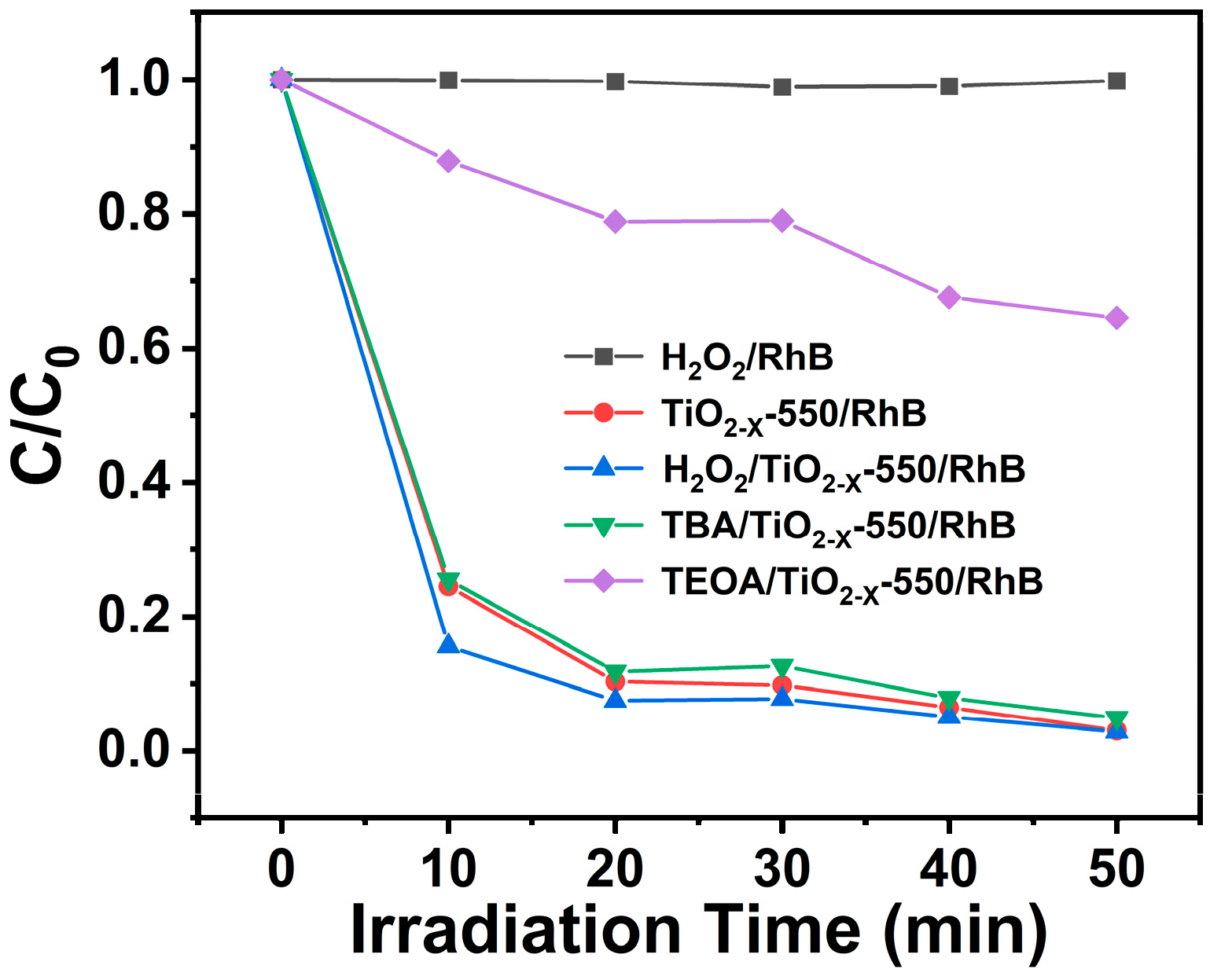
To further elucidate the photocatalytic degradation mechanism of RhB over TiO2-X-550 and identify the predominant reactive species, radical trapping experiments were carried out. In these experiments, tert-butanol (TBA) and triethanolamine (TEOA) were employed as scavengers for ·OH and h+, respectively, while H2O2 was introduced to further evaluate the role of hydroxyl radicals in the degradation process. As illustrated in Figure 9, in the H2O2/RhB system, the C/C0 value of RhB remained close to 1.00 after 50 min of visible-light irradiation, indicating that H2O2 alone was almost incapable of degrading RhB. In contrast, in the H2O2/TiO2-X-550/RhB system, the C/C0 value decreased significantly, showing a much higher degradation efficiency than that of the TiO2-X-550/RhB system. This result indicates that the introduction of H2O2 promoted RhB degradation, suggesting that ·OH participated in the reaction to a certain extent.
After the addition of TBA, the degradation efficiency showed only a slight change compared with that of the TiO2-X-550/RhB system, indicating that ·OH was not the primary reactive species. However, upon the addition of TEOA, the degradation of RhB was markedly suppressed, with the C/C0 value remaining at 0.64 after 50 min. This result demonstrates that photogenerated holes played a dominant role in the photocatalytic degradation of RhB over TiO2-X-550. Therefore, the degradation of RhB mainly proceeded through a hole-dominated photooxidation pathway, while ·OH acted only as a secondary reactive species. The specific process is described as follows:
Photogenerated holes, as the primary reactive species, directly oxidize organic molecules, ultimately yielding oxidation products:
RhB + h+ → Oxidation products
In addition, photogenerated holes can first participate in oxidation reactions to generate ·OH, after which ·OH, as a reactive oxygen species, further oxidizes and degrades RhB.
hvb + OH → ·OH
RhB + ·OH → Oxidation products
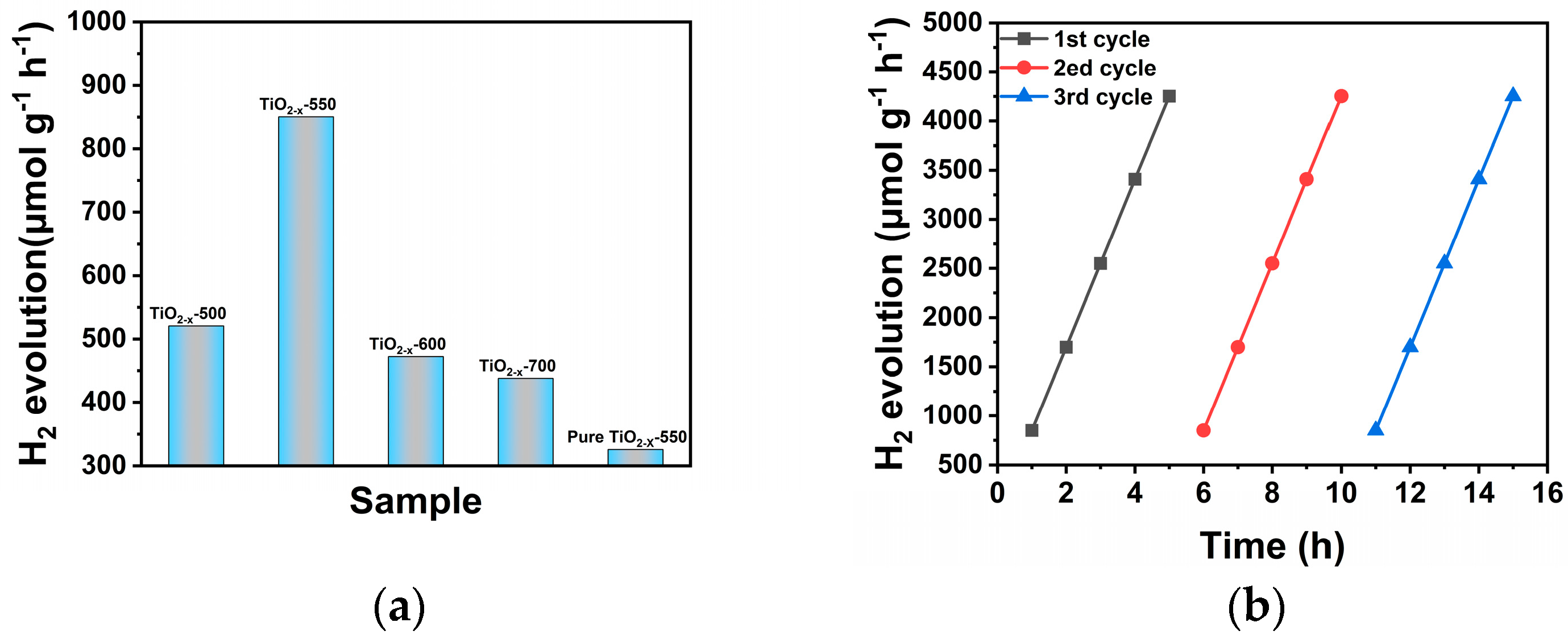
As shown in Figure 10a, the hydrogen production capacity of different samples varies significantly. The TiO2-X-550 sample has the highest hydrogen production rate within a unit time, reaching 850.6 μmol·g−1·h−1, which is much higher than that of TiO2-X-500, TiO2-X-600, TiO2-X-700, and pure TiO2-X. The sample synthesized at 550 °C exhibits the optimal photocatalytic hydrogen production activity. This is because an appropriate calcination temperature is conducive to improving the crystal phase, defects, and surface properties of the sample, facilitating the separation and transmission of photogenerated carriers, thereby enhancing the photocatalytic hydrogen production ability. However, excessively high or low calcination temperatures will result in poor crystallization degree or reduced specific surface area, or even excessive agglomeration, which is not conducive to the occurrence of the hydrogen production reaction. At the same time, the appropriate oxygen vacancies or surface defects generated at 550 °C can provide a good transmission path for photogenerated electrons and increase the number of active sites, thus making this sample have a better photocatalytic hydrogen desorption effect. For further benchmarking, the photocatalytic hydrogen evolution performance of commercial P25 TiO2 was also evaluated, and the corresponding results are presented in Figure S8, further confirming the superior hydrogen evolution activity of TiO2-X-550. As shown in the Figure S8, the H2 evolution rate of TiO2-X-550 is 850.6 μmol·g−1·h−1, which is significantly higher than that of commercial P25 TiO2 (55 μmol·g−1·h−1). The hydrogen evolution activity of TiO2-X-550 is therefore approximately 15.5 times that of P25, indicating its superior photocatalytic hydrogen production performance. In addition, the wavelength-dependent apparent quantum efficiency (AQE) and apparent quantum yield (AQY) of TiO2-X-550 were further evaluated, as shown in Figures S9 and S10. The results show that both AQE and AQY decrease gradually with increasing irradiation wavelength, which is in good agreement with the optical absorption behavior of the catalyst. This observation further confirms the efficient utilization of incident photons by TiO2-X-550 and supports its excellent photocatalytic hydrogen evolution performance.
As shown in Figure 10b, in the continuous three-cycle tests, the hydrogen production volume of the samples increased almost linearly with the increase in reaction time. Moreover, the slope of each curve did not change much and the final cumulative hydrogen production volume was similar, indicating that this catalyst can be reused and still perform well in photocatalytic hydrogen production. From the above experiments, it can be concluded that after multiple cycles of reaction, the sample does not show obvious deactivation or decrease in activity, indicating that it has good cycle stability and recyclability in Figures S11 and S12; it also indicates that this substance has good high-temperature resistance and corrosion resistance and is not prone to deactivation. For comparison, the synthetic methods, light sources, catalyst dosages, organic dye degradation efficiencies, and H2 evolution rates of representative TiO2-based photocatalysts reported in recent studies in Table S4 to illustrate the advantages of our work [50,51,52,53,54]. During the continuous reaction process, it can always retain certain active centers and good interface reaction performance, which has a good guiding significance for its future application in real photocatalytic hydrogen production systems.

2.4. Photocatalytic Mechanism

TiO2-x-550 exhibits enhanced photocatalytic activity owing to the synergistic effects of oxygen vacancies, Ti3+ defect states, and its hierarchical porous framework. Upon light irradiation, TiO2 is photoexcited to generate electron–hole pairs. The introduced oxygen vacancies and Ti3+ species act as electron-trapping sites or shallow donor levels, which facilitate charge separation, suppress electron–hole recombination, and simultaneously broaden the light absorption range as well as promote the activation of adsorbed oxygen molecules. In addition, the hierarchical meso-/macroporous channels favor the diffusion and transport of reactant molecules into the inner surface of the photocatalyst, while the thin framework shortens the migration distance of photogenerated charge carriers, thereby improving interfacial charge transfer efficiency. During the photocatalytic process, photogenerated holes react with adsorbed H2O or OH to produce highly oxidative hydroxyl radicals, whereas photogenerated electrons reduce adsorbed O2 to superoxide radicals, both of which contribute to the degradation of organic pollutants. Meanwhile, part of the conduction-band electrons participate in proton reduction to generate hydrogen, The detailed reaction process is shown in Equations (12)–(15) [55,56,57]. Therefore, the improved photocatalytic degradation and hydrogen evolution performance of TiO2-x-550 can be attributed to the combined contributions of defect-induced electronic modulation, enhanced visible-light utilization, accelerated mass transport, and efficient charge separation and migration.
TiO2−X + hν → e + h+
H2O/OH + h+ → ·OH
2H+ + 2e → H2
O2 + e → O2·−

3. Conclusions

In summary, a hierarchical porous TiO2 photocatalyst rich in oxygen vacancies was successfully prepared using IRA-900 as a template, forming a three-dimensional interconnected pore structure. It exhibited excellent activity in RhB and mixed-dye degradation, with over 85% RhB removed within 50 min, and a photocatalytic hydrogen evolution rate of 850.6 μmol·g−1 h−1. The performance enhancement mainly arises from the synergy between the hierarchical porous structure and oxygen vacancies: the former improves mass transfer and provides abundant active sites, while the latter tunes the electronic structure and promotes charge separation. Overall, this strategy offers an effective route to enhance the photoelectric conversion performance of TiO2 and provides theoretical and experimental support for defect engineering and structural design of TiO2-based photocatalysts; it also shows great potential for photocatalytic hydrogen evolution applications.

4. Materials and Methods

4.1. Materials

No further purification of chemicals before experiments. Tetrabutyl titanate (C16H36O4Ti) was purchased from Shanghai Boer Chemical Co., Ltd. (Shanghai, China). Acetic acid (C2H4O2) and absolute ethanol (C2H6O) were supplied by Tianjin Tianli Chemical Co., Ltd. (Tianjin, China). Hydrochloric acid (HCl) was obtained from Sinopharm Chemical Reagent Co., Ltd. (Shanghai, China). IRA-900 purchased from Alfa Aesar Co., Ltd. (Shanghai, China).

4.2. Preparation of Micron Porous TiO2-X

First, 10 mL of tetrabutyl titanate, 5 mL of acetic acid, and 40 mL of absolute ethanol were mixed and stirred at 540 rpm for 5 min. Subsequently, a mixed solution containing 10 mL of deionized water, 10 mL of absolute ethanol, and 2 mL of hydrochloric acid was added dropwise under continuous stirring. After further stirring for 5 h, a homogeneous TiO2 sol was obtained. Then, 9.0 g of IRA-900 anion-exchange resin was introduced into the TiO2 sol, and the mixture was stirred at 40 °C for 20 h to ensure sufficient impregnation of the resin by the sol. The impregnated resin and residual sol were subsequently transferred into a Teflon-lined stainless-steel autoclave and aged statically at 60 °C for 24 h, during which the TiO2 sol further evolved into a gel precursor. The obtained product was collected by separation, thoroughly washed, and dried to afford the IRA-900-supported TiO2 gel precursor. The resulting gel precursor was pre-calcined in a tubular furnace under a mixed atmosphere of 2% H2 and 98% inert gas. The pre-calcined sample was then transferred to a muffle furnace and heated at a rate of 1.5 °C min−1 to 500, 550, 600, or 700 °C, respectively, and maintained at the target temperature for 360 min. The obtained micron-sized porous TiO2 microspheres gels were denoted as TiO2−X-500, TiO2-X-550, TiO2-X-600, and TiO2-X-700, respectively. Among them, the template removal efficiency in the repeated experiments was 90.7% ± 2.5%.

4.3. Characteristic

The morphology and microstructure of the samples were characterized by SEM (TESCAN MIRA LMS, Brno, Czech Republic, 5 kV) and TEM (FEI Talos F200X G2 AEMC, Thermo Fisher Scientific, Waltham, MA, USA, 120 kV). The crystal structures were analyzed by XRD (Shimadzu XRD-6100, Shimadzu Corp., Kyoto, Japan), and the average crystallite size was calculated using the Scherrer equation. FT-IR spectra were recorded on a Spectrum 400 spectrometer (PerkinElmer, Waltham, MA, USA) in the range of 4000–500 cm−1. The specific surface area and pore structure were determined by N2 adsorption–desorption measurements on an ASAP 2460 analyzer (Micromeritics Instrument Corp., Norcross, GA, USA), and the pore size distribution was calculated using the BJH model. UV-vis DRS spectra were obtained using a Shimadzu UV-2450 spectrophotometer (Shimadzu Corp., Kyoto, Japan) equipped with an integrating sphere, with BaSO4 as the reference. XPS analysis was performed on an ESCA PHI 5000 instrument (Physical Electronics Inc., Chanhassen, MN, USA). PL spectra were collected on a PerkinElmer LS 55 fluorescence spectrometer (PerkinElmer, Waltham, MA, USA). Photoelectrochemical measurements were carried out in a three-electrode system with platinum wire as the counter electrode, Ag/AgCl as the reference electrode, and sample-coated conductive glass as the working electrode. The photocurrent response was measured in 2 M Na2SO4 electrolyte under irradiation from a 300 W xenon lamp (SAN-EI Electric Co., Ltd., Osaka, Japan), and the transient photocurrent at zero bias was recorded on a CHI 660E electrochemical workstation (CH Instruments, Inc., Austin, TX, USA). EIS measurements were performed over a frequency range of 10−2–10−5 Hz.

4.4. Catalytic Process

The photocatalytic activity was assessed by monitoring the degradation of rhodamine B (RhB,10 mg·L−1) under simulated solar-light irradiation. A 300 W xenon lamp was used as the irradiation source. Before illumination, 0.05 g of photocatalyst was dispersed in 50 mL of RhB aqueous solution and stirred in the dark for 30 min, followed by ultrasonication for 10 min, to achieve adsorption–desorption equilibrium between the catalyst surface and the dye molecules. During the photocatalytic reaction, aliquots were collected every 10 min and centrifuged to remove the suspended catalyst particles. The absorbance of the resulting supernatant was measured at 554 nm with a UV-vis spectrophotometer, and the corresponding RhB concentration was determined using a standard calibration curve. The photocatalytic degradation efficiency was then calculated accordingly.
The photocatalytic performance was evaluated by monitoring the hydrogen evolution rate. The photocatalytic hydrogen evolution performance of TiO2 for water splitting was evaluated as follows. First, 0.5 g of the sample was accurately weighed and placed into a quartz reactor. Then, 300 mL of deionized water and 30 mL of methanol were added to form the reaction solution. Methanol was employed as a sacrificial agent to effectively consume photogenerated holes, suppress electron–hole recombination, and thus enhance the hydrogen evolution reaction. Prior to irradiation, the suspension was ultrasonically dispersed for 30 min to ensure the uniform distribution of the catalyst particles in the reaction medium. Subsequently, the reactor was evacuated and purged with nitrogen to remove residual air and dissolved oxygen, thereby ensuring an oxygen-free and closed reaction environment. After the pretreatment, a xenon lamp was used as the simulated light source to initiate the photocatalytic water-splitting reaction. Irradiation was carried out using optical filters in the ranges of 310–400 nm and 400–700 nm, respectively. During the reaction, gas samples were collected every 1 h, and the amount of hydrogen evolved was quantified by gas chromatography. The photocatalytic activity and hydrogen evolution performance of the TiO2 samples were finally evaluated according to the hydrogen production rate and its variation as a function of reaction time.

Supplementary Materials

The following supporting information can be downloaded at: https://www.mdpi.com/article/10.3390/gels12050370/s1. Figure S1: EDAX spectrum and elemental composition of TiO2-X-550; Figure S2: Micro-CT image of the TiO2-X-550; Figure S3: XPS survey spectrum of TiO2-X-550; Figure S4: EPR of porous TiO2-X; Figure S5: Mott–Schottky plots of TiO2-X samples prepared at different calcination temperatures; Figure S6: Comparison of the photocatalytic degradation performance of different TiO2 samples; Figure S7: Pseudo-first-order kinetic plots of photocatalytic degradation over TiO2 samples calcined at different temperatures; Figure S8: Comparison of the hydrogen evolution performance of different TiO2 samples; Figure S9: Apparent quantum efficiency (AQE) of TiO2-X-550; Figure S10: Apparent quantum yield (AQY) of TiO2-X-550 at different wavelengths; Figure S11: XRD of TiO2-X-550 before and after three cycles hydrogen evolution; Figure S12: FITR of TiO2-X-550 before and after three cycles hydrogen evolution; Table S1: XRD peak parameters and calculated crystallite sizes of the TiO2-X-550; Table S2: Nitrogen adsorption–desorption data of porous TiO2-X at different calcination temperatures; Table S3: Micro-CT-derived pore structure parameters of the TiO2-X-550; Table S4: Comparison of synthesis methods, reaction conditions, and photocatalytic performance of representative TiO2-based photocatalysts reported in previous studies. References [50,51,52,53,54] are cited in the Supplementary Materials.

Author Contributions

Conceptualization, H.J. and W.W.; methodology, H.J.; software, C.L.; validation, H.J., W.W. and Y.W.; formal analysis, Y.W.; investigation, M.Y.; resources, C.L.; data curation, W.W.; writing—original draft preparation, H.J.; writing—review and editing, D.L. and Y.L.; visualization, C.L.; supervision, H.J.; project administration, Y.L.; funding acquisition, Y.L. and D.L. All authors have read and agreed to the published version of the manuscript.

Funding

This work was supported by the Natural Science Foundation of China (Grant Nos. 52203352 and 52503392), Natural Science Foundation of Heilongjiang Province (PL2024E008 and ZD2024E002).

Institutional Review Board Statement

Not applicable.

Informed Consent Statement

Not applicable.

Data Availability Statement

Data supporting the findings of this study are not currently publicly available owing to related ongoing research but can be requested from the corresponding author.

Acknowledgments

The authors acknowledge the use of Doubao (Version 12.7.0; available at: https://www.doubao.com/, accessed on 15 March 2026) for language checking and polishing of this manuscript. All scientific content and conclusions are the responsibility of the authors.

Conflicts of Interest

The authors declare no conflicts of interest.

References

  1. Si, W.; Li, Y.; Li, T.; Liu, H.; Zhang, Z.; Lu, X.; Qiu, D.; Qiao, Y.; Lin, Y. Solar-driven fast photocatalytic hydrogen evolution using size-minimized organic heterojunctions. Nat. Commun. 2025, 17, 1052. [Google Scholar] [CrossRef]
  2. Jiang, M.; Wu, Z.; Zhang, X.; Cai, Y.; Wang, W.; Liang, Y. Synergetic effect of surface plasmon resonance and Schottky junction to drastically boost solar-driven photoelectrochemical hydrogen production and photocatalytic performance of CdS/Al nanorod arrays. Energy Convers. Manag. 2022, 268, 115978. [Google Scholar] [CrossRef]
  3. Dolla, T.H.; Xaba, B.S.; Mguni, L.; Seadira, T.; Mabuea, B.P.; Maboya, W.K.; Mathaba, M.J.; Makgwane, P.R. Metal selenides for solar-driven photocatalytic and photoelectrochemical hydrogen production: Progress, challenges, and perspectives. Coord. Chem. Rev. 2026, 559, 217792. [Google Scholar] [CrossRef]
  4. Dang, V.-H.; Nguyen, T.-A.; Le, M.-V.; Nguyen, D.Q.; Wang, Y.H.; Wu, J.C.S. Photocatalytic hydrogen production from seawater splitting: Current status, challenges, strategies and prospective applications. Chem. Eng. J. 2024, 484, 149213. [Google Scholar] [CrossRef]
  5. Fu, H.; Wu, Y.; Guo, Y.; Sakurai, T.; Zhang, Q.; Liu, Y.; Zheng, Z.; Cheng, H.; Wang, Z.; Huang, B.; et al. A scalable solar-driven photocatalytic system for separated H2 and O2 production from water. Nat. Commun. 2025, 16, 990. [Google Scholar] [CrossRef]
  6. Lu, X.; Ye, J.; Tu, W.; Li, Z.; Cao, S.; Yu, S.; Zhou, Y.; Wang, H. The advances on scaling-up of photocatalytic and photoelectrochemical hydrogen production and field demonstration. Mater. Today 2025, 87, 329–347. [Google Scholar] [CrossRef]
  7. Hasegawa, G.; Kanamori, K.; Nakanishi, K.; Hanada, T. Facile Preparation of Hierarchically Porous TiO2 Monoliths. J. Am. Ceram. Soc. 2010, 93, 3110–3115. [Google Scholar] [CrossRef]
  8. Zhang, Y.; Yan, J. Recent advances in the synthesis of defective TiO2 nanofibers and their applications in energy and catalysis. Chem. Eng. J. 2023, 472, 144831. [Google Scholar] [CrossRef]
  9. Zeng, J.; Xie, L.; Liu, T.; He, Y.; Liu, W.; Zhang, Q.; Li, J.; Li, X.; Qiu, B.; Zhou, S.; et al. Super-Assembled Multilayered Mesoporous TiO2 Nanorockets for Light-Powered Space-Confined Microfluidic Catalysis. ACS Appl. Mater. Interfaces 2024, 16, 23484–23496. [Google Scholar] [CrossRef]
  10. Zhang, A.-Y.; Liu, C.; Yu, H.-Q. Emerging Electrochemical Catalysis on {001}-Facet and Defect-Engineered TiO2 for Water Purification. Acc. Mater. Res. 2025, 6, 422–433. [Google Scholar] [CrossRef]
  11. Schneider, J.; Matsuoka, M.; Takeuchi, M.; Zhang, J.; Horiuchi, Y.; Anpo, M.; Bahnemann, D.W. Understanding TiO2 Photocatalysis: Mechanisms and Materials. Chem. Rev. 2014, 114, 9919–9986. [Google Scholar] [CrossRef] [PubMed]
  12. Xing, L.; Wei, K.; Li, Y.; Fang, Z.; Li, Q.; Qi, T.; An, S.; Zhang, S.; Wang, L. TiO2 Coating Strategy for Robust Catalysis of the Metal–Organic Framework toward Energy-Efficient CO2 Capture. Environ. Sci. Technol. 2021, 55, 11216–11224. [Google Scholar] [CrossRef]
  13. Wang, Y.; Zhou, Y.; Huang, Y.; He, G.; Zhang, L.; Tan, M.; Yuan, S. Mechanistic insights into evolution of Schottky junctions on metal nanoparticle-loaded Mo-doped TiO2 for enhanced photothermal ammonia catalysis. Chem. Eng. J. 2025, 517, 164377. [Google Scholar] [CrossRef]
  14. Tang, C.-W.; Liu, C.-H.; Wang, C.-C.; Wang, C.-B. Electro-oxidation of Methanol, Ethanol and Ethylene Glycol over Pt/TiO2-C and PtSn/TiO2-C Anodic Catalysts. Int. J. Electrochem. Sci. 2021, 16, 211045. [Google Scholar] [CrossRef]
  15. Hejazi, S.; Mohajernia, S.; Osuagwu, B.; Zoppellaro, G.; Andryskova, P.; Tomanec, O.; Kment, S.; Zbořil, R.; Schmuki, P. On the Controlled Loading of Single Platinum Atoms as a Co-Catalyst on TiO2 Anatase for Optimized Photocatalytic H2 Generation. Adv. Mater. 2020, 32, 1908505. [Google Scholar] [CrossRef]
  16. Mahato, D.; Kharwar, Y.P.; Ramanujam, K.; Haridoss, P.; Thomas, T. S, N co-doped graphene quantum dots decorated TiO2 and supported with carbon for oxygen reduction reaction catalysis. Int. J. Hydrogen Energy 2021, 46, 21549–21565. [Google Scholar] [CrossRef]
  17. Zhang, J.; Vasei, M.; Sang, Y.; Liu, H.; Claverie, J.P. TiO2@Carbon Photocatalysts: The Effect of Carbon Thickness on Catalysis. ACS Appl. Mater. Interfaces 2016, 8, 1903–1912. [Google Scholar] [CrossRef]
  18. Cao, C.; Yang, C.; Zhang, D.; Zhang, J.; Hu, X.; Dong, J.; Tong, Y.; Liu, G.; Wang, Y.; Ji, Y. Synergistic carbon quantum dot and nitrogen Co–doping of TiO2 for enhanced visible–light photocatalysis and antibacterial gel applications. Colloids Surf. A 2026, 735, 139567. [Google Scholar] [CrossRef]
  19. Na, S.; Seo, S.; Lee, H. Recent Developments of Advanced Ti3+-Self-Doped TiO2 for Efficient Visible-Light-Driven Photocatalysis. Catalysts 2020, 10, 679. [Google Scholar] [CrossRef]
  20. Xing, M.; Fang, W.; Nasir, M.; Ma, Y.; Zhang, J.; Anpo, M. Self-doped Ti3+-enhanced TiO2 nanoparticles with a high-performance photocatalysis. J. Catal. 2013, 297, 236–243. [Google Scholar] [CrossRef]
  21. Li, F.; Han, T.; Wang, H.; Zheng, X.; Wan, J.; Ni, B. Morphology evolution and visible light driven photocatalysis study of Ti3+ self-doped TiO2−x nanocrystals. J. Mater. Res. 2017, 32, 1563–1572. [Google Scholar] [CrossRef]
  22. Kang, S.H.; Jo, Y.N.; Prasanna, K.; Santhoshkumar, P.; Joe, Y.C.; Vediappan, K.; Gnanamuthu, R.; Lee, C.W. Bandgap tuned and oxygen vacant TiO2−x anode materials with enhanced electrochemical properties for lithium ion batteries. J. Ind. Eng. Chem. 2019, 71, 177–183. [Google Scholar] [CrossRef]
  23. Jiang, S.Y.; He, G.; Zhang, Q.; Yin, Z.Y.; Cheng, S.W.; Fu, X.H.; Shang, S.Y.; Xu, J.Q. Rich oxygen vacancies 2D-nanoholey NiCo2O4-δ for selective and stable methane electrooxidation to acetaldehyde. J. Energy Chem. 2026, 116, 843–853. [Google Scholar] [CrossRef]
  24. Tian, G.; Li, Z.W.; Zhang, C.X.; Liu, X.Y.; Fan, X.Y.; Shen, K.; Meng, H.B.; Wang, N.; Xiong, H.; Zhao, M.Y.; et al. Upgrading CO2 to sustainable aromatics via perovskite-mediated tandem catalysis. Nat. Commun. 2024, 15, 3037. [Google Scholar] [CrossRef]
  25. He, G.; Zhang, J.; Hu, Y.; Bai, Z.; Wei, C. Dual-template synthesis of mesoporous TiO2 nanotubes with structure-enhanced functional photocatalytic performance. Appl. Catal. B 2019, 250, 301–312. [Google Scholar] [CrossRef]
  26. Lyu, J.; Zhu, L.; Burda, C. Optimizing Nanoscale TiO2 for Adsorption-Enhanced Photocatalytic Degradation of Low-Concentration Air Pollutants. ChemCatChem 2013, 5, 3114–3123. [Google Scholar] [CrossRef]
  27. Ma, D.; Schneider, J.; Lee, W.I.; Pan, J.H. Controllable synthesis and self-template phase transition of hydrous TiO2 colloidal spheres for photo/electrochemical applications. Adv. Colloid Interface Sci. 2021, 295, 102493. [Google Scholar] [CrossRef]
  28. Hernández-Gordillo, A.; Campero, A.; Vera-Robles, L.I. Mesoporous TiO2 synthesis using a semi-hard biological template. Microporous Mesoporous Mater. 2018, 270, 140–148. [Google Scholar] [CrossRef]
  29. Wang, W.; Lin, Y.; Zhang, G.; Kang, C.; Pan, Z.; Zhong, X.; Rao, H. Modification of compact TiO2 layer by TiCl4-TiCl3 mixture treatment and construction of high-efficiency carbon-based CsPbI2Br perovskite solar cells. J. Energy Chem. 2021, 63, 442–451. [Google Scholar] [CrossRef]
  30. Lu, H.; Zhong, J.; Ji, C.; Zhao, J.; Li, D.; Zhao, R.; Jiang, Y.; Fang, S.; Liang, T.; Li, H.; et al. Fabricating an optimal rutile TiO2 electron transport layer by delicately tuning TiCl4 precursor solution for high performance perovskite solar cells. Nano Energy 2020, 68, 104336. [Google Scholar] [CrossRef]
  31. Rahiminezhad–Soltani, M.; Saberyan, K.; Simchi, A. New insight into reaction mechanisms of TiCl4 for the synthesis of TiO2 nanoparticles in H2O-assisted atmospheric-pressure CVS process. Mater. Sci. Eng. B 2021, 264, 114958. [Google Scholar] [CrossRef]
  32. Wang, M.; He, T.; Pan, Y.; Liao, W.; Zhang, S.; Du, W. Water concentration controlled hydrolysis and crystallization in n-octanol to TiO2 nanocrystals with size below 10 nm. Mater. Chem. Phys. 2011, 130, 1294–1299. [Google Scholar] [CrossRef]
  33. Liu, H.; Wang, S.; Zhao, J.; Zhang, W.; Chen, S.; Jing, Z. Crystallization kinetics of nano titanium dioxide under different reaction parameter conditions. Ceram. Int. 2025, 314. [Google Scholar] [CrossRef]
  34. Deng, X.; Liu, D.; Yuan, M.; Li, Y.; Yang, H.; Wang, C.; Wang, R.; Yang, X. Synergistic Effect of Boron Doping and Porous Structures on Titanium Dioxide for Efficient Photocatalytic Nitrate Reduction to Nitrogen in Pure Water. Inorg. Chem. 2025, 64, 2294–2302. [Google Scholar] [CrossRef]
  35. Xu, Z.; Zheng, X.; Bao, S.; Yang, Z.; Sun, W.; Mei, J.; Rong, J.; Li, Z. Controllable construction of multistage porous TiO2 and study on its CO2 adsorption and photocatalytic mechanism. Sep. Purif. Technol. 2026, 390, 136948. [Google Scholar] [CrossRef]
  36. Peng, C.; Li, T.; Liao, S.; Chen, J.; Xue, Y.; Yan, Y.; Ma, F.; Tian, G. Electroreductive removal of uranium from uranium-organic wastewater using TiO2 nanotube arrays electrodes. J. Colloid Interface Sci. 2026, 712, 140114. [Google Scholar] [CrossRef]
  37. Aswathappa, S.; Dai, L.; Sathiyadhas, S.J.D.; Kumar, R.S.; Almansour, A.I.; Freire, P.T.C.; Athiruban, S.; Kang, G. Quantitative analysis of anatase-rutile mixtures of TiO2 employing X-ray diffractometry and visible-Raman spectroscopy at normal heating and superheating conditions- Implications and limitations of the Spurr-Mayers equation. Ceram. Int. 2025, 51, 61025–61034. [Google Scholar] [CrossRef]
  38. Xiong, J.; Lai, X.; Li, H.; Wang, H.; Su, X.; Zeng, X. Significant enhancement of the tracking resistance of silicone rubber via promoting ceramization by platinum anchored on rutile TiO2 with oxygen vacancies. Appl. Surf. Sci. 2026, 731, 166299. [Google Scholar] [CrossRef]
  39. Xing, S.; Wang, D.; Fan, Z.; Wang, X.; Kang, W.; Wang, Q. Electron Beam Lithography with Carboxylate-Modified TiO2 Nanoparticles for Sub-20 nm Features. Small Methods 2026, 10, e01332. [Google Scholar] [CrossRef] [PubMed]
  40. Zhang, L.; Yang, L.; Jelle, B.P.; Wang, Y.; Gustavsen, A. Hygrothermal properties of compressed earthen bricks. Constr. Build. Mater. 2018, 162, 576–583. [Google Scholar] [CrossRef]
  41. AlAbduljabbar, F.A.; Haider, S.; Ali, F.A.; Alghyamah, A.A.; Almasry, W.A.; Patel, R.; Mujtaba, I.M. Efficient Photocatalytic Degradation of Organic Pollutant in Wastewater by Electrospun Functionally Modified Polyacrylonitrile Nanofibers Membrane Anchoring TiO2 Nanostructured. Membranes 2021, 11, 785. [Google Scholar] [CrossRef] [PubMed]
  42. Ge, H.; Xu, F.; Cheng, B.; Yu, J.; Ho, W. S-Scheme Heterojunction TiO2/CdS Nanocomposite Nanofiber as H2-Production Photocatalyst. ChemCatChem 2019, 11, 6301–6309. [Google Scholar] [CrossRef]
  43. Zhan, Z.W.; Zhang, J.; Lin, L.; Jiang, T.Y.; Shi, J.Y. Salt-templated two-step activation synthesis of poplar-derived hierarchical porous carbon for high-performance supercapacitor electrodes. Ind. Crops Prod. 2025, 236, 122105. [Google Scholar] [CrossRef]
  44. Wang, L.; Cheng, B.; Zhang, L.; Yu, J. In situ Irradiated XPS Investigation on S-Scheme TiO2@ZnIn2S4 Photocatalyst for Efficient Photocatalytic CO2 Reduction. Small 2021, 17, 2103447. [Google Scholar] [CrossRef]
  45. Zhu, Y.; Yang, C.; Zhong, J.; Chen, J.; Zhang, Y.; Tian, C. Modulation of oxygen vacancies in TiO2 by high-energy electron beam irradiation for photocatalytic CO2 reduction and typical organic contaminant destruction. Int. J. Hydrogen Energy 2026, 218, 154014. [Google Scholar] [CrossRef]
  46. Zhang, Y.; Dou, L.; Zhang, S.; Zheng, X.; Huang, S. Boosted photocatalytic degradation performance of TiO2 with enriched oxygen vacancies. Mater. Res. Bull. 2025, 183, 113194. [Google Scholar] [CrossRef]
  47. Wang, Y.J.; Tian, B.C.; Tian, Y.X.; Wang, W.C.; Ma, X.; Liu, Y.S.; Hou, J.W. Orbital Hybridization-Mediated Decoupling of Electrocatalytic Functions for Paired CO2 Electrosynthesis. Adv. Sci. 2026, 13, e22711. [Google Scholar] [CrossRef]
  48. Ma, S.; Shen, H.Z.; Shi, S.K.; Yang, P.Y.; He, G.X.; Zhang, H.; Xie, A.D.; Jiang, H.P. CdS/Bi2S3 heterojunction for boosted photocatalysis via synergistic H2O adsorption and charge separation. Int. J. Hydrogen Energy 2026, 229, 154748. [Google Scholar] [CrossRef]
  49. Guo, L.; Wu, R.; Wei, Y.; Yao, Z.; Su, X.; Su, Q.; Yu, J. TiO2-chitosan-cyclodextrin polymers based on subject-object recognition for adsorption-assisted photocatalytic degradation of Congo red. Int. J. Biol. Macromol. 2026, 340, 150156. [Google Scholar] [CrossRef]
  50. Zhang, B.; Wang, D.; Cao, J.; He, W.; Liu, G.; Liu, D.; Zhao, C.; Pan, J.; Liu, S.; Zhang, W.; et al. Tuning Stark effect by defect engineering on black titanium dioxide mesoporous spheres for enhanced hydrogen evolution. Chin. Chem. Lett. 2024, 35, 110254. [Google Scholar] [CrossRef]
  51. Menin, J.; Cechin, C.N.; Burrow, R.A.; Iglesias, B.A.; Daudt, N.F.; Ledesma, G.N.; Cargnelutti, R.; dos Santos, S.S.; Lang, E.S.; Tirloni, B. Solar-driven hydrogen production by a modified titania matrix with Pd complexes as co-catalysts. J. Mol. Struct. 2026, 1349, 143645. [Google Scholar] [CrossRef]
  52. Banerjee, N.; Roy, A.; Nair, R.G. Z-Scheme modulated direct-direct Titania-CdS heterojunctions: A strategy-driven approach to enhance photoelectrochemical and solar photocatalytic hydrogen evolution. Int. J. Hydrogen Energy 2025, 173, 151332. [Google Scholar] [CrossRef]
  53. Guo, X.; Zhang, Z.; Li, K.; Liu, Y.; Zhang, X.; Xu, L.; Li, B. Conductive MOF/defect titanium dioxide S-scheme heterojunction with enhanced charge transfer for efficient photocatalytic hydrogen generation. Int. J. Hydrogen Energy 2025, 128, 665–673. [Google Scholar] [CrossRef]
  54. Niero, A.L.d.S.; Pasini, S.M.; Daguer, P.H.; Sica, E.T.; Oechsler, B.F.; González, S.Y.G.; Hotza, D. Structured macroporous brown TiO2-SiC catalysts for ethanol-water photoreforming under visible light for hydrogen production. Int. J. Hydrogen Energy 2025, 140, 26–35. [Google Scholar] [CrossRef]
  55. Chen, J.-L.; Liu, M.-M.; Xie, S.-Y.; Yue, L.-J.; Gong, F.-L.; Chai, K.-M.; Zhang, Y.-H. Cu2O-loaded TiO2 heterojunction composites for enhanced photocatalytic H2 production. J. Mol. Struct. 2022, 1247, 131294. [Google Scholar] [CrossRef]
  56. Yang, G.; Yuan, M.; Hao, Y.; Wang, Y.; Jiao, H.; Li, Y.; Zhou, D.; Liu, X.; Yang, H.; Wang, C. Construction of Moiré-like Structure to Efficiently Enhance the H2 Photogeneration. Catalysts 2025, 15, 398. [Google Scholar] [CrossRef]
  57. Fu, Z.C.; Qin, Y.; Yang, H.J.; An, W.L.; Wang, T.; Deng, J.N.; Chen, M.J. Photocatalytic radical (O)P-P(O) bond formation: Access to diphosphine dioxides for thermoset protection. Green Chem. 2026, 28, 4602–4609. [Google Scholar] [CrossRef]
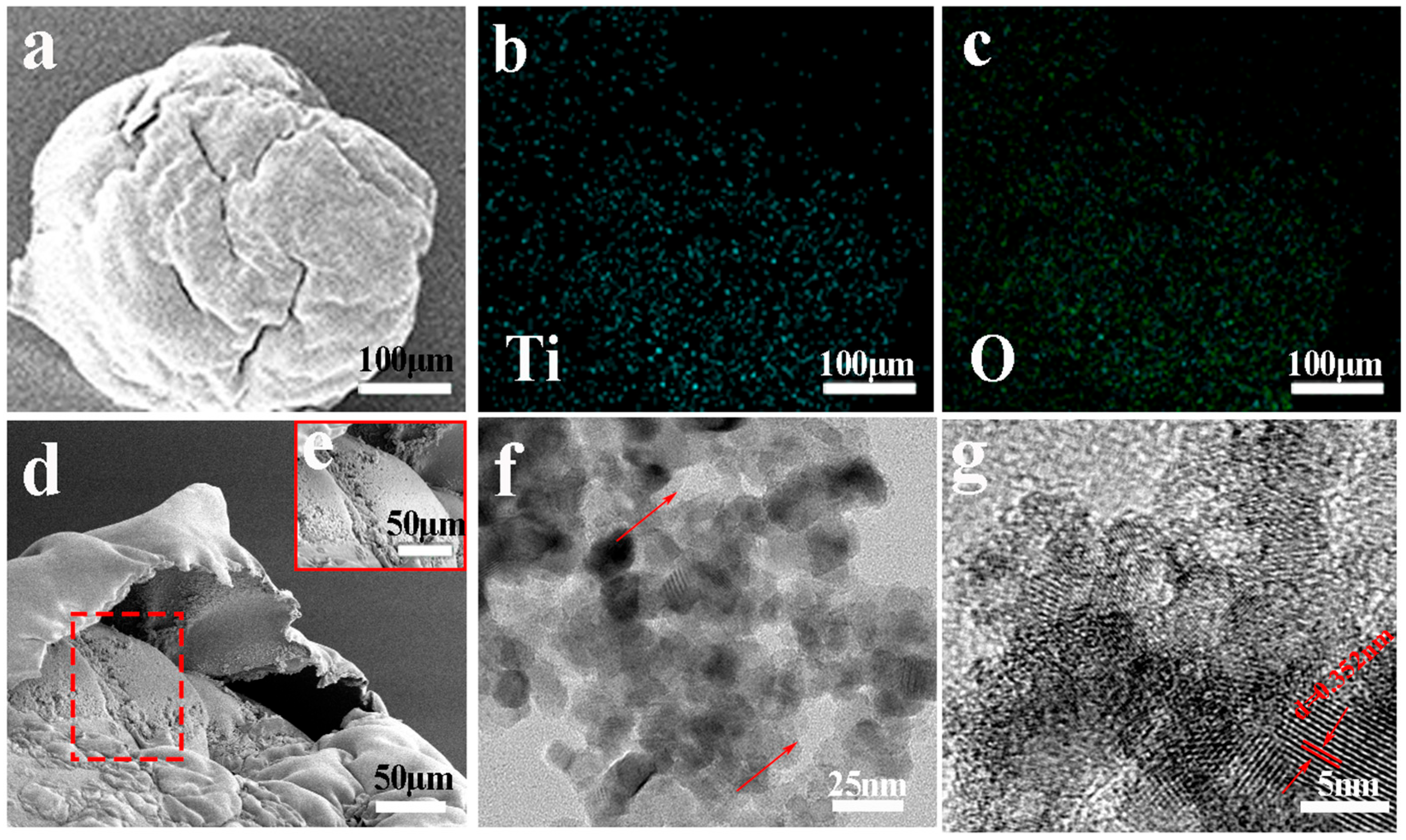
Figure 1. (ac) SEM and EDS of porous TiO2-X-550, where (b)Ti spectrum and (c) O spectrum, (d,e) SEM of the fractured surface of TiO2-X-550, and (f,g) TEM of TiO2-X-550. The arrows indicate the channels, and d = 0.352 nm represents the lattice spacing.
Gels 12 00370 g001
Figure 2. (a) XRD patterns of porous TiO2−X calcined at different temperatures; (b) FT−IR spectra of porous TiO2−X calcined at different temperatures.
Gels 12 00370 g002
Figure 3. (a) Pore size distribution and (b) N2 adsorption–desorption isotherms of porous TiO2−X at different calcination temperatures.
Gels 12 00370 g003
Figure 4. (a) XPS spectra of porous TiO2−X-550, in which Ti 2p (a) and O 1s (b).
Gels 12 00370 g004
Figure 5. (a) UV-vis diffuse reflectance spectra; (b) band gap energies of porous TiO2−X.
Gels 12 00370 g005
Figure 6. (a) Electrochemical photoresponse current test; (b) Electrochemical impedance spectrum of porous TiO2−X.
Gels 12 00370 g006
Figure 7. Fluorescence spectra of porous TiO2−X.
Gels 12 00370 g007
Figure 8. (a) Degradation experiments of RhB by porous TiO2−X after calcination at different temperatures; (b) Three-cycle degradation experiment of RhB by TiO2−X−550.
Gels 12 00370 g008
Figure 9. Degradation rate curves of RhB solution under visible light in different photocatalytic degradation systems over the TiO2-X-550 photocatalyst.
Gels 12 00370 g009
Figure 10. (a) Hydrogen evolution of porous TiO2 calcined at different temperatures; (b) Three−cycle hydrogen evolution of TiO2−X−550.
Gels 12 00370 g010
Disclaimer/Publisher’s Note: The statements, opinions and data contained in all publications are solely those of the individual author(s) and contributor(s) and not of MDPI and/or the editor(s). MDPI and/or the editor(s) disclaim responsibility for any injury to people or property resulting from any ideas, methods, instructions or products referred to in the content.