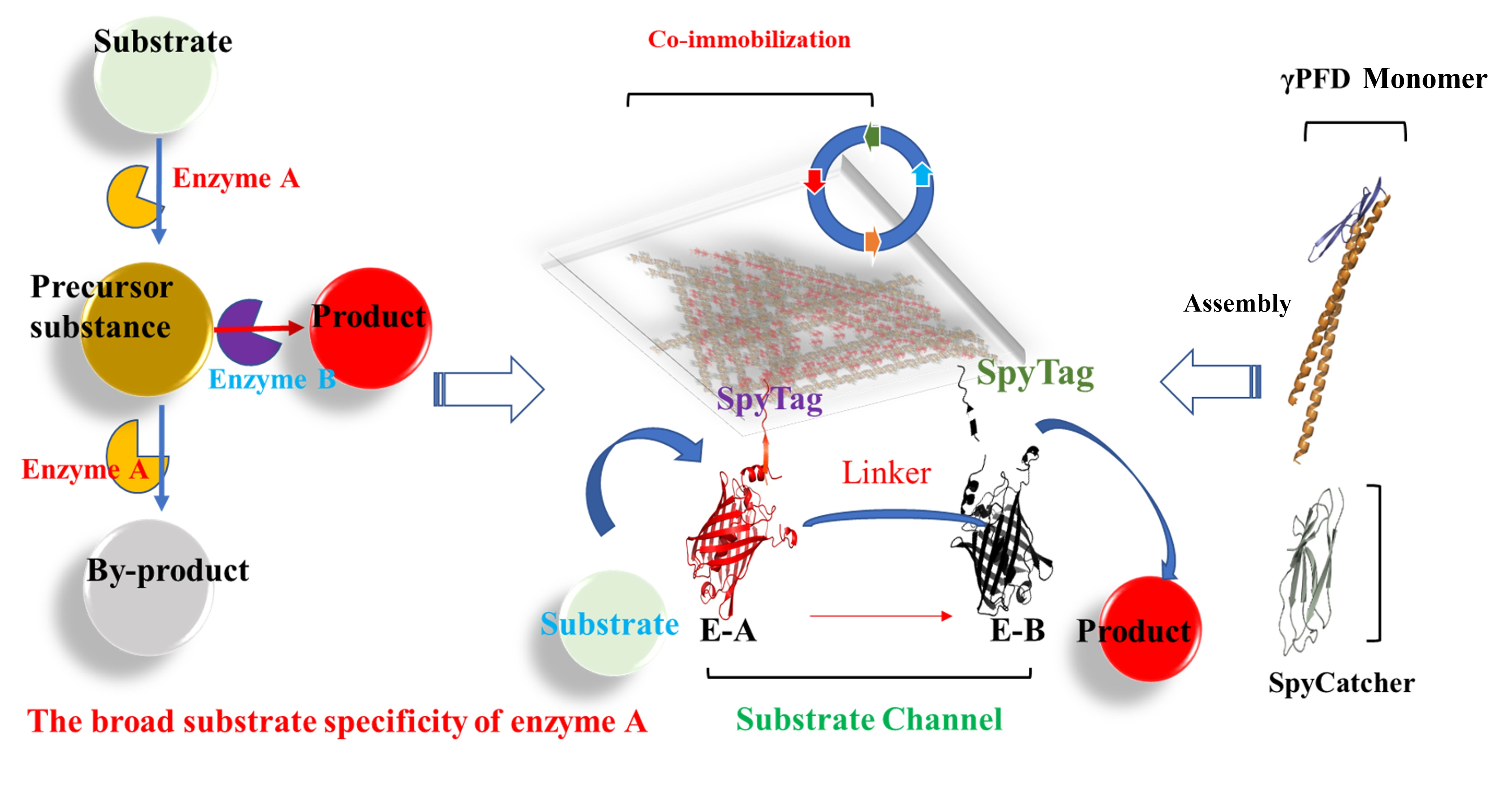

Co-Immobilization of SpyTag-Cyclized Enzymes on a γPFD-SpyCatcher Hydrogel to Address Broad Specificity


Abstract
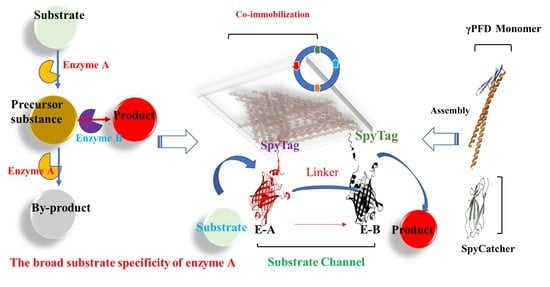
1. Introduction
2. Results and Discussion
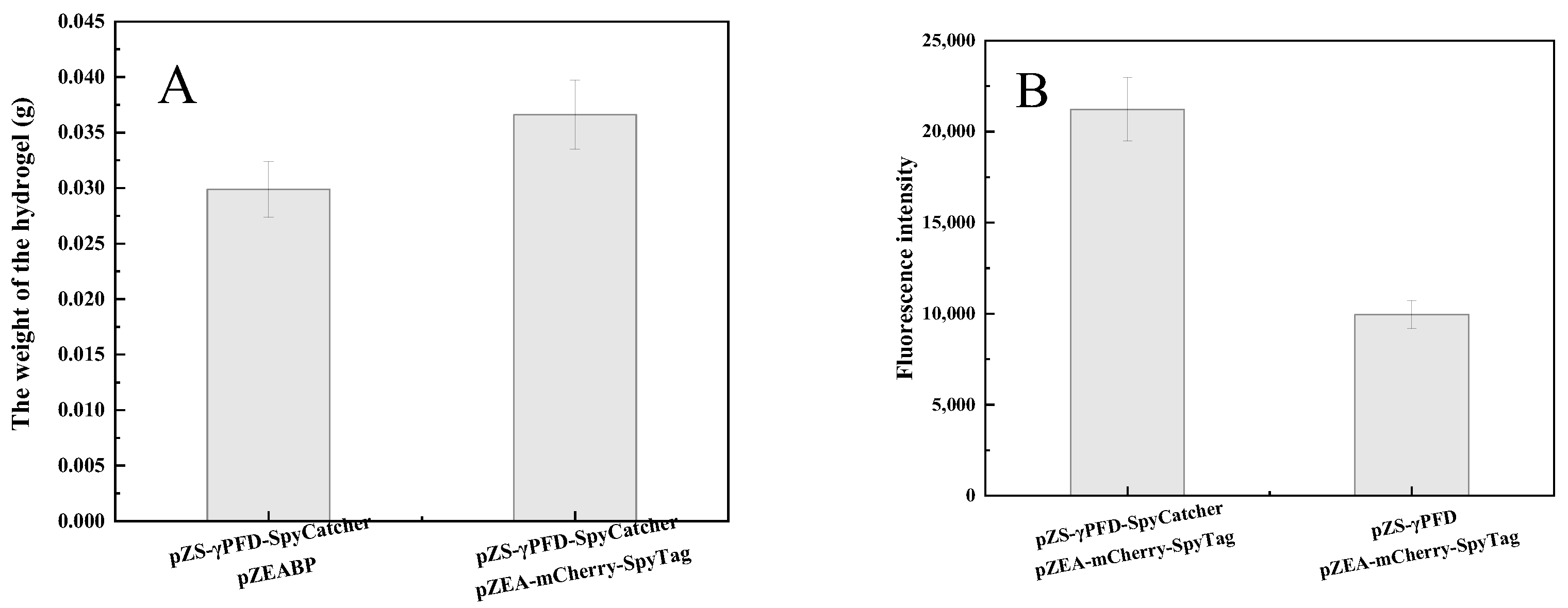
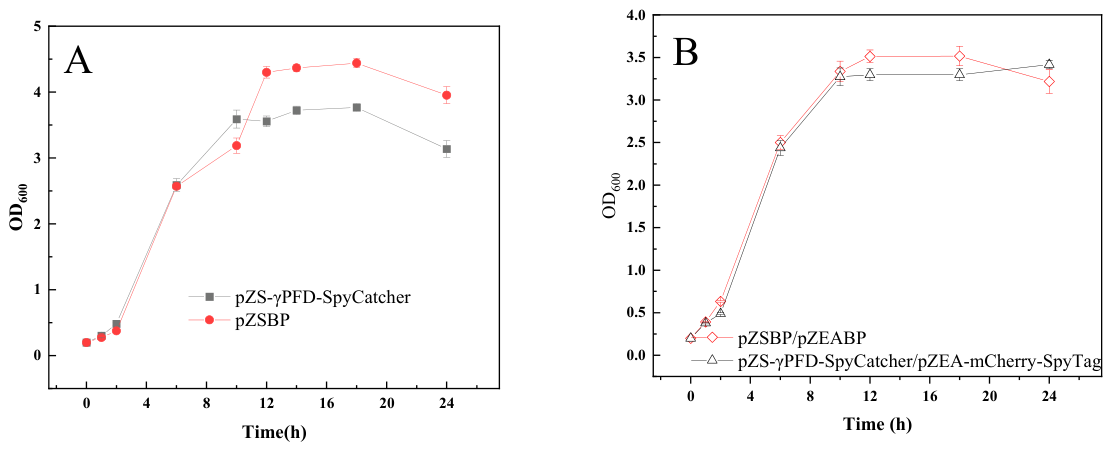
2.1. In Vivo Assembly of γPFD-SpyCatcher Hydrogels and Its Impact on Cell Physiology
2.2. In Vivo Enzyme Immobilization
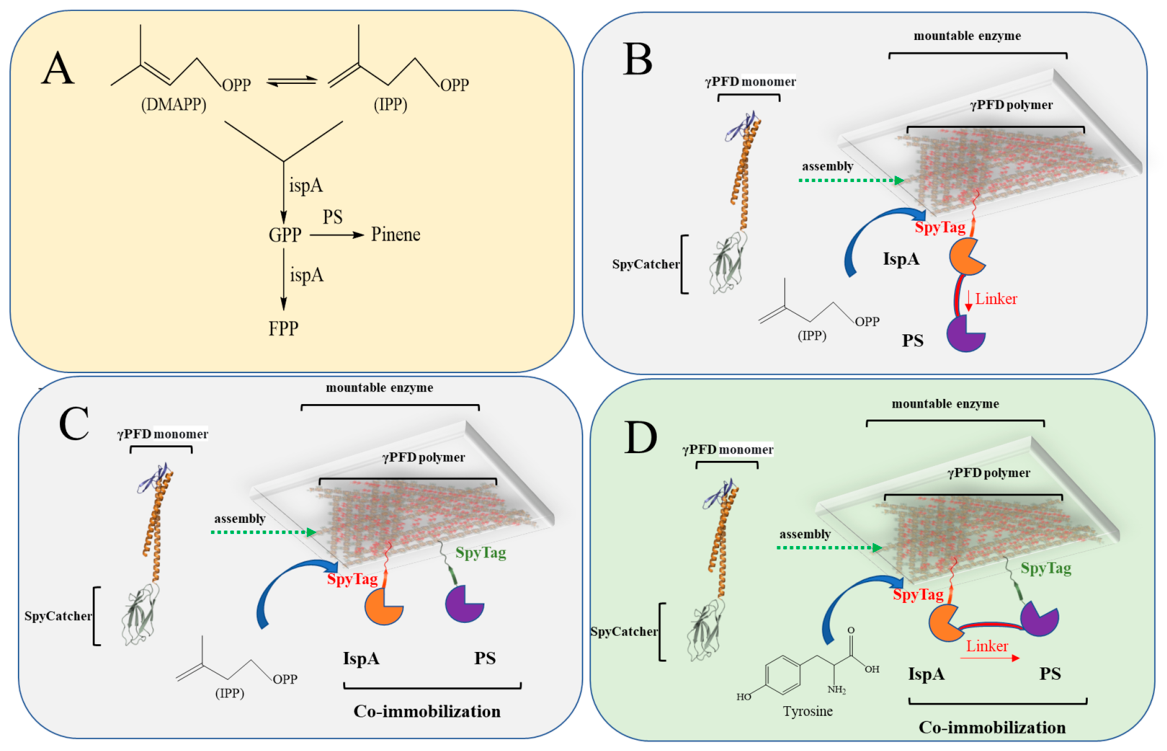
2.3. Co-Immobilization of Cascade Enzymes for Enhanced Pinene Biosynthesis
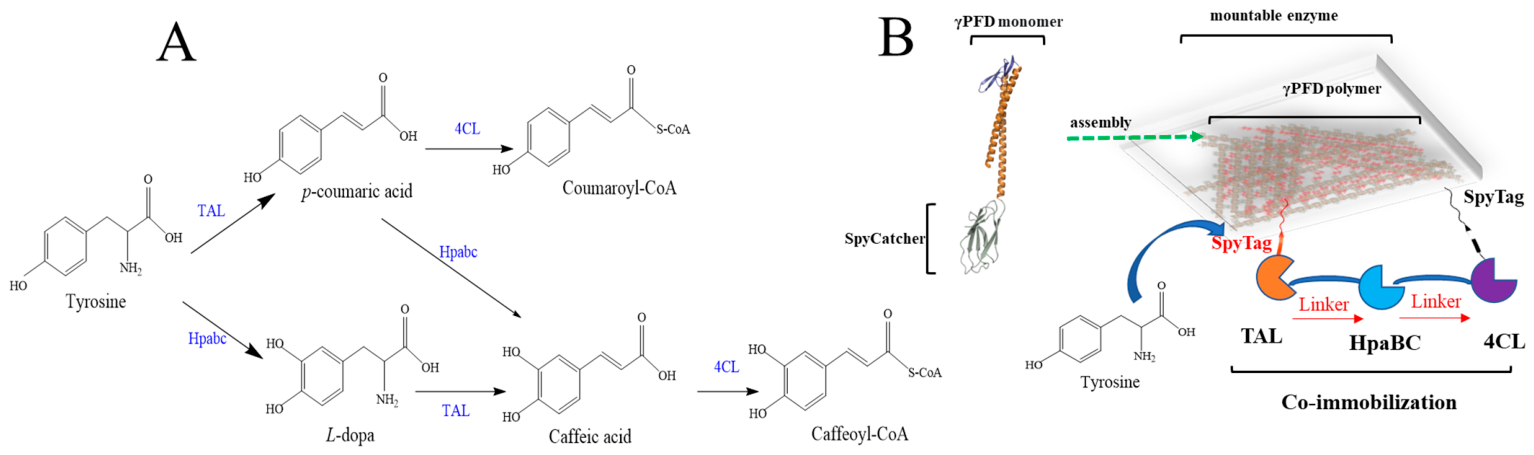
2.4. The Co-Immobilization of γPFD-SpyCatcher with SpyTag-Cyclized Enzymes for Caffeoyl-CoA Production
2.5. Mechanistic Insights and Comparative Advantage
3. Conclusions
4. Materials and Methods
4.1. Strains and Plasmids
4.2. Construction of Plasmids
4.3. In Vivo Assessment of γPFD-SpyCatcher Hydrogel Effects on Cell Growth
4.4. In Vivo Hydrogel Formation and Enzyme Immobilization
4.5. Loading Efficiency of Enzymes Immobilized In Vivo by γPFD-SpyCatcher
4.6. Cell Growth and Production
4.7. Characterization of Hydrogel and Immobilized Enzymes
4.8. Assay
4.9. Statistical Analysis
Supplementary Materials
Author Contributions
Funding
Institutional Review Board Statement
Informed Consent Statement
Data Availability Statement
Conflicts of Interest
References
- Wu, S.K.; Zhou, Y.; Wang, W.; Zhang, W.; Gao, P.F.; Li, Z. From single-enzyme catalysis to multienzyme cascade: Inspired from Professor Daniel I.C. Wang’s pioneer work in enzyme technology. Synth. Biol. J. 2021, 2, 543–558. [Google Scholar]
- Zhou, J.; Wang, C.; Yang, L.; Choi, E.S.; Kim, S.W. Geranyl diphosphate synthase: An important regulation point in balancing a recombinant monoterpene pathway in Escherichia coli. Enzym. Microb. Technol. 2015, 68, 50–55. [Google Scholar] [CrossRef]
- Zhou, S.; Liu, P.; Chen, J.; Du, G.; Li, H.; Zhou, J. Characterization of mutants of a tyrosine ammonia-lyase from Rhodotorula glutinis. Appl. Microbiol. Biotechnol. 2016, 100, 10443–10452. [Google Scholar] [CrossRef]
- Li, Y.; Kim, J.I.; Pysh, L.; Chapple, C. Four isoforms of Arabidopsis thaliana 4-coumarate: CoA ligase (4CL) have overlapping yet distinct roles in phenylpropanoid metabolism. Plant Physiol. 2015, 169, 2409. [Google Scholar] [CrossRef]
- Jiang, Y.; Li, S. Catalytic function and application of cytochrome P450 enzymes in biosynthesis and organic synthesis. Chin. J. Org. Chem. 2018, 38, 2307. [Google Scholar] [CrossRef]
- Coon, M.J. Cytochrome P450: Nature’s most versatile biological catalyst. Annu. Rev. Pharmacol. Toxicol. 2005, 45, 1–25. [Google Scholar] [CrossRef]
- Dueber, J.E.; Wu, G.C.; Malmirchegini, G.R.; Moon, T.S.; Petzold, C.J.; Ullal, A.V.; Prather, K.L.; Keasling, J.D. Synthetic protein scaffolds provide modular control over metabolic flux. Nat. Biotechnol. 2009, 27, 753. [Google Scholar] [CrossRef]
- Zhang, G.Q.; Quin, M.B.; Schmidt-Dannert, C. Self-assembling protein scaffold system for easy in vitro coimmobilization of biocatalytic cascade enzymes. ACS Catal. 2018, 8, 5611–5620. [Google Scholar] [CrossRef]
- Zakeri, B.; Fierer, J.O.; Celik, E.; Chittock, E.C.; Schwarz-Linek, U.; Moy, V.T.; Howarth, M. Peptide tag forming a rapid covalent bond to a protein, through engineering a bacterial adhesin. Proc. Natl. Acad. Sci. USA 2012, 109, E690–E697. [Google Scholar] [CrossRef]
- Keeble, A.H.; Howarth, M. Power to the protein: Enhancing and combining activities using the Spy toolbox. Chem. Sci. 2020, 11, 7281–7291. [Google Scholar] [CrossRef]
- Peng, F.; Chen, Q.S.; Zong, M.H.; Lou, W.Y. Sequential co-immobilization of multienzyme nanodevices based on SpyCatcher and SpyTag for robust biocatalysis. Mol. Catal. 2021, 510, 111673. [Google Scholar] [CrossRef]
- Jiang, W.; Zeng, W. Construction of a Self-purification and self-assembly coenzyme regeneration system for the synthesis of chiral drug intermediates. ACS Omega 2021, 6, 1911–1916. [Google Scholar] [CrossRef]
- Schoene, C.; Fierer, J.O.; Bennett, S.P.; Howarth, M. SpyTag/SpyCatcher cyclization confers resilience to boiling on a mesophilic enzyme. Angew. Chem. Int. Ed. 2014, 53, 6101–6104. [Google Scholar] [CrossRef]
- Li, M.; Zhuang, W.; Zhang, J.; Zhang, K.; Xu, J.; Wang, Z. Improving the thermostability and catalytic activity of RgDAAO by a combinatorial strategy using sequence consensus design and SpyTag/SpyCatcher Self-Cyclization. J. Agric. Food Chem. 2025, 73, 24211–24221. [Google Scholar] [CrossRef]
- Lim, S.; Jung, G.A.; Glover, D.J.; Clark, D.S. Enhanced Enzyme Activity through Scaffolding on Customizable Self-Assembling Protein Filaments. Small 2019, 15, e1805558. [Google Scholar] [CrossRef]
- Wang, B.-P.; Yin, X.; Huang, M.-Y.; Li, T.-Y.; Long, X.-F.; Li, Y.; Niu, F.-X. A self-assembling γPFD-SpyCatcher hydrogel scaffold for the coimmobilization of SpyTag-enzymes to facilitate the catalysis of regulated enzymes. J. Agric. Food Chem. 2024, 72, 19940–19947. [Google Scholar] [CrossRef]
- Peschke, T.; Bitterwolf, P.; Gallus, S.; Hu, Y.; Oelschlaeger, C.; Willenbacher, N.; Rabe, K.S.; Niemeyer, C.M. Self-assembling all-enzyme hydrogels for flow biocatalysis. Angew. Chem. Int. Ed. 2018, 57, 52. [Google Scholar]
- Sun, F.; Zhang, W.B.; Mahdavi, A.; Arnold, F.H.; Tirrell, D.A. Synthesis of bioactive protein hydrogels by genetically encoded SpyTag-SpyCatcher chemistry. Proc. Natl. Acad. Sci. USA 2014, 111, 11269–11274. [Google Scholar] [CrossRef]
- Wang, L.; Gu, X.; Zhao, Y.; Tian, J.; Ma, X.; Tong, M. Advances in molecular dynamics simulations for hydrogels and nanocomposite-reinforced hydrogels: Multiscale simulation strategies and future directions. Gels 2026, 12, 288. [Google Scholar] [CrossRef]
- Russo, E.; Caviglia, D.; Schito, A.M.; Villa, C. Cellulose-based hydrogels incorporating olive mill wastewater (OMW): Preparation, characterization, and in vitro antimicrobial activity. Gels 2026, 12, 282. [Google Scholar] [CrossRef]
- Krunic, T.; Ilic, N.; Osmokrovic, A. Effect of biopolymer additives on functional properties of alginate-based composite hydrogels. Gels 2026, 12, 266. [Google Scholar] [CrossRef] [PubMed]
- Sun, H.; Qu, X.; Wang, Q.; Guo, Y.; Dong, X. Dynamic regulation of interfacial adhesion in biomedical hydrogels. Chem. Soc. Rev. 2026, 55, 469–503. [Google Scholar] [CrossRef]
- Yabbarov, N.G.; Romashkin, I.V.; Zakharova, V.A.; Zinovieva, D.N.; Mollaeva, M.R.; Sokol, M.B.; Chirkina, M.V.; Gulyaev, I.A.; Klimenko, M.A.; Nikolskaya, E.D. Gradient hydrogels: Fabrication strategies and biomedical applications. Biochemistry 2026, 91, S251–S281. [Google Scholar] [CrossRef]
- Jia, H.; Zhu, G.; Vugrinovich, B.; Kataphinan, W.; Reneker, D.H.; Wang, P. Enzyme-carrying polymeric nanofibers prepared via electrospinning for use as unique biocatalysts. Biotechnol. Prog. 2002, 18, 1027–1032. [Google Scholar] [CrossRef] [PubMed]
- Wang, Z.G.; Wan, L.S.; Liu, Z.M.; Huang, X.J.; Xu, Z.K. Enzyme immobilization on electrospun polymer nanofibers: An overview. J. Mol. Catal. B Enzy 2009, 56, 189–195. [Google Scholar] [CrossRef]
- Tashiro, M.; Kiyota, H.; Kawai-Noma, S.; Saito, K.; Ikeuchi, M.; Iijima, Y.; Umeno, D. Bacterial production of pinene by a laboratory-evolved pinene-synthase. ACS Synth. Biol. 2016, 5, 1011–1020. [Google Scholar] [CrossRef]
- Niu, F.X.; He, X.; Wu, Y.Q.; Liu, J.Z. Enhancing production of pinene in Escherichia coli by using a combination of tolerance, evolution, and modular co-culture engineering. Front. Microbiol. 2018, 9, 1623. [Google Scholar] [CrossRef]
- Cui, Y.Y.; Ling, C.; Zhang, Y.Y.; Huang, J.; Liu, J.Z. Production of shikimic acid from Escherichia coli through chemically inducible chromosomal evolution and cofactor metabolic engineering. Microb. Cell Factories 2014, 13, 21. [Google Scholar] [CrossRef] [PubMed]
- Wei, T.; Cheng, B.Y.; Liu, J.Z. Genome engineering Escherichia coli for L-DOPA overproduction from glucose. Sci. Rep. 2016, 6, 30080. [Google Scholar] [CrossRef]
- Li, X.R.; Tian, G.Q.; Shen, H.J.; Liu, J.Z. Metabolic engineering of Escherichia coli to produce zeaxanthin. J. Ind. Microbiol. Biotechnol. 2015, 42, 627. [Google Scholar] [CrossRef] [PubMed]



| Sample | γPFD-SpyCatcher | |
|---|---|---|
| Character | ||
| Structural Strength (G’) | continuous solid network structure (~1.44 Pa) | |
| Viscous/Elastic Ratio (tan δ) | elastic samples (~0.39) | |
| Zero-shear Viscosity (η0) | ‘shear thinning’ type | |
| Structural Stability | Stable | |
| Yield Stress | medium-strength | |
| Shear-thinning Behavior | Observed | |
| Name | Strain | Expression Plasmid | Pinene (mg/L) |
|---|---|---|---|
| A | E. coli MEVI | pZEA-ispA, pZAC-PS | 16.3 ± 1.1 |
| B | E. coli MEVI | pZEA-ispA-L-PS | 17.4 ± 1.2 |
| C | E. coli MEVI | pZEA-SpyTag-ispA-L-PS, pZS-γPFD-SpyCatcher | 58.5 ± 3.6 |
| D | E. coli MEVI | pZEA-SpyTag-ispA, pZAC-SpyTag-PS, pZS-γPFD-SpyCatcher | 21.4 ± 2.7 |
| E | E. coli MEVI | pZEA-SpyTag-ispA-L-PS-SpyTag, pZS-γPFD-SpyCatcher | 64.5 ± 4.3 |
| F | E. coli MEVI | pZEA-SpyTag-ispA-L-2XPS-SpyTag, pZS-γPFD-SpyCatcher | 94.5 ± 4.1 |
| G | E. coli MEVI | pZEA-SpyTag-ispA-L-PS-SpyTag, pZSBP | 15.4 ± 1.6 |
| Name | Strain | Expression Plasmid | Caffeic Acid (mg/L) | Caffeoyl-CoA (mg/L) |
|---|---|---|---|---|
| A | E. coli TYR | pZEA-HpaBC, pZAC-TAL pZS-4CL | 44.2 ± 2.1 | 32.4 ± 2.8 |
| B | E. coli TYR | pZEA-SpyTag-HpaBC-TAL-4CL-SpyTag, pZS-γPFD-SpyCatcher | 18.5 ± 2.6 | 60.3 ± 3.5 |
| C | E. coli TYR | pZEA-SpyTag-TAL- HpaBC-4CL-SpyTag, pZS-γPFD-SpyCatcher | 48.6 ± 3.1 | 78.6 ± 4.6 |
| Strains/Plasmids | Description | Source/Purpose |
|---|---|---|
| Strain | ||
| E. coli DH5α | recA endA1 gyrA96 thi-1 relA1supE44 Δ(lacZYA-argF) U169 (Φ80lacZ ΔM15) hsdR17 | Invitrogen |
| E. coli MEVI | CIChE strain from E. coli YZFP after integration of the mevalonate pathway | [27] |
| E. coli BW25113 | lacIq rrnBT14ΔrhaBADLD7 hsdR514 ΔaraBADAH33 8ΔlacZWJ16 | [28] |
| E. coli TYR | L-tyrosine producing strain, E. coli BW25113, ΔtyrR, ΔcsrA, ΔptsHI, Δcrr, P37-galP-P37-glk, Δzwf, ΔpheLA | [29] |
| Plasmid | ||
| pZEABP | Constitutive expression vector, P37 promoter, pBR322 ori, Ampr | [30] |
| pZEA-mCherry-SpyTag | pZEABP fusion protein of mCherry (Discosoma sp.) to a SpyTag domain via a (GSG)2 linker. | This study |
| pZACBP | Constitutive expression vector, P37 promoter, Cmr, p15A ori | [30] |
| pZEA-ispA | pZEABP derivatives containing FPP synthase gene ispA from E. coli W | This study |
| pZAC-PS | pZACBP derivatives containing the codon-optimized pinene synthase gene PS from Agelas grandis (A. grandis) | This study |
| pZEA—ispA -L-PS | pZEABP derivatives containing FPP synthase gene ispA and pinene synthase gene PS with (GSG)2 linker | This study |
| pZEA-SpyTag- ispA -L-PS | pZEA-ispA-L-PS containing a SpyTag at N-terminal with (GSG)2 linker | This study |
| pZEA-SpyTag- ispA | pZEA-ispA containing a SpyTag at N-terminal with (GSG)2 linker | This study |
| pZAC-SpyTag-PS | pZAC-PS containing a SpyTag at N-terminal with (GSG)2 linker | This study |
| pZEA-SpyTag- ispA -L-PS-SpyTag | pZEA-SpyTag-ispA-L-PS containing a SpyTag at C-terminal with (GSG)2 linker | This study |
| pZEA-HpaBC | pZEABP derivatives containing 4-hydroxyphenylacetate 3 monooxygenase gene hpaB and hpaC with a (GSG)2 linker from E. coli W | This study |
| pZEA-SpyTag-HpaBC | pZEA-HpaBC containing a SpyTag at N-terminal | This study |
| pZAC-TAL | pZACBP derivatives containing the codon-optimized tyrosine ammonia lyase gene tal from Rhodotorula glutinis (R. glutinis) | This study |
| pZSBP | Constitutive expression vector, pBBR1 ori, P37 promoter, Kanr | [30] |
| pZS-4CL | pZSBP derivatives containing the codon optimized 4-coumaroyl-coenzyme A ligases gene 4CL from Arabidopsis thaliana (A. thaliana) | This study |
| pZEA-SpyTag-HpaBC-TAL-4CL-SpyTag | pZEABP derivatives containing 3 monooxygenase gene hpaBC, tyrosine ammonia lyase gene tal, 4-coumaroyl-coenzyme A ligases gene 4CL and two SpyTag at N-terminal and C-terminal respectively with (GSG)2 linker. | This study |
| pZEA-SpyTag- TAL- HpaBC-4CL-SpyTag | pZEABP derivatives containing tyrosine ammonia lyase gene tal,3 monooxygenase gene hpaBC, 4-coumaroyl-coenzyme A ligases gene 4CL and two SpyTag at N-terminal and C-terminal respectively, with (GSG)2 linker. | This study |
| pZEA-SpyTag- TAL- HpaBC-2 × 4CL-SpyTag | pZEABP derivatives containing tyrosine ammonia lyase gene tal,3 monooxygenase gene hpaBC, two copies of 4-coumaroyl-coenzyme A ligases gene 4CL and two SpyTag at N-terminal and C-terminal respectively, with (GSG)2 linker. | This study |
| pZS-γPFD-SpyCatcher | pZSBP derivatives containing the γPFD from Methanococcus jannaschii (M. jannaschii) and connected a SpyCatcher domain via a (GSG)2 linker | This study |
Disclaimer/Publisher’s Note: The statements, opinions and data contained in all publications are solely those of the individual author(s) and contributor(s) and not of MDPI and/or the editor(s). MDPI and/or the editor(s) disclaim responsibility for any injury to people or property resulting from any ideas, methods, instructions or products referred to in the content. |
© 2026 by the authors. Licensee MDPI, Basel, Switzerland. This article is an open access article distributed under the terms and conditions of the Creative Commons Attribution (CC BY) license.
Share and Cite
Huang, M.-Y.; Su, Q.-Y.; Wei, T.; Niu, F.-X. Co-Immobilization of SpyTag-Cyclized Enzymes on a γPFD-SpyCatcher Hydrogel to Address Broad Specificity. Gels 2026, 12, 348. https://doi.org/10.3390/gels12040348
Huang M-Y, Su Q-Y, Wei T, Niu F-X. Co-Immobilization of SpyTag-Cyclized Enzymes on a γPFD-SpyCatcher Hydrogel to Address Broad Specificity. Gels. 2026; 12(4):348. https://doi.org/10.3390/gels12040348
Chicago/Turabian StyleHuang, Ming-Yue, Qing-Yi Su, Tao Wei, and Fu-Xing Niu. 2026. "Co-Immobilization of SpyTag-Cyclized Enzymes on a γPFD-SpyCatcher Hydrogel to Address Broad Specificity" Gels 12, no. 4: 348. https://doi.org/10.3390/gels12040348
APA StyleHuang, M.-Y., Su, Q.-Y., Wei, T., & Niu, F.-X. (2026). Co-Immobilization of SpyTag-Cyclized Enzymes on a γPFD-SpyCatcher Hydrogel to Address Broad Specificity. Gels, 12(4), 348. https://doi.org/10.3390/gels12040348