Article

Freeze-Cast Chitosan/Resole Aerogels: Effect of Resole Fraction on Properties and Their Efficiency for Cr(VI) Uptake


by
Jean Flores-Gómez
1,*,
Milton Vázquez-Lepe
2,
Álvaro de Jesús Martínez-Gómez
3,
Víctor Hugo Romero-Arellano
4 and
Juan Morales Rivera
1,*
1
Departamento de Agua y Energía, Centro Universitario de Tonalá, Universidad de Guadalajara, Tonalá 45425, Mexico
2
Departamento de Ingeniería de Proyectos, Centro Universitario de Ciencias Exactas e Ingenierías, Universidad de Guadalajara, Zapopan 45100, Mexico
3
Departamento de Ingeniería Química, Centro Universitario de Ciencias Exactas e Ingenierías, Universidad de Guadalajara, Guadalajara 44430, Mexico
4
Departamento de Ciencias Básicas Aplicadas e Ingeniería, Centro Universitario de Tonalá, Universidad de Guadalajara, Tonalá 45425, Mexico
*
Authors to whom correspondence should be addressed.
Gels 2026, 12(4), 330; https://doi.org/10.3390/gels12040330
Submission received: 21 March 2026 / Revised: 1 April 2026 / Accepted: 8 April 2026 / Published: 15 April 2026
(This article belongs to the Special Issue Recent Advances in Biopolymer Gels (2nd Edition))

Abstract

Aligned CS/Rx aerogels were fabricated by inducing non-directional ice growth (freeze-molding) followed by low-temperature curing, resulting in monoliths with interconnected channels, a high void fraction, and moldability. The swelling index (S%) was calculated to be 1029, the apparent density 0.496 g·cm−3, and the estimated porosity 90% based on micrographic analysis. Aerogels have mechanical behavior Shore A hardness greater than 25. Batch metal removal tests were performed (10 mL, 100 mg·L−1 Cr(VI), 0.19 g adsorbent, 24 h, and pH 5–5.5), and the material achieved 95% metal removal. Additional kinetic and isothermal results were obtained using CS85R15 on a packed column (20 to 140 mg·L−1, 1000 mL Cr(VI), 0.80 g adsorbent, 24 h, and pH 5–5.5). Equilibrium data were consistent with a heterogeneous surface hosting a specific site, as reflected in the joint Freundlich/Langmuir fit (qmax 100.8 mg·g−1 for Langmuir). This confirmed the preservation of chitosan functionalities (–OH/–NH) after processing, while XPS detected chromium on the surface with signals consistent with the partial reduction of Cr(VI) to Cr(III) on the aerogel surface. This highlights the relevance of adsorption-based technologies for water remediation, where high-porosity and low-density materials allow for short diffusion pathways and capture electrostatics by protonated amines and redox conversion of hazardous substances. The soft-cure freeze-molding technique is simple, scalable, and compatible with packed-bed/column operation, providing a material platform for tailoring the microstructure (sheets and channels) and surface chemistry to regenerable sorbents for industrial wastewater treatment.

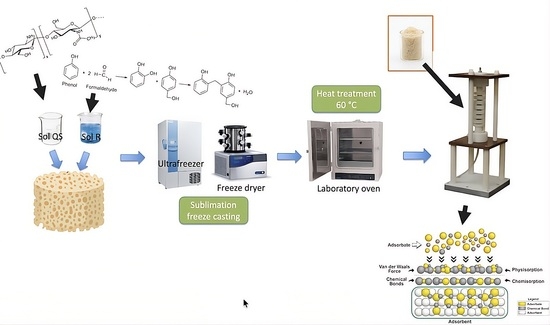
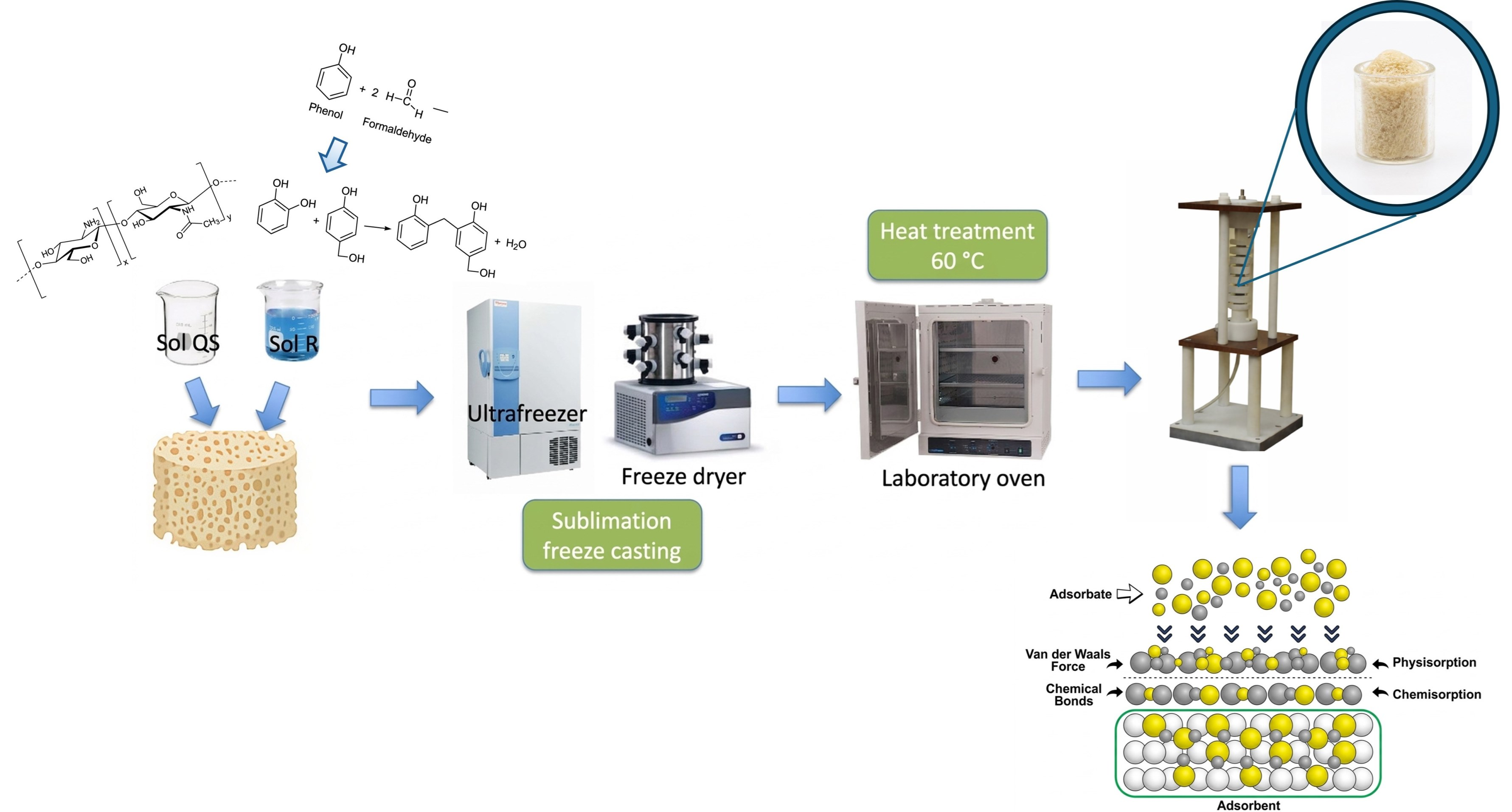
Graphical Abstract

1. Introduction

The demand for efficient methods to remove contaminants from water continues to grow worldwide, particularly when heavy metal contamination is present. Functionalized materials have emerged as promising tools for this purpose [1,2]. Among them, chitosan (CS) has attracted significant attention due to its amine-rich polysaccharide backbone, which originates from the deacetylation of chitin obtained from fish waste [3,4,5], making it economical and sustainable. Its metal-binding capacity, mediated by electrostatic and chemical interactions of the –NH2 groups, has been extensively documented [6,7,8]. However, practical implementation requires controlling swelling and mass transfer limitations to ensure selective and efficient adsorption [6,7,9]. Porous adsorbents with large surface areas generally exhibit better ion removal performance [2,3,10]. In this sense, freezing and melting allow the manufacture of biomimetic materials with aligned sheets and a large specific surface area [11], potentially improving the internal diffusion pathways relevant for adsorption [10,11,12,13,14]. Despite the structural advantages of freeze-molded chitosan, these aerogels often exhibit brittleness and fragility, and the process can involve complex control over ice nucleation and growth orientation, increasing manufacturing costs and reducing scalability [9,15]. To overcome these limitations, incorporating phenol–formaldehyde resole resin into the chitosan suspension represents a promising strategy. Resole resins (R) are synthesized under basic conditions [16,17,18,19] and are characterized by their ability to cure without additional crosslinkers, remaining soluble long enough to be mixed with acidic CS solutions before solidification [10,16,17,18]. Once frozen and cured, the resole forms methylene and ether bridges that reinforce the scaffold, improving mechanical integrity while preserving chitosan as the main functional component for metal adsorption [20]. We propose that controlling the resole fraction (x) allows for the adjustment of key structural parameters (lamellar architecture, porosity, and swelling resistance), which in turn impact Cr(VI) adsorption, as stabilized porous networks improve mass transfer and maintain the accessibility of adsorption sites [21,22]. Although CS-based materials have been extensively studied in the form of films [23,24], fibers [25,26,27], membranes [12,24,28,29], beads [30,31], microspheres [32,33], coatings [34,35] and hydrogels [33,36,37,38], and chitosan aerogels have been explored for contaminant removal, existing studies focus on the addressing how the resole fraction governs structure–property–adsorption relationships in freeze–melt CS/R aerogels remain scarce [10,22]. In this work, a series of CS/R aerogels was fabricated by refrigerator freezing with unidirectional freeze-casting and low-temperature curing. This study analyzes whether, during aerogel molding, there is a resole fraction that maximizes the balance between chitosan-NH2 accessibility, aligned lamellar porosity, and mechanical integrity, thereby improving Cr(VI) uptake. The main objective was to quantify the effect of the resole fraction on (i) microstructure (SEM) [10], (ii) swelling index and porosity [19,39], (iii) mechanical hardness/compression) [40], and (iv) Cr(VI) removal capacity [8,39].

2. Results and Discussion

2.1. CS-x Aerogel Characterization

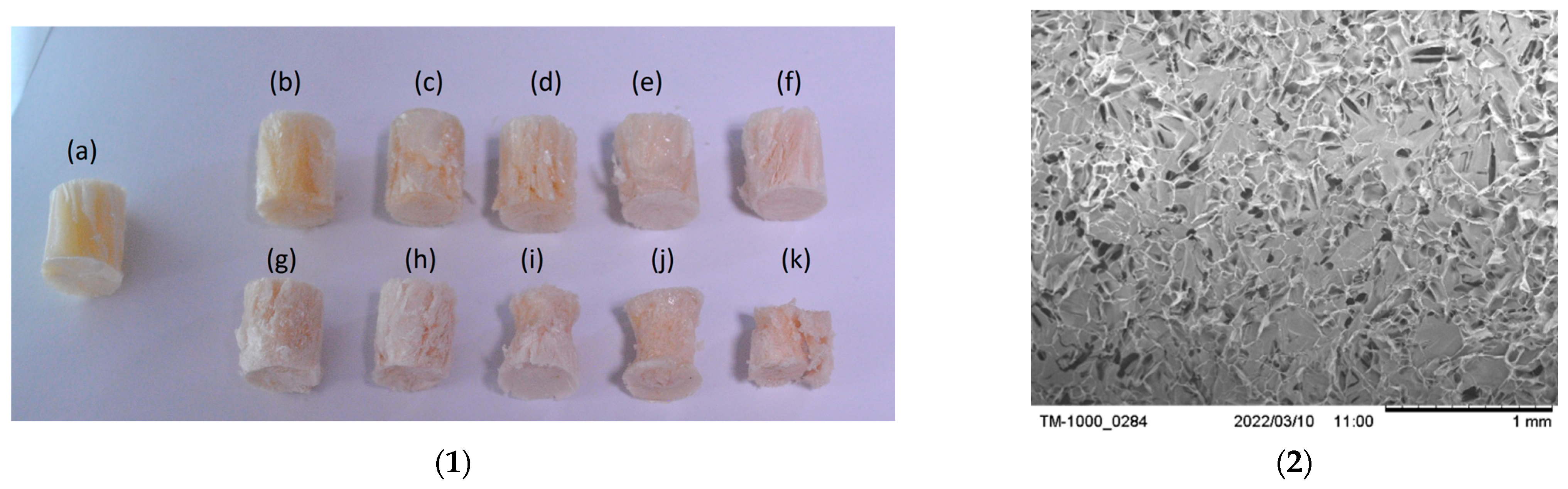
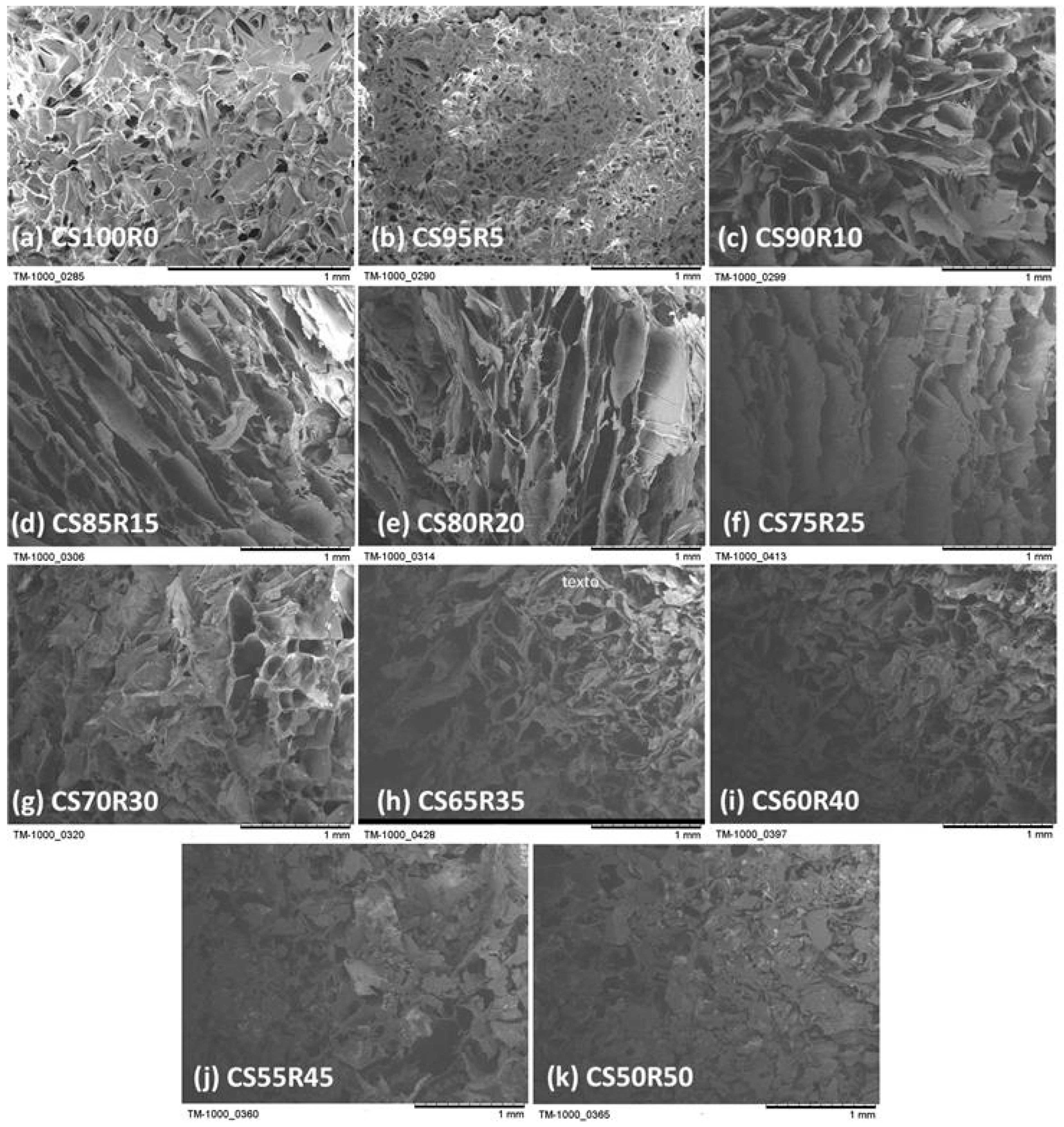
Figure 1(1a) shows CS/R x aerogels after demolding and before thermal curing; the monoliths are flexible and exhibit no measurable hardness, with a marked decrease in size after demolding. After curing, the yellowing and loss of flexibility are consistent with resole curing and aging, which typically increase mechanical integrity in freeze-molded networks, as described by Maleki et al. [9]. In Figure 1(1b) (CS100/R0), dilute chitosan molds a porous scaffold by freeze-molding, producing a dense, high-area network; 100× micrographs show a uniform distribution of nanometer-sized pores [10,41,42]. The porosity values obtained from an SEM image analysis represent apparent two-dimensional porosity, which is suitable for comparative morphological evaluation. All the CS/R x aerogels exhibited high porosity (>85%), consistent with freeze-molded aerogel architectures. Increasing the chitosan fraction led to a progressive decrease in porosity, accompanied by a marked reduction in pore size and an increase in sheet thickness, indicating structural densification and partial collapse of the ice-molded network [43]. These results demonstrate that porosity alone is insufficient to describe transport accessibility, and that pore size and sheet thickness must be considered to identify an optimal composition window for aerogel formulation [44]. A change is observed with increasing CS fraction and lower resole, as shown in Figure 2a–c. Morphologically, it is quite notable that the pore diameter decreases abruptly (92 to 97% vs. the composition with the highest resole loading) and the lamellar thickness increases, with a simultaneous drop in porosity (47% at the end). This pattern suggests solid-phase compaction and loss of lamellar order, reducing the effective connectivity of the channels [43]. Conversely, the formulations with the highest resole loading (R 50–75, Figure 2g–k exhibit large pores (median 600–1850 µm) and thin lamellars (2.6–7.8 µm) while maintaining high porosity (92%). This lamellar architecture with open channels favors percolation and seemingly straight or linear trajectories, facilitating water delivery and internal diffusion to active adsorption sites [44]. A decrease in pore size accompanied by an increase in sheet thickness is consistent with structural densification and partial ice-tempered network collapse, as Karimi et al. suggest [45]. Therefore, we can infer that the formulations of CS/R aerogels in an apparently better ratio, as shown in Figure 2d–f, are most suitable. Thus, pore size and sheet thickness should be considered together to identify an optimal composition window for aerogel formulation as reported [46]. The incorporation of resole into the formulation aims to reinforce and stabilize the structure generated during ice growth, regardless of slight variations in the freezing front’s trajectory. This behavior can also be attributed to thermodynamic considerations, as the gel–solvent system tends to minimize its free energy during solidification, favoring entropy-induced self-assembly processes within the polymer scaffold. It is assumed that the freezing front advances mainly in an axial direction, from the meniscus towards the bottom of the tempered cristal tube, traveling a characteristic distance equal to the height of the cylinder at an estimate rate of R ≈ 0.80 cm h−1.

2.2. Swelling Experiments

The results of the swelling experiments are summarized in Table 1. CS/R-x aerogels with lower resole fractions exhibit a very high swelling index (S%), reaching S% ≈ 5000 for CS100/R0, which is consistent with superabsorbent-like behavior reported for chitosan-based hydrogels under specific crosslinking conditions [16,17,26,47,48]. The decrease in S% with increasing resole content reflects the progressive network densification and reduced hydrophilicity imparted by the phenolic resin. In this framework, the inverse correlation between S% and apparent density is physically reasonable for a higher density and lower S%; therefore, the amount of resole prevents the walls from being flexible [49].

2.3. Shore A Hardness Measurements

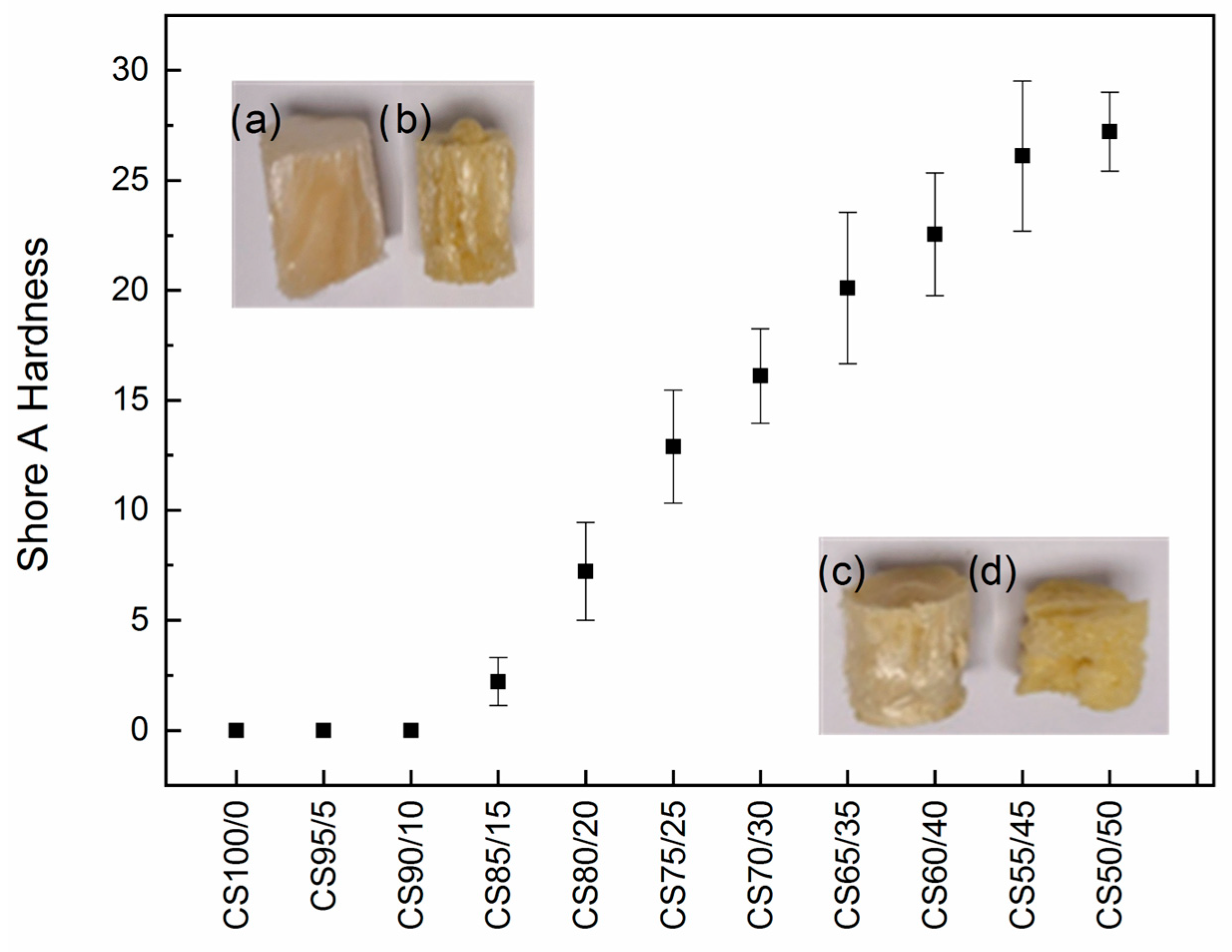
Shore A hardness was measured following standard durometry practice (multiple indents per specimen; results as mean ± SD). The resole fraction exerted a crucial effect: CS50/R50 reached Shore A ≳ 25, while the samples with low resole (e.g., CS100/R0, CS95/R05, and CS90/R10) could not be measured because the indenter penetrated completely, indicating soft/elastic behavior. Thermal treatment was necessary to complete the resole curing, enabling reproducible hardness values [50]. The observed hardness trend is consistent with the literature on polymer-crosslinked aerogels, where higher crosslink density leads to higher modulus/hardness while maintaining low density [51,52], as observed in Figure 3.

2.4. FT-IR Analysis

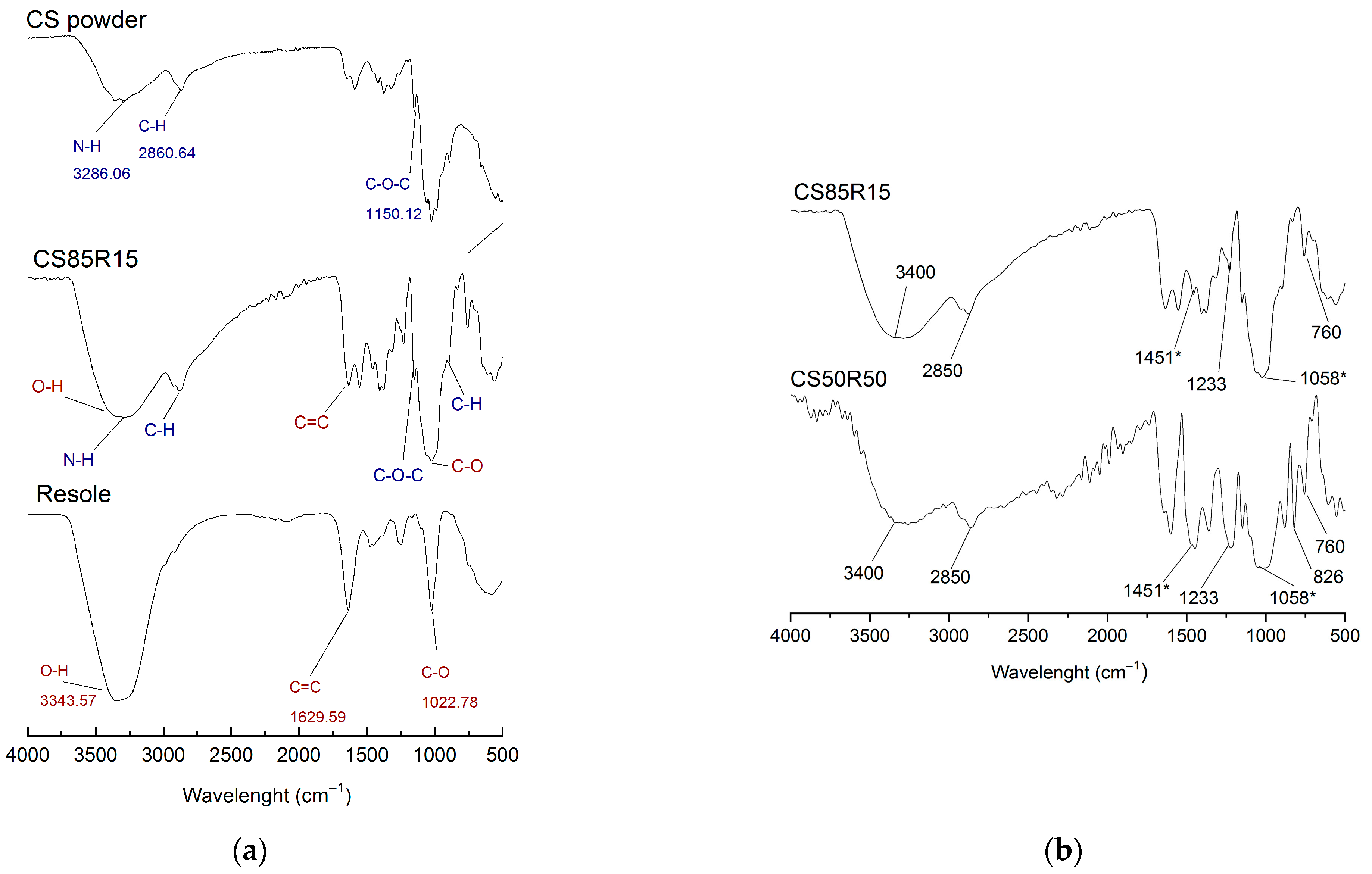
Figure 4 compares FT-IR spectra of chitosan, resole precursor, and CS-x aerogels. For chitosan, the broad ν (OH,NH) band appears at 3200–3500 cm−1, with Amide I at 1645 cm−1, Amide II at 1560–1590 cm−1, Amide III at 1320 cm−1, ν (C–O–C)/ν (C–O) at 1020–1070 cm−1, and a glycosidic signal near 890 cm−1 characteristically of saccharide and a crystalline sensitive band on 659 cm−1 [26,40,48,49,53]. For the resole, we observe a broad phenolic ν (OH) at 3200–3500 cm−1, aromatic C=C at 1600–1500 cm−1, methylene (CH2) deformation near 1450 cm−1, C–O stretching of the –CH2OH groups around 1040–1060 cm−1, and out-of-plane C–H for para- (830 cm−1) and ortho-substituted rings (750–760 cm−1) [16,17,47,54,55,56,57]. In CS/R-x aerogels, increasing the resole fraction intensifies bands associated with methylene bridges (1450 cm−1) and ether linkages (C–O–C 1100 cm−1), consistent with thermal curing/reticulation; consecutively, –CH2OH (1050 cm−1) tends to decrease as condensation proceeds [40,58]. The broad 3200–3500 cm−1 envelope reflects overlapping ν (OH)/ν (NH) with hydrogen-bonding contributions from both networks. Overall, the spectral evolution supports chemical crosslinking between the phenolic resin and the polysaccharide network during curing [25].

2.5. XPS Analysis

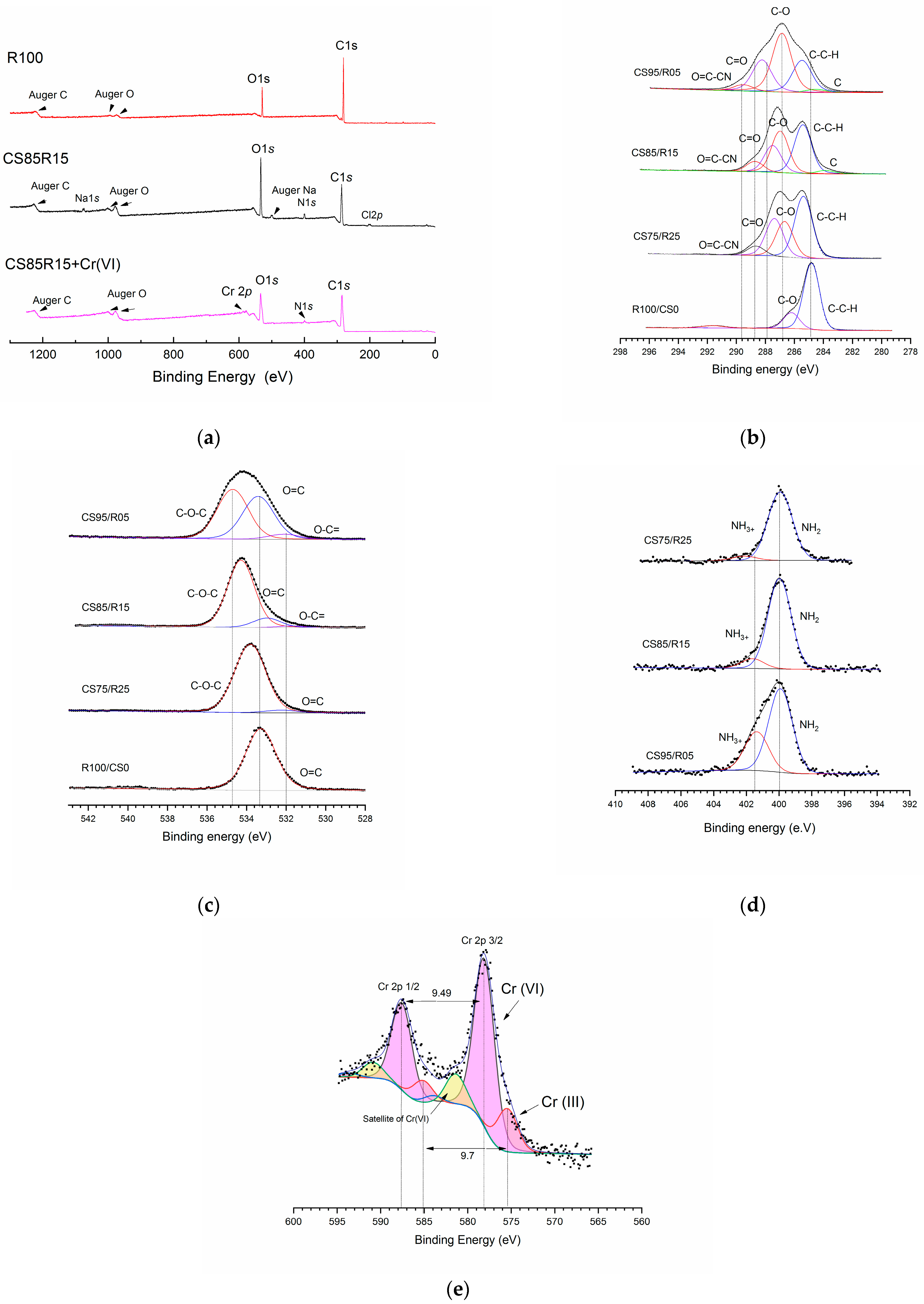
The analysis of XPS spectra (C1s, O1s, N1s, and Cr2p) were acquired from resole (R100/CS0) and CS/R-aerogels (CS75/R25, CS85/R15, and CS95/R05), as well as from CS85/R15 after Cr(VI) adsorption, as observed in Figure 5a. The survey spectra show the presence of C and O signals characteristic of the phenolic network in the resole study; the CS-x spectra show C, O, and N (the latter contributed by chitosan). Cr2p is detected in Cr-laden CS85/R15, confirming chromium capture.
As seen in C1 (Figure 5b, in resole, the main C–C/C–H component was fixed at 284.8 eV; a second component of 286 eV attributable to C–O/C–N was observed, and a third of 288–289 eV associated with C=O/O–C=O. In CS-x, the review requires 4 to 5 components: C–C/C–H (284.8–285.4 eV), C–O/C–N (286.2–286.9 eV), C=O (288–289 eV), and, depending on the formulation, a contribution of N–C=O of 289–290 eV (amide) [29,57]. Increasing chitosan (CS95/R05) increases C–O/C–N (286.8 eV) and decreases C–C/C–H, consistent with a higher polysaccharide fraction, and agitation peaks > 291–292 eV may appear [56], as seen in O1 Figure 5c. Two or three components were resolved: C=O (531.5–532 eV) and C–O/C–O–C (533–535 eV), with a possible minor contribution of 532 eV (amide/hydroxyl). In CS95/R05, C–O/C–O–C broadens (534.7 eV) and C=O remains constant (533.1 eV), which is consistent with a higher chitosan content appearing [56] as seen in N1 (Figure 6(2d). Two components are identified: –NH2 (399.8–400.0 eV) and –NH3+/amide (401.2–401.5 eV). With higher chitosan concentrations, the N content increases, and in acidic (acetic) medium, the protonated fraction (–NH3+) is favored. So, despite the fact that we have a higher concentration of N1s, the percentage protonated by the acidification of the mixture limits the amino group present [35,59], as seen in Cr2p on CS85/R15 after adsorption (Figure 5e). The main component, Cr2p3/2, at 576.6–577.1 eV, is assigned to Cr(III); a component at 579.5–580.5 eV indicates remnant Cr(VI). It is recommended to adjust only 2π/2 and use multiplets for Cr(III) and one peak for Cr(VI). Consider the reduction of Cr(VI) → Cr(III). This suggests that, during adsorption, the reducing surface with NH2 and the hydroxyl group generates the reduction of Cr(VI) through electrostatic attraction. The NIST X-ray database also identifies the peak at 573.5 eV as Cr(III), which is almost entirely reduced on the QS85/R15 aerogel [33,56,57,59,60,61].
From the deconvolution summarized in Table 2, the resole shows a C1s dominated by C–C/C–H at 284.8 eV (68%), with a second component at 286.1 eV (14%) attributable to C–O/C–N; in O1s, 533.0 eV (18%) predominates, consistent with C–O/C–O–C in polymeric matrices, while the signal at 539.9 eV corresponds to loss (“shake-off”/inelastic loss) (the bond energies are referenced to C1s = 284.8 eV). When chitosan is incorporated (CS75/R25 → CS85/R15 → CS95/R05), a systematic decrease in C–C/C–H is observed (31% → 22% → 16% at 285.3–285.4 eV) with an increase in the 286.8–286.9 eV component (21.3% → 23.3% → 29%), indicating a surface enrichment in C–O/C–N characteristic of the polysaccharide; in addition, the C=O components at 288–289 eV are maintained/modulated according to the resole fraction, as expected in phenol–formaldehyde networks. In O1s, the contributions of 534–535 eV (CS75/R25: 26.0% → CS85/R15: 26.2% → CS95/R05: 30.0% adding up to 534.7 + 533.4 + 532.1 eV), characteristic of C–O/C–O–C, increase, while the contributions of 532–533 eV are associated with C=O/amide/hydroxyl, confirming a net increase in oxygenated functionalities with higher chitosan content. In N1s, the total surface fraction increases (CS75/R25: 2.4%; CS85/R15: 6.0%; and CS95/R05: 6.3%) and is dominated by the 401.3 eV component versus 399.9 eV, indicating that most of the nitrogen appears as –NH3+/amide (high BE) and the remainder as neutral –NH2 (low BE), consistent with protonation in an acidic preparation/adsorption medium and with the increase in the chitosan phase. In conclusion, XPS counts reveal that, with increasing chitosan fraction, the CS-x surface becomes enriched in the C–O/C–N and N groups, maintaining the C=O signals associated with the resole. This chemical evolution supports the idea that the amino/hydroxyl functionality of chitosan becomes more exposed/abundant, while the resole provides the underlying aromatic and carbonyl skeleton [35,59].

2.6. Batch Adsorption Experiments

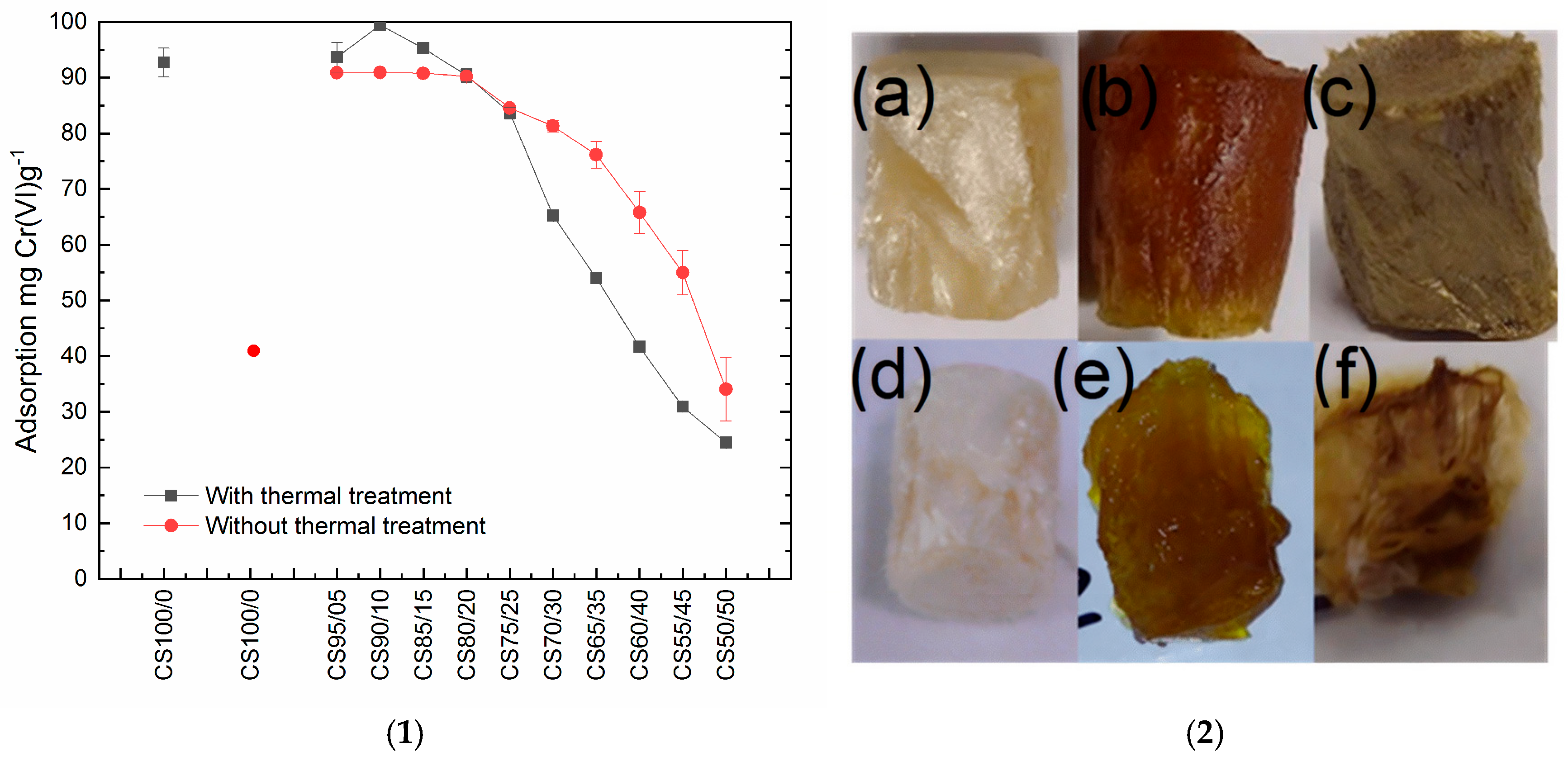
This study evaluated whether the different CS/R-x aerogels exhibit adsorption capacity. All the CS/R-x materials adsorbed Cr(VI); however, higher resole fractions reduced the uptake, which we attribute to lower swelling/permeability and a decrease in accessible surface contributed by the chitosan template. To highlight the role of aging/curing, we first tested CS/R-x aerogels without the final thermal treatment, as observed in Figure 6(1) The thermal step chemically crosslinks the polymeric matrix, providing the desired mechanical integrity, but it also limits swelling, which can diminish mass transfer. Consequently, for high-resole formulations, non-cured samples removed more Cr(VI) than their thermally cured counterparts. The effect of aging was particularly evident for CS100/0: thermal treatment strengthened the internal chitosan-derived network; without it, the adsorption decreased, and the monolith disintegrated in acidic Cr(VI) solution, behaving like powdered, gel-forming chitosan. After adsorption, the CS/Rx-aerogel retained its shape on drying and exhibited a metallic coloration consistent with chromium species on the composite surface, as observed in Figure 6(2b).

2.7. Column Adsorptions Experiments

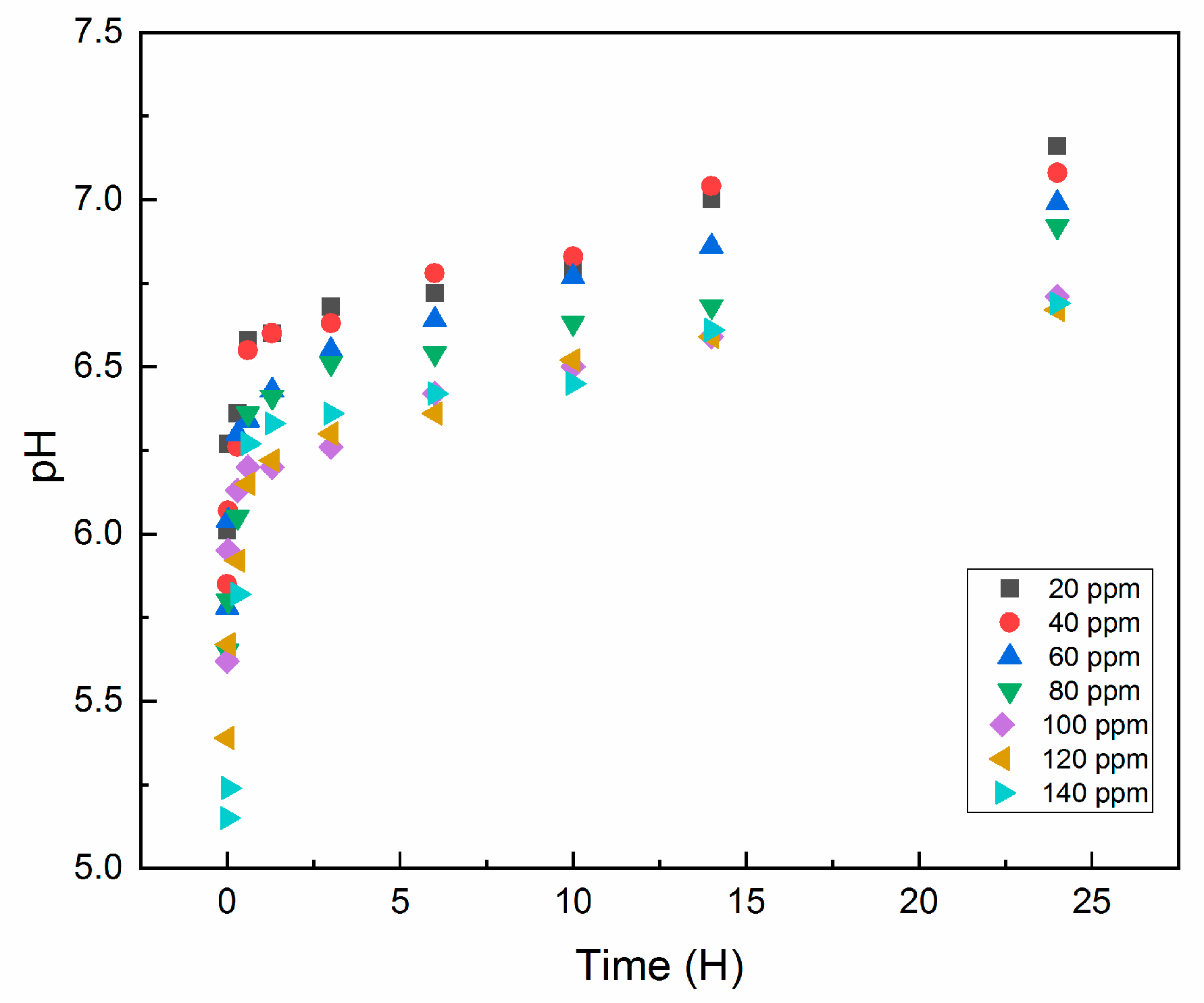
Bibliography indicates that Cr(VI) adsorption with chitosan occurs efficiently in a pH range of 2 to 5 [62]. In this work, the adsorption column design required that the chromium solution not be adjusted or conditioned, since chitosan acquires a positive charge in acidic media, which favors the electrostatic equilibrium between the protonated amino groups (–NH3+) and the anionic Cr(VI) species [5], hence the importance of pre-washing the adsorbent to restore near-neutral initial conditions, more details in Supplementary Materials. Figure 7 shows the pH evolution during sampling and the adsorption kinetics at 24 h. Initially, the Cr solution has an acidic pH close to 5; however, as the effluent repeatedly passes through the adsorbent material, a progressive decrease in ionic interaction is observed, attributed to the reduction of free species in the solution. This leads to a gradual neutralization of the medium to a pH of approximately 7 at the end of the experiment. Isotherm analysis Table 3. indicates that the experimental data fit the Langmuir and Freundlich models, adjustment of models (Figures S1–S4) in Supplementary Materials. However, the Freundlich model shows a better statistical fit (R2 = 0.9786), suggesting a heterogeneous adsorption process with multilayer formation and a predominance of electrostatic physical interactions. Furthermore, the significant fit to the Langmuir model (R2 = 0.9634; qmax = 100.8 mg·g) demonstrates the simultaneous presence of chemisorption at specific sites, which was subsequently corroborated by chemical surface characterization techniques. Taken together, these results indicate that the adsorption of Cr(VI) onto QS85/R15 occurs through a mixed mechanism, dominated by a heterogeneous surface with contributions from both physisorption and chemisorption.
As observed in Table 4, a comparison with CS-based adsorbents reported in the literature that most chitosan-based Cr(VI) adsorbents achieve high Qmax values under strongly acidic conditions (pH 2–3) and batch static operation, frequently requiring relatively high adsorbent dosages. In contrast, the CS85/R15 work operates at a milder pH (5–5.5) using a low adsorbent mass while maintaining competitive adsorption capacity.

3. Conclusions

CS/R-x aerogels effectively integrate structural robustness and adsorbent functionality, offering formation of aligned lamellar structures; anisotropic growth; and the generation of large, interconnected pores, favorable for applications in adsorption and fluid transport, for the retention and transformation of Cr(VI) in batches and columns. The combination of lamellar microstructure, heterogeneous surface, and amino groups activates a mixed mechanism with competitive qmax and a process compatible with scale-up. Consolidating their practical application requires further research into the redox mechanism, and optimization, for example, specifically measuring breakthrough curves (C/C0–t, dynamic capacity) under different residence times, bed heights, and operating cycles, as well as evaluating regeneration or operating cycles, could be a promising area for future research. In addition, the ecotoxicity and carbon footprint of the process will be assessed. From a techno-economic perspective, CS/R-x aerogels combine low reagent costs, moderate energy consumption during processing, and significantly improved mechanical durability. While freeze-drying accounts for most of the energy consumption, the low-temperature curing (~60 °C) results in a favorable operational balance. Ideally, a life cycle assessment (LCA) and a cost analysis should also be performed. Further investigation would be conducted on the composition window and properties, column design and regeneration, and safety and sustainability assessments. These lines of research will strengthen the technological viability of CS/R-x aerogels in water and waste management and facilitate their industrial adoption.

4. Materials and Methods

4.1. Matrix Concept and Materials

Chitosan powder > 85% deacetylation degree was obtained from America Alimentos, Zapopan, Mexico; HCl (37.0%), CH3COOH (99.9%), C6H5OH (99%), H2CO (37.0%), NaOH (98%), (CH3)2CO (99.0%), and H2SO4 (97.3%) were bought from Fermont (Productos Químicos Monterrey, Monterrey, Mexico). Additionally, deionized water and ethanol were used for dissolved and washing solutions, respectively.
Chitosan was prepared at 2 wt.%, with an acetic acid solution of 2 vol.% without mechanical stirring, dissolving in repose for three days at room temperature. The chitosan solution is the principal agent of the scaffold formation, and it establishes the growth of ice crystals as the main matrix with >50 vol.% of gel. An amount of 20 wt.% water content is suitable for the nucleation of water, which is influenced by this state of gel during freezing [48,66].
Formulation of the aerogel composite process.

4.2. Synthesis of Phenol–Formaldehyde Resins for CS-x Blends

Resole solution of phenol–formaldehyde resin was prepared by the reported method [15] with adjusted modifications [22], and the monomer resole precursor was synthesized by adding formaldehyde and phenol into a solution of NaOH (0.1 M). The mixture was heated at 70 °C in a water bath and stirred at 150 rpm for 1 h. The solution was adjusted to pH 7–7.5. Then, a rotary evaporator was used at 50 °C and 50 mbar for 1 h, and the solution of liquid resole monomer was removed, collected and stored at −4 °C for further use.

Processing

The process started with the preparation of a suspension yield with the diluted chitosan and resole solution inside a syringe, which was then ejected into glass cylinders (2 cm base × 1.6 cm height) as molds. These recipients were cooled down to −70 °C and then carried into a laboratory and freeze-dried (Freeze-Dryer system Ilshin Biobase TFD8501, Komachine, Seoul, Republic of Korea), using a vacuum at 35 mTorr for 24 h. Without removing the glass recipient after freezing, the integrity of the matrix attached to the glass cylinder area was ensured. The last step was a thermal treatment at 60 °C for 24 h. Formulation of different samples is shown in Table 5.

4.3. CS-x Aerogel Characterization

The morphology of the chitosan/resole CS-x aerogels was characterized by Scanning Electron Microscopy (SEM) (HITACHI TM-1000, Tokyo, Japan) to observe microstructure morphology and internal porous structure. Functional groups of the solid aerogel were determined by a Fourier-Transform Infrared Spectrometer with Attenuated Total Reflection (Bruker Alpha II, Billerica, MA, USA).
Surface composition was analyzed with X-ray Photoelectron Spectroscopy with a monochromatic Al Kα X-ray source (hν = 1486.7 eV) (Phoibos 150, SPECS, Berlin, Germany) operated at 250 W. Survey spectra data were collected using a step size of 0.5 eV and a pass energy of 40 eV. High-resolution spectra of core levels C1s, O1s, N1s and Cr2p were collected using a step size of 0.1 eV and a pass energy of 15 eV. The corresponding peak areas were calculated using software AAnalyzer 2.23 [42] to calculate concentration. Deconvoluted spectra for all core levels were presented using simultaneous fitting and the corresponding chemical shift reference position at 285.4 eV for the main C1s peak on CS-x aerogels and 284.8 eV for resole [41]. To compensate for the charge of non-conducting samples, an electron flood gun for charge neutralization was operated during measurements. The cross-section and sensitive factor values were taken from theoretical calculations [67,68].

4.4. Swelling Experiments

Also, a test of the degree of swelling ( S % ) and porosity was calculated to identify the water absorbed by the matrix; all the experiments were performed at 25 °C. This was calculated by weighing the CS/R-x aerogels. The initial mass was weighed before absorption, W d (dry state); then, the CS/R-x aerogels were immersed in distilled water until they were saturated and then weighed again, W W (wet state). Excess was removed by allowing drips to fall by gravity for 5 s. The S% was calculated with the following Equation (1) [19,39]:
S % = W W W d W d
where Ww (g) and Wd (g) are the mass of the sample in the wet and dry states. The apparent density indicates the quantity of hollow spaces measured from volume or weight, which directs the influence on adsorptive capacity; it was measured with the gain of volume solution captured in the pores of CS/R-x aerogels with the following Equation (2). Also, the porosity can be measured with this criterion, Equation (3) [50].
a p a r e n t   d e n s i t y = W w W d ρ w V c
where ρ W is the density (g·cm−3) of water retained in the sample and the cylinder volume V c is 4.02 cm3.
P = V e V t 100
where V t (cm3) represents the total volume, V e (cm3) represents the volume of the empty spaces, and P represents the porosity. Experiments were made in triplicate, and the data presented were mean values.

4.5. Shore A Hardness Measurements, Mechanical Characterization

Shore durometer measurements were performed, using Shore A for thermoplastic elastomers. Measures were made according to ASTM D2240 [69], Ref. [40]. Assessments were taken in a parallel direction to the pore orientation (Indenter stroke 0–2.5 mmm, end pressure 0.55–8.06 N, were performed according to ISO 7619-1:2004, which is identical to GB/T 531.1-2008. standard GB/T 531.1-2008/ISO7619-1:2004) [70].

4.6. Chromium Solutions

Stock solution of Cr(VI) was prepared by dissolving 2.832 g of K2Cr2O7 (grade ACS) in 1L of distilled water. A calibration curve was in the range of 0.1 to 1.0 mg g−1 made from a 1000 mg·g−1 standard solution (Golden Bell, Materiales y Abastos Especializados, Zapopan, México).

4.6.1. Batch Adsorption Experiments

Batch adsorption experiments were conducted at 25 °C, cylindrical pieces of the different CS/R-x aerogels were placed with 10 mL of concentration solution of 100 ppm of Cr(VI) in batches for 24 h, and CS/R-x aerogels were immersed with original pH (5–5.5) and static conditions. The remaining concentration was diluted into the calibration curve range, adjusting pH with a few drops of HNO3 and adding 2 mL of 1,5-diphenylcarbazide (previously diluted 0.0250 g in 50 mL acetone) to each sample for complexation. The Cr(VI) concentration was determined colorimetrically at 540 nm by a UV-Vis spectrophotometer (UV-5600, Metash Instruments, Shanghai, China). The complexation procedure was made according to APHA-AWWA-WEF (2012) and NMX-AA-044-SCFI-2014 [8,39], and uptake of Cr(VI) was calculated according to Equations (4) and (5):
Q e = C o C e m
percentage   removal = C o C t C o 100
where Q e represents the amount of Cr(VI) adsorbed per gram of CS/R-x aerogel (mg·g−1), m is the mass of adsorbent (mg·L−1), C o is the initial concentration and C e is the concentration at equilibrium, and C t is the final concentration at the end time of the adsorption process (mg·L−1). Experiments were made in triplicate with and without thermal treatment for reticulation; the data presented were mean values.

4.6.2. Column Adsorption Experiment

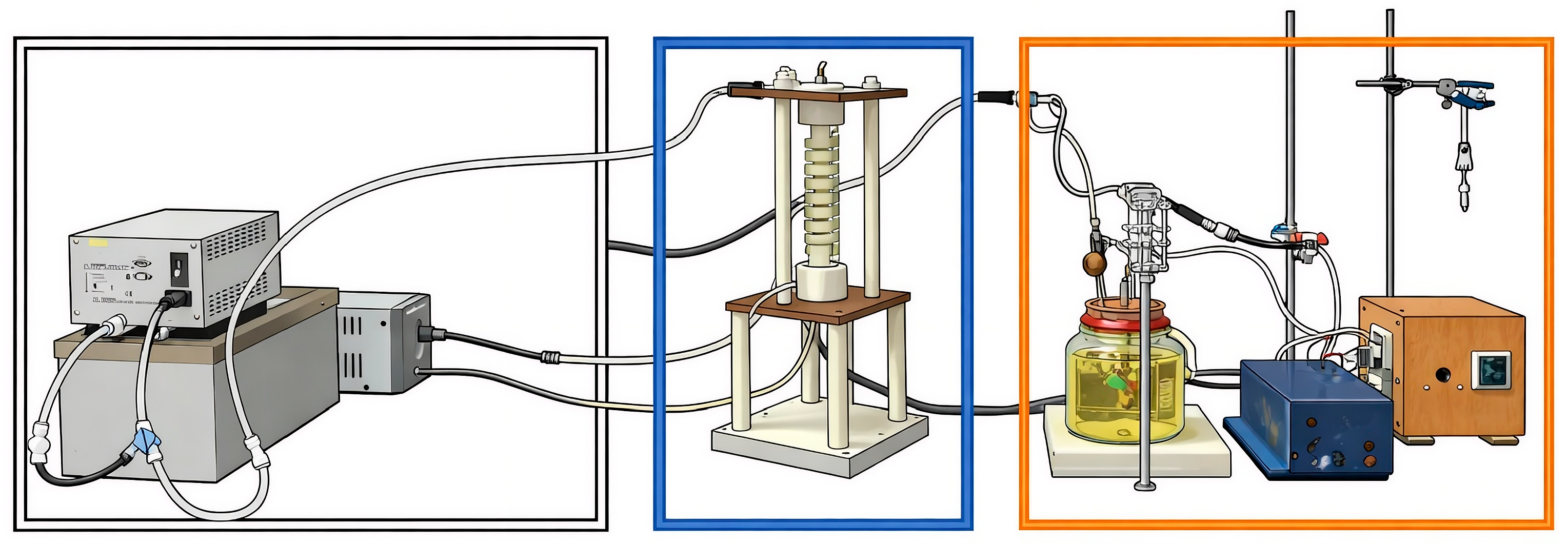
Column adsorption experiments (Figure 8) were conducted using a differential fixed-bed configuration, specifically designed to evaluate the dynamic performance of QS-x porous aerogel material, which has two phases (solid–liquid), and to promote homogeneous dispersion of the contaminant under continuous operation. The adsorption column consisted of a transparent tempered glass tube fitted with nylon plugs and internal couplings to ensure axial flow. The column had an internal diameter of approximately 2 cm and an effective bed length of 22 cm of packed material of approx. 0.8 g. The adsorbent bed was formed by stacked cylindrical CS/R aerogel tubes, arranged to operate under differential conditions and minimize axial dispersion [71].
The feed solution was stored in a double-walled, stirred glass tank equipped with inlet and outlet ports and a shaft-driven mechanical stirrer with 7 and 14 min intervals to maintain a constant concentration throughout the experiment. Solution circulation was achieved using a peristaltic pump (Masterflex® 7518-00, Barrington, IL, USA) with an Easy-Load L/S pump head), which operated at a flow rate of approximately 90 to 100 mL min−1 and ensured stable hydrodynamic conditions during operation. The system was operated in closed-loop recirculation mode at ambient temperature (25 °C) without pH adjustment. The adsorption column effluent was collected from the stirred tank using a syringe to determine adsorption kinetics. Before each kinetic analysis, a conditioning treatment was carried out for 4 h until a neutral pH was detected in the adsorbent column. This pH was measured by taking 2 mL aliquots at different contact times. The kinetics were performed with adsorption tests at different Cr(VI) concentrations, ranging from 20 to 140 g·mg−1, over a maximum time of 24 h, at which point the concentrations reached equilibrium. The Cr(VI) removal efficiency was calculated from these data details of column assembly in Supplementary Materials.
The adsorption kinetics of the Cr(VI) was studied on the CS85/R15 aerogels, using pseudo-first order and pseudo-second-order kinetic models, Equations (6) and (7), respectively [72].
l n ( q e q t ) = l n q e K 1 t    
t q t = 1 k 2   q e 2 + t q e  
where qe and qt (g·mg−1) indicate the adsorption capacities at equilibrium time t (h), k1 (min−1) is the constant rate for the pseudo-first order, and k2 (g·mg−1·min−1) is the constant rate of the pseudo-second order.
Following the isotherm analysis, we use the Langmuir model for fitting, and adsorption takes place at specific, equivalent surface sites until a monolayer is completed, with no interaction between the adsorbed molecules; under these assumptions, the equilibrium can be described by the classical Langmuir Equation (8).
Q e = Q m K L C e 1 + K L C e  
The Freundlich isotherm [73] accounts for heterogeneous surface energies and multilayer adsorption, permitting interactions between adsorbate molecules and the surface, a behavior commonly linked to chemisorption, as described by the Freundlich Equation (9).
Q e = K F C e 1 n    
where Qe (mg·g−1) indicates the adsorption capacity at equilibrium in the solid phase, Qm (mg·g−1) represents the maximum quantity of adsorbed molecules on to the surface, Ce (mg·L−1) represents the concentration of the molecules at equilibrium, KL (L·mg−1) represents the Langmuir constant, and KF (mg·g−1) and 1/n are Freundlich constant being an indicator of heterogeneity and intensity [31,74].

Supplementary Materials

The following supporting information can be downloaded at: https://www.mdpi.com/article/10.3390/gels12040330/s1, Figure S1: Adsorption kinetics, Figures S2–S4: Isotherm models fitted to Langmuir and Freundlich and Pseudo Second Order Ho and Mckay.

Author Contributions

Methodology, J.F.-G., J.M.R. and Á.d.J.M.-G.; formal analysis, J.M.R. and Á.d.J.M.-G., writing—original draft preparation, J.F.-G. and J.M.R.; writing—review and editing, M.V.-L., J.M.R. and V.H.R.-A.; supervision, M.V.-L. and V.H.R.-A. All authors have read and agreed to the published version of the manuscript.

Funding

A graduate scholarship (721625) of Jean Flores-Gómez was provided by the Secretariat of Science, Humanities, Technology and Innovation of Mexico (SECIHTI) before CONACYT.

Institutional Review Board Statement

Not applicable.

Informed Consent Statement

Not applicable.

Data Availability Statement

Data is available from the corresponding author upon request.

Acknowledgments

Thanks to the UdG (University of Guadalajara) institutional support for the pro SNI funding projects. During the preparation of this manuscript, the authors used Microsoft 365 Copilot for spelling and grammar correction. A scheme was created using ChatGPT (version 5.3 Go), based on real photographs of the experimental setup. Additionally, the configuration photographs were retouched and rearranged for schematic purposes. The authors have reviewed and edited all content generated by these tools and take full responsibility for the accuracy and integrity of the published work.

Conflicts of Interest

The authors declare no conflicts of interest.

Abbreviations

CSChitosan
CSW%Chitosan percentage on weight %
RResole solution (prepolymer)
RW%Resole percentage on weight %

References

  1. Khulbe, K.C.; Matsuura, T. Removal of Heavy Metals and Pollutants by Membrane Adsorption Techniques. Appl. Water Sci. 2018, 8, 19. [Google Scholar] [CrossRef]
  2. Akpor, O.B.; Muchie, M. Remediation of Heavy Metals in Drinking Water and Wastewater Treatment Systems: Processes and Applications. Int. J. Phys. Sci. 2010, 5, 1807–1817. [Google Scholar]
  3. Ngah, W.S.W.; Teong, L.C.; Hanafiah, M.A.K.M. Adsorption of Dyes and Heavy Metal Ions by Chitosan Composites: A Review. Carbohydr. Polym. 2011, 83, 1446–1456. [Google Scholar] [CrossRef]
  4. Zhang, L.; Zeng, Y.; Cheng, Z. Removal of Heavy Metal Ions Using Chitosan and Modified Chitosan: A Review. J. Mol. Liq. 2016, 214, 175–191. [Google Scholar] [CrossRef]
  5. Rodríguez-Pedroso, A.T.; Ramírez-Arrebato, M.A.; Rivero-González, D.; Bosquez-Molina, E.; Barrera-Necha, L.L.; Bautista-Baños, S. Propiedades Químico-Estructurales Y Actividad Biológica De La Quitosana. Rev. Chapingo Ser. Hortic. 2009, 15, 307–317. [Google Scholar]
  6. Babel, S.; Kurniawan, T.A. Low-Cost Adsorbents for Heavy Metals Uptake from Contaminated Water: A Review. J. Hazard. Mater. 2003, 97, 219–243. [Google Scholar] [CrossRef]
  7. Vieira, R.S.; Beppu, M.M. Dynamic and Static Adsorption and Desorption of Hg(II) Ions on Chitosan Membranes and Spheres. Water Res. 2006, 40, 1726–1734. [Google Scholar] [CrossRef]
  8. Aydin, Y.A.; Aksoy, N.D. Adsorption of Chromium on Chitosan: Optimization, Kinetics and Thermodynamics. Chem. Eng. J. 2009, 151, 188–194. [Google Scholar] [CrossRef]
  9. Maleki, H. Recent Advances in Aerogels for Environmental Remediation Applications: A Review. Chem. Eng. J. 2016, 300, 98–118. [Google Scholar] [CrossRef]
  10. Shahbazi, M.A.; Ghalkhani, M.; Maleki, H. Directional Freeze-Casting: A Bioinspired Method to Assemble Multifunctional Aligned Porous Structures for Advanced Applications. Adv. Eng. Mater. 2020, 22, 2000033. [Google Scholar] [CrossRef]
  11. Chavez, A.; Colina, M.; Valbuena, A.; Lopez, A. Obtencion y Caracterización de Películas de Quitosano Elaborado a Partir de Los Desechos de La Industria Cangrejera. Rev. Iberoam. Polímeros 2012, 13, 77–88. [Google Scholar]
  12. Zhang, X.; Shi, X.; Ma, L.; Pang, X.; Li, L. Preparation of Chitosan Stacking Membranes for Adsorption of Copper Ions. Polymers 2019, 11, 1463. [Google Scholar] [CrossRef] [PubMed]
  13. Chaudary, A.; Patoary, M.K.; Zhang, M.; Chudhary, T.; Farooq, A.; Liu, L. Structurally Integrated Thermal Management of Isotropic and Directionally Ice-Templated Nanocellulose/Chitosan Aerogels. Cellulose 2022, 29, 8265–8282. [Google Scholar] [CrossRef]
  14. Zhao, N.; Li, M.; Gong, H.; Bai, H. Controlling Ice Formation on Gradient Wettability Surface for High-Performance Bioinspired Materials. Sci. Adv. 2020, 6, eabb4712. [Google Scholar] [CrossRef] [PubMed]
  15. Yu, Z.-L.; Yang, N.; Zhou, L.; Ma, Z.-Y.; Zhu, Y.; Lu, Y.; Qin, B.; Xing, W.-Y.; Ma, T.; Li, S.-C.; et al. Bioinspired Polymeric Woods. Sci. Adv. 2018, 4, eaat7223. [Google Scholar] [CrossRef]
  16. Chen, Y.; Zhang, H.B.; Wang, M.; Qian, X.; Dasari, A.; Yu, Z.Z. Phenolic Resin-Enhanced Three-Dimensional Graphene Aerogels and Their Epoxy Nanocomposites with High Mechanical and Electromagnetic Interference Shielding Performances. Compos. Sci. Technol. 2017, 152, 254–262. [Google Scholar] [CrossRef]
  17. Song, P.; Dai, J.; Chen, G.; Yu, Y.; Fang, Z.; Lei, W.; Fu, S.; Wang, H.; Chen, Z.G. Bioinspired Design of Strong, Tough, and Thermally Stable Polymeric Materials via Nanoconfinement. ACS Nano 2018, 12, 9266–9278. [Google Scholar] [CrossRef]
  18. Grishechko, L.I.; Amaral-Labat, G.; Szczurek, A.; Fierro, V.; Kuznetsov, B.N.; Celzard, A. Lignin-Phenol-Formaldehyde Aerogels and Cryogels. Microporous Mesoporous Mater. 2013, 168, 19–29. [Google Scholar] [CrossRef]
  19. Sahebjamee, N.; Soltanieh, M.; Mousavi, S.M.; Heydarinasab, A. Preparation and Characterization of Porous Chitosan–Based Membrane with Enhanced Copper Ion Adsorption Performance. React. Funct. Polym. 2020, 154, 104681. [Google Scholar] [CrossRef]
  20. Iliasu, G.; Kogo, A.; Yakubu, M. Optimization of Mechanical Properties of Chitosan/Phenol Formaldehyde Composite. Bayero J. Pure Appl. Sci. 2018, 11, 229–235. [Google Scholar] [CrossRef]
  21. Liu, D.; Zhang, H.; Mei, J.; Zheng, X.; Rong, J.; Li, Z. Highly Efficient Adsorption of Cr(VI) by Mechanically Enhanced Chitosan Oligosaccharide Aerogel with Hierarchical Porosity. Langmuir 2025, 41, 8602–8610. [Google Scholar] [CrossRef] [PubMed]
  22. Flores-Gómez, J.; Romero Arellano, V.H.; Vazquez-Lepe, M.; Martínez-Gómez, A.d.J.; Morales-Rivera, J. Modeling and Optimization of the Adsorption of Cr (VI) in a Chitosan-Resole Aerogel Using Response Surface Methodology. Gels 2023, 9, 197. [Google Scholar] [CrossRef] [PubMed]
  23. Rocha, L.S.; Almeida, A.; Nunes, C.; Henriques, B.; Coimbra, M.A.; Lopes, C.B.; Silva, C.M.; Duarte, A.C.; Pereira, E. Simple and Effective Chitosan Based Films for the Removal of Hg from Waters: Equilibrium, Kinetic and Ionic Competition. Chem. Eng. J. 2016, 300, 217–229. [Google Scholar] [CrossRef]
  24. Salazar, M.C.; Negrón, A.V. Preparación Y Caracterización De Películas De Quitosano Despolimerizado Y Reticulado Con Tripolifosfato De Sodio Preparation and Characterization of Depolymerised Chitosan Films and Crosslinked with Sodium Tripolyphosphate. Rev. Soc. Química Perú 2013, 79, 195–208. [Google Scholar]
  25. Tasselli, F.; Mirmohseni, A.; Seyed Dorraji, M.S.; Figoli, A. Mechanical, Swelling and Adsorptive Properties of Dry-Wet Spun Chitosan Hollow Fibers Crosslinked with Glutaraldehyde. React. Funct. Polym. 2013, 73, 218–223. [Google Scholar] [CrossRef]
  26. Mirmohseni, A.; Seyed Dorraji, M.S.; Figoli, A.; Tasselli, F. Chitosan Hollow Fibers as Effective Biosorbent toward Dye: Preparation and Modeling. Bioresour. Technol. 2012, 121, 212–220. [Google Scholar] [CrossRef]
  27. Li, L.; Li, Y.; Cao, L.; Yang, C. Enhanced Chromium (VI) Adsorption Using Nanosized Chitosan Fibers Tailored by Electrospinning. Carbohydr. Polym. 2015, 125, 206–213. [Google Scholar] [CrossRef]
  28. He, Z.Y.; Nie, H.L.; Branford-White, C.; Zhu, L.M.; Zhou, Y.T.; Zheng, Y. Removal of Cu2+ from Aqueous Solution by Adsorption onto a Novel Activated Nylon-Based Membrane. Bioresour. Technol. 2008, 99, 7954–7958. [Google Scholar] [CrossRef]
  29. Vieira, R.S.; Beppu, M.M. Mercury Ion Recovery Using Natural and Crosslinked Chitosan Membranes. Adsorption 2005, 11, 731–736. [Google Scholar] [CrossRef]
  30. Chen, D.; Li, W.; Wu, Y.; Zhu, Q.; Lu, Z.; Du, G. Preparation and Characterization of Chitosan/Montmorillonite Magnetic Microspheres and Its Application for the Removal of Cr (VI). Chem. Eng. J. 2013, 221, 8–15. [Google Scholar] [CrossRef]
  31. Verduzco Navarro, I.P.; Mendizábal, E.; Rivera Mayorga, J.A.; Rentería-Urquiza, M.; Gonzalez-Alvarez, A.; Rios-Donato, N. Arsenate Removal from Aqueous Media Using Chitosan-Magnetite Hydrogel by Batch and Fixed-Bed Columns. Gels 2022, 8, 186. [Google Scholar] [CrossRef] [PubMed]
  32. Thinh, N.N.; Hanh, P.T.B.; Ha, L.T.T.; Anh, L.N.; Hoang, T.V.; Hoang, V.D.; Dang, L.H.; Van Khoi, N.; Lam, T.D. Magnetic Chitosan Nanoparticles for Removal of Cr(VI) from Aqueous Solution. Mater. Sci. Eng. C 2013, 33, 1214–1218. [Google Scholar] [CrossRef] [PubMed]
  33. Yu, Z.; Zhang, X.; Huang, Y. Magnetic Chitosan-Iron(III) Hydrogel as a Fast and Reusable Adsorbent for Chromium(VI) Removal. Ind. Eng. Chem. Res. 2013, 52, 11956–11966. [Google Scholar] [CrossRef]
  34. Pérez-Fonseca, A.A.; Gómez, C.; Dávila, H.; González-Núñez, R.; Robledo-Ortíz, J.R.; Vázquez-Lepe, M.O.; Herrera-Gómez, A. Chitosan Supported onto Agave Fiber’postconsumer HDPE Composites for Cr(VI) Adsorption. Ind. Eng. Chem. Res. 2012, 51, 5939–5946. [Google Scholar] [CrossRef]
  35. Vázquez, M.O.; Herrera, V.S.; Gómez, C.; Gómez-Salazar, S.; Rodrigue, D.; González-Núñez, R.; Luna-Barcenas, J.G.; Mani-González, P.G.; Herrera-Gomez, A. Postconsumer High-Density Polyethylene/Agave Fiber Foamed Composites Coated with Chitosan for the Removal of Heavy Metals. J. Appl. Polym. Sci. 2010, 115, 2971–2980. [Google Scholar] [CrossRef]
  36. Li, N.; Bai, R. A Novel Amine-Shielded Surface Cross-Linking of Chitosan Hydrogel Beads for Enhanced Metal Adsorption Performance. Ind. Eng. Chem. Res. 2005, 44, 6692–6700. [Google Scholar] [CrossRef]
  37. Verduzco-Navarro, I.P.; Rios-Donato, N.; Jasso-Gastinel, C.F.; Martínez-Gómez, Á.d.J.; Mendizábal, E. Removal of Cu(II) by Fixed-Bed Columns Using Alg-Ch and Alg-Chs Hydrogel Beads: Effect of Operating Conditions on the Mass Transfer Zone. Polymers 2020, 12, 2345. [Google Scholar] [CrossRef]
  38. Noè, C.; Zanon, M.; Arencibia, A.; López-Muñoz, M.-J.; Fernández de Paz, N.; Calza, P.; Sangermano, M. UV-Cured Chitosan and Gelatin Hydrogels for the Removal of As(V) and Pb(II) from Water. Polymers 2022, 14, 1268. [Google Scholar] [CrossRef]
  39. Ma, M.; Mukerabigwi, J.F.; Huang, R.; Lei, S.; Huang, X.; Cao, Y. Eco-Friendly Superabsorbent Synthesis Based on Polysaccharides. J. Polym. Environ. 2020, 28, 2801–2809. [Google Scholar] [CrossRef]
  40. Qi, H.J.; Joyce, K.; Boyce, M.C. Durometer Hardness and the Stress-Strain Behavior of Elastomeric Materials. Rubber Chem. Technol. 2003, 76, 419–435. [Google Scholar] [CrossRef]
  41. Davies, M. High Resolution XPS of Organic Polymers: The Scienta ESCA300 Database; Beamson, G., Briggs, D., Eds.; John Wiley: Chichester, UK, 1994. [Google Scholar]
  42. Herrera-Gomez, A. Uncertainties in Photoemission Peak Fitting Accounting for the Covariance with Background Parameters. J. Vac. Sci. Technol. A 2020, 38, 033211. [Google Scholar] [CrossRef]
  43. Ruan, J.Q.; Xie, K.Y.; Wan, J.N.; Chen, Q.Y.; Zuo, X.; Li, X.; Wu, X.; Fei, C.; Yao, S. Effects of Freeze-Drying Processes on the Acoustic Absorption Performance of Sustainable Cellulose Nanocrystal Aerogels. Gels 2024, 10, 141. [Google Scholar] [CrossRef] [PubMed]
  44. Zhou, R.; Ren, Y.; Mashhadi, M.E.; Jiang, C.; Lu, Q. Feasibility Evaluation of Flowback and Produced Water Treatment via Interfacial Solar Evaporation: Experimental Validation and Techno-Economic Analysis. J. Water Process Eng. 2025, 80, 109094. [Google Scholar] [CrossRef]
  45. Karimi, A.; Paydar, M.H. Investigation on the Mechanical Behavior and Fracture Mode of Ice-Templated NiO-YSZ Anode Electrode for Solid Oxide Fuel Cells Application. J. Mater. Eng. Perform. 2024, 33, 6499–6506. [Google Scholar] [CrossRef]
  46. Saeed, M.U.; Weng, Y.K.; Bahzad, M.; Shin, S.; Aaron, D.S.; Kihm, K.D. Structural Formation and Pore Control of Freeze-Cast Directional Graphene Aerogel (DGA). ACS Appl. Mater. Interfaces 2024, 16, 425–434. [Google Scholar] [CrossRef]
  47. Hu, X.J.; Wang, J.S.; Liu, Y.G.; Li, X.; Zeng, G.M.; Bao, Z.L.; Zeng, X.X.; Chen, A.W.; Long, F. Adsorption of Chromium (VI) by Ethylenediamine-Modified Cross-Linked Magnetic Chitosan Resin: Isotherms, Kinetics and Thermodynamics. J. Hazard. Mater. 2011, 185, 306–314. [Google Scholar] [CrossRef]
  48. Yin, R.; Cheng, H.; Hong, C.; Zhang, X. Synthesis and Characterization of Novel Phenolic Resin/Silicone Hybrid Aerogel Composites with Enhanced Thermal, Mechanical and Ablative Properties. Compos. Part A Appl. Sci. Manuf. 2017, 101, 500–510. [Google Scholar] [CrossRef]
  49. Habiba, U.; Afifi, A.M.; Salleh, A.; Ang, B.C. Chitosan/(Polyvinyl Alcohol)/Zeolite Electrospun Composite Nanofibrous Membrane for Adsorption of Cr6+, Fe3+ and Ni2+. J. Hazard. Mater. 2017, 322, 182–194. [Google Scholar] [CrossRef]
  50. Flores-Gómez, J.; Villegas-Ruvalcaba, M.; Blancas-Flores, J.; Morales-Rivera, J. Chitosan–Resole–Pectin Aerogel in Methylene Blue Removal: Modeling and Optimization Using an Artificial Neuron Network. ChemEngineering 2023, 7, 82. [Google Scholar] [CrossRef]
  51. Filimonova, E.; Bergmann, T.; Zhao, S.; Dyatlov, V.A.; Malfait, W.J.; Wu, T. Effect of Polymer Concentration and Cross-Linking Density on the Microstructure and Properties of Polyimide Aerogels. J. Sol-Gel Sci. Technol. 2024, 110, 747–759. [Google Scholar] [CrossRef]
  52. Privar, Y.; Skatova, A.; Maiorova, M.; Golikov, A.; Boroda, A.; Bratskaya, S. Tuning Mechanical Properties, Swelling, and Enzymatic Degradation of Chitosan Cryogels Using Diglycidyl Ethers of Glycols with Different Chain Length as Cross-Linkers. Gels 2024, 10, 483. [Google Scholar] [CrossRef]
  53. Wang, X.; Jing, S.; Hou, Z.; Liu, Y.; Qiu, X.; Liu, Y.; Tan, Y. Permeable, Robust and Magnetic Hydrogel Beads: Water Droplet Templating Synthesis and Utilization for Heavy Metal Ions Removal. J. Mater. Sci. 2018, 53, 5009–15024. [Google Scholar] [CrossRef]
  54. Alonso, M. Formulación y Curado de Resinas Fenol-Formaldehído Tipo Resol Con Sustitución Parcial Del Fenol Por Lignosulfonatos Modificados. Doctoral Dissertation, Universidad Complutense de Madrid, Madrid, Spain, 2002. [Google Scholar]
  55. Taverna, M.E.; Nicolau, V.V.; Felissia, F.E.; Area, M.C.; Estenoz, D.A.; Meira, G. Empleo de Ligninas Comerciales y Organosolv En La Síntesis de Resoles. Estudio de La Hidroximetilación. SAP 2013, 2–5. [Google Scholar]
  56. Myers, G.E.; Christiansen, A.W.; Geimer, R.L.; Follensbee, R.A.; Koutsky, J.A. Phenol–Formaldehyde Resin Curing and Bonding in Steam-injection Pressing. I. Resin Synthesis, Characterization, and Cure Behavior. J. Appl. Polym. Sci. 1991, 43, 237–250. [Google Scholar] [CrossRef]
  57. Poljanšek, I.; Krajnc, M. Characterization of Phenol-Formaldehyde Prepolymer Resins by in Line FT-IR Spectroscopy. Acta Chim. Slov. 2005, 52, 238–244. [Google Scholar]
  58. Perentena, L.; Celis, B.; Valbuena, A. Síntesis de Bases de Schiff Derivadas del Quitosano Por Metoxibenzaldehido. Rev. Iberoam. Polímeros 2015, 16, 1–27. [Google Scholar]
  59. Maachou, H.; Genet, M.J.; Aliouche, D.; Dupont-Gillain, C.C.; Rouxhet, P.G. XPS Analysis of Chitosan-Hydroxyapatite Biomaterials: From Elements to Compounds. Surf. Interface Anal. 2013, 45, 1088–1097. [Google Scholar] [CrossRef]
  60. Vickerman, J.C.; Gilmore, I.S. Surface Analysis—The Principal Techniques, 2nd ed.; John Wiley & Sons: Hoboken, NJ, USA, 2009. [Google Scholar]
  61. Liu, W.; Lou, T.; Wang, X. Enhanced Dye Adsorption with Conductive Polyaniline Doped Chitosan Nanofibrous Membranes. Int. J. Biol. Macromol. 2023, 242, 124711. [Google Scholar] [CrossRef]
  62. Liu, Q.; Yu, H.; Zeng, F.; Li, X.; Sun, J.; Li, C.; Lin, H.; Su, Z. HKUST-1 Modified Ultrastability Cellulose/Chitosan Composite Aerogel for Highly Efficient Removal of Methylene Blue. Carbohydr. Polym. 2021, 255, 117402. [Google Scholar] [CrossRef]
  63. Aliabadi, M. Removal of Pb(II) and Cr(VI) Ions from Aqueous Solutions Using Chitosan/Cobalt Ferrite Nanofibrous Adsorbent. Fibers Polym. 2016, 17, 1162–1170. [Google Scholar] [CrossRef]
  64. Zhao, J.; Yang, C.; He, J.; Liu, L.; Yao, J.; Yang, Y.; Xu, K.; Feng, W.; Du, G.; Zhang, L. Cellulose/Covalent Organic Framework Aerogel for Efficient Removal of Cr(VI): Performance and Mechanism Study. Int. J. Biol. Macromol. 2025, 300, 140243. [Google Scholar] [CrossRef]
  65. Guo, D.M.; An, Q.D.; Xiao, Z.Y.; Zhai, S.R.; Yang, D.J. Efficient Removal of Pb(II), Cr(VI) and Organic Dyes by Polydopamine Modified Chitosan Aerogels. Carbohydr. Polym. 2018, 202, 306–314. [Google Scholar] [CrossRef]
  66. Santos-López, G.; Argüelles-Monal, W.; Carvajal-Millan, E.; López-Franco, Y.L.; Recillas-Mota, M.T.; Lizardi-Mendoza, J. Aerogels from Chitosan Solutions in Ionic Liquids. Polymers 2017, 9, 722. [Google Scholar] [CrossRef]
  67. Yeh, J.J.; Lindau, I. Atomic Subshell Photoionization Cross Sections and Asymmetry Parameters. At. Data Nucl. Data Tables 1985, 32, 1–155. [Google Scholar] [CrossRef]
  68. Scofield, J.H. Hartree-Slater Subshell Photoionization Cross-Sections at 1254 and 1487 EV. J. Electron Spectrosc. Relat. Phenom. 1976, 8, 129–137. [Google Scholar] [CrossRef]
  69. ASTM D2240-05; Standard Test Method for Rubber Property (Durometer Hardness). Building System Performance: Wellington, New Zealand, 2019.
  70. ISO 7619-1:2004; Rubber, Vulcanized or Thermoplastic—Determination of Indentation Hardness. ISO: Geneva, Switzerland, 2004.
  71. Martinez Madrigal, S. Método Para La Determinación de La Cinética de Adsorción Solido-Liquido En El Caso de Un Adsorbente Flotable. Ph.D Thesis, Universidad de Guadalajara, Guadalajara, Mexico, 2020. [Google Scholar]
  72. Recio-Colmenares, C.L.; Flores-Gómez, J.; Morales Rivera, J.P.; Palacios Hinestroza, H.; Sulbarán-Rangel, B. Green Materials for Water and Wastewater Treatment: Mechanisms and Artificial Intelligence. Processes 2025, 13, 566. [Google Scholar] [CrossRef]
  73. Kyzas, G.Z.; Kostoglou, M. Green Adsorbents for Wastewaters: A Critical Review. Materials 2014, 7, 333–364. [Google Scholar] [CrossRef]
  74. Kecili, R.; Hussain, C.M. Mechanism of Adsorption on Nanomaterials; Elsevier Inc.: New York, NY, USA, 2018. [Google Scholar]
Figure 1. (1) Final geometry structure obtained from the cylindrical recipient of CS-x aerogels without thermal treatment (a) CS100/R0, (b) CS95/R5, (c) CS90/10, (d) CS85/R15, (e) CS80/R20, (f) CS75/R25, (g) CS70/R30, (h) CS65/R35, (i) CS60/R40 (j) CS55/R45 and (k) CS50/R50; (2) SEM micrograph magnification of (a) CS100/R0 without resole.
Gels 12 00330 g001
Figure 2. Cross-section SEM micrographs for different resole ratio formulations, lamellar internal structure decreases and porous structures are observed from CS100/R0 to CS50/R50 proportional resole ratios from (ak).
Gels 12 00330 g002
Figure 3. Shore measurement of the hardness of the CS-x aerogels after the thermal treatment. Samples of CS/R x aerogels: (a) CS100/R0, (b) CS85/R15, (c) CS70/R30 and (d) CS50/R50.
Gels 12 00330 g003
Figure 4. (a) FT-IR comparison of chitosan powder, CS85R15 aerogel and resole (Critical functional groups (blue and red) are visible on CS85R15; (b) FT-IR comparison of CS85R15 aerogel and CS50R50 aerogel (* intensification of the bands associated with methylene bridges (1450 cm−1) and ether bonds (C–O–C 1100 cm−1).
Gels 12 00330 g004
Figure 5. This figure shows the XPS analysis comparisons: (a) survey of resole, CS-x aerogel and Cr (VI) loaded CS85/R15; (b) carbon 1s comparison high-resolution spectra; (c) oxygen 1s comparison high-resolution spectra; (d) nitrogen 1s comparison high-resolution spectra; (An increase or decrease in the number of electrons is observed from the corresponding deconvolutions. The features are depicted using the same color, as they correspond to the same bond identified). (e) Cr2p high-resolution spectra.
Gels 12 00330 g005
Figure 6. (1) Adsorption of batch experiments with and without thermal treatment. (2) Pieces of CS-aerogel CS90/10 with thermal treatment, (a) dry, (b) wet, (c) dry with Cr(VI) after adsorption, and CS-aerogel CS90/10 without thermal treatment (d) dry, (e) wet, (f) dry with Cr(VI) after adsorption.
Gels 12 00330 g006
Figure 7. pH evolution during the adsorption kinetics at 24 h from the concentrations of 20 to 140 (mg·L−1).
Gels 12 00330 g007
Figure 8. Schematic representation of the experimental continuous adsorption setup, showing the temperature recirculation unit (white box), the differential fixed-bed adsorption column packed with stacked CS/R aerogel tempered glass tubes (blue box), the mechanically agitated feed tank with thermal jacket (orange box), which was operating under closed-loop recirculation with a peristaltic pump for flow control. A scheme was created using ChatGPT 5.3 Go, based on real photographs of the experimental setup.
Gels 12 00330 g008
Table 1. Swelling percentage (S%).
Short NameAverage Dry Weight After Curing (g)Average Wet Weight (g)Swelling Percentage S%Apparent Density (g cm−3)
CS100/R0 10.103 +/− 0.0055.340 +/− 0.42550681.305
CS95/R05 10.146 +/− 0.0203.376 +/− 0.17221970.805
CS90/R10 10.166 +/− 0.0152.893 +/− 0.09016330.680
CS85/R15 10.193 +/− 0.0152.183 +/− 0.14110290.496
CS80/R20 10.200 +/− 0.0751.756 +/− 0.0257780.388
CS75/R25 10.236 +/− 0.0051.586 +/− 0.1425700.336
CS70/R30 10.480 +/− 0.0261.553 +/− 0.1122240.268
CS65/R35 10.483 +/− 0.0051.460 +/− 0.0982020.243
CS60/R40 10.573 +/− 0.0201.513 +/− 0.1121640.234
CS55/R45 10.560 +/− 0.0471.376 +/− 0.0401460.204
CS50/R50 10.670 +/− 0.0451.320 +/− 0.121970.162
1 combination with respect to a volume of 4 mL.
Table 2. Elementary composition from XPS analysis by component deconvoluted and its corresponding defined binding energy (eV) (with respect to main elements except hydrogen %).
SampleBe (eV)C1sBe (eV)O1sBe (eV)N1s
Resole284.868%533.018%
286.114%539.9Shake off
291.5Shake off
CS75R25285.331%534.326%401.32.3%
286.821.3%533.50.5%399.90.1%
287.615%
288.84%
292.4Shake off
CS85/R15285.422%534.326.2%401.35.4%
286.923.3%533.02.4%399.90.6%
287.712%532.01.2%
289.94%
283.92%
CS95/R05285.416%534.715%401.34.8%
286.829%533.413%399.91.5%
288.216%532.12%
289.52.4%
284.53%
Table 3. Isotherm analysis.
FreundlichLangmuir
log Kf (L/g)Kf1/nR2Qmax (mg·g−1)b (L/mg)R2
0.72482.5070.66670.9786100.80.8060.9634
Table 4. CS-based adsorbent comparison.
AdsorbentpHQmax
(mg·g−1)
Temperature
(°C)
Contact Time
(h)
Adsorbent
Dose (g/L)
Kinetic
Model
Isotherm
CS flakes [8]322.0925413PSOLangmuir
Crosslinked CS resin [47]245.874015PSOLangmuir/
Temkin
Electrospun CS nanofibers [32]3131.5825810PSOFreundlich/
Langmuir
CS/cobalt ferrite nanofibrous [63]2–3175.2–178.2–179.125–35–4515PSOFreundlich/
Langmuir
Nylon-supported adsorptive membrane [28]410.794251NRPSOLangmuir
Covalent organic frameworks cellulose aerogel [64]3411.12–349.66–307.7315–25–35122.5PSOLangmuir
PDA-modified CS aerogel beads [65]2374.4NR24NRPSOLangmuir
CS reinforced with hard multi-walled carbon nanotube aerogel [21]3367.63022.5PSOLangmuir
CS85/R15 this work5–5.5100.825240.8PSOFreundlich/
Langmuir
Table 5. Formulation of CS/R aerogel adsorbents with mass balance based on CS solution.
Short NameAverage Dry Weight
After Curing (g)
CS Diluted on Weight (g)CS Percentage on Weight CSW%
CS100/R0 10.103 +/− 0.0050.07976.69%
CS95/R05 10.159 +/− 0.0200.07547.16%
CS90/R10 10.199 +/− 0.0150.07135.76%
CS85/R15 10.227 +/− 0.0150.06729.51%
CS80/R20 10.282 +/− 0.0750.06322.34%
CS75/R25 10.247 +/− 0.0050.05923.88%
CS70/R30 10.290 +/− 0.0260.05518.96%
CS65/R35 10.315 +/− 0.0050.05116.19%
CS60/R40 10.333 +/− 0.0200.04714.11%
CS55/R45 10.338 +/− 0.0470.04312.72%
CS50/R50 10.406 +/− 0.0450.0399.60%
1 Combination with respect to a volume of 4 mL, ρ C S 0.987 g/mL and ρ R 1.014 g/mL; (CSX1/X2): X1 % solution of CS with X2 % solution of R.
Disclaimer/Publisher’s Note: The statements, opinions and data contained in all publications are solely those of the individual author(s) and contributor(s) and not of MDPI and/or the editor(s). MDPI and/or the editor(s) disclaim responsibility for any injury to people or property resulting from any ideas, methods, instructions or products referred to in the content.