
Genetic Diversity and Gene Flow of the Ectomycorrhizal Mushroom Lactarius hatsudake in Southern China: Evidence from SSR Markers


Abstract
1. Introductiona
2. Materials and Methods
2.1. Sample Collection, Identification and DNA Extraction
2.2. SSR Marker Screening and Genotyping Analysis
2.3. Data Analysis
3. Results
3.1. Polymorphism of SSR Markers and Population Genetic Diversity
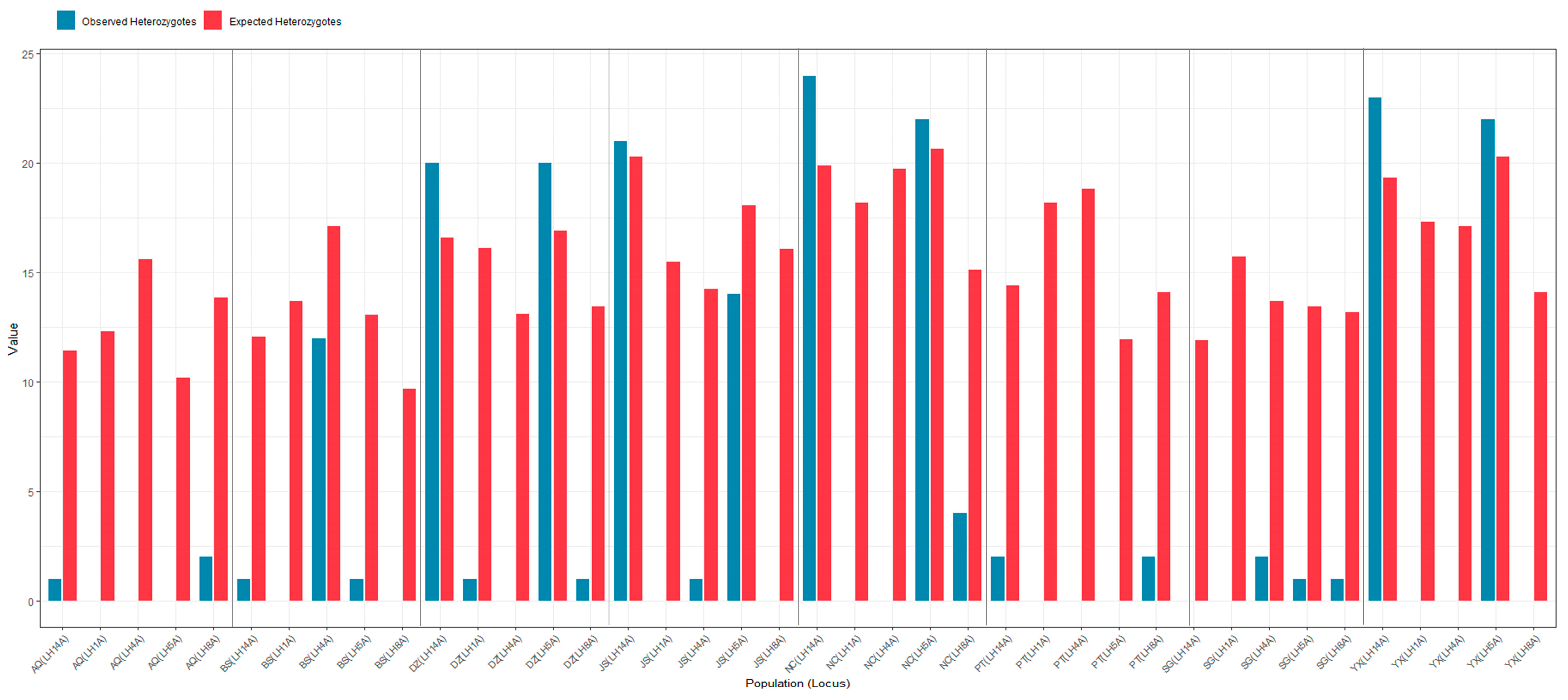
3.2. Hardy–Weinberg Equilibrium and Linkage Disequilibrium
3.3. Population Genetic Differentiation and Gene Flow
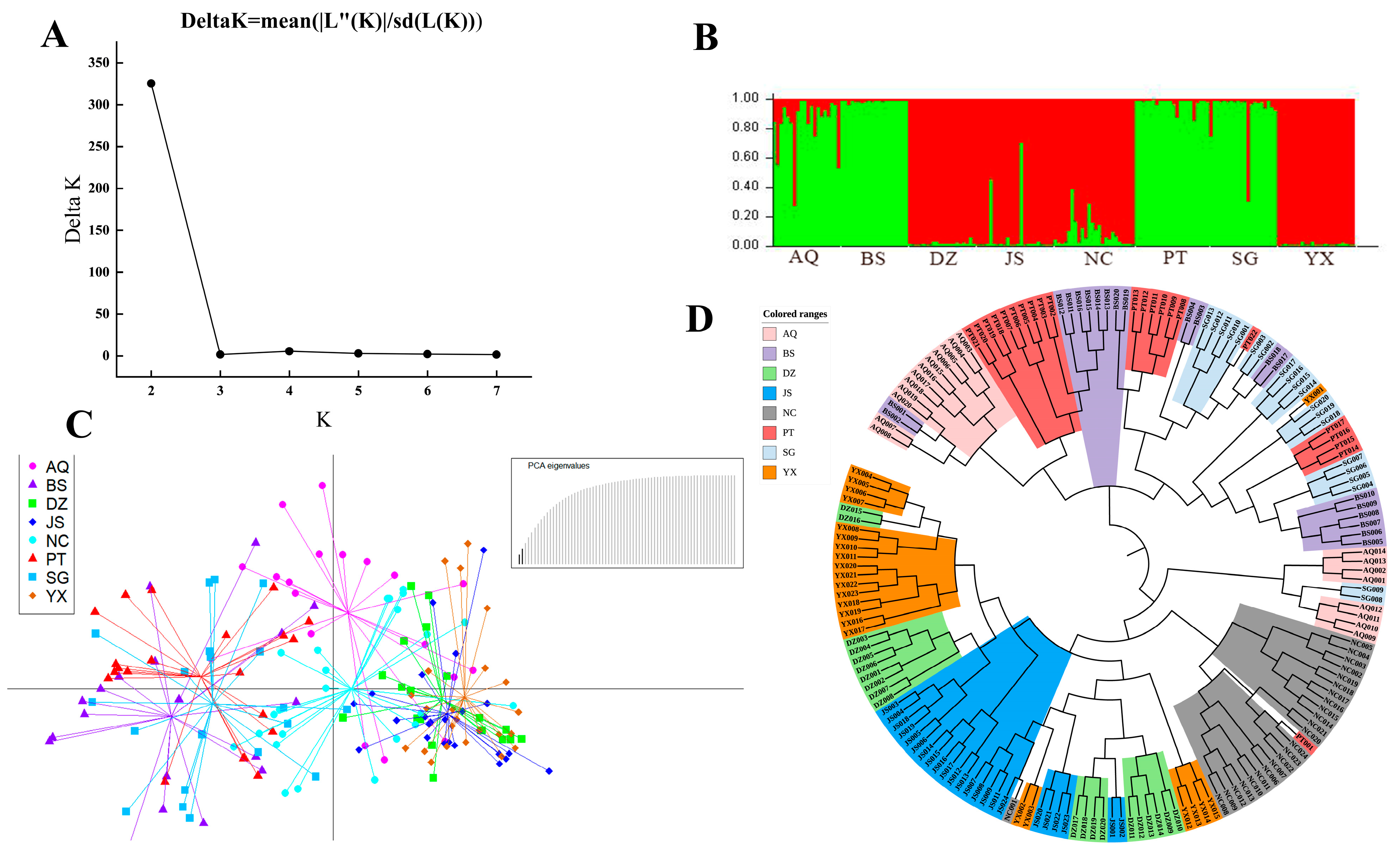
3.4. Population Structure
4. Discussion
5. Conclusions
Supplementary Materials
Author Contributions
Funding
Institutional Review Board Statement
Informed Consent Statement
Data Availability Statement
Conflicts of Interest
References
- Yang, Q.; Zhang, X.; Qin, H.; Luo, F.; Ren, J. Phenolic acid profiling of Lactarius hatsudake extracts, anti-cancer function and its molecular mechanisms. Foods 2022, 11, 1839. [Google Scholar] [CrossRef]
- Zhao, K.; Xu, J. Chapter 3: Mushroom population genetics and germplasm. In Mushroomology; Xu, J., James, T.Y., Bao, D.P., Eds.; Brill/Wageningen Academic: Leiden, The Netherlands, 2026; pp. 154–188. [Google Scholar] [CrossRef]
- Wang, R.; Guerin-Laguette, A.; Huang, L.L.; Wang, X.H.; Butler, R.; Wang, Y.; Yu, F.Q. Mycorrhizal syntheses between Lactarius spp. section Deliciosi and Pinus spp. and the effects of grazing insects in Yunnan, China. Can. J. For. Res. 2019, 49, 616–627. [Google Scholar] [CrossRef]
- Shen, A.; Luo, C.; Tan, Y.; Shen, B.; Liu, L.; Li, J.; Tan, Z.; Zeng, L. A high-quality genome assembly of Lactarius hatsudake strain JH5. G3 Genes Genom. Genet. 2022, 12, jkac262. [Google Scholar] [CrossRef] [PubMed]
- Yang, Q.; Chang, S.L.; Tian, Y.M.; Li, W.; Ren, J.L. Glucan polysaccharides isolated from Lactarius hatsudake Tanaka mushroom: Structural characterization and in vitro bioactivities. Carbohydr. Polym. 2024, 337, 122171. [Google Scholar] [CrossRef] [PubMed]
- Zhu, H.; Chen, Z.; Hu, Y.; Li, G.; Yao, X.; Cao, L. Nutritional value, elemental bioaccumulation and antioxidant activity of fruiting bodies and mycelial cultures of an unrecorded wild Lactarius hatsudake from Nanyue mountainous region in China. Food Res. Int. 2023, 173, 113358. [Google Scholar] [CrossRef]
- He, L.; Liang, G.; Guoying, Z.; Jun-ang, L. Analysis of genetic diversity of Lactarius hatsudake in south China. Can. J. Microbiol. 2011, 57, 661–666. [Google Scholar] [CrossRef] [PubMed]
- Zhao, K.; Mao, M.; Wang, X.; Xu, J. Inbreeding and genetic differentiation among geographic populations of Lactarius hatsudake in southwest China. J. Fungi 2025, 11, 438. [Google Scholar] [CrossRef]
- Sraphet, S.; Srisawad, N.; Suksee, N.; Tappiban, P.; Waengsothorn, S.; Chaichoun, K.; Buddhirongawatr, R.; Suwanpakdee, S.; Tungsudjai, S.; Sedwisai, P.; et al. Development and cross-amplification of novel SSR markers for population genetic analysis of Kitti’s hog-nosed bat (Craseonycteris thonglongyai) in Thailand. Sci. Rep. 2025, 16, 991. [Google Scholar] [CrossRef]
- Li, Y.; Zhou, H.; Shang, J.; Zhou, C.; Wan, J.; Li, J.; Li, W.; Bao, D.; Wu, Y. Genome-wide SSR markers reveal genetic diversity and establish a core collection for commercial Hypsizygus marmoreus germplasm. J. Fungi 2025, 11, 842. [Google Scholar] [CrossRef]
- Luong, N.H.; Kang, I.J.; You, H.J.; Lee, S. Pathotypes and simple sequence repeat (SSR)-based genetic diversity of Phytophthora sojae isolates in the republic of Korea. Microorganisms 2025, 13, 478. [Google Scholar] [CrossRef]
- Vieira, M.L.; Santini, L.; Diniz, A.L.; Munhoz, C.F. Microsatellite markers: What they mean and why they are so useful. Genet. Mol. Biol. 2016, 39, 312–328. [Google Scholar] [CrossRef] [PubMed]
- Ahmad, A.; Wang, J.D.; Pan, Y.B.; Sharif, R.; Gao, S.J. Development and use of simple sequence repeats (SSRs) markers for sugarcane breeding and genetic studies. Agronomy 2018, 8, 260. [Google Scholar] [CrossRef]
- Antanynienė, R.; Stanys, V.; Frercks, B. One step forwards in knowledge of blossom blight brown rot disease: Monilinia spp. SSR marker database. Microorganisms 2024, 12, 605. [Google Scholar] [CrossRef]
- An, H.; Lee, H.Y.; Shin, H.; Bang, J.H.; Han, S.; Oh, Y.L.; Jang, K.Y.; Cho, H.; Hyun, T.K.; Sung, J.; et al. Evaluation of genetic diversity and population structure analysis among germplasm of Agaricus bisporus by SSR Markers. Mycobiology 2021, 49, 376–384. [Google Scholar] [CrossRef]
- Yin, L.; Yao, F.; Shi, C.; Lu, L.; Wang, T.; Liu, W. Genetic diversity of wild Auricularia heimuer germplasm resources based on SSR markers. Acta Edulis Fungi 2022, 29, 1–9. [Google Scholar] [CrossRef]
- Lee, H.Y.; Moon, S.; Ro, H.S.; Chung, J.W.; Ryu, H. Analysis of genetic diversity and population structure of wild strains and cultivars using genomic SSR markers in Lentinula edodes. Mycobiology 2020, 48, 115–121. [Google Scholar] [CrossRef]
- Wang, X.H. Type studies of Lactarius species published from China. Mycologia 2007, 99, 253–268. [Google Scholar] [CrossRef]
- Xu, J.P.; Yoell, H.J.; Anderson, J.B. An efficient protocol for isolating DNA from higher fungi. Trends Genet. 1996, 10, 26–27. [Google Scholar] [CrossRef]
- Holland, M.M.; Parson, W. GeneMarker® HID: A reliable software tool for the analysis of forensic STR data. J. Forensic Sci. 2011, 56, 29–35. [Google Scholar] [CrossRef]
- Kalinowski, S.T.; Taper, M.L.; Marshall, T.C. Revising how the computer program CERVUS accommodates genotyping error increases success in paternity assignment. Mol. Ecol. 2007, 16, 1099–1106. [Google Scholar] [CrossRef] [PubMed]
- Peakall, R.; Smouse, P.E. GenAlEx 6.5: Genetic analysis in Excel. Population genetic software for teaching and research—An update. Bioinformatics 2012, 28, 2537–2539. [Google Scholar] [CrossRef]
- Peakall, R.; Smouse, P.E. GenAlEx 6: Genetic analysis in Excel. Population genetic software for teaching and research. Mol. Ecol. Notes 2006, 6, 288–295. [Google Scholar] [CrossRef]
- Rousset, F. Genepop’007: A complete re-implementation of the genepop software for Windows and Linux. Mol. Ecol. Resour. 2008, 8, 103–106. [Google Scholar] [CrossRef]
- Chapuis, M.P.; Estoup, A. Microsatellite null alleles and estimation of population differentiation. Mol. Biol. Evol. 2007, 24, 621–631. [Google Scholar] [CrossRef]
- Weir, B.S.; Cockerham, C.C. Estimating F-statistics for the analysis of population structure. Evolution 1984, 38, 1358–1370. [Google Scholar] [CrossRef]
- Meirmans, P.G. AMOVA-based clustering of population genetic data. J. Hered. 2012, 103, 744–750. [Google Scholar] [CrossRef]
- Goudet, J.; Weir, B.S. An allele-sharing, moment-based estimator of global, population-specific and population-pair FST under a general model of population structure. PLoS Genet. 2023, 19, e1010871. [Google Scholar] [CrossRef]
- Meirmans, P.G.; Liu, S.; van Tienderen, P.H. The Analysis of Polyploid Genetic Data. J. Hered. 2018, 109, 283–296. [Google Scholar] [CrossRef]
- Slatkin, M. A measure of population subdivision based on microsatellite allele frequencies. Genetics 1995, 139, 457–462. [Google Scholar] [CrossRef]
- Forlani, A.; Crestanello, B.; Mantovani, S.; Livoreil, B.; Zane, L.; Bertorelle, G.; Congiu, L. Identification and characterization of microsatellite markers in Hermann’s tortoise (Testudo hermanni, Testudinidae). Mol. Ecol. Notes 2005, 5, 228–230. [Google Scholar] [CrossRef]
- Nei, M.; Chesser, R.K. Estimation of fixation indices and gene diversities. Ann. Hum. Genet. 1983, 47, 253–259. [Google Scholar] [CrossRef]
- Kalinowski, S.T. Hp-rare 1.0: A computer program for performing rarefaction on measures of allelic richness. Mol. Ecol. Notes 2005, 5, 187–189. [Google Scholar] [CrossRef]
- Mantel, N. The detection of disease clustering and a generalized regression approach. Cancer Res. 1967, 27, 209–220. [Google Scholar] [CrossRef]
- Diniz-Filho, J.A.F.; Soares, T.N.; Lima, J.S.; Dobrovolski, R.; Landeiro, V.L.; Telles, M.P.d.C.; Rangel, T.F.; Bini, L.M. Mantel test in population genetics. Genet. Mol. Biol. 2013, 36, 475–485. [Google Scholar] [CrossRef]
- Rousset, F. Genetic differentiation and estimation of gene flow from F-statistics under isolation by distance. Genetics 1997, 145, 1219–1228. [Google Scholar] [CrossRef]
- Evanno, G.; Regnaut, S.; Goudet, J. Detecting the number of clusters of individuals using the software STRUCTURE: A simulation study. Mol. Ecol. 2005, 14, 2611–2620. [Google Scholar] [CrossRef]
- Earl, D.; Harvester, B.V.S. A website and program for visualizing STRUCTURE output and implementing the Evanno method. Conserv. Genet. Resour. 2012, 4, 359–361. [Google Scholar] [CrossRef]
- Jakobsson, M.; Rosenberg, N.A. CLUMPP: A cluster matching and permutation program for dealing with label switching and multimodality in analysis of population structure. Bioinformatics 2007, 23, 1801–1806. [Google Scholar] [CrossRef]
- Babayi, N.; Rafat, A.; Moradi, M.H.; Feizi Derakhshi, M.R. Comparison of principal component analysis (PCA) and discriminant analysis of principal component (DAPC) methods for analysis of population structure in Akhal-Take, Arabian and Caspian horse breeds using genomic data. Iran. J. Anim. Sci. Res. 2021, 13, 453–462. [Google Scholar] [CrossRef]
- Kumar, S.; Stecher, G.; Li, M.; Knyaz, C.; Tamura, K. MEGA X: Molecular Evolutionary Genetics Analysis across Computing Platforms. Mol. Biol. Evol. 2018, 35, 1547–1549. [Google Scholar] [CrossRef]
- Letunic, I.; Bork, P. Interactive Tree of Life (iTOL) v6: Recent updates to the phylogenetic tree display and annotation tool. Nucleic Acids Res. 2024, 52, W78–W82. [Google Scholar] [CrossRef]
- Kurokochi, H.; Zhang, S.; Takeuchi, Y.; Tan, E.; Asakawa, S.; Lian, C. Local-level genetic diversity and structure of matsutake mushroom (Tricholoma matsutake) populations in Nagano Prefecture, Japan, revealed by 15 microsatellite markers. J. Fungi 2017, 3, 23. [Google Scholar] [CrossRef]
- Hoffman, J.I.; Nagel, R.; Litzke, V.; Wells, D.A.; Amos, W. Genetic analysis of Boletus edulis suggests that intra-specific competition may reduce local genetic diversity as a woodland ages. R. Soc. Open Sci. 2020, 7, 200419. [Google Scholar] [CrossRef]
- Dalgleish, H.J.; Jacobson, K.M. A first assessment of genetic variation among Morchella esculenta (morel) populations. J. Hered. 2005, 96, 396–403. [Google Scholar] [CrossRef][Green Version]
- Bonello, P.; Bruns, T.D.; Gardes, M. Genetic structure of a natural population of the ectomycorrhizal fungus Suillus pungens. New Phytol. 1998, 138, 533–542. [Google Scholar] [CrossRef]
- Carlsson, J. Effects of microsatellite null alleles on assignment testing. J. Hered. 2008, 99, 616–623. [Google Scholar] [CrossRef]
- Boo, G.H.; Bottalico, A.; Le Gall, L.; Yoon, H.S. Genetic diversity and phylogeography of a turf-forming cosmopolitan marine alga, Gelidium crinale (Gelidiales, Rhodophyta). Int. J. Mol. Sci. 2023, 24, 5263. [Google Scholar] [CrossRef]
- Liu, J.Q.; Sun, Y.S.; Ge, X.J.; Gao, L.M.; Qin, Y.X. Phylogeographic studies of plants in China: Advances in the past and directions in the future. J. Syst. Evol. 2012, 50, 267–275. [Google Scholar] [CrossRef]
- Chen, D.M.; Kang, H.Z.; Liu, C.J. An overview on the potential Quaternary Glacial Refugia of plants in China mainland. Bull. Bot. Res. 2011, 31, 623–632. [Google Scholar]
- Bao, L.; Kudureti, A.; Bai, W.; Chen, R.; Wang, T.; Wang, H.; Ge, J. Contributions of multiple refugia during the Last Glacial period to current mainland populations of Korean pine (Pinus koraiensis). Sci. Rep. 2015, 5, 18608. [Google Scholar] [CrossRef]
- Ge, X.J.; Hsu, T.W.; Hung, K.H.; Lin, C.J.; Huang, C.C.; Huang, C.C.; Chiang, Y.C.; Chiang, T.Y. Inferring multiple refugia and phylogeographical patterns in Pinus massoniana based on nucleotide sequence variation and DNA fingerprinting. PLoS ONE 2012, 7, e43717. [Google Scholar] [CrossRef]
- Tian, S.; Kou, Y.; Zhang, Z.; Yuan, L.; Li, D.; López-Pujol, J.; Fan, D.; Zhang, Z. Phylogeography of Eomecon chionantha in subtropical China: The dual roles of the Nanling Mountains as a glacial refugium and a dispersal corridor. BMC Evol. Biol. 2018, 18, 20. [Google Scholar] [CrossRef]
- Xing, Y.; Ree, R.H. Uplift-driven diversification in the Hengduan Mountains, a temperate biodiversity hotspot. Proc. Natl. Acad. Sci. USA 2017, 114, E3444–E3451. [Google Scholar] [CrossRef] [PubMed]
- Feng, B.; Zhao, Q.; Xu, J.; Qin, J.; Yang, Z.L. Drainage isolation and climate change-driven population expansion shape the genetic structures of Tuber indicum complex in the Hengduan Mountains region. Sci. Rep. 2016, 6, 21811. [Google Scholar] [CrossRef] [PubMed]
- Zhao, Z.; Chao, S.; Zhao, Z.; Jing, M. Climate change threatens the habitat of Pinus massoniana in China. Forests 2024, 15, 323. [Google Scholar] [CrossRef]
- Douhan, G.W.; Vincenot, L.; Gryta, H.; Selosse, M.A. Population genetics of ectomycorrhizal fungi: From current knowledge to emerging directions. Fungal Biol. 2011, 115, 569–597. [Google Scholar] [CrossRef]
- Abe, H.; Gan, L.; Murata, M.; Nara, K. Habitat fragmentation strongly restricts gene flow in endangered ectomycorrhizal fungal populations: Evidence from Rhizopogon togasawarius, specific to Pseudotsuga japonica, across the entire distribution range. Mol. Ecol. 2024, 33, e17533. [Google Scholar] [CrossRef]
- Chaudhary, V.B.; Aguilar-Trigueros, C.A.; Mansour, I.; Rillig, M.C. Fungal dispersal across spatial scales. Annu. Rev. Ecol. Evol. Syst. 2022, 53, 69–85. [Google Scholar] [CrossRef]
- Molinier, V.; Murat, C.; Baltensweiler, A.; Büntgen, U.; Martin, F.; Meier, B.; Moser, B.; Sproll, L.; Stobbe, U.; Tegel, W.; et al. Fine-scale genetic structure of natural Tuber aestivum sites in southern Germany. Mycorrhiza 2016, 26, 895–907. [Google Scholar] [CrossRef]
- Li, X.; Zhao, M.; Xu, Y.; Li, Y.; Tigabu, M.; Zhao, X. Genetic diversity and population differentiation of Pinus koraiensi in China. Horticulturae 2021, 7, 104. [Google Scholar] [CrossRef]



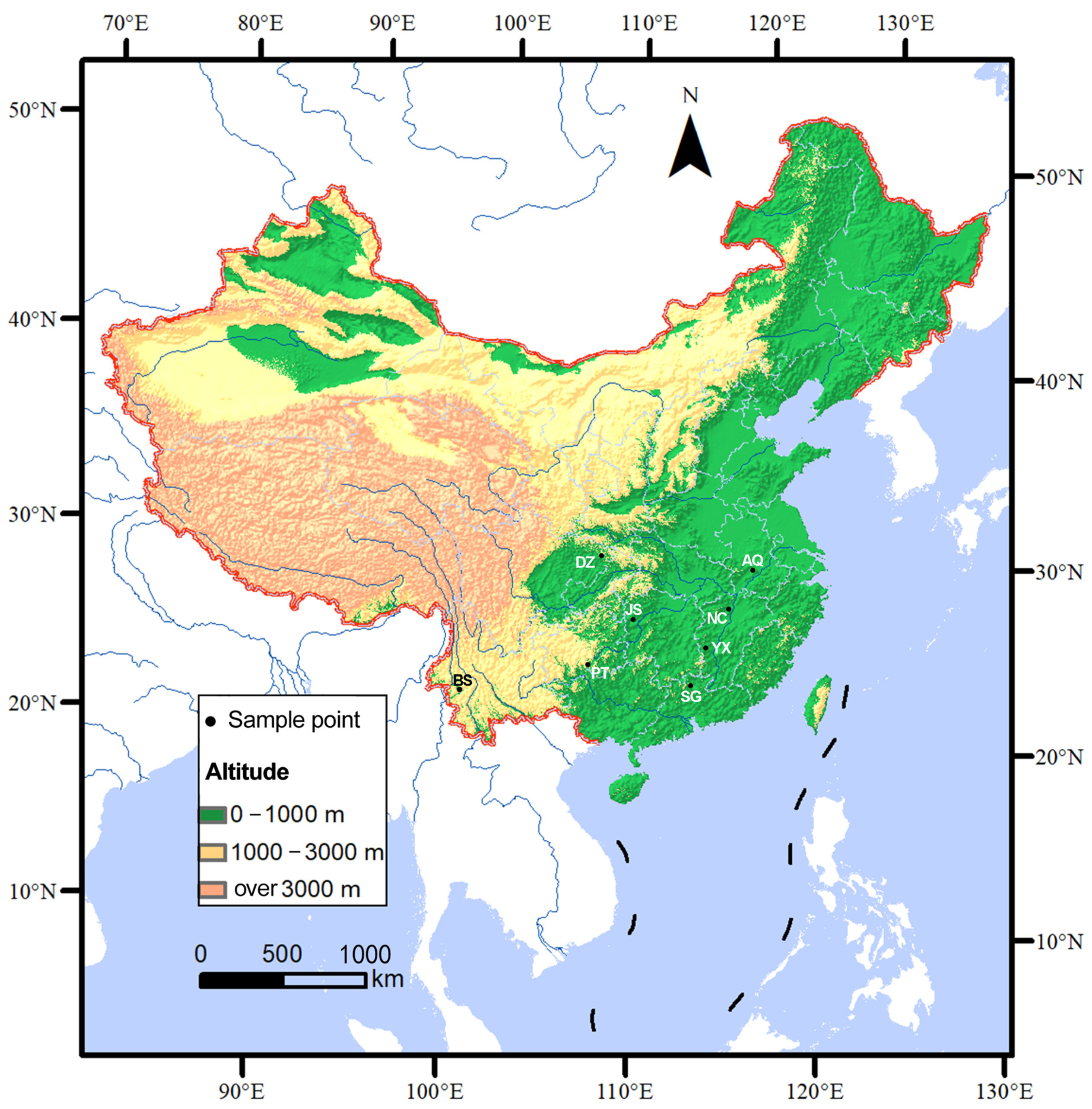
| Code | City | Province | Sample Size | Altitude (Meters Above Sea Level) | Latitude | Longitude | Main Host Plant |
|---|---|---|---|---|---|---|---|
| AQ | Anqing | Anhui | 20 | 400–800 m | 30°50′59″ N | 116°21′35″ E | Pinus massoniana |
| BS | Baoshan | Yunnan | 20 | 1200–1600 m | 24°49′40″ N | 99°36′18″ E | Pinus massoniana |
| DZ | Dazhou | Sichuan | 20 | 800–1200 m | 31°8′45″ N | 107°42′27″ E | Pinus massoniana |
| JS | Jishou | Hu’nan | 23 | 400–600 m | 28°16′27″N | 109°40′39″E | Pinus massoniana |
| NC | Nanchang | Jiangxi | 24 | 50–200 m | 28°45′30″ N | 115°44′5″ E | Pinus massoniana |
| PT | Pingtang | Guizhou | 22 | 600–1500 m | 25°49′21″ N | 107°19′22″ E | Pinus massoniana |
| SG | Shaoguan | Guangdong | 20 | 600–1000 m | 24°41′13″ N | 113°36′19″ E | Pinus massoniana |
| YX | Yongxin | Jiangxi | 23 | 300–500 m | 26°56′43″ N | 114°14′33″ E | Pinus massoniana |
| Total | 172 |
| ID | Na | Ho | He | PIC |
|---|---|---|---|---|
| Lh1 | 12 | 0.006 | 0.849 | 0.828 |
| Lh4 | 15 | 0.087 | 0.860 | 0.860 |
| Lh5 | 21 | 0.483 | 0.857 | 0.857 |
| Lh8 | 13 | 0.058 | 0.803 | 0.803 |
| Lh14 | 17 | 0.535 | 0.865 | 0.865 |
| Mean | 15.6 | 0.234 | 0.860 | 0.842 |
| Population | Ar | Ne | uH |
|---|---|---|---|
| AQ | 5.600 ± 0.800 | 2.990 ± 0.440 | 0.655 ± 0.048 |
| BS | 5.600 ± 2.417 | 3.497 ± 0.889 | 0.647 ± 0.062 |
| DZ | 7.400 ± 2.577 | 4.669 ± 0.721 | 0.781 ± 0.041 |
| JS | 7.051 ± 2.851 | 4.441 ± 1.078 | 0.748 ± 0.047 |
| NC | 7.983 ± 2.658 | 5.092 ± 0.769 | 0.796 ± 0.042 |
| PT | 6.333 ± 2.269 | 4.108 ± 0.936 | 0.720 ± 0.061 |
| SG | 5.400 ± 0.800 | 3.258 ± 0.368 | 0.697 ± 0.031 |
| YX | 7.466 ± 3.164 | 5.003 ± 1.032 | 0.782 ± 0.047 |
| Mean | 6.400 ± 0.842 | 4.023 ± 0.758 | 0.768 ± 0.043 |
| Source | df | SS | MS | Est. Var. | %Contribution |
|---|---|---|---|---|---|
| Among Populations | 7 | 241.373 | 34.482 | 1.312 | 17 *** |
| Within Populations | 164 | 1032.500 | 6.296 | 6.296 | 83 *** |
| Total | 171 | 1273.872 | 7.608 | 100 |
Disclaimer/Publisher’s Note: The statements, opinions and data contained in all publications are solely those of the individual author(s) and contributor(s) and not of MDPI and/or the editor(s). MDPI and/or the editor(s) disclaim responsibility for any injury to people or property resulting from any ideas, methods, instructions or products referred to in the content. |
© 2026 by the authors. Licensee MDPI, Basel, Switzerland. This article is an open access article distributed under the terms and conditions of the Creative Commons Attribution (CC BY) license.
Share and Cite
Yang, S.; Mao, M.; Huang, J.; Gu, B.; Zhao, K. Genetic Diversity and Gene Flow of the Ectomycorrhizal Mushroom Lactarius hatsudake in Southern China: Evidence from SSR Markers. J. Fungi 2026, 12, 280. https://doi.org/10.3390/jof12040280
Yang S, Mao M, Huang J, Gu B, Zhao K. Genetic Diversity and Gene Flow of the Ectomycorrhizal Mushroom Lactarius hatsudake in Southern China: Evidence from SSR Markers. Journal of Fungi. 2026; 12(4):280. https://doi.org/10.3390/jof12040280
Chicago/Turabian StyleYang, Shatong, Mingwei Mao, Jieyu Huang, Bing Gu, and Kuan Zhao. 2026. "Genetic Diversity and Gene Flow of the Ectomycorrhizal Mushroom Lactarius hatsudake in Southern China: Evidence from SSR Markers" Journal of Fungi 12, no. 4: 280. https://doi.org/10.3390/jof12040280
APA StyleYang, S., Mao, M., Huang, J., Gu, B., & Zhao, K. (2026). Genetic Diversity and Gene Flow of the Ectomycorrhizal Mushroom Lactarius hatsudake in Southern China: Evidence from SSR Markers. Journal of Fungi, 12(4), 280. https://doi.org/10.3390/jof12040280