
Qualitative Evaluation of an Online Technology to Support Rural Caregivers of People with Dementia

 , , , ,
Abstract
1. Introduction
2. Materials and Methods
2.1. Study Design
2.2. Ethics Approval
2.3. Study Setting
2.4. Recruitment
- The current provision of a dementia service or service for older adults in one of the catchment areas;
- Access to a smartphone or tablet, or computer with internet access.
2.5. Data Collection and Analysis
3. Results
3.1. Innovation Characteristics
3.1.1. Evidence Strength and Quality
Grounded in Research
3.1.2. Design Quality and Packaging
Supportive Information and Resources
3.2. Outer Setting
3.2.1. Needs and Resources
Resource and Infrastructure Challenges
3.3. Inner Setting
3.3.1. Culture
Alignment with Organisational Values and Goals
3.3.2. Implementation Climate: Relative Priority
Staffing and Competing Priorities
3.3.3. Readiness for Implementation: Leadership Engagement
Supportive Management
3.4. Individual Characteristics
3.4.1. Knowledge and Beliefs About the Intervention
Preference for Face-to-Face Support
3.4.2. Individual Stage of Change
Personal Readiness
3.4.3. Other Personal Attributes
Lack of Digital Literacy, Fear of and Resistance to Technology
Privacy Concerns
3.5. Process
3.5.1. Engaging
Challenges Recruiting Volunteers
4. Discussion
Author Contributions
Funding
Institutional Review Board Statement
Informed Consent Statement
Data Availability Statement
Acknowledgments
Conflicts of Interest
Abbreviations
| CFIR | Consolidated Framework for Implementation Research |
Appendix A. Interview Schedule
- Please tell me about the activities you participated in as part of the VERILY project
- How complicated was it to implement VERILY? Were changes or alterations made to the way that VERILY was implemented in your community?
- What other carer support programs are available in your area? How does VERILY compare to other existing programs; does it replace or complement other programs? Is there another way of attaining support that carers would rather use? Do you think there was a strong need for VERILY?
- How well do you think VERILY met the needs of your clients? Do you think VERILY was effective in your area?
- What barriers did your clients experience with accessing VERILY?
- What stories have you heard about the experiences of participants with VERILY?
- How do you think your organisation’s culture (general beliefs, values, assumptions that people embrace) affected the implementation of VERILY? What was the general level of receptivity in your organisation to implementing VERILY?
- How essential is VERILY to assisting you to meet the needs of your clients or your other organisational goals? Please describe the activities or initiatives that have the highest priority for your organisation? To what extent did VERILY take a backseat to other high-priority initiatives? How did you juggle completing priorities in your work?
- To what extent does implementing VERILY provide an advantage to your town compared to other towns?
- How well did VERILY fit with existing work processes and practices in your area? Can you describe how VERILY will be integrated into your ongoing work processes?
- Did you have sufficient resources to implement VERILY? If yes, what was the quality of these resources?
- What training did you receive in implementing VERILY? How prepared did you feel to use VERILY initiatives? Who did you ask if you had questions about VERILY or its implementation?
- Were there incentives to help you ensure that the implementation of VERILY was successful?
- What level of endorsement or support for VERILY did you see or hear from leaders? What level of involvement did leadership at your organisation have with VERILY? What kind of support or actions from leaders was needed to help VERILY be implemented?
- Did you or others act as champions for VERILY? If yes, what behaviours or actions did you or others take to champion VERILY? What steps have been taken to encourage people to commit to using VERILY? What communication strategy was used to get the word out about VERILY?
- Is there anything else that you would like to say about VERILY that we haven’t covered?
References
- Canadian Institute for Health Information. Dementia in Canada: Summary. Available online: https://www.cihi.ca/en/dementia-in-canada/dementia-in-canada-summary (accessed on 16 May 2025).
- Harkin, D.J.; O’Connor, C.M.C.; Birch, M.R.; Poulos, C.J. Perspectives of Australian family carers of people with dementia on the ‘cottage’ model of respite: Compared to traditional models of residential respite provided in aged care facilities. Health Soc. Care Community 2020, 28, 850–861. [Google Scholar] [CrossRef]
- Australian Institute of Health and Welfare. Dementia in Australia. Available online: https://www.aihw.gov.au/reports/dementia/dementia-in-aus/contents/national-policy-response-to-dementia (accessed on 5 May 2025).
- Alzheimer Society of Canada. Navigating the Path Forward for Dementia in Canada: The Landmark Study Report #1. Available online: https://alzheimer.ca/en/research/reports-dementia/navigating-path-forward-landmark-report-1 (accessed on 16 May 2025).
- Dementia Australia. The Dementia Guide: Support and Information for Carers. Available online: https://www.dementia.org.au/get-support/dementia-guide (accessed on 21 July 2025).
- Royall, D.R.; Chiodo, L.K.; Polk, M.J. Correlates of disability among elderly retirees with “subclinical” cognitive impairment. J. Gerontol. Ser. A Biol. Sci. Med. Sci. 2000, 55, M541–M546. [Google Scholar] [CrossRef]
- Canadian Institute for Health Information. Unpaid Caregiver Challenges and Supports. Available online: https://www.cihi.ca/en/dementia-in-canada/unpaid-caregiver-challenges-and-supports (accessed on 20 July 2025).
- Australian Institute of Health and Welfare. Dementia in Australia: Impact of the Caring Role on Carers. Available online: https://www.aihw.gov.au/reports/dementia/dementia-in-aus/contents/carers-and-care-needs-of-people-with-dementia/impact-of-the-caring-role-on-carers (accessed on 21 July 2025).
- Bevans, M.; Sternberg, E.M. Caregiving Burden, Stress, and Health Effects Among Family Caregivers of Adult Cancer Patients. J. Am. Med. Assoc. 2012, 307, 398–403. [Google Scholar] [CrossRef]
- Dam, A.E.H.; Boots, L.M.M.; Van Boxtel, M.P.J.; Verhey, F.R.J.; De Vugt, M.E.; Vernooij-Dassen, M.; Moniz-Cook, E.; Jeon, Y.-H. A mismatch between supply and demand of social support in dementia care: A qualitative study on the perspectives of spousal caregivers and their social network members. Int. Psychogeriatr. 2018, 30, 881–892. [Google Scholar] [CrossRef] [PubMed]
- Martinez-Martin, P.; Macaulay, D.; Jalundhwala, Y.J.; Mu, F.; Ohashi, E.; Marshall, T.; Sail, K. The long-term direct and indirect economic burden among Parkinson’s disease caregivers in the United States. Mov. Disord. 2019, 34, 236–245. [Google Scholar] [CrossRef] [PubMed]
- Pinquart, M.; Sörensen, S. Associations of stressors and uplifts of caregiving with caregiver burden and depressive mood: A meta-analysis. J. Gerontol. Ser. B Psychol. Sci. Soc. Sci. 2003, 58, P112–P128. [Google Scholar] [CrossRef]
- Walter, E.; Pinquart, M. How effective are dementia caregiver interventions? An updated comprehensive meta-analysis. Gerontol. 2020, 60, e609–e619. [Google Scholar] [CrossRef] [PubMed]
- Chien, L.Y.; Chu, H.; Guo, J.L.; Liao, Y.M.; Chang, L.I.; Chen, C.H.; Chou, K.R. Caregiver support groups in patients with dementia: A meta-analysis. Int. J. Geriatr. Psychiatry 2011, 26, 1089–1098. [Google Scholar] [CrossRef]
- Jackson, G.A.; Browne, D. Supporting carers of people with dementia: What is effective? BJPsych Adv. 2017, 23, 179–186. [Google Scholar] [CrossRef]
- Burholt, V.; Dobbs, C. Research on rural ageing: Where have we got to and where are we going in Europe? J. Rural Stud. 2012, 28, 432–446. [Google Scholar] [CrossRef]
- Havens, B.; Hall, M.; Sylvestre, G.; Jivan, T. Social isolation and loneliness: Differences between older rural and urban Manitobans. Can. J. Aging/La Rev. Can. Du Vieil. 2004, 23, 129–140. [Google Scholar] [CrossRef]
- Lau, R.; Morse, C.A. Health and wellbeing of older people in Anglo-Australian and Italian-Australian communities: A rural–urban comparison. Aust. J. Rural Health 2008, 16, 5–11. [Google Scholar] [CrossRef]
- Wiese, L.A.K.; Gibson, A.; Guest, M.A.; Nelson, A.R.; Weaver, R.; Gupta, A.; Carmichael, O.; Lewis, J.P.; Lindauer, A.; Loi, S.; et al. Global rural health disparities in Alzheimer’s disease and related dementias: State of the science. Alzheimer’s Dement. 2023, 19, 4204–4225. [Google Scholar] [CrossRef]
- Cohen, S.A.; Ahmed, N.; Brown, M.J.; Meucci, M.R.; Greaney, M.L. Rural-urban differences in informal caregiving and health-related quality of life. J. Rural Health 2022, 38, 442–456. [Google Scholar] [CrossRef] [PubMed]
- Byrd, J.; Spencer, S.M.; Goins, R.T. Differences in caregiving: Does residence matter? J. Appl. Gerontol. 2011, 30, 407–421. [Google Scholar] [CrossRef]
- Roberts, J.R.; Windle, G.; Story, A.; Brotherhood, E.V.; Camic, P.M.; Crutch, S.J.; Stott, J.; Sullivan, M.P.; Grillo, A. Dementia in rural settings: A scoping review exploring the personal experiences of people with dementia and their carers. Ageing Soc. 2024, 44, 2580–2609. [Google Scholar] [CrossRef]
- Jolliff, A.; Boucher, S.; Hill, J.R.; Allen-Watts, K.; Rodriguez, M.J.; Elliott, C.; Zuraw, M.; Werner, N.E. The Use of Technology by the Rural-Dwelling Caregivers of People Living with Dementia to Support Caregiving: Qualitative Interview Study. JMIR Form. Res. 2025, 9, e77231. [Google Scholar] [CrossRef]
- Burns, A.; Bruce, D.; Marlin, A. Rural Poverty Discussion Paper; Agriculture and Agri-Food Canada. Rural Secretariat: Ottawa, ON, Canada, 2024. [Google Scholar]
- Greenberg, A.J.; Haney, D.; Blake, K.D.; Moser, R.P.; Hesse, B.W. Differences in Access to and Use of Electronic Personal Health Information Between Rural and Urban Residents in the United States. J. Rural Health 2018, 34, s30–s38. [Google Scholar] [CrossRef] [PubMed]
- Jongebloed, H.; Anderson, K.; Winter, N.; Nguyen, L.; Huggins, C.E.; Savira, F.; Cooper, P.; Yuen, E.; Peeters, A.; Rasmussen, B.; et al. The digital divide in rural and regional communities: A survey on the use of digital health technology and implications for supporting technology use. BMC Res. Notes 2024, 17, 90. [Google Scholar] [CrossRef]
- Chapman, A.; Buccheri, A.; Mohotti, D.; Wong Shee, A.; Huggins, C.E.; Alston, L.; Hutchinson, A.M.; Yoong, S.L.; Beks, H.; Mc Namara, K.; et al. Staff-reported barriers and facilitators to the implementation of healthcare interventions within regional and rural areas: A rapid review. BMC Health Serv. Res. 2025, 25, 331. [Google Scholar] [CrossRef] [PubMed]
- Liu, Y.; Hughes, M.C.; Baumbach, A.; Derain, L. An online intervention to improve the health and well-being of informal caregivers of individuals with Alzheimer’s disease: A pilot study. PEC Innov. 2023, 3, 100229. [Google Scholar] [CrossRef] [PubMed]
- Czaja, S.J.; Loewenstein, D.; Schulz, R.; Nair, S.N.; Perdomo, D. A Videophone Psychosocial Intervention for Dementia Caregivers. Am. J. Geriatr. Psychiatry 2013, 21, 1071–1081. [Google Scholar] [CrossRef] [PubMed]
- Christie, H.L.; Dam, A.E.H.; Van Boxtel, M.; Köhler, S.; Verhey, F.; De Vugt, M.E. Lessons Learned From an Effectiveness Evaluation of Inlife, a Web-Based Social Support Intervention for Caregivers of People With Dementia: Randomized Controlled Trial. JMIR Aging 2022, 5, e38656. [Google Scholar] [CrossRef]
- O’Connell, M.E.; Crossley, M.; Cammer, A.; Morgan, D.; Allingham, W.; Cheavins, B.; Dalziel, D.; Lemire, M.; Mitchell, S.; Morgan, E. Development and evaluation of a telehealth videoconferenced support group for rural spouses of individuals diagnosed with atypical early-onset dementias. Dementia 2014, 13, 382–395. [Google Scholar] [CrossRef]
- Deeken, F.; Rezo, A.; Hinz, M.; Discher, R.; Rapp, M.A. Evaluation of Technology-Based Interventions for Informal Caregivers of Patients With Dementia—A Meta-Analysis of Randomized Controlled Trials. Am. J. Geriatr. Psychiatry 2019, 27, 426–445. [Google Scholar] [CrossRef]
- Blackberry, I.; Rasekaba, T.; Morgan, D.; Royals, K.; Greenhill, J.; Perkins, D.; O’Connell, M.; Hamiduzzaman, M.; Winbolt, M.; Robinson, A.; et al. Virtual Dementia-Friendly Communities (Verily Connect) Stepped-Wedge Cluster-Randomised Controlled Trial: Improving Dementia Caregiver Wellbeing in Rural Australia. Geriatrics 2023, 8, 85. [Google Scholar] [CrossRef]
- Damschroder, L.J.; Aron, D.C.; Keith, R.E.; Kirsh, S.R.; Alexander, J.A.; Lowery, J.C. Fostering implementation of health services research findings into practice: A consolidated framework for advancing implementation science. Implement. Sci. IS 2009, 4, 50. [Google Scholar] [CrossRef]
- Braun, V.; Clarke, V. Using thematic analysis in psychology. Qual. Res. Psychol. 2006, 3, 77–101. [Google Scholar] [CrossRef]
- Wilding, C.; Morgan, D.; Greenhill, J.; Perkins, D.; O’Connell, M.E.; Bauer, M.; Farmer, J.; Morley, C.; Blackberry, I. Web-based technologies to support carers of people living with dementia: Protocol for a mixed methods stepped-Wedge Cluster Randomized Controlled Trial. JMIR Res. Protoc. 2022, 11, e33023. [Google Scholar] [CrossRef] [PubMed]
- National Health and Medical Research Council. National Statement on Ethical Conduct in Human Research; The National Health and Medical Research Council, the Australian Research Council and Universities Australia: Commonwealth of Australia, Canberra, 2018. [Google Scholar]
- CFIR. Consolidated Framework for Implementation Research. Available online: https://cfirguide.org/ (accessed on 4 April 2025).
- Ghahfarokhi, Z.S. Challenges in health and technological literacy of older adults: A qualitative study in Isfahan. BMC Geriatr. 2025, 25, 247. [Google Scholar] [CrossRef] [PubMed]
- Jung, J.; You, J.; Kim, D. Effective but sustainable? A case of a digital literacy program for older adults. Educ. Inf. Technol. 2025, 30, 13309–13330. [Google Scholar] [CrossRef]
- Wu, D.; Pu, L.; Jo, J.; Moyle, W. Technologies and Applications of Robots in Dementia Care: A Systematic Review. J. Intell. Robot. Syst. 2025, 111, 33. [Google Scholar] [CrossRef]
- Medical Advisory Secretariat. Social isolation in community-dwelling seniors: An evidence-based analysis. Ont Health Technol. Assess. Ser. 2008, 8, 1–49. [Google Scholar]
- Gulline, H.; Carmody, S.; Yates, M.; Bevins, A.; Brodtmann, A.; Loi, S.M.; Lim, Y.Y.; Macklin, H.; Glennen, K.; Woodward, M.; et al. Equity of access in rural and metropolitan dementia diagnosis, management, and care experiences: An exploratory qualitative study. Int. J. Equity Health 2025, 24, 74. [Google Scholar] [CrossRef]
- Woods, L.; Eden, R.; Macklin, S.; Krivit, J.; Duncan, R.; Murray, H.; Donovan, R.; Sullivan, C. Strengthening rural healthcare outcomes through digital health: Qualitative multi-site case study. BMC Health Serv. Res. 2024, 24, 1096. [Google Scholar] [CrossRef] [PubMed]
- Pettersen, S.; Eide, H.; Berg, A. The role of champions in the implementation of technology in healthcare services: A systematic mixed studies review. BMC Health Serv. Res. 2024, 24, 456. [Google Scholar] [CrossRef]
- Santos, W.J.; Graham, I.D.; Lalonde, M.; Demery Varin, M.; Squires, J.E. The effectiveness of champions in implementing innovations in health care: A systematic review. Implement. Sci. Commun. 2022, 3, 80. [Google Scholar] [CrossRef]
- Bertolazzi, A.; Quaglia, V.; Bongelli, R. Barriers and facilitators to health technology adoption by older adults with chronic diseases: An integrative systematic review. BMC Public Health 2024, 24, 506. [Google Scholar] [CrossRef] [PubMed]
- Kakulla, B. Tech Trends and Adults 50+. AARP Research December 2024. Available online: https://www.aarp.org/content/dam/aarp/research/topics/technology/internet-media-devices/2025-technology-trends-older-adults.doi.10.26419-2fres.00891.001.pdf (accessed on 21 July 2025).
- Haimi, M.; Sergienko, R. Adoption and Use of Telemedicine and Digital Health Services Among Older Adults in Light of the COVID-19 Pandemic: Repeated Cross-Sectional Analysis. JMIR Aging 2024, 7, e52317. [Google Scholar] [CrossRef]
- Emmesjö, L.; Hallgren, J.; Gillsjö, C. Older adults’ digital technology experiences: A qualitative study. BMC Digit. Health 2025, 3, 24. [Google Scholar] [CrossRef]
- Masoud, S.S.; Meyer, K.N.; Martin Sweet, L.; Prado, P.J.; White, C.L. “We Don’t Feel so Alone”: A Qualitative Study of Virtual Memory Cafés to Support Social Connectedness Among Individuals Living With Dementia and Care Partners During COVID-19. Front. Public Health 2021, 9, 660144. [Google Scholar] [CrossRef] [PubMed]


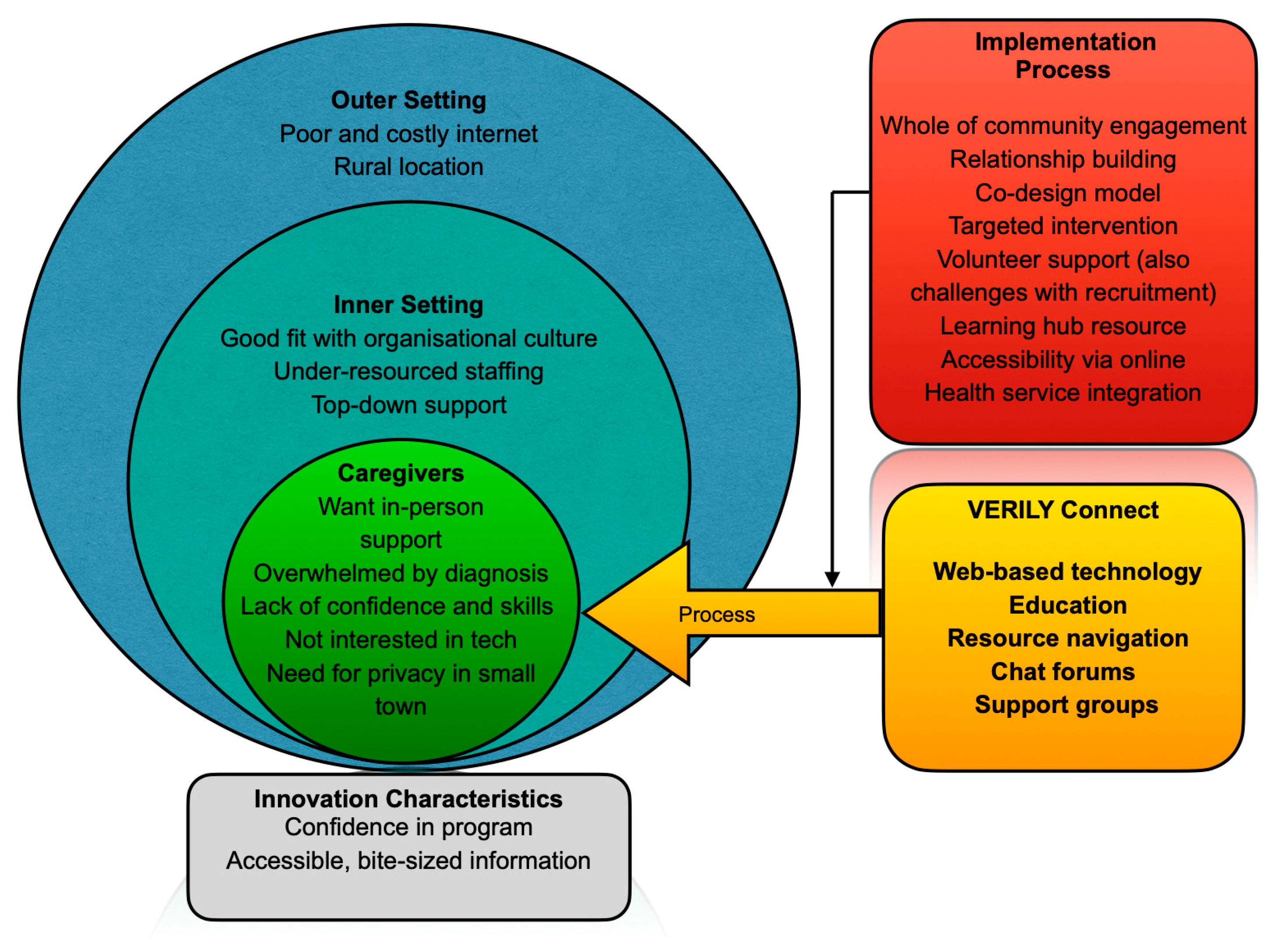
| CFIR Constructs | Themes | Barrier or Facilitator |
|---|---|---|
| I. Innovation Characteristics | ||
| Evidence strength and quality | Grounded in research | Facilitators |
| Design quality and packaging | Supportive information and resources | |
| II. Outer Setting | ||
| Needs and resources | Resource and infrastructure challenges | Barrier |
| III. Inner Setting | ||
| Culture | Aligns with organisational values and goals | Facilitator |
Implementation climate
| Staffing and competing priorities | Barrier |
Readiness for implementation
| Supportive management | Facilitator |
| IV. Individual Characteristics | ||
| Knowledge and beliefs about the intervention | Preference for face-to-face support | Barriers |
| Individual stage of change | Personal readiness | |
| Other personal attributes | Lack of digital literacy, fear of and resistance to technology Privacy concerns | |
| V. Process | ||
| Engaging | Challenge recruiting volunteers | Barrier |
Disclaimer/Publisher’s Note: The statements, opinions and data contained in all publications are solely those of the individual author(s) and contributor(s) and not of MDPI and/or the editor(s). MDPI and/or the editor(s) disclaim responsibility for any injury to people or property resulting from any ideas, methods, instructions or products referred to in the content. |
© 2025 by the authors. Licensee MDPI, Basel, Switzerland. This article is an open access article distributed under the terms and conditions of the Creative Commons Attribution (CC BY) license (https://creativecommons.org/licenses/by/4.0/).
Share and Cite
Leone, C.; Wilding, C.; Rasekaba, T.; O’Connell, M.E.; Morgan, D.; Blackberry, I. Qualitative Evaluation of an Online Technology to Support Rural Caregivers of People with Dementia. Geriatrics 2025, 10, 161. https://doi.org/10.3390/geriatrics10060161
Leone C, Wilding C, Rasekaba T, O’Connell ME, Morgan D, Blackberry I. Qualitative Evaluation of an Online Technology to Support Rural Caregivers of People with Dementia. Geriatrics. 2025; 10(6):161. https://doi.org/10.3390/geriatrics10060161
Chicago/Turabian StyleLeone, Carmela, Clare Wilding, Tshepo Rasekaba, Megan E. O’Connell, Debra Morgan, and Irene Blackberry. 2025. "Qualitative Evaluation of an Online Technology to Support Rural Caregivers of People with Dementia" Geriatrics 10, no. 6: 161. https://doi.org/10.3390/geriatrics10060161
APA StyleLeone, C., Wilding, C., Rasekaba, T., O’Connell, M. E., Morgan, D., & Blackberry, I. (2025). Qualitative Evaluation of an Online Technology to Support Rural Caregivers of People with Dementia. Geriatrics, 10(6), 161. https://doi.org/10.3390/geriatrics10060161