Review

Toxoplasma gondii as a Direct Cause of Reproductive Dysfunction: Dual Threats to Male and Female Fertility

1
College of Veterinary Medicine, Yangzhou University, Yangzhou 225009, China
2
Key Laboratory for Animal Genetics & Molecular Breeding of Jiangsu Province, College of Animal Science and Technology, Yangzhou University, Yangzhou 225009, China
3
Department of Clinical Sciences, College of Veterinary Medicine, King Faisal University, Al-Ahsa 31982, Saudi Arabia
4
Department of Pathobiology Multan, College of Veterinary Sciences, Multan University of Science and Technology, Multan 60000, Pakistan
5
College of Life and Environmental Sciences, Hunan University of Arts and Science, Changde 415000, China
6
College of Veterinary Medicine, South China Agricultural University, Guangzhou 510642, China
7
College of Veterinary Medicine, Huazhong Agricultural University, Wuhan 430070, China
*
Authors to whom correspondence should be addressed.
These authors contributed equally to this work.
Vet. Sci. 2026, 13(5), 430; https://doi.org/10.3390/vetsci13050430
Submission received: 5 March 2026 / Revised: 10 April 2026 / Accepted: 17 April 2026 / Published: 28 April 2026
(This article belongs to the Special Issue Prevention and Control of Obstetric Diseases in Domestic Animals)

Simple Summary

Toxoplasma gondii can seriously affect fertility and pregnancy outcomes in both women and men. In women, the parasite can infect the uterus and placenta, disrupting the delicate immune balance needed for a healthy pregnancy. This can lead to miscarriage, stillbirth, or premature delivery—even when the baby itself is not infected. In men, the parasite invades the testes, damages sperm quality, and disrupts hormone production, potentially causing infertility. The parasite produces its own hormones and manipulates the host’s hormone systems, creating a complex interaction that affects reproduction in both sexes. Current treatments have limitations because they do not reach reproductive tissues well. However, promising new approaches using natural products, immune-modulating therapies, and nanoparticle drug delivery systems show potential. Understanding how this parasite damages reproductive health could lead to better diagnosis and treatment for couples struggling with unexplained infertility or recurrent pregnancy loss.

Abstract

Toxoplasma gondii, an obligate intracellular protozoan infecting approximately one-third of the global population, poses a significant yet underappreciated threat to reproductive health in both sexes. Although this parasite has long been linked to birth defects caused by infection during pregnancy, new research shows that it also reduces fertility in both sexes through different but related mechanisms. This review synthesizes knowledge on T. gondii-induced reproductive pathology across females and males, examining shared mechanistic themes while respecting tissue-specific differences, and evaluates emerging therapeutic strategies. In females, the parasite establishes persistent uterine reservoirs, triggers decidual immune dysregulation characterized by NK cell cytotoxicity, M1 macrophage polarization, Treg apoptosis, and inflammasome-mediated pyroptosis, while disrupting estrogen and progesterone signaling through both host receptor modulation and intrinsic parasite steroidogenic enzymes (TgCYP450mt, TgMAPR, Tg-HSD). In males, T. gondii breaches the blood–testis barrier, induces germ cell and Leydig cell apoptosis via ER stress and caspase pathways, impairs sperm quality parameters across acute and chronic infection, and disrupts the hypothalamic–pituitary–gonadal axis. Conserved molecular mechanisms—including NLRP3 inflammasome activation, PERK/eIF2α/ATF4/CHOP-mediated ER stress, and oxidative stress—operate in both reproductive tissues. The parasite’s intrinsic steroidogenic capability and bidirectional hormonal manipulation represent a paradigm shift in understanding host–parasite interactions. Conventional antiparasitics face limitations due to poor reproductive sanctuary penetration. Immunomodulatory approaches targeting Trem2, Tim-3, and the NLRP3 inflammasome show promise, along with natural products including Inonotus obliquus polysaccharide and ginseng polysaccharide. Nanomedicine platforms and mRNA vaccine candidates offer new directions for overcoming tissue barrier limitations. Toxoplasma gondii represents a fundamental threat to fertility and pregnancy outcomes rather than merely a risk for congenital infection. Integrated therapeutic strategies addressing direct parasitism, immunopathology, and endocrine disruption are needed. Longitudinal cohort studies, strain-specific mechanistic comparisons, and clinical trials of immunomodulatory adjuncts are urgently required.

1. Introduction

Toxoplasma gondii infection represents a paradox in reproductive biology: an organism whose transmission depends on predation of intermediate hosts by feline definitive hosts has evolved sophisticated mechanisms to manipulate mammalian reproductive systems, potentially enhancing its spread through vertical and possibly sexual transmission routes [1,2,3]. This intracellular parasite infects at least one-third of humanity, establishing lifelong persistence in neural, muscular, and reproductive tissues through the formation of tissue cysts containing bradyzoites [3,4]. The reproductive consequences of toxoplasmosis extend far beyond the well-documented congenital toxoplasmosis syndrome. In females, acute infection during pregnancy can precipitate miscarriage, stillbirth, or severe fetal malformation [3,4], while chronic uterine persistence may compromise fertility even without active fetal infection [5,6,7]. In males, accumulating evidence from animal models and human studies indicates that T. gondii directly impairs spermatogenesis, reduces sperm quality, and disrupts endocrine support of reproduction [1,8,9,10]. Although the uterus and testis represent anatomically and functionally distinct reproductive organs, both constitute immunologically privileged sites characterized by tightly regulated immune environments essential for gamete development and embryonic support [11,12].
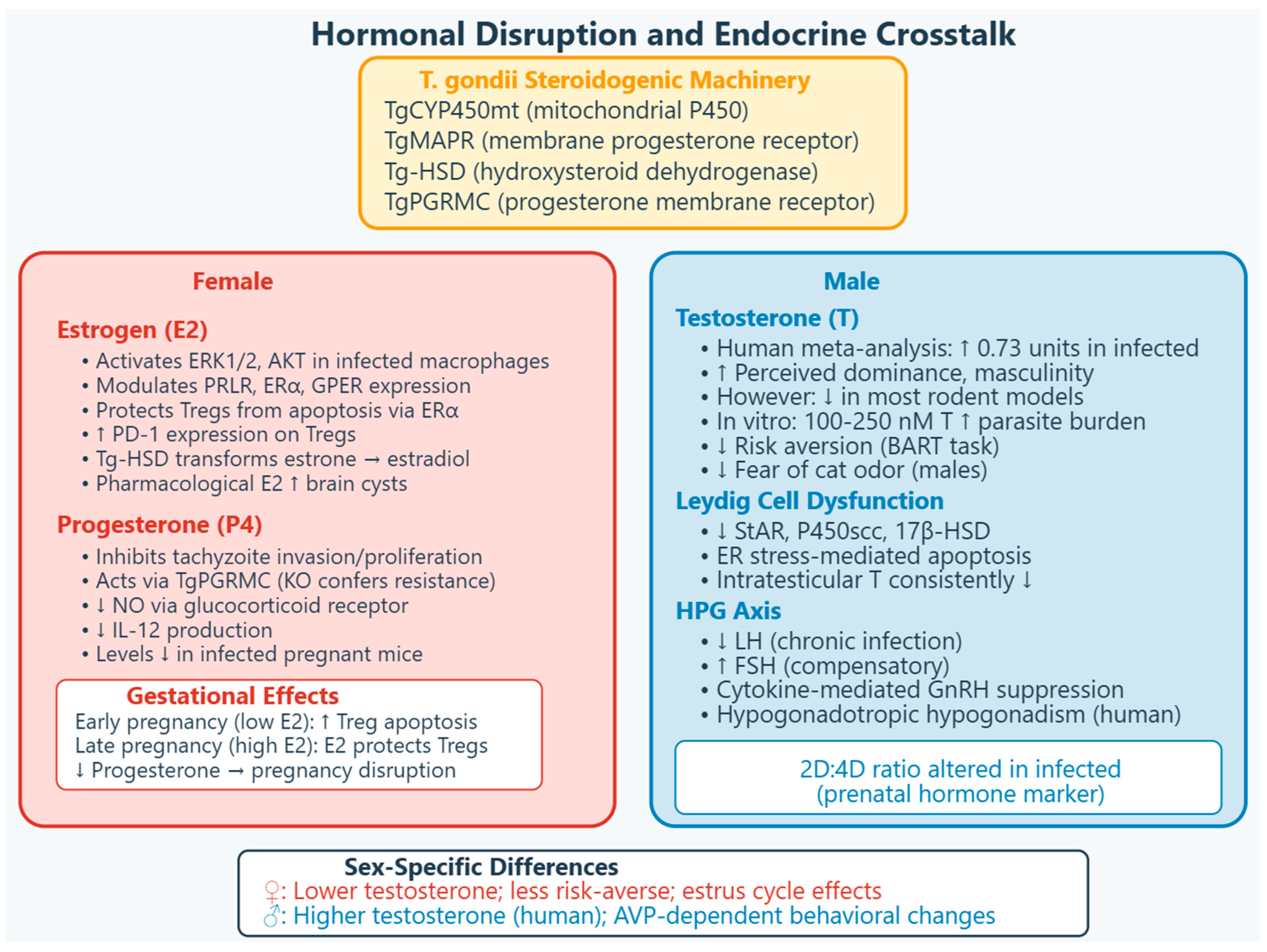
The cellular biology underlying T. gondii’s broad tissue tropism involves the creation of a parasitophorous vacuole (PV) that serves as a protected replicative niche. Recent work demonstrates that the host protein MOSPD2 is recruited to the PV membrane in a strain-dependent manner, though its functional significance remains under investigation [13]. The parasite’s capacity to manipulate host cell signaling, metabolic pathways, and immune responses creates opportunities for reproductive system disruption that have only recently gained systematic attention [14,15,16,17]. Toxoplasma gondii transfers hormone signals through exosomes and extracellular vesicles, which deliver parasite miRNAs and proteins to host cells to modulate hormone receptor expression including ERα and PRLR. Sex-associated hormones modulate parasitic disease susceptibility and outcomes, with epidemiological and experimental evidence confirming that fluctuations in estrogen, progesterone, and testosterone directly influence both immune responses and pathogen behavior [14,15,16,17,18]. Intriguingly, T. gondii possesses intrinsic steroidogenic capabilities, including a mitochondrial cytochrome P450 enzyme (TgCYP450mt) and membrane-associated progesterone receptor (TgMAPR), enabling endogenous hormone synthesis that may facilitate host manipulation [19]. Latent toxoplasmosis, previously considered harmless in immunocompetent persons, is now recognized as a potential risk factor for schizophrenia and may contribute to traffic and workplace accidents [2,20]. At least some of these effects, possibly mediated by increased dopamine and decreased tryptophan, are products of manipulation activity by T. gondii aiming to increase the probability of transmission from intermediate to definitive host through predation [2]. The relationship between latent toxoplasmosis and sex hormone modulation is complex and appears to differ between humans and animal models, as well as between sexes [1,21,22,23].
Our work seeks to answer three basic questions: (1) How does the parasite infiltrate reproductive tissues and remain there despite immune surveillance? (2) How can reproductive harm occur at the molecular and cellular levels? (3) Which treatment approaches aim to address these harmful processes? Toxoplasmosis is a direct cause of infertility and bad pregnancy outcomes. We want to build a coherent conceptual framework by combining findings from human studies and animal models. This literature review was conducted using PubMed as the primary database. Search terms included combinations of: “Toxoplasma gondii”, “reproductive dysfunction”,“fertility”, “infertility”, “pregnancy”, “testis”, “uterus”, “placenta”, “hormonal disruption”,“estrogen”, “progesterone”, “testosterone”,“immune dysregulation”, “decidual NK cells”, “spermatogenesis”, “blood–testis barrier” and “vertical transmission.” The analysis was limited to articles published in English. Additional relevant references were identified by manually screening the reference lists of retrieved articles. This review takes a narrative approach, synthesizing findings from original research, animal models, human studies, and prior reviews.

2. Establishing Infection in Female Reproductive Tissues

2.1. Female Reproductive Tract: Uterine and Placental Persistence

Toxoplasma gondii demonstrates a remarkable capacity to infect and persist within the female reproductive tract, establishing a local reservoir for vertical transmission and chronic inflammatory pathology. Early studies isolated the parasite from human abortus material, placenta, and endometrial biopsies, with recovery in 10% of specimens examined [24,25]. The presence of tachyzoites in cervical smears and menstrual blood confirms active replication within the reproductive tract [5,26]. Critical evidence demonstrated T. gondii tachyzoites in endometrial biopsies from women with habitual abortion, with five of six positive cases being serologically negative—highlighting the limitation of serological diagnosis alone. Importantly, anti-T. gondii treatment eliminated parasites from the endometrium, establishing a causal relationship between local infection and reproductive pathology [5].
Molecular studies in livestock demonstrate high prevalence of T. gondii DNA in uterine tissues of chronically infected cows and ewes, with distribution throughout the genital tract including ovaries, uterine horns, body, and vagina [27,28]. Genotyping in Egyptian small ruminants identified Type II (92.8%) and Type III (7.1%) as predominant strains in reproductive tissues, with important public health implications [29]. Experimental vaginal infection in mice results in uterine and placental parasite detection, though fetal involvement remains inconsistent, suggesting the uterus may serve as a persistent reservoir [30]. The clinical significance of uterine persistence is underscored by findings that chronic infection induces uterine atrophy in mice secondary to hypothalamic-pituitary-ovarian axis dysfunction [6]. Administration of 17β-estradiol to infected mice restored uterotropic responses, ruling out direct uterine refractoriness and implicating central hypogonadism as the primary defect [6,7]. This reproductive failure is characterized by interruption of pregnancy, fetal wastage, and infertility, linked to an acquired hypogonadotropic hypogonadism secondary to hypothalamic dysfunction [31]. Beyond laboratory models, T. gondii has been detected in uteri of wild red deer across all trimesters and in Hector’s dolphins with suppurative metritis, demonstrating broad species susceptibility [32,33]. Placental infection presents particularly complex diagnostic challenges. Toxoplasma gondii B1 gene was detected in 86.7% of placental tissues from women with acute toxoplasmosis, despite the absence of anti-T. gondii IgM in umbilical cord and neonatal blood, confirming that placental infection can occur without congenital transmission [34]. Similarly, T. gondii B1 gene was detected in 60% of placental tissues from IgG seropositive, IgM seronegative women, reiterating that the presence of the parasite in the placenta does not always result in congenital toxoplasmosis [35]. This persistent presence establishes a local reservoir for vertical transmission and creates opportunities for chronic inflammatory pathology that may compromise reproductive success even without active fetal infection.

2.2. Mechanisms of Female Reproductive Immunopathology

Toxoplasma gondii disrupts maternal–fetal immune homeostasis through coordinated dysregulation of multiple decidual cell populations.

2.2.1. Uterine Innate Lymphoid Cells and Natural Killer Cells

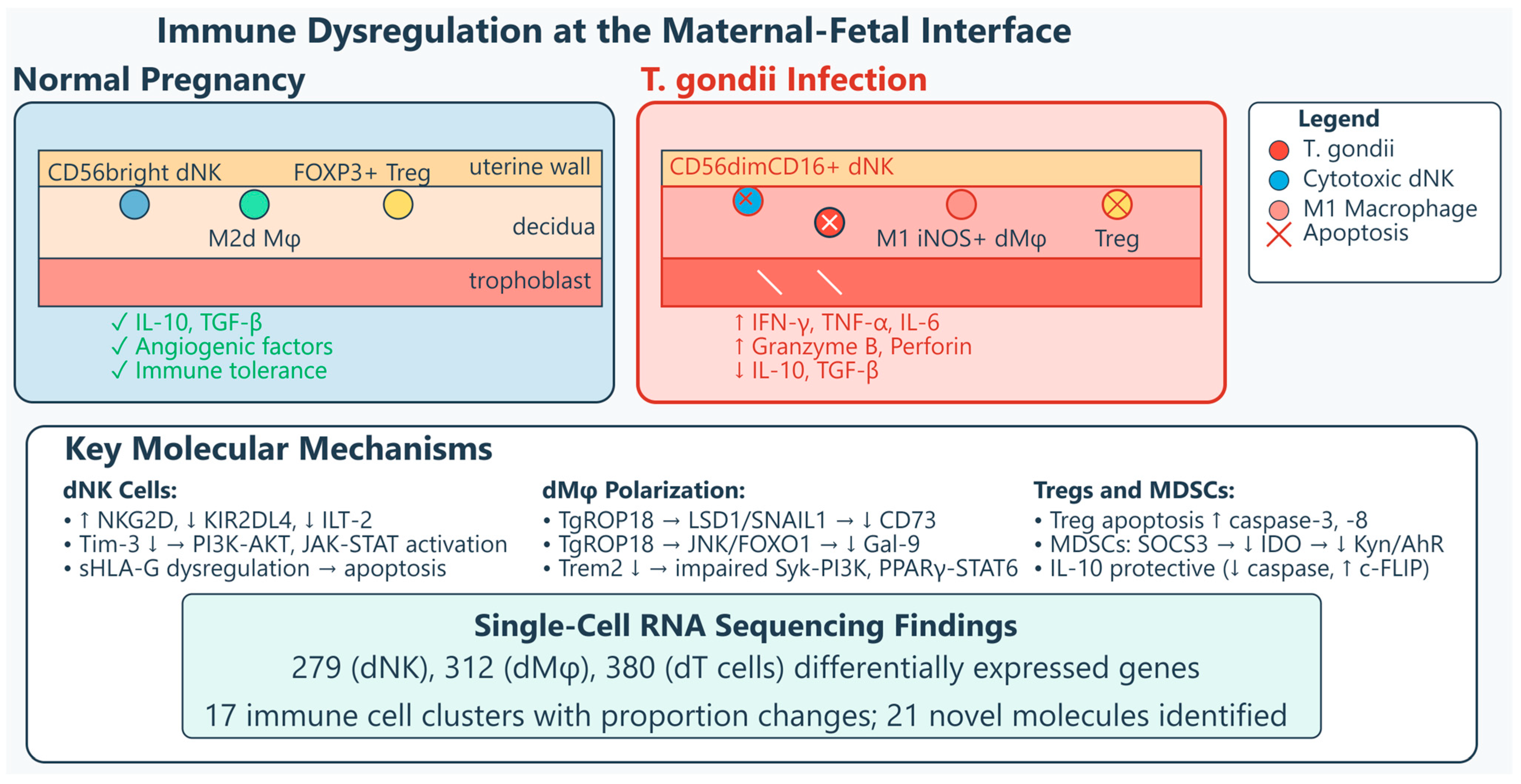
Infection reprograms uILCs from a pregnancy-supportive (GATA-3+, RORγt+) to a pro-inflammatory Th1-like (T-bet+) phenotype, increasing IFN-γ and TNF-α while decreasing IL-5 and IL-17. dNK cells undergo cytotoxic skewing characterized by expansion of CD56dimCD16+ subset, upregulation of NKG2D, and loss of inhibitory receptors KIR2DL4 and ILT-2, enhancing IFN-γ secretion and killing capacity [36,37,38,39,40]. The protective Tim-3 checkpoint is downregulated, activating PI3K/AKT and JAK-STAT pathways and unleashing granzyme B and perforin [41]. HLA-G is paradoxically elevated, inducing dNK apoptosis via caspases while potentially facilitating immune evasion [42,43]. Functional deficiency of uterine trNK cells drives adverse pregnancy outcomes, rescued by adoptive transfer [44,45,46]. PD-1/PD-L1 upregulation on DX5+ NK cells correlates with decreased NK cell proportions [47].

2.2.2. Decidual Macrophages and Dendritic Cells

dMφ polarize from M2 to pro-inflammatory M1 phenotype (↓CD206, arginase-1; ↑iNOS, CD80, CD86, TNF-α, IL-12) [48]. TgROP18 downregulates CD73 via LSD1/SNAIL1, reducing Arg-1 and IL-10 through the adenosine/A2AR/PKA/p-CREB/C/EBPβ pathway [49,50,51,52,53,54]. TgROP18 also suppresses Gal-9 via JNK/FOXO1, causing dNK dysfunction through Gal-9/Tim-3 interaction [51,52,53,54,55]. Trem2 is downregulated, impairing Trem2-Syk-PI3K and Trem2-PPARγ-STAT6 signaling [53,56]. Infected decidual dendritic cells produce IL-12, amplifying dNK cytotoxicity [37]. Single-cell RNA-seq reveals 279, 312, and 380 differentially expressed genes in dNK cells, dMφ, and decidual T cells, with 17 immune cell clusters showing proportion changes and 21 genes with altered expression [16]. This coordinated dysregulation across multiple immune cell populations creates a hostile decidual environment incompatible with healthy pregnancy maintenance.

2.2.3. Regulatory T Cells and Myeloid-Derived Suppressor Cells

Tregs undergo apoptosis via caspase-3 and caspase-8 upregulation [57,58]. IL-10 reduces Treg apoptosis; rIL-10 treatment downregulates cleaved caspase-3 and caspase-8, while IL-10 deficiency worsens outcomes. PD-1 expression increases on surviving Tregs, but overall numbers and suppressive capacity diminish [58,59]. MDSCs show reduced IDO expression via SOCS3-mediated degradation, reducing TGF-β and IL-10 through the Kyn/AhR/SP1 pathway [51,52,53,54,59], Table 1, Figure 1.

2.2.4. Cytokine-Mediated Tissue Damage and Cell Death Pathways

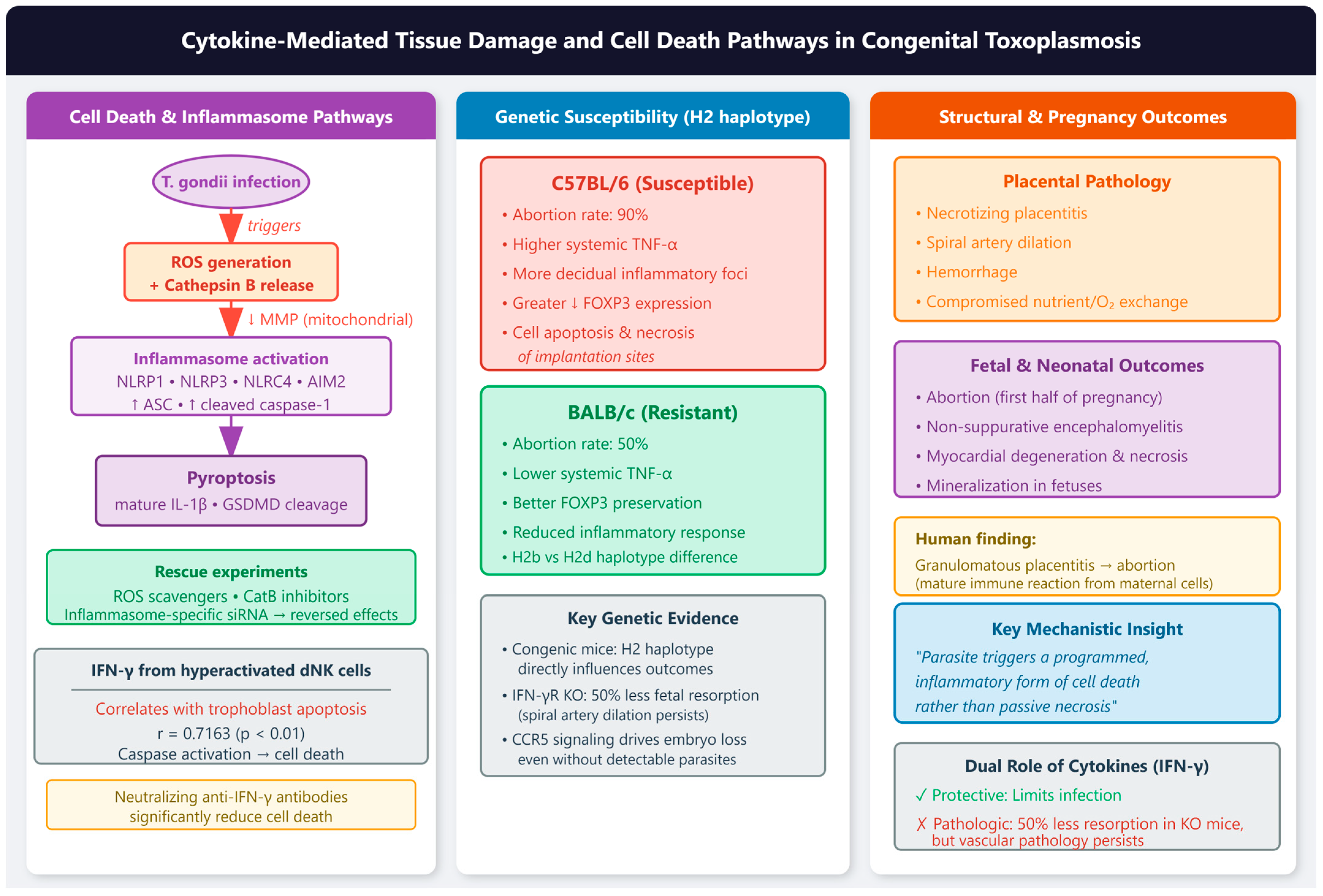
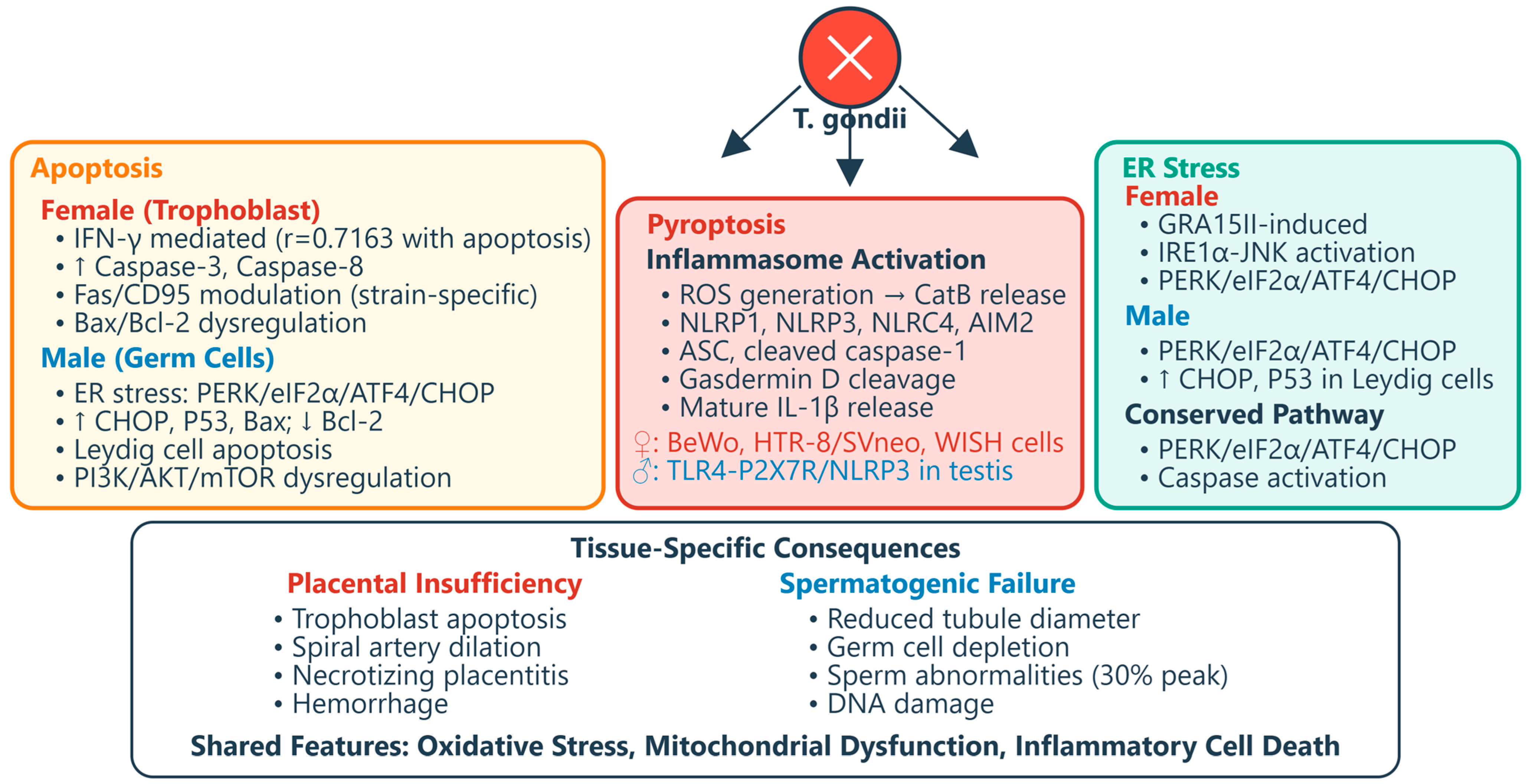
Both female and male reproductive tissues experience cytokine-driven pathology, though with distinct consequences reflecting tissue-specific functions. The decidual cytokine storm—characterized by increased IFN-γ and TNF-α with reciprocal decreases in IL-10 and TGF-β—directly damages placental tissues [61,62]. IFN-γ secreted by hyperactivated dNK cells correlates positively (r = 0.7163) with trophoblast apoptosis via caspase activation, with neutralizing antibodies significantly reducing cell death [40]. A study showed that in human placental trophoblast (BeWo and HTR-8/SVneo) and amniotic (WISH) cells, T. gondii decreases mitochondrial membrane potential, increases ROS production, and releases cathepsin B (CatB) into the cytosol [63]. This oxidative and lysosomal stress triggers activation of multiple inflammasome complexes—NLRP1, NLRP3, NLRC4, and AIM2—leading to caspase-1-mediated pyroptosis, as evidenced by increased expression of ASC, cleaved caspase-1, mature IL-1β, and gasdermin D cleavage. The functional significance was confirmed through rescue experiments: administration of ROS scavengers, CatB inhibitors, or inflammasome-specific siRNA reversed these effects in infected cells. Importantly, adverse pregnancy outcomes were observed in a T. gondii-infected pregnant mouse model, correlating with inflammasome activation and pyroptosis induction in placental tissues. This mechanism may play an important role in inducing cell injury in congenital toxoplasmosis, revealing that the parasite triggers a programmed, inflammatory form of cell death rather than passive necrosis [63].
Genetic background significantly influences susceptibility. C57BL/6 mice (H2b haplotype) exhibit 90% abortion rates versus 50% in resistant BALB/c mice, associated with higher systemic TNF-α and decidual inflammatory foci [64,65]. The impaired pregnancy outcome in C57BL/6 mice is associated with a higher inflammatory response leading to cell apoptosis and necrosis of implantation sites, with this phenomenon not due to inducible nitric oxide synthase expression in the decidua [65]. Studies using congenic mice have confirmed that the H2 haplotype influences pregnancy outcomes, with high IFN-γ and TNF serum levels involved in poor pregnancy outcomes even when parasite detection in the uterus and placenta is low [65]. Furthermore, FOXP3 expression at the maternal–fetal interface is reduced following infection, with the reduction being larger in susceptible C57BL/6 mice compared with resistant BALB/c mice [62]. IFN-γ receptor knockout mice show 50% less fetal resorption, though spiral artery dilation and placental apoptosis persist, revealing the cytokine’s dual role in protection and pathology [66]. CCR5 signaling contributes to embryo loss even without detectable parasites in fetoplacental tissues, implicating maternal immune responses rather than direct fetal infection as the primary driver [67].
Structural consequences include necrotizing placentitis, spiral artery dilation, and hemorrhage, compromising nutrient and oxygen exchange [66,68,69]. In pregnant sows experimentally infected with T. gondii oocysts, necrotizing placentitis was observed with numerous tachyzoites in trophoblast cells lining areolae, along with non-suppurative encephalomyelitis and myocardial degeneration, necrosis, and mineralization in fetuses [69]. In humans, granulomatous placentitis due to toxoplasmosis has been reported as a cause of abortion in the first half of pregnancy, possibly representing a mature immune reaction from maternal immunocompetent cells [70], Figure 2.

2.3. Female: Pregnancy Hormones and Parasite Modulation

Pregnancy-associated hormones critically influence T. gondii pathogenesis. Monocytes and macrophages are a significant immunologic barrier against T. gondii by boosting inflammation. This outcome is highly regulated by signaling pathways such as MAPK (ERK1/2) and PI3K (AKT), necessary in cell growth and proliferation. It may be associated with the hormonal receptors’ modulation by T. gondii (Estrogen Receptor (ER)-α, ERβ, G Protein-coupled ER (GPER), and Prolactin Receptor (PRLR)). 17β-estradiol also activates MAPK and PI3K; however, its combined effect in THP-1 monocytes and macrophages, infected with T. gondii, has been evaluated. Studies demonstrate that 17β-estradiol performs activation of ERK1/2 and AKT in T. gondii-infected macrophages and modulates the expression of hormonal receptors in infected cells: it increases the PRLR and PrgR in T. gondii-infected macrophages and decreases the PRLR and ERα in T. gondii-infected monocytes. As for GPER, its expression is abolished by T. gondii, and 17β-estradiol cannot restore it. These findings indicate that 17β-estradiol modifies the receptors of T. gondii-infected THP1 macrophages and monocytes in an ERK/AKT-dependent manner [14].

2.3.1. Estradiol

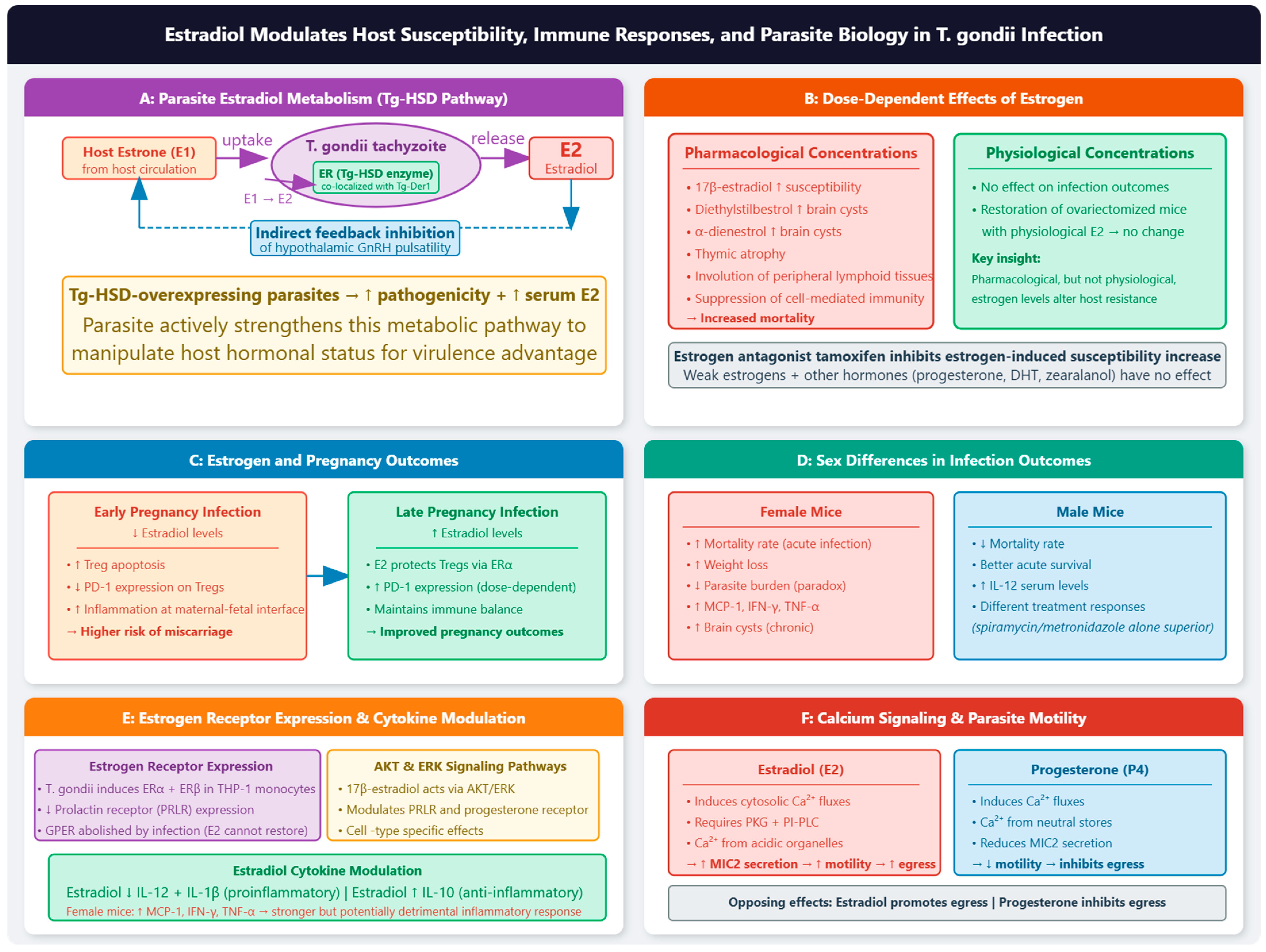
Estradiol promotes Type II and III parasite infection and contributes to pathogenicity through the parasite’s own hydroxysteroid dehydrogenase (Tg-HSD), which efficiently transforms estrone to estradiol. Tg-HSD-overexpressing parasites show enhanced pathogenicity and upregulated estradiol levels in mice, demonstrating that the parasite utilizes host hormones for its own benefit [71]. The interaction between Tg-HSD and the host endocrine system operates through specific, non-conventional pathways rather than direct enzymatic interference with the host Hypothalamic–Pituitary–Gonadal (HPG) axis, as follows: (1) Tg-HSD does not directly interfere with the host HPG axis. Instead, the parasite converts host-derived estrone (E1) into estradiol (E2) within its own cytoplasm. The newly synthesized estradiol is subsequently released into the host circulation, where it acts indirectly to feedback-inhibit hypothalamic GnRH pulsatility. This represents an indirect endocrine disruption strategy, exploiting the host’s native feedback loops rather than directly blocking HPG components [71]. (2) Tg-HSD is localized specifically to the parasite Endoplasmic Reticulum (ER), as confirmed by co-localization with the Tg-Der1 ER marker. There is no study on exosomal or vesicular transfer mechanisms; the crosstalk is characterized solely by intracellular conversion of estrone and release of estradiol into the host cytoplasm. The crosstalk is strictly defined by the intracellular conversion of estrone and the passive or active release of the resulting estradiol into the host cytoplasm [71]. (3) The parasite does not weaken or downregulate this pathway. Functional studies demonstrate that Tg-HSD-overexpressing parasitesshow significantly enhanced pathogenicity and upregulated serum estradiol levels in mice. This confirms that T. gondii actively strengthens (overexpresses) this metabolic pathway to manipulate host hormonal status for its own survival and virulence advantage [71].
Bioinformatics analysis shows that T. gondii may have a residual estradiol metabolism-related gene Tg-HSD. Functional studies demonstrate that Tg-HSD can efficiently transform estrone into estradiol, and Tg-HSD-overexpressing parasites show significantly enhanced pathogenicity and upregulation of estradiol levels in mice. These findings indicate that estradiol can promote toxoplasmosis in vitro and in vivo through mechanisms involving the parasite’s own Tg-HSD gene [71]. Sex steroids, particularly estrogen, have emerged as critical modulators of host–pathogen interactions [72]. The susceptibility to toxoplasmosis exhibits notable sex differences, with female mice demonstrating higher mortality rates despite better control of initial parasite replication [73]. This review examines the multifaceted relationship between estrogen and T. gondii, exploring how estrogen influences infection susceptibility, immune responses, and parasite biology, while also considering how the parasite may manipulate host endocrine systems for its survival and transmission.
Dose-Dependent Effects of Estrogen
Early studies established that estrogen exposure significantly influences susceptibility to toxoplasmosis. Pung and Luster (1986) [74] demonstrated that pharmacological concentrations of potent estrogenic compounds, including 17β-estradiol, diethylstilbestrol, and α-dienestrol, increased susceptibility in mice as measured by brain cyst formation. This effect was specific to estrogenic compounds, as weak estrogens and other hormones including 5α-dihydrotestosterone, progesterone, and zearalanol did not alter host resistance. Importantly, the ability of estrogens to increase susceptibility was inhibited by the estrogen antagonist tamoxifen, and restoration of ovariectomized mice with physiological estrogen concentrations had no effect on infection outcomes. These findings indicate that pharmacological, but not physiological, levels of estrogen selectively alter host resistance to T. gondii [74]. Subsequent studies confirmed that estrogen administration induces thymic atrophy and involution of peripheral lymphoid tissues, leading to suppression of cell-mediated immunity and overwhelming toxoplasmosis [75,76,77,78]. Hexoestrol-treated mice exhibited almost complete thymic atrophy and increased mortality following infection, suggesting that the cellular immune response is of greater importance than antibody formation in resistance to toxoplasmosis [75,78].
Estrogen and Pregnancy Outcomes
The relationship between estrogen and toxoplasmosis during pregnancy is particularly complex. During gestation, estrogen levels progressively increase and the severity of T. gondii-mediated adverse pregnancy outcomes is closely related to the timing of primary maternal infection [79]. Infection in early pregnancy is more likely to induce miscarriage in mice than infection in late pregnancy, correlating with inflammation at the maternal–fetal interface. The apoptotic rate of regulatory T cells (Tregs) was higher, and programmed death-1 (PD-1) expression on Tregs was lower in early pregnancy compared to late pregnancy [79]. Importantly, estrogen appeared to protect Tregs against apoptosis and upregulate PD-1 expression in a dose-dependent manner through estrogen receptor α (ERα). Simulated mid-pregnancy levels of estradiol alleviated infection-induced apoptosis of Tregs and potentiated PD-1 expression in nonpregnant mice. Thus, estrogen helps maintain immune balance and improve pregnancy outcomes during toxoplasmosis [79]. Similarly, Inonotus obliquus polysaccharide (IOP) protected against adverse pregnancy outcomes by restoring progesterone and estriol levels and regulating the Th17/Treg balance [80]. However, conflicting evidence exists regarding estrogen’s effects during pregnancy. Estradiol promoted infection with Type II (Pru) and Type III (VEG) strains, contributing to pathogenicity in mice [71]. This discrepancy may reflect differences in experimental models, parasite strains, and the distinction between physiological and pharmacological estrogen concentrations.
Sex Differences in Infection Outcomes
Sex differences in toxoplasmosis outcomes are well documented. Female mice are more susceptible to acute infection, with higher mortality rates and greater weight loss compared to males. Paradoxically, female mice exhibited lower parasite burdens during acute infection, suggesting that increased mortality results from an exaggerated immune response rather than failure to control parasite replication. Female mice produced significantly higher levels of monocyte chemoattractant protein-1 (MCP-1), interferon-γ (IFN-γ), and tumor necrosis factor-α (TNF-α) than males, indicating a stronger but potentially detrimental inflammatory response [73]. Similarly, female mice demonstrated higher brain cyst burden and more severe pathological reactions than males in chronic infection, while IL-12 serum levels were significantly higher in male mice. Treatment responses also differed by sex, with combined testosterone/atovaquone or testosterone/spiramycin/metronidazole regimens being most effective in females, while spiramycin/metronidazole alone was superior in males [81].
Estrogen Receptor Expression in Toxoplasmosis
The effects of estrogen on immune cells during toxoplasmosis are mediated through estrogen receptors. Toxoplasmosis induces the expression of ERα and ERβ in THP-1 monocytes while decreasing prolactin receptor (PRLR) expression. Estradiol treatment diminished PRLR expression, while progesterone decreased PRLR and ERβ but increased ERα expression. These findings indicate that hormones can modulate the expression of other hormonal receptors during infection, potentially influencing immune responses [82]. Further mechanistic studies revealed that 17β-estradiol modulates hormonal receptor expression in T. gondii-infected macrophages and monocytes through AKT and ERK-dependent signaling pathways. Estradiol increased PRLR and progesterone receptor expression in infected macrophages while decreasing PRLR and ERα in infected monocytes. The G protein-coupled estrogen receptor (GPER) was abolished by infection, and estradiol could not restore its expression. Blockade of ERK and AKT pathways modified hormonal receptor expression, establishing these signaling cascades as critical mediators of estrogen’s effects during infection [14].
Estrogen and Cytokine Production
Estrogen significantly influences cytokine production during toxoplasmosis. Estradiol decreased the secretion of proinflammatory cytokines IL-12 and IL-1β while increasing anti-inflammatory IL-10 production in infected THP-1 cells. Progesterone similarly increased IL-10 but reduced IL-4 and IL-13. These findings suggest that estrogen may promote an anti-inflammatory environment that could favor parasite survival [82]. The balance between proinflammatory and anti-inflammatory responses is critical for controlling toxoplasmosis while preventing immunopathology. The exaggerated inflammatory response in female mice, characterized by elevated MCP-1, IFN-γ, and TNF-α, contributed to increased morbidity and mortality despite better control of parasite replication. Interestingly, MCP-1 levels were not directly affected by physiological concentrations of estrogen or testosterone in vitro, suggesting that sex differences in immune responses are mediated through indirect mechanisms involving other factors [73].
Calcium Signaling and Parasite Motility
Emerging evidence indicates that estrogen directly influences parasite biology. Estradiol and progesterone induce cytosolic calcium fluxes in T. gondii tachyzoites. Estradiol-induced calcium fluxes required entry into the parasite cytoplasm and involved cGMP-dependent protein kinase G (PKG) and phosphoinositide-phospholipase C (PI-PLC). Cytosolic calcium mobilized by estradiol was primarily derived from acidic organelles and resulted in increased microneme protein 2 (MIC2) secretion, enhanced gliding motility, and accelerated parasite egress. In contrast, progesterone mobilized calcium from neutral stores, reduced MIC2 secretion, and inhibited gliding motility, suggesting opposing effects of these hormones on parasite behavior [83]. These findings are consistent with the established role of calcium signaling in T. gondii egress. A positive feedback loop involving cAMP and lipid metabolism links calcium and cyclic nucleotide signaling during egress. Understanding how estrogen modulates these signaling pathways may provide insights into parasite biology and identify new therapeutic targets [84].
Parasite Estrogen Metabolism
Remarkably, T. gondii appears capable of metabolizing estrogens. Tg-HSD gene in the parasite genome was identified, and it efficiently converts estrone to estradiol. Overexpression of Tg-HSD in parasites significantly enhanced pathogenicity and increased estradiol levels in infected mice. The ability of T. gondii to metabolize estrogens suggests that the parasite may actively manipulate its hormonal environment to promote survival and replication [71].
Host–Parasite Endocrine Interactions
The bidirectional interactions between T. gondii and host endocrine systems extend beyond estrogen. There is evidence that sex steroids mediate bidirectional interactions between hosts and microbes. Testosterone, estradiol, and progesterone affect immune cell function, while microbes can use these hormones and manipulate sex steroid receptor signaling mechanisms to increase survival and replication. This arms race between hosts and microbes has driven the evolution of sophisticated mechanisms for utilizing sex steroid hormone signaling [72]. Chronic toxoplasmosis can also alter host endocrine function. Chronic murine toxoplasmosis causes ovarian dysfunction, leading to uterine atrophy. This effect was not due to uterine refractoriness to estrogen, as infected mice showed normal uterotropic responses to exogenous estradiol, but rather resulted from pituitary gonadotropin insufficiency. The authors hypothesized that peripherally released cytokines reach the hypothalamus, inhibiting pulsatile gonadotropin-releasing hormone release and impairing the pituitary-ovarian axis [6,7]. Similarly, T. gondii infection in pregnant goats disrupted endocrine fetal-placental function, with decreased oestrone sulphate levels and increased prostaglandin F2α metabolites preceding abortion [85].
Therapeutic Implications
The discovery that tamoxifen, a selective estrogen receptor modulator (SERM), exhibits potent antiparasitic activity against T. gondii has opened new therapeutic possibilities. A screen of 1120 compounds identified tamoxifen as a potent inhibitor of T. gondii replication, with a 50% inhibitory concentration below 5 μM. Although T. gondii can activate the estrogen receptor, tamoxifen inhibits parasite growth independently of this transcription factor. Instead, tamoxifen induces autophagy, stimulating recruitment of the autophagy marker LC3-GFP onto the parasitophorous vacuole membrane and leading to time-dependent elimination of intracellular parasites [86]. The antimicrobial properties of SERMs are noteworthy, with emerging evidence for their efficacy against normal and resistant microbial strains through various mechanisms. The repurposing of SERMs as broad-spectrum antimicrobial agents, alone or in combination with existing drugs, represents a promising approach for treating toxoplasmosis and other infections [87]. Combining hormone modulators with conventional antiparasitic drugs may enhance therapeutic efficacy. Combined therapy with testosterone/atovaquone or testosterone/spiramycin/metronidazole significantly reduced cyst numbers in female mice, while spiramycin/metronidazole alone was most effective in males. These findings highlight the importance of sex-specific treatment strategies for chronic toxoplasmosis [81]. S-methylcysteine, a garlic-derived compound with antioxidant and anti-inflammatory properties, combined with spiramycin, significantly mitigated hormonal disruptions and promoted tissue recovery in T. gondii-infected rats. This combination approach, targeting both the parasite and host endocrine dysfunction, may offer improved outcomes for toxoplasmosis during pregnancy [88].
Despite promising preclinical findings, several challenges remain. The dose-dependent effects of estrogen on infection outcomes suggest that careful consideration of hormonal status is necessary when designing treatment protocols. The paradoxical finding that physiological estrogen levels may protect against adverse pregnancy outcomes while pharmacological levels increase susceptibility underscores the importance of dosing in therapeutic applications [79]. Furthermore, the complex signaling networks involved in T. gondii biology presents both challenges and opportunities. The critical role of phosphodiesterases in cyclic nucleotide turnover across apicomplexan parasites has been reviewed, highlighting their potential as therapeutic targets. Understanding how estrogen modulates these signaling pathways could identify novel intervention points [74,89].
Several key questions remain regarding the molecular mechanisms underlying estrogen–T. gondii interactions. The signaling pathways identified (AKT and ERK) and (PKG and PI-PLC) require further elucidation [14,83,90]. Additionally, the role of estrogen in modulating autophagy and xenophagy, as suggested by tamoxifen studies [86], warrants investigation using physiological estrogen concentrations. The association between toxoplasmosis and altered offspring sex ratios suggests that toxoplasmosis may influence human reproductive endocrinology [91]. It is hypothesized that women infected with T. gondii may have elevated estrogen levels, potentially explaining reports of higher offspring sex ratios, longer gestations, and behavioral traits. Validation of these hypotheses in human populations could have important public health implications [91]. The identification of tamoxifen as an antiparasitic agent [86,87] supports further investigation of SERMs and other hormone modulators for toxoplasmosis treatment. The development of parasite-specific inhibitors targeting Tg-HSD [71] or phosphodiesterases [89] may provide more selective therapeutic options. Additionally, understanding sex differences in treatment responses [81] will be essential for optimizing clinical protocols. The temporal dynamics of estradiol during pregnancy modulate disease severity. Early pregnancy infection, when estradiol levels are lower, induces higher Treg apoptosis and lower PD-1 expression than late pregnancy infection. Estradiol protects Tregs against apoptosis and upregulates PD-1 in a dose-dependent manner through ERα, explaining the discrepancy in outcomes by gestational age [79]. As the level of E2 in mouse serum gradually increases with the development of pregnancy, E2 may contribute to the discrepancy of Tregs at different stages of pregnancy. E2 in vitro can protect Tregs against apoptosis and upregulate the expression of PD-1 on Tregs in a dose-dependent manner through ERα. Likewise, the simulated mid-pregnancy level of E2 in nonpregnant mice also alleviates toxoplasmosis-induced apoptosis of Tregs and potentiates PD-1 expression on Tregs. Therefore, in the pathogenesis of T. gondii-induced abnormal pregnancy, E2 helps maintain immune balance and improve pregnancy outcome through regulating Tregs [79].
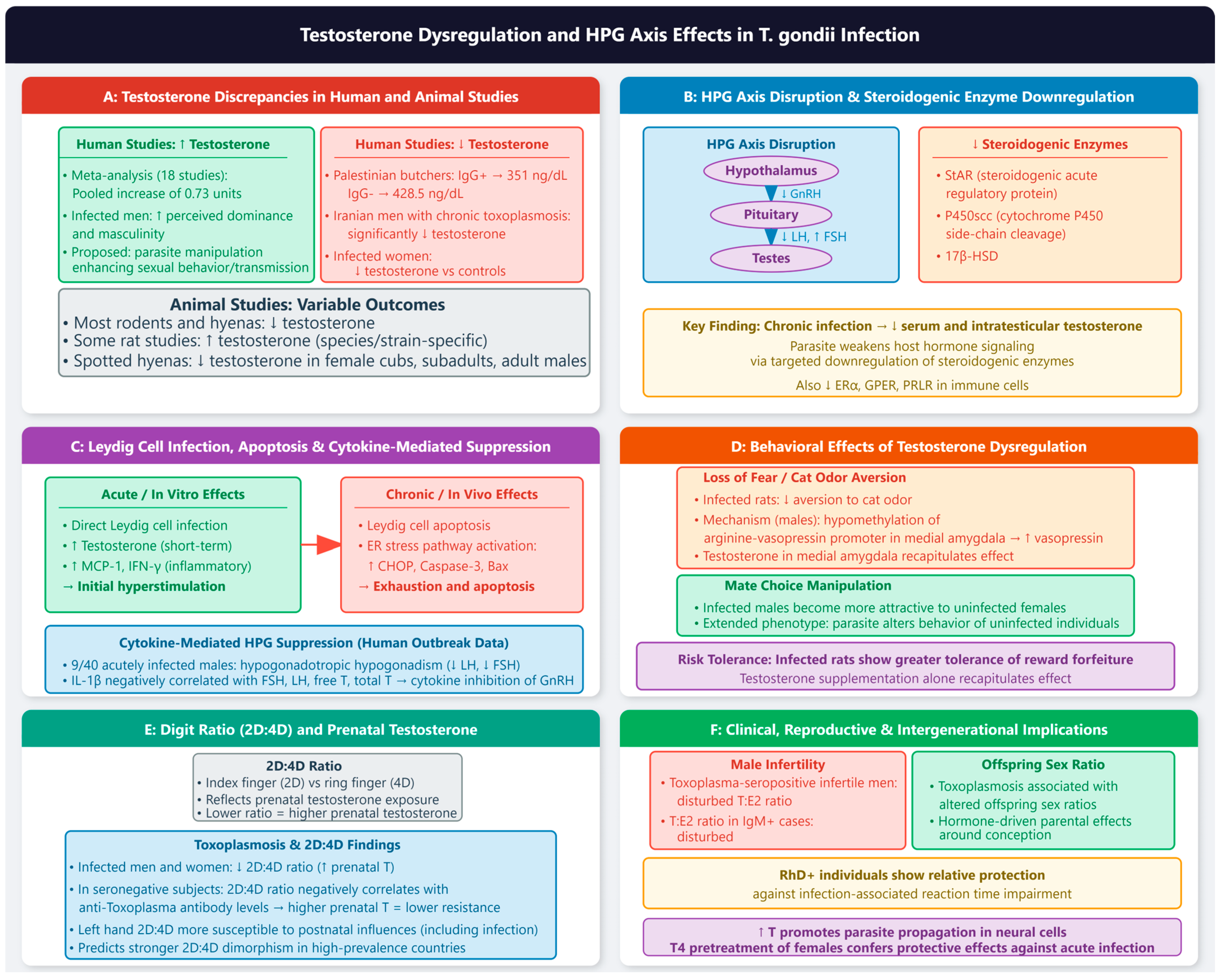
Exposure to pharmacological concentrations of potent estrogenic compounds, including 17β-estradiol, diethylstilbestrol, and α-dienestrol, increases the susceptibility of mice to T. gondii as measured by brain cyst formation. Compounds with weak estrogenic activity or other hormonal activity, including 5α-dihydrotestosterone, progesterone, and zearalanol, do not alter host resistance to infection. The ability of estrogens to alter susceptibility is inhibited by the estrogen antagonist tamoxifen. The restoration of ovariectomized mice with normal physiological concentrations of estrogen has no effect on subsequent infection with T. gondii, indicating that pharmacological, but not physiological, levels of estrogen selectively alter host resistance to T. gondii, possibly through hormonal events [74], Figure 3.

2.3.2. Progesterone

Progesterone is a critical hormone for the establishment and maintenance of pregnancy. During gestation, progesterone levels progressively increase, peaking in the third trimester [92]. Given the temporal association between rising progesterone levels and increased susceptibility to toxoplasmosis during pregnancy, it has long been hypothesized that this hormone may modulate host–parasite interactions [93]. However, the relationship between progesterone and T. gondii has proven remarkably complex, with evidence for both host-mediated and direct parasite-directed effects.
Direct Effects of Progesterone on T. gondii
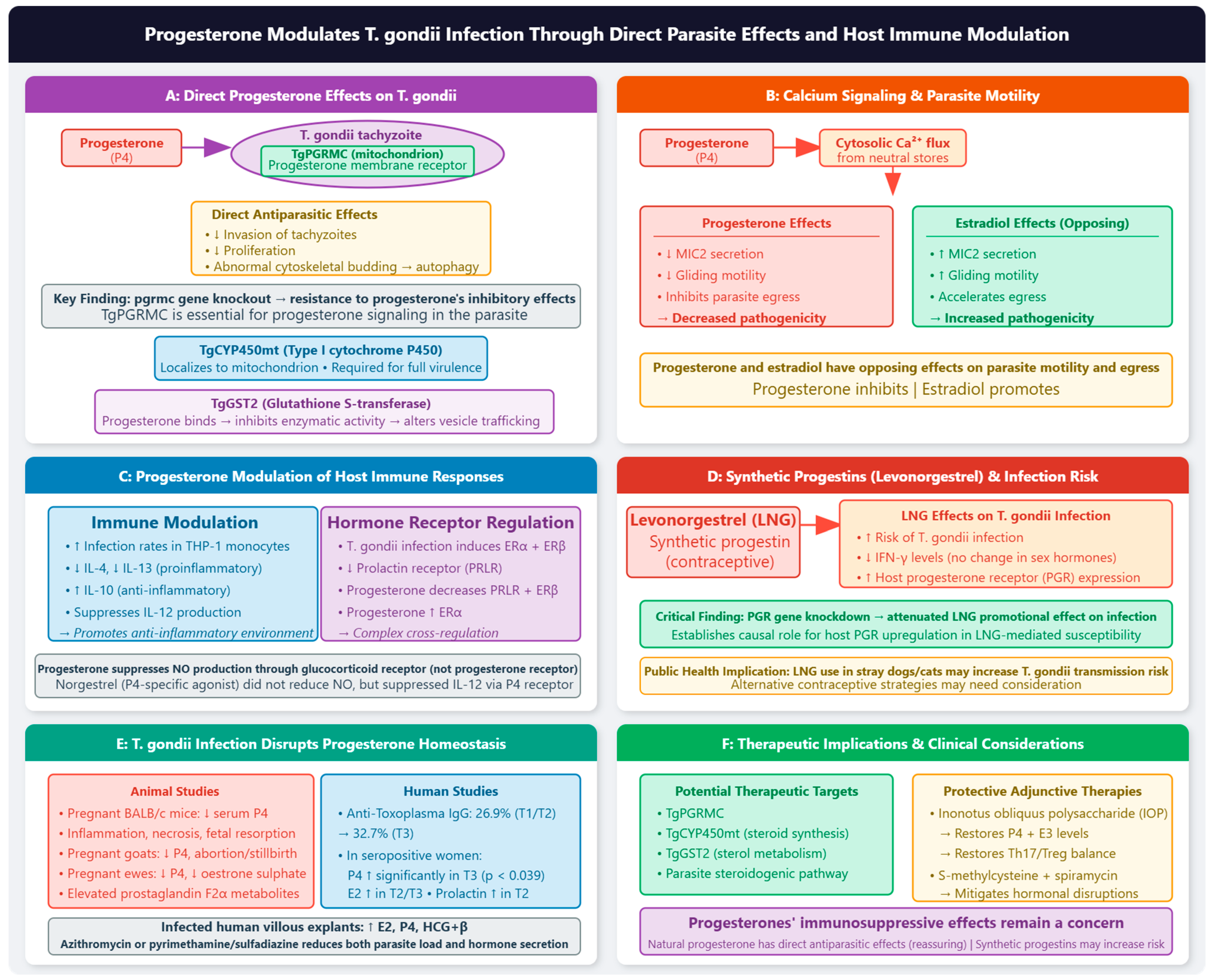
A paradigm-shifting discovery demonstrated that progesterone directly inhibits the invasion and proliferation of T. gondii tachyzoites, inducing abnormal cytoskeletal daughter budding and subsequent autophagy in vitro. This finding contradicts the long-held assumption that progesterone uniformly benefits the parasite. A T. gondii progesterone membrane receptor protein (TgPGRMC) localized to the mitochondrion was identified that mediates these effects. Critically, knockout of the PGRMC gene conferred resistance to progesterone’s inhibitory effects, establishing TgPGRMC as an essential link between the parasite and progesterone signaling [94]. The existence of a parasite-encoded steroid hormone receptor is consistent with the broader concept that microbes have evolved to utilize host hormonal signaling mechanisms for survival and replication [72]. Further characterization of the steroidogenic capacity of T. gondii demonstrated that the parasite possesses a functional type I cytochrome P450 enzyme (TgCYP450mt) and a membrane-associated progesterone receptor (TgMAPR) that localize to the mitochondrion. Genetic ablation of CYP450mt impairs parasite growth, and both TgCYP450mt and TgMAPR are required for full virulence in mice. Metabolomics studies revealed that these proteins are involved in steroid synthesis, with the parasite producing anti-inflammatory hydroxypregnenolone species, deoxycorticosterone, and dehydroepiandrosterone [19].
The effects of progesterone on parasite motility are mediated through calcium signaling. Progesterone induces cytosolic calcium fluxes in T. gondii tachyzoites, with calcium mobilized primarily from neutral stores. In contrast to estradiol, which increases microneme protein 2 (MIC2) secretion and promotes gliding motility, progesterone reduces MIC2 secretion and inhibits parasite gliding motility, potentially decreasing pathogenicity [83,90]. This differential effect highlights the opposing actions of estradiol and progesterone on parasite behavior.
The interaction between progesterone and TgGST2, a parasite glutathione S-transferase involved in vesicle trafficking and sterol metabolism, was investigated. Progesterone bound to TgGST2 and inhibited its enzymatic activity in a concentration-dependent manner. Upon progesterone treatment, TgGST2 localization changed from the Golgi and vesicles to hollow circles, leading to abnormal localization of the molecular transporter Sortilin (VPS10) and microneme proteins (M2AP and MIC2), ultimately affecting parasite life activities. Notably, estradiol did not produce similar effects, indicating the specificity of the progesterone–TgGST2 interaction [95].
Dehydroepiandrosterone (DHEA), a precursor steroid that can be converted to progesterone, exhibits toxoplasmicidal effects on extracellular tachyzoites. DHEA treatment altered parasite cytoskeletal structures, leading to loss of organelle organization and cellular shape. Notably, in the presence of DHEA, a TgPGRMC with a cytochrome b5 family heme/steroid binding domain was expressed, while proteins essential for motility and virulence were reduced. In vivo, DHEA treatment reduced parasitic load in male but not female mice, suggesting sex-dependent effects [96].
Progesterone Modulation of Host Immune Responses
Progesterone exerts profound effects on the host immune response to T. gondii. Progesterone treatment of THP-1 monocytes infected with T. gondii increased infection rates while reducing proinflammatory cytokines IL-4 and IL-13. Both progesterone and estradiol increased anti-inflammatory IL-10 production, suggesting that these hormones promote an anti-inflammatory environment that may facilitate parasite survival [82]. The mechanisms by which progesterone modulates macrophage function following Toll-like receptor-4 (TLR-4) activation were systematically investigated. Using the synthetic progesterone receptor-specific agonist norgestrel and the glucocorticoid receptor agonist dexamethasone, they demonstrated that progesterone-mediated suppression of nitric oxide (NO) production occurs through the glucocorticoid receptor, while suppression of interleukin-12 (IL-12) production can be mediated through either receptor. Importantly, while progesterone reduced NO-mediated killing of Leishmania donovani, it had little effect on T. gondii growth in activated macrophages, suggesting that progesterone-mediated increased susceptibility during pregnancy is more likely related to IL-12 downregulation and suppression of type-1 immune responses [97].
T cell immunity to T. gondii in pregnant women with primary toxoplasmosis was investigated, a question previously unexplored in humans. T cells from infected pregnant women proliferated in response to T. gondii tachyzoites, excretory-secretory antigens, and recombinant surface antigen-1 (rSAG-1), displaying a Th1 or Th0 cytokine profile with overexpression of IFN-γ. Importantly, this Th1-biased response remained unchanged upon in vitro exposure to progesterone at concentrations approximating those at the maternal–fetal interface, suggesting that progesterone does not directly suppress established anti-T. gondii T cell responses [98].
The expression of progesterone receptors is dynamically regulated during infection. Toxoplasmosis induces the expression of estrogen receptors ERα and ERβ while lowering prolactin receptor (PRLR) expression. Progesterone treatment decreased PRLR and ERβ expression but increased ERα expression, indicating complex cross-regulation among hormone receptors during infection [82]. Progesterone combined with estradiol decreased the number of intracellular parasites in infected neurons at 48 h post-treatment. Using specific agonists and antagonists, they showed that the effects of progesterone on neuronal infection are mediated through classical progesterone receptors, as the antagonist mifepristone modulated progesterone’s effects [99].
Synthetic Progestins and Toxoplasmosis
The first study examining the effects of levonorgestrel (LNG), a synthetic progestin used for contraception in stray animals, on T. gondii susceptibility was conducted. Using both in vivo and in vitro models, they demonstrated that LNG increased the risk of toxoplasmosis, an effect associated with downregulation of IFN-γ levels rather than alterations in host sex hormone levels. Concurrently, LNG enhanced the expression of its ligand, the progesterone receptor (PGR), on host cells. Critically, the promotional effect of LNG on infection was attenuated when the PGR gene was knocked down, establishing a causal role for PGR upregulation [51,52,53,54]. These findings have important implications for the widespread use of LNG as a contraceptive in stray dog and cat populations, which serve as intermediate and definitive hosts for T. gondii, respectively. The effects of progesterone, norgestrel (a synthetic progesterone-receptor-specific agonist), and dexamethasone on macrophage function were compared. While progesterone and dexamethasone significantly reduced NO production following LPS stimulation, norgestrel did not, indicating that this effect is mediated through the glucocorticoid receptor rather than the progesterone receptor. However, all three steroids downregulated IL-12 production, demonstrating that progesterone receptor ligation alone is sufficient to modulate this aspect of the immune response [97]. The available evidence suggests that natural progesterone and synthetic progestins may have divergent effects on toxoplasmosis. Direct antiparasitic effects of natural progesterone through TgPGRMC [94] were domonstrated, while levonorgestrel increased infection risk through host PGR upregulation and IFN-γ suppression [51,52,53,54]. These differences may reflect distinct mechanisms of action, with natural progesterone acting directly on the parasite and synthetic progestins primarily affecting host immunity. Alternatively, the concentrations used and experimental models may account for some discrepancies.
Effects of Toxoplasmosis on Progesterone Homeostasis
Toxoplasma gondii infection in pregnant BALB/c mice reduced serum progesterone levels and induced adverse effects at the maternal–fetal interface, including inflammation, necrosis, and fetal resorption. Infected pregnant mice exhibited clinical signs of infection, and alterations in immune spleen cells were dependent on the day of pregnancy [100]. Similarly, T. gondii infection in pregnant goats caused all inoculated animals aborted or delivered stillborn or weak kids 54–73 days after inoculation. Plasma progesterone levels showed a slight decrease after inoculation, and the pattern of progesterone changes around abortion resembled that around normal parturition, but with elevated prostaglandin F2α metabolites. Oestrone sulphate levels failed to increase before abortion, indicating disturbed endocrine fetal-placental function [85]. Similar findings were reported in pregnant ewes, with infected animals showing decreased progesterone and oestrone sulphate levels following an initial increase in prostaglandin metabolite [101].
A follow-up study of 52 pregnant women was conducted to determine associations between serum hormone levels and anti-T. gondii antibody kinetics. The prevalence of anti-T. gondii IgG antibodies was 26.92% in the first and second trimesters, increasing to 32.7% in the third trimester. In seropositive women, progesterone increased significantly (p < 0.039) in the third trimester, while 17β-estradiol increased in the second and third trimesters and prolactin increased in the second trimester (p < 0.021). These findings indicate that progesterone and other hormones are associated with toxoplasmosis during pregnancy, though the direction of causality remains to be determined [92]. Toxoplasma gondii-infected human villous explants increased secretion of estradiol, progesterone, and HCG+β. Treatment with azithromycin or the standard combination of pyrimethamine, sulfadiazine, and folinic acid reduced both parasite load and hormone secretion, suggesting that hormonal dysregulation is a consequence of infection rather than a pre-existing condition [102].
The effects of toxoplasmosis on aversive behaviors in female rats were investigated, finding that infected females lost their natural preference for rabbit urine over bobcat urine and spent more time investigating social novelty, indicating reduced risk aversion and increased exploratory behavior. Notably, infected rats had elevated levels of circulating progesterone, a known anxiolytic, and the behavioral effects were influenced by the estrus cycle. Uninfected rats preferred rabbit urine throughout the cycle except at estrus and metestrus, while infected rats lost this preference at every stage except estrus [103]. However, the loss of predator aversion in female rats after infection was not dependent on ovarian steroids, suggesting alternative mechanisms [104].
Progesterone and Congenital Toxoplasmosis
The relationship between foodborne infections during pregnancy was reviewed, noting that escalated production of progesterone during pregnancy leads to down-regulation of cellular (cell-mediated) immune functions. Many intracellular pathogens, including T. gondii, are controlled by cell-mediated immunity, and pregnancy-induced decreases in these functions increase susceptibility. Toxoplasma gondii and Listeria monocytogenes are identified as the most important foodborne pathogens in pregnancy in the United States, capable of inducing death or grave disease in the fetus and newborn [105]. Global miRNA expression profiling of domestic cat livers following acute toxoplasmosis and identified 82 differentially expressed miRNAs. Kyoto Encyclopedia of Genes and Genomes analysis revealed that predicted gene targets were involved in multiple pathways, including the progesterone-mediated oocyte maturation pathway, suggesting that infection may influence progesterone signaling at the molecular level [106]. IOP protected against adverse pregnancy outcomes caused by toxoplasmosis in mice. IOP significantly reduced abortion rates, inhibited the decrease in progesterone and estriol levels, and restored the balance of Th17/Treg cells through the TLR4/NF-κB pathway [80]. Similarly, S-methylcysteine combined with spiramycin mitigated hormonal disruptions (including progesterone) and promoted tissue recovery in infected rats, suggesting that therapies targeting both the parasite and host endocrine function may be beneficial [88].
Conflicting Evidence and Knowledge Gaps
Several studies have reported conflicting findings regarding progesterone’s effects on T. gondii. Progesterone failed to modulate T. gondii replication in RAW 264.7 murine macrophages, even though it inhibited NO production induced by IFN-γ/LPS. The authors concluded that progesterone has no direct effect on macrophage response to the parasite and that the real effects of sex steroids in toxoplasmosis likely involve broader immune mechanisms [107]. The effects of testosterone and progesterone on T. gondii propagation in glioblastoma cells were investigated, finding that testosterone significantly increased infection while progesterone had no significant effects. This contrasts with the direct inhibitory effects reported by Wu et al. (2022) and may reflect differences in cell types, parasite strains, or experimental conditions [94,108]. A major challenge in understanding progesterone–T. gondii interactions is distinguishing direct effects on the parasite from indirect effects mediated through host immunity. The discovery of TgPGRMC [94] and the steroidogenic capacity of the parasite [19] provides compelling evidence for direct parasite–hormone interactions. However, the immune-modulatory effects of progesterone, including suppression of IL-12 and promotion of IL-10 [82,97], likely contribute to increased susceptibility in vivo. The effects of progesterone may be concentration-dependent. Progesterone, unlike estrogens, did not alter host resistance to infection when administered at pharmacological concentrations [74]. However, this study used pharmacological rather than physiological concentrations, and the effects of physiological progesterone levels during pregnancy may differ. Direct antiparasitic effects were found using progesterone concentrations relevant to pregnancy, suggesting that the discrepancy may relate to experimental conditions [94].
Clinical and Public Health Implications
Understanding the complex role of progesterone in toxoplasmosis has important implications for managing toxoplasmosis during pregnancy. While progesterone is essential for pregnancy maintenance and is commonly supplemented in cases of luteal phase deficiency or threatened abortion [109], its potential effects on toxoplasmosis should be considered. The finding that progesterone has direct antiparasitic effects is reassuring [94], but the immunosuppressive effects of pregnancy, mediated in part by progesterone, remain a concern [105]. Important public health concerns were raised regarding the use of levonorgestrel as a contraceptive in stray dogs and cats. Given that these animals play critical roles in the transmission of T. gondii (cats as definitive hosts, dogs as intermediate hosts), the finding that LNG increases infection risk has implications for both animal welfare and public health. Alternative contraceptive strategies may need to be considered, or LNG use should be accompanied by monitoring for toxoplasmosis [51,52,53,54]. The identification of TgPGRMC as a mediator of progesterone’s antiparasitic effects [94] and the steroidogenic capacity of the parasite [19] suggest new therapeutic targets. Drugs that modulate progesterone receptor signaling or interfere with parasite steroid metabolism could be developed as novel anti-T. gondii agents. Additionally, the protective effects of IOP [80] and S-methylcysteine [88] on progesterone levels and pregnancy outcomes suggest that adjunctive therapies targeting hormone homeostasis may improve clinical outcomes.
Several key questions remain regarding the molecular mechanisms underlying progesterone–T. gondii interactions. The signaling pathways downstream of TgPGRMC require further elucidation, as does the functional significance of the parasite’s steroidogenic capacity. The relationship between progesterone-induced calcium fluxes [83,90] and TgPGRMC activation needs to be established. Most current evidence derives from animal models and in vitro systems. Prospective human studies examining the relationship between endogenous progesterone levels, progesterone supplementation, and the risk and severity of toxoplasmosis during pregnancy are needed. The findings of [92] provide a foundation for such studies. The development of drugs targeting TgPGRMC or other components of the parasite steroid signaling pathway represents a promising avenue for anti-T. gondii therapy. Additionally, the differential effects of natural progesterone versus synthetic progestins warrant further investigation to guide the safe use of these compounds in at-risk populations (Figure 4).

2.3.3. Oxytocin

Toxoplasmosis in female rats causes an atypical increase in oxytocin and its receptor in the brain, specifically enhancing oxytocin mRNA in the paraventricular nucleus of the hypothalamus and oxytocin receptor mRNA in the posterodorsal medial amygdala [110]. This finding is significant because it reveals a sexually dimorphic mechanism underlying the parasite’s behavioral manipulation. While infected male rats lose their innate fear of cat odors through increased testosterone and vasopressin signaling, infected female rats exhibit the same loss of predator aversion without changes in gonadal steroids [110]. Instead, the authors propose that the enhanced oxytocin signaling from the hypothalamus to the medial amygdala may alter activity in social salience circuits, shifting the behavioral output from defensive avoidance toward approach-like responses to ambivalent cues such as cat odors [110]. Thus, T. gondii achieves sexually monomorphic behavioral changes through sexually dimorphic neural substrates.
Figure 4. Progesterone modulates toxoplasmosis through direct parasite effects and host immune modulation. (A) Direct progesterone effects on T. gondii. Progesterone directly inhibits the invasion and proliferation of T. gondii tachyzoites, inducing abnormal cytoskeletal daughter budding and subsequent autophagy. These effects are mediated by a parasite-encoded progesterone membrane receptor protein (TgPGRMC) localized to the mitochondrion. TgPGRMC gene knockout confers resistance to progesterone’s inhibitory effects, establishing TgPGRMC as an essential link between the parasite and progesterone signaling. The parasite also possesses a functional type I cytochrome P450 enzyme (TgCYP450mt) and a membrane-associated progesterone receptor (TgMAPR) that localize to the mitochondrion; both are required for full virulence in mice. Additionally, progesterone binds to TgGST2 (a parasite glutathione S-transferase) and inhibits its enzymatic activity in a concentration-dependent manner, leading to abnormal localization of Sortilin (VPS10) and microneme proteins (M2AP and MIC2), ultimately affecting parasite life activities. Estradiol does not produce similar effects, indicating the specificity of the progesterone–TgGST2 interaction. (B) Calcium signaling and parasite motility. Progesterone induces cytosolic calcium fluxes in T. gondii tachyzoites, with calcium mobilized primarily from neutral stores. In contrast to estradiol, which increases microneme protein 2 (MIC2) secretion and promotes gliding motility, progesterone reduces MIC2 secretion and inhibits parasite gliding motility, potentially decreasing pathogenicity. (C) Progesterone modulation of host immune responses. Progesterone exerts profound effects on the host immune response to T. gondii. Progesterone treatment of infected THP-1 monocytes increases infection rates while reducing proinflammatory cytokines IL-4 and IL-13. Both progesterone and estradiol increase anti-inflammatory IL-10 production, suggesting that these hormones promote an anti-inflammatory environment that may facilitate parasite survival. Progesterone-mediated suppression of nitric oxide (NO) production occurs through the glucocorticoid receptor, while suppression of IL-12 can be mediated through either the glucocorticoid or progesterone receptor. Regarding hormone receptor regulation, toxoplasmosis induces ERα and ERβ expression while lowering prolactin receptor (PRLR) expression. Progesterone treatment decreases PRLR and ERβ expression but increases ERα expression, indicating complex cross-regulation among hormone receptors during infection. (D) Synthetic progestins (levonorgestrel) and infection risk. Levonorgestrel (LNG) increases the risk of toxoplasmosis. This effect is associated with downregulation of IFN-γ levels (rather than alterations in host sex hormone levels) and enhanced expression of the progesterone receptor (PGR) on host cells. Critically, PGR gene knockdown attenuates the promotional effect of LNG on infection, establishing a causal role for host PGR upregulation. These findings have important public health implications, as LNG use in stray dog and cat populations (which serve as intermediate and definitive hosts for T. gondii, respectively) may increase parasite transmission risk. Natural progesterone and synthetic progestins may have divergent effects: natural progesterone exhibits direct antiparasitic effects through TgPGRMC, while synthetic progestins primarily affect host immunity. (E) Toxoplasmosis disrupts progesterone homeostasis. Infection disrupts progesterone homeostasis in both animal models and humans. In pregnant BALB/c mice, infection reduces serum progesterone levels and induces adverse effects at the maternal–fetal interface, including inflammation, necrosis, and fetal resorption. Infected pregnant goats and ewes show decreased progesterone and oestrone sulphate levels following an initial increase in prostaglandin metabolites, leading to abortion or stillbirth. In human studies, anti-T. gondii IgG prevalence increases from 26.9% in the first/second trimesters to 32.7% in the third trimester. In seropositive women, progesterone increases significantly in the third trimester (p < 0.039), while estradiol increases in the second and third trimesters and prolactin increases in the second trimester (p < 0.021). Infected human villous explants show increased secretion of estradiol, progesterone, and HCG+β; treatment with azithromycin or pyrimethamine/sulfadiazine reduces both parasite load and hormone secretion, suggesting that hormonal dysregulation is a consequence of infection rather than a pre-existing condition. (F) Therapeutic implications and clinical considerations. The identification of TgPGRMC, TgCYP450mt, and TgGST2 as mediators of progesterone’s antiparasitic effects suggests new therapeutic targets. Drugs that modulate progesterone receptor signaling or interfere with parasite steroid metabolism could be developed as novel anti-T. gondii agents. Protective adjunctive therapies include IOP, which significantly reduces abortion rates, inhibits the decrease in progesterone and estriol levels, and restores Th17/Treg balance through the TLR4/NF-κB pathway. S-methylcysteine combined with spiramycin mitigates hormonal disruptions (including progesterone) and promotes tissue recovery in infected rats. While progesterone is essential for pregnancy maintenance and is commonly supplemented in cases of luteal phase deficiency or threatened abortion, its immunosuppressive effects remain a concern. The finding that natural progesterone has direct antiparasitic effects is reassuring, but synthetic progestins may increase infection risk (pink boxes indicate progesterone and its effects; purple boxes denote T. gondii parasite structures and direct parasite–hormone interactions; red/orange boxes indicate synthetic progestins, calcium signaling, and infection risk; green boxes indicate protective/therapeutic effects and estradiol; blue boxes denote host immune modulation; arrows indicate increased or decreased expresson level or directional regulatory relationships (e.g., hormone → parasite effect, infection → hormone disruption). ↑ = increased (expression); ↓ = decreased (expression); → = proceed to.
Vetsci 13 00430 g004

2.3.4. Follicle Stimulating Hormone (FSH)

The relationship between toxoplasmosis and Follicle Stimulating Hormone (FSH) levels is not consistently clear across different studies, and the existing evidence suggests that the parasite may have a limited or sex-specific impact on this hormone. A study conducted exclusively on male blood donors in Baghdad specifically examined the effect of toxoplasmosis on FSH levels. Their findings indicated that in both acute and chronic phases of toxoplasmosis, the mean concentration of FSH showed non-significant differences compared to controls. Specifically, the mean FSH levels were 6.41 ± 0.47 IU/mL and 6.515 ± 0.51 IU/mL for acute and chronic infections, respectively, leading the authors to conclude that toxoplasmosis did not produce a statistically significant alteration in FSH levels in their male cohort [111]. This observation of a lack of significant FSH change is partially supported by another human study, this time a pilot study conducted on immunocompetent human male volunteers. This investigation also found no statistically significant influence of latent Toxoplasmosis on serum levels of FSH in males. However, the authors of this pilot study caution that due to their limited sample size (60 subjects), they cannot definitively affirm the absence of an influence. They calculated that a much larger study (approximately 994 subjects) would be needed to reliably detect a potential effect in human males, leaving the question partially open [112].
In stark contrast to these human male studies, research on animal models—specifically on female mice—suggests a more complex role for FSH in the context of toxoplasmosis, particularly regarding ovarian dysfunction. A study on chronically infected female mice found that while the ovaries could respond to exogenous gonadotropins, there was evidence of pituitary FSH insufficiency. Specifically, following unilateral ovariectomy, infected female mice did not develop compensatory hypertrophy of the remaining ovary—a process normally driven by FSH. This pointed to a deficiency in endogenous FSH secretion from the pituitary. The researchers hypothesized that this impairment was likely due to cytokines released by the immune response to the parasite, which could inhibit the hypothalamic release of gonadotropin-releasing hormone (GnRH), thereby secondarily suppressing FSH (and LH) production in females [6,7]. Therefore, while human studies on males to date report no significant change in baseline FSH levels, animal research on females indicates that chronic toxoplasmosis can disrupt the functional capacity of the FSH axis, potentially leading to ovulatory problems. Whether T. gondii affects FSH in human females or in male animals remains unknown from these studies.

2.3.5. Luteinizing Hormone (LH)

In female mice, chronic toxoplasmosis clearly suppresses LH function and disrupts the reproductive axis. Chronically infected female mice exhibited reproductive failure characterized by constant diestrous (a non-reproductive phase of the estrous cycle) along with ovarian and uterine atrophy. While basal serum LH levels were similar between infected and uninfected mice, infected females showed a significantly decreased pituitary responsiveness to a luteinizing hormone-releasing hormone (LHRH) analog. This indicates a dysfunction at the level of the hypothalamic-adenohypophyseal axis, specifically a reduction in the readily releasable pool of pituitary LH. A follow-up study by the same group further confirmed the absence of the critical preovulatory surge of endogenous LH from the pituitary in infected female mice, which directly prevented ovulation despite otherwise vigorous follicular growth stimulated by exogenous hormones [6,7].
In male mice, the evidence also points to a suppressive effect of T. gondii on LH, which correlates with reduced reproductive fitness. A study found that the level of LH in the urine of T. gondii-infected male mice was significantly lower compared to uninfected controls. This reduction in LH was directly correlated with diminished testicular function, including lower sperm counts, reduced numbers of spermatocytes and spermatids, and impaired spermatogenesis. These findings demonstrate a direct relationship between toxoplasmosis and decreased male reproductive fitness in mice, mediated in part by lowered LH levels. Later intervention studies using polysaccharides from medicinal fungi in T. gondii-infected male mice further support this pattern [113]. Both treatment with IOP or ginseng polysaccharide (GP), respectively, was able to increase serum LH levels (along with testosterone and FSH) while mitigating testicular damage and improving spermatogenic capacity. The fact that these therapeutic agents raised LH levels back toward normal strongly implies that chronic toxoplasmosis originally suppressed them.
In humans, the evidence regarding LH is more limited but suggests a potential for disruption, particularly in immunocompromised individuals. No large-scale human study specifically examining LH levels in immunocompetent males with latent toxoplasmosis was provided in these abstracts. However, a case report described a 37-year-old immunocompromised man (HIV-positive with a very low CD4 count) who presented with intracranial toxoplasmosis [114]. His laboratory evaluation revealed panhypopituitarism, including low levels of luteinizing hormone (LH) and testosterone, along with other pituitary hormones. A brain biopsy confirmed T. gondii as the cause of the brain lesions, which were believed to be directly causing his hormonal deficiencies [114]. This case demonstrates that in severe, disseminated toxoplasmosis affecting the central nervous system in an immunocompromised host, LH deficiency can occur as part of a broader pituitary failure. Whether latent toxoplasmosis affects LH levels in otherwise healthy humans remains unknown from these studies.

2.3.6. Human Chorionic Gonadotropin (hCG)

A study on female mice chronically infected with T. gondii used hCG as a research tool to probe ovarian function [6,7]. In this experiment, the researchers administered hCG to infected female mice three days after they had received pregnant mare serum gonadotropin (PMSG). hCG is structurally similar to luteinizing hormone (LH) and is commonly used experimentally to mimic the LH surge that triggers ovulation. The key finding was thathCG successfully induced “superovulation” within 16 hin the chronically infected mice. This result is highly significant because it demonstrates that the ovaries of infected mice werenotthe site of failure—they remained capable of ovulating when given the appropriate hormonal signal (hCG). The problem, as the authors concluded, was not primary ovarian failure but rather the absence of theendogenouspreovulatory LH surge from the pituitary. In other words, toxoplasmosis impaired the brain and/or pituitary gland, but the ovaries themselves were still functionally responsive to exogenous gonadotropins like hCG.

2.3.7. Prolactin

Prolactin as a Protective Factor Against Infection in Humans
Multiple human studies indicate that elevated prolactin levels are associated with a lower prevalence of toxoplasmosis, particularly in women. A cross-sectional study on 343 individuals found that women with high prolactin levels had a significantly lower prevalence of anti-T. gondii IgG antibodies compared to those with normal prolactin levels. Furthermore, as prolactin levels increased in women with hyperprolactinemia, the prevalence of toxoplasmosis decreased progressively [115]. This finding was corroborated by Dzitko et al., who studied a Polish population of 234 hyperprolactinemic individuals, 41 hypoprolactinemic individuals, and 281 controls. Women with hyperprolactinemia showed significantly lower seroprevalence (33.90%) than those with normal prolactin levels (45.58%). Notably, women with very high prolactin levels (>86 ng/mL) had a seroprevalence of only 12.50%, which was significantly lower than that of controls [116]. Both studies suggest that high prolactin may serve as a protective factor against T. gondii acquisition in women.
Prolactin in Pregnancy and Infertility
During pregnancy, hormonal changes create a complex relationship with toxoplasmosis. A study of 52 pregnant women across all three trimesters found that prolactin levels increased significantly in the second trimester among seropositive women (p < 0.021), alongside increases in 17β estradiol and progesterone [92]. The prevalence of anti-T. gondii IgG antibodies rose from 26.92% in the first and second trimesters to 32.7% in the third trimester. In the context of infertility, 520 infertile women over a ten-year period were examined and 65.77% were seropositive for anti-T. gondii IgG. However, serum prolactin levels were normal in 81.29% of these seropositive infertile women, suggesting that while latent toxoplasmosis is highly prevalent among infertile women, it does not typically present with abnormal prolactin levels [117]. Additionally, a case report described a 27-year-old woman with secondary amenorrhea and moderately elevated prolactin levels who was found to have both a nonfunctioning pituitary adenoma and T. gondii bradyzoites within the adenoma [118]. This rare presentation highlights that sellar toxoplasmosis can coexist with pituitary lesions and hyperprolactinemia.
Prolactin Receptors and Direct Parasite Binding
The interaction between prolactin and T. gondii appears to involve direct binding at the molecular level. Sheep prolactin binds specifically to live tachyzoites of both type I (RH) and type II (ME49) T. gondii strains, as demonstrated using fluorescein- and biotin-labeled prolactin. This binding was confirmed to be specific through competitive inhibition analysis [119]. Furthermore, T. gondii infection itself lowers the expression of the prolactin receptor (PRLR) on THP-1 human monocytic cells [82]. Treatment with exogenous prolactin further decreased the expression of estrogen receptors (ERα and ERβ), indicating complex cross-talk between hormonal signaling pathways during infection. 17β-estradiol modulates the expression of PRLR in T. gondii-infected macrophages and monocytes in an AKT and ERK-dependent manner, increasing PRLR expression in infected macrophages while decreasing it in infected monocytes [14].
Prolactin’s Anti-Parasitic Effects in Cell Cultures
In vitro studies consistently demonstrate that prolactin inhibits T. gondii proliferation. Recombinant human prolactin (rhPRL) on three cell lines (murine L929 and human Hs27 and HeLa) was evaluated and pre-incubation of tachyzoites with rhPRL significantly reduced their replication ability by up to 36.15%, primarily by limiting the parasites’ capacity to penetrate host cells. No toxic effects of rhPRL on host cells or extracellular tachyzoites were observed [120]. Expanding on this, peripheral blood mononuclear cells (PBMCs) from female hyperprolactinemia patients found that both exogenous rhPRL and autologous serum prolactin significantly restricted intracellular growth of T. gondii. This effect was positively correlated with increased production of IL-10, suggesting an immunomodulatory mechanism [121]. Similarly, prolactin, along with TNF-α, induced T. gondii static activity in murine microglia, leading to intracellular killing of T. gondii and release of IL-1β, IL-3, and IL-6, with the effect partially dependent on ICAM-1 expression [122].
Prolactin’s Protective Effects in Animal Models
In vivo animal studies confirm that prolactin administration confers protection against toxoplasmosis. Mice treated with recombinant mouse prolactin for five days prior to toxoplasmosis showed a significant increase in survival rate, a significant decrease in the number, size, and DNA content of brain cysts, and noticeable improvement in histopathological lesions in brain and liver tissues. These protective effects were associated with significant rises in serum levels of anti-T. gondii IgM, IFN-γ, and TNF-α, indicating stimulation of both humoral and cell-mediated immunity [123]. Mice lethally infected with T. gondii and treated with prolactin (0.5–2 mg/kg twice daily for 12 days) were protected against death in a dose-dependent manner (p < 0.001). Survival rates reached 50–70% when prolactin was combined with either rIFN-γ or rTNF-α, and a slight synergistic effect on reducing brain cyst formation was observed with prolactin plus TNF-α [124]. The authors concluded that prolactin regulates endogenous TNF-α production and plays an important role in modulating host immune defense against toxoplasmosis. One methodological study described the use of xanthine oxidase as a label in solid-phase immunoassays, including the detection of anti-T. gondii IgG antibodies and prolactin measurement [125]. This technical paper demonstrates that prolactin and T. gondii serology can be measured using the same labeling technology, but it does not address any biological relationship between the two.

2.3.8. Gonadotropin-Releasing Hormone (GnRH)

Two studies point to a model in which toxoplasmosis leads to suppression of GnRH, which in turn causes downstream impairment of the pituitary-gonadal axis. However, the evidence comes from different contexts: one in female mice with chronic infection, and the other in male humans with acute infection. In female mice with chronic toxoplasmosis, the etiology of ovarian dysfunction was investigated. It was found that while the ovaries of infected mice remained capable of responding to exogenous gonadotropins (PMSG and hCG) by undergoing folliculogenesis and even superovulation, the mice failed to ovulate on their own due to the absence of the endogenous preovulatory LH surge. Furthermore, unilateral ovariectomy did not result in compensatory hypertrophy of the remaining ovary, indicating insufficient FSH. Taken together, these findings pointed to a central defect at the level of the hypothalamus or pituitary, rather than primary ovarian failure. The authors directly hypothesized that “cytokines released peripherally in response to the parasite reached the hypothalamus and initiated a sequence of events that inhibited the pulsatile release of gonadotropin-releasing hormone (GnRH), leading to the subsequent impairment of the pituitary-ovarian axis.” This study thus places GnRH suppression at the center of T. gondii-induced reproductive dysfunction in female mice [6,7].
In male humans with acute toxoplasmosis, an outbreak of toxoplasmosis in a male boarding school in Turkey was studied. Among 40 infected male patients aged 17–18 years, nine (group B) were found to have low levels of FSH, LH, free testosterone, and total testosterone, consistent with hypogonadotropic hypogonadism (i.e., gonadal failure caused by insufficient pituitary stimulation rather than a primary testicular problem). The remaining 31 patients (group A) had normal sex hormone levels. The key finding was that interleukin-1 beta (IL-1β) levels were significantly higher in group B patients than in group A, and IL-1β levels correlated negatively with FSH, LH, and testosterone across all infected patients. While this study did not measure GnRH directly, the pattern of low FSH and LH with normal pituitary responsiveness (implied) is classic for hypothalamic GnRH deficiency. The authors concluded that acute toxoplasmosis causes temporary hypogonadotropic hypogonadism, and the suppressive effect is likely mediated by IL-1β acting on GnRH secretion [126], Table 2.

2.3.9. Anti-Müllerian Hormone

The relationship between toxoplasmosis and Anti-Müllerian Hormone (AMH) levels in young, unmarried women aged 20–25 years was investigated. AMH is a hormone produced by ovarian granulosa cells and is a clinically important marker of ovarian reserve—the number of remaining eggs in a woman’s ovaries. Higher than normal AMH can be associated with polycystic ovary syndrome (PCOS), while low AMH indicates diminished ovarian reserve. The key finding from both studies is that toxoplasmosis is associated with elevated AMH levels, and this elevation correlates positively with various pro-inflammatory and regulatory cytokines [127,128]. In the first study, blood samples were collected from 80 unmarried women (40 infected with T. gondii and 40 uninfected controls). They measured levels of IL-2, IL-10, IL-12, and AMH. The results showed a significant increase in IL-2, IL-10, and IL-12 levels in infected women compared to the control group. Importantly, there was a positive correlation between all three cytokines and AMH levels in infected women. The authors concluded that this positive correlation supports the possibility of adopting the AMH level as an indicator for future cases of polycystic ovariancysts and infertility in women with toxoplasmosis [127]. In other words, toxoplasmosis, through its effects on the immune system, may raise AMH levels, which could predispose women to PCOS and related fertility problems. The second study appears to be a follow-up investigation by the same group using the same study design (80 women total: 40 infected, 40 controls) but focusing on different inflammatory cytokines: IL-1β, IL-6, and tumor necrosis factor alpha (TNF-α). The results mirrored the first study: infected women had significantly higher levels of IL-1β, IL-6, and TNF-α compared to controls. Once again, AMH concentrations correlated significantly and positively with all three immune parameters [128]. The authors concluded that the strong association between AMH and these inflammatory cytokines implies that toxoplasmosis may influence ovarian reserve markers through immune-mediated mechanisms.

3. Male Reproductive Tract: Testicular Tropism and Seminal Shedding

The possibility of venereal transmission—infection through semen during natural mating or artificial insemination—is inconsistent across species and experimental models, with some studies demonstrating clear transmission while others find no evidence. The testis represents an immunologically privileged site essential for germ cell development, yet T. gondii efficiently breaches the blood–testis barrier to establish productive infection. Seminal studies using in vivo bioluminescence imaging demonstrated rapid parasite dissemination to testes following systemic inoculation, with intense photon signals detectable by day 4–5 post-infection and strong correlation between testicular signal and viable parasite counts [12]. This establishes the testis as a significant site of acute parasite replication. Notably, MyD88-deficient mice fail to contain infection and exhibit parasite loads up to two orders of magnitude greater than wild-type, establishing the critical role of Toll/interleukin-1 receptor signaling in testicular defense [12]. Direct visualization studies confirm testicular tropism across species. In experimentally infected mice and rats, parasites localize to the testes and epididymis with accompanying inflammatory infiltration and architectural disruption [12,129]. Histological demonstrations in animals and humans have confirmed the presence of T. gondii trophozoites and proliferative forms, with special consideration given to the sex organs as sites of infection [130].

3.1. Species-Specific Patterns of Seminal Shedding

3.1.1. Sheep: Brief Shedding but Demonstrated Transmission

The most rigorous early investigation of seminal shedding in ruminants came from Teale, Blewett, and Miller (1982) [131]. Six young rams were inoculated subcutaneously with 2000 T. gondii tissue cysts, with observations continuing for over 90 days post-infection (pi). Three of six infected rams produced infective semen, each on two occasions, occurring between 14 and 26 days pi—demonstrating that “the production of infective semen was restricted to a brief period shortly after infection” [131]. The authors concluded that venereal transmission was unlikely to be significant in the spread of ovine toxoplasmosis, based on the brief duration of shedding, absence of diagnostic clinical changes, and the likelihood that acutely ill rams would be removed from breeding.
However, subsequent studies demonstrated that transmission can occur despite this narrow window. Sexual transmission of T. gondii in sheep has been definitively demonstrated. Male sheep were inoculated either orally with 2.0 × 10⁵ oocysts (P strain) or subcutaneously with 1.0 × 10⁶ tachyzoites (RH strain). After inoculation, seronegative ewes were exposed to natural mating. Toxoplasma gondii was isolated from the semen of infected rams before mating. Following natural mating, 5 of 12 females seroconverted, with one ewe developing a macerated fetus on day 70 post-coverage. The parasite was isolated from tissue pools of all five seroconverted females and their lambs, demonstrating both sexual and subsequent vertical transmission [132]. Artificial insemination with semen experimentally contaminated with tachyzoites was shown to infect ewes in a dose-dependent manner: 33.3% seroconversion with 6.5 × 10⁴ tachyzoites versus 100% with 4 × 10⁷ tachyzoites. Nested PCR confirmed parasitemia in 93.3% of infected animals across both dose groups [133]. These findings were extended by demonstrating that frozen-thawed semen spiked with tachyzoites remained infectious. All five ewes inseminated with contaminated frozen semen seroconverted by day 7 post-insemination, with parasites detected in tissues by immunohistochemistry—significant implications for artificial insemination programs, as standard freezing protocols do not inactivate the parasite [134].
Not all studies support significant venereal transmission in sheep. Semen from 77 apparently normal rams was tested by mouse passage and found no patent infections. Two rams with chronic toxoplasmosis were repeatedly mated with seronegative ewes; none seroconverted, and all lambed satisfactorily [135]. Similarly, semen from five seropositive rams were tested negative for T. gondii by both endpoint and real-time PCR [136]. These negative findings likely reflect that shedding is restricted to acute infection [131], and chronically infected rams do not continuously shed. In rams with experimental oral infection, T. gondii DNA was detected in 12.5% of sperm samples at 15 weeks post-infection, with infected animals showing characteristic fever, seroconversion, and deteriorating sperm quality despite intermittent parasite detection [137]. Notably, sulphadimidine administered 24 h post-infection or at two months post-infection failed to prevent deterioration in sperm quality parameters, possibly reflecting the inability of sulphadimidine to adequately penetrate the blood–testis barrier [137]. Early in vitro work further supported the parasite’s tropism for male reproductive tissues by successfully cultivating T. gondii in lamb testicular cell culture [137,138].

3.1.2. Goats: Prolonged Shedding but Limited Follow-Up

The Dubey and Sharma (1980) [139] goat study remains the most frequently cited evidence for prolonged shedding. Three one-year-old male goats were orally inoculated with 104 oocysts of the GT-1 strain. All three shed T. gondii in semen, with excretion periods of 52, 16, and 5 days, respectively. Mouse bioassay confirmed infectivity [139]. The 52-day duration substantially exceeds the 12-day window (14–26 days pi) reported in rams. The animal shedding for 52 days was euthanized while still shedding, leaving the true maximum duration unknown. Possible explanations for species differences include inoculation route (oral vs. subcutaneous) or strain variation [139]. Beyond this study, data on seminal shedding in goats remain sparse, and the finding has not been systematically replicated.

3.1.3. Mice: Sexual Transmission with Reduced Fertility

Sexual transmission in mice using the RH strain was directly evaluated. Male Balb/C mice were intraperitoneally inoculated with tachyzoites; semen collected from epididymides 48 h later was examined by Giemsa staining and PCR. Female mice mated with infected males showed dramatically reduced pregnancy rates: only 4 of 20 (20%) became pregnant compared to 17 of 20 (85%) in controls (p = 0.0001). Despite detection of parasite DNA and whole organisms in semen, no abortion or death was observed in females, and no transmission to females or offspring was detected via mating. The authors suggested that infected male mice “cannot entirely mate with females due to reduction in male weapon and body size, physiological vigor and energy” [140]. This study demonstrates that while toxoplasmosis impairs male reproductive capacity and fertility, successful sexual transmission may be limited by behavioral and physiological changes in infected males.

3.1.4. Rats: Impaired Reproductive Parameters

Male Wistar rats infected orally with 5 × 10³ tissue cysts. Over 60 days post-inoculation, they observed significantly decreased sperm motility (days 10–60), decreased sperm concentration (days 10, 30, 40, 60), and increased sperm abnormalities (days 30 and 40). Epididymal weight was significantly decreased on day 30 pi. No pathological lesions were detected in the pituitary gland or testes [129]. These findings were extended to latent infection. Infected rats exhibited a significant progressive loss of body weight and absolute testicular weight. Sperm motility, viability, and concentration showed highly significant decreases throughout the observation period, with highly significant increases in abnormal sperm forms. Histopathological insults in the testes were documented. These studies confirm that both acute and latent toxoplasmosis adversely affect male rat reproductive parameters, though neither directly demonstrated seminal shedding duration [141].

3.1.5. Rabbits: Limited Window of Infectivity

Early experimental infection of male rabbits demonstrated that infective T. gondii could be isolated from the testicles and accessory gonads only up to the 29th day post-infection, and attempts to transmit infection through sexual intercourse to T. gondii-free female rabbits were uniformly unsuccessful, suggesting that sexual transmission, even if biologically possible, may be epidemiologically insignificant [142].

3.1.6. Dogs: Molecular Detection in Breeding Animals

Toxoplasma gondii in semen of breeding dogs from southeastern Iran was investigated using a highly sensitive REP-based nested PCR assay. Among 36 purebred male dogs (31% seropositive), 8.33% (3/36) had detectable T. gondii DNA in semen. One positive sample exhibited orchitis with significant sperm abnormalities including reduced motility and tail defects. However, the authors noted “no relation between T. gondii detection in semen and reproductive disorders” in this population, calling for further studies to confirm sexual transmission [143].

3.1.7. Cats: A Notable Negative Finding

Given that cats are the definitive hosts for T. gondii, their potential role in venereal transmission merits investigation. Twelve male cats were experimentally infected with either 600 tissue cysts (P strain, type III) or 2 × 10⁵ tachyzoites (RH strain, type I). Despite confirmed seroconversion and parasitemia, no T. gondii was detected in semen samples collected on days 7, 14, 21, 28, 42, 56, and 70 pi. Testicular and epididymal tissues collected at orchiectomy on day 70 were also negative by nested PCR, mouse bioassay, histopathology, and immunohistochemistry [144]. The authors concluded: “sexual transmission in domestic cats does not appear to be a major route of toxoplasmosis, possibly demonstrating the tendency of this protozoan to develop a response directed to the formation and excretion of oocysts in the feces of these definite hosts” [144]. This finding is biologically plausible: the parasite’s evolutionary strategy in the definitive host prioritizes fecal–oral transmission, and reproductive tract colonization may be selected against.

3.1.8. Field Studies: Prevalence in Naturally Infected Animals

A field study of 92 rams from four regions in Tunisia was conducted. Using PCR on semen samples, they found a molecular prevalence of 51.09% (±10.21%) for T. gondii DNA, with an overall seroprevalence of 39.13% (±9.97%). Risk factors included geographic location and number of completed mating seasons (p < 0.05). Concordance between sero- and molecular prevalence was fair (Kappa = 0.33). Sequencing of five positive samples revealed 100% identical haplotypes, matching sequences previously reported in chickens, cats, European polecats, and humans from multiple countries, indicating wide geographic distribution and lack of host specificity [145]. This high molecular prevalence in field-collected semen samples—contrasting with the negative findings of Blewett et al. in 77 apparently normal rams—warrants explanation [135]. Possible factors include: (1) different detection methods (PCR detects DNA from non-viable as well as viable organisms); (2) different geographic regions with varying infection pressures; (3) different stages of infection in sampled animals; or (4) different parasite strains. It is noted that “further studies concerning its venereal transmission capacity are needed prior to recommending a systematic screening of T. gondii DNA in rams’ semen” [145].

3.1.9. Human Studies: HIV/AIDS, Latent Infection, and Reproductive Consequences

Autopsy studies of AIDS patients identified testicular T. gondii in 3.7–39% of cases, sometimes as the only extracerebral manifestation [146,147,148,149]. A comprehensive study of 56 AIDS patients with systemic opportunistic infections found light-microscopic evidence of T. gondii in the testes of 39% of cases, leading to speculation about possible sexual transmission of the parasite based on the prevalence and histologic features of testicular involvement [146]. Symptomatic orchitis has been documented as the initial presentation of disseminated toxoplasmosis, with nephrotic syndrome remitting only after orchiectomy and anti-parasitic therapy [150]. Case reports have further documented concurrent cerebral toxoplasmosis and myocardial involvement in AIDS patients with testicular disease, emphasizing the disseminated nature of infection in immunocompromised hosts [151]. Histopathological examination reveals both pseudocysts (containing bradyzoites) within necroses and inflammatory foci by conventional staining, while trophozoites became apparent only with immunohistochemical methods [147], highlighting the importance of sensitive detection techniques. A broader histopathological comparison of 57 AIDS patients with age-matched controls further revealed that infected individuals exhibited significantly impaired spermatogenesis, along with prominent thickening of the basement membrane and interstitial fibrosis [149]. HIV/AIDS exacerbates T. gondii-induced reproductive dysfunction through immunosuppression-driven reactivation and direct endocrine disruption. In HIV-infected pregnant women, T. gondii seroprevalence reaches 41%, with co-infection associated with increased miscarriage, stillbirth, and congenital defects [152,153]. In non-pregnant individuals, cerebral toxoplasmosis—occurring when CD4+ counts fall below 100 cells/μL—can cause isolated gonadotrophin deficiency. A documented case report describes an HIV-positive woman who developed secondary amenorrhea and ovarian failure due to a pituitary toxoplasmosis lesion that impaired LH/FSH secretion [154]. Additionally, toxoplasmosis of the hypothalamus or pituitary in AIDS patients can precipitate hypogonadotropic hypogonadism, directly compromising fertility [155]. Thus, in HIV-endemic regions, T. gondii co-infection represents a lesion-mediated cause of central reproductive failure, Table 3 and Table 4.

3.2. Mechanisms of Male Reproductive Immunopathology

The testis maintains immune privilege to protect germ cells expressing novel antigens from autoimmune attack. Toxoplasmosis triggers robust pro-inflammatory responses that compromise this privilege, fundamentally altering the testicular microenvironment.

3.2.1. Innate Immune Recognition and Signaling

Toxoplasmosis initiates powerful innate immune responses through Toll/interleukin-1 receptor (TIR) signaling via the adaptor protein MyD88. MyD88-deficient mice fail to contain infection, exhibiting parasite loads two orders of magnitude higher than wild-type, with bioluminescence imaging confirming uncontrolled testicular dissemination [12]. Notably, ICE-deficient mice (lacking functional IL-1 and IL-18) control infection normally, suggesting MyD88 signaling occurs through Toll-like receptors rather than IL-1R or IL-18R [12]. However, the host defense is complex and redundant, as single deficiencies in TLR1, TLR2, TLR4, TLR6, or TLR9 do not independently increase susceptibility to infection [12]. Male germ cells express TLR11, which recognizes T. gondii-derived profilin and initiates innate immune responses characterized by inflammatory cytokine production [160]. The TLR4-P2X7R/NLRP3 inflammasome pathway is activated in the testes of infected mice, contributing to the inflammatory cascade [161]. Neutrophil IL-12 production requires JNK2 MAP kinase, demonstrating pathway-specific host defense requirements [162]. The critical role of immune signaling in controlling testicular infection is further illustrated by observations in immunocompromised hosts, where testicular toxoplasmosis can become clinically apparent [146,148].

3.2.2. Cytokine Profiles and T Helper Responses

Infection shifts the testicular cytokine milieu toward a Th1-polarized state with elevated IFN-γ, TNF-α, and IL-6 [163,164]. Acute infection induces a strong Th1 response with increased pro-apoptotic Bax in spermatogenic cells, correlating with sustained testicular damage [163]. This inflammatory environment, while necessary for parasite control, creates bystander damage to developing germ cells. Studies on gender and sex hormones in susceptibility demonstrate that female animals died significantly earlier than males after peroral infection, with early mortality of females associated with greater numbers of tachyzoites and severe necrosis in their small intestines [165]. Treatment of female mice with testosterone resulted in markedly reduced intestinal parasite numbers and pathology, indicating that gender and sex hormones are important factors for determining susceptibility to toxoplasmosis [165]. Both female and male reproductive tissues experience cytokine-driven pathology, though with distinct consequences reflecting tissue-specific functions.

3.2.3. Male: Germ Cell Apoptosis and Spermatogenic Failure

T. gondii-induced testicular damage occurs through multiple convergent pathways. Direct parasite-trophozoite interaction with spermatozoa in vitro causes headless sperm, twisted tails, and plasma membrane disruptions through mitochondrial membrane potential loss without ROS modulation—pointing to mitochondrial dysfunction as the primary driver [8]. Toxoplasma gondii demonstrates definitive tropism for reproductive tissues, colonizing the testes and epididymis, altering tissue homeostasis, and directly damaging human spermatozoa through mitochondrial dysfunction [8]. In vivo, infection reduces seminiferous tubule diameter, depletes germ cells, and disrupts spermatogenic epithelium architecture [12,141,166,167]. In mice, infection reduces the number of spermatocytes and spermatids [113], disrupting the normal architecture of the seminiferous epithelium. Sperm concentration and motility decline significantly while morphological abnormalities increase, with peak abnormality rates of 30% at 30–40 days post-infection [129]. A comprehensive time-course study in male Wistar rats found that sperm motility was significantly decreased in infected animals at all time points measured from day 10 to day 60 post-inoculation, with sperm concentration significantly reduced on days 10, 30, 40, and 60, and a marked increase in sperm abnormalities including bent tail, loss of hook shape, and detached heads [129]. DNA damage, evidenced by increased acridine orange, aniline blue, and toluidine blue staining, indicates chromatin abnormalities persisting beyond acute infection [168]. To investigate the influence of acute toxoplasmosis on the reproductive function of male mice, a study found that infection led to significantly reduced testicular LDH-X levels, lower sperm concentration and motility, and a higher percentage of deformed spermatozoa compared to controls, confirming a direct negative impact on male reproductive function [169].
The ram study provides a detailed quantitative assessment of sperm quality parameters following infection during the prepubertal period. Sperm viability was significantly reduced in all infected groups compared to controls (41.33–48.55% vs. 75.71% in controls). The hypo-osmotic swelling test revealed similarly dramatic differences, and total morphological abnormalities were significantly higher in infected groups, with head defects and tail abnormalities particularly elevated [137]. Collectively, these findings demonstrate that toxoplasmosis compromises male fertility through a dual mechanism: it disrupts the physiological process of spermatogenesis within the testes and directly impairs the functional integrity of mature spermatozoa, with effects that persist for months after initial infection [129]. Apoptosis occurs via endoplasmic reticulum stress through the PERK/eIF2α/ATF4/CHOP pathway, with upregulation of CHOP, P53, Caspase-3, and Bax [161,170]. Mechanistic investigations reveal that T. gondii induces Leydig cell apoptosis via the endoplasmic reticulum stress pathway, as evidenced by upregulation of CHOP, P53, Caspase-3, and Bax, with concurrent increases in Bcl-2 expression [170]. Concurrently, the PI3K/AKT/mTOR survival pathway is often dysregulated in infected testicular tissue [161,171]. Chronic infection also alters the expression of genes crucial for maintaining the blood–testis barrier [172], potentially compromising the immune-privileged environment that protects developing germ cells from systemic inflammatory responses. Transcriptomic analysis of testicular tissue from chronically infected mice identified 250 differentially expressed genes, including those involved in blood–testis barrier integrity (e.g., PTGDS), offering new insights into how infection disrupts the spermatogenic microenvironment [172]. Oxidative stress represents a unifying mechanism across both sexes. Testicular infection depletes superoxide dismutase, catalase, and glutathione while increasing malondialdehyde, creating biochemical hostility to spermatogenesis [173,174,175]. In T. gondii-infected rats, significant decreases in superoxide dismutase activity on day 80, catalase activity on days 60 and 80, and reduced glutathione and total antioxidant capacity on day 80 were observed in testis tissue, while malondialdehyde concentration increased on day 70 post-infection, confirming that infection causes oxidative stress in testicular tissue which may adversely affect the male reproductive system [173,174], Table 5, Figure 5.
These effects persist even without detectable local parasites, suggesting self-perpetuating tissue injury cycles [129]. Acute toxoplasmosis in mice results in a significant increase in oxygen-free radicals and a subsequent compensatory rise in superoxide dismutase (SOD) in both serum and testicular tissue, indicating the induction of oxidative stress [173]. In vitro exposure of bovine sperm to soluble T. gondii antigens impairs sperm motility, mitochondrial activity, and membrane integrity, and while it does not affect fertilization rates, it negatively impacts subsequent early embryonic development [10]. Toxoplasmosis, a parasitic infection, disrupts sexual functions, resulting in a decline in reproductive and economic performance in sheep. A high prevalence of T. gondii DNA (51%) was found in the semen of rams from Tunisian farms, with risk factors including location and breeding history, underscoring the potential for venereal transmission and the need for screening in breeding programs [145]. In breeding dogs with reproductive disorders, T. gondii DNA was detected in the semen of 8.33% of animals, with one positive case exhibiting orchitis and sperm abnormalities, suggesting a potential link that warrants further investigation [143]. Oral inoculation of mice with T. gondii oocysts results in dose-dependent mortality and widespread histopathological changes, including in the testes, demonstrating the multi-organ damage caused by disseminated infection [175], Table 6, Figure 6.

3.3. Male Hormonal Disruption and Endocrine Crosstalk

3.3.1. Testosterone Dysregulation and HPG Axis Effects

Testosterone regulation in infected males shows complex, apparently contradictory patterns. Meta-analysis of 18 human studies confirms elevated testosterone in latently infected males (pooled increase of 0.73 units), proposed as parasite manipulation enhancing sexual behavior and transmission [1,21,22,23]. Infected men show increased perceived dominance and masculinity, consistent with androgenic effects [183]. Conversely, infected women tend to exhibit lower testosterone concentrations than uninfected controls, a sex-specific divergence that may underlie the distinct behavioral shifts observed in toxoplasmosis [21,22,23,184]. However, the literature is not unanimous. A study in Palestinian butchers found median testosterone levels of 351 ng/dL in IgG-positive versus 428.5 ng/dL in seronegative individuals, with raw meat consumption and soil exposure as significant risk factors [185]. Similarly, a study in Iranian men with chronic toxoplasmosis reported significantly lower serum testosterone compared to controls [186]. Animal studies similarly show variable outcomes, with most reporting testosterone declines in infected rodents and hyenas, though some rat studies note increases, suggesting species-specific or strain-specific effects [1,187]. In spotted hyenas, a negative association between toxoplasmosis and plasma testosterone was detected in female cubs, subadults, and adult males, further supporting species-specific and age-dependent endocrine disruption [188].
Despite acute in vitro findings of testosterone elevation, chronic infection models consistently demonstrate significant reductions in both serum and intratesticular testosterone levels [166,167,187]. This hormonal suppression is mechanistically linked to downregulation of key steroidogenic enzymes, including steroidogenic acute regulatory protein (StAR), cytochrome P450 side-chain cleavage enzyme (P450scc), and 17β-hydroxysteroid dehydrogenase (17β-HSD) [161,171]. The parasite actively weakens host hormone signaling through targeted downregulation of steroidogenic enzymes including StAR, P450scc, and 17β-HSD in Leydig cells and hormone receptors including ERα, GPER, and PRLR in immune cells. Direct infection of Leydig cells by T. gondii has been demonstrated in vitro, leading to increased testosterone and inflammatory mediators (MCP-1, IFN-γ) in the short term, but apoptosis of Leydig cells via the endoplasmic reticulum stress pathway (CHOP, Caspase-3, Bax upregulation) over longer periods [164,170]. The discrepancy between acute in vitro testosterone elevation and chronic in vivo suppression may reflect initial Leydig cell hyperstimulation followed by exhaustion and apoptosis—a pattern consistent with the dualistic outcomes reported in human studies. The hypothalamic–pituitary–gonadal (HPG) axis is affected at multiple levels. Chronically infected rodents exhibit lower luteinizing hormone (LH) levels and elevated follicle-stimulating hormone (FSH), suggesting both primary testicular dysfunction and altered central feedback regulation [113,166]. Specifically, one study reported significantly higher mean serum FSH in infected rats compared to controls at 40, 50, and 60 days post-infection, while intratesticular testosterone became significantly lower only by day 60 [166]. These findings align with observations from a human toxoplasmosis outbreak, where acutely infected males developed temporary hypogonadotropic hypogonadism characterized by suppressed LH and FSH that correlated negatively with elevated IL-1β levels [126]. In that outbreak, nine of 40 acutely infected males showed low sex hormones, with IL-1β levels significantly higher in these individuals and negatively correlated with FSH, LH, free testosterone, and total testosterone [126]. Cytokine-mediated inhibition of hypothalamic gonadotropin-releasing hormone (GnRH) pulsatility—a mechanism documented in female murine toxoplasmosis [6,7]—likely contributes to this central suppression in males as well.
Beyond direct endocrine disruption, T. gondii-induced testosterone alterations have broader biological implications. Infection enhances sexual attractiveness and attenuates innate fear of cat odor in male rats, effects associated with upregulation of testicular steroidogenesis genes and increased testosterone production—a proposed parasite manipulation strategy to facilitate transmission to the feline definitive host [189]. In humans, latent toxoplasmosis correlates with increased perceived dominance and masculinity in infected men, consistent with elevated testosterone [183], and has been associated with altered offspring sex ratios, potentially reflecting hormone-driven parental effects [190]. Furthermore, a study on male infertility found that among T. gondii-seropositive infertile men, a substantial proportion (38.2% of IgG-positive and 75% of IgM-positive cases) had disturbed testosterone-to-estradiol ratios, with the T:E2 ratio being significantly lower in IgM-positive cases (8.68 ± 1.95) compared to seronegative controls (10.45 ± 0.54), highlighting the clinical relevance of toxoplasmosis in male reproductive health [191]. The RhD blood group phenotype may modulate susceptibility to T. gondii-induced behavioral changes in a testosterone-dependent manner, with RhD-positive individuals showing relative protection against infection-associated reaction time prolongation [21,22,23]. This protective effect of RhD positivity against T. gondii-induced reaction time impairment has been confirmed in both men and women, and testosterone concentration strongly influences reaction times, suggesting that RhD polymorphism may be maintained by balancing selection related to geographic variation in toxoplasmosis prevalence [21,22,23].
Decision-making under risk involves balancing the potential of gaining rewards with the possibility of loss and/or punishment. Tolerance to risk varies between individuals. Understanding the biological basis of risk tolerance is pertinent because excessive tolerance contributes to adverse health and safety outcomes. Using a rodent model of the balloon analogous risk task, studies show that latent toxoplasmosis leads to a greater tolerance of reward forfeiture. Furthermore, effects of the infection on risk can be recapitulated with testosterone supplementation alone, demonstrating that greater testosterone synthesis by the host post-infection is sufficient to change risk tolerance [192]. However, a study in female humans found no significant association between toxoplasmosis and financial risk-taking behavior measured by experimental economic tasks, suggesting that the effect of toxoplasmosis on risk tolerance may be sex-dependent [193].
The effect of T. gondii on rat behavior assessed in a colony of free-ranging wild/laboratory hybrid rats allowed to compete freely for food and mates in an outdoor naturalistic enclosure reveals that toxoplasmosis has no effect on social status or mating success, both the product of costly and competitive activities. However, the propensity to explore novel stimuli in their environment is higher in infected than in uninfected individuals. These results are consistent with the hypothesis that T. gondii only affects the behavioral traits thatselectively benefit the parasite, rather than causing a general alteration of rat behavior [194].
The protozoan T. gondii manipulates the behavior of its rodent intermediate host to facilitate its passage to its feline definitive host. This is accomplished by a reduction in the aversive response that rodents show towards cat odors, which likely increases the predation risk. Females, on average, show similar changes as males. However, behaviors that relate to aversion and attraction are usually strongly influenced by the estrus cycle. Studies replicating behavioral effects of T. gondii in female rats and characterizing the role of the estrus cycle demonstrate that infected females lose preferences for safety and spend more time investigating social novelty. Infection makes females less risk-averse and more exploratory, and this effect is influenced by the estrus cycle. Uninfected rats prefer rabbit urine to bobcat urine throughout the cycle except at estrus and metestrus, while infected rats lose this preference at every stage of the cycle except estrus. Commensurate with the possibility that this was a hormone-dependent effect, infected rats have elevated levels of circulating progesterone, a known anxiolytic [103].
Toxoplasmosis reduces aversion to cat odors in male rats. Relevant proximate mechanisms include the interaction of gonadal testosterone and brain nonapeptide arginine-vasopressin. Specifically, infected male rats exhibit hypomethylation of the arginine vasopressin promoter in the medial amygdala, leading to greater expression of this nonapeptide and greater activation of vasopressinergic neurons after exposure to cat odor; this loss of fear can be rescued by systemic hypermethylation and recapitulated by directed hypomethylation [195]. Furthermore, exogenous testosterone administration into the medial amygdala of uninfected castrated rats recapitulates the reduced fear response to cat odor, while castration post-infection precludes this behavioral change, demonstrating that testosterone acts specifically within the medial amygdala to mediate this parasitic manipulation [196]. Both of these substrates are sexually dimorphic with preferential expression in males, suggesting either absence of behavioral change in females or mediation by analogous neuroendocrine substrates. Studies demonstrate that toxoplasmosis reduces aversion to cat odor in female rats. This change is not accompanied by altered steroid hormones; cannot be rescued by gonadal removal; and does not depend on arginine-vasopressin. Thus, behavioral change in males and females occurs through non-analogous mechanisms that remain hitherto unknown [104].
Typically, female rats demonstrate clear mate choice. Mate preference is driven by the evolutionary need to choose males with heritable parasite resistance and to prevent the transmission of contagious diseases during mating. Thus, females detect and avoid parasitized males. Over evolutionary time scales, parasite-free males plausibly evolve to advertise their status. This arrangement between males and females is obviously detrimental to parasites, especially for sexually transmitted parasites. Yet T. gondii, a sexually transmitted parasite, gets around this obstacle by manipulating the mate choice of uninfected females. Males infected with this parasite become more attractive to uninfected females. The ability of T. gondii to not only advantageously alter the behavior and physiology of its host but also secondarily alter the behavior of uninfected females presents a striking example of the ‘extended phenotype’ of parasites. Toxoplasma gondii also abolishes the innate fear response of rats to cat odor; this likely increases parasite transmission through the trophic route. It is plausible that these two manipulations are not two distinct phenotypes, but are rather part of a single pattern built around testosterone-mediated interplay between mate choice, parasitism and predation [197].
A sexually dimorphic characteristic, the second-to-fourth digit ratio (2D:4D ratio), has been shown to reflect the prenatal concentration of sex steroid hormones and to correlate with many personality, physiological, and life history traits. The correlations are usually stronger for the right than the left hand. Most studies have shown that the 2D:4D ratio does not vary with age or postnatal concentration of sex steroid hormones. Recently, a strong association between the left hand 2D:4D ratio and infection with a common human parasite T. gondii has been reported. The confounding effect of toxoplasmosis on the left hand 2D:4D ratio could be responsible for the stronger association between different traits and the right hand rather than the left hand 2D:4D ratio. This confounding effect of toxoplasmosis could also be responsible for the difficulty in finding an association between the 2D:4D ratio and age or postnatal steroid hormone concentration. Analysis of the association between sex and age and 2D:4D ratio in a population of students with and without controlling for the confounding variables of toxoplasmosis and testosterone concentration shows that the relationship between age and sex and 2D:4D ratio increases sharply when toxoplasmosis and testosterone concentration are controlled. Consistent with this, infected men and women have lower 2D:4D ratios (indicating higher prenatal testosterone) compared to uninfected controls, and the 2D:4D ratio negatively correlates with anti-T. gondii antibody levels in seronegative subjects, suggesting that individuals with higher prenatal testosterone may have lower natural resistance to infection [21,22,23]. These results suggest that the left hand 2D:4D ratio is more susceptible to postnatal influences and that the confounding factors of toxoplasmosis, testosterone concentration and possibly also age, should be controlled in future 2D:4D ratio studies. Because of a stronger 2D:4D dimorphism in T. gondii-infected than in T. gondii-free subjects, it is predicted that 2D:4D ratio dimorphism and the right hand/left hand 2D:4D ratio dimorphism will be higher in countries with a high prevalence of toxoplasmosis than in those with a low prevalence [21,22,23].
Toxoplasma gondii is a parasite of cats that uses any warm-blooded animalas an intermediate host. It is known to induce shifts in behavior, physiology and even morphology of its intermediate hosts, including humans. The lower second-to-fourth digit ratio (2D:4D ratio) in infected men and women, and higher height in infected men suggest that sex steroid hormones like testosterone could play a role in these shifts. Studies showing portrait pictures of male students to female students reveal that when statistically corrected for age, men with latent toxoplasmosis are perceived as more dominant (p = 0.009) and masculine (p = 0.052). These results support the idea that the higher level of testosterone could be responsible for at least some of the toxoplasmosis-associated shifts in human and animal behavior [183]. However, a large population-based study using NHANES III data found no association between latent toxoplasmosis and any body measures including height, weight, BMI, or waist-hip ratio in U.S. adults, suggesting that the relationship between T. gondii and human morphology may vary across populations or be influenced by unmeasured confounders [198]. An attempt is made to summarize the evidence that the offspring sex ratios (proportion male at birth) of mammals (including man) are causally related to the hormone levels of both parents around the time of conception. Almost all of the cited studies were reported by non-endocrinologists. This being so, it would seem desirable to have comments fromendocrinologists on this topic. The purpose of this article is to elicit such a comment [199].
Testosterone modulates infection dynamics bidirectionally. Testosterone at concentrations of 100 and 250 nM significantly increases the number of infected cells and parasite burden 24 and 48 h post-treatment compared to untreated controls in neural cells. Progesterone has no significant effects in the same manner, indicating that testosterone could augment the propagation of T. gondii in vitro [108]. Furthermore, testosterone treatment of female mice prior to peroral infection with T. gondii tissue cysts markedly reduces intestinal parasite numbers and pathology, demonstrating that testosterone can also confer protective effects against acute infection depending on the context and host sex [165]. Collectively, these findings establish that toxoplasmosis disrupts male endocrine function through multiple mechanisms: direct Leydig cell infection and apoptosis, suppression of steroidogenic enzyme expression, HPG axis dysfunction, and complex cytokine–hormone interactions. The resulting hormonal alterations have consequences extending beyond fertility to encompass behavior, secondary sex characteristics, and potentially intergenerational effects (Table 7, Figure 7 and Figure 8).

3.3.2. Molecular and Genomic Convergence

High-throughput analyses reveal the breadth of T. gondii’s impact on reproductive tissue gene expression. In the uterus, infection before pregnancy, after pregnancy, and after implantation differentially affects 4561, 2345, and 2997 genes, respectively, with pathways including anatomical structure development, hormone biosynthesis, and cytokine–cytokine receptor interactions significantly affected [200]. These genomic changes provide a molecular basis for the observed histopathological and functional abnormalities. Cross-tissue transcriptome comparison identified common pathways and specific genes (Nlrp5, Insc, and Gbp7) involved in host response across both testes and uterus, while Gbp2b and Ifit3 represent shared host defense upregulation [17]. This molecular convergence suggests therapeutic targets effective in both sexes. Both uterine and testicular infection share fundamental requirements: breach of physical barriers (blood–testis barrier or placental barrier), evasion of local immune surveillance, and establishment of persistent reservoirs. However, significant differences characterize these processes. Uterine infection typically occurs during acute phases with risk of immediate pregnancy disruption, while testicular infection may persist chronically with cumulative damage to spermatogenesis. The uterus experiences cyclical hormonal fluctuations that may modulate parasite replication, whereas testicular infection faces constant high-testosterone environments that paradoxically may enhance parasite propagation [108]. Transcriptomic analysis comparing infected testes and uterus identified common host response genes including Nlrp5, Insc, and Gbp7, suggesting shared fundamental mechanisms of reproductive damage, while Gbp2b and Ifit3 represent upregulated defense genes in both tissues [17]. This molecular convergence supports integrated therapeutic approaches targeting conserved pathogenic pathways. Chronic toxoplasmosis also has systemic metabolic consequences, significantly altering the expression of hepatic drug-metabolizing enzymes, including multiple cytochrome P450 genes, which may have important implications for drug efficacy and toxicity in infected individuals [201]. This molecular convergence supports integrated therapeutic approaches targeting conserved pathogenic pathways.
The parasite’s intrinsic steroidogenic capability represents a paradigm shift in understanding host–parasite interactions. Targeted lipidomics detected dehydroepiandrosterone and deoxycorticosterone within T. gondii, with TgCYP450mt and TgMAPR localizing to mitochondria and interacting to support steroidogenesis. Genetic disruption impairs parasite growth, mitochondrial integrity, and virulence, confirming that T. gondii is not merely subject to host hormonal influences but possesses endogenous hormone synthesis capacity [19]. Proteomic profiling of human decidual immune cells identified 181 dysregulated proteins, with 11 verified to be associated with trophoblast invasion, placental development, intrauterine fetal growth, and immune tolerance [90].

4. Transmission Dynamics and Reproductive Consequences

4.1. Vertical Transmission: Timing and Mechanisms

Congenital transmission represents the most clinically significant outcome of maternal infection, with risk varying by gestational timing. Primary maternal infection may cause fetal death in utero or severe sequelae [3,4]. A widevariety of microorganisms are capable of causing fetal infections, and protozoa such as T. gondii are prominent among them [202]. In red deer, infection correlates with abortion across all trimesters, indicating a persistent threat throughout gestation [33]. Within-herd seroprevalence at the second pregnancy scan was positively associated with daily abortion rate, and T. gondii DNA was detected in uteri, cotyledons, and fetal brains from aborted hinds [33]. The extravillous trophoblast layer represents the initial cellular barrier for placental invasion, with first-trimester explant studies demonstrating significantly greater vulnerability of decidual versus villous regions despite smaller surface area [11]. Using first-trimester human placental explants, researchers demonstrated that the decidual site with extravillous trophoblasts is significantly more vulnerable to infection than the villous region, despite presenting a vastly smaller surface area [11]. Morphological studies in Calomys callosus show parasite infection during early blastocyst-endometrial relationship, with p30-containing trails in extracellular matrix highlighting trophoblast defense barrier function [203]. Pregnant BALB/c mice infected with a T. gondii type II strain have been used to determine how pregnancy interferes with the development of maternal immunity to T. gondii and how infection disrupts pregnancy and fetal development. Infected pregnant mice exhibit clinical signs of infection, inflammation and necrosis at the maternal–fetal interface, and decreased serum progesterone levels. In infected mice, there is a clear effect of pregnancy and infection on macrophage cell numbers. However, no differences in parasite load are detected between non-pregnant and pregnant mice, suggesting a pregnancy-dependent mechanism during toxoplasmosis able to interfere with macrophage numbers [100].
Timing of fetal invasion varies by species: in goats, T. gondii reaches fetal tissues 11–15 days post-maternal inoculation, with preferential isolation from skeletal muscle, heart, lung, and brain [204,205]. In pigs, transplacental infection appears less common than postnatal infection, but when it occurs, tissue cysts persist in edible organs for several months, with longer persistence in the brain, heart, and tongue [206]. The functional consequences of placental infection are clearly illustrated in pregnant goats experimentally inoculated with T. gondii, which abort or deliver stillborn kids 54–73 days post-infection [85]. Ultrasound examination reveals that fetal death precedes expulsion by 1–12 days, with fetal appearance ranging from fresh to mummified depending on the interval. Endocrine profiling demonstrates that infection profoundly disrupts fetal-placental function: inoculated animals exhibit elevated plasma 15-ketodihydro-PGF2α (a prostaglandin metabolite) from approximately day 40 onward, indicating active inflammation and luteolysis, accompanied by a failure of oestrone sulphate to rise normally before parturition [85].
Critically, vertical transmission can occur during chronic infection upon reinfection with different strains, demonstrating that prior immunity may not fully protect the fetus [207]. Calomys callosus chronically infected with the ME-49 strain and reinfected with Brazilian strains showed placental parasite detection and vertical transmission of both strains, with TgChBrUD2 reinfection causing more severe outcomes [207]. However, BALB/c mouse studies did not detect congenital transmission of the challenge strain during chronic infection, suggesting host genetic influences on transmission risk [208]. Fatal systemic toxoplasmosis with transplacental transmission has been documented in a pregnant cat and its kittens, providing strong evidence for vertical transmission in feline species. The mother cat presented with dystocia, and despite cesarean section, both surviving kittens died, with T. gondii immunopositive reactions observed in multiple tissues and PCR confirming infection [209]. Studies on naturally occurring latent infection in cats and dogs have also documented the distribution of T. gondii in various organs, contributing to the understanding of its life cycle and persistence in hosts [210].
In a mouse model of acute infection, congenital transmission was observed in 60.6% of pups when infection occurred 6–11 days after pregnancy, while minocycline treatment reduced transmission to 3.6%. During chronic infection, females exhibited reproductive problems with accentuated hypertrophy of endometrium and myometrium, and only two of 49 females gave birth [211]. Protective immunity against congenital transmission is primarily IFN-γ-mediated; its absence leads to higher uterine and placental parasite loads and more frequent fetal infection, revealing the cytokine’s paradoxical role in protection and immunopathology [212]. Studies in IFN-γ knockout mice demonstrate that T. gondii loads are higher in the uterus and placenta of both susceptible (C57BL/6) and resistant (BALB/c) strains, with fetal infection detected only in IFN-γ KO C57BL/6 mice, indicating that both IFN-γ and genetic background are important for protective immunity against vertical transmission [212], Table 8.

4.2. Sexual Transmission: Biological Plausibility and Controversy

The consistent detection of T. gondii in male reproductive tissues raises the critical question of sexual transmission. Biological plausibility is firmly established: parasites colonize testes by day 4 post-infection, replicate significantly, and are present in semen [12,157]. Toxoplasma gondii DNA has been detected in ram and human sperm, and infective parasites have been isolated from goat semen for extended periods [137,139,157]. Epidemiological hypotheses suggest that sexual transmission could explain congenital toxoplasmosis cases without identified traditional risk factors [214]. Toxoplasma gondii infects about 30% of the human population. The authors hypothesize that sexual transmission of T. gondii from men to women could explain many cases of congenital toxoplasmosis where no traditional risk factor is identified, citing the presence of the parasite in semen and epidemiological patterns as supporting evidence [214,215].
However, direct evidence remains limited. An earlier study found no parasites in the semen of husbands of women with T. gondii-positive endometrium. Rabbit mating studies failed to demonstrate sexual transmission [142], and infected cats showed no seminal parasites despite disseminated infection [144]. Experimental evidence is mixed. Artificial insemination with contaminated semen successfully transmitted infection in sheep, goats, and rabbits, establishing biological feasibility [133,134,216,217]. Natural mating of ewes with experimentally infected rams resulted in seroconversion and vertical transmission, providing strong evidence for venereal spread in sheep [132]. However, chronic ram infection with subsequent immunosuppression or mating did not result in reactivation or venereal transmission, suggesting latent infection poses a low risk [135]. Experimentally infected rams shed infective T. gondii in their semen only transiently (between 14 and 26 days post-infection), leading to the conclusion that venereal transmission is unlikely to be a significant route of spread in ovine toxoplasmosis [131]. Toxoplasma gondii was detected in the semen and reproductive tissues of experimentally infected dogs. Artificial insemination of females with this contaminated semen led to seroconversion, fetal reabsorption, and the presence of cysts in offspring, suggesting sexual transmission is possible in dogs [218]. In rams with chronic toxoplasmosis, subsequent immunosuppression or mating with seronegative ewes did not result in reactivation of infection or evidence of venereal transmission, indicating that latent infection poses a low risk for sexual spread [135].
Laparoscopic artificial insemination of ewes with frozen-thawed semen experimentally contaminated with T. gondii tachyzoites successfully established infection, demonstrating that cryopreservation does not eliminate the risk of parasite transmission [134]. In a rabbit model, T. gondii was successfully transmitted to females via artificial insemination with contaminated semen, with the vaginal health status of the females not affecting transmission rates [217]. Toxoplasma gondii DNA was detected intermittently in the semen and reproductive organs of experimentally infected goats, suggesting that male goats could serve as a source of venereal transmission [219,220]. Goats inseminated vaginally with semen containing T. gondii tachyzoites became infected, leading to seroconversion, detection of parasite DNA in blood, and embryonic reabsorption, confirming the potential for vaginal transmission [216]. Sheep inseminated with fresh semen contaminated with T. gondii tachyzoites became infected, with higher parasite doses resulting in 100% seroconversion and evidence of embryonic reabsorption, confirming that contaminated semen is an effective route of transmission [133]. Despite a 22.6% seroprevalence in a large cohort of cats and dogs undergoing neutering, no T. gondii DNA or viable parasites were detected in their reproductive tissues, suggesting that natural infection may not always lead to colonization of these organs [159]. Current consensus holds that while biological plausibility for sexual transmission is established, it represents a less efficient route than oral–fecal transmission from felids (via oocysts) or oral transmission via tissue cysts from infected intermediate hosts. Clinical significance may be limited to specific contexts such as serodiscordant couples during pregnancy or artificial insemination with contaminated semen, Table 9, Figure 9.

5. Therapeutic Strategies and Future Directions

5.1. Conventional Antiparasitic Therapy

Standard therapy combining pyrimethamine and sulfadiazine achieves parasite suppression but faces limitations including bone marrow suppression, megaloblastic anemia, leukopenia, and granulocytopenia, and poor penetration of reproductive sanctuaries [220,221]. The failure of sulphadimidine to prevent sperm quality deterioration in infected rams, despite partial immune suppression, highlights the blood–testis barrier’s therapeutic challenge [137]. Nitrofurantoin, alone or combined with spiramycin, reduces parasite burden and uterine inflammation with good inhibitory effects on hepatic, renal, and uterine inflammatory processes [222]. The combination of diclazuril and atovaquone shows synergistic pregnancy protection [223]. Early studies with sulfamonomethoxine in experimentally infected pigs provided foundational knowledge on drug distribution and efficacy in controlling toxoplasmosis. Monensin, an ionophore antibiotic, significantly reduces lamb losses in infected ewes (16.7% versus 55.2% in untreated controls) and results in heavier lambs, possibly due to a lesser “weight” of infection within the gravid uterus. Monensin alone caused no discernible problems [224].

5.2. Immunomodulatory Approaches

Given that reproductive pathology often stems from immunopathology rather than direct parasite cytopathic effect, immunomodulatory strategies targeting host responses show particular promise. TGF-β1 administration improves pregnancy outcomes by decreasing dNK cell cytotoxicity via NKG2D/DAP10 pathway modulation. IL-10 reduces Treg apoptosis and improves outcomes, with recombinant IL-10 downregulating caspase expression [57]. The immunomodulatory potential of IL-10 in T. gondii-infected trophoblasts was investigated, and it was demonstrated that IL-10 treatment of infected human trophoblasts and BeWo cells decreased HLA-G expression compared to untreated infected cells, while no change was observed in uninfected cells treated with IL-10. Critically, IL-10 treatment reduced apoptosis levels in infected trophoblasts, with corresponding decreases in caspase-3 and caspase-8 expression and increased c-FLIP levels. These findings suggest that IL-10 regulates HLA-G expression and reduces apoptosis in T. gondii-infected trophoblasts, potentially contributing to improved pregnancy outcomes when infected women receive IL-10 treatment [57,176].
IOP demonstrates multi-target protective effects in both sexes. In pregnant mice, IOP reduces abortion rates, preserves progesterone and estriol, mitigates oxidative stress, and rebalances the immune environment by inhibiting pro-inflammatory cytokines (TNF-α, IL-6, IFN-γ, IL-1β, IL-17A) and promoting anti-inflammatory mediators (IL-10, TGF-β) via TLR4/NF-κB signaling and Th17/Treg equilibrium restoration [80]. In males, IOP improves spermatogenic capacity, restores testosterone, LH, and FSH levels, upregulates steroidogenic enzymes (StAR, P450scc, 17β-HSD), enhances antioxidant defenses via Nrf2 (increasing SOD, GSH, HO-1, NQO-1 while decreasing MDA and NO), and suppresses apoptosis through PI3K/AKT/mTOR pathway activation [171]. Ginseng polysaccharide similarly mitigates testicular injury by reducing inflammation (TLR4-P2X7R/NLRP3 pathway), inhibiting apoptosis (ER stress PERK/eIF2α pathway), and restoring hormonal levels [161].

5.3. Natural Products and Emerging Therapies

Natural products including propolis and wheat germ oil, particularly in combination, decrease parasite load and restore histopathological damage in the brain, uterus, and kidney in both acute and chronic models [225,226]. The combination treatment effectively restored histopathological changes observed in the brain, uterus, and kidney [225]. Copaifera oleoresins impair parasite proliferation in trophoblasts and villous explants through immunomodulation and direct antiparasitic action, with irreversible concentration-dependent antiparasitic action and parasite cell cycle arrest in the S/M phase [227]. Prenylated chalcones cause ultrastructural tachyzoite damage and modulate cytokine profiles by increasing IL-8 and downmodulating MIF and ROS levels in BeWo cells, and downregulating TNF-α release in villous explants [228]. S-methylcysteine combined with spiramycin mitigates hormonal imbalances and promotes tissue recovery in the uterus and ovary in female rats [88]. Nanomedicine approaches may overcome blood–tissue barrier limitations. Biogenic silver nanoparticles (AgNp-Bio) reduce tachyzoite viability without Leydig cell cytotoxicity at low concentrations, decreasing infection rates and proliferation while activating microbicidal and inflammatory mechanisms [221]. Among the morphological and ultrastructural changes, AgNp-Bio induces a reduction in the number of intracellular tachyzoites and causes changes in the tachyzoites with accumulation of autophagic vacuoles and a decrease in the number of tachyzoites inside the parasitophorous vacuoles [221].

5.4. Vaccination Strategies

Despite decades of research, no commercial vaccine exists for human toxoplasmosis, with the only licensed product being for sheep to prevent ovine abortions [18,20]. The parasite’s complex life cycle, ability to form latent tissue cysts, and sophisticated immune evasion mechanisms have frustrated conventional vaccine approaches. The urgency is further underscored by the observation that cerebral toxoplasmosis remains a common opportunistic infection in AIDS patients, where delayed diagnosis frequently leads to neurological impairment and death [229].

5.4.1. Foundational Lessons from Veterinary Vaccinology

The development of effective vaccination strategies for toxoplasmosis has been significantly informed by decades of research in animal models, particularly regarding the prevention of reproductive failure. Early studies demonstrated proof-of-concept using heterologous parasites: Hammondiahammondi oocyst vaccination of goats resulted in four of five vaccinated does giving birth to healthy kids despite subsequent T. gondii challenge, although T. gondii was still isolated from tissues of all kids born to vaccinated does [204,205]. Similar protection against abortion and neonatal death was observed in goats vaccinated with H. hammondi oocysts, though again fetal infection was not completely prevented [230]. Studies in sheep established that vaccination suppresses parasite dissemination in lymph and therefore to other sites, including the gravid uterus. This work culminated in the commercial development of the live attenuated S48 strain (Toxovax®), which increased viable lamb births, reduced placental damage, and provided protection lasting at least 18 months [231]. Mechanistic investigations revealed that toxoplasmosis in pregnant ewes triggers an early rise in prostaglandin metabolite levels followed by declines in both progesterone and oestrone sulphate—hormonal patterns that correlate with adverse pregnancy outcomes [101]. Critically, vaccination with immunostimulating complexes (iscoms) prior to infection markedly preserved normal endocrine profiles in challenged animals compared to unvaccinated controls, suggesting that immune modulation can protect the fetal-placental unit from hormone-mediated pregnancy failure [101]. These foundational insights have guided contemporary vaccine development, which now encompasses an expanding arsenal of platforms including inactivated vaccines, virus-like particles (VLPs), viral vectors, DNA constructs, mRNA formulations, and transmission-blocking strategies.

5.4.2. mRNA Vaccines: A Promising Frontier

A recent study presents the exploration of an mRNA-based vaccine against T. gondii, employing reverse vaccinology to design a multi-epitope construct targeting MIC1, MIC3, ROP29, and SAG1 proteins. This in silico approach achieved 100% predicted global population coverage, with docking analyses revealing high binding affinities to TLR-2 and TLR-4 receptors (energy scores of −1000.5 and −1008.6 kJ/mol, respectively). The refined vaccine demonstrated favorable biophysical properties with a Ramachandran score of 80.9% and a Z-score of −7.55 [232]. Building on this foundation, another study directly compared unmodified versus nucleoside-modified mRNA constructs expressing GRA1 protein in HEK293T cells. Surprisingly, unmodified constructs with extended poly-A tails yielded significantly higher protein expression than their nucleoside-modified counterparts. Both formats produced proteins that reacted strongly with T. gondii IgG seropositive sera, suggesting that the immunogenicity of unmodified mRNA may be sufficient without nucleoside modification—a finding with important manufacturing implications [233]. Similarly, optimized ROP6 mRNA constructs have been shown to successfully expressimmunogenic protein in cell culture, with recombinant protein strongly reacting with sera from infected mice (p = 0.0003) [234]. The most clinically advanced mRNA candidate involves a quadrivalent self-amplifying mRNA-LNP vaccine incorporating ROP18, TGME49_237490, TGME49_268230, and MIC13 [235]. This construct induced sustained antibody titers for at least 10 weeks post-vaccination and achieved 60–80% survival against lethal challenges with RH, ME49, and WH6 strains. Notably, vaccinated mice showed dramatically reduced tissue cyst burdens (72.5% reduction, p < 0.05) following PRU oocyst challenge, addressing both acute and chronic disease [235].

5.4.3. Live-Attenuated Vaccines: Efficacy with Safety Concerns

Live-attenuated vaccines consistently demonstrate the most robust protection but raise safety concerns. The PruΔpp2a-c mutant was shown to elicit strong cellular (IL-2, IL-4, IL-10, IL-12, IFN-γ) and humoral (IgG, IgG1, IgG2a) responses in mice and, importantly, reduced feline oocyst shedding by 94.5% (p < 0.001). This dual efficacy in both intermediate and definitive hosts represents a significant advance for transmission-blocking strategies [236]. Similarly, the PruΔUrm1 mutant provided 100% protection against lethal type I RH challenge while exhibiting markedly reduced pathogenicity and significantly elevated cytokine levels including TNF-α, IFN-γ and IL-10 [237]. A C2 domain-containing protein deletion mutant (ME49Δ203240) was found to protect mice against lethal challenge with type I, II, and III strains, eliciting high levels of specific IgG antibodies and key cytokines (IFN-γ, TNF-α, IL-12) [238]. Additionally, UBLCP1-deficient parasites exhibited collapsed mitochondria, decreased mitochondrial membrane potential, and compromised growth; immunization with the deletion mutant protected mice against challenges with virulent PRU and VEG strains [239]. A direct comparison of gamma-irradiated live tachyzoites (0.25 kGy) versus killed preparations (1.5 kGy) in a murine model demonstrated that the live attenuated vaccine achieved 57.1% long-term survival (six months) with 99.8% infection reduction and complete absence of tachyzoites in liver impression smears, whereas the killed vaccine offered minimal protection. The live vaccine triggered significantly elevated levels of IFN-γ, IL-12, and IL-17, and increased percentages of CD4+ and CD8+ T-lymphocytes [240]. However, regulatory hurdles for live vaccines in humans remain substantial, directing attention toward safer platforms, particularly given that T. gondii’s capacity to disrupt programmed cell death pathways and establish chronic infections while avoiding immune detection poses fundamental challenges for vaccine development [241].

5.4.4. Inactivated Vaccines: Adjuvant Innovation

An inactivated vaccine based on a low-passage type III isolate (TgPigSP1) was evaluated in pregnant sheep, achieving 100% and 78% viable gestations in two trials compared to 50% in controls [242]. The vaccine, adjuvanted with QuilA®, induced both cellular and humoral immune responses without adverse gestation effects [242]. The same vaccine platform, when tested in pigs, reduced tissue cyst burden by ≥95% in target muscles, with viable T. gondii cysts undetectable in at least 50% of vaccinated animals as confirmed by bioassay [243]. Colloidal manganese salt (MnJ) adjuvant has been shown to significantly enhance an inactivated vaccine’s efficacy, triggering powerful innate immunity that increased CD4+ and CD8+ T cells secreting IFN-γ and enhanced CD8+ central and effector memory T cell generation. The survival rate reached 50% against acute infection—a 40% improvement over vaccine alone—while brain cyst burden was reduced by 90.77% during chronic infection [244]. A novel low-temperature inactivation method hasbeen introduced, achieving 10% protection with inactivated vaccine alone, but 50% and 70% protection when combined with adjuvants HA201 and HA203, respectively. The approach preserved antigen integrity while ensuring biosafety, addressing a key limitation of traditional chemical inactivation that can damage protective epitopes [245].

5.4.5. Virus-like Particles and Viral Vectors

The VLP platform has shown remarkable versatility. Influenza matrix protein-based VLPs displaying GRA14 achieved 100% short-term survival and 83% long-term protection (32 weeks post-vaccination) against lethal ME49 challenge [246]. Vaccinated mice exhibited elevated T. gondii-specific IgG, IgG1, and IgG2a responses, increased antibody-secreting plasma cells, germinal center B cells, memory B cells, and both Th1 (IFN-γ) and Th2 (IL-4, IL-5) cytokines [246]. GRA5 VLPs induced parasite-specific IgG in serum and both IgG and IgA in brain tissues, and notably suppressed IFN-γ and IL-6 production in the brain, leading to significantly reduced inflammation and decreased cyst counts—suggesting a mechanism that limits immunopathology while controlling infection [247]. Similarly, GRA7 VLPs conferred 100% survival with a marked reduction in cerebral pro-inflammatory cytokines and parasite cyst burden [248]. Recombinant vaccinia viruses expressing MIC8, AMA1, or RON4 have been compared, with all three providing 100% survival against ME49 challenge, with MIC8-rVV eliciting the strongest CD8+ T cell and B cell responses and achieving 89.6% reduction in brain cyst counts [249]. A subsequent heterologous prime-boost strategy (rVV prime, VLP boost) further improved efficacy, with the rVV + VLP group showing higher antibody-secreting cell responses, memory B cells, and CD4+/CD8+ T cells compared to homologous VLP vaccination [249]. Recombinant vaccinia viruses expressing MIC8 and AMA1 together produced significant increases in T. gondii-specific IgG, robust CD4+ and CD8+ T cell activation, memory B cell expansion, and 89.6% cyst reduction [250]. Additionally, ROP4-expressing recombinant vaccinia virus induced parasite-specific serum antibody responses as early as 3 weeks post-immunization, with enhanced mucosal IgA in intestines upon challenge. Immunization preserved T cell and germinal center B cell populations, mitigated neuroinflammation, reduced tissue cyst formation, and ensured survival [251]. A comprehensive review of VLP applications against protozoan parasites notes that VLP vaccines targeting T. gondii, Plasmodium spp., and Leishmania spp. have the potential to make significant contributions to public health, though antigenic diversity and short-lived immunity remain challenge [252].

5.4.6. Subunit and DNA Vaccines

Multiple groups have pursued DNA vaccine strategies with various antigen combinations. GRA28 and GRA83 with IL-28B as a molecular adjuvant demonstrated that the cocktail vaccine with adjuvant significantly improved survival and reduced cyst formation compared to single antigens. Co-administration of pVAX-IL-28B further augmented vaccine-induced immunity, enhancing both cellular and humoral responses in a type I IFN signaling-independent manner consistent with type III IFN biology [253]. A ROP6/MIC12 bivalent DNA vaccine reduced brain cyst burden by 56.6% and prolonged survival following lethal RH challenge, outperforming single-gene formulations. The vaccine elicited elevated IgG2a/IgG1 ratios, enhanced cytotoxic T lymphocyte activity, increased CD4+ and CD8+ T cell populations, and elevated production of IFN-γ, IL-12, and IL-2. Similarly, a five-gene DNA vaccine cocktail (ROP5, ROP18, GRA7, GRA15, MIC6) with IL-24 adjuvant significantly increased serum IgG levels, Th1 cytokine production, and CD4+/CD8+ T cell proportions, leading to extended survival and reduced brain cyst counts [254]. IMP1 DNA vaccine with IL-12 adjuvant induced elevated IgG1 and IgG2a antibodies, strong lymphoproliferative responses, and higher IFN-γ and IL-4 production, with prolonged survival times compared to controls (p < 0.05), though protection remained modest. A multi-epitope DNA vaccine encoding ROP21 and ROP29, which significantly increased total IgG antibodies (122.16 ng/mL) and IFN-γ (12.37 pg/mL) with a predominant IgG2a response, prolonged survival to 14 days, and reduced brain cyst burden [255]. A ROP18 DNA vaccine in domestic catsresultedin vaccinated animals shed 53.3% fewer oocysts than controls and produced specific IgG antibodies, though statistical significance was not achieved for oocyst reduction (p > 0.05) [256].

5.4.7. Nanoparticle Delivery Systems

Several studies have focused on optimizing antigen delivery through nanoparticle formulations. Encapsulation of TgGAP45 in PLGA nanoparticlesinduced stronger immunoprotection against acute toxoplasmosis than oil adjuvants (Montanide ISA 660 VG and 206 VG). The PLGA formulation induced a mixed Th1/Th2 immune response and provided the strongest reduction in parasite burden in spleen and heart tissues [257]. Similarly, pVAX1-TgIMC1-loaded PLGA and chitosan nanospheres enhanced humoral and cellular immune responses compared to naked DNA, significantly increasing specific IgG levels and cytokine production (IFN-γ and IL-17), with PLGA nanospheres exhibiting superior protection against acute toxoplasmosis, while chitosan nanospheres offered advantages in antigen stability and delivery [253]. Niosomes as vehicles for excretory/secretory antigensachieved 85% and 90% parasite reduction in liver and spleen, respectively—superior to conventional adjuvants. Niosome-formulated vaccine efficiently reduced inflammation and parenchymal injury in the liver with intense iNOS immunostaining expression, and significantly increased anti-T. gondii IgG, CD4+ and CD8+ percentages, and serum IFN-γ levels [258]. Cationic DOTAP liposomes with imiquimod adjuvant induced strong Th1 responses with elevated IgG2a and IFN-γ secretion (p < 0.0001), significantly improving survival against RH challenge compared to control groups. A systematic review of liposomal nanocarrier systems against protozoan diseases confirmed that such platforms effectively modulate immunological profiles by elevating protective cytokines including IFN-γ, TNF-α, IL-12, and IL-17 [259].

5.4.8. Veterinary Applications and One Health Implications

Several studies specifically addressed veterinary applications with direct public health relevance. The inactivated vaccine platform demonstrates the feasibility of controlling T. gondii in livestock, thereby reducing zoonotic transmission through meat consumption. The vaccine was safe in both murine models and piglets, with an absence of local reactions observed in piglets, and induced robust humoral and cellular immune responses evidenced by elevated IgG and IFN-γ levels [242,243]. Immunization of cats with recombinant GRA12 protein formulated with ISA 201 adjuvant achieved a 20.1–27.9% reduction in oocyst shedding (p < 0.05) and extendedmedian survival from 19 days (controls) to 60 days (vaccinated), inducing mixed Th1/Th2 responses with an IgG1/IgG2a ratio > 1, elevated IFN-γ, IL-2, TNF-α, and IL-4 levels. Parasite burdens in the brain, heart, lungs, liver, and spleen were significantly reduced in vaccinated cats (p < 0.01) [260].
An innovative using a plant-based vaccine approach involved orally administering leaves expressing SAG1 fused to Arabidopsis thaliana Hsp90 to lambs. While the subcutaneous recombinant vaccine (produced in E. coli) induced higher antibody titers (∼4-fold more than controls), the oral plant vaccine uniquely increased IFN-γ serum levels post-challenge (~3-fold more than controls). Both vaccination strategies reduced histopathological lesions by approximately 80% compared to unvaccinated challenged animals. The study used the recombinant Gra4-Gra7 protein as an acute infection marker, confirming that vaccinated lambs had lower serological reactivity correlating with reduced lesion severity [261]. The acute immune response in sheep following immunization with tachyzoites or parasite-derived glycoconjugates, finding that infected sheep developed specific IgM antibodies from day 4 and IgG against glycoconjugates from day 12 post-infection. Glycoconjugate-immunized sheep produced IgM against lysate antigens from day 4 and IgG from day 12, with flow cytometry revealing a significant increase in circulating CD8+ T cells on day 60 [262].

5.4.9. Immunoinformatics and Rational Design

Characterization of TgSPATR identified 534 amino acids with moderate thermostability (aliphatic index 65.71) and hydrophilic nature (GRAVY-0.507). The protein contained 120 post-translational modification sites, with refined 3D models achieving 93.8% of residues in favored Ramachandran regions and an ERRAT score increasing from 89.557 to 95.046 after refinement. Virtual immune simulation suggested that three injections would elicit both humoral and cellular immune responses [263]. Multi-criteria decision-making tools have been applied (TOPSIS, VIKOR, MABAC) to rank all 8000+ T. gondii proteins for vaccine potential, integrating Vacceed exposure scores, B and T cell epitope metrics, and physicochemical properties. Top-ranked proteins included novel, uncharacterized membrane transporters and proteins associated with RNA metabolism. Conformal prediction intervals provided confidence estimates for each rank [264]. Other notable computational studies include characterization of CDPK8 [265], which identified notable surface accessibility, flexibility, and antigenicity indices; SABP1 [266], a 315-residue protein with antigenicity score 0.46 and high solubility (0.783); perforin-like proteins PLP1 and PLP2 [267], both showing good antigenicity (0.7021 and 0.5701) with numerous post-translational modification sites; ROP41 [268], with secondary structure containing 33.47% alpha-helix and 49.18% random coil; and TgAMA1 [269], a 569-amino acid protein with refined model showing over 97% of residues in favored Ramachandran regions. SRS67 and SRS20A genes were cloned and analyzed, successfully expressing recombinant proteins in E. coli and confirming their immunogenicity [270]. A secreted form of SAG2 protein has been designed, identifying appropriate signal peptides for fusion and translocation into the extracellular environment [271]. The multi-epitope vaccine design approach has been further advanced by a construct combining ROP5, ROP7, and SAG1 epitopes, within silico analyses confirming antigenicity (VaxiJen score: 0.96), non-allergenicity, solubility (GRAVY index: 0.45), and physicochemical stability (instability index: 32.14; aliphatic index: 78.3). Molecular docking demonstrated high-affinity binding to murine TLR4, and vaccination reduced cerebral cyst burden by 76% (p < 0.01) [272]. Five multi-epitope vaccine candidates using membrane protein-derived epitopes have been designed using membrance protein-derived epitopes, with constructs containing RS-09 adjuvant (Toxo-App), IFN-γ (Toxo-Apfn), and 50S ribosomal protein (Toxo-Ribos) showing the highest predicted immunogenicity [267,273]. A chimeric RMS immunogen from ROP18, MIC4, and SAG1 domains (545 amino acids; MW 58.8 kDa) has been designed, with secondary structure containing 21.28% alpha-helix, 24.59% extended strand, and 54.13% random coil [274].

5.4.10. Mechanistic Insights Supporting Vaccine Development

Understanding parasite biology continues to inform vaccine design. TgEfhc3, an EF-hand domain-containing protein with the highest Ca2+-binding affinity among T. gondii calcium-binding proteins, is essential for tachyzoite proliferation, egress, and invasion. Genetic deletion severely impaired these processes, and recombinant protein immunization induced high levels of anti-T. gondii IgG, enhanced Th1/Th2 cytokine production (IL-4, IFN-γ, IL-10), stimulated robust CD4+ T-cell proliferation, and significantly prolonged survival time following acute infection [275]. ROP6 expressed in Saccharomyces cerevisiae INVSc1 cells, showing that Freund’s-adjuvanted rROP6 induced strong CD8+ T lymphocyte IFN-γ secretion (p < 0.05) and provided significant protection with all vaccinated mice surviving challenge and showing significantly reduced tissue cysts and T. gondii DNA (p < 0.01; p < 0.0001). A comparison of cell wall disruption methods for S. cerevisiae expressing rROP6 found that microfluidizer and acid-washed glass bead methods achieved superior efficiency for large-scale processing, while Y-PER reagent offered better protein stability with reduced multimerization and degradation [276]. Glutaredoxin 5 (Grx5) has been identified as essential for oocyst formation and sporulation, with knockout reducing oocyst production in cats by approximately 70% and sporulation rate by 50%. Tachyzoites showed no defects in growth or virulence, and neither in vitro nor in vivo tachyzoite-to-bradyzoite differentiation was affected, indicating that Grx5 plays a predominant role specifically within the feline host and during the external environmental stage of sporulation—providing a crucial molecular target for transmission-blocking vaccine development [277]. Quantitative proteomic analysis of the T. gondii cytoskeleton identified 623 proteins including 30 IMC proteins, 34 cytoskeleton proteins, and 14 uncharacterized proteins. ROP8 emerged as the most promising vaccine candidate based on epitope prediction [278]. Immune-proteomics identified 313 antigenic proteins recognized by sera from patients with acute and chronic toxoplasmosis, including 63 recognized by IgM and 250 by IgG antibodies, with bioinformatic analyses enabling selection of highly immunogenic proteins [279].
Characterization of the N-glycoproteome of T. gondii tachyzoites using lectin enrichment and mass spectrometry identified over 100 N-glycoproteins with glycosylation sites and N-glycan compositions. Identified glycoproteins included known virulence factors and vaccine candidates, providing ground knowledge for rational vaccine design [280]. SRS67 and SRS20A proteins, both containing signal peptides, exhibit favorable immunogenicity with multiple B-cell, Th-cell, and CTL epitopes. SRS67 had 7 dominant B-cell epitopes, 10 Th epitopes, and 2 CTL epitopes; SRS20A had 8 B-cell, 20 Th, and 3 CTL epitopes. MIC13 possesses 70 phosphorylation sites and five acetylation sites, with secondary structure containing 27.99% alpha-helix, 16.45% extended strand, and 55.56% random coil [270]. GRA10 has 192 post-translational modification sites and confirming its immunogenic but non-allergenic nature [281].

5.4.11. Novel Platforms and Emerging Concepts

T. gondii-derived cell membrane-derived nanovesicles (TgCMNVs) retain unique features including abundant GPI-anchored SRS proteins, phosphatidylthreonine-rich lipids, and an editable genome enabling versatile engineering. TgCMNVs show promise for immunomodulation, attenuation of tissue injury, cancer immunotherapy, and self-adjuvanting vaccine design [282]. Bacillus subtilis spores displaying GRA12 (rBS-GRA12) significantly increased splenocyte proliferation, IgG and IgG2a titers, IFN-γ, IL-12, and IL-4 production, and secretory sIgA levels compared to controls, and immunized mice exhibited significantly lower brain and liver parasite loads and longer survival times when challenged with acute toxoplasmosis [283]. A large-scale evaluation of VXN-Toxo, an intranasal vaccine composed of maltodextrin nanoparticles conjugated with inactivated T. gondii, was administered to 784 animals representing over 58 species across 20 zoos. Retrospective mortality data revealed an overall 96.7% reduction in toxoplasmosis-associated deaths post-vaccination, demonstrating consistent broad-spectrum protection against different T. gondii strains in a wide array of captive wildlife species [284]. Despite these advances, significant hurdles remain. Acomprehensivereview of challenges, including antigenic diversity, short-lived immunity, regulatory barriers, and limited funding, notes that emerging technologies, including systems vaccinology, reverse vaccinology, and vectored delivery platforms, are paving the way for more targeted and effective vaccination [285]. The comparative efficacy across platforms is instructive. Live-attenuated vaccines consistently provide the strongest protection but face safety concerns for human use, particularly in immunocompromised populations who need protection most. mRNA and VLP platforms offer superior safety profiles with impressive efficacy in animal models, though long-term durability remains to be established. The 4x-mRNA-LNP vaccinemaintainsantibody responses for 10 weeks post-vaccination, which is encouraging, but human data are lacking [235].
Adjuvant selection emerges as a critical determinant of efficacy. The success of MnJ [244], niosomes [258], PLGA nanoparticles [257], and liposomal formulations [259,286] suggests that formulation science may be as important as antigen selection. The finding that NPL/T. gondii formulation specifically triggers existing Th1 memory in seropositive donors, raises intriguing possibilities for therapeutic vaccination to prevent reactivation [287]. The potential for parasite-based cancer immunotherapy represents an unexpected but promising direction. Toxoplasma gondii immunomodulators exhibit antineoplastic activity against human colorectal and hepatocellular carcinoma cells, with anti-T. gondii antibodies showing 50.43% inhibition of HT-29 colorectal cancer cells [288]. Molecular mimicry between T. gondii and cancer cells has been documented, though T. gondii antibodies did not react with MCF-7 breast cancer or A549 lung cancer cell extracts, suggesting species-specific cross-reactivity patterns [289].

5.4.12. Post-Vaccination Protection Against Reproductive Toxoplasmosis

The prevention of T. gondii-induced reproductive failure through vaccination has been pursued for nearly four decades, with markedly different outcomes depending on the vaccine platform. Live vaccines have consistently succeeded where killed vaccines failed. Early attempts using killed, disintegrated tachyzoite vaccines in ewes actually worsened lambing outcomes: twice-vaccinated ewes had significantly lower lambing percentages than unvaccinated controls following challenge [290]. This failure established that effective immunity against T. gondii abortion requires live vaccination. The live attenuated S48 strain (later commercialized as Toxovax®) proved highly effective. Vaccinated ewes challenged at mid-gestation produced 72–81% viable lambs compared to only 18% in unvaccinated controls [291,292]. Critically, this protection lasted at least 18 months after a single pre-mating immunization [291]. The mechanism involves preservation of normal endocrine function: infected ewes show characteristic rises in prostaglandin metabolites followed by falls in progesterone and oestrone sulphate, but vaccinated animals maintain significantly more normal hormonal patterns [101]. Toxovax® remains the only commercially licensed vaccine for ovine toxoplasmosis worldwide [231,293].
Alternative live candidates have since emerged. The Mic1-3KO strain proved as effective as S48 in sheep, with 62–91% of lambs viable following challenge compared to 0% in unvaccinated ewes [294]. The TS-4 temperature-sensitive mutant showed no transplacental transmission in mice and was avirulent in pregnant adults, though it caused disease in neonates [295]. More recent deletion mutants including RHΔtkl1 and RHΔgra17Δnpt1 have protected mice against congenital infection, with vaccinated dams producing viable litters while all unvaccinated dams aborted [296,297]. Subunit and DNA vaccines have shown only partial success. Recombinant SAG1 protein protected 66–86% of guinea pig fetuses from congenital transmission [298]. A DNA cocktail encoding GRA4 and SAG1 with GM-CSF increased live births in mice from 1.1 to 4.3 per litter, though vertical transmission was not completely prevented [299]. The ROP6/MIC12 bivalent DNA vaccine reduced brain cysts by 57% and prolonged survival, but protection remained partial [254]. Importantly, T. gondii vaccination does not cross-protect against Neospora caninum. Ewes immunized with Toxovax® suffered 100% fetal death following N. caninum challenge, despite evidence of cross-reactive cellular immunity [300]. However, the converse approach—immunization with attenuated T. gondii mic1-3KO—did protect mice against lethal N. caninum infection, with 70–80% survival compared to 30% in controls [301].

5.5. Drug Safety Considerations

Clinicians must remain aware of drug interactions: tamoxifen exacerbates chronic infection and increases uterine pathology with severe endometrial necrosis [302]. Tamoxifen treatment during chronic toxoplasmosis increased parasite burden and induced severe histopathological changes including multiple T. gondii tissue cysts in the lumen of proximal convoluted tubules with complete necrosis, multiple tissue cysts in hepatic parenchyma, clusters of intracellular tachyzoites in the endometrial lining epithelium associated with severe endometrial necrosis, and hemorrhages in pia mater, with severity increasing with treatment duration [302]. Pyrimethamine causes testicular developmental delays in neonatal rats, with delays in testicular development, reduced cell proliferation, and increased apoptosis, effects that are partially mitigated by folic acid supplementation [303]. Even when pyrimethamine is highly specific against parasites, it may provoke neutropenia in patients apart from other complications, which usually justify its suspension. Moreover, medication against congenital toxoplasmosis coincides with the proliferation stage of Sertoli and germ cells, highlighting potential side effects of this common anti-T. gondii drug [303].
Treatment with flunixin meglumine, a prostaglandin synthesis inhibitor, could not prevent abortion in infected ewes despite depressing prostaglandin release and eliminating fever, suggesting that the infectious process itself was not sufficiently affected by anti-inflammatory therapy alone [304]. The aim of examining the endocrinological response (15-ketodihydro-PGF2α, progesterone, and oestrone sulphate) of pregnant ewes constantly treated with flunixin meglumine (FM) after infection with T. gondii reveals that FM can neither completely inhibit prostaglandin release during abortion nor the physiological change in the hormone before parturition, even though it depresses prostaglandin release before abortion or parturition and eliminates fever. The infectious process caused by the organism is probably not affected. FM treatment alone has no observed negative effects on pregnant ewes and their fetuses [304], Table 10, Figure 10.

6. Broader Clinical and Epidemiological Implications

The impact of T. gondii extends beyond direct reproductive pathology. Spontaneous abortion is estimated to occur in 15–20% of all clinical pregnancies. Among the infective factors, T. gondii is difficult to analyse since serology is not sufficient without real proof of endometrial colonization [109]. Recurrent pregnancy loss (RPL), affecting approximately 5% of couples, remains idiopathic in up to 50% of cases, and environmental triggers such as toxoplasmosis are increasingly recognized as contributing factors, along with genetic polymorphisms like NOS2 rs2779249, immune dysfunction characterized by altered Treg subsets, impaired checkpoint expression (PD-1/PD-L1 and Tim-3), aberrant cytokine profiles, and dysregulated non-coding RNAs [306]. Molecular studies from Iran and Yemen confirm that T. gondii DNA is detectable in blood, placenta, and umbilical cord of women with abortion, but not in normal deliveries, directly linking active parasitemia and placental invasion to fetal loss [307], Table 11.
Male factor infertility accounts for approximately 50% of couple infertility cases, with a substantial portion classified as idiopathic [8,141]. An analysis of testicular biopsies from 371 azoospermic patients categorized the degree of germinal epithelial damage and attempted to correlate it with various etiopathogenetic factors, including potential infectious causes [308]. The parasite’s ability to persist in various tissues has direct implications for public health. The high seropositivity rates in food-producing animals underscore this risk, with studies in sheep demonstrating high seropositivity rates [309]. In Egyptian small ruminants, T. gondii seropositivity was 26.8% in live ewes and 21.2% in she-goats, with Type II (92.8%) and Type III (7.1%) genotypes identified, confirming the public health importance of these livestock species [29]. Toxoplasma gondii is a protozoan parasite with a broad range of intermediate hosts. Following oral infection with T. gondii oocysts, turkeys show widespread parasite dissemination, with a high prevalence in edible tissues like brain and thigh muscle, confirming the risk of human infection through consumption of undercooked meat [310].
The systemic nature of toxoplasmosis is also evident in human health. Seroprevalence in healthy blood donors can be significant, as demonstrated by a study in Ankara, Turkey, which found an overall rate of 42.5% [311]. In immunocompromised populations, such as those with AIDS, the parasite can cause disseminated disease, with testicular involvement documented in autopsy studies [147]. Clinical outcome data from pregnant women with a bad obstetric history reveal that toxoplasmosis is associated with 38% complete abortion, 6% stillbirths, 16% premature delivery, and 6% congenital anomalies [213]. There are no previous studies about ocular toxoplasmosis and serum levels of dehydroepiandrosterone sulphated hormone (DHEAS). Studies comparing DHEAS levels between individuals with chronic asymptomatic infection, chronic asymptomatic patients with retinal scars of retinochoroiditis, acute symptomatic patients with active retinochoroiditis, and individuals with negative assays for IgG anti-T. gondii show no significant differences in serum levels of DHEAS between groups when age and sex are controlled. DHEAS levels are not significantly different in active ocular toxoplasmosis related to non-active or non-infected persons [312].

6.1. Wildlife and Conservation Implications

Toxoplasmosis poses significant threats to wildlife populations. In endangered Hector’s dolphins (Cephalorhynchushectori) endemic to New Zealand, 7 of 28 (25%) dolphins examined died due to disseminated toxoplasmosis, with an additional 10 dolphins having T. gondii DNA detected in tissues. Genotyping revealed an atypical Type II genotype in 7 of 8 successfully amplified isolates. Fatal cases exhibited necrotising and haemorrhagic lesions in the lung, lymph nodes, liver, and adrenals, with tachyzoites and tissue cysts present in the brain, heart, stomach, and uterus. One dolphin had marked suppurative metritis with numerous intra-epithelial tachyzoites. This provides the first evidence that infectious agents could be important in the population decline of this endangered species and highlights the need for research into how T. gondii enters the marine environment worldwide [32].

6.2. Differential Diagnosis and Co-Infections

The etiological complexity of reproductive diseases is highlighted by studies in female goats, where pathological involvement of the uterus (62.96%) was associated with various pathogens including Campylobacter spp., B. melitensis, and Chlamydophila spp. [313]. In humans, a case of uterine gas gangrene was reported as a co-infection of T. gondii and Clostridium perfringens following term pregnancy, suggesting that co-infections may explain severe presentations like myonecrosis [314]. The parasite’s effects are not limited to the reproductive tract. Research on large cohorts, such as the FACE-SZ study in schizophrenia patients, has identified latent toxoplasmosis as a factor of interest, contributing to a model of low-grade peripheral inflammation in a subset of patients [315]. The ocular lesions of toxoplasmosis, which may occur in up to 25% of infected individuals, can result from both congenital and post-natal infection [316].

6.3. Ultrastructural and Gender Effects

Toxoplasmosis increases lymphocyte trafficking through lymph node post-capillary venules while paradoxically reducing endothelial Golgi apparatus content and increasing ribosomes, suggesting a redirection from protein processing to synthesis. These ultrastructural changes are modulated by sex hormones, with females showing greater baseline endothelial Golgi content that is reduced by oophorectomy and enhanced by estrogen treatment [75,78], Table 10.

6.4. Recommendations for Clinical Practice

The mechanistic evidence summarized in this review supports specific, actionable changes to clinical practice that extend beyond current diagnostic and therapeutic paradigms. First, given that T. gondii colonizes endometrial and testicular tissues even in seronegative individuals [5], routine infertility workups should be expanded to include PCR-based detection of parasite DNA in menstrual blood, endometrial biopsies, and semen samples, particularly for couples with recurrent implantation failure or unexplained infertility [5,16,157,172]. Second, strain genotyping should be integrated into the evaluation of adverse pregnancy outcomes, as the H2 haplotype significantly modulates abortion risk (90% in susceptible mouse strains versus 50% in resistant strains) [64,65], and distinct parasite genotypes (e.g., Type II vs. III) exhibit differential virulence and tissue tropism [29]; therefore, genotyping of placental or fetal tissues following pregnancy loss could inform prognosis and guide strain-specific management. Third, standard antiparasitic therapy (pyrimethamine-sulfadiazine) should be supplemented with immunomodulatory adjuncts, as conventional agents fail to adequately penetrate the blood–testis barrier and do not reverse the Th1-skewed immunopathology or Treg apoptosis that drive reproductive tissue damage [57]. Adjunctive strategies with preclinical support include IL-10 or TGF-β1 analogs to reduce trophoblast pyroptosis [63,176,305] and natural products such as IOP, which restores hormonal balance, mitigates oxidative stress via Nrf2 activation, and improves pregnancy outcomes in animal models [80,171]. Implementing these evidence-based recommendations would shift the clinical paradigm from serology-dependent diagnosis and parasite-centric therapy toward an integrated approach that addresses direct parasitism, immunopathology, and endocrine disruption in both sexes (Table 12).

7. Synthesis and Conclusions

Toxoplasma gondii directly causes reproductive dysfunction in both sexes through mechanistically convergent pathways involving barrier breach, immunopathology, oxidative stress, cell death, and bidirectional hormonal disruption, establishing that this ubiquitous parasite represents a fundamental threat to fertility and pregnancy outcomes rather than merely a risk for congenital infection. In females, the parasite creates persistent uterine reservoirs, triggers decidual immune dysregulation characterized by NK cell cytotoxicity, M1 macrophage polarization, Treg apoptosis, and inflammasome-mediated pyroptosis, while disrupting estrogen and progesterone signaling through both host receptor modulation and intrinsic parasite steroidogenic enzymes including TgCYP450mt, TgMAPR, and Tg-HSD. In males, T. gondii breaches the blood–testis barrier, induces germ cell and Leydig cell apoptosis via ER stress and caspase pathways, impairs sperm quality parameters across acute and chronic infection, and disrupts the hypothalamic–pituitary–gonadal axis with complex, context-dependent effects on testosterone regulation. Conserved molecular mechanisms—including NLRP3 inflammasome activation, PERK/eIF2α/ATF4/CHOP-mediated ER stress, and PI3K/AKT/mTOR dysregulation—operate in both reproductive tissues, while shared host response genes including Nlrp5, Insc, and Gbp7 suggest common pathogenic foundations. The detection of intact parasite cysts in human semen from latently infected immunocompetent men and evidence of sexual transmission in animal models raises critical questions about venereal spread, though direct transmission in humans remains unproven. Therapeutic approaches must address the pathogenic triad of direct parasitism, immunopathology, and oxidative stress, with immunomodulatory strategies and natural products like IOP and ginseng polysaccharide showing particular promise, while conventional antiparasitics face limitations due to poor reproductive sanctuary penetration and toxicity.
Longitudinal cohort studies are urgently needed to determine the duration, frequency, and viability of seminal parasite shedding in infected humans and to definitively establish whether sexual transmission occurs at clinically significant rates through serodiscordant couple studies with strain genotyping. Systematic comparison of strain-specific pathogenic mechanisms must evaluate how diverse T. gondii genotypes affect placental invasion, testicular tropism, and vertical transmission, moving beyond laboratory-adapted strains to include atypical isolates. Immunomodulatory therapies targeting Trem2, Tim-3, and the NLRP3 inflammasome require preclinical development and testing in validated mouse models of reproductive toxoplasmosis, with particular attention to optimal timing relative to infection and pregnancy. Transgenerational and epigenetic effects demand investigation through sperm small RNA profiling and methylation studies in offspring of infected males to determine whether heritable reproductive or behavioral alterations occur in humans. Clinical diagnostic improvement should focus on validating PCR-based assays on endometrial biopsies, menstrual blood, and semen samples, alongside biomarker discovery to distinguish active reproductive tract infection from latent systemic disease. Natural products including IOP, ginseng polysaccharide, Copaifera oleoresins, and prenylated chalcones should advance to Phase I/II clinical trials, while nanocarrier platforms require biodistribution studies specifically evaluating penetration of the blood–testis and placental barriers. Wildlife conservation efforts must identify environmental transmission routes and evaluate vaccination strategies for endangered species like Hector’s dolphins. Co-infection and host genetic studies should examine synergistic effects with other reproductive pathogens and polymorphisms in TLR11, MyD88, cytokine, and hormone receptor genes. Elucidation of parasite steroidogenic mechanisms through targeted gene disruption and inhibitor development against TgCYP450mt, TgMAPR, and Tg-HSD offers novel therapeutic avenues. Finally, vaccine development must prioritize advancing mRNA and VLP candidates into non-human primate models with pregnancy outcomes as endpoints, developing transmission-blocking vaccines targeting feline oocyst shedding, and establishing correlates of protective immunity against reproductive disease.

Author Contributions

Conceptualization, M.F., T.S. and A.S.; methodology, M.F., M.A.-R. and Z.S.; software, M.F.; validation, M.F., T.S., M.A.-R. and A.S.; formal analysis, M.F. and Z.S.; investigation, M.F. and A.S.; resources, M.F. and M.A.-R.; data curation, M.F. and T.S.; writing—original draft preparation, M.F. and Z.S.; writing—review and editing, M.F., M.A.-R. and A.S.; visualization, M.F. and T.S.; supervision, M.F. and A.S.; project administration, M.F. and M.A.-R.; funding acquisition, M.F. and M.A.-R. All authors have read and agreed to the published version of the manuscript.

Funding

This study was supported by National Natural Science Foundation of China (Grant No. W2433064) and by the Deanship of Scientific Research, Vice Presidency for Graduate Studies and Scientific Research, King Faisal University, Al-Ahsa, Saudi Arabia (Grant NO: KFU261779).

Institutional Review Board Statement

Not applicable.

Informed Consent Statement

Not applicable.

Data Availability Statement

No new data were created or analyzed in this study. Data sharing is not applicable to this article.

Conflicts of Interest

The authors declare no conflicts of interest.

References

  1. Abdoli, A.; Ghaffarifar, F.; Sharifi, Z.; Taghipour, A. Toxoplasma gondii Infection and Testosterone Alteration: A Systematic Review and Meta-Analyses. PLoS ONE 2024, 19, e0297362. [Google Scholar] [CrossRef]
  2. Flegr, J. How and Why Toxoplasma Makes Us Crazy. Trends Parasitol. 2013, 29, 156–163. [Google Scholar] [CrossRef]
  3. Saadatnia, G.; Golkar, M. A Review on Human Toxoplasmosis. Scand. J. Infect. Dis. 2012, 44, 805–814. [Google Scholar] [CrossRef]
  4. Matowicka-Karna, J.; Kemona, H. IgE Antibodies in Toxoplasmosis. Postep. Hig. Med. Dosw. (Online) 2014, 68, 597–602. [Google Scholar] [CrossRef]
  5. Stray-Pedersen, B.; Lorentzen-Styr, A.M. Uterine Toxoplasma Infections and Repeated Abortions. Am. J. Obstet. Gynecol. 1977, 128, 716–721. [Google Scholar] [CrossRef]
  6. Stahl, W.; Kaneda, Y.; Tanabe, M.; Kumar, S.A. Uterine Atrophy in Chronic Murine Toxoplasmosis Due to Ovarian Dysfunction. Parasitol. Res. 1995, 81, 109–113. [Google Scholar] [CrossRef]
  7. Stahl, W.; Dias, J.A.; Turek, G.; Kaneda, Y. Etiology of Ovarian Dysfunction in Chronic Murine Toxoplasmosis. Parasitol. Res. 1995, 81, 114–120. [Google Scholar] [CrossRef]
  8. Rojas-Barón, L.; Tana-Hernandez, L.; Nguele Ampama, M.H.; Sanchéz, R.; Gärtner, U.; Wagenlehner, F.M.E.; Preußer, C.; Pogge von Strandmann, E.; Hermosilla, C.; Taubert, A.; et al. Adverse Impact of Acute Toxoplasma gondii Infection on Human Spermatozoa. FEBS J. 2025, 292, 4720–4736. [Google Scholar] [CrossRef] [PubMed]
  9. Abdoli, A.; Dalimi, A.; Movahedin, M. Impaired Reproductive Function of Male Rats Infected with Toxoplasma gondii. Andrologia 2012, 44, 679–687. [Google Scholar] [CrossRef] [PubMed]
  10. Blandon, K.O.E.; Travençolo, B.A.N.; Martínez, A.F.F.; Rojas, Y.D.P.; Martins, M.C.; Fontoura, K.A.; Mineo, T.W.P.; Beletti, M.E. The Quality and Characteristics of Bovine Sperm Are Compromised by Toxoplasma gondii Antigens, Impacting in in Vitro Bull Fertility. Vet. Parasitol. 2024, 331, 110297. [Google Scholar] [CrossRef] [PubMed]
  11. Robbins, J.R.; Zeldovich, V.B.; Poukchanski, A.; Boothroyd, J.C.; Bakardjiev, A.I. Tissue Barriers of the Human Placenta to Infection with Toxoplasma gondii. Infect. Immun. 2012, 80, 418–428. [Google Scholar] [CrossRef]
  12. Hitziger, N.; Dellacasa, I.; Albiger, B.; Barragan, A. Dissemination of Toxoplasma gondii to Immunoprivileged Organs and Role of Toll/Interleukin-1 Receptor Signalling for Host Resistance Assessed by in Vivo Bioluminescence Imaging. Cell. Microbiol. 2005, 7, 837–848. [Google Scholar] [CrossRef] [PubMed]
  13. Ferrel, A.; Romano, J.; Panas, M.W.; Coppens, I.; Boothroyd, J.C. Host MOSPD2 Enrichment at the Parasitophorous Vacuole Membrane Varies between Toxoplasma Strains and Involves Complex Interactions. mSphere 2023, 8, e0067022. [Google Scholar] [CrossRef]
  14. Pereira-Suárez, A.L.; de la Galván-Ramírez, M.L.; Rodríguez-Pérez, L.R.; López-Pulido, E.I.; Hernández-Silva, C.D.; Ramírez-López, I.G.; Morales Amaya, G.V.; Lopez Cabrera, L.D.; Muñoz-Valle, J.F.; Ramírez-de-Arellano, A. 17β-Estradiol Modulates the Expression of Hormonal Receptors on THP-1 T. gondii-Infected Macrophages and Monocytes in an AKT and ERK-Dependent Manner. Mol. Biochem. Parasitol. 2022, 247, 111433. [Google Scholar] [CrossRef]
  15. Roberts, C.W.; Walker, W.; Alexander, J. Sex-Associated Hormones and Immunity to Protozoan Parasites. Clin. Microbiol. Rev. 2001, 14, 476–488. [Google Scholar] [CrossRef]
  16. Fu, T.; Wang, X.; Zhao, X.; Jiang, Y.; Liu, X.; Zhang, H.; Ren, Y.; Li, Z.; Hu, X. Single-Cell Transcriptomic Analysis of Decidual Immune Cell Landscape in the Occurrence of Adverse Pregnancy Outcomes Induced by Toxoplasma gondii Infection. Parasit. Vectors 2024, 17, 213. [Google Scholar] [CrossRef] [PubMed]
  17. da Silva, R.J.; Almeida, M.P.O.; Gomes, A.O.; Franco, P.S.; de Souza, G.; Rosini, A.M.; Milian, I.C.B.; Servato, J.P.S.; Mineo, J.R.; Mineo, T.W.P.; et al. Intercellular Adhesion Molecule (ICAM)-1 Is Required to Control Toxoplasma Gondii Infection in Uterine Tissues and Establish a Successful Gestation in a Murine Model of Congenital Toxoplasmosis. Placenta 2026, 173, 50–62. [Google Scholar] [CrossRef]
  18. Farhab, M.; Yuan, Y.-G. From Nucleation to Capping: The Lifecycle of an Actin Filament in Toxoplasma gondii Gliding. Vet. Parasitol. 2025, 342, 110679. [Google Scholar] [CrossRef] [PubMed]
  19. Asady, B.; Sampels, V.; Romano, J.D.; Levitskaya, J.; Lige, B.; Khare, P.; Le, A.; Coppens, I. Function and Regulation of a Steroidogenic CYP450 Enzyme in the Mitochondrion of Toxoplasma gondii. PLoS Pathog. 2023, 19, e1011566. [Google Scholar] [CrossRef]
  20. Farhab, M.; Aziz, M.W.; Shaukat, A.; Cao, M.-X.; Hou, Z.; Huang, S.-Y.; Li, L.; Yuan, Y.-G. Review of Toxoplasmosis: What We Still Need to Do. Vet. Sci. 2025, 12, 772. [Google Scholar] [CrossRef]
  21. Flegr, J.; Novotná, M.; Lindová, J.; Havlícek, J. Neurophysiological Effect of the Rh Factor. Protective Role of the RhD Molecule against Toxoplasma-Induced Impairment of Reaction Times in Women. Neuro Endocrinol. Lett. 2008, 29, 475–481. [Google Scholar]
  22. Flegr, J.; Lindová, J.; Pivoñková, V.; Havlícek, J. Brief Communication: Latent Toxoplasmosis and Salivary Testosterone Concentration--Important Confounding Factors in Second to Fourth Digit Ratio Studies. Am. J. Phys. Anthropol. 2008, 137, 479–484. [Google Scholar] [CrossRef] [PubMed]
  23. Flegr, J.; Lindová, J.; Kodym, P. Sex-Dependent Toxoplasmosis-Associated Differences in Testosterone Concentration in Humans. Parasitology 2008, 135, 427–431. [Google Scholar] [CrossRef]
  24. Mellgren, J.; Alm, L.; Kjessler, A. The Isolation of Toxoplasma from the Human Placenta and Uterus. Acta Pathol. Microbiol. Scand. 1952, 30, 59–67. [Google Scholar] [CrossRef]
  25. Hingorani, V.; Prakash, O.; Chowdhry, P.; Kamalam, T.S. Toxoplasmosis: Abortions and Stillbirths. Indian J. Med. Res. 1970, 58, 967–974. [Google Scholar]
  26. Wasylenko, M.; Racela, L.; Papasian, C.J.; Watanabe, I. Toxoplasma gondii in a Cervical Smear. Acta Cytol. 1991, 35, 145–146. [Google Scholar] [PubMed]
  27. Rouatbi, M.; Amairia, S.; Samed, S.; Rekik, M.; Darghouth, M.A.; Jeljli, A.; Gharbi, M. High Toxoplasma gondii Frequency of Infection in the Genital Tract of Ewes Previously Positive for the Parasite DNA in Meat, in Sidi Bouzid, Tunisia. Vet. Parasitol. 2021, 300, 109593. [Google Scholar] [CrossRef]
  28. Amdouni, Y.; Rjeibi, M.R.; Awadi, S.; Gharbi, M. Molecular Identification of Neospora Caninum and Co-Infection with Toxoplasma gondii in Genital Apparatus of Naturally Infected Cows in North Tunisia. Trop. Anim. Health Prod. 2021, 53, 528. [Google Scholar] [CrossRef] [PubMed]
  29. Gad, W.A.; Etman, R.H.; Awad, W.S.; Abd El-Razik, K.A.; Soror, A.H.; Barakat, A.M.A. Immunological, Histopathological, Molecular Identification and Genotyping of Toxoplasma gondii in Small Ruminants in Egypt. Pak. J. Biol. Sci. 2022, 25, 144–153. [Google Scholar] [CrossRef]
  30. Bayat, P.D.; Eslamirad, Z.; Shojaee, S. Toxoplasmosis: Experimental Vaginal Infection in NMRI Mice and Its Effect on Uterin, Placenta and Fetus Tissues. Iran. Red. Crescent Med. J. 2013, 15, 595–599. [Google Scholar] [CrossRef]
  31. Stahl, W.; Kaneda, Y.; Noguchi, T. Reproductive Failure in Mice Chronically Infected with Toxoplasma gondii. Parasitol. Res. 1994, 80, 22–28. [Google Scholar] [CrossRef]
  32. Roe, W.D.; Howe, L.; Baker, E.J.; Burrows, L.; Hunter, S.A. An Atypical Genotype of Toxoplasma gondii as a Cause of Mortality in Hector’s Dolphins (Cephalorhynchus hectori). Vet. Parasitol. 2013, 192, 67–74. [Google Scholar] [CrossRef] [PubMed]
  33. Patel, K.K.; Burrows, E.; Heuer, C.; Asher, G.W.; Wilson, P.R.; Howe, L. Investigation of Toxoplasma gondii and Association with Early Pregnancy and Abortion Rates in New Zealand Farmed Red Deer (Cervus elaphus). Parasitol. Res. 2019, 118, 2065–2077. [Google Scholar] [CrossRef]
  34. Sardarian, K.; Maghsood, A.H.; Farimani, M.; Hajiloii, M.; Saidijam, M.; Rezaeepoor, M.; Mahaki, H.; Zamani, A. Evaluation of Toxoplasma gondii B1 Gene in Placental Tissues of Pregnant Women with Acute Toxoplasmosis. Adv. Biomed. Res. 2018, 7, 119. [Google Scholar] [CrossRef]
  35. Sardarian, K.; Maghsood, A.H.; Farimani, M.; Hajiloii, M.; Saidijam, M.; Farahpour, M.; Mahaki, H.; Zamani, A. Detection of Toxoplasma gondii B1 Gene in Placenta Does Not Prove Congenital Toxoplasmosis. Hum. Antib. 2019, 27, 31–35. [Google Scholar] [CrossRef]
  36. Santos, P.V.D.; Toledo, D.N.M.D.; De Souza, D.M.S.; Menezes, T.P.; Perucci, L.O.; Silva, Z.M.; Teixeira, D.C.; Vieira, E.W.R.; Andrade-Neto, V.F.D.; Guimarães, N.S.; et al. The Imbalance in the Relationship between Inflammatory and Regulatory Cytokines during Gestational Toxoplasmosis Can Be Harmful to Fetuses: A Systematic Review. Front. Immunol. 2023, 14, 1074760. [Google Scholar] [CrossRef]
  37. Liu, X.; Zhao, M.; Yang, X.; Han, M.; Xu, X.; Jiang, Y.; Hu, X. Toxoplasma gondii Infection of Decidual CD1c(+) Dendritic Cells Enhances Cytotoxicity of Decidual Natural Killer Cells. Inflammation 2014, 37, 1261–1270. [Google Scholar] [CrossRef] [PubMed]
  38. Xu, X.; Fu, Q.; Zhang, Q.; Zhao, M.; Gao, Z.; Liu, X.; Liu, Y.; Hu, X. Changes of Human Decidual Natural Killer Cells Cocultured with YFP-Toxoplasma gondii: Implications for Abnormal Pregnancy. Fertil. Steril. 2013, 99, 427–432. [Google Scholar] [CrossRef] [PubMed]
  39. Xu, X.; Zhao, M.; Liu, X.; Jiang, Y.; Zhang, H.; Zhai, X.; Zhang, L.; Hu, X. Toxoplasma gondii Infection Regulates the Balance of Activating and Inhibitory Receptors on Decidual Natural Killer Cells. PLoS ONE 2013, 8, e55432. [Google Scholar] [CrossRef][Green Version]
  40. Zhang, L.; Zhao, M.; Jiao, F.; Xu, X.; Liu, X.; Jiang, Y.; Zhang, H.; Ou, X.; Hu, X. Interferon Gamma Is Involved in Apoptosis of Trophoblast Cells at the Maternal-Fetal Interface Following Toxoplasma gondii Infection. Int. J. Infect. Dis. 2015, 30, 10–16. [Google Scholar] [CrossRef]
  41. Li, T.; Cui, L.; Xu, X.; Zhang, H.; Jiang, Y.; Ren, L.; Yang, C.; Liu, X.; Hu, X. The Role of Tim-3 on dNK Cells Dysfunction During Abnormal Pregnancy with Toxoplasma gondii Infection. Front. Cell. Infect. Microbiol. 2021, 11, 587150. [Google Scholar] [CrossRef]
  42. Wang, H.F.; Jiang, Y.Z.; Ren, L.Q.; Liu, X.B.; Zhang, H.X.; Hu, X.M. The Role of Soluble HLA-G in the Vertical Transmission of Toxoplasma gondii. Mol. Biol. 2019, 53, 303–310. [Google Scholar] [CrossRef]
  43. Han, M.; Jiang, Y.; Lao, K.; Xu, X.; Zhan, S.; Wang, Y.; Hu, X. sHLA-G Involved in the Apoptosis of Decidual Natural Killer Cells Following Toxoplasma gondii Infection. Inflammation 2014, 37, 1718–1727. [Google Scholar] [CrossRef]
  44. Yuan, Y.-G.; Liu, S.-Z.; Farhab, M.; Lv, M.-Y.; Zhang, T.; Cao, S.-X. Genome Editing: An Insight into Disease Resistance, Production Efficiency, and Biomedical Applications in Livestock. Funct. Integr. Genom. 2024, 24, 81. [Google Scholar] [CrossRef] [PubMed]
  45. Zhang, F.; Sun, W.; Zhao, J.; Zhang, C.; Sheng, K.; Wang, C.; Song, L.; Zhang, X.; Cao, Y.; Luo, Q.; et al. Toxoplasma gondii Causes Adverse Pregnancy Outcomes by Damaging Uterine Tissue-Resident NK Cells That Secrete Growth-Promoting Factors. J. Infect. Dis. 2024, 229, 547–557. [Google Scholar] [CrossRef]
  46. Zhang, C.; Xu, M.; Yang, M.; Liao, A.; Lv, P.; Liu, X.; Chen, Y.; Liu, H.; He, Z. Efficient Generation of Cloned Cats with Altered Coat Colour by Editing of the KIT Gene. Theriogenology 2024, 222, 54–65. [Google Scholar] [CrossRef]
  47. Sun, J.; Bai, Q.; Chen, X.; Lü, J.; He, S.; Tang, L.; Liao, D.; Liu, D.; Fu, X. Regulation of natural killer cell subtypes and functions by programmed cell death protein 1 and its receptor at the maternal-fetal interface in mice infected with Toxoplasma gondii during the second trimester. Zhongguo Xue Xi Chong Bing Fang Zhi Za Zhi 2025, 37, 465–474. [Google Scholar] [CrossRef]
  48. Liu, X.; Jiang, M.; Ren, L.; Zhang, A.; Zhao, M.; Zhang, H.; Jiang, Y.; Hu, X. Decidual Macrophage M1 Polarization Contributes to Adverse Pregnancy Induced by Toxoplasma gondii PRU Strain Infection. Microb. Pathog. 2018, 124, 183–190. [Google Scholar] [CrossRef]
  49. Li, Z.; Zhao, M.; Li, T.; Zheng, J.; Liu, X.; Jiang, Y.; Zhang, H.; Hu, X. Decidual Macrophage Functional Polarization during Abnormal Pregnancy Due to Toxoplasma Gondii: Role for LILRB4. Front. Immunol. 2017, 8, 1013. [Google Scholar] [CrossRef]
  50. Guo, J.; Wang, X.; Wei, L.; Li, S.; Wang, J.; Zhang, Y.; Yang, R.; Zhang, H.; Xu, A.; Jiang, Y.; et al. Toxoplasma gondii ROP18 Induces Maternal-Fetal Dysfunction by Downregulating CD73 Expression on Decidual Macrophages. Parasit. Vectors 2025, 18, 72. [Google Scholar] [CrossRef]
  51. Wang, X.; Wang, S.; Xu, X.; Jiang, Y.; Ren, L.; Zhang, H.; Li, Z.; Liu, X.; Hu, X.; Ren, Y. The Effect of Toxoplasma gondii Infection on Galectin-9 Expression in Decidual Macrophages Contributing to Dysfunction of Decidual NK Cells during Pregnancy. Parasit. Vectors 2024, 17, 299. [Google Scholar] [CrossRef] [PubMed]
  52. Cui, L.; Wang, Y.; Ren, L.; Li, Z.; Jiang, Y.; Wang, C.; Liu, X.; Ren, Y.; Hu, X. Effect of B7-H4 Downregulation Induced by Toxoplasma gondii Infection on Dysfunction of Decidual Macrophages Contributes to Adverse Pregnancy Outcomes. Parasit. Vectors 2022, 15, 464. [Google Scholar] [CrossRef] [PubMed]
  53. Wang, Q.; Cao, Y.; Ye, S.; Ding, M.; Ge, W.; Liang, Y.; Chen, J. Trem2/Syk/PI3K Axis Contributes to the Host Protection against Toxoplasma gondii-Induced Adverse Pregnancy Outcomes via Modulating Decidual Macrophages. PLoS Pathog. 2024, 20, e1012543. [Google Scholar] [CrossRef]
  54. Li, Y.; Guo, J.; Zhang, H.; Li, Z.; Ren, Y.; Jiang, Y.; Liu, X.; Hu, X. LILRB4 Regulates the Function of Decidual MDSCs via the SHP-2/STAT6 Pathway during Toxoplasma gondii Infection. Parasit. Vectors 2023, 16, 237. [Google Scholar] [CrossRef]
  55. Katan Piñeiro, J.; Soto, A.S.; Farias, A.; Perrone Sibilia, M.; Sánchez, V.R.; Martin, V.; Berguer, P.M.; Seigelshifer, D.J.; Fenoy, I.M.; Goldman, A. Modulating Dendritic Cell Function in Allergic Asthma with Toxoplasma Gondii Serine Protease Inhibitor 1. Int. Immunol. 2025, 37, 695–710. [Google Scholar] [CrossRef]
  56. Cao, Y.; Wang, X.; Zhang, Z.; Shi, M.; Ming, T.; Yang, M.; Chen, J. Trem2 Prevents Adverse Pregnancy Outcomes Induced by Toxoplasma gondii by Promoting PPARγ-Mediated P-STAT6 Signaling. Int. Immunopharmacol. 2026, 168, 115739. [Google Scholar] [CrossRef]
  57. Lao, K.; Zhao, M.; Li, Z.; Liu, X.; Zhang, H.; Jiang, Y.; Wang, Y.; Hu, X. IL-10 Regulate Decidual Tregs Apoptosis Contributing to the Abnormal Pregnancy with Toxoplasma gondii Infection. Microb. Pathog. 2015, 89, 210–216. [Google Scholar] [CrossRef]
  58. Chen, J.; Huang, C.; Zhu, D.; Shen, P.; Duan, Y.; Wang, J.; Yang, C.; Wu, L. Chinese 1 Strain of Toxoplasma gondii Excreted-Secreted Antigens Negatively Modulate FOXP3 via Inhibition of the TGFßRII/Smad2/Smad3/Smad4 Pathway. J. Cell. Mol. Med. 2017, 21, 1944–1953. [Google Scholar] [CrossRef]
  59. Zhang, H.; Cui, L.; Ren, L.; Liu, X.; Jiang, Y.; Yang, C.; Hu, X.; Li, F. The Role of Decidual PD-1(+) Treg Cells in Adverse Pregnancy Outcomes Due to Toxoplasma gondii Infection. Inflammation 2019, 42, 2119–2128. [Google Scholar] [CrossRef]
  60. Liu, S.; Liu, Q.; Xie, H.; Li, M.; Wang, F.; Shen, J.; Liu, M.; Ren, C.; Hou, X. Imbalance of Uterine Innate Lymphoid Cells Is Involved in the Abnormal Pregnancy Induced by Toxoplasma gondii Infection. J. Reprod. Immunol. 2021, 145, 103312. [Google Scholar] [CrossRef] [PubMed]
  61. Fu, X.; Wu, B.; Huang, B.; Zheng, H.; Huang, S.; Gan, Y.; Shen, J.; Lun, Z.-R.; Lu, F. The Correlation of Tim-3 and IFN-γ Expressions in Mice Infected with Toxoplasma gondii during Gestation. Parasitol. Res. 2015, 114, 125–132. [Google Scholar] [CrossRef] [PubMed]
  62. Sousa, R.O.; Cariaco, Y.; Almeida, M.P.O.; Nascimento, L.A.C.; Coutinho, L.B.; Ferreira-Júnior, A.A.; Briceño, M.P.P.; Venâncio, M.d.F.A.; Oliveira, M.C.; Miranda, N.C.; et al. The Imbalance of TNF and IL-6 Levels and FOXP3 Expression at the Maternal-Fetal Interface Is Involved in Adverse Pregnancy Outcomes in a Susceptible Murine Model of Congenital Toxoplasmosis. Cytokine 2021, 143, 155517. [Google Scholar] [CrossRef]
  63. Quan, J.-H.; Gao, F.F.; Ma, T.-Z.; Ye, W.; Gao, X.; Deng, M.-Z.; Yin, L.-L.; Choi, I.-W.; Yuk, J.-M.; Cha, G.-H.; et al. Toxoplasma gondii Induces Pyroptosis in Human Placental Trophoblast and Amniotic Cells by Inducing ROS Production and Activation of Cathepsin B and NLRP1/NLRP3/NLRC4/AIM2 Inflammasome. Am. J. Pathol. 2023, 193, 2047–2065. [Google Scholar] [CrossRef]
  64. Coutinho, L.B.; Oliveira, M.C.; Araujo, E.C.B.; França, F.B.F.; Almeida, M.P.O.; Cariaco, Y.; Czarnewski, P.; Silva, N.M. Both C57BL/KsJ (H2(d) Haplotype) and CB10-H2 (H2(b) Haplotype) Mice Are Highly Susceptible to Congenital Toxoplasmosis. Acta Trop. 2023, 248, 107022. [Google Scholar] [CrossRef]
  65. Coutinho, L.B.; Gomes, A.O.; Araújo, E.C.B.; Barenco, P.V.C.; Santos, J.L.; Caixeta, D.R.; Silva, D.A.O.; Cunha-Júnior, J.P.; Ferro, E.A.V.; Silva, N.M. The Impaired Pregnancy Outcome in Murine Congenital Toxoplasmosis Is Associated with a Pro-Inflammatory Immune Response, but Not Correlated with Decidual Inducible Nitric Oxide Synthase Expression. Int. J. Parasitol. 2012, 42, 341–352. [Google Scholar] [CrossRef]
  66. Senegas, A.; Villard, O.; Neuville, A.; Marcellin, L.; Pfaff, A.W.; Steinmetz, T.; Mousli, M.; Klein, J.P.; Candolfi, E. Toxoplasma gondii-Induced Foetal Resorption in Mice Involves Interferon-Gamma-Induced Apoptosis and Spiral Artery Dilation at the Maternofoetal Interface. Int. J. Parasitol. 2009, 39, 481–487. [Google Scholar] [CrossRef] [PubMed]
  67. Nishimura, M.; Umeda, K.; Suwa, M.; Furuoka, H.; Nishikawa, Y. CCR5 Is Involved in Interruption of Pregnancy in Mice Infected with Toxoplasma gondii during Early Pregnancy. Infect. Immun. 2017, 85, e00257-17. [Google Scholar] [CrossRef]
  68. Buxton, D.; Finlayson, J. Experimental Infection of Pregnant Sheep with Toxoplasma gondii: Pathological and Immunological Observations on the Placenta and Foetus. J. Comp. Pathol. 1986, 96, 319–333. [Google Scholar] [CrossRef]
  69. Dubey, J.P.; Schlafer, D.H.; Urban, J.F.J.; Lindsay, D.S. Lesions in Fetal Pigs with Transplacentally-Induced Toxoplasmosis. Vet. Pathol. 1990, 27, 411–418. [Google Scholar] [CrossRef] [PubMed]
  70. Susani, M. Granulomatous placentitis in toxoplasmosis (author’s transl). Wien. Klin. Wochenschr. 1981, 93, 24–28. [Google Scholar]
  71. Zhang, X.; Liu, J.; Li, M.; Fu, Y.; Zhang, T.; Han, Q.; Liu, Q. Role of an Estradiol Regulatory Factor-Hydroxysteroid Dehydrogenase (HSD) in Toxoplasma gondii Infection and Pathogenicity. J. Steroid Biochem. Mol. Biol. 2017, 174, 176–182. [Google Scholar] [CrossRef]
  72. Vom Steeg, L.G.; Klein, S.L. Sex Steroids Mediate Bidirectional Interactions Between Hosts and Microbes. Horm. Behav. 2017, 88, 45–51. [Google Scholar] [CrossRef] [PubMed]
  73. Alonaizan, R.; Woods, S.; Hargrave, K.E.; Roberts, C.W. An Exaggerated Immune Response in Female BALB/c Mice Controls Initial Toxoplasma gondii Multiplication but Increases Mortality and Morbidity Relative to Male Mice. Pathogens 2021, 10, 1145. [Google Scholar] [CrossRef]
  74. Pung, O.J.; Luster, M.I. Toxoplasma gondii: Decreased Resistance to Infection in Mice Due to Estrogen. Exp. Parasitol. 1986, 61, 48–56. [Google Scholar] [CrossRef] [PubMed]
  75. Kittas, C.; Henry, L. Effect of Sex Hormones on the Response of Mice to Infection with Toxoplasma gondii. Br. J. Exp. Pathol. 1980, 61, 590–600. [Google Scholar]
  76. Kittas, C.; Henry, L. Effect of Gonadectomy and Oestrogen Administration on the Response of Lymph-Node Post-Capillary Venules to Infection with Toxoplasma gondii. J. Pathol. 1979, 127, 129–136. [Google Scholar] [CrossRef]
  77. Kittas, C.; Henry, L. Effect of Sex Hormones on the Immune System of Guinea-Pigs and on the Development of Toxoplasmic Lesions in Non-Lymphoid Organs. Clin. Exp. Immunol. 1979, 36, 16–23. [Google Scholar]
  78. Kittas, C.; Henry, L. Ultrastructural Effects of Sex Hormones and Infection on Lymph Node Post-Capillary Venules. J. Pathol. 1980, 132, 121–131. [Google Scholar] [CrossRef] [PubMed]
  79. Qiu, J.; Zhang, R.; Xie, Y.; Wang, L.; Ge, K.; Chen, H.; Liu, X.; Wu, J.; Wang, Y. Estradiol Attenuates the Severity of Primary Toxoplasma gondii Infection-Induced Adverse Pregnancy Outcomes Through the Regulation of Tregs in a Dose-Dependent Manner. Front. Immunol. 2018, 9, 1102. [Google Scholar] [CrossRef]
  80. Xu, L.; Yu, Y.; Sang, R.; Ge, B.; Wang, M.; Zhou, H.; Zhang, X. Inonotus obliquus Polysaccharide Protects against Adverse Pregnancy Caused by Toxoplasma gondii Infection through Regulating Th17/Treg Balance via TLR4/NF-κB Pathway. Int. J. Biol. Macromol. 2020, 146, 832–840. [Google Scholar] [CrossRef]
  81. Hegazy, M.M.; Elmehankar, M.S.; Azab, M.S.; El-Tantawy, N.L.; Abdel-Aziz, A. Sex Dichotomy in the Course of Experimental Latent Toxoplasmosis. Exp. Parasitol. 2019, 202, 15–21. [Google Scholar] [CrossRef]
  82. de la Galván-Ramírez, M.L.; Ramírez De Arellano, A.; Rodríguez-Pérez, L.R.; Lopez-Pulido, E.I.; Muñoz-Valle, J.F.; Pereira-Suárez, A.L. Hormonal Modulation of Toxoplasma gondii Infection: Regulation of Hormonal Receptors and Cytokine Production in THP-1 Cells. Exp. Parasitol. 2019, 204, 107721. [Google Scholar] [CrossRef] [PubMed]
  83. Zhang, X.; Zhang, H.; Fu, Y.; Liu, J.; Liu, Q. Effects of Estradiol and Progesterone-Induced Intracellular Calcium Fluxes on Toxoplasma gondii Gliding, Microneme Secretion, and Egress. Front. Microbiol. 2018, 9, 1266. [Google Scholar] [CrossRef] [PubMed]
  84. Nofal, S.D.; Dominicus, C.; Broncel, M.; Katris, N.J.; Flynn, H.R.; Arrizabalaga, G.; Botté, C.Y.; Invergo, B.M.; Treeck, M. A Positive Feedback Loop Mediates Crosstalk between Calcium, Cyclic Nucleotide and Lipid Signalling in Calcium-Induced Toxoplasma gondii Egress. PLoS Pathog. 2022, 18, e1010901. [Google Scholar] [CrossRef]
  85. Engeland, I.V.; Waldeland, H.; Kindahl, H.; Ropstad, E.; Andresen, O. Effect of Toxoplasma gondii Infection on the Development of Pregnancy and on Endocrine Foetal-Placental Function in the Goat. Vet. Parasitol. 1996, 67, 61–74. [Google Scholar] [CrossRef]
  86. Dittmar, A.J.; Drozda, A.A.; Blader, I.J. Drug Repurposing Screening Identifies Novel Compounds That Effectively Inhibit Toxoplasma gondii Growth. mSphere 2016, 1. [Google Scholar] [CrossRef]
  87. Garg, A.; Singh, B.; Sharma, R.; Singh, A.; Kumar, A. Selective Estrogen Receptor Modulators (SERMs): Mechanistic Insights Against Microbial Infections. Curr. Mol. Med. 2020, 20, 102–115. [Google Scholar] [CrossRef]
  88. Ashry, N.I.; El Shewehy, D.M.M.; Elbadry, D.A.; Ismail, A. Protective Effect of S-Methylcysteine Against Toxoplasma gondii-Induced Reproductive Toxicity in Female Albino Rats. Acta Parasitol. 2025, 71, 1. [Google Scholar] [CrossRef]
  89. Moss, W.J.; Brusini, L.; Kuehnel, R.; Brochet, M.; Brown, K.M. Apicomplexan Phosphodiesterases in Cyclic Nucleotide Turnover: Conservation, Function, and Therapeutic Potential. mBio 2024, 15, e0305623. [Google Scholar] [CrossRef]
  90. Zhang, D.; Sun, X.; Ren, L.; Yang, C.; Liu, X.; Zhang, H.; Jiang, Y.; Hu, X. Proteomic Profiling of Human Decidual Immune Proteins during Toxoplasma gondii Infection. J. Proteom. 2018, 186, 28–37. [Google Scholar] [CrossRef] [PubMed]
  91. James, W.H. Potential Solutions to Problems Posed by the Offspring Sex Ratios of People with Parasitic and Viral Infections. Folia Parasitol. 2010, 57, 114–120. [Google Scholar] [CrossRef] [PubMed]
  92. Luna Rojas, Y.G.; Camarena Pulido, E.E.; Rodríguez-Pérez, L.R.; de la Galván-Ramírez, M.L. Follow-Up Study of 17-β Estradiol, Prolactin and Progesterone with the Kinetics and Prevalence of T. gondii Infection in Pregnant Women. Curr. Issues Mol. Biol. 2024, 46, 5701–5711. [Google Scholar] [CrossRef]
  93. de la Galván-Ramírez, M.L.; Gutiérrez-Maldonado, A.F.; Verduzco-Grijalva, F.; Jiménez, J.M.D. The Role of Hormones on Toxoplasma gondii Infection: A Systematic Review. Front. Microbiol. 2014, 5, 503. [Google Scholar] [CrossRef]
  94. Wu, Y.; Zhang, X.; Fu, Y.; Liu, J.; Xue, Y.; Liu, Q. Progesterone Can Directly Inhibit the Life Activities of Toxoplasma gondii In Vitro through the Progesterone Receptor Membrane Component (PGRMC). Int. J. Mol. Sci. 2022, 23, 3834. [Google Scholar] [CrossRef]
  95. Li, S.; Ying, Z.; Xue, Y.; Sun, Z.; Liu, J.; Liu, Q. Effects of Different Drugs and Hormone Treatment on Toxoplasma gondii Glutathione S-Transferase 2. Parasit. Vectors 2022, 15, 461. [Google Scholar] [CrossRef]
  96. Muñiz-Hernández, S.; Luna-Nophal, A.; León, C.T.G.-D.; Domínguez-Ramírez, L.; Patrón-Soberano, O.A.; Nava-Castro, K.E.; Ostoa-Saloma, P.; Morales-Montor, J. Dehydroepiandrosterone Effect on Toxoplasma gondii: Molecular Mechanisms Associated to Parasite Death. Microorganisms 2021, 9, 513. [Google Scholar] [CrossRef]
  97. Jones, L.A.; Anthony, J.-P.; Henriquez, F.L.; Lyons, R.E.; Nickdel, M.B.; Carter, K.C.; Alexander, J.; Roberts, C.W. Toll-like Receptor-4-Mediated Macrophage Activation Is Differentially Regulated by Progesterone via the Glucocorticoid and Progesterone Receptors. Immunology 2008, 125, 59–69. [Google Scholar] [CrossRef] [PubMed]
  98. Prigione, I.; Chiesa, S.; Taverna, P.; Ceccarelli, R.; Frulio, R.; Morandi, F.; Bocca, P.; Cesbron-Delauw, M.-F.; Pistoia, V. T Cell Mediated Immune Responses to Toxoplasma gondii in Pregnant Women with Primary Toxoplasmosis. Microbes Infect. 2006, 8, 552–560. [Google Scholar] [CrossRef]
  99. de la Galván Ramírez, M.L.; Dueñas-Jiménez, J.M.; Gutiérrez-Maldonado, A.F.; Rodríguez Pérez, L.R. Effect of 17β-Estradiol, Progesterone, and Tamoxifen on Neurons Infected with Toxoplasma gondii In Vitro. Microorganisms 2021, 9, 2174. [Google Scholar] [CrossRef] [PubMed]
  100. Brito, C.; M Silva, T.; M Castro, M.; Wyrwas, W.; Oliveira, B.; Fonseca, B.M.; Oliveira, P.; Roberts, C.W.; Teixeira, N.; Borges, M. Toxoplasma gondii Infection Reduces Serum Progesterone Levels and Adverse Effects at the Maternal-Foetal Interface. Parasite Immunol. 2020, 42, e12690. [Google Scholar] [CrossRef]
  101. Fredriksson, G.; Buxton, D.; Uggla, A.; Kindahl, H.; Edqvist, L.E. The Effect of Toxoplasma gondii Infection in Unvaccinated and Iscom-Vaccinated Pregnant Ewes as Monitored by Plasma Levels of 15-Ketodihydroprostaglandin F2 Alpha, Progesterone, and Oestrone Sulphate. Zentralbl Vet. A 1990, 37, 113–122. [Google Scholar] [CrossRef]
  102. Castro-Filice, L.S.; Barbosa, B.F.; Angeloni, M.B.; Silva, N.M.; Gomes, A.O.; Alves, C.M.O.S.; Silva, D.A.O.; Martins-Filho, O.A.; Santos, M.C.; Mineo, J.R.; et al. Azithromycin Is Able to Control Toxoplasma gondii Infection in Human Villous Explants. J. Transl. Med. 2014, 12, 132. [Google Scholar] [CrossRef] [PubMed]
  103. Golcu, D.; Gebre, R.Z.; Sapolsky, R.M. Toxoplasma gondii Influences Aversive Behaviors of Female Rats in an Estrus Cycle Dependent Manner. Physiol. Behav. 2014, 135, 98–103. [Google Scholar] [CrossRef]
  104. Abdulai-Saiku, S.; Vyas, A. Loss of Predator Aversion in Female Rats after Toxoplasma gondii Infection Is Not Dependent on Ovarian Steroids. Brain Behav. Immun. 2017, 65, 95–98. [Google Scholar] [CrossRef] [PubMed]
  105. Smith, J.L. Foodborne Infections during Pregnancy. J. Food Prot. 1999, 62, 818–829. [Google Scholar] [CrossRef]
  106. Cong, W.; Zhang, X.-X.; He, J.-J.; Li, F.-C.; Elsheikha, H.M.; Zhu, X.-Q. Global miRNA Expression Profiling of Domestic Cat Livers Following Acute Toxoplasma gondii Infection. Oncotarget 2017, 8, 25599–25611. [Google Scholar] [CrossRef] [PubMed]
  107. Gay-Andrieu, F.; Cozon, G.J.N.; Ferrandiz, J.; Peyron, F. Progesterone Fails to Modulate Toxoplasma gondii Replication in the RAW 264.7 Murine Macrophage Cell Line. Parasite Immunol. 2002, 24, 173–178. [Google Scholar] [CrossRef]
  108. Abdoli, A.; Ghaffarifar, F.; Sharifi, Z.; Zaki, L. Testosterone Augments Propagation of Toxoplasma gondii in Glioblastoma Cells In Vitro. Acta Parasitol. 2022, 67, 1425–1431. [Google Scholar] [CrossRef]
  109. Salat-Baroux, J. Recurrent spontaneous abortions. Reprod. Nutr. Dev. (1980) 1988, 28, 1555–1568. [Google Scholar] [CrossRef]
  110. Abdulai-Saiku, S.; Vyas, A. Toxoplasma gondii Infection Causes an Atypical Abundance of Oxytocin and Its Receptor in the Female Rat Brain. Pathogens 2021, 10, 1495. [Google Scholar] [CrossRef]
  111. Zghair, K.H.; Al-Qadhi, B.N.; Mahmood, S.H. The Effect of Toxoplasmosis on the Level of Some Sex Hormones in Males Blood Donors in Baghdad. J. Parasit. Dis. 2015, 39, 393–400. [Google Scholar] [CrossRef]
  112. Colosi, H.A.; Jalali-Zadeh, B.; Colosi, I.A.; Simon, L.M.; Costache, C.A. Influence of Toxoplasma gondii Infection on Male Fertility: A Pilot Study on Immunocompetent Human Volunteers. Iran. J. Parasitol. 2015, 10, 402–409. [Google Scholar]
  113. Dvorakova-Hortova, K.; Sidlova, A.; Ded, L.; Hladovcova, D.; Vieweg, M.; Weidner, W.; Steger, K.; Stopka, P.; Paradowska-Dogan, A. Toxoplasma gondii Decreases the Reproductive Fitness in Mice. PLoS ONE 2014, 9, e96770. [Google Scholar] [CrossRef]
  114. Hamdeh, S.; Abbas, A.; Fraker, J.; Lambrecht, J.E. Intracranial Toxoplasmosis Presenting as Panhypopituitarism in an Immunocompromised Patient. Am. J. Emerg. Med. 2015, 33, 1848.e1–1848.e2. [Google Scholar] [CrossRef] [PubMed]
  115. Mohammadpour, A.; Keshavarz, H.; Mohebali, M.; Salimi, M.; Teimouri, A.; Shojaee, S. The Relation of Serum Prolactin Levels and Toxoplasma Infection in Humans. Int. J. Gen. Med. 2019, 12, 7–12. [Google Scholar] [CrossRef]
  116. Dzitko, K.; Malicki, S.; Komorowski, J. Effect of Hyperprolactinaemia on Toxoplasma gondii Prevalence in Humans. Parasitol. Res. 2008, 102, 723–729. [Google Scholar] [CrossRef]
  117. Zamaniyan, M.; Fakhar, M.; Tabaripour, R.; Peivandi, S.; Keighobadi, M.; Ghasemi, S.; Montazeri, M. Credible Serological Evidence of Latent Toxoplasma Infection Among Women with Primary Infertility: A Ten-Year Registry-Based Study. Acta Parasitol. 2023, 68, 400–405. [Google Scholar] [CrossRef]
  118. Berkmann, S.; Fischer, I.; Sonderegger, B.; Fischli, S.; Fandino, J. Sellar Toxoplasmosis and Nonfunctioning Pituitary Adenoma. World Neurosurg. 2015, 84, 1495.e1–1495.e4. [Google Scholar] [CrossRef]
  119. Dzitko, K.; Dziadek, B.; Gatkowska, J.; Długońska, H. Toxoplasma gondii Binds Sheep Prolactin. Exp. Parasitol. 2013, 134, 216–219. [Google Scholar] [CrossRef] [PubMed]
  120. Dzitko, K.; Gatkowska, J.; Płociński, P.; Dziadek, B.; Długońska, H. The Effect of Prolactin (PRL) on the Growth of Toxoplasma gondii Tachyzoites in Vitro. Parasitol. Res. 2010, 107, 199–204. [Google Scholar] [CrossRef]
  121. Dzitko, K.; Lawnicka, H.; Gatkowska, J.; Dziadek, B.; Komorowski, J.; Długońska, H. Inhibitory Effect of Prolactin on Toxoplasma Proliferation in Peripheral Blood Mononuclear Cells from Patients with Hyperprolactinemia. Parasite Immunol. 2012, 34, 302–311. [Google Scholar] [CrossRef]
  122. Benedetto, N.; Folgore, A.; Romano Carratelli, C.; Galdiero, F. Effects of Cytokines and Prolactin on the Replication of Toxoplasma gondii in Murine Microglia. Eur. Cytokine Netw. 2001, 12, 348–358. [Google Scholar] [PubMed]
  123. Atia, A.F.; Beshay, E.V.N.; Fath-Allah, S.K.; Sweed, D.; El-Refai, S.A. Recombinant Mouse Prolactin Confers Partial Protection Against Toxoplasma gondii Infection in a Pre-Treated Experimental Murine Model. Acta Parasitol. 2023, 68, 182–193. [Google Scholar] [CrossRef]
  124. Benedetto, N.; Folgore, A.; Galdiero, M.; Meli, R.; Di Carlo, R. Effect of Prolactin, rIFN-Gamma or rTNF-Alpha in Murine Toxoplasmosis. Pathol. Biol. 1995, 43, 395–400. [Google Scholar] [PubMed]
  125. Baret, A.; Fert, V.; Aumaille, J. Application of a Long-Term Enhanced Xanthine Oxidase-Induced Luminescence in Solid-Phase Immunoassays. Anal. Biochem. 1990, 187, 20–26. [Google Scholar] [CrossRef] [PubMed]
  126. Oktenli, C.; Doganci, L.; Ozgurtas, T.; Araz, R.E.; Tanyuksel, M.; Musabak, U.; Sanisoglu, S.Y.; Yesilova, Z.; Erbil, M.K.; Inal, A. Transient Hypogonadotrophic Hypogonadism in Males with Acute Toxoplasmosis: Suppressive Effect of Interleukin-1 Beta on the Secretion of GnRH. Hum. Reprod. 2004, 19, 859–866. [Google Scholar] [CrossRef][Green Version]
  127. Mushattat, S.J.; ALAridi, J.A.; Kadhim, S. Effect of Some Immunological Markers on The Level of Anti- Mullerian Hormone (AMH) in Women Infected with Toxoplasma gondii. Wiad. Lek. 2024, 77, 2020–2026. [Google Scholar] [CrossRef]
  128. Mushattat, S.J.; ALAridi, J.A.; Hamrah, K.T.K.A.; Kadhim, S. Effect of Some Immunological Markers on the Level of Anti-Mullerian Hormone (AMH) in Women Infected with Toxoplasma gondii: Further Investigations. Wiad. Lek. 2025, 78, 2669–2676. [Google Scholar] [CrossRef]
  129. Terpsidis, K.I.; Papazahariadou, M.G.; Taitzoglou, I.A.; Papaioannou, N.G.; Georgiadis, M.P.; Theodoridis, I.T. Toxoplasma gondii: Reproductive Parameters in Experimentally Infected Male Rats. Exp. Parasitol. 2009, 121, 238–241. [Google Scholar] [CrossRef]
  130. Werner, H. On histological demonstration of Toxoplasma gondii (trophozoites and proliferative forms) in animal and man with special consideration of the sex organs. Zentralbl Bakteriol. Orig. 1966, 199, 233–258. [Google Scholar]
  131. Teale, A.J.; Blewett, D.A.; Miller, J.K. Experimentally Induced Toxoplasmosis in Young Rams: The Clinical Syndrome and Semen Secretion of Toxoplasma. Vet. Rec. 1982, 111, 53–55. [Google Scholar] [CrossRef]
  132. Lopes, W.D.Z.; Rodriguez, J.D.; Souza, F.A.; Santos, T.R.; Santos, R.S.; Rosanese, W.M.; Lopes, W.R.Z.; Sakamoto, C.A.; Costa, A.J. Sexual Transmission of Toxoplasma gondii in Sheep. Vet. Parasitol. 2013, 195, 47–56. [Google Scholar] [CrossRef]
  133. de Moraes, E.P.B.X.; Batista, A.M.; Faria, E.B.; Freire, R.L.; Freitas, A.C.; Silva, M.A.R.; Braga, V.A.; Mota, R.A. Experimental Infection by Toxoplasma gondii Using Contaminated Semen Containing Different Doses of Tachyzoites in Sheep. Vet. Parasitol. 2010, 170, 318–322. [Google Scholar] [CrossRef]
  134. Consalter, A.; Silva, A.F.; Frazão-Teixeira, E.; Matos, L.F.; de Oliveira, F.C.R.; Leite, J.S.; Silva, F.B.F.; Ferreira, A.M.R. Toxoplasma gondii Transmission by Artificial Insemination in Sheep with Experimentally Contaminated Frozen Semen. Theriogenology 2017, 90, 169–174. [Google Scholar] [CrossRef] [PubMed]
  135. Blewett, D.A.; Teale, A.J.; Miller, J.K.; Scott, G.R.; Buxton, D. Toxoplasmosis in Rams: Possible Significance of Venereal Transmission. Vet. Rec. 1982, 111, 73–75. [Google Scholar] [CrossRef] [PubMed]
  136. Klauck, V.; Pazinato, R.; Radavelli, W.M.; Custódio, E.; Bianchi, A.E.; Camillo, G.; Cezar, A.S.; Vogel, F.F.; Tonin, A.A.; Ferreira, R.; et al. Toxoplasma gondii Infection in Dairy Ewes: Vertical Transmission and Influence on Milk Production and Reproductive Performance. Microb. Pathog. 2016, 99, 101–105. [Google Scholar] [CrossRef] [PubMed]
  137. Fais, T.; Giadinis, N.; Papadopoulos, E.; Brellou, G.; Theodoridis, A.; Blaga, R.; Roux, D.L.; Bitchava, D.; Ntemka, A.; Boscos, C.; et al. Effect of Toxoplasma gondii on Ram Sperm Quality After Experimental Infection. Pathogens 2020, 9, 1004. [Google Scholar] [CrossRef] [PubMed]
  138. Gupta, S.L.; Gautam, O.P.; Bhardwaj, R.M. Cultivation of Toxoplasma gondii in Lamb Testicular Cell Culture. Indian. J. Med. Res. 1980, 71, 217–220. [Google Scholar]
  139. Dubey, J.P.; Sharma, S.P. Prolonged Excretion of Toxoplasma gondii in Semen of Goats. Am. J. Vet. Res. 1980, 41, 794–795. [Google Scholar] [CrossRef]
  140. Asgari, Q.; Keshavarz Valian, H.; Rezaeian, M.; Shojaee, S.; Mehrabani, D. Toxoplasma gondii: Sexual Transmission in Mice. J. Parasit. Dis. 2015, 39, 253–257. [Google Scholar] [CrossRef]
  141. Hegazy, M.; Elghanam, W.; Aboulfotouh, N.; Sheta, H.; El-Tantawy, N. Impact of Latent Toxoplasmosis on the Fertility Indices of Male Rats. Exp. Parasitol. 2023, 251, 108571. [Google Scholar] [CrossRef] [PubMed]
  142. Janitschke, K.; Nürnberger, F. Studies on the significane of sexual intercourse for the transmission of Toxoplasma gondii (author’s transl). Zentralbl Bakteriol. Orig. A 1975, 231, 323–332. [Google Scholar]
  143. Saljoughi, S.S.; Aghamiri, S.M.; Akhtardanesh, B.; Jajarmi, M.; Ziaali, N. Molecular Detection of Toxoplasma gondii in Semen of Breeding Dogs from Southeastern Iran. Vet. Parasitol. Reg. Stud. Rep. 2025, 57, 101196. [Google Scholar] [CrossRef]
  144. Teixeira, W.F.P.; Tozato, M.E.G.; Pierucci, J.C.; Vital, G.P.; Cruz, A.C.; Lopes, W.D.Z.; Cursino, M.S.; Joaquim, S.F.; Soares, V.E.; Langoni, H.; et al. Investigation of Toxoplasma gondii in Semen, Testicle and Epididymis Tissues of Primo-Infected Cats (Felis Catus). Vet. Parasitol. 2017, 238, 90–93. [Google Scholar] [CrossRef] [PubMed]
  145. Rouatbi, M.; Amairia, S.; Lahmer, M.; Lassoued, N.; Rekik, M.; Wieland, B.; Mwacharo, J.M.; Gharbi, M. Detection of Toxoplasma gondii Infection in Semen of Rams Used for Natural Mating in Commercial Sheep Farms in Tunisia. Vet. Parasitol. Reg. Stud. Rep. 2019, 18, 100341. [Google Scholar] [CrossRef]
  146. De Paepe, M.E.; Guerrieri, C.; Waxman, M. Opportunistic Infections of the Testis in the Acquired Immunodeficiency Syndrome. Mt. Sinai J. Med. 1990, 57, 25–29. [Google Scholar]
  147. Jautzke, G.; Sell, M.; Thalmann, U.; Janitschke, K.; Gottschalk, J.; Schürmann, D.; Ruf, B. Extracerebral Toxoplasmosis in AIDS. Histological and Immunohistological Findings Based on 80 Autopsy Cases. Pathol. Res. Pract. 1993, 189, 428–436. [Google Scholar] [CrossRef]
  148. Jautzke, G.; Sell, M.; Thalmann, U.; Janitschke, K.; Iglesias, J.; Schürmann, B.; Ruf, B. Immunohistochemical demonstration of extracerebral toxoplasmosis in AIDS. Verh. Dtsch. Ges. Pathol. 1991, 75, 185–188. [Google Scholar]
  149. De Paepe, M.E.; Waxman, M. Testicular Atrophy in AIDS: A Study of 57 Autopsy Cases. Hum. Pathol. 1989, 20, 210–214. [Google Scholar] [CrossRef]
  150. Haskell, L.; Fusco, M.J.; Ares, L.; Sublay, B. Disseminated Toxoplasmosis Presenting as Symptomatic Orchitis and Nephrotic Syndrome. Am. J. Med. Sci. 1989, 298, 185–190. [Google Scholar] [CrossRef]
  151. Tolat, D.; Kim, H.S. Toxoplasmosis of the Brain and Heart: Autopsy Report of a Patient with AIDS. Tex. Med. 1989, 85, 40–42. [Google Scholar]
  152. Endris, M.; Belyhun, Y.; Moges, F.; Adefiris, M.; Tekeste, Z.; Mulu, A.; Kassu, A. Seroprevalence and Associated Risk Factors of Toxoplasma gondii in Pregnant Women Attending in Northwest Ethiopia. Iran. J. Parasitol. 2014, 9, 407–414. [Google Scholar] [PubMed]
  153. Nissapatorn, V.; Lee, C.; Quek, K.F.; Leong, C.L.; Mahmud, R.; Abdullah, K.A. Toxoplasmosis in HIV/AIDS Patients: A Current Situation. Jpn. J. Infect. Dis. 2004, 57, 160–165. [Google Scholar] [CrossRef]
  154. Ohiolei, J.A.; Isaac, C. Toxoplasmosis in Nigeria: The Story so Far (1950–2016): A Review. Folia Parasitol. 2016, 63, 030. [Google Scholar] [CrossRef]
  155. Millogo, A.; Ki-Zerbo, G.A.; Traoré, W.; Sawadogo, A.B.; Ouédraogo, I.; Péghini, M. Toxoplasma serology in HIV infected patients and suspected cerebral toxoplasmosis at the Central Hospital of Bobo-Dioulasso (Burkina Faso). Bull. Soc. Pathol. Exot. 2000, 93, 17–19. [Google Scholar] [PubMed]
  156. Ullmann, J.; Kodym, P.; Flegr, J.; Berenová, D.; Jirsová, S.; Kaňková, Š. Oral Sex as a Potential Route for Toxoplasma gondii Transmission: Experiment with Human Semen and Laboratory Mice Model. Acta Parasitol. 2024, 69, 1314–1318. [Google Scholar] [CrossRef]
  157. Tong, W.H.; Hlaváčová, J.; Abdulai-Saiku, S.; Kaňková, Š.; Flegr, J.; Vyas, A. Presence of Toxoplasma gondii Tissue Cysts in Human Semen: Toxoplasmosis as a Potential Sexually Transmissible Infection. J. Infect. 2023, 86, 60–65. [Google Scholar] [CrossRef]
  158. Pourahmad, A.; Shirazi Yeganeh, B.; Abdoli, A.; Kargar Jahromi, Z.; Kazemi, A.; Taghipour, A.; Rezanezhad, A.; Rezanezhad, H. Molecular Detection of Toxoplasma gondii in Paraffin Blocks from Patients Diagnosed with Various Cancers. Trans. R. Soc. Trop. Med. Hyg. 2025, 119, 1400–1404. [Google Scholar] [CrossRef] [PubMed]
  159. Murata, F.H.A.; Barboza, J.P.; de Souza, C.A.G.; Abrahão, D.; de Lavor, U.L.; de Mattos, L.C.; Su, C.; Brandão, C.C. Investigation of Toxoplasma gondii in Reproductive Tissues of Companion Animals from a Municipal Neutering Program. Vet. Parasitol. Reg. Stud. Rep. 2026, 67, 101408. [Google Scholar] [CrossRef]
  160. Chen, Q.; Zhu, W.; Liu, Z.; Yan, K.; Zhao, S.; Han, D. Toll-like Receptor 11-Initiated Innate Immune Response in Male Mouse Germ Cells. Biol. Reprod. 2014, 90, 38. [Google Scholar] [CrossRef]
  161. Han, C.; Qi, X.; Liu, X.; Hu, M.; Zhao, Q.; Guan, L.; Xu, L. Integrated Network Pharmacology, Molecular Docking and in Vivo Experiments to Elucidate the Extenuative Mechanisms of Ginseng Polysaccharide against Toxoplasma Gondii-Induced Testicular Toxicity. Int. Immunopharmacol. 2025, 148, 114147. [Google Scholar] [CrossRef]
  162. Sukhumavasi, W.; Egan, C.E.; Denkers, E.Y. Mouse Neutrophils Require JNK2 MAPK for Toxoplasma gondii-Induced IL-12p40 and CCL2/MCP-1 Release. J. Immunol. 2007, 179, 3570–3577. [Google Scholar] [CrossRef] [PubMed]
  163. Yang, R. Effect of Toxoplasma gondii infection on cytokines and spermatogenic cells in rats. Zhongguo Ji Sheng Chong Xue Yu Ji Sheng Chong Bing Za Zhi 2011, 29, 274–278. [Google Scholar]
  164. Staurengo-Ferrari, L.; da Sanfelice, R.A.S.; Souza, J.B.; Assolini, J.P.; Dos Santos, D.P.; Cataneo, A.H.D.; Bordignon, J.; Conchon-Costa, I.; Costa, I.N.; Fernandes, G.S.A. Impact of Toxoplasma gondii Infection on TM3 Leydig Cells: Alterations in Testosterone and Cytokines Levels. Acta Trop. 2021, 220, 105938. [Google Scholar] [CrossRef] [PubMed]
  165. Liesenfeld, O.; Nguyen, T.A.; Pharke, C.; Suzuki, Y. Importance of Gender and Sex Hormones in Regulation of Susceptibility of the Small Intestine to Peroral Infection with Toxoplasma gondii Tissue Cysts. J. Parasitol. 2001, 87, 1491–1493. [Google Scholar] [CrossRef]
  166. El-Beshbishi, S.N.; Awad, S.I.; Almeniar, E.F.; Youssef, M.Y.; El-Tantawy, N.L.; Taman, A.I. The Impact of Chronic Toxoplasmosis on the Gonadotropic Gonadal Axis in Male Rats. Acta Parasitol. 2025, 71, 3. [Google Scholar] [CrossRef]
  167. Hegazy, M.; Elghanam, W.; Aboulfotouh, N.; Sheta, H.; El-Tantawy, N. The Degree of Toxoplasmosis and Testicular Histomorphometry in Rats. Sci. Rep. 2024, 14, 27896. [Google Scholar] [CrossRef]
  168. Taherimoghaddam, M.; Bahmanzadeh, M.; Maghsood, A.H.; Fallah, M.; Tapak, L.; Foroughi-Parvar, F. Toxoplasma gondii Induced Sperm DNA Damage on the Experimentally Infected Rats. J. Parasit. Dis. 2021, 45, 351–358. [Google Scholar] [CrossRef]
  169. Sun, L.-H.; Fan, F.; Wang, J.-J.; Gong, J. Acute Toxoplasma gondii infection affects the reproductive function of male mice. Zhonghua Nan Ke Xue 2008, 14, 55–57. [Google Scholar]
  170. Wang, L.; Wang, H.; Wei, S.; Huang, X.; Yu, C.; Meng, Q.; Wang, D.; Yin, G.; Huang, Z. Toxoplasma gondii Induces MLTC-1 Apoptosis via ERS Pathway. Exp. Parasitol. 2023, 244, 108429. [Google Scholar] [CrossRef] [PubMed]
  171. Ding, X.; Ge, B.; Wang, M.; Zhou, H.; Sang, R.; Yu, Y.; Xu, L.; Zhang, X. Inonotus obliquus Polysaccharide Ameliorates Impaired Reproductive Function Caused by Toxoplasma gondii Infection in Male Mice via Regulating Nrf2-PI3K/AKT Pathway. Int. J. Biol. Macromol. 2020, 151, 449–458. [Google Scholar] [CrossRef] [PubMed]
  172. Li, H.; Yuan, H.; Yang, Z.-P.; Song, Y.; Wang, J.-J.; Wen, Q.; Zheng, Y.-X.; Zhang, X.-X.; Yu, M.; Yuan, Z.-G. Differential Transcriptome Study on the Damage of Testicular Tissues Caused by Chronic Infection of T. gondii in Mice. Parasit. Vectors 2024, 17, 252. [Google Scholar] [CrossRef] [PubMed]
  173. Yang, J.-F.; Yue, H.-P.; Hou, Y.-Y.; Liu, Z.-S.; Rao, H.-X.; He, Y.-X.; Zhang, T.-T.; Huang, C.-Y.; Guo, L.-N. Acute infection of Toxoplasma gondii affects the level of oxygen free radicals in serum and testes of mice. Zhongguo Ji Sheng Chong Xue Yu Ji Sheng Chong Bing Za Zhi 2010, 28, 364–367. [Google Scholar]
  174. Hoseiny Asl Nazarlu, Z.; Matini, M.; Bahmanzadeh, M.; Foroughi-Parvar, F. Toxoplasma gondii: A Possible Inducer of Oxidative Stress in Reproductive System of Male Rats. Iran. J. Parasitol. 2020, 15, 521–529. [Google Scholar] [CrossRef] [PubMed]
  175. Fayed, H.M.; Allam, K.A.M.; Ali, N.-E.S.-E. Merogony of Toxoplasma gondii (Apicomplexa: Coccidia) and Its Effect on the Mortality and Histopathology in the House Mouse Mus Musculus. J. Egypt. Soc. Parasitol. 2004, 34, 45–64. [Google Scholar] [PubMed]
  176. Zhao, M.; Zhang, R.; Xu, X.; Liu, Y.; Zhang, H.; Zhai, X.; Hu, X. IL-10 Reduces Levels of Apoptosis in Toxoplasma gondii-Infected Trophoblasts. PLoS ONE 2013, 8, e56455. [Google Scholar] [CrossRef]
  177. Angeloni, M.B.; Guirelli, P.M.; Franco, P.S.; Barbosa, B.F.; Gomes, A.O.; Castro, A.S.; Silva, N.M.; Martins-Filho, O.A.; Mineo, T.W.P.; Silva, D.A.O.; et al. Differential Apoptosis in BeWo Cells after Infection with Highly (RH) or Moderately (ME49) Virulent Strains of Toxoplasma gondii Is Related to the Cytokine Profile Secreted, the Death Receptor Fas Expression and Phosphorylated ERK1/2 Expression. Placenta 2013, 34, 973–982. [Google Scholar] [CrossRef]
  178. Elsalam, S.A.; Mansor, A.E.; Sarhan, M.H.; Shalaby, A.M.; Gobran, M.A.; Alabiad, M.A. Evaluation of Apoptosis, Proliferation, and Adhesion Molecule Expression in Trophoblastic Tissue of Women with Recurrent Spontaneous Abortion and Infected with Toxoplasma gondii. Int. J. Gynecol. Pathol. 2021, 40, 124–133. [Google Scholar] [CrossRef]
  179. Wei, W.; Zhang, F.; Chen, H.; Tang, Y.; Xing, T.; Luo, Q.; Yu, L.; Du, J.; Shen, J.; Zhang, L. Toxoplasma gondii Dense Granule Protein 15 Induces Apoptosis in Choriocarcinoma JEG-3 Cells through Endoplasmic Reticulum Stress. Parasit. Vectors 2018, 11, 251. [Google Scholar] [CrossRef]
  180. Xu, X.; He, L.; Zhang, A.; Li, Q.; Hu, W.; Chen, H.; Du, J.; Shen, J. Toxoplasma gondii Isolate with Genotype Chinese 1 Triggers Trophoblast Apoptosis through Oxidative Stress and Mitochondrial Dysfunction in Mice. Exp. Parasitol. 2015, 154, 51–61. [Google Scholar] [CrossRef] [PubMed]
  181. Abbasi, M.; Kowalewska-Grochowska, K.; Bahar, M.A.; Kilani, R.T.; Winkler-Lowen, B.; Guilbert, L.J. Infection of Placental Trophoblasts by Toxoplasma gondii. J. Infect. Dis. 2003, 188, 608–616. [Google Scholar] [CrossRef]
  182. Angeloni, M.B.; Silva, N.M.; Castro, A.S.; Gomes, A.O.; Silva, D.A.O.; Mineo, J.R.; Ferro, E.A.V. Apoptosis and S Phase of the Cell Cycle in BeWo Trophoblastic and HeLa Cells Are Differentially Modulated by Toxoplasma gondii Strain Types. Placenta 2009, 30, 785–791. [Google Scholar] [CrossRef] [PubMed]
  183. Hodková, H.; Kolbeková, P.; Skallová, A.; Lindová, J.; Flegr, J. Higher Perceived Dominance in Toxoplasma Infected Men--a New Evidence for Role of Increased Level of Testosterone in Toxoplasmosis-Associated Changes in Human Behavior. Neuro Endocrinol. Lett. 2007, 28, 110–114. [Google Scholar]
  184. Zouei, N.; Shojaee, S.; Mohebali, M.; Keshavarz, H. The Association of Latent Toxoplasmosis and Level of Serum Testosterone in Humans. BMC Res. Notes 2018, 11, 365. [Google Scholar] [CrossRef]
  185. Emran, B.; Arafat, B.; Salous, A.; Dibas, M.; Kharraz, L.; Belkebir, S.; Damiri, B. Seroprevalence of Toxoplasma gondii and Testosterone Level in Palestinian Butchers. Sci. Rep. 2025, 15, 9856. [Google Scholar] [CrossRef]
  186. Eslamirad, Z.; Hajihossein, R.; Ghorbanzadeh, B.; Alimohammadi, M.; Mosayebi, M.; Didehdar, M. Effects of Toxoplasma gondii Infection in Level of Serum Testosterone in Males with Chronic Toxoplasmosis. Iran. J. Parasitol. 2013, 8, 622–626. [Google Scholar] [PubMed]
  187. Kaňková, S.; Kodym, P.; Flegr, J. Direct Evidence of Toxoplasma-Induced Changes in Serum Testosterone in Mice. Exp. Parasitol. 2011, 128, 181–183. [Google Scholar] [CrossRef] [PubMed]
  188. Laubach, Z.M.; Gering, E.; Yang, E.; Montgomery, T.M.; Getty, T.; Holekamp, K.E. Associations between Toxoplasma gondii Infection and Steroid Hormone Levels in Spotted Hyenas. Int. J. Parasitol. Parasites Wildl. 2022, 17, 53–59. [Google Scholar] [CrossRef]
  189. Lim, A.; Kumar, V.; Hari Dass, S.A.; Vyas, A. Toxoplasma gondii Infection Enhances Testicular Steroidogenesis in Rats. Mol. Ecol. 2013, 22, 102–110. [Google Scholar] [CrossRef]
  190. James, W.H.; Grech, V. Can Offspring Sex Ratios Help to Explain the Endocrine Effects of Toxoplasmosis Infection on Human Behaviour? Early Hum. Dev. 2018, 122, 42–44. [Google Scholar] [CrossRef] [PubMed]
  191. Ragab, A.; Hamdy, D.A.; Ibrahim, S.S. Serum Testosterone-Estradiol Ratio in Toxoplasma-Seropositive Infertile Men: A Prospective, Single-Center Study. J. Reprod. Infertil. 2024, 25, 28–37. [Google Scholar] [CrossRef] [PubMed]
  192. Tan, D.; Vyas, A. Toxoplasma gondii Infection and Testosterone Congruently Increase Tolerance of Male Rats for Risk of Reward Forfeiture. Horm. Behav. 2016, 79, 37–44. [Google Scholar] [CrossRef]
  193. Lanchava, L.; Carlson, K.; Šebánková, B.; Flegr, J.; Nave, G. No Evidence of Association between Toxoplasma gondii Infection and Financial Risk Taking in Females. PLoS ONE 2015, 10, e0136716. [Google Scholar] [CrossRef][Green Version]
  194. Berdoy, M.; Webster, J.P.; Macdonald, D.W. Parasite-Altered Behaviour: Is the Effect of Toxoplasma gondii on Rattus Norvegicus Specific? Parasitology 1995, 111, 403–409. [Google Scholar] [CrossRef] [PubMed]
  195. Hari Dass, S.A.; Vyas, A. Toxoplasma gondii Infection Reduces Predator Aversion in Rats through Epigenetic Modulation in the Host Medial Amygdala. Mol. Ecol. 2014, 23, 6114–6122. [Google Scholar] [CrossRef]
  196. Singh, D.K.; Hari Dass, S.A.; Abdulai-Saiku, S.; Vyas, A. Testosterone Acts Within the Medial Amygdala of Rats to Reduce Innate Fear to Predator Odor Akin to the Effects of Toxoplasma gondii Infection. Front. Psychiatry 2020, 11, 630. [Google Scholar] [CrossRef]
  197. Vyas, A. Parasite-Augmented Mate Choice and Reduction in Innate Fear in Rats Infected by Toxoplasma gondii. J. Exp. Biol. 2013, 216, 120–126. [Google Scholar] [CrossRef][Green Version]
  198. Berrett, A.N.; Gale, S.D.; Erickson, L.D.; Brown, B.L.; Hedges, D.W. No Association between Latent Toxoplasmosis and Multiple Body Measures in U.S. Adults. Folia Parasitol. 2016, 63, 034. [Google Scholar] [CrossRef] [PubMed]
  199. James, W.H. Evidence That Mammalian Sex Ratios at Birth Are Partially Controlled by Parental Hormone Levels around the Time of Conception. J. Endocrinol. 2008, 198, 3–15. [Google Scholar] [CrossRef]
  200. Zhou, X.; Zhang, X.-X.; Mahmmod, Y.S.; Hernandez, J.A.; Li, G.-F.; Huang, W.-Y.; Wang, Y.-P.; Zheng, Y.-X.; Li, X.-M.; Yuan, Z.-G. A Transcriptome Analysis: Various Reasons of Adverse Pregnancy Outcomes Caused by Acute Toxoplasma gondii Infection. Front. Physiol. 2020, 11, 115. [Google Scholar] [CrossRef]
  201. Uno, Y.; Uehara, S.; Ushirozako, G.; Masatani, T.; Yamazaki, H. Chronic Toxoplasma Infection Affects Gene Expression of Drug-Metabolizing Enzymes in Mouse Liver. Xenobiotica 2023, 53, 581–586. [Google Scholar] [CrossRef] [PubMed]
  202. Jakobovits, A. Intrauterine infections. Orv. Hetil. 2006, 147, 1723–1730. [Google Scholar] [PubMed]
  203. Ferro, E.A.; Bevilacqua, E.; Favoreto-Junior, S.; Silva, D.A.; Mortara, R.A.; Mineo, J.R. Calomys Callosus (Rodentia: Cricetidae) Trophoblast Cells as Host Cells to Toxoplasma gondii in Early Pregnancy. Parasitol. Res. 1999, 85, 647–654. [Google Scholar] [CrossRef]
  204. Dubey, J.P. Prevention of Abortion and Neonatal Death Due to Toxoplasmosis by Vaccination of Goats with the Nonpathogenic Coccidium Hammondia Hammondi. Am. J. Vet. Res. 1981, 42, 2155–2157. [Google Scholar] [CrossRef]
  205. Dubey, J.P. Toxoplasma-Induced Abortion in Dairy Goats. J. Am. Vet. Med. Assoc. 1981, 178, 671–674. [Google Scholar] [CrossRef]
  206. Dubey, J.P. A Review of Toxoplasmosis in Pigs. Vet. Parasitol. 1986, 19, 181–223. [Google Scholar] [CrossRef]
  207. Franco, P.S.; da Silva, N.M.; de Freitas Barbosa, B.; de Oliveira Gomes, A.; Ietta, F.; Shwab, E.K.; Su, C.; Mineo, J.R.; Ferro, E.A.V. Calomys callosus Chronically Infected by Toxoplasma gondii Clonal Type II Strain and Reinfected by Brazilian Strains Is Not Able to Prevent Vertical Transmission. Front. Microbiol. 2015, 6, 181. [Google Scholar] [CrossRef]
  208. Pezerico, S.B.; Langoni, H.; Da Silva, A.V.; Da Silva, R.C. Evaluation of Toxoplasma gondii Placental Transmission in BALB/c Mice Model. Exp. Parasitol. 2009, 123, 168–172. [Google Scholar] [CrossRef] [PubMed]
  209. Atmaca, H.T.; Dincel, G.C.; Macun, H.C.; Terzi, O.S.; Uzunalioglu, T.; Kalender, H.; Kul, O. A Rare Case of Feline Congenital Toxoplasma gondii Infection: Fatal Outcome of Systemic Toxoplasmosis for the Mother and Its Kitten. Berl. Munch. Tierarztl. Wochenschr. 2013, 126, 216–219. [Google Scholar]
  210. Katsube, Y.; Hagiwara, T.; Miyakawa, H.; Muto, T.; Imaizumi, K. Studies on Toxoplasmosis. 2. Distribution of Toxoplasma in the Organs of Cat and Dog Cases of Latent Infection Occurring Naturally. Jpn. J. Med. Sci. Biol. 1969, 22, 319–326. [Google Scholar] [CrossRef][Green Version]
  211. Fux, B.; Ferreira, A.; Cassali, G.D.; Tafuri, W.L.; Vitor, R.W. Experimental Toxoplasmosis in Balb/c Mice. Prevention of Vertical Disease Transmission by Treatment and Reproductive Failure in Chronic Infection. Mem. Inst. Oswaldo Cruz 2000, 95, 121–126. [Google Scholar] [CrossRef]
  212. Shiono, Y.; Mun, H.-S.; He, N.; Nakazaki, Y.; Fang, H.; Furuya, M.; Aosai, F.; Yano, A. Maternal-Fetal Transmission of Toxoplasma gondii in Interferon-Gamma Deficient Pregnant Mice. Parasitol. Int. 2007, 56, 141–148. [Google Scholar] [CrossRef]
  213. Mookherjee, N.; Gogate, A.; Shah, P.K. Microbiological Evaluation of Women with Bad Obstetrics History. Indian J. Med. Res. 1995, 101, 103–107. [Google Scholar]
  214. Flegr, J.; Klapilová, K.; Kaňková, S. Toxoplasmosis Can Be a Sexually Transmitted Infection with Serious Clinical Consequences. Not All Routes of Infection Are Created Equal. Med. Hypotheses 2014, 83, 286–289. [Google Scholar] [CrossRef]
  215. Flegr, J.; Príplatova, L.; Hampl, R.; Bicikovíá, M.; Ripova, D.; Mohr, P. Difference of Neuro- and Immunomodulatory Steroids and Selected Hormone and Lipid Concentrations between Toxoplasma-Free and Toxoplasma-Infected but Not CMV-Free and CMV-Infected Schizophrenia Patients. Neuro Endocrinol. Lett. 2014, 35, 20–27. [Google Scholar] [PubMed]
  216. Wanderley, F.S.; Porto, W.J.N.; Câmara, D.R.; da Cruz, N.L.N.; de Feitosa, B.C.O.; Freire, R.L.; de Moraes, E.P.B.X.; Mota, R.A. Experimental Vaginal Infection of Goats with Semen Contaminated with the “CPG” Strain of Toxoplasma gondii. J. Parasitol. 2013, 99, 610–613. [Google Scholar] [CrossRef]
  217. Liu, S.; Qin, C.; Yao, Z.; Wang, D. Study on the Transmission of Toxoplasma gondii by Semen in Rabbits. Zhongguo Ji Sheng Chong Xue Yu Ji Sheng Chong Bing Za Zhi 2006, 24, 166–170. [Google Scholar]
  218. Arantes, T.P.; Lopes, W.D.Z.; Ferreira, R.M.; Pieroni, J.S.P.; Pinto, V.M.R.; Sakamoto, C.A.; da Costa, A.J. Toxoplasma gondii: Evidence for the Transmission by Semen in Dogs. Exp. Parasitol. 2009, 123, 190–194. [Google Scholar] [CrossRef] [PubMed]
  219. Santana, L.F.; da Costa, A.J.; Pieroni, J.; Lopes, W.D.Z.; Santos, R.S.; de Oliveira, G.P.; de Mendonça, R.P.; Sakamoto, C.A.M. Detection of Toxoplasma gondii in the Reproductive System of Male Goats. Rev. Bras. Parasitol. Vet. 2010, 19, 179–182. [Google Scholar] [CrossRef] [PubMed]
  220. Liu, S.; Zhang, H.; Li, X.; Zhang, Z.; Hu, B. Dynamic Observation of Polypide in Semen and Blood of Rabbits Infected with Toxoplasma Tachyzoites. Chin. Med. J. (Engl.) 2006, 119, 701–704. [Google Scholar] [CrossRef]
  221. Semedo, S.S.L.; da Silva Sanfelice, R.A.; Tomiotto-Pellissier, F.; Silva, T.F.; da Silva Bortoleti, B.T.; de Oliveira, G.C.; de Lion Siervo, G.E.M.; Bosqui, L.R.; Lazarin-Bidói, D.; Conchon-Costa, I.; et al. Biogenic Silver Nanoparticles (AgNp-Bio) Restore Testosterone Levels and Increase TNF-α and IL-6 in Leydig Cells Infected with Toxoplasma gondii. Exp. Parasitol. 2022, 241, 108343. [Google Scholar] [CrossRef]
  222. Elkholy, A.; Wassef, R.; Alsaid, O.; Elawady, M.; Barakat, A.; Soror, A.; Kishik, S. Evaluation of Mono and Combined Nitrofurantoin Therapy for Toxoplasmosis in Vivo Using Murine Model. Pathog. Glob. Health 2023, 117, 664–673. [Google Scholar] [CrossRef]
  223. Oz, H.S. Toxoplasmosis Complications and Novel Therapeutic Synergism Combination of Diclazuril plus Atovaquone. Front. Microbiol. 2014, 5, 484. [Google Scholar] [CrossRef]
  224. Buxton, D.; Blewett, D.A.; Trees, A.J.; McColgan, C.; Finlayson, J. Further Studies in the Use of Monensin in the Control of Experimental Ovine Toxoplasmosis. J. Comp. Pathol. 1988, 98, 225–236. [Google Scholar] [CrossRef] [PubMed]
  225. Elmahallawy, E.K.; Ali, F.A.Z.; Raya-Álvarez, E.; Fehaid, A.; Abd El-Razik, K.A.; El Fadaly, H.A.M.; El-Khadragy, M.F.; Sayed, A.S.M.; Soror, A.H.; Alhegaili, A.S.; et al. Ameliorative Effects of Propolis and Wheat Germ Oil on Acute Toxoplasmosis in Experimentally Infected Mice Are Associated with Reduction in Parasite Burden and Restoration of Histopathological Changes in the Brain, Uterus, and Kidney. Front. Vet. Sci. 2024, 11, 1357947. [Google Scholar] [CrossRef] [PubMed]
  226. Elmahallawy, E.K.; El Fadaly, H.A.M.; Soror, A.H.; Ali, F.A.Z.; Abd El-Razik, K.A.; Soliman, Y.A.; Alkhaldi, A.A.M.; Albezrah, N.K.A.; Barakat, A.M. Novel Insights on the Potential Activity of Propolis and Wheat Germ Oil against Chronic Toxoplasmosis in Experimentally Infected Mice. Biomed. Pharmacother. 2022, 156, 113811. [Google Scholar] [CrossRef]
  227. Teixeira, S.C.; de Souza, G.; Borges, B.C.; de Araújo, T.E.; Rosini, A.M.; Aguila, F.A.; Ambrósio, S.R.; Veneziani, R.C.S.; Bastos, J.K.; Silva, M.J.B.; et al. Copaifera Spp. Oleoresins Impair Toxoplasma gondii Infection in Both Human Trophoblastic Cells and Human Placental Explants. Sci. Rep. 2020, 10, 15158. [Google Scholar] [CrossRef] [PubMed]
  228. Paschoalino, M.; Júnior, V.S.; Soares, O.H.L.; Luz, L.C.; de Souza, G.; Rosini, A.M.; Almeida, M.P.O.; Sousa, D.P.; De Lima Júnior, J.P.; Santos, N.C.L.; et al. Prenylated Chalcone Analog-Mediated Inhibition of Toxoplasma gondii Growth in Human Trophoblast Cell Line and Villous Explants. Sci. Rep. 2025, 15, 23539. [Google Scholar] [CrossRef] [PubMed]
  229. Si, Z.; Yang, H.; Meng, W.; Yang, R.; Wan, Y. Advances in Imaging-Based Diagnosis and Treatment Strategies for AIDSRelated Cerebral Toxoplasmosis. Curr. Med. Imaging 2026, 22, E15734056415877. [Google Scholar] [CrossRef]
  230. Munday, B.L.; Dubey, J.P. Prevention of Toxoplasma gondii Abortion in Goats by Vaccination with Oocysts of Hammondia Hammondi. Aust. Vet. J. 1988, 65, 150–153. [Google Scholar] [CrossRef]
  231. Innes, E.A.; Bartley, P.M.; Buxton, D.; Katzer, F. Ovine Toxoplasmosis. Parasitology 2009, 136, 1887–1894. [Google Scholar] [CrossRef]
  232. Siddiquee, N.H.; Al Mamun, M.A.; Dremit, T.I.; Ullah, O.; Ritu, I.J.; Shethe, A.K.; Rochona, N.P.; Tabrez, S.; Islam, J.; Mawa, J.; et al. Reverse Vaccinology and Immunoinformatics Approaches Driven Designing of a Novel Multi-Epitope mRNA Vaccine against Toxoplasma gondii. Hum. Immunol. 2026, 87, 111731. [Google Scholar] [CrossRef]
  233. Şahinci, M.N.; Döşkaya, M.; Karakavuk, M.; Kaplan, S.; Mutlu, G.; Perçin, T.G.; Erkunt Alak, S.; Günay-Esiyok, Ö.; Gül Mete, A.; Değirmenci Döşkaya, A.; et al. In Vitro Expression and Seroreactivity of Toxoplasma gondii GRA1 Protein Encoded by Unmodified and Nucleoside-Modified mRNA Constructs. Gene 2026, 982, 149965. [Google Scholar] [CrossRef] [PubMed]
  234. Erkunt Alak, S.; Gül, C.; Güvendi, M.; Gül, A.; Karakavuk, M.; Değirmenci Döşkaya, A.; Kaplan, S.; Ün, C.; Gürüz, A.Y.; Döşkaya, M.; et al. An Optimized ROP6 mRNA Construct Successfully Expressed Immunogenic Toxoplasma gondii ROP6 Protein in Cell Culture. Gene 2025, 935, 149073. [Google Scholar] [CrossRef]
  235. Wu, Q.; Zhang, Z.; Chu, H.; Xia, B.; Li, W.; Ding, J.; Ding, H.; Zheng, B.; Gao, M.; Wang, Y.; et al. A Novel Combined Quadrivalent Self-Amplifying mRNA-LNP Vaccine Provokes Protective Immunity against Acute and Chronic Toxoplasmosis in Mice. Infect. Dis. Poverty 2025, 14, 55. [Google Scholar] [CrossRef]
  236. Xie, S.-C.; Lv, Y.-H.; Wang, M.; Zheng, X.-N.; Wang, J.-L.; Fu, B.-Q.; Zhu, X.-Q. Live-Attenuated Toxoplasma gondii PruΔpp2a-c Mutant Elicits Protective Immunity against Toxoplasmosis in Mice and Cats. Int. J. Parasitol. 2026, 56, 104714. [Google Scholar] [CrossRef] [PubMed]
  237. Bian, S.; Cai, Q.; Wang, S.; Xie, Y.; Chen, N.; Song, Q.; Li, H.; Zhao, N.; Zhang, X. Evaluation of the Toxoplasma Urm1 Gene Deletion Mutant (PruΔUrm1) as a Promising Vaccine Candidate against Toxoplasmosis in Mice. Vaccine 2025, 45, 126632. [Google Scholar] [CrossRef]
  238. Luo, Y.; He, M.; Yang, S.; Qian, J.; He, Z.; Xu, J.; Guo, L.; Xiao, S.; Fang, R. Toxoplasma gondii C2 Domain Protein Deletion Mutant as a Promising Vaccine Against Toxoplasmosis in Mice. Microb. Biotechnol. 2025, 18, e70143. [Google Scholar] [CrossRef]
  239. Sheng, K.; Song, K.; Yang, Y.; Wu, H.; Du, Z.; Chen, X.; Yang, Y.; Ma, G.; Du, A. Phosphatase UBLCP1 Is Required for the Growth, Virulence and Mitochondrial Integrity of Toxoplasma gondii. Parasit. Vectors 2025, 18, 122. [Google Scholar] [CrossRef]
  240. El Shanawany, E.E.; Abdel-Rahman, E.H.; Nemr, W.A.; Hassan, S.E.; Hassan, N.M.F.; Desouky, H.M.; Zalat, R.; Nofal, A.E.; Shaapan, R.M.; Younis, S.S. Comparative Evaluation of Live Attenuated and Killed Tachyzoites as Vaccine Candidates for Toxoplasmosis. AMB Express 2025, 15, 102. [Google Scholar] [CrossRef]
  241. Erazo Flores, B.J.; Knoll, L.J. Toxoplasma gondii at the Host Interface: Immune Modulation and Translational Strategies for Infection Control. Vaccines 2025, 13, 819. [Google Scholar] [CrossRef]
  242. Regidor-Cerrillo, J.; Largo-de la Torre, A.; Sánchez-Sánchez, R.; Ferre, I.; Moreno-Gonzalo, J.; Ortega-Mora, L.M. A Safe and Efficacious Inactivated Vaccine Aids Prevent Reproductive Failure Associated with Congenital Toxoplasmosis in Ovine. Vet. Res. 2026, 57, 40. [Google Scholar] [CrossRef] [PubMed]
  243. Largo-de la Torre, A.; Sánchez-Sánchez, R.; Diezma-Díaz, C.; Ferre, I.; Regidor-Cerrillo, J.; Ortega-Mora, L.M. An Inactivated Vaccine against Acquired Toxoplasma gondii Infection in Pigs as a Tool to Minimize the Zoonotic Transmission Risk. Vet. Res. 2025, 56, 206. [Google Scholar] [CrossRef]
  244. Huang, C.; Bai, S.; Yu, H.; Pan, M.; Hou, Z.; Fu, L.; Huang, S. Colloidal Manganese Salt Improves the Efficacy of Toxoplasma gondii Inactivated Vaccine in Mice. Vaccines 2025, 13, 1230. [Google Scholar] [CrossRef] [PubMed]
  245. Bai, S.-Y.; Zhou, G.-Q.; Li, Y.-Y.; Pan, M.; Fu, L.; Huang, S.-Y. High Levels of Protection Against Acute and Chronic Toxoplasmosis in Institute of Cancer Research Mice with a Novel Low-Temperature Inactivated Toxoplasma gondii Candidate Vaccine Adjuvanted with HA201/HA203. Foodborne Pathog. Dis. 2025, fpd20240159. [Google Scholar] [CrossRef]
  246. Mao, J.; Kang, H.-J.; Eom, G.-D.; Heo, S.I.; Nam, H.; Lee, J.-H.; Park, K.-H.; Lee, M.S.; Kim, S.S.; Quan, F.-S. Protection Against Toxoplasma gondii Lethal ME49 Challenge Induced by Influenza Virus-like Particles Containing Dense Granule Protein 14. Pharmaceutics 2026, 18, 93. [Google Scholar] [CrossRef] [PubMed]
  247. Heo, S.I.; Kang, H.-J.; Mao, J.; Yang, Z.-S.; Ahmed, M.A.; Quan, F.-S. Protective Efficacy Induced by Virus-like Particles Expressing Dense Granule Protein 5 of Toxoplasma gondii. Vaccines 2025, 13, 787. [Google Scholar] [CrossRef] [PubMed]
  248. Mao, J.; Kang, H.-J.; Heo, S.-I.; Quan, F.-S. Influenza Virus-like Particles Presenting Toxoplasma gondii Dense Granule Protein 7 Protect Mice from Lethal ME49 Challenge. Nanomedicine 2025, 20, 2309–2320. [Google Scholar] [CrossRef]
  249. Kang, H.-J.; Quan, F.-S. Recombinant Vaccinia Virus Expressing MIC8, AMA1, or RON4 Induce Protection against Toxoplasma gondii ME49 Strain Infection. Acta Trop. 2025, 270, 107812. [Google Scholar] [CrossRef]
  250. Kang, H.-J.; Jin, Y.; Yang, Z.-S.; Ahmed, M.A.; Quan, F.-S. Vaccinia Virus Expressing MIC8 and AMA1 Provides Protection against Toxoplasma gondii ME49 Infection. Parasites Hosts Dis. 2025, 63, 340–348. [Google Scholar] [CrossRef] [PubMed]
  251. Yoon, K.-W.; Eom, G.-D.; Mao, J.; Kim, M.-J.; Heo, S.I.; Kang, H.-J.; Chu, K.B.; Moon, E.-K.; Quan, F.-S. Protection Induced by Recombinant Vaccinia Virus Targeting the ROP4 of Toxoplasma gondii in Mice. Exp. Parasitol. 2025, 269, 108900. [Google Scholar] [CrossRef] [PubMed]
  252. Chu, K.B.; Quan, F.-S. Applications of Virus-like Particles in the Prevention of Protozoan Parasite Infection. Nanomedicine 2025, 20, 1573–1587. [Google Scholar] [CrossRef] [PubMed]
  253. Fang, Y.; Zhou, P.; Qi, W.; Yu, Y.; Wang, X.; Jiang, Y.; Zhang, L.; Yu, Y.; Wang, J.; Yu, Z.; et al. Research on Inner Membrane Complex Protein 1: A Novel Nanovaccines against Toxoplasma gondii. BMC Vet. Res. 2025, 21, 521. [Google Scholar] [CrossRef]
  254. Xu, B.; Zhang, X.; Wang, Y.; Chen, J. IL-24 Is a Promising Molecular Adjuvant for Enhancing Protective Immunity Induced by DNA Vaccination Against Toxoplasma gondii. Microorganisms 2025, 13, 1661. [Google Scholar] [CrossRef]
  255. Alizadeh, F.; Hataminejad, M.; Yaghoobi, H.; Azizi, H. Modest Protective Immune Responses Induced by a DNA Vaccine Expressing IMP1 of Toxoplasma gondii in BALB/c Mice. Parasite Immunol. 2025, 47, e70025. [Google Scholar] [CrossRef]
  256. Minutti, A.F.; Sasse, J.P.; Dos Santos Silva, A.C.; Martins, T.A.; Martinez, V.; de Souza Lima Nino, B.; de Souza Rodrigues, F.; de Barros, L.D.; Garcia, J.L. Evaluation of a DNA Vector Plasmid Encoding a Partial ROP18 Gene from Toxoplasma gondii in Domestic Cats as a Vaccine Candidate. Vaccine 2025, 54, 126965. [Google Scholar] [CrossRef] [PubMed]
  257. Zhou, P.; Yu, Y.; Qi, W.; Wang, X.; Yu, Y.; Wang, J.; Zhang, L.; Yu, Z.; Liu, T. PLGA Nanoparticles as an Efficient Carrier in Toxoplasma GAP45: A More Effective Vaccine against Acute Toxoplasmosis than Traditional Ones. Front. Immunol. 2025, 16, 1600399. [Google Scholar] [CrossRef]
  258. Younis, S.S.; Gamea, G.A.; El Maghraby, G.M.; Arafa, M.F.; Khalifa, R.A.; Shoeib, S.M.; El-Gohary, R.M.; Elmansory, B.M. Niosomes as a Vehicle for Excretory/Secretory Antigens Enhance Immunization Efficacy of Toxoplasma gondii Vaccine. Exp. Parasitol. 2025, 277, 109024. [Google Scholar] [CrossRef]
  259. Mirahmadi, H.; Mehravaran, A.; Kavand, M.; Salimi Khorashad, A.R.; Rezaee, N. Protective Immune Response Induced by Cationic Liposomes Bearing Soluble Antigens Improves the Survival of BALB/c Mice against Toxoplasma gondii RH Strain. Iran. J. Basic. Med. Sci. 2025, 28, 347–354. [Google Scholar] [CrossRef]
  260. Yang, J.; Nie, L.; Song, Y.; Yang, Z.; Yang, L.; Ren, H.; Li, W.; Mahmmod, Y.; Zhang, X.-X.; Yuan, Z.; et al. Immunogenicity and Protective Efficacy of a Recombinant Toxoplasma gondii GRA12 Vaccine in Domestic Cats. Vaccines 2025, 13, 851. [Google Scholar] [CrossRef]
  261. Campero, L.M.; Gual, I.; Sander, V.A.; Morales, L.F.M.; Duarte, V.A.R.; Formigo, P.M.; Sosa, E.; Lázaro, F.; Scioli, M.V.; Atela, A.; et al. Immunization with Plant-Based Vaccine Expressing Toxoplasma gondii SAG1 Fused to Plant HSP90 Elicits Protective Immune Response in Lambs. Acta Trop. 2025, 262, 107540. [Google Scholar] [CrossRef] [PubMed]
  262. Meira-Santos, P.O.; Piedade, G.C.; Guedes, M.T.; Loureiro, D.; Raynal, J.T.; Meyer, R.; Vicentini, L.; Soares, L.; Fux, B.; Portela, R.W. The Acute Immune Response in Sheep Following Immunization with Toxoplasma gondii Tachyzoites or Parasite-Derived Glycoconjugates. Vet. Sci. 2025, 12, 928. [Google Scholar] [CrossRef]
  263. Foroutan, M.; Karimzadeh-Soureshjani, E.; Ghaffarifar, F. Is Toxoplasma gondii-Secreted Protein with an Altered Thrombospondin Repeat (TgSPATR) a Potential Candidate for Immunisation? An Immunoinformatics-Based Analysis. Vet. Med. Sci. 2026, 12, e70807. [Google Scholar] [CrossRef] [PubMed]
  264. Ellis, J.T.; Kennedy, P.J. Multi-Criteria Decision Making and Its Application to in Silico Discovery of Vaccine Candidates for Toxoplasma gondii. Vaccine 2025, 58, 127242. [Google Scholar] [CrossRef] [PubMed]
  265. Abedi, A.; Ghaffari, A.D. Considerations on Structural Vaccinology and Epitope Screening of Calcium-Dependent Protein Kinases 8 as a Potential Vaccine Target Against Toxoplasma gondii. Interdiscip. Perspect. Infect. Dis. 2025, 2025, 4426082. [Google Scholar] [CrossRef]
  266. Gholami, S.; Abadi, A.J.E.; Ghiabi, S.; Siamian, D.; Abdollahi, H.; Famili, F.; Yousefi, A.; Majidiani, H. Sialic Acid-Binding Protein-1 (SABP1) of Toxoplasma gondii: Preliminary Computer-Based Epitope Mapping for Enhanced Vaccine Design. J. Parasitol. Res. 2025, 2025, 9909421. [Google Scholar] [CrossRef]
  267. Hosseini, S.A.; Safari, M.H.; Siamian, D.; Majidiani, H.; Basati, G.; Asghari, A. Evaluation of Toxoplasma gondii Perforin-like Proteins (PLPs) to Find the Potential Epitopes for Immunization through in Silico Approach. Recent. Adv. Inflamm. Allergy Drug Discov. 2025, 180–192. [Google Scholar] [CrossRef]
  268. Asadi, M.; Ghaffari, A.D.; Mohammadhasani, F. In Silico Analysis and Structural Vaccinology Prediction of Toxoplasma gondii ROP41 Gene via Immunoinformatics Methods as a Vaccine Candidate. Curr. Res. Transl. Med. 2025, 73, 103475. [Google Scholar] [CrossRef]
  269. Foroutan, M.; Ghaffari, A.D.; Ghaffarifar, F.; Karimipour-Saryazdi, A.; Birgani, A.A.; Majidiani, H.; Cortes, H.; Elsheikha, H.M. In Silico-Based Investigation of the Immunogenicity and Biochemical Attributes of Toxoplasma gondii Apical Membrane Antigen 1 (TgAMA1). J. Parasitol. Res. 2025, 2025, 3514414. [Google Scholar] [CrossRef] [PubMed]
  270. Chen, X.; Yin, D.; Ma, W.; Yi, T.; Li, H.; Liu, L.; Liu, Z.; Du, M.; Zhou, S.; Li, Q. Cloning and bioinformatics analysis of surface antigen-related sequence protein SRS67 and SRS20A genes in Toxoplasma gondii. Zhongguo Xue Xi Chong Bing Fang Zhi Za Zhi 2025, 37, 387–397. [Google Scholar] [CrossRef]
  271. Mesri, A.; Asadi, N.; Maleki-Kakelar, H.; Taheri-Anganeh, M. Bioinformatic Design of the Secreted Form of SAG2 Protein as a Toxoplasma gondii Vaccine Candidate. Recent. Pat. Biotechnol. 2025. [Google Scholar] [CrossRef] [PubMed]
  272. Moghadamizad, Z.; Dalimi, A.; Pirestani, M.; Ghafarifar, F. Designing a Multi-Epitope Vaccine Using Toxoplasma ROP5, ROP7, and SAG1 Epitopes and Immunogenicity Evaluation against Acute and Chronic Toxoplasmosis in BABL/c Mice. Microb. Pathog. 2025, 204, 107567. [Google Scholar] [CrossRef] [PubMed]
  273. Hosseini, S.A.; Hashemi, S.; Siamian, D.; Asghari, A.; Fathollahzadeh, M.; Majidiani, H.; Shahraki, I.; Safari, M.H. Discovery of Novel Vaccine Candidates Based on the Immunogenic Epitopes Derived from Toxoplasma Membrane Proteins. Clin. Exp. Vaccine Res. 2025, 14, 86–100. [Google Scholar] [CrossRef]
  274. Nayeri, T.; Sarvi, S.; Fasihi-Ramandi, M.; Asgarian-Omran, H.; Ajami, A.; Hosseininejad, Z.; Dodangeh, S.; Daryani, A. Structural Prediction and Antigenic Analysis of ROP18, MIC4, and SAG1 Proteins to Improve Vaccine Design against Toxoplasma gondii: An In Silico Approach. Infect. Disord. Drug Targets 2025, 25, e18715265332103. [Google Scholar] [CrossRef] [PubMed]
  275. Tian, X.; Ma, H.; Wang, Q.; Zhu, B.; Li, Y.; Zhang, J.; Wang, J.; Hu, Y.; Li, Y.; Zhang, Z.; et al. The Role of TgEfhc3 in Toxoplasma gondii Biology and Its Prospects as a Subunit Vaccine. Parasit. Vectors 2026, 19, 116. [Google Scholar] [CrossRef]
  276. Karakavuk, T.; Karakavuk, M.; Gül, C.; Can, H.; Gül, A.; Alak, S.E.; Döşkaya, A.D.; Kaplan, S.; Yavuz, İ.; Akbaba, H.; et al. Recombinant ROP6 Protein Expressed in Saccharomyces Cerevisiae INVSc1 Cells Induced Strong Immune Response and Provided Significant Protection against Toxoplasmosis. Sci. Rep. 2025, 15, 32979. [Google Scholar] [CrossRef]
  277. Xie, F.; Xie, Y.; Yang, Y.; Zhao, C.; Suo, J.; Zhang, Z.; Liang, R.; Tang, X.; Liu, X. Loss of TGME49_227100 (Glutaredoxin 5) Disrupts Oocyst Formation and Sporulation in Toxoplasma gondii. Pathogens 2026, 15, 150. [Google Scholar] [CrossRef]
  278. Araujo-Ruiz, K.; López-Flores, D.I.; Martínez-Muné, M.K.; García-Sánchez, B.Y.; Ramírez-Flores, C.J.; Sandoval-Rodríguez, F.E.; Ríos-Castro, E.; Mondragón-Castelán, M.E.; González-Pozos, S.; Mondragón-Flores, R. Quantitative Proteomic Analysis of the Toxoplasma gondii Cytoskeleton and Bioinformatic Identification of Highly Antigenic Proteins. J. Proteom. 2025, 321, 105509. [Google Scholar] [CrossRef]
  279. Lagunas-Cortés, N.; García-Sánchez, B.Y.; Ríos-Castro, E.; Vega-López, M.A.; González-Pozos, S.; Diaz-Martín, R.D.; Carranza, J.M.; Ramírez-Flores, C.J.; Mondragón-Flores, R. Detection and Identification of Highly Antigenic Proteins from Cytoskeleton of Toxoplasma gondii by Immune-Proteomics. J. Proteom. 2025, 317, 105454. [Google Scholar] [CrossRef]
  280. Horn, V.; Zarnovican, P.; Tiemann, B.; Pich, A.; Bakker, H.; Routier, F.H. N-Glycoproteomics of the Apicomplexan Parasite Toxoplasma gondii. Proteomics 2025, 25, e202400239. [Google Scholar] [CrossRef]
  281. Khadem Mohammadi, M.; Ghaffari, A.D. Toxoplasma gondii (GRA10): A Closer Glance Into Immunogenic and Biochemical Characteristics Using In Silico Approach. Parasite Immunol. 2025, 47, e70004. [Google Scholar] [CrossRef] [PubMed]
  282. Chen, J.; Zhang, P.; Peng, H.; Chen, J. Toxoplasma gondii-Derived Nanocarriers: Leveraging Protozoan Membrane Biology for Scalable Immune Modulation and Therapeutic Delivery. Bioact. Mater. 2025, 54, 602–613. [Google Scholar] [CrossRef]
  283. Sun, W.; Yan, A.; Wang, L.; Wang, B.; Pan, B. Genome-Wide Screening, Identification and Analysis of BAR Domain-Containing Proteins in Toxoplasma gondii. Exp. Parasitol. 2025, 279, 109068. [Google Scholar] [CrossRef] [PubMed]
  284. Scuotto, A.; Ogonczyk-Makowska, D.; Quiévy, A.; Berthet, M.; Schlax, K.; Boussarie, D.; Maillot, A.; Popelin-Wedlarski, F.; Charpentier, T.; Perot, M.; et al. Retrospective Analysis of the Impact of Vaccination with an Inactivated Vaccine on Toxoplasmosis-Associated Mortality in Captive Wildlife. Vaccines 2025, 13, 910. [Google Scholar] [CrossRef] [PubMed]
  285. Alshammari, A. Immunological Insights and Vaccine Advances against Apicomplexan Parasites: Emerging Concepts and Innovations. Microb. Pathog. 2025, 209, 108074. [Google Scholar] [CrossRef]
  286. Lourenco, F.D.; Teixeira, J.V.L.; de Moura, G.A.; Rocha, Y.M.; Rodrigues, J.P.V.; de Oliveira, J.R.; Pinheiro, C.V.; de Figueiredo Nicolete, L.D.; Nicolete, R. Immunological Activity of Vaccine Systems Containing Liposomal Nanocarriers against Protozoan-Induced Diseases: A Systematic Review. Curr. Med. Chem. 2025, 32, 3620–3637. [Google Scholar] [CrossRef]
  287. Vargas-Montes, M.; Fasquelle, F.; Cardona, N.I.; Gómez-Marín, J.E.; Betbeder, D. T-Cell Activation of Toxoplasma gondii Positive Donors by Maltodextrin Nanoparticles Formulated with Killed Toxoplasma gondii. BMC Infect. Dis. 2025, 25, 279. [Google Scholar] [CrossRef]
  288. El Skhawy, N.; Shehata, A.; Eissa, M.M. Parasites’ Immunomodulators: A Breakthrough in Immunotherapeutics Displaying Antineoplastic Activity against Human Colorectal and Hepatocellular Carcinoma Cells. Infect. Agent. Cancer 2025, 21, 5. [Google Scholar] [CrossRef]
  289. Eissa, M.M.; Allam, S.R.A.; Ismail, C.A.; Ghazala, R.A.; El Skhawy, N.; Ibrahim, E.I.E.-S. Molecular Mimicry between Parasites and Cancer: A Novel Approach for Developing Cancer Vaccines and Therapeutic Antibodies. Cancer Immunol. Immunother. 2025, 74, 212. [Google Scholar] [CrossRef]
  290. Wilkins, M.F.; O’Connell, E.; Te Punga, W.A. Toxoplasmosis in Sheep. I. Effect of a Killed Vaccine on Lambing Losses Caused by Experimental Challenge with Toxoplasma gondii. N. Z. Vet. J. 1987, 35, 31–34. [Google Scholar] [CrossRef]
  291. Buxton, D.; Thomson, K.M.; Maley, S.; Wright, S.; Bos, H.J. Experimental Challenge of Sheep 18 Months after Vaccination with a Live (S48) Toxoplasma gondii Vaccine. Vet. Rec. 1993, 133, 310–312. [Google Scholar] [CrossRef]
  292. Buxton, D.; Thomson, K.M.; Maley, S.; Wastling, J.M.; Innes, E.A.; Panton, W.R.; Nicoll, S. Primary and Secondary Responses of the Ovine Lymph Node to Toxoplasma gondii: Cell Output in Efferent Lymph and Parasite Detection. J. Comp. Pathol. 1994, 111, 231–241. [Google Scholar] [CrossRef]
  293. Dubey, J.P. Toxoplasmosis in Sheep--the Last 20 Years. Vet. Parasitol. 2009, 163, 1–14. [Google Scholar] [CrossRef] [PubMed]
  294. Mévélec, M.-N.; Ducournau, C.; Bassuny Ismael, A.; Olivier, M.; Sèche, E.; Lebrun, M.; Bout, D.; Dimier-Poisson, I. Mic1-3 Knockout Toxoplasma gondii Is a Good Candidate for a Vaccine against T. Gondii-Induced Abortion in Sheep. Vet. Res. 2010, 41, 49. [Google Scholar] [CrossRef] [PubMed]
  295. Pinckney, R.D.; Lindsay, D.S.; Blagburn, B.L. Further Characterization of the TS-4 Temperature-Sensitive Mutant of Toxoplasma gondii in Mice. J. Parasitol. 1995, 81, 118–121. [Google Scholar] [CrossRef] [PubMed]
  296. Liang, Q.-L.; Sun, L.-X.; Elsheikha, H.M.; Cao, X.-Z.; Nie, L.-B.; Li, T.-T.; Li, T.-S.; Zhu, X.-Q.; Wang, J.-L. RHΔgra17Δnpt1 Strain of Toxoplasma gondii Elicits Protective Immunity Against Acute, Chronic and Congenital Toxoplasmosis in Mice. Microorganisms 2020, 8, 352. [Google Scholar] [CrossRef]
  297. Wang, J.-L.; Liang, Q.-L.; Li, T.-T.; He, J.-J.; Bai, M.-J.; Cao, X.-Z.; Elsheikha, H.M.; Zhu, X.-Q. Toxoplasma gondii Tkl1 Deletion Mutant Is a Promising Vaccine against Acute, Chronic, and Congenital Toxoplasmosis in Mice. J. Immunol. 2020, 204, 1562–1570. [Google Scholar] [CrossRef]
  298. Haumont, M.; Delhaye, L.; Garcia, L.; Jurado, M.; Mazzu, P.; Daminet, V.; Verlant, V.; Bollen, A.; Biemans, R.; Jacquet, A. Protective Immunity against Congenital Toxoplasmosis with Recombinant SAG1 Protein in a Guinea Pig Model. Infect. Immun. 2000, 68, 4948–4953. [Google Scholar] [CrossRef]
  299. Mévélec, M.-N.; Bout, D.; Desolme, B.; Marchand, H.; Magné, R.; Bruneel, O.; Buzoni-Gatel, D. Evaluation of Protective Effect of DNA Vaccination with Genes Encoding Antigens GRA4 and SAG1 Associated with GM-CSF Plasmid, against Acute, Chronical and Congenital Toxoplasmosis in Mice. Vaccine 2005, 23, 4489–4499. [Google Scholar] [CrossRef]
  300. Innes, E.A.; Lundén, A.; Esteban, I.; Marks, J.; Maley, S.; Wright, S.; Rae, A.; Harkins, D.; Vermeulen, A.; McKendrick, I.J.; et al. A Previous Infection with Toxoplasma gondii Does Not Protect against a Challenge with Neospora Caninum in Pregnant Sheep. Parasite Immunol. 2001, 23, 121–132. [Google Scholar] [CrossRef]
  301. Penarete-Vargas, D.M.; Mévélec, M.N.; Dion, S.; Sèche, E.; Dimier-Poisson, I.; Fandeur, T. Protection against Lethal Neospora Caninum Infection in Mice Induced by Heterologous Vaccination with a Mic1 Mic3 Knockout Toxoplasma gondii Strain. Infect. Immun. 2010, 78, 651–660. [Google Scholar] [CrossRef] [PubMed]
  302. Barakat, A.M.; El Fadaly, H.A.M.; Selem, R.F.; Madboli, A.E.-N.A.; Abd El-Razik, K.A.; Hassan, E.A.; Alghamdi, A.H.; Elmahallawy, E.K. Tamoxifen Increased Parasite Burden and Induced a Series of Histopathological and Immunohistochemical Changes During Chronic Toxoplasmosis in Experimentally Infected Mice. Front. Microbiol. 2022, 13, 902855. [Google Scholar] [CrossRef]
  303. Gutiérrez-Pérez, O.; Durand-Montaño, C.; Rojas-Castañeda, J.C.; Chavez-Saldaña, M.; Vigueras-Villaseñor, R.M. Effect of Pyrimethamine Treatment on Male Rat Testicular Cell Population Development. Andrology 2014, 2, 780–786. [Google Scholar] [CrossRef] [PubMed][Green Version]
  304. Aiumlamai, S.; Fredriksson, G.; Uggla, A.; Kindahl, H.; Edqvist, L.E. The Effect of Toxoplasma gondii Infection in Flunixin Meglumine Treated Pregnant Ewes as Monitored by Plasma Levels of 15-Ketodihydroprostaglandin F2 Alpha, Progesterone, Oestrone Sulphate and Ultrasound Scanning. Zentralbl Vet. A 1990, 37, 23–34. [Google Scholar] [CrossRef]
  305. Xu, X.; Zhang, J.; Zhan, S.; Li, Z.; Liu, X.; Zhang, H.; Jiang, Y.; Hu, X. TGF-Β1 Improving Abnormal Pregnancy Outcomes Induced by Toxoplasma gondii Infection: Regulating NKG2D/DAP10 and Killer Subset of Decidual NK Cells. Cell Immunol. 2017, 317, 9–17. [Google Scholar] [CrossRef]
  306. Yuan, X.; Li, C.; Zhang, X.; Feng, X. Recurrent Pregnancy Loss: Crosstalk between Immune Cells, Decidual Cells, and Cellular Autophagy. Reprod. Biol. 2025, 25, 101083. [Google Scholar] [CrossRef]
  307. Saki, J.; Zamanpour, M.; Najafian, M.; Mohammadpour, N.; Foroutan, M. Detection of Acute and Chronic Toxoplasma gondii Infection among Women with History of Abortion in the Southwest of Iran. J. Parasitol. Res. 2021, 2021, 6693070. [Google Scholar] [CrossRef]
  308. Lábady, F.; Lepies, P.; Hácik, T. The Influence of Various Aetiopathogenetic Factors on Testicular Function. Int. Urol. Nephrol. 1989, 21, 63–72. [Google Scholar] [CrossRef]
  309. Leblebicier, A.; Yıldız, K. Seroprevalence of Toxoplasma gondii in sheep in Silopi district by using indirect fluorescent antibody test (IFAT). Turk. Parazitol. Derg. 2014, 38, 1–4. [Google Scholar] [CrossRef]
  310. Bangoura, B.; Zöller, B.; Koethe, M.; Ludewig, M.; Pott, S.; Fehlhaber, K.; Straubinger, R.K.; Daugschies, A. Experimental Toxoplasma gondii Oocyst Infections in Turkeys (Meleagris Gallopavo). Vet. Parasitol. 2013, 196, 272–277. [Google Scholar] [CrossRef] [PubMed]
  311. Yilmaz, G.R.; Babür, C.; Kiliç, S.; Taylan Ozkan, A.; Beyaz, E.; Karakoç, A.E. Short communication: Investigation of Toxoplasma gondii antibodies in blood donors by Sabin-Feldman Dye Test. Mikrobiyol. Bul. 2006, 40, 375–381. [Google Scholar]
  312. de-la-Torre, A.; Ríos-Cadavid, A.C.; Cardozo-García, C.M.; Padilla, L.; Gómez-Marín, J.E. Serum Levels of Dehydroepiandrosterone Sulfate (DHEAS) in Ocular Toxoplasmosis. J. Microbiol. Immunol. Infect. 2012, 45, 65–68. [Google Scholar] [CrossRef] [PubMed][Green Version]
  313. Beena, V.; Pawaiya, R.V.S.; Gururaj, K.; Singh, D.D.; Mishra, A.K.; Gangwar, N.K.; Gupta, V.K.; Singh, R.; Sharma, A.K.; Karikalan, M.; et al. Molecular Etiopathology of Naturally Occurring Reproductive Diseases in Female Goats. Vet. World 2017, 10, 964–972. [Google Scholar] [CrossRef][Green Version]
  314. Alsammani, M.A.; Ahmed, S.R.; Alsheeha, M.A.; Saadia, Z.; Khairi, S.A. Co-Infection with Toxoplasma gondii and Clostridium Perfringens in a Postpartum Woman with Uterine Gas Gangrene: A Case Report. J. Obstet. Gynaecol. Res. 2012, 38, 1024–1027. [Google Scholar] [CrossRef] [PubMed]
  315. Fond, G.; Godin, O.; Schürhoff, F.; Berna, F.; André, M.; Aouizerate, B.; Capdevielle, D.; Chereau, I.; D’ Amato, T.; Dubertret, C.; et al. Confirmations, Advances and Recommendations for the Daily Care of Schizophrenia Based on the French National FACE-SZ Cohort. Prog. Neuro-Psychopharmacol. Biol. Psychiatry 2020, 101, 109927. [Google Scholar] [CrossRef]
  316. Vallochi, A.L.; Nakamura, M.V.; Schlesinger, D.; Martins, M.C.; Silveira, C.; Belfort, R.J.; Rizzo, L.V. Ocular Toxoplasmosis: More than Just What Meets the Eye. Scand. J. Immunol. 2002, 55, 324–328. [Google Scholar] [CrossRef] [PubMed]
Figure 1. Immune dysregulation at the maternal–fetal interface. Toxoplasma gondii disrupts decidual immune homeostasis through coordinated dysregulation of multiple cell populations. In normal pregnancy (left), the decidua contains three pregnancy-supportive immune populations: (1) CD56bright dNK cells (light blue circle)—non-cytotoxic, cytokine-secreting natural killer cells that support vascular remodeling; (2) M2 dMφ (green circle)—alternatively activated decidual macrophages with anti-inflammatory, tissue-repair functions; and (3) FOXP3+ Tregs (yellow circle)—regulatory T cells that maintain maternal–fetal tolerance. During T. gondii infection (right), all three populations are altered, and the parasite appears directly. The red circle with a white cross represents T. gondii tachyzoites replicating in decidual/trophoblast tissue. The dark blue circle labeled CD56dimCD16+ dNK represents cytotoxic decidual NK cells that secrete granzyme B and perforin, killing trophoblast cells. The light red/pink circle labeled M1 iNOS+ dMφ represents pro-inflammatory M1 macrophages that produce iNOS, TNF-α, and IL-12, driving local inflammation. The yellow circle with a red “X” represents apoptotic FOXP3+ Tregs (caspase-3/8-mediated), indicating loss of immune suppression. White damage lines (\\) on the trophoblast layer indicate infection-induced tissue injury. Symbols: ↑ = increased expression/abundance (e.g., IFN-γ, TNF-α, granzyme B); ↓ = decreased expression/abundance (e.g., IL-10, TGF-β). → = proceed to. Bottom panel (molecular mechanisms): Parasite effector molecules (e.g., TgROP18) and disrupted host pathways (e.g., LSD1/SNAIL1, JNK/FOXO1, PI3K/AKT, JAK-STAT, Trem2-Syk-PI3K, PPARγ-STAT6, SOCS3-IDO-Kyn/AhR) are shown. The teal box summarizes single-cell RNA-seq findings: 279 (dNK), 312 (dMφ), and 380 (decidual T cells) differentially expressed genes; 17 altered immune cell clusters; 21 novel molecules identified. Legend (upper right): Quick reference for T. gondii, cytotoxic dNK, M1 macrophage, and apoptosis symbols.
Vetsci 13 00430 g001
Figure 2. Cytokine-mediated tissue damage and cell death pathways in congenital toxoplasmosis. Left panel (Cell death & inflammasome pathways). Toxoplasmosis triggers reactive oxygen species (ROS) generation and cathepsin B (CatB) release into the cytosol, accompanied by decreased mitochondrial membrane potential (MMP). This oxidative and lysosomal stress activates multiple inflammasome complexes (NLRP1, NLRP3, NLRC4, AIM2), leading to ASC speck formation, cleaved caspase-1, mature IL-1β, and gasdermin D (GSDMD) cleavage—hallmarks of pyroptosis. Rescue experiments using ROS scavengers, CatB inhibitors, or inflammasome-specific siRNA reverse these effects. Separately, IFN-γ secreted by hyperactivated decidual natural killer (dNK) cells correlates positively with trophoblast apoptosis via caspase activation; neutralizing anti-IFN-γ antibodies significantly reduce cell death. Middle panel (Genetic susceptibility). The H2 haplotype strongly influences pregnancy outcomes. Susceptible C57BL/6 mice (H2b) exhibit a 90% abortion rate, higher systemic TNF-α, more decidual inflammatory foci, greater reduction in FOXP3 expression, and apoptosis/necrosis of implantation sites. Resistant BALB/c mice (H2d) show a 50% abortion rate with lower inflammation and better FOXP3 preservation. Congenic mouse studies confirm the H2 haplotype’s direct role. IFN-γ receptor knockout reduces fetal resorption by 50%, but spiral artery dilation persists, revealing the cytokine’s dual role. CCR5 signaling contributes to embryo loss even without detectable fetal parasites, implicating maternal immunity as the primary driver. Right panel (Structural & pregnancy outcomes). Consequences include necrotizing placentitis, spiral artery dilation, hemorrhage, and compromised nutrient exchange. Fetal outcomes include abortion (first half of pregnancy in humans), non-suppurative encephalomyelitis, myocardial degeneration, necrosis, and mineralization. Human granulomatous placentitis represents a mature maternal immune reaction. A key mechanistic insight is that the parasite triggers programmed, inflammatory cell death (pyroptosis) rather than passive necrosis. IFN-γ plays a dual role: protective against infection but also pathological, as demonstrated by reduced resorption but persistent vascular pathology in knockout models (Purple (boxes colour and text) indicate inflammasome activation and pyroptosis pathways; red denote inflammatory mediators and cellular stress signals; green represent protective or rescue interventions—in the left panel highlighting experimental evidence using ROS scavengers, cathepsin B inhibitors, and inflammasome-specific siRNA that reverse cell death, and in the middle panel denoting the resistant BALB/c mouse strain with favorable pregnancy outcomes; blue text indicate genetic susceptibility factors; orange denote structural and clinical outcomes including placental pathology and fetal/neonatal sequelae; yellow highlight key experimental findings and clinical observations such as neutralizing antibody effects and human pathological findings; and gray text present integrative concepts and supporting evidence including the dual role of IFN-γ and mechanistic insights from knockout studies. Italicized text indicates direct quotations from source literature. Abbreviations: ROS, reactive oxygen species; CatB, cathepsin B; ↓MMP, decreased mitochondrial membrane potential; ASC, apoptosis-associated speck-like protein containing a CARD; GSDMD, gasdermin D; dNK, decidual natural killer; KO, knockout; CCR5, C-C chemokine receptor type 5; H2, major histocompatibility complex class II haplotype in mice). ↑ = increased (expression); ↓ = decreased (expression); → = proceed to.
Vetsci 13 00430 g002
Figure 3. Estradiol modulates host susceptibility, immune responses, and parasite biology in toxoplasmosis. (A) Parasite estradiol metabolism (Tg-HSD pathway). Toxoplasma gondii possesses a hydroxysteroid dehydrogenase gene (Tg-HSD) localized to the parasite endoplasmic reticulum (ER), confirmed by co-localization with the Tg-Der1 ER marker. Tg-HSD efficiently converts host-derived estrone (E1) into estradiol (E2) within the parasite cytoplasm. The newly synthesized estradiol is released into host circulation, where it acts indirectly to feedback-inhibit hypothalamic GnRH pulsatility. This represents an indirect endocrine disruption strategy exploiting the host’s native feedback loops rather than directly blocking HPG axis components. Tg-HSD-overexpressing parasites show enhanced pathogenicity and upregulated serum estradiol levels in mice, demonstrating that the parasite actively strengthens this metabolic pathway to manipulate host hormonal status for virulence advantage. (B) Dose-dependent effects of estrogen. Pharmacological concentrations of potent estrogenic compounds (17β-estradiol, diethylstilbestrol, α-dienestrol) increase host susceptibility to T. gondii as measured by brain cyst formation. These compounds induce thymic atrophy, involution of peripheral lymphoid tissues, and suppression of cell-mediated immunity, leading to increased mortality. Weak estrogens and other hormones (5α-dihydrotestosterone, progesterone, zearalanol) do not alter host resistance. The estrogen antagonist tamoxifen inhibits the estrogen-induced increase in susceptibility. Restoration of ovariectomized mice with physiological estrogen concentrations has no effect on infection outcomes, indicating that pharmacological, but not physiological, estrogen levels selectively alter host resistance. (C) Estrogen and pregnancy outcomes. During gestation, estrogen levels progressively increase. Infection in early pregnancy (low estradiol) induces higher regulatory T cell (Treg) apoptosis, lower PD-1 expression on Tregs, and increased inflammation at the maternal–fetal interface, correlating with a higher risk of miscarriage. Infection in late pregnancy (high estradiol) shows protective effects: estradiol protects Tregs against apoptosis and upregulates PD-1 expression in a dose-dependent manner through estrogen receptor α (ERα), helping maintain immune balance and improve pregnancy outcomes. Simulated mid-pregnancy levels of estradiol in nonpregnant mice alleviate infection-induced Treg apoptosis and potentiate PD-1 expression. (D) Sex differences in infection outcomes. Female mice are more susceptible to acute infection, with higher mortality rates and greater weight loss than males, yet exhibit lower parasite burdens during acute infection. This paradox suggests that increased mortality results from an exaggerated immune response rather than failure to control parasite replication. Female mice produce significantly higher levels of MCP-1, IFN-γ, and TNF-α than males, indicating a stronger but potentially detrimental inflammatory response. In chronic infection, females demonstrate higher brain cyst burden and more severe pathological reactions than males, while IL-12 serum levels are significantly higher in males. Treatment responses also differ by sex, with combined testosterone/atovaquone or testosterone/spiramycin/metronidazole regimens being most effective in females, while spiramycin/metronidazole alone is superior in males. (E) Estrogen receptor expression and cytokine modulation. Toxoplasma gondii infection induces ERα and ERβ expression in THP-1 monocytes while decreasing prolactin receptor (PRLR) expression. The G protein-coupled estrogen receptor (GPER) is abolished by infection, and estradiol cannot restore its expression. 17β-Estradiol modulates hormonal receptor expression through AKT and ERK-dependent signaling pathways, with cell type-specific effects in macrophages versus monocytes. Estradiol decreases the secretion of proinflammatory cytokines IL-12 and IL-1β while increasing anti-inflammatory IL-10 production in infected cells, suggesting that estrogen may promote an anti-inflammatory environment favoring parasite survival. However, female mice exhibit elevated MCP-1, IFN-γ, and TNF-α, contributing to increased morbidity despite better control of parasite replication. (F) Calcium signaling and parasite motility. Estradiol induces cytosolic calcium fluxes in T. gondii tachyzoites, requiring entry into the parasite cytoplasm and involving cGMP-dependent protein kinase G (PKG) and phosphoinositide-phospholipase C (PI-PLC). Cytosolic calcium mobilized by estradiol is primarily derived from acidic organelles and results in increased microneme protein 2 (MIC2) secretion, enhanced gliding motility, and accelerated parasite egress. Progesterone has opposing effects: it mobilizes calcium from neutral stores, reduces MIC2 secretion, and inhibits gliding motility. These opposing effects demonstrate that host hormones directly modulate parasite behavior through calcium-dependent signaling pathways (Purple arrows (A) indicate estradiol (E2) metabolism, trafficking, and conversion (E1 → E2) within the parasite endoplasmic reticulum. Blue dashed arrows (A) represent indirect feedback inhibition of the hypothalamic–pituitary–gonadal (HPG) axis. Blue arrows between panels (C) indicate comparison between early and late pregnancy. Color coding: Red/pink boxes denote detrimental outcomes (increased susceptibility, pathology, miscarriage, female sex, pro-inflammatory effects); blue boxes denote male-specific effects or protective mechanisms; green/teal boxes denote physiological concentrations, protective outcomes, or improved pregnancy outcomes; orange/purple boxes denote mechanistic pathways (dose effects, estrogen receptor signaling, AKT/ERK pathways); and yellow boxes highlight key findings or therapeutic insights). ↑ = increased (expression); ↓ = decreased (expression); → = proceed to.
Vetsci 13 00430 g003
Figure 5. Toxoplasma gondii breaches the blood–testis barrier, triggering inflammatory responses, Leydig cell dysfunction, and germ cell apoptosis through multiple convergent pathways including ER stress, oxidative stress, and cytokine-mediated damage. The bottom table shows sperm quality parameters in infected versus control animals: viability decreased from 75.7% (control) to 41.3–48.6% (infected), and morphological abnormalities increased from approximately 10% (control) to 30% peak (infected) [129,137], (Yellow circles with dark yellow centers represent seminiferous tubules (red crosses indicate damage), green circles represent Leydig cells (red crosses indicate apoptosis), red circles with white crosses represent T. gondii tachyzoites, small red circles represent neutrophil infiltrate, dashed blue lines indicate intact blood–testis barrier, dashed red lines with V-shaped symbols indicate barrier breach, normal fish-shaped icon represents normal sperm, and deformed fish-shaped icon represents damaged sperm. ↑ = increased (expression); ↓ = decreased (expression)).
Vetsci 13 00430 g005
Figure 6. Convergent cell death mechanisms in female and male reproductive tissues. Both sexes experience apoptosis, pyroptosis, and ER stress-mediated cell death through shared molecular pathways, though with tissue-specific consequences (Black arrows originating from T. gondii (red circle with white cross, center) indicate direct induction of each cell death pathway. Colored boxes distinguish the three pathways: yellow = Apoptosis, red = Pyroptosis, teal = ER stress. Within each pathway box, red text denotes findings in female reproductive tissues (e.g., trophoblast, placenta), while blue text denotes findings in male reproductive tissues (e.g., germ cells, Leydig cells, testis). The bottom panel summarizes tissue-specific downstream consequences: placental insufficiency (female, left) and spermatogenic failure (male, right), with shared unifying mechanisms listed beneath). ↑ = increased (expression); ↓ = decreased (expression); → = proceed to.
Vetsci 13 00430 g006
Figure 7. Testosterone dysregulation and HPG axis effects in toxoplasmosis. (A) Testosterone discrepancies. Human studies conflict: meta-analysis shows ↑ testosterone in infected males (+0.73 units) with increased dominance/masculinity, but some studies report ↓ testosterone (Palestinian butchers, Iranian men). Infected females show ↓ testosterone. Animal studies mostly show ↓ testosterone, with species/strain variation. (B) HPG axis & enzymes. Chronic infection ↓ serum and intratesticular testosterone via downregulation of StAR, P450scc, and 17β-HSD. Infected rodents show ↓ LH and ↑ FSH. Human outbreak: acute infection causes hypogonadotropic hypogonadism; IL-1β negatively correlates with LH, FSH, and testosterone. (C) Leydig cell apoptosis. Acute infection → hyperstimulation (↑ testosterone, ↑ cytokines). Chronic infection → ER stress-mediated apoptosis (↑ CHOP, Caspase-3, Bax) → cell exhaustion and testosterone decline. (D) Behavioral effects. Infected male rats lose cat odor aversion (vasopressin hypomethylation in amygdala; testosterone recapitulates). Infected males are more attractive to uninfected females. Infected rats show greater risk tolerance (recapitulated by testosterone alone). (E) Digit ratio (2D:4D). Infected individuals have lower 2D:4D (higher prenatal testosterone). In seronegatives, 2D:4D negatively correlates with antibody levels (higher prenatal T = lower resistance). (F) Clinical implications. Infected infertile men have a disturbed T:E2 ratio (8.68 vs. 10.45). Infection alters offspring sex ratios. RhD+ confers protection. Testosterone has bidirectional effects: it promotes parasite growth in neural cells but protects females against acute infection (Green boxes generally indicate increased/elevated findings, red/pink boxes indicate decreased/pathological findings, blue boxes indicate mechanistic pathways, and yellow boxes highlight key conclusions. ↑ = increased (expression); ↓ = decreased (expression); → = proceed to).
Vetsci 13 00430 g007
Figure 8. Bidirectional hormonal interactions between host and parasite. Toxoplasma gondii possesses intrinsic steroidogenic machinery (TgCYP450mt, TgMAPR, Tg-HSD) while simultaneously manipulating host hormone signaling, leading to sex-specific endocrine disruption (↑ = increased (expression); ↓ = decreased (expression); → = proceed to).
Vetsci 13 00430 g008
Figure 9. Transmission routes of T. gondii with reproductive consequences. Vertical transmission occurs during pregnancy with gestational timing-dependent outcomes. Sexual transmission, while biologically plausible, remains controversial with species-specific evidence. White boxes summarize quantitative fetal outcomes (left) and consensus conclusions (right).
Vetsci 13 00430 g009
Figure 10. Integrated therapeutic approaches targeting the pathogenic triad of inflammation, oxidative stress, and cell death in both sexes. Conventional antiparasitics, immunomodulators, natural products, and nanomedicine offer complementary strategies for reproductive toxoplasmosis. The central red circle with white cross represents T. gondii. The three surrounding yellow circles depict the core pathogenic triad: Inflammation (top), Oxidative Stress (bottom-right), and Cell Death (bottom-left), illustrating how the parasite drives all three interconnected pathological processes. ↑ = increased (expression); ↓ = decreased (expression).
Vetsci 13 00430 g010
Table 1. Immune Dysregulation at the Maternal–Fetal Interface.
Cell PopulationNormal FunctionT. gondii-Induced ChangesMolecular MechanismsFunctional ConsequencesRef.
Uterine Innate Lymphoid Cells (uILCs)Pregnancy-supportive (GATA-3+, RORγt+)Shift to Th1-like phenotype (T-bet+)Transcriptional reprogramming↑ IFN-γ, TNF-α; ↓ IL-5, IL-17[60]
Decidual NK Cells (dNK)Angiogenesis, trophoblast invasionCytotoxic skewing; expansion of CD56dimCD16+ subsetNKG2D; ↓ KIR2DL4, ILT-2↑ IFN-γ secretion, ↑ killing capacity[37]
Tim-3 checkpoint downregulationPI3K/AKT, JAK-STAT activation↑ Granzyme B, perforin[41]
sHLA-G dysregulationCaspase-mediated apoptosisdNK apoptosis; potential immune evasion[42,43]
trNK cell functional deficiencyUnknownFetal growth restriction (rescued by adoptive transfer)[45]
PD-1/PD-L1 upregulationAltered NK cell subsetsSuppressed NK cell function[47]
Decidual Macrophages (dMφ)Immunosuppressive M2 phenotypePolarization to pro-inflammatory M1CD206, arginase-1; ↑ iNOS, CD80, CD86, TNF-α, IL-12Maternal–fetal tolerance disruption[48]
TgROP18-mediated CD73 downregulationLSD1/SNAIL1 pathway →↓ adenosine/A2AR/PKA/p-CREB/C/EBPβArg-1, IL-10[51,52,53,54]
TgROP18-mediated Gal-9 suppressionJNK/FOXO1 pathwaydNK dysfunction via Gal-9/Tim-3[51,53]
Trem2 downregulationImpaired Trem2-Syk-PI3K, Trem2-PPARγ-STAT6Impaired trophoblast proliferation/migration/invasion[53,56]
Decidual Dendritic CellsAntigen presentationIL-12 productionUnknownAmplifies dNK IFN-γ, NKG2D, cytotoxicity[37,60]
Regulatory T Cells (Tregs)Fetal toleranceApoptosisCaspase-3, Caspase-8↓ Immunotolerance[57,58]
PD-1 upregulation on surviving cellsUnknownNet reduction in suppressive capacity[58,59]
Myeloid-Derived Suppressor Cells (MDSCs)Immune regulation↓ IDO expressionSOCS3-mediated degradation →↓ Kyn/AhR/SP1↓ TGF-β, IL-10; impaired dNK suppression[53,59]
Single-Cell TranscriptomicsN/A17 immune cell clusters with proportion changes279 (dNK), 312 (dMφ), 380 (dT cells) differentially expressed genes21 genes with altered expression[16]
↑ = increased (expression); ↓ = decreased (expression); → = proceed to.
Table 2. Comparison of T. gondii-Induced Hypothalamic–Pituitary–Gonadal Axis Dysfunction in Female Mice and Male Humans.
FeatureMice (Females) [6,7]Humans (Males) [126]
Infection stageChronicAcute
Observed defectAbsent LH surge, absent FSH-driven ovarian compensationLow FSH, LH, and testosterone (hypogonadotropic hypogonadism)
Site of defectHypothalamus (inhibited pulsatile GnRH)Hypothalamus (suppressed GnRH)
Proposed mediatorCytokines reaching the hypothalamusIL-1β (negative correlation with gonadotropins)
ConclusionGnRH inhibition leads to pituitary-ovarian axis impairmentIL-1β suppresses GnRH, causing temporary hypogonadotropic hypogonadism
Table 3. Toxoplasma gondii shedding duration and transmission evidence in different speices.
SpeciesShedding DurationTransmission EvidenceRef.
SheepBrief (14–26 days)Documented[131,132]
GoatsUp to 52 daysLimited replication[139]
Rams (field)High PCR positivity (51%)Significance unclear[145]
CatsNo detectable sheddingNegative[144]
MiceParasite in semenTransmission not successful[140]
RabbitsUp to 29 daysUniformly unsuccessful[142]
HumansCysts in latent infectionOral transmission not demonstrated[156,157]
Table 4. Tissue Tropism and Parasite Localization in the Reproductive Tract.
TissueSpeciesDetection MethodKey FindingsRef.
Female Reproductive Tract
Endometrial biopsiesHumanMicroscopy, cultureTachyzoites in 5/6 seronegative women with habitual abortion; cleared with treatment[5]
PlacentaHumanPCR (B1 gene)86.7% positive in acute infection; 60% positive in IgG+/IgM− women[34,35]
Uterine tissueCow, ewePCR, genotypingType II (92.8%) and III (7.1%) strains; distribution throughout the genital tract[27,28,29]
UterusRed deerPCRDetected across all trimesters; associated with abortion[33]
UterusHector’s dolphinHistology, PCRSuppurative metritis with intra-epithelial tachyzoites[32]
Cervical smears, menstrual bloodHumanMicroscopyActive replication within the reproductive tract[5]
Abortus materialHumanIsolationEarly isolation from abortus specimens[24,25]
Male Reproductive Tract
TestisMouseBioluminescence imagingIntense signal days 4–5 post-infection (R = 0.81 with viable counts)[12]
TestisHuman (AIDS)Histology, IHC3.7–39% of autopsy cases; pseudocysts within necroses[146,147]
TestisHumanPCRDetected in testicular cancer tissue[158]
Testis, epididymisMouse, ratHistologyInflammatory infiltration, architectural disruption[129,130]
SemenRamPCR, mouse inoculation12.5% positive at 15 weeks post-infection; prolonged shedding[137,139]
SemenHumanMicroscopy, PCRCysts visualized in immunocompetent men; bradyzoite gene expression confirmed[157]
SemenGoatMouse inoculationShedding days 7–52 post-inoculation[139]
SemenDogPCR8.33% positive in breeding dogs with reproductive disorders[143]
SemenRam (Tunisia)PCR51% prevalence in farmed rams[145]
Testicular cell cultureLambCultureSuccessful in vitro cultivation[138]
Negative/Negligible Findings
SemenHumanMouse inoculationNo isolation from 285 ejaculates, 23 biopsies[142]
SemenRabbitIsolationInfective organisms only up to day 29 post-infection[142]
SemenCatPCR, histologyNot detected despite disseminated infection[144]
TestisSheep (slaughterhouse)IsolationOnly 1 isolate from 50 testicles[142]
Reproductive tissuesCat, dogPCRNo DNA detected despite 22.6% seroprevalence[159]
Table 5. Testicular Immunopathology and Spermatogenic Failure.
Pathway/MechanismKey FindingsMolecular MediatorsFunctional ConsequencesRef.
Innate Immune Recognition
MyD88 signalingMyD88/ mice: parasite loads ↑ 100×TIR signaling via TLRs (not IL-1R/IL-18R)Uncontrolled testicular dissemination[12]
TLR11Germ cell expressionRecognizes profilinInflammatory cytokine production[160]
TLR4-P2X7R/NLRP3Activation in infected testesInflammasome pathwayInflammatory cascade[161]
JNK2 MAP kinaseRequired for neutrophil IL-12MAPK signalingHost defense[162]
Cytokine Milieu
Th1 polarization↑ IFN-γ, TNF-α, IL-6T-cell responsesBystander damage to germ cells[163,164]
Pro-apoptotic shiftBax in spermatogenic cellsCorrelates with sustained damageGerm cell depletion[163]
Sperm Quality Parameters
Sperm viability41.33–48.55% vs. 75.71% controlsMembrane integrity lossReduced fertilizing capacity[137]
Sperm motilitySignificant decrease days 10–60 p.i.Mitochondrial dysfunctionImpaired sperm function[129]
Sperm concentrationReduced days 10, 30, 40, 60 p.i.Impaired spermatogenesisOligozoospermia[129]
Morphological abnormalities↑ Bent tail, loss of hook, detached heads (peak 30% at days 30–40)Structural disruptionTeratozoospermia[129,169]
DNA damage↑ Acridine orange, aniline blue, and toluidine blueChromatin abnormalitiesGenetic integrity compromised[168]
Histopathological Changes
Seminiferous tubulesReduced diameterEpithelial disruptionImpaired spermatogenesis[166,167]
Germ cell populationsDepletion of spermatocytes, spermatidsApoptosisReduced sperm output[113]
Blood–testis barrierAltered gene expression (e.g., PTGDS)250 differentially expressed genesCompromised immune privilege[172]
Direct Sperm Damage (In Vitro)
Mitochondrial dysfunctionLoss of mitochondrial membrane potentialNo ROS modulationHeadless sperm, twisted tails[8]
Soluble antigen exposureImpaired motility, mitochondrial activity, and membrane integrityNo effect on fertilization rateNegative impact on embryonic development[10]
↑ = increased (expression).
Table 6. Cell Death Pathways in Reproductive Tissues.
PathwayFemale (Trophoblast/Placenta)Male (Germ Cells/Leydig Cells)Shared MechanismsRef.
Apoptosis
Caspase-dependentCaspase-3, Caspase-8; IFN-γ-mediated (r = 0.7163 with apoptosis)Caspase-3, Bax; ↓ Bcl-2Mitochondrial pathway involvement[40,170,176]
Death receptorFas/CD95 modulation (strain-specific)UnknownDifferential regulation by strain[177]
Bcl-2 familyBax/Bcl-2 dysregulation in recurrent miscarriageBax, CHOP, P53Pro-apoptotic shift[170,178]
Pyroptosis
Inflammasome activationNLRP1, NLRP3, NLRC4, AIM2 in BeWo, HTR-8/SVneo, WISH cellsTLR4-P2X7R/NLRP3 activationCaspase-1-mediated; gasdermin D cleavage[63,161]
ROS generation↑ ROS → CatB release into cytosolOxidative stress in the testisInitiates inflammasome signaling[63,174]
IL-1β maturationASC, cleaved caspase-1, mature IL-1βInflammatory cytokine productionPro-inflammatory cell death[63]
Endoplasmic Reticulum Stress
PERK/eIF2α/ATF4/CHOPGRA15II-induced in trophoblastsCHOP, P53 in Leydig cellsConserved pathway across sexes[161,170,179]
IRE1α-JNKActivated by GRA15IIUnknownApoptosis induction[179]
Oxidative Stress
Antioxidant depletionMitochondrial dysfunction↓ SOD, catalase, GSH; ↑ MDACompromised cellular defense
NADPH oxidaseROS productionUnknownMitochondrial dysfunction[174,180]
Nrf2 pathwayProtective role↑ SOD, GSH, HO-1, NQO-1 with IOP treatmentTherapeutic target[171]
Bystander Effects
Paracrine killingProtection of parasitized cells; killing of bystandersInflammatory-mediated damageIndirect pathology[181]
Strain-specific modulationRH strain inhibits apoptosis; ME49 promotes itDifferential virulence factorsVirulence-dependent outcomes[177,182]
↑ = increased (expression); ↓ = decreased (expression); → = proceed to.
Table 7. Hormonal Disruption and Endocrine Interactions.
Hormone/PathwayFemale Reproductive EffectsMale Reproductive EffectsParasite-Directed MechanismsRef.
Estrogen/Estradiol
Hormone levelsFluctuate with the gestational stage↑ in latently infected men (meta-analysis: +0.73 units)Tg-HSD transforms estrone → estradiol[1,71]
Immune modulationERK/AKT activation in infected macrophages; modulates PRLR, ERα, GPER↑ parasite burden in neural cells at 100–250 nMReceptor modulation; tamoxifen antagonizes[9,14,74]
Treg regulationProtects Tregs from apoptosis via ERα; ↑ PD-1 expressionN/AGestational age-dependent effects[79]
Pharmacological effectsHigh-dose estrogens ↑ brain cystsN/AAntagonized by tamoxifen[74]
Progesterone
Hormone levels↓ in infected pregnant mice; elevated in infected female ratsNo significant in vitro effectsDirect parasite interaction via TgPGRMC[94,100,103]
Parasite inhibitionInhibits tachyzoite invasion/proliferationNo effect on replication in RAW cellsTgPGRMC knockout confers resistance[94,107]
Immune modulation↓ NO via glucocorticoid receptor; ↓ IL-12N/AReceptor-specific effects[97]
Testosterone
Serum levels↓ in infected womenVariable: ↑ in human meta-analysis; ↓ in most rodent modelsLeydig cell apoptosis; ↓ StAR, P450scc, 17β-HSD[1,21,22,161,171]
IntratesticularN/AConsistently ↓ in chronic infectionSteroidogenic enzyme downregulation[166,187]
Behavioral effects↑ dominance perception in men; ↑ attractiveness to females↑ risk tolerance; ↓ fear of cat odorManipulation strategy for transmission[183,192,197]
HPG Axis
LHN/A↓ in chronic infectionCytokine-mediated GnRH suppression[166]
FSHN/A↑ in chronic infectionCompensatory response to testicular failure[113,166]
GnRHHypothalamic dysfunctionProbable suppressionCytokine-mediated[6,7,31]
Parasite Steroidogenic Machinery
TgCYP450mtMitochondrial P450 enzymeMitochondrial P450 enzymeEndogenous hormone synthesis[19]
TgMAPRMembrane-associated progesterone receptorMembrane-associated progesterone receptorSupports steroidogenesis; interacts with TgCYP450mt[19]
Tg-HSDHydroxysteroid dehydrogenaseHydroxysteroid dehydrogenaseTransforms estrone → estradiol[71]
TgPGRMCProgesterone membrane receptorProgesterone membrane receptorMediates progesterone effects[94]
Sex-Specific Differences
2D:4D digit ratioAltered in infected womenAltered in infected menReflects prenatal hormone exposure[21,22,23]
Behavioral changesLess risk-averse; influenced by the estrus cycle↓ cat odor aversion (AVP-dependent)Different neuroendocrine mechanisms[103,104]
Mortality/susceptibilityFemales die earlier post-infectionProtected by testosteroneTestosterone reduces intestinal pathology[165]
↑ = increased (expression); ↓ = decreased (expression); → = proceed to.
Table 8. Vertical Transmission Dynamics is different for different species.
ParameterFindingsSpeciesKey FactorsRef.
Timing of Transmission
First trimesterThe decidualsite with extravillous trophoblasts is most vulnerableHuman (explant)Greater vulnerability than the villous region[11]
Early pregnancyBlastocyst-endometrial relationship stageCalomys callosusp30-containing trails in the ECM[203]
Days 6–11 post-coitum60.6% congenital transmissionMouse (acute)Minocycline reduces to 3.6%[211]
Days 11–15 post-inoculationParasite reaches fetal tissuesGoatPreferential isolation: muscle, heart, lung, brain[204,205]
All trimestersAssociated with abortionRed deerDetected in the uterus, cotyledons, and fetal brains[33]
Placental Infection
Without fetal infectionB1 gene in 86.7% (acute), 60% (chronic) placentaHumanIgM negative in cord blood[34,35]
Necrotizing placentitisTachyzoites in the trophoblasts lining areolaeSowNon-suppurative encephalomyelitis in fetuses[69]
Granulomatous placentitisMature immune reactionHumanCause of first-trimester abortion[70]
Fetal Outcomes
Complete abortion38% of cases with bad obstetric historyHumanAssociated with toxoplasmosis[213]
Stillbirth6% of casesHumanFetal death precedes expulsion by 1–12 days[85,213]
Premature delivery16% of casesHumanVaries by gestational age[213]
Congenital anomalies6% of casesHumanSevere sequelae possible[213]
Fetal mummificationVariable interval to expulsionGoatFresh to mummified appearance[85]
Endocrine Changes During Pregnancy
Progesterone↓ in infected pregnant miceMouseCorrelates with adverse outcomes[100]
15-ketodihydro-PGF2α↑ from day 40 onwardGoat, sheepIndicates inflammation, luteolysis[85,101]
Oestrone sulphateFailure to rise normallyGoat, sheepReflects placental dysfunction[85,101]
Protective Immunity
IFN-γEssential for protection; absence ↑ of uterine/placental loadsMouse (KO)Fetal infection only in IFN-γ KO C57BL/6[212]
Genetic backgroundC57BL/6 (H2b): 90% abortion; BALB/c: 50%MouseHigher TNF-α, inflammatory foci in C57BL/6[64,65]
FOXP3 expression↓ at the maternal–fetal interface; greater ↓ in C57BL/6MouseCorrelates with susceptibility[62]
Prior immunityReinfection with a different strain can transmitCalomys callosusBrazilian strains more severe[207,208]
↑ = increased (expression); ↓ = decreased (expression).
Table 9. Evidence for and Against Sexual Transmission.
Evidence TypeSupporting EvidenceContradictory/Negative EvidenceSpeciesRef.
Parasite in Semen
Direct visualizationCysts in the semen of immunocompetent menNot observed in husbands of infected womenHuman[5,157]
DNA detection51% in ram semen; 8.33% in dog semenNot detected in cat semenRam, Dog, Cat[143,144,145]
Infective parasitesIsolated from goat semen days 7–52 p.i.Only transient in ram semen (days 14–26 p.i.)Goat, Ram[131,139]
Artificial Insemination Studies
SheepSuccessful transmission with contaminated semenN/ASheep[133,134]
GoatsSeroconversion, embryonic reabsorptionN/AGoat[216]
RabbitsSuccessful transmissionN/ARabbit[220]
DogsSeroconversion, fetal reabsorption, cysts in offspringN/ADog[218]
Natural Mating Studies
SheepEwes seroconverted; vertical transmissionLatent infection: no reactivation with immunosuppressionSheep[132,135]
RabbitsNo transmission to T. gondii-free femalesAttempts uniformly unsuccessfulRabbit[142]
Epidemiological Evidence
Congenital toxoplasmosisCases without identified risk factorsN/AHuman[214]
Serodiscordant couplesHypothesized transmission routeDirect evidence lackingHuman[214]
Reproductive Tissue Presence
Testicular infectionConfirmed in multiple speciesNot always detected despite seropositivityVariousMultiple Ref.
Genital tract distributionThroughout the male and female tractsIntermittent shedding commonVariousMultiple Ref.
Current ConsensusBiologically plausible; less efficient than the oral–fecal route; clinical significance may be limited to specific contexts (serodiscordant couples, artificial insemination)
Table 10. Therapeutic Strategies for Reproductive Toxoplasmosis.
Therapeutic CategoryAgent/ApproachMechanism of ActionEfficacy/FindingsSex AffectedRef.
Conventional Antiparasitic
Folate antagonist + sulfonamidePyrimethamine + SulfadiazineInhibit folate synthesisParasite suppression; poor reproductive sanctuary penetration; bone marrow suppressionBoth[221]
SulfonamideSulphadimidineInhibit folate synthesisFailed to prevent sperm deterioration in ramsMale[137]
NitrofuranNitrofurantoin ± SpiramycinDNA damage↓ Parasite burden, uterine inflammationFemale[222]
Triazine + naphthoquinoneDiclazuril + AtovaquoneMitochondrial inhibitionSynergistic pregnancy protectionFemale[223]
IonophoreMonensinCation ionophore↓ Lamb losses (16.7% vs. 55.2%); heavier lambsFemale (ewe)[224]
Immunomodulatory
Cytokine therapyTGF-β1↓ dNK cytotoxicity via NKG2D/DAP10Improved pregnancy outcomesFemale[305]
IL-10 (recombinant)↓ Treg apoptosis; ↓ caspase-3, -8; ↑ c-FLIPImproved pregnancy outcomes; regulates HLA-GFemale[57,176]
Checkpoint modulationTim-3 pathwayRestores immune balanceProtective in animal modelsFemale[41]
Trem2 agonismSyk-PI3K, PPARγ-STAT6 signalingProtects against adverse pregnancy outcomesFemale
Natural Products
Fungal polysaccharideInonotus obliquus polysaccharideTLR4/NF-κB; Th17/Treg; Nrf2; PI3K/AKT/mTOR↓ Abortion rates; ↑ progesterone, estriol; antioxidant; restores testosterone, LH, FSH; ↑ StAR, P450scc, 17β-HSDBoth[53,56,80,171]
Herbal polysaccharideGinseng polysaccharideTLR4-P2X7R/NLRP3; PERK/eIF2α↓ Inflammation; ↓ ER stress apoptosis; restores hormonesMale[161]
ResinCopaifera oleoresinsImmunomodulation; direct antiparasitic; cell cycle arrest (S/M phase)Irreversible antiparasitic action in trophoblastsFemale[227]
FlavonoidsPrenylated chalconesUltrastructural damage; ↑ IL-8; ↓ MIF, ROS, TNF-αImpaired parasite invasionFemale[228]
Amino acid derivativeS-methylcysteine + SpiramycinHormonal restorationTissue recovery in the uterus andovaryFemale[88]
Bee product + oilPropolis + Wheat germ oil↓ Parasite load; histopathological restorationRestored brain, uterus, and kidney damageFemale[225,226]
Nanomedicine
Biogenic nanoparticlesAgNp-Bio (silver)Autophagic vacuole accumulation; ↓ intracellular tachyzoitesNo Leydig cell cytotoxicity at low dosesMale[221]
Vaccination
Cross-speciesHammondiahammondi oocystsCross-protective immunity4/5 goats gave birth to healthy kids; but T. gondii still isolatedFemale (goat)[204,205]
Iscom vaccineImmunostimulating complexes↓ Parasite dissemination; preserves endocrine profilesNormal progesterone, oestrone sulphate in challenged ewesFemale (sheep)[101,292]
Drug Safety Concerns
SERMTamoxifenEstrogen antagonistExacerbates chronic infection; severe endometrial necrosisFemale[302]
AntifolatePyrimethamineFolate antagonistTesticular developmental delay in neonates; partially mitigated by folic acidMale (neonatal)[303]
NSAIDFlunixin meglumineCOX inhibitor (PGF2α suppression)Could not prevent abortion; infectious process unaffectedFemale (sheep)[304]
↑ = increased (expression); ↓ = decreased (expression).
Table 11. Molecular and Genomic Changes in Reproductive Tissues.
Tissue/ConditionAnalysis TypeKey FindingsDifferentially Expressed Genes/ProteinsPathways AffectedRef.
Uterus
Pre-pregnancy infectionTranscriptomics4561 differentially expressed genesAnatomical structure development[200]
Post-pregnancy infectionTranscriptomics2345 differentially expressed genesHormone biosynthesis
Post-implantation infectionTranscriptomics2997 differentially expressed genesCytokine–cytokine receptor interactions
Testis
Chronic infectionTranscriptomics250 differentially expressed genesPTGDS (blood–testis barrier)Spermatogenic microenvironment[172]
Cross-Tissue Comparison
Testis and uterusTranscriptomicsShared host response genesNlrp5, Insc, Gbp7Conserved reproductive damage mechanisms[42]
Shared defense genesGbp2b, Ifit3Host defense upregulation
Decidual Immune Cells
dNK, dMφ, dT cellsSingle-cell RNA-seq17 immune cell clusters with proportion changes279 (dNK), 312 (dMφ), 380 (dT cells) genes21 novel molecules identified[16]
Decidual immune cellsProteomics181 dysregulated proteins11 verified proteinsTrophoblast invasion, placental development, and immune tolerance[90]
Parasite-Directed Mechanisms
PV formationProtein recruitmentMOSPD2 recruited to the PV membrane (strain-dependent)MOSPD2Functional significance under investigation[13]
Virulence factorsFunctional analysisTgROP18CD73, Gal-9 regulationImmune modulation[53,55]
SteroidogenesisLipidomics, geneticsEndogenous hormone synthesisTgCYP450mt, TgMAPRMitochondrial integrity, virulence[19]
Functional analysisEstrogen synthesisTg-HSDPathogenicity enhancement[71]
Functional analysisProgesterone responseTgPGRMCProgesterone sensitivity[94]
Table 12. Clinical and Epidemiological Implications.
CategoryFindingPopulation/SpeciesSignificanceRef.
Pregnancy Outcomes
Spontaneous abortion15–20% of clinical pregnanciesHumanT. gondii as a contributing factor; requires endometrial proof[109]
Recurrent pregnancy loss (RPL)Affects ~5% of couples; 50% idiopathicHumanEnvironmental triggers include T. gondii; genetic polymorphisms (NOS2 rs2779249); immune dysfunction (Treg, PD-1/PD-L1, Tim-3)[306]
Bad obstetric history38% complete abortion; 6% stillbirth; 16% premature delivery; 6% congenital anomaliesHumanToxoplasmosis-associated outcomes[213]
Male Infertility
Male factor infertility~50% of couples’ infertilityHumanSubstantial portion idiopathic[8,141]
AzoospermiaGerminal epithelial damage gradingHuman (371 biopsies)Potential infectious causes[308]
Livestock and Food Safety
Seropositivity in food animals26.8% in ewes; 21.2% in she-goatsEgyptian small ruminantsType II (92.8%) and III (7.1%) genotypes; public health importance[29]
Tissue cysts in edible organsBrain, thigh muscleTurkeyRisk from undercooked meat[310]
High seropositivityVariable ratesSheepFoodborne transmission risk[309]
Human Seroprevalence
Blood donors42.5%Ankara, TurkeySignificant background exposure[311]
Immunocompromised Hosts
AIDS patientsTesticular involvement in 3.7–39%HumanDisseminated disease; often only extracerebral manifestation[146,147]
Wildlife and Conservation
Endangered Hector’s dolphins7/28 (25%) died from disseminated toxoplasmosis; 10 additional DNA-positiveNew ZealandFirst evidence that infectious agents contribute to population decline; atypical Type II genotype; suppurative metritis with tachyzoites[32]
Differential Diagnosis and Co-infections
Caprine reproductive disease62.96% uterine pathologyGoatCo-pathogens: Campylobacter spp., B. melitensis, Chlamydophila spp.[313]
Uterine gas gangreneCo-infection with C. perfringensHumanSevere presentation post-term pregnancy[314]
Systemic Effects
SchizophreniaLatent toxoplasmosis as a factorHuman (FACE-SZ study)Low-grade peripheral inflammation in a subset[315]
Ocular toxoplasmosisUp to 25% of infected individualsHumanCongenital and post-natal infection[316]
DHEAS levelsNo significant difference in ocular toxoplasmosisHumanAge- and sex-controlled[312]
Hepatic Effects
Drug-metabolizing enzymesAltered cytochrome P450 expressionMouseImplications for drug efficacy/toxicity in infected individuals[201]
Disclaimer/Publisher’s Note: The statements, opinions and data contained in all publications are solely those of the individual author(s) and contributor(s) and not of MDPI and/or the editor(s). MDPI and/or the editor(s) disclaim responsibility for any injury to people or property resulting from any ideas, methods, instructions or products referred to in the content.