1. Introduction
Disasters seriously affect ecosystem services and biodiversity [
1,
2,
3,
4]. To accurately evaluate these effects, long-term disaster records including specific dates and locations are essential. Modern records, which rely on in situ and satellite observations, statistical data, and online information, are valuable but limited in temporal scope. To understand periods before modern monitoring began (e.g., prior to 150 years ago in Japan), it is necessary to access historical records extracted from historical diaries and documents. This so-called “historical dark data” [
5,
6] enables the collection of dates and locations for disasters such as fires, floods, earthquakes, tsunamis, volcanic eruptions, droughts, and famines at centennial and millennial scales [
7,
8,
9,
10,
11,
12,
13,
14,
15,
16,
17].
The temporal impact of earthquakes, tsunamis, and volcanic eruptions on ecosystem services and biodiversity typically spans decades to centuries, whereas the impact of fires and floods generally ranges from days to years. The spatial extent of the effect of fires and floods (10 m to 10 km scales) is much narrower than that of earthquakes, tsunamis, and volcanic eruptions (10 km to 100 km). Excluding travel accounts or hearsay, the spatiotemporal extent of old diaries and documents written by a single author is usually limited to the writer’s immediate living and activity area (ranging from a few to several dozen kilometers) over a relatively short period (a few years to several decades). Consequently, single-author diaries and documents tend to be highly consistent in their recording of specific events. These characteristics suggest that fires and floods are ideal targets for historical data retrieval. Because specific weather conditions trigger these events, a distinct seasonal variation in their occurrence is expected; however, previous studies have not sufficiently examined these seasonal patterns.
To resolve this issue, we clarify (1) the utility of historical dark data for the analysis of seasonal trends in disaster occurrence, and (2) explore the limitations and uncertainties inherent in retrieving disaster data from historical documents. To this end, we extract fire and flood records spanning approximately 30 years in the early 19th century from a diary written by a single author to clarify their seasonal frequency, causal factors, and similarities to or differences from current fire and flood patterns.
2. Materials and Methods
2.1. The Diary Source
This study utilized the
Zayu-Nichiroku (hereafter referred to as the “Kakuson Diaries”) written by the Japanese Confucian scholar KANEKO Kakuson (1758–1840) in Kanazawa, Japan (36°33′40″ N 136°39′24″ E). Despite the difficulty of retrieving continuous, centennial-scale records from a single historical source, using a single-author diary minimizes the systematic noise that would be caused by the varying recording styles of multiple authors (e.g., the
Sekiguchi Diaries [Yokohama (35°27′02″ N, 139°38′03″ E), 1762–1901] [
18] and the
Diaries of the Toyama Family [Hachinohe (40°30′44″ N, 141°29′18″ E), 1792–1919] [
19]).
During the period covered in the diary, Kanazawa was located in the castle town of the Kaga Domain, known as
Kaga Hyakumangoku (referring to its status as a “Million-Koku” region, where a
koku is a traditional unit of rice production), and a center of flourishing samurai culture [
20]. The Kakuson Diaries contain diverse observations, including daily weather, social events, disasters, meals, and plant phenology. Previous research has utilized these records to reconstruct historical climate patterns [
21], analyze food culture [
22,
23,
24], and study plant phenology [
25,
26].
2.2. Temporal Coverage and Data Extraction
For this analysis, we used the printed editions of the Kakuson Diaries [
27,
28,
29,
30,
31,
32]. The diary entries span the period from 18 August 1807 (15 July, Bunka 4, in the Japanese calendar) to 9 October 1838 (21 August, Tenpo 9). However, several gaps exist within the record, most notably throughout 1811, 1815, and the mid-1830s (see details in
Table 1; [
22,
24]). We assumed these missing records did not affect the analysis because there was no extreme seasonal bias.
2.3. Statistical Analysis
Because records from the Kakuson Diaries may not capture every instance of fire or flood in Kanazawa, we analyzed the monthly probability of these events. The probability of fire and flood occurrence was assumed to follow a Poisson distribution, which expresses the probability of a given number of events occurring over a certain fixed interval of time. Suppose an event happens on average
λ times in a given period, the probability of an event occurring
k times,
P(
X =
k), is defined by Equation (1):
where
e is Euler’s number.
The expected value (mean) and variance of the Poisson distribution are and , respectively.
2.4. Data Processing and Quality Control
First, we extracted records of fire and flooding events for the period between 1807 and 1838 in and around Kanazawa. We then applied a quality control (QC) flag to each record in the dataset (see
Supplementary_fire_Kakuson_diaries.csv and Supplementary_flood_Kakuson_diaries.csv). A QC flag of 1 was assigned when the location of the event could be verified via historical online databases or geographical records; a QC flag of 0 was applied when no evidence for the specific place name could be confirmed. Despite the lack of direct evidence, contextual information within the diaries supported the conclusion that flag-0 records nonetheless referred to locations in and around Kanazawa. Because the Kakuson Diaries follow the Japanese luni-solar calendar, all dates were converted to the Gregorian calendar by established online conversion tools [
33,
34]. Finally, we calculated the mean monthly frequency for both fires and floods (
λ) and used Equation (1) to determine the probability mass functions for 0 to 5 occurrences per month.
Statistical analyses and calculations were performed using R ver. 4.5.2 [
35] within the RStudio environment (ver. 2024.12.1, Build 563) [
36]. Data organization and preliminary processing were conducted using LibreOffice ver. 24.2.6.2 [
37] and custom shell scripts.
3. Results
3.1. Disaster Frequency and Data Quality
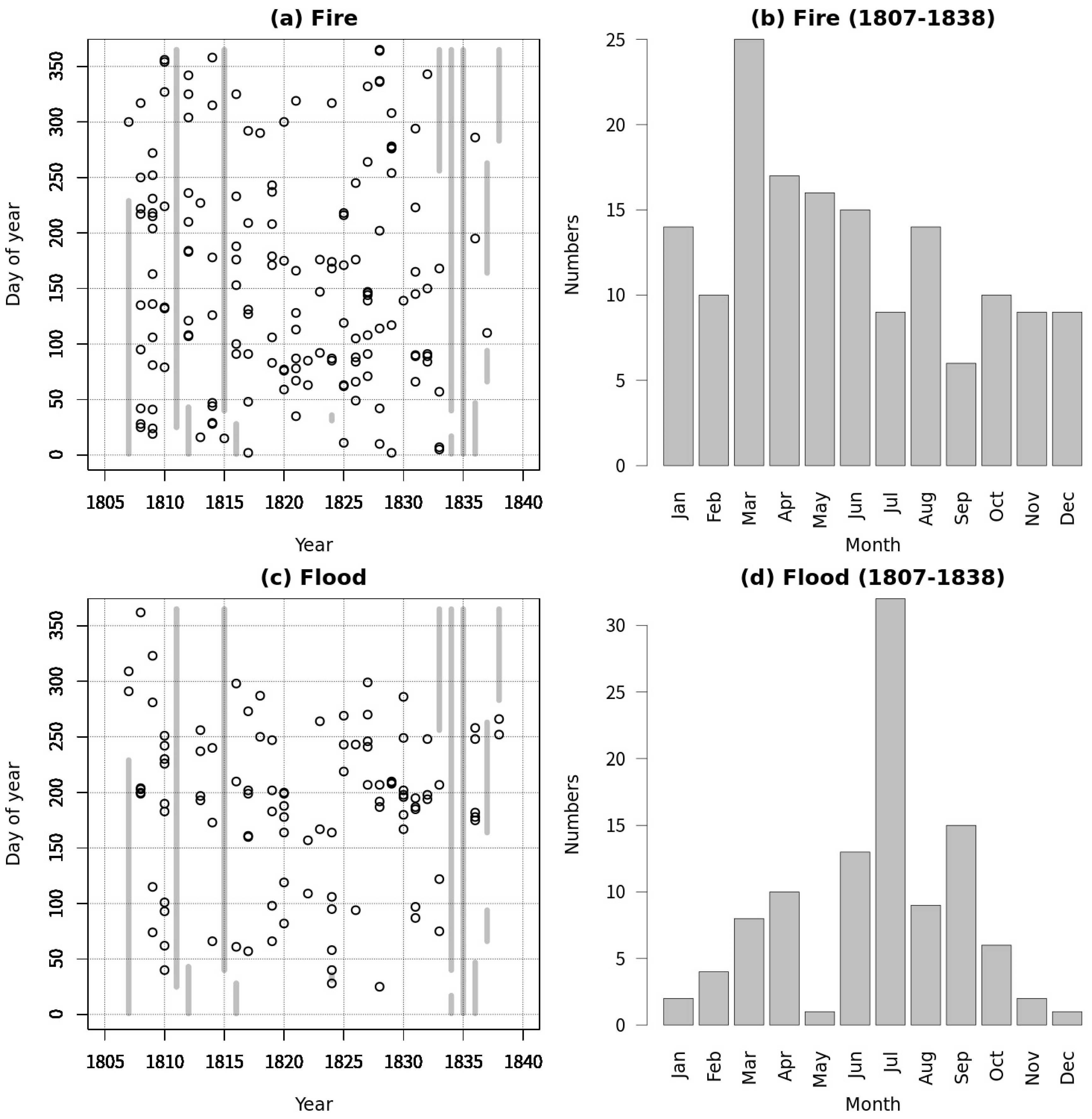
A total of 154 fire and 103 flood records were extracted from the Kakuson Diaries (
Figure 1a,c; see
Supplementary Materials). Fire records peaked in March, with fewer occurrences documented in February, July, and from September to December (
Figure 1b). Fifty fire records (32.5%) were assigned a QC flag of 0 owing to unclear descriptions or defunct place names that could not be verified.
Flood records were most frequent in July, with few records in January, February, May, and from October to December (
Figure 1d). Only eight flood records (7.8%) were assigned a QC flag of 0, owing to unclear descriptions. Notably, 92 of the recorded flood events occurred along the Sai River (Saigawa).
3.2. Seasonal Probability Analysis
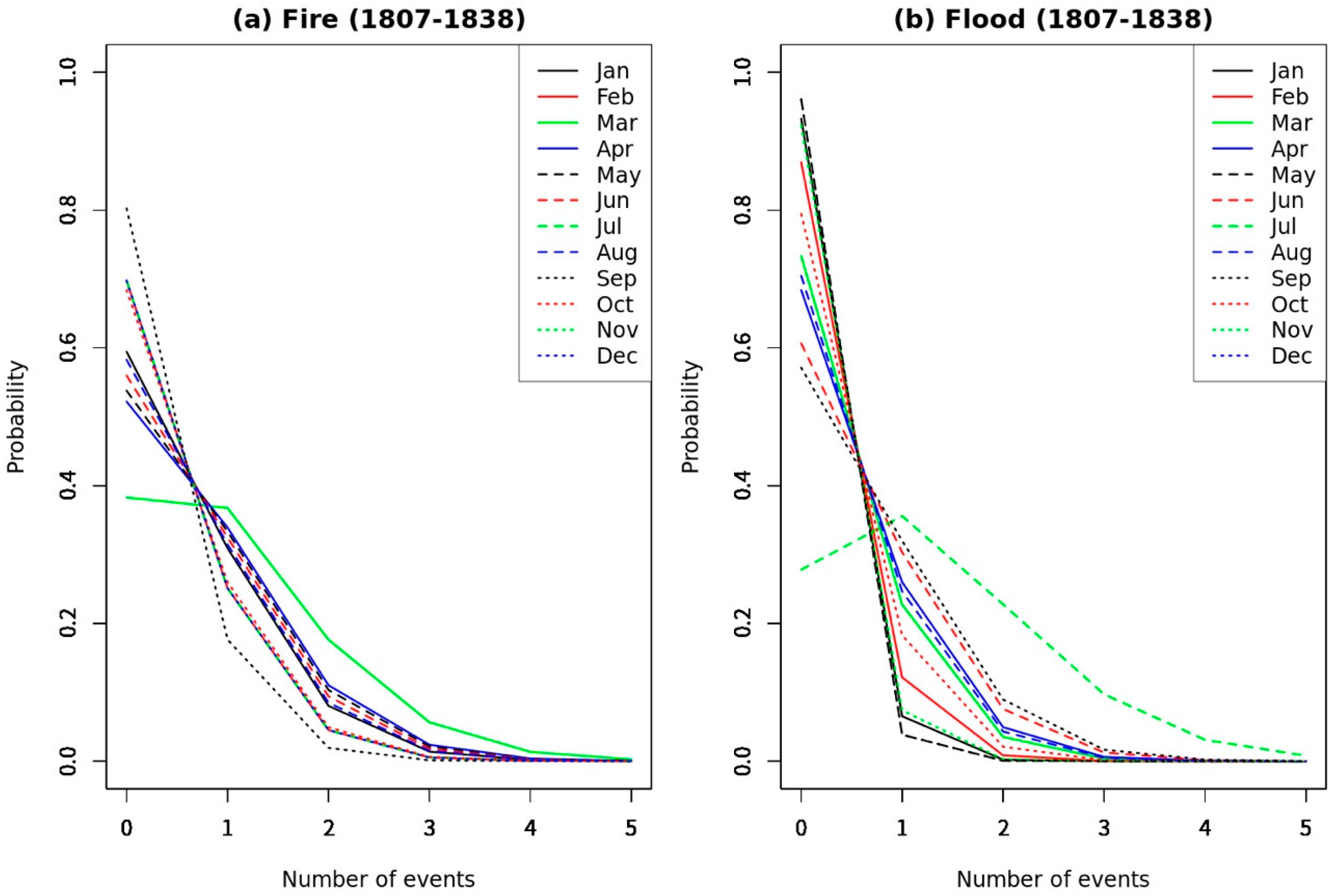
The monthly probability of disaster occurrence was calculated using the Poisson distribution parameters shown in
Table 2. For fire events, excluding the probability of zero occurrences, the probability of 1 to 3 events occurring per year was highest in March. The probability of zero fires occurring in March was much lower than in other months (approx. 0.4;
Figure 2a).
For floods, the probability of 1 to 3 events occurring per month was higher in June, July, and September compared to the rest of the year. The probability of zero floods in July was the lowest of any month (approx. 0.3;
Figure 2b).
4. Discussion
4.1. Seasonal Probability of Fire and Flood Occurrence
The probability of fire and flood events in Kanazawa during the early 19th century shows distinct seasonal patterns (
Figure 1 and
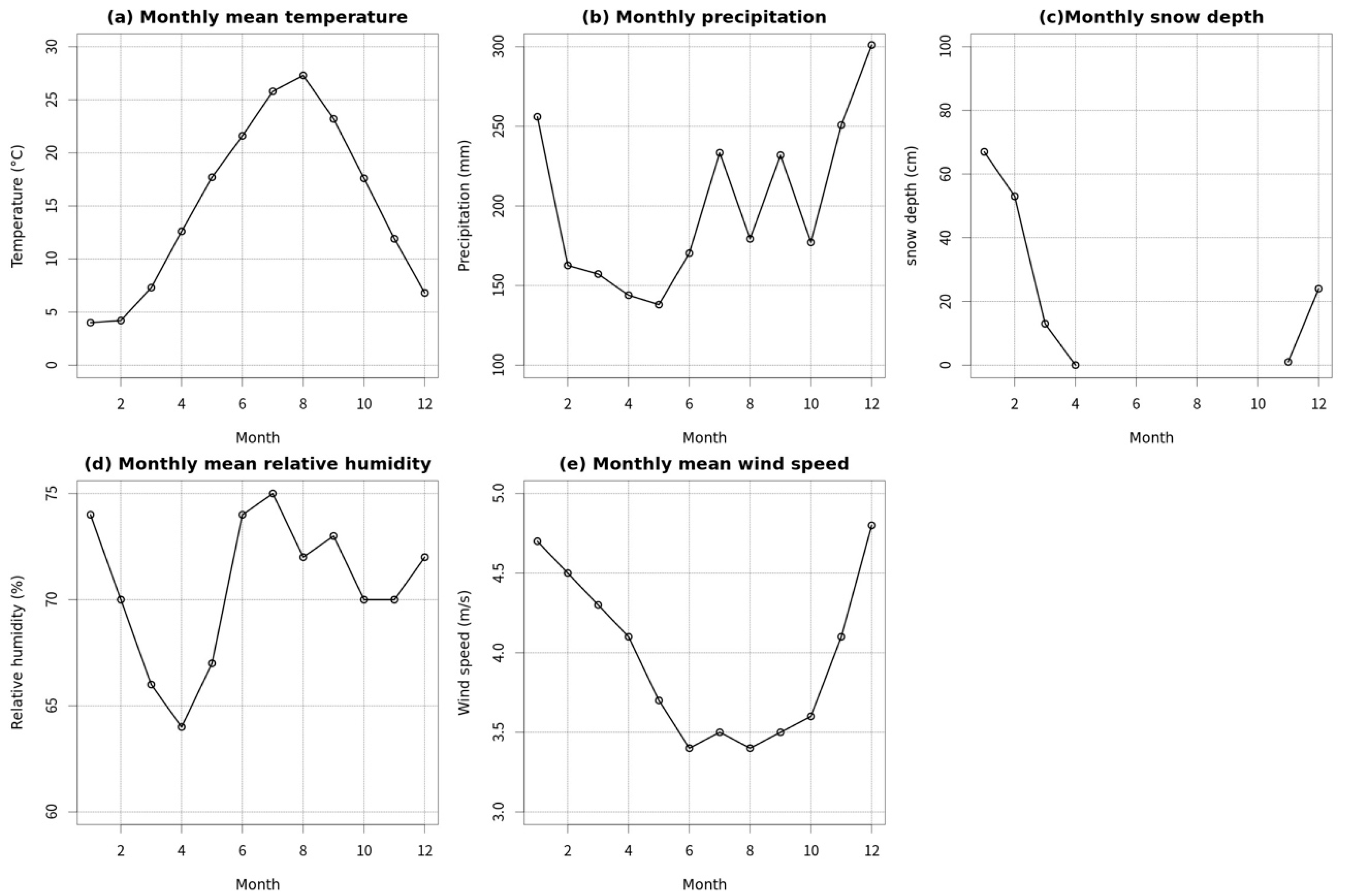
Figure 2). These historical patterns can be explained by comparing them to the contemporary climate of Kanazawa (
Figure 3; [
38]). This comparison is based on the premise that while absolute temperatures and precipitation totals may have fluctuated since the early 19th century, the fundamental regional drivers (such as the interaction between local topography and seasonal atmospheric circulation) remain consistent. Consequently, the meteorological mechanisms responsible for disasters today provide a reliable framework for interpreting the patterns recorded in the Kakuson Diaries.
Regarding fires, the high probability observed between March and June corresponds with periods of low humidity and strong winds. Monthly precipitation from March to June is lower than in other months, and relative humidity is lowest between March and May. Furthermore, wind speeds from November through April (the snow and snow melting periods) are higher than in other months. In particular, the peak in fire risk during March and April is exacerbated by the Foehn phenomenon, which occurs in Kanazawa when a migratory anticyclone moves southeast while a low-pressure system or trough moves toward the Sea of Japan, leading to warm air advection on the eastern side of the low [
39]. These conditions result in sudden increases in temperature, dryness, and strong winds, which collectively increase the risk of fire.
Conversely, the elevated flood risk in June, July, and September corresponds to periods of prolonged rainfall and localized heavy precipitation. These are associated with the rainy season (June and July) and typhoon season (September) [
40]. During these months, heavy rainfall leads to rising river levels, increasing the risk of flooding.
4.2. Comparison of the Early 19th Century and the Present
The climate during the early 19th century coincided with the latter part of the Little Ice Age, characterized by temperatures lower than those of the present day [
41,
42,
43]. To evaluate how these climatic shifts may have influenced the seasonal probabilities of fire and flood occurrence, we calculated the current probability of fire and flood events by using modern statistical data [
44,
45] (
Figure 4; see
Appendix A for details).
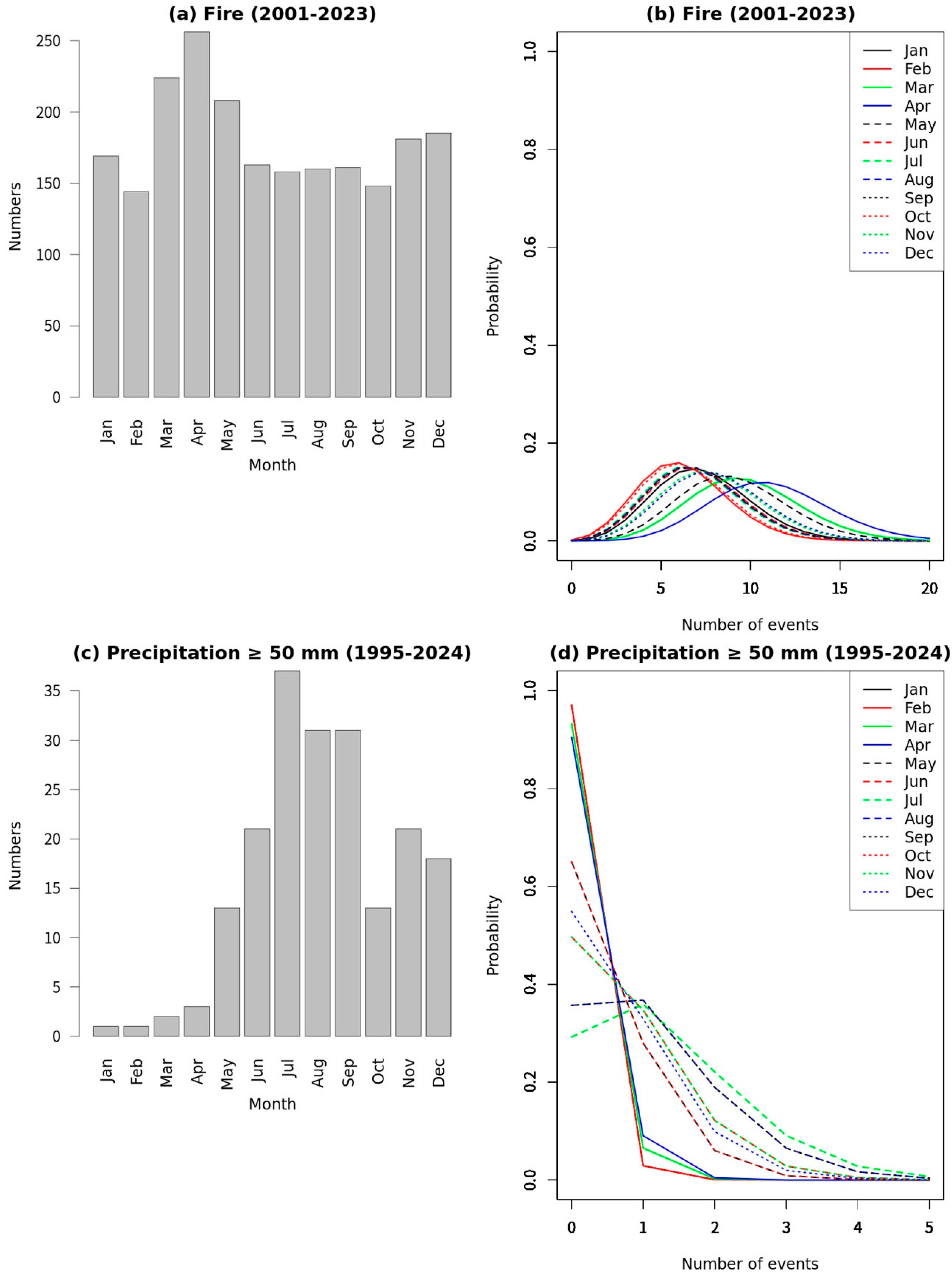
Figure 4.
Seasonal disaster probabilities in present-day Kanazawa. (
a,
c) Monthly total of observed fire records (2001–2023) and frequency of days with daily precipitation exceeding 50 mm (1995–2024). (
b,
d) Probability mass functions for fire and daily precipitation exceeding 50 mm by month. Corresponding statistical parameters are summarized in
Table 3.
Figure 4.
Seasonal disaster probabilities in present-day Kanazawa. (
a,
c) Monthly total of observed fire records (2001–2023) and frequency of days with daily precipitation exceeding 50 mm (1995–2024). (
b,
d) Probability mass functions for fire and daily precipitation exceeding 50 mm by month. Corresponding statistical parameters are summarized in
Table 3.
Table 3.
Monthly Poisson Distribution Statistics for Fire and Heavy Precipitation Events in present-day Kanazawa.
Table 3.
Monthly Poisson Distribution Statistics for Fire and Heavy Precipitation Events in present-day Kanazawa.
| Month | Fire | Daily Precipitation ≥ 50 mm |
|---|
| | Mean | Variance | Mean | Variance |
|---|
| January | 7.35 | 7.35 | 0.03 | 0.03 |
| February | 6.26 | 6.26 | 0.03 | 0.03 |
| March | 9.74 | 9.74 | 0.07 | 0.07 |
| April | 11.13 | 11.13 | 0.1 | 0.1 |
| May | 9.04 | 9.04 | 0.43 | 0.43 |
| June | 7.09 | 7.09 | 0.7 | 0.7 |
| July | 6.87 | 6.87 | 1.23 | 1.23 |
| August | 6.96 | 6.96 | 1.03 | 1.03 |
| September | 7 | 7 | 1.03 | 1.03 |
| October | 6.43 | 6.43 | 0.43 | 0.43 |
| November | 7.87 | 7.87 | 0.7 | 0.7 |
| December | 8.04 | 8.04 | 0.6 | 0.6 |
In modern Japan, river embankments have been constructed to mitigate flood risk; consequently, the current threshold for flooding is daily precipitation exceeding 100 mm [
46]. However, because daily precipitation exceeding 100 mm is extremely rare, we used the frequency of days with precipitation exceeding 50 mm as a proxy for flood occurrence.
Our analysis indicates that the modern probability of fire remains highest between March and May. Similarly, the probability of daily precipitation exceeding 50 mm is highest between July and September. Despite the differences in data collection methods and geographic coverage, as well as the qualitative descriptions of each fire and flood record, the seasonal probabilities of fire and flood occurrence during the early 19th century appear remarkably consistent with present patterns.
4.3. Limitations and Uncertainty
Retrieving disaster records from old diaries and documents written by a single author involves the following uncertainties: (1) omission bias: disasters that actually occurred may not have been recorded; (2) document loss: old diaries and documents that recorded disasters may have been destroyed by war or subsequent natural disasters; (3) geospatial ambiguity: descriptions of locations may be unclear, or historical place names may have become defunct; (4) regional recording bias: authors prioritize different events based on local geography and culture; and (5) short-term missing records: the authors’ illness or personal circumstances may have caused them to miss recording some events.
To reduce the first and second uncertainties, researchers should retrieve as many old diaries and documents as possible from the same period. In addition, the use of probability mass functions, as demonstrated in this study, can help estimate occurrence patterns despite potential gaps. In addressing the third uncertainty, it is important to carefully cross-reference associated literature, but also allow contextual interpretation to some extent. Regarding the fourth uncertainty, it should be taken into consideration that historical records of flooding are often more prevalent in specific rural areas where flooding has occurred often since ancient days (e.g., river basins of the Kiso, Nagara, and Ibi Rivers) [
8,
10]. This fact indicates the importance of selecting target disasters that, as a consequence of the specific climate and topography, are likely to occur in the study area. Finally, regarding the fifth uncertainty, utilizing multiple historical sources is useful, although it introduces additional challenges.
5. Conclusions
We reconstructed the seasonal probability of fire and flood events in early-19th-century Kanazawa by utilizing disaster records extracted from the Kakuson Diaries. Our results demonstrate that fires were more likely to occur between March and June, driven by seasonal low humidity and strong winds, while floods were more likely to occur in June, July, and September. These historical patterns closely mirror current seasonal probabilities for fires and daily precipitation exceeding 50 mm, suggesting a long-term consistency in the region’s climate-driven disaster cycles.
While individual old diaries and documents provide high-resolution “historical dark data”, they are subject to uncertainties caused by omitted entries, the loss of archival material, ambiguous descriptions, unique local recording biases, and short-term missing records. To mitigate these limitations, future research should integrate records from multiple historical sources and focus on retrieving records for disaster types that are most probable given the local climate and topography. Combining such qualitative historical sources with the analysis of the seasonal probability of each disaster occurrence is a vital approach for understanding long-term environmental shifts and improving historical disaster reconstructions.
Supplementary Materials
The following supporting information can be downloaded at
https://www.mdpi.com/article/10.3390/data11040080/s1. Table S1 (Supplementary_fire_Kakuson_diaries.csv): Extracted records of fire events from the Kakuson Diaries; Table S2 (Supplemen-tary_flood_Kakuson_diaries.csv): Extracted records of flood events from the Kakuson Diaries.
Author Contributions
Conceptualization, N.S.; writing—original draft preparation, N.S. and T.M.S.; writing—review and editing, N.S., T.M.S. and C.K.; methodology, N.S.; validation, N.S.; formal analysis, N.S.; data curation, N.S. and C.K.; visualization, N.S.; funding acquisition, N.S. and T.M.S. All authors have read and agreed to the published version of the manuscript.
Funding
This study was supported by KAKENHI grants (JP22H05244, JP24H00011, JP24H00935, and JP24K21357) from the Japan Society for the Promotion of Science.
Data Availability Statement
Acknowledgments
The authors would like to thank Yoshikazu Sasai (Japan Agency for Marine-Earth Science and Technology) for his insightful discussions and support. We are grateful to the editors and two reviewers for their constructive comments.
Conflicts of Interest
The authors declare no conflicts of interest.
Appendix A
To count the monthly observed fire records in Kanazawa City, we used the Kanazawa City Statistical Report [
45]. Records included building, forest, vehicle, and other fires. To count the frequency of days with daily precipitation exceeding 50 mm for each month, we used daily precipitation data from 1995 to 2024 observed at the AMeDAS station in Kanazawa [
47].
References
- Kaur, H.; Habibullah, M.S.; Nagaratnam, S. Impact of natural disasters on biodiversity: Evidence using quantile regression approach. J. Ekon. Malays. 2019, 53, 67–81. [Google Scholar] [CrossRef]
- Mysiak, J.; Molinari, D.; Tsionis, G.; Toreti, A.; Okuyama, Y. Economic sectors. In Science for Disaster Risk Management 2020: Acting Today, Protecting Tomorrow; EUR 30183, EN; Casajus Valles, A., Marin Ferrer, M., Poljanšek, K., Clark, I., Eds.; Publications Office of the European Union: Luxembourg, 2020. [Google Scholar] [CrossRef]
- Walz, Y.; Janzen, S.; Narvaez, L.; Ortiz-Vargas, A.; Woelki, J.; Doswald, N.; Sebesvari, Z. Disaster-related losses of ecosystems and their services. Why and how do losses matter for disaster risk reduction? Int. J. Disaster Risk Reduct. 2021, 63, 102425. [Google Scholar] [CrossRef]
- Habibullah, M.S.; Din, B.H.; Tan, S.H.; Zahid, H. Impact of climate change on biodiversity loss: Global evidence. Environ. Sci. Pollut. Res. 2022, 29, 1073–1086. [Google Scholar] [CrossRef]
- Easterday, K.; Paulson, T.; DasMohapatra, P.; Alagona, P.; Feirer, S.; Kelly, M. From the field to the cloud: A review of three approaches to sharing historical data from field stations using principles from data science. Front. Environ. Sci. 2018, 6, 88. [Google Scholar] [CrossRef]
- Kelly, J.A.; Farrell, S.L.; Hendrickson, L.G.; Luby, J.; Mastel, K.L. A critical literature review of historic scientific analog data: Uses, successes, and challenges. Data Sci. J. 2022, 21, 14. [Google Scholar] [CrossRef]
- Central Meteorological Observatory and Marine Meteorological Observatory. Meteorological Records in Japan; Central Meteorological Observatory and Marine Meteorological Observatory: Tokyo, Japan, 1939; 770p. (In Japanese)
- Gifu Prefecture Government. Flood Control Records in Gifu Prefecture; Gifu Prefecture Government: Gifu city, Japan, 1953; Volume 2, 958p. (In Japanese)
- Ishikawa Prefecture Government. Disaster Records in Ishikawa Prefecture; Ishikawa Prefecture Government: Kanazawa, Japan, 1961; 177p. (In Japanese)
- Gifu Local Meteorological Observatory. Disaster Records in Gifu Prefecture; Gifu Local Meteorological Observatory: Gifu City, Japan, 1996; 122p. (In Japanese)
- Albini, P.; Musson, R.M.W.; Gomez Capera, A.A.; Locati, M.; Rovida, A.; Stucchi, M.; Viganò, D. Global Historical Earthquake Archive and Catalogue (1000–1903); GEM Technical Report 2013-01 V1.0.0; GEM Foundation: Pavia, Italy, 2013; 168p, Available online: https://cloud-storage.globalquakemodel.org/public/wix-new-website/pdf-collections-wix/publications/Global%20Historical%20Earthquake%20Archive%20and%20Catalogue%20(1000-1903).pdf (accessed on 2 April 2026). [CrossRef]
- Wang, P.; Lin, K.-H.; Liao, Y.-C.; Liao, H.-M.; Lin, Y.-S.; Hsu, C.-T.; Hsu, S.-M.; Wan, C.-W.; Lee, S.-Y.; Fan, I.-C.; et al. Construction of the REACHES climate database based on historical documents of China. Sci. Data 2018, 5, 180288. [Google Scholar] [CrossRef]
- Diodato, N.; Ljungqvist, F.C.; Bellocchi, G. A millennium-long reconstruction of damaging hydrological events across Italy. Sci. Rep. 2019, 9, 9963. [Google Scholar] [CrossRef]
- Tang, X.; Feng, Q. Analysis of drought and flood disasters during 0–1950 AD in the Hexi Corridor, China, based on historical documents. Front. Environ. Sci. 2021, 9, 781179. [Google Scholar] [CrossRef]
- Gao, M.J.; Li, Y. Description to the historical records dataset on human activity in the Hexi Corridor of China (from Neolithic to Qing dynasty). J. Glob. Chang. Data Discov. 2023, 7, 195–203. [Google Scholar] [CrossRef]
- Lyu, B.; Yue, X.; Meng, L. Japanese literature organization and spatiotemporal database system creation for natural disaster analysis. Herit. Sci. 2024, 12, 14. [Google Scholar] [CrossRef]
- Ghazi, B.; Przybylak, R.; Oliński, P.; Pospieszyńska, A. Flood occurrences and characteristics in Poland (Central Europe) in the last millennium. Glob. Planet. Chang. 2025, 246, 104706. [Google Scholar] [CrossRef]
- Kanazawa City Tourism Association. Visit Kanazawa; Kanazawa City Tourism Association: Ishikawa, Japan, 2022; Available online: https://visitkanazawa.jp/en/ (accessed on 2 April 2026).
- Yoshimura, M. Historical weather data base and reconstruction of the climate in historical time. J. Geogr. 1993, 102, 131–143, (In Japanese with English summary). [Google Scholar] [CrossRef] [PubMed]
- Fukai, Y. Basic research of the confectionary culture of Kanazawa of the Edo period—Historical records of the confectionary in Kakuson’s diary (1). J. Toyama Coll. 2002, 37, 1–17. (In Japanese) [Google Scholar]
- Yoshida, H. Food culture in Kanazawa during Kasei Era–Read Kakuson diaries. Res. Bull. Shuchiin Univ. 2003, 4, 87–102. (In Japanese) [Google Scholar]
- Fukai, Y. Viewing the confectionary culture of Edo-Period Kanazawa through the Kakuson Diaries. J. Food Cult. Jpn. 2011, 7, 23–34, (In Japanese with English summary). [Google Scholar] [CrossRef]
- Kawamura, T. An attempt to reconstruct the climate in little ice age using phenological data. J. Geogr. 1993, 102, 125–130, (In Japanese with English summary). [Google Scholar] [CrossRef][Green Version]
- Shin, N.; Sasai, Y.; Kotani, A.; Saitoh, T.M. Mining plant phenology records from Kanazawa, Japan in the 1807–1838 Kakuson Diary. Int. J. Biometeorol. 2024, 68, 125–131. [Google Scholar] [CrossRef]
- Kaneko, K. Kakuson Diaries; Ishikawa Prefecture Library Association: Kanazawa, Japan, 1976; Volume 1, Number 1. (In Japanese) [Google Scholar]
- Kaneko, K. Kakuson Diaries; Ishikawa Prefecture Library Association: Kanazawa, Japan, 1976; Volume 1, Number 2. (In Japanese) [Google Scholar]
- Kaneko, K. Kakuson Diaries; Ishikawa Prefecture Library Association: Kanazawa, Japan, 1976; Volume 2, Number 1. (In Japanese) [Google Scholar]
- Kaneko, K. Kakuson Diaries; Ishikawa Prefecture Library Association: Kanazawa, Japan, 1976; Volume 2, Number 2. (In Japanese) [Google Scholar]
- Kaneko, K. Kakuson Diaries; Ishikawa Prefecture Library Association: Kanazawa, Japan, 1976; Volume 3, Number 1. (In Japanese) [Google Scholar]
- Kaneko, K. Kakuson Diaries; Ishikawa Prefecture Library Association: Kanazawa, Japan, 1976; Volume 3, Number 2. (In Japanese) [Google Scholar]
- National Astronomical Observatory of Japan. Japanese Calendar Database. 1994–2026. Available online: https://eco.mtk.nao.ac.jp/cgi-bin/koyomi/caldb_en.cgi (accessed on 2 April 2026).
- Ripplex Inc. Ke!san: Convert from the Japanese Calendar to the Gregorian Calendar. 2026. Available online: https://keisan.site/exec/system/1239884730 (accessed on 2 April 2026). (In Japanese)
- R Core Team. The R Project for Statistical Computing. 2026. Available online: https://www.r-project.org/ (accessed on 2 April 2026).
- Posit Software, PBC. RStudio Desktop. 2026. Available online: https://posit.co/download/rstudio-desktop/ (accessed on 2 April 2026).
- OpenOffice.org. LibreOffice. 2026. Available online: https://www.libreoffice.org/ (accessed on 2 April 2026).
- Japan Meteorological Agency. Past Weather Data Search. 2026. Available online: https://www.data.jma.go.jp/stats/etrn/index.php (accessed on 2 April 2026). (In Japanese)
- Nagata, S.; Kato, H. Appearance properties of the Foehn phenomenon in Hokuriku district: Analysis by the weather pattern classification. Proc. Inst. Nat. Sci. Nihon Univ. 2015, 50, 81–93, (In Japanese with English summary). [Google Scholar]
- Kusaka, H.; Fujibe, F. (Eds.) Japanese Climate Encyclopedia; Maruzen Publishing Co., Ltd.: Tokyo, Japan, 2018; 498p. (In Japanese) [Google Scholar]
- Maejima, I.; Tagami, Y. Climate of Little Ice Age in Japan. Geogr. Rep. Tokyo Metrop. Univ. 1983, 18, 91–111. [Google Scholar]
- Tagami, Y.; Fukashi, K. Some examinations on the reconstruction of climate in “Little Ice Age”. J. Geogr. 1993, 102, 167–175, (In Japanese with English summary). [Google Scholar] [CrossRef]
- Mizukoshi, M. Climatic reconstruction in Central Japan during the Little Ice Age based on documentary sources. J. Geogr. 1993, 102, 152–166, (In Japanese with English summary). [Google Scholar] [CrossRef] [PubMed][Green Version]
- Kanazawa City Government. Kanazawa City Statistical Report. 2000–2019; Kanazawa City Government: Kanazawa, Japan. Available online: https://digilib.city.kanazawa.ishikawa.jp/doc/?q=%E7%B5%B1%E8%A8%88%E6%9B%B8&c=&g=&d= (accessed on 2 April 2026). (In Japanese)
- Kanazawa City Government. Kanazawa City Statistical Report. 2020–2024; Kanazawa City Government: Kanazawa, Japan. Available online: https://www4.city.kanazawa.lg.jp/soshikikarasagasu/chosatokeishitsu/gyomuannai/1/3/3/index.html (accessed on 2 April 2026). (In Japanese)
- Disaster Information Laboratory, NIED. How to Evaluate the Risk of Disasters. 2026. Available online: https://dil.bosai.go.jp/workshop/03kouza_yosoku/02yuuin.html (accessed on 16 February 2026). (In Japanese)
- Yokohama City Board of Education. Sekiguchi Diaries. 1971–1984; Yokohama City Board of Education: Yokohama, Japan, 1984; Volume 1–23 and Extra Issue 1–3. (In Japanese)
- Hachinohe City Library. Diaries of the Toyama Family. 2004–2022; Hachinohe City Library: Hachinohe, Japan, 2022; Volume 1–11. (In Japanese) [Google Scholar]
- Japan Meteorological Agency. Past Weather Data Download. 2026. Available online: https://www.data.jma.go.jp/risk/obsdl/index.php (accessed on 2 April 2026). (In Japanese)
| Disclaimer/Publisher’s Note: The statements, opinions and data contained in all publications are solely those of the individual author(s) and contributor(s) and not of MDPI and/or the editor(s). MDPI and/or the editor(s) disclaim responsibility for any injury to people or property resulting from any ideas, methods, instructions or products referred to in the content. |