Article

Regional Copula Modeling of Rainfall Duration and Intensity: Derivation and Validation of IDF Curves in the Kastoria Basin

by
Evangelos Leivadiotis
1,
Aris Psilovikos
1,* and
Silvia Kohnová
2
1
Laboratory of Ecohydraulics and Inland Water Management, Department of Ichthyology and Aquatic Environment, University of Thessaly, Fytokou Street, 38446 New Ionia, Greece
2
Department of Land and Water Resources Management, Faculty of Civil Engineering, Slovak University of Technology in Bratislava, Radlinskeho 11, 81005 Bratislava, Slovakia
*
Author to whom correspondence should be addressed.
Hydrology 2026, 13(4), 117; https://doi.org/10.3390/hydrology13040117
Submission received: 5 March 2026 / Revised: 7 April 2026 / Accepted: 12 April 2026 / Published: 20 April 2026

Abstract

Intensity–Duration–Frequency (IDF) curves are the cornerstone of hydraulic infrastructure design, yet standard methodologies often fail to account for the complex dependence structure of rainfall characteristics and the non-stationary effects of climate change. This study develops a robust Regional Copula Framework for the Kastoria Lake basin, Greece, utilizing sub-hourly rainfall records from four meteorological stations (2007–2024). We employ a forensic data quality control process to pool 277 independent storm events. Unlike traditional approaches, our analysis demonstrates that the Generalized Extreme Value (GEV) distribution (ξ = 0.348) significantly outperforms the standard Lognormal distribution in modeling heavy-tailed rainfall intensities. The dependence between storm duration and intensity was found to be consistently negative (τ = −0.35), a structure best captured by the Rotated Gumbel (90°) copula, which physically reflects the region’s convective storm dynamics. Trend analysis revealed a statistically significant decrease in peak intensity (τ = −0.14) coupled with an increase in storm duration (τ = 0.22), a hydro-climatic shift that contrasts with increasing intensity trends reported in the wider Balkan region. These findings suggest a regime transition from flash-flood dominance to volume-critical events, necessitating updated design criteria that integrate both multivariate dependence and local climatic non-stationarity.

1. Introduction

Climate change and global warming pose the defining environmental challenges of the twenty-first century [1]. The IPCC Sixth Assessment Report highlights that recent years have seen significant changes in the hydrological cycle and atmospheric circulation, resulting in a marked increase in the frequency and intensity of extreme precipitation events worldwide [2]. Such climatic shifts necessitate robust methodologies for assessing and predicting extreme rainfall events, especially in regions characterized by sparse meteorological stations and complex hydrological regimes [3]. These climatic shifts are exacerbated by human activities, such as rapid urbanization and land-use changes, which have increased surface runoff coefficients and rendered short-term, high-intensity torrential rains highly destructive to infrastructure and agriculture [4]. Consequently, the traditional assumption of stationarity in hydrological time series is becoming increasingly untenable. Moreover, standard univariate frequency analysis underestimates risk by failing to account for the complex dependencies between variables, such as rainfall intensity and duration [5]. This necessitates the development of sophisticated analytical tools capable of modeling non-stationary hydrological phenomena and capturing multivariate dependencies, thereby addressing the limitations of traditional approaches [6].
Precise evaluation of extreme precipitation events is essential for alleviating societal and environmental hazards [1]. Nevertheless, conventional univariate frequency analyses inadequately represent the intricate dependencies among hydroclimatic variables, especially during extreme occurrences. Hydrological processes are intrinsically multivariate, with variables such as rainfall intensity, duration, and soil moisture exhibiting substantial correlations [7]. Exclusive reliance on univariate approaches disregards these interrelationships, yielding distorted risk estimates [8]. Moreover, traditional multivariate methods typically presuppose variable independence or conformity to identical distributional families—a limitation seldom compatible with empirical hydrological observations [7]. xTo overcome these shortcomings, copulas have established themselves as a robust approach for modeling multivariate probability distributions [9]. Their chief strength resides in decoupling marginal distributions from the underlying dependence structure, permitting the representation of variables with non-Gaussian and nonlinear dependencies—characteristic of hydrological processes—via the tailored selection of suitable marginals for individual variables [10]. This flexibility allows for a more accurate assessment of multivariate hydrological risks, particularly for events like droughts and floods, where multiple correlated characteristics contribute to the overall impact [11]. Specifically, copulas enable the construction of joint cumulative probability distributions for multiple variables, providing a powerful framework for understanding complex hydroclimatic phenomena [12,13,14]. This flexibility positions copulas as ideally suited to current hydrological demands: they enable the computation of annual exceedance probabilities for multivariate events across diverse spatial sites, while effectively augmenting limited observed flood records—a prevalent constraint in hydrological datasets—to deliver more reliable estimates of flood quantiles at extended return periods [15,16,17]. The utility of copula functions in hydrological simulation has been extensively demonstrated across various applications, including multivariate flood frequency analysis, drought assessments, and storm or rainfall dependence analysis [18]. Recent applications demonstrate the versatility of this method. Copulas have been employed to explore the joint probability of precipitation and soil moisture for agricultural drought detection [19], analyze the structural characteristics of rainfall patterns [20], and model multidimensional drought severity and duration [21]. These studies confirm that Copula-based models provide a more comprehensive understanding of complex environmental processes than traditional methods. Specifically, copula functions have been utilized for a wide array of hydrological studies, encompassing multivariate flood frequency analysis, compound flood assessment involving river discharges and sea level rise, drought characterization, and the simulation of streamflow [7,22].
Intensity–Duration–Frequency (IDF) curves are fundamental tools in hydrology that summarize the relationship between rainfall intensity, duration, and probability of exceedance [2,23]. These curves are critical for the design and management of hydrological infrastructure—including urban drainage systems—as well as for flood risk mitigation and catchment impact assessments. Traditionally, they are constructed through univariate frequency analysis, as described by Koutsoyiannis et al., [24]. This involves fitting theoretical probability distribution functions to annual maximum rainfall intensities across durations ranging from sub-hourly to daily. For this purpose, researchers worldwide have employed various distributions, including the Generalized Extreme Value, Gumbel, Weibull, and Normal distributions [25,26,27]. However, the application of copulas has extended the conventional approach by enabling the modeling of IDF curves within a multivariate framework, thereby capturing the complex dependencies between rainfall characteristics that univariate methods often overlook [28]. For instance, copulas have been successfully applied to model the joint distribution of rainfall intensity and duration, offering a more nuanced understanding of extreme rainfall events and their associated risks [29]. This capability allows for a more accurate representation of rainfall events crucial for robust hydrological design and forecasting [30]. However, recent studies demonstrate that climate change is inducing significant alterations in these curves, particularly in urbanized areas. The direction and magnitude of these changes vary by region [31,32]. Conversely, some areas show a declining trend; Mirhosseini et al. [33] observed a 33–74% decrease in rainfall intensity for durations under two hours in Alabama. This non-uniformity in IDF trends highlights the complex variability of local climate regimes and suggests that traditional, stationary univariate methods may be insufficient for accurate future planning. Consequently, there is a growing imperative for developing non-stationary intensity–duration–frequency curves that explicitly account for the temporal evolution of extreme precipitation characteristics, rather than assuming a static climatic condition [34].
Despite the growing recognition of multivariate approaches, rigorous regional applications that simultaneously address data quality limitations, non-stationarity, and the physical selection of marginal distributions remain rare, particularly in the complex hydro-climatic zones of the Mediterranean [35,36,37,38]. This gap underscores the need for advanced methodologies capable of integrating diverse data sources and statistical techniques to enhance the robustness of extreme rainfall analyses in such regions. This paper introduces a novel Copula-based regional frequency analysis framework designed to overcome these challenges, focusing on extreme rainfall events in hydrologically complex environments.
This study fills this gap by developing a robust Regional Copula Framework for the Kastoria Lake basin in Greece. Unlike standard applications, this research integrates a comprehensive forensic data analysis to correct systematic recording errors, ensuring the physical validity of the regional dataset. We evaluate a wide spectrum of marginal distributions (including GEV and Weibull) and copula families to identify the optimal dependence structure between storm duration and peak intensity. Furthermore, by coupling this stationary dependence model with non-stationary trend analysis (Mann–Kendall), we provide a holistic view of the changing flood regime. The ultimate objective is to derive reliable, physically consistent Regional Intensity–Duration–Frequency (IDF) curves that account for compound risks, offering a critical tool for adaptive infrastructure design in an ungauged or data-scarce environment.

2. Materials and Methods

2.1. Study Area

2.1.1. Kastoria

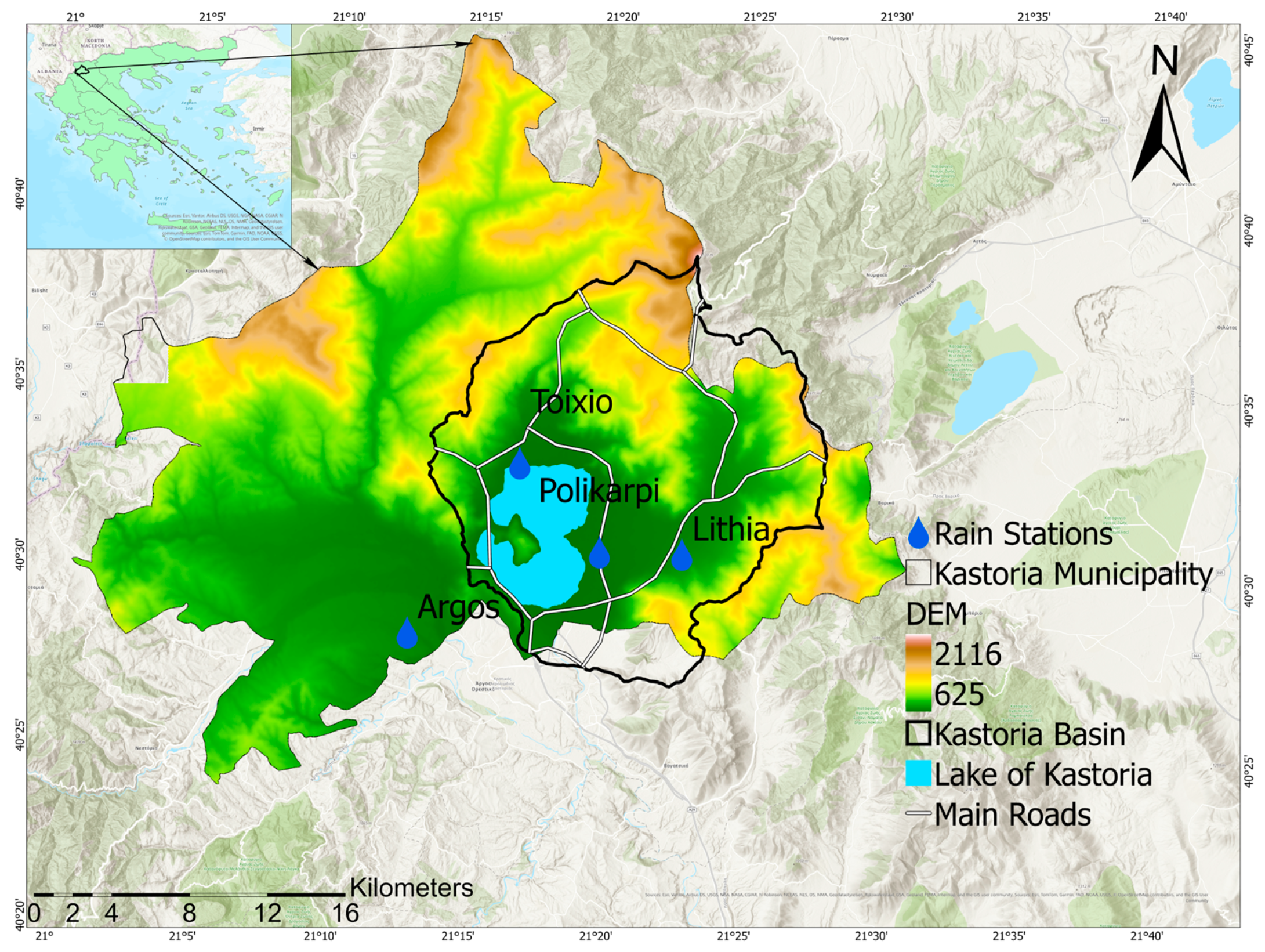
The Kastoria basin is a closed hydrographic basin in the Western Macedonia area of the North Greek region, defined geographically within the coordinates of 40°25′–40°38′ N and 21°13′–21°28′ E (Figure 1) [39]. The basin covers a catchment area of about 253–305 km2, where Lake Kastoria (Lake Orestiada) is the prominent feature that occupies the lowest terrene point of the basin at a height of about 630 m above mean sea level (a.m.s.l) [40,41,42]. The surrounding terrain is dominated by mountainous elevations that range between 620 m to over 2000 m high (Vernon & Askio mountain ranges), forming a barrier that significantly affects the basin’s precipitation patterns and temperatures [41]. Geologically speaking, the basin is complex in nature and consists of metamorphic rocks of the Paleozoic era (schists & gneisses), Mesozoic era rocks that are predominantly composed of calcareous materials (limestones & dolomites), and ophiolites that are mostly found within the mountain ranges of the basin’s periphery [41,42,43]. Low-lying regions are dominated by alluvial materials of the Neogene & Quaternary periods that form the main productive aquifers of the basin. High levels of karstification are recorded within the limestone outcrops, especially within the basin’s northern & eastern parts that make the aquifer susceptible to contamination but are conducive to groundwater recharge [41]. The basin’s climate can best be described as sub-humid continental with extreme winters & hot & dry summers. The average annual temperatures are recorded at a value of 11.8 °C that fluctuates between sub-zero levels during the winter months & the high levels of over 30 °C during the summer months [40]. Rainfall patterns are erratic & range between a low of 600 mm within the low-lying regions & over 1000 mm within the mountainous terrain that mostly occurs between the months of October & May of the year. The hydrological cycle in the area is supported by a number of torrent rivers, namely Xeropotamos, Metamorphosis, Toichio, and Vyssinia, discharging into Lake Kastoria [40]. The lake is a shallow polymictic body of water, measuring an approximate 28 km2 in surface area, 4 m in mean depth, and a maximum depth of 9 m [42]. The lake acts as a natural buffer basin whose water drains out via the Gioli channel to the Aliakmon River. Land use has an important role in the basin’s hydrology and water quality. The upland areas are mostly covered by forests (29%) and pastures (44%), while the lowland areas are intensively cultivated (24%), mostly for the production of beans, corn, and apples [40]. These high levels of environmental pressure have negative impacts. Previous studies have described the Lake Kastoria ecosystem as eutrophic to hypertrophic, mostly because of the high nutrient load (nitrogen and phosphorus) coming from agriculture and the inadequately treated urban wastewater [40,41,42,44]. Because of this, the basin is classified as a nitrate vulnerable zone, highlighting the importance of water resource management.

2.1.2. Inter-Event Time Definition (IETD)

To accomplish a multivariate frequency analysis, the rainfall data has to be initially discretized to rainfall events. This is carried out in accordance with the Inter-Event Time Definition (IETD), with the minimum duration of the dry interval separating rainfall occurrences that are to be considered distinct events. The selection of an optimal IETD plays an extremely important role in guaranteeing the independence of the storm intensity series obtained. Following the criteria suggested in the literature study of Restrepo-Posada and Eagleson (1982), the choice of the IETD should aim at reducing the correlation between events [44]. Concerning the operational steps of the process of separating events, it functionally entails the following: the process of aggregation, the pulses of rainfall will be considered to belong to the same single storm if the inter-event dry period is less than the value of IETD, whereas if the period exceeds the value of the IETD, the pulses belong to different independent events [44,45,46]. It should be noted at this stage that after applying the aforementioned criterion, the essential random variables of the specific storm, namely the duration of the rainfall process (D), the total depth of the process (V), or the average or peak values of the intensity of the process (I), will be identified [46,47]. These random variables will exhibit joint probabilistic evolution, which will function as the input required in the application of multivariate copula techniques. Previous studies have demonstrated the feasibility of the application of the specific values of the IETD in the context of the creation of the bivariate PDFs, using values ranging from 6 h in the context of the urban infrastructure of the stormwater systems to values of 10–24 h, approaching the stochastic process models in the context of the macro-infrastructure [48,49].

2.2. Sklar’s Theorem and Joint Distributions

Introduced by Sklar (1959) [49], this theory has become a standard tool in hydrology for analyzing compound events, such as the joint probability of rainfall duration and intensity [50]. A copula is a multivariate cumulative distribution function (CDF) with uniform marginal distributions on the interval [0, 1]. Copulas provide a flexible framework for modeling the dependence structure between random variables independently of their marginal behaviors.
Let X and Y be two continuous random variables (e.g., storm duration and peak intensity) with marginal cumulative distribution functions (CDFs) F X ( x ) and F Y ( y ) , and a joint CDF H ( x , y ) . According to Sklar’s Theorem, there exists a unique copula function C : [ 0 , 1 ] 2 [ 0 , 1 ] that couples the marginals to form the joint distribution:
H ( x , y ) = C ( F X ( x ) , F Y ( y ) ) = C ( u , v )  
where u = F X ( x ) and v = F Y ( y ) are the uniform marginals.
Conversely, if the marginal distributions F X and F Y and the copula C are known, the joint probability density function (PDF) h ( x , y ) can be derived. By differentiating the joint CDF, the joint PDF is expressed as the product of the marginal densities and the copula density:
h ( x , y ) = f X ( x ) f Y ( y ) c ( u , v )  
where f X ( x ) and f Y ( y ) are the marginal PDFs, and c ( u , v ) is the copula density function, defined as
c ( u , v ) = 2 C ( u , v ) u v
This decomposition allows for the separate estimation of marginal parameters and the dependence parameter, simplifying the modeling of complex hydrological extremes.

2.3. Archimedean Copulas

This study primarily utilizes the Archimedean family of copulas, which are widely applied in hydrological frequency analysis due to their ability to model various dependence structures (e.g., tail dependence) with a single parameter. Archimedean copulas are constructed using a continuous, strictly decreasing convex generator function ϕ : [ 0 , 1 ] [ 0 , ] , such that ϕ ( 1 ) = 0 . The copula is defined as
C θ ( u , v ) = ϕ 1 ( ϕ ( u ) + ϕ ( v ) )
where ϕ 1 is the pseudo-inverse of the generator, and θ is the dependence parameter governing the strength of the correlation.
Common Archimedean families used in hydro-climatic studies include the Clayton, Gumbel, and Frank copulas [51]. The choice of copula determines how dependence is distributed; for instance, the Gumbel copula exhibits strong upper-tail dependence (suitable for extreme floods), while the Clayton copula exhibits lower-tail dependence.

2.4. Relationship with Kendall’s Tau

To estimate the copula parameter θ , the non-parametric measure of association, Kendall’s rank correlation coefficient ( τ ), is often used. For Archimedean copulas, there is a direct functional relationship between τ and the generator function ϕ :
τ = 1 + 4 0 1 ϕ ( t ) ϕ ( t ) d t
This relationship allows for the consistent estimation of θ based on the observed rank correlation of the hydrological dataset. For example, for the Clayton copula, this relationship simplifies to θ = 2 τ / ( 1 τ ) . The following sections detail the estimation of marginal distributions and the subsequent fitting and validation of the bivariate copula models used in this study.

2.5. Estimating Marginal Distributions

A critical prerequisite for copula modeling is the accurate identification of the marginal probability distributions for each hydro-climatic variable. In this study, the variables of interest are Storm Duration (D) and Peak Intensity (I). We evaluated four candidate distribution families: Gamma, Log-normal, Weibull, and Generalized Extreme Value (GEV). The probability density functions (PDFs) for these distributions are given below:
  • Gamma Distribution:
f ( x ) = 1   β α Γ ( α ) x α 1 e x / β ,   x > 0
where α is the shape parameter and β is the scale parameter.
  • Log-Normal Distribution:
f ( x ) = 1 x σ 2 π e ( l n x μ ) 2 2 σ 2 ,   x > 0
where μ and σ are the mean and standard deviation of ln(x), respectively.
  • Weibull Distribution:
f ( x ) k λ ( x λ ) k 1 e ( x λ ) k ,   x 0  
where k is the shape parameter and λ is the scale parameter.
  • Generalized Extreme Value (GEV) Distribution:
f ( x ) = 1 σ e x p ( ( 1 + ξ z ) 1 ξ ) ( 1 + ξ z ) 1 1 ξ
where z = (xμ)/σ, and μ, σ, and ξ are the location, scale, and shape parameters, respectively.
Parameters for all candidate distributions were estimated using the Maximum Likelihood Estimation (MLE) method. The optimal marginal distribution for each variable was selected based on the minimum Akaike Information Criterion (AIC) score and validated using the Kolmogorov–Smirnov (K-S) goodness-of-fit test.

2.6. Estimating Copula Parameters

Estimation of the copula dependence parameter (θ) was performed using the Inference Functions for Margins (IFM) method. This two-step approach is computationally efficient and statistically robust.
1.
Step 1: The marginal parameters ( β D ,   β I ) for Duration and Intensity are estimated independently via MLE.
2.
Step 2: The copula parameter vector θ is estimated by maximizing the log-likelihood function of the copula density, treating the marginal parameters as fixed:
L ( θ ) = i = 1 n l n c ( F D ( d i ;   β D ) , ^   F I ( i i ; β I ^ ) ; θ )  
where c(.) is the copula density function, and F D and F I are the cumulative distribution functions (CDFs) of the fitted marginals. This optimization ensures that the dependence structure is fitted to the specific characteristics of the transformed pseudo-observations (u, v).

2.7. Goodness-of-Fit Tests for Copulas

To assess the adequacy of the fitted copula models, we employed both graphical and statistical diagnostics:
  • Cramér–von Mises Statistic ( S n ): This statistic measures the integrated squared distance between the empirical copula ( C n ) and the estimated parametric copula ( C θ ). It is defined as
    S n = 0,1 2   C n ( u , v ) C θ ( u , v ) 2 d C n ( u ,   v )
    An approximate p-value for S n was obtained using a parametric bootstrap procedure [52].
  • Graphical Diagnostics: We utilized Kendall’s K-plots (Lambda plots) to visually compare the theoretical dependence function K(w) = P(C(u, v) ≤ w) with the non-parametric empirical estimate. A close alignment between the parametric and empirical curves indicates a satisfactory model fit. Additionally, Chi-plots were generated to visualize local dependence structures and detect potential deviations from independence.
All statistical analyses were implemented in the R programming environment using the fitdistrplus package for marginals and the VineCopula package (2.6.1) for multivariate modeling.

2.8. Regional Data Pooling and Normalization

To develop a robust regional model applicable to ungauged locations within the basin, the “Index-Flood” approach was adapted for bivariate analysis. Given the limited record length of individual stations (N < 20 years), data from all four stations were pooled to increase the statistical sample size and capture a wider phase-space of storm characteristics.
Prior to pooling, event variables were normalized by their respective at-site means to create dimensionless standardized variates:
d i j * = d i j μ D i , j ,   i i , j * = i i , j μ I i , j
where i i , j * and d i j * are the duration and intensity of the i-th event at station j, and μ D i , j and μ I i , j are the mean duration and intensity for station j. This transformation ensures homogeneity, removing local magnitude biases while preserving the underlying dependence structure (Kendall’s τ) of the region.

2.9. Derivation of Regional Design Storms

Design rainfall intensities were derived based on the conditional return period concept. Unlike univariate analysis where frequency is defined by a single variable, bivariate analysis requires a specific definition of probability. This study adopted the Conditional Expectation Method, where the design intensity (i) is conditioned on a specific storm duration (d) for a given return period (T):
P = ( I i | D = d ) = 1 1 T λ
where λ is the average number of storm events per year. Using the fitted copula C (u, v), this conditional probability is expressed in terms of the partial derivative of the copula:
C I | D ( u , v ) = d C ( u , v ) d u = 1 1 T λ
For a target duration d * (normalized) and return period T, the corresponding pseudo-observation u * is calculated from the marginal duration distribution. The equation is then solved numerically for u * , which is subsequently back-transformed using the inverse marginal intensity distribution ( i * = F I 1 ( u * ) ) and re-scaled by the regional mean intensity to obtain the final design value.

2.10. Fitting of Analytical IDF Curves

To facilitate practical engineering applications, the discrete design intensity points derived from the Copula model were parameterized using the generalized Koutsoyiannis IDF equation [24]. This formulation provides a mathematically consistent description of rainfall intensity (i) as a function of duration (d) and return period (T) across multiple time scales:
i ( d , T ) = λ Τ κ ( d + θ ) η
where λ, κ, θ, and η are empirically fitted parameters. The parameters were estimated using non-linear least squares regression to minimize the residual error between the Copula-derived design values and the analytical curve.

2.11. Non-Stationarity and Trend Analysis

To investigate potential shifts in the hydro-climatic regime, the Mann–Kendall (MK) test, a rank-based non-parametric method, was applied to the time-ordered regional dataset. The test detects monotonic trends in storm magnitude (Intensity, Duration) and frequency without assuming a specific data distribution. The MK statistic S is calculated as
S = k = 1 n 1 j = k + 1 n s n g ( x j x k )

3. Results

3.1. Event Selection and Data Quality Control

The application of the Peak-Over-Threshold (POT) method with a 6 h inter-event time definition (IETD) successfully extracted independent storm events from the 17-year record (2007–2024). Threshold selection was optimized iteratively for each station to balance sample size stability with extreme value validity. The final thresholds ranged from 20 mm to 30 mm, yielding sample sizes between 58 and 82 events per station (Table 1), which exceeds the recommended minimum (N > 50) for reliable bivariate frequency analysis.
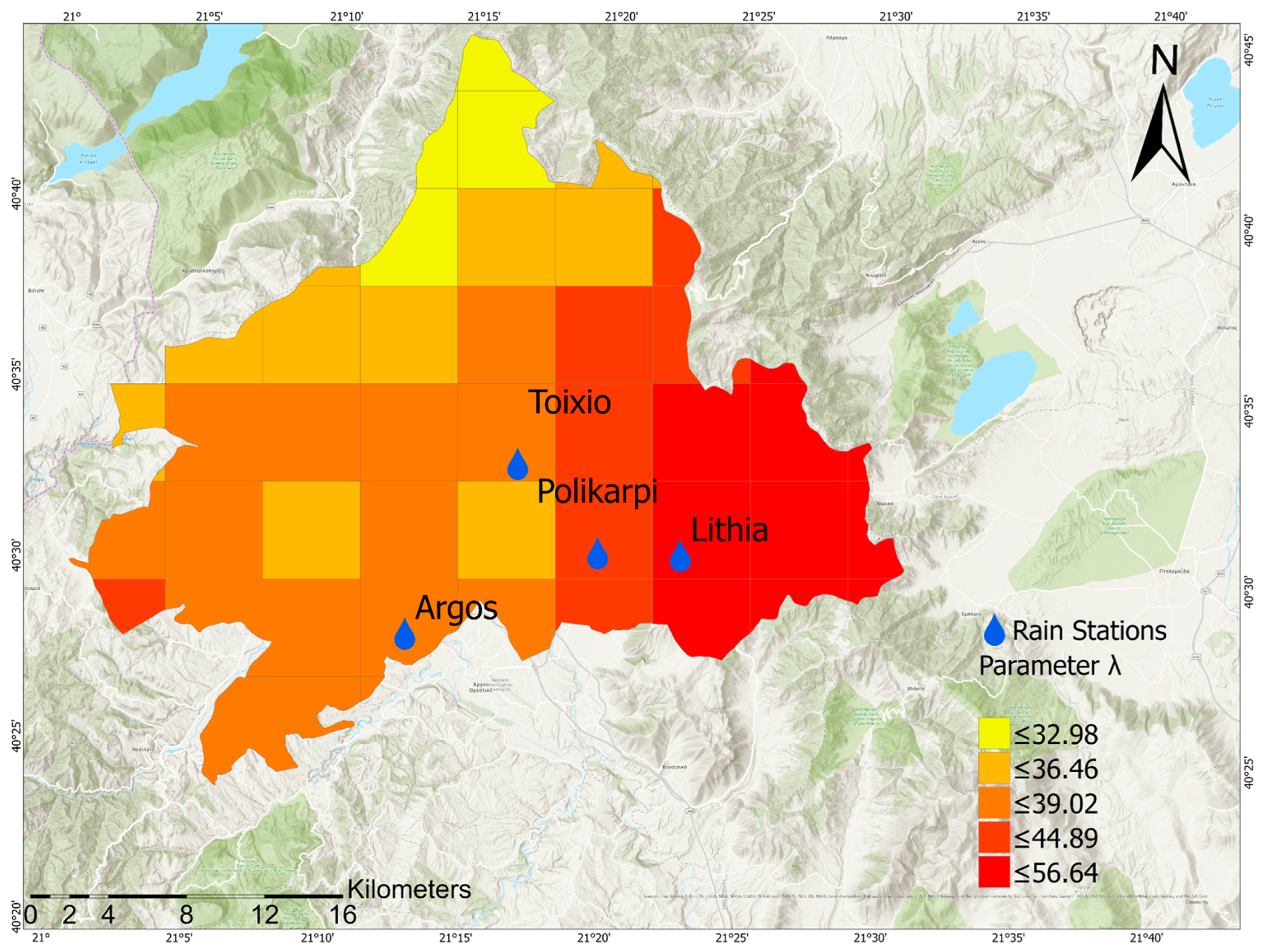
In order to position the local analysis within the general hydro-climatic conditions of Greece, Figure 2 illustrates the spatial structure of the IDF scale parameter (λ) according to the national gridded analysis of Koutsoyiannis [24]. In the case of the Kastoria basin, it is observed that the parameter λ ranges between 32.98 and 56.64, indicating a spatial gradient that corresponds to regions of higher rainfall potential. In that area, independent storms have been detected through the Peak-Over-Threshold method. As for the mean annual arrival rate of storms (ν), which is a parameter independent of the potential intensity parameter λ, it was calculated for each location. It ranges between ν = 3.4 for Argos and ν = 4.8 for Polikarpi.

3.2. Homogenity Test

A formal regional homogeneity framework utilizing L-moments was employed to mathematically justify the pooling of the four meteorological stations. The discordancy measure (Di) was computed for each station to detect potential outliers; all stations produced a Di value of 1.00, substantially below the crucial threshold of 3.0, indicating that no individual station significantly diverges from the regional group. The regional heterogeneity measure (H1) was assessed by 500 Monte Carlo simulations. The test yielded a value of H1 = −0.15. Since H1 < 1.0, the Kastoria basin is formally classified as “acceptably homogeneous” for rainfall extremes. Furthermore, the L-moments Goodness-of-Fit measure (ZDIST) strongly supported the selection of the Generalized Extreme Value (GEV) distribution for regional peak intensity, yielding a near-perfect fit score of ZGEV = −0.03 (well within the acceptable bounds of ±1.64).

3.3. Innovative Trend Analysis (ITA)

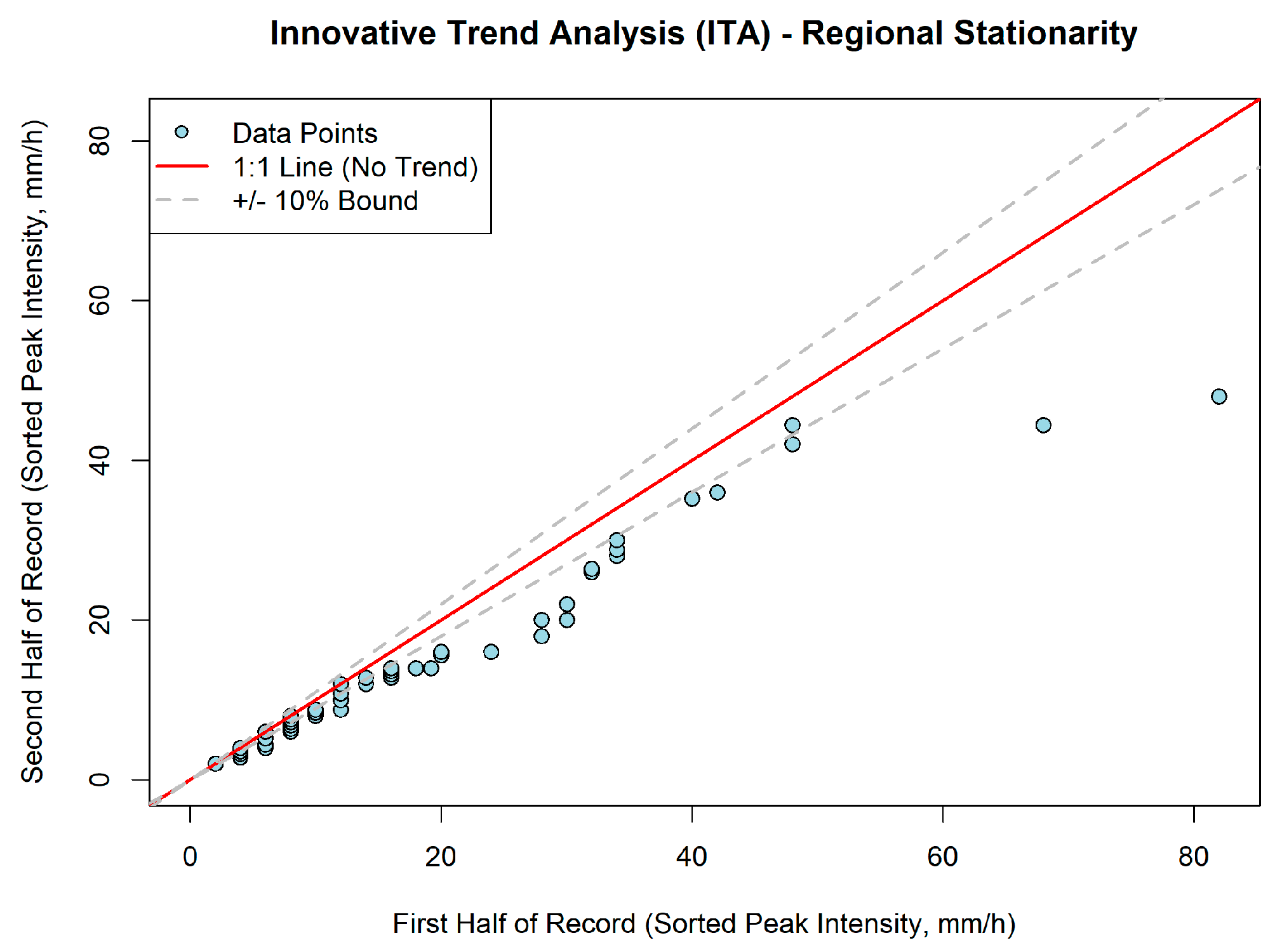
To evaluate the temporal dynamics of the regionalized data, an Innovative Trend Analysis (ITA) was performed on the pooled Peak-Over-Threshold (POT) intensities (Figure 3. The chronological record was plotted against a 1:1 no-trend line with standard ± 10% boundaries. The ITA plot reveals a divided temporal behavior. Low to moderate peak intensities (≤15 mm/h) cluster tightly along the 1:1 line, indicating strict stationarity for standard events. However, for the most extreme events (>20 mm/h), the data points deviate significantly below the 1:1 line and the lower 10% boundary. This indicates a decreasing trend in the magnitude of extreme peak intensities during the second half of the observation period. While standard IDF derivation assumes strict stationarity, this observed decreasing trend implies that the derived historical baseline curves inherently contain a conservative safety margin for current hydro-climatic conditions in the Kastoria basin, as the most severe bursts occurred in the earlier half of the record

3.4. At-Site Marginal Distribution Analysis

Marginal distributions for storm duration (D) and peak intensity (I) were evaluated for each station using the Akaike Information Criterion (AIC) and the Kolmogorov–Smirnov (K-S) goodness-of-fit test:
  • Duration: The Gamma and Weibull distributions emerged as the best-fitting models across the basin. The Gamma distribution provided the best fit for Polikarpi and Toixio, while the Weibull distribution was superior for Argos and Lithia.
  • Intensity: The Lognormal distribution consistently outperformed Gamma and Weibull models for individual stations, accurately capturing the skewness of peak rainfall intensities. The Generalized Extreme Value (GEV) distribution was also tested but frequently failed to converge for smaller individual station datasets (N < 100), likely due to parameter estimation instability with limited sample sizes.

3.5. Dependence Structure and Copula Selection

The dependence structure between storm duration and peak intensity was investigated using Kendall’s rank correlation coefficient (τ). All four stations exhibited a statistically significant negative dependence, with τ values ranging from −0.15 (Toixio) to −0.51 (Lithia). This negative correlation confirms the convective nature of the local climate, where the highest intensity bursts are typically associated with shorter durations.
A wide range of Archimedean and Elliptical copula families were fitted to the data. Rotated (Survival) families were particularly effective at capturing the asymmetric tail dependence observed in the data. The optimal copula families varied slightly by station—ranging from Rotated Clayton (270°) at Argos to Rotated Gumbel (90°) at Polikarpi—but all best-fitting models consistently represented the same fundamental negative dependence structure (Table 1).
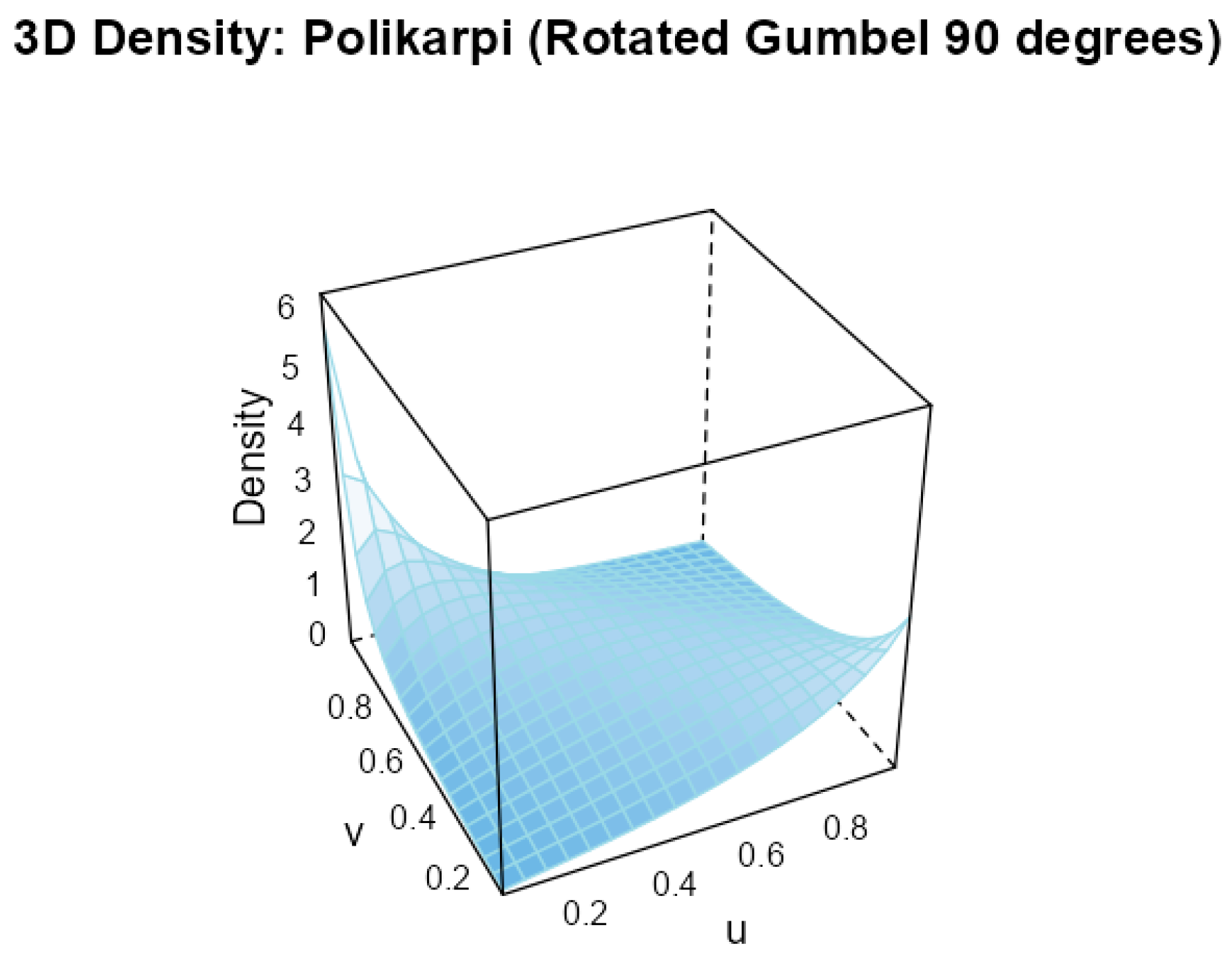
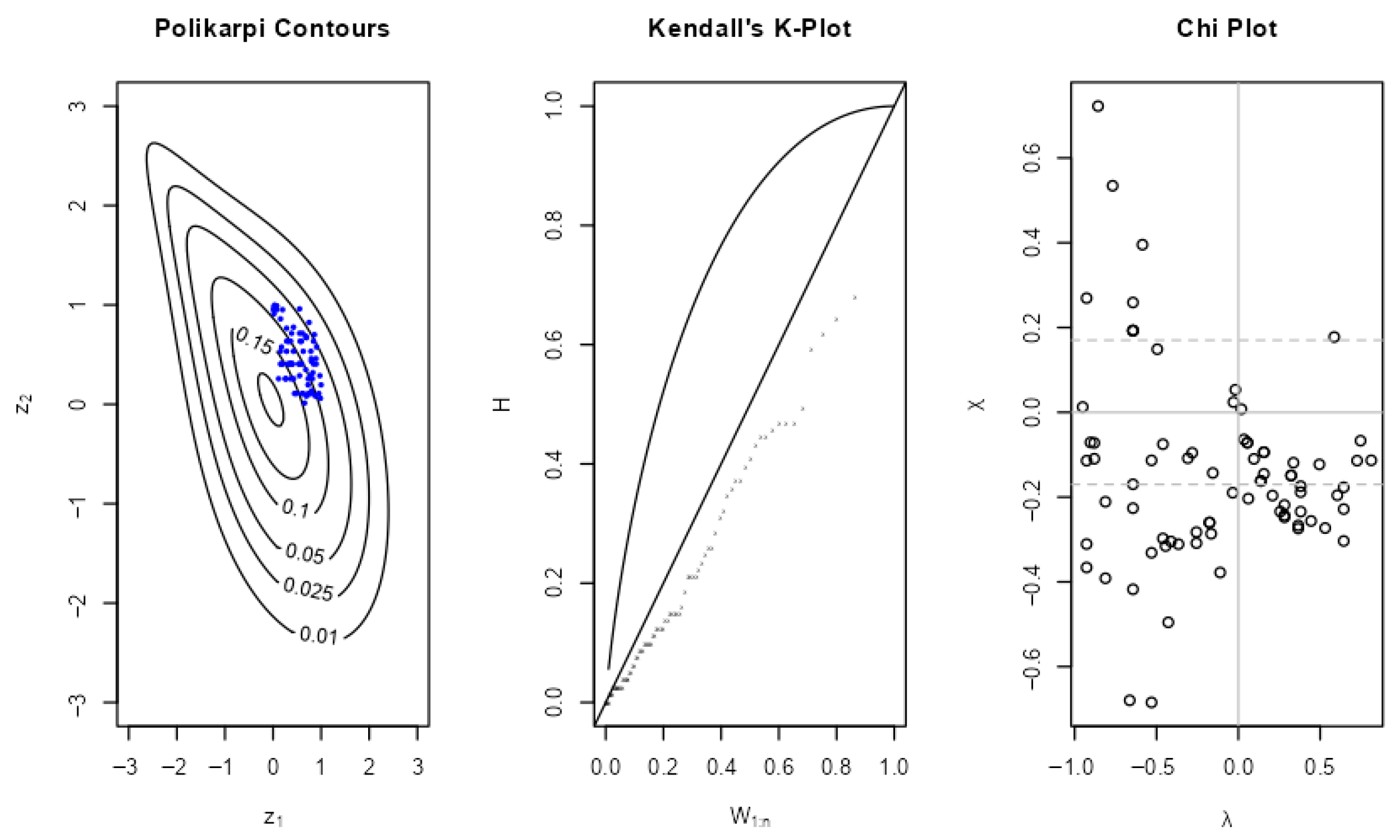
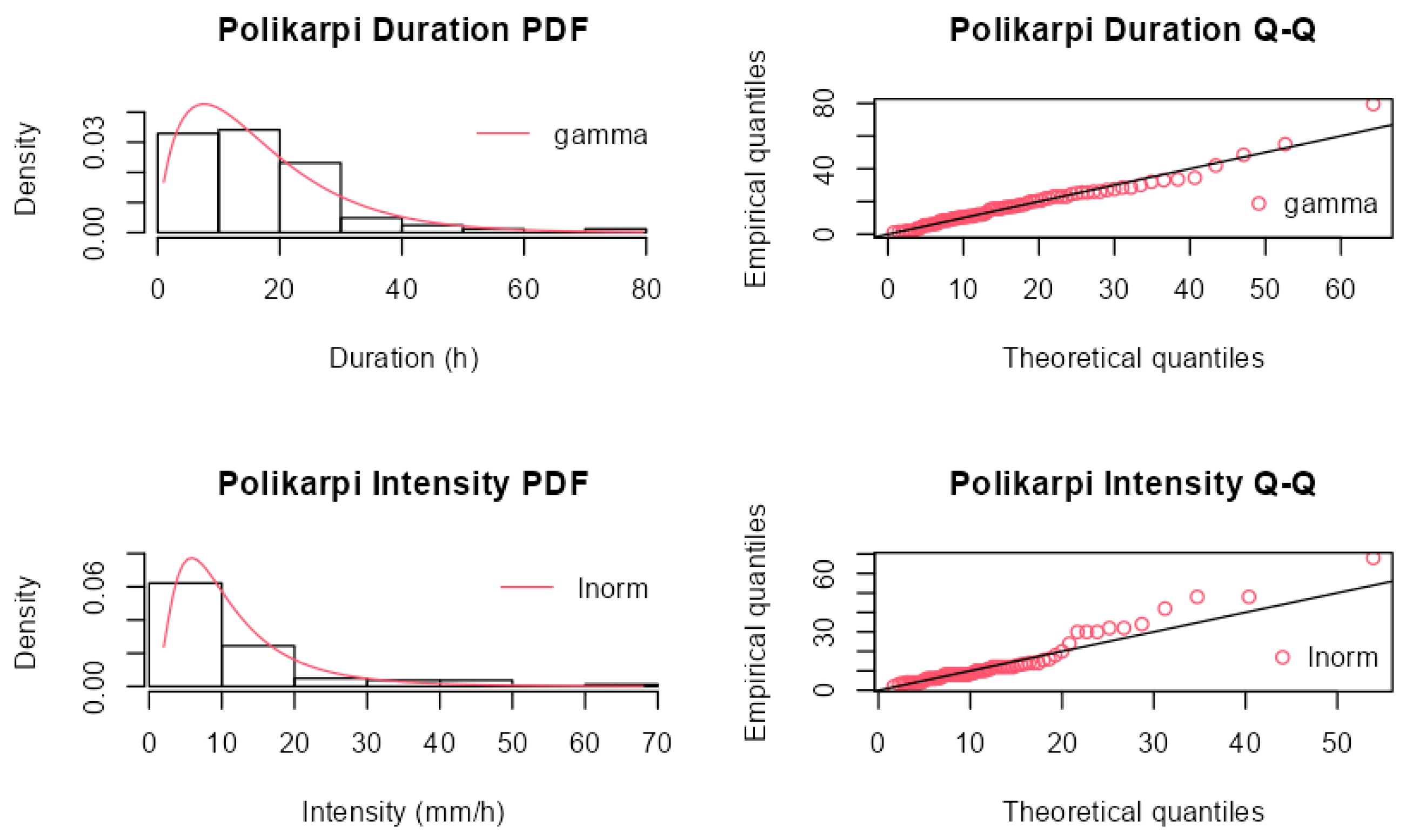
For the Polikarpi station, the stochastic properties of the extreme weather events were modeled in great detail, and the Gamma and Lognormal distributions, respectively, were found to best describe the duration and peak intensity, while the bivariate dependence relationship indicated a negative rank correlation, which could best be explained by the Rotated Gumbel (90 degrees) copula function (Figure 4). As shown in Figure 5 and Figure 6 the graphical diagnostics and the observed data points overlaid the theoretical contour lines, and the Kendall’s tau plots reflected an excellent level of agreement between the theoretical and observed dependence functions, while the joint probability density function, represented by the 3-D graphic, portrayed the typical saddle shape where there existed well-defined modes at short-duration and high-intensity, as well as at long-duration and low-intensity, regions, thereby physically authenticating the model’s ability to qualitatively describe the local convective climate while giving zero weight to the joint extreme values of the other two.
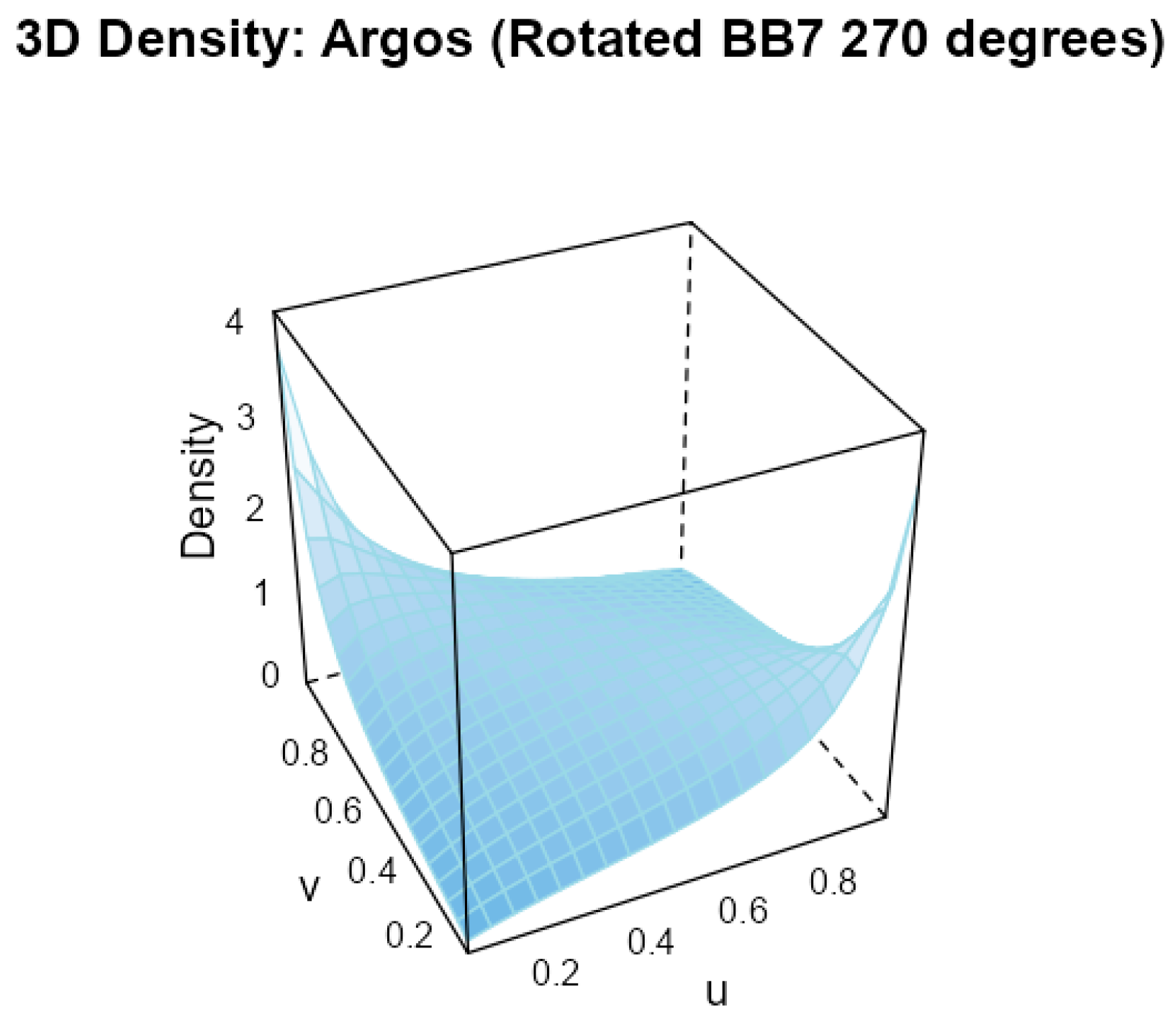
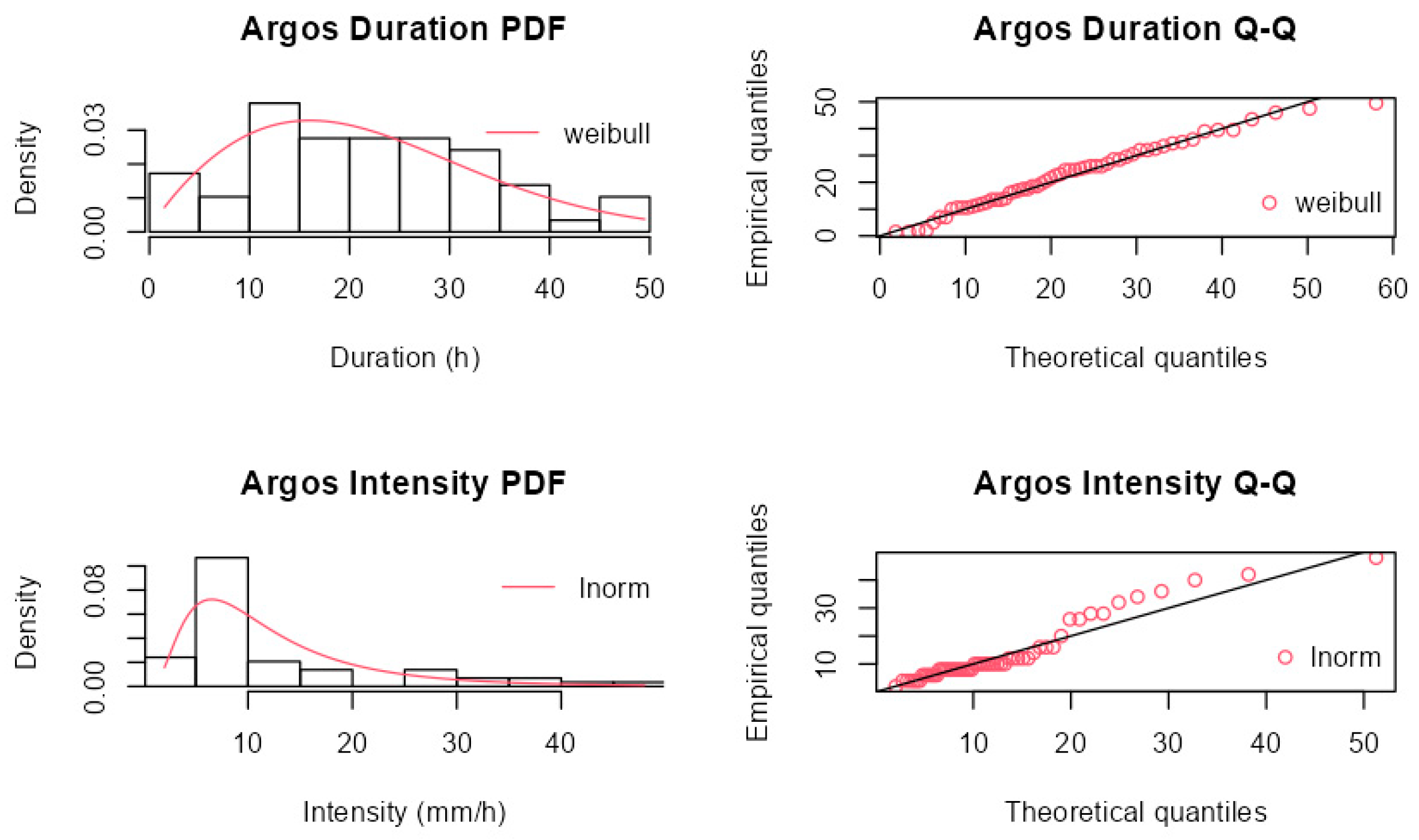
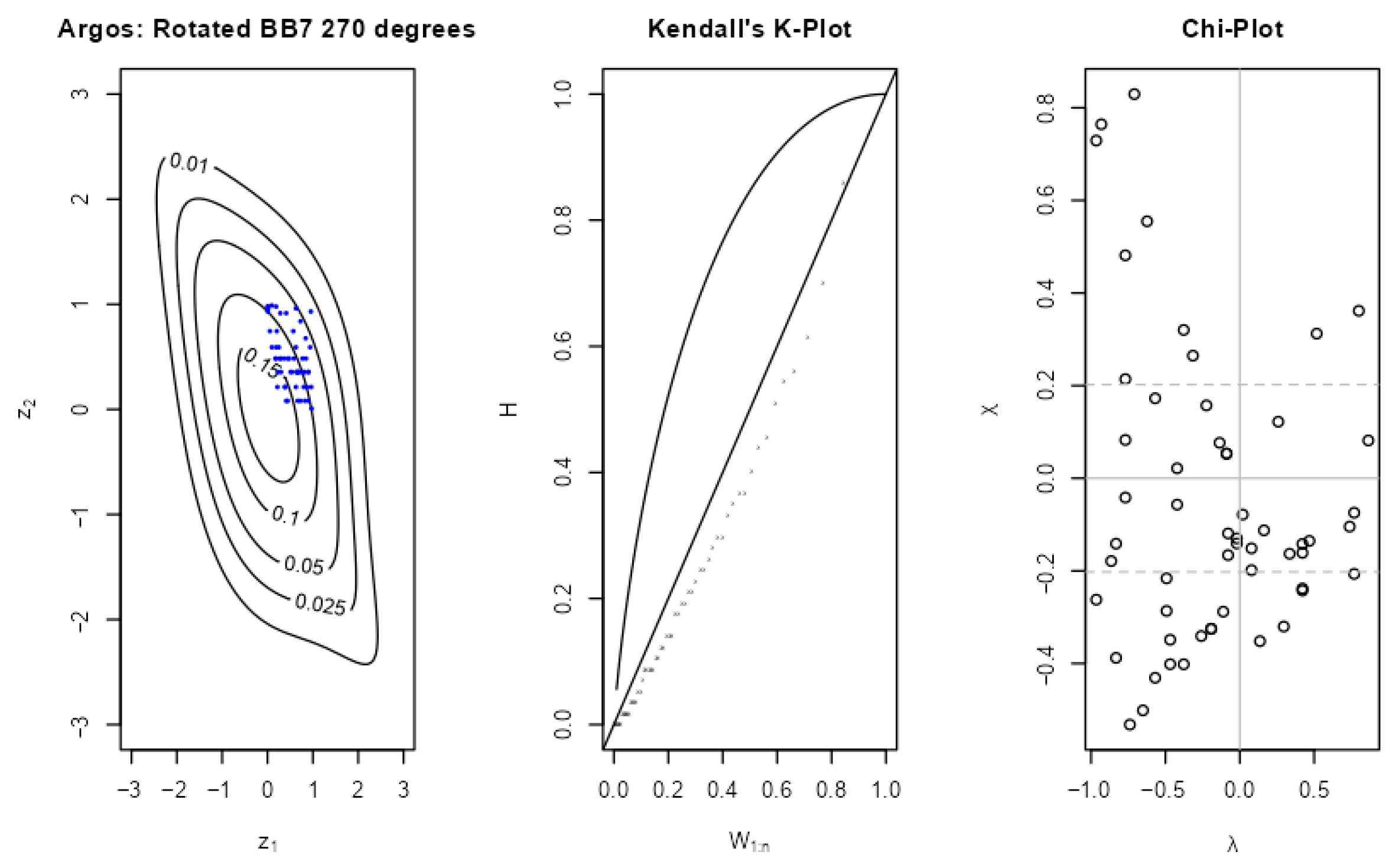
The complete bivariate modeling framework for the Argos station encompassing the copula selection, dependence structure, and marginal distributions is detailed in Figure 7, Figure 8 and Figure 9. For the Argos station, the bivariate modeling process yielded the Rotated BB7 (270°) copula as the optimal model (Figure 7). This selection was driven by the underlying dependence structure, which presented a high negative rank correlation coefficient (τ = −0.33) (Figure 8). The choice of copula was validated based on the proximity of the empirical and theoretical dependence measures, and the grouping of the observation points within the theoretical probability contours of the Kendall’s tau diagram. Furthermore, the obtained joint probability density surface presented well-defined saddles, reproducing the local hydroclimate’s constraining properties and hindering the occurrence of compound events. Finally, the marginal random properties of these events were described using the Weibull distribution for duration and the Lognormal distribution for peak intensity (Figure 9). The marginal fits were deemed robust, with the Lognormal model successfully reproducing the tail behavior of extreme peak intensity values despite minor deviations in the median.
Figure 10, Figure 11 and Figure 12 provide a comprehensive visual summary of the bivariate statistical framework applied to the Lithia station, capturing the final copula model, its dependence diagnostics, and the underlying marginal distributions.
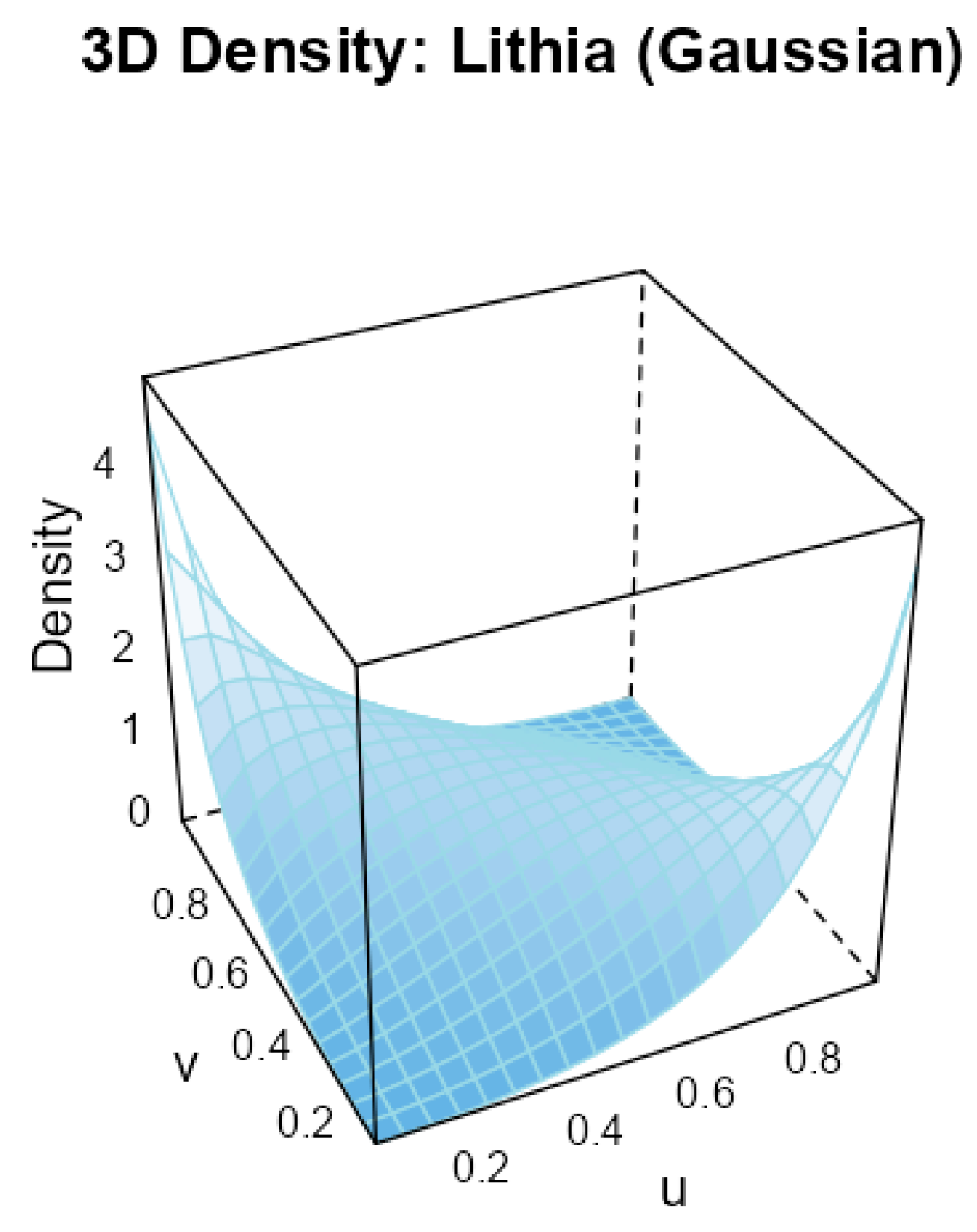
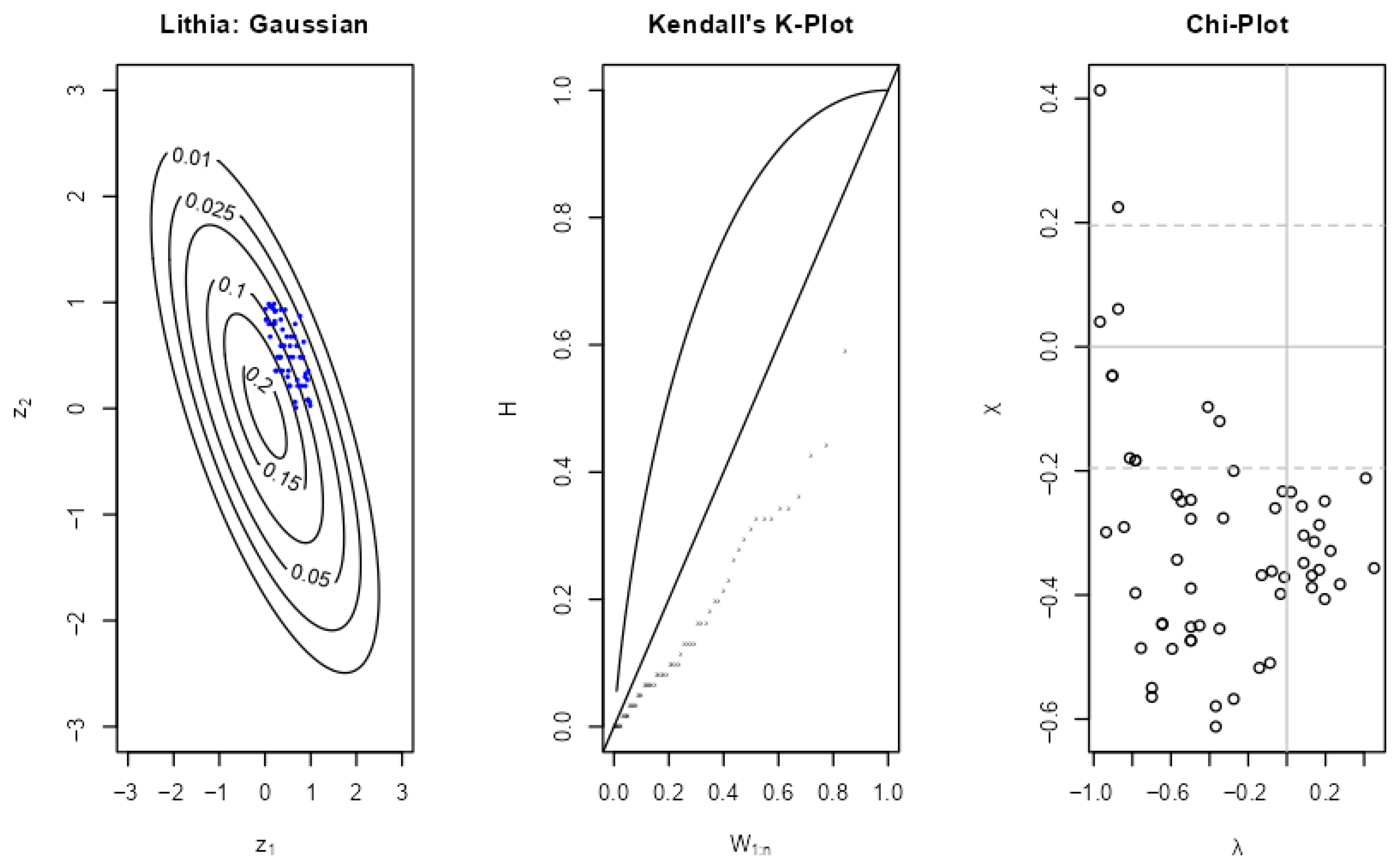
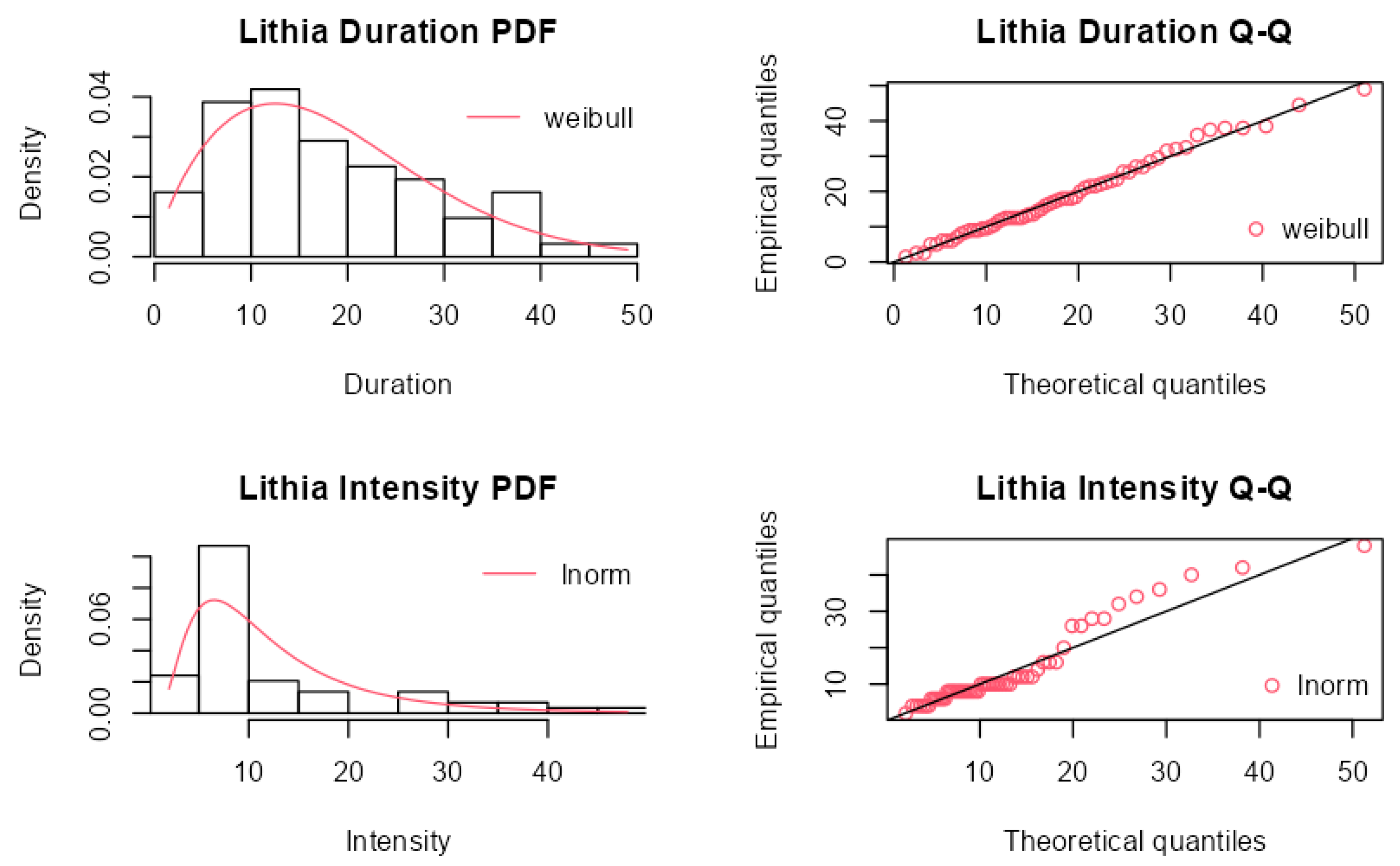
Τhe Lithia site displays the strongest negative correlation with a value of −0.51 for the rank correlation (τ). The strongest negative association suggests the optimal model to be the Gaussian copula model (Figure 10), as it diverges from the other two Archimedean copulas used at the other two stations. The depiction of the elliptical contours and the concentration of the values represented in the Chi-plot in the negative region validate the Gaussian model’s appropriateness (Figure 11). The resulting joint density surface manifests a symmetric saddle, which portrays a strong physical relationship that only allows the combination of events with high intensity and small duration. The site’s association remains consistent with the regional convective climate after the application of the quality control measureThe Q-Q plots for the duration margins demonstrate an almost perfectly linear pattern, indicating an excellent fit for the Weibull model (Figure 12).
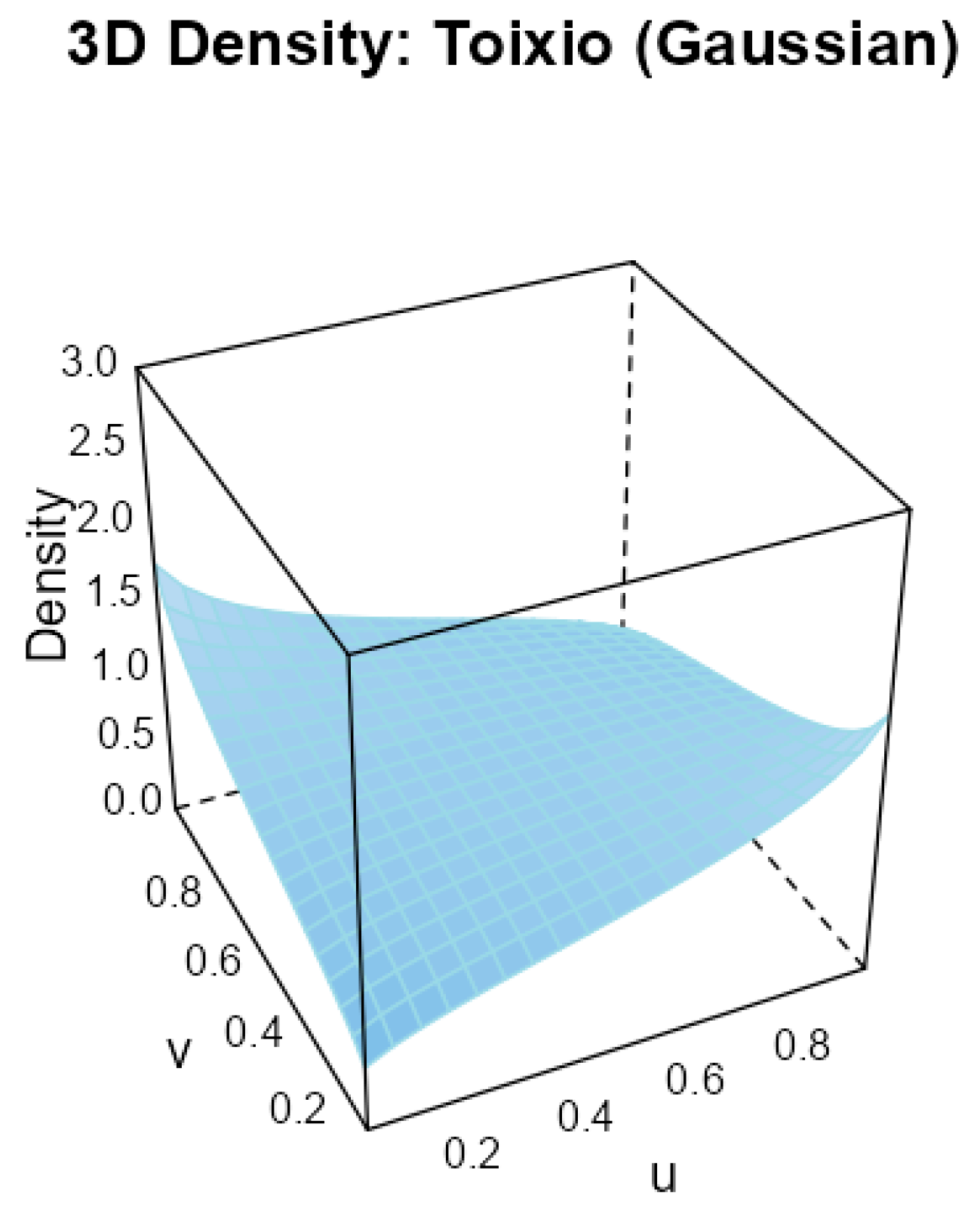
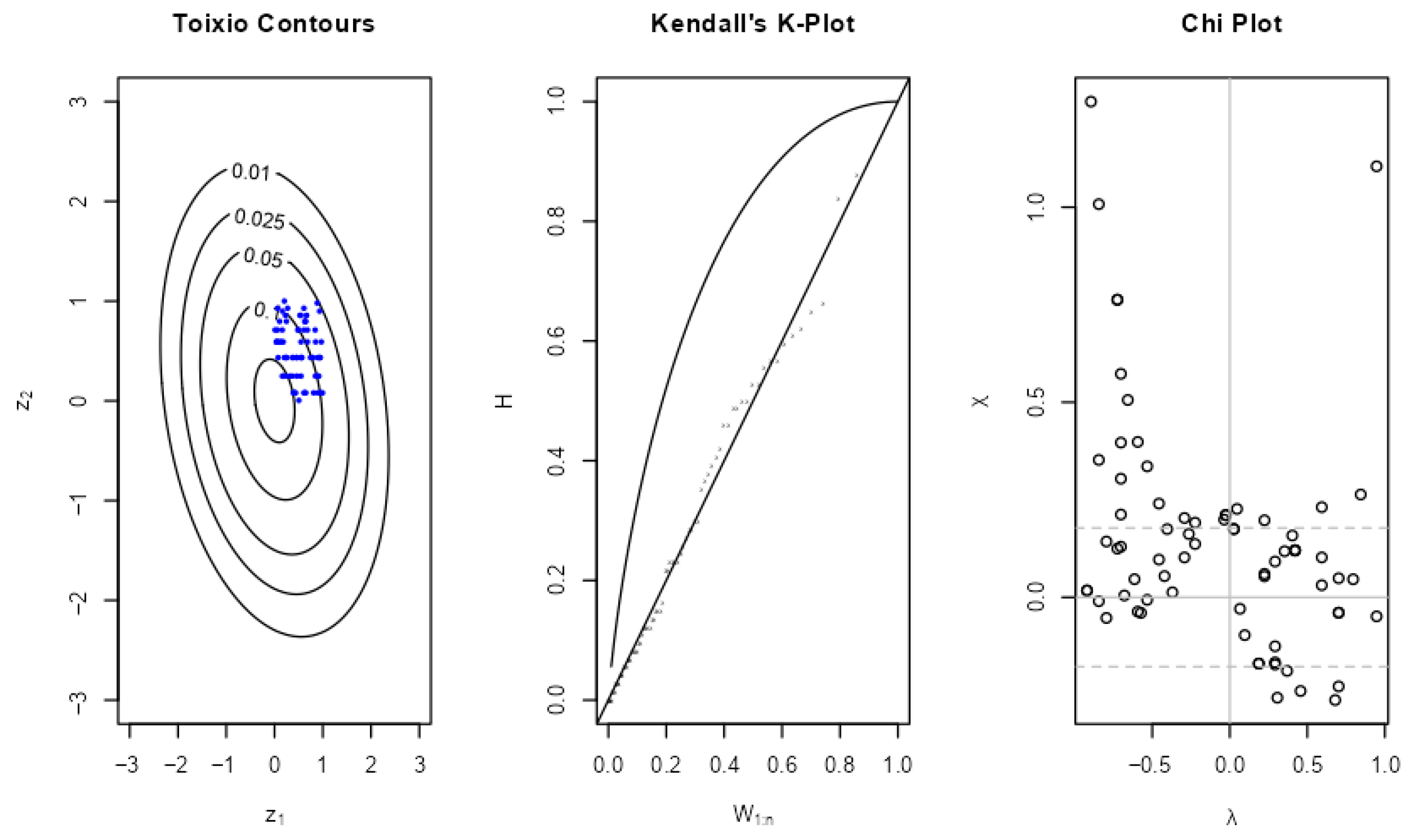
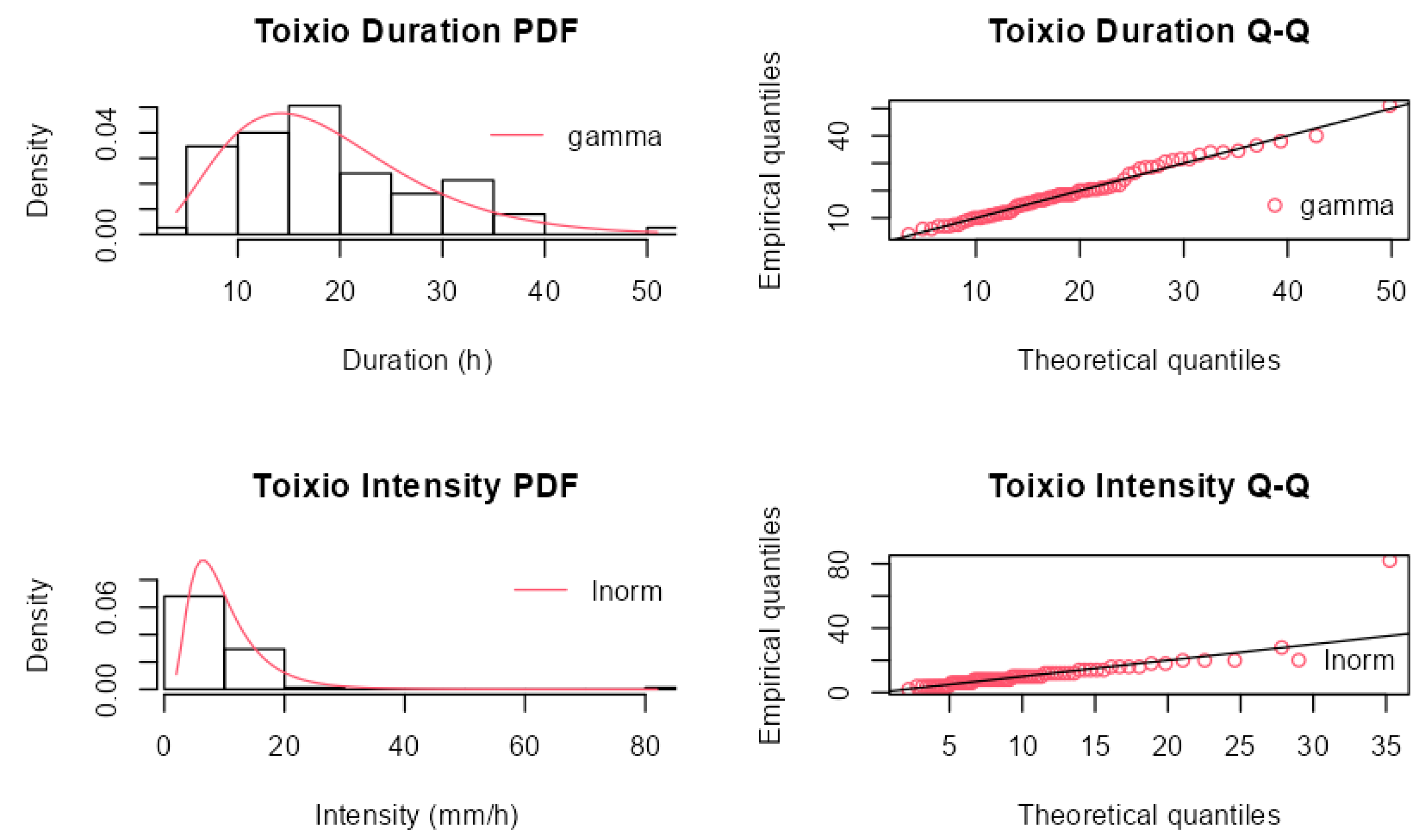
The bivariate modeling framework for the Toixio station is illustrated sequentially in Figure 13, Figure 14 and Figure 15, detailing the copula selection, dependence structure, and marginal distributions. For the Toixio station, the bivariate modeling process indicated that the medium-strength negative dependence was optimally modeled with a Gaussian copula (Figure 13). This aligns with the site’s underlying correlation, which, unlike other stations in the basin, showed a smaller dependence with a Kendall’s rank correlation of approximately −0.15 (Figure 14). The Kendall’s K-plot presented a reasonable agreement between both empirical and theoretical expressions for dependence. The marginal distributions for storm duration and intensity at the Toixio station were adequately represented using the Gamma and Lognormal distributions, respectively. The Q-Q diagnostic plot revealed a good representation of the data using the Gamma model on the duration spectrum, while the intensity spectrum was properly modeled with the Lognormal distribution, except for a point at the topmost part of the tail (Figure 15). The bivariate probability density surface derived from this model presented a less topographically rough structure than those derived for other stations. This generally reflected a more reduced gradient within a diffuse correlation not altering the basin-wide tendency against extremes in intensity and duration at the same time.

3.6. Regional Model Development

Given the spatial homogeneity in dependence structure (consistent negative τ), data from all four stations were pooled to develop a robust Regional Copula Model. The pooled dataset (N = 277) was created by normalizing event characteristics by their respective site means.

Regional Marginal Selection

For the pooled regional dataset, a rigorous “tournament” of six candidate distributions was conducted:
  • Duration: The Weibull distribution was selected as the optimal regional model for duration (AIC = 458.03, p K S = 0.67), marginally outperforming the Gamma distribution.
  • Intensity: A significant finding was the superior performance of the Generalized Extreme Value (GEV) distribution for the pooled intensity data. Unlike in the at-site analysis, the larger regional sample size allowed the GEV model to converge successfully. It achieved the lowest AIC (421.78) and was the only candidate to pass the K-S test at the 5% significance level ( p K S = 0.28$), whereas the standard Lognormal distribution failed ( p K S = 0.03). The positive shape parameter (ξ = 0.348) indicates a Fréchet-type heavy tail, highlighting the region’s susceptibility to extreme flash-flood-producing storms.

3.7. Regional Copula Selection

To ensure a rigorous and objective selection of the regional dependence structure, competing copula families were systematically evaluated. Goodness-of-fit was quantified using the Akaike Information Criterion (AIC). As demonstrated in Table 2, the Rotated Gumbel (90°) copula provided the optimal fit (lowest AIC = −96.93) for the negative dependence structure (τ = −0.345) observed in the regional pooled dataset, outperforming symmetric models such as the Gaussian copula.
For the regional data pool (N = 277), a thorough investigation of marginal characteristics of storm events was conducted to identify the Weibull and GEV distributions for duration and intensity, respectively. Moreover, it should be noted that GEV modeling of intensity statistics represents a case of special interest: according to Q-Q diagnostic plots, GEV performed better than the frequently used Lognormal distribution in portraying tail statistics for regional data, which again points to a Fréchet-type (ξ > 0) heavy tail nature of convective storms. Furthermore, regarding regional aspects, for which Kendall’s correlation measure τ = −0.35 provided a measure of regional dependence structure, it was found that a copula function of type “Rotated Gumbel (90°) copula” best applies. This choice was ascertained through comparison of probability contours, which well correlated with event pairs for given regional data, and a comparison of corresponding functions through a “Kendall’s K” plot, where a considerable level of equivalence was found between theoretical and actual functions. Consistent with expectation and synchrony with marginal characteristics, this bivariate form of joint probability density has a “saddle shape” topology that partitions probability mass between “short-duration and high-intensity” and “long-duration and low-intensity” event modes, which supports the interpretation that regional hydro-climatology does have a natural and inherent contribution to limit compound risk of jointly extreme duration and intensity and, by such means, form a physical basis for obtaining a “canonical” form of joint intensity–duration–frequency curves of a strongly “concave” shape.

3.8. Bootstrapping Analysis

A rigorous semi-parametric bootstrap test was conducted to accurately quantify the uncertainty related to extrapolating extreme quantiles from the given 17-year chronological record. A pooled regional sample of N = 277 separate Peak-Over-Threshold (POT) events was resampled with replacement for B = 500 iterations. In each iteration, empirical pseudo-observations (ranks) were employed to re-estimate the Copula dependence structure, ensuring numerical stability and bypassing domain limits, while L-moments were utilized to recalibrate the GEV marginal distribution for intensity. The 95% Confidence Intervals (CIs) were subsequently obtained for both the 50-year and 100-year design intensities across all specified durations (Table 3). According to extreme value theory, the 50-year return period estimates demonstrate significantly lower and more consistent confidence intervals (e.g., 21.8–28.3 mm/h for the 24 h duration) in comparison to the 100-year estimates (Table 4). The analysis indicates a clear temporal divergence in uncertainty: long-duration volumetric events exhibit high statistical reliability, whereas short-duration convective events (e.g., 1 h duration) show significant upper-bound uncertainty (e.g., 111.0–339.5 mm/h for the 100-year event). This represents the heavy-tailed characteristics of the GEV distribution in the Kastoria basin, offering engineers essential, measurable safety margins for flash flood mitigation instead of depending on a possibly misleading deterministic single value.

3.9. Regional Design Storms (IDF Curves)

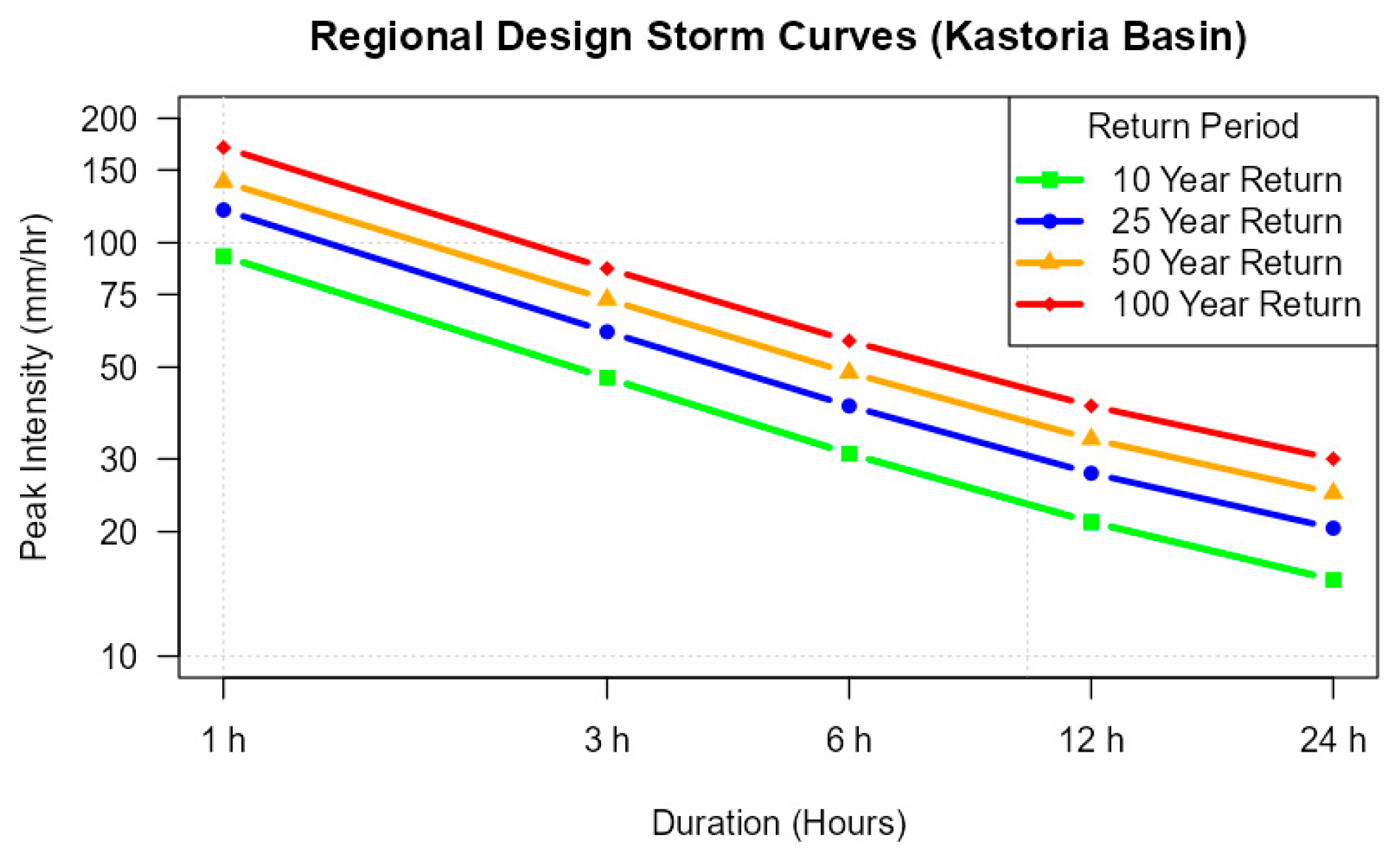
Conditional design rainfall intensities were derived from the fitted Regional Copula Model (Weibull–GEV-Rotated Gumbel) for return periods of 10, 25, 50, and 100 years. The results indicate significant rainfall hazards for short-duration events, with 1 h intensities reaching 170.0 mm/h for the 100-year return period (Table 5).
To facilitate engineering application, these probabilistic results were parameterized using the generalized Koutsoyiannis IDF equation [24]. Non-linear least squares regression yielded an excellent fit ( R 2 = 0.998), resulting in the following regional design equation:
i ( d , T ) = 50.66 T 0.262 d 0.586
where i is rainfall intensity (mm/h), d is duration (hours), and T is the return period (years). The scale parameter θ converged to zero, indicating a standard power-law decay behavior for durations 1 h. t is noteworthy that this locally derived value falls squarely within the range of the national gridded estimates (32.98–56.64) shown in Figure 2, providing strong physical validation for the Copula-based approach.

3.10. Trend Analysis and Non-Stationarity

The assumption of stationarity was explicitly tested using the Mann–Kendall test on the time-ordered regional dataset (2009–2024). The analysis revealed a statistically significant non-stationary signal in the region’s hydro-climatology:
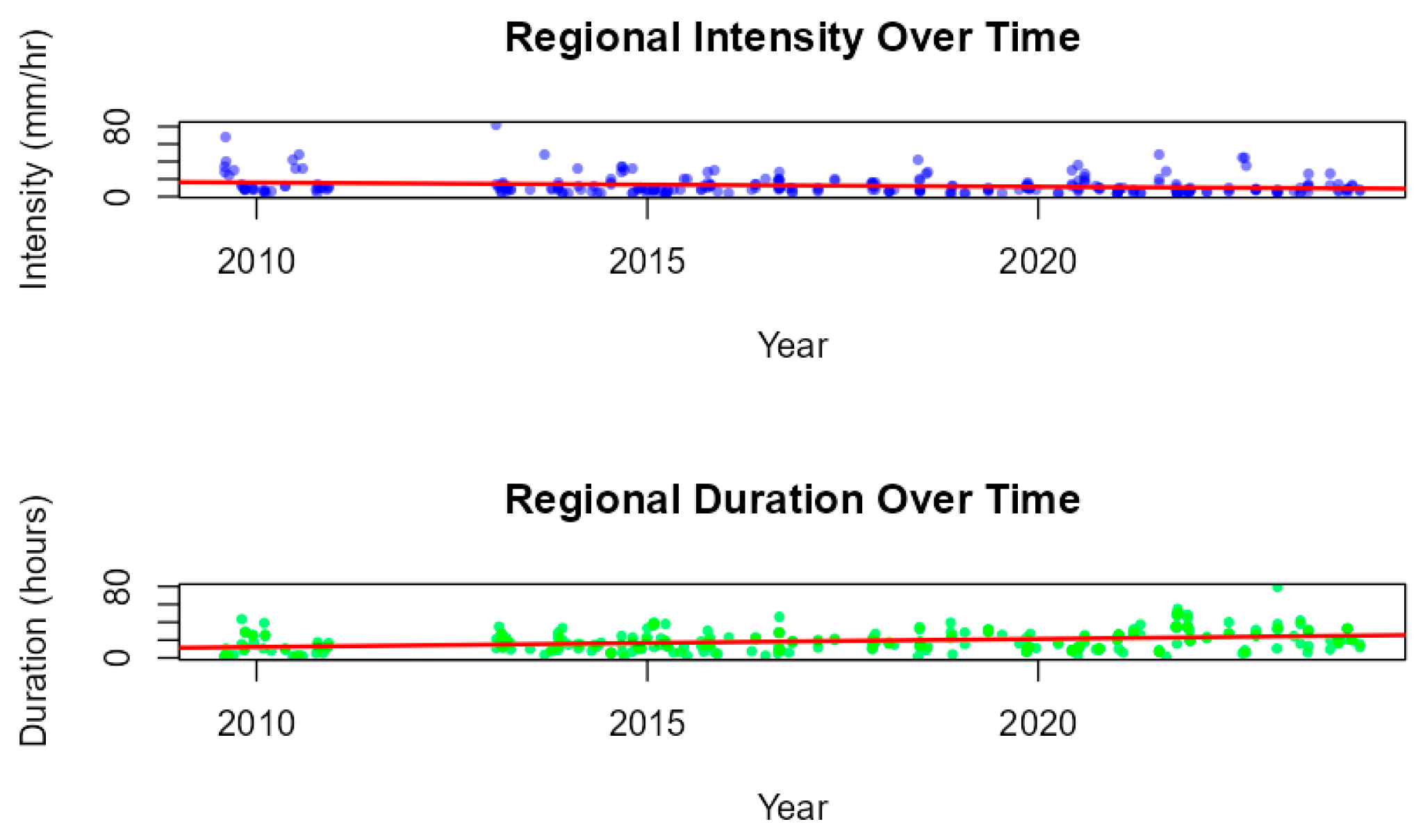
  • Decreasing Intensity: A significant downward trend was observed in peak storm intensity (τ = −0.141, p < 0.001).
  • Increasing Duration: Conversely, a highly significant upward trend was detected in storm duration (τ = 0.224, p < 0.001).
  • Stable Frequency: The annual frequency of storm events showed no significant trend (p > 0.05).
These findings suggest a regime shift from short, high-intensity convective storms toward longer-duration stratiform events. While the risk of instantaneous flash flooding (intensity-driven) appears to be moderating, the significant increase in event duration implies a growing risk for volume-dependent infrastructure, such as reservoir storage and dam spillways.
The sequence of storm properties over time (Figure 16) shows that the Kastoria basin exhibits a clear hydro-climatic shift. According to the trend analysis performed using the Mann–Kendall test, the characteristics of the storms show a significant trend of decreasing peak intensity (τ = −0.141) alongside an increasing duration (τ = 0.224). This trend of de-intensification of the storms is consistent with the reported deficits in the regional water balance, as observed by Voulanas [53], indicating a shift in the type of flash floods, from convective to stratiform.
In spite of this trend towards lighter intensity, the result of using the Copula to produce the IDF curves from the dataset (Figure 17) is to render one thing very evident: there remains a need for robust models of heavy-tail distributions. The design formula, i = 50.66 T0.262/d0.586, is formulated to reflect the tail characteristics inspired by the Fréchet distribution (ξ = 0.348) from the GEV distribution. This ensures the hydraulic design retains robustness to infrequent, very heavy rainfall events, as may potentially be underestimated by using the Lognormal distribution in standard practice. The power-law decay rate, η = 0.586, further incorporates the strong negative correlation evident in the region and functions as a drag to prevent over-estimation in the volume for design storms of high intensity.

4. Discussion

Physical Interpretation of Dependence Structure

Applying the theory of bivariate copulas on the Kastoria basin, a strong negative rank correlation exists between the rainfall duration and the peak intensity for all of the stations, namely τ = −0.35. This is a strong indicator of the area’s precipitation process and its dual nature. In line with expectations for similar hydro-climatic areas, only a short-duration intense precipitation process is physically feasible for the region, while longer precipitation processes indicate lower intensity precipitation, namely stratiform systems for the area. This matches the current understanding for the area’s entire hydro-climatic process. According to a recent research, for a similar area in the neighboring state of Romania, urban floods are driven by short-term torrent events, on average between 5 and 30 min [54]. The Rotated Copula Model, such as “Gumbel Rotated by 90°”, aptly reflects this saddle probability space. This space prevents the produced compound designs from entering physically unrealistic zones, namely preventing a simultaneous large intensity and large duration. In this manner, the current method counteracts the risk of confining compound risk values by assuming a direct dependence. The key result of the current work is the superior performance of the Generalized Extreme Value (GEV) model in simulating rainfall intensity at the regional level, with particular emphasis on the heavy right tail (ξ > 0). Although in standard engineering design, the Lognormal distribution is favored for its simplicity, our results clearly illustrate its inadequacies in describing extreme values in the pooled dataset. The increased focus on GEV models is in line with new approaches in the region. A study conducted in the Balkan Peninsula used GEV-based thresholds to project the occurrence of extreme heavy precipitation episodes, thus accepting implicitly that other lighter-tailed models may potentially underestimate the severity of rare convectional precipitation episodes [55]. Furthermore, in recognizing the importance of sound tail description, the “EURO-SUPREME” project asserts that detailed sub-daily definitions of extremes are compulsory in the pursuit of proper climate risk estimation. With this in mind, this work presents a new site-specific and more conservative design criterion of hydraulic infrastructure through its focus on GEV. To assess the practical applicability of the proposed regional copula framework, the outputs generated by the model were paired with the official national mitigation strategies for flood-prone areas (https://floods.ypeka.gr/sdkp-lap/maps-1round/sdkp-el09-1round/) (accessed on 5 April 2026) as provided by the Greek Ministry of Environment and Energy for the Argos Orestiko (Kastoria) station. A direct comparison discloses a notable discrepancy. According to the national criteria for a 100-year return period (T = 100), the upper 95% confidence interval intensities are quantified as 50.29 mm/h for a 1 h duration and 5.35 mm/h for an hour duration. In contrast, the expected intensities derived from the Copula approach are 170.0 mm/h and 30.0 mm/h, respectively. This deviation is not indicative of an overestimation but rather a fundamental shift in methodological paradigms Traditional national Intensity–Duration–Frequency (IDF) curves are constructed utilizing Annual Maxima Series (AMS) of rolling-window accumulations, thereby representing the mean intensity across a fixed temporal interval. Conversely, the proposed Copula framework clearly separates independent Peak-Over-Threshold (POT) events and proficiently accounts for the interdependence between the overall synoptic duration of the storm and its internal peak burst intensity.
Among the most important results of this study, there is the evidence for a statistically significant decrease in peak rainfall intensity together with a simultaneous increase in storm duration, as expressed by τ = −0.14 for the former parameter and τ = +0.22 for the latter, within the basin of Kastoria. This contradicts the general opinion on a uniform intensification of the hydrological cycle. However, this exception from the general Balkan climate is strongly evidenced by recent, targeted studies in the area. A recent study has investigated the long-term balance of the Lake Kastoria basin in terms of its hydrological cycle and has found that there is a statistically significant decrease in the annual rainfall amounts, coupled with the rising temperatures [53]. The negative value of the peak storm intensity (τ = −0.14) that we have identified can now be seen as the high-resolution, targeted process that sustains these findings, namely that the area in question is not merely experiencing fewer storms, but fewer convective events that have, in the past, driven the flood events in the basin. The agreement of our sub-hourly findings with the monthly/annual timescale indicates that the Kastoria basin is a ‘drying’ microclimate within the broader, increasingly arid Mediterranean region.
  • Regional Contrast: These results are very different from those found in the latest search conducted in the Romanian area, which showed an increase in the strength of short-term rain episodes (5, 10, 30 min) and a decrease in longer-term rain episodes [54].
  • The Role of Variability: This paradox of decreasing intensity in Kastoria and increasing intensity in Romania is in line with the overall trend that has been noticed in the Mediterranean region. In most cases, the precipitation trend in the Mediterranean region is dominated by high natural variability rather than the linear climate change signal [55].
These results indicate that the Kastoria region may be experiencing a localized change in hydroclimatic regime or be influenced by cycles of low-frequency oscillation, distinct from the more general Balkan trend. They demonstrate further the risk of relying on regional general climate drivers when designing local infrastructure and the need to update those designs with site-specific data, as here shown. The divergent trends have obvious implications for how the area adapts. While the risk of rapid, short-duration rain-driven floods (flash floods) might be plateauing, the significant increase in storm duration represents an increased risk for volume-sensitive structures such as reservoir spillways and retention basins which have to safely handle larger volumes of water in extended periods. Another value of this work is that it directly fills a critical data gap called identified in recent literature [56]. The detected shift toward longer-duration events has specific implications for the management of Lake Kastoria’s water level, a critical concern regarding the lake’s vulnerability to climate change [53]. While instantaneous flood peaks may be stabilizing, the significant increase in storm duration (τ = 0.22) suggests that inflow hydrographs will become more voluminous and extended in time. For the lake’s hydraulic control structures, this shifts the operational requirement from rapid peak-shaving (handling flash floods) to sustained volume retention. Integrating our updated GEV–Weibull IDF curves with water balance models would provide the most robust framework for adapting the lake’s regulation rules to this ‘slower but longer’ inflow regime. The authors have identified the absence of high-resolution, sub-daily rainfall datasets as one of the fundamental limitations to grasping small-scale extremes in Europe. By developing updated, physically consistent IDF curves based on local sub-hourly data, this study provides a critical tool for local engineers by updating outdated standards with design criteria appropriate for the current and complex hydroclimatology of the basin.

5. Conclusions

This work has proposed a robust Regional Copula Framework for the Kastoria Lake basin by challenging the assumptions of the traditional univariate approach in order to obtain physically consistent ID curves. Four major conclusions have been derived:
  • Dependence Structure: There exists a strong negative rank correlation (τ = −0.35) between the duration and intensity of the storms. The Rotated Gumbel (90°) copula correctly identifies this dependence structure, suggesting that the risk of extreme rainfall in the area is posed by short-duration convective storms, thus counteracting the effect of over-design that results from assuming independence or positive correlation between the variables.
  • Marginal Distributions: The Generalized Extreme Value (GEV) distribution performs better than the traditional Lognormal distribution in terms of rainfall intensity in a region. The detection of a heavy-tailed process, where ξ > 0, indicates that the probability of catastrophic floods was likely underestimated by existing approaches.
  • Climatic Non-Stationarity: Trend analysis indicates departure from the Balkan pattern. Whilst surrounding areas experience increasing extreme values, the Kastoria Basin experiences a decreasing trend in peak intensity (τ = −0.14) and an increasing trend in storm duration (τ = 0.22). This makes it a unique hydro-climatic micro-region that can be attributed to local orographic effects or drying trends in the lake’s overall hydrological system.
  • Practical Application: From the Koutsoyiannis-type equation (Equation (15)), a direct means for the implementation of these results has been provided for the engineer. Based on the trend identified, it appears that the resilience of future infrastructural systems will be more dependent upon volumetric retention capabilities rather than peak capabilities associated with flash floods. Therefore, the Lake Kastoria management plan must focus on the extended hydrograph rather than the flash flood peaks.

Author Contributions

Conceptualization, E.L.; methodology, E.L.; validation, A.P. and S.K.; writing—original draft preparation, E.L.; writing—review and editing, E.L., A.P. and S.K. All authors have read and agreed to the published version of the manuscript.

Funding

This research was partially funded by the Slovak Research and Development Agency under contract numbers APVV 23-0332 and VV-MVP-24-0208, and by the VEGA Grant Agency under grant number 2/0115/25.

Data Availability Statement

The raw data supporting the conclusions of this article will be made available by the authors on request.

Conflicts of Interest

The authors declare no conflicts of interest.

References

  1. Liu, Y.; Wright, D.B. A storm-centered multivariate modeling of extreme precipitation frequency based on atmospheric water balance. Hydrol. Earth Syst. Sci. 2022, 26, 5241–5267. [Google Scholar] [CrossRef]
  2. Lanciotti, S.; Ridolfi, E.; Russo, F.; Napolitano, F. Intensity–Duration–Frequency Curves in a Data-Rich Era: A Review. Water 2022, 14, 3705. [Google Scholar] [CrossRef]
  3. Mahbod, M.; Ebrahimiat, A.; Mahmoodi-Eshkaftaki, M.; Rafiee, M.R. An Innovative Regional Frequency Analysis Approach for Robust Extreme Precipitation Assessment in Data-rich and Climatically Diverse Regions. Water Resour. Manag. 2025, 39, 5079–5102. [Google Scholar] [CrossRef]
  4. Granata, F.; Di Nunno, F. Pathways for Hydrological Resilience: Strategies for Adaptation in a Changing Climate. Earth Syst. Environ. 2026, 10, 203–231. [Google Scholar] [CrossRef]
  5. Brunner, M.I. Floods and droughts: A multivariate perspective. Hydrol. Earth Syst. Sci. 2023, 27, 2479–2497. [Google Scholar] [CrossRef]
  6. Xu, P.; Wang, D.; Singh, V.P.; Wang, Y.; Wu, J.; Lu, H.; Wang, L.; Liu, J.; Zhang, J. Time-varying copula and design life level-based nonstationary risk analysis of extreme rainfall events. Hydrol. Earth Syst. Sci. Discuss. 2019, 2019, 1–59. [Google Scholar] [CrossRef]
  7. Fan, Y.; Huang, K.; Huang, G.; Li, Y.; Wang, F. An uncertainty partition approach for inferring interactive hydrologic risks. Hydrol. Earth Syst. Sci. 2020, 24, 4601–4624. [Google Scholar] [CrossRef]
  8. Zhong, M.; Zeng, T.; Jiang, T.; Wu, H.; Chen, X.; Hong, Y. A Copula-Based Multivariate Probability Analysis for Flash Flood Risk under the Compound Effect of Soil Moisture and Rainfall. Water Resour. Manag. 2021, 35, 83–98. [Google Scholar] [CrossRef]
  9. Größer, J.; Okhrin, O. Copulae: An overview and recent developments. WIREs Comput. Stat. 2022, 14, e1557. [Google Scholar] [CrossRef]
  10. Ahn, K.-H. Streamflow estimation at partially gaged sites using multiple-dependence conditions via vine copulas. Hydrol. Earth Syst. Sci. 2021, 25, 4319–4333. [Google Scholar] [CrossRef]
  11. Alencar, P.H.L.; Paton, E.N. Which droughts are becoming more frequent? A copula entropy analysis on the return period of droughts in Europe. Nat. Hazards 2025, 121, 543–565. [Google Scholar] [CrossRef]
  12. Pouliasis, G.; Torres-Alves, G.A.; Morales-Napoles, O. Stochastic Modeling of Hydroclimatic Processes Using Vine Copulas. Water 2021, 13, 2156. [Google Scholar] [CrossRef]
  13. Tootoonchi, F.; Haerter, J.O.; Räty, O.; Grabs, T.; Sadegh, M.; Teutschbein, C. Copulas for hydroclimatic applications—A practical note on common misconceptions and pitfalls. Hydrol. Earth Syst. Sci. Discuss. 2020, 2020, 1–31. [Google Scholar] [CrossRef]
  14. Tootoonchi, F.; Sadegh, M.; Haerter, J.O.; Räty, O.; Grabs, T.; Teutschbein, C. Copulas for hydroclimatic analysis: A practice-oriented overview. WIREs Water 2022, 9, e1579. [Google Scholar] [CrossRef]
  15. Barna, D.M.; Engeland, K.; Thorarinsdottir, T.L.; Xu, C.-Y. Flexible and consistent Flood–Duration–Frequency modeling: A Bayesian approach. J. Hydrol. 2023, 620, 129448. [Google Scholar] [CrossRef]
  16. Gomez, F.J.; Jafarzadegan, K.; Moftakhari, H.; Moradkhani, H. Probabilistic flood inundation mapping through copula Bayesian multi-modeling of precipitation products. Nat. Hazards Earth Syst. Sci. 2024, 24, 2647–2665. [Google Scholar] [CrossRef]
  17. Khajehali, M.; Safavi, H.R.; Nikoo, M.R.; Najafi, M.R.; Alizadeh-Sh, R. A copula-based multivariate flood frequency analysis under climate change effects. Sci. Rep. 2025, 15, 146. [Google Scholar] [CrossRef]
  18. Huang, K.; Fan, Y.R. Parameter Uncertainty and Sensitivity Evaluation of Copula-Based Multivariate Hydroclimatic Risk Assessment. J. Environ. Inform. 2021, 38, 131–144. [Google Scholar] [CrossRef]
  19. Cammalleri, C.; De Michele, C.; Toreti, A. Exploring the joint probability of precipitation and soil moisture over Europe using copulas. Hydrol. Earth Syst. Sci. 2024, 28, 103–115. [Google Scholar] [CrossRef]
  20. Sherly, M.A.; Karmakar, S.; Chan, T.; Rau, C. Design Rainfall Framework Using Multivariate Parametric-Nonparametric Approach. J. Hydrol. Eng. 2016, 21, 04015049. [Google Scholar] [CrossRef]
  21. Fahimirad, Z.; Shahkarami, N. The Impact of Climate Change on Hydro-Meteorological Droughts Using Copula Functions. Water Resour. Manag. 2021, 35, 3969–3993. [Google Scholar] [CrossRef]
  22. Robati, M.; Najafgholi, P.; Nikoomaram, H.; Vaziri, B.M. Zoning of Critical Hubs of Climate Change (Flood-Drought) Using the Hydrologic Engineering Center-Hydrologic Modeling System and Copula Functions Case study: Khorramabad Basin. Res. Sq. 2024; in review. [CrossRef]
  23. Zhang, B.; Wang, S.; Moradkhani, H.; Slater, L.; Liu, J. A Vine Copula-Based Ensemble Projection of Precipitation Intensity–Duration–Frequency Curves at Sub-Daily to Multi-Day Time Scales. Water Resour. Res. 2022, 58, e2022WR032658. [Google Scholar] [CrossRef]
  24. Koutsoyiannis, D.; Kozonis, D.; Manetas, A. A mathematical framework for studying rainfall intensity-duration-frequency relationships. J. Hydrol. 1998, 206, 118–135. [Google Scholar] [CrossRef]
  25. Back, Á.J.; Bonfante, F.M. Evaluation of generalized extreme value and Gumbel distributions for estimating maximum daily rainfall. Rev. Bras. Ciênc. Ambient. 2021, 56, 654–664. [Google Scholar] [CrossRef]
  26. Ghebreyesus, D.T.; Sharif, H.O. Development and Assessment of High-Resolution Radar-Based Precipitation Intensity-Duration-Curve (IDF) Curves for the State of Texas. Remote Sens. 2021, 13, 2890. [Google Scholar] [CrossRef]
  27. Towler, E.; Llewellyn, D.; Prein, A.; Gilleland, E. Extreme-value analysis for the characterization of extremes in water resources: A generalized workflow and case study on New Mexico monsoon precipitation. Weather Clim. Extrem. 2020, 29, 100260. [Google Scholar] [CrossRef]
  28. Jurado, O.E.; Ulrich, J.; Scheibel, M.; Rust, H.W. Evaluating the Performance of a Max-Stable Process for Estimating Intensity-Duration-Frequency Curves. Water 2020, 12, 3314. [Google Scholar] [CrossRef]
  29. Fan, Y.R.; Huang, W.W.; Huang, G.H.; Li, Y.P.; Huang, K.; Li, Z. Hydrologic risk analysis in the Yangtze River basin through coupling Gaussian mixtures into copulas. Adv. Water Resour. 2016, 88, 170–185. [Google Scholar] [CrossRef]
  30. Chowdhary, H.; Escobar, L.A.; Singh, V.P. Identification of suitable copulas for bivariate frequency analysis of flood peak and flood volume data. Hydrol. Res. 2011, 42, 193–216. [Google Scholar] [CrossRef]
  31. Ganguli, P.; Coulibaly, P. Does nonstationarity in rainfall require nonstationary intensity–duration–frequency curves? Hydrol. Earth Syst. Sci. 2017, 21, 6461–6483. [Google Scholar] [CrossRef]
  32. De Souza Costa, C.E.A.; Blanco, C.J.C.; De Oliveira-Júnior, J.F. IDF curves for future climate scenarios in a locality of the Tapajós Basin, Amazon, Brazil. J. Water Clim. Change 2020, 11, 760–770. [Google Scholar] [CrossRef]
  33. Mirhosseini, G.; Srivastava, P.; Fang, X. Developing Rainfall Intensity-Duration-Frequency Curves for Alabama under Future Climate Scenarios Using Artificial Neural Networks. J. Hydrol. Eng. 2014, 19, 04014022. [Google Scholar] [CrossRef]
  34. Feitoza Silva, D.; Simonovic, S.; Schardong, A.; Avruch Goldenfum, J. Introducing Non-Stationarity Into the Development of Intensity-Duration-Frequency Curves under a Changing Climate. Water 2021, 13, 1008. [Google Scholar] [CrossRef]
  35. Diodato, N.; Di Salvo, C.; Bellocchi, G. Climate driven generative time-varying model for improved decadal storm power predictions in the Mediterranean. Commun. Earth Environ. 2025, 6, 212. [Google Scholar] [CrossRef]
  36. François, B.; Vrac, M.; Cannon, A.J.; Robin, Y.; Allard, D. Multivariate bias corrections of climate simulations: Which benefits for which losses? Earth Syst. Dyn. 2020, 11, 537–562. [Google Scholar] [CrossRef]
  37. Luppichini, M.; Natali, S.; Columbu, A.; Zanchetta, G.; Bini, M. Mediterranean precipitation variability is driven by complex atmospheric mechanisms beyond the North Atlantic Oscillation. Commun. Earth Environ. 2026, 7, 81. [Google Scholar] [CrossRef]
  38. Zellou, B.; El Moçayd, N.; Bergou, E.H. Review article: Towards improved drought prediction in the Mediterranean region—Modeling approaches and future directions. Nat. Hazards Earth Syst. Sci. 2023, 23, 3543–3583. [Google Scholar] [CrossRef]
  39. Matzafleri, N.; Psilovikos, A.; Sentas, A. Zooplankton Population Seasonal Variations In Relation To Nutrients. Case Study Of Lake Kastoria, Western Macedonia, Greece. FEB—FRESENIUS Environ. Bull. 2017, 26, 1318–1324. [Google Scholar]
  40. Mantzafleri, N.; Psilovikos, A.; Blanta, A. Water Quality Monitoring and Modeling in Lake Kastoria, Using GIS. Assessment and Management of Pollution Sources. Water Resour. Manag. 2009, 23, 3221–3254. [Google Scholar] [CrossRef]
  41. Kagalou, I.; Psilovikos, A. Assessment of the typology and the trophic status of two Mediterranean lake ecosystems in Northwestern Greece. Water Resour. 2014, 41, 335–343. [Google Scholar] [CrossRef]
  42. Matzafleri, N.; Psilovikos, A. Eutrophication Assessment Of Lake Kastoria Using GIS Techniques. In Proceedings of the 3rd International Congress on Applied Ichtyology & Aquatic Environment, Volos, Greece, 8–11 November 2018. [Google Scholar]
  43. Karamoutsou, L.; Psilovikos, A. Deep Learning in Water Resources Management: Τhe Case Study of Kastoria Lake in Greece. Water 2021, 13, 3364. [Google Scholar] [CrossRef]
  44. Restrepo-Posada, P.J.; Eagleson, P.S. Identification of independent rainstorms. J. Hydrol. 1982, 55, 303–319. [Google Scholar] [CrossRef]
  45. Ignaccolo, M.; De Michele, C. A point based Eulerian definition of rain event based on statistical properties of inter drop time intervals: An application to Chilbolton data. Adv. Water Resour. 2010, 33, 933–941. [Google Scholar] [CrossRef]
  46. Jun, C.; Qin, X.; Tung, Y.-K.; De Michele, C. Storm event-based frequency analysis method. Hydrol. Res. 2018, 49, 700–710. [Google Scholar] [CrossRef]
  47. Joo, J.; Lee, J.; Kim, J.; Jun, H.; Jo, D. Inter-Event Time Definition Setting Procedure for Urban Drainage Systems. Water 2013, 6, 45–58. [Google Scholar] [CrossRef]
  48. Yoo, C.; Park, C.; Jun, C. Evaluation of the Concept of Critical Rainfall Duration by Bivariate Frequency Analysis of Annual Maximum Independent Rainfall Event Series in Seoul, Korea. J. Hydrol. Eng. 2016, 21, 05015016. [Google Scholar] [CrossRef]
  49. Sklar, M. Fonctions de répartition à N dimensions et leurs marges. Ann. l’ISUP 1959, 8, 229–231. [Google Scholar]
  50. Salvadori, G.; De Michele, C. On the Use of Copulas in Hydrology: Theory and Practice. J. Hydrol. Eng. 2007, 12, 369–380. [Google Scholar] [CrossRef]
  51. Zhang, L.; Singh, V.P. Bivariate rainfall frequency distributions using Archimedean copulas. J. Hydrol. 2007, 332, 93–109. [Google Scholar] [CrossRef]
  52. Genest, C.; Kojadinovic, I.; Nešlehová, J.; Yan, J. A goodness-of-fit test for bivariate extreme-value copulas. Bernoulli 2011, 17, 253–275. [Google Scholar] [CrossRef]
  53. Voulanas, D.; Theodosiou, N.; Hatzigiannakis, E. Assessment of potential hydrological climate change impacts in Kastoria basin (Western Macedonia, Greece) using EUROCORDEX regional climate models. Glob. NEST J. 2021, 23, 43–54. [Google Scholar] [CrossRef]
  54. Sîrbu, N.; Racovițeanu, G.; Drobot, R. Regionalization of Updated Intensity-Duration-Frequency Curves for Romania and the Consequences of Climate Change on Sub-Daily Rainfall. Climate 2025, 14, 7. [Google Scholar] [CrossRef]
  55. Valcheva, R.; Spiridonov, V. Regional climate projections of heavy precipitation over the Balkan Peninsula. Időjárás 2023, 127, 77–106. [Google Scholar] [CrossRef]
  56. Dierickx, A.; Dewettinck, W.; Van Schaeybroeck, B.; De Cruz, L.; Caluwaerts, S.; Termonia, P.; Van De Vyver, H. EURO-SUPREME: Sub-daily precipitation extremes in the EURO-CORDEX ensemble. Earth Syst. Sci. Data 2025, 17, 6747–6762. [Google Scholar] [CrossRef]
Figure 1. Distribution of rain station and DEM of the study area.
Hydrology 13 00117 g001
Figure 2. Spatial distribution of the Koutsoyiannis IDF scale parameter (λ) across the Kastoria basin, derived from the national flood protection masterplan. The values (32.98–56.64) indicate the background climatic potential for rainfall intensity, serving as a validation range for the regionally derived Copula parameter (λ = 50.66).
Hydrology 13 00117 g002
Figure 3. Innovative Trend Analysis (ITA) on the Peak-Over-Threshold (POT) intensities.
Hydrology 13 00117 g003
Figure 4. Three-dimensional plot of selected rotated Gumbel copula of Polikarpi station.
Hydrology 13 00117 g004
Figure 5. Polikarpi Contour plots (left), Kendall’s K-plot compares the dependence structure, where the x-axis (Wi:n) represents the expected order statistics under the assumption of independence, and the y-axis (H) represents the empirical Kendall’s function. The dotted line represents the empirical observations, the straight solid diagonal line corresponds to the theoretical case of strict independence, and the curved solid line represents the theoretical distribution of the selected copula (middle) and the Chi plot (right) the black circles represent the empirical data pairs, the solid horizontal line at zero indicates perfect independence, and the dashed horizontal lines represent the 95% confidence intervals.
Hydrology 13 00117 g005
Figure 6. Polikarpi PDF and Q-Q plots for Duration and Intensity.
Hydrology 13 00117 g006
Figure 7. Three-dimensional plot of selected rotated BB7 copula of Argos station.
Hydrology 13 00117 g007
Figure 8. Argos Contour plots (left), Kendall’s K-plot compares the dependence structure, where the x-axis (Wi:n) represents the expected order statistics under the assumption of independence, and the y-axis (H) represents the empirical Kendall’s function. The dotted line represents the empirical observations, the straight solid diagonal line corresponds to the theoretical case of strict independence, and the curved solid line represents the theoretical distribution of the selected copula (middle) and the Chi plot (right) the black circles represent the empirical data pairs, the solid horizontal line at zero indicates perfect independence, and the dashed horizontal lines represent the 95% confidence intervals.
Hydrology 13 00117 g008
Figure 9. Argos PDF and Q-Q plots for Duration and Intensity.
Hydrology 13 00117 g009
Figure 10. Three-dimensional plot of selected rotated Gaussian copula of Lithia station.
Hydrology 13 00117 g010
Figure 11. Lithia Contour plots (left), Kendall’s K-plot compares the dependence structure, where the x-axis (Wi:n) represents the expected order statistics under the assumption of independence, and the y-axis (H) represents the empirical Kendall’s function. The dotted line represents the empirical observations, the straight solid diagonal line corresponds to the theoretical case of strict independence, and the curved solid line represents the theoretical distribution of the selected copula (middle) and the Chi plot (right) the black circles represent the empirical data pairs, the solid horizontal line at zero indicates perfect independence, and the dashed horizontal lines represent the 95% confidence intervals.
Hydrology 13 00117 g011
Figure 12. Lithia PDF and Q-Q plots for Duration and Intensity.
Hydrology 13 00117 g012
Figure 13. Three-dimensional plot of selected rotated Gaussian copula of Toixio station.
Hydrology 13 00117 g013
Figure 14. Toixio Contour plots (left), Kendall’s K-plot compares the dependence structure, where the x-axis (Wi:n) represents the expected order statistics under the assumption of independence, and the y-axis (H) represents the empirical Kendall’s function. The dotted line represents the empirical observations, the straight solid diagonal line corresponds to the theoretical case of strict independence, and the curved solid line represents the theoretical distribution of the selected copula (middle) and the Chi plot (right) the black circles represent the empirical data pairs, the solid horizontal line at zero indicates perfect independence, and the dashed horizontal lines represent the 95% confidence intervals.
Hydrology 13 00117 g014
Figure 15. Toixio PDF and Q-Q plots for Duration and Intensity.
Hydrology 13 00117 g015
Figure 16. Regional trends of intensity and duration.
Hydrology 13 00117 g016
Figure 17. IDF curves of the regional model.
Hydrology 13 00117 g017
Table 1. Selected thresholds and marginal distributions for each station and the regional pooled data.
StationThreshold (mm)Events (N)Duration Dist.Intensity Dist.Selected Copula FamilyKendall’s τ
Argos3058WeibullLognormalRotated BB7 (270°)−0.33
Polikarpi2082GammaLognormalRotated Gumbel (90°)−0.39
Toixio2075GammaLognormalGaussian−0.15
Lithia2562WeibullLognormalGaussian−0.51
RegionalPooled277WeibullGEVRotated Gumbel (90°)−0.35
Table 2. Regional copula selection based on AIC.
RankCopula FamilyAkaike Information Criterion (AIC)Kendall’s τ
1Rotated Gumbel (90°)−96.93−0.345
2Gaussian−93.95−0.366
3Rotated Clayton (270°)−91.77−0.310
4Student-t−91.72−0.365
5Rotated Joe (90°)−85.58−0.287
6Frank−78.03−0.354
Table 3. Estimated parameters and standard errors for the selected regional marginal distributions and the bivariate copula dependence structure (Rotated Gumbel 90°) for the pooled dataset.
ComponentSelected ModelParameterSymbolEstimateStandard Error
Duration (D)WeibullShapek1.6890.077
Scaleλ1.120.042
Intensity (I)GEVLocationμ0.6170.024
Scaleσ0.3570.021
Shapeξ0.3480.053
DependenceRot. Gumbel (90°)Copula Parameterθ−1.526
Kendall’s Tauτ−0.345
Table 4. The 95% Confidence Intervals (CIs) for the 50-year and 100-year Regional Design Rainfall Intensities derived via non-parametric bootstrapping (B = 500).
Duration (Hour)50-Year Lower Bound50-Year Original50-Year Upper Bound100-Year Lower Bound100-Year Original100-Year Upper Bound
1101.5140.3217.6111.0170.0339.5
358.972.992.665.786.6111.8
640.848.558.246.457.969.3
1229.333.538.533.840.346.6
2421.824.828.325.830.034.7
Table 5. Regional design rainfall intensities (mm/h) derived from the Copula-based model for selected storm durations and return periods.
Duration10-Year Return Period25-Year Return Period50-Year Return Period100-Year Return Period
1 h92.8120140.3170
3 h47.160.972.986.6
6 h30.940.348.557.9
12 h21.127.733.540.3
24 h15.320.424.830
Disclaimer/Publisher’s Note: The statements, opinions and data contained in all publications are solely those of the individual author(s) and contributor(s) and not of MDPI and/or the editor(s). MDPI and/or the editor(s) disclaim responsibility for any injury to people or property resulting from any ideas, methods, instructions or products referred to in the content.