


Abstract
This study investigates the valorization of two agri-food residues, specifically olive pomace (alperujo, A) and banana peel (B), into efficient N-doped carbon-based catalysts for polluted wastewater treatment. The residues were converted into hydrochar (HA and HB), which were subsequently N-doped using polyethylenimine (PEI) in combination with cross-linkers (glutaraldehyde (GTA) or 1-ethyl-3-(3-dimethylaminopropyl)-carbodiimide (EDC)) to optimize their catalytic properties. The enhanced hydrochars were utilized as catalysts for the removal of organic pollutants from water by activation of peroxymonosulfate (PMS). Characterization techniques, including CHNS, FTIR, XPS, SEM and electrochemical analysis, were employed to understand the physicochemical properties of the materials. The catalytic activity was evaluated using Reactive Black 5 (RB5) as a model pollutant, with the N-doped alperujo-derived hydrochar cross-linked with EDC (N-HA-EDC) showing the best performance, achieving 80% removal in 60 min and an adsorption capacity of 97 mg/g. The versatility of this functionalization approach was assessed through tests with three pharmaceuticals, corroborating the adaptability and efficacy of the catalyst and demonstrating its potential for wastewater treatment applications. This study provides insights into the development of sustainable, cost-effective carbocatalysts, aligning with circular economy and zero waste principles.
1. Introduction
Pollution is a complex problem that affects the environment, human health, and environmental safety [1]. Growing concerns about ecosystem integrity and water quality, particularly regarding organic pollutants, are increasing [2]. Furthermore, the substantial waste generated by unsustainable consumption patterns emphasizes the urgency of the problem. Effectively addressing pollution necessitates adopting an ample perspective and promoting worldwide cooperation encompassing individuals, institutions, and governmental entities. Regulatory authorities, exemplified by initiatives like The European Green Deal [3] and Circular Economy Action Plan [4], are implementing necessary regulations. Under these frameworks, a proposal for a directive on urban wastewater treatment has been introduced [5]. This proposal states that by 2035, urban wastewater treatment plants handling 100,000 or more population equivalents must provide quaternary treatment, removing a wide range of pharmaceuticals. Hence, an integrated approach combining waste valorization and wastewater treatment offers a holistic solution, contributing to the circular economy and sustainable development goals.
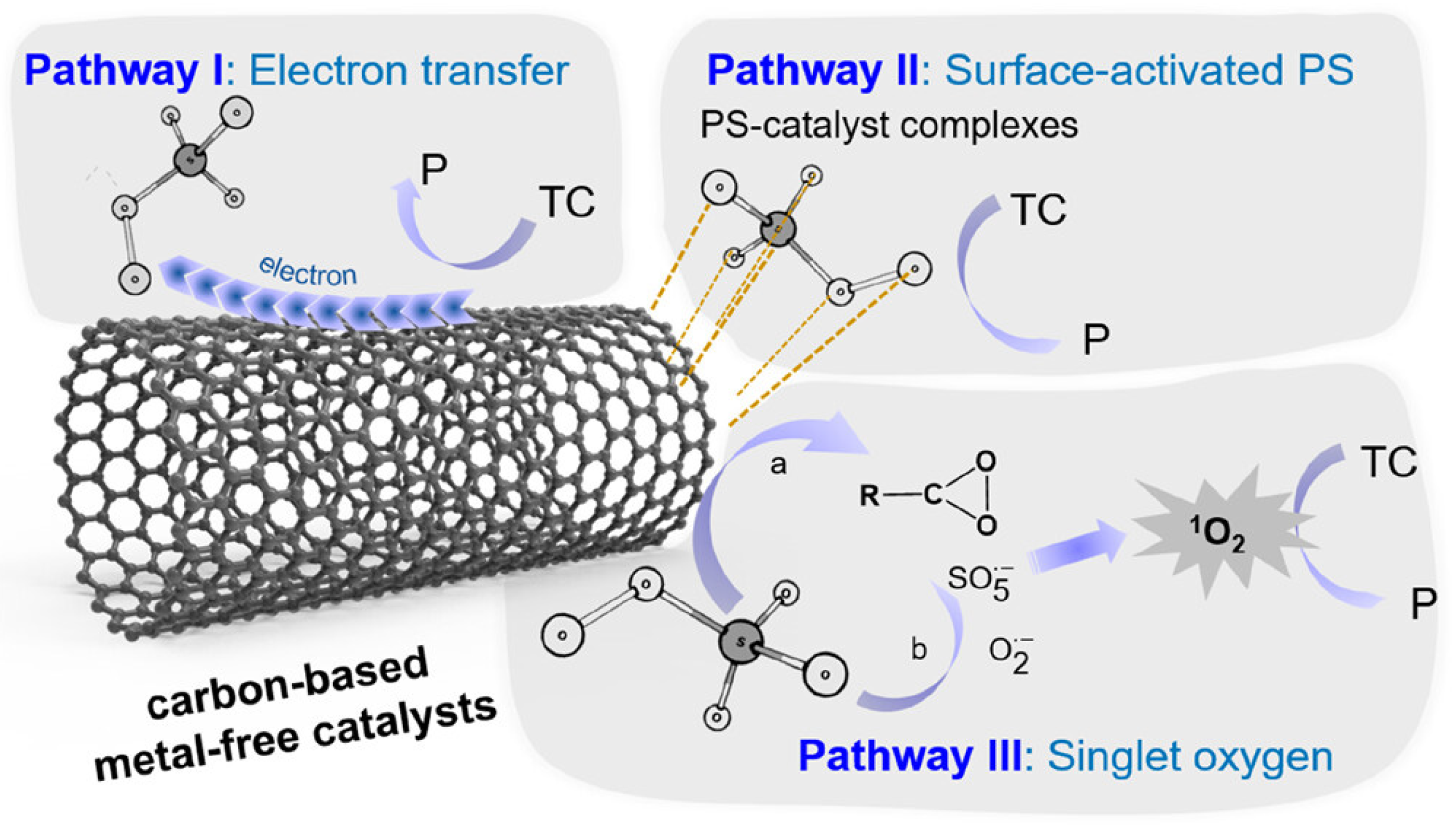
Thus far, the scientific community has extensively experimented with numerous approaches for the implementation of organic pollutants treatment. Notably, advanced oxidation processes (AOPs) have emerged as one of the most extensively studied methods for decontamination purposes [6,7,8,9]. These oxidation processes, including sulfate-based AOPs utilizing peroxymonosulfate (PMS), typically depend on catalysts, commonly metallic catalysts. Metallic catalysts possess the capability to initiate the one-electron reduction of PMS, leading to the generation of powerful oxidant species such as the SO4•− radical (E0 = 2.5–3.1 V vs. NHE) [10,11]. This enables the radical-induced oxidation of organic substances, a process commonly known as Fenton-like. However, these metallic catalysts often give rise to secondary contamination either through metal leaching or sludge generation, thereby resulting in additional costs and operational challenges [12,13]. In order to mitigate these drawbacks, research is currently underway to investigate carbon-based catalysts, referred to as carbocatalysts, as a greener alternative to conventional methods [14]. These carbocatalysts facilitate catalytic oxidation through nonradical pathways (Figure 1), effectively addressing certain limitations related to radical self-consumption and non-selective reactions [15]. Additionally, they reduce chemical input, and the avoidance of the generation of highly halogenated intermediates can be achieved [16,17,18]. Another benefit of nonradical-based carbocatalysis is that it can prevent the severe surface corrosion of carbons that is seen with radical-based carbocatalysis, making it more practical for environmental use [19].
Figure 1.
Different nonradical PS activation pathways for the carbon-based metal-free catalysts. TC and P stand for target compounds and their degradation products, respectively. (a) Epoxy structure is formed via the oxidation of C=O groups in carbonaceous catalysts by PS. (b) PS and electron-poor C atom on catalysts act as electron donor and acceptor, respectively. The electron transfer from PS to C atom allows for the formation of SO5•−. For O2•−, it was reported to form by the base-catalyzed hydrolysis of PS [PS stands for PMS]. Reprinted with permission from Ref. [20] Copyright (2023) ACS Publications.
In this context, the utilization of agri-food residues for carbocatalyst production serves a dual purpose: reducing waste generation and providing an eco-friendly and cost-effective wastewater treatment alternative, considering the often-higher cost of metals, including precious ones, used in catalysts [21]. Agri-food residues represent a significant portion of organic waste worldwide and have the potential to be valorized through hydrothermal carbonization (HTC) into hydrochar (HC), which can be turned into valuable adsorbents and carbocatalysts for the removal of pollutants from water [10,22]. Nevertheless, the catalytic activity of pristine HCs is generally lower than that of metallic catalysts, although HCs present a tunable surface that allows for the adjustment of their electronic and physicochemical properties [22,23,24]. Customizing HCs by introducing specific elements into the carbon matrix disrupts the original surface charge equilibrium and induces bond polarization at the inclusion site, ultimately creating a more favorable material for chemical catalysis [25]. Grafting heteroatoms, particularly nitrogen (N), onto HCs is a common and readily available method to modify surface properties, favoring electron transfer mechanisms that trigger nonradical pathways of PMS activation [26]. In the pursuit of identifying exceptional carbocatalysts, various N-doping techniques have been employed thus far. Some researchers have utilized mechanochemical ball milling with ammonia as N precursor, followed by annealing at different temperatures (ranging from 500 to 800 °C) to obtain N-doped carbon nanotubes (CNTs) and then elucidated which N species acted as the main activators or triggers in the catalytic mechanism [27]. Other approaches have synthesized N-doped CNTs using melamine, followed by annealing at 700 °C in a tube furnace, and ammonium nitrate as a N precursor for annealing at 350 °C [28]. These studies involve the use of carbon nanotubes, which are expensive to produce and require very high temperatures for N-doping, both factors that can increase costs in industrial-scale applications. Alternative approaches have involved lower-cost carbon sources such as sludge biomass, employing ammonium nitrate as a nitrogen donor. However, the process involved two steps: HTC followed by pyrolysis at 800 °C [29]. Qu and collaborators again employed a high annealing temperature of 800 °C while using 2-methylimidazole as the nitrogen-doping agent for pinewood biochar [30].
The main objective of this research is to develop and validate a novel functionalization approach for N-doped carbon-based materials that enhances the efficiency and sustainability of catalytic processes, with a particular focus on wastewater treatment applications. This approach aims to be as straightforward as possible, avoiding the use of harmful reagents and high temperatures, thereby enabling its potential integration into industrial-scale processes in a viable and cost-effective manner. Notably, there is a distinct lack of studies investigating N-doped hydrochars produced via HTC at mild temperatures without subsequent high-temperature treatment. Specifically, this study aims to valorize two agri-food residues as N-doped carbocatalysts: olive pomace, the primary byproduct of olive oil production, also known as “alperujo”, and banana peel obtained from a local food processing company. The enhanced N-doped hydrochars (N-HCs) will be utilized for the efficient removal of organic pollutants from water through the activation of PMS. To explore the influence of the raw material and subsequent treatments on catalytic properties, the study commences with an analysis of Reactive Black 5 (RB5) removal as a primary case study. Another key objective is to determine whether the observed patterns in catalytic capacity exhibited by the engineered N-HCs hold true across a broader spectrum of organic pollutants. To this end, the results obtained from this initial research will be compared and contrasted with those concerning the elimination of various selected pharmaceuticals. This comparison aims to corroborate the adaptability and efficacy of the catalyst, demonstrating its potential for application to a wide range of molecules. To the best of our knowledge, this is the first work to employ N-doped HTC-derived agri-food residues under such conditions for the removal of multiple (four) structurally diverse organic pollutants, thereby providing a comprehensive validation of this approach’s viability and versatility, and highlighting the significance of this research in expanding the scope and practical applicability of low-temperature HTC-based carbocatalysts for water treatment.
2. Materials and Methods
Aceites Abril S.L. generously supplied olive pomace, “alperujo” (A), while banana peel (B) was sourced from Freshcut S.L., both companies based in Galicia (Spain). RB5, sulfamethoxazole (SMX), potassium peroxymonosulfate (OXONE®, PMS), glutaraldehyde (GTA) (25% v/v), methanol, KI, and NaN3 were purchased from Sigma-Aldrich, St. Louis and Burlington, MA, USA. Diclofenac sodium salt (DCF), ibuprofen (IBU), and 1-ethyl-3-(3-dimethylaminopropyl)-carbodiimide (EDC) were acquired from TCI Europe, Zwijndrecht, Belgium. Polyethylenimine (PEI) (branched, M.W. 10,000, 99%) was obtained from Alfa Aesar, Heysham, Lancashire, UK. Concentrated solutions of RB5, SMX, IBU, and DCF were prepared using distilled water, after which they were promptly refrigerated at a temperature of 4 °C for subsequent utilization as the starting point for preparing all the required dilutions utilized in this study.
2.1. Hydrochar Synthesis
HC production conditions were established based on the optimal settings for modification reported in our previous studies [22] when preparing A-derived HC. In short, a cylindrical hydrothermal reactor made of stainless steel with a 100 mL PTFE inner chamber was used to synthesize HCs from A and B, obtaining HA and HB, respectively. The PTFE inner chamber contained a total amount of 50 g of a mixture, either Water/A or Water/B, in a ratio of 3. The reactor was placed in a muffle furnace (Thermolyne F30430CM-33–60, Thermo Fisher Scientific Inc., Waltham, MA, USA) for 2.5 h, after reaching the objective temperature (220 °C) with no gas flow provided. Next, the as-prepared HCs were rinsed vigorously with deionized water several times and were dried at 105 °C overnight. A scheme representing the synthesis is provided as Figure S1 in the Supplementary Materials.
2.2. N-Doped Hydrochar Synthesis
The grafting process of PEI using the cross-linker GTA was carried out in a two-step post-treatment following the protocol described by Sun et al. [31] and Xia et al. [32]. Briefly, in a beaker, 10 mL of PEI/methanol solution (10% w/v) and 2 g of HA or HB were added, and the mixture was left on a magnetic stirring plate for 24 h at 180 rpm and 30 °C. Subsequently, the mixture was vacuum-filtered and washed several times with methanol to remove residual liquid phase vestiges. Afterwards, the product was air-dried and added to 150 mL of a 2% GTA solution, and the mixture was stirred for 25 min at 180 rpm and 30 °C. Following this process, the content underwent vacuum filtration and was rinsed with deionized water.
To carry out the functionalization with the cross-linker EDC, the procedure by Ateia et al. [33] was followed. Concisely, 1 g of HA or HB was suspended in 99 g of water. To this suspension, 15.33 mL of a 50% w/w PEI/water solution and 1.1 g of EDC were added. The HC, PEI, and EDC mixture was stirred at room temperature for 6 h. Afterward, the result was filtered, washed several times with deionized water, and dried overnight (60 °C). For the sake of clarity, a scheme representing each N-doping route is provided in Figure S1 in the Supplementary Materials.
After completing functionalization, catalysts were packaged and labeled. The resulting products, now the N-HC catalysts, were distinguished by the precursor material and cross-linker used in functionalization. Thus, one can refer to catalysts such as N-HA-GTA or N-HA-EDC, and the same for N-HB-GTA or N-HB-EDC.
2.3. Evaluation of Catalytic Activity
Amber glass tubes were used for catalyst evaluation tests. Mixing was accomplished with an IKA Roller 10 digital shaker, ensuring complete homogeneity in the glass tube volume (50 mL). To assess the catalytic efficiency of the HC/PMS and N-HC/PMS systems, pollutants (RB5, IBU, SMX, and DCF), PMS, and catalysts were combined at different concentrations. To isolate the oxidizing effect of PMS without catalysis, the PMS control was executed using the concentrations of the pollutant at 0.05 mM and PMS at 2 mM. Considering the possible adsorption capacity of each catalyst involved, an adsorption control was carried out for all catalysts at a concentration of 0.1 g/L. Throughout the process, absorbance measurements in the spectrophotometer (596 nm) and HPLC were used to determine the concentration in the solution of the dye and pharmaceuticals, respectively. The concentrations were measured exclusively in the bulk aqueous solution in both pre- and post-reaction samples. The HPLC method used was described in previous studies of the group [22]. Briefly, pharmaceutical concentrations were determined on an Agilent Infinity 1100 system equipped with a diode array detector. The validated method for SMX, DCF, and IBU (calibration parameters are provided in Table S1) employed a Kinetex Biphenyl reversed-phase column (5 μm, 100 Å) and a mobile phase of water/methanol/ammonium formate at 65:30:5. Detection was carried out at 266 nm for SMX, 275 nm for DCF, and 228 nm for IBU. The percentage of removal against the initial concentration is given by the following equation: Removal (%) = (1 − C) × 100 (where C represents the concentration of the pollutant in the solution). All experiments, including controls, were performed in triplicate to enhance measurement accuracy. Statistical analyses were carried out using one-way ANOVA (p < 0.05), followed by Tukey’s Studentized Range (HSD) post hoc test, with all calculations conducted using MATLAB® version R2025b.
To draw empirical and quantifiable conclusions, the reaction kinetics results in the experiments were fitted to the most commonly used empirical kinetic models, pseudo-first order (PFO) and pseudo-second order (PSO), due to their extensive application and effectiveness in accurately describing degradation processes, making them the preferred models in catalytic reaction kinetics studies [34]. Sampling during the kinetic assay was performed at 0, 30, 60, 90, and 120 min.
2.4. Evaluation of Catalytic Mechanism
To discern the produced reactive oxygen species (ROS) and understand the mechanism of action in the N-HC/PMS system, a series of selective inhibition tests was conducted. These tests replicated the conditions of catalytic capacity evaluation (time = 2 h, [PMS] = 2 mM, [catalyst] = 0.1 g/L), with inhibitors added at specified concentrations. Following Wang et al. [26] in combination with the methodology used by Guan et al. [18], the concentrations included 1M MeOH to inhibit free radical species, 20 mM KI for surface-bound complexes, and 20 mM NaN3 for singlet oxygen.
2.5. Characterization
After the steps of synthesizing the HCs, functionalizing the catalysts, and performing catalysis assays, characterization tests were conducted at CACTI at the University of Vigo. The characterization studies carried out include elemental analysis (CHNS) using a Fisons Carlo Erba EA1108 elemental analyzer (Thermo Fisher Scientific Inc., Waltham, MA, USA), X-ray photoelectron spectroscopy (XPS) with a Thermo Scientific NEXSA instrument (Thermo Fisher Scientific Inc., Waltham, MA, USA) equipped with a monochromated aluminum Kα X-ray source at 1486.6 eV, scanning electron microscopy with energy-dispersive X-ray analysis (SEM-EDX) using a JSM-6700F SEM (JEOL, Akishima Tokyo, Japan) adjusted with an Inca Energy 300 X-ray energy-dispersive spectrometer (Oxford Instruments, Abingdon, UK). Fourier-transform infrared analysis (FTIR) was performed with a Nicolet 6700 instrument (Thermo Fisher Scientific Inc., Waltham, MA, USA) fitted with an attenuated total reflectance (ATR) accessory. Inductively Coupled Plasma Optical Emission Spectroscopy (ICP-OES) was measured using a ICAP PRO XP DUO (Thermo Fisher Scientific Inc., Waltham, MA, USA). FTIR spectra preprocessing was conducted using Orange Data Mining version 3.34 [35]. Rubber band baseline correction, truncation from 2715 to 1801.1 cm−1, normalization with an extended multiplicative signal correction, and smoothing using the Savitzky–Golay algorithm (polynomial 2, window size 11, derivative order 0) were applied to all FTIR spectra. Electrochemical impedance spectroscopy (EIS) was performed using the Autolab PGSTAT302N (Metrohm, Herisau, Switzerland). The measurements were conducted with a three-electrode system using a Pt wire as the counter electrode, Hg/HgCl2 as the reference electrode, and a 1 cm2 Ni foam electrode (110 pores per inch, 0.3 mm thickness) as a porous support for 1 mg of catalyst. Finally, N2 adsorption–desorption isotherms were obtained using a Sync-200 (3P Instruments, Odelzhausen, Germany) for surface area determination following Brunauer–Emmett–Teller (BET) analysis.
3. Results
3.1. Characterization
Regarding the CHNS characterization of the materials that can be observed in Table 1, carbon serves as the predominant element across all materials, with the application of HTC treatment consistently augmenting its content. Notably, A surpasses B in both C and N content, probably due to its lower content in protein and fat [36,37]. Turning to oxygen, B exhibits a higher concentration, notwithstanding a more substantial loss in quantity, resulting in HB containing less oxygen than HA. This discrepancy arises from the notable disparity in hydrolysable sugar content, with B having significantly higher amounts than A [36,37]. Furthermore, A presented a higher hydrogen content than B. Despite a comparatively lower reduction percentage after HTC for A, HA maintains a greater hydrogen content than HB. A higher C and H contents were found in both N-HCs when treated with EDC compared to GTA, which aligns with the proper cross-linker molecules and the PEI fixation on the HC surface. In the instance of N grafted onto the surface, a greater quantity was obtained with the cross-linker GTA compared to EDC in the N-HA. This is in agreement with Elsayed et al. [38], who reported a N% of 9.31 after PEI grafting; however, this trend was not replicated for the N-HB, with negligible differences identified in the fixed nitrogen using GTA or EDC.
Table 1.
CHNS content in % for raw materials, HCs, and N-HCs.
Metal content is crucial to understand the behavior of a catalyst as it modifies its physicochemical properties and, thus, the catalytic activity [39,40]. Thus, the mineral content was measured after sample digestion. According to Table S2 in the Supplementary Materials, material A generally exhibited a higher metal content than material B, particularly in transition metals, with Cu at 0.37 mg/g and Fe at 0.40 mg/g, which could ultimately contribute to improved catalytic performance in PMS activation. Escudero-Curiel et al. [41,42] proved that the differences in metal content in two biochar matrices played an important role when using PMS as an oxidizing agent. Taking Fe explicitly as an illustrative example, being one of the key transition metals contributing prominently to PMS activation [43], they reported Fe contents in their biochar matrices ranging from 0.93 to 14 mg/g, which contributed to the enhanced performance of the materials. This range serves as a relevant reference point to contextualize our findings.
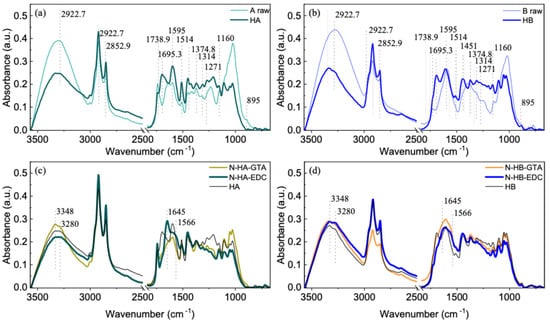
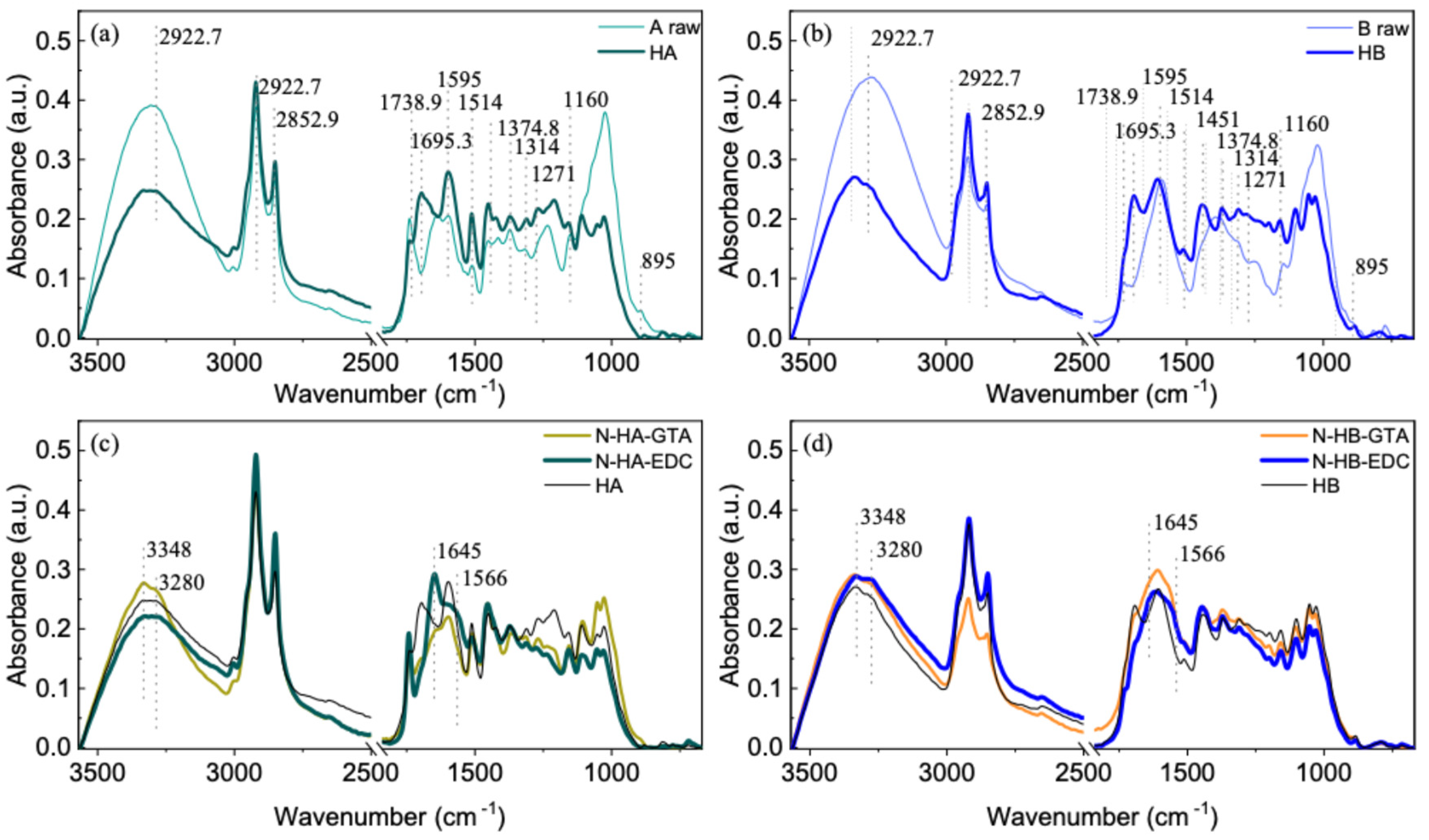
FTIR analyses were performed to obtain valuable insights into the chemical changes resulting from both HTC and for both A and B raw biomass (Figure 2a,b). After the HTC treatment, both materials exhibited a decrease in bands in the region of 1160–895 cm−1, indicating degradation of polysaccharides, mainly hemicellulose, and, in the case of B, possibly starch through decarboxylation and dehydration reactions. This process is significant as degradation intermediates aid in the formation of the HC itself through polymerization, condensation, and aromatization reactions [44]. The disappearance of cellulose, hemicellulose, and lignin can also be observed in the decline of C–H bending vibrations at 1374.8 cm−1 and 1451 cm−1, although the latter peak mainly corresponds to lignin, which prevails more and is, therefore, more difficult to degrade [45]. The increase in the peak at 1695.3 cm−1 in both materials is due to the appearance of aldehydes, ketones, esters, lactones, and carboxylic acids, as it is contributed by the conjugated C=O stretch present in these compounds formed during the HTC process. This peak might also be contributed by unconjugated C=O in lignin [44,46]. Clues to the increase in aromaticity can be found in the peaks corresponding to guaiacyl (1271 cm−1) and syringyl (1314 cm−1, 1514 cm−1) rings from lignin, with phenol groups emerging at 1595 cm−1, completing the lignin skeleton. Additionally, signs of a greater degree of carbonization can be seen in the decrease in the band at 3299.8 cm−1, contributed by stretching vibration of O-H groups present in cellulose or lignin phenols and chemisorbed water [47]. Looking particularly at material HA, the peaks detected at 2852.9 and 2922.7 cm−1 correspond to the stretching vibrations of C–H bonds found in methylene and terminal methyl groups within the fatty acid chains [22]. Moreover, a peak perceived at 3012 cm−1 corresponds to C–H stretching originating from unsaturated C=C–H bonds. These spectral features, in combination with the ester peak identified at 1738.9 cm−1, suggest the preservation of aliphatic structures, notably residual triglycerides derived from olive oil, throughout the HTC process [46]. However, the peak observed at 1738.9 cm−1 in HB is not as pronounced, indicating the preservation of sterols, which are much more abundant in material B than in A [37,48].
Figure 2.
Comparisons of FTIR spectra obtained for (a) raw A and HA, (b) raw B and HB, (c) N-HAs, and (d) N-HBs.
The FTIR spectrum after doping HA and HB with PEI using both cross-linkers can be seen in Figure 2c and Figure 2d, respectively. The primary and secondary amine groups present in PEI can be observed as a doublet in the region of 3400–3200 cm−1. As EDC and GTA are water-soluble condensing reagents that couple carboxylic groups with amines to form amides, it is expected to find these groups in the functionalized HC. In the case of HB, it already started from a higher base of amines compared to HA, which is in accordance with the results reported by Landázuri et al. [49]. In the case of HA, functionalization with EDC shows a smaller increase in the content of primary and secondary amines compared to treatment with GTA. However, the binding of PEI to HA can be observed in the formation of primary amides, which emerge at 1645 cm−1 due to the C=O-NH bond, and it is also possible to observe the CNH bend and the C-N stretch at 1566 cm−1 [50,51]. As can be seen in Figure 2c,d, the appearance of amides is much more pronounced in the EDC treatment and in material A.
3.2. Assessing the Catalytic Capacity of Alperujo and Banana Peel Materials
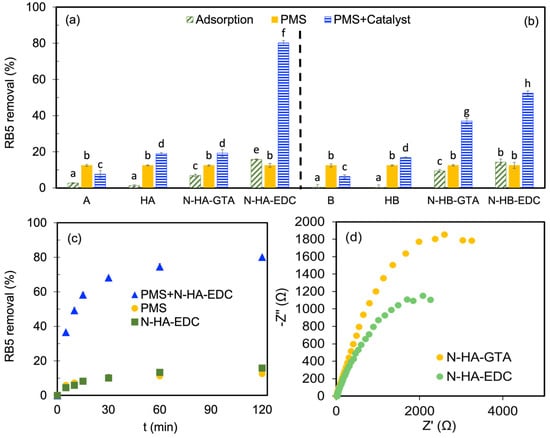
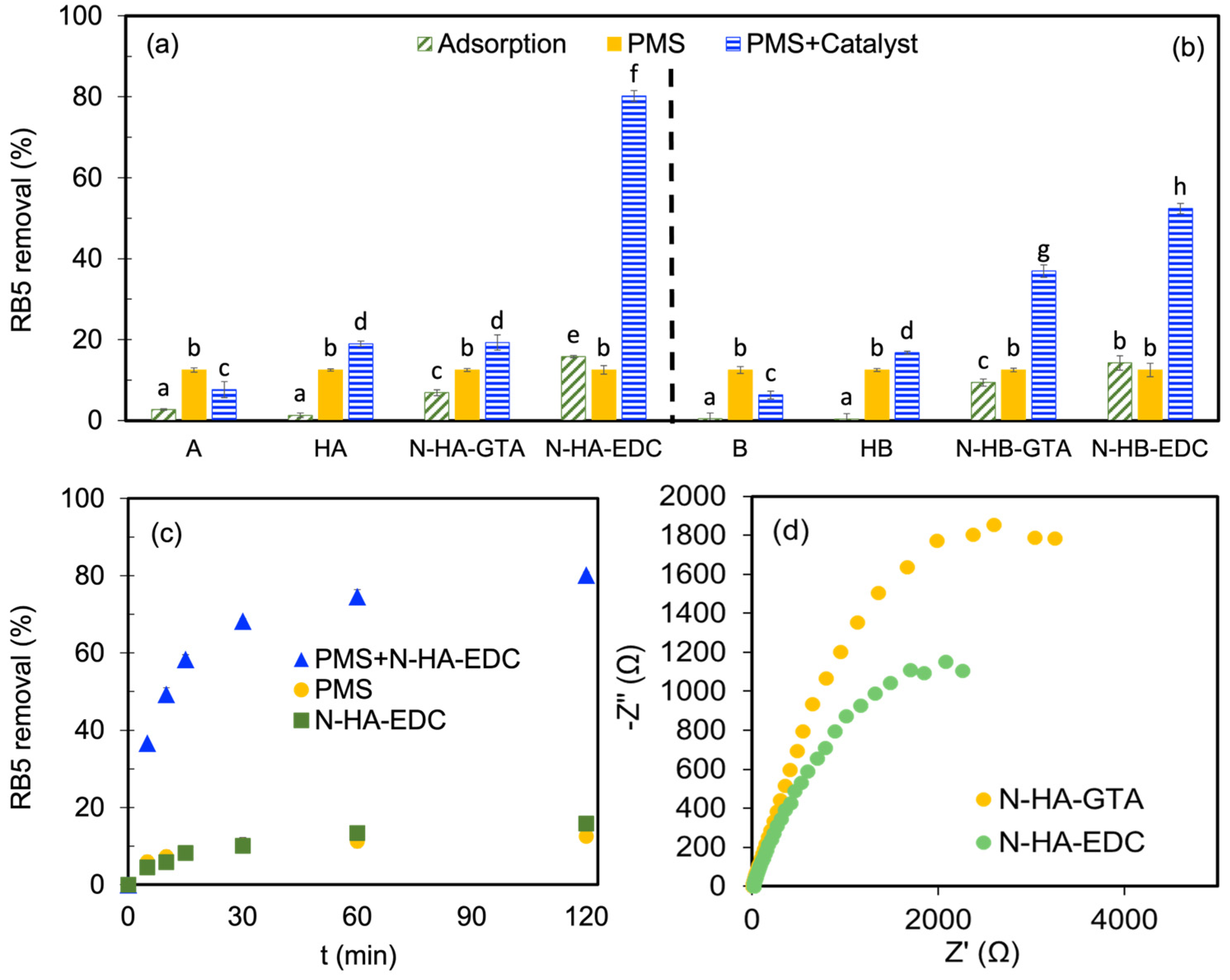
The catalytic activity for all samples was evaluated, and the results are shown in Figure 3a,b. It can be observed that B adsorbs less RB5 than A, and the same is true for their respective HCs, HA, and HB.
Figure 3.
RB5 removal performance of synthesized and functionalized hydrochars: (a) raw material A and derivatives; (b) raw material B and derivatives after 2 h of treatment; (c) kinetic study of RB5 degradation by N-HA-EDC, PMS, and PMS + N-HA-EDC ([RB5] = 50 mg/L, [catalyst] = 0.1 g/L, [PMS] = 2 mM); (d) EIS comparison of N-HA-GTA and N-HA-EDC. Error bars represent standard deviation. Different letters denote statistically significant (Tukey, p < 0.05).
In general, catalysts based on B exhibited a lower catalytic capacity. This phenomenon could be attributed to the lower adsorption observed in B, HB, N-HB-GTA, and N-HB-EDC catalysts, which may result in inadequate interaction between active sites on the surface and the contaminant and PMS [52]. PEI functionalization increased the adsorption capacity of both HA and HB, as nitrogen groups were grafted, modifying the surface characteristics of the HCs and their affinity for the anionic dye used [22]. HCs prepared with EDC exhibited superior results in terms of enhanced adsorption capacity, achieving adsorption values of 97 mg/g for HA and 70 mg/g for HB. These values are superior to those reported by Elsayed et al. [38] when investigating RB5 adsorption on pine wood HC functionalized with PEI, despite their higher nitrogen content compared with N-HA-EDC. It was corroborated that the HTC process alone was insufficient to synthesize a catalyst suitable for PMS activation, which was achieved through the PEI-functionalization treatments. Notably, N-HA-EDC was found to be the material that exhibited the best performance in removing RB5 from aqueous media, achieving a remarkable 80% in 60 min. These results indicate that the cross-linker EDC can anchor the nitrogen from PEI to the carbon matrix better than GTA. Consequently, N exhibited greater activity when interfering in the reactions, generating a charge imbalance in the carbonaceous network, allowing for an increase in its catalytic activity.
After obtaining the kinetics of the processes with N-HA-EDC, PFO, and PSO were used to determine which model best fits the experimental data and to obtain the kinetic reaction parameters. One of the initial conclusions drawn from the kinetics graphs (Figure 3c) is that after half an hour of reaction, the decolorization slowed down, and although it continued to increase, it did so at a rate that could be assumed to be at a steady state, given that during the following hour, not even 5% of decolorization occurred. For this reason, when calculating the kinetic models, only the first 30 min of reaction were considered, both for materials A and B. The kinetic constants, along with the least squares fitting coefficients for each case, are shown in Table S3 in the Supplementary Materials. Based on the kinetic models, it can be stated that the catalyzed degradation process of the model pollutant, RB5, by the N-HC/PMS system followed a PSO kinetic, as in all cases the R2 value was higher for this model than for the PFO model, which implies that the reaction rate is proportional to the square of the concentration of the pollutant. PSO kinetics typically suggest that the reaction rate is dependent on the availability of both the pollutant and active sites on the catalyst. This often indicates that the adsorption process may be a significant step in the degradation mechanism. For carbocatalysts degrading organic pollutants, a higher R2 value for PSO kinetics compared to PFO kinetics could imply that the catalyst has a high affinity for the pollutant, and the degradation process is likely limited by the surface reaction rate rather than the mass transfer. These findings are in good agreement with those found by Anfar et al. [53] when using a co-doped N/S porous carbon derived from almond shells to remove organic pollutants from water using persulfate.
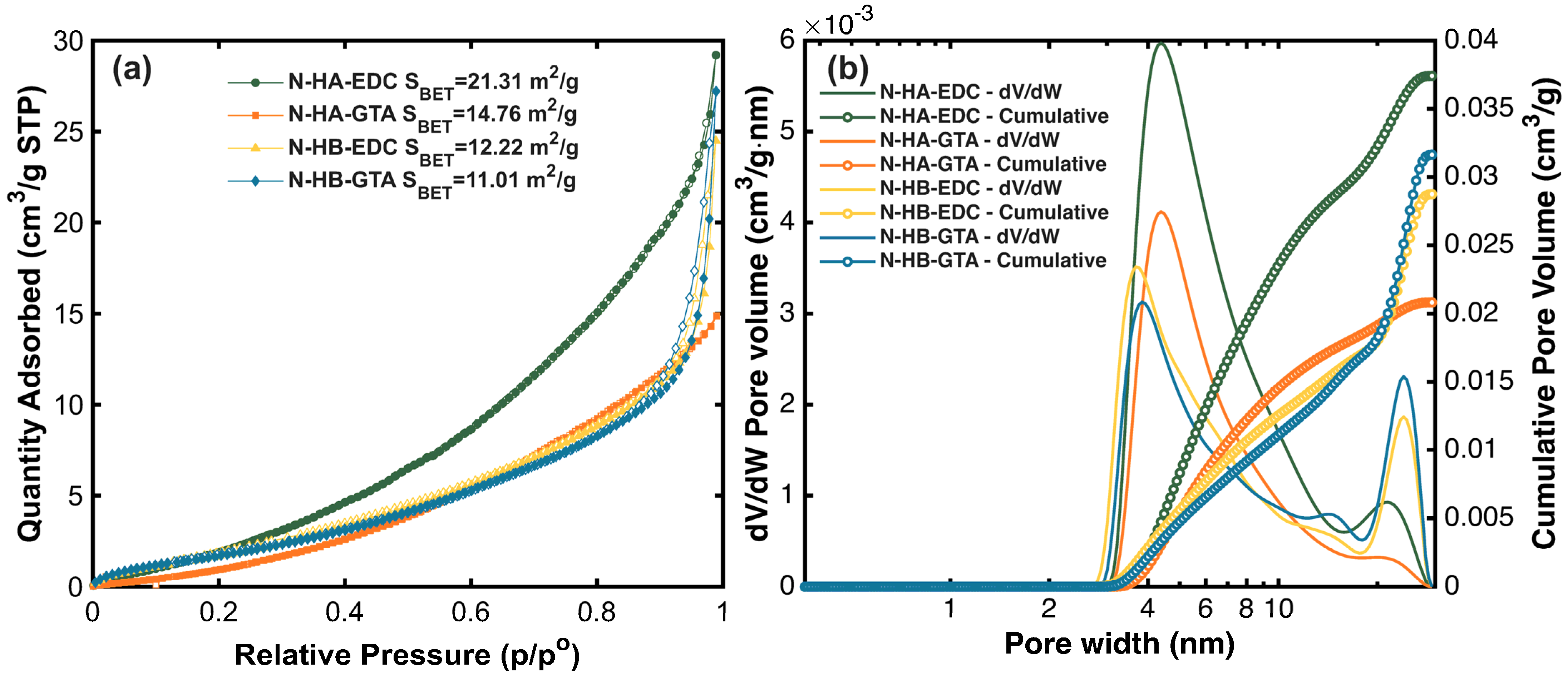
As the best results were obtained with the N-HCs samples, BET analyses were performed on all of them to identify differences that could explain these findings. The data obtained are depicted in Figure 4, and the parameters are presented in Table S4 in the Supplementary Materials. From Figure 4a, it is evident that N-HA-EDC has the highest specific surface area, 21.31 m2/g. It is, without a doubt, the most distinct sample among all those studied. The N-HA-GTA sample, which shows a similar isotherm profile but has half the specific surface area, exhibits values very similar to those observed for both N-HB samples, with N-HB-GTA displaying the lowest specific surface area of all. These values are consistent with the average values for HCs reported in other studies, as HCs do not develop a high specific surface area, unlike chars produced by pyrolysis [44,54]. The BET surface area values are even high compared to some HCs from olive pomace, such as those reported by Delgado et al. [55], who found 7 m2/g, and HC from banana reported by Landázuri et al. [49], which reached a maximum of 5 m2/g after 6 h of treatment in both studies. Regarding the pore volume presented in Figure 4b, the N-HA samples display few macropores, with the majority of their pore volume concentrated in the mesoporous range, especially around a pore width of 4.5 nm (more than half of the total pore volume corresponds to this size, as indicated by the cumulative curve). Notably, the N-HA-EDC sample exhibits a maximum differential pore volume of approximately 6·10−3 cm3/g·nm at this pore size. This reflects a well-developed mesoporous structure that affords accessible pore space. By contrast, the N-HB samples exhibit a similar range of pore widths (just below 4 nm) but show a substantially greater pore volume in the macropore region compared to the N-HA samples. Additionally, compared to N-HA-EDC, the N-HB samples exhibit approximately half the maximum differential pore volume per gram of material within the narrow pore size range around 4 nm, indicating a lower concentration of mesopores of this size.
Figure 4.
Surface area and porosity characterization of N-doped hydrochars: (a) nitrogen adsorption–desorption isotherms (filled markers: adsorption; open markers: desorption) with BET-specific surface area values; (b) pore size distribution profiles (dV/dw and cumulative curves) for all N-HC samples.
N-HCs crosslinked with EDC achieved the highest removal performance, with N-HA-EDC markedly outperforming all other measured samples. Consequently, EIS was employed with this sample to investigate the electrochemical dynamics of the catalysts N-HA-EDC and the same sample crosslinked with GTA, N-HA-GTA, with the findings elucidated in Figure 3d. The N-HA-EDC catalyst exhibits a comparatively smaller semicircular arc, which implies an enhanced charge transfer capability alongside a diminishment in electron/hole recombination, as per previous research findings [56,57]. Additionally, the linear segment of the Nyquist plot, spanning the 0–200 Ω range of real impedance (Z), aligns with the extent of diffusion-controlled processes [58]. The gentler gradient associated with the N-HA-EDC sample signifies a more efficient diffusion process compared to the N-HA-GTA counterpart. Contrastingly, the more pronounced semicircle in the N-HA-GTA sample’s Nyquist plot suggests a more obstructed electron transfer to the semiconductor/electrolyte interface, thereby increasing the likelihood of electron recombination before engaging in the intended electrochemical reactions [58]. The superior charge separation and electrical conductivity of the N-HA-EDC sample denote its potential as a more effective electrocatalyst [59,60]. Furthermore, a lower resistance is indicative of accelerated electron and hole migration, which is associated with an uptick in radical generation during the degradation process. This reduced resistance is beneficial for catalytic performance, as it enhances the degradation of pollutants [60,61].
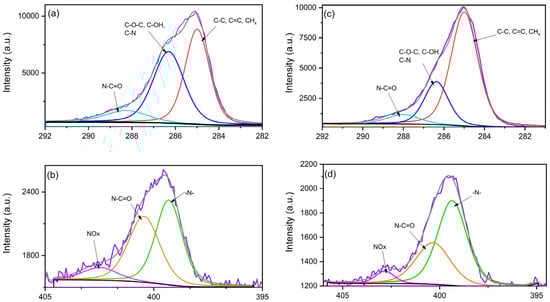
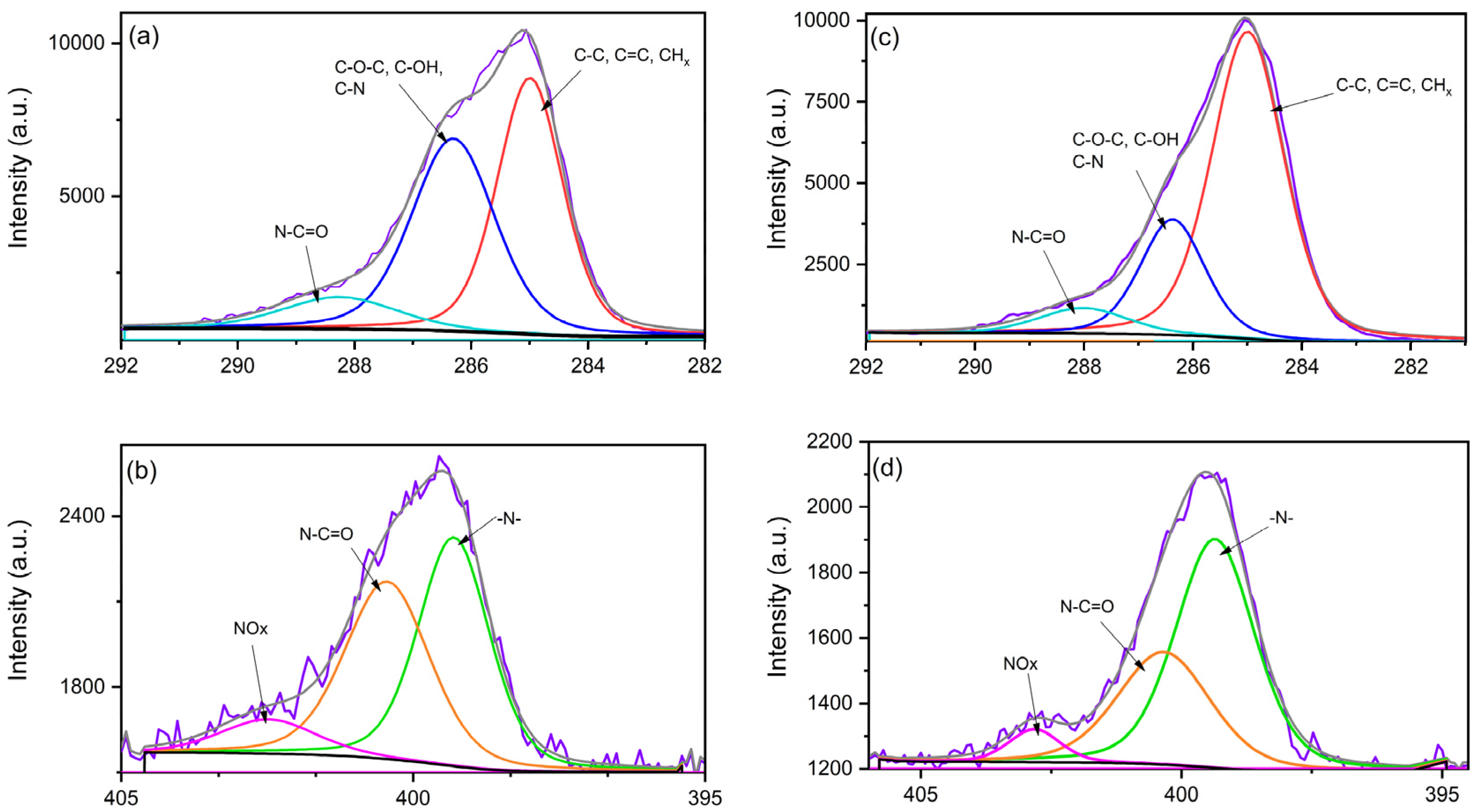
The surface chemical composition of the N-doped materials was assessed by XPS technology, and the intricate analysis results are presented in Figure 5 and Tables S5 and S6 in the Supplementary Materials. The N1s spectrum of N-HCs, as shown in Table S6, was deconvoluted into three distinct peaks: tertiary amino (399.3 eV), amide (400.2 eV), and nitrogen–oxygen species (402.04 eV), echoing the findings of He and colleagues [62] regarding the synthesis of a hyperbranched polyamine adsorbent for CO2 capture. The surface of N-HA-EDC is characterized by a more carbonaceous and aliphatic nature, potentially offering increased anchoring points for initiating a surface electronic conduction mechanism [63]. While N-HA-GTA exhibits a greater number of single-bond oxygen functional groups, in N-HA-EDC, oxygen is involved in forming carbonyl-type bonds. These bonds act as Lewis bases to initiate the radical pathway and to generate singlet oxygen (1O2) [63]. Accordingly, the XPS analysis not only corroborated the FTIR observations for both N-HCs but also affirmed the efficacy of the grafting technique employed in this study.
Figure 5.
XPS spectra deconvolution of C1s and N1s regions for N-HA-GTA [(a) C1s, (b) N1s] and N-HA-EDC [(c) C1s, (d) N1s]. Black lines denote the background line. Black, grey and purple lines denote background line, fitted envelope and raw data respectively.
Upon analysis of SEM images captured from all A-derived samples (Figure S2 in Supplementary Materials), it is observed that the surface of HA exhibits greater irregularity compared to that of A, providing defects and irregular edges that may serve as active sites for electron transfer. However, it is noteworthy that following functionalization, the catalyst surface demonstrates significantly enhanced porosity. This increased porosity substantially promotes all interactions that precipitate the activation of PMS. The distinctive multi-porous structure of N-HA-EDC may facilitate the accumulation of the contaminant in the region proximal to the catalyst, which is consequently richer in free radicals [64]. The generation of radicals occurs on the catalyst surface, while the radical degradation reaction takes place in the aqueous phase. Due to the extremely short half-life of the radicals and the presence of surface-bound complexes, a higher porous material that allows for the accumulation of the contaminant in the region adjacent to the surface will subsequently enhance the efficiency of the degradation reaction [65]. BET analyses (Figure 4) corroborate the indications of porosity observed in the SEM images.
3.3. Optimization of Catalytic Activity
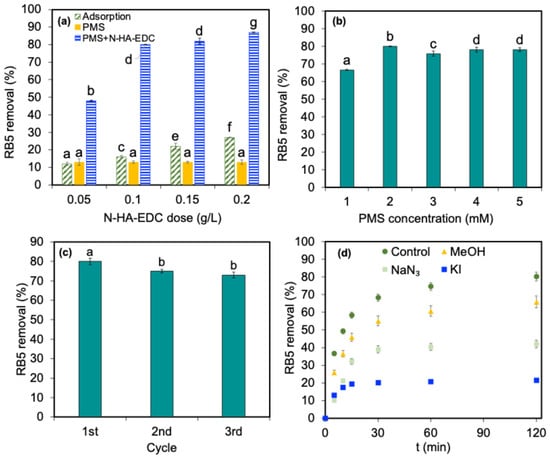
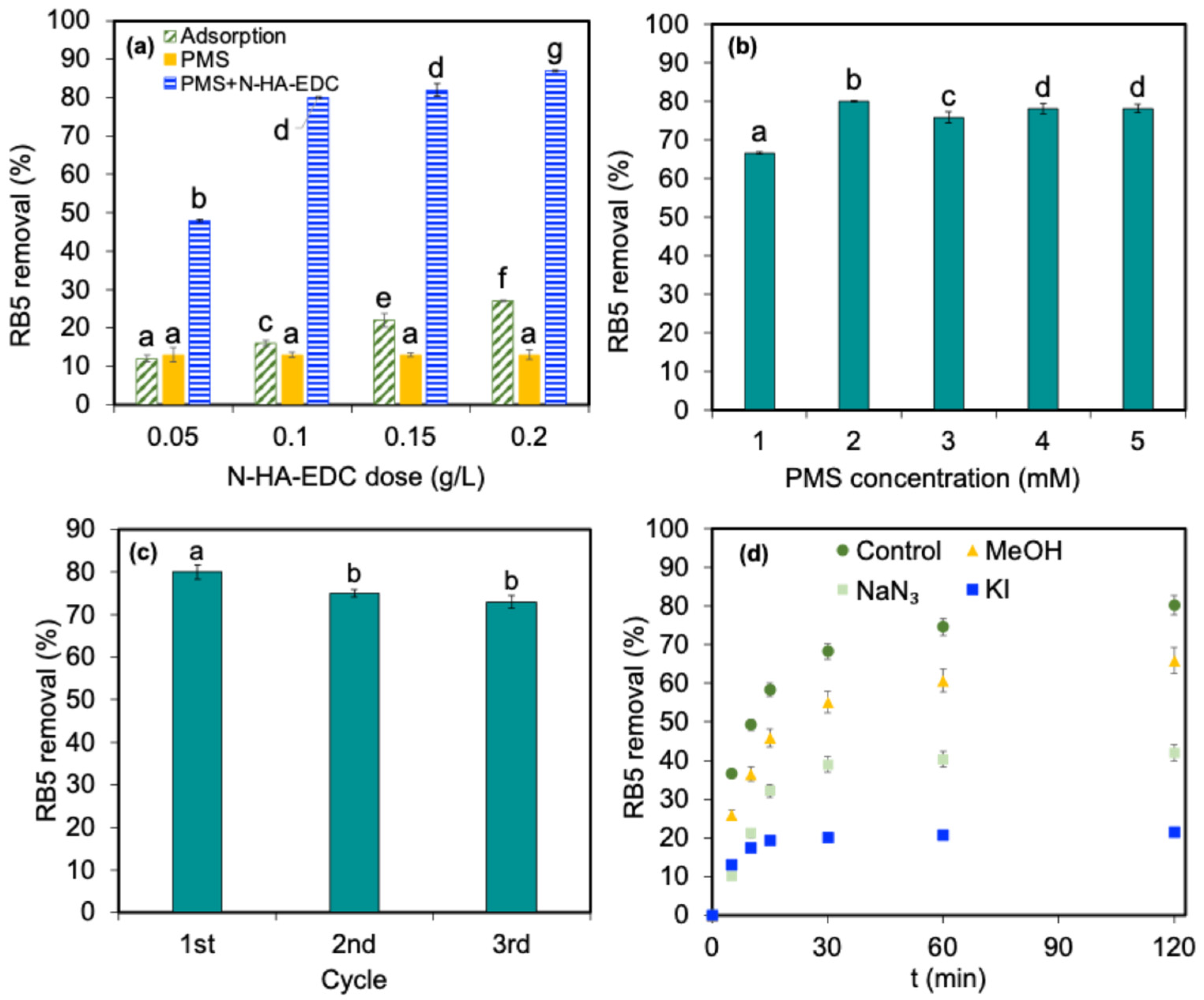
Given that the most efficient catalyst was found to be N-HA-EDC, an optimization of the operational conditions was carried out. First, the catalyst load was assessed with the results displayed in Figure 6a. As can be observed, decolorization increased by nearly 30% when the catalyst concentration rose from 0.05 to 0.1 g/L, and this level was maintained at 0.15 g/L. However, despite doubling the catalyst amount beyond 0.1 g/L, only a 7% further increase in decolorization was observed. Indeed, as suggested by the adsorption control, it is evident that this increment was attributable to the adsorption of the pollutant by the catalyst rather than to degradation. For this reason, it was decided to maintain 0.1 g/L as the optimal catalyst load in the system. After these outcomes, PMS concentration was optimized, and the results are presented in Figure 6b. After an increase in RB5 removal when raising the concentration from 1 mM to 2 mM, no significant enhancement in removal was observed with further increases in PMS concentration, as an excess of PMS might interact with the pre-existing reactive radicals, thereby diminishing the overall efficiency of the process [66]. Hence, the optimal conditions in this study were established as 0.1 g/L of catalyst load and 2 mM for PMS concentration.
Figure 6.
Optimization studies for RB5 removal: (a) effect of N-HA-EDC dose (time = 2 h, [PMS] = 2 mM); (b) influence of PMS concentration (time = 2 h, [catalyst] = 0.1 g/L); (c) recyclability of N-HA-EDC over three cycles (time = 2 h, [PMS] = 2 mM, [catalyst] = 0.1 g/L); (d) RB5 degradation kinetics in the presence of different scavengers (time = 2 h, [PMS] = 2 mM, [catalyst] = 0.1 g/L). Error bars represent standard deviation. Different letters denote statistically significant (Tukey, p < 0.05).
To further assess the industrial applicability of the catalyst, reuse experiments were conducted, and the results are presented in Figure 6c. A slight reduction in RB5 removal efficiency was observed, starting at 80.9% in the first use and decreasing to 74.97% by the third reuse, representing only a 5% loss in effectiveness after three reuses. These results are better than those reported by Anfar et al. [53], who observed a 20% decrease in effectiveness after the third use of N-doped almond-derived biochar doped with melamine for removing Orange G from aqueous solution.
3.4. Evaluation of Catalytic Mechanism
Looking at the results obtained from the quenching experiments in Figure 6d, it is evident that nearly all the decolorizing capacity of the N-HA-EDC/PMS system is attributable to the action of highly reactive PMS@N-HA-EDC complexes or surface-bound complexes, with charge transfer enhanced by the conductive carbon framework (Figure 1). Thus, this test confirmed that the nonradical pathway was the primary mechanism for PMS activation by N-HA-EDC, with singlet oxygen playing a secondary role. Examination of the kinetics reveals that when the action of surface-bound complexes is blocked due to the presence of KI, decolorization reaches its maximum at 15 min and subsequently ceases entirely after achieving approximately 20% decolorization. Conversely, when methanol is used to inhibit free radicals, the reaction continues almost unabated, losing less than 20% of removal efficiency, which is consistent with the results reported by Oh et al. [67] when using a N-doped biochar for PMS activation and methylene blue removal. Singlet oxygen, meanwhile, quenched by NaN3, occupies an intermediate position between these two scenarios, which is in contrast with what Anfar et al. [53] found, being singlet oxygen the main degradation mechanism in their persulfate/N-doped catalyst for removing orange G. The active nature of the PMS@N-HA-EDC complexes lies in their catalytic ability to circumvent the formation of sulfate/hydroxyl radical’s species, in different nonradical pathways, as is described in Figure 1. Importantly, I− ions from KI competitively interact with these PMS@N-HA-EDC complexes. I− from KI is oxidized by surface-bound complexes, yielding hypoiodous acid (HOI) and sulfate ions [18,68].
This phenomenon is because free radicals and singlet oxygen are ROS that are consumed upon participating in the degradation reaction, whereas active surface-bound complexes operate via the catalytic electron shuttle mechanism and are capable of degrading contaminants without depletion [69]. Furthermore, free radicals possess a remarkably short half-life owing to their exceptionally high reactivity, while singlet oxygen is a more selective compound that does not interact with background compounds other than the organic contaminant [14].
3.5. Catalyst Evaluation for Other Organic Pollutants
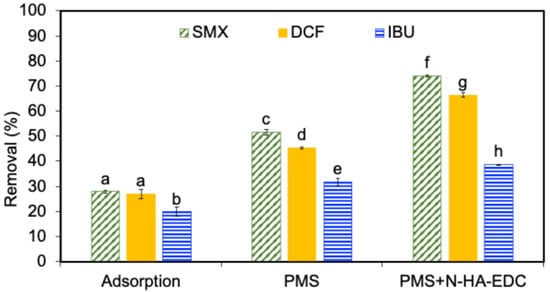
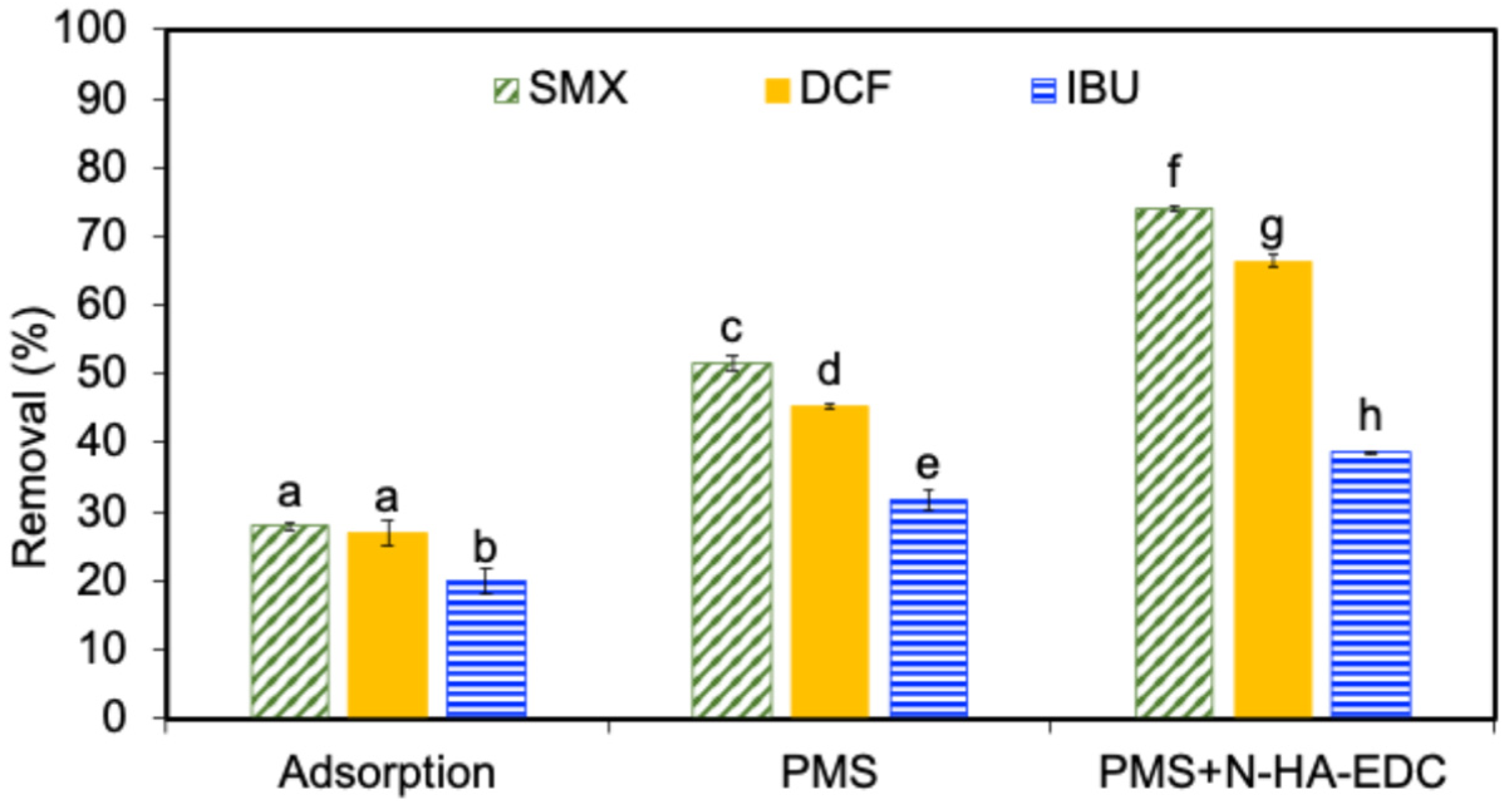
The versatility of the synthesized N-doped catalyst was assessed using different pharmaceuticals (SMX, DCF, and IBU) with significantly different chemical characteristics, and the results are displayed in Figure 7. Removal rates of 74.04%, 66.47% and 38.78% were found for SMX, DCF, and IBU, respectively. Adsorption appears to be more effective for SMX and DCF, with removal percentages close to 30%, respectively. In contrast, adsorption is much less effective for IBU, with a removal percentage below 20%. Thus, the adsorption process played an important role in the removal, with uptakes of 93.76, 102.49, and 40.00 mg/g for SMX, DCF, and IBU, respectively, underscoring its significance. These results are comparable to those presented by Kemmou et al. [70], who reported a 40% contribution of adsorption to the total SMX removal using biochar from spent malt rootlets. When comparing PMS alone with PMS + Catalyst, it is evident that the addition of the catalyst significantly improves the removal efficiency for all pharmaceuticals. For SMX and DCF, the process achieves removal rates around 70%, while in the case of IBU, there are also notable improvements, albeit not as pronounced. This can be attributed to the better performance of the catalyst in terms of adsorption, which could retain the pollutant near the surface, making it more accessible for the surface-active complexes to act, as has been determined to be the primary mechanism of action for the N-HA-EDC catalyst. Therefore, the versatility of the catalyst developed in this study would be ensured, proving effective across a broad range of organic pollutants with varying chemical properties.
Figure 7.
Removal efficiency of N-HA-EDC for SMX, DCF, and IBU by adsorption (control), PMS alone, and PMS combined with N-HA-EDC (time = 2 h, [PMS] = 2 mM, [catalyst] = 0.1 g/L, [SMX] = [DCF] = [IBU] = 0.05 mM). Error bars represent standard deviation. Different letters denote statistically significant (Tukey, p < 0.05).
Comparison of the removal efficiencies obtained for RB5, SMX, DCF, and IBU with those reported for similar materials is challenging, as this study is among the first to employ hydrochar directly, without activation at high temperatures, treatment with strong acids or bases, or metal doping. Nonetheless, a body of research exists involving N-doped carbon-based materials that share certain similarities with this study, at least regarding the type of pharmaceutical or dye. These studies are presented in Table S7 in the Supplementary Materials. References [53,71,72,73,74,75,76,77,78,79] are cited in the Supplementary Materials. The synthesis temperature and BET are also included to provide insight into the production process. As observed, the novel functionalization approach can yield highly competitive results. It is important to note that the specific surface area of hydrochar is considerably lower than that of activated carbon, and most studies employ at least double the catalyst concentration to achieve comparable outcomes. These attributes underscore the practical potential of N-HA-EDC for water treatment and advanced oxidation applications.
4. Conclusions
This work advances our knowledge of carbon material functionalization as a powerful tool for designing efficient and sustainable catalysts for various chemical processes. Our findings support the notion that N-doping can significantly improve the catalytic performance of carbon materials by modifying the physicochemical properties of the carbon matrix. This highlights the potential of agri-food residues as precursors for efficient and sustainable carbocatalysts in wastewater treatment applications, contributing to the circular economy and addressing environmental challenges.
The results obtained in this study corroborate that the successful valorization of agri-food residues into effective N-doped carbon-based catalysts for wastewater treatment is feasible. The N-doped alperujo-derived hydrochar cross-linked with EDC (N-HA-EDC) exhibited superior catalytic performance, achieving 80% removal of RB5 in 60 min and an adsorption capacity of 97 mg/g. The catalyzed degradation process followed a pseudo-second-order kinetic model, suggesting a high affinity between the catalyst and the pollutant. Furthermore, the successful degradation of diverse pharmaceutical pollutants underscores the robustness and broad applicability of the N-HA-EDC catalysts.
EIS measurements revealed that N-HA-EDC possessed enhanced charge transfer capability and efficient diffusion processes. The multi-porous structure of N-HA-EDC, as observed through SEM, likely contributes to its superior catalytic performance by facilitating pollutant accumulation near the catalyst surface.
In conclusion, this strategy presents a sustainable and environmentally friendly alternative to traditional metal-based catalysts. The novel functionalization approach developed in this study paves the way for more efficient and sustainable catalytic processes in the future, particularly in wastewater treatment applications. Although the N-HA-EDC/PMS system has significant potential for organic pollutant removal, it has limitations for real wastewater applications. The complexity of real matrices can reduce oxidation efficiency by competing for reactive radicals or scavenging them. Carbocatalyst deactivation from fouling or changes may also impair long-term performance. Therefore, continuous operation, scale-up, and trials in actual wastewater are essential for further system evaluation.
Supplementary Materials
The following supporting information can be downloaded at: https://www.mdpi.com/article/10.3390/chemengineering9060135/s1, Table S1. Validation parameters of HPLC method; Table S2. Mineral content of the raw materials after HNO3 digestion as determined by ICP analysis; Table S3. Parameters obtained for both PFO and PSO kinetic models for all samples.; Table S4. Parameters obtained from N2 analyses of all N-HC samples; Table S5. Binding Energy BE (eV)/Relative Percent (Rel. %); Table S6. N1s Binding Energy BE (eV)/Relative Percent (Rel.); Table S7. Comparative summary of removal efficiency and degradation performance between this work and other similar carbon-based/PMS systems; Figure S1. Schematic representation of the synthesis of the hydrochars and N-doping routes de-scribed in this study; Figure S2. SEM images of (a, b) A, (c, d) HCA and (c, d) N-HCA-EDC.
Author Contributions
Conceptualization, Data curation, Investigation, Validation, Formal analysis, Writing—original draft, Supervision, Writing—review and editing, S.E.-C.; Investigation, Formal analysis, X.M.L.-R.; Methodology, Writing—review and editing, Project administration, Funding acquisition, A.M.D.; Supervision, Writing—review and editing, Project administration, Funding acquisition, resources, M.P.; Supervision, Writing—review and editing, Project administration, Funding acquisition, resources, Á.S. All authors have read and agreed to the published version of the manuscript.
Funding
This research has been funded by R&D Project PID2023-146133NB-I00 funded by MCIU/AEI/10.13039/501100011033 and PCI2022-132941 (BiodivRestore Cofund 2020) funded by MCIU/AEI/10.13039/501100011033, by the European Union Next Generation EU/PRTR, Xunta de Galicia (GRC-ED431C 2025/47), and by project H2-ZeroWaste from AXA Research Fund. The researcher Aida M. Díez is grateful to MICIU for the Ramon y Cajal financial support obtained (RYC2023-044934-I). Silvia Escudero-Curiel thanks Xunta de Galicia for her fellowship (ED481B-109).
Data Availability Statement
Data will be available upon request.
Conflicts of Interest
The authors declare no conflict of interest.
References
- Ewadh, H.M.; Abdullah, S.R.; Anwar, N.; Hasan, H.A. Pharmaceuticals and Personal Care Products: Sources, Toxicity in the Environment, Regulations and Removal Technologies. J. Chem. Pharm. Sci. 2017, 10, 1180–1187. [Google Scholar]
- Melchor-Martínez, E.M.; Jiménez-Rodríguez, M.G.; Martínez-Ruiz, M.; Peña-Benavides, S.A.; Iqbal, H.M.N.; Parra-Saldívar, R.; Sosa-Hernández, J.E. Antidepressants Surveillance in Wastewater: Overview Extraction and Detection. Case Stud. Chem. Environ. Eng. 2021, 3, 100074. [Google Scholar] [CrossRef] [Scilit]
- European Commission. Communication from the Commission to the European Parliament, the European Council, the Council, the European Economic and Social Committee and the Committee of the Regions. The European Green Deal. Available online: https://eur-lex.europa.eu/resource.html?uri=cellar:b828d165-1c22-11ea-8c1f-01aa75ed71a1.0002.02/DOC_1&format=PDF (accessed on 12 May 2023).
- European Commission. Communication from the Commission to the European Parliament, the Council, the European Economic and Social Committee and the Committee of the Regions. A New Circular Economy Action Plan for a Cleaner and More Competitive Europe. Available online: https://eur-lex.europa.eu/resource.html?uri=cellar:9903b325-6388-11ea-b735-01aa75ed71a1.0017.02/DOC_1&format=PDF (accessed on 12 May 2023).
- European Commission. Proposal for a Directive of the European Parliament and of the Council Urban Wastewater Treatment (Recast). Available online: https://eur-lex.europa.eu/legal-content/EN/TXT/?uri=CELEX:52022PC0541 (accessed on 16 May 2023).
- Puga, A.; Rosales, E.; Pazos, M.; Sanromán, M.A. Application of Deep Eutectic Solvents (DES) for the Synthesis of Iron Heterogeneous Catalyst: Application to Sulfamethoxazole Degradation by Advanced Oxidation Processes. Catalysts 2023, 13, 679. [Google Scholar] [CrossRef] [Scilit]
- Díez, A.M.; Ribeiro, A.S.; Sanromán, M.A.; Pazos, M. Optimization of Photo-Fenton Process for the Treatment of Prednisolone. Environ. Sci. Pollut. Res. 2018, 25, 27768–27782. [Google Scholar] [CrossRef] [Scilit]
- Poza-Nogueiras, V.; Moratalla, Á.; Pazos, M.; Sanromán, Á.; Sáez, C.; Rodrigo, M.A. Towards a More Realistic Heterogeneous Electro-Fenton. J. Electroanal. Chem. 2021, 895, 115475. [Google Scholar] [CrossRef] [Scilit]
- Arellano, M.; Pazos, M.; Sanromán, M.Á. Sulfate Radicals-Based Technology as a Promising Strategy for Wastewater. Water 2019, 11, 1695. [Google Scholar] [CrossRef] [Scilit]
- Yu, J.; Zhu, Z.; Zhang, H.; Di, G.; Qiu, Y.; Yin, D.; Wang, S. Hydrochars from Pinewood for Adsorption and Nonradical Catalysis of Bisphenols. J. Hazard. Mater. 2020, 385, 121548. [Google Scholar] [CrossRef] [Scilit]
- Yun, E.-T.; Lee, J.H.; Kim, J.; Park, H.-D.; Lee, J. Identifying the Nonradical Mechanism in the Peroxymonosulfate Activation Process: Singlet Oxygenation Versus Mediated Electron Transfer. Environ. Sci. Technol. 2018, 52, 7032–7042. [Google Scholar] [CrossRef] [Scilit]
- Tang, L.; Liu, Y.; Wang, J.; Zeng, G.; Deng, Y.; Dong, H.; Feng, H.; Wang, J.; Peng, B. Enhanced Activation Process of Persulfate by Mesoporous Carbon for Degradation of Aqueous Organic Pollutants: Electron Transfer Mechanism. Appl. Catal. B 2018, 231, 1–10. [Google Scholar] [CrossRef] [Scilit]
- Sun, H.; Kwan, C.K.; Suvorova, A.; Ang, H.M.; Tadé, M.O.; Wang, S. Catalytic Oxidation of Organic Pollutants on Pristine and Surface Nitrogen-Modified Carbon Nanotubes with Sulfate Radicals. Appl. Catal. B 2014, 154–155, 134–141. [Google Scholar] [CrossRef] [Scilit]
- Gasim, M.F.; Lim, J.-W.; Low, S.-C.; Lin, K.-Y.A.; Oh, W.-D. Can Biochar and Hydrochar Be Used as Sustainable Catalyst for Persulfate Activation? Chemosphere 2022, 287, 132458. [Google Scholar] [CrossRef] [Scilit]
- Zaeni, J.R.J.; Lim, J.-W.; Wang, Z.; Ding, D.; Chua, Y.-S.; Ng, S.-L.; Oh, W.-D. In Situ Nitrogen Functionalization of Biochar via One-Pot Synthesis for Catalytic Peroxymonosulfate Activation: Characteristics and Performance Studies. Sep. Purif. Technol. 2020, 241, 116702. [Google Scholar] [CrossRef] [Scilit]
- Wan, Z.; Sun, Y.; Tsang, D.C.W.; Hou, D.; Cao, X.; Zhang, S.; Gao, B.; Ok, Y.S. Sustainable Remediation with an Electroactive Biochar System: Mechanisms and Perspectives. Green Chem. 2020, 22, 2688–2711. [Google Scholar] [CrossRef] [Scilit]
- Lee, J.; Von Gunten, U.; Kim, J.H. Persulfate-Based Advanced Oxidation: Critical Assessment of Opportunities and Roadblocks. Environ. Sci. Technol. 2020, 54, 3064–3081. [Google Scholar] [CrossRef] [Scilit]
- Guan, C.; Jiang, J.; Luo, C.; Pang, S.; Yang, Y.; Wang, Z.; Ma, J.; Yu, J.; Zhao, X. Oxidation of Bromophenols by Carbon Nanotube Activated Peroxymonosulfate (PMS) and Formation of Brominated Products: Comparison to Peroxydisulfate (PDS). Chem. Eng. J. 2018, 337, 40–50. [Google Scholar] [CrossRef] [Scilit]
- Oh, W.-D.; Lim, T.T. Design and Application of Heterogeneous Catalysts as Peroxydisulfate Activator for Organics Removal: An Overview. Chem. Eng. J. 2019, 358, 110–133. [Google Scholar] [CrossRef] [Scilit]
- Yan, Y.; Wei, Z.; Duan, X.; Long, M.; Spinney, R.; Dionysiou, D.D.; Xiao, R.; Alvarez, P.J.J. Merits and Limitations of Radical vs. Nonradical Pathways in Persulfate-Based Advanced Oxidation Processes. Environ. Sci. Technol. 2023, 57, 12153–12179. [Google Scholar] [CrossRef] [Scilit]
- Navalon, S.; Dhakshinamoorthy, A.; Alvaro, M.; Garcia, H. Carbocatalysis by Graphene-Based Materials. Chem. Rev. 2014, 114, 6179–6212. [Google Scholar] [CrossRef] [Scilit] [PubMed]
- Escudero-Curiel, S.; Pazos, M.; Sanromán, A. Facile One-Step Synthesis of a Versatile Nitrogen-Doped Hydrochar from Olive Oil Production Waste, “Alperujo”, for Removing Pharmaceuticals from Wastewater. Environ. Pollut. 2023, 330, 121751. [Google Scholar] [CrossRef] [Scilit] [PubMed]
- Rajapaksha, A.U.; Chen, S.S.; Tsang, D.C.W.; Zhang, M.; Vithanage, M.; Mandal, S.; Gao, B.; Bolan, N.S.; Ok, Y.S. Engineered/Designer Biochar for Contaminant Removal/Immobilization from Soil and Water: Potential and Implication of Biochar Modification. Chemosphere 2016, 148, 276–291. [Google Scholar] [CrossRef] [Scilit]
- Ahmed, W.; Mehmood, S.; Mahmood, M.; Ali, S.; Shakoor, A.; Núñez-Delgado, A.; Asghar, R.M.A.; Zhao, H.; Liu, W.; Li, W. Adsorption of Pb(II) from Wastewater Using a Red Mud Modified Rice-Straw Biochar: Influencing Factors and Reusability. Environ. Pollut. 2023, 326, 121405. [Google Scholar] [CrossRef] [Scilit]
- Yang, G.; Chen, H.; Qin, H.; Feng, Y. Amination of Activated Carbon for Enhancing Phenol Adsorption: Effect of Nitrogen-Containing Functional Groups. Appl. Surf. Sci. 2014, 293, 299–305. [Google Scholar] [CrossRef] [Scilit]
- Wang, H.; Guo, W.; Liu, B.; Wu, Q.; Luo, H.; Zhao, Q.; Si, Q.; Sseguya, F.; Ren, N. Edge-Nitrogenated Biochar for Efficient Peroxydisulfate Activation: An Electron Transfer Mechanism. Water Res. 2019, 160, 405–414. [Google Scholar] [CrossRef] [Scilit] [PubMed]
- Wan, Z.; Xu, Z.; Sun, Y.; He, M.; Hou, D.; Cao, X.; Tsang, D.C.W. Critical Impact of Nitrogen Vacancies in Nonradical Carbocatalysis on Nitrogen-Doped Graphitic Biochar. Environ. Sci. Technol. 2021, 55, 7004–7014. [Google Scholar] [CrossRef] [Scilit] [PubMed]
- Duan, X.; Sun, H.; Wang, Y.; Kang, J.; Wang, S. N-Doping-Induced Nonradical Reaction on Single-Walled Carbon Nanotubes for Catalytic Phenol Oxidation. ACS Catal. 2014, 5, 553–559. [Google Scholar] [CrossRef] [Scilit]
- Byambaa, B.; Kim, E.J.; Seid, M.G.; An, B.M.; Cho, J.; Aung, S.L.; Song, K.G. Synthesis of N-Doped Sludge Biochar Using the Hydrothermal Route-Enabled Carbonization Method for the Efficient Degradation of Organic Pollutants by Peroxymonosulfate Activation. Chem. Eng. J. 2023, 456, 141037. [Google Scholar] [CrossRef] [Scilit]
- Qu, S.; Yuan, Y.; Yang, X.; Xu, H.; Mohamed, A.K.; Zhang, J.; Zhao, C.; Liu, L.; Wang, B.; Wang, X.; et al. Carbon Defects in Biochar Facilitated Nitrogen Doping: The Significant Role of Pyridinic Nitrogen in Peroxymonosulfate Activation and Ciprofloxacin Degradation. Chem. Eng. J. 2022, 441, 135864. [Google Scholar] [CrossRef] [Scilit]
- Sun, X.-F.; Wang, S.-G.; Cheng, W.; Fan, M.; Tian, B.-H.; Gao, B.-Y.; Li, X.-M. Enhancement of Acidic Dye Biosorption Capacity on Poly(Ethylenimine) Grafted Anaerobic Granular Sludge. J. Hazard. Mater. 2011, 189, 27–33. [Google Scholar] [CrossRef] [Scilit]
- Xia, Y.; Luo, H.; Li, D.; Chen, Z.; Yang, S.; Liu, Z.; Yang, T.; Gai, C. Efficient Immobilization of Toxic Heavy Metals in Multi-Contaminated Agricultural Soils by Amino-Functionalized Hydrochar: Performance, Plant Responses and Immobilization Mechanisms. Environ. Pollut. 2020, 261, 114217. [Google Scholar] [CrossRef] [Scilit]
- Ateia, M.; Attia, M.F.; Maroli, A.; Tharayil, N.; Alexis, F.; Whitehead, D.C.; Karanfil, T. Rapid Removal of Poly- and Perfluorinated Alkyl Substances by Poly(Ethylenimine)-Functionalized Cellulose Microcrystals at Environmentally Relevant Conditions. Environ. Sci. Technol. Lett. 2018, 5, 764–769. [Google Scholar] [CrossRef] [Scilit]
- Tran, H.D.; Nguyen, D.Q.; Do, P.T.; Tran, U.N.P. Kinetics of Photocatalytic Degradation of Organic Compounds: A Mini-Review and New Approach. RSC Adv. 2023, 13, 16915–16925. [Google Scholar] [CrossRef] [Scilit] [PubMed]
- Demšar, J.; Erjavec, A.; Hočevar, T.; Milutinovič, M.; Možina, M.; Toplak, M.; Umek, L.; Zbontar, J.; Zupan, B. Orange: Data Mining Toolbox in Python Tomaž Curk Matija Polajnar Laň Zagar. J. Mach. Learn. Res. 2013, 14, 2349–2353. [Google Scholar]
- Alburquerque, J.A.; Gonzálvez, J.; García, D.; Cegarra, J. Agrochemical Characterisation of “Alperujo”, a Solid by-Product of the Two-Phase Centrifugation Method for Olive Oil Extraction. Bioresour. Technol. 2004, 91, 195–200. [Google Scholar] [CrossRef] [Scilit] [PubMed]
- Lee, E.H.; Yeom, H.J.; Ha, M.S.; Bae, D.H. Development of Banana Peel Jelly and Its Antioxidant and Textural Properties. Food Sci. Biotechnol. 2010, 19, 449–455. [Google Scholar] [CrossRef] [Scilit]
- Elsayed, I.; Madduri, S.; El-Giar, E.M.; Hassan, E.B. Effective Removal of Anionic Dyes from Aqueous Solutions by Novel Polyethylenimine-Ozone Oxidized Hydrochar (PEI-OzHC) Adsorbent. Arab. J. Chem. 2022, 15, 103757. [Google Scholar] [CrossRef] [Scilit]
- Ghanbari, F.; Moradi, M. Application of Peroxymonosulfate and Its Activation Methods for Degradation of Environmental Organic Pollutants: Review. Chem. Eng. J. 2017, 310, 41–62. [Google Scholar] [CrossRef] [Scilit]
- Anipsitakis, G.P.; Dionysiou, D.D. Radical Generation by the Interaction of Transition Metals with Common Oxidants. Environ. Sci. Technol. 2004, 38, 3705–3712. [Google Scholar] [CrossRef] [Scilit]
- Escudero-Curiel, S.; Penelas, U.; Sanromán, M.Á.; Pazos, M. An Approach towards Zero-Waste Wastewater Technology: Fluoxetine Adsorption on Biochar and Removal by the Sulfate Radical. Chemosphere 2021, 268, 129318. [Google Scholar] [CrossRef] [Scilit]
- Escudero-Curiel, S.; Acevedo-García, V.; Sanromán, M.Á.; Pazos, M. Eco-Approach for Pharmaceutical Removal: Thermochemical Waste Valorisation, Biochar Adsorption and Electro-Assisted Regeneration. Electrochim. Acta 2021, 389, 138694. [Google Scholar] [CrossRef] [Scilit]
- Brillas, E.; Oliver, R. Development of Persulfate-Based Advanced Oxidation Processes to Remove Synthetic Azo Dyes from Aqueous Matrices. Chemosphere 2024, 355, 141766. [Google Scholar] [CrossRef] [Scilit]
- Reza, M.T.; Andert, J.; Wirth, B.; Busch, D.; Pielert, J.; Lynam, J.G.; Mumme, J. Hydrothermal Carbonization of Biomass for Energy and Crop Production. Appl. Bioenergy 2014, 1, 11–29. [Google Scholar] [CrossRef] [Scilit]
- Xu, F.; Yu, J.; Tesso, T.; Dowell, F.; Wang, D. Qualitative and Quantitative Analysis of Lignocellulosic Biomass Using Infrared Techniques: A Mini-Review. Appl. Energy 2013, 104, 801–809. [Google Scholar] [CrossRef] [Scilit]
- Abdelhadi, S.O.; Dosoretz, C.G.; Rytwo, G.; Gerchman, Y.; Azaizeh, H. Production of Biochar from Olive Mill Solid Waste for Heavy Metal Removal. Bioresour. Technol. 2017, 244, 759–767. [Google Scholar] [CrossRef] [Scilit]
- Volpe, M.; Wüst, D.; Merzari, F.; Lucian, M.; Andreottola, G.; Kruse, A.; Fiori, L. One Stage Olive Mill Waste Streams Valorisation via Hydrothermal Carbonisation. Waste Manag. 2018, 80, 224–234. [Google Scholar] [CrossRef] [Scilit]
- Mohd Zaini, H.; Roslan, J.; Saallah, S.; Munsu, E.; Sulaiman, N.S.; Pindi, W. Banana Peels as a Bioactive Ingredient and Its Potential Application in the Food Industry. J. Funct. Foods 2022, 92, 105054. [Google Scholar] [CrossRef] [Scilit]
- Landázuri, A.C.; Prócel, L.M.; Caisaluisa, O.; Beltrán, K.; Holguín, E.; Yépez, S.; Orejuela-Escobar, L.M.; Guerrero, V.H.; Herrera, N.; Taco, R. Valorization of Ripe Banana Peels and Cocoa Pod Husk Hydrochars as Green Sustainable “Low Loss” Dielectric Materials. J. Clean. Prod. 2023, 426, 139044. [Google Scholar] [CrossRef] [Scilit]
- Charville, H.; Jackson, D.; Hodges, G.; Whiting, A. The Thermal and Boron-Catalysed Direct Amide Formation Reactions: Mechanistically Understudied yet Important Processes. Chem. Commun. 2010, 46, 1813–1823. [Google Scholar] [CrossRef] [Scilit] [PubMed]
- Larkin, P.J. Introduction. In Infrared and Raman Spectroscopy; Elsevier: Amsterdam, The Netherlands, 2018; pp. 1–5. [Google Scholar]
- Chen, X.; Oh, W.-D.; Lim, T.T. Graphene- and CNTs-Based Carbocatalysts in Persulfates Activation: Material Design and Catalytic Mechanisms. Chem. Eng. J. 2018, 354, 941–976. [Google Scholar] [CrossRef] [Scilit]
- Anfar, Z.; El Fakir, A.A.; Zbair, M.; Hafidi, Z.; Amedlous, A.; Majdoub, M.; Farsad, S.; Amjlef, A.; Jada, A.; El Alem, N. New Functionalization Approach Synthesis of Sulfur Doped, Nitrogen Doped and Co-Doped Porous Carbon: Superior Metal-Free Carbocatalyst for the Catalytic Oxidation of Aqueous Organics Pollutants. Chem. Eng. J. 2021, 405, 126660. [Google Scholar] [CrossRef] [Scilit]
- Mumme, J.; Eckervogt, L.; Pielert, J.; Diakité, M.; Rupp, F.; Kern, J. Hydrothermal Carbonization of Anaerobically Digested Maize Silage. Bioresour. Technol. 2011, 102, 9255–9260. [Google Scholar] [CrossRef] [Scilit] [PubMed]
- Delgado-Moreno, L.; Bazhari, S.; Gasco, G.; Méndez, A.; El Azzouzi, M.; Romero, E. New Insights into the Efficient Removal of Emerging Contaminants by Biochars and Hydrochars Derived from Olive Oil Wastes. Sci. Total Environ. 2021, 752, 141838. [Google Scholar] [CrossRef] [Scilit]
- Ângelo, J.; Magalhães, P.; Andrade, L.; Mendes, A. Characterization of TiO2-Based Semiconductors for Photocatalysis by Electrochemical Impedance Spectroscopy. Appl. Surf. Sci. 2016, 387, 183–189. [Google Scholar] [CrossRef] [Scilit]
- Díez, A.M.; García-Ocampo, J.; Pazos, M.; Sanromán, M.Á.; Kolen’ko, Y.V. Structured Organic Frameworks as Endocrine Disruptor Adsorbents Suitable for Fenton Regeneration and Reuse. J. Environ. Chem. Eng. 2024, 12, 111820. [Google Scholar] [CrossRef] [Scilit]
- Mahanthappa, M.; Kottam, N.; Yellappa, S. Enhanced Photocatalytic Degradation of Methylene Blue Dye Using CuSCdS Nanocomposite under Visible Light Irradiation. Appl. Surf. Sci. 2019, 475, 828–838. [Google Scholar] [CrossRef] [Scilit]
- Pant, B.; Ojha, G.P.; Kuk, Y.S.; Kwon, O.H.; Wan Park, Y.; Park, M. Synthesis and Characterization of ZnO-TiO2/Carbon Fiber Composite with Enhanced Photocatalytic Properties. Nanomaterials 2020, 10, 1960. [Google Scholar] [CrossRef] [Scilit] [PubMed]
- Niu, L.; Zhao, X.; Tang, Z.; Lv, H.; Wu, F.; Wang, X.; Zhao, T.; Wang, J.; Wu, A.; Giesy, J.P. Difference in Performance and Mechanism for Methylene Blue When TiO2 Nanoparticles Are Converted to Nanotubes. J. Clean. Prod. 2021, 297, 126498. [Google Scholar] [CrossRef] [Scilit]
- Díez, A.M.; Núñez, I.; Pazos, M.; Sanromán, M.Á.; Kolen’ko, Y.V. Fluoride-Doped TiO2 Photocatalyst with Enhanced Activity for Stable Pollutant Degradation. Catalysts 2022, 12, 1190. [Google Scholar] [CrossRef] [Scilit]
- He, H.; Hu, Y.; Chen, S.; Zhuang, L.; Ma, B.; Wu, Q. Preparation and Properties of A Hyperbranch-Structured Polyamine Adsorbent for Carbon Dioxide Capture. Sci. Rep. 2017, 7, 3913. [Google Scholar] [CrossRef] [Scilit]
- Zhao, Y.; Wang, H. Structure-Function Correlations of Carbonaceous Materials for Persulfate-Based Advanced Oxidation. Langmuir 2021, 37, 13969–13975. [Google Scholar] [CrossRef] [Scilit]
- Zhao, Y.; Yuan, X.; Li, X.; Jiang, L.; Wang, H. Burgeoning Prospects of Biochar and Its Composite in Persulfate-Advanced Oxidation Process. J. Hazard. Mater. 2021, 409, 124893. [Google Scholar] [CrossRef] [Scilit] [PubMed]
- Huang, W.; Xiao, S.; Zhong, H.; Yan, M.; Yang, X. Activation of Persulfates by Carbonaceous Materials: A Review. Chem. Eng. J. 2021, 418, 129297. [Google Scholar] [CrossRef] [Scilit]
- Ji, R.; Zhang, Z.; Tian, L.; Jin, L.; Xu, Q.; Lu, J. Z- Scheme Heterojunction of BiOI Nanosheets Grown in Situ on NH2-UiO-66 Crystals with Rapid Degradation of BPA in Real Water. Chem. Eng. J. 2023, 453, 139897. [Google Scholar] [CrossRef] [Scilit]
- Oh, W.-D.; Zaeni, J.R.J.; Lisak, G.; Lin, K.-Y.A.; Leong, K.-H.; Choong, Z.-Y. Accelerated Organics Degradation by Peroxymonosulfate Activated with Biochar Co-Doped with Nitrogen and Sulfur. Chemosphere 2021, 277, 130313. [Google Scholar] [CrossRef] [Scilit]
- Guan, C.; Jiang, J.; Luo, C.; Pang, S.; Jiang, C.; Ma, J.; Jin, Y.; Li, J. Transformation of Iodide by Carbon Nanotube Activated Peroxydisulfate and Formation of Iodoorganic Compounds in the Presence of Natural Organic Matter. Env. Sci. Technol. 2016, 51, 479–487. [Google Scholar] [CrossRef] [Scilit]
- Zhao, C.; Shao, B.; Yan, M.; Liu, Z.; Liang, Q.; He, Q.; Wu, T.; Liu, Y.; Pan, Y.; Huang, J.; et al. Activation of Peroxymonosulfate by Biochar-Based Catalysts and Applications in the Degradation of Organic Contaminants: A Review. Chem. Eng. J. 2021, 416, 128829. [Google Scholar] [CrossRef] [Scilit]
- Kemmou, L.; Frontistis, Z.; Vakros, J.; Manariotis, I.D.; Mantzavinos, D. Degradation of Antibiotic Sulfamethoxazole by Biochar-Activated Persulfate: Factors Affecting the Activation and Degradation Processes. Catal. Today 2018, 313, 128–133. [Google Scholar] [CrossRef] [Scilit]
- Li, Y.; Zhang, S.; Qin, Y.; Yao, C.; An, Q.; Xiao, Z.; Zhai, S. Preparation of Cobalt/Hydrochar Using the Intrinsic Features of Rice Hulls for Dynamic Carbamazepine Degradation via Efficient PMS Activation. J. Environ. Chem. Eng. 2022, 10, 108659. [Google Scholar] [CrossRef] [Scilit]
- Shen, X.; Wang, Y.; Zhang, H.; Qiu, Y.; Yin, D.; Zhu, Z. Synergistic Electron Transfer in MnOX-Embedded Hydrochar Composite for Efficient Peroxymonosulfate Activation toward Degradation of Refractory Florfenicol in Water. J. Environ. Chem. Eng. 2025, 13, 119597. [Google Scholar] [CrossRef] [Scilit]
- Ouadrhiri, F.E.L.; Adachi, A.; Elyemni, M.; Bayout, A.; Hmamou, A.; Bendaoud, A.; Lhassani, A.; Chaouch, M.; Oturan, M.A.; Lahkimi, A. N,P-Co-Doped Carbocatalyst from Olive Pomace Obtained by Catalytic Hydrothermal Carbonization for Efficient Dye Degradation via Persulfate-Based Advanced Oxidation Process. 2022. [CrossRef] [Scilit]
- Yu, J.; Zhu, Z.; Zhang, H.; Qiu, Y.; Yin, D. Fe–Nitrogen–Doped Carbon with Dual Active Sites for Efficient Degradation of Aromatic Pollutants via Peroxymonosulfate Activation. Chem. Eng. J. 2022, 427, 130898. [Google Scholar] [CrossRef] [Scilit]
- Wei, J.; Xiong, Z.; Ao, M.; Guo, Z.; Zhang, J.; Lai, B.; Song, Y. Selective Degradation of Sulfamethoxazole by N-Doped Iron-Based Carbon Activated Peroxymonosulfate: Collaboration of Singlet Oxygen and High-Valent Iron-Oxo Species. Sep. Purif. Technol. 2022, 297, 121379. [Google Scholar] [CrossRef] [Scilit]
- Liu, T.; Li, C.; Chen, X.; Chen, Y.; Cui, K.; Wang, D.; Wei, Q. Peroxymonosulfate Activation by Fe@N Co-Doped Biochar for the Degradation of Sulfamethoxazole: The Key Role of Pyrrolic, N. Int. J. Mol. Sci. 2024, 25, 10528. [Google Scholar] [CrossRef] [Scilit] [PubMed]
- Wang, Y.; Song, Y.; Li, N.; Liu, W.; Yan, B.; Yu, Y.; Liang, L.; Chen, G.; Hou, L.; Wang, S. Tunable Active Sites on Biogas Digestate Derived Biochar for Sulfanilamide Degradation by Peroxymonosulfate Activation. J. Hazard Mater. 2022, 421, 126794. [Google Scholar] [CrossRef] [Scilit]
- Sun, Z.; Kou, W.; Leng, J.; Xu, Y.; Ke, S.; Ren, W. Thermally Derived Sludge Biochar as an Efficient Activator of Persulfate for Dye Wastewater Treatment. Environ. Res. 2025, 287, 123146. [Google Scholar] [CrossRef] [Scilit] [PubMed]
- Wang, J.; Duan, X.; Dong, Q.; Meng, F.; Tan, X.; Liu, S.; Wang, S. Facile Synthesis of N-Doped 3D Graphene Aerogel and Its Excellent Performance in Catalytic Degradation of Antibiotic Contaminants in Water. Carbon N. Y. 2019, 144, 781–790. [Google Scholar] [CrossRef] [Scilit]

Disclaimer/Publisher’s Note: The statements, opinions and data contained in all publications are solely those of the individual author(s) and contributor(s) and not of MDPI and/or the editor(s). MDPI and/or the editor(s) disclaim responsibility for any injury to people or property resulting from any ideas, methods, instructions or products referred to in the content. |
© 2025 by the authors. Licensee MDPI, Basel, Switzerland. This article is an open access article distributed under the terms and conditions of the Creative Commons Attribution (CC BY) license (https://creativecommons.org/licenses/by/4.0/).