1. Introduction
The
result document, often called the
certificate of conformity, is a significant element within the field of conformity assessment, as it serves to demonstrate the compliance of the assessed object with the specified requirements. Given its importance, it is essential to define and to designate it unambiguously in order to avoid misunderstandings in specialized communication. To achieve this, various international and national standardization organizations and institutions, such as the International Organization for Standardization (ISO), International Electrotechnical Commission (IEC), European Committee for Standardization/European Committee for Electrotechnical Standardization (CEN/CENELEC), and Deutsches Institut für Normung (DIN), are working on harmonizing specialized terminology. However, upon an analysis of various textual sources, such as international, European, and national laws, regulations, and technical standards, it is noticeable that this consistency is not strictly adhered to. On the one hand, different terms are provided that may be considered similar in meaning. On the other hand, these terms are not given a standardized definition, and their meaning can only be identified from the context. Instead, this
result document is only used in relation to the result statement, which conveys assurance about the object’s conformity [
1,
2]. This inconsistency became apparent within a digitization project, part of the German QI-Digital Initiative (qi-digital.de), where the specified terminology is intended to be used for the development of a machine-readable data structure referred to as the Digital Certificate of Conformity (D-CoC) [
3]. The D-CoC is designed to enable the semantic description of the entire content of a
result document issued for a specific type of conformity assessment, which is carried out within certification schemes related to product certification. The D-CoC is created for application within the New Legislative Framework (NLF), with a focus on legal metrology in Europe, in accordance with Directive 2014/31/EU on non-automatic weighing instruments [
4], Directive 2014/32/EU on measuring instruments [
5], and Directive 2014/34/EU on equipment and protective systems intended for use in potentially explosive atmospheres [
6]. In addition, the D-CoC data structure enables the content description of the
result document issued as part of product certification according to ISO/IEC 17065 [
7] and ISO/IEC 17067 [
2], especially in type examination, product verification, and conformity based on quality assurance. The D-CoC-based
result document aims to replace the paper-based format. This will improve the flow and exchange of data and information not only between the stakeholders involved in conformity assessment, but also between other stakeholders in the overall product quality infrastructure at the European level.
The development of the D-CoC data structure was carried out by the working group “Digital Certificates” at the European coordination group of Notified Bodies in Legal Metrology (NoBoMet), set up specifically for this digitization purpose. This enabled professionals from various European countries to be brought together, who could provide necessary expert knowledge gained through working practice. As the working group only had professional expertise in the certification of the products covered by the above-mentioned European Directives and could not comment on other types of conformity assessment, further topics have been omitted.
When selecting the proper term to designate the result document to be digitized, various textual sources were analyzed, and it was recognized that several different terms could be considered. To select an appropriate one for reuse, it was necessary to carry out a semantic analysis.
The present publication describes the procedure and outcomes of this analysis by using the following structure:
Section 2 provides the basic terminology knowledge about conformity assessment with a consideration of all relevant players, processes, and objects.
Section 3 is dedicated to semantic analysis and its basic procedure. The immediate analysis and its results for the field of standardization and legislation are presented separately in
Section 3.1 and
Section 3.2, followed by
Section 4 with the results and discussion,
Section 5 with the conclusion, and
Section 6 with possible topics for future work.
2. The Principle of Conformity Assessment
Conformity assessment forms one of the elements of the European Union (EU) legislative initiative, known as the New Legislative Framework (NLF). The NLF has been established as part of the legislative process to avoid barriers to the free movement of products throughout the EU [
8]. In this framework, conformity assessment ensures the conformity of products with specified requirements to enable a high level of protection related to public interests and to the health and safety of the customers and the environment.
To simplify the procedure for product assessment throughout the EU, a common conformity assessment policy was developed [
9]. For this, at the request of the European Commission, a standards series known as EN ISO/IEC 170xx has been developed which determines requirements on the bodies involved in conformity assessments of products [
8]. Based on these standards, a set of common conformity assessment modules and rules for their selection have been developed and laid down in Decision 768/2008/EC on a common framework for the marketing of products [
9]. These modules are also explained in detail in The Blue Guide [
8], which is guidance to Decision 768/2008/EC [
9] intended to provide a common understanding of the product-related EU rules and its implementation rules within the NLF. Thus, the principle of conformity assessment in the legally regulated area is based on legislation and standardization. It is therefore of great importance to consider both fields in semantic analysis. The following Sections present terminology systems that provide basic terminological knowledge from both fields with a focus on a conformity assessment type of product certification.
2.1. Conformity Assessment in Terms of Standardization
In the field of standardization, the general idea of a
conformity assessment is presented in the technical standard ISO/IEC 17000 [
1]. It provides the basic terms and definitions relevant for all types of
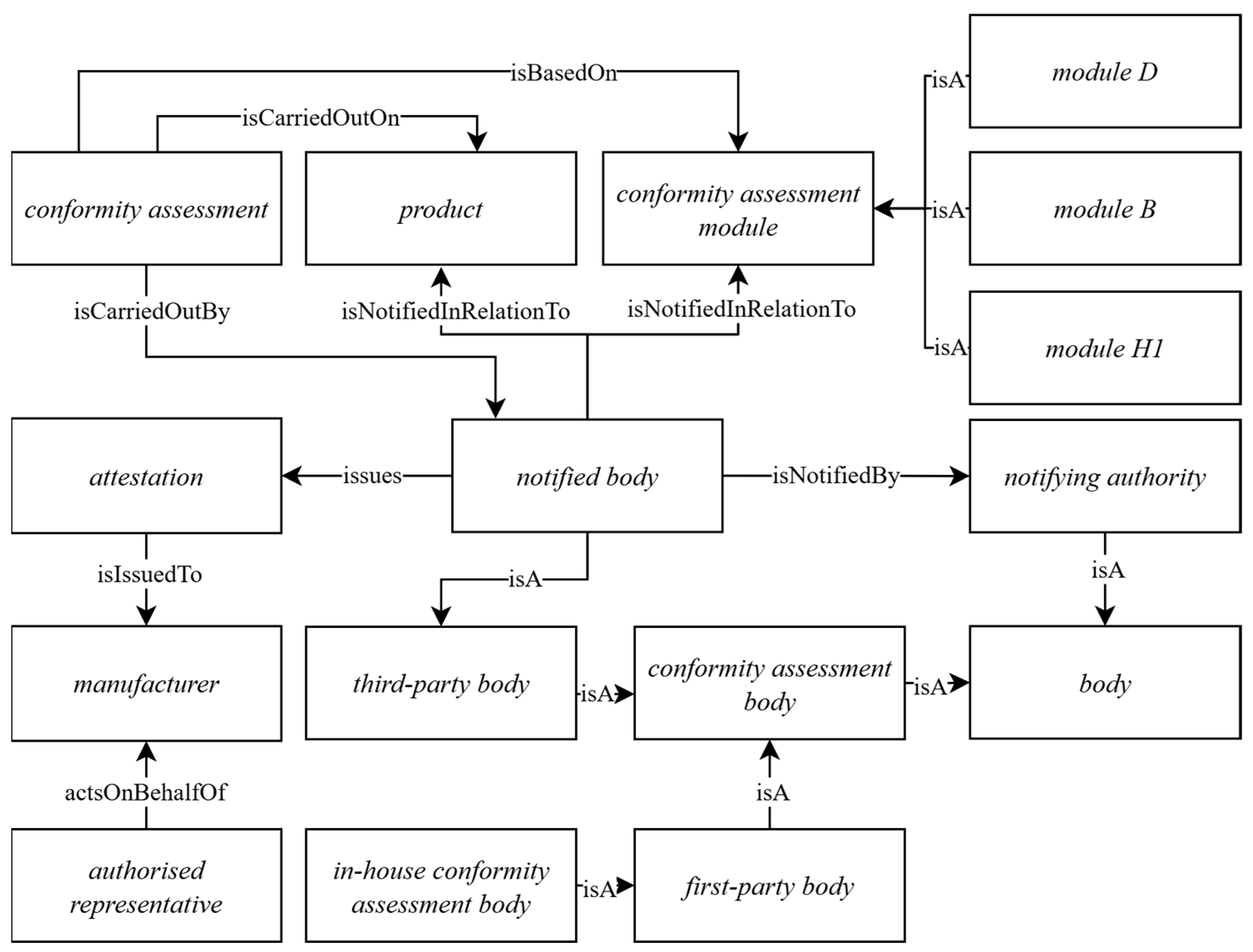
conformity assessment, as shown in
Figure 1. This figure does not claim to be exhaustive, as it only includes the terms that are relevant for the given use case of
product certification.
Conformity assessments may be of different types, for example,
testing,
inspection, or
certification, and can be related to different entities to be assessed, such as
products,
processes,
services,
systems,
persons, or
bodies. These entities are generalized in the
object of conformity assessment. In the following, only
certification is considered. Depending on the
object of conformity, different types of
certifications are distinguished, for example,
product certification [
2,
7] and
certification of persons [
10,
11].
A
conformity assessment is carried out by a
body called a
conformity assessment body, which can be of different types depending on the
object for which it has demonstrated competence. Thus, the
conformity assessment body that performs the
product certification is known as a
certification body. It is generally a so-called
third-party body that always operates independently of the provider of the
object to be certified and has no user interest in it [
1].
Each
conformity assessment can be performed on the basis of a
conformity assessment scheme. It contains rules and procedures that describe the
object of conformity assessment. Moreover, it identifies the set of
specified requirements to which the
object must conform and provides the methodology for performing the assessment. A
conformity assessment scheme applied on a
product certification is known as a
certification scheme and differs in its type.
Figure 1 provides three examples of them.
Depending on the
conformity assessment scheme, several activities are to be performed within a
conformity assessment [
7]. These vary in type and number due to the needs of the potential user [
1]. The ISO/IEC 170xx series describes a variety of
conformity assessments in detail.
The result of a
conformity assessment can be either positive, where the
object of conformity assessment meets all
specified requirements and its conformity is approved, or negative, where the specified requirements are not met and the
conformity assessment has failed. The result of a
conformity assessment is captured in a formal conclusion, a so-called
statement of conformity, which serves as an assurance that the
specified requirements are fulfilled. Such a statement “includes all means of communicating” [
1] the result and is usually issued within the final step of a
conformity assessment, known as
attestation [
1]. In the case of the
product certification, where the statement is issued by a
third-party body, this final step is called
third-party attestation [
1].
2.2. Conformity Assessment in Terms of Legislation
Within the EU legislation, the
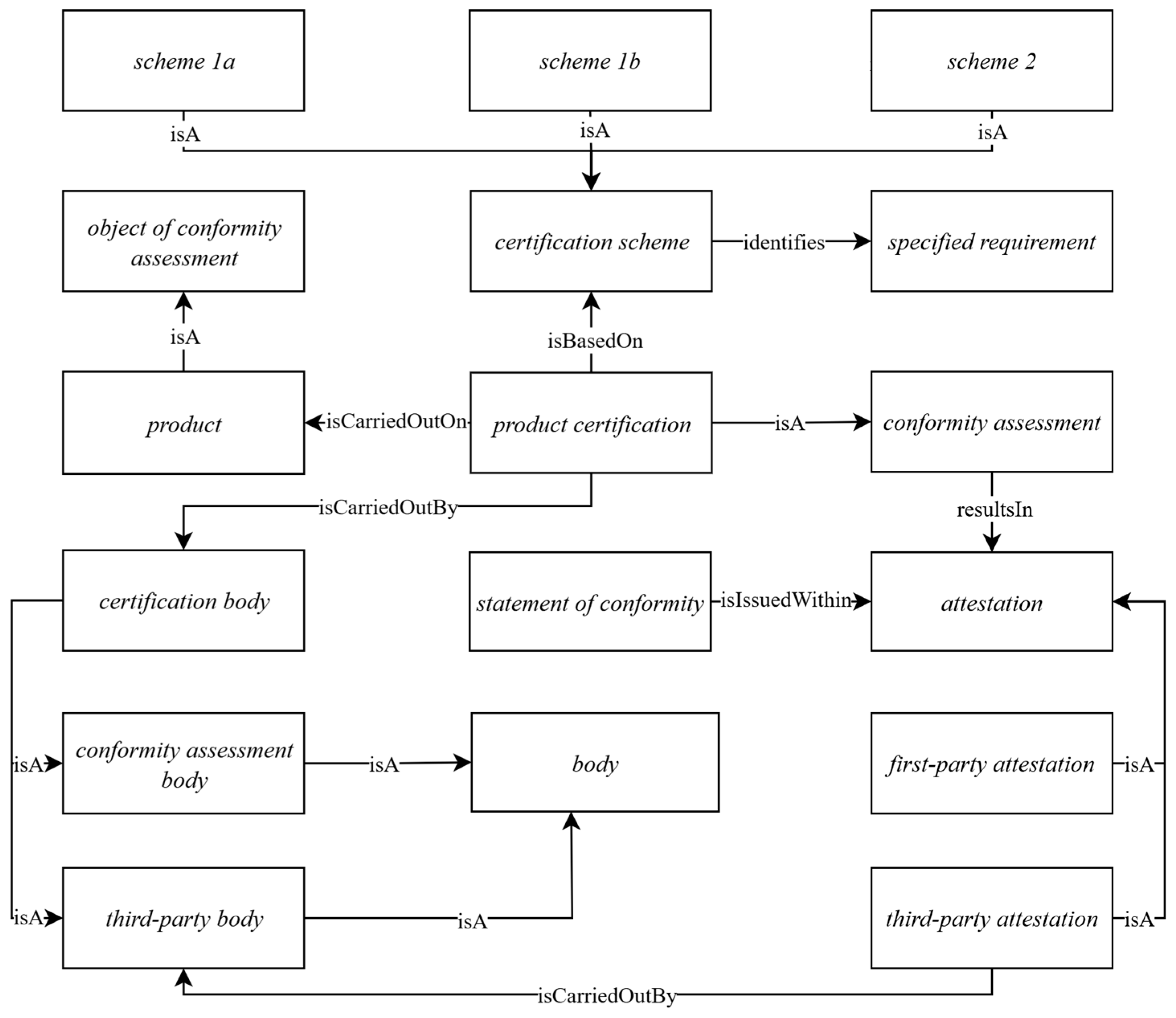
conformity assessment is always carried out on a product which, unlike the standardization framework, is not further specified. An overview of the main terms is shown in
Figure 2. It does not claim to be exhaustive, as it only includes the terms that are relevant for the given use case of
product certification.
A
conformity assessment is carried out by different
conformity assessment bodies: one of them is a
third-party conformity assessment body, known as a
notified body [
8,
9]. It is designated by a
notifying authority after having been assessed and having demonstrated the competence to carry out
conformity assessments within the EU. Notification is made for a specific type of
product and specific
conformity assessment modules for which the
notified body demonstrates its competence. The other type of
body is a
first-party body represented by an
in-house conformity assessment body [
8].
Conformity assessment modules can be understood as consolidated procedures for performing
conformity assessments within the NLF. They can be selected for the application in accordance with the predefined rules and considering the risk level associated with the product and with the specifics of the sector in which this product is used [
8]. The examples here are
module B, which stands for an
EU-type examination;
module H1 that is equal to the
conformity based on full quality assurance plus design examination; or
module D, as a
quality assurance of the production process. The
modules can therefore be compared with the
conformity assessment schemes presented within the terminological system according to ISO/IEC 170xx, as shown in
Figure 1.
Where the
conformity assessment has a positive result and the product concerned demonstrates compliance with the
essential requirements, the
notified body issues an
attestation to the
manufacturer [
8].
The interpretation of the
attestation is the only major difference between the fields of legislation and standardization: The
attestation in legislation is a document [
8]. The
attestation in standardization, in contrast, represents one of the functions on which
conformity assessment is based. This function includes certain
conformity assessment activities, within which the
statement of conformity is issued [
1].
As can be seen, the terms representing the
result document of a
conformity assessment are missing in
Figure 1 and
Figure 2. These terms have been deliberately omitted because each of the textual sources, both from the legal and standardization field, contains several terms for
result documents whose similarity in meaning is not obvious due to the lack of definitions.
2.3. Characteristics of a Result Document
Since the aim of semantic analysis is to find a suitable term for a specific document of which only the characteristics are known, it was decided to use a reference term called result document. It is important to note that result document is not a standardized term but a freely chosen term and merely represents a placeholder for the document to be covered by the D-CoC project. The correct term, which corresponds to the standardized terminology of a conformity assessment, is going to be identified by the semantic analysis and reused for the D-CoC-based document.
As none of the analyzed text sources provided a stable definition for the
result document, it instead had to be defined by its characteristics that are considered to be essential within the application of the D-CoC project mentioned in the Introduction. Essential characteristics have been defined by the experts participating in the project working group, who are directly involved in the conformity assessment procedures. Based on that, the
result document in the context of the D-CoC project can be considered as a document which is issued in the case of a positive outcome of a
product certification carried out according to all
certification systems included in European Directives 2014/31/EU [
4], 2014/32/EU [
5], and 2014/34/EU [
6]. It always contains a
statement of conformity and is issued only by an independent
body with no interest in the assessed product. These characteristics have been reformulated into three hypotheses containing the statements considered to be true about the nature of the reference term
result document. Here, each hypothesis states exactly one essential characteristic:
A result document within a product certification is issued by a third-party conformity assessment body;
A result document within a product certification includes a statement of conformity;
A result document within a product certification is not limited to a specific conformity assessment module/scheme.
Applying these hypotheses to document-relevant terms from the textual sources will help to identify ones with the same or similar characteristics, which can be used in the D-CoC project. The full procedure for the semantic analysis is described in detail in
Section 3.
3. Terms Analysis
The analysis procedure is divided into three main steps. The first step is to identify and extract the terms designating the
result document. The second step is to identify the essential characteristics of the extracted terms. Since most of the terms do not have specified definitions, which are generally used in terminology work as the main means of distinguishing terms [
12], the characteristics are derived from the textual sources. For this purpose, the textual environments in which the terms occur are taken into account. These textual environments can be seen as thematic priorities and are referred to throughout this publication as contextual frames. The main contextual frames correspond to the textual sources considered in the analysis and are as follows:
Conformity assessment according to ISO/IEC 17000 [
1];
Conformity assessment according to ISO/IEC 17065 [
7];
Conformity assessment according to ISO/IEC 17067 [
2];
Conformity assessment according to Decision 768/2008/EC [
9];
Conformity assessment according to The Blue Guide [
8].
Each of these main contextual frames is then divided into several sub-frames corresponding to more specific thematic priorities. The sub-frames are, in general, defined according to the chapter headings within the textual sources. In most cases, such sub-frames correspond to the different steps or activities within a conformity assessment procedure. They may also refer to different requirements related to the actors involved, to the object of conformity assessment, and to other administrative, legal, or temporal issues.
Within these (sub-)frames, the expressions, such as phrases, sentences, or parts thereof, are found, which provide a statement about the term. These statements must be directly or indirectly related to the essential characteristics defined in hypotheses 1 to 3 in
Section 2.3. Hereby, the focus is laid to identify the verbs syntactically associated with the term in question including their direct or indirect objects. Here, the verbs are assumed to represent the term characteristics because verbs carry the semantic load of each natural language expression and are important for forming expressions that are semantically correct [
13]. The direct or indirect objects associated with these verbs serve as characteristic values and take on the role of the main semantic distinguisher between the terms. The following example illustrates the identification of essential characteristics and their values: we assume that a sentence has been identified that contains a statement about the creator of the document in question, for example, “The document is issued by a responsible body”. Here, the “document” is the term to be characterized, the verb including the associated conjunction (“is issued by”) represents the characteristic of the term, and the direct object of the verb (“responsible body”) is taken as the characteristic value. To make the differentiation easier, the characteristics are presented underlined below and, in cases where they consist of several words, are written in sequence, with each word, except the first, written in upper case. If the verb has an associated conjunction that is crucial for the correct interpretation of the meaning, this is also included as part of the characteristic, such as
isIssuedBy. The direct or indirect objects of verbs used as characteristic values are italicized and underlined, for example,
responsible body. To provide a better overview, the terms, their characteristics, and the associated values are presented in this publication in separate columns of a table for each contextual frame, with a reference to the section of the textual source in which they occur.
The third step is to compare the essential characteristics of all the terms concerned with those associated with the reference term
result document introduced in
Section 2.3. To do this, each term in question is inserted into the hypotheses and, depending on whether the hypothesis is confirmed or rejected, the equivalence of this term to the reference term is estimated.
3.1. Ambiguity in Standardization
The analysis of ambiguity within the standardization field is carried out on the international technical standards related to the
conformity assessment. These include ISO/IEC 17000 [
1] providing general terms and definitions for conformity assessments; ISO/IEC 17065 [
7] focusing on certification of products, processes, and services; and ISO/IEC 17067 [
2] including all existing
certification schemes that can be applied to the certification of products, processes, and services.
3.1.1. Contextual Frame of ISO/IEC 17000
In ISO/IEC 17000, the term
certificate is used alongside the term
report as the form of the
result document of the related conformity assessment activity [
1]. As there is no information on the issuer of the
certificate, it is not possible to make a statement on hypothesis 1. In addition, there is no clear relationship between
certificate and
statement of conformity. The
statement of conformity is provided in ISO/IEC 17000 as a statement issued within a
certification [
1], although it is not clear whether it can be considered as a whole
result document or only as its content element. This makes hypothesis 2 seem possible. Furthermore, hypothesis 3 can be stated as possible, as while there is no immediate association between the term
certificate and different
certification schemes, it is mentioned in the contextual frame of “Trade and Regulation”, which is broadly relevant to all types of
conformity assessment, as shown in
Table 1.
3.1.2. Contextual Frame of ISO/IEC 17065
In the contextual frame of the
conformity assessment according to the technical standard ISO/IEC 17065 [
7], several terms for a result document are identified:
certificate,
certificate of conformity,
formal certification documentation,
certification documentation,
formal certification documents, and
certification documents, as in can be seen in
Table 2. Four of them designate the documents which are the responsibility of the
certification body to issue and to modify:
formal certification documentation,
certification documentation,
formal certification documents, and
certification documents. This information is sufficient to conform with hypothesis 1 for all these terms, since the
certification body is a
third-party body, as shown in
Figure 1. However, there is no further clear distinction between these terms. In addition, it is not possible to determine the similarity or differences based on the characteristic related to the mandatory content, since this characteristic is only associated with
formal certification documentation. This is not sufficient to make a clear statement about hypothesis 2. This hypothesis can possibly only be confirmed in the case of
formal certification documentation, given that these are issued only after the certification requirements have been met, as this results in a
statement of conformity. In addition, hypothesis 3 remains open for all four terms mentioned above due to the lack of information.
A
certificate of conformity is used here as one of the two forms in which a
statement of conformity can be expressed, along with the mark of conformity [
7]. This confirms hypothesis 2. In addition, this information can also indirectly confirm hypothesis 1, because within a
product certification, a
statement of conformity is only issued by the
certification body, which is always a
third-party body [
7]. Other characteristics are not addressed in the standard, so that no statements can be made on hypothesis 3.
The term
certificate is identified in the contextual frame of “Usage of Certificate”. Here it is mentioned that the responsibility for the withdrawing of a
certificate is defined by the
certification body, which is a
third-party body, as shown in
Figure 1. This conforms to hypothesis 1. Moreover, the
certificate is used together with the mark of conformity as one of the mechanisms representing that the product has been certified, and it declares the fulfillment of the
certification. Since the fulfillment of the
specified requirements is always confirmed by the issuance of a
statement of conformity [
1], hypothesis 2 can be indirectly confirmed. Hypothesis 3 remains open because no information regarding the usage of the term
certificate in association with
conformity assessment scheme is provided.
Although several terms are mentioned and partly characterized, the following questions remain unanswered:
What is the difference between certification documentation, formal certification documentation, formal certification documents, and certification documents?
What is the difference between certificate, certification documentation, formal certification documentation, formal certification documents, and certification documents?
Does (formal) certification documentation refer to a single document or a set of documents?
3.1.3. Contextual Frame of ISO/IEC 17067
In ISO/IEC 17067 [
2], four different terms for
result document are used:
certificate of conformity,
certificate,
type certificate, and
certification documents, as shown in
Table 3. As can be seen, none of these terms have any reference to the issuer, so that no statement can be made about hypothesis 1.
No consistent conclusion for all terms can be drawn regarding hypothesis 2. Although the
statement of conformity refers to the terms
certificate and
certificate of conformity, this is not considered as their mandatory content, but as equivalent to them. In addition, the
type certificate declares conformity to the
specified requirements, which is only true if the result of the
certification is positive [
2]. This can indirectly confirm hypothesis 2 for the terms
certificate,
certificate of conformity, and
type certificate.The three different terms (
certificate of conformity,
certificate, and
type certificate) occur within the contextual frame “Scheme Type 1a”, which stands for
conformity assessment realized as
type examination [
14]. In addition, the terms
certificate of conformity and
certificate refer to
type examination, as shown in their mandatory content: For example, the
certificate must contain the description of the certified
product type, and the
certificate of conformity is explicitly issued for a
product type. However, the term
certificate of conformity is also used in the
certification of a
product batch that is subject to a
certification other than
type examination, such as
product or
unit verification [
14]. This is reflected in the contextual frame “Licensing (and Control of the Mark)”. This information rejects the hypothesis 3 for
certificate and
type certificate and conforms to
certificate of conformity.
The term certification documents is mentioned as one of the elements to be specified within a certification scheme, for example, in case of their return due to certification suspension, withdrawal, and termination of certification. Since the term is used in the plural, it indicates that it may be not only one document, but several documents, possibly including other types of documents. All this information is not sufficient to make any statements about hypotheses 2 and 3.
3.1.4. Summary of Standardization
The analysis of the use of the document-related terms in ISO/IEC standards comes to no clear result. However, a few summarizing statements can be made:
Product certification as a third-party attestation is performed by a certification body;
A certification body is the third-party conformity assessment body;
Product certification results in a certificate, certificate of conformity, or a mark of conformity;
Type examination results in a certificate, certificate of conformity, or a type certificate;
Certificate, certificate of conformity, and mark of conformity are statements of conformity;
A certification body can issue formal certification documentation, certificates, certification documentation, and formal certification documents.
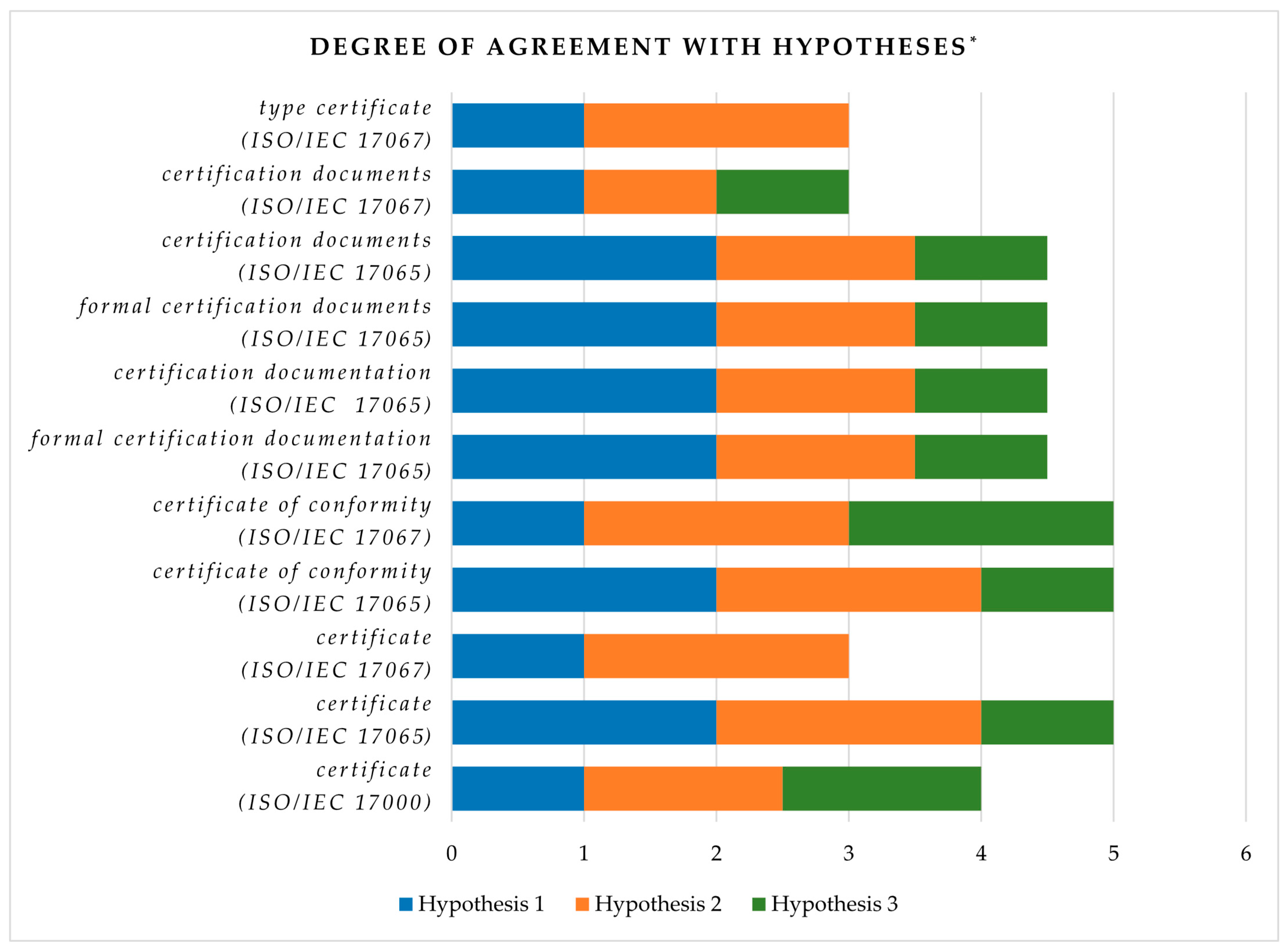
Regarding the established hypotheses, the below findings were obtained and are summarized in
Figure 3.
3.2. Ambiguity in Legislation
The analysis of the terms related to a
result document in the legislation field has been made based on Decision 768/2008/EC [
9] and The Blue Guide on the implementation of EU product rules 2022 (2022/C 247/01) [
8].
3.2.1. Contextual Frame of Decision 768/2008/EC
Decision 768/2008/EC [
9] provides six different terms (
certificate, conformity certificate, certificate of conformity, EC-Type examination certificate, EC-design examination certificate, and
EC design examination certificate) within seven contextual frames, as shown in
Table 4. Here, the
EC design examination certificate (without hyphen) and the
EC-design examination certificate are spelling variants and can therefore be equated.
Regarding the term conformity certificate, no statements can be made as it is not associated with any of the three essential characteristics. Therefore, none of the three hypotheses can be confirmed or rejected in this respect.
The terms
certificate, certificate of conformity, EC-type examination certificate, and
EC(-)design examination certificate share the same issuer, which is a
notified body representing the
third-party conformity assessment body, as shown in
Figure 2. In any case, this information is sufficient to confirm hypothesis 1.
Hypothesis 2 can be considered as possible only regarding the terms EC-type examination certificate and certificate, as conformity assessment information and evaluation information are part of their mandatory content.
Hypothesis 3 is confirmed for the terms certificate of conformity and certificate, as they are associated with several conformity assessment modules. In addition, both terms are normally used in different contextual frames instead of specific terms to avoid repetition. However, it remains unclear to what extent the two terms differ from one another.
Concerning the terms EC-type examination certificate and EC(-)design examination certificate, hypothesis 3 can be rejected because each of them are issued within a specific conformity assessment module: module B (EC-type examination) and H1 (full quality assurance plus design examination).
3.2.2. Contextual Frame of the Blue Guide
The following terms for
result document are used in different contextual frames within The Blue Guide [
8]:
certificate,
certificate of conformity,
conformity assessment certificate,
EU-type examination certificate,
EC-type examination certificate,
EU-design examination certificate,
EU design examination certificate,
EC design examination certificate,
EC-design examination certificate,
declaration of conformity, and
EU declaration of conformity, as shown in
Table 5. Some of these are spelling variants, written with or without EU, with EU or EC, and with or without hyphenation, but they are considered equivalent. The difference between EU and EC is historical, as the European Communities (EC) were renamed the European Union (EU) in 1993, and part of The Blue Guide quotes older documents.
The terms
conformity assessment certificate,
certificate of conformity,
EC-/EU-type examination certificate, and
EU(-)/EC(-)design examination certificate confirm hypothesis 1, as they are similar with respect to their issuer, which is a
third-third party conformity assessment body of a different type. Hypothesis 1 is rejected for the term
certificate, because it can be issued by a
third-party as well as by the
first-party body, represented here by the
in-house conformity assessment body, as shown in
Table 5.
As far as hypothesis 2 is concerned, a statement can only be made about the term certificate. The inclusion in its content of a statement of conformity follows indirectly from the contextual frame “Actors’ Obligation”, where it is stated that the certificate declares the conformity of the product. For all other terms, there is no association with the statement of conformity.
Within the frame “Conformity Assessment”, certificate and certificate of conformity are used as general terms instead of a more specific term such as EC-/EU-type examination certificate or EU(-)/EC(-)design examination certificate to avoid repetition. This makes it clear that both terms can be used within different conformity assessment modules, which in turn confirms hypothesis 3.
Hypothesis 3 is rejected for the terms EC-/EU-type examination certificate and EU(-)/EC(-)design examination certificate, as they are associated with a specific conformity assessment module: the EC-/EU-type examination certificate is to be issued only within an EU/EC-type examination (module B) and the EU(-)/EC(-)design examination certificate is to be issued under the conformity assessment module H1 representing full quality assurance plus design examination.
The term
(EU) declaration of conformity appears as the document is issued and signed under the responsibility of the
manufacturer. A
manufacturer shall not be equated with the
third-party body, since it manufactures the product to be assessed and may therefore have an economic interest in it, which contradicts the definition of a
third-party body. In this case, the
manufacturer represents a so-called
first-party body. This rejects hypothesis 1. Hypothesis 2 remains open, because no association is given. Hypothesis 3 can however be stated as true, because
(EU) declaration of conformity is associated with several
conformity assessment modules:
A,
A1,
A2,
C,
C1,
C2,
D,
D1,
E,
E1,
F,
F1,
G,
H, and
H1 [
8].
3.2.3. Summary of Legislation
The analysis of the term usage for the result document concerning the NLF is inconclusive. However, it is possible to make some general statements:
A conformity assessment body can also be a notified body;
A certificate declares the conformity of the product;
An EC-/EU-type examination certificate and EU(-)/EC(-)design examination certificate are specific sub-types of a certificate, certificate of conformity, and conformity assessment certificate;
A (EU) declaration of conformity is typically issued by a manufacturer or (for EU) by one of the other economic operators;
A (EU) declaration of conformity is not an EC-/EU-type examination certificate, an EU(-)/EC(-)design examination certificate, a certificate, a certificate of conformity, or a conformity assessment certificate.
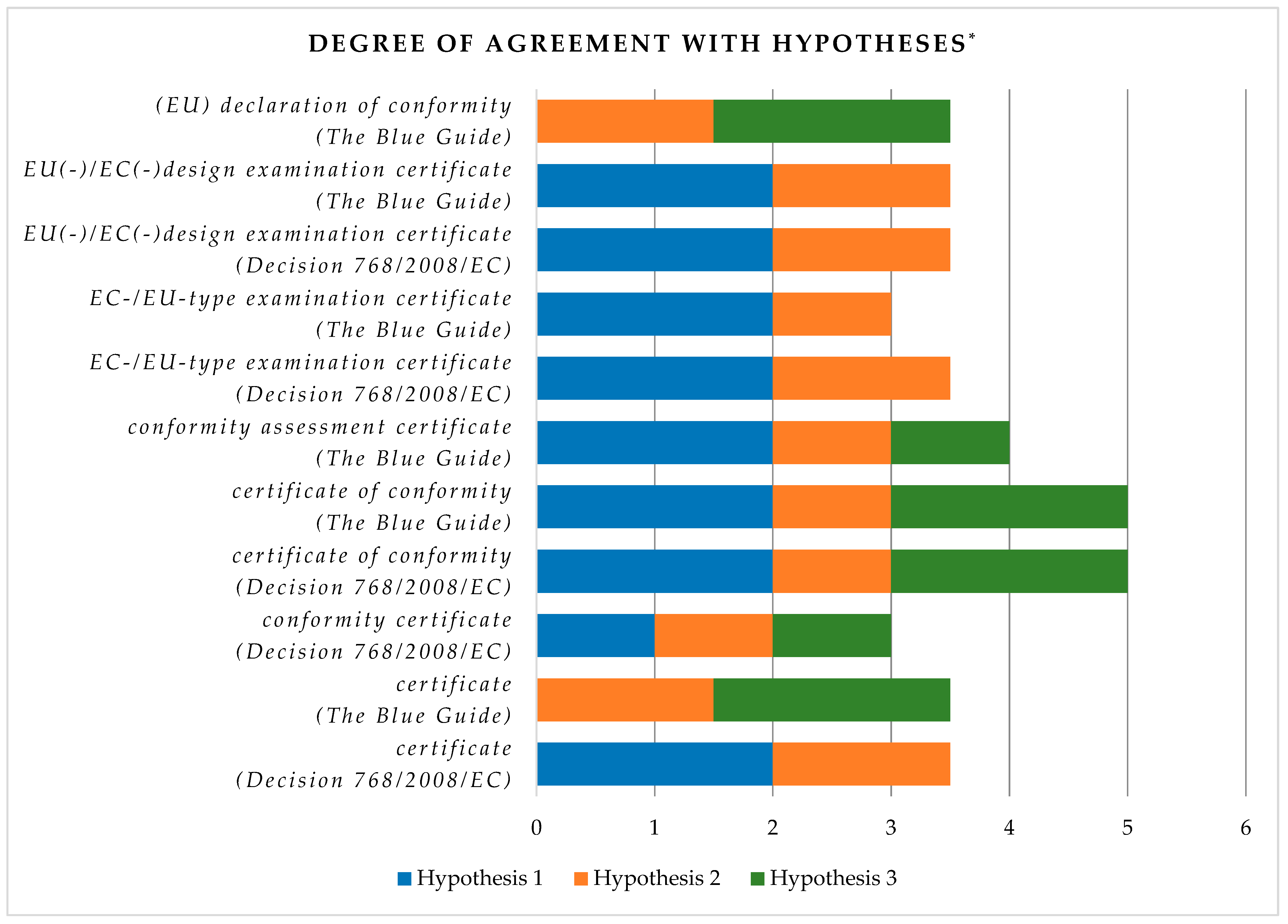
With regard to the hypotheses put forward, the below results can be obtained, which are summarized in
Figure 4.
4. Results and Discussion
The aim of this analysis was to find an appropriate term to describe the
result document issued by a positive outcome of a
conformity assessment in accordance with European Directives 2014/31/EU [
4], 2014/32/EU [
5], and 2014/34/EU [
6]. For this purpose, a reference term
result document was defined with three essential characteristics, which were formulated in the form of three hypotheses. These characteristics served as reference characteristics to which the term to be selected should correspond. After identifying the actual characteristics for each identified term, presented in the contextual frames of the source documents, the most appropriate term was to be selected for use in the D-CoC data structure. This chapter discusses the considerations for selecting the most appropriate term.
As can be seen from
Section 3.1 and
Section 3.2, the semantic analysis of
result document did not produce any clear results; only a tendency towards the usage of individual terms can be shown. The most stable results in general use have been obtained for the terms
certificate and
certificate of conformity: they are the only terms that are used in both standardization and legislation. However, the term
certificate has a slightly higher usage tendency. It is mentioned in all the technical standards. In contrast, the term
certificate of conformity is only associated with
product certification and is completely absent from ISO/IEC 17000 [
1].
Another important outcome is the association of both terms with the essential characteristics defined as references. Here, the term
certificate, in general, tends to be unstable in its characteristics across all textual sources and especially in standardization. The greatest incompatibility with the essential characteristics is found in ISO/IEC 17000 [
1]. This standard does not provide any information about the issuer and the inclusion in the content of a
statement of conformity and the use of the
certificate under different
schemes/
modules is not explicitly proven in this standard but may be possible. This may be explained by the fact that ISO/IEC 17000 is a general standard covering different types of
conformity assessment, the results of which have to be stated in different types of
result documents requiring different content [
1]. Thus, the standard allows flexibility in the requirements for documenting the results obtained in different types of
conformity assessments such as
product certification,
testing, or
inspection. Within ISO/IEC 17065 [
7] and ISO/IEC 17067 [
2], the term
certificate tends to be more stable, corresponding to the reference term in two of the three essential characteristics: the issuer and the
statement of conformity. Only the third characteristic differs in assigning the
certificate to a specific
conformity assessment scheme. Unlike the
certificate, the term
certificate of conformity meets all the three reference characteristics within
product certification.
Regarding the compliance with the reference characteristics in the legislation, the term
certificate has a higher degree of consistency of use than in standardization. Here, its characteristics match those of the reference term, except one related to the
statement of conformity. For this, both Decision 768/2008/EC [
9] and The Blue Guide [
8] do not explicitly mention the provision of the
statement of conformity, but this can be considered possible. In contrast, the association of the term
certificate of conformity with the
statement of conformity remains unknown, as neither text source contains this information. Apart from this, the
certificate of conformity corresponds to the essential characteristics of the reference term in both legislative textual sources.
All other terms are generally distinguished by being used exclusively in one of the two fields considered and can only be partly characterized. For example, the terms
conformity certificate and
conformity assessment certificate are only used in legislation.
Conformity certificate occurs only in Decision 768/2008/EC [
9], without any reference to any of the three essential characteristics.
Conformity assessment certificate, however, is used only in The Blue Guide [
8] and matches the reference term only in relation to the issuer. Such limited use makes it impossible to identify the level of equivalence of these terms with the reference term. In addition, their usage in parallel with the more widely used terms such as
certificate and
certificate of conformity remains open. In contrast to them, the terms
certification documentation,
formal certification documentation,
formal certification documents, and
certification documents occur only in standardization. Additionally, the
statement of conformity may be provided in the
formal certification documentation and
certification documentation. As there is no reference to the issuer, it is difficult to assess whether these terms match the reference term. They are therefore the least likely candidates for the D-CoC digitization project.
The term (EU) declaration of conformity also does not correspond to the characteristics of the reference term, as it is issued by the manufacturer. This makes it clear that this is a completely different document, which is not covered by the D-CoC digitization project. Therefore, its use is excluded here.
The three further terms are not suitable for the given use case because of their narrower meaning, as they are only associated with specific conformity assessment modules: in the field of standardization, for example, the term type examination certificate is used in connection with module B; in legislation it is the term EC-/EU(-)type examination certificate. The term EC(-)/EU(-)design examination certificate is only valid for module H1.
Regarding the choice of the appropriate term for digitizing the
result document in the framework of the D-CoC project, the analysis has revealed the following:
Certificate of conformity is the most suitable for several reasons: Firstly, it is commonly used in both standardization and legislation. Secondly, its meaning has been shown to be quite stable and universal, and its characteristics comply with the reference essential characteristics. It can be used as a generic term to represent several more specific sub-types of
result documents issued within different types of
conformity assessment schemes or
modules. Thirdly, it is also applicable to the assessment of different
objects within the NLF. Finally, a
certificate of conformity is about a
third-party result document, which is also the case within the D-CoC project. The fact that this term is not used in ISO/IEC 17000 [
1] can be disregarded, as this standard covers all types of
conformity assessment and uses the more general term
certificate, which may also have a different intended purpose (aside from demonstration of conformity) than the
result document within
product certification.
5. Conclusions
In summary, the semantic analysis has identified several sources of ambiguity that have a negative impact on understanding the meaning of the terms for the result document. The first is the lack of fixed definitions in both standards and legislative text sources. Definitions are the main source providing the meaning and are therefore indispensable, especially in communication between parties involved. Furthermore, given definitions are written without considering the rules of terminology work and are therefore difficult to interpret. The second reason is that existing text sources and their terms are not taken into account when writing new documents or updating the old version. This publication therefore aims to encourage standardization experts and legislators to improve term harmonization. As could be identified, high-priority terms to be defined are certificate, report (and its difference to all other result documents), (formal) certification documentation, and (formal) certification documents. Here, the development of harmonization guidelines for equivalent terms between the fields of legislation and standardization would be helpful.
In addition, this publication also aims to highlight the fact that inconsistency of terminology can have a negative impact on the progress of digital-supported processes, procedures, and workflows. For example, aligning the metadata required for the automatic transfer of
digital certificates to a certificate database can be problematic.
Digital certificates that are already stored in a certificate database are difficult to find, and their content is not searchable. The content, or parts of it, required for possible further processing cannot be recognized, interpreted, or extracted automatically. Incorrect interpretation can result in non-compliance with legal or normative requirements, such as those set out in European Directives or technical standards. This can lead to legal and regulatory risks, as well as the inability to trace conformity decisions. All these negative consequences contradict the European Union’s various efforts to promote digital transformation in different areas. A well-known example of such effort is the European Strategy for the Digital Single Market (DSM) [
15]. It focuses on digitizing the European economy to enable free online access for businesses and other activities and to ensure the free movement of different products, persons, or services independently of residence in the EU while considering data protection [
15]. The legislative proposal 2025/0133/COD [
16], based on the principle of “digital by default”, aims to amend European Directives within the NLF with regard to the obligations of economic operators related to, among others, reporting the product conformity. According to them, paper-based conformity assessment documents are to be replaced with digital ones, which are to be exchanged between economic operators and competent authorities by electronic means [
16]. This proposal corresponds exactly to the objectives of the D-CoC project.



 ,
,