QSAR Modeling to Predict Aquatic Toxicity Across Multiple Species

 , , ,
, , ,  , , , ,
  and
and
Abstract
1. Introduction
2. Materials and Methods
2.1. Toxicity and Structural Data
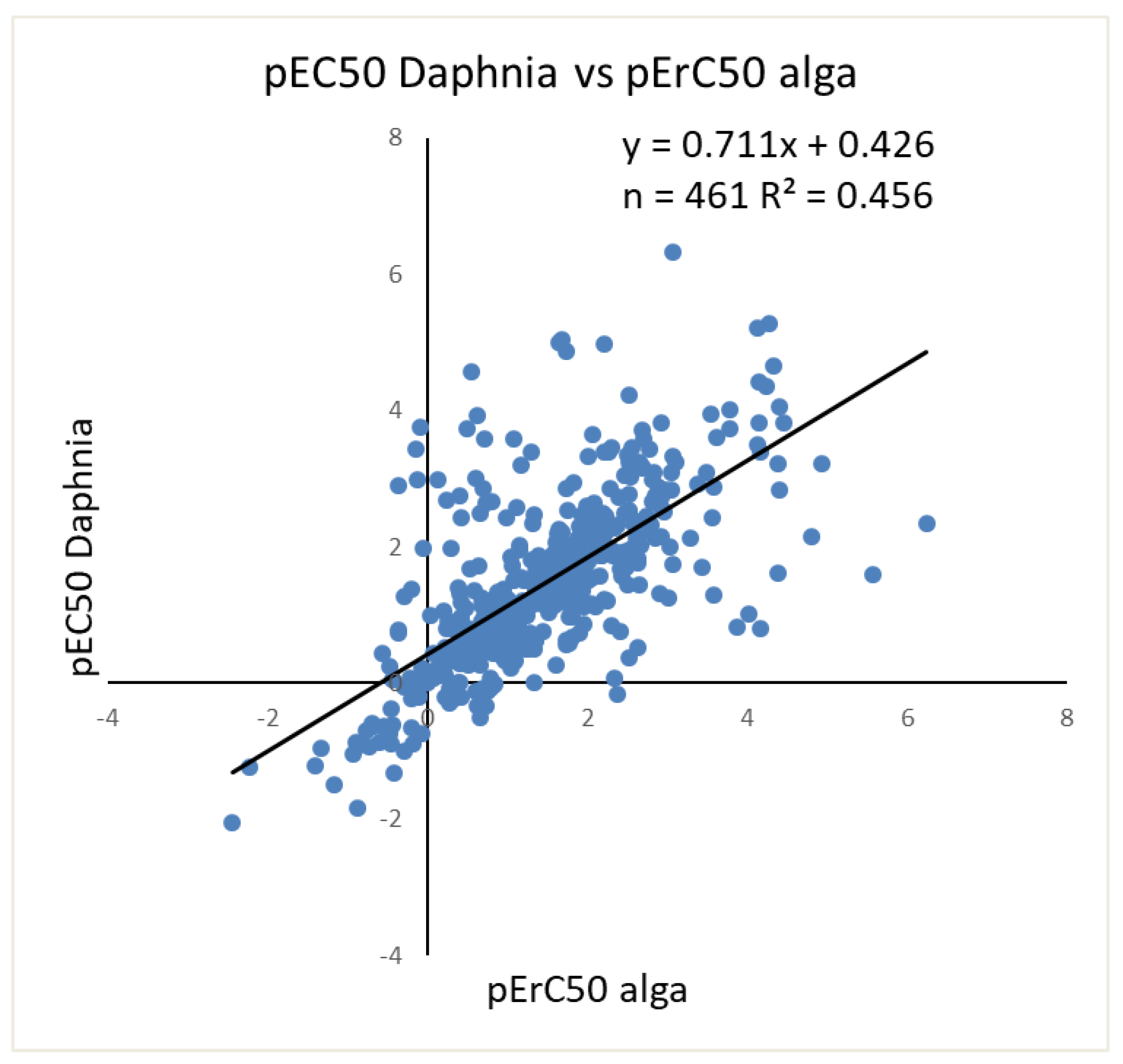
- Raphidocelis subcapitata—half-maximum inhibitory concentrations (ErC50) according to the OECD Guideline for the Testing of Chemicals No 201 “Freshwater Alga and Cyanobacteria, Growth Inhibition Test” [23]. The guideline recommends the use of EC50 calculated from inhibition of the algal growth rate (ErC50) at 72 h exposure period.
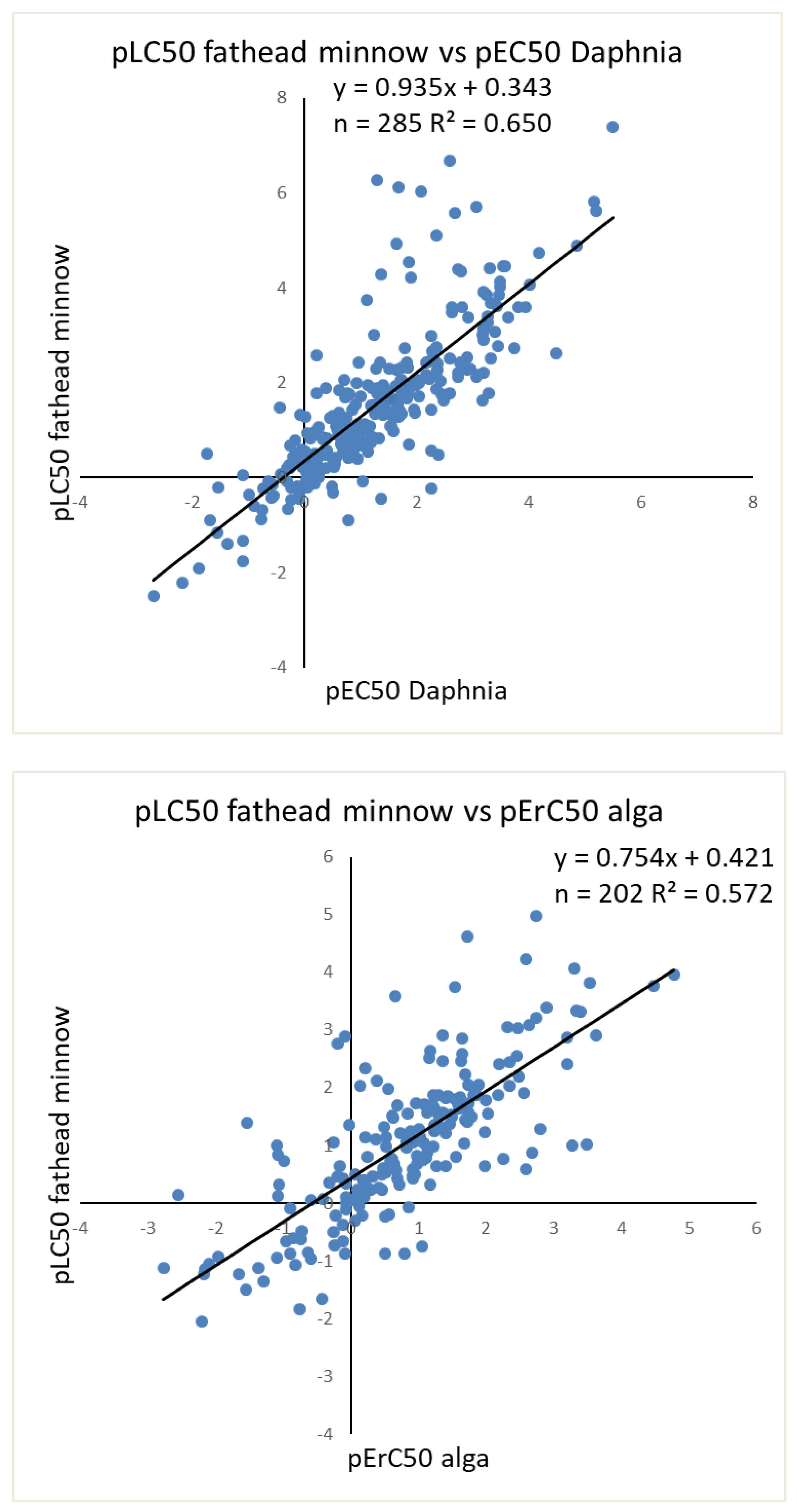
- Daphnia magna—half-maximum effective concentrations (EC50) according to the OECD Guideline for the Testing of Chemicals No 202 “Daphnia sp. Acute Immobilisation Test” [24]. The guiding recommends the use of EC50 calculated from immobilization, recorded after 48 h exposure to the test substance of young daphnids.
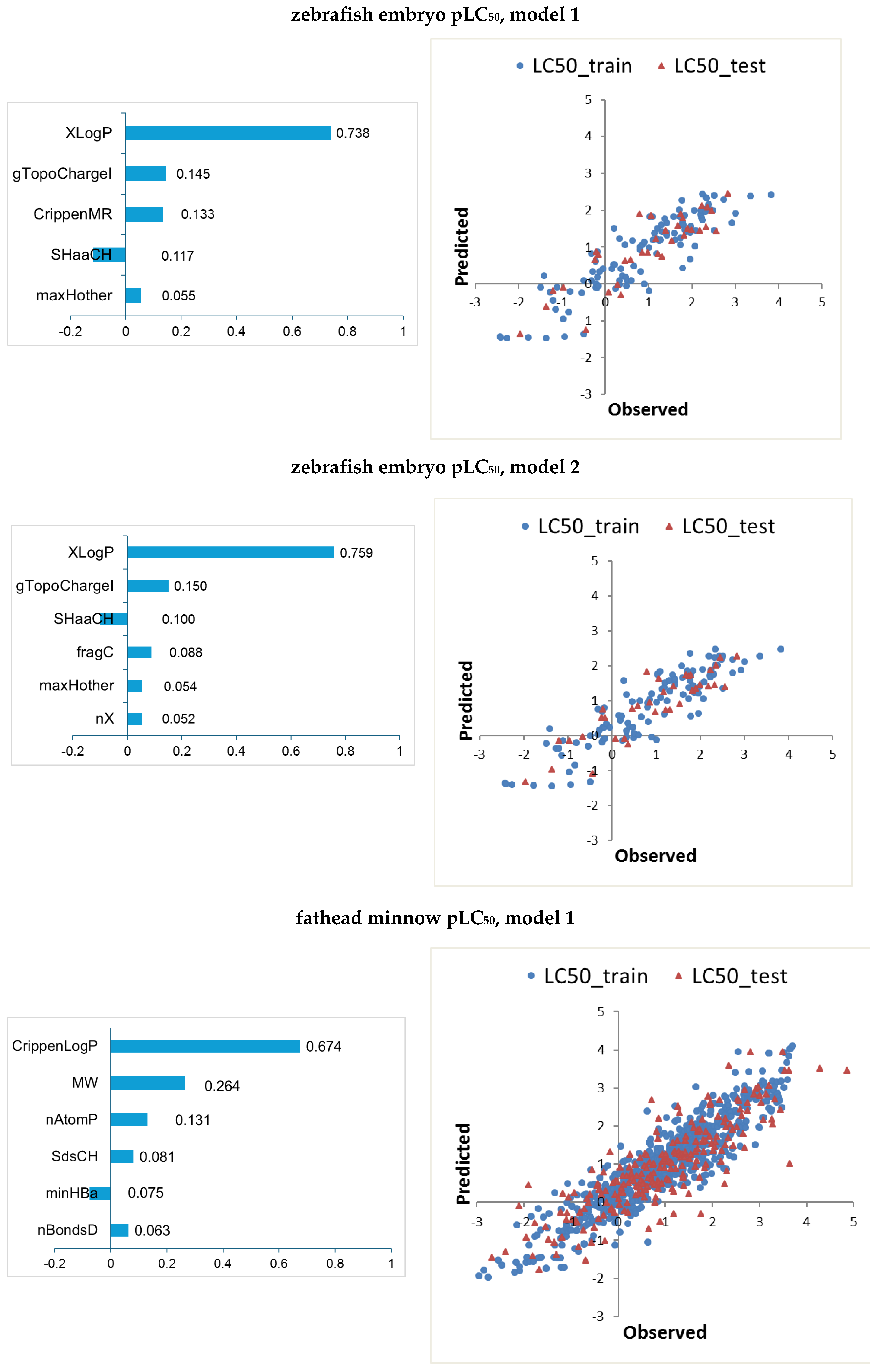
- Danio rerio (zebrafish embryo)—half-maximum lethal concentration (LC50) to fish embryo according to the OECD Guideline for the Testing of Chemicals No 236 “Fish Embryo Acute Toxicity (FET) Test” [25].
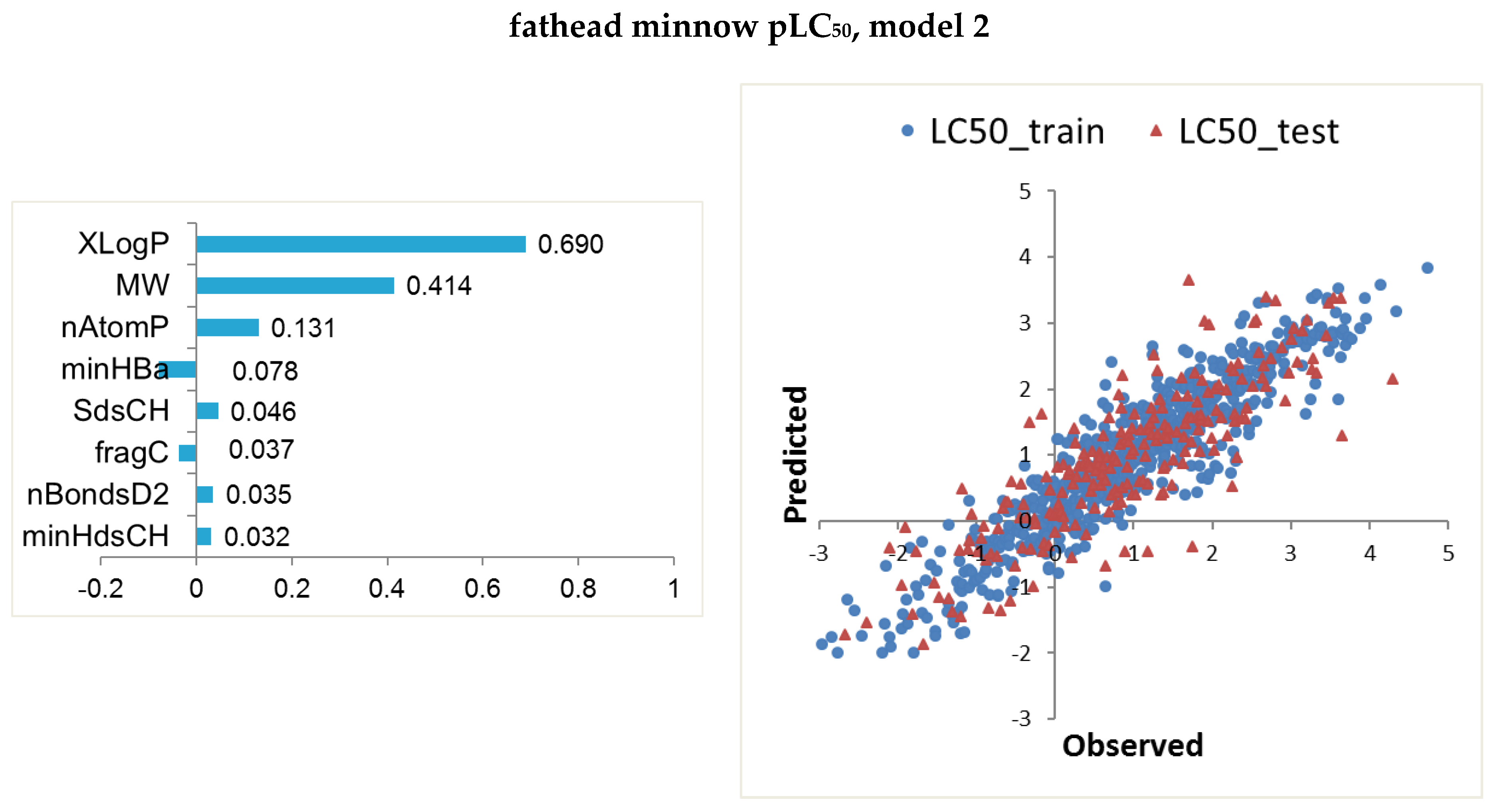
- Pimephales promelas (fish fathead minnow)—half-maximum lethal concentration (LC50) at 96 h exposure period according to the OECD Guideline for the Testing of Chemicals No 203 “Fish, Acute Toxicity Testing” [26].
2.2. Descriptors
2.3. Development of QSAR and Classification Models
3. Results
3.1. Summary of the Toxicity and Structural Data Used for Modeling
3.2. Random Forest Regression Models
3.3. Random Forest Classification Models
3.4. QSAAR Models
4. Discussion
4.1. Models’ Development
4.2. Applicability Domain
4.3. Comparison Among the Models
4.4. Mechanistic Interpretation of the Structural Descriptors
4.5. Interspecies Correlations and QSAAR Models
5. Conclusions
Supplementary Materials
Author Contributions
Funding
Institutional Review Board Statement
Informed Consent Statement
Data Availability Statement
Conflicts of Interest
Abbreviations
| MLR | Multiple linear regression |
| NN | Neural networks |
| OOB | Out-of-bag |
| LOO | Leave-one-out |
| SEE | Standard error of estimate |
| CCC | Concordance correlation coefficient |
| PLS | Partial least squares |
| QSAR | Quantitative structure–activity relationship |
| QSAAR | Quantitative structure–activity–activity relationship |
| RBF | Radial basis function |
| RFR | Random forest regression |
| RFC | Random forest classification |
| SHAP | Shapley additive explanations |
| SVM | Support vector machine |
References
- European Chemicals Agency. The Use of Alternatives to Testing on Animals for the REACH Regulation: Third Report Under Article 117(3) of the REACH Regulation; Publications Office: Luxembourg, 2017. [Google Scholar] [CrossRef]
- Cronin, M.T.D. (Q)SARs to Predict Environmental Toxicities: Current Status and Future Needs. Environ. Sci. Process. Impacts 2017, 19, 213–220. [Google Scholar] [CrossRef]
- Tarazona, J.V.; Fernandez-Agudo, A.; Adamovsky, O.; Baccaro, M.; Burden, N.; Campos, B.; Hidding, B.; Jenner, K.; John, D.; Lacasse, K.; et al. Use of Alternatives to Animal Testing for Environmental Safety Assessment (ESA): Report from the 2023 EPAA Partners’ Forum. Regul. Toxicol. Pharmacol. 2025, 156, 105774. [Google Scholar] [CrossRef]
- Spurgeon, D.; Lahive, E.; Robinson, A.; Short, S.; Kille, P. Species Sensitivity to Toxic Substances: Evolution, Ecology and Applications. Front. Environ. Sci. 2020, 8, 588380. [Google Scholar] [CrossRef]
- Yoon, Y.; Lee, Y.; Cho, M. Acute Toxicity Assessment and QSAR Modeling of Zebrafish Embryos Exposed to Methyl Paraben and Its Halogenated Byproducts. J. Environ. Manag. 2024, 370, 122844. [Google Scholar] [CrossRef] [PubMed]
- Chen, S.; Sun, G.; Fan, T.; Li, F.; Xu, Y.; Zhang, N.; Zhao, L.; Zhong, R. Ecotoxicological QSAR Study of Fused/Non-Fused Polycyclic Aromatic Hydrocarbons (FNFPAHs): Assessment and Priority Ranking of the Acute Toxicity to Pimephales promelas by QSAR and Consensus Modeling Methods. Sci. Total Environ. 2023, 876, 162736. [Google Scholar] [CrossRef] [PubMed]
- Qiao, K.; Fu, W.; Jiang, Y.; Chen, L.; Li, S.; Ye, Q.; Gui, W. QSAR Models for the Acute Toxicity of 1,2,4-Triazole Fungicides to Zebrafish (Danio rerio) Embryos. Environ. Pollut. 2020, 265, 114837. [Google Scholar] [CrossRef]
- ECOTOX. Available online: https://cfpub.epa.gov/ecotox/ (accessed on 1 April 2026).
- Khan, K.; Roy, K. Ecotoxicological QSAR Modelling of Organic Chemicals against Pseudokirchneriella Subcapitata Using Consensus Predictions Approach. SAR QSAR Environ. Res. 2019, 30, 665–681. [Google Scholar] [CrossRef]
- Sangion, A.; Gramatica, P. Hazard of Pharmaceuticals for Aquatic Environment: Prioritization by Structural Approaches and Prediction of Ecotoxicity. Environ. Int. 2016, 95, 131–143. [Google Scholar] [CrossRef]
- Khan, K.; Khan, P.M.; Lavado, G.; Valsecchi, C.; Pasqualini, J.; Baderna, D.; Marzo, M.; Lombardo, A.; Roy, K.; Benfenati, E. QSAR Modeling of Daphnia magna and Fish Toxicities of Biocides Using 2D Descriptors. Chemosphere 2019, 229, 8–17. [Google Scholar] [CrossRef] [PubMed]
- Yu, X. Quantitative Structure-Toxicity Relationships of Organic Chemicals against Pseudokirchneriella subcapitata. Aquat. Toxicol. 2020, 224, 105496. [Google Scholar] [CrossRef]
- Yu, X. Predicting Chemical Toxicity towards Raphidocelis subcapitata with Quantum Chemical Descriptors. Algal Res. 2025, 89, 104055. [Google Scholar] [CrossRef]
- Aalizadeh, R.; Von Der Ohe, P.C.; Thomaidis, N.S. Prediction of Acute Toxicity of Emerging Contaminants on the Water Flea Daphnia magna by Ant Colony Optimization–Support Vector Machine QSTR Models. Environ. Sci. Process. Impacts 2017, 19, 438–448. [Google Scholar] [CrossRef]
- Yu, X. Global Classification Models for Predicting Acute Toxicity of Chemicals towards Daphnia magna. Environ. Res. 2023, 238, 117239. [Google Scholar] [CrossRef] [PubMed]
- Wang, Y.; Chen, X. A Joint Optimization QSAR Model of Fathead Minnow Acute Toxicity Based on a Radial Basis Function Neural Network and Its Consensus Modeling. RSC Adv. 2020, 10, 21292–21308. [Google Scholar] [CrossRef]
- CORAL Software. Available online: http://www.insilico.eu/coral/ (accessed on 1 April 2026).
- Toropov, A.A.; Toropova, A.P.; Benfenati, E. The Index of Ideality of Correlation: QSAR Model of Acute Toxicity for Zebrafish (Danio rerio) Embryo. Int. J. Env. Res. 2019, 13, 387–394. [Google Scholar] [CrossRef]
- Furuhama, A.; Hayashi, T.I.; Yamamoto, H. Development of QSAAR and QAAR Models for Predicting Fish Early-Life Stage Toxicity with a Focus on Industrial Chemicals. SAR QSAR Environ. Res. 2019, 30, 825–846. [Google Scholar] [CrossRef]
- Wu, J.; D’Ambrosi, S.; Ammann, L.; Stadnicka-Michalak, J.; Schirmer, K.; Baity-Jesi, M. Predicting Chemical Hazard across Taxa through Machine Learning. Environ. Int. 2022, 163, 107184. [Google Scholar] [CrossRef] [PubMed]
- Wu, X.; Guo, J.; Dang, G.; Sui, X.; Zhang, Q. Prediction of Acute Toxicity to Daphnia magna and Interspecific Correlation: A Global QSAR Model and a Daphnia -Minnow QTTR Model. SAR QSAR Environ. Res. 2022, 33, 583–600. [Google Scholar] [CrossRef]
- OECD. (Q)SAR Assessment Framework: Guidance for the Regulatory Assessment of (Quantitative) Structure Activity Relationship Models and Predictions; OECD Series on Testing and Assessment; OECD: Paris, France, 2023. [Google Scholar] [CrossRef]
- OECD. Test No. 201: Alga, Growth Inhibition Test. In OECD Guidelines for the Testing of Chemicals, Section 2: Effects on Biotic Systems; OECD Publishing: Paris, France, 2006. [Google Scholar] [CrossRef]
- OECD. Test No. 202: Daphnia Sp. Acute Immobilisation Test. In OECD Guidelines for the Testing of Chemicals, Section 2; OECD: Paris, France, 2004. [Google Scholar] [CrossRef]
- OECD. Test No. 236: Fish Embryo Acute Toxicity (FET) Test. In OECD Guidelines for the Testing of Chemicals, Section 2; OECD Publishing: Paris, France, 2025. [Google Scholar] [CrossRef]
- OECD. Test No. 203: Fish, Acute Toxicity Test. In OECD Guidelines for the Testing of Chemicals, Section 2; OECD Publishing: Paris, France, 2025. [Google Scholar] [CrossRef]
- Esaki, T.; Ikeda, K. Data Curation in Cheminformatics: Importance and Implementation. J. Cheminform. 2026, 18, 43. [Google Scholar] [CrossRef]
- European Commission. Guidance Document on the Assessment of the Equivalence of Technical Materials of Substances Regulated Under Regulation (EC) No 1107/2009; SANCO/10597/2003--rev. 10.1; Publications Office: Luxembourg, 2012. [Google Scholar]
- EFSA. Available online: https://www.efsa.europa.eu/ (accessed on 1 April 2026).
- QSAR Toolbox. Available online: https://qsartoolbox.org/ (accessed on 1 April 2026).
- Aruoja, V.; Sihtmäe, M.; Dubourguier, H.-C.; Kahru, A. Toxicity of 58 Substituted Anilines and Phenols to Algae Pseudokirchneriella Subcapitata and Bacteria Vibrio Fischeri: Comparison with Published Data and QSARs. Chemosphere 2011, 84, 1310–1320. [Google Scholar] [CrossRef]
- Gramatica, P.; Chirico, N.; Papa, E.; Cassani, S.; Kovarich, S. QSARINS: A New Software for the Development, Analysis, and Validation of QSAR MLR Models. J. Comput. Chem. 2013, 34, 2121–2132. [Google Scholar] [CrossRef]
- Aruoja, V.; Moosus, M.; Kahru, A.; Sihtmäe, M.; Maran, U. Measurement of Baseline Toxicity and QSAR Analysis of 50 Non-Polar and 58 Polar Narcotic Chemicals for the Alga Pseudokirchneriella subcapitata. Chemosphere 2014, 96, 23–32. [Google Scholar] [CrossRef] [PubMed]
- Singh, K.P.; Gupta, S.; Kumar, A.; Mohan, D. Multispecies QSAR Modeling for Predicting the Aquatic Toxicity of Diverse Organic Chemicals for Regulatory Toxicology. Chem. Res. Toxicol. 2014, 27, 741–753. [Google Scholar] [CrossRef] [PubMed]
- VEGAHUB. Available online: https://www.vegahub.eu/ (accessed on 1 April 2026).
- Cassani, S.; Kovarich, S.; Papa, E.; Roy, P.P.; Van Der Wal, L.; Gramatica, P. Daphnia and Fish Toxicity of (Benzo)Triazoles: Validated QSAR Models, and Interspecies Quantitative Activity–Activity Modelling. J. Hazard. Mater. 2013, 258–259, 50–60. [Google Scholar] [CrossRef]
- Ali, S.; Mil, H.G.J.V.; Richardson, M.K. Large-Scale Assessment of the Zebrafish Embryo as a Possible Predictive Model in Toxicity Testing. PLoS ONE 2011, 6, e21076. [Google Scholar] [CrossRef] [PubMed]
- Klüver, N.; Vogs, C.; Altenburger, R.; Escher, B.I.; Scholz, S. Development of a General Baseline Toxicity QSAR Model for the Fish Embryo Acute Toxicity Test. Chemosphere 2016, 164, 164–173. [Google Scholar] [CrossRef]
- Papa, E.; Battaini, F.; Gramatica, P. Ranking of Aquatic Toxicity of Esters Modelled by QSAR. Chemosphere 2005, 58, 559–570. [Google Scholar] [CrossRef]
- Wu, X.; Zhang, Q.; Hu, J. QSAR Study of the Acute Toxicity to Fathead Minnow Based on a Large Dataset. SAR QSAR Environ. Res. 2016, 27, 147–164. [Google Scholar] [CrossRef]
- Munkittrick, K.R.; Power, E.A.; Sergy, G.A. The Relative Sensitivity of Microtox®, Daphnid, Rainbow Trout, and Fathead Minnow Acute Lethality Tests. Environ. Toxicol. Water Qual. 1991, 6, 35–62. [Google Scholar] [CrossRef]
- Austin, T.; Denoyelle, M.; Chaudry, A.; Stradling, S.; Eadsforth, C. European Chemicals Agency Dossier Submissions as an Experimental Data Source: Refinement of a Fish Toxicity Model for Predicting Acute LC50 Values. Environ. Toxicol. Chem. 2014, 34, 369–378. [Google Scholar] [CrossRef]
- Cronin, M.T.D.; Netzeva, T.I.; Dearden, J.C.; Edwards, R.; Worgan, A.D.P. Assessment and Modeling of the Toxicity of Organic Chemicals to Chlorella Vulgaris: Development of a Novel Database. Chem. Res. Toxicol. 2004, 17, 545–554. [Google Scholar] [CrossRef]
- Ren, S.; Frymier, P.D.; Schultz, T.W. An Exploratory Study of the Use of Multivariate Techniques to Determine Mechanisms of Toxic Action. Ecotoxicol. Environ. Saf. 2003, 55, 86–97. [Google Scholar] [CrossRef] [PubMed]
- Sinks, G.D.; Schultz, T.W. Correlation of Tetrahymena and Pimephales Toxicity: Evaluation of 100 Additional Compounds. Environ. Toxicol. Chem. 2001, 20, 917–921. [Google Scholar] [CrossRef]
- Bearden, A.P.; Schultz, T.W. Structure-Activity Relationships for Pimephales and Tetrahymena: A Mechanism of Action Approach. Environ. Toxicol. Chem. 1997, 16, 1311–1317. [Google Scholar] [CrossRef]
- Jaworska, J.S.; Schultz, T.W. Quantitative Relationships of Structure-Activity and Volume Fraction For Selected Nonpolar and Polar Narcotic Chemicals. SAR QSAR Environ. Res. 1993, 1, 3–19. [Google Scholar] [CrossRef]
- Jaworska, J.S.; Hunter, R.S.; Schultz, T.W. Quantitative Structure-Toxicity Relationships and Volume Fraction Analyses for Selected Esters. Arch. Environ. Contam. Toxicol. 1995, 29, 86–93. [Google Scholar] [CrossRef] [PubMed]
- Schultz, T.W.; Arnold, L.M.; Wilke, T.S.; Moulton, M.P. Relationships of Quantitative Structure—Activity for Normal Aliphatic Alcohols. Ecotoxicol. Environ. Saf. 1990, 19, 243–253. [Google Scholar] [CrossRef]
- Wayne Schultz, T.; Wilke, T.S.; Bryant, S.E.; Hosein, L.M. QSARs for Selected Aliphatic and Aromatic Amines. Sci. Total Environ. 1991, 109–110, 581–587. [Google Scholar] [CrossRef]
- Yap, C.W. PaDEL-descriptor: An Open Source Software to Calculate Molecular Descriptors and Fingerprints. J. Comput. Chem. 2011, 32, 1466–1474. [Google Scholar] [CrossRef]
- Netzeva, T.I.; Worth, A.P.; Aldenberg, T.; Benigni, R.; Cronin, M.T.D.; Gramatica, P.; Jaworska, J.S.; Kahn, S.; Klopman, G.; Marchant, C.A.; et al. Current Status of Methods for Defining the Applicability Domain of (Quantitative) Structure-Activity Relationships: The Report and Recommendations of ECVAM Workshop 52. Alter. Lab. Anim. 2005, 33, 155–173. [Google Scholar] [CrossRef]
- Svetnik, V.; Liaw, A.; Tong, C.; Culberson, J.C.; Sheridan, R.P.; Feuston, B.P. Random Forest: A Classification and Regression Tool for Compound Classification and QSAR Modeling. J. Chem. Inf. Comput. Sci. 2003, 43, 1947–1958. [Google Scholar] [CrossRef]
- RandomForestRegressor. Available online: https://scikit-learn.org/stable/modules/generated/sklearn.ensemble.RandomForestRegressor.html (accessed on 1 April 2026).
- RandomForestClassifier. Available online: https://scikit-learn.org/stable/modules/generated/sklearn.ensemble.RandomForestClassifier.html (accessed on 1 April 2026).
- Python 3.14.4. Available online: https://www.python.org/downloads/release/python-3144/ (accessed on 1 April 2026).
- Hastie, T.; Tibshirani, R.; Friedman, J. The Elements of Statistical Learning; Springer Series in Statistics; Springer: New York, NY, USA, 2009. [Google Scholar] [CrossRef]
- Rodríguez-Pérez, R.; Bajorath, J. Interpretation of Compound Activity Predictions from Complex Machine Learning Models Using Local Approximations and Shapley Values. J. Med. Chem. 2020, 63, 8761–8777. [Google Scholar] [CrossRef] [PubMed]
- SHAP (SHapley Additive exPlanations). Available online: https://shap.readthedocs.io/en/latest/ (accessed on 1 April 2026).
- Regulation (EC) No 1272/2008 of the European Parliament and of the Council of 16 December 2008 on Classification, Labelling and Packaging of Substances and Mixtures, Amending and Repealing Directives 67/548/EEC and 1999/45/EC, and Amending Regulation (EC) No 1907/2006 (Text with EEA Relevance); Publications Office of the European Union: Luxembourg, 2008; Volume 353. Available online: http://data.europa.eu/eli/reg/2008/1272/oj (accessed on 22 April 2026).
- Cohen, J. Weighted Kappa: Nominal Scale Agreement Provision for Scaled Disagreement or Partial Credit. Psychol. Bull. 1968, 70, 213–220. [Google Scholar] [CrossRef] [PubMed]
- Wang, R.; Fu, Y.; Lai, L. A New Atom-Additive Method for Calculating Partition Coefficients. J. Chem. Inf. Comput. Sci. 1997, 37, 615–621. [Google Scholar] [CrossRef]
- Wang, R.; Gao, Y.; Lai, L. Calculating Partition Coefficient by Atom-Additive Method. Perspect. Drug Discov. Des. 2000, 19, 47–66. [Google Scholar] [CrossRef]
- Wildman, S.A.; Crippen, G.M. Prediction of Physicochemical Parameters by Atomic Contributions. J. Chem. Inf. Comput. Sci. 1999, 39, 868–873. [Google Scholar] [CrossRef]
- Hall, L.H.; Kier, L.B. Electrotopological State Indices for Atom Types: A Novel Combination of Electronic, Topological, and Valence State Information. J. Chem. Inf. Comput. Sci. 1995, 35, 1039–1045. [Google Scholar] [CrossRef]
- Masand, V.H.; Zaki, M.E.A.; Al-Hussain, S.A.; Ghorbal, A.B.; Akasapu, S.; Lewaa, I.; Ghosh, A.; Jawarkar, R.D. Identification of Concealed Structural Alerts Using QSTR Modeling for Pseudokirchneriella subcapitata. Aquat. Toxicol. 2021, 239, 105962. [Google Scholar] [CrossRef]
- Altman, D.G. Practical Statistics for Medical Research; Chapman and Hall/CRC: Boca Raton, FL, USA, 1990. [Google Scholar] [CrossRef]
- Landis, J.R.; Koch, G.G. The Measurement of Observer Agreement for Categorical Data. Biometrics 1977, 33, 159–174. [Google Scholar] [CrossRef]
- Rubach, M.N.; Crum, S.J.H.; Van Den Brink, P.J. Variability in the Dynamics of Mortality and Immobility Responses of Freshwater Arthropods Exposed to Chlorpyrifos. Arch. Env. Contam. Toxicol. 2011, 60, 708–721. [Google Scholar] [CrossRef]
- Jillella, G.K.; Roy, K. QSAR Modelling of Organic Dyes for Their Acute Toxicity in Daphnia magna Using 2D-Descriptors. SAR QSAR Environ. Res. 2022, 33, 111–139. [Google Scholar] [CrossRef]
- He, L.; Xiao, K.; Zhou, C.; Li, G.; Yang, H.; Li, Z.; Cheng, J. Insights into Pesticide Toxicity against Aquatic Organism: QSTR Models on Daphnia magna. Ecotoxicol. Environ. Saf. 2019, 173, 285–292. [Google Scholar] [CrossRef] [PubMed]
- Saavedra, L.M.; Duchowicz, P.R. Predicting Zebrafish (Danio rerio) Embryo Developmental Toxicity through a Non-Conformational QSAR Approach. Sci. Total Environ. 2021, 796, 148820. [Google Scholar] [CrossRef]
- Lavado, G.J.; Gadaleta, D.; Toma, C.; Golbamaki, A.; Toropov, A.A.; Toropova, A.P.; Marzo, M.; Baderna, D.; Arning, J.; Benfenati, E. Zebrafish AC Modelling: (Q)SAR Models to Predict Developmental Toxicity in Zebrafish Embryo. Ecotoxicol. Environ. Saf. 2020, 202, 110936. [Google Scholar] [CrossRef]
- Lomba, L.; Ribate, M.P.; Zuriaga, E.; García, C.B.; Giner, B. Acute and Subacute Effects of Drugs in Embryos of Danio rerio. QSAR Group Model. Ecotoxicol. Environ. Saf. 2019, 172, 232–239. [Google Scholar] [CrossRef] [PubMed]
- Liu, T.; Yan, F.; Jia, Q.; Wang, Q. Norm Index-Based QSAR Models for Acute Toxicity of Organic Compounds toward Zebrafish Embryo. Ecotoxicol. Environ. Saf. 2020, 203, 110946. [Google Scholar] [CrossRef] [PubMed]
- Cassotti, M.; Ballabio, D.; Todeschini, R.; Consonni, V. A Similarity-Based QSAR Model for Predicting Acute Toxicity towards the Fathead Minnow (Pimephales promelas). SAR QSAR Environ. Res. 2015, 26, 217–243. [Google Scholar] [CrossRef]
- CompuTox Predictor. Available online: https://computox.bas.bg/ (accessed on 4 April 2026).



| Toxicity Endpoint | Number of Training Set Compounds | Number of Test Set Compounds | Toxicity Range (Negative Decimal Logarithm in Units mmol/L) | Toxicity Mean | Sources |
|---|---|---|---|---|---|
| Raphidocelis subcapitata (alga) ErC50 of growth rate at 72 h exposure | 522 | 173 | −2.045 to 6.834 | 1.510 | ECOTOX [8], EFSA [29], QSAR Toolbox [30], Arouja et al. [31], Gramatica et al. [32], Arouja et al. [33], Singh et al. [34], Sangion and Gramatica [10]. |
| Daphnia magna EC50 for immobilization at 48 h exposure | 882 | 293 | −2.630 to 7.391 | 1.674 | ECOTOX [8], EFSA [29], QSAR Toolbox [30], VEGA [35], Cassani et al. [36], Sangion and Gramatica [10], Khan and Roy [9], Furuhama et al. [19]. |
| Danio rerio (zebrafish) embryo LC50 at 96 h exposure | 117 | 38 | −2.429 to 4.083 | 0.945 | ECOTOX [8], Ali et al. [37], Klüver et al. [38]. |
| Pimephales promelas (fish fathead minnow) LC50 at 96 h exposure | 758 | 251 | −2.965 to 6.890 | 1.062 | ECOTOX [8], EFSA [29], QSAR Toolbox [30], Papa et al. [39], Wang and Chen [16], Wu et al. [40], Sangion and Gramatica [10], Munkittrick et al. [41], Austin et al. [42], Cronin et al. [43], Ren et al. [44], Sinks and Schultz [45], Bearden and Schultz [46], Javorska and Schultz [47], Javorska et al. [48], Schultz et al. [49], Wayne Schultz et al. [50]. |
| Class | Toxic | Harmful | Non-Toxic |
|---|---|---|---|
| Boundary (mg/L) | <10 | ≥10 and <100 | ≥100 |
| Boundary (mmol/L) | <0.0439 | ≥0.0439 and <0.439 | ≥0.439 |
| Descriptor Abbreviation | Description |
|---|---|
| CrippenLogP | Crippen’s LogP |
| CrippenMR | Crippen’s molar refractivity |
| fragC | Complexity of a system |
| gTopoChargeI | Global topological charge index |
| gmin | Minimum E-State |
| maxaasC | Maximum atom-type E-State: :C:- |
| MAXDP | Maximum positive intrinsic state difference in the molecule |
| maxHBa | Maximum E-States for (strong) hydrogen bond acceptors |
| maxHBd | Maximum E-States for (strong) hydrogen bond donors |
| maxHother | Maximum atom-type H E-State, H on :CH:, =CH2 or =CH- |
| maxsCH3 | Maximum atom-type E-State: -CH3 |
| minaasC | Minimum atom-type E-State: :C:- |
| minHBa | Minimum E-States for (strong) hydrogen bond acceptors |
| minHdsCH | Minimum atom-type H E-State: =CH- |
| minHsOH | Minimum atom-type H E-State: -OH |
| minsCH3 | Minimum atom-type E-State: -CH3 |
| MW | Molecular weight |
| nHBAcc3 | Number of hydrogen bond acceptors |
| nAtomP | Number of atoms in the largest pi system |
| nBondsD | Number of double bonds |
| nBondsD2 | Number of double bonds, excluding double bonds in aromatic rings |
| nN | Number of nitrogen atoms |
| nT6HRing | Number of six-membered rings (includes fused rings) with heteroatoms |
| nX | Number of halogen atoms |
| nsNH2 | Count of atom-type E-State: -NH2 |
| RotBtFrac | Fraction of rotatable bonds, including terminal bonds |
| SdO | Sum of atom-type E-State: =O |
| SdsCH | Sum of atom-type E-State: =CH- |
| SHaaCH | Sum of atom-type H E-State: :CH: |
| topoDiameter | Topological diameter (maximum atom eccentricity) |
| TopoPSA/MW | Topological polar surface area divided by the molecular weight |
| XLogP | XLogP |
| Model No. | Endpoint | Descriptors | Training Set | Test Set | ||||||||
|---|---|---|---|---|---|---|---|---|---|---|---|---|
| n | R2 | R2adj | SEE | Q2 | R2_oob | n | R2 | SEE | CCC | |||
| 1 | zebrafish embryo pLC50 | CrippenMR, gTopoChargeI, maxHother, SHaaCH, XlogP | 110 | 0.783 (0.780 ÷ 0.786) | 0.772 (0.770 ÷ 0.777) | 0.625 (0.621 ÷ 0.629) | 0.556 (0.552 ÷ 0.560 | 0.559 (0.554 ÷ 0.563) | 35 | 0.738 (0.731 ÷ 0.743) | 0.678 (0.671 ÷ 0.687) | 0.838 (0.832 ÷ 0.840) |
| 2 | zebrafish embryo pLC50 | fragC, gTopoChargeI, maxHother, nX, SHaaCH, XlogP | 109 | 0.781 (0.767 ÷ 0.786 | 0.768 (0.754 ÷ 0.773 | 0.637 (0.629 ÷ 0.659) | 0.551 (0.520 ÷ 0.561) | 0.551 (0.518 ÷ 0.568) | 36 | 0.758 (0.746 ÷ 0.765) | 0.668 (0.658 ÷ 0.683) | 0.845 (0.837 ÷ 0.850) |
| 1 | fathead minnow pLC50 | CrippenLogP, minHBa, MW, nAtomP, nBondsD, SdsCH | 715 | 0.832 (0.830 ÷ 0.835) | 0.831 (0.828 ÷ 0.834) | 0.553 (0.546 ÷ 0.557) | 0.678 (0.674 ÷ 0.684) | 0.678 (0.672 ÷ 0.684) | 228 | 0.716 (0.710 ÷ 0.720) | 0.735 (0.730 ÷ 0.744) | 0.833 (0.831 ÷ 0.835) |
| 2 | fathead minnow pLC50 | fragC, minHBa, minHdsCH, MW, nAtomP, nBondsD2, SdsCH, XLogP | 713 | 0.851 (0.849 ÷ 0.854) | 0.850 (0.847 ÷ 0.852) | 0.516 (0.513 ÷ 0.521) | 0.696 (0.691 ÷ 0.699) | 0.696 (0.690 ÷ 0.701) | 225 | 0.719 (0.717 ÷ 0.722) | 0.721 (0.718 ÷ 0.724) | 0.838 (0.836 ÷ 0.839) |
| Model No. | Endpoint | Descriptors | Accuracy by Chance | Training Set | Test Set | |||||
|---|---|---|---|---|---|---|---|---|---|---|
| n | Acc | Acc_oob | qCK | n | Acc | qCK | ||||
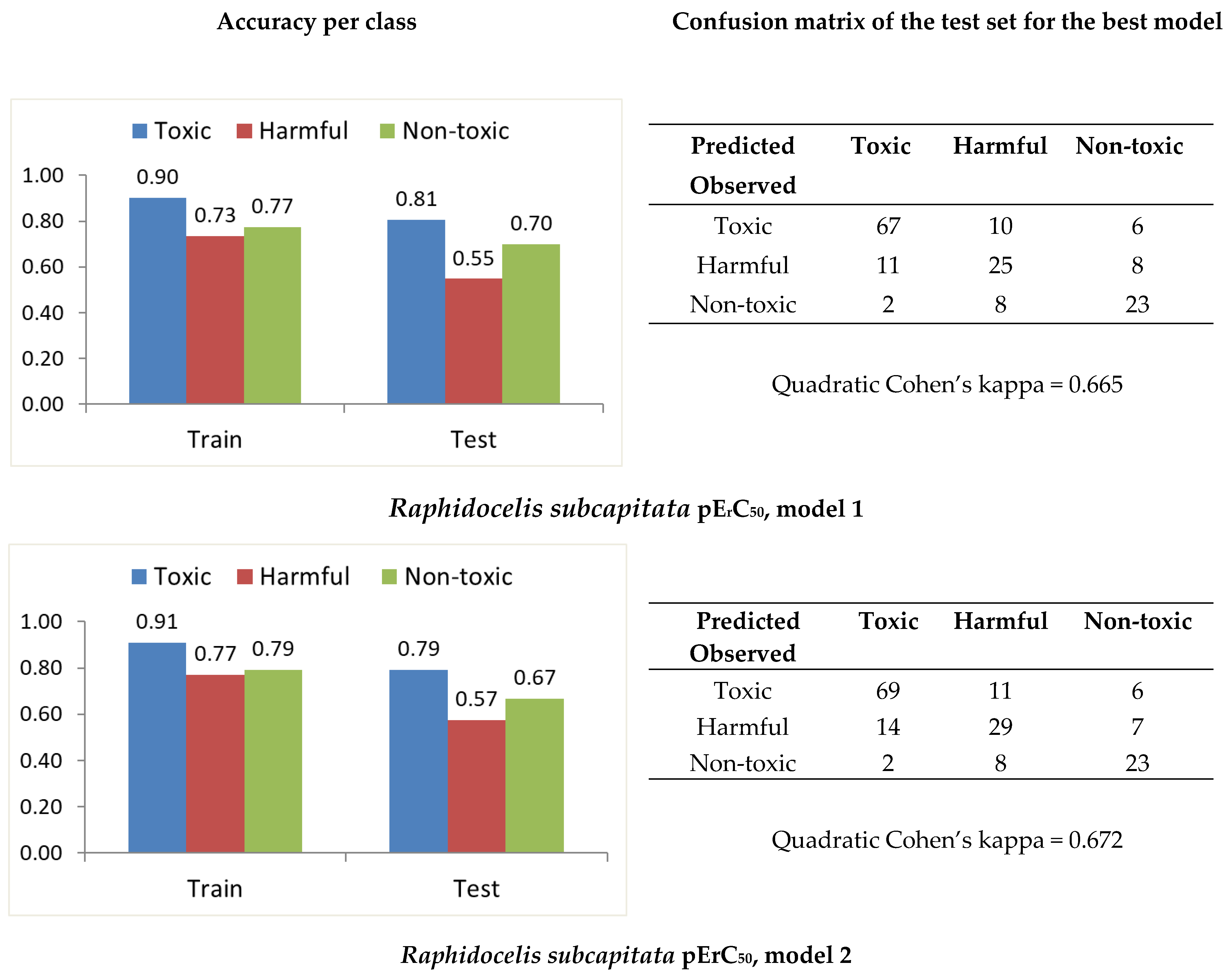
| 1 | Raphidocelis subcapitata pErC50 | CrippenLogP, maxaasC, minHBa, minHsOH, nHBAcc3, topoDiameter | 37.6 | 503 | 82.7 (82.3 ÷ 83.1) | 68.1 (67.4 ÷ 68.8) | 0.753 (0.743 ÷ 0.769 | 160 | 71.4 (70.0 ÷ 71.9) | 0.653 (0.637 ÷ 0.665) |
| 2 | Raphidocelis subcapitata pErC50 | CrippenLogP, maxsCH3, minHBa, minHsOH, RotBtFrac, topoDiameter | 37.9 | 517 | 84.5 (83.9 ÷ 85.1) | 67.9 (67.1 ÷ 68.7) | 0.772 (0.765 ÷ 0.777 | 169 | 70.3 (69.2 ÷ 71.6) | 0.649 (0.627 ÷ 0.672) |
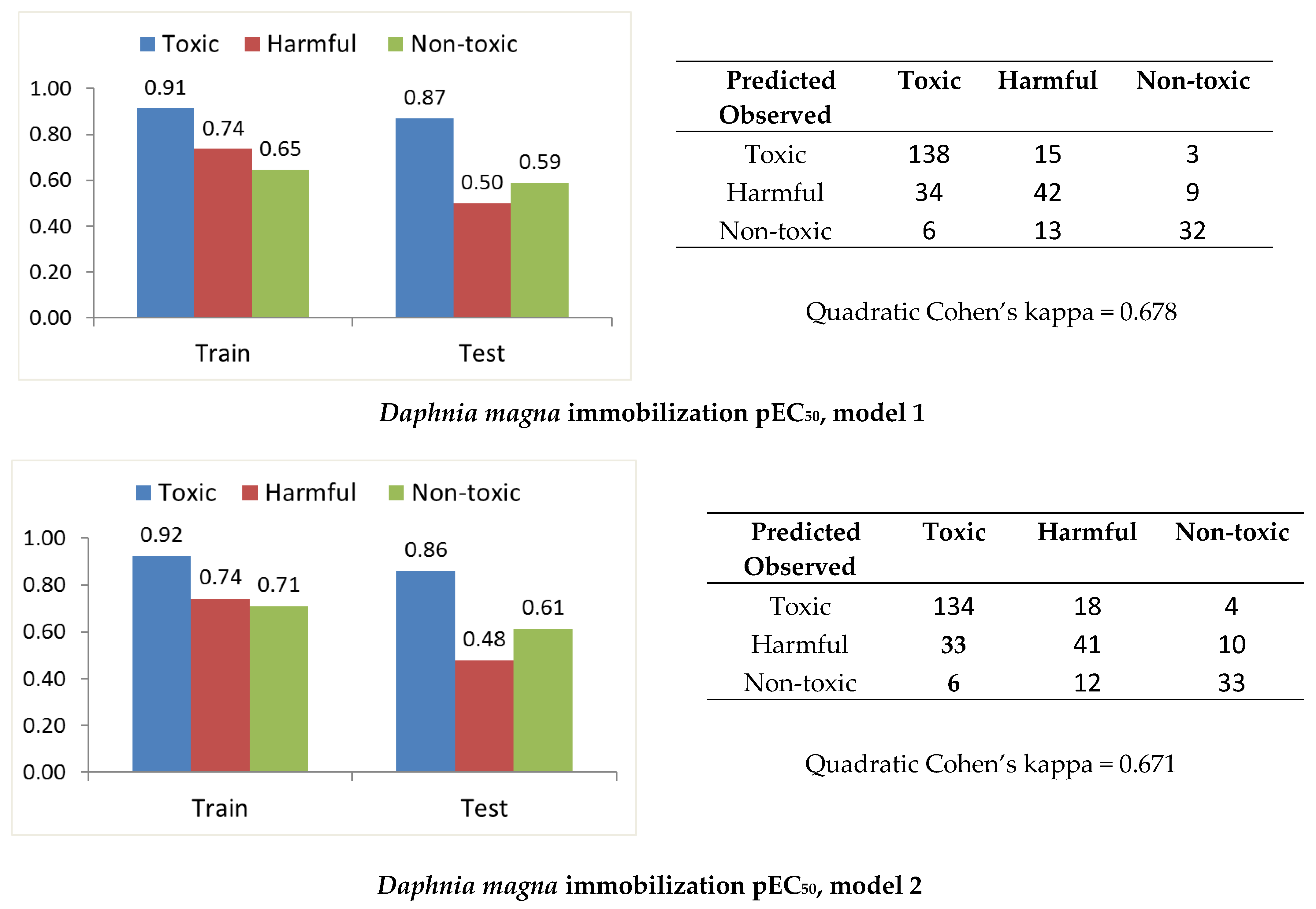
| 1 | Daphnia magna immobilization pEC50 | CrippenLogP, maxHBd, minHBa, minHsOH, minsCH3, nT6HRing | 45.1 | 875 | 81.5 (80.9 ÷ 82.5) | 67.9 (67.3 ÷ 68.7) | 0.745 (0.738 ÷ 0.757 | 292 | 71.3 (70.2 ÷ 72.6) | 0.662 (0.650 ÷ 0.678) |
| 2 | Daphnia magna immobilization pEC50 | CrippenLogP, gmin, maxHBd, minaasC, minHBa, minsCH3 | 43.9 | 874 | 83.3 (82.2 ÷ 84.2) | 68.0 (67.4 ÷ 68.4) | 0.771 (0.753 ÷ 0.782) | 291 | 70.6 (69.8 ÷ 71.5) | 0.658 (0.641 ÷ 0.671) |
| Model No. | Dependent Endpoint | Independent Endpoint Used in the Equation | Descriptors | Training Set | Test Set | ||||||||
|---|---|---|---|---|---|---|---|---|---|---|---|---|---|
| n | R2 | R2adj | SEE | Q2 | R2_oob | n | R2 | SEE | CCC | ||||
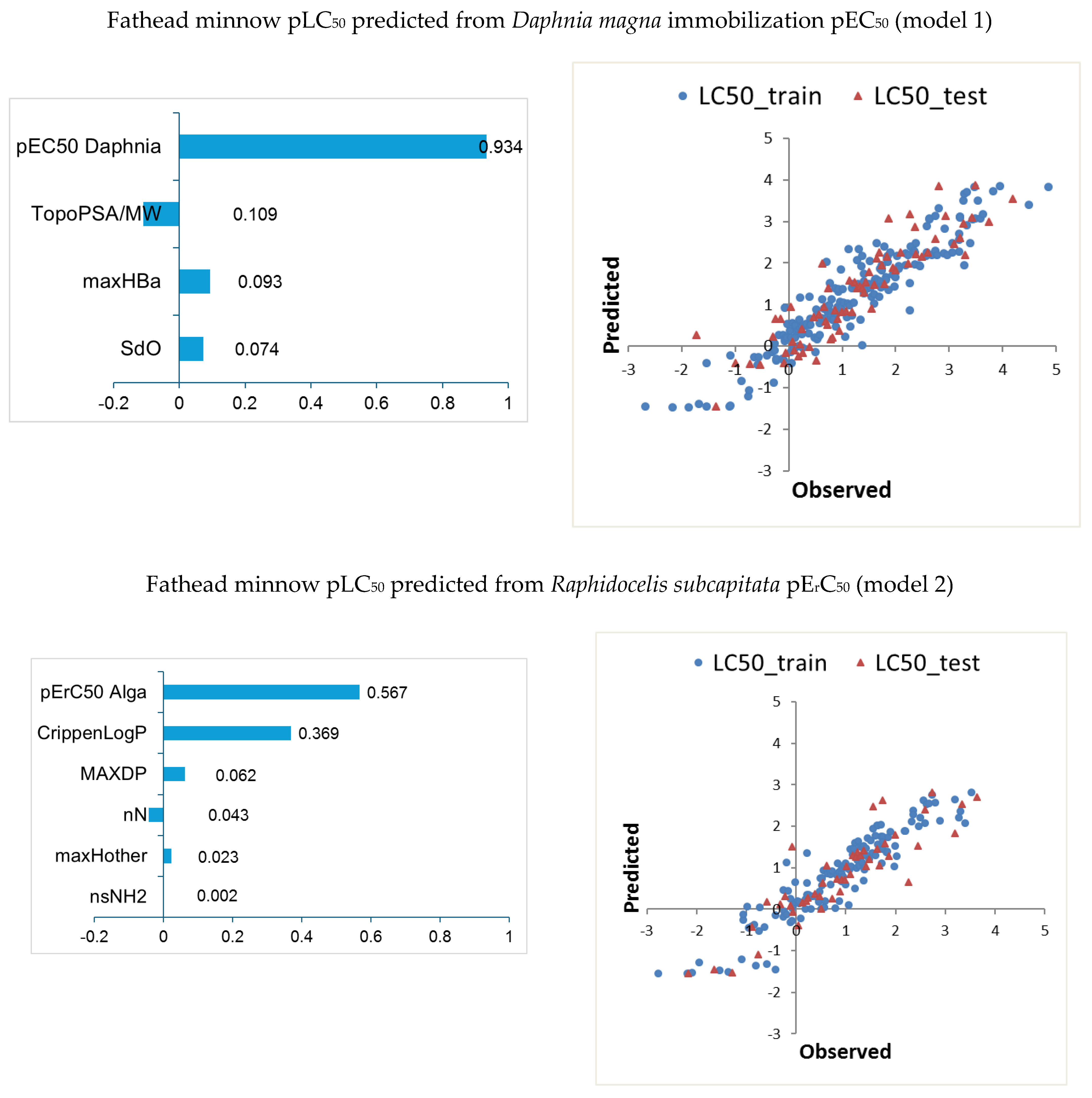
| 1 | fathead minnow pLC50 | Daphnia magna immobilization pEC50 | maxHBa, SdO, TopoPSA/MW | 203 | 0.875 (0.874 ÷ 0.876) | 0.874 (0.871 ÷ 0.879) | 0.478 (0.476 ÷ 0.480) | 0.773 (0.770 ÷ 0.774) | 0.772 (0.769 ÷ 0.777) | 71 | 0.813 (0.811 ÷ 0.814) | 0.597 (0.594 ÷ 0.600) | 0.898 (0.897 ÷ 0.899) |
| 2 | fathead minnow pLC50 | Raphidocelis subcapitata pErC50 | CrippenLogP, MAXDP, maxHot-her, nN, nsNH2 | 143 | 0.854 (0.851 ÷ 0.860) | 0.847 (0.845 ÷ 0.853) | 0.478 (0.467 ÷ 0.483) | 0.720 (0.716 ÷ 0.729) | 0.719 (0.712 ÷ 0.733) | 48 | 0.781 (0.774 ÷ 0.792) | 0.626 (0.611 ÷ 0.634) | 0.872 (0.867 ÷ 0.879) |
Disclaimer/Publisher’s Note: The statements, opinions and data contained in all publications are solely those of the individual author(s) and contributor(s) and not of MDPI and/or the editor(s). MDPI and/or the editor(s) disclaim responsibility for any injury to people or property resulting from any ideas, methods, instructions or products referred to in the content. |
© 2026 by the authors. Licensee MDPI, Basel, Switzerland. This article is an open access article distributed under the terms and conditions of the Creative Commons Attribution (CC BY) license.
Share and Cite
Lessigiarska, I.; Alov, P.; Angelova, M.; Ivanov, S.; Katerski, P.; Nikolova-Kejova, R.; Pajeva, I.; Pencheva, T.; Tsakovska, I. QSAR Modeling to Predict Aquatic Toxicity Across Multiple Species. Toxics 2026, 14, 498. https://doi.org/10.3390/toxics14060498
Lessigiarska I, Alov P, Angelova M, Ivanov S, Katerski P, Nikolova-Kejova R, Pajeva I, Pencheva T, Tsakovska I. QSAR Modeling to Predict Aquatic Toxicity Across Multiple Species. Toxics. 2026; 14(6):498. https://doi.org/10.3390/toxics14060498
Chicago/Turabian StyleLessigiarska, Iglika, Petko Alov, Maria Angelova, Stefan Ivanov, Parashkev Katerski, Radostina Nikolova-Kejova, Ilza Pajeva, Tania Pencheva, and Ivanka Tsakovska. 2026. "QSAR Modeling to Predict Aquatic Toxicity Across Multiple Species" Toxics 14, no. 6: 498. https://doi.org/10.3390/toxics14060498
APA StyleLessigiarska, I., Alov, P., Angelova, M., Ivanov, S., Katerski, P., Nikolova-Kejova, R., Pajeva, I., Pencheva, T., & Tsakovska, I. (2026). QSAR Modeling to Predict Aquatic Toxicity Across Multiple Species. Toxics, 14(6), 498. https://doi.org/10.3390/toxics14060498