Saltiness and Bitterness Perception of KCl-Based Mixed Salts (KCl/NaCl/L-Arginine) Evaluated by the R-Index and Partial Projective Mapping Methods

 , and
, and
Abstract
1. Introduction
2. Materials and Methods
2.1. Preparation of Mixed Salt Solutions
2.2. RIX Analysis with Ranked Data
2.3. Partial Projective Mapping (PPM) Evaluation
2.4. Statistical Analysis
3. Results and Discussion
3.1. Perception of Saltiness and Bitterness Using RIX
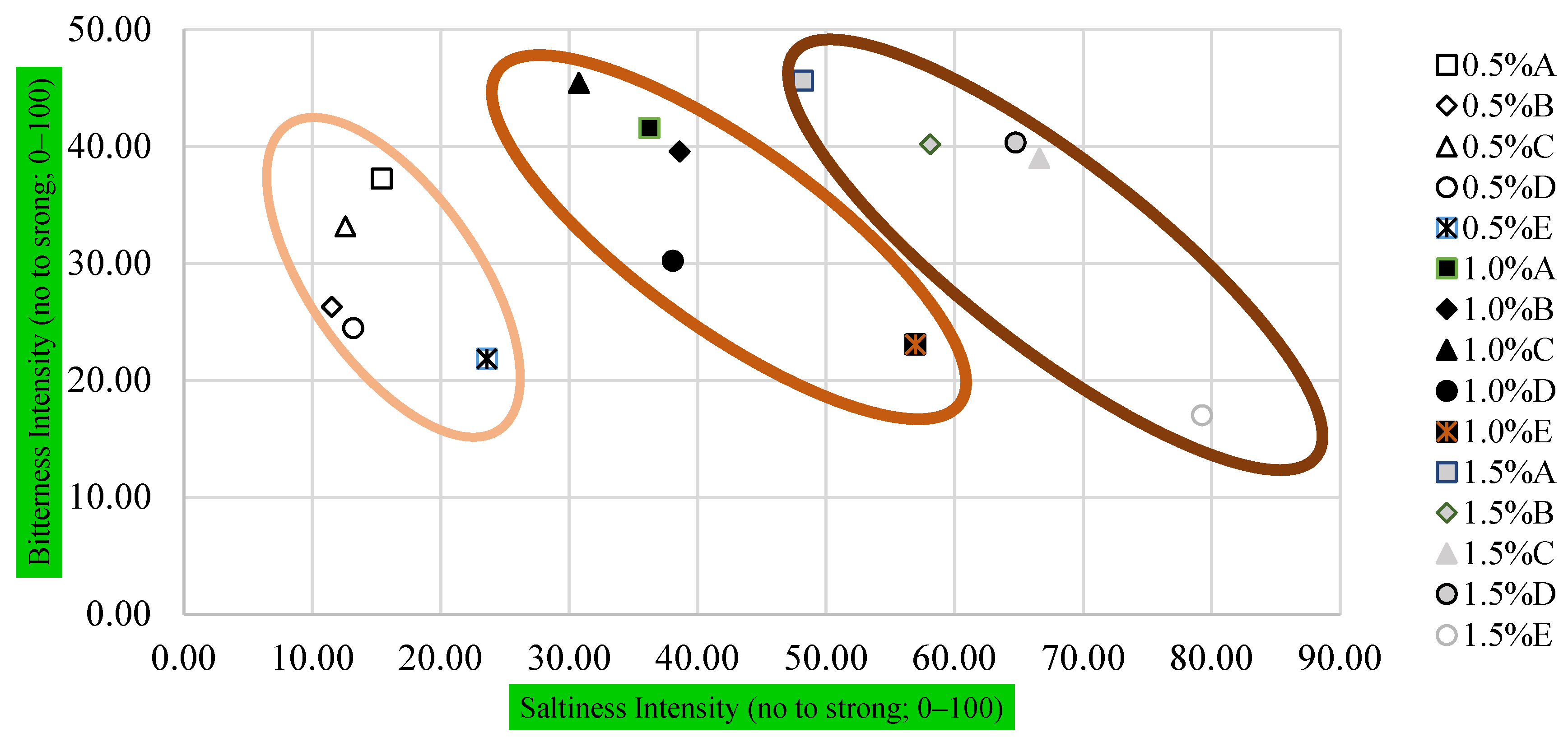
3.2. Perception of Saltiness and Bitterness Using PPM
3.3. Comparison of Practicality and the Results of RIX and PPM
4. Conclusions, Research Gaps and Future Studies
Author Contributions
Funding
Institutional Review Board Statement
Informed Consent Statement
Data Availability Statement
Acknowledgments
Conflicts of Interest
References
- Hunter, R.W.; Dhaun, N.; Bailey, M.A. The impact of excessive salt intake on human health. Nat. Rev. Nephrol. 2022, 18, 321–335. [Google Scholar] [CrossRef] [PubMed]
- Sriwattana, S.; Chokumnoyporn, N.; Prinyawiwatkul, W. Reduced-sodium Vienna sausage: Selected quality characteristics, optimized salt mixture, and commercial scale-up production. J. Food Sci. 2021, 86, 3939–3950. [Google Scholar] [CrossRef]
- Regan, Á.; Kent, M.P.; Raats, M.M.; McConnon, Á.; Wall, P.; Dubois, L. Applying a Consumer Behavior Lens to Salt Reduction Initiatives. Nutrients 2017, 9, 901. [Google Scholar] [CrossRef]
- Kissock, K.R.; Ghammachi, N.; Hoek, A.C.; Bullen, J.D.; Webster, J.; Pettigrew, S.; Garg, N.; Neal, B.; Trieu, K. Knowledge, attitudes, and behaviours related to reduced-sodium salt: A systematic review. J. Hum. Hypertens. 2025, 40, 1–9. [Google Scholar] [CrossRef]
- Chokumnoporn, N.; Sriwattana, S.; Phimolsiripol, Y.; Torrico, D.; Prinyawiwatkul, W. Soy sauce odour induces and enhances saltiness perception. Int. J. Food Sci. Technol. 2015, 50, 2215–2221. [Google Scholar] [CrossRef]
- Chokumnoyporn, N.; Sriwattana, S.; Prinyawiwatkul, W. Saltiness Enhancement of Oil Roasted Peanuts Induced by Foam-Mat Salt and Soy Sauce Odour. Int. J. Food Sci. Technol. 2016, 51, 978–985. [Google Scholar]
- Dunteman, A.N.; McKenzie, E.N.; Yang, Y.; Lee, Y.; Lee, S.Y. Compendium of sodium reduction strategies in foods: A scoping review. Compr. Rev. Food Sci. Food Saf. 2022, 21, 1300–1335. [Google Scholar] [CrossRef]
- Linscott, T.D.; Lim, J. Retronasal odor enhancement by salty and umami tastes. Food Qual. Prefer. 2016, 48, 1–10. [Google Scholar] [CrossRef]
- Pujols, K.D.; Ardoin, R.; Chaiya, B.; Tuuri, G.; Prinyawiwatkul, W. Low–sodium roasted peanuts: Effects of salt mixtures (NaCl, KCl and glycine) on consumer perception and purchase intent. Int. J. Food Sci. Technol. 2019, 54, 2754–2762. [Google Scholar] [CrossRef]
- Lorén, N.; Niimi, J.; Höglund, E.; Albin, R.; Rytter, E.; Bjerre, K.; Nielsen, T. Sodium reduction in foods: Challenges and strategies for technical solutions. J. Food Sci. 2023, 88, 885–900. [Google Scholar] [CrossRef] [PubMed]
- Sukkwai, S.; Kijroongrojana, K.; Chonpracha, P.; Pujols, K.D.; Alonso–Marenco, J.R.; Ardoin, R.; Prinyawiwatkul, W. Effects of colorant concentration and ‘natural colour’ or ‘sodium content’ claim on saltiness perception, consumer liking and emotion, and purchase intent of dipping sauces. Int. J. Food Sci. Technol. 2018, 53, 1246–1254. [Google Scholar] [CrossRef]
- Liang, W.; Cheng, L.; Corke, H.; Zhang, B.B.; Yang, Q. Salt reduction strategies with health benefits: An updated review focused on food colloids. Int. J. Food Sci. Nutr. 2025, 76, 477–494. [Google Scholar] [CrossRef]
- Nurmilah, S.; Cahyana, Y.; Utama, G.L.; Aït-Kaddour, A. Strategies to reduce salt content and its effect on food characteristics and acceptance: A review. Foods 2022, 11, 3120. [Google Scholar] [CrossRef]
- Wongthahan, P.; Sae-Eaw, A.; Prinyawiwatkul, W. Influence of Visual Color Cues on Saltiness Expectation, Sensory Liking, and Emotions: A Soy Sauce Model Study. Foods 2026, 15, 159. [Google Scholar] [CrossRef]
- Liem, D.G.; Miremadi, F.; Keast, R.S.J. Reducing sodium in foods: The effect on flavor. Nutrients 2011, 3, 694–711. [Google Scholar] [CrossRef] [PubMed]
- Tan, H.L.; Tan, T.C.; Easa, A.M. The use of salt substitutes to replace sodium chloride in food products: A review. Int. J. Food Sci. Technol. 2022, 57, 6997–7007. [Google Scholar] [CrossRef]
- Musiienko, D.; Jurkaninová, L.; Chrpová, D.; Kourimská, L. Impact of NaCl reduction and substitution with KCl and CaCl2 on quality attributes of wheat-based bakery products. Front. Nutr. 2025, 12, 1657034. [Google Scholar] [CrossRef]
- Stanley, R.E.; Bower, C.G.; Sullivan, G.A. Influence of sodium chloride reduction and replacement with potassium chloride based salts on the sensory and physico–chemical characteristics of pork sausage patties. Meat Sci. 2017, 133, 36–42. [Google Scholar] [CrossRef] [PubMed]
- Mudalal, S.; Farah, A.; Zaazaa, A.; Abu-Khalaf, N.; Al-Rimawi, F.; Rahhal, B.; Petracci, M. Effect of partial replacement of sodium chloride with potassium chloride on the quality traits of beef burgers during refrigerated storage. Future Food—J. Food Agric. Soc. 2026, 13, 78–88. [Google Scholar] [CrossRef]
- Lilic, S.; Brankovic, I.; Koricanac, V.; Vranic, D.; Spalevic, L.; Pavlovic, M.; Lakicevic, B. Reducing Sodium Chloride Content in Meat Burgers by Adding Potassium Chloride and Onion. Procedia Food Sci. 2015, 5, 164–167. [Google Scholar] [CrossRef]
- Roland, W.S.U.; Gouka, R.J.; Gruppen, H.; Driesse, M.; van Buren, L.; Smit, G.; Vincken, J.-P. 6–Methoxyflavanones as Bitter Taste Receptor Blockers for hTAS2R39. PLoS ONE 2014, 9, e94451. [Google Scholar]
- Khetra, Y.; Kanawjia, S.; Puri, R. Selection and Optimization of Salt Replacer, Flavour Enhancer and Bitter Blocker for Manufacturing Low Sodium Cheddar Cheese using Response Surface Methodology. LWT 2016, 72, 99–105. [Google Scholar] [CrossRef]
- Pydi, S.P.; Sobotkiewicz, T.; Billakanti, R.; Bhullar, R.P.; Loewen, M.C.; Chelikani, P. Amino Acid Derivatives as Bitter Taste Receptor (T2R) Blockers. J. Biol. Chem. 2014, 289, 25054–25066. [Google Scholar] [CrossRef]
- Ogawa, T.; Nakamura, T.; Tsuji, E.; Miyanaga, Y.; Nakagawa, H.; Hirabayashi, H.; Uchida, T. The combination effect of L-Arginine and NaCl on bitterness suppression of amino acid solutions. Chem. Pharm. Bull. 2004, 52, 172–177. [Google Scholar] [CrossRef] [PubMed]
- Burns, S.L.; Penfield, M.P.; Saxton, A.M.; Luckett, C.R. Comparison of triangle and tetrad discrimination methodology in an applied manner. Food Qual. Prefer. 2018, 68, 105–112. [Google Scholar]
- Van Hout, D.; Lee, H.S. Sureness Judgements and R-Index Calculations and Their Applications. In Discrimination Testing in Sensory Evaluation; Rogers, L., Hort, J., Kemp, S.E., Eds.; Hollowood, T. Wiley: Hoboken, NJ, USA, 2024; pp. 131–150. [Google Scholar]
- Lee, H.-S.; Van Hout, D. Quantification of Sensory and Food Quality: The R-Index Analysis. J. Food Sci. 2009, 74, R57–R64. [Google Scholar] [CrossRef] [PubMed]
- Moss, R.; McSweeney, M.B. Projective mapping as a versatile sensory profiling tool: A review of recent studies on different food products. J. Sens. Stud. 2022, 37, e12743. [Google Scholar] [CrossRef]
- Pfeiffer, J.C.; Gilbert, C.C. Napping by modality: A happy medium between analytical and holistic approaches. In Proceedings of the 9th Sensometrics Meeting, ON, Canada, 20–23 July 2008. [Google Scholar]
- Marcano, J.; Ares, G.; Fiszman, S. Comparison of partial and global projective mapping with consumers: A case study with satiating cheese pies. Food Res. Int. 2015, 67, 323–330. [Google Scholar] [CrossRef]
- Crouch, S.H.; Ware, L.J.; Norris, S.A.; Schutte, A.E. Comparing a range of potassium-enriched low sodium salt substitutes to common salt: Results of taste and visual tests in South African adults. Nutr. Metab. Cardiovas. Dis. 2024, 34, 903–910. [Google Scholar]
- World Health Organization. WHO Global Sodium Benchmarks for Different Food Categories, 2nd ed.; WHO: Geneva, Switzerland, 2024; Available online: https://resolvetosavelives.org/resources/who-global-sodium-benchmarks-for-different-food-categories/ (accessed on 19 April 2026).
- Waimaleongora-Ek, P. Sensory Characteristics of Salt Substitute Containing L-Arginine. Master’s Thesis, Louisiana State University and Agricultural & Mechanical College, Baton Rouge, LA, USA, 2006. [Google Scholar]
- Nestrud, M.A.; Lawless, H.T. Perceptual mapping of apples and cheese using projective mapping and sorting. J. Sens. Stud. 2010, 25, 390–405. [Google Scholar] [CrossRef]
- Bi, J.; O’Mahony, M. Table for testing the significance of the R-index. J. Sens. Stud. 2007, 22, 713–720. [Google Scholar] [CrossRef]
- Bi, J.; O’Mahony, M. R-index critical value. J. Sens. Stud. 2020, 35, e12591. [Google Scholar] [CrossRef]
- O’Mahony, M. Understanding discrimination tests: A user-friendly treatment of response bias, rating and ranking R-index tests and their relationship to signal detection. J. Sens. Stud. 1992, 7, 1–47. [Google Scholar] [CrossRef]
- Guyton, A.C.; Hall, J.E. Textbook of Medical Physiology, 11th ed.; Elsevier Saunders: Philadelphia, PA, USA, 2006. [Google Scholar]
- Antúnez, L.; Giménez, A.; Vidal, L.; Ares, G. Partial replacement of NaCl with KCl in bread: Effect on sensory characteristics and consumer perception. J. Sens. Stud. 2018, 33, e12441. [Google Scholar] [CrossRef]
- Feltrin, A.C.; de Souza, V.R.; Saraiva, C.G.; Nunes, C.A.; Pinheiro, A.C.M. Sensory study of different sodium chloride substitutes in aqueous solution. Int. J. Food Sci. Technol. 2015, 50, 730–735. [Google Scholar] [CrossRef]
- Veinand, B.; Godefroy, C.; Adam, C.; Delarue, J. Highlight of important product characteristics for consumers. Comparison of three sensory descriptive methods performed by consumers. Food Qual. Prefer. 2011, 22, 474–485. [Google Scholar] [CrossRef]
- Bi, J. Statistical analyses for R–index. J. Sens. Stud. 2006, 21, 584–600. [Google Scholar] [CrossRef]
- O’Mahony, M. Some assumptions and difficulties with common statistics the sensory analysis. Food Technol. 1982, 32, 75–82. [Google Scholar]
- Thurstone, L.L. Some new psychophysical methods. In Food Acceptance Testing Methodology; Peryam, D.R., Pilgrim, F.S., Peterson, M.S., Eds.; National Academy of Sciences–National Research Council: Washington, DC, USA, 1954; pp. 100–104. [Google Scholar]
- Bi, J. Sensory Discrimination Tests and Measurements: Sensometrics in Sensory Evaluation, 2nd ed.; Wiley-Blackwell: Hoboken, NJ, USA, 2015; p. 560. [Google Scholar]


| Sample | % KCl | % NaCl | % L-Arginine |
|---|---|---|---|
| A | 70 | 20 | 10 |
| B | 65 | 25 | 10 |
| C | 60 | 30 | 10 |
| D | 55 | 35 | 10 |
| E (control) | 0 | 100 | 0 |
| Sample | Individual Response | Total | ||||
|---|---|---|---|---|---|---|
| 1st (Most Intense) | 2nd | 3rd | 4th | 5th (Least Intense) | ||
| A | a | b | c | d | e | nA |
| … | … | … | … | … | … | … |
| D | … | … | … | … | … | nD |
| E | f | g | h | i | j | nE |
| Sample (KCl:NaCl:L-Arg) | Concentration (w/v) | Sample | |||
|---|---|---|---|---|---|
| B (65:25:10) | C (60:30:10) | D (55:35:10) | E (0:100:0) | ||
| A (70:20:10) | 0.5% | 0.424 | 0.384 | 0.350 * | 0.024 * |
| 1.0% | 0.409 | 0.327 * | 0.226 * | 0.029 * | |
| 1.5% | 0.417 | 0.302 * | 0.217 * | 0.051 * | |
| B (65:25:10) | 0.5% | 0.471 | 0.439 | 0.031 * | |
| 1.0% | 0.379 | 0.258 * | 0.038 * | ||
| 1.5% | 0.378 | 0.279 * | 0.043 * | ||
| C (60:30:10) | 0.5% | 0.454 | 0.042 * | ||
| 1.0% | 0.319 * | 0.046 * | |||
| 1.5% | 0.372 | 0.067 * | |||
| D (55:35:10) | 0.5% | 0.053 * | |||
| 1.0% | 0.079 * | ||||
| 1.5% | 0.065 * | ||||
| Sample (KCl:NaCl:L-Arg) | Concentration (w/v) | Sample | |||
|---|---|---|---|---|---|
| B (65:25:10) | C (60:30:10) | D (55:35:10) | E (0:100:0) | ||
| A (70:20:10) | 0.5% | 0.563 | 0.609 | 0.640 | 0.965 * |
| 1.0% | 0.524 | 0.686 * | 0.742 * | 0.938 * | |
| 1.5% | 0.505 | 0.669 * | 0.697 * | 0.939 * | |
| B (65:25:10) | 0.5% | 0.483 | 0.544 | 0.928 * | |
| 1.0% | 0.658 * | 0.726 * | 0.940 * | ||
| 1.5% | 0.641 | 0.669 * | 0.938 * | ||
| C (60:30:10) | 0.5% | 0.542 | 0.895 * | ||
| 1.0% | 0.603 | 0.917 * | |||
| 1.5% | 0.536 | 0.902 * | |||
| D (55:35:10) | 0.5% | 0.895 * | |||
| 1.0% | 0.921 * | ||||
| 1.5% | 0.896 * | ||||
| Taste | Sample | KCl:NaCl:L-Arg | Mean Rank † | ||
|---|---|---|---|---|---|
| 0.5% w/v | 1.0% w/v | 1.5% w/v | |||
| Saltiness | A | 70:20:10 | 3.82 c | 4.01 d | 4.01 d |
| B | 65:25:10 | 3.48 bc | 3.73 cd | 3.72 cd | |
| C | 60:30:10 | 3.36 bc | 3.34 c | 3.24 bc | |
| D | 55:35:10 | 3.19 b | 2.73 b | 2.81 b | |
| E | 0:100:0 | 1.15 a | 1.19 a | 1.23 a | |
| Bitterness | A | 70:20:10 | 2.19 a | 2.02 a | 2.23 a |
| B | 65:25:10 | 2.57 a | 2.22 a | 2.32 ab | |
| C | 60:30:10 | 2.69 a | 2.86 b | 2.73 bc | |
| D | 55:35:10 | 2.93 a | 3.19 b | 3.05 c | |
| E | 0:100:0 | 4.63 b | 4.72 c | 4.68 d | |
| Taste | Sample † | KCl:NaCl:L-Arg | Intensity Scores ‡ | ||
|---|---|---|---|---|---|
| 0.5% w/v | 1.0% w/v | 1.5% w/v | |||
| Saltiness | A | 70:20:10 | 15.38 a, B | 36.23 b, A | 48.19 c, A |
| B | 65:25:10 | 11.54 a, C | 38.60 b, B | 58.11 bc, A | |
| C | 60:30:10 | 12.60 a, C | 30.75 b, B | 66.61 ab, A | |
| D | 55:35:10 | 13.18 a, C | 38.07 b, B | 64.75 ab, A | |
| E | 0:100:0 | 23.60 a, C | 56.94 a, B | 79.27 a, A | |
| Bitterness | A | 70:20:10 | 37.27 a | 41.61 a | 45.67 a, ns |
| B | 65:25:10 | 26.32 a | 39.59 ab | 40.22 a, ns | |
| C | 60:30:10 | 33.19 a | 45.48 a | 39.03 a, ns | |
| D | 55:35:10 | 24.49 a | 30.27 ab | 40.36 a, ns | |
| E | 0:100:0 | 21.87 a | 23.13 b | 17.05 b, ns | |
| Salt Concentration † | Saltiness Perception | Bitterness Perception | ||
|---|---|---|---|---|
| RIX | PPM | RIX | PPM | |
| 0.5% w/v | 5 | 0 | 4 | 0 |
| 1.0% w/v | 8 | 4 | 8 | 2 |
| 1.5% w/v | 7 | 3 | 7 | 4 |
| Total | 20 | 7 | 19 | 6 |
Disclaimer/Publisher’s Note: The statements, opinions and data contained in all publications are solely those of the individual author(s) and contributor(s) and not of MDPI and/or the editor(s). MDPI and/or the editor(s) disclaim responsibility for any injury to people or property resulting from any ideas, methods, instructions or products referred to in the content. |
© 2026 by the authors. Licensee MDPI, Basel, Switzerland. This article is an open access article distributed under the terms and conditions of the Creative Commons Attribution (CC BY) license.
Share and Cite
Chaiya, B.; Chonpracha, P.; Waimaleongora-ek, P.; Sriwattana, S.; Prinyawiwatkul, W. Saltiness and Bitterness Perception of KCl-Based Mixed Salts (KCl/NaCl/L-Arginine) Evaluated by the R-Index and Partial Projective Mapping Methods. Foods 2026, 15, 1605. https://doi.org/10.3390/foods15091605
Chaiya B, Chonpracha P, Waimaleongora-ek P, Sriwattana S, Prinyawiwatkul W. Saltiness and Bitterness Perception of KCl-Based Mixed Salts (KCl/NaCl/L-Arginine) Evaluated by the R-Index and Partial Projective Mapping Methods. Foods. 2026; 15(9):1605. https://doi.org/10.3390/foods15091605
Chicago/Turabian StyleChaiya, Busarawan, Pitchayapat Chonpracha, Pamarin Waimaleongora-ek, Sujinda Sriwattana, and Witoon Prinyawiwatkul. 2026. "Saltiness and Bitterness Perception of KCl-Based Mixed Salts (KCl/NaCl/L-Arginine) Evaluated by the R-Index and Partial Projective Mapping Methods" Foods 15, no. 9: 1605. https://doi.org/10.3390/foods15091605
APA StyleChaiya, B., Chonpracha, P., Waimaleongora-ek, P., Sriwattana, S., & Prinyawiwatkul, W. (2026). Saltiness and Bitterness Perception of KCl-Based Mixed Salts (KCl/NaCl/L-Arginine) Evaluated by the R-Index and Partial Projective Mapping Methods. Foods, 15(9), 1605. https://doi.org/10.3390/foods15091605