Article

Rapid Determination of Several Biogenic Amines in Cold-Chain Fish Samples by Portable Ion Trap Mass Spectrometry with Nano-Electrospray Ionization

Beijing Key Laboratory of Agricultural Product Detection and Control for Spoilage Organisms and Pesticides, College of Food Science and Engineering, Beijing University of Agriculture, Beijing 102206, China
*
Author to whom correspondence should be addressed.
Foods 2026, 15(10), 1802; https://doi.org/10.3390/foods15101802
Submission received: 23 March 2026 / Revised: 12 May 2026 / Accepted: 13 May 2026 / Published: 19 May 2026
(This article belongs to the Special Issue Sensory Detection and Analysis in Food Industry)

Abstract

A novel method was developed for the rapid determination of five biogenic amines (BAs)—histamine (HIS), tyramine (TYR), cadaverine (CAD), spermidine (SPD), and spermine (SPM) in cold-chain fish by portable ion trap mass spectrometry with nano-electrospray(nESI) ionization. Samples were homogenized and extracted with aqueous solution containing 1% (v/v) formic acid and 80% (v/v) acetonitrile. With HIS-d4 as an internal standard, the sample solutions were directly injected with the nESI injection device and detected by a portable ion trap mass spectrometer at MS/MS detection mode. The results showed good linearity in the invested range of 0.2 (or 0.5)–10 μg mL−1 with R2 > 0.992, The limit of detection (LODs) and limits of quantification (LOQs) for HIS were less than 1.5 mg/kg and 4.0 mg/kg, respectively; the LOD and LOQ for other four BAs were less than 4.0 mg/kg and 12.5 mg/kg, respectively. Recoveries at three fortified levels ranged from 84.26% to 106.6% with relative standard deviations between 4.56% and 13.84%. With the safety limits of HIS as the concentrations of concern, this method demonstrated excellent performance when applied to the eligibility fast screening of HIS in cold-chain fish. The study provided a valuable methodological reference for the rapid detection of BAs in food.

1. Introduction

Biogenic amine (BA) is a class of basic nitrogenous compounds of low molecular mass in foods produced mainly by decarboxylation of free amino acids or aldoketo amination reactions [1,2]. Low levels of BAs in the body have important physiological functions such as growth regulation, neurotransmission, and inflammatory mediators [3,4], but consumption of foods with high levels of BA can lead to toxic reactions such as respiratory distress, elevated blood pressure, vomiting, and headache [5,6]. In addition, BA in foods can react with nitrites to convert them into carcinogenic nitrosamines [7,8]. Usually, fresh aquatic products contain low levels of BAs, but due to improper storage and transportation, these protein- and amino acid-rich aquatic products are prone to producing large amounts of BAs [9,10], which affects the quality of the products. As a result, BA has also become one of the key indicators for assessing food safety and freshness in many countries. There is no uniform international limit standard for BA in food, and the existing regulatory limits mainly focus on fish and their products, and the BAs involved are mainly histamine (HIS) and tyramine (TYR), which have the most toxic effects [11,12]. For example, the U.S. Food and Drug Administration (FDA) stipulates a limit level of 50 mg/kg for HIS and no more than 100 mg/kg for TYR, while in China, only a limit for HIS in aquatic products has been set, which stipulates a limit level of 400 mg/kg in high-histamine fishes, such as mackerel, tuna and skipjack tuna, and 200 mg/kg in other seawater fishes.
Currently, the analytical methods reported for BAs mainly include high-performance liquid chromatography (HPLC) using different kinds of detectors [13,14], gas chromatography-mass spectrometry (GC-MS) [15], high-performance liquid chromatography-tandem mass spectrometry (HPLC-MS/MS) or ultra performance liquid chromatography-tandem mass spectrometry (UPLC-MS/MS) [16,17], capillary electrophoresis (CE) [18] and ion mobility spectrometry[IMS] [19]. Among them, CE and IMS are less used in routine food analysis; HPLC and GC-MS both require pre-column or post-column derivatization, which is inconvenient; the advantages of HPLC-MS/MS or UPLC-MS/MS in solving the tasks of qualitative and quantitative analysis of micro- and trace multicomponent targets in complex matrices are very prominent, in terms of BAs, derivatization-free detection could be achieved, so it has been more widely used in the detection of BAs in food, but there are problems such as relying on large-scale equipment, high detection cost and inability to realize on-site detection.
Ambient ionization mass spectrometry (MS) is a rapidly developing ionization technique from the 2000s, which can complete the analysis of samples without or only with simple sample pretreatment and has the advantages of fast analysis speed, simplicity and high efficiency [20,21,22]. A large number of ambient ionization techniques have been reported and applied in the field of food and drugs to date [23,24]. In recent years, with the rapid development of mass spectrometry technology, the combination of ambient ionization technology and portable mass spectrometry has realized the miniaturization of the instrument, while still retaining the advantages of qualitative and reliable mass spectrometry, and also enabling rapid detection. The paper capillary spray (PCS) [25,26,27] and nanoelectrospray (nESI) technique [28] are two of the better-developed ambient ionization techniques used in portable mass spectrometers. The PCS technology combines a metal capillary with a paper substrate by loading solid or liquid samples onto the surface of the paper substrate, eluting them with a suitable solvent, and entering the capillary for electrospraying them, which improves spraying stability and sensitivity compared to paper spraying technology. The nESI technique loads a liquid sample into a glass capillary (lined with a metal wire) for electrospraying; Compared with PCS, nESI provides higher sensitivity, better reproducibility and larger sample loading capacity, which is more conducive to quantitative analysis. Both techniques are characterized by easy operation, high detection efficiency, and on-site real-time determination in conjunction with portable mass spectrometry, but few studies have been reported on analyzing BAs in cold-chain fish products. Therefore, it is of great value to apply this technique to the quality evaluation and monitoring of cold chain fish products.
In this study, it is proposed to nESI ionization combined with a small portable ion trap mass spectrometer to establish and validate a novel method for the rapid detection of five types of BAs, namely, HIS, TYR, cadaverine (CAD), spermine (SPM) and spermidine (SPD), in cold-chained fish products, which could provide a valuable technology reference for the rapid screening and on-site detection of BAs content in cold-chained fish products.

2. Materials and Methods

2.1. Chemicals and Reagents

The standards of HIS, CAD, TYR, SPM and SPD were purchased from Sigma Aldrich Shanghai Co. (Shanghai, China). Histamine-d4 (HIS-d4) was purchased from Tianjin Alta Technology Co. (Tianjin, China). HPLC-grade acetonitrile, methanol, formic acid and n-hexane were purchased from Beijing Myriad Technology Co. (Beijing, China).

2.2. Standard Solution Preparation

Stock solutions of each BA at 1.0 mg mL−1 and HIS-d4 at 0.1 mg mL−1 were prepared in methanol and were stored frozen between −12 °C and −18 °C. Intermediate standard solutions of the mixture of five BAs at 100 μg mL−1 and the HIS-d4 internal standard working solution at 10 μg mL−1 were prepared by diluting the stock solutions with methanol, respectively. The calibration standard solutions of the mixture of the five analytes (0.2, 0.5, 1, 2, 5 and 10 μg mL−1) were prepared by diluting the intermediate standard solutions with an aqueous solution containing 1% (v/v) formic acid and 80% (v/v) acetonitrile.

2.3. Sample Preparation

About 200 g of the edible portion of the was taken from each fish sample after de-boning and was fully crushed in a sample pulverizer (Midea MJ-WBL2531H, Guangdong Midea Living Electrical Appliances Manufacturing Co., Ltd., Foshan, China). The sample extraction was performed following the method described by WU et al. [29] with appropriate modifications and briefly summarized as follows: 2.0 g (accurate to 0.0001 g) of the sample was crushed and weighed into a 50 mL centrifuge tube, and 10 mL of aqueous solution containing 1% (v/v) formic acid and 80% (v/v) acetonitrile was added. Then, the sample in the tube was homogenized using a homogenizer (FSH-2 Adjustable High-speed Homogenizer, Changzhou Guohua Electric Co., Ltd., Changzhou, China) at a speed between 9500 and 10,500 r/min for 30 s. After that, the tube was put into the centrifuge (Eppendorf Centrifuge 5180 R, Eppendorf AG, 2231 Hamburg, Germany) and centrifuged at 8000 rpm for 5 min. The supernatant was transferred to a 25 mL volumetric flask. The blade head of the homogenizer was rinsed for 30 s at same rotational speed with another 50 mL centrifuge tube containing 10 mL of the aqueous solution containing 1% (v/v) formic acid and 80% (v/v) acetonitrile, and the rinsate was then poured into the original tube containing the sample residue for a second extraction by vortexing the mixture for 30 s and centrifuging again at 8000 rpm for 5 min; the supernatant from the second extraction was also combined into the same volumetric flask and was diluted to the volume with the aqueous solution containing 1% (v/v) formic acid and 80% (v/v) acetonitrile. Then, 2 mL of the sample extraction solution was transferred into a 10 mL centrifuge tube, and 3 mL of n-hexane was added. The tube was vortexed for 30 s, then left to stand until fully stratified, and the upper layer of n-hexane solution was discarded. The lower layer sample extraction solution was filtered through a 0.22 µm syringe filter and collected into a 2 mL vial, ready for analysis.

2.4. Portable Ion Trap Mass Spectrometry Analysis

2.4.1. Instrumentation and Analysis Conditions

The rapid determination was carried out using a CELL portable ion trap mass spectrometry system on the MS/MS detection mode with PMS Client Pro analytical software and the simple, small nESI injection device containing an injection base and a nano-spray needle (Beijing Qingpu Analytical Instrument Co., Ltd., Beijing, China). The analytical parameters of each analyte are shown in Table 1.

2.4.2. Operating Procedures

A volume of 100 μL of the final sample extraction solution and 20 μL of internal standard working solution were accurately pipetted into a 2 mL centrifugal tube and mixed by vortexing, then not less than 20 μL of the mixing sample solution was pipetted into the nano-spray needle of the nESI injection device. Next, the nESI injection device was inserted into the injection port of the small mass spectrometer and MS detection was performed. For the series of mixture calibration standard solutions, the detection was carried out with the same procedures.

2.5. Method Validation

2.5.1. Linearity, Limit of Detection (LOD), Limit of Quantification (LOQ), Accuracy and Precision

Linearity was evaluated by injection of the calibration standard solutions and least-square regression between the concentration ratios of analytes to the internal standard HIS-d4 and the ratios of their response. The LOD and LOQ were estimated based on the quantitative results of the actual samples or the samples fortified with analyte at the low level, with a signal-to-noise ratio of ≥3 and ≥10 as criteria, respectively. The accuracy and precision were evaluated through analyzing the samples fortified with each analyte at three concentrations (near LOQ, medium, and high) and calculating the recoveries and relative standard deviations (RSDs).

2.5.2. Threshold and Positive Detection Rate

Threshold is the value that determines whether the detection result exceeds the concentration of concern when a quantitative analytical method is used for the purpose of an eligibility screen. It was calculated according to the determining results of multiple replicate samples spiked with the analyte at the same level of concentration of concern. The calculation equation was as Formula (1).
T h r e s h o l d = x ¯ t α ( f ) · S n
where x ¯ is the average result of the multiple independent determinations; t α ( f ) is the value of the t-distribution when the significance level is α (here, α = 0.05) and the degree of freedom is f (here, f = n − 1); S and n are the standard deviation and number of independent repeated determinations, respectively.
For a concentration of concern, if the determining result of the analyte was above the threshold, the sample was recorded as a positive sample for the analyte, and if that was below the threshold, the sample was recorded as a negative sample for the analyte. Series gradient spiked samples with analyte concentrations close to (below, above, and equal to) the concentration of concern were prepared with 20 replicate samples for each gradient level. The analyte was determined in those samples, and positive detection rates were calculated at each fortified level. The positive detection rate, calculated according to Formula (2).
p o s i t i v e   d e t e c t i o n   r a t e   =   n N × 100 %
where n is the number of positive samples at a level; N is the total number of samples at the level.
The concentration level at which the positive detection rate is at least 95% is defined as the minimum reliable detection level for positive samples; the concentration level at which the positive detection rate is at most 5% is defined as the maximum reliable detection level for negative samples.

3. Results and Discussion

3.1. Mass Spectrometry Detection

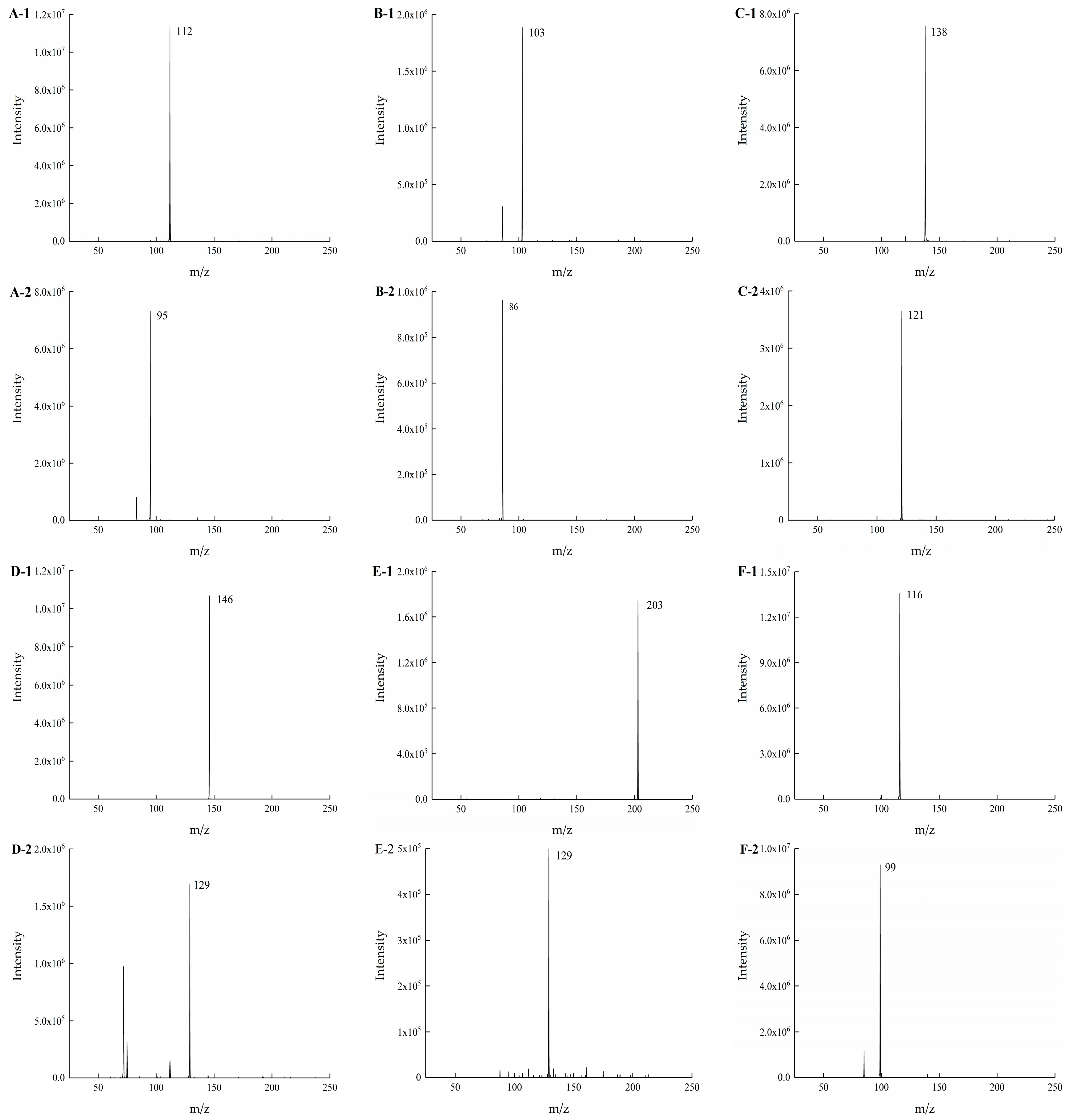
Firstly, single standard solutions of each analyte at an injection concentration of 10 μg/mL were injected for analysis. The [M + H]+ ions of each target compound were selected as precursor ions for full-scan MS acquisition with a collision energy of 0 eV. Taking the maximum response intensity as the evaluation index, the ionization voltage and injection time were optimized to determine their optimal values. Subsequently, MS/MS scanning was performed at different collision energies to screen the optimal fragment ions and their corresponding collision energies. The optimized mass spectrometry parameters are summarized in Table 1. The mass spectra of the five target BAs and the internal standard HIS-d4 under the optimized conditions are shown in Figure 1. The sample solvent is another factor that affects the performance. Although multi-stage ion trap mass spectrometry can provide better selectivity, the detection sensitivity decreases accordingly. For the BAs compounds with small molecular masses ranging from 103 to 203 Daltons, here, the experiments showed that MS/MS detection not only ensured good selectivity but also maintained high sensitivity. Therefore, MS/MS detection was used.
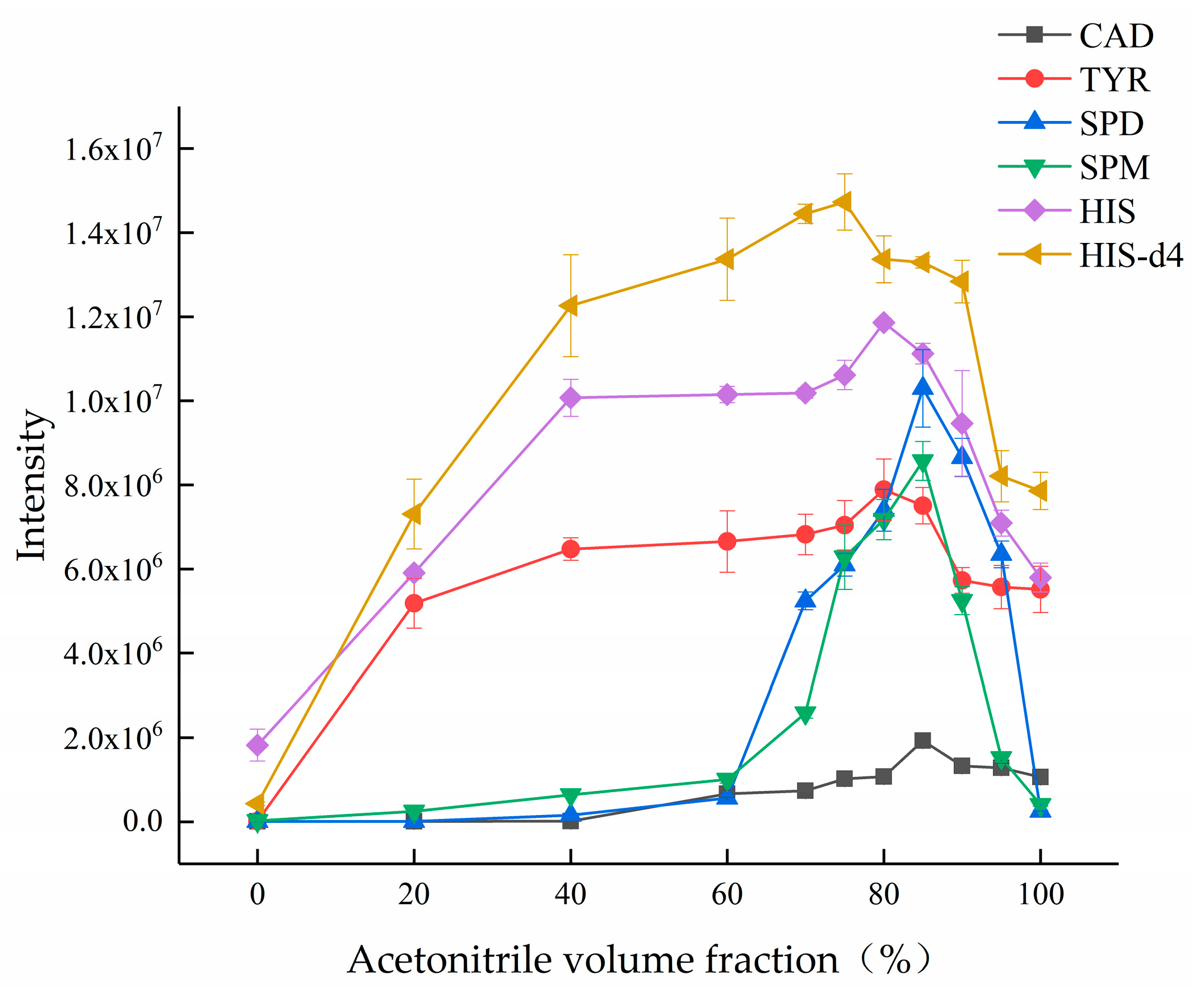
Sample solvent is another factor that affects the sensitivity of mass spectrometry detection. To better align the MS detection with the sample pretreatment process, in addition to adding 1% (v/v) formic acid to the solvent [29], the experiment further investigated the effect of different acetonitrile-water ratios. The results showed that when the acetonitrile ratio was between 70% (v/v) and 90% (v/v), the ion signals of the target compounds were relatively stronger; outside this range, the signal decreased significantly (see Figure 2). This is primarily because acetonitrile, as an aprotic solvent, is not conducive to the ionization of target compounds when its ratio is too high. Conversely, when the ratio is too low, the volatility of the solvent decreases, leading to poor nebulization efficiency. Therefore, the acetonitrile ratio in the final sample solution was controlled within this range. In this study, the aqueous solution containing 1% (v/v) formic acid and 80% (v/v) acetonitrile was used as both extraction solvent and diluent, and its combination with hexane in a partitioning step effectively removes proteins and fatty materials, meeting the requirements for detection by mass spectrometry.

3.2. Method Validation

Under the optimized mass spectrometry conditions and sample pretreatment methods, the LOD and LOQ for the five BAs are presented in Table 2. Among these, HIS exhibited the lowest LOD and LOQ, reaching 1.5 mg kg−1 and 4.0 mg kg−1, respectively, which are significantly below the allowable lowest limits of 50 mg kg−1 (FDA) for HIS in aquatic products. This satisfies the requirements for HIS eligibility fast screening and quantification analysis for quality evaluation using BAs as markers.
The linearity of the method was further investigated across concentrations ranging from 0.2 or 0.5 μg mL−1 (equivalent to LOQ in samples) to a maximum of 10 μg mL−1 for each analyte. The results demonstrated good linearity, with R2 values ranging from 0.9923 to 0.9961 (See also Table 2).
The accuracy and precision were further evaluated via a spike recovery experiment with three fortified levels and six replicates at each level. Because the background contents of SPD and SPM in the samples are relatively high and mostly above the LOQ, it is difficult to prepare spiked samples near the LOQ level; So, the lowest fortification level of SPD and SPM was set at 50 mg/kg in the experiment. The results are shown in Table 3. The recoveries ranged from 84.26% to 106.6%, with relative standard deviations (RSDs), the intra-day repeatability, between 4.56% and 13.84%, indicating that the method exhibits good accuracy and precision. Since BAs are stable, the instrument was recalibrated before each batch of sample analysis, and in addition, the stable isotope-labeled BA (HIS-d4) was adopted as the internal standard for overcoming matrix effects and operational errors. Accordingly, the evaluation of precision using only intra-day replicates is sufficient for method validation, and inter-day precision was therefore not conducted in this study.
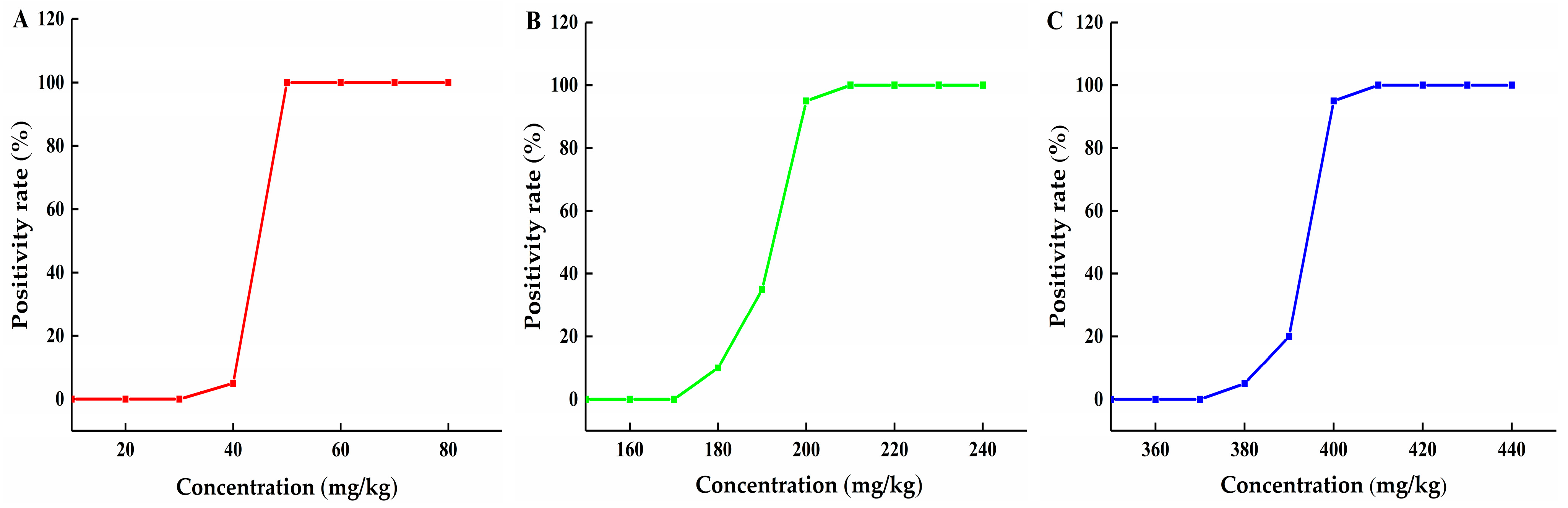
Regarding fish products, HIS is currently the only BA with established safety limits; however, these limits vary across countries. The U.S. FDA sets a limit of 50 mg kg−1, while China differentiates between low-histamine and high-histamine fish, with limits of 200 mg kg−1 and 400 mg kg−1, respectively. Therefore, the primary application of this method is rapid eligibility screening for histamine. For evaluating the performance of this eligibility screening method, three decision thresholds were calculated with the typical three safety limit concentrations of HIS mentioned above as the concentrations of concern, and the threshold values calculated were 49.35, 195.8, and 396.9 mg kg−1, respectively. With threshold values, the positive detection rate curves were constructed, and the minimum reliable detection concentration for positive samples (with a detection rate ≥95%) and the maximum reliable detection concentration for negative samples (with a positive detection rate ≤ 5%) were determined. The results, as shown in Figure 3, indicate that unreliable determinations are confined to a narrow concentration range from the maximum reliable detection concentration for negative samples to the minimum reliable detection concentration for positive samples, which were 40–50 mg kg−1, 180–200 mg kg−1 and 380–400 mg kg−1, respectively; the results demonstrated that this method is well-suited for the eligibility fast screening needs.

3.3. Practical Applications

With the method developed, BAs were detected in nine actual commercially available cold-chain fish products, and the detection results were re-verified using HPLC-MS/MS [29], as shown in Table 4. The results indicated that all nine samples tested negative (with a concern concentration of 50 mg/kg) for histamine, and the correctness of the determination results could be confirmed by HPLC-MS/MS. Only a few samples showed SPD and SPM levels exceeding the method’s LOQ, and these results were not significantly different from those obtained by the HPLC-MS/MS method (p ≥ 0.05). All the above indicate that the established method is feasible.

4. Conclusions

This study established a novel method for the rapid detection of five BAs, including HIS, TYR, CAD, SPD, and SPM, in cold-chain fish products with portable ion trap mass spectrometry with nano-electrospray ionization. The developed method features simple sample preparation, requires no derivatization or chromatographic separation, low cost and offers easy operation and rapid analysis with satisfactory accuracy and precision; It meets the requirements for BA safety detection and quality evaluation using BAs as markers in the cold-chain fish products. For HIS, which has safety limits in fish, the method could be successfully applied for the eligibility fast screening. The study provided a valuable methodological reference for the rapid detection of BAs in food.

Author Contributions

Conceptualization, Z.W.; methodology, Z.W., J.W. and X.M.; validation, J.W., X.M., Y.L., J.M. and W.M.; data curation, J.W. and X.M.; writing—original draft preparation, J.W.; writing—review and editing, Z.W.; supervision, Y.W.; project administration, Z.W.; funding acquisition, Z.W. All authors have read and agreed to the published version of the manuscript.

Funding

This work was supported by the Science and Technology Deputy General Manager Program of Changping District of Beijing [grant numbers: 2064115223], Capital Science and Technology Innovation Voucher Program [grant numbers: 2064115284], and Key Educational Reform Project of Beijing University of Agriculture [grant numbers: 5046516650/204].

Institutional Review Board Statement

Not applicable.

Informed Consent Statement

Not applicable.

Data Availability Statement

The data that support the findings of this study are available from the corresponding author upon request.

Acknowledgments

We gratefully acknowledge Miao Yu and Hongfen Zuo for the technical support and instrument operation training from Beijing Qingpu Analytical Instrument Co., Ltd.

Conflicts of Interest

The authors declare no conflicts of interest.

References

  1. Dabadé, D.S.; Jacxsens, L.; Miclotte, L.; Abatihet, E.; Devlieghere, F.; Bruno De Meulenaer, B. Survey of multiple biogenic amines and correlation to microbiological quality and free amino acids in foods. Food Control 2021, 120, 107497. [Google Scholar] [CrossRef]
  2. Wang, Y.; Yan, B.; Xu, H.; Huang, Y.; Sheng, Q.; Wang, L.-H. Biogenic amines in fermented foods: A comprehensive review from formation pathways, risk analysis, detection technologies to control measures. Food Res. Int. 2026, 223, 117832. [Google Scholar] [CrossRef]
  3. Rane, R.S.; Prashant Anil Pawase, P.A.; Shams, R.; Darshan, G.; Bashir, O.; Roy, S. A critical review on biogenic amines in dairy: Formation pathways, toxicity, and regulatory standards. J. Food Compos. Anal. 2025, 142, 107496. [Google Scholar] [CrossRef]
  4. Ahmad, W.; Mohammed, G.I.; Al-Eryani, D.A.; Saigl, Z.M.; Alyoubi, A.O.; Alwael, H.; Bashammakh, A.S.; O’Sullivan, C.K.; El-Shahawi, M.S. Biogenic amines formation mechanism and determination strategies: Future challenges and limitations. Crit. Rev. Anal. Chem. 2020, 50, 485–500. [Google Scholar] [CrossRef] [PubMed]
  5. Feddern, V.; Mazzuco, H.; Fonseca, F.N.; de Lima, G.J.M.M. A review on biogenic amines in food and feed: Toxicological aspects, impact on health and control measures. Anim. Prod. Sci. 2019, 59, 608–618. [Google Scholar] [CrossRef]
  6. Wójcik, W.; Łukasiewicz, M.; Puppel, K. Biogenic amines—Formation, action and toxicity-review. J. Sci. Food Agric. 2020, 101, 2634–2640. [Google Scholar] [CrossRef]
  7. Zhou, Q.; Jiang, L.; Zhu, J.; Lu, Y.; He, Q. The metabolic regulation mechanism of gallic acid on biogenic amines and nitrosamines in reduced-nitrite Chinese fermented sausages: A perspective of metabolomics and metagenomics. Food Chem. 2024, 456, 139900. [Google Scholar] [CrossRef] [PubMed]
  8. Chen, C.; Wang, Z.; Wu, J.; He, S.; Wang, Y.; Dong, Z.; Ma, X. Analytical Method Development and Accumulation Factors Analysis for Volatile Nitrosamines in Cured Fish with Gas Chromatography-Tandem Mass Spectrometry. Food Sci. Technol. 2025, 50, 303–311, (In Chinese with English Abstract). [Google Scholar] [CrossRef]
  9. Visciano, P.; Schirone, M.; Paparella, A. An Overview of Histamine and Other Biogenic Amines in Fish and Fish Products. Foods 2020, 9, 1795. [Google Scholar] [CrossRef]
  10. Ding, T.; Li, Y. Biogenic amines are important indices for characterizing the freshness and hygienic quality of aquatic products: A review. LWT 2024, 194, 115793. [Google Scholar] [CrossRef]
  11. Abdullah, O.; Mohammed, R.R.; Ameen, P.S.M.; Abas, Z.A.; Ekici, K. Presence of biogenic amines in food and their public health concerns. J. Food Prot. 2021, 84, 1539–1548. [Google Scholar] [CrossRef]
  12. Ruiz-Capillas, C.; Herrero, A.M. Impact of Biogenic Amines on Food Quality and Safety. Foods 2019, 8, 62. [Google Scholar] [CrossRef]
  13. Yue, C.S.; Selvi, C.; Tang, A.N.; Chee, K.N.; Ng, H.Y. Determination of biogenic amines in malaysian traditional wine by high performance liquid chromatography. Anal. Lett. 2021, 54, 1968–1994. [Google Scholar] [CrossRef]
  14. Eirini, K.; Apostolia, T.; Constantinos, K.Z.; Paraskevas, D.T. Specific determination of histamine in cheese and cured meat products by ion chromatography coupled to fluorimetric detection. Microchem. J. 2021, 168, 106513. [Google Scholar] [CrossRef]
  15. Papageorgiou, M.; Lambropoulou, D.; Morrison, C.; Namieśnik, J.; Płotka-Wasylka, J. Direct solid phase microextraction combined with gas chromatography—Mass spectrometry for the determination of biogenic amines in wine. Talanta 2018, 183, 276–282. [Google Scholar] [CrossRef] [PubMed]
  16. Zhang, X.; Fang, C.; Huang, D.; Yang, G.; Tang, Y.; Shi, Y.; Kong, C.; Cao, P.; Cai, Y. Determination of 8 biogenic amines in aquatic products and their derived products by high-performance liquid chromatography-tandem mass spectrometry without derivatization. Food Chem. 2021, 361, 130044. [Google Scholar] [CrossRef] [PubMed]
  17. Xia, H.; Zhang, H.; Zhu, Z.; Tong, K.; Chang, Q.; Zhang, H.; Fan, C.; Chen, H. Rapid determination of eight biogenic amines in air-dried yak meat by QuEChERS combined with ultra-performance liquid chromatography-mass spectrometry. J. Food Compos. Anal. 2024, 133, 106466. [Google Scholar] [CrossRef]
  18. Seyfinejad, B.; Jouyban, K.; Dehpour, A.R.; Razieh Mohammad Jafari, R.M.; Charkhpour, M.; Mogaddam, M.R.A. Ion-pair hollow fiber liquid-phase microextraction combined with capillary electrophoresis for the determination of biogenic amines in rat tissues. J. Pharm. Biomed. Anal. 2022, 219, 35803014. [Google Scholar] [CrossRef]
  19. Parchami, R.; Kamalabadi, M.; Alizadeh, N. Determination of biogenic amines in canned fish samples using head-space solid phase microextraction based on nanostructured polypyrrole fiber coupled to modified ionization region ion mobility spectrometry. J. Chromatogr. A 2017, 1481, 37–43. [Google Scholar] [CrossRef]
  20. Takáts, Z.; Wiseman, J.M.; Gologan, B.; Cooks, R.G. Mass spectrometry sampling under ambient conditions with desorption electrospray ionization. Science 2004, 306, 471–473. [Google Scholar] [CrossRef]
  21. Cody, R.B.; Laramée, J.A.; Durst, H.D. Versatile new ion source for the analysis of materials in open air under ambient conditions. Anal. Chem. 2005, 77, 2297–2302. [Google Scholar] [CrossRef] [PubMed]
  22. Feider, C.L.; Krieger, A.; DeHoog, R.J.; Livia, S.E. Ambient ionization mass spectrometry: Recent developments and applications. Anal. Chem. 2019, 91, 4266–4290. [Google Scholar] [CrossRef]
  23. Liu, C.; Pan, Y. Principle and applications of ambient photo ionization mass spectrometry. Chin. Mass Spectrom. Soc. 2021, 42, 514–531. [Google Scholar] [CrossRef]
  24. Yuan, Y.; Lian, J.; Shao, Z.; Zeng, D.; Wang, H.; Li, M. Ambient mass spectrometry and ambient ionization mass spectrometry imaging in rapid food safety detection. Food Sci. 2025, 46, 290–298, (In Chinese with English Abstract). [Google Scholar] [CrossRef]
  25. Xie, Y.; Huang, S.; Zhang, Q.; Zhang, S.; Han, Z.; Yu, J.; Wang, X.; Chen, K.; Wang, Z.; Li, L.; et al. On-site analysis and rapid authentication of valuable agarwood samples by paper capillary spray miniature mass spectrometry. J. Anal. Test. 2025, 9, 61–67. [Google Scholar] [CrossRef]
  26. Ma, X.; Wu, J.; Wang, Z.; Yu, M.; Zuo, H. Rapid detection of histamine in wine by portable ion trap mass spectrometry. J. Beijing Agric. 2025, 40, 113–117, (In Chinese with English Abstract). [Google Scholar]
  27. Zhang, S.; Li, L.; Xie, Y.; Fan, L.; Wang, Y.; Wang, N.; Han, Z.; Wang, Z.; Chen, K.; Yang, L. Rapid identification and on-site analysis by miniature mass spectrometry of chemical markers for fragrant rosewood authentication. J. Pharm. Biomed. Anal. 2025, 252, 116490. [Google Scholar] [CrossRef] [PubMed]
  28. Lv, Y.; Shang, Y.; Li, L.; Zhang, Y.; Ma, Q. Online hyphenation of in-capillary aptamer-functionalized solid-phase microextraction and extraction nanoelectrospray ionization for miniature mass spectrometry analysis. Analyst 2023, 148, 1815–1823. [Google Scholar] [CrossRef] [PubMed]
  29. Wu, J.X.; Wang, Z.Y.; Yu, M.; Bi, G.B.; Zhang, W.Q.; Dong, Z.Q.; Ma, X.T. Determination of 16 biogenic amines in cold-chain fish and shrimp by volatile ion-pair reversed-phase liquid chromatography-tandem mass spectrometry. Food Sci. 2025, 46, 282–289, (In Chinese with English Abstract). [Google Scholar] [CrossRef]
Figure 1. The primary mass spectra ((A-1) HIS, (B-1) CAD, (C-1) TYR, (D-1) SPD, (E-1) SPM and (F-1) HIS-d4) and secondary ((A-2) HIS, (B-2) CAD, (C-2) TYR, (D-2) SPD, (E-2) SPM and (F-2) HIS-d4) mass spectra.
Foods 15 01802 g001
Figure 2. Effect of different acetonitrile volume fractions on the response values of analytes.
Foods 15 01802 g002
Figure 3. Positive rate detection curves of HIS in the fish matrix at three concentrations of concern. (A) Concentration of concern at 50 mg kg−1; (B) Concentration of concern at 200 mg kg−1; (C) Concentration of concern at 400 mg kg−1.
Foods 15 01802 g003
Table 1. Analytical parameters of five BAs and the internal compound HIS-d4.
ItemHISHIS-d4CADTYRSPDSPM
Ionization modeESI+ESI+ESI+ESI+ESI+ESI+
Ionization Voltage (V)250025002000250020002500
Injection time (s)606040606060
Scan range (m/z)20–25020–25020–25020–25020–25020–250
Collision gasAirAirAirAirAirAir
Precursor ion (m/z) and Collision energy (eV)112; 0116; 0103; 0138; 0146; 0203; 0
Product ions (m/z) and Collision energy (eV)95; 299; 286; 1.5121; 2129; 2129; 2.5
Table 2. Linearity, Limit of detection (LOD) and Limit of quantification (LOQ).
BALOD (mg/kg)LOQ (mg/kg)Linear EquationRange (μg/mL)R2
HIS≤1.5≤5.0y = 0.4370x + 0.02240.2~100.9961
CAD≤4.0≤12.5y = 0.0659x + 0.00530.5~100.9936
TYR≤4.0≤12.5y = 0.5616x + 0.04250.5~100.9923
SPD≤4.0≤12.5y = 0.2063x + 0.03320.5~100.9959
SPM≤4.0≤12.5y = 0.3691x + 0.07690.5~100.9932
y is the peak area ratio of each BA to HIS-d4; x is the content ratio of each BA to HIS-d4.
Table 3. The results of the spiked recovery experiment (n = 6).
BAAdd Level (mg kg−1)Recovery (%)RSD (%)
CAD12.5, 100, 20085.36, 96.85, 92.4112.53, 6.78, 5.68
HIS5, 100, 20085.44, 99.10, 94.289.62, 4.56, 4.74
TYR12.5, 100, 20097.47, 88.41, 103.611.26, 8.30, 6.69
SPD50, 100, 20084.26, 98.64, 97.4912.86, 9.42, 8.87
SPM50, 100, 200104.8, 106.6, 88.7513.84, 5.76, 8.02
Table 4. Determination results of 5BAs in actual cold-chain fish products with the portable ion trap mass spectrometry and HPLC-MS/MS.
SampleContent (mg kg−1)
HISCADTYRSPDSPM
SalmonND a<LOQND<LOQ18.87 ± 3.03
0.96 ± 0.04 b6.12 ± 0.021.31 ± 0.1010.80 ± 0.7621.63 ± 1.77
MackerelND<LOQND12.79 ± 1.48ND
0.97 ± 0.085.96 ± 0.051.18 ± 0.0910.75 ± 0.509.36 ± 0.82
Yellow CroakerND<LOQNDND17.57 ± 0.87
1.01 ± 0.046.38 ± 0.011.20 ± 0.017.76 ± 0.5419.43 ± 3.06
White pomfretND44.64 ± 3.27<LOQNDND
1.41 ± 0.0747.69 ± 0.267.90 ± 0.1913.23 ± 0.2416.96 ± 1.11
Chilled sea bassND<LOQND14.04 ± 1.8526.85 ± 2.73
1.41 ± 0.576.35 ± 0.301.38 ± 0.0316.49 ± 1.2931.78 ± 1.63
CodfishND<LOQND<LOQ<LOQ
0.96 ± 0.016.42 ± 0.250.99 ± 0.016.95 ± 0.568.78 ± 0.63
BalsaND<LOQND<LOQND
0.99 ± 0.035.69 ± 0.101.06 ± 0.015.76 ± 0.573.31 ± 0.45
Pacific sauryND<LOQND16.03 ± 1.1620.31 ± 3.09
1.23 ± 0.186.97 ± 0.341.14 ± 0.0418.10 ± 0.5822.09 ± 0.96
Spanish mackerelND<LOQND16.68 ± 2.8217.88 ± 1.68
1.26 ± 0.0411.45 ± 0.162.04 ± 0.0717.70 ± 0.2716.78 ± 0.60
ND means not detected. a Portable ion trap mass spectrometry analysis results. b HPLC-MS/MS analysis results.
Disclaimer/Publisher’s Note: The statements, opinions and data contained in all publications are solely those of the individual author(s) and contributor(s) and not of MDPI and/or the editor(s). MDPI and/or the editor(s) disclaim responsibility for any injury to people or property resulting from any ideas, methods, instructions or products referred to in the content.