MycoTWIN Working Group Discussion: A Multi-Actor Perspective on Future Research Directions for Mycotoxins and Toxigenic Fungi Along the Food and Feed Chain

 ,
,  ,
,  ,
,  ,
,  , , ,
, , ,  and
and
Abstract
1. Introduction
2. Methodology for Collaborative Exercise
2.1. Participants
2.2. Working Group 1 (1st Phase)
- Silent reflection: Each participant considered the proposed draft list of issues and annotated amendments or additions of new issues to be included in the subsequent discussion.
- Plenary discussion: The discussion was led by a facilitator, who moderated the discussion, and a reporter, who took notes of the amendments and/or new issues generated by the participants.
- Voting and ranking: Once the participants agreed on the list of issues generated from the plenary discussion, they were asked to vote on them according to the priority of action, with a scale of 1 (low priority) to 10 (high priority). To calculate the weighted mean, the total scores for each issue were divided by the number of participants who ranked that issue. The first six issues, prioritized according to the weighted mean, were subjected to another round of voting according to uncertainty using the same scale (1 to 10).
2.3. Working Group 2 (2nd Phase)
- Topic discussion: The issues prioritized in the previous working group were briefly discussed, also reviewing the priority and uncertainty scores.
- Target action proposition: For each prioritized issue, the participants were asked to propose a target action or strategic plan by specifying the related hazard. The participants’ contributions were first collected on a digital board and then reviewed and rephrased until consensus was achieved.
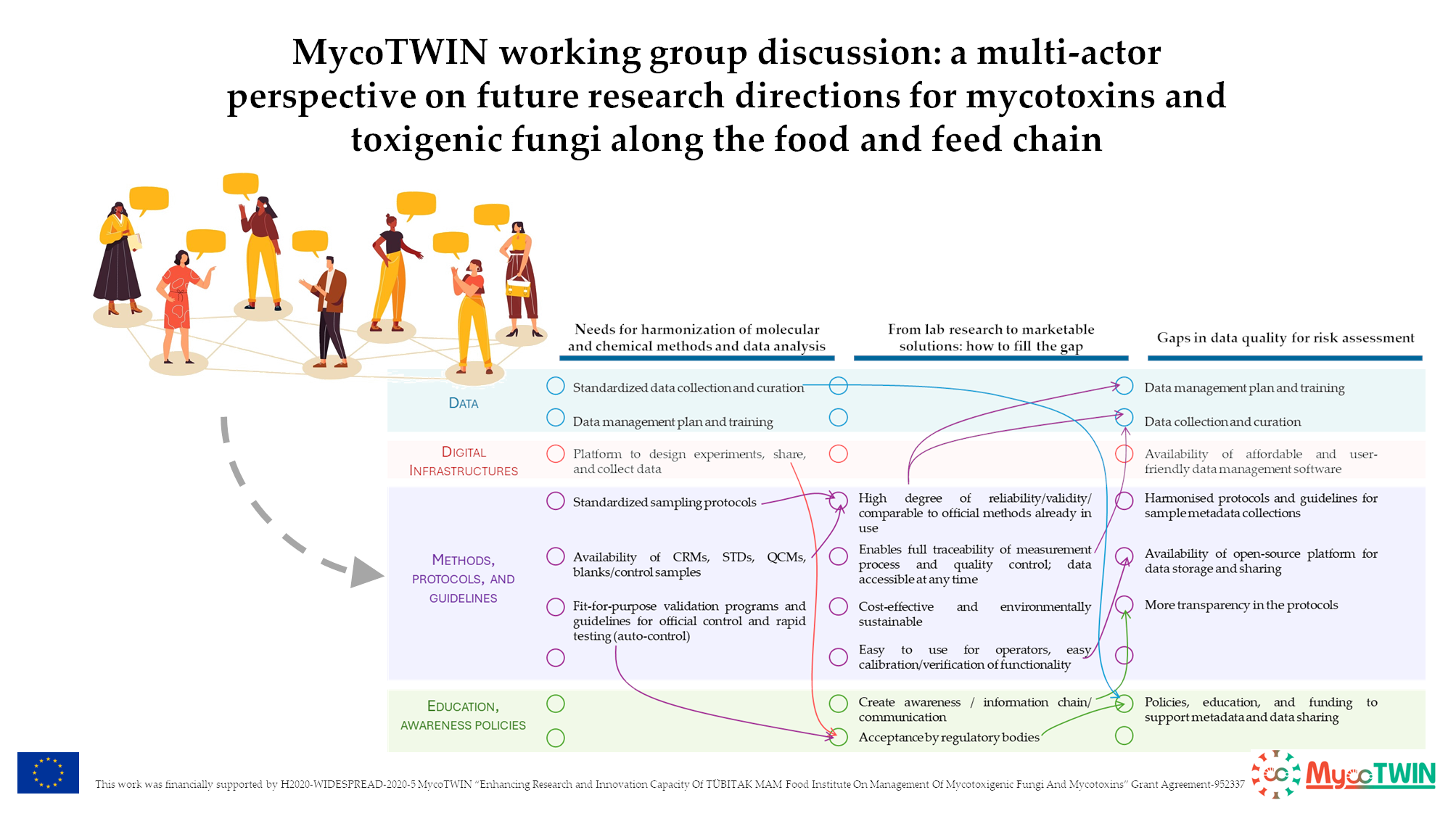
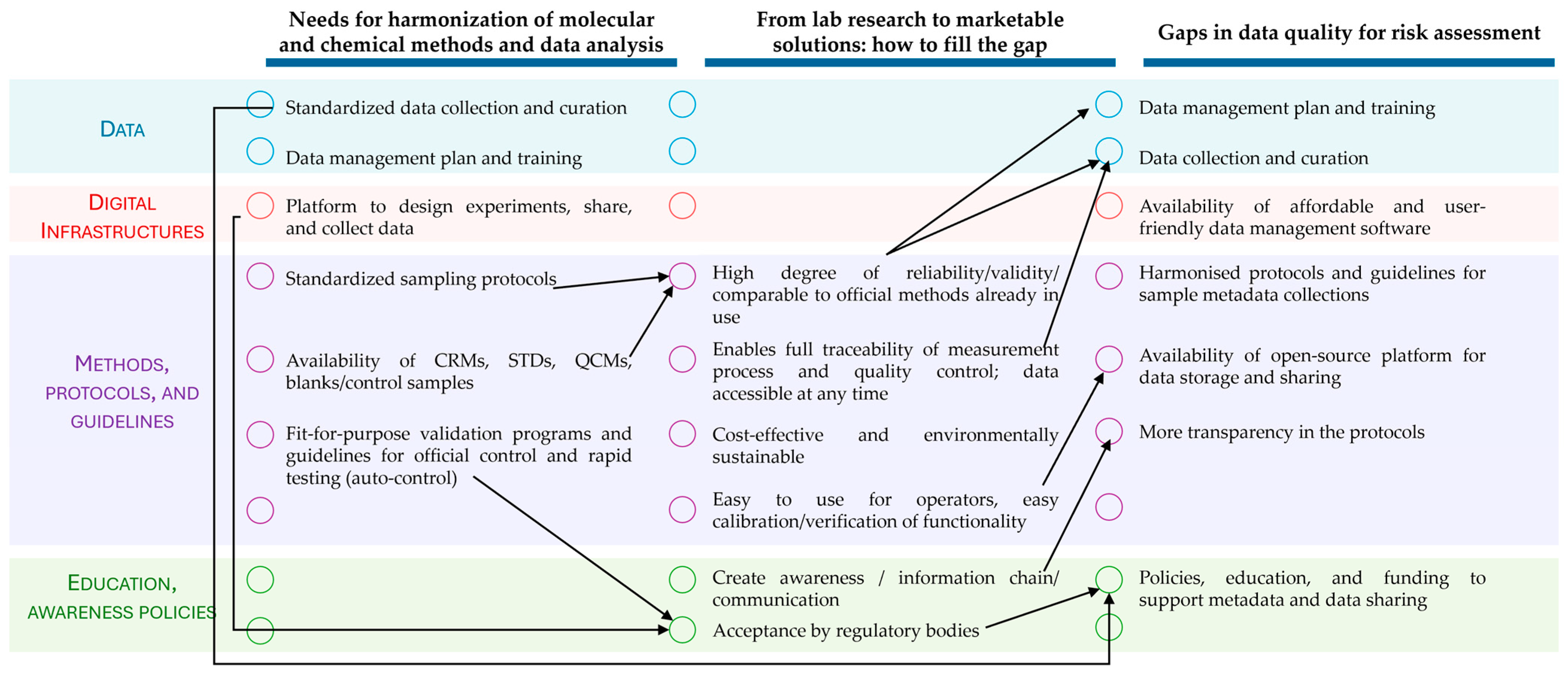
- Interlinks: After carrying out step 2 for each of the three topics, the participants were asked to discuss and indicate interlinks between the proposed actions and subtopics.
- (i)
- Present (one-year needs): Urgent issues;
- (ii)
- Near future (three-year needs): Emerging issues;
- (iii)
- Normal term (five-year needs): Mid-term issues;
- (iv)
- Long term (eight-year needs): Far future issues.
2.4. Statistical Analyses
2.5. Glossary
- (i)
- High level of priority of action: Something given or meriting attention before competing alternatives since it represents a pre-requisite, or a key requisite, to undertake the other issues in the list;
- (ii)
- High level of uncertainty: not fully investigated and researched; not based on well-established knowledge; values are unknown; possible outcomes are incomplete and ambiguous; unstable; hard to predict; difficult to estimate; unobvious impact.
3. Results
3.1. Topic 1: Needs for Harmonization of Molecular and Chemical Methods and Data Analysis
3.1.1. Topic 1 Issue Definition and Prioritization
3.1.2. Definition of Hazards and Relevant Actions for Topic 1
3.2. Topic 2: From Lab Research to Marketable Solutions: How to Fill the Gap
3.2.1. Topic 2 Issue Definition and Prioritization
3.2.2. Definition of Hazards and Actions for Topic 2
3.3. Topic 3: Gaps in Data Quality for Risk Assessment
3.3.1. Topic 3 Issue Definition and Prioritization
3.3.2. Definition of Hazards and Actions for Topic 3
4. Discussion
5. Conclusions
- (1)
- Further development of in silico models for emerging risk assessment (NAMs), including harmonized models and protocols for computational modeling, high-throughput screening, omics technologies, and mechanistic toxicology;
- (2)
- To develop new and more robust approaches for the taxonomic classification of fungal species, also based on interlaboratory comparisons;
- (3)
- To map the available resources and propose pathways for the integration and interoperability of the existing platforms/infrastructures connecting data and metadata from different sources (i.e., genomic analyses, transcriptomic studies, biological assays, expression profiles, and more).
Author Contributions
Funding
Institutional Review Board Statement
Informed Consent Statement
Data Availability Statement
Acknowledgments
Conflicts of Interest
References
- DSM Mycotoxin Survey 2024. Available online: https://www.dsm.com/ (accessed on 29 October 2024).
- Kolawole, O.; Siri-Anusornsak, W.; Petchkongkaew, A.; Elliott, C. A systematic review of global occurrence of emerging mycotoxins in crops and animal feeds, and their toxicity in livestock. Emerg. Contam. 2024, 10, 100305. [Google Scholar] [CrossRef] [Scilit]
- RASFF. 2022 Annual Report Alert and Cooperation Network. Available online: https://food.ec.europa.eu/system/files/2023-10/acn_annual-report_2022.pdf (accessed on 14 June 2024).
- European Environmental Agency. Transforming Europe’s Food System—Assessing the EU Policy Mix; European Environmental Agency: Copenhagen, Denmark, 2022; Available online: https://www.eea.europa.eu/publications/transforming-europes-food-system (accessed on 17 June 2024).
- MycoTWIN Project. Available online: https://www.mycotwin.eu/ (accessed on 20 June 2024).
- FoodSafety4EU Project. Available online: https://foodsafety4.eu/ (accessed on 21 June 2024).
- Dall’Asta, C.; De Boevre, M.; Dellafiora, L.; De Saeger, S.; Moretti, A.; Pinson-Gadais, L.; Susca, A. Boosting knowledge and harmonisation in the mycotoxin field through sustainable scientific alliances—MYCOBOOST. EFSA Supp. Publ. 2023, 20, 8420E. [Google Scholar] [CrossRef] [Scilit]
- Leslie, J.F.; Lattanzio, V.; Audenaert, K.; Battilani, P.; Cary, J.; Chulze, S.N.; De Saeger, S.; Gerardino, A.; Karlovsky, P.; Liao, Y.-C.; et al. MycoKey Round Table Discussions of Future Directions in Research on Chemical Detection Methods, Genetics and Biodiversity of Mycotoxins. Toxins 2018, 10, 109. [Google Scholar] [CrossRef] [Scilit] [PubMed]
- Food 2030: Green and Resilient Food System. Available online: https://research-innovation-community.ec.europa.eu/events/5XBL7D4zP2PsfvrXmAJPv1/overview (accessed on 19 July 2024).
- Nastasia, B.; Duta, D.; Cito, N.; Rychlik, M.; Lattanzio, V.M.T. Strategic Research and Innovation Agenda for Food Safety in Europe. EU Food Safety Forum, Brussels. Zenodo 2023. [Google Scholar] [CrossRef]
- Horizon Europe Programme. Available online: https://research-and-innovation.ec.europa.eu/funding/funding-opportunities/funding-programmes-and-open-calls/horizon-europe_en (accessed on 22 June 2024).
- Ortega-Beltran, A.; Bandyopadhyay, R. Aflatoxin Biocontrol in Practice Requires a Multidisciplinary, Long-Term Approach. Front. Sustain. Food Syst. 2023, 7, 1110964. [Google Scholar] [CrossRef] [Scilit]
- Chhaya, R.S.; O’Brien, J.; Cummins, E. Feed to Fork Risk Assessment of Mycotoxins under Climate Change Influences-Recent Developments. Trends Food Sci. Technol. 2022, 126, 126–141. [Google Scholar] [CrossRef] [Scilit]
- Cernava, T.; Rybakova, D.; Buscot, F.; Clavel, T.; McHardy, A.C.; Meyer, F.; Berg, G. Metadata Harmonization–Standards Are the Key for a Better Usage of Omics Data for Integrative Microbiome Analysis. Environ. Microbiome 2022, 17, 33. [Google Scholar] [CrossRef] [Scilit] [PubMed]
- Mesfin, A.; Lachat, C.; Vidal, A.; Croubels, S.; Haesaert, G.; Ndemera, M.; Matumba, L. Essential Descriptors for Mycotoxin Contamination Data in Food and Feed. Food Res. Int. 2022, 152, 110883. [Google Scholar] [CrossRef] [Scilit] [PubMed]


| Needs for Harmonization of Molecular and Chemical Methods and Data Analysis For Each Issue, What Is the Perceived Level of Priority of Action? | ||
|---|---|---|
| Issue n. | Issue | Priority Score 1 |
| 1 | Standardized sampling protocols | 6.00 a |
| 2 | Standardized data collection and curation | 5.48 a |
| 3 | Availability of certified reference materials (CRMs), standards (STDs), quality control materials (QCMs), and blanks/control samples | 5.41 ab |
| 4 | Data management plan and training | 5.41 ab |
| 5 | Fit-for-purpose validation programs and guidelines for official control and rapid testing | 5.03 ab |
| 6 | Platform to design experiments, share, and collect data | 5.03 ab |
| 7 | Simplified standard data format | 4.79 ab |
| 8 | Measurement uncertainty protocols | 4.64 ab |
| 9 | Criteria for calculating and evaluating Limit Of Quantification (LOQ) | 4.25 b |
| 10 | Guidelines and acceptance criteria for matrix effects | 4.14 b |
| 11 | Availability of interlaboratory ring trials (IRTs) and/or proficiency testing programs (PTPs) | 4.11 b |
| Needs for Harmonization of Molecular and Chemical Methods and Data Analysis. For Each Proposition, What Is the Perceived Level of Uncertainty? | |
|---|---|
| Issue | Uncertainty Score 1 |
| Availability of certified reference materials (CRMs), standards (STDs), quality control materials (QCMs), and blanks/control samples | 3.91 |
| Standardized data collection and curation | 3.69 |
| Standardized sampling protocols | 3.39 |
| Fit-for-purpose validation programs and guidelines for official control and rapid testing (auto-control) | 3.36 |
| Data Management plan and Training | 3.35 |
| Platform to design experiments, share, and collect data | 2.99 |
| Time | Issue | Hazard | Action |
|---|---|---|---|
| Present (1-year needs) | Platform to design experiments, share, and collect data for feed models | All mycotoxins Re-occurring mycotoxins related to climate change (f.i. aflatoxins) | Starting from the already existing ones, to develop or integrate collaborative infrastructures/data-driven platforms/online repositories Include data for bioanalysis for evidence based on public health information |
| Near Future (3-year needs) | Standardized data collection and curation | Emerging mycotoxins Modified mycotoxins Regulated mycotoxins in new commodities of interest | To develop simplified standard data formats, taking into account big data and AI developments as well as the FAIR 1 principles To develop training modules on data collection and curation for different target users To develop committee-supervised, unanimous consensus on methods/approaches used to obtain data for taxonomic rearrangements |
| Fungal chemotypes vs. fungal species | To enforce the definition of “chemotypes” rather than species (mycotoxin production vs. core genome) To promote investments in risk monitoring | ||
| Standardized sampling protocols | Regulated mycotoxins in regulated and unregulated commodities of interest (f.i. fermented foods, novel foods, and side stream) Fungi | To develop and/or standardize sampling methods for new commodities To develop and/or standardize alternative sampling methods (f.i. based on the latest developments in dust sampling) To develop and/or feed infrastructures and culture collections, including methodologies to define and maintain reference strains | |
| Fit-for-purpose validation programs and guidelines for official control and rapid testing (auto-control) | Regulated mycotoxins in regulated commodities | To develop validation programs, including in-house validation protocols for rapid testing—co-development with food business operators To develop dedicated proficiency tests To propose an update of the Regulation 519/2014/EC (mycotoxin screening methods)—link with EFSA 2 to take into account risk assessment needs | |
| Fungi | For the classification of new species: create more links between biology/genetics and taxonomy (structured pathways) | ||
| Data Management plan and Training | Regulated and (re)emerging mycotoxins | To propose harmonized data formats To implement AI 3/machine learning approaches to merge redundant data/integrate the existing data To develop joint training modules for AI 3 experts and analytical chemists | |
| Fungi | To develop AI/machine learning for modeling—investigate the link between genomic elements To develop AI-based approaches to predict the biology of a microorganism | ||
| Normal term (5-year needs) | Availability of CRMs 4, STDs 5, QCMs 6, and blanks/control samples | Emerging mycotoxins Modified mycotoxins Regulated mycotoxins in new commodities of interest (f.i. fermented foods, novel foods, and side streams) | To develop new protocols for CRM 4, STDs 5, and QCMs 6—go for the fitness-for-purpose approach To develop standard methods/procedures for reference material characterization Define reference values (low vs. high exposure) for mycotoxin bioanalysis |
| Fungal chemotypes (defining mycotoxigenic potential) | Define reference strains for fungi Define robust taxonomy classification through interlaboratory comparison—long-term perspective |
| From Lab Research to Marketable Solutions: How to Fill the Gap For Each Proposition, What Is the Perceived Level of Priority of Action? | ||
|---|---|---|
| Subtopic/Issue/Proposition | Priority Score 1 | |
| 1 | Cost-effective | 5.75 a |
| 2 | Create awareness/information chain/communication | 5.67 a |
| 3 | Easy to use: limited expertise and minimal operator manipulations/easy calibration/verification of functionality | 5.64 a |
| 4 | High degree of reliability/validity/comparable to official methods already in use/brand-independent transferability | 5.42 ab |
| 5 | Acceptance by regulatory bodies | 5.3 ab |
| 6 | Enables full traceability of measurement process and quality control; data accessible at any time | 5.18 ab |
| 7 | Compliant with regulations/standards/contracts below regulation | 5.18 ab |
| 8 | High degree of reliability/validity/comparable to official methods already in use | 5.1 ab |
| 9 | Secure supply of materials | 4.9 ab |
| 10 | “Green” technology, sustainable, safe, and easy handling | 4.82 ab |
| 11 | Enables process automation and speed, online capability | 4.78 ab |
| 12 | Productability studies | 4.26 b |
| From Lab Research to Marketable Solutions: How to Fill the Gap For Each Proposition, What Is the Perceived Level of Uncertainty? | |
|---|---|
| Subtopic/Issue/Proposition | Uncertainty Score 1 |
| Easy to use: limited expertise and minimal operator manipulations/easy calibration/verification of functionality | 3.91 |
| Enables full traceability of measurement process and quality control; data accessible at any time | 3.66 |
| Acceptance by regulatory bodies | 3.55 |
| Create awareness/information chain/communication | 3.23 |
| High degree of reliability/validity/comparable to official methods already in use | 2.97 |
| Cost-effectiveness | 2.58 |
| Gaps in Data Quality for Risk Assessment For Each Proposition, What Is The Perceived Level of Priority of Action? | ||
|---|---|---|
| Issue | Priority Score 1 | |
| 1 | Harmonized protocols and guidelines for sample metadata collections | 5.86 |
| 2 | Policies, education, and funding to support metadata and data sharing | 5.73 |
| 3 | Data collection and curation | 5.63 |
| 4 | Availability of open-source platforms for data storage and sharing | 5.53 |
| 5 | Availability of affordable and user-friendly data management software | 5.39 |
| 6 | More transparency in the protocols | 5.31 |
| 7 | Simplified standard data format | 5.04 |
| 8 | Privacy/reputation | 4.96 |
| 9 | Increased knowledge of data management plans | 4.86 |
| Gaps in Data Quality for Risk Assessment For Each Proposition, What Is the Perceived Level of Uncertainty? | |
|---|---|
| Prioritized Issue | Uncertainty Score 1 |
| Harmonized protocols and guidelines for sample metadata collections | 5.00 |
| Policies, education, and funding to support metadata and data sharing | 4.79 |
| More transparency in the protocols | 4.03 |
| Availability of open-source platforms for data storage and sharing | 3.74 |
| Availability of affordable and user-friendly data management software | 3.70 |
| Data collection and curation | 3.46 |
| Time | Issue | Hazard | Action |
|---|---|---|---|
| Present (1-year needs) | High degree of reliability/validity/comparable to official methods already in use | Regulated mycotoxins or under consideration for future regulation (recommended) | To develop fitness-for-purpose method verification strategy assessment |
| Cost-effectiveness and environmental sustainability | Regulated mycotoxins or under consideration for future regulation (recommended) | To promote investments in research and innovation/collaborative research projects with academia and industries To develop environmentally safe kits (no plastic—eco-friendly) | |
| Near Future (3-year needs) | Enables full traceability of measurement process and quality control; data accessible at any time | Regulated mycotoxins | To develop fully automated procedures with remote access to the data and integrate AI-based technologies |
| Acceptance by regulatory bodies | Regulated mycotoxins | To develop fit-for-purpose validation/performance verification protocols for operators (industries) To provide on-site training tailored to specific industry/operator needs To develop guidelines for dossier/documents to be submitted to the regulatory bodies | |
| Fungi | Note: fungi are not regulated, so no need for acceptance by regulatory bodies. However, the early detection of fungi should be in the regulation/recommendation coupled with accurate prediction approaches and mitigation steps | ||
| Create awareness/information chain/communication | To develop and pilot innovative/simple communication models to reach operators/consumers in rural areas with low levels of education To create awareness of the importance of the early detection of fungi to promote mitigatory practices | ||
| Normal term (5-year needs) | Easy to use: limited expertise and minimal operator manipulations Easy calibration/verification of functionality | Regulated mycotoxins in regulated commodities and unconventional matrices (blood/urine) Mycotoxin adducts/metabolites in unconventional matrices (blood/urine), e.g., Ochratoxin A in blood, aflatoxins–lysin adducts | To develop green and simplified sample preparation protocols, including protocols without extraction (e.g., Infrared Spectroscopy) To improve test readers/detectors with user-friendly interface and online data management and to integrate user-friendly AI—simplified AI interfaces and more intuitive interfaces hiding the technical complexities of machine learning Implement method validation/verification protocols to assure accuracy, completeness, consistency, and reliability of obtained data |
| Time | Subtopic | Hazard | Action |
|---|---|---|---|
| Near Future (3-year needs) | Data collection and curation | Emerging mycotoxins Modified mycotoxins Regulated mycotoxins in new commodities of interest | To develop training modules on data collection and curation according to the FAIR 1 principles for different target users To develop and/or make accessible infrastructures for data collection, taking into account big data and AI 2 developments |
| Normal term (5-year needs) | More transparency in the protocols | All mycotoxins and fungi | Propose methodologies and strategies to reinforce trust and IP 3/ownership, like rights recognition and data anonymization |
| Availability of open-source platforms for data storage and sharing | All mycotoxins and fungi | To map and propose pathways for the integration of the existing platforms to make data available and interoperable To develop approaches for data curation and data security and/or building awareness of the existing ones Propose clear definitions and roles in data responsibility and management | |
| Availability of affordable and user-friendly data management software | All mycotoxins and fungi | To develop user-friendly and cost-effective data management software To integrate in a user-friendly workflow open access tools for data management/processing | |
| Long term (8-year needs) | Harmonized protocols and guidelines for sample metadata collections | Emerging mycotoxins Modified mycotoxins Regulated mycotoxins in new commodities of interest | To map the existing formats/protocols and guidelines and propose harmonized formats (f.i. commodity-dedicated) To develop harmonized protocols and guideline protocols for NAM 4 technologies (computational modeling, high-throughput screening, omics technologies, and mechanistic toxicology) |
| Policies, education, and funding to support metadata and data sharing | All mycotoxins and fungi | To develop and implement training programs for risk assessors and risk managers about the latest scientific developments in relation to emerging risk identification, monitoring, and assessment To build awareness about in silico models for risk assessment (NAM 4) To enable the scientific community to share data/acknowledge data To establish revenues arising from data access and sharing To set up links with the existing microbial collections and to establish an international data/microbial collection-sharing platform through liasons/bilateral agreements between national authorities To promote investments in data-driven innovation |
Disclaimer/Publisher’s Note: The statements, opinions and data contained in all publications are solely those of the individual author(s) and contributor(s) and not of MDPI and/or the editor(s). MDPI and/or the editor(s) disclaim responsibility for any injury to people or property resulting from any ideas, methods, instructions or products referred to in the content. |
© 2024 by the authors. Licensee MDPI, Basel, Switzerland. This article is an open access article distributed under the terms and conditions of the Creative Commons Attribution (CC BY) license (https://creativecommons.org/licenses/by/4.0/).
Share and Cite
Loi, M.; Moretti, A.; Lippolis, V.; Özer, H.; Pembeci Kodolbas, C.; Yener, E.; Demirtaş, İ.; Vila-Donat, P.; Manyes, L.; Lattanzio, V.M.T. MycoTWIN Working Group Discussion: A Multi-Actor Perspective on Future Research Directions for Mycotoxins and Toxigenic Fungi Along the Food and Feed Chain. Foods 2024, 13, 3582. https://doi.org/10.3390/foods13223582
Loi M, Moretti A, Lippolis V, Özer H, Pembeci Kodolbas C, Yener E, Demirtaş İ, Vila-Donat P, Manyes L, Lattanzio VMT. MycoTWIN Working Group Discussion: A Multi-Actor Perspective on Future Research Directions for Mycotoxins and Toxigenic Fungi Along the Food and Feed Chain. Foods. 2024; 13(22):3582. https://doi.org/10.3390/foods13223582
Chicago/Turabian StyleLoi, Martina, Antonio Moretti, Vincenzo Lippolis, Hayrettin Özer, Ceyda Pembeci Kodolbas, Elif Yener, İlknur Demirtaş, Pilar Vila-Donat, Lara Manyes, and Veronica M. T. Lattanzio. 2024. "MycoTWIN Working Group Discussion: A Multi-Actor Perspective on Future Research Directions for Mycotoxins and Toxigenic Fungi Along the Food and Feed Chain" Foods 13, no. 22: 3582. https://doi.org/10.3390/foods13223582
APA StyleLoi, M., Moretti, A., Lippolis, V., Özer, H., Pembeci Kodolbas, C., Yener, E., Demirtaş, İ., Vila-Donat, P., Manyes, L., & Lattanzio, V. M. T. (2024). MycoTWIN Working Group Discussion: A Multi-Actor Perspective on Future Research Directions for Mycotoxins and Toxigenic Fungi Along the Food and Feed Chain. Foods, 13(22), 3582. https://doi.org/10.3390/foods13223582