1. Introduction
Dark count is a false signal registered by a single-photon detector (SPD) in the absence of incident photons [
1,
2]. These events typically arise from thermal excitation and the tunneling effect [
3]. Thermal excitation generates electron-hole pairs due to internal thermal energy, while tunneling occurs when electrons quantum mechanically pass through potential barriers under high bias voltages. In single-photon detection, dark count is a significant noise source that can severely degrade detector performance, particularly in high-sensitivity applications such as quantum communication, time-of-flight measurements, and quantum metrology [
1,
4]. They directly reduce the signal-to-noise ratio (SNR), compromising measurement accuracy and reliability [
5,
6]. This issue becomes especially critical in low-light environments, where weak photon flux exacerbates the impact of dark count.
Dark count in single-photon detectors is typically quantified by measuring the number of spurious signals that occur in the absence of incident photons. To perform this measurement, the detector is placed in a light-tight environment, ensuring that no external photons are incident, and the number of erroneous output pulses
is recorded within a fixed time window
T. In conventional single-photon detectors (SPDs), the dark count rate is often modeled as a Poisson process, assuming that the probability of a dark count occurring within a given time interval is proportional to the gate time [
7].
First-photon-gated SPDs combine the first-photon response with the gated mechanism. Its main feature is that within each gated detection window, the detector only responds to the first trigger event, and immediately terminates the current detection cycle after the recording is completed, until the next gated cycle begins [
8]. This mode precisely limits the detection window in terms of time, effectively compressing the data volume and suppressing the influence of subsequent noise interference. Since noise is randomly distributed in the time domain while the signal has a fixed period, the probability of its occurrence at a specific position within the gated window is much higher than that of noise. Therefore, the probability of the first trigger event being a signal photon is significantly higher than that of noise, thereby further improving the measurement accuracy of the detector under low-light conditions. Specifically, the gated mode controls the bias state of the detector through an external timing signal, making it work only within the preset time window, thus effectively avoiding background noise triggering during non-measurement periods. At the beginning of each gated cycle, the detector enters the Geiger mode, being in a state of waiting for a photon trigger. Once an effective detection event occurs, the system immediately terminates the response process of the current cycle, and the detector leaves the Geiger state until the next gated cycle is reactivated. The first-photon response mechanism can effectively enhance the measurement efficiency and noise resistance of the system, but its special event recording method also brings new challenges to the modeling of dark count rate. In this mode, each gated cycle records at most one detection event. However, when the dark count rate becomes exceptionally high or the gate width is extended, the dark count probability approaches unity. In such cases, small fluctuations in dark count can result in substantial errors. Consequently, the traditional method becomes ineffective, highlighting the need for a new approach to define and measure dark count in first-photon-gated SPDs. This work proposes a characterization method based on the average dark count arrival time, which provides significant improvements in both measurement accuracy and precision compared to the conventional estimator that relies solely on the binary per-gate outcome. The regime where the probability of dark count approaches unity is not merely a pathological corner case. It arises in a practically relevant scenario: in long-distance quantum communication or time-of-flight LiDAR, the gate width is determined by the photon flight time and cannot be arbitrarily reduced. Under such conditions, the probability of dark count may approach unity even for moderate dark count rates. Hence, a robust estimation method in this regime is of practical importance.
Several previous studies have addressed detector characterization using timing or counting statistics. Ferreira da Silva et al. developed a real-time method for gated-mode SPADs based on the statistics of times between consecutive detections, extracting dark-count probability, efficiency, and afterpulse parameters simultaneously [
9]. Humer et al. proposed a counting-statistics-based method that operates using only intrinsic dark counts and works for both gated and free-running modes [
10]. Oh et al. derived an analytical model for SPADs in the saturation regime, covering the range where conventional low-probability estimators fail [
11]. While the above studies shared the idea of exploiting temporal or inter-event statistics for characterization, they differed from our work in several key aspects. Ferreira da Silva et al. required the full inter-detection time distribution and an external continuous-wave light source. Humer et al. relied on time-binned counting statistics and required sufficient bin resolution to resolve afterpulsing. Oh et al. addressed the high-signal saturation regime (strong incident light), whereas our work targets the high-dark-count-probability regime (weak signal but high noise). The works above shared the idea of exploiting temporal or inter-event statistics for characterization, but they targeted conventional SPADs where multiple events per gate can be recorded. In contrast, our work focuses specifically on first-photon-gated SPDs, where each gate records at most one event. This constraint allows us to use a simpler estimator based on the mean arrival time within each gate, without needing to resolve multiple events per gate or to know the dead time precisely. Additional studies have investigated the timing behavior of gated avalanche photodiodes and photon-number discrimination in InGaAs/InP SPADs [
12,
13], but these did not address the dark-count estimation problem in the high-dark-count-probability regime.
2. Simulation of the New Dark Count Definition
In photon detection, particularly for first-photon-gated SPDs, dark count can significantly impact the measurement accuracy. To model dark count, it is common to assume that they are independent events occurring within each gate and follow a Poisson distribution [
14]. This assumption does not break down when the dark count per gate probability approaches unity. Rather, the exponential waiting-time distribution of a Poisson process is the very basis of the timing-based expectation method. The issue with the conventional estimator is that it discards the continuous timing information and uses only the binary outcome per gate. Based on this assumption, the dark count rate
can be estimated using the following expression:
where
is the probability of a dark count occurring in each gate, and
is the gate width. This method works well when the dark count probability per gate is small, typically in situations where the dark count rate is low, and the gate width is relatively short compared to the photon period. However, this method becomes less reliable when the dark count probability per gate increases. As
approaches unity, even small fluctuations in the number of dark counts can introduce substantial errors in the estimation of the dark count rate. This issue is particularly pronounced in the case of first-photon-gated SPDs, where the detector operates with a relatively long gate width or a high dark count rate.
To overcome these limitations, we propose a new methodology for characterizing dark count rate that is particularly suited for first-photon-gated SPDs under conditions of high dark count rate or extended gate width. The key distinction of the proposed method lies in the statistical approach. We calculate the average dark count arrival time over a series of gates. This method allows us to capture the cumulative temporal behavior of dark count more accurately, especially when the dark count rate is high or the gate time is extended. The average dark count arrival time provides a more reliable estimate of the dark count rate by accounting for the temporal distribution of dark counts across multiple gates.
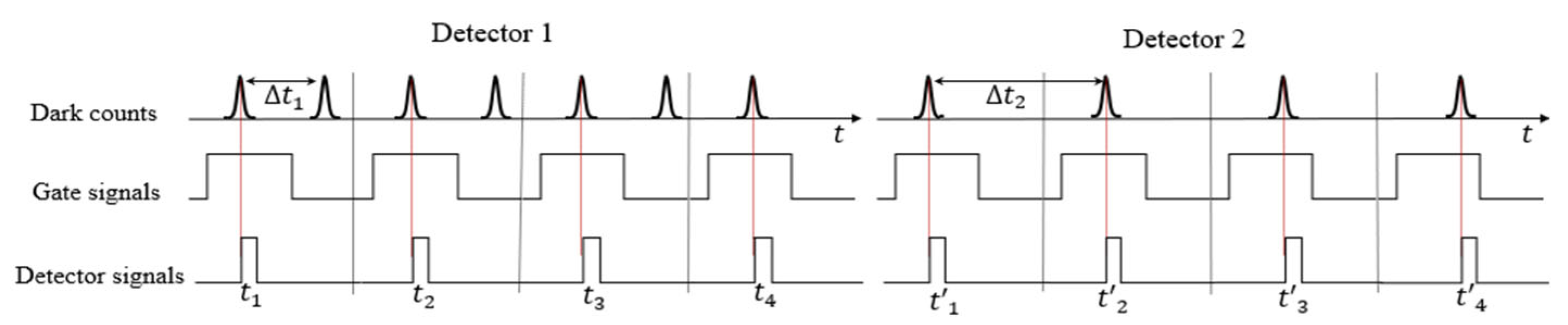
Figure 1 schematically illustrates the operation of two first-photon-gated SPDs with different dark count rates. Detector 1 exhibits a higher dark count rate than Detector 2, which results in a shorter average dark count interval for Detector 1. In the example, both detectors register the same number of dark counts, but the shorter interval for Detector 1 indicates a higher dark count rate. This demonstrates how the average dark count arrival time can distinguish between detectors with identical counts per gate but different rates.
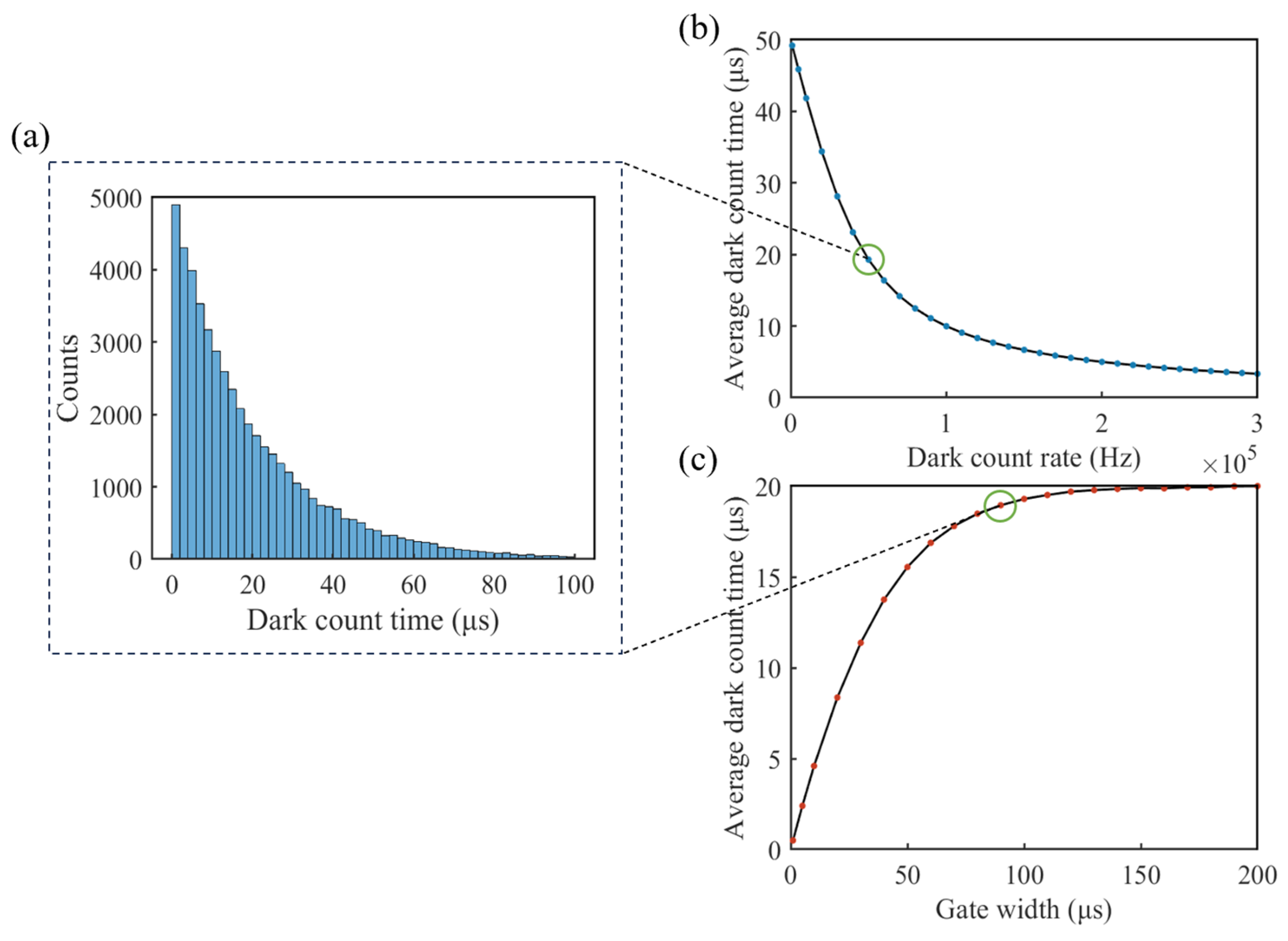
The statistical characteristics of first-photon-gated SPDs are systematically investigated through numerical simulations, as summarized in
Figure 2.
Figure 2a displays the temporal distribution of dark count for a detector with a dark count rate of 50 kHz and a gate width of 100 μs. The histogram reveals a pronounced temporal localization, with the majority of events recorded within the first half of the gate interval. This exponential decay pattern is consistent with the waiting time distribution predicted for a Poisson process, where the event probability per unit time is constant [
15]. Building on these observations,
Figure 2b quantifies the inverse proportionality between the detector’s dark count rate and the average dark count time,
. As the dark count rate increases from 1 kHz to 300 kHz at a fixed gate width of 100 μs,
decreases monotonically.
Figure 2c demonstrates the simulated correlation between average dark count time and gate width for detectors operating at a fixed dark count rate of 50 kHz. As the gate width
increases,
asymptotically approaches 20 μs. The convergence of
can be attributed to the fundamental properties of the Poisson process [
16,
17,
18]. In a Poisson process, the first arrival time follows an exponential distribution, with its mean value given by the reciprocal of the event rate. When
is sufficiently large relative to
, the probability of detecting the first dark count within the gate interval approaches unity. Under this condition, as the influence of the finite gate boundary becomes negligible, the statistical averaging over multiple trials yields:
The simulation results indicate that the proposed methodology provides a more accurate and reliable estimation of the dark count rate. By utilizing this definition, we are able to obtain distinct average dark count times for detectors with varying dark count rates, enabling more precise characterization of first-photon-gated SPDs in practical applications.
3. Experimental Verification
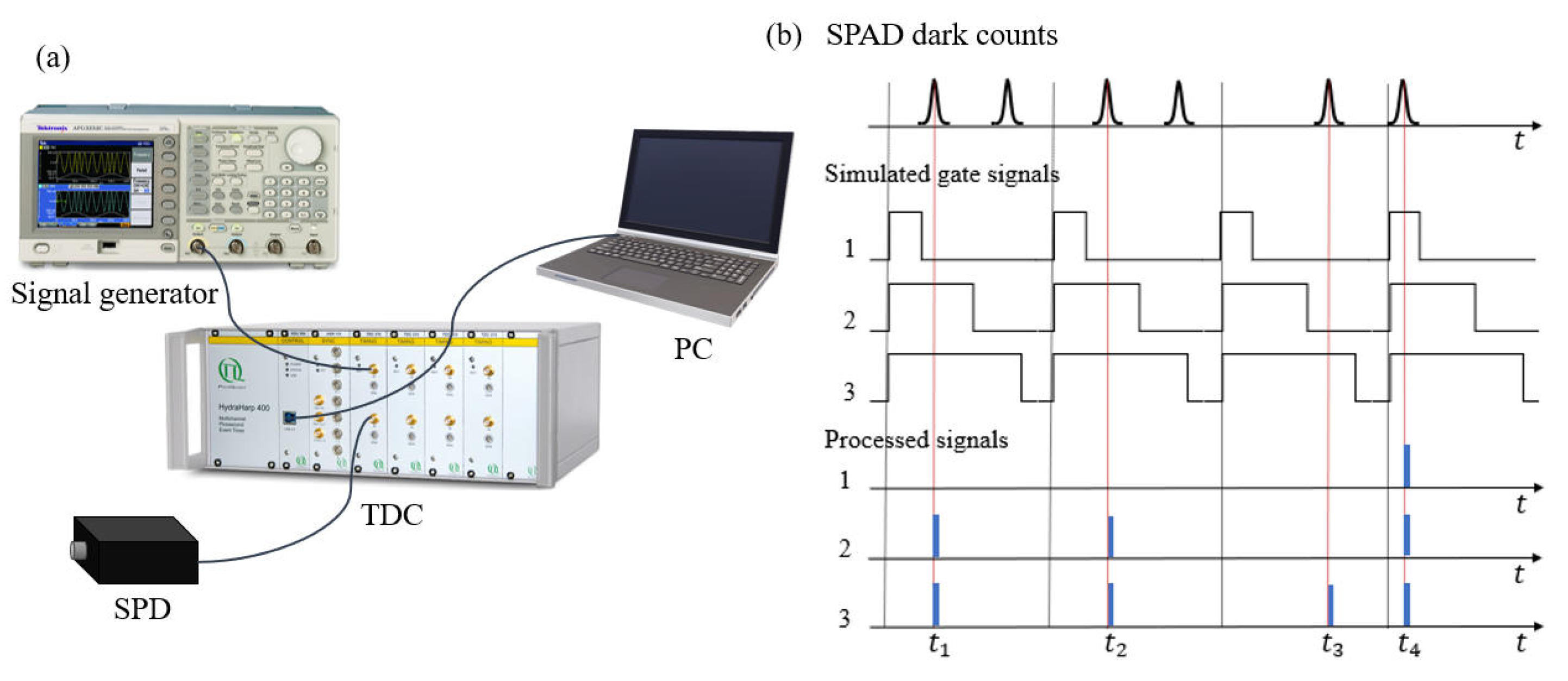
The experimental setup is shown in
Figure 3a. The dark count signal from the SPD (LBTEK, SPD300A-PC, Changsha, China) and a periodic trigger signal generated by a function generator (Tektronix, AFG3252C, Beaverton, OR, USA) were recorded using an event timer (PicoQuant, HydraHarp 400, Berlin, Germany). The recorded data were processed using a personal computer. To ensure precise control of experimental variables, a commercial SPD was employed. After acquiring the dark count data, post-processing was performed to simulate the behavior of a first-photon-gated SPD with varying gate widths. The data processing procedure is illustrated in
Figure 3b, where the black dashed line represents the periodic signal generated by the signal generator. A dark count is retained within each period only if it falls within the specified gate window, provided that no preceding signals within the same cycle have been recorded.
In a controlled environment, the Time-to-Digital Converter (TDC), with a resolution of 16 ns and a minimum time bin width of 1 ps, recorded data continuously over 100 s. Through extensive data statistics, using the formula “Error (%) = [(Estimated Rate − Baseline Rate)/Baseline Rate]”, the relative percentage error of the baseline dark count was determined to be 29.77 kcps (counts per second). To simulate detection data for varying gate widths, we applied the method illustrated in
Figure 3b, where the gate signal was synchronized with the periodic trigger. During each period defined by the trigger signal, a virtual gating window is set up, and only the first event that falls within the gating window is retained in each period to simulate the first photon response mechanism. By adjusting the length of the gating window, the performance of detection under different gating widths can be flexibly analyzed. Boundary cases are counted as inside the gate. The simulated dead time of the detector was applied in the simulation of
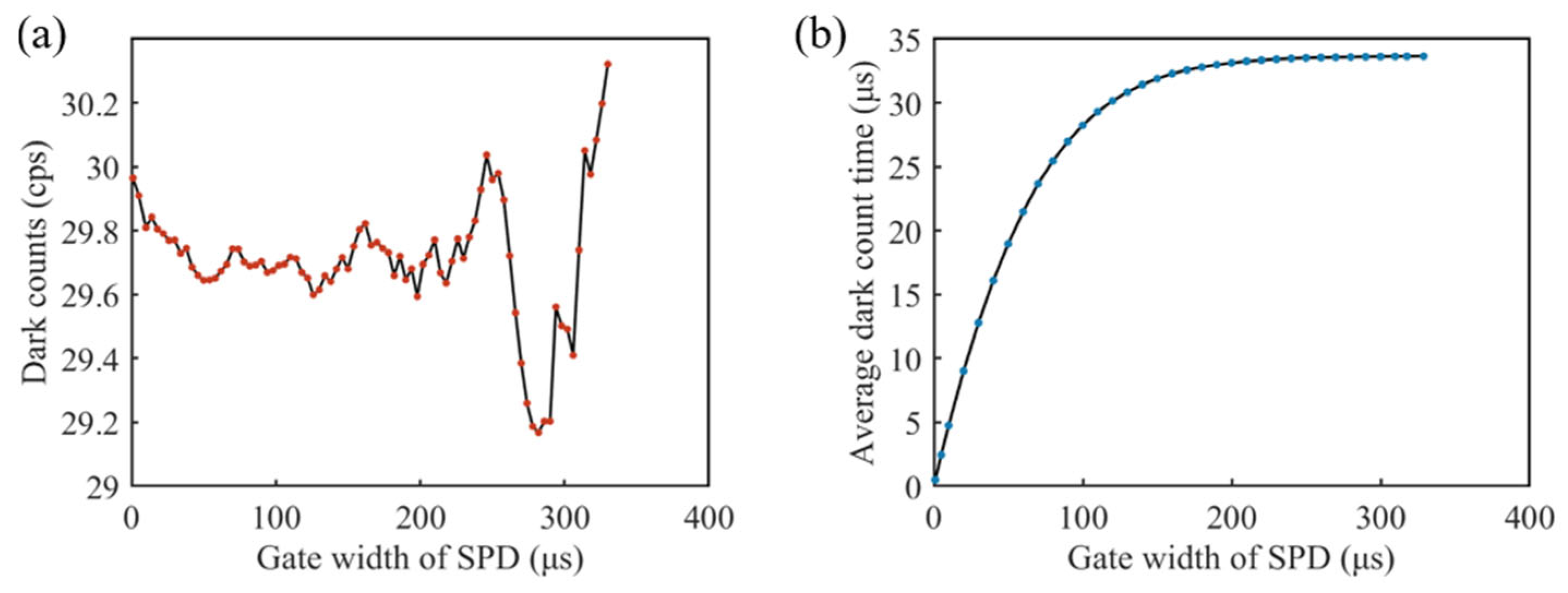
Figure 2, but in the experimental post-processing, the raw data already include the detector’s internal dead time, so no additional dead time was imposed. Data processing was performed using both the traditional Poisson model and the proposed average dark count time method, with the results presented in
Figure 4. The experimental results demonstrate that as the gate width increases, the dark count fluctuations reconstructed using the Poisson model grow significantly. These fluctuations are primarily attributed to the inherent instability of dark count during the experiment. When the gate width is small, the error introduced by these fluctuations remains relatively limited. However, within the gate width range of 250 μs to 333 μs, further increases in the gate width lead to a continued increase in the theoretically calculated
, although the magnitude of this increase is much smaller compared to those at shorter gate widths. At this stage, the influence of measurement errors becomes significant, compromising the accuracy of dark count reconstruction. In contrast, as shown in
Figure 4b, the method based on the average dark count time provides a much more consistent and stable estimation of the dark count magnitude.
As summarized in
Table 1, the dark count rate and its associated errors are calculated using both the traditional Poisson distribution and the proposed average dark count time method. The results indicate that the average dark count time method provides more stable and accurate estimations, particularly for larger gate widths, where the Poisson method introduces significant errors. To illustrate, at a gate width of
= 333 μs, where the dark count probability
reaches saturation, the Poisson-based estimated dark count rate of 30.96 kHz yields an error of approximately 4%, whereas the timing-based expectation method yields a dark count rate of 29.718 kHz with an error of only −0.17%. These results provide a clear quantitative basis for our conclusion that the timing-based expectation method is significantly more robust in high-probability regimes. Specifically, when
exceeds 99.9%, the Poisson model exhibits severe numerical instability, with errors fluctuating between −2% and +4%, while the timing-based approach remains stable with a residual error of approximately −0.17%. Notably, the absolute error of the average dark count time method gradually increases after reaching its minimum. This behavior is attributed to the TDC resolution, which is limited to 16 ns due to experimental constraints.