Article

Differential Vortex Beam Interferometry for Nanometric Asymmetric Shaft Misalignment


1
School of Information and Communication Engineering, North University of China, Taiyuan 030051, China
2
Science and Technology on Electronic Test and Measurement Laboratory, North University of China, Taiyuan 030051, China
3
School of Instrument and Electronics, North University of China, Taiyuan 030051, China
*
Author to whom correspondence should be addressed.
Photonics 2026, 13(5), 458; https://doi.org/10.3390/photonics13050458
Submission received: 8 April 2026 / Revised: 21 April 2026 / Accepted: 22 April 2026 / Published: 6 May 2026
(This article belongs to the Section Lasers, Light Sources and Sensors)

Abstract

This paper proposes a Misalignment Differential Vortex Beam Interferometer (MD-VBI) integrated with DenseNet-169 for high-precision asymmetric shaft alignment. The system employs a polarization-multiplexed differential configuration to linearly map nanometric displacement to interference-fringe rotations. Building upon the optical architecture’s intrinsic suppression of common-mode thermal drift, the DenseNet-169 model serves as a robust demodulation backend, further mitigating inherent system-level optical noise to precisely decode misalignment signatures in interferograms. Experimental results demonstrate a Mean Absolute Error (MAE) of 0.382 nm within a 0–500 nm range. By decoupling true asymmetric shaft misalignment from intrinsic system noise and common-mode drift, the system provides a robust, non-contact solution for nanometric metrology under realistic conditions.

1. Introduction

In advanced manufacturing sectors such as semiconductor lithography and MEMS packaging, ultra-precision displacement measurement and synchronous shaft alignment are fundamental to ensuring overlay accuracy and device yield [1,2]. Nanometric axial misalignments can induce parasitic motions, leading to irreversible manufacturing defects [3,4,5]. Since environmental thermal drift is a primary source of common-mode interference in precision metrology, it is imperative to overcome the limitations of absolute single-point positioning and develop high-precision relative monitoring mechanisms with intrinsic common-mode rejection (CMR) capabilities [6,7].
Unlike macro-scale assembly verified by Coordinate Measuring Machines (CMMs) or laser triangulation sensors [8,9,10], nanometric misalignment monitoring requires significantly higher resolution, typically relying on heterodyne laser interferometers or grating encoders as traceability standards [11]. However, deploying these instruments for continuous in-situ monitoring of relative misalignment poses distinct physical challenges. Laser interferometers are highly sensitive to environmental fluctuations, often leading to zero-point drift [12], whereas grating encoders require close mounting, limiting their use in remote sensing or flexible layouts [13]. Although Position Sensitive Detectors (PSDs) offer a compact alternative, they are limited by a “position-intensity coupling” effect, which introduces non-linearity errors (>0.1%) exceeding strict lithography tolerances [14]. Crucially, most existing methods lack an intrinsic differential topology, leaving them vulnerable to common-mode thermal drift.
To address these physical limitations, Vortex Beam Interferometry (VBI) has emerged as a promising alternative, linearly mapping translational displacements into the macroscopic rotation of interference patterns [15,16]. Nevertheless, existing VBI implementations are predominantly limited to single-point absolute measurements [17], lacking a differential mechanism to decouple relative misalignment from thermal expansion. Furthermore, standard angular demodulation relies heavily on temporal phase-shifting algorithms, which inherently require multi-frame temporal scanning. In continuous industrial monitoring scenarios, any shaft jitter during acquisition destroys inter-frame correlation, thereby introducing severe phase coupling errors [18] and rendering traditional analytical solvers ineffective in non-static environments.
To circumvent the constraints of temporal scanning, single-shot deep learning demodulation schemes have been introduced. While our previous 9-layer CNN [19] demonstrated superior robustness over traditional analytical methods, its shallow architecture limited its ability to characterize minute fringe variations. Conversely, advanced deep architectures such as PI-DL and cGANs [20,21,22] often prioritize perceptual image reconstruction over pixel-level regression. Their aggressive down-sampling mechanisms inevitably cause the loss of high-frequency spatial details essential for identifying minute rotations, thereby limiting the resolution ceiling.
To address these limitations, this paper proposes integrating the Misalignment Differential Vortex Beam Interferometer (MD-VBI) with a DenseNet-169 framework. Optically, the MD-VBI employs a synchronous dual-shaft differential topology to linearly map minute shaft misalignment (i.e., asymmetric relative displacement) into interference pattern rotations. By intrinsically filtering out symmetric thermal expansion errors via common-mode rejection, this optical design effectively overcomes the environmental sensitivity limitations of traditional methods. Algorithmically, the DenseNet-169 model [23,24] is integrated to precisely decode the misalignment signatures encoded within the rotational angles. Leveraging dense connectivity to maximize feature reuse, this architecture effectively mitigates the information dilution problem inherent in standard CNNs. To comprehensively validate system feasibility and performance, we designed three representative kinematic experimental scenarios—single-shaft baseline tracking, differential misalignment sensing, and common-mode thermal rejection—and conducted comparative benchmark tests against traditional analytical algorithms and mainstream deep learning models. Experimental results confirm that the system exhibits superior robustness to intrinsic optical perturbations and symmetric thermal drift, while maintaining nanometric regression accuracy.

2. Theory

2.1. Principle and Optical Path Analysis

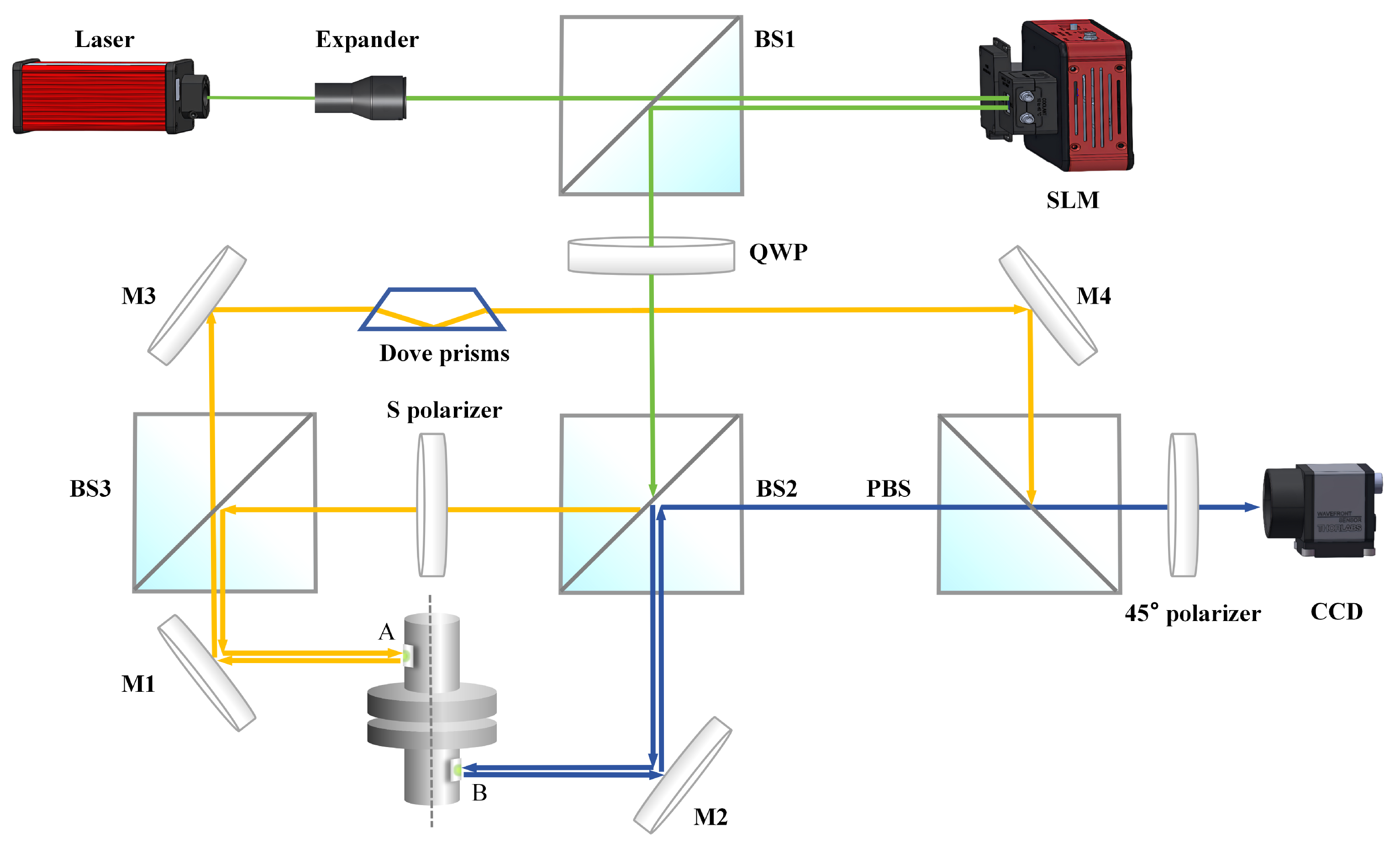
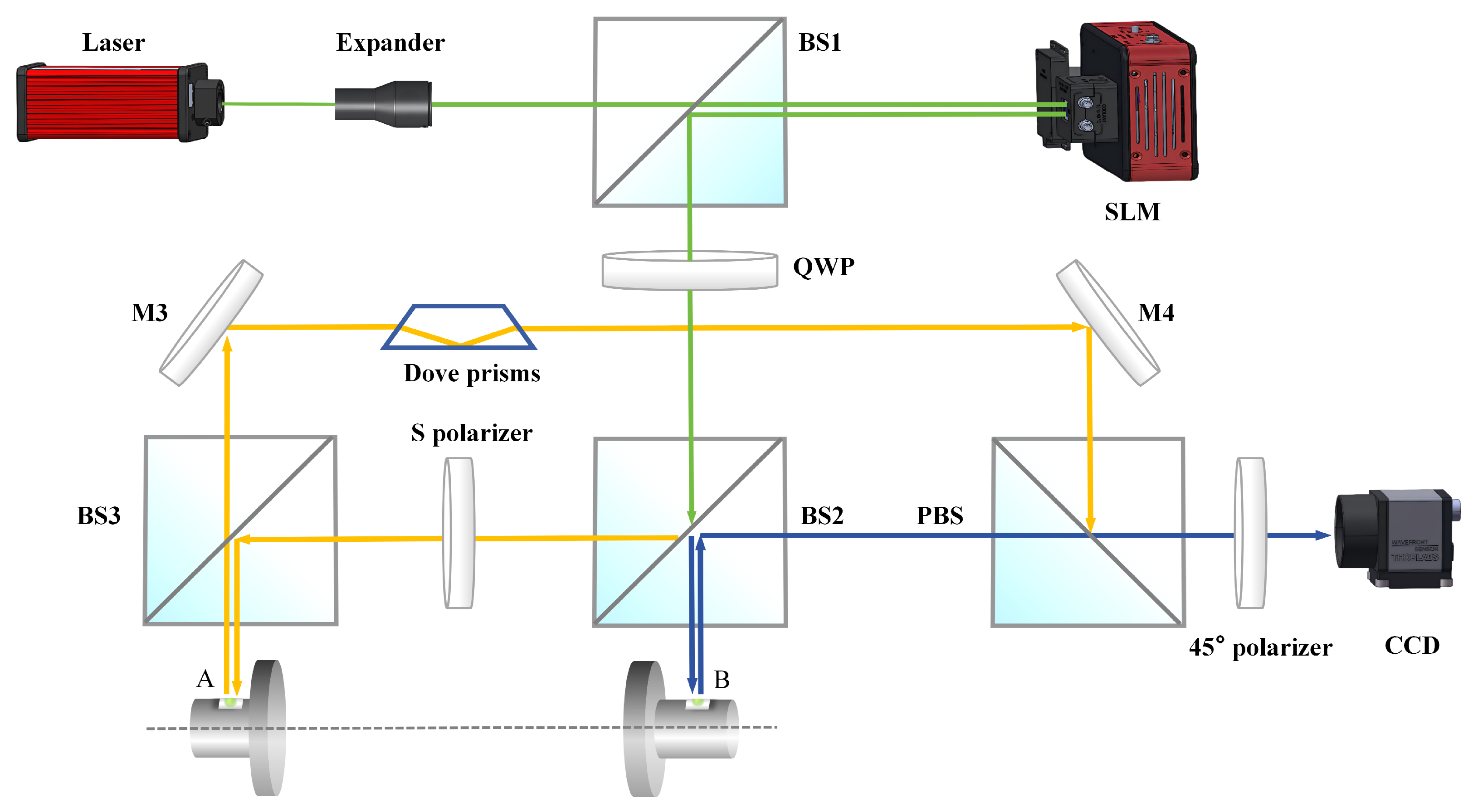
The schematic of the MD-VBI system is shown in Figure 1. A 532 nm laser is modulated by a Spatial Light Modulator (SLM) to generate a vortex beam with topological charge l. The beam is then converted to circular polarization by a Quarter-Wave Plate (QWP) and split into two synchronous probing paths by a beam splitter (BS2). The positive direction of axial displacement is defined as the direction opposite to beam propagation, corresponding to a reduction in the optical path length.
Channel B (Probing End B): As indicated by the blue optical path in Figure 1, the beam transmitted through BS2 is guided by mirror M2 to vertically be incident on End B of the target. Upon reflection, the beam retraces its path via M2 back to BS2. Within this channel, the beam undergoes an odd number of reflections (5 times). Since each reflection inverts the sign of the topological charge, this cumulative effect reverses the original charge from + l to l . Assuming End B undergoes an axial displacement x B in the positive direction (path reduction), the round-trip optical path decreases by 2 x B , introducing a phase advance of 2 k x B . Consequently, the resulting electric field E B returning to the detection plane is expressed as:
E B ( r , θ ) = E 0 exp ( i l θ + ϕ B 0 + 2 k x B )
where E 0 is the amplitude, k = 2 π / λ is the wavenumber, and ϕ B 0 represent the initial phases.
Channel A (Probing End A): As indicated by the yellow optical path in Figure 1, the beam reflected by BS2 first passes through an S-polarizer, is subsequently reflected by beam splitter BS3, and is then guided by mirror M1 to be vertically incident on End A. Following retro-reflection, the beam transmits through BS3 and enters a conjugate conversion module comprising mirror M3, a Dove prism, and mirror M4. This optical path undergoes an even number of reflections (10 times), thereby preserving the original topological charge + l constant. Notably, the S-polarizer ensures that only S-polarized light is transmitted; consequently, any leakage from BS3 is reflected by the polarizing beam splitter (PBS) and prevented from reaching the CCD, effectively isolating the valid interference signal. Furthermore, an axial displacement x A of End A in the positive direction introduces a phase change of 2 k x A . Thus, the returning optical field E A can be expressed as:
E A ( r , θ ) = E 0 exp ( i l θ + ϕ A 0 + 2 k x A )
Finally, the two returning beams ( E A and E B ) are recombined at BS2 and pass through a 45° polarizer. This component projects the orthogonal polarization states onto a common polarization axis, enabling them to interfere and generate a vortex interference pattern featuring a characteristic petal-like intensity distribution.
The static interference intensity I is governed by the superposition of these conjugate fields:
I = | E A ( r , θ ) + E B ( r , θ ) | 2 = 2 E 0 2 { 1 + cos [ 2 l θ + ϕ 0 + Δ ϕ ] }
This equation represents a petal-like pattern with 2 l lobes, where ϕ 0 is the initial phase difference.
To quantify the misalignment, we define the effective differential displacement Δ x as x B x A . The sign of the optical path difference determines the direction of the pattern rotation (clockwise or counter-clockwise), while the magnitude determines the rotation angle. This allows the system to unambiguously distinguish the direction of the asymmetric misalignment. According to wave optics, the change in optical path difference Δ L induces a phase shift Δ ϕ in the interference signal. The relationship is given by:
Δ ϕ = k · Δ L = 2 π λ · 2 ( x B x A )
As indicated in Equation (3), the interference pattern rotates dynamically in response to the displacement of the measured targets, providing a direct optical signature of the relative linear displacement. Here, Δ ϕ denotes the phase difference. Letting Δ θ represent the rotation angle of the interference pattern in radians, Δ θ and Δ ϕ satisfy the following linear relationship:
Δ θ = Δ ϕ 2 l = 4 π λ l ( x B x A )
Equation (5) demonstrates that the rotation angle Δ θ is linearly proportional to the relative asymmetric misalignment ( x B x A ) . Therefore, by precisely decoding the rotation of the vortex beam interference pattern, the MD-VBI system can analytically retrieve the nanometric differential displacement between the two shafts.

2.2. Topological Charge Selection and Comparative Analysis of Fringe Quality

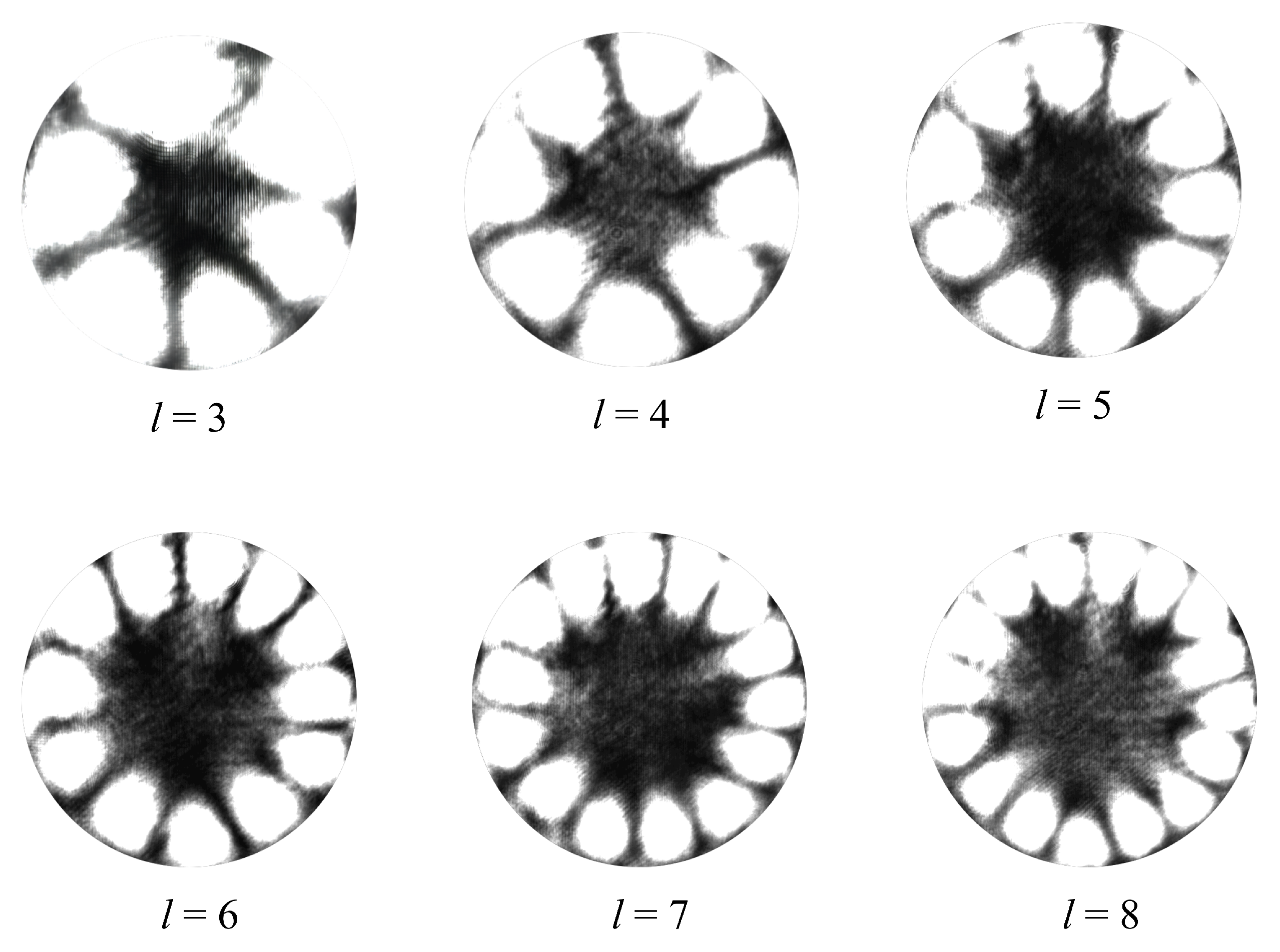
The topological charge l dictates the critical trade-off between angular sensitivity and spatial resolvability in the MD-VBI system. To determine the optimal pattern configuration for deep feature representation, we analyzed fringe morphologies ranging from l = 3 to l = 8 , as visually compared in Figure 2 and quantified in Table 1.
Theoretically, rotational sensitivity is inversely proportional to the topological charge ( Δ θ 1 / | l | ). Consequently, the rotation angle induced by a unit differential displacement ( Δ x = 1 nm ) diminishes significantly as l increases. To quantitatively describe the spatial distribution constraints of these interference fringes, we introduce the Illuminated Pixel Ratio (IPR, denoted as γ ) as a rigorous evaluation metric:
γ = N illu N total
where N illu represents the number of effectively illuminated pixels in the interferogram, and N total denotes the total number of pixels.
As detailed in Table 1, the IPR decreases overall as the topological charge l increases (from 0.1991 to 0.1789). Combined with the increase of lobes ( 2 l ), this decline in effective illuminated area inevitably causes individual lobes to be severely compressed azimuthally, rendering the fringe structures progressively thinner and the energy distribution increasingly sparse.
For lower-order topological charges ( l = 3 and l = 4 ), the primary limitation lies in insufficient geometric constraints. Although lower-order modes offer higher angular sensitivity, the reduced number of lobes and their excessively broad individual structures result in shallow spatial intensity gradients at the bright-dark boundaries. This lack of high-frequency spatial information hinders the network from accurately resolving minute rotational variations, rendering the regression results highly susceptible to local intensity fluctuations.
Conversely, for higher-order topological charges ( l = 7 and l = 8 ), the primary drawback is physical resolution limitation. As the number of lobes surges, the angular spacing is severely compressed, resulting in a highly dense fringe structure where minute details approach the spatial resolution limit of the imaging system. This drastically increases the risk of spatial aliasing and the loss of critical high-frequency edge information, while concurrently attenuating the effective signal energy, thereby severely degrading the discriminability of rotational features.
Consequently, based on this optical analysis, l = 6 was selected as the operating topological charge for the subsequent experiments. This configuration generates 12 clearly separated petal-like fringes, offering sufficient geometric constraints while preserving a relatively favorable energy distribution ( γ = 0.1831 ) and spatial resolvability. Its fringe density is well within the effective resolving capability of the imaging system, and the resulting clear boundaries significantly mitigate the risks of spatial aliasing and degradation of high-frequency edge information. Although its sensitivity (0.113°/nm) is slightly lower than that of lower-order modes, it achieves an optimal balance among sensitivity, fringe density, and feature discriminability, making it highly suitable for high-precision nanometric regression tasks. A quantitative comparison further supporting this selection will be provided in Section 4.1.

2.3. DenseNet Framework for Rotational Feature Demodulation

Based on the optical analysis in Section 2.2, l = 6 was adopted as the fixed operating condition for this study, and all main network training and evaluation were performed using interferograms generated under this topological charge. Under this condition, the primary task is to accurately resolve the minute rotational variations of the vortex interferograms into nanometric relative misalignment values. Crucially, the proposed framework estimates the relative misalignment between the reference and a measured state, rather than extracting the absolute position or alignment of a single object from an isolated interferogram.
Theoretically, decoding the physical rotation angle from the digital image plane requires an explicit Cartesian-to-polar coordinate transformation [25]. However, conventional analytical methods that rely on this transformation require rigid manual centroid extraction. This intermediate step renders them highly vulnerable to localized optical noise and beam aberrations. In contrast, deep learning models can directly extract rotational features from raw 2D optical images, thereby circumventing the error propagation inherent in explicit coordinate unwrapping [26]. Based on this rationale, our framework directly processes raw interferograms, implicitly learning the mapping between spatial intensity distributions and angular displacements through the hierarchical representation of convolutional features.
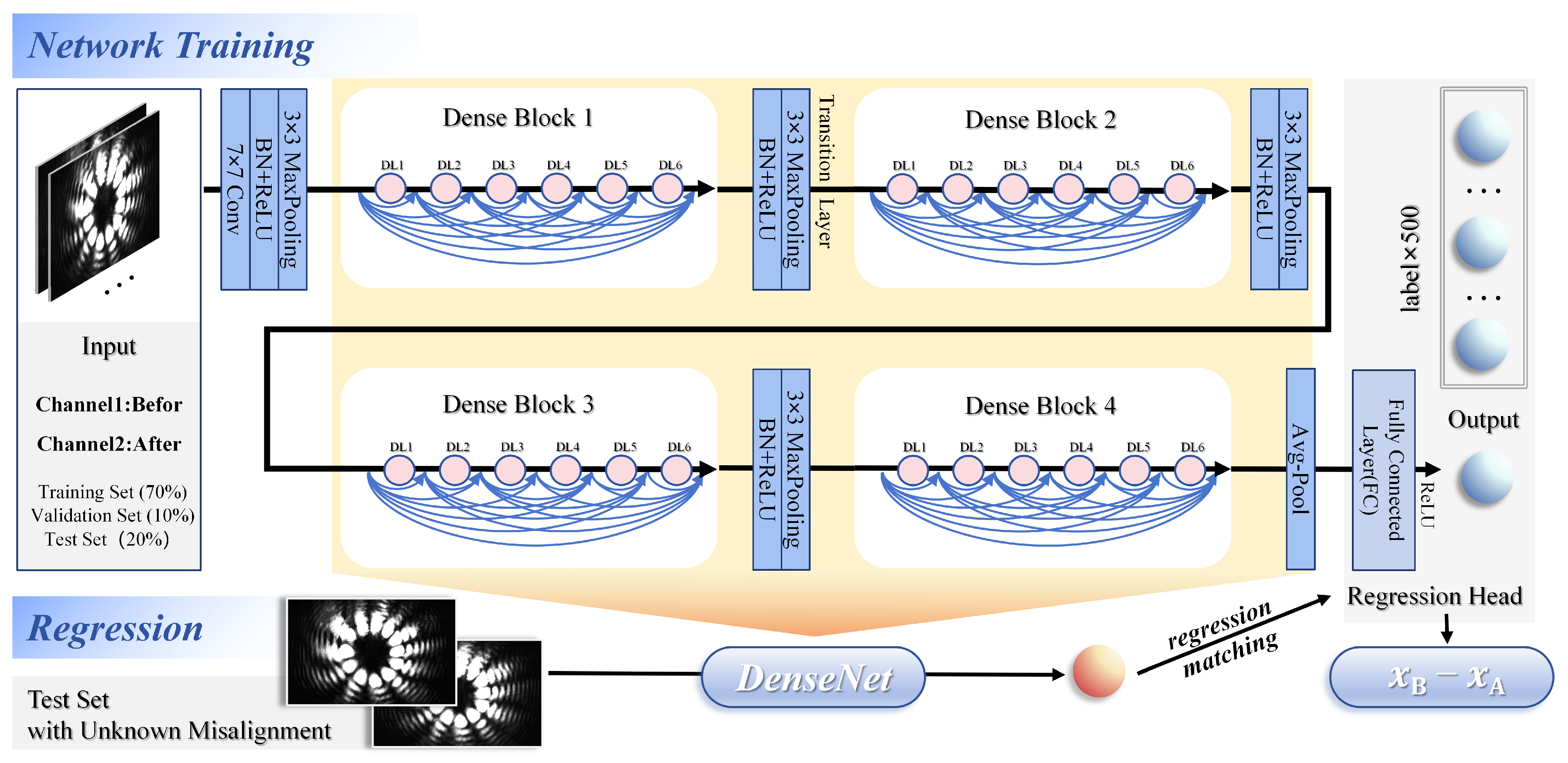
However, within this deep learning paradigm, the critical challenge in analyzing vortex beam interferograms lies in preserving high-frequency spatial details—specifically, the edge and texture features of the petal-like patterns that encode minute misalignment signatures. To precisely resolve these subtle rotation angles within the l = 6 vortex interference fringes, we propose a regression strategy based on DenseNet-169, as illustrated in Figure 3.
The rationale for this architectural choice fundamentally lies in its distinct mechanism of feature fusion. In standard residual architectures (e.g., ResNet), feature fusion relies on element-wise summation. Mathematically, consecutive summations across deep layers intrinsically act as spatial low-pass filters, which tend to average out pixel activations and inevitably smooth the sharp intensity gradients at the azimuthal edges of the interferometric lobes. In contrast, DenseNet employs a dense connectivity pattern that concatenates feature maps from all preceding layers along the channel dimension. Specifically, the l th layer receives the feature maps of all preceding layers, X 0 , , X l 1 , as input:
X l = H l X 0 , X 1 , , X l 1
X 0 denotes the input feature map, and X l represents the output of the l th layer. [ X 0 , X 1 , , X l 1 ] refers to the concatenation of the feature-maps produced in layers 0 , , l 1 . By circumventing the additive blurring effect, this design philosophy maximizes feature reuse and ensures that pristine shallow visual cues are explicitly preserved and propagated to deeper regression layers. Such a mechanism effectively prevents the feature dissipation of high-frequency structural information during feature abstraction, thereby enabling the network to regress nanometric displacements with high fidelity.
Each layer in the DenseNet implements a nonlinear transformation H l ( · ) , which is a composite function within a dense block comprising batch normalization (BN), rectified linear units (ReLUs), and a 3 × 3 convolution (Conv). The structure of the composite function H l ( · ) is expressed as:
BN ReLU Conv 3 × 3
To accurately resolve relative misalignment, we adopted a comparative dual-channel input strategy. The model processes a stacked tensor ( 512 × 512 × 2 ) comprising the initial reference interferogram and the current measurement interferogram. Rather than extracting static features from a single image, this configuration compels the network to explicitly evaluate the differential angular rotation between the two states, instead of relying solely on a potentially ambiguous intensity distribution. This approach directly reflects the physical measurement process, where displacement is quantified by the fringe shift relative to a zero baseline. To adapt the architecture for regression, the original classification head is replaced by a Global Average Pooling (GAP) layer followed by fully connected layers. This structure maps deep features directly to a scalar output representing the misalignment value Δ x , establishing an end-to-end mapping from optical signatures to the physical misalignment quantity.
Notably, while the interferograms exhibit high contrast, minor optical distortions and background noise inherent to the experimental setup itself (e.g., beam aberrations, scattering artifacts, and intensity fluctuations) are unavoidable. In traditional analytical frameworks, such non-ideal factors frequently induce centroid drift and phase demodulation errors. However, during the training process, the DenseNet-169 model implicitly incorporates these experimental artifacts into its hierarchical feature space. By leveraging localized distortions as a form of natural data augmentation, the network successfully learns distortion-invariant representations, thereby ensuring robust, high-fidelity nanometric regression amidst inherent system-level optical perturbations.

3. Experimental Design and Implementation

3.1. Optical System Configuration and Data Acquisition

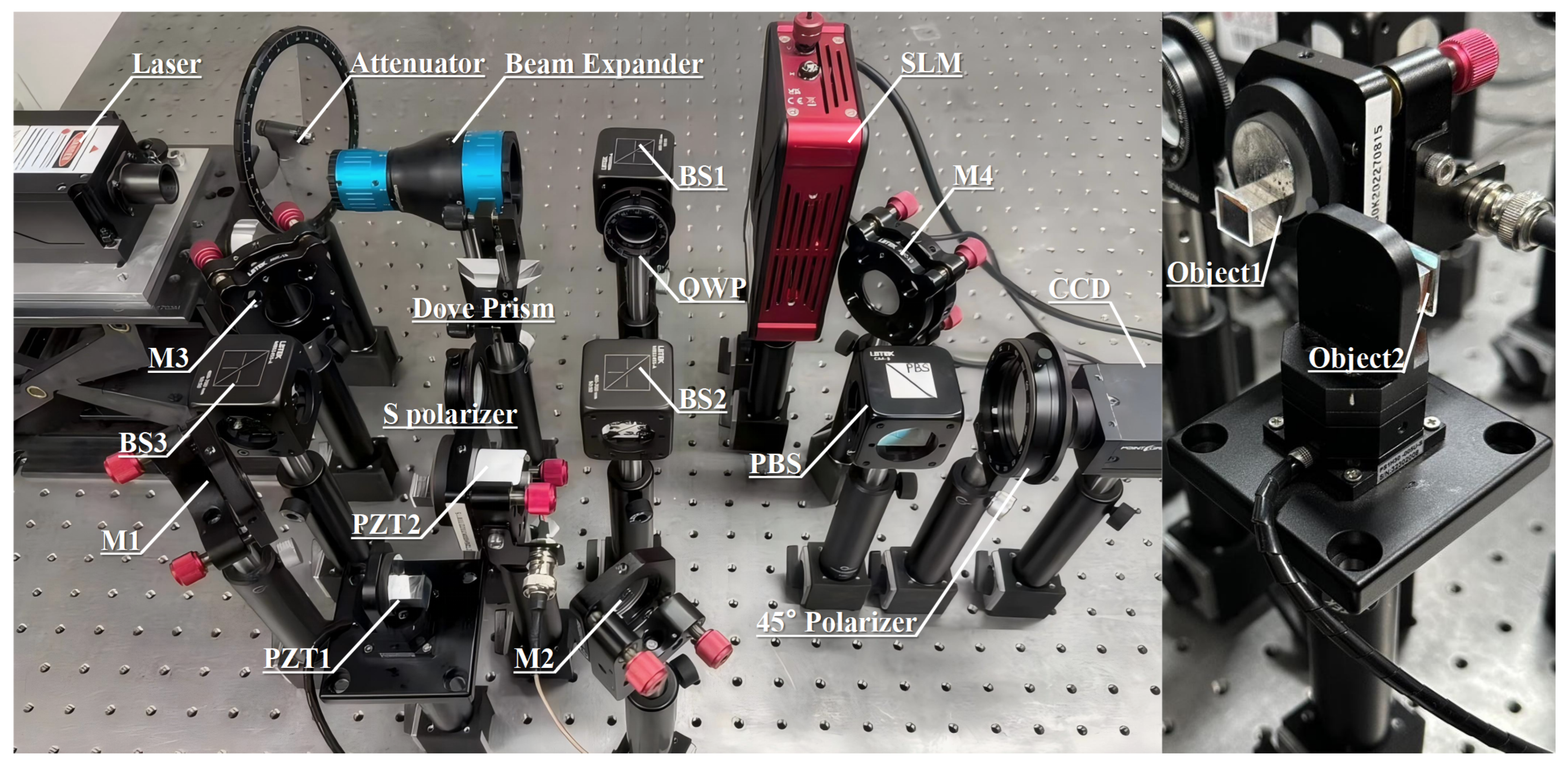
As illustrated in Figure 4, the experimental setup was constructed on a vibration-isolated optical table. The system employs a 532 nm single-frequency laser and a reflective Spatial Light Modulator (SLM, Exulus-HD2, Thorlabs, Newton, NJ, USA) to generate l = 6 vortex beams in real-time via phase hologram loading. To simulate nanometric misalignment, cubic blocks representing Targets A and B were mounted on independent closed-loop piezoelectric nanopositioners (Nano-HS3M, Mad City Labs, Madison, WI, USA). With a positioning resolution of 0.01 nm, these stages served as the ground-truth reference for displacement. To eliminate wavefront divergence and distortion induced by the inherent curvature of cylindrical shafts, high-quality planar dielectric mirrors were attached to the measurement surfaces. This configuration ensures that the vortex beams undergo specular reflection, preserving topological phase information and yielding high-contrast interferograms captured by a scientific CMOS camera (GS3-U3-23S6M-C, Teledyne FLIR, Wilsonville, OR, USA, 1920 × 1200 pixels).
Notably, all interferograms used in this study were acquired from real experimental measurements, rather than being generated through numerical simulations. Data acquisition focused on the asymmetric misalignment range of 0 to 500 nm, addressing a critical gap in precision shaft alignment: while micrometer-level positioning is achievable via coarse alignment stages, residual misalignment within the sub-500 nm regime remains a primary factor contributing to device yield loss and coupling efficiency degradation. By driving the PZT stages in precise 1 nm increments, 501 discrete displacement positions were sampled. At each position, the stages were held stationary while 30 sequential interferograms were recorded, yielding a complete raw dataset of 15,030 samples.
During image preprocessing, the raw interferograms were first cropped directly to a 512 × 512 pixel central Region of Interest (ROI) to remove the peripheral zero-intensity background and stray light. Since the energy of the l = 6 vortex pattern is centrally concentrated, this cropping window fully encompasses the effective petal structures, ensuring that the azimuthal rotation ( Δ θ ) is accurately preserved without scaling distortion. To strictly preserve pristine optical fidelity and maintain the physical mapping between fringe rotation and displacement, no artificial data augmentation methods (such as random rotation, geometric transformations, or synthetic noise injection) were employed during this process. Specifically, because the azimuthal rotation of the pattern directly encodes nanometric misalignment, conventional rotation augmentation would corrupt the physical label semantics; concurrently, artificially injecting synthetic noise could obscure or destroy the high-frequency fringe edges and minute details crucial for nanometric regression.
To construct the network inputs, each pair of preprocessed images was stacked into a dual-channel input tensor (512 × 512 × 2). The first channel contains the reference interferogram captured at the zero-displacement state ( Δ x = 0 ), and the second channel contains the measurement interferogram captured at the current target misalignment state. The output label assigned to each dual-channel sample is defined as the net differential displacement ( Δ x ) directly obtained from the PZT readings. Notably, all 30 samples captured at the same displacement point share an identical label. This strategy of combining a dual-channel configuration with repeated measurements not only enables the network to extract differential rotational features between the reference and measured states, but also intrinsically captures the statistical characteristics of real experimental perturbations, including optical speckle fluctuations, minor beam drift, air disturbances, and local optical distortions. By exposing the network to multiple real samples with identical labels but slightly varying optical realizations, the model is guided to implicitly suppress inherent system-level optical noise.
To ensure reliable evaluation and prevent data leakage, a strict chronological partitioning strategy was adopted, with 70%, 10%, and 20% of the dataset allocated to the training, validation, and testing sets, respectively. This temporal isolation guarantees an unbiased assessment of the model’s generalization performance against temporal environmental variations.

3.2. Measurement Scenarios and Kinematic Definitions

To systematically validate the misalignment response characteristics and environmental robustness of the proposed MD-VBI, and to experimentally corroborate the theoretical “misalignment-to-rotation” model derived in Equation (5), three distinct kinematic measurement scenarios were designed. These scenarios are structured to rigorously characterize the fundamental single-shaft baseline response and complex dual-shaft differential sensing, while simultaneously verifying the system’s common-mode rejection (CMR) capability against symmetric thermal disturbances.
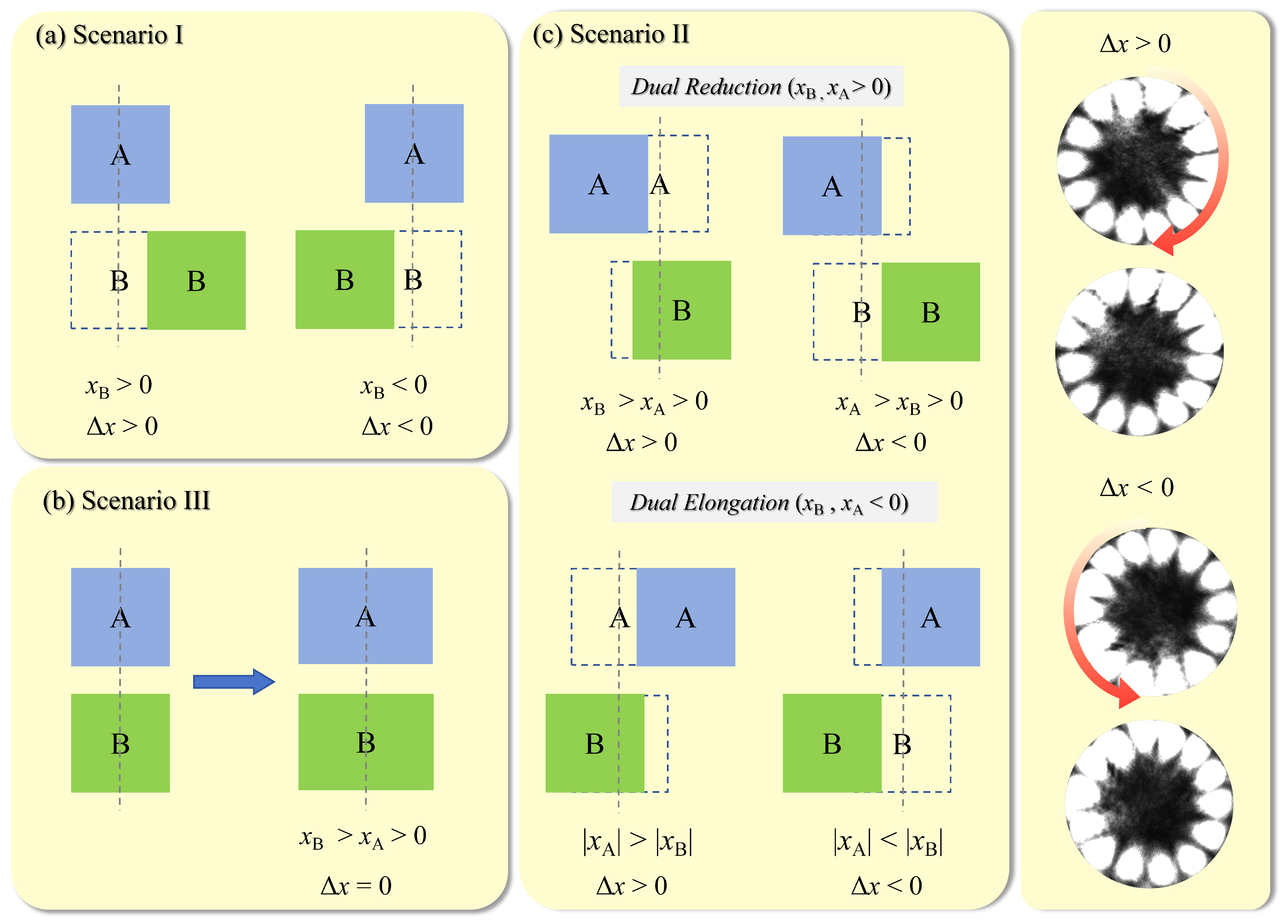
For quantitative analysis, the net differential displacement is defined as Δ x = x B x A . The positive direction ( Δ x > 0 ) is rigorously defined as optical path reduction; conversely, a negative sign ( Δ x < 0 ) denotes optical path elongation. Crucially, the MD-VBI system operates on a strictly differential measurement principle. The morphological rotation of the interference pattern is governed solely by the net differential displacement ( Δ x ). Consequently, equivalent net displacements generated under different kinematic contexts (e.g., Scenario I versus Scenario II) produce physically identical interferograms. This physical indistinguishability is not a limitation of the learning model, but is intrinsic to the differential measurement mechanism of the MD-VBI system. Therefore, the DenseNet-169 model functions exclusively as a highly precise differential demodulator to resolve Δ x . Categorizing the specific mechanical origins of this displacement relies on the preliminary information of the user’s defined experimental scenario.

3.2.1. Scenario I: Standard Single-Shaft Response

As illustrated in Figure 5a, this scenario serves as the calibration baseline to establish the system’s directional sensitivity and linearity. It simulates the fundamental condition where one shaft acts as a stationary reference. Specifically, the reference arm (A) is rigidly fixed ( x A = 0 ), while the measurement arm (B) is actuated to undergo precision stepping in both the positive (path reduction, x B > 0 ) and negative (path elongation, x B < 0 ) directions. This scenario confirms that the interference pattern rotation direction unambiguously identifies the motion polarity of a single target: a clockwise (CW) rotation is expected for positive displacement ( x B > 0 ), and a counter-clockwise (CCW) rotation for negative displacement ( x B < 0 ).

3.2.2. Scenario II: Asymmetric Dual-Shaft Misalignment (Differential Mode)

As shown in Figure 5c, this scenario validates the system’s ability to resolve relative misalignment when both shafts are in motion. We categorize the complex kinematics into two groups based on the direction of optical path change:
Group 1: Dual Path Reduction (A, Left; B, Right)
Both shafts move to shorten their optical paths ( x A , x B > 0 ). The rotation depends on the differential magnitude.
Sub-case i ( x B > x A ): If Arm B moves further than Arm A, the net difference is positive ( Δ x > 0 ), resulting in clockwise (CW) rotation.
Sub-case ii ( x A > x B ): If Arm A moves further than Arm B, the net difference is negative ( Δ x < 0 ), resulting in counter-clockwise (CCW) rotation.
Group 2: Dual Path Elongation (A, Right; B, Left)
Both shafts move to increase their optical paths ( x A , x B < 0 ). Due to the subtraction of negative values ( Δ x < 0 ), the logic is governed by the relative retraction magnitude.
Sub-case iii ( | x A | > | x B | ): Arm A extends by a greater distance than Arm B. Algebraically, the subtraction of the larger negative term x A yields a positive net difference ( Δ x = x B x A > 0 ). This drives a clockwise (CW) rotation.
Sub-case iv ( | x B | > | x A | ): Arm B extends by a greater distance than Arm A. Algebraically, the subtraction of the larger negative term x B yields a negative net difference ( Δ x = x B x A < 0 ). This drives a counter-clockwise (CCW) rotation.

3.2.3. Scenario III: Common-Mode Rejection

As shown in Figure 5b, this scenario simulates environmental disturbances such as thermal expansion, where the shafts expand symmetrically outwards or contract inwards relative to the center.
Target A moves left (outward) while Target B moves right (outward) with identical magnitudes. Spatially, they move in opposite directions, but optically, both arms undergo path reduction ( x A > 0 , x B > 0 ). The differential input is nullified ( Δ x = x B x A = 0 ), resulting in a Static Interference Pattern. This verifies the system’s Common-Mode Rejection (CMR) capability against symmetric thermal deformations.

4. Results and Analysis

4.1. Model Training Performance

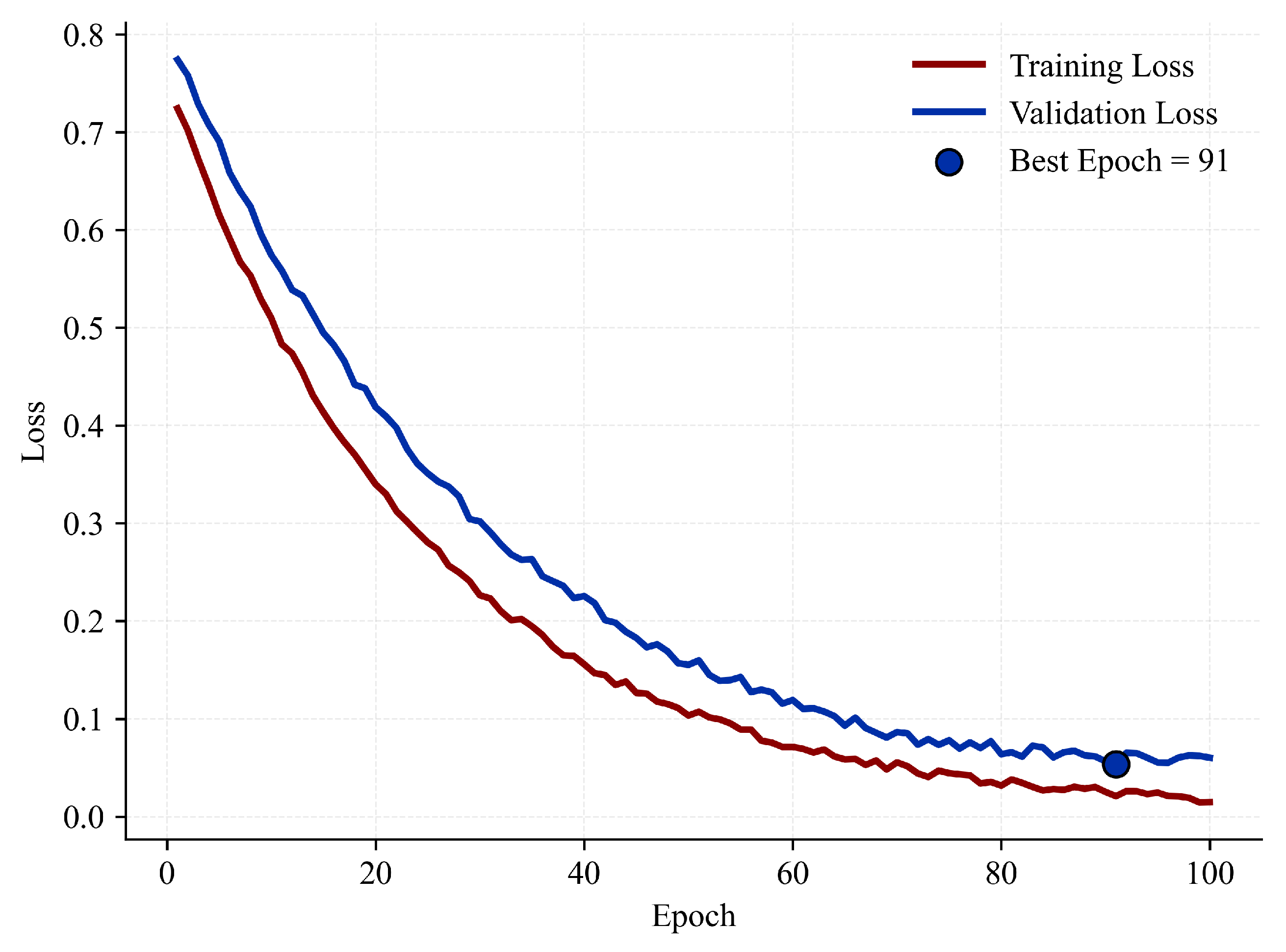
The demodulation backend, implemented using the Python 3.12 and optimized with the Adam algorithm and an early stopping mechanism. To further demonstrate the training stability and generalization performance of the proposed framework, the training and validation loss curves are presented in Figure 6. Both curves exhibit a smooth and rapid descent during the early stages of training, with the validation loss closely tracking the training trajectory. The validation loss converges to its optimal minimum at Epoch 91, plateauing thereafter without significant divergence or late-stage rebound. This confirms that the validation-loss-based early stopping strategy effectively intercepts potential overfitting at the optimal weight configuration, thereby supporting the stable training and robust generalization of DenseNet-169 under the strict chronological partitioning scheme.
Besides regression accuracy, computational efficiency is a crucial practical metric for low-latency monitoring of relative misalignment in industrial deployment. For each unseen interferogram pair, stacked as a 512 × 512 × 2 dual-channel input tensor, the average inference time was approximately 12.5 ms, corresponding to about 80 FPS. This result indicates that the proposed single-shot deep-learning demodulation framework has the computational potential for near-real-time evaluation of relative misalignment at the algorithmic level. However, end-to-end latency in industrial deployment depends not only on neural-network inference but also on image acquisition, camera exposure time, data transfer, and control-loop communication overhead. Under the current hardware configuration, accounting for a typical CMOS exposure time (approximately 2–5 ms) and data-transfer overhead, the overall end-to-end latency is estimated to remain within approximately 20 ms. These results indicate the potential for low-latency monitoring of relative misalignment in industrial deployment.
To further validate the rationality of the topological charge selection discussed in Section 2.2, we conducted a comparative study using interferograms generated with different topological charges ( l = 3 to l = 8 ) within the same DenseNet-169 framework, while keeping the dataset partition, optimizer settings, and training protocol unchanged. As shown in Table 2, the regression performance does not follow the IPR in a strictly monotonic manner, but is jointly affected by angular sensitivity, fringe density, and effective illuminated area. Specifically, the lower-order modes exhibit higher MAE values due to relatively insufficient geometric constraints, whereas the higher-order modes suffer from degraded accuracy because of dense fringe packing and reduced spatial resolvability. Among all tested cases, l = 6 achieves the best overall regression performance, which quantitatively supports the rationality of the selected topological charge.
Beyond the above validation of the operating topological charge, we comprehensively benchmarked DenseNet-169 against a shallow baseline (standard CNN), standard deep architectures (VGG-16, ResNet-50), and an attention-based Vision Transformer (ViT). Results indicate that the shallow CNN lacks the representational depth required to resolve nanometric misalignment, while the massive VGG-16 introduces severe parameter redundancy. In contrast, DenseNet-169 leverages an efficient channel-wise feature concatenation mechanism to achieve the lowest regression error with only 12.3 M parameters, striking the optimal balance between representational capacity and computational efficiency. Additionally, the ViT model, lacking mechanisms to capture local structural details, failed to converge and to decode fringe-rotation features.
As shown in Table 3, the proposed DenseNet-169 model achieved an optimal Mean Absolute Error (MAE) of 0.365 nm and a Coefficient of Determination ( R 2 ) of 0.968 on the independent test set, demonstrating its effectiveness in decoding subtle features from complex interference fringes to ensure high-precision misalignment measurement. Furthermore, its low Mean Squared Error (MSE) of 0.172 exhibits strong robustness against data outliers, effectively suppressing sporadic prediction deviations caused by local optical speckles and background noise.
Further exploration of network depth within the DenseNet family reveals that simply increasing the number of layers does not yield a linear improvement in accuracy. The shallower DenseNet-121 suffers from performance saturation due to limited fitting capability. Conversely, blindly extending the depth to 201 layers (DenseNet-201) not only increases the computational load (FLOPs) to 4.6 G but also degrades the error (MAE: 0.378 nm), exposing distinct structural redundancy and a tendency toward overfitting.
Subsequent ablation studies further verified the physical necessity of its internal components. Removing dense connectivity, transition layers, or batch normalization significantly deteriorates both MAE and MSE. This confirms that intrinsic feature reuse and dimensional compression mechanisms are indispensable for preserving high-frequency rotational features, collectively ensuring that the network achieves the globally optimal convergence required for nanometric regression amidst inherent system-level optical perturbations.

4.2. Verification of Directional Response and Linearity (Scenario I)

The Single-Shaft Baseline test (Scenario I) established the system’s fundamental metrological benchmark. With Reference Target A rigidly fixed, Measurement Target B was actuated in 1 nm increments over the 0–500 nm range. At each displacement step, 30 independent sample sets were acquired to evaluate statistical consistency.
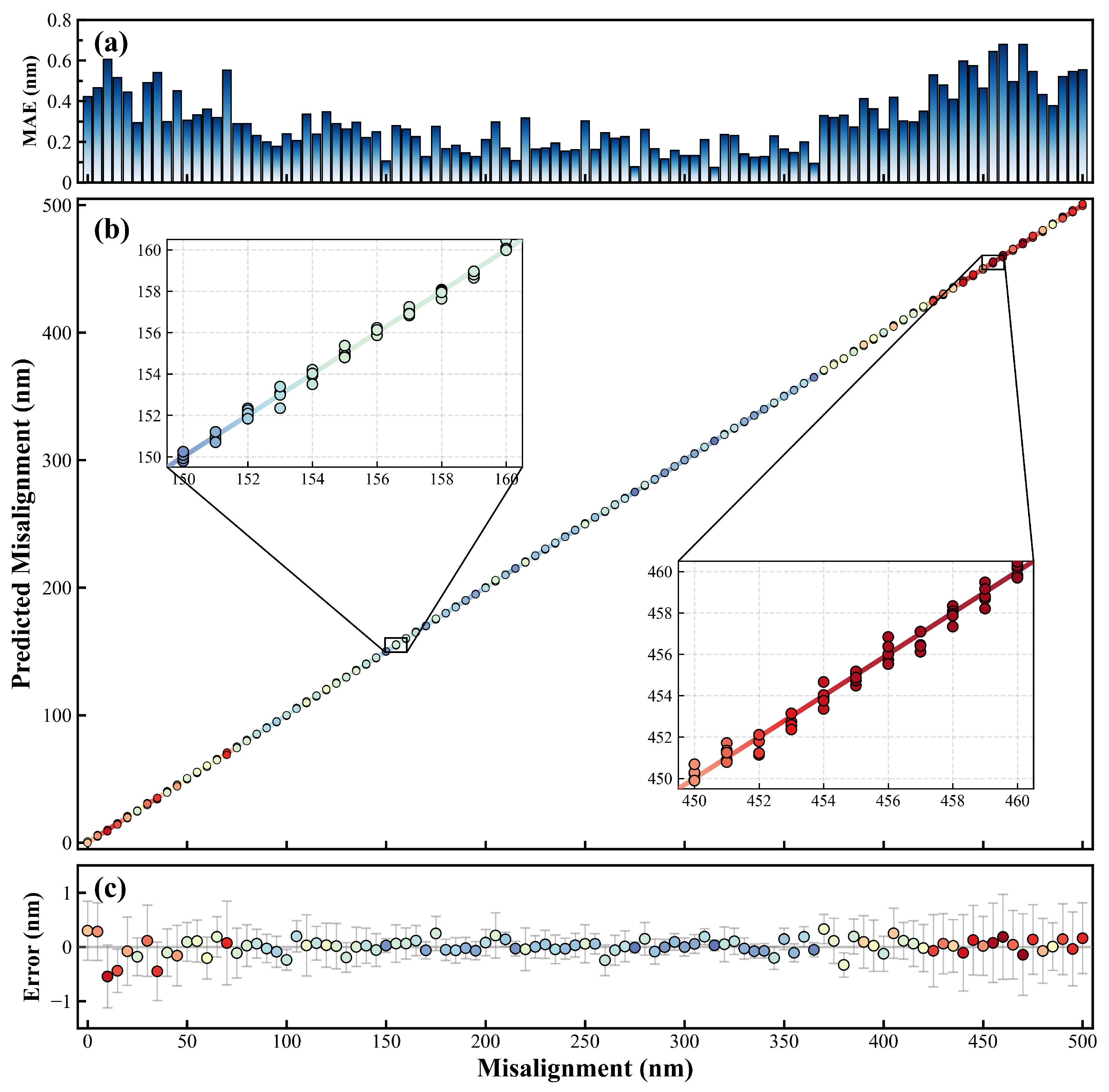
As illustrated in Figure 7b, the system exhibits a highly deterministic linear response ( R 2 = 0.962 ), with predicted misalignment values aligning closely with the ground truth provided by the nanopositioner. Positive ( x B > 0 ) and negative ( x B < 0 ) differential displacements trigger strict clockwise (CW) and counter-clockwise (CCW) rotations of the interference pattern, respectively. Consistent with the theoretical derivation in Section 3.2, this confirms that the DenseNet-169 model has successfully learned the monotonic “phase–rotation” mapping law.
Detailed statistical characterization is presented in Figure 7a,c. The error bar plot in Figure 7c confirms the absence of systematic bias, as discrete errors oscillate strictly around the zero line across the entire range. However, as shown in Figure 7a, the precision distribution exhibits distinct non-uniformity: stability peaks in the central region (MAE: ∼0.26 nm) and degrades slightly towards the extremities. This error amplification is attributed to the coupling of two mechanisms: the proximal small-displacement regime is bottlenecked by noise-limited resolution, where the minute differential rotation induced by micro-misalignment approaches the system’s noise floor, leading to a degraded Signal-to-Noise Ratio (SNR); and the distal boundary regime is limited by “edge effects” in regression, where prediction uncertainty increases due to the lack of bilateral data support. Nevertheless, the maximum error across the full dynamic range remains strictly within the sub-nanometer tolerance required for precision alignment.

4.3. Asymmetric Misalignment Measurement and Comparative Benchmarking (Scenario II)

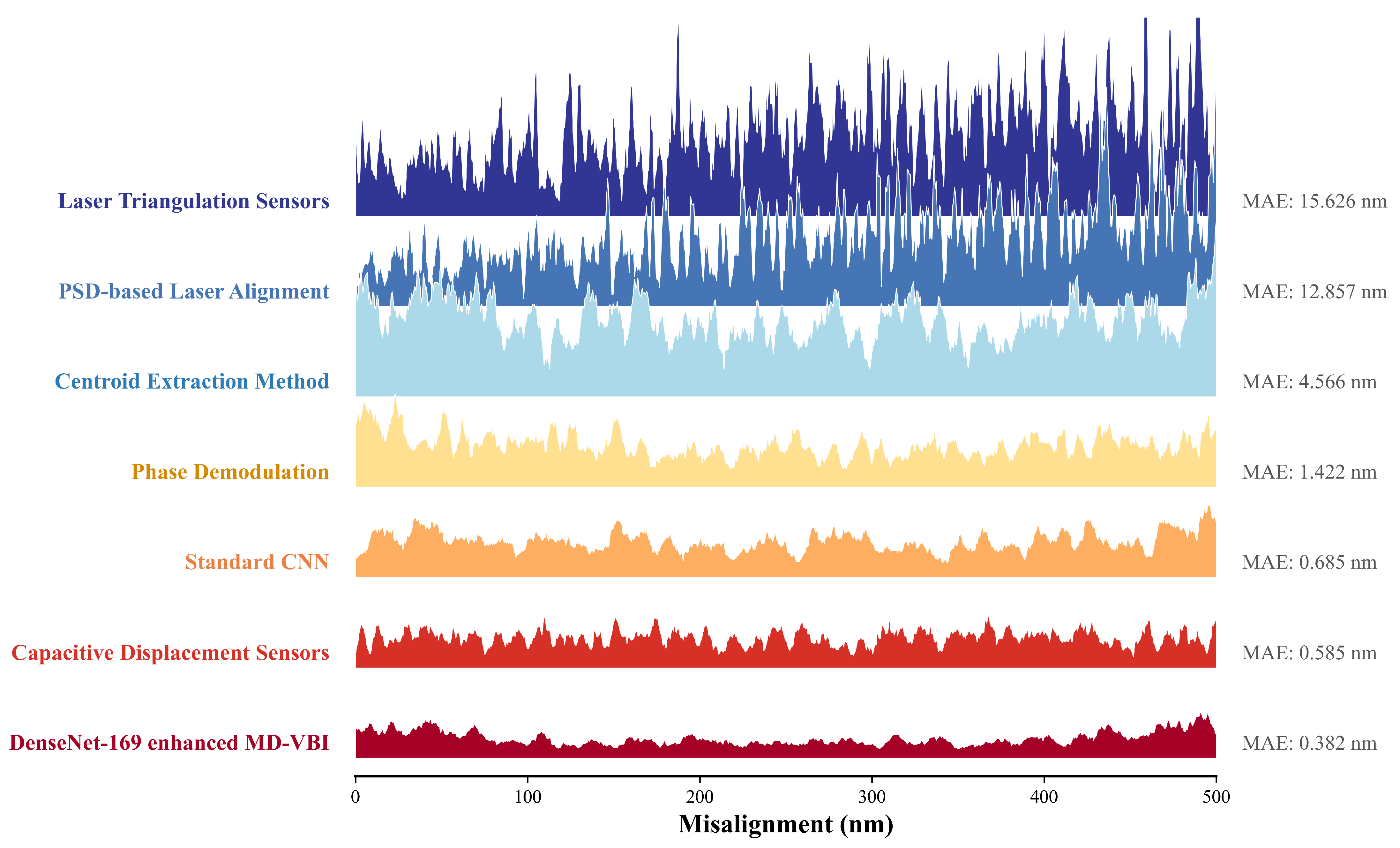
The Asymmetric Dual-Shaft Misalignment test (Scenario II) validated the proposed system’s capability to decouple relative misalignment under complex kinematic states. Table 4 details the comprehensive quantitative performance metrics for this configuration, while Figure 8 visualizes the comparative results via error distribution ridges.
Benchmarking against mainstream industrial solutions—Capacitive Sensors, Laser Triangulation, and PSD-based Laser Alignment—reveals significant insights. While Capacitive Sensors serve as the industry precision benchmark, maintaining high linearity and a flat error distribution (MAE: 0.585 nm), their practical application is strictly confined by microscopic working distances (< 500 μ m). The measurement system based on the MD-VBI architecture not only surpasses this precision benchmark (MAE: 0.382 nm) but also achieves a flexible standoff distance (>5 cm), providing critical adaptability for encapsulated MEMS monitoring where proximal access is precluded.
In contrast, intensity-dependent methods—Laser Triangulation (MAE: 15.626 nm) and PSD (MAE: 12.857 nm)—exhibit distinct range-dependent error divergence. As shown in Figure 8, the magnitude and dispersion of measurement errors amplify significantly with increasing misalignment. This degradation is attributed to the coupling of cross-scale measurement limitations and environmental susceptibility. Optimized for micrometer-scale monitoring, these sensors operate near their signal-to-noise limits in the nanometric regime, bottlenecked by coherent speckle noise from rough surfaces and turbulence-induced beam wander. Furthermore, intrinsic photodetector non-linearity and distal spot degradation exacerbate stochastic errors at the range limit. Conversely, the proposed system discards reliance on local intensity, employing deep learning to decode nanometric signatures encoded in the global azimuthal rotation of MD-VBI interference fringes. By leveraging global feature redundancy in the latent space, this approach effectively circumvents local intensity perturbations, ensuring high robustness.
Algorithmic benchmarking further confirms the superiority of DenseNet-169. Unlike traditional physical algorithms (Centroid, Phase Demodulation) that are prone to cumulative calculation errors and sensitive to local optical artifacts, DenseNet establishes a precise end-to-end mapping by decoding physically meaningful global rotational features. Moreover, compared to the Standard CNN (MAE: 0.685 nm), DenseNet leverages a feature reuse strategy to effectively preserve minute fringe details often lost during downsampling, ensuring nanometric precision even with minimal feature gradients.
In summary, the holistic synergy between the MD-VBI optical architecture and the DenseNet model is key to achieving exceptional performance. The former physically amplifies feature discernibility, while the latter leverages superior feature preservation capabilities to robustly decode these complex optical signatures, thereby collectively ensuring high system resolution and robustness.

4.4. Environmental Robustness via Common-Mode Rejection (Scenario III)

In the context of high-precision manufacturing, thermal disturbances such as motor self-heating or ambient fluctuations inevitably cause thermo-elastic deformations within structural components. Conventional single-point sensors face a fundamental challenge in physically decoupling thermally induced common-mode surface displacement from true differential-mode kinematic misalignment. Consequently, these sensors are prone to misinterpreting such thermal drift as lateral shaft displacement, creating a pseudo-misalignment that triggers erroneous compensation in active alignment systems.
To verify the system’s immunity to such common-mode disturbances, the Common-Mode Rejection (CMR) test (Scenario III) was conducted. We simulated a symmetric thermal expansion event where both Target A and Target B displaced outwardly from the geometric center with identical magnitudes ( x A = x B ), theoretically resulting in zero net differential misalignment ( Δ x = 0 ).
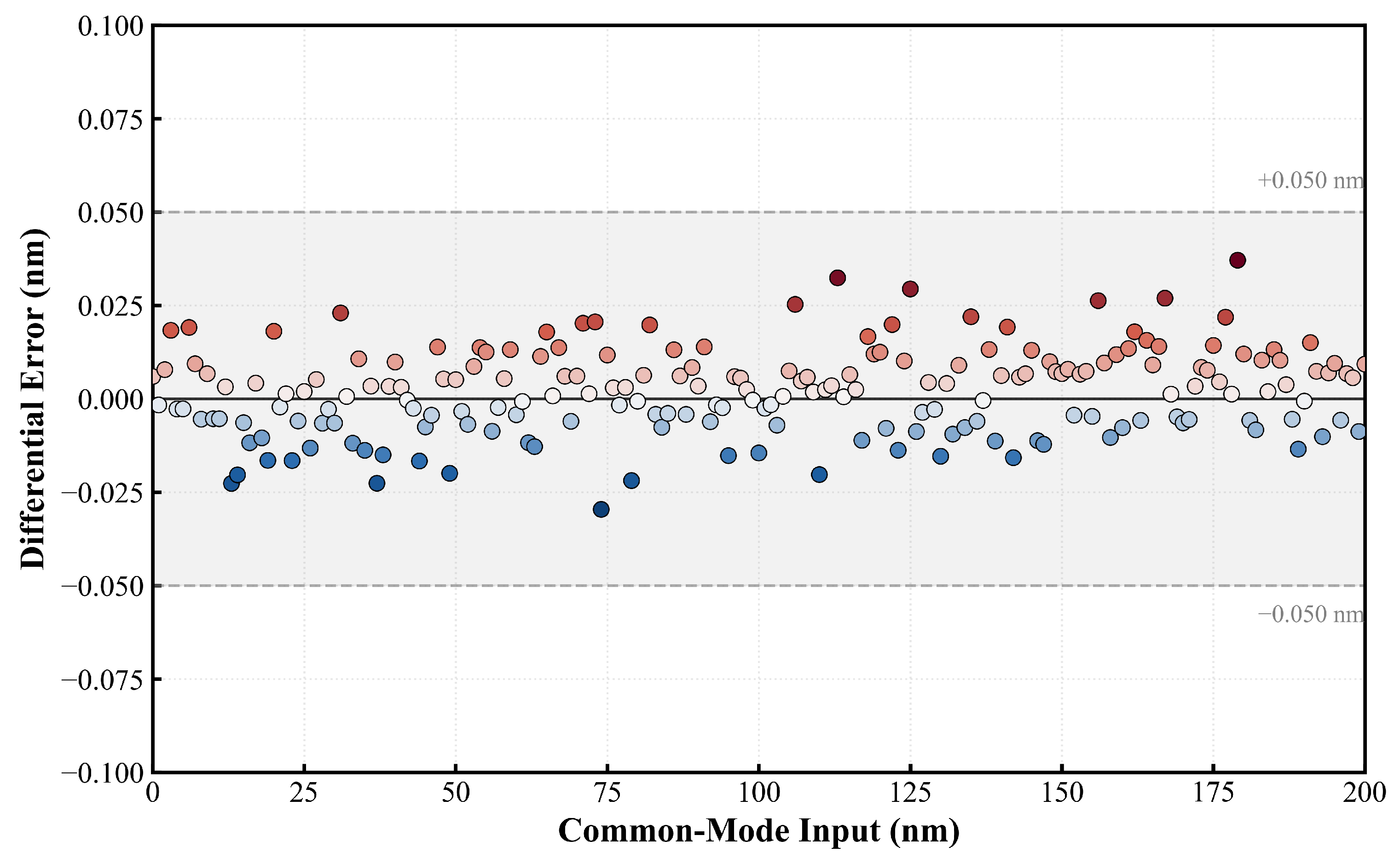
As illustrated in Figure 9, despite the common-mode input linearly ramping from 0 to 200 nm, the measured differential misalignment remained remarkably stable, fluctuating strictly within the noise floor of ± 0.05 nm. This demonstrates that the differential optical topology of the MD-VBI provides an intrinsic optical-domain common-mode rejection mechanism, physically eliminating thermal drift and vibration noise that affect both measurement arms equally. This capability ensures the system’s ability to precisely distinguish true mechanical errors from environmental drift during long-term monitoring.

5. Discussion

5.1. Configuration Adaptability for Orthogonal Misalignment Dimensions

The theoretical framework and experimental validation presented in Section 2.1 were primarily conducted in a vertical dual-shaft configuration, in which targets A and B are arranged vertically. In this setup, folding mirrors M1 and M2 are essential for beam steering and capturing relative lateral displacement (x-axis offset). However, the MD-VBI optical configuration features intrinsic flexibility. As illustrated in Figure 10, the system can be readily reconfigured to a horizontal setup by simply removing the folding mirrors M1 and M2. In this simplified mode, vortex beams propagate linearly along the primary optical axis without deflection, enabling the measurement of relative vertical displacement (y-axis) between juxtaposed targets.
This modularity demonstrates that the MD-VBI system is not restricted to a single mechanical layout. By selectively including or excluding the folding mirrors, the system adapts to diverse assembly constraints—such as vertical stacking versus horizontal juxtaposition—to monitor parallelism in orthogonal directions. Crucially, this geometric reconfiguration preserves both the fundamental interference principle and the monotonic ‘phase-to-rotation’ mapping law, ensuring that nanometric precision is maintained regardless of the measurement orientation.

5.2. Limitation Regarding Angular Misalignment

While the proposed MD-VBI system demonstrates exceptional precision in resolving nanometric lateral misalignment, it is imperative to explicitly delineate its operational boundaries regarding angular degrees of freedom. The system is not designed to decouple angular tilt; rather, its measurement accuracy is strictly predicated on a pre-constrained parallel motion environment.
This characteristic represents not a design flaw, but an inherent physical trade-off between measurement precision and degrees of freedom. Governed by the law of reflection, a target surface tilt of angle α induces a reflected beam deviation of 2 α . In the retro-reflective configuration, this angular deviation amplifies over the propagation distance, triggering a dual detrimental effect: first, it causes significant lateral beam walk-off; second, and more critically, it introduces a complex, non-linear parasitic Optical Path Difference (OPD). This tilt-induced OPD is highly coupled with the phase shift arising from lateral misalignment, rendering the decoupling process computationally intractable. Consequently, minute target tilts result in measurement invalidation due to inseparable phase crosstalk, while excessive tilts directly cause beam walk-off, preventing the beam from retracing its path and leading to the complete extinction of the interference signal.
In light of this, the proposed system is rigorously defined as a high-precision parallelism monitor rather than a generic six-degree-of-freedom (6-DOF) tracker. It is specifically tailored for precision engineering scenarios where angular posture is mechanically constrained by external structures like air-bearing guides, and where the primary sources of misalignment are minute lateral offsets or thermal drifts. Only under the prerequisite of angular constraint can the system fully leverage its optical gain to achieve nanometric measurement of relative lateral misalignment.

6. Conclusions

This paper presents a high-precision metrology method for asymmetric shaft misalignment based on the Misalignment Differential Vortex Beam Interferometer (MD-VBI) integrated with the DenseNet-169 architecture. By synergizing a polarization-multiplexed differential optical architecture with a deep learning-based regression framework, the system achieves high-precision nanometric alignment monitoring, significantly enhancing robustness to inherent system-level optical perturbations.
Optically, the system establishes a unique dual-path synchronous probing architecture, realizing precise differential sensing of the relative misalignment between the two target end-faces. By leveraging the superposition interference of conjugate vortex beams (with opposite topological charges), the system transforms minute linear misalignments into a significant rotation of the interference pattern, physically amplifying the sensitivity of nanometric measurements. Resolving this robust global rotation—rather than tracking noise-susceptible local vortex splitting singularities—significantly enhances measurement stability at the nanometric scale. Crucially, this counter-propagating optical configuration constitutes an intrinsic differential baseline: common-mode expansion induced by environmental thermal effects is intrinsically canceled via the differential mechanism, fundamentally overcoming the common-mode thermal sensitivity bottleneck of conventional laser interferometry.
Algorithmically, integrating DenseNet-169 effectively overcomes the feature dissipation bottleneck inherent in standard CNNs. By leveraging its unique dense connectivity architecture and efficient feature reuse mechanisms, the network robustly decodes the subtle rotational features encoded within the petal-like interference fringes ( l = 6 ), achieving a high-fidelity resolution of nanometric shaft deviations.
The study comprehensively benchmarks the proposed method against three categories of existing technologies: traditional algorithms (Phase Demodulation, Centroid Extraction Method), baseline neural networks, and commercial hardware (Capacitive Displacement Sensors, PSD-based Laser Alignment, Laser Triangulation Sensors). Quantitatively, within the critical misalignment measurement range of 0–500 nm, the system demonstrates exceptional metrological accuracy, achieving a Mean Absolute Error (MAE) of only 0.382 nm.
Compared to traditional methods such as laser triangulation or centroid extraction, which frequently exhibit high-frequency signal jitter, the proposed approach ensures exceptional signal smoothness and stability. This is attributed to the robust noise suppression and non-linear fitting capabilities of the deep learning algorithm. At the architectural level, the DenseNet-169 backbone leverages its unique dense connectivity to outperform conventional deep learning baselines. By structurally mitigating deep feature dissipation, it ensures high-precision regression outputs, thereby establishing superior robustness compared to standard architectures.
In conclusion, with its proven capability to efficiently decouple true asymmetric misalignment signals from environmental thermal expansion perturbations, the proposed method offers a robust, non-contact solution with significant promise for critical precision engineering sectors, such as semiconductor overlay alignment and precision bearing assembly. Future research will focus on enhancing the algorithm’s temporal resolution to accommodate real-time dynamic monitoring requirements, addressing current limitations in angular tilt sensing, and exploring domain adaptation strategies to extend this laboratory-validated framework to complex industrial environments. To further facilitate this industrial transition, the dynamically programmable SLM can be readily replaced by low-cost optical elements with a fixed topological charge, such as spiral phase plates. The ultimate goal is to achieve comprehensive six-degree-of-freedom (6-DOF) sensing for advanced manufacturing processes.

Author Contributions

Conceptualization, T.Y. and J.L.; methodology, T.Y.; software, B.Z.; validation, J.W. and Y.Z.; formal analysis, T.Y.; investigation, T.Y.; resources, J.L.; data curation, B.Z.; writing—original draft preparation, T.Y.; writing—review and editing, J.L.; visualization, J.W.; supervision, J.L.; project administration, J.L.; funding acquisition, J.L. All authors have read and agreed to the published version of the manuscript.

Funding

This research was funded by the Natural Science Foundation of Shanxi grant number 202403021211089; Shanxi Scholarship Council of China grant numbers 2024-117 and 2023-141; Graduate Innovation Project of Shanxi Province grant number 2025XS128; and The Shanxi Special Project for Guiding the Transformation of Scientific and Technological Achievements grant number 202404021301029.

Institutional Review Board Statement

Not applicable.

Informed Consent Statement

Not applicable.

Data Availability Statement

The data that support the findings of this study are available from the corresponding author upon reasonable request.

Acknowledgments

We thank the members of State key Laboratory of Extreme Environment Optoelectronic Dynamic Measurement Technology and Instrument for their technical assistance.

Conflicts of Interest

The authors declare no conflicts of interest.

References

  1. Zhang, M.; Liu, Y.; Wang, D.; Tan, J. A coaxiality measurement method for the aero-engine rotor based on common datum axis. Measurement 2022, 191, 110696. [Google Scholar] [CrossRef]
  2. Liu, Y.; Li, R.; Sun, C.; Mei, Y.; Wang, X.; Tan, J.; Wang, H. A coaxiality measurement model based on multi-systematic errors separation for turbine shaft. Measurement 2021, 186, 109975. [Google Scholar] [CrossRef]
  3. Srisungsitthisunti, P.; Moon, E.E.; Tansarawiput, C.; Zhang, H.; Qi, M.; Xu, X. Nanometer-level alignment using interferometric-spatial-phase-imaging (ISPI) during silicon nanowire growth. Proc. SPIE 2010, 7767, 23–29. [Google Scholar]
  4. Song, Y.; Gui, C.; Huo, Z.; Lee, S.R.; Liu, S. Mechanical system and dynamic control in photolithography for nanoscale fabrication: A critical review. Int. J. Mech. Syst. Dyn. 2021, 1, 35–51. [Google Scholar] [CrossRef]
  5. Wen, X.; Traverso, L.M.; Srisungsitthisunti, P.; Xu, X.; Moon, E.E. High precision dynamic alignment and gap control for optical near-field nanolithography. J. Vac. Sci. Technol. B 2013, 31, 041601. [Google Scholar] [CrossRef]
  6. Geng, Z.; Tong, Z.; Jiang, X. Review of geometric error measurement and compensation techniques of ultra-precision machine tools. Light Adv. Manuf. 2021, 2, 211–227. [Google Scholar] [CrossRef]
  7. Wang, Y.; Zhao, F.; Luo, L.; Li, X. A review on recent advances in signal processing in interferometry. Sensors 2025, 25, 5013. [Google Scholar] [CrossRef]
  8. Rangappa, R.; Patel, G.C.M.; Chate, G.R.; Lokare, D.; Lakshmikanthan, A.; Giasin, K.; Pimenov, D.Y. Coaxiality error analysis and optimization of cylindrical parts of CNC turning process. Int. J. Adv. Manuf. Technol. 2022, 120, 6617–6634. [Google Scholar] [CrossRef]
  9. Simm, A.; Wang, Q.; Huang, S.; Zhao, W. Laser Based Measurement for the Monitoring of Shaft Misalignment. Measurement 2016, 87, 104–116. [Google Scholar] [CrossRef]
  10. Chai, Z.; Lu, Y.; Li, X.; Cai, G.; Tan, J.; Ye, Z. Non-contact measurement method of coaxiality for the compound gear shaft composed of bevel gear and spline. Measurement 2021, 168, 108453. [Google Scholar] [CrossRef]
  11. Cui, C.; Li, X. Precision Nanometrology: Laser Interferometer, Grating Interferometer and Time Grating Sensor. Sensors 2025, 25, 6791. [Google Scholar] [CrossRef] [PubMed]
  12. Zhang, M.; Lu, C.; Liu, W.; Liu, X.; Zhao, Q. Integrated Micro Sensor Based on Grating Interferometer: A Review. IEEE Sens. J. 2024, 25, 2073–2089. [Google Scholar] [CrossRef]
  13. Luo, L.; Zhao, M.; Li, X. A Review: Grating Encoder Technologies for Multi-Degree-of-Freedom Spatial Measurement. Sensors 2025, 25, 6071. [Google Scholar] [CrossRef]
  14. Dwik, S.; Sasikala, G.; Natarajan, S. Advancements and applications of position-sensitive detector (PSD): A review. Optoelectron. Lett. 2024, 20, 330–338. [Google Scholar] [CrossRef]
  15. Zhao, D.; Wang, S.; Ma, Y.; Li, X.; Zhang, H. Measurement of micro-displacement based on the interference of vortex beams and spherical wave. Infrared Laser Eng. 2020, 49, 0413005. [Google Scholar] [CrossRef]
  16. Emile, O.; Emile, J. Naked eye picometer resolution in a Michelson interferometer using conjugated twisted beams. Opt. Lett. 2017, 42, 354–357. [Google Scholar] [CrossRef]
  17. Han, S.; Yang, D.; Hu, X.; Yang, Z.; Zhuang, X.; Liu, Z. Micro-displacement measurement based on interference of vortex beams and plane wave. Opt. Precis. Eng. 2022, 30, 2058. [Google Scholar] [CrossRef]
  18. Zhang, F.; Liu, Y.; Wang, W.; Geng, L.; Xiao, Z. Digital phase-shift method based on distance mapping for phase recovery of an ESPI fringe pattern. Appl. Opt. 2023, 62, 2988–2997. [Google Scholar] [CrossRef]
  19. Yuan, T.; Liu, J.; Wu, J.; Zhang, Y.; Wang, Y.; Jing, N. Advanced vortex beam interference system enhanced by CNN for micro-displacement detection. Opt. Lasers Eng. 2025, 191, 108987. [Google Scholar] [CrossRef]
  20. Yin, W.; Che, Y.; Li, X.; Li, M.; Hu, Y.; Feng, S.; Lam, E.Y.; Chen, Q.; Zuo, C. Physics-informed deep learning for fringe pattern analysis. Opto-Electron. Adv. 2023, 7, 230034. [Google Scholar] [CrossRef]
  21. Ram, V.S.; Gannavarapu, R. Deep learning assisted fringe normalization for handling dynamic intensity fluctuations in digital holographic interferometry. Proc. SPIE 2025, 13567, 498–502. [Google Scholar]
  22. Shen, M.; He, L.; Zhang, H.; Ma, L.; Li, Y. Deep learning based measurement accuracy improvement of high dynamic range objects in fringe projection profilometry. Opt. Express 2024, 32, 35689–35702. [Google Scholar] [CrossRef]
  23. Liu, Z.; Zhang, Y.; Teng, G. Identification Method of Mature Wheat Varieties Based on Improved DenseNet Model. Agriculture 2025, 15, 736. [Google Scholar] [CrossRef]
  24. Huang, G.; Liu, Z.; Van Der Maaten, L.; Weinberger, K.Q. Densely connected Convolutional Networks. Proc. CVPR 2017, 4700–4708. [Google Scholar]
  25. Zhou, J.; Yin, Y.; Tang, J.; Chu, Q.; Li, L.; Xia, Y.; Gu, Q.; Yin, J. Machine-learning-assisted precision measurement of a tiny rotational angle based on interference vortex modes. Chin. Opt. Lett. 2025, 23, 093501. [Google Scholar] [CrossRef]
  26. Ni, L.; Xia, H.; Xu, F.; Wu, Q.; Zhang, J.; Chang, S. Picometer-scale OAM interferometry using an adaptive polar transform algorithm. Opt. Express 2024, 32, 40227–40243. [Google Scholar] [CrossRef] [PubMed]
  27. Lu, H.; Huang, X.; Guo, C.; Xu, J.; Xu, J.; Hao, H.; Zhao, H.; Tang, W.; Wang, P.; Li, H. Orbital-angular-momentum beams-based Fizeau interferometer using the advanced azimuthal-phase-demodulation method. Appl. Phys. Lett. 2022, 121, 241102. [Google Scholar] [CrossRef]
  28. Xia, H.; Gu, R.; Pan, C. Signal processing method for displacement measurement interferometry using vortex beams. Opt. Precis. Eng. 2020, 28, 1905–1912. [Google Scholar] [CrossRef]
Figure 1. Schematic of the Misalignment Differential Vortex Beam Interferometer (MD-VBI). Green lines indicate the incident beam path, while blue and yellow lines indicate the optical paths for Channel B and Channel A, respectively; arrows denote the direction of beam propagation.
Photonics 13 00458 g001
Figure 2. Comparative view of interference patterns across topological charges l = 3 to l = 8. Upper row: l = 3–5; Lower row: l = 6–8.
Photonics 13 00458 g002
Figure 3. Architecture of the DenseNet-169 regression model customized for shaft misalignment decoding.
Photonics 13 00458 g003
Figure 4. Layout of the measurement system. Key components: SLM (EXULUS-HD2, 400–850 nm, Thorlabs, Newton, NJ, USA); BS (MBS1455-A, 50:50(R:T), LBTEK, Shenzhen, China); PBS (PBS251, 420–680 nm, T p : T s > 1000 : 1 , Thorlabs, Newton, NJ, USA); Nanopositioner (Nano-HS3M, Mad City Labs, Madison, WI, USA); M (SPM10-532, LBTEK, Shenzhen, China); Beam Expander (GCO-2501, Daheng Optics, Beijing, China); Dove prism (PS995, Thorlabs, Newton, NJ, USA); RAP (PS911, Thorlabs, Newton, NJ, USA).
Photonics 13 00458 g004
Figure 5. Kinematic schematic of the three measurement scenarios: (a) Single-shaft tracking; (b) Common-Mode Rejection test; (c) Asymmetric dual-shaft misalignment. Blue and green blocks represent Target A and Target B, respectively, while dashed outlines indicate their initial positions. The straight blue arrow in (b) denotes the transition of symmetric displacement. On the right, the curved red arrows indicate the rotation direction of the interference fringes.
Photonics 13 00458 g005
Figure 6. Training and validation loss curves of the DenseNet-169 model.
Photonics 13 00458 g006
Figure 7. Performance validation: (a) error distribution, (b) linearity of prediction, and (c) measurement residuals. For visual clarity, the zoomed-in insets in (b) display 5 representative samples out of the 30 repeated measurements at each displacement step. The colors of the discrete circles represent the magnitude of the measurement error (transitioning from blue for smaller errors to red for larger errors).
Photonics 13 00458 g007
Figure 8. Comparison diagram of MAE for different shaft misalignment measurement methods.
Photonics 13 00458 g008
Figure 9. Measurement results of the Common-Mode Rejection test (Scenario III). The color-coded scatter points represent independent measurement realizations. The color mapping explicitly indicates both the polarity and magnitude of the differential error: red denotes positive errors, whereas blue denotes negative errors. Additionally, the color saturation reflects the absolute error magnitude, transitioning from pale shades near zero to deeper shades at the extreme boundaries.
Photonics 13 00458 g009
Figure 10. Geometric adaptability of the MD-VBI configuration. By modifying the beam steering optics, the system can be reconfigured to measure the vertical relative misalignment of horizontally arranged shafts. Green lines indicate the incident beam path, while blue and yellow lines indicate the optical paths for Channel B and Channel A, respectively; arrows denote the direction of beam propagation.
Photonics 13 00458 g010
Table 1. Quantitative comparison of interference fringe characteristics and rotation sensitivity under different topological charges.
Topological Charge (l)Number of Interference FringesRotation Angle ( Δ θ ) (°/nm)Illuminated Pixel Ratio (IPR, γ )
360.2260.1991
480.1700.1898
5100.1360.1866
6120.1130.1831
7140.0980.1808
8160.0850.1789
Table 2. Comparative study on the topological charge l within the DenseNet-169 framework.
Topological Charge (l)Illuminated Pixel Ratio (IPR, γ )MAE (nm)MSE R 2
30.19910.4410.2470.931
40.18980.3980.2110.946
50.18660.3760.1840.957
6 (Selected)0.18310.3650.1720.968
70.18080.3890.2010.951
80.17890.4270.2360.938
Table 3. Performance comparison of different model architectures and ablation study results.
Model/ConfigurationParams (M)FLOPs (G)MAE (nm)MSE R 2
Comparative Architectures
Standard CNN4.15.720.5240.3580.882
VGG-16134.215.483.92016.5420.645
ResNet-5025.64.40.4860.3120.905
ViT-B/16 (Vision Transformer)85.816.8Not Converged
DenseNet-1216.92.80.4080.2180.945
DenseNet-20118.14.60.3780.1860.954
DenseNet-169 (Proposed)12.33.40.3650.1720.968
Ablation Study (Based on DenseNet-169)
w/o dense connections0.5120.3450.852
w/o transition layers0.4480.2860.895
w/o batch normalization0.4650.3020.884
Table 4. Comparison of six micro-displacement measurement systems’ performance.
CategoryMeasurement MethodsMean MAEMean MSE R 2
Proposed SystemDenseNet-169 Enhanced MD-VBI0.3820.1850.965
Algorithmic ComparisonsStandard CNN [19]0.6850.6200.885
Phase Demodulation [27]1.4223.1550.902
Centroid Extraction [28]4.56638.2500.850
Commercial SensorsCapacitive Displacement Sensors0.5850.4550.825
PSD-based Laser Alignment12.857168.4410.702
Laser Triangulation Sensors15.626305.8290.775
Disclaimer/Publisher’s Note: The statements, opinions and data contained in all publications are solely those of the individual author(s) and contributor(s) and not of MDPI and/or the editor(s). MDPI and/or the editor(s) disclaim responsibility for any injury to people or property resulting from any ideas, methods, instructions or products referred to in the content.