Article

Weak Coherent and Heralded Single Photon Sources for Quantum Secured Imaging and Sensing

Centre for Sensors, Instrumentation and Cyber Physical System Engineering (SeNSE), Indian Institute of Technology Delhi, Haus Khaz, New Delhi 110016, India
*
Authors to whom correspondence should be addressed.
Photonics 2026, 13(5), 457; https://doi.org/10.3390/photonics13050457
Submission received: 15 January 2026 / Revised: 29 March 2026 / Accepted: 10 April 2026 / Published: 6 May 2026
(This article belongs to the Special Issue Recent Progress in Single-Photon Generation and Detection)

Abstract

An ever-increasing demand for higher photon generation rates in quantum light sources often leads to the generation of multiple photon pairs, making quantum secure imaging, sensing, and communication vulnerable to photon number splitting (PNS) attacks. Here, we investigate the use of weak coherent sources (WCS) and heralded single-photon sources (HSPS) in conjunction with quantum key distribution protocols to mitigate these risks. Our initial observation shows that the BB84 protocol using HSPS has an advantage in secured information transfer over the WCS. We then extend our comparative study between WCS and HSPS to high dimensional protocols and conduct a rigorous analysis to estimate a benchmark for quantum advantage in secure bit rate thresholds for secure information transfer. When combined with high-dimensional states (hybrid encoding), the two-state non-orthogonal encoding protocol offers an increased resistance to PNS and unambiguous state discrimination attacks. These findings suggest that integrating high dimensional encoding would strengthen the security and performance of quantum secure imaging, sensing, and communication systems for practical and resilient implementations at shorter distances.

1. Introduction

Quantum imaging and sensing protocols offer enhanced measurement schemes compared to traditional schemes, finding applications in measuring light sensitive samples under low illumination [1,2,3,4,5,6,7,8]. Quantum communication, particularly through quantum key distribution (QKD), offers a fundamentally secure approach to information transfer against attacks such as intercept resend, photon number splitting (PNS), and unambiguous state discrimination (USD) [9,10,11,12]. Weak coherent sources (WCS) and spontaneous parametric down conversion (SPDC)-based sources have been widely employed in QKD, quantum imaging, and sensing applications [13,14,15,16,17,18,19,20,21].
High dimensional (HD) quantum states have also been explored to improve the quantum communication, imaging, and sensing protocols [22,23,24,25,26,27,28]. At high operating speeds, generating all four quantum states (as in BB84 QKD protocol) becomes technically more challenging due to the increased voltage demands of modulation devices, especially in on-chip integrated devices. In contrast, two-state QKD protocols are more practical under such conditions, requiring less modulation effort. The two-state protocol, however, requires an additional monitoring detector to guard against advanced USD attack [12]. However, for practical deployment, it is essential that these protocols remain robust during continuous operation, even in the presence of potential adversarial attacks, and are an active area of research [29,30,31,32,33]. Recent progress in identifying appropriate sources and detection schemes, validating them experimentally, and improving the resolution suggests promising directions for practical implementation [34,35,36,37,38,39].
These developments can be viewed within the broader framework of the first and second quantum revolutions. The first quantum revolution established the fundamental principles of quantum mechanics. It led to technologies based on different classes of light sources, including thermal, Poissonian, and sub-Poissonian statistics, as well as the development of single photon detectors, and nonlinear optical techniques. Nonlinear optics enabled the wavelength conversion methods such as upconversion techniques, allowing detection in spectral regions where conventional detectors are not sensitive. While these techniques enhance resolution, they do not inherently provide information-theoretic protection against adversarial tampering. In contrast, the second quantum revolution centers on the use of quantum properties, such as the no cloning theorem, superposition, entanglement, and teleportation principles. These fundamental principles along with the impossibility of perfectly discriminating non-orthogonal states form the basis of modern quantum communication and information protocols [9].
Quantum secured imaging and sensing are emerging disciplines that enable secure information transfer and measurements [40,41,42,43,44,45,46,47,48,49,50]. Quantum secured imaging and sensing can be formulated within a unified Alice, Bob and Eve framework, where Alice and Bob are the legitimate parties seeking to securely share imaging or sensing information, and Eve represents an adversary attempting to intercept, extract, or spoof the signals. Depending on the object’s placement, three operational scenarios arise. In the first scenario, the object is at Alice’s source end. It is imaged using an appropriate imaging technique, and the resulting image is encrypted using secret keys generated through QKD; alternatively, the quantum keys themselves may be used to generate random mask patterns for single-pixel computational ghost imaging, where the secure bit rate determines whether sufficient key material is available for this purpose [51]. In the second scenario, the object is in the quantum channel and is reflective to the encoding degree of freedom, such as polarization, time-bin, or spatial mode. Here, probe quantum states interact with the object during transmission, and the use of nonorthogonal quantum states ensures that any interception or discrimination attempt by Eve introduces unavoidable disturbances, enabling spoofing detection [40,41,42,44,49,50]. In the third scenario, the object is at Bob’s detector end, and quantum secure parameter estimation is performed at Bob’s station, with random parameter estimation rounds and security checks to monitor the channel and bound the amount of adversarial information [43,45,46,47,48]. Across all scenarios, the secure bit rate would serve as a universal operational parameter governing encryption capacity, spoofing detectability, and limits on information leakage.
The present work expands the quantum secure information transfer landscape by examining SPDC based HSPS, and WCS under decoy, and non-decoy QKD protocol configurations. Additionally, we investigate both BB84 and B92 QKD protocols, analyzing their performance in quantum secure information applications. To further enhance the resilience of these systems, we investigated HD QKD protocols (HD-B92) to improve resistance against PNS and USD attacks. We adapt these countermeasures to our mathematical modeling by drawing on solutions developed in the HD-QKD literature. This work simultaneously addresses security, precision, and operational range in quantum secured architectures. Security is treated explicitly by countering relevant attack models including PNS and USD, and by leveraging HD quantum states to increase the tolerable quantum bit error rate (QBER) and enhance robustness against eavesdropping [26,27]. While previous WCS and HSPS comparisons have primarily focused on secure communication throughput and key generation rates, secure imaging and sensing applications impose fundamentally different requirements. In these contexts, the goal is not to sustain high rate key generation but rather to reliably detect tampering or estimate a physical parameter. The reduced multiphoton probability of HSPS becomes the dominant advantage, enabling operation over extended secure ranges in the low mean photon number regime. HD encoding with dimensions d = 2 to d = 8 is considered to enhance performance without significantly increasing hardware complexity. A recent study demonstrated this advantage in an eight-dimensional QKD system that simultaneously exploited time-bin, spin, and spatial-mode degrees of freedom [52]. Furthermore, here the B92 protocol is investigated as it requires fewer optical resources than BB84 and provides resilience against PNS attacks without revealing basis information. We establish a unified benchmarking framework analyzing WCS and HSPS across BB84 and B92 protocols with high-dimensional encoding, explicitly incorporating multiphoton contributions, detector noise, and PNS/USD attack models to guide the design of secure quantum imaging and sensing systems.

2. Mathematical Modeling and Methods

2.1. Photon Number Distribution for Quantum States of a Weak Coherent Source and a Heralded Single Photon Source

The equation describing the photon number distribution for WCS is given by Equation (1), and for SPDC-based HSPS (thermal distribution) is given by Equation (2) [53,54].
P k , μ w e a k = e μ μ k k !
p k , μ H S P S p e r = μ k 1 + μ k + 1 1 1 η A k + d A P µ p o s t ;
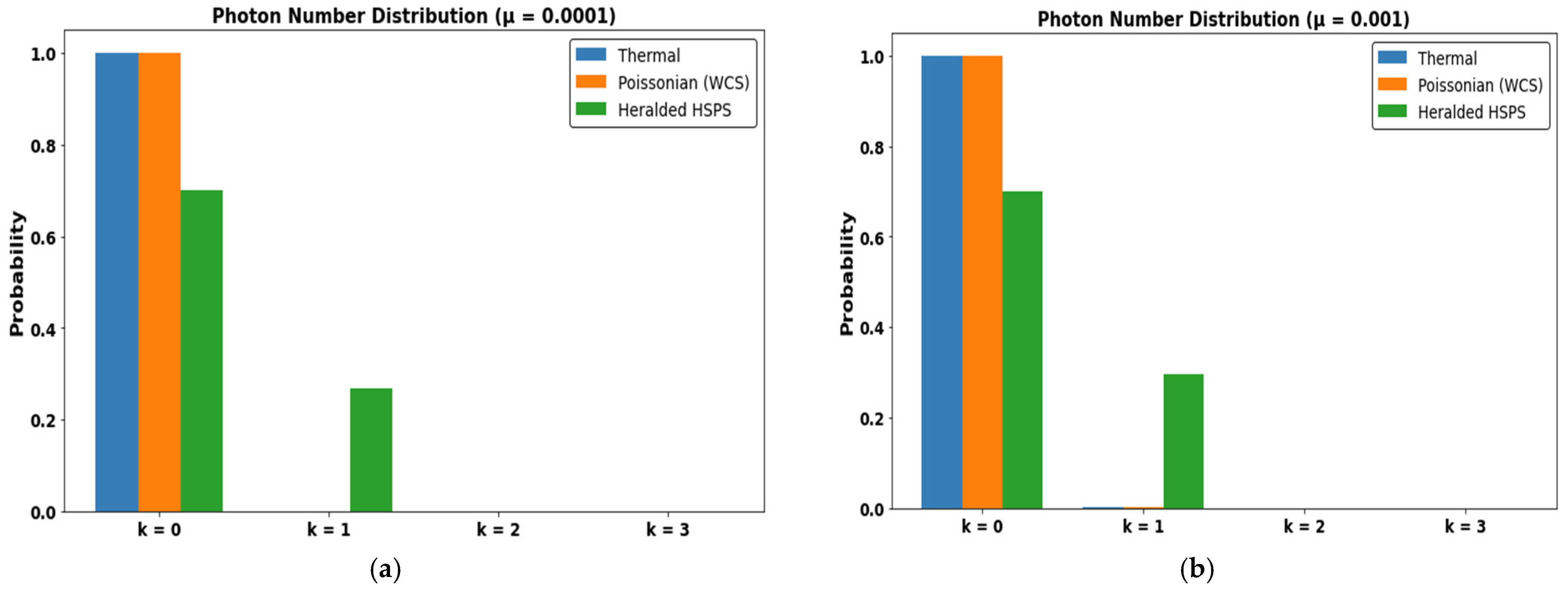
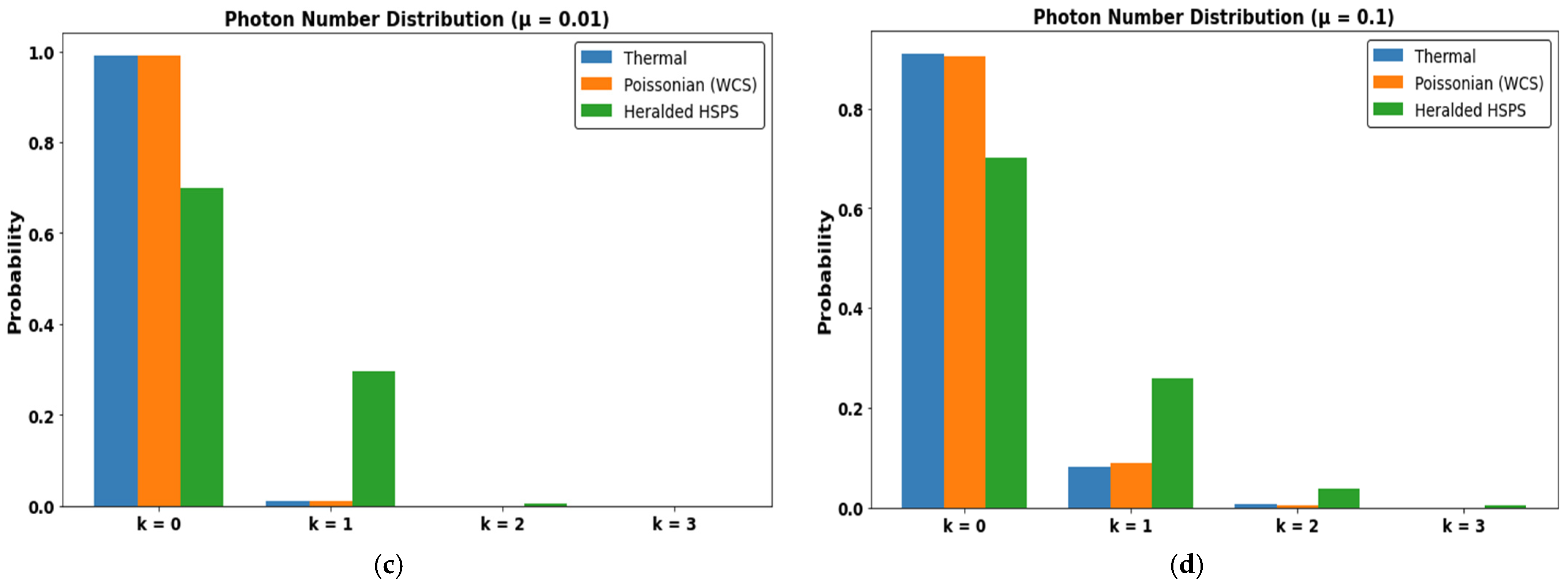
where μ is the mean photon number, k is the photon number, η A represents the detection efficiency of the heralding detector at the source end, d A is the dark count rate for the detector at the source, P μ p o s t is the post-selected probability given by P μ p o s t = μ η A 1 + μ η A + d A ; p 0 , μ = 1 P μ c o r + p 0 , μ p e r P μ c o r , and p k , μ = p k , μ p e r P μ c o r where   P μ c o r = 0.3 ; the parameter P μ c o r represents an experimentally reported nonideal photon pair-correlation probability for SPDC based HSPS [53,54]. In realistic implementations, imperfect heralding efficiency and residual vacuum components prevent the ideal suppression of vacuum contribution as is seen in Figure 1.
The reduction in the vacuum component at low mean photon number originates from the strong photon-number correlations inherent in SPDC [6]. In SPDC, each individual arm follows a thermal photon number distribution (or Poissonian but at low mean photon number the distribution is almost similar). However, conditional detection (heralding) in the idler arm due to photon number correlation suppresses the vacuum contribution in the signal arm by projecting onto events where at least one photon pair is generated. As the mean photon number increases, the photon number distribution of the source naturally reduces the vacuum contribution across all the sources. Nevertheless, this advantage comes at the cost of an increased probability of multi-photon emissions. Therefore, mitigating multi-photon components becomes essential for maintaining security in quantum secure information transfer protocol. At higher mean photon numbers, the photon-number correlation advantage of the HSPS which provides superior performance in the low mean photon number regime begins to degrade due to imperfect heralding efficiency, accidental counts and residual multi-pair generation. Consequently, the benefit of heralding becomes less pronounced.
The improved efficiency and reduced dark count rate of the heralding detector will significantly enhance the reliability of conditional single photon heralding. Higher detection efficiency increases the probability that a generated photon is successfully registered, while the lower dark counts reduce false heralding events, thereby improving the signal-to-noise ratio and the fidelity of the heralded single photon state. However, the presence of multiphoton components in the source cannot be completely eliminated. Even with an ideal heralding detector, multiphoton emission events originating from the HSPS photon generation process will still occur. Thus, while detector improvements enhance the quality and purity of the heralded output, they do not fundamentally remove the intrinsic multiphoton contributions of the source. Figure 1 illustrates the photon number distributions for thermal, WCS (Poissonian), and HSPS (thermal distribution) at various mean photon numbers: 0.0001, 0.001, 0.01, and 0.1. As observed, the vacuum component (zero-photon probability) is significantly suppressed in the heralded single-photon source. However, as the mean photon number increases, multiphoton components begin to appear across all sources, highlighting the growing probability of more than one photon per pulse, which is critical when assessing security and performance in quantum secure communication, imaging, and sensing protocols.

2.2. Security Analysis for Non-Ideal Conditions to Obtain Secure Bit Rate vs. Loss in dB

The secure bit rate without decoy state for BB84 and B92 protocol is given by Equations (3) and (4), respectively [12,55,56,57]
R B B 84 = q Q μ { 1 Δ log 2 d H d e 1 f E μ H d E μ } ;
where q is a parameter which depends on QKD protocol, q = 1 2 for BB84 and q = 1 4 for B92; Q μ is the overall gain (probability that Bob detects a signal given Alice sends a pulse of mean photon number μ ), d is the dimension, H is the binary Shannon entropy, e 1 is the error rate of single photons given by e 1 = E μ Δ ;   Δ = 1 P 0 P 1 Q μ ; here E μ is the overall error rate,   P k is the probability of having k photons in a pulse, Δ is term considering multiphoton probablity against PNS attack (multiphoton pulses are assumed fully compromised under PNS attacks and therefore do not contribute positively to the secure bit rate, appropriate probabilities of photon number are to be substituted from Equations (1) and (2) for WCS and HSPS sources for a given mean photon number).
H d p = p l o g 2 [ p d 1 ] 1 p log 2 1 p ] ;   and   f E μ = 1.22 ;
Q μ W C S = Y o + 1 e μ η ;   Y 0 = 1 1 d B d ;   E μ = e 0 e d d B Q μ W C S + e d ;
e 0 = d 1 d , η is the overall channel transmittance with appropriate attenuation coefficient, including detector efficiency η b [25,53,54].
Q μ H S P S = 1 P μ p o s t μ η 1 + d A 1 + μ η + μ η A 1 + d B 1 + μ η A + 1 1 + μ η + η A η η A 1 d A d B ;
E μ = e 0 e d d B Q μ H S P S + e d ;
R B 92 = q Q μ { 1 Δ log 2 d H d e 1 f E μ H d E μ I A E U S D } ;
USD exploits the non-orthogonality of the signal states and can be applied even to single photon pulses. Eve may perform a USD measurement that yields a conclusive outcome with some probability and an inconclusive result otherwise. In practical implementations, inconclusive events can be masked as channel loss, creating an effective leakage term proportional to the USD success probability. Here I A E U S D is the information leakage due to USD attack given by I A E U S D = 1 η 1 c o s α N η ( 1 1 c o s α N ) [12]. α controls the nonorthogonality between the two nonorthogonal quantum states. For a standard B92 protocol α = π 4 , N is the number of multiple qubit encoding which in high dimensional (hybrid encoding) terms is taken as N = log 2 d , Δ = 1 P 0 P 1 P 2 Q μ is used by considering the contribution of 2 photon pulses in B92 protocol due to its robustness against PNS attack. In the B92 protocol, security arises from the use of two non-orthogonal quantum states and the absence of basis reconciliation; only the timing of conclusive detection events is revealed over the classical channel. This structure fundamentally distinguishes B92 from BB84. In standard BB84, PNS attacks become effective because basis information is publicly disclosed after transmission, allowing an eavesdropper who stores one photon from a multiphoton pulse to measure it deterministically in the correct basis. In contrast, B92 does not reveal basis information, so a PNS attack on two-photon pulses does not by itself provide deterministic knowledge of the encoded bit. Therefore, in our model we distinguish clearly between PNS vulnerabilities (which rely on multiphoton storage and basis disclosure and are largely suppressed in B92) and USD leakage (which is inherent to non-orthogonal encoding and must be bounded independently). This suppression of I A E U S D with increasing N is the central motivation for high-dimensional B92 encoding: it does not merely increase the capacity per photon, but provides a quantifiable, stronger resistance to the USD attack.
The secure bit rate with a decoy state for BB84 and B92 protocol is given by Equation (5) [10,25,54]
R = q { Q 0 ( log 2 d ) + Q 1 log 2 d H d e 1 Q μ f E μ H d ( E μ ) } ;
where Q 0 = Y 0 p 0 ( μ ) ; Y 0 = 1 1 d B d ; Q 1 = Y 1 p 1 ( μ ) ;
Y 1 = p 2 μ Q ν p 2 ν Q μ Y 0 p 0 ν p 2 μ p 0 ( μ p 2 ν ] p 1 ν p 2   μ p 1 μ p 2 ν ;   e 1 = ( Q μ E μ e 0 Y 0 p 0 ( μ ) ) ( Y 1 p 1 ( μ ) ) .
The decoy state method relies on randomly varying the intensity of the transmitted pulses between signal (µ) and weaker decoy levels (ν), with the choice revealed only after detection. As an eavesdropper cannot distinguish signal pulses from decoy pulses during transmission, she must apply the same attack strategy to both. By comparing the measured detection rates and error rates for multiple intensities, Alice and Bob can place tight lower bounds on the single photon yield and upper bounds on the single-photon error rate.
The shared parameter values used in simulations are as follows: Channel attenuation ( α ) = 0.21 (dB/km), detection efficiency at receiver ( η B ) = 0.045, heralding arm efficiency ( η A ) = 0.4, dark count probability in heralding detector d A = 10 6 , misalignment error e d = 0.033. The analysis is performed under asymptotic key assumption. Finite-key statistical modeling is beyond the scope of the present theoretical benchmarking work and is identified as future research. Channel attenuation is expressed in dB to represent total channel loss, making the framework independent of a specific transmission medium. While channel attenuation ( α ) = 0.21 (dB/km) corresponds to standard telecom fiber at 1550 nm, the analysis can be directly adapted to free-space or visible-wavelength systems by substituting the appropriate transmission channel attenuation coefficient.

3. Results and Discussion

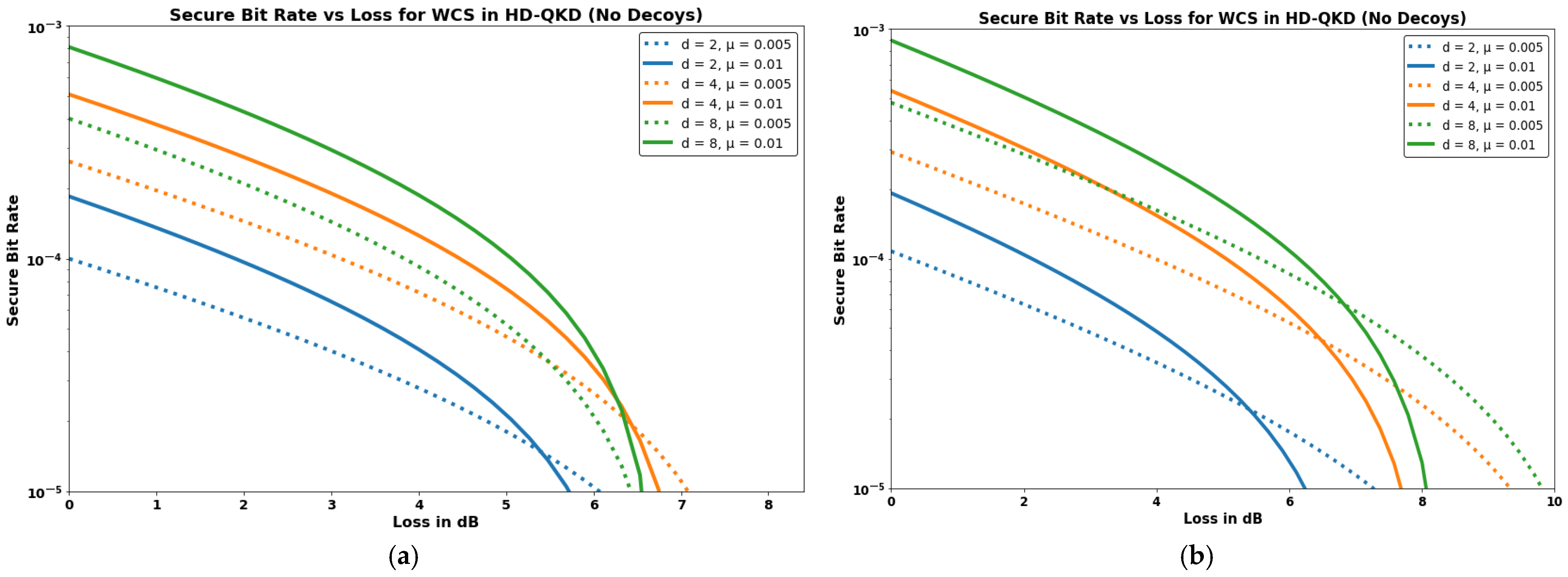
Figure 2 presents the secure bit rate as a function of channel loss (in dB) for the BB84 QKD protocol using a WCS without decoy state analysis. Two scenarios are shown, corresponding to different dark count probabilities of Bob’s detector: (a) d B = 10 6 and (b) d B = 10 7 . A lower dark count probability enhances the signal-to-noise ratio, thereby improving the maximum quantum secure information transfer distance. This performance improvement demonstrates the importance of low-noise detectors in practical quantum communication and information transfer. When such low-noise conditions are combined with high-dimensional encoding schemes, secure distance and bit rate gains can be expected. Lower mean photon numbers do not generate high secure key rates, and they also result in a shorter achievable secure transmission distances due to the reduced detection probability. Conversely, higher mean photon numbers lead to an increased multiphoton fraction, which compromises security and ultimately results in no secure bit generation.
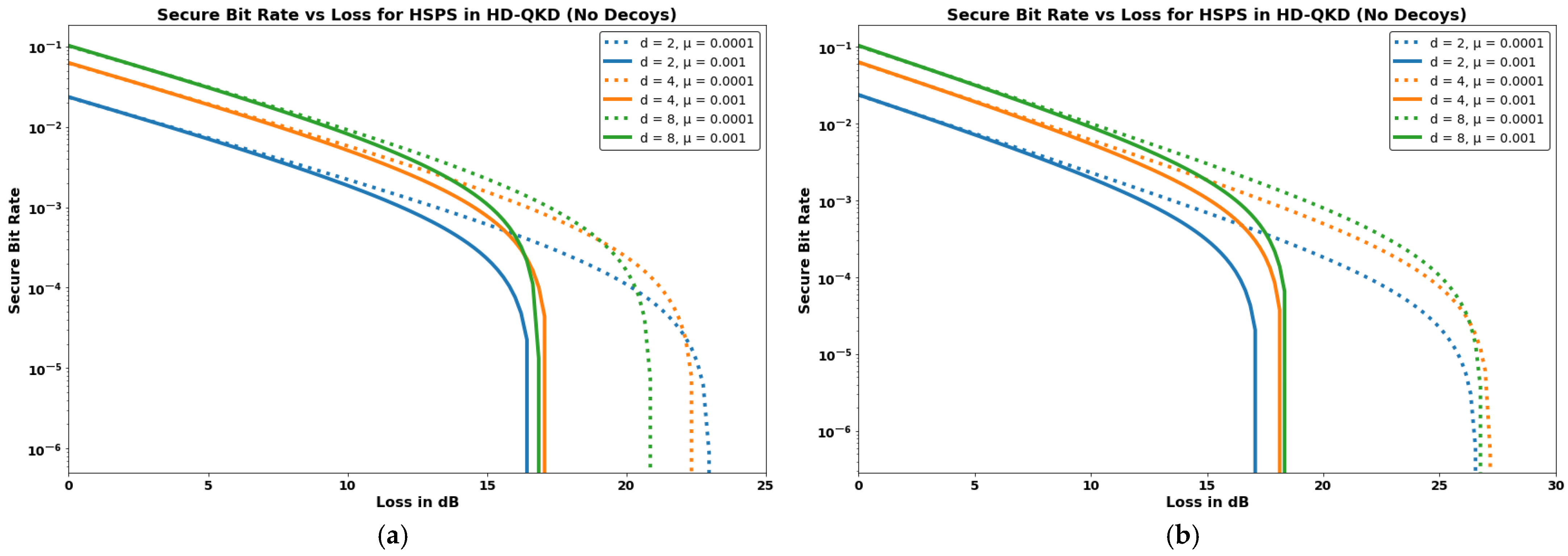
Figure 3 shows the secure bit rate versus channel loss (in dB) for the BB84 protocol using a HSPS without decoy state analysis. The results are plotted for two different dark count probabilities of Bob’s detector: (a) d b = 10 5 and (b) d b = 10 6 . It can be observed that the HSPS remains effective even in the presence of relatively high detector noise ( d b = 10 5 ), achieving a reasonable secure distance. This robustness to noise highlights one of the key advantages of HSPS in practical quantum secure information transfer scenarios, particularly when high-performance detectors are not available. It is observed that the BB84 protocol using HSPS demonstrates an advantage in secure distance over WCS without decoy states at low mean photon number regime due to the photon number correlation resulting in better discrimination of signal from noise. At high mean photon numbers, the photon number correlation starts degrading for the HSPS source due to accidental counts, due to which the heralding reference arm loses its advantage. Multiphoton contribution from both sources at higher mean photon numbers will result in no secure bit generation.
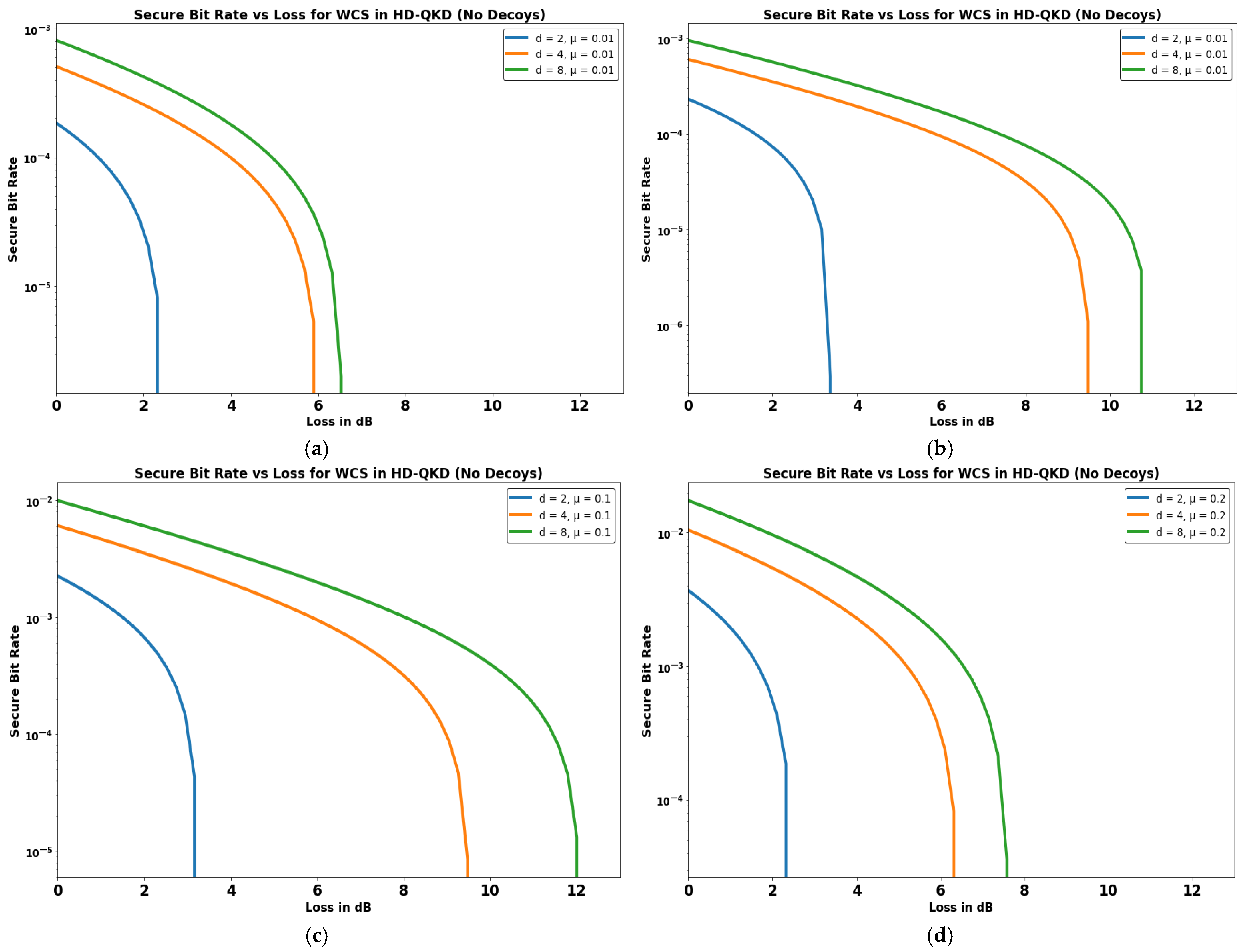
Figure 4 presents the secure bit rate versus channel loss for the B92 protocol using a WCS. Figure 4a shows the case where two-photon contributions are excluded, while Figure 4b–d incorporate the two-photon components. WCS-based B92 protocol benefits from its intrinsic resistance to PNS attacks, allowing the secure bits to be extracted even in the presence of multiphoton pulses using high dimensional (hybrid encoding). This shows that B92, when used with a WCS, can maintain security without decoy state analysis and avoid the protocol to stop under PNS attack.
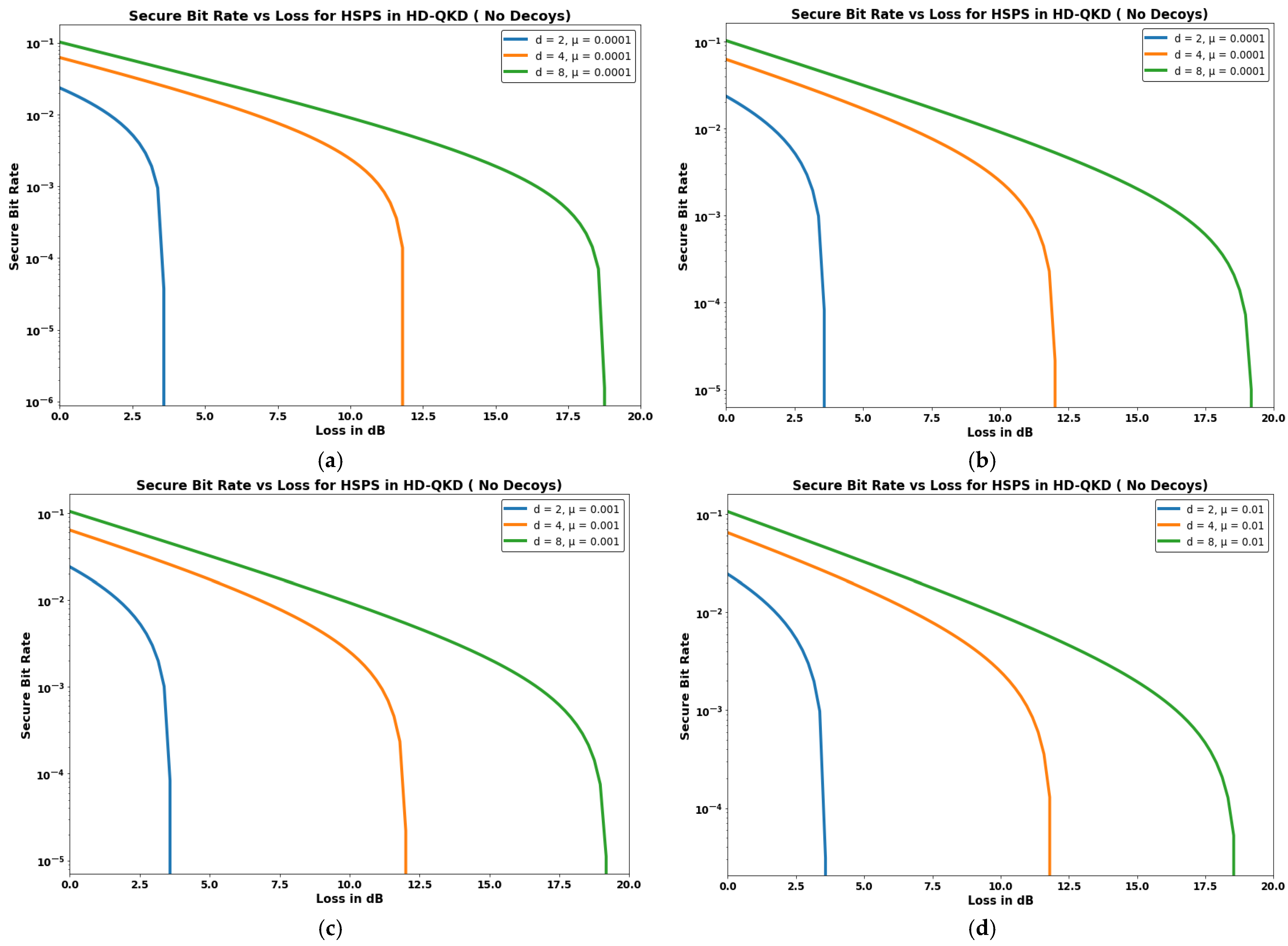
Figure 5 presents the secure bit rate versus channel loss for the B92 protocol without decoy state analysis for HSPS. Figure 5a shows the case where two-photon contributions are excluded from the key rate calculation, while plots Figure 5b–d incorporate two-photon contributions. In the HD B92 with WCS, d = 8 over d = 2 has an advantage of around 9 dB, while the HSPS-based HD B92 protocol achieves around 15 dB advantage for the same high dimensional (hybrid encoding) upgrade. Moreover, in secure information transfer distance, HSPS outperforms WCS by around 6–7 dB in the HDB92 configuration in terms of quantum secure information transfer distance.
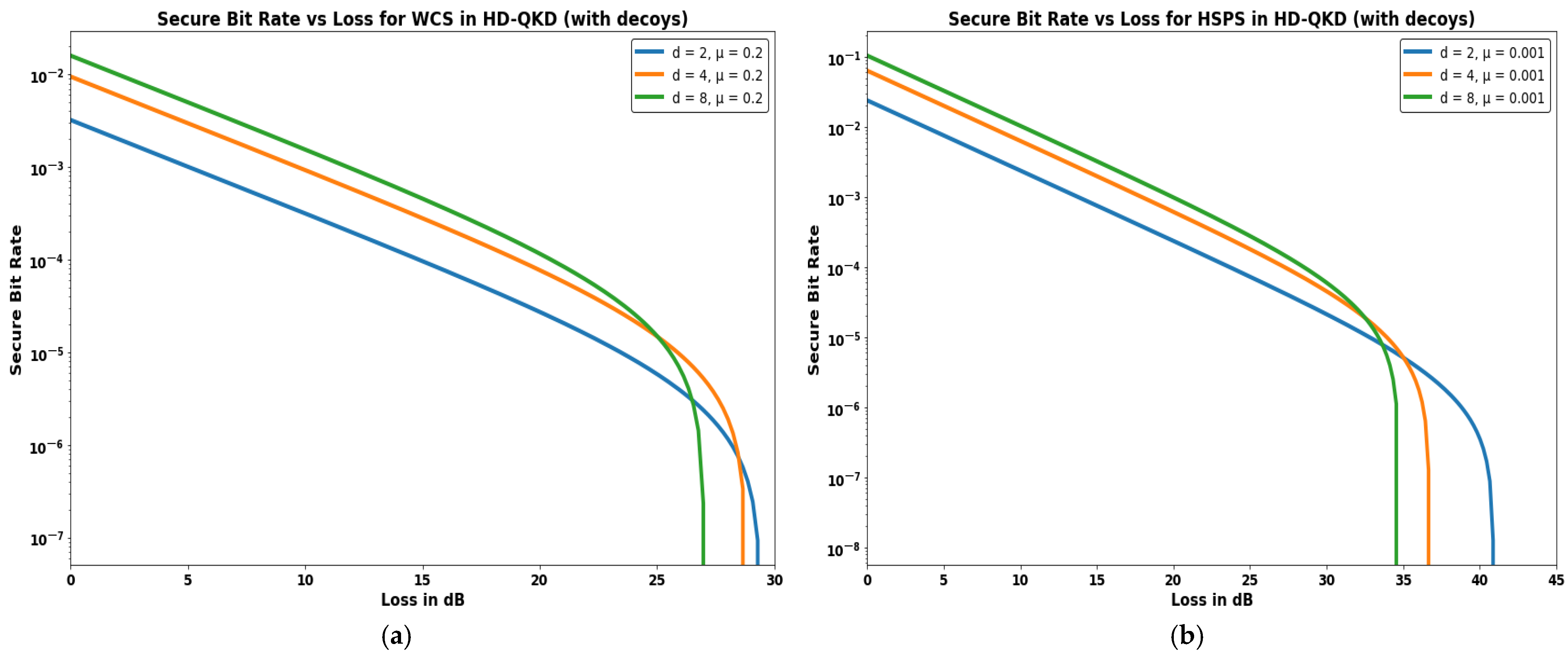
Figure 6 compares the performance of (a) WCS and (b) HSPS under decoy state analysis using the BB84 protocol. Including decoy states significantly enhances the secure distance and enables detection of PNS attacks. While HSPS achieves a longer secure transmission distance, WCS benefits from a much higher photon emission rate. As a result, although HSPS provides superior distance performance, the overall bit rate is often higher for WCS when the overall figure of merit is considered concerning the photon counts obtained from the source, making it a practical choice in many real-world systems. Finally, implementing decoy states provides a further gain of 15–20 dB compared to schemes without decoy states.
At higher mean photon numbers, the photon number correlation advantage of the HSPS which provides superior performance in the low mean photon number regime begins to degrade due to imperfect heralding efficiency, accidental counts and residual multi-pair generation. Consequently, the benefit of heralding becomes less pronounced in this regime. When decoy-state analysis is incorporated, security can be guaranteed even in the presence of multi-photon contributions up to a certain threshold. This makes weak coherent sources combined with decoy-state techniques particularly favorable in high mean photon regimes.
HD quantum states enhance both security and bits per pulse in quantum communication. In quantum imaging and sensing, samples may exhibit sensitivity to high-dimensional photon degrees of freedom, or multiple degrees of freedom, such as polarization and orbital angular momentum, which can be exploited for probing. WCS can generate higher photon rates, which are advantageous for key generation rates in communication. Considering the WCS advantage of higher photon counts of about three orders based on current technology, it gives a higher secure bit rate of 1–2 orders when considering the overall figure of merit for secure bits with repetition rate of the source. In contrast, HSPS, which have reduced vacuum photon number probability contributions at low photon illumination, are more suitable to securely probing samples over longer distances.
Depending on the specific application, the secure bit rate must be carefully evaluated, as it represents the secure gain before being scaled by the source repetition rate. As the SPDC source exhibits conditional photon number correlations, it offers a comparatively higher secure gain. However, the actual photon counts delivered by the source must also be taken into account when assessing the overall figure of merit. Moreover, in addition to polarization and OAM modes, pulse position modulation offers strong potential for hybrid encoding schemes and for enhancing imaging capabilities in application specific settings.

4. Conclusions

Our analysis focuses on the photon number statistics of WCS and HSPS, examining their roles in quantum secure imaging, sensing, and communication. Nonorthogonal two state protocols offer resilience to PNS attack to a certain threshold of multi-photon components without halting the quantum secure information transfer in non-ideal source conditions. HSPS is particularly beneficial in high-loss settings due to its reduced vacuum component, allowing for extended secure distances. However, their practical advantage relies on highly efficient and low-loss components in encoding, detection, and coupling. In contrast, WCSs produce higher photon rates, making them advantageous for high-throughput applications, including precision quantum sensing. The compatibility with GHz clock rates and decoy-state methods makes WCS suitable for secure communication, imaging and sensing scenarios. In order to increase the number of secure bits for practical applications such as the generation of secure keys for encryption or parameter estimation it is necessary to increase the mean photon number of the signal. Previous studies have primarily considered HSPS for secure key generation; however, such sources often do not produce a sufficient photon flux for high-rate key distribution. In contrast, tasks such as tamper detection and parameter estimation particularly when implemented across a network of sensors offer more practical applications for HSPS. At low mean photon numbers, the strong single photon character of HSPS enables operation over a longer secure range (especially without decoy state analysis), making them well suited for these secure imaging and sensing applications.
Combining HD state encoding introduces a trade-off: while it improves security and bits per pulse in ideal conditions, performance declines with increasing channel loss. Also, the modulation speed of devices to encode high dimensional quantum states need to improve to outperform low dimensional high-speed counterparts. Nonseparable states are well suited for operation under high speed conditions. Still, such configurations support a broader range of secure imaging and sensing applications. HD quantum states can significantly enhance security by increasing the complexity of the encoding space and strengthening resilience against certain classes of attacks. However, in practical implementations, their repetition rates and achievable secure transmission distances are typically lower compared to low-dimensional counterparts due to increased system complexity and loss sensitivity. When combined with the B92 protocol, high-dimensional encoding can offer practical advantages, particularly in countering USD attacks and improving performance in short-range quantum networks. This approach may be especially beneficial when the object or system being probed is sensitive to a specific high-dimensional encoding strategy, thereby allowing both enhanced security and application-driven functionality. Resistance to both quantum and classical jamming attacks is possible, where the framework can adapt by subtracting the mutual information of an adversary from the secure bit rate equation, to estimate secure distances accordingly. Moreover, these findings have direct implications for the design of quantum networks, where flexible combinations of source types, dimensionality and protocol choices can be optimized based on channel conditions and application goals whether it be quantum secure imaging, sensing, or communication. Thus, the proposed analysis supports resilient architectures for quantum networks operating in real world noisy and lossy conditions.

Author Contributions

Conceptualization, S.V. and J.X.; investigation, S.V. and J.X.; writing—original draft preparation, S.V.; writing—review and editing, S.V. and J.X.; supervision of investigation—J.X. All authors have read and agreed to the published version of the manuscript.

Funding

This research received no external funding.

Institutional Review Board Statement

Not applicable.

Data Availability Statement

The data that support the findings of this study are available from the corresponding author upon reasonable request.

Acknowledgments

SV gratefully acknowledges research financial support from MHRD, Government of India.

Conflicts of Interest

The authors declare no conflicts of interest.

Abbreviations

The following abbreviations are used in this manuscript:
PNSPhoton number splitting attacks
QKDQuantum key distribution
HSPSHeralded single photon sources
WCSWeak coherent sources
HDHigh dimensional states
SPDCSpontaneous parametric down conversion
USDUnambiguous state discrimination attacks

References

  1. Defienne, H.; Bowen, W.P.; Chekhova, M.; Lemos, G.B.; Oron, D.; Ramelow, S.; Treps, N.; Faccio, D. Advances in Quantum Imaging. Nat. Photonics 2024, 18, 1024–1036. [Google Scholar] [CrossRef]
  2. Vernekar, S.; Xavier, J. Quantum Correlation Enhanced Optical Imaging. Quantum Beam Sci. 2024, 8, 19. [Google Scholar] [CrossRef]
  3. Moodley, C.; Forbes, A. Advances in Quantum Imaging with Machine Intelligence. Laser Photonics Rev. 2024, 18, 2300939. [Google Scholar] [CrossRef]
  4. Jones, C.; Xavier, J.; Vartabi Kashanian, S.; Nguyen, M.; Aharonovich, I.; Vollmer, F. Time-Dependent Mandel Q Parameter Analysis for a Hexagonal Boron Nitride Single Photon Source. Opt. Express 2023, 31, 10794–10804. [Google Scholar] [CrossRef]
  5. Xavier, J.; Yu, D.; Vollmer, F.; Jones, C.; Zossimova, E. Quantum Nanophotonic and Nanoplasmonic Sensing: Towards Quantum Optical Bioscience Laboratories on Chip. Nanophotonics 2021, 10, 1387–1435. [Google Scholar] [CrossRef]
  6. Meda, A.; Losero, E.; Samantaray, N.; Scafirimuto, F.; Pradyumna, S.; Avella, A.; Ruo-Berchera, I.; Genovese, M. Photon-Number Correlation for Quantum Enhanced Imaging and Sensing. J. Opt. 2017, 19, 094002. [Google Scholar] [CrossRef]
  7. Berchera, I.R.; Degiovanni, I.P. Quantum Imaging with Sub-Poissonian Light: Challenges and Perspectives in Optical Metrology. Metrologia 2019, 56, 024001. [Google Scholar] [CrossRef]
  8. Genovese, M. Real Applications of Quantum Imaging. J. Opt. 2016, 18, 073002. [Google Scholar] [CrossRef]
  9. Pirandola, S.; Andersen, U.L.; Banchi, L.; Berta, M.; Bunandar, D.; Colbeck, R.; Englund, D.; Gehring, T.; Lupo, C.; Ottaviani, C.; et al. Advances in Quantum Cryptography. Adv. Opt. Photonics 2020, 12, 1012–1236. [Google Scholar] [CrossRef]
  10. Lo, H.K.; Ma, X.; Chen, K. Decoy State Quantum Key Distribution. Phys. Rev. Lett. 2005, 94, 15–18. [Google Scholar] [CrossRef] [PubMed]
  11. Dušek, M.; Jahma, M.; Lütkenhaus, N. Unambiguous State Discrimination in Quantum Cryptography with Weak Coherent States. Phys. Rev. A 2000, 62, 9. [Google Scholar] [CrossRef]
  12. Ko, H.; Choi, B.S.; Choe, J.S.; Youn, C.J. Advanced Unambiguous State Discrimination Attack and Countermeasure Strategy in a Practical B92 QKD System. Quantum Inf. Process. 2018, 17, 17. [Google Scholar] [CrossRef]
  13. Liao, S.K.; Cai, W.Q.; Liu, W.Y.; Zhang, L.; Li, Y.; Ren, J.G.; Yin, J.; Shen, Q.; Cao, Y.; Li, Z.P.; et al. Satellite-to-Ground Quantum Key Distribution. Nature 2017, 549, 43–47. [Google Scholar] [CrossRef]
  14. Li, Y.; Cai, W.Q.; Ren, J.G.; Wang, C.Z.; Yang, M.; Zhang, L.; Wu, H.Y.; Chang, L.; Wu, J.C.; Jin, B.; et al. Microsatellite-Based Real-Time Quantum Key Distribution. Nature 2025, 640, 47–54. [Google Scholar] [CrossRef]
  15. Yang, J.Z.; Li, M.F.; Chen, X.X.; Yu, W.K.; Zhang, A.N. Single-Photon Quantum Imaging via Single-Photon Illumination. Appl. Phys. Lett. 2020, 117, 214001. [Google Scholar] [CrossRef]
  16. Kim, J.; Jeong, T.; Lee, S.Y.; Kim, D.Y.; Kim, D.; Lee, S.; Ihn, Y.S.; Kim, Z.; Jo, Y. Heralded Single-Pixel Imaging with High Loss-Resistance and Noise-Robustness. Appl. Phys. Lett. 2021, 119, 244002. [Google Scholar] [CrossRef]
  17. Johnson, S.; McMillan, A.; Torre, C.; Frick, S.; Rarity, J.; Padgett, M. Single-Pixel Imaging with Heralded Single Photons. Opt. Contin. 2022, 1, 826–833. [Google Scholar] [CrossRef]
  18. Shafi, K.M.; Padhye, A.; Chandrashekar, C.M. Quantum Illumination Using Polarization-Path Entangled Single Photons for Low Reflectivity Object Detection in a Noisy Background. Opt. Express 2023, 31, 32093. [Google Scholar] [CrossRef]
  19. Ying, J.W.; Zhao, P.; Zhong, W.; Du, M.M.; Li, X.Y.; Shen, S.T.; Zhang, A.L.; Zhou, L.; Sheng, Y.B. Passive Decoy-State Quantum Secure Direct Communication with a Heralded Single-Photon Source. Phys. Rev. Appl. 2024, 22, 024040. [Google Scholar] [CrossRef]
  20. Mahdavifar, M.; Hashemi Rafsanjani, S.M. Violating Bell Inequality Using Weak Coherent States. Opt. Lett. 2021, 46, 5998–6001. [Google Scholar] [CrossRef] [PubMed]
  21. Gandelman, S.P.; Maslennikov, A.; Rozenman, G.G. Hands-On Quantum Cryptography: Experimentation with the B92 Protocol Using Pulsed Lasers. Photonics 2025, 12, 220. [Google Scholar] [CrossRef]
  22. Sit, A.; Bouchard, F.; Fickler, R.; Gagnon-Bischoff, J.; Larocque, H.; Heshami, K.; Elser, D.; Peuntinger, C.; Günthner, K.; Heim, B.; et al. High-Dimensional Intracity Quantum Cryptography with Structured Photons. Optica 2017, 4, 1006–1010. [Google Scholar] [CrossRef]
  23. Iqbal, H.; Krawec, W.O. Analysis of a High-Dimensional Extended B92 Protocol. Quantum Inf. Process. 2021, 20, 344. [Google Scholar] [CrossRef]
  24. Dutta, A.; Muskan; Banerjee, S.; Pathak, A. Analysis for Satellite-Based High-Dimensional Extended B92 and High-Dimensional BB84 Quantum Key Distribution. Adv. Quantum Technol. 2024, 7, 2400149. [Google Scholar] [CrossRef]
  25. Cañas, G.; Vera, N.; Cariñe, J.; González, P.; Cardenas, J.; Connolly, P.W.R.; Przysiezna, A.; Gómez, E.S.; Figueroa, M.; Vallone, G.; et al. High-Dimensional Decoy-State Quantum Key Distribution over Multicore Telecommunication Fibers. Phys. Rev. A 2017, 96, 022317. [Google Scholar] [CrossRef]
  26. Otte, E.; Nape, I.; Rosales-Guzmán, C.; Denz, C.; Forbes, A.; Ndagano, B. High-Dimensional Cryptography with Spatial Modes of Light: Tutorial. J. Opt. Soc. Am. B 2020, 37, A309–A323. [Google Scholar] [CrossRef]
  27. Nape, I.; Sephton, B.; Ornelas, P.; Moodley, C.; Forbes, A. Quantum Structured Light in High Dimensions. APL Photonics 2023, 8, 051101. [Google Scholar] [CrossRef]
  28. Nothlawala, F.; Moodley, C.; Gounden, N.; Nape, I.; Forbes, A. Quantum Ghost Imaging by Sparse Spatial Mode Reconstruction. Adv. Quantum Technol. 2025, 8, 2400577. [Google Scholar] [CrossRef]
  29. Bash, B.A.; Gheorghe, A.H.; Patel, M.; Habif, J.L.; Goeckel, D.; Towsley, D.; Guha, S. Quantum-Secure Covert Communication on Bosonic Channels. Nat. Commun. 2015, 6, 8626. [Google Scholar] [CrossRef] [PubMed]
  30. Walter, D.; Pitsch, C.; Paunescu, G.; Lutzmann, P. Quantum Ghost Imaging for Remote Sensing. In Proceedings of SPIE 11134, Quantum Communications and Quantum Imaging XVII, 111340W; SPIE: Bellingham, WA, USA, 2019. [Google Scholar] [CrossRef]
  31. Gregory, T.; Moreau, P.A.; Mekhail, S.; Wolley, O.; Padgett, M.J. Noise Rejection through an Improved Quantum Illumination Protocol. Sci. Rep. 2021, 11, 21841. [Google Scholar] [CrossRef]
  32. Johnson, S.; Rarity, J.; Padgett, M. Transmission of Quantum-Secured Images. Sci. Rep. 2024, 14, 11579. [Google Scholar] [CrossRef] [PubMed]
  33. Sternberg, J.; Voisin, J.; Roux, C.; Chassagneux, Y.; Amanti, M. Secure Communication Based on Sensing of Undetected Photons. EPJ Web Conf. 2024, 309, 08009. [Google Scholar] [CrossRef]
  34. León-Torres, J.R.; Dosan, V.-L.; Ćurčić, M.M.; Lagarrigue, A.; Setzpfandt, F.; Gräfe, M.; Gili, V.F. Mid-Infrared Quantum Scanning Microscopy via Visible Light beyond Spatial Correlations. arXiv 2025, arXiv:2505.04490. [Google Scholar] [CrossRef]
  35. Pitsch, C.; Heußner, N.; Haka, H.; Walter, D.; Villa, F. Asynchronous QGI—Videorate Imaging at PW Illumination. In Proceedings of SPIE 13676, Quantum Technologies for Defence and Security II, 136760C; SPIE: Bellingham, WA, USA, 2025; Volume 13676, pp. 1–6. [Google Scholar] [CrossRef]
  36. Perna, A.S.; Ortega, E.; Gräfe, M.; Steinlechner, F. Visible-Wavelength Polarization-Entangled Photon Source for Quantum Communication and Imaging. Appl. Phys. Lett. 2022, 120, 074001. [Google Scholar] [CrossRef]
  37. Fuenzalida, J.; Giese, E.; Gräfe, M. Nonlinear Interferometry: A New Approach for Imaging and Sensing. Adv. Quantum Technol. 2024, 7, 2300353. [Google Scholar] [CrossRef]
  38. Senapati, N.; Bhattacharjee, A.; Khare, K.; Jha, A.K. Super-Resolution Imaging of Azimuthal Features with Illumination Carrying OAM. arXiv 2025, arXiv:2511.09066. [Google Scholar] [CrossRef]
  39. Duplinskiy, A.; Frank, J.; Bearne, K.; Lvovsky, A.I. Tsang’ s Resolution Enhancement Method for Imaging with Focused Illumination. Light Sci. Appl. 2025, 14, 159. [Google Scholar] [CrossRef]
  40. Malik, M.; Magaña-Loaiza, O.S.; Boyd, R.W. Quantum-Secured Imaging. Appl. Phys. Lett. 2012, 101, 241103. [Google Scholar] [CrossRef]
  41. Zhao, Y.B.; Zhang, W.L.; Wang, D.; Song, X.T.; Zhou, L.J.; Ding, C.B. Proof-of-Principle Experimental Demonstration of Quantum Secure Imaging Based on Quantum Key Distribution. Chin. Phys. B 2019, 28, 104203. [Google Scholar] [CrossRef]
  42. Vernekar, S.; Xavier, J. Secure Quantum Imaging with Decoy State Heralded Single Photons. arXiv 2024, arXiv:2402.11675. [Google Scholar] [CrossRef]
  43. Yin, P.; Takeuchi, Y.; Zhang, W.H.; Yin, Z.Q.; Matsuzaki, Y.; Peng, X.X.; Xu, X.Y.; Xu, J.S.; Tang, J.S.; Zhou, Z.Q.; et al. Experimental Demonstration of Secure Quantum Remote Sensing. Phys. Rev. Appl. 2020, 14, 014065. [Google Scholar] [CrossRef]
  44. Heo, J.; Kim, J.; Jeong, T.; Ihn, Y.S.; Kim, D.Y.; Kim, Z.; Jo, Y. Quantum-Secured Single-Pixel Imaging with Enhanced Security. Optica 2023, 10, 1461–1470. [Google Scholar] [CrossRef]
  45. Moore, S.W.; Dunningham, J.A. Secure Quantum Remote Sensing without Entanglement. AVS Quantum Sci. 2023, 5, 014406. [Google Scholar] [CrossRef]
  46. Rahim, M.T.; Khan, A.; Khalid, U.; Rehman, J.U.; Jung, H.; Shin, H. Quantum Secure Metrology for Network Sensing-Based Applications. Sci. Rep. 2023, 13, 11630. [Google Scholar] [CrossRef]
  47. He, W.; Huang, C.; Guan, R.; Chen, Y.; Zhang, Z.; Wei, K. Experimental Secure Entanglement-Free Quantum Remote Sensing over 50 Km of Optical Fiber. Phys. Rev. A 2025, 111, 062607. [Google Scholar] [CrossRef]
  48. Moore, S.W.; Dunningham, J.A. Secure Quantum-Enhanced Measurements on a Network of Sensors. Phys. Rev. A 2025, 111, 012616. [Google Scholar] [CrossRef]
  49. Wang, D.; Zhou, L.; Zhao, J.; Zhao, Y. Time-Bin Phase-Encoding Quantum-Secured LiDAR Against Spoofing Attacks. IEEE J. Quantum Electron. 2025, 61, 1400111. [Google Scholar] [CrossRef]
  50. Heo, J.; Kim, J.; Jeong, T.; Ihn, Y.S.; Kim, D.Y.; Kim, Z.; Jo, Y. Imaging through Strong External Illumination via Mode-Error Analysis. Opt. Express 2025, 33, 36973–36989. [Google Scholar] [CrossRef]
  51. Wu, J.; Chen, Y.U.N.; Zhou, C.; Xu, C.; Song, L. A Remote Security Computational Ghost Imaging Method Based on Quantum Key Distribution Technology. IEEE Access 2022, 10, 18899–18909. [Google Scholar] [CrossRef]
  52. Wang, F.; Lu, Q.; Chen, W.; Wang, S.; Fu, H.; Lu, Y.; Hao, P.; Chen, J.; Ding, W.; Ma, J.; et al. Hybrid High-Dimensional Quantum Key Distribution for a Composable Quantum Network. Phys. Rev. Appl. 2023, 10, 054060. [Google Scholar] [CrossRef]
  53. Wang, S.; Zhang, S.L.; Li, H.W.; Yin, Z.Q.; Zhao, Y.B.; Chen, W.; Han, Z.F.; Guo, G.C. Decoy-State Theory for the Heralded Single-Photon Source with Intensity Fluctuations. Phys. Rev. A 2009, 79, 062309. [Google Scholar] [CrossRef]
  54. Wang, Q.; Chen, W.; Xavier, G.; Swillo, M.; Zhang, T.; Sauge, S.; Tengner, M.; Han, Z.F.; Guo, G.C.; Karlsson, A. Experimental Decoy-State Quantum Key Distribution with a Sub-Poissionian Heralded Single-Photon Source. Phys. Rev. Lett. 2008, 100, 090501. [Google Scholar] [CrossRef]
  55. Schiavon, M.; Vallone, G.; Ticozzi, F.; Villoresi, P. Heralded Single-Photon Sources for Quantum-Key-Distribution Applications. Phys. Rev. A 2016, 93, 012331. [Google Scholar] [CrossRef]
  56. Scarani, V.; Acín, A.; Ribordy, G.; Gisin, N. Quantum Cryptography Protocols Robust against Photon Number Splitting Attacks for Weak Laser Pulse Implementations. Phys. Rev. Lett. 2004, 92, 057901. [Google Scholar] [CrossRef]
  57. Acín, A.; Gisin, N.; Scarani, V. Coherent-Pulse Implementations of Quantum Cryptography Protocols Resistant to Photon-Number-Splitting Attacks. Phys. Rev. A 2004, 69, 012309. [Google Scholar] [CrossRef]
Figure 1. Photon number distributions for thermal (blue), WCS (orange), and HSPS (green) at mean photon numbers ( η A   = 0.4 and d A = 10 6 ) (a) 0.0001, (b) 0.001, (c) 0.01, and (d) 0.1.
Photonics 13 00457 g001aPhotonics 13 00457 g001b
Figure 2. Secure bit rate versus channel loss (dB) for the BB84 protocol using a WCS without decoy state analysis. Two detector dark count probabilities are considered ( μ = 0.005   a n d   0.01 ): (a) WCS d B = 10 6 ; (b) WCS   d B = 10 7 .
Photonics 13 00457 g002
Figure 3. Secure bit rate as a function of channel loss (dB) for the BB84 protocol using a HSPS without decoy state analysis. Two dark count probabilities are considered: (a) HSPS d B = 10 5 ; (b) HSPS d B = 10 6 ( μ = 0.0001   a n d   0.001 ).
Photonics 13 00457 g003
Figure 4. Secure bit rate versus channel loss (dB) for the B92 protocol using a WCS without decoy state analysis ( d B = 10 6 ). (a) WCS Δ = 1 P 0 P 1 Q μ ; μ = 0.01 ; (b) WCS Δ = 1 P 0 P 1 P 2 Q μ ; μ = 0.01 . (c) WCS Δ = 1 P 0 P 1 P 2 Q μ ; μ = 0.1 . (d) WCS Δ = 1 P 0 P 1 P 2 Q μ ; μ = 0.2 .
Photonics 13 00457 g004
Figure 5. Secure bit rate versus channel loss (dB) for the B92 protocol without decoy state analysis ( d B = 10 6 ). (a) HSPS Δ = 1 P 0 P 1 Q μ ; μ = 0.0001 ; (b) HSPS Δ = 1 P 0 P 1 P 2 Q μ ; μ = 0.0001 . (c) HSPS Δ = 1 P 0 P 1 P 2 Q μ ; μ = 0.001 . (d) HSPS Δ = 1 P 0 P 1 P 2 Q μ ; μ = 0.01 .
Photonics 13 00457 g005
Figure 6. Secure bit rate versus channel loss (dB) with decoy state analysis for the BB84 protocol using (a) WCS d B = 10 6   a n d   ν = 0.1 ; (b) HSPS d B = 10 6   a n d   ν = 0.0001 .
Photonics 13 00457 g006
Disclaimer/Publisher’s Note: The statements, opinions and data contained in all publications are solely those of the individual author(s) and contributor(s) and not of MDPI and/or the editor(s). MDPI and/or the editor(s) disclaim responsibility for any injury to people or property resulting from any ideas, methods, instructions or products referred to in the content.