Article

Temperature-Controlled CO2 Laser Polishing of Fused Silica Microlens Arrays

1
Center for Precision Engineering, Harbin Institute of Technology, Harbin 150001, China
2
School of Mechanical Engineering, Taishan University, Tai’an 271000, China
*
Author to whom correspondence should be addressed.
Photonics 2026, 13(5), 454; https://doi.org/10.3390/photonics13050454
Submission received: 3 April 2026 / Revised: 28 April 2026 / Accepted: 1 May 2026 / Published: 5 May 2026
(This article belongs to the Special Issue Advanced Lasers and Their Applications, 3rd Edition)

Abstract

While fused silica microlens arrays (MLAs) act as crucial components in the fields of infrared optics and laser systems, direct laser writing has been proposed for the fabrication of MLAs. However, the layer-by-layer slicing strategy generally leads to stepped surface textures formed on the microlens surface, resulting in high surface roughness and limited transmittance. This work proposes a temperature-controlled CO2 laser polishing method for the fabrication and subsequent smoothing of fused silica microlens arrays. Specifically, an infrared temperature measurement system is integrated into a CO2 laser direct writing platform. Correspondingly, a proportional-integral-derivative algorithm is used to adjust the laser power in real time based on the temperature deviation at the processing spot, thus maintaining the polishing zone in a molten rather than vaporizing state. Furthermore, a finite element model of laser polishing of fused silica coupled with laser heating and fluid flow is developed, which is used to analyze the spatiotemporal evolution of the temperature field, as well as its correlation with the response of the processed surface. Experimental results show that temperature-controlled laser polishing reduces the surface roughness of the fabricated MLAs by 86.8%, while the transmittance in the visible band remains above 90%. This work provides a feasible closed-loop polishing method and a mechanistic analysis model for the laser polishing of fused silica MLAs.

1. Introduction

Microlens arrays (MLAs) are key optical components in imaging, beam shaping, light field control, fiber coupling, and wavelength selective switching systems [1]. Their performance strongly depends on shape accuracy, surface smoothness, and optical transmittance [2]. In recent years, as optical systems move toward higher integration and higher power density, the fabrication of high-quality MLAs has received increasing attention [3,4]. Compared with common optical materials such as polymers, fused silica provides broad spectral transmission, high thermal stability, excellent chemical stability, and good laser resistance, which makes it suitable for long-term operation under high optical load and complex thermal conditions [5,6]. On the other hand, recent advances in optical field engineering and surface-light interaction have further highlighted the importance of high-quality optical surfaces with micro/nano-structure. For example, precise structural fidelity is critical for broadband accelerating beam generation, surface plasmon polariton field manipulation, and wavelength-independent Bessel beam excitation for high-resolution and deep-focus imaging [7,8,9]. These studies further indicate that surface quality and profile accuracy are closely related not only to geometric integrity, but also to the resulting optical performance of structured optical elements. However, fused silica exhibits high hardness and brittleness, making it challenging to precisely shape. Conventional mechanical processing can introduce surface or subsurface defects, which then limit the final optical performance [10,11].
Many fabrication methods have been developed for MLAs, including thermal reflow combined with dry etching, mask moving or mask shifting lithography, diffuser assisted lithography, micro forming, direct laser writing (DLW), electrohydrodynamic printing, and freeform surface design [12,13]. These methods offer advantages in array layout, fill factor, and surface design, but they still show clear limits when they are applied to fused silica MLAs [14]. On the one hand, methods based on lithography, thermal reflow, and micro forming are generally suitable for polymers or silicon, and their direct shaping ability for fused silica, which has high hardness and a high melting point, remains limited. In most cases, they also require complex molds, masks, or transfer steps [15]. On the other hand, DLW based on femtosecond lasers or CO2 lasers improves the flexibility of fused silica MLAs fabrication [16]. However, when a three-dimensional curved surface of MLAs is built directly, the microlens is still usually formed by a layer-by-layer slicing strategy [17]. This route is suitable for DLW and is convenient for producing complex array structures, but clear stepped textures and fine surface textures often remain on the formed surface. These features increase surface roughness, enhance scattering, and reduce transmittance, so the device cannot directly reach its full optical performance after shaping [18]. Therefore, for fused silica MLAs fabricated by DLW with layer-by-layer slicing, effective removal of stepped texture while preserving the original lens profile remains a key issue for high quality fabrication [19].
Precision processing methods such as magnetorheological polishing can improve the surface integrity of fused silica, but their adaptability and efficiency are still limited for MLAs with curved microstructures and high fill factor arrays [20]. In contrast, laser polishing is a non-contact and local polishing method that is suitable for complex curved surfaces, and it is especially attractive for hard and brittle materials [11]. Previous studies show that CO2 laser polishing can effectively smooth fused silica surfaces, and important advances have been made in process optimization, heat-affected zone control, suppression of mid and high spatial frequency errors, profile evolution, and defect suppression [21,22]. These studies also show that the process window of CO2 laser polishing for fused silica is very narrow. If the polishing temperature is too low, material flow is not sufficient. If the temperature is too high, evaporation and surface remelting may occur [23,24]. Although these advances are important, most existing studies focus on flat fused silica optical components, ground surfaces, or structures reshaped from micropillars [25]. More specifically, existing studies have mainly focused on the general mechanisms of laser polishing for hard and brittle materials and on thermal-field, heat-accumulation, and heat-affected-zone regulation in CO2 laser polishing of fused silica [11,21,26,27]. However, studies on real-time temperature-controlled laser polishing of hard and brittle microstructures remain limited, mainly because the process has a narrow thermal processing window, while real-time temperature measurement in a small-scale molten zone still faces practical difficulties such as spot alignment, high-dynamic sampling, and the need for algorithm-supported power regulation. Laser polishing of fused silica MLAs fabricated by DLW with layer-by-layer slicing still receives much less attention. In particular, systematic understanding of temperature control and profile evolution during polishing is still lacking, even though these factors directly determine the practical value of MLAs.
In this work, a temperature-controlled laser polishing method is proposed for fused silica MLAs fabricated by DLW with layer-by-layer slicing. An infrared thermometer and proportional-integral-derivative (PID) laser power control algorithm are integrated into the polishing platform to achieve precise temperature control during molten polishing. In addition, a coupled thermal fluid finite element (FE) simulation model is established to analyze the transient temperature field and melt flow during temperature-controlled laser polishing, and the FE model is verified by experimental data. Finally, the effects of temperature-controlled laser polishing on surface roughness, shape error, and transmittance are evaluated. The results show that the roughness of fused silica MLAs decreases by more than 80%, the shape error remains within 5.14 ± 0.27 μm after polishing, and the transmittance stays above 90% in the wavelength range from 400 to 1000 nm after polishing. This work aims to provide a feasible process route for high quality laser polishing of fused silica MLAs.

2. Methodologies

2.1. Temperature-Controlled Laser Polishing Strategy for MLAs

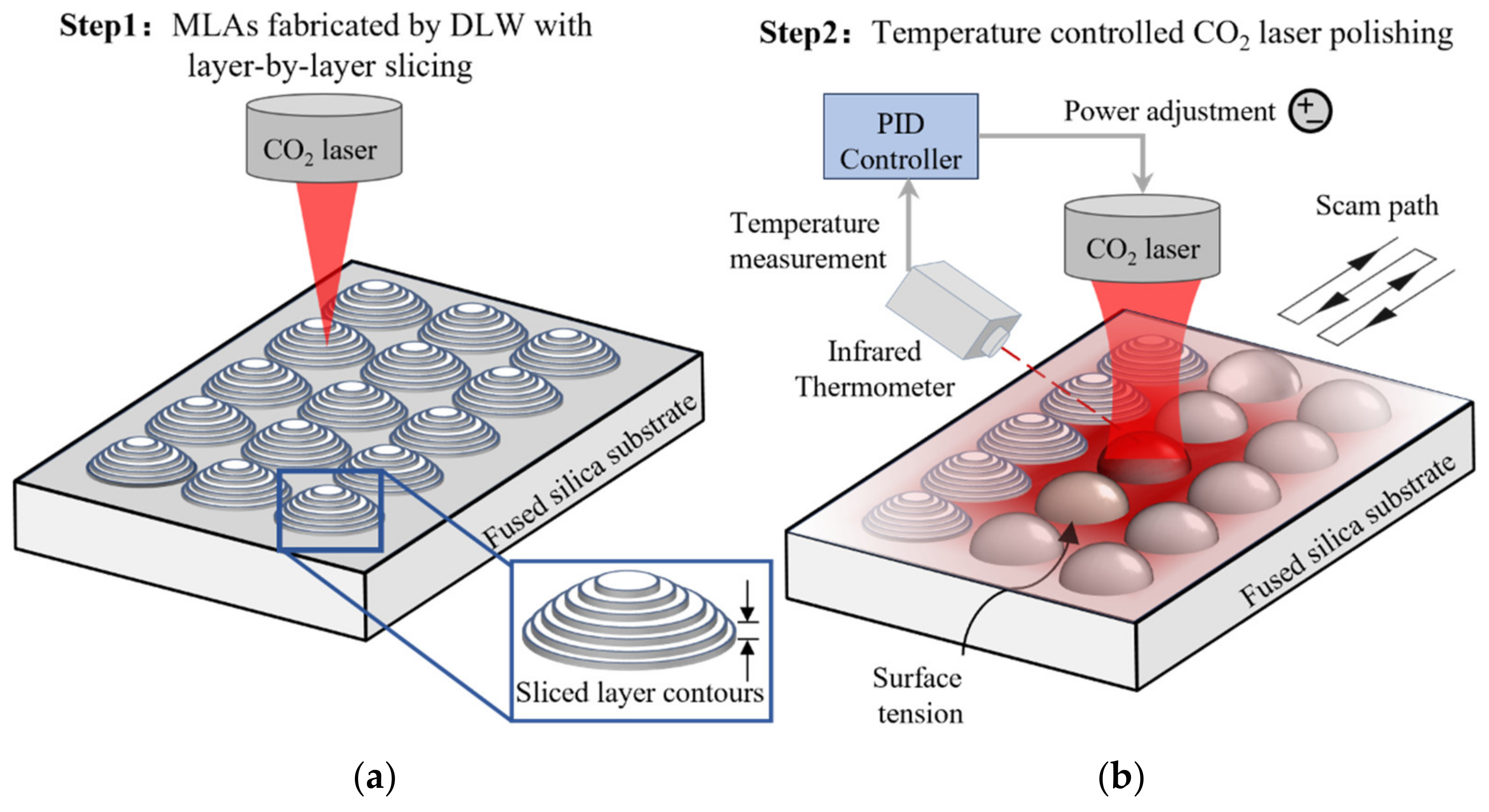
Figure 1 shows the fabrication process of the MLAs. The process includes two steps. In Step 1, rough MLAs are fabricated on a fused silica substrate by DLW with layer-by-layer slicing. The rough MLAs already contain the target lens profile, but clear stepped textures remain on the lens surface, which results from slicing the theoretical MLAs profile with a fixed layer height, as shown in Figure 1a. In Step 2, a large spot CO2 laser is used for temperature-controlled laser polishing of the rough MLAs. During polishing, the laser beam scans the fused silica surface along a serpentine scanning path with a speed of v and a spacing of s. The local lens surface is heated to a molten state. Then, the material redistributes under surface tension, and the stepped texture gradually changes into a continuous lens profile. The polishing temperature is kept as close as possible to the evaporation temperature of fused silica, so that the material can melt and flow while severe evaporation is avoided. An infrared thermometer monitors the temperature of the processing area in real time, and the laser power is adjusted dynamically through a PID controller so that the processing area remains within the expected temperature range.
The PID control algorithm is expressed by Equation (1):
P l a s e r ( k ) = K p e ( k ) + K i i = 0 k e ( i ) + K d [ e ( k ) e ( k 1 ) ] .
where Plaser(k) is the laser output power at time k, e(k) is the error between the set temperature and the measured temperature, and Kp, Ki, and Kd are the proportional, integral, and derivative coefficients, respectively. The values of Kp, Ki, and Kd are 0.025, 1, and 0.0025.
The objective of the PID controller used in this work is to maintain the polishing temperature, which thus rapidly and stably approaches the preset molten temperature during the laser polishing process, thereby avoiding insufficient smoothing at low temperature and excessive melting or even local evaporation at overly high temperature. The PID parameters are mainly determined through preliminary tuning experiments, in which the proportional, integral, and derivative gains are adjusted step by step by balancing response speed and temperature fluctuation, so that the measured temperature can rapidly track the target value and remain relatively stable during polishing.

2.2. Experimental Setup of Temperature-Controlled Laser Polishing of MLAs

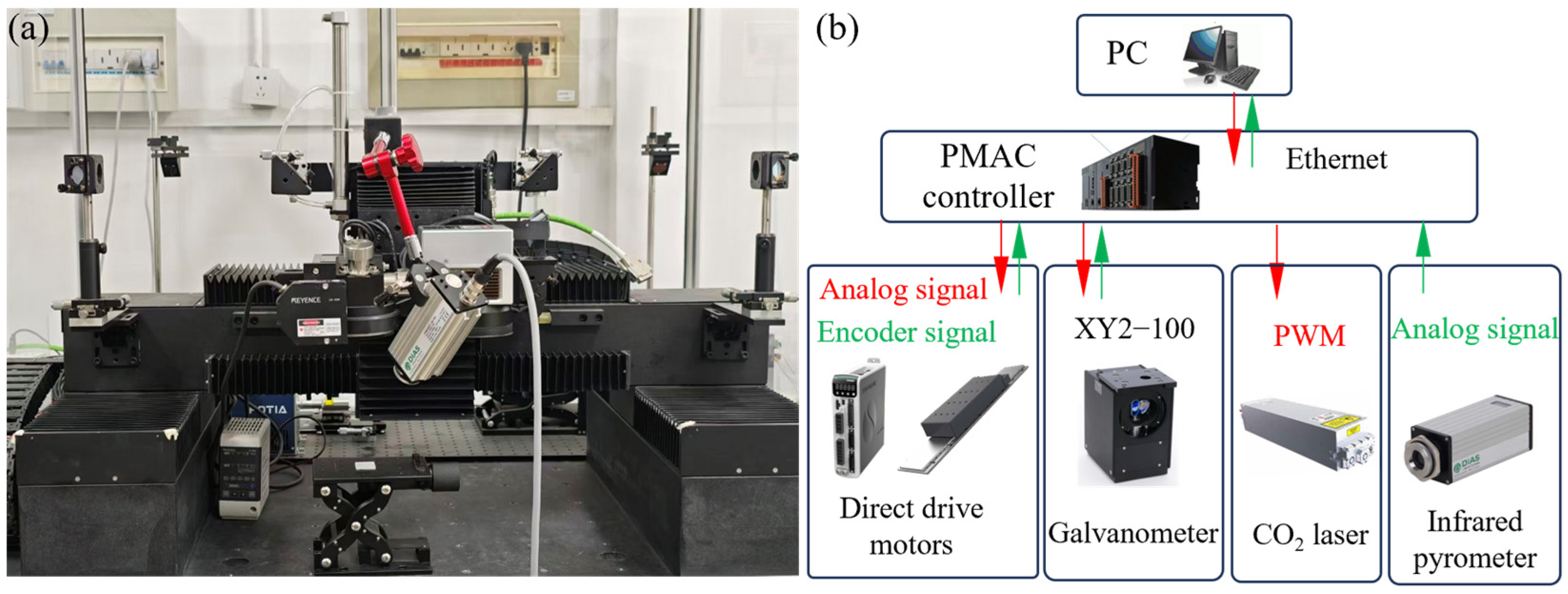
Figure 2 shows the equipment for temperature-controlled laser polishing of MLAs. As shown in Figure 2a, the setup integrates a CO2 laser, an infrared thermometer, an XYZ motion stage, and a galvanometer scanner. During polishing, the system measures the temperature at the polishing spot in real time and sends the data to the controller. The laser source is a Cx-10LSP quasi-continuous CO2 laser manufactured by Coherent, with a wavelength of 10.6 µm, a maximum output power of 120 W, a maximum pulse width of 625 μs, and a frequency range of 0–200 kHz. The XYZ motion stage employs direct drive motors on each axis, with absolute positioning accuracy and repeatability of ±1.5 µm and ±1 µm, respectively. A marble gantry is mounted on the dual-drive Y axis, while the X and Z axes are mounted on the horizontal beam of the marble gantry. The galvanometer scanner (SCANLAB, Hurryscan10) and the laser displacement sensor (KEYENCE, LK-G30) are mounted on the Z axis. During polishing, the galvanometer only keeps the laser beam perpendicular to the fused silica surface, while the motion of the laser beam in the working plane is achieved by the X and Y axes. A non-contact infrared thermometer (DIAS, DA10G) is used for temperature measurement, with a measurement range of 500–2500 K, a sampling frequency of 200 Hz, and a measurement spot diameter of 1.14 mm. The thermometer is mounted on the Z axis fixture and moves together with the Z axis. Before polishing, the temperature measurement position of the thermometer is accurately aligned with the laser polishing position. Specifically, a distinguishable ablation mark is first generated on the fused silica surface using the laser, serving as the spatial reference for the laser action center. The infrared thermometer’s red indicator light is then activated to indicate the measurement position. Finally, the position and orientation of the infrared thermometer are adjusted under 140× CCD observation to ensure that the center of its infrared measurement spot coincides with the center of the ablation mark.
Figure 2b shows the schematic of the numerical control unit based on a PMAC series CK3M controller with a servo cycle time of 50 μs. This system realizes unified control of the laser source, the motion stage, the infrared thermometer, and the galvanometer. The X, Y, and Z axes of the motion stage are controlled in torque mode by analog signals from the PMAC controller. The encoder signals from the motors are also fed back to the PMAC, forming a full closed-loop control system for the motion stage. The galvanometer is controlled through the XY2-100 protocol. The laser energy and laser switch are controlled by the pulse width modulated (PWM) signal from the PMAC. The PID algorithm for temperature control is built into the PMAC controller. The temperature measured by the thermometer is converted into an analog voltage signal and then input into the PMAC controller. In this way, temperature measurement, motion control, and laser power adjustment are integrated into one control system, which enables closed-loop temperature control with high dynamic response during the laser polishing.
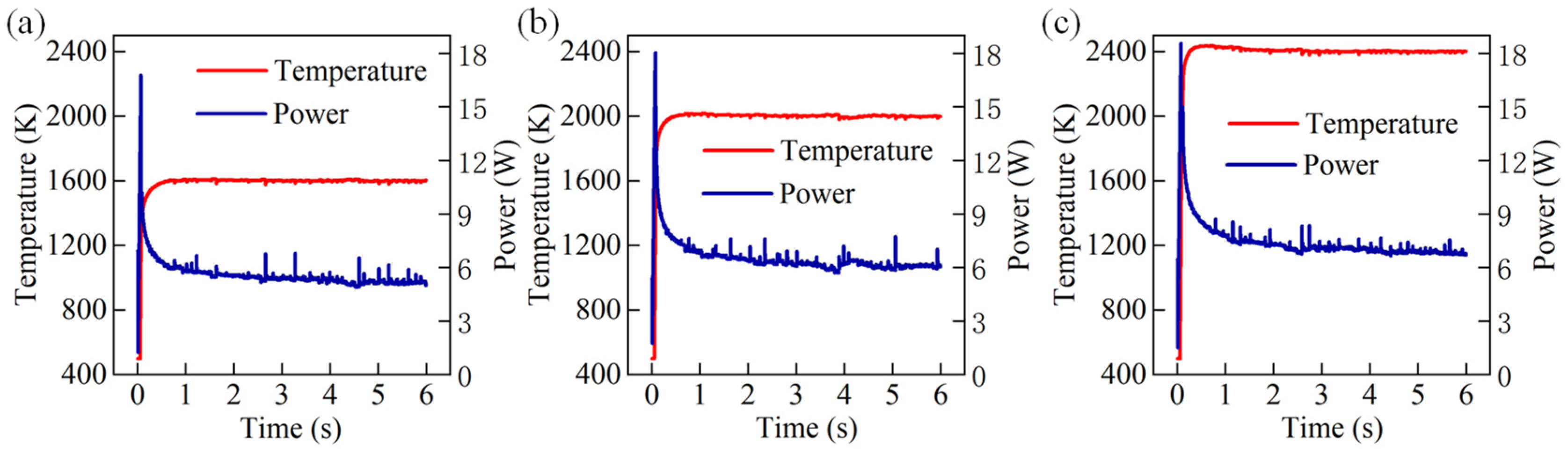
Figure 3 shows the measured temperature at the processing point and the corresponding laser power under different set temperatures of 1600 K, 2000 K, and 2400 K. Figure 3a–c indicate that the temperature in all cases rapidly rises to the vicinity of the set value, while the laser power correspondingly decreases after the initial high-power stage and then stabilizes with only small fluctuations, indicating an effective closed-loop adjustment process of temperature. Table 1 further summarizes the corresponding time-domain parameters. The results show that the rise time and the settling time is within 0.10 s and 0.35 s, respectively, the overshoot is below 1.6%, and the steady-state error does not exceed 2 K under all tested conditions. Moreover, as the set temperature increases from 1600 K to 2400 K, the rise time, peak time, and settling time generally decrease, indicating a faster response of the closed-loop system at higher temperature levels, while the overshoot increases slightly but remains low. These results demonstrate that the selected PID parameters provide a reasonable balance between response speed and temperature stability, which is suitable for the present laser polishing conditions that require rapid entry into the molten regime while avoiding excessive overheating.

2.3. Finite Element Modelling of Temperature-Controlled Laser Polishing of MLAs

To reveal the response mechanism of temperature-controlled laser polishing of fused silica MLAs, a two-dimensional FE simulation model that couples transient heat transfer and fluid flow is established in COMSOL Multiphysics 6.2. To focus on the main physical processes, fused silica is treated as an isotropic continuous medium, the molten flow is assumed to be incompressible and laminar, and only the dynamic viscosity of fused silica is considered temperature-dependent. In addition, the viscosity is treated as the dominant temperature-dependent parameter in the present model, while the temperature dependence of other properties of thermal conductivity and surface tension is not fully considered, which may influence local thermal and flow details. In this work, the laser frequency is 2 kHz, corresponding to a pulse period of 0.5 ms. The thermal diffusion time td for laser processing of the fused silica surface can be estimated using Equation (2), which is approximately 0.406 s [28]. The two timescales differ by about three orders of magnitude, which means that before the thermal diffusion response to a single laser pulse is completed, the surface has already received a large number of successive pulses. As a result, the temperature field is not sensitive to the instantaneous fluctuation of individual pulses, but is mainly governed by the average energy deposition. Therefore, under the frequency and scanning conditions used in this work, the quasi-continuous CO2 laser is approximated as a continuous heat source with equivalent average power. We also note that this simplification may introduce some deviation in describing single-pulse transient peak temperature and instantaneous thermal gradients. However, since the present model focuses on the average thermal evolution and molten smoothing trend under high-frequency processing conditions, such deviation is acceptable in this study.
t d = L 2 α
where td is the thermal diffusion time and L is the characteristic thermal diffusion length, whose value can be determined according to the model and experimental conditions used. In this study, L is taken as the laser spot radius of 0.57 mm; and α is the thermal diffusivity of fused silica, taken as 8.0 × 10⁻⁷ m2/s [29].
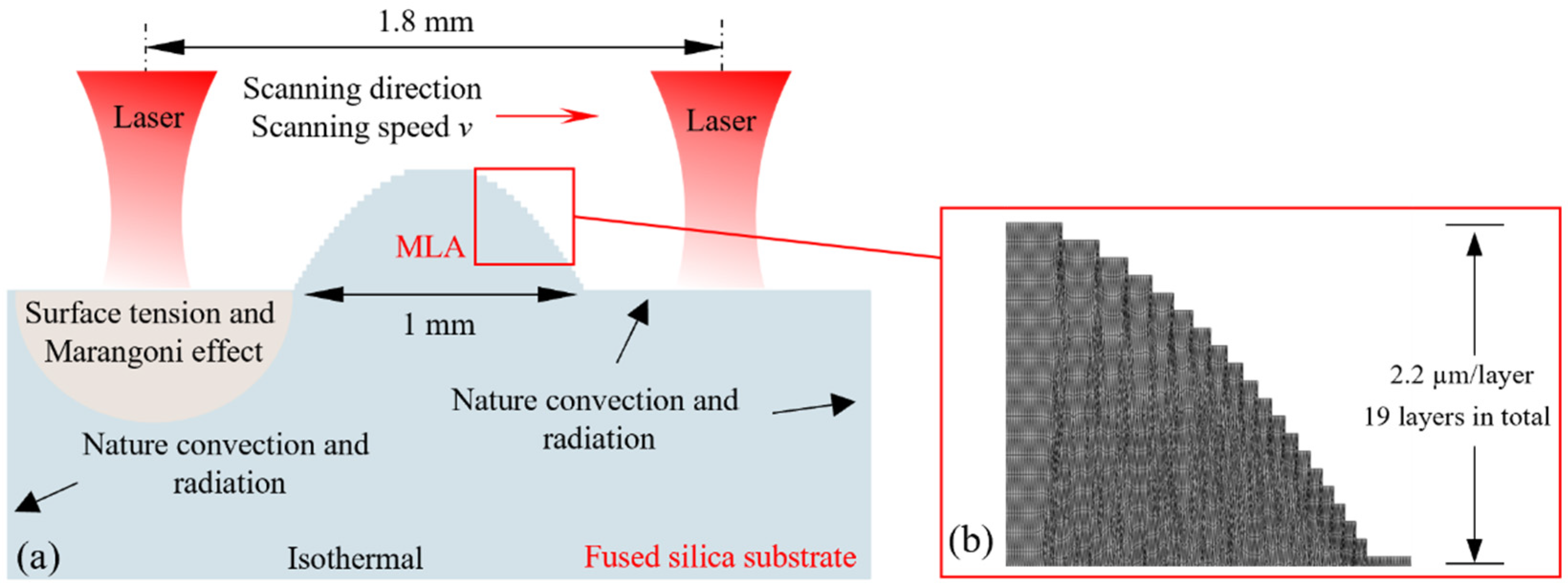
Figure 4a shows the boundary conditions of the FE model. The upper surface is defined as a free surface under laser heating, and natural convection and thermal radiation are also considered. The side boundaries include convective and radiative heat loss, and the bottom boundary is set as isothermal. After the molten area is formed, the material flow is described by the incompressible Navier–Stokes equation, and the body force mainly includes surface tension and the Marangoni effect. The laser scanning speed is 0.2 mm/s, and the scanning length is 1.8 mm. To simulate the real closed-loop regulation in temperature-controlled processing, a PID control module is introduced into the FE model. It monitors the maximum temperature at the processing point in real time and adjusts the laser power by feedback, so that the heat input can adapt to temperature variation. Figure 4b shows the local tetrahedral mesh of the single microlens model generated automatically by the software. The maximum mesh size is 3 μm, and the minimum mesh size is 0.06 μm. The initial surface in the model is obtained by slicing a microlens with a period of 1 mm and a radius of curvature of 3 mm into layers with a single-layer height of 2.2 μm, giving a total of 19 layers. The physical properties of fused silica used in the FE model are sourced from reference [30,31,32,33,34,35,36]. Moreover, the 2D FE model of laser polishing is adopted to capture the local thermo-fluid smoothing behavior with acceptable computational cost, and it is therefore more suitable for the qualitative analysis and mechanistic interpretation than the full 3D prediction of microlens curvature effects.

3. Results and Discussion

3.1. Verification of FE Model of Temperature-Controlled Laser Polishing

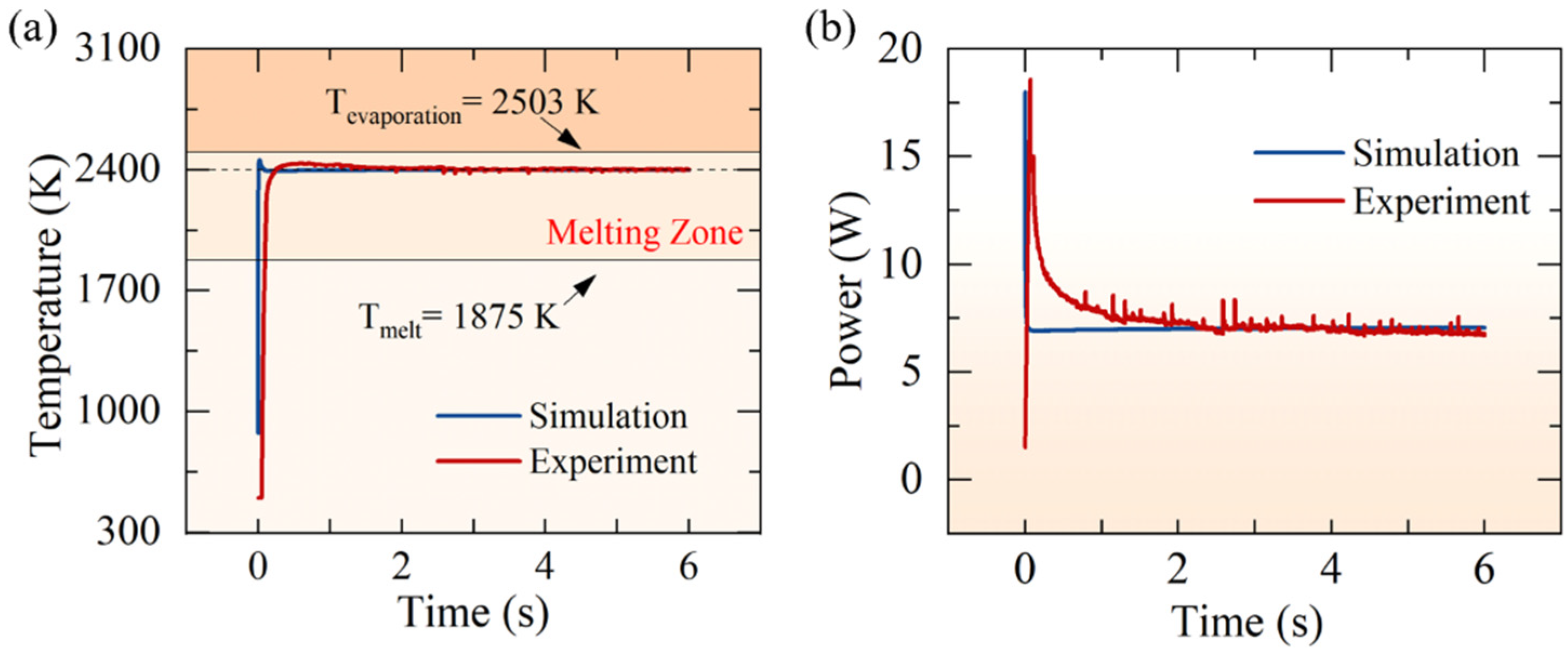
To verify the accuracy of the FE model of temperature-controlled laser polishing of MLAs, simulation and experimental comparison are carried out for CO2 laser heating of fused silica, with the set temperature fixed at 2400 K. Figure 5 compares the simulated and experimental results for the temperature and the laser power at the laser spot center over time.
As shown in Figure 5a, the temperature at the laser spot center rises rapidly during the initial heating stage and soon reaches a steady state. The simulation and experiment show highly consistent trends. The simulated steady-state temperature is 2399.73 K, while the experimentally measured steady-state temperature is 2402.45 K, resulting in a difference of 2.72 K and a relative error of 0.11%. This shows that the FE model accurately predicts the surface temperature response during temperature-controlled polishing of fused silica. In addition, the steady-state temperature remains higher than the melting temperature of 1875 K and lower than the evaporation temperature of 2503 K. This indicates that the process stays in a stable molten range and does not enter a state dominated by evaporation removal. Figure 5b shows that the laser power exhibits a peak during the initial stage, followed by a rapid decrease and subsequent stabilization. The evolution trends observed in the simulation and experiment are in good agreement. This indicates that the temperature control system needs higher input power during the heating stage to reach the set temperature quickly, while only lower power is needed at the steady stage to compensate for heat loss and maintain the temperature. The simulated steady-state power is 7.02 W, while the experimental steady-state power is 6.96 W, with a difference of only 0.06 W and a relative error of 0.86%. Overall, both the temperature and power results show that the FE model reproduces the thermal response and energy regulation process in the experiment well, and it therefore provides reliable support for later analysis of the mechanism of temperature-controlled laser polishing of microlenses. It should be noted that the present validation mainly focuses on the closed-loop thermal response and temperature regulation trend, as reflected by the measured temperature and laser power evolution. The small steady-state temperature error mainly indicates the tracking ability of the PID control system, while further spatial and morphological evidence is still needed to evaluate melt pool geometry, surface profile evolution, and flow dynamics in greater detail. These aspects are important for further improving the model evaluation and will be investigated in future work.

3.2. Surface Topography Evolution During Temperature-Controlled Laser Polishing of MLAs

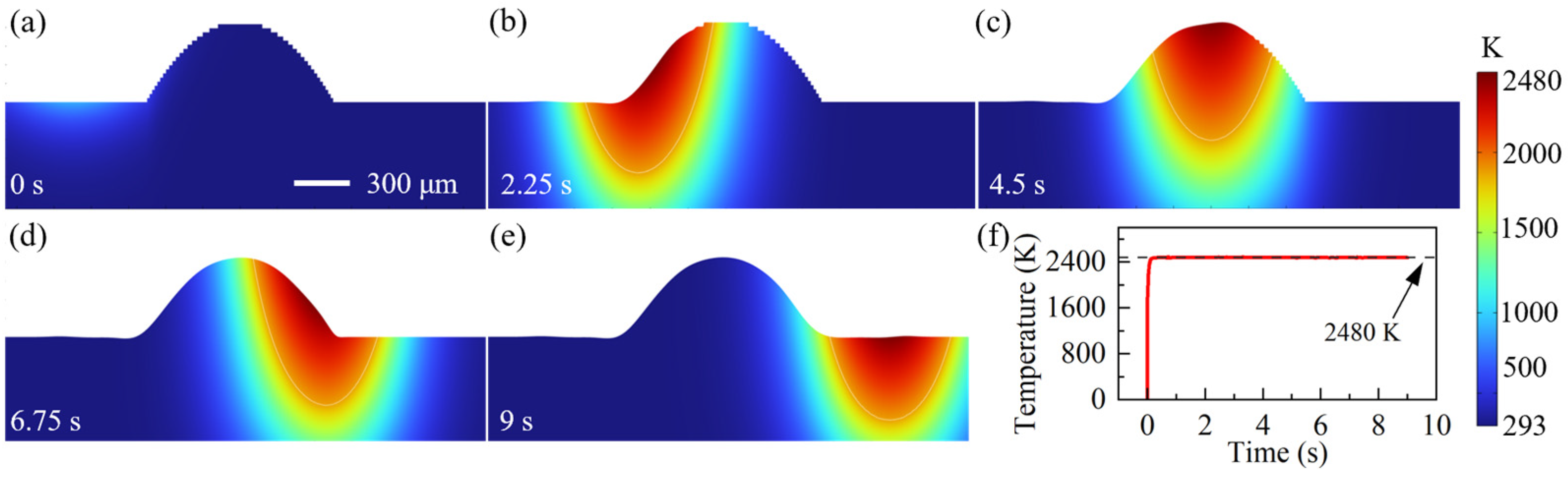
Figure 6 shows the simulated temperature fields at different times during temperature-controlled laser polishing of MLAs and the corresponding maximum temperature curve. The set temperature is 2480 K, and the laser scanning speed is 0.2 mm/s. As shown in Figure 6a–e, the high-temperature area is limited to a small local area during temperature-controlled polishing of the microlens. As the laser beam moves along the microlens surface, the high-temperature molten zone continuously migrates along the polishing path, and the evolution of the microlens surface profile occurs mainly near the laser-irradiated area. The surface material in the heated area melts locally because the temperature is above the melting point, and the original stepped texture is gradually removed, manifesting as a localized smoothing process advancing along the scanning path. During the whole process, the macroscopic microlens profile remains basically stable, and no obvious collapse or edge instability is observed. This indicates that the process mainly acts on the correction of surface microtopography and does not significantly damage the original curved shape. Figure 6f shows that the peak temperature rises rapidly during the initial stage and then stabilizes at approximately 2480 K. This temperature is above the melting point but still slightly below the evaporation temperature, suggesting that the evolution of the microlens surface profile is dominated by melt flow and solidification rather than by evaporation-induced ablation. These results demonstrate that temperature-controlled polishing can achieve surface smoothing while preserving the microlens shape.
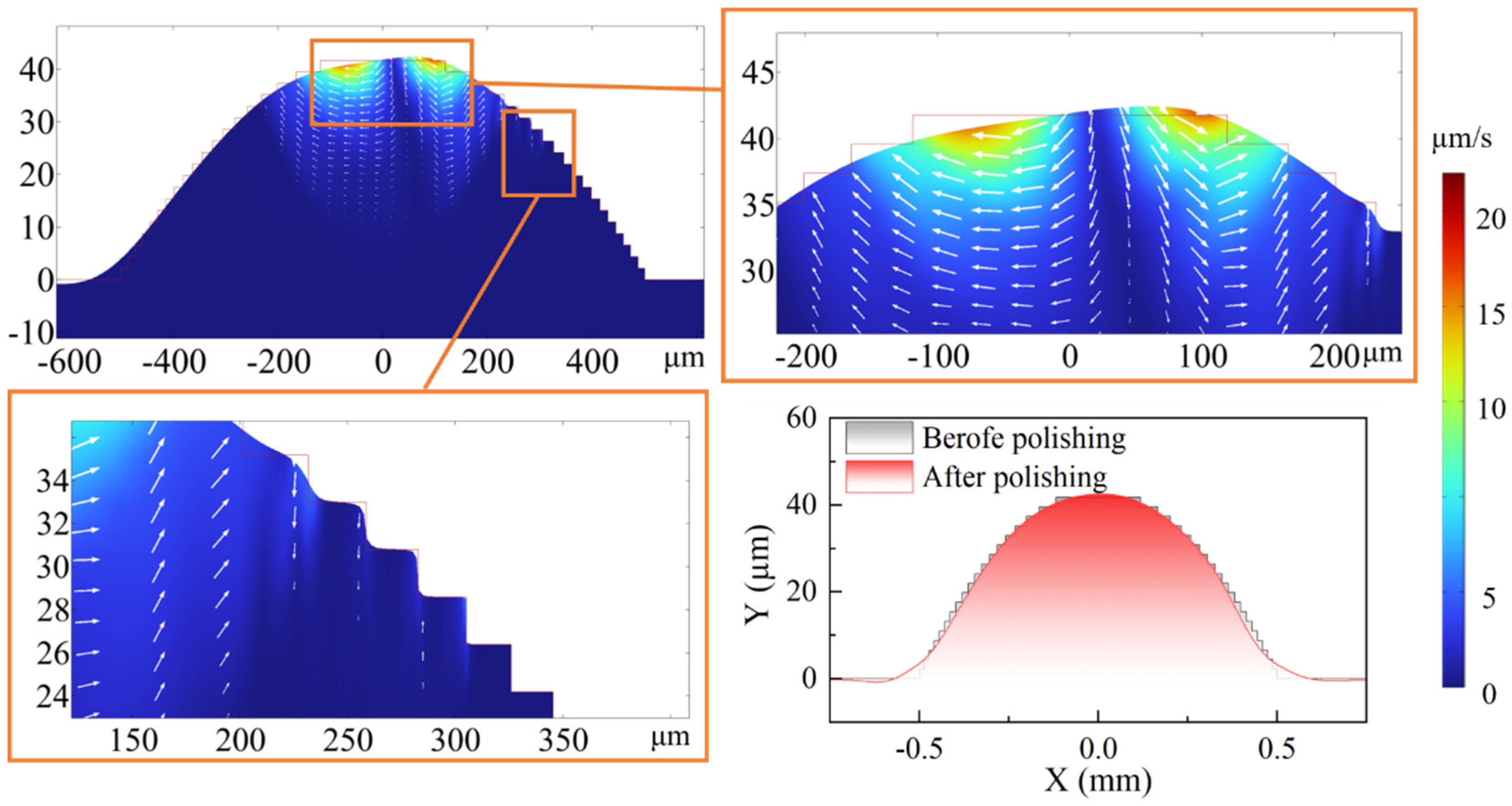
Figure 7 shows the velocity field at 4.5 s during polishing of MLAs and microlens profile comparison before and after temperature-controlled laser polishing of a microlens. It can be observed that material flow is primarily concentrated in the localized molten region near the lens surface, while the velocity within the lens interior remains very low. The local magnification results indicate that the velocity is highest in the region directly beneath the laser spot at the lens apex, with material flowing overall from the high-temperature area toward the low-temperature area. At the stepped texture formed by layer-by-layer slicing, the surface material migrates from elevated features to adjacent recessed areas driven by surface tension, thereby progressively reducing height difference between layers and diminishing surface undulations. Along the laser scanning direction, the surface height of the material in front of the spot is slightly higher than that of the material behind the spot. This is because the material in front of the spot has already melted, but the molten time is still short and the surface flow is not yet sufficient, so the original profile feature remains. In contrast, the material behind the spot has undergone complete molten flow and redistribution process. This indicates that during temperature-controlled laser polishing, the evolution of surface morphology lags behind the temperature field variation, and the removal of the stepped texture is a local dynamic smoothing process that moves gradually along the scanning direction. The profile comparison further demonstrates that the unpolished surface exhibits a distinct stepped texture, whereas the polished profile becomes a continuous, smooth curve, with the original steps completely disappearing. At the same time, the overall lens shape is well preserved. Therefore, temperature-controlled laser polishing effectively removes the stepped texture on the microlens surface through local remelting, surface flow, and solidification, which corresponding achieves the surface smoothing.
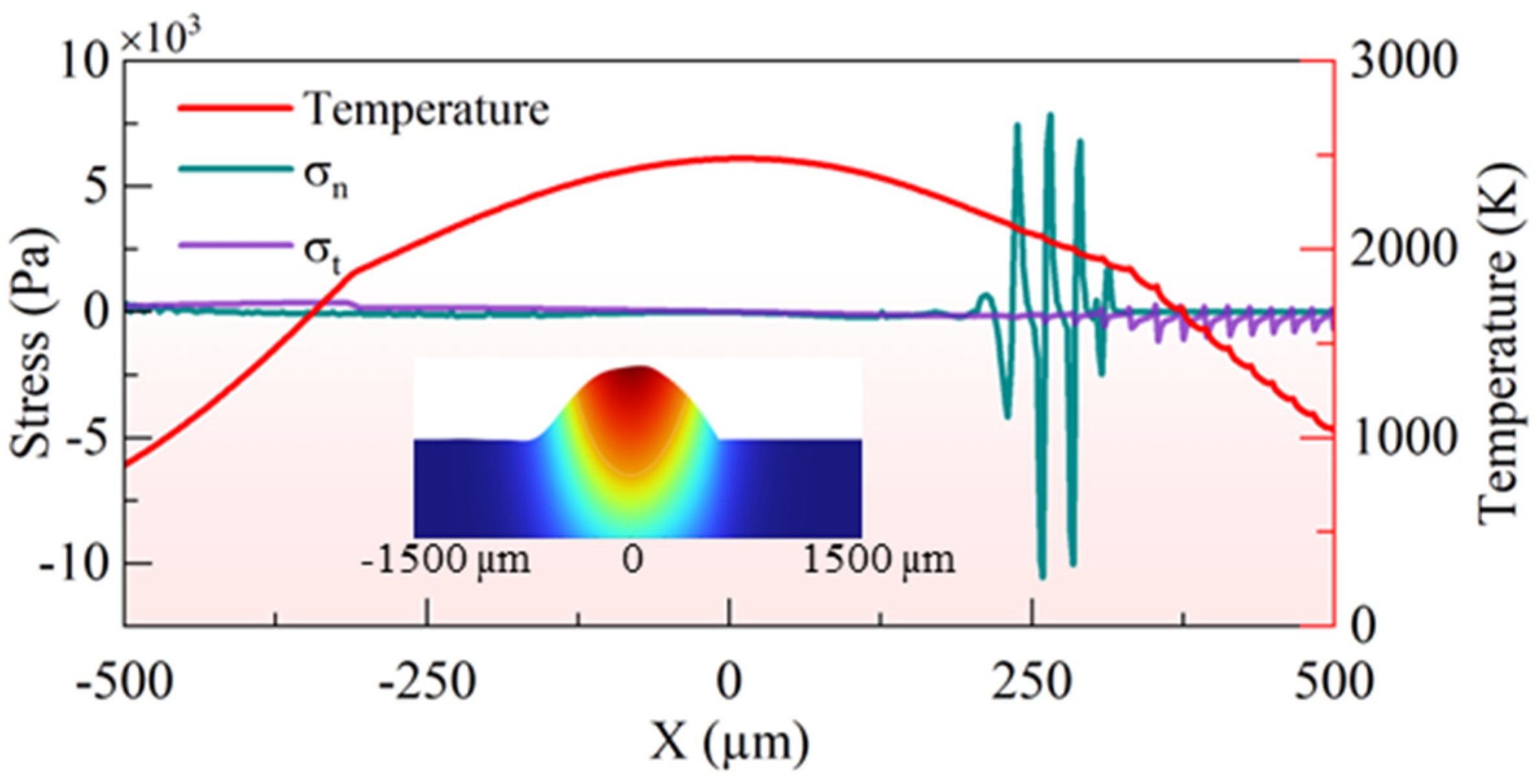
Figure 8 shows the distributions of temperature, surface-tension-induced normal stress σn, and Marangoni shear stress σt along the free surface of the microlens at 4.5 s. When the laser scans near the microlens center, the temperature reaches its maximum in the central region and gradually decreases toward both sides, indicating the existence of a pronounced surface temperature gradient. On the unpolished side, where the original stepped surface textures are still preserved and the local curvature remains relatively large, the maximum surface-tension-induced normal stress reaches about 8000 Pa, which is much higher than the Marangoni shear stress of about 400 Pa. This indicates that the rapid local leveling that occurred in this region is mainly dominated by the normal capillary effect. In contrast, on the polished side, as the surface becomes smoother and the local curvature decreases, σn rapidly drops to a level comparable to or even locally lower than σt. Under this condition, the Marangoni effect becomes relatively prominent and mainly promotes the continued lateral redistribution of molten material along the surface. Therefore, the results presented in Figure 8 quantitatively demonstrate that the temperature gradient governs the local surface-tension-related driving forces, with the surface-tension-induced normal capillary effect dominating rapid smoothing in the unpolished region, while the Marangoni effect mainly serves as an auxiliary mechanism for lateral melt redistribution in the already smoothed region. The two effects act cooperatively to gradually eliminate the stepped surface texture on the microlens surface.

3.3. Experimental Results of Temperatur-Controlled Laser Polishing of MLAs

To verify the effectiveness of the proposed temperature-controlled laser polishing method of MLAs, polishing experiments are carried out on MLAs. The MLAs are fabricated by CO2 laser DLW with layer-by-layer slicing. The fabrication parameters of the rough MLAs follow our previous work [16]. The designed parameters of the MLAs with a fill factor of 100% are a period of 1 mm, a radius of curvature of 3 mm, and a slicing height of 2.2 µm per layer, consistent with the FE simulation model. The processing parameters for temperature-controlled laser polishing are a set temperature of 2480 K, a scanning speed of 0.2 mm/s, and a scanning spacing of 0.025 mm.
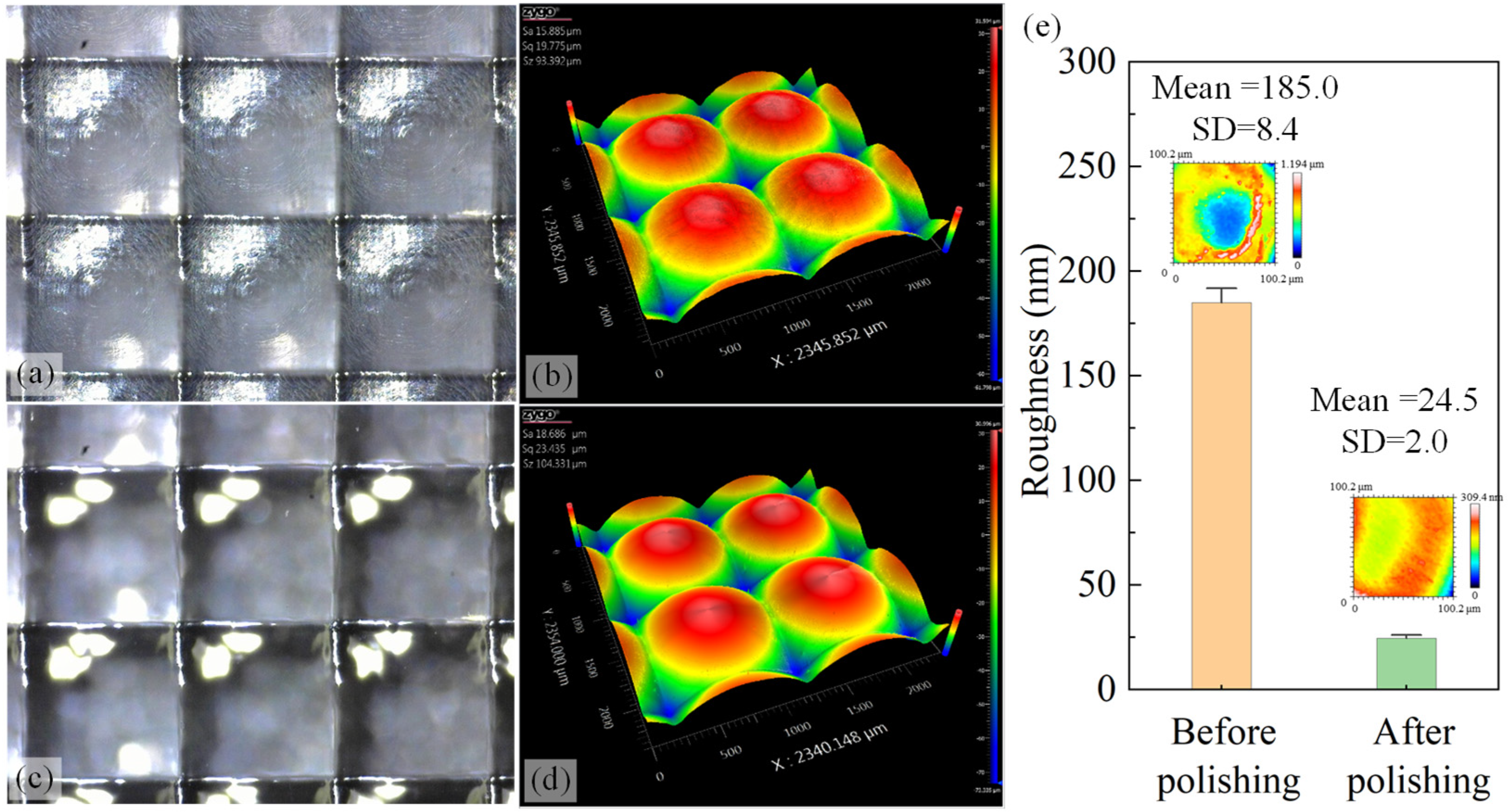
Figure 9 shows the experimental results after temperature-controlled laser polishing of MLAs. Figure 9a shows the optical micrographs of the MLAs before polishing, revealing a regular overall arrangement with individual lens units neatly aligned along the bottom boundary and an intact array morphology. It indicates that a relatively clear spherical lens contour has already been formed after the layer-by-layer slicing process. However, the overall transmittance is relatively weak, and the surface shows an obvious hazy appearance and diffuse reflection. This indicates that strong surface roughness and remelting traces remain on the surface, which directly reduce the optical transmission ability of MLAs. Figure 9b further shows the surface morphology of the MLAs before polishing measured by white light interferometry. The results show that the MLAs consist of regularly distributed lens units, with the lens tops retaining spherical convex features and the bottoms exhibiting square boundaries.
Figure 9c shows the optical micrographs of the MLAs after temperature-controlled laser polishing. The MLAs still maintain good array consistency and integrity. The lens size and arrangement are basically the same as before polishing, and no obvious collapse, deformation, or missing unit boundary is observed. More importantly, the transmittance of the MLAs is significantly improved after polishing, with the sample surface transitioning from a scattering appearance before polishing to a clear and bright transmission appearance. As shown by the MLAs surface profile in Figure 9d, no groove trace caused by laser ablation is observed. This proves that during temperature-controlled laser polishing, there is no excessive evaporation or ablation removal. Instead, the surface is smoothed by local remelting, material flow under surface tension, and then solidification. Figure 9e shows the surface roughness values of the microlenses before and after polishing. Four microlenses are randomly selected, and the surface roughness at the top region of each microlens is measured over an area of 100 μm × 100 μm, from which the mean and standard deviations (SD) are then calculated. The results show that the surface roughness before polishing is 185.0 ± 8.4 nm, with notable uneven undulations and material buildup, indicating a rough and nonuniform surface morphology. After polishing, the surface roughness decreases to 24.5 ± 2.0 nm, corresponding to a reduction of 86.8% compared with that before polishing. This is attributed to the local melting and solidification that occur during temperature-controlled laser polishing.
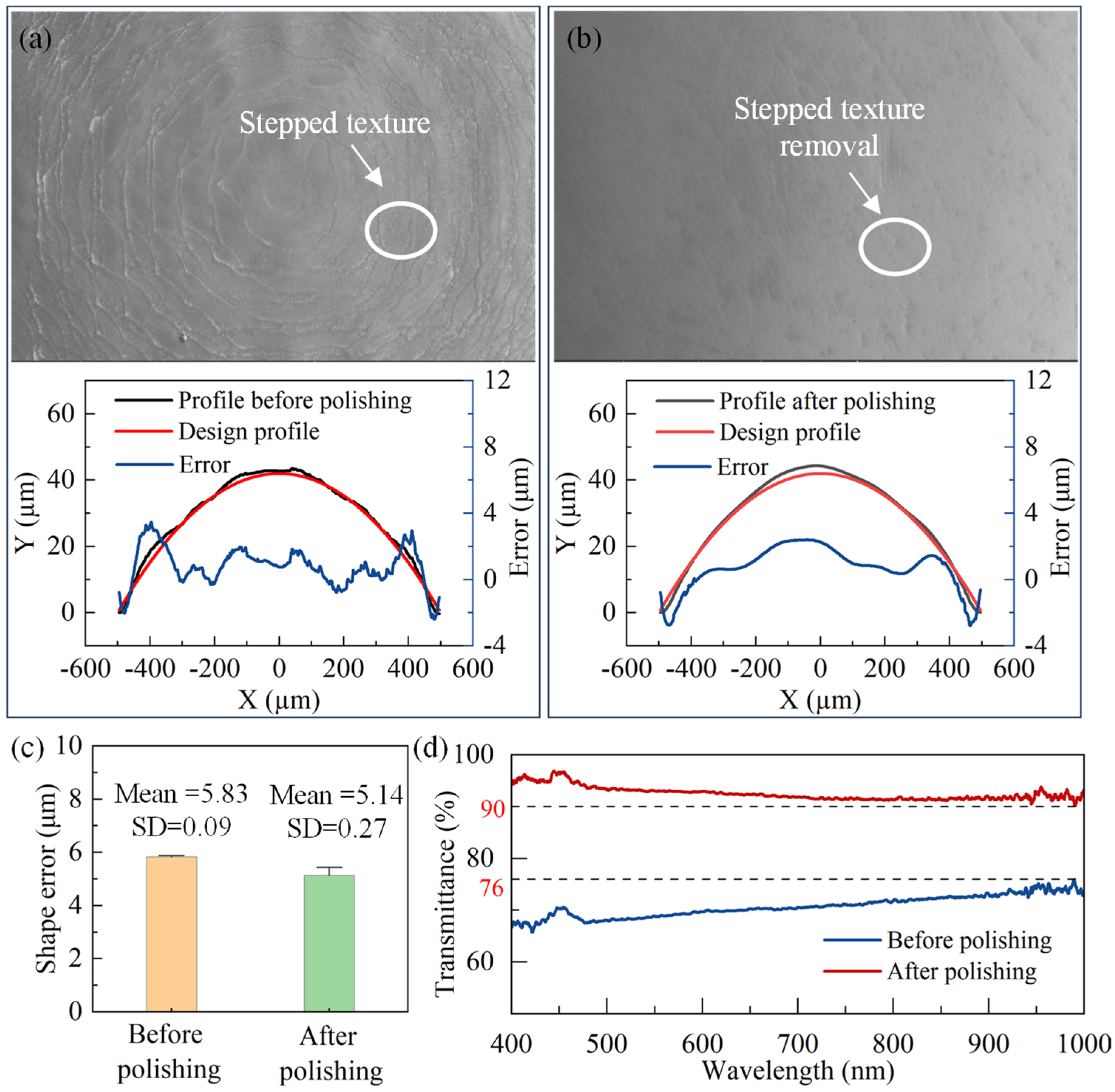
Figure 10 further evaluates the local surface morphology, lens shape error, and transmittance. Figure 10a shows the SEM image and cross-sectional profile of the surface of a single lens before polishing. The laser scanning path is clearly visible, accompanied by material removal caused by laser ablation, resulting in obvious stepped texture by layer-by-layer slicing. The MLAs morphology is clear and basically symmetric along the axis with good agreement with the theoretical profile. Figure 10b shows the SEM image and cross-sectional profile of the surface of a single lens after temperature-controlled laser polishing. The surface morphology changes clearly from a rough stepped surface to a smoother continuous surface. Under the action of surface tension during temperature-controlled polishing, the stepped texture is completely removed. For the temperature-controlled laser surface polishing process, the heat-affected zone is mainly manifested as a locally thermally affected near-surface region formed sequentially along the scanning path, rather than as a uniform thermally damaged layer over the entire scanned surface. The simulation results show that the high-temperature zone remains confined near the laser interaction region and continuously migrates during scanning. The experimental results further show that no obvious ablation grooves, edge collapse, or large-area thermal damage are observed after polishing, while the microlens profile is well preserved. These results indicate that, under the present processing conditions, the thermal effect is mainly confined to a local surface layer, and the heat-affected zone is effectively controlled.
The shape error is defined as the deviation between the measured cross-sectional profile of the microlenses and the theoretical profile of cross-sectional. Figure 10c summarizes the mean shape error and SD of four randomly selected microlenses before and after polishing, indicating the MLAs maintain good consistency with the theoretical profile. Specifically, the results show that the shape error of the microlenses is 5.83 ± 0.09 μm before polishing and 5.14 ± 0.27 μm after polishing, indicating that the cross-sectional shape error is slightly reduced after polishing. Figure 10d shows the optical transmittance of the fused silica MLAs before and after temperature-controlled laser polishing in the wavelength range of 400–1000 nm. The data are collected by a UV-visible spectrophotometer (Ocean Optics USB2000+). The transmittance of the unpolished MLAs does not exceed 76% over the same wavelength range, whereas after polishing, the transmittance remains above 90%, with a more pronounced improvement in the short wavelength range than in the long wavelength range. These results show that the proposed temperature-controlled laser polishing method improves both surface integrity and optical transmission.
It is worth noting that the residual shape error of 5.14 ± 0.27 μm is mainly inherited from the preceding MLAs fabricated by DLW with the layer-by-layer slicing strategy, given the relatively large size of the lens with high steepness and high fill factor. The main benefit of the proposed closed-loop temperature-controlled polishing lies in reducing stepped surface textures and improving transmittance rather than ensuring strict macroscopic wavefront accuracy. Furthermore, under the present parameters, polishing a 1 mm2 microlens requires approximately 3.3 min, which indeed indicates a limitation for large-area MLAs. Future research will explore potential strategies to increase processing efficiency, including increasing scanning speeds while maintaining a stable melt window, optimizing scanning spacing and scanning paths, and increasing the effective polishing spot size.
Table 2 presents a quantitative comparison of representative fused silica polishing methods using ion beams, plasma, and CO2 lasers. It is seen from Table 2 that both ion beam figuring and plasma polishing offer significant advantages for surface processing of fused silica, particularly in terms of surface quality and controlled material removal. Recent studies have achieved atomic-level roughness and nanometer-level geometric precision, surpassing the results of this work [37,38]. However, ion beam figuring has mainly focused on deterministic figuring of large-aperture fused silica optical components, while plasma polishing has also been primarily concentrated on fused silica surface polishing rather than MLAs composed of numerous microstructures. Further research is needed to determine whether ion beam figuring and plasma polishing can be directly applied to fused silica MLAs. At the same time, recent studies on CO2 laser polishing of fused silica have shown that the roughness of planar fused silica surfaces or MLAs can be reduced to the nanometer scale by optimizing processing parameters, such as scanning speed, laser power, defocus amount, and path spacing [5,21]. However, in most previous studies of laser polishing, the laser parameters are preset, and the temperature field is often understood through indirect inference or post-process characterization, lacking real-time measurement and dynamic regulation of the actual temperature at the processing point, which therefore requires extensive experiments to determine the optimal processing parameters. This work is specifically aimed at the post-processing smoothing of preformed MLAs, with the objective of eliminating stepped surface texture accompanied by the layer-by-layer slicing strategy, thus reducing surface roughness and improving transmittance, rather than reconstructing the macroscopic lens geometry from scratch. In addition, the integration of the infrared temperature monitoring with laser power regulation is employed to actively and fast maintain the polishing process under the required molten temperature, thereby improving the stability and controllability of the post-processing of MLAs surface.

4. Conclusions

This work proposes a temperature-controlled laser polishing method to address the issues of stepped surface texture and high surface roughness remaining on fused silica MLAs that are fabricated by DLW with the layer-by-layer slicing strategy. The thermal behavior and surface polishing process of MLAs are studied by both FE simulations and experiments. The results show that the simulated temperature at the irradiated point has a deviation error of 0.11% from experimental data. During laser polishing, the high-temperature area is always limited to the area near laser action and moves stably along the scanning path. The peak temperature remains between the melting temperature and the evaporation temperature, which allows stable melting and flow of the irradiated surface material. The velocity field and profile evolution further show that the surface material migrates from stepped texture protrusions to adjacent recessed areas under surface tension, and the stepped texture is gradually weakened along the scanning direction, which finally becomes a continuous smooth surface. After the temperature-controlled polishing, the surface roughness of the MLAs decreases from 185.0 ± 8.4 nm to 24.5 ± 2.0 nm with a reduction of 86.8%, while the transmittance remains above 90%. These results show that temperature-controlled laser polishing effectively improves the surface quality while preserving the overall geometric profile of the MLAs, and provides a feasible method for the fabrication of high-quality fused silica MLAs by improving surface roughness and enhancing transmittance. However, to further improve the form accuracy of MLAs, it is still necessary to combine temperature-controlled laser polishing with higher-precision forming or subsequent shaping correction processes. In future work, further performance evaluations of focusing quality, spot size and imaging capability will be carried out to assess the influence of the temperature-controlled laser polishing method on optical performance.

Author Contributions

H.L.: Investigation, Methodology, Validation, Visualization, Writing—original draft. E.Q.: Visualization, Investigation. J.L.: Visualization, Investigation. S.J.: Investigation. W.M.: Conceptualization. J.Z.: Review & editing, Supervision, Project administration, Funding acquisition. All authors have read and agreed to the published version of the manuscript.

Funding

The research is support by the Harbin Manufacturing Science and Technology Innovation Talent Project (No. 2023CXRCGD035).

Data Availability Statement

The data presented in this study are available on request from the corresponding author.

Conflicts of Interest

The authors declare no conflicts of interest.

Abbreviations

The following abbreviations are used in this manuscript:
MLAsMicrolens arrays
DLWDirect laser writing
PWMPulse width modulated
PIDProportional-integral-derivative
FEFinite element
SDStandard deviations

References

  1. Yuan, W.; Li, L.-H.; Lee, W.-B.; Chan, C.-Y. Fabrication of Microlens Array and Its Application: A Review. Chin. J. Mech. Eng. 2018, 31, 16. [Google Scholar] [CrossRef]
  2. Li, Y.; Li, P.; Zheng, X.; Liu, H.; Zhao, Y.; Sun, X.; Liu, W.; Zhou, S. Design of a Novel Microlens Array and Imaging System for Light Fields. Micromachines 2024, 15, 1166. [Google Scholar] [CrossRef] [PubMed]
  3. Cheng, K.; Wang, J.; Wang, G.; Yang, K.; Zhang, W. Controllable Preparation of Fused Silica Micro Lens Array through Femtosecond Laser Penetration-Induced Modification Assisted Wet Etching. Materials 2024, 17, 4231. [Google Scholar] [CrossRef]
  4. Wu, J.; Wu, H.; Lin, Z.; Zhang, H. Stepped Confocal Microlens Array Fabricated by Femtosecond Laser. Photonics 2025, 12, 494. [Google Scholar] [CrossRef]
  5. Zhang, Z.; Lei, H.; Cheng, J.; Zhao, Q.; He, X.; Zhao, L.; Chen, M.; Wang, J. Fabrication of high-quality microlens arrays on fused silica based on combined rapid evaporative ablation and precision melting polishing of CO2 lasers. J. Mater. Res. Technol. 2024, 33, 3928–3943. [Google Scholar] [CrossRef]
  6. Han, Y.; Peng, X.; Wan, S.; Cao, Z.; Chen, H.; Wang, L.; Jiang, G.; Cheng, X.; Wei, C.; Shao, J. Microsecond Pulsed CO2 Laser Cleaning of High Damage Threshold Fused Silica. Int. J. Mech. Sci. 2024, 279, 109481. [Google Scholar] [CrossRef]
  7. Chen, L.; Kanwal, S.; Lu, Y.; Zhang, D.; Chen, X.; Chen, J.; Wen, J. Broadband generation of accelerating polygon beams with large curvature ratio and small focused spot using all-dielectric metasurfaces. Nanophotonics 2022, 11, 1203–1210. [Google Scholar] [CrossRef]
  8. Bai, C.; Chen, J.; Zhang, Y.; Kanwal, S.; Zhang, D.; Zhan, Q. Shift of the surface plasmon polariton interference pattern in symmetrical arc slit structures and its application to Rayleigh metallic particle trapping. Opt. Express 2020, 28, 21210–21219. [Google Scholar] [CrossRef]
  9. Wen, J.; Xie, Z.; Liu, S.; Chen, X.; Tang, T.; Kanwal, S.; Zhang, D. Wavelength-independent excitation Bessel beams for high-resolution and deep focus imaging. Nanomaterials 2023, 13, 508. [Google Scholar] [CrossRef]
  10. Zhang, L.; Li, W.; Zhou, J.; Lu, M.; Liu, Q.; Du, Y.; Yang, Y. Removal Modeling and Experimental Verification of Magnetorheological Polishing Fused Silica Glass. Micromachines 2023, 14, 54. [Google Scholar] [CrossRef] [PubMed]
  11. Azami, A.; Xie, W.; Luo, X. Laser Polishing of Hard and Brittle Materials: A Review. Procedia CIRP 2025, 137, 391–396. [Google Scholar] [CrossRef]
  12. Wu, Y.; Dong, X.; Wang, X.; Xiao, J.; Sun, Q.; Shen, L.; Lan, J.; Shen, Z.; Xu, J.; Du, Y. Fabrication of Large Area Silicon Spherical Microlens Arrays by Thermal Reflow and ICP Etching. Micromachines 2024, 15, 460. [Google Scholar] [CrossRef]
  13. Gong, J.; Zhou, J.; Sun, H.; Hu, S.; Wang, J.; Liu, J. Mask Shifting Based Projection Lithography for Microlens Array Fabrication. Photonics 2023, 10, 1135. [Google Scholar] [CrossRef]
  14. Kim, H.-M.; Shin, Y.-K.; Seo, M.-H. Development of Shape Prediction Model of Microlens Fabricated via Diffuser Assisted Photolithography. Micromachines 2023, 14, 2171. [Google Scholar] [CrossRef]
  15. Lin, M.-J.; Wen, C.H. Microlens Array Fabrication by Using a Microshaper. Micromachines 2021, 12, 244. [Google Scholar] [CrossRef]
  16. Li, H.; Han, Y.; Ma, W.; Zhang, J. One Stop Direct Laser Writing of Fused Silica Convex Microlens Arrays with High Filling Factor. Appl. Surf. Sci. 2025, 713, 164270. [Google Scholar] [CrossRef]
  17. Zhang, Z.; Zhao, Q.; Yin, Z.; Cheng, J.; Lei, H.; He, X.; Zhao, L.; Chen, M.; Wang, J.; Zhang, T. Morphological Evolution Mechanism of Microstructures Involved in Shaping Micro Pillar Arrays into Microlens Arrays on Fused Silica Surfaces by CO2 Laser Polishing. Surf. Interfaces 2024, 55, 105333. [Google Scholar] [CrossRef]
  18. Gong, J.; Zhou, J.; Liu, J.; Hu, S.; Wang, J.; Sun, H. Mask Moving Lithography Based High Precision Surface Fabrication Method for Microlens Arrays. Micromachines 2024, 15, 289. [Google Scholar] [CrossRef] [PubMed]
  19. Hao, J.; Gao, Y.; Dong, C.; Meng, Z.; Chen, G. The Design of a Fiber Coupling Micro Lens Array for an M × N Wavelength Selective Switch. Micromachines 2024, 15, 307. [Google Scholar] [CrossRef] [PubMed]
  20. Luo, X.; Yang, W.; Li, Y. The Influence of Laser Beam Shaping on Surface Roughness, Surface Figure and Mid Spatial Frequency of Fused Silica Glass in CO2 Laser Smoothing. Opt. Laser Technol. 2024, 170, 110426. [Google Scholar] [CrossRef]
  21. Lu, G.; Li, X.; Wang, D.; Wang, K. Process Parameter Optimization for CO2 Laser Polishing of Fused Silica Using the Taguchi Method. Materials 2024, 17, 709. [Google Scholar] [CrossRef]
  22. Zhang, T.; Zhao, L.; Cheng, J.; Yin, Z.; Li, T.; Chen, M.; Liao, W.; Yuan, X. Role of Fictive Temperature Distribution Involved in CO2 Laser Polishing of Fused Silica and Its Optimization for Achieving Even Heat Affected Zones. Appl. Surf. Sci. 2024, 670, 160605. [Google Scholar] [CrossRef]
  23. Han, Y.; Wan, S.; Peng, X.; Chen, H.; Cao, Z.; Wei, C.; Shao, J. Formation Mechanism and Suppression Method of Surface Deter0ioration in CO2 Laser Polishing for Fused Silica. Opt. Laser Technol. 2025, 188, 113007. [Google Scholar] [CrossRef]
  24. Zhuo, J.; Wang, S.; Tan, T.; Jin, H.; Geng, F.; Wang, X.; Fan, F.; Zhang, Q.; Xu, Q. The Formation Law of Surface Profile in Fused Silica during Continuous Wave CO2 Laser Processing. Micromachines 2025, 16, 1328. [Google Scholar] [CrossRef] [PubMed]
  25. Tan, T.; Xu, Q.; Wang, S.; Zhuo, J.; Geng, F.; Liu, Z.; Jin, H.; Wang, X.; Liu, H.; Zhang, Q. Experimental Study on Laser Induced Damage Performance of CO2 Laser Polished Fused Silica Components. Micromachines 2025, 16, 1400. [Google Scholar] [CrossRef] [PubMed]
  26. Tan, C.; Zhao, L.; Chen, M.; Cheng, J.; Wu, C.; Liu, Q.; Yang, H.; Yin, Z.; Liao, W. Heat accumulation effect during CO2 laser processing of fused silica optics. Results Phys. 2022, 34, 105308. [Google Scholar] [CrossRef]
  27. Dogan, Y. Experimental and numerical study of the CO2 laser-polishing edge effect on silica surface. Int. J. Adv. Manuf. Technol. 2023, 128, 1483–1491. [Google Scholar] [CrossRef]
  28. Takami, A.; Nakajima, Y.; Nedyalkov, N.; Terakawa, M. The influence of the thermal diffusivity of the substrates on fabrication of metal nanostructures by femtosecond laser irradiation. Appl. Phys. A 2017, 123, 126. [Google Scholar] [CrossRef]
  29. Wei, T.; Abraham, J.; Wang, Y. New temperature and heat loss charts for one-dimensional, transient heat conduction. J. Heat Transf. 2023, 145, 042001. [Google Scholar] [CrossRef]
  30. Li, T.; Yin, Z.; Chen, M.; Cheng, J.; Zhao, L.; Zhang, T. Ablation profile prediction of hard brittle fused silica optics irradiated by single-pulse femtosecond laser. Appl. Surf. Sci. 2025, 688, 162319. [Google Scholar] [CrossRef]
  31. Zhang, W.; Shen, X.; Shi, F.; Song, C.; Qiao, S.; Ruan, N.; Sun, G.; Li, W. Material migration and damage characteristics of fused silica optical surface treated by CO2 laser/short-pulse ultraviolet laser. Opt. Laser Technol. 2024, 175, 110867. [Google Scholar] [CrossRef]
  32. Zhang, T.; Yin, Z.; Zhao, L.; Cheng, J.; Chen, M.; Li, T.; Liao, W.; Yuan, X.; Jiang, X. Investigation on control of middle and high-spatial frequency errors of fused silica optics melt polished by CO2 lasers. J. Mater. Process. Technol. 2025, 337, 118733. [Google Scholar] [CrossRef]
  33. Tan, C.; Zhao, L.; Chen, M.; Cheng, J.; Yang, H.; Liu, Q.; Yin, Z.; Liao, W. Formation mechanism of surface morphology in the process of CO2 pulsed laser processing of fused silica optics. Opt. Laser Technol. 2021, 138, 106838. [Google Scholar] [CrossRef]
  34. Tan, C.; Zhao, L.; Chen, M.; Cheng, J.; Wu, C.; Liu, Q.; Yang, H.; Yin, Z.; Liao, W. Experimental and theoretical investigation of localized CO2 laser interaction with fused silica during the process of surface damage mitigation. Results Phys. 2020, 16, 102936. [Google Scholar] [CrossRef]
  35. Yang, Z.; Cheng, J.; Chen, M.; Zhao, L.; Li, Y.; Xu, Q.; Liu, Z.; Geng, F.; Tan, C.; Xu, H. Formation mechanism of bubbles in the crack healing process of fused silica using a CO2 laser. Opt. Express 2021, 29, 32089–32104. [Google Scholar] [CrossRef]
  36. Doremus, R.H. Viscosity of silica. J. Appl. Phys. 2002, 92, 7619–7629. [Google Scholar] [CrossRef]
  37. Xu, M.; Dai, Y.; Xie, X.; Zhou, L.; Liao, W. Structure optimization and fabricating capability analysis of an ion-beam machine for a subnanometer optical surface. Appl. Opt. 2015, 54, 8055–8061. [Google Scholar] [CrossRef] [PubMed]
  38. Zhan, Z.; Chen, Z.; Zhang, J.; Zhang, Y.; Li, X.; Wang, Q.; Deng, H. Low-damage optical manufacturing via plasma finishing and figuring. J. Mater. Process. Technol. 2024, 334, 118633. [Google Scholar] [CrossRef]
Figure 1. Illustration of fabrication process of fused silica MLAs. (a) Layer-by-layer DLW of MLAs. (b) Temperature-controlled laser polishing of MLAs.
Photonics 13 00454 g001
Figure 2. Temperature-controlled laser polishing equipment of MLAs. (a) Realization of experimental setup. (b) Numerical control unit.
Photonics 13 00454 g002
Figure 3. Measured surface temperatures and laser power at the processing point for different set temperatures of (a) 1600 K. (b) 2000 K. (c) 2400 K.
Photonics 13 00454 g003
Figure 4. FE model of temperature-controlled laser polishing of fused silica. (a) Boundary conditions. (b) Mesh configuration.
Photonics 13 00454 g004
Figure 5. Comparison between FE simulation and experiment for CO2 laser irradiation of fused silica under temperature-controlled polishing. Variation of (a) temperature and (b) laser power with time at the center of the laser spot.
Photonics 13 00454 g005
Figure 6. (ae) Temperature field and (f) maximum temperature curve during temperature-controlled laser polishing of MLAs.
Photonics 13 00454 g006
Figure 7. Velocity field at 4.5 s and profile comparison before and after temperatur-controlled laser polishing of a microlens.
Photonics 13 00454 g007
Figure 8. The distributions of temperature, surface-tension-induced normal stress σn, and Marangoni shear stress σt along the surface of the microlens at 4.5 s.
Photonics 13 00454 g008
Figure 9. (ad) Experimental results of MLAs morphologies before (upper row) and after (lower row) temperature—controlled laser polishing. (a,c) Optical micrographs. (b,d) Surface morphology by white light interferometer. (e) Surface roughness of MLAs before and after polishing.
Photonics 13 00454 g009
Figure 10. Comparison of (a,b) surface topography and shape error of MLAs before (left row) and after (right row) temperature-controlled laser polishing. (c) Shape error before and after polishing. (d) Transmittance results of MLAs.
Photonics 13 00454 g010
Table 1. Time-domain parameters statistics in temperature-controlled laser processing.
Set Temperature1600 K2000 K2400 K
Settling time (s)0.350.250.17
Peak Time (s)1.551.070.68
Rise Time (s)0.100.060.06
Overshoot (%)0.690.941.58
Steady-state error (K)0.340.201.66
Table 2. Comparison between the processing result of this work and that of other manufacturing processes involving ion beam figuring, plasma polishing, and CO2 laser polishing methods for fused silica.
MethodTarget ObjectSurface RoughnessShape Accuracy
Ion-beam figuring [37]Spherical concave surface0.167 nm ⟶ 0.087 nm
(1 × 1 μm2)
21.75 nm ⟶ 7.26 nm
(135.7 × 135.7 mm2)
Inductively coupled plasma polishing plus capacitively coupled plasma figuring [38]Planar or large-aperture surface0.5 nm ⟶ 0.3 nm
(87 × 87 μm2)
137 nm ⟶ 19 nm
(40 × 40 mm2)
Process-parameter optimization of fused silica CO2 laser polishing [5]Planar surface157 nm ⟶ 5 nm
(107 × 143 μm2)
Not provided
Two-step CO2 laser fabrication and polishing of fused silica microlens arrays [21]Fused silica microlens arrays390 nm ⟶ 44.49 nm
(147 × 125 μm2)
Not provided
This workFused silica microlens arrays173 nm ⟶ 25 nm
(100 × 100 μm2)
5.83 μm⟶ 5.14 μm
(1 mm)
Disclaimer/Publisher’s Note: The statements, opinions and data contained in all publications are solely those of the individual author(s) and contributor(s) and not of MDPI and/or the editor(s). MDPI and/or the editor(s) disclaim responsibility for any injury to people or property resulting from any ideas, methods, instructions or products referred to in the content.